Questions as text
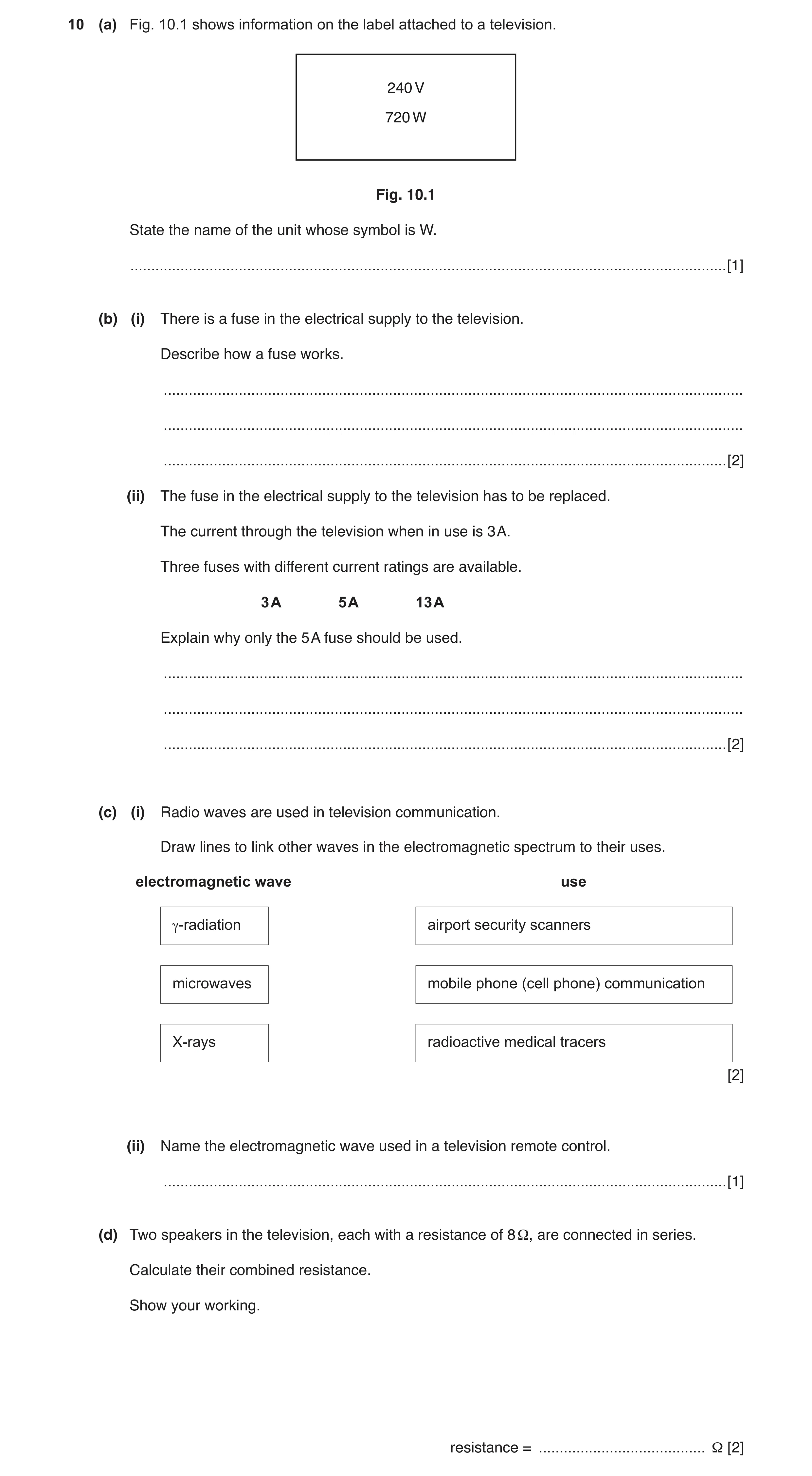
Q1 · Information on the label attached to a television 0654/32 May/June 2017
10 (a) Fig. 10.1 shows information on the label attached to a television. 240 V 720 W Fig. 10.1 State the name of the unit whose symbol is W. … [1] (b) (i) There is a fuse in the electrical supply to the television. Describe how a fuse works. … … … [2] (ii) The fuse in the electrical supply to the television has to be replaced. The current through the television when in use is 3 A. Three fuses with different current ratings are available. 3 A 5 A 13 A Explain why only the 5 A fuse should be used. … … … [2] (c) (i) Radio waves are used in television communication. Draw lines to link other waves in the electromagnetic spectrum to their uses. electromagnetic wave use γ-radiation airport security scanners microwaves mobile phone (cell phone) communication X-rays radioactive medical tracers [2] (ii) Name the electromagnetic wave used in a television remote control. … [1] (d) Two speakers in the television, each with a resistance of 8 Ω, are connected in series. Calculate their combined resistance. Show your working. resistance = … Ω [2]
10 marks
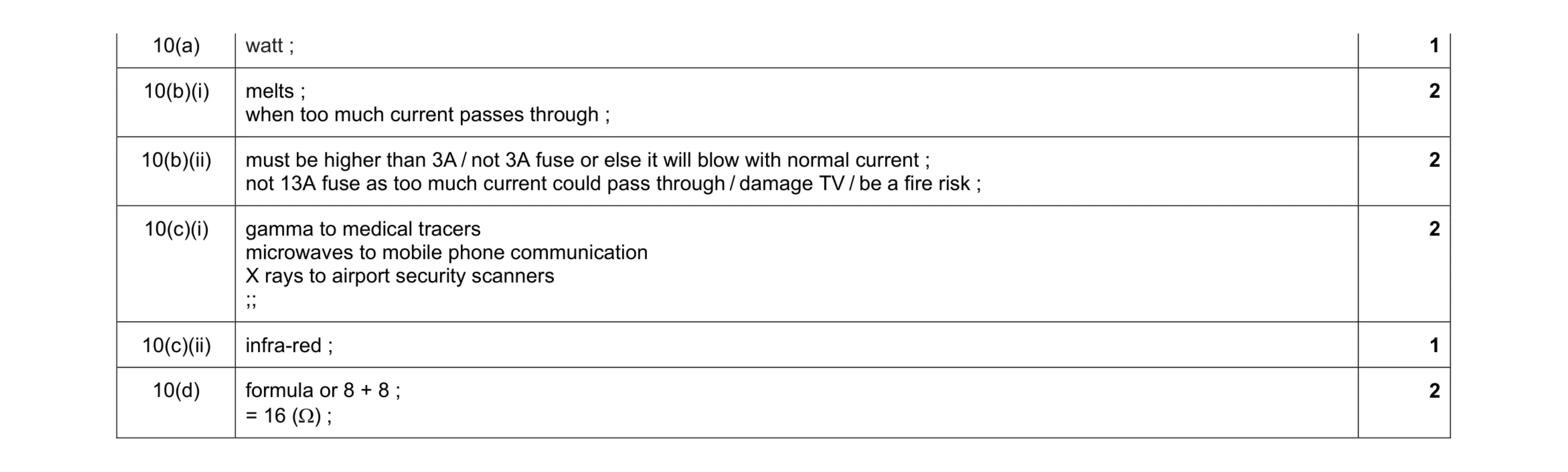
Mark scheme: 10(a) watt ; 1 10(b)(i) melts ; when too much current passes through ; 2 10(b)(ii) must be higher than 3A / not 3A fuse or else it will blow with normal current ; not 13A fuse as too much current could pass through / damage TV / be a fire risk ; 2 10(c)(i) gamma to medical tracers microwaves to mobile phone communication X rays to airport security scanners ;; 2 10(c)(ii) infra-red ; 1 10(d) formula or 8 + 8 ; = 16 (Ω) ; 2
This question in 0654/32 May/June 2017
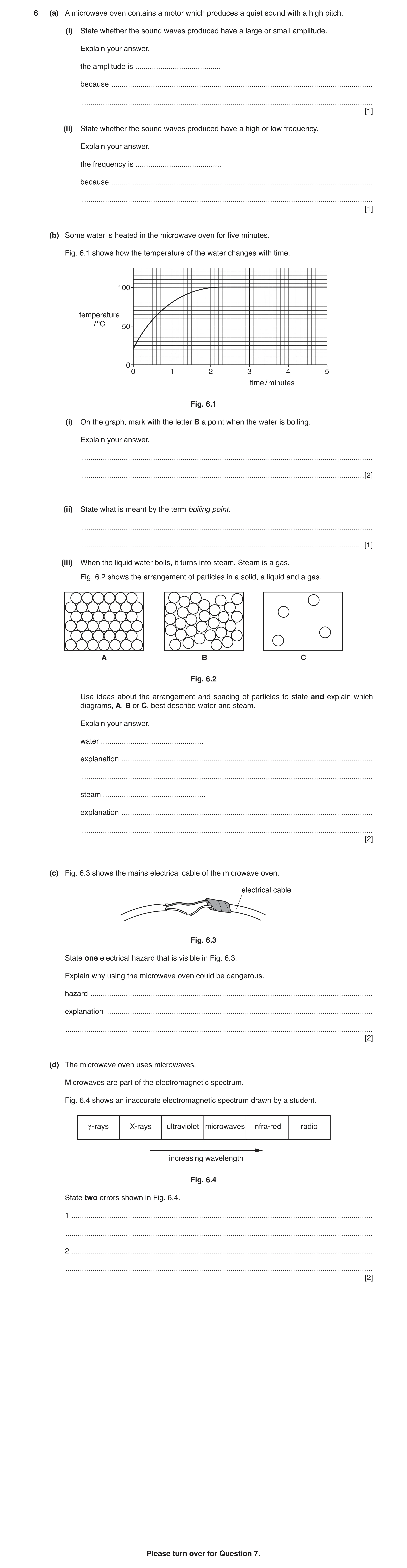
Q2 · A microwave oven contains a motor which produces a quiet sound with a high pitch 0654/32 Oct/Nov 2017
6 (a) A microwave oven contains a motor which produces a quiet sound with a high pitch. (i) State whether the sound waves produced have a large or small amplitude. Explain your answer. the amplitude is … because … … [1] (ii) State whether the sound waves produced have a high or low frequency. Explain your answer. the frequency is … because … … [1] (b) Some water is heated in the microwave oven for five minutes. Fig. 6.1 shows how the temperature of the water changes with time. 100 temperature / ºC 50 0 0 1 2 3 4 5 time / minutes Fig. 6.1 (i) On the graph, mark with the letter B a point when the water is boiling. Explain your answer. … … [2] (ii) State what is meant by the term boiling point. … … [1] (iii) When the liquid water boils, it turns into steam. Steam is a gas. Fig. 6.2 shows the arrangement of particles in a solid, a liquid and a gas. A B C Fig. 6.2 Use ideas about the arrangement and spacing of particles to state and explain which diagrams, A, B or C, best describe water and steam. Explain your answer. water … explanation … … steam … explanation … … [2] (c) Fig. 6.3 shows the mains electrical cable of the microwave oven. electrical cable Fig. 6.3 State one electrical hazard that is visible in Fig. 6.3. Explain why using the microwave oven could be dangerous. hazard … explanation … … [2] (d) The microwave oven uses microwaves. Microwaves are part of the electromagnetic spectrum. Fig. 6.4 shows an inaccurate electromagnetic spectrum drawn by a student. γ -rays X-rays ultraviolet microwaves infra-red radio increasing wavelength Fig. 6.4 State two errors shown in Fig. 6.4. 1 … … 2 … … [2] Please turn over for Question 7.
11 marks
Mark scheme: 6(a)(i) small amplitude because quiet noise / amplitude determines loudness ; 1 6(a)(ii) high frequency because high pitch / frequency determines pitch ; 1 6(b)(i) B anywhere from 2 minutes to 5 minutes ; temperature is constant when boiling / water boils at 100 o C ; 2 6(b)(ii) temperature at which a liquid boils / turns into a gas ; 1 6(b)(iii) water – B AND particles are close together / touching and randomly arranged ; steam – C AND particles are widely spaced / spread out (and randomly arranged) ; 2 6(c) cable broken / no insulation / wire exposed ; danger of electrocution / short circuit / electric shock / fire ; 2 6(d) visible light is missing ; microwaves and / or infra-red in wrong place / in each other’s place ; 2
This question in 0654/32 Oct/Nov 2017
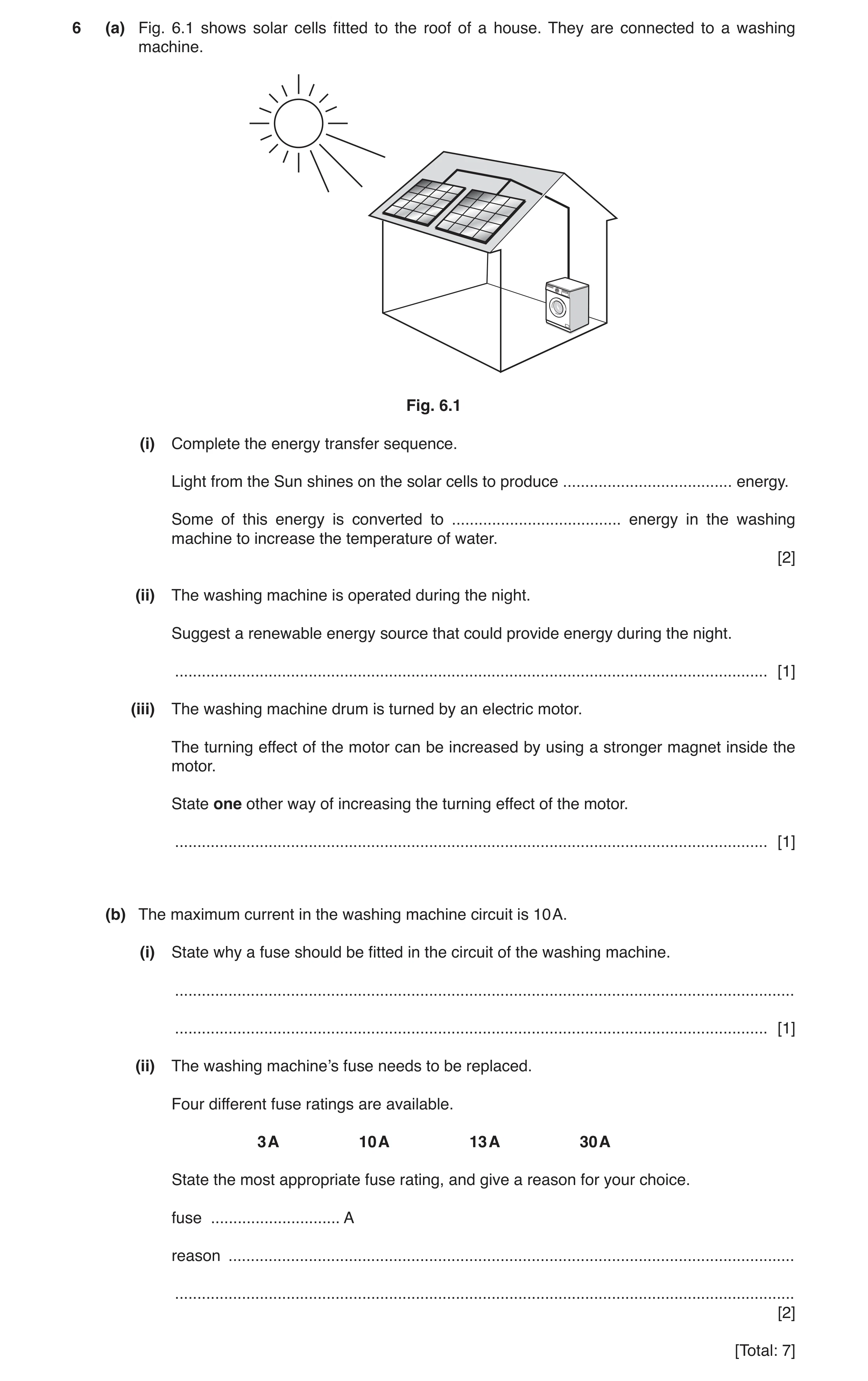
Q3 · Solar cells fitted to the roof of a house 0654/31 Oct/Nov 2019
6 (a) Fig. 6.1 shows solar cells fitted to the roof of a house. They are connected to a washing machine. Fig. 6.1 (i) Complete the energy transfer sequence. Light from the Sun shines on the solar cells to produce … energy. Some of this energy is converted to … energy in the washing machine to increase the temperature of water. [2] (ii) The washing machine is operated during the night. Suggest a renewable energy source that could provide energy during the night. … [1] (iii) The washing machine drum is turned by an electric motor. The turning effect of the motor can be increased by using a stronger magnet inside the motor. State one other way of increasing the turning effect of the motor. … [1] (b) The maximum current in the washing machine circuit is 10 A. (i) State why a fuse should be fitted in the circuit of the washing machine. … … [1] (ii) The washing machine’s fuse needs to be replaced. Four different fuse ratings are available. 3 A 10 A 13 A 30 A State the most appropriate fuse rating, and give a reason for your choice. fuse … A reason … … [2] [Total: 7]
7 marks
Mark scheme: 6(a)(i) electrical; thermal; 2 6(a)(ii) wind/geothermal/biomass; 1 6(a)(iii) increase the number of turns on the coil or increase the current; 1 6(b)(i) to protect the circuit/ to prevent fire/to prevent electrocution/to prevent overheating; 1 6(b)(ii) 13 amp; the fuse will stay intact in normal use and blow with a small increase of current or a 30 amp fuse will allow too much abnormal current to flow and the circuits could be damaged; 2
This question in 0654/31 Oct/Nov 2019
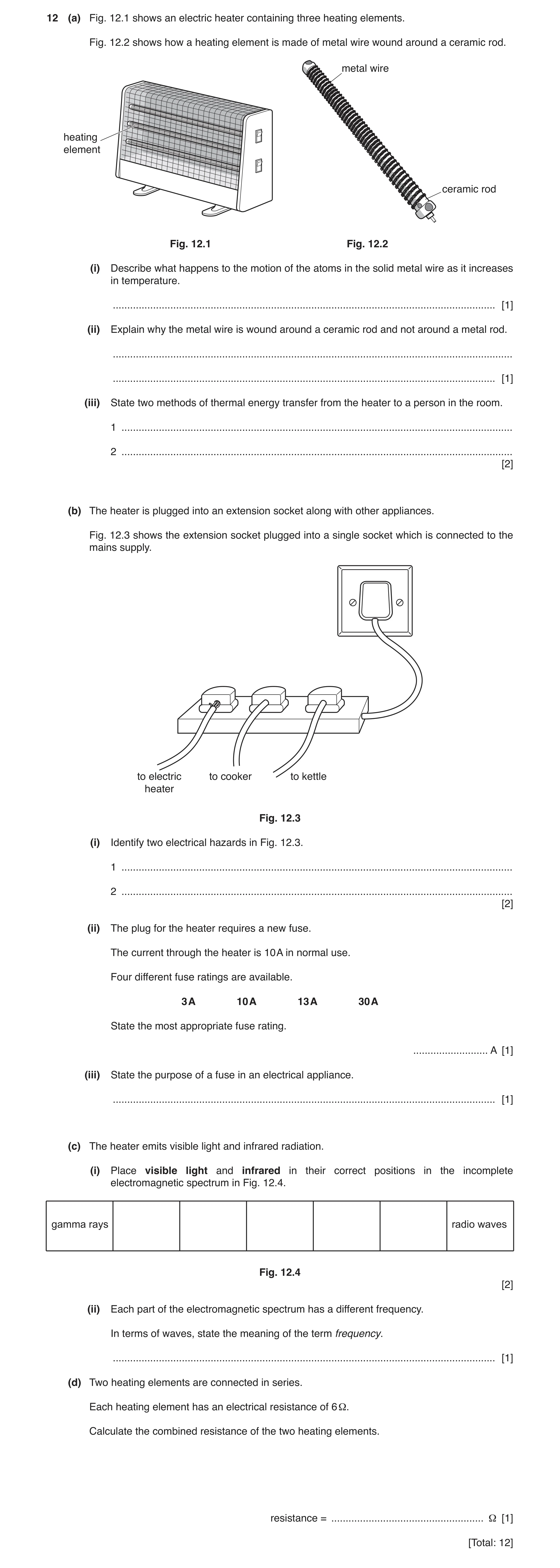
Q4 · An electric heater containing three heating elements 0654/33 Oct/Nov 2019
12 (a) Fig. 12.1 shows an electric heater containing three heating elements. Fig. 12.2 shows how a heating element is made of metal wire wound around a ceramic rod. metal wire heating element ceramic rod Fig. 12.1 Fig. 12.2 (i) Describe what happens to the motion of the atoms in the solid metal wire as it increases in temperature. … [1] (ii) Explain why the metal wire is wound around a ceramic rod and not around a metal rod. … … [1] (iii) State two methods of thermal energy transfer from the heater to a person in the room. 1 … 2 … [2] (b) The heater is plugged into an extension socket along with other appliances. Fig. 12.3 shows the extension socket plugged into a single socket which is connected to the mains supply. to electric to cooker to kettle heater Fig. 12.3 (i) Identify two electrical hazards in Fig. 12.3. 1 … 2 … [2] (ii) The plug for the heater requires a new fuse. The current through the heater is 10 A in normal use. Four different fuse ratings are available. 3 A 10 A 13 A 30 A State the most appropriate fuse rating. … A [1] (iii) State the purpose of a fuse in an electrical appliance. … [1] (c) The heater emits visible light and infrared radiation. (i) Place visible light and infrared in their correct positions in the incomplete electromagnetic spectrum in Fig. 12.4. gamma rays radio waves Fig. 12.4 [2] (ii) Each part of the electromagnetic spectrum has a different frequency. In terms of waves, state the meaning of the term frequency. … [1] (d) Two heating elements are connected in series. Each heating element has an electrical resistance of 6 Ω. Calculate the combined resistance of the two heating elements. resistance = … Ω [1] [Total: 12]
12 marks
Mark scheme: 12(a)(i) vibrate faster; 1 12(a)(ii) a metal rod would cause a short circuit / it is an electrical conductor; or ceramic rod would prevent short circuit / as it is an insulator ; max 1 1 12(a)(iii) convection; radiation; 2 12(b)(i) damaged cable / insulation (on cable to electric heater); overloaded socket / overheating of cables / overheating of plug (to mains socket); 2 12(b)(ii) 13; 1 12(b)(iii) to protect the electrical circuit, to provide electrical safety to the user; 1 12(c)(i) visible in middle box; infrared in 5th box; 2 12(c)(ii) number of waves (passing a point) per unit time; 1 12(d) 12 (Ω); 1
This question in 0654/33 Oct/Nov 2019
Q5 · A circuit containing a battery of 4 cells 0654/31 May/June 2020
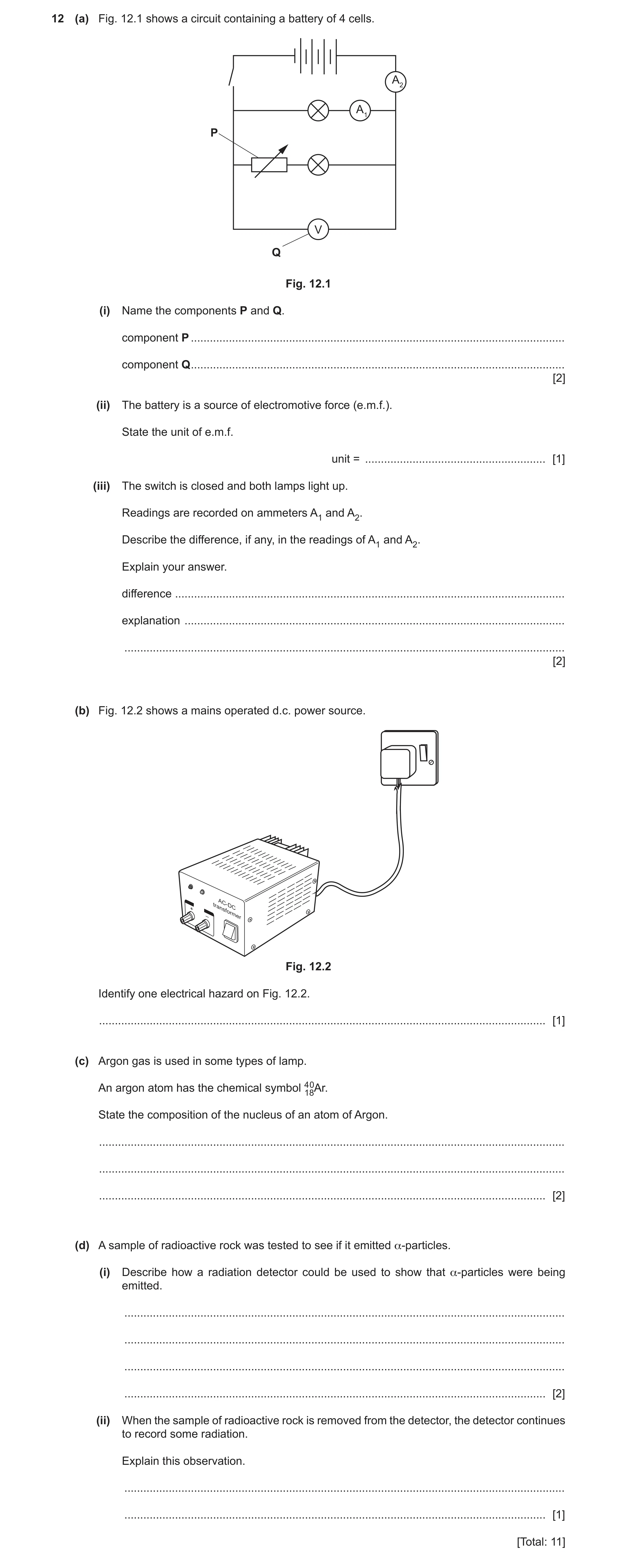
12 (a) Fig. 12.1 shows a circuit containing a battery of 4 cells. A2 A1 P V Q Fig. 12.1 (i) Name the components P and Q. component P … component Q … [2] (ii) The battery is a source of electromotive force (e.m.f.). State the unit of e.m.f. unit = … [1] (iii) The switch is closed and both lamps light up. Readings are recorded on ammeters A1 and A2. Describe the difference, if any, in the readings of A1 and A2. Explain your answer. difference … explanation … … [2] (b) Fig. 12.2 shows a mains operated d.c. power source. + AC-DC – transformer Fig. 12.2 Identify one electrical hazard on Fig. 12.2. … [1] (c) Argon gas is used in some types of lamp. An argon atom has the chemical symbol 41 8Ar.0 State the composition of the nucleus of an atom of Argon. … … … [2] (d) A sample of radioactive rock was tested to see if it emitted α-particles. (i) Describe how a radiation detector could be used to show that α-particles were being emitted. … … … … [2] (ii) When the sample of radioactive rock is removed from the detector, the detector continues to record some radiation. Explain this observation. … … [1] [Total: 11]
11 marks
Mark scheme: 12(a)(i) P – variable resistor; Q – voltmeter; 2 Question Answer Marks 12(a)(ii) volt; 1 12(a)(iii) ammeter 1 will be lower than ammeter 2; current from the source is larger than the current in each branch; 2 12(b) damaged cable, insulation damaged; 1 12(c) 18 protons ; 22 neutrons; 2 12(d)(i) counts recorded (without paper); put paper in front of sample to see if counts reduce ; 2 12(d)(ii) background radiation; 1
This question in 0654/31 May/June 2020
Q6 · The total current supplied to a television when in use is 3 A 0654/33 Oct/Nov 2021
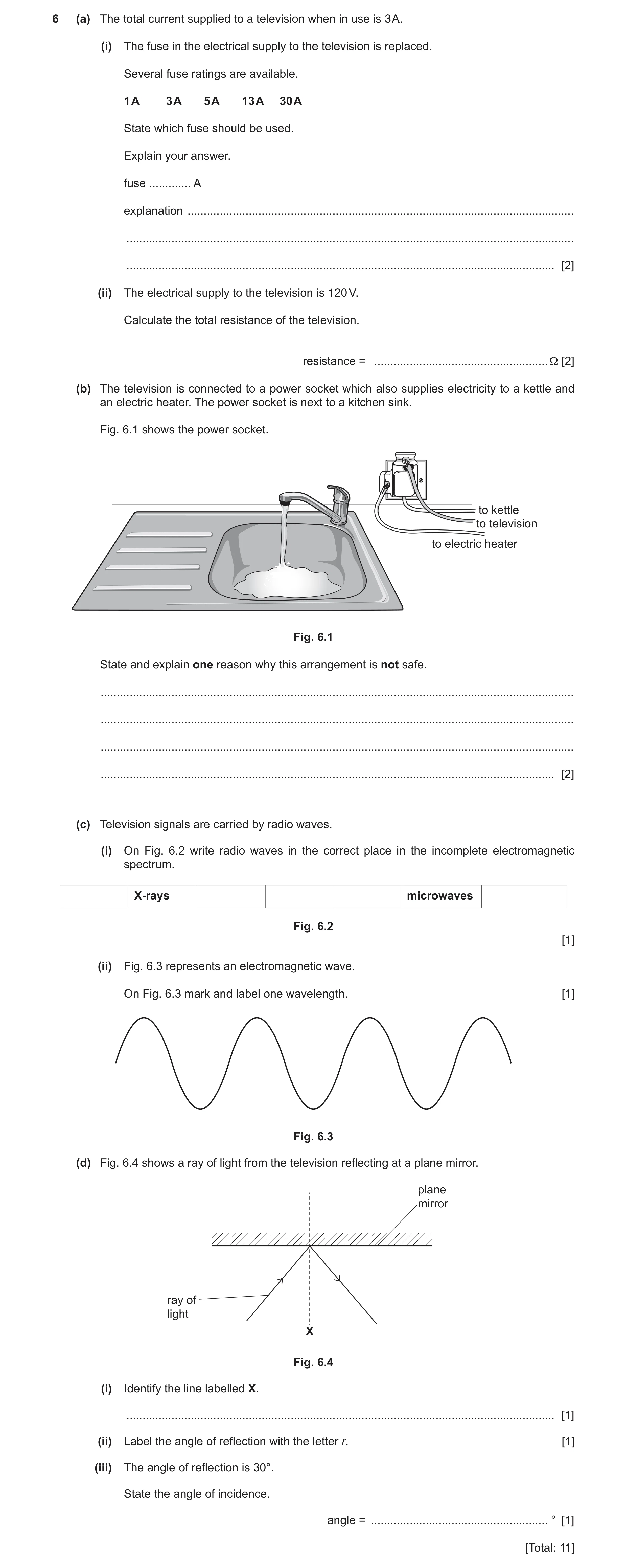
6 (a) The total current supplied to a television when in use is 3 A. (i) The fuse in the electrical supply to the television is replaced. Several fuse ratings are available. 1 A 3 A 5 A 13 A 30 A State which fuse should be used. Explain your answer. fuse … A explanation … … … [2] (ii) The electrical supply to the television is 120 V. Calculate the total resistance of the television. resistance = … Ω [2] (b) The television is connected to a power socket which also supplies electricity to a kettle and an electric heater. The power socket is next to a kitchen sink. Fig. 6.1 shows the power socket. to kettle to television to electric heater Fig. 6.1 State and explain one reason why this arrangement is not safe. … … … … [2] (c) Television signals are carried by radio waves. (i) On Fig. 6.2 write radio waves in the correct place in the incomplete electromagnetic spectrum. X-rays microwaves Fig. 6.2 [1] (ii) Fig. 6.3 represents an electromagnetic wave. On Fig. 6.3 mark and label one wavelength. [1] Fig. 6.3 (d) Fig. 6.4 shows a ray of light from the television reflecting at a plane mirror. plane mirror ray of light X Fig. 6.4 (i) Identify the line labelled X. … [1] (ii) Label the angle of reflection with the letter r. [1] (iii) The angle of reflection is 30°. State the angle of incidence. angle = … ° [1] [Total: 11]
11 marks
Mark scheme: 6(a)(i) 5 (A) ; smallest rating above working current ; 2 6(a)(ii) R = V / I or 120 / 3 ; 40 (Ω) ; 2 6(b) insulation broken or missing ; fire hazard / overheating ; or socket overloaded ; fire hazard / overheating ; or socket too close to water ; danger of electrocution ; 2 6(c)(i) radio waves in right hand box ; 1 6(c)(ii) peak to peak / trough to trough / equivalent ; 1 6(d)(i) normal ; 1 6(d)(ii) between ray and normal ; 1 6(d)(iii) 30° ; 1
This question in 0654/33 Oct/Nov 2021
Q7 · A room in a house has an electric heater 0654/32 Feb/March 2023
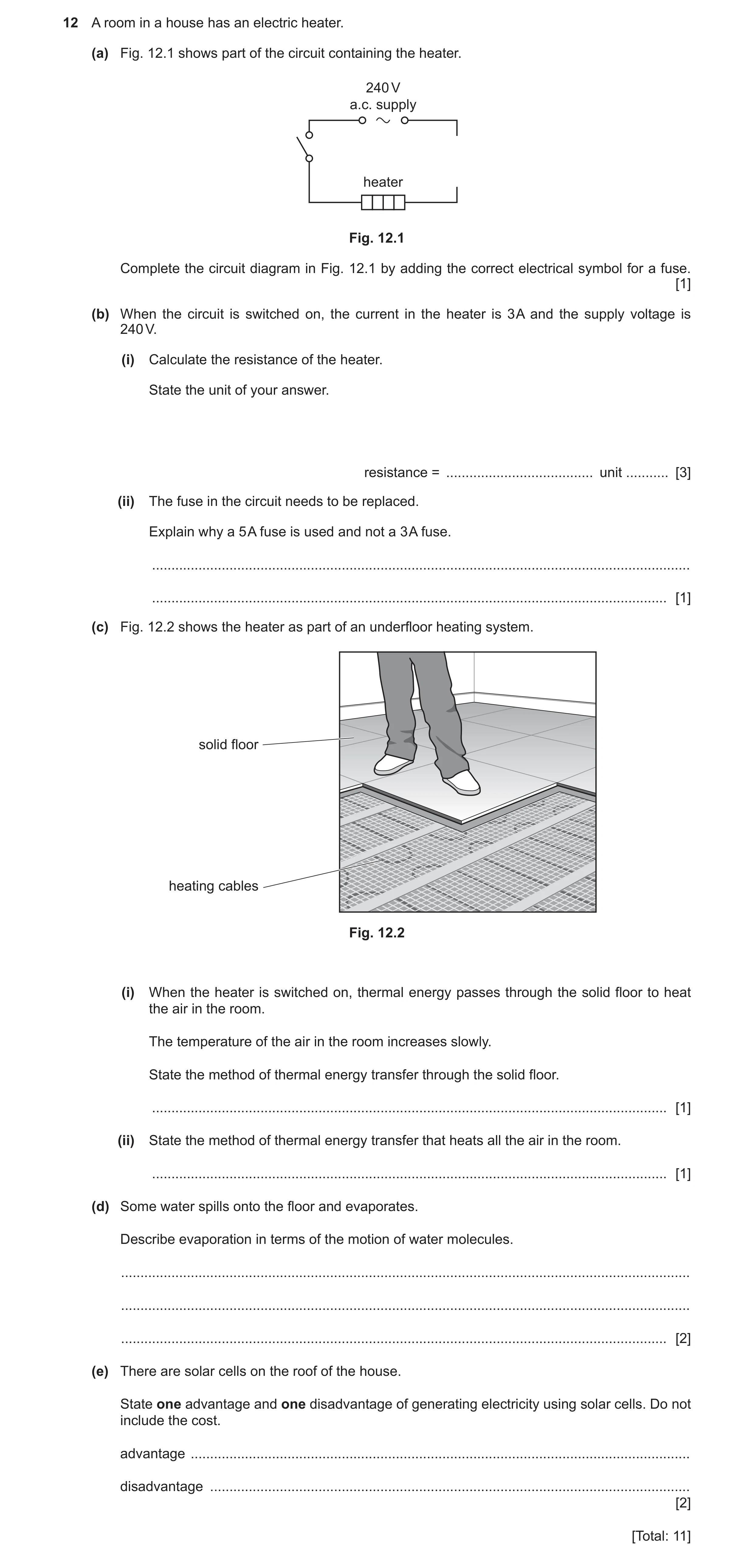
12 A room in a house has an electric heater. (a) Fig. 12.1 shows part of the circuit containing the heater. 240 V a.c. supply heater Fig. 12.1 Complete the circuit diagram in Fig. 12.1 by adding the correct electrical symbol for a fuse. [1] (b) When the circuit is switched on, the current in the heater is 3 A and the supply voltage is 240 V. (i) Calculate the resistance of the heater. State the unit of your answer. resistance = … unit … [3] (ii) The fuse in the circuit needs to be replaced. Explain why a 5 A fuse is used and not a 3 A fuse. … … [1] (c) Fig. 12.2 shows the heater as part of an underfloor heating system. solid floor heating cables Fig. 12.2 (i) When the heater is switched on, thermal energy passes through the solid floor to heat the air in the room. The temperature of the air in the room increases slowly. State the method of thermal energy transfer through the solid floor. … [1] (ii) State the method of thermal energy transfer that heats all the air in the room. … [1] (d) Some water spills onto the floor and evaporates. Describe evaporation in terms of the motion of water molecules. … … … [2] (e) There are solar cells on the roof of the house. State one advantage and one disadvantage of generating electricity using solar cells. Do not include the cost. advantage … disadvantage … [2] [Total: 11]
11 marks
Mark scheme: 12(a) fuse inserted in gap using the correct symbol ; 1 12(b)(i) evidence of resistance = voltage / current (in any form) or 240 / 3 ; 3 = 80 ; / ohms ; 12(b)(ii) fuse needs to be slightly greater than maximum current (or it would blow in normal use) ; 1 12(c)(i) conduction ; 1 12(c)(ii) convection ; 1 12(d) faster moving / most energetic molecules (leave) ; 2 (leave) from the surface of the liquid ; 12(e) renewable energy / does not produce CO2 etc ; 2 need sunlight / only works during the day etc ;
This question in 0654/32 Feb/March 2023
Q8 · How the energy transfers in a television when 100 J of electrical energy are supplied 0654/32 Oct/Nov 2023
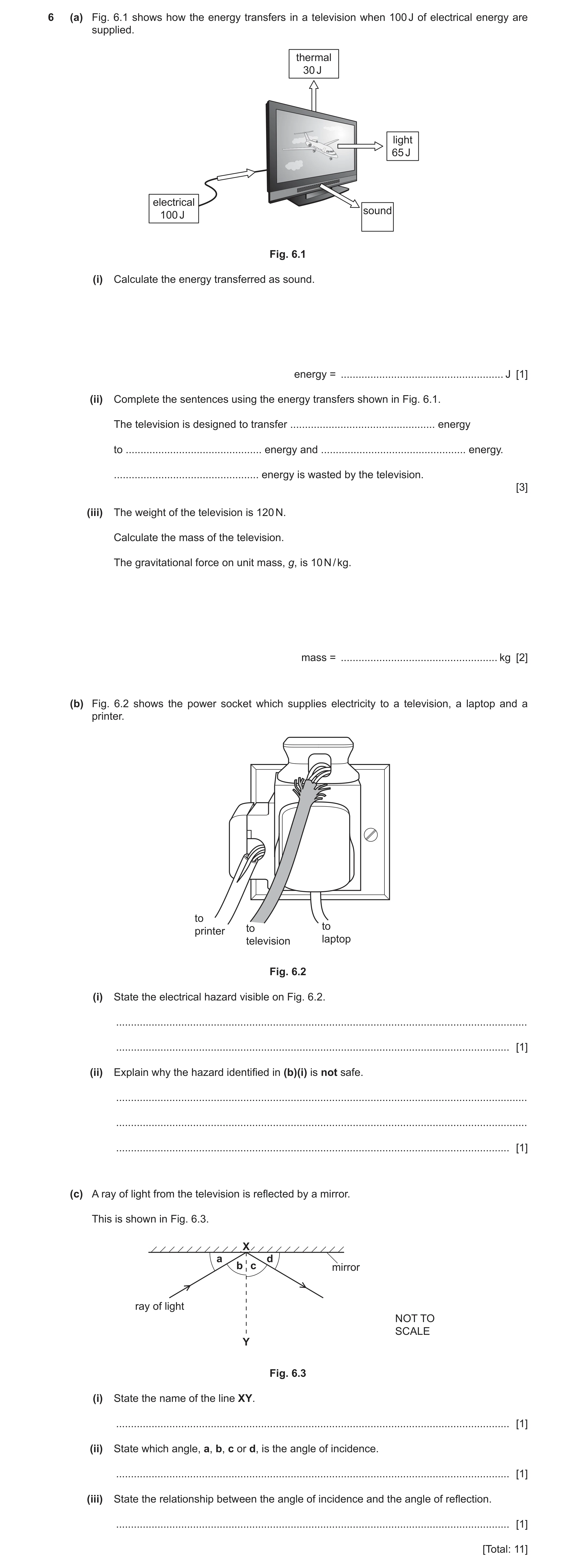
6 (a) Fig. 6.1 shows how the energy transfers in a television when 100 J of electrical energy are supplied. thermal 30 J light 65 J electrical sound 100 J Fig. 6.1 (i) Calculate the energy transferred as sound. energy = … J [1] (ii) Complete the sentences using the energy transfers shown in Fig. 6.1. The television is designed to transfer … energy to … energy and … energy. … energy is wasted by the television. [3] (iii) The weight of the television is 120 N. Calculate the mass of the television. The gravitational force on unit mass, g, is 10 N / kg. mass = … kg [2] (b) Fig. 6.2 shows the power socket which supplies electricity to a television, a laptop and a printer. to printer to to television laptop Fig. 6.2 (i) State the electrical hazard visible on Fig. 6.2. … … [1] (ii) Explain why the hazard identified in (b)(i) is not safe. … … … [1] (c) A ray of light from the television is reflected by a mirror. This is shown in Fig. 6.3. X a d b c mirror ray of light NOT TO SCALE Y Fig. 6.3 (i) State the name of the line XY. … [1] (ii) State which angle, a, b, c or d, is the angle of incidence. … [1] (iii) State the relationship between the angle of incidence and the angle of reflection. … [1] [Total: 11]
11 marks
Mark scheme: 6(a)(i) 5 (J) ; 1 6(a)(ii) electrical ; 3 light and sound ; thermal ; 6(a)(iii) weight = mass g (in any form) or mass = 120 ÷ 10 ; 2 = 12 (kg) ; 6(b)(i) frayed cables ; 1 6(b)(ii) danger of electrocution / short circuit ; 1 6(c)(i) normal ; 1 6(c)(ii) b ; 1 6(c)(iii) angle of incidence equals angle of reflection ; 1
This question in 0654/32 Oct/Nov 2023
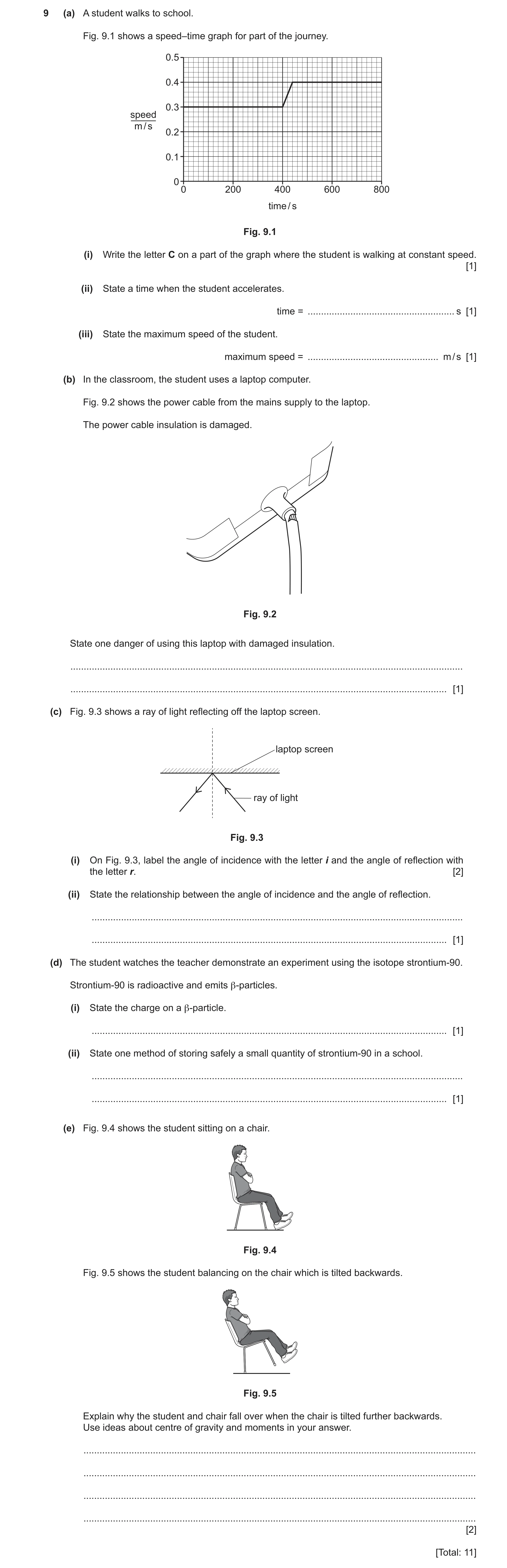
Q9 · A student walks to school 0654/32 Feb/March 2025
9 (a) A student walks to school. Fig. 9.1 shows a speed–time graph for part of the journey. 0.5 0.4 0.3 speed m / s 0.2 0.1 0 0 200 400 600 800 time / s Fig. 9.1 (i) Write the letter C on a part of the graph where the student is walking at constant speed. [1] (ii) State a time when the student accelerates. time = … s [1] (iii) State the maximum speed of the student. maximum speed = … m / s [1] (b) In the classroom, the student uses a laptop computer. Fig. 9.2 shows the power cable from the mains supply to the laptop. The power cable insulation is damaged. Fig. 9.2 State one danger of using this laptop with damaged insulation. … … [1] (c) Fig. 9.3 shows a ray of light reflecting off the laptop screen. laptop screen ray of light Fig. 9.3 (i) On Fig. 9.3, label the angle of incidence with the letter i and the angle of reflection with the letter r. [2] (ii) State the relationship between the angle of incidence and the angle of reflection. … … [1] (d) The student watches the teacher demonstrate an experiment using the isotope strontium-90. Strontium-90 is radioactive and emits β-particles. (i) State the charge on a β-particle. … [1] (ii) State one method of storing safely a small quantity of strontium-90 in a school. … … [1] (e) Fig. 9.4 shows the student sitting on a chair. Fig. 9.4 Fig. 9.5 shows the student balancing on the chair which is tilted backwards. Fig. 9.5 Explain why the student and chair fall over when the chair is tilted further backwards. Use ideas about centre of gravity and moments in your answer. … … … … [2] [Total: 11]
11 marks
Mark scheme: 9(a)(i) C anywhere between t = 0 and t = 400 or between t = 440 and t = 800 ; 1 9(a)(ii) anywhere from t = 400(s) to t = 440(s) ; 1 9(a)(iii) 0.4 (m / s) ; 1 9(b) electrocution/electric shock; 1 9(c)(i) i indicated correctly on the figure ; 2 r indicated correctly on the figure ; 9(c)(ii) angle of incidence = angle of reflection ; 1 9(d)(i) negative/minus 1 / – ; 1 9(d)(ii) in lead container ; 1 9(e) centre of gravity is not over the base ; 2 moment produced (by weight) ;
This question in 0654/32 Feb/March 2025
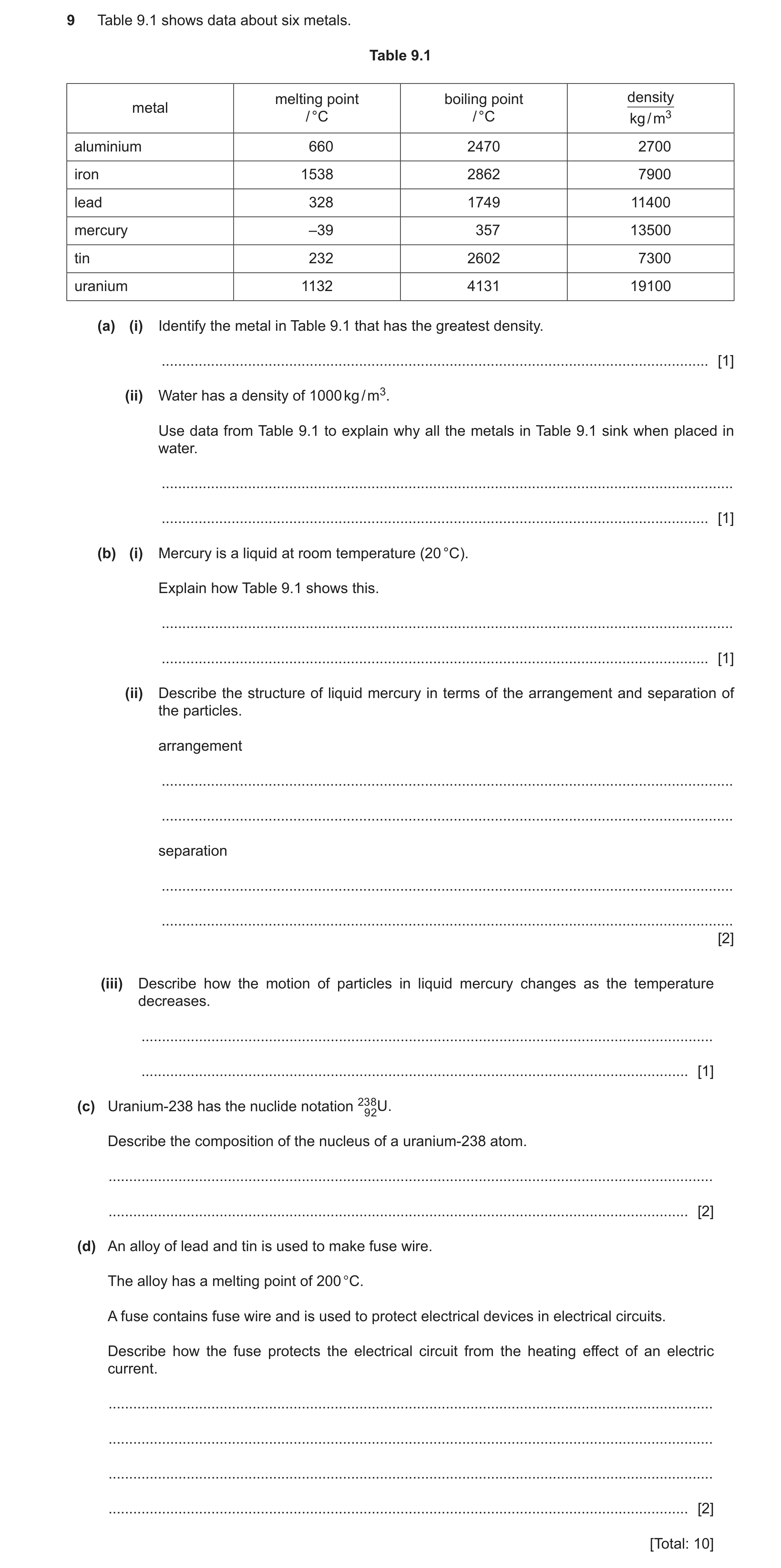
Q10 · Data about six metals 0654/31 Oct/Nov 2025
9 Table 9.1 shows data about six metals. Table 9.1 melting point boiling point density metal / °C / °C kg / m3 aluminium 660 2470 2700 iron 1538 2862 7900 lead 328 1749 11400 mercury –39 357 13500 tin 232 2602 7300 uranium 1132 4131 19100 (a) (i) Identify the metal in Table 9.1 that has the greatest density. … [1] (ii) Water has a density of 1000 kg / m3. Use data from Table 9.1 to explain why all the metals in Table 9.1 sink when placed in water. … … [1] (b) (i) Mercury is a liquid at room temperature (20 °C). Explain how Table 9.1 shows this. … … [1] (ii) Describe the structure of liquid mercury in terms of the arrangement and separation of the particles. arrangement … … separation … … [2] (iii) Describe how the motion of particles in liquid mercury changes as the temperature decreases. … … [1] (c) Uranium-238 has the nuclide notation 23 8 9 2U. Describe the composition of the nucleus of a uranium-238 atom. … … [2] (d) An alloy of lead and tin is used to make fuse wire. The alloy has a melting point of 200 °C. A fuse contains fuse wire and is used to protect electrical devices in electrical circuits. Describe how the fuse protects the electrical circuit from the heating effect of an electric current. … … … … [2] [Total: 10]
10 marks
Mark scheme: 9(a)(i) uranium ; 1 9(a)(ii) (all the metals) have a density greater than water / (all the metals) have a density greater than 1000 (kg / m3) ; 1 9(b)(i) melting point is below 20 °C and boiling point is above 20 °C ; 1 9(b)(ii) irregular / random ; 2 close together / most touching ; 9(b)(iii) (move) more slowly 1 9(c) 92 protons ; 2 146 neutrons ; 9(d) any two from: 2 • if too much current ; • fuse wire melts ; • breaks circuit ;
This question in 0654/31 Oct/Nov 2025
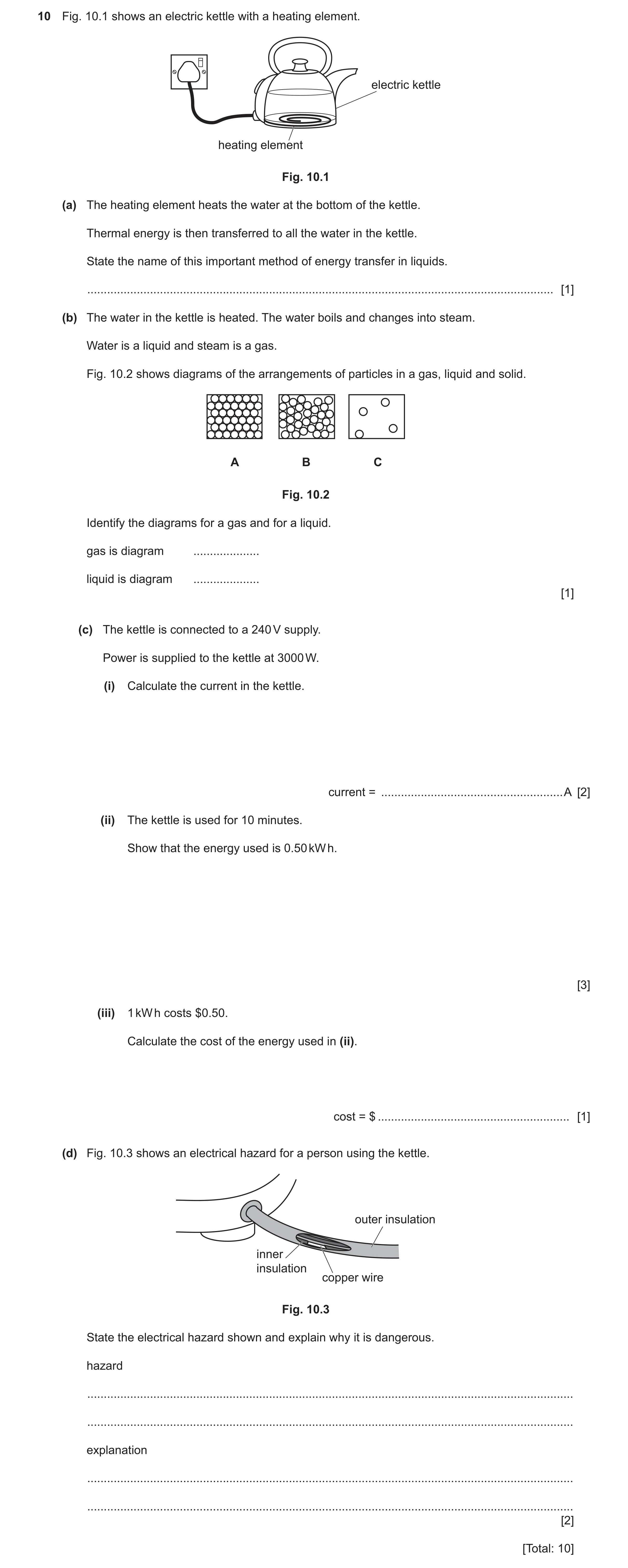
Q11 · An electric kettle with a heating element 0654/32 Oct/Nov 2025
10 Fig. 10.1 shows an electric kettle with a heating element. electric kettle heating element Fig. 10.1 (a) The heating element heats the water at the bottom of the kettle. Thermal energy is then transferred to all the water in the kettle. State the name of this important method of energy transfer in liquids. … [1] (b) The water in the kettle is heated. The water boils and changes into steam. Water is a liquid and steam is a gas. Fig. 10.2 shows diagrams of the arrangements of particles in a gas, liquid and solid. A B C Fig. 10.2 Identify the diagrams for a gas and for a liquid. gas is diagram … liquid is diagram … [1] (c) The kettle is connected to a 240 V supply. Power is supplied to the kettle at 3000 W. (i) Calculate the current in the kettle. current = … A [2] (ii) The kettle is used for 10 minutes. Show that the energy used is 0.50 kW h. [3] (iii) 1 kW h costs $0.50. Calculate the cost of the energy used in (ii). cost = $ … [1] (d) Fig. 10.3 shows an electrical hazard for a person using the kettle. outer insulation inner insulation copper wire Fig. 10.3 State the electrical hazard shown and explain why it is dangerous. hazard … … explanation … … [2] [Total: 10]
10 marks
Mark scheme: 10(a) convection ; 1 10(b) (gas is diagram) C and (liquid is diagram) B ; 1 10(c)(i) P = IV (in any form) 2 OR (current =) 3000 / 240 ; 12.5 (A) ; 10(c)(ii) energy = power time (in any form) ; 3 conversion of minutes to hours ; conversion of W to kW ; (= 0.5 kWh) 10(c)(iii) ($) 0.25 ; 1 10(d) insulation damaged / exposed (live) wire / AW ; 2 electric shock ;
This question in 0654/32 Oct/Nov 2025
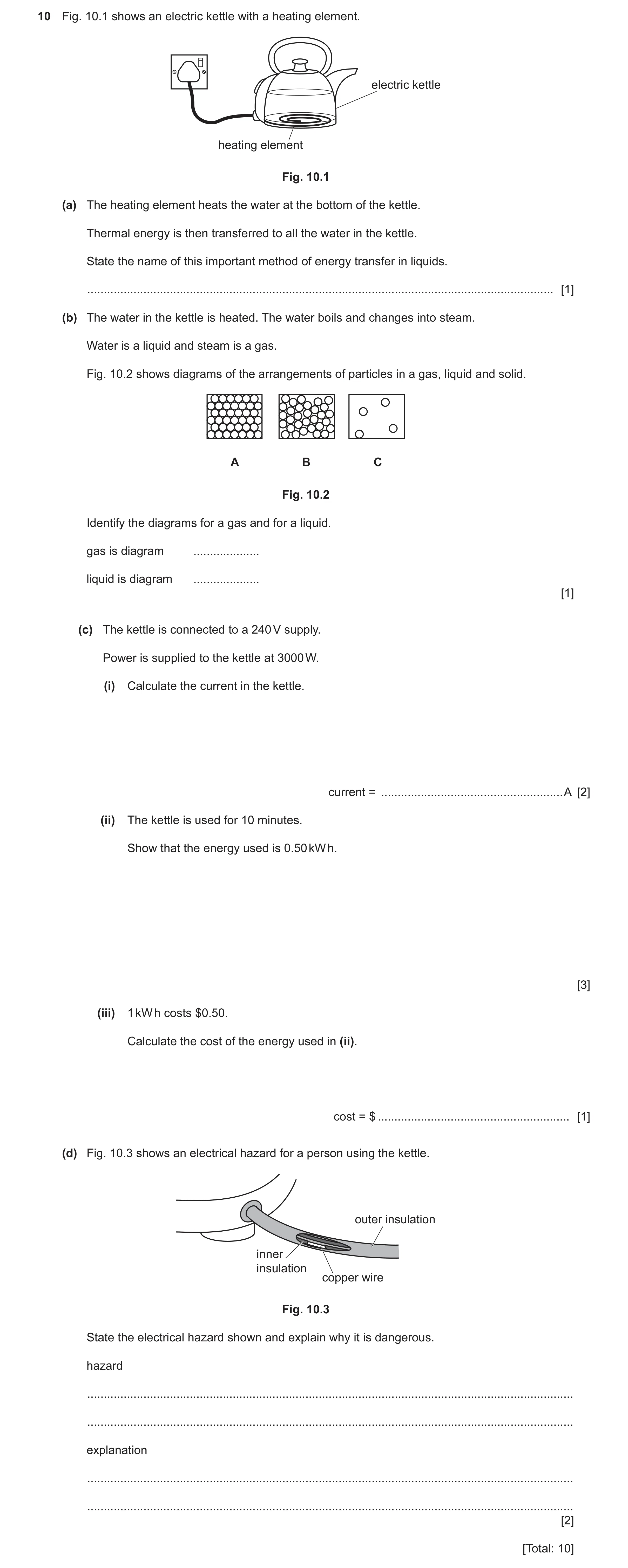
Q12 · An electric kettle with a heating element 0654/33 Oct/Nov 2025
10 Fig. 10.1 shows an electric kettle with a heating element. electric kettle heating element Fig. 10.1 (a) The heating element heats the water at the bottom of the kettle. Thermal energy is then transferred to all the water in the kettle. State the name of this important method of energy transfer in liquids. … [1] (b) The water in the kettle is heated. The water boils and changes into steam. Water is a liquid and steam is a gas. Fig. 10.2 shows diagrams of the arrangements of particles in a gas, liquid and solid. A B C Fig. 10.2 Identify the diagrams for a gas and for a liquid. gas is diagram … liquid is diagram … [1] (c) The kettle is connected to a 240 V supply. Power is supplied to the kettle at 3000 W. (i) Calculate the current in the kettle. current = … A [2] (ii) The kettle is used for 10 minutes. Show that the energy used is 0.50 kW h. [3] (iii) 1 kW h costs $0.50. Calculate the cost of the energy used in (ii). cost = $ … [1] (d) Fig. 10.3 shows an electrical hazard for a person using the kettle. outer insulation inner insulation copper wire Fig. 10.3 State the electrical hazard shown and explain why it is dangerous. hazard … … explanation … … [2] [Total: 10]
10 marks
Mark scheme: 10(a) convection ; 1 10(b) (gas is diagram) C and (liquid is diagram) B ; 1 10(c)(i) P = IV (in any form) 2 OR (current =) 3000 / 240 ; 12.5 (A) ; 10(c)(ii) energy = power time (in any form) ; 3 conversion of minutes to hours ; conversion of W to kW ; (= 0.5 kWh) 10(c)(iii) ($) 0.25 ; 1 10(d) insulation damaged / exposed (live) wire / AW ; 2 electric shock ;
This question in 0654/33 Oct/Nov 2025
 10
10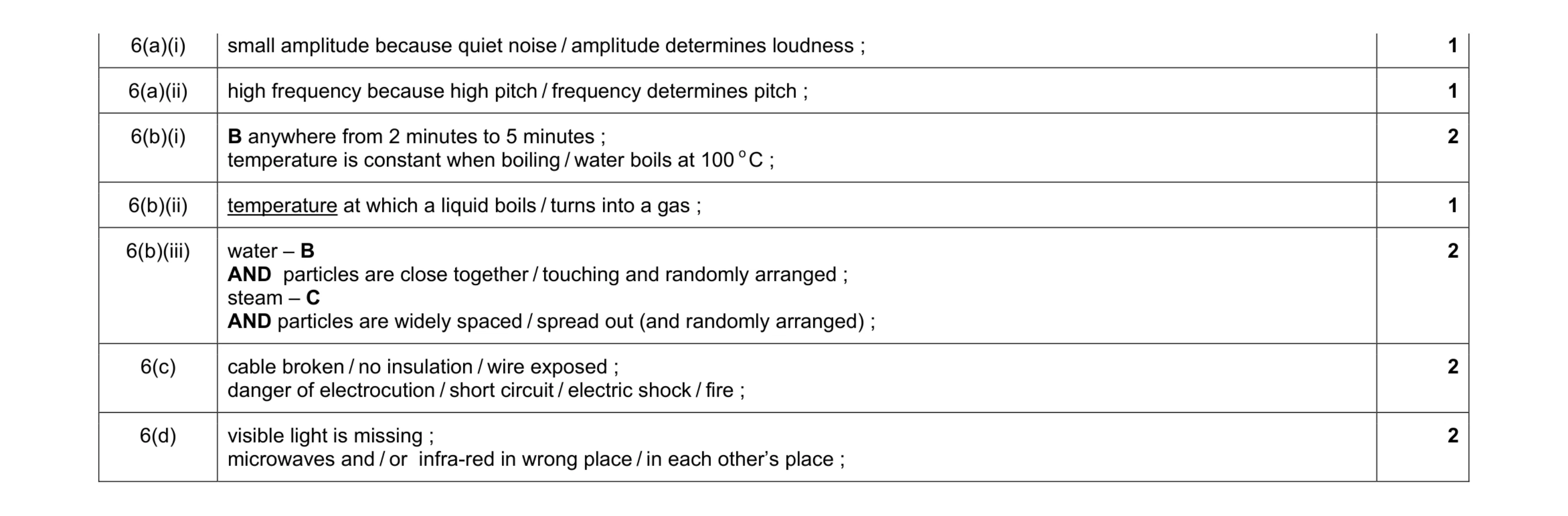 11
11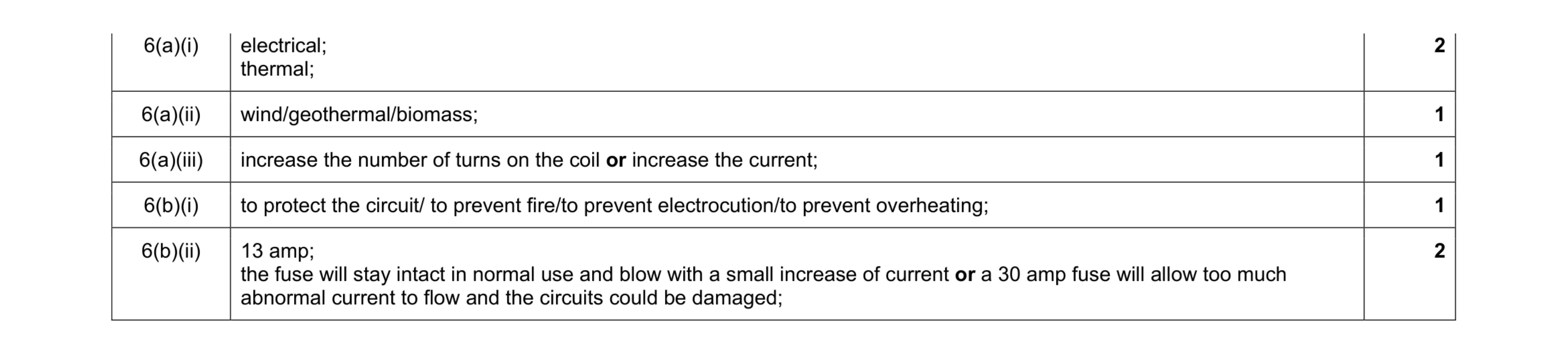 7
7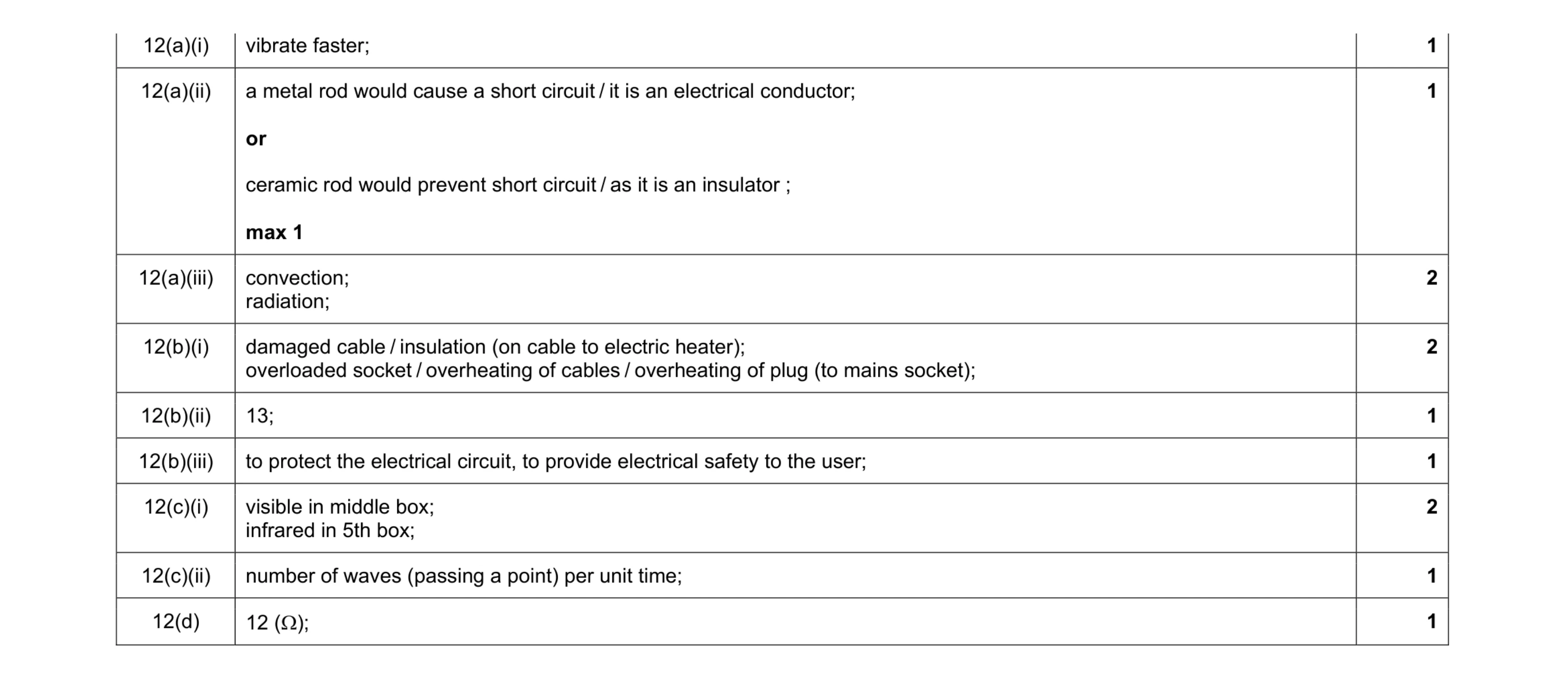 12
12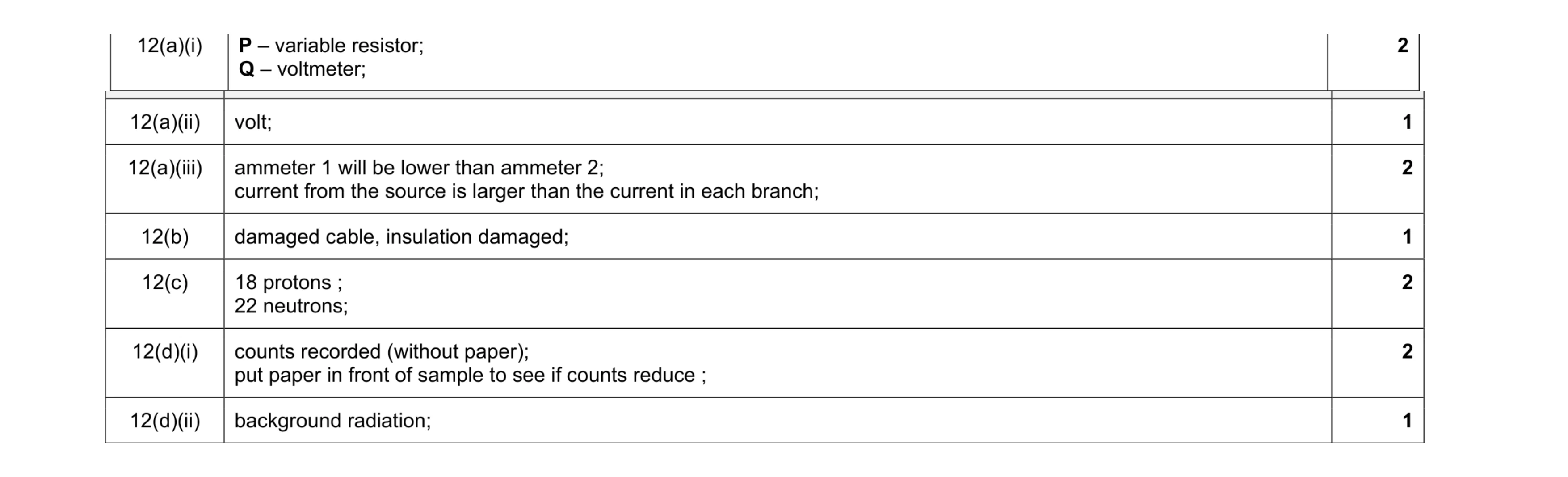 11
11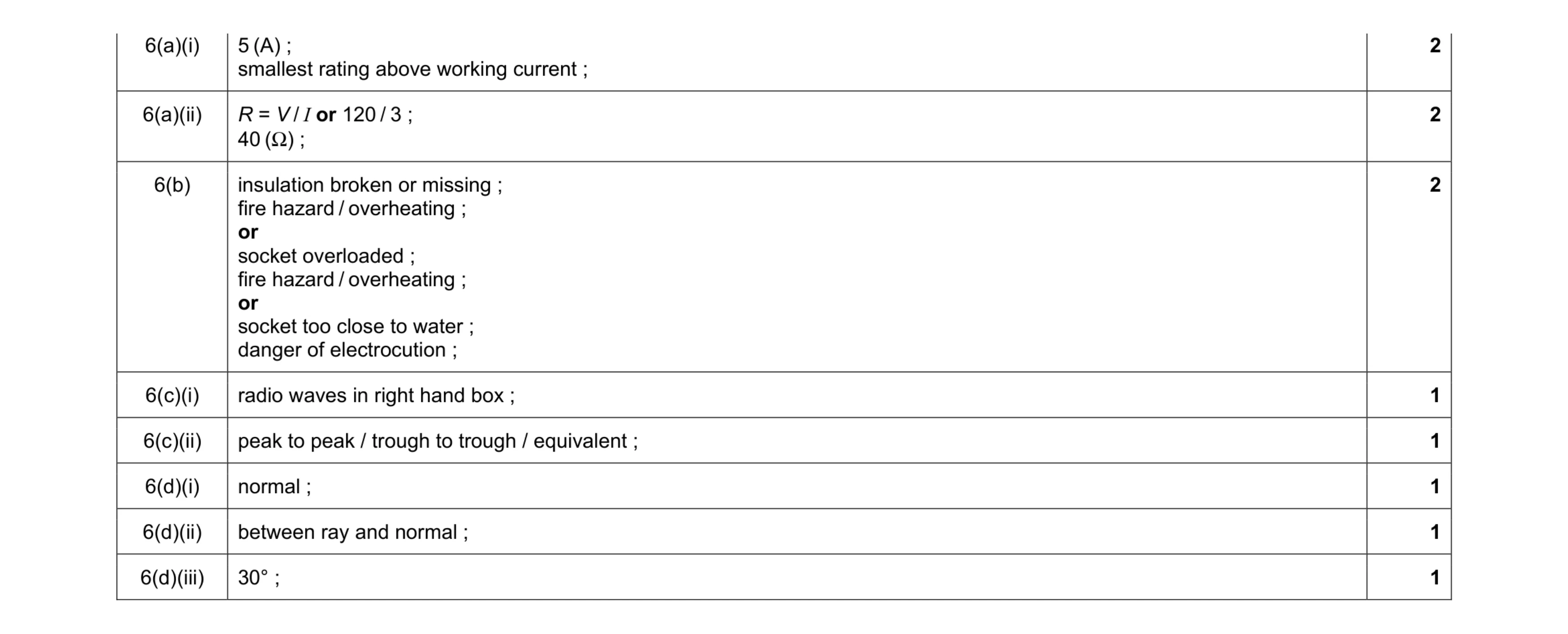 11
11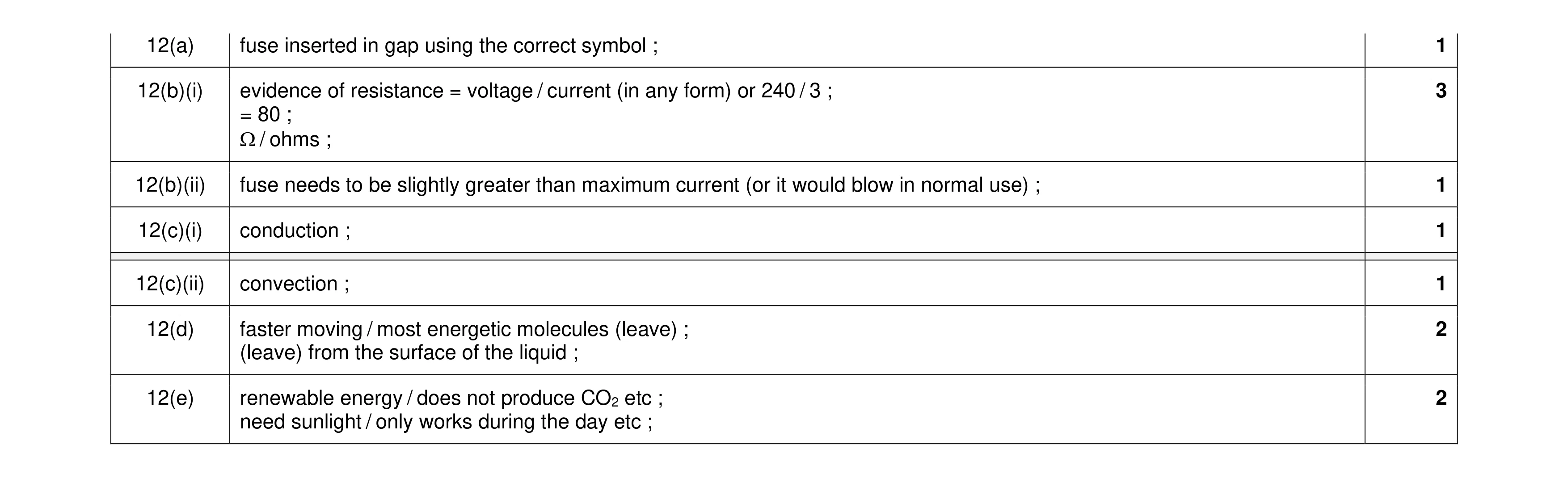 11
11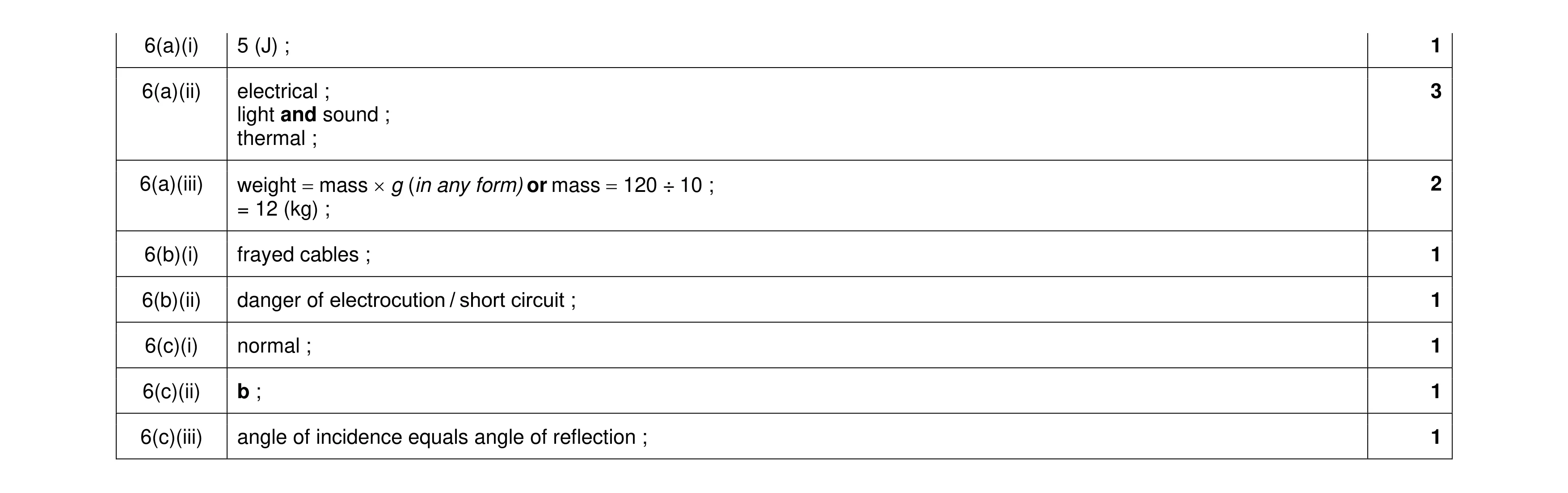 11
11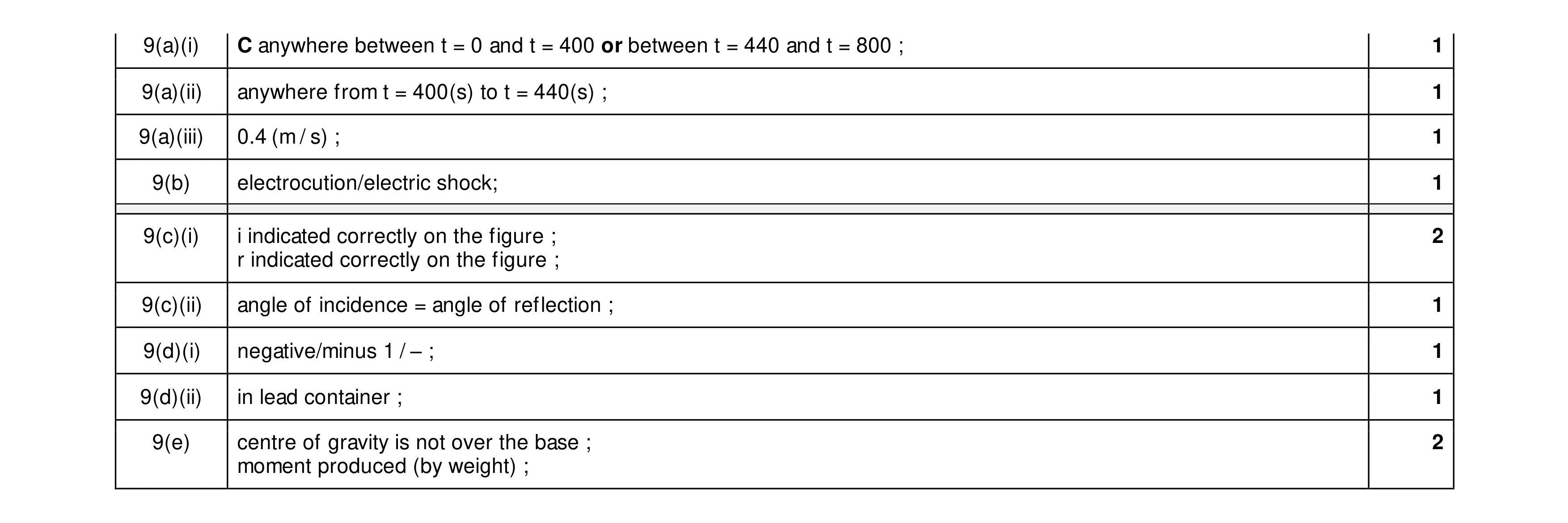 11
11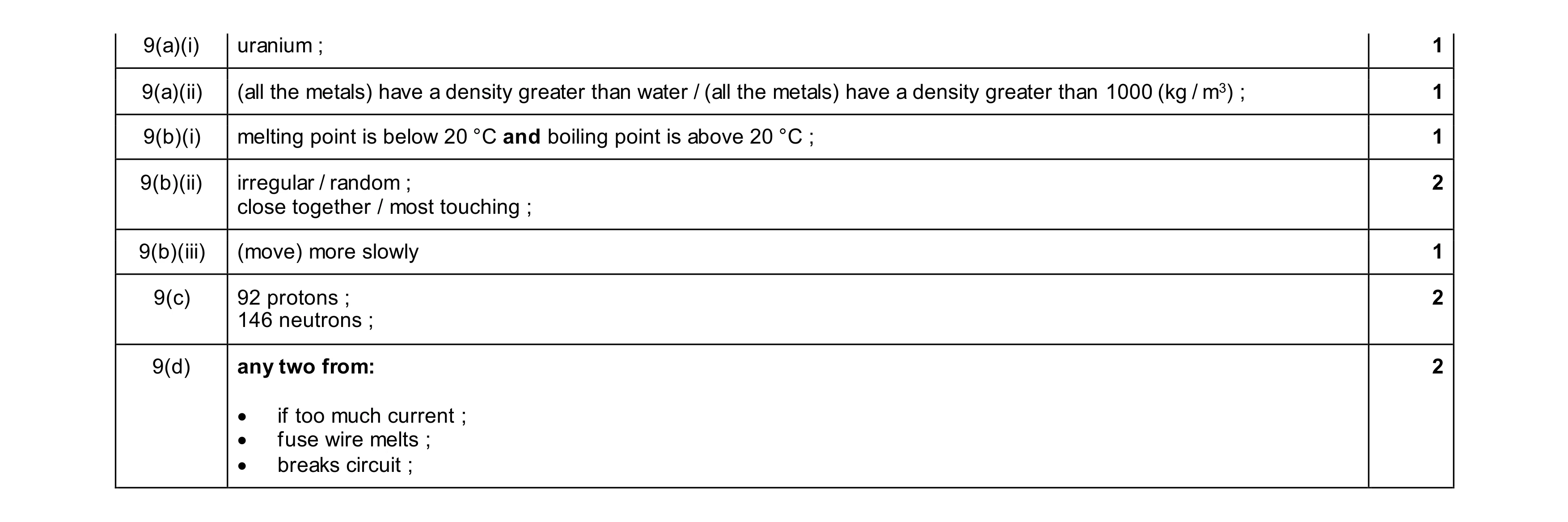 10
10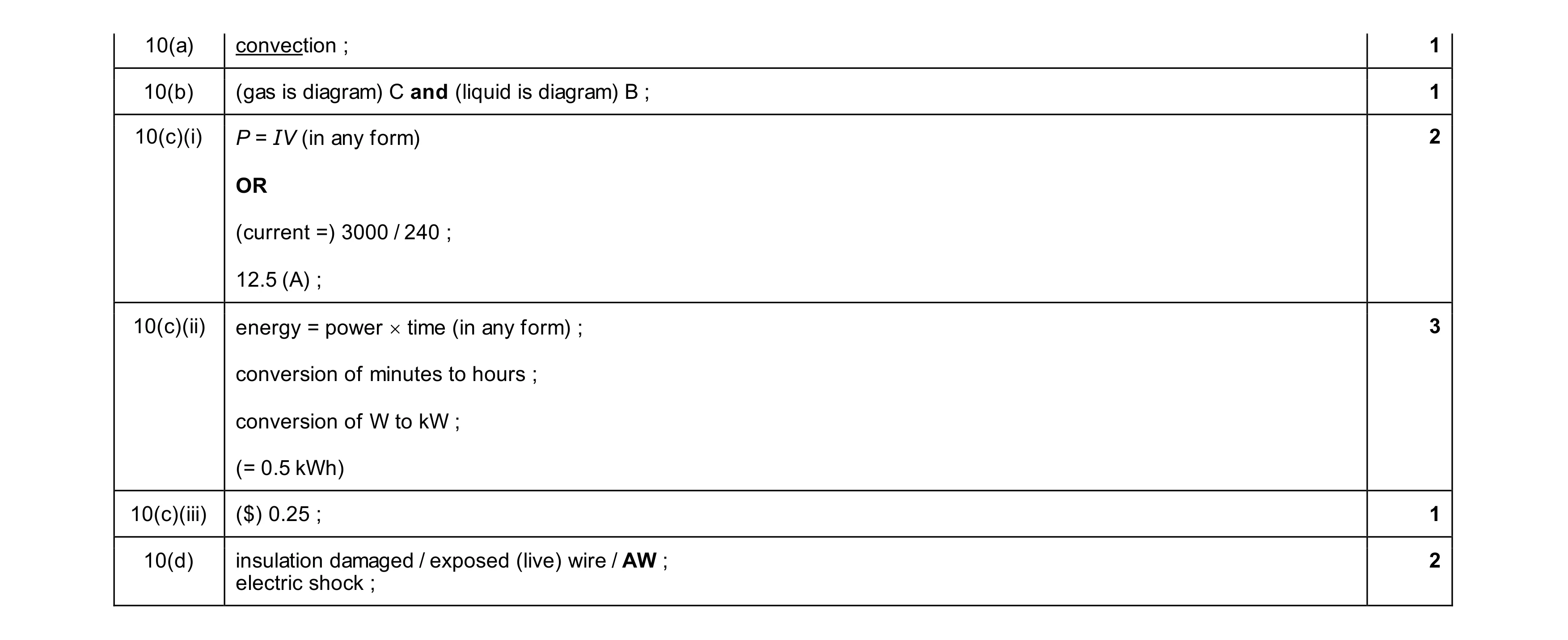 10
10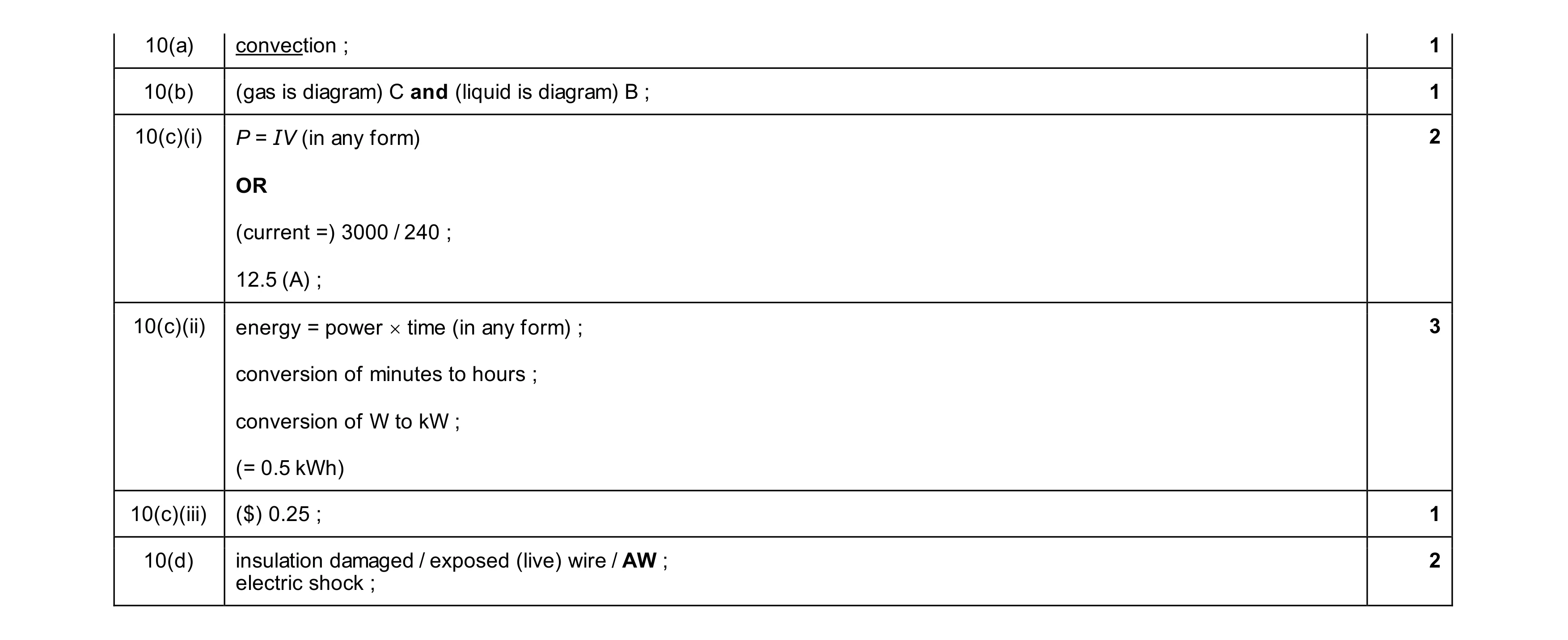 10
10