Questions as text
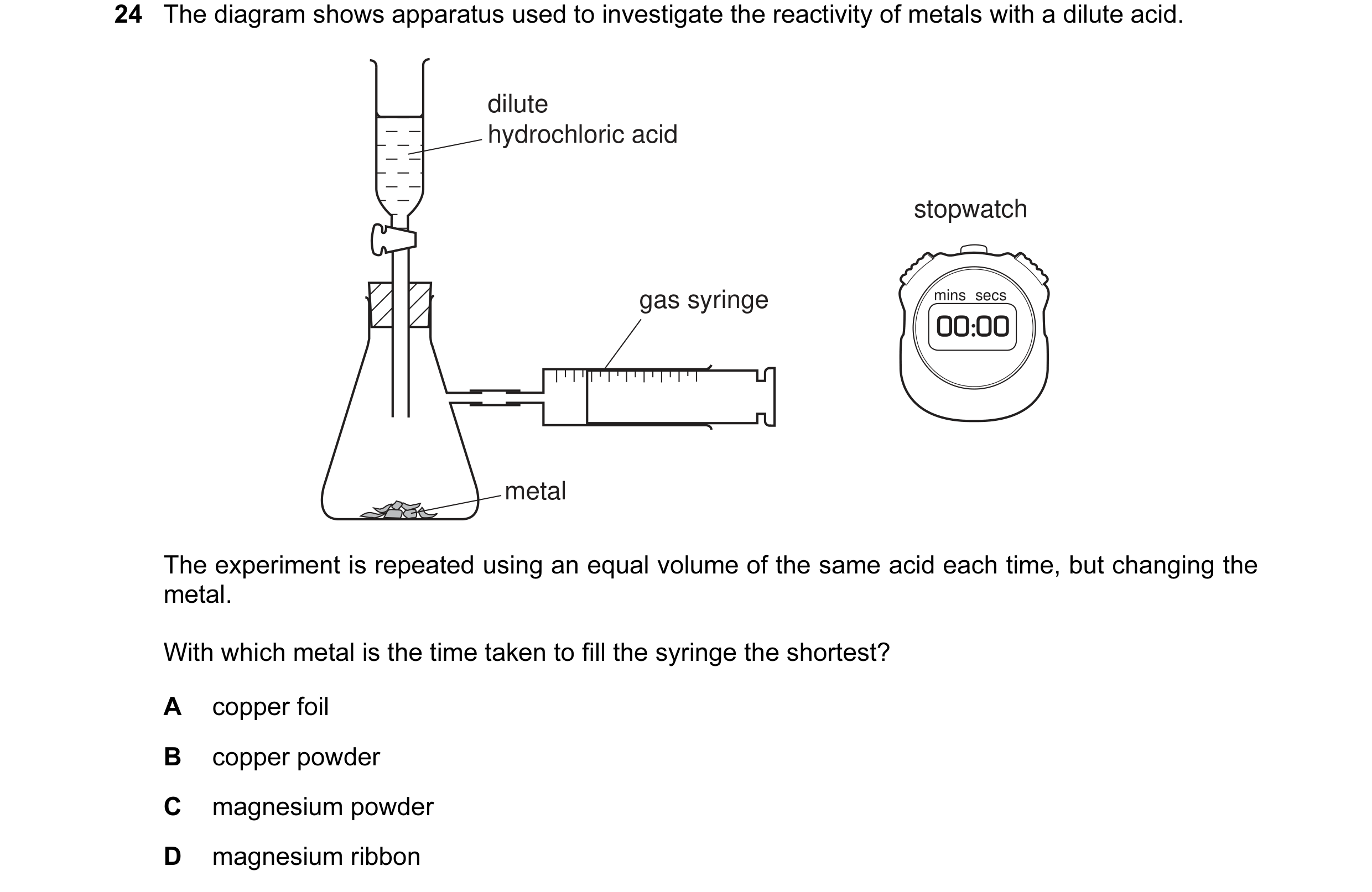
Q1 · The diagram shows apparatus used to investigate the reactivity of metals with a dilute… 0654/11 May/June 2007
24 The diagram shows apparatus used to investigate the reactivity of metals with a dilute acid. dilute hydrochloric acid stopwatch gas syringe mins secs metal The experiment is repeated using an equal volume of the same acid each time, but changing the metal. With which metal is the time taken to fill the syringe the shortest? A copper foil B copper powder C magnesium powder D magnesium ribbon
1 marks
Answer: C
This question in 0654/11 May/June 2007
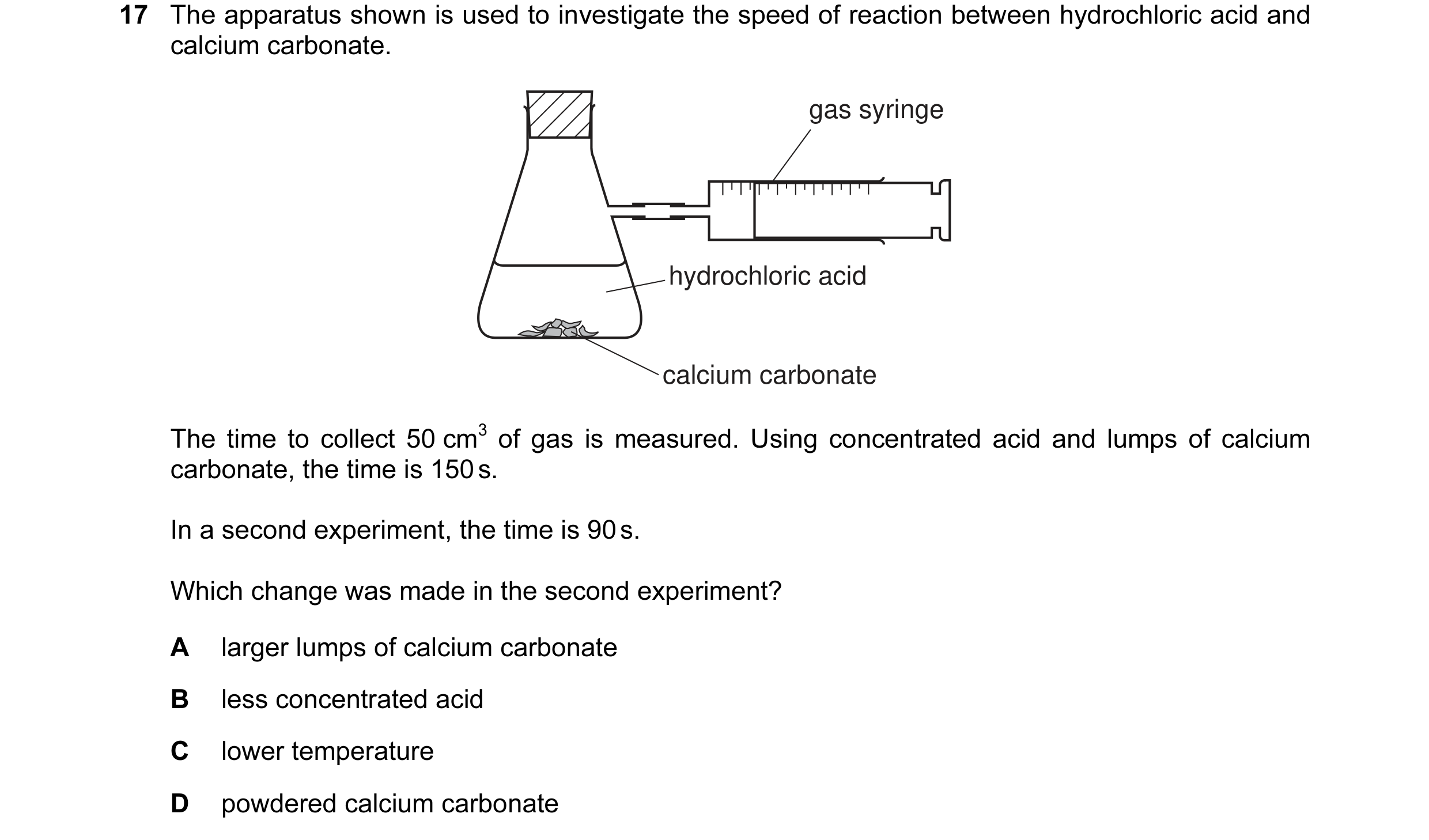
Q2 · The apparatus shown is used to investigate the speed of reaction between hydrochloric… 0654/11 Oct/Nov 2007
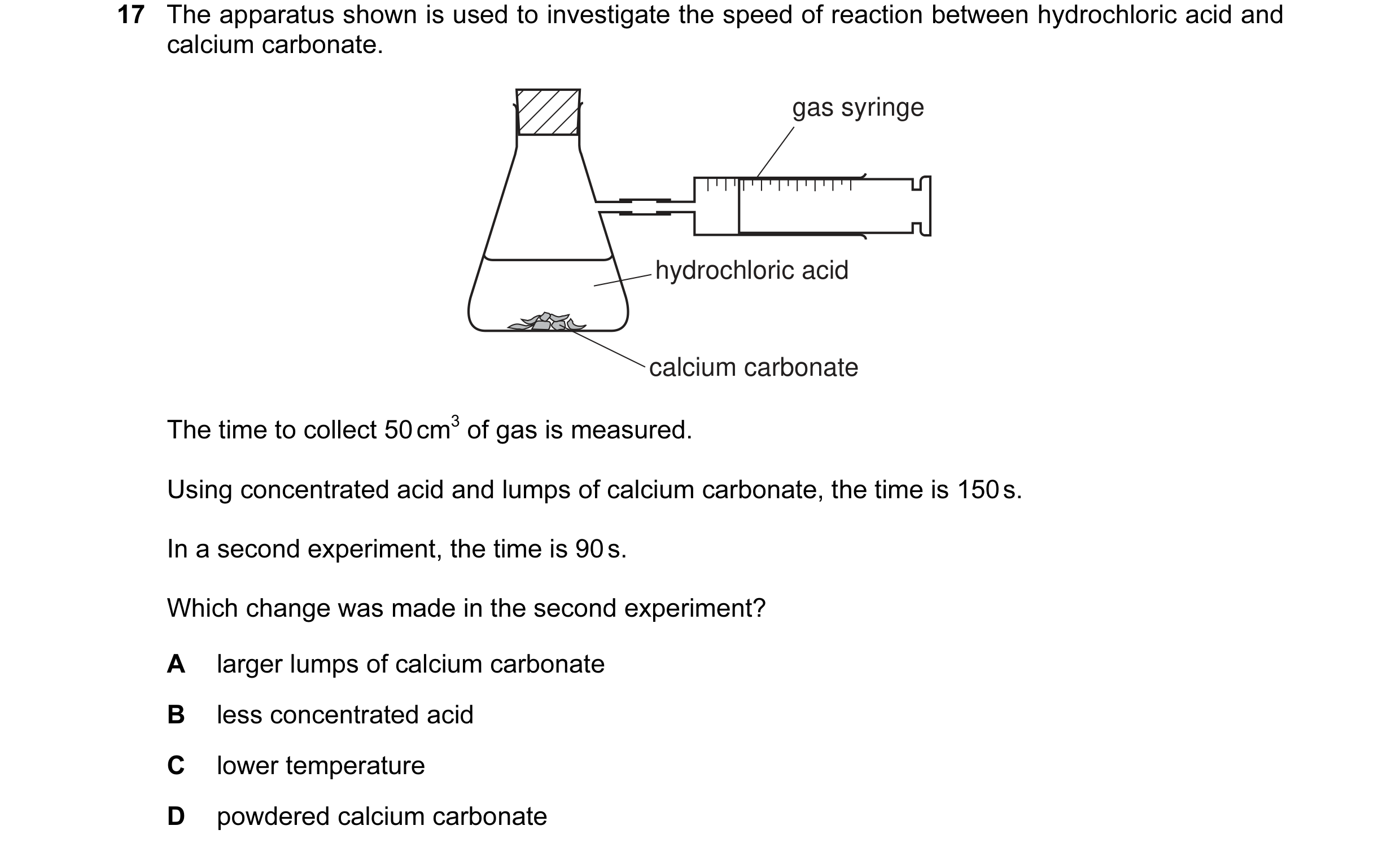
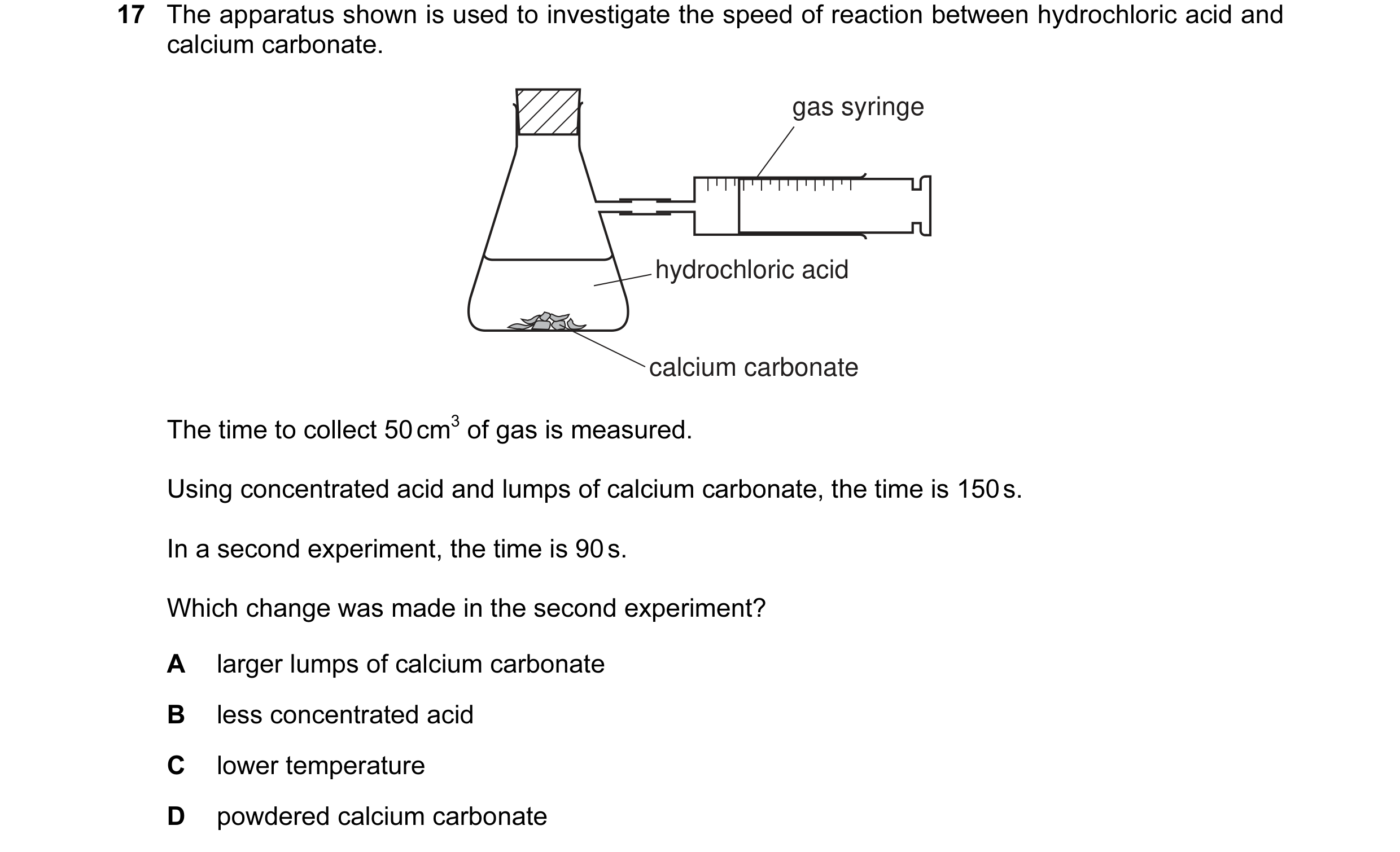
17 The apparatus shown is used to investigate the speed of reaction between hydrochloric acid and calcium carbonate. gas syringe hydrochloric acid calcium carbonate The time to collect 50 cm3 of gas is measured. Using concentrated acid and lumps of calcium carbonate, the time is 150 s. In a second experiment, the time is 90 s. Which change was made in the second experiment? A larger lumps of calcium carbonate B less concentrated acid C lower temperature D powdered calcium carbonate
1 marks
Answer: D
This question in 0654/11 Oct/Nov 2007
Q3 · Processes used in the petrochemical industry include 1 cracking 0654/11 May/June 2008
17 Processes used in the petrochemical industry include 1 cracking. 2 distillation. For which of these processes is a catalyst used? A both 1 and 2 B 1 only C 2 only D neither 1 nor 2
1 marks
Answer: B
This question in 0654/11 May/June 2008
Q4 · Processes used in the petrochemical industry include 1 cracking, 2 distillation 0654/12 Oct/Nov 2011
16 Processes used in the petrochemical industry include 1 cracking, 2 distillation. For which of these processes is a catalyst used? A both 1 and 2 B 1 only C 2 only D neither 1 nor 2
1 marks
Answer: B
This question in 0654/12 Oct/Nov 2011
Q5 · The apparatus shown is used to investigate the speed of reaction between hydrochloric… 0654/11 May/June 2012
17 The apparatus shown is used to investigate the speed of reaction between hydrochloric acid and calcium carbonate. gas syringe hydrochloric acid calcium carbonate The time to collect 50 cm3 of gas is measured. Using concentrated acid and lumps of calcium carbonate, the time is 150 s. In a second experiment, the time is 90 s. Which change was made in the second experiment? A larger lumps of calcium carbonate B less concentrated acid C lower temperature D powdered calcium carbonate
1 marks
Answer: B
This question in 0654/11 May/June 2012
Q6 · The apparatus shown is used to investigate the speed of reaction between hydrochloric… 0654/12 May/June 2012
17 The apparatus shown is used to investigate the speed of reaction between hydrochloric acid and calcium carbonate. gas syringe hydrochloric acid calcium carbonate The time to collect 50 cm3 of gas is measured. Using concentrated acid and lumps of calcium carbonate, the time is 150 s. In a second experiment, the time is 90 s. Which change was made in the second experiment? A larger lumps of calcium carbonate B less concentrated acid C lower temperature D powdered calcium carbonate
1 marks
Answer: D
This question in 0654/12 May/June 2012
Q7 · The apparatus shown is used to investigate the speed of reaction between hydrochloric… 0654/13 May/June 2012
17 The apparatus shown is used to investigate the speed of reaction between hydrochloric acid and calcium carbonate. gas syringe hydrochloric acid calcium carbonate The time to collect 50 cm3 of gas is measured. Using concentrated acid and lumps of calcium carbonate, the time is 150 s. In a second experiment, the time is 90 s. Which change was made in the second experiment? A larger lumps of calcium carbonate B less concentrated acid C lower temperature D powdered calcium carbonate
1 marks
Answer: D
This question in 0654/13 May/June 2012
Q8 · Ammonia is oxidised as shown 0654/11 May/June 2013
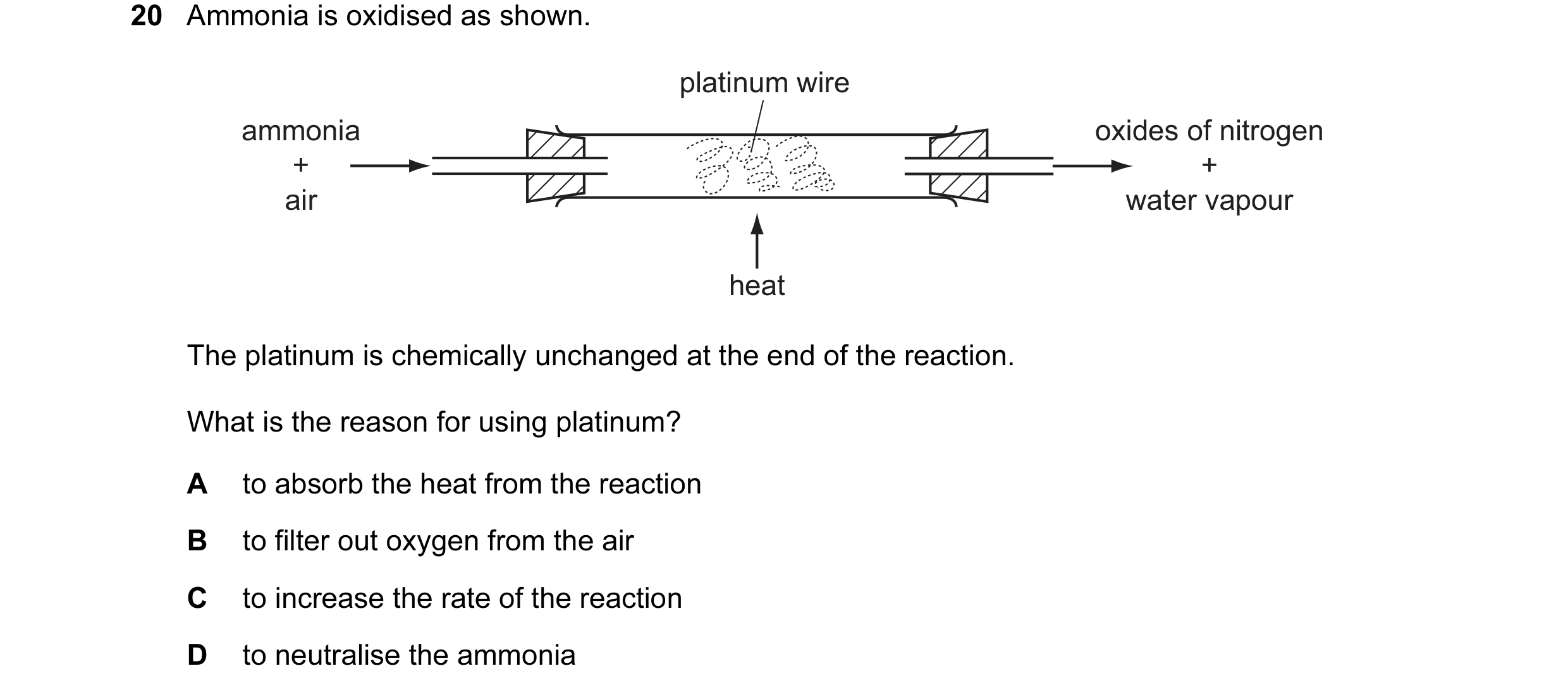
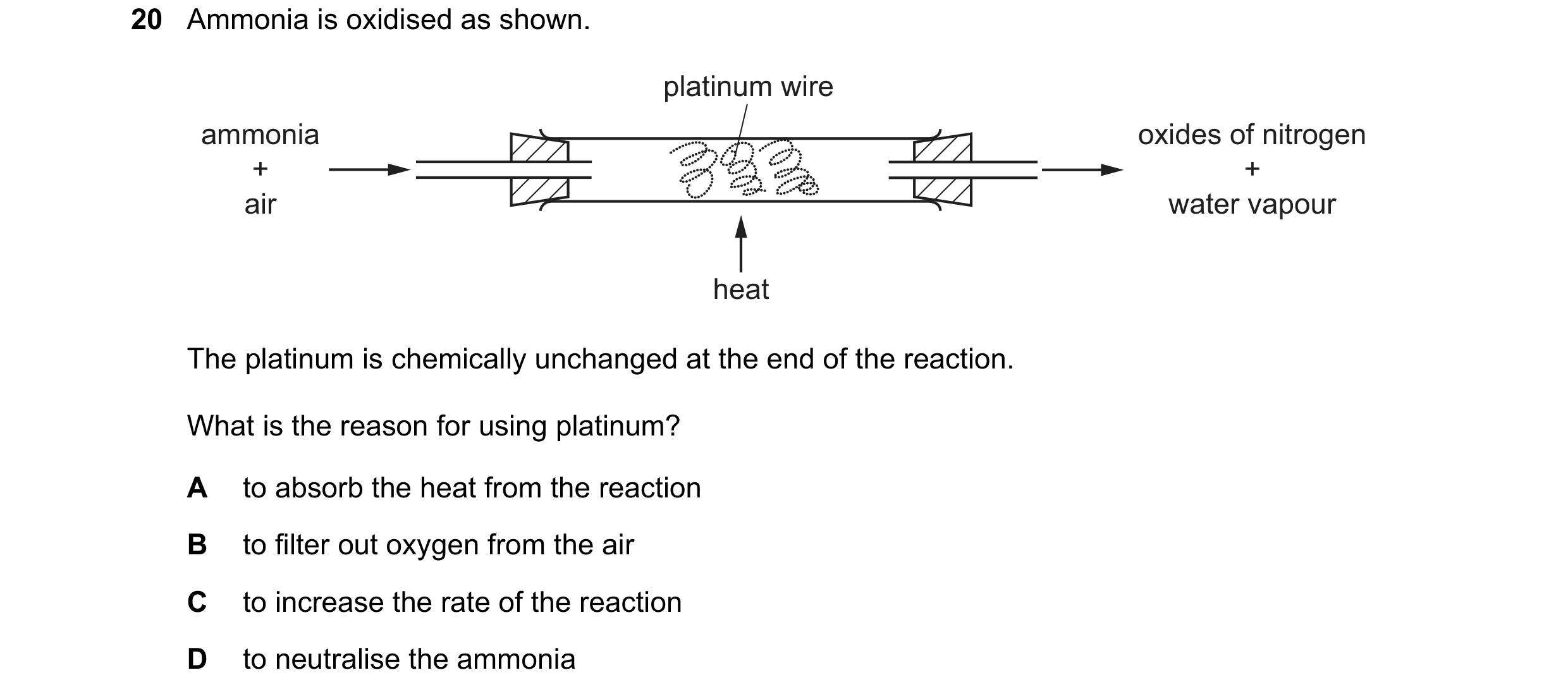
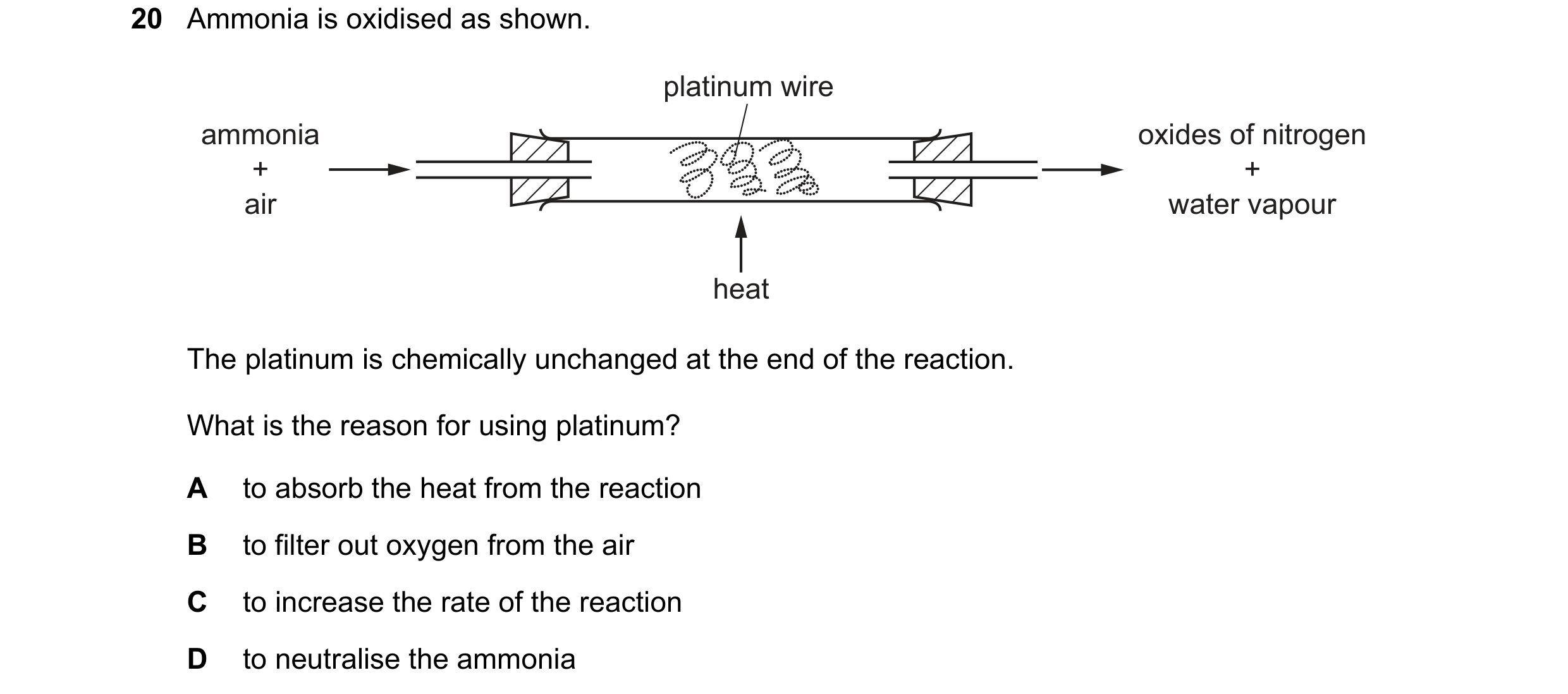
19 Ammonia is oxidised as shown. platinum wire ammonia oxides of nitrogen + + air water vapour heat The platinum is chemically unchanged at the end of the reaction. What is the reason for using platinum? A to absorb the heat from the reaction B to filter out oxygen from the air C to increase the rate of the reaction D to neutralise the ammonia
1 marks
Answer: C
This question in 0654/11 May/June 2013
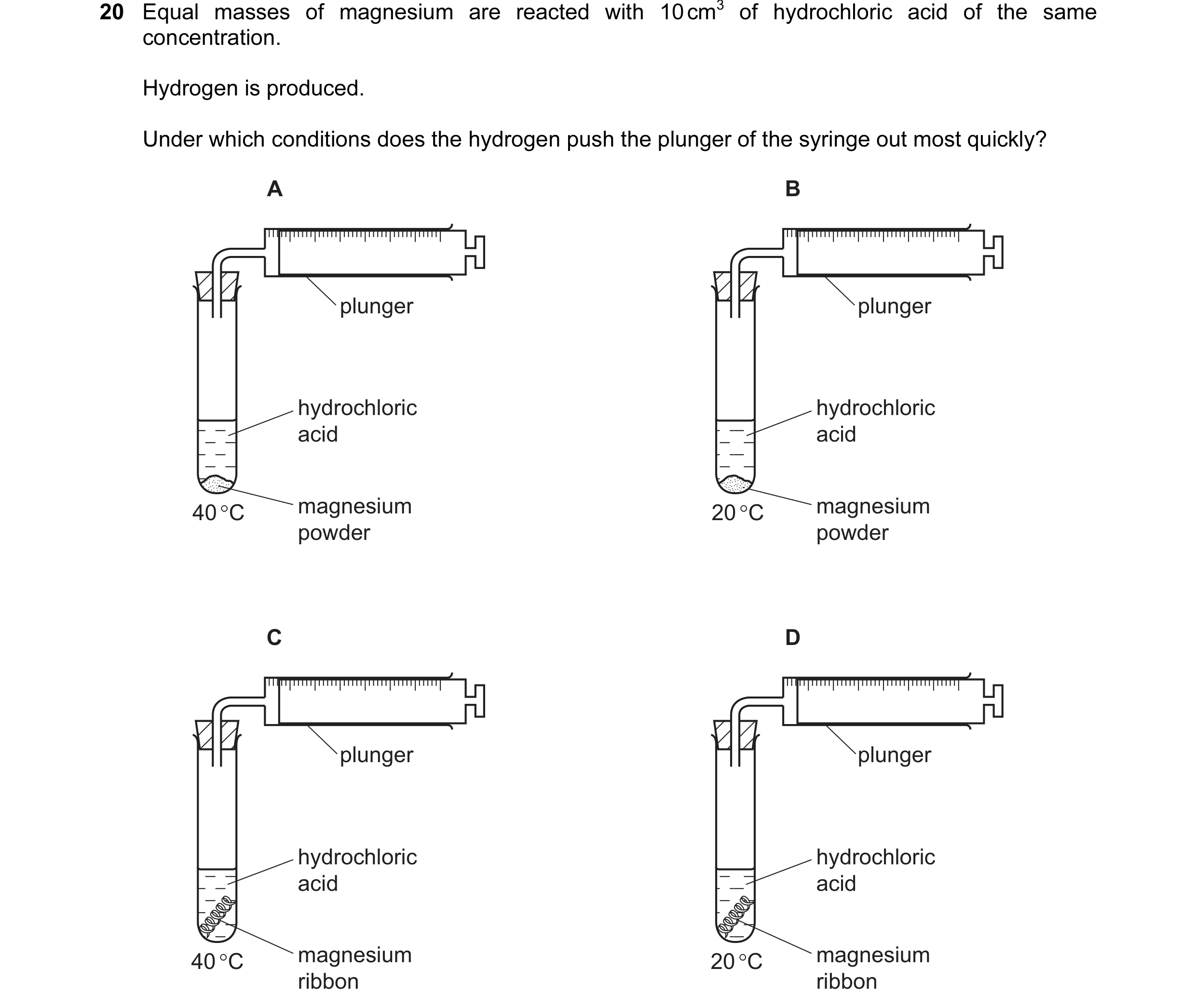
Q9 · Equal masses of magnesium are reacted with 10 cm3 of hydrochloric acid of the same… 0654/11 May/June 2013
20 Equal masses of magnesium are reacted with 10 cm3 of hydrochloric acid of the same concentration. Hydrogen is produced. Under which conditions does the hydrogen push the plunger of the syringe out most quickly? A B plunger plunger hydrochloric hydrochloric acid acid 40 °C magnesium 20 °C magnesium powder powder C D plunger plunger hydrochloric hydrochloric acid acid 40 °C magnesium 20 °C magnesium ribbon ribbon
1 marks
Answer: A
This question in 0654/11 May/June 2013
Q10 · Ammonia is oxidised as shown 0654/12 May/June 2013
19 Ammonia is oxidised as shown. platinum wire ammonia oxides of nitrogen + + air water vapour heat The platinum is chemically unchanged at the end of the reaction. What is the reason for using platinum? A to absorb the heat from the reaction B to filter out oxygen from the air C to increase the rate of the reaction D to neutralise the ammonia
1 marks
Answer: C
This question in 0654/12 May/June 2013
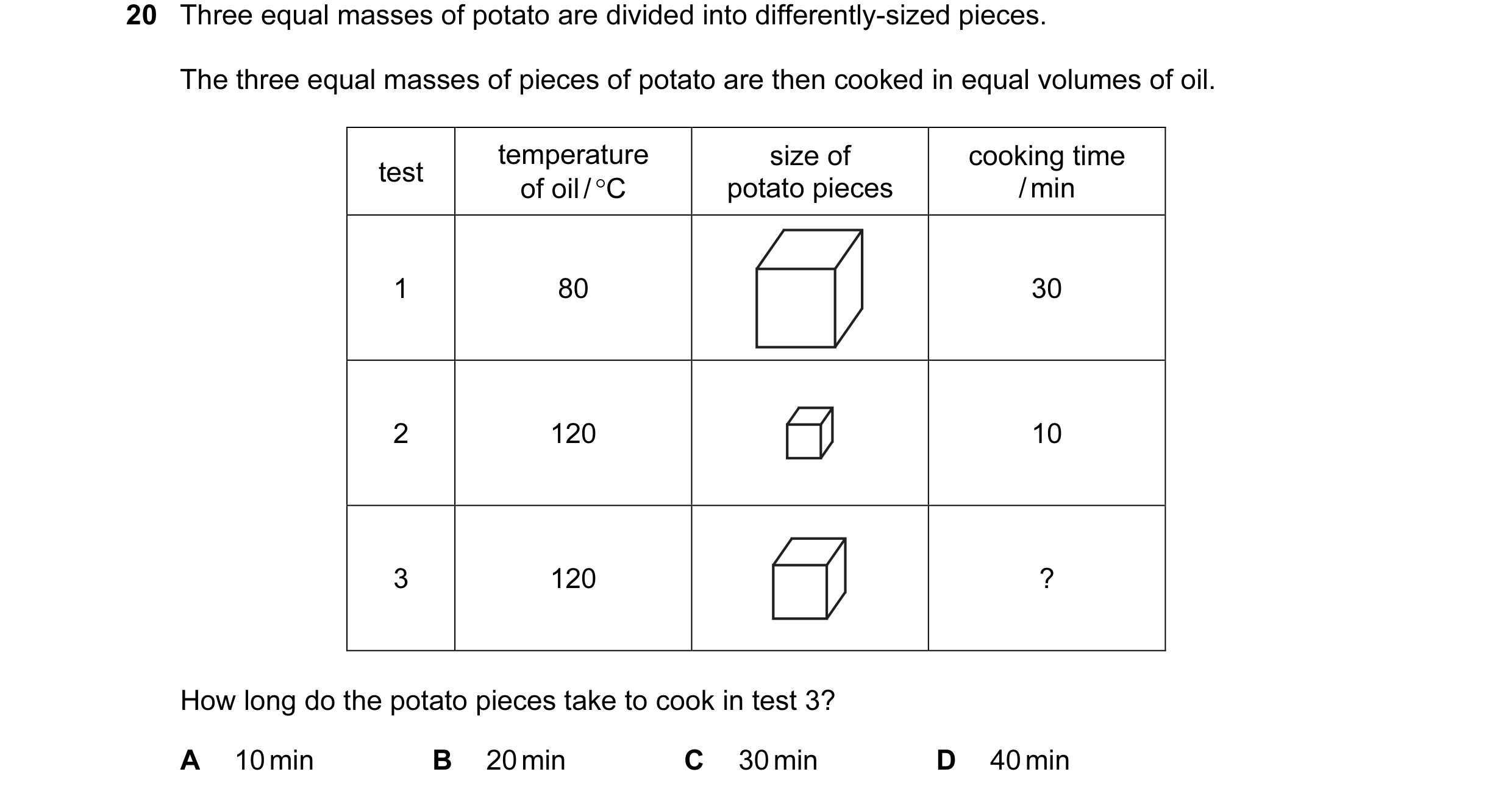
Q11 · Three equal masses of potato are divided into differently-sized pieces 0654/12 May/June 2013
20 Three equal masses of potato are divided into differently-sized pieces. The three equal masses of pieces of potato are then cooked in equal volumes of oil. temperature size of cooking time test of oil / °C potato pieces / min 1 80 30 2 120 10 3 120 ? How long do the potato pieces take to cook in test 3? A 10 min B 20 min C 30 min D 40 min
1 marks
Answer: B
This question in 0654/12 May/June 2013
Q12 · Equal masses of magnesium are reacted with 10 cm3 of hydrochloric acid of the same… 0654/13 May/June 2013
18 Equal masses of magnesium are reacted with 10 cm3 of hydrochloric acid of the same concentration. Hydrogen is produced. Under which conditions does the hydrogen push the plunger of the syringe out most quickly? A B plunger plunger hydrochloric hydrochloric acid acid 40 °C magnesium 20 °C magnesium powder powder C D plunger plunger hydrochloric hydrochloric acid acid 40 °C magnesium 20 °C magnesium ribbon ribbon
1 marks
Answer: A
This question in 0654/13 May/June 2013
Q13 · Ammonia is oxidised as shown 0654/13 May/June 2013
20 Ammonia is oxidised as shown. platinum wire ammonia oxides of nitrogen + + air water vapour heat The platinum is chemically unchanged at the end of the reaction. What is the reason for using platinum? A to absorb the heat from the reaction B to filter out oxygen from the air C to increase the rate of the reaction D to neutralise the ammonia
1 marks
Answer: C
This question in 0654/13 May/June 2013
Q14 · Substance X does not react with dilute acid 0654/11 Oct/Nov 2013
20 Substance X does not react with dilute acid. Substance Y reacts with dilute acid, forming a gas. The graph shows the results of two experiments. experiment 1 Y + dilute acid experiment 2 X + Y + dilute acid experiment 2 total volume of gaseous product experiment 1 0 time What do these results show? X is a catalyst X is quickly used up A ✓ ✓ key B ✓ ✗ ✓= true C ✗ ✓ ✗= false D ✗ ✗
1 marks
Answer: B
This question in 0654/11 Oct/Nov 2013
Q15 · The apparatus below is used to investigate the speed of a chemical reaction 0654/12 Oct/Nov 2013
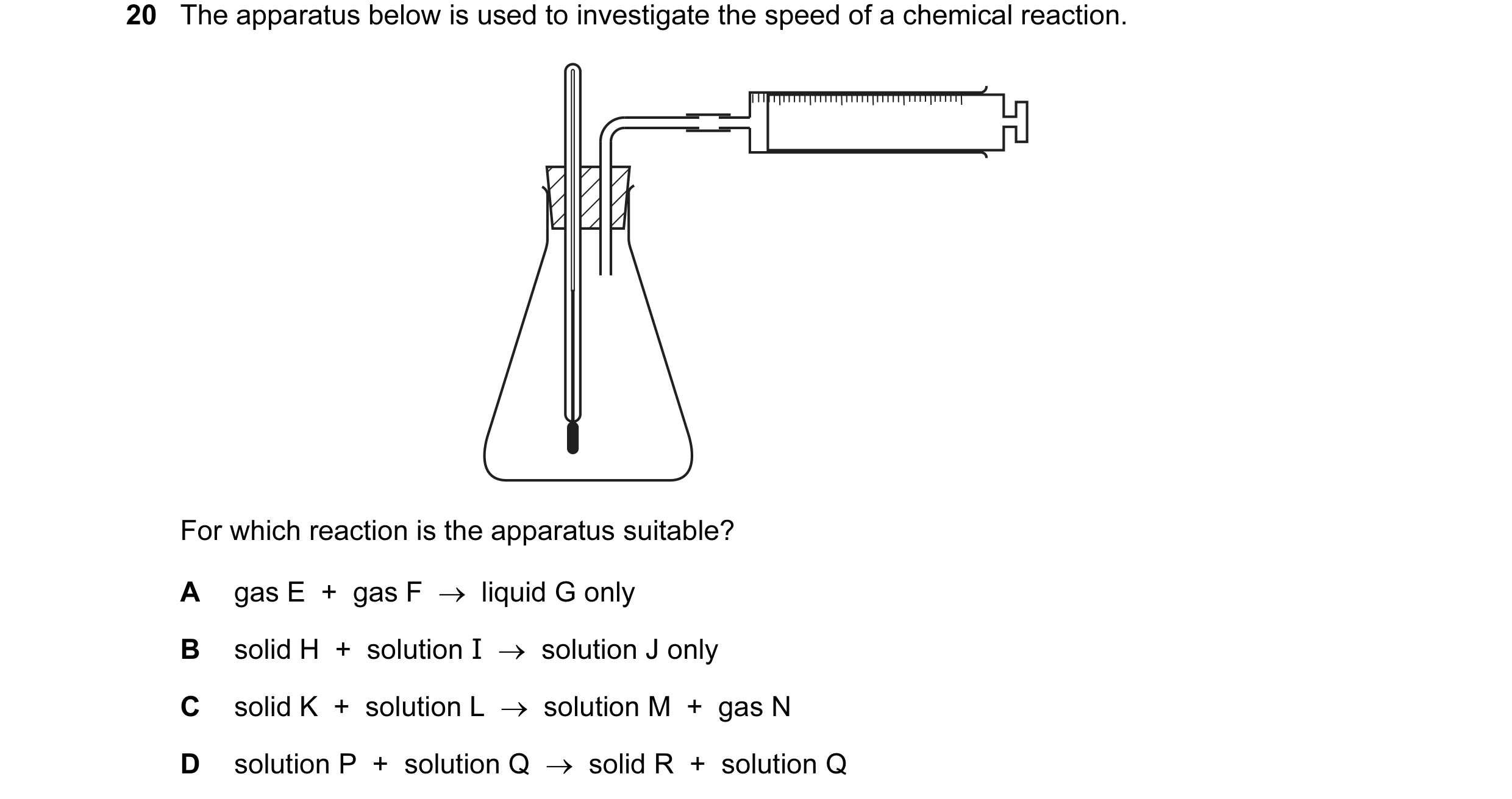
20 The apparatus below is used to investigate the speed of a chemical reaction. For which reaction is the apparatus suitable? A gas E + gas F → liquid G only B solid H + solution I → solution J only C solid K + solution L → solution M + gas N D solution P + solution Q → solid R + solution Q
1 marks
Answer: C
This question in 0654/12 Oct/Nov 2013
Q16 · Substance X does not react with dilute acid 0654/12 Oct/Nov 2013
21 Substance X does not react with dilute acid. Substance Y reacts with dilute acid, forming a gas. The graph shows the results of two experiments. experiment 1 Y + dilute acid experiment 2 X + Y + dilute acid experiment 2 total volume of gaseous product experiment 1 0 time What do these results show? X is a catalyst X is quickly used up A ✓ ✓ key B ✓ ✗ ✓= true C ✗ ✓ ✗= false D ✗ ✗
1 marks
Answer: B
This question in 0654/12 Oct/Nov 2013
Q17 · The diagram shows apparatus used to investigate the speed of a reaction 0654/13 Oct/Nov 2013
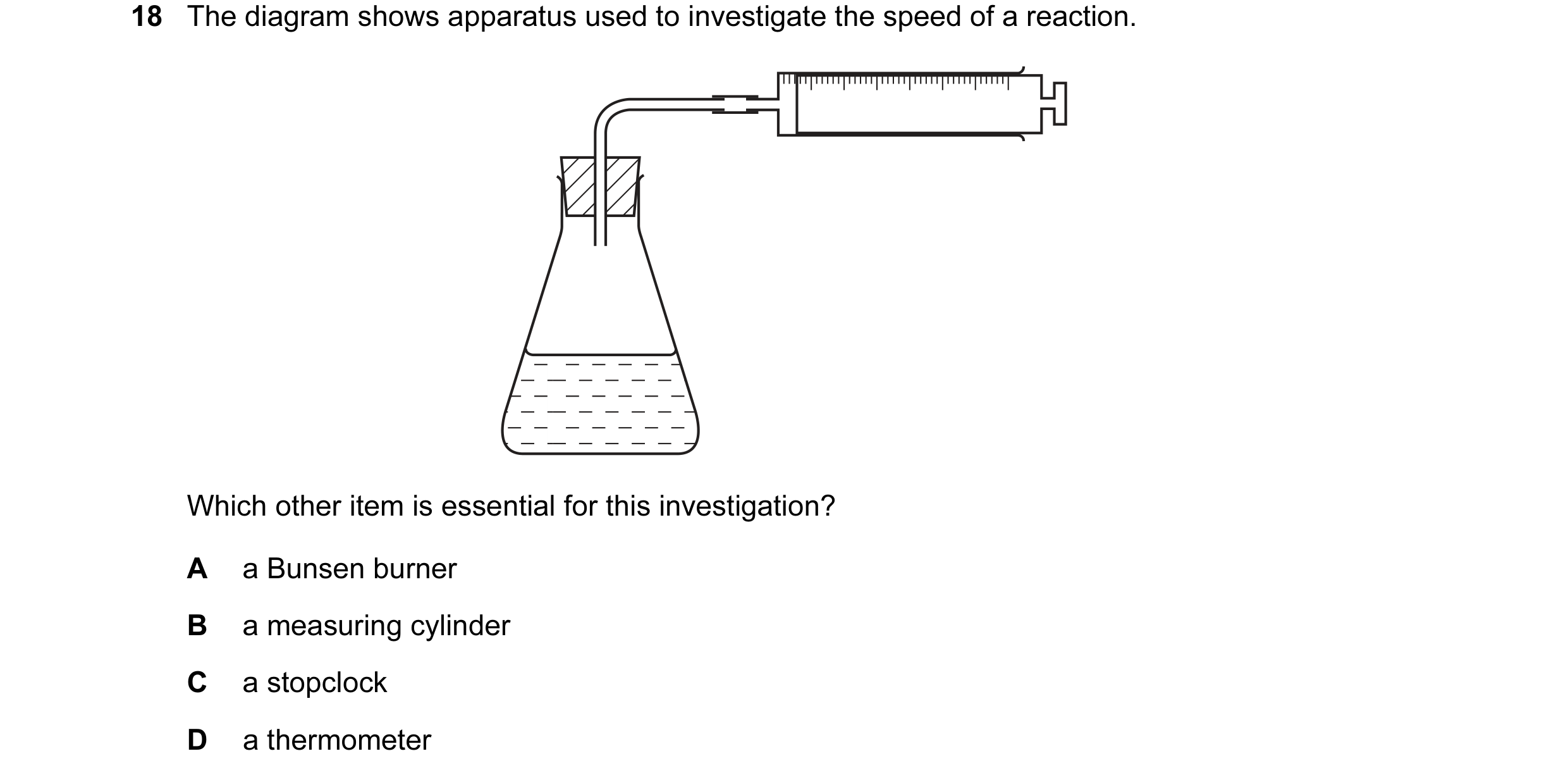
18 The diagram shows apparatus used to investigate the speed of a reaction. Which other item is essential for this investigation? A a Bunsen burner B a measuring cylinder C a stopclock D a thermometer
1 marks
Answer: C
This question in 0654/13 Oct/Nov 2013
Q18 · Substance X does not react with dilute acid 0654/13 Oct/Nov 2013
20 Substance X does not react with dilute acid. Substance Y reacts with dilute acid, forming a gas. The graph shows the results of two experiments. experiment 1 Y + dilute acid experiment 2 X + Y + dilute acid experiment 2 total volume of gaseous product experiment 1 0 time What do these results show? X is a catalyst X is quickly used up A ✓ ✓ key B ✓ ✗ ✓= true C ✗ ✓ ✗= false D ✗ ✗
1 marks
Answer: B
This question in 0654/13 Oct/Nov 2013
Q19 · Marble (calcium carbonate) reacts with dilute hydrochloric acid 0654/11 May/June 2014
20 Marble (calcium carbonate) reacts with dilute hydrochloric acid. 1 g of powdered marble reacts faster with the same volume and concentration of acid than a 1 g lump of marble. What is the reason for this observation? A The powder has a larger mass. B The powder has a larger surface area. C The powder has a smaller mass. D The powder has a smaller surface area.
1 marks
Answer: B
This question in 0654/11 May/June 2014
Q20 · Small lumps of zinc are added to sulfuric acid 0654/12 May/June 2014
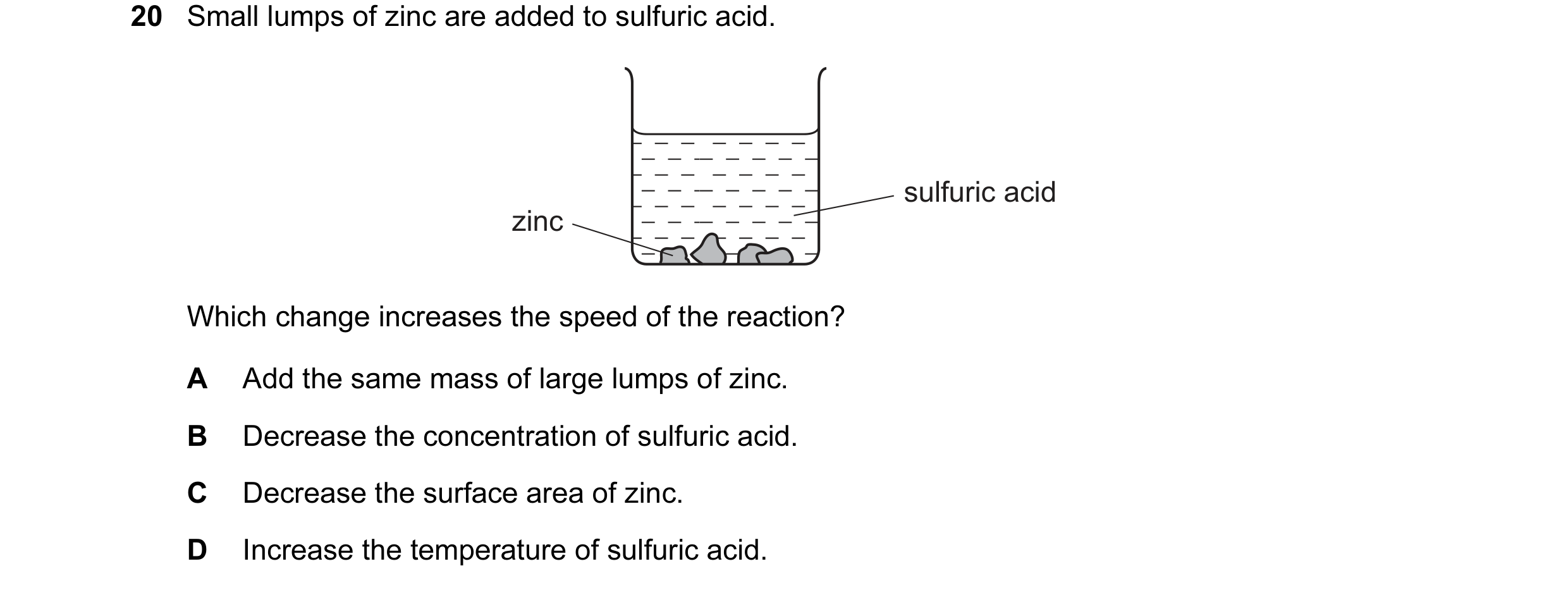
20 Small lumps of zinc are added to sulfuric acid. sulfuric acid zinc Which change increases the speed of the reaction? A Add the same mass of large lumps of zinc. B Decrease the concentration of sulfuric acid. C Decrease the surface area of zinc. D Increase the temperature of sulfuric acid.
1 marks
Answer: D
This question in 0654/12 May/June 2014
Q21 · Marble (calcium carbonate) reacts with dilute hydrochloric acid 0654/13 May/June 2014
18 Marble (calcium carbonate) reacts with dilute hydrochloric acid. 1 g of powdered marble reacts faster with the same volume and concentration of acid than a 1 g lump of marble. What is the reason for this observation? A The powder has a larger mass. B The powder has a larger surface area. C The powder has a smaller mass. D The powder has a smaller surface area.
1 marks
Answer: B
This question in 0654/13 May/June 2014
Q22 · Solid copper(II) carbonate reacts with dilute nitric acid producing carbon dioxide 0654/13 Oct/Nov 2014
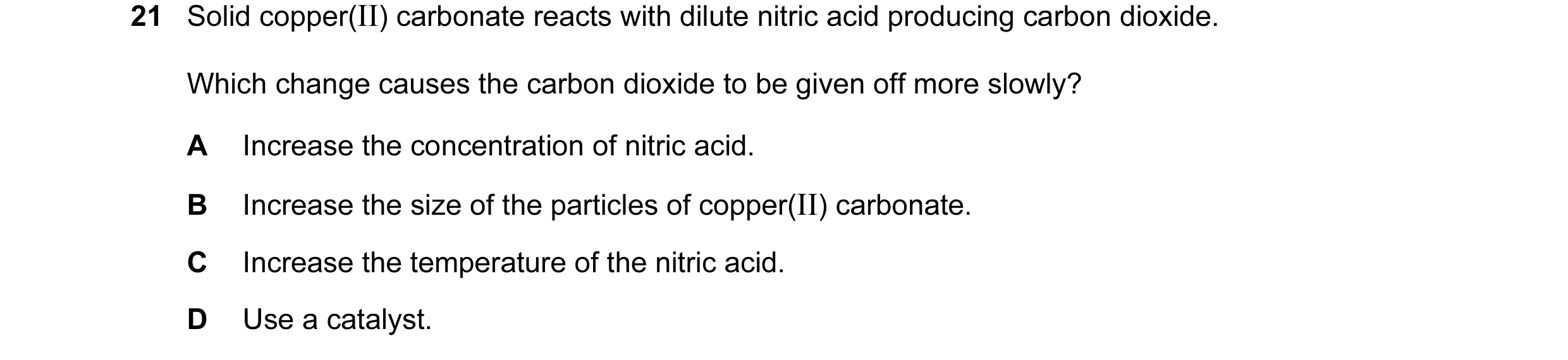
21 Solid copper(II) carbonate reacts with dilute nitric acid producing carbon dioxide. Which change causes the carbon dioxide to be given off more slowly? A Increase the concentration of nitric acid. B Increase the size of the particles of copper(II) carbonate. C Increase the temperature of the nitric acid. D Use a catalyst.
1 marks
Answer: B
This question in 0654/13 Oct/Nov 2014
Q23 · The diagram shows zinc reacting with sulfuric acid 0654/11 May/June 2015
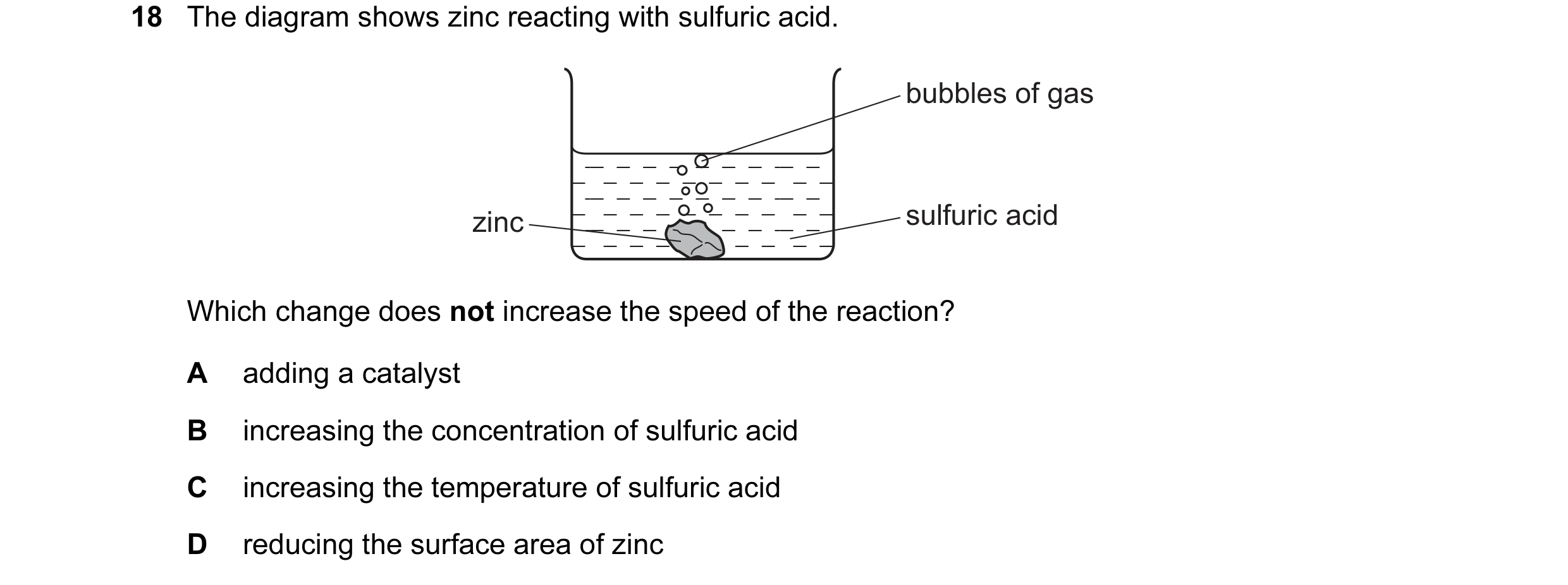
18 The diagram shows zinc reacting with sulfuric acid. bubbles of gas zinc sulfuric acid Which change does not increase the speed of the reaction? A adding a catalyst B increasing the concentration of sulfuric acid C increasing the temperature of sulfuric acid D reducing the surface area of zinc
1 marks
Answer: D
This question in 0654/11 May/June 2015
Q24 · Dilute sulfuric acid reacts with a piece of zinc 0654/13 May/June 2015
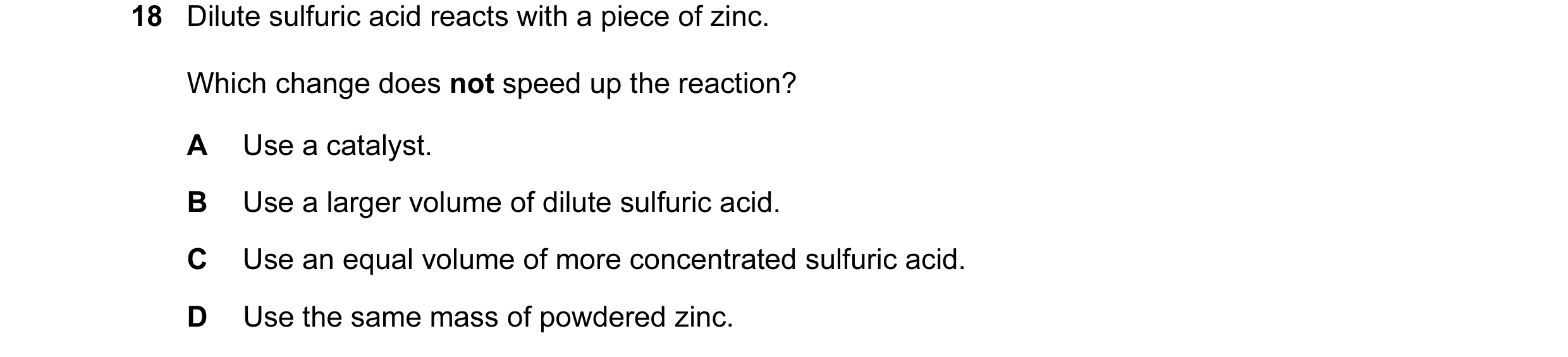
18 Dilute sulfuric acid reacts with a piece of zinc. Which change does not speed up the reaction? A Use a catalyst. B Use a larger volume of dilute sulfuric acid. C Use an equal volume of more concentrated sulfuric acid. D Use the same mass of powdered zinc.
1 marks
Answer: B
This question in 0654/13 May/June 2015
Q25 · Nitrogen from the air is used to manufacture ammonia 0654/11 Oct/Nov 2015
21 Nitrogen from the air is used to manufacture ammonia. nitrogen + hydrogen → ammonia Why is a catalyst used in this reaction? A Nitrogen from the air is not pure. B Nitrogen is a gas at room temperature. C Nitrogen is a non-metallic element. D Nitrogen is not very reactive.
1 marks
Answer: D
This question in 0654/11 Oct/Nov 2015
Q26 · Hydrochloric acid reacts with excess solid sodium carbonate to form sodium chloride… 0654/11 Oct/Nov 2015
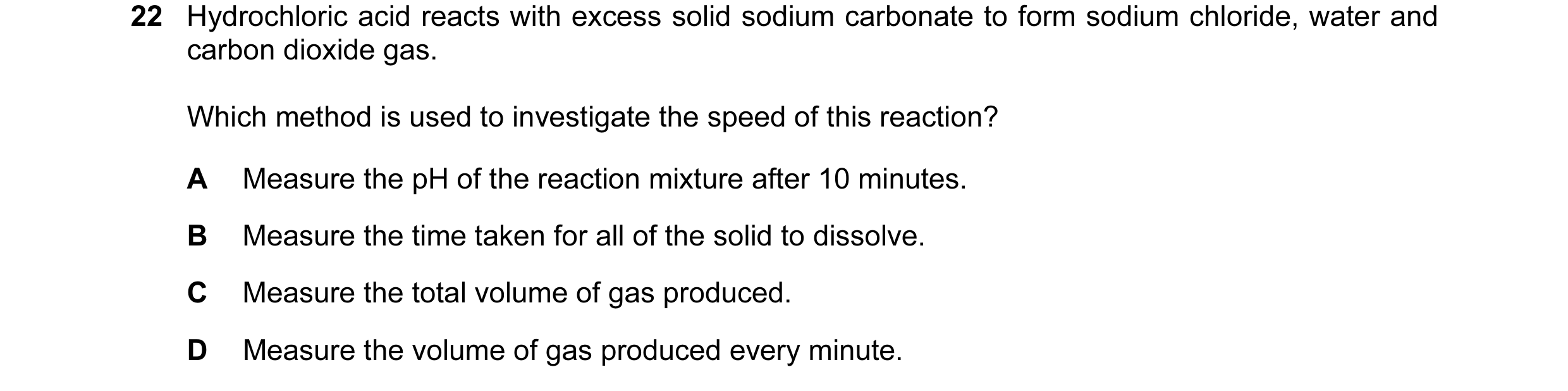
22 Hydrochloric acid reacts with excess solid sodium carbonate to form sodium chloride, water and carbon dioxide gas. Which method is used to investigate the speed of this reaction? A Measure the pH of the reaction mixture after 10 minutes. B Measure the time taken for all of the solid to dissolve. C Measure the total volume of gas produced. D Measure the volume of gas produced every minute.
1 marks
Answer: D
This question in 0654/11 Oct/Nov 2015
Q27 · Nitrogen from the air is used to manufacture ammonia 0654/12 Oct/Nov 2015
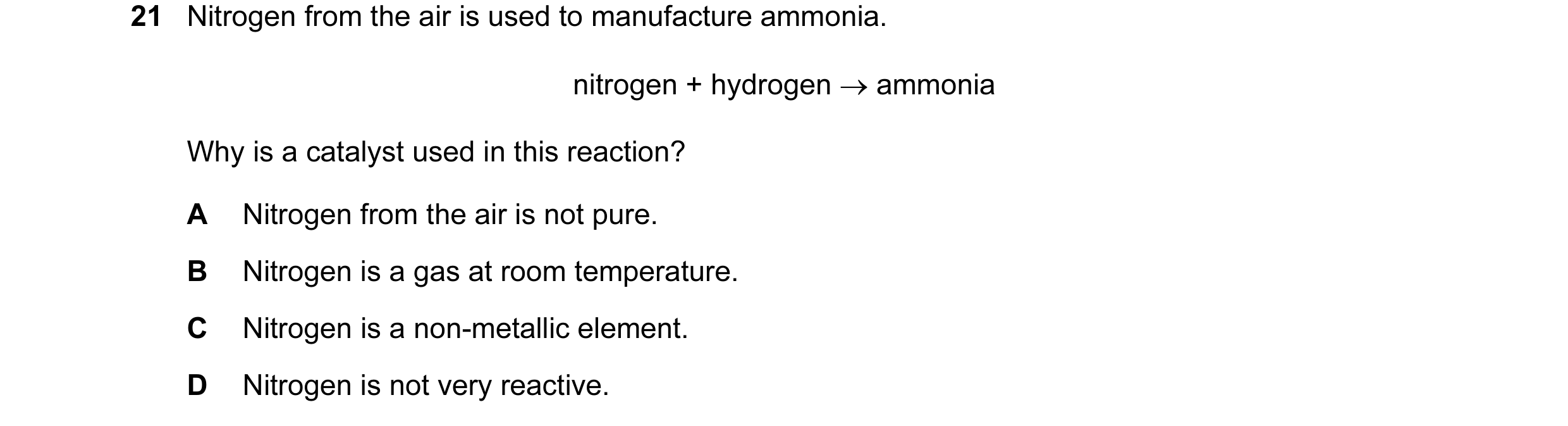
21 Nitrogen from the air is used to manufacture ammonia. nitrogen + hydrogen → ammonia Why is a catalyst used in this reaction? A Nitrogen from the air is not pure. B Nitrogen is a gas at room temperature. C Nitrogen is a non-metallic element. D Nitrogen is not very reactive.
1 marks
Answer: D
This question in 0654/12 Oct/Nov 2015
Q28 · Nitrogen from the air is used to manufacture ammonia 0654/13 Oct/Nov 2015
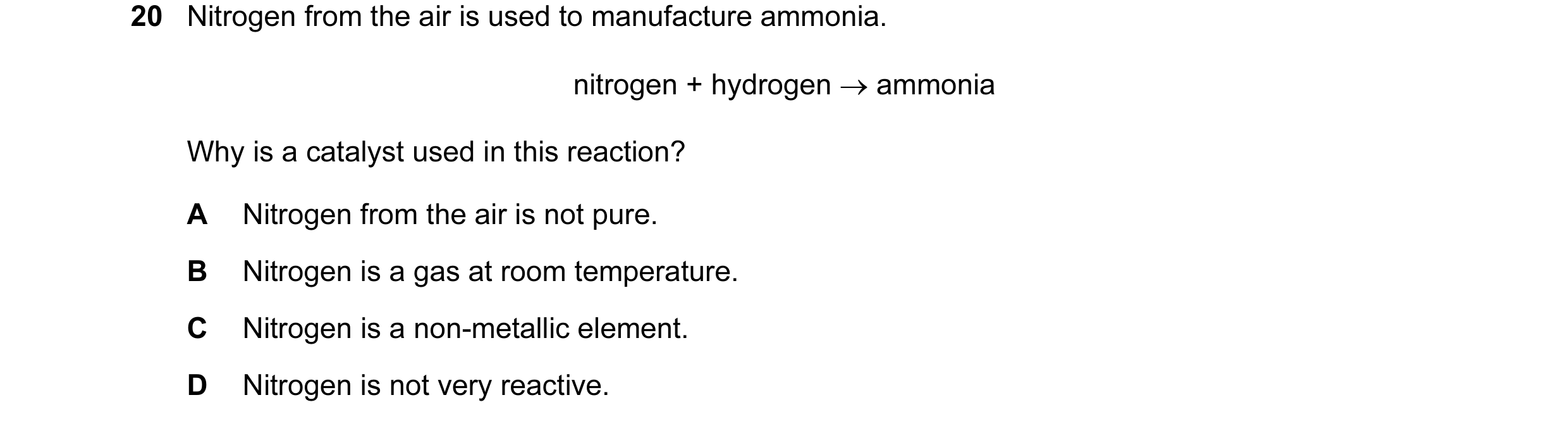
20 Nitrogen from the air is used to manufacture ammonia. nitrogen + hydrogen → ammonia Why is a catalyst used in this reaction? A Nitrogen from the air is not pure. B Nitrogen is a gas at room temperature. C Nitrogen is a non-metallic element. D Nitrogen is not very reactive.
1 marks
Answer: D
This question in 0654/13 Oct/Nov 2015
Q29 · A metal ore dissolves in hydrochloric acid 0654/13 May/June 2016
18 A metal ore dissolves in hydrochloric acid. Under which conditions does the ore dissolve most quickly? concentration of temperature of form of ore hydrochloric acid hydrochloric acid A lumps high low B lumps low high C powder high high D powder low low
1 marks
Answer: C
This question in 0654/13 May/June 2016
Q30 · Dilute hydrochloric acid reacts with solid calcium carbonate 0654/11 Oct/Nov 2016
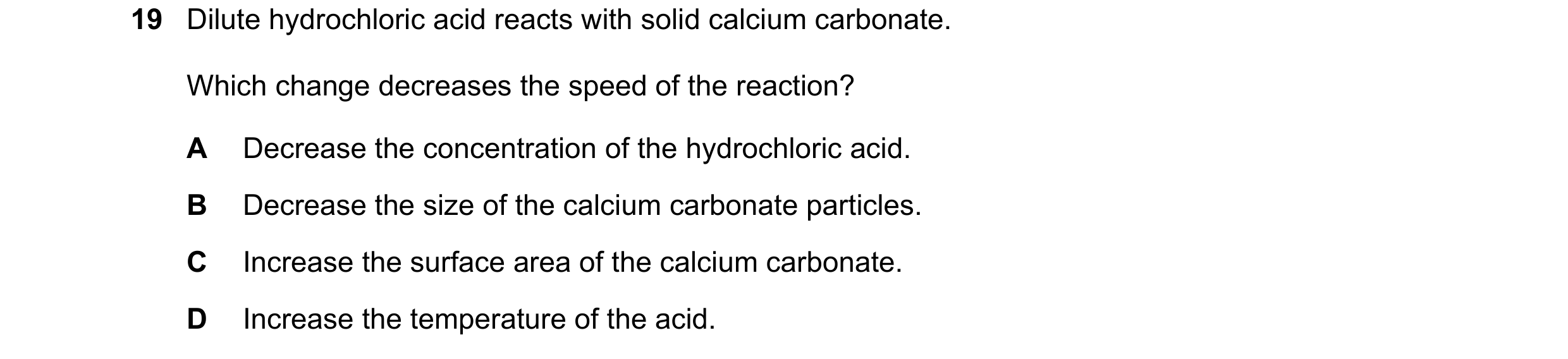
19 Dilute hydrochloric acid reacts with solid calcium carbonate. Which change decreases the speed of the reaction? A Decrease the concentration of the hydrochloric acid. B Decrease the size of the calcium carbonate particles. C Increase the surface area of the calcium carbonate. D Increase the temperature of the acid.
1 marks
Answer: A
This question in 0654/11 Oct/Nov 2016
Q31 · Solid calcium carbonate reacts with dilute hydrochloric acid to produce aqueous calcium… 0654/12 Oct/Nov 2016
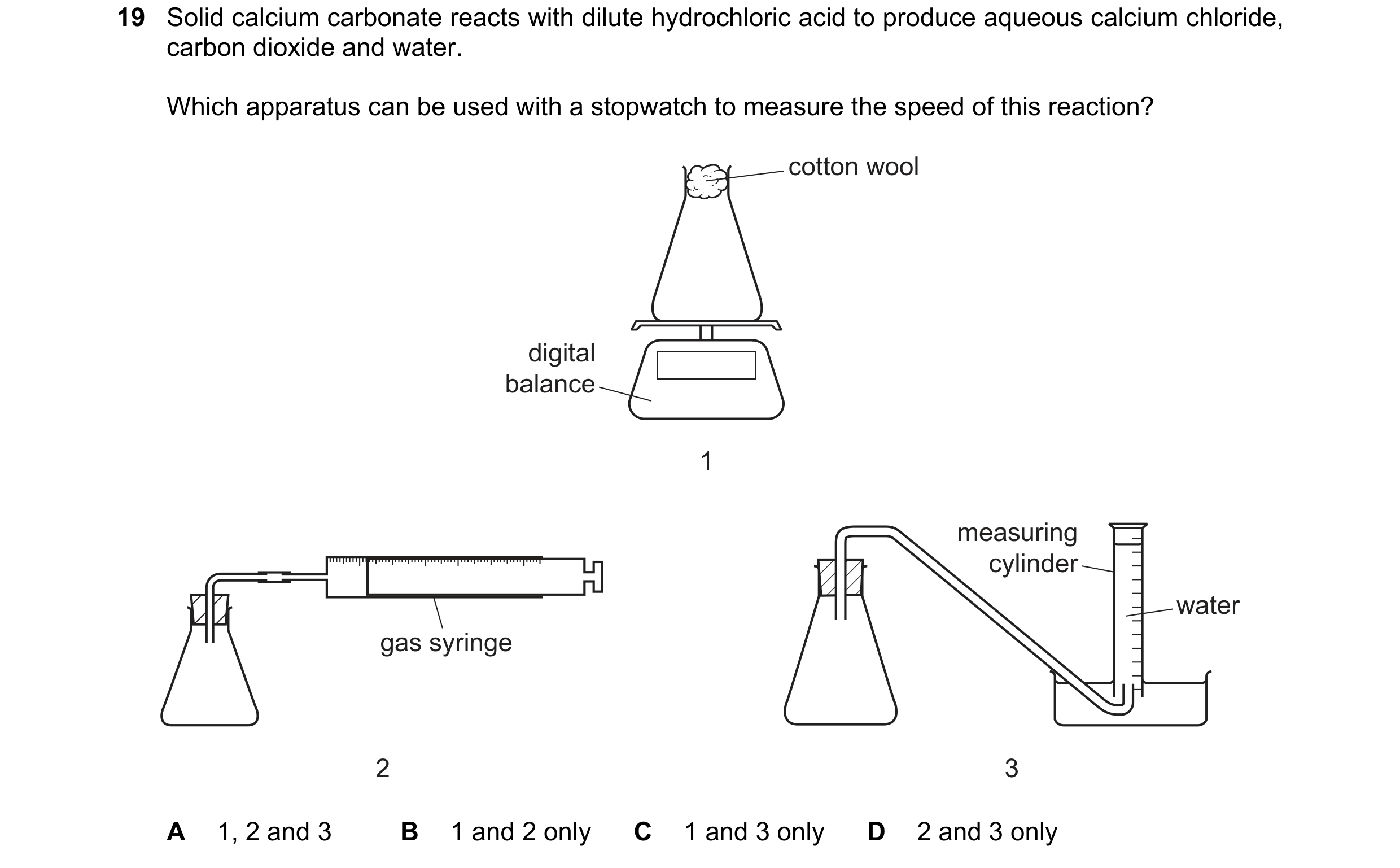
19 Solid calcium carbonate reacts with dilute hydrochloric acid to produce aqueous calcium chloride, carbon dioxide and water. Which apparatus can be used with a stopwatch to measure the speed of this reaction? cotton wool digital balance 1 measuring cylinder water gas syringe 2 3 A 1, 2 and 3 B 1 and 2 only C 1 and 3 only D 2 and 3 only
1 marks
Answer: A
This question in 0654/12 Oct/Nov 2016
Q32 · Marble (calcium carbonate) reacts with dilute hydrochloric acid 0654/11 May/June 2017
18 Marble (calcium carbonate) reacts with dilute hydrochloric acid. 1 g of powdered marble reacts faster with the same volume and concentration of acid than a 1 g lump of marble. What is the reason for this observation? A The powder has a larger mass. B The powder has a larger surface area. C The powder has a smaller mass. D The powder has a smaller surface area.
1 marks
Answer: B
This question in 0654/11 May/June 2017
Q33 · Marble (calcium carbonate) reacts with dilute hydrochloric acid 0654/12 May/June 2017
19 Marble (calcium carbonate) reacts with dilute hydrochloric acid. 1 g of powdered marble reacts faster with the same volume and concentration of acid than a 1 g lump of marble. What is the reason for this observation? A The powder has a larger mass. B The powder has a larger surface area. C The powder has a smaller mass. D The powder has a smaller surface area.
1 marks
Answer: B
This question in 0654/12 May/June 2017
Q34 · Marble (calcium carbonate) reacts with dilute hydrochloric acid 0654/13 May/June 2017
18 Marble (calcium carbonate) reacts with dilute hydrochloric acid. 1 g of powdered marble reacts faster with the same volume and concentration of acid than a 1 g lump of marble. What is the reason for this observation? A The powder has a larger mass. B The powder has a larger surface area. C The powder has a smaller mass. D The powder has a smaller surface area.
1 marks
Answer: B
This question in 0654/13 May/June 2017
Q35 · Ammonia is oxidised as shown 0654/11 Oct/Nov 2017
20 Ammonia is oxidised as shown. platinum wire ammonia oxides of nitrogen + + air water vapour heat The platinum is chemically unchanged at the end of the reaction. What is the reason for using platinum? A to absorb the heat from the reaction B to filter out oxygen from the air C to increase the rate of the reaction D to neutralise the ammonia
1 marks
Answer: C
This question in 0654/11 Oct/Nov 2017
Q36 · Ammonia is oxidised as shown 0654/12 Oct/Nov 2017
20 Ammonia is oxidised as shown. platinum wire ammonia oxides of nitrogen + + air water vapour heat The platinum is chemically unchanged at the end of the reaction. What is the reason for using platinum? A to absorb the heat from the reaction B to filter out oxygen from the air C to increase the rate of the reaction D to neutralise the ammonia
1 marks
Answer: C
This question in 0654/12 Oct/Nov 2017
Q37 · Ammonia is oxidised as shown 0654/13 Oct/Nov 2017
20 Ammonia is oxidised as shown. platinum wire ammonia oxides of nitrogen + + air water vapour heat The platinum is chemically unchanged at the end of the reaction. What is the reason for using platinum? A to absorb the heat from the reaction B to filter out oxygen from the air C to increase the rate of the reaction D to neutralise the ammonia
1 marks
Answer: C
This question in 0654/13 Oct/Nov 2017
Q38 · Dilute sulfuric acid reacts with a piece of zinc 0654/11 Oct/Nov 2018
19 Dilute sulfuric acid reacts with a piece of zinc. Which change does not increase the rate of reaction? A Use a catalyst. B Use a larger volume of dilute sulfuric acid. C Use an equal volume of more concentrated sulfuric acid. D Use the same mass of powdered zinc.
1 marks
Answer: B
This question in 0654/11 Oct/Nov 2018
Q39 · Dilute sulfuric acid reacts with a piece of zinc 0654/12 Oct/Nov 2018
20 Dilute sulfuric acid reacts with a piece of zinc. Which change does not increase the rate of reaction? A Use a catalyst. B Use a larger volume of dilute sulfuric acid. C Use an equal volume of more concentrated sulfuric acid. D Use the same mass of powdered zinc.
1 marks
Answer: B
This question in 0654/12 Oct/Nov 2018
Q40 · Dilute sulfuric acid reacts with a piece of zinc 0654/13 Oct/Nov 2018
19 Dilute sulfuric acid reacts with a piece of zinc. Which change does not increase the rate of reaction? A Use a catalyst. B Use a larger volume of dilute sulfuric acid. C Use an equal volume of more concentrated sulfuric acid. D Use the same mass of powdered zinc.
1 marks
Answer: B
This question in 0654/13 Oct/Nov 2018
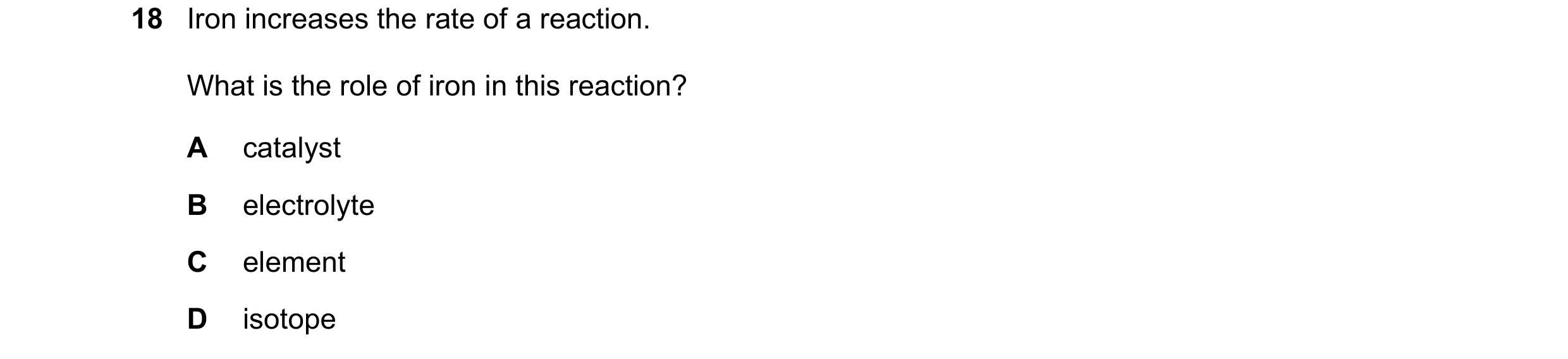
Q41 · Iron increases the rate of a reaction 0654/11 May/June 2019
18 Iron increases the rate of a reaction. What is the role of iron in this reaction? A catalyst B electrolyte C element D isotope
1 marks
Answer: A
This question in 0654/11 May/June 2019
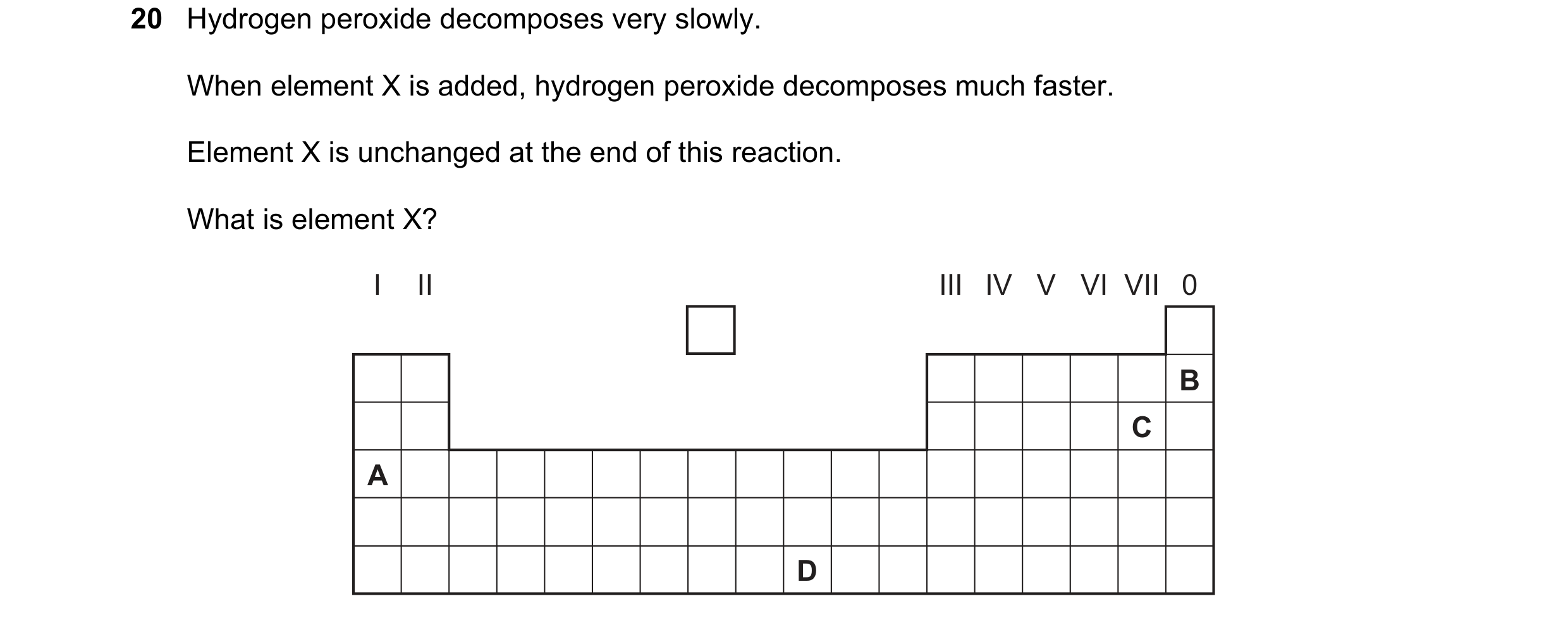
Q42 · Hydrogen peroxide decomposes very slowly 0654/11 Oct/Nov 2019
20 Hydrogen peroxide decomposes very slowly. When element X is added, hydrogen peroxide decomposes much faster. Element X is unchanged at the end of this reaction. What is element X? I II III IV V VI VII 0 B C A D
1 marks
Answer: D
This question in 0654/11 Oct/Nov 2019
Q43 · When 50 cm3 of dilute hydrochloric acid and excess solid sodium carbonate are mixed, they… 0654/13 Oct/Nov 2019
18 When 50 cm3 of dilute hydrochloric acid and excess solid sodium carbonate are mixed, they react to form carbon dioxide gas. The gas is collected in a gas syringe. The experiment is repeated using 25 cm3 of dilute hydrochloric acid. gas syringe conical flask dilute hydrochloric acid and sodium carbonate mixture Which statement about the second experiment compared to the first experiment is correct? A It has the same initial rate of reaction and produces a lower volume of gas. B It has the same initial rate of reaction and produces the same volume of gas. C It has a slower initial rate of reaction and produces a lower volume of gas. D It has a slower initial rate of reaction and produces the same volume of gas.
1 marks
Answer: A
This question in 0654/13 Oct/Nov 2019
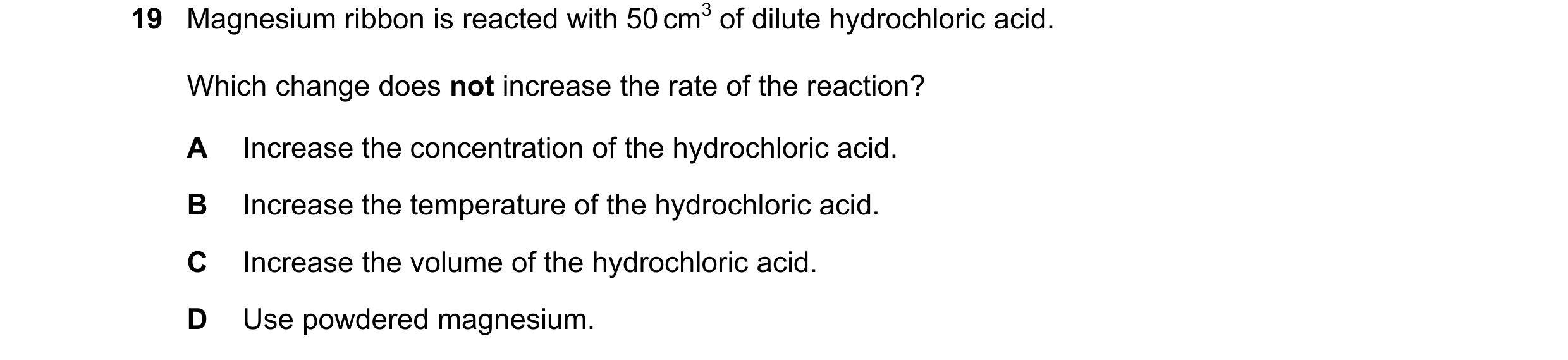
Q44 · Magnesium ribbon is reacted with 50 cm3 of dilute hydrochloric acid 0654/13 Oct/Nov 2020
19 Magnesium ribbon is reacted with 50 cm3 of dilute hydrochloric acid. Which change does not increase the rate of the reaction? A Increase the concentration of the hydrochloric acid. B Increase the temperature of the hydrochloric acid. C Increase the volume of the hydrochloric acid. D Use powdered magnesium.
1 marks
Answer: C
This question in 0654/13 Oct/Nov 2020
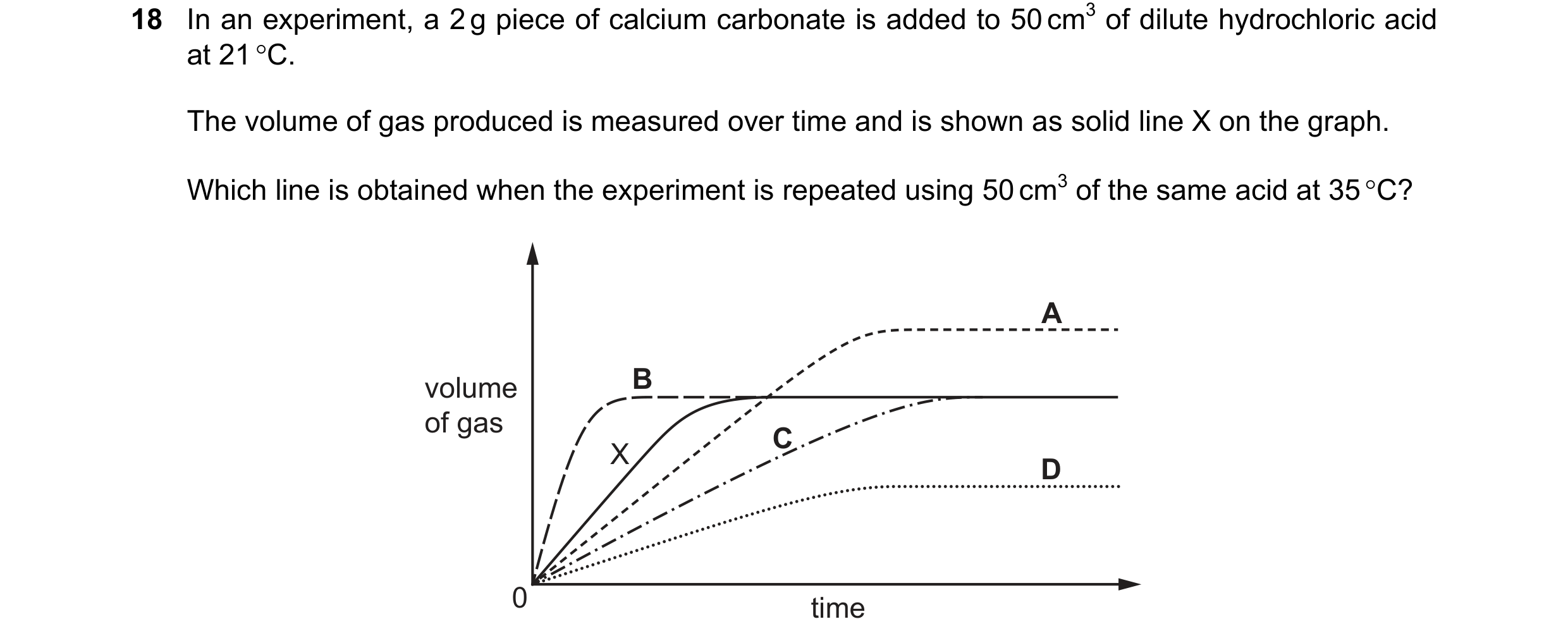
Q45 · In an experiment, a 2 g piece of calcium carbonate is added to 50 cm3 of dilute… 0654/12 Feb/March 2021
18 In an experiment, a 2 g piece of calcium carbonate is added to 50 cm3 of dilute hydrochloric acid at 21 C. The volume of gas produced is measured over time and is shown as solid line X on the graph. Which line is obtained when the experiment is repeated using 50 cm3 of the same acid at 35 C? A B volume of gas C X D 0 time
1 marks
Answer: B
This question in 0654/12 Feb/March 2021
Q46 · Aqueous hydrogen peroxide decomposes slowly and produces water and oxygen gas 0654/11 Oct/Nov 2021
19 Aqueous hydrogen peroxide decomposes slowly and produces water and oxygen gas. The equation for this decomposition is shown. 2H2O2 2H2O + O2 The time taken to produce the first 20 cm3 of gas and the total volume of gas produced in the reaction are measured. The experiment is repeated using a catalyst. Which row describes the results for the second experiment? time taken to produce total volume of first 20 cm3 of gas gas produced A less than experiment 1 the same as experiment 1 B less than experiment 1 more than experiment 1 C more than experiment 1 the same as experiment 1 D more than experiment 1 more than experiment 1
1 marks
Answer: A
This question in 0654/11 Oct/Nov 2021
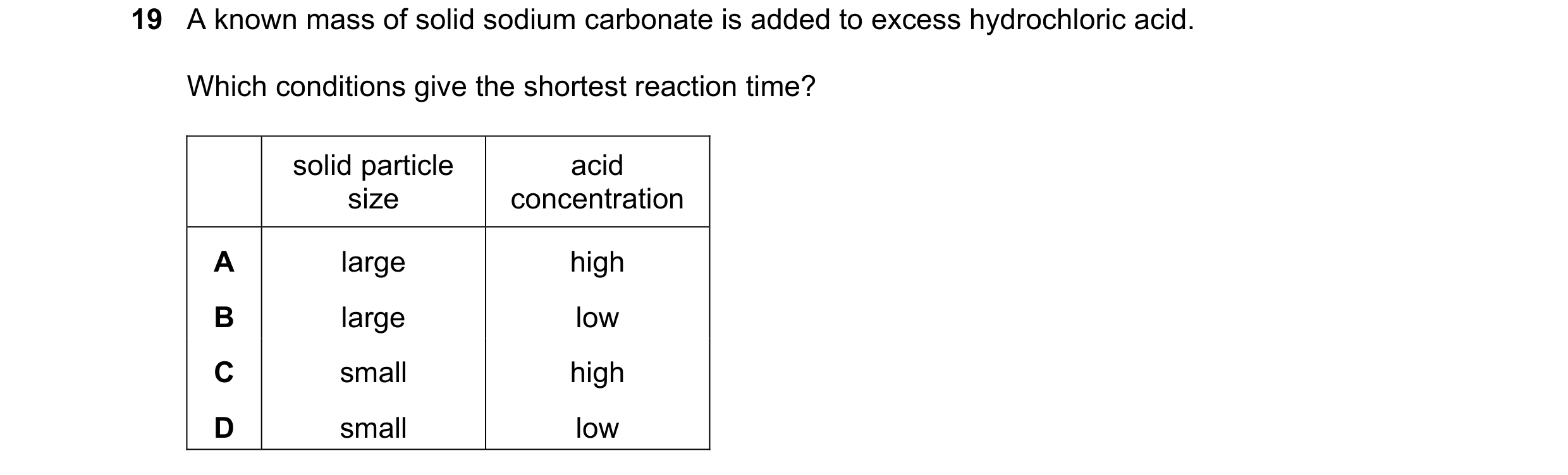
Q47 · A known mass of solid sodium carbonate is added to excess hydrochloric acid 0654/12 Oct/Nov 2021
19 A known mass of solid sodium carbonate is added to excess hydrochloric acid. Which conditions give the shortest reaction time? solid particle acid size concentration A large high B large low C small high D small low
1 marks
Answer: C
This question in 0654/12 Oct/Nov 2021
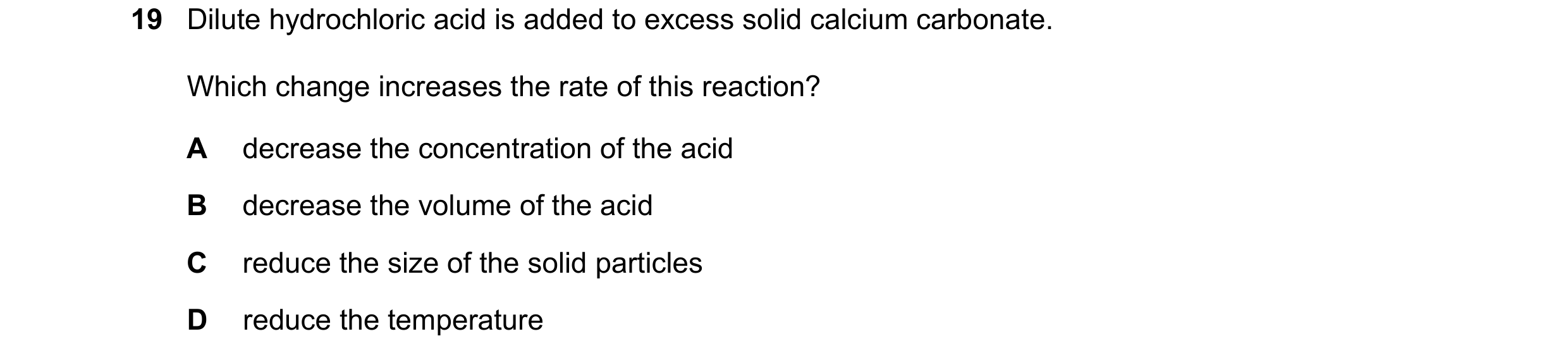
Q48 · Dilute hydrochloric acid is added to excess solid calcium carbonate 0654/13 Oct/Nov 2021
19 Dilute hydrochloric acid is added to excess solid calcium carbonate. Which change increases the rate of this reaction? A decrease the concentration of the acid B decrease the volume of the acid C reduce the size of the solid particles D reduce the temperature
1 marks
Answer: C
This question in 0654/13 Oct/Nov 2021
Q49 · A fixed mass of a solid is reacted with a liquid 0654/11 May/June 2022
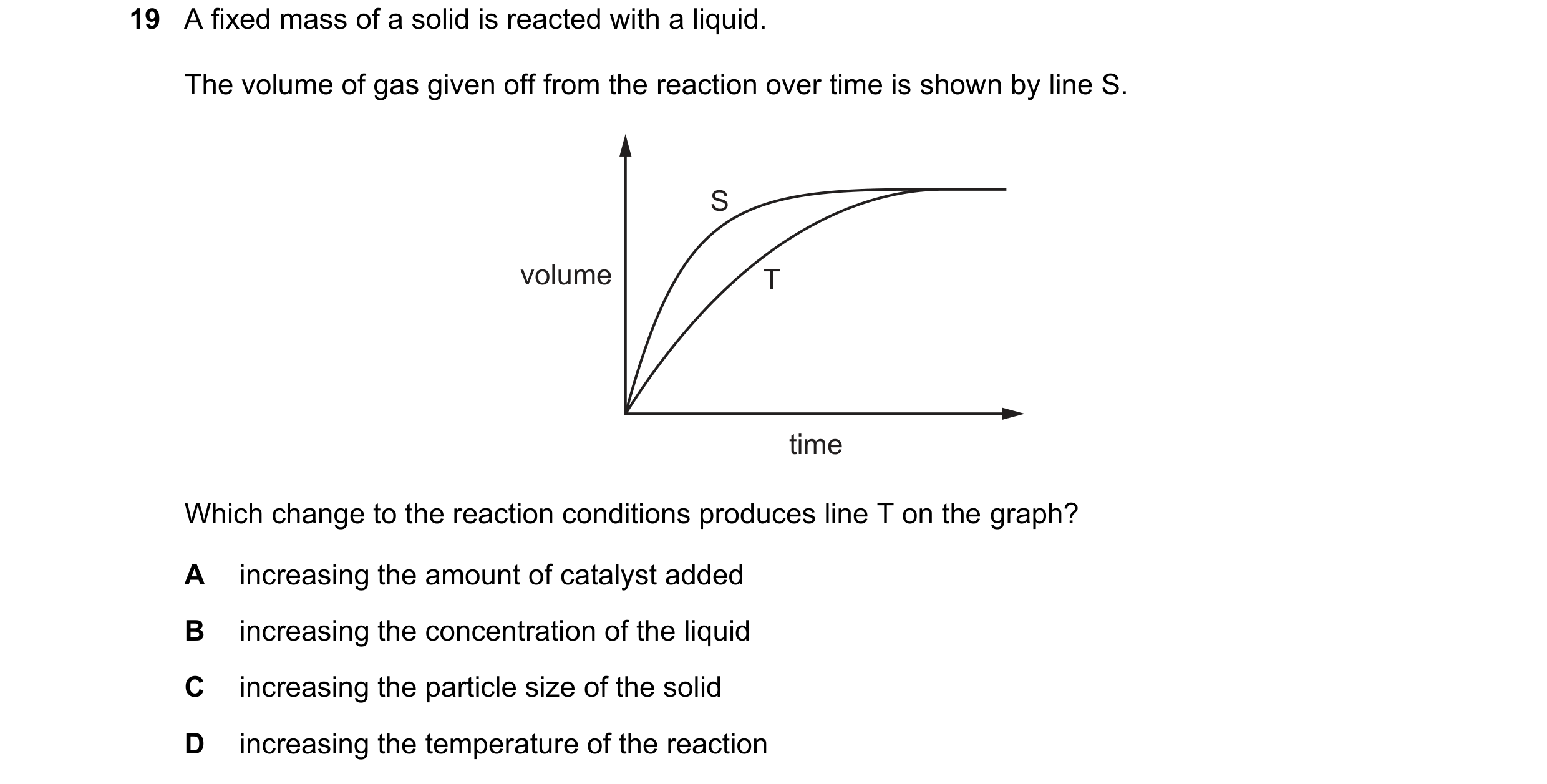
19 A fixed mass of a solid is reacted with a liquid. The volume of gas given off from the reaction over time is shown by line S. S volume T time Which change to the reaction conditions produces line T on the graph? A increasing the amount of catalyst added B increasing the concentration of the liquid C increasing the particle size of the solid D increasing the temperature of the reaction
1 marks
Answer: C
This question in 0654/11 May/June 2022
Q50 · When solid pieces of calcium carbonate are added to dilute hydrochloric acid in a flask… 0654/12 May/June 2022
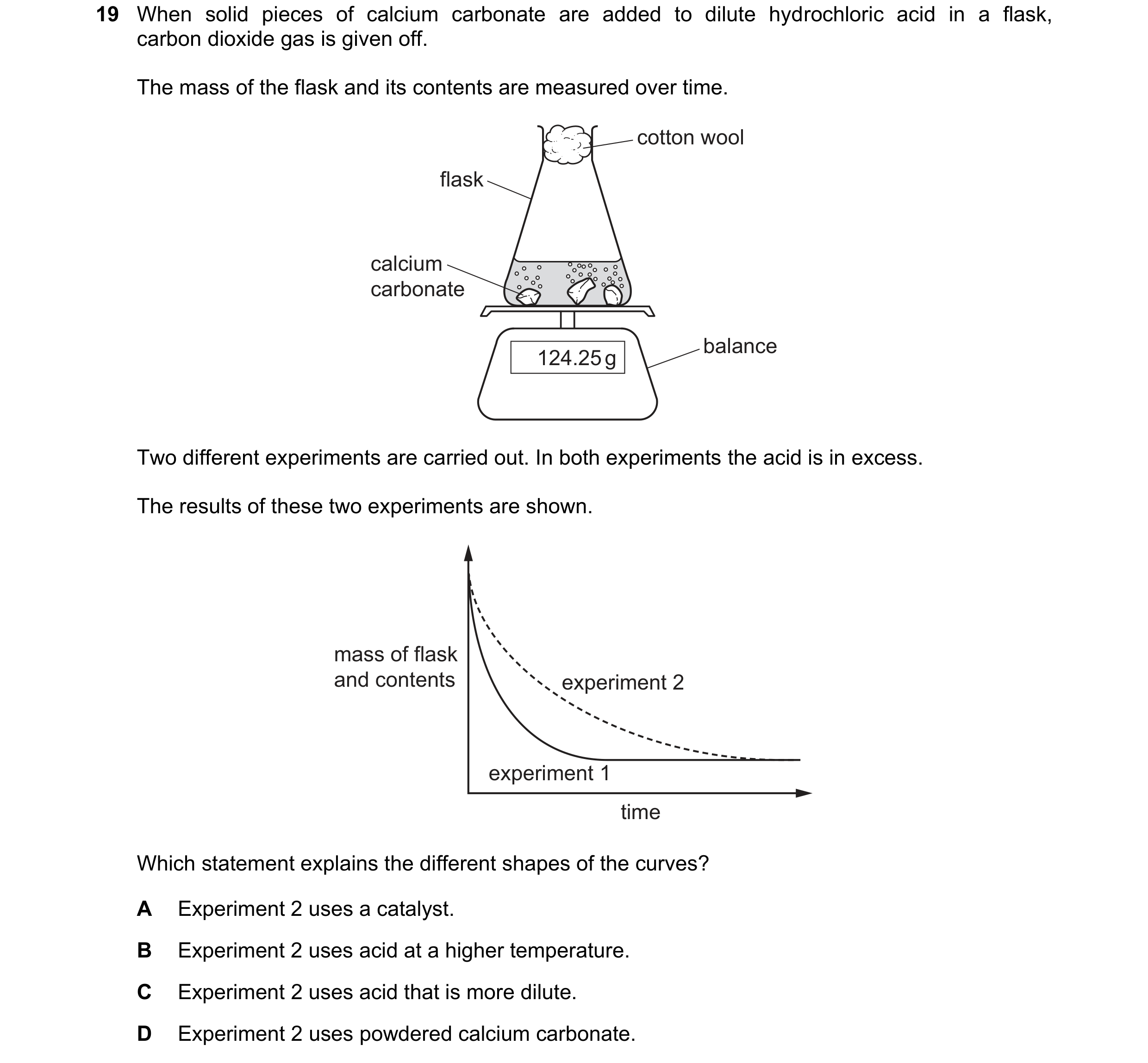
19 When solid pieces of calcium carbonate are added to dilute hydrochloric acid in a flask, carbon dioxide gas is given off. The mass of the flask and its contents are measured over time. cotton wool flask calcium carbonate balance 124.25 g Two different experiments are carried out. In both experiments the acid is in excess. The results of these two experiments are shown. mass of flask and contents experiment 2 experiment 1 time Which statement explains the different shapes of the curves? A Experiment 2 uses a catalyst. B Experiment 2 uses acid at a higher temperature. C Experiment 2 uses acid that is more dilute. D Experiment 2 uses powdered calcium carbonate.
1 marks
Answer: C
This question in 0654/12 May/June 2022
Q51 · When solid pieces of calcium carbonate are added to dilute hydrochloric acid in a flask… 0654/13 May/June 2022
19 When solid pieces of calcium carbonate are added to dilute hydrochloric acid in a flask, carbon dioxide gas is given off. The mass of the flask and its contents are measured over time. cotton wool flask calcium carbonate balance 124.25 g Two different experiments are carried out. In both experiments the acid is in excess. The results of these two experiments are shown. mass of flask and contents experiment 2 experiment 1 time Which statement explains the different shapes of the curves? A Experiment 2 uses a catalyst. B Experiment 2 uses acid at a higher temperature. C Experiment 2 uses acid that is more dilute. D Experiment 2 uses powdered calcium carbonate.
1 marks
Answer: C
This question in 0654/13 May/June 2022
Q52 · The rate of a reaction between a powdered metal and a dilute acid is investigated by… 0654/11 Oct/Nov 2022
19 The rate of a reaction between a powdered metal and a dilute acid is investigated by measuring the volume of hydrogen gas produced per minute. The investigation is repeated using a catalyst. The same mass of powdered metal and the same volume and concentration of acid is used. Which statement about the second investigation is correct? A The rate of the reaction is higher and a greater total volume of hydrogen is produced. B The rate of the reaction is higher and the same total volume of hydrogen is produced. C The rate of the reaction is lower and a smaller total volume of hydrogen is produced. D The rate of the reaction is lower and the same total volume of hydrogen is produced.
1 marks
Answer: B
This question in 0654/11 Oct/Nov 2022
Q53 · Two separate experiments X and Y are used to investigate the rate of the reaction between… 0654/12 Oct/Nov 2022
19 Two separate experiments X and Y are used to investigate the rate of the reaction between equal masses of calcium carbonate and excess dilute hydrochloric acid. The volume of carbon dioxide given off is measured over time. A graph of the results is shown. X volume of carbon dioxide Y time Which statement explains the difference between experiments X and Y? A A catalyst is added to Y. B A higher temperature is used in Y. C Larger pieces of calcium carbonate are used in X. D The acid is more concentrated in X.
1 marks
Answer: D
This question in 0654/12 Oct/Nov 2022
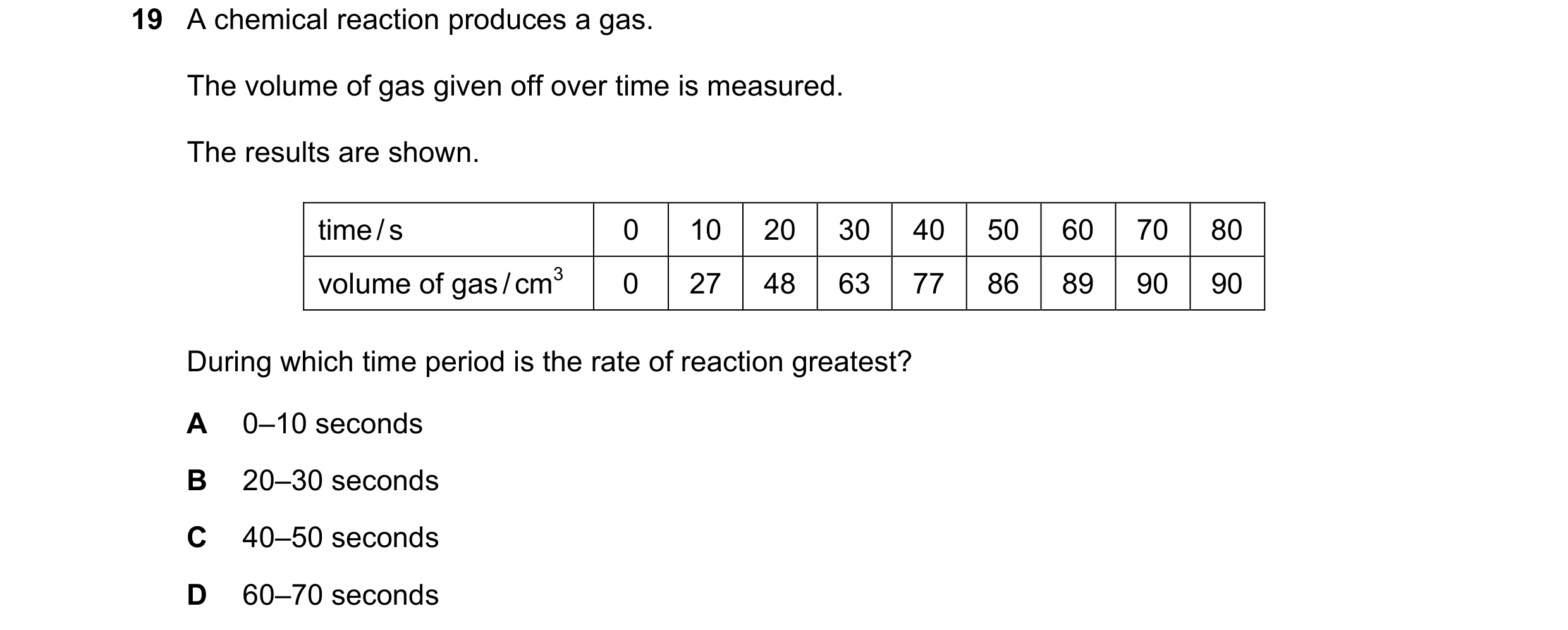
Q54 · A chemical reaction produces a gas 0654/13 Oct/Nov 2022
19 A chemical reaction produces a gas. The volume of gas given off over time is measured. The results are shown. time / s 0 10 20 30 40 50 60 70 80 volume of gas / cm3 0 27 48 63 77 86 89 90 90 During which time period is the rate of reaction greatest? A 0–10 seconds B 20–30 seconds C 40–50 seconds D 60–70 seconds
1 marks
Answer: A
This question in 0654/13 Oct/Nov 2022
Q55 · Which statement about rates of reaction is correct? 0654/12 Feb/March 2023
19 Which statement about rates of reaction is correct? A Catalysts never affect the rate of reaction. B Decreasing the temperature of a reaction increases the rate of reaction. C Increasing the concentration of a reacting solution decreases the rate of reaction. D Using smaller sized pieces of a solid increases the rate of reaction.
1 marks
Answer: D
This question in 0654/12 Feb/March 2023
Q56 · Dilute hydrochloric acid reacts with calcium carbonate 0654/11 May/June 2024
20 Dilute hydrochloric acid reacts with calcium carbonate. The equation for the reaction is shown. CaCO3 + 2HCl CaCl 2 + CO2 + H2O Which change increases the rate of the reaction? A decreasing the temperature of the hydrochloric acid B increasing the concentration of the hydrochloric acid C increasing the size of the calcium carbonate particles D increasing the volume of the hydrochloric acid
1 marks
Answer: B
This question in 0654/11 May/June 2024
Q57 · Dilute hydrochloric acid reacts with solid calcium carbonate 0654/11 Oct/Nov 2024
20 Dilute hydrochloric acid reacts with solid calcium carbonate. Which change decreases the rate of the reaction? A decreasing the concentration of the hydrochloric acid B decreasing the size of the calcium carbonate pieces C increasing the surface area of the calcium carbonate D increasing the temperature of the acid
1 marks
Answer: A
This question in 0654/11 Oct/Nov 2024
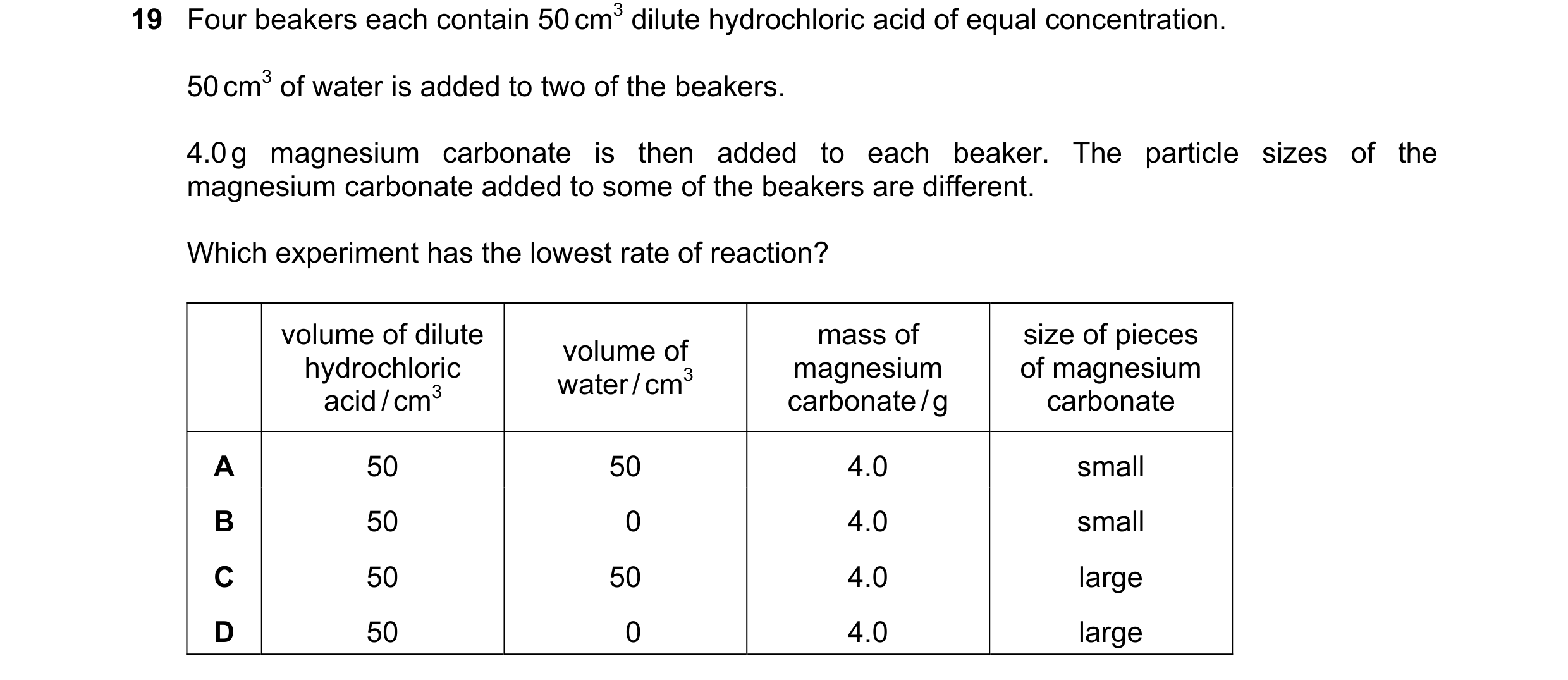
Q58 · Four beakers each contain 50 cm3 dilute hydrochloric acid of equal concentration 0654/12 Oct/Nov 2024
19 Four beakers each contain 50 cm3 dilute hydrochloric acid of equal concentration. 50 cm3 of water is added to two of the beakers. 4.0 g magnesium carbonate is then added to each beaker. The particle sizes of the magnesium carbonate added to some of the beakers are different. Which experiment has the lowest rate of reaction? volume of dilute mass of size of pieces volume of hydrochloric water / cm3 magnesium of magnesium acid / cm3 carbonate / g carbonate A 50 50 4.0 small B 50 0 4.0 small C 50 50 4.0 large D 50 0 4.0 large
1 marks
Answer: C
This question in 0654/12 Oct/Nov 2024
Q59 · Four beakers each contain 50 cm3 dilute hydrochloric acid of equal concentration 0654/13 Oct/Nov 2024
19 Four beakers each contain 50 cm3 dilute hydrochloric acid of equal concentration. 50 cm3 of water is added to two of the beakers. 4.0 g magnesium carbonate is then added to each beaker. The particle sizes of the magnesium carbonate added to some of the beakers are different. Which experiment has the lowest rate of reaction? volume of dilute mass of size of pieces volume of hydrochloric water / cm3 magnesium of magnesium acid / cm3 carbonate / g carbonate A 50 50 4.0 small B 50 0 4.0 small C 50 50 4.0 large D 50 0 4.0 large
1 marks
Answer: C
This question in 0654/13 Oct/Nov 2024
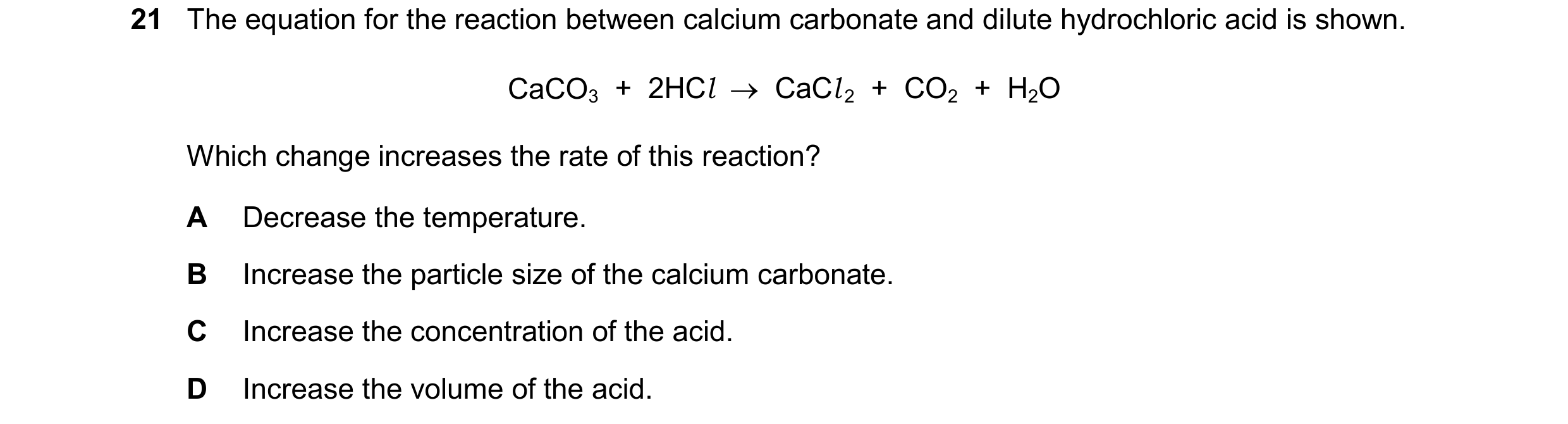
Q60 · The equation for the reaction between calcium carbonate and dilute hydrochloric acid is… 0654/12 Feb/March 2025
21 The equation for the reaction between calcium carbonate and dilute hydrochloric acid is shown. CaCO3 + 2HCl CaCl 2 + CO2 + H2O Which change increases the rate of this reaction? A Decrease the temperature. B Increase the particle size of the calcium carbonate. C Increase the concentration of the acid. D Increase the volume of the acid.
1 marks
Answer: C
This question in 0654/12 Feb/March 2025
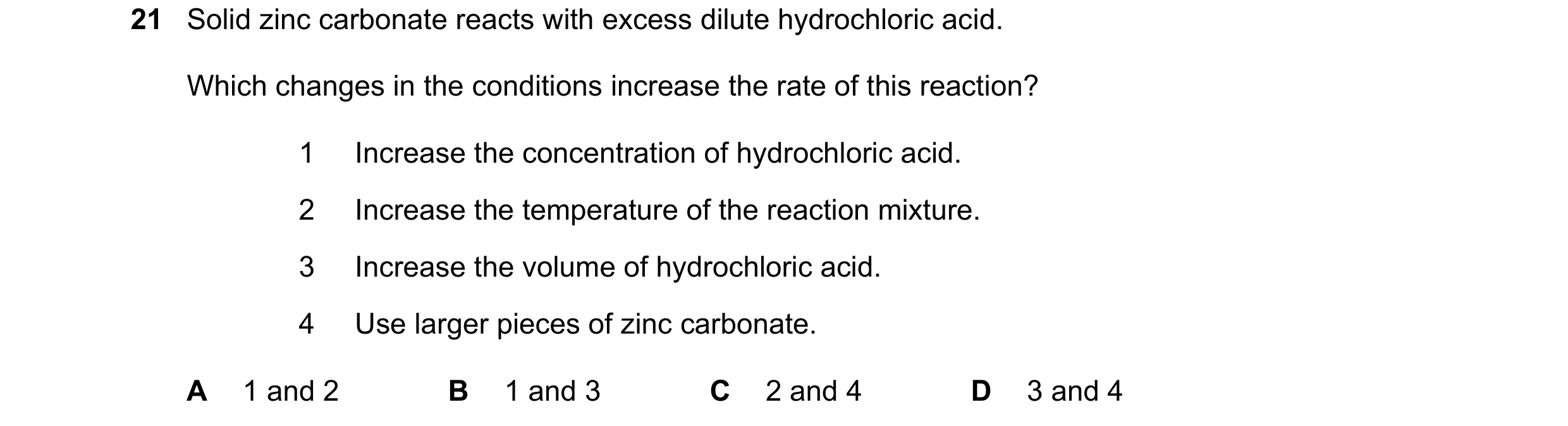
Q61 · Solid zinc carbonate reacts with excess dilute hydrochloric acid 0654/11 May/June 2025
21 Solid zinc carbonate reacts with excess dilute hydrochloric acid. Which changes in the conditions increase the rate of this reaction? 1 Increase the concentration of hydrochloric acid. 2 Increase the temperature of the reaction mixture. 3 Increase the volume of hydrochloric acid. 4 Use larger pieces of zinc carbonate. A 1 and 2 B 1 and 3 C 2 and 4 D 3 and 4
1 marks
Answer: A
This question in 0654/11 May/June 2025
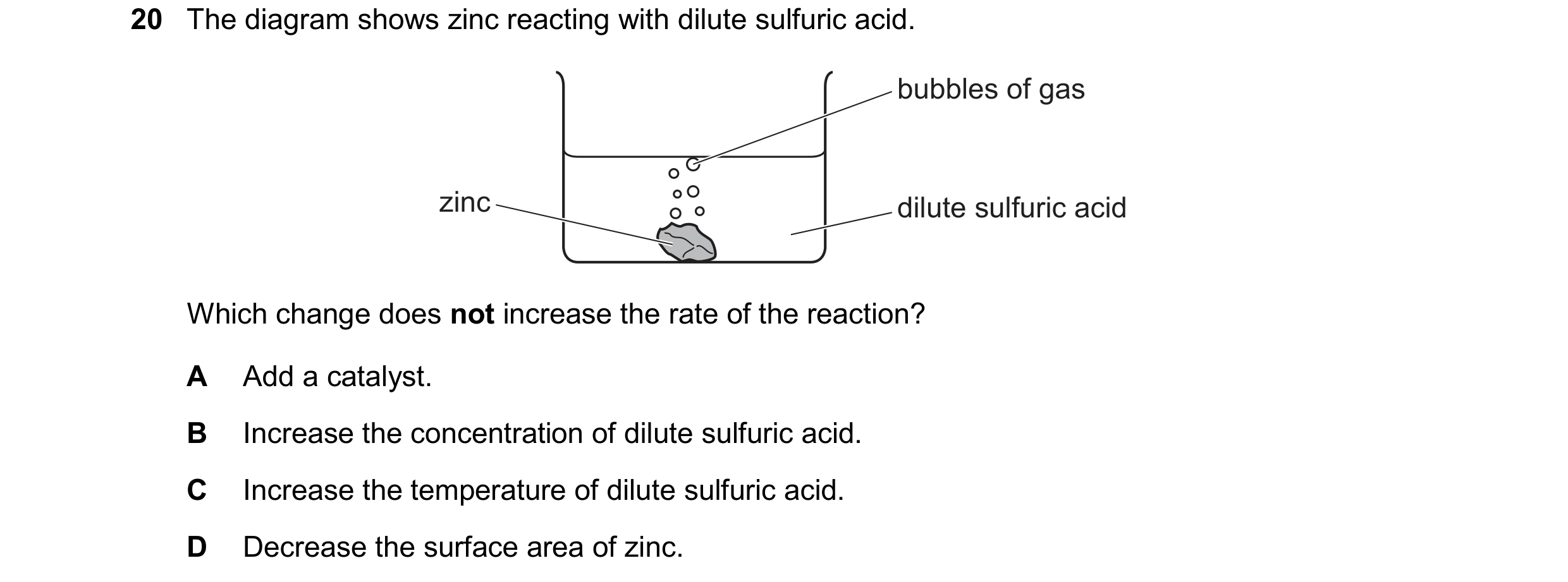
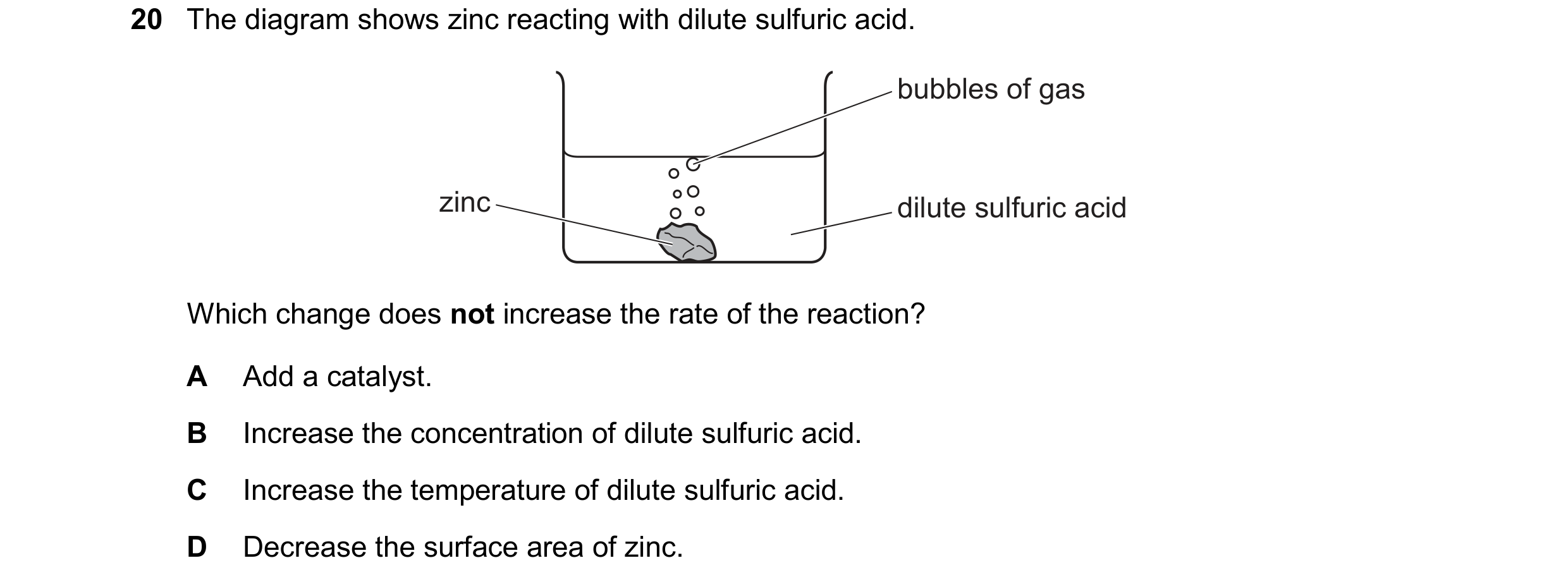
Q62 · The diagram shows zinc reacting with dilute sulfuric acid 0654/12 Oct/Nov 2025
20 The diagram shows zinc reacting with dilute sulfuric acid. bubbles of gas zinc dilute sulfuric acid Which change does not increase the rate of the reaction? A Add a catalyst. B Increase the concentration of dilute sulfuric acid. C Increase the temperature of dilute sulfuric acid. D Decrease the surface area of zinc.
1 marks
Answer: D
This question in 0654/12 Oct/Nov 2025
Q63 · The diagram shows zinc reacting with dilute sulfuric acid 0654/13 Oct/Nov 2025
20 The diagram shows zinc reacting with dilute sulfuric acid. bubbles of gas zinc dilute sulfuric acid Which change does not increase the rate of the reaction? A Add a catalyst. B Increase the concentration of dilute sulfuric acid. C Increase the temperature of dilute sulfuric acid. D Decrease the surface area of zinc.
1 marks
Answer: D
This question in 0654/13 Oct/Nov 2025
 1 / 24
 2 / 24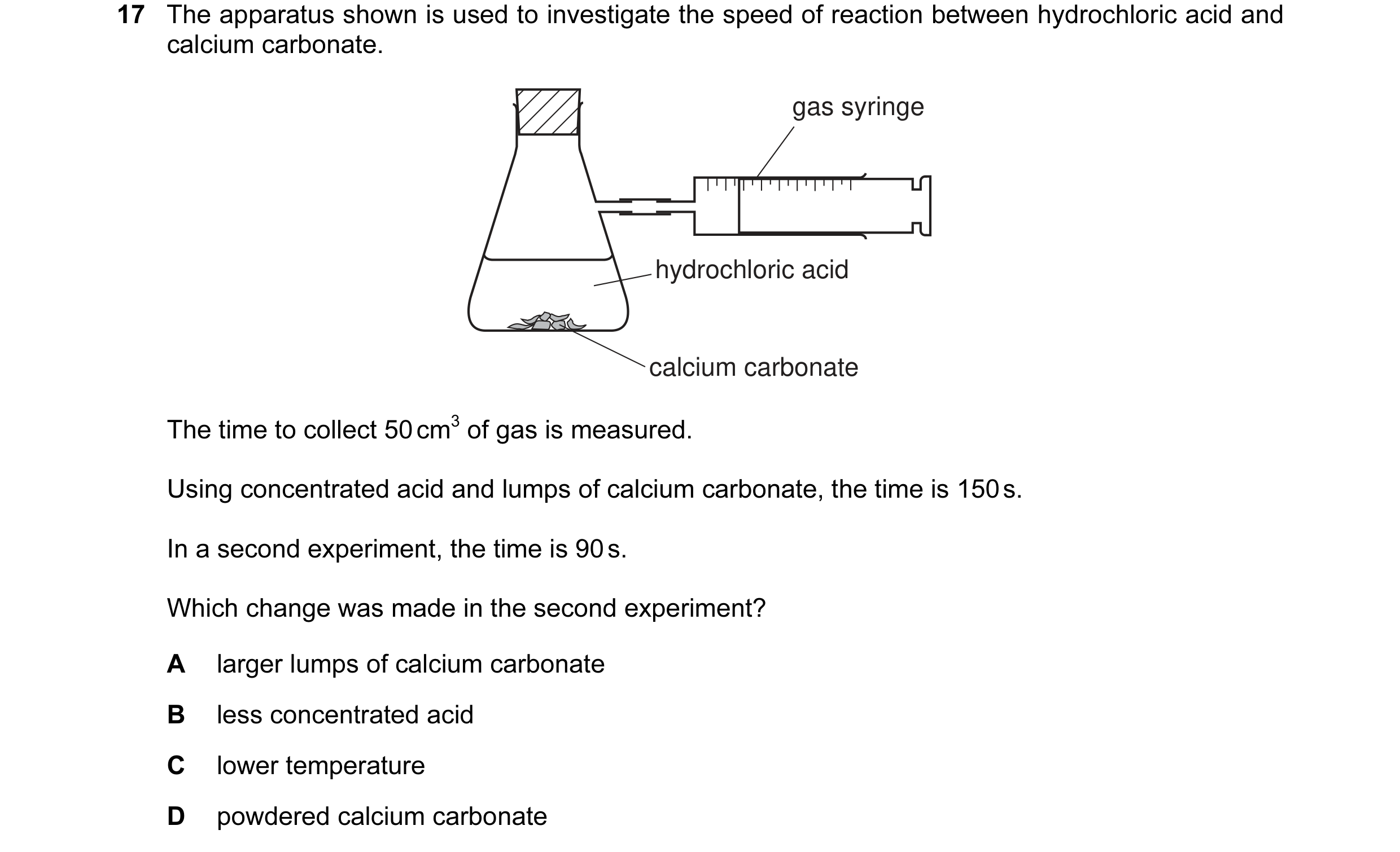
 3 / 24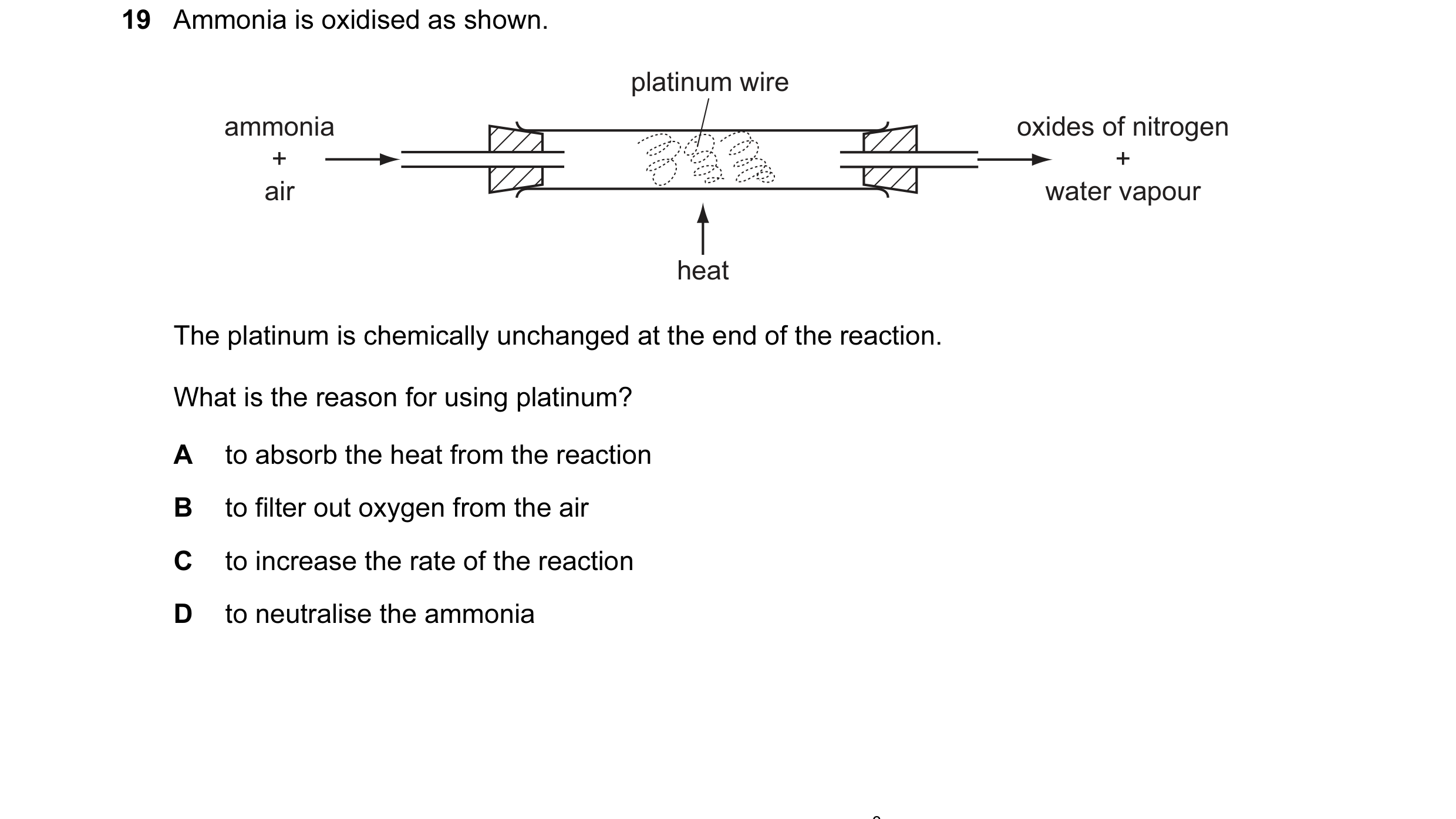
 4 / 24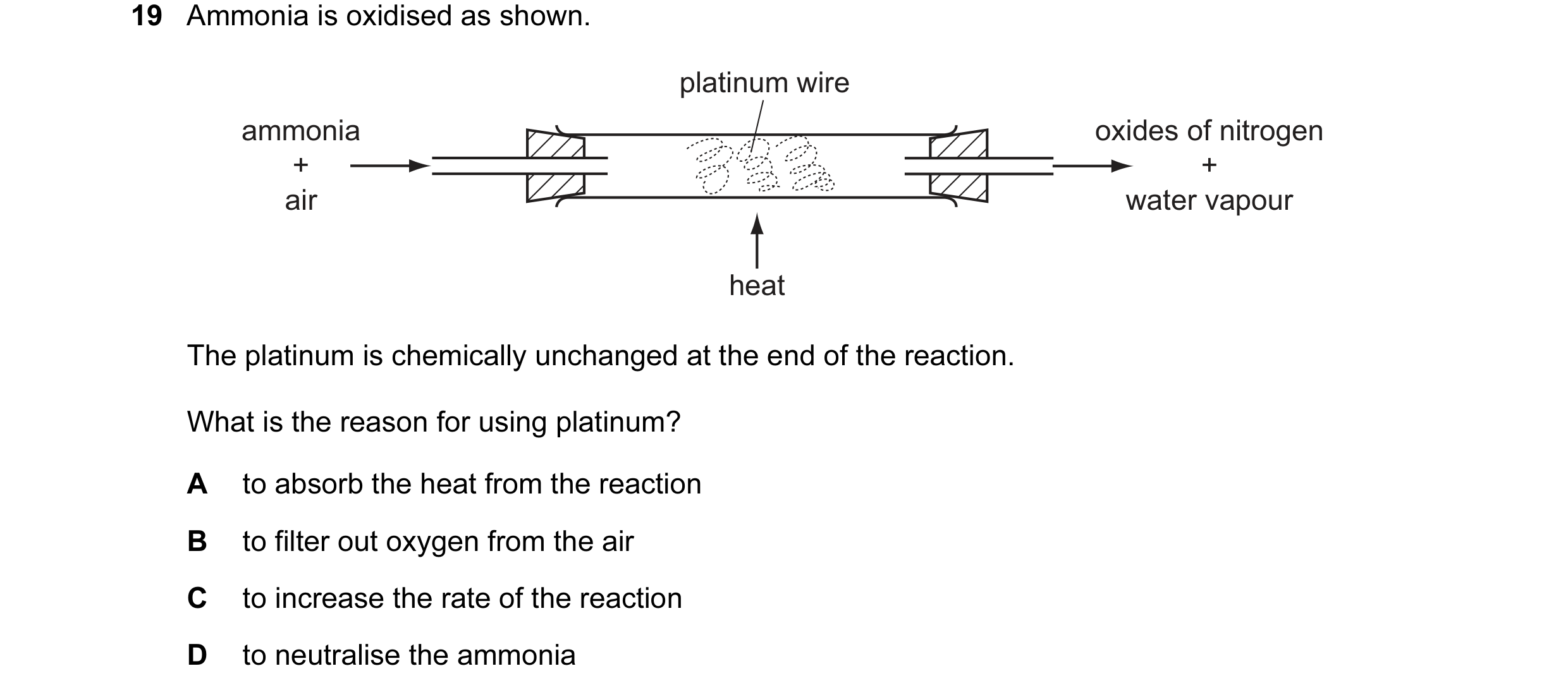
 5 / 24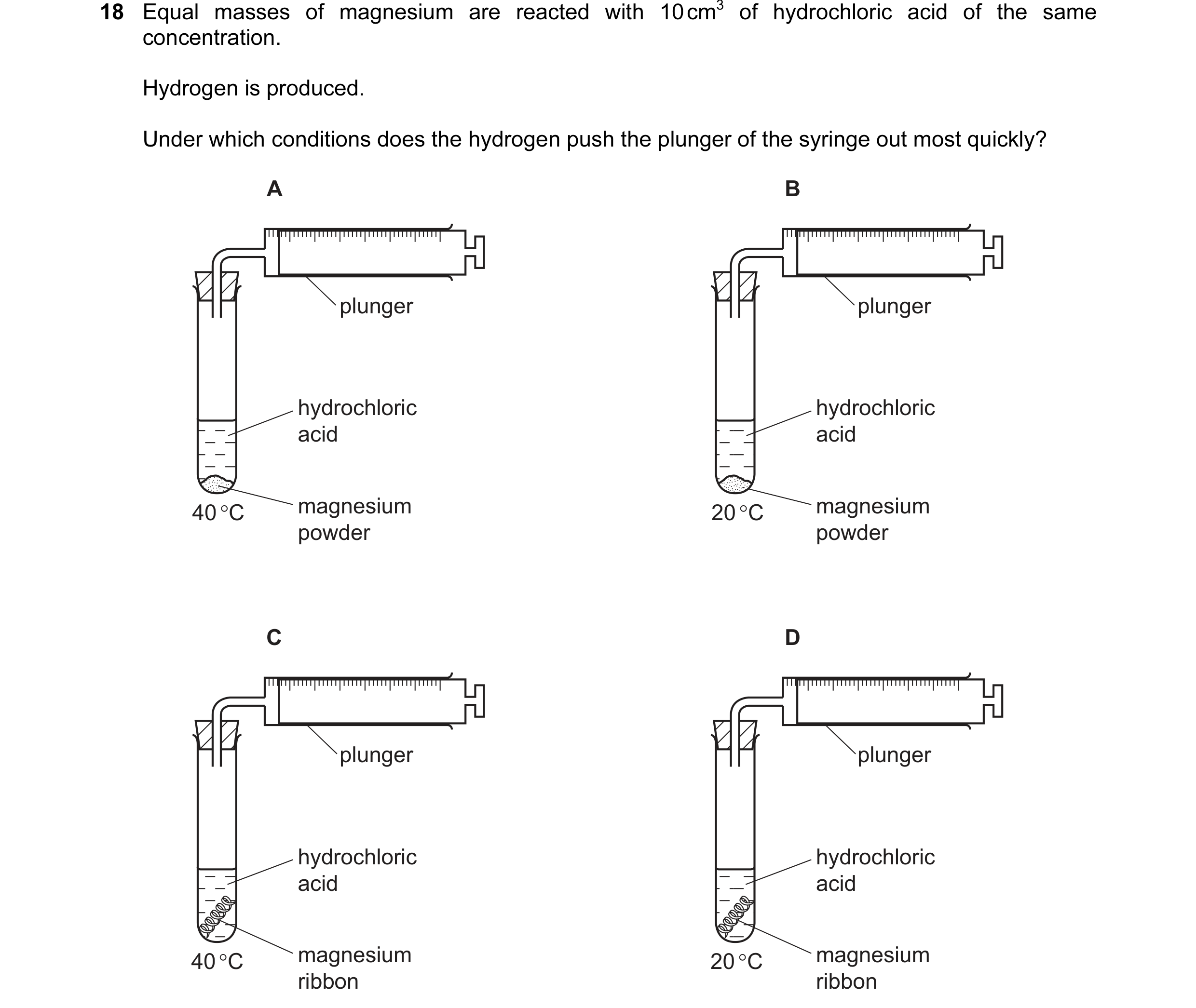
 6 / 24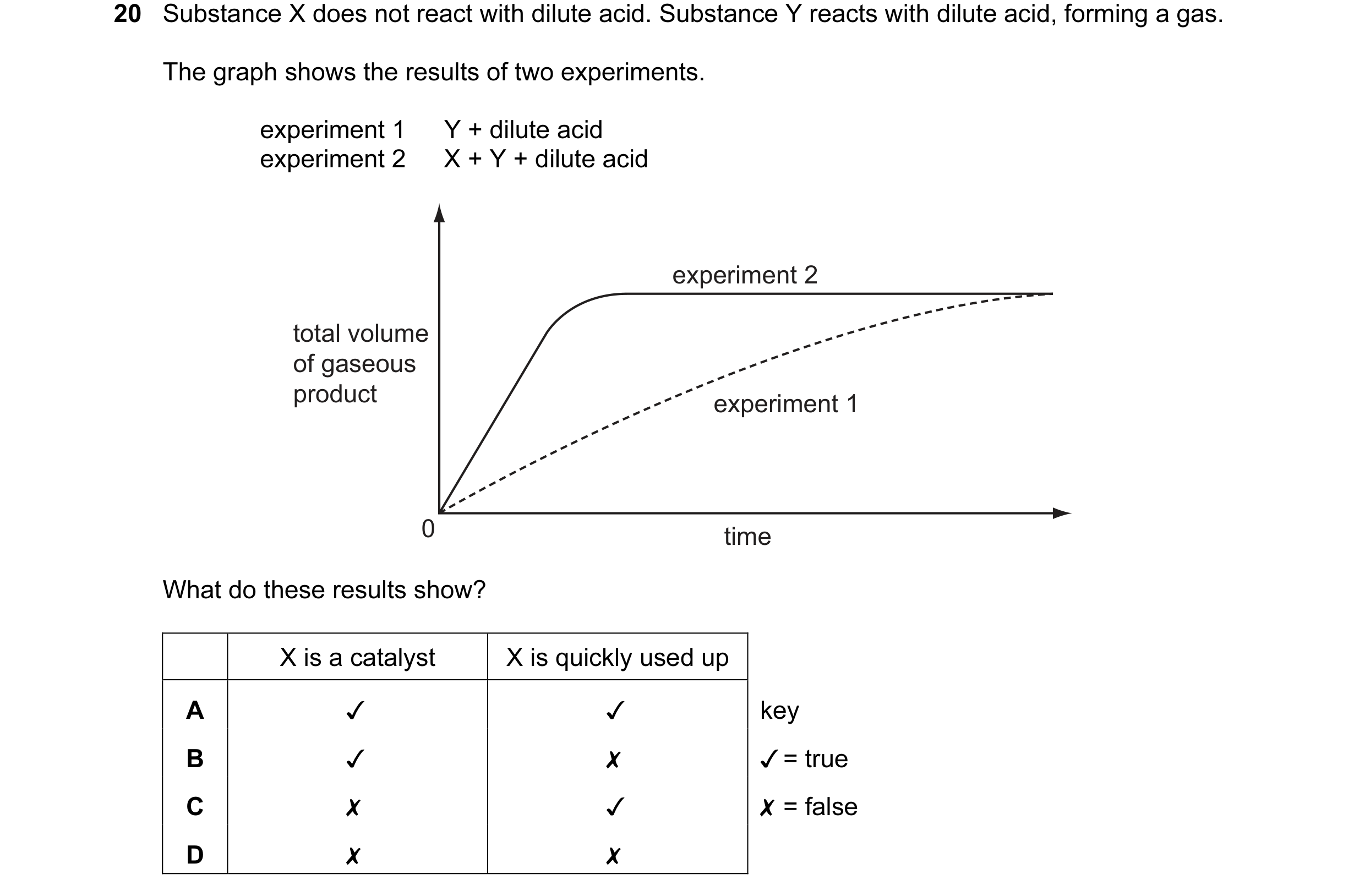
 7 / 24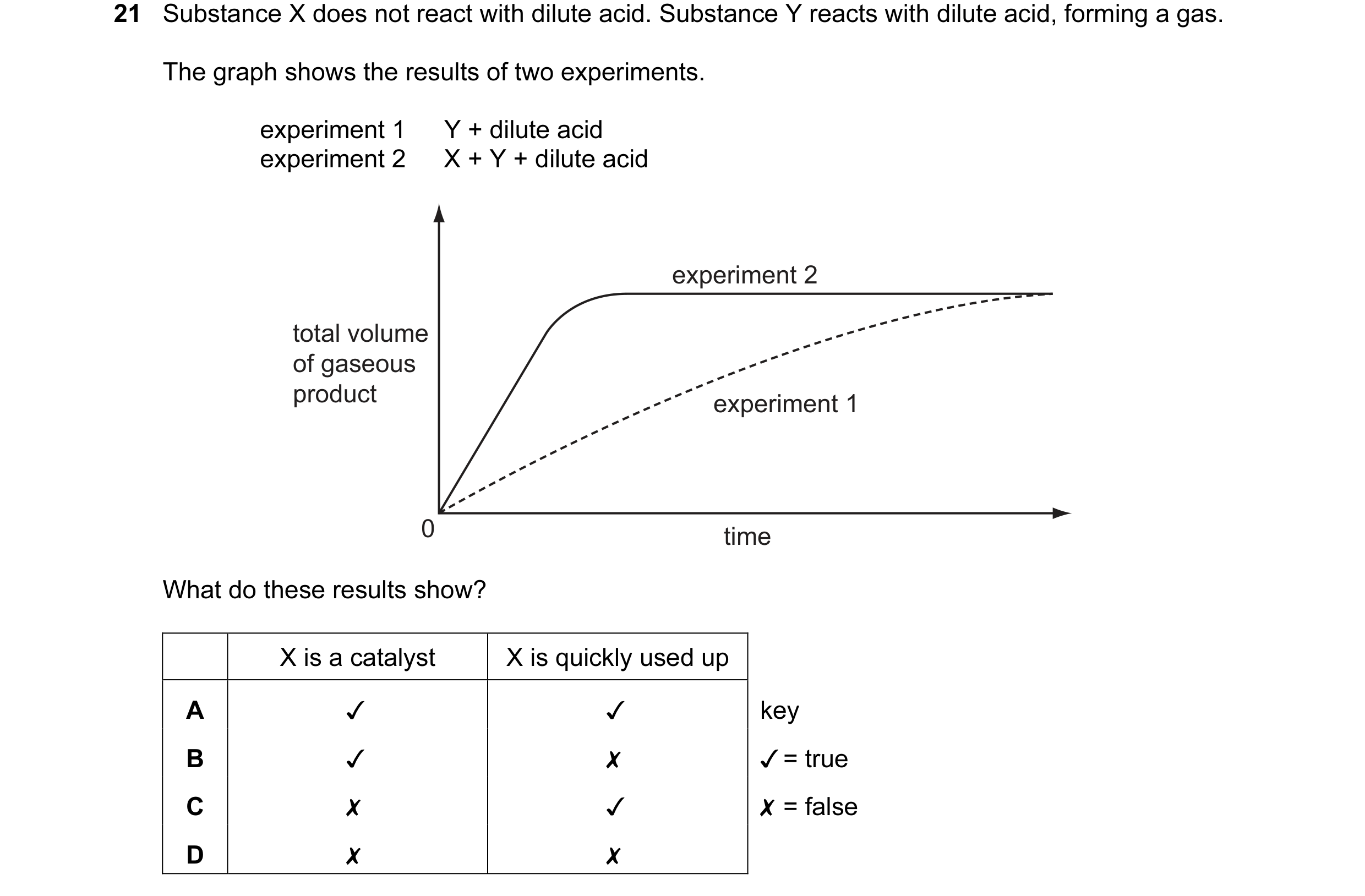
 8 / 24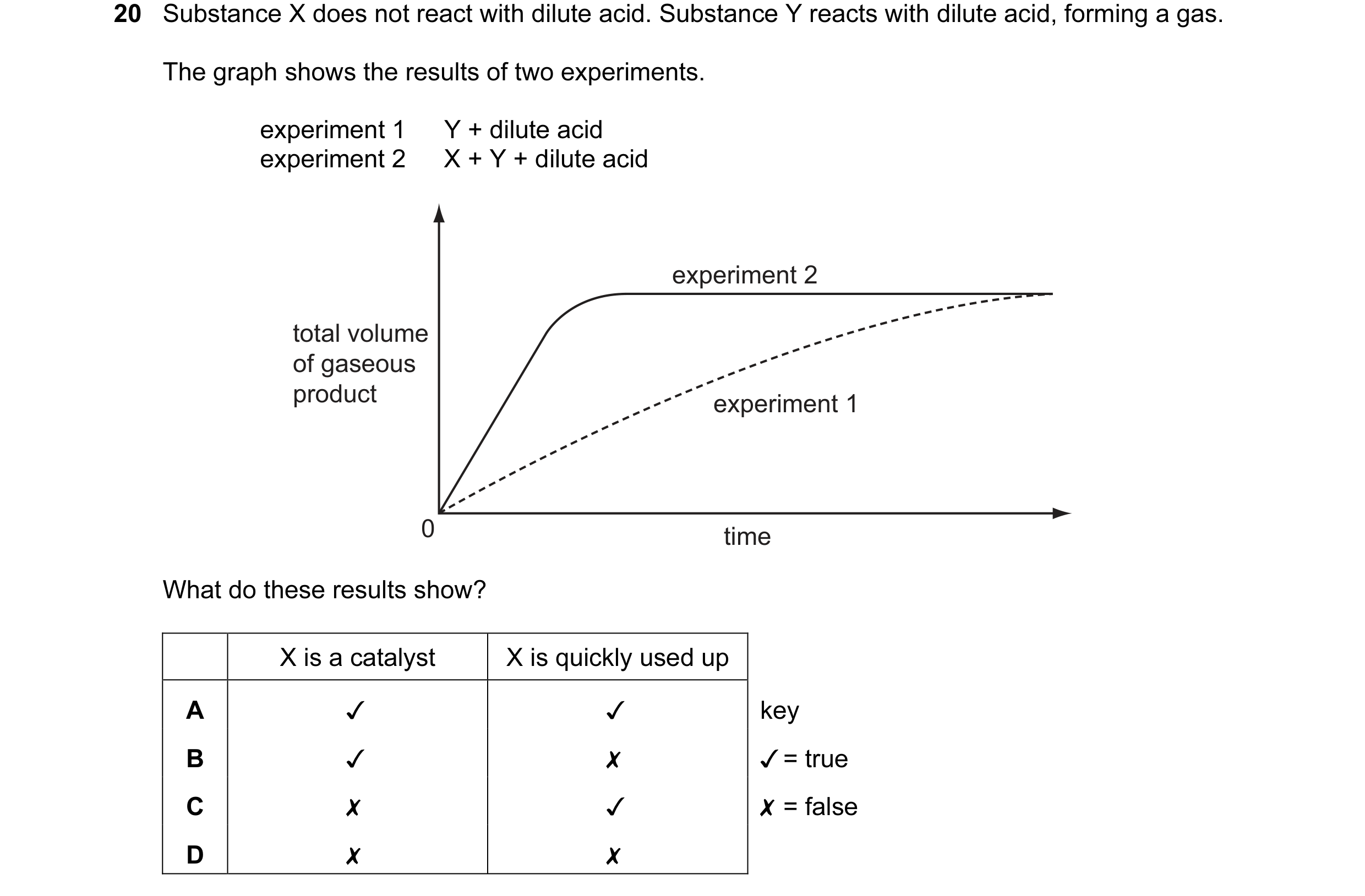
 9 / 24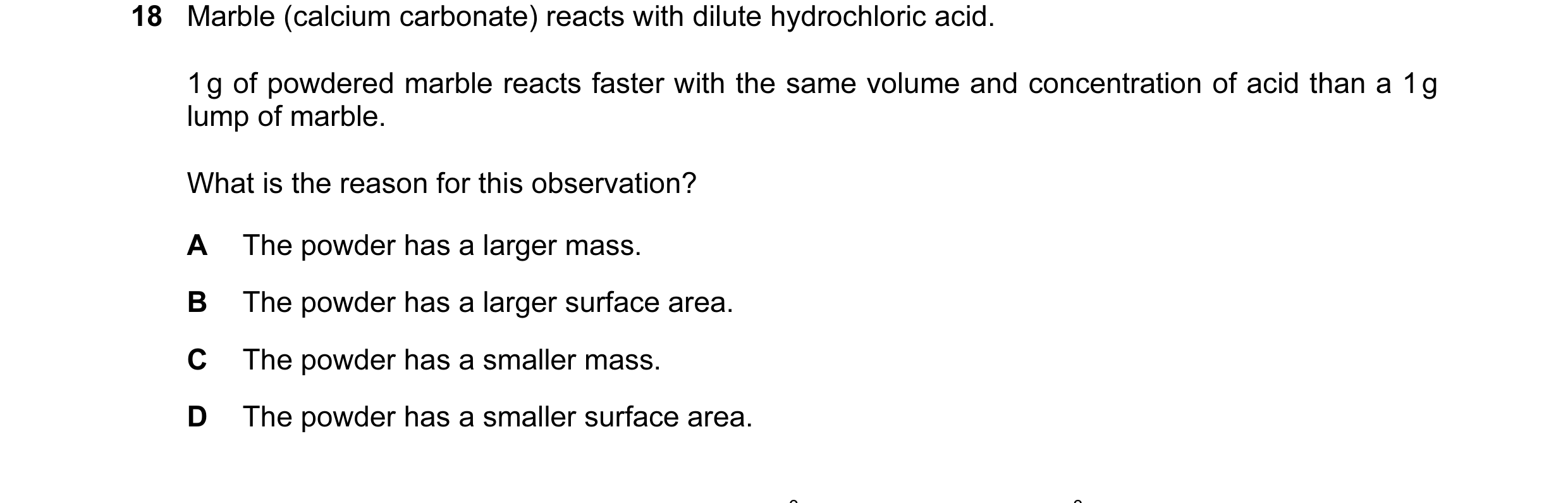
 10 / 24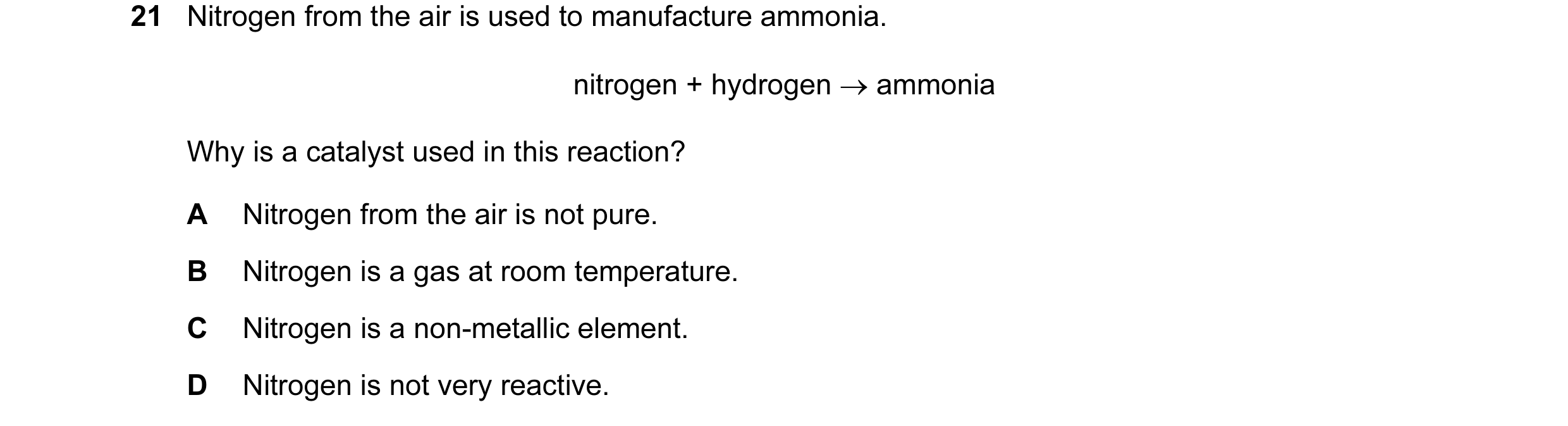
 11 / 24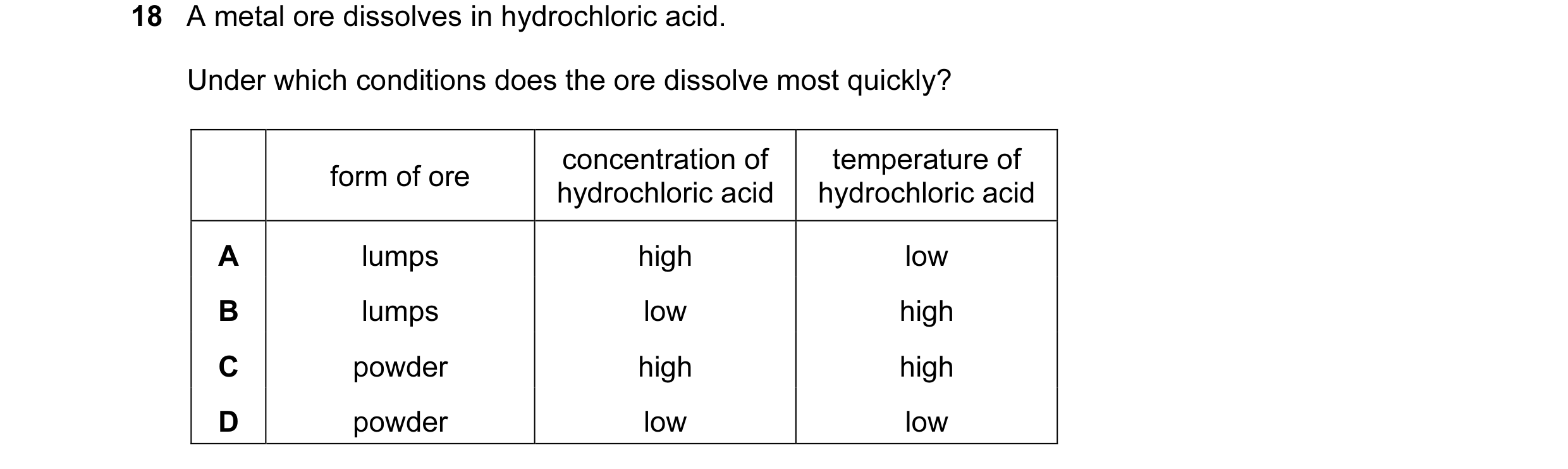
 12 / 24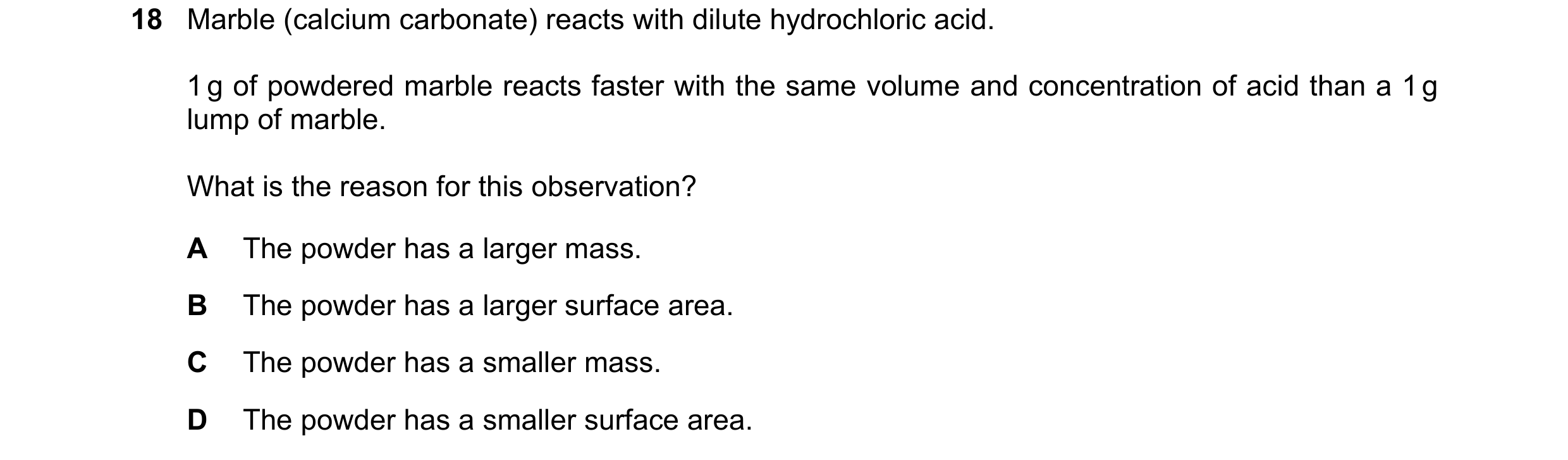
 13 / 24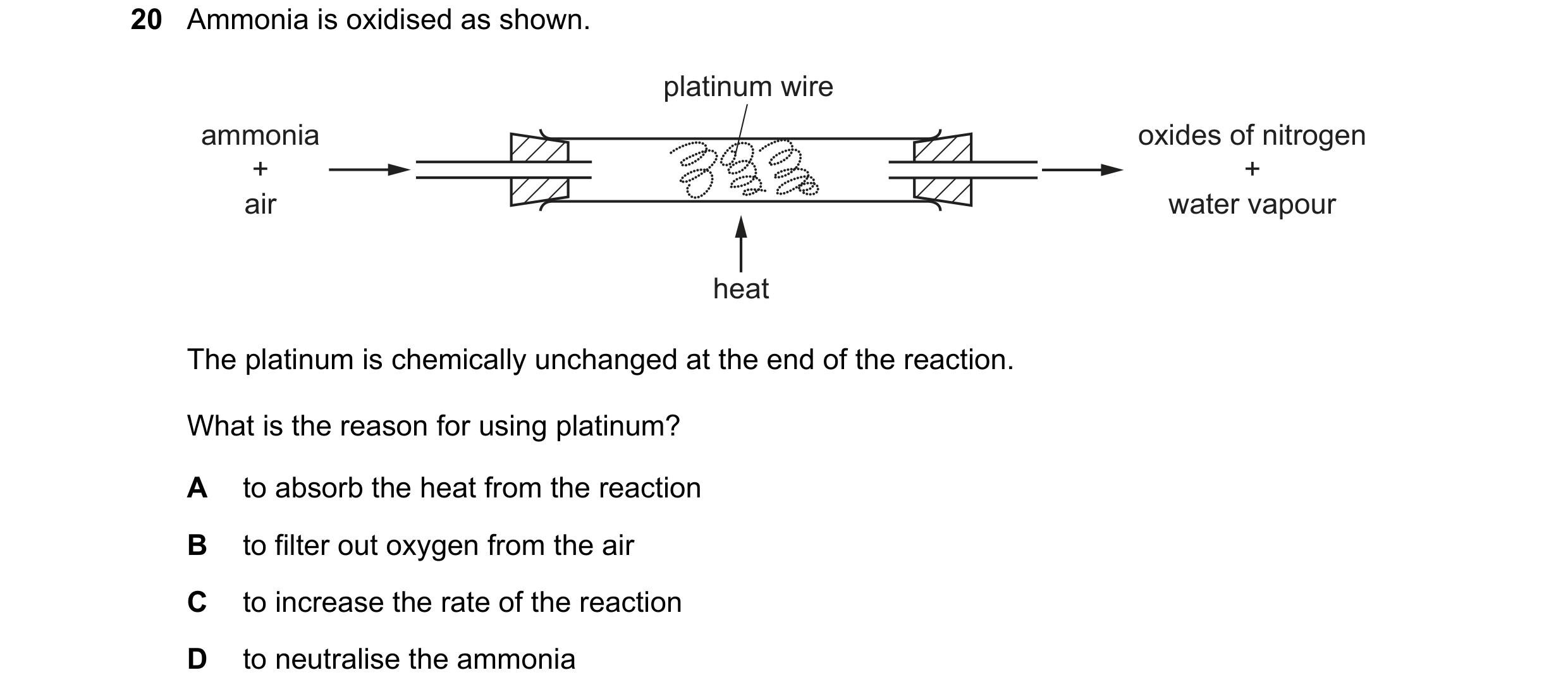
 14 / 24
 15 / 24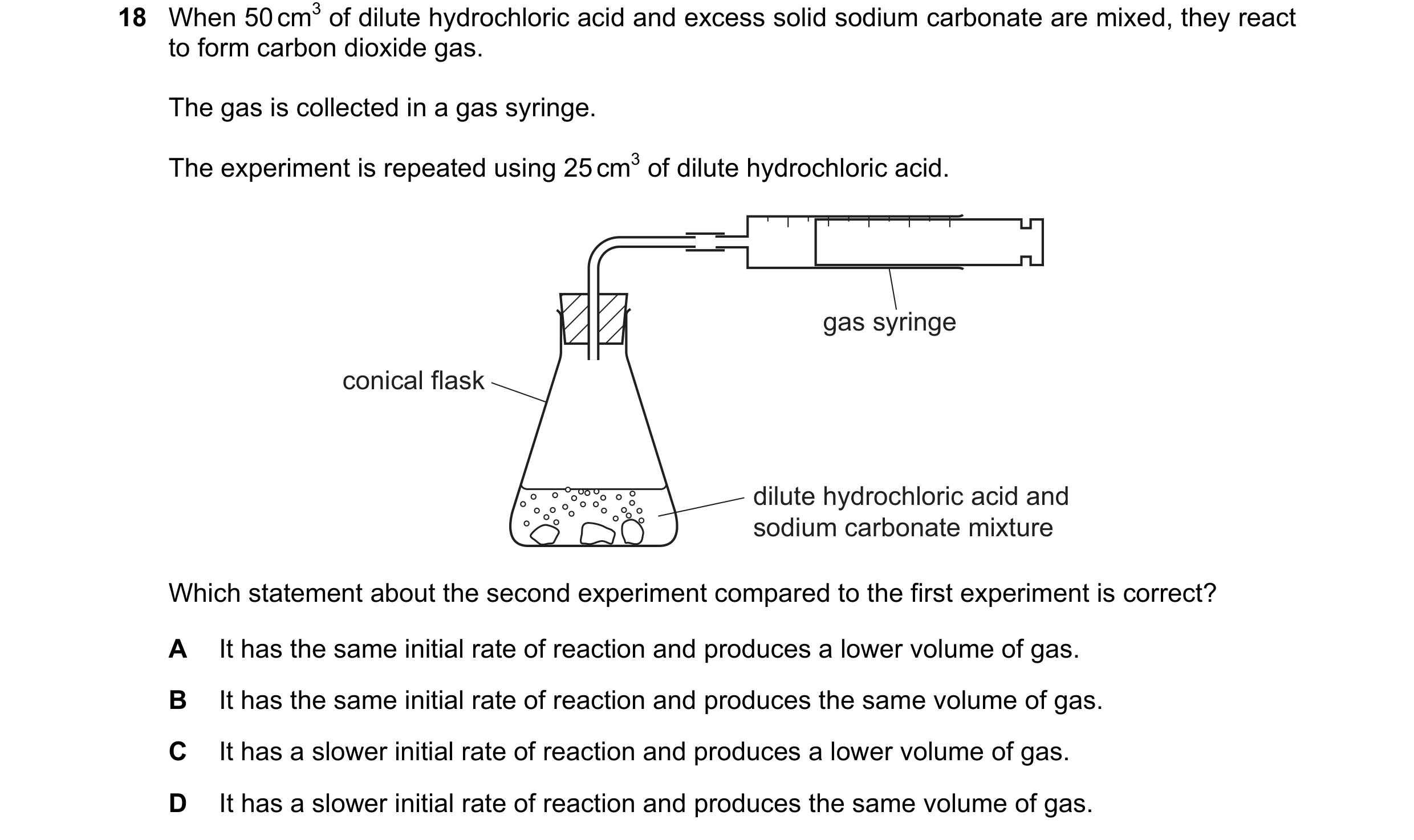
 16 / 24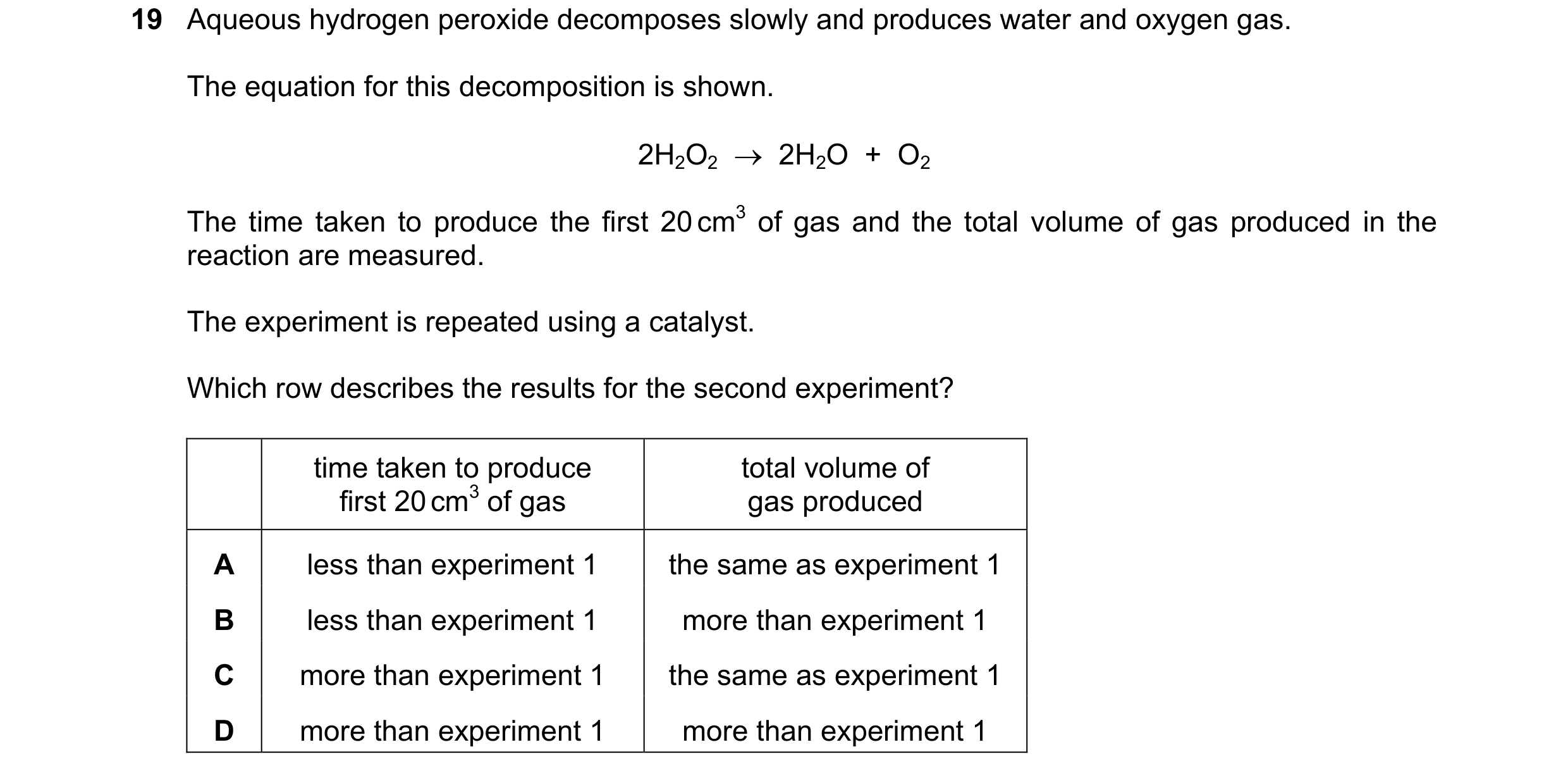
 17 / 24
 18 / 24
 19 / 24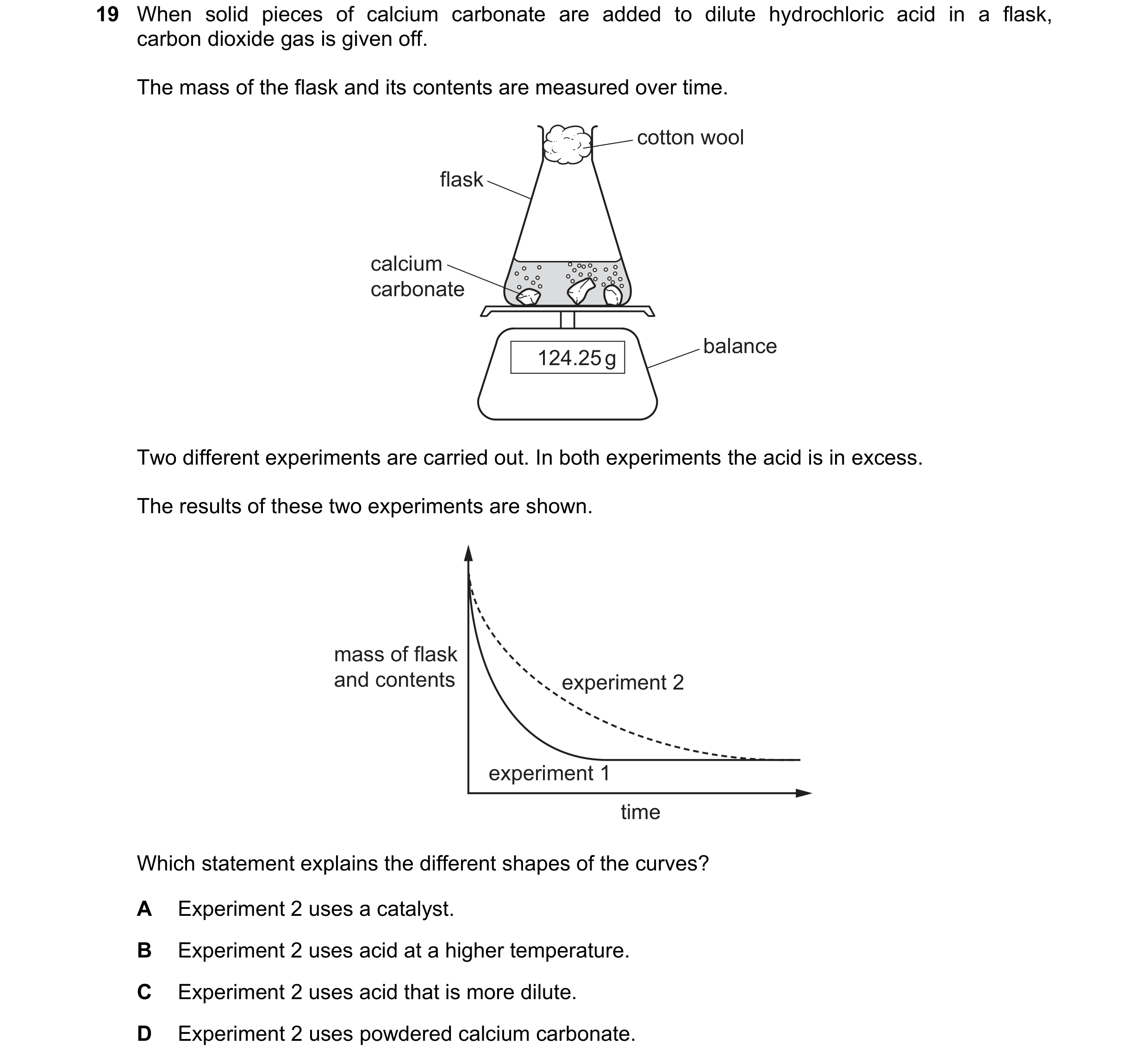
 20 / 24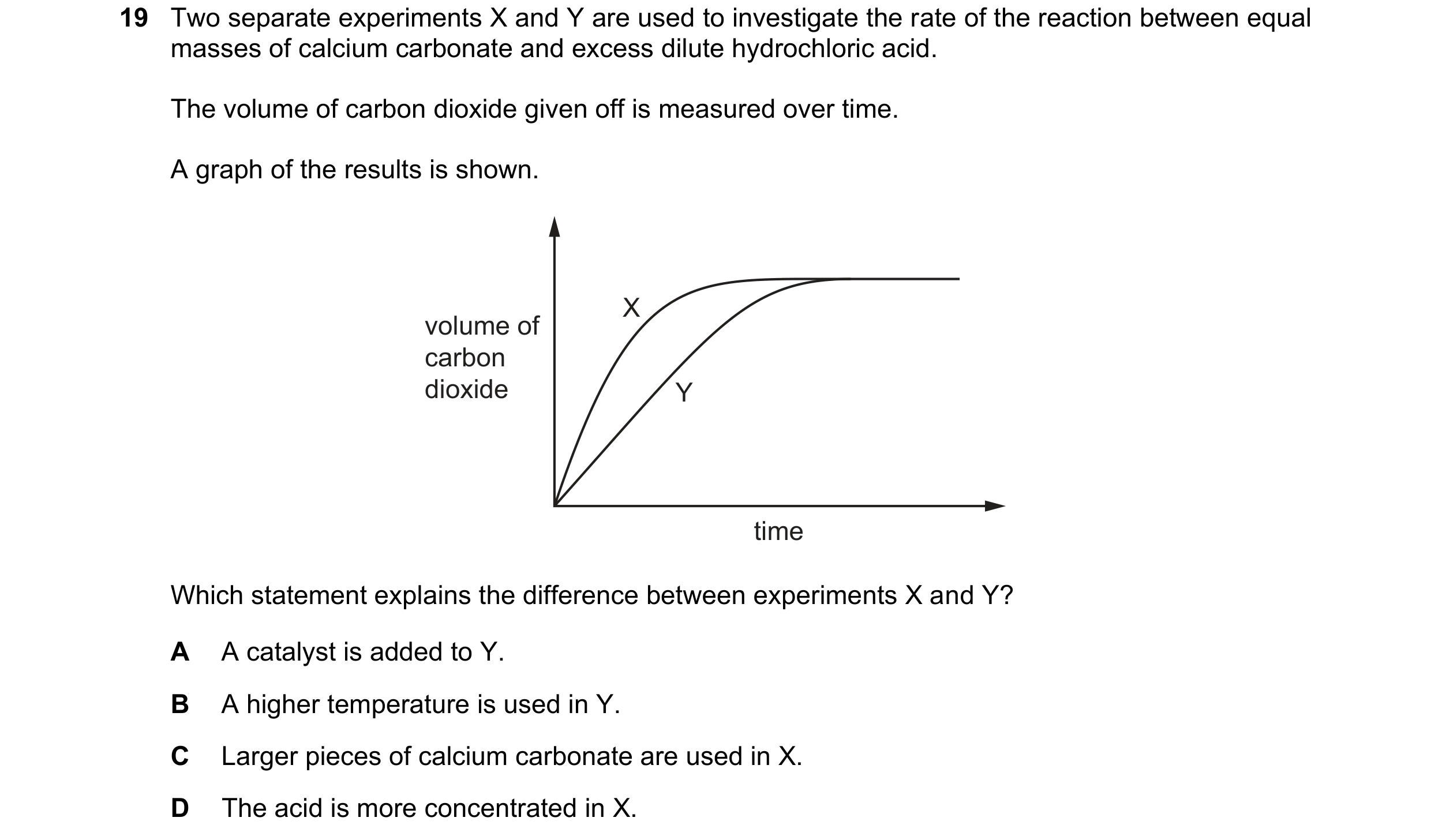
 21 / 24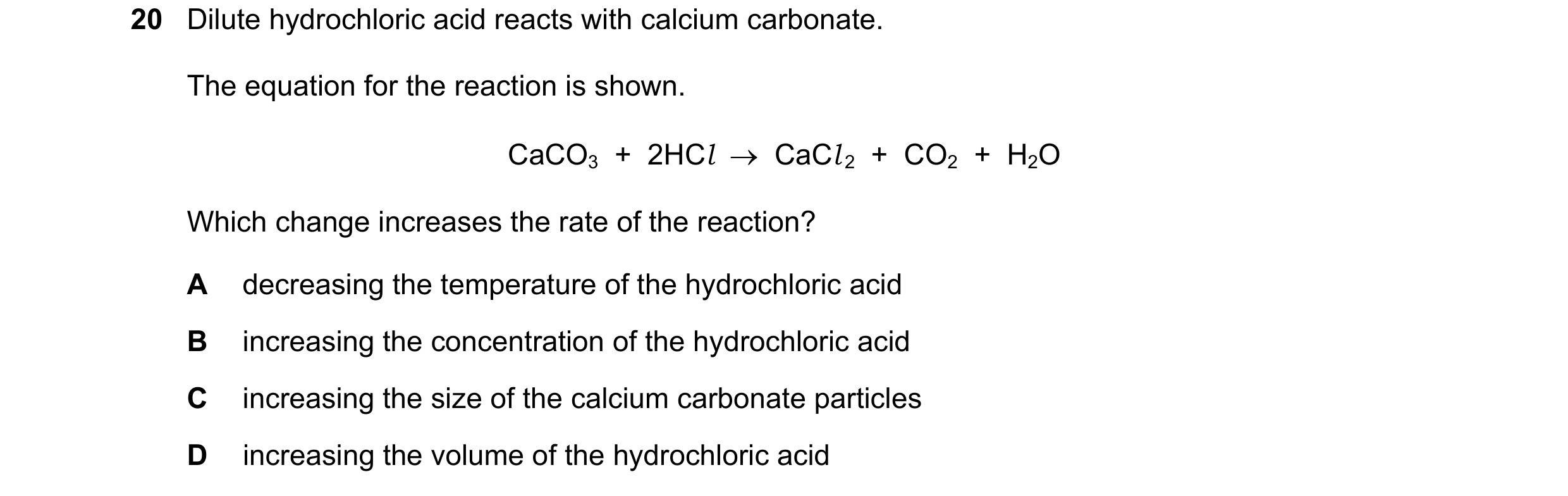
 22 / 24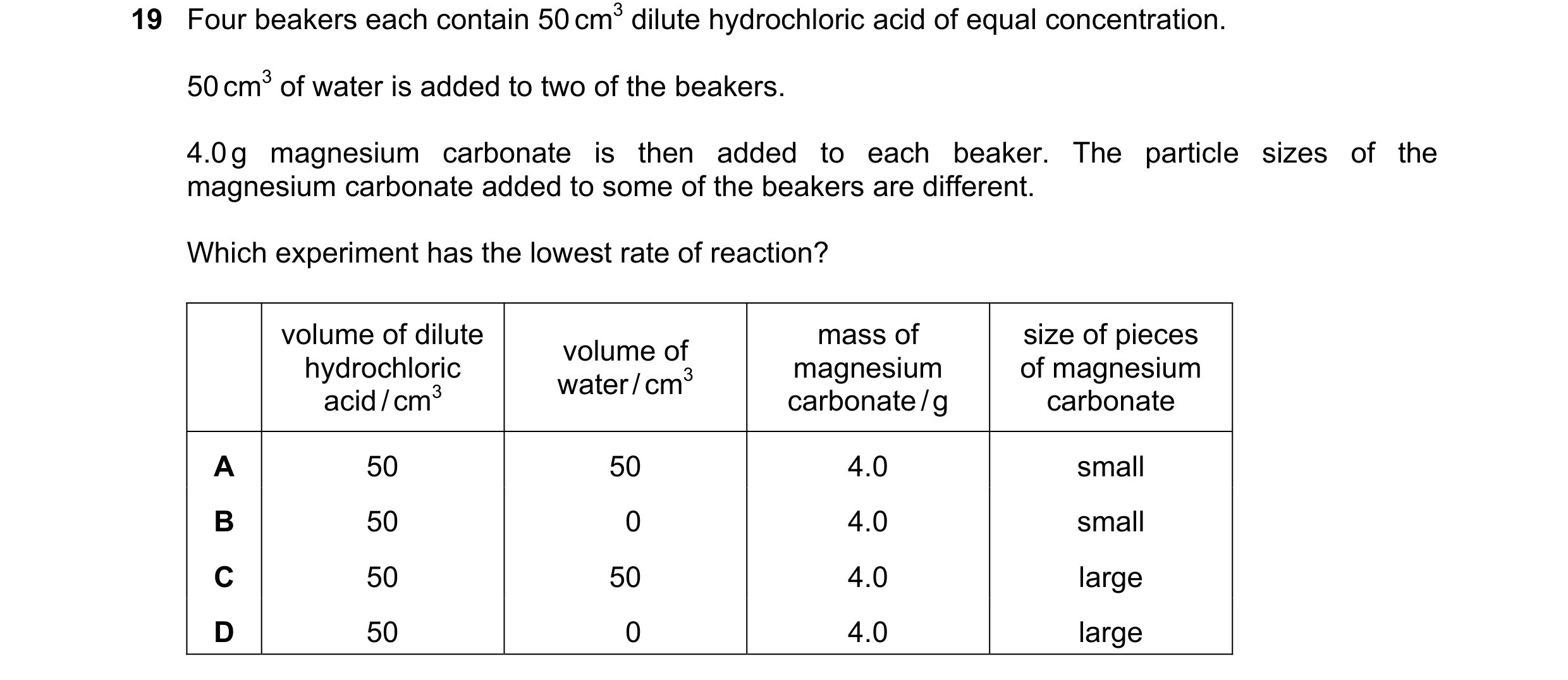
 23 / 24
 24 / 24