Questions as text
Q1 · Aqueous sodium thiosulfate reacts with dilute hydrochloric acid 0654/21 May/June 2017
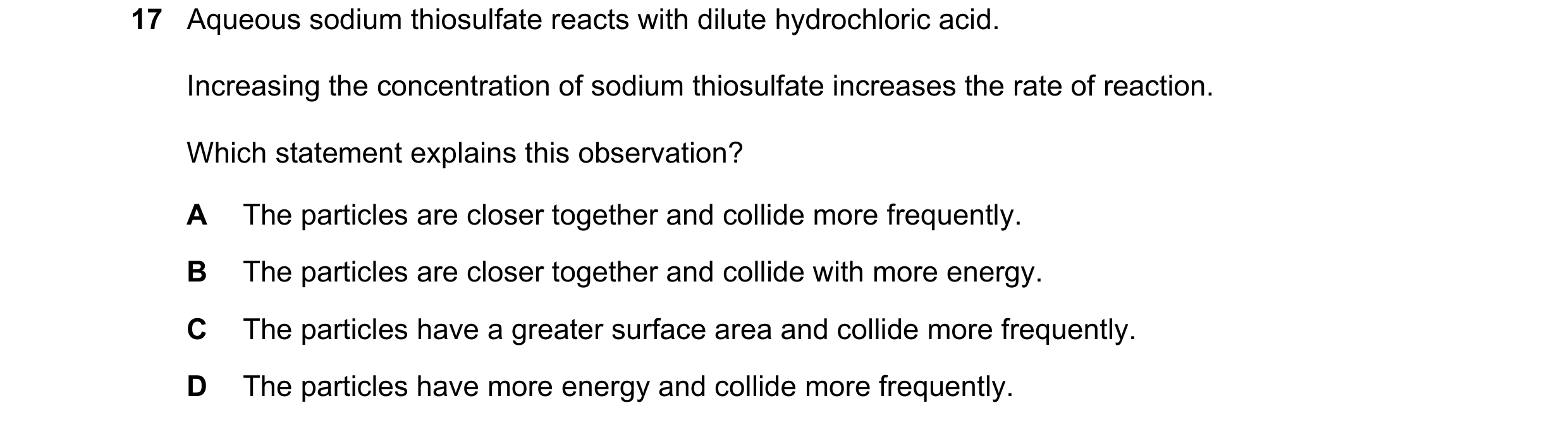
17 Aqueous sodium thiosulfate reacts with dilute hydrochloric acid. Increasing the concentration of sodium thiosulfate increases the rate of reaction. Which statement explains this observation? A The particles are closer together and collide more frequently. B The particles are closer together and collide with more energy. C The particles have a greater surface area and collide more frequently. D The particles have more energy and collide more frequently.
1 marks
Answer: A
This question in 0654/21 May/June 2017
Q2 · Aqueous sodium thiosulfate reacts with dilute hydrochloric acid 0654/22 May/June 2017
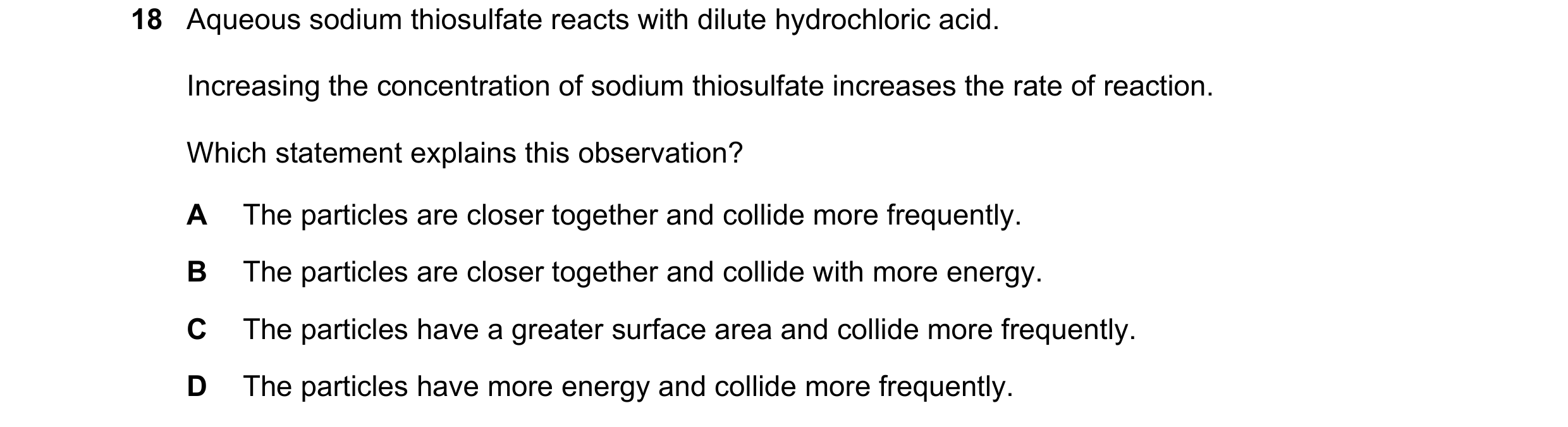
18 Aqueous sodium thiosulfate reacts with dilute hydrochloric acid. Increasing the concentration of sodium thiosulfate increases the rate of reaction. Which statement explains this observation? A The particles are closer together and collide more frequently. B The particles are closer together and collide with more energy. C The particles have a greater surface area and collide more frequently. D The particles have more energy and collide more frequently.
1 marks
Answer: A
This question in 0654/22 May/June 2017
Q3 · Aqueous sodium thiosulfate reacts with dilute hydrochloric acid 0654/23 May/June 2017
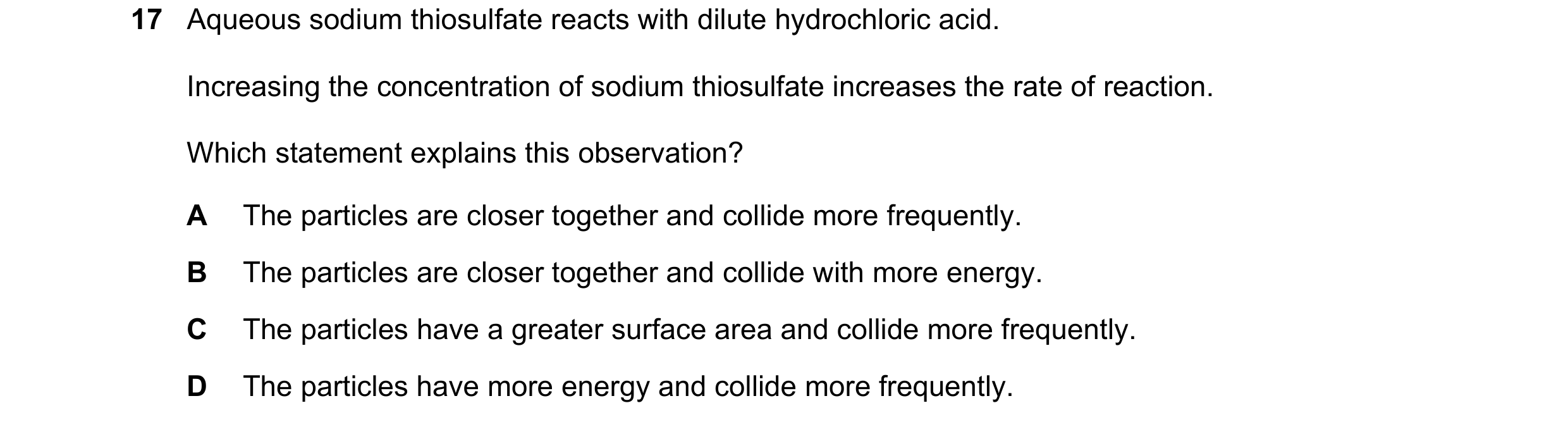
17 Aqueous sodium thiosulfate reacts with dilute hydrochloric acid. Increasing the concentration of sodium thiosulfate increases the rate of reaction. Which statement explains this observation? A The particles are closer together and collide more frequently. B The particles are closer together and collide with more energy. C The particles have a greater surface area and collide more frequently. D The particles have more energy and collide more frequently.
1 marks
Answer: A
This question in 0654/23 May/June 2017
Q4 · Ammonia is oxidised as shown 0654/21 Oct/Nov 2017
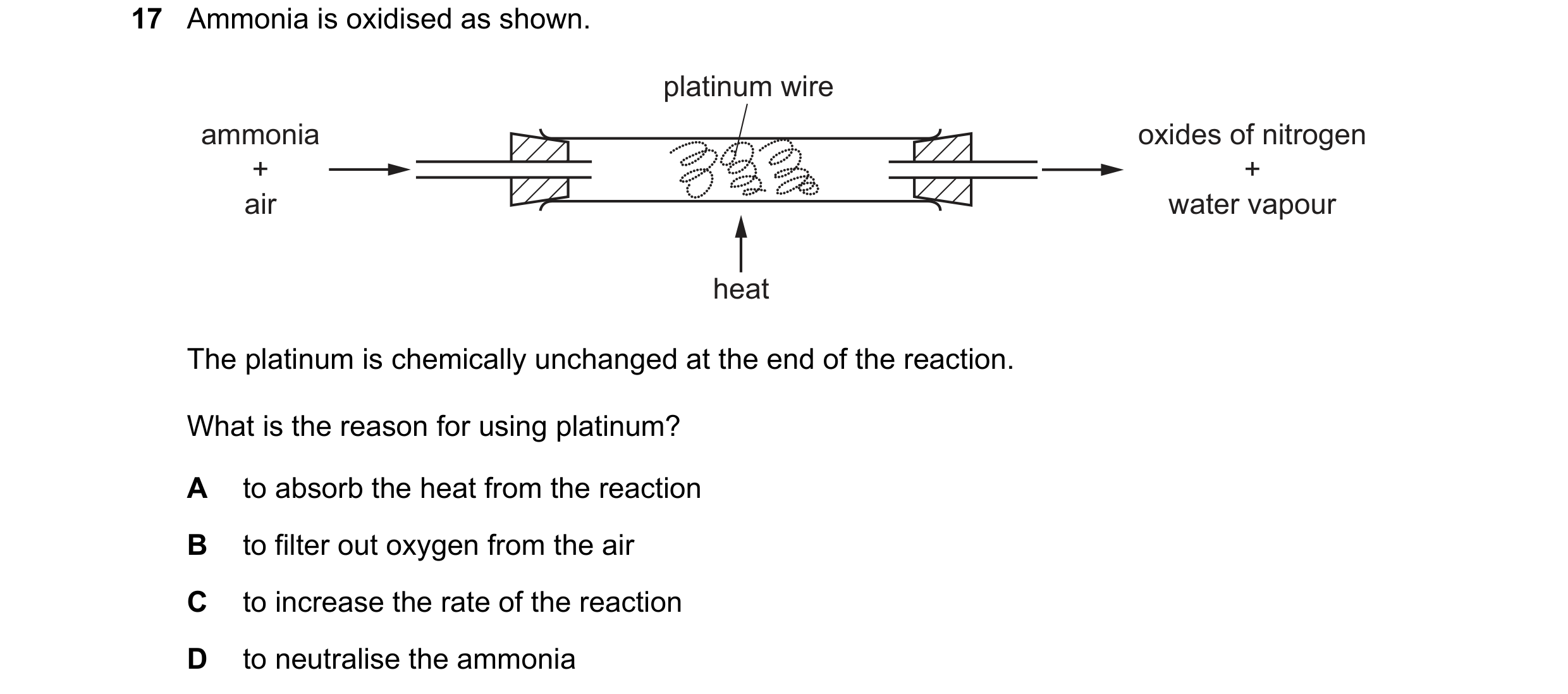
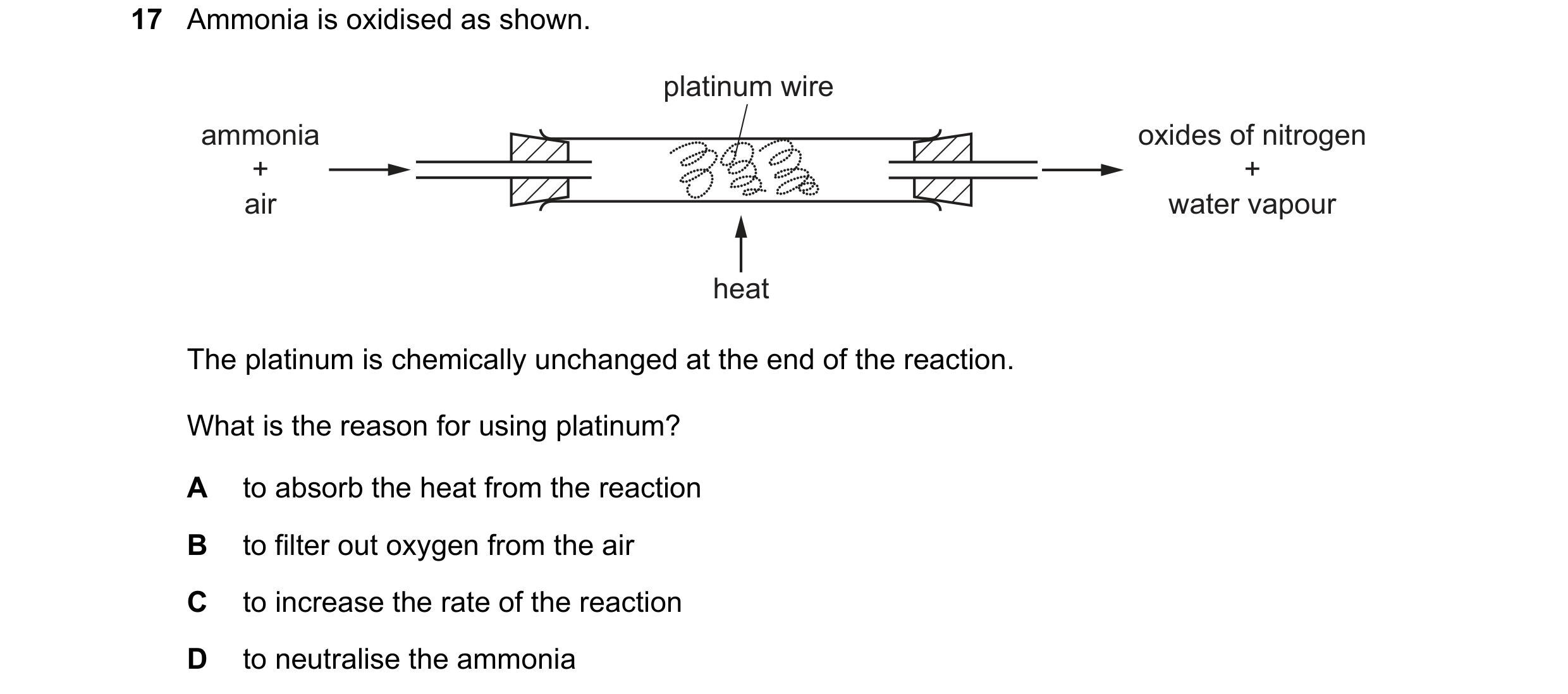
17 Ammonia is oxidised as shown. platinum wire ammonia oxides of nitrogen + + air water vapour heat The platinum is chemically unchanged at the end of the reaction. What is the reason for using platinum? A to absorb the heat from the reaction B to filter out oxygen from the air C to increase the rate of the reaction D to neutralise the ammonia
1 marks
Answer: C
This question in 0654/21 Oct/Nov 2017
Q5 · The Contact process is used to manufacture sulfuric acid 0654/21 Oct/Nov 2017
24 The Contact process is used to manufacture sulfuric acid. Which statement about the Contact process is not correct? A An iron catalyst is used. B Sulfur dioxide reacts with oxygen to form sulfur trioxide. C Sulfur burns to form sulfur dioxide. D Sulfur trioxide dissolves in concentrated sulfuric acid to form oleum.
1 marks
Answer: A
This question in 0654/21 Oct/Nov 2017
Q6 · Ammonia is oxidised as shown 0654/22 Oct/Nov 2017
17 Ammonia is oxidised as shown. platinum wire ammonia oxides of nitrogen + + air water vapour heat The platinum is chemically unchanged at the end of the reaction. What is the reason for using platinum? A to absorb the heat from the reaction B to filter out oxygen from the air C to increase the rate of the reaction D to neutralise the ammonia
1 marks
Answer: C
This question in 0654/22 Oct/Nov 2017
Q7 · Which row shows the conditions used for making sulfur trioxide in the Contact process? 0654/22 Oct/Nov 2017
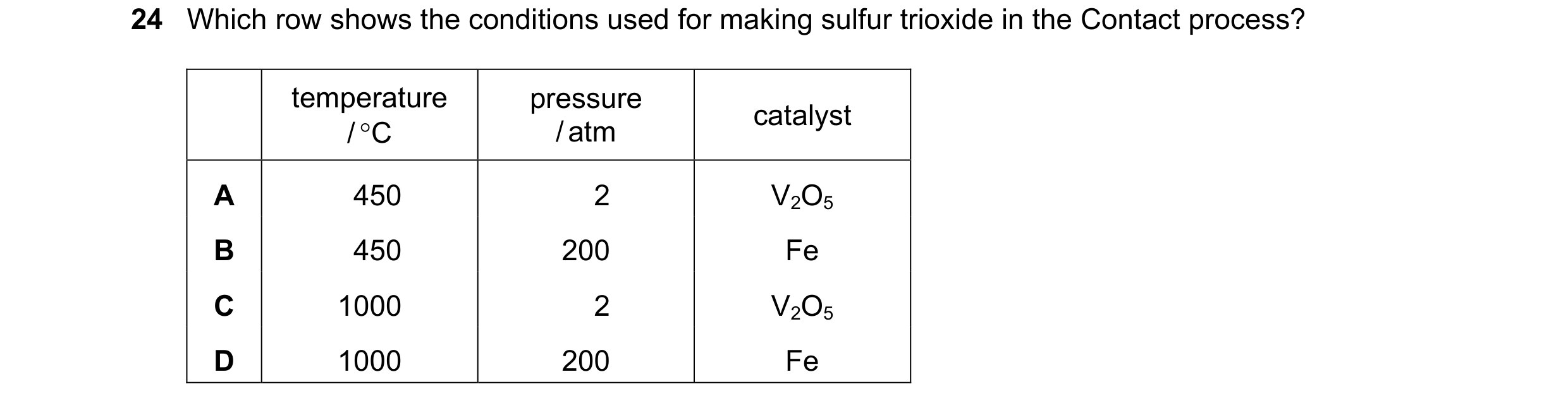
24 Which row shows the conditions used for making sulfur trioxide in the Contact process? temperature pressure catalyst / °C / atm A 450 2 V2O5 B 450 200 Fe C 1000 2 V2O5 D 1000 200 Fe
1 marks
Answer: A
This question in 0654/22 Oct/Nov 2017
Q8 · Ammonia is oxidised as shown 0654/23 Oct/Nov 2017
17 Ammonia is oxidised as shown. platinum wire ammonia oxides of nitrogen + + air water vapour heat The platinum is chemically unchanged at the end of the reaction. What is the reason for using platinum? A to absorb the heat from the reaction B to filter out oxygen from the air C to increase the rate of the reaction D to neutralise the ammonia
1 marks
Answer: C
This question in 0654/23 Oct/Nov 2017
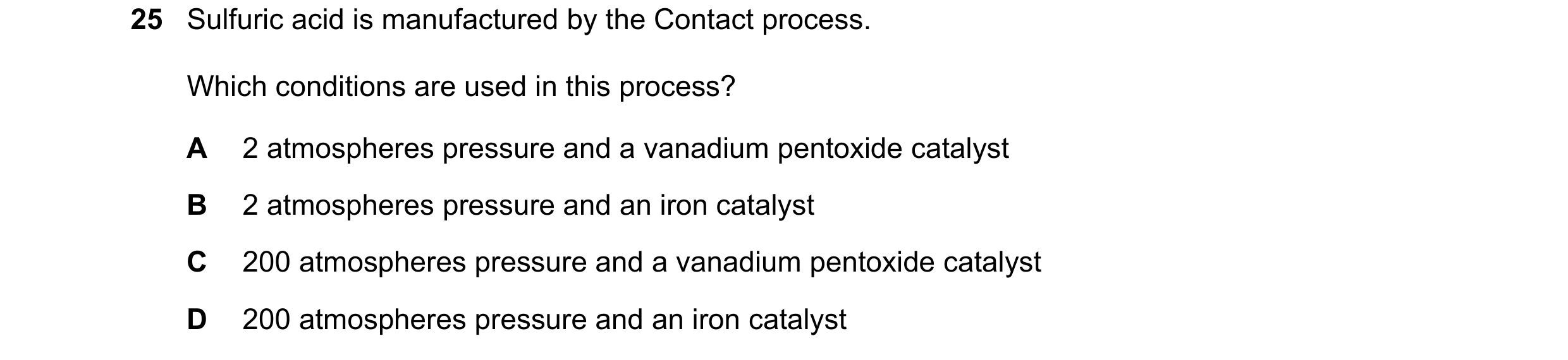
Q9 · Sulfuric acid is manufactured by the Contact process 0654/22 Oct/Nov 2018
25 Sulfuric acid is manufactured by the Contact process. Which conditions are used in this process? A 2 atmospheres pressure and a vanadium pentoxide catalyst B 2 atmospheres pressure and an iron catalyst C 200 atmospheres pressure and a vanadium pentoxide catalyst D 200 atmospheres pressure and an iron catalyst
1 marks
Answer: A
This question in 0654/22 Oct/Nov 2018
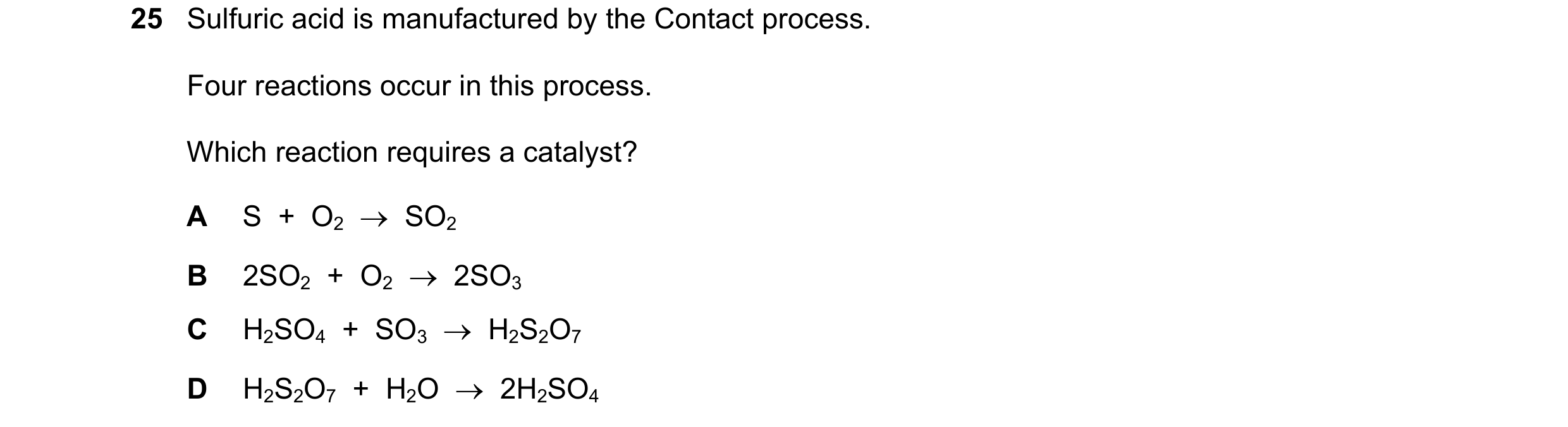
Q10 · Sulfuric acid is manufactured by the Contact process 0654/21 May/June 2019
25 Sulfuric acid is manufactured by the Contact process. Four reactions occur in this process. Which reaction requires a catalyst? A S + O2 → SO2 B 2SO2 + O2 → 2SO3 C H2SO4 + SO3 → H2S2O7 D H2S2O7 + H2O → 2H2SO4
1 marks
Answer: B
This question in 0654/21 May/June 2019
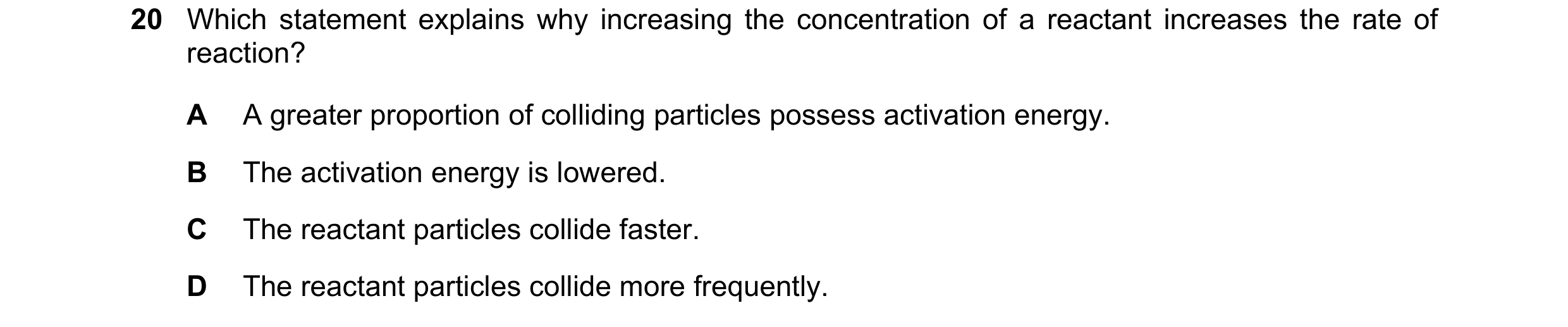
Q11 · Which statement explains why increasing the concentration of a reactant increases the… 0654/22 May/June 2019
20 Which statement explains why increasing the concentration of a reactant increases the rate of reaction? A A greater proportion of colliding particles possess activation energy. B The activation energy is lowered. C The reactant particles collide faster. D The reactant particles collide more frequently.
1 marks
Answer: D
This question in 0654/22 May/June 2019
Q12 · Which row describes the effect of increasing temperature on collisions between particles… 0654/23 May/June 2019
20 Which row describes the effect of increasing temperature on collisions between particles in a chemical reaction? number of collisions with energy frequency of collisions greater than activation energy A increases increases B increases remains constant C remains constant increases D remains constant remains constant
1 marks
Answer: A
This question in 0654/23 May/June 2019
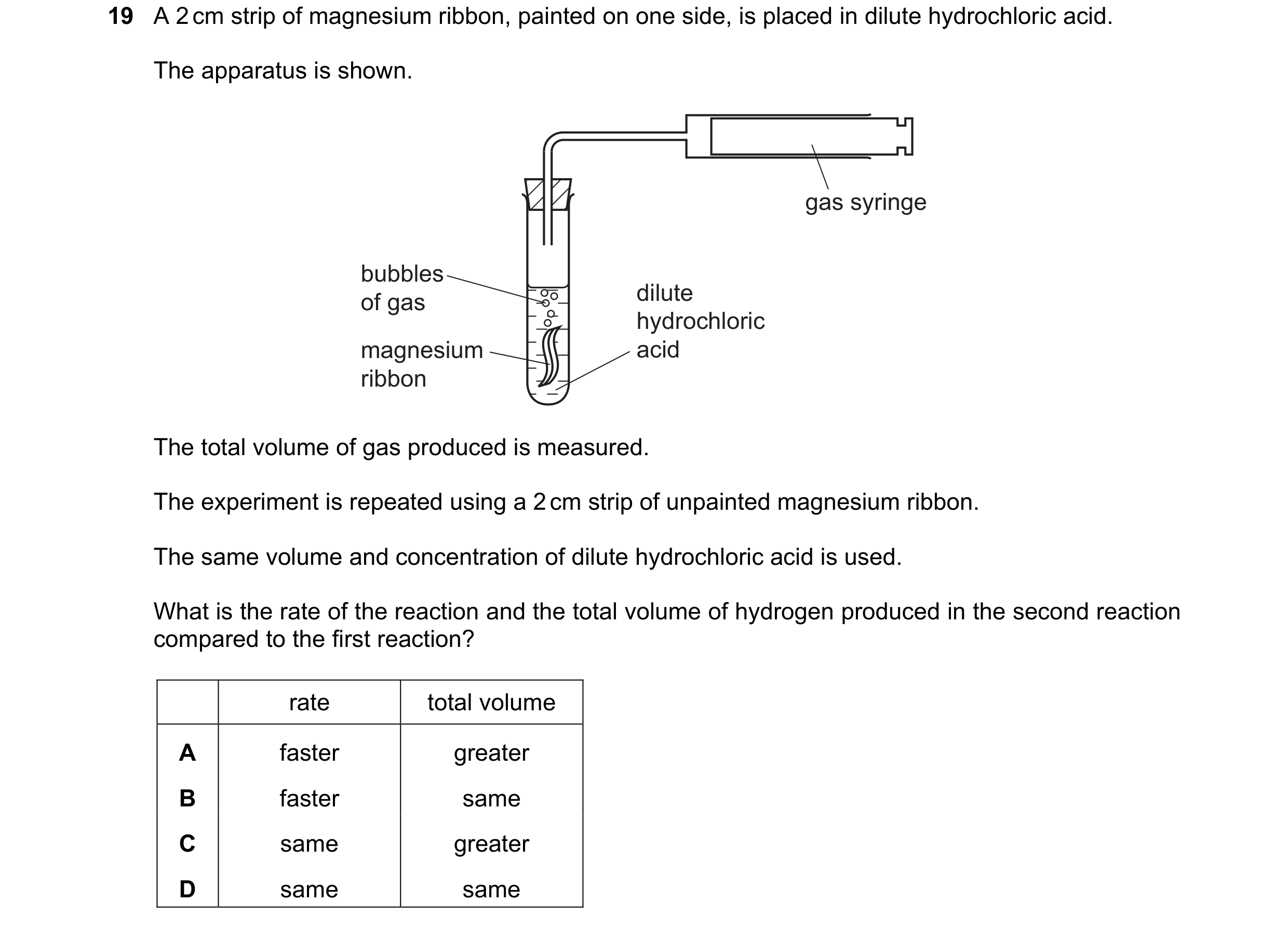
Q13 · A 2 cm strip of magnesium ribbon, painted on one side, is placed in dilute hydrochloric… 0654/22 Oct/Nov 2019
19 A 2 cm strip of magnesium ribbon, painted on one side, is placed in dilute hydrochloric acid. The apparatus is shown. gas syringe bubbles of gas dilute hydrochloric magnesium acid ribbon The total volume of gas produced is measured. The experiment is repeated using a 2 cm strip of unpainted magnesium ribbon. The same volume and concentration of dilute hydrochloric acid is used. What is the rate of the reaction and the total volume of hydrogen produced in the second reaction compared to the first reaction? rate total volume A faster greater B faster same C same greater D same same
1 marks
Answer: B
This question in 0654/22 Oct/Nov 2019
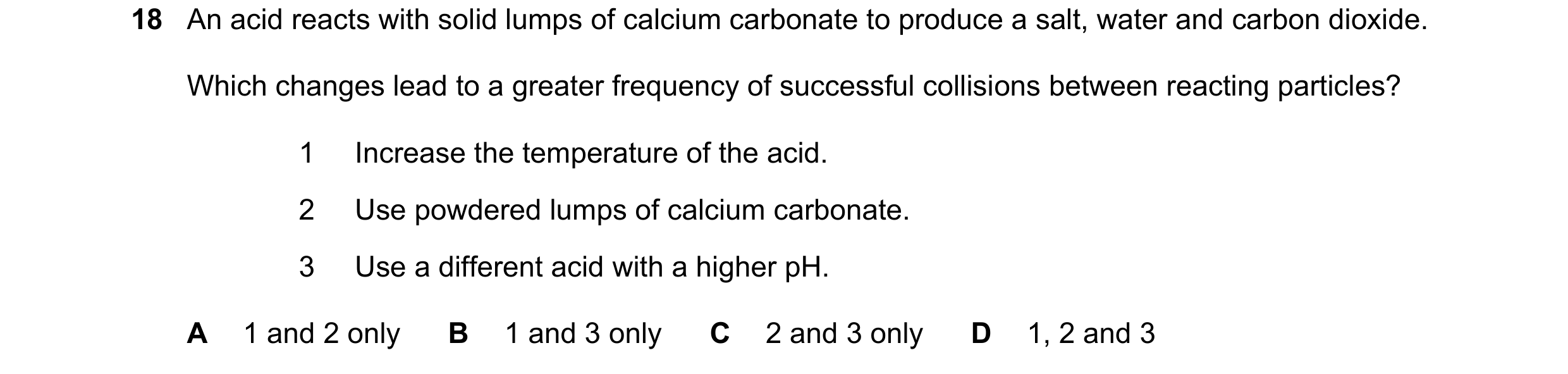
Q14 · An acid reacts with solid lumps of calcium carbonate to produce a salt, water and carbon… 0654/21 May/June 2020
18 An acid reacts with solid lumps of calcium carbonate to produce a salt, water and carbon dioxide. Which changes lead to a greater frequency of successful collisions between reacting particles? 1 Increase the temperature of the acid. 2 Use powdered lumps of calcium carbonate. 3 Use a different acid with a higher pH. A 1 and 2 only B 1 and 3 only C 2 and 3 only D 1, 2 and 3
1 marks
Answer: A
This question in 0654/21 May/June 2020
Q15 · Three methods for investigating rates of reaction are listed 0654/23 May/June 2020
21 Three methods for investigating rates of reaction are listed. 1 Observe a colour change. 2 Use a gas syringe. 3 Use a balance. The equation for the reaction of magnesium and dilute hydrochloric acid is shown. Mg(s) + 2HCl (aq) → MgCl 2(aq) + H2(g) Which of the methods can be used to investigate the rate of this reaction? A 2 only B 1 and 2 C 1 and 3 D 2 and 3
1 marks
Answer: D
This question in 0654/23 May/June 2020
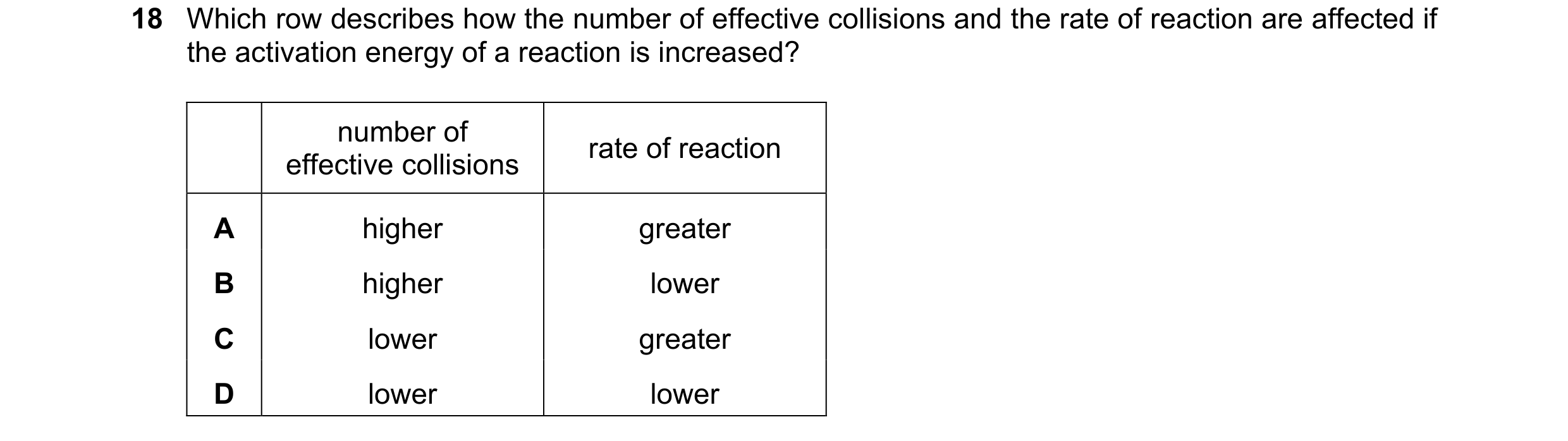
Q16 · Which row describes how the number of effective collisions and the rate of reaction are… 0654/21 Oct/Nov 2020
18 Which row describes how the number of effective collisions and the rate of reaction are affected if the activation energy of a reaction is increased? number of rate of reaction effective collisions A higher greater B higher lower C lower greater D lower lower
1 marks
Answer: D
This question in 0654/21 Oct/Nov 2020
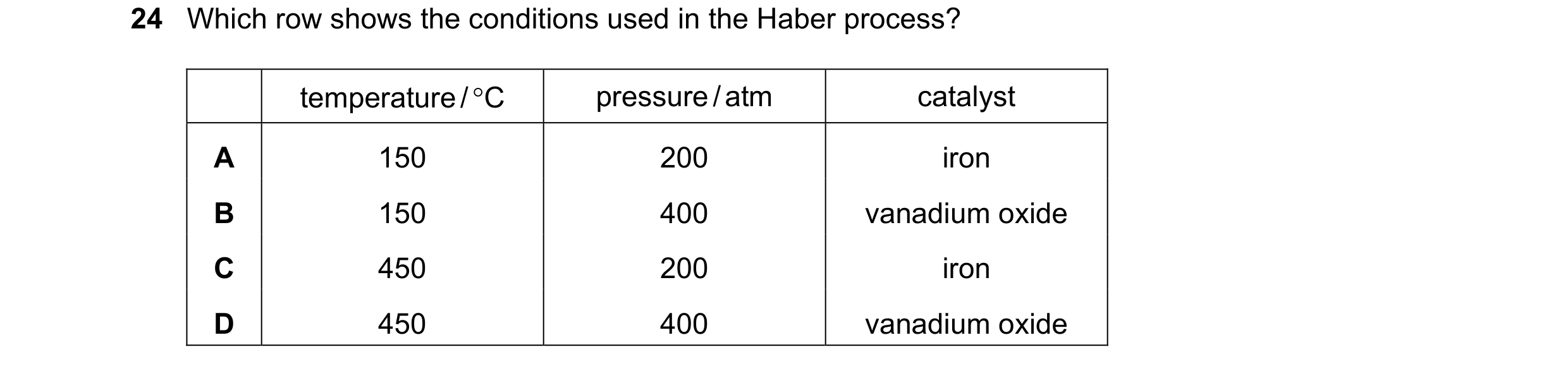
Q17 · Which row shows the conditions used in the Haber process? 0654/21 Oct/Nov 2020
24 Which row shows the conditions used in the Haber process? temperature / C pressure / atm catalyst A 150 200 iron B 150 400 vanadium oxide C 450 200 iron D 450 400 vanadium oxide
1 marks
Answer: C
This question in 0654/21 Oct/Nov 2020
Q18 · Four identical pieces of magnesium ribbon are added to separate 25 cm3 samples of dilute… 0654/22 Oct/Nov 2020
18 Four identical pieces of magnesium ribbon are added to separate 25 cm3 samples of dilute hydrochloric acid. The concentrations of the four acid samples are 0.5 mol / dm3, 1.0 mol / dm3, 1.5 mol / dm3 and 2.0 mol / dm3. The volume of hydrogen gas produced is measured at different times. The results are shown in the graph. Which line on the graph is obtained using 1.0 mol / dm3 hydrochloric acid? A B C volume of D gas / cm3 00 time / s
1 marks
Answer: C
This question in 0654/22 Oct/Nov 2020
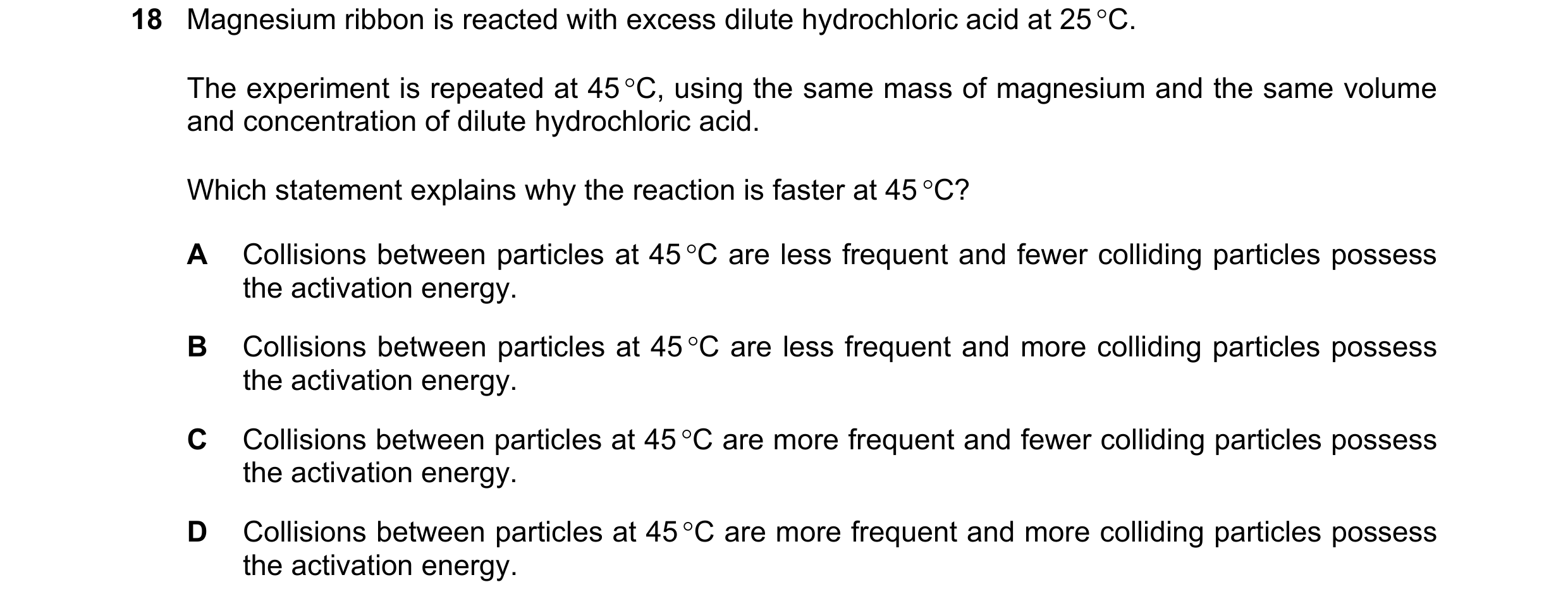
Q19 · Magnesium ribbon is reacted with excess dilute hydrochloric acid at 25 C 0654/23 Oct/Nov 2020
18 Magnesium ribbon is reacted with excess dilute hydrochloric acid at 25 C. The experiment is repeated at 45 C, using the same mass of magnesium and the same volume and concentration of dilute hydrochloric acid. Which statement explains why the reaction is faster at 45 C? A Collisions between particles at 45 C are less frequent and fewer colliding particles possess the activation energy. B Collisions between particles at 45 C are less frequent and more colliding particles possess the activation energy. C Collisions between particles at 45 C are more frequent and fewer colliding particles possess the activation energy. D Collisions between particles at 45 C are more frequent and more colliding particles possess the activation energy.
1 marks
Answer: D
This question in 0654/23 Oct/Nov 2020
Q20 · Excess magnesium reacts with 25 cm3 of 0.1 mol / dm3 hydrochloric acid 0654/21 Oct/Nov 2021
17 Excess magnesium reacts with 25 cm3 of 0.1 mol / dm3 hydrochloric acid. The dashed line shows the volume of gas made over time. The experiment is repeated using excess magnesium and 25 cm3 of 0.05 mol / dm3 hydrochloric acid. Which line shows the results for this experiment? A B C volume of original experiment gas / cm3 D 0 0 time / s
1 marks
Answer: D
This question in 0654/21 Oct/Nov 2021
Q21 · The Contact process is used to manufacture sulfuric acid 0654/21 Oct/Nov 2021
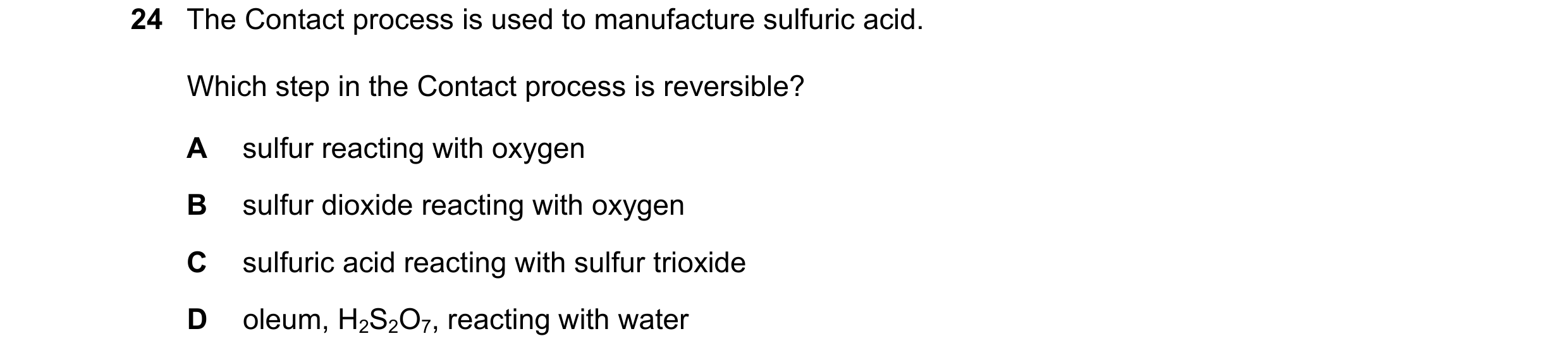
24 The Contact process is used to manufacture sulfuric acid. Which step in the Contact process is reversible? A sulfur reacting with oxygen B sulfur dioxide reacting with oxygen C sulfuric acid reacting with sulfur trioxide D oleum, H2S2O7, reacting with water
1 marks
Answer: B
This question in 0654/21 Oct/Nov 2021
Q22 · Calcium carbonate reacts with dilute hydrochloric acid 0654/22 Oct/Nov 2021
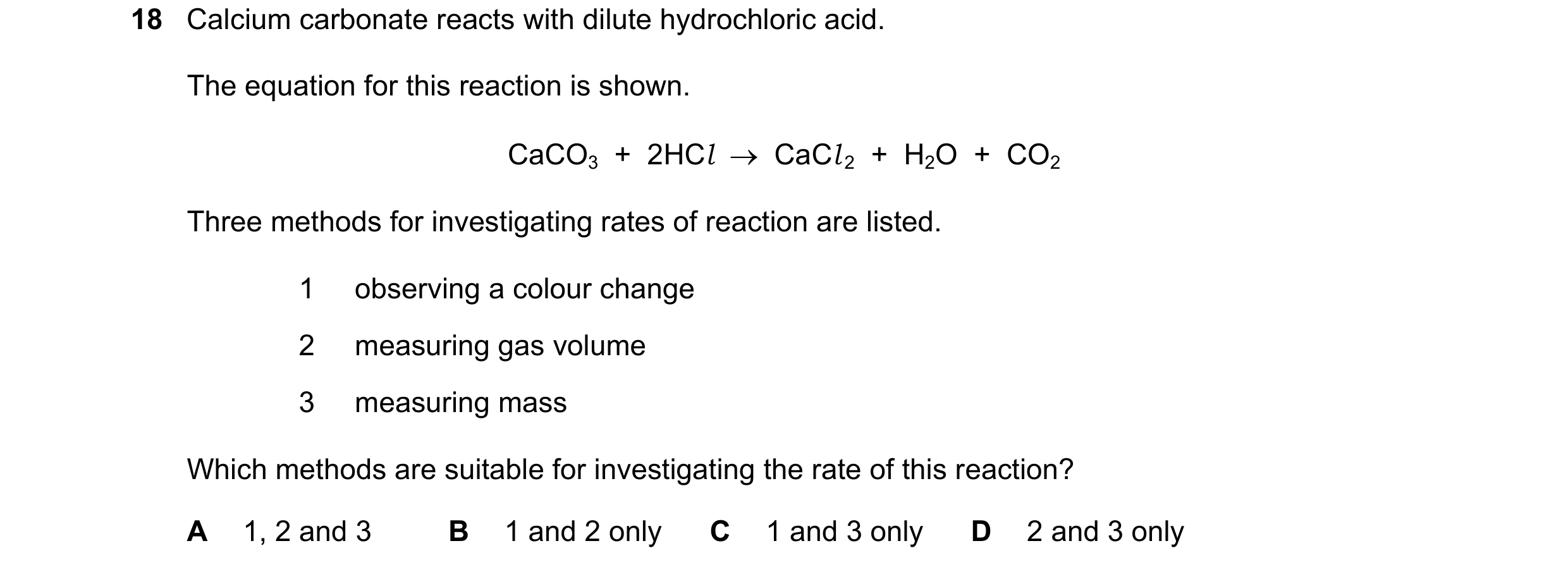
18 Calcium carbonate reacts with dilute hydrochloric acid. The equation for this reaction is shown. CaCO3 + 2HCl CaCl 2 + H2O + CO2 Three methods for investigating rates of reaction are listed. 1 observing a colour change 2 measuring gas volume 3 measuring mass Which methods are suitable for investigating the rate of this reaction? A 1, 2 and 3 B 1 and 2 only C 1 and 3 only D 2 and 3 only
1 marks
Answer: D
This question in 0654/22 Oct/Nov 2021
Q23 · Sulfuric acid is manufactured by the Contact process 0654/22 Oct/Nov 2021
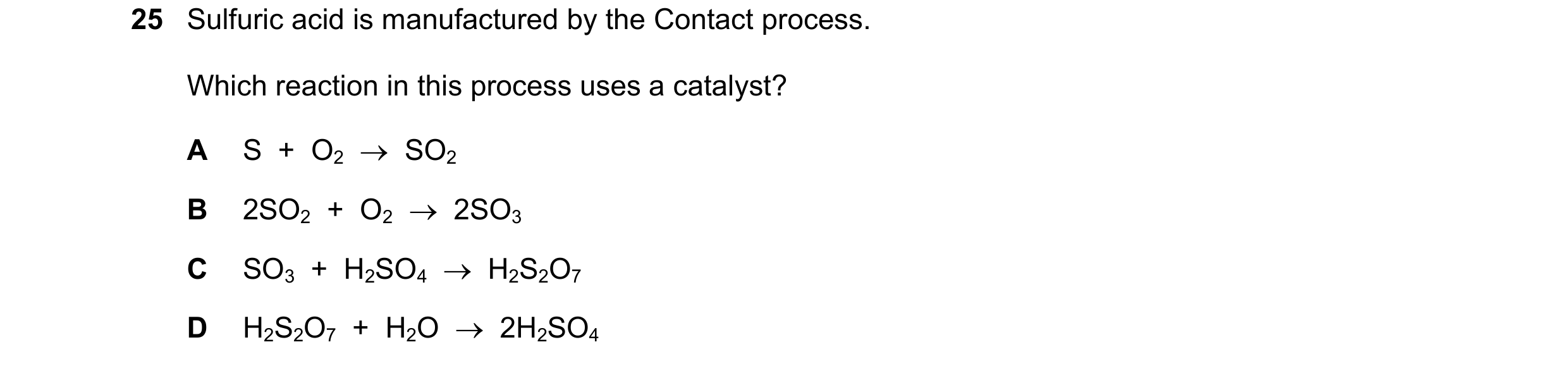
25 Sulfuric acid is manufactured by the Contact process. Which reaction in this process uses a catalyst? A S + O2 SO2 B 2SO2 + O2 2SO3 C SO3 + H2SO4 H2S2O7 D H2S2O7 + H2O 2H2SO4
1 marks
Answer: B
This question in 0654/22 Oct/Nov 2021
Q24 · In experiment 1, dilute hydrochloric acid is added to an excess of solid calcium carbonate 0654/23 Oct/Nov 2021
18 In experiment 1, dilute hydrochloric acid is added to an excess of solid calcium carbonate. In experiment 2, the concentration of the acid is halved and the volume of acid used is doubled. The same mass and size of solid calcium carbonate is used in both experiments. Which row about the two experiments is correct? number of particles possessing frequency of reactant the activation energy particle collisions A equal in both experiments equal in both experiments B equal in both experiments greater in experiment 1 C greater in experiment 1 greater in experiment 1 D greater in experiment 1 equal in both experiments
1 marks
Answer: B
This question in 0654/23 Oct/Nov 2021
Q25 · Sulfuric acid is produced in the Contact process 0654/21 May/June 2022
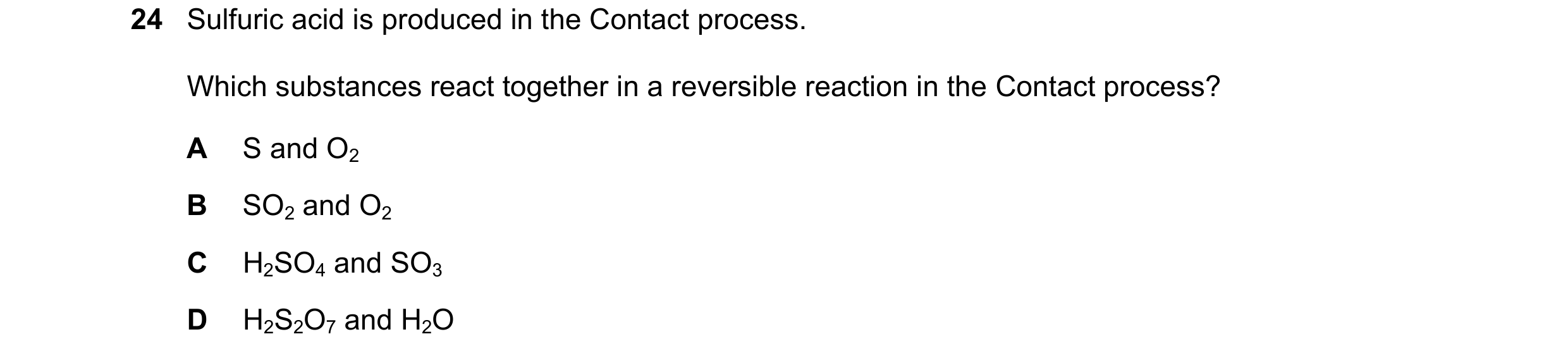
24 Sulfuric acid is produced in the Contact process. Which substances react together in a reversible reaction in the Contact process? A S and O2 B SO2 and O2 C H2SO4 and SO3 D H2S2O7 and H2O
1 marks
Answer: B
This question in 0654/21 May/June 2022
Q26 · Which equation does not represent a reaction that occurs in the Contact process? 0654/23 May/June 2022
24 Which equation does not represent a reaction that occurs in the Contact process? A 2S + 3O2 2SO3 B 2SO2 + O2 2SO3 C H2SO4 + SO3 H2S2O7 D H2S2O7 + H2O 2H2SO4
1 marks
Answer: A
This question in 0654/23 May/June 2022
Q27 · Which row describes conditions for the conversion of sulfur dioxide to sulfur trioxide in… 0654/21 Oct/Nov 2022
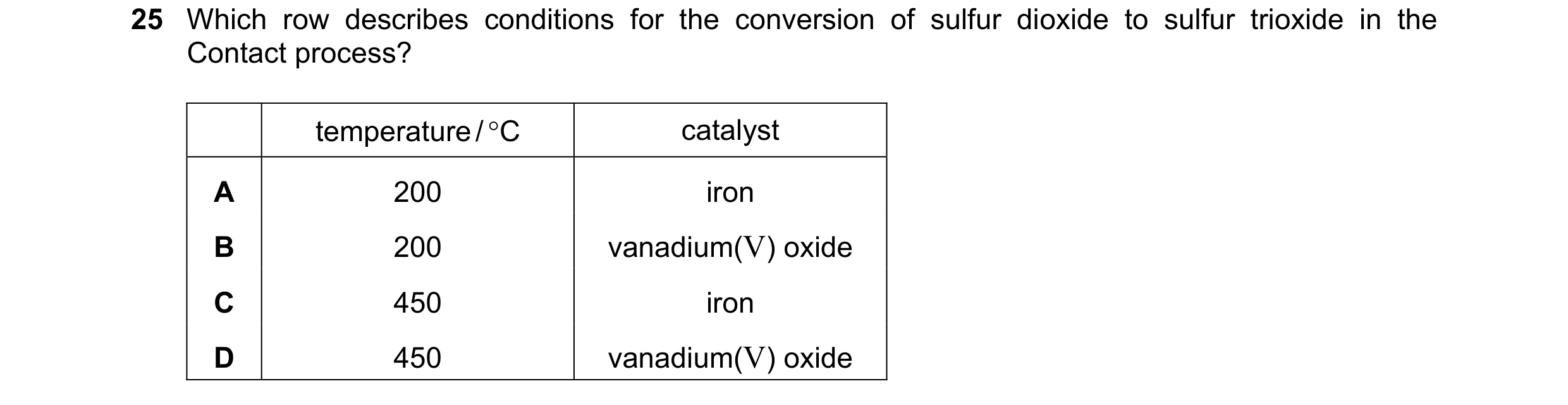
25 Which row describes conditions for the conversion of sulfur dioxide to sulfur trioxide in the Contact process? temperature / C catalyst A 200 iron B 200 vanadium(V) oxide C 450 iron D 450 vanadium(V) oxide
1 marks
Answer: D
This question in 0654/21 Oct/Nov 2022
Q28 · Sulfur dioxide is oxidised to sulfur trioxide in the Contact process 0654/22 Oct/Nov 2022
25 Sulfur dioxide is oxidised to sulfur trioxide in the Contact process. The equation for this reaction is shown. 2SO2 + O2 2SO3 Which row describes the conditions for this reaction? catalyst temperature / C pressure / atm A Fe 200 2 B Fe 450 250 C V2O5 200 250 D V2O5 450 2
1 marks
Answer: D
This question in 0654/22 Oct/Nov 2022
Q29 · Dilute hydrochloric acid reacts with calcium carbonate 0654/22 Feb/March 2023
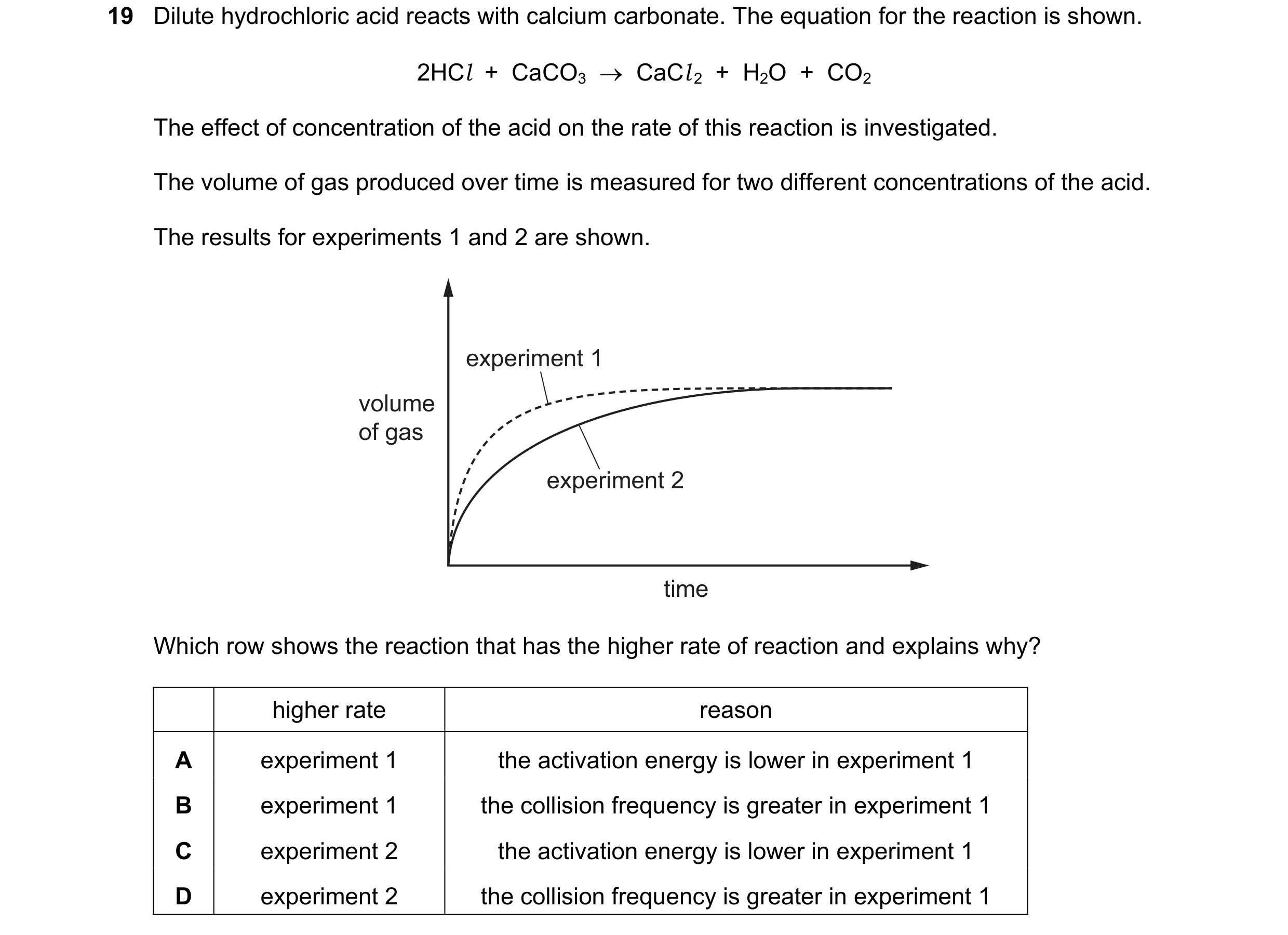
19 Dilute hydrochloric acid reacts with calcium carbonate. The equation for the reaction is shown. 2HCl + CaCO3 CaCl 2 + H2O + CO2 The effect of concentration of the acid on the rate of this reaction is investigated. The volume of gas produced over time is measured for two different concentrations of the acid. The results for experiments 1 and 2 are shown. experiment 1 volume of gas experiment 2 time Which row shows the reaction that has the higher rate of reaction and explains why? higher rate reason A experiment 1 the activation energy is lower in experiment 1 B experiment 1 the collision frequency is greater in experiment 1 C experiment 2 the activation energy is lower in experiment 1 D experiment 2 the collision frequency is greater in experiment 1
1 marks
Answer: B
This question in 0654/22 Feb/March 2023
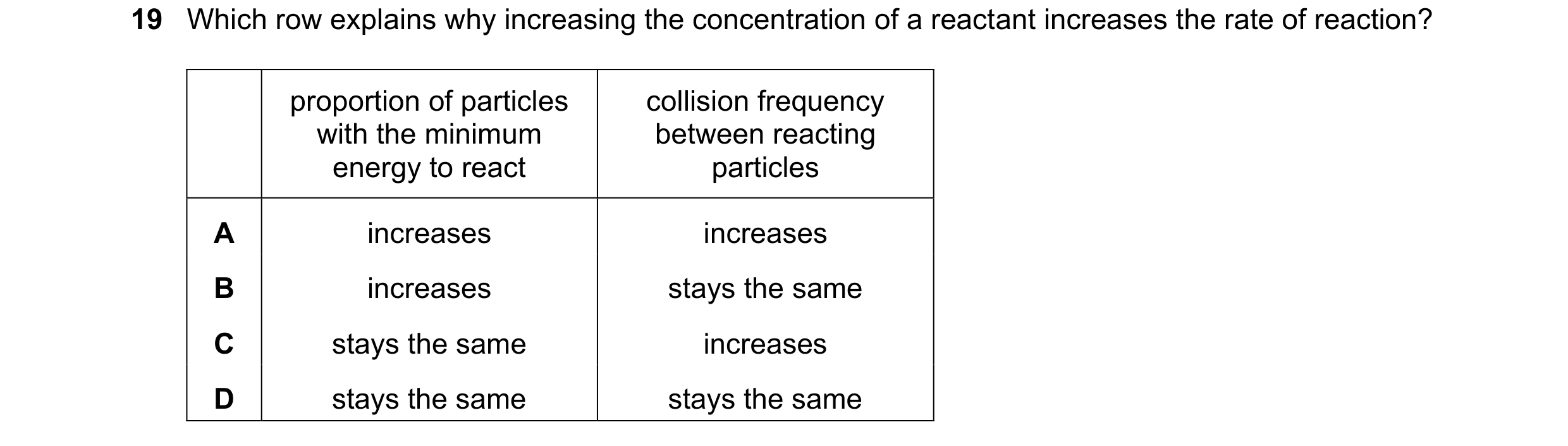
Q30 · Which row explains why increasing the concentration of a reactant increases the rate of… 0654/21 May/June 2023
19 Which row explains why increasing the concentration of a reactant increases the rate of reaction? proportion of particles collision frequency with the minimum between reacting energy to react particles A increases increases B increases stays the same C stays the same increases D stays the same stays the same
1 marks
Answer: C
This question in 0654/21 May/June 2023
Q31 · Equations representing reactions in the Contact process are listed 0654/21 May/June 2023
24 Equations representing reactions in the Contact process are listed. reaction 1 S + O2 SO2 reaction 2 2SO2 + O2 2SO3 reaction 3 H2SO4 + SO3 H2S2O7 reaction 4 H2S2O7 + H2O 2H2SO4 Which row identifies the reactions that use the stated conditions? requires a requires a requires a vanadium(V) oxide temperature of pressure of catalyst 450 C 2 atmospheres A reaction 2 reaction 1 reaction 4 B reaction 2 reaction 2 reaction 2 C reaction 3 reaction 1 reaction 2 D reaction 3 reaction 2 reaction 4
1 marks
Answer: B
This question in 0654/21 May/June 2023
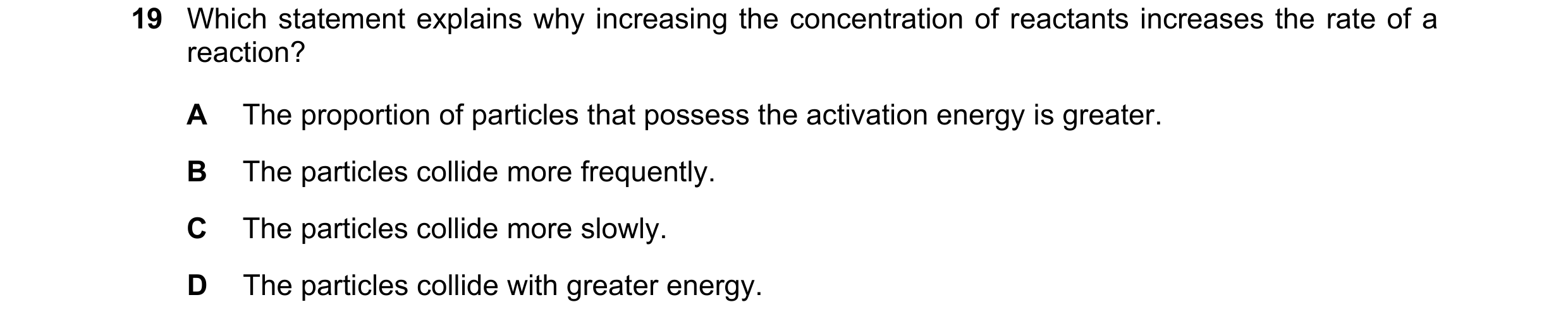
Q32 · Which statement explains why increasing the concentration of reactants increases the rate… 0654/22 May/June 2023
19 Which statement explains why increasing the concentration of reactants increases the rate of a reaction? A The proportion of particles that possess the activation energy is greater. B The particles collide more frequently. C The particles collide more slowly. D The particles collide with greater energy.
1 marks
Answer: B
This question in 0654/22 May/June 2023
Q33 · Which catalyst is used in the Contact process? 0654/22 May/June 2023
24 Which catalyst is used in the Contact process? A iron B phosphoric(V) acid C nickel D vanadium(V) oxide
1 marks
Answer: D
This question in 0654/22 May/June 2023
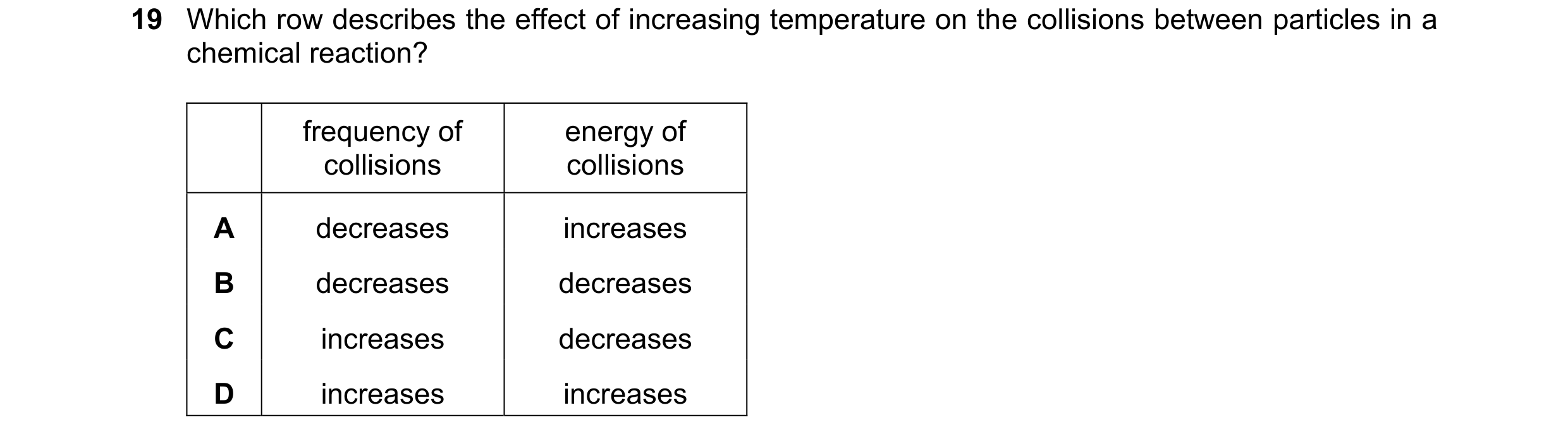
Q34 · Which row describes the effect of increasing temperature on the collisions between… 0654/23 May/June 2023
19 Which row describes the effect of increasing temperature on the collisions between particles in a chemical reaction? frequency of energy of collisions collisions A decreases increases B decreases decreases C increases decreases D increases increases
1 marks
Answer: D
This question in 0654/23 May/June 2023
Q35 · The rate of reaction between calcium carbonate and dilute hydrochloric acid is determined… 0654/21 Oct/Nov 2023
19 The rate of reaction between calcium carbonate and dilute hydrochloric acid is determined either by measuring the change in gas volume per unit time or by measuring the change in mass per unit time. Which piece of apparatus must be used for both methods? A a balance B a gas syringe C a stop-clock D a thermometer
1 marks
Answer: C
This question in 0654/21 Oct/Nov 2023
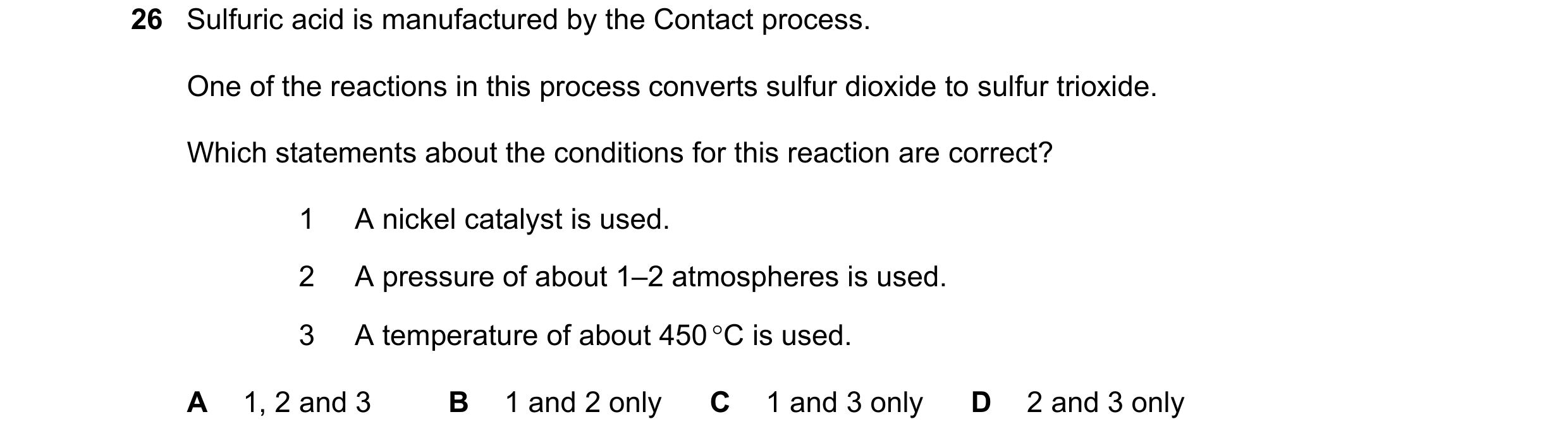
Q36 · Sulfuric acid is manufactured by the Contact process 0654/21 Oct/Nov 2023
26 Sulfuric acid is manufactured by the Contact process. One of the reactions in this process converts sulfur dioxide to sulfur trioxide. Which statements about the conditions for this reaction are correct? 1 A nickel catalyst is used. 2 A pressure of about 1–2 atmospheres is used. 3 A temperature of about 450 C is used. A 1, 2 and 3 B 1 and 2 only C 1 and 3 only D 2 and 3 only
1 marks
Answer: D
This question in 0654/21 Oct/Nov 2023
Q37 · Which change decreases the frequency of collisions between reactant particles? 0654/22 Oct/Nov 2023
18 Which change decreases the frequency of collisions between reactant particles? A increasing the concentration of reactant solutions B increasing the pressure on gaseous reactants C increasing the temperature of the reaction mixture D using larger pieces of a solid reactant
1 marks
Answer: D
This question in 0654/22 Oct/Nov 2023
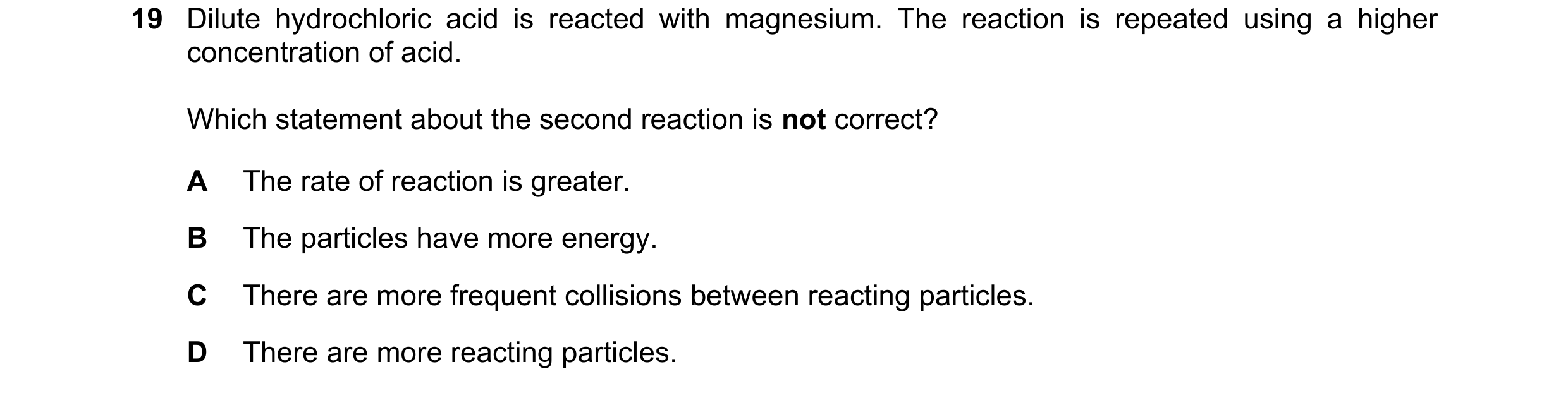
Q38 · Dilute hydrochloric acid is reacted with magnesium 0654/23 Oct/Nov 2023
19 Dilute hydrochloric acid is reacted with magnesium. The reaction is repeated using a higher concentration of acid. Which statement about the second reaction is not correct? A The rate of reaction is greater. B The particles have more energy. C There are more frequent collisions between reacting particles. D There are more reacting particles.
1 marks
Answer: B
This question in 0654/23 Oct/Nov 2023
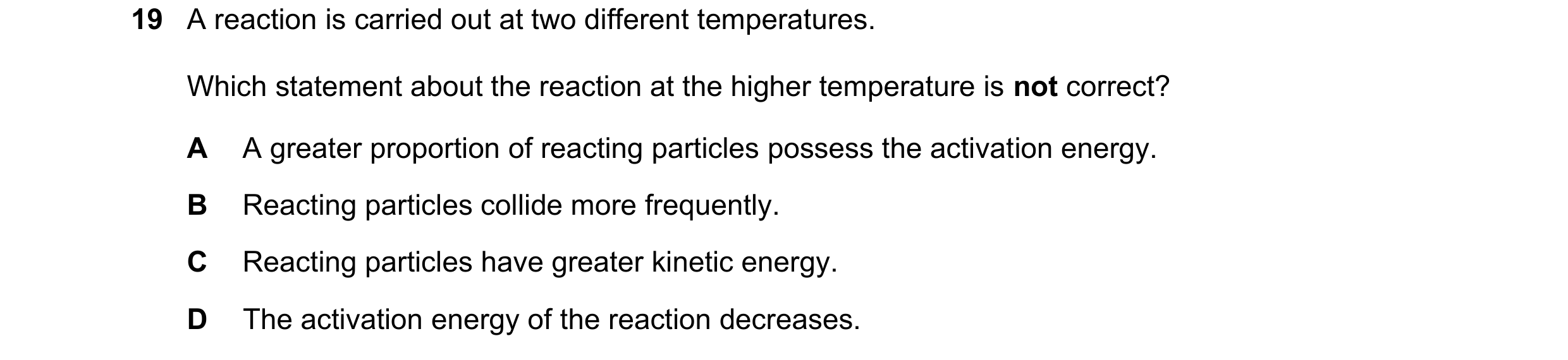
Q39 · A reaction is carried out at two different temperatures 0654/22 Feb/March 2024
19 A reaction is carried out at two different temperatures. Which statement about the reaction at the higher temperature is not correct? A A greater proportion of reacting particles possess the activation energy. B Reacting particles collide more frequently. C Reacting particles have greater kinetic energy. D The activation energy of the reaction decreases.
1 marks
Answer: D
This question in 0654/22 Feb/March 2024
Q40 · The Contact process is used to manufacture sulfuric acid 0654/22 Feb/March 2024
26 The Contact process is used to manufacture sulfuric acid. Which step in the Contact process is reversible? A sulfur reacting with oxygen B sulfur dioxide reacting with oxygen C sulfuric acid reacting with sulfur trioxide D oleum, H2S2O7, reacting with water
1 marks
Answer: B
This question in 0654/22 Feb/March 2024
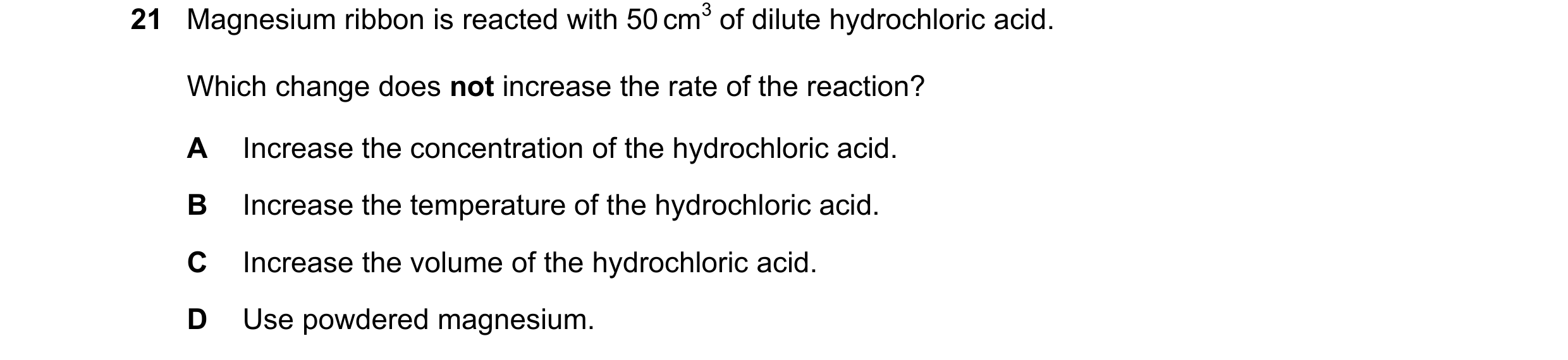
Q41 · Magnesium ribbon is reacted with 50 cm3 of dilute hydrochloric acid 0654/21 May/June 2024
21 Magnesium ribbon is reacted with 50 cm3 of dilute hydrochloric acid. Which change does not increase the rate of the reaction? A Increase the concentration of the hydrochloric acid. B Increase the temperature of the hydrochloric acid. C Increase the volume of the hydrochloric acid. D Use powdered magnesium.
1 marks
Answer: C
This question in 0654/21 May/June 2024
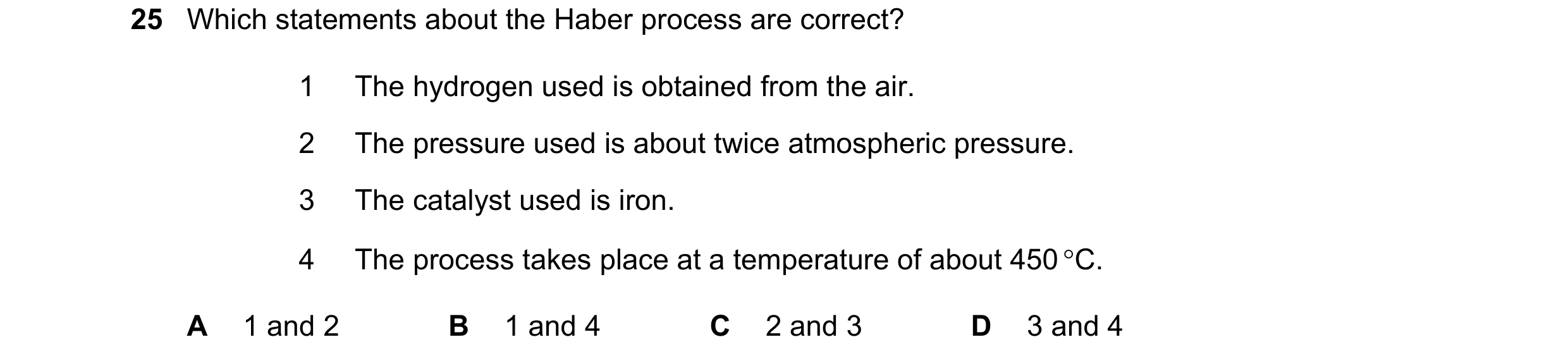
Q42 · Which statements about the Haber process are correct? 0654/21 May/June 2024
25 Which statements about the Haber process are correct? 1 The hydrogen used is obtained from the air. 2 The pressure used is about twice atmospheric pressure. 3 The catalyst used is iron. 4 The process takes place at a temperature of about 450 C. A 1 and 2 B 1 and 4 C 2 and 3 D 3 and 4
1 marks
Answer: D
This question in 0654/21 May/June 2024
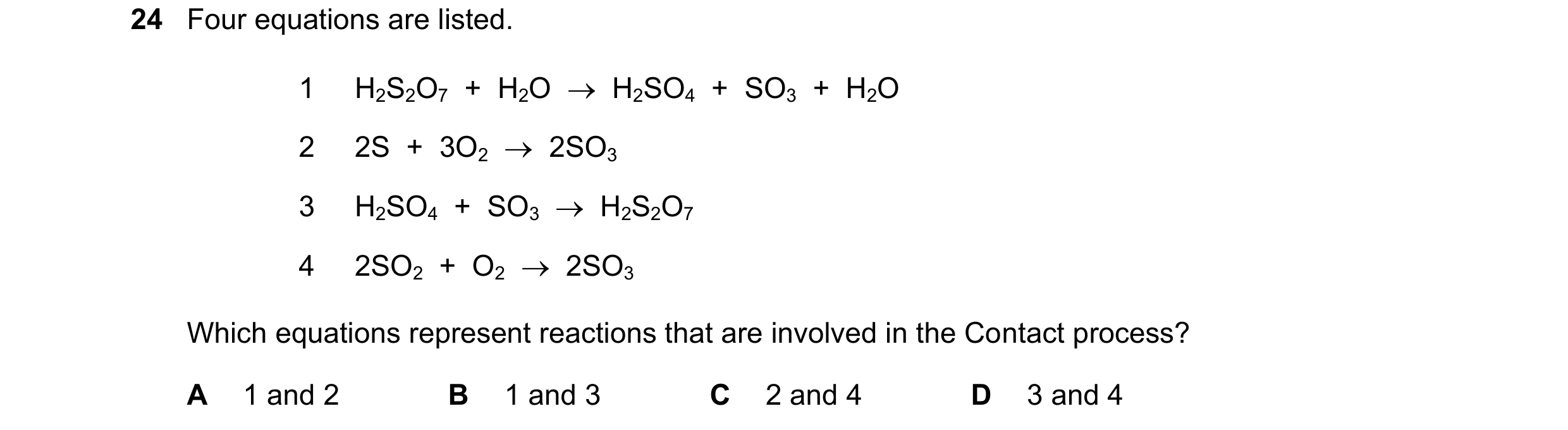
Q43 · Four equations are listed 0654/22 May/June 2024
24 Four equations are listed. 1 H2S2O7 + H2O H2SO4 + SO3 + H2O 2 2S + 3O2 2SO3 3 H2SO4 + SO3 H2S2O7 4 2SO2 + O2 2SO3 Which equations represent reactions that are involved in the Contact process? A 1 and 2 B 1 and 3 C 2 and 4 D 3 and 4
1 marks
Answer: D
This question in 0654/22 May/June 2024
Q44 · When dilute hydrochloric acid reacts with calcium carbonate, carbon dioxide is produced 0654/23 May/June 2024
17 When dilute hydrochloric acid reacts with calcium carbonate, carbon dioxide is produced. Which pieces of apparatus are used to investigate the effect of temperature on the rate of this reaction? 1 2 3 A 1, 2 and 3 B 1 and 2 only C 1 and 3 only D 2 and 3 only
1 marks
Answer: A
This question in 0654/23 May/June 2024
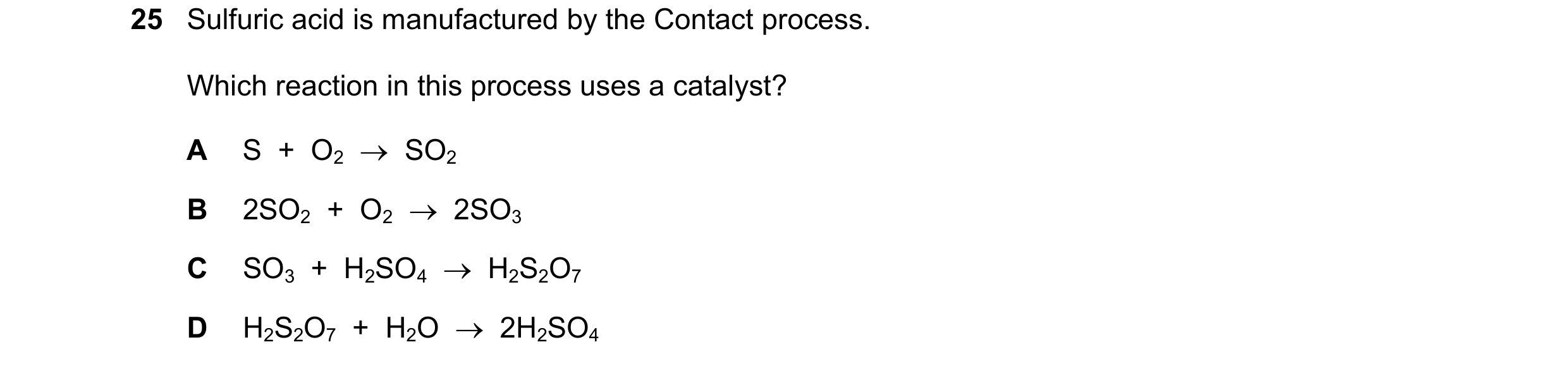
Q45 · Sulfuric acid is manufactured by the Contact process 0654/23 May/June 2024
25 Sulfuric acid is manufactured by the Contact process. Which reaction in this process uses a catalyst? A S + O2 SO2 B 2SO2 + O2 2SO3 C SO3 + H2SO4 H2S2O7 D H2S2O7 + H2O 2H2SO4
1 marks
Answer: B
This question in 0654/23 May/June 2024
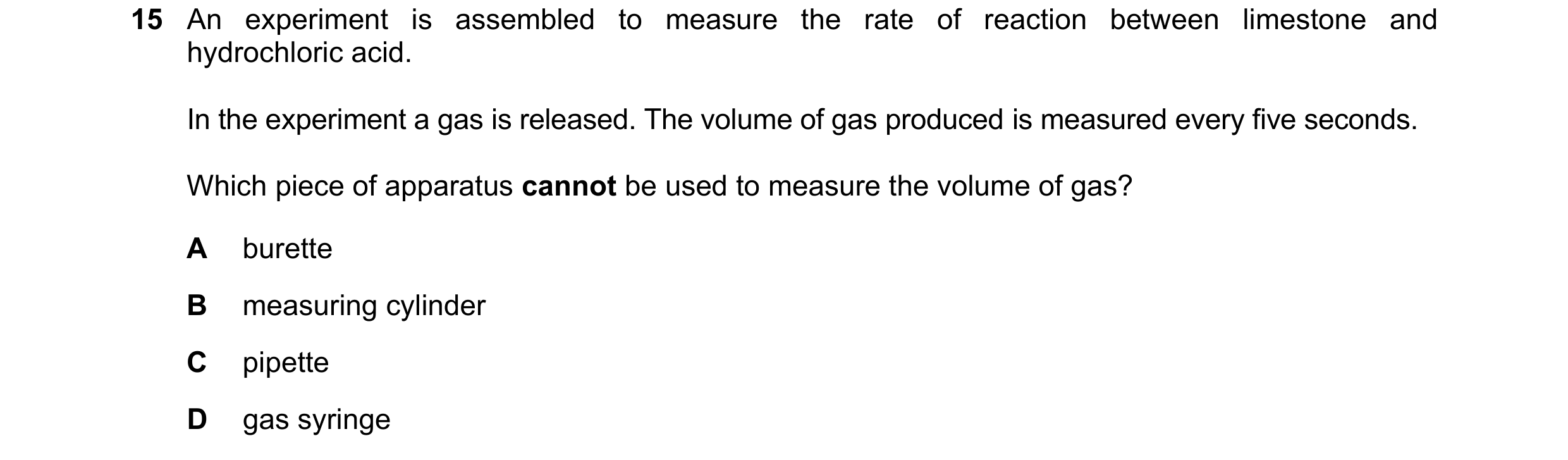
Q46 · An experiment is assembled to measure the rate of reaction between limestone and… 0654/21 Oct/Nov 2024
15 An experiment is assembled to measure the rate of reaction between limestone and hydrochloric acid. In the experiment a gas is released. The volume of gas produced is measured every five seconds. Which piece of apparatus cannot be used to measure the volume of gas? A burette B measuring cylinder C pipette D gas syringe
1 marks
Answer: C
This question in 0654/21 Oct/Nov 2024
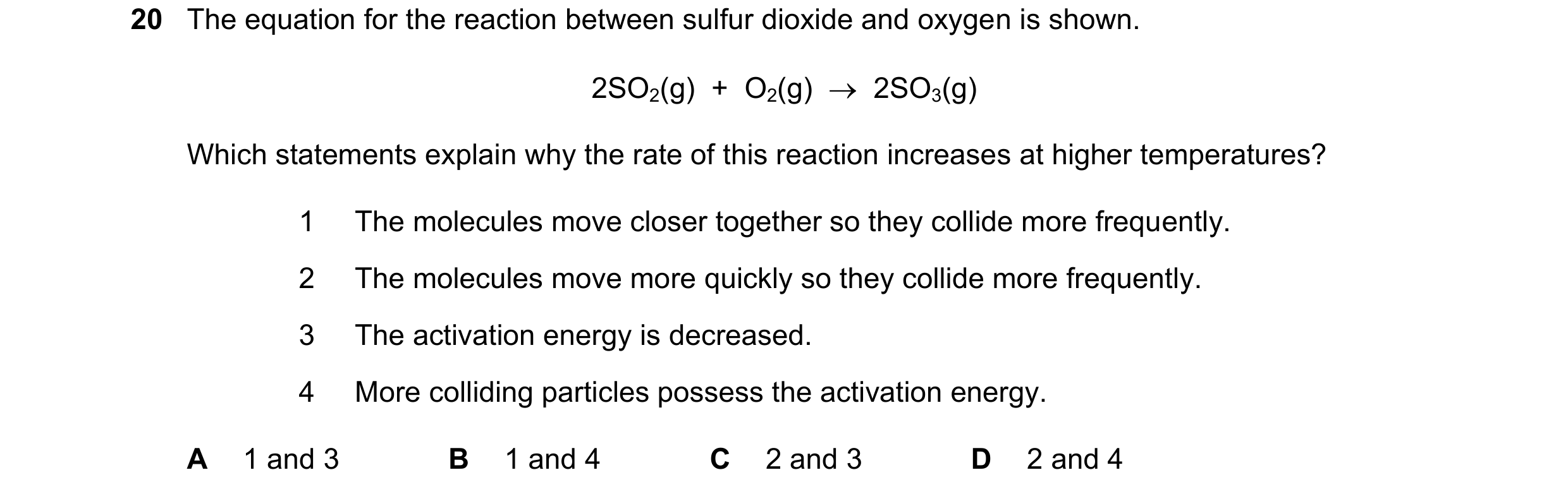
Q47 · The equation for the reaction between sulfur dioxide and oxygen is shown 0654/21 Oct/Nov 2024
20 The equation for the reaction between sulfur dioxide and oxygen is shown. 2SO2(g) + O2(g) 2SO3(g) Which statements explain why the rate of this reaction increases at higher temperatures? 1 The molecules move closer together so they collide more frequently. 2 The molecules move more quickly so they collide more frequently. 3 The activation energy is decreased. 4 More colliding particles possess the activation energy. A 1 and 3 B 1 and 4 C 2 and 3 D 2 and 4
1 marks
Answer: D
This question in 0654/21 Oct/Nov 2024
Q48 · The apparatus used to determine the rate of a chemical reaction is shown 0654/23 Oct/Nov 2024
18 The apparatus used to determine the rate of a chemical reaction is shown. For which reaction is the rate determined using this apparatus? A CaCO3 CaO + CO2 B 2C2H6 + 7O2 4CO2 + 6H2O C MgCO3 + 2HCl MgCl 2 + CO2 + H2O D Cl 2 + 2NaBr Br2 + 2NaCl
1 marks
Answer: C
This question in 0654/23 Oct/Nov 2024
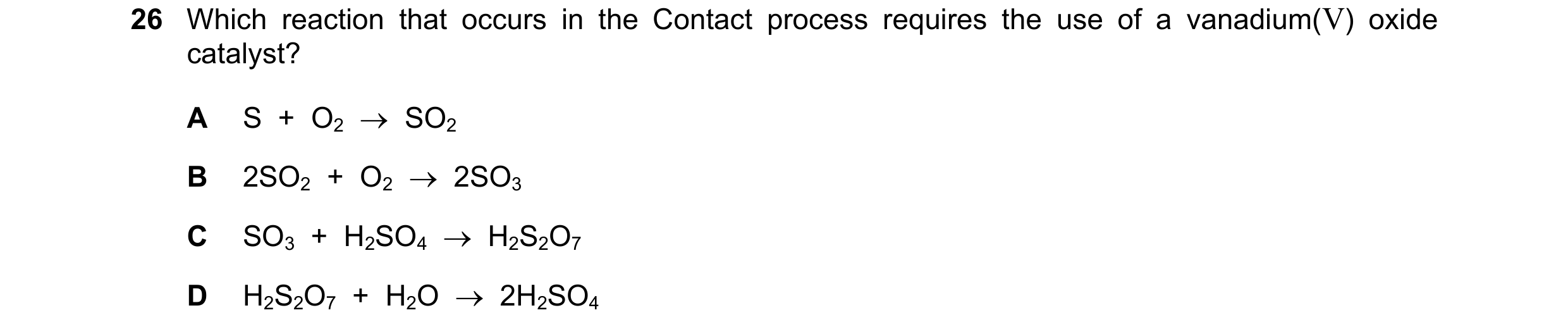
Q49 · Which reaction that occurs in the Contact process requires the use of a vanadium(V) oxide… 0654/23 Oct/Nov 2024
26 Which reaction that occurs in the Contact process requires the use of a vanadium(V) oxide catalyst? A S + O2 SO2 B 2SO2 + O2 2SO3 C SO3 + H2SO4 H2S2O7 D H2S2O7 + H2O 2H2SO4
1 marks
Answer: B
This question in 0654/23 Oct/Nov 2024
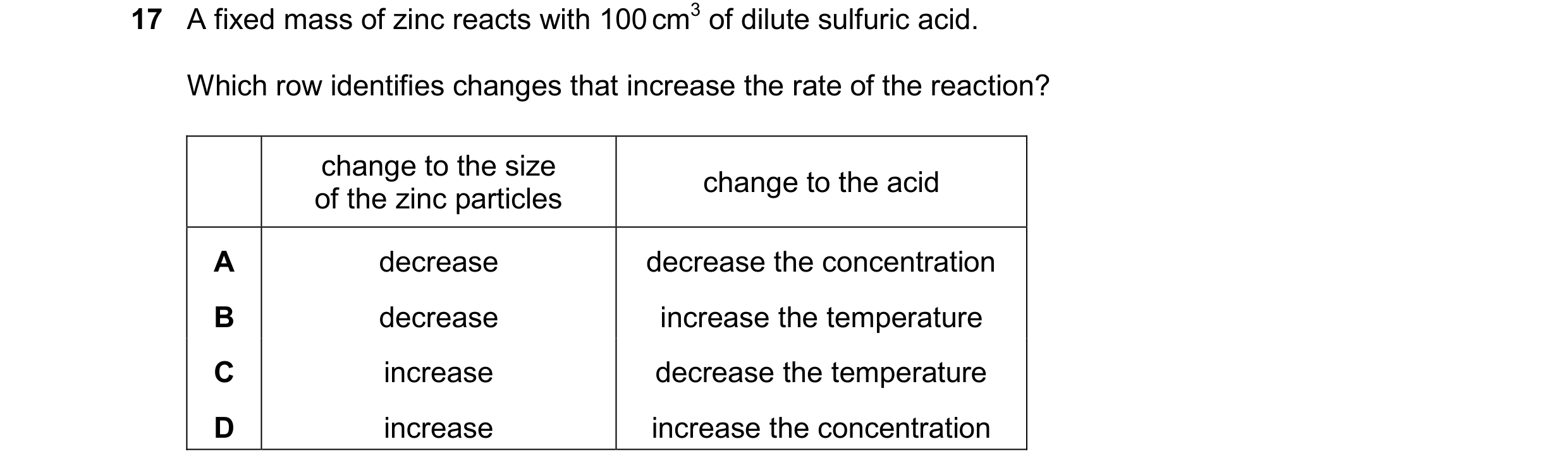
Q50 · A fixed mass of zinc reacts with 100 cm3 of dilute sulfuric acid 0654/22 Feb/March 2025
17 A fixed mass of zinc reacts with 100 cm3 of dilute sulfuric acid. Which row identifies changes that increase the rate of the reaction? change to the size change to the acid of the zinc particles A decrease decrease the concentration B decrease increase the temperature C increase decrease the temperature D increase increase the concentration
1 marks
Answer: B
This question in 0654/22 Feb/March 2025
Q51 · Equal masses of limestone pieces are reacted with acid in two experiments 0654/22 May/June 2025
18 Equal masses of limestone pieces are reacted with acid in two experiments. Only one change to the conditions is made between experiment 1 and experiment 2. The volume of gas produced is measured over time. The results are shown. experiment 1 volume of gas experiment 2 / cm3 time / s Which statement about the experiments is correct? A The concentration of acid used in experiment 2 is higher than in experiment 1. B The temperature used in experiment 2 is lower than in experiment 1. C The limestone pieces used in experiment 1 are larger than in experiment 2. D The volume of acid used in experiment 1 is greater than in experiment 2.
1 marks
Answer: D
This question in 0654/22 May/June 2025
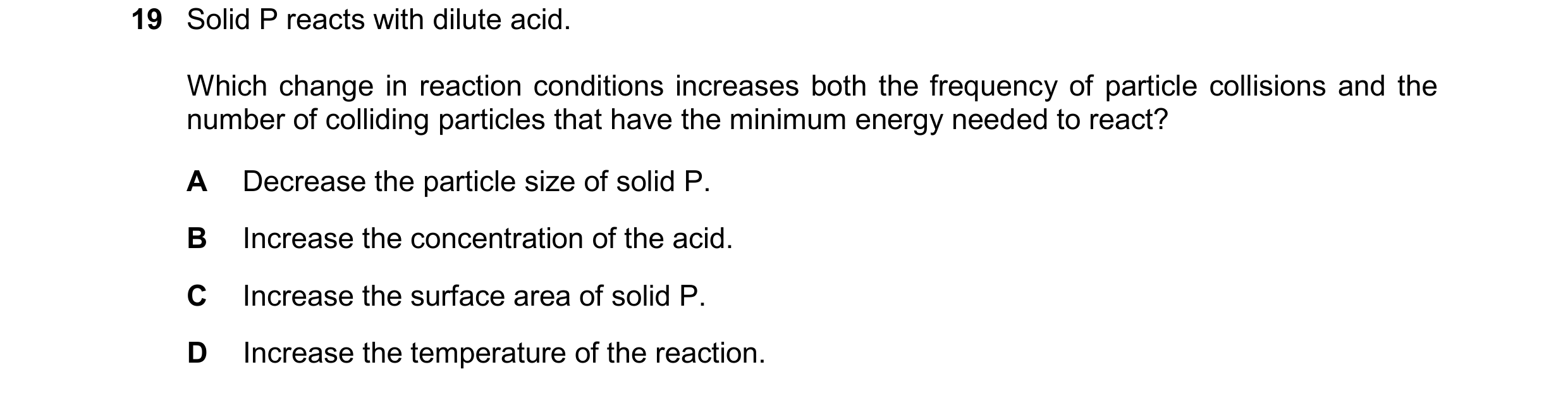
Q52 · Solid P reacts with dilute acid 0654/23 May/June 2025
19 Solid P reacts with dilute acid. Which change in reaction conditions increases both the frequency of particle collisions and the number of colliding particles that have the minimum energy needed to react? A Decrease the particle size of solid P. B Increase the concentration of the acid. C Increase the surface area of solid P. D Increase the temperature of the reaction.
1 marks
Answer: D
This question in 0654/23 May/June 2025
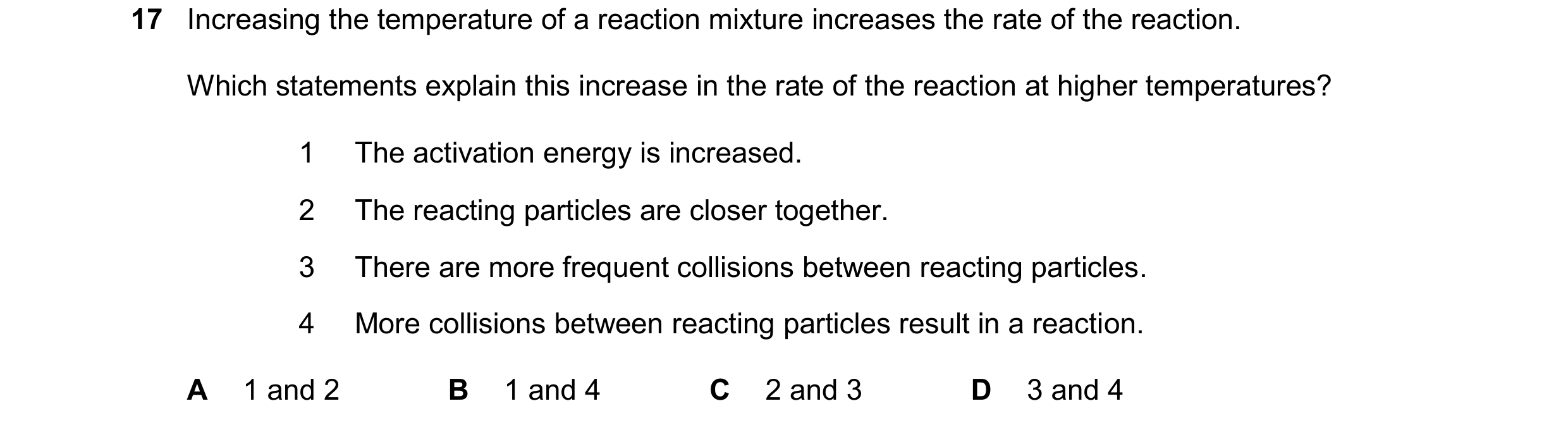
Q53 · Increasing the temperature of a reaction mixture increases the rate of the reaction 0654/21 Oct/Nov 2025
17 Increasing the temperature of a reaction mixture increases the rate of the reaction. Which statements explain this increase in the rate of the reaction at higher temperatures? 1 The activation energy is increased. 2 The reacting particles are closer together. 3 There are more frequent collisions between reacting particles. 4 More collisions between reacting particles result in a reaction. A 1 and 2 B 1 and 4 C 2 and 3 D 3 and 4
1 marks
Answer: D
This question in 0654/21 Oct/Nov 2025
Q54 · Which change to the conditions of a reaction can produce the same number of successful… 0654/22 Oct/Nov 2025
23 Which change to the conditions of a reaction can produce the same number of successful collisions between reacting particles per second? reactant temperature concentration A higher lower B higher unchanged C lower lower D lower unchanged
1 marks
Answer: A
This question in 0654/22 Oct/Nov 2025
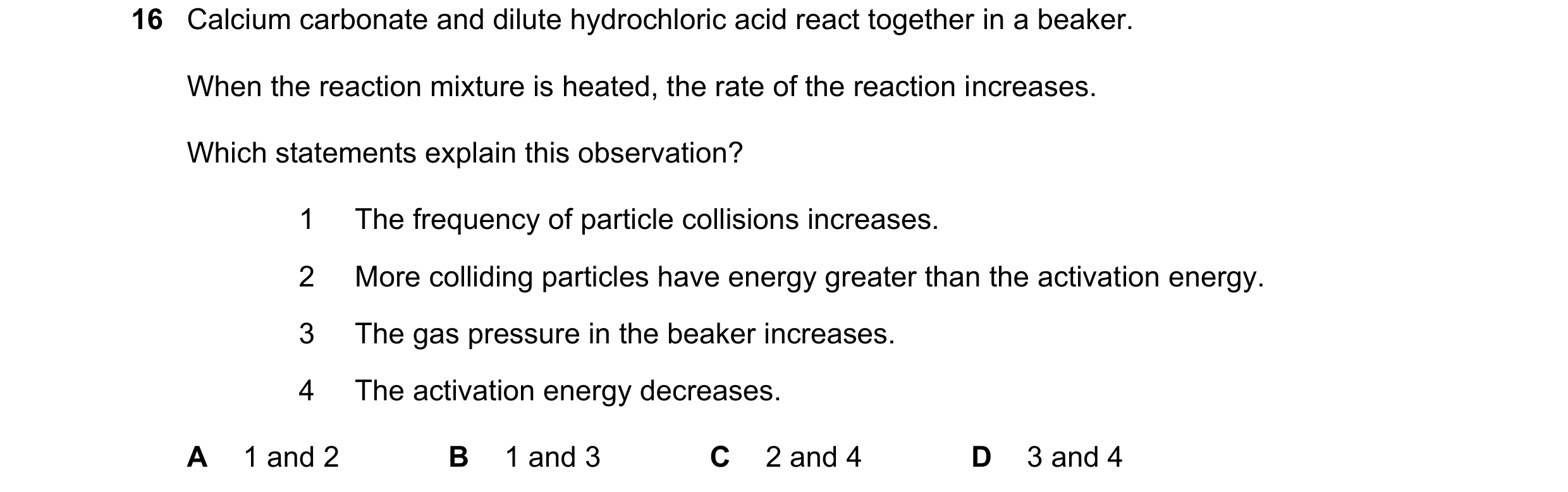
Q55 · Calcium carbonate and dilute hydrochloric acid react together in a beaker 0654/23 Oct/Nov 2025
16 Calcium carbonate and dilute hydrochloric acid react together in a beaker. When the reaction mixture is heated, the rate of the reaction increases. Which statements explain this observation? 1 The frequency of particle collisions increases. 2 More colliding particles have energy greater than the activation energy. 3 The gas pressure in the beaker increases. 4 The activation energy decreases. A 1 and 2 B 1 and 3 C 2 and 4 D 3 and 4
1 marks
Answer: A
This question in 0654/23 Oct/Nov 2025
 1 / 16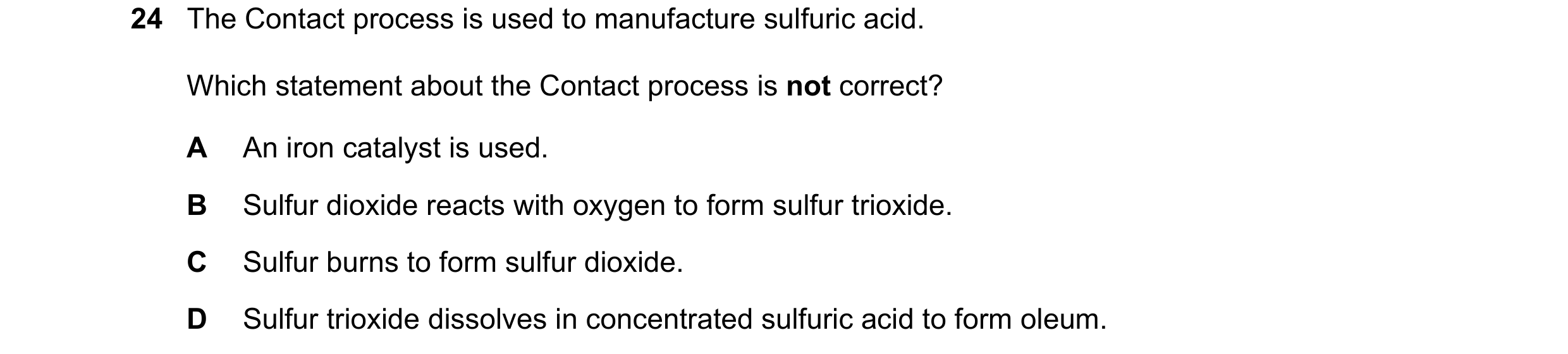
 2 / 16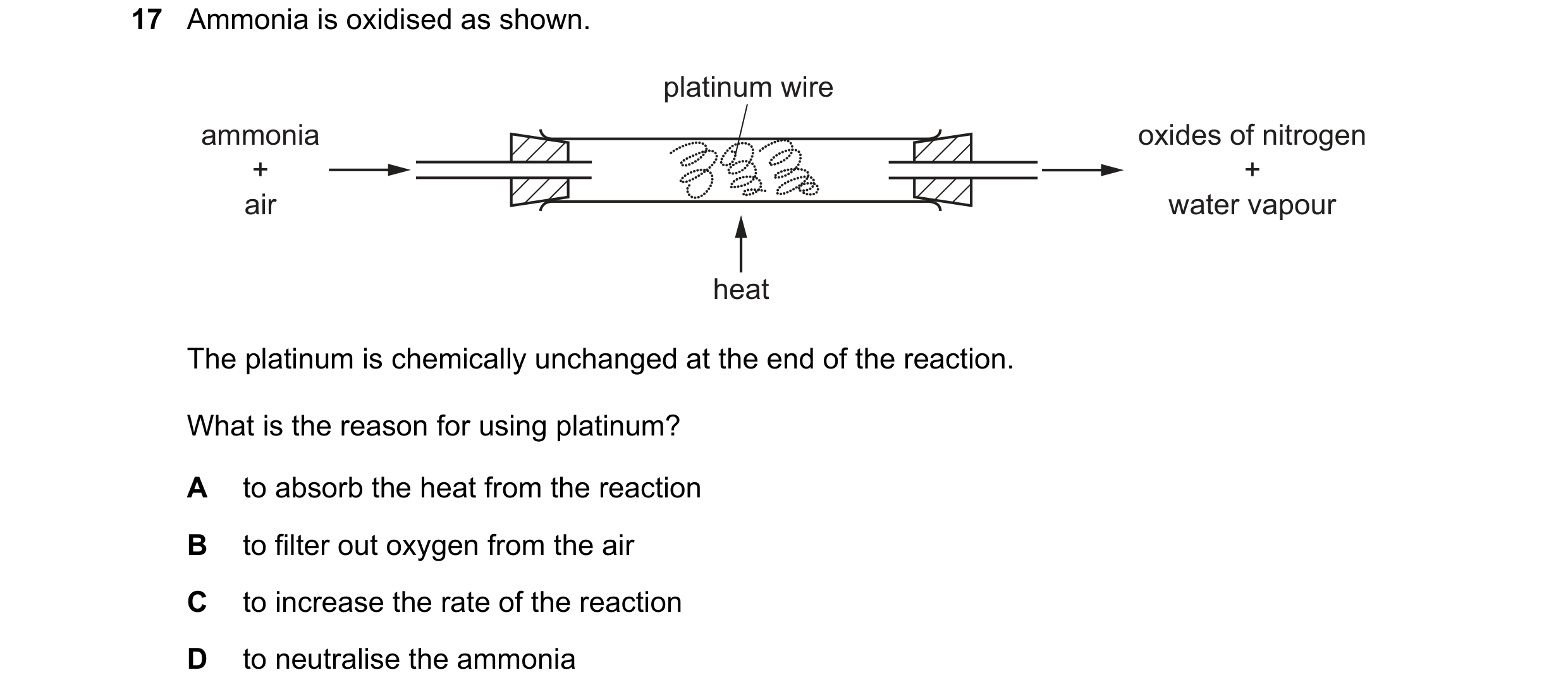
 3 / 16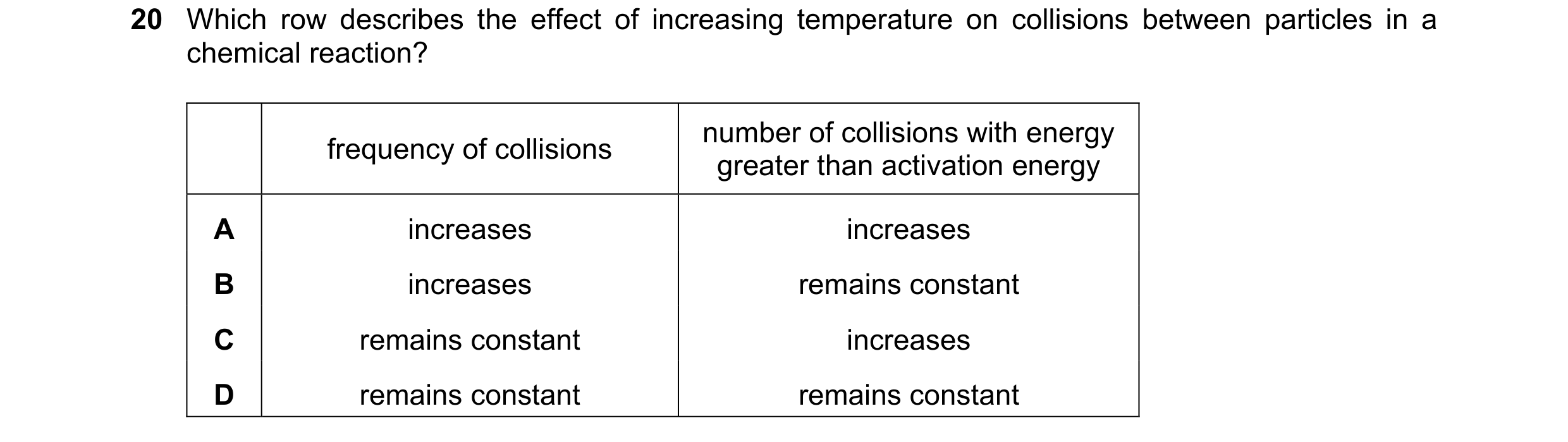
 4 / 16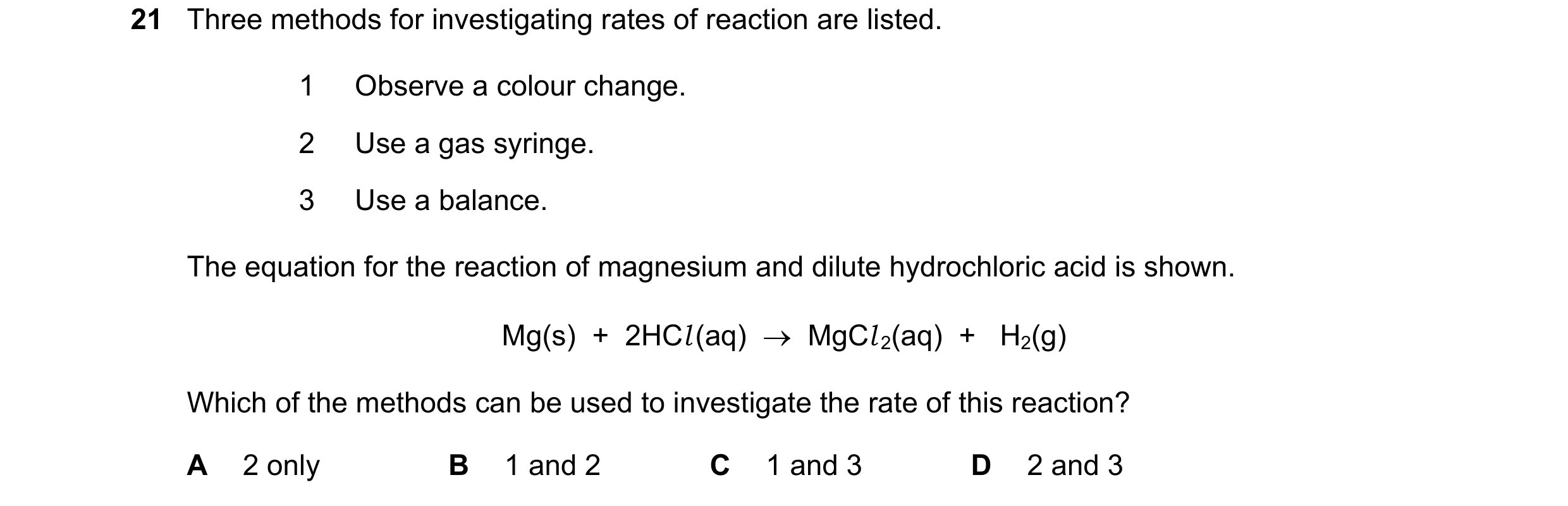
 5 / 16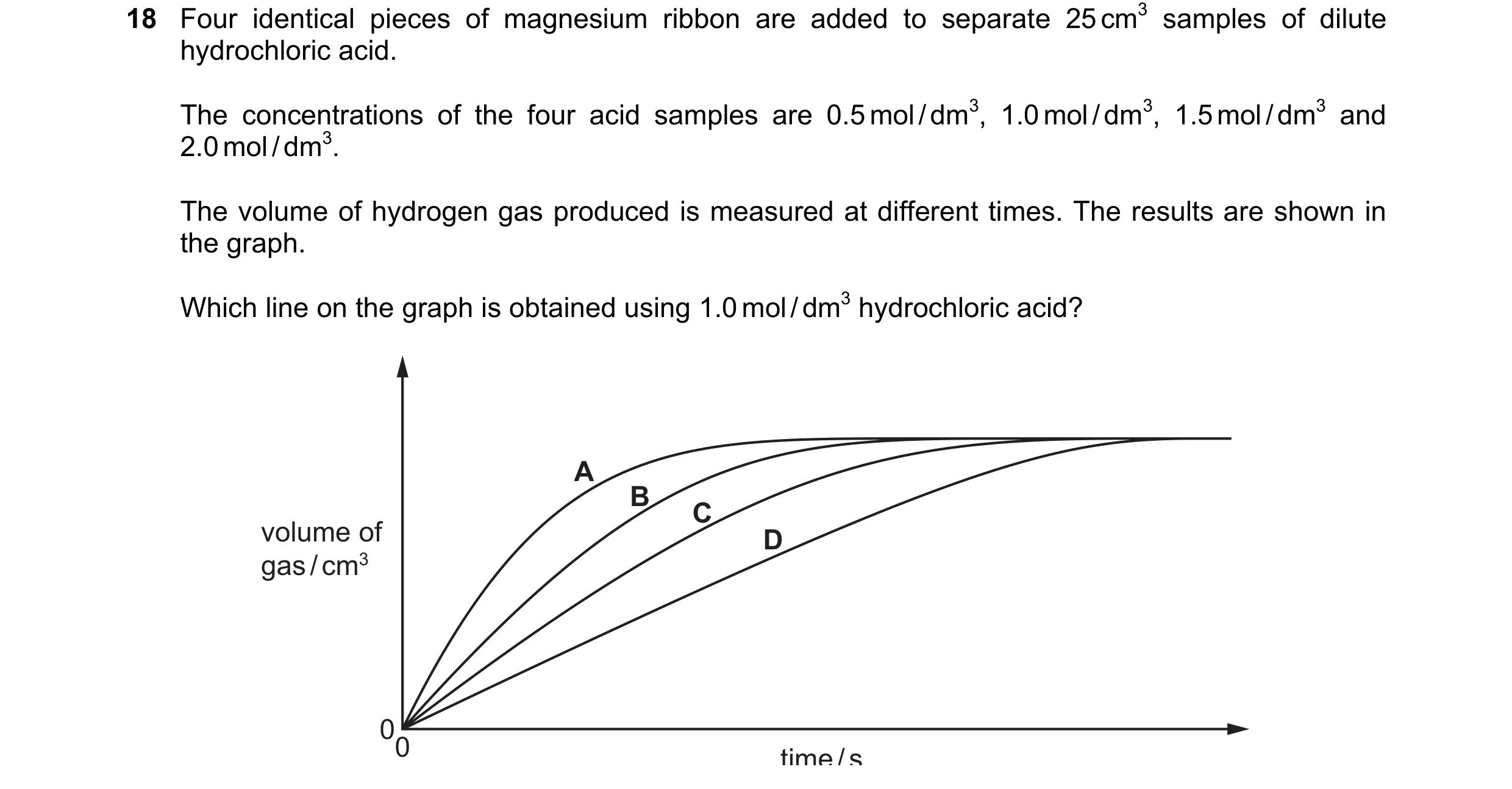
 6 / 16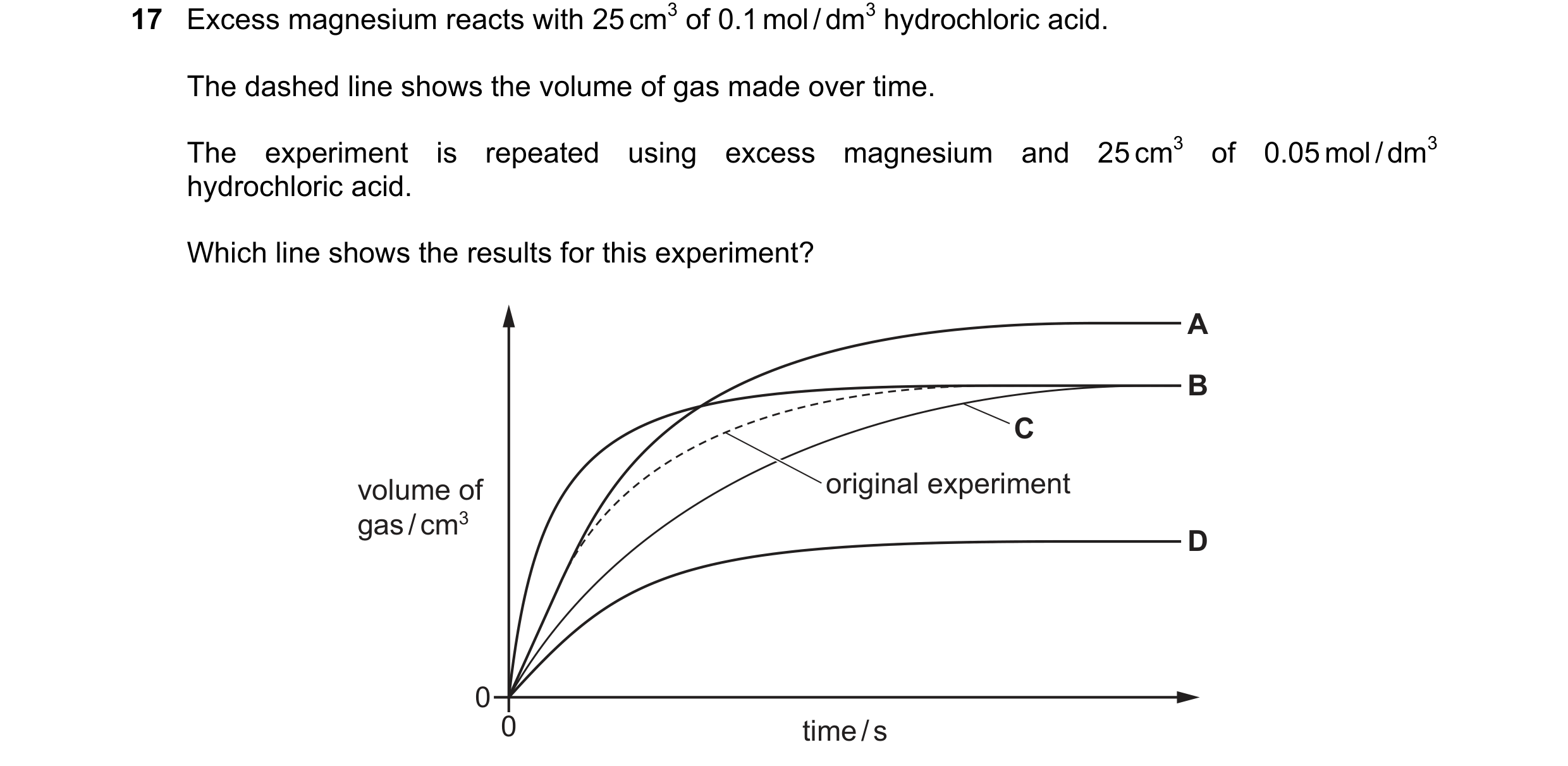
 7 / 16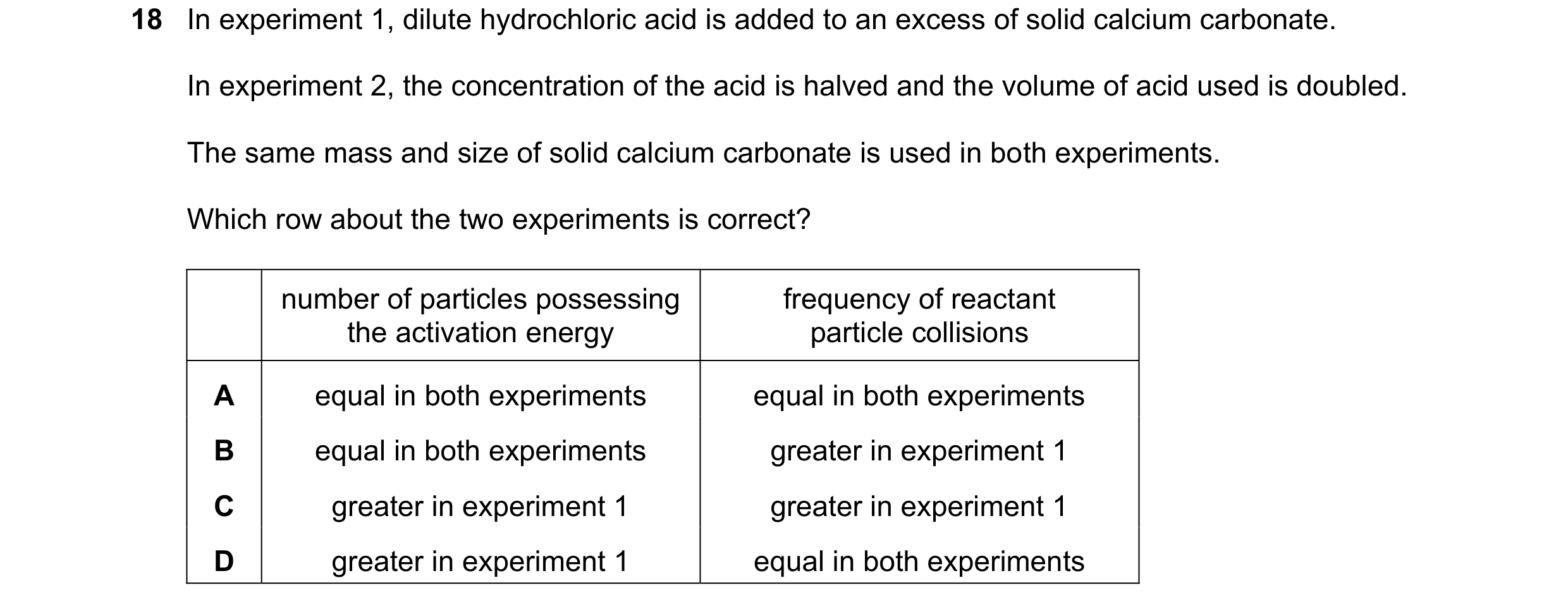

 8 / 16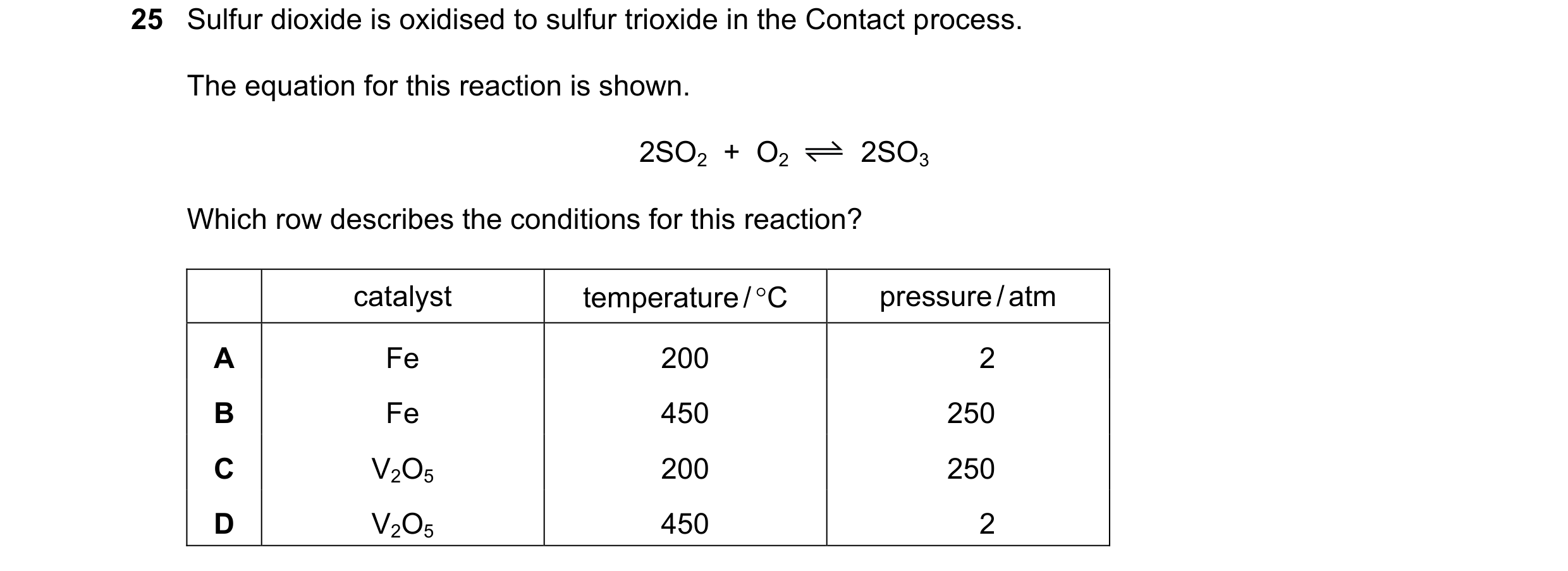
 9 / 16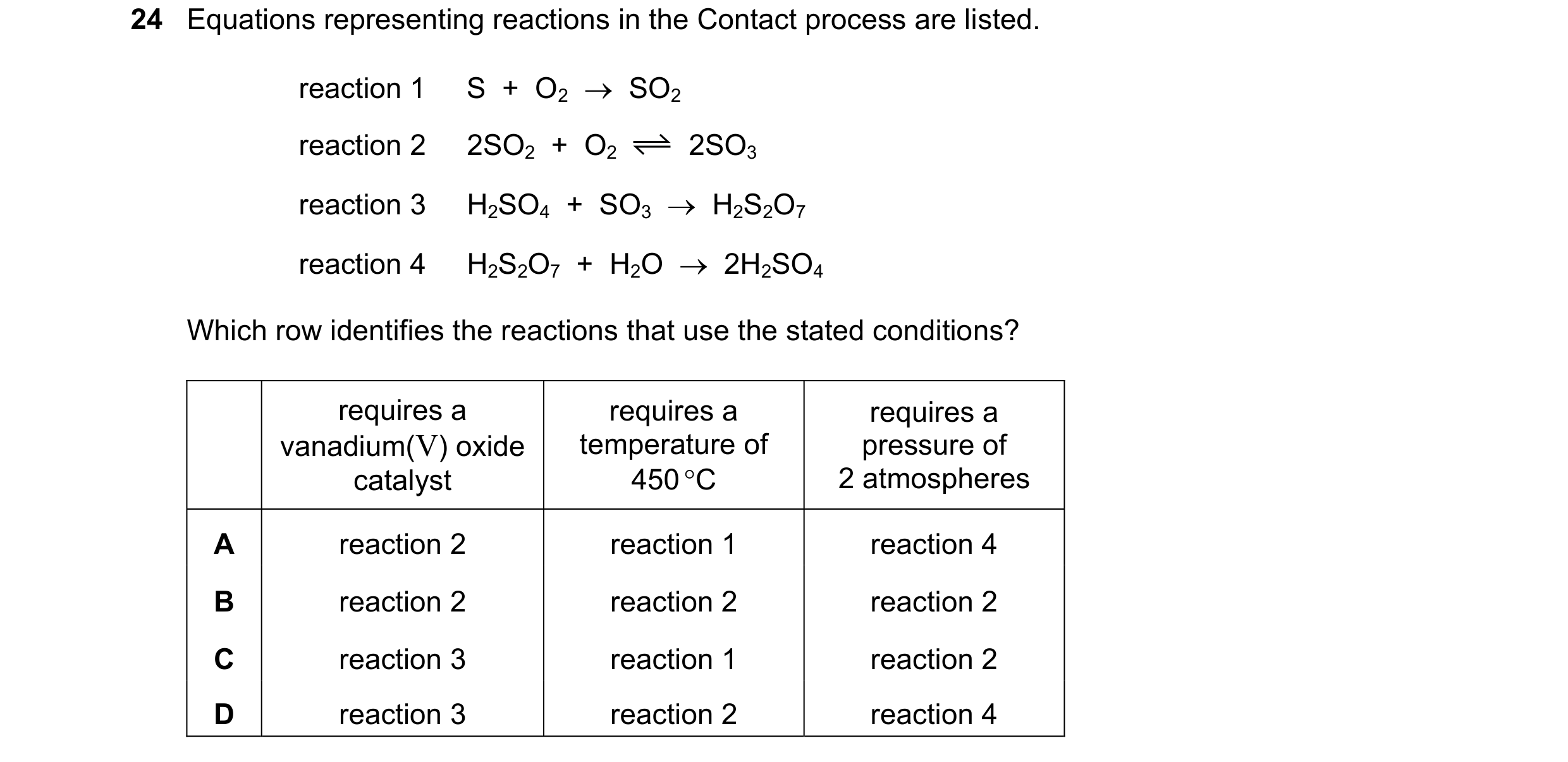

 10 / 16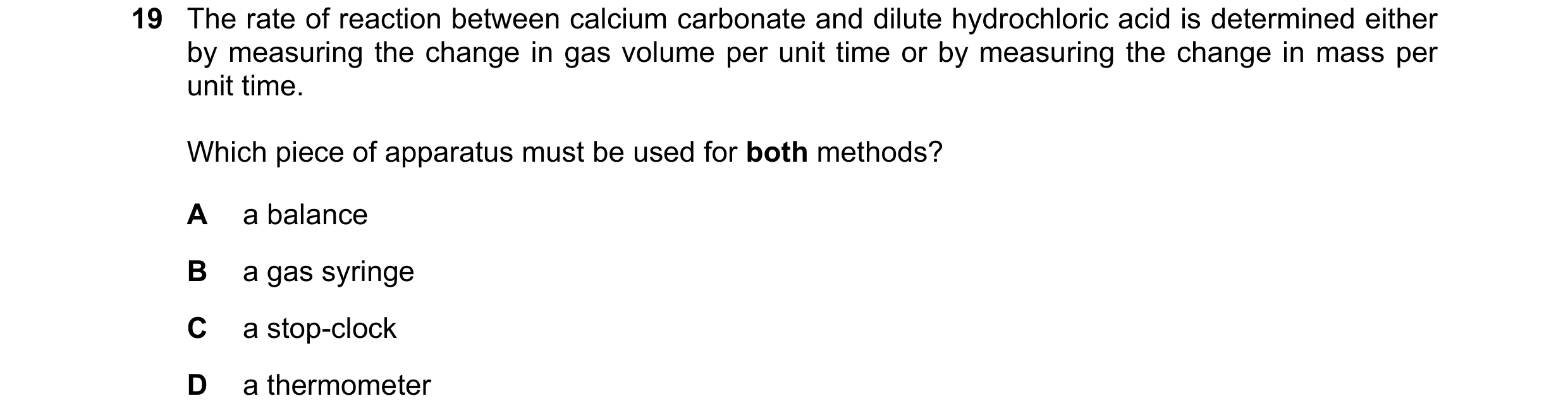

 11 / 16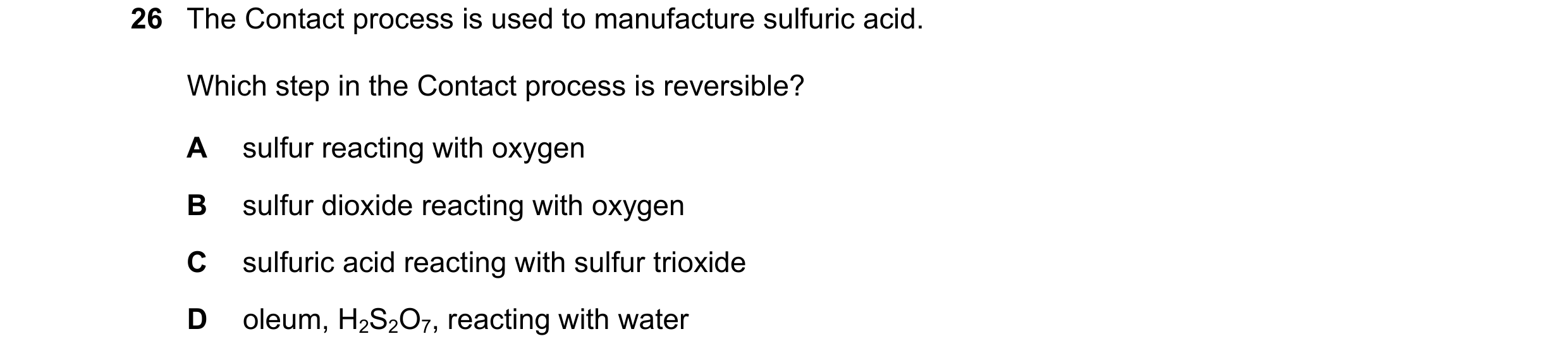
 12 / 16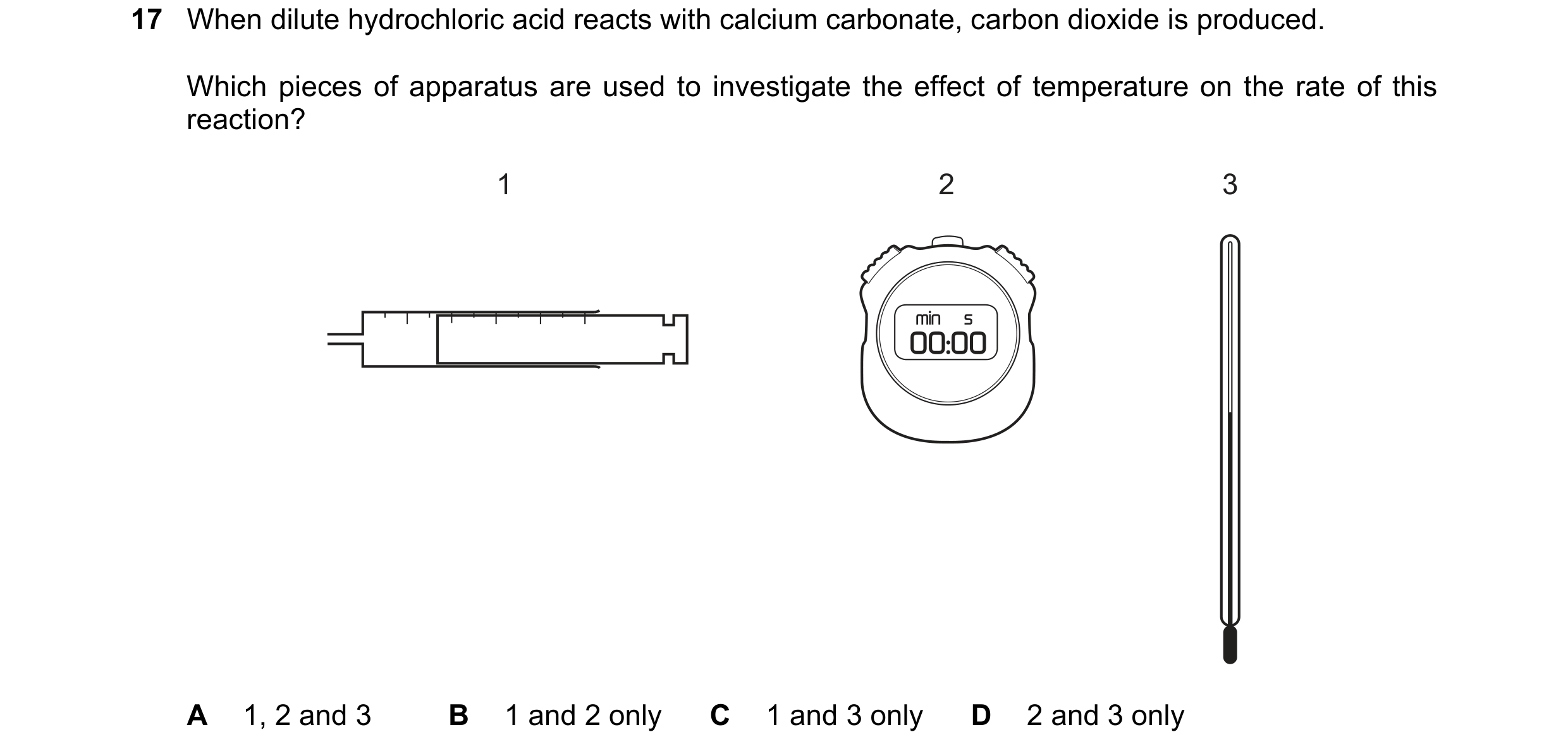
 13 / 16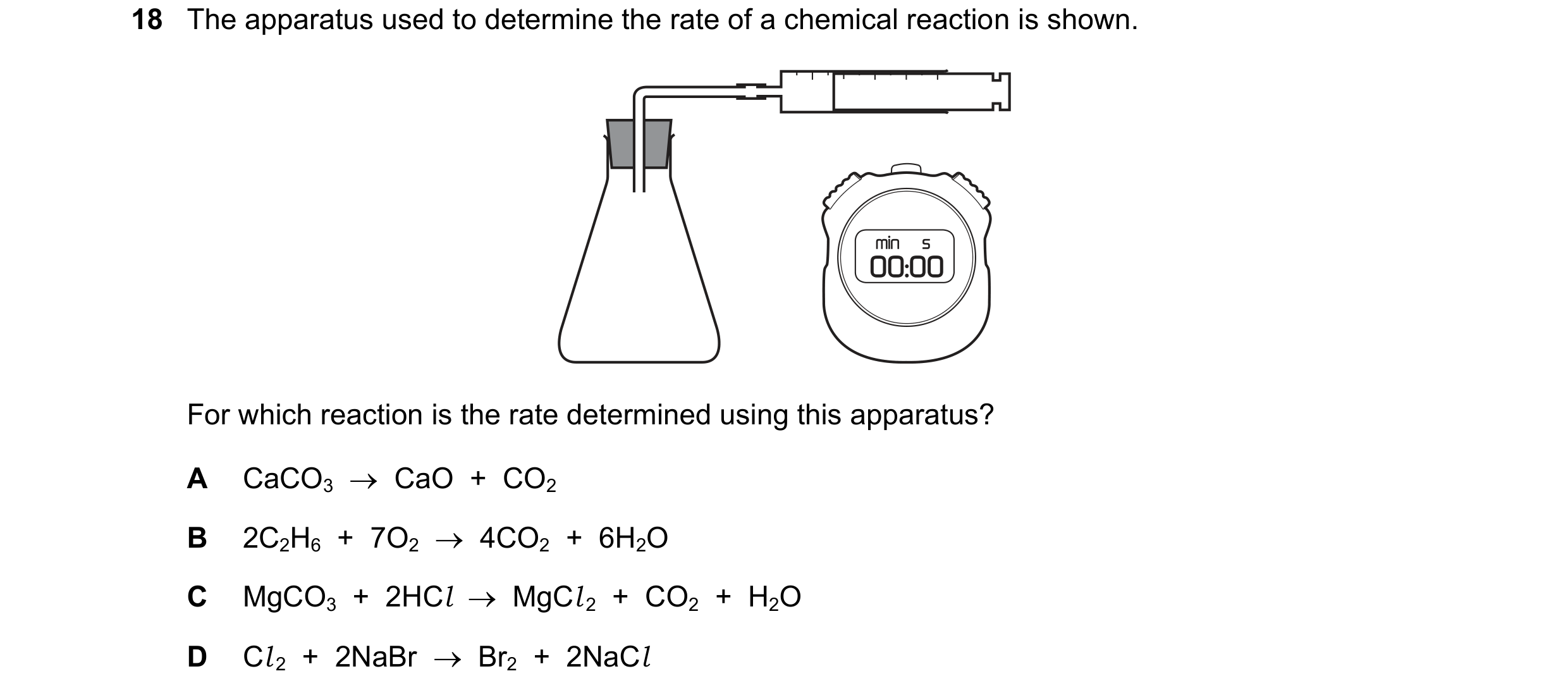
 14 / 16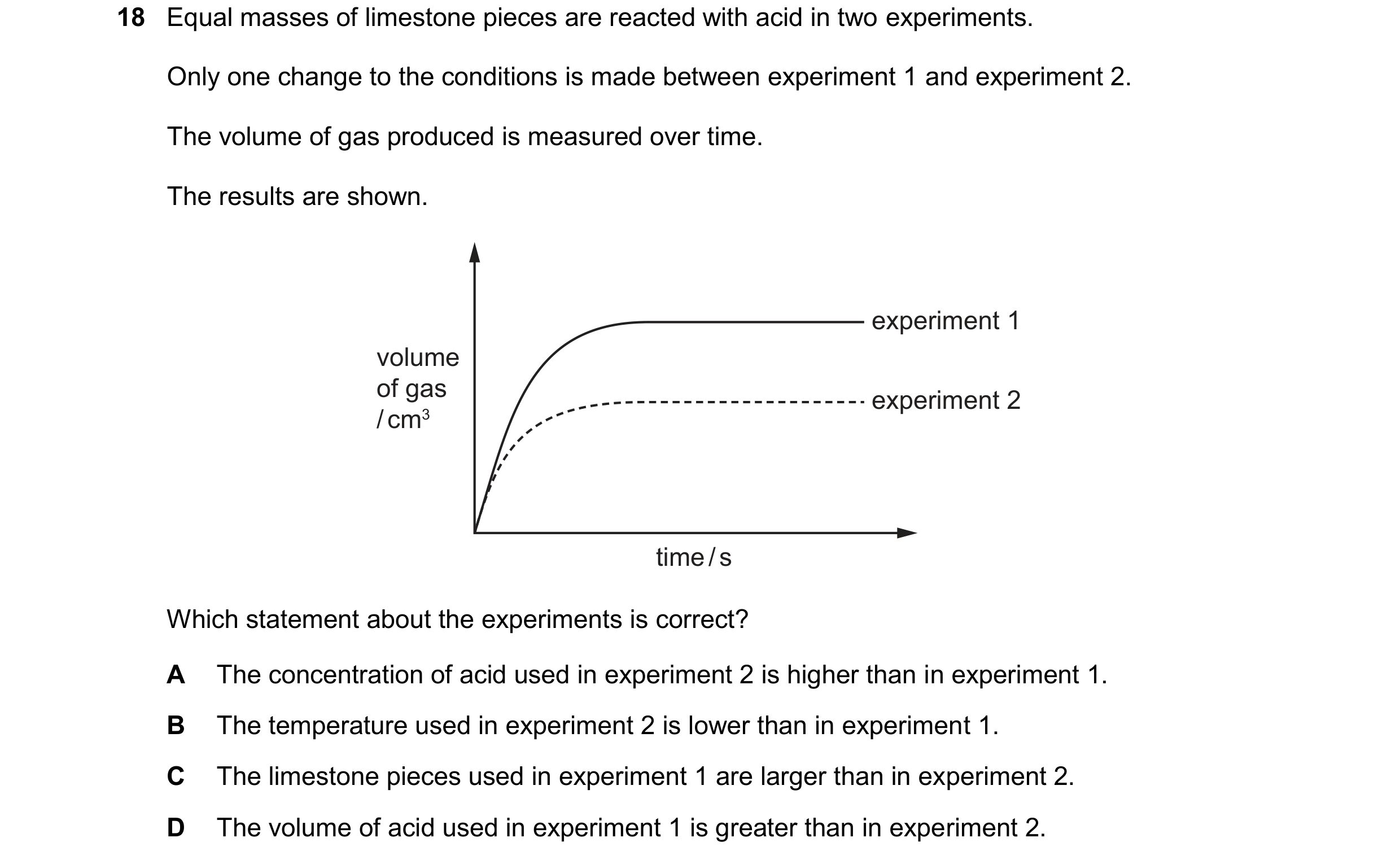
 15 / 16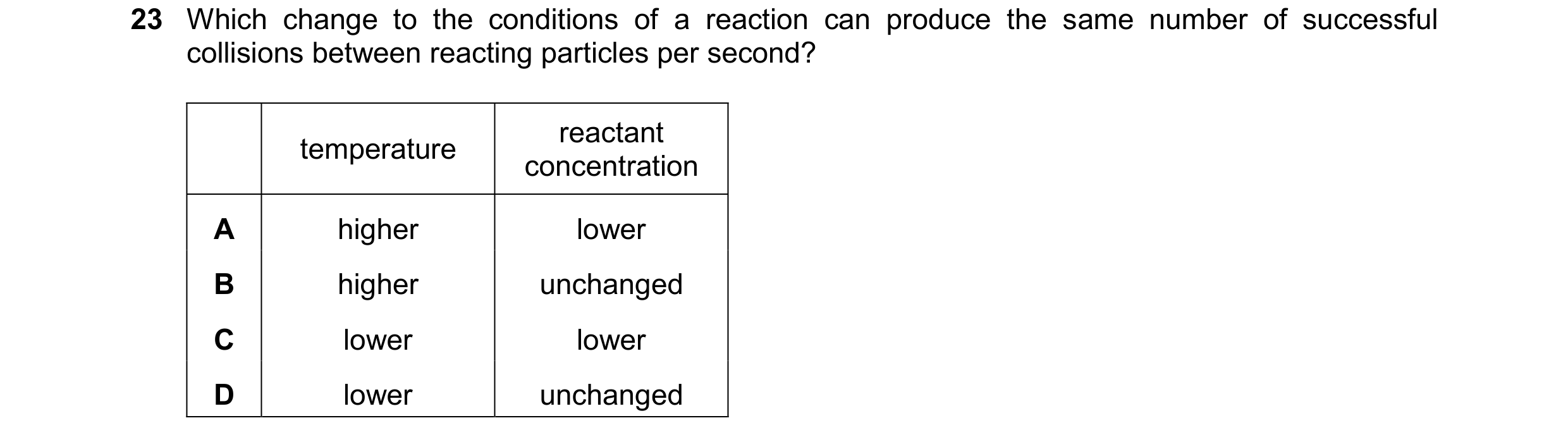
 16 / 16