Questions as text
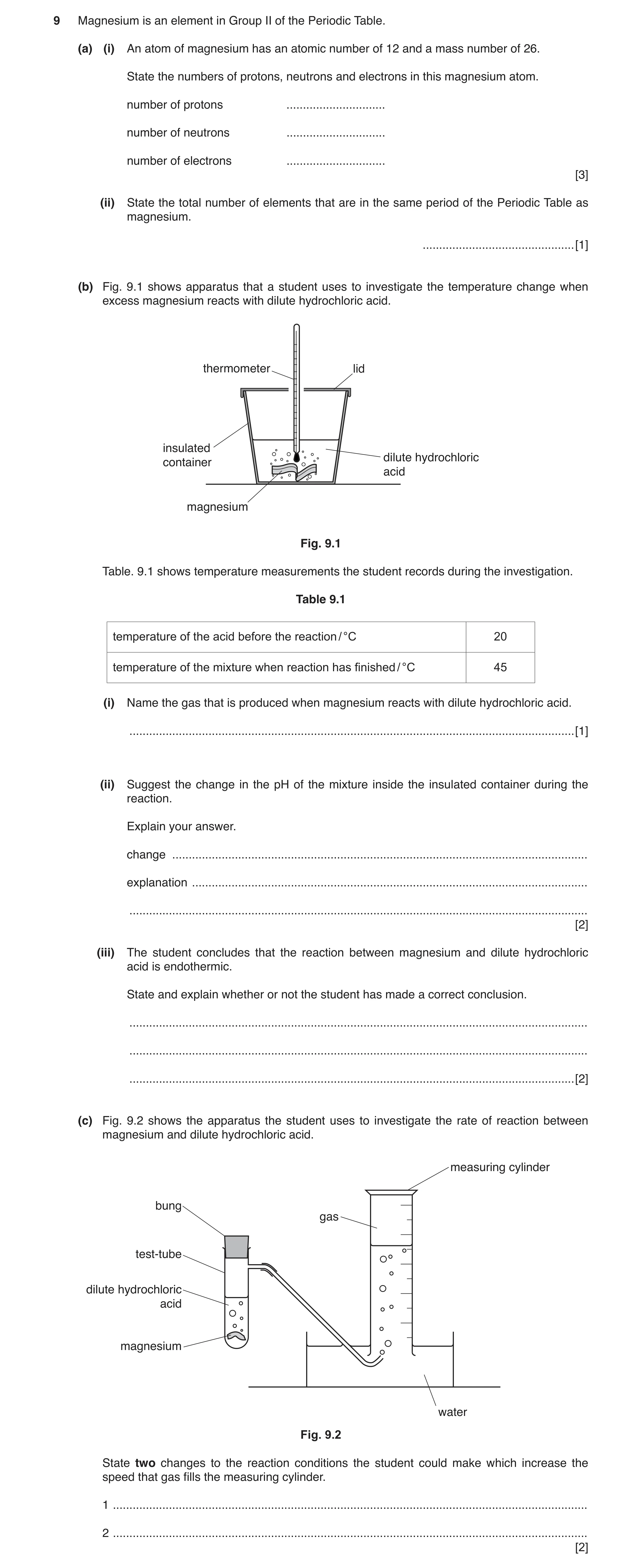
Q1 · Magnesium is an element in Group II of the Periodic Table 0654/31 May/June 2017
9 Magnesium is an element in Group II of the Periodic Table. (a) (i) An atom of magnesium has an atomic number of 12 and a mass number of 26. State the numbers of protons, neutrons and electrons in this magnesium atom. number of protons … number of neutrons … number of electrons … [3] (ii) State the total number of elements that are in the same period of the Periodic Table as magnesium. … [1] (b) Fig. 9.1 shows apparatus that a student uses to investigate the temperature change when excess magnesium reacts with dilute hydrochloric acid. thermometer lid insulated dilute hydrochloric container acid magnesium Fig. 9.1 Table. 9.1 shows temperature measurements the student records during the investigation. Table 9.1 temperature of the acid before the reaction / °C 20 temperature of the mixture when reaction has finished / °C 45 (i) Name the gas that is produced when magnesium reacts with dilute hydrochloric acid. … [1] (ii) Suggest the change in the pH of the mixture inside the insulated container during the reaction. Explain your answer. change … explanation … … [2] (iii) The student concludes that the reaction between magnesium and dilute hydrochloric acid is endothermic. State and explain whether or not the student has made a correct conclusion. … … … [2] (c) Fig. 9.2 shows the apparatus the student uses to investigate the rate of reaction between magnesium and dilute hydrochloric acid. measuring cylinder bung gas test-tube dilute hydrochloric acid magnesium water Fig. 9.2 State two changes to the reaction conditions the student could make which increase the speed that gas fills the measuring cylinder. 1 … 2 … [2]
11 marks
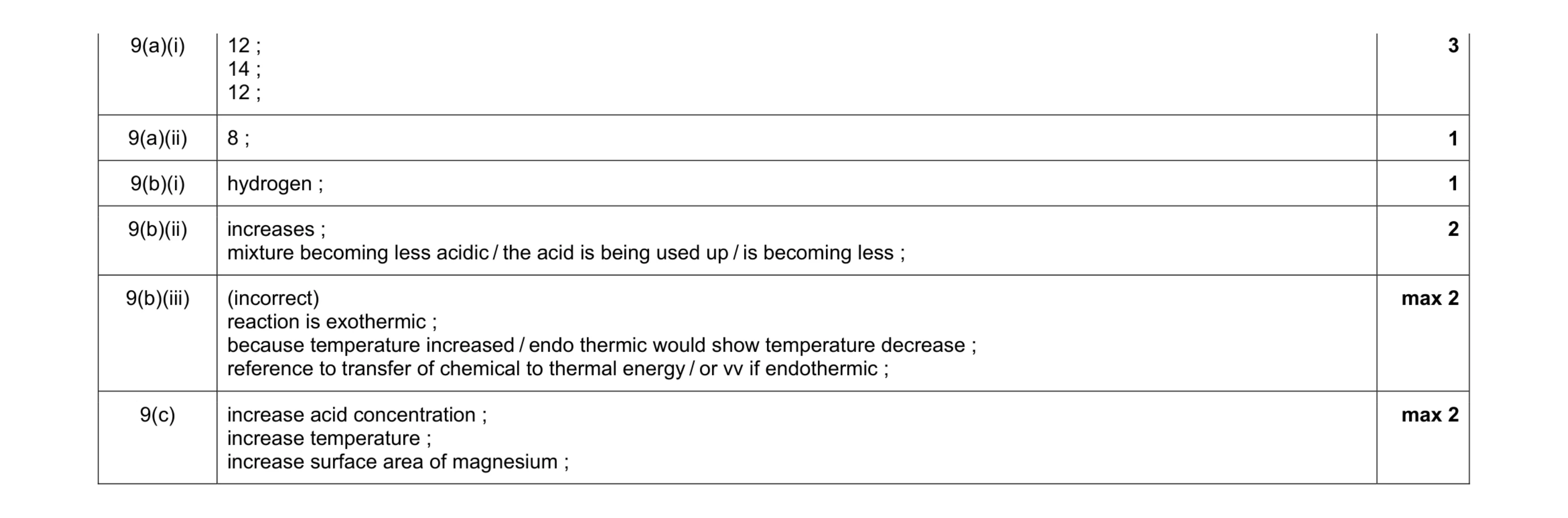
Mark scheme: 9(a)(i) 12 ; 14 ; 12 ; 3 9(a)(ii) 8 ; 1 9(b)(i) hydrogen ; 1 9(b)(ii) increases ; mixture becoming less acidic / the acid is being used up / is becoming less ; 2 9(b)(iii) (incorrect) reaction is exothermic ; because temperature increased / endo thermic would show temperature decrease ; reference to transfer of chemical to thermal energy / or vv if endothermic ; max 2 9(c) increase acid concentration ; increase temperature ; increase surface area of magnesium ; max 2
This question in 0654/31 May/June 2017
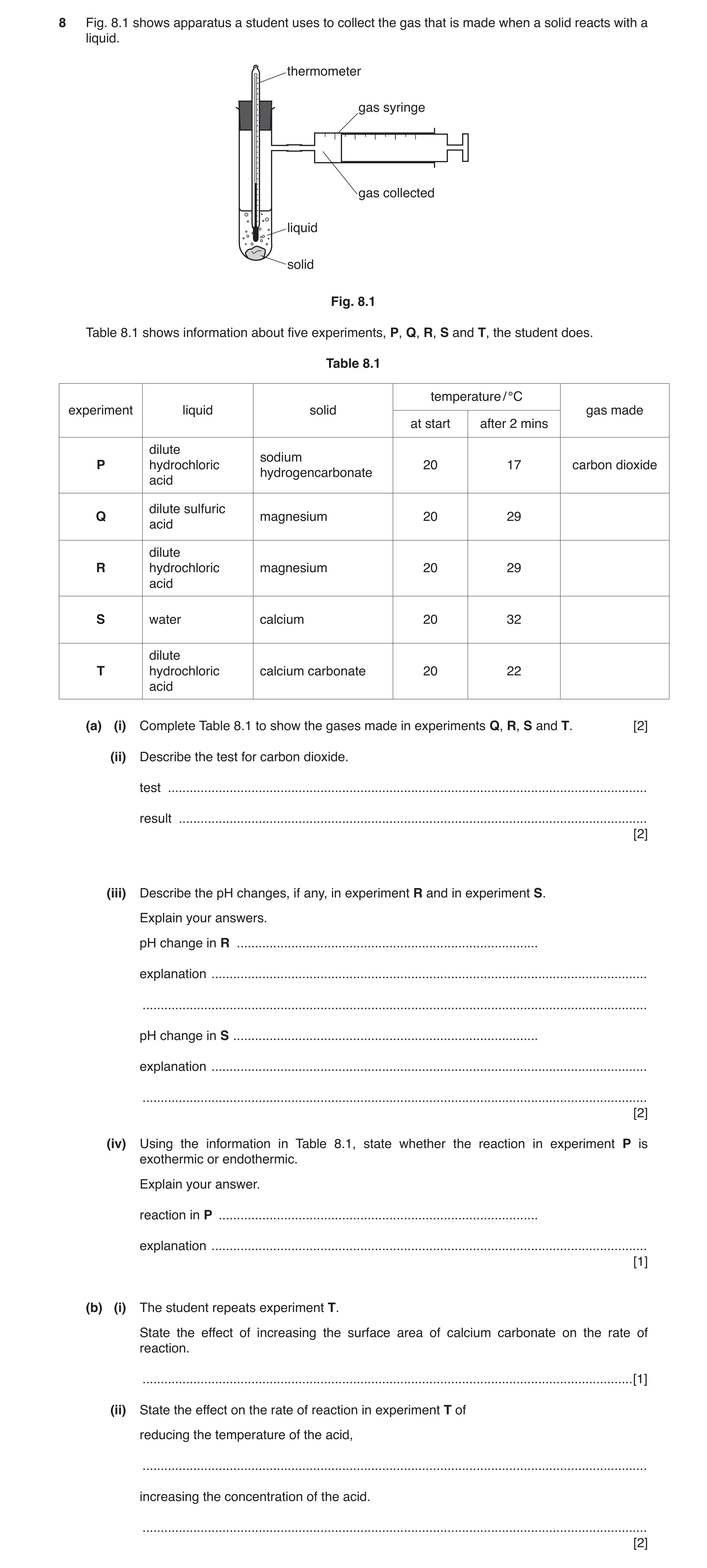
Q2 · Apparatus a student uses to collect the gas that is made when a solid reacts with a liquid 0654/31 Oct/Nov 2017
8 Fig. 8.1 shows apparatus a student uses to collect the gas that is made when a solid reacts with a liquid. thermometer gas syringe gas collected liquid solid Fig. 8.1 Table 8.1 shows information about five experiments, P, Q, R, S and T, the student does. Table 8.1 temperature / °C experiment liquid solid gas made at start after 2 mins dilute sodium P hydrochloric 20 17 carbon dioxide hydrogencarbonate acid dilute sulfuric Q magnesium 20 29 acid dilute R hydrochloric magnesium 20 29 acid S water calcium 20 32 dilute T hydrochloric calcium carbonate 20 22 acid (a) (i) Complete Table 8.1 to show the gases made in experiments Q, R, S and T. [2] (ii) Describe the test for carbon dioxide. test … result … [2] (iii) Describe the pH changes, if any, in experiment R and in experiment S. Explain your answers. pH change in R … explanation … … pH change in S … explanation … … [2] (iv) Using the information in Table 8.1, state whether the reaction in experiment P is exothermic or endothermic. Explain your answer. reaction in P … explanation … [1] (b) (i) The student repeats experiment T. State the effect of increasing the surface area of calcium carbonate on the rate of reaction. … [1] (ii) State the effect on the rate of reaction in experiment T of reducing the temperature of the acid, … increasing the concentration of the acid. … [2]
10 marks
Mark scheme: 8(a)(i) Q hydrogen R hydrogen S hydrogen T carbon dioxide 2 or 3 correct ; 4 correct ; 2 8(a)(ii) limewater ; goes milky ; 2 8(a)(iii) R increases AND acid is being used up / acid concentration is decreasing ; S increases AND reaction produces an alkaline product / calcium hydroxide concentration increases ; 2 Question Answer Marks 8(a)(iv) endothermic (because) temperature decreases / thermal energy taken in ; 1 8(b)(i) increases ; 1 8(b)(ii) rate decreases ; rate increases ; 2
This question in 0654/31 Oct/Nov 2017
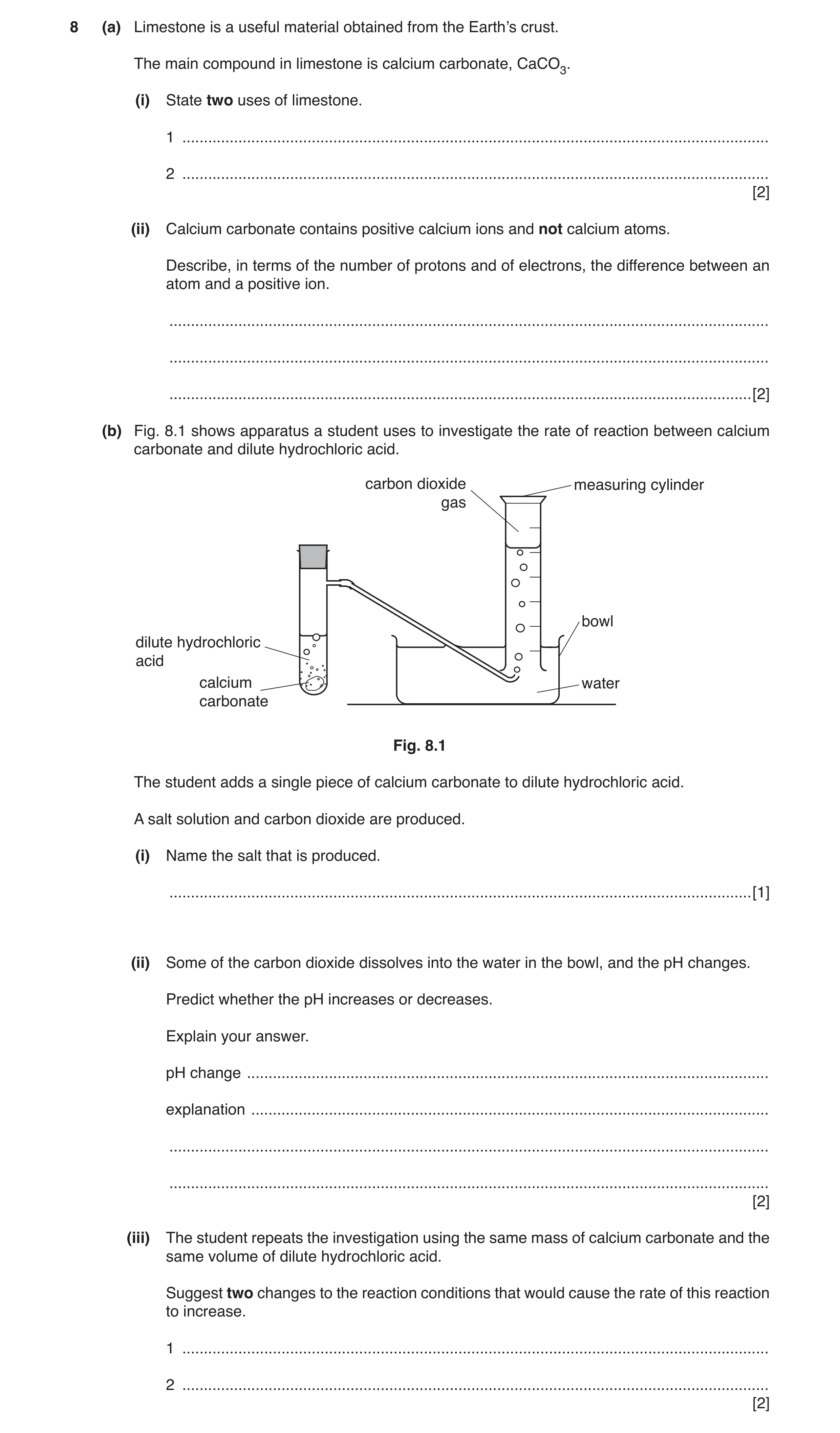
Q3 · Limestone is a useful material obtained from the Earth’s crust 0654/32 Oct/Nov 2018
8 (a) Limestone is a useful material obtained from the Earth’s crust. The main compound in limestone is calcium carbonate, CaCO3. (i) State two uses of limestone. 1 … 2 … [2] (ii) Calcium carbonate contains positive calcium ions and not calcium atoms. Describe, in terms of the number of protons and of electrons, the difference between an atom and a positive ion. … … … [2] (b) Fig. 8.1 shows apparatus a student uses to investigate the rate of reaction between calcium carbonate and dilute hydrochloric acid. carbon dioxide measuring cylinder gas bowl dilute hydrochloric acid calcium water carbonate Fig. 8.1 The student adds a single piece of calcium carbonate to dilute hydrochloric acid. A salt solution and carbon dioxide are produced. (i) Name the salt that is produced. … [1] (ii) Some of the carbon dioxide dissolves into the water in the bowl, and the pH changes. Predict whether the pH increases or decreases. Explain your answer. pH change … explanation … … … [2] (iii) The student repeats the investigation using the same mass of calcium carbonate and the same volume of dilute hydrochloric acid. Suggest two changes to the reaction conditions that would cause the rate of this reaction to increase. 1 … 2 … [2]
9 marks
Mark scheme: 8(a)(i) making, lime / calcium oxide; neutralisation of, acidic industrial waste / acidic soil; used in blast furnace / for iron extraction; AVP; max 2 8(a)(ii) in atom number of protons = number of electrons; in calcium ion there are fewer electrons than protons; 2 8(b)(i) calcium chloride; 1 8(b)(ii) (pH decreases) the gas / CO2 reacts with the water; turning it acidic; reference to non-metal oxide; max 2 8(b)(iii) increase acid concentration; increase (acid) temperature; use powdered calcium carbonate / increase surface area of calcium carbonate max 2
This question in 0654/32 Oct/Nov 2018
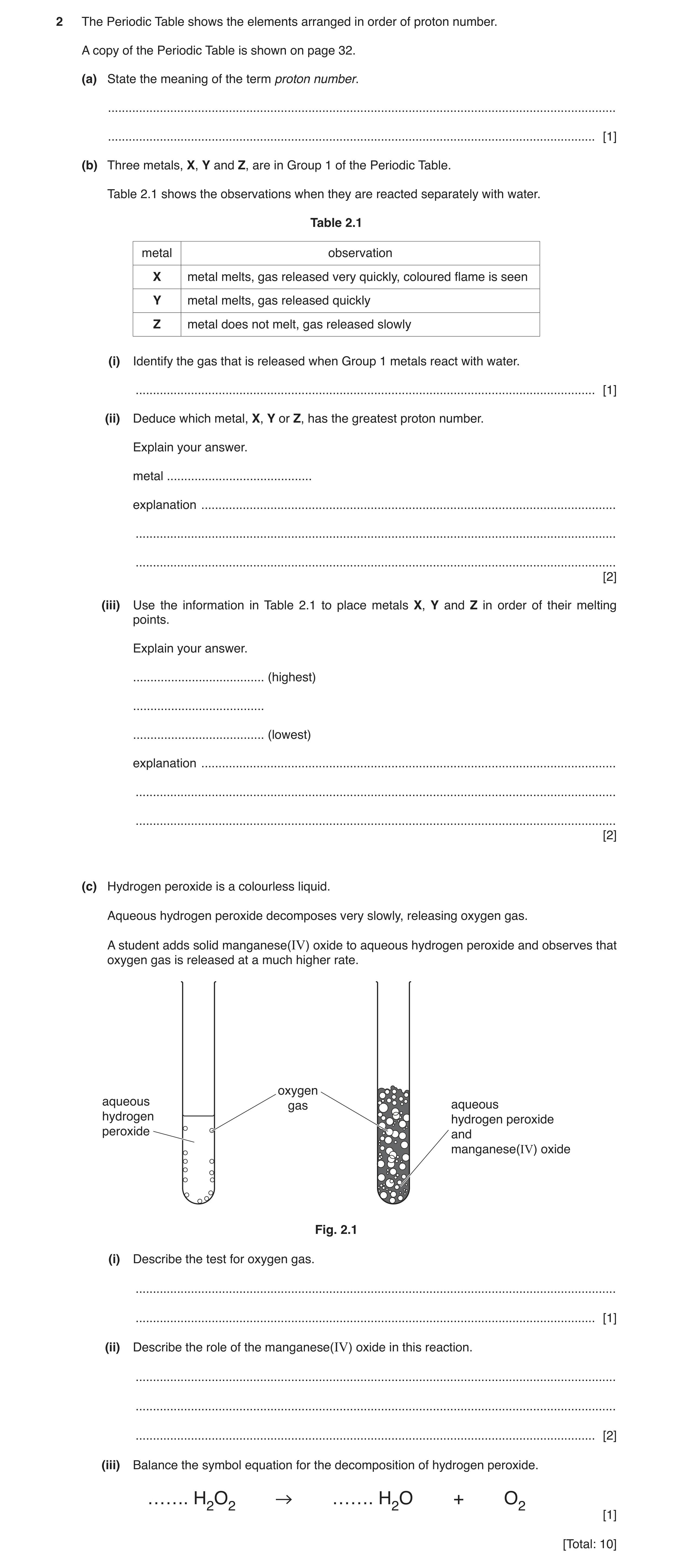
Q4 · The Periodic Table shows the elements arranged in order of proton number 0654/31 Oct/Nov 2019
2 The Periodic Table shows the elements arranged in order of proton number. A copy of the Periodic Table is shown on page 32. (a) State the meaning of the term proton number. … … [1] (b) Three metals, X, Y and Z, are in Group 1 of the Periodic Table. Table 2.1 shows the observations when they are reacted separately with water. Table 2.1 metal observation X metal melts, gas released very quickly, coloured flame is seen Y metal melts, gas released quickly Z metal does not melt, gas released slowly (i) Identify the gas that is released when Group 1 metals react with water. … [1] (ii) Deduce which metal, X, Y or Z, has the greatest proton number. Explain your answer. metal … explanation … … … [2] (iii) Use the information in Table 2.1 to place metals X, Y and Z in order of their melting points. Explain your answer. … (highest) … … (lowest) explanation … … … [2] (c) Hydrogen peroxide is a colourless liquid. Aqueous hydrogen peroxide decomposes very slowly, releasing oxygen gas. A student adds solid manganese(IV) oxide to aqueous hydrogen peroxide and observes that oxygen gas is released at a much higher rate. oxygen aqueous gas aqueous hydrogen hydrogen peroxide peroxide and manganese(IV) oxide Fig. 2.1 (i) Describe the test for oxygen gas. … … [1] (ii) Describe the role of the manganese(IV) oxide in this reaction. … … … [2] (iii) Balance the symbol equation for the decomposition of hydrogen peroxide. ……. H2O2 ……. H2O + O2 [1] [Total: 10]
10 marks
Mark scheme: 2(a) number of protons in an atom (of the element) ; 1 2(b)(i) hydrogen / H2 ; 1 2(b)(ii) (X) X reacts most vigorously with water ; reactivity increases down Group 1 / with increasing proton number ; 2 2(b)(iii) Z (highest) Y X (lowest) ; the idea that melting point decreases down Group 1 / as reactivity increases / owtte ; 2 2(c)(i) relights glowing splint ; 1 2(c)(ii) catalyst ; speeds up reaction rate ; 2 2(c)(iii) 2H2O2 → 2H2O + O2 ; 1
This question in 0654/31 Oct/Nov 2019
Q5 · A chart showing the composition of clean air 0654/33 Oct/Nov 2019
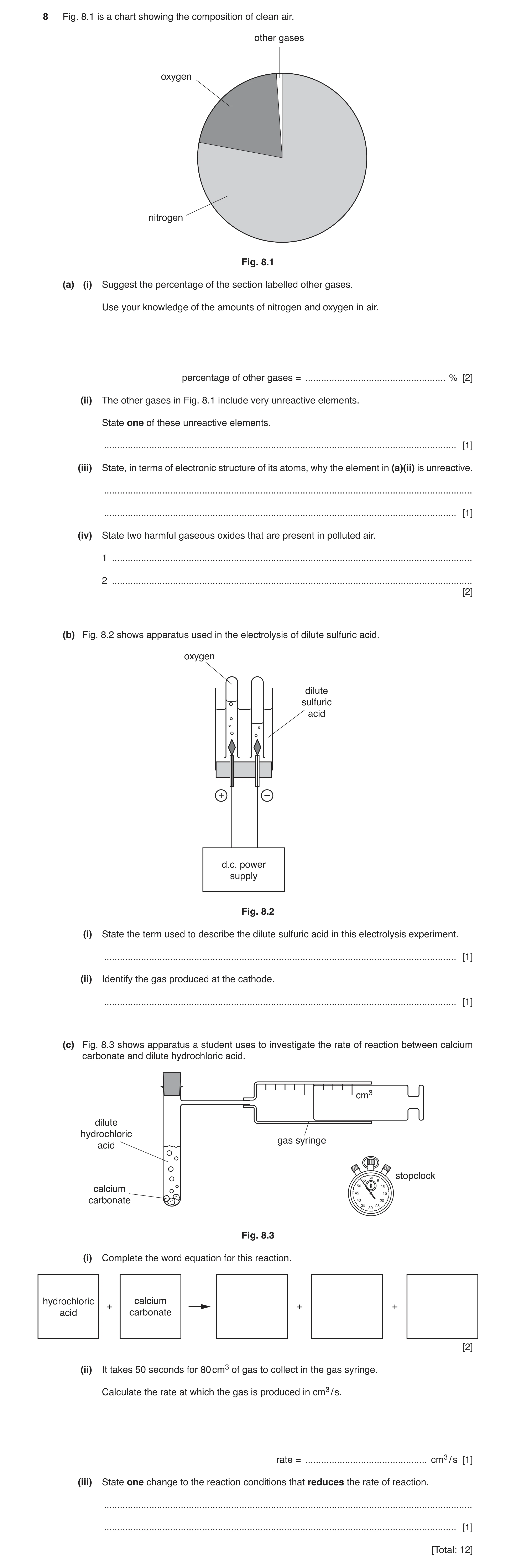
8 Fig. 8.1 is a chart showing the composition of clean air. other gases oxygen nitrogen Fig. 8.1 (a) (i) Suggest the percentage of the section labelled other gases. Use your knowledge of the amounts of nitrogen and oxygen in air. percentage of other gases = … % [2] (ii) The other gases in Fig. 8.1 include very unreactive elements. State one of these unreactive elements. … [1] (iii) State, in terms of electronic structure of its atoms, why the element in (a)(ii) is unreactive. … … [1] (iv) State two harmful gaseous oxides that are present in polluted air. 1 … 2 … [2] (b) Fig. 8.2 shows apparatus used in the electrolysis of dilute sulfuric acid. oxygen dilute sulfuric acid + – d.c. power supply Fig. 8.2 (i) State the term used to describe the dilute sulfuric acid in this electrolysis experiment. … [1] (ii) Identify the gas produced at the cathode. … [1] (c) Fig. 8.3 shows apparatus a student uses to investigate the rate of reaction between calcium carbonate and dilute hydrochloric acid. cm3 dilute hydrochloric gas syringe acid stopclock calcium carbonate Fig. 8.3 (i) Complete the word equation for this reaction. hydrochloric calcium + + + acid carbonate [2] (ii) It takes 50 seconds for 80 cm3 of gas to collect in the gas syringe. Calculate the rate at which the gas is produced in cm3 / s. rate = … cm3 / s [1] (iii) State one change to the reaction conditions that reduces the rate of reaction. … … [1] [Total: 12]
12 marks
Mark scheme: 8(a)(i) nitrogen 78% + oxygen 21% = 99% / or equivalent ; so other gases = 100 – 99 = 1% ; 2 8(a)(ii) any noble gas ; 1 8(a)(iii) reference to full outer shell ; 1 8(a)(iv) sulfur dioxide / SO2 ; carbon monoxide / CO ; nitrogen oxides (named oxide) / NOx ; max 2 2 8(b)(i) electrolyte ; 1 8(b)(ii) hydrogen ; 1 8(c)(i) → calcium chloride ; + carbon dioxide + water ; 2 8(c)(ii) 80 ÷ 50 = 1.6 (cm3 / s) ; 1 8(c)(iii) decrease temperature / decrease acid concentration / decrease surface area of calcium carbonate ; 1
This question in 0654/33 Oct/Nov 2019
Q6 · The molecular structures of four carbon compounds, A, B, C and D 0654/32 Oct/Nov 2020
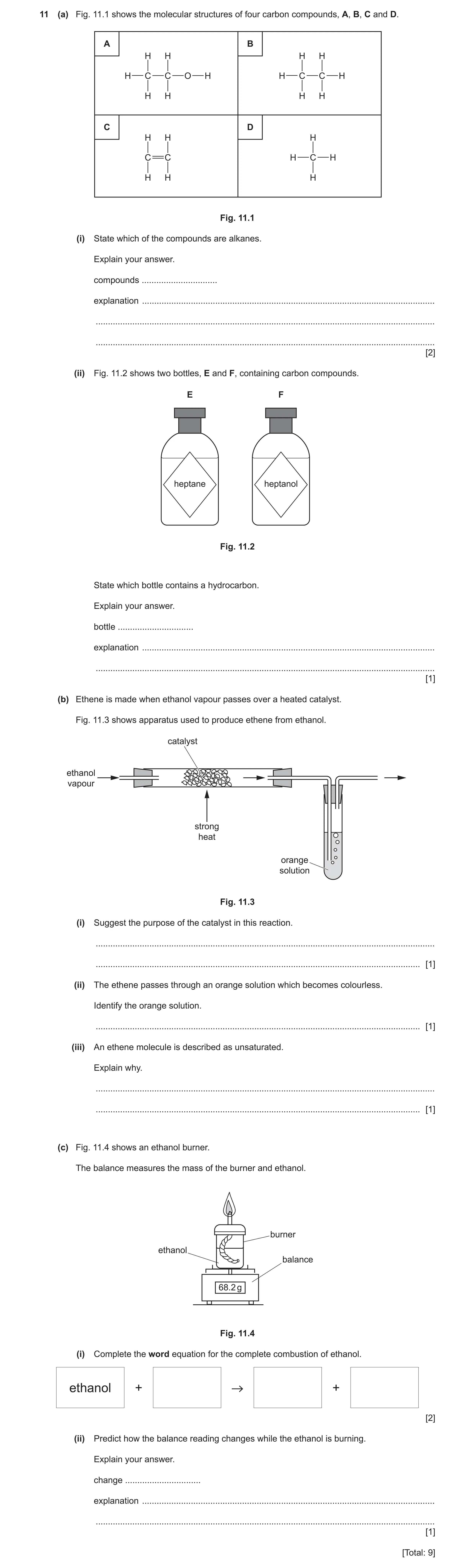
11 (a) Fig. 11.1 shows the molecular structures of four carbon compounds, A, B, C and D. A B H H H H H C C O H H C C H H H H H C D H H H C C H C H H H H Fig. 11.1 (i) State which of the compounds are alkanes. Explain your answer. compounds … explanation … … … [2] (ii) Fig. 11.2 shows two bottles, E and F, containing carbon compounds. E F heptane heptanol Fig. 11.2 State which bottle contains a hydrocarbon. Explain your answer. bottle … explanation … … [1] (b) Ethene is made when ethanol vapour passes over a heated catalyst. Fig. 11.3 shows apparatus used to produce ethene from ethanol. catalyst ethanol vapour strong heat orange solution Fig. 11.3 (i) Suggest the purpose of the catalyst in this reaction. … … [1] (ii) The ethene passes through an orange solution which becomes colourless. Identify the orange solution. … [1] (iii) An ethene molecule is described as unsaturated. Explain why. … … [1] (c) Fig. 11.4 shows an ethanol burner. The balance measures the mass of the burner and ethanol. burner ethanol balance 68.2 g Fig. 11.4 (i) Complete the word equation for the complete combustion of ethanol. ethanol + + [2] (ii) Predict how the balance reading changes while the ethanol is burning. Explain your answer. change … explanation … … [1] [Total: 9]
9 marks
Mark scheme: 11(a)(i) (B and D ) they are hydrocarbons / contain only hydrogen and carbon ; they contain only single bonds / they are saturated ; 2 11(a)(ii) (bottle E / heptane) name ending -ane denotes an alkane ; alkanes are hydrocarbons ; name ending -ol shows it is not a hydrocarbon / is an alcohol / contains oxygen ; max 1 1 11(b)(i) increases the rate (of reaction) ; 1 11(b)(ii) aqueous bromine / bromine water / bromine solution ; 1 11(b)(iii) molecules contain a double bond (between carbon atoms) / molecule does not contain the maximum possible number of hydrogen atoms ; 1 11(c)(i) + oxygen ; → carbon dioxide + water ; 2 11(c)(ii) (balance reading decreases) gases / carbon dioxide / water vapour released ; 1
This question in 0654/32 Oct/Nov 2020
Q7 · Thermal decomposition happens when compounds are heated and break down into simpler… 0654/33 Oct/Nov 2020
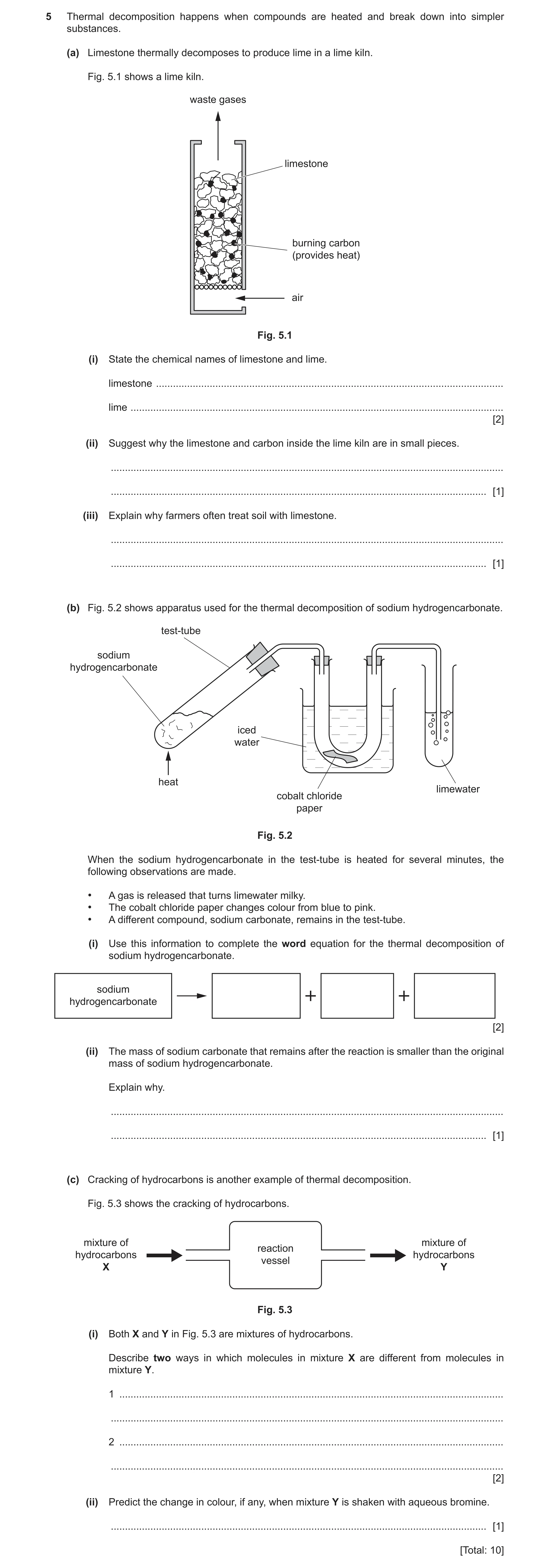
5 Thermal decomposition happens when compounds are heated and break down into simpler substances. (a) Limestone thermally decomposes to produce lime in a lime kiln. Fig. 5.1 shows a lime kiln. waste gases limestone burning carbon (provides heat) air Fig. 5.1 (i) State the chemical names of limestone and lime. limestone … lime … [2] (ii) Suggest why the limestone and carbon inside the lime kiln are in small pieces. … … [1] (iii) Explain why farmers often treat soil with limestone. … … [1] (b) Fig. 5.2 shows apparatus used for the thermal decomposition of sodium hydrogencarbonate. test-tube sodium hydrogencarbonate iced water heat limewater cobalt chloride paper Fig. 5.2 When the sodium hydrogencarbonate in the test‑tube is heated for several minutes, the following observations are made. • A gas is released that turns limewater milky. • The cobalt chloride paper changes colour from blue to pink. • A different compound, sodium carbonate, remains in the test‑tube. (i) Use this information to complete the word equation for the thermal decomposition of sodium hydrogencarbonate. sodium hydrogencarbonate [2] (ii) The mass of sodium carbonate that remains after the reaction is smaller than the original mass of sodium hydrogencarbonate. Explain why. … … [1] (c) Cracking of hydrocarbons is another example of thermal decomposition. Fig. 5.3 shows the cracking of hydrocarbons. mixture of mixture of reaction hydrocarbons hydrocarbons vessel X Y Fig. 5.3 (i) Both X and Y in Fig. 5.3 are mixtures of hydrocarbons. Describe two ways in which molecules in mixture X are different from molecules in mixture Y. 1 … … 2 … … [2] (ii) Predict the change in colour, if any, when mixture Y is shaken with aqueous bromine. … [1] [Total: 10]
10 marks
Mark scheme: 5(a)(i) calcium carbonate ; calcium oxide ; 2 5(a)(ii) speeds up reaction rate (of both reactions) 1 5(a)(iii) treat acidic soil ; 1 5(b)(i) (sodium hydrogencarbonate →) sodium carbonate + carbon dioxide + water ;; 2 5(b)(ii) gaseous products removed from sodium hydrogencarbonate ; 1 5(c)(i) mixture Y contains unsaturated hydrocarbons (and X does not) ; molecules (on average) are smaller in Y ; 2 5(c)(ii) orange to colourless ; 1
This question in 0654/33 Oct/Nov 2020
Q8 · Information about three colourless liquids J, K and L 0654/32 Feb/March 2021
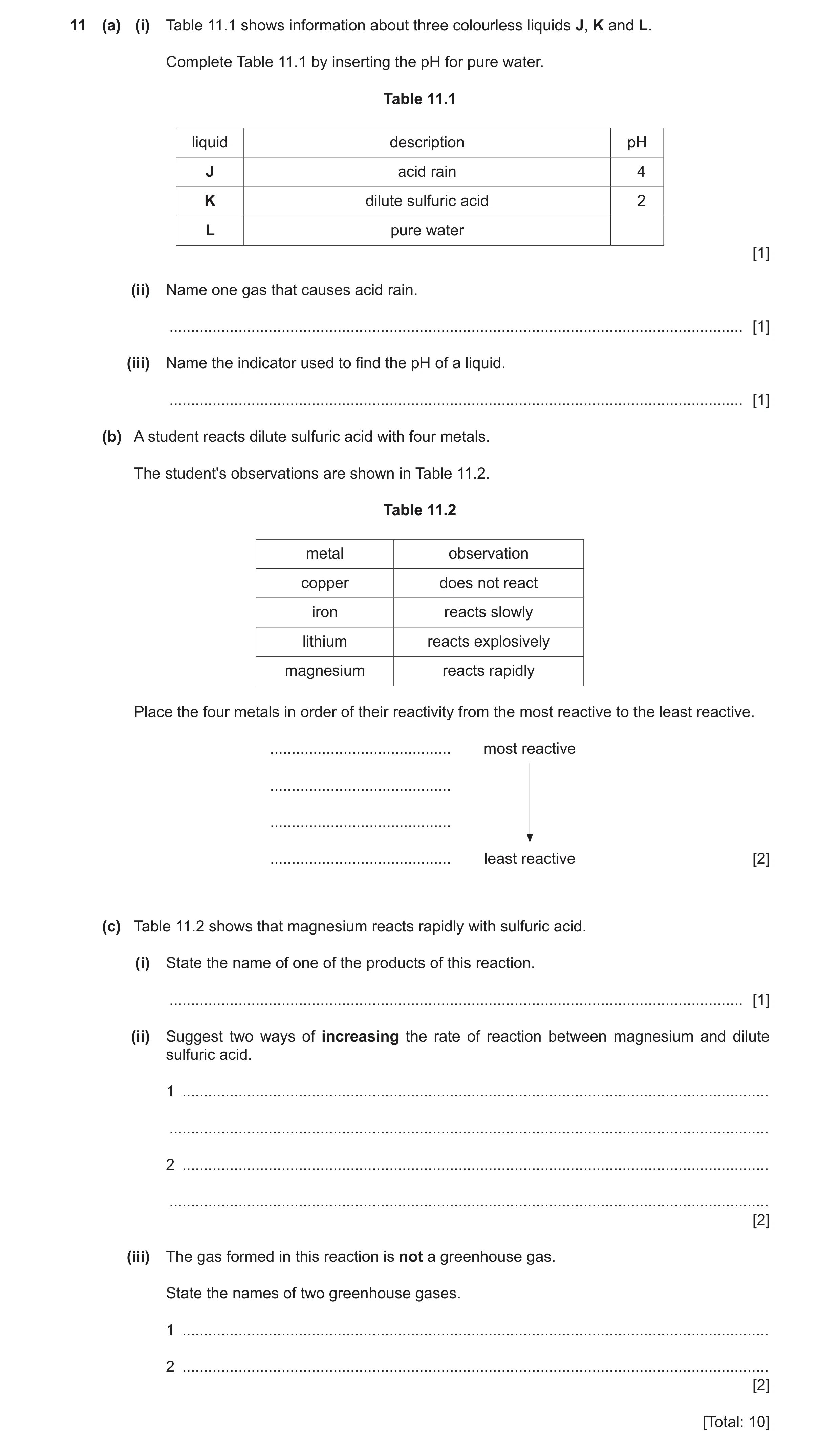
11 (a) (i) Table 11.1 shows information about three colourless liquids J, K and L. Complete Table 11.1 by inserting the pH for pure water. Table 11.1 liquid description pH J acid rain 4 K dilute sulfuric acid 2 L pure water [1] (ii) Name one gas that causes acid rain. … [1] (iii) Name the indicator used to find the pH of a liquid. … [1] (b) A student reacts dilute sulfuric acid with four metals. The student's observations are shown in Table 11.2. Table 11.2 metal observation copper does not react iron reacts slowly lithium reacts explosively magnesium reacts rapidly Place the four metals in order of their reactivity from the most reactive to the least reactive. … most reactive … … … least reactive [2] (c) Table 11.2 shows that magnesium reacts rapidly with sulfuric acid. (i) State the name of one of the products of this reaction. … [1] (ii) Suggest two ways of increasing the rate of reaction between magnesium and dilute sulfuric acid. 1 … … 2 … … [2] (iii) The gas formed in this reaction is not a greenhouse gas. State the names of two greenhouse gases. 1 … 2 … [2] [Total: 10]
10 marks
Mark scheme: 11(a)(i) 7; 1 11(a)(ii) sulfur dioxide / nitrogen dioxide; 1 11(a)(iii) universal ; 1 11(b) lithium magnesium iron copper ;; 2 11(c)(i) hydrogen / magnesium sulfate; 1 11(c)(ii) increase temperature; increase surface area of magnesium; increase concentration of acid; max 2 2 Question Answer Marks 11(c)(iii) carbon dioxide; methane; 2
This question in 0654/32 Feb/March 2021
Q9 · The names of eight gases 0654/31 May/June 2022
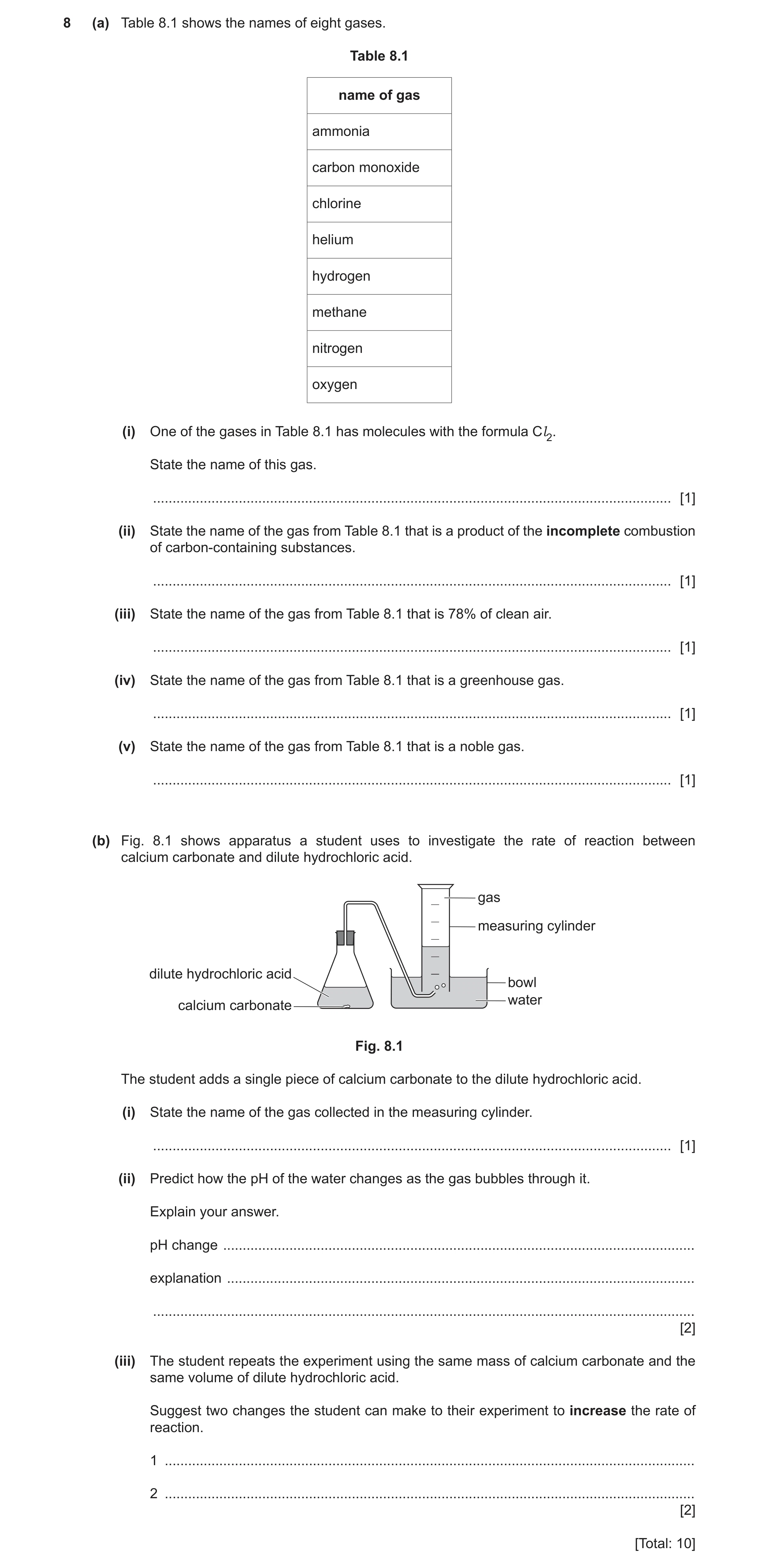
8 (a) Table 8.1 shows the names of eight gases. Table 8.1 name of gas ammonia carbon monoxide chlorine helium hydrogen methane nitrogen oxygen (i) One of the gases in Table 8.1 has molecules with the formula Cl2. State the name of this gas. … [1] (ii) State the name of the gas from Table 8.1 that is a product of the incomplete combustion of carbon-containing substances. … [1] (iii) State the name of the gas from Table 8.1 that is 78% of clean air. … [1] (iv) State the name of the gas from Table 8.1 that is a greenhouse gas. … [1] (v) State the name of the gas from Table 8.1 that is a noble gas. … [1] (b) Fig. 8.1 shows apparatus a student uses to investigate the rate of reaction between calcium carbonate and dilute hydrochloric acid. gas measuring cylinder dilute hydrochloric acid bowl water calcium carbonate Fig. 8.1 The student adds a single piece of calcium carbonate to the dilute hydrochloric acid. (i) State the name of the gas collected in the measuring cylinder. … [1] (ii) Predict how the pH of the water changes as the gas bubbles through it. Explain your answer. pH change … explanation … … [2] (iii) The student repeats the experiment using the same mass of calcium carbonate and the same volume of dilute hydrochloric acid. Suggest two changes the student can make to their experiment to increase the rate of reaction. 1 … 2 … [2] [Total: 10]
10 marks
Mark scheme: 8(a)(i) chlorine; 1 8(a)(ii) carbon monoxide; 1 8(a)(iii) nitrogen; 1 8(a)(iv) methane; 1 8(a)(v) helium; 1 8(b)(i) carbon dioxide; 1 8(b)(ii) pH decreases; non-metal oxide / carbon dioxide is acidic; 2 8(b)(iii) increase acid concentration; increase temperature of acid; increase surface area of calcium carbonate; Max 2 marks 2
This question in 0654/31 May/June 2022
Q10 · A list of six elements 0654/32 May/June 2022
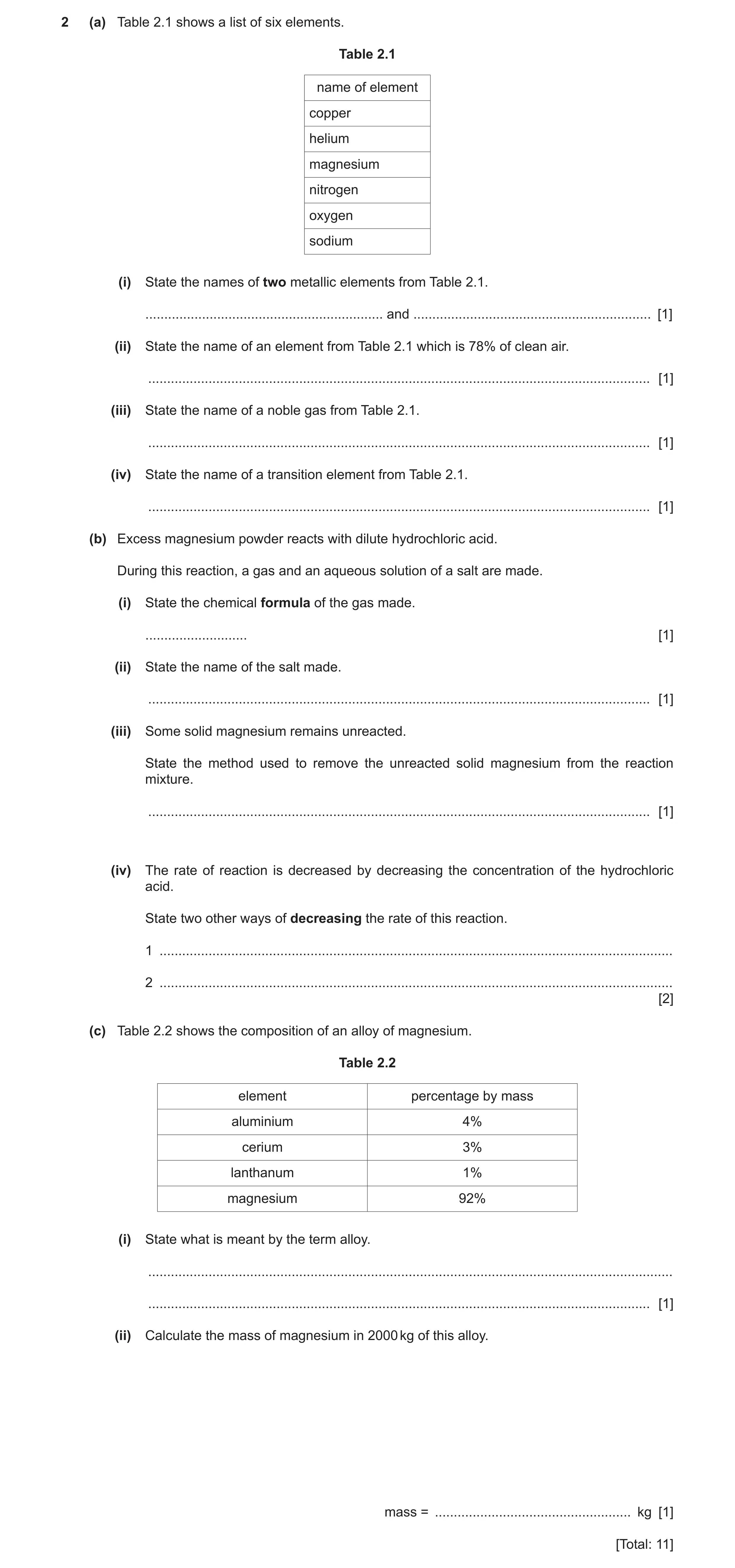
2 (a) Table 2.1 shows a list of six elements. Table 2.1 name of element copper helium magnesium nitrogen oxygen sodium (i) State the names of two metallic elements from Table 2.1. … and … [1] (ii) State the name of an element from Table 2.1 which is 78% of clean air. … [1] (iii) State the name of a noble gas from Table 2.1. … [1] (iv) State the name of a transition element from Table 2.1. … [1] (b) Excess magnesium powder reacts with dilute hydrochloric acid. During this reaction, a gas and an aqueous solution of a salt are made. (i) State the chemical formula of the gas made. … [1] (ii) State the name of the salt made. … [1] (iii) Some solid magnesium remains unreacted. State the method used to remove the unreacted solid magnesium from the reaction mixture. … [1] (iv) The rate of reaction is decreased by decreasing the concentration of the hydrochloric acid. State two other ways of decreasing the rate of this reaction. 1 … 2 … [2] (c) Table 2.2 shows the composition of an alloy of magnesium. Table 2.2 element percentage by mass aluminium 4% cerium 3% lanthanum 1% magnesium 92% (i) State what is meant by the term alloy. … … [1] (ii) Calculate the mass of magnesium in 2000 kg of this alloy. mass = … kg [1] [Total: 11]
11 marks
Mark scheme: 2(a)(i) any two from copper, magnesium and sodium; 1 2(a)(ii) nitrogen ; 1 2(a)(iii) helium; 1 2(a)(iv) copper; 1 2(b)(i) H2; 1 2(b)(ii) magnesium chloride; 1 2(b)(iii) filtration; 1 2(b)(iv) decrease surface area / increase particle size of magnesium; decrease temperature (of acid); 2 Question Answer Marks 2(c)(i) mixture of metals / mixture of a metal and another element; 1 2(c)(ii) 1840 (kg) ; 1
This question in 0654/32 May/June 2022
Q11 · A list of six elements 0654/33 May/June 2022
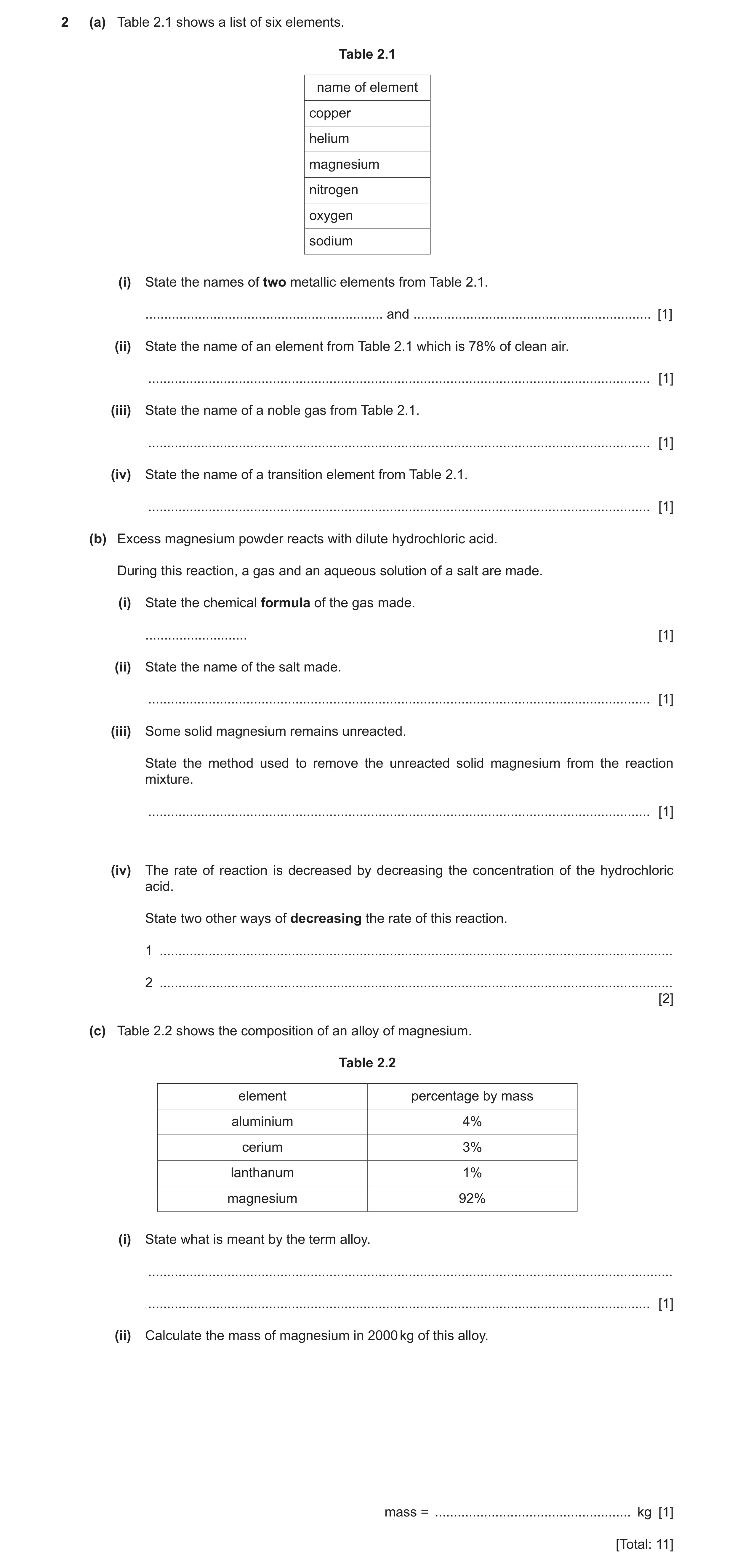
2 (a) Table 2.1 shows a list of six elements. Table 2.1 name of element copper helium magnesium nitrogen oxygen sodium (i) State the names of two metallic elements from Table 2.1. … and … [1] (ii) State the name of an element from Table 2.1 which is 78% of clean air. … [1] (iii) State the name of a noble gas from Table 2.1. … [1] (iv) State the name of a transition element from Table 2.1. … [1] (b) Excess magnesium powder reacts with dilute hydrochloric acid. During this reaction, a gas and an aqueous solution of a salt are made. (i) State the chemical formula of the gas made. … [1] (ii) State the name of the salt made. … [1] (iii) Some solid magnesium remains unreacted. State the method used to remove the unreacted solid magnesium from the reaction mixture. … [1] (iv) The rate of reaction is decreased by decreasing the concentration of the hydrochloric acid. State two other ways of decreasing the rate of this reaction. 1 … 2 … [2] (c) Table 2.2 shows the composition of an alloy of magnesium. Table 2.2 element percentage by mass aluminium 4% cerium 3% lanthanum 1% magnesium 92% (i) State what is meant by the term alloy. … … [1] (ii) Calculate the mass of magnesium in 2000 kg of this alloy. mass = … kg [1] [Total: 11]
11 marks
Mark scheme: 2(a)(i) any two from copper, magnesium and sodium; 1 2(a)(ii) nitrogen ; 1 2(a)(iii) helium; 1 2(a)(iv) copper; 1 2(b)(i) H2; 1 2(b)(ii) magnesium chloride; 1 2(b)(iii) filtration; 1 2(b)(iv) decrease surface area / increase particle size of magnesium; decrease temperature (of acid); 2 Question Answer Marks 2(c)(i) mixture of metals / mixture of a metal and another element; 1 2(c)(ii) 1840 (kg) ; 1
This question in 0654/33 May/June 2022
Q12 · A student investigates the rate of reaction between calcium carbonate and hydrochloric… 0654/32 Oct/Nov 2023
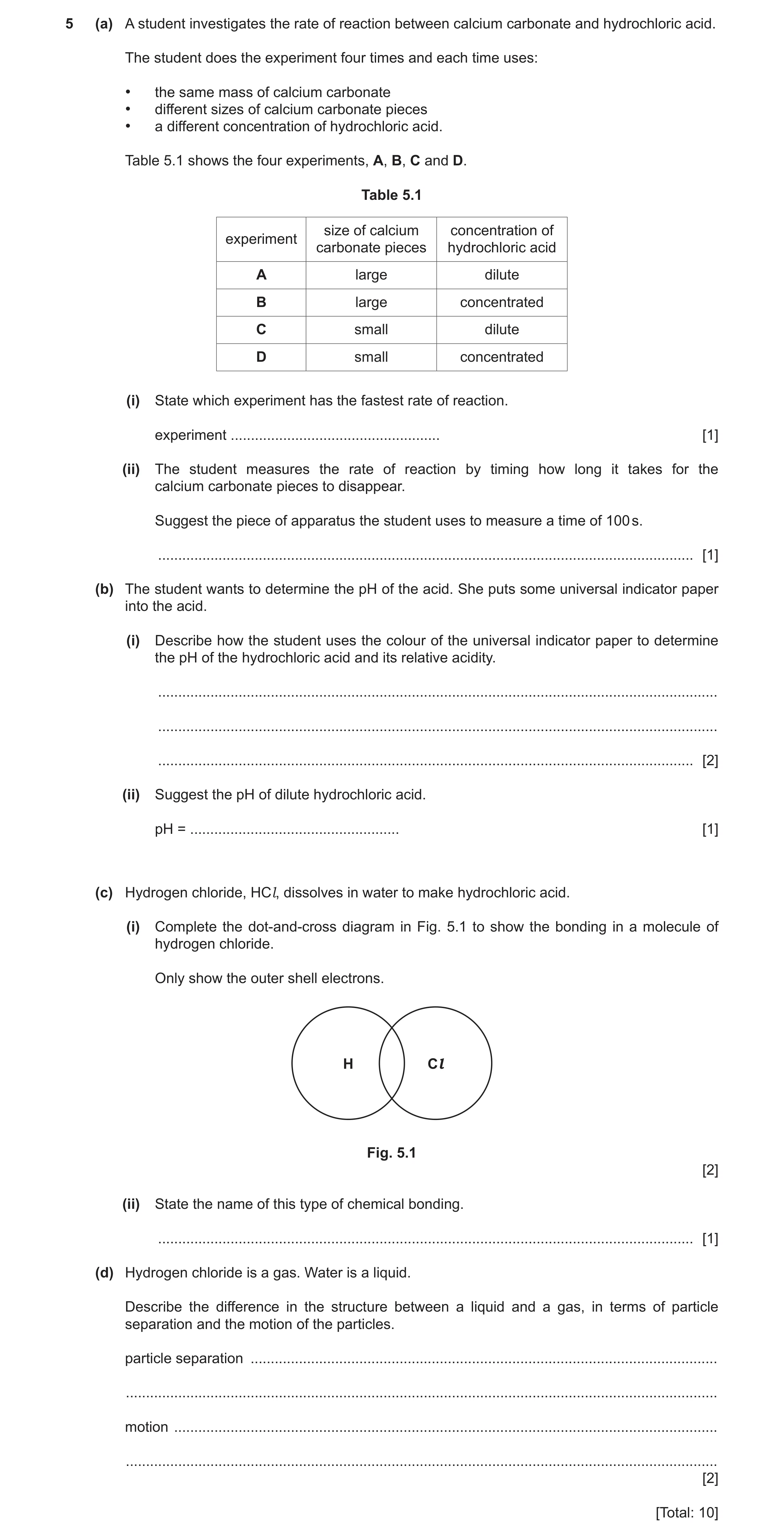
5 (a) A student investigates the rate of reaction between calcium carbonate and hydrochloric acid. The student does the experiment four times and each time uses: • the same mass of calcium carbonate • different sizes of calcium carbonate pieces • a different concentration of hydrochloric acid. Table 5.1 shows the four experiments, A, B, C and D. Table 5.1 size of calcium concentration of experiment carbonate pieces hydrochloric acid A large dilute B large concentrated C small dilute D small concentrated (i) State which experiment has the fastest rate of reaction. experiment … [1] (ii) The student measures the rate of reaction by timing how long it takes for the calcium carbonate pieces to disappear. Suggest the piece of apparatus the student uses to measure a time of 100 s. … [1] (b) The student wants to determine the pH of the acid. She puts some universal indicator paper into the acid. (i) Describe how the student uses the colour of the universal indicator paper to determine the pH of the hydrochloric acid and its relative acidity. … … … [2] (ii) Suggest the pH of dilute hydrochloric acid. pH = … [1] (c) Hydrogen chloride, HCl, dissolves in water to make hydrochloric acid. (i) Complete the dot-and-cross diagram in Fig. 5.1 to show the bonding in a molecule of hydrogen chloride. Only show the outer shell electrons. H Cl Fig. 5.1 [2] (ii) State the name of this type of chemical bonding. … [1] (d) Hydrogen chloride is a gas. Water is a liquid. Describe the difference in the structure between a liquid and a gas, in terms of particle separation and the motion of the particles. particle separation … … motion … … [2] [Total: 10]
10 marks
Mark scheme: 5(a)(i) experiment D ; 1 5(a)(ii) stopwatch ; 1 5(b)(i) check colour against pH chart ; 2 red pH 1–3 very acidic and orange/yellow pH 4–6 weakly acidic ; 5(b)(ii) pH = any value between 1 and 6 ; 1 5(c)(i) 2 1 shared pair only ; all else correct ; 5(c)(ii) covalent (bonding) ; 1 5(d) (liquid) closer together / (gas) further apart) ; 2 (liquid) slide past each other / slower / (gas) free to move / faster ;
This question in 0654/32 Oct/Nov 2023
Q13 · The apparatus a student uses to investigate the rate of reaction between magnesium and… 0654/33 Oct/Nov 2023
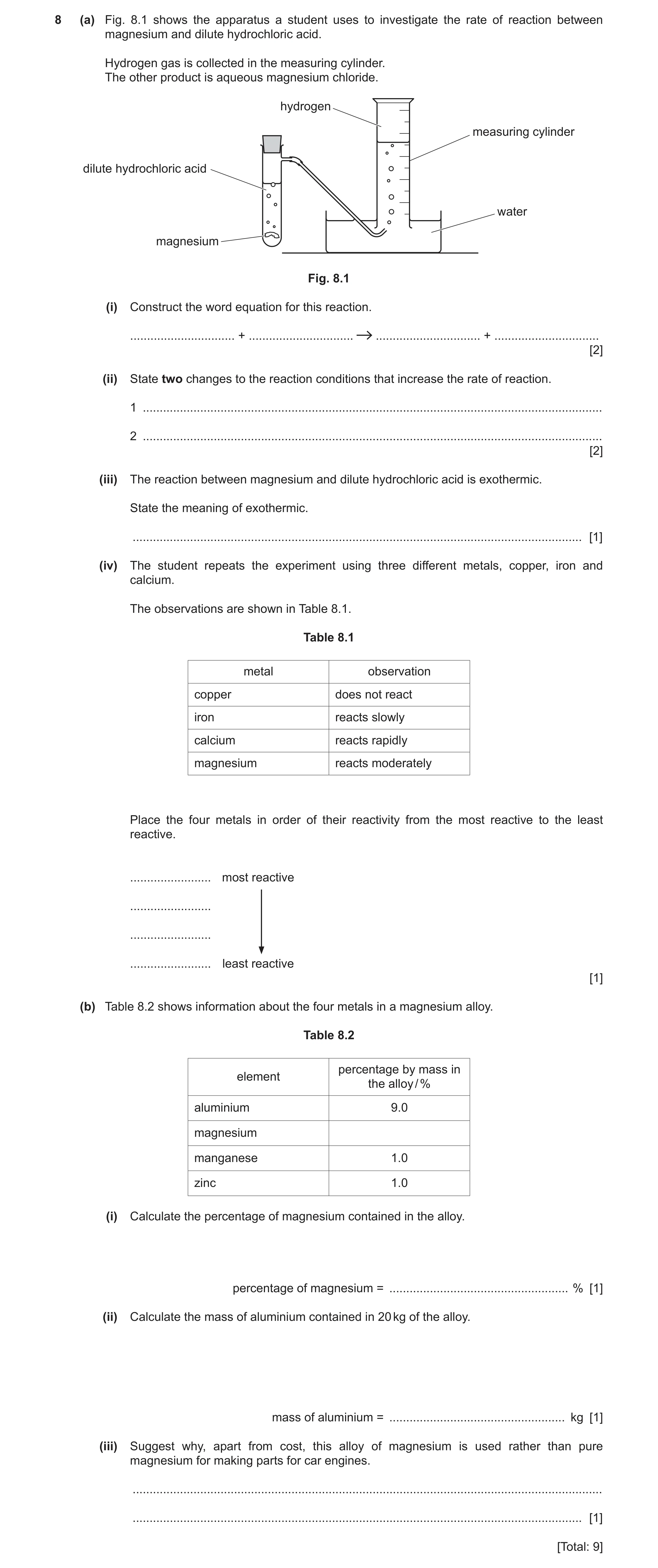
8 (a) Fig. 8.1 shows the apparatus a student uses to investigate the rate of reaction between magnesium and dilute hydrochloric acid. Hydrogen gas is collected in the measuring cylinder. The other product is aqueous magnesium chloride. hydrogen measuring cylinder dilute hydrochloric acid water magnesium Fig. 8.1 (i) Construct the word equation for this reaction. … + … … + … [2] (ii) State two changes to the reaction conditions that increase the rate of reaction. 1 … 2 … [2] (iii) The reaction between magnesium and dilute hydrochloric acid is exothermic. State the meaning of exothermic. … [1] (iv) The student repeats the experiment using three different metals, copper, iron and calcium. The observations are shown in Table 8.1. Table 8.1 metal observation copper does not react iron reacts slowly calcium reacts rapidly magnesium reacts moderately Place the four metals in order of their reactivity from the most reactive to the least reactive. … most reactive … … … least reactive [1] (b) Table 8.2 shows information about the four metals in a magnesium alloy. Table 8.2 percentage by mass in element the alloy / % aluminium 9.0 magnesium manganese 1.0 zinc 1.0 (i) Calculate the percentage of magnesium contained in the alloy. percentage of magnesium = … % [1] (ii) Calculate the mass of aluminium contained in 20 kg of the alloy. mass of aluminium = … kg [1] (iii) Suggest why, apart from cost, this alloy of magnesium is used rather than pure magnesium for making parts for car engines. … … [1] [Total: 9]
9 marks
Mark scheme: 8(a)(i) magnesium + hydrochloric acid → magnesium chloride + hydrogen ; 2 8(a)(ii) any two from: 2 increase temperature (of acid) ; increase concentration (of acid) ; decrease particle size / increase surface area of magnesium ; 8(a)(iii) releases thermal energy ; 1 8(a)(iv) calcium 1 magnesium iron copper ; 8(b)(i) 89 (%) ; 1 8(b)(ii) 1.8 (kg) ; 1 8(b)(iii) stronger ; 1
This question in 0654/33 Oct/Nov 2023
Q14 · A list of formulae is shown 0654/31 Oct/Nov 2024
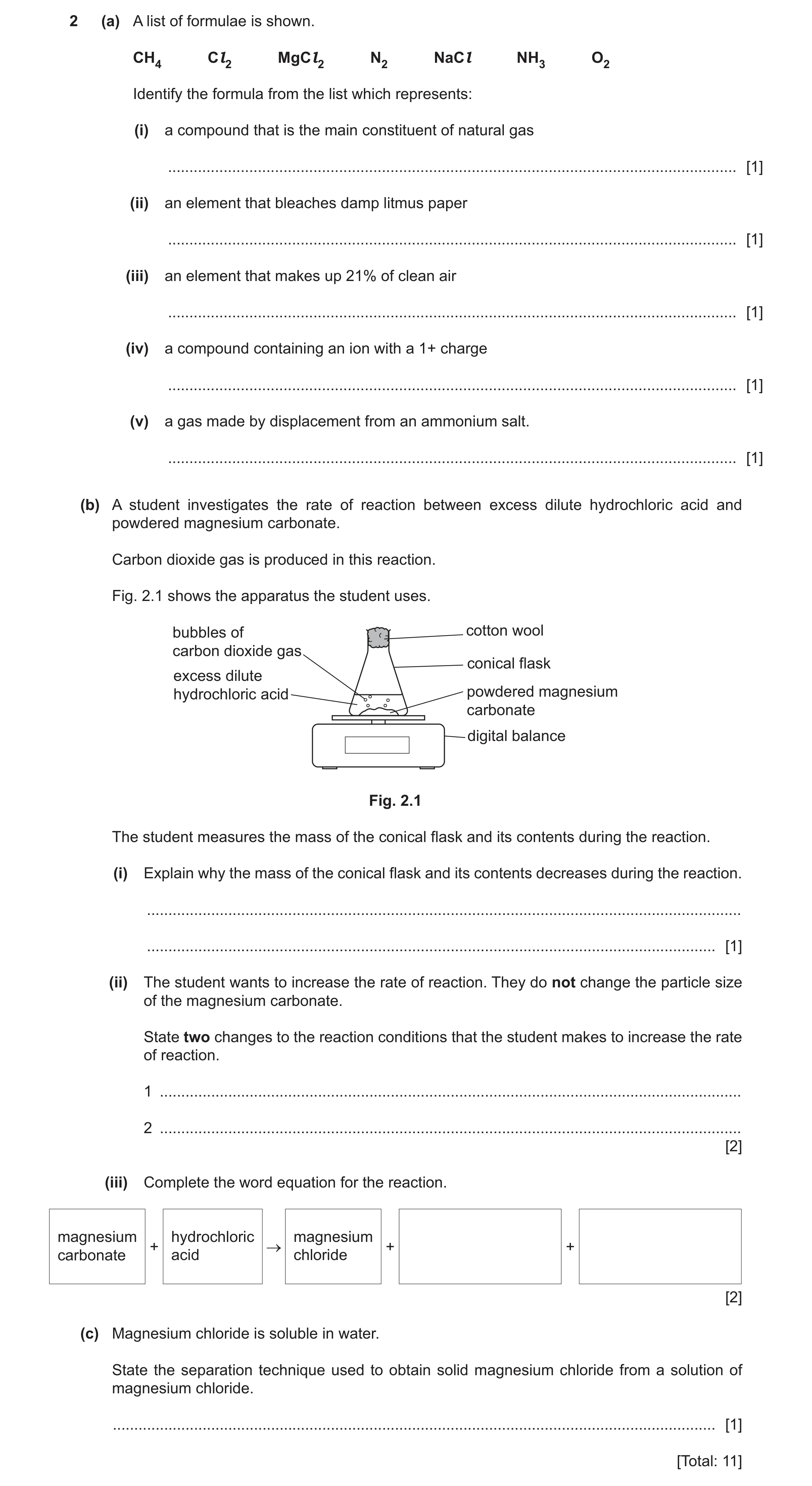
2 (a) A list of formulae is shown. CH4 Cl 2 MgCl 2 N2 NaCl NH3 O2 Identify the formula from the list which represents: (i) a compound that is the main constituent of natural gas … [1] (ii) an element that bleaches damp litmus paper … [1] (iii) an element that makes up 21% of clean air … [1] (iv) a compound containing an ion with a 1+ charge … [1] (v) a gas made by displacement from an ammonium salt. … [1] (b) A student investigates the rate of reaction between excess dilute hydrochloric acid and powdered magnesium carbonate. Carbon dioxide gas is produced in this reaction. Fig. 2.1 shows the apparatus the student uses. bubbles of cotton wool carbon dioxide gas conical flask excess dilute hydrochloric acid powdered magnesium carbonate digital balance Fig. 2.1 The student measures the mass of the conical flask and its contents during the reaction. (i) Explain why the mass of the conical flask and its contents decreases during the reaction. … … [1] (ii) The student wants to increase the rate of reaction. They do not change the particle size of the magnesium carbonate. State two changes to the reaction conditions that the student makes to increase the rate of reaction. 1 … 2 … [2] (iii) Complete the word equation for the reaction. magnesium hydrochloric magnesium + + + carbonate acid chloride [2] (c) Magnesium chloride is soluble in water. State the separation technique used to obtain solid magnesium chloride from a solution of magnesium chloride. … [1] [Total: 11]
11 marks
Mark scheme: 2(a)(i) CH4 ; 1 2(a)(ii) Cl2 ; 1 2(a)(iii) O2 ; 1 2(a)(iv) NaCl ; 1 2(a)(v) NH3 ; 1 2(b)(i) carbon dioxide is lost ; 1 2(b)(ii) increase temperature (of acid) ; 2 increase concentration (of acid) ; 2(b)(iii) carbon dioxide ; 2 water ; 2(c) crystallisation ; 1
This question in 0654/31 Oct/Nov 2024
 11
11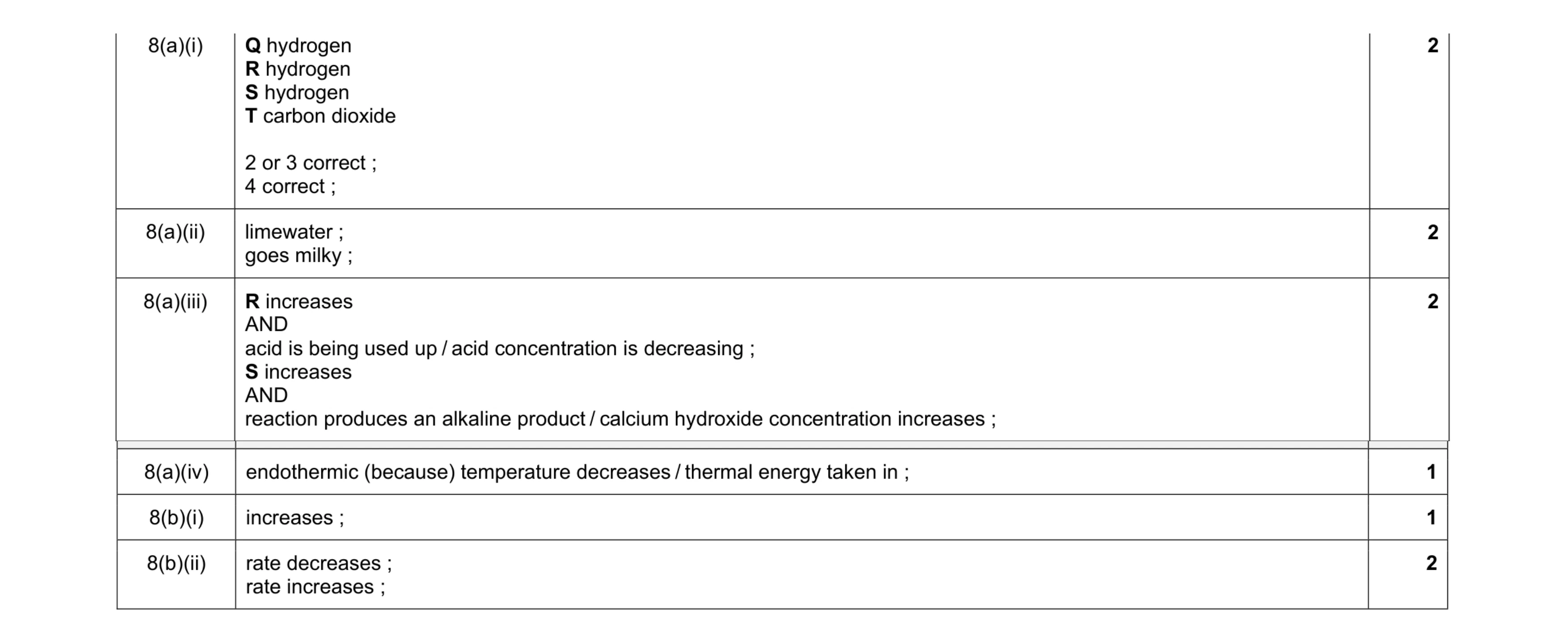 10
10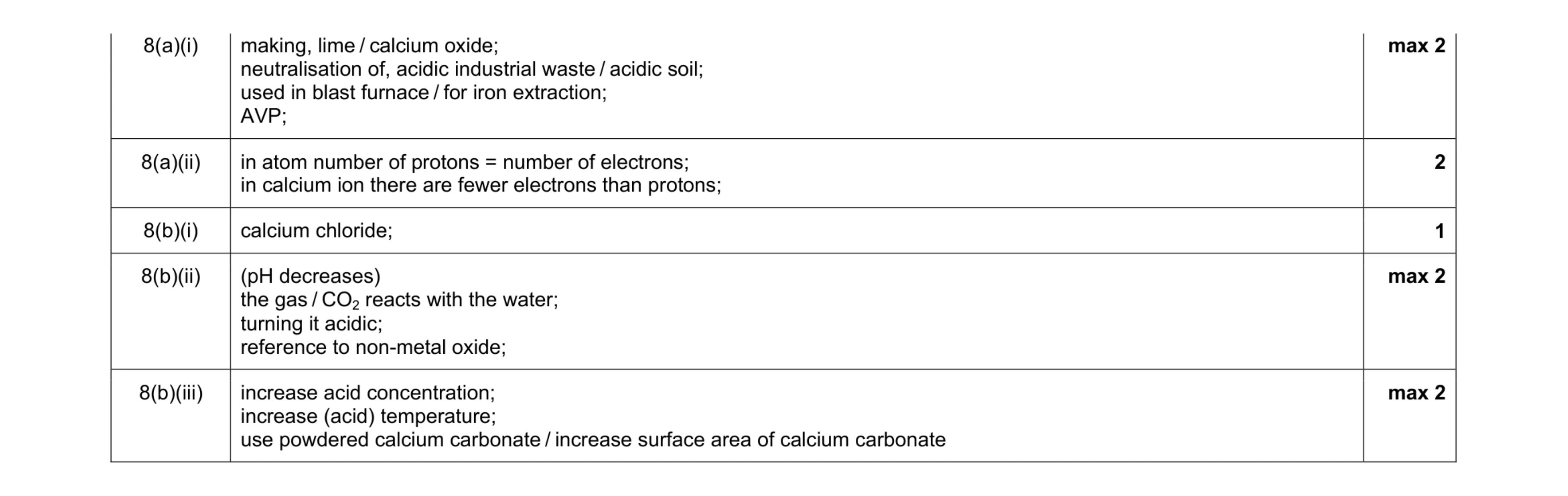 9
9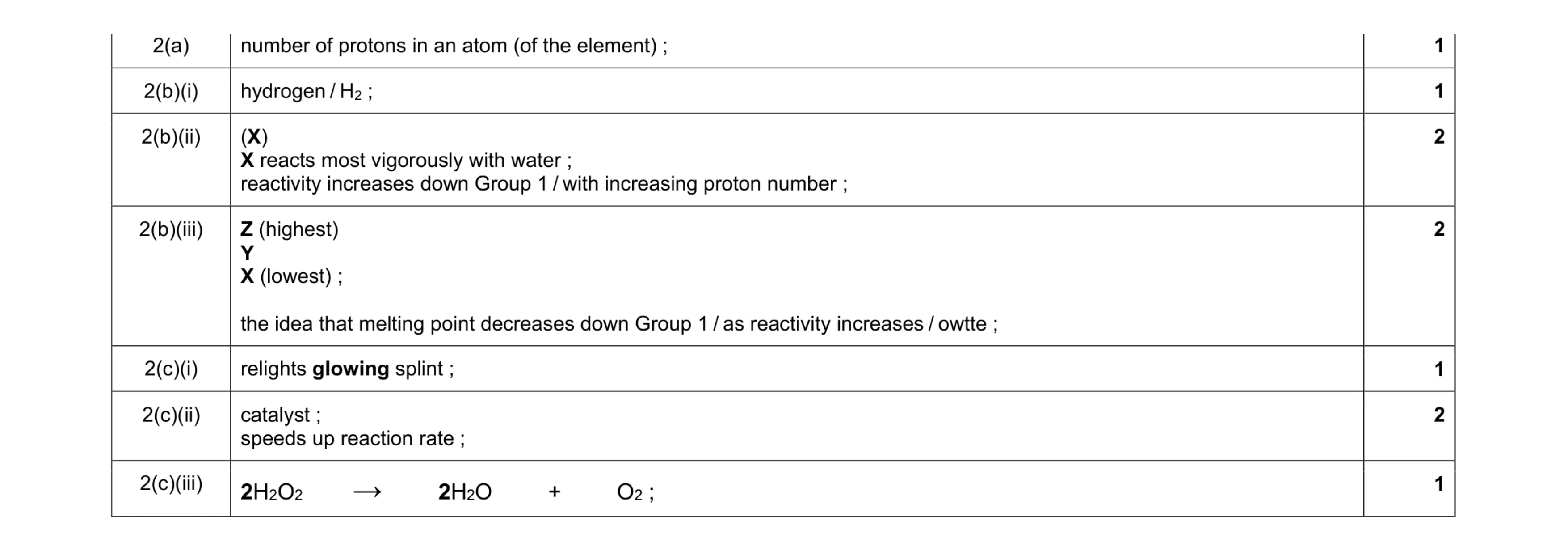 10
10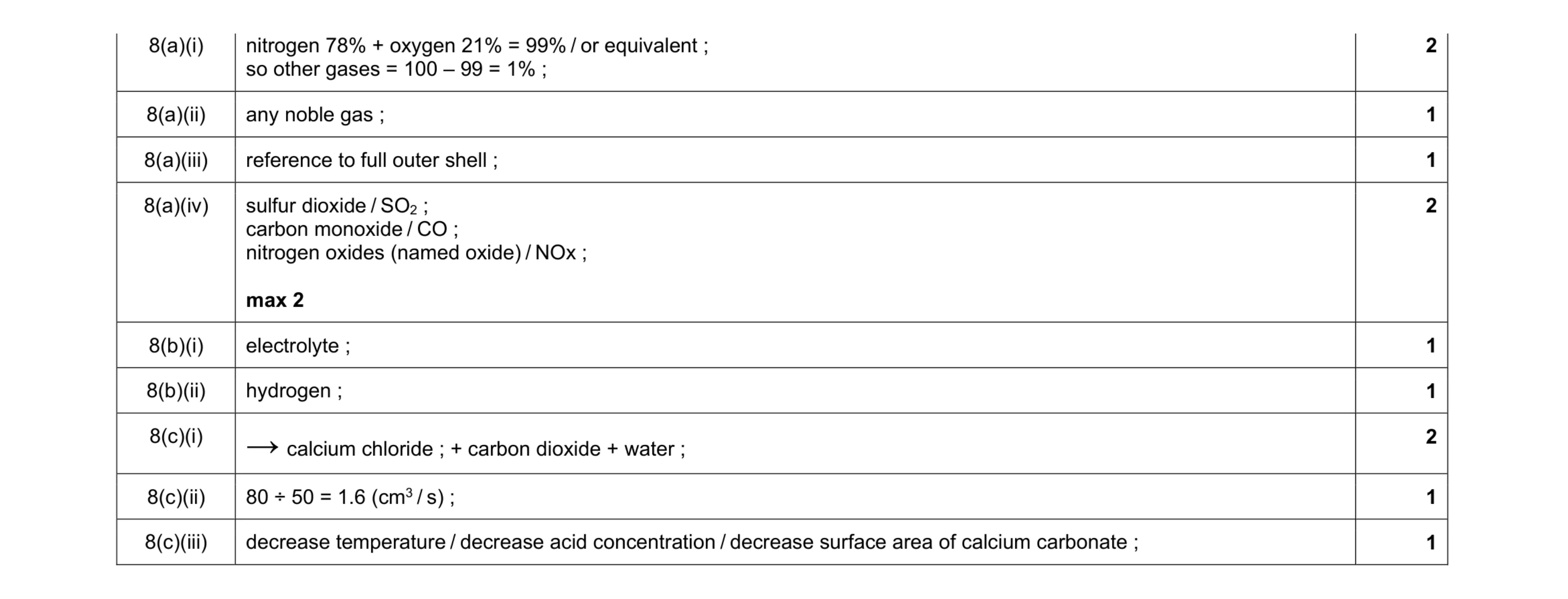 12
12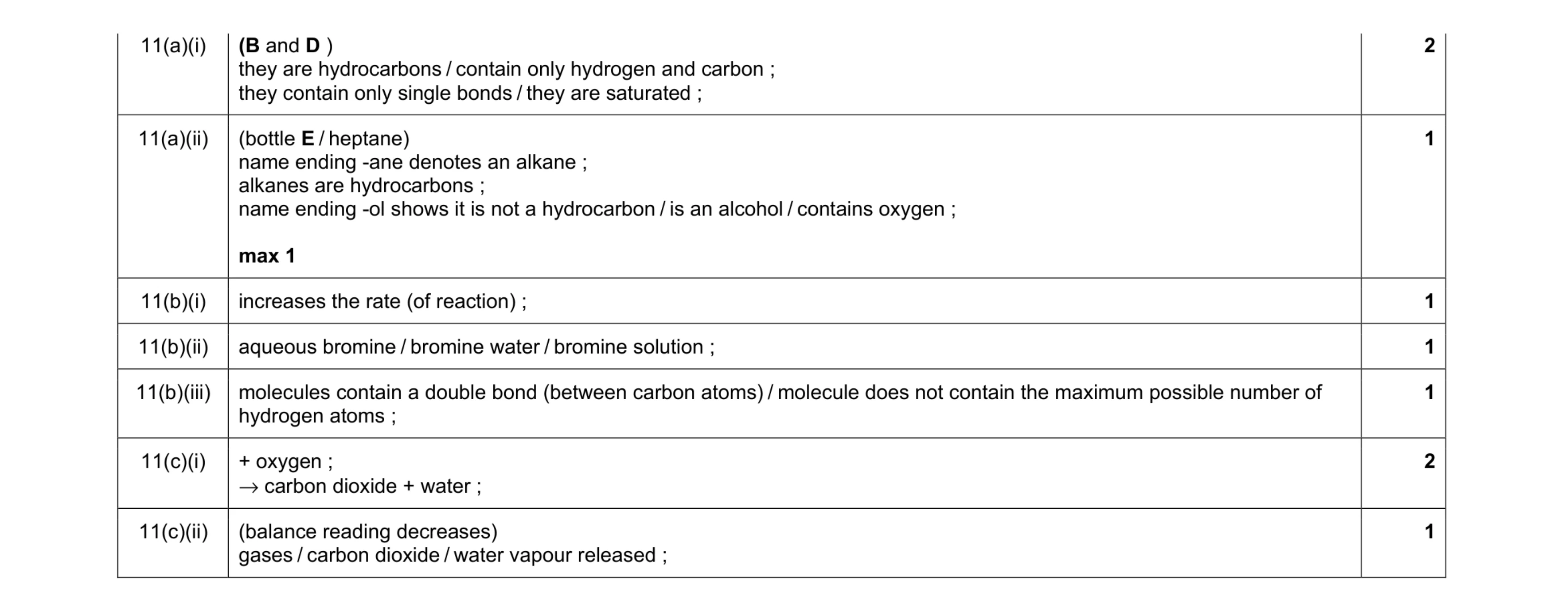 9
9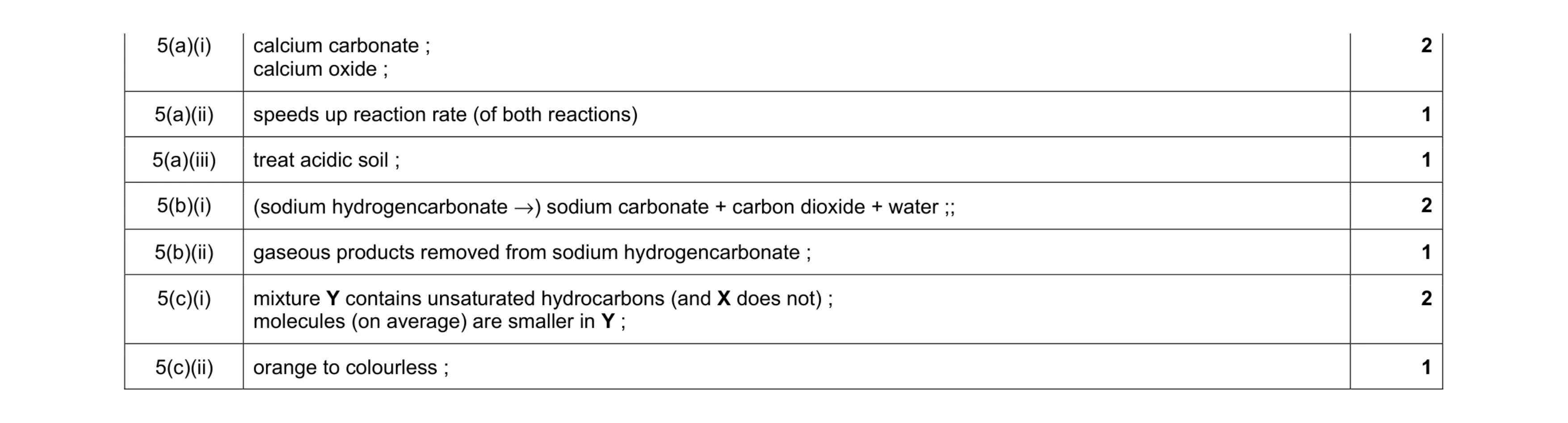 10
10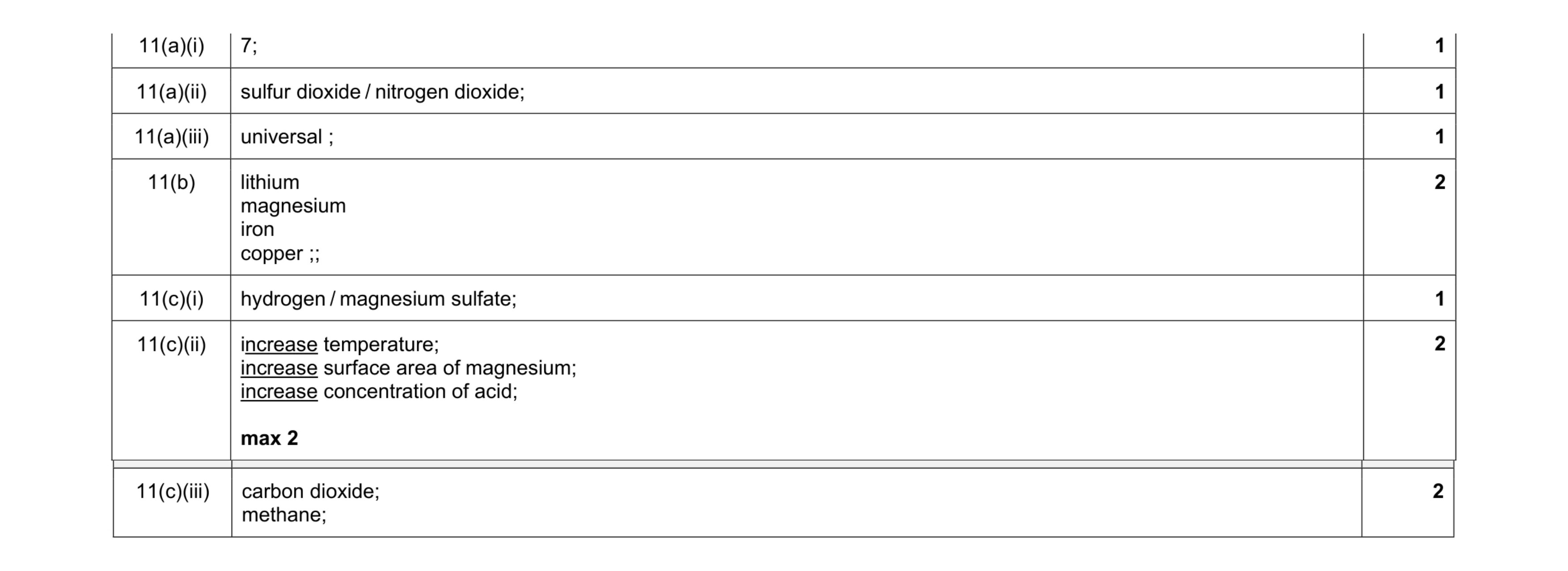 10
10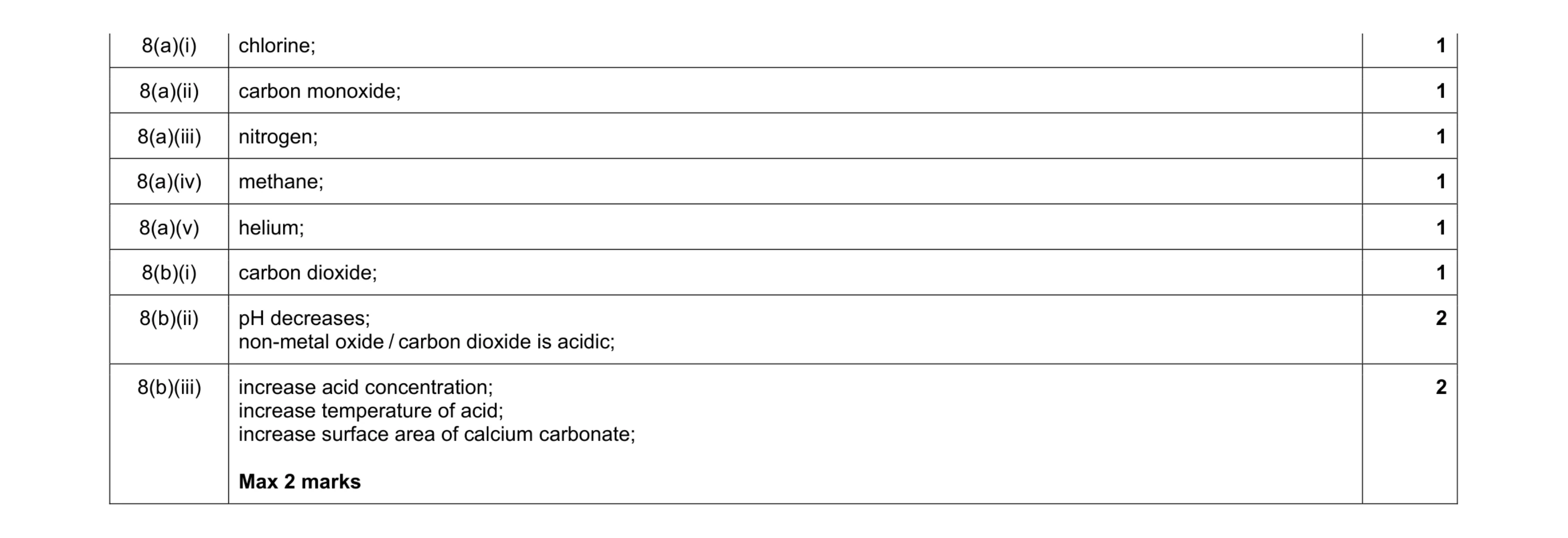 10
10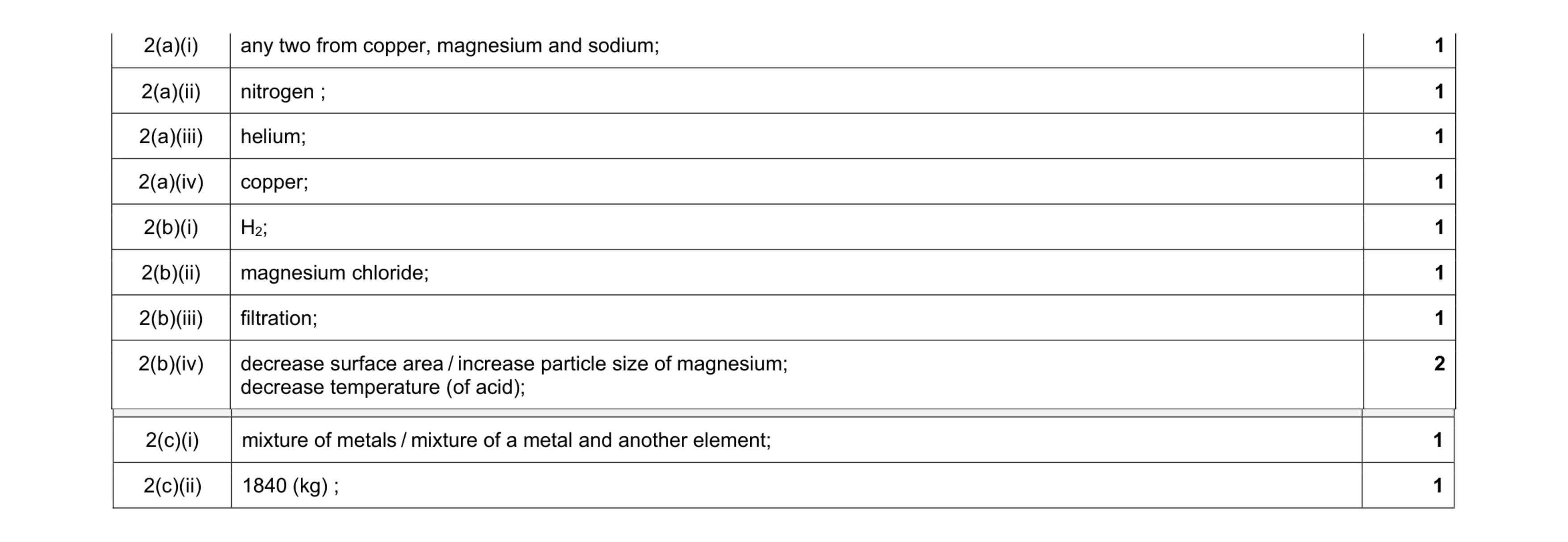 11
11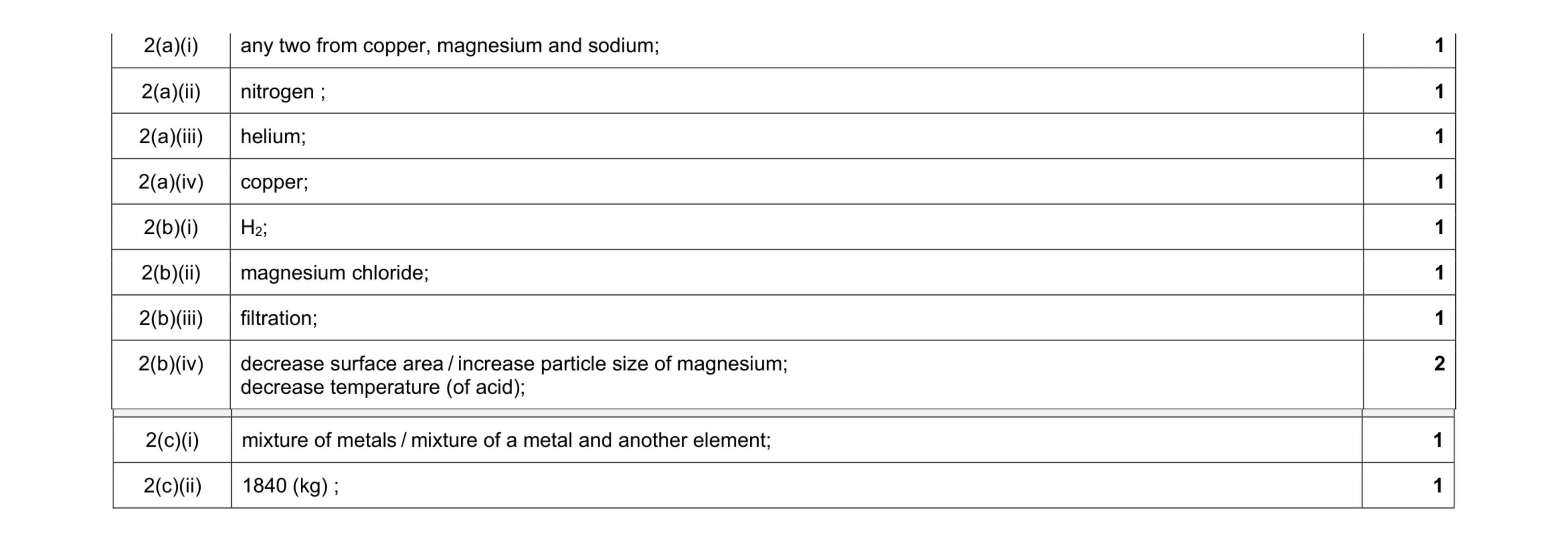 11
11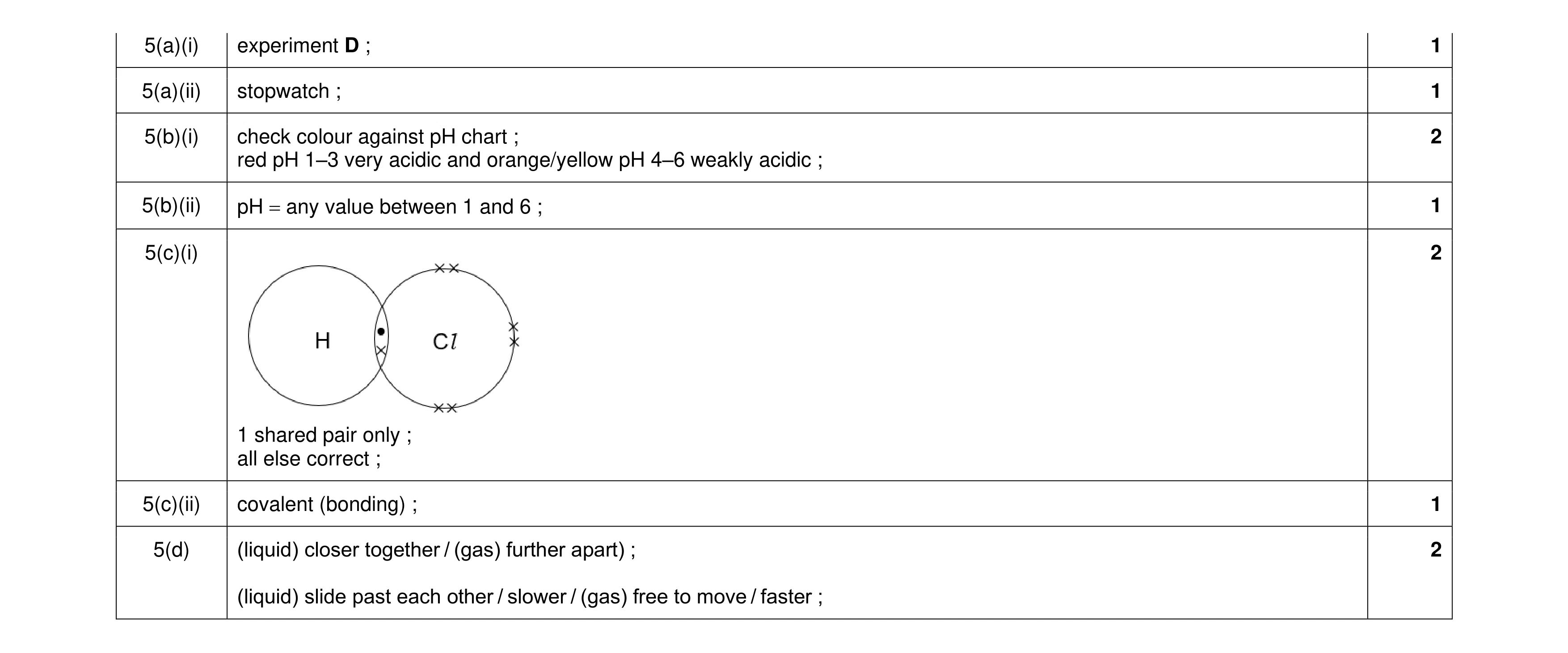 10
10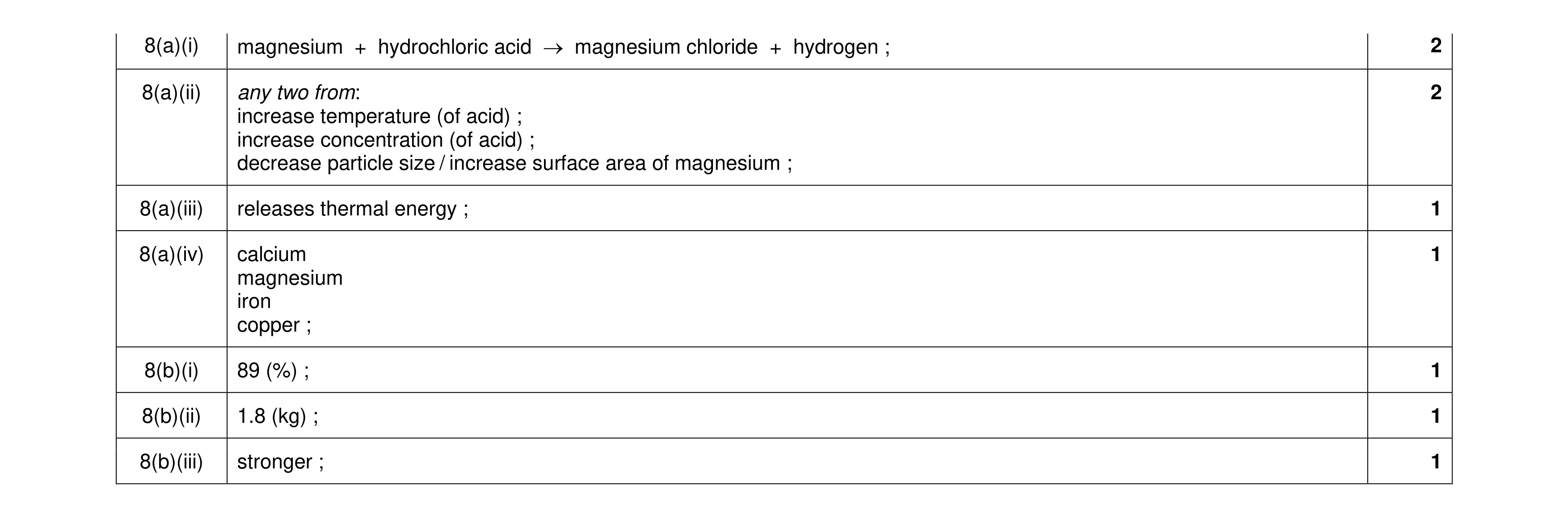 9
9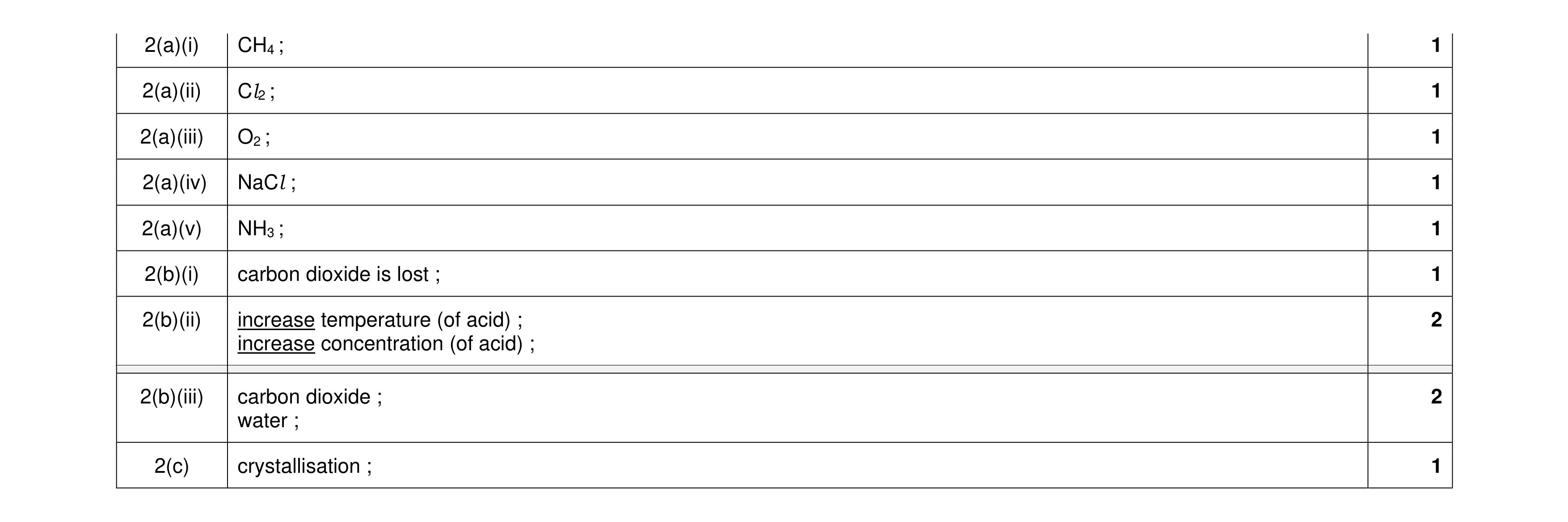 11
11