Cambridge IGCSE Science - Combined 0653 — 2025 May/June Paper 4 · Variant 3
0653/43/M/J/25 · 9 questions · 80 marks · 75 min
The question paper and its mark scheme, free to read here and free to download. This is Cambridge’s own paper, exactly as it was sat.
Question paper20 pages
Mark scheme12 pages
Answers below. Sit the paper first if you are practising.
Questions as text
Q1 · A photomicrograph of human blood
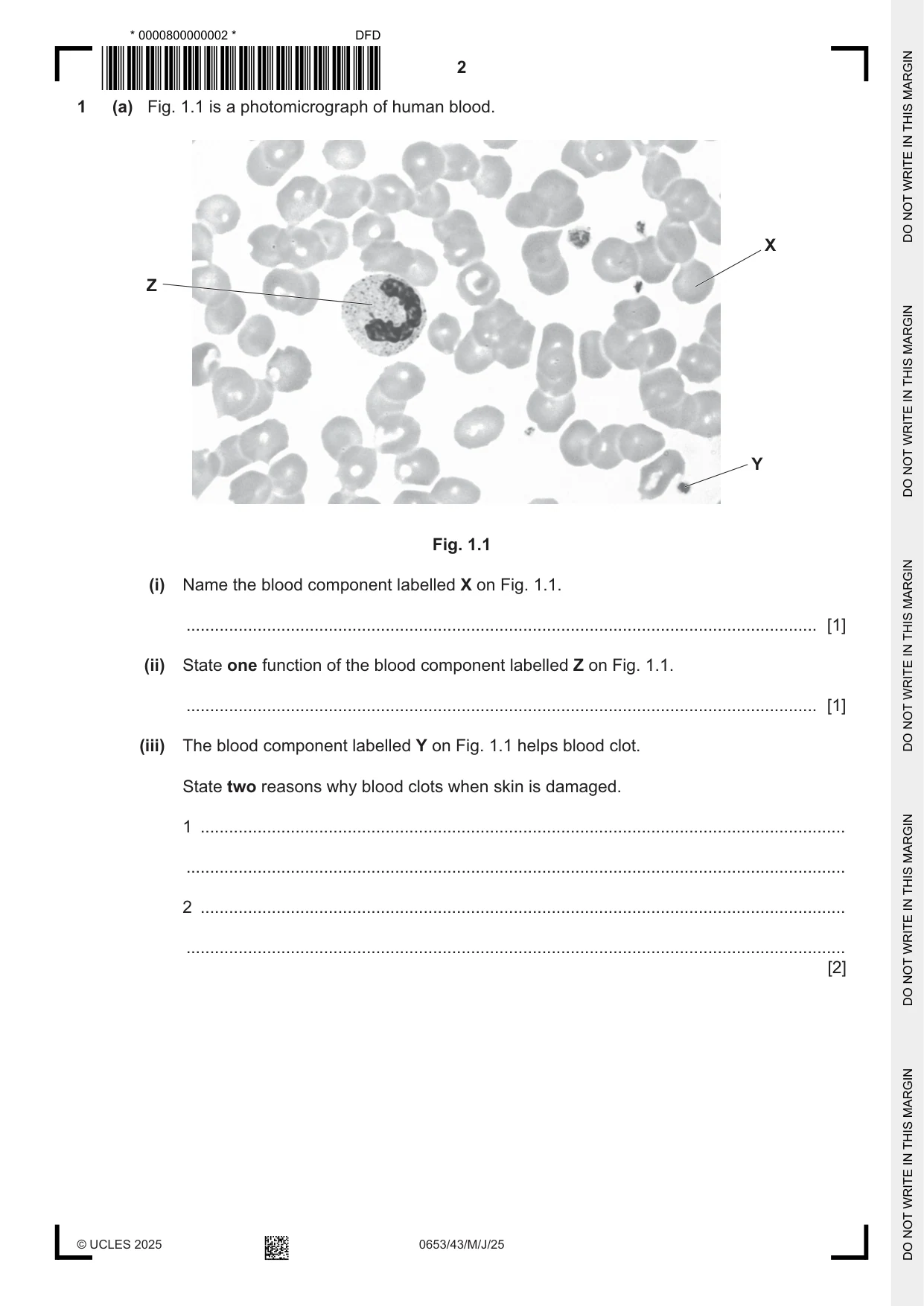
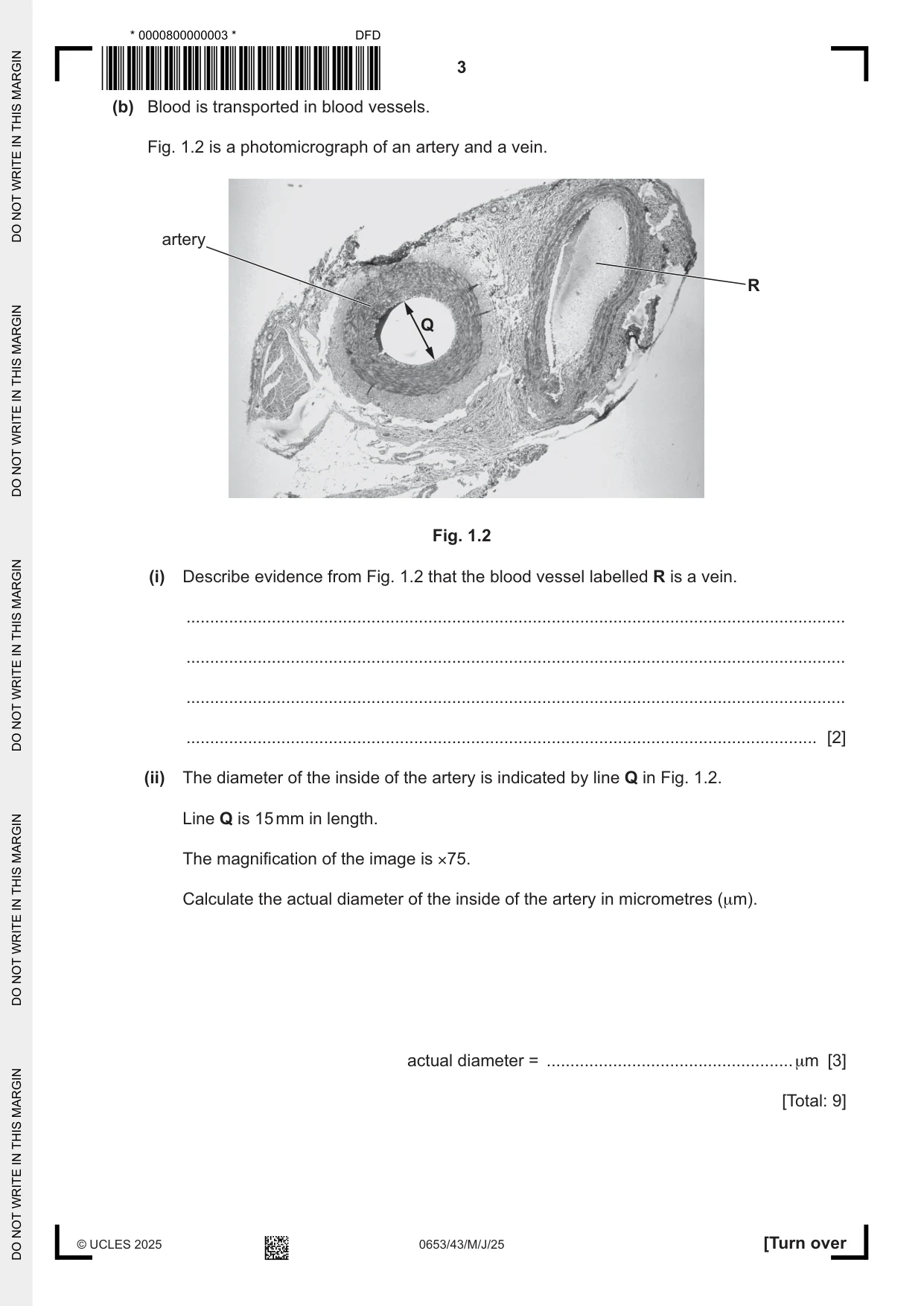
1 (a) Fig. 1.1 is a photomicrograph of human blood. X Z Y Fig. 1.1 (i) Name the blood component labelled X on Fig. 1.1. ..................................................................................................................................... [1] (ii) State one function of the blood component labelled Z on Fig. 1.1. ..................................................................................................................................... [1] (iii) The blood component labelled Y on Fig. 1.1 helps blood clot. State two reasons why blood clots when skin is damaged. 1 ........................................................................................................................................ ........................................................................................................................................... 2 ........................................................................................................................................ ........................................................................................................................................... [2] (b) Blood is transported in blood vessels. Fig. 1.2 is a photomicrograph of an artery and a vein. artery R Q Fig. 1.2 (i) Describe evidence from Fig. 1.2 that the blood vessel labelled R is a vein. ........................................................................................................................................... ........................................................................................................................................... ........................................................................................................................................... ..................................................................................................................................... [2] (ii) The diameter of the inside of the artery is indicated by line Q in Fig. 1.2. Line Q is 15 mm in length. The magnification of the image is ×75. Calculate the actual diameter of the inside of the artery in micrometres (μm). actual diameter = .................................................... μm [3] [Total: 9]
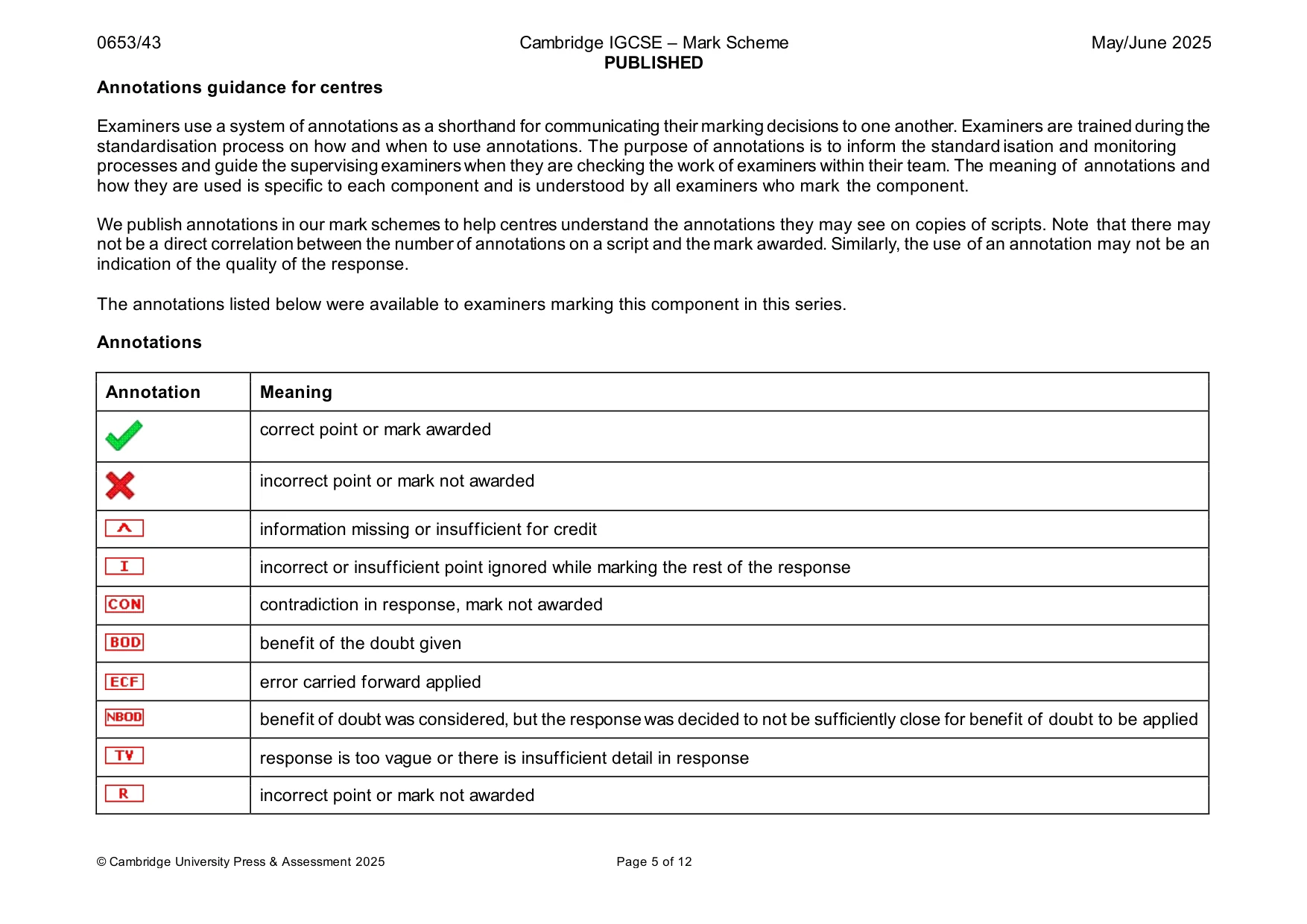
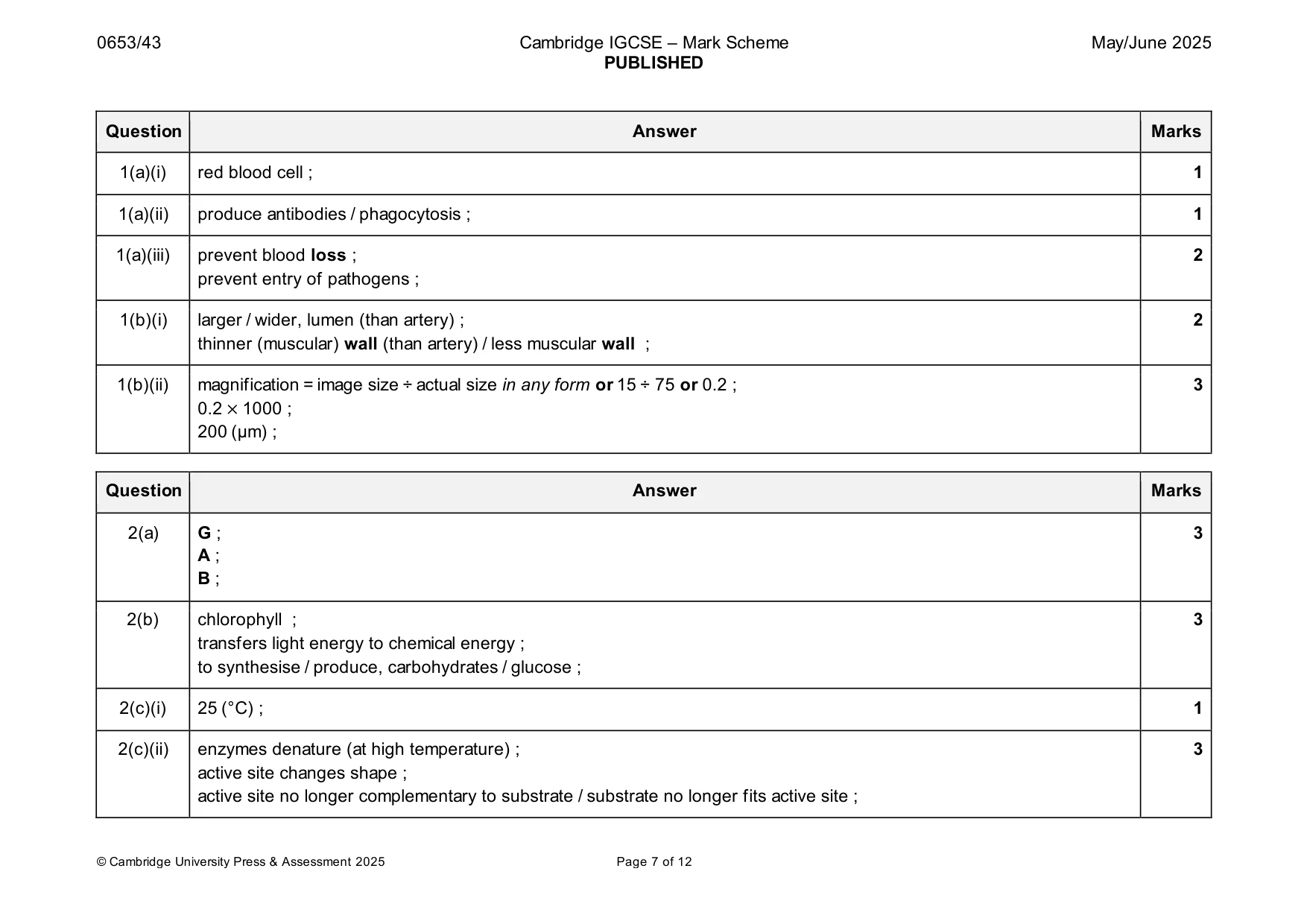
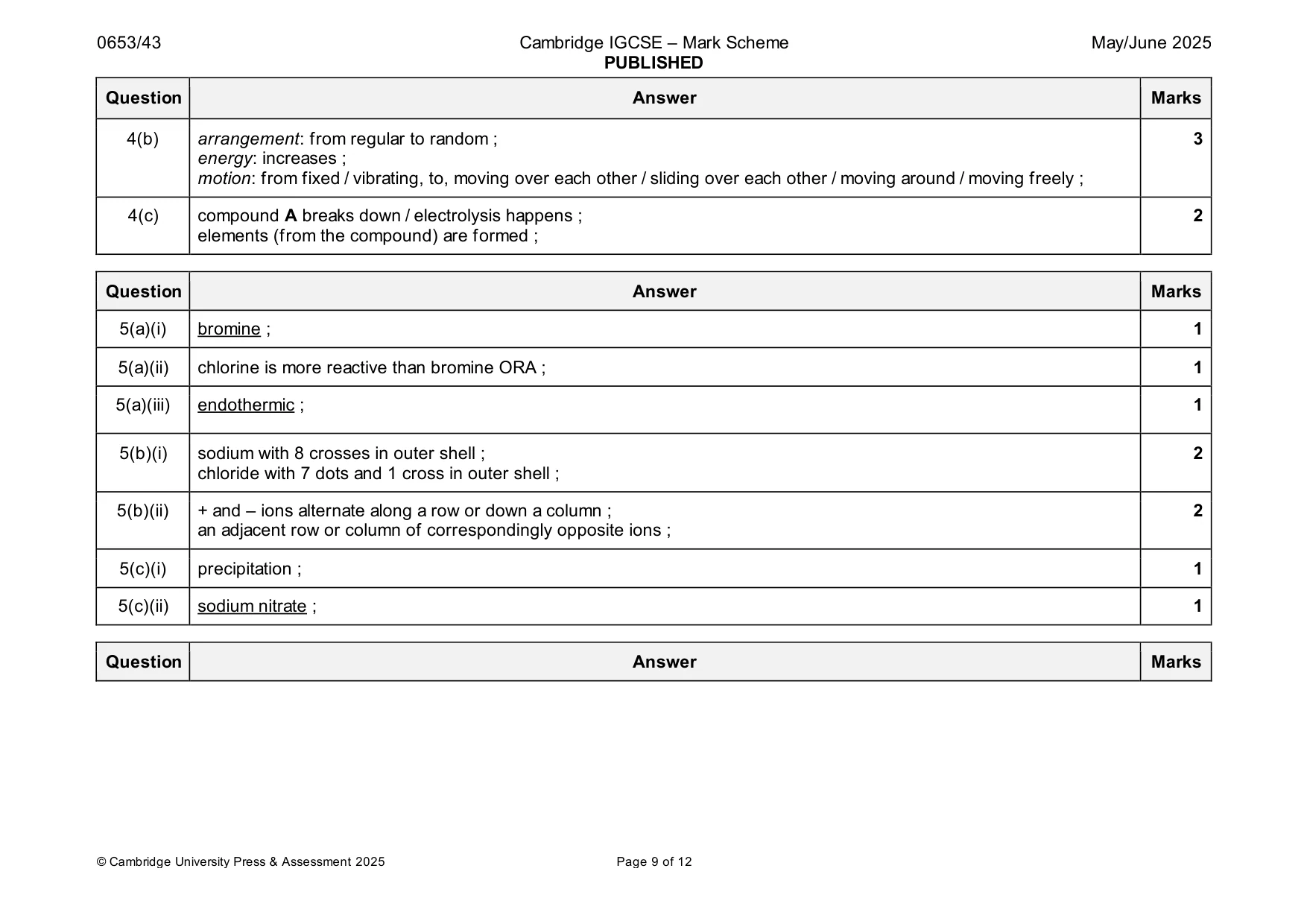
Mark scheme: Question Answer Marks 1(a)(i) red blood cell ; 1 1(a)(ii) produce antibodies / phagocytosis ; 1 1(a)(iii) prevent blood loss ; 2 prevent entry of pathogens ; 1(b)(i) larger / wider, lumen (than artery) ; 2 thinner (muscular) wall (than artery) / less muscular wall ; 1(b)(ii) magnification = image size ÷ actual size in any form or 15 ÷ 75 or 0.2 ; 3 0.2 × 1000 ; 200 (µm) ;
Q2 · A diagram of a cross-section through a leaf
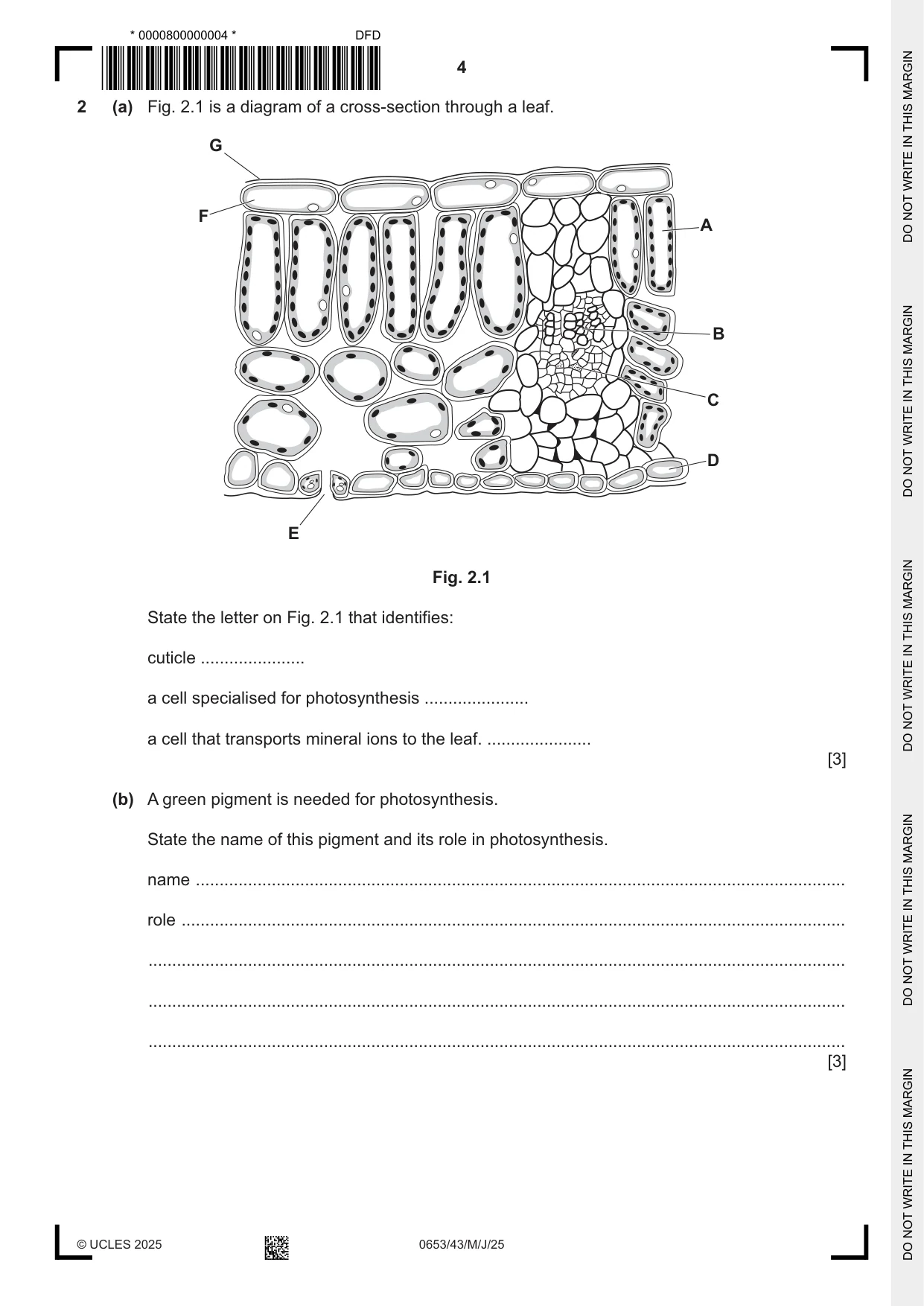
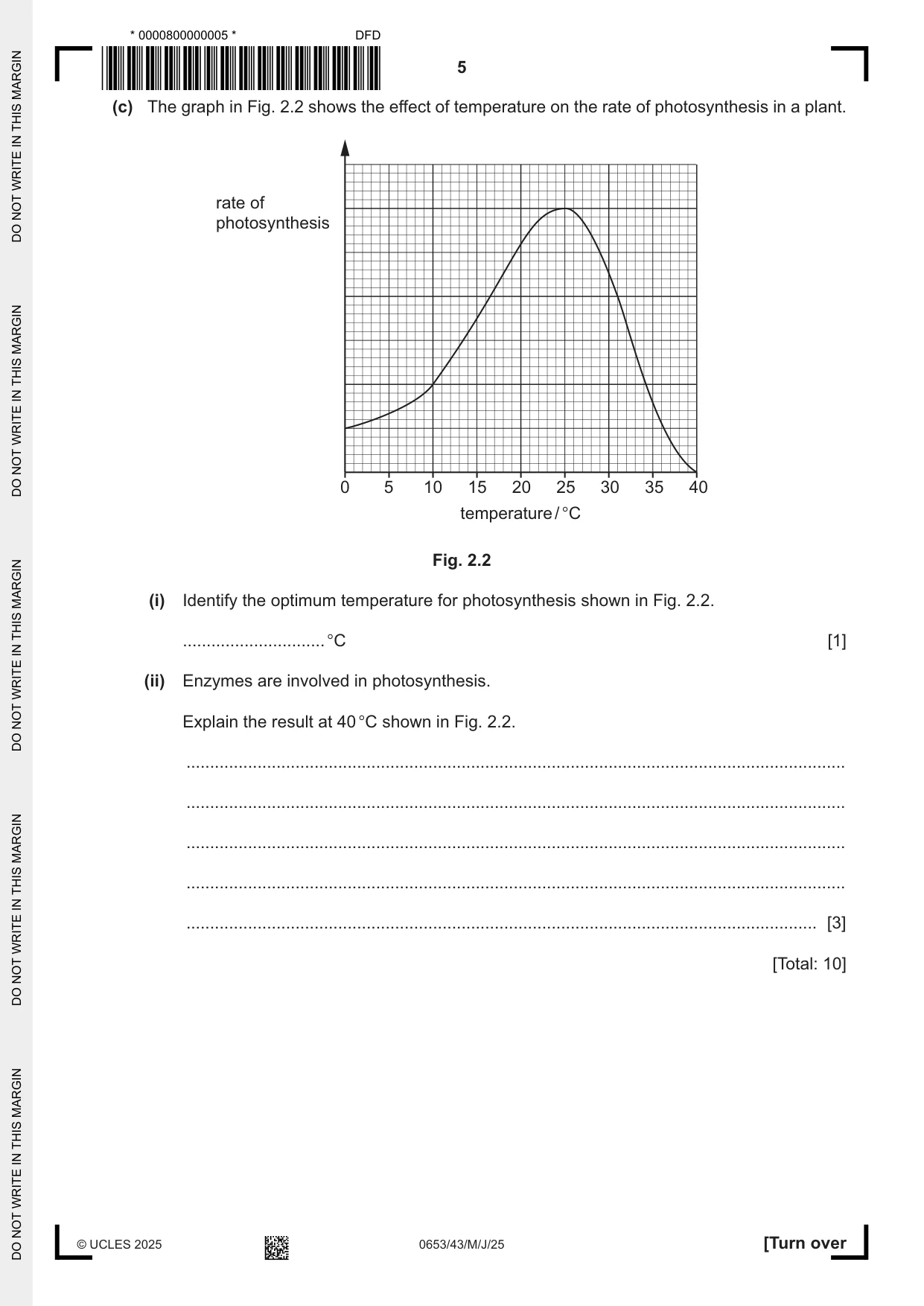
2 (a) Fig. 2.1 is a diagram of a cross-section through a leaf. G F A B C D E Fig. 2.1 State the letter on Fig. 2.1 that identifies: cuticle ...................... a cell specialised for photosynthesis ...................... a cell that transports mineral ions to the leaf. ...................... [3] (b) A green pigment is needed for photosynthesis. State the name of this pigment and its role in photosynthesis. name ......................................................................................................................................... role ............................................................................................................................................ ................................................................................................................................................... ................................................................................................................................................... ................................................................................................................................................... [3] (c) The graph in Fig. 2.2 shows the effect of temperature on the rate of photosynthesis in a plant. rate of photosynthesis 0 5 10 15 20 25 30 35 40 temperature / °C Fig. 2.2 (i) Identify the optimum temperature for photosynthesis shown in Fig. 2.2. .............................. °C [1] (ii) Enzymes are involved in photosynthesis. Explain the result at 40 °C shown in Fig. 2.2. ........................................................................................................................................... ........................................................................................................................................... ........................................................................................................................................... ........................................................................................................................................... ..................................................................................................................................... [3] [Total: 10]
Mark scheme: 2(a) G ; 3 A ; B ; 2(b) chlorophyll ; 3 transfers light energy to chemical energy ; to synthesise / produce, carbohydrates / glucose ; 2(c)(i) 25 (°C) ; 1 2(c)(ii) enzymes denature (at high temperature) ; 3 active site changes shape ; active site no longer complementary to substrate / substrate no longer fits active site ;
Q3 · Part of the breathing system in humans
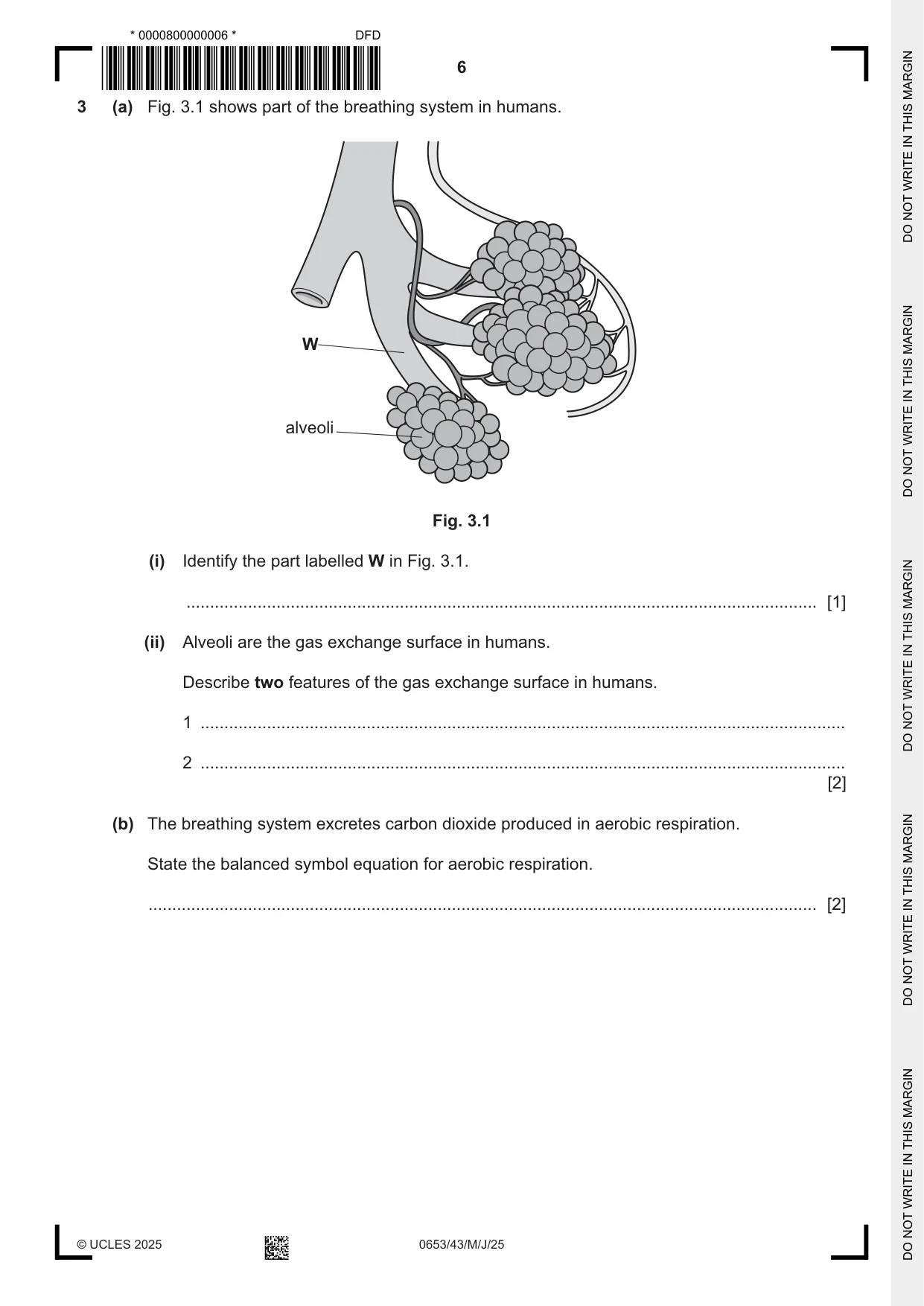
3 (a) Fig. 3.1 shows part of the breathing system in humans. W alveoli Fig. 3.1 (i) Identify the part labelled W in Fig. 3.1. ..................................................................................................................................... [1] (ii) Alveoli are the gas exchange surface in humans. Describe two features of the gas exchange surface in humans. 1 ........................................................................................................................................ 2 ........................................................................................................................................ [2] (b) The breathing system excretes carbon dioxide produced in aerobic respiration. State the balanced symbol equation for aerobic respiration. ............................................................................................................................................. [2] (c) Respiration is part of the carbon cycle. Human activities have an impact on the carbon cycle. (i) Explain why deforestation impacts the carbon cycle. ........................................................................................................................................... ........................................................................................................................................... ........................................................................................................................................... ..................................................................................................................................... [2] (ii) The impact on the carbon cycle is one undesirable effect of deforestation. State one other undesirable effect of deforestation. ..................................................................................................................................... [1] [Total: 8]
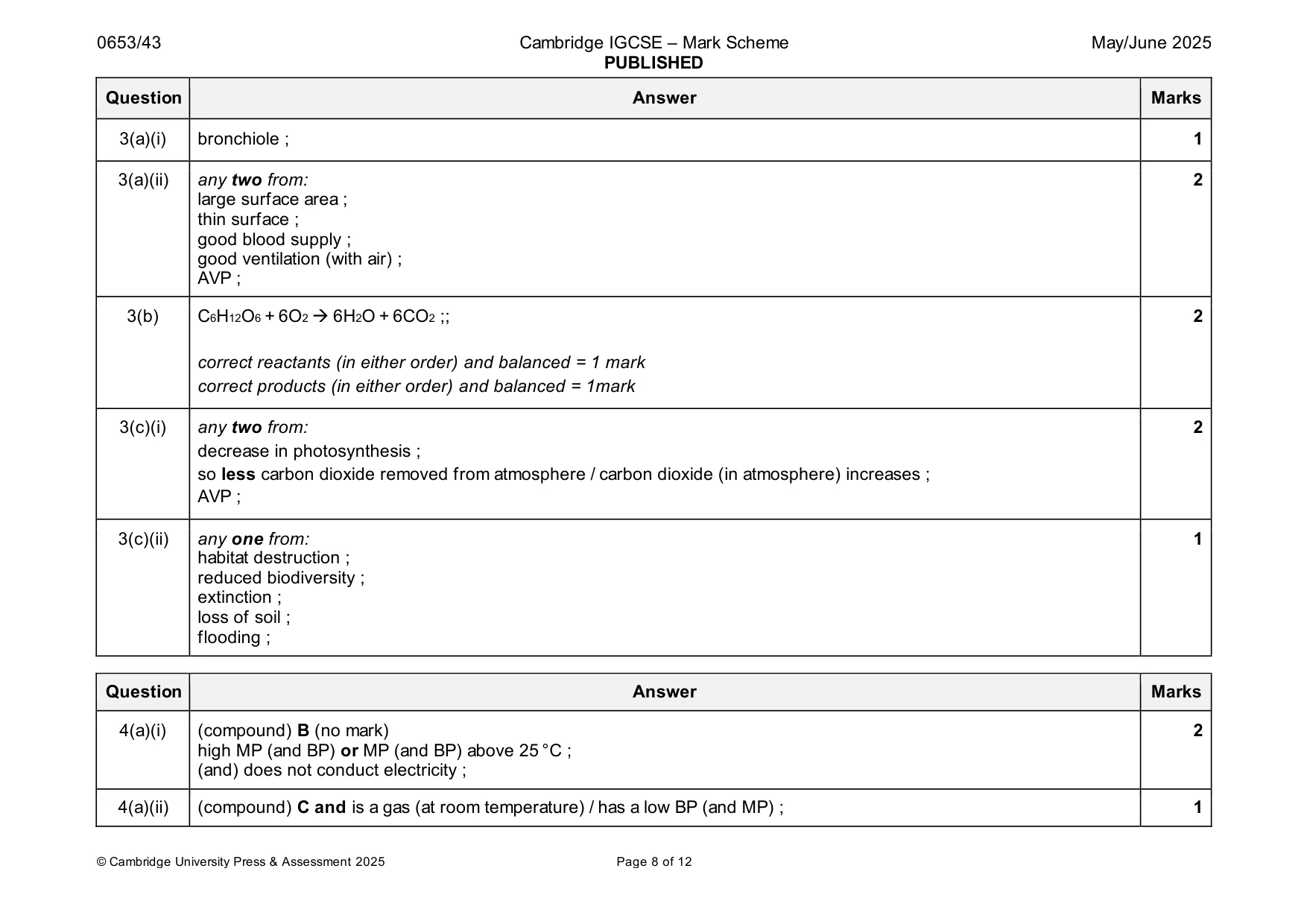
Mark scheme: 3(a)(i) bronchiole ; 1 3(a)(ii) any two from: 2 large surface area ; thin surface ; good blood supply ; good ventilation (with air) ; AVP ; 3(b) C6H12O6 + 6O2 → 6H2O + 6CO2 ;; 2 correct reactants (in either order) and balanced = 1 mark correct products (in either order) and balanced = 1mark 3(c)(i) any two from: 2 decrease in photosynthesis ; so less carbon dioxide removed from atmosphere / carbon dioxide (in atmosphere) increases ; AVP ; 3(c)(ii) any one from: 1 habitat destruction ; reduced biodiversity ; extinction ; loss of soil ; flooding ;
Q4 · Information about three compounds, A, B and C
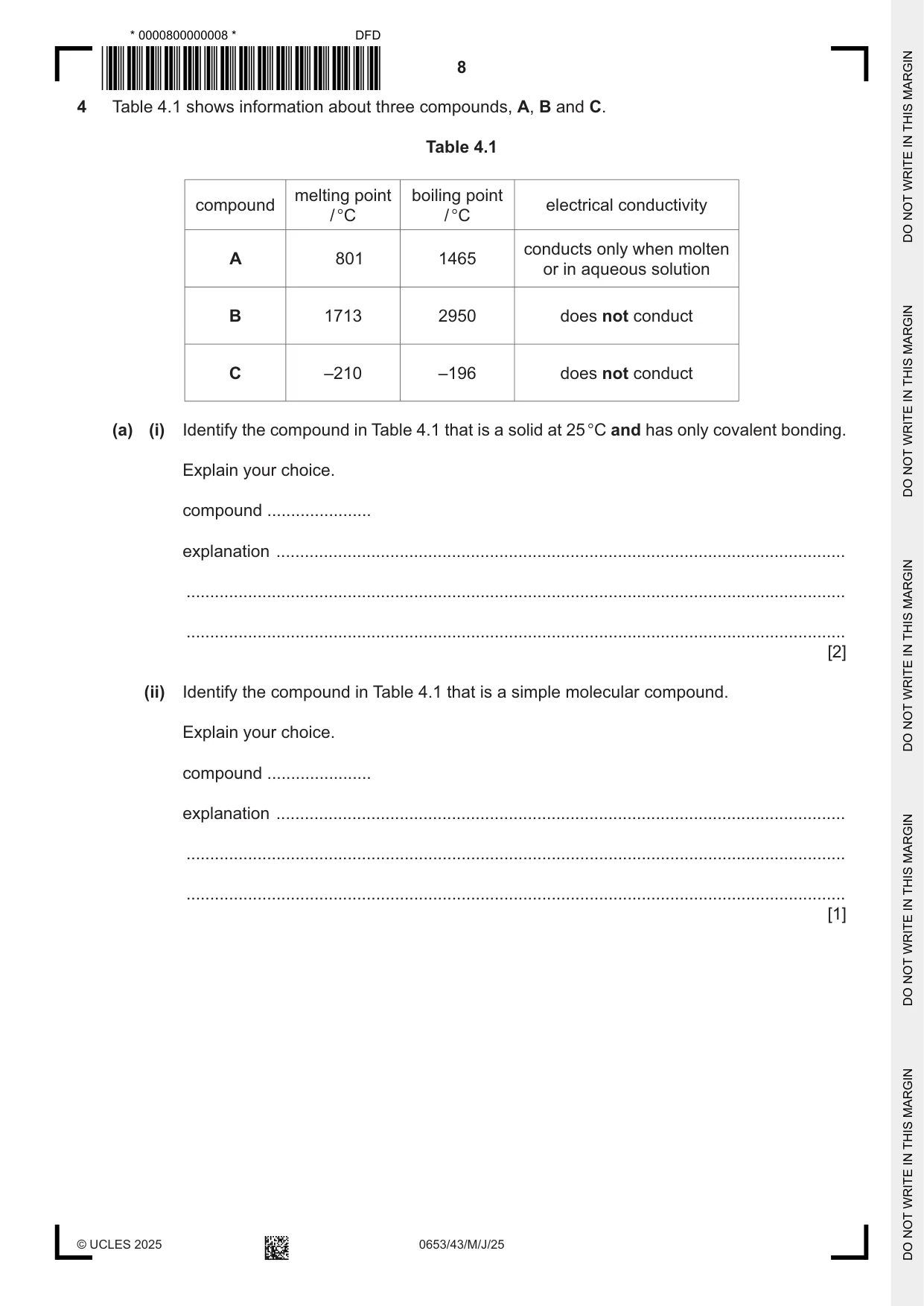
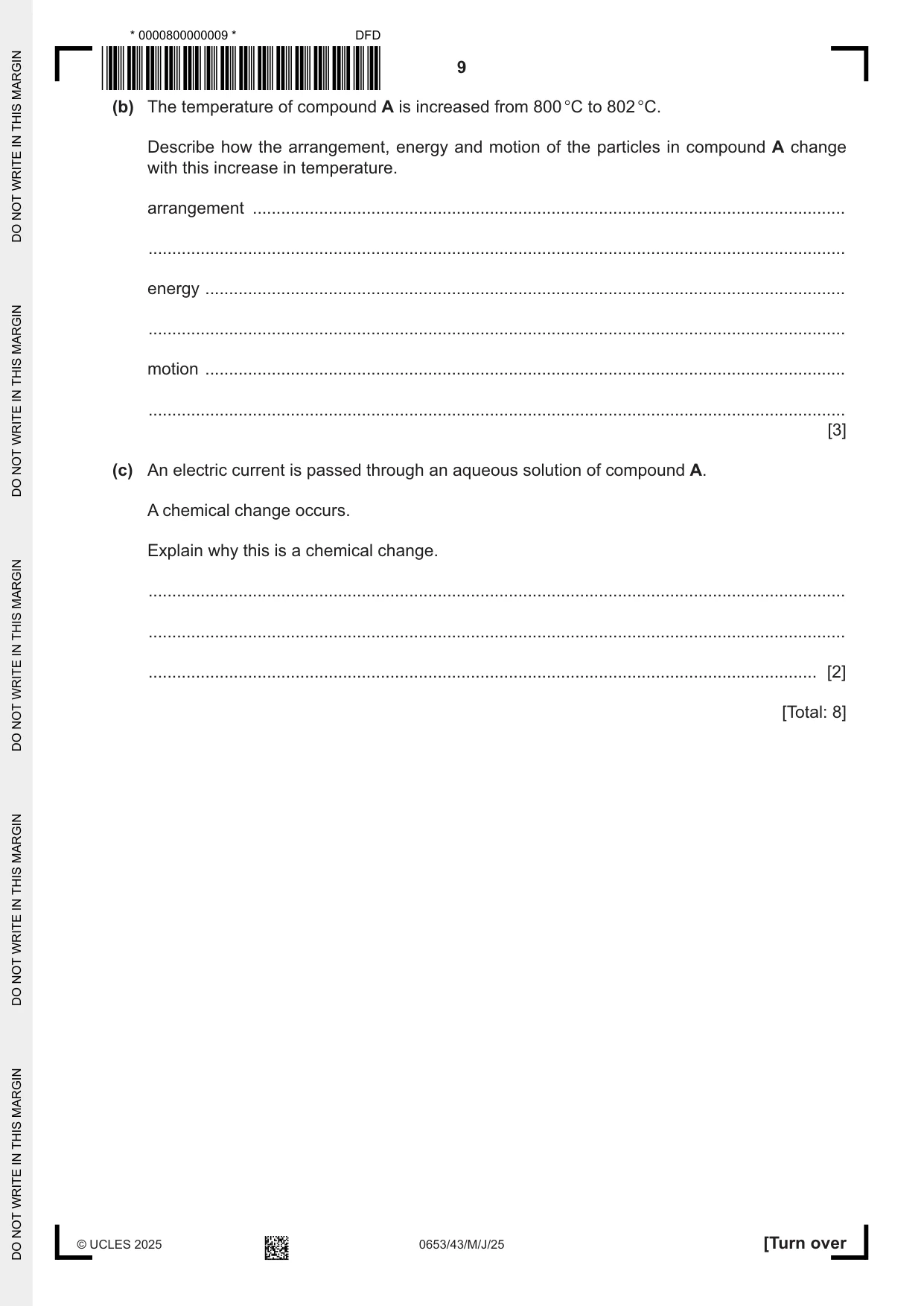
4 Table 4.1 shows information about three compounds, A, B and C. Table 4.1 melting point boiling point compound electrical conductivity / °C / °C conducts only when molten A 801 1465 or in aqueous solution B 1713 2950 does not conduct C –210 –196 does not conduct (a) (i) Identify the compound in Table 4.1 that is a solid at 25 °C and has only covalent bonding. Explain your choice. compound ...................... explanation ........................................................................................................................ ........................................................................................................................................... ........................................................................................................................................... [2] (ii) Identify the compound in Table 4.1 that is a simple molecular compound. Explain your choice. compound ...................... explanation ........................................................................................................................ ........................................................................................................................................... ........................................................................................................................................... [1] (b) The temperature of compound A is increased from 800 °C to 802 °C. Describe how the arrangement, energy and motion of the particles in compound A change with this increase in temperature. arrangement ............................................................................................................................. ................................................................................................................................................... energy ....................................................................................................................................... ................................................................................................................................................... motion ....................................................................................................................................... ................................................................................................................................................... [3] (c) An electric current is passed through an aqueous solution of compound A. A chemical change occurs. Explain why this is a chemical change. ................................................................................................................................................... ................................................................................................................................................... ............................................................................................................................................. [2] [Total: 8]
Mark scheme: 4(a)(i) (compound) B (no mark) 2 high MP (and BP) or MP (and BP) above 25 °C ; (and) does not conduct electricity ; 4(a)(ii) (compound) C and is a gas (at room temperature) / has a low BP (and MP) ; 1 4(b) arrangement: from regular to random ; 3 energy: increases ; motion: from fixed / vibrating, to, moving over each other / sliding over each other / moving around / moving freely ; 4(c) compound A breaks down / electrolysis happens ; 2 elements (from the compound) are formed ;
Q5 · Chlorine is in Group VII of the Periodic Table
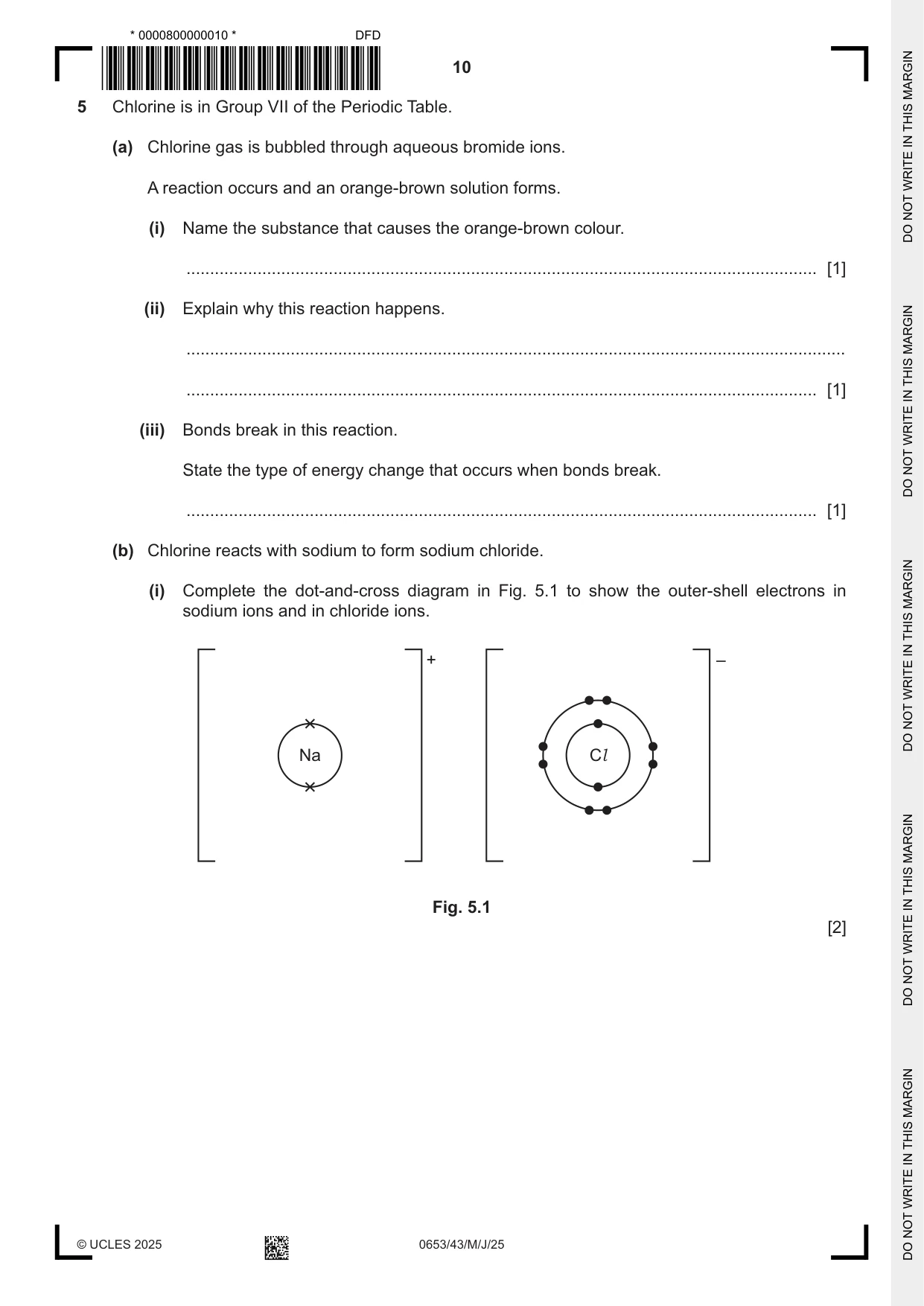
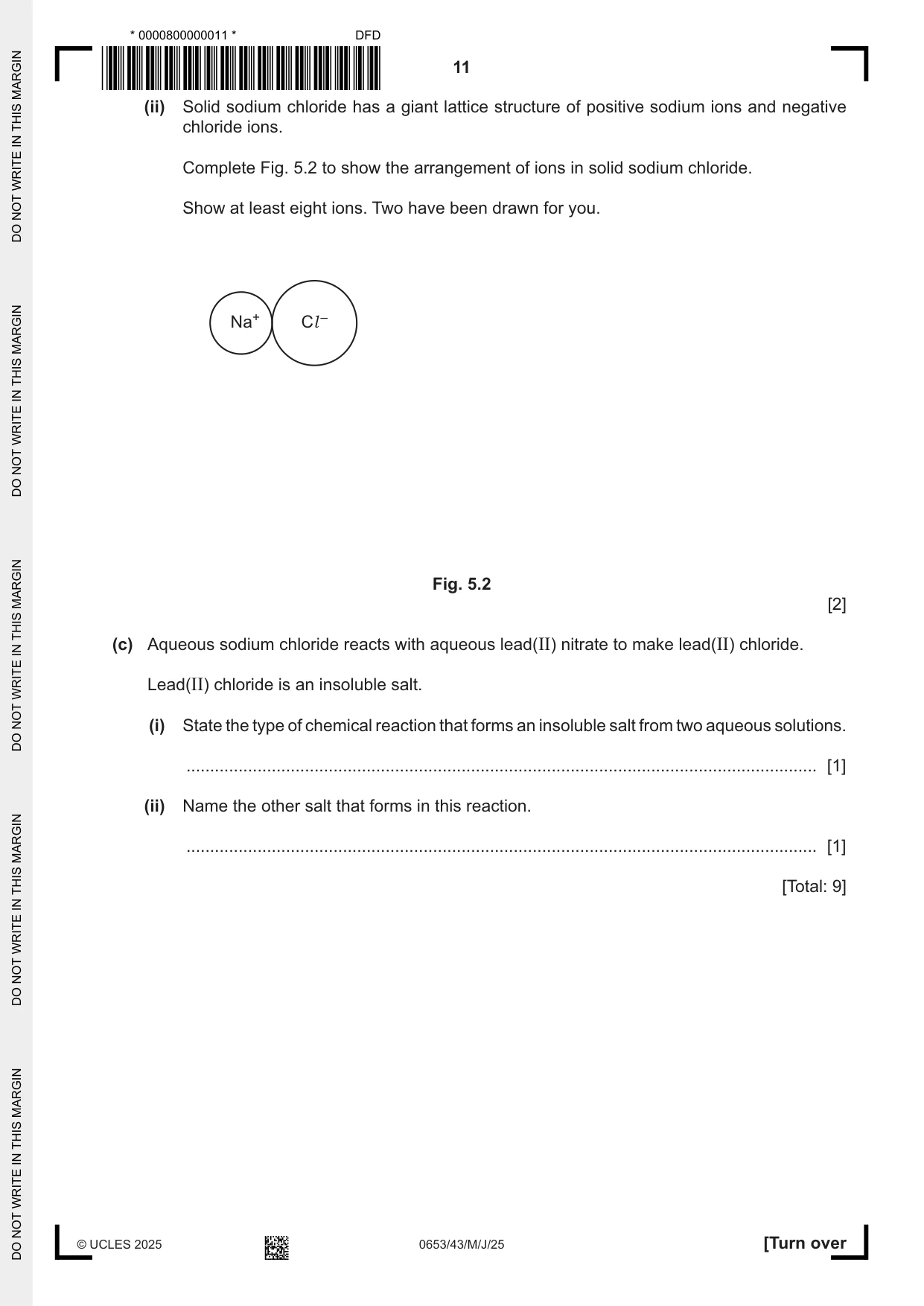
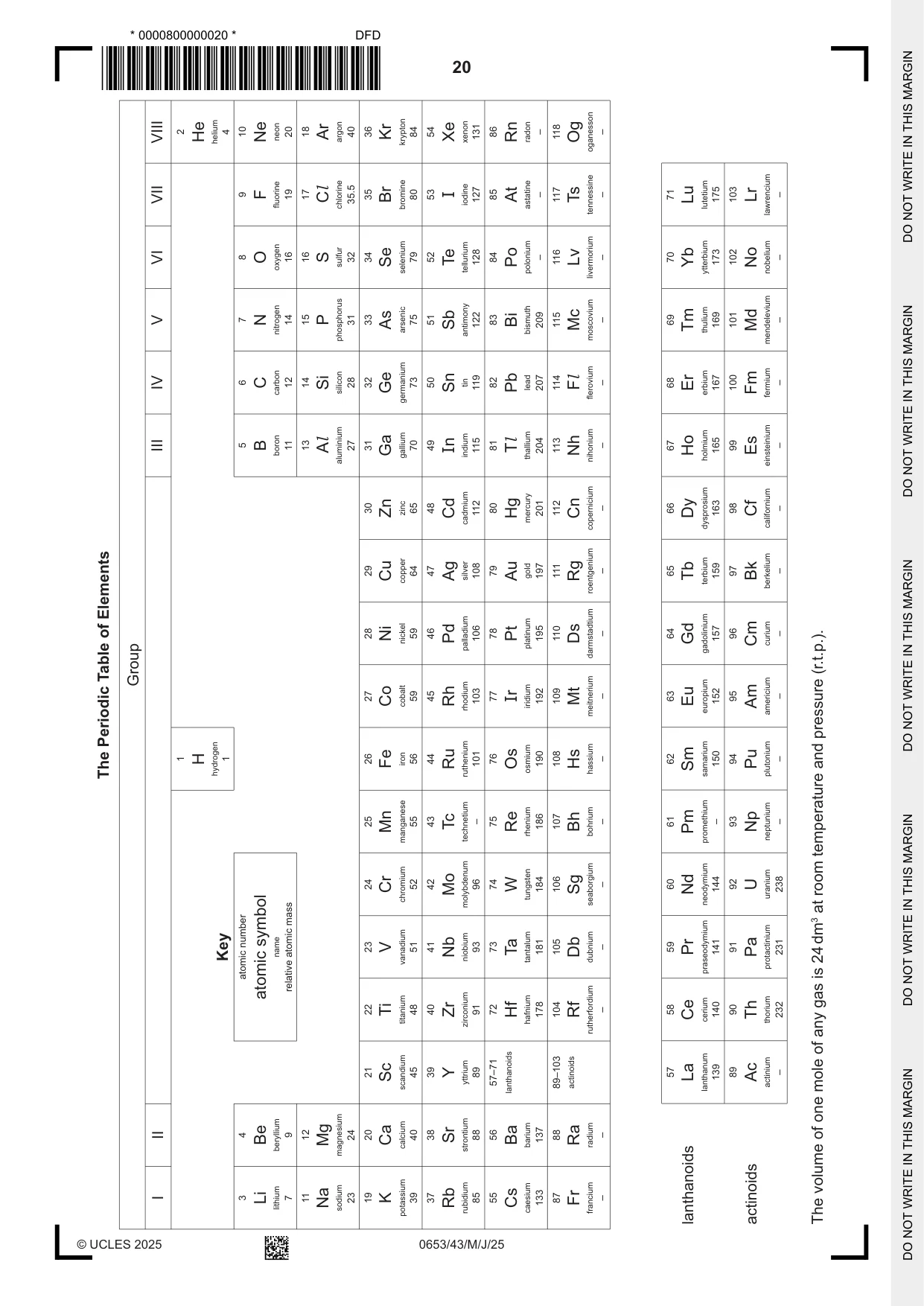
5 Chlorine is in Group VII of the Periodic Table. (a) Chlorine gas is bubbled through aqueous bromide ions. A reaction occurs and an orange-brown solution forms. (i) Name the substance that causes the orange-brown colour. ..................................................................................................................................... [1] (ii) Explain why this reaction happens. ........................................................................................................................................... ..................................................................................................................................... [1] (iii) Bonds break in this reaction. State the type of energy change that occurs when bonds break. ..................................................................................................................................... [1] (b) Chlorine reacts with sodium to form sodium chloride. (i) Complete the dot-and-cross diagram in Fig. 5.1 to show the outer-shell electrons in sodium ions and in chloride ions. + – Na Cl Fig. 5.1 [2] (ii) Solid sodium chloride has a giant lattice structure of positive sodium ions and negative chloride ions. Complete Fig. 5.2 to show the arrangement of ions in solid sodium chloride. Show at least eight ions. Two have been drawn for you. Na+ Cl – Fig. 5.2 [2] (c) Aqueous sodium chloride reacts with aqueous lead(II) nitrate to make lead(II) chloride. Lead(II) chloride is an insoluble salt. (i) State the type of chemical reaction that forms an insoluble salt from two aqueous solutions. ..................................................................................................................................... [1] (ii) Name the other salt that forms in this reaction. ..................................................................................................................................... [1] [Total: 9]
Mark scheme: 5(a)(i) bromine ; 1 5(a)(ii) chlorine is more reactive than bromine ORA ; 1 5(a)(iii) endothermic ; 1 5(b)(i) sodium with 8 crosses in outer shell ; 2 chloride with 7 dots and 1 cross in outer shell ; 5(b)(ii) + and – ions alternate along a row or down a column ; 2 an adjacent row or column of correspondingly opposite ions ; 5(c)(i) precipitation ; 1 5(c)(ii) sodium nitrate ; 1 Question Answer Marks
Q6 · Ethene is an alkene
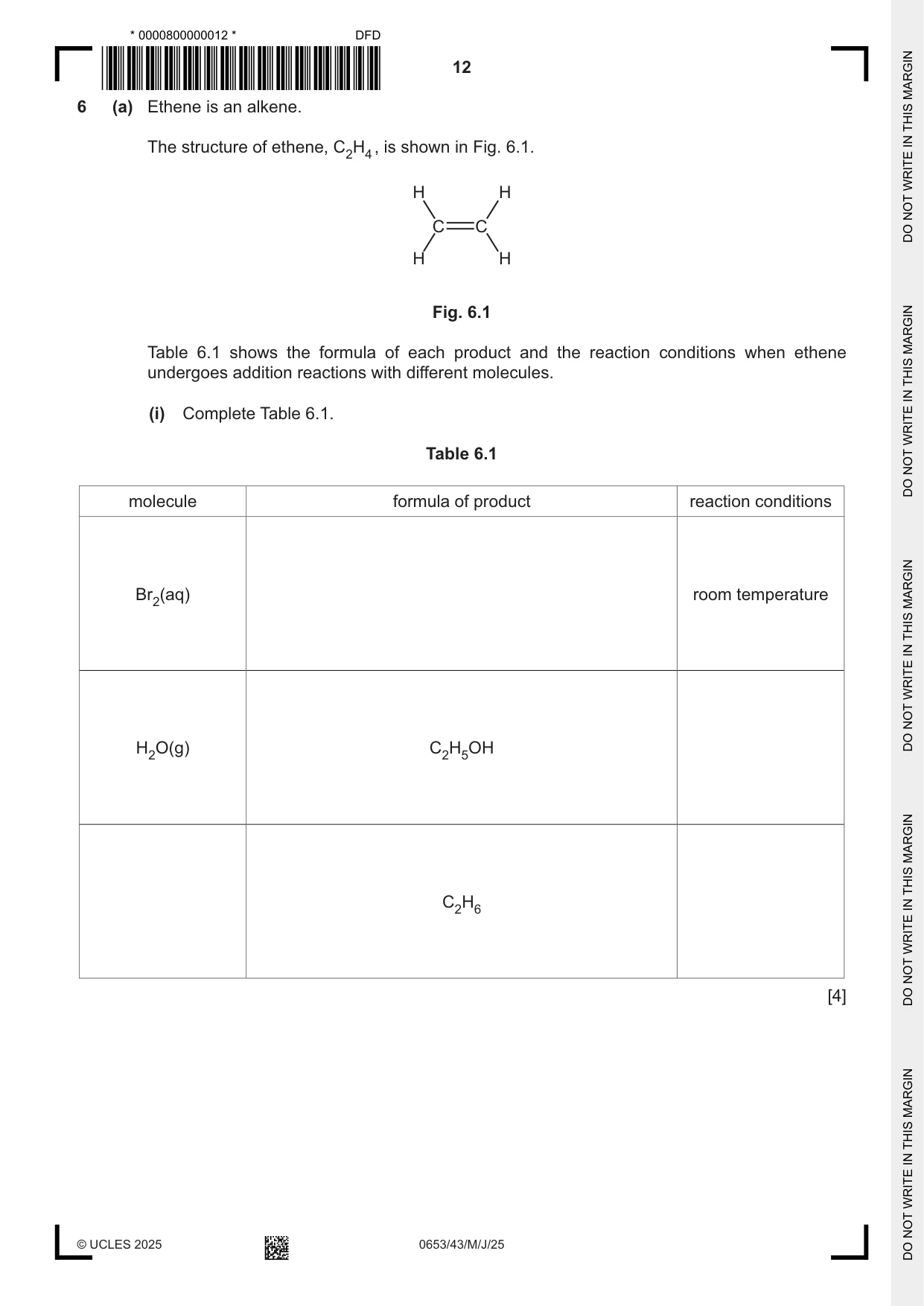
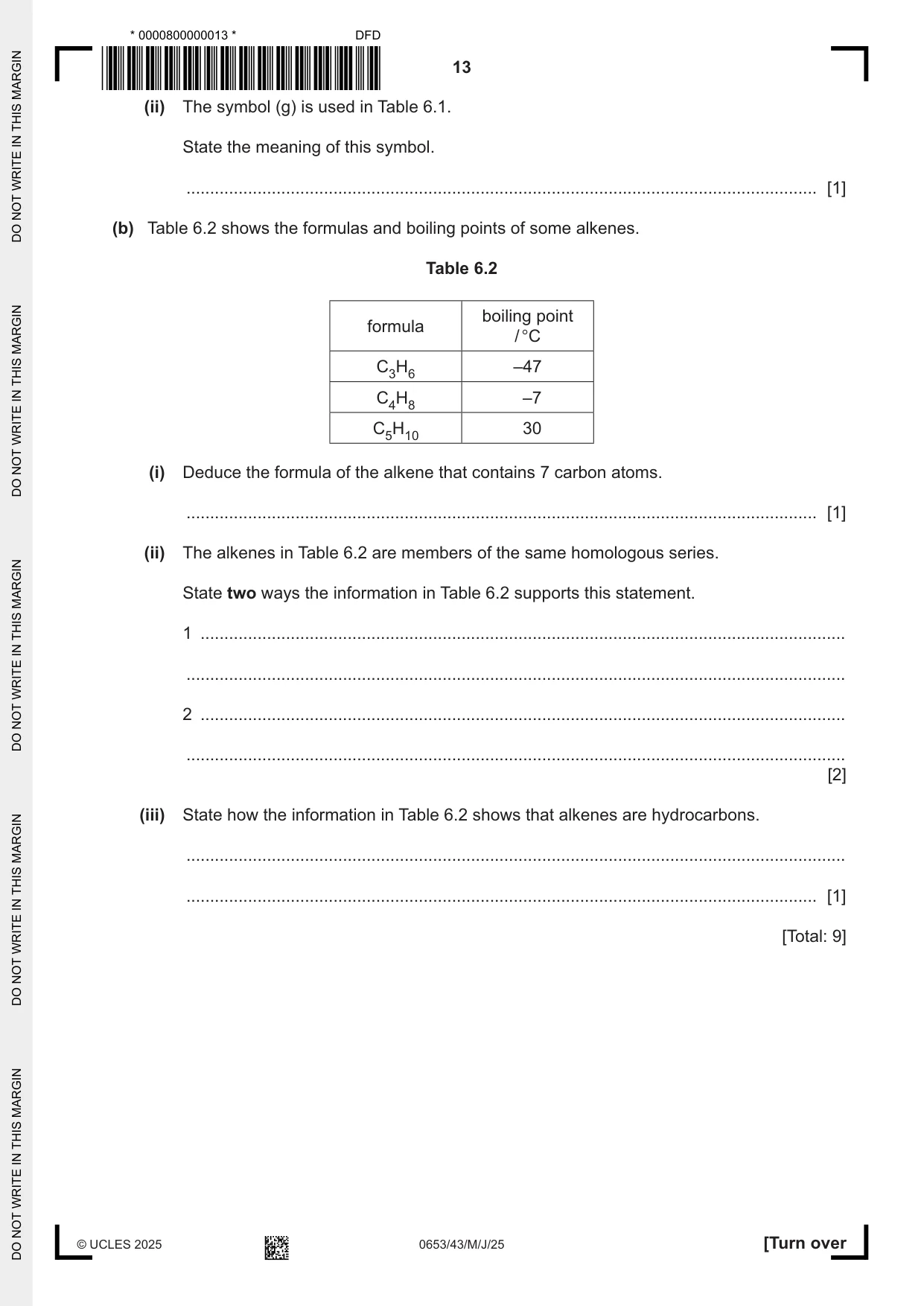
6 (a) Ethene is an alkene. The structure of ethene, C2H4 , is shown in Fig. 6.1. H H C C H H Fig. 6.1 Table 6.1 shows the formula of each product and the reaction conditions when ethene undergoes addition reactions with different molecules. (i) Complete Table 6.1. Table 6.1 molecule formula of product reaction conditions Br2(aq) room temperature H2O(g) C2H5OH C2H6 [4] (ii) The symbol (g) is used in Table 6.1. State the meaning of this symbol. ..................................................................................................................................... [1] (b) Table 6.2 shows the formulas and boiling points of some alkenes. Table 6.2 boiling point formula / °C C3H6 –47 C4H8 –7 C5H10 30 (i) Deduce the formula of the alkene that contains 7 carbon atoms. ..................................................................................................................................... [1] (ii) The alkenes in Table 6.2 are members of the same homologous series. State two ways the information in Table 6.2 supports this statement. 1 ........................................................................................................................................ ........................................................................................................................................... 2 ........................................................................................................................................ ........................................................................................................................................... [2] (iii) State how the information in Table 6.2 shows that alkenes are hydrocarbons. ........................................................................................................................................... ..................................................................................................................................... [1] [Total: 9]
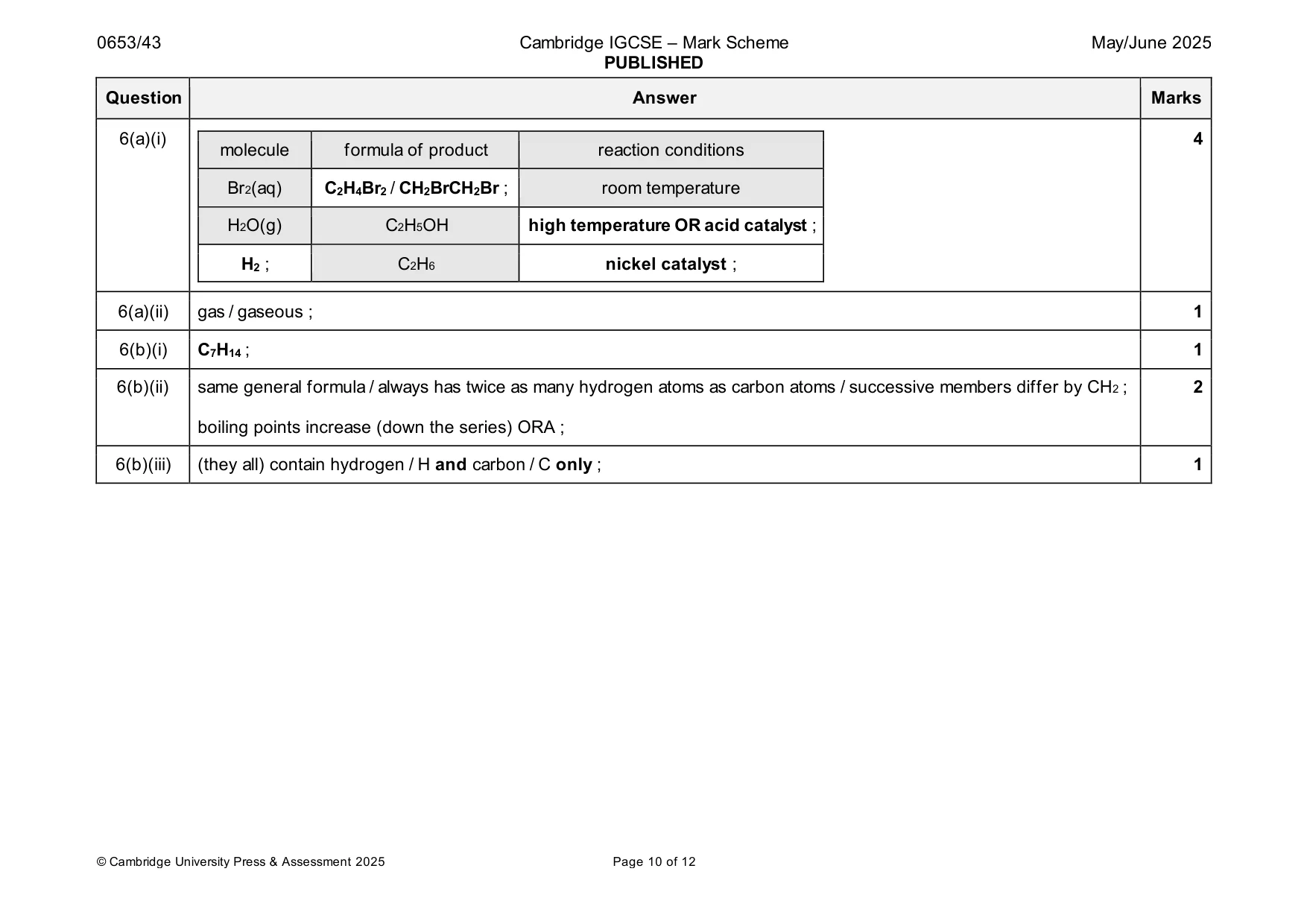
Mark scheme: 6(a)(i) 4 molecule formula of product reaction conditions Br2(aq) C2H4Br2 / CH2BrCH2Br ; room temperature H2O(g) C2H5OH high temperature OR acid catalyst ; H2 ; C2H6 nickel catalyst ; 6(a)(ii) gas / gaseous ; 1 6(b)(i) C7H14 ; 1 6(b)(ii) same general formula / always has twice as many hydrogen atoms as carbon atoms / successive members differ by CH2 ; 2 boiling points increase (down the series) ORA ; 6(b)(iii) (they all) contain hydrogen / H and carbon / C only ; 1
Q7 · A toy car, powered by a battery
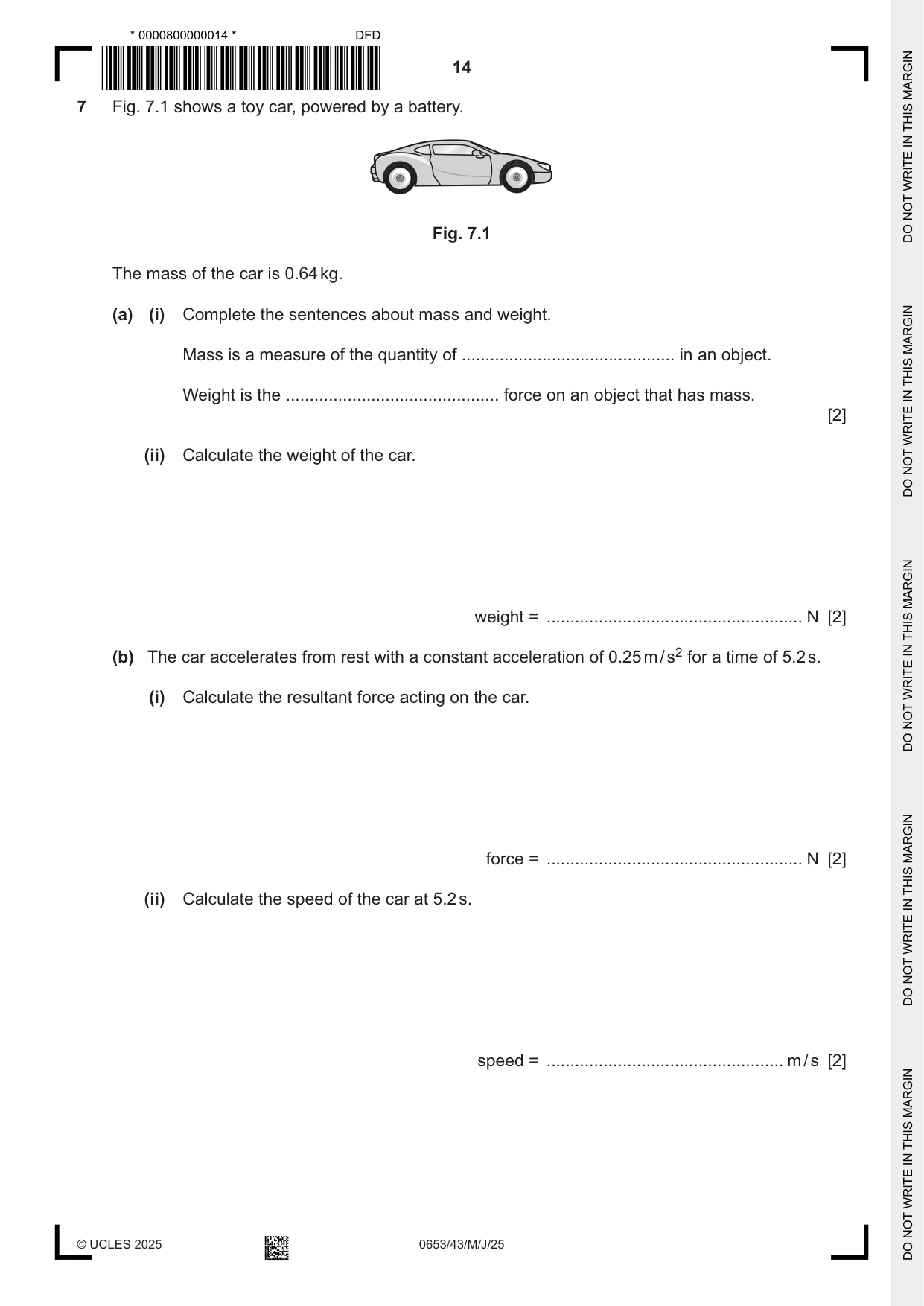
7 Fig. 7.1 shows a toy car, powered by a battery. Fig. 7.1 The mass of the car is 0.64 kg. (a) (i) Complete the sentences about mass and weight. Mass is a measure of the quantity of ............................................. in an object. Weight is the ............................................. force on an object that has mass. [2] (ii) Calculate the weight of the car. weight = ...................................................... N [2] (b) The car accelerates from rest with a constant acceleration of 0.25 m / s2 for a time of 5.2 s. (i) Calculate the resultant force acting on the car. force = ...................................................... N [2] (ii) Calculate the speed of the car at 5.2 s. speed = .................................................. m / s [2] (c) The total power input to the car is 3.00 W. The useful power output of the car is 0.75 W. (i) Calculate the efficiency of the car. efficiency = …………………………….. % [2] (ii) Explain why the efficiency of the car is not 100%. ........................................................................................................................................... ..................................................................................................................................... [1] [Total: 11]
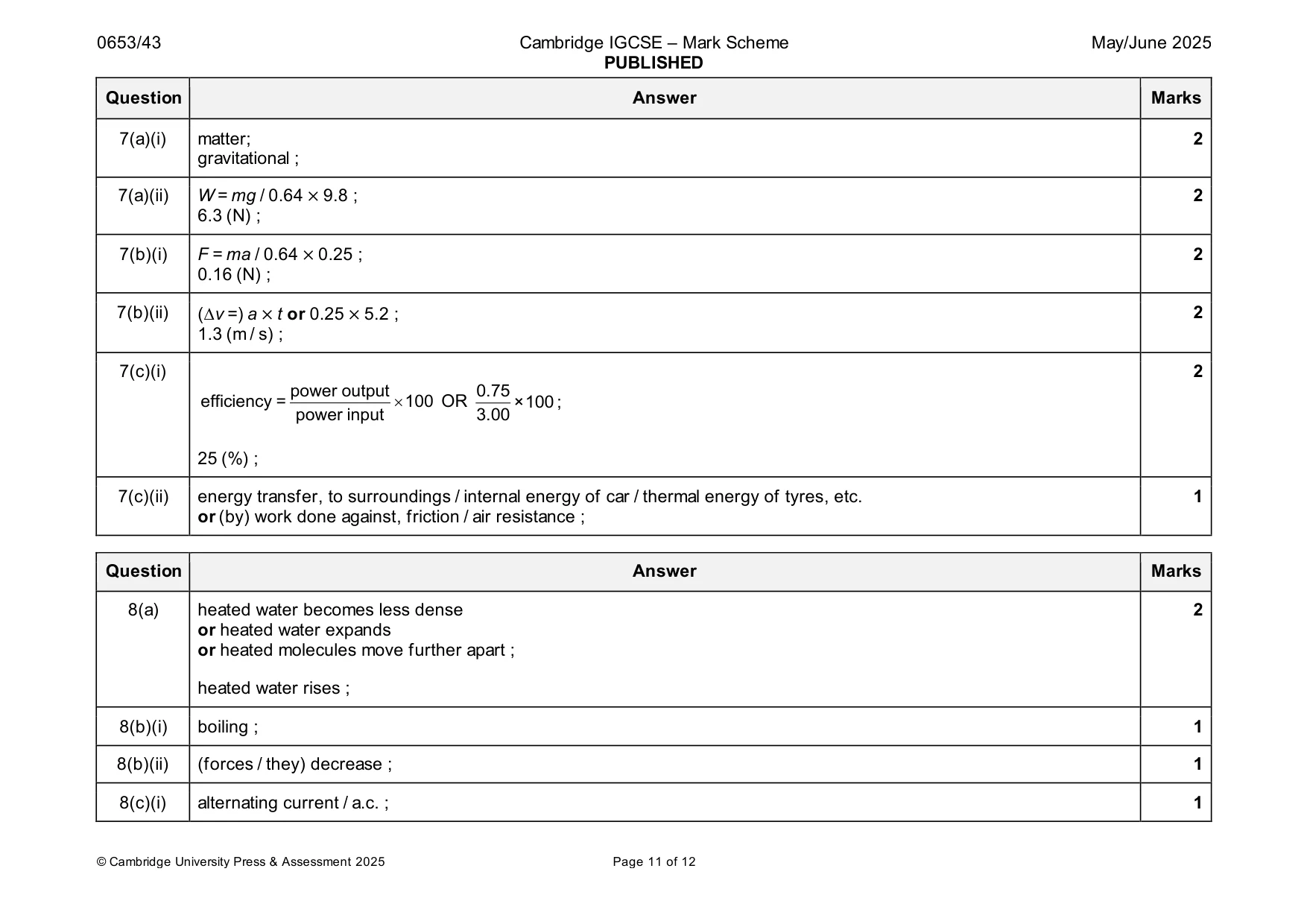
Mark scheme: 7(a)(i) matter; 2 gravitational ; 7(a)(ii) W = mg / 0.64 × 9.8 ; 2 6.3 (N) ; 7(b)(i) F = ma / 0.64 × 0.25 ; 2 0.16 (N) ; 7(b)(ii) (v =) a × t or 0.25 × 5.2 ; 2 1.3 (m / s) ; 7(c)(i) 2 power output 0.75 efficiency = 100 OR ×100 ; power input 3.00 25 (%) ; 7(c)(ii) energy transfer, to surroundings / internal energy of car / thermal energy of tyres, etc. 1 or (by) work done against, friction / air resistance ;
Q8 · A pan of water being heated on an electric hotplate
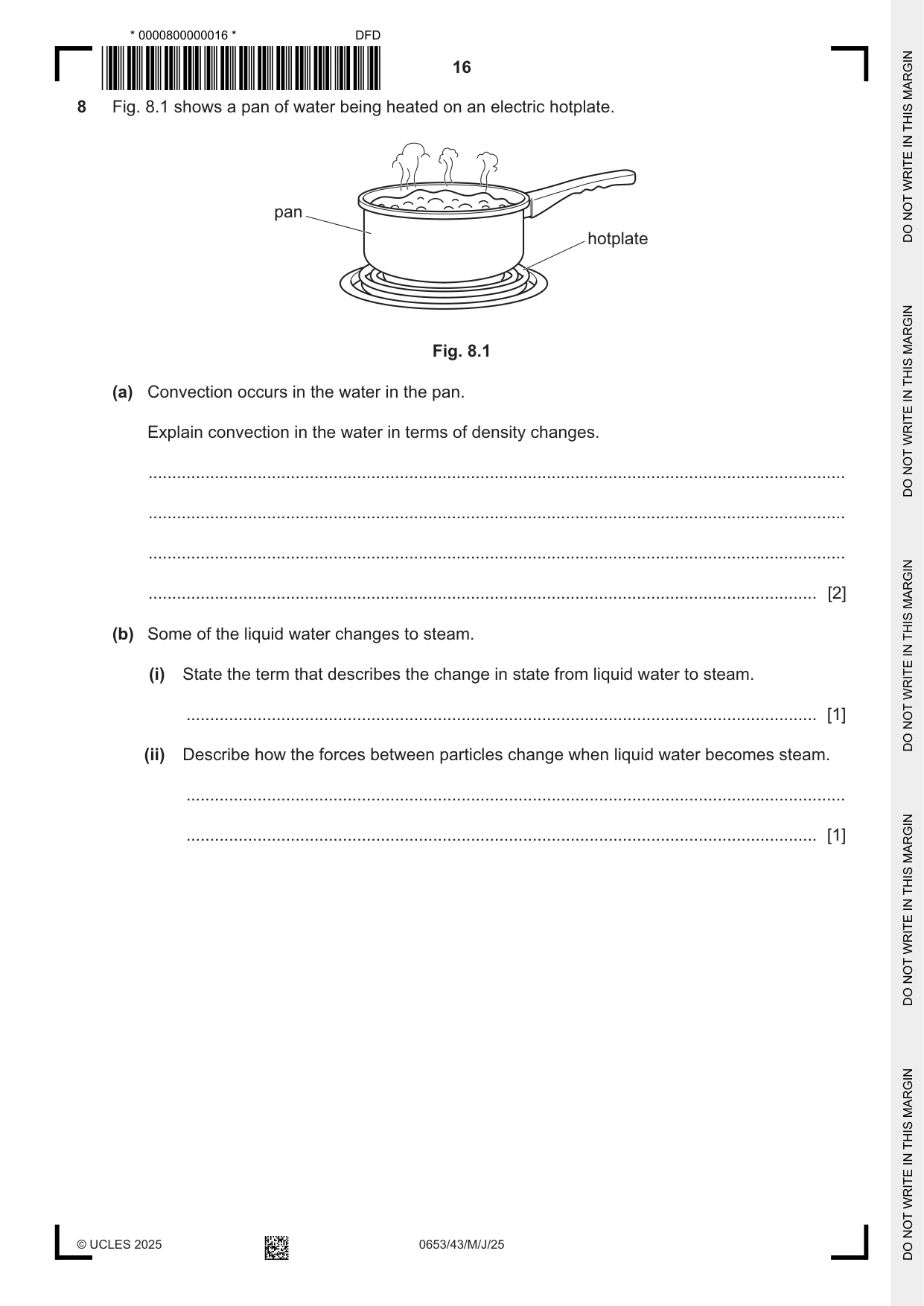
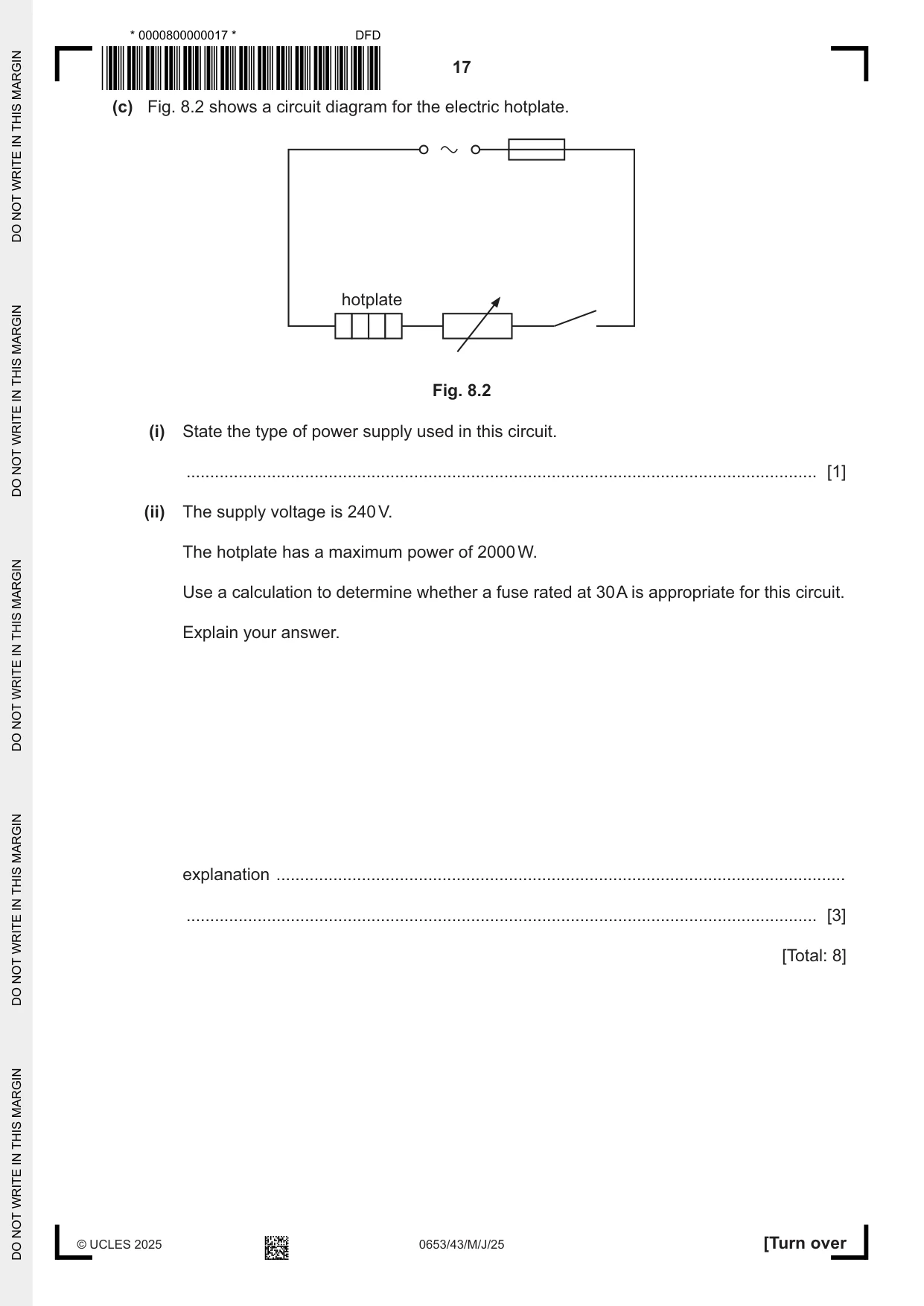
8 Fig. 8.1 shows a pan of water being heated on an electric hotplate. pan hotplate Fig. 8.1 (a) Convection occurs in the water in the pan. Explain convection in the water in terms of density changes. ................................................................................................................................................... ................................................................................................................................................... ................................................................................................................................................... ............................................................................................................................................. [2] (b) Some of the liquid water changes to steam. (i) State the term that describes the change in state from liquid water to steam. ..................................................................................................................................... [1] (ii) Describe how the forces between particles change when liquid water becomes steam. ........................................................................................................................................... ..................................................................................................................................... [1] (c) Fig. 8.2 shows a circuit diagram for the electric hotplate. hotplate Fig. 8.2 (i) State the type of power supply used in this circuit. ..................................................................................................................................... [1] (ii) The supply voltage is 240 V. The hotplate has a maximum power of 2000 W. Use a calculation to determine whether a fuse rated at 30 A is appropriate for this circuit. Explain your answer. explanation ........................................................................................................................ ..................................................................................................................................... [3] [Total: 8]
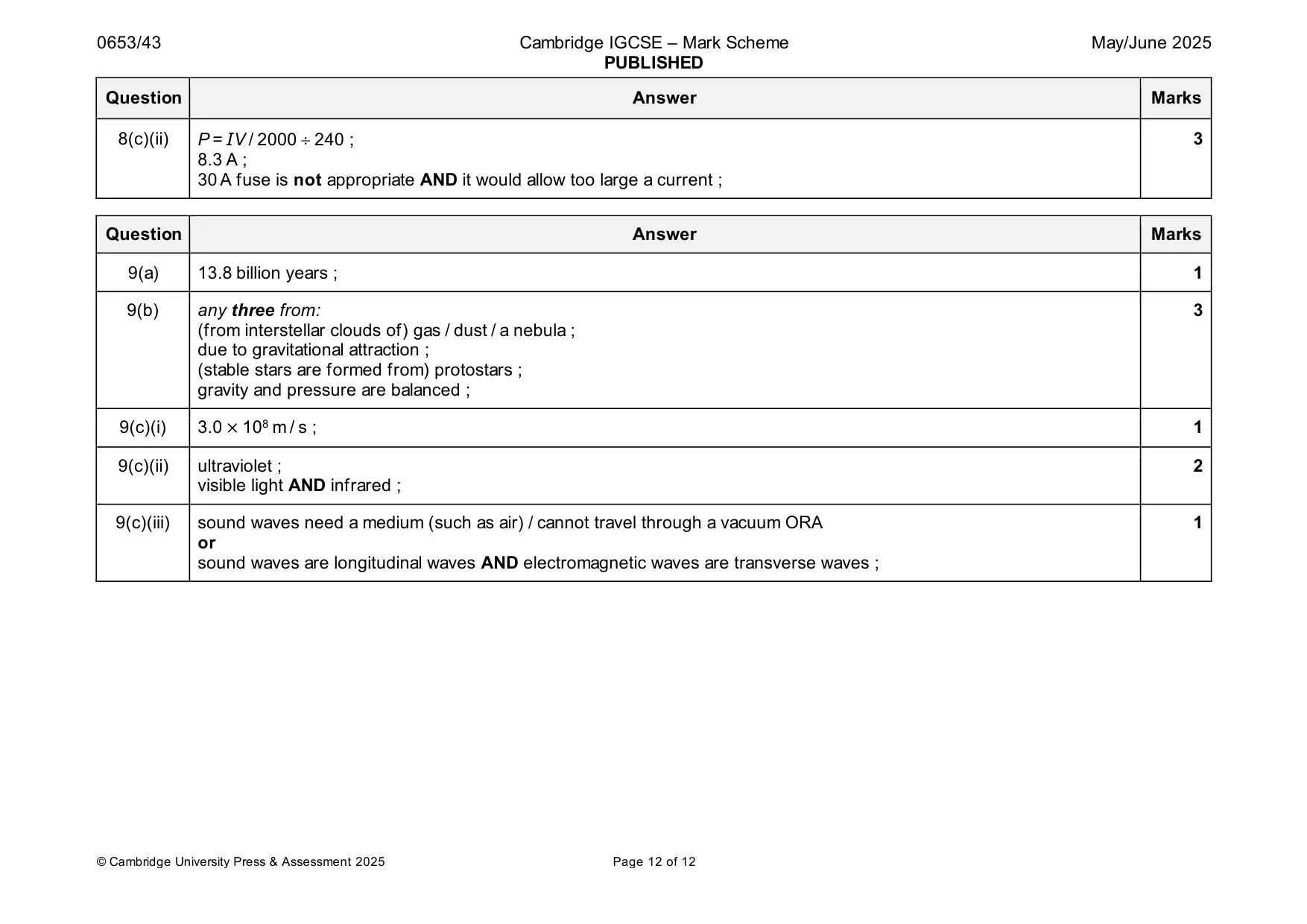
Mark scheme: 8(a) heated water becomes less dense 2 or heated water expands or heated molecules move further apart ; heated water rises ; 8(b)(i) boiling ; 1 8(b)(ii) (forces / they) decrease ; 1 8(c)(i) alternating current / a.c. ; 1 8(c)(ii) P = IV / 2000 240 ; 3 8.3 A ; 30 A fuse is not appropriate AND it would allow too large a current ;
Q9 · State the approximate age of the Universe
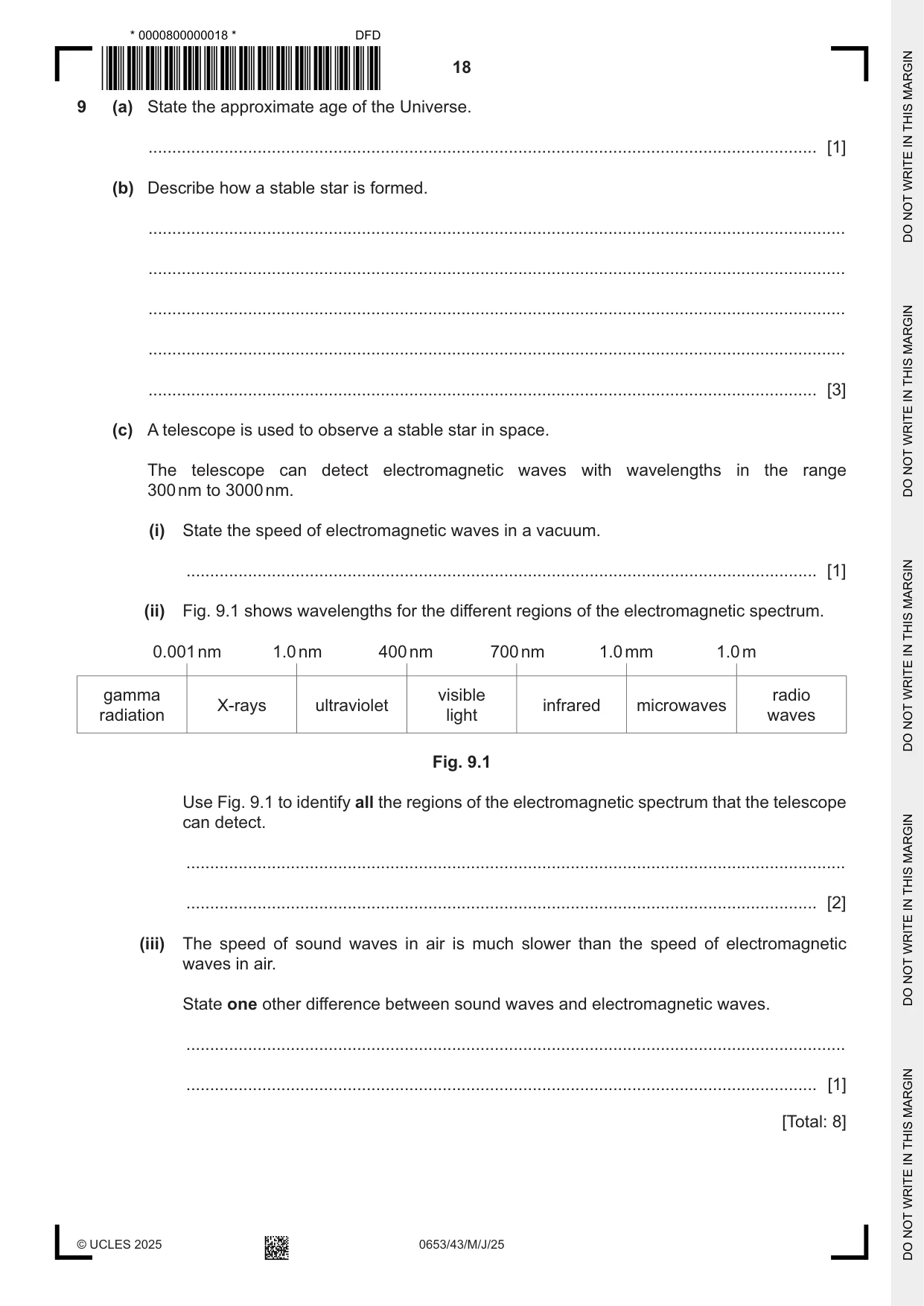
9 (a) State the approximate age of the Universe. ............................................................................................................................................. [1] (b) Describe how a stable star is formed. ................................................................................................................................................... ................................................................................................................................................... ................................................................................................................................................... ................................................................................................................................................... ............................................................................................................................................. [3] (c) A telescope is used to observe a stable star in space. The telescope can detect electromagnetic waves with wavelengths in the range 300 nm to 3000 nm. (i) State the speed of electromagnetic waves in a vacuum. ..................................................................................................................................... [1] (ii) Fig. 9.1 shows wavelengths for the different regions of the electromagnetic spectrum. 0.001 nm 1.0 nm 400 nm 700 nm 1.0 mm 1.0 m gamma visible radio X-rays ultraviolet infrared microwaves radiation light waves Fig. 9.1 Use Fig. 9.1 to identify all the regions of the electromagnetic spectrum that the telescope can detect. ........................................................................................................................................... ..................................................................................................................................... [2] (iii) The speed of sound waves in air is much slower than the speed of electromagnetic waves in air. State one other difference between sound waves and electromagnetic waves. ........................................................................................................................................... ..................................................................................................................................... [1] [Total: 8]
Mark scheme: 9(a) 13.8 billion years ; 1 9(b) any three from: 3 (from interstellar clouds of) gas / dust / a nebula ; due to gravitational attraction ; (stable stars are formed from) protostars ; gravity and pressure are balanced ; 9(c)(i) 3.0 × 10⁸ m / s ; 1 9(c)(ii) ultraviolet ; 2 visible light AND infrared ; 9(c)(iii) sound waves need a medium (such as air) / cannot travel through a vacuum ORA 1 or sound waves are longitudinal waves AND electromagnetic waves are transverse waves ;
What was in this paper
The subtopics covered by these 9 questions, and how many questions each got. Open one in a new tab to see every Cambridge question on it.
What you needed in this session
Cambridge’s own grade thresholds for 2025 May/June, Paper 4 · Variant 3. A higher threshold means an easier paper — the bar moves with how the cohort did.