Cambridge IGCSE Science - Combined 0653 — 2023 Oct/Nov Paper 4 · Variant 2
0653/42/O/N/23 · 9 questions · 80 marks · ≈90 min
The question paper and its mark scheme, free to read here and free to download. This is Cambridge’s own paper, exactly as it was sat.
Question paper20 pages

Mark scheme12 pages
Answers below. Sit the paper first if you are practising.
Questions as text
Q1 · The transfer of pollen from flower A to flower B
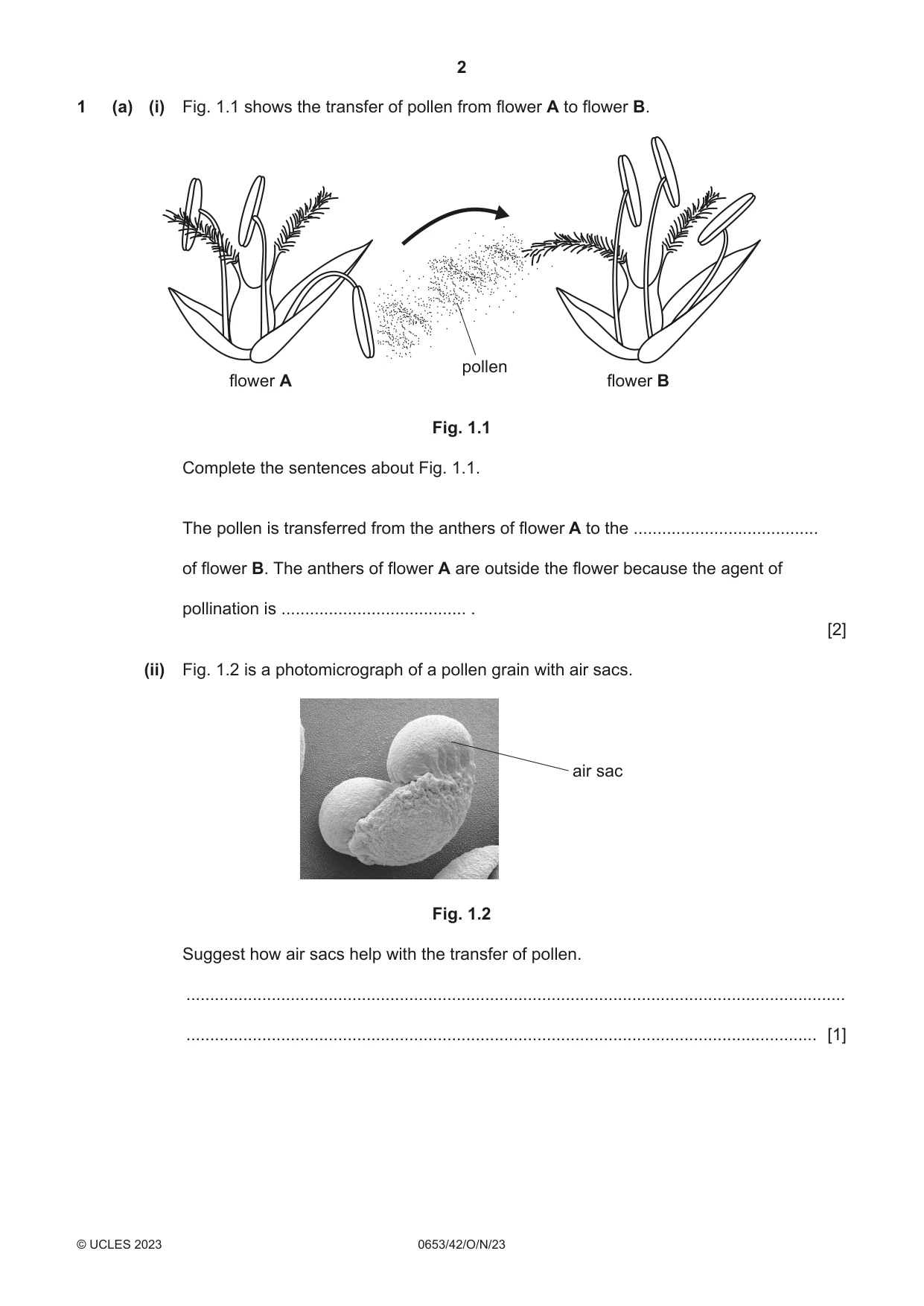
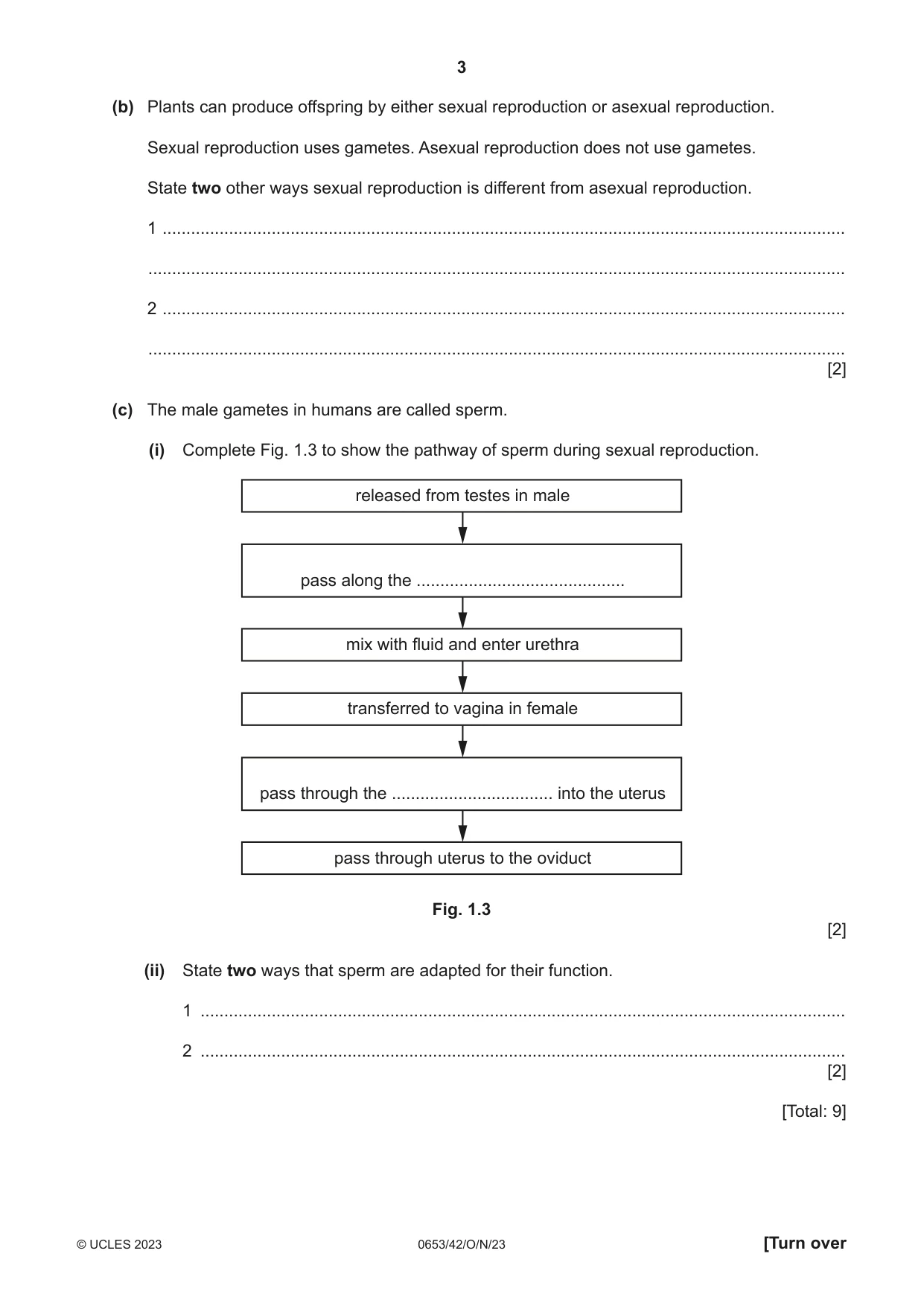
1 (a) (i) Fig. 1.1 shows the transfer of pollen from flower A to flower B. pollen flower A flower B Fig. 1.1 Complete the sentences about Fig. 1.1. The pollen is transferred from the anthers of flower A to the ....................................... of flower B. The anthers of flower A are outside the flower because the agent of pollination is ....................................... . [2] (ii) Fig. 1.2 is a photomicrograph of a pollen grain with air sacs. air sac Fig. 1.2 Suggest how air sacs help with the transfer of pollen. ........................................................................................................................................... ..................................................................................................................................... [1] (b) Plants can produce offspring by either sexual reproduction or asexual reproduction. Sexual reproduction uses gametes. Asexual reproduction does not use gametes. State two other ways sexual reproduction is different from asexual reproduction. 1 ................................................................................................................................................ ................................................................................................................................................... 2 ................................................................................................................................................ ................................................................................................................................................... [2] (c) The male gametes in humans are called sperm. (i) Complete Fig. 1.3 to show the pathway of sperm during sexual reproduction. released from testes in male pass along the ............................................ mix with fluid and enter urethra transferred to vagina in female pass through the .................................. into the uterus pass through uterus to the oviduct Fig. 1.3 [2] (ii) State two ways that sperm are adapted for their function. 1 ........................................................................................................................................ 2 ........................................................................................................................................ [2] [Total: 9]
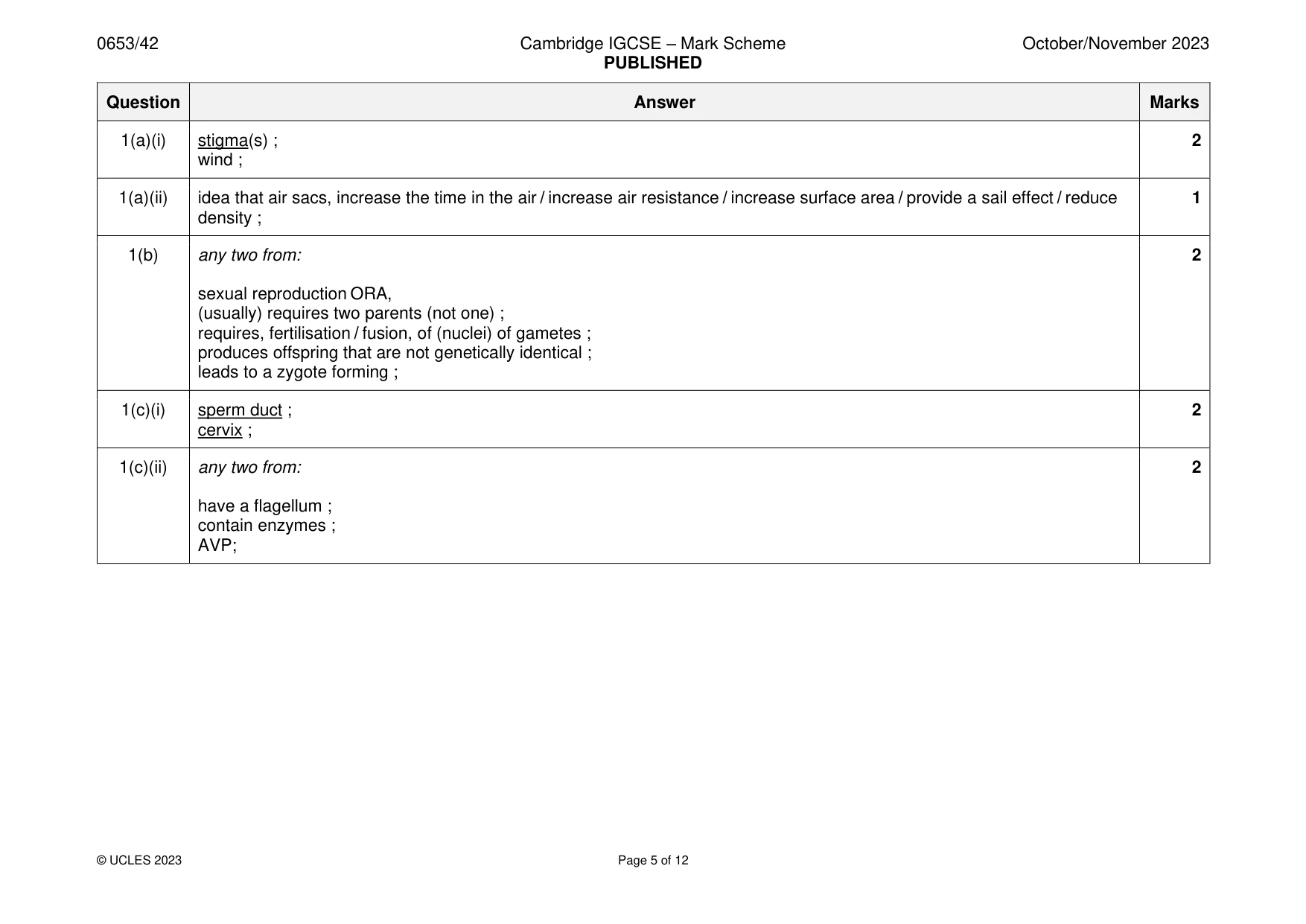
Mark scheme: Question Answer Marks 1(a)(i) stigma(s) ; 2 wind ; 1(a)(ii) idea that air sacs, increase the time in the air / increase air resistance / increase surface area / provide a sail effect / reduce 1 density ; 1(b) any two from: 2 sexual reproduction ORA, (usually) requires two parents (not one) ; requires, fertilisation / fusion, of (nuclei) of gametes ; produces offspring that are not genetically identical ; leads to a zygote forming ; 1(c)(i) sperm duct ; 2 cervix ; 1(c)(ii) any two from: 2 have a flagellum ; contain enzymes ; AVP;
Q2 · Magnesium chloride is a soluble salt
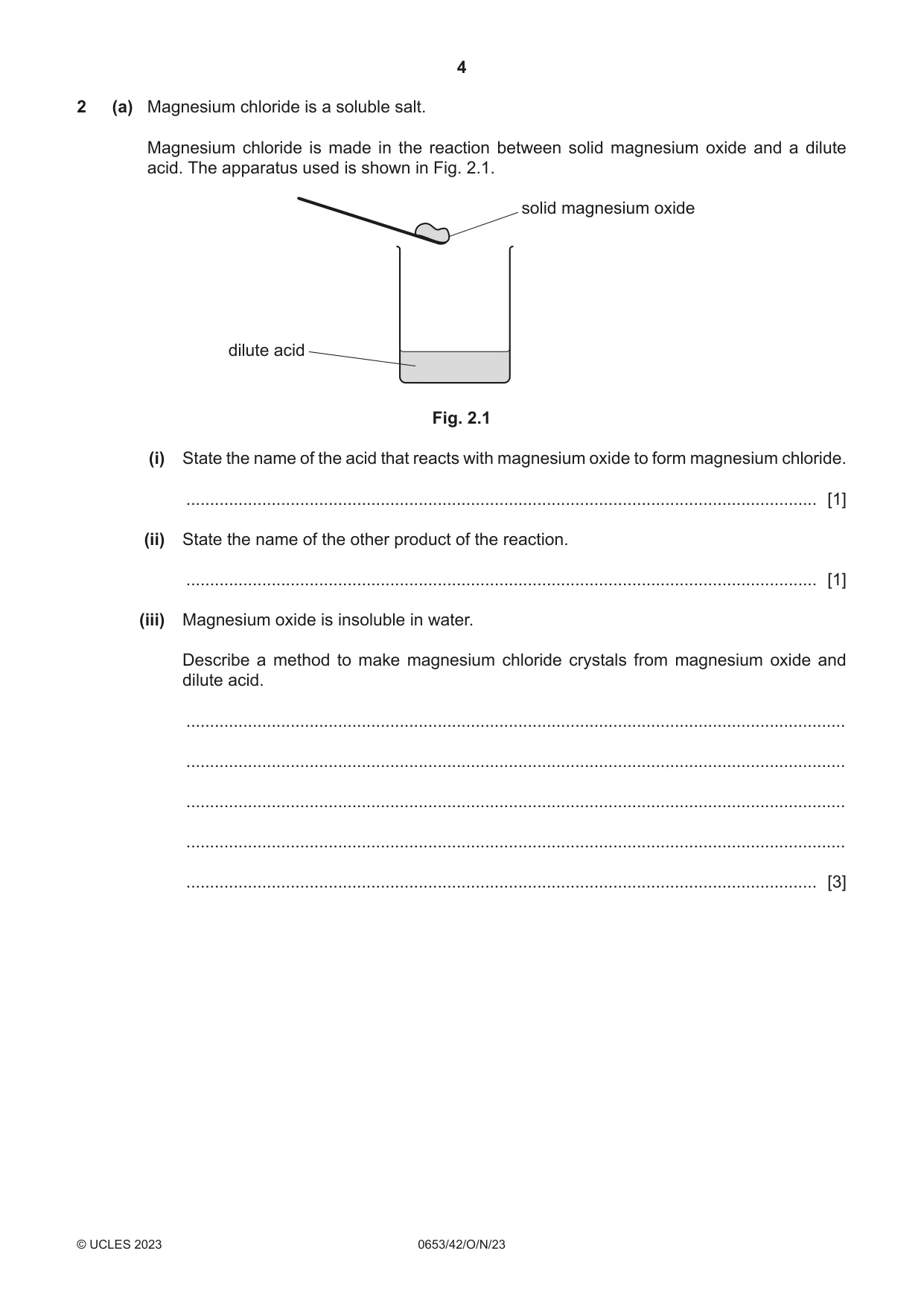
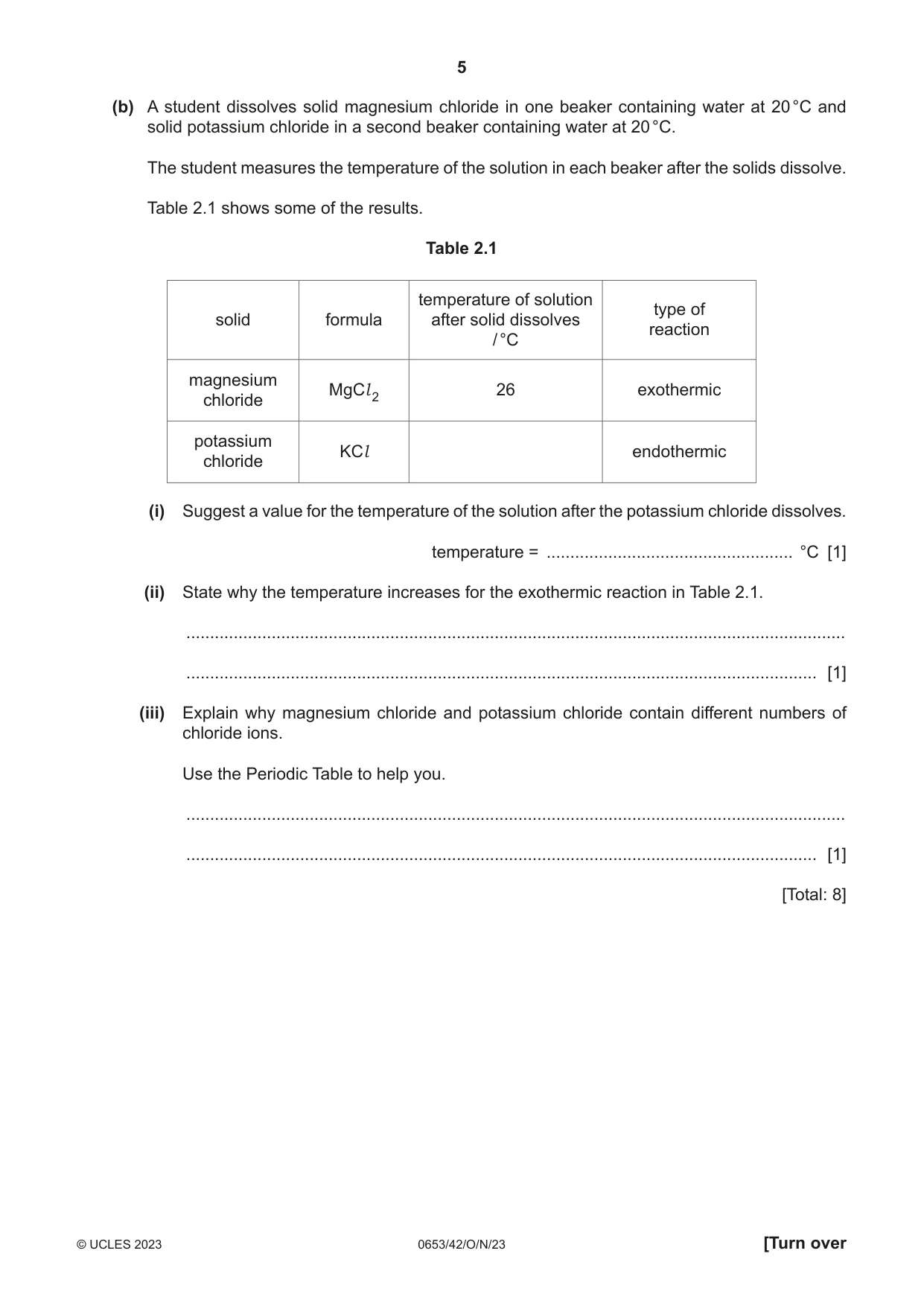
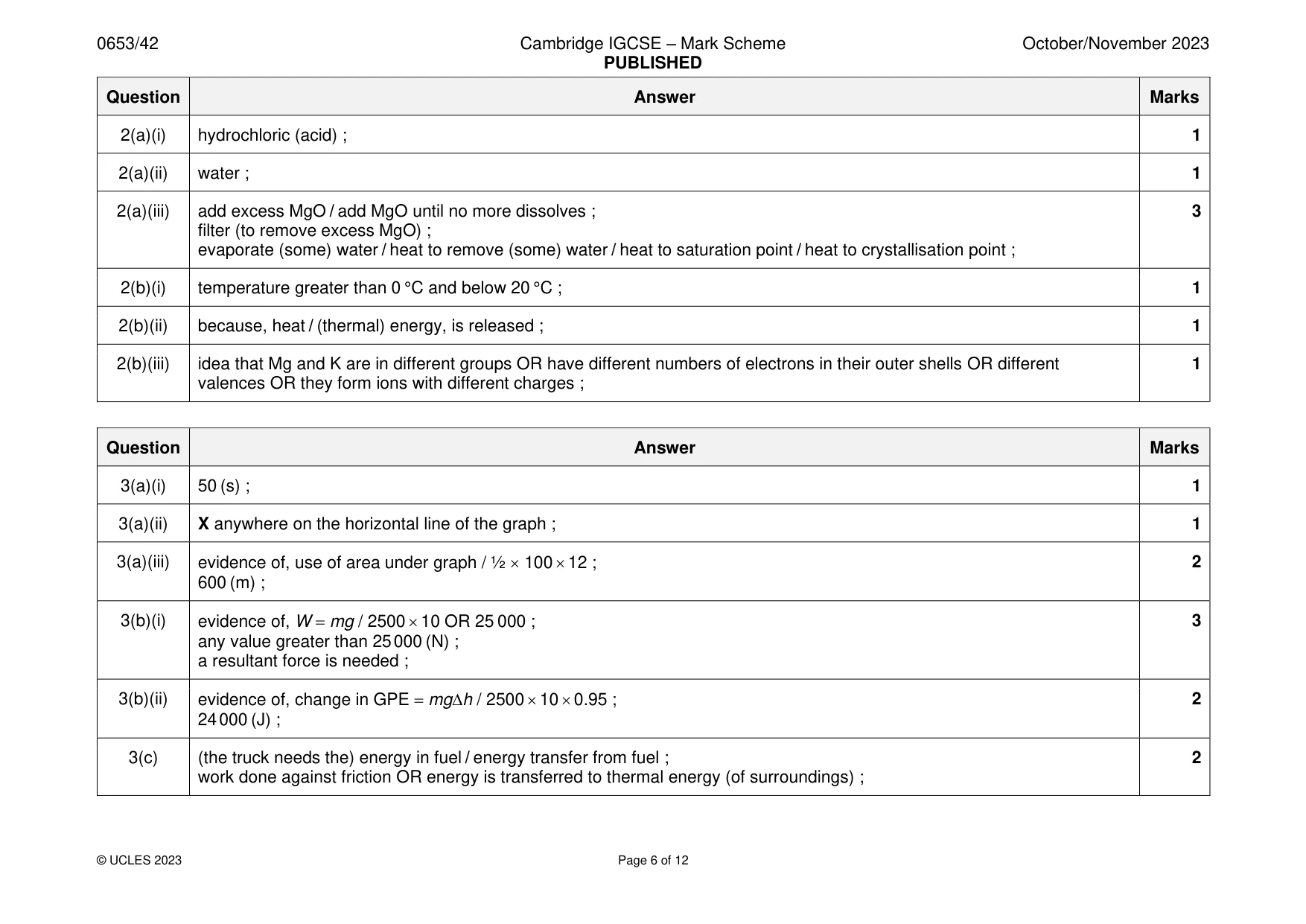
2 (a) Magnesium chloride is a soluble salt. Magnesium chloride is made in the reaction between solid magnesium oxide and a dilute acid. The apparatus used is shown in Fig. 2.1. solid magnesium oxide dilute acid Fig. 2.1 (i) State the name of the acid that reacts with magnesium oxide to form magnesium chloride. ..................................................................................................................................... [1] (ii) State the name of the other product of the reaction. ..................................................................................................................................... [1] (iii) Magnesium oxide is insoluble in water. Describe a method to make magnesium chloride crystals from magnesium oxide and dilute acid. ........................................................................................................................................... ........................................................................................................................................... ........................................................................................................................................... ........................................................................................................................................... ..................................................................................................................................... [3] (b) A student dissolves solid magnesium chloride in one beaker containing water at 20 °C and solid potassium chloride in a second beaker containing water at 20 °C. The student measures the temperature of the solution in each beaker after the solids dissolve. Table 2.1 shows some of the results. Table 2.1 temperature of solution type of solid formula after solid dissolves reaction / °C magnesium MgCl 2 26 exothermic chloride potassium KCl endothermic chloride (i) Suggest a value for the temperature of the solution after the potassium chloride dissolves. temperature = .................................................... °C [1] (ii) State why the temperature increases for the exothermic reaction in Table 2.1. ........................................................................................................................................... ..................................................................................................................................... [1] (iii) Explain why magnesium chloride and potassium chloride contain different numbers of chloride ions. Use the Periodic Table to help you. ........................................................................................................................................... ..................................................................................................................................... [1] [Total: 8]
Mark scheme: 2(a)(i) hydrochloric (acid) ; 1 2(a)(ii) water ; 1 2(a)(iii) add excess MgO / add MgO until no more dissolves ; 3 filter (to remove excess MgO) ; evaporate (some) water / heat to remove (some) water / heat to saturation point / heat to crystallisation point ; 2(b)(i) temperature greater than 0 °C and below 20 °C ; 1 2(b)(ii) because, heat / (thermal) energy, is released ; 1 2(b)(iii) idea that Mg and K are in different groups OR have different numbers of electrons in their outer shells OR different 1 valences OR they form ions with different charges ;
Question 3
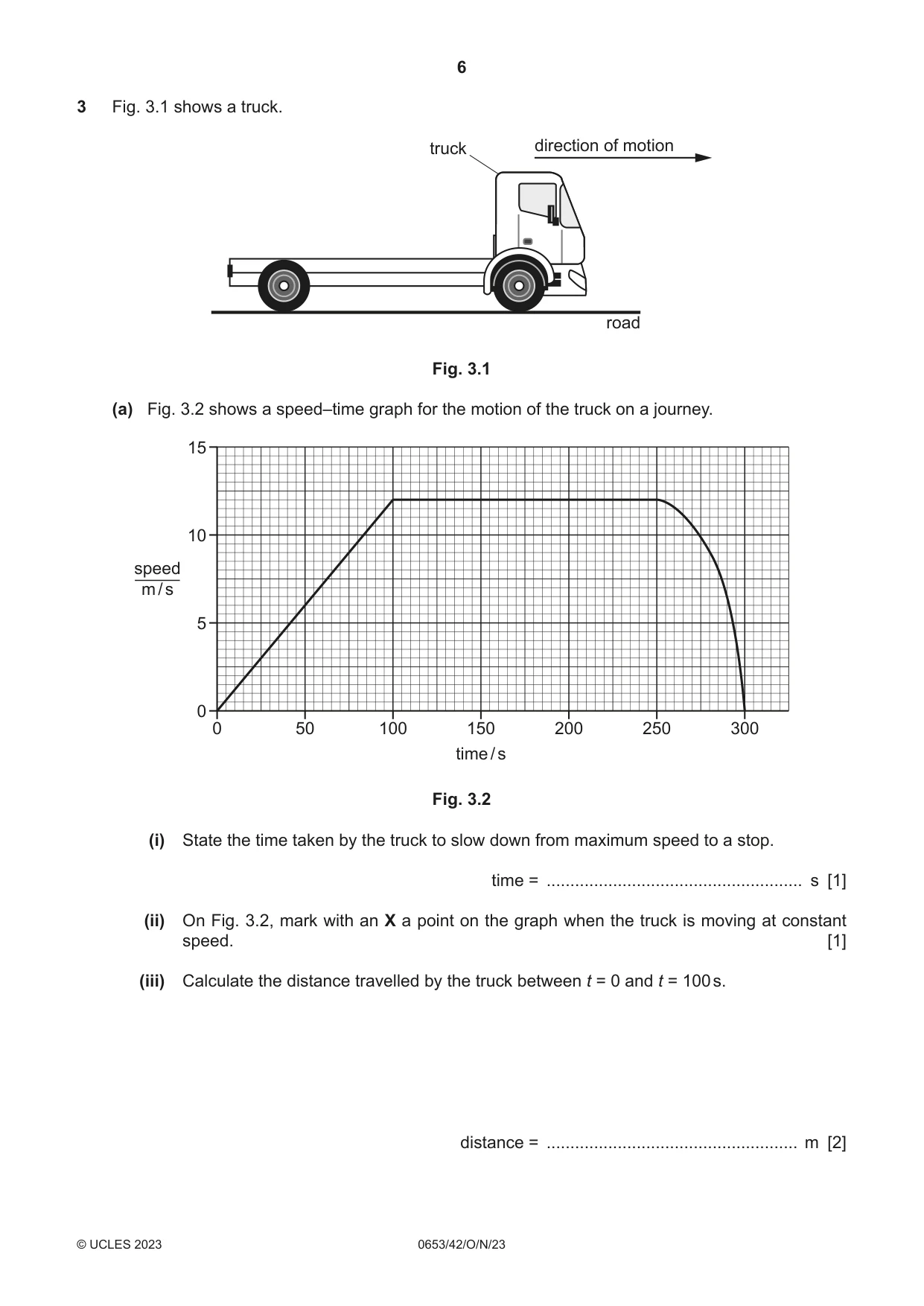
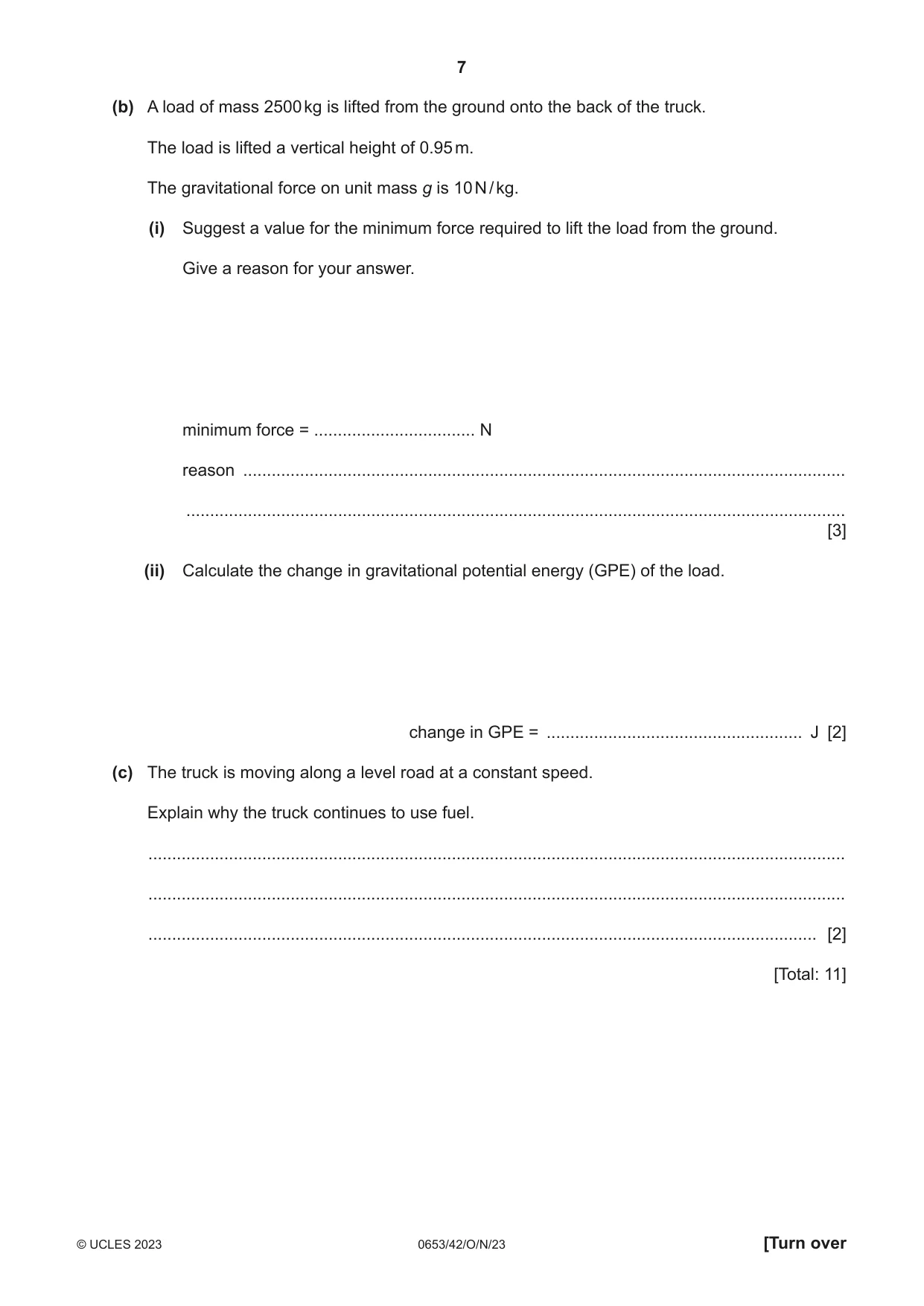
3 Fig. 3.1 shows a truck. truck direction of motion road Fig. 3.1 (a) Fig. 3.2 shows a speed–time graph for the motion of the truck on a journey. 15 10 speed m / s 5 0 0 50 100 150 200 250 300 time / s Fig. 3.2 (i) State the time taken by the truck to slow down from maximum speed to a stop. time = ...................................................... s [1] (ii) On Fig. 3.2, mark with an X a point on the graph when the truck is moving at constant speed. [1] (iii) Calculate the distance travelled by the truck between t = 0 and t = 100 s. distance = ..................................................... m [2] (b) A load of mass 2500 kg is lifted from the ground onto the back of the truck. The load is lifted a vertical height of 0.95 m. The gravitational force on unit mass g is 10 N / kg. (i) Suggest a value for the minimum force required to lift the load from the ground. Give a reason for your answer. minimum force = .................................. N reason ............................................................................................................................... ........................................................................................................................................... [3] (ii) Calculate the change in gravitational potential energy (GPE) of the load. change in GPE = ...................................................... J [2] (c) The truck is moving along a level road at a constant speed. Explain why the truck continues to use fuel. ................................................................................................................................................... ................................................................................................................................................... ............................................................................................................................................. [2] [Total: 11]
Mark scheme: 3(a)(i) 50 (s) ; 1 3(a)(ii) X anywhere on the horizontal line of the graph ; 1 3(a)(iii) evidence of, use of area under graph / ½ 100 12 ; 2 600 (m) ; 3(b)(i) evidence of, W = mg / 2500 10 OR 25 000 ; 3 any value greater than 25 000 (N) ; a resultant force is needed ; 3(b)(ii) evidence of, change in GPE = mgh / 2500 10 0.95 ; 2 24 000 (J) ; 3(c) (the truck needs the) energy in fuel / energy transfer from fuel ; 2 work done against friction OR energy is transferred to thermal energy (of surroundings) ;
Question 4
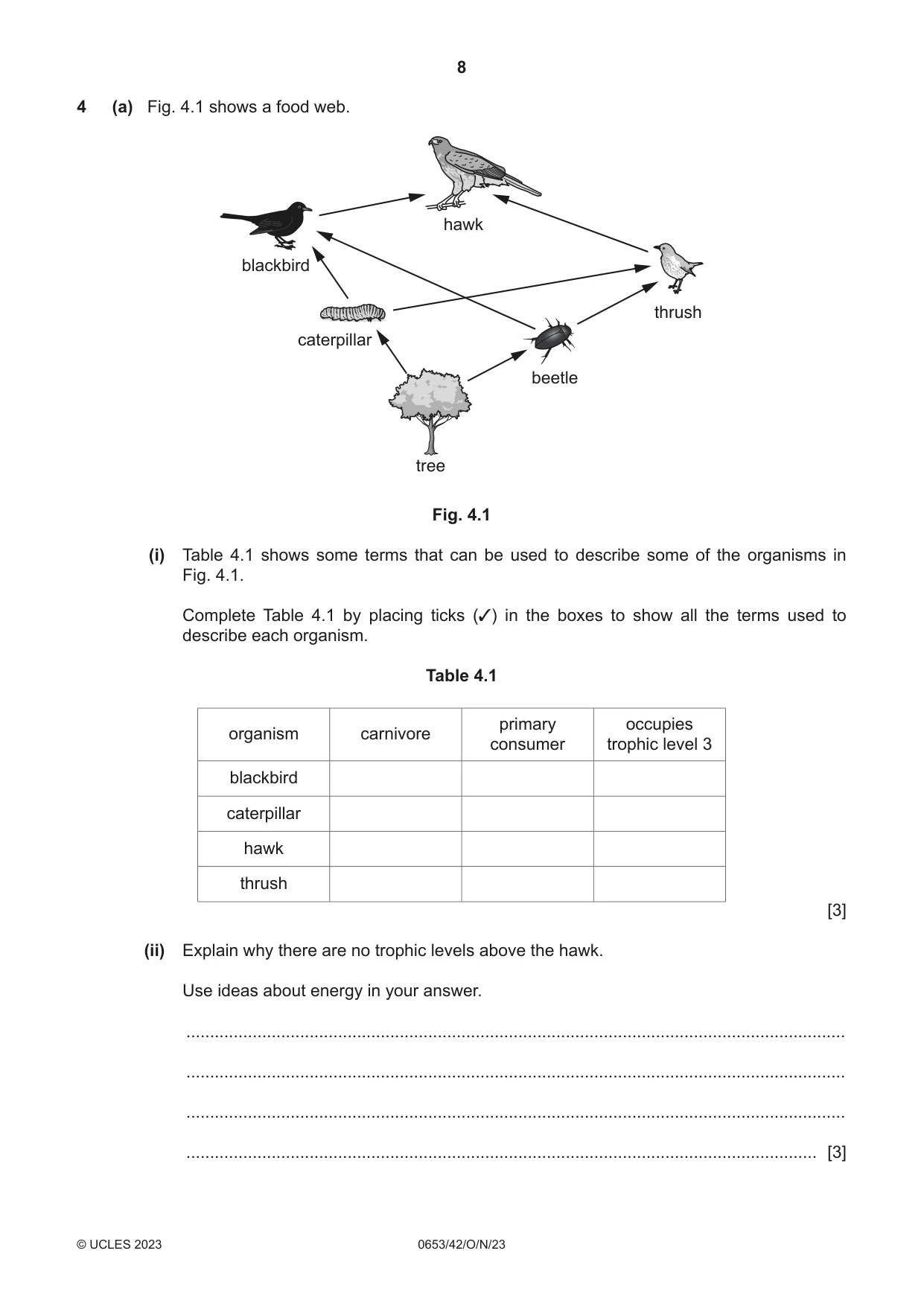
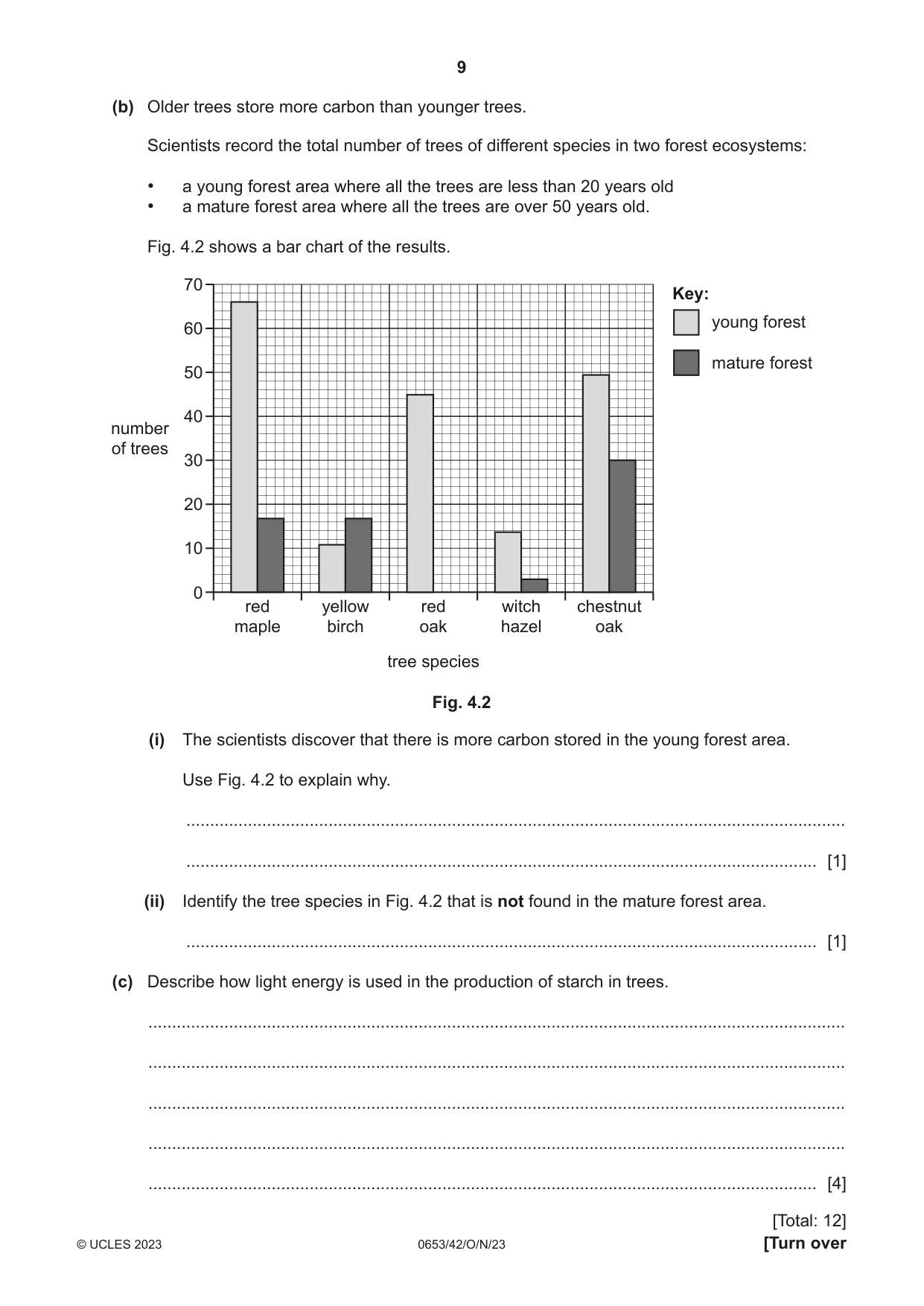
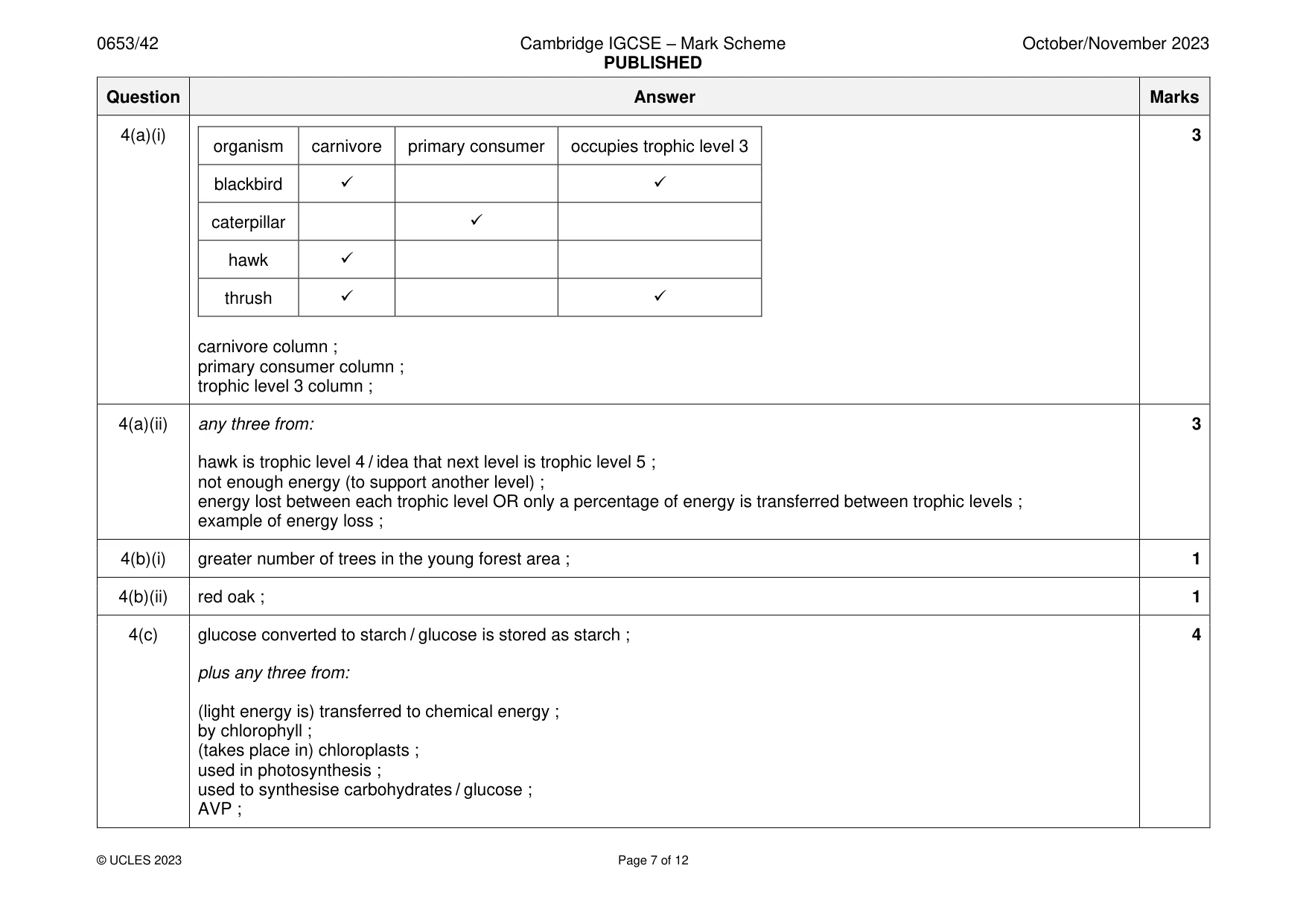
4 (a) Fig. 4.1 shows a food web. hawk blackbird thrush caterpillar beetle tree Fig. 4.1 (i) Table 4.1 shows some terms that can be used to describe some of the organisms in Fig. 4.1. Complete Table 4.1 by placing ticks (3) in the boxes to show all the terms used to describe each organism. Table 4.1 primary occupies organism carnivore consumer trophic level 3 blackbird caterpillar hawk thrush [3] (ii) Explain why there are no trophic levels above the hawk. Use ideas about energy in your answer. ........................................................................................................................................... ........................................................................................................................................... ........................................................................................................................................... ..................................................................................................................................... [3] (b) Older trees store more carbon than younger trees. Scientists record the total number of trees of different species in two forest ecosystems: • a young forest area where all the trees are less than 20 years old • a mature forest area where all the trees are over 50 years old. Fig. 4.2 shows a bar chart of the results. 70 Key: young forest 60 mature forest 50 40 number of trees 30 20 10 0 red yellow red witch chestnut maple birch oak hazel oak tree species Fig. 4.2 (i) The scientists discover that there is more carbon stored in the young forest area. Use Fig. 4.2 to explain why. ........................................................................................................................................... ..................................................................................................................................... [1] (ii) Identify the tree species in Fig. 4.2 that is not found in the mature forest area. ..................................................................................................................................... [1] (c) Describe how light energy is used in the production of starch in trees. ................................................................................................................................................... ................................................................................................................................................... ................................................................................................................................................... ................................................................................................................................................... ............................................................................................................................................. [4] [Total: 12]
Mark scheme: 4(a)(i) 3 organism carnivore primary consumer occupies trophic level 3 blackbird ✓ ✓ caterpillar ✓ hawk ✓ thrush ✓ ✓ carnivore column ; primary consumer column ; trophic level 3 column ; 4(a)(ii) any three from: 3 hawk is trophic level 4 / idea that next level is trophic level 5 ; not enough energy (to support another level) ; energy lost between each trophic level OR only a percentage of energy is transferred between trophic levels ; example of energy loss ; 4(b)(i) greater number of trees in the young forest area ; 1 4(b)(ii) red oak ; 1 4(c) glucose converted to starch / glucose is stored as starch ; 4 plus any three from: (light energy is) transferred to chemical energy ; by chlorophyll ; (takes place in) chloroplasts ; used in photosynthesis ; used to synthesise carbohydrates / glucose ; AVP ;
Q5 · A student investigates the reaction of dilute hydrochloric acid with different metals
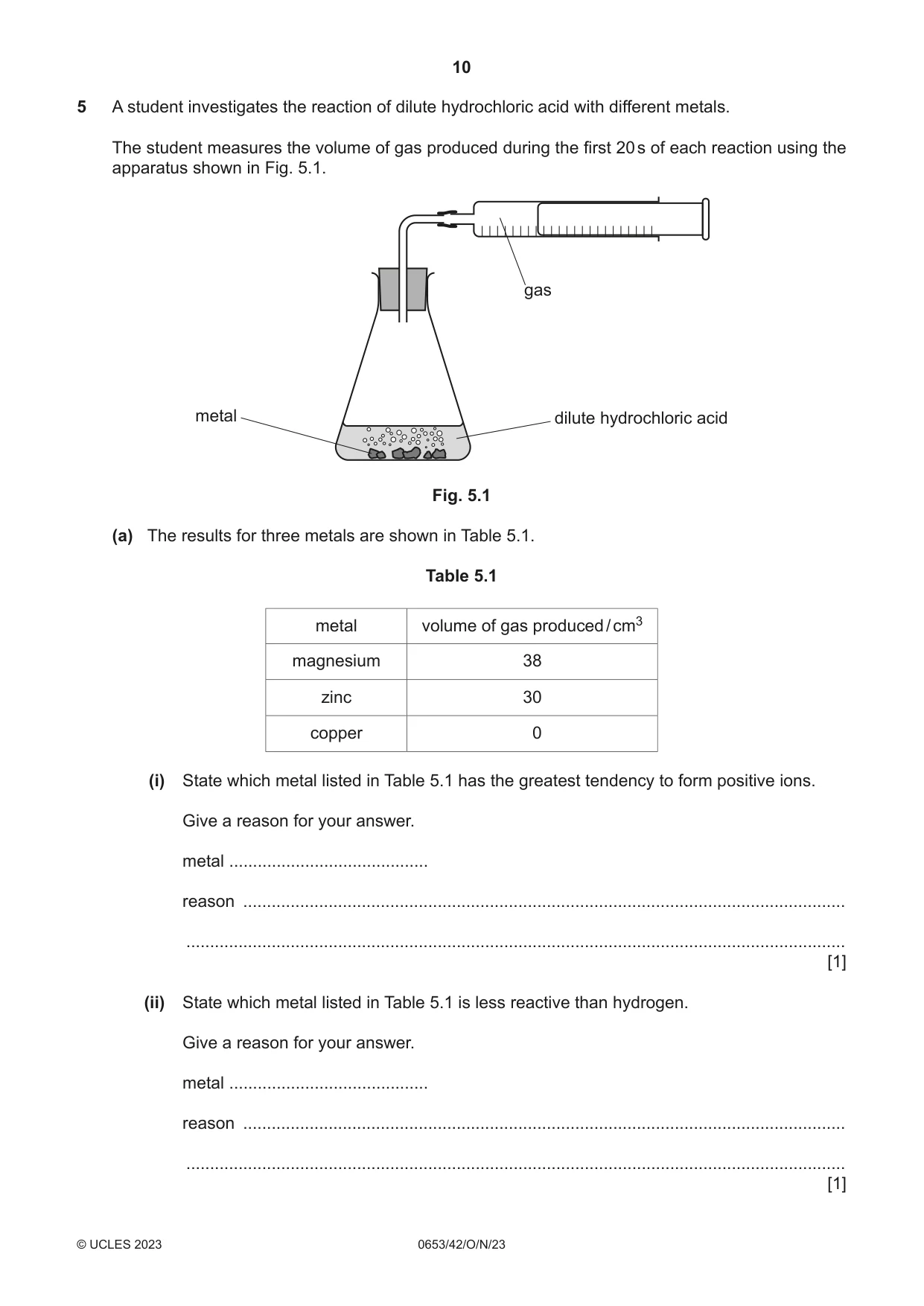
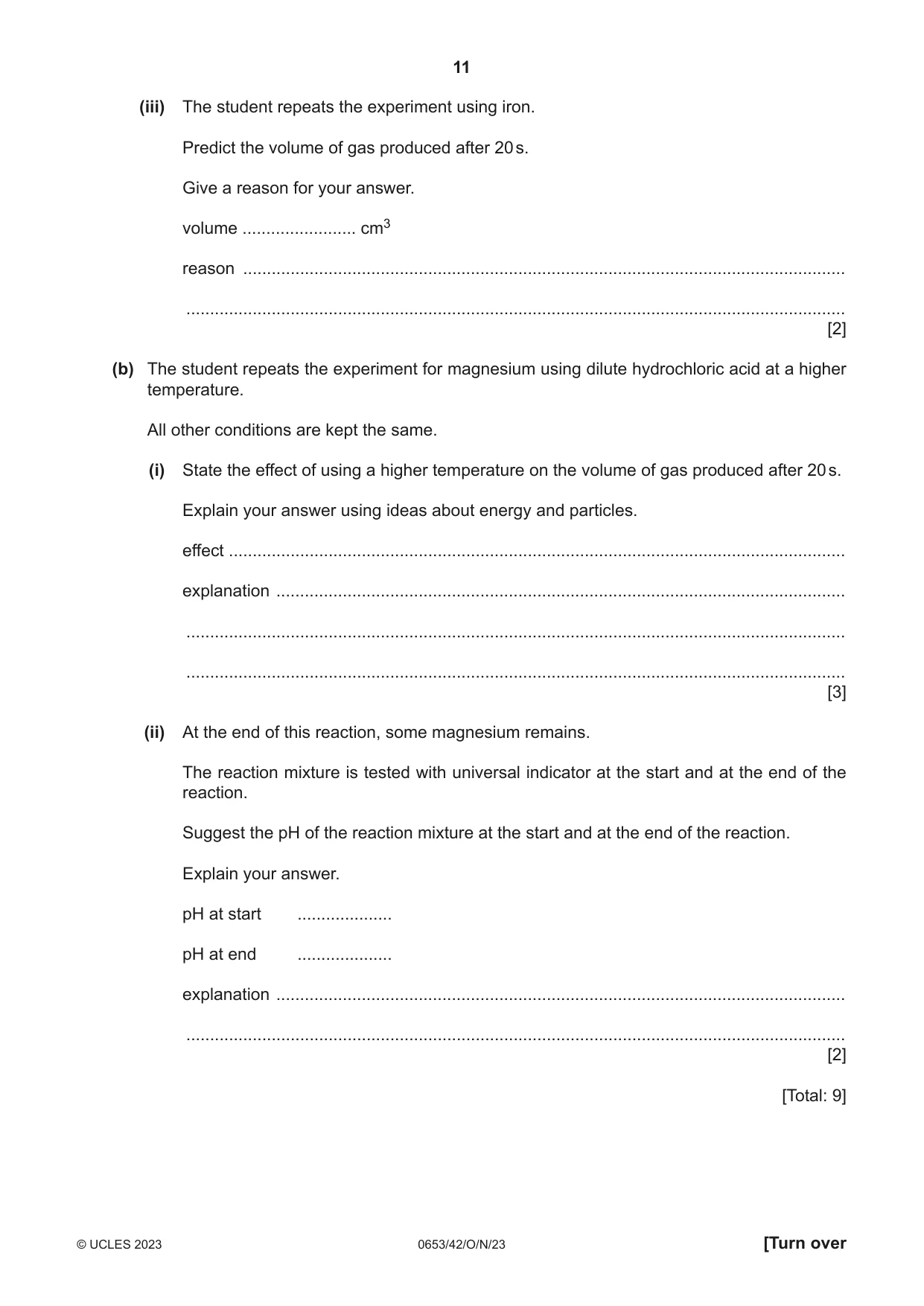
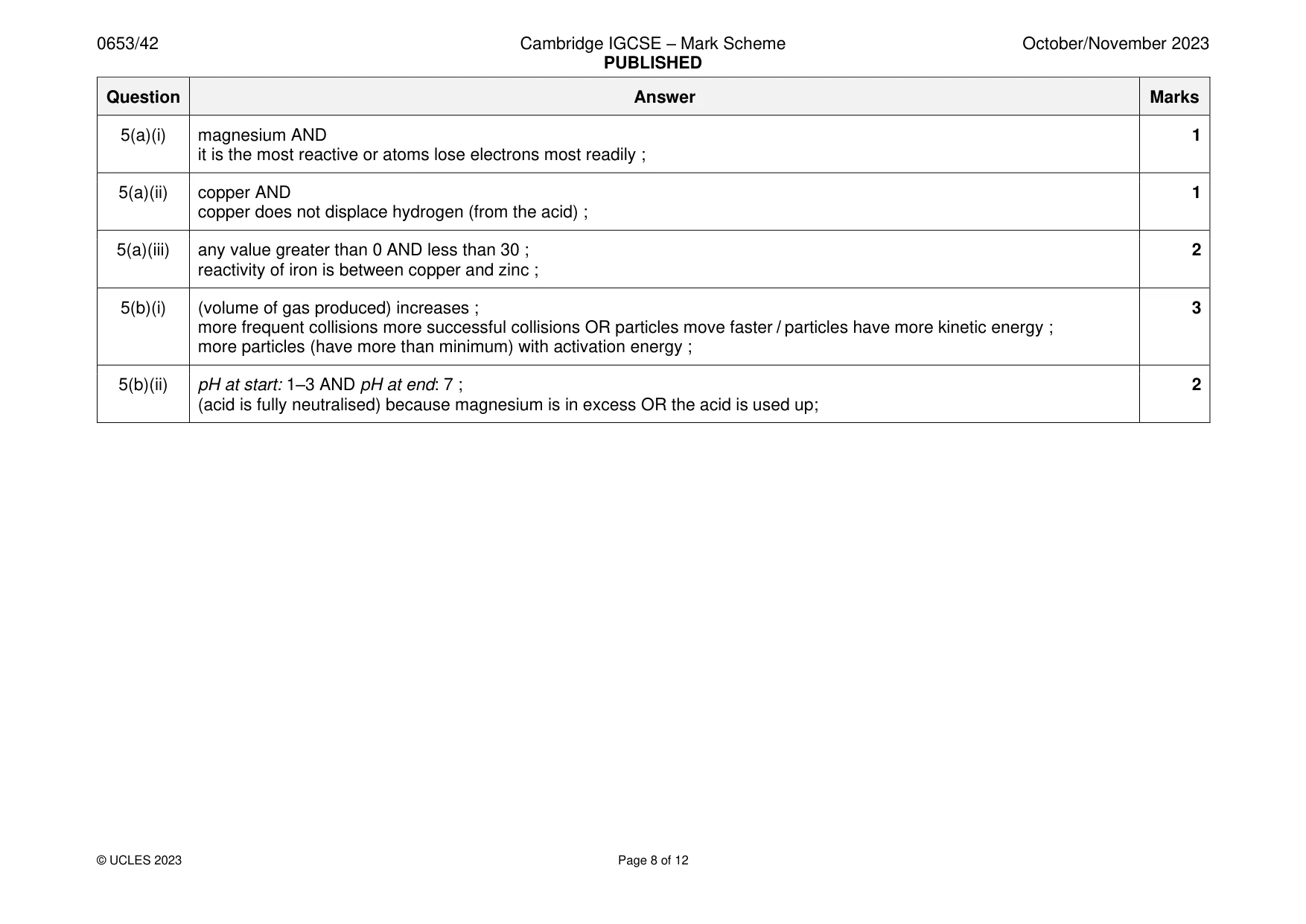
5 A student investigates the reaction of dilute hydrochloric acid with different metals. The student measures the volume of gas produced during the first 20 s of each reaction using the apparatus shown in Fig. 5.1. gas metal dilute hydrochloric acid Fig. 5.1 (a) The results for three metals are shown in Table 5.1. Table 5.1 metal volume of gas produced / cm3 magnesium 38 zinc 30 copper 0 (i) State which metal listed in Table 5.1 has the greatest tendency to form positive ions. Give a reason for your answer. metal .......................................... reason ............................................................................................................................... ........................................................................................................................................... [1] (ii) State which metal listed in Table 5.1 is less reactive than hydrogen. Give a reason for your answer. metal .......................................... reason ............................................................................................................................... ........................................................................................................................................... [1] (iii) The student repeats the experiment using iron. Predict the volume of gas produced after 20 s. Give a reason for your answer. volume ........................ cm3 reason ............................................................................................................................... ........................................................................................................................................... [2] (b) The student repeats the experiment for magnesium using dilute hydrochloric acid at a higher temperature. All other conditions are kept the same. (i) State the effect of using a higher temperature on the volume of gas produced after 20 s. Explain your answer using ideas about energy and particles. effect .................................................................................................................................. explanation ........................................................................................................................ ........................................................................................................................................... ........................................................................................................................................... [3] (ii) At the end of this reaction, some magnesium remains. The reaction mixture is tested with universal indicator at the start and at the end of the reaction. Suggest the pH of the reaction mixture at the start and at the end of the reaction. Explain your answer. pH at start .................... pH at end .................... explanation ........................................................................................................................ ........................................................................................................................................... [2] [Total: 9]
Mark scheme: 5(a)(i) magnesium AND 1 it is the most reactive or atoms lose electrons most readily ; 5(a)(ii) copper AND 1 copper does not displace hydrogen (from the acid) ; 5(a)(iii) any value greater than 0 AND less than 30 ; 2 reactivity of iron is between copper and zinc ; 5(b)(i) (volume of gas produced) increases ; 3 more frequent collisions more successful collisions OR particles move faster / particles have more kinetic energy ; more particles (have more than minimum) with activation energy ; 5(b)(ii) pH at start: 1–3 AND pH at end: 7 ; 2 (acid is fully neutralised) because magnesium is in excess OR the acid is used up;
Q6 · A lighthouse used at night to warn ships of dangerous rocks in the sea
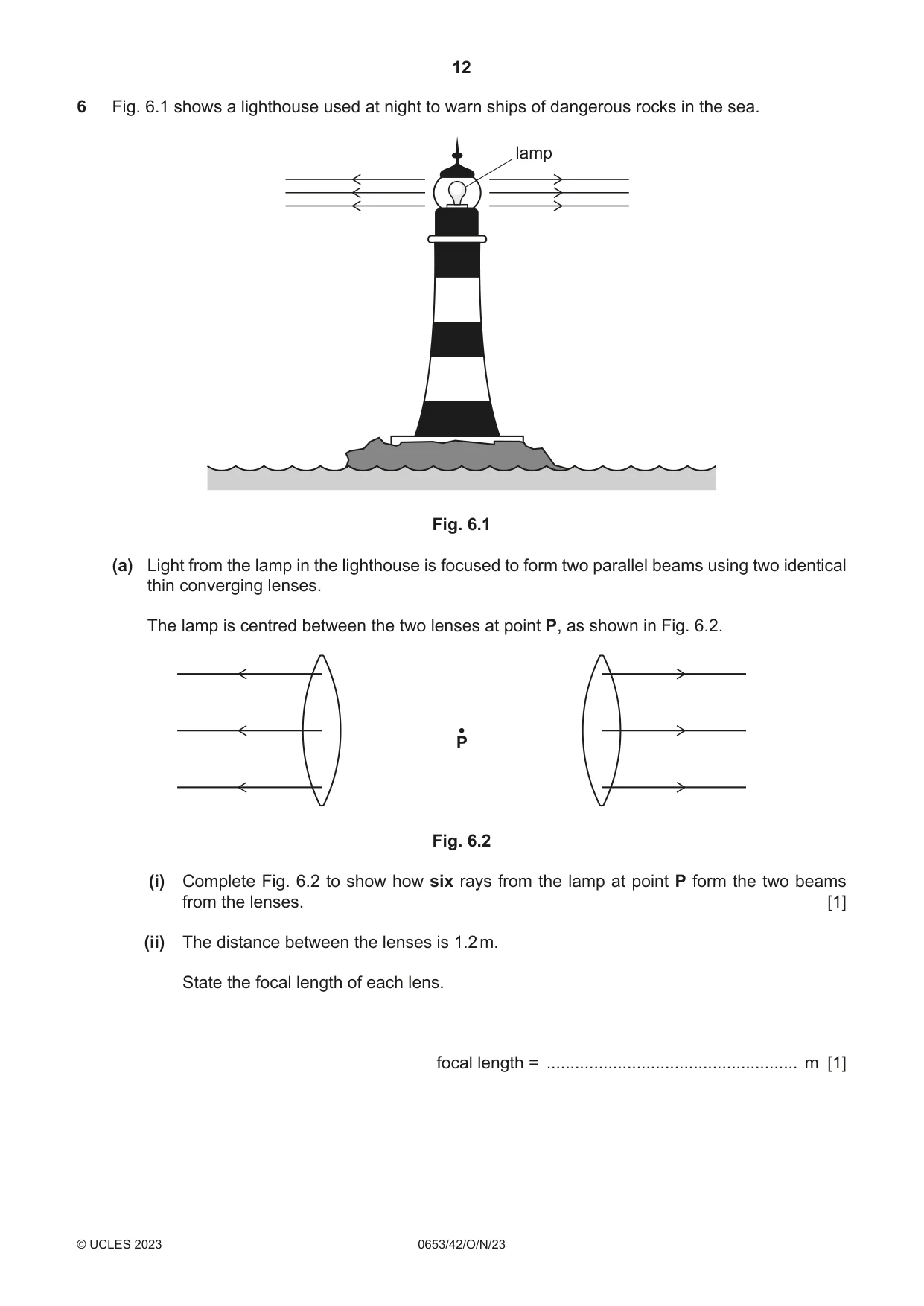
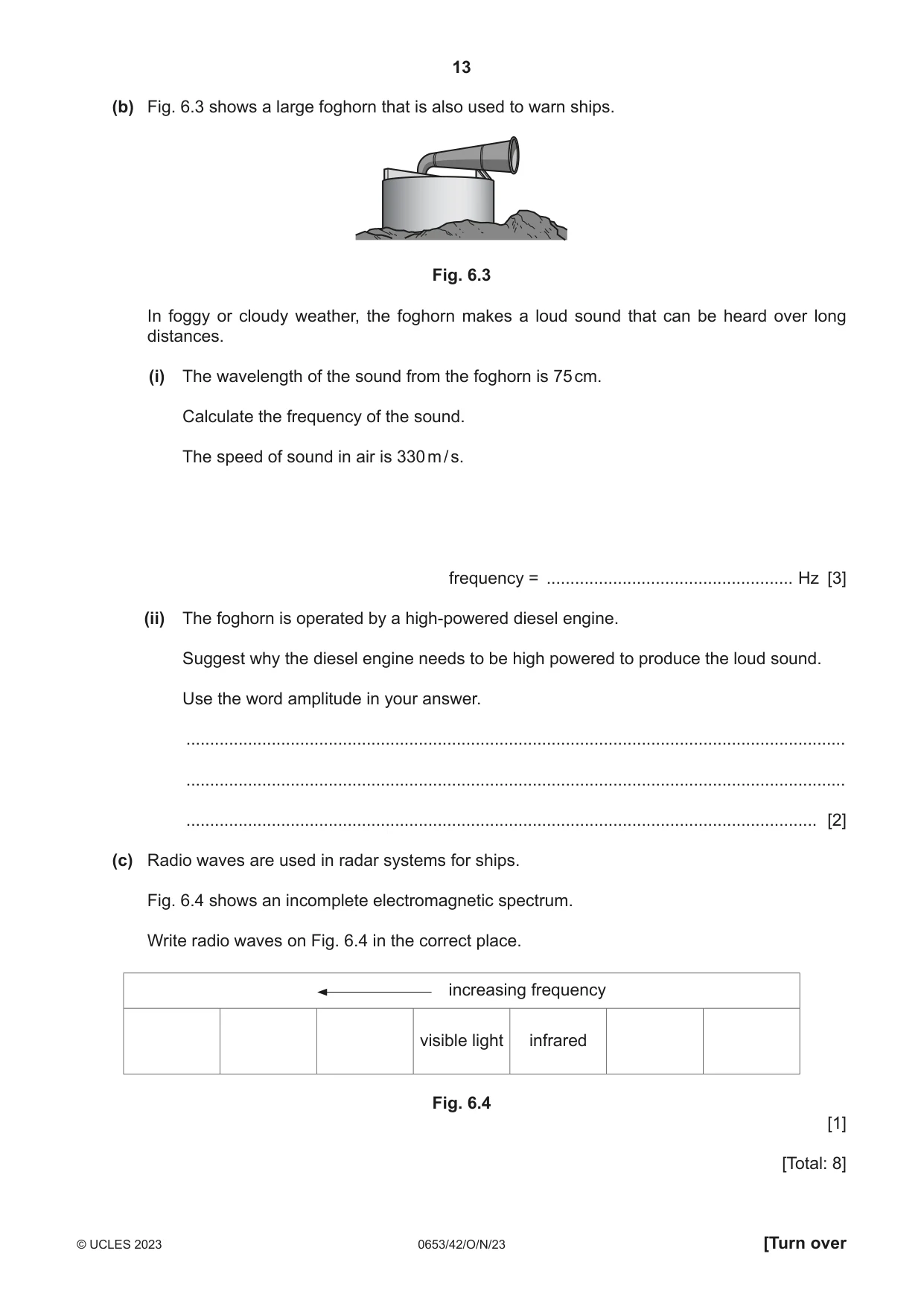
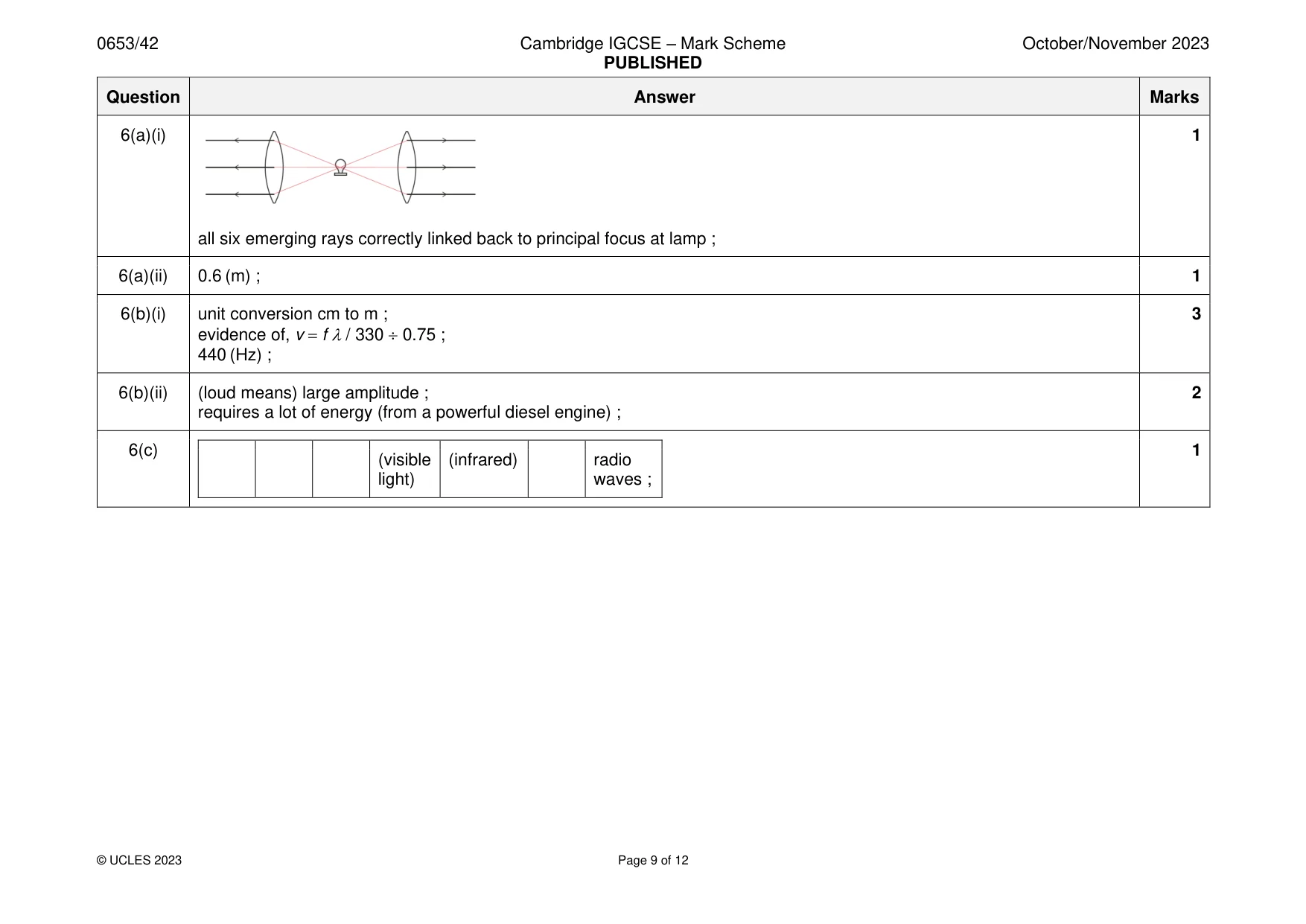
6 Fig. 6.1 shows a lighthouse used at night to warn ships of dangerous rocks in the sea. lamp Fig. 6.1 (a) Light from the lamp in the lighthouse is focused to form two parallel beams using two identical thin converging lenses. The lamp is centred between the two lenses at point P, as shown in Fig. 6.2. P Fig. 6.2 (i) Complete Fig. 6.2 to show how six rays from the lamp at point P form the two beams from the lenses. [1] (ii) The distance between the lenses is 1.2 m. State the focal length of each lens. focal length = ..................................................... m [1] (b) Fig. 6.3 shows a large foghorn that is also used to warn ships. Fig. 6.3 In foggy or cloudy weather, the foghorn makes a loud sound that can be heard over long distances. (i) The wavelength of the sound from the foghorn is 75 cm. Calculate the frequency of the sound. The speed of sound in air is 330 m / s. frequency = .................................................... Hz [3] (ii) The foghorn is operated by a high-powered diesel engine. Suggest why the diesel engine needs to be high powered to produce the loud sound. Use the word amplitude in your answer. ........................................................................................................................................... ........................................................................................................................................... ..................................................................................................................................... [2] (c) Radio waves are used in radar systems for ships. Fig. 6.4 shows an incomplete electromagnetic spectrum. Write radio waves on Fig. 6.4 in the correct place. increasing frequency visible light infrared Fig. 6.4 [1] [Total: 8]
Mark scheme: 6(a)(i) 1 all six emerging rays correctly linked back to principal focus at lamp ; 6(a)(ii) 0.6 (m) ; 1 6(b)(i) unit conversion cm to m ; 3 evidence of, v = f / 330 0.75 ; 440 (Hz) ; 6(b)(ii) (loud means) large amplitude ; 2 requires a lot of energy (from a powerful diesel engine) ; 6(c) 1 (visible (infrared) radio light) waves ;
Q7 · Explain one way the structure of an artery is adapted to its function
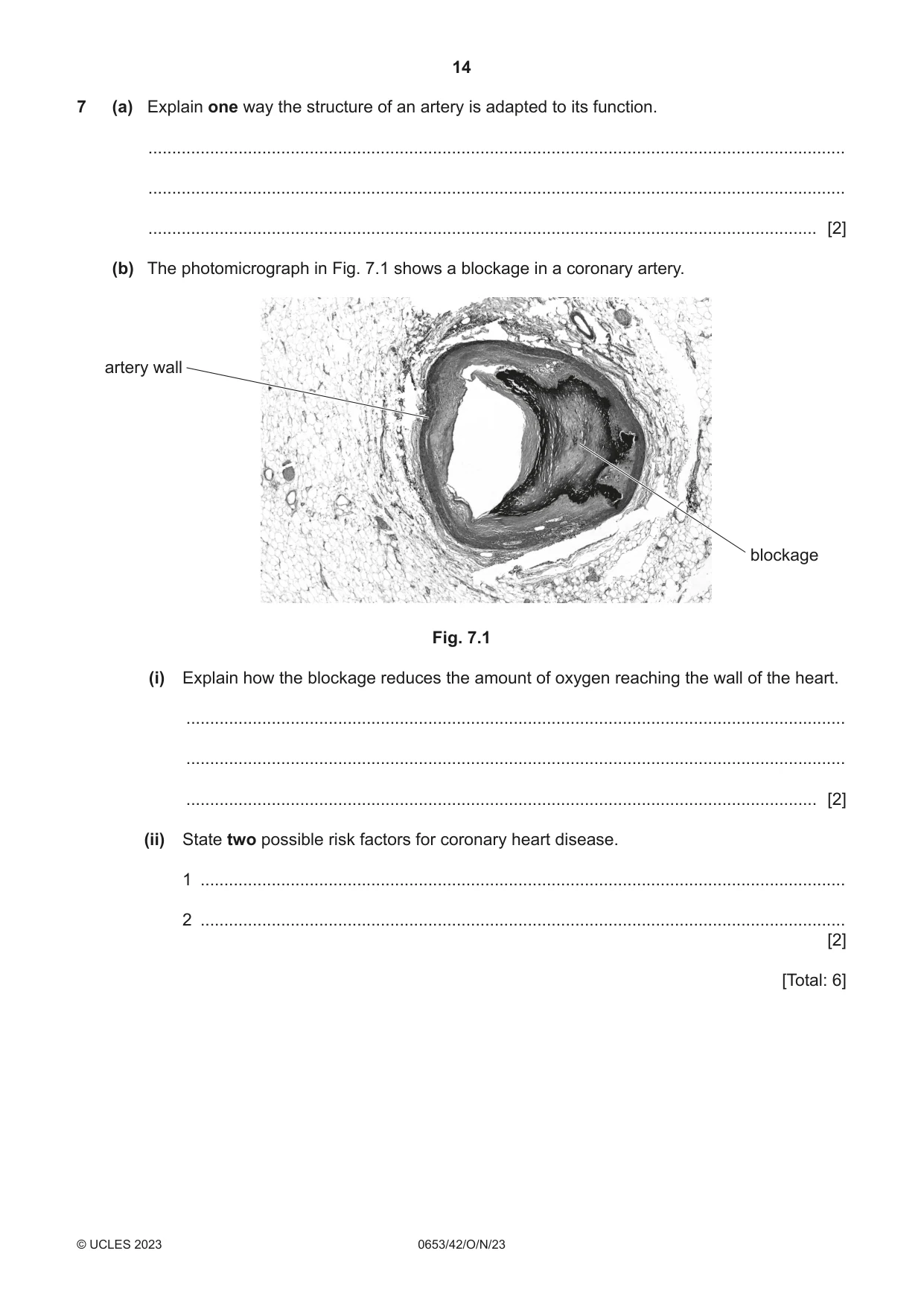
7 (a) Explain one way the structure of an artery is adapted to its function. ................................................................................................................................................... ................................................................................................................................................... ............................................................................................................................................. [2] (b) The photomicrograph in Fig. 7.1 shows a blockage in a coronary artery. artery wall blockage Fig. 7.1 (i) Explain how the blockage reduces the amount of oxygen reaching the wall of the heart. ........................................................................................................................................... ........................................................................................................................................... ..................................................................................................................................... [2] (ii) State two possible risk factors for coronary heart disease. 1 ........................................................................................................................................ 2 ........................................................................................................................................ [2] [Total: 6]
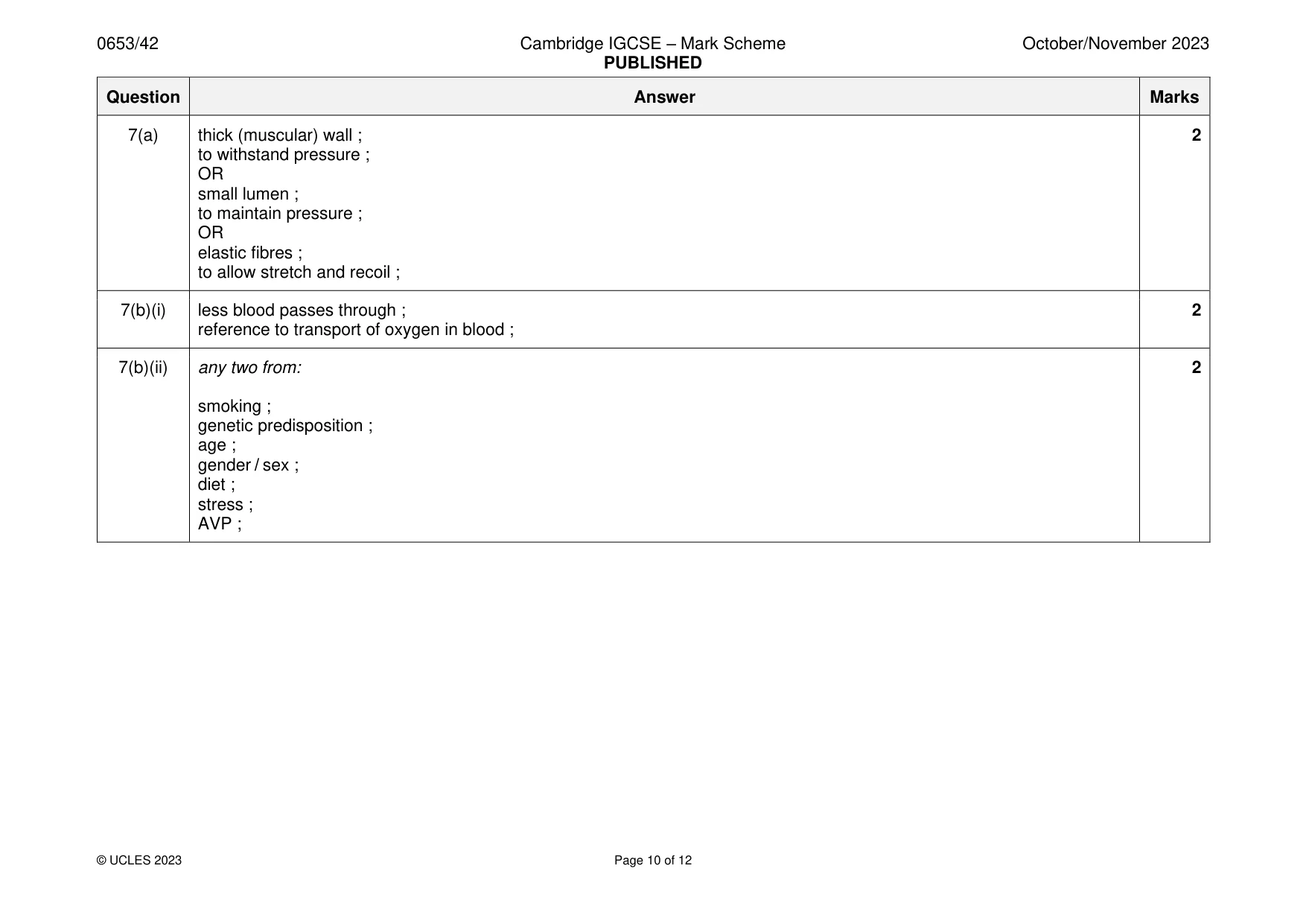
Mark scheme: 7(a) thick (muscular) wall ; 2 to withstand pressure ; OR small lumen ; to maintain pressure ; OR elastic fibres ; to allow stretch and recoil ; 7(b)(i) less blood passes through ; 2 reference to transport of oxygen in blood ; 7(b)(ii) any two from: 2 smoking ; genetic predisposition ; age ; gender / sex ; diet ; stress ; AVP ;
Q8 · Iron is extracted from hematite in a blast furnace
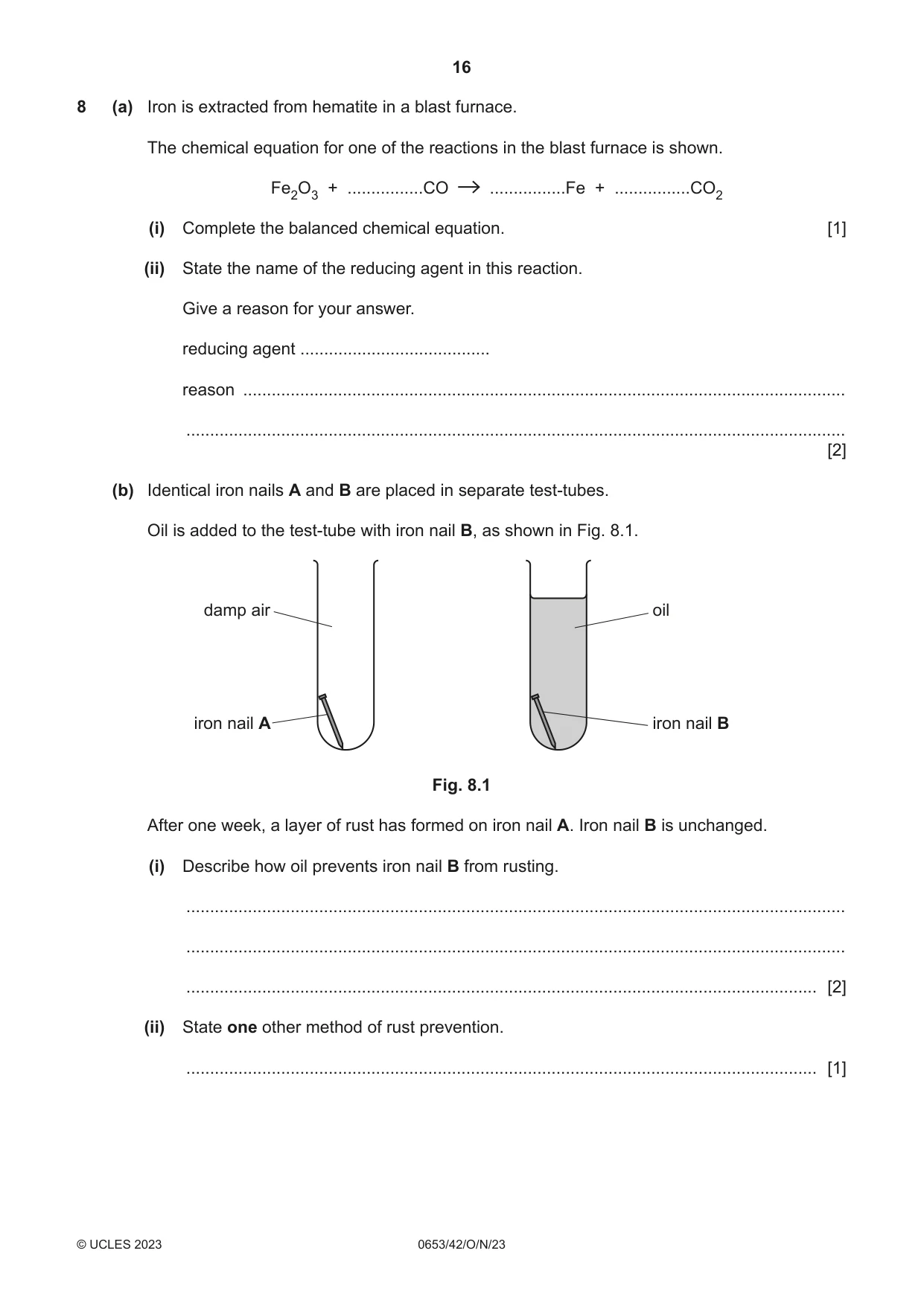
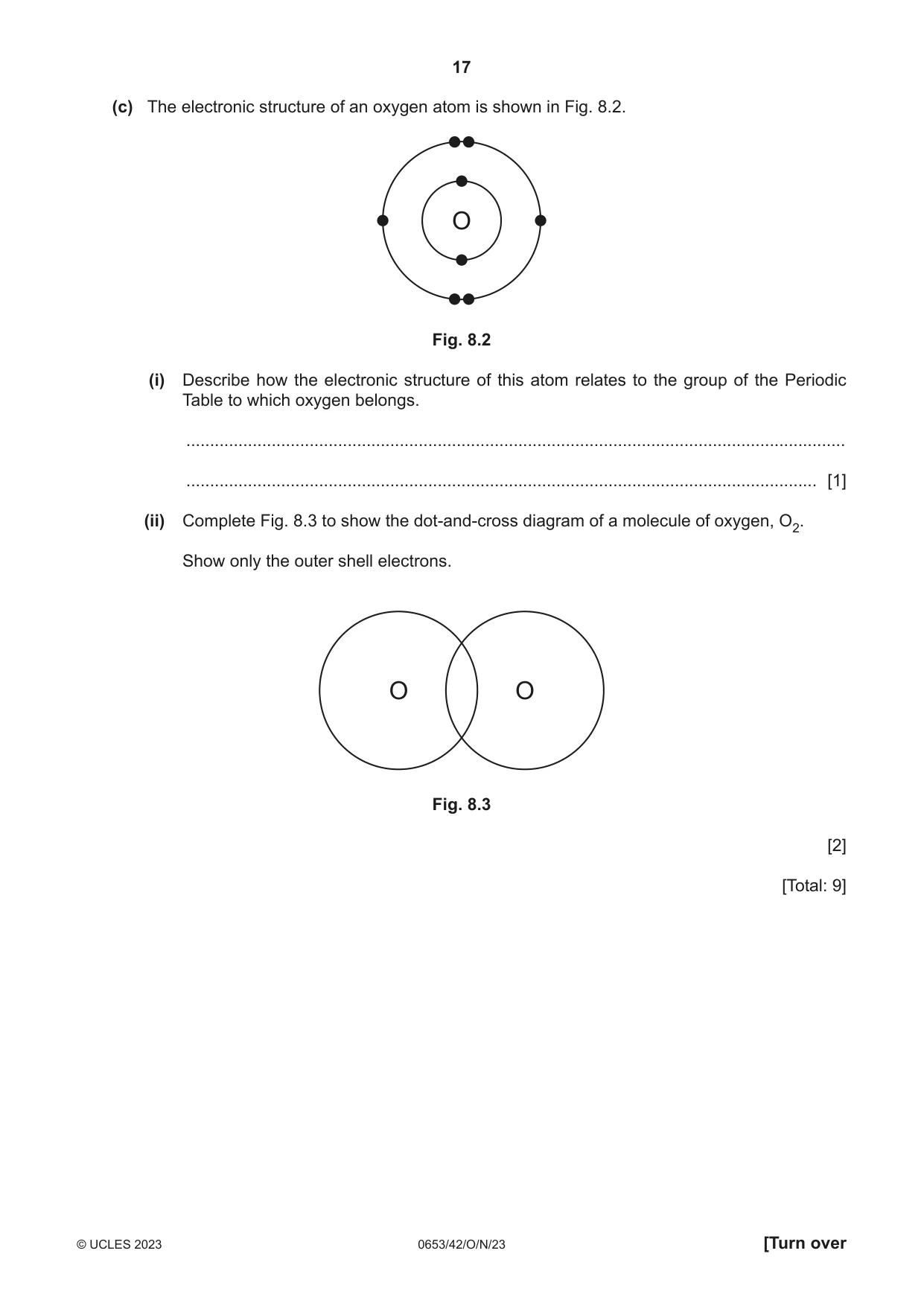
8 (a) Iron is extracted from hematite in a blast furnace. The chemical equation for one of the reactions in the blast furnace is shown. Fe2O3 + ................CO ................Fe + ................CO2 (i) Complete the balanced chemical equation. [1] (ii) State the name of the reducing agent in this reaction. Give a reason for your answer. reducing agent ........................................ reason ............................................................................................................................... ........................................................................................................................................... [2] (b) Identical iron nails A and B are placed in separate test-tubes. Oil is added to the test-tube with iron nail B, as shown in Fig. 8.1. damp air oil iron nail A iron nail B Fig. 8.1 After one week, a layer of rust has formed on iron nail A. Iron nail B is unchanged. (i) Describe how oil prevents iron nail B from rusting. ........................................................................................................................................... ........................................................................................................................................... ..................................................................................................................................... [2] (ii) State one other method of rust prevention. ..................................................................................................................................... [1] (c) The electronic structure of an oxygen atom is shown in Fig. 8.2. O Fig. 8.2 (i) Describe how the electronic structure of this atom relates to the group of the Periodic Table to which oxygen belongs. ........................................................................................................................................... ..................................................................................................................................... [1] (ii) Complete Fig. 8.3 to show the dot-and-cross diagram of a molecule of oxygen, O2. Show only the outer shell electrons. O O Fig. 8.3 [2] [Total: 9]
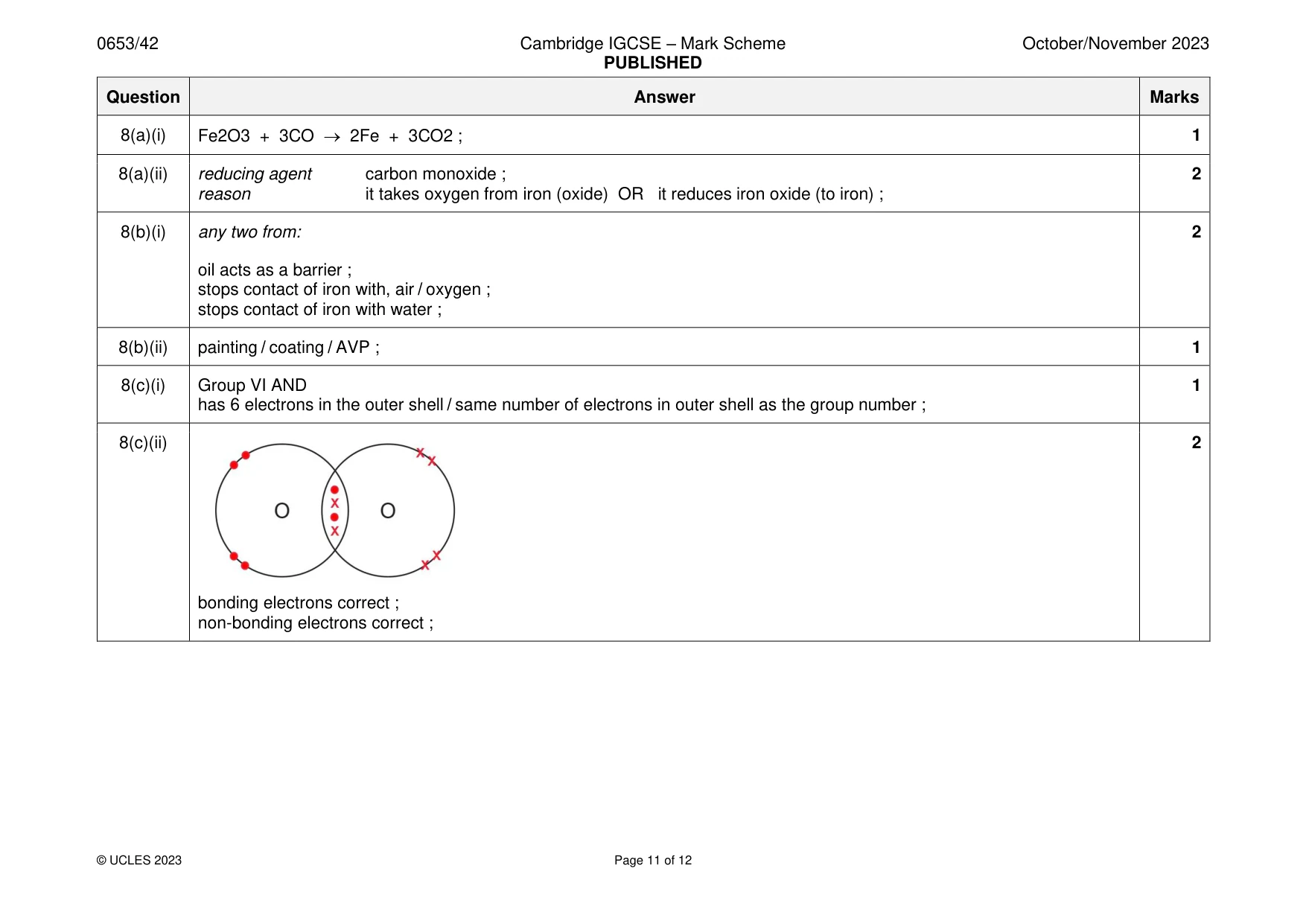
Mark scheme: 8(a)(i) Fe2O3 + 3CO → 2Fe + 3CO2 ; 1 8(a)(ii) reducing agent carbon monoxide ; 2 reason it takes oxygen from iron (oxide) OR it reduces iron oxide (to iron) ; 8(b)(i) any two from: 2 oil acts as a barrier ; stops contact of iron with, air / oxygen ; stops contact of iron with water ; 8(b)(ii) painting / coating / AVP ; 1 8(c)(i) Group VI AND 1 has 6 electrons in the outer shell / same number of electrons in outer shell as the group number ; 8(c)(ii) 2 bonding electrons correct ; non-bonding electrons correct ;
Q9 · Two identical floodlights, F and G, at a sports ground
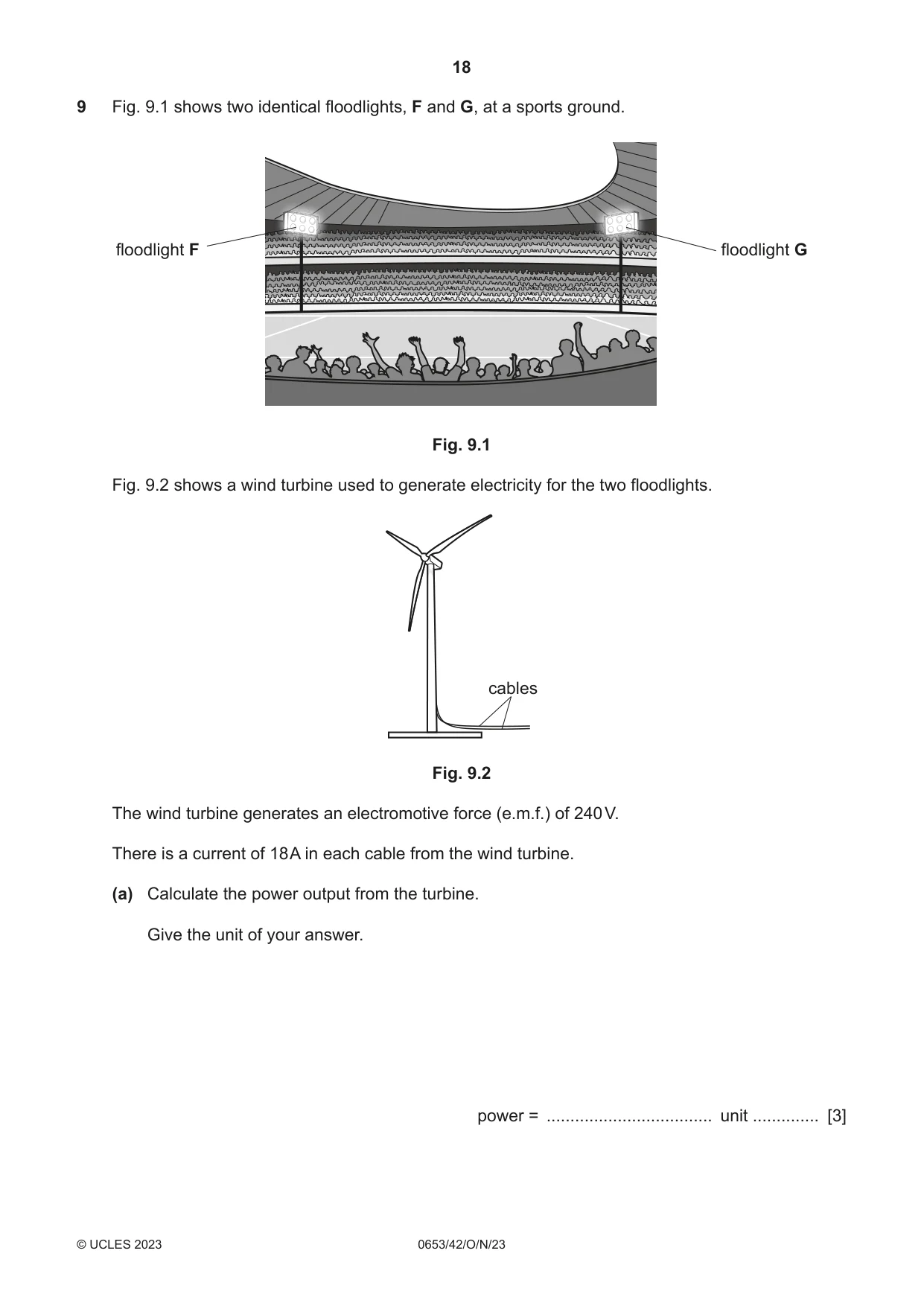
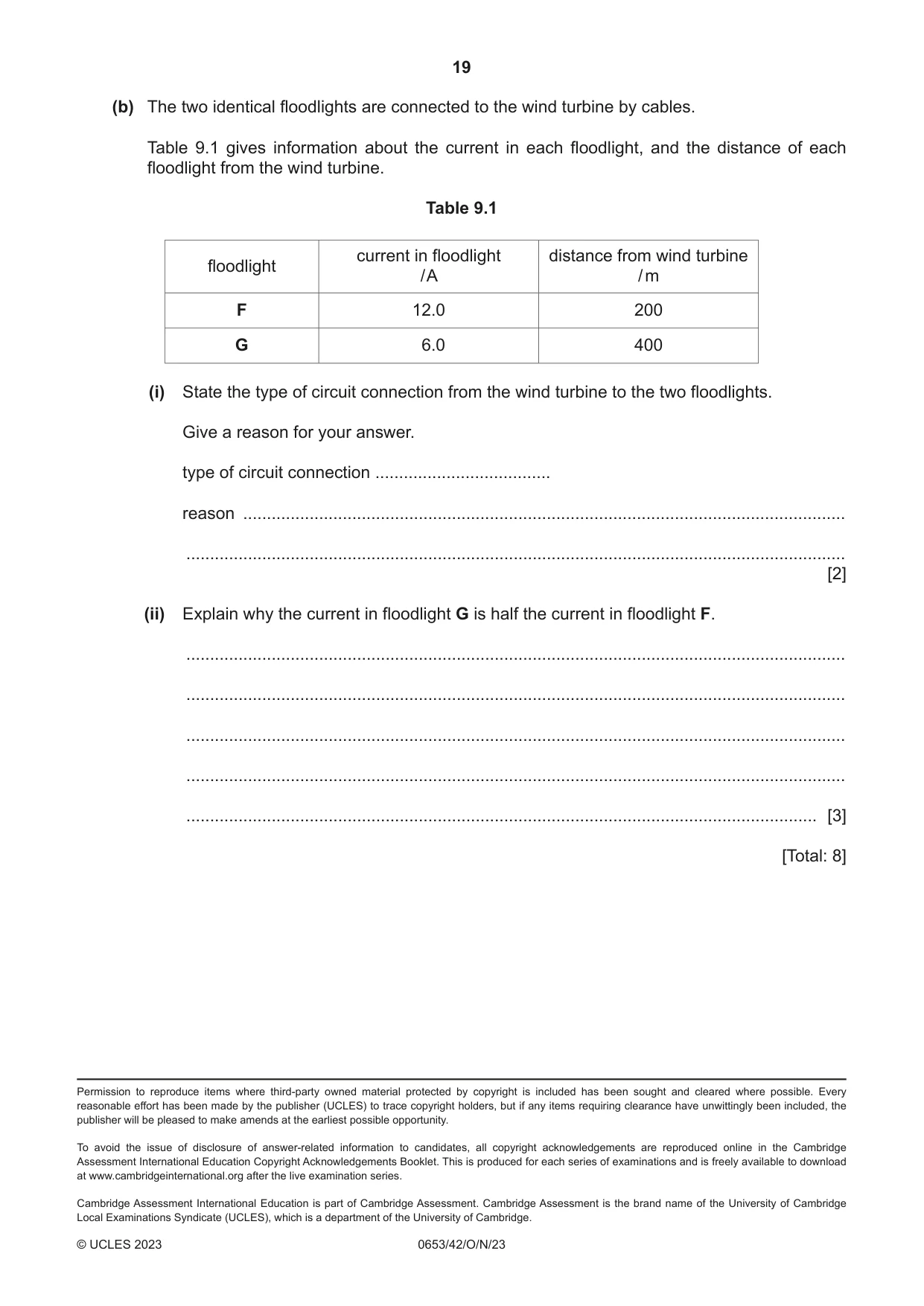
9 Fig. 9.1 shows two identical floodlights, F and G, at a sports ground. floodlight F floodlight G Fig. 9.1 Fig. 9.2 shows a wind turbine used to generate electricity for the two floodlights. cables Fig. 9.2 The wind turbine generates an electromotive force (e.m.f.) of 240 V. There is a current of 18 A in each cable from the wind turbine. (a) Calculate the power output from the turbine. Give the unit of your answer. power = ................................... unit .............. [3] (b) The two identical floodlights are connected to the wind turbine by cables. Table 9.1 gives information about the current in each floodlight, and the distance of each floodlight from the wind turbine. Table 9.1 current in floodlight distance from wind turbine floodlight / A / m F 12.0 200 G 6.0 400 (i) State the type of circuit connection from the wind turbine to the two floodlights. Give a reason for your answer. type of circuit connection ..................................... reason ............................................................................................................................... ........................................................................................................................................... [2] (ii) Explain why the current in floodlight G is half the current in floodlight F. ........................................................................................................................................... ........................................................................................................................................... ........................................................................................................................................... ........................................................................................................................................... ..................................................................................................................................... [3] [Total: 8]
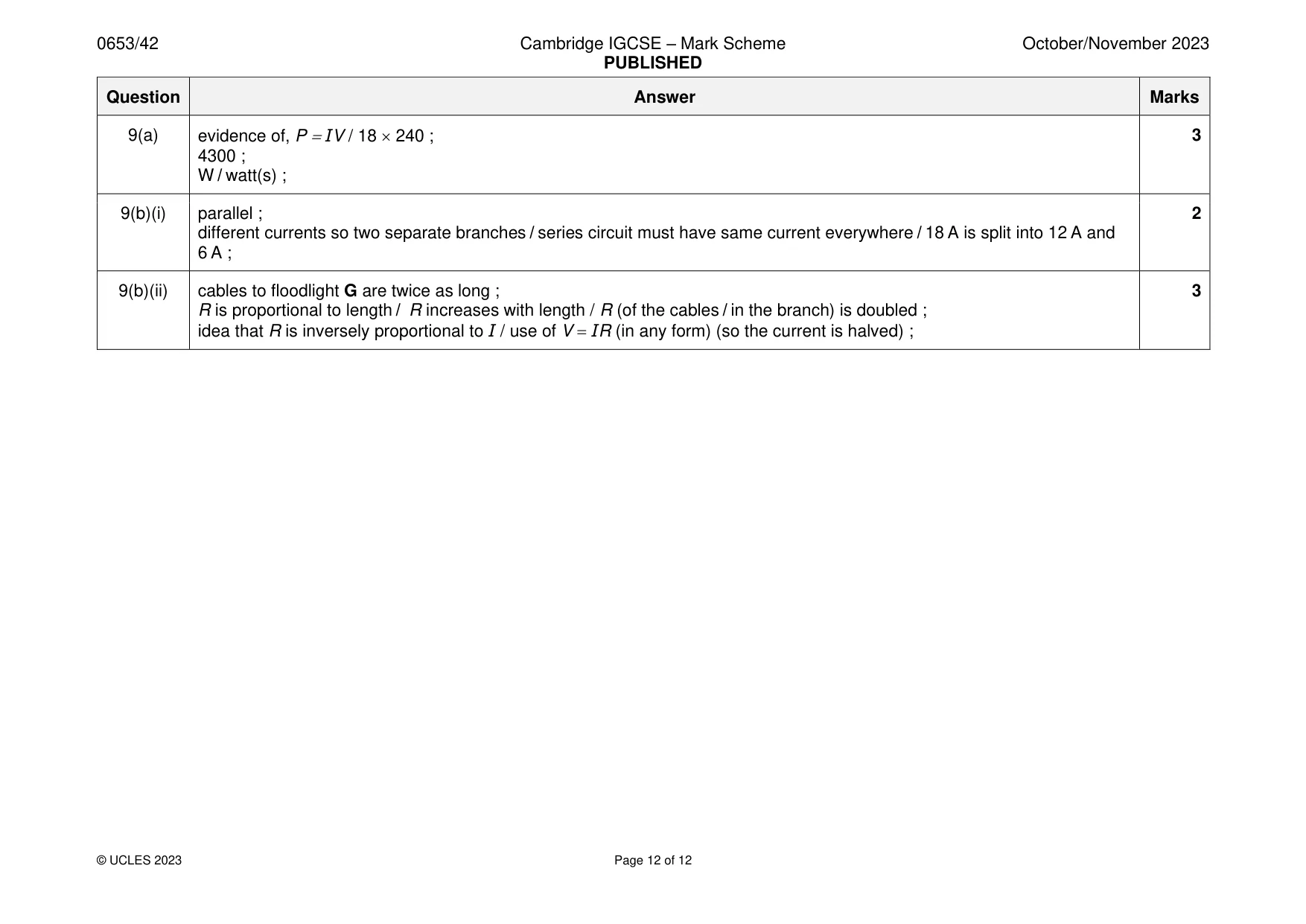
Mark scheme: 9(a) evidence of, P =IV / 18 240 ; 3 4300 ; W / watt(s) ; 9(b)(i) parallel ; 2 different currents so two separate branches / series circuit must have same current everywhere / 18 A is split into 12 A and 6 A ; 9(b)(ii) cables to floodlight G are twice as long ; 3 R is proportional to length / R increases with length / R (of the cables / in the branch) is doubled ; idea that R is inversely proportional to I / use of V = IR (in any form) (so the current is halved) ;
What was in this paper
The subtopics covered by these 9 questions, and how many questions each got. Open one in a new tab to see every Cambridge question on it.
What you needed in this session
Cambridge’s own grade thresholds for 2023 Oct/Nov, Paper 4 · Variant 2. A higher threshold means an easier paper — the bar moves with how the cohort did.