Cambridge IGCSE Science - Combined 0653 — 2022 May/June Paper 4 · Variant 1
0653/41/M/J/22 · 9 questions · 80 marks · ≈90 min
The question paper and its mark scheme, free to read here and free to download. This is Cambridge’s own paper, exactly as it was sat.
Question paper20 pages


Mark scheme11 pages
Answers below. Sit the paper first if you are practising.
Questions as text
Q1 · A diagram of the gas exchange system in humans
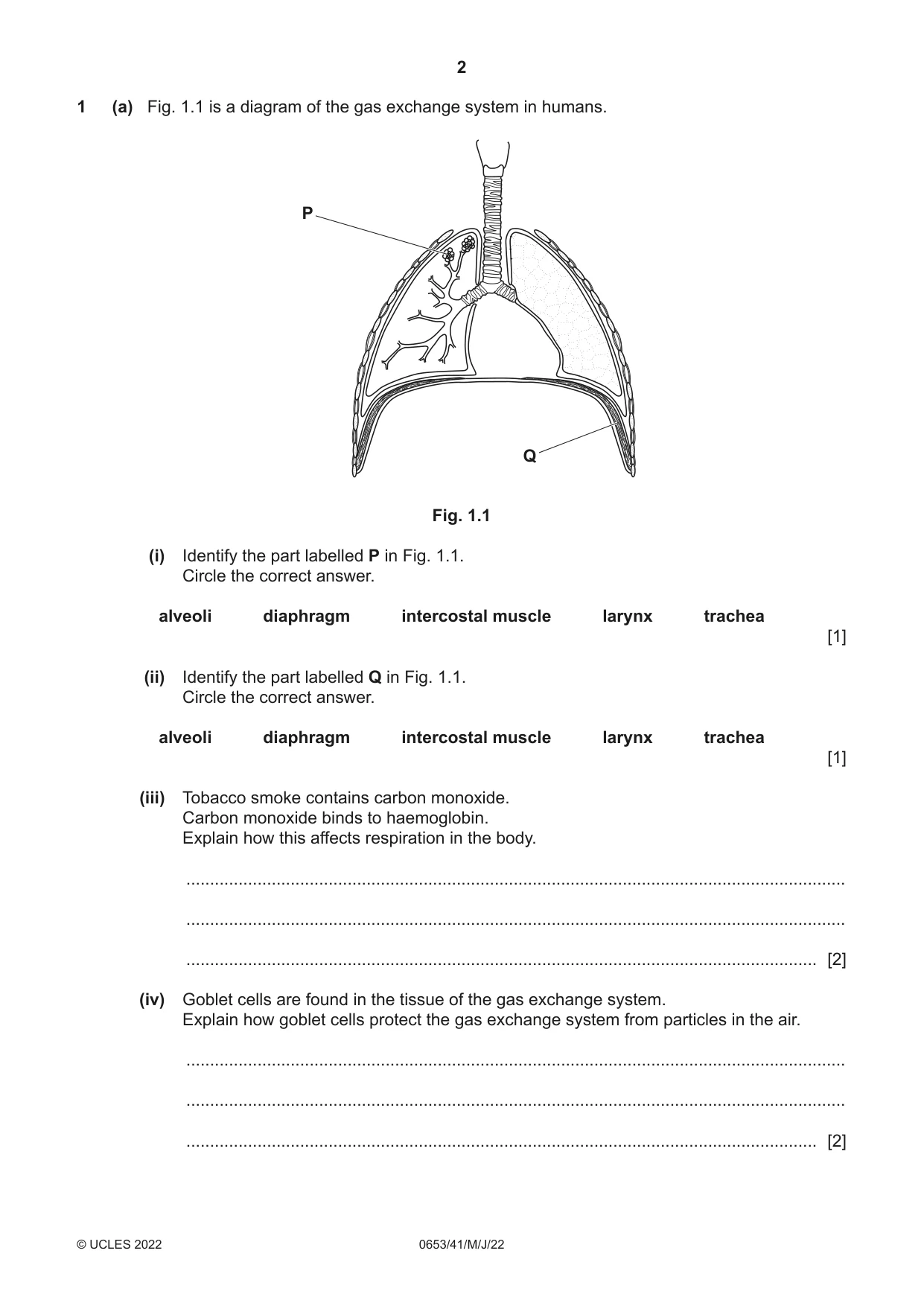
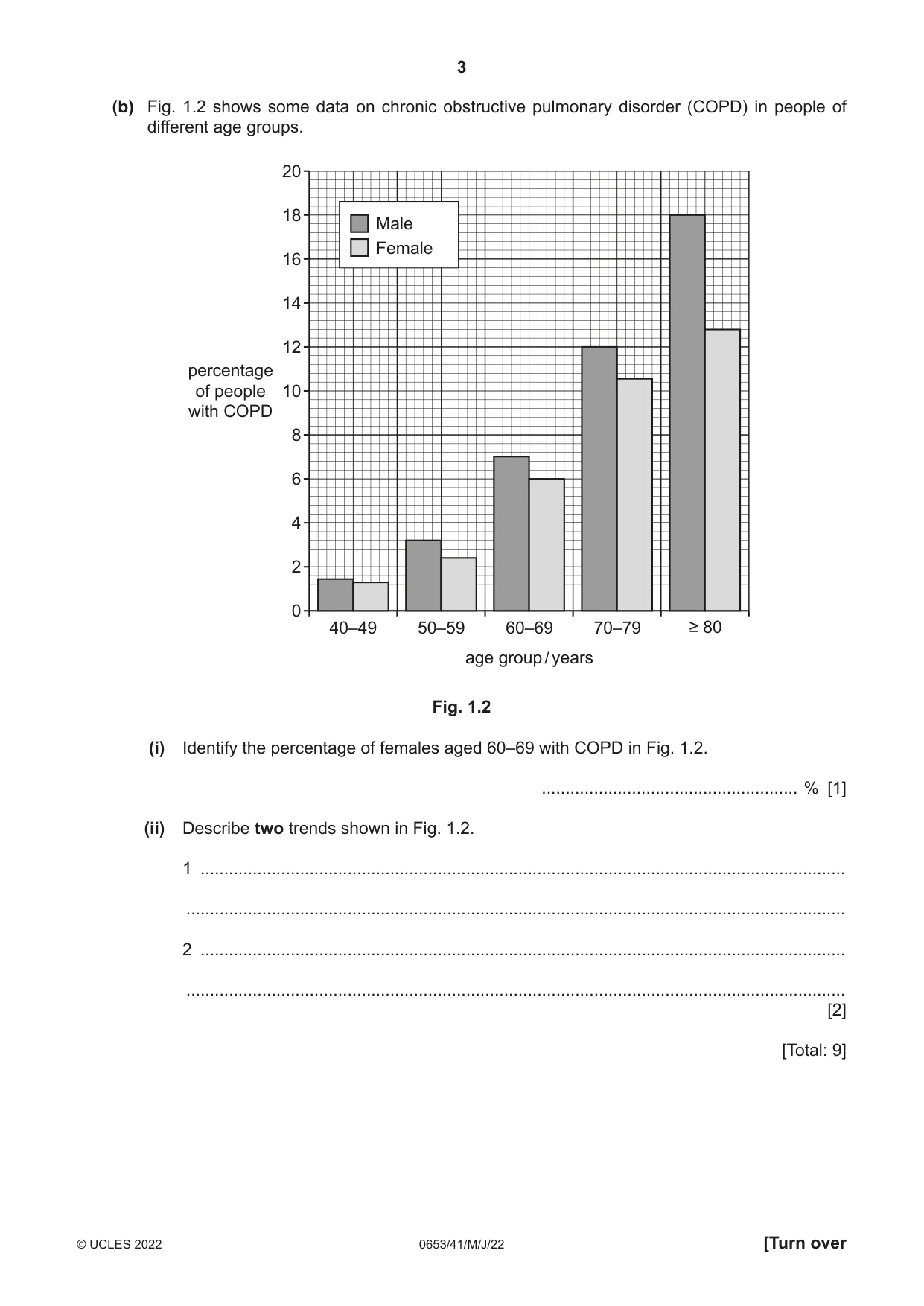
1 (a) Fig. 1.1 is a diagram of the gas exchange system in humans. P Q Fig. 1.1 (i) Identify the part labelled P in Fig. 1.1. Circle the correct answer. alveoli diaphragm intercostal muscle larynx trachea [1] (ii) Identify the part labelled Q in Fig. 1.1. Circle the correct answer. alveoli diaphragm intercostal muscle larynx trachea [1] (iii) Tobacco smoke contains carbon monoxide. Carbon monoxide binds to haemoglobin. Explain how this affects respiration in the body. ........................................................................................................................................... ........................................................................................................................................... ..................................................................................................................................... [2] (iv) Goblet cells are found in the tissue of the gas exchange system. Explain how goblet cells protect the gas exchange system from particles in the air. ........................................................................................................................................... ........................................................................................................................................... ..................................................................................................................................... [2] (b) Fig. 1.2 shows some data on chronic obstructive pulmonary disorder (COPD) in people of different age groups. 20 18 Male Female 16 14 12 percentage of people 10 with COPD 8 6 4 2 0 40–49 50–59 60–69 70–79 ≥ 80 age group / years Fig. 1.2 (i) Identify the percentage of females aged 60–69 with COPD in Fig. 1.2. ...................................................... % [1] (ii) Describe two trends shown in Fig. 1.2. 1 ........................................................................................................................................ ........................................................................................................................................... 2 ........................................................................................................................................ ........................................................................................................................................... [2] [Total: 9]
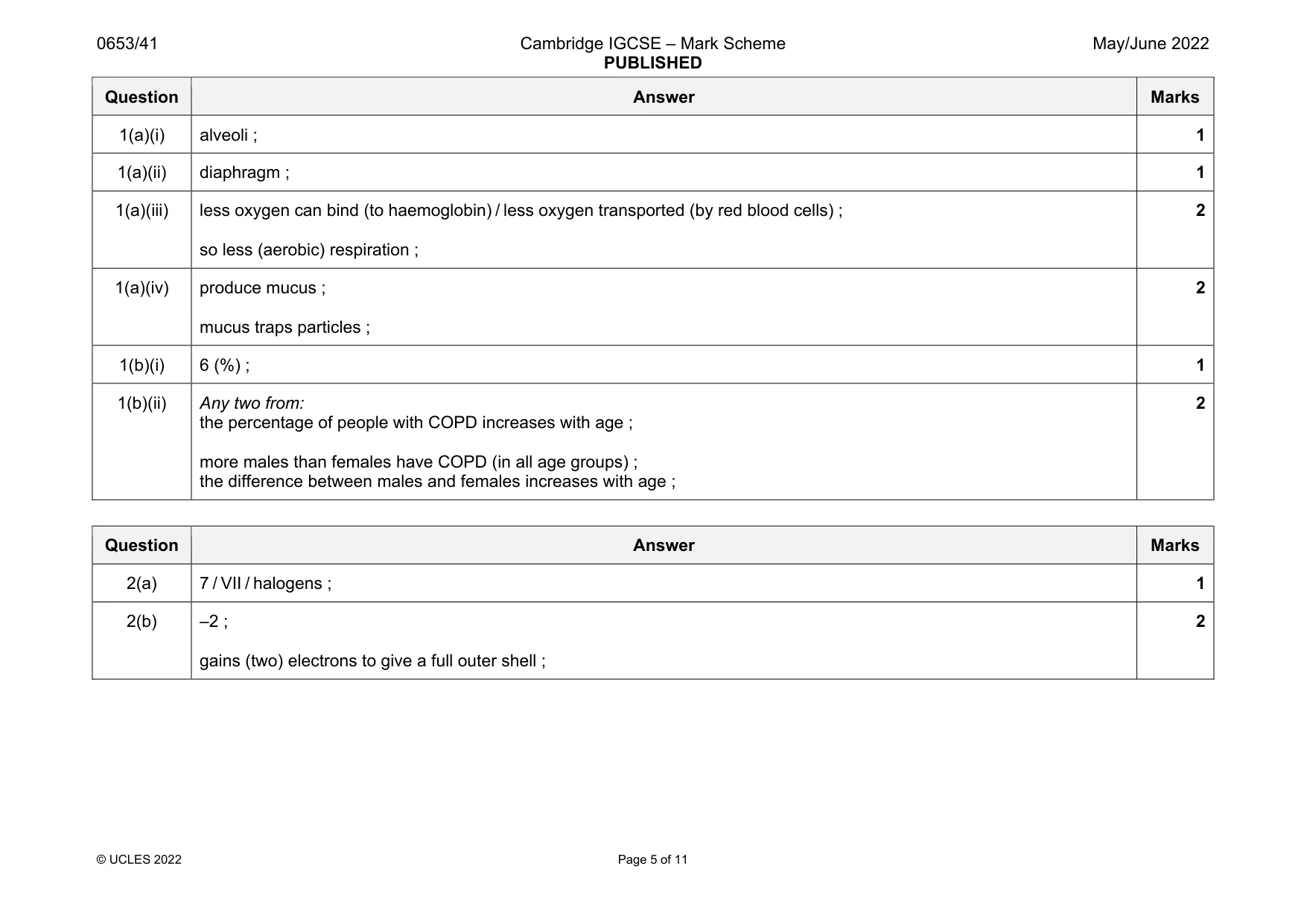
Mark scheme: 1(a)(i) alveoli ; 1 1(a)(ii) diaphragm ; 1 1(a)(iii) less oxygen can bind (to haemoglobin) / less oxygen transported (by red blood cells) ; so less (aerobic) respiration ; 2 1(a)(iv) produce mucus ; mucus traps particles ; 2 1(b)(i) 6 (%) ; 1 1(b)(ii) Any two from: the percentage of people with COPD increases with age ; more males than females have COPD (in all age groups) ; the difference between males and females increases with age ; 2
Q2 · The outer shell electrons in atoms of elements X, Y and Z are shown in Fig
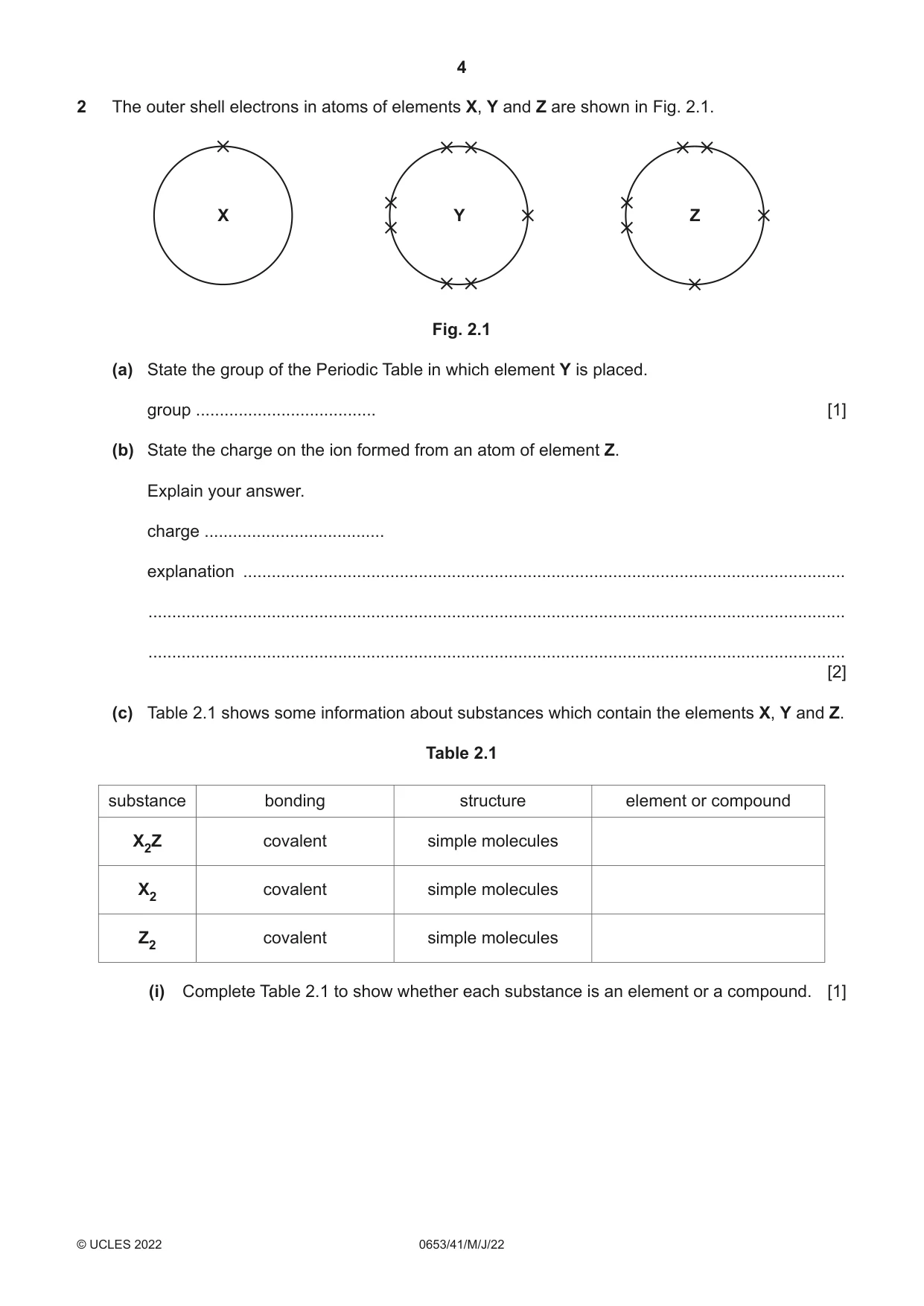
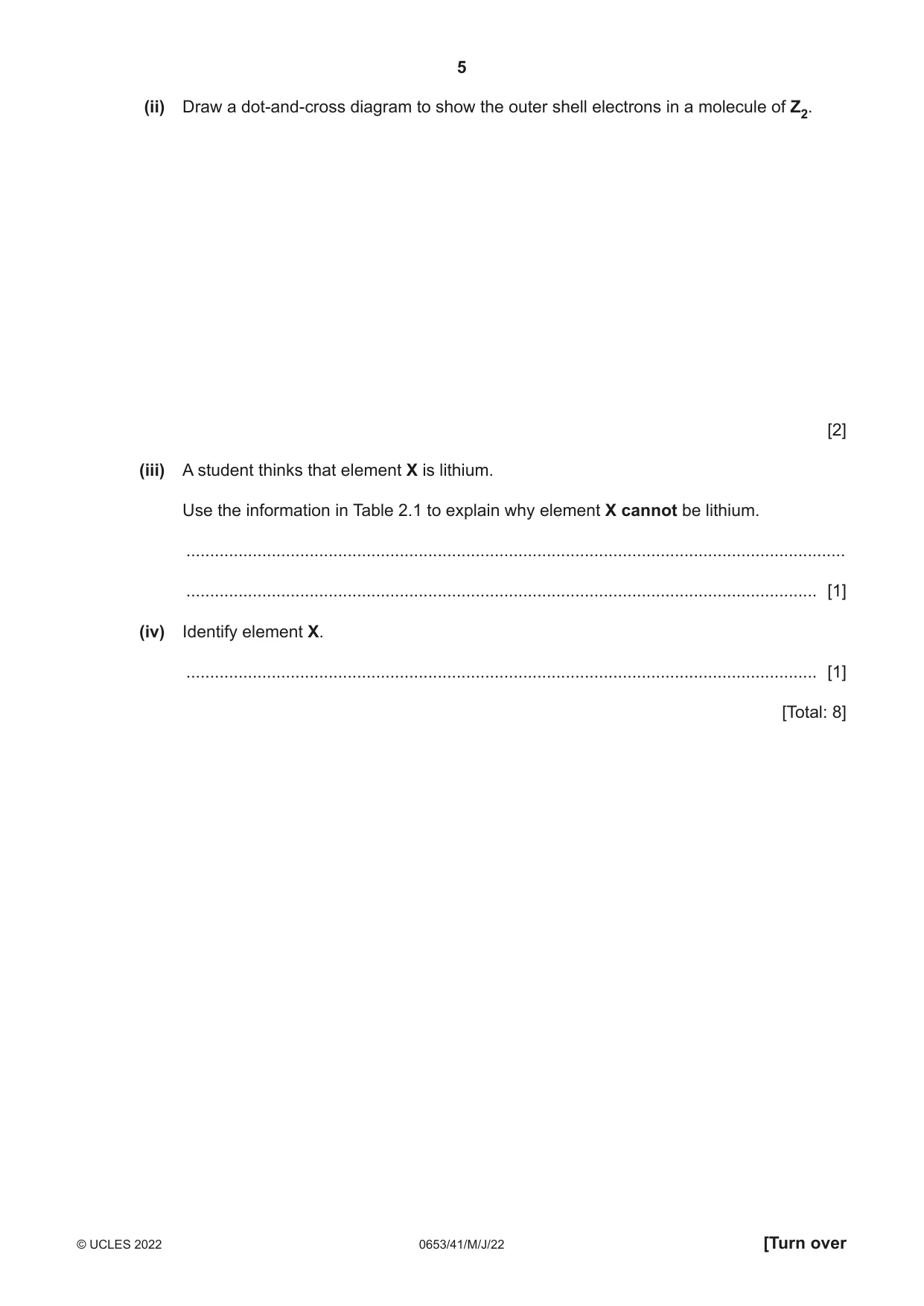
2 The outer shell electrons in atoms of elements X, Y and Z are shown in Fig. 2.1. X Y Z Fig. 2.1 (a) State the group of the Periodic Table in which element Y is placed. group ...................................... [1] (b) State the charge on the ion formed from an atom of element Z. Explain your answer. charge ...................................... explanation ............................................................................................................................... ................................................................................................................................................... ................................................................................................................................................... [2] (c) Table 2.1 shows some information about substances which contain the elements X, Y and Z. Table 2.1 substance bonding structure element or compound X2Z covalent simple molecules X2 covalent simple molecules Z2 covalent simple molecules (i) Complete Table 2.1 to show whether each substance is an element or a compound. [1] (ii) Draw a dot-and-cross diagram to show the outer shell electrons in a molecule of Z2. [2] (iii) A student thinks that element X is lithium. Use the information in Table 2.1 to explain why element X cannot be lithium. ........................................................................................................................................... ..................................................................................................................................... [1] (iv) Identify element X. ..................................................................................................................................... [1] [Total: 8]
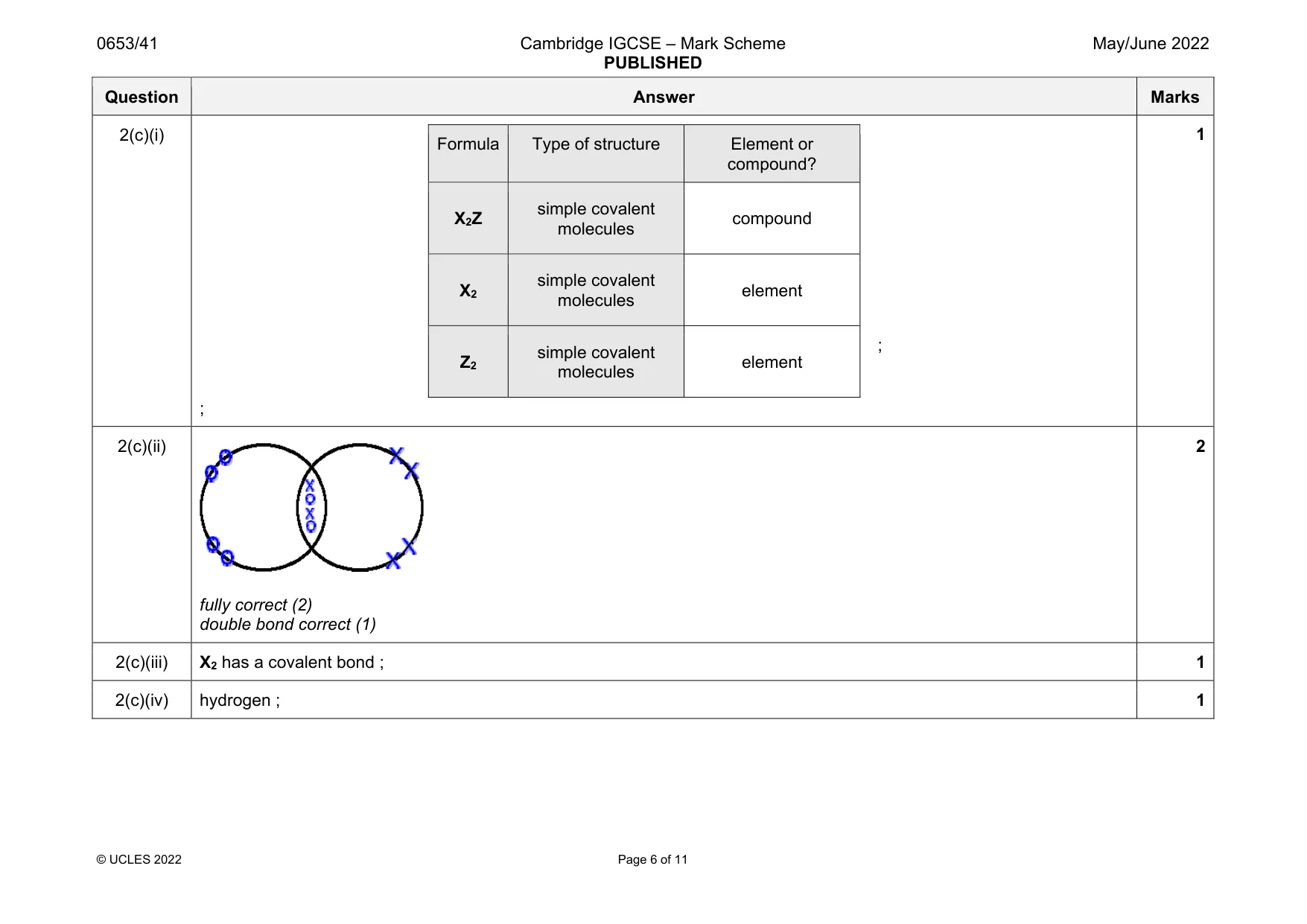
Mark scheme: 2(a) 7 / VII / halogens ; 1 2(b) –2 ; gains (two) electrons to give a full outer shell ; 2 Question Answer Marks 2(c)(i) Formula Type of structure Element or compound? X2Z simple covalent molecules compound X2 simple covalent molecules element Z2 simple covalent molecules element ; ; 1 2(c)(ii) fully correct (2) double bond correct (1) 2 2(c)(iii) X2 has a covalent bond ; 1 2(c)(iv) hydrogen ; 1
Q3 · A man pushing a shopping trolley forwards along a level surface
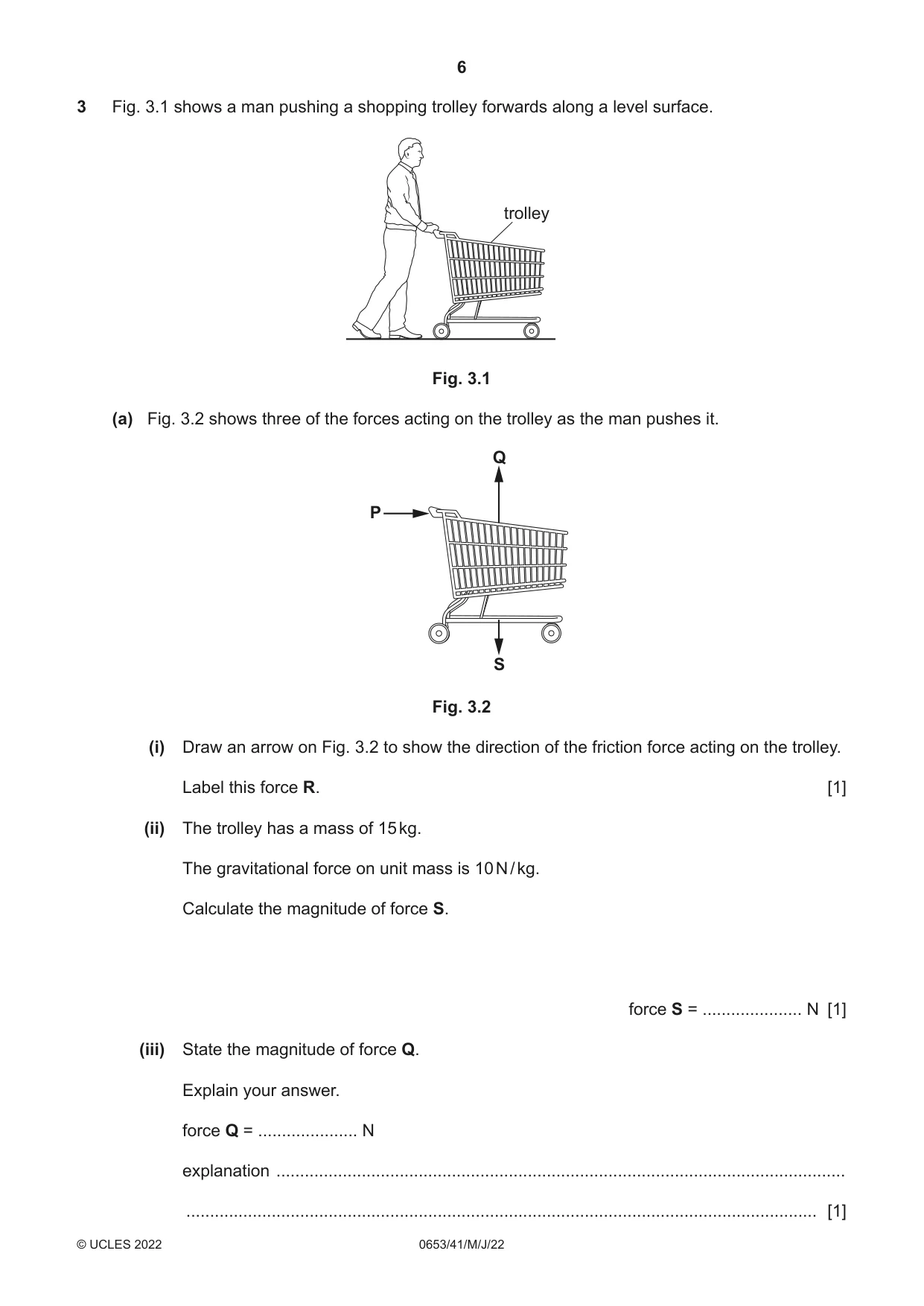
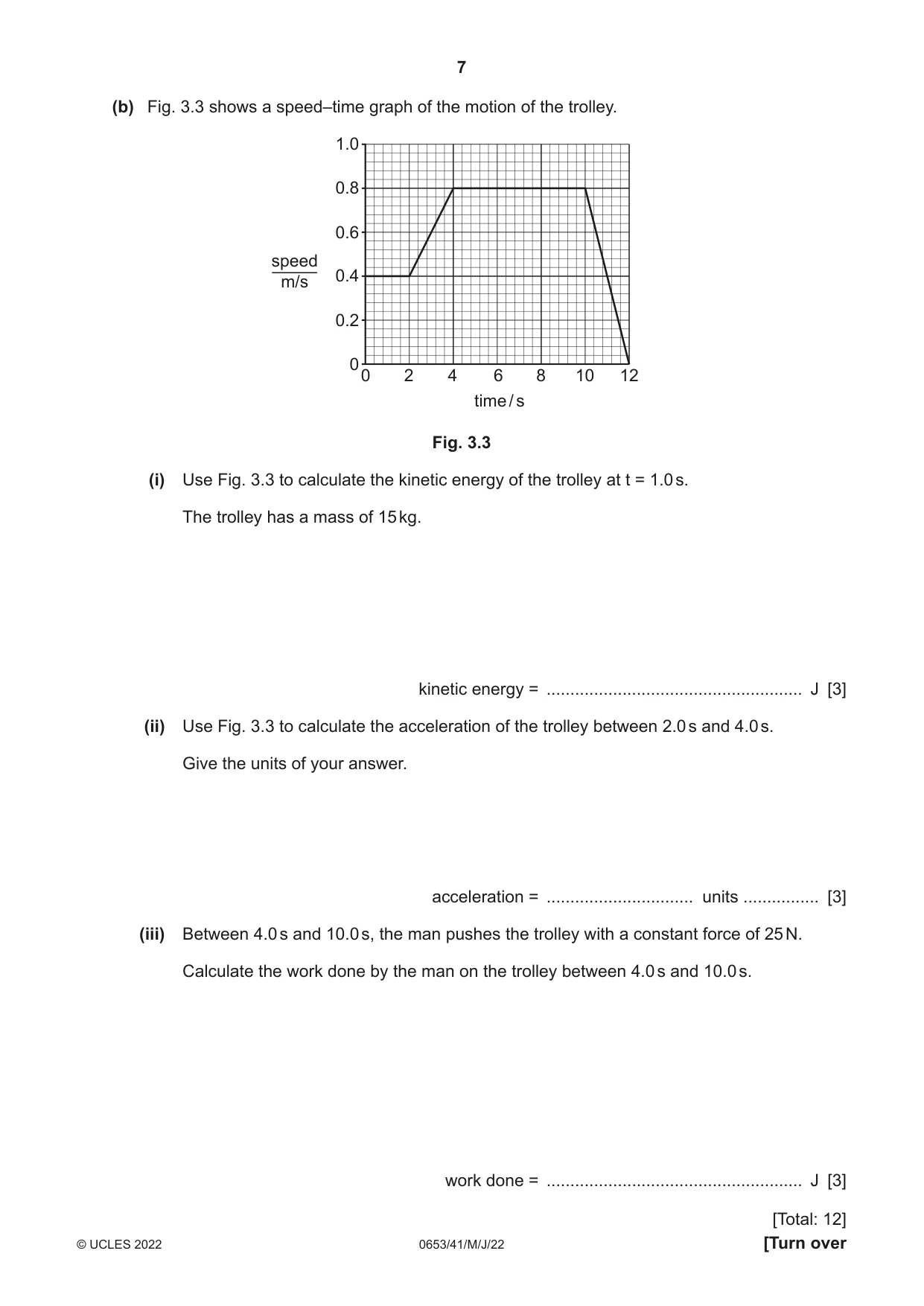
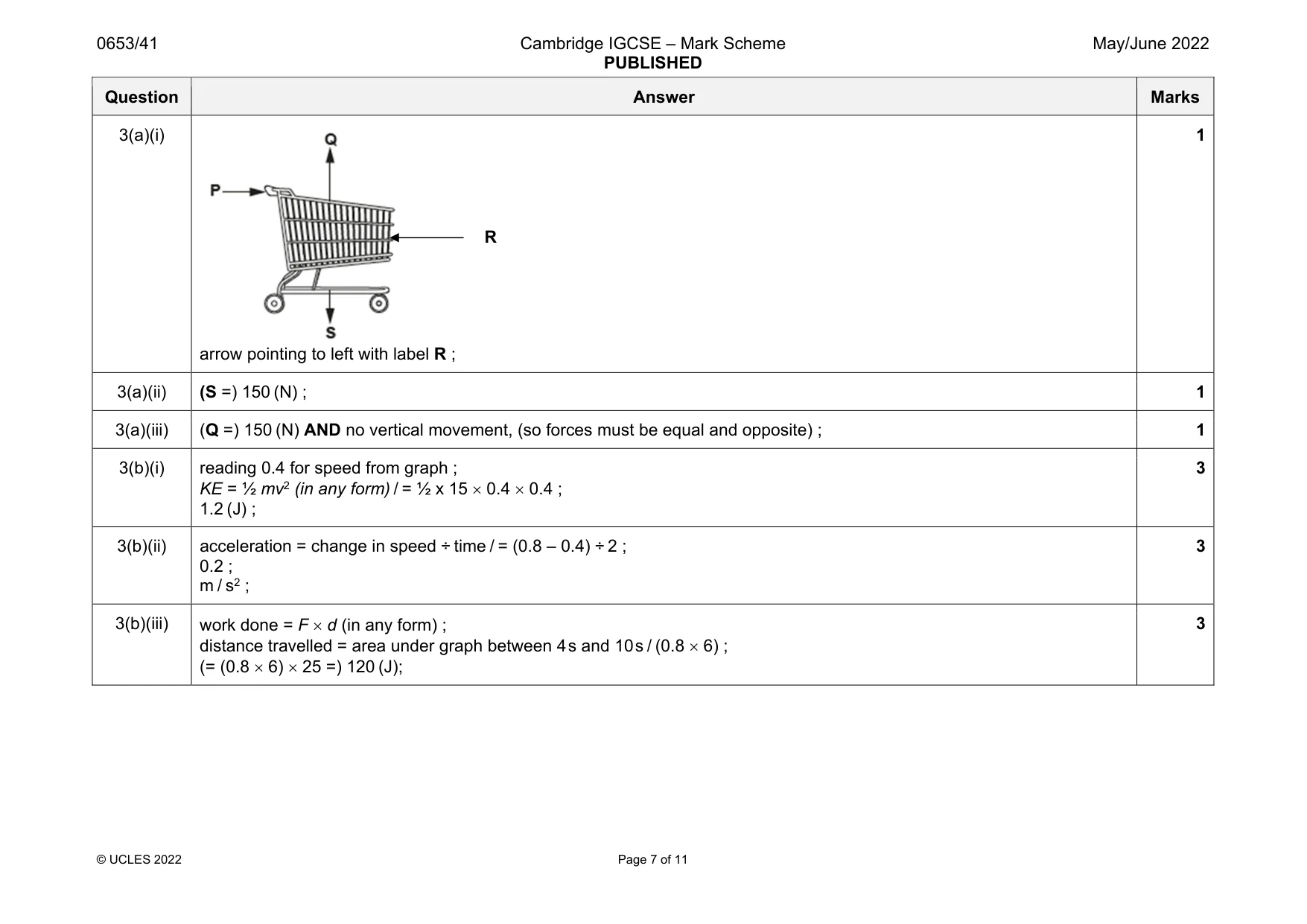
3 Fig. 3.1 shows a man pushing a shopping trolley forwards along a level surface. trolley Fig. 3.1 (a) Fig. 3.2 shows three of the forces acting on the trolley as the man pushes it. Q P S Fig. 3.2 (i) Draw an arrow on Fig. 3.2 to show the direction of the friction force acting on the trolley. Label this force R. [1] (ii) The trolley has a mass of 15 kg. The gravitational force on unit mass is 10 N / kg. Calculate the magnitude of force S. force S = ..................... N [1] (iii) State the magnitude of force Q. Explain your answer. force Q = ..................... N explanation ........................................................................................................................ ..................................................................................................................................... [1] (b) Fig. 3.3 shows a speed–time graph of the motion of the trolley. 1.0 0.8 0.6 speed 0.4 m/s 0.2 00 2 4 6 8 10 12 time / s Fig. 3.3 (i) Use Fig. 3.3 to calculate the kinetic energy of the trolley at t = 1.0 s. The trolley has a mass of 15 kg. kinetic energy = ...................................................... J [3] (ii) Use Fig. 3.3 to calculate the acceleration of the trolley between 2.0 s and 4.0 s. Give the units of your answer. acceleration = ............................... units ................ [3] (iii) Between 4.0 s and 10.0 s, the man pushes the trolley with a constant force of 25 N. Calculate the work done by the man on the trolley between 4.0 s and 10.0 s. work done = ...................................................... J [3] [Total: 12]
Mark scheme: 3(a)(i) arrow pointing to left with label R ; 1 3(a)(ii) (S =) 150 (N) ; 1 3(a)(iii) (Q =) 150 (N) AND no vertical movement, (so forces must be equal and opposite) ; 1 3(b)(i) reading 0.4 for speed from graph ; KE = ½ mv2 (in any form) / = ½ x 15 0.4 0.4 ; 1.2 (J) ; 3 3(b)(ii) acceleration = change in speed ÷ time / = (0.8 – 0.4) ÷ 2 ; 0.2 ; m / s2 ; 3 3(b)(iii) work done = F d (in any form) ; distance travelled = area under graph between 4 s and 10 s / (0.8 6) ; (= (0.8 6) 25 =) 120 (J); 3 R
Q4 · A diagram of a wind-pollinated flower
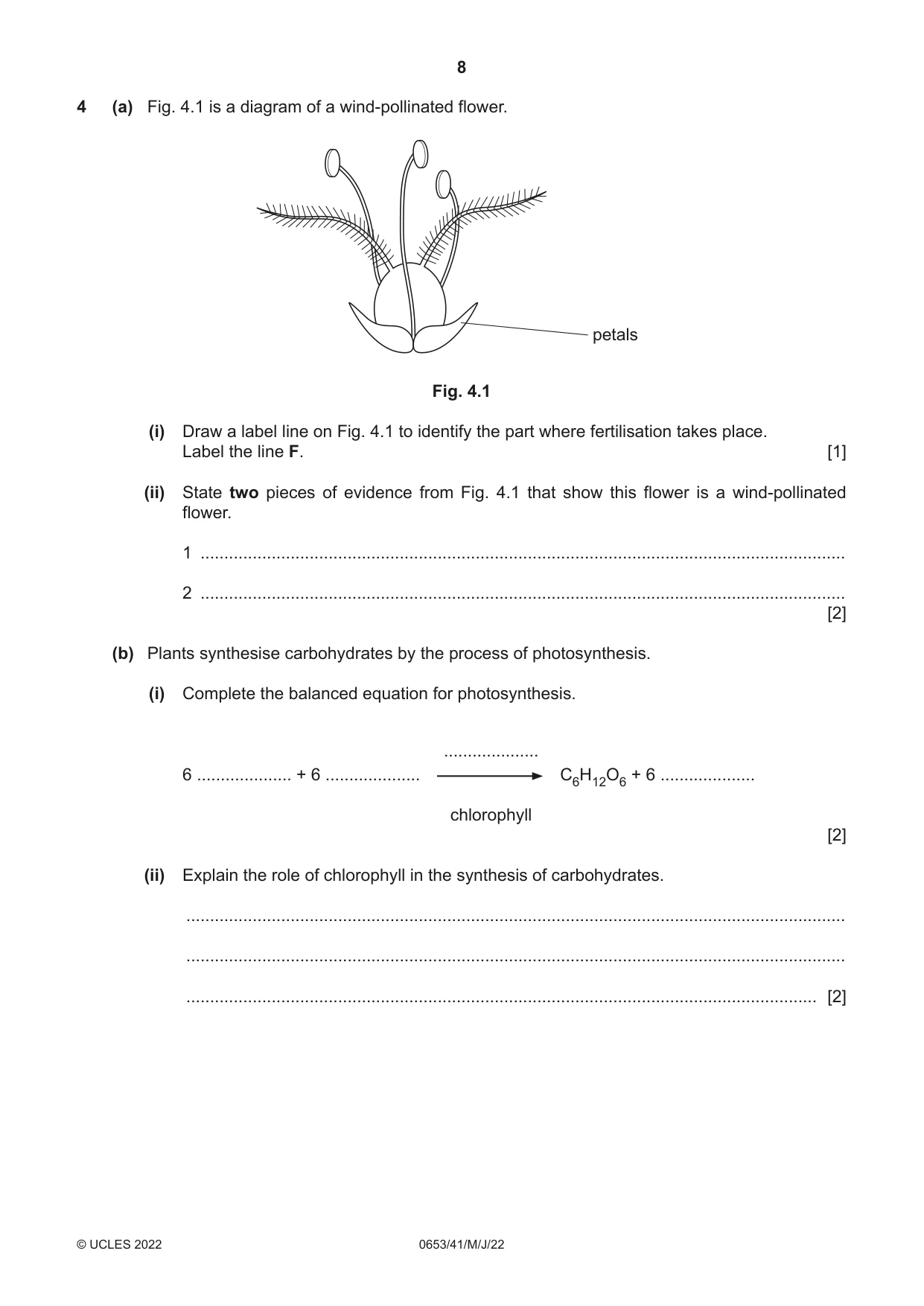
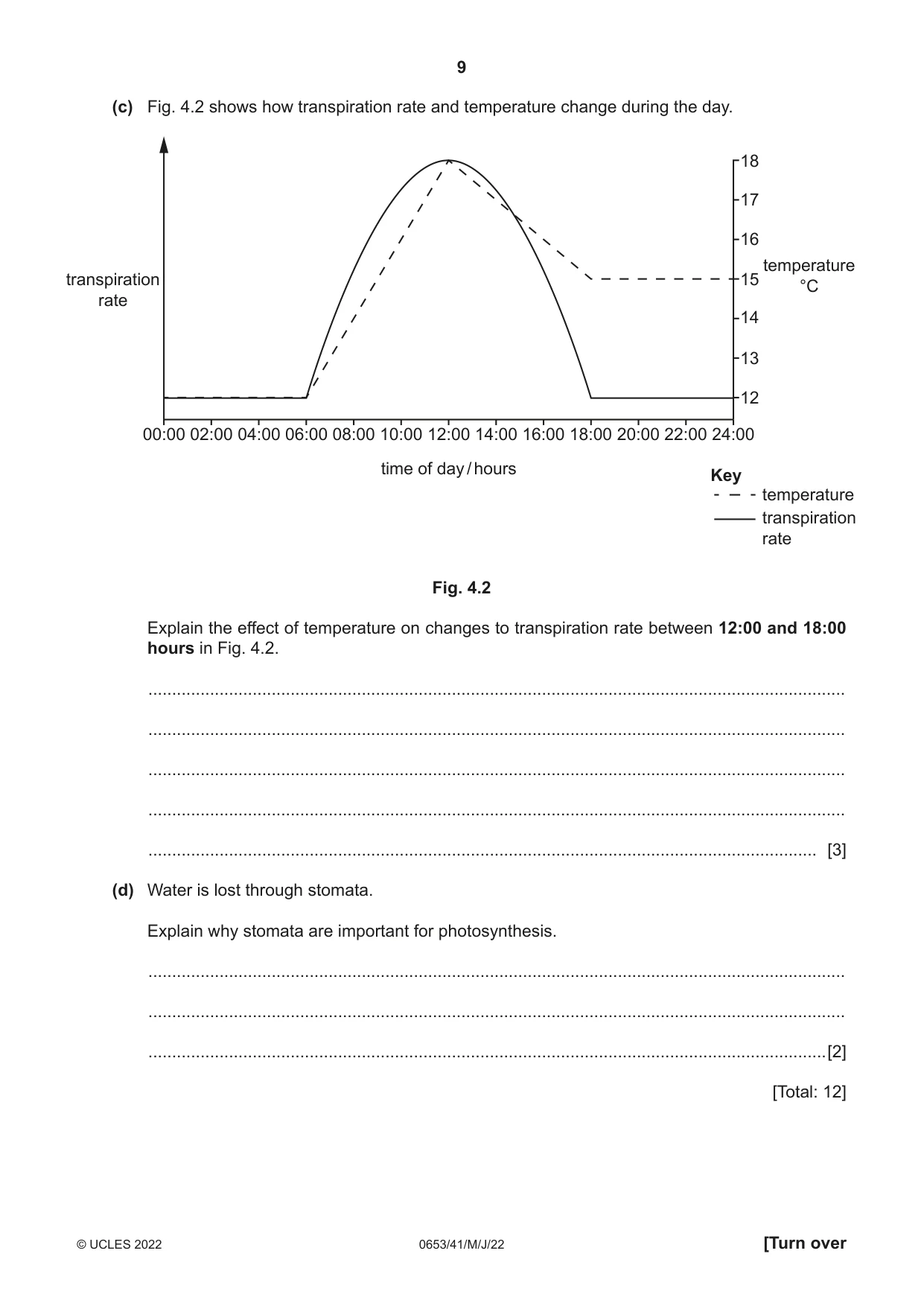
4 (a) Fig. 4.1 is a diagram of a wind-pollinated flower. petals Fig. 4.1 (i) Draw a label line on Fig. 4.1 to identify the part where fertilisation takes place. Label the line F. [1] (ii) State two pieces of evidence from Fig. 4.1 that show this flower is a wind-pollinated flower. 1 ........................................................................................................................................ 2 ........................................................................................................................................ [2] (b) Plants synthesise carbohydrates by the process of photosynthesis. (i) Complete the balanced equation for photosynthesis. .................... 6 .................... + 6 .................... C6H12O6 + 6 .................... chlorophyll [2] (ii) Explain the role of chlorophyll in the synthesis of carbohydrates. ........................................................................................................................................... ........................................................................................................................................... ..................................................................................................................................... [2] (c) Fig. 4.2 shows how transpiration rate and temperature change during the day. 18 17 16 temperature transpiration 15 °C rate 14 13 12 00:00 02:00 04:00 06:00 08:00 10:00 12:00 14:00 16:00 18:00 20:00 22:00 24:00 time of day / hours Key temperature transpiration rate Fig. 4.2 Explain the effect of temperature on changes to transpiration rate between 12:00 and 18:00 hours in Fig. 4.2. ................................................................................................................................................... ................................................................................................................................................... ................................................................................................................................................... ................................................................................................................................................... ............................................................................................................................................. [3] (d) Water is lost through stomata. Explain why stomata are important for photosynthesis. ................................................................................................................................................... ................................................................................................................................................... ...............................................................................................................................................[2] [Total: 12]
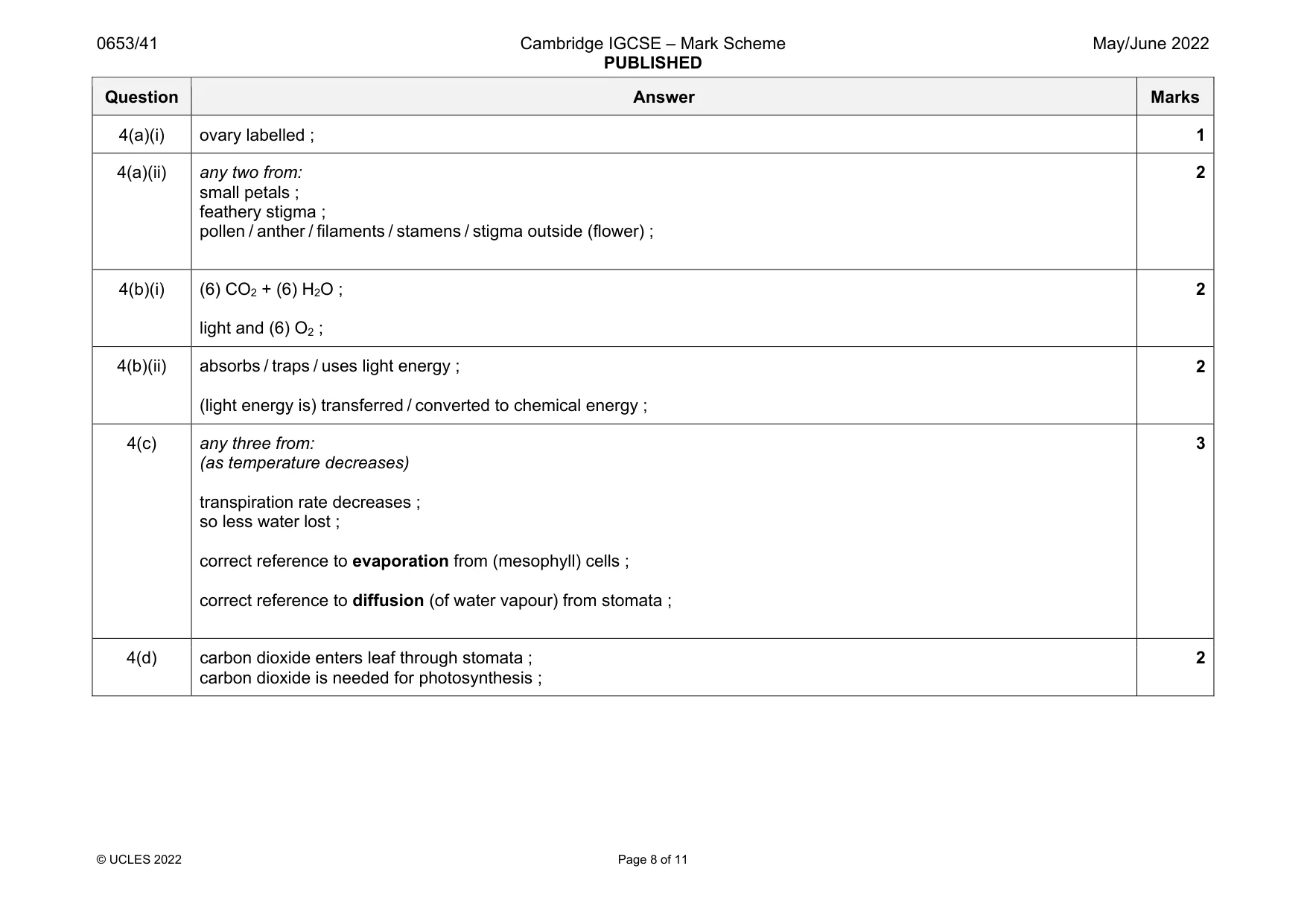
Mark scheme: 4(a)(i) ovary labelled ; 1 4(a)(ii) any two from: small petals ; feathery stigma ; pollen / anther / filaments / stamens / stigma outside (flower) ; 2 4(b)(i) (6) CO2 + (6) H2O ; light and (6) O2 ; 2 4(b)(ii) absorbs / traps / uses light energy ; (light energy is) transferred / converted to chemical energy ; 2 4(c) any three from: (as temperature decreases) transpiration rate decreases ; so less water lost ; correct reference to evaporation from (mesophyll) cells ; correct reference to diffusion (of water vapour) from stomata ; 3 4(d) carbon dioxide enters leaf through stomata ; carbon dioxide is needed for photosynthesis ; 2
Q5 · A pH meter is an instrument which measures pH
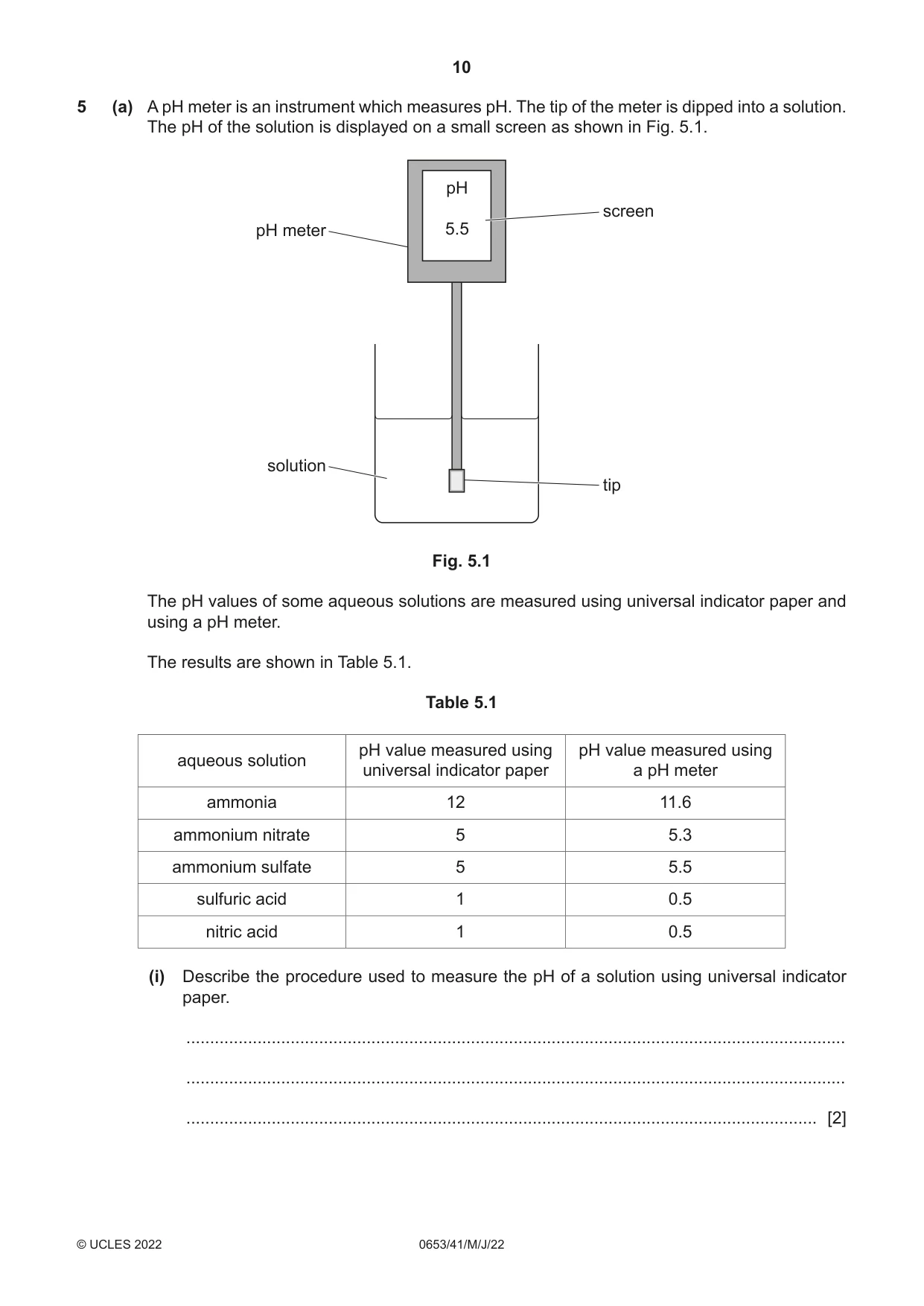
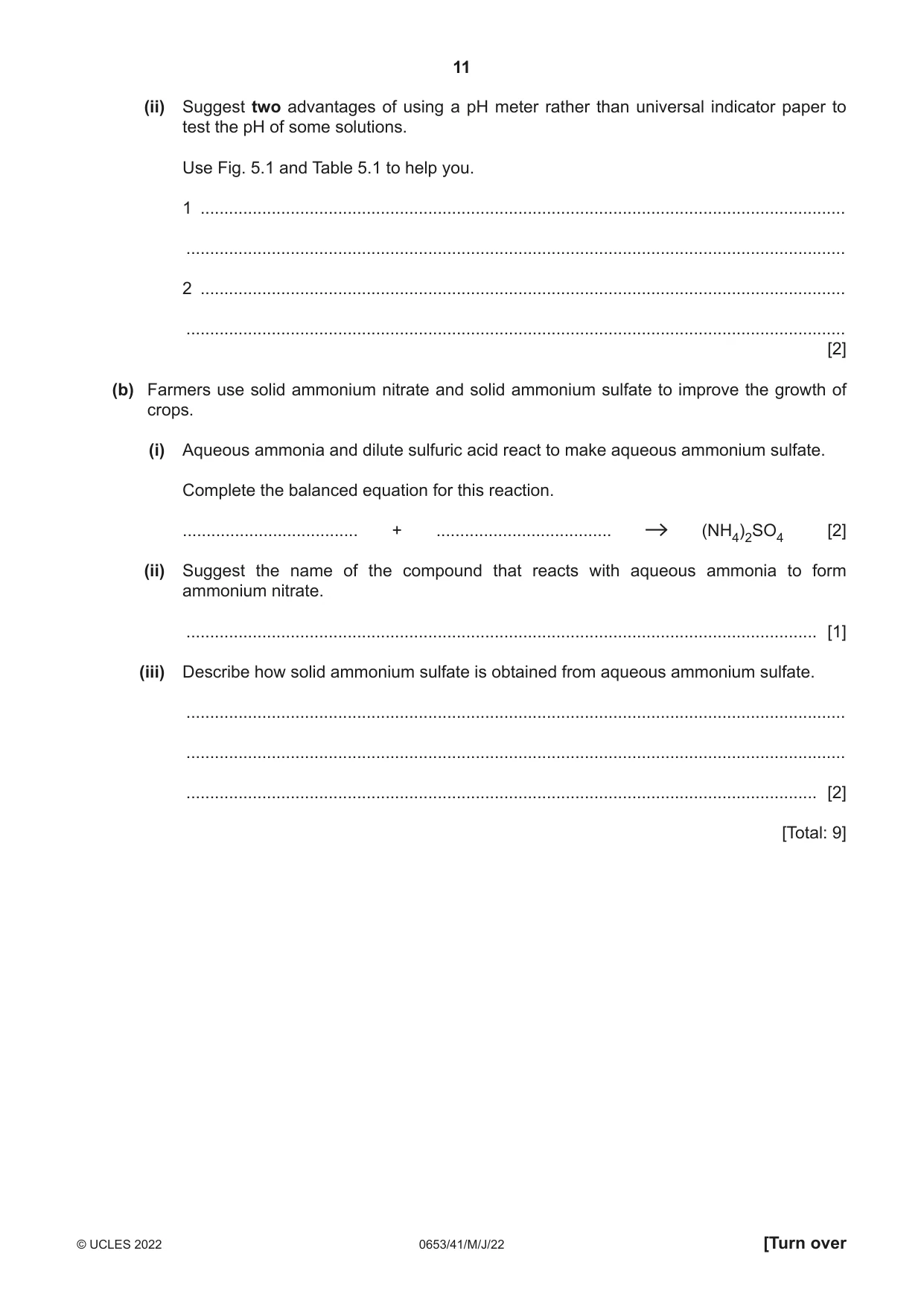
5 (a) A pH meter is an instrument which measures pH. The tip of the meter is dipped into a solution. The pH of the solution is displayed on a small screen as shown in Fig. 5.1. pH screen pH meter 5.5 solution tip Fig. 5.1 The pH values of some aqueous solutions are measured using universal indicator paper and using a pH meter. The results are shown in Table 5.1. Table 5.1 pH value measured using pH value measured using aqueous solution universal indicator paper a pH meter ammonia 12 11.6 ammonium nitrate 5 5.3 ammonium sulfate 5 5.5 sulfuric acid 1 0.5 nitric acid 1 0.5 (i) Describe the procedure used to measure the pH of a solution using universal indicator paper. ........................................................................................................................................... ........................................................................................................................................... ..................................................................................................................................... [2] (ii) Suggest two advantages of using a pH meter rather than universal indicator paper to test the pH of some solutions. Use Fig. 5.1 and Table 5.1 to help you. 1 ........................................................................................................................................ ........................................................................................................................................... 2 ........................................................................................................................................ ........................................................................................................................................... [2] (b) Farmers use solid ammonium nitrate and solid ammonium sulfate to improve the growth of crops. (i) Aqueous ammonia and dilute sulfuric acid react to make aqueous ammonium sulfate. Complete the balanced equation for this reaction. ..................................... + ..................................... (NH4)2SO4 [2] (ii) Suggest the name of the compound that reacts with aqueous ammonia to form ammonium nitrate. ..................................................................................................................................... [1] (iii) Describe how solid ammonium sulfate is obtained from aqueous ammonium sulfate. ........................................................................................................................................... ........................................................................................................................................... ..................................................................................................................................... [2] [Total: 9]
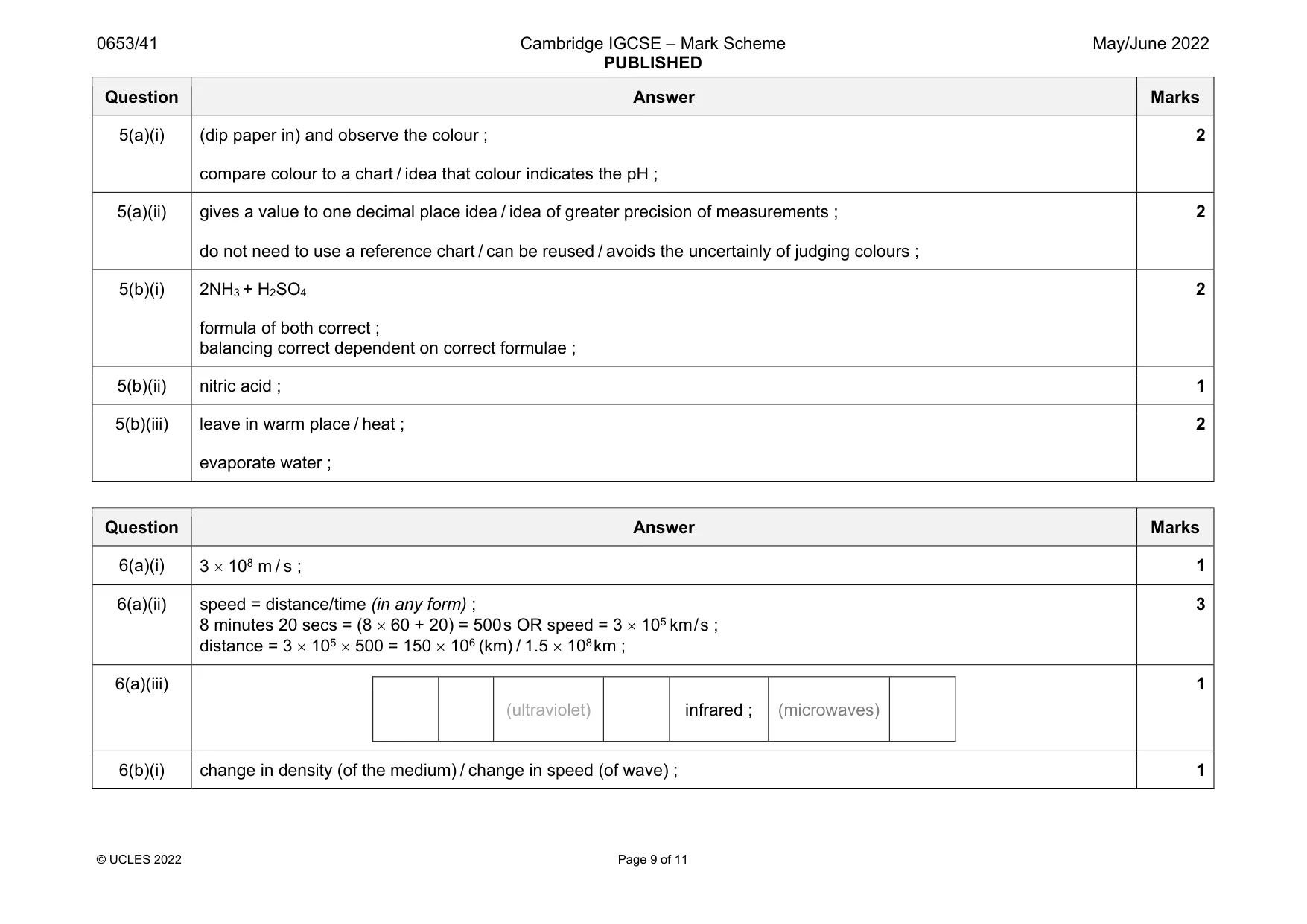
Mark scheme: 5(a)(i) (dip paper in) and observe the colour ; compare colour to a chart / idea that colour indicates the pH ; 2 5(a)(ii) gives a value to one decimal place idea / idea of greater precision of measurements ; do not need to use a reference chart / can be reused / avoids the uncertainly of judging colours ; 2 5(b)(i) 2NH3 + H2SO4 formula of both correct ; balancing correct dependent on correct formulae ; 2 5(b)(ii) nitric acid ; 1 5(b)(iii) leave in warm place / heat ; evaporate water ; 2
Q6 · The Earth is heated by infrared radiation from the Sun
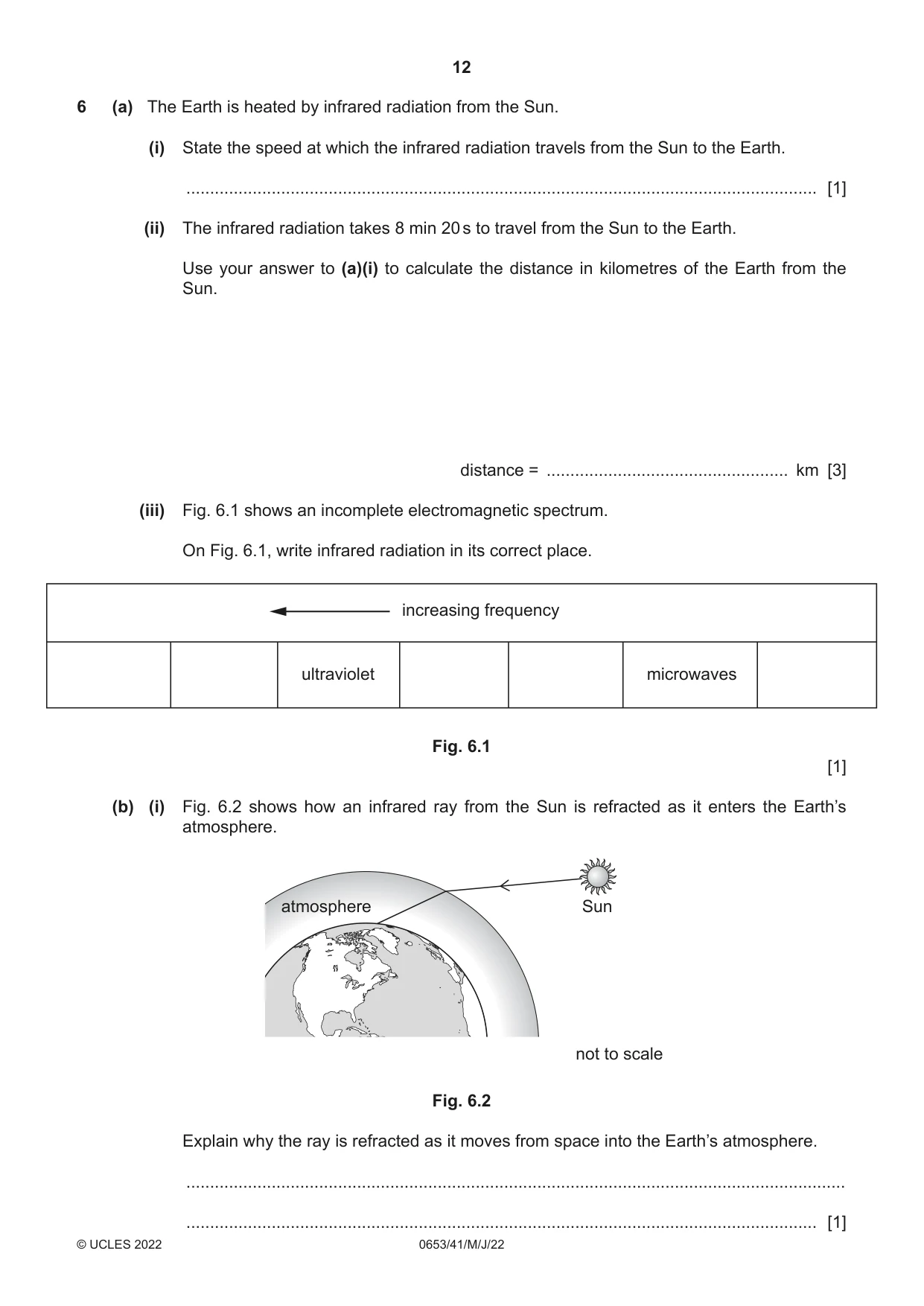
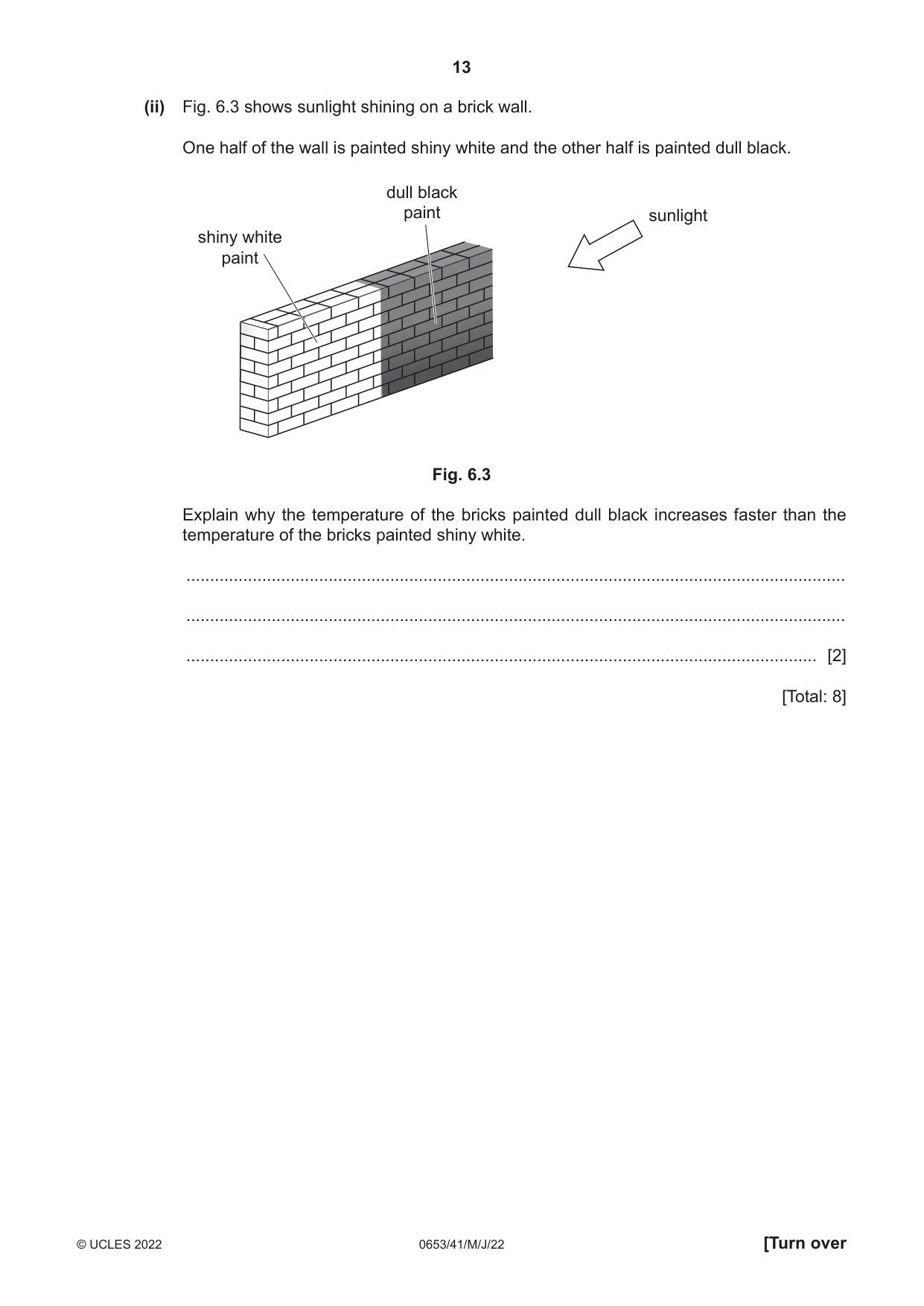
6 (a) The Earth is heated by infrared radiation from the Sun. (i) State the speed at which the infrared radiation travels from the Sun to the Earth. ..................................................................................................................................... [1] (ii) The infrared radiation takes 8 min 20 s to travel from the Sun to the Earth. Use your answer to (a)(i) to calculate the distance in kilometres of the Earth from the Sun. distance = ................................................... km [3] (iii) Fig. 6.1 shows an incomplete electromagnetic spectrum. On Fig. 6.1, write infrared radiation in its correct place. increasing frequency ultraviolet microwaves Fig. 6.1 [1] (b) (i) Fig. 6.2 shows how an infrared ray from the Sun is refracted as it enters the Earth’s atmosphere. atmosphere Sun not to scale Fig. 6.2 Explain why the ray is refracted as it moves from space into the Earth’s atmosphere. ........................................................................................................................................... ..................................................................................................................................... [1] (ii) Fig. 6.3 shows sunlight shining on a brick wall. One half of the wall is painted shiny white and the other half is painted dull black. dull black paint sunlight shiny white paint Fig. 6.3 Explain why the temperature of the bricks painted dull black increases faster than the temperature of the bricks painted shiny white. ........................................................................................................................................... ........................................................................................................................................... ..................................................................................................................................... [2] [Total: 8]
Mark scheme: 6(a)(i) 1 6(a)(ii) speed = distance/time (in any form) ; 8 minutes 20 secs = (8 60 + 20) = 500 s OR speed = 3 105 km / s ; distance = 3 105 500 = 150 106 (km) / 1.5 108 km ; 3 6(a)(iii) (ultraviolet) infrared ; (microwaves) 1 6(b)(i) change in density (of the medium) / change in speed (of wave) ; 1 Question Answer Marks 6(b)(ii) radiation / heat / light reflected by shiny / white / absorbed by dull/black ; dull/black absorbs more radiation (than the shiny / white) ; 2
Q7 · Part of the human alimentary canal and associated organs
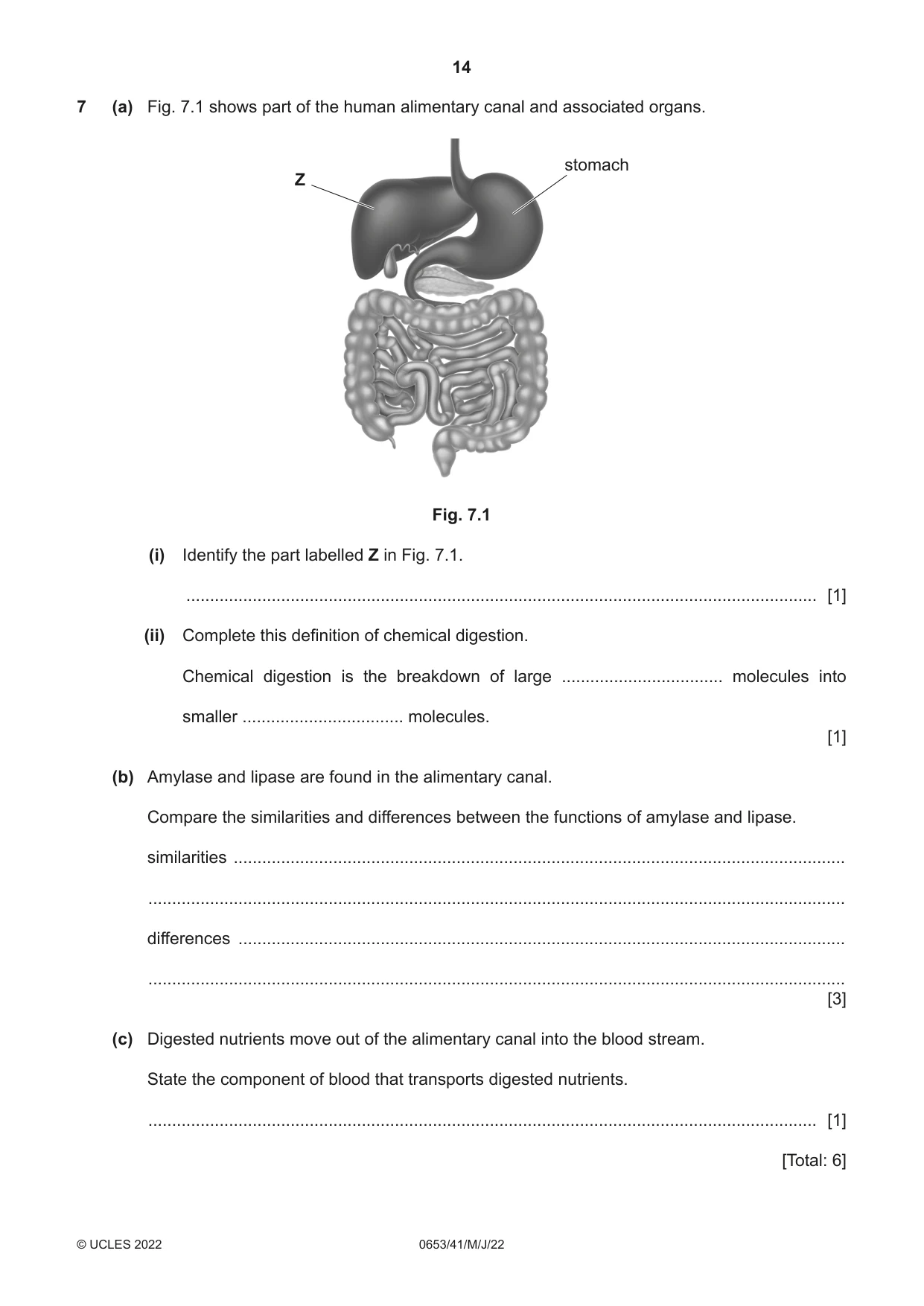
7 (a) Fig. 7.1 shows part of the human alimentary canal and associated organs. stomach Z Fig. 7.1 (i) Identify the part labelled Z in Fig. 7.1. ..................................................................................................................................... [1] (ii) Complete this definition of chemical digestion. Chemical digestion is the breakdown of large .................................. molecules into smaller .................................. molecules. [1] (b) Amylase and lipase are found in the alimentary canal. Compare the similarities and differences between the functions of amylase and lipase. similarities ................................................................................................................................. ................................................................................................................................................... differences ................................................................................................................................ ................................................................................................................................................... [3] (c) Digested nutrients move out of the alimentary canal into the blood stream. State the component of blood that transports digested nutrients. ............................................................................................................................................. [1] [Total: 6]
Mark scheme: 7(a)(i) liver ; 1 7(a)(ii) insoluble AND soluble ; 1 7(b) any three from: (similarities) are enzymes / speed up digestion ; breakdown large / insoluble, food molecules ; (differences) amylase breaks down / digests starch / carbohydrates / produces sugars ; lipase breaks down / digests fats / oils / lipids / produces fatty acids / glycerol ; 3 7(c) plasma ; 1
Q8 · Iron is extracted from hematite in a blast furnace
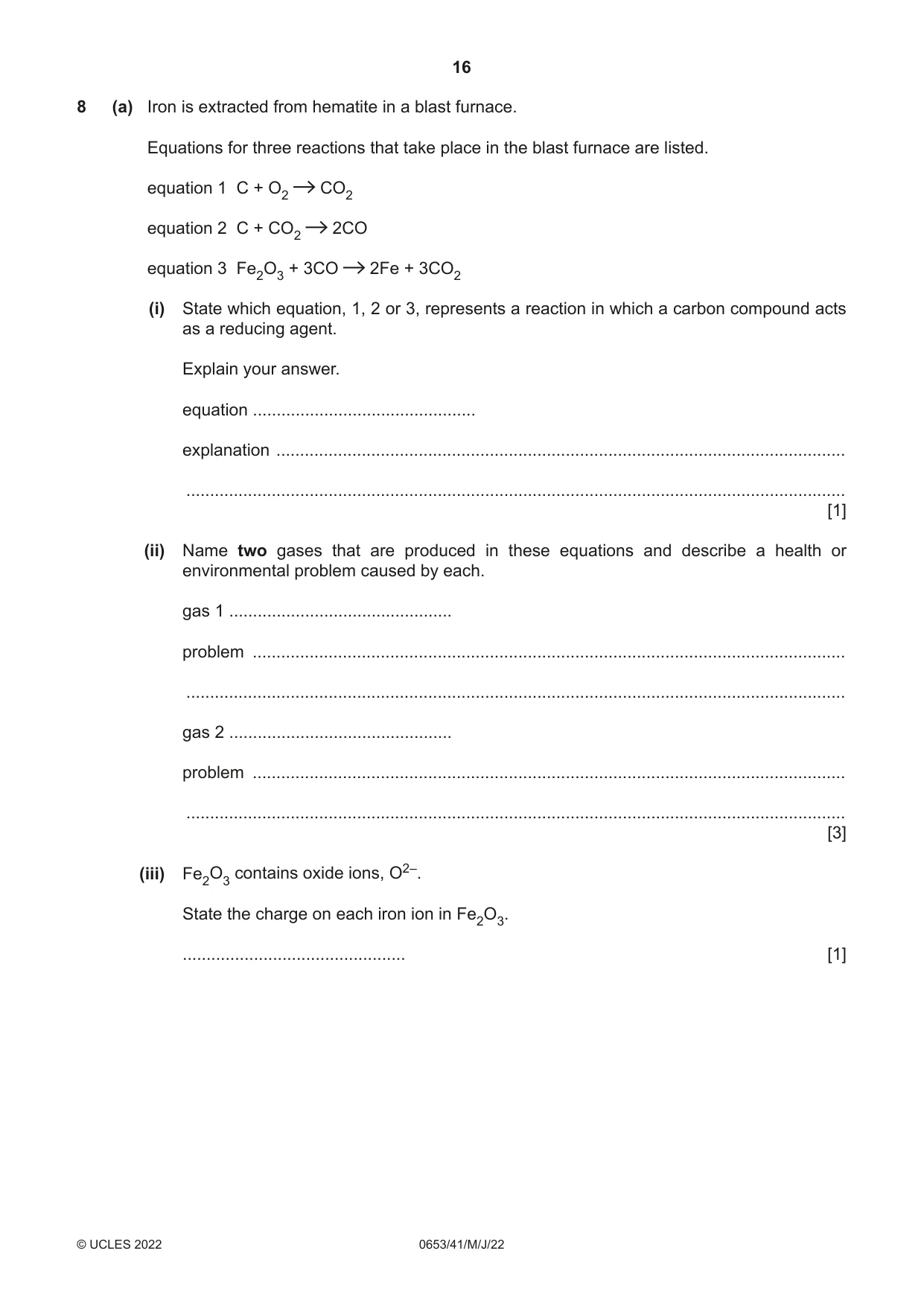
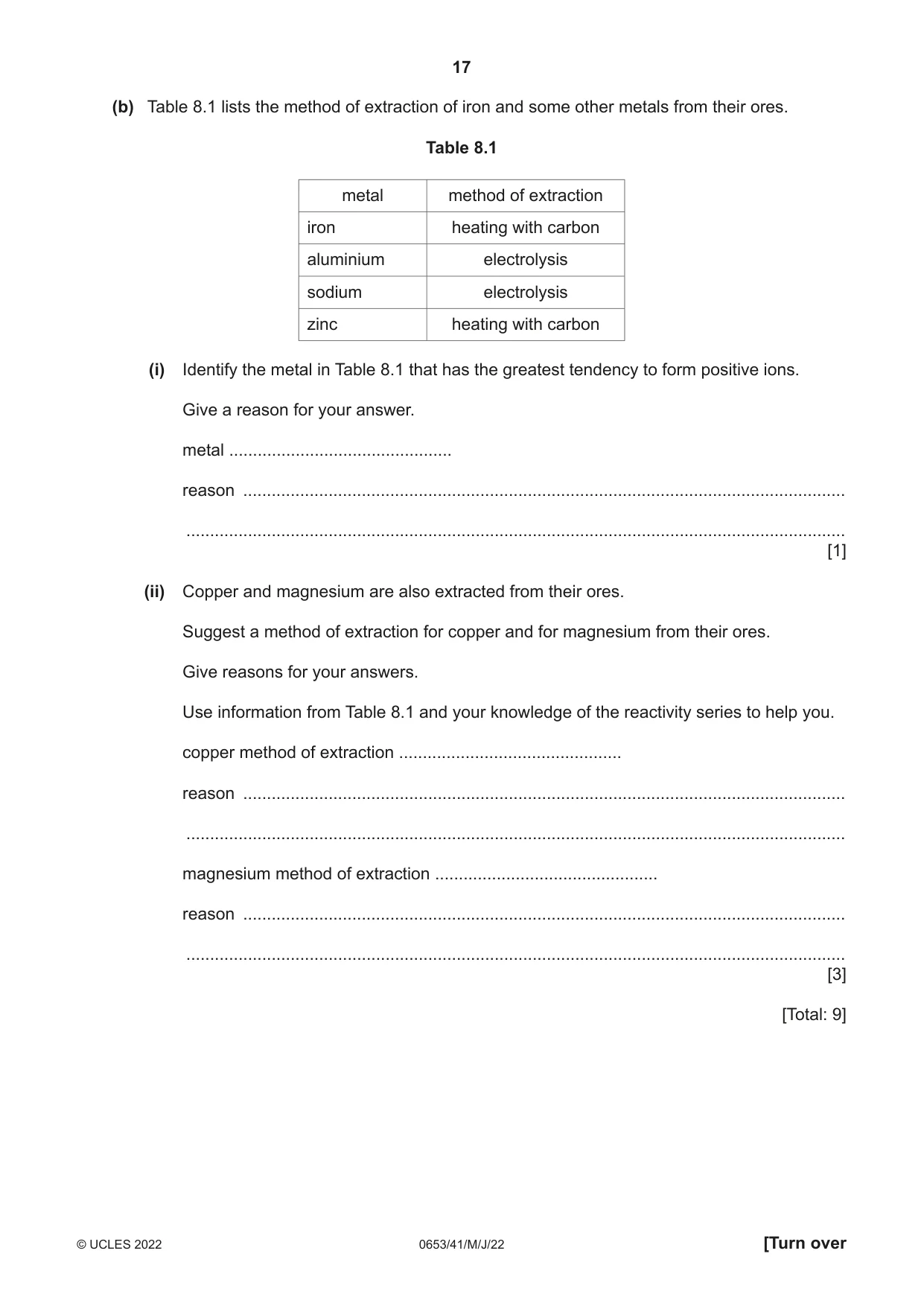
8 (a) Iron is extracted from hematite in a blast furnace. Equations for three reactions that take place in the blast furnace are listed. equation 1 C + O2 CO2 equation 2 C + CO2 2CO equation 3 Fe2O3 + 3CO 2Fe + 3CO2 (i) State which equation, 1, 2 or 3, represents a reaction in which a carbon compound acts as a reducing agent. Explain your answer. equation ............................................... explanation ........................................................................................................................ ........................................................................................................................................... [1] (ii) Name two gases that are produced in these equations and describe a health or environmental problem caused by each. gas 1 ............................................... problem ............................................................................................................................. ........................................................................................................................................... gas 2 ............................................... problem ............................................................................................................................. ........................................................................................................................................... [3] (iii) Fe2O3 contains oxide ions, O2–. State the charge on each iron ion in Fe2O3. ............................................... [1] (b) Table 8.1 lists the method of extraction of iron and some other metals from their ores. Table 8.1 metal method of extraction iron heating with carbon aluminium electrolysis sodium electrolysis zinc heating with carbon (i) Identify the metal in Table 8.1 that has the greatest tendency to form positive ions. Give a reason for your answer. metal ............................................... reason ............................................................................................................................... ........................................................................................................................................... [1] (ii) Copper and magnesium are also extracted from their ores. Suggest a method of extraction for copper and for magnesium from their ores. Give reasons for your answers. Use information from Table 8.1 and your knowledge of the reactivity series to help you. copper method of extraction ............................................... reason ............................................................................................................................... ........................................................................................................................................... magnesium method of extraction ............................................... reason ............................................................................................................................... ........................................................................................................................................... [3] [Total: 9]
Mark scheme: 8(a)(i) (equation) 3 AND carbon monoxide removes oxygen from iron (oxide) ; 1 8(a)(ii) carbon monoxide AND carbon dioxide ; carbon monoxide, is toxic / restricts oxygen transport in the blood ; carbon dioxide causes, climate change / enhanced greenhouse effect / global warming ; 3 8(a)(iii) 3+ / Fe3+ ; 1 8(b)(i) sodium AND because it is the most reactive ; 1 Question Answer Marks 8(b)(ii) Cu heating with carbon AND Mg electrolysis ; Cu because less reactive than iron / carbon ; Mg because more reactive than aluminium / carbon ; 3
Question 9
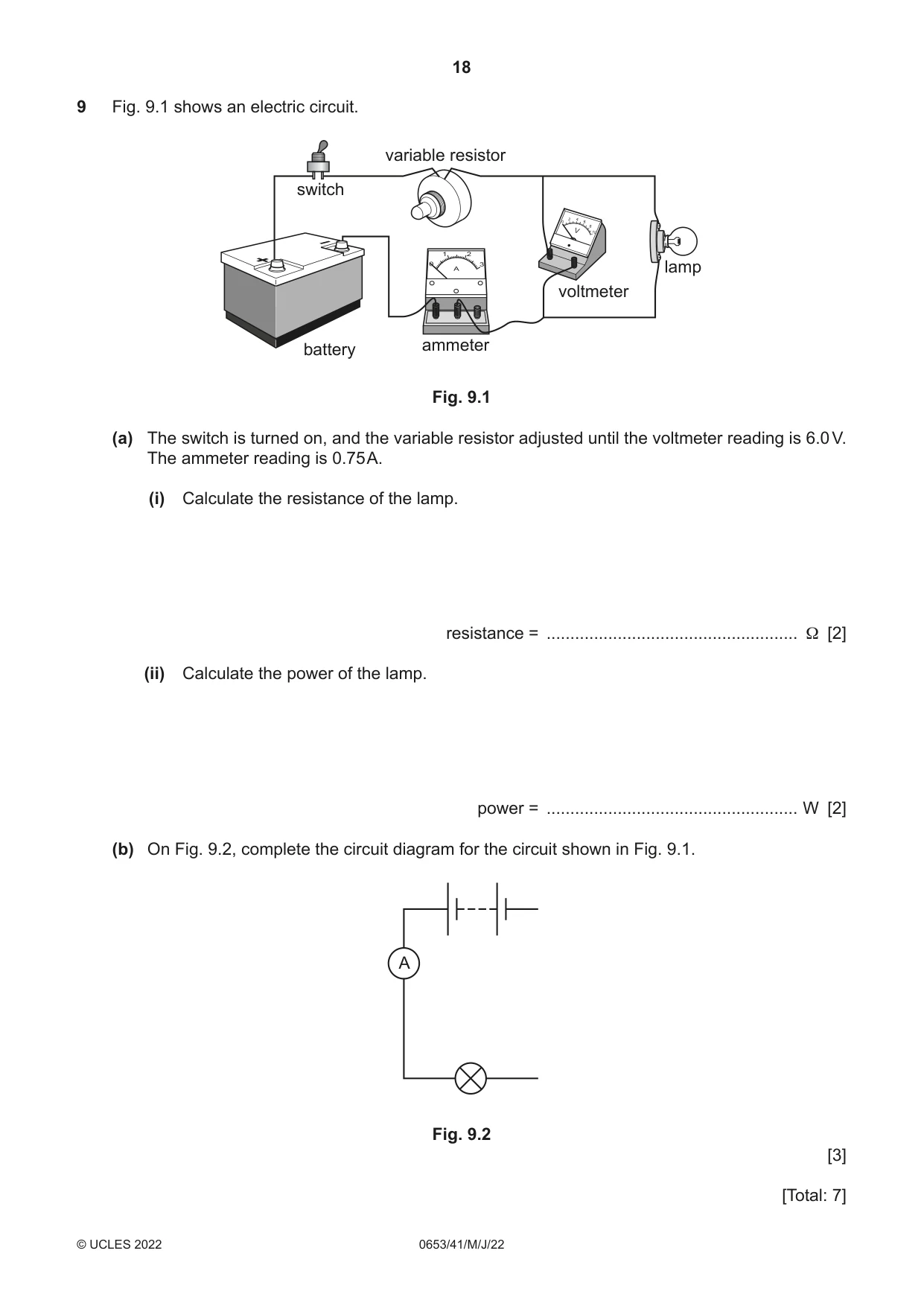
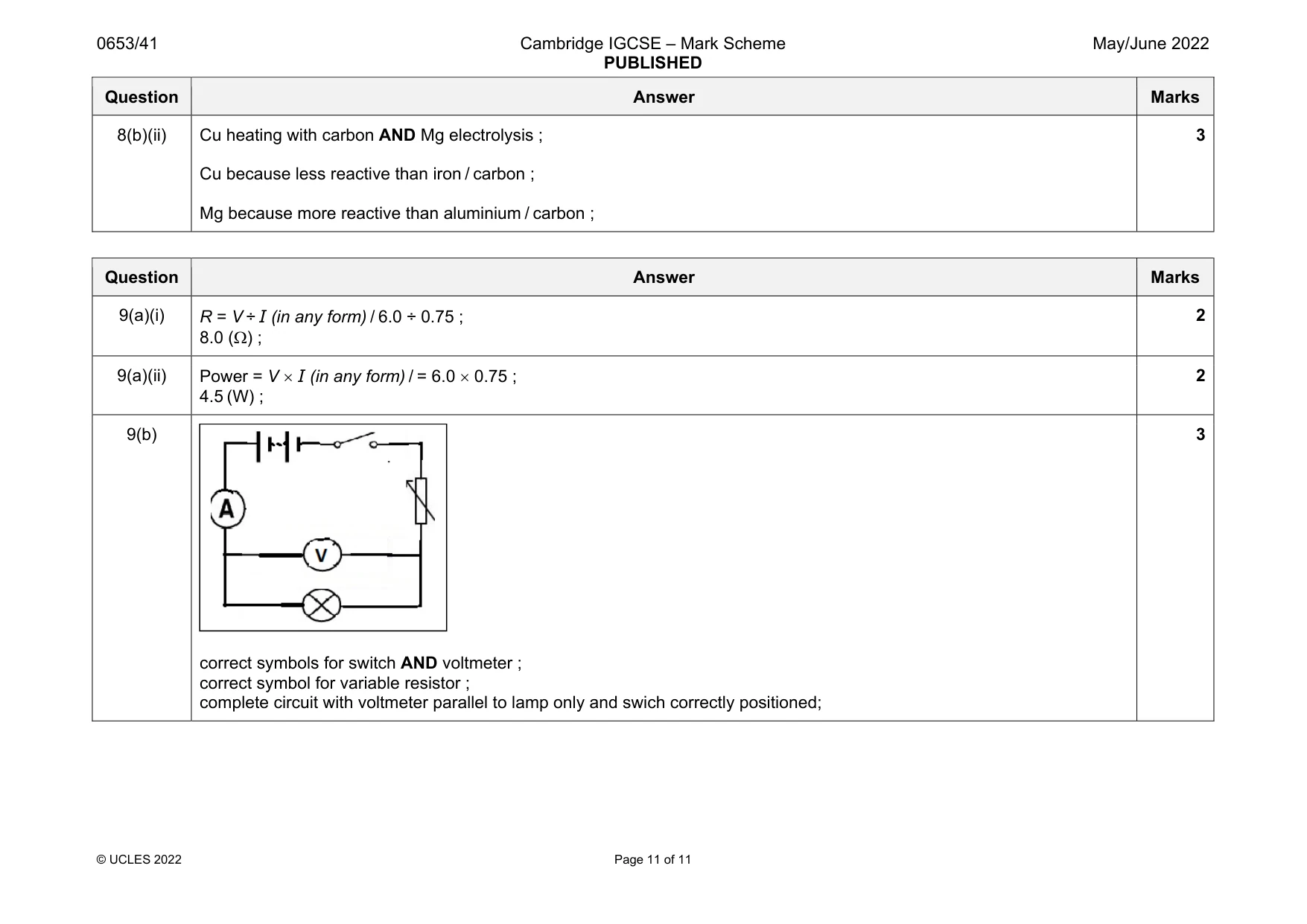
9 Fig. 9.1 shows an electric circuit. variable resistor switch lamp voltmeter battery ammeter Fig. 9.1 (a) The switch is turned on, and the variable resistor adjusted until the voltmeter reading is 6.0 V. The ammeter reading is 0.75 A. (i) Calculate the resistance of the lamp. resistance = ..................................................... Ω [2] (ii) Calculate the power of the lamp. power = ..................................................... W [2] (b) On Fig. 9.2, complete the circuit diagram for the circuit shown in Fig. 9.1. A Fig. 9.2 [3] [Total: 7]
Mark scheme: 9(a)(i) 8.0 () ; 2 9(a)(ii) Power = V I (in any form) / = 6.0 0.75 ; 4.5 (W) ; 2 9(b) correct symbols for switch AND voltmeter ; correct symbol for variable resistor ; complete circuit with voltmeter parallel to lamp only and swich correctly positioned; 3
What was in this paper
The subtopics covered by these 9 questions, and how many questions each got. Open one in a new tab to see every Cambridge question on it.
What you needed in this session
Cambridge’s own grade thresholds for 2022 May/June, Paper 4 · Variant 1. A higher threshold means an easier paper — the bar moves with how the cohort did.