Cambridge IGCSE Science - Combined 0653 — 2021 May/June Paper 4 · Variant 1
0653/41/M/J/21 · 9 questions · 80 marks · ≈90 min
The question paper and its mark scheme, free to read here and free to download. This is Cambridge’s own paper, exactly as it was sat.
Question paper24 pages
Mark scheme10 pages
Answers below. Sit the paper first if you are practising.
Questions as text
Q1 · A diagram of a human sperm cell
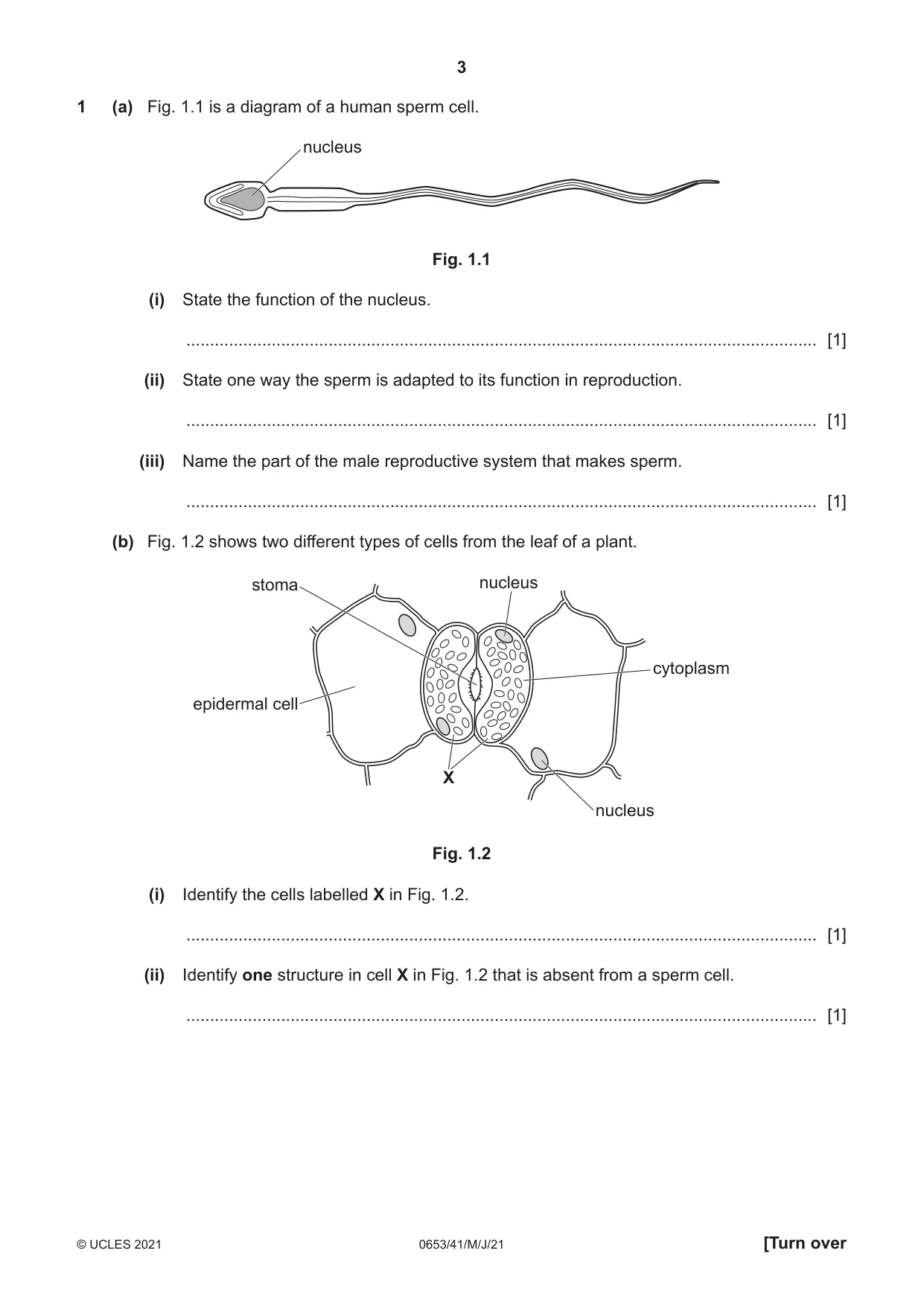
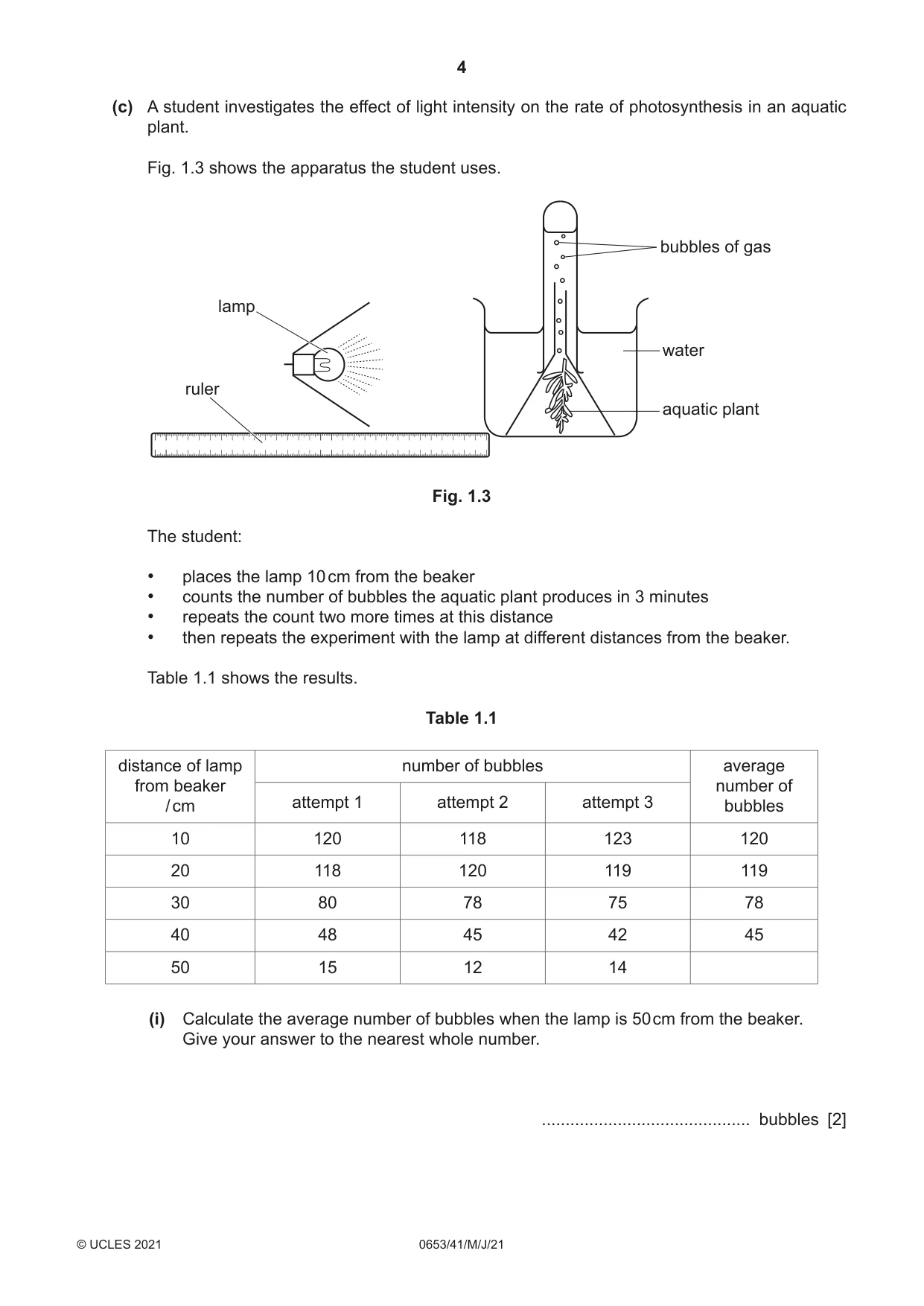
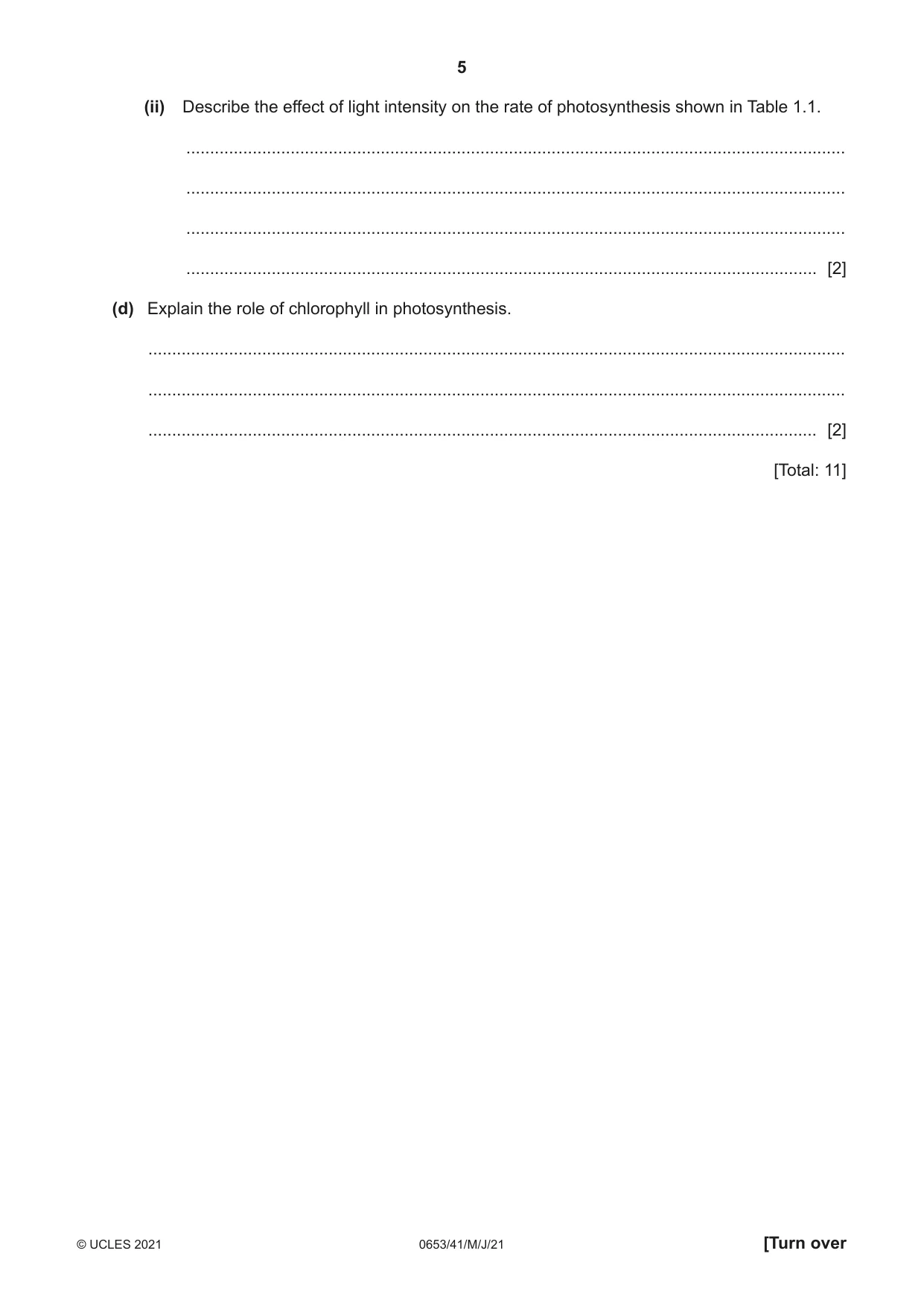
1 (a) Fig. 1.1 is a diagram of a human sperm cell. nucleus Fig. 1.1 (i) State the function of the nucleus. ..................................................................................................................................... [1] (ii) State one way the sperm is adapted to its function in reproduction. ..................................................................................................................................... [1] (iii) Name the part of the male reproductive system that makes sperm. ..................................................................................................................................... [1] (b) Fig. 1.2 shows two different types of cells from the leaf of a plant. stoma nucleus cytoplasm epidermal cell X nucleus Fig. 1.2 (i) Identify the cells labelled X in Fig. 1.2. ..................................................................................................................................... [1] (ii) Identify one structure in cell X in Fig. 1.2 that is absent from a sperm cell. ..................................................................................................................................... [1] (c) A student investigates the effect of light intensity on the rate of photosynthesis in an aquatic plant. Fig. 1.3 shows the apparatus the student uses. bubbles of gas lamp water ruler aquatic plant Fig. 1.3 The student: • places the lamp 10 cm from the beaker • counts the number of bubbles the aquatic plant produces in 3 minutes • repeats the count two more times at this distance • then repeats the experiment with the lamp at different distances from the beaker. Table 1.1 shows the results. Table 1.1 distance of lamp number of bubbles average from beaker number of / cm attempt 1 attempt 2 attempt 3 bubbles 10 120 118 123 120 20 118 120 119 119 30 80 78 75 78 40 48 45 42 45 50 15 12 14 (i) Calculate the average number of bubbles when the lamp is 50 cm from the beaker. Give your answer to the nearest whole number. ............................................ bubbles [2] (ii) Describe the effect of light intensity on the rate of photosynthesis shown in Table 1.1. ........................................................................................................................................... ........................................................................................................................................... ........................................................................................................................................... ..................................................................................................................................... [2] (d) Explain the role of chlorophyll in photosynthesis. ................................................................................................................................................... ................................................................................................................................................... ............................................................................................................................................. [2] [Total: 11]
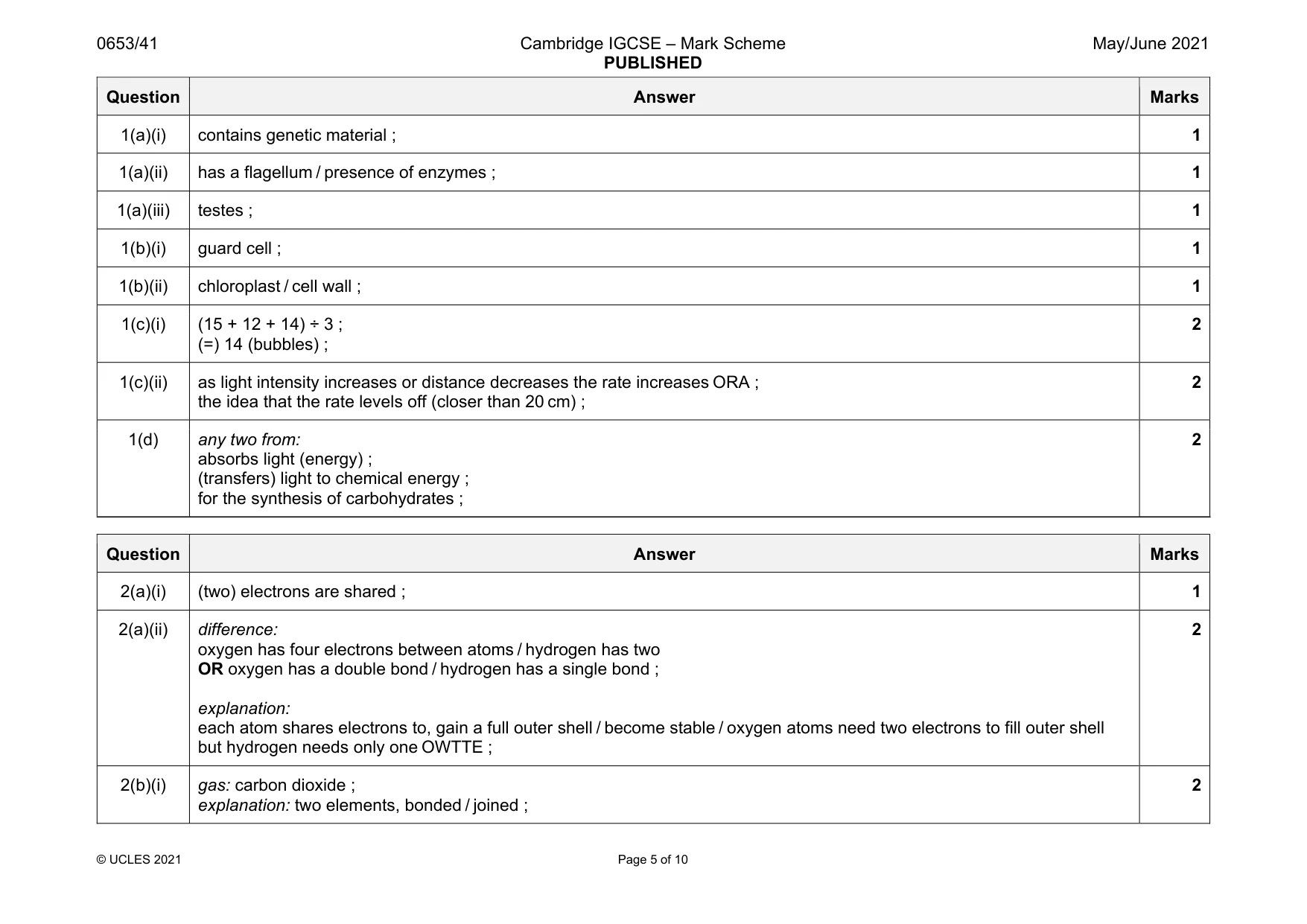
Mark scheme: 1(a)(i) contains genetic material ; 1 1(a)(ii) has a flagellum / presence of enzymes ; 1 1(a)(iii) testes ; 1 1(b)(i) guard cell ; 1 1(b)(ii) chloroplast / cell wall ; 1 1(c)(i) (15 + 12 + 14) ÷ 3 ; (=) 14 (bubbles) ; 2 1(c)(ii) as light intensity increases or distance decreases the rate increases ORA ; the idea that the rate levels off (closer than 20 cm) ; 2 1(d) any two from: absorbs light (energy) ; (transfers) light to chemical energy ; for the synthesis of carbohydrates ; 2
Q2 · Oxygen and hydrogen are gases
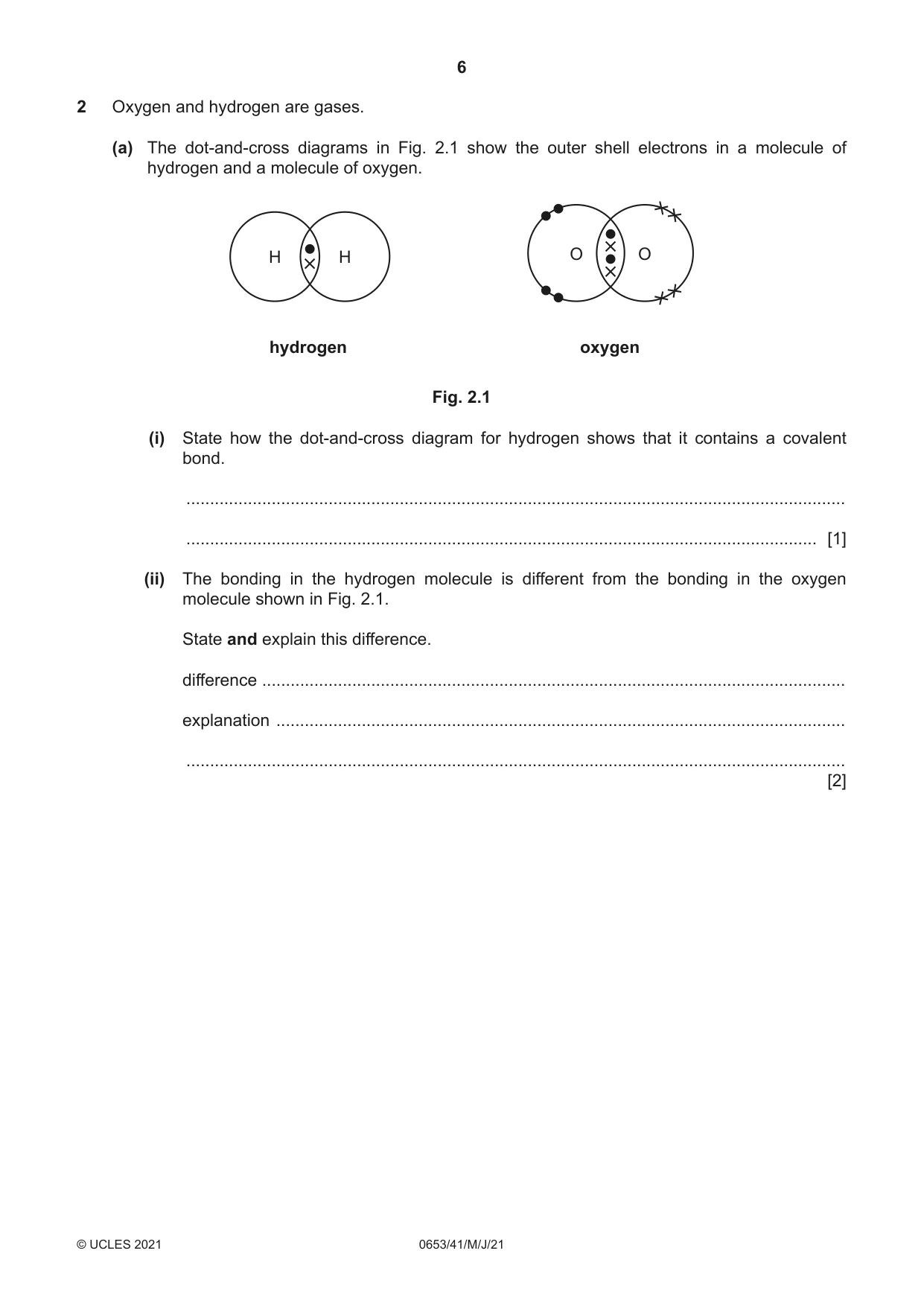
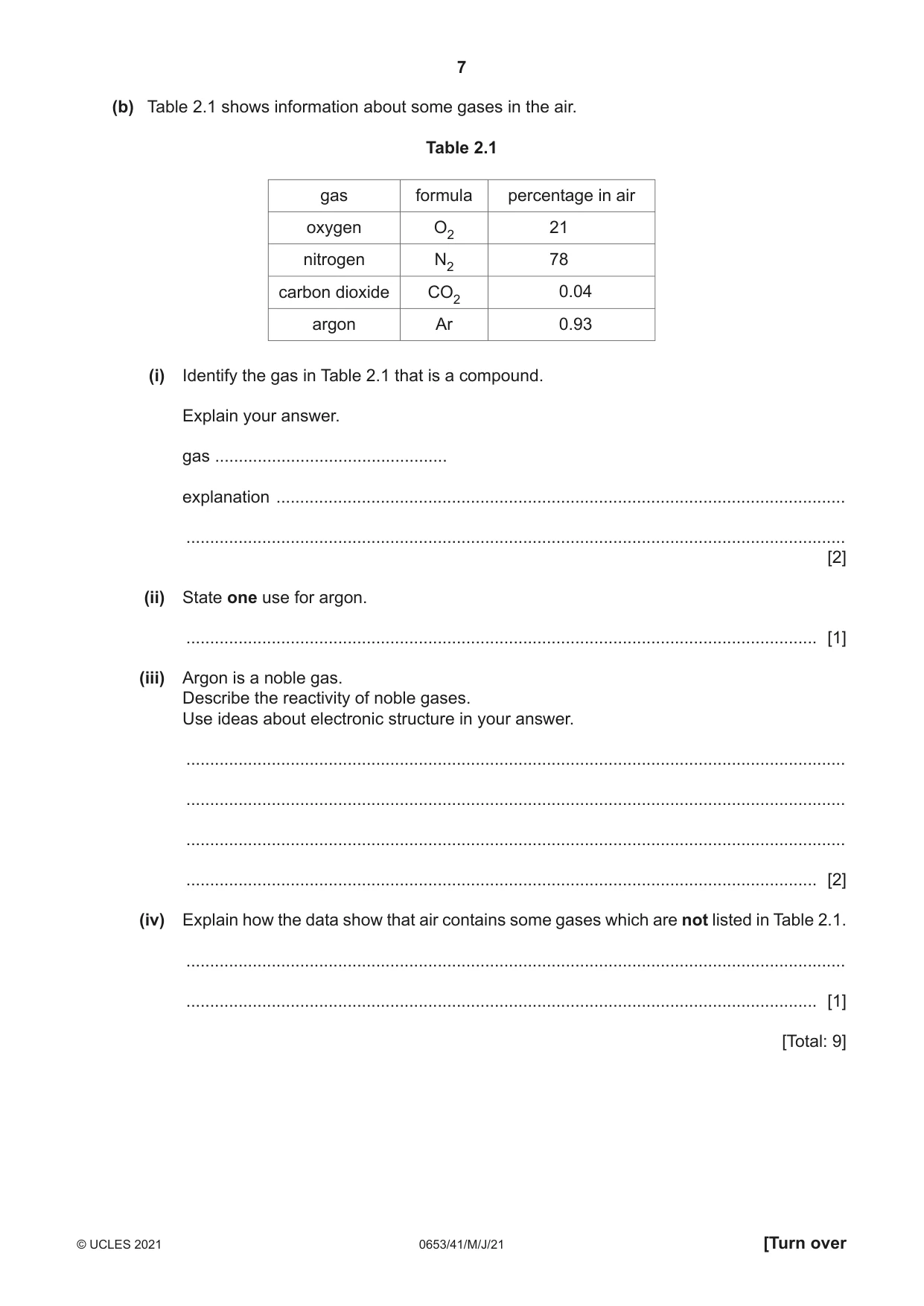
2 Oxygen and hydrogen are gases. (a) The dot-and-cross diagrams in Fig. 2.1 show the outer shell electrons in a molecule of hydrogen and a molecule of oxygen. H H O O hydrogen oxygen Fig. 2.1 (i) State how the dot-and-cross diagram for hydrogen shows that it contains a covalent bond. ........................................................................................................................................... ..................................................................................................................................... [1] (ii) The bonding in the hydrogen molecule is different from the bonding in the oxygen molecule shown in Fig. 2.1. State and explain this difference. difference ........................................................................................................................... explanation ........................................................................................................................ ........................................................................................................................................... [2] (b) Table 2.1 shows information about some gases in the air. Table 2.1 gas formula percentage in air oxygen O2 21 nitrogen N2 78 carbon dioxide CO2 0.04 argon Ar 0.93 (i) Identify the gas in Table 2.1 that is a compound. Explain your answer. gas ................................................. explanation ........................................................................................................................ ........................................................................................................................................... [2] (ii) State one use for argon. ..................................................................................................................................... [1] (iii) Argon is a noble gas. Describe the reactivity of noble gases. Use ideas about electronic structure in your answer. ........................................................................................................................................... ........................................................................................................................................... ........................................................................................................................................... ..................................................................................................................................... [2] (iv) Explain how the data show that air contains some gases which are not listed in Table 2.1. ........................................................................................................................................... ..................................................................................................................................... [1] [Total: 9]
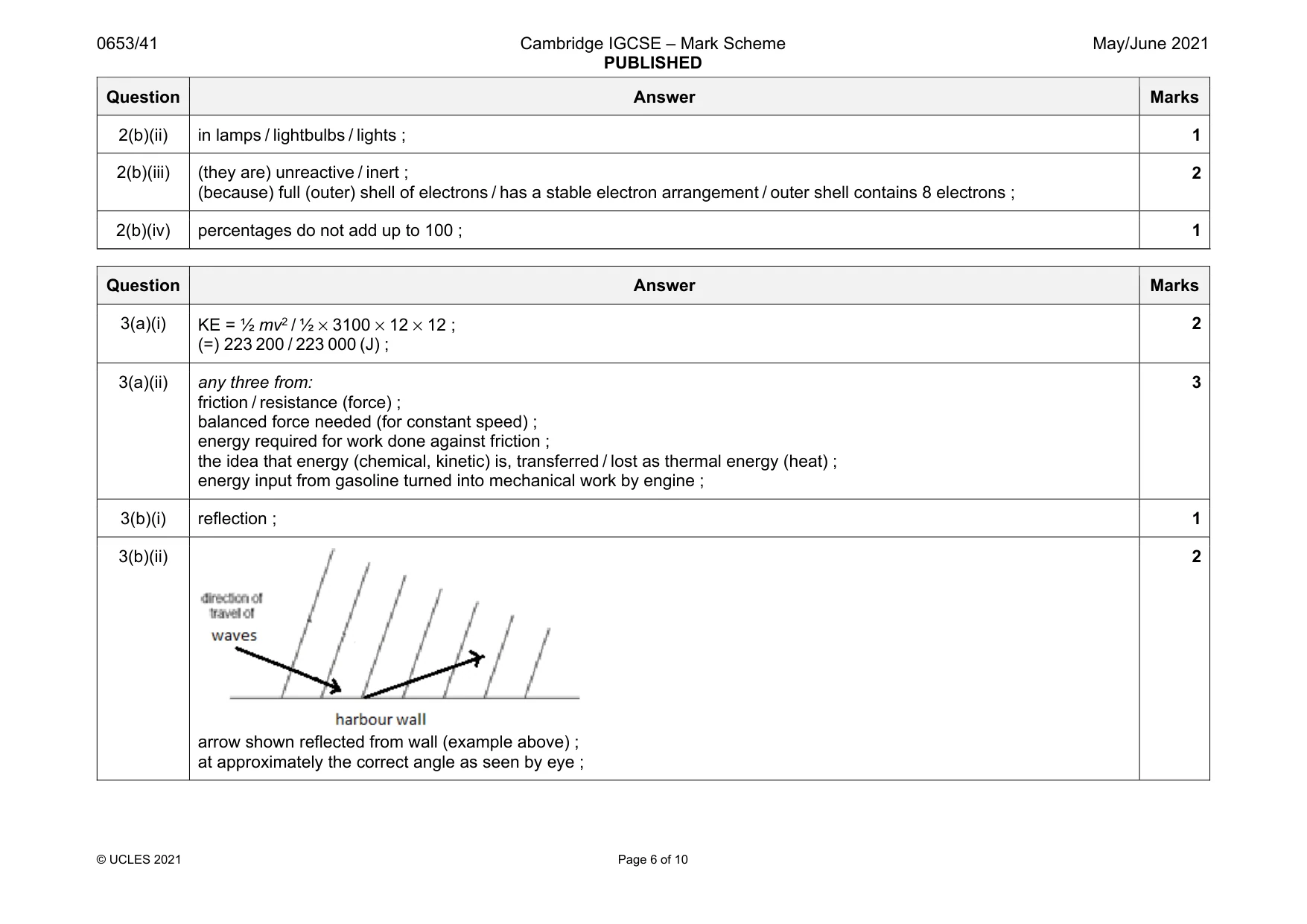
Mark scheme: 2(a)(i) (two) electrons are shared ; 1 2(a)(ii) difference: oxygen has four electrons between atoms / hydrogen has two OR oxygen has a double bond / hydrogen has a single bond ; explanation: each atom shares electrons to, gain a full outer shell / become stable / oxygen atoms need two electrons to fill outer shell but hydrogen needs only one OWTTE ; 2 2(b)(i) gas: carbon dioxide ; explanation: two elements, bonded / joined ; 2 Question Answer Marks 2(b)(ii) in lamps / lightbulbs / lights ; 1 2(b)(iii) (they are) unreactive / inert ; (because) full (outer) shell of electrons / has a stable electron arrangement / outer shell contains 8 electrons ; 2 2(b)(iv) percentages do not add up to 100 ; 1
Q3 · A motor boat moving forward across the sea
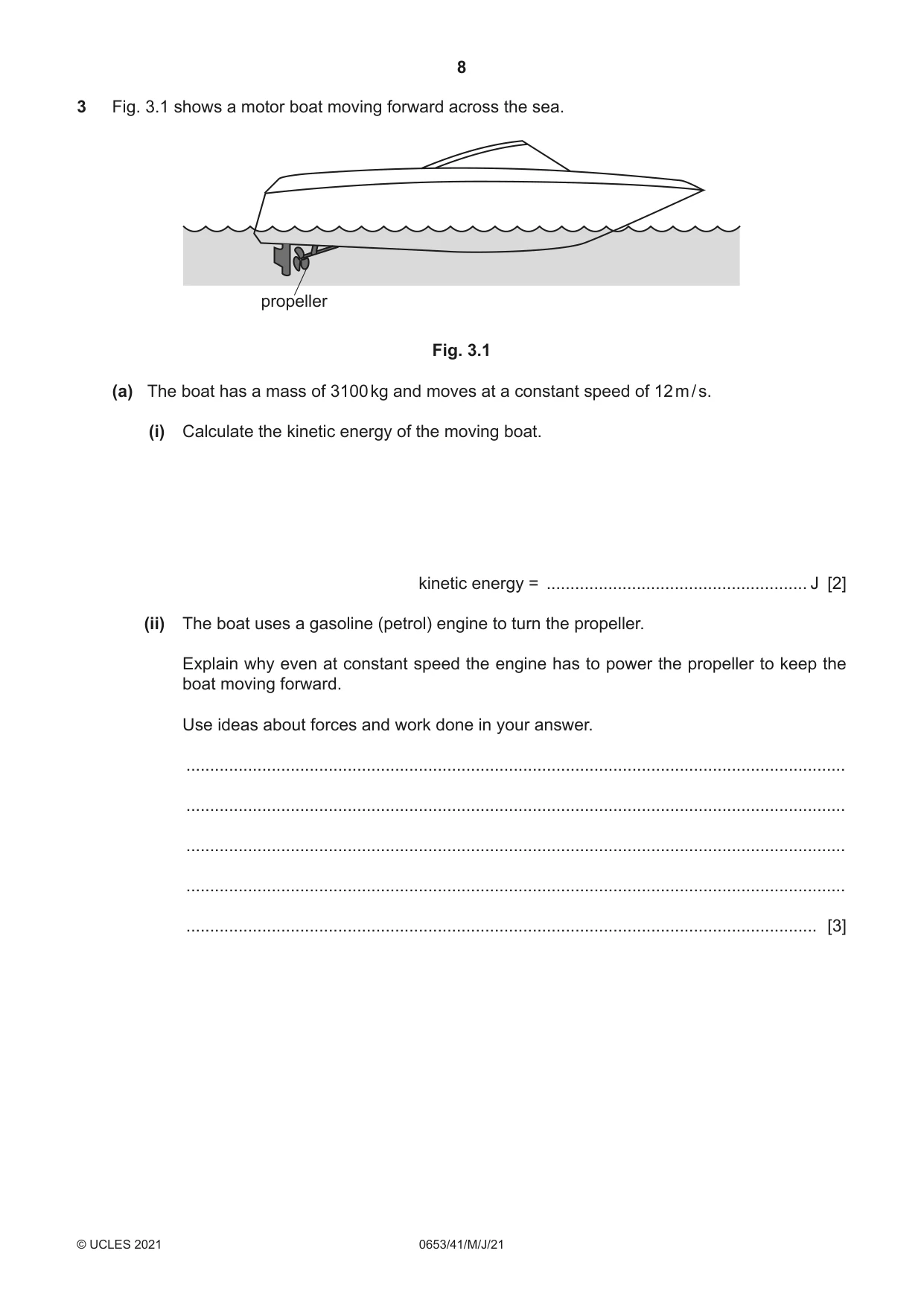
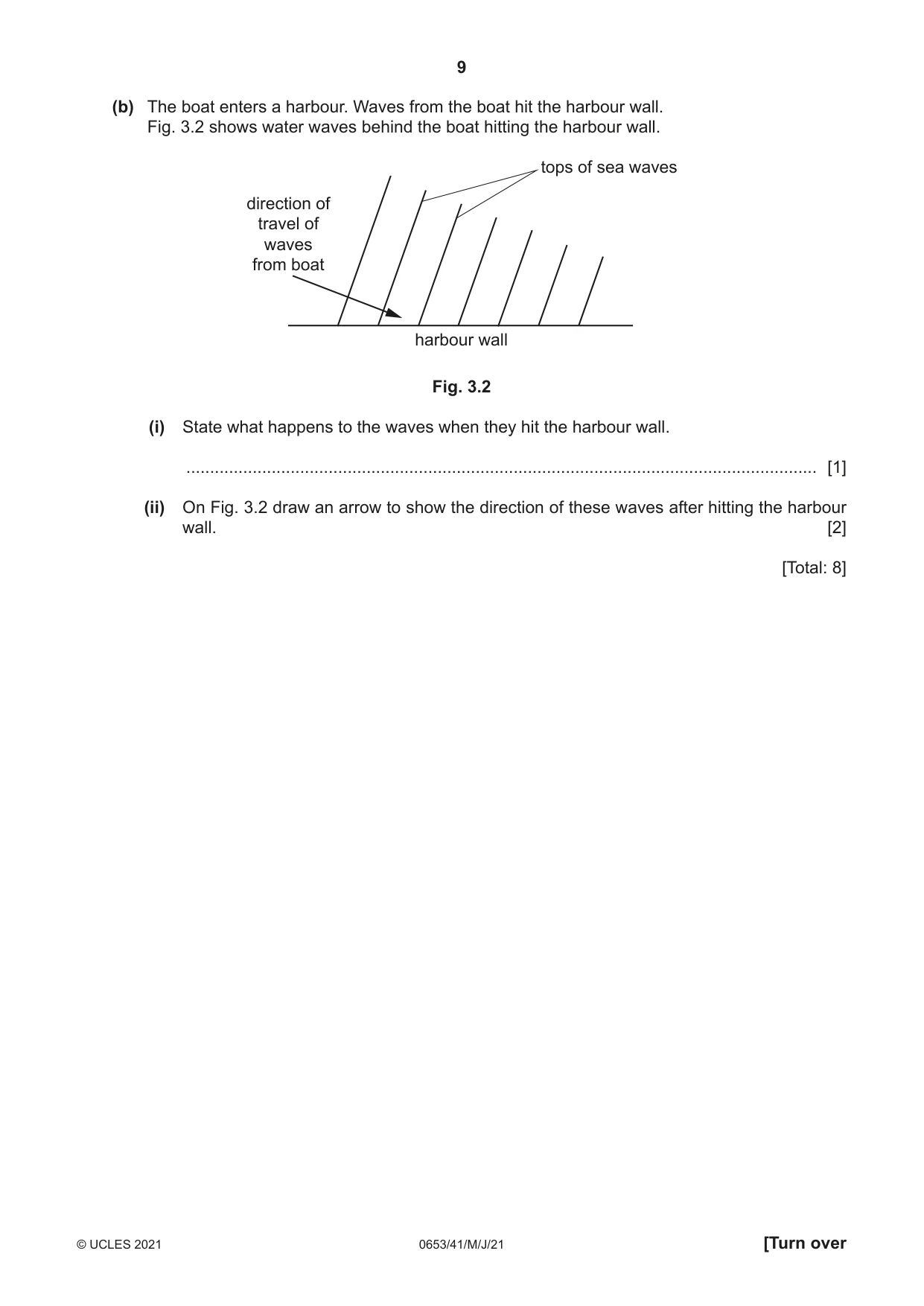
3 Fig. 3.1 shows a motor boat moving forward across the sea. propeller Fig. 3.1 (a) The boat has a mass of 3100 kg and moves at a constant speed of 12 m / s. (i) Calculate the kinetic energy of the moving boat. kinetic energy = ....................................................... J [2] (ii) The boat uses a gasoline (petrol) engine to turn the propeller. Explain why even at constant speed the engine has to power the propeller to keep the boat moving forward. Use ideas about forces and work done in your answer. ........................................................................................................................................... ........................................................................................................................................... ........................................................................................................................................... ........................................................................................................................................... ..................................................................................................................................... [3] (b) The boat enters a harbour. Waves from the boat hit the harbour wall. Fig. 3.2 shows water waves behind the boat hitting the harbour wall. tops of sea waves direction of travel of waves from boat harbour wall Fig. 3.2 (i) State what happens to the waves when they hit the harbour wall. ..................................................................................................................................... [1] (ii) On Fig. 3.2 draw an arrow to show the direction of these waves after hitting the harbour wall. [2] [Total: 8]
Mark scheme: 3(a)(i) KE = ½ mv2 / ½ × 3100 × 12 × 12 ; (=) 223 200 / 223 000 (J) ; 2 3(a)(ii) any three from: friction / resistance (force) ; balanced force needed (for constant speed) ; energy required for work done against friction ; the idea that energy (chemical, kinetic) is, transferred / lost as thermal energy (heat) ; energy input from gasoline turned into mechanical work by engine ; 3 3(b)(i) reflection ; 1 3(b)(ii) arrow shown reflected from wall (example above) ; at approximately the correct angle as seen by eye ; 2
Q4 · The mass of protein in some different food types
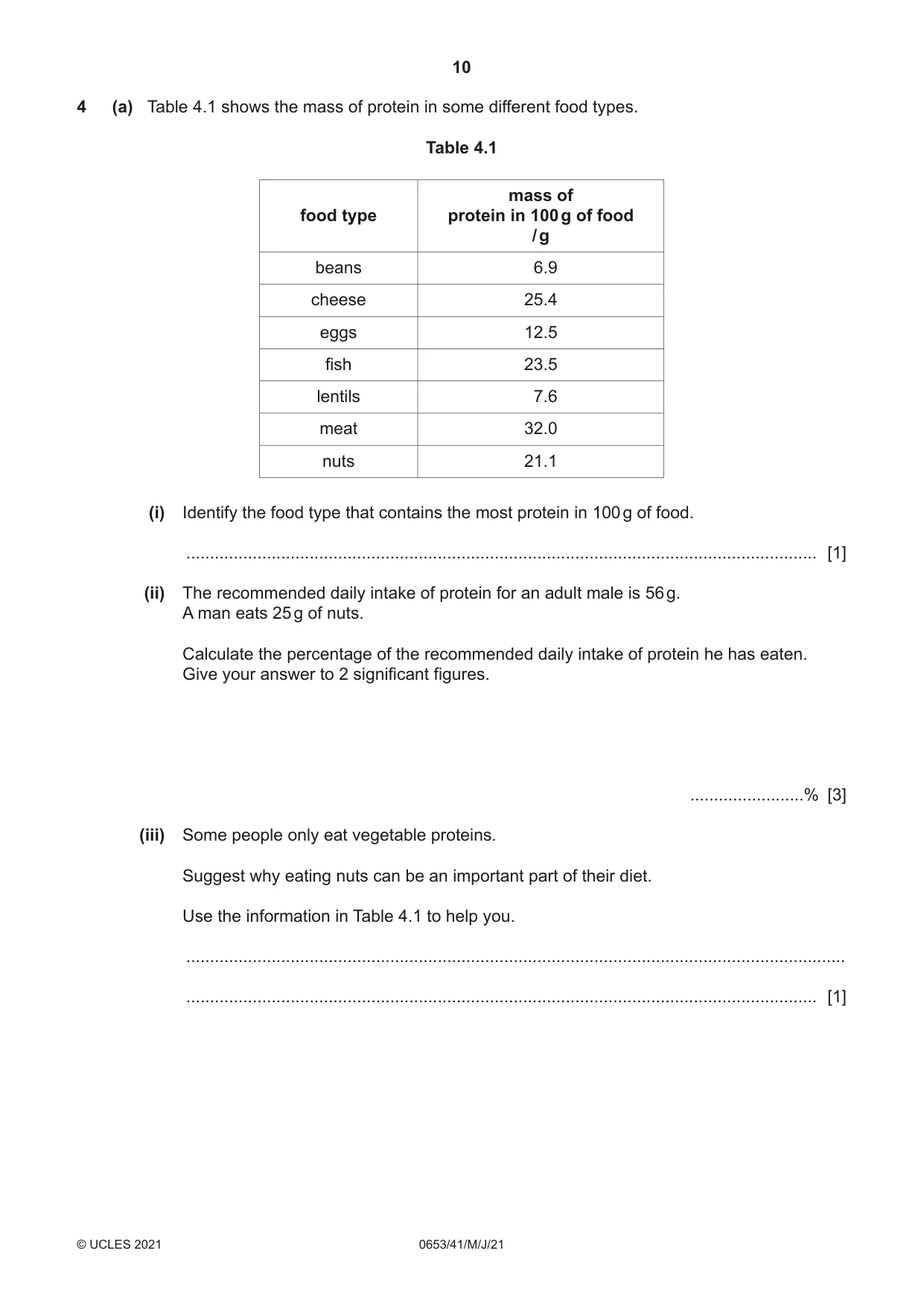
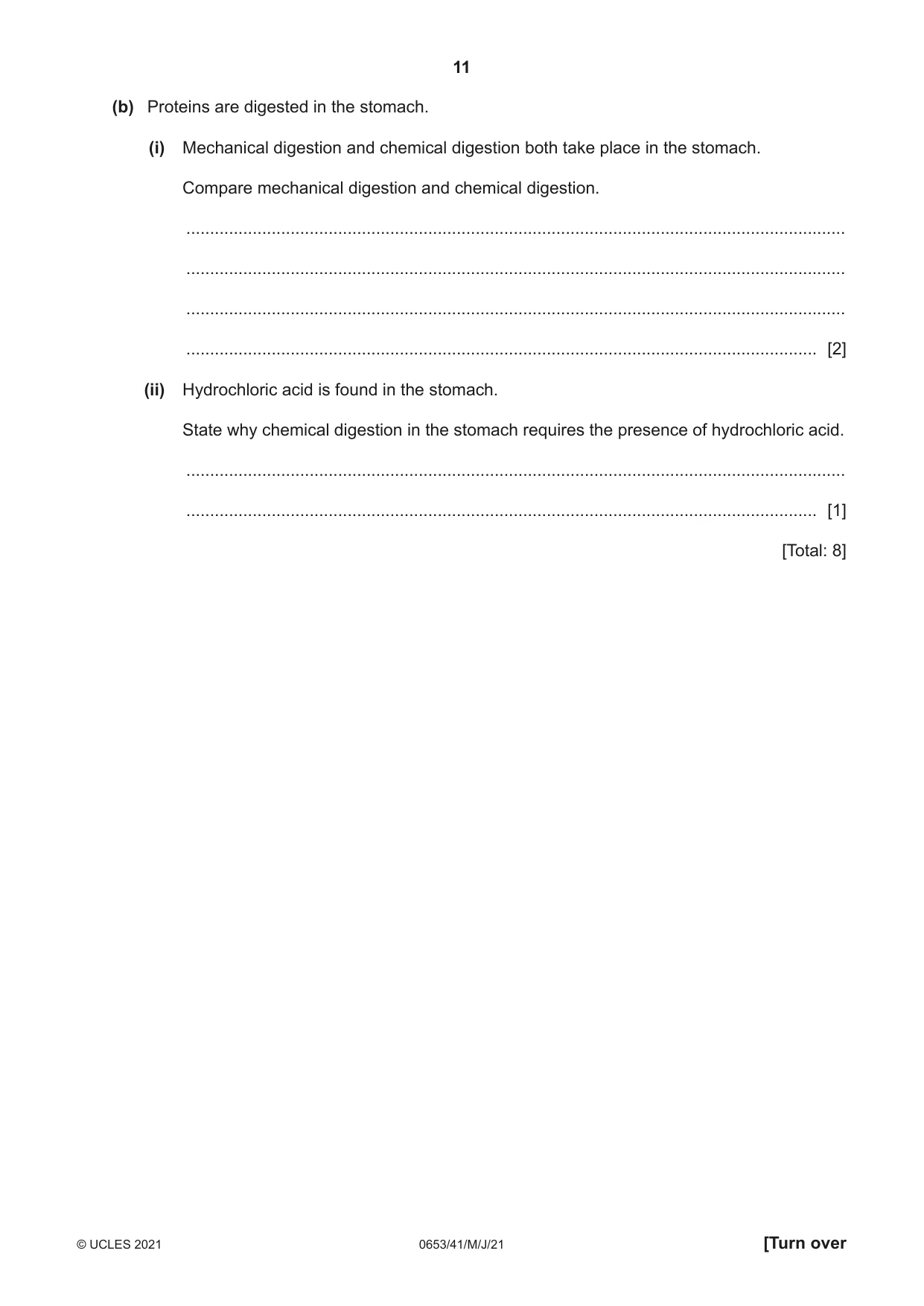
4 (a) Table 4.1 shows the mass of protein in some different food types. Table 4.1 mass of food type protein in 100 g of food / g beans 6.9 cheese 25.4 eggs 12.5 fish 23.5 lentils 7.6 meat 32.0 nuts 21.1 (i) Identify the food type that contains the most protein in 100 g of food. ..................................................................................................................................... [1] (ii) The recommended daily intake of protein for an adult male is 56 g. A man eats 25 g of nuts. Calculate the percentage of the recommended daily intake of protein he has eaten. Give your answer to 2 significant figures. ........................% [3] (iii) Some people only eat vegetable proteins. Suggest why eating nuts can be an important part of their diet. Use the information in Table 4.1 to help you. ........................................................................................................................................... ..................................................................................................................................... [1] (b) Proteins are digested in the stomach. (i) Mechanical digestion and chemical digestion both take place in the stomach. Compare mechanical digestion and chemical digestion. ........................................................................................................................................... ........................................................................................................................................... ........................................................................................................................................... ..................................................................................................................................... [2] (ii) Hydrochloric acid is found in the stomach. State why chemical digestion in the stomach requires the presence of hydrochloric acid. ........................................................................................................................................... ..................................................................................................................................... [1] [Total: 8]
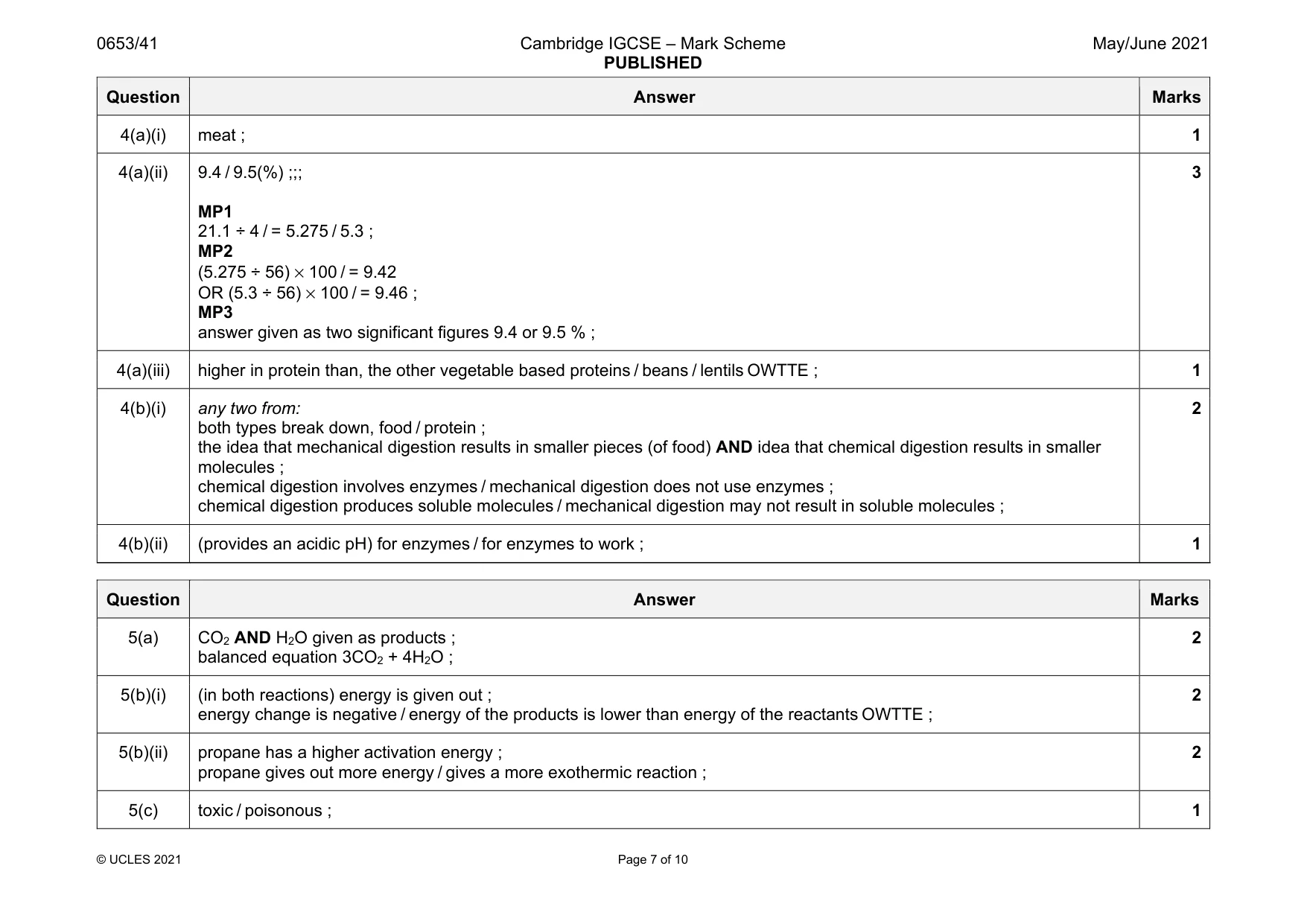
Mark scheme: 4(a)(i) meat ; 1 4(a)(ii) 9.4 / 9.5(%) ;;; MP1 21.1 ÷ 4 / = 5.275 / 5.3 ; MP2 (5.275 ÷ 56) × 100 / = 9.42 OR (5.3 ÷ 56) × 100 / = 9.46 ; MP3 answer given as two significant figures 9.4 or 9.5 % ; 3 4(a)(iii) higher in protein than, the other vegetable based proteins / beans / lentils OWTTE ; 1 4(b)(i) any two from: both types break down, food / protein ; the idea that mechanical digestion results in smaller pieces (of food) AND idea that chemical digestion results in smaller molecules ; chemical digestion involves enzymes / mechanical digestion does not use enzymes ; chemical digestion produces soluble molecules / mechanical digestion may not result in soluble molecules ; 2 4(b)(ii) (provides an acidic pH) for enzymes / for enzymes to work ; 1
Q5 · Some gas ovens use methane as a fuel, other gas ovens use propane
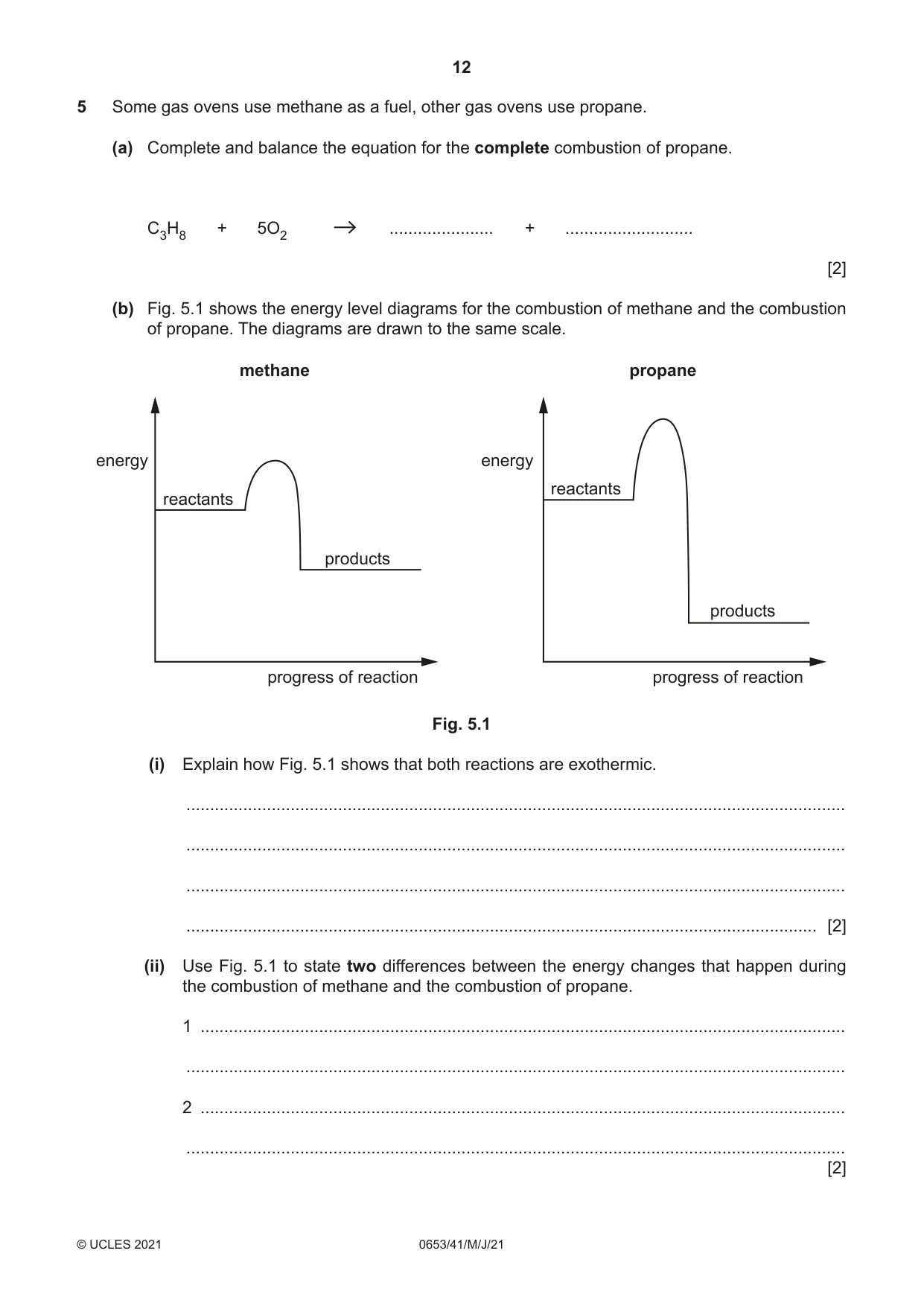
5 Some gas ovens use methane as a fuel, other gas ovens use propane. (a) Complete and balance the equation for the complete combustion of propane. C3H8 + 5O2 ...................... + ........................... [2] (b) Fig. 5.1 shows the energy level diagrams for the combustion of methane and the combustion of propane. The diagrams are drawn to the same scale. methane propane energy energy reactants reactants products products progress of reaction progress of reaction Fig. 5.1 (i) Explain how Fig. 5.1 shows that both reactions are exothermic. ........................................................................................................................................... ........................................................................................................................................... ........................................................................................................................................... ..................................................................................................................................... [2] (ii) Use Fig. 5.1 to state two differences between the energy changes that happen during the combustion of methane and the combustion of propane. 1 ........................................................................................................................................ ........................................................................................................................................... 2 ........................................................................................................................................ ........................................................................................................................................... [2] (c) When the air supply to an oven is limited, carbon monoxide is formed. State one adverse effect of carbon monoxide. ................................................................................................................................................... ............................................................................................................................................. [1] [Total: 7]
Mark scheme: 5(a) CO2 AND H2O given as products ; balanced equation 3CO2 + 4H2O ; 2 5(b)(i) (in both reactions) energy is given out ; energy change is negative / energy of the products is lower than energy of the reactants OWTTE ; 2 5(b)(ii) propane has a higher activation energy ; propane gives out more energy / gives a more exothermic reaction ; 2 5(c) toxic / poisonous ; 1
Q6 · A thermometer in a solution of salt in water
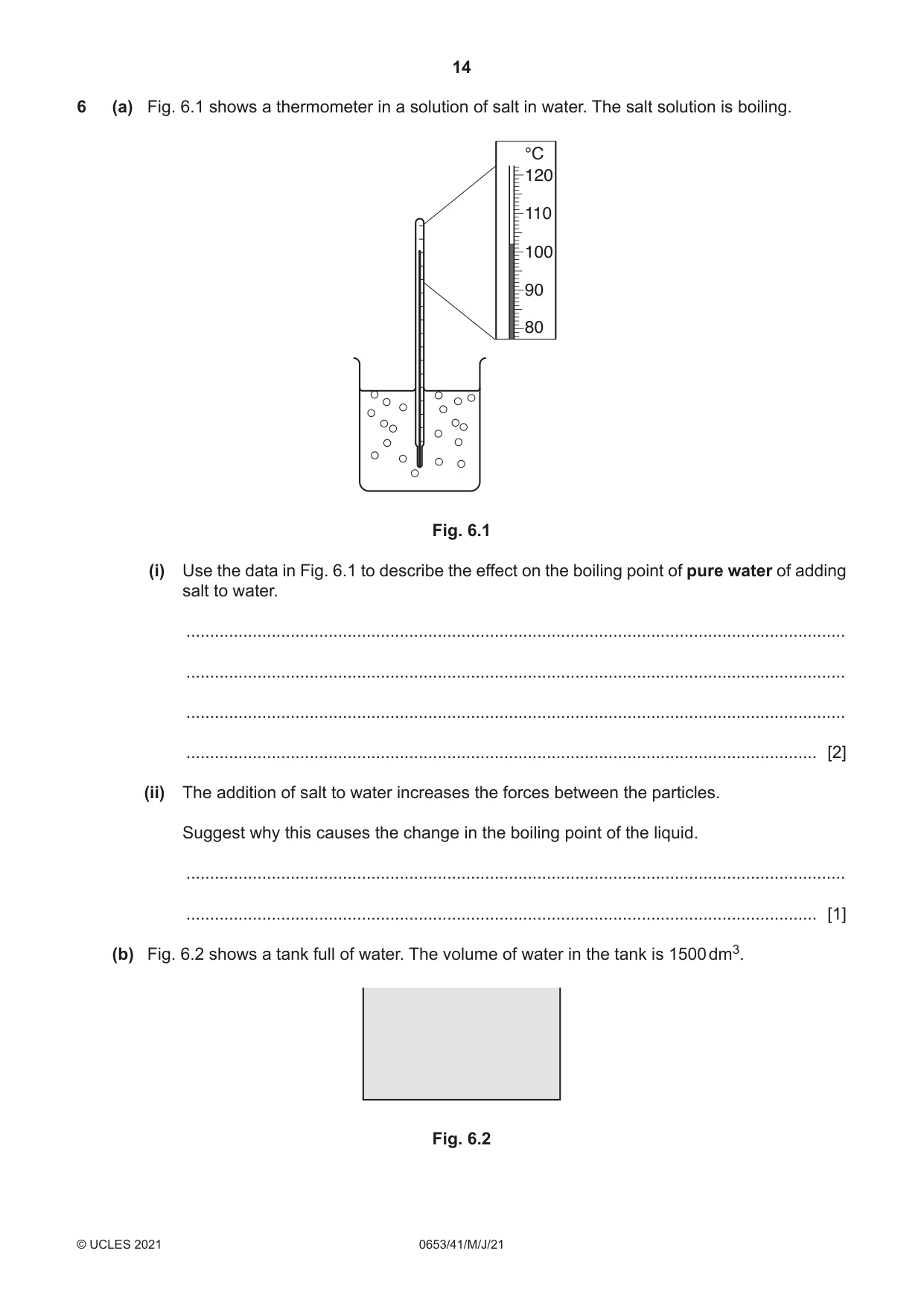
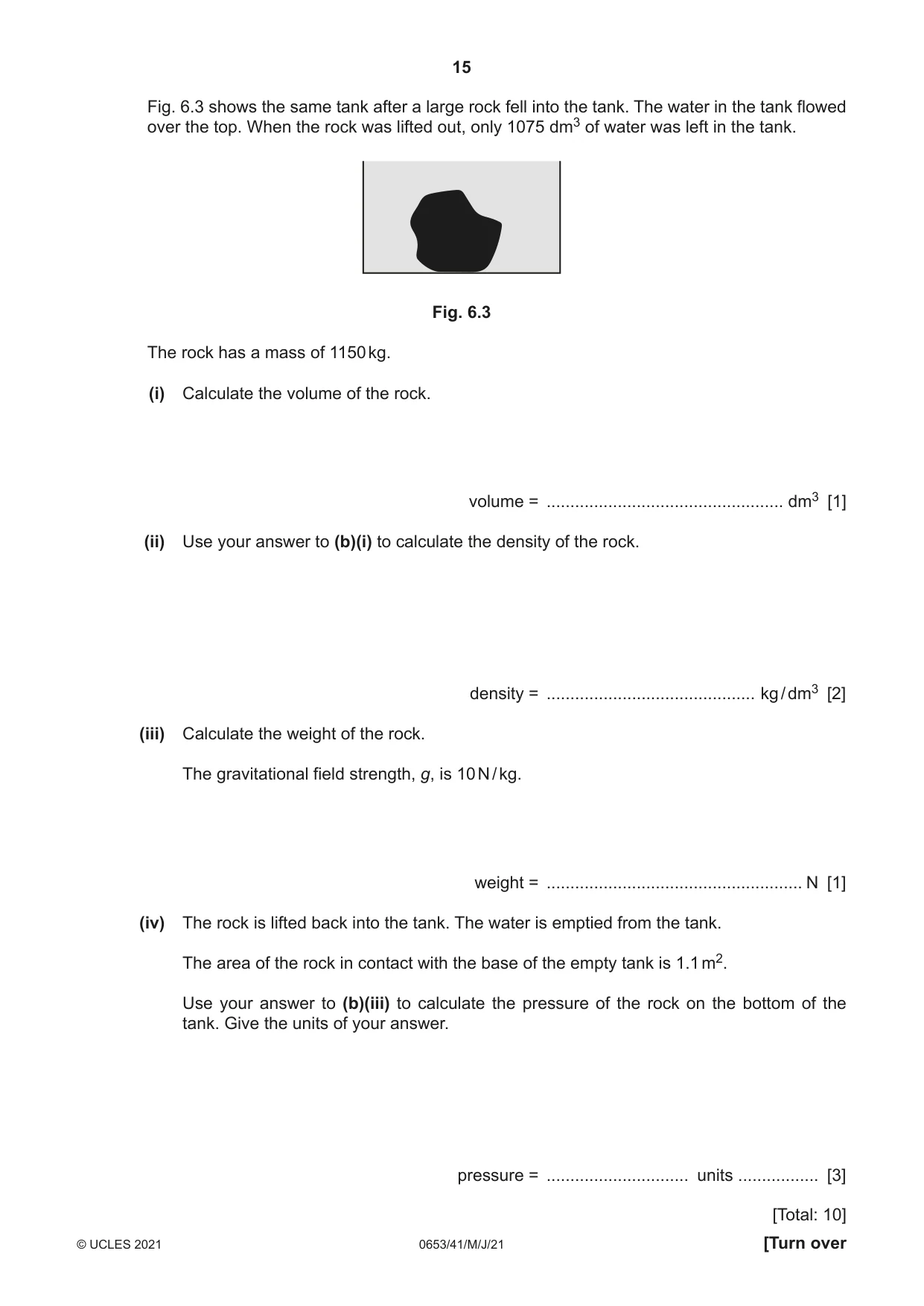
6 (a) Fig. 6.1 shows a thermometer in a solution of salt in water. The salt solution is boiling. °C 120 110 100 90 80 Fig. 6.1 (i) Use the data in Fig. 6.1 to describe the effect on the boiling point of pure water of adding salt to water. ........................................................................................................................................... ........................................................................................................................................... ........................................................................................................................................... ..................................................................................................................................... [2] (ii) The addition of salt to water increases the forces between the particles. Suggest why this causes the change in the boiling point of the liquid. ........................................................................................................................................... ..................................................................................................................................... [1] (b) Fig. 6.2 shows a tank full of water. The volume of water in the tank is 1500 dm3. Fig. 6.2 Fig. 6.3 shows the same tank after a large rock fell into the tank. The water in the tank flowed over the top. When the rock was lifted out, only 1075 dm3 of water was left in the tank. Fig. 6.3 The rock has a mass of 1150 kg. (i) Calculate the volume of the rock. volume = .................................................. dm3 [1] (ii) Use your answer to (b)(i) to calculate the density of the rock. density = ............................................ kg / dm3 [2] (iii) Calculate the weight of the rock. The gravitational field strength, g, is 10 N / kg. weight = ...................................................... N [1] (iv) The rock is lifted back into the tank. The water is emptied from the tank. The area of the rock in contact with the base of the empty tank is 1.1 m2. Use your answer to (b)(iii) to calculate the pressure of the rock on the bottom of the tank. Give the units of your answer. pressure = .............................. units ................. [3] [Total: 10]
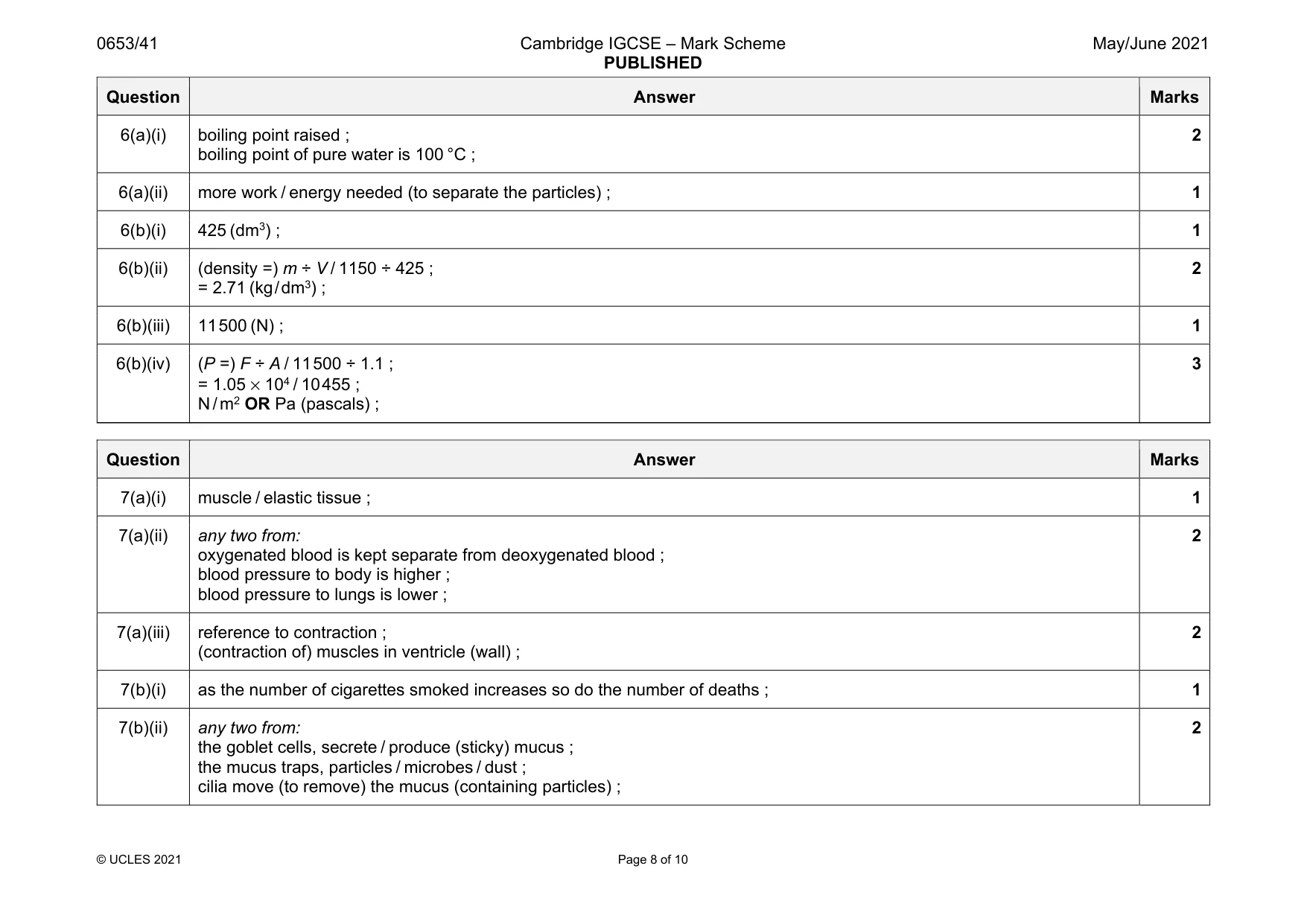
Mark scheme: 6(a)(i) boiling point raised ; boiling point of pure water is 100 °C ; 2 6(a)(ii) more work / energy needed (to separate the particles) ; 1 6(b)(i) 425 (dm3) ; 1 6(b)(ii) (density =) m ÷ V / 1150 ÷ 425 ; = 2.71 (kg / dm3) ; 2 6(b)(iii) 11 500 (N) ; 1 6(b)(iv) (P =) F ÷ A / 11 500 ÷ 1.1 ; = 1.05 × 10⁴ / 10 455 ; N / m2 OR Pa (pascals) ; 3
Q7 · A photomicrograph of a cross-section of an artery
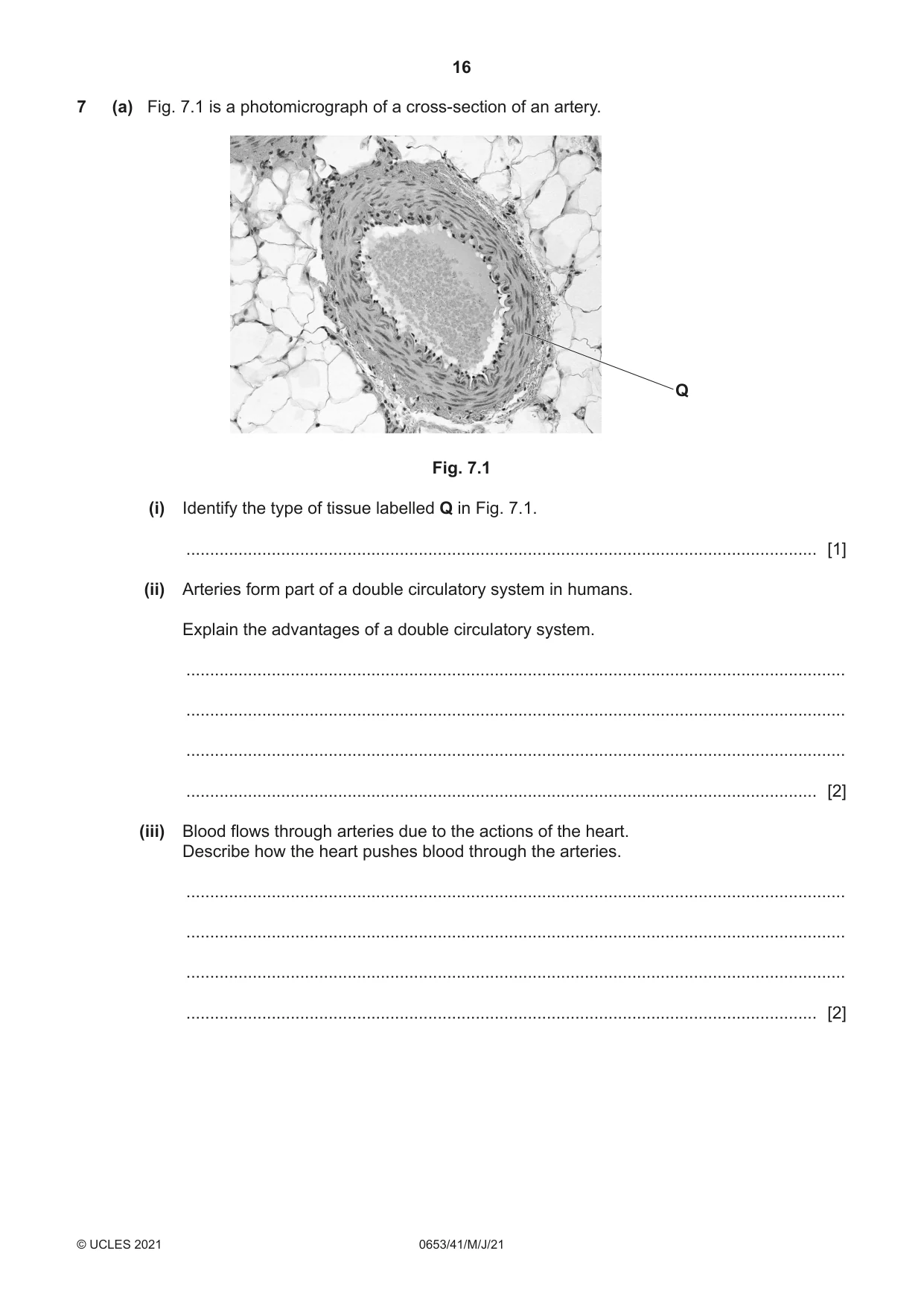
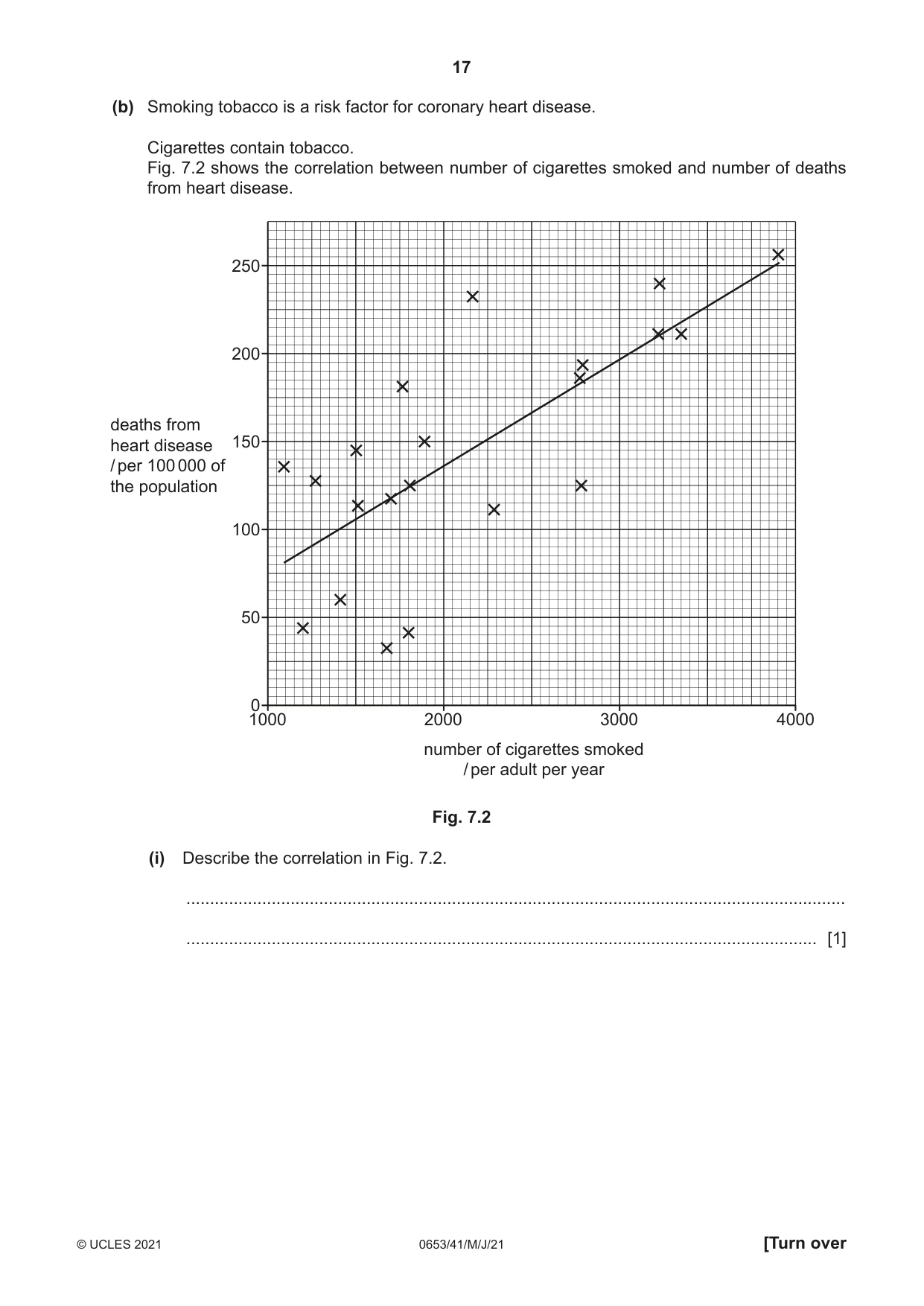
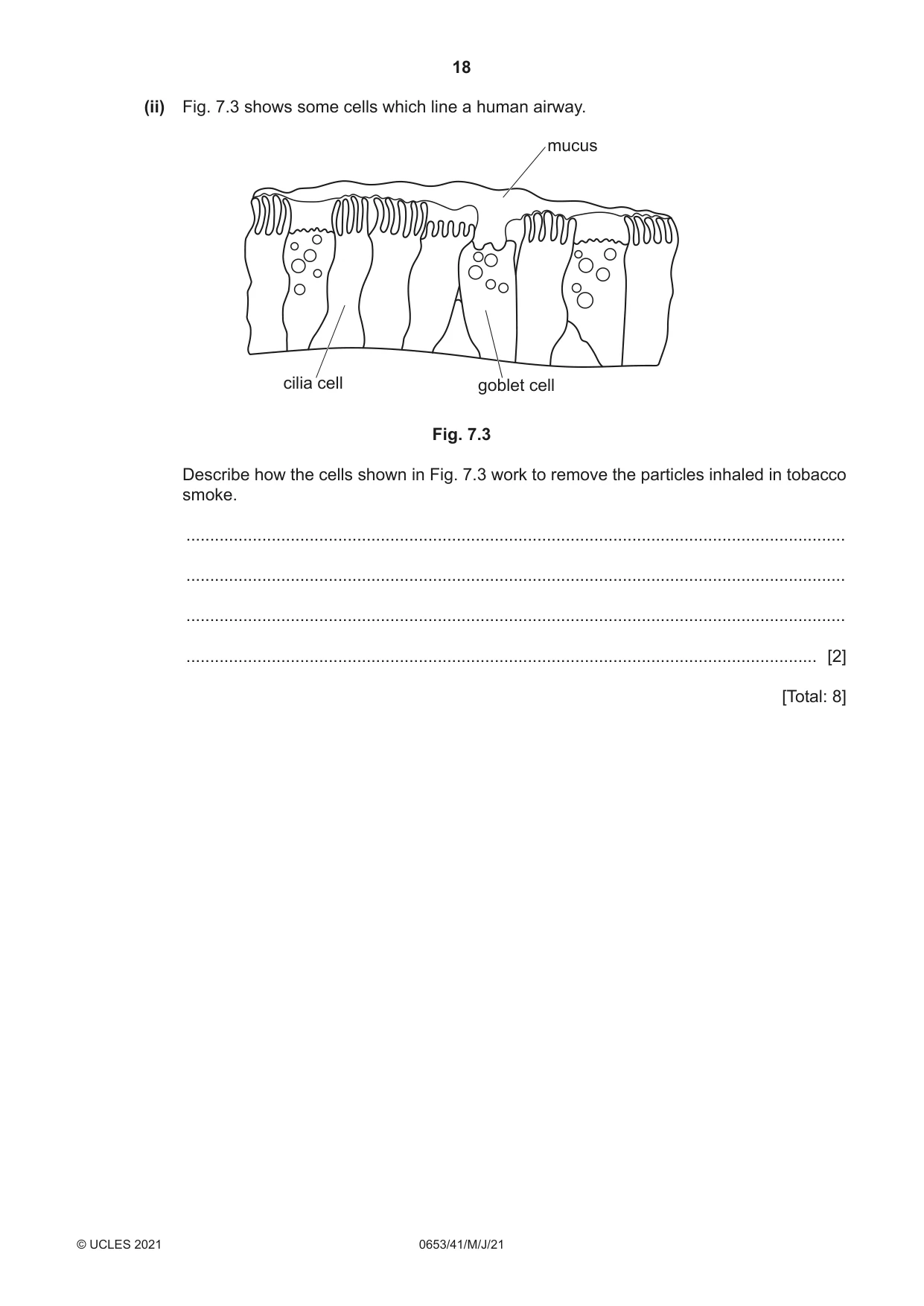
7 (a) Fig. 7.1 is a photomicrograph of a cross-section of an artery. Q Fig. 7.1 (i) Identify the type of tissue labelled Q in Fig. 7.1. ..................................................................................................................................... [1] (ii) Arteries form part of a double circulatory system in humans. Explain the advantages of a double circulatory system. ........................................................................................................................................... ........................................................................................................................................... ........................................................................................................................................... ..................................................................................................................................... [2] (iii) Blood flows through arteries due to the actions of the heart. Describe how the heart pushes blood through the arteries. ........................................................................................................................................... ........................................................................................................................................... ........................................................................................................................................... ..................................................................................................................................... [2] (b) Smoking tobacco is a risk factor for coronary heart disease. Cigarettes contain tobacco. Fig. 7.2 shows the correlation between number of cigarettes smoked and number of deaths from heart disease. 250 200 deaths from heart disease 150 / per 100 000 of the population 100 50 0 1000 2000 3000 4000 number of cigarettes smoked / per adult per year Fig. 7.2 (i) Describe the correlation in Fig. 7.2. ........................................................................................................................................... ..................................................................................................................................... [1] (ii) Fig. 7.3 shows some cells which line a human airway. mucus cilia cell goblet cell Fig. 7.3 Describe how the cells shown in Fig. 7.3 work to remove the particles inhaled in tobacco smoke. ........................................................................................................................................... ........................................................................................................................................... ........................................................................................................................................... ..................................................................................................................................... [2] [Total: 8]
Mark scheme: 7(a)(i) muscle / elastic tissue ; 1 7(a)(ii) any two from: oxygenated blood is kept separate from deoxygenated blood ; blood pressure to body is higher ; blood pressure to lungs is lower ; 2 7(a)(iii) reference to contraction ; (contraction of) muscles in ventricle (wall) ; 2 7(b)(i) as the number of cigarettes smoked increases so do the number of deaths ; 1 7(b)(ii) any two from: the goblet cells, secrete / produce (sticky) mucus ; the mucus traps, particles / microbes / dust ; cilia move (to remove) the mucus (containing particles) ; 2
Q8 · Bromine, chlorine and iodine are in Group VII of the Periodic Table
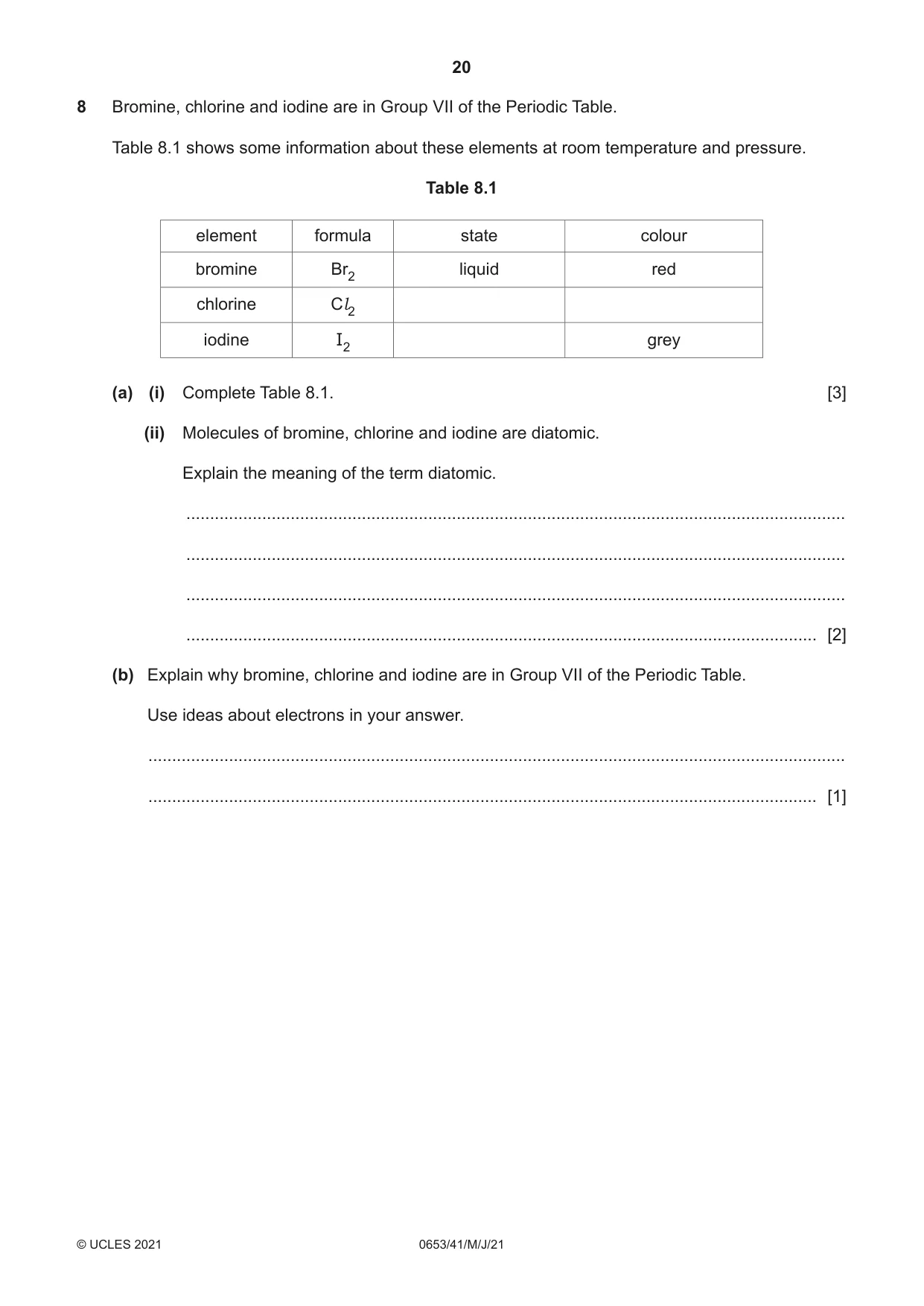
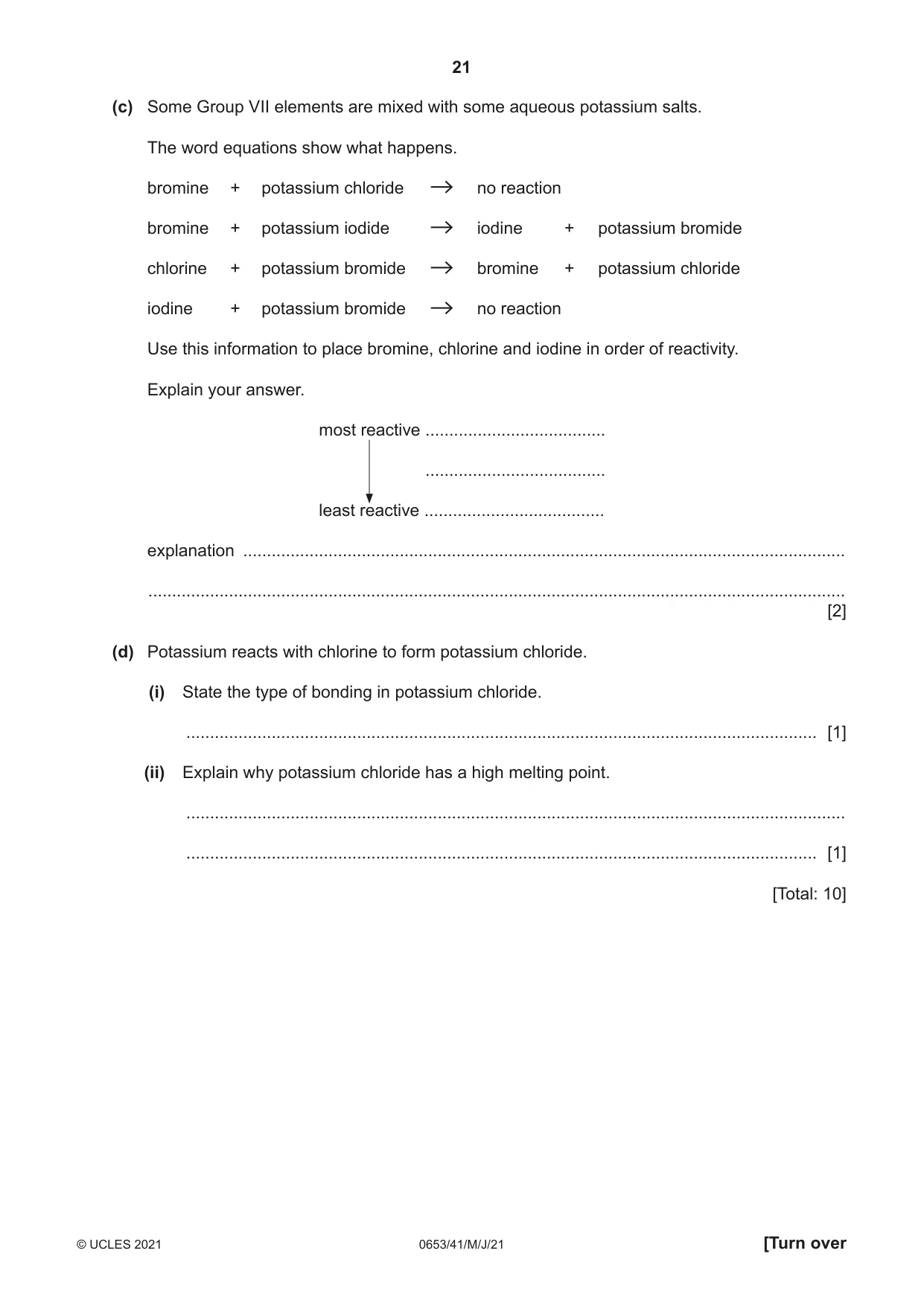
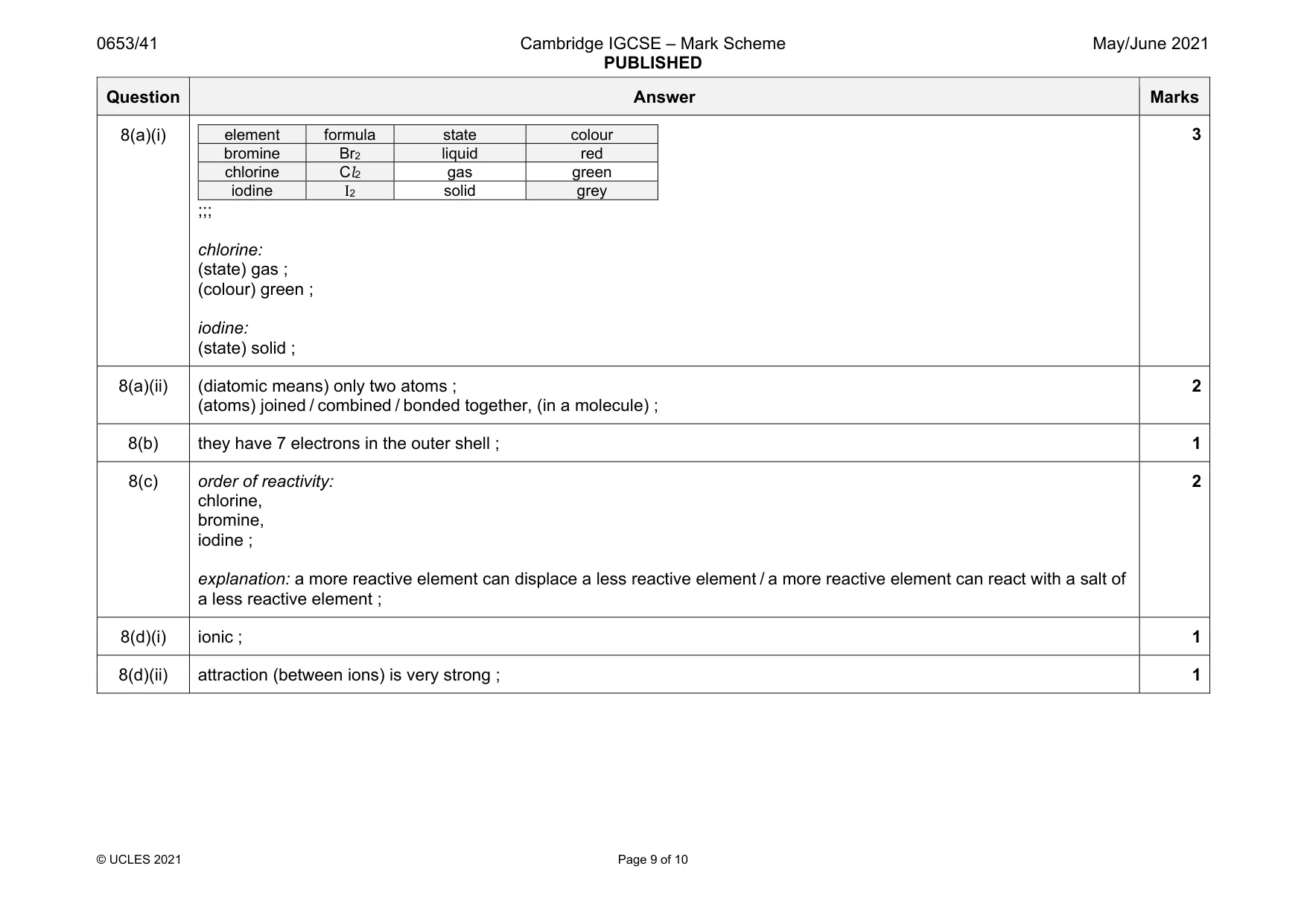
8 Bromine, chlorine and iodine are in Group VII of the Periodic Table. Table 8.1 shows some information about these elements at room temperature and pressure. Table 8.1 element formula state colour bromine Br2 liquid red chlorine Cl2 iodine I grey 2 (a) (i) Complete Table 8.1. [3] (ii) Molecules of bromine, chlorine and iodine are diatomic. Explain the meaning of the term diatomic. ........................................................................................................................................... ........................................................................................................................................... ........................................................................................................................................... ..................................................................................................................................... [2] (b) Explain why bromine, chlorine and iodine are in Group VII of the Periodic Table. Use ideas about electrons in your answer. ................................................................................................................................................... ............................................................................................................................................. [1] (c) Some Group VII elements are mixed with some aqueous potassium salts. The word equations show what happens. bromine + potassium chloride no reaction bromine + potassium iodide iodine + potassium bromide chlorine + potassium bromide bromine + potassium chloride iodine + potassium bromide no reaction Use this information to place bromine, chlorine and iodine in order of reactivity. Explain your answer. most reactive ...................................... ...................................... least reactive ...................................... explanation ............................................................................................................................... ................................................................................................................................................... [2] (d) Potassium reacts with chlorine to form potassium chloride. (i) State the type of bonding in potassium chloride. ..................................................................................................................................... [1] (ii) Explain why potassium chloride has a high melting point. ........................................................................................................................................... ..................................................................................................................................... [1] [Total: 10]
Mark scheme: 8(a)(i) element formula state colour bromine Br2 liquid red chlorine Cl2 gas green iodine I2 solid grey ;;; chlorine: (state) gas ; (colour) green ; iodine: (state) solid ; 8(a)(ii) (diatomic means) only two atoms ; (atoms) joined / combined / bonded together, (in a molecule) ; 2 8(b) they have 7 electrons in the outer shell ; 1 8(c) order of reactivity: chlorine, bromine, iodine ; explanation: a more reactive element can displace a less reactive element / a more reactive element can react with a salt of a less reactive element ; 2 8(d)(i) ionic ; 1 8(d)(ii) attraction (between ions) is very strong ; 1
Q9 · An incomplete circuit used to determine the resistance of a length of resistance wire
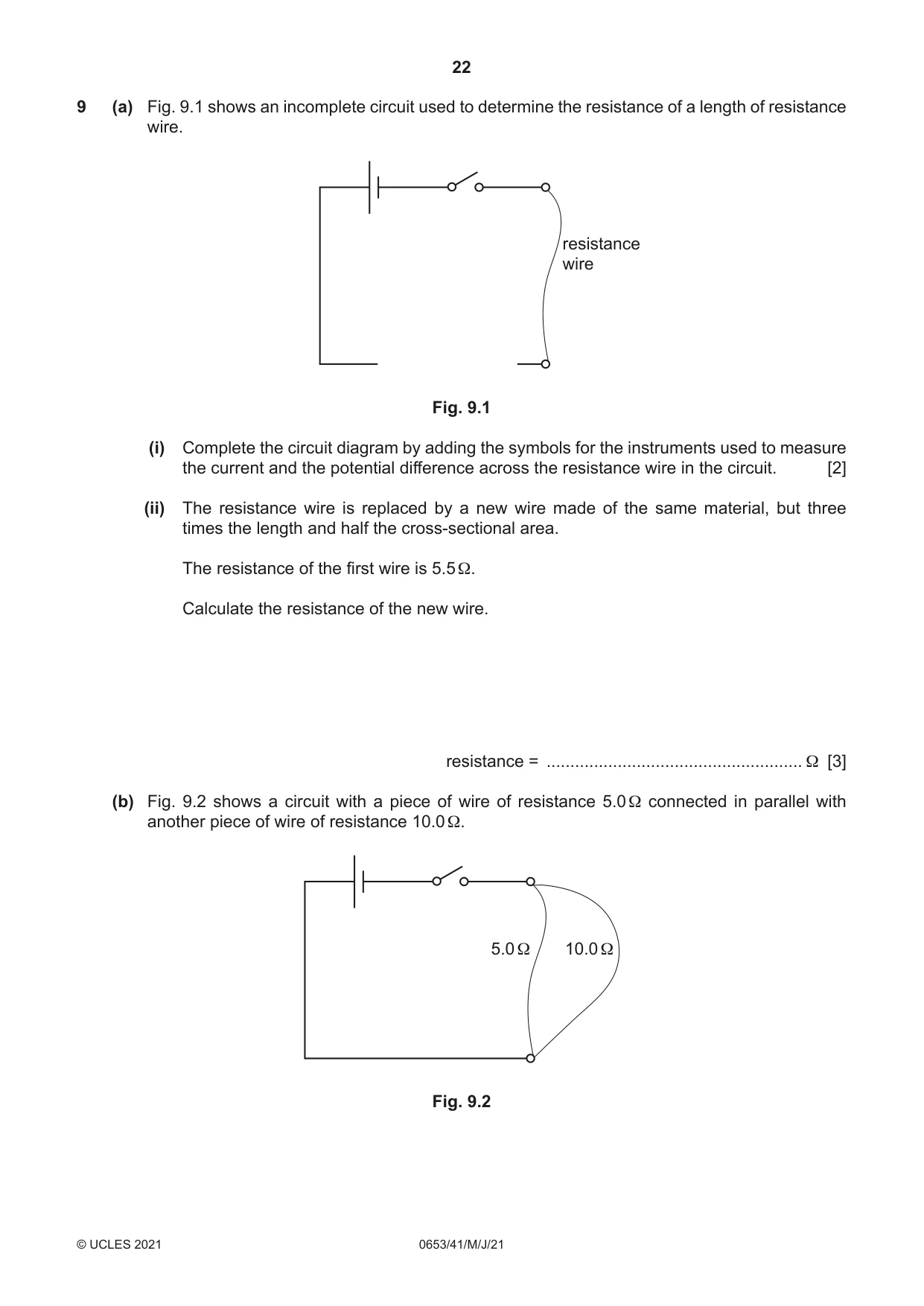
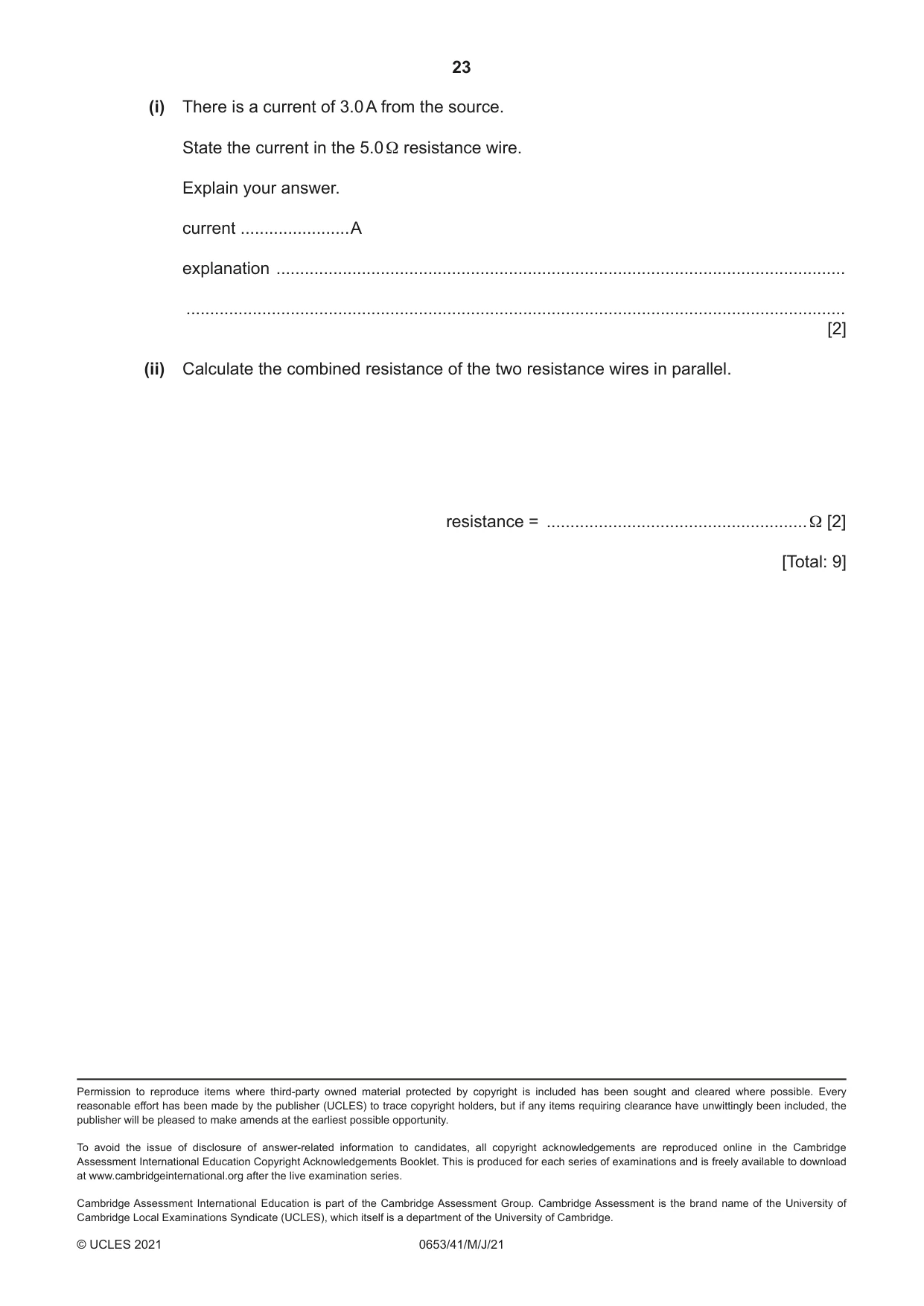
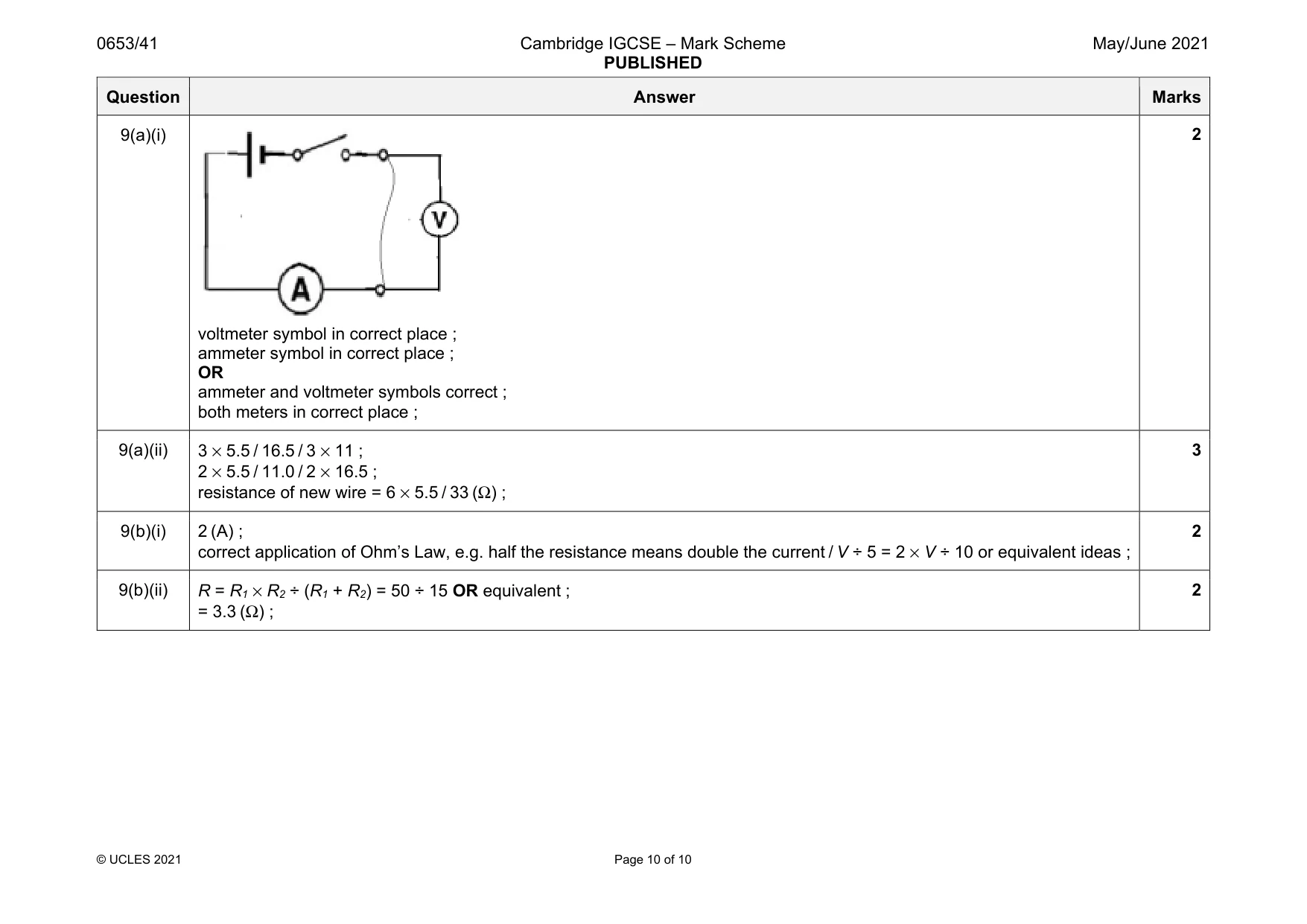
9 (a) Fig. 9.1 shows an incomplete circuit used to determine the resistance of a length of resistance wire. resistance wire Fig. 9.1 (i) Complete the circuit diagram by adding the symbols for the instruments used to measure the current and the potential difference across the resistance wire in the circuit. [2] (ii) The resistance wire is replaced by a new wire made of the same material, but three times the length and half the cross-sectional area. The resistance of the first wire is 5.5 Ω. Calculate the resistance of the new wire. resistance = ...................................................... Ω [3] (b) Fig. 9.2 shows a circuit with a piece of wire of resistance 5.0 Ω connected in parallel with another piece of wire of resistance 10.0 Ω. 5.0 Ω 10.0 Ω Fig. 9.2 (i) There is a current of 3.0 A from the source. State the current in the 5.0 Ω resistance wire. Explain your answer. current ....................... A explanation ........................................................................................................................ ........................................................................................................................................... [2] (ii) Calculate the combined resistance of the two resistance wires in parallel. resistance = ....................................................... Ω [2] [Total: 9]
Mark scheme: 9(a)(i) voltmeter symbol in correct place ; ammeter symbol in correct place ; OR ammeter and voltmeter symbols correct ; both meters in correct place ; 9(a)(ii) 3 × 5.5 / 16.5 / 3 × 11 ; 2 × 5.5 / 11.0 / 2 × 16.5 ; resistance of new wire = 6 × 5.5 / 33 (Ω) ; 3 9(b)(i) 2 (A) ; correct application of Ohm’s Law, e.g. half the resistance means double the current / V ÷ 5 = 2 × V ÷ 10 or equivalent ideas ; 2 9(b)(ii) R = R1 × R2 ÷ (R1 + R2) = 50 ÷ 15 OR equivalent ; = 3.3 (Ω) ; 2
What was in this paper
The subtopics covered by these 9 questions, and how many questions each got. Open one in a new tab to see every Cambridge question on it.
What you needed in this session
Cambridge’s own grade thresholds for 2021 May/June, Paper 4 · Variant 1. A higher threshold means an easier paper — the bar moves with how the cohort did.