Cambridge IGCSE Science - Combined 0653 — 2022 Feb/March Paper 4 · Variant 2
0653/42/F/M/22 · 9 questions · 80 marks · ≈90 min
The question paper and its mark scheme, free to read here and free to download. This is Cambridge’s own paper, exactly as it was sat.
Question paper24 pages


Mark scheme10 pages
Answers below. Sit the paper first if you are practising.
Questions as text
Q1 · Part of a food web
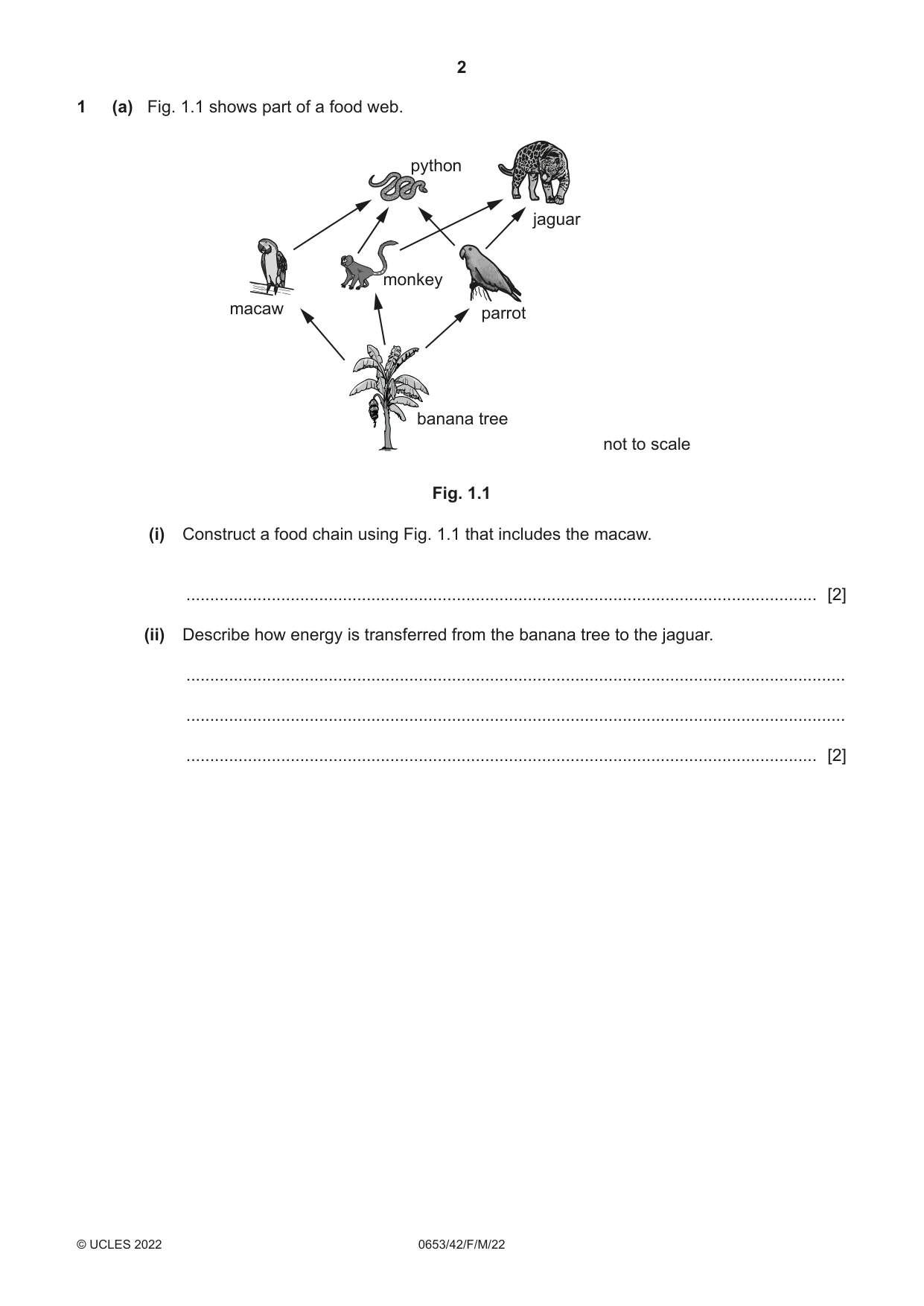
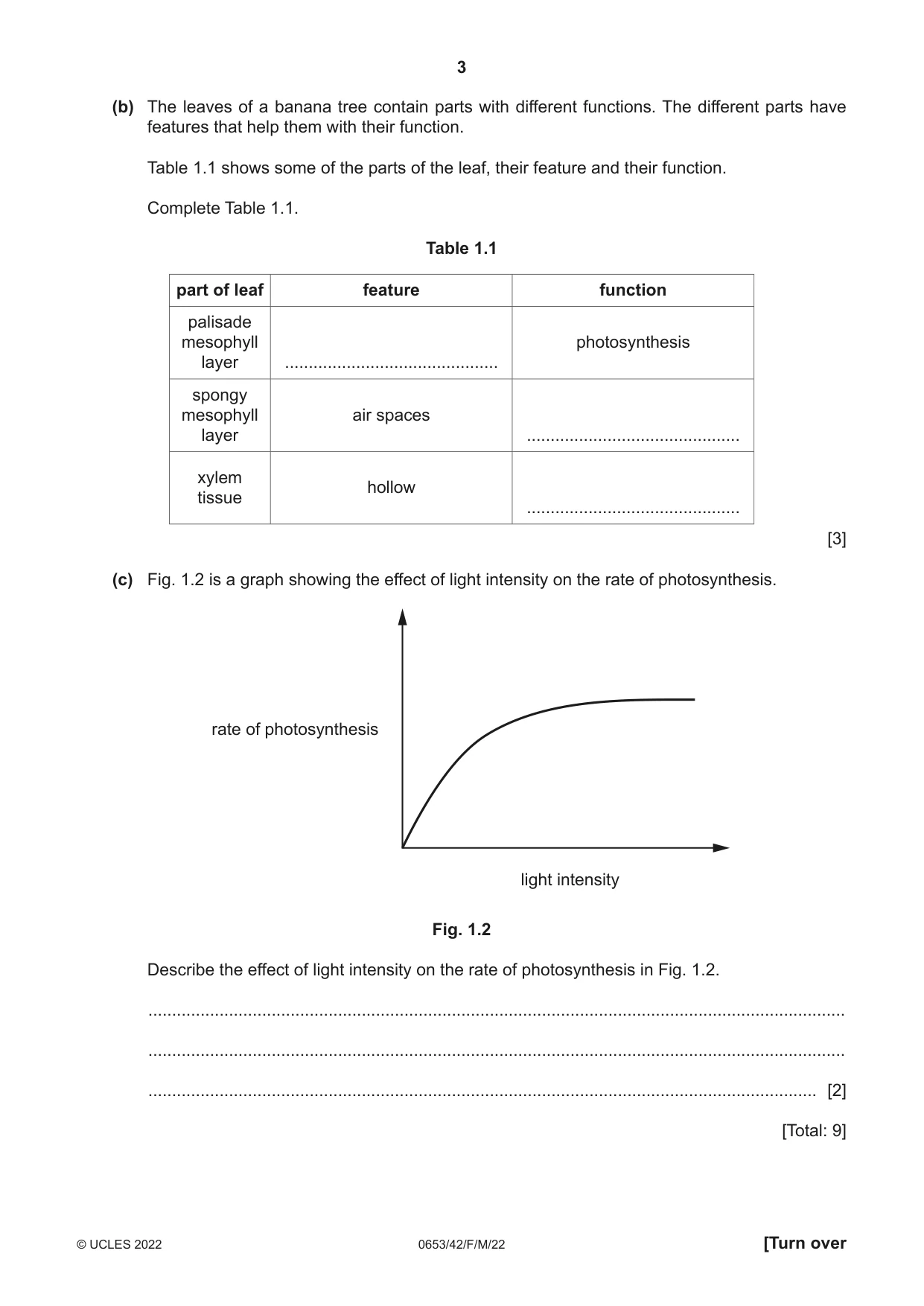
1 (a) Fig. 1.1 shows part of a food web. python jaguar monkey macaw parrot banana tree not to scale Fig. 1.1 (i) Construct a food chain using Fig. 1.1 that includes the macaw. ..................................................................................................................................... [2] (ii) Describe how energy is transferred from the banana tree to the jaguar. ........................................................................................................................................... ........................................................................................................................................... ..................................................................................................................................... [2] (b) The leaves of a banana tree contain parts with different functions. The different parts have features that help them with their function. Table 1.1 shows some of the parts of the leaf, their feature and their function. Complete Table 1.1. Table 1.1 part of leaf feature function palisade mesophyll photosynthesis layer ............................................. spongy mesophyll air spaces layer ............................................. xylem hollow tissue ............................................. [3] (c) Fig. 1.2 is a graph showing the effect of light intensity on the rate of photosynthesis. rate of photosynthesis light intensity Fig. 1.2 Describe the effect of light intensity on the rate of photosynthesis in Fig. 1.2. ................................................................................................................................................... ................................................................................................................................................... ............................................................................................................................................. [2] [Total: 9]
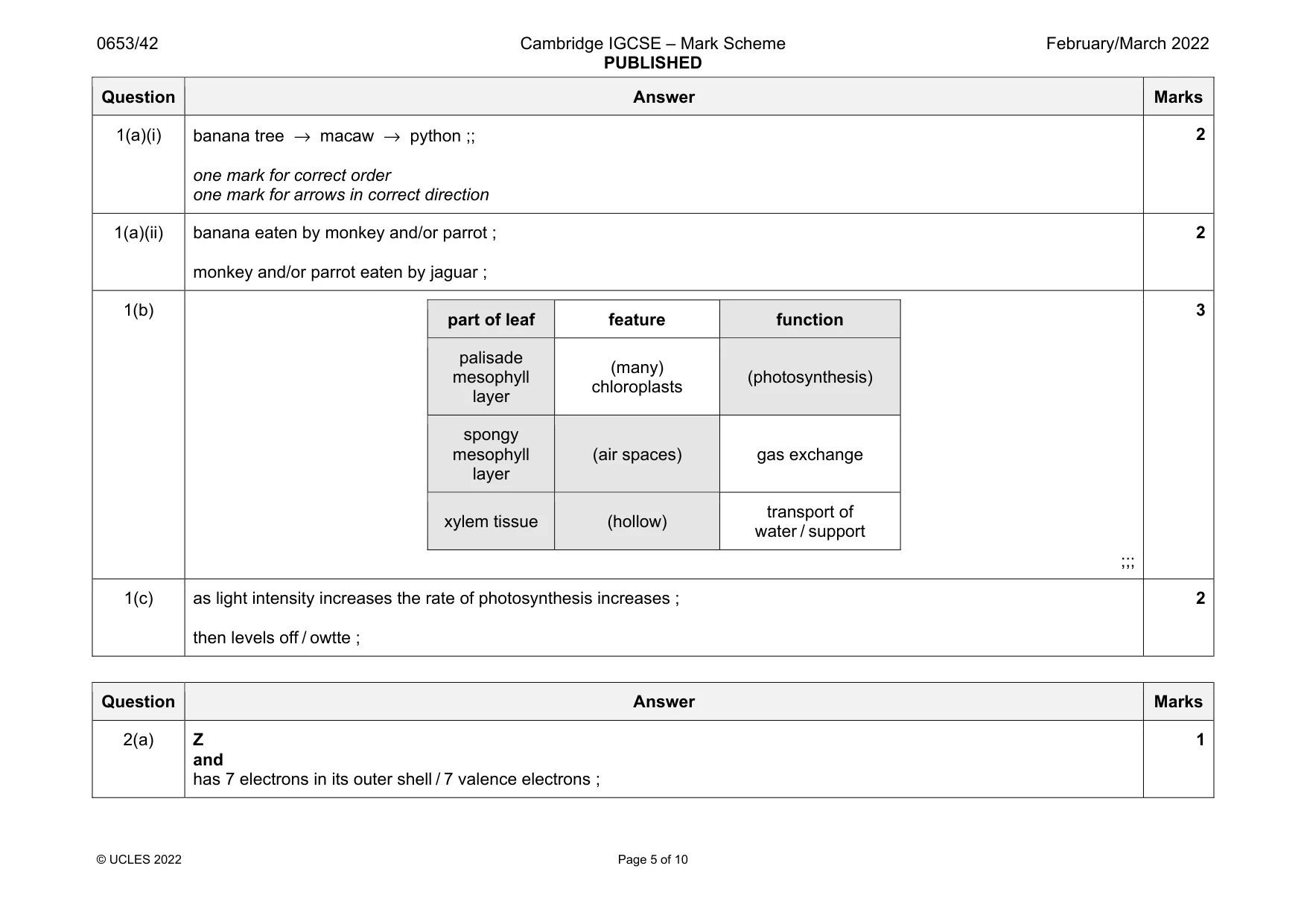
Mark scheme: 1(a)(i) banana tree → macaw → python ;; one mark for correct order one mark for arrows in correct direction 1(a)(ii) banana eaten by monkey and/or parrot ; monkey and/or parrot eaten by jaguar ; 2 1(b) part of leaf feature function palisade mesophyll layer (many) chloroplasts (photosynthesis) spongy mesophyll layer (air spaces) gas exchange xylem tissue (hollow) transport of water / support ;;; 3 1(c) as light intensity increases the rate of photosynthesis increases ; then levels off / owtte ; 2
Q2 · Only the outer shell electrons in atoms of elements X, Y and Z
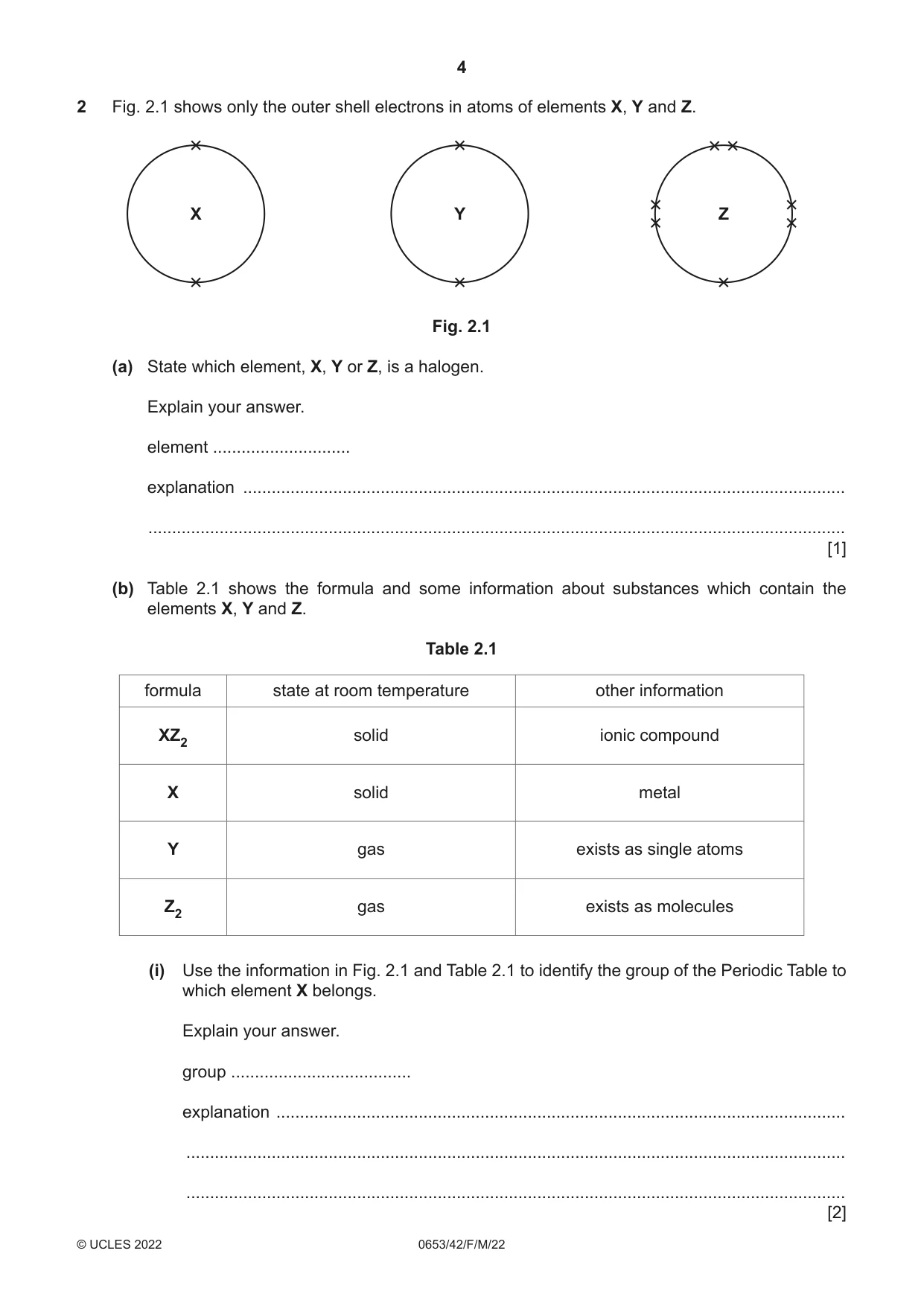
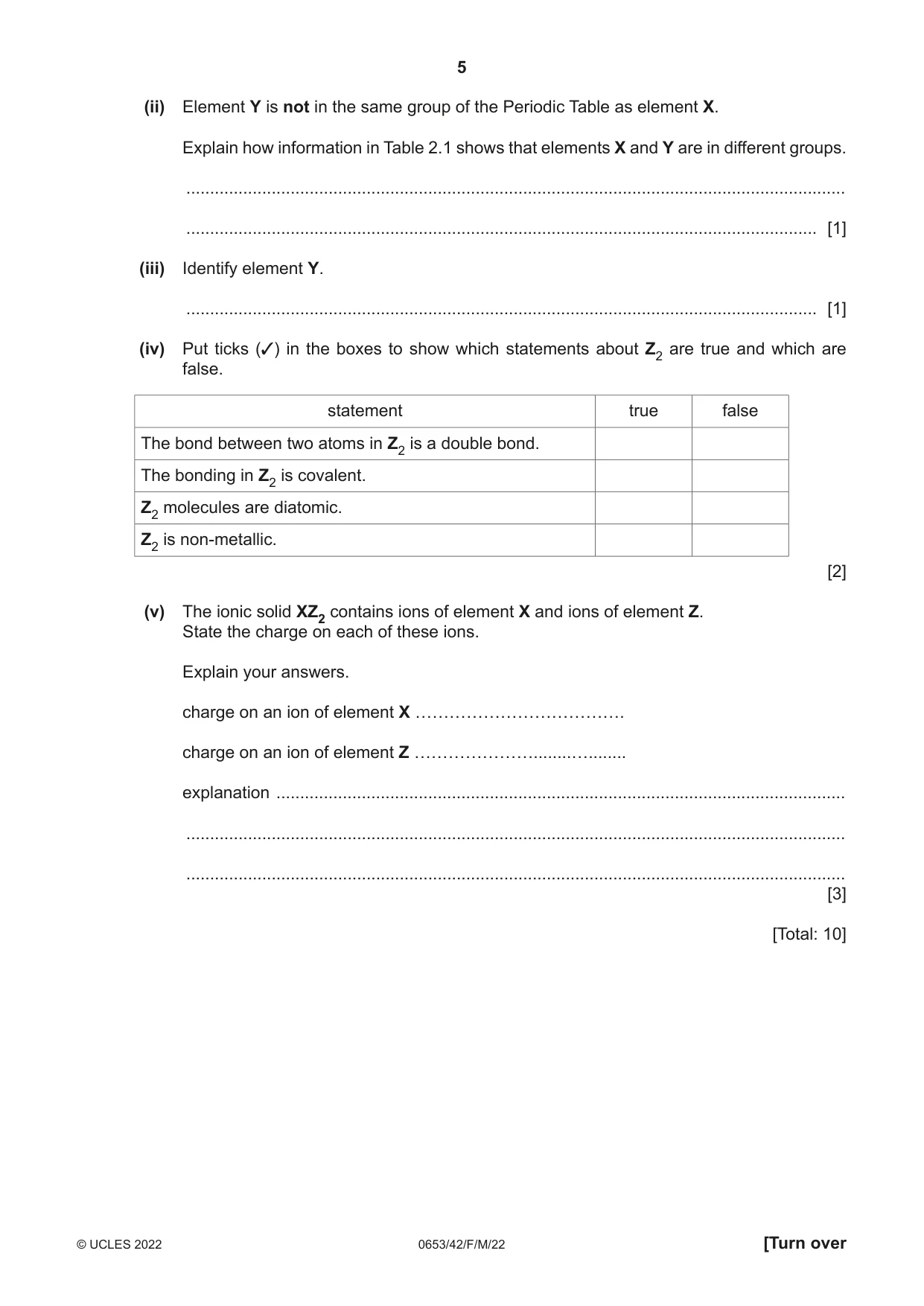
2 Fig. 2.1 shows only the outer shell electrons in atoms of elements X, Y and Z. X Y Z Fig. 2.1 (a) State which element, X, Y or Z, is a halogen. Explain your answer. element ............................. explanation ............................................................................................................................... ................................................................................................................................................... [1] (b) Table 2.1 shows the formula and some information about substances which contain the elements X, Y and Z. Table 2.1 formula state at room temperature other information XZ2 solid ionic compound X solid metal Y gas exists as single atoms Z2 gas exists as molecules (i) Use the information in Fig. 2.1 and Table 2.1 to identify the group of the Periodic Table to which element X belongs. Explain your answer. group ...................................... explanation ........................................................................................................................ ........................................................................................................................................... ........................................................................................................................................... [2] (ii) Element Y is not in the same group of the Periodic Table as element X. Explain how information in Table 2.1 shows that elements X and Y are in different groups. ........................................................................................................................................... ..................................................................................................................................... [1] (iii) Identify element Y. ..................................................................................................................................... [1] (iv) Put ticks (3) in the boxes to show which statements about Z2 are true and which are false. statement true false The bond between two atoms in Z2 is a double bond. The bonding in Z2 is covalent. Z2 molecules are diatomic. Z2 is non-metallic. [2] (v) The ionic solid XZ2 contains ions of element X and ions of element Z. State the charge on each of these ions. Explain your answers. charge on an ion of element X ………………………………. charge on an ion of element Z …………………........…........ explanation ........................................................................................................................ ........................................................................................................................................... ........................................................................................................................................... [3] [Total: 10]
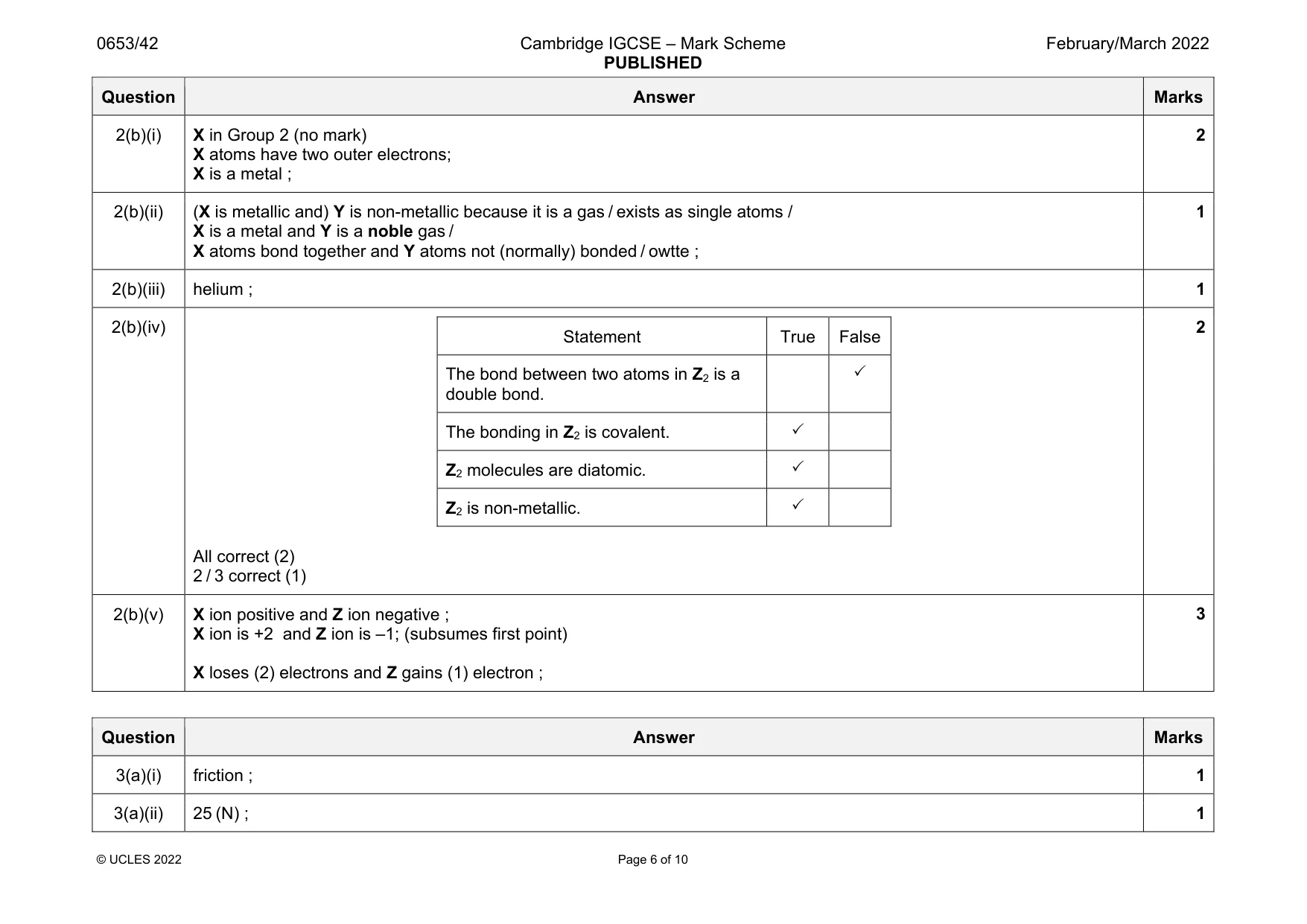
Mark scheme: 2(a) Z and has 7 electrons in its outer shell / 7 valence electrons ; 1 Question Answer Marks 2(b)(i) X in Group 2 (no mark) X atoms have two outer electrons; X is a metal ; 2 2(b)(ii) (X is metallic and) Y is non-metallic because it is a gas / exists as single atoms / X is a metal and Y is a noble gas / X atoms bond together and Y atoms not (normally) bonded / owtte ; 1 2(b)(iii) helium ; 1 2(b)(iv) Statement True False The bond between two atoms in Z2 is a double bond. The bonding in Z2 is covalent. Z2 molecules are diatomic. Z2 is non-metallic. All correct (2) 2 / 3 correct (1) 2 2(b)(v) X ion positive and Z ion negative ; X ion is +2 and Z ion is –1; (subsumes first point) X loses (2) electrons and Z gains (1) electron ; 3
Q3 · A child in a toy car moves forward at a constant speed of 0.7 m / s
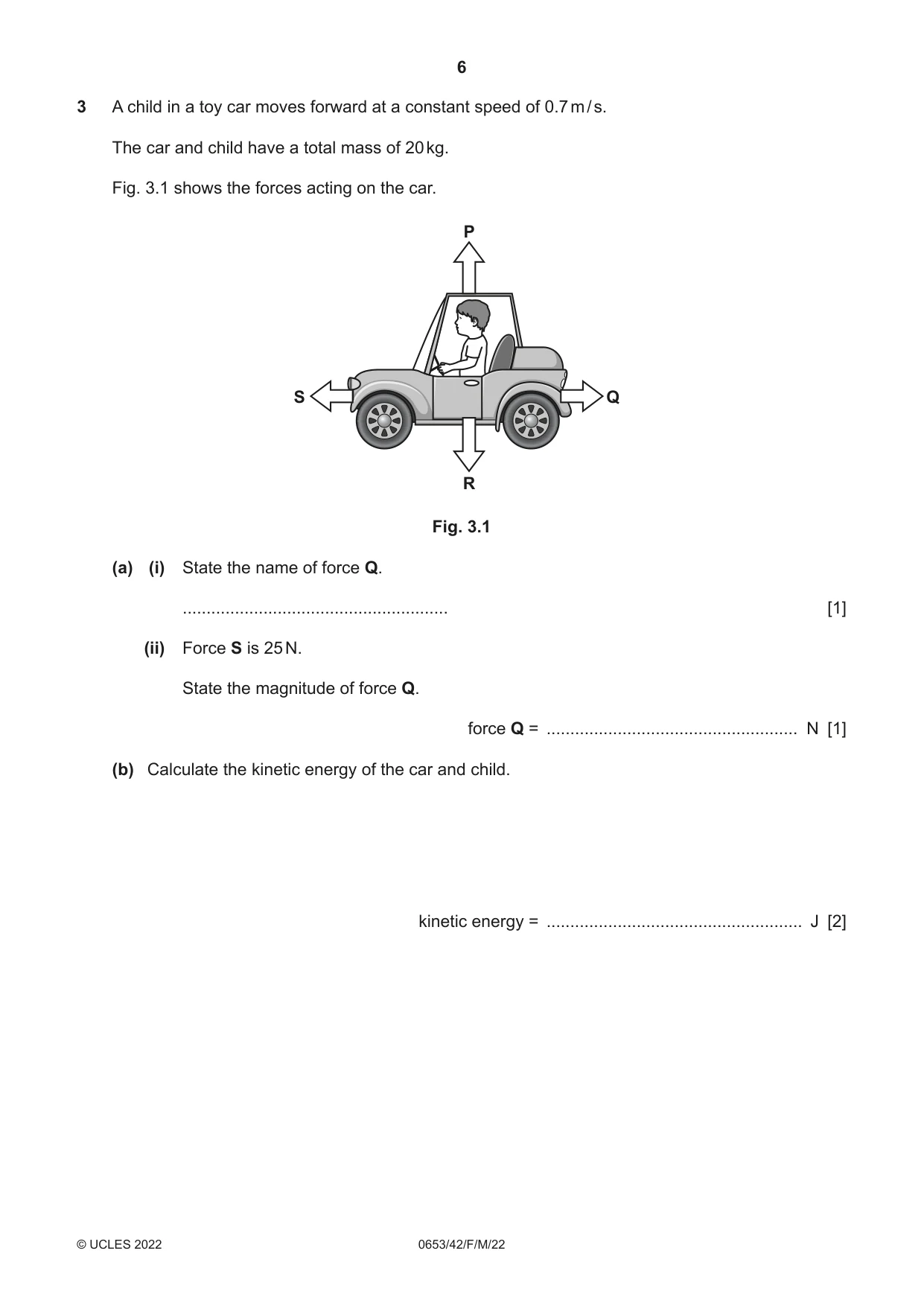
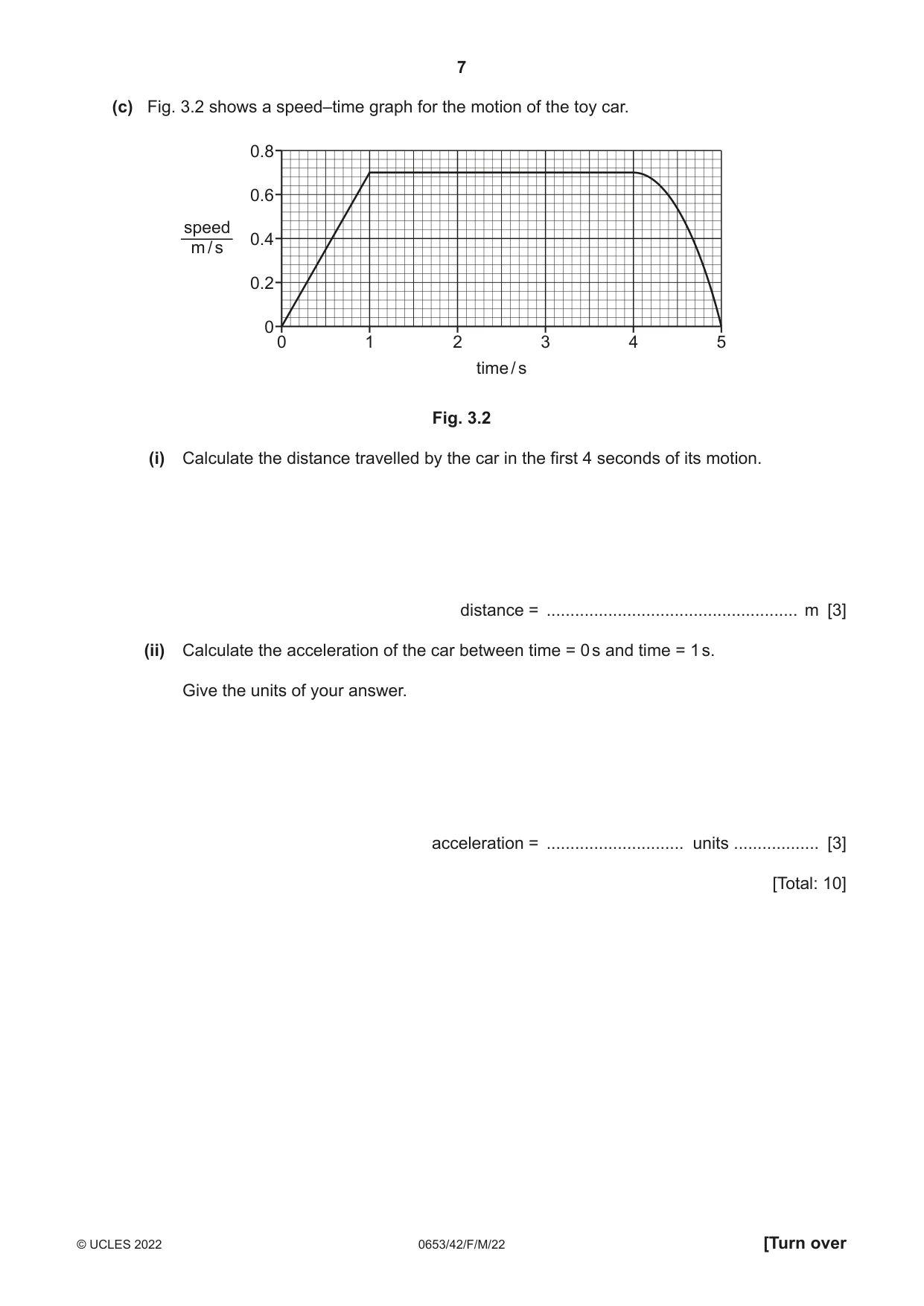
3 A child in a toy car moves forward at a constant speed of 0.7 m / s. The car and child have a total mass of 20 kg. Fig. 3.1 shows the forces acting on the car. P S Q R Fig. 3.1 (a) (i) State the name of force Q. ........................................................ [1] (ii) Force S is 25 N. State the magnitude of force Q. force Q = ..................................................... N [1] (b) Calculate the kinetic energy of the car and child. kinetic energy = ...................................................... J [2] (c) Fig. 3.2 shows a speed–time graph for the motion of the toy car. 0.8 0.6 speed 0.4 m / s 0.2 0 0 1 2 3 4 5 time / s Fig. 3.2 (i) Calculate the distance travelled by the car in the first 4 seconds of its motion. distance = ..................................................... m [3] (ii) Calculate the acceleration of the car between time = 0 s and time = 1 s. Give the units of your answer. acceleration = ............................. units .................. [3] [Total: 10]
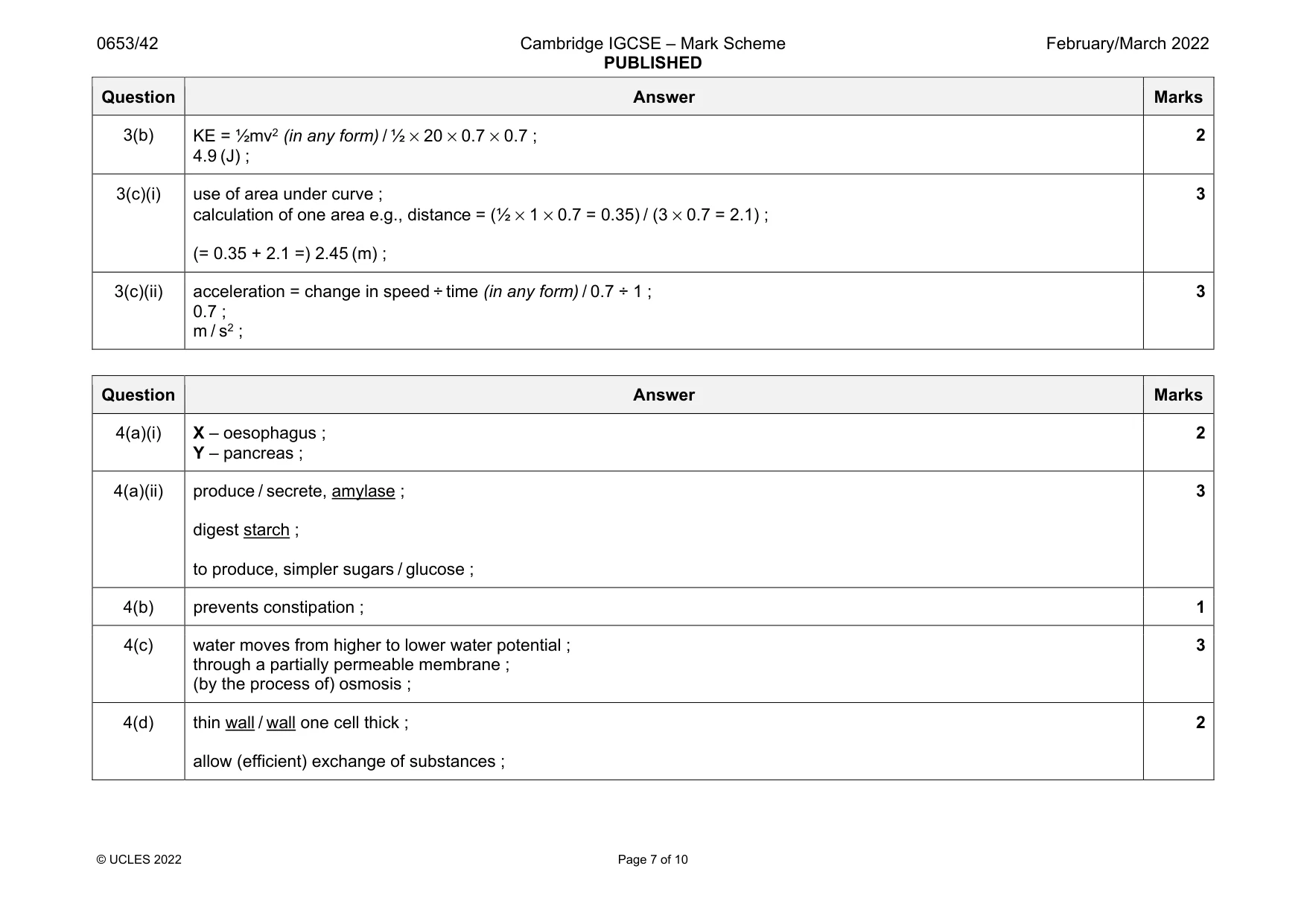
Mark scheme: 3(a)(i) friction ; 1 3(a)(ii) 25 (N) ; 1 Question Answer Marks 3(b) KE = ½mv2 (in any form) / ½ × 20 × 0.7 × 0.7 ; 4.9 (J) ; 2 3(c)(i) use of area under curve ; calculation of one area e.g., distance = (½ × 1 × 0.7 = 0.35) / (3 × 0.7 = 2.1) ; (= 0.35 + 2.1 =) 2.45 (m) ; 3 3(c)(ii) acceleration = change in speed ÷ time (in any form) / 0.7 ÷ 1 ; 0.7 ; m / s2 ; 3
Q4 · The first part of the alimentary canal and associated organs
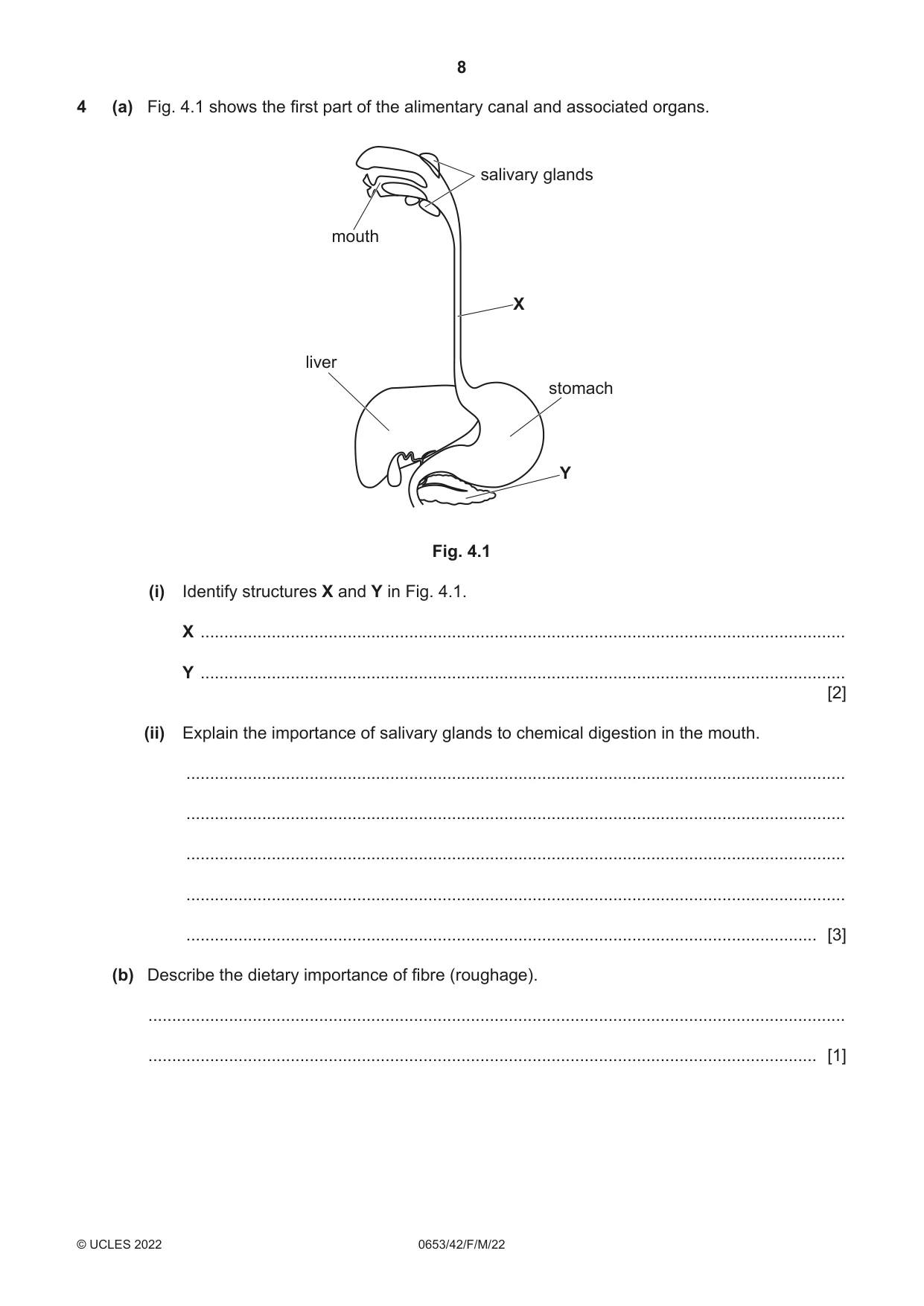
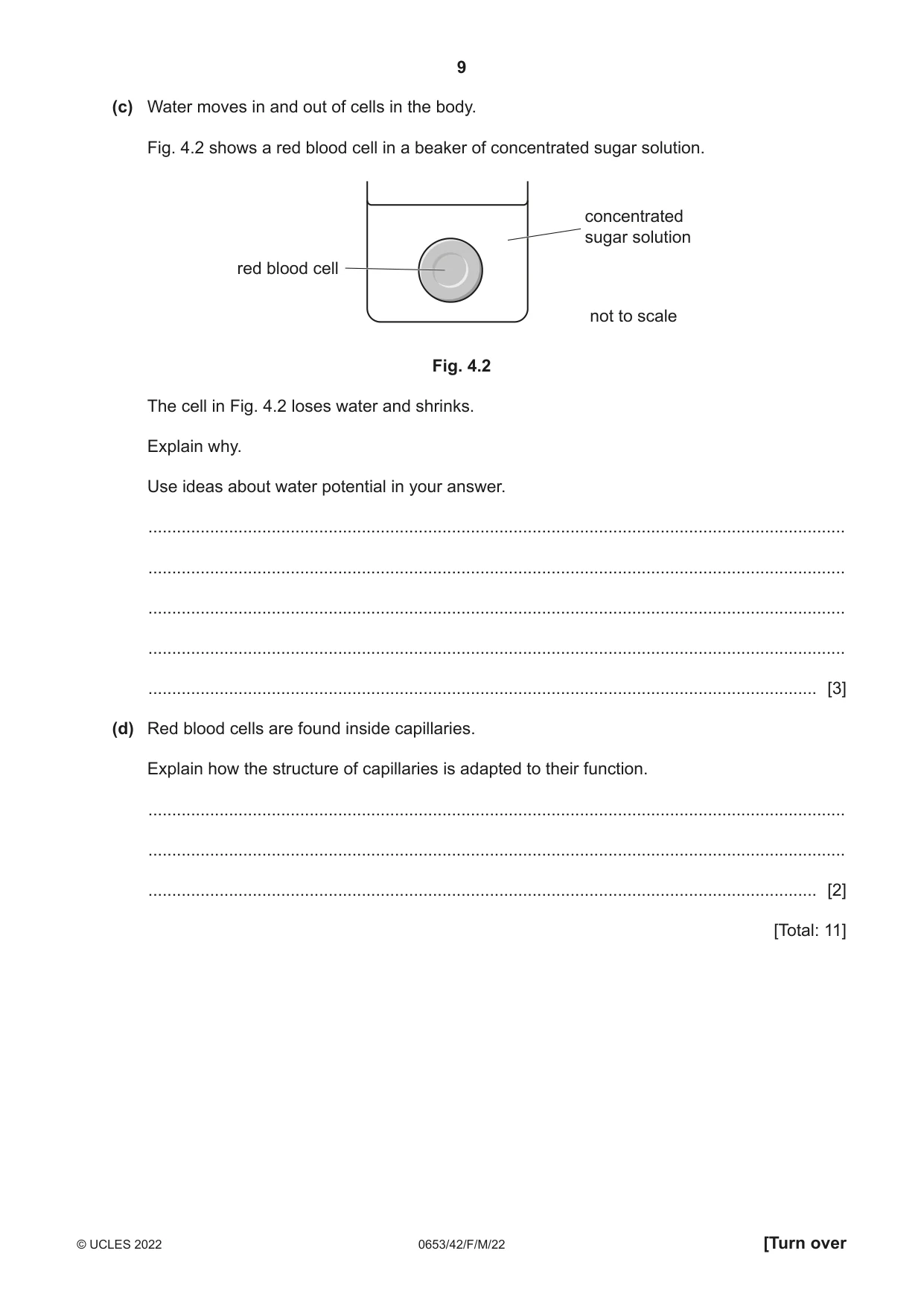
4 (a) Fig. 4.1 shows the first part of the alimentary canal and associated organs. salivary glands mouth X liver stomach Y Fig. 4.1 (i) Identify structures X and Y in Fig. 4.1. X ........................................................................................................................................ Y ........................................................................................................................................ [2] (ii) Explain the importance of salivary glands to chemical digestion in the mouth. ........................................................................................................................................... ........................................................................................................................................... ........................................................................................................................................... ........................................................................................................................................... ..................................................................................................................................... [3] (b) Describe the dietary importance of fibre (roughage). ................................................................................................................................................... ............................................................................................................................................. [1] (c) Water moves in and out of cells in the body. Fig. 4.2 shows a red blood cell in a beaker of concentrated sugar solution. concentrated sugar solution red blood cell not to scale Fig. 4.2 The cell in Fig. 4.2 loses water and shrinks. Explain why. Use ideas about water potential in your answer. ................................................................................................................................................... ................................................................................................................................................... ................................................................................................................................................... ................................................................................................................................................... ............................................................................................................................................. [3] (d) Red blood cells are found inside capillaries. Explain how the structure of capillaries is adapted to their function. ................................................................................................................................................... ................................................................................................................................................... ............................................................................................................................................. [2] [Total: 11]
Mark scheme: 4(a)(i) X – oesophagus ; Y – pancreas ; 2 4(a)(ii) produce / secrete, amylase ; digest starch ; to produce, simpler sugars / glucose ; 3 4(b) prevents constipation ; 1 4(c) water moves from higher to lower water potential ; through a partially permeable membrane ; (by the process of) osmosis ; 3 4(d) thin wall / wall one cell thick ; allow (efficient) exchange of substances ; 2
Q5 · Hydrogen and oxygen are made when dilute sulfuric acid is electrolysed using inert…
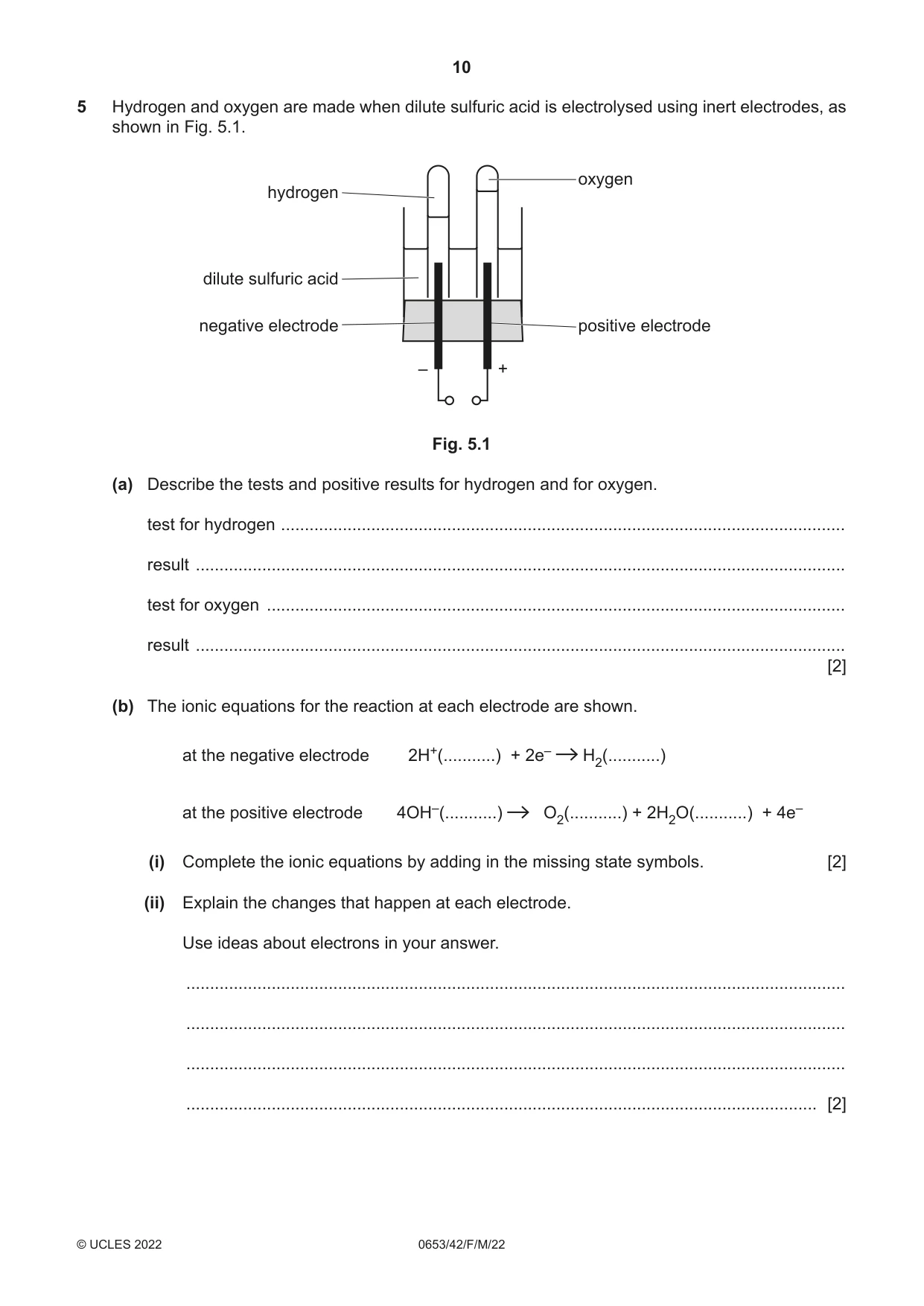
5 Hydrogen and oxygen are made when dilute sulfuric acid is electrolysed using inert electrodes, as shown in Fig. 5.1. oxygen hydrogen dilute sulfuric acid negative electrode positive electrode – + Fig. 5.1 (a) Describe the tests and positive results for hydrogen and for oxygen. test for hydrogen ....................................................................................................................... result ......................................................................................................................................... test for oxygen .......................................................................................................................... result ......................................................................................................................................... [2] (b) The ionic equations for the reaction at each electrode are shown. at the negative electrode 2H+(...........) + 2e– H2(...........) at the positive electrode 4OH–(...........) O2(...........) + 2H2O(...........) + 4e– (i) Complete the ionic equations by adding in the missing state symbols. [2] (ii) Explain the changes that happen at each electrode. Use ideas about electrons in your answer. ........................................................................................................................................... ........................................................................................................................................... ........................................................................................................................................... ..................................................................................................................................... [2] (c) The sulfuric acid is not all used up during the electrolysis. State a test and its result to show that the solution is acidic at the end of the electrolysis. test ............................................................................................................................................ result ......................................................................................................................................... [1] [Total: 7]
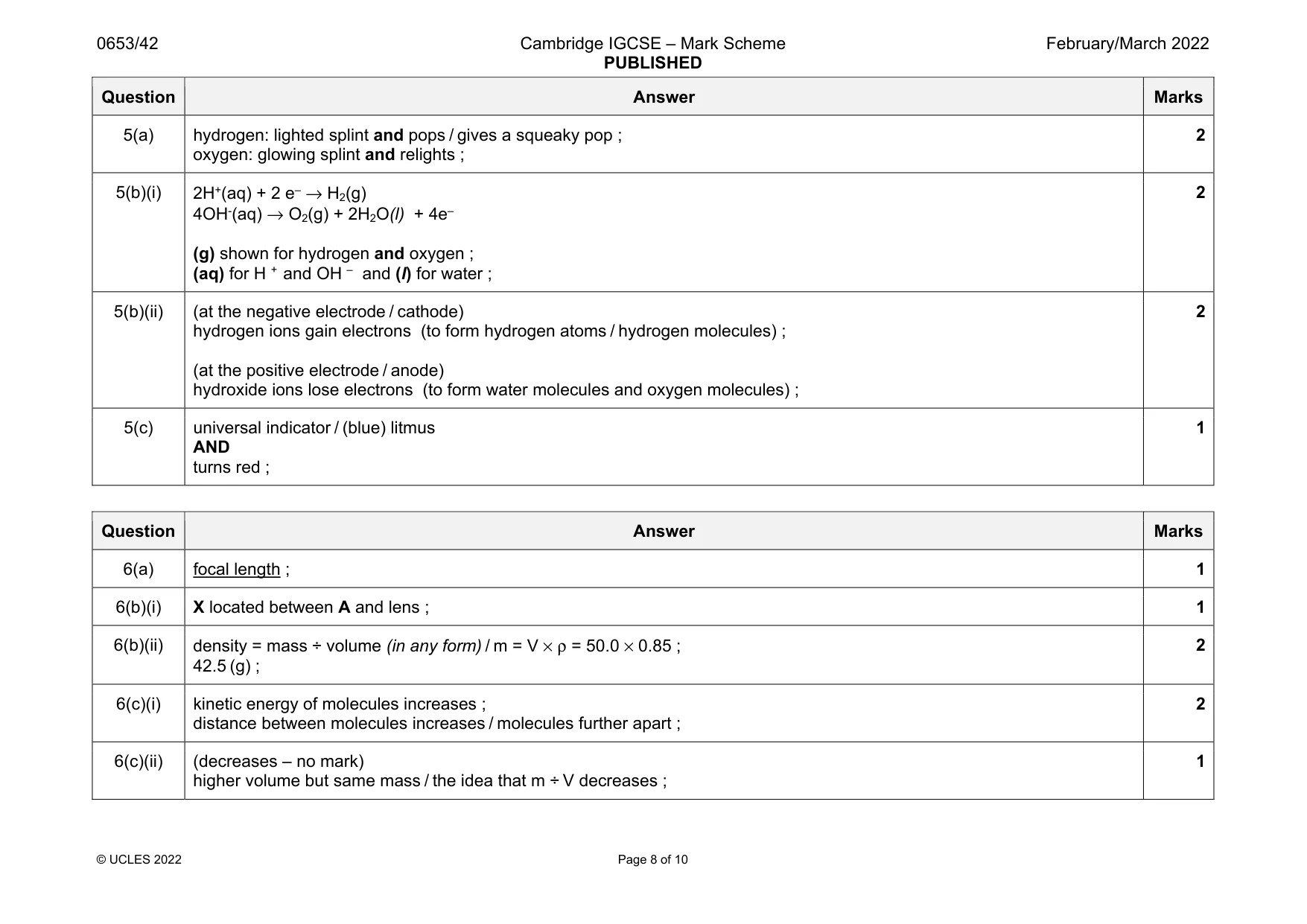
Mark scheme: 5(a) hydrogen: lighted splint and pops / gives a squeaky pop ; oxygen: glowing splint and relights ; 2 5(b)(i) 2H+(aq) + 2 e– → H2(g) 4OH-(aq) → O2(g) + 2H2O(l) + 4e– (g) shown for hydrogen and oxygen ; (aq) for H + and OH – and (l) for water ; 2 5(b)(ii) (at the negative electrode / cathode) hydrogen ions gain electrons (to form hydrogen atoms / hydrogen molecules) ; (at the positive electrode / anode) hydroxide ions lose electrons (to form water molecules and oxygen molecules) ; 2 5(c) universal indicator / (blue) litmus AND turns red ; 1
Q6 · A thin converging lens
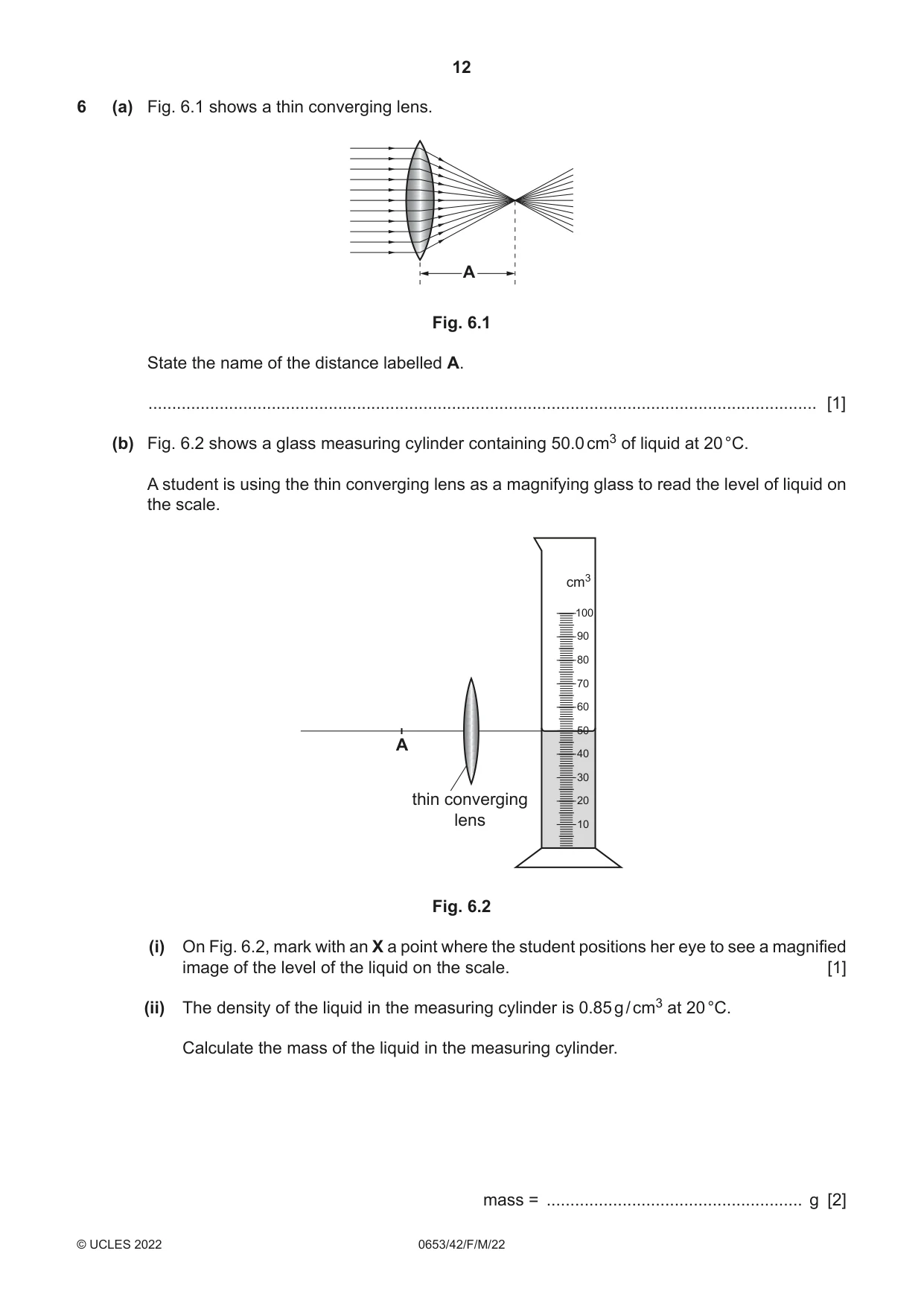
6 (a) Fig. 6.1 shows a thin converging lens. A Fig. 6.1 State the name of the distance labelled A. ............................................................................................................................................. [1] (b) Fig. 6.2 shows a glass measuring cylinder containing 50.0 cm3 of liquid at 20 °C. A student is using the thin converging lens as a magnifying glass to read the level of liquid on the scale. cm3 100 90 80 70 60 50 A 40 30 thin converging 20 lens 10 Fig. 6.2 (i) On Fig. 6.2, mark with an X a point where the student positions her eye to see a magnified image of the level of the liquid on the scale. [1] (ii) The density of the liquid in the measuring cylinder is 0.85 g / cm3 at 20 °C. Calculate the mass of the liquid in the measuring cylinder. mass = ...................................................... g [2] (c) The student increases the temperature of the liquid from 20 °C to 60 °C. (i) Explain why the volume of the liquid increases as the temperature increases. Use ideas about the distances between molecules and the motion of molecules in your answer. ........................................................................................................................................... ........................................................................................................................................... ........................................................................................................................................... ..................................................................................................................................... [2] (ii) State whether the density of the liquid increases or decreases. Explain your answer. density .................................................. explanation ........................................................................................................................ ........................................................................................................................................... [1] [Total: 7]
Mark scheme: 6(a) focal length ; 1 6(b)(i) X located between A and lens ; 1 6(b)(ii) density = mass ÷ volume (in any form) / m = V × ρ = 50.0 × 0.85 ; 42.5 (g) ; 2 6(c)(i) kinetic energy of molecules increases ; distance between molecules increases / molecules further apart ; 2 6(c)(ii) (decreases – no mark) higher volume but same mass / the idea that m ÷ V decreases ; 1
Q7 · A study investigates the number of people with lung cancer in different age ranges
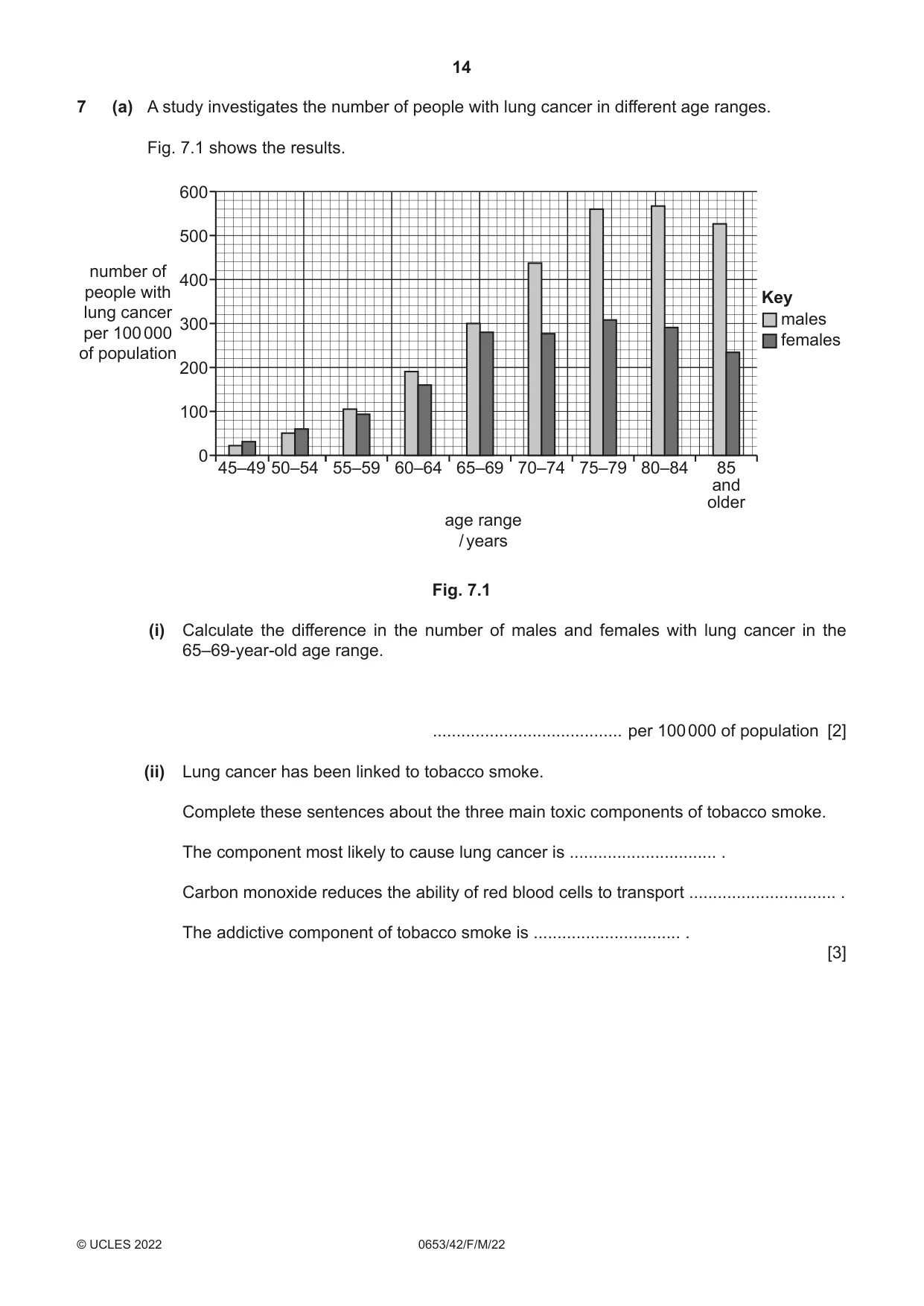
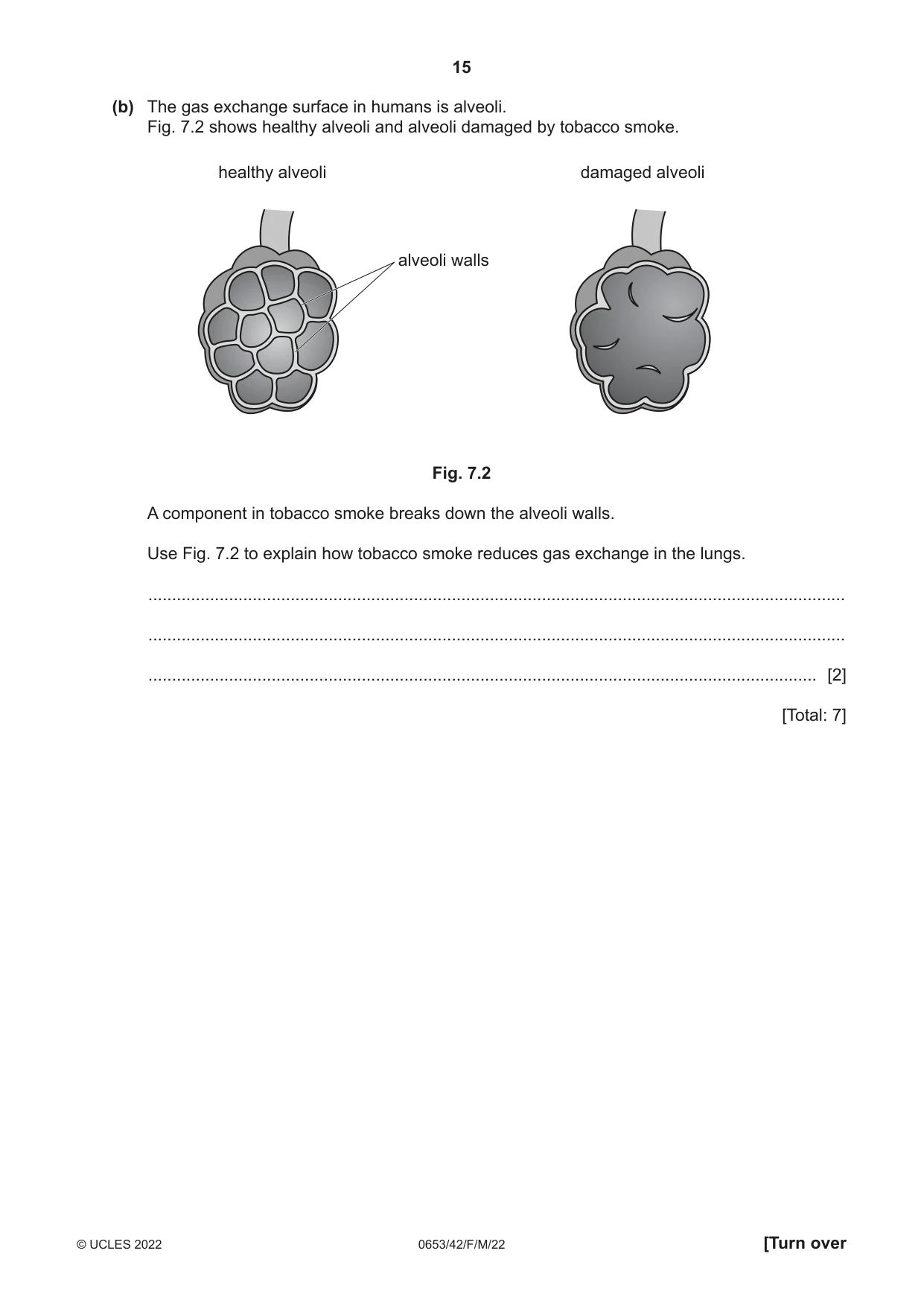
7 (a) A study investigates the number of people with lung cancer in different age ranges. Fig. 7.1 shows the results. 600 500 number of 400 people with Key lung cancer males 300 per 100 000 females of population 200 100 0 45–49 50–54 55–59 60–64 65–69 70–74 75–79 80–84 85 and older age range / years Fig. 7.1 (i) Calculate the difference in the number of males and females with lung cancer in the 65–69-year-old age range. ........................................ per 100 000 of population [2] (ii) Lung cancer has been linked to tobacco smoke. Complete these sentences about the three main toxic components of tobacco smoke. The component most likely to cause lung cancer is ............................... . Carbon monoxide reduces the ability of red blood cells to transport ............................... . The addictive component of tobacco smoke is ............................... . [3] (b) The gas exchange surface in humans is alveoli. Fig. 7.2 shows healthy alveoli and alveoli damaged by tobacco smoke. healthy alveoli damaged alveoli alveoli walls Fig. 7.2 A component in tobacco smoke breaks down the alveoli walls. Use Fig. 7.2 to explain how tobacco smoke reduces gas exchange in the lungs. ................................................................................................................................................... ................................................................................................................................................... ............................................................................................................................................. [2] [Total: 7]
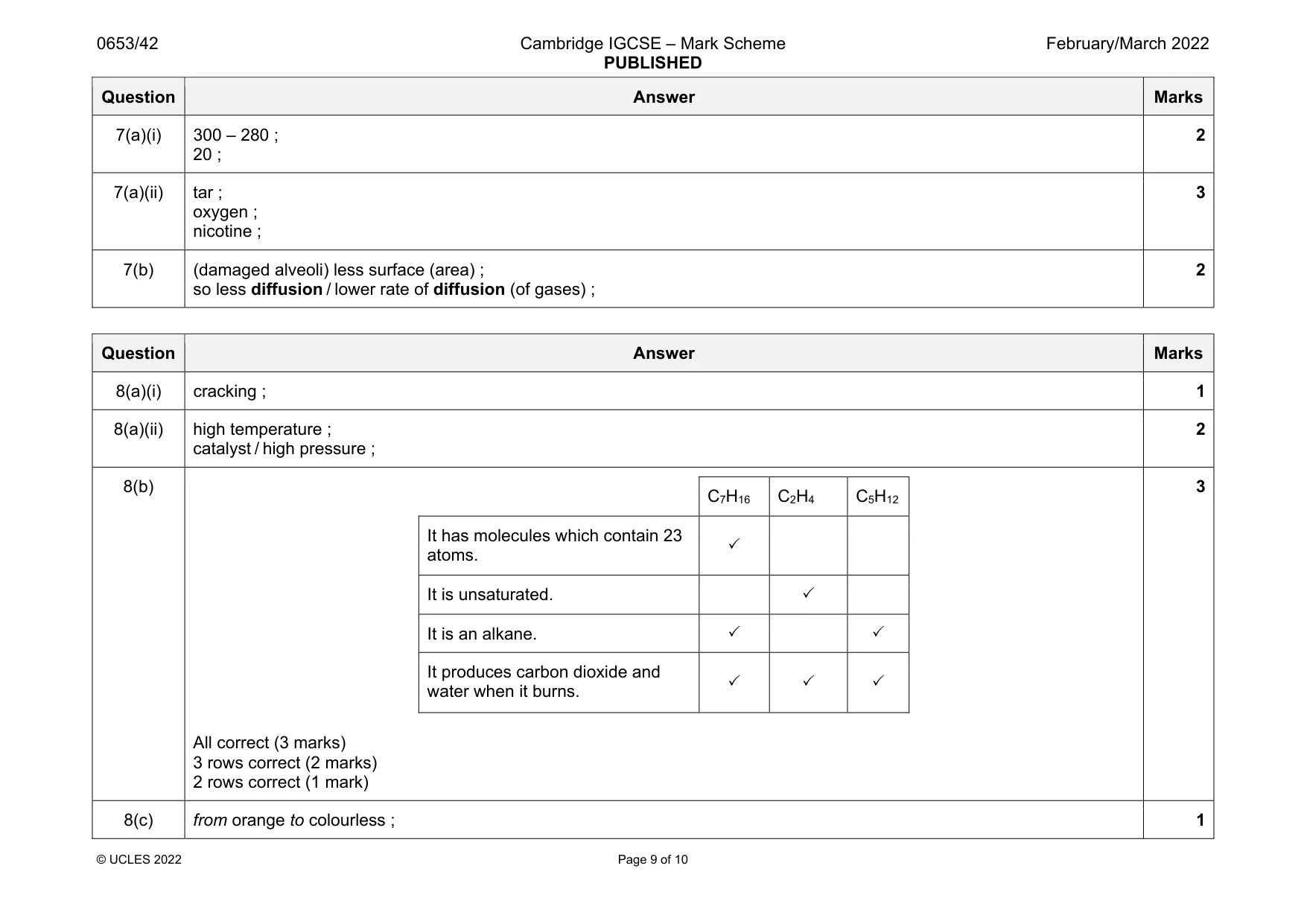
Mark scheme: 7(a)(i) 300 – 280 ; 20 ; 2 7(a)(ii) tar ; oxygen ; nicotine ; 3 7(b) (damaged alveoli) less surface (area) ; so less diffusion / lower rate of diffusion (of gases) ; 2
Q8 · Heptane, C7H16, is a hydrocarbon
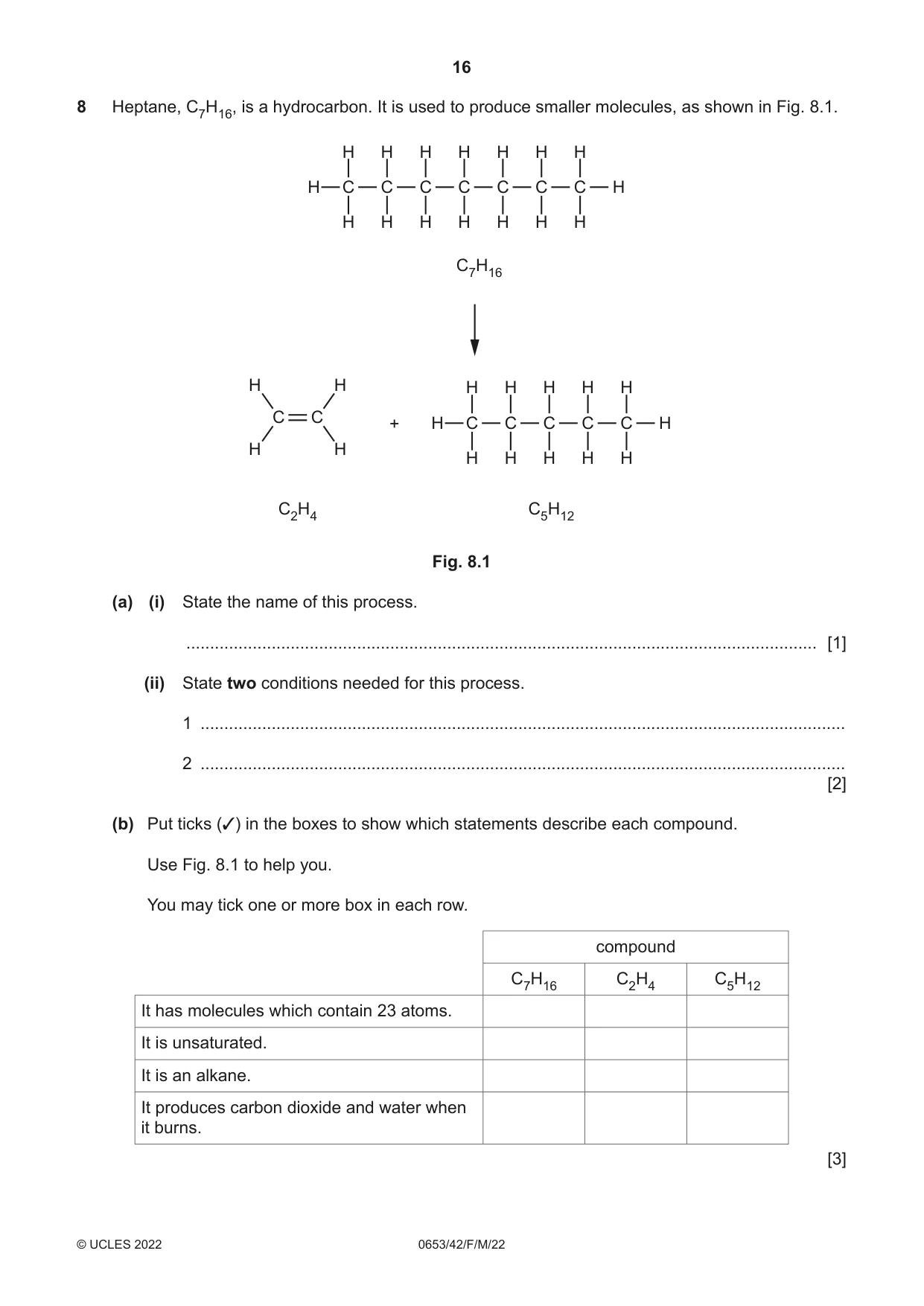
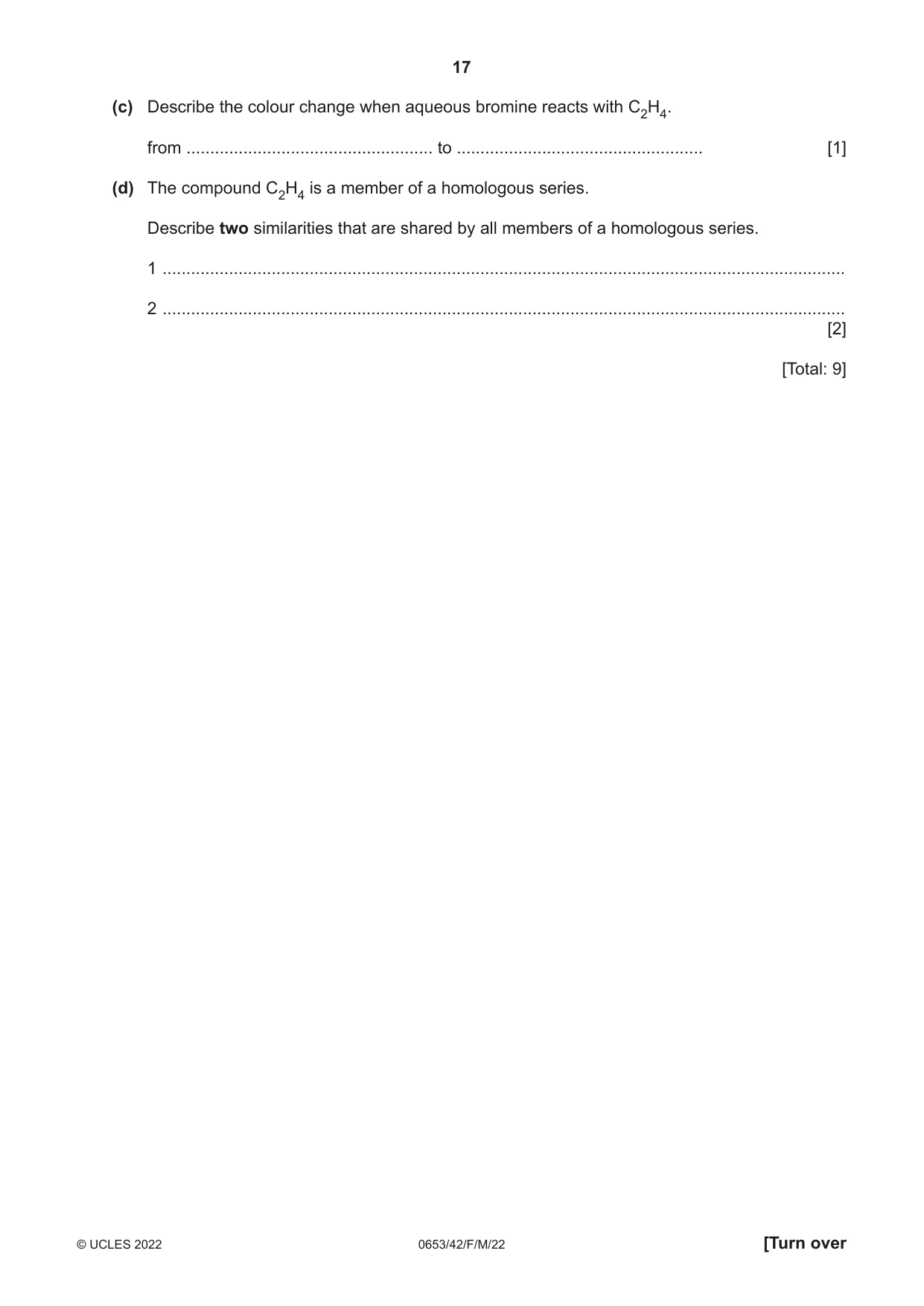
8 Heptane, C7H16, is a hydrocarbon. It is used to produce smaller molecules, as shown in Fig. 8.1. H H H H H H H H C C C C C C C H H H H H H H H C7H16 H H H H H H H C C + H C C C C C H H H H H H H H C2H4 C5H12 Fig. 8.1 (a) (i) State the name of this process. ..................................................................................................................................... [1] (ii) State two conditions needed for this process. 1 ........................................................................................................................................ 2 ........................................................................................................................................ [2] (b) Put ticks (3) in the boxes to show which statements describe each compound. Use Fig. 8.1 to help you. You may tick one or more box in each row. compound C7H16 C2H4 C5H12 It has molecules which contain 23 atoms. It is unsaturated. It is an alkane. It produces carbon dioxide and water when it burns. [3] (c) Describe the colour change when aqueous bromine reacts with C2H4. from .................................................... to .................................................... [1] (d) The compound C2H4 is a member of a homologous series. Describe two similarities that are shared by all members of a homologous series. 1 ................................................................................................................................................ 2 ................................................................................................................................................ [2] [Total: 9]
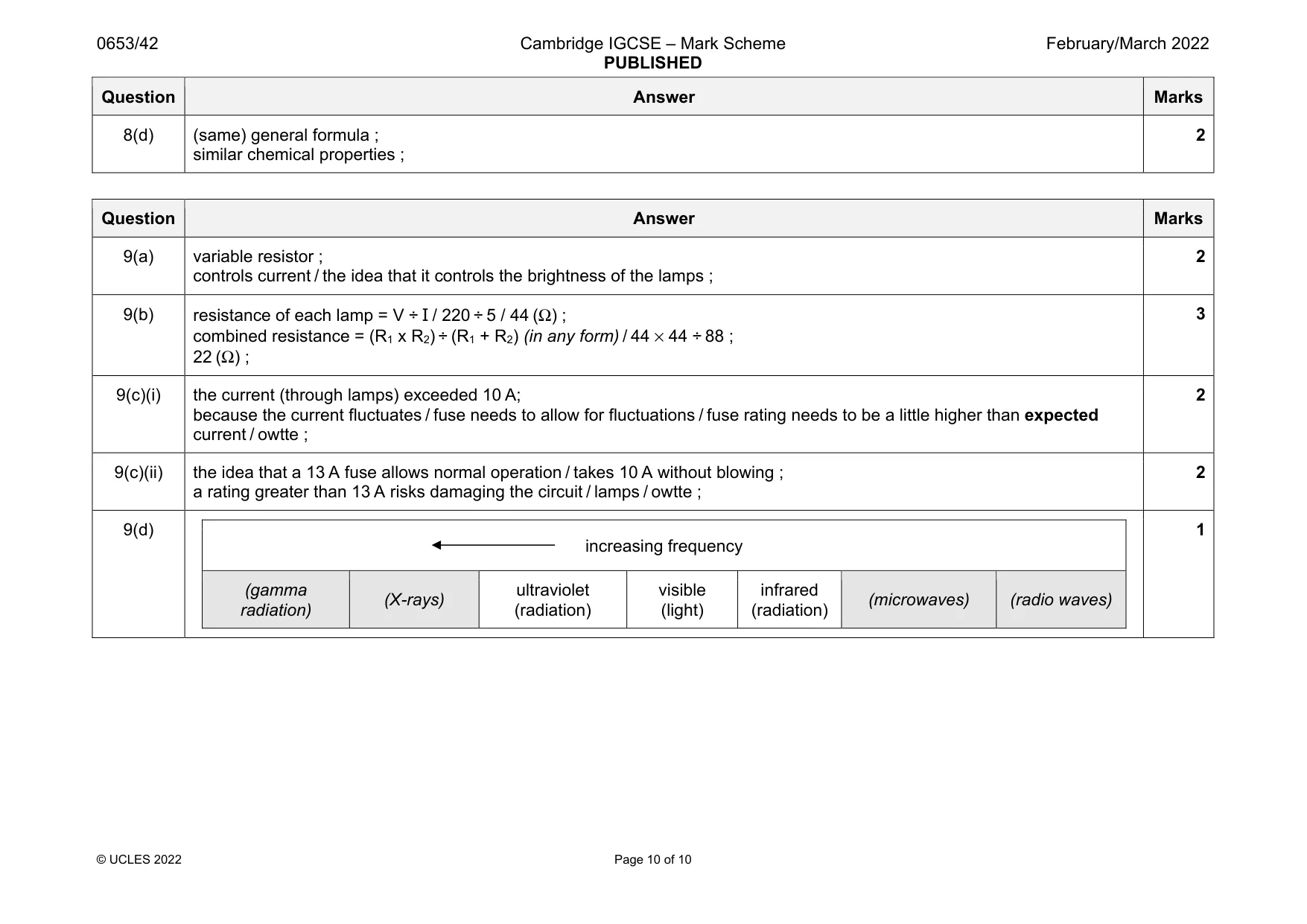
Mark scheme: 8(a)(i) cracking ; 1 8(a)(ii) high temperature ; catalyst / high pressure ; 2 8(b) C7H16 C2H4 C5H12 It has molecules which contain 23 atoms. It is unsaturated. It is an alkane. It produces carbon dioxide and water when it burns. All correct (3 marks) 3 rows correct (2 marks) 2 rows correct (1 mark) 3 8(c) from orange to colourless ; 1 Question Answer Marks 8(d) (same) general formula ; similar chemical properties ; 2
Q9 · Two lamps, A and B, used for lighting in a theatre
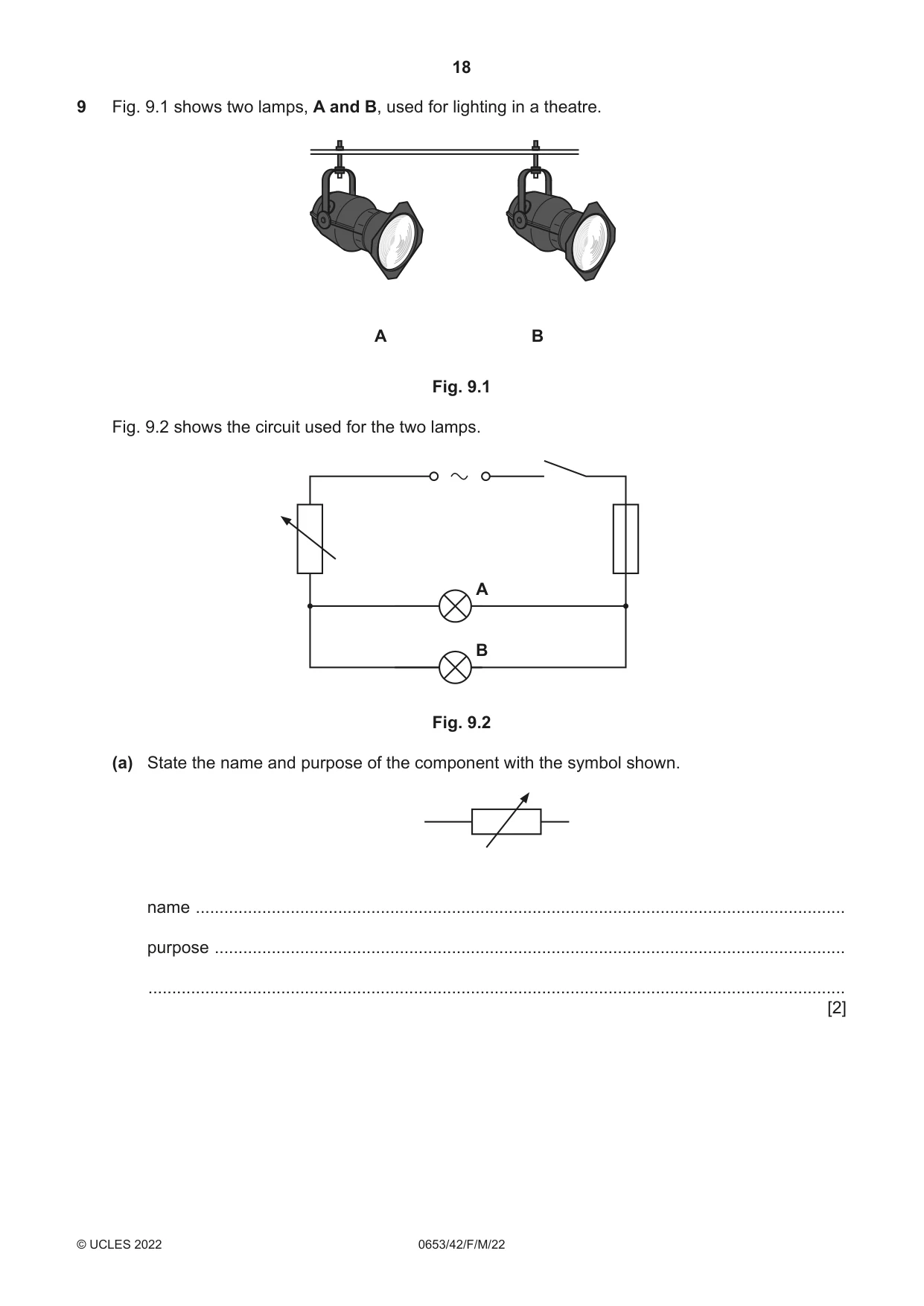
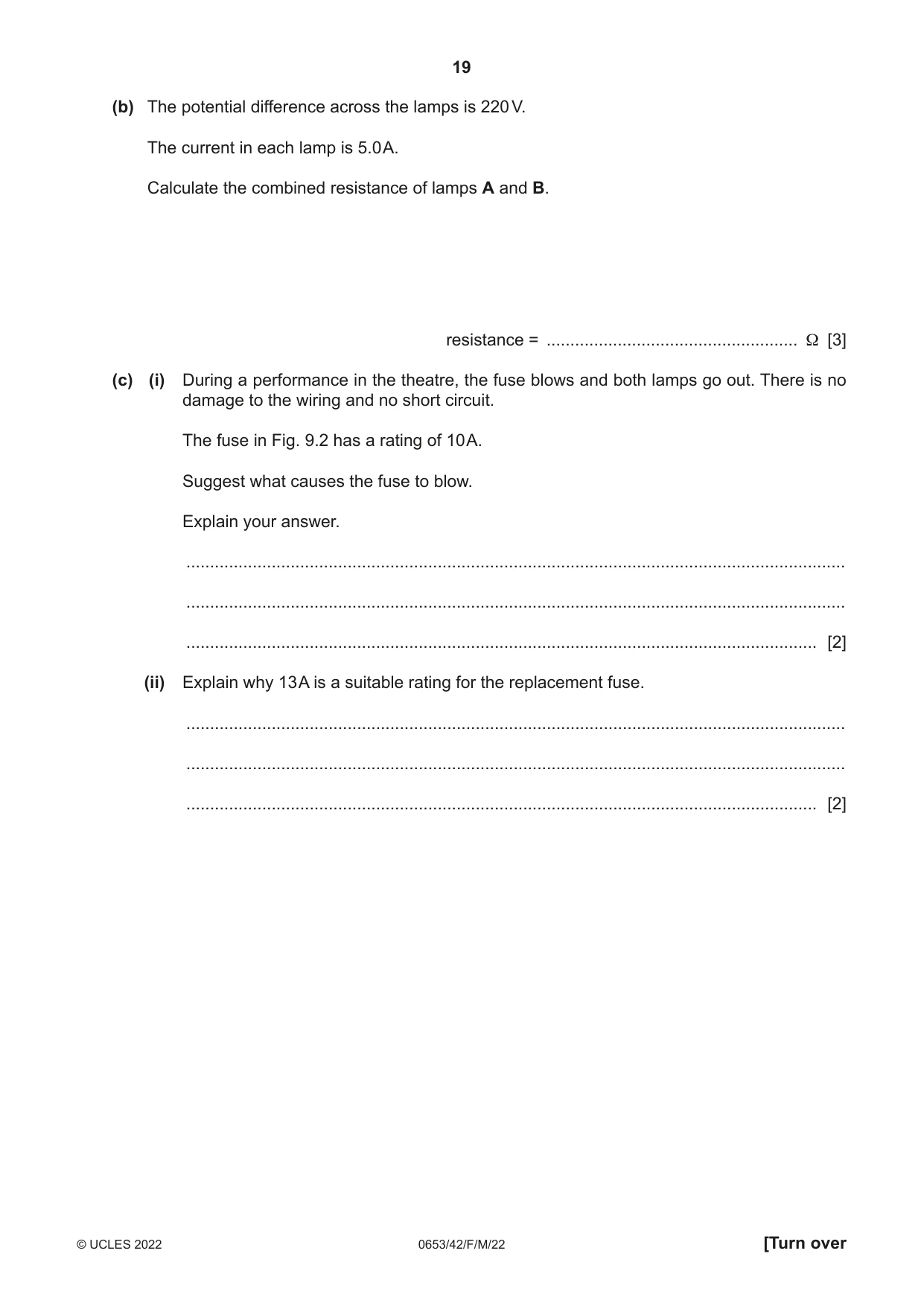
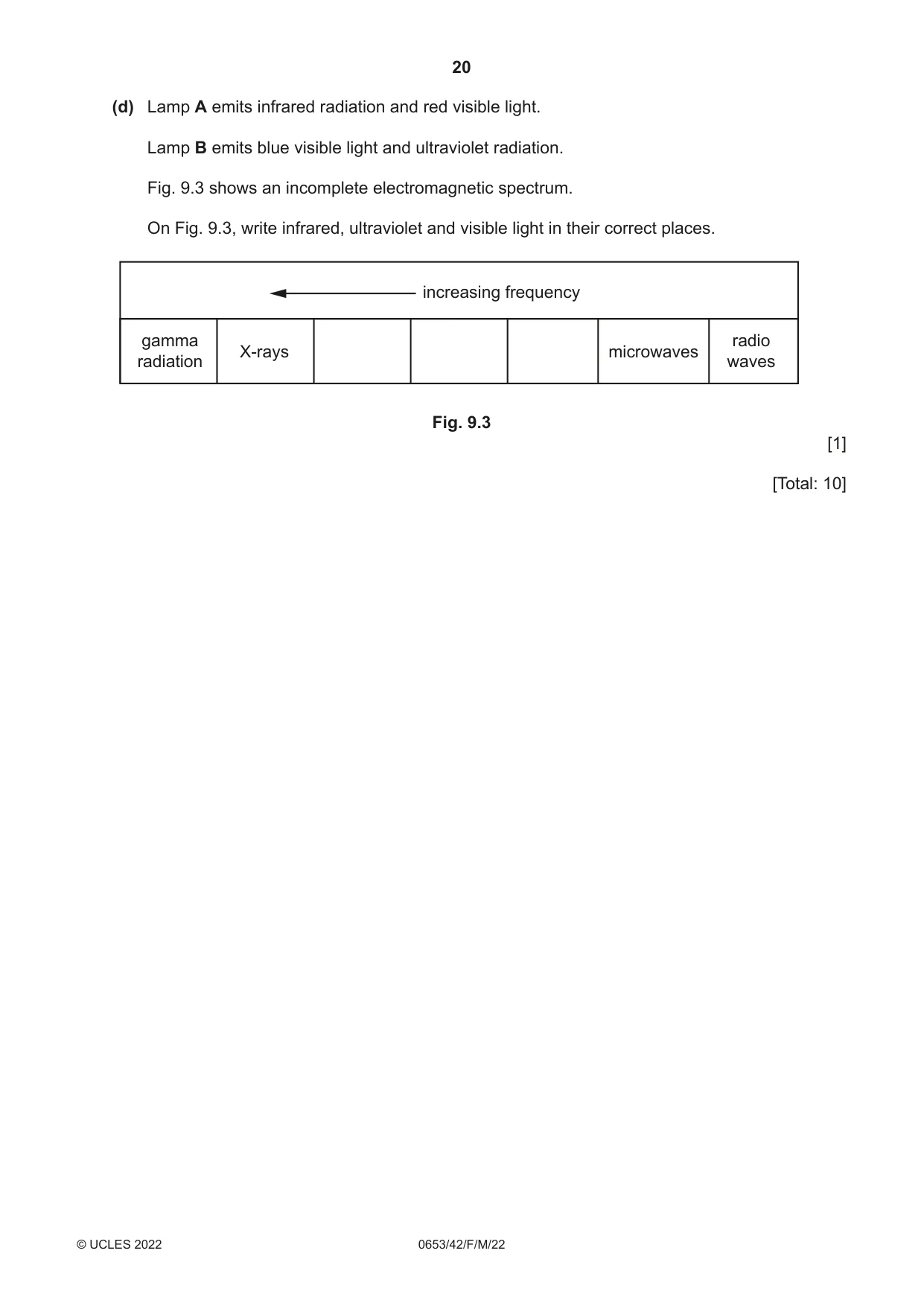
9 Fig. 9.1 shows two lamps, A and B, used for lighting in a theatre. A B Fig. 9.1 Fig. 9.2 shows the circuit used for the two lamps. A B Fig. 9.2 (a) State the name and purpose of the component with the symbol shown. name ......................................................................................................................................... purpose ..................................................................................................................................... ................................................................................................................................................... [2] (b) The potential difference across the lamps is 220 V. The current in each lamp is 5.0 A. Calculate the combined resistance of lamps A and B. resistance = ..................................................... Ω [3] (c) (i) During a performance in the theatre, the fuse blows and both lamps go out. There is no damage to the wiring and no short circuit. The fuse in Fig. 9.2 has a rating of 10 A. Suggest what causes the fuse to blow. Explain your answer. ........................................................................................................................................... ........................................................................................................................................... ..................................................................................................................................... [2] (ii) Explain why 13 A is a suitable rating for the replacement fuse. ........................................................................................................................................... ........................................................................................................................................... ..................................................................................................................................... [2] (d) Lamp A emits infrared radiation and red visible light. Lamp B emits blue visible light and ultraviolet radiation. Fig. 9.3 shows an incomplete electromagnetic spectrum. On Fig. 9.3, write infrared, ultraviolet and visible light in their correct places. increasing frequency gamma radio X-rays microwaves radiation waves Fig. 9.3 [1] [Total: 10]
Mark scheme: 9(a) variable resistor ; controls current / the idea that it controls the brightness of the lamps ; 2 9(b) resistance of each lamp = V ÷ I / 220 ÷ 5 / 44 (Ω) ; combined resistance = (R1 x R2) ÷ (R1 + R2) (in any form) / 44 × 44 ÷ 88 ; 22 (Ω) ; 3 9(c)(i) the current (through lamps) exceeded 10 A; because the current fluctuates / fuse needs to allow for fluctuations / fuse rating needs to be a little higher than expected current / owtte ; 2 9(c)(ii) the idea that a 13 A fuse allows normal operation / takes 10 A without blowing ; a rating greater than 13 A risks damaging the circuit / lamps / owtte ; 2 9(d) increasing frequency (gamma radiation) (X-rays) ultraviolet (radiation) visible (light) infrared (radiation) (microwaves) (radio waves) 1
What was in this paper
The subtopics covered by these 9 questions, and how many questions each got. Open one in a new tab to see every Cambridge question on it.
What you needed in this session
Cambridge’s own grade thresholds for 2022 Feb/March, Paper 4 · Variant 2. A higher threshold means an easier paper — the bar moves with how the cohort did.