Cambridge IGCSE Science - Combined 0653 — 2022 May/June Paper 4 · Variant 2
0653/42/M/J/22 · 9 questions · 80 marks · ≈90 min
The question paper and its mark scheme, free to read here and free to download. This is Cambridge’s own paper, exactly as it was sat.
Question paper20 pages
Mark scheme12 pages
Answers below. Sit the paper first if you are practising.
Questions as text
Q1 · A healthy human heart and a damaged human heart
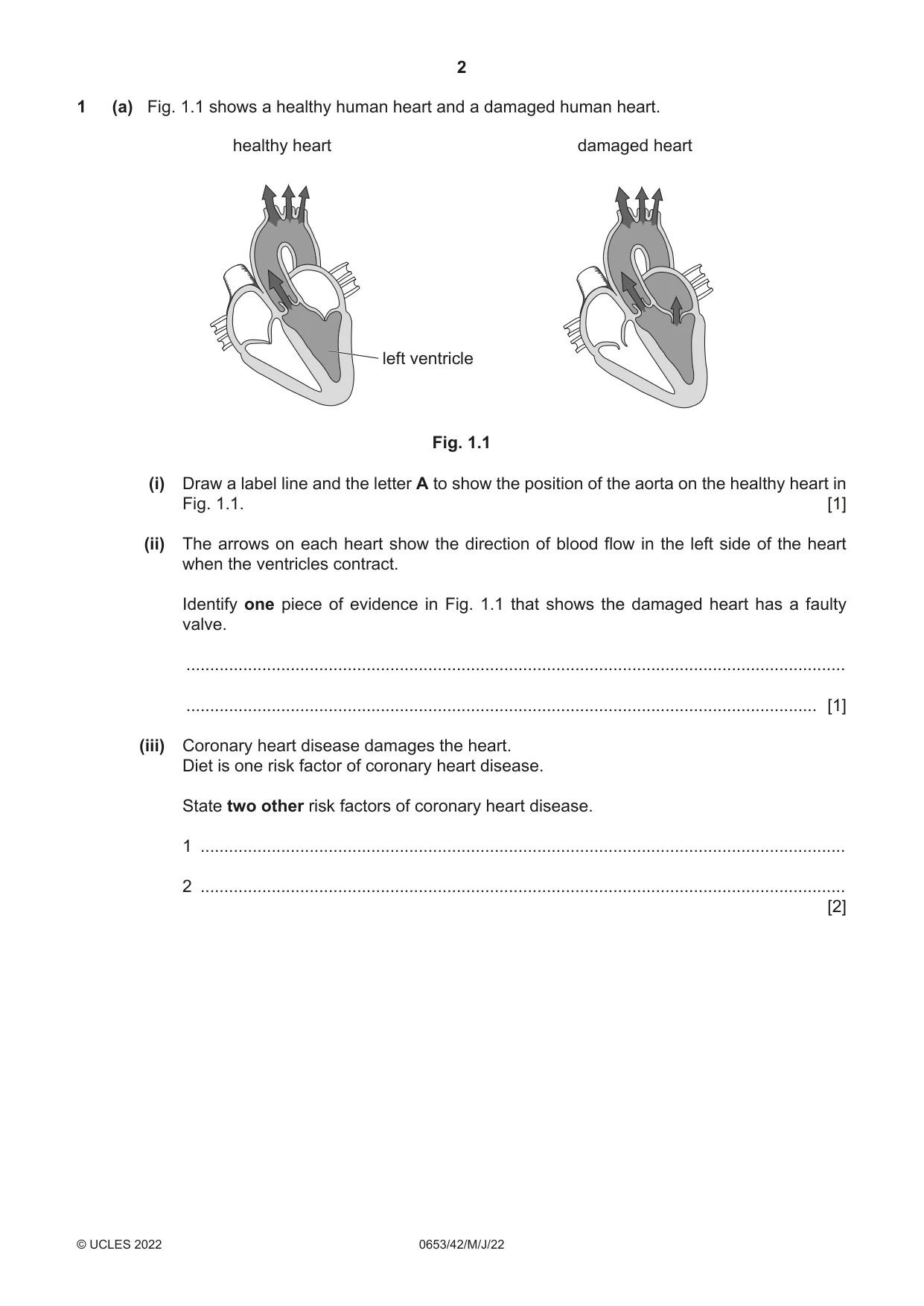
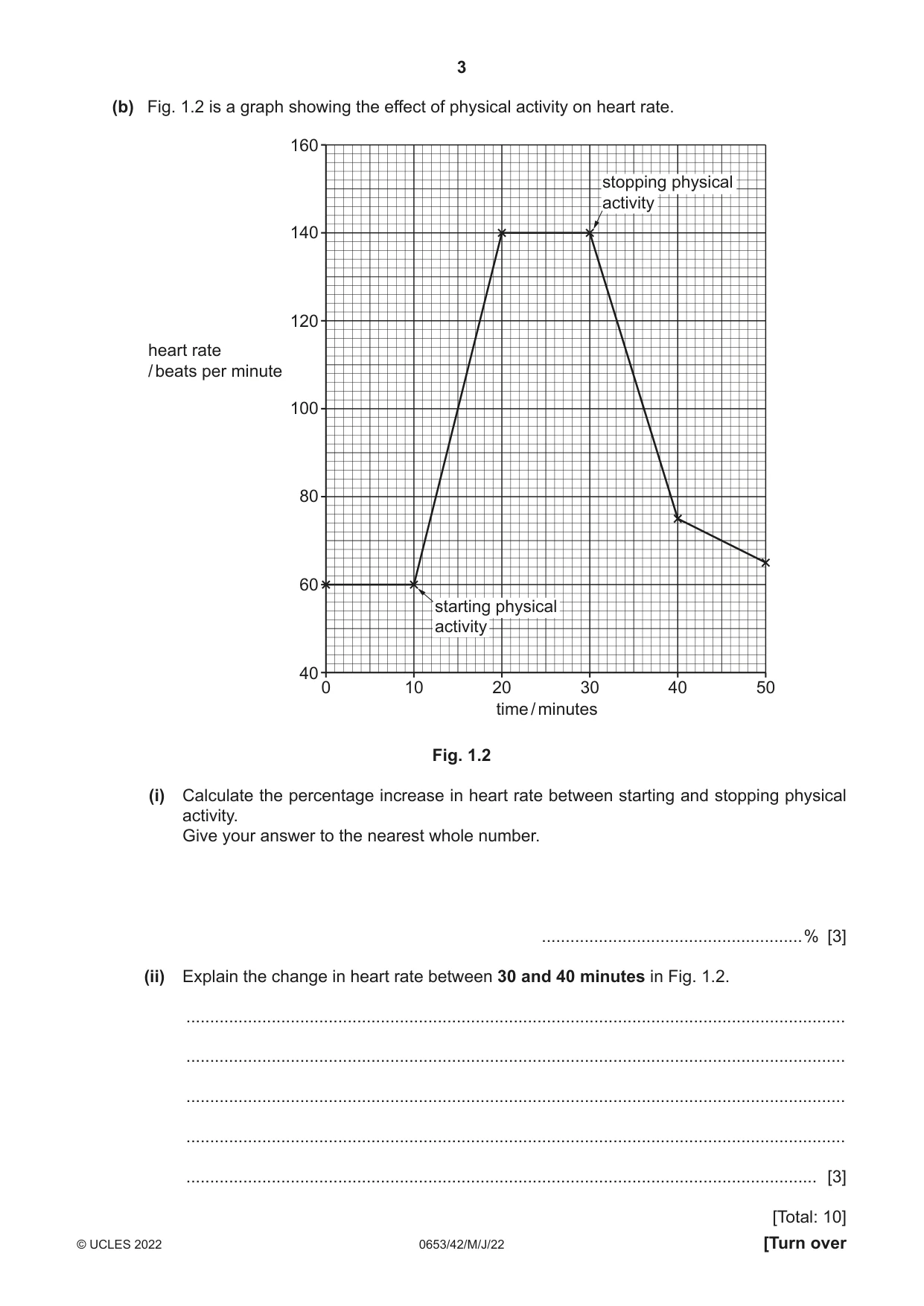
1 (a) Fig. 1.1 shows a healthy human heart and a damaged human heart. healthy heart damaged heart left ventricle Fig. 1.1 (i) Draw a label line and the letter A to show the position of the aorta on the healthy heart in Fig. 1.1. [1] (ii) The arrows on each heart show the direction of blood flow in the left side of the heart when the ventricles contract. Identify one piece of evidence in Fig. 1.1 that shows the damaged heart has a faulty valve. ........................................................................................................................................... ..................................................................................................................................... [1] (iii) Coronary heart disease damages the heart. Diet is one risk factor of coronary heart disease. State two other risk factors of coronary heart disease. 1 ........................................................................................................................................ 2 ........................................................................................................................................ [2] (b) Fig. 1.2 is a graph showing the effect of physical activity on heart rate. 160 stopping physical activity 140 120 heart rate / beats per minute 100 80 60 starting physical activity 40 0 10 20 30 40 50 time / minutes Fig. 1.2 (i) Calculate the percentage increase in heart rate between starting and stopping physical activity. Give your answer to the nearest whole number. .......................................................% [3] (ii) Explain the change in heart rate between 30 and 40 minutes in Fig. 1.2. ........................................................................................................................................... ........................................................................................................................................... ........................................................................................................................................... ........................................................................................................................................... ..................................................................................................................................... [3] [Total: 10]
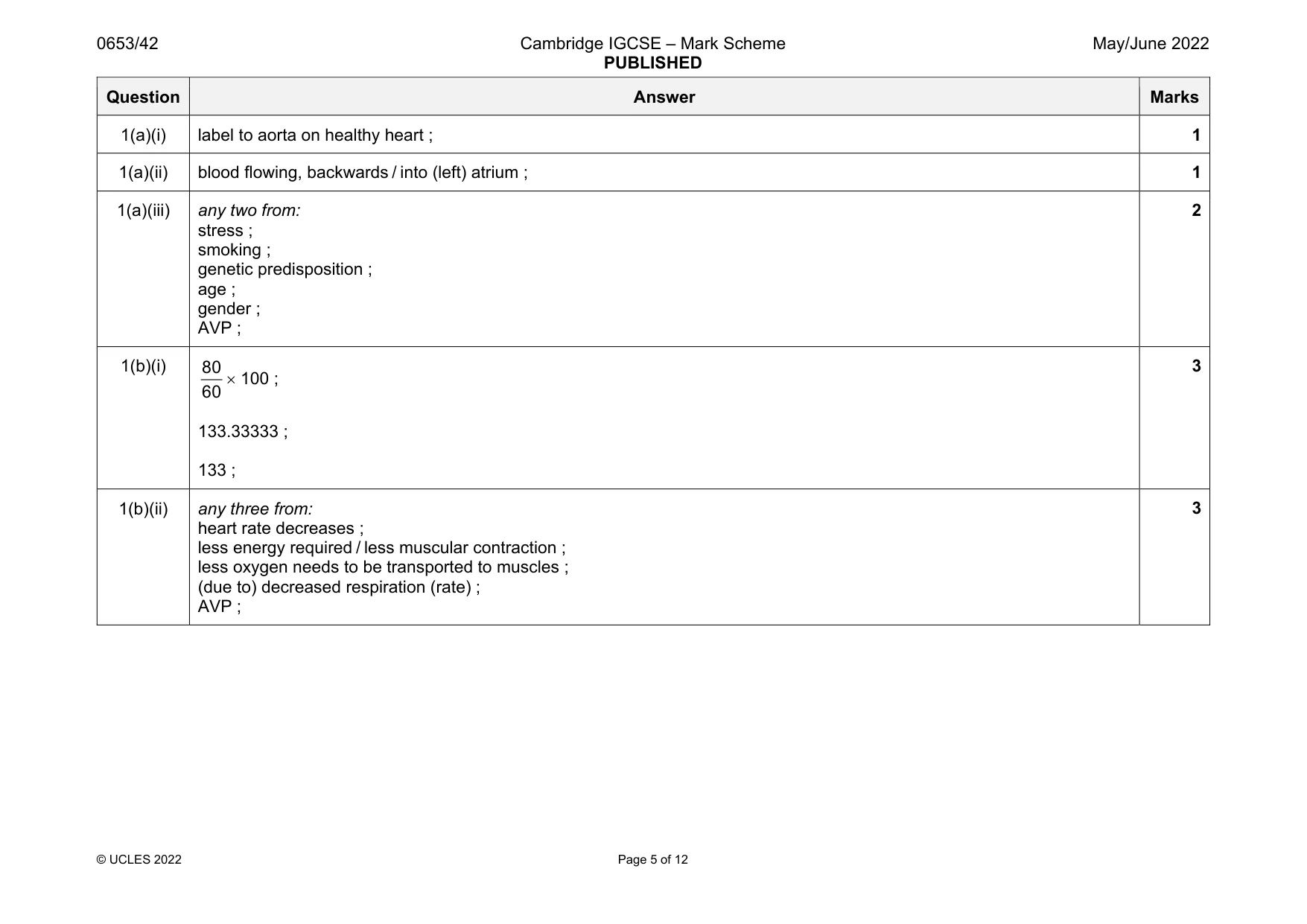
Mark scheme: 1(a)(i) label to aorta on healthy heart ; 1 1(a)(ii) blood flowing, backwards / into (left) atrium ; 1 1(a)(iii) any two from: stress ; smoking ; genetic predisposition ; age ; gender ; AVP ; 2 1(b)(i) 80 60 100 ; 133.33333 ; 133 ; 3 1(b)(ii) any three from: heart rate decreases ; less energy required / less muscular contraction ; less oxygen needs to be transported to muscles ; (due to) decreased respiration (rate) ; AVP ; 3
Q2 · A student investigates a solid, a liquid and a gas
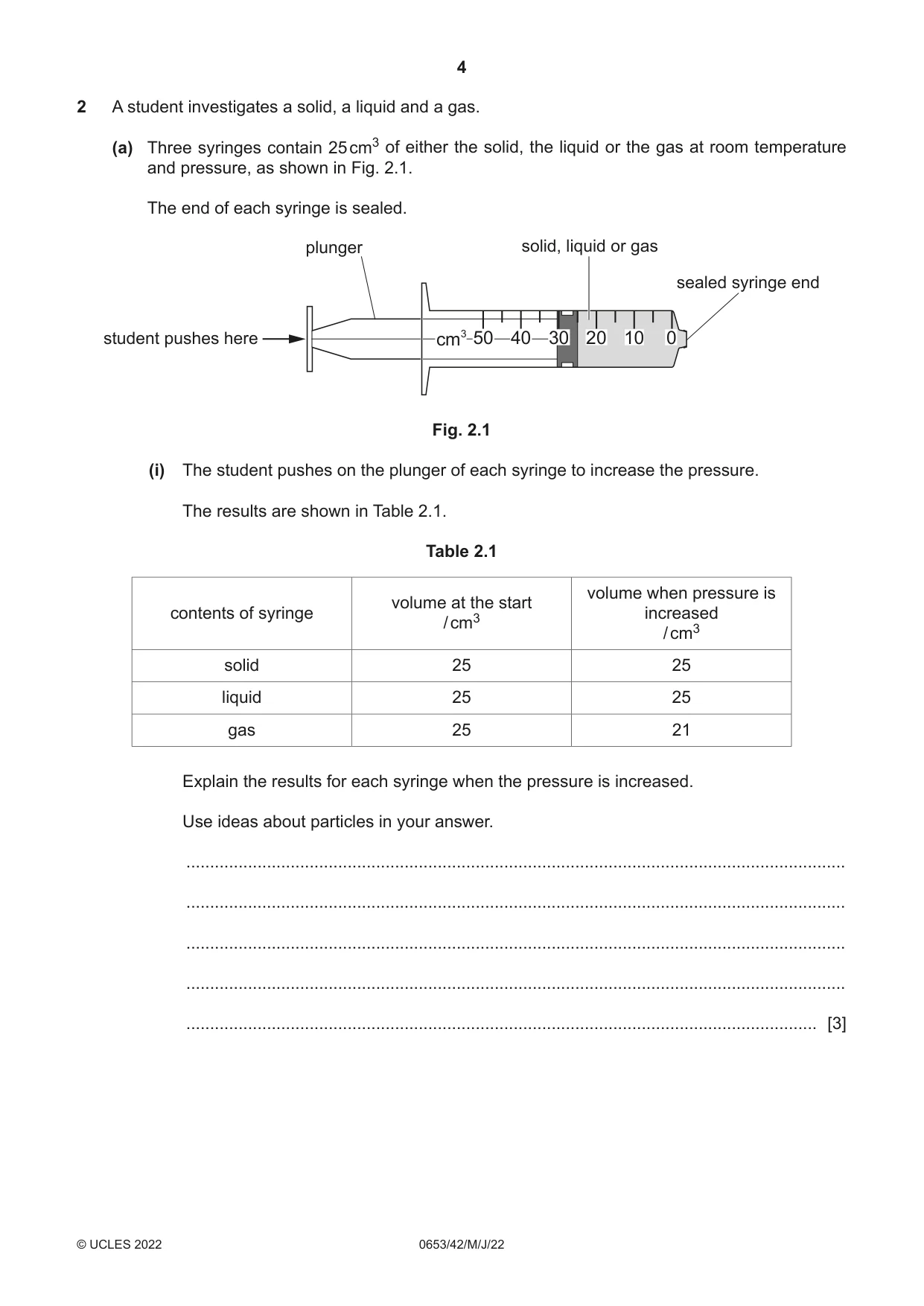
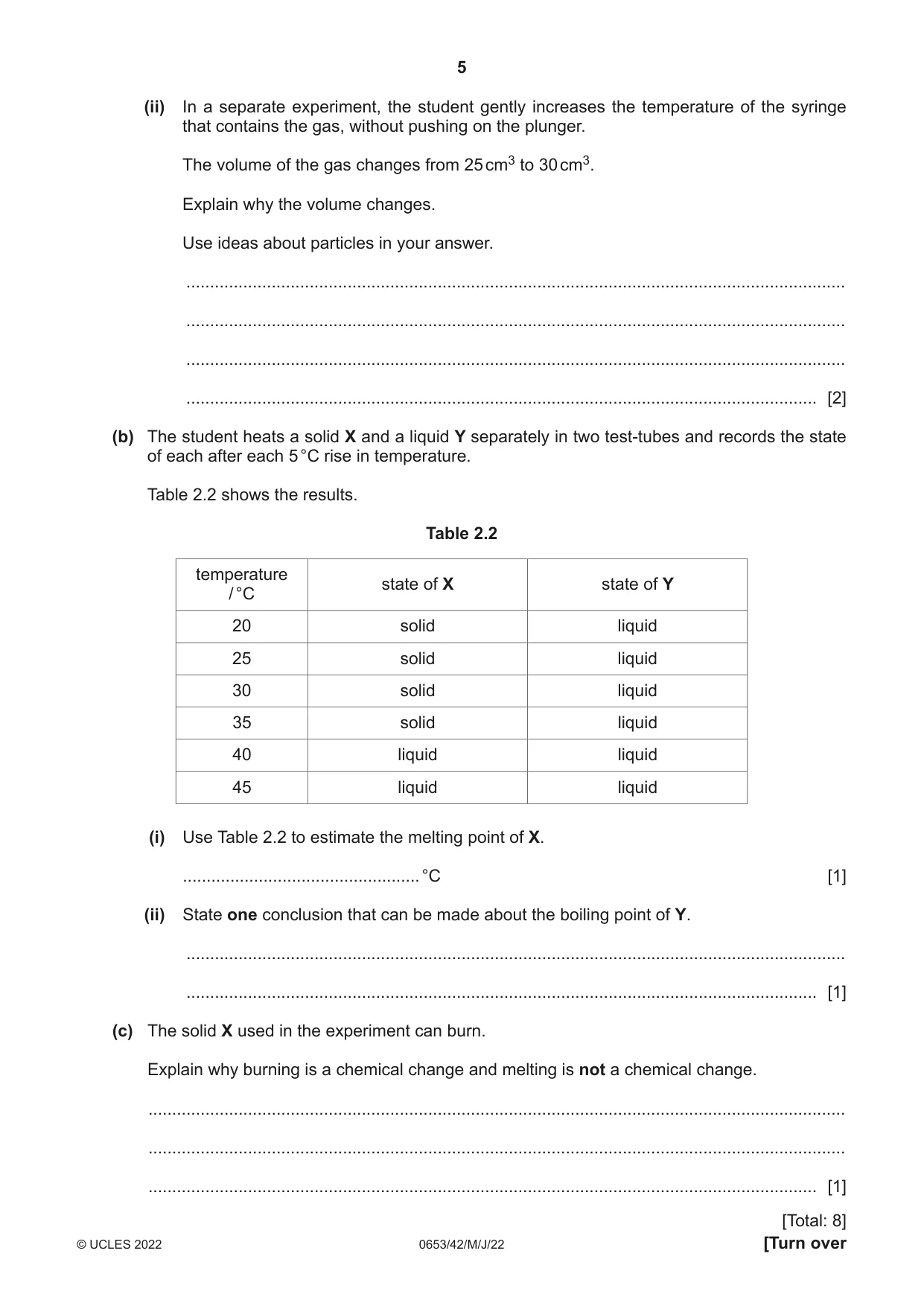
2 A student investigates a solid, a liquid and a gas. (a) Three syringes contain 25 cm3 of either the solid, the liquid or the gas at room temperature and pressure, as shown in Fig. 2.1. The end of each syringe is sealed. plunger solid, liquid or gas sealed syringe end student pushes here cm3 50 40 30 20 10 0 Fig. 2.1 (i) The student pushes on the plunger of each syringe to increase the pressure. The results are shown in Table 2.1. Table 2.1 volume when pressure is volume at the start contents of syringe increased / cm3 / cm3 solid 25 25 liquid 25 25 gas 25 21 Explain the results for each syringe when the pressure is increased. Use ideas about particles in your answer. ........................................................................................................................................... ........................................................................................................................................... ........................................................................................................................................... ........................................................................................................................................... ..................................................................................................................................... [3] (ii) In a separate experiment, the student gently increases the temperature of the syringe that contains the gas, without pushing on the plunger. The volume of the gas changes from 25 cm3 to 30 cm3. Explain why the volume changes. Use ideas about particles in your answer. ........................................................................................................................................... ........................................................................................................................................... ........................................................................................................................................... ..................................................................................................................................... [2] (b) The student heats a solid X and a liquid Y separately in two test‑tubes and records the state of each after each 5 °C rise in temperature. Table 2.2 shows the results. Table 2.2 temperature state of X state of Y / °C 20 solid liquid 25 solid liquid 30 solid liquid 35 solid liquid 40 liquid liquid 45 liquid liquid (i) Use Table 2.2 to estimate the melting point of X. .................................................. °C [1] (ii) State one conclusion that can be made about the boiling point of Y. ........................................................................................................................................... ..................................................................................................................................... [1] (c) The solid X used in the experiment can burn. Explain why burning is a chemical change and melting is not a chemical change. ................................................................................................................................................... ................................................................................................................................................... ............................................................................................................................................. [1] [Total: 8]
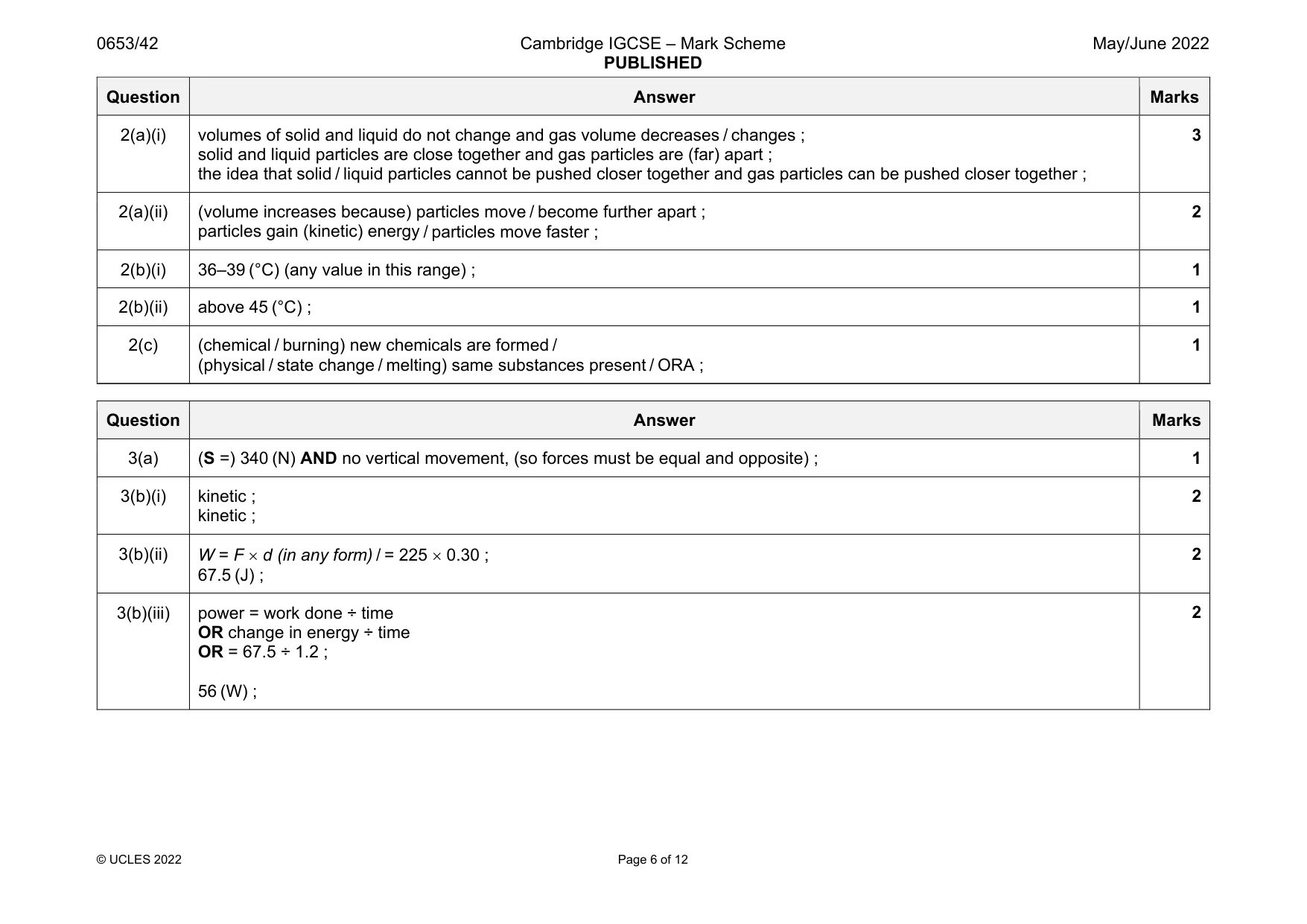
Mark scheme: 2(a)(i) volumes of solid and liquid do not change and gas volume decreases / changes ; solid and liquid particles are close together and gas particles are (far) apart ; the idea that solid / liquid particles cannot be pushed closer together and gas particles can be pushed closer together ; 3 2(a)(ii) (volume increases because) particles move / become further apart ; particles gain (kinetic) energy / particles move faster ; 2 2(b)(i) 36–39 (°C) (any value in this range) ; 1 2(b)(ii) above 45 (°C) ; 1 2(c) (chemical / burning) new chemicals are formed / (physical / state change / melting) same substances present / ORA ; 1
Q3 · The forces acting as a student rides forwards on a moving scooter
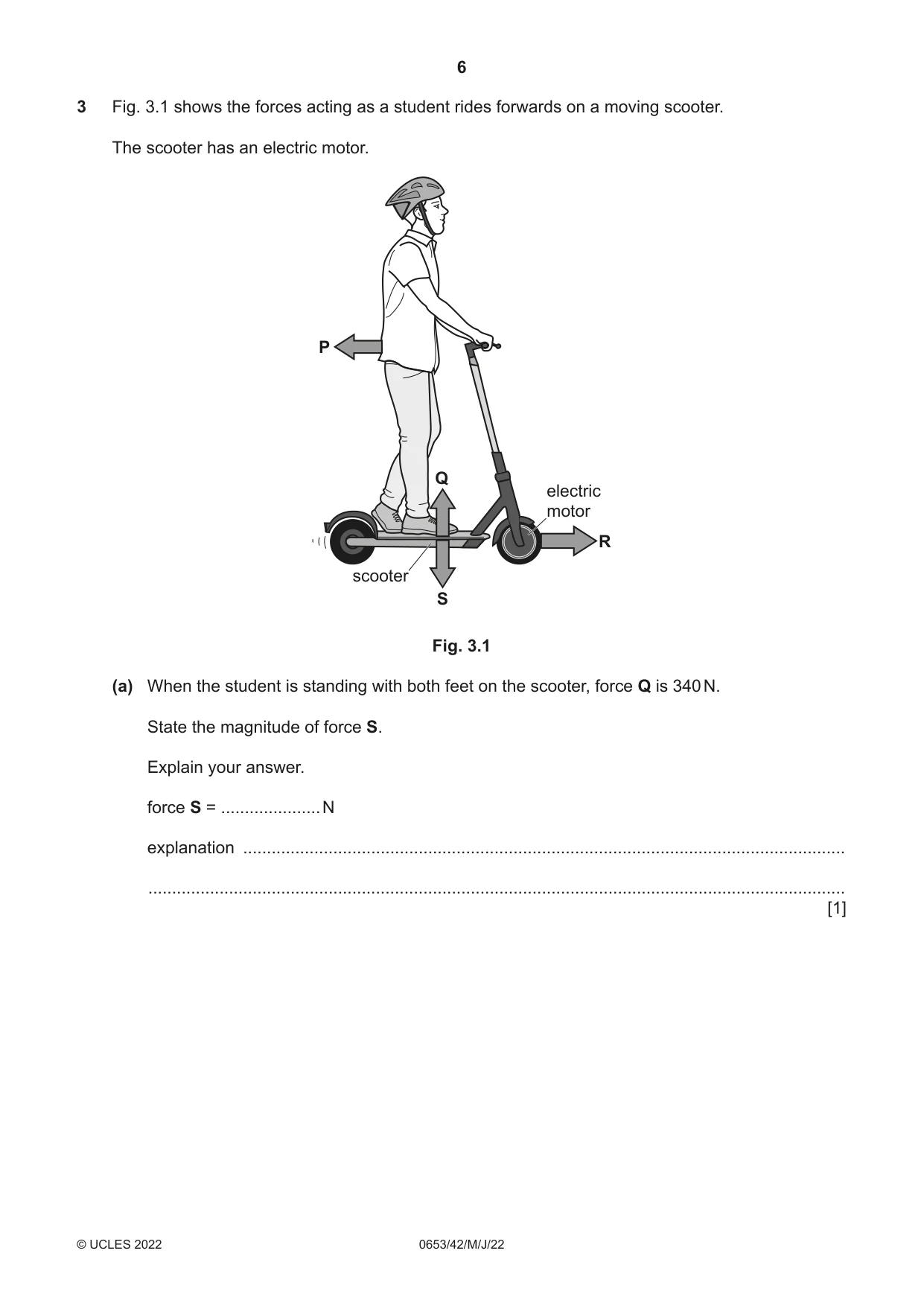
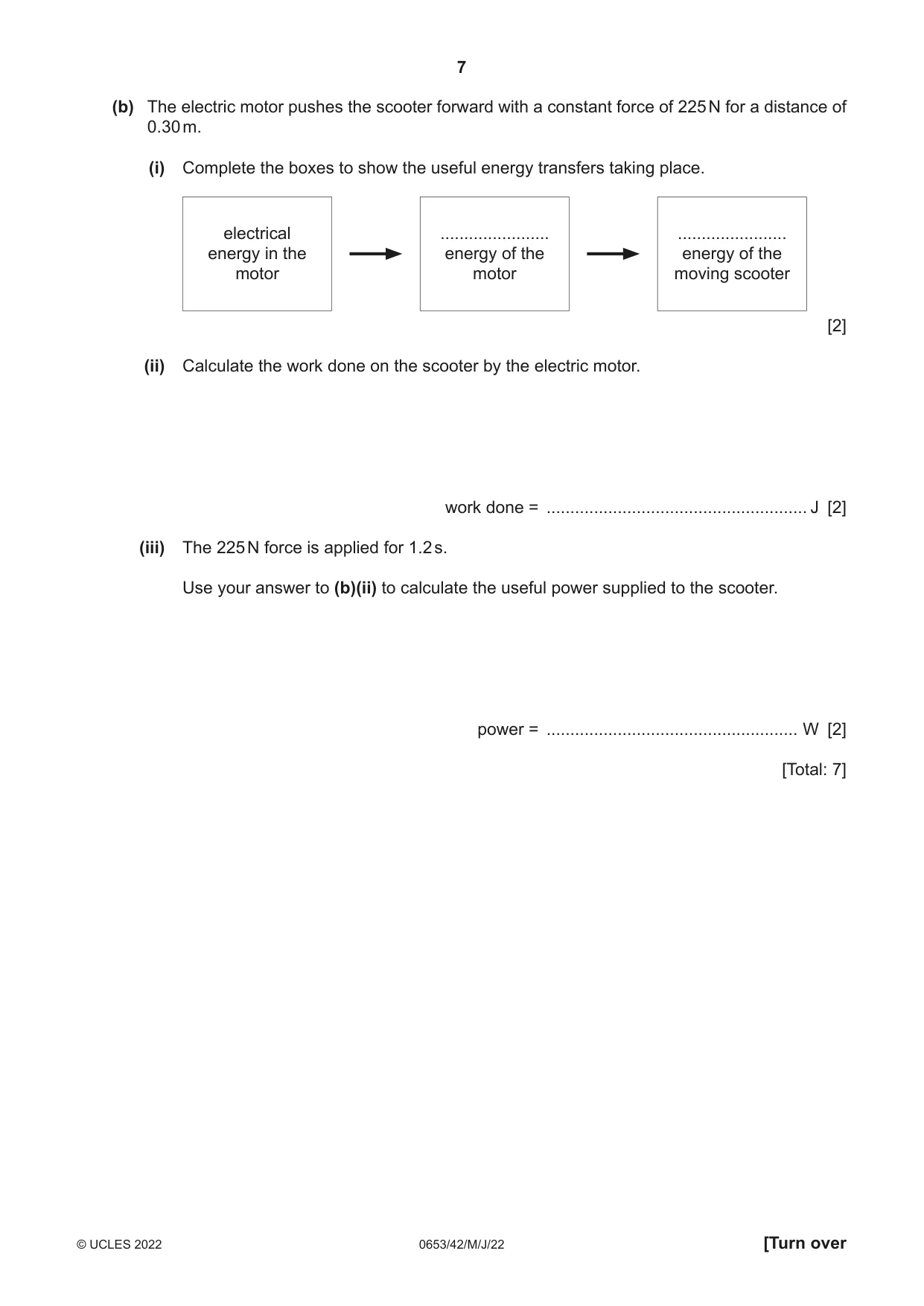
3 Fig. 3.1 shows the forces acting as a student rides forwards on a moving scooter. The scooter has an electric motor. P Q electric motor R scooter S Fig. 3.1 (a) When the student is standing with both feet on the scooter, force Q is 340 N. State the magnitude of force S. Explain your answer. force S = ..................... N explanation ............................................................................................................................... ................................................................................................................................................... [1] (b) The electric motor pushes the scooter forward with a constant force of 225 N for a distance of 0.30 m. (i) Complete the boxes to show the useful energy transfers taking place. electrical ....................... ....................... energy in the energy of the energy of the motor motor moving scooter [2] (ii) Calculate the work done on the scooter by the electric motor. work done = ....................................................... J [2] (iii) The 225 N force is applied for 1.2 s. Use your answer to (b)(ii) to calculate the useful power supplied to the scooter. power = ..................................................... W [2] [Total: 7]
Mark scheme: 3(a) (S =) 340 (N) AND no vertical movement, (so forces must be equal and opposite) ; 1 3(b)(i) kinetic ; kinetic ; 2 3(b)(ii) W = F d (in any form) / = 225 0.30 ; 67.5 (J) ; 2 3(b)(iii) power = work done ÷ time OR change in energy ÷ time OR = 67.5 ÷ 1.2 ; 56 (W) ; 2
Q4 · A diagram of a wind‑pollinated flower
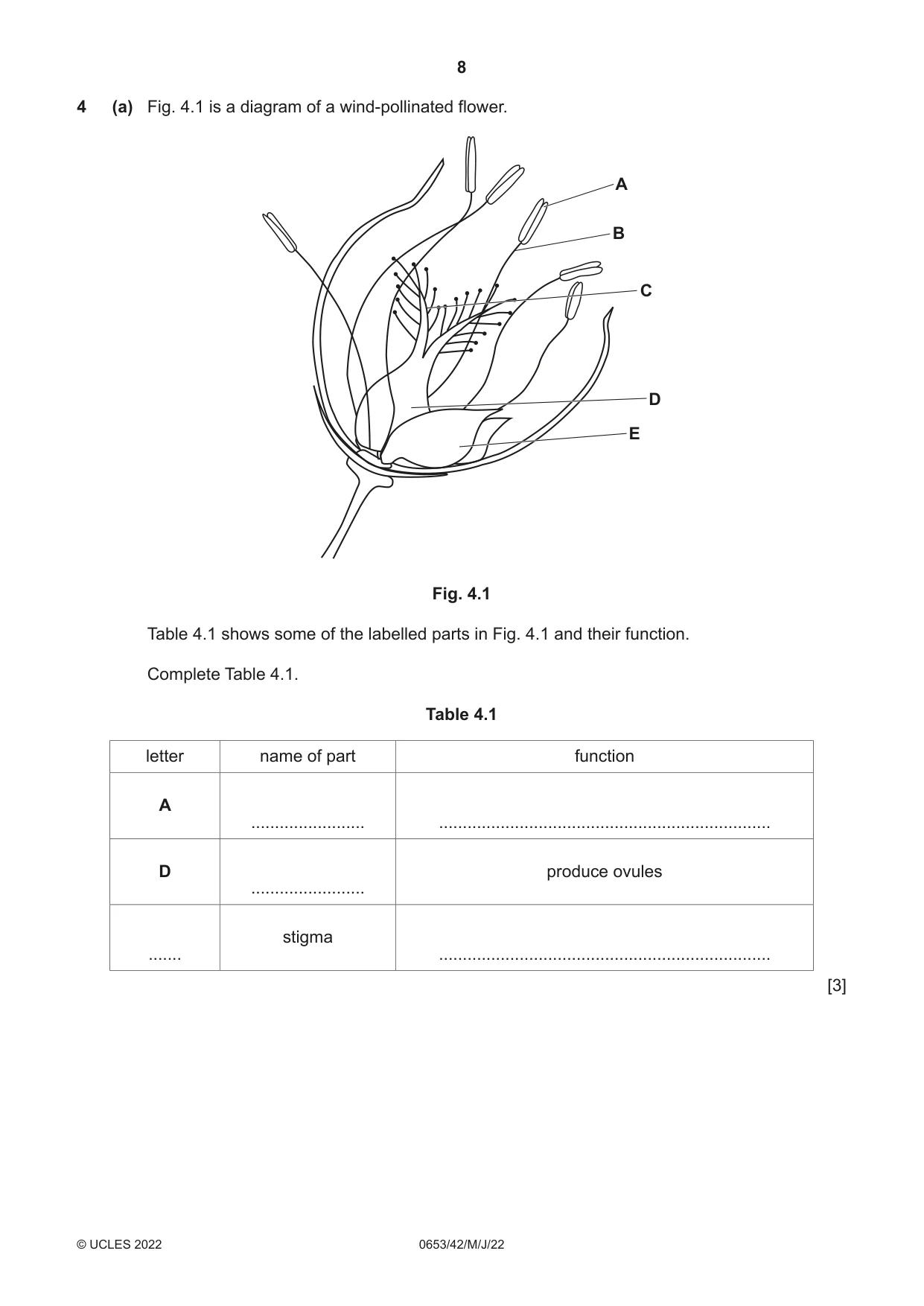
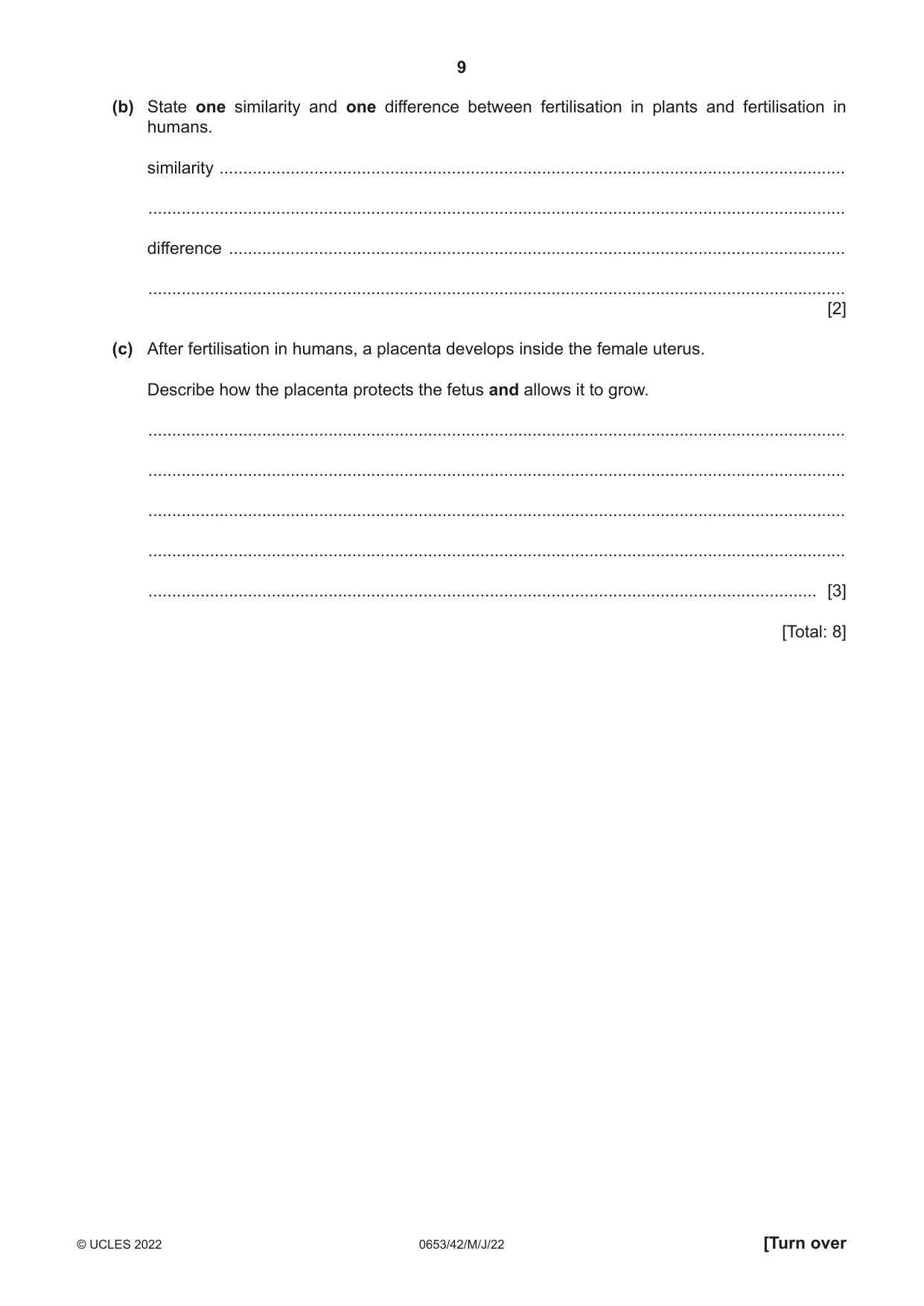
4 (a) Fig. 4.1 is a diagram of a wind‑pollinated flower. A B C D E Fig. 4.1 Table 4.1 shows some of the labelled parts in Fig. 4.1 and their function. Complete Table 4.1. Table 4.1 letter name of part function A ........................ ...................................................................... D produce ovules ........................ stigma ....... ...................................................................... [3] (b) State one similarity and one difference between fertilisation in plants and fertilisation in humans. similarity .................................................................................................................................... ................................................................................................................................................... difference .................................................................................................................................. ................................................................................................................................................... [2] (c) After fertilisation in humans, a placenta develops inside the female uterus. Describe how the placenta protects the fetus and allows it to grow. ................................................................................................................................................... ................................................................................................................................................... ................................................................................................................................................... ................................................................................................................................................... ............................................................................................................................................. [3] [Total: 8]
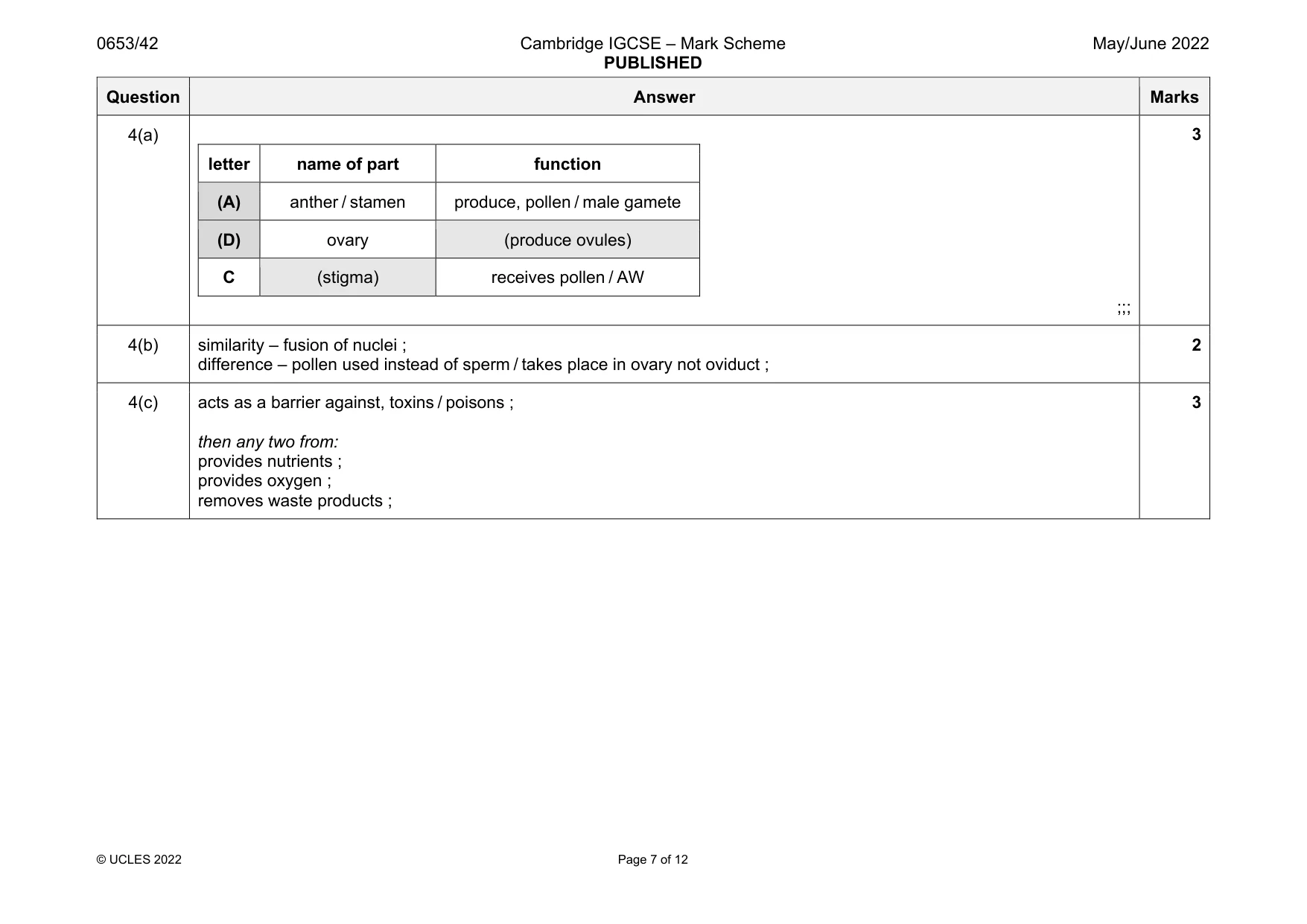
Mark scheme: 4(a) letter name of part function (A) anther / stamen produce, pollen / male gamete (D) ovary (produce ovules) C (stigma) receives pollen / AW ;;; 4(b) similarity – fusion of nuclei ; difference – pollen used instead of sperm / takes place in ovary not oviduct ; 2 4(c) acts as a barrier against, toxins / poisons ; then any two from: provides nutrients ; provides oxygen ; removes waste products ; 3
Q5 · A key made from the alloy brass
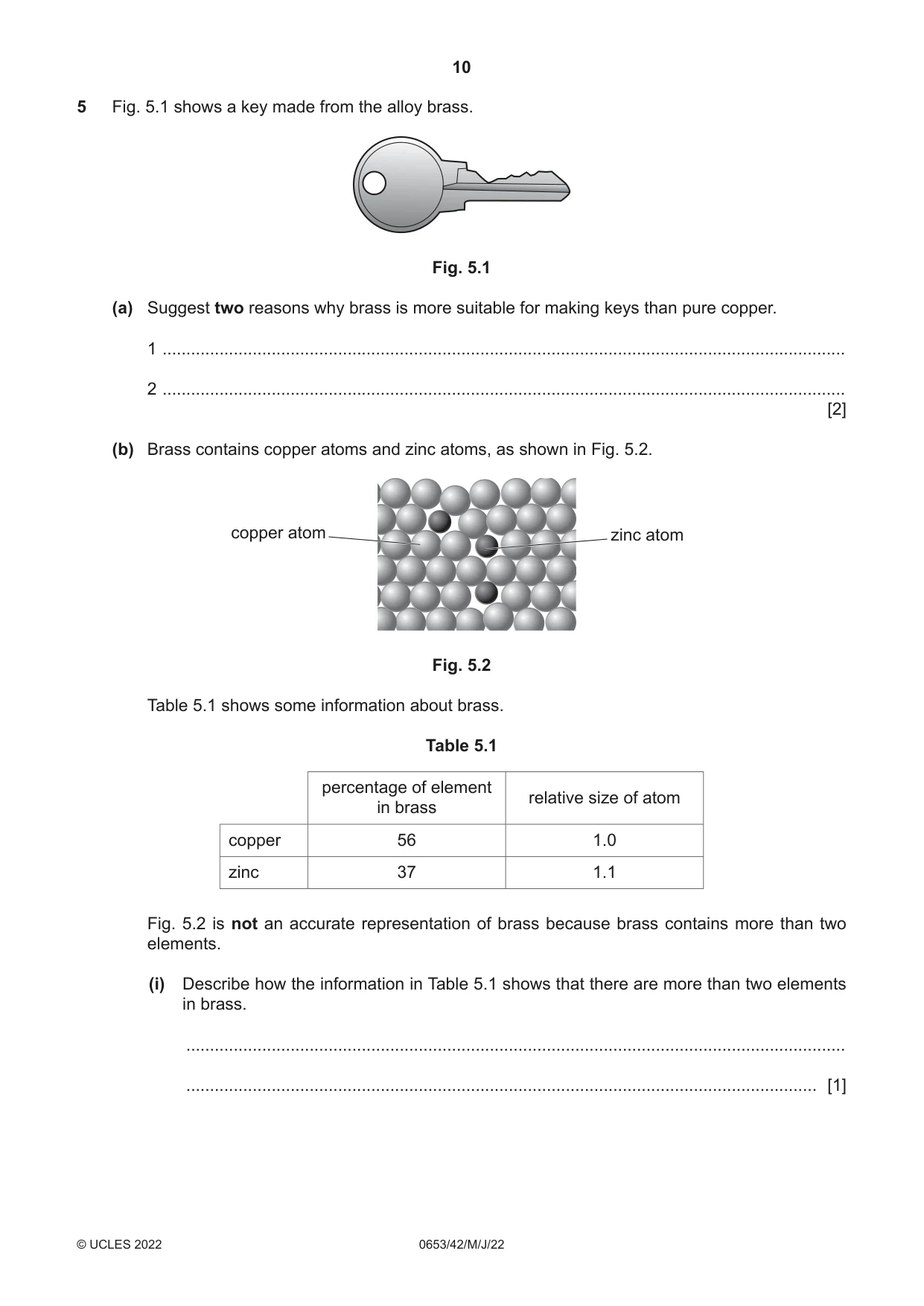
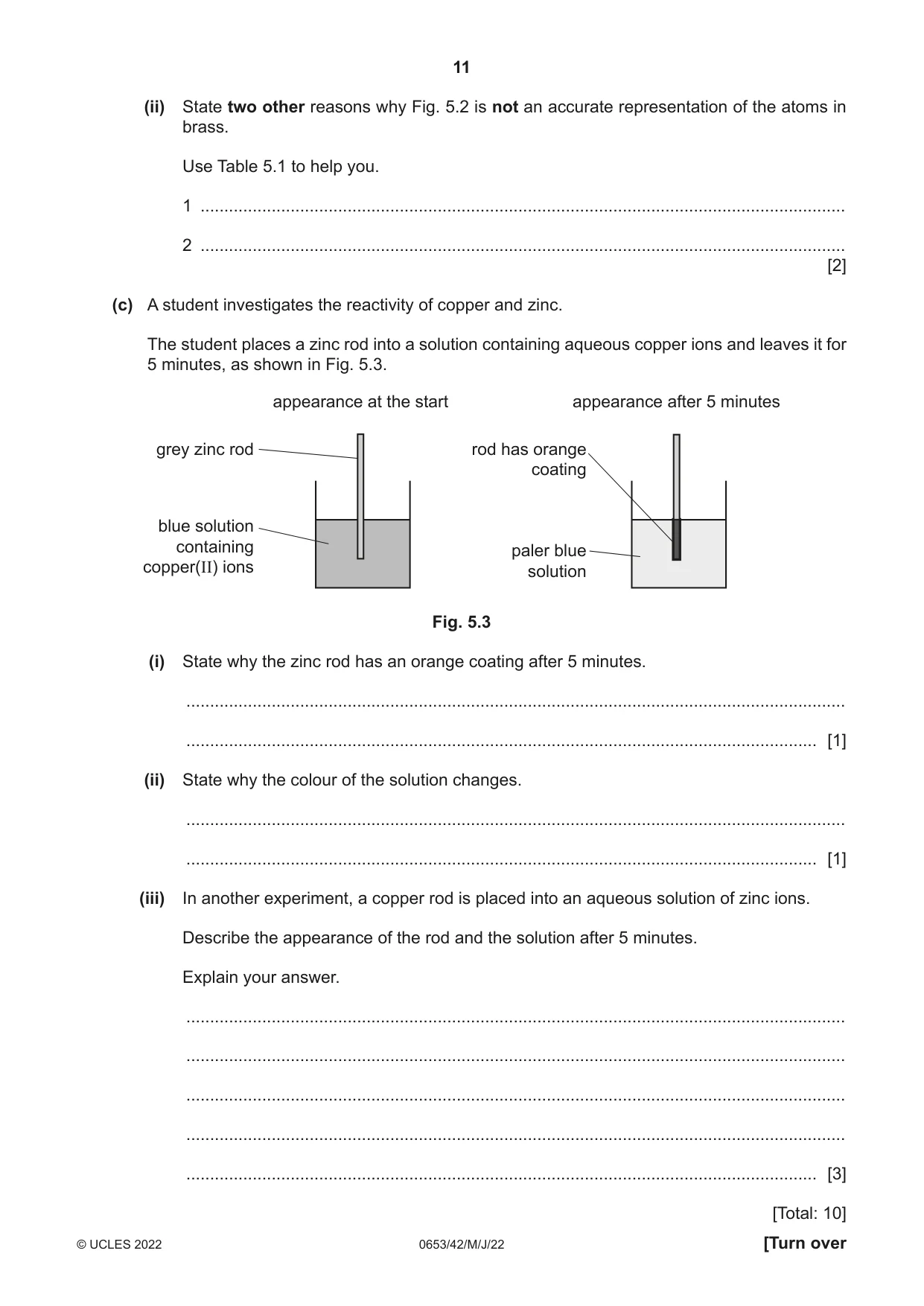
5 Fig. 5.1 shows a key made from the alloy brass. Fig. 5.1 (a) Suggest two reasons why brass is more suitable for making keys than pure copper. 1 ................................................................................................................................................ 2 ................................................................................................................................................ [2] (b) Brass contains copper atoms and zinc atoms, as shown in Fig. 5.2. copper atom zinc atom Fig. 5.2 Table 5.1 shows some information about brass. Table 5.1 percentage of element relative size of atom in brass copper 56 1.0 zinc 37 1.1 Fig. 5.2 is not an accurate representation of brass because brass contains more than two elements. (i) Describe how the information in Table 5.1 shows that there are more than two elements in brass. ........................................................................................................................................... ..................................................................................................................................... [1] (ii) State two other reasons why Fig. 5.2 is not an accurate representation of the atoms in brass. Use Table 5.1 to help you. 1 ........................................................................................................................................ 2 ........................................................................................................................................ [2] (c) A student investigates the reactivity of copper and zinc. The student places a zinc rod into a solution containing aqueous copper ions and leaves it for 5 minutes, as shown in Fig. 5.3. appearance at the start appearance after 5 minutes grey zinc rod rod has orange coating blue solution containing paler blue copper(II) ions solution Fig. 5.3 (i) State why the zinc rod has an orange coating after 5 minutes. ........................................................................................................................................... ..................................................................................................................................... [1] (ii) State why the colour of the solution changes. ........................................................................................................................................... ..................................................................................................................................... [1] (iii) In another experiment, a copper rod is placed into an aqueous solution of zinc ions. Describe the appearance of the rod and the solution after 5 minutes. Explain your answer. ........................................................................................................................................... ........................................................................................................................................... ........................................................................................................................................... ........................................................................................................................................... ..................................................................................................................................... [3] [Total: 10]
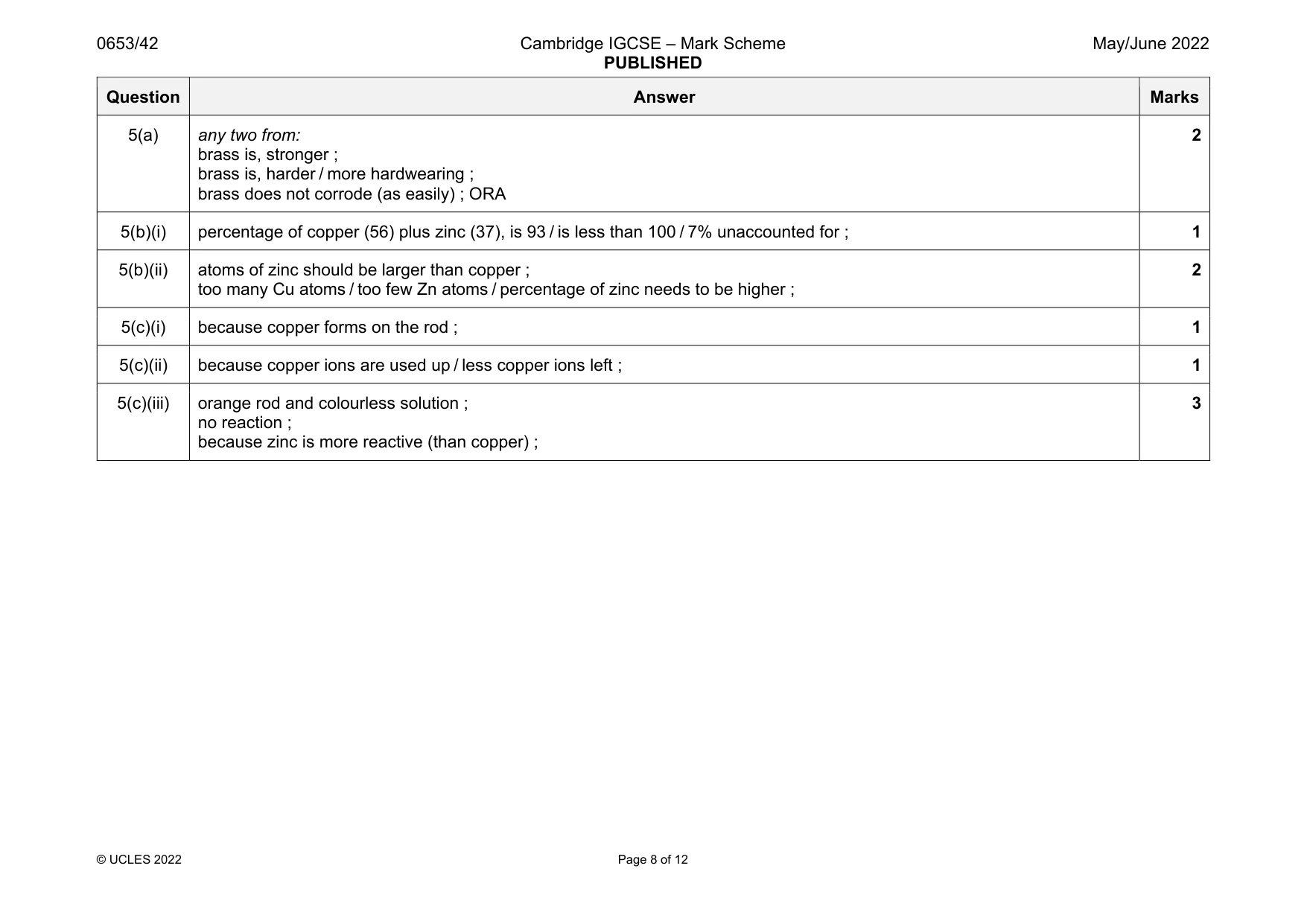
Mark scheme: 5(a) any two from: brass is, stronger ; brass is, harder / more hardwearing ; brass does not corrode (as easily) ; ORA 2 5(b)(i) percentage of copper (56) plus zinc (37), is 93 / is less than 100 / 7% unaccounted for ; 1 5(b)(ii) atoms of zinc should be larger than copper ; too many Cu atoms / too few Zn atoms / percentage of zinc needs to be higher ; 2 5(c)(i) because copper forms on the rod ; 1 5(c)(ii) because copper ions are used up / less copper ions left ; 1 5(c)(iii) orange rod and colourless solution ; no reaction ; because zinc is more reactive (than copper) ; 3
Q6 · Ultraviolet radiation and microwaves are part of the electromagnetic spectrum
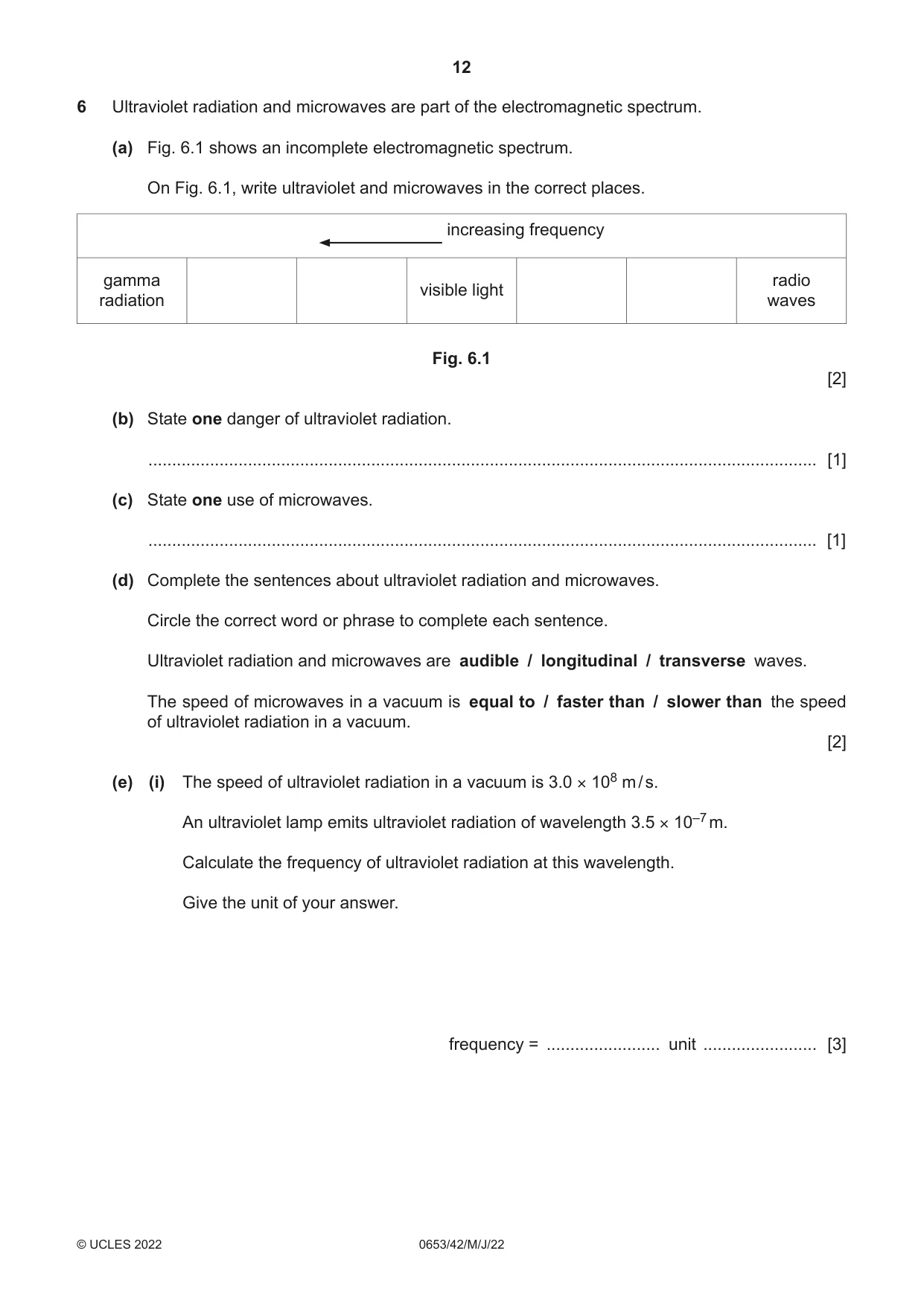
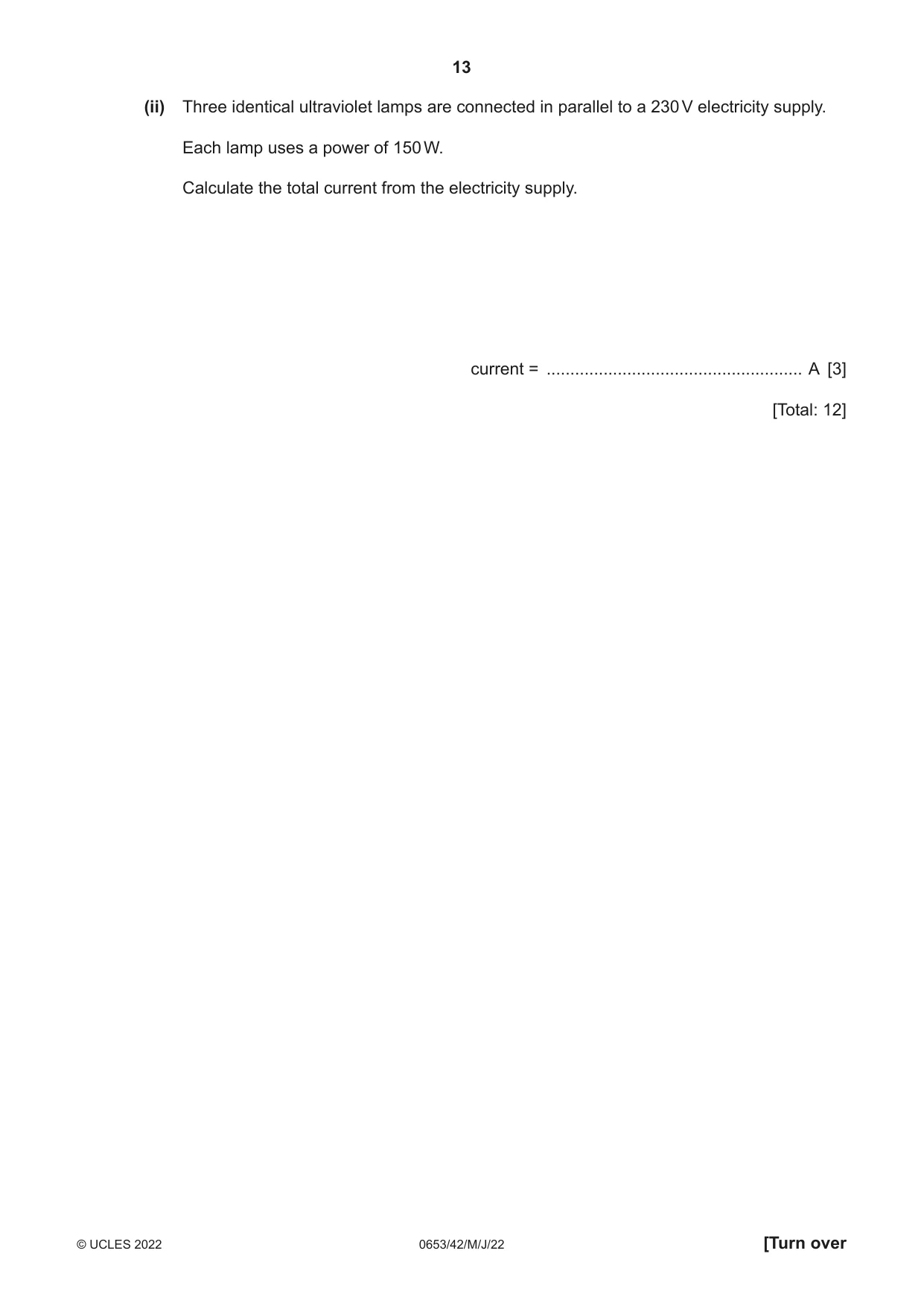
6 Ultraviolet radiation and microwaves are part of the electromagnetic spectrum. (a) Fig. 6.1 shows an incomplete electromagnetic spectrum. On Fig. 6.1, write ultraviolet and microwaves in the correct places. increasing frequency gamma radio visible light radiation waves Fig. 6.1 [2] (b) State one danger of ultraviolet radiation. ............................................................................................................................................. [1] (c) State one use of microwaves. ............................................................................................................................................. [1] (d) Complete the sentences about ultraviolet radiation and microwaves. Circle the correct word or phrase to complete each sentence. Ultraviolet radiation and microwaves are audible / longitudinal / transverse waves. The speed of microwaves in a vacuum is equal to / faster than / slower than the speed of ultraviolet radiation in a vacuum. [2] (e) (i) The speed of ultraviolet radiation in a vacuum is 3.0 × 10⁸ m / s. An ultraviolet lamp emits ultraviolet radiation of wavelength 3.5 × 10⁻⁷ m. Calculate the frequency of ultraviolet radiation at this wavelength. Give the unit of your answer. frequency = ........................ unit ........................ [3] (ii) Three identical ultraviolet lamps are connected in parallel to a 230 V electricity supply. Each lamp uses a power of 150 W. Calculate the total current from the electricity supply. current = ...................................................... A [3] [Total: 12]
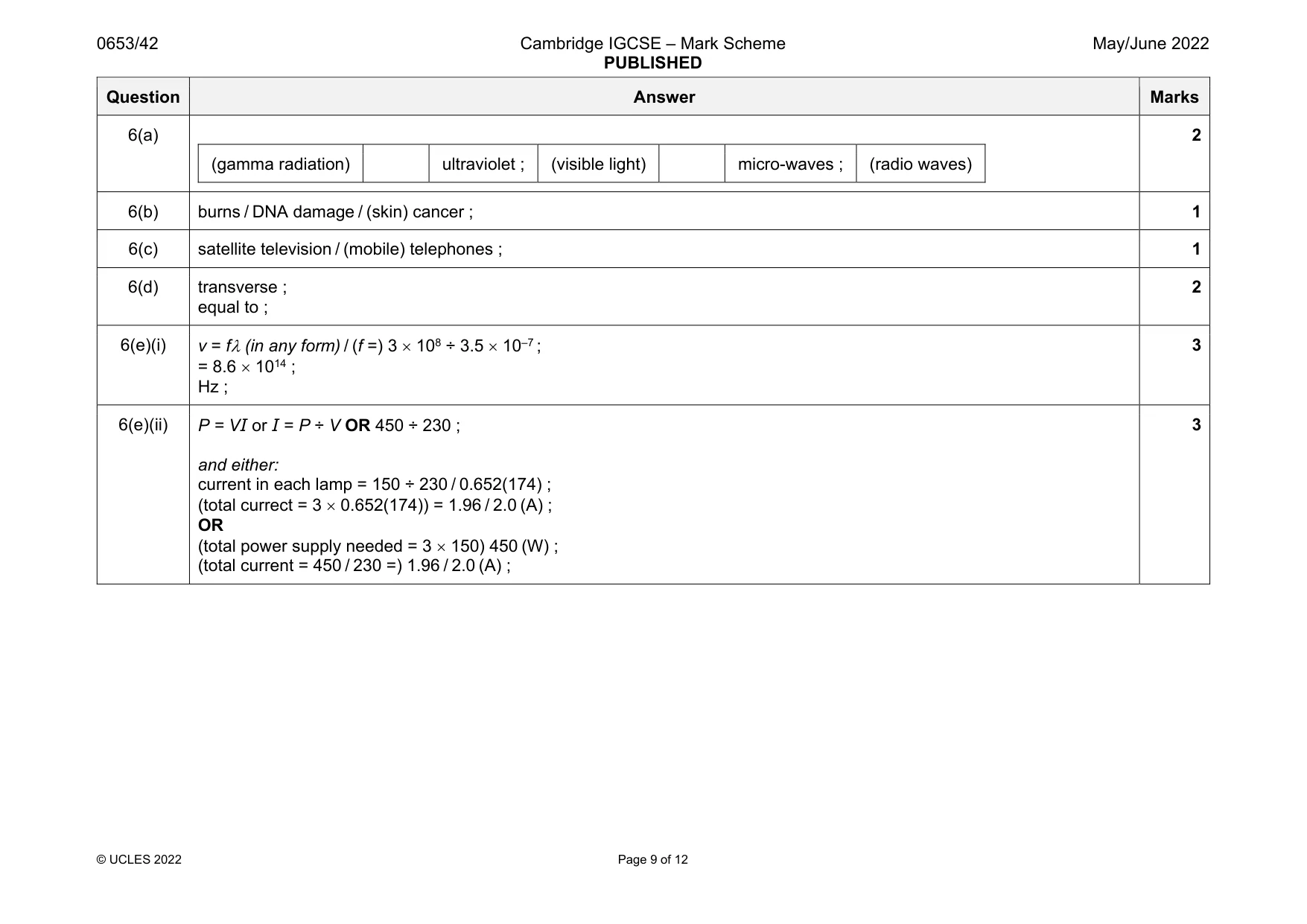
Mark scheme: 6(a) (gamma radiation) ultraviolet ; (visible light) micro-waves ; (radio waves) 2 6(b) burns / DNA damage / (skin) cancer ; 1 6(c) satellite television / (mobile) telephones ; 1 6(d) transverse ; equal to ; 2 6(e)(i) v = f (in any form) / (f =) 3 108 ÷ 3.5 10–7 ; = 8.6 1014 ; Hz ; 3 6(e)(ii) P = VI or I = P ÷ V OR 450 ÷ 230 ; and either: current in each lamp = 150 ÷ 230 / 0.652(174) ; (total currect = 3 0.652(174)) = 1.96 / 2.0 (A) ; OR (total power supply needed = 3 150) 450 (W) ; (total current = 450 / 230 =) 1.96 / 2.0 (A) ; 3
Question 7
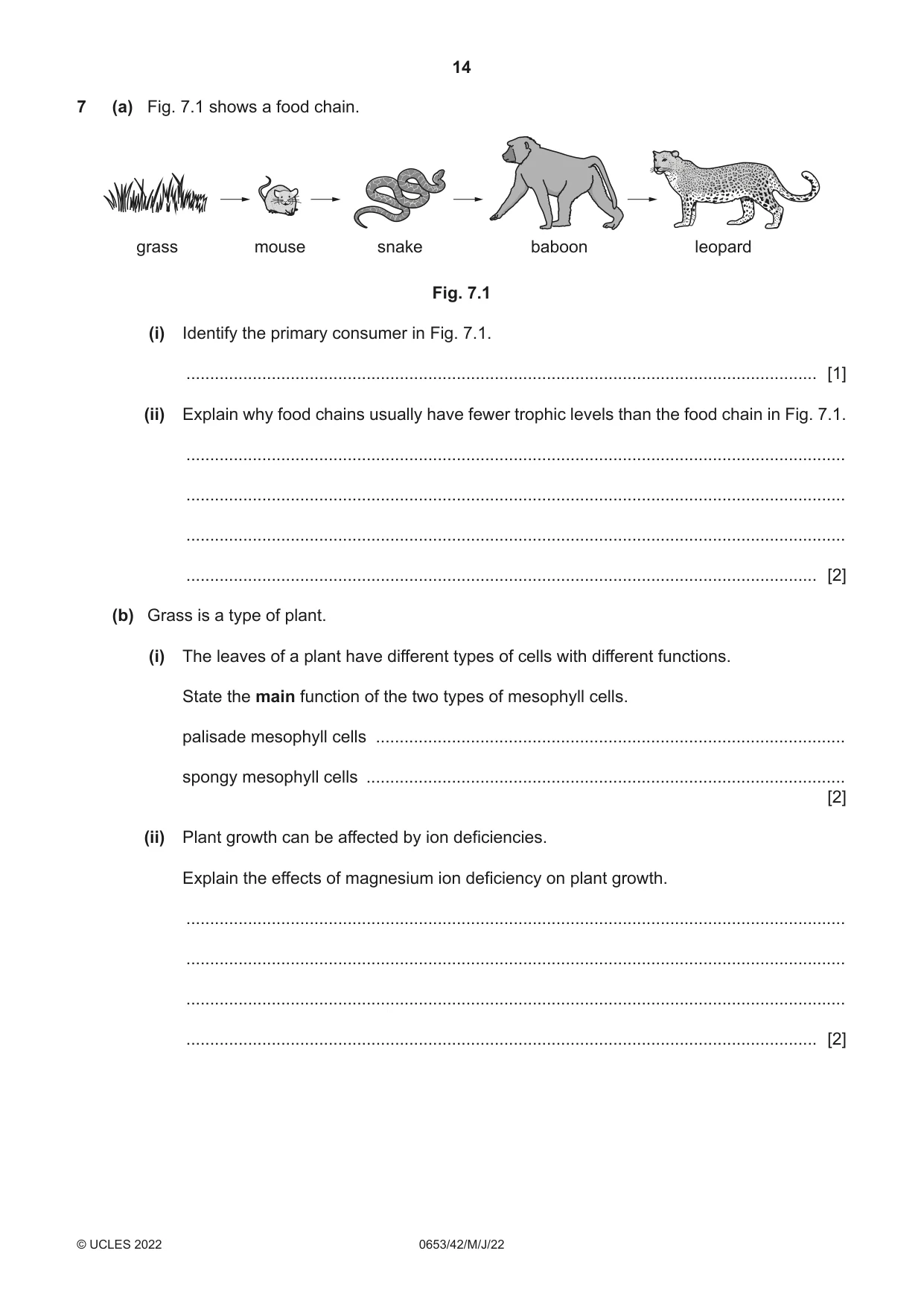
7 (a) Fig. 7.1 shows a food chain. grass mouse snake baboon leopard Fig. 7.1 (i) Identify the primary consumer in Fig. 7.1. ..................................................................................................................................... [1] (ii) Explain why food chains usually have fewer trophic levels than the food chain in Fig. 7.1. ........................................................................................................................................... ........................................................................................................................................... ........................................................................................................................................... ..................................................................................................................................... [2] (b) Grass is a type of plant. (i) The leaves of a plant have different types of cells with different functions. State the main function of the two types of mesophyll cells. palisade mesophyll cells ................................................................................................... spongy mesophyll cells ..................................................................................................... [2] (ii) Plant growth can be affected by ion deficiencies. Explain the effects of magnesium ion deficiency on plant growth. ........................................................................................................................................... ........................................................................................................................................... ........................................................................................................................................... ..................................................................................................................................... [2] (c) In humans, food is digested in the stomach of the alimentary canal. Hydrochloric acid is found in the stomach. State two functions of hydrochloric acid in the stomach. 1 ................................................................................................................................................ 2 ................................................................................................................................................ [2] [Total: 9]
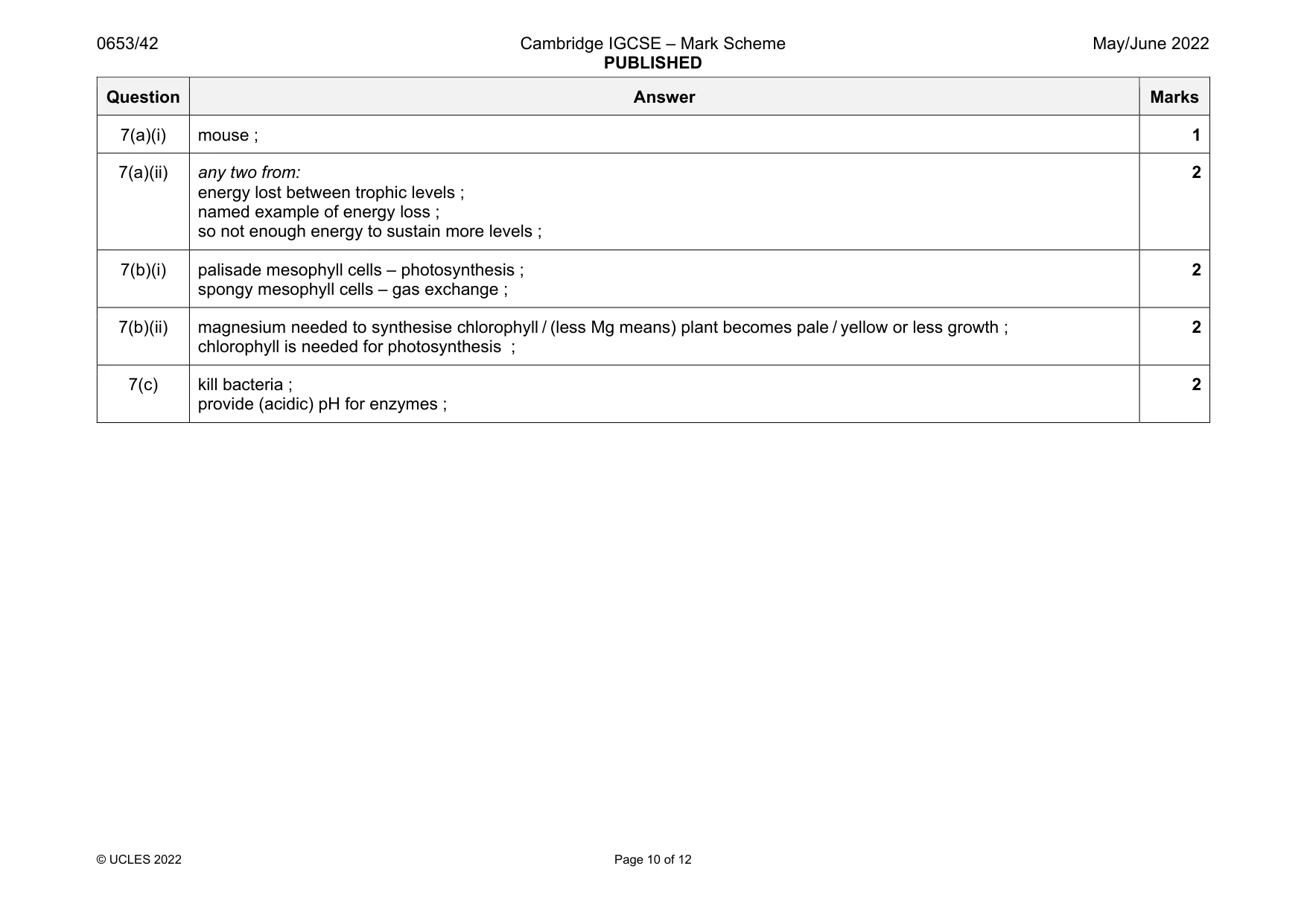
Mark scheme: 7(a)(i) mouse ; 1 7(a)(ii) any two from: energy lost between trophic levels ; named example of energy loss ; so not enough energy to sustain more levels ; 2 7(b)(i) palisade mesophyll cells – photosynthesis ; spongy mesophyll cells – gas exchange ; 2 7(b)(ii) magnesium needed to synthesise chlorophyll / (less Mg means) plant becomes pale / yellow or less growth ; chlorophyll is needed for photosynthesis ; 2 7(c) kill bacteria ; provide (acidic) pH for enzymes ; 2
Q8 · Energy level diagrams for two reactions are shown in Fig
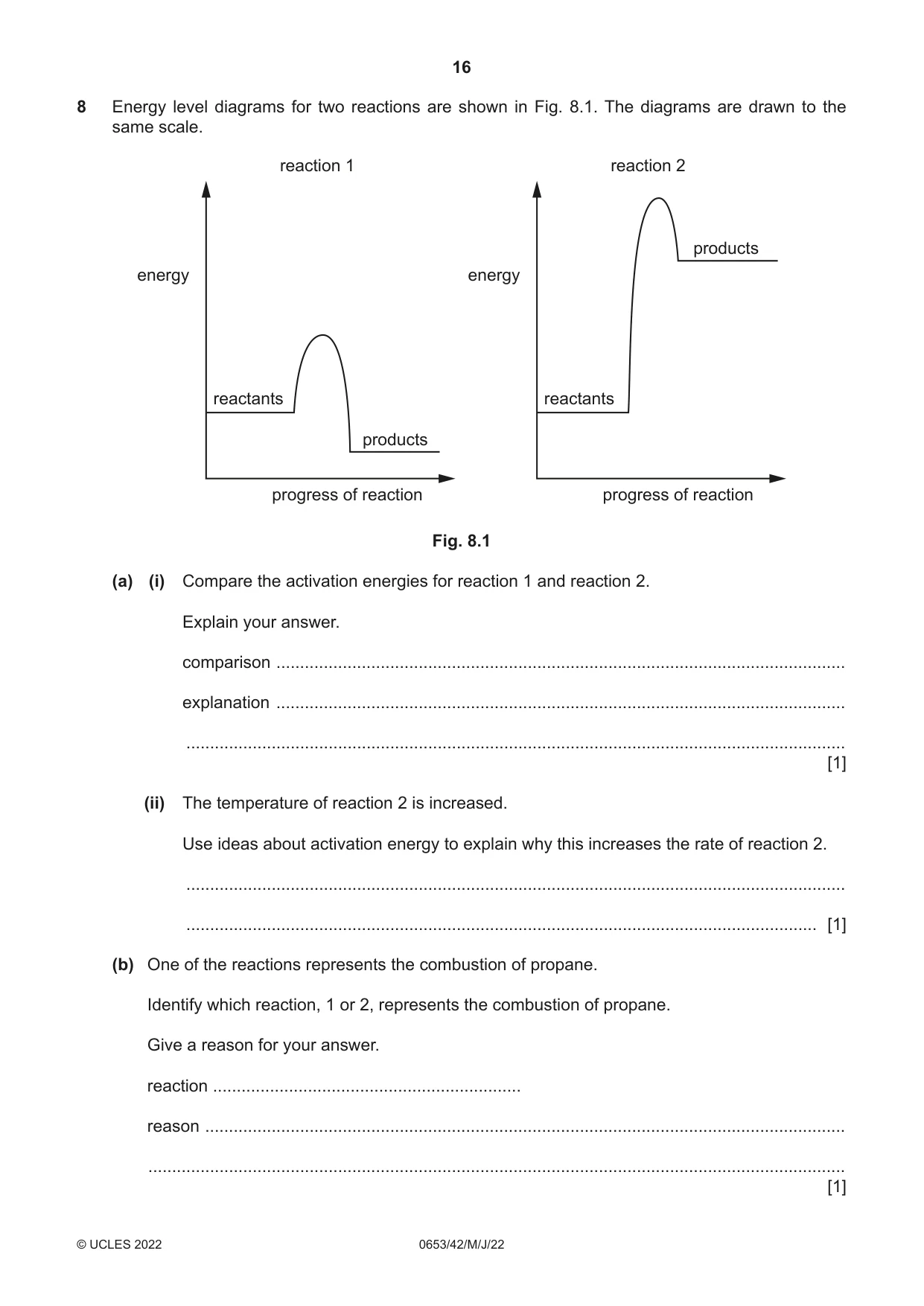
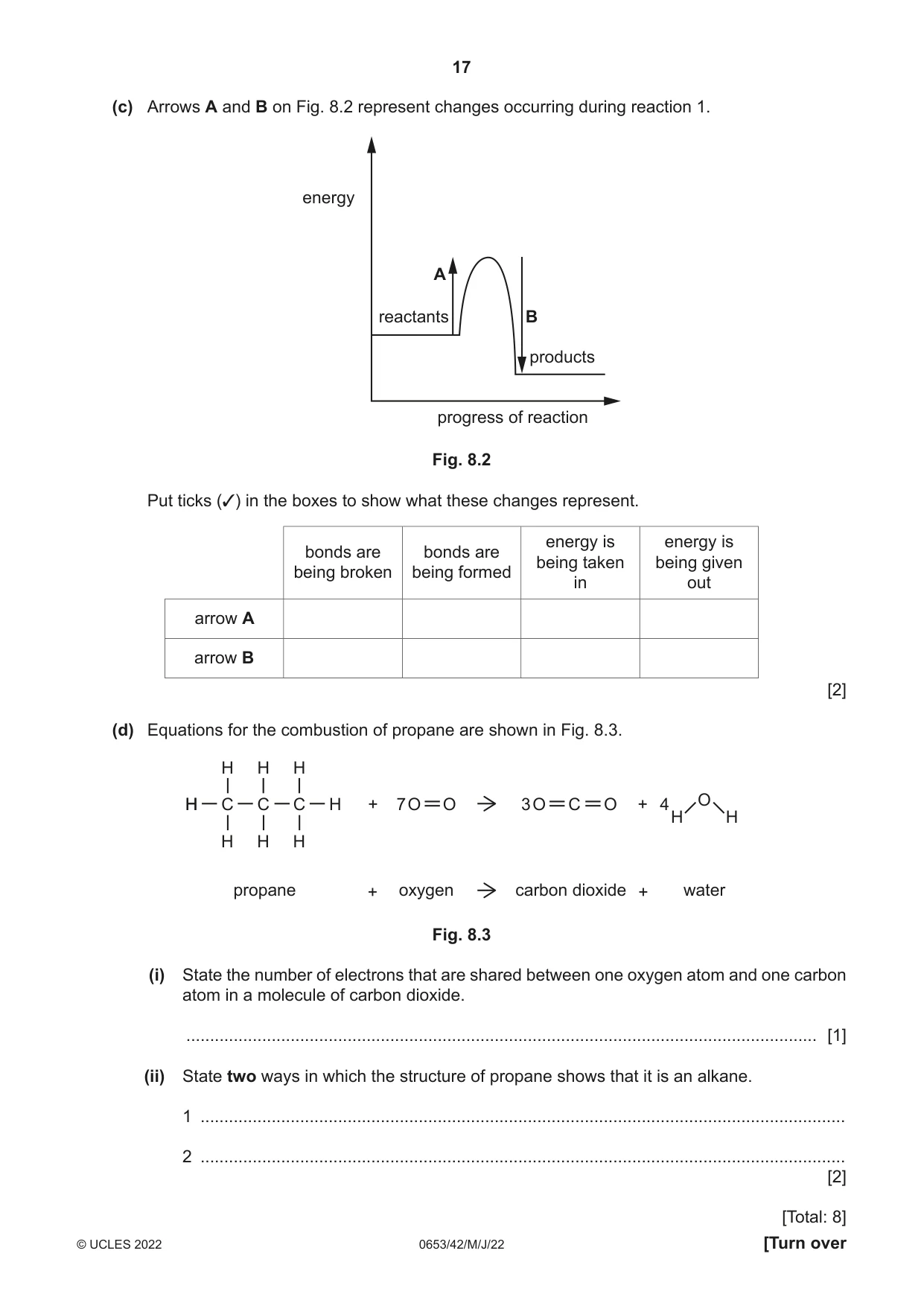
8 Energy level diagrams for two reactions are shown in Fig. 8.1. The diagrams are drawn to the same scale. reaction 1 reaction 2 products energy energy reactants reactants products progress of reaction progress of reaction Fig. 8.1 (a) (i) Compare the activation energies for reaction 1 and reaction 2. Explain your answer. comparison ........................................................................................................................ explanation ........................................................................................................................ ........................................................................................................................................... [1] (ii) The temperature of reaction 2 is increased. Use ideas about activation energy to explain why this increases the rate of reaction 2. ........................................................................................................................................... ..................................................................................................................................... [1] (b) One of the reactions represents the combustion of propane. Identify which reaction, 1 or 2, represents the combustion of propane. Give a reason for your answer. reaction ................................................................. reason ....................................................................................................................................... ................................................................................................................................................... [1] (c) Arrows A and B on Fig. 8.2 represent changes occurring during reaction 1. energy A reactants B products progress of reaction Fig. 8.2 Put ticks (✓) in the boxes to show what these changes represent. energy is energy is bonds are bonds are being taken being given being broken being formed in out arrow A arrow B [2] (d) Equations for the combustion of propane are shown in Fig. 8.3. H H H H C C C H + 7 O O 3 O C O + 4 O H H H H H propane + oxygen carbon dioxide + water Fig. 8.3 (i) State the number of electrons that are shared between one oxygen atom and one carbon atom in a molecule of carbon dioxide. ..................................................................................................................................... [1] (ii) State two ways in which the structure of propane shows that it is an alkane. 1 ........................................................................................................................................ 2 ........................................................................................................................................ [2] [Total: 8]
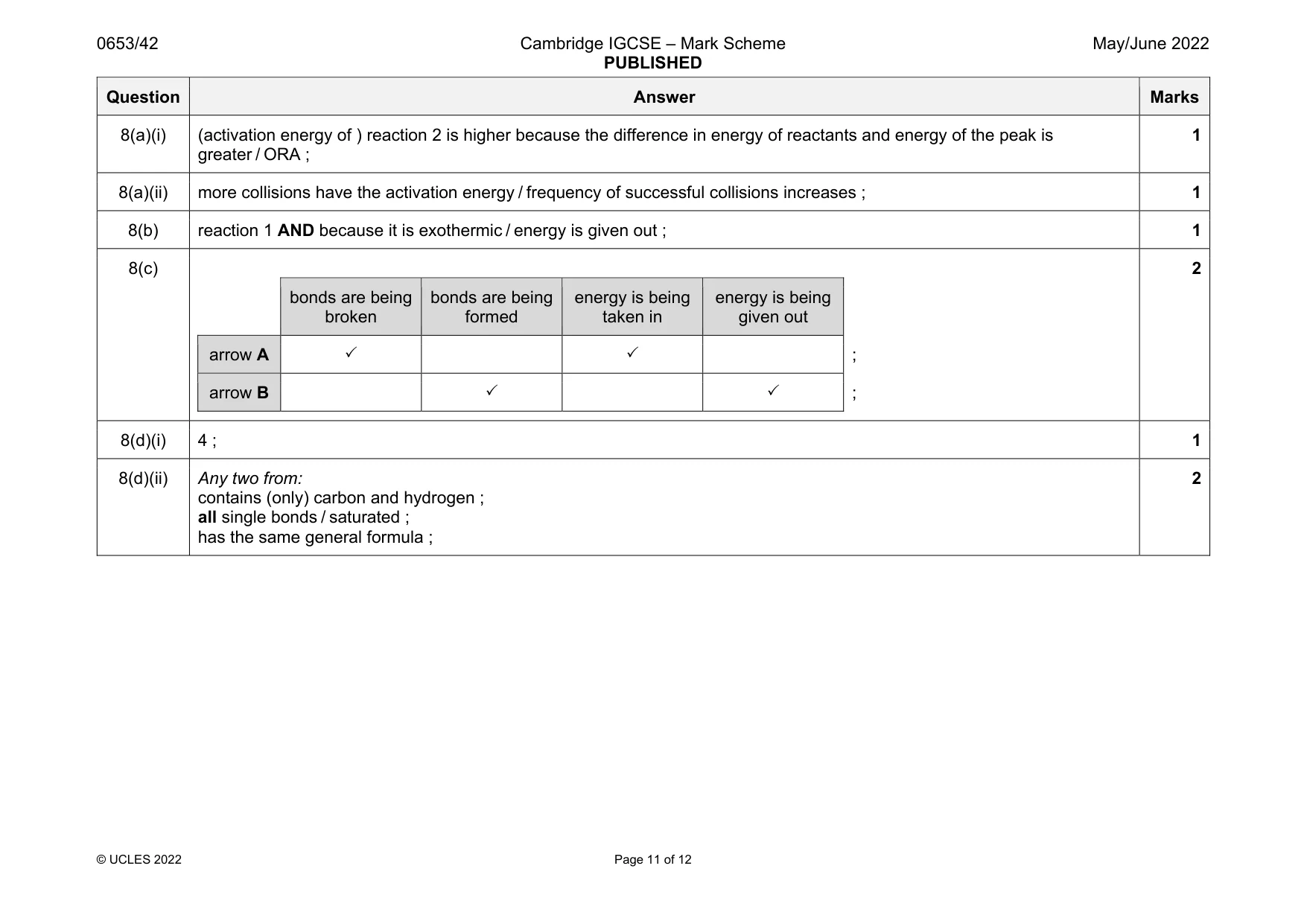
Mark scheme: 8(a)(i) (activation energy of ) reaction 2 is higher because the difference in energy of reactants and energy of the peak is greater / ORA ; 1 8(a)(ii) more collisions have the activation energy / frequency of successful collisions increases ; 1 8(b) reaction 1 AND because it is exothermic / energy is given out ; 1 8(c) bonds are being broken bonds are being formed energy is being taken in energy is being given out arrow A ; arrow B ; 2 8(d)(i) 4 ; 1 8(d)(ii) Any two from: contains (only) carbon and hydrogen ; all single bonds / saturated ; has the same general formula ; 2
Q9 · A liquid‑in‑glass thermometer without a scale
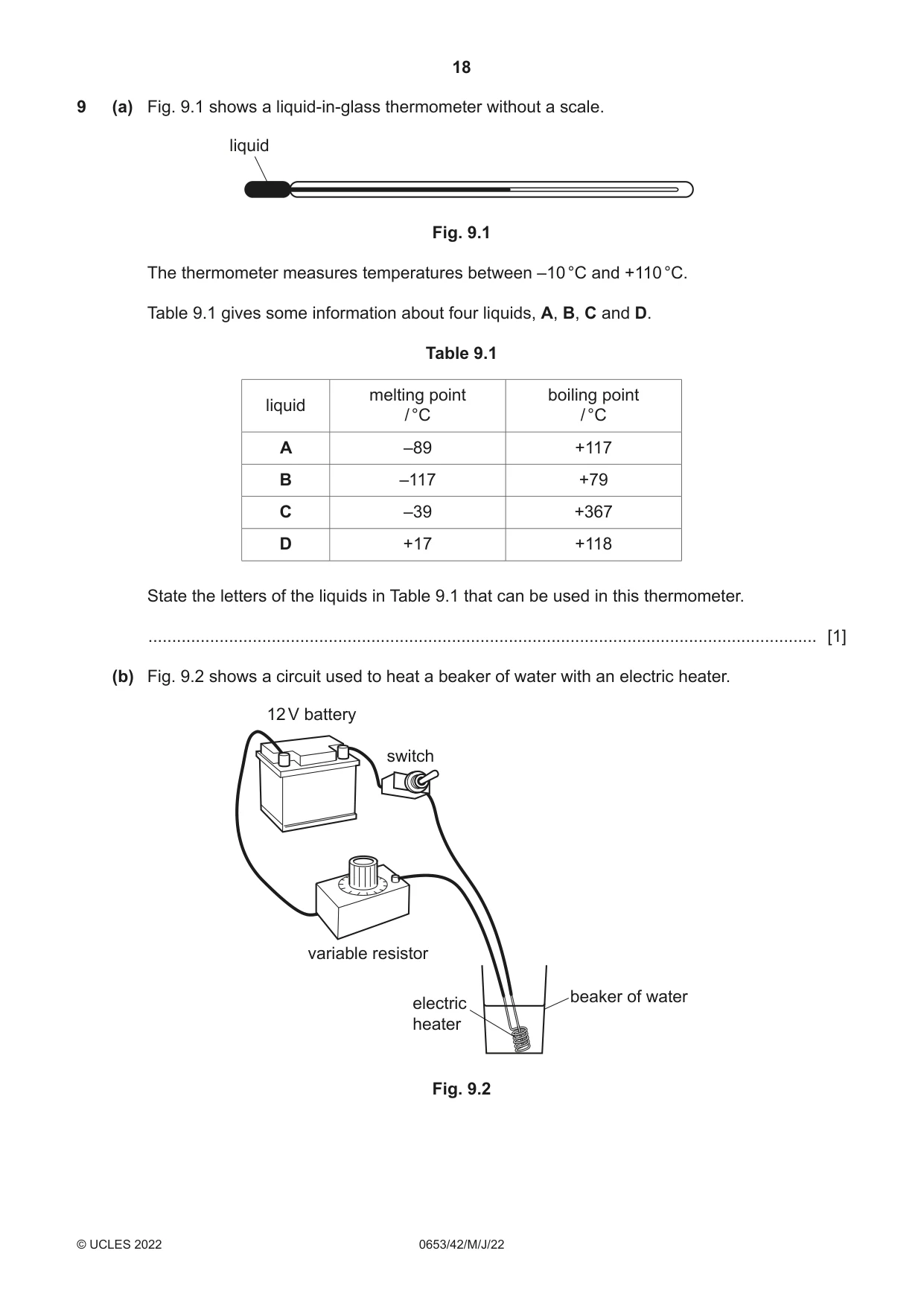
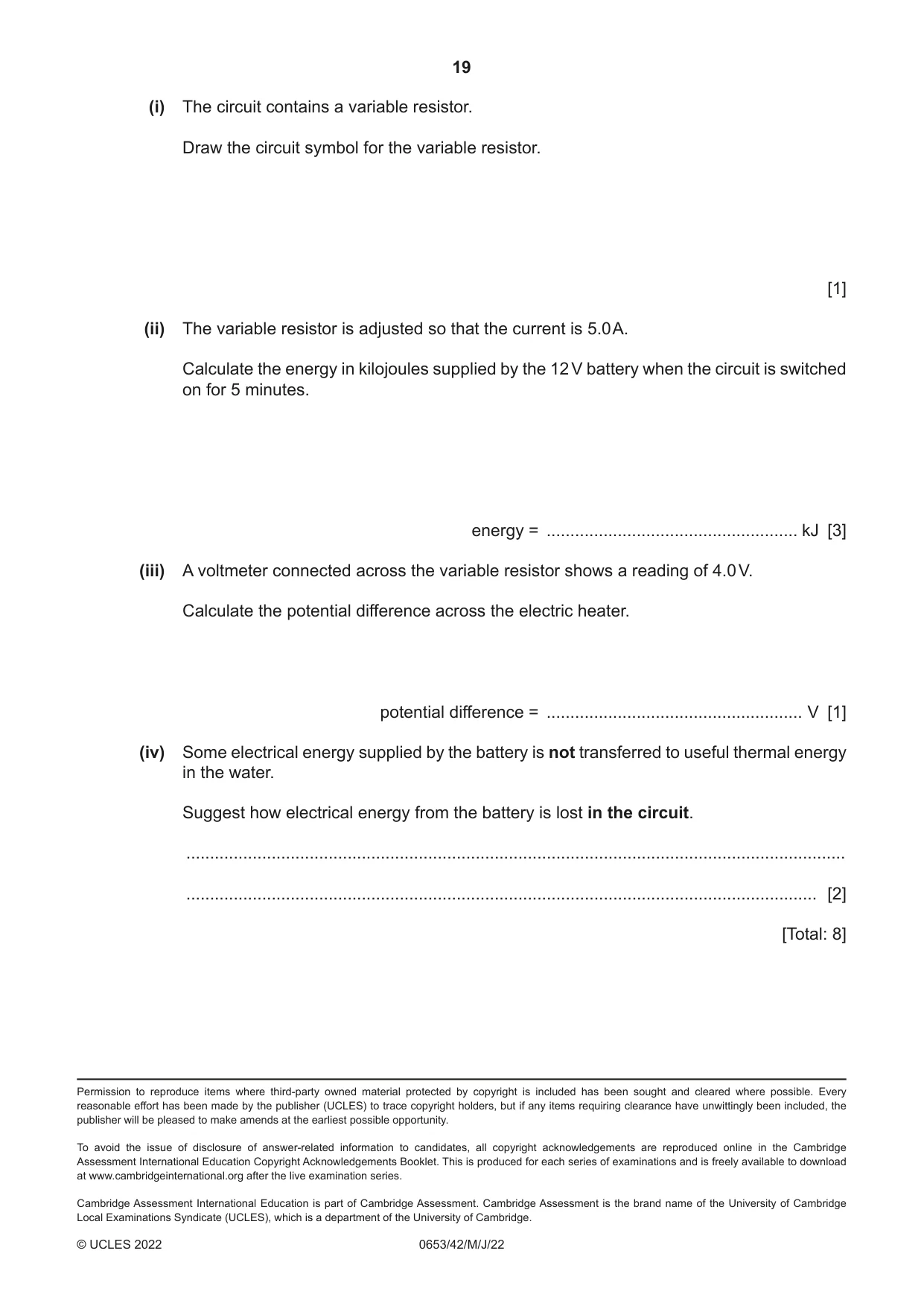
9 (a) Fig. 9.1 shows a liquid‑in‑glass thermometer without a scale. liquid Fig. 9.1 The thermometer measures temperatures between –10 °C and +110 °C. Table 9.1 gives some information about four liquids, A, B, C and D. Table 9.1 melting point boiling point liquid / °C / °C A –89 +117 B –117 +79 C –39 +367 D +17 +118 State the letters of the liquids in Table 9.1 that can be used in this thermometer. ............................................................................................................................................. [1] (b) Fig. 9.2 shows a circuit used to heat a beaker of water with an electric heater. 12 V battery switch variable resistor beaker of water electric heater Fig. 9.2 (i) The circuit contains a variable resistor. Draw the circuit symbol for the variable resistor. [1] (ii) The variable resistor is adjusted so that the current is 5.0 A. Calculate the energy in kilojoules supplied by the 12 V battery when the circuit is switched on for 5 minutes. energy = ..................................................... kJ [3] (iii) A voltmeter connected across the variable resistor shows a reading of 4.0 V. Calculate the potential difference across the electric heater. potential difference = ...................................................... V [1] (iv) Some electrical energy supplied by the battery is not transferred to useful thermal energy in the water. Suggest how electrical energy from the battery is lost in the circuit. ........................................................................................................................................... ..................................................................................................................................... [2] [Total: 8]
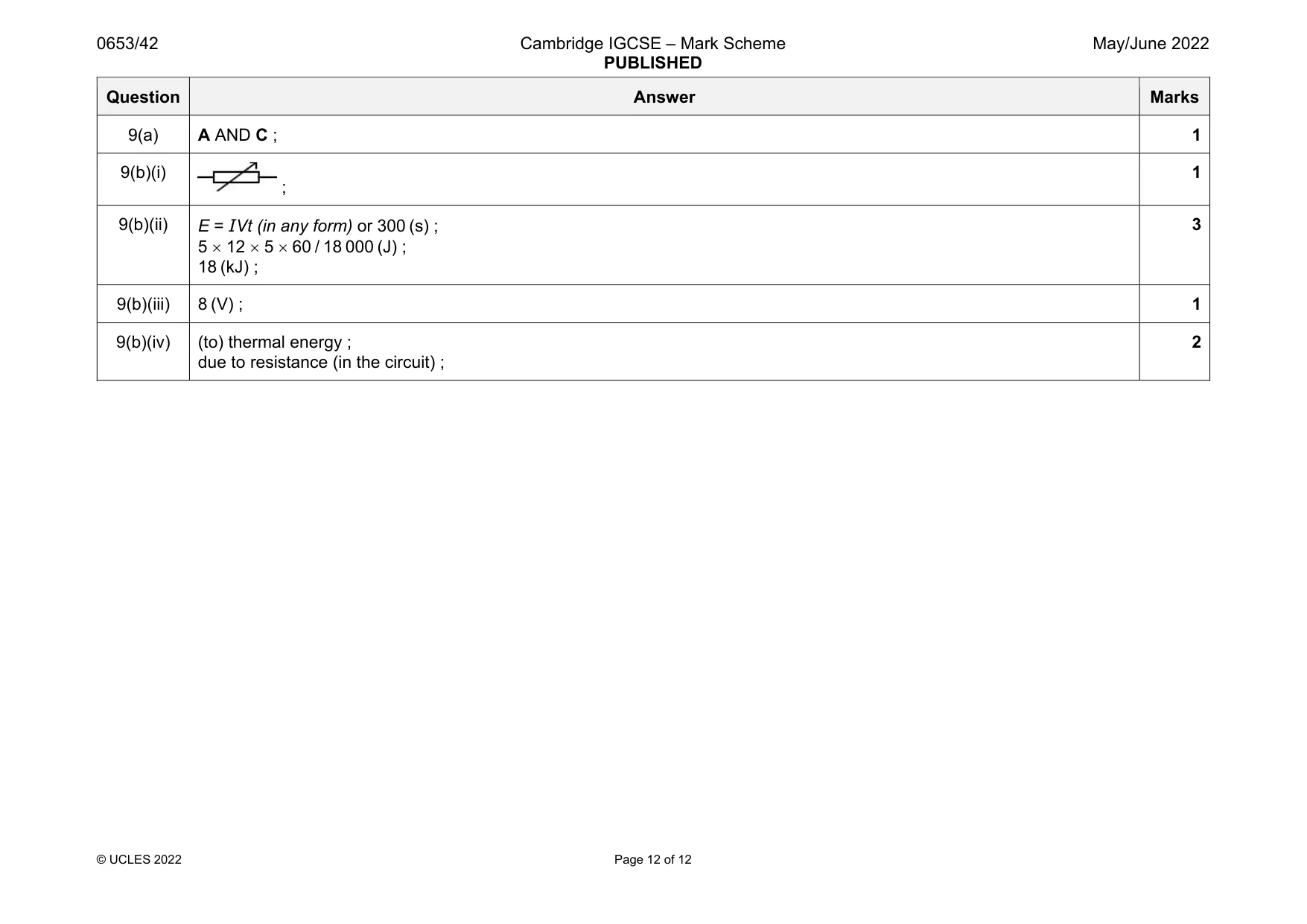
Mark scheme: 9(a) A AND C ; 1 9(b)(i) ; 1 9(b)(ii) E = IVt (in any form) or 300 (s) ; 5 12 5 60 / 18 000 (J) ; 18 (kJ) ; 3 9(b)(iii) 8 (V) ; 1 9(b)(iv) (to) thermal energy ; due to resistance (in the circuit) ; 2
What was in this paper
The subtopics covered by these 9 questions, and how many questions each got. Open one in a new tab to see every Cambridge question on it.
What you needed in this session
Cambridge’s own grade thresholds for 2022 May/June, Paper 4 · Variant 2. A higher threshold means an easier paper — the bar moves with how the cohort did.