Cambridge IGCSE Science - Combined 0653 — 2020 Oct/Nov Paper 4 · Variant 2
0653/42/O/N/20 · 9 questions · 80 marks · ≈90 min
The question paper and its mark scheme, free to read here and free to download. This is Cambridge’s own paper, exactly as it was sat.
Question paper24 pages


Mark scheme9 pages
Answers below. Sit the paper first if you are practising.
Questions as text
Q1 · Some pasta noodles and some vegetable noodles
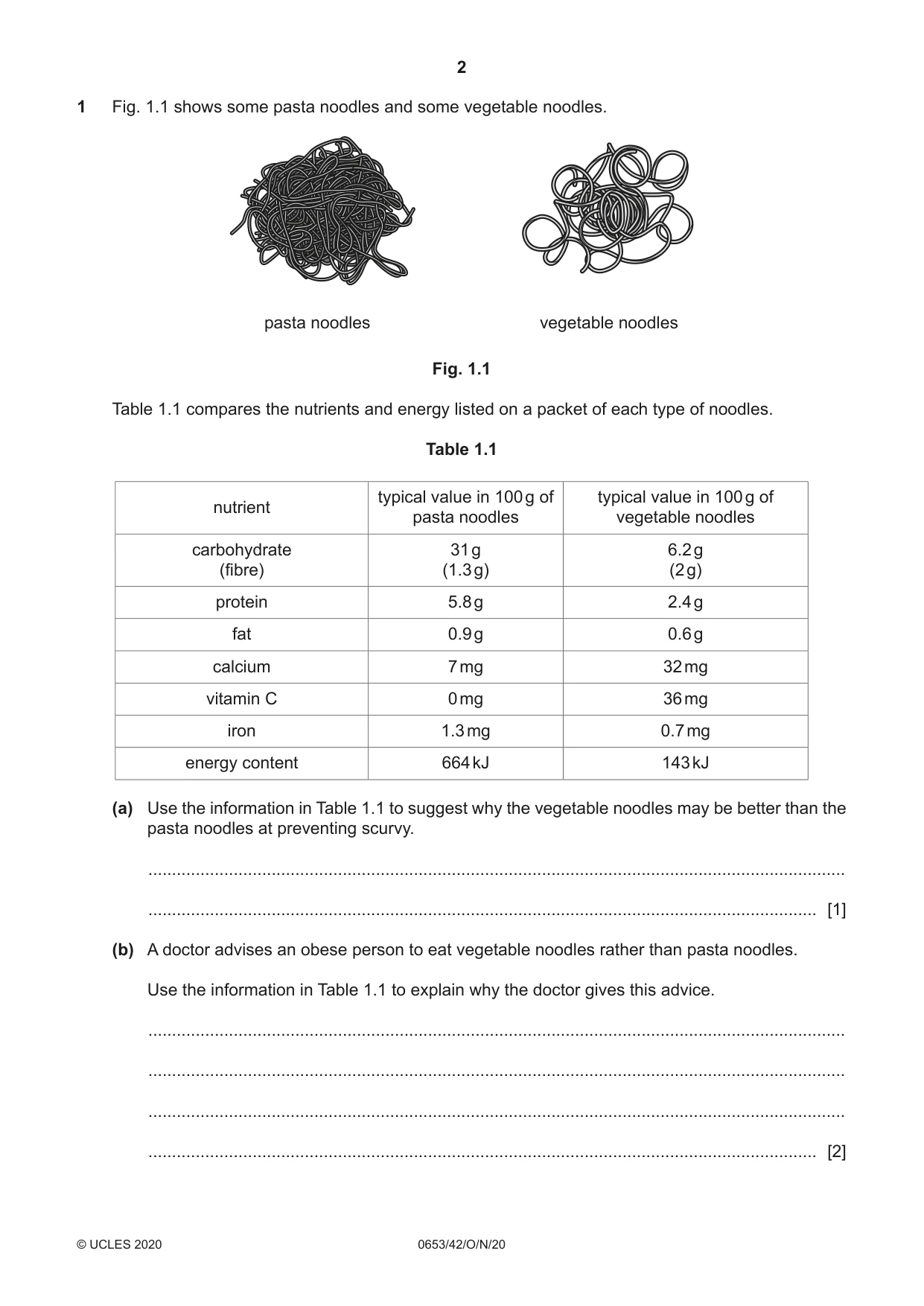
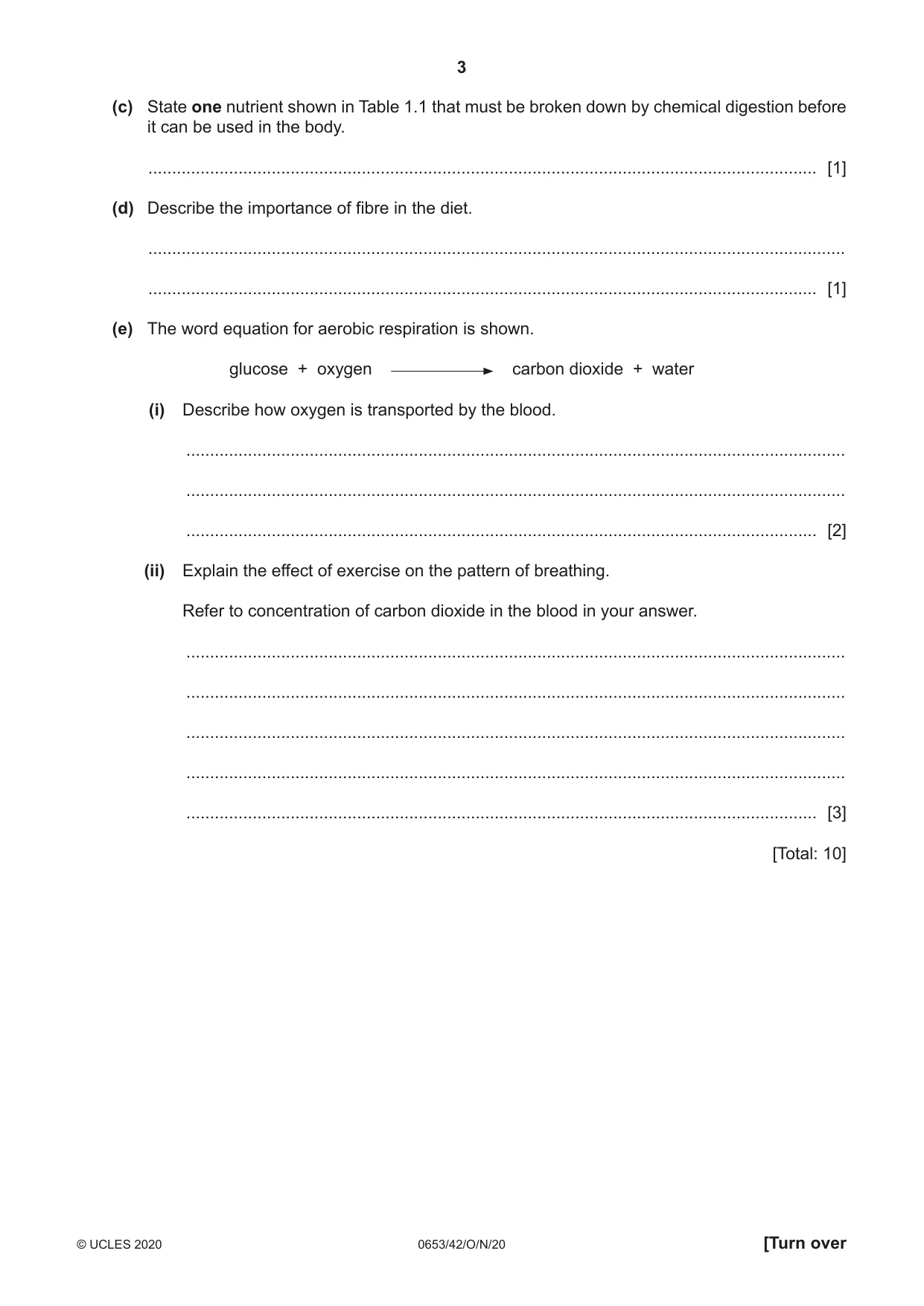
1 Fig. 1.1 shows some pasta noodles and some vegetable noodles. pasta noodles vegetable noodles Fig. 1.1 Table 1.1 compares the nutrients and energy listed on a packet of each type of noodles. Table 1.1 typical value in 100 g of typical value in 100 g of nutrient pasta noodles vegetable noodles carbohydrate 31 g 6.2 g (fibre) (1.3 g) (2 g) protein 5.8 g 2.4 g fat 0.9 g 0.6 g calcium 7 mg 32 mg vitamin C 0 mg 36 mg iron 1.3 mg 0.7 mg energy content 664 kJ 143 kJ (a) Use the information in Table 1.1 to suggest why the vegetable noodles may be better than the pasta noodles at preventing scurvy. ................................................................................................................................................... ............................................................................................................................................. [1] (b) A doctor advises an obese person to eat vegetable noodles rather than pasta noodles. Use the information in Table 1.1 to explain why the doctor gives this advice. ................................................................................................................................................... ................................................................................................................................................... ................................................................................................................................................... ............................................................................................................................................. [2] (c) State one nutrient shown in Table 1.1 that must be broken down by chemical digestion before it can be used in the body. ............................................................................................................................................. [1] (d) Describe the importance of fibre in the diet. ................................................................................................................................................... ............................................................................................................................................. [1] (e) The word equation for aerobic respiration is shown. glucose + oxygen carbon dioxide + water (i) Describe how oxygen is transported by the blood. ........................................................................................................................................... ........................................................................................................................................... ..................................................................................................................................... [2] (ii) Explain the effect of exercise on the pattern of breathing. Refer to concentration of carbon dioxide in the blood in your answer. ........................................................................................................................................... ........................................................................................................................................... ........................................................................................................................................... ........................................................................................................................................... ..................................................................................................................................... [3] [Total: 10]
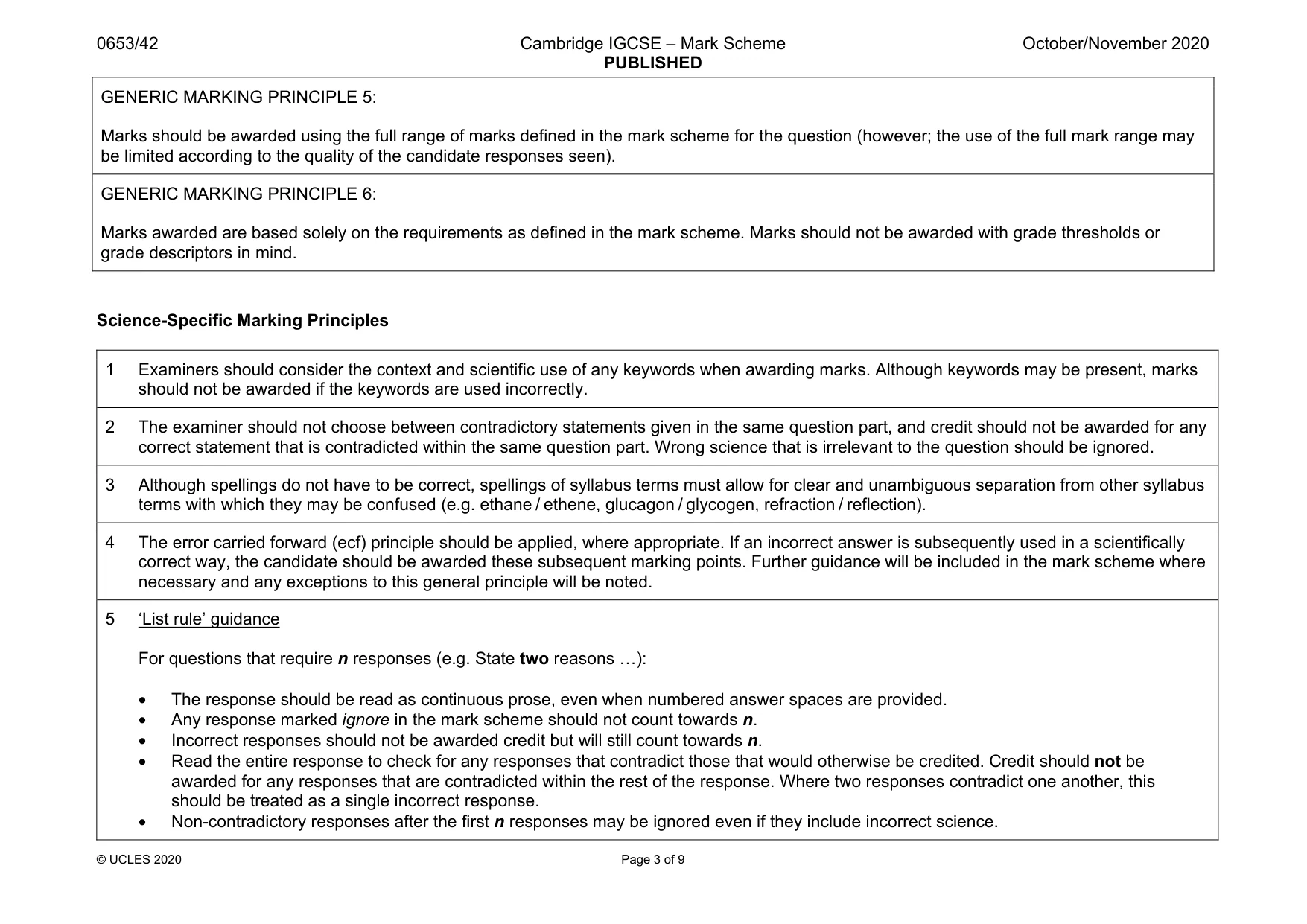
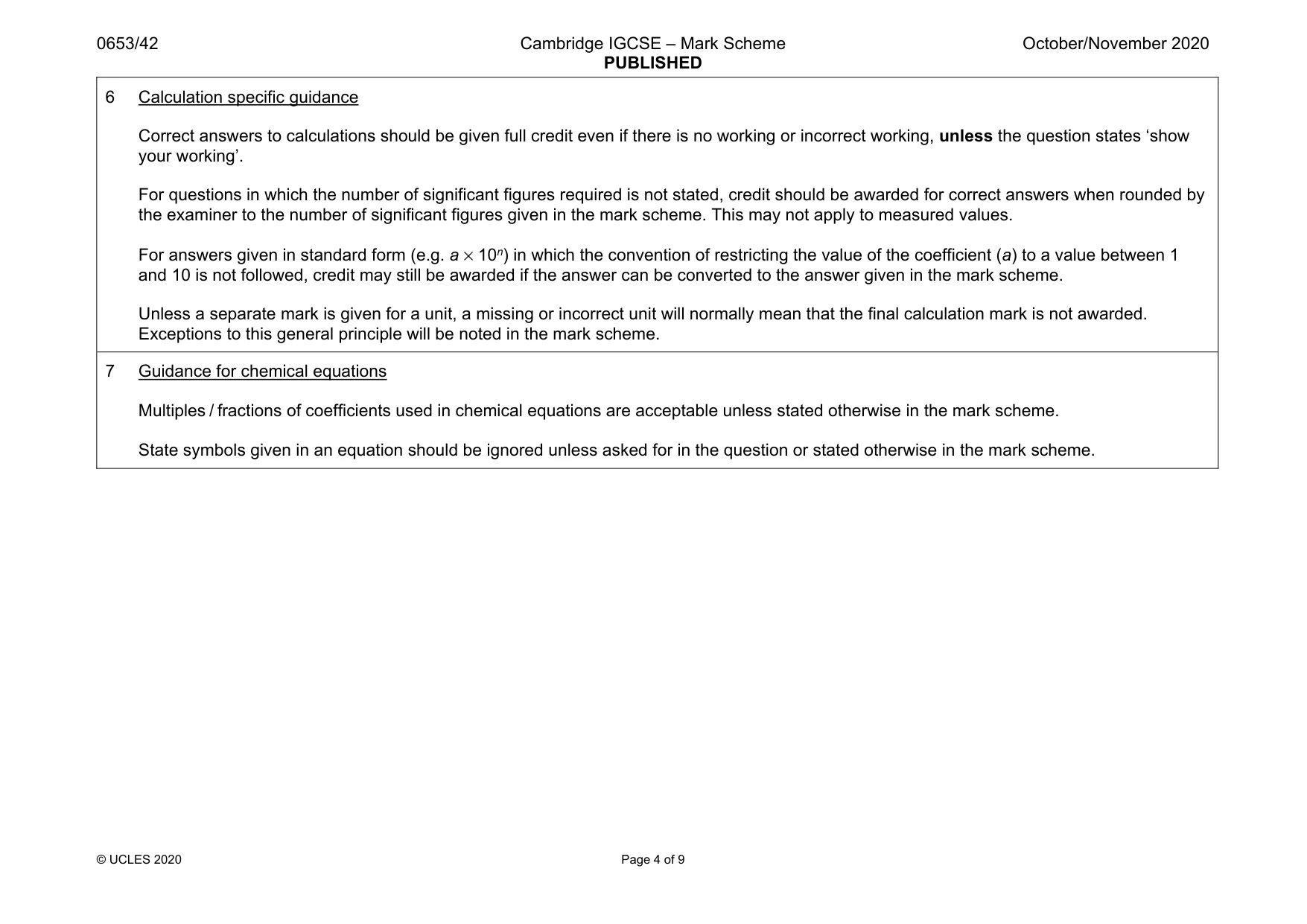
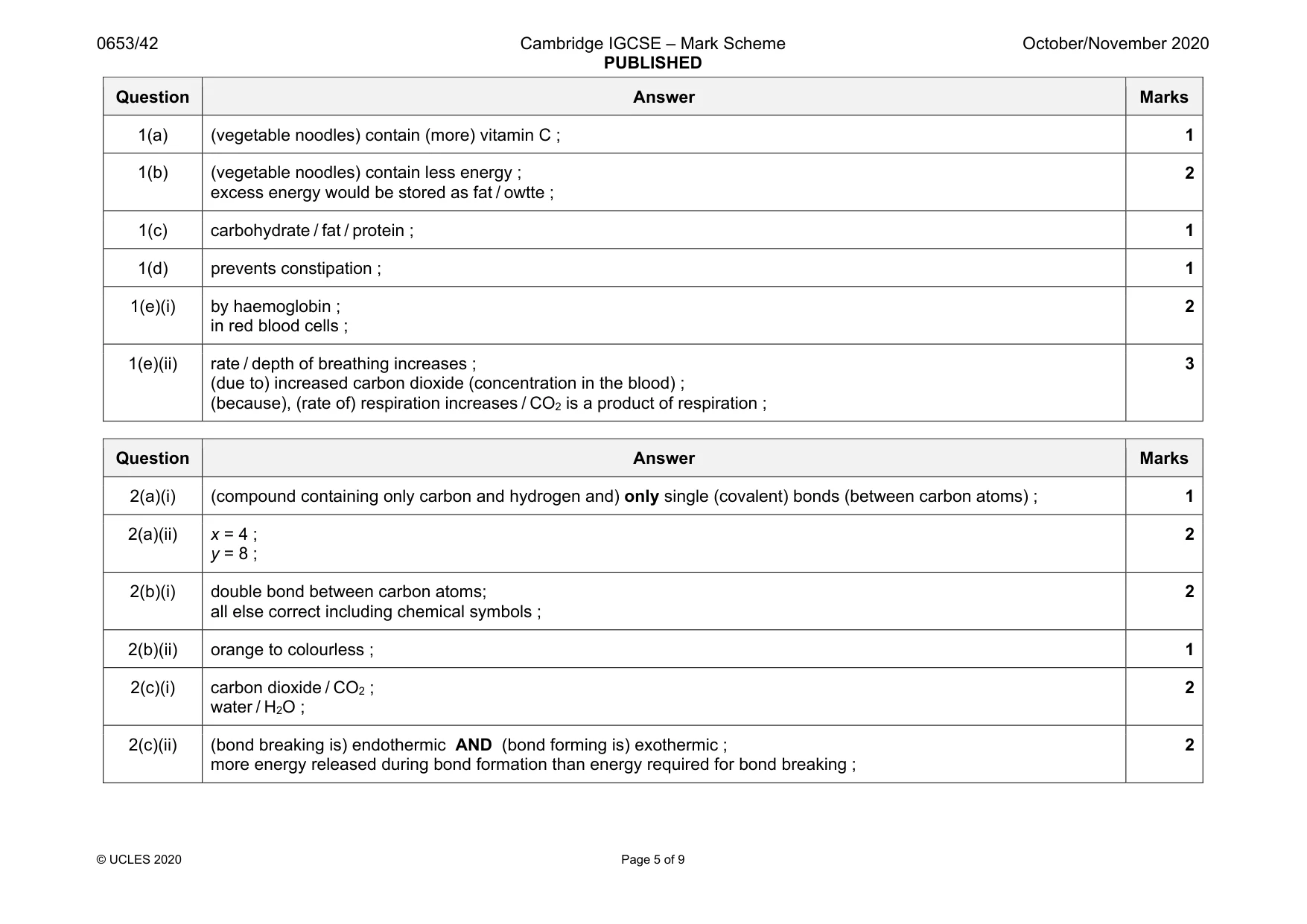
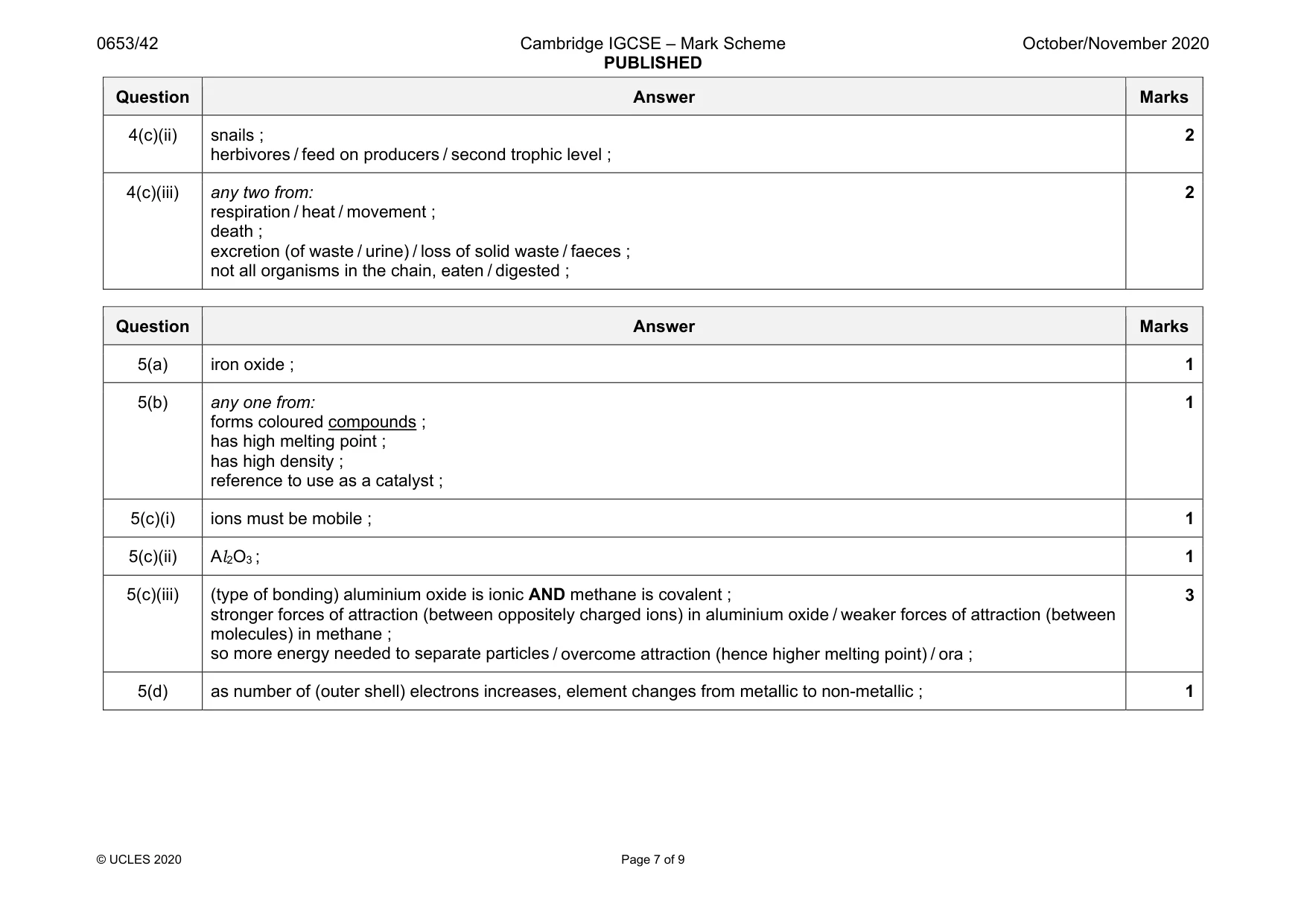
Mark scheme: 1(a) (vegetable noodles) contain (more) vitamin C ; 1 1(b) (vegetable noodles) contain less energy ; excess energy would be stored as fat / owtte ; 2 1(c) carbohydrate / fat / protein ; 1 1(d) prevents constipation ; 1 1(e)(i) by haemoglobin ; in red blood cells ; 2 1(e)(ii) rate / depth of breathing increases ; (due to) increased carbon dioxide (concentration in the blood) ; (because), (rate of) respiration increases / CO2 is a product of respiration ; 3
Q2 · Cracking breaks down large saturated hydrocarbon molecules into smaller hydrocarbon…
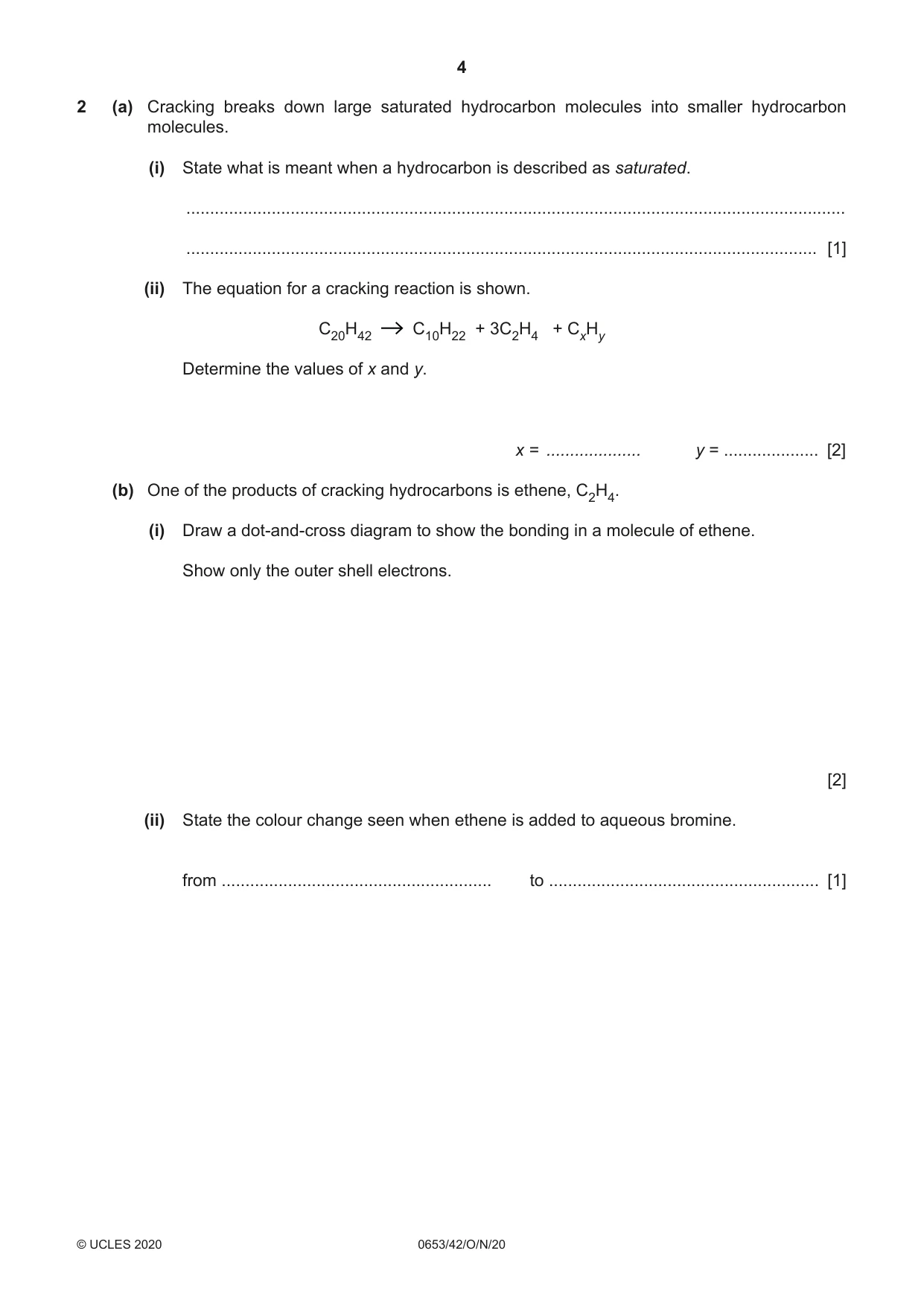
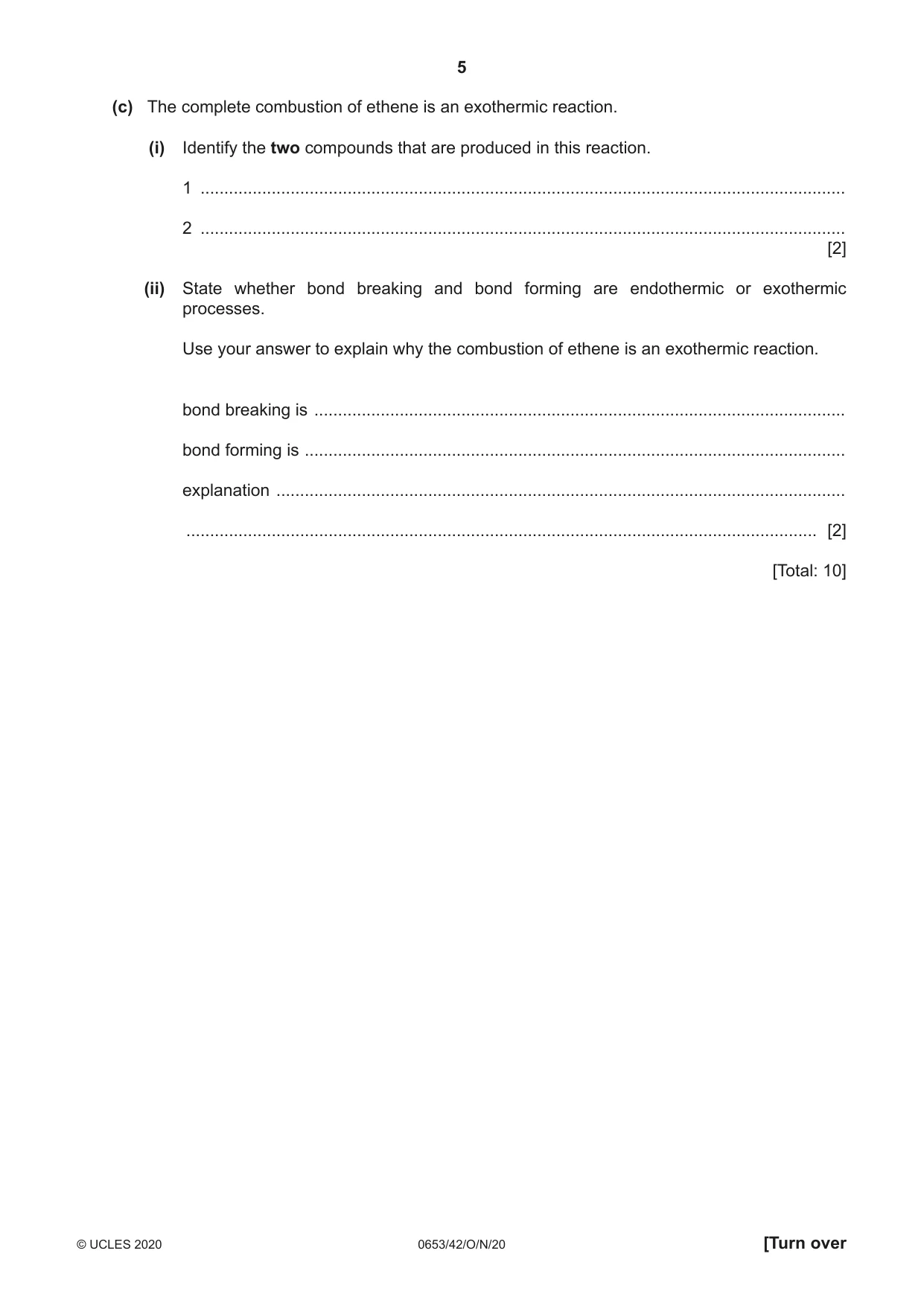
2 (a) Cracking breaks down large saturated hydrocarbon molecules into smaller hydrocarbon molecules. (i) State what is meant when a hydrocarbon is described as saturated. ........................................................................................................................................... ..................................................................................................................................... [1] (ii) The equation for a cracking reaction is shown. C20H42 C10H22 + 3C2H4 + CxHy Determine the values of x and y. x = .................... y = .................... [2] (b) One of the products of cracking hydrocarbons is ethene, C2H4. (i) Draw a dot-and-cross diagram to show the bonding in a molecule of ethene. Show only the outer shell electrons. [2] (ii) State the colour change seen when ethene is added to aqueous bromine. from ......................................................... to ......................................................... [1] (c) The complete combustion of ethene is an exothermic reaction. (i) Identify the two compounds that are produced in this reaction. 1 ........................................................................................................................................ 2 ........................................................................................................................................ [2] (ii) State whether bond breaking and bond forming are endothermic or exothermic processes. Use your answer to explain why the combustion of ethene is an exothermic reaction. bond breaking is ................................................................................................................ bond forming is .................................................................................................................. explanation ........................................................................................................................ ..................................................................................................................................... [2] [Total: 10]
Mark scheme: 2(a)(i) (compound containing only carbon and hydrogen and) only single (covalent) bonds (between carbon atoms) ; 1 2(a)(ii) x = 4 ; y = 8 ; 2 2(b)(i) double bond between carbon atoms; all else correct including chemical symbols ; 2 2(b)(ii) orange to colourless ; 1 2(c)(i) carbon dioxide / CO2 ; water / H2O ; 2 2(c)(ii) (bond breaking is) endothermic AND (bond forming is) exothermic ; more energy released during bond formation than energy required for bond breaking ; 2
Q3 · The forces acting on a truck full of sand as it is pulled along level ground at constant…
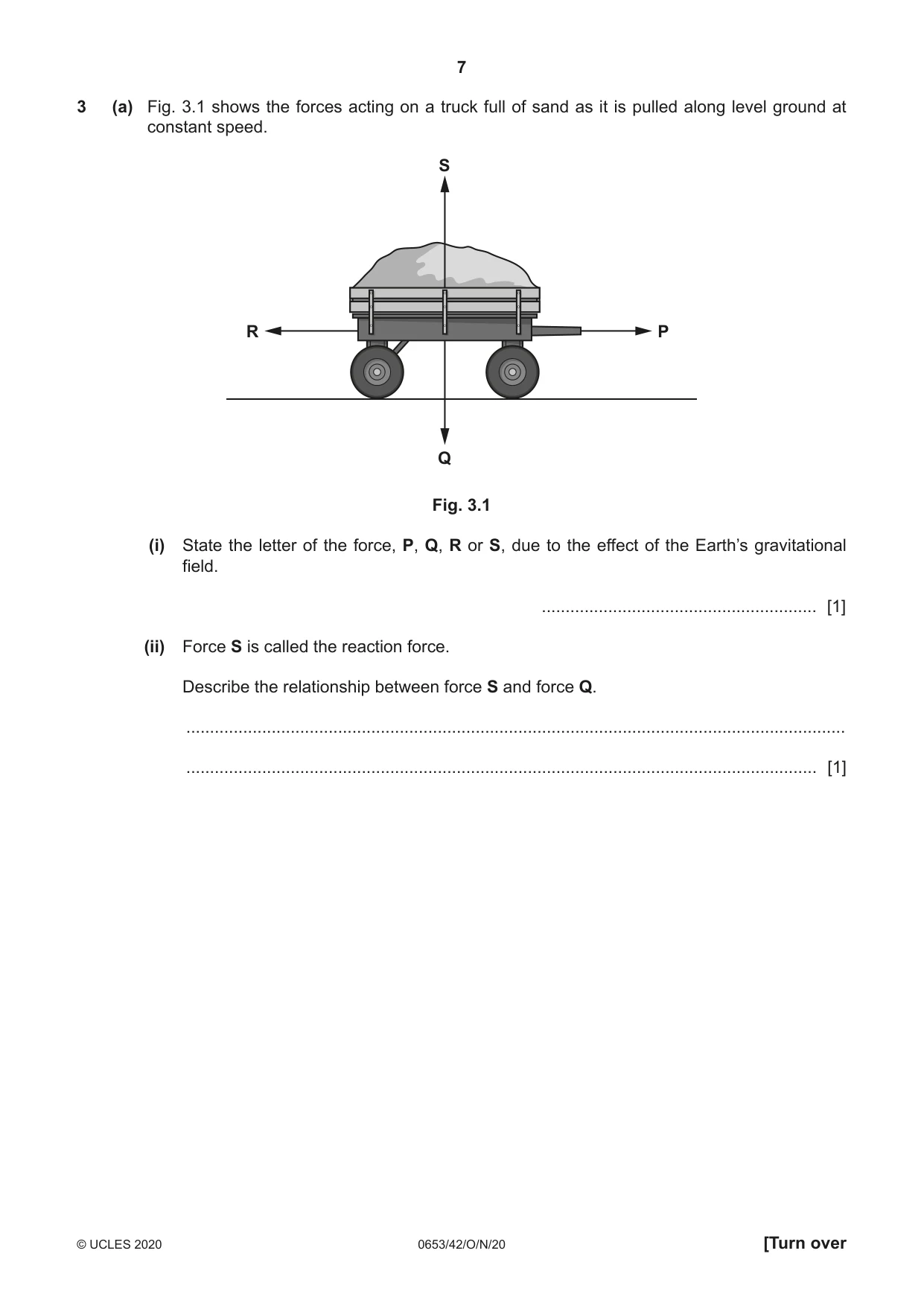
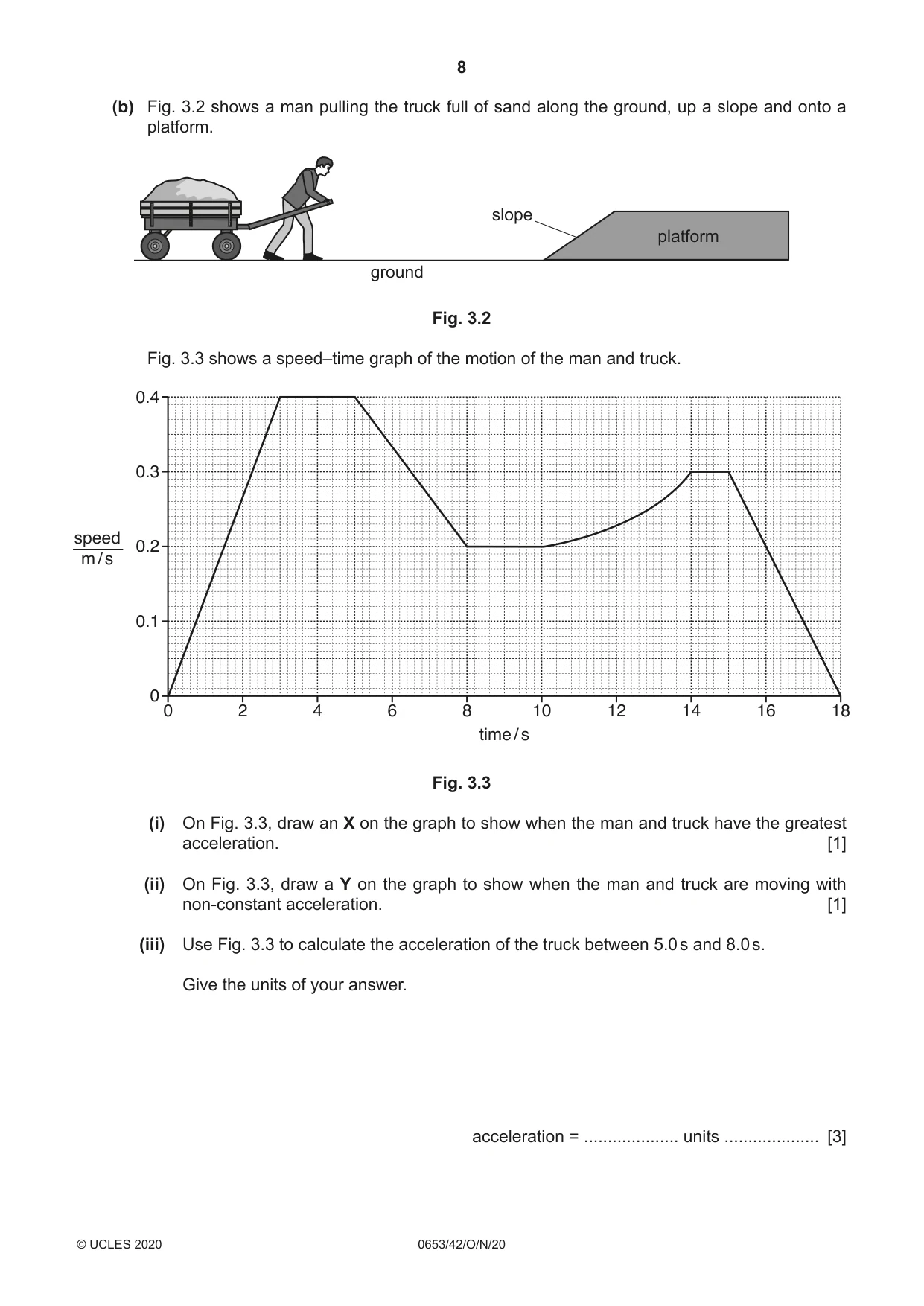
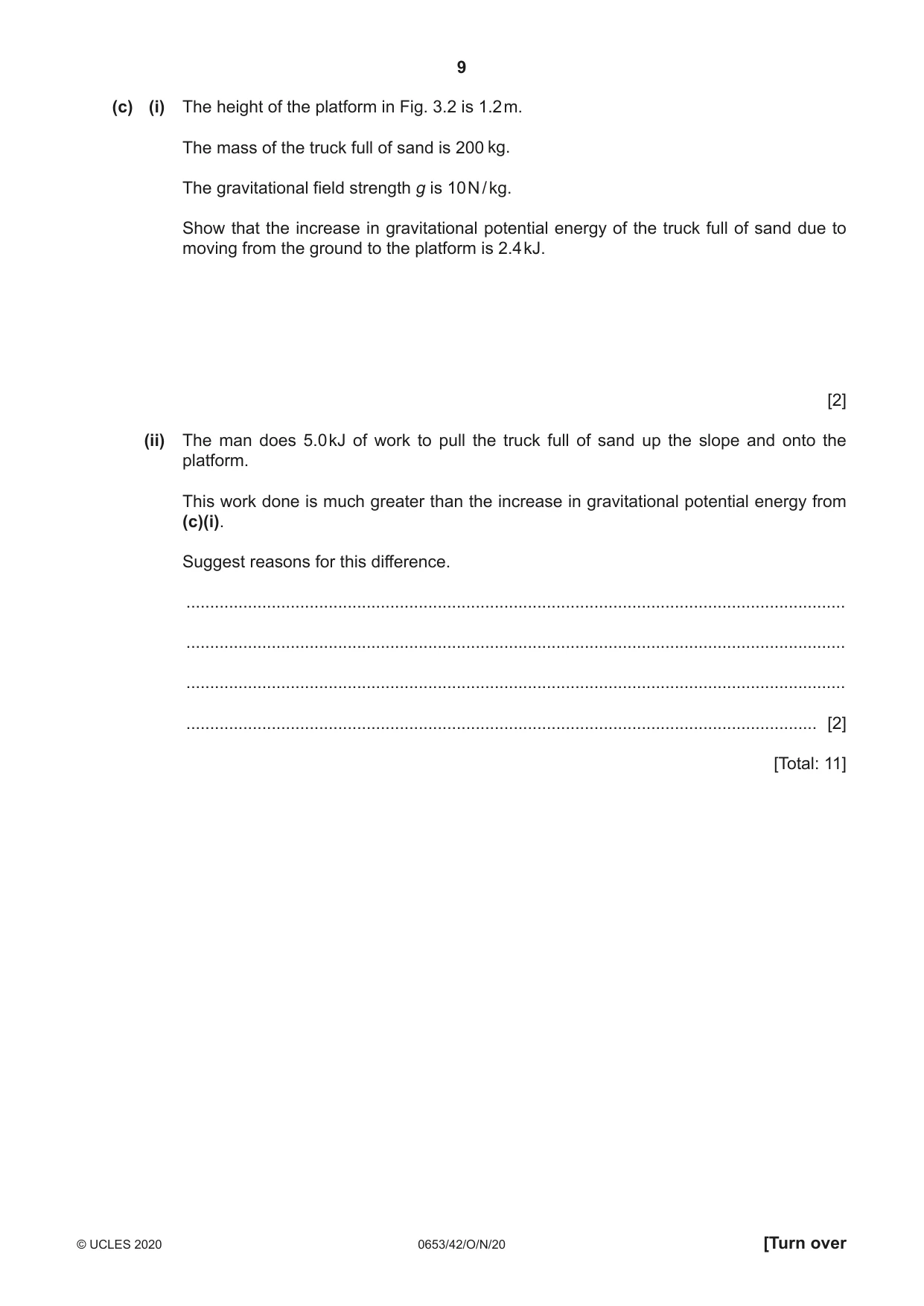
3 (a) Fig. 3.1 shows the forces acting on a truck full of sand as it is pulled along level ground at constant speed. S R P Q Fig. 3.1 (i) State the letter of the force, P, Q, R or S, due to the effect of the Earth’s gravitational field. .......................................................... [1] (ii) Force S is called the reaction force. Describe the relationship between force S and force Q. ........................................................................................................................................... ..................................................................................................................................... [1] (b) Fig. 3.2 shows a man pulling the truck full of sand along the ground, up a slope and onto a platform. slope platform ground Fig. 3.2 Fig. 3.3 shows a speed–time graph of the motion of the man and truck. 0.4 0.3 speed 0.2 m / s 0.1 0 0 2 4 6 8 10 12 14 16 18 time / s Fig. 3.3 (i) On Fig. 3.3, draw an X on the graph to show when the man and truck have the greatest acceleration. [1] (ii) On Fig. 3.3, draw a Y on the graph to show when the man and truck are moving with non-constant acceleration. [1] (iii) Use Fig. 3.3 to calculate the acceleration of the truck between 5.0 s and 8.0 s. Give the units of your answer. acceleration = .................... units .................... [3] (c) (i) The height of the platform in Fig. 3.2 is 1.2 m. The mass of the truck full of sand is 200 kg. The gravitational field strength g is 10 N / kg. Show that the increase in gravitational potential energy of the truck full of sand due to moving from the ground to the platform is 2.4 kJ. [2] (ii) The man does 5.0 kJ of work to pull the truck full of sand up the slope and onto the platform. This work done is much greater than the increase in gravitational potential energy from (c)(i). Suggest reasons for this difference. ........................................................................................................................................... ........................................................................................................................................... ........................................................................................................................................... ..................................................................................................................................... [2] [Total: 11]
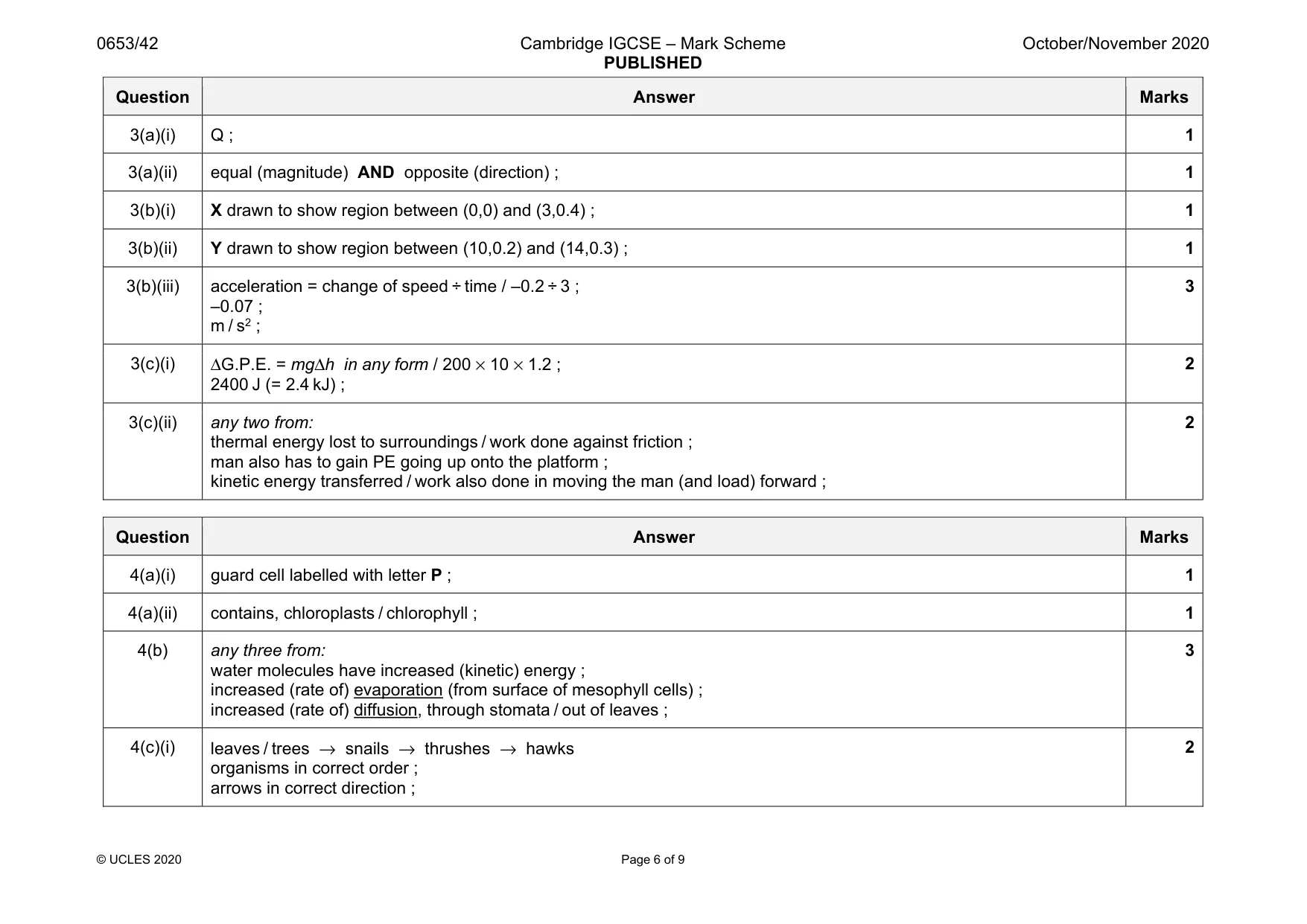
Mark scheme: 3(a)(i) Q ; 1 3(a)(ii) equal (magnitude) AND opposite (direction) ; 1 3(b)(i) X drawn to show region between (0,0) and (3,0.4) ; 1 3(b)(ii) Y drawn to show region between (10,0.2) and (14,0.3) ; 1 3(b)(iii) acceleration = change of speed ÷ time / –0.2 ÷ 3 ; –0.07 ; m / s2 ; 3 3(c)(i) ΔG.P.E. = mgΔh in any form / 200 × 10 × 1.2 ; 2400 J (= 2.4 kJ) ; 2 3(c)(ii) any two from: thermal energy lost to surroundings / work done against friction ; man also has to gain PE going up onto the platform ; kinetic energy transferred / work also done in moving the man (and load) forward ; 2
Q4 · A cross-sectional diagram of a leaf
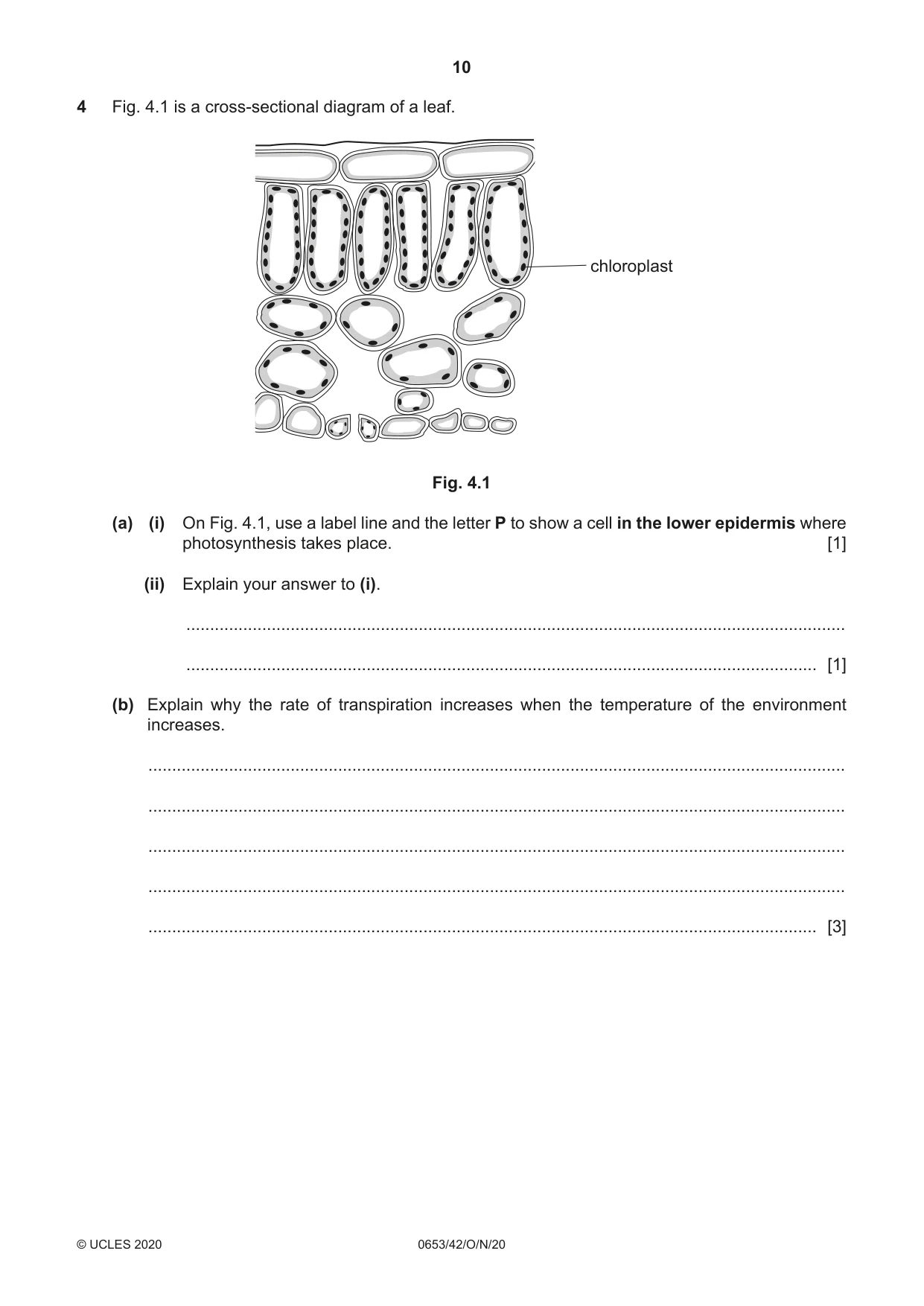
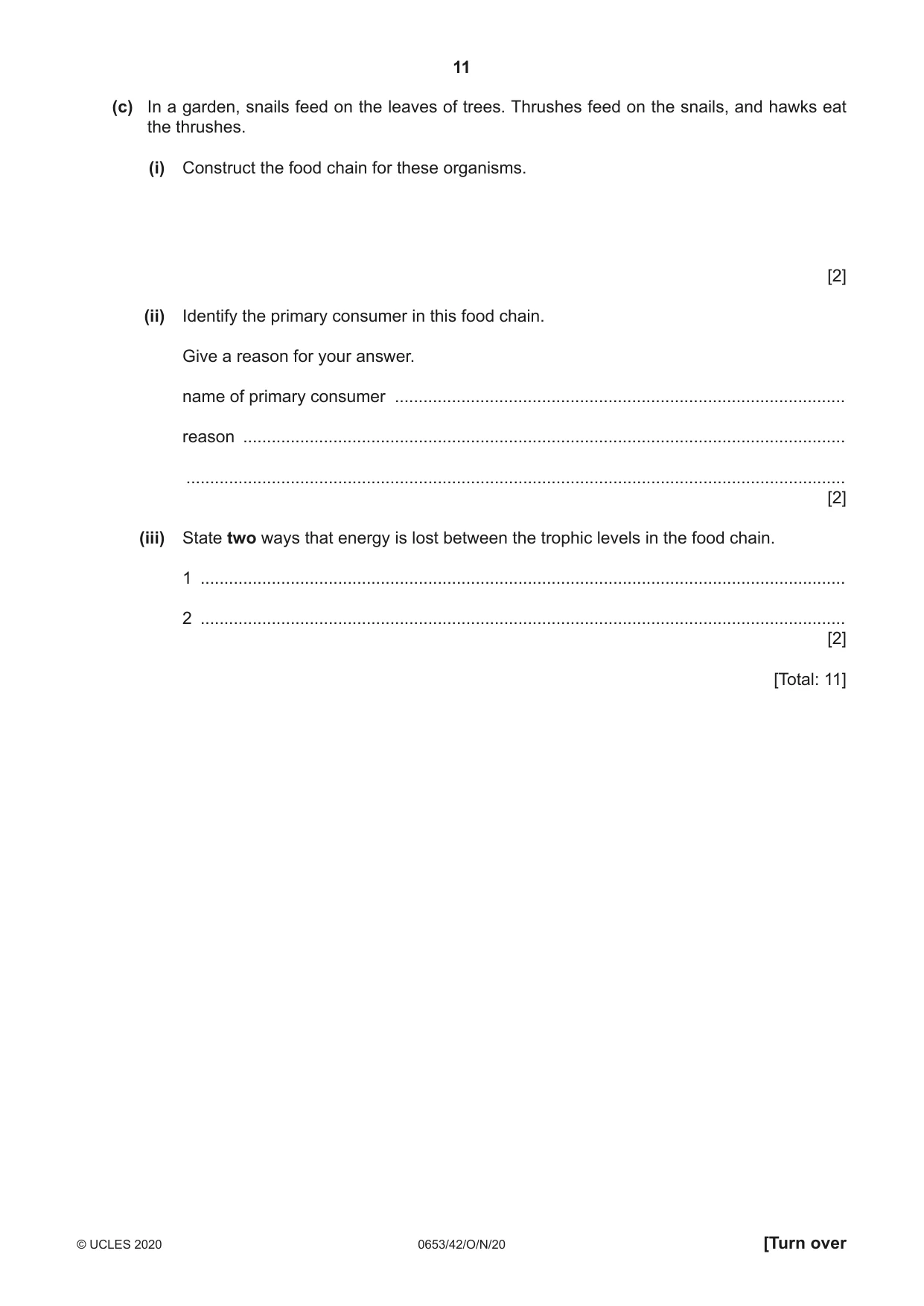
4 Fig. 4.1 is a cross-sectional diagram of a leaf. chloroplast Fig. 4.1 (a) (i) On Fig. 4.1, use a label line and the letter P to show a cell in the lower epidermis where photosynthesis takes place. [1] (ii) Explain your answer to (i). ........................................................................................................................................... ..................................................................................................................................... [1] (b) Explain why the rate of transpiration increases when the temperature of the environment increases. ................................................................................................................................................... ................................................................................................................................................... ................................................................................................................................................... ................................................................................................................................................... ............................................................................................................................................. [3] (c) In a garden, snails feed on the leaves of trees. Thrushes feed on the snails, and hawks eat the thrushes. (i) Construct the food chain for these organisms. [2] (ii) Identify the primary consumer in this food chain. Give a reason for your answer. name of primary consumer ............................................................................................... reason ............................................................................................................................... ........................................................................................................................................... [2] (iii) State two ways that energy is lost between the trophic levels in the food chain. 1 ........................................................................................................................................ 2 ........................................................................................................................................ [2] [Total: 11]
Mark scheme: 4(a)(i) guard cell labelled with letter P ; 1 4(a)(ii) contains, chloroplasts / chlorophyll ; 1 4(b) any three from: water molecules have increased (kinetic) energy ; increased (rate of) evaporation (from surface of mesophyll cells) ; increased (rate of) diffusion, through stomata / out of leaves ; 3 4(c)(i) leaves / trees → snails → thrushes → hawks organisms in correct order ; arrows in correct direction ; 2 Question Answer Marks 4(c)(ii) snails ; herbivores / feed on producers / second trophic level ; 2 4(c)(iii) any two from: respiration / heat / movement ; death ; excretion (of waste / urine) / loss of solid waste / faeces ; not all organisms in the chain, eaten / digested ; 2
Q5 · Iron is extracted from iron oxide in a blast furnace
5 (a) Iron is extracted from iron oxide in a blast furnace. One of the reactions occurring in the blast furnace is shown. Fe2O3 + 3CO 2Fe + 3CO2 Name the oxidising agent in this reaction. ............................................................................................................................................. [1] (b) Iron is a transition element. Aluminium is not a transition element. Describe one property of iron that is not a property of aluminium. ................................................................................................................................................... ............................................................................................................................................. [1] (c) Aluminium is obtained by the electrolysis of molten aluminium oxide. (i) Explain why aluminium oxide must be molten during electrolysis. ........................................................................................................................................... ..................................................................................................................................... [1] (ii) Aluminium oxide contains aluminium ions, Al 3+, and oxide ions, O2–. Deduce the formula of aluminium oxide. formula ......................................................... [1] (iii) The melting point of aluminium oxide is 2072 °C. The melting point of methane is –182 °C. Explain the difference in these melting points. Use ideas about types of bonds and attractive forces in your answer. ........................................................................................................................................... ........................................................................................................................................... ........................................................................................................................................... ........................................................................................................................................... ........................................................................................................................................... ..................................................................................................................................... [3] (d) Aluminium is an element in Period 3 of the Periodic Table. Describe the relationship between the number of outer shell electrons and the metallic character of the elements across a period. ................................................................................................................................................... ............................................................................................................................................. [1] [Total: 8]
Mark scheme: 5(a) iron oxide ; 1 5(b) any one from: forms coloured compounds ; has high melting point ; has high density ; reference to use as a catalyst ; 1 5(c)(i) ions must be mobile ; 1 5(c)(ii) Al2O3 ; 1 5(c)(iii) (type of bonding) aluminium oxide is ionic AND methane is covalent ; stronger forces of attraction (between oppositely charged ions) in aluminium oxide / weaker forces of attraction (between molecules) in methane ; so more energy needed to separate particles / overcome attraction (hence higher melting point) / ora ; 3 5(d) as number of (outer shell) electrons increases, element changes from metallic to non-metallic ; 1
Q6 · A device called a ‘solar still’
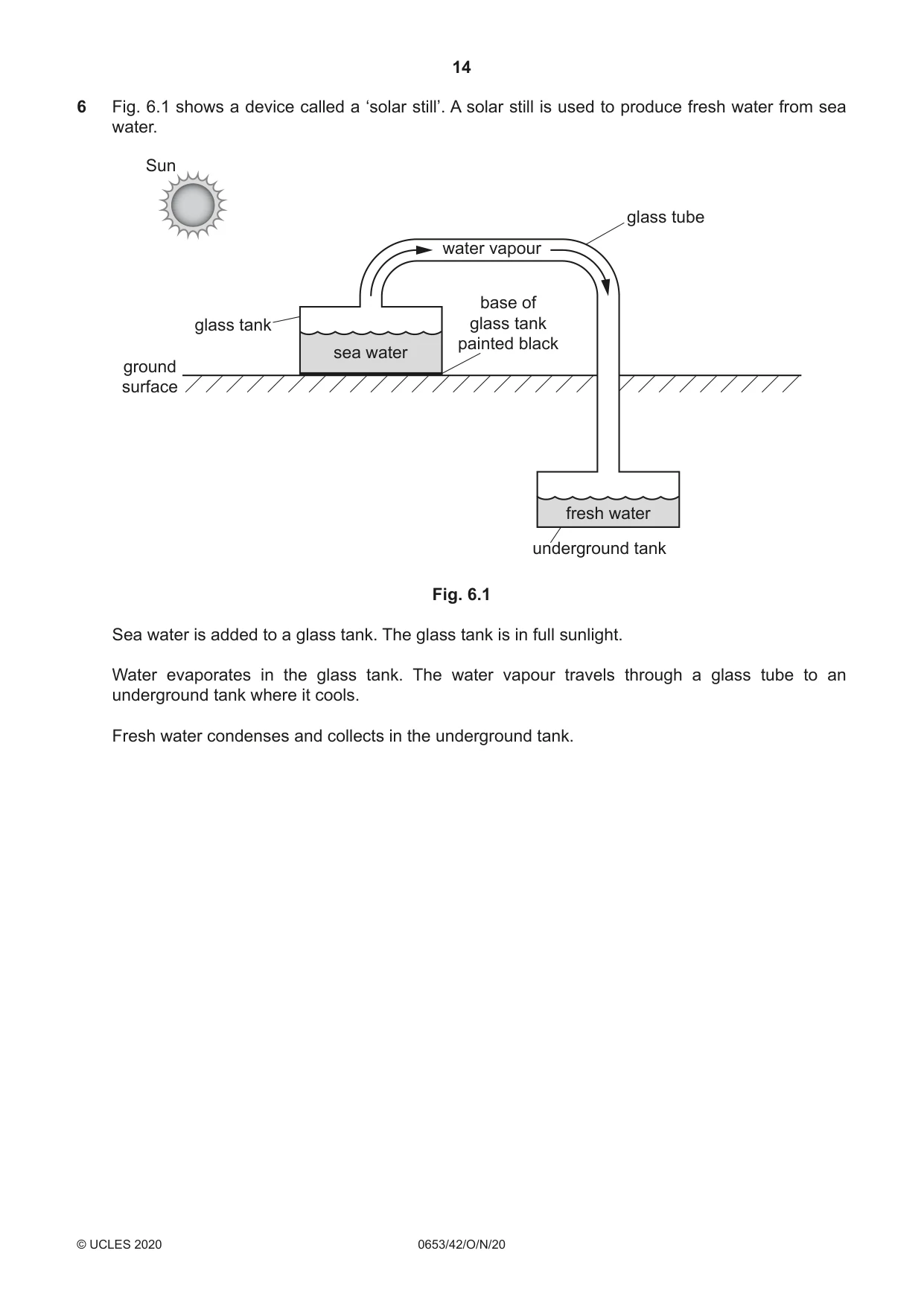
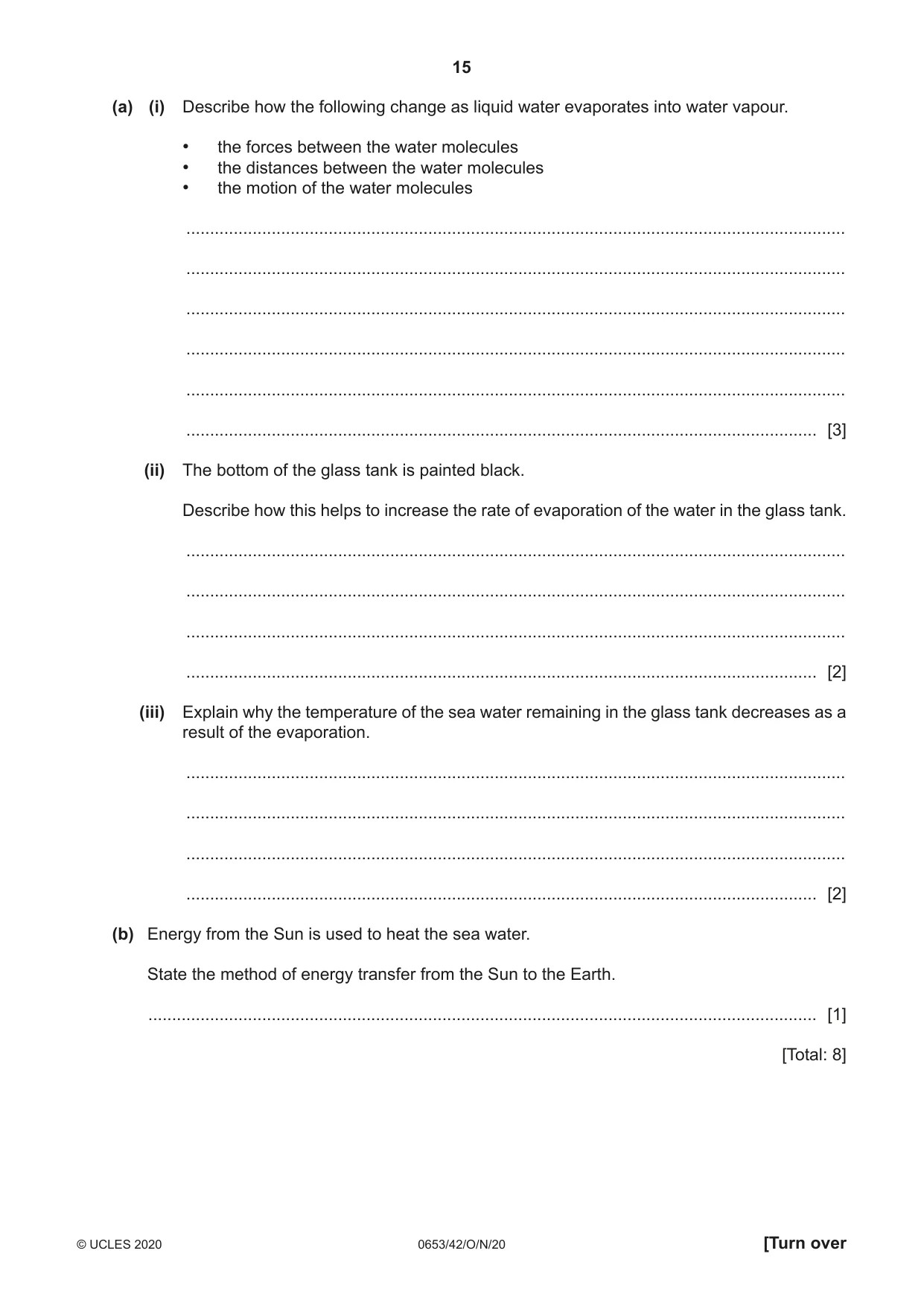
6 Fig. 6.1 shows a device called a ‘solar still’. A solar still is used to produce fresh water from sea water. Sun glass tube water vapour base of glass tank glass tank painted black sea water ground surface fresh water underground tank Fig. 6.1 Sea water is added to a glass tank. The glass tank is in full sunlight. Water evaporates in the glass tank. The water vapour travels through a glass tube to an underground tank where it cools. Fresh water condenses and collects in the underground tank. (a) (i) Describe how the following change as liquid water evaporates into water vapour. • the forces between the water molecules • the distances between the water molecules • the motion of the water molecules ........................................................................................................................................... ........................................................................................................................................... ........................................................................................................................................... ........................................................................................................................................... ........................................................................................................................................... ..................................................................................................................................... [3] (ii) The bottom of the glass tank is painted black. Describe how this helps to increase the rate of evaporation of the water in the glass tank. ........................................................................................................................................... ........................................................................................................................................... ........................................................................................................................................... ..................................................................................................................................... [2] (iii) Explain why the temperature of the sea water remaining in the glass tank decreases as a result of the evaporation. ........................................................................................................................................... ........................................................................................................................................... ........................................................................................................................................... ..................................................................................................................................... [2] (b) Energy from the Sun is used to heat the sea water. State the method of energy transfer from the Sun to the Earth. ............................................................................................................................................. [1] [Total: 8]
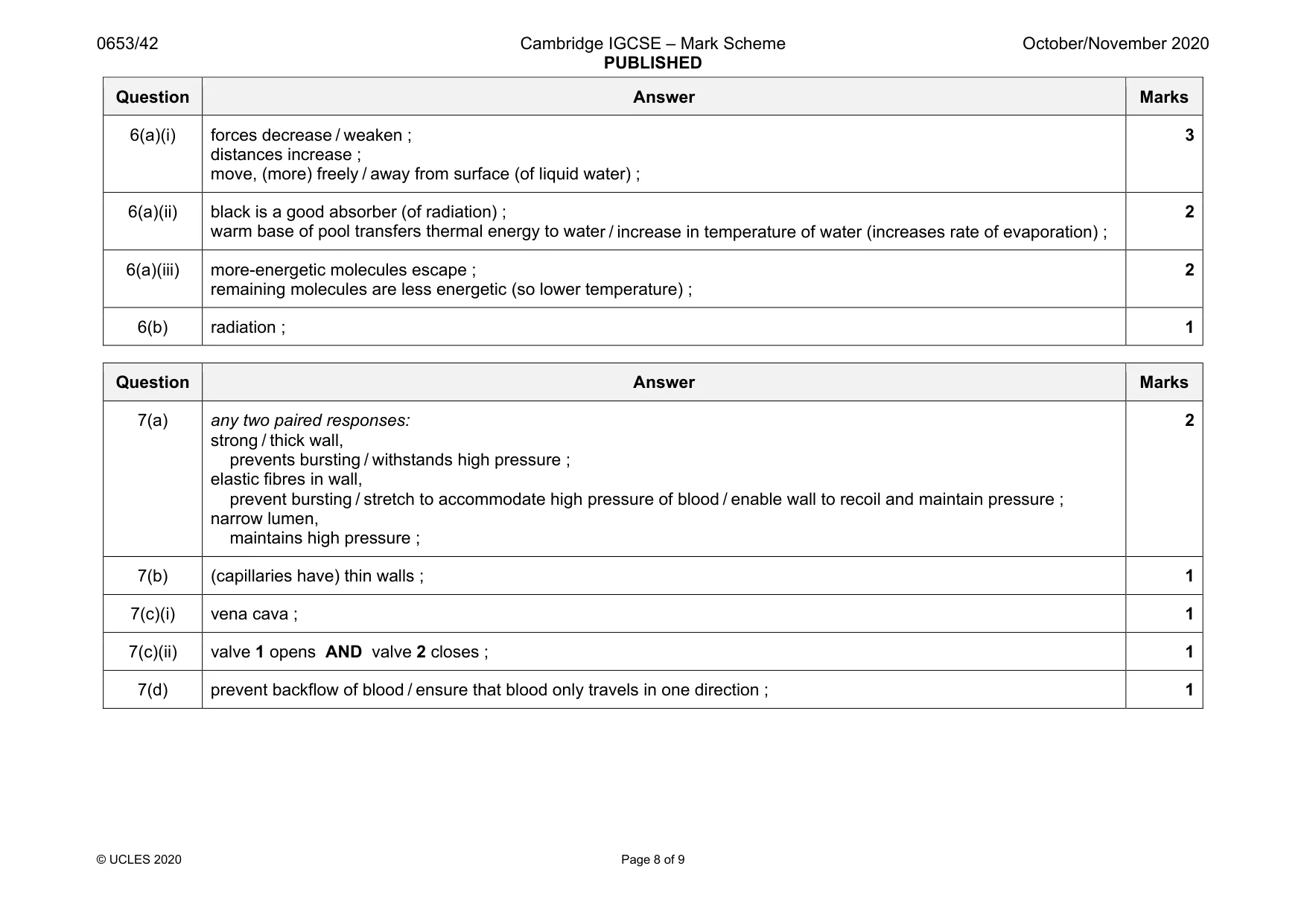
Mark scheme: 6(a)(i) forces decrease / weaken ; distances increase ; move, (more) freely / away from surface (of liquid water) ; 3 6(a)(ii) black is a good absorber (of radiation) ; warm base of pool transfers thermal energy to water / increase in temperature of water (increases rate of evaporation) ; 2 6(a)(iii) more-energetic molecules escape ; remaining molecules are less energetic (so lower temperature) ; 2 6(b) radiation ; 1
Q7 · A diagram of a cross-section through an artery
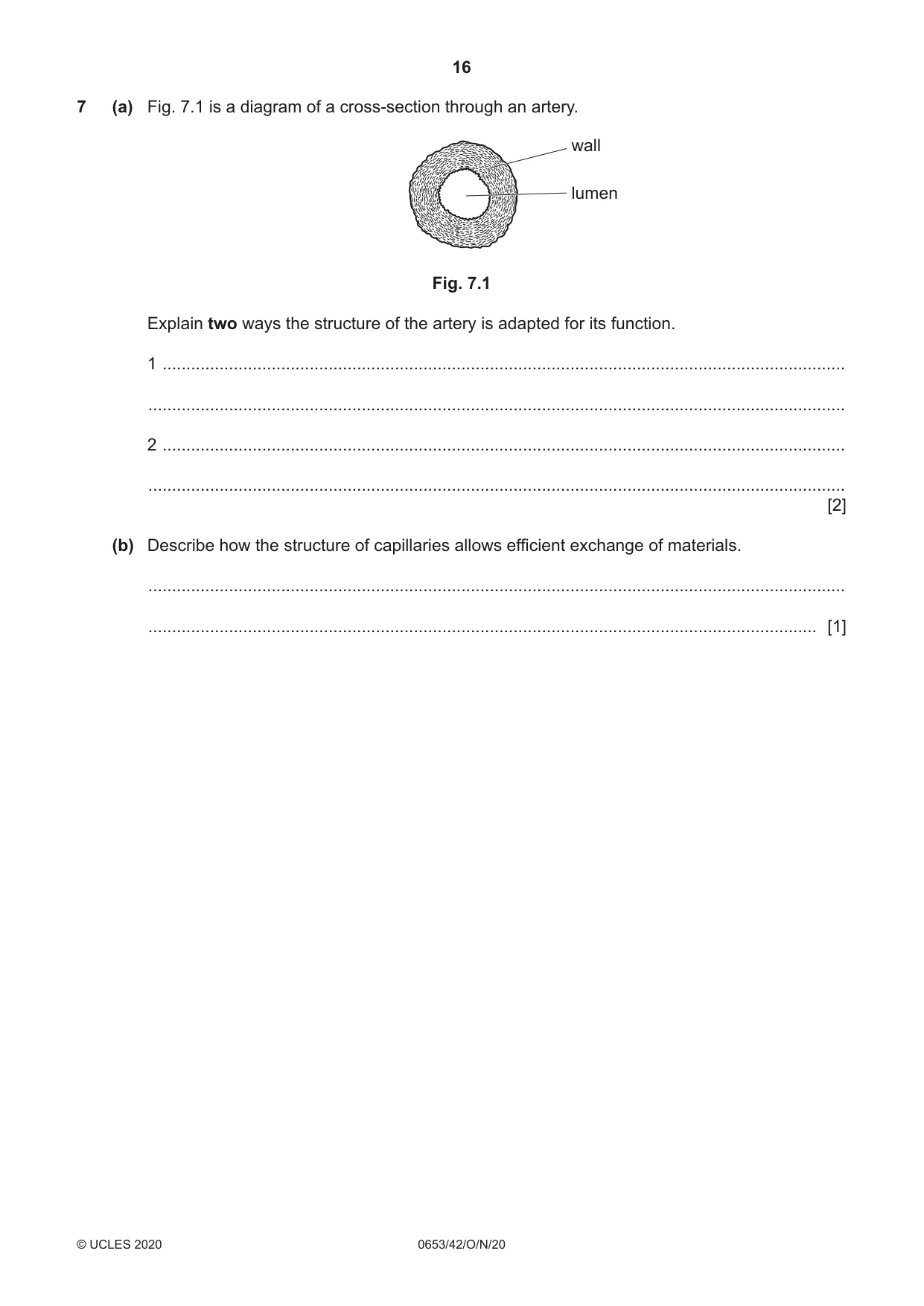
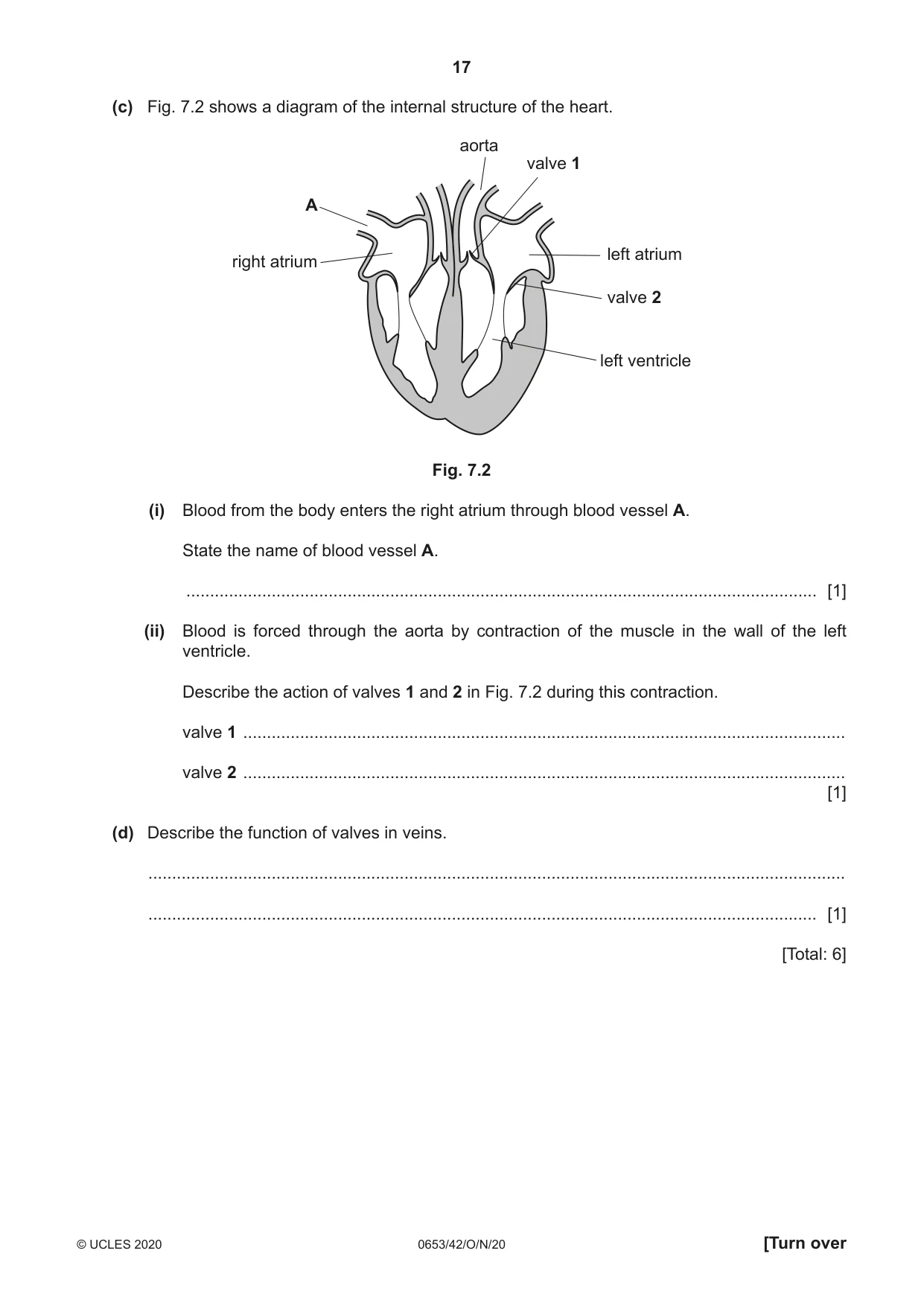
7 (a) Fig. 7.1 is a diagram of a cross-section through an artery. wall lumen Fig. 7.1 Explain two ways the structure of the artery is adapted for its function. 1 ................................................................................................................................................ ................................................................................................................................................... 2 ................................................................................................................................................ ................................................................................................................................................... [2] (b) Describe how the structure of capillaries allows efficient exchange of materials. ................................................................................................................................................... ............................................................................................................................................. [1] (c) Fig. 7.2 shows a diagram of the internal structure of the heart. aorta valve 1 A left atrium right atrium valve 2 left ventricle Fig. 7.2 (i) Blood from the body enters the right atrium through blood vessel A. State the name of blood vessel A. ..................................................................................................................................... [1] (ii) Blood is forced through the aorta by contraction of the muscle in the wall of the left ventricle. Describe the action of valves 1 and 2 in Fig. 7.2 during this contraction. valve 1 ............................................................................................................................... valve 2 ............................................................................................................................... [1] (d) Describe the function of valves in veins. ................................................................................................................................................... ............................................................................................................................................. [1] [Total: 6]
Mark scheme: 7(a) any two paired responses: strong / thick wall, prevents bursting / withstands high pressure ; elastic fibres in wall, prevent bursting / stretch to accommodate high pressure of blood / enable wall to recoil and maintain pressure ; narrow lumen, maintains high pressure ; 7(b) (capillaries have) thin walls ; 1 7(c)(i) vena cava ; 1 7(c)(ii) valve 1 opens AND valve 2 closes ; 1 7(d) prevent backflow of blood / ensure that blood only travels in one direction ; 1
Q8 · When 1 g of copper carbonate powder is added to excess dilute hydrochloric acid, aqueous…
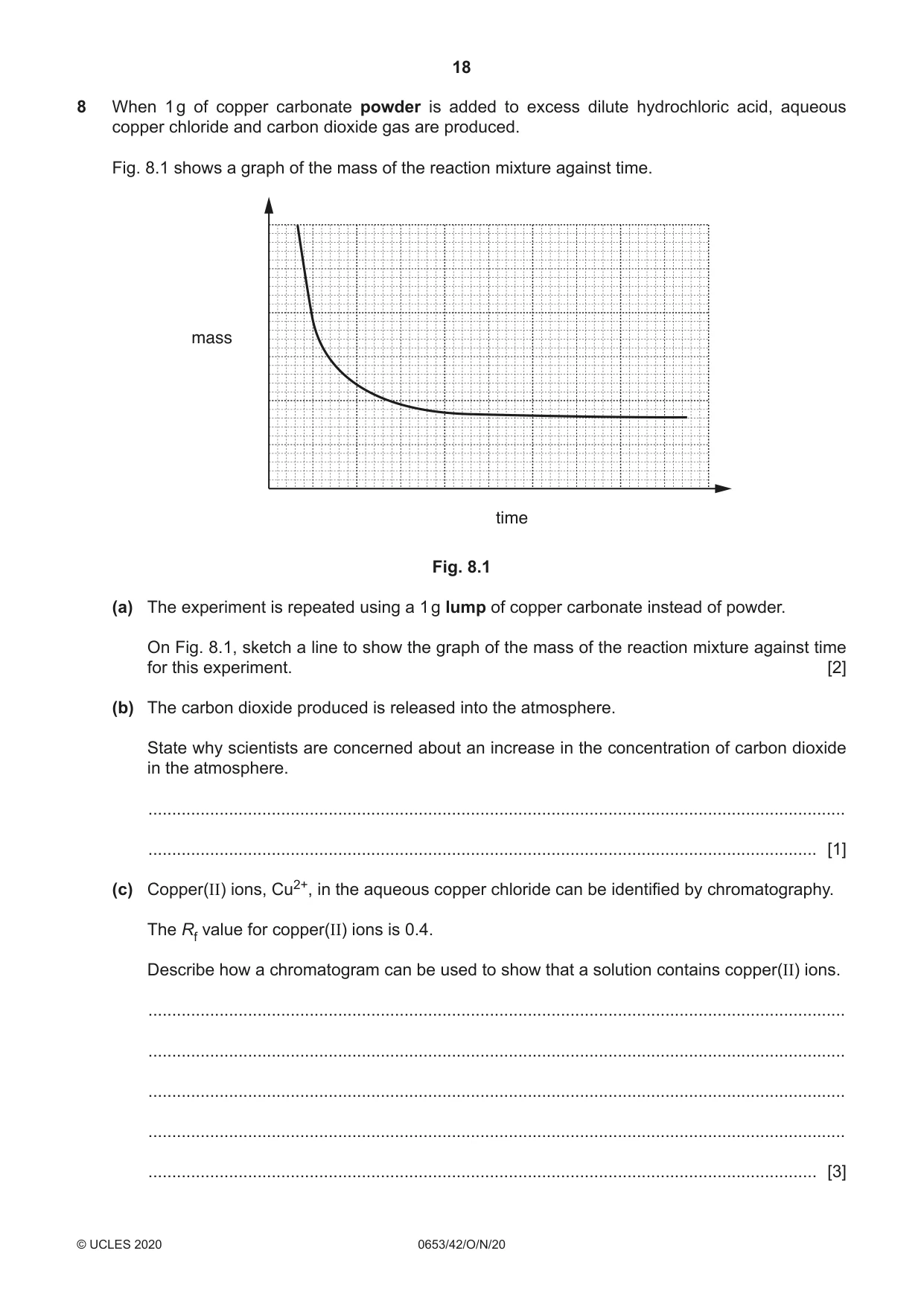
8 When 1 g of copper carbonate powder is added to excess dilute hydrochloric acid, aqueous copper chloride and carbon dioxide gas are produced. Fig. 8.1 shows a graph of the mass of the reaction mixture against time. mass time Fig. 8.1 (a) The experiment is repeated using a 1 g lump of copper carbonate instead of powder. On Fig. 8.1, sketch a line to show the graph of the mass of the reaction mixture against time for this experiment. [2] (b) The carbon dioxide produced is released into the atmosphere. State why scientists are concerned about an increase in the concentration of carbon dioxide in the atmosphere. ................................................................................................................................................... ............................................................................................................................................. [1] (c) Copper(II) ions, Cu2+, in the aqueous copper chloride can be identified by chromatography. The Rf value for copper(II) ions is 0.4. Describe how a chromatogram can be used to show that a solution contains copper(II) ions. ................................................................................................................................................... ................................................................................................................................................... ................................................................................................................................................... ................................................................................................................................................... ............................................................................................................................................. [3] (d) During the electrolysis of aqueous copper(II) chloride, copper forms at the cathode. Describe how copper forms at the cathode. Use ideas about ions and electrons in your answer. ................................................................................................................................................... ................................................................................................................................................... ............................................................................................................................................. [2] [Total: 8]
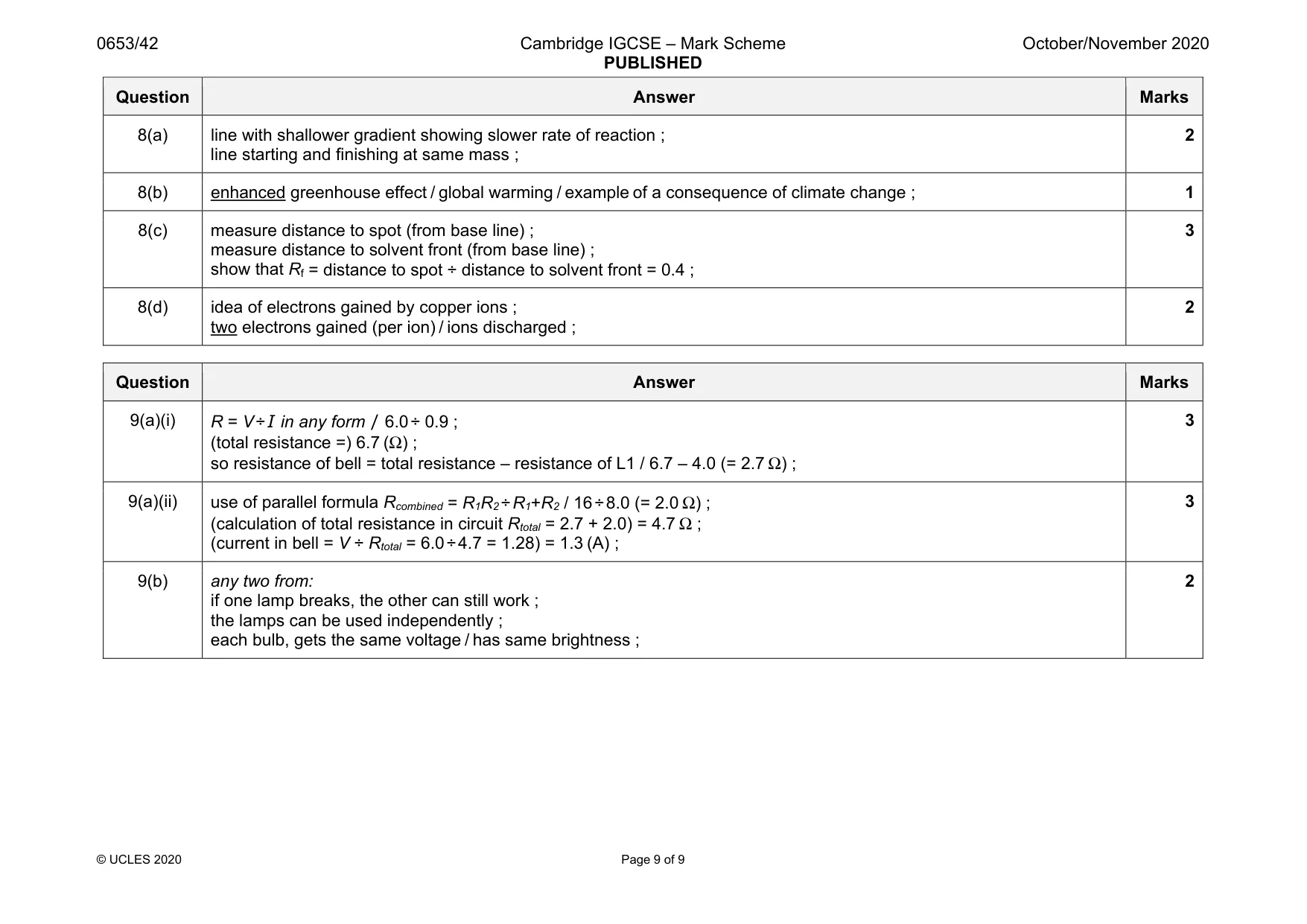
Mark scheme: 8(a) line with shallower gradient showing slower rate of reaction ; line starting and finishing at same mass ; 2 8(b) enhanced greenhouse effect / global warming / example of a consequence of climate change ; 1 8(c) measure distance to spot (from base line) ; measure distance to solvent front (from base line) ; show that Rf = distance to spot ÷ distance to solvent front = 0.4 ; 3 8(d) idea of electrons gained by copper ions ; two electrons gained (per ion) / ions discharged ; 2
Q9 · A circuit containing a 6.0 V battery, an electric bell, two identical switches S1 and S2…
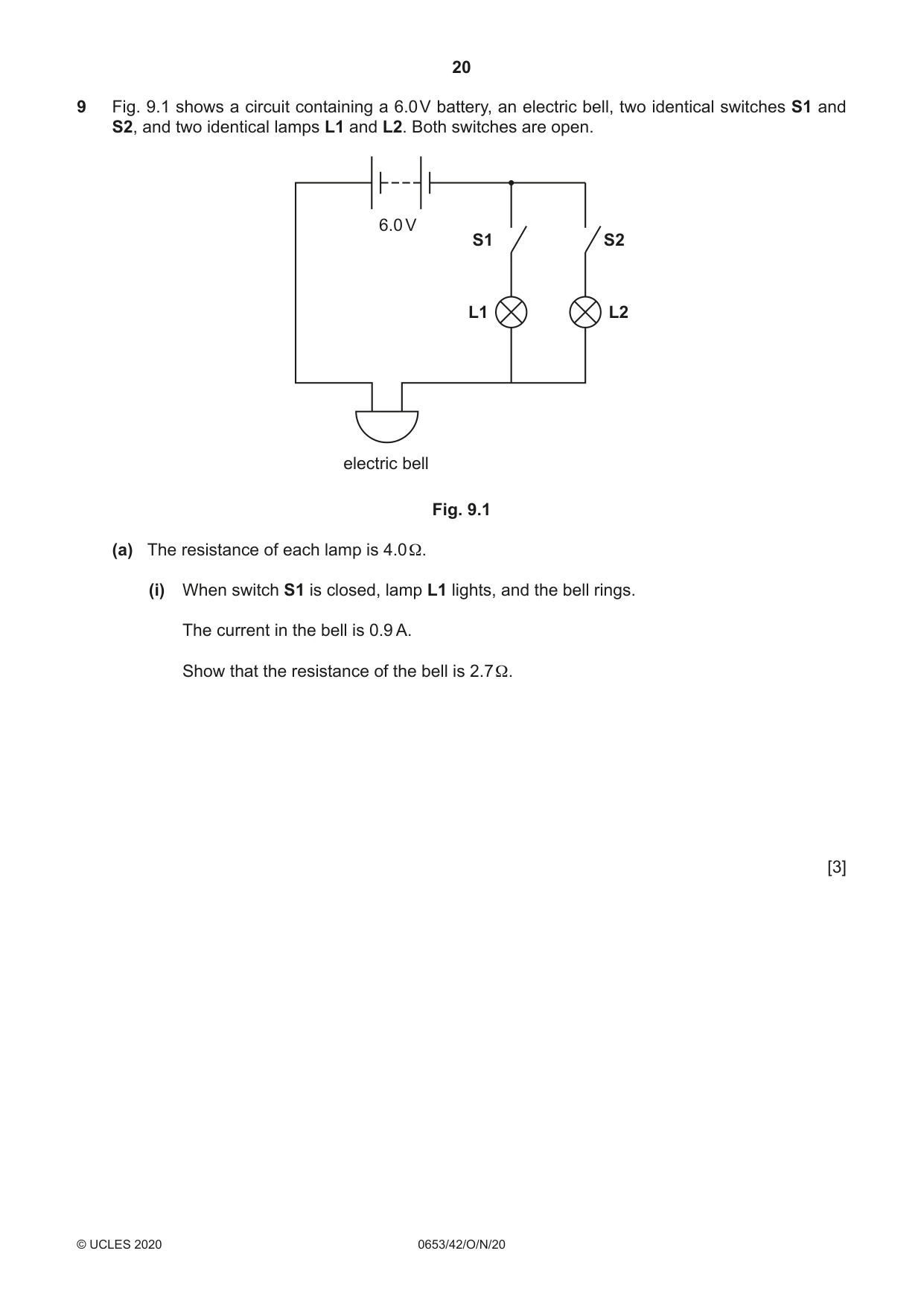
9 Fig. 9.1 shows a circuit containing a 6.0 V battery, an electric bell, two identical switches S1 and S2, and two identical lamps L1 and L2. Both switches are open. 6.0 V S1 S2 L1 L2 electric bell Fig. 9.1 (a) The resistance of each lamp is 4.0 Ω. (i) When switch S1 is closed, lamp L1 lights, and the bell rings. The current in the bell is 0.9 A. Show that the resistance of the bell is 2.7 Ω. [3] (ii) When both switches S1 and S2 are closed at the same time, both lamps L1 and L2 light, and the bell rings. Calculate the current in the bell when both switches are closed. current = ...................................................... A [3] (b) The lamps in Fig. 9.1 are connected in parallel. State two advantages of connecting lamps in parallel in a circuit. 1 ................................................................................................................................................ 2 ................................................................................................................................................ [2] [Total: 8]
Mark scheme: 9(a)(i) (total resistance =) 6.7 (Ω) ; so resistance of bell = total resistance – resistance of L1 / 6.7 – 4.0 (= 2.7 Ω) ; 9(a)(ii) use of parallel formula Rcombined = R1R2 ÷ R1+R2 / 16 ÷ 8.0 (= 2.0 Ω) ; (calculation of total resistance in circuit Rtotal = 2.7 + 2.0) = 4.7 Ω ; (current in bell = V ÷ Rtotal = 6.0 ÷ 4.7 = 1.28) = 1.3 (A) ; 3 9(b) any two from: if one lamp breaks, the other can still work ; the lamps can be used independently ; each bulb, gets the same voltage / has same brightness ; 2
What was in this paper
The subtopics covered by these 9 questions, and how many questions each got. Open one in a new tab to see every Cambridge question on it.
What you needed in this session
Cambridge’s own grade thresholds for 2020 Oct/Nov, Paper 4 · Variant 2. A higher threshold means an easier paper — the bar moves with how the cohort did.