Cambridge IGCSE Science - Combined 0653 — 2020 Feb/March Paper 4 · Variant 2
0653/42/F/M/20 · 9 questions · 80 marks · ≈90 min
The question paper and its mark scheme, free to read here and free to download. This is Cambridge’s own paper, exactly as it was sat.
Question paper20 pages

Mark scheme10 pages
Answers below. Sit the paper first if you are practising.
Questions as text
Q1 · An incomplete food web of some organisms in a field
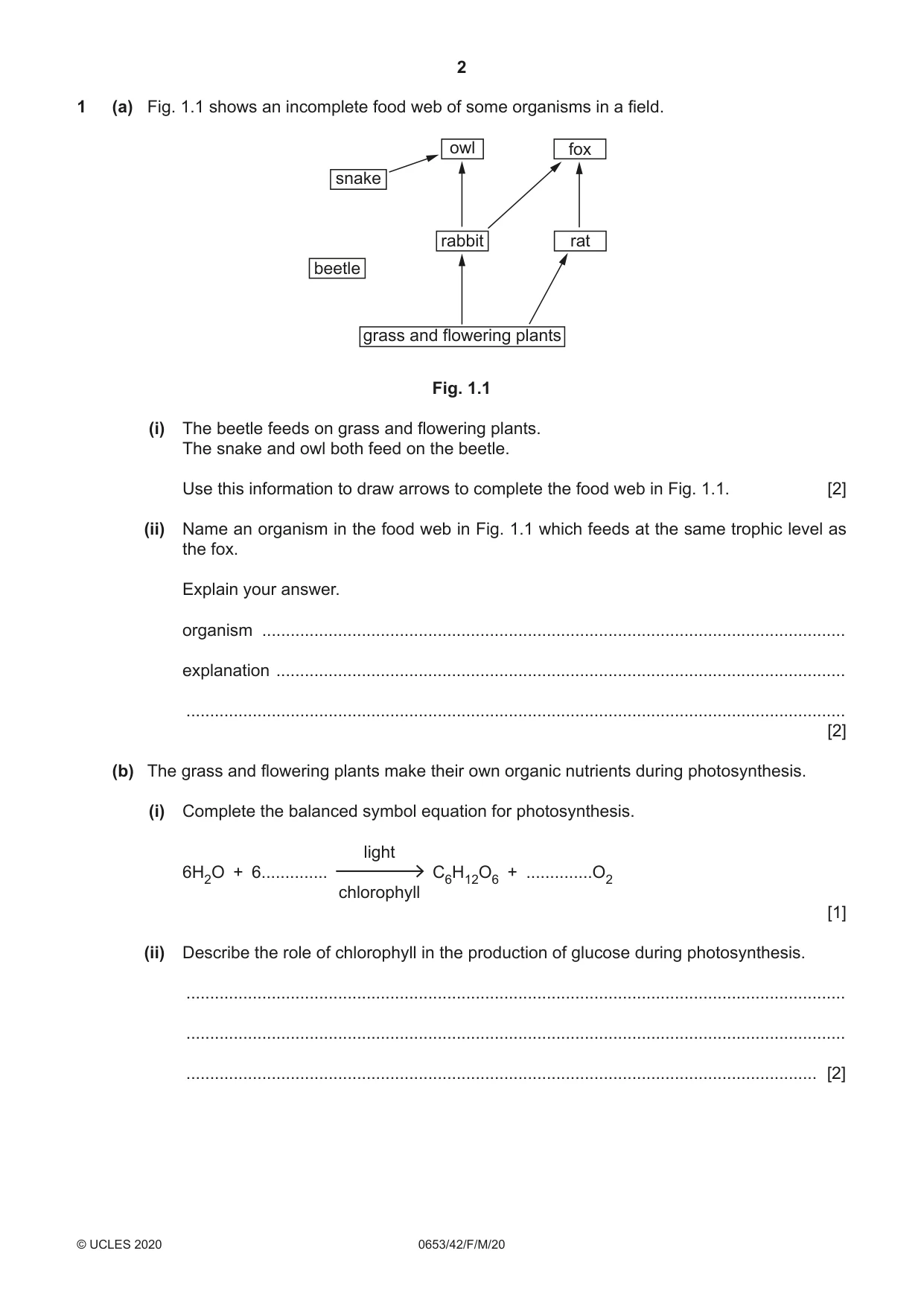
1 (a) Fig. 1.1 shows an incomplete food web of some organisms in a field. owl fox snake rabbit rat beetle grass and flowering plants Fig. 1.1 (i) The beetle feeds on grass and flowering plants. The snake and owl both feed on the beetle. Use this information to draw arrows to complete the food web in Fig. 1.1. [2] (ii) Name an organism in the food web in Fig. 1.1 which feeds at the same trophic level as the fox. Explain your answer. organism ........................................................................................................................... explanation ........................................................................................................................ ........................................................................................................................................... [2] (b) The grass and flowering plants make their own organic nutrients during photosynthesis. (i) Complete the balanced symbol equation for photosynthesis. light 6H2O + 6.............. C6H12O6 + ..............O2 chlorophyll [1] (ii) Describe the role of chlorophyll in the production of glucose during photosynthesis. ........................................................................................................................................... ........................................................................................................................................... ..................................................................................................................................... [2] (iii) Many glucose molecules may be joined together to form starch. State the function of starch in plants. ..................................................................................................................................... [1] (iv) Name one other large molecule made from many glucose molecules joined together. ..................................................................................................................................... [1] [Total: 9]
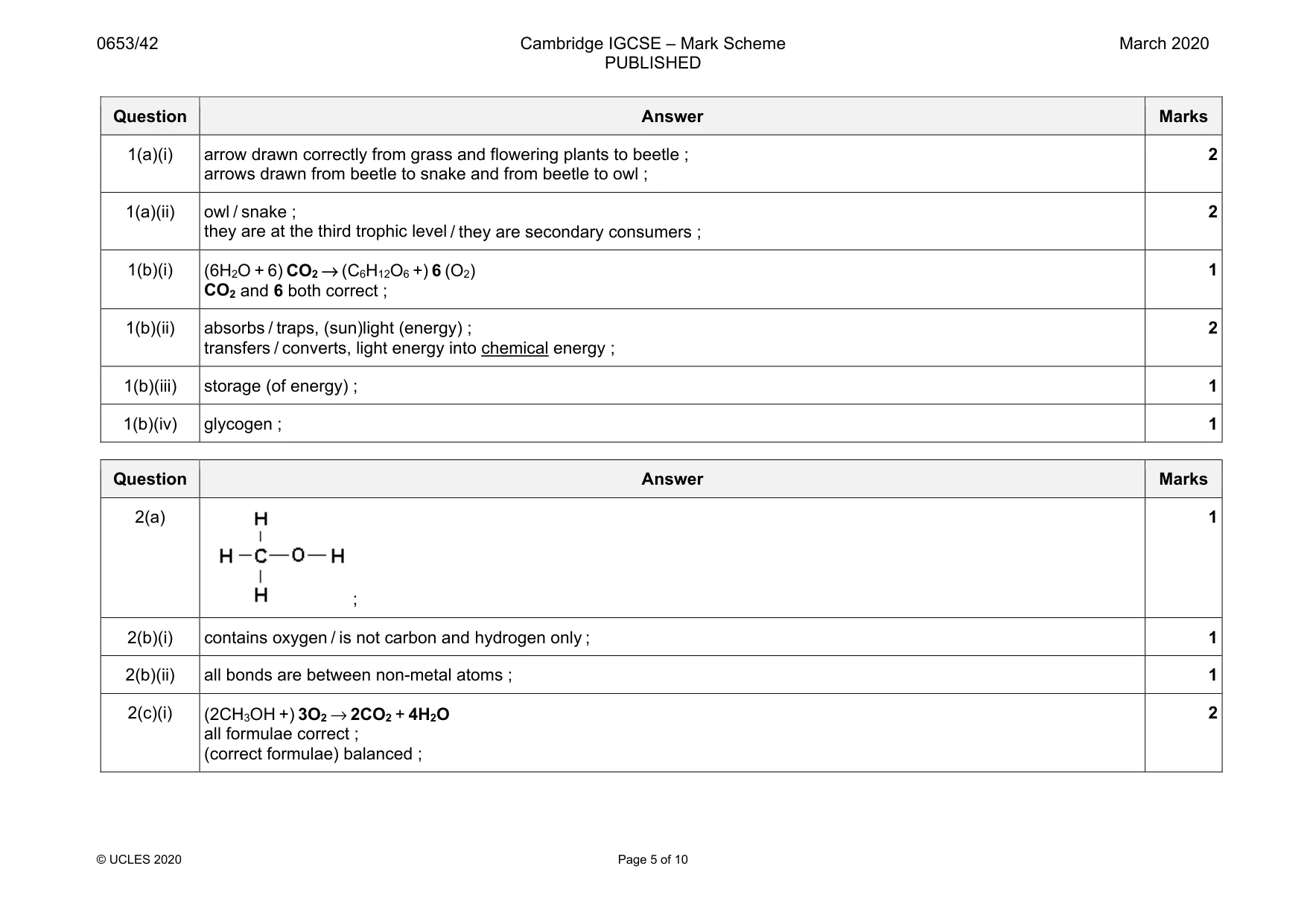
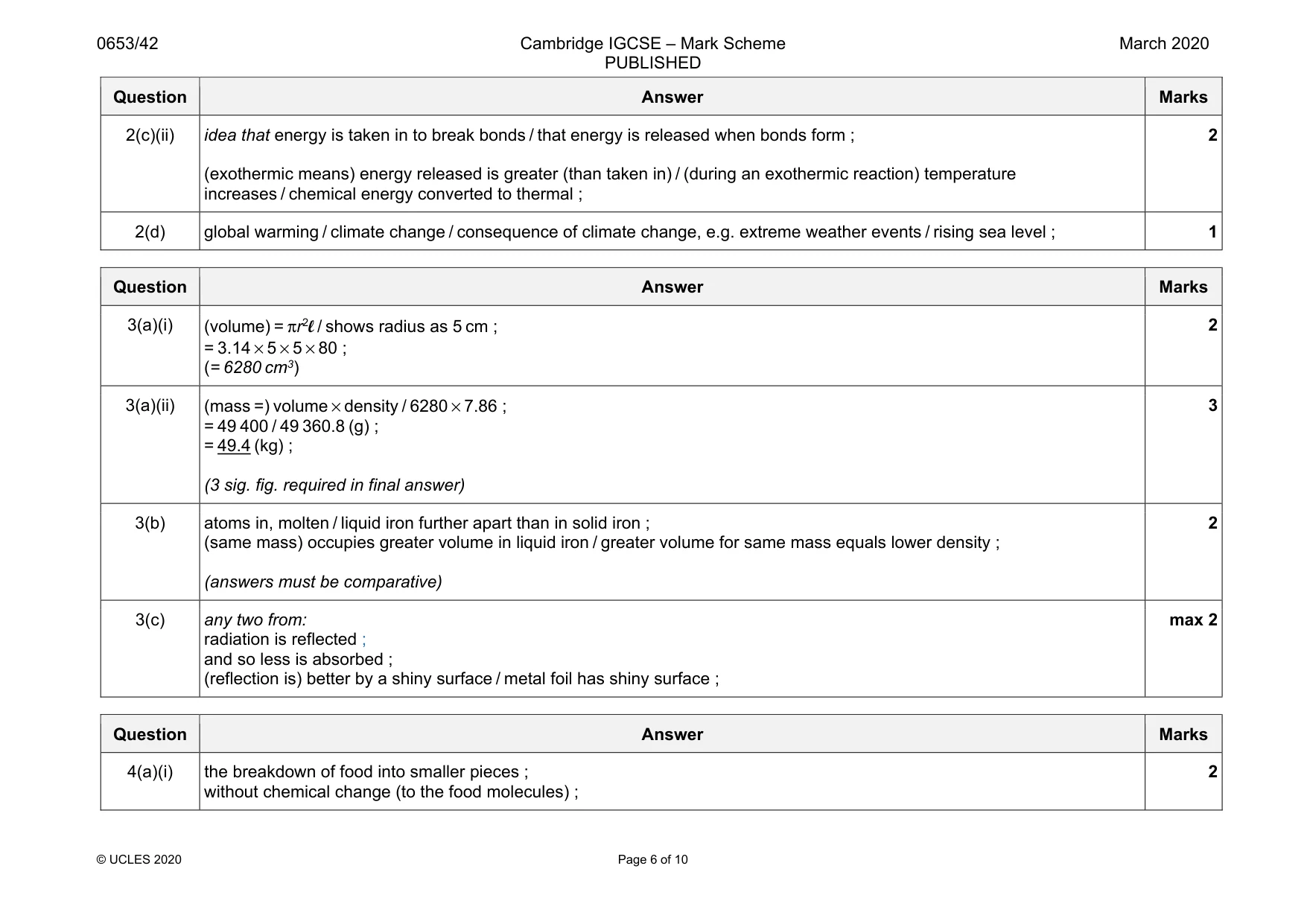
Mark scheme: 1(a)(i) arrow drawn correctly from grass and flowering plants to beetle ; arrows drawn from beetle to snake and from beetle to owl ; 2 1(a)(ii) owl / snake ; they are at the third trophic level / they are secondary consumers ; 2 1(b)(i) (6H2O + 6) CO2 → (C6H12O6 +) 6 (O2) CO2 and 6 both correct ; 1 1(b)(ii) absorbs / traps, (sun)light (energy) ; transfers / converts, light energy into chemical energy ; 2 1(b)(iii) storage (of energy) ; 1 1(b)(iv) glycogen ; 1
Q2 · The formula of methanol is CH3OH
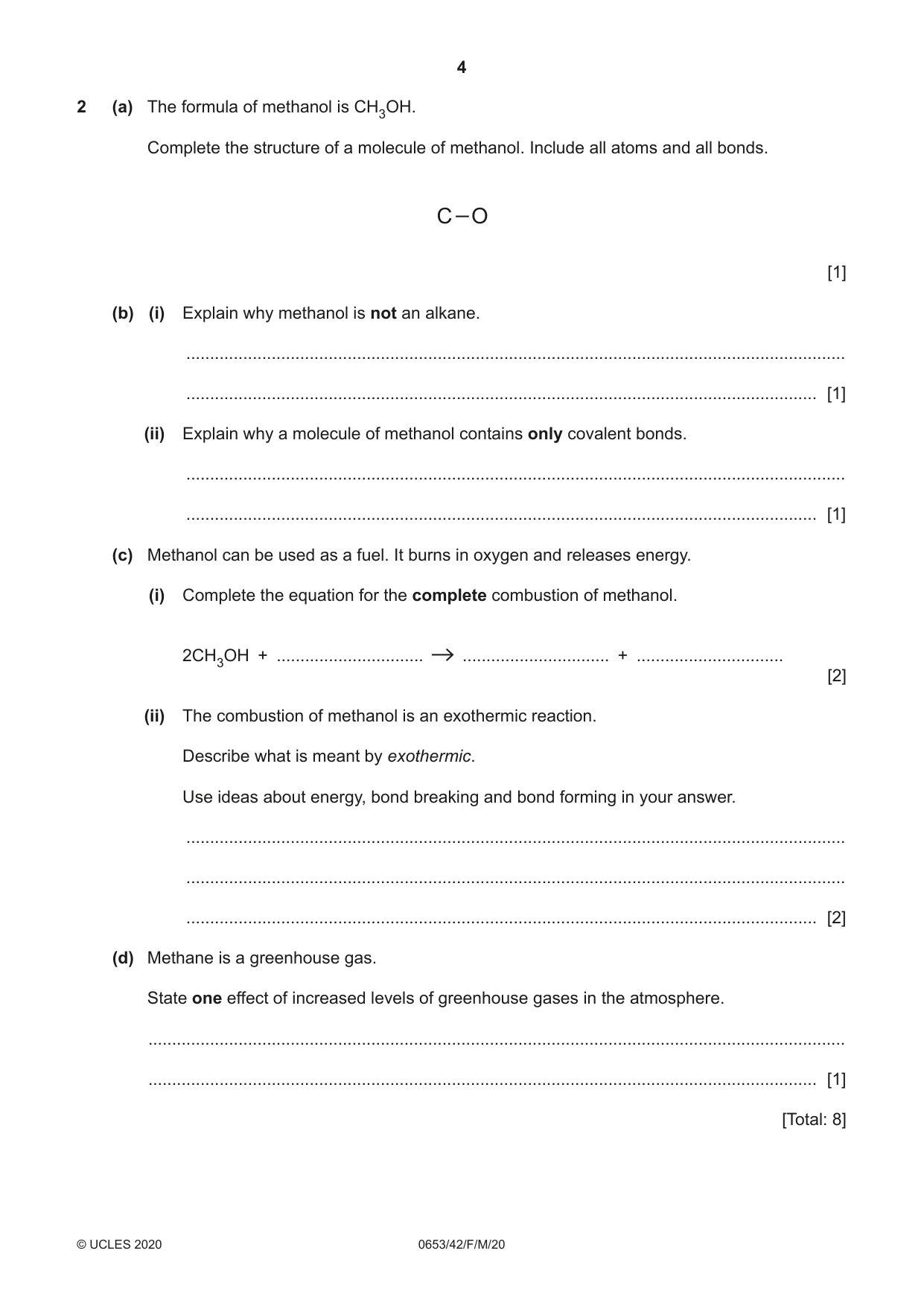
2 (a) The formula of methanol is CH3OH. Complete the structure of a molecule of methanol. Include all atoms and all bonds. C O [1] (b) (i) Explain why methanol is not an alkane. ........................................................................................................................................... ..................................................................................................................................... [1] (ii) Explain why a molecule of methanol contains only covalent bonds. ........................................................................................................................................... ..................................................................................................................................... [1] (c) Methanol can be used as a fuel. It burns in oxygen and releases energy. (i) Complete the equation for the complete combustion of methanol. 2CH3OH + ............................... ............................... + ............................... [2] (ii) The combustion of methanol is an exothermic reaction. Describe what is meant by exothermic. Use ideas about energy, bond breaking and bond forming in your answer. ........................................................................................................................................... ........................................................................................................................................... ..................................................................................................................................... [2] (d) Methane is a greenhouse gas. State one effect of increased levels of greenhouse gases in the atmosphere. ................................................................................................................................................... ............................................................................................................................................. [1] [Total: 8]
Mark scheme: 2(a) ; 2(b)(i) contains oxygen / is not carbon and hydrogen only ; 1 2(b)(ii) all bonds are between non-metal atoms ; 1 2(c)(i) (2CH3OH +) 3O2 → 2CO2 + 4H2O all formulae correct ; (correct formulae) balanced ; 2 Question Answer Marks 2(c)(ii) idea that energy is taken in to break bonds / that energy is released when bonds form ; (exothermic means) energy released is greater (than taken in) / (during an exothermic reaction) temperature increases / chemical energy converted to thermal ; 2 2(d) global warming / climate change / consequence of climate change, e.g. extreme weather events / rising sea level ; 1
Q3 · Liquid (molten) iron being poured from a furnace into a mould to form an iron rod in the…
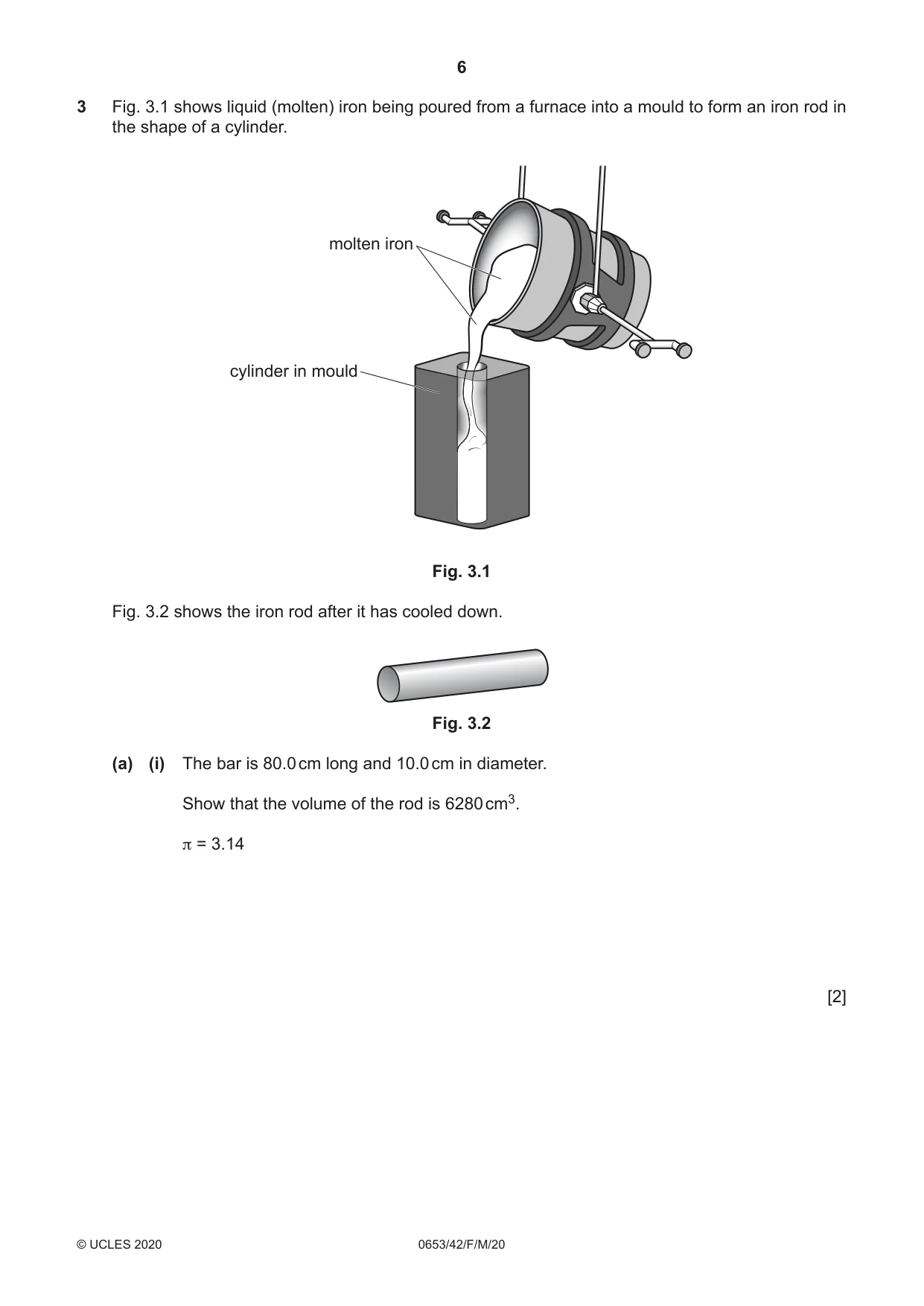
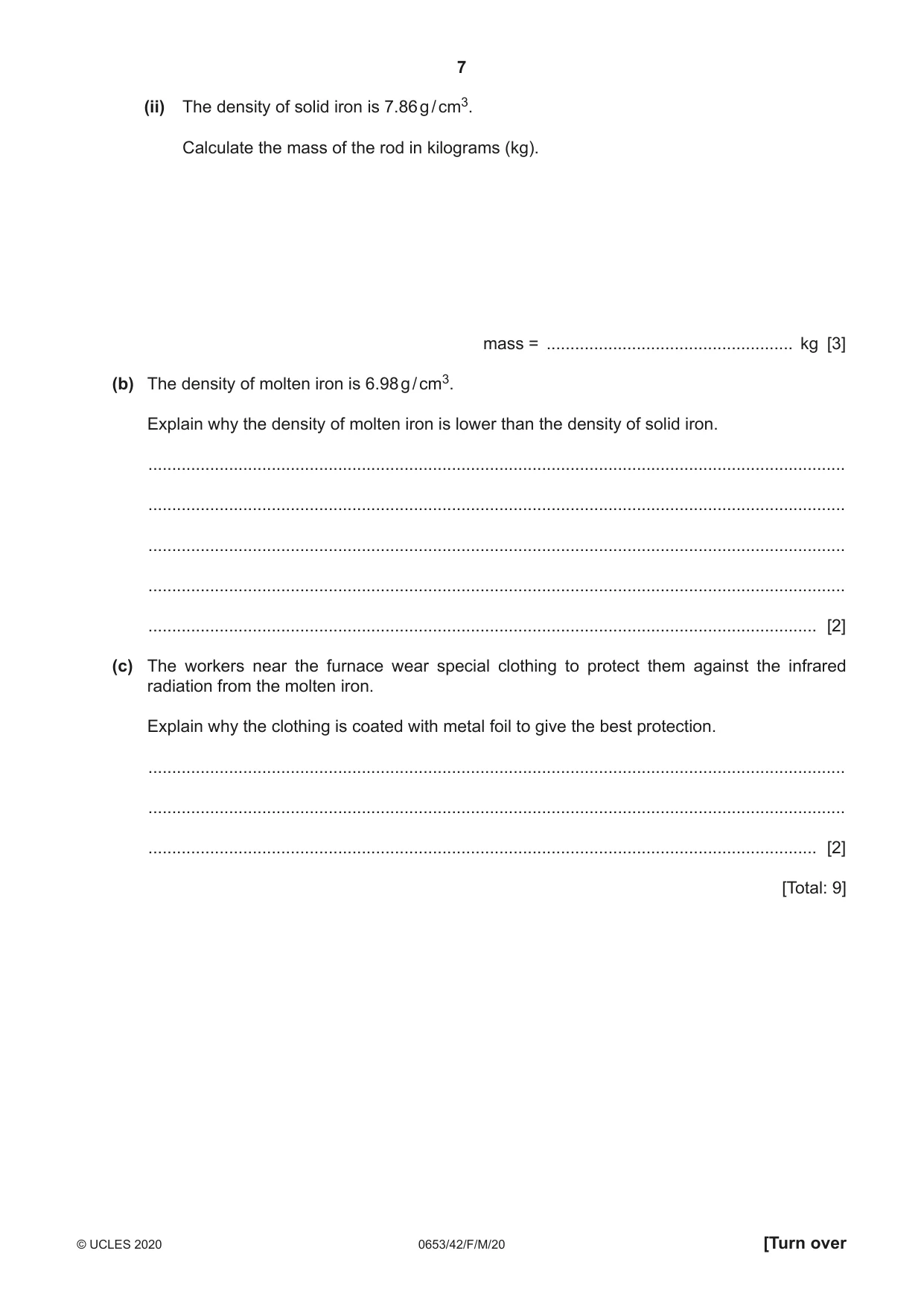
3 Fig. 3.1 shows liquid (molten) iron being poured from a furnace into a mould to form an iron rod in the shape of a cylinder. molten iron cylinder in mould Fig. 3.1 Fig. 3.2 shows the iron rod after it has cooled down. Fig. 3.2 (a) (i) The bar is 80.0 cm long and 10.0 cm in diameter. Show that the volume of the rod is 6280 cm3. π = 3.14 [2] (ii) The density of solid iron is 7.86 g / cm3. Calculate the mass of the rod in kilograms (kg). mass = .................................................... kg [3] (b) The density of molten iron is 6.98 g / cm3. Explain why the density of molten iron is lower than the density of solid iron. ................................................................................................................................................... ................................................................................................................................................... ................................................................................................................................................... ................................................................................................................................................... ............................................................................................................................................. [2] (c) The workers near the furnace wear special clothing to protect them against the infrared radiation from the molten iron. Explain why the clothing is coated with metal foil to give the best protection. ................................................................................................................................................... ................................................................................................................................................... ............................................................................................................................................. [2] [Total: 9]
Mark scheme: 3(a)(i) (volume) = πr2l / shows radius as 5 cm ; = 3.14 × 5 × 5 × 80 ; (= 6280 cm3) 2 3(a)(ii) (mass =) volume × density / 6280 × 7.86 ; = 49 400 / 49 360.8 (g) ; = 49.4 (kg) ; (3 sig. fig. required in final answer) 3 3(b) atoms in, molten / liquid iron further apart than in solid iron ; (same mass) occupies greater volume in liquid iron / greater volume for same mass equals lower density ; (answers must be comparative) 2 3(c) any two from: radiation is reflected ; and so less is absorbed ; (reflection is) better by a shiny surface / metal foil has shiny surface ; max 2
Q4 · Food taken in by the body must be digested so that the body can absorb the nutrients
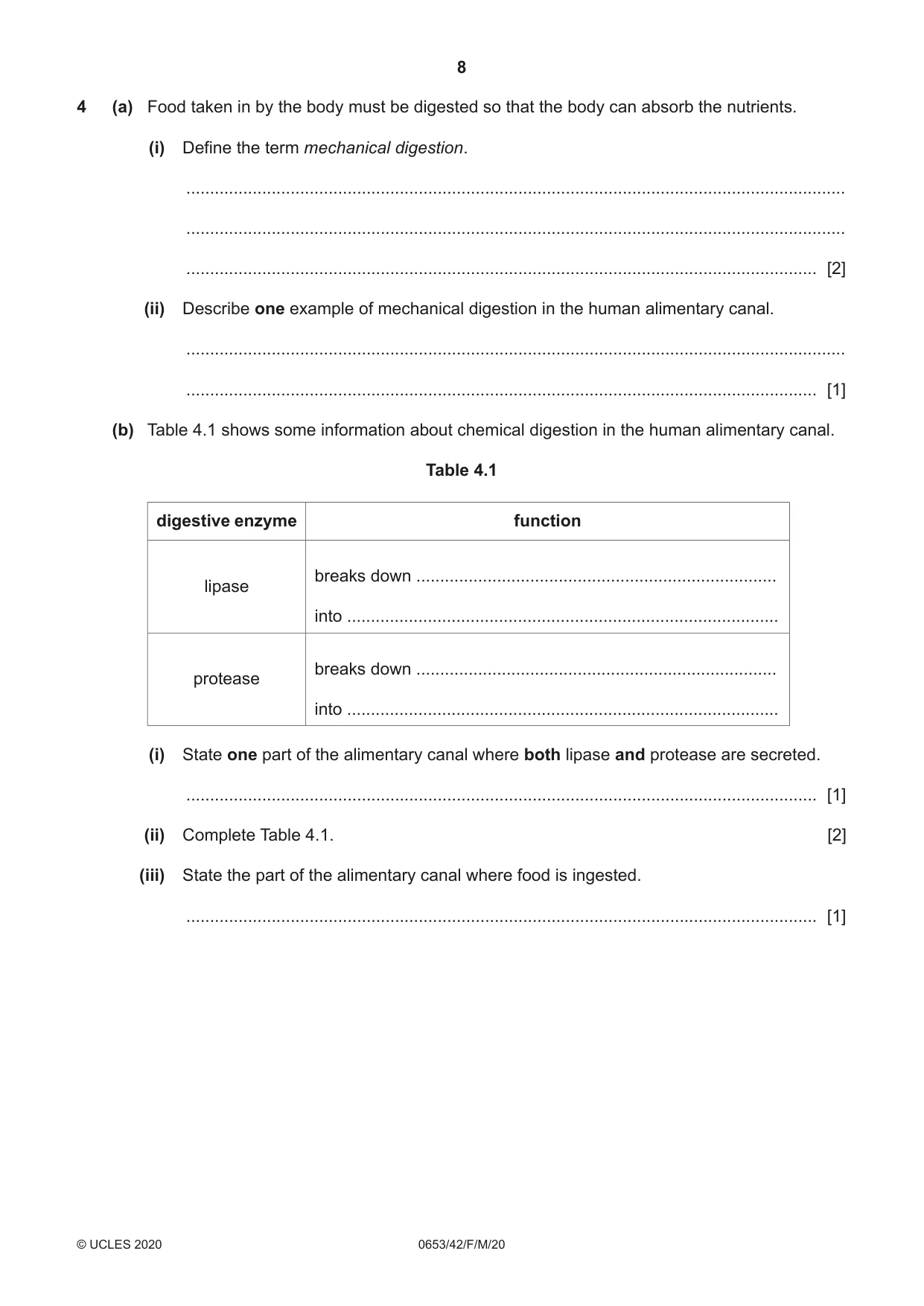
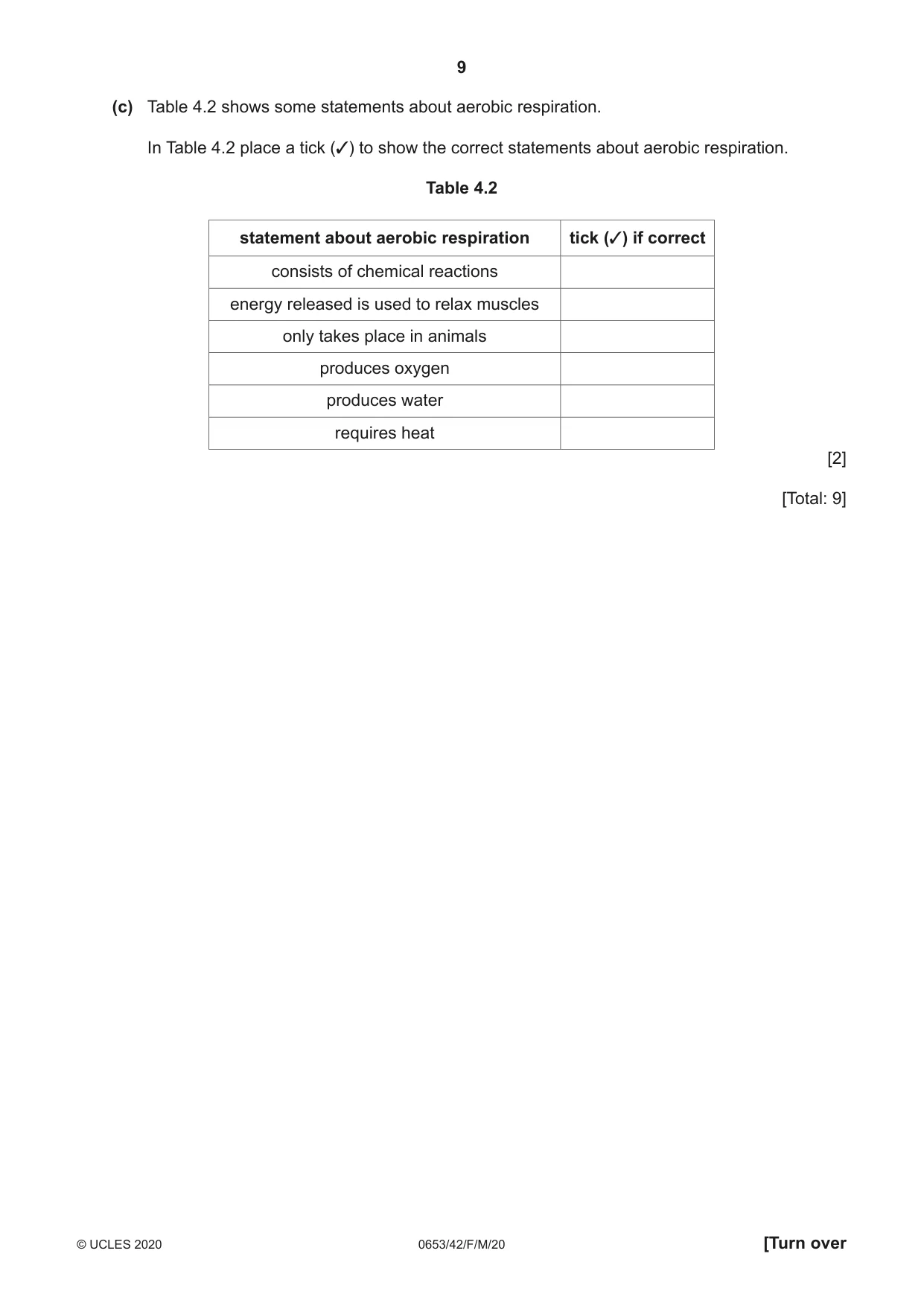
4 (a) Food taken in by the body must be digested so that the body can absorb the nutrients. (i) Define the term mechanical digestion. ........................................................................................................................................... ........................................................................................................................................... ..................................................................................................................................... [2] (ii) Describe one example of mechanical digestion in the human alimentary canal. ........................................................................................................................................... ..................................................................................................................................... [1] (b) Table 4.1 shows some information about chemical digestion in the human alimentary canal. Table 4.1 digestive enzyme function breaks down ............................................................................ lipase into ........................................................................................... breaks down ............................................................................ protease into ........................................................................................... (i) State one part of the alimentary canal where both lipase and protease are secreted. ..................................................................................................................................... [1] (ii) Complete Table 4.1. [2] (iii) State the part of the alimentary canal where food is ingested. ..................................................................................................................................... [1] (c) Table 4.2 shows some statements about aerobic respiration. In Table 4.2 place a tick (✓) to show the correct statements about aerobic respiration. Table 4.2 statement about aerobic respiration tick (✓) if correct consists of chemical reactions energy released is used to relax muscles only takes place in animals produces oxygen produces water requires heat [2] [Total: 9]
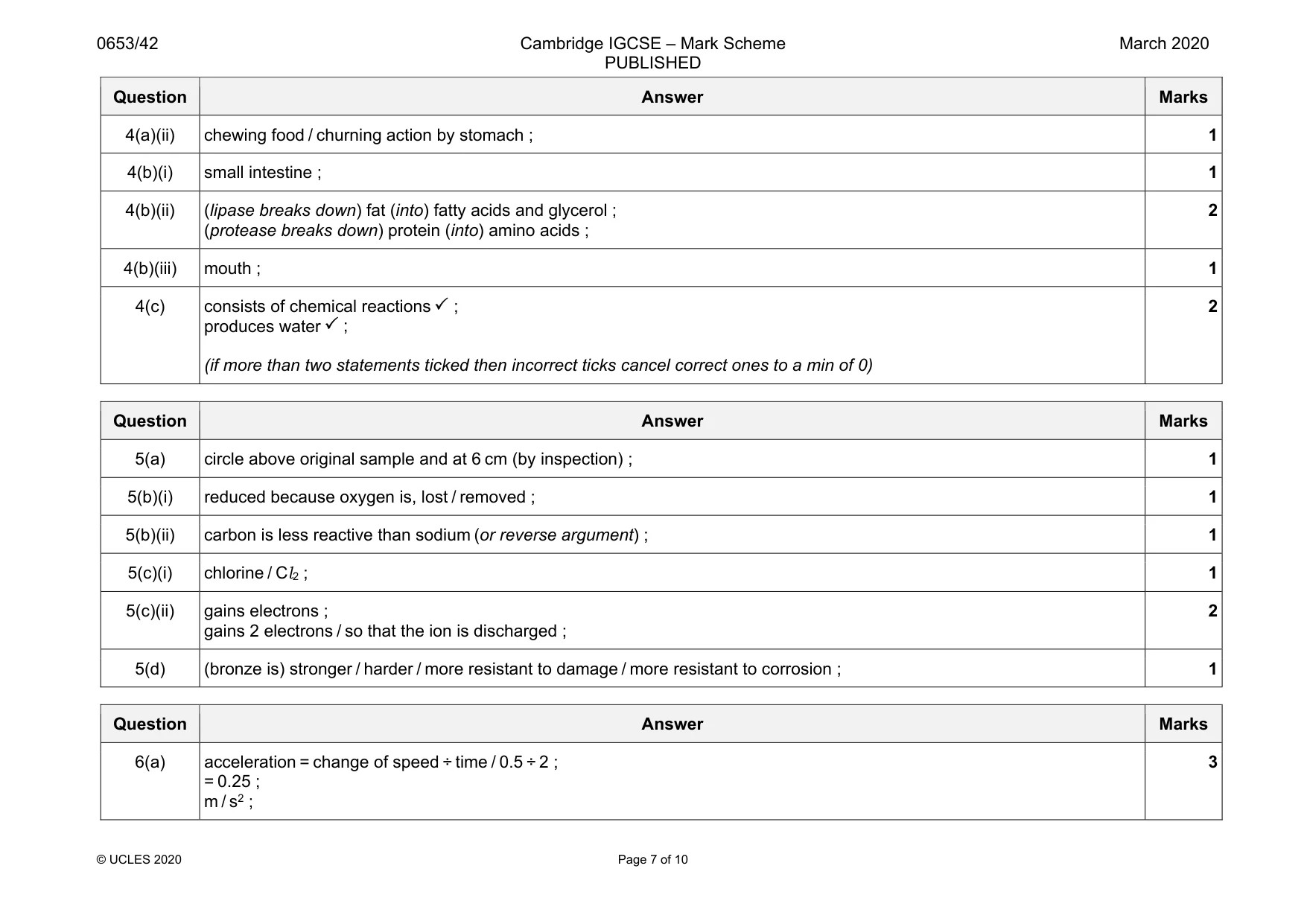
Mark scheme: 4(a)(i) the breakdown of food into smaller pieces ; without chemical change (to the food molecules) ; Question Answer Marks 4(a)(ii) chewing food / churning action by stomach ; 1 4(b)(i) small intestine ; 1 4(b)(ii) (lipase breaks down) fat (into) fatty acids and glycerol ; (protease breaks down) protein (into) amino acids ; 2 4(b)(iii) mouth ; 1 4(c) consists of chemical reactions ; produces water ; (if more than two statements ticked then incorrect ticks cancel correct ones to a min of 0) 2
Q5 · A student places a spot of copper chloride solution onto a piece of chromatography paper…
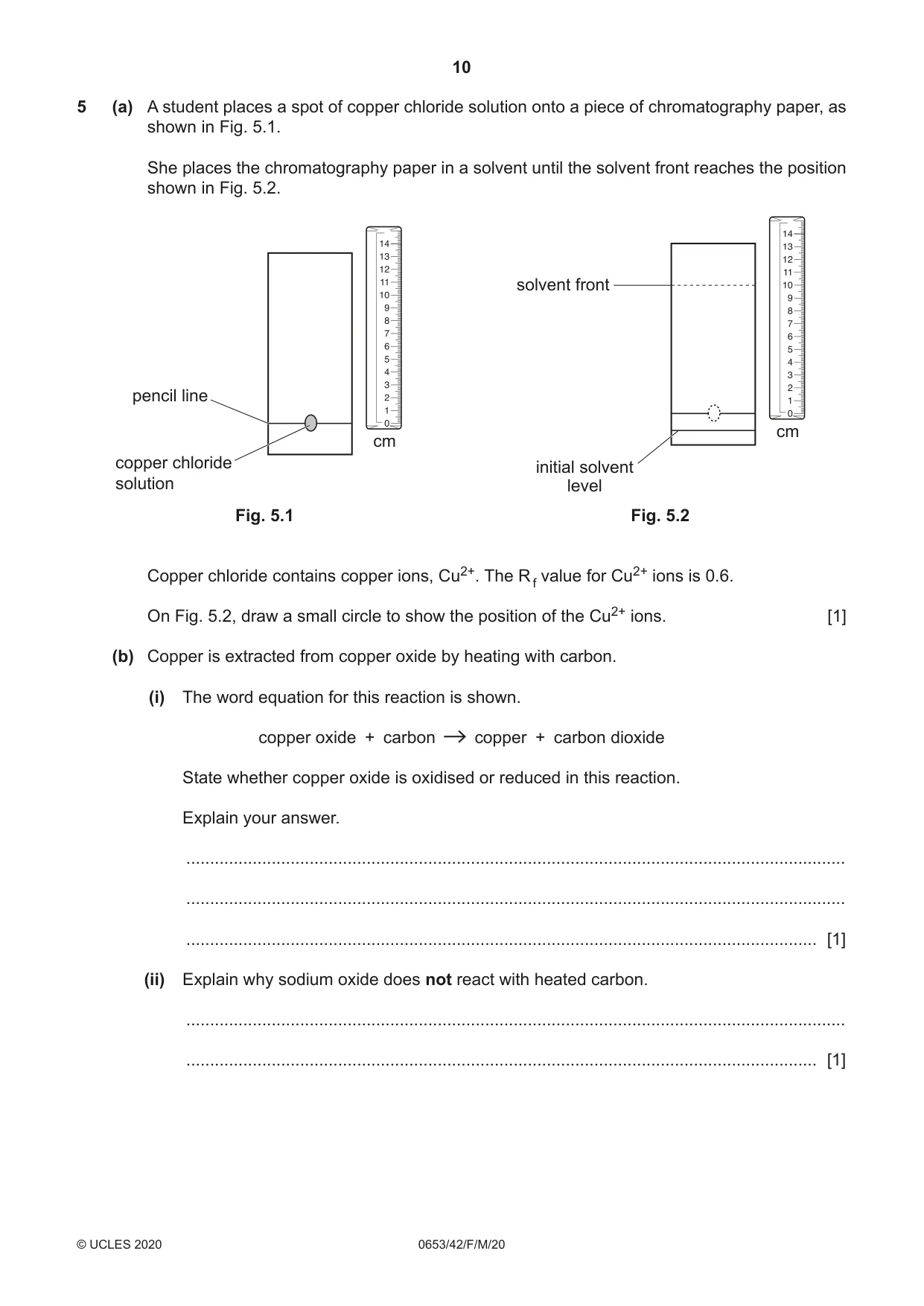
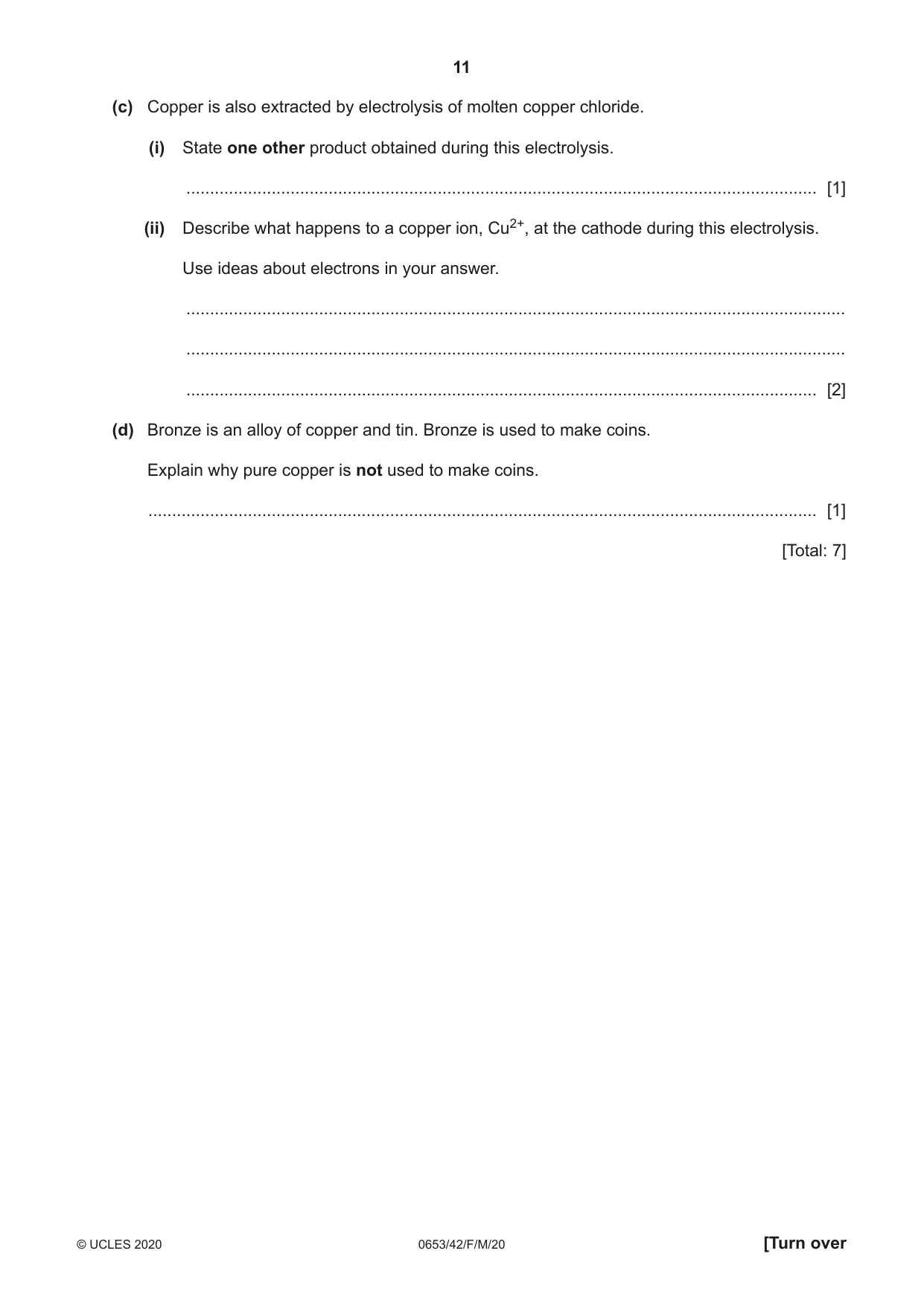
5 (a) A student places a spot of copper chloride solution onto a piece of chromatography paper, as shown in Fig. 5.1. She places the chromatography paper in a solvent until the solvent front reaches the position shown in Fig. 5.2. solvent front pencil line cm cm copper chloride initial solvent solution level Fig. 5.1 Fig. 5.2 Copper chloride contains copper ions, Cu2+. The R f value for Cu2+ ions is 0.6. On Fig. 5.2, draw a small circle to show the position of the Cu2+ ions. [1] (b) Copper is extracted from copper oxide by heating with carbon. (i) The word equation for this reaction is shown. copper oxide + carbon copper + carbon dioxide State whether copper oxide is oxidised or reduced in this reaction. Explain your answer. ........................................................................................................................................... ........................................................................................................................................... ..................................................................................................................................... [1] (ii) Explain why sodium oxide does not react with heated carbon. ........................................................................................................................................... ..................................................................................................................................... [1] (c) Copper is also extracted by electrolysis of molten copper chloride. (i) State one other product obtained during this electrolysis. ..................................................................................................................................... [1] (ii) Describe what happens to a copper ion, Cu2+, at the cathode during this electrolysis. Use ideas about electrons in your answer. ........................................................................................................................................... ........................................................................................................................................... ..................................................................................................................................... [2] (d) Bronze is an alloy of copper and tin. Bronze is used to make coins. Explain why pure copper is not used to make coins. ............................................................................................................................................. [1] [Total: 7]
Mark scheme: 5(a) circle above original sample and at 6 cm (by inspection) ; 1 5(b)(i) reduced because oxygen is, lost / removed ; 1 5(b)(ii) carbon is less reactive than sodium (or reverse argument) ; 1 5(c)(i) chlorine / Cl2 ; 1 5(c)(ii) gains electrons ; gains 2 electrons / so that the ion is discharged ; 2 5(d) (bronze is) stronger / harder / more resistant to damage / more resistant to corrosion ; 1
Q6 · A crane lifting a load to the top of a building
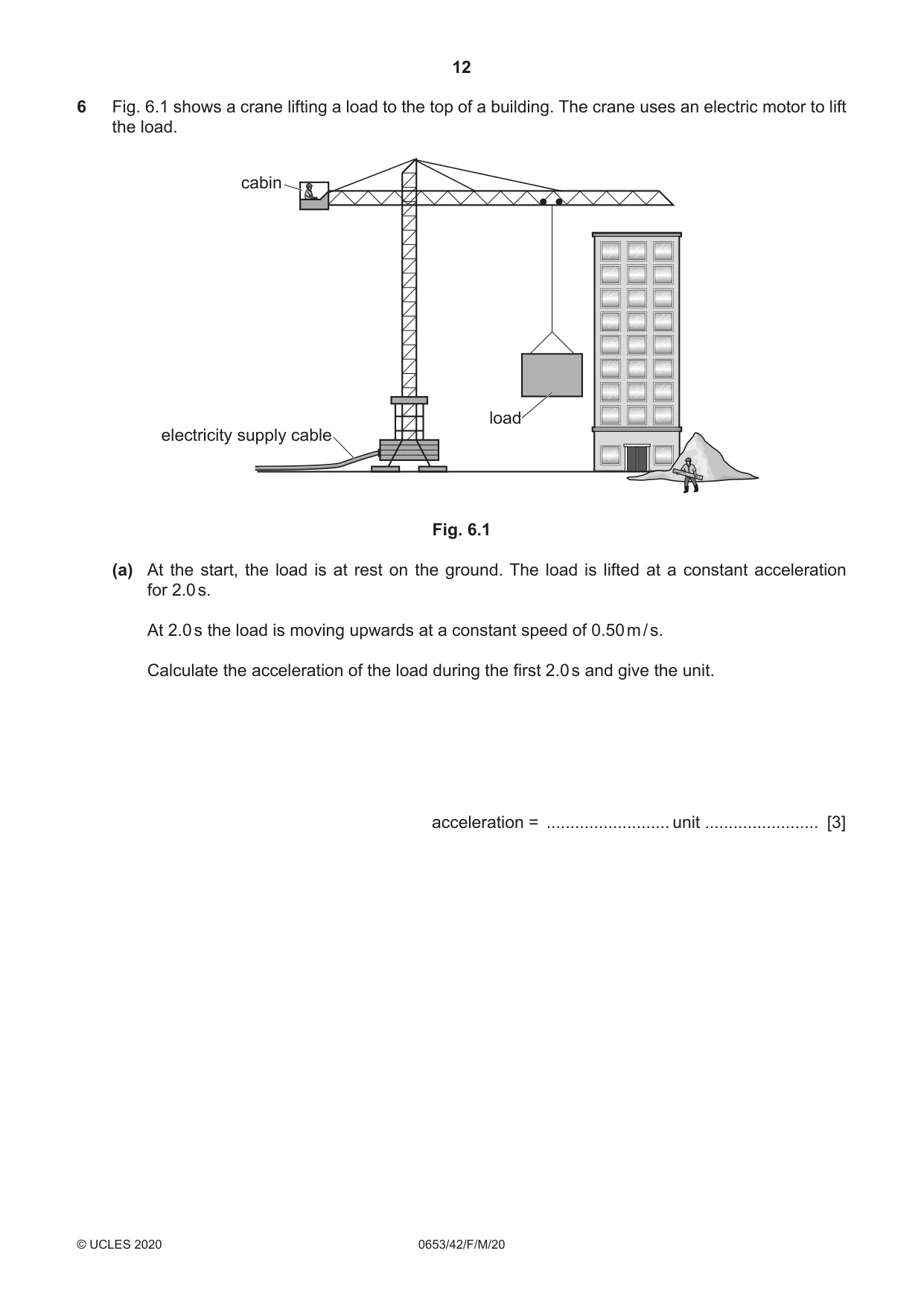
6 Fig. 6.1 shows a crane lifting a load to the top of a building. The crane uses an electric motor to lift the load. cabin load electricity supply cable Fig. 6.1 (a) At the start, the load is at rest on the ground. The load is lifted at a constant acceleration for 2.0 s. At 2.0 s the load is moving upwards at a constant speed of 0.50 m / s. Calculate the acceleration of the load during the first 2.0 s and give the unit. acceleration = .......................... unit ........................ [3] (b) The mass of the load is 500 kg. (i) The load is lifted from the ground to the top of the building 25 m above the ground. Gravitational field strength is 10 N / kg. Calculate the work done on the load. Show your working. work done = ...................................................... J [2] (ii) The power of the electric motor lifting the load is 5 kW. The crane takes 56 s to lift the load to the top of the building. Calculate the electrical energy supplied to the electric motor in this time. energy = ...................................................... J [2] (iii) The electrical energy supplied is greater than the useful work done on the load. Some electrical energy is transferred in other ways. Suggest one other way in which this electrical energy is used. ........................................................................................................................................... ........................................................................................................................................... ..................................................................................................................................... [1] [Total: 8]
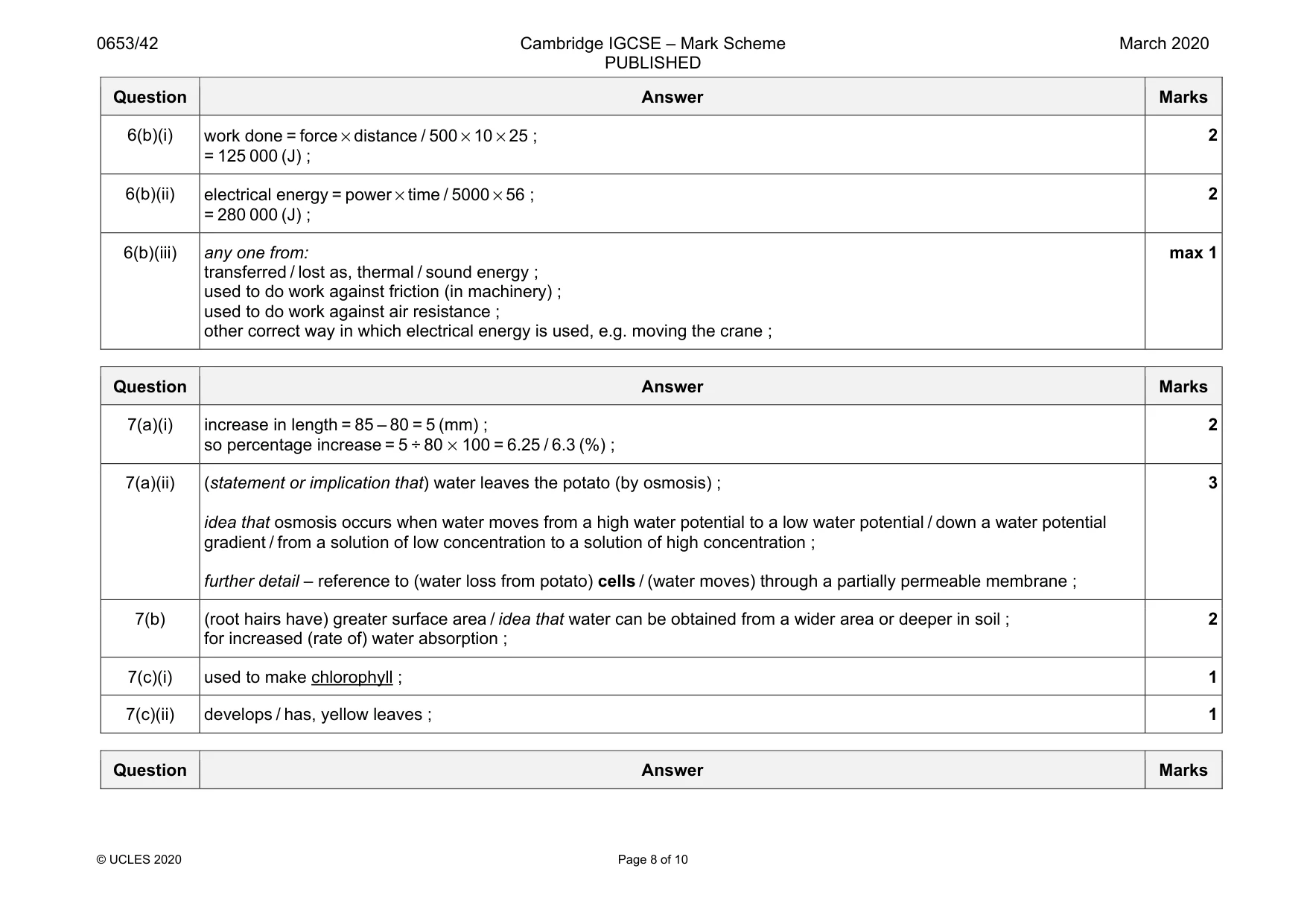
Mark scheme: 6(a) acceleration = change of speed ÷ time / 0.5 ÷ 2 ; = 0.25 ; m / s2 ; 3 Question Answer Marks 6(b)(i) work done = force × distance / 500 × 10 × 25 ; = 125 000 (J) ; 2 6(b)(ii) electrical energy = power × time / 5000 × 56 ; = 280 000 (J) ; 2 6(b)(iii) any one from: transferred / lost as, thermal / sound energy ; used to do work against friction (in machinery) ; used to do work against air resistance ; other correct way in which electrical energy is used, e.g. moving the crane ; max 1
Q7 · Potato pieces A, B and C are immersed in salt solutions of different concentrations for…
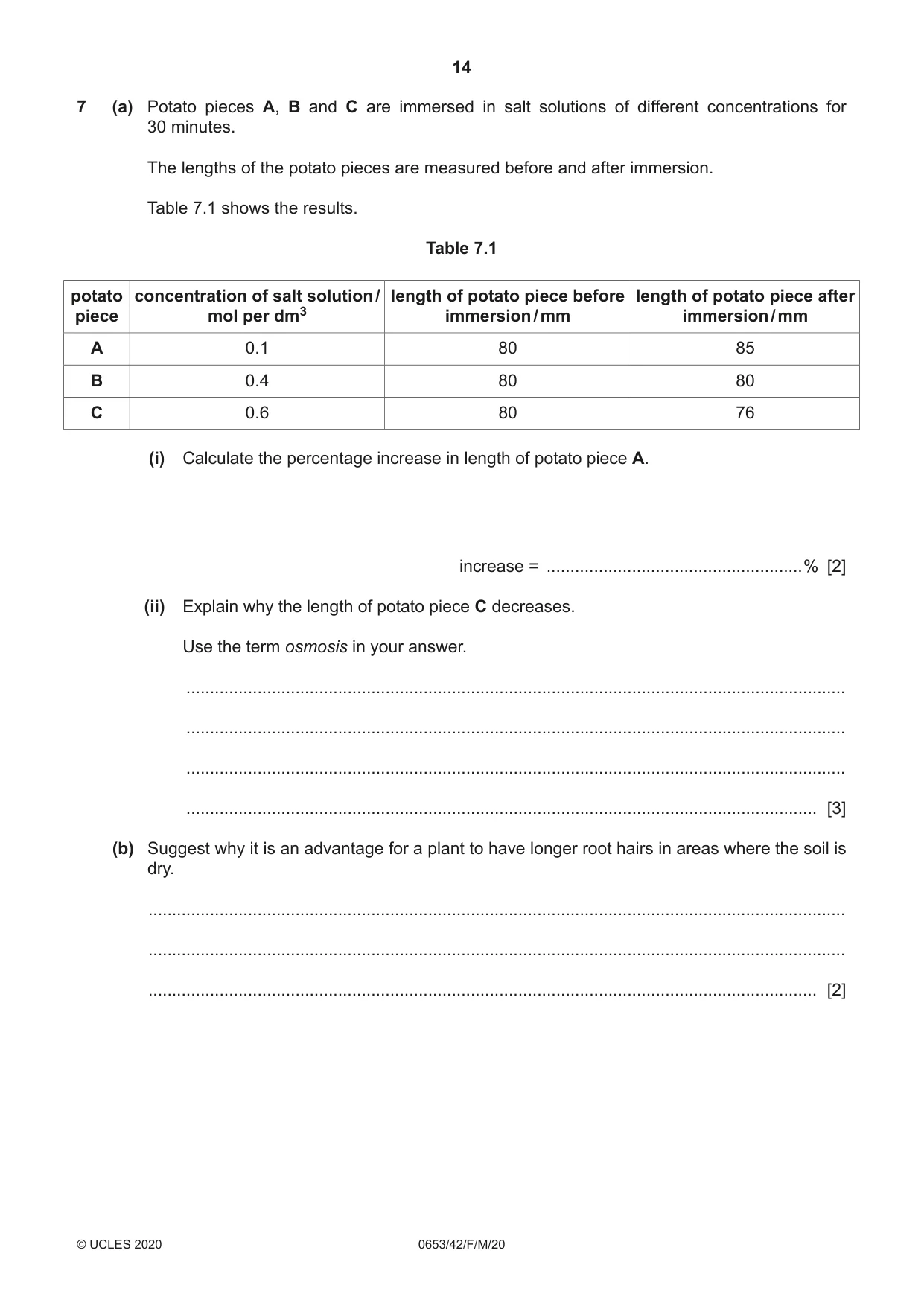
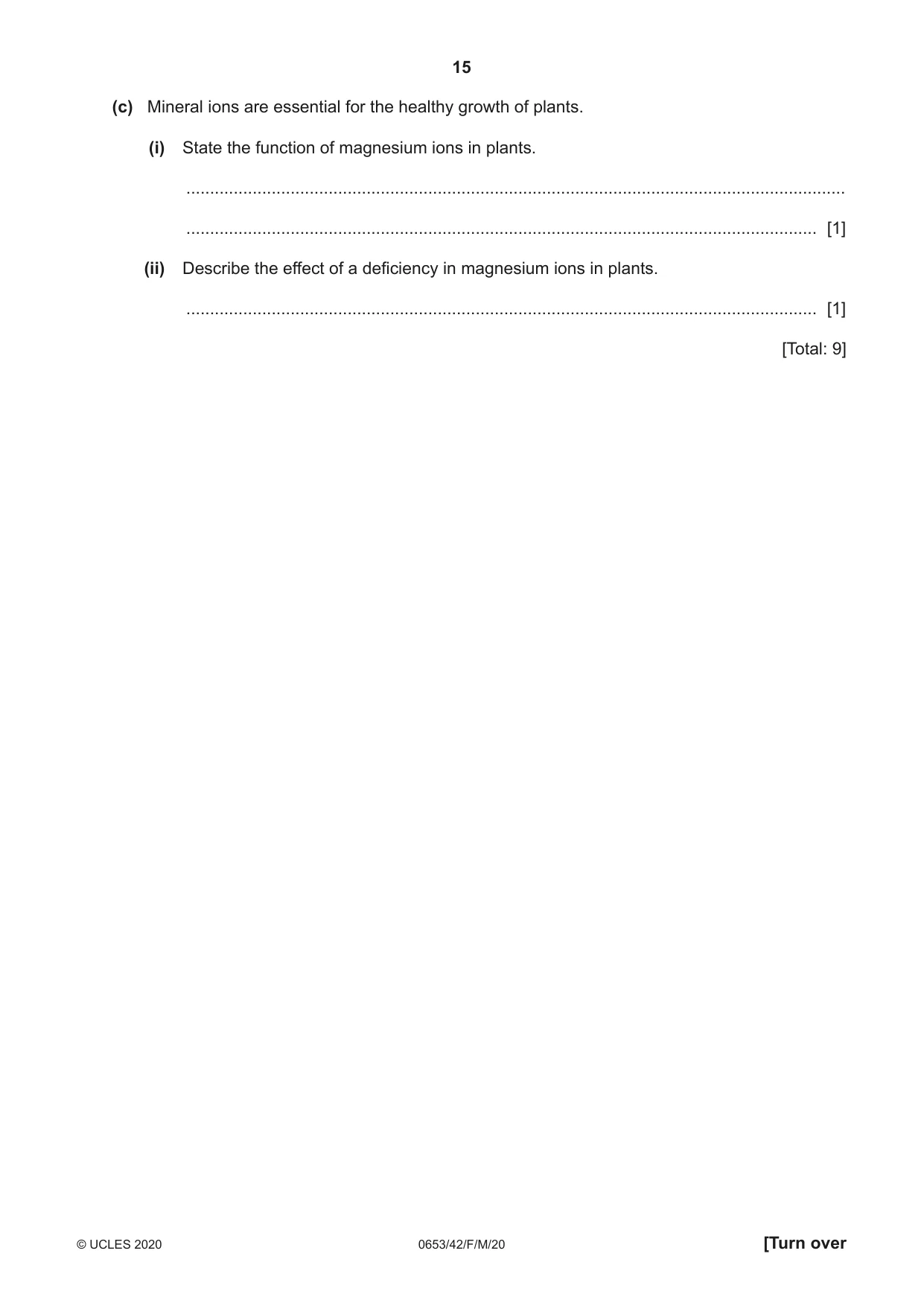
7 (a) Potato pieces A, B and C are immersed in salt solutions of different concentrations for 30 minutes. The lengths of the potato pieces are measured before and after immersion. Table 7.1 shows the results. Table 7.1 potato concentration of salt solution / length of potato piece before length of potato piece after piece mol per dm3 immersion / mm immersion / mm A 0.1 80 85 B 0.4 80 80 C 0.6 80 76 (i) Calculate the percentage increase in length of potato piece A. increase = ......................................................% [2] (ii) Explain why the length of potato piece C decreases. Use the term osmosis in your answer. ........................................................................................................................................... ........................................................................................................................................... ........................................................................................................................................... ..................................................................................................................................... [3] (b) Suggest why it is an advantage for a plant to have longer root hairs in areas where the soil is dry. ................................................................................................................................................... ................................................................................................................................................... ............................................................................................................................................. [2] (c) Mineral ions are essential for the healthy growth of plants. (i) State the function of magnesium ions in plants. ........................................................................................................................................... ..................................................................................................................................... [1] (ii) Describe the effect of a deficiency in magnesium ions in plants. ..................................................................................................................................... [1] [Total: 9]
Mark scheme: 7(a)(i) increase in length = 85 – 80 = 5 (mm) ; so percentage increase = 5 ÷ 80 × 100 = 6.25 / 6.3 (%) ; 2 7(a)(ii) (statement or implication that) water leaves the potato (by osmosis) ; idea that osmosis occurs when water moves from a high water potential to a low water potential / down a water potential gradient / from a solution of low concentration to a solution of high concentration ; further detail – reference to (water loss from potato) cells / (water moves) through a partially permeable membrane ; 3 7(b) (root hairs have) greater surface area / idea that water can be obtained from a wider area or deeper in soil ; for increased (rate of) water absorption ; 2 7(c)(i) used to make chlorophyll ; 1 7(c)(ii) develops / has, yellow leaves ; 1 Question Answer Marks
Q8 · A bromine atom contains seven electrons in its outer shell
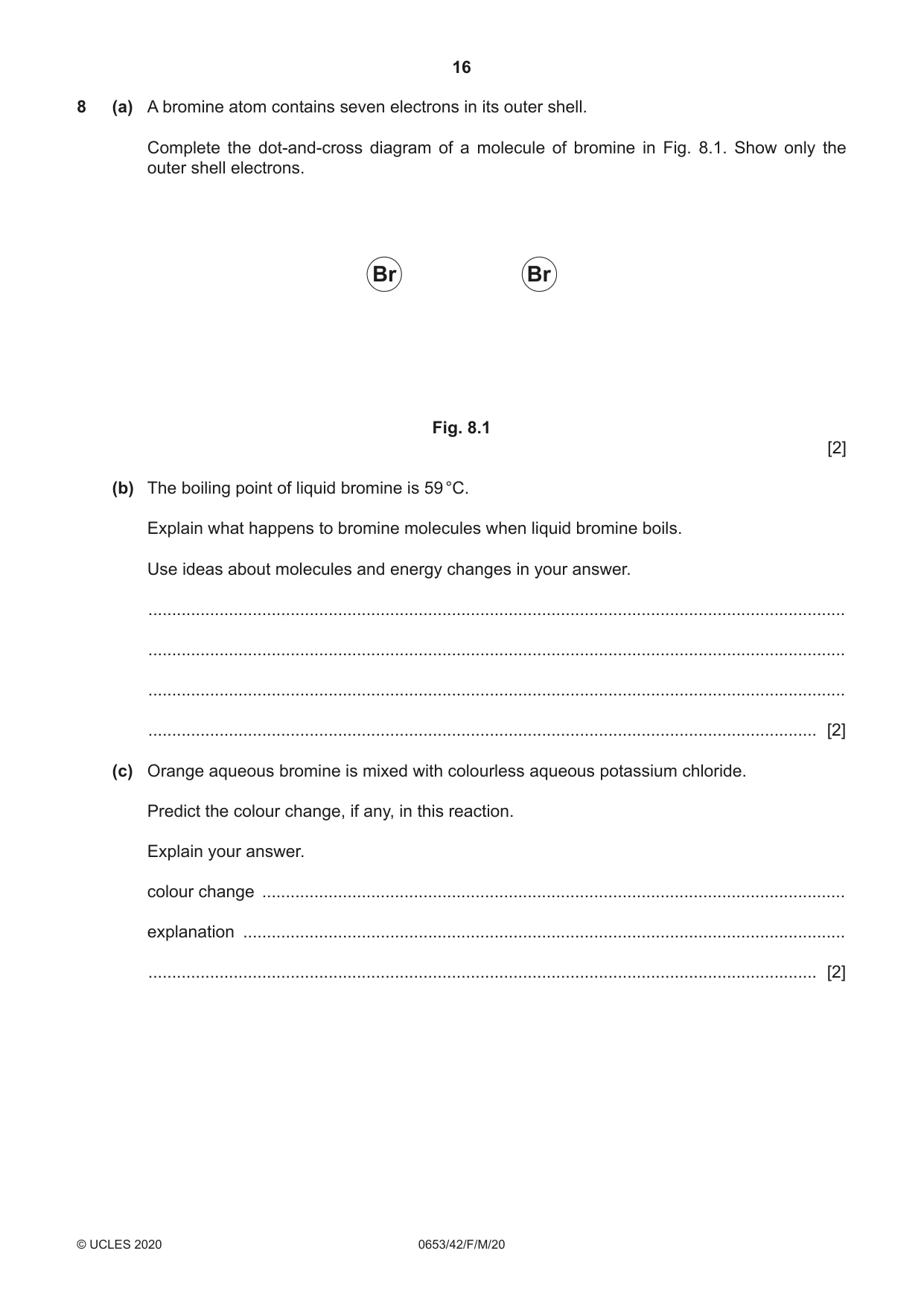
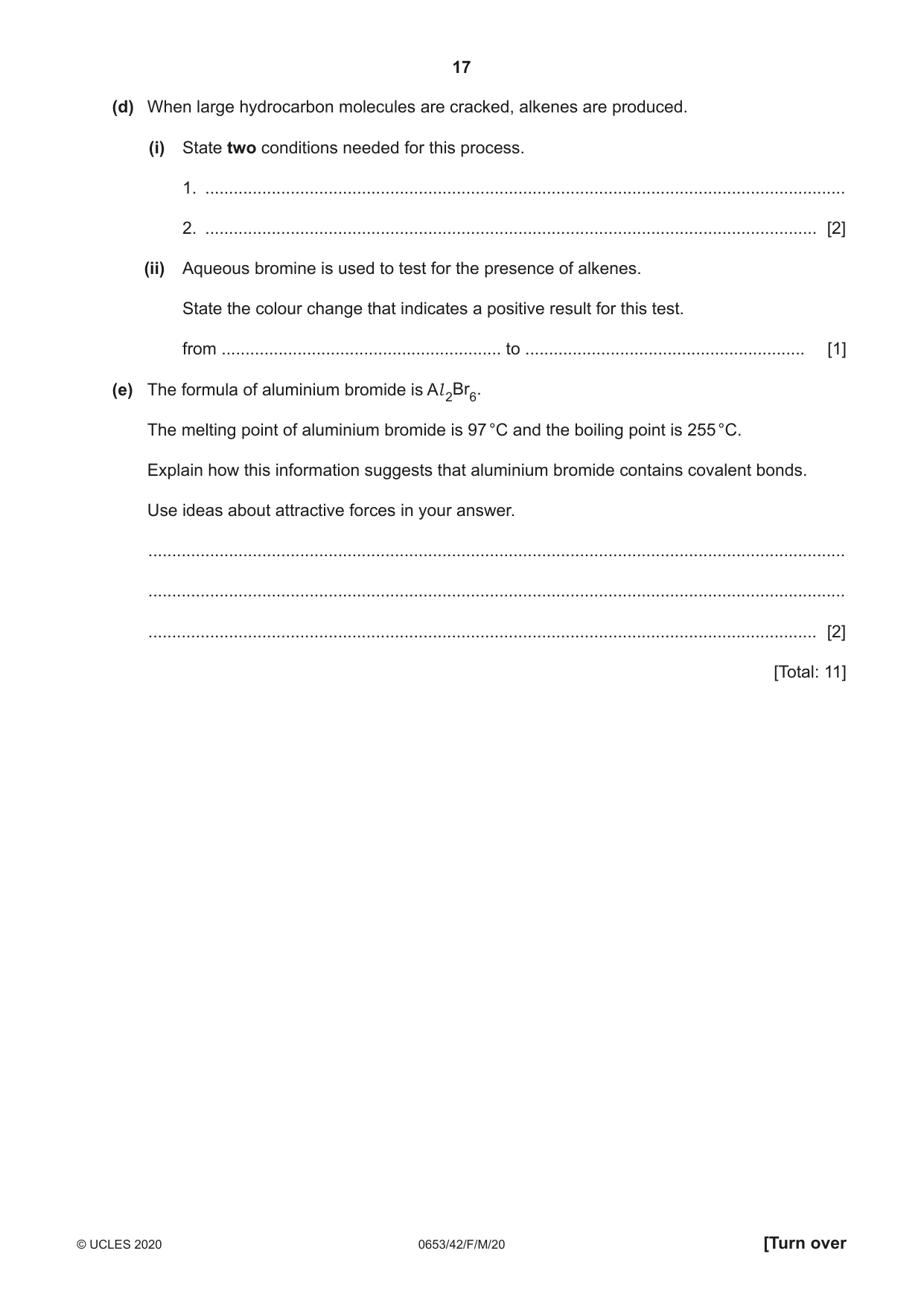
8 (a) A bromine atom contains seven electrons in its outer shell. Complete the dot-and-cross diagram of a molecule of bromine in Fig. 8.1. Show only the outer shell electrons. Br Br Fig. 8.1 [2] (b) The boiling point of liquid bromine is 59 °C. Explain what happens to bromine molecules when liquid bromine boils. Use ideas about molecules and energy changes in your answer. ................................................................................................................................................... ................................................................................................................................................... ................................................................................................................................................... ............................................................................................................................................. [2] (c) Orange aqueous bromine is mixed with colourless aqueous potassium chloride. Predict the colour change, if any, in this reaction. Explain your answer. colour change ........................................................................................................................... explanation ............................................................................................................................... ............................................................................................................................................. [2] (d) When large hydrocarbon molecules are cracked, alkenes are produced. (i) State two conditions needed for this process. 1. ....................................................................................................................................... 2. ................................................................................................................................. [2] (ii) Aqueous bromine is used to test for the presence of alkenes. State the colour change that indicates a positive result for this test. from ........................................................... to ........................................................... [1] (e) The formula of aluminium bromide is Al 2Br6. The melting point of aluminium bromide is 97 °C and the boiling point is 255 °C. Explain how this information suggests that aluminium bromide contains covalent bonds. Use ideas about attractive forces in your answer. ................................................................................................................................................... ................................................................................................................................................... ............................................................................................................................................. [2] [Total: 11]
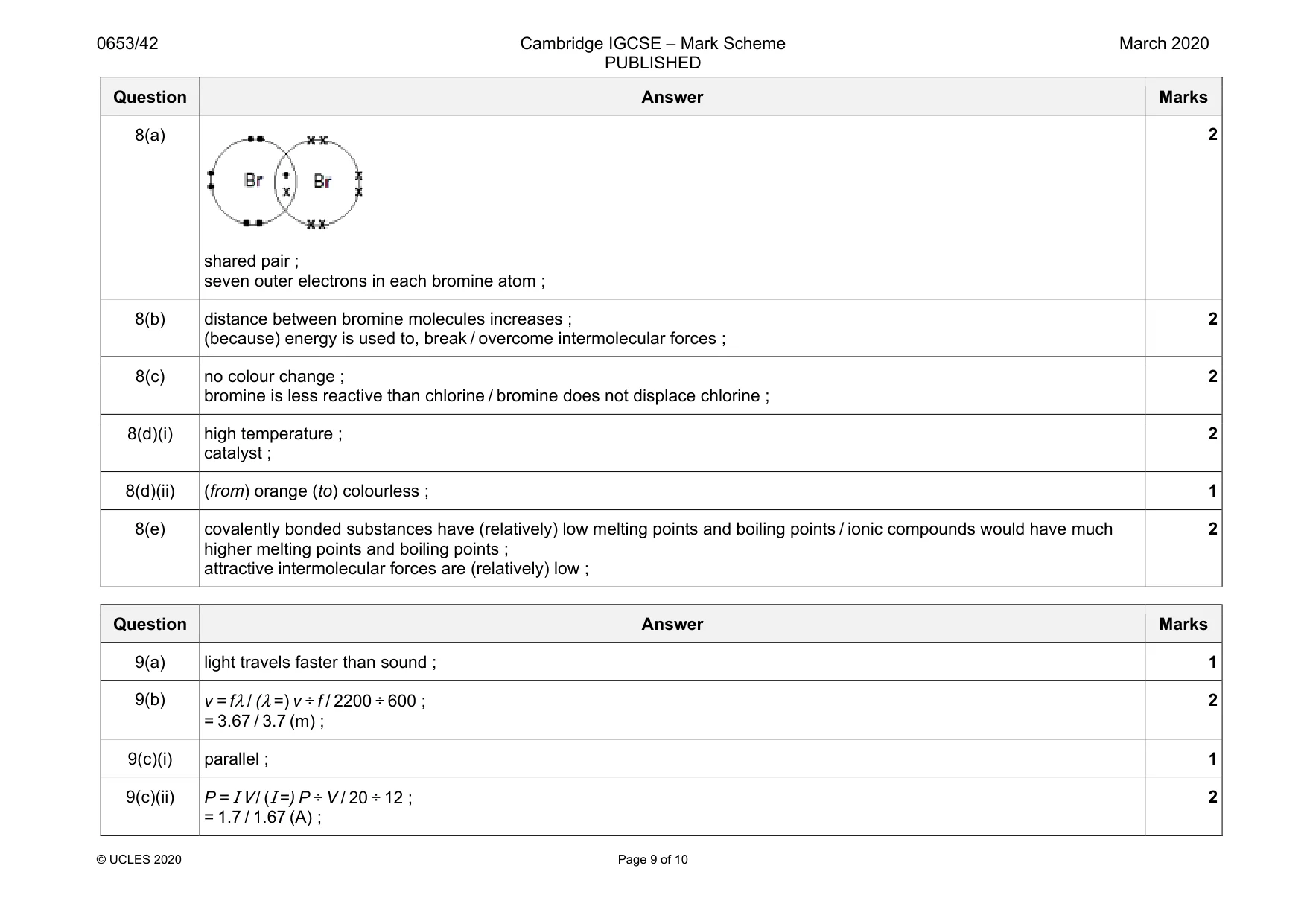
Mark scheme: 8(a) shared pair ; seven outer electrons in each bromine atom ; 8(b) distance between bromine molecules increases ; (because) energy is used to, break / overcome intermolecular forces ; 2 8(c) no colour change ; bromine is less reactive than chlorine / bromine does not displace chlorine ; 2 8(d)(i) high temperature ; catalyst ; 2 8(d)(ii) (from) orange (to) colourless ; 1 8(e) covalently bonded substances have (relatively) low melting points and boiling points / ionic compounds would have much higher melting points and boiling points ; attractive intermolecular forces are (relatively) low ; 2
Question 9
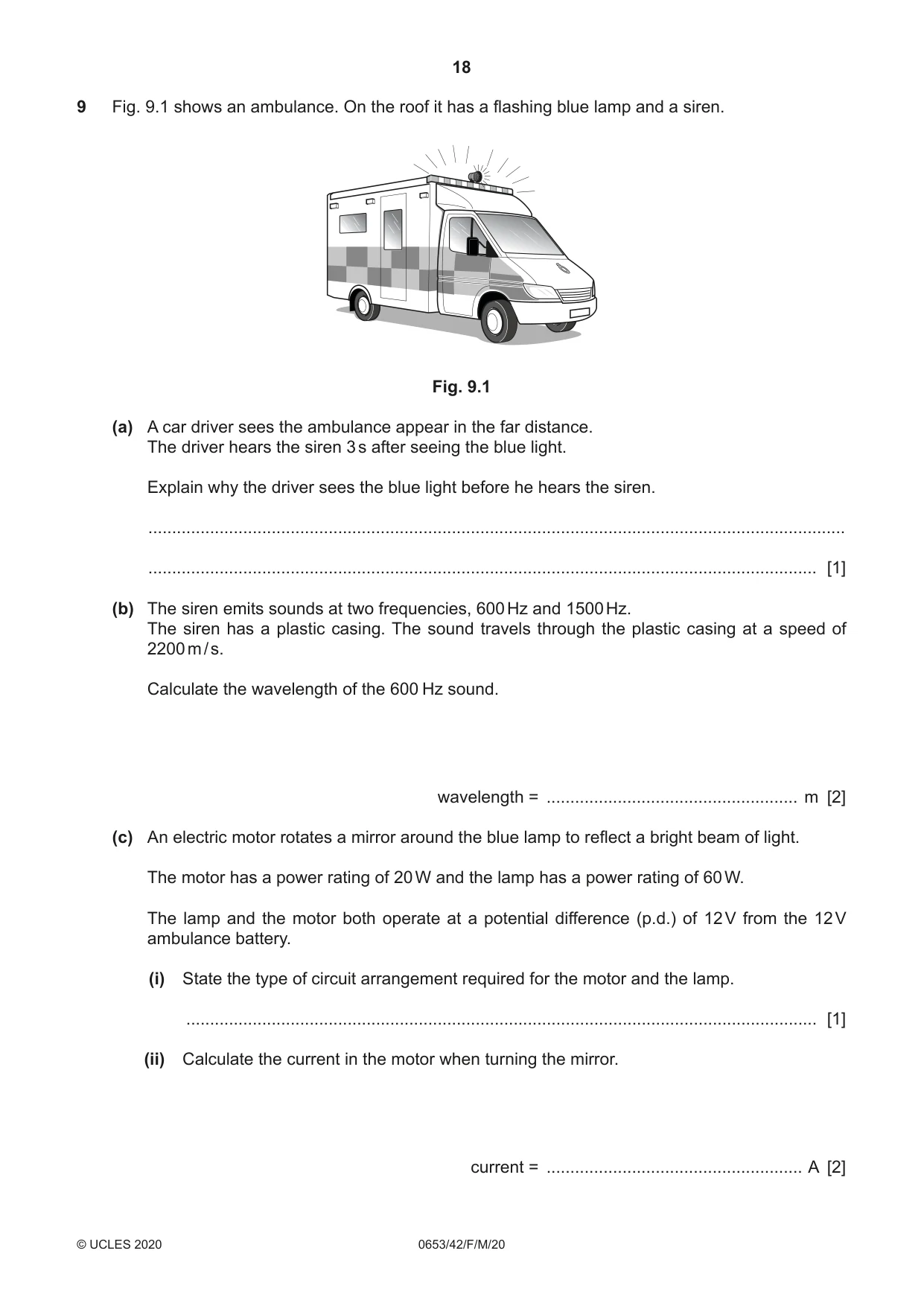
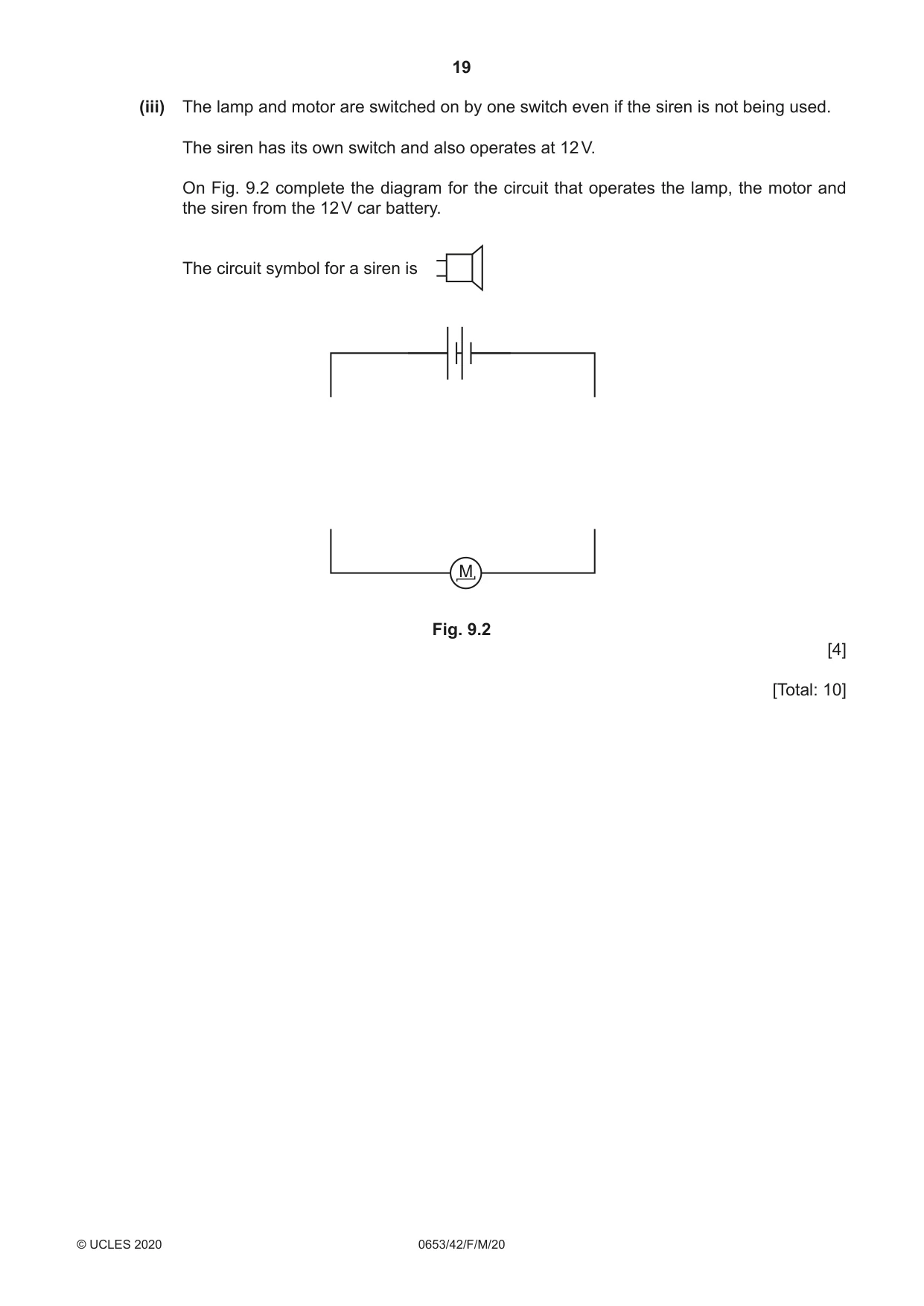
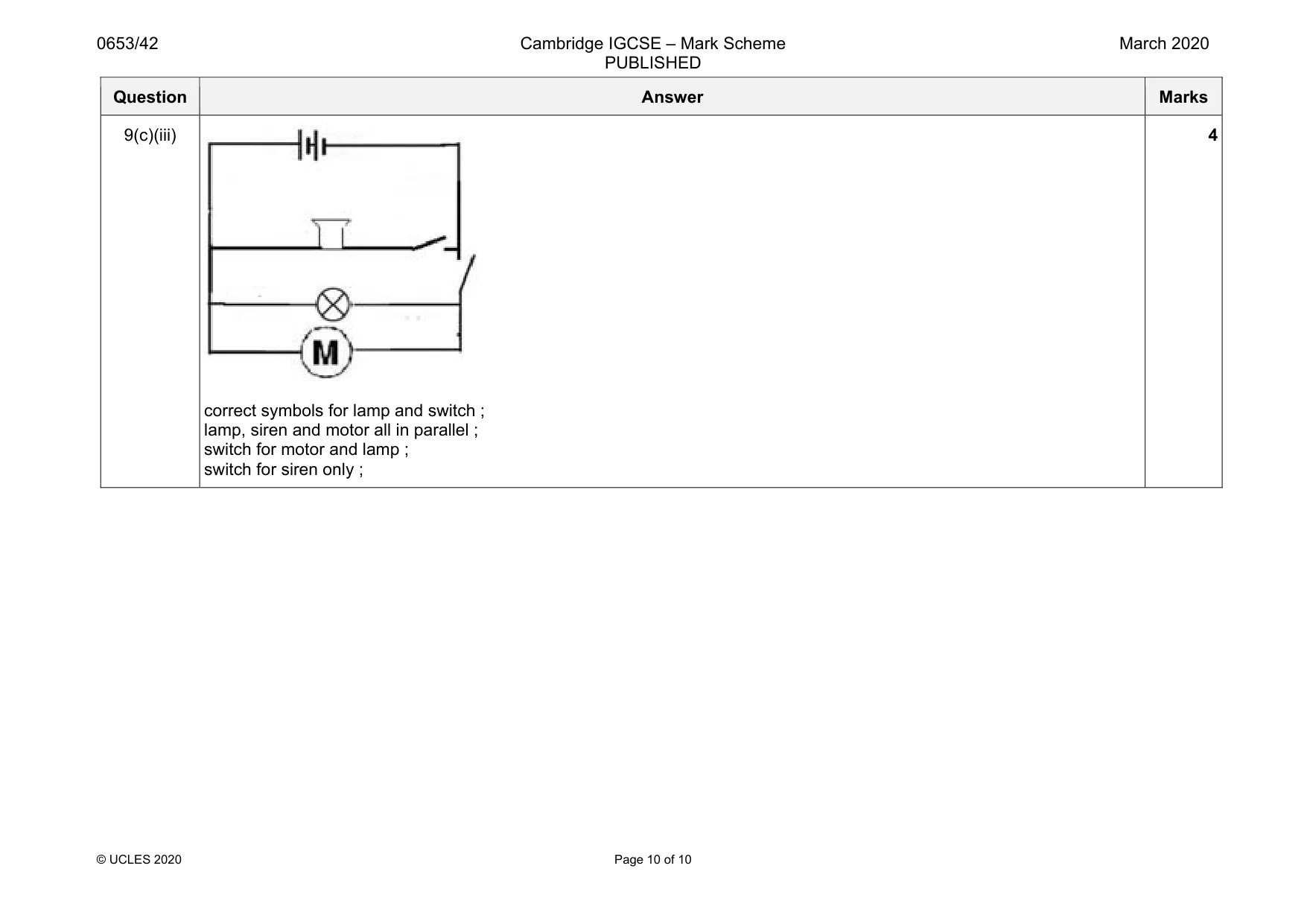
9 Fig. 9.1 shows an ambulance. On the roof it has a flashing blue lamp and a siren. Fig. 9.1 (a) A car driver sees the ambulance appear in the far distance. The driver hears the siren 3 s after seeing the blue light. Explain why the driver sees the blue light before he hears the siren. ................................................................................................................................................... ............................................................................................................................................. [1] (b) The siren emits sounds at two frequencies, 600 Hz and 1500 Hz. The siren has a plastic casing. The sound travels through the plastic casing at a speed of 2200 m / s. Calculate the wavelength of the 600 Hz sound. wavelength = ..................................................... m [2] (c) An electric motor rotates a mirror around the blue lamp to reflect a bright beam of light. The motor has a power rating of 20 W and the lamp has a power rating of 60 W. The lamp and the motor both operate at a potential difference (p.d.) of 12 V from the 12 V ambulance battery. (i) State the type of circuit arrangement required for the motor and the lamp. ..................................................................................................................................... [1] (ii) Calculate the current in the motor when turning the mirror. current = ...................................................... A [2] (iii) The lamp and motor are switched on by one switch even if the siren is not being used. The siren has its own switch and also operates at 12 V. On Fig. 9.2 complete the diagram for the circuit that operates the lamp, the motor and the siren from the 12 V car battery. The circuit symbol for a siren is M Fig. 9.2 [4] [Total: 10]
Mark scheme: 9(a) light travels faster than sound ; 1 9(b) v = fλ / (λ =) v ÷ f / 2200 ÷ 600 ; = 3.67 / 3.7 (m) ; 2 9(c)(i) parallel ; 1 9(c)(ii) P = I V / (I =) P ÷ V / 20 ÷ 12 ; = 1.7 / 1.67 (A) ; 2 Question Answer Marks 9(c)(iii) correct symbols for lamp and switch ; lamp, siren and motor all in parallel ; switch for motor and lamp ; switch for siren only ; 4
What was in this paper
The subtopics covered by these 9 questions, and how many questions each got. Open one in a new tab to see every Cambridge question on it.
What you needed in this session
Cambridge’s own grade thresholds for 2020 Feb/March, Paper 4 · Variant 2. A higher threshold means an easier paper — the bar moves with how the cohort did.