Cambridge IGCSE Science - Combined 0653 — 2020 Oct/Nov Paper 4 · Variant 1
0653/41/O/N/20 · 9 questions · 80 marks · ≈90 min
The question paper and its mark scheme, free to read here and free to download. This is Cambridge’s own paper, exactly as it was sat.
Question paper20 pages
Mark scheme10 pages
Answers below. Sit the paper first if you are practising.
Questions as text
Q1 · Gas exchange takes place at the gas exchange surfaces of organisms
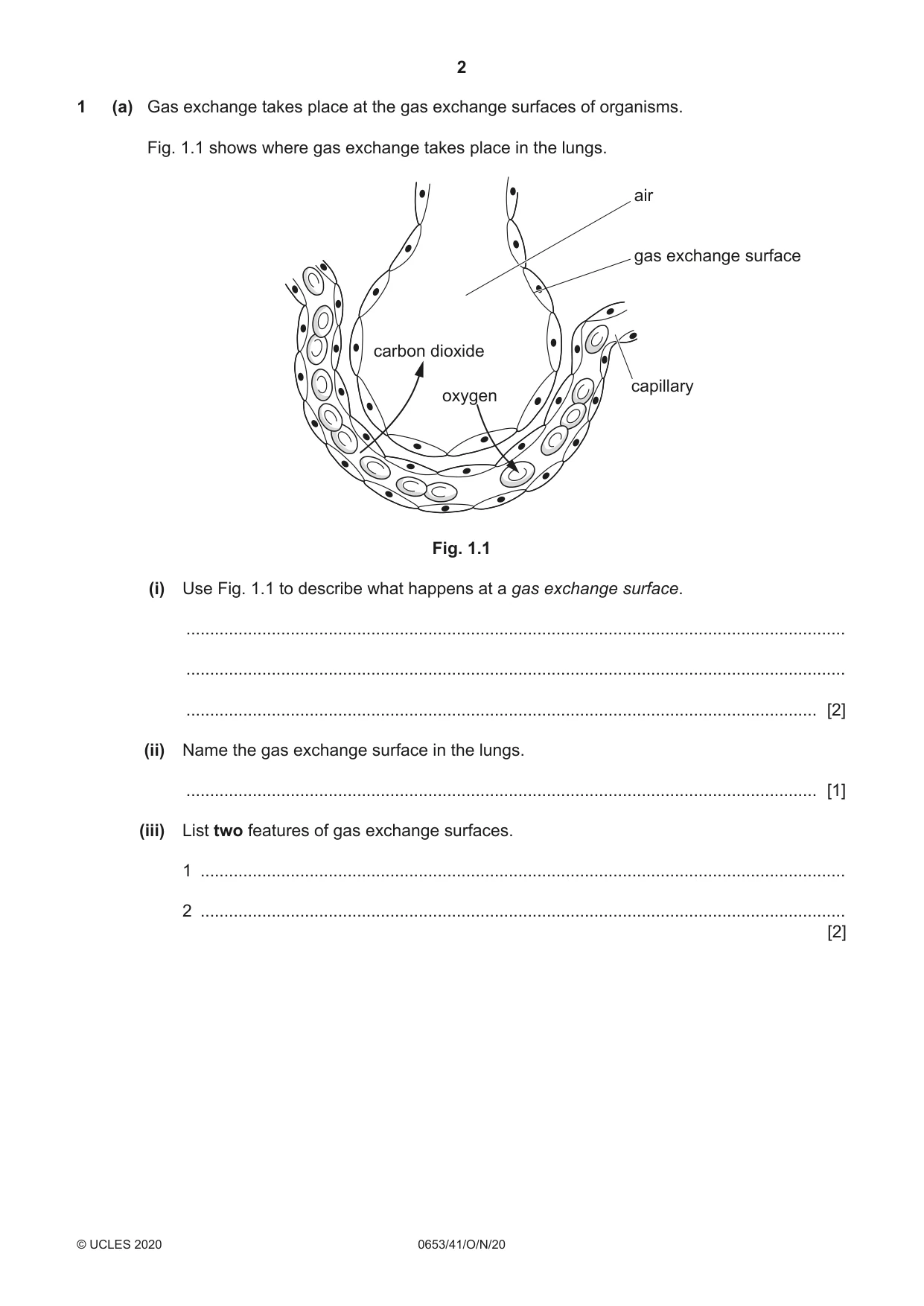
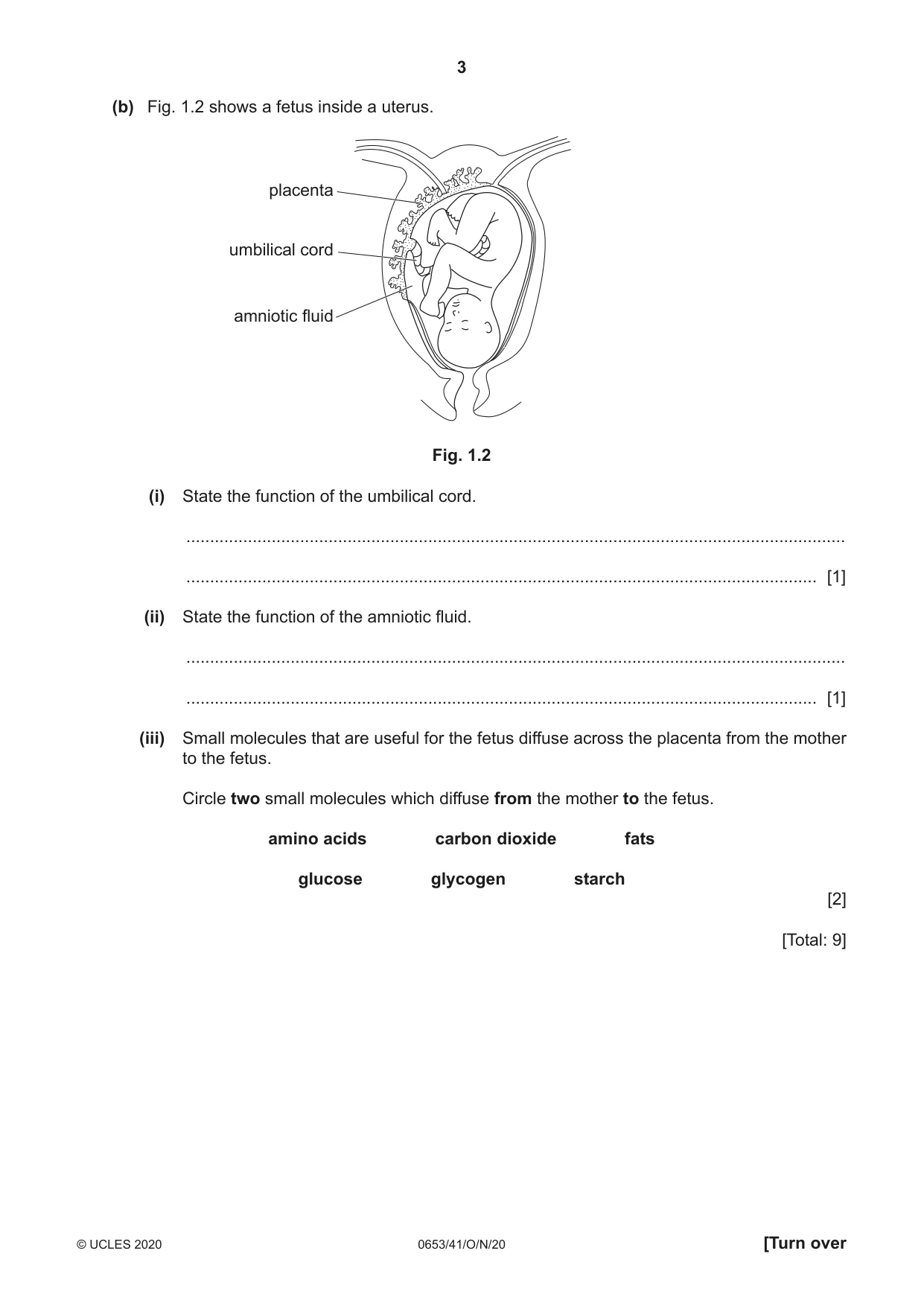
1 (a) Gas exchange takes place at the gas exchange surfaces of organisms. Fig. 1.1 shows where gas exchange takes place in the lungs. air gas exchange surface carbon dioxide capillary oxygen Fig. 1.1 (i) Use Fig. 1.1 to describe what happens at a gas exchange surface. ........................................................................................................................................... ........................................................................................................................................... ..................................................................................................................................... [2] (ii) Name the gas exchange surface in the lungs. ..................................................................................................................................... [1] (iii) List two features of gas exchange surfaces. 1 ........................................................................................................................................ 2 ........................................................................................................................................ [2] (b) Fig. 1.2 shows a fetus inside a uterus. placenta umbilical cord amniotic fluid Fig. 1.2 (i) State the function of the umbilical cord. ........................................................................................................................................... ..................................................................................................................................... [1] (ii) State the function of the amniotic fluid. ........................................................................................................................................... ..................................................................................................................................... [1] (iii) Small molecules that are useful for the fetus diffuse across the placenta from the mother to the fetus. Circle two small molecules which diffuse from the mother to the fetus. amino acids carbon dioxide fats glucose glycogen starch [2] [Total: 9]
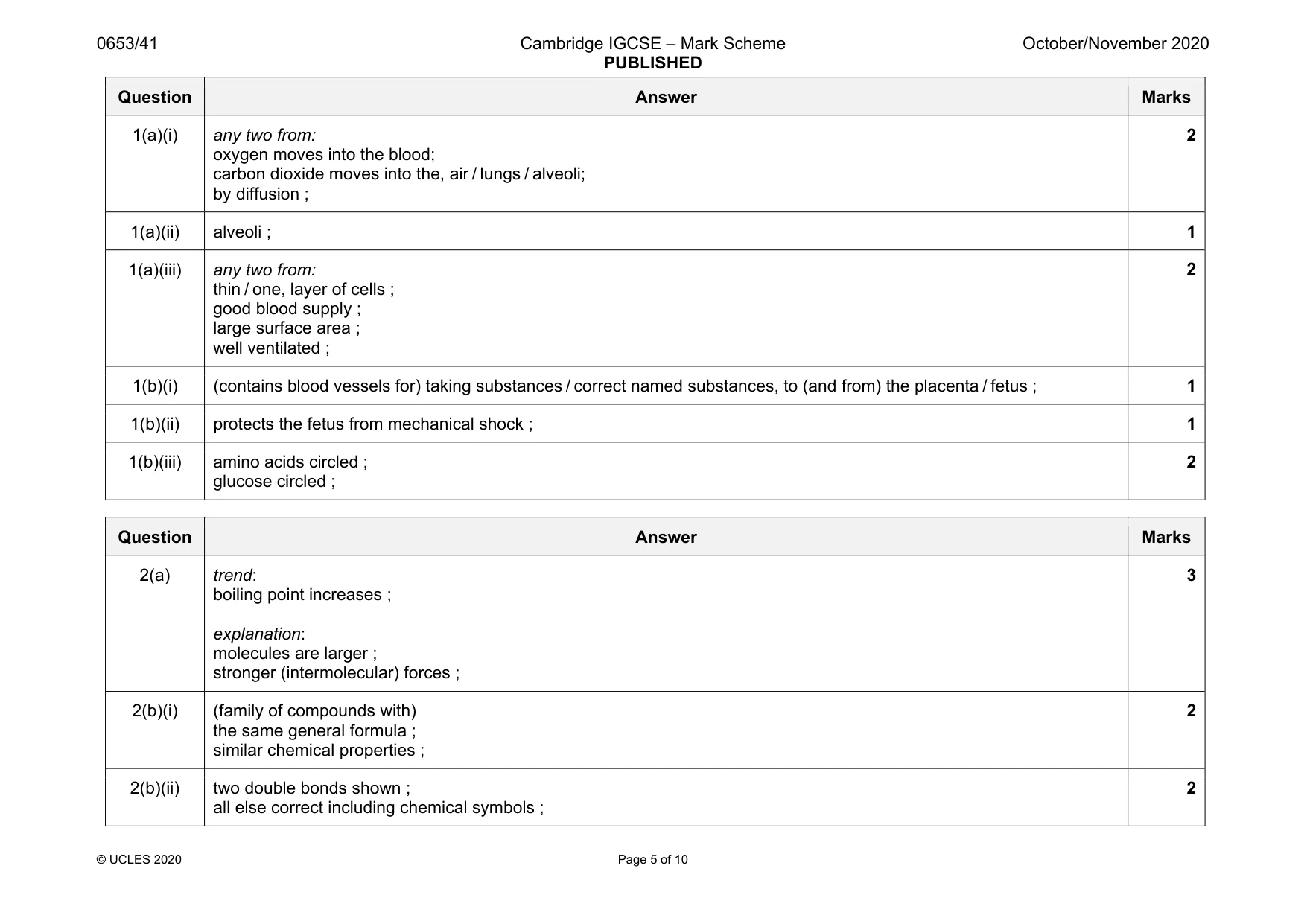
Mark scheme: 1(a)(i) any two from: oxygen moves into the blood; carbon dioxide moves into the, air / lungs / alveoli; by diffusion ; 2 1(a)(ii) alveoli ; 1 1(a)(iii) any two from: thin / one, layer of cells ; good blood supply ; large surface area ; well ventilated ; 2 1(b)(i) (contains blood vessels for) taking substances / correct named substances, to (and from) the placenta / fetus ; 1 1(b)(ii) protects the fetus from mechanical shock ; 1 1(b)(iii) amino acids circled ; glucose circled ; 2
Q2 · A simplified diagram of the fractional distillation of petroleum
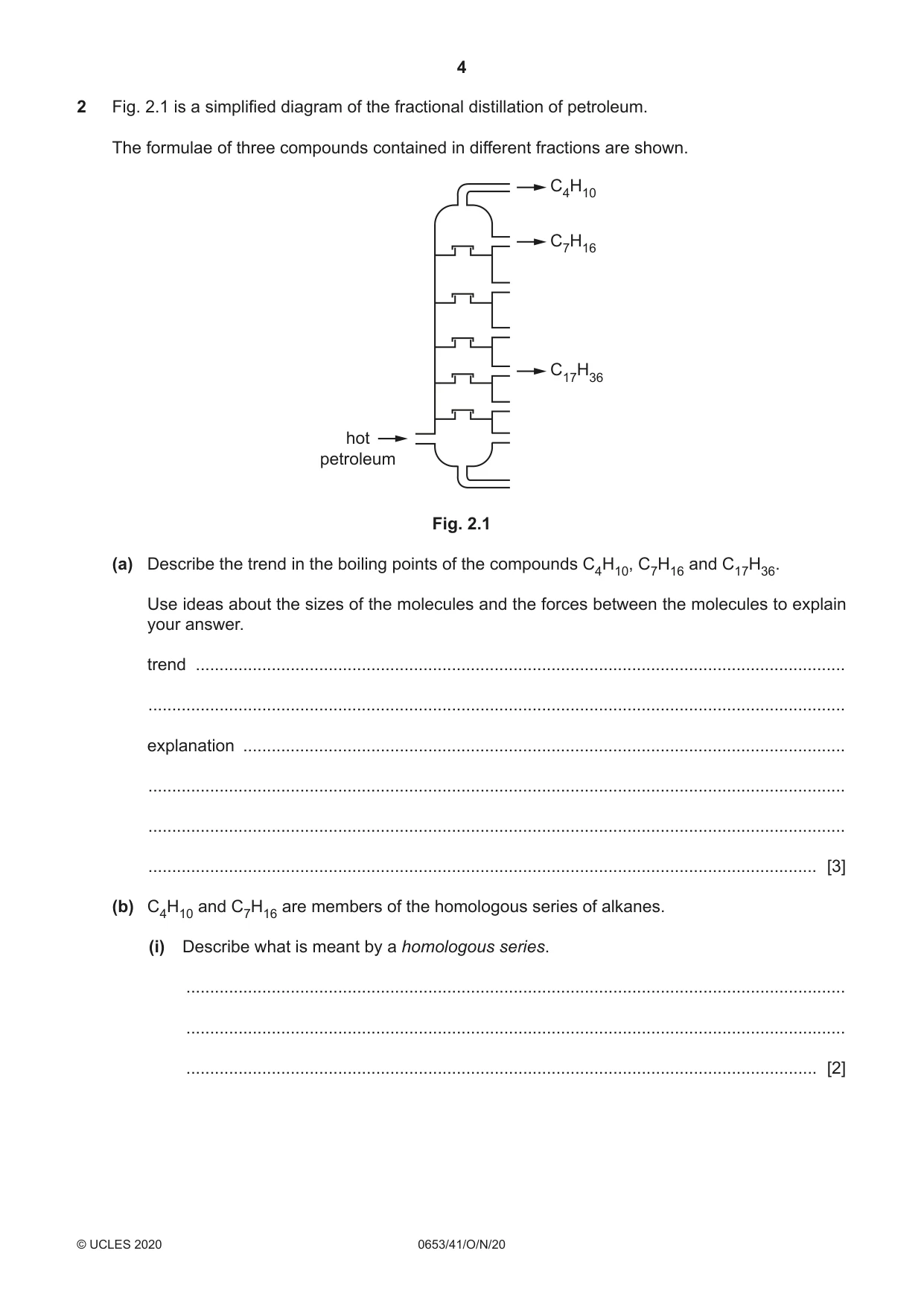
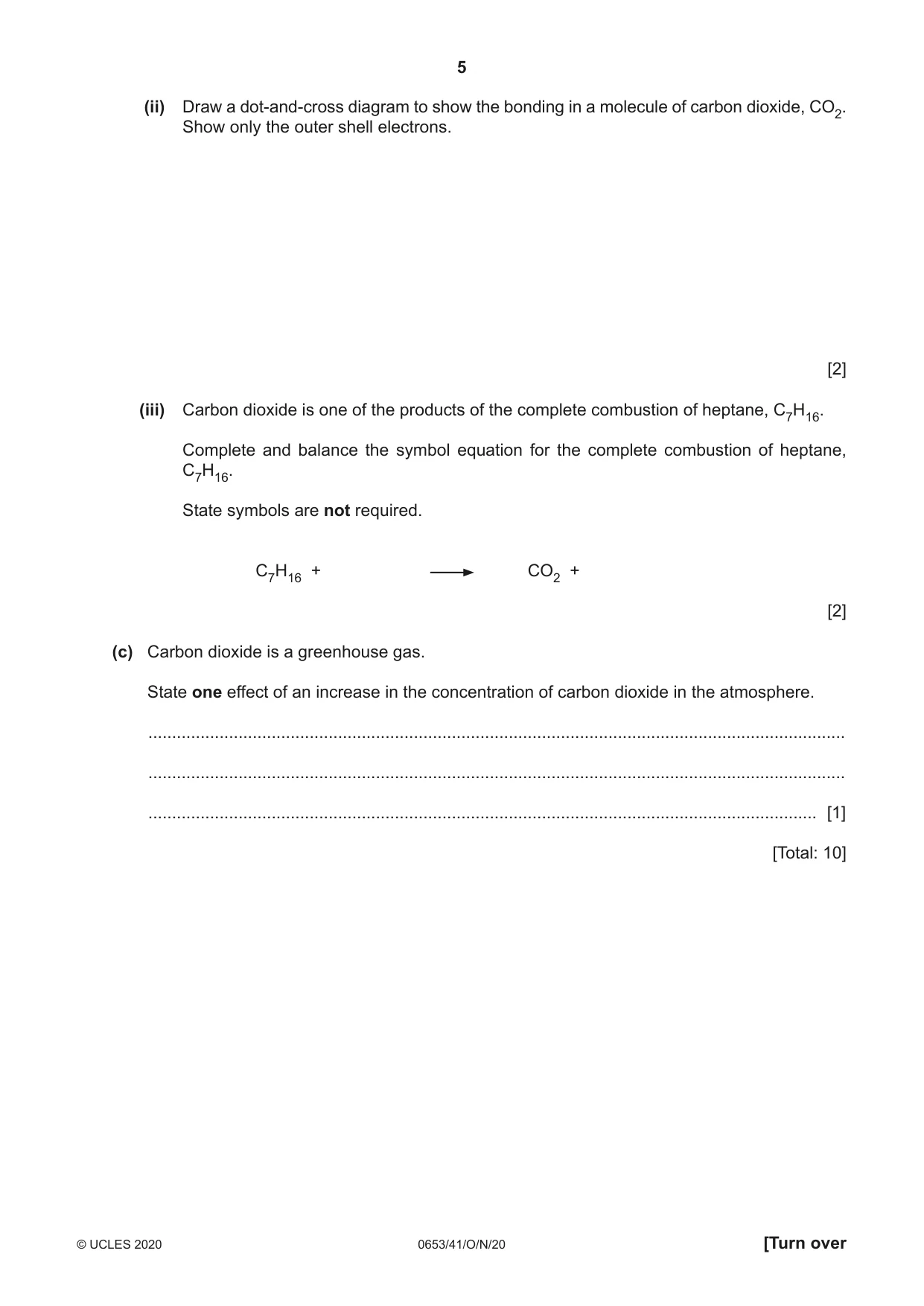
2 Fig. 2.1 is a simplified diagram of the fractional distillation of petroleum. The formulae of three compounds contained in different fractions are shown. C4H10 C7H16 C17H36 hot petroleum Fig. 2.1 (a) Describe the trend in the boiling points of the compounds C4H10, C7H16 and C17H36. Use ideas about the sizes of the molecules and the forces between the molecules to explain your answer. trend ......................................................................................................................................... ................................................................................................................................................... explanation ............................................................................................................................... ................................................................................................................................................... ................................................................................................................................................... ............................................................................................................................................. [3] (b) C4H10 and C7H16 are members of the homologous series of alkanes. (i) Describe what is meant by a homologous series. ........................................................................................................................................... ........................................................................................................................................... ..................................................................................................................................... [2] (ii) Draw a dot-and-cross diagram to show the bonding in a molecule of carbon dioxide, CO2. Show only the outer shell electrons. [2] (iii) Carbon dioxide is one of the products of the complete combustion of heptane, C7H16. Complete and balance the symbol equation for the complete combustion of heptane, C7H16. State symbols are not required. C7H16 + CO2 + [2] (c) Carbon dioxide is a greenhouse gas. State one effect of an increase in the concentration of carbon dioxide in the atmosphere. ................................................................................................................................................... ................................................................................................................................................... ............................................................................................................................................. [1] [Total: 10]
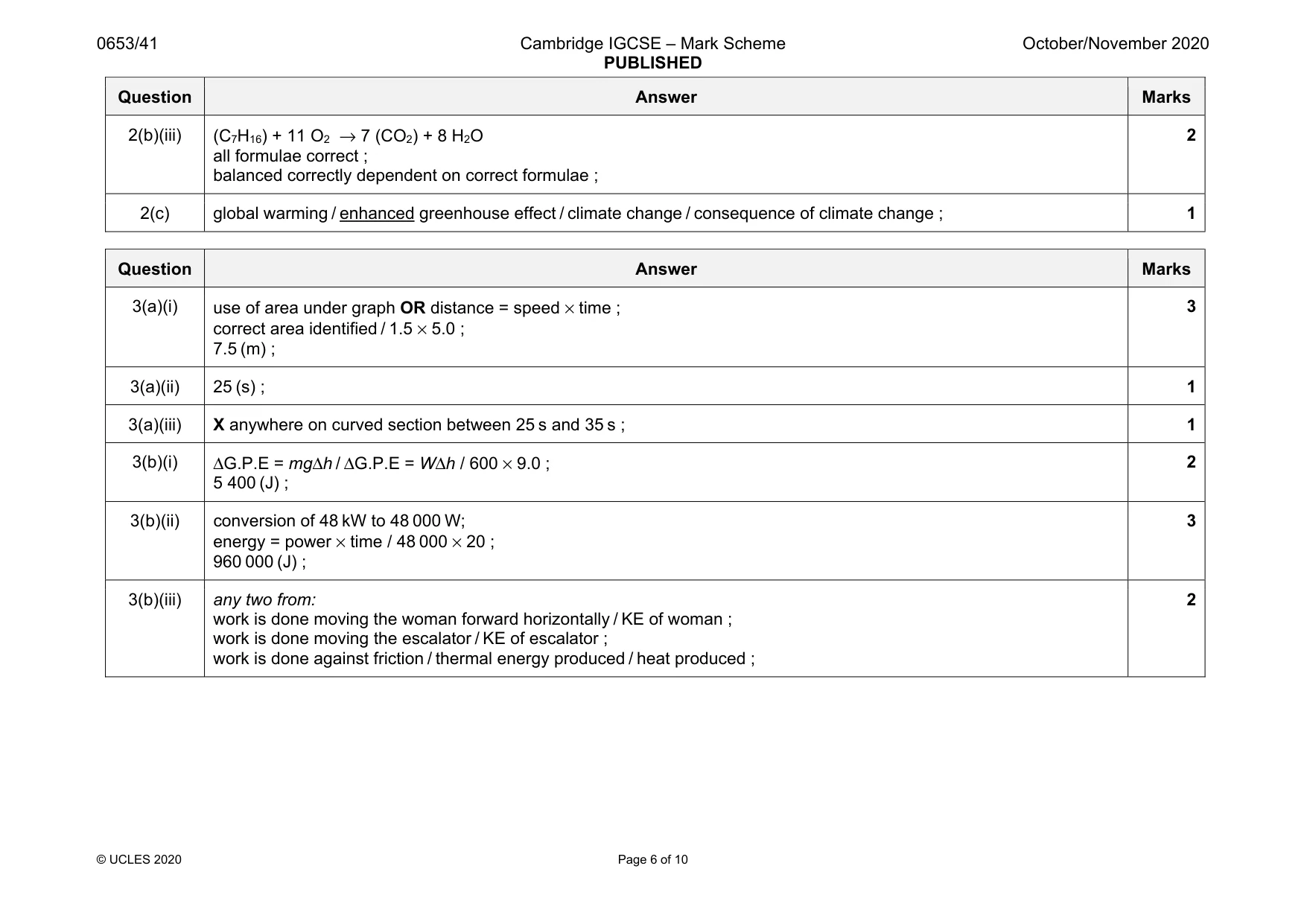
Mark scheme: 2(a) trend: boiling point increases ; explanation: molecules are larger ; stronger (intermolecular) forces ; 2(b)(i) (family of compounds with) the same general formula ; similar chemical properties ; 2 2(b)(ii) two double bonds shown ; all else correct including chemical symbols ; 2 Question Answer Marks 2(b)(iii) (C7H16) + 11 O2 → 7 (CO2) + 8 H2O all formulae correct ; balanced correctly dependent on correct formulae ; 2 2(c) global warming / enhanced greenhouse effect / climate change / consequence of climate change ; 1
Q3 · A woman travelling on an escalator (a moving staircase)
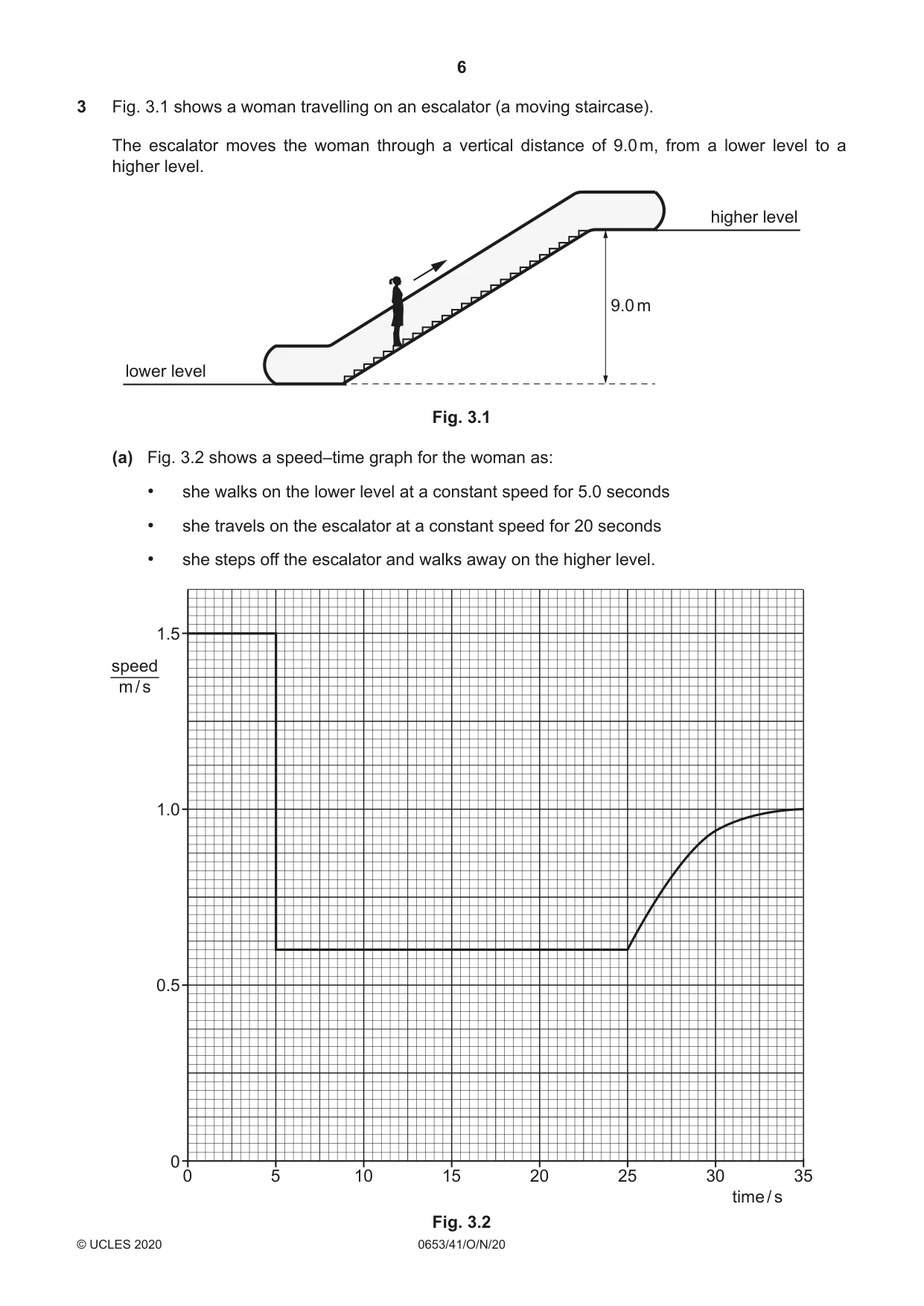
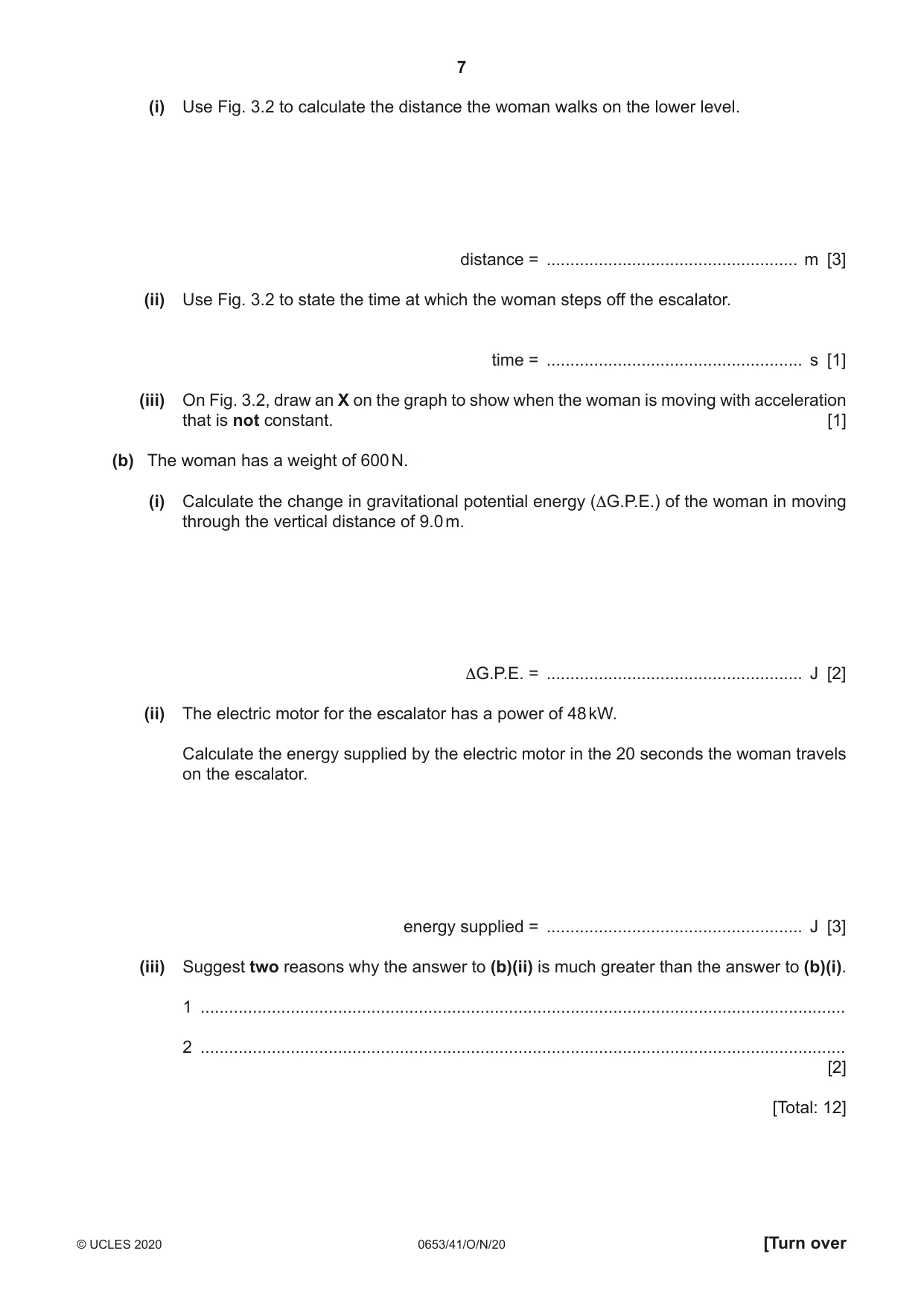
3 Fig. 3.1 shows a woman travelling on an escalator (a moving staircase). The escalator moves the woman through a vertical distance of 9.0 m, from a lower level to a higher level. higher level 9.0 m lower level Fig. 3.1 (a) Fig. 3.2 shows a speed–time graph for the woman as: • she walks on the lower level at a constant speed for 5.0 seconds • she travels on the escalator at a constant speed for 20 seconds • she steps off the escalator and walks away on the higher level. 1.5 speed m / s 1.0 0.5 0 0 5 10 15 20 25 30 35 time / s Fig. 3.2 (i) Use Fig. 3.2 to calculate the distance the woman walks on the lower level. distance = ..................................................... m [3] (ii) Use Fig. 3.2 to state the time at which the woman steps off the escalator. time = ...................................................... s [1] (iii) On Fig. 3.2, draw an X on the graph to show when the woman is moving with acceleration that is not constant. [1] (b) The woman has a weight of 600 N. (i) Calculate the change in gravitational potential energy (ΔG.P.E.) of the woman in moving through the vertical distance of 9.0 m. ΔG.P.E. = ...................................................... J [2] (ii) The electric motor for the escalator has a power of 48 kW. Calculate the energy supplied by the electric motor in the 20 seconds the woman travels on the escalator. energy supplied = ...................................................... J [3] (iii) Suggest two reasons why the answer to (b)(ii) is much greater than the answer to (b)(i). 1 ........................................................................................................................................ 2 ........................................................................................................................................ [2] [Total: 12]
Mark scheme: 3(a)(i) use of area under graph OR distance = speed × time ; correct area identified / 1.5 × 5.0 ; 7.5 (m) ; 3 3(a)(ii) 25 (s) ; 1 3(a)(iii) X anywhere on curved section between 25 s and 35 s ; 1 3(b)(i) ΔG.P.E = mgΔh / ΔG.P.E = WΔh / 600 × 9.0 ; 5 400 (J) ; 2 3(b)(ii) conversion of 48 kW to 48 000 W; energy = power × time / 48 000 × 20 ; 960 000 (J) ; 3 3(b)(iii) any two from: work is done moving the woman forward horizontally / KE of woman ; work is done moving the escalator / KE of escalator ; work is done against friction / thermal energy produced / heat produced ; 2
Q4 · An external view of the heart
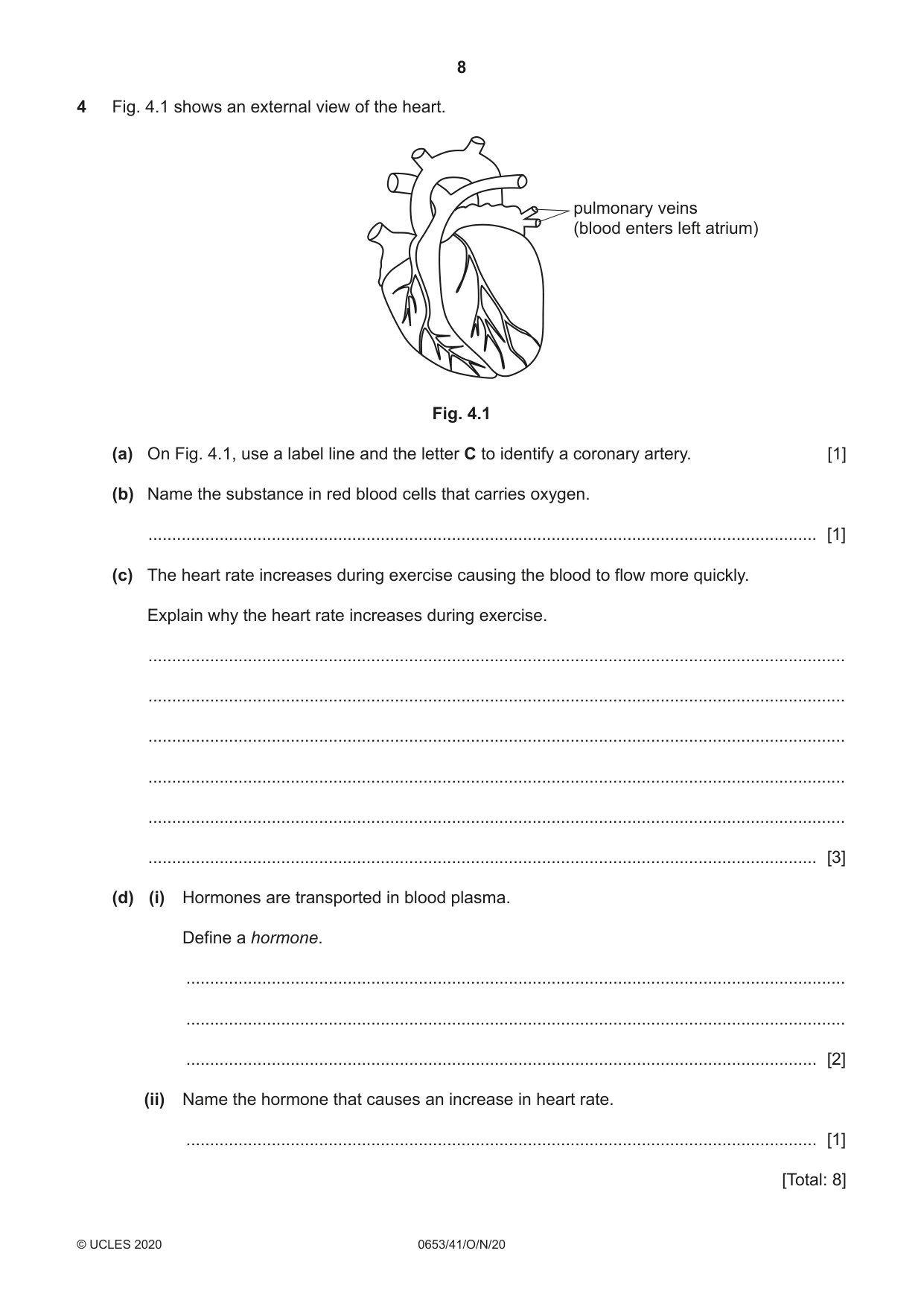
4 Fig. 4.1 shows an external view of the heart. pulmonary veins (blood enters left atrium) Fig. 4.1 (a) On Fig. 4.1, use a label line and the letter C to identify a coronary artery. [1] (b) Name the substance in red blood cells that carries oxygen. ............................................................................................................................................. [1] (c) The heart rate increases during exercise causing the blood to flow more quickly. Explain why the heart rate increases during exercise. ................................................................................................................................................... ................................................................................................................................................... ................................................................................................................................................... ................................................................................................................................................... ................................................................................................................................................... ............................................................................................................................................. [3] (d) (i) Hormones are transported in blood plasma. Define a hormone. ........................................................................................................................................... ........................................................................................................................................... ..................................................................................................................................... [2] (ii) Name the hormone that causes an increase in heart rate. ..................................................................................................................................... [1] [Total: 8]
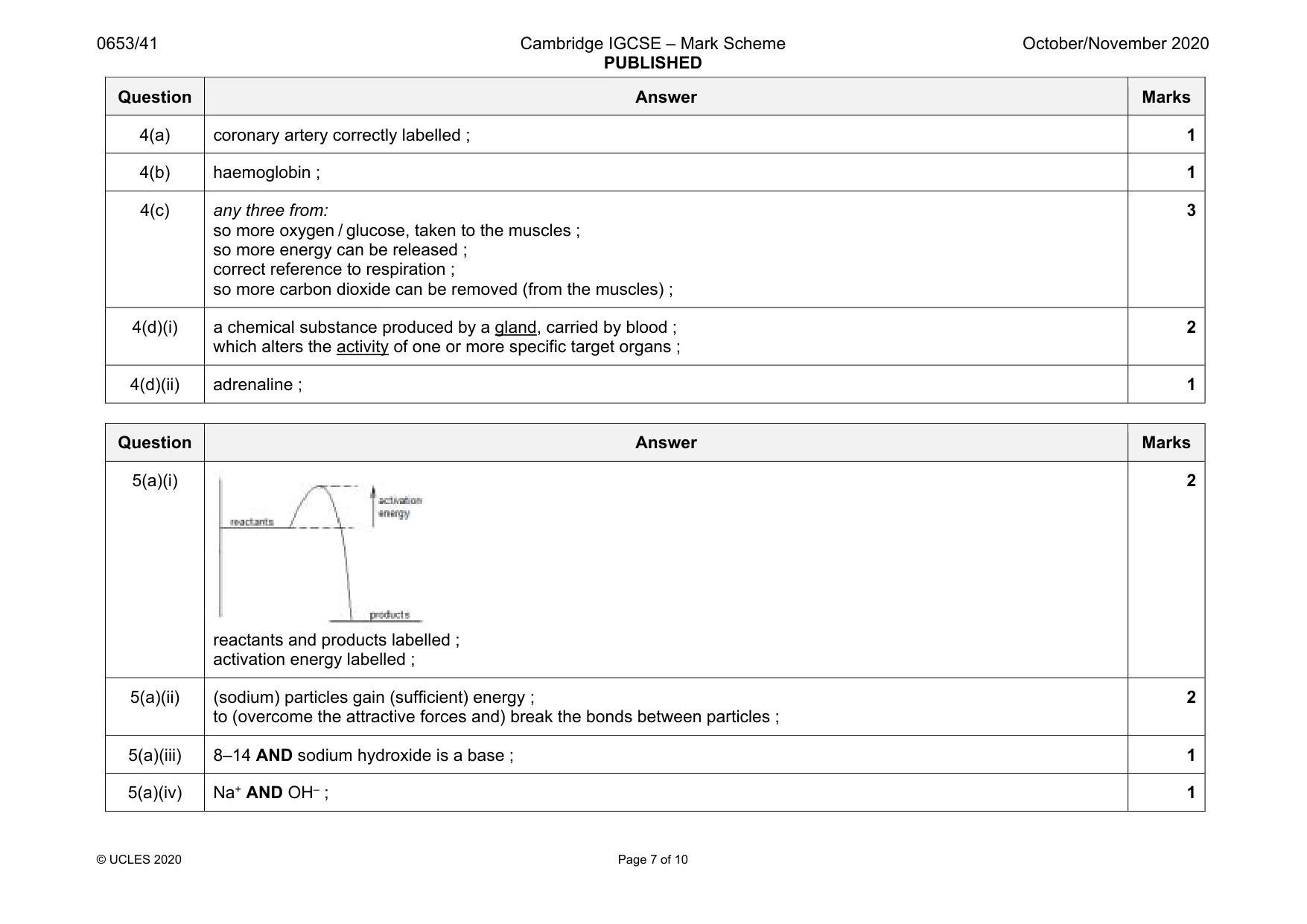
Mark scheme: 4(a) coronary artery correctly labelled ; 1 4(b) haemoglobin ; 1 4(c) any three from: so more oxygen / glucose, taken to the muscles ; so more energy can be released ; correct reference to respiration ; so more carbon dioxide can be removed (from the muscles) ; 3 4(d)(i) a chemical substance produced by a gland, carried by blood ; which alters the activity of one or more specific target organs ; 2 4(d)(ii) adrenaline ; 1
Q5 · Sodium reacts with water to form aqueous sodium hydroxide, NaOH, and hydrogen gas
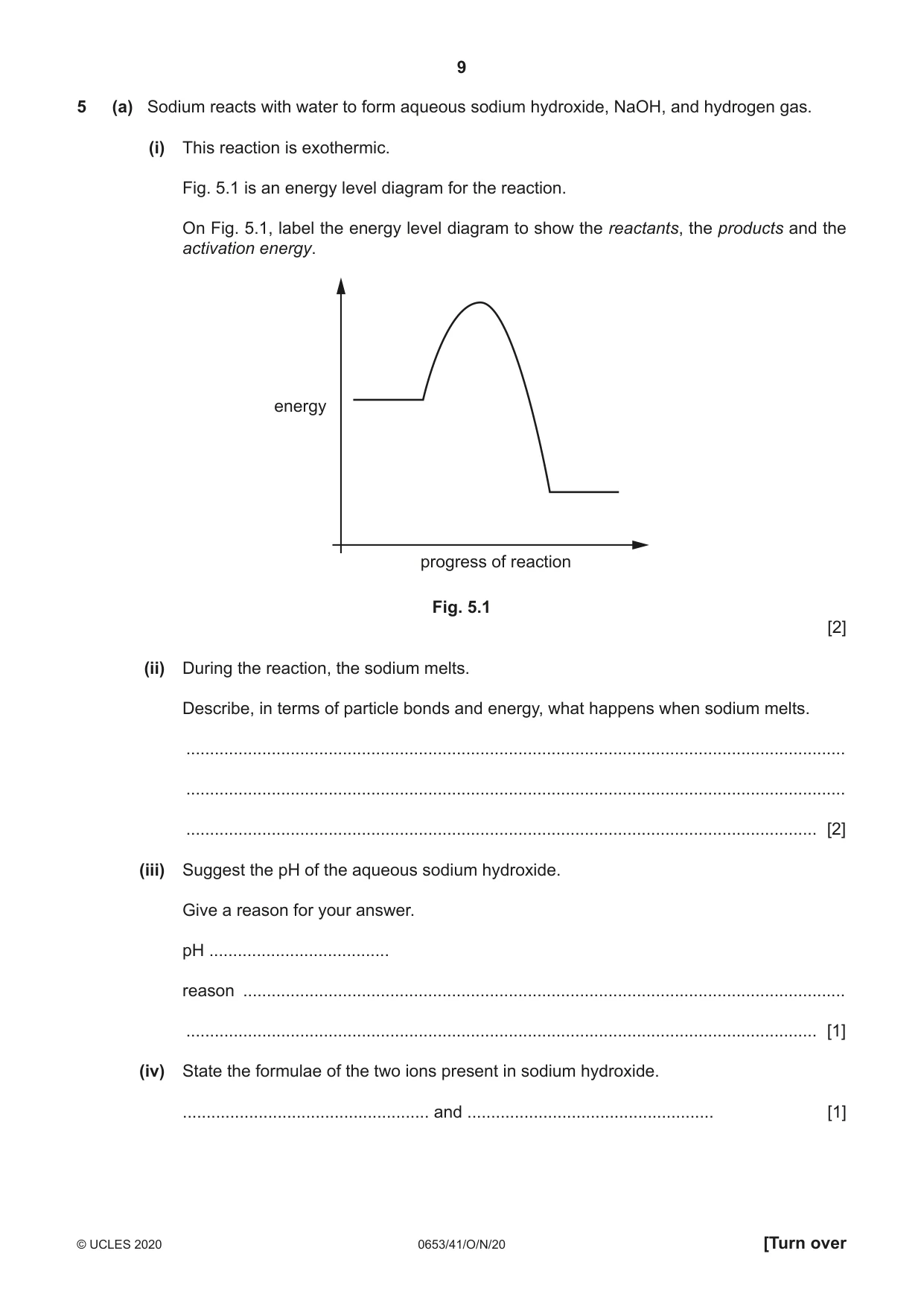
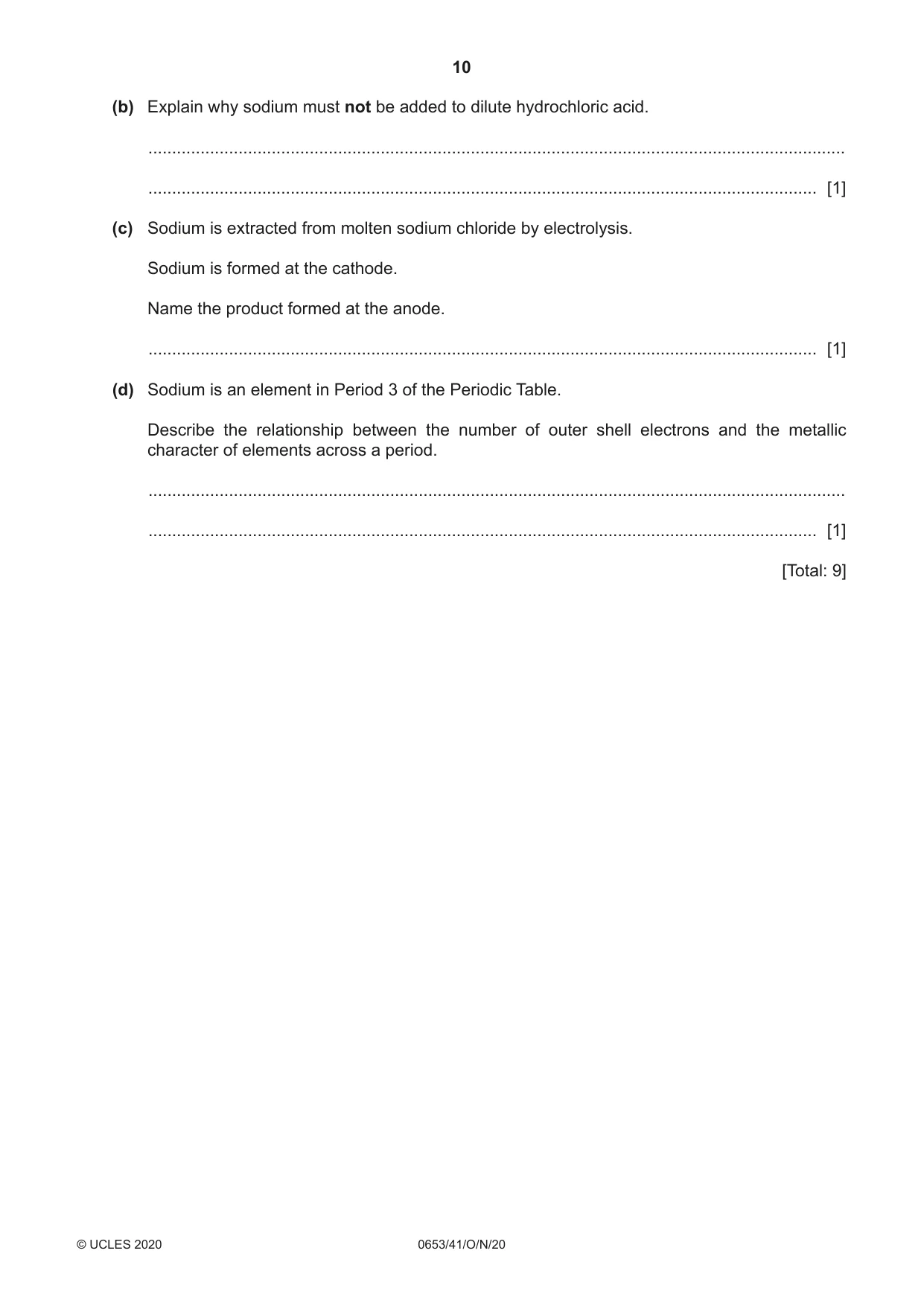
5 (a) Sodium reacts with water to form aqueous sodium hydroxide, NaOH, and hydrogen gas. (i) This reaction is exothermic. Fig. 5.1 is an energy level diagram for the reaction. On Fig. 5.1, label the energy level diagram to show the reactants, the products and the activation energy. energy progress of reaction Fig. 5.1 [2] (ii) During the reaction, the sodium melts. Describe, in terms of particle bonds and energy, what happens when sodium melts. ........................................................................................................................................... ........................................................................................................................................... ..................................................................................................................................... [2] (iii) Suggest the pH of the aqueous sodium hydroxide. Give a reason for your answer. pH ...................................... reason ............................................................................................................................... ..................................................................................................................................... [1] (iv) State the formulae of the two ions present in sodium hydroxide. .................................................... and .................................................... [1] (b) Explain why sodium must not be added to dilute hydrochloric acid. ................................................................................................................................................... ............................................................................................................................................. [1] (c) Sodium is extracted from molten sodium chloride by electrolysis. Sodium is formed at the cathode. Name the product formed at the anode. ............................................................................................................................................. [1] (d) Sodium is an element in Period 3 of the Periodic Table. Describe the relationship between the number of outer shell electrons and the metallic character of elements across a period. ................................................................................................................................................... ............................................................................................................................................. [1] [Total: 9]
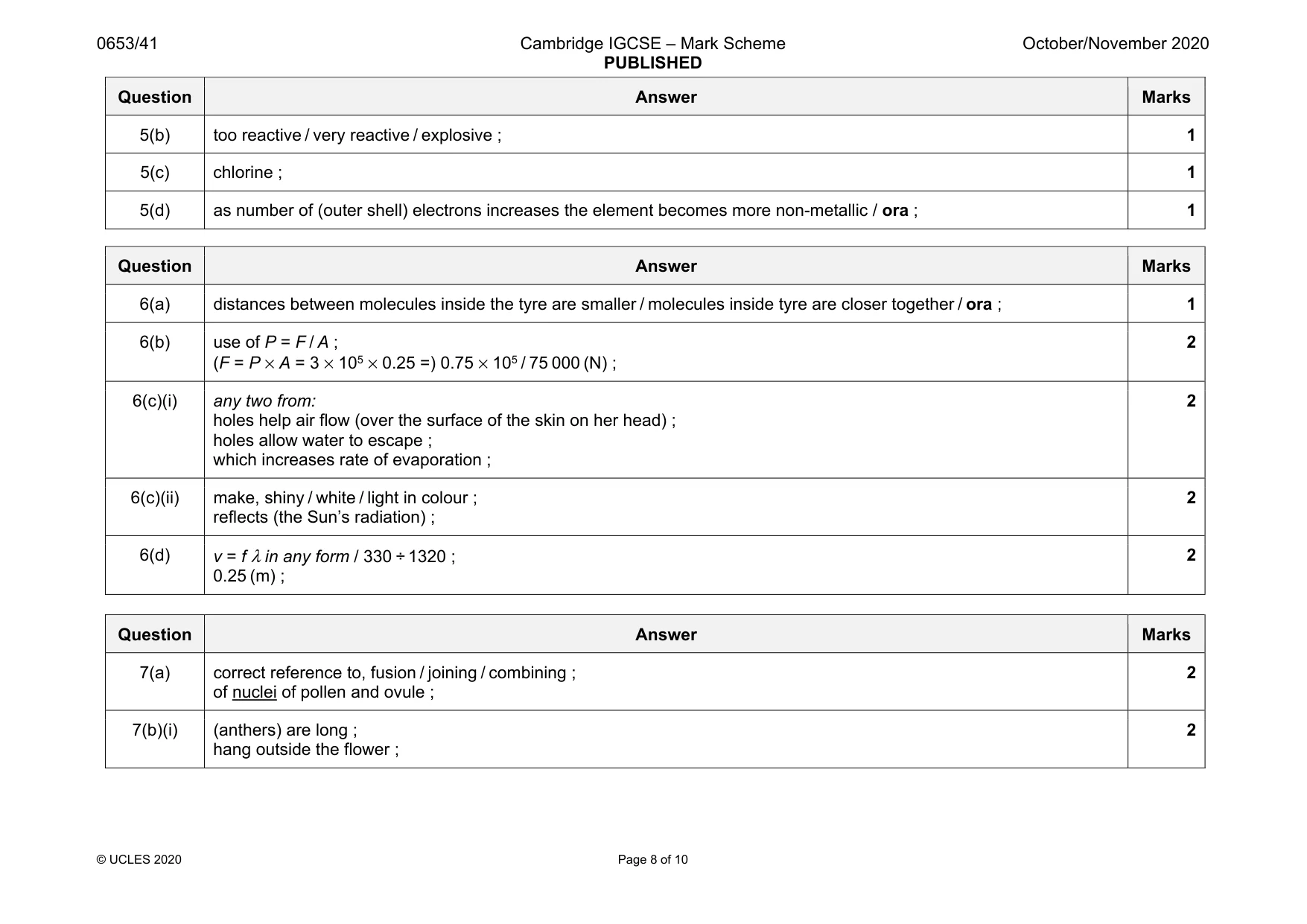
Mark scheme: 5(a)(i) reactants and products labelled ; activation energy labelled ; 2 5(a)(ii) (sodium) particles gain (sufficient) energy ; to (overcome the attractive forces and) break the bonds between particles ; 2 5(a)(iii) 8–14 AND sodium hydroxide is a base ; 1 5(a)(iv) Na+ AND OH– ; 1 Question Answer Marks 5(b) too reactive / very reactive / explosive ; 1 5(c) chlorine ; 1 5(d) as number of (outer shell) electrons increases the element becomes more non-metallic / ora ; 1
Q6 · A girl using a bicycle pump to ‘pump up’ (add air to) a bicycle tyre
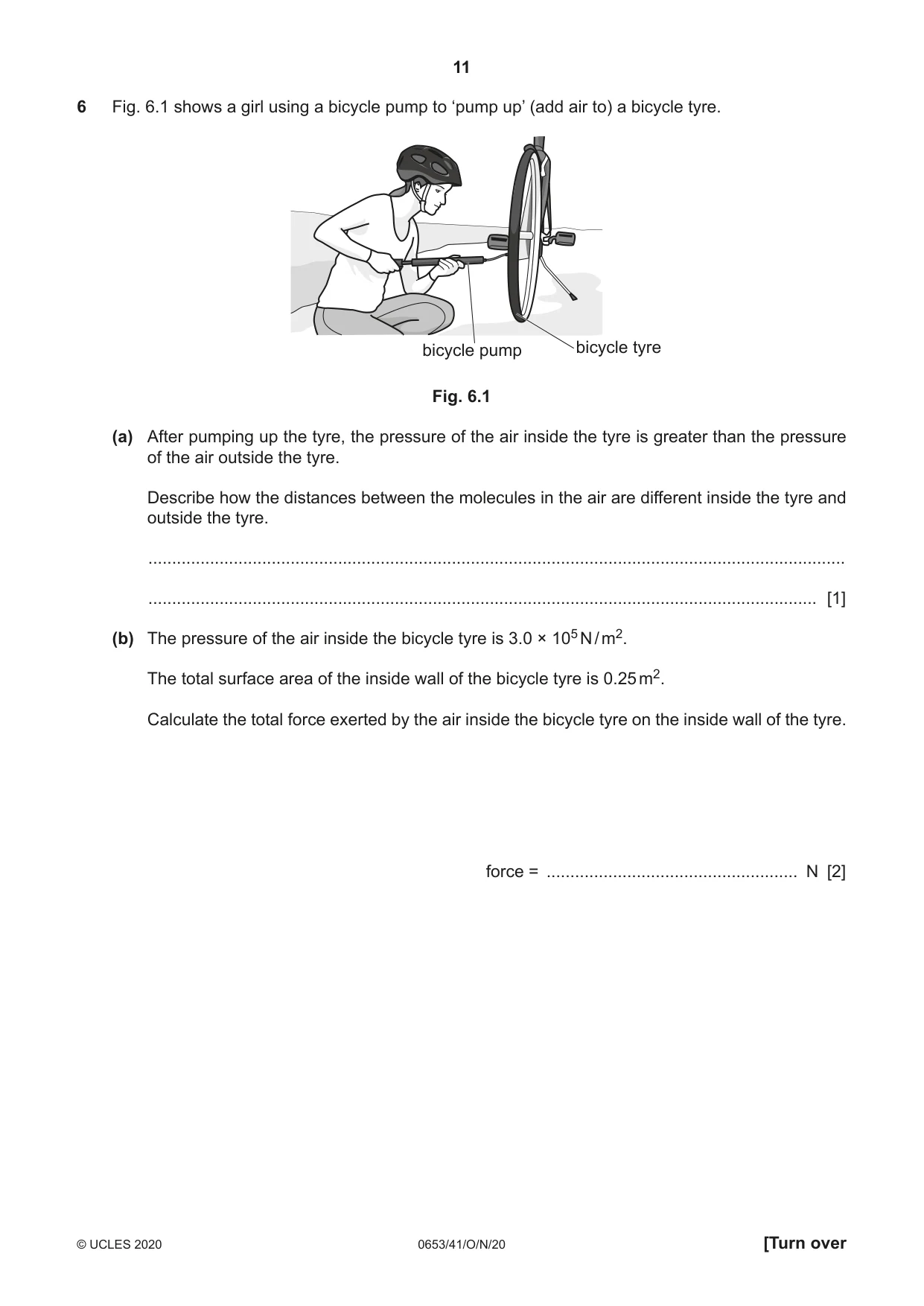
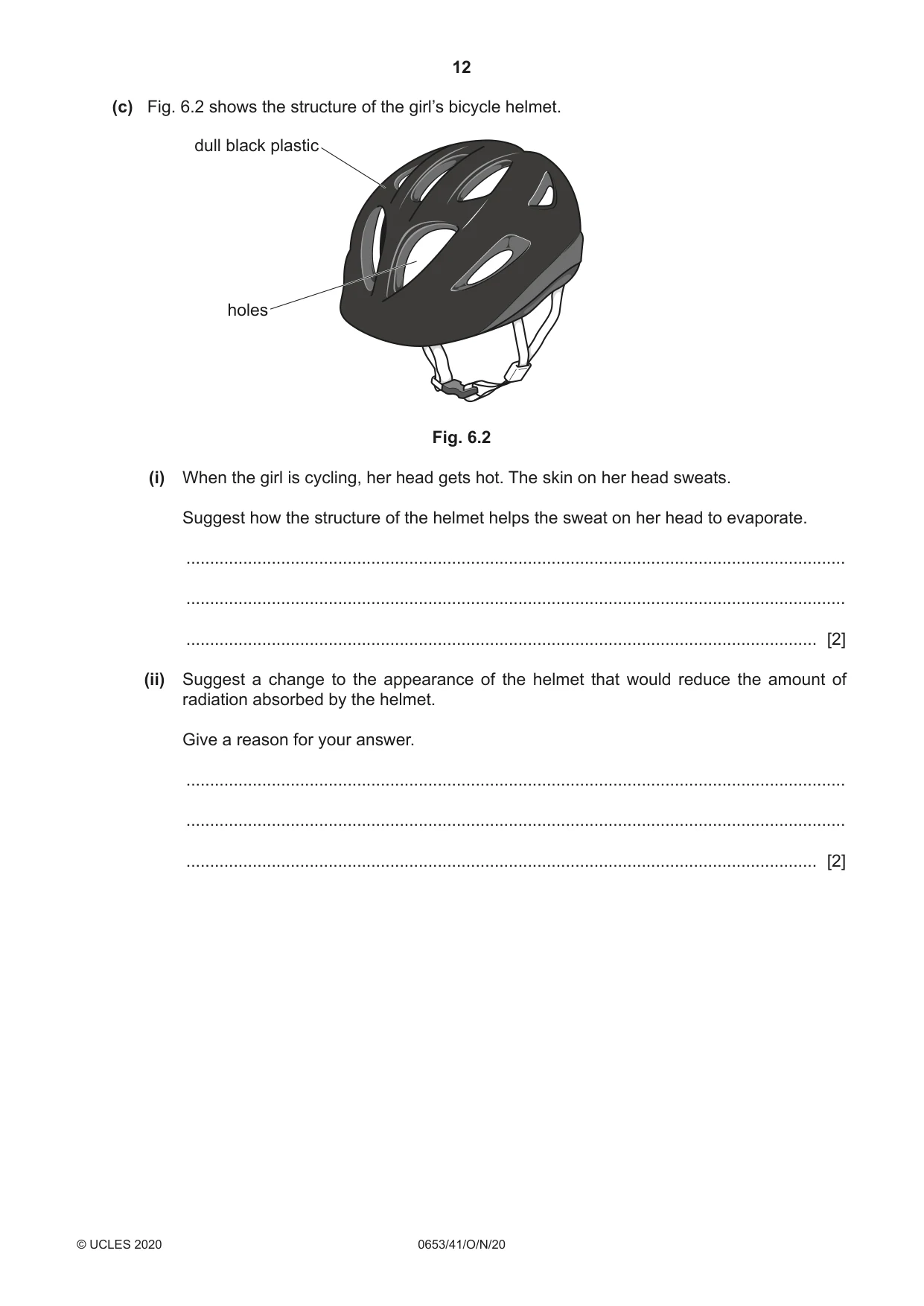
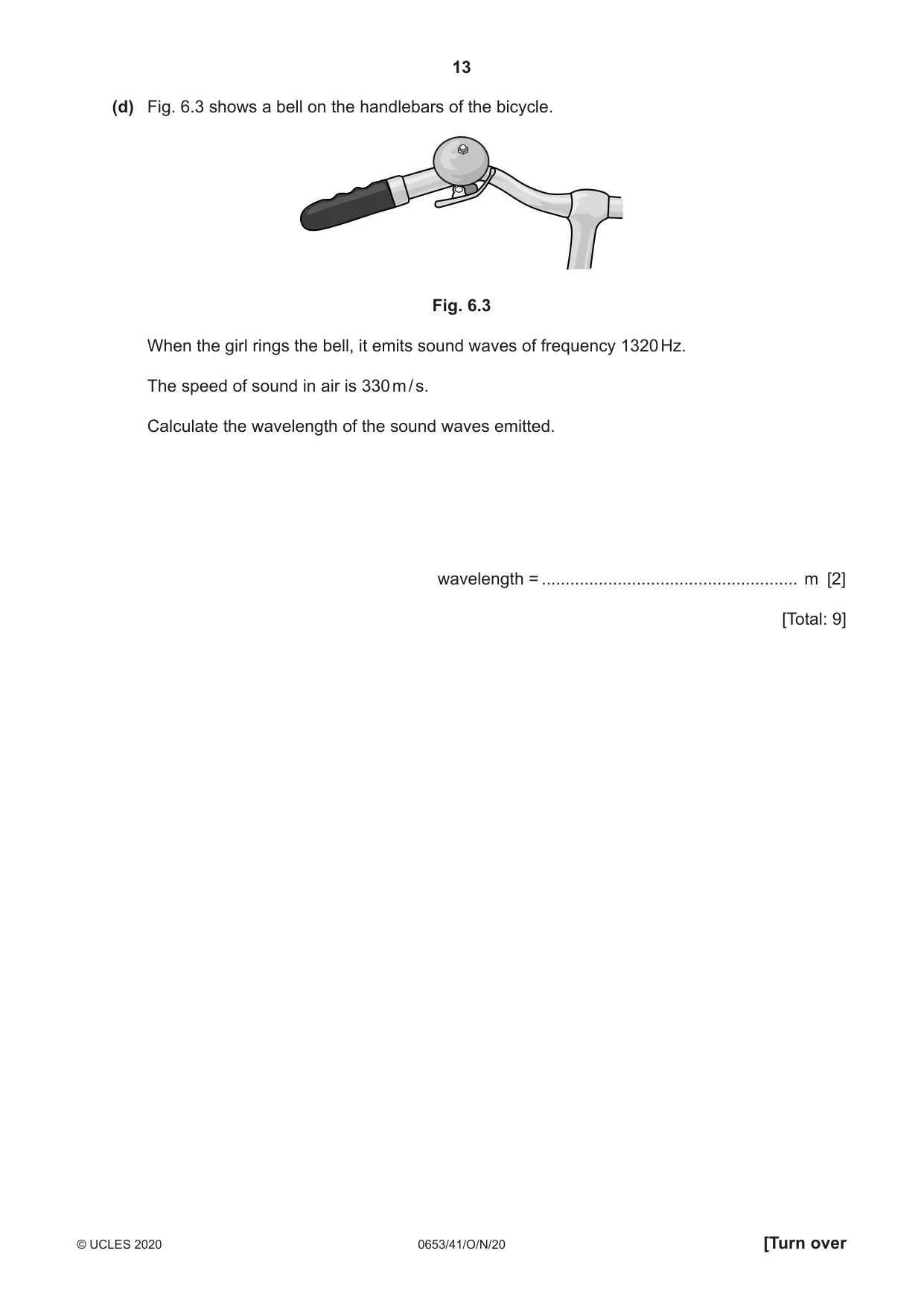
6 Fig. 6.1 shows a girl using a bicycle pump to ‘pump up’ (add air to) a bicycle tyre. bicycle pump bicycle tyre Fig. 6.1 (a) After pumping up the tyre, the pressure of the air inside the tyre is greater than the pressure of the air outside the tyre. Describe how the distances between the molecules in the air are different inside the tyre and outside the tyre. ................................................................................................................................................... ............................................................................................................................................. [1] (b) The pressure of the air inside the bicycle tyre is 3.0 × 10⁵ N / m2. The total surface area of the inside wall of the bicycle tyre is 0.25 m2. Calculate the total force exerted by the air inside the bicycle tyre on the inside wall of the tyre. force = ..................................................... N [2] (c) Fig. 6.2 shows the structure of the girl’s bicycle helmet. dull black plastic holes Fig. 6.2 (i) When the girl is cycling, her head gets hot. The skin on her head sweats. Suggest how the structure of the helmet helps the sweat on her head to evaporate. ........................................................................................................................................... ........................................................................................................................................... ..................................................................................................................................... [2] (ii) Suggest a change to the appearance of the helmet that would reduce the amount of radiation absorbed by the helmet. Give a reason for your answer. ........................................................................................................................................... ........................................................................................................................................... ..................................................................................................................................... [2] (d) Fig. 6.3 shows a bell on the handlebars of the bicycle. Fig. 6.3 When the girl rings the bell, it emits sound waves of frequency 1320 Hz. The speed of sound in air is 330 m / s. Calculate the wavelength of the sound waves emitted. wavelength = ...................................................... m [2] [Total: 9]
Mark scheme: 6(a) distances between molecules inside the tyre are smaller / molecules inside tyre are closer together / ora ; 1 6(b) use of P = F / A ; (F = P × A = 3 × 105 × 0.25 =) 0.75 × 10⁵ / 75 000 (N) ; 2 6(c)(i) any two from: holes help air flow (over the surface of the skin on her head) ; holes allow water to escape ; which increases rate of evaporation ; 2 6(c)(ii) make, shiny / white / light in colour ; reflects (the Sun’s radiation) ; 2 6(d) v = f λ in any form / 330 ÷ 1320 ; 0.25 (m) ; 2
Q7 · During sexual reproduction in flowering plants, both pollination and fertilisation take…
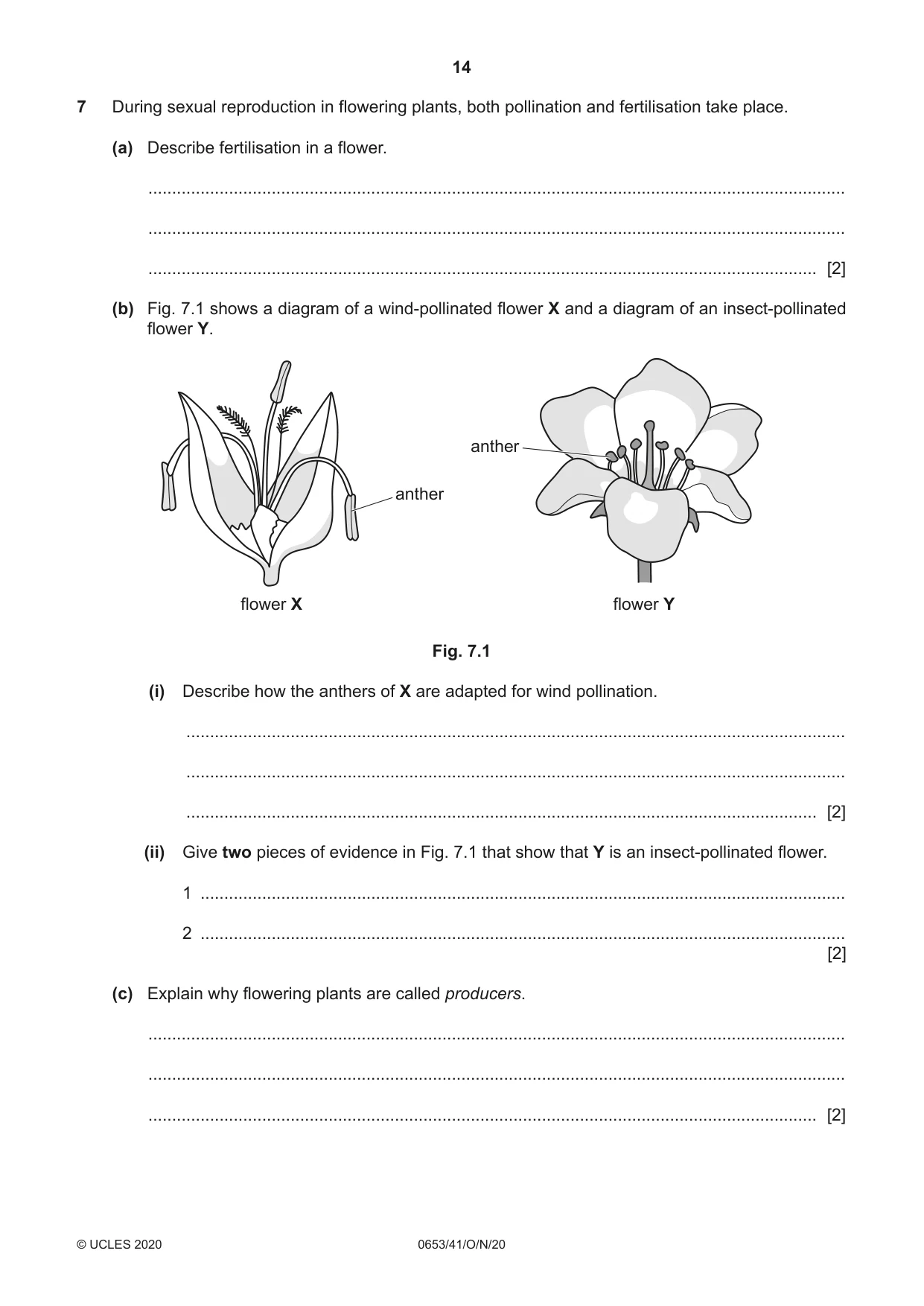
7 During sexual reproduction in flowering plants, both pollination and fertilisation take place. (a) Describe fertilisation in a flower. ................................................................................................................................................... ................................................................................................................................................... ............................................................................................................................................. [2] (b) Fig. 7.1 shows a diagram of a wind-pollinated flower X and a diagram of an insect-pollinated flower Y. anther anther flower X flower Y Fig. 7.1 (i) Describe how the anthers of X are adapted for wind pollination. ........................................................................................................................................... ........................................................................................................................................... ..................................................................................................................................... [2] (ii) Give two pieces of evidence in Fig. 7.1 that show that Y is an insect-pollinated flower. 1 ........................................................................................................................................ 2 ........................................................................................................................................ [2] (c) Explain why flowering plants are called producers. ................................................................................................................................................... ................................................................................................................................................... ............................................................................................................................................. [2] (d) Producers are the first trophic level of every food chain. Explain why food chains usually have fewer than five trophic levels. ................................................................................................................................................... ................................................................................................................................................... ............................................................................................................................................. [2] [Total: 10]
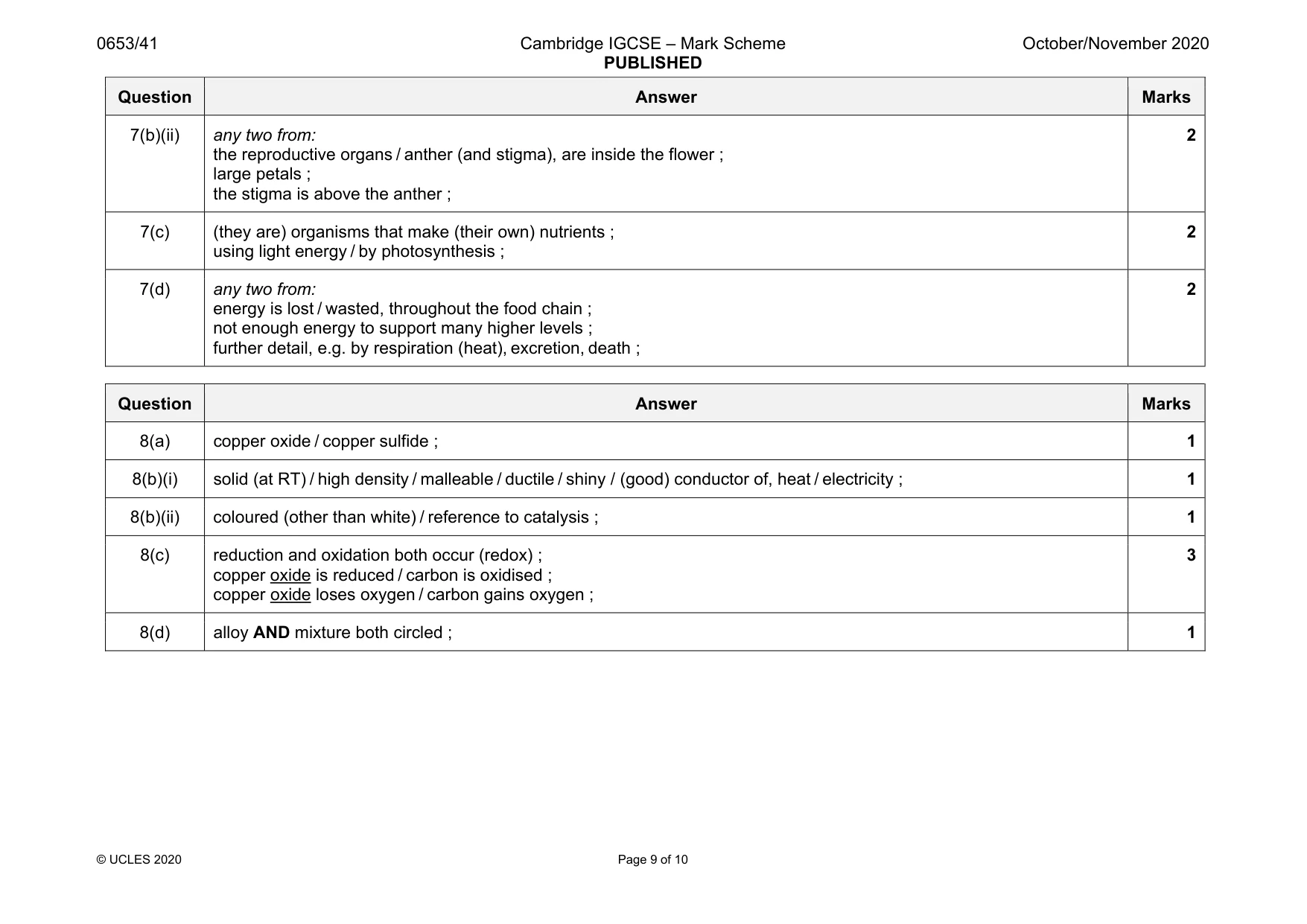
Mark scheme: 7(a) correct reference to, fusion / joining / combining ; of nuclei of pollen and ovule ; 2 7(b)(i) (anthers) are long ; hang outside the flower ; 2 Question Answer Marks 7(b)(ii) any two from: the reproductive organs / anther (and stigma), are inside the flower ; large petals ; the stigma is above the anther ; 2 7(c) (they are) organisms that make (their own) nutrients ; using light energy / by photosynthesis ; 2 7(d) any two from: energy is lost / wasted, throughout the food chain ; not enough energy to support many higher levels ; further detail, e.g. by respiration (heat), excretion, death ; 2
Q8 · Copper chloride is produced when dilute hydrochloric acid reacts with copper carbonate
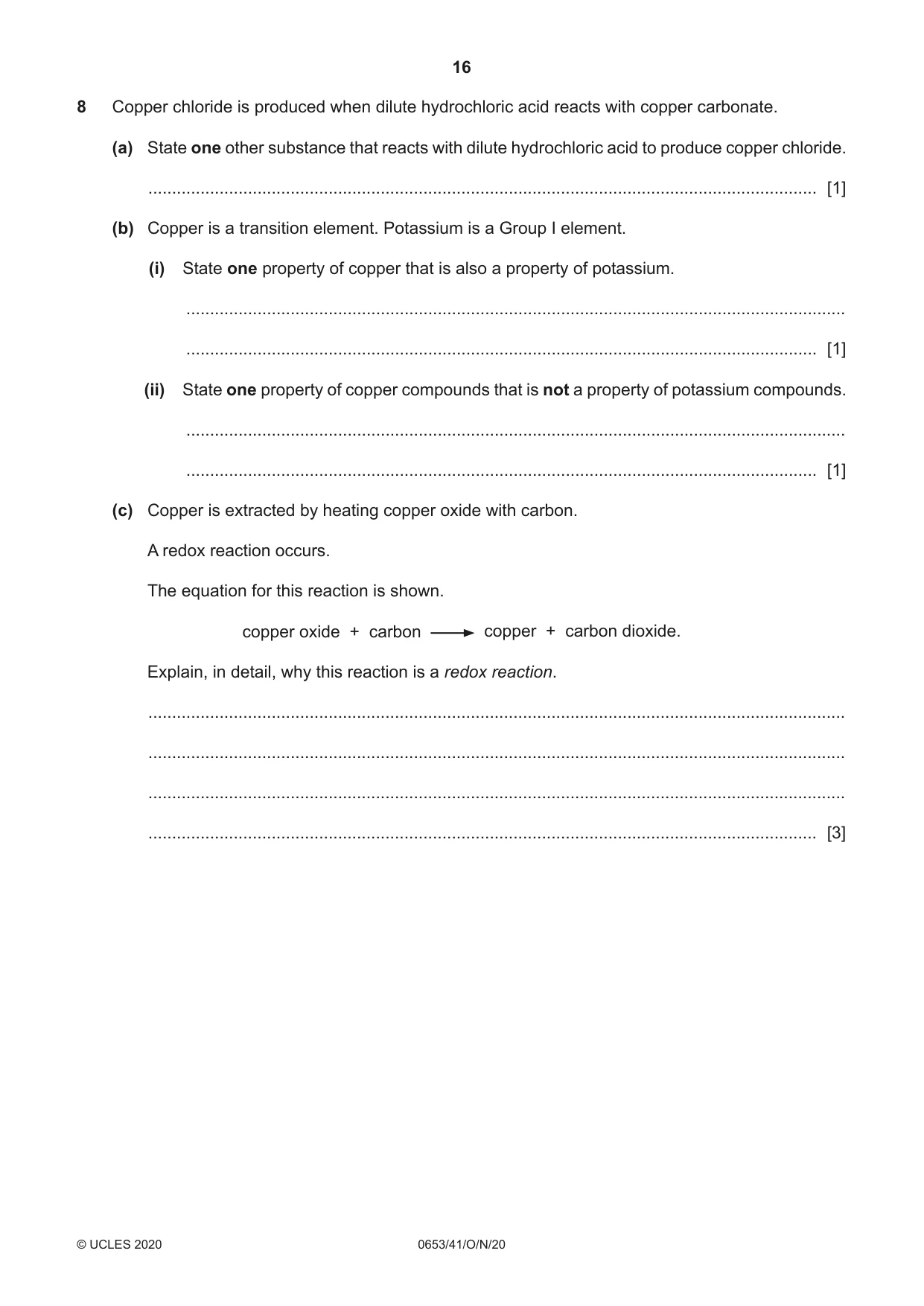
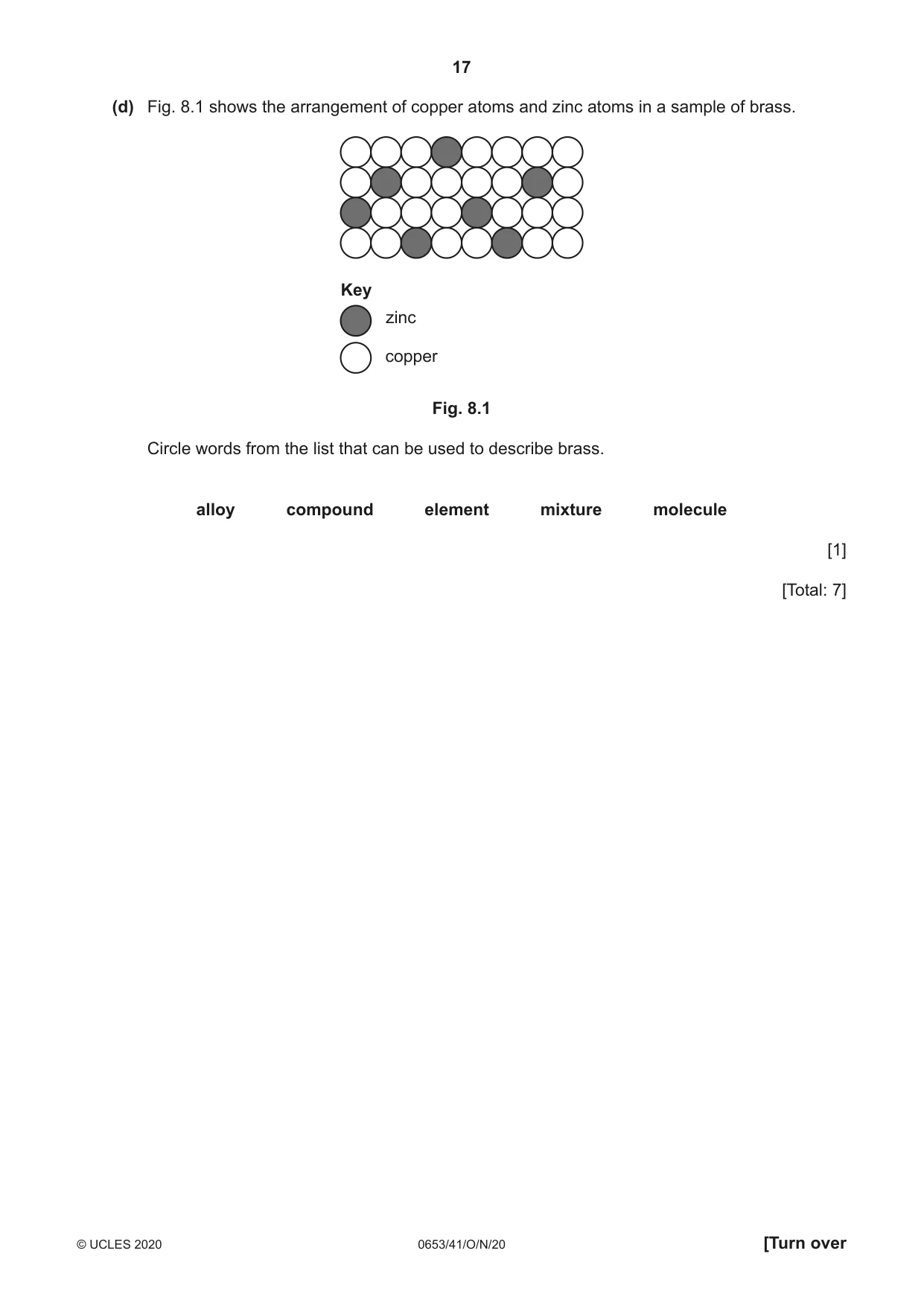
8 Copper chloride is produced when dilute hydrochloric acid reacts with copper carbonate. (a) State one other substance that reacts with dilute hydrochloric acid to produce copper chloride. ............................................................................................................................................. [1] (b) Copper is a transition element. Potassium is a Group I element. (i) State one property of copper that is also a property of potassium. ........................................................................................................................................... ..................................................................................................................................... [1] (ii) State one property of copper compounds that is not a property of potassium compounds. ........................................................................................................................................... ..................................................................................................................................... [1] (c) Copper is extracted by heating copper oxide with carbon. A redox reaction occurs. The equation for this reaction is shown. copper oxide + carbon copper + carbon dioxide. Explain, in detail, why this reaction is a redox reaction. ................................................................................................................................................... ................................................................................................................................................... ................................................................................................................................................... ............................................................................................................................................. [3] (d) Fig. 8.1 shows the arrangement of copper atoms and zinc atoms in a sample of brass. Key zinc copper Fig. 8.1 Circle words from the list that can be used to describe brass. alloy compound element mixture molecule [1] [Total: 7]
Mark scheme: 8(a) copper oxide / copper sulfide ; 1 8(b)(i) solid (at RT) / high density / malleable / ductile / shiny / (good) conductor of, heat / electricity ; 1 8(b)(ii) coloured (other than white) / reference to catalysis ; 1 8(c) reduction and oxidation both occur (redox) ; copper oxide is reduced / carbon is oxidised ; copper oxide loses oxygen / carbon gains oxygen ; 3 8(d) alloy AND mixture both circled ; 1
Q9 · An electric lawnmower that is used for cutting grass
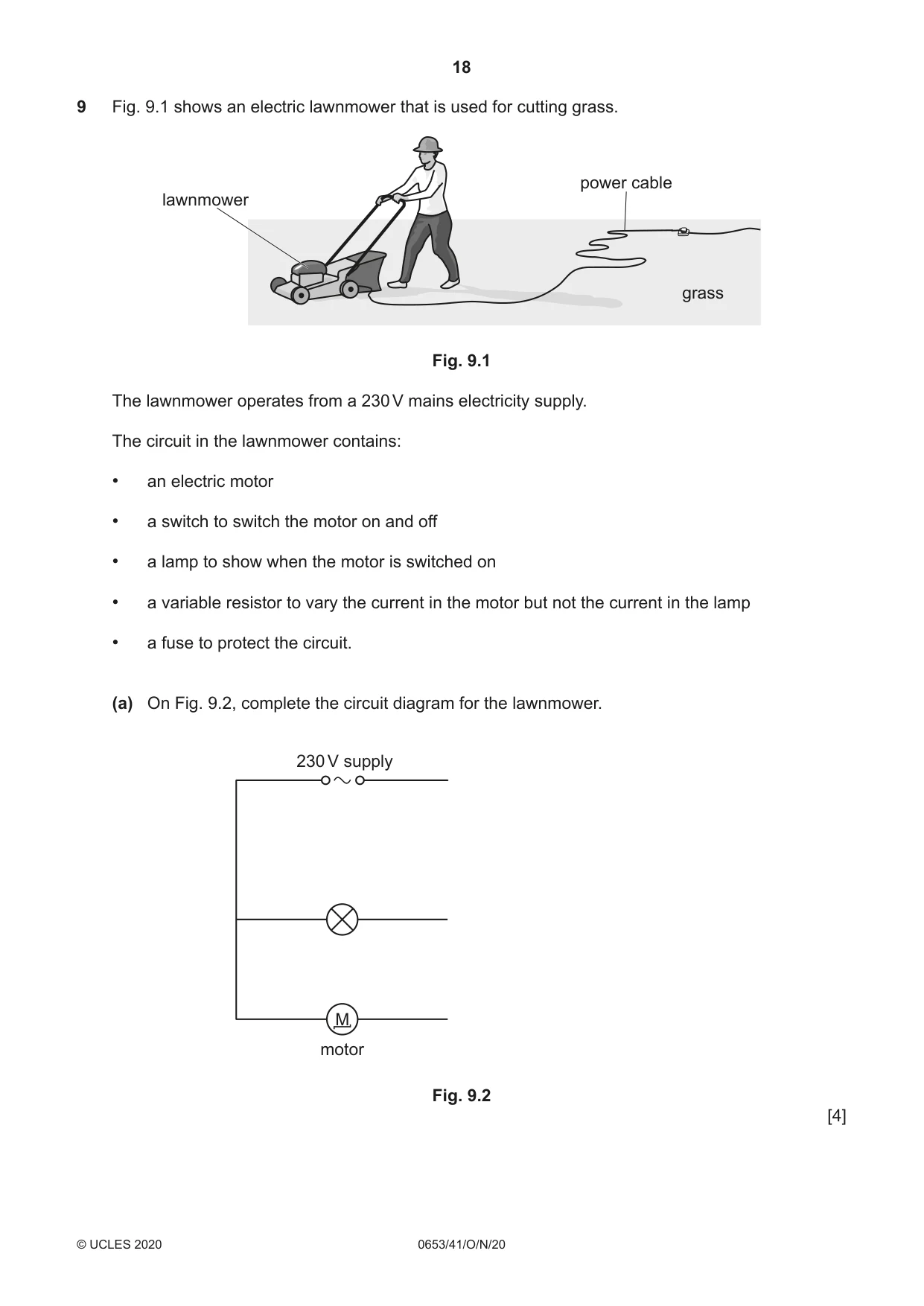
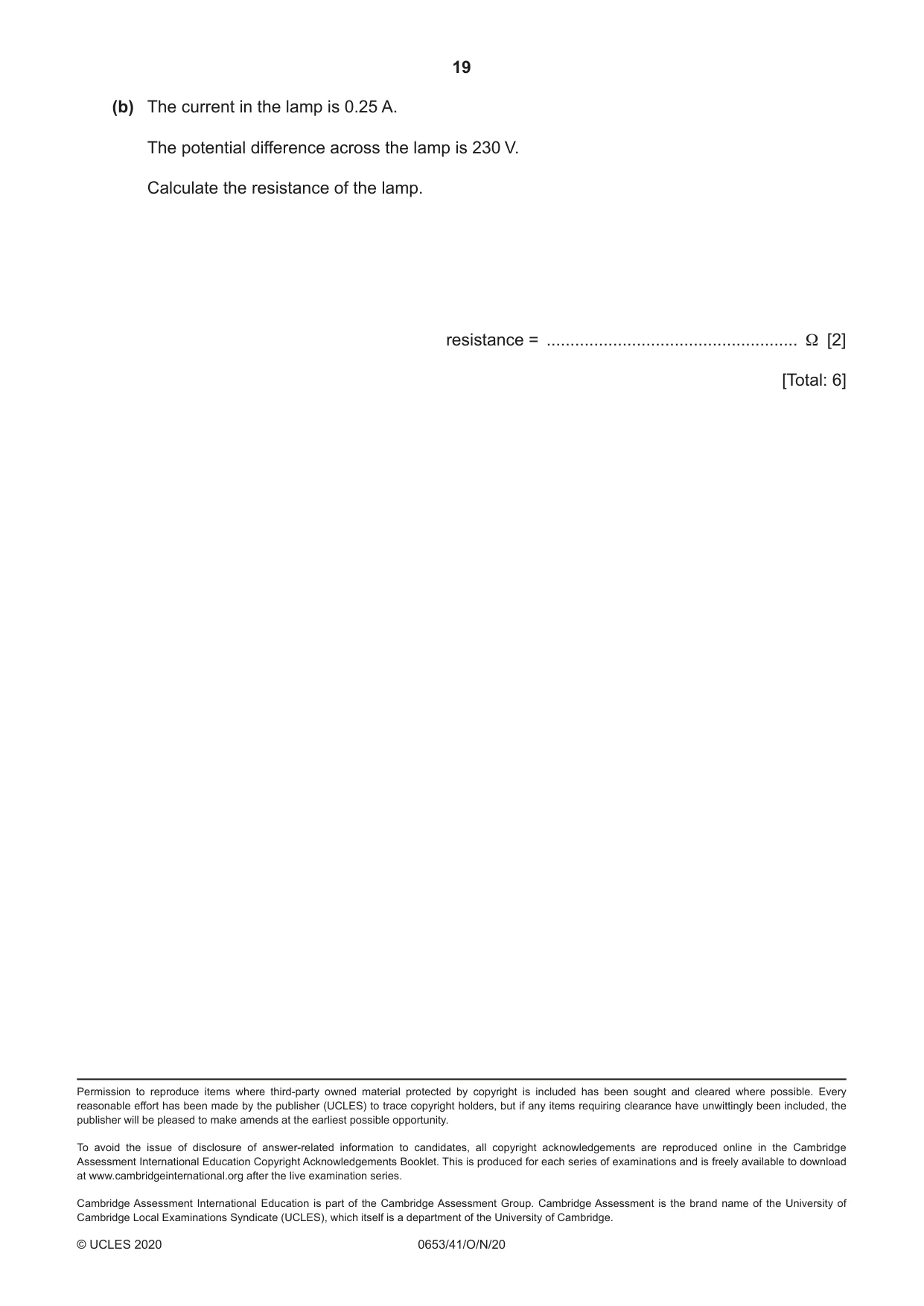
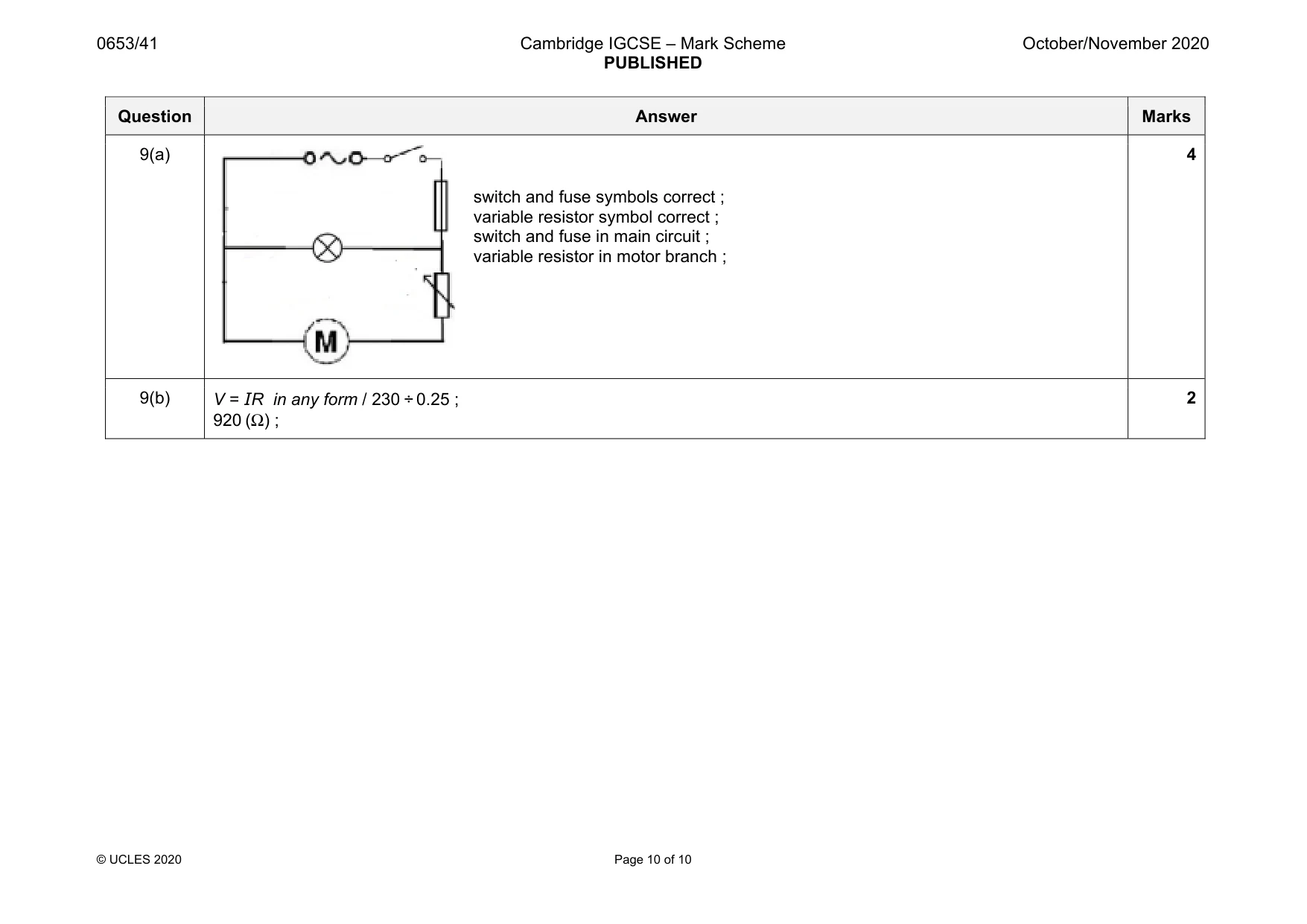
9 Fig. 9.1 shows an electric lawnmower that is used for cutting grass. power cable lawnmower grass Fig. 9.1 The lawnmower operates from a 230 V mains electricity supply. The circuit in the lawnmower contains: • an electric motor • a switch to switch the motor on and off • a lamp to show when the motor is switched on • a variable resistor to vary the current in the motor but not the current in the lamp • a fuse to protect the circuit. (a) On Fig. 9.2, complete the circuit diagram for the lawnmower. 230 V supply M motor Fig. 9.2 [4] (b) The current in the lamp is 0.25 A. The potential difference across the lamp is 230 V. Calculate the resistance of the lamp. resistance = ..................................................... Ω [2] [Total: 6]
Mark scheme: 9(a) 9(b) V = IR in any form / 230 ÷ 0.25 ; 920 (Ω) ; 2 switch and fuse symbols correct ; variable resistor symbol correct ; switch and fuse in main circuit ; variable resistor in motor branch ;
What was in this paper
The subtopics covered by these 9 questions, and how many questions each got. Open one in a new tab to see every Cambridge question on it.
What you needed in this session
Cambridge’s own grade thresholds for 2020 Oct/Nov, Paper 4 · Variant 1. A higher threshold means an easier paper — the bar moves with how the cohort did.