Cambridge IGCSE Science - Combined 0653 — 2018 Oct/Nov Paper 4 · Variant 3
0653/43/O/N/18 · 9 questions · 80 marks · ≈90 min
The question paper and its mark scheme, free to read here and free to download. This is Cambridge’s own paper, exactly as it was sat.
Question paper24 pages


Mark scheme9 pages
Answers below. Sit the paper first if you are practising.
Questions as text
Q1 · A diagram of a cell which lines the human airway
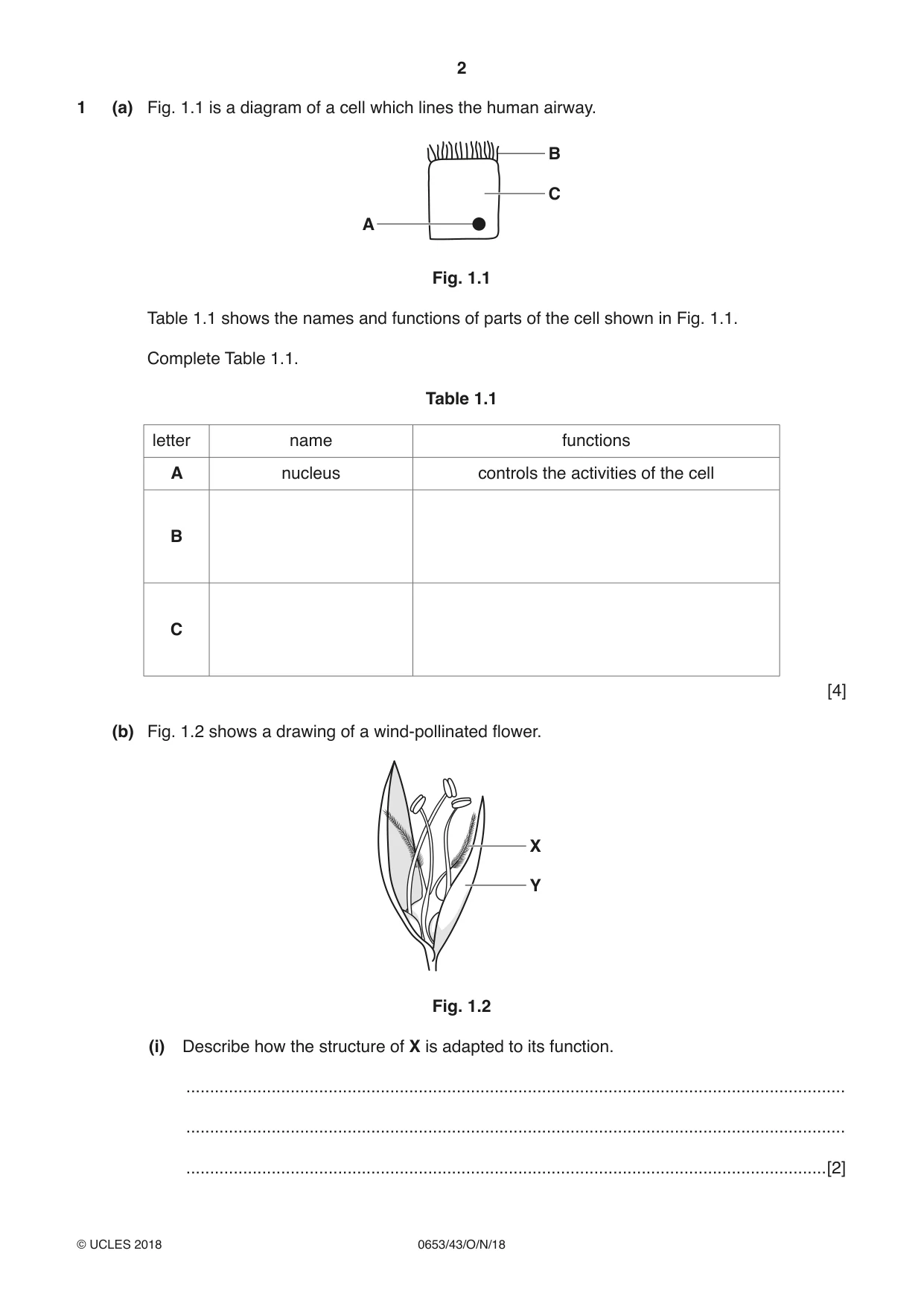
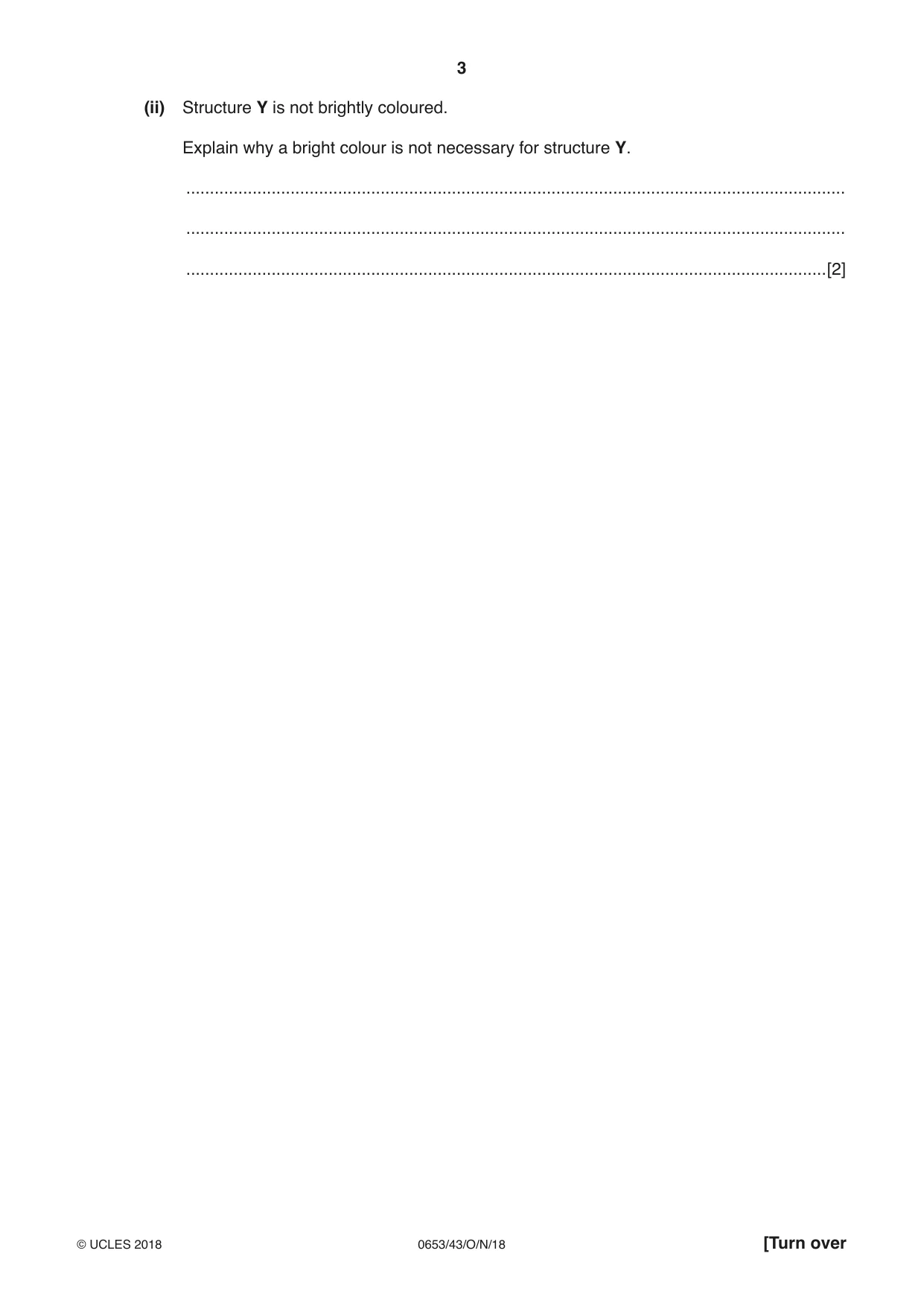
1 (a) Fig. 1.1 is a diagram of a cell which lines the human airway. B C A Fig. 1.1 Table 1.1 shows the names and functions of parts of the cell shown in Fig. 1.1. Complete Table 1.1. Table 1.1 letter name functions A nucleus controls the activities of the cell B C [4] (b) Fig. 1.2 shows a drawing of a wind-pollinated flower. X Y Fig. 1.2 (i) Describe how the structure of X is adapted to its function. ........................................................................................................................................... ........................................................................................................................................... .......................................................................................................................................[2] (ii) Structure Y is not brightly coloured. Explain why a bright colour is not necessary for structure Y. ........................................................................................................................................... ........................................................................................................................................... .......................................................................................................................................[2]
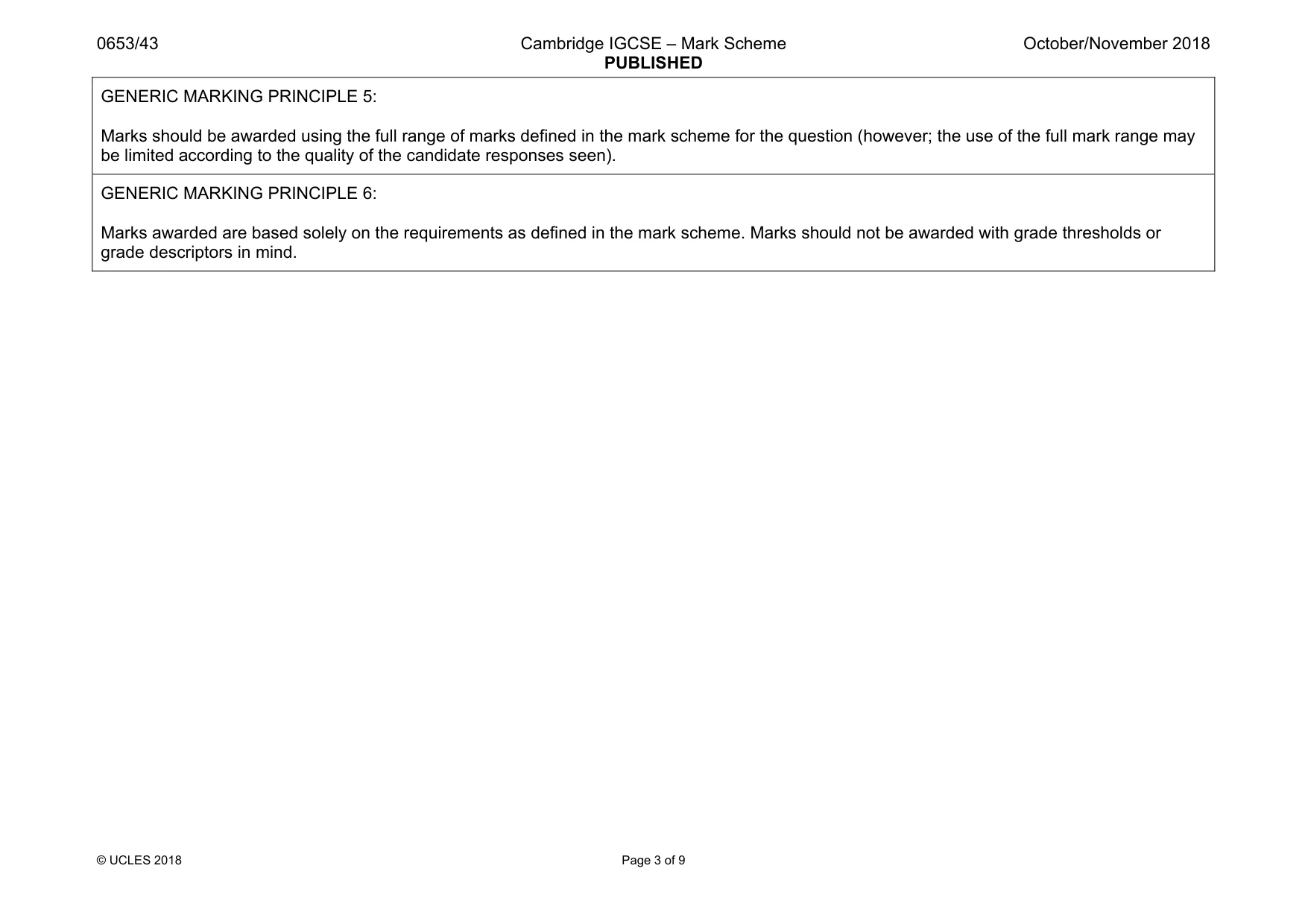
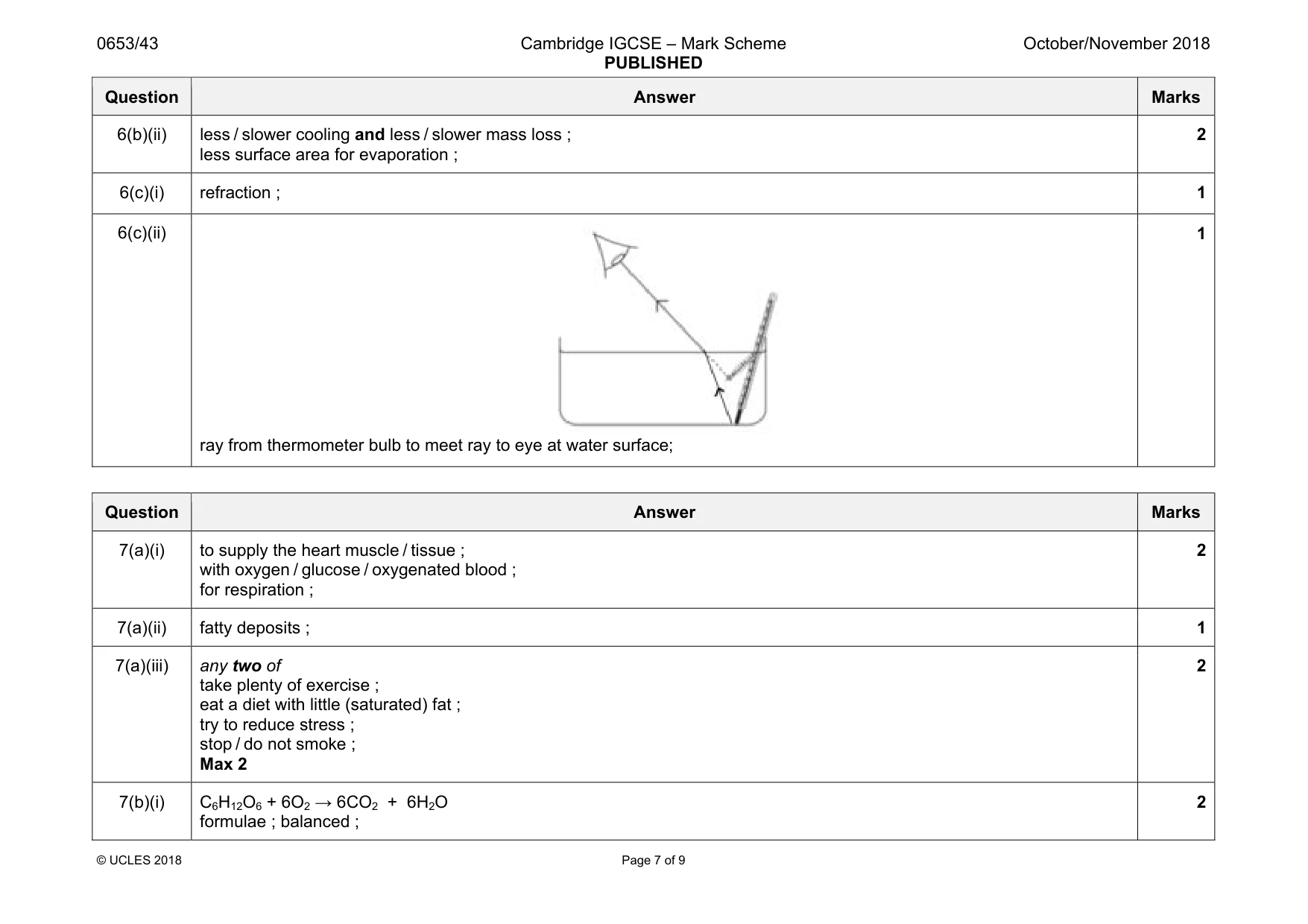
Mark scheme: 1(a) (B) cilia ; removes mucus from airway ; (C) cytoplasm ; place where chemical reactions / respiration takes place ; 4 1(b)(i) feathery / large surface area ; for collecting pollen ; 2 1(b)(ii) no need to attract insects ; because they are not needed for pollination / pollination is by wind / not by insects ; 2
Q2 · Carbon dioxide is a product of the thermal decomposition of calcium carbonate
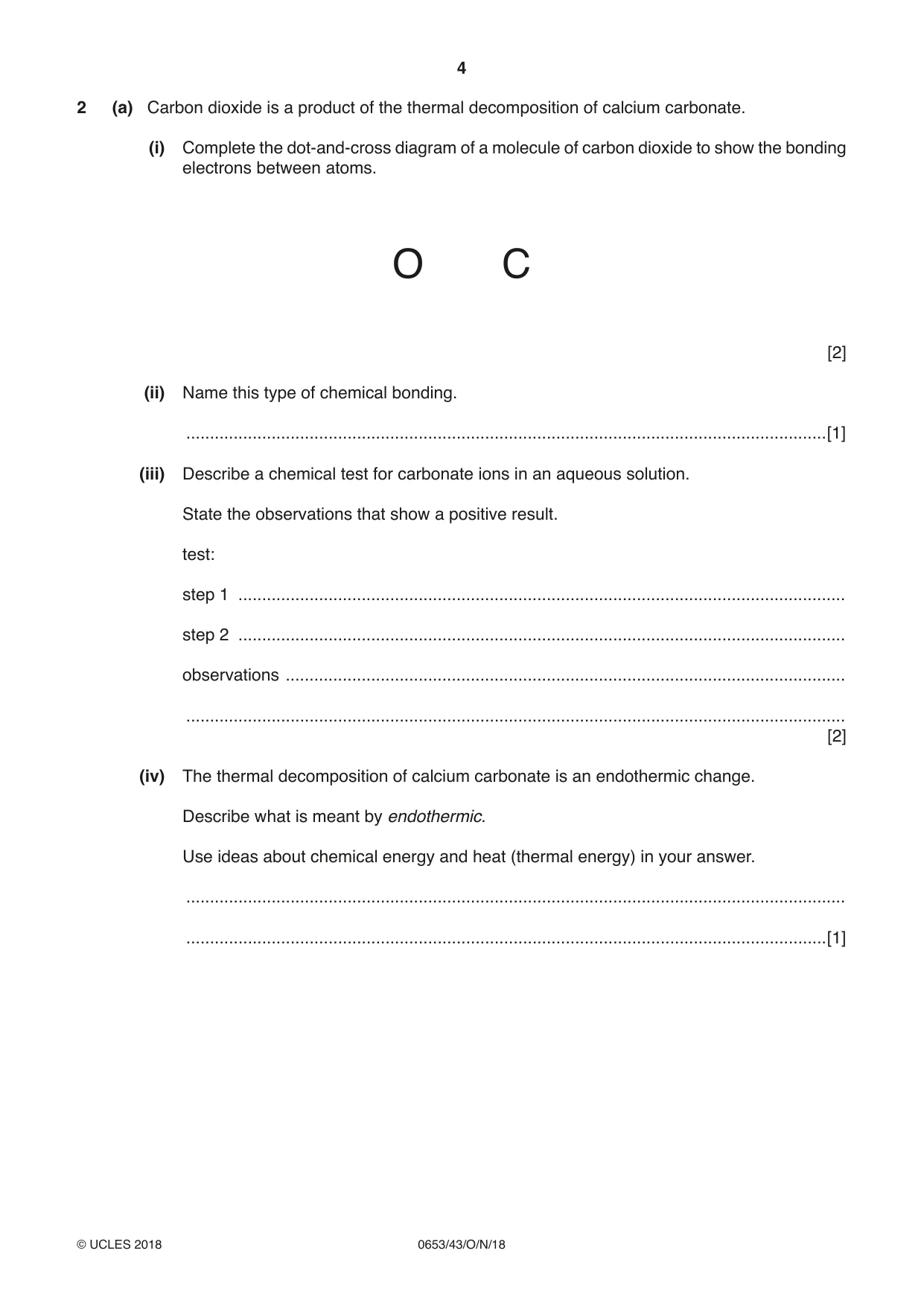
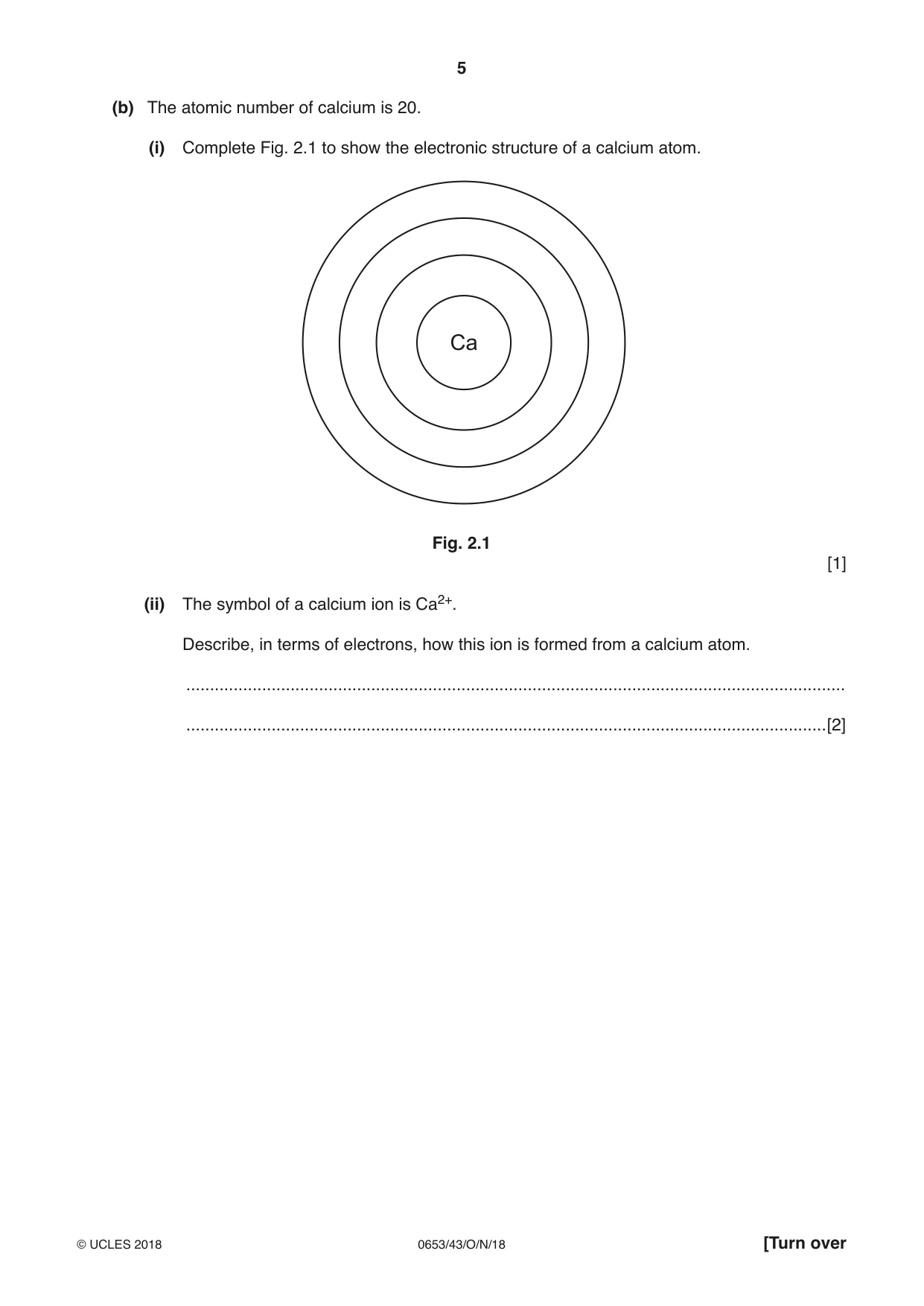
2 (a) Carbon dioxide is a product of the thermal decomposition of calcium carbonate. (i) Complete the dot-and-cross diagram of a molecule of carbon dioxide to show the bonding electrons between atoms. O C [2] (ii) Name this type of chemical bonding. .......................................................................................................................................[1] (iii) Describe a chemical test for carbonate ions in an aqueous solution. State the observations that show a positive result. test: step 1 ................................................................................................................................ step 2 ................................................................................................................................ observations ...................................................................................................................... ........................................................................................................................................... [2] (iv) The thermal decomposition of calcium carbonate is an endothermic change. Describe what is meant by endothermic. Use ideas about chemical energy and heat (thermal energy) in your answer. ........................................................................................................................................... .......................................................................................................................................[1] (b) The atomic number of calcium is 20. (i) Complete Fig. 2.1 to show the electronic structure of a calcium atom. Ca Fig. 2.1 [1] (ii) The symbol of a calcium ion is Ca2+. Describe, in terms of electrons, how this ion is formed from a calcium atom. ........................................................................................................................................... .......................................................................................................................................[2]
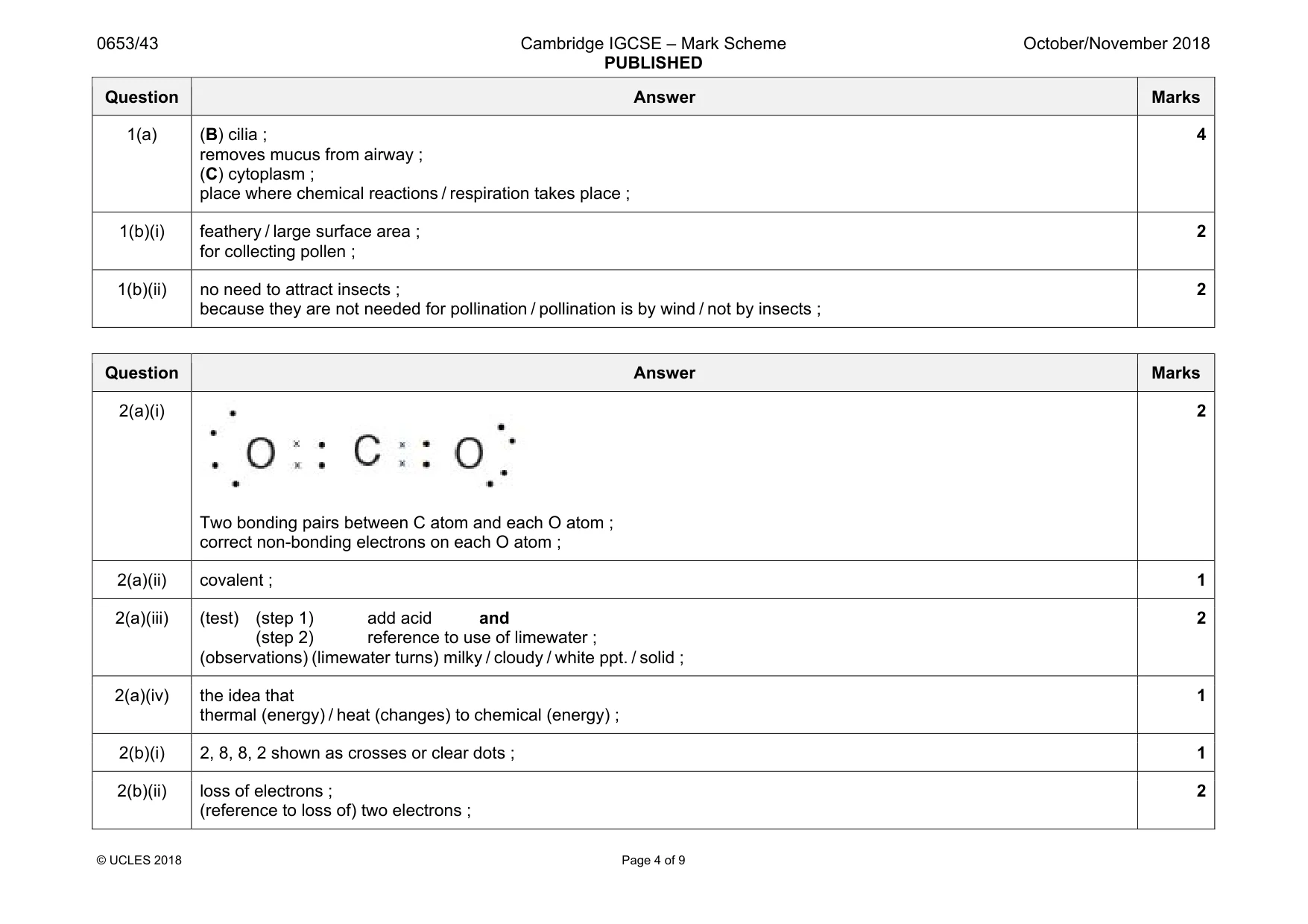
Mark scheme: 2(a)(i) Two bonding pairs between C atom and each O atom ; correct non-bonding electrons on each O atom ; 2 2(a)(ii) covalent ; 1 2(a)(iii) (test) (step 1) add acid and (step 2) reference to use of limewater ; (observations) (limewater turns) milky / cloudy / white ppt. / solid ; 2 2(a)(iv) the idea that thermal (energy) / heat (changes) to chemical (energy) ; 1 2(b)(i) 2, 8, 8, 2 shown as crosses or clear dots ; 1 2(b)(ii) loss of electrons ; (reference to loss of) two electrons ; 2
Q3 · A man pushing a shopping trolley
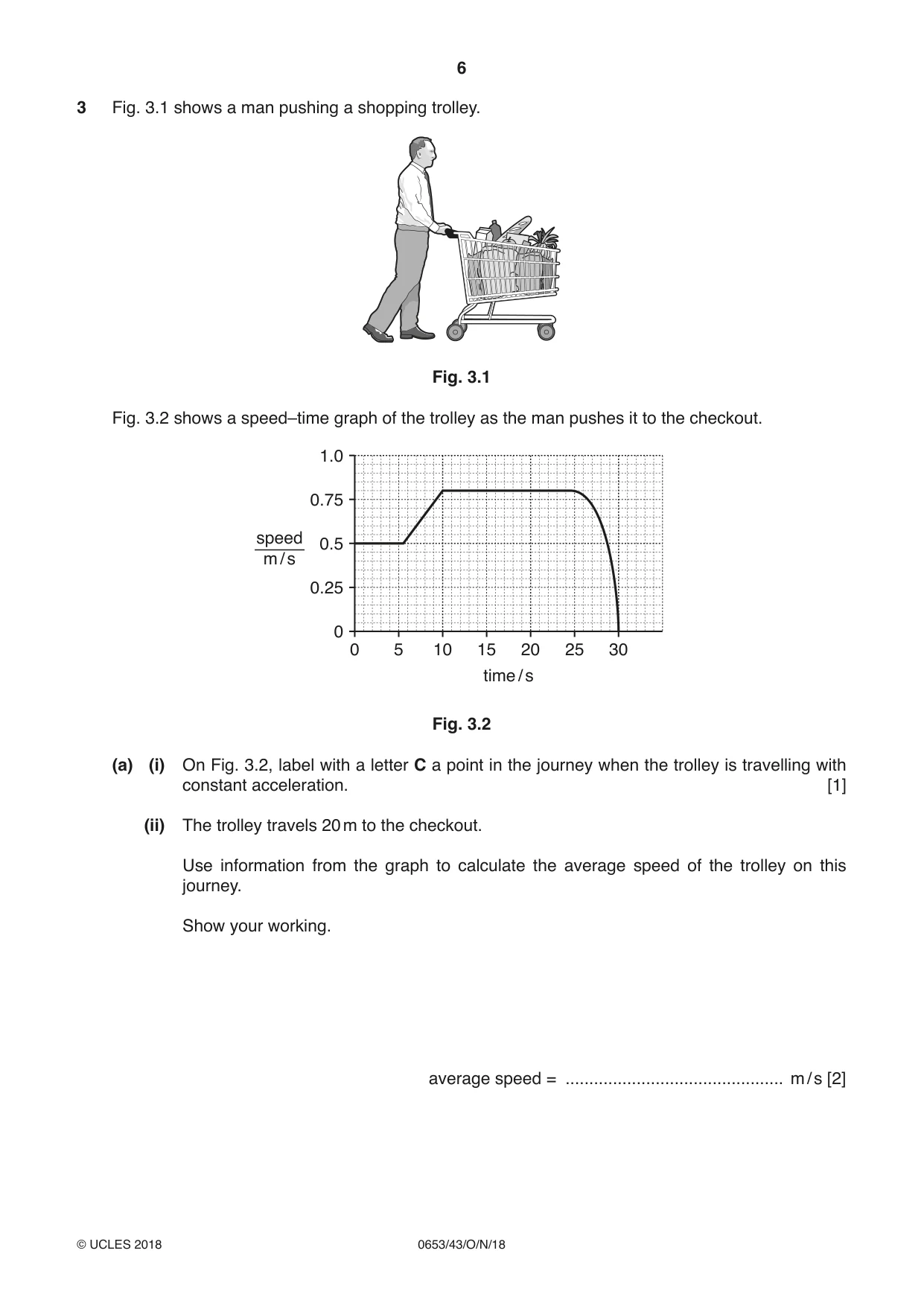
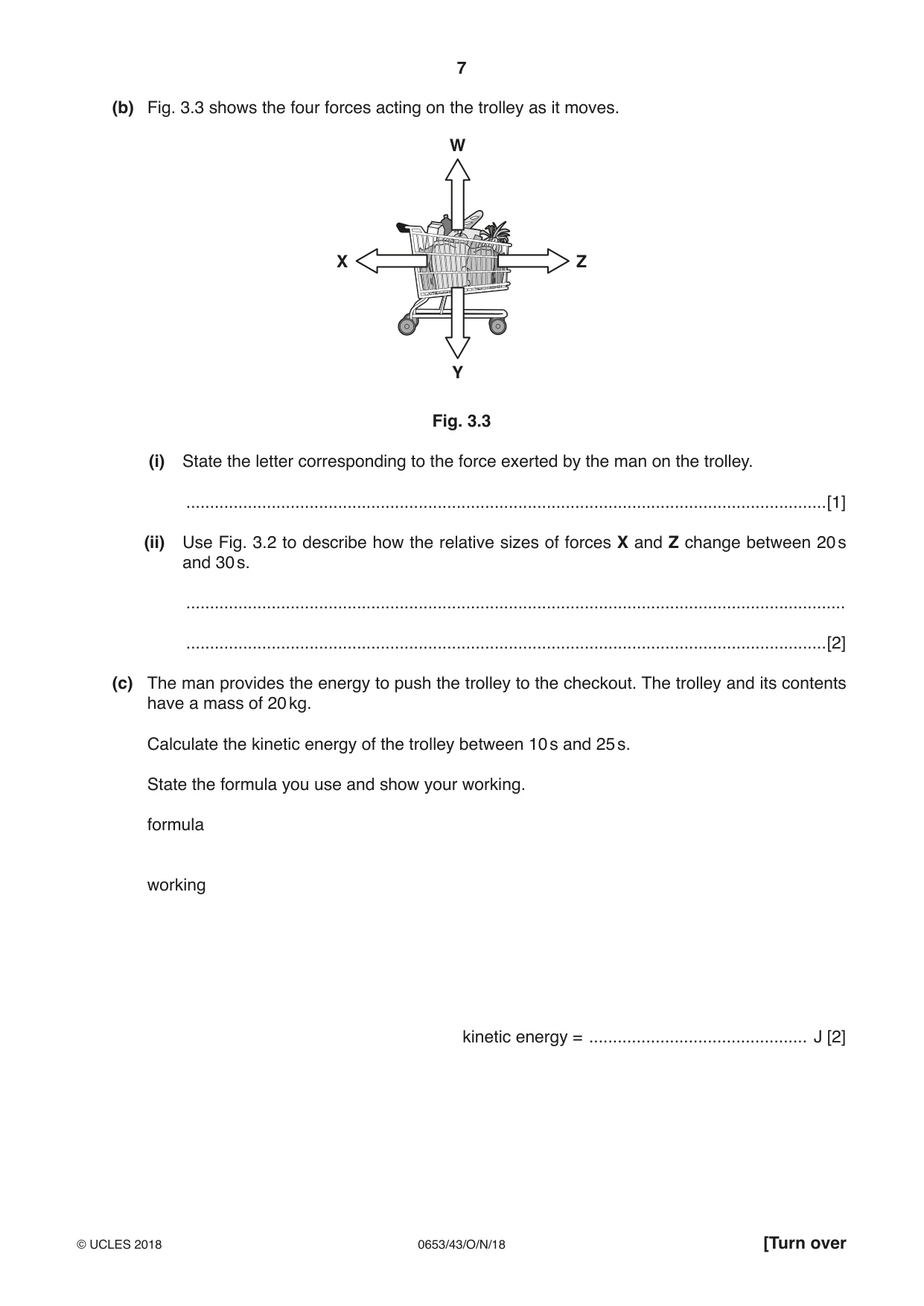
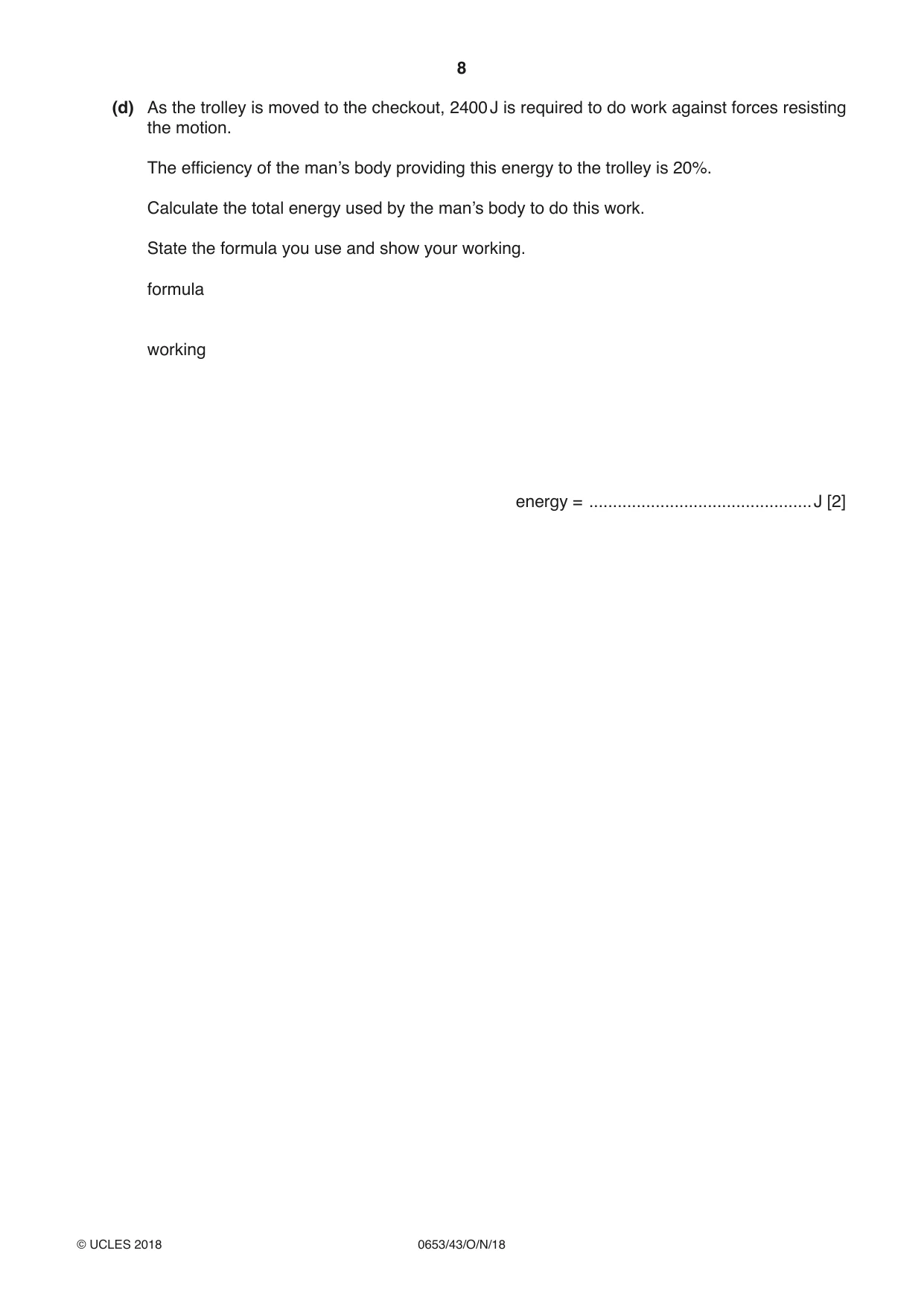
3 Fig. 3.1 shows a man pushing a shopping trolley. Fig. 3.1 Fig. 3.2 shows a speed–time graph of the trolley as the man pushes it to the checkout. 1.0 0.75 speed 0.5 m / s 0.25 0 0 5 10 15 20 25 30 time / s Fig. 3.2 (a) (i) On Fig. 3.2, label with a letter C a point in the journey when the trolley is travelling with constant acceleration. [1] (ii) The trolley travels 20 m to the checkout. Use information from the graph to calculate the average speed of the trolley on this journey. Show your working. average speed = .............................................. m / s [2] (b) Fig. 3.3 shows the four forces acting on the trolley as it moves. W X Z Y Fig. 3.3 (i) State the letter corresponding to the force exerted by the man on the trolley. .......................................................................................................................................[1] (ii) Use Fig. 3.2 to describe how the relative sizes of forces X and Z change between 20 s and 30 s. ........................................................................................................................................... .......................................................................................................................................[2] (c) The man provides the energy to push the trolley to the checkout. The trolley and its contents have a mass of 20 kg. Calculate the kinetic energy of the trolley between 10 s and 25 s. State the formula you use and show your working. formula working kinetic energy = .............................................. J [2] (d) As the trolley is moved to the checkout, 2400 J is required to do work against forces resisting the motion. The efficiency of the man’s body providing this energy to the trolley is 20%. Calculate the total energy used by the man’s body to do this work. State the formula you use and show your working. formula working energy = ...............................................J [2]
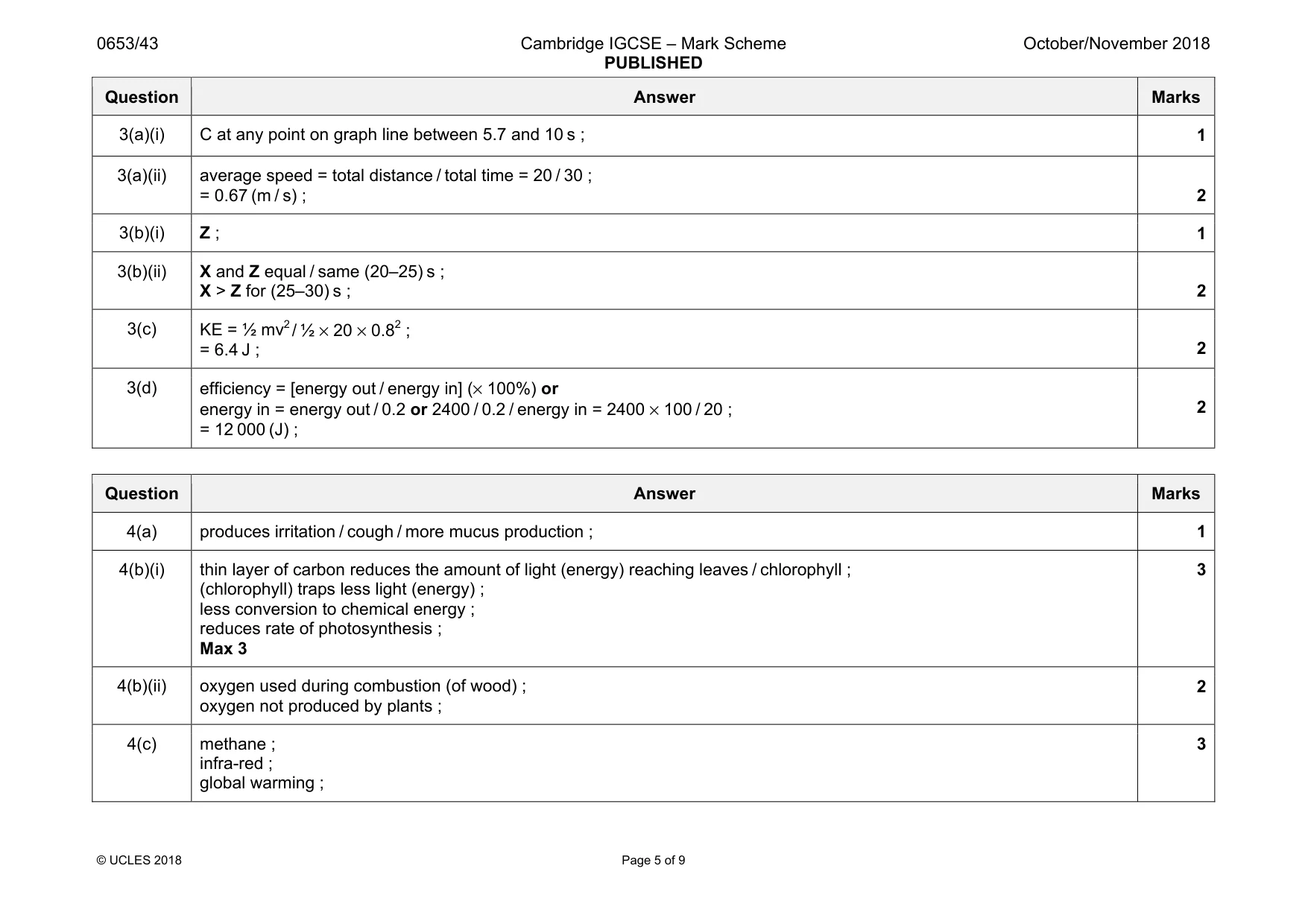
Mark scheme: 3(a)(i) C at any point on graph line between 5.7 and 10 s ; 1 3(a)(ii) average speed = total distance / total time = 20 / 30 ; = 0.67 (m / s) ; 2 3(b)(i) Z ; 1 3(b)(ii) X and Z equal / same (20–25) s ; X > Z for (25–30) s ; 2 3(c) KE = ½ mv2 / ½ × 20 × 0.82 ; = 6.4 J ; 2 3(d) efficiency = [energy out / energy in] (× 100%) or energy in = energy out / 0.2 or 2400 / 0.2 / energy in = 2400 × 100 / 20 ; = 12 000 (J) ; 2
Q4 · Rainforest is often cleared for agriculture by cutting down the trees and burning them
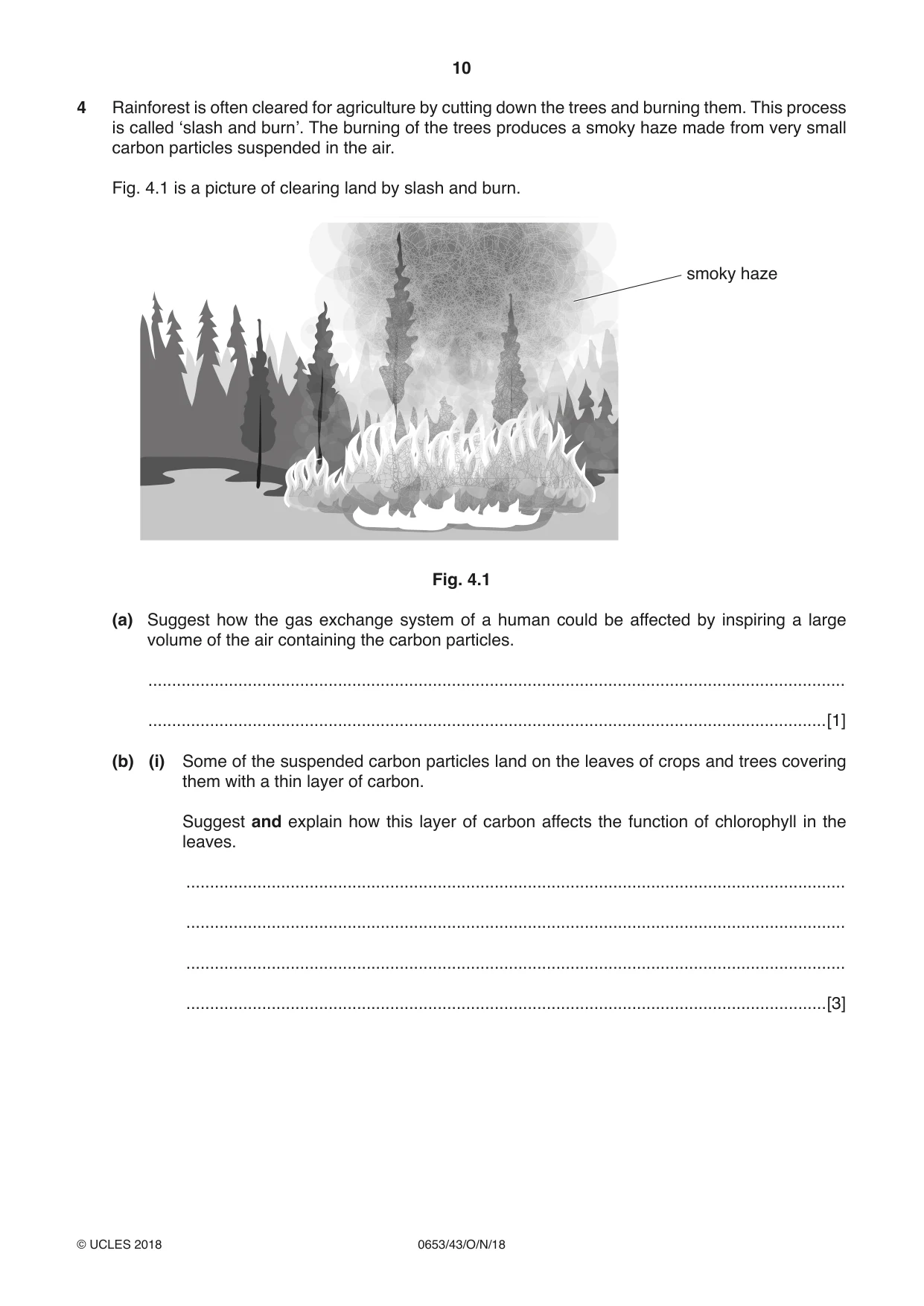
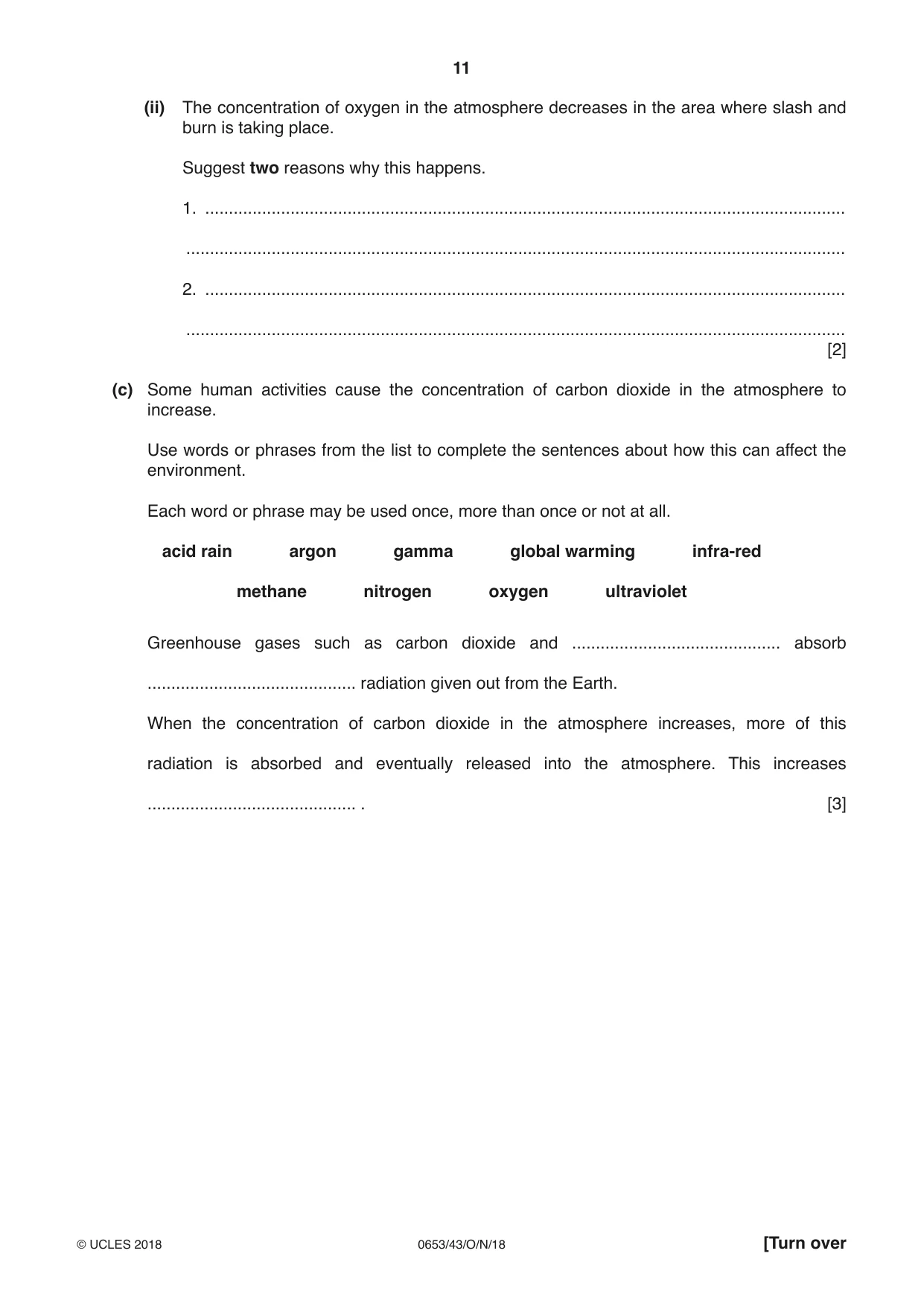
4 Rainforest is often cleared for agriculture by cutting down the trees and burning them. This process is called ‘slash and burn’. The burning of the trees produces a smoky haze made from very small carbon particles suspended in the air. Fig. 4.1 is a picture of clearing land by slash and burn. smoky haze Fig. 4.1 (a) Suggest how the gas exchange system of a human could be affected by inspiring a large volume of the air containing the carbon particles. ................................................................................................................................................... ...............................................................................................................................................[1] (b) (i) Some of the suspended carbon particles land on the leaves of crops and trees covering them with a thin layer of carbon. Suggest and explain how this layer of carbon affects the function of chlorophyll in the leaves. ........................................................................................................................................... ........................................................................................................................................... ........................................................................................................................................... .......................................................................................................................................[3] (ii) The concentration of oxygen in the atmosphere decreases in the area where slash and burn is taking place. Suggest two reasons why this happens. 1. ....................................................................................................................................... ........................................................................................................................................... 2. ....................................................................................................................................... ........................................................................................................................................... [2] (c) Some human activities cause the concentration of carbon dioxide in the atmosphere to increase. Use words or phrases from the list to complete the sentences about how this can affect the environment. Each word or phrase may be used once, more than once or not at all. acid rain argon gamma global warming infra-red methane nitrogen oxygen ultraviolet Greenhouse gases such as carbon dioxide and ............................................ absorb ............................................ radiation given out from the Earth. When the concentration of carbon dioxide in the atmosphere increases, more of this radiation is absorbed and eventually released into the atmosphere. This increases ............................................ . [3]
Mark scheme: 4(a) produces irritation / cough / more mucus production ; 1 4(b)(i) thin layer of carbon reduces the amount of light (energy) reaching leaves / chlorophyll ; (chlorophyll) traps less light (energy) ; less conversion to chemical energy ; reduces rate of photosynthesis ; Max 3 3 4(b)(ii) oxygen used during combustion (of wood) ; oxygen not produced by plants ; 2 4(c) methane ; infra-red ; global warming ; 3
Q5 · A student investigates the reactivities of four metals, A, B, C and D
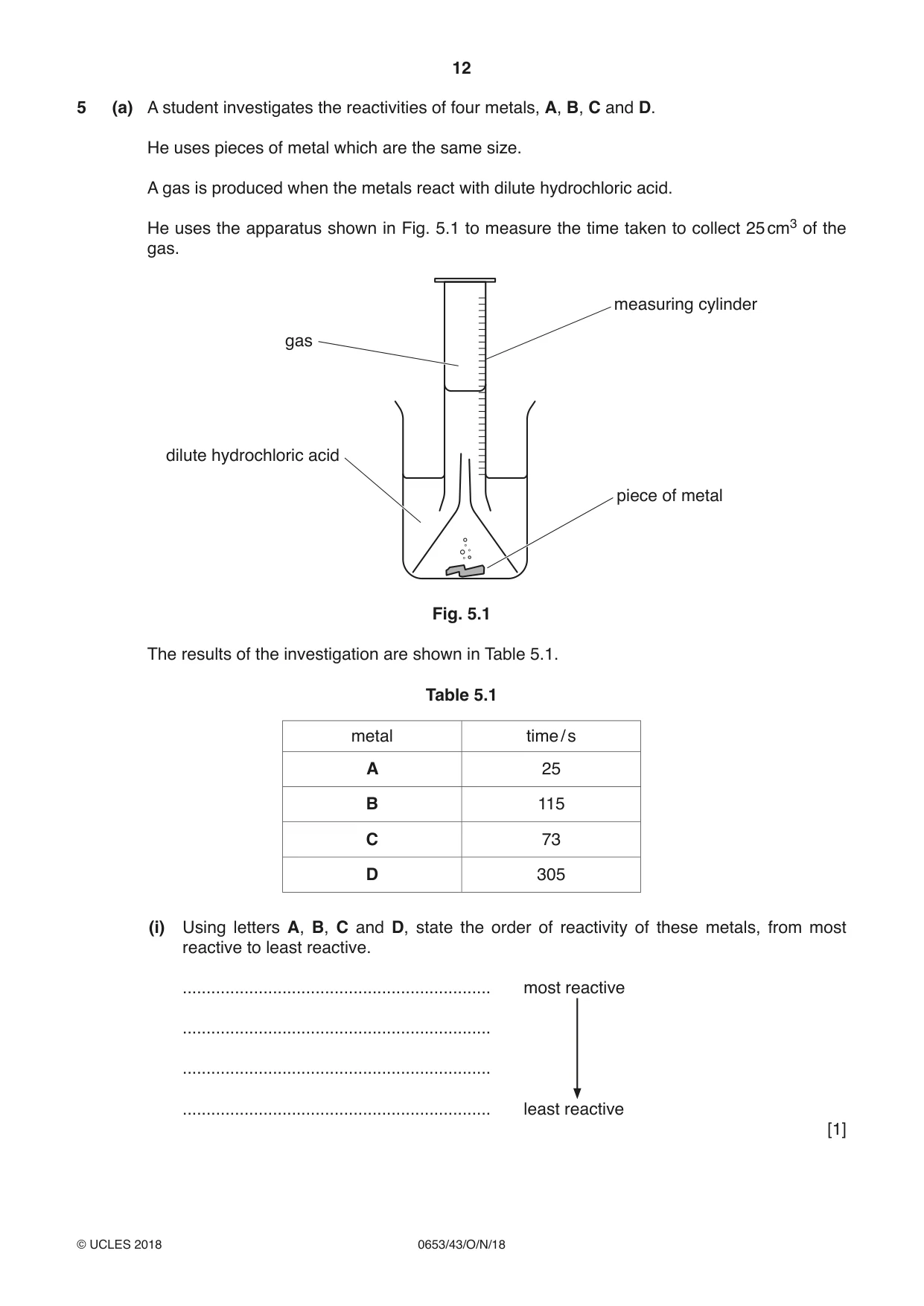
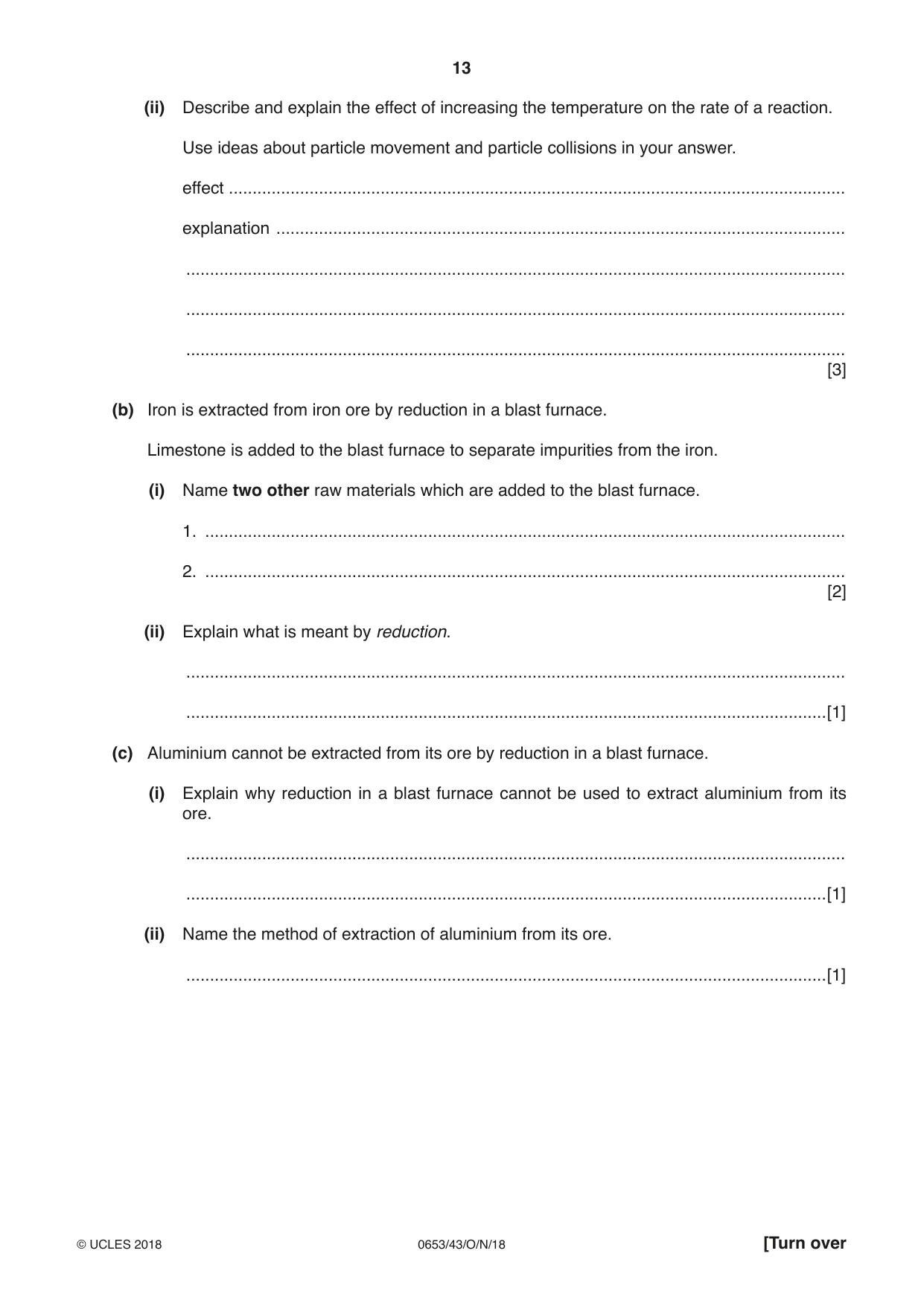
5 (a) A student investigates the reactivities of four metals, A, B, C and D. He uses pieces of metal which are the same size. A gas is produced when the metals react with dilute hydrochloric acid. He uses the apparatus shown in Fig. 5.1 to measure the time taken to collect 25 cm3 of the gas. measuring cylinder gas dilute hydrochloric acid piece of metal Fig. 5.1 The results of the investigation are shown in Table 5.1. Table 5.1 metal time / s A 25 B 115 C 73 D 305 (i) Using letters A, B, C and D, state the order of reactivity of these metals, from most reactive to least reactive. ................................................................. most reactive ................................................................. ................................................................. ................................................................. least reactive [1] (ii) Describe and explain the effect of increasing the temperature on the rate of a reaction. Use ideas about particle movement and particle collisions in your answer. effect .................................................................................................................................. explanation ........................................................................................................................ ........................................................................................................................................... ........................................................................................................................................... ........................................................................................................................................... [3] (b) Iron is extracted from iron ore by reduction in a blast furnace. Limestone is added to the blast furnace to separate impurities from the iron. (i) Name two other raw materials which are added to the blast furnace. 1. ....................................................................................................................................... 2. ....................................................................................................................................... [2] (ii) Explain what is meant by reduction. ........................................................................................................................................... .......................................................................................................................................[1] (c) Aluminium cannot be extracted from its ore by reduction in a blast furnace. (i) Explain why reduction in a blast furnace cannot be used to extract aluminium from its ore. ........................................................................................................................................... .......................................................................................................................................[1] (ii) Name the method of extraction of aluminium from its ore. .......................................................................................................................................[1]
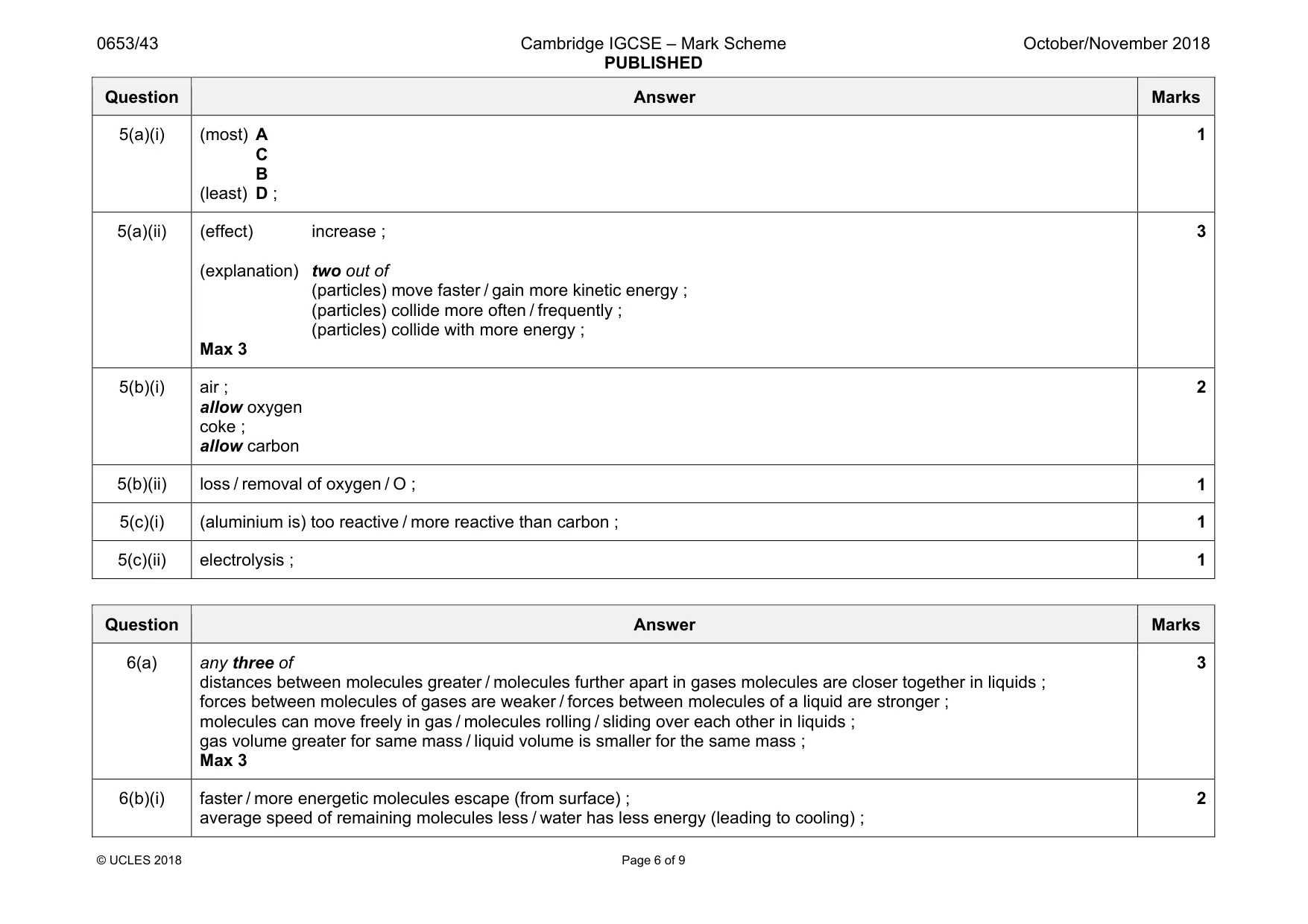
Mark scheme: 5(a)(i) (most) A C B (least) D ; 1 5(a)(ii) (effect) increase ; (explanation) two out of (particles) move faster / gain more kinetic energy ; (particles) collide more often / frequently ; (particles) collide with more energy ; Max 3 3 5(b)(i) air ; allow oxygen coke ; allow carbon 2 5(b)(ii) loss / removal of oxygen / O ; 1 5(c)(i) (aluminium is) too reactive / more reactive than carbon ; 1 5(c)(ii) electrolysis ; 1
Q6 · The density of water, a liquid, is very different from the density of steam, a gas
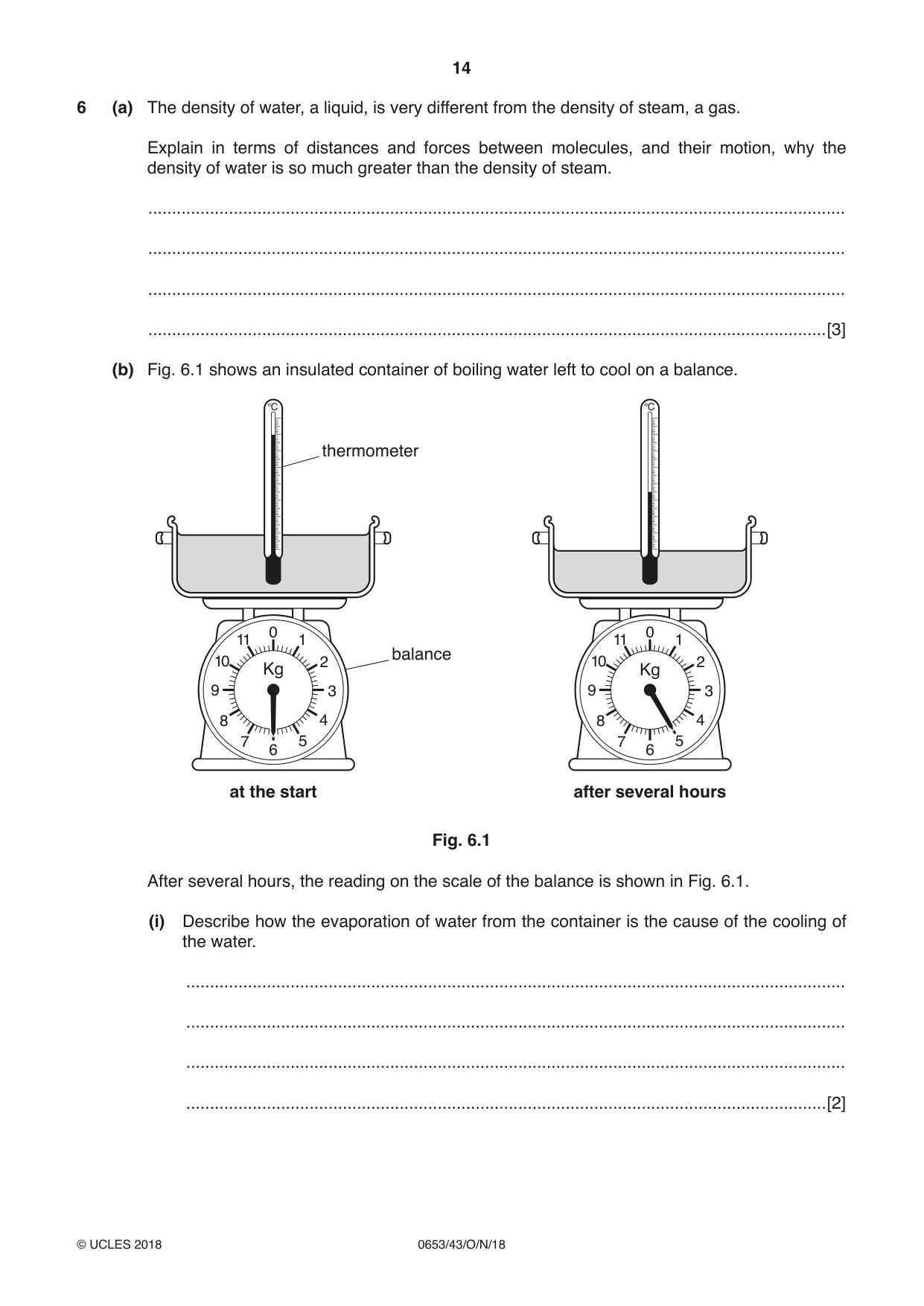
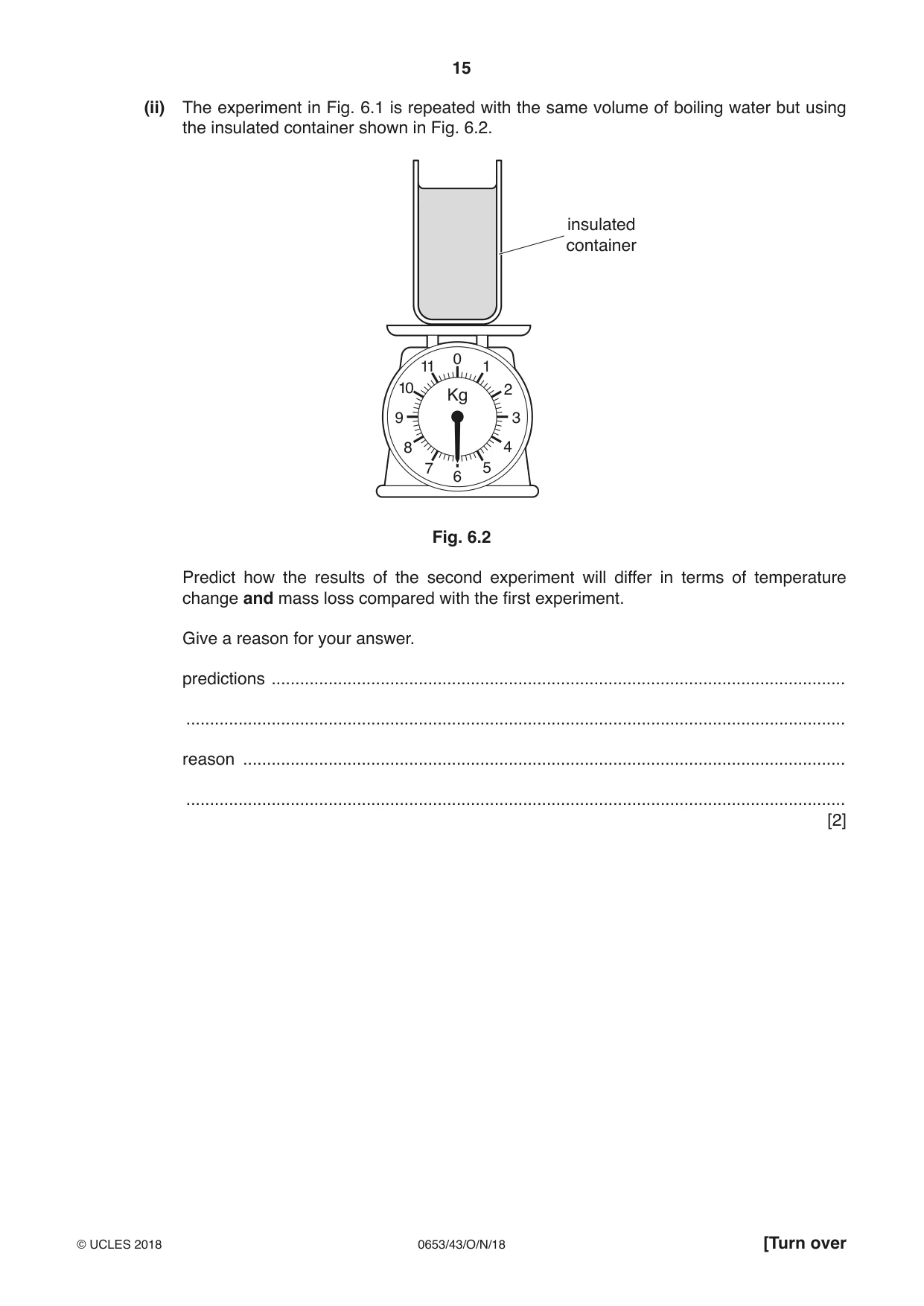
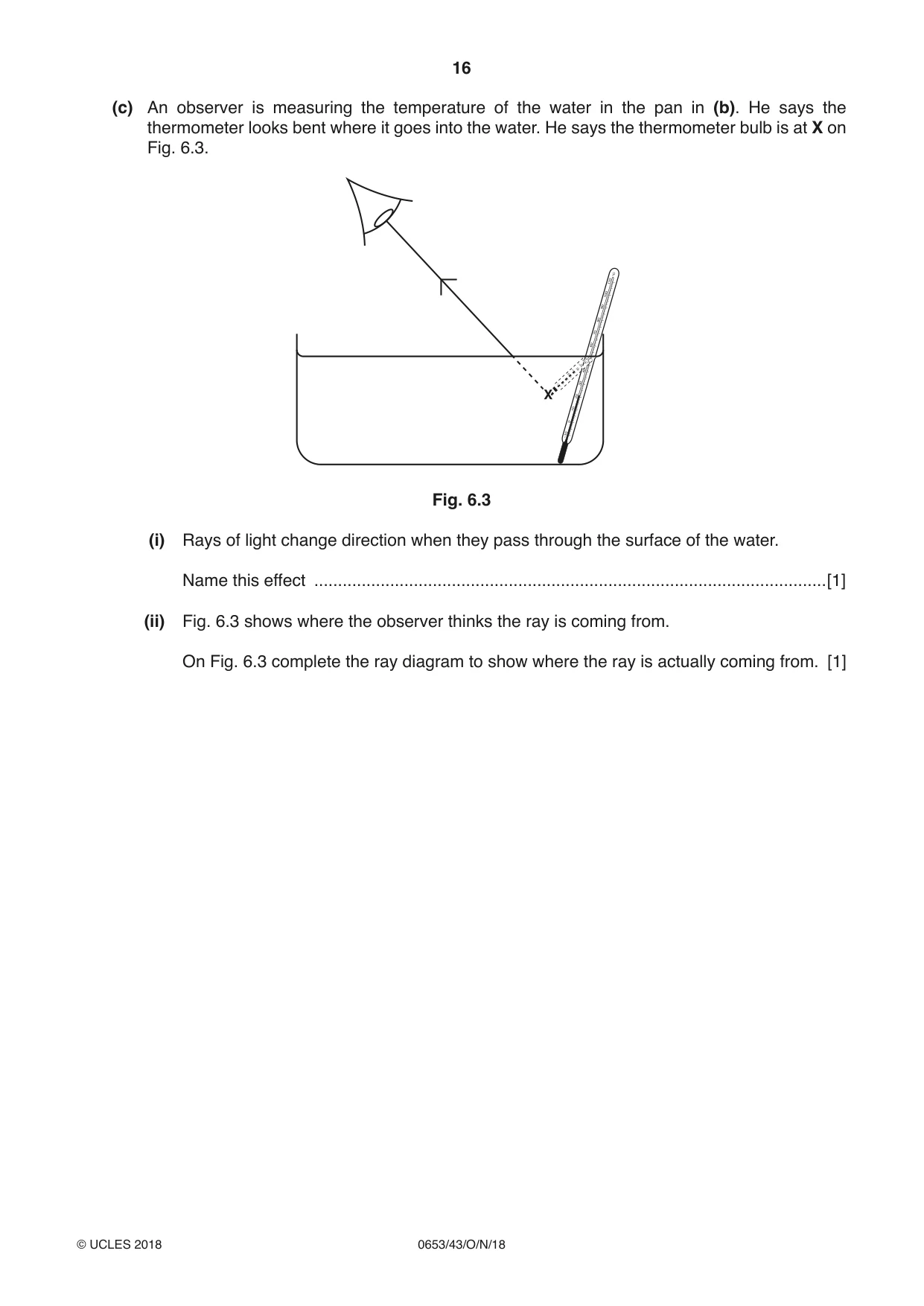
6 (a) The density of water, a liquid, is very different from the density of steam, a gas. Explain in terms of distances and forces between molecules, and their motion, why the density of water is so much greater than the density of steam. ................................................................................................................................................... ................................................................................................................................................... ................................................................................................................................................... ...............................................................................................................................................[3] (b) Fig. 6.1 shows an insulated container of boiling water left to cool on a balance. °C °C thermometer 0 0 11 1 11 1 balance 10 2 10 2 Kg Kg 9 3 9 3 8 4 8 4 7 5 7 5 6 6 at the start after several hours Fig. 6.1 After several hours, the reading on the scale of the balance is shown in Fig. 6.1. (i) Describe how the evaporation of water from the container is the cause of the cooling of the water. ........................................................................................................................................... ........................................................................................................................................... ........................................................................................................................................... .......................................................................................................................................[2] (ii) The experiment in Fig. 6.1 is repeated with the same volume of boiling water but using the insulated container shown in Fig. 6.2. insulated container 0 11 1 10 2 Kg 9 3 8 4 7 5 6 Fig. 6.2 Predict how the results of the second experiment will differ in terms of temperature change and mass loss compared with the first experiment. Give a reason for your answer. predictions ......................................................................................................................... ........................................................................................................................................... reason ............................................................................................................................... ........................................................................................................................................... [2] (c) An observer is measuring the temperature of the water in the pan in (b). He says the thermometer looks bent where it goes into the water. He says the thermometer bulb is at X on Fig. 6.3. 5 Fig. 6.3 (i) Rays of light change direction when they pass through the surface of the water. Name this effect ............................................................................................................[1] (ii) Fig. 6.3 shows where the observer thinks the ray is coming from. On Fig. 6.3 complete the ray diagram to show where the ray is actually coming from. [1]
Mark scheme: 6(a) any three of distances between molecules greater / molecules further apart in gases molecules are closer together in liquids ; forces between molecules of gases are weaker / forces between molecules of a liquid are stronger ; molecules can move freely in gas / molecules rolling / sliding over each other in liquids ; gas volume greater for same mass / liquid volume is smaller for the same mass ; Max 3 3 6(b)(i) faster / more energetic molecules escape (from surface) ; average speed of remaining molecules less / water has less energy (leading to cooling) ; 2 Question Answer Marks 6(b)(ii) less / slower cooling and less / slower mass loss ; less surface area for evaporation ; 2 6(c)(i) refraction ; 1 6(c)(ii) ray from thermometer bulb to meet ray to eye at water surface; 1
Q7 · The external structures of the heart
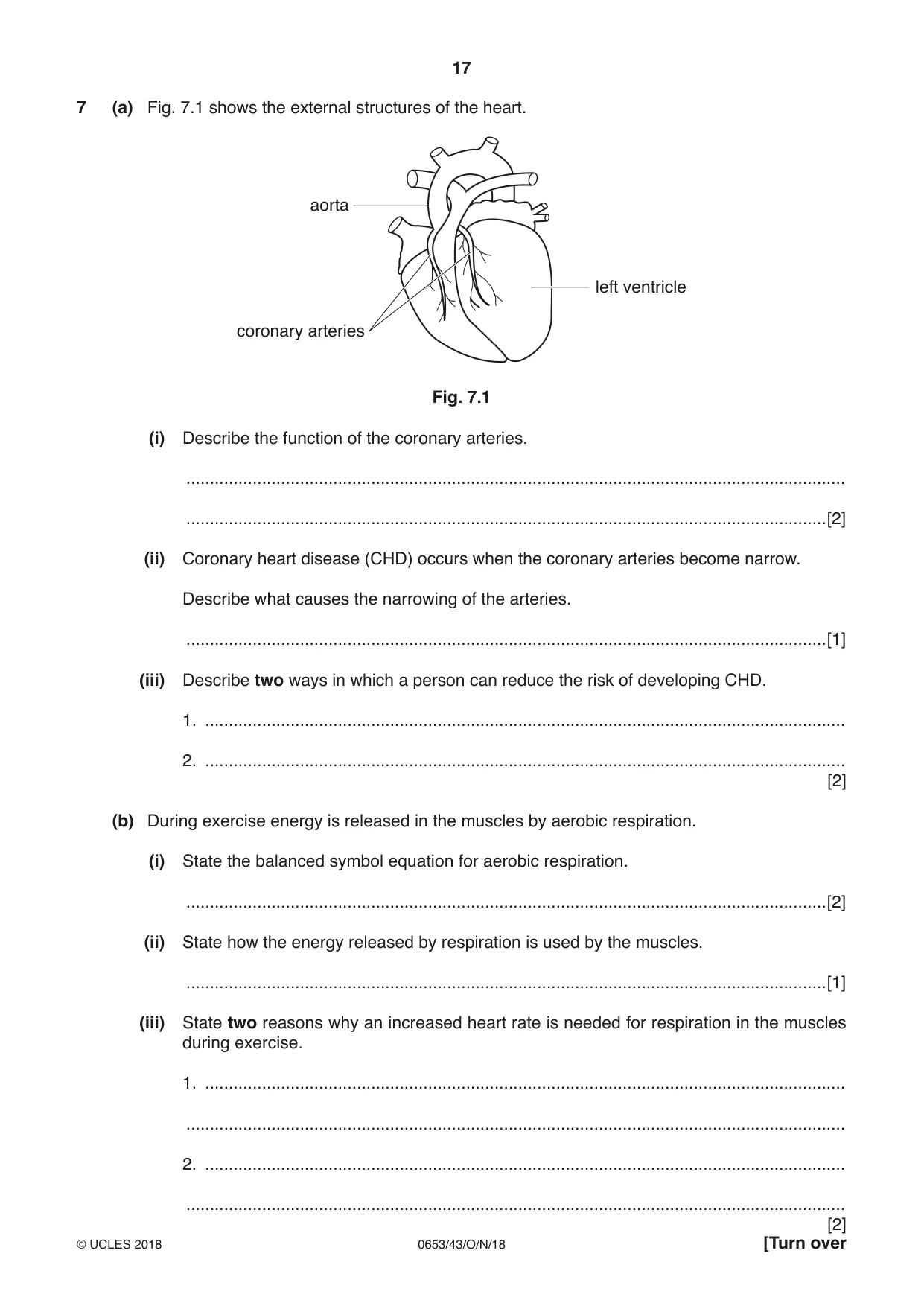
7 (a) Fig. 7.1 shows the external structures of the heart. aorta left ventricle coronary arteries Fig. 7.1 (i) Describe the function of the coronary arteries. ........................................................................................................................................... .......................................................................................................................................[2] (ii) Coronary heart disease (CHD) occurs when the coronary arteries become narrow. Describe what causes the narrowing of the arteries. .......................................................................................................................................[1] (iii) Describe two ways in which a person can reduce the risk of developing CHD. 1. ....................................................................................................................................... 2. ....................................................................................................................................... [2] (b) During exercise energy is released in the muscles by aerobic respiration. (i) State the balanced symbol equation for aerobic respiration. .......................................................................................................................................[2] (ii) State how the energy released by respiration is used by the muscles. .......................................................................................................................................[1] (iii) State two reasons why an increased heart rate is needed for respiration in the muscles during exercise. 1. ....................................................................................................................................... ........................................................................................................................................... 2. ....................................................................................................................................... ...........................................................................................................................................
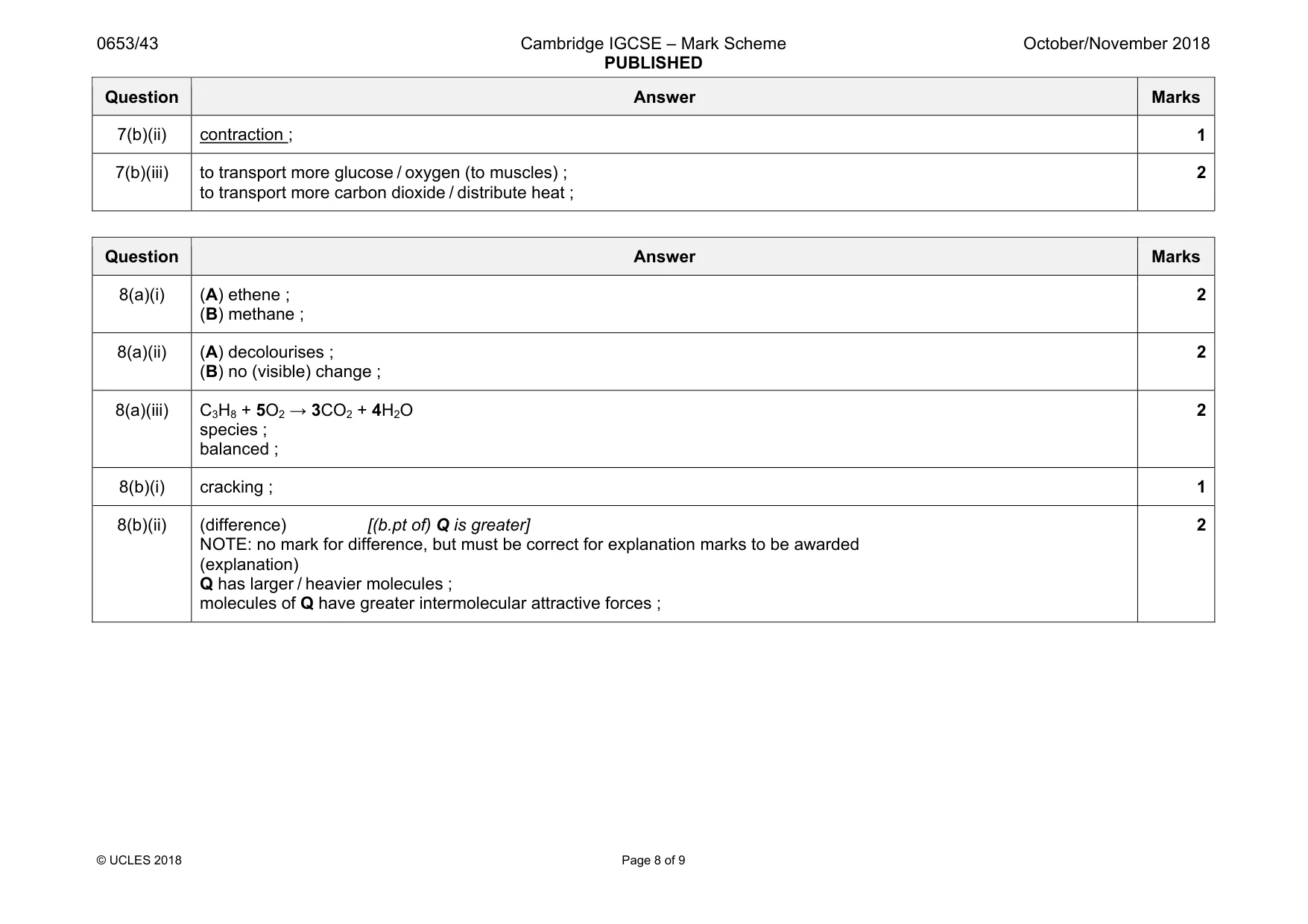
Mark scheme: 7(a)(i) to supply the heart muscle / tissue ; with oxygen / glucose / oxygenated blood ; for respiration ; 2 7(a)(ii) fatty deposits ; 1 7(a)(iii) any two of take plenty of exercise ; eat a diet with little (saturated) fat ; try to reduce stress ; stop / do not smoke ; Max 2 2 7(b)(i) C6H12O6 + 6O2 → 6CO2 + 6H2O formulae ; balanced ; 2 Question Answer Marks 7(b)(ii) contraction ; 1 7(b)(iii) to transport more glucose / oxygen (to muscles) ; to transport more carbon dioxide / distribute heat ; 2
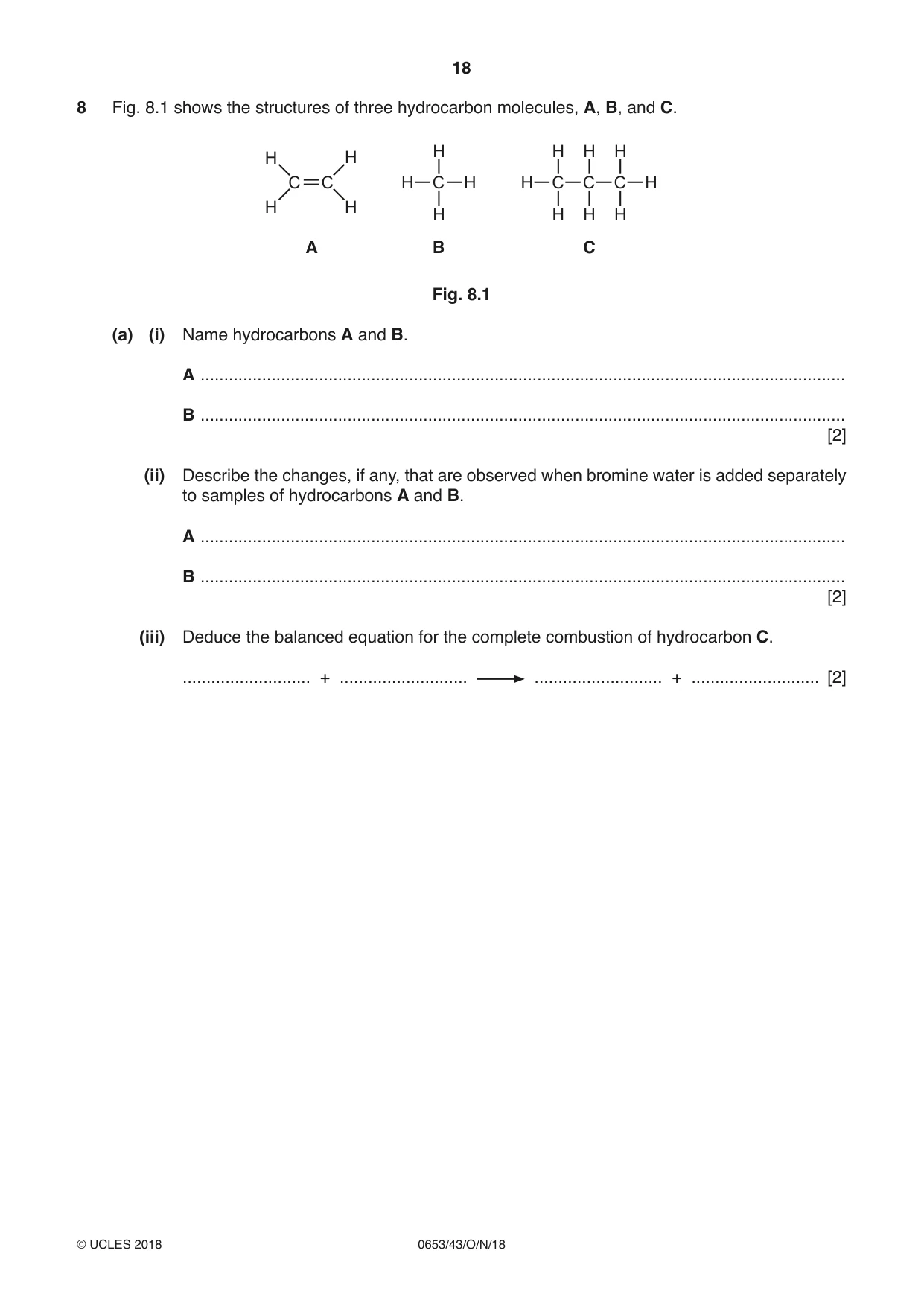
Q8 · The structures of three hydrocarbon molecules, A, B, and C
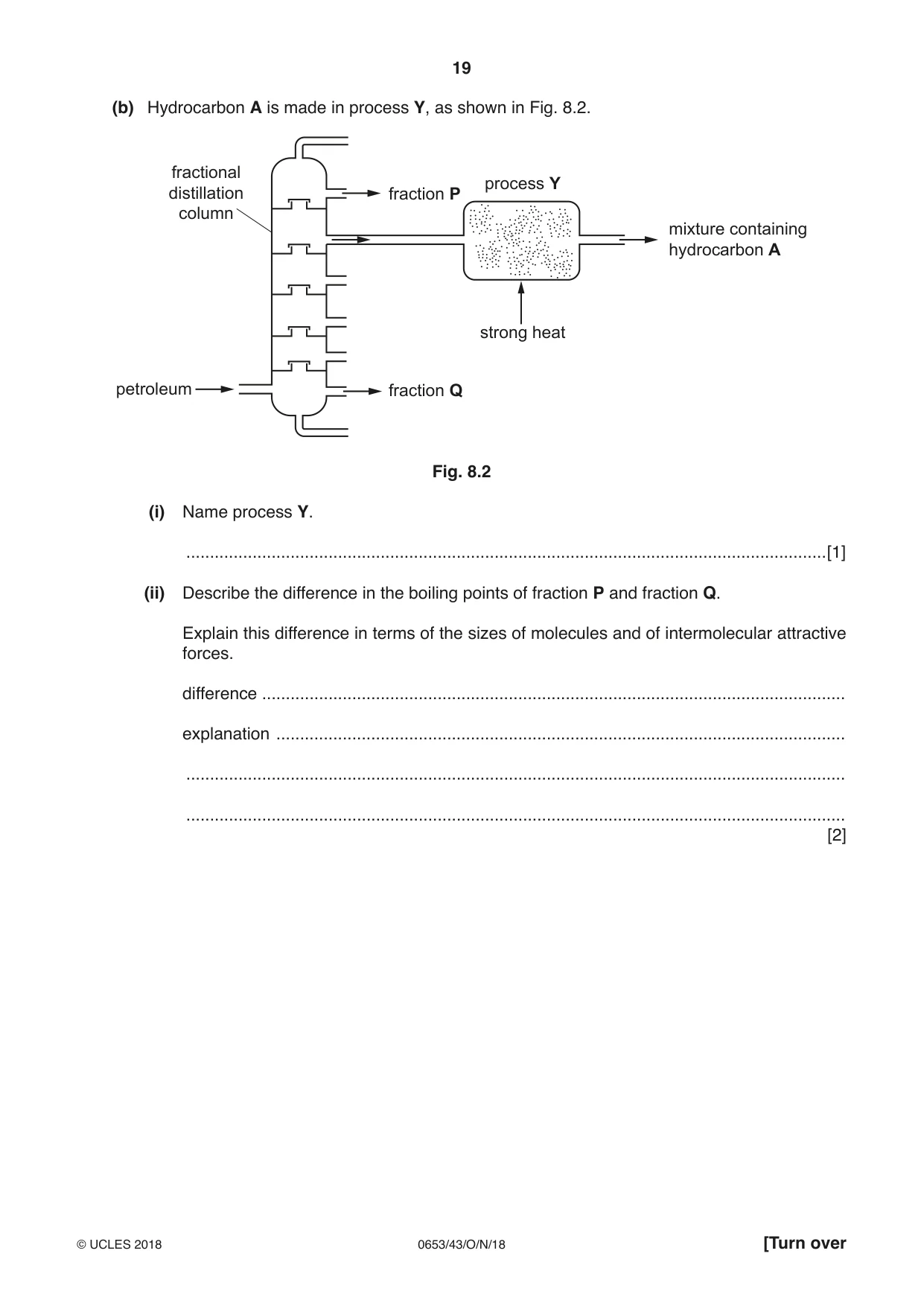
8 Fig. 8.1 shows the structures of three hydrocarbon molecules, A, B, and C. H H H H H H C C H C H H C C C H H H H H H H A B C Fig. 8.1 (a) (i) Name hydrocarbons A and B. A ........................................................................................................................................ B ........................................................................................................................................ [2] (ii) Describe the changes, if any, that are observed when bromine water is added separately to samples of hydrocarbons A and B. A ........................................................................................................................................ B ........................................................................................................................................ [2] (iii) Deduce the balanced equation for the complete combustion of hydrocarbon C. ........................... + ........................... ........................... + ........................... [2] (b) Hydrocarbon A is made in process Y, as shown in Fig. 8.2. fractional process Y distillation fraction P column mixture containing hydrocarbon A strong heat petroleum fraction Q Fig. 8.2 (i) Name process Y. .......................................................................................................................................[1] (ii) Describe the difference in the boiling points of fraction P and fraction Q. Explain this difference in terms of the sizes of molecules and of intermolecular attractive forces. difference ........................................................................................................................... explanation ........................................................................................................................ ........................................................................................................................................... ........................................................................................................................................... [2]
Mark scheme: 8(a)(i) (A) ethene ; (B) methane ; 2 8(a)(ii) (A) decolourises ; (B) no (visible) change ; 2 8(a)(iii) C3H8 + 5O2 → 3CO2 + 4H2O species ; balanced ; 2 8(b)(i) cracking ; 1 8(b)(ii) (difference) [(b.pt of) Q is greater] NOTE: no mark for difference, but must be correct for explanation marks to be awarded (explanation) Q has larger / heavier molecules ; molecules of Q have greater intermolecular attractive forces ; 2
Q9 · A display refrigerator for storing cold drinks in a shop
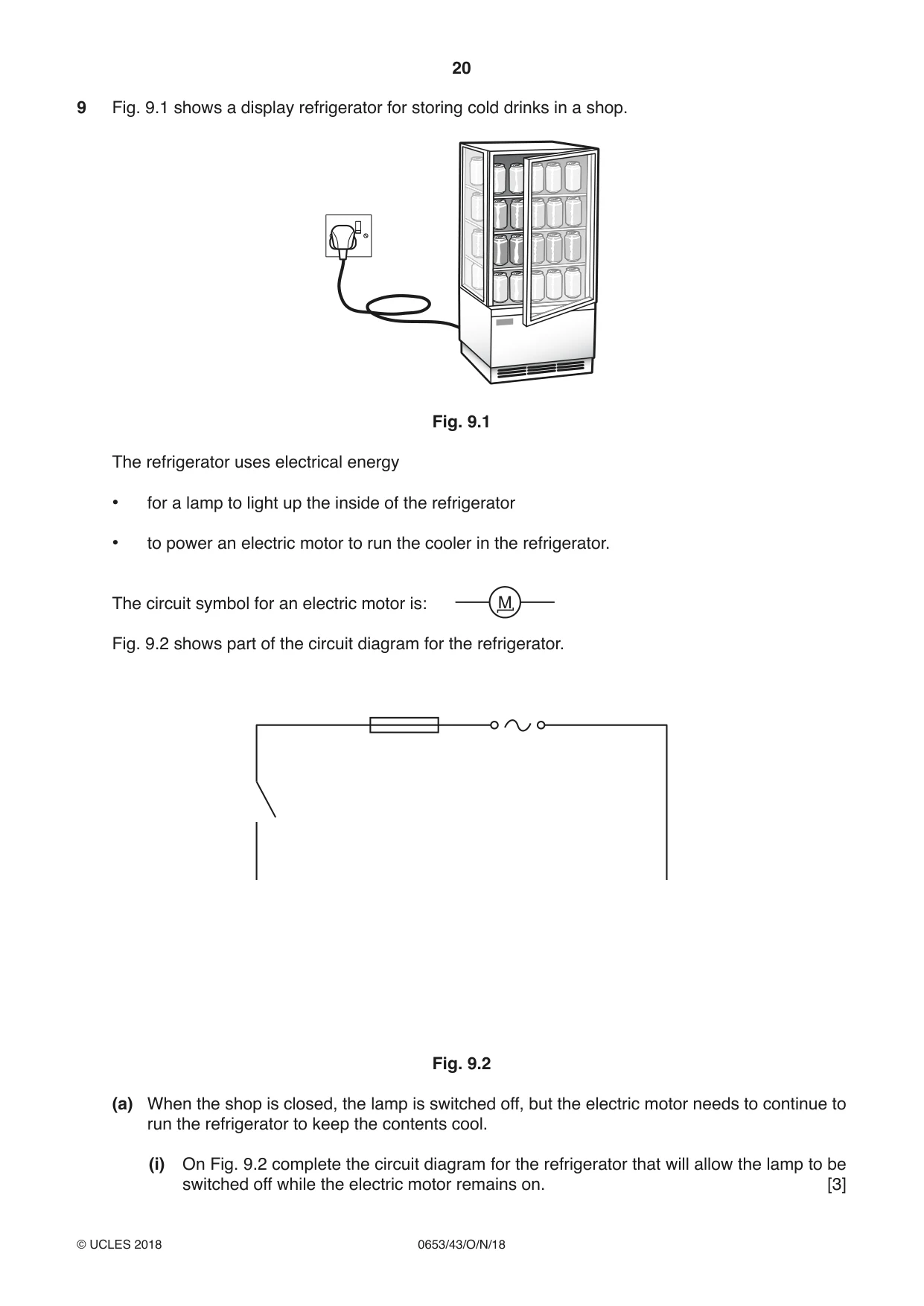
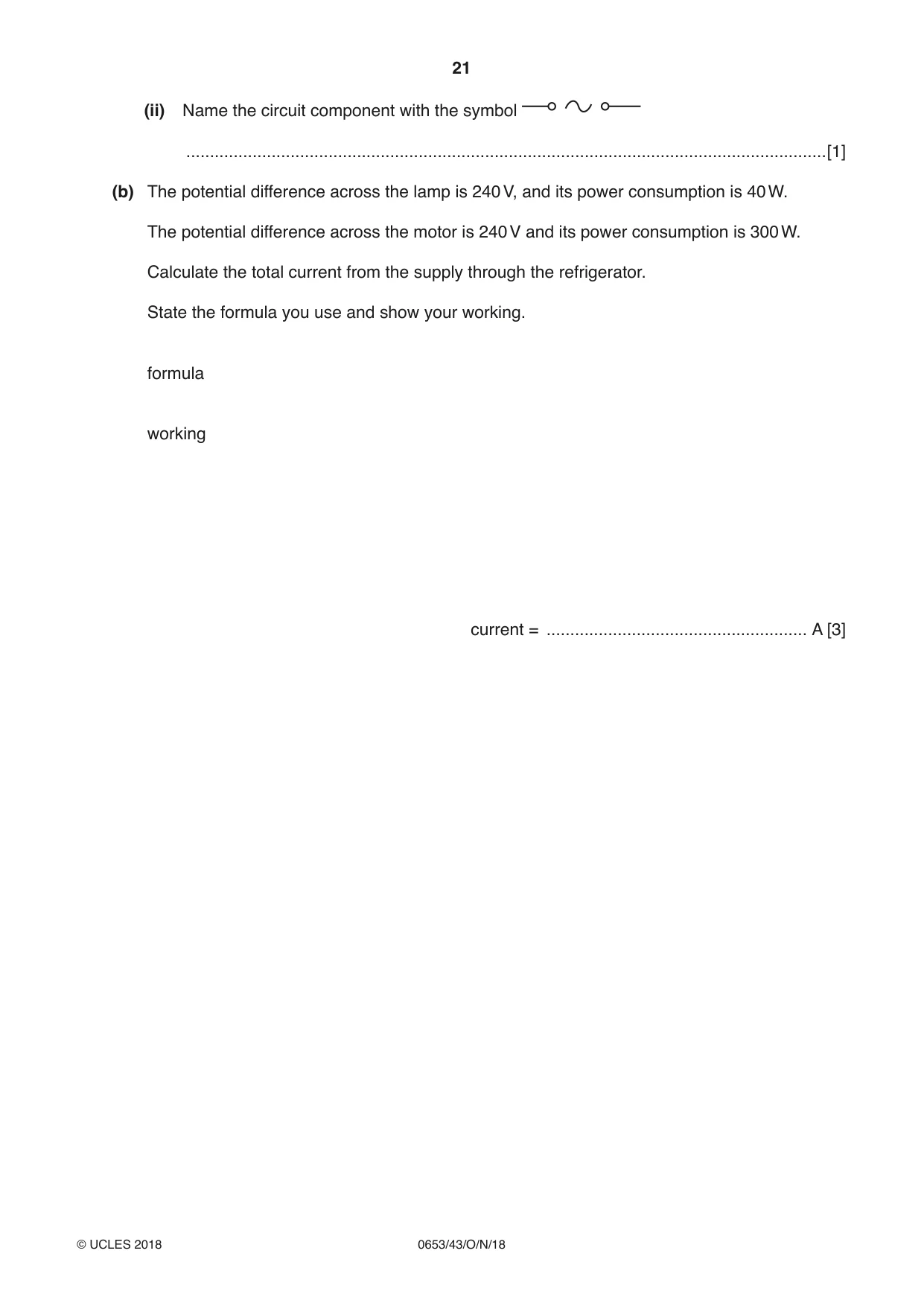
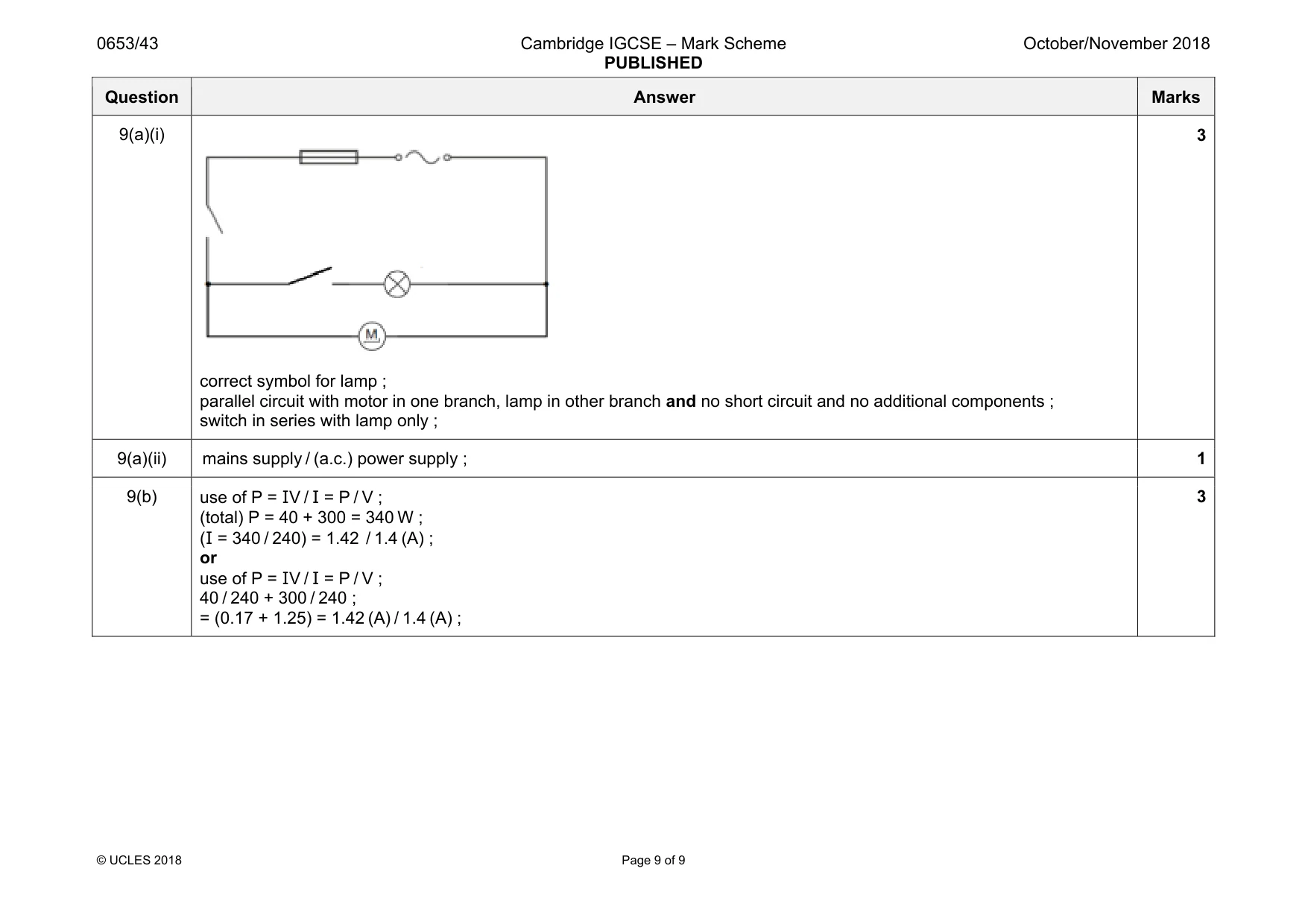
9 Fig. 9.1 shows a display refrigerator for storing cold drinks in a shop. Fig. 9.1 The refrigerator uses electrical energy • for a lamp to light up the inside of the refrigerator • to power an electric motor to run the cooler in the refrigerator. The circuit symbol for an electric motor is: M Fig. 9.2 shows part of the circuit diagram for the refrigerator. Fig. 9.2 (a) When the shop is closed, the lamp is switched off, but the electric motor needs to continue to run the refrigerator to keep the contents cool. (i) On Fig. 9.2 complete the circuit diagram for the refrigerator that will allow the lamp to be switched off while the electric motor remains on. [3] (ii) Name the circuit component with the symbol .......................................................................................................................................[1] (b) The potential difference across the lamp is 240 V, and its power consumption is 40 W. The potential difference across the motor is 240 V and its power consumption is 300 W. Calculate the total current from the supply through the refrigerator. State the formula you use and show your working. formula working current = ....................................................... A [3]
Mark scheme: 9(a)(i) correct symbol for lamp ; parallel circuit with motor in one branch, lamp in other branch and no short circuit and no additional components ; switch in series with lamp only ; 3 9(a)(ii) mains supply / (a.c.) power supply ; 1 9(b) use of P = IV / I = P / V ; (total) P = 40 + 300 = 340 W ; (I = 340 / 240) = 1.42 / 1.4 (A) ; or use of P = IV / I = P / V ; 40 / 240 + 300 / 240 ; = (0.17 + 1.25) = 1.42 (A) / 1.4 (A) ; 3
What was in this paper
The subtopics covered by these 9 questions, and how many questions each got. Open one in a new tab to see every Cambridge question on it.
What you needed in this session
Cambridge’s own grade thresholds for 2018 Oct/Nov, Paper 4 · Variant 3. A higher threshold means an easier paper — the bar moves with how the cohort did.