Cambridge IGCSE Science - Combined 0653 — 2020 May/June Paper 4 · Variant 1
0653/41/M/J/20 · 9 questions · 80 marks · ≈90 min
The question paper and its mark scheme, free to read here and free to download. This is Cambridge’s own paper, exactly as it was sat.
Question paper20 pages
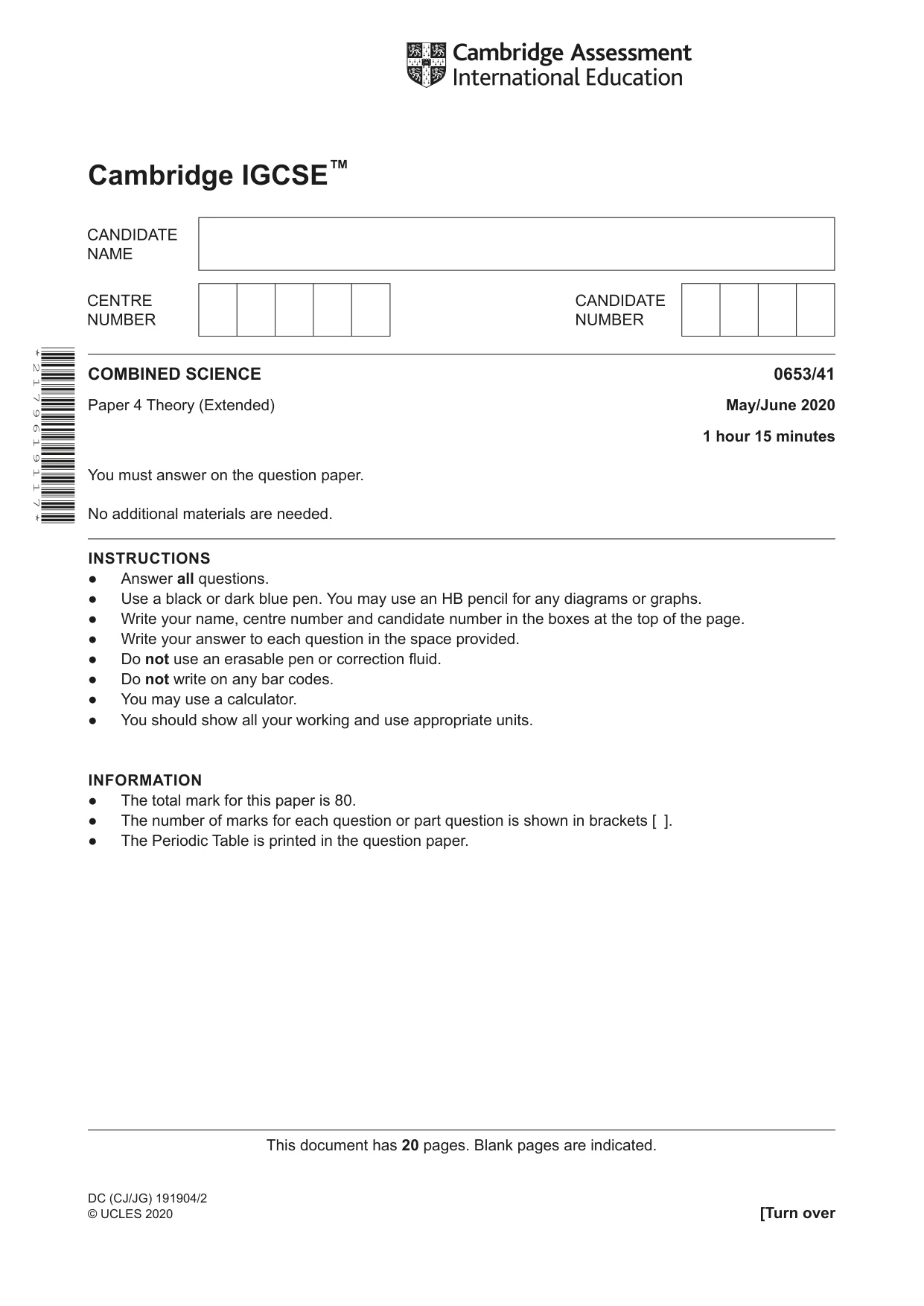

Mark scheme10 pages
Answers below. Sit the paper first if you are practising.
Questions as text
Q1 · The percentage composition of the gases in inspired air and in expired air
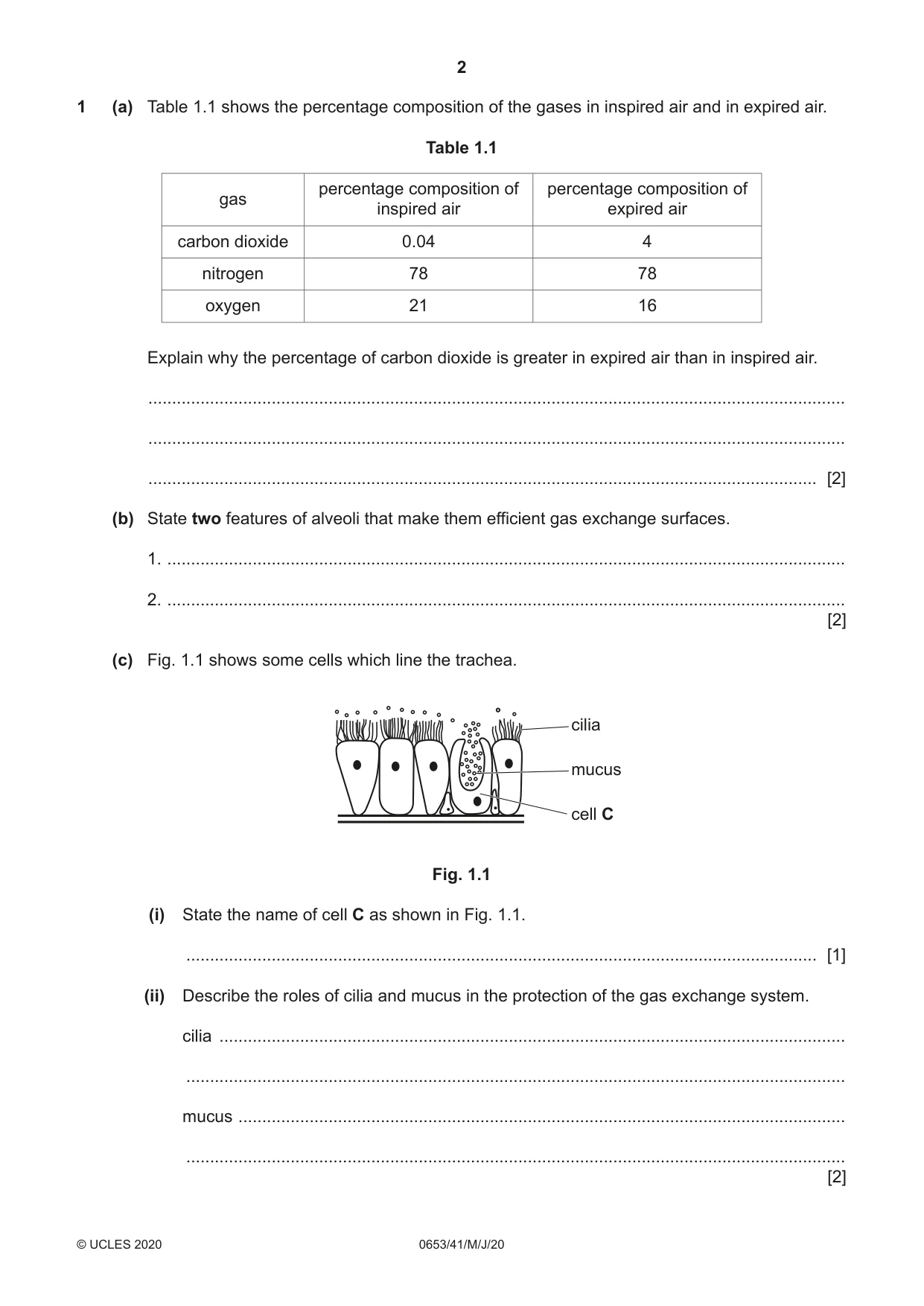
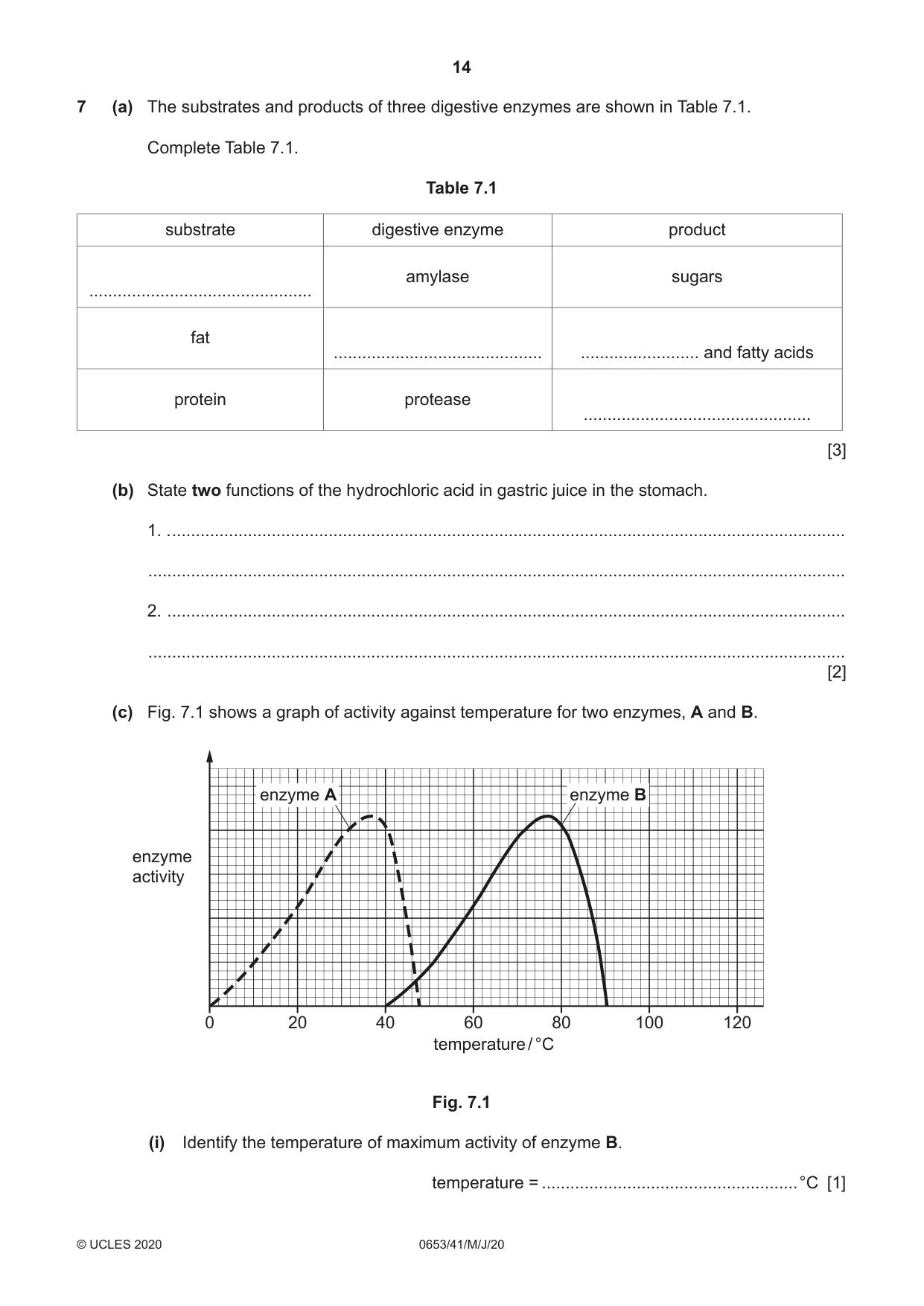
1 (a) Table 1.1 shows the percentage composition of the gases in inspired air and in expired air. Table 1.1 percentage composition of percentage composition of gas inspired air expired air carbon dioxide 0.04 4 nitrogen 78 78 oxygen 21 16 Explain why the percentage of carbon dioxide is greater in expired air than in inspired air. ................................................................................................................................................... ................................................................................................................................................... ............................................................................................................................................. [2] (b) State two features of alveoli that make them efficient gas exchange surfaces. 1. ............................................................................................................................................... 2. ............................................................................................................................................... [2] (c) Fig. 1.1 shows some cells which line the trachea. cilia mucus cell C Fig. 1.1 (i) State the name of cell C as shown in Fig. 1.1. ..................................................................................................................................... [1] (ii) Describe the roles of cilia and mucus in the protection of the gas exchange system. cilia .................................................................................................................................... ........................................................................................................................................... mucus ................................................................................................................................ ........................................................................................................................................... [2] (iii) Describe one effect of tar in tobacco smoke on the gas exchange system. ........................................................................................................................................... ..................................................................................................................................... [1] [Total: 8]
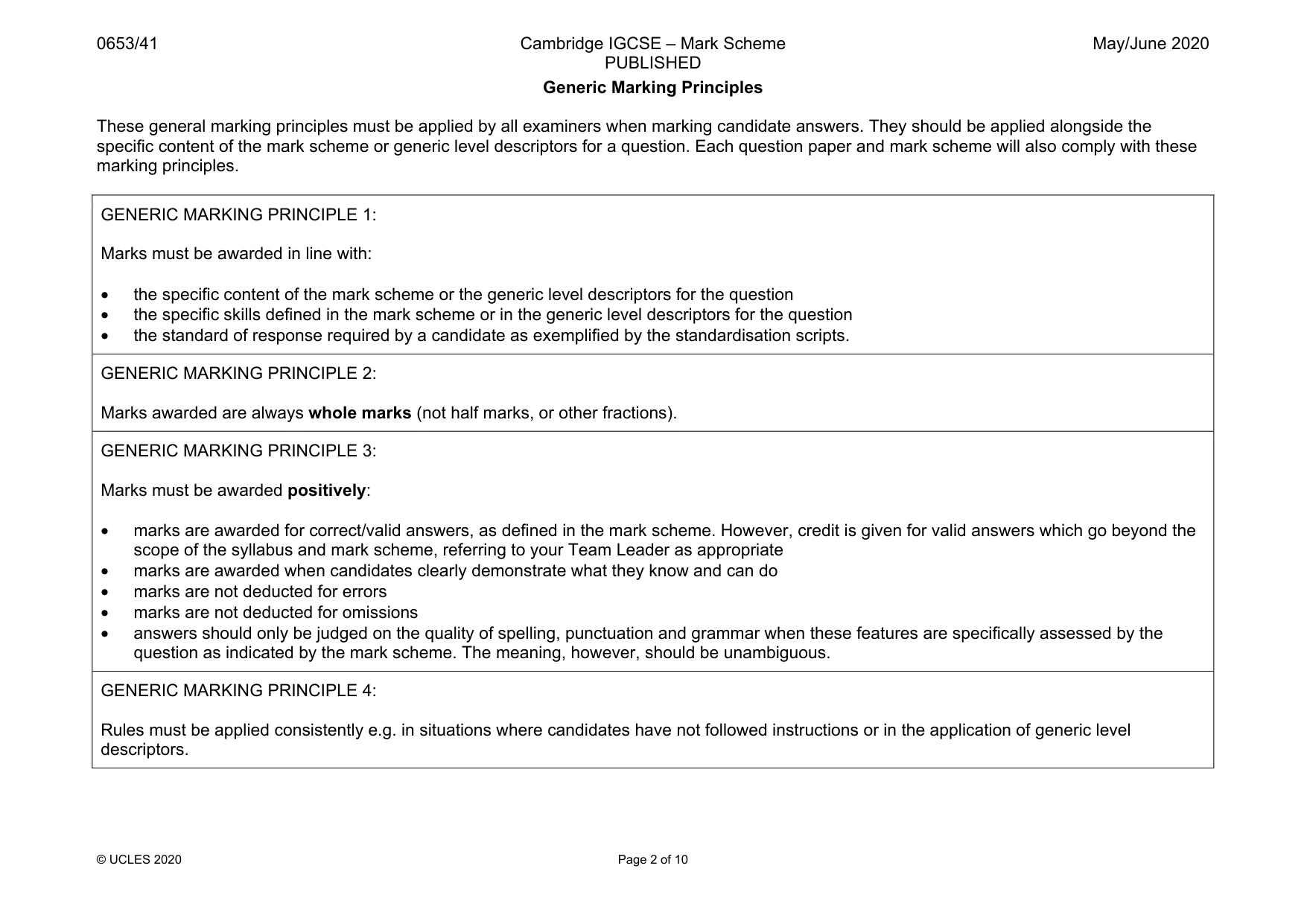
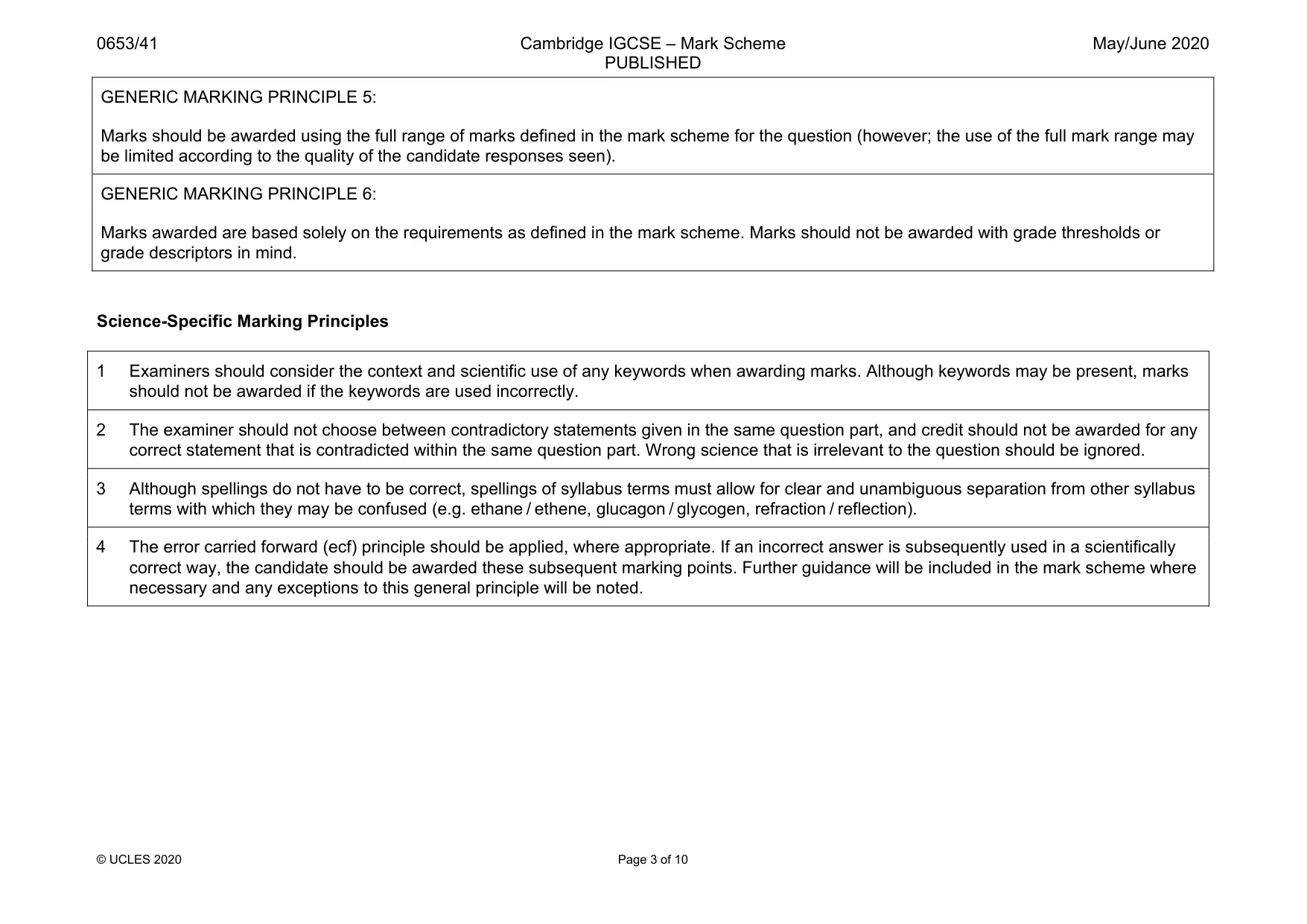
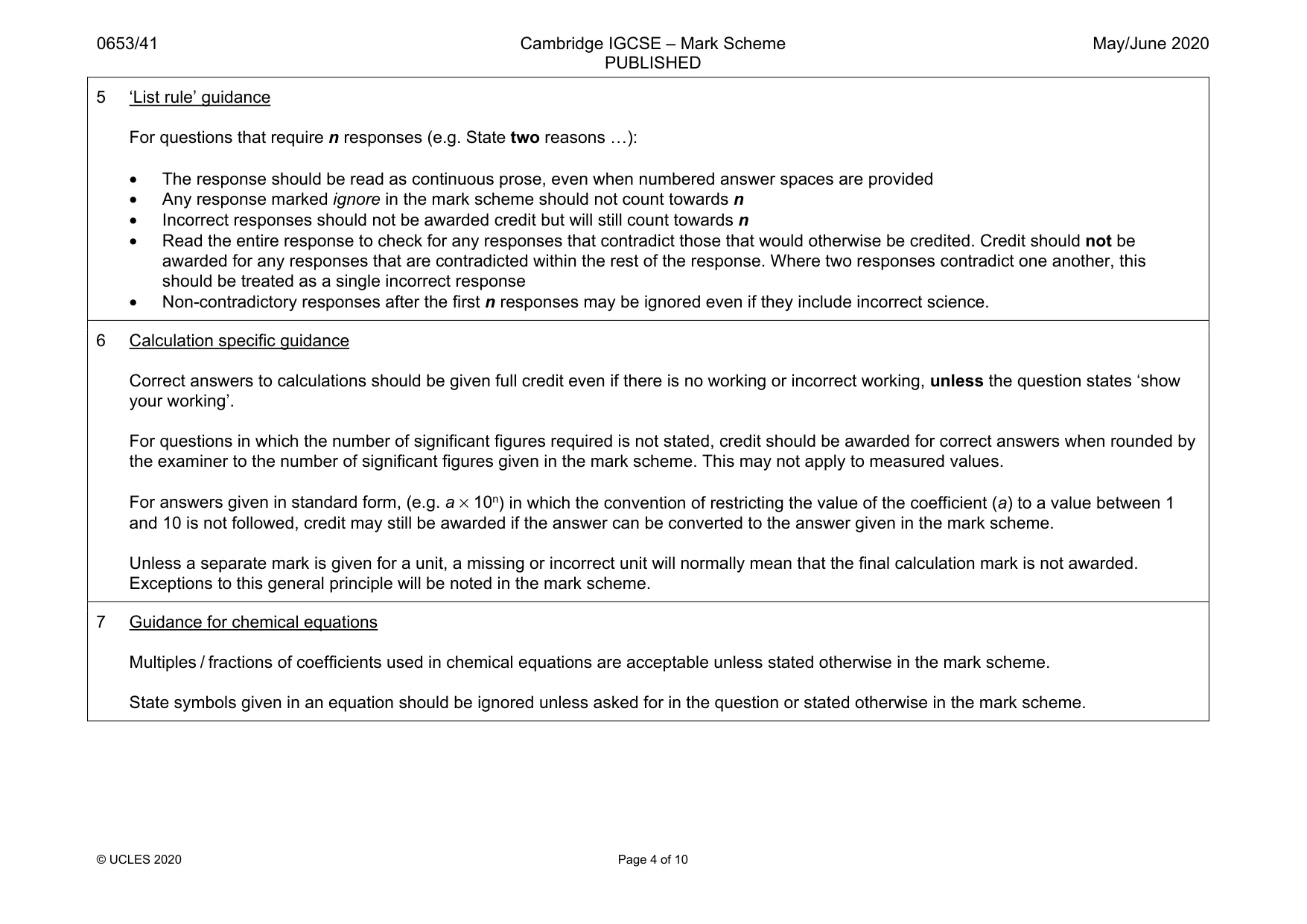
Mark scheme: 1(a) carbon dioxide produced by cells during respiration ; carbon dioxide, diffuses from blood (plasma) / into alveoli / is excreted at the lungs ; 2 1(b) any two from: large surface area ; thin surface ; good blood supply ; well ventilated ; max 2 1(c)(i) goblet cell ; 1 1(c)(ii) (cilia) (beat to) remove mucus ; (mucus) traps pathogens and particles ; 2 1(c)(iii) stimulates mucus production / bronchitis / lung cancer / destroys or paralyses cilia / collects in alveoli / coats gas exchange surface ; 1
Q2 · The formula of methanol is CH3OH
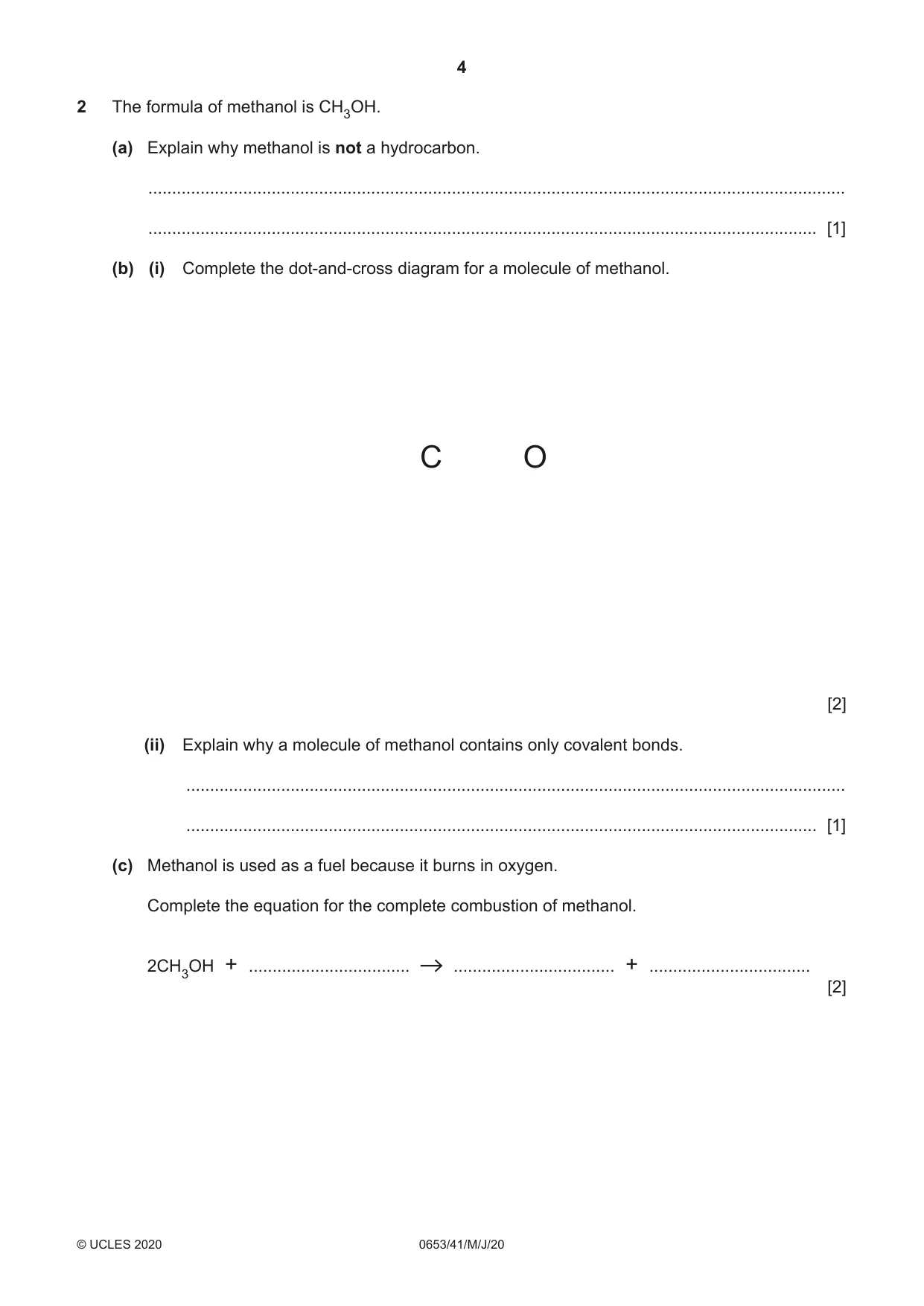
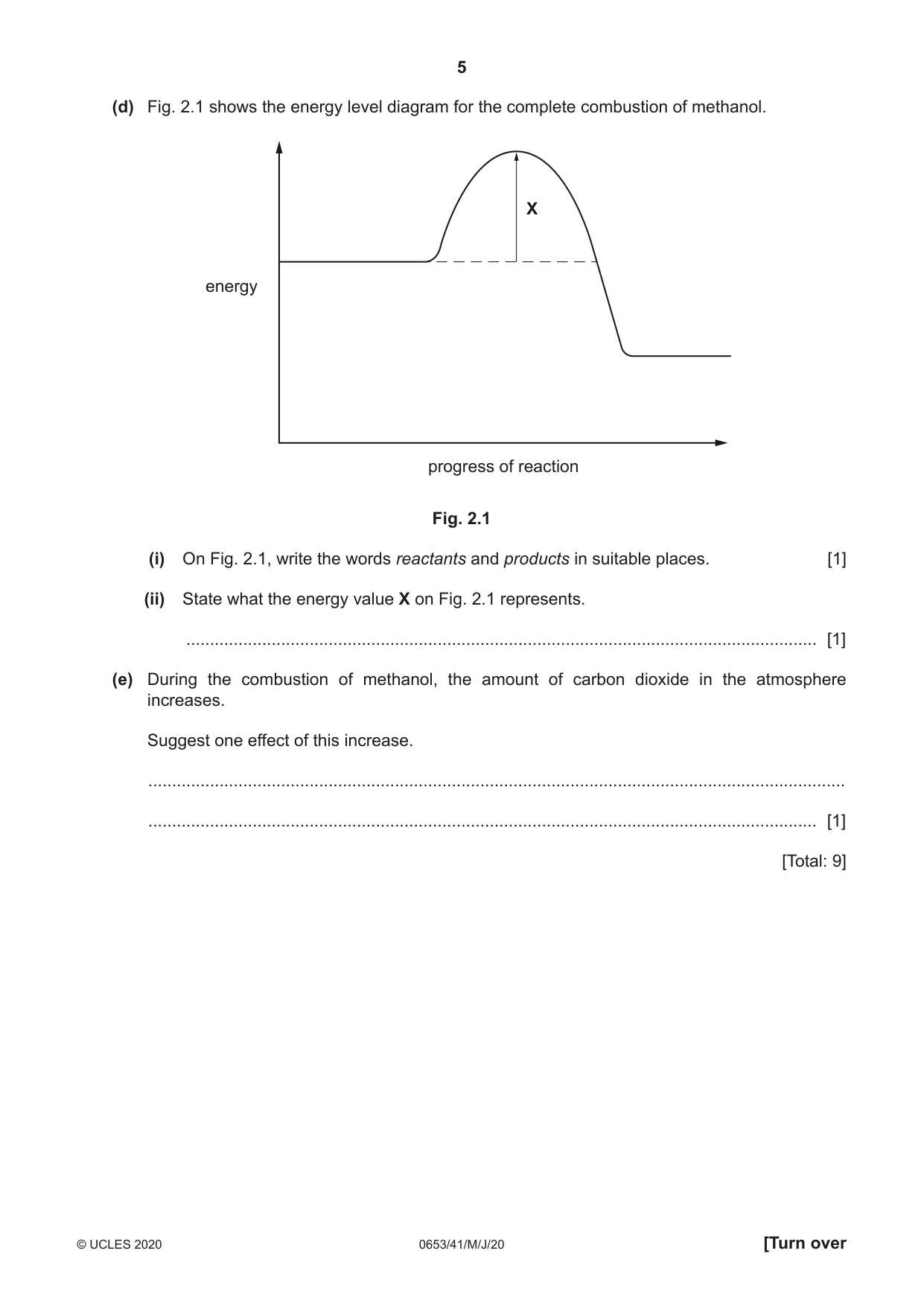
2 The formula of methanol is CH3OH. (a) Explain why methanol is not a hydrocarbon. ................................................................................................................................................... ............................................................................................................................................. [1] (b) (i) Complete the dot-and-cross diagram for a molecule of methanol. C O [2] (ii) Explain why a molecule of methanol contains only covalent bonds. ........................................................................................................................................... ..................................................................................................................................... [1] (c) Methanol is used as a fuel because it burns in oxygen. Complete the equation for the complete combustion of methanol. 2CH3OH + .................................. .................................. + .................................. [2] (d) Fig. 2.1 shows the energy level diagram for the complete combustion of methanol. X energy progress of reaction Fig. 2.1 (i) On Fig. 2.1, write the words reactants and products in suitable places. [1] (ii) State what the energy value X on Fig. 2.1 represents. ..................................................................................................................................... [1] (e) During the combustion of methanol, the amount of carbon dioxide in the atmosphere increases. Suggest one effect of this increase. ................................................................................................................................................... ............................................................................................................................................. [1] [Total: 9]
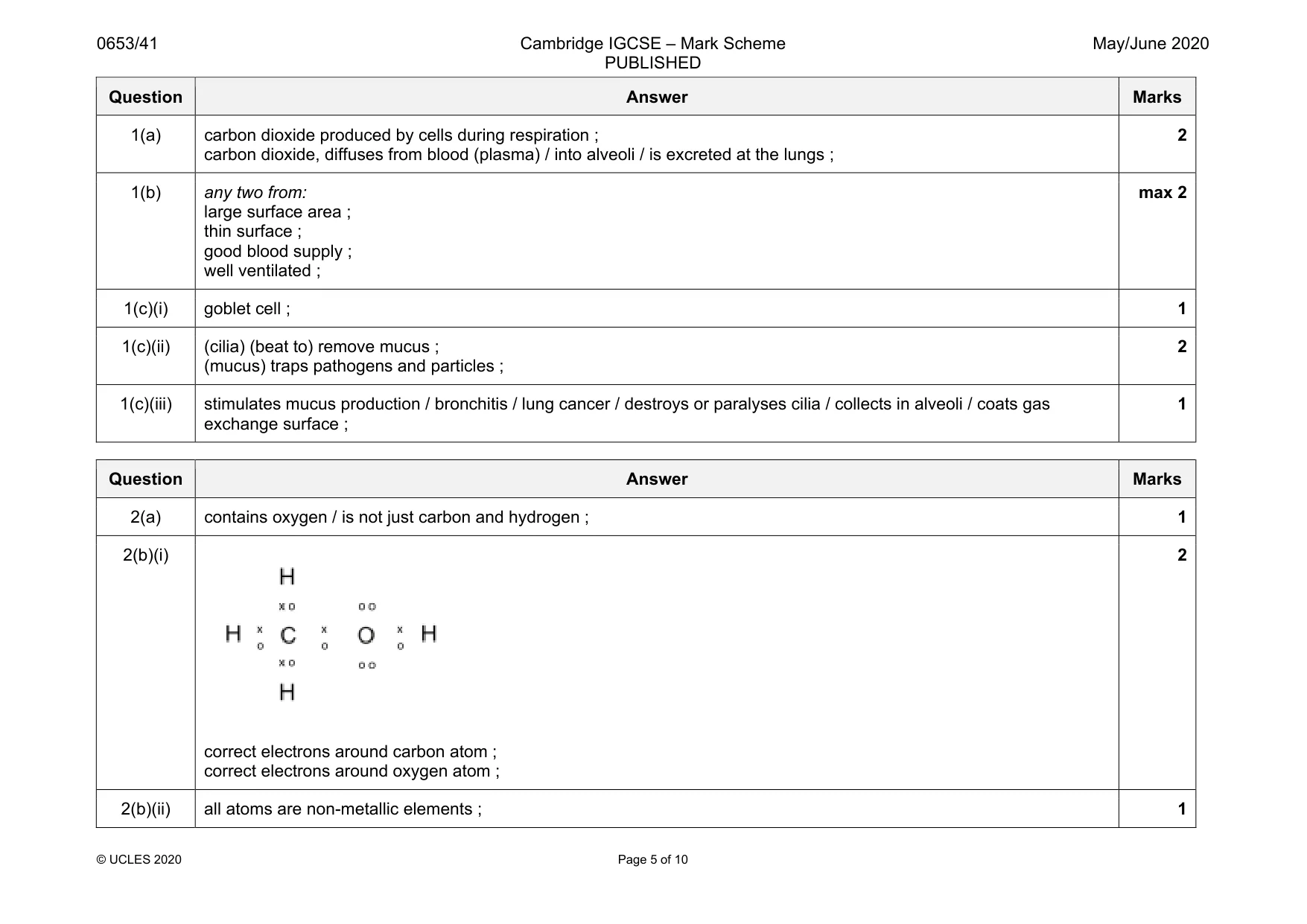
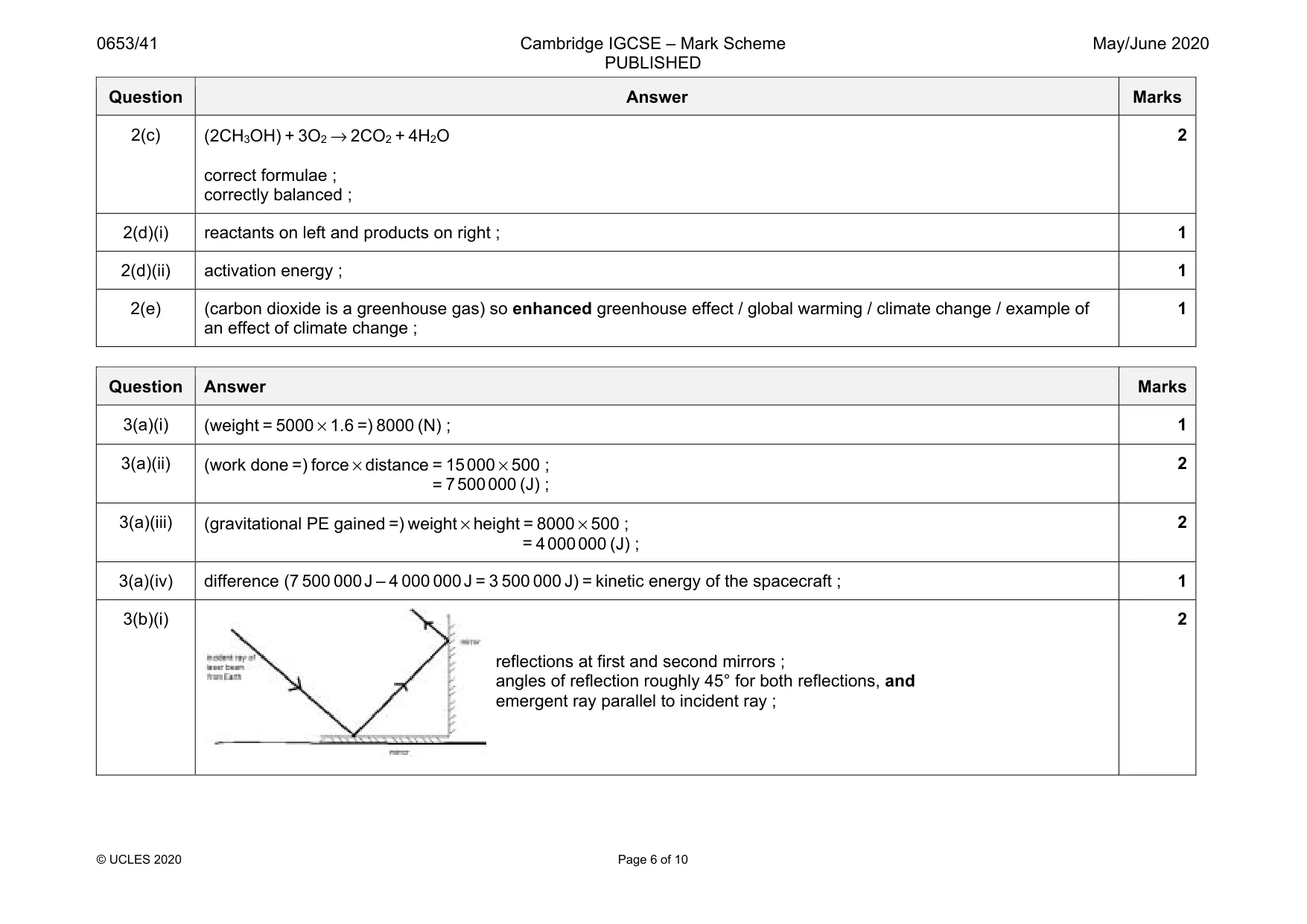
Mark scheme: 2(a) contains oxygen / is not just carbon and hydrogen ; 1 2(b)(i) correct electrons around carbon atom ; correct electrons around oxygen atom ; 2 2(b)(ii) all atoms are non-metallic elements ; 1 Question Answer Marks 2(c) (2CH3OH) + 3O2 → 2CO2 + 4H2O correct formulae ; correctly balanced ; 2 2(d)(i) reactants on left and products on right ; 1 2(d)(ii) activation energy ; 1 2(e) (carbon dioxide is a greenhouse gas) so enhanced greenhouse effect / global warming / climate change / example of an effect of climate change ; 1
Q3 · A spacecraft taking off from the Moon
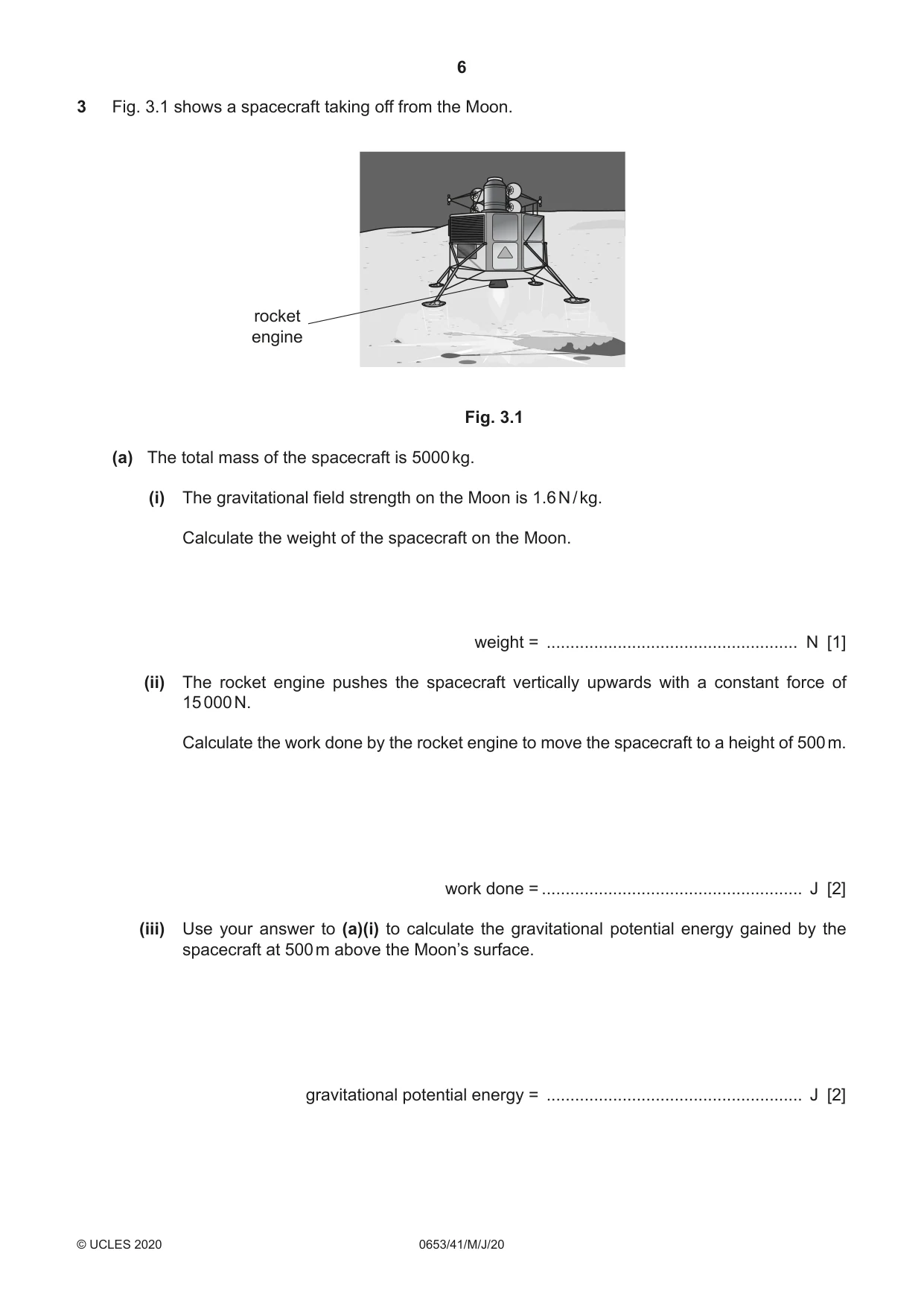
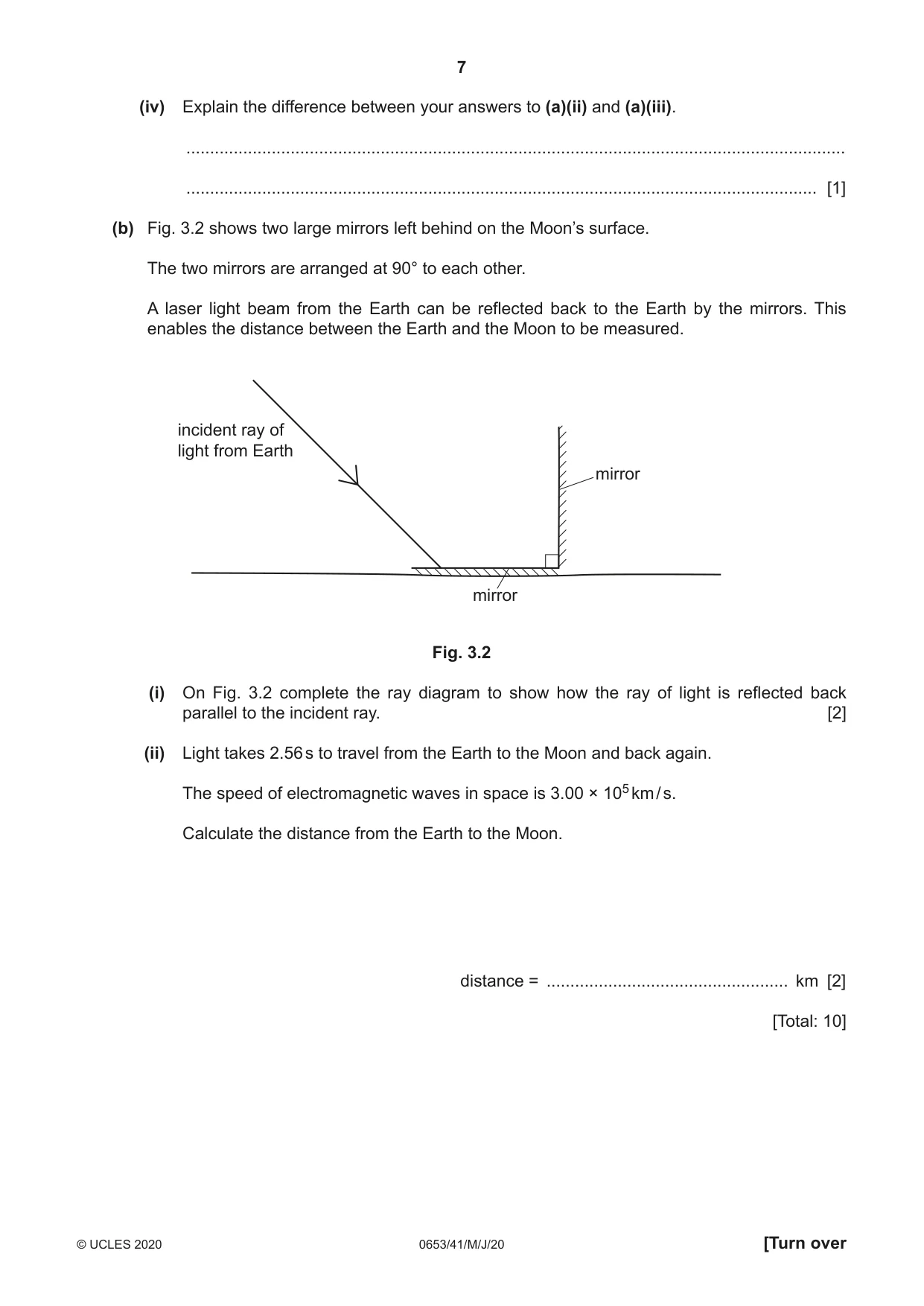
3 Fig. 3.1 shows a spacecraft taking off from the Moon. rocket engine Fig. 3.1 (a) The total mass of the spacecraft is 5000 kg. (i) The gravitational field strength on the Moon is 1.6 N / kg. Calculate the weight of the spacecraft on the Moon. weight = ..................................................... N [1] (ii) The rocket engine pushes the spacecraft vertically upwards with a constant force of 15 000 N. Calculate the work done by the rocket engine to move the spacecraft to a height of 500 m. work done = ....................................................... J [2] (iii) Use your answer to (a)(i) to calculate the gravitational potential energy gained by the spacecraft at 500 m above the Moon’s surface. gravitational potential energy = ...................................................... J [2] (iv) Explain the difference between your answers to (a)(ii) and (a)(iii). ........................................................................................................................................... ..................................................................................................................................... [1] (b) Fig. 3.2 shows two large mirrors left behind on the Moon’s surface. The two mirrors are arranged at 90° to each other. A laser light beam from the Earth can be reflected back to the Earth by the mirrors. This enables the distance between the Earth and the Moon to be measured. incident ray of light from Earth mirror mirror Fig. 3.2 (i) On Fig. 3.2 complete the ray diagram to show how the ray of light is reflected back parallel to the incident ray. [2] (ii) Light takes 2.56 s to travel from the Earth to the Moon and back again. The speed of electromagnetic waves in space is 3.00 × 10⁵ km / s. Calculate the distance from the Earth to the Moon. distance = ................................................... km [2] [Total: 10]
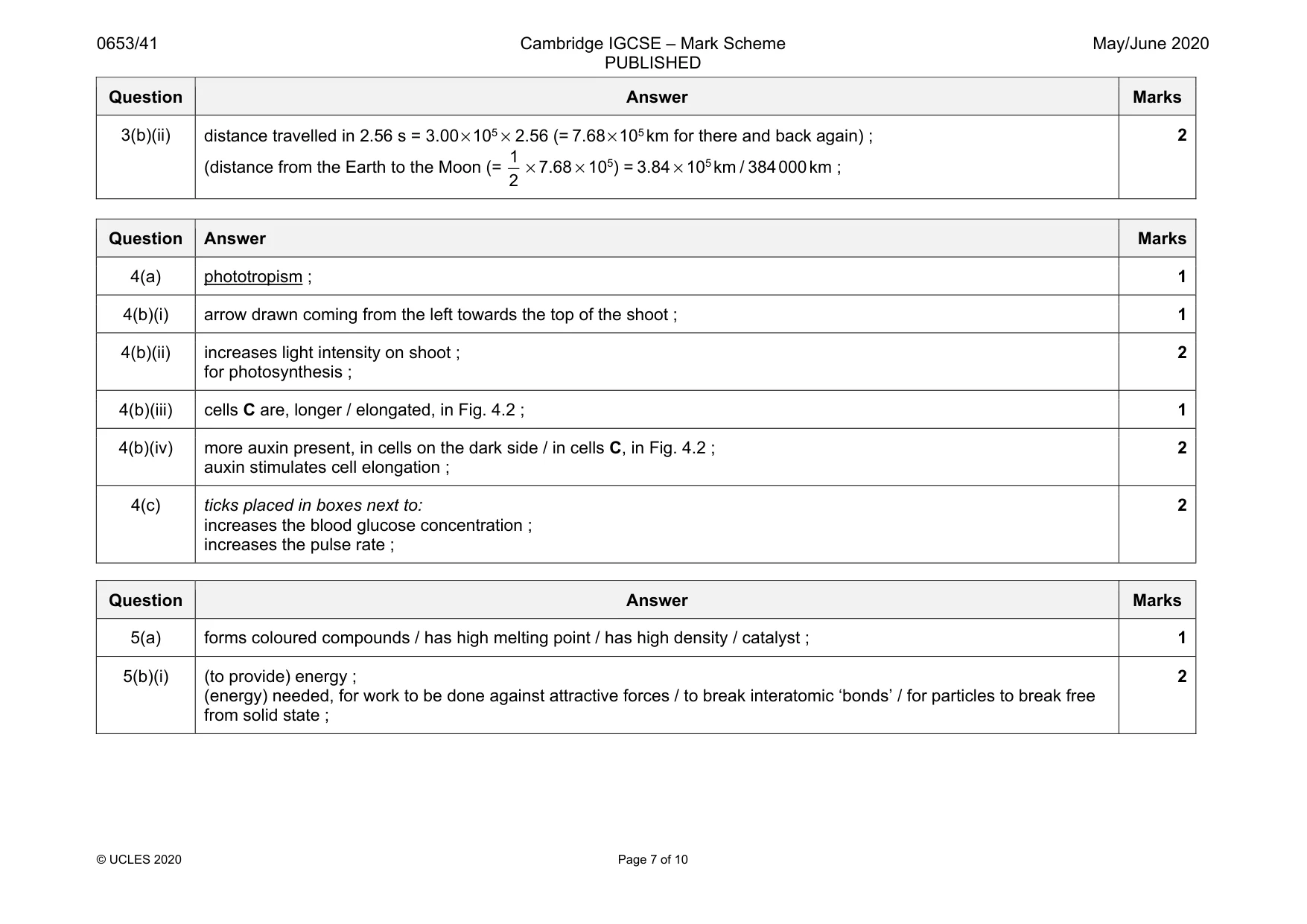
Mark scheme: 3(a)(i) (weight = 5000 × 1.6 =) 8000 (N) ; 1 3(a)(ii) (work done =) force × distance = 15 000 × 500 ; = 7500000 (J) ; 2 3(a)(iii) (gravitational PE gained =) weight × height = 8000 × 500 ; = 4000000 (J) ; 2 3(a)(iv) difference (7 500 000J – 4 000 000J = 3 500 000 J) = kinetic energy of the spacecraft ; 1 3(b)(i) 2 reflections at first and second mirrors ; angles of reflection roughly 45° for both reflections, and emergent ray parallel to incident ray ; Question Answer Marks 3(b)(ii) distance travelled in 2.56 s = 3.00 × 105 × 2.56 (= 7.68 × 10⁵ km for there and back again) ; (distance from the Earth to the Moon (= 1 2 × 7.68 × 105) = 3.84 × 10⁵ km / 384 000 km ; 2
Q4 · If the light shining on a shoot tip is more intense on one side, the shoot shows a growth…
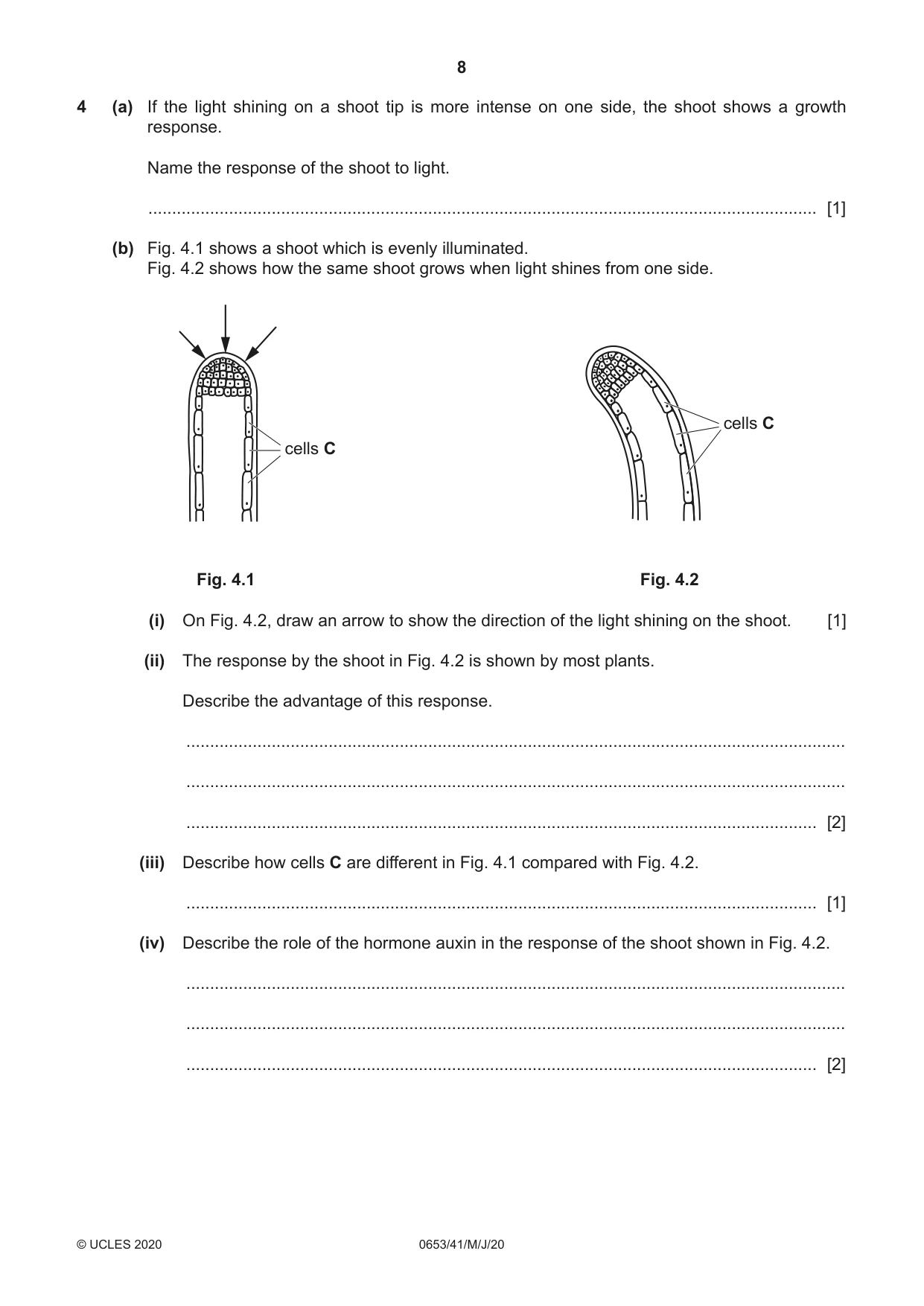
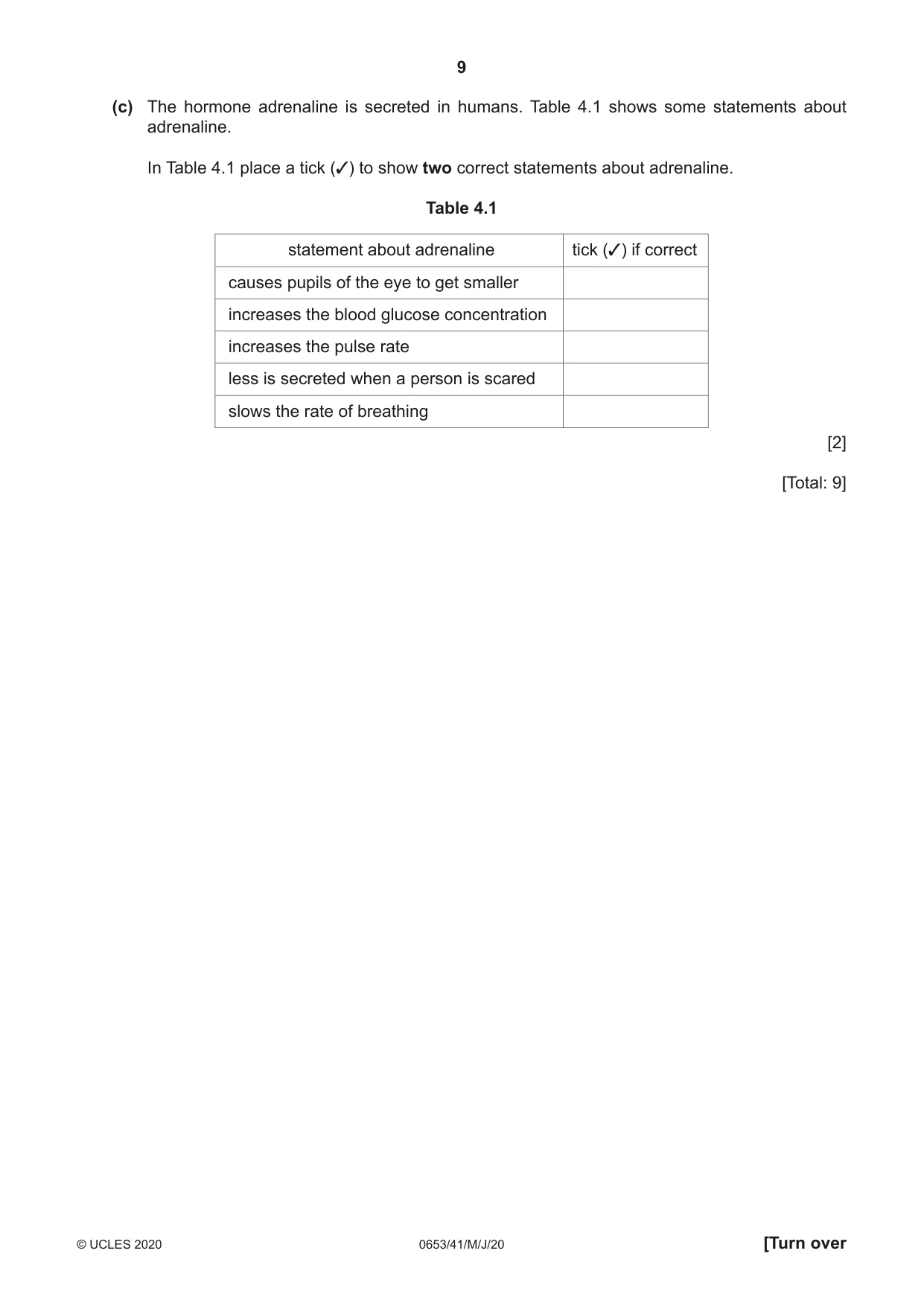
4 (a) If the light shining on a shoot tip is more intense on one side, the shoot shows a growth response. Name the response of the shoot to light. ............................................................................................................................................. [1] (b) Fig. 4.1 shows a shoot which is evenly illuminated. Fig. 4.2 shows how the same shoot grows when light shines from one side. cells C cells C Fig. 4.1 Fig. 4.2 (i) On Fig. 4.2, draw an arrow to show the direction of the light shining on the shoot. [1] (ii) The response by the shoot in Fig. 4.2 is shown by most plants. Describe the advantage of this response. ........................................................................................................................................... ........................................................................................................................................... ..................................................................................................................................... [2] (iii) Describe how cells C are different in Fig. 4.1 compared with Fig. 4.2. ..................................................................................................................................... [1] (iv) Describe the role of the hormone auxin in the response of the shoot shown in Fig. 4.2. ........................................................................................................................................... ........................................................................................................................................... ..................................................................................................................................... [2] (c) The hormone adrenaline is secreted in humans. Table 4.1 shows some statements about adrenaline. In Table 4.1 place a tick (3) to show two correct statements about adrenaline. Table 4.1 statement about adrenaline tick (3) if correct causes pupils of the eye to get smaller increases the blood glucose concentration increases the pulse rate less is secreted when a person is scared slows the rate of breathing [2] [Total: 9]
Mark scheme: 4(a) phototropism ; 1 4(b)(i) arrow drawn coming from the left towards the top of the shoot ; 1 4(b)(ii) increases light intensity on shoot ; for photosynthesis ; 2 4(b)(iii) cells C are, longer / elongated, in Fig. 4.2 ; 1 4(b)(iv) more auxin present, in cells on the dark side / in cells C, in Fig. 4.2 ; auxin stimulates cell elongation ; 2 4(c) ticks placed in boxes next to: increases the blood glucose concentration ; increases the pulse rate ; 2
Q5 · Iron is a transition element
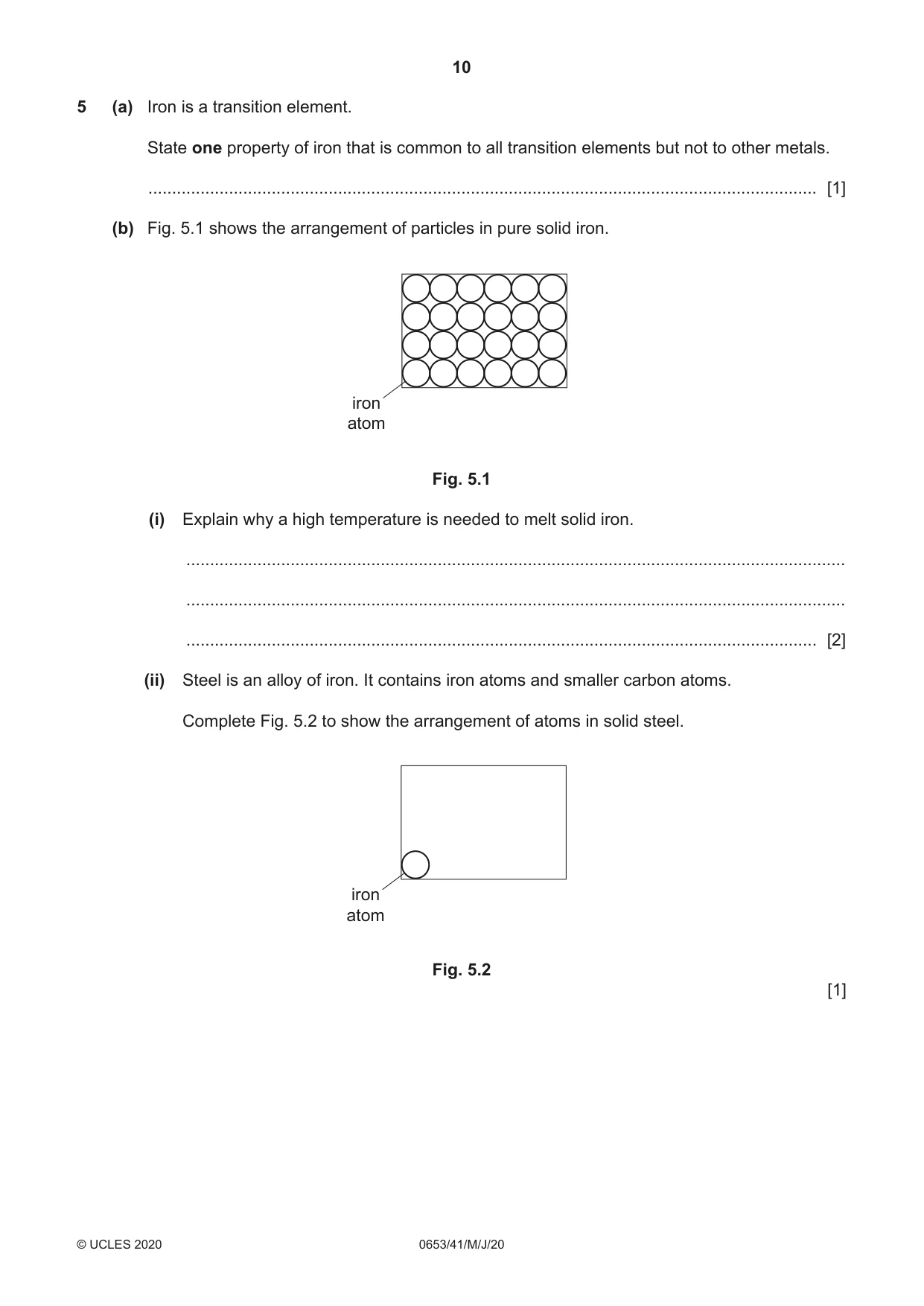
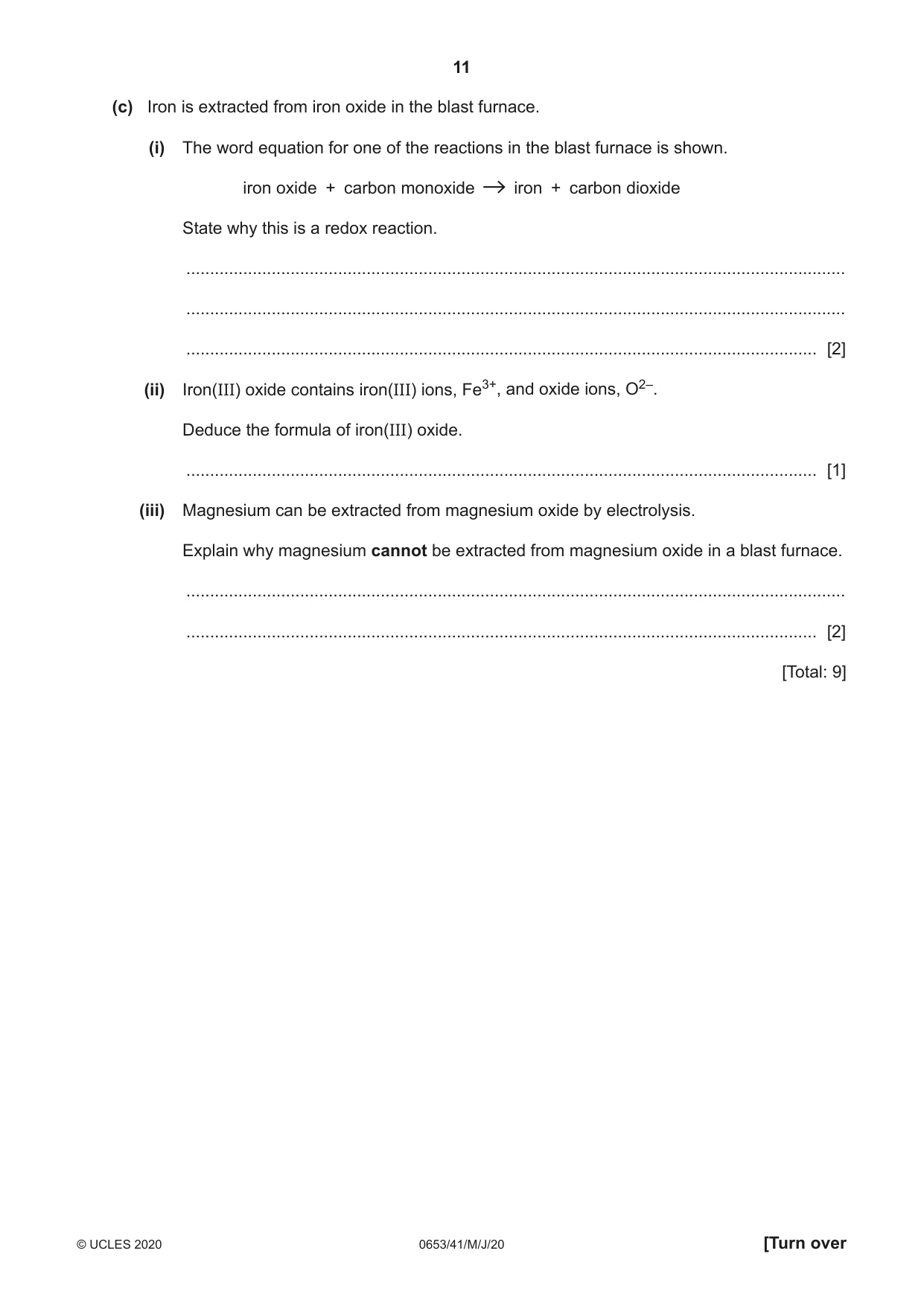
5 (a) Iron is a transition element. State one property of iron that is common to all transition elements but not to other metals. ............................................................................................................................................. [1] (b) Fig. 5.1 shows the arrangement of particles in pure solid iron. iron atom Fig. 5.1 (i) Explain why a high temperature is needed to melt solid iron. ........................................................................................................................................... ........................................................................................................................................... ..................................................................................................................................... [2] (ii) Steel is an alloy of iron. It contains iron atoms and smaller carbon atoms. Complete Fig. 5.2 to show the arrangement of atoms in solid steel. iron atom Fig. 5.2 [1] (c) Iron is extracted from iron oxide in the blast furnace. (i) The word equation for one of the reactions in the blast furnace is shown. iron oxide + carbon monoxide iron + carbon dioxide State why this is a redox reaction. ........................................................................................................................................... ........................................................................................................................................... ..................................................................................................................................... [2] (ii) Iron(III) oxide contains iron(III) ions, Fe3+, and oxide ions, O2–. Deduce the formula of iron(III) oxide. ..................................................................................................................................... [1] (iii) Magnesium can be extracted from magnesium oxide by electrolysis. Explain why magnesium cannot be extracted from magnesium oxide in a blast furnace. ........................................................................................................................................... ..................................................................................................................................... [2] [Total: 9]
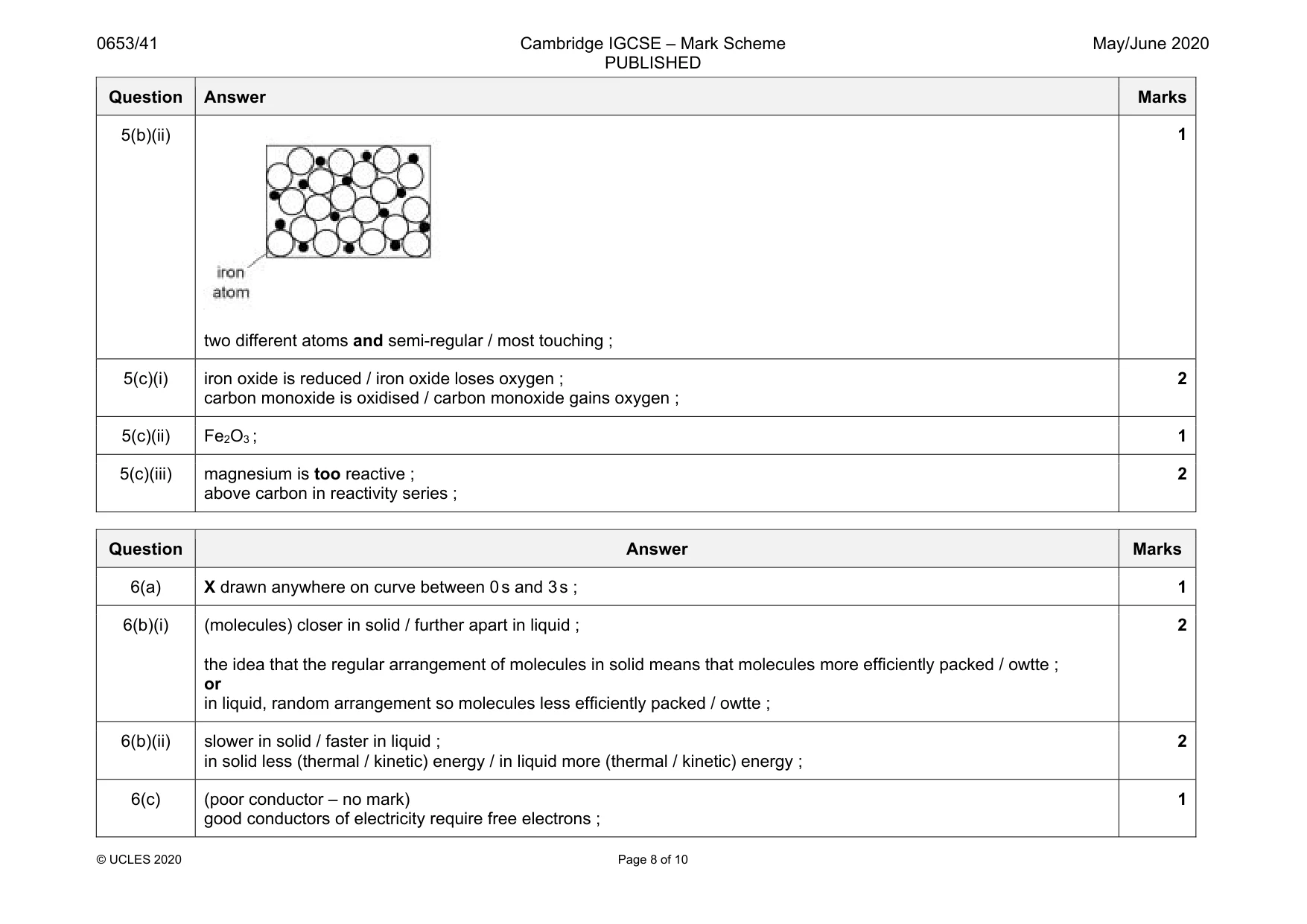
Mark scheme: 5(a) forms coloured compounds / has high melting point / has high density / catalyst ; 1 5(b)(i) (to provide) energy ; (energy) needed, for work to be done against attractive forces / to break interatomic ‘bonds’ / for particles to break free from solid state ; 2 Question Answer Marks 5(b)(ii) two different atoms and semi-regular / most touching ; 1 5(c)(i) iron oxide is reduced / iron oxide loses oxygen ; carbon monoxide is oxidised / carbon monoxide gains oxygen ; 2 5(c)(ii) Fe2O3 ; 1 5(c)(iii) magnesium is too reactive ; above carbon in reactivity series ; 2
Q6 · Naphthalene is a solid that melts at 80 °C to form a liquid
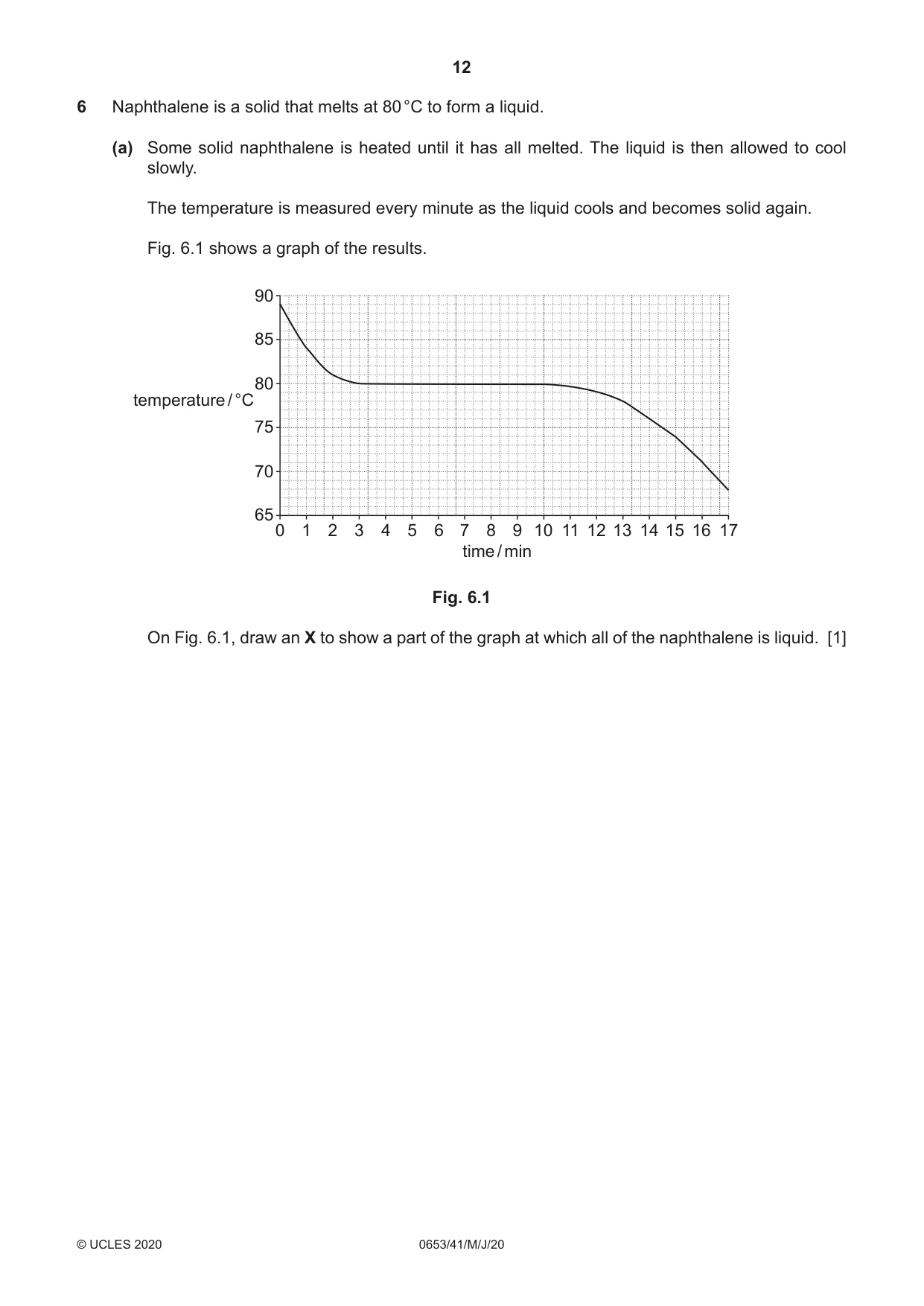
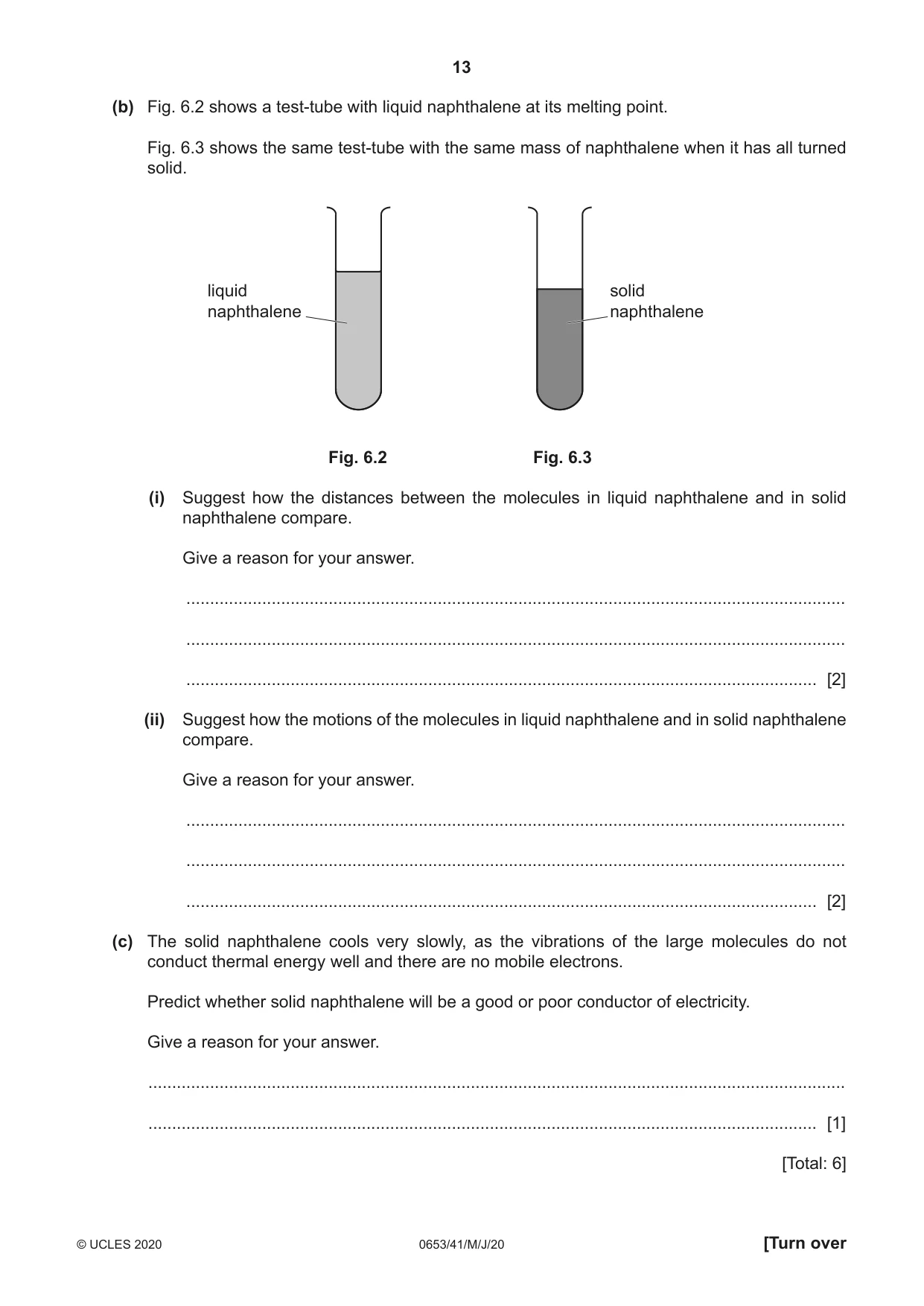
6 Naphthalene is a solid that melts at 80 °C to form a liquid. (a) Some solid naphthalene is heated until it has all melted. The liquid is then allowed to cool slowly. The temperature is measured every minute as the liquid cools and becomes solid again. Fig. 6.1 shows a graph of the results. 90 85 80 temperature / °C 75 70 65 0 1 2 3 4 5 6 7 8 9 10 11 12 13 14 15 16 17 time / min Fig. 6.1 On Fig. 6.1, draw an X to show a part of the graph at which all of the naphthalene is liquid. [1] (b) Fig. 6.2 shows a test-tube with liquid naphthalene at its melting point. Fig. 6.3 shows the same test-tube with the same mass of naphthalene when it has all turned solid. liquid solid naphthalene naphthalene Fig. 6.2 Fig. 6.3 (i) Suggest how the distances between the molecules in liquid naphthalene and in solid naphthalene compare. Give a reason for your answer. ........................................................................................................................................... ........................................................................................................................................... ..................................................................................................................................... [2] (ii) Suggest how the motions of the molecules in liquid naphthalene and in solid naphthalene compare. Give a reason for your answer. ........................................................................................................................................... ........................................................................................................................................... ..................................................................................................................................... [2] (c) The solid naphthalene cools very slowly, as the vibrations of the large molecules do not conduct thermal energy well and there are no mobile electrons. Predict whether solid naphthalene will be a good or poor conductor of electricity. Give a reason for your answer. ................................................................................................................................................... ............................................................................................................................................. [1] [Total: 6]
Mark scheme: 6(a) X drawn anywhere on curve between 0s and 3s ; 1 6(b)(i) (molecules) closer in solid / further apart in liquid ; the idea that the regular arrangement of molecules in solid means that molecules more efficiently packed / owtte ; or in liquid, random arrangement so molecules less efficiently packed / owtte ; 2 6(b)(ii) slower in solid / faster in liquid ; in solid less (thermal / kinetic) energy / in liquid more (thermal / kinetic) energy ; 2 6(c) (poor conductor – no mark) good conductors of electricity require free electrons ; 1
Q7 · The substrates and products of three digestive enzymes are shown in Table 7.1
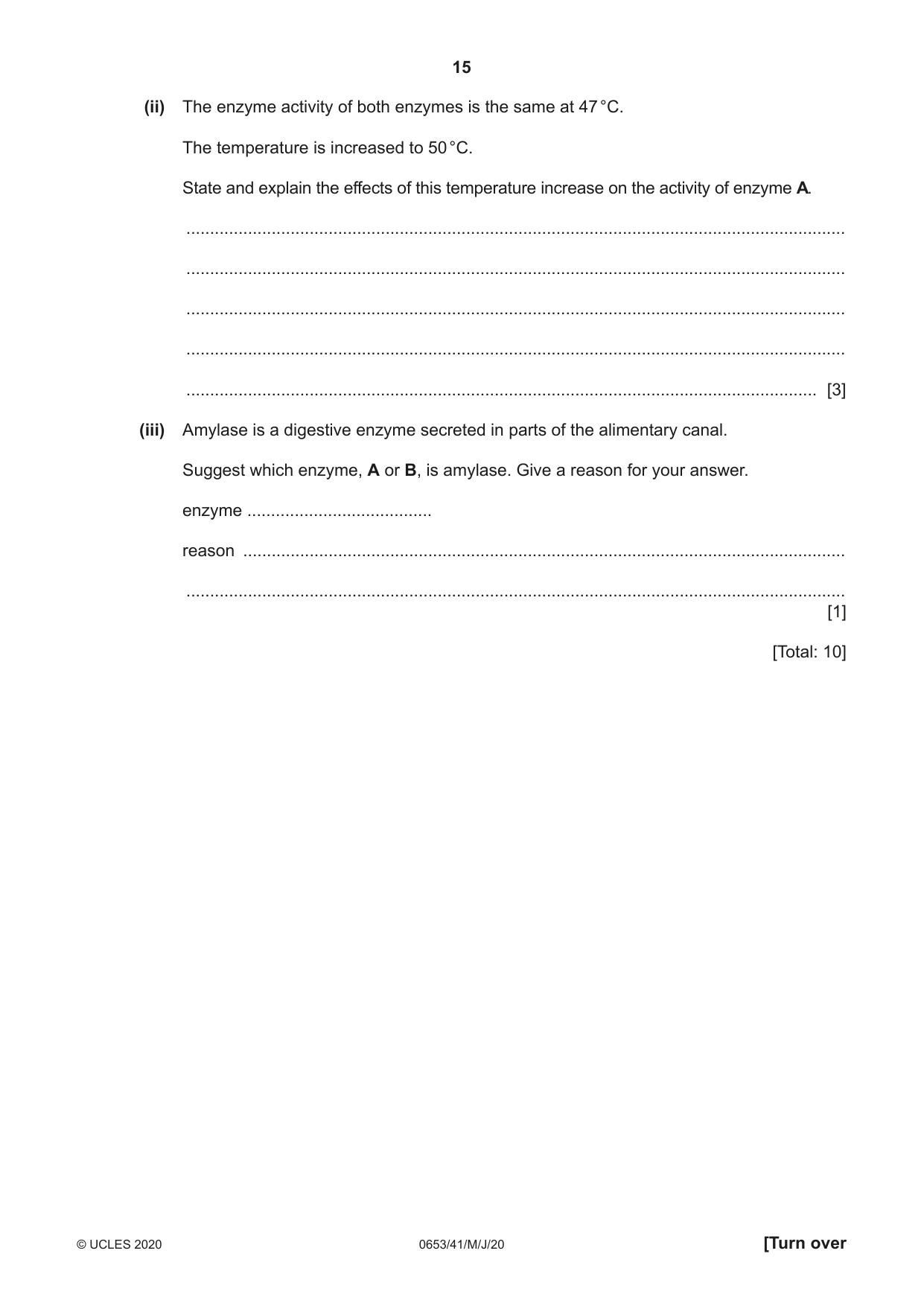
7 (a) The substrates and products of three digestive enzymes are shown in Table 7.1. Complete Table 7.1. Table 7.1 substrate digestive enzyme product amylase sugars ............................................... fat ............................................ ......................... and fatty acids protein protease ................................................ [3] (b) State two functions of the hydrochloric acid in gastric juice in the stomach. 1. . .............................................................................................................................................. ................................................................................................................................................... 2. ............................................................................................................................................... ................................................................................................................................................... [2] (c) Fig. 7.1 shows a graph of activity against temperature for two enzymes, A and B. enzyme A enzyme B enzyme activity 0 20 40 60 80 100 120 temperature / °C Fig. 7.1 (i) Identify the temperature of maximum activity of enzyme B. temperature = ......................................................°C [1] (ii) The enzyme activity of both enzymes is the same at 47 °C. The temperature is increased to 50 °C. State and explain the effects of this temperature increase on the activity of enzyme A. ........................................................................................................................................... ........................................................................................................................................... ........................................................................................................................................... ........................................................................................................................................... ..................................................................................................................................... [3] (iii) Amylase is a digestive enzyme secreted in parts of the alimentary canal. Suggest which enzyme, A or B, is amylase. Give a reason for your answer. enzyme ....................................... reason ............................................................................................................................... ........................................................................................................................................... [1] [Total: 10]
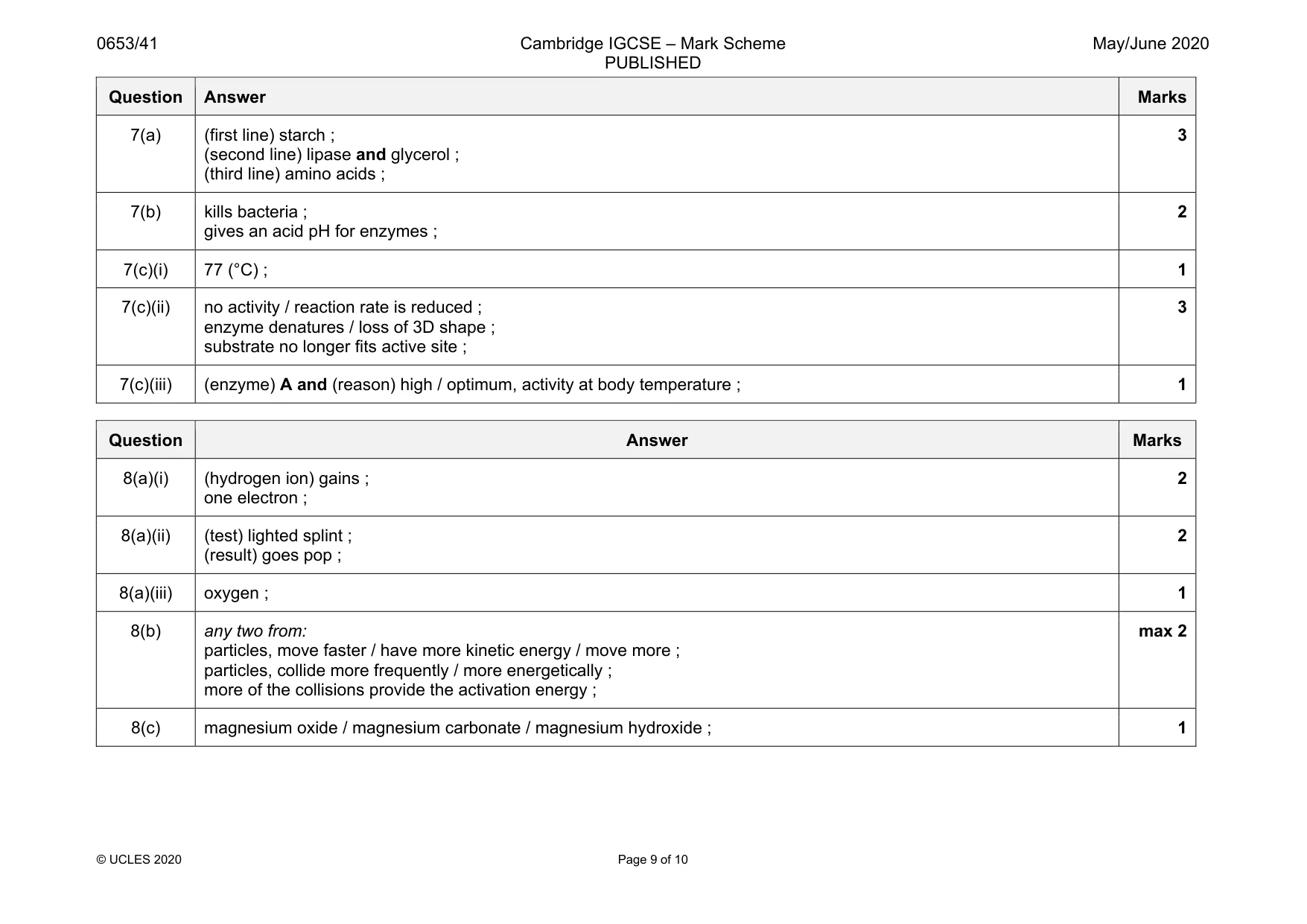
Mark scheme: 7(a) (first line) starch ; (second line) lipase and glycerol ; (third line) amino acids ; 3 7(b) kills bacteria ; gives an acid pH for enzymes ; 2 7(c)(i) 77 (°C) ; 1 7(c)(ii) no activity / reaction rate is reduced ; enzyme denatures / loss of 3D shape ; substrate no longer fits active site ; 3 7(c)(iii) (enzyme) A and (reason) high / optimum, activity at body temperature ; 1
Q8 · When dilute sulfuric acid is electrolysed, hydrogen forms at the cathode
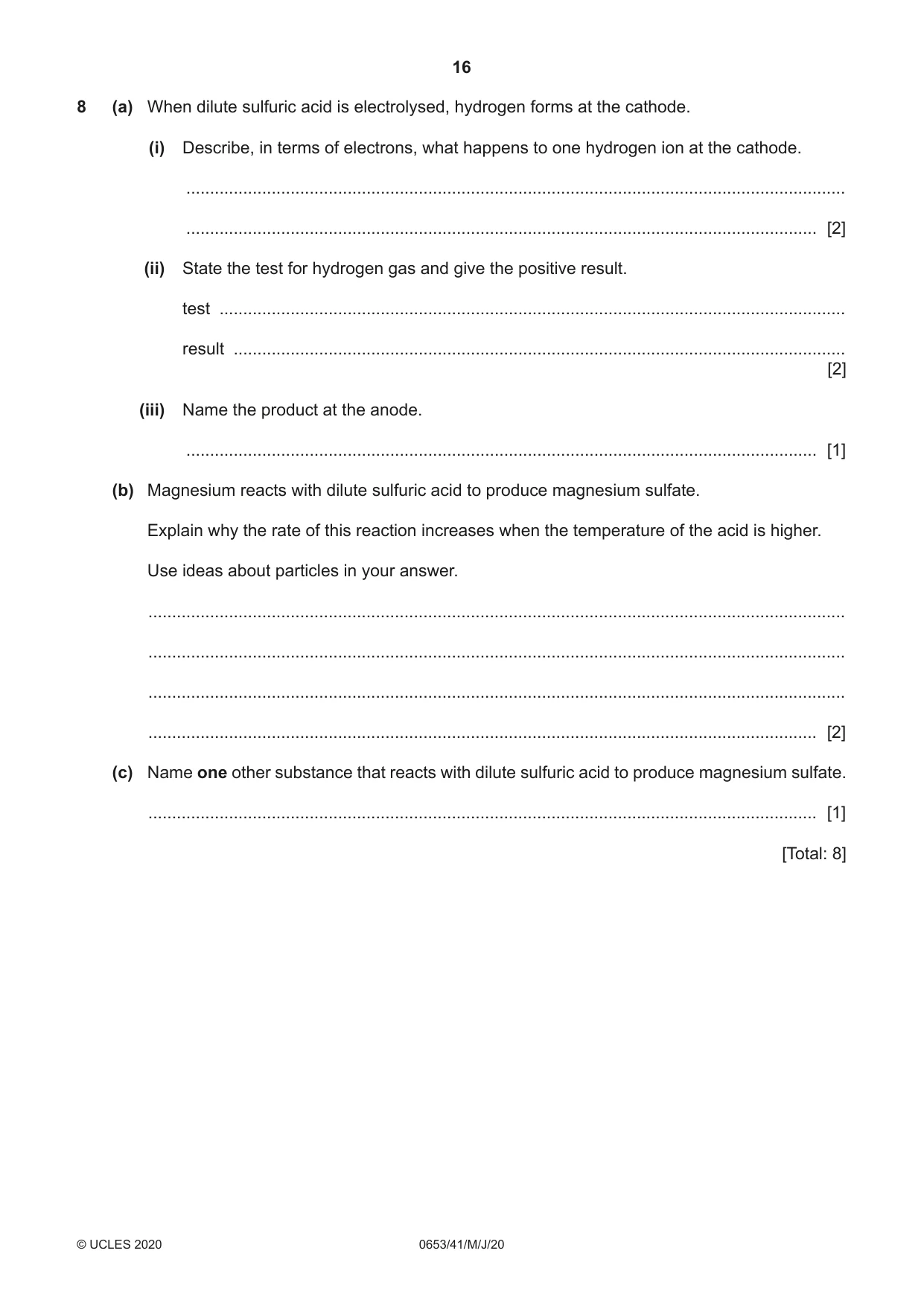
8 (a) When dilute sulfuric acid is electrolysed, hydrogen forms at the cathode. (i) Describe, in terms of electrons, what happens to one hydrogen ion at the cathode. ........................................................................................................................................... ..................................................................................................................................... [2] (ii) State the test for hydrogen gas and give the positive result. test .................................................................................................................................... result ................................................................................................................................. [2] (iii) Name the product at the anode. ..................................................................................................................................... [1] (b) Magnesium reacts with dilute sulfuric acid to produce magnesium sulfate. Explain why the rate of this reaction increases when the temperature of the acid is higher. Use ideas about particles in your answer. ................................................................................................................................................... ................................................................................................................................................... ................................................................................................................................................... ............................................................................................................................................. [2] (c) Name one other substance that reacts with dilute sulfuric acid to produce magnesium sulfate. ............................................................................................................................................. [1] [Total: 8]
Mark scheme: 8(a)(i) (hydrogen ion) gains ; one electron ; 2 8(a)(ii) (test) lighted splint ; (result) goes pop ; 2 8(a)(iii) oxygen ; 1 8(b) any two from: particles, move faster / have more kinetic energy / move more ; particles, collide more frequently / more energetically ; more of the collisions provide the activation energy ; max 2 8(c) magnesium oxide / magnesium carbonate / magnesium hydroxide ; 1
Q9 · A microwave oven connected to a mains electricity supply
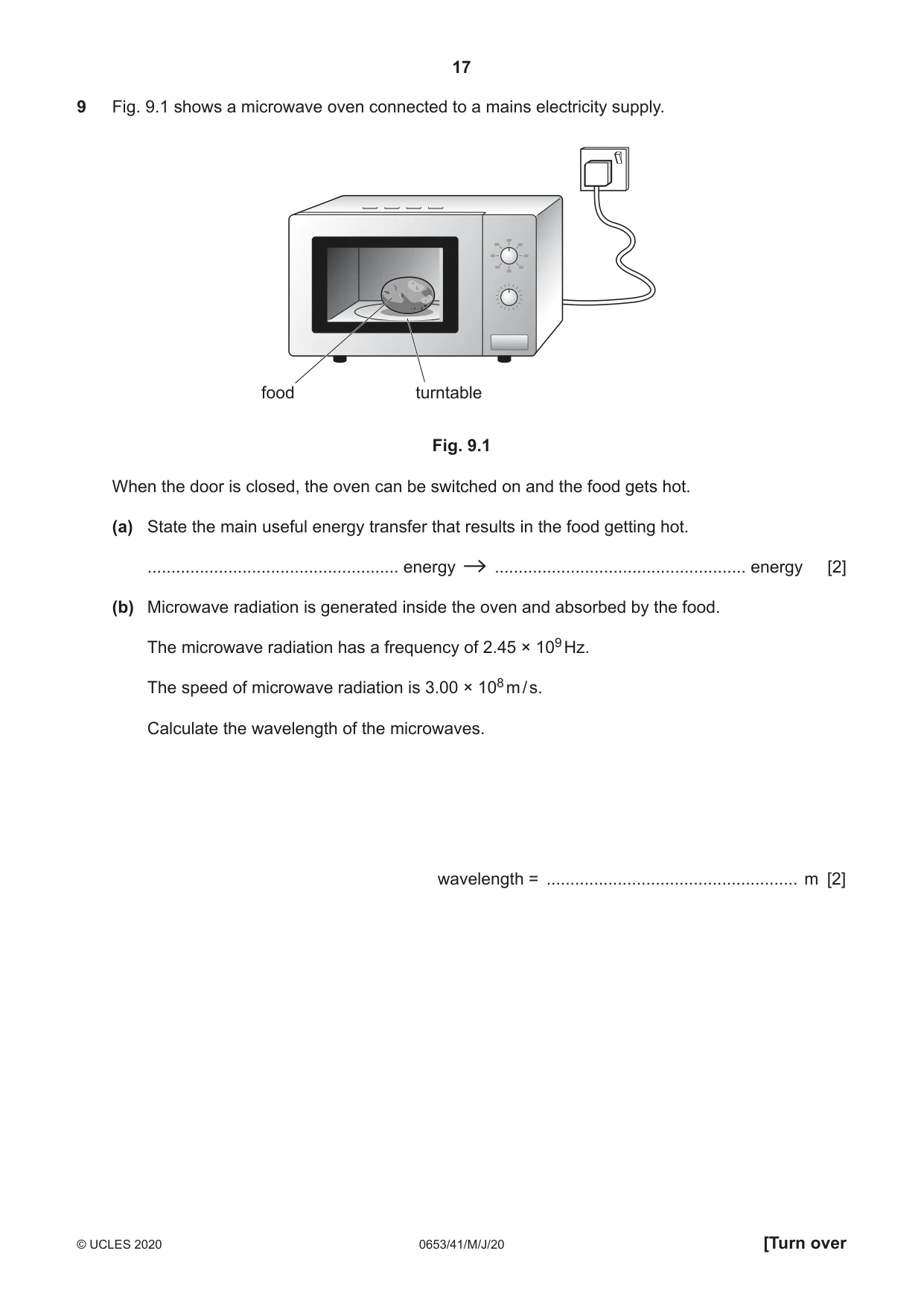
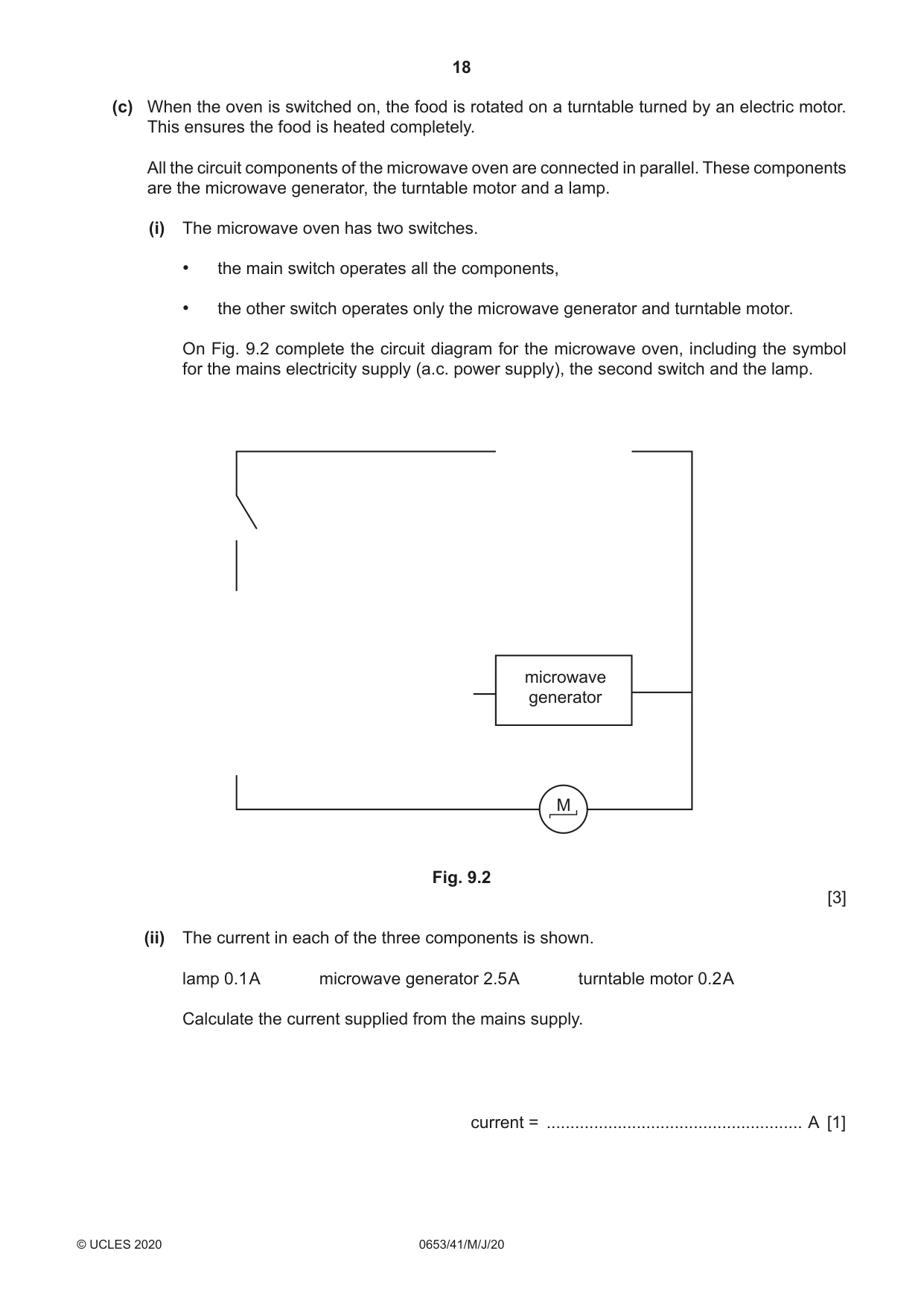
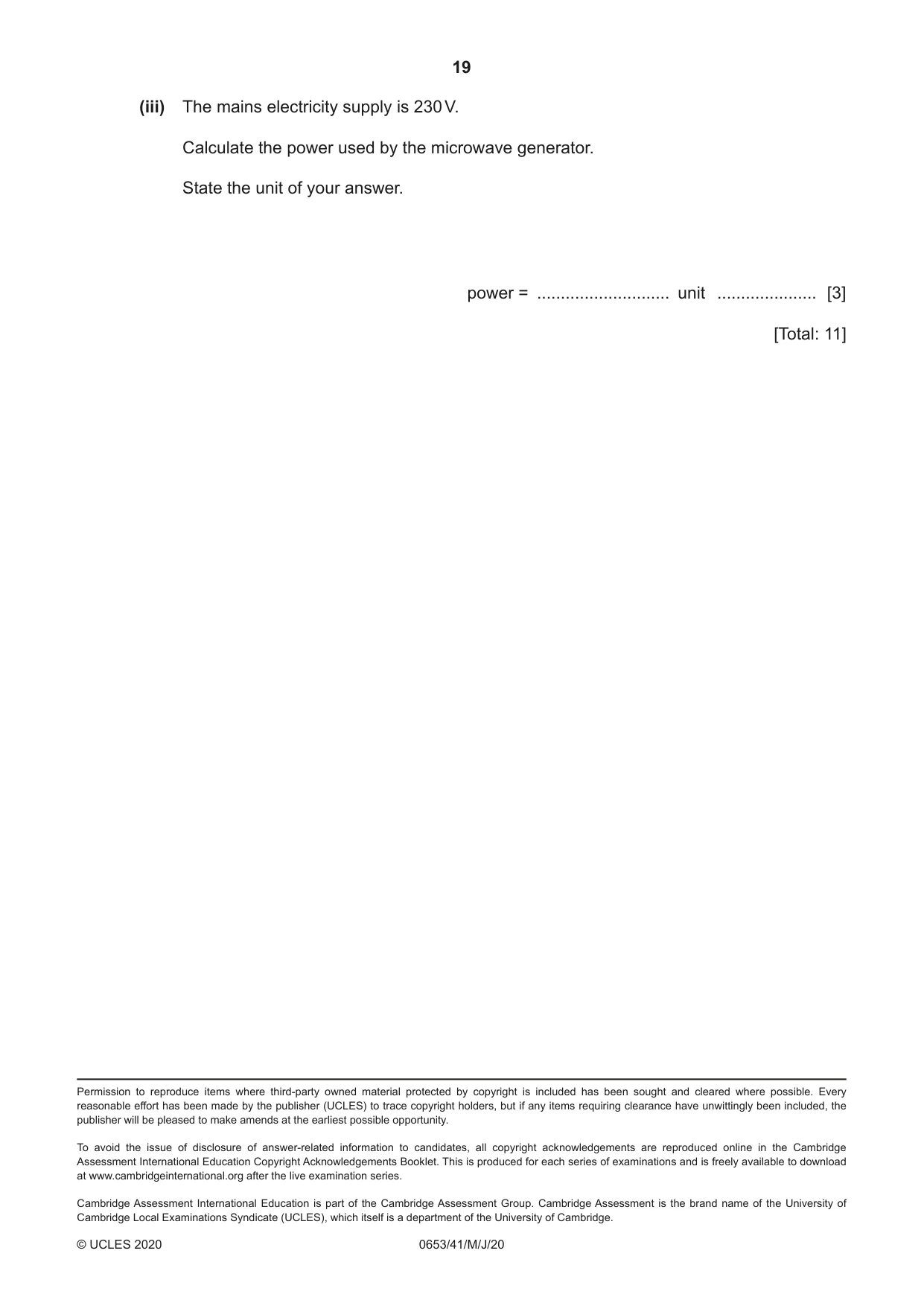
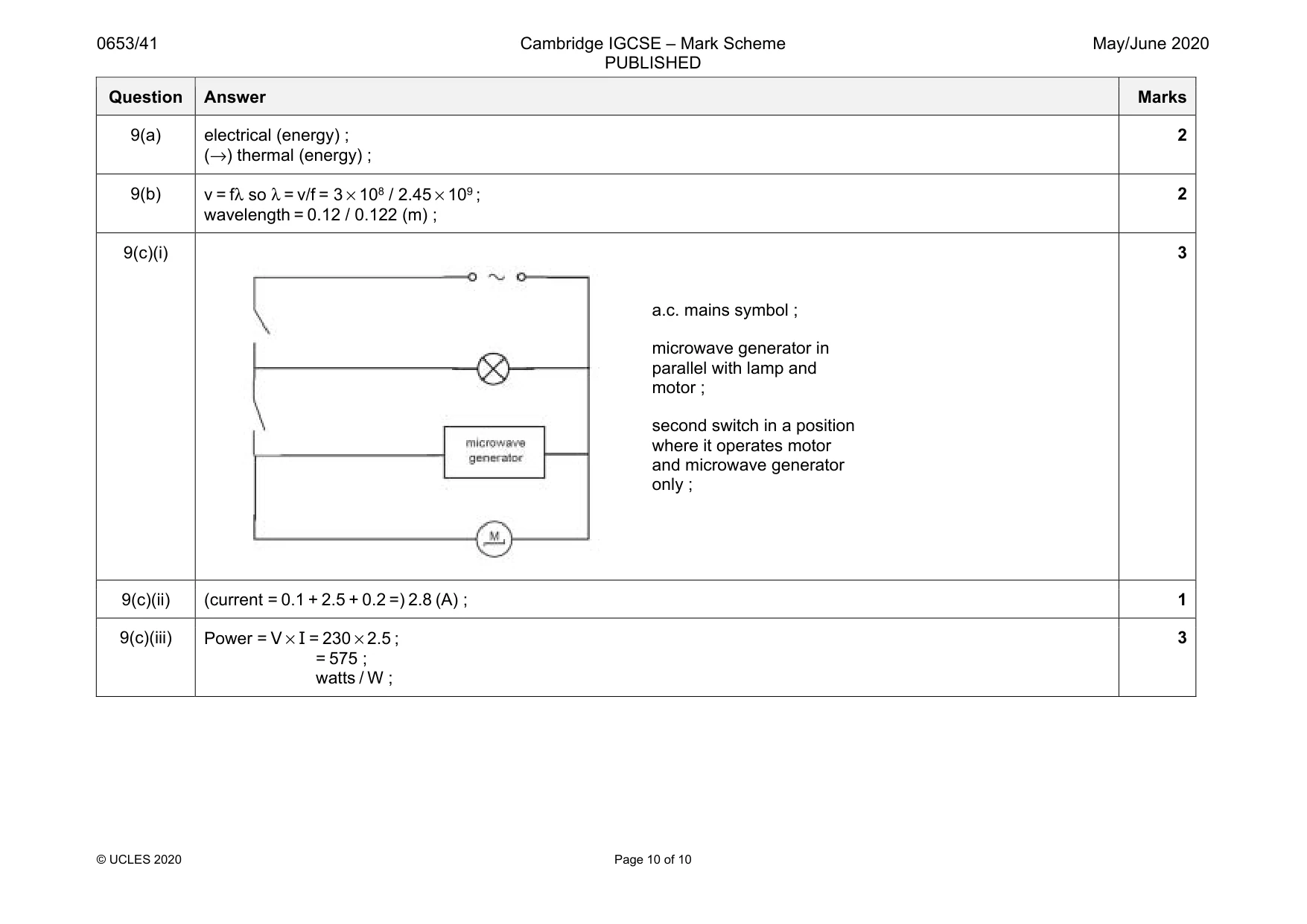
9 Fig. 9.1 shows a microwave oven connected to a mains electricity supply. food turntable Fig. 9.1 When the door is closed, the oven can be switched on and the food gets hot. (a) State the main useful energy transfer that results in the food getting hot. ..................................................... energy ..................................................... energy [2] (b) Microwave radiation is generated inside the oven and absorbed by the food. The microwave radiation has a frequency of 2.45 × 10⁹ Hz. The speed of microwave radiation is 3.00 × 10⁸ m / s. Calculate the wavelength of the microwaves. wavelength = ..................................................... m [2] (c) When the oven is switched on, the food is rotated on a turntable turned by an electric motor. This ensures the food is heated completely. All the circuit components of the microwave oven are connected in parallel. These components are the microwave generator, the turntable motor and a lamp. (i) The microwave oven has two switches. • the main switch operates all the components, • the other switch operates only the microwave generator and turntable motor. On Fig. 9.2 complete the circuit diagram for the microwave oven, including the symbol for the mains electricity supply (a.c. power supply), the second switch and the lamp. microwave generator M Fig. 9.2 [3] (ii) The current in each of the three components is shown. lamp 0.1 A microwave generator 2.5 A turntable motor 0.2 A Calculate the current supplied from the mains supply. current = ...................................................... A [1] (iii) The mains electricity supply is 230 V. Calculate the power used by the microwave generator. State the unit of your answer. power = ............................ unit ..................... [3] [Total: 11]
Mark scheme: 9(a) electrical (energy) ; (→) thermal (energy) ; 2 9(b) v = fλ so λ = v/f = 3 × 10⁸ / 2.45 × 10⁹ ; wavelength = 0.12 / 0.122 (m) ; 2 9(c)(i) 3 9(c)(ii) (current = 0.1 + 2.5 + 0.2 =) 2.8 (A) ; 1 9(c)(iii) Power = V × I = 230 × 2.5 ; = 575 ; watts / W ; 3 a.c. mains symbol ; microwave generator in parallel with lamp and motor ; second switch in a position where it operates motor and microwave generator only ;
What was in this paper
The subtopics covered by these 9 questions, and how many questions each got. Open one in a new tab to see every Cambridge question on it.