Cambridge IGCSE Science - Combined 0653 — 2025 Oct/Nov Paper 4 · Variant 2
0653/42/O/N/25 · 9 questions · 80 marks · 75 min
The question paper and its mark scheme, free to read here and free to download. This is Cambridge’s own paper, exactly as it was sat.
Question paper20 pages
Mark scheme14 pages
Answers below. Sit the paper first if you are practising.
Questions as text
Q1 · A diagram of a cross-section through a leaf
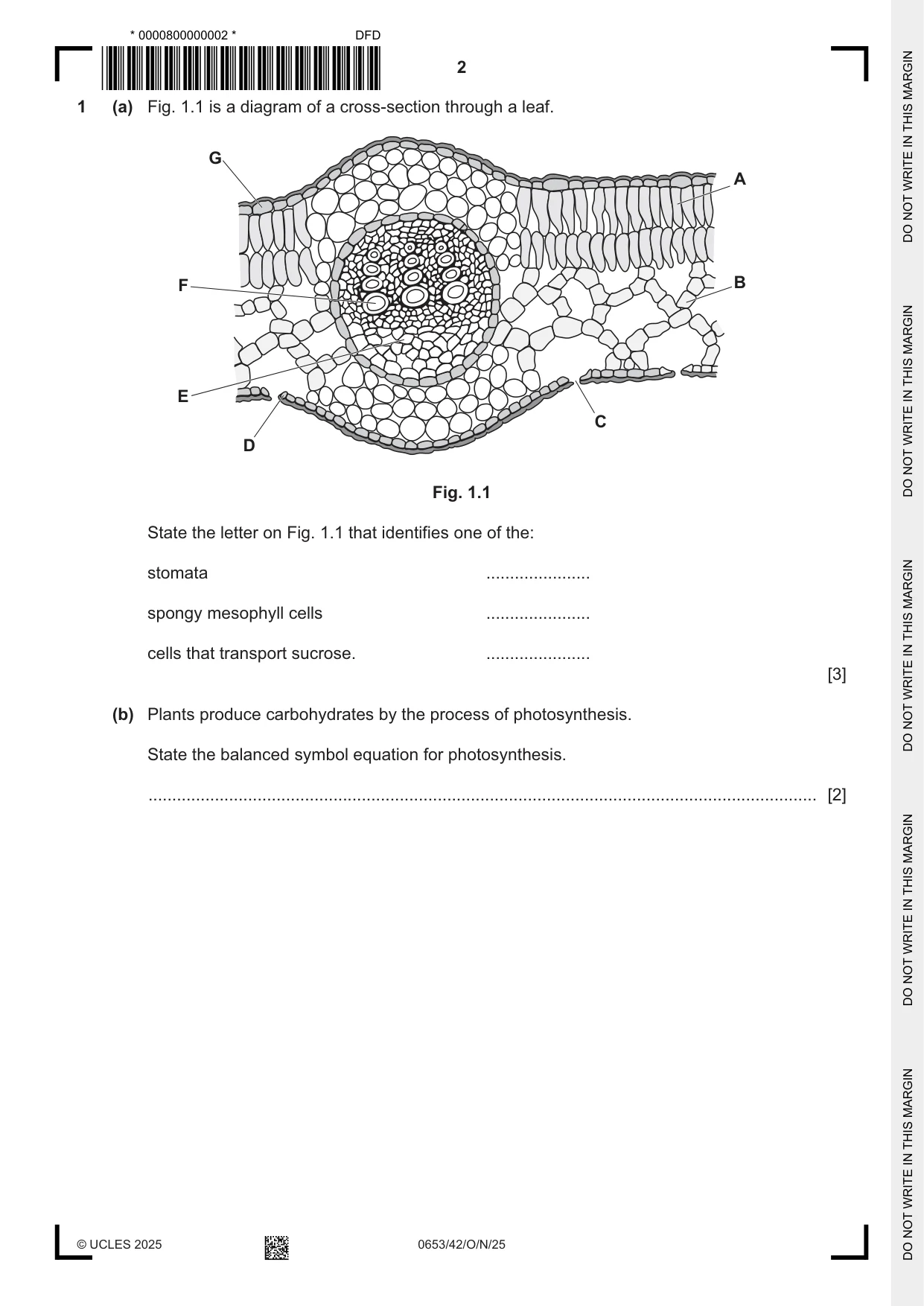
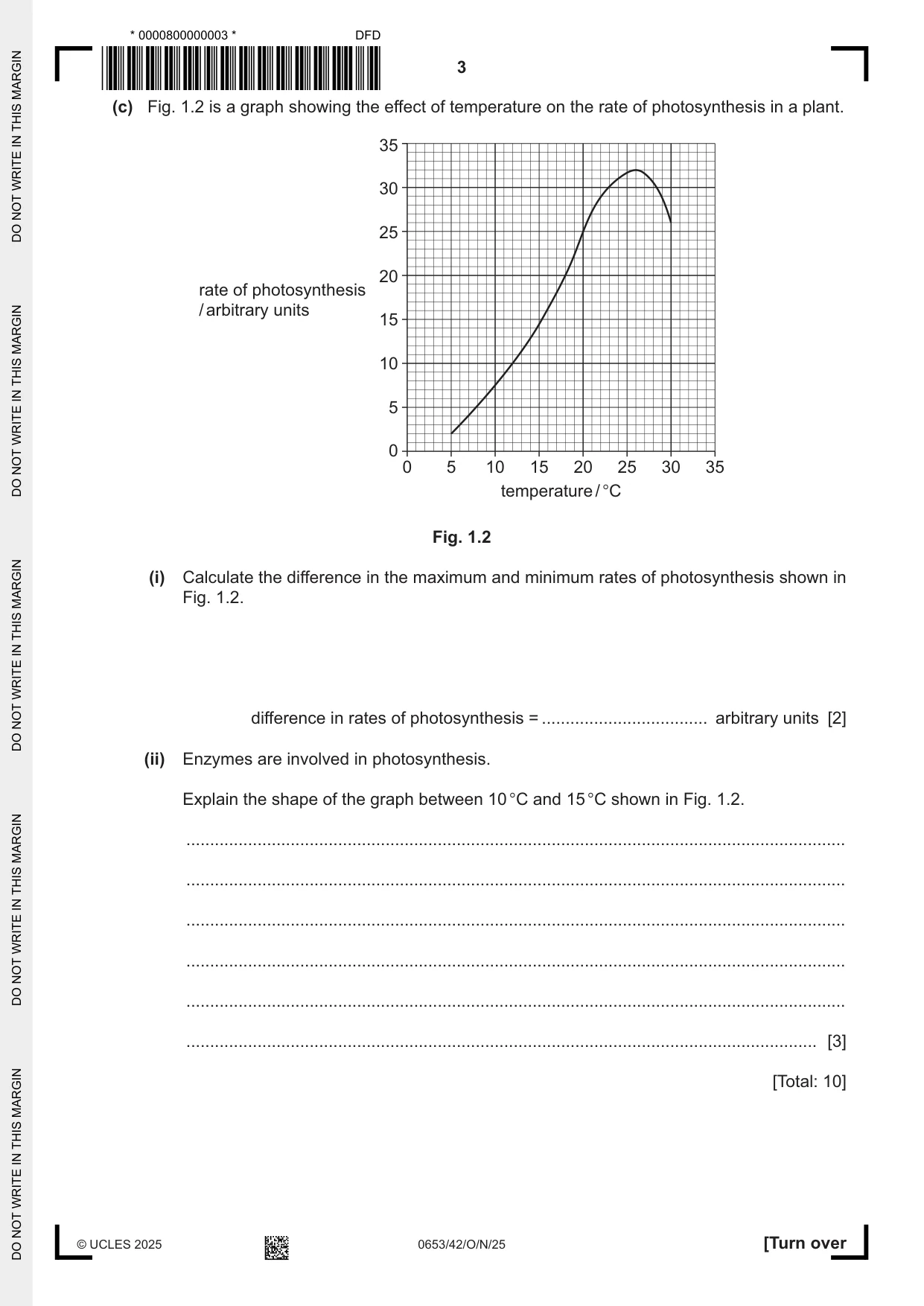
1 (a) Fig. 1.1 is a diagram of a cross-section through a leaf. G A F B E C D Fig. 1.1 State the letter on Fig. 1.1 that identifies one of the: stomata ...................... spongy mesophyll cells ...................... cells that transport sucrose. ...................... [3] (b) Plants produce carbohydrates by the process of photosynthesis. State the balanced symbol equation for photosynthesis. ............................................................................................................................................. [2] (c) Fig. 1.2 is a graph showing the effect of temperature on the rate of photosynthesis in a plant. 35 30 25 20 rate of photosynthesis / arbitrary units 15 10 5 0 0 5 10 15 20 25 30 35 temperature / °C Fig. 1.2 (i) Calculate the difference in the maximum and minimum rates of photosynthesis shown in Fig. 1.2. difference in rates of photosynthesis = ................................... arbitrary units [2] (ii) Enzymes are involved in photosynthesis. Explain the shape of the graph between 10 °C and 15 °C shown in Fig. 1.2. ........................................................................................................................................... ........................................................................................................................................... ........................................................................................................................................... ........................................................................................................................................... ........................................................................................................................................... ..................................................................................................................................... [3] [Total: 10]
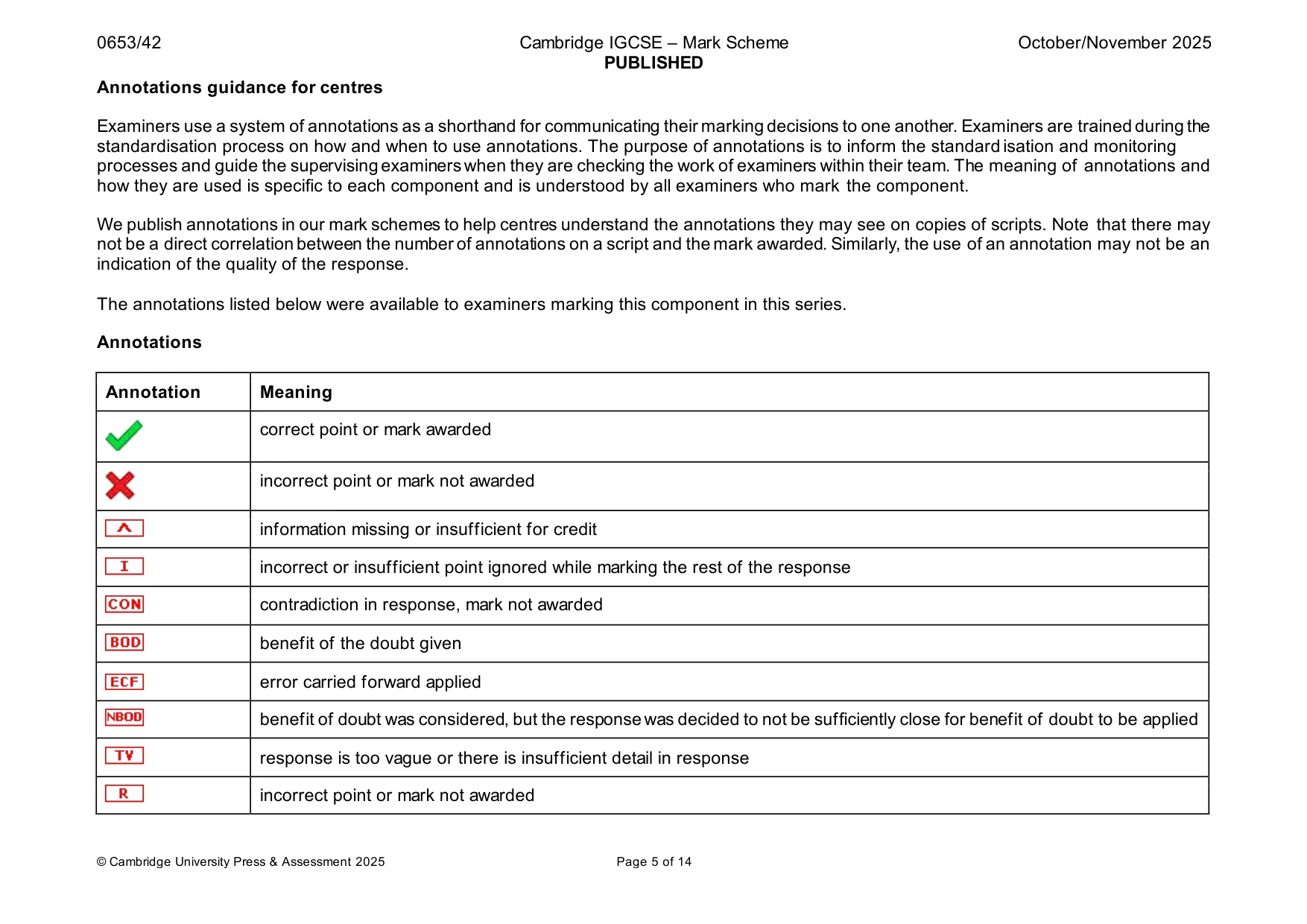
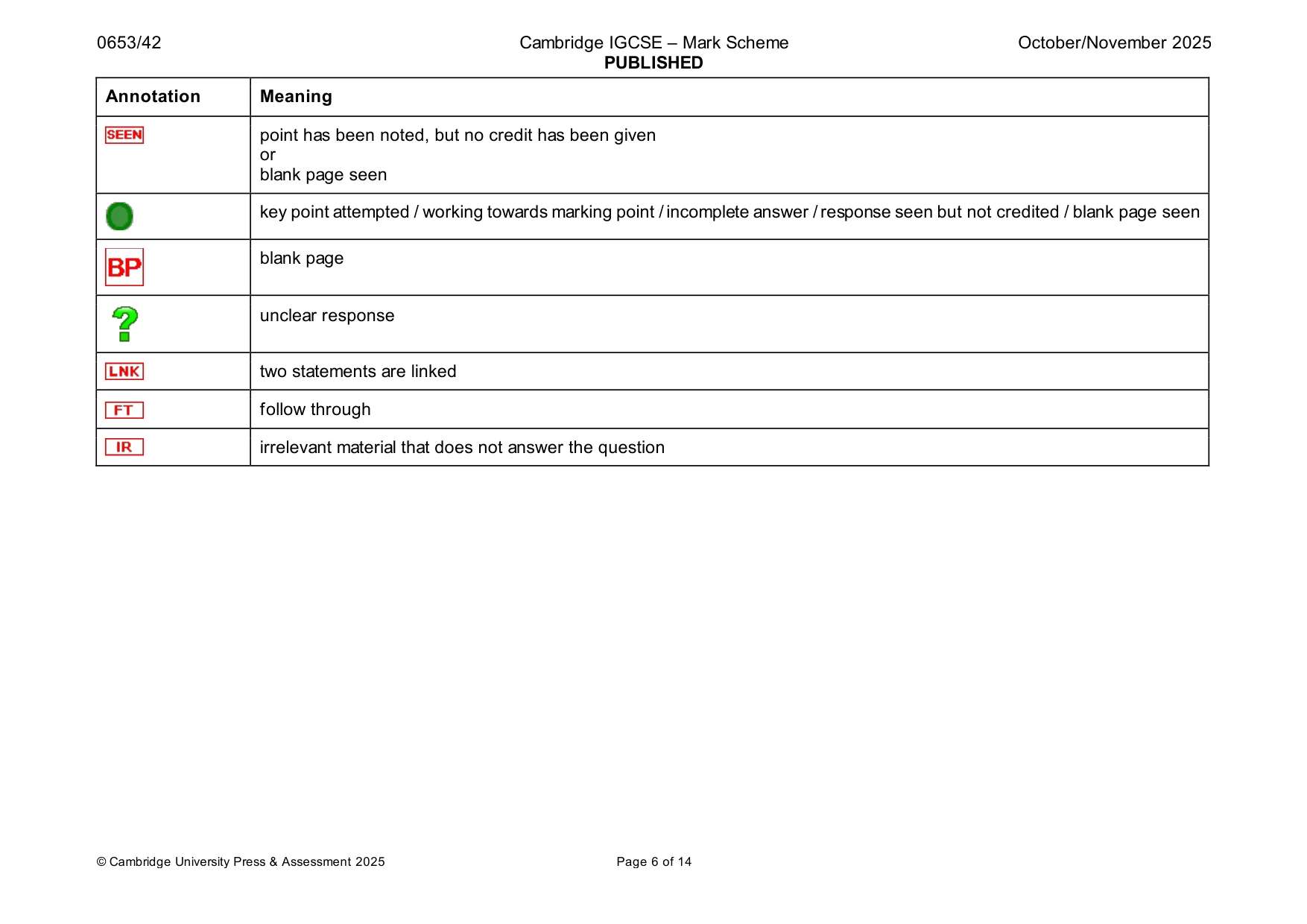
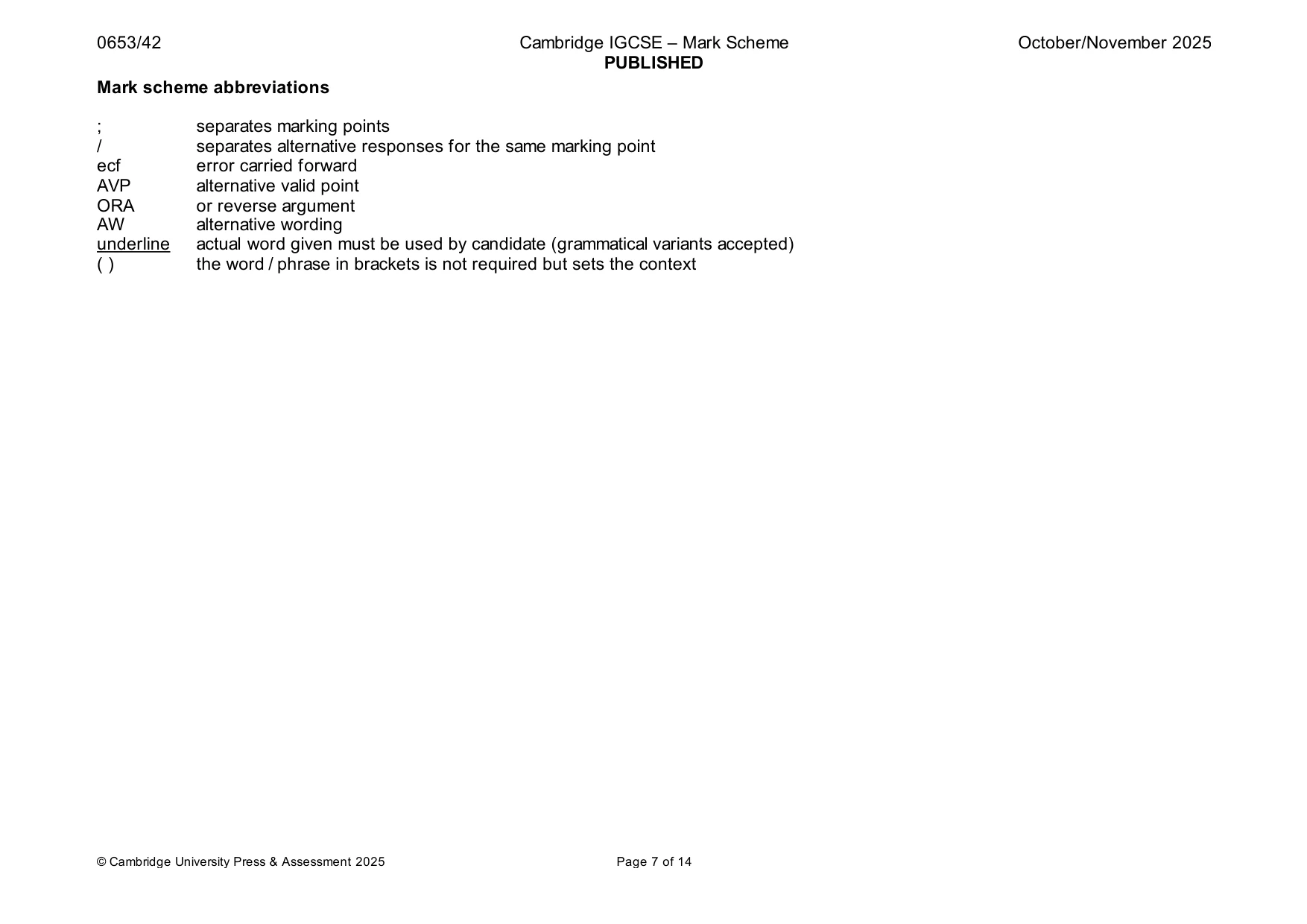
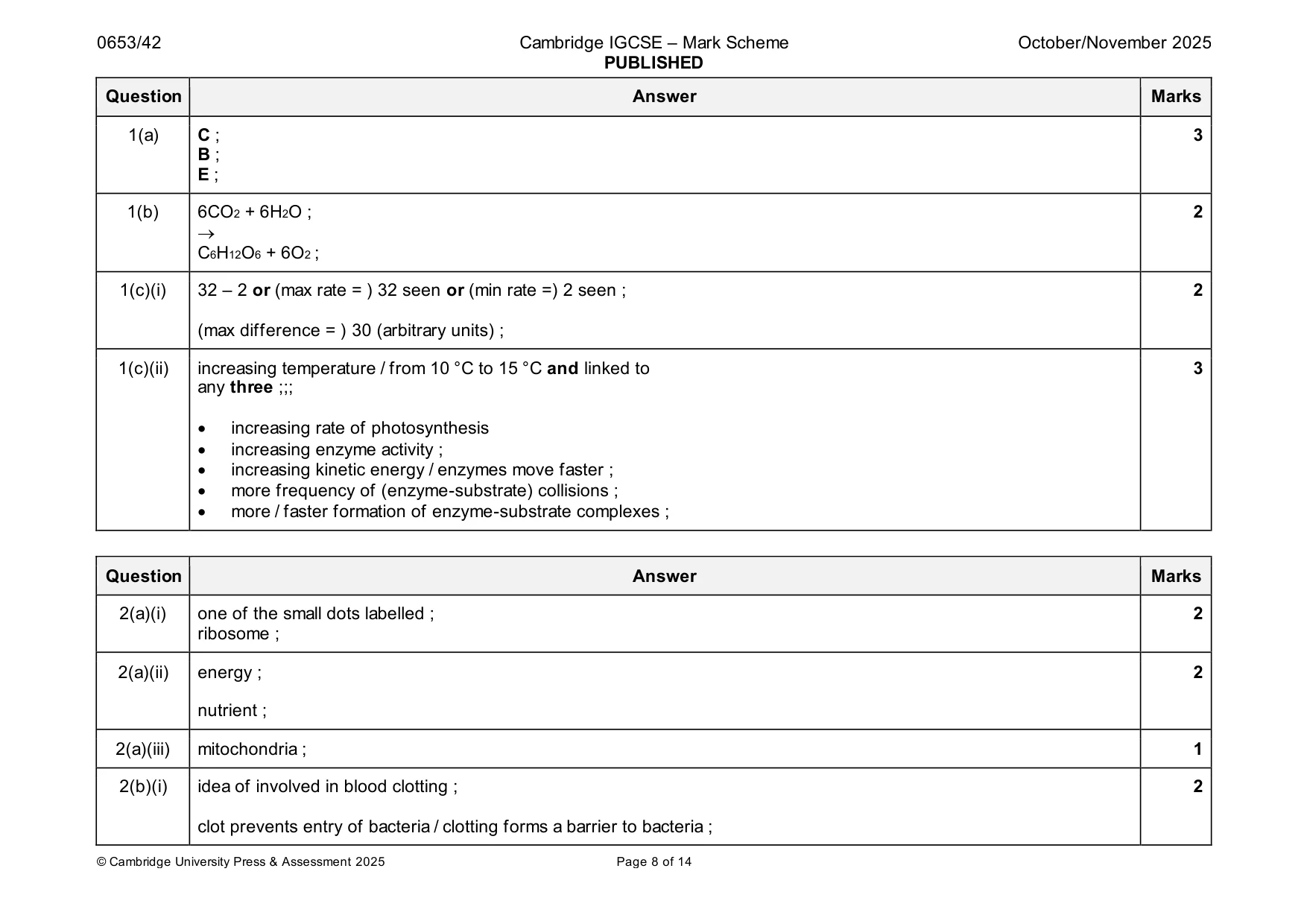
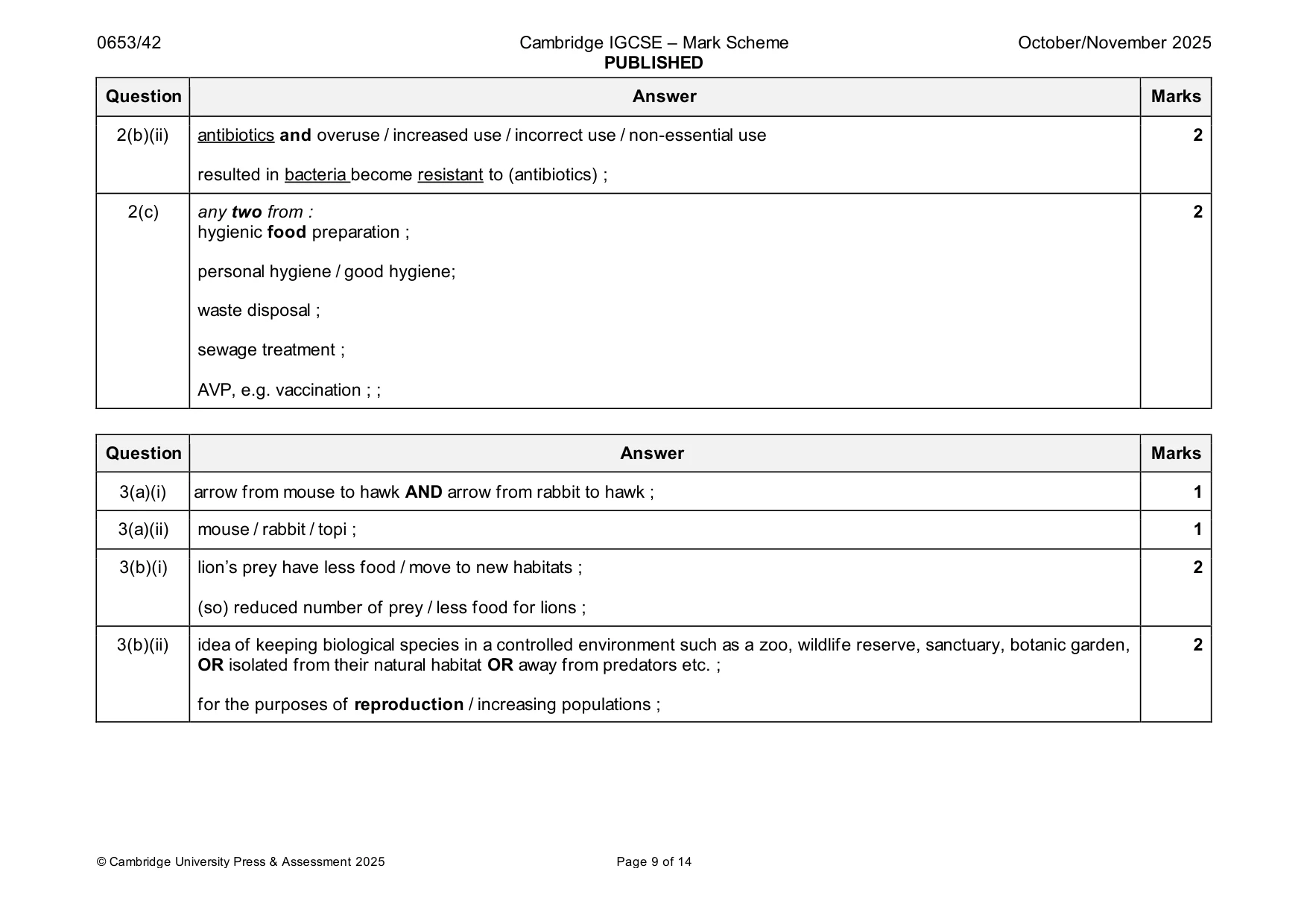
Mark scheme: Question Answer Marks 1(a) C ; 3 B ; E ; 1(b) 6CO2 + 6H2O ; 2 → C6H12O6 + 6O2 ; 1(c)(i) 32 – 2 or (max rate = ) 32 seen or (min rate =) 2 seen ; 2 (max difference = ) 30 (arbitrary units) ; 1(c)(ii) increasing temperature / from 10 °C to 15 °C and linked to 3 any three ;;; • increasing rate of photosynthesis • increasing enzyme activity ; • increasing kinetic energy / enzymes move faster ; • more frequency of (enzyme-substrate) collisions ; • more / faster formation of enzyme-substrate complexes ;
Q2 · A diagram of a bacterial cell
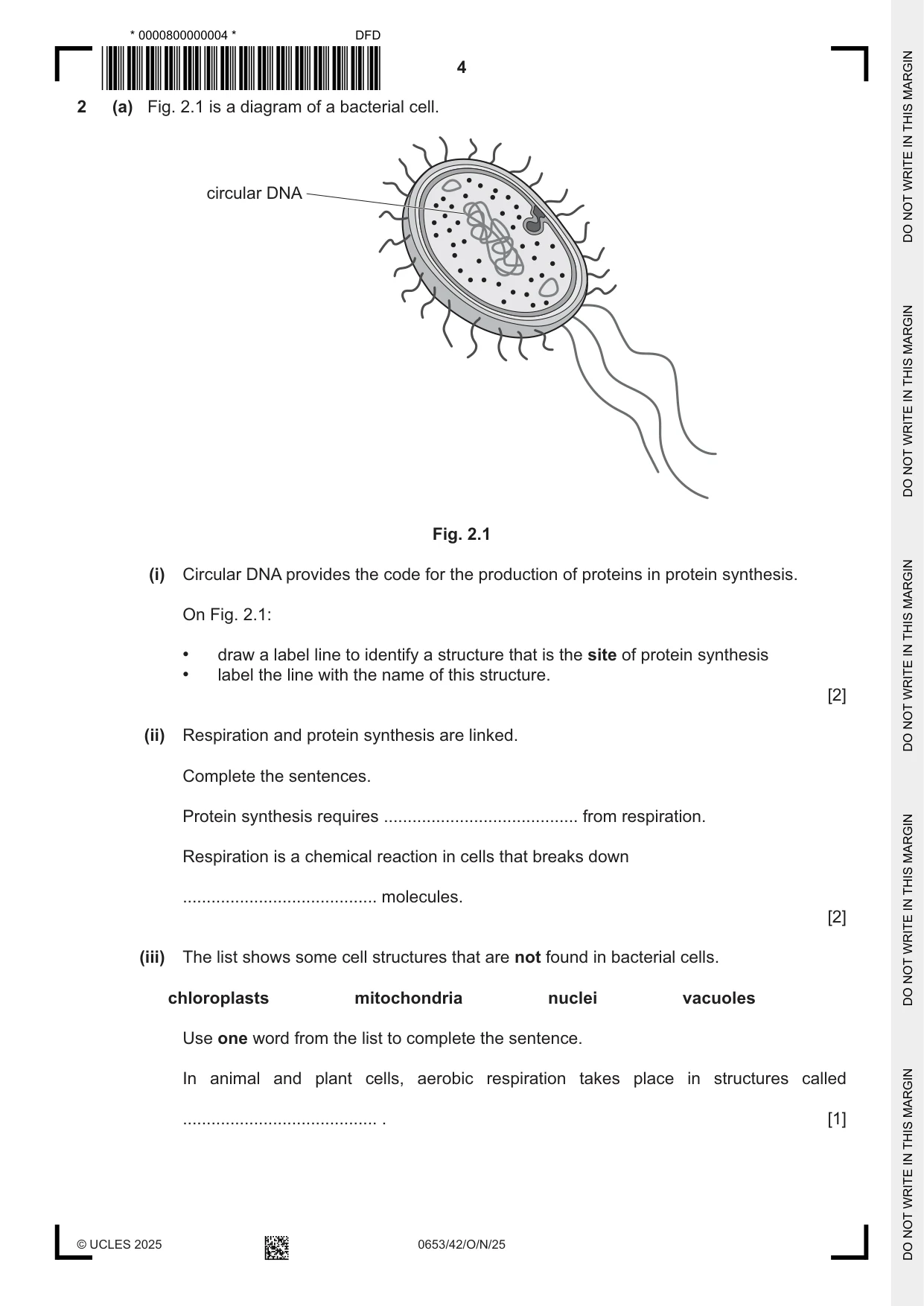
2 (a) Fig. 2.1 is a diagram of a bacterial cell. circular DNA Fig. 2.1 (i) Circular DNA provides the code for the production of proteins in protein synthesis. On Fig. 2.1: • draw a label line to identify a structure that is the site of protein synthesis • label the line with the name of this structure. [2] (ii) Respiration and protein synthesis are linked. Complete the sentences. Protein synthesis requires ......................................... from respiration. Respiration is a chemical reaction in cells that breaks down ......................................... molecules. [2] (iii) The list shows some cell structures that are not found in bacterial cells. chloroplasts mitochondria nuclei vacuoles Use one word from the list to complete the sentence. In animal and plant cells, aerobic respiration takes place in structures called ......................................... . [1] (b) Some bacteria cause diseases. (i) Describe how platelets in the blood help prevent bacterial infection. ........................................................................................................................................... ........................................................................................................................................... ........................................................................................................................................... ..................................................................................................................................... [2] (ii) Explain why some treatments of bacterial infections have become less effective. ........................................................................................................................................... ........................................................................................................................................... ........................................................................................................................................... ..................................................................................................................................... [2] (c) Providing a clean water supply helps reduce the spread of diseases. State two other ways to reduce the spread of diseases. 1 ................................................................................................................................................ ................................................................................................................................................... 2 ................................................................................................................................................ ................................................................................................................................................... [2] [Total: 11]
Mark scheme: 2(a)(i) one of the small dots labelled ; 2 ribosome ; 2(a)(ii) energy ; 2 nutrient ; 2(a)(iii) mitochondria ; 1 2(b)(i) idea of involved in blood clotting ; 2 clot prevents entry of bacteria / clotting forms a barrier to bacteria ; 2(b)(ii) antibiotics and overuse / increased use / incorrect use / non-essential use 2 resulted in bacteria become resistant to (antibiotics) ; 2(c) any two from : 2 hygienic food preparation ; personal hygiene / good hygiene; waste disposal ; sewage treatment ; AVP, e.g. vaccination ; ;
Q3 · A food web from a grassland habitat
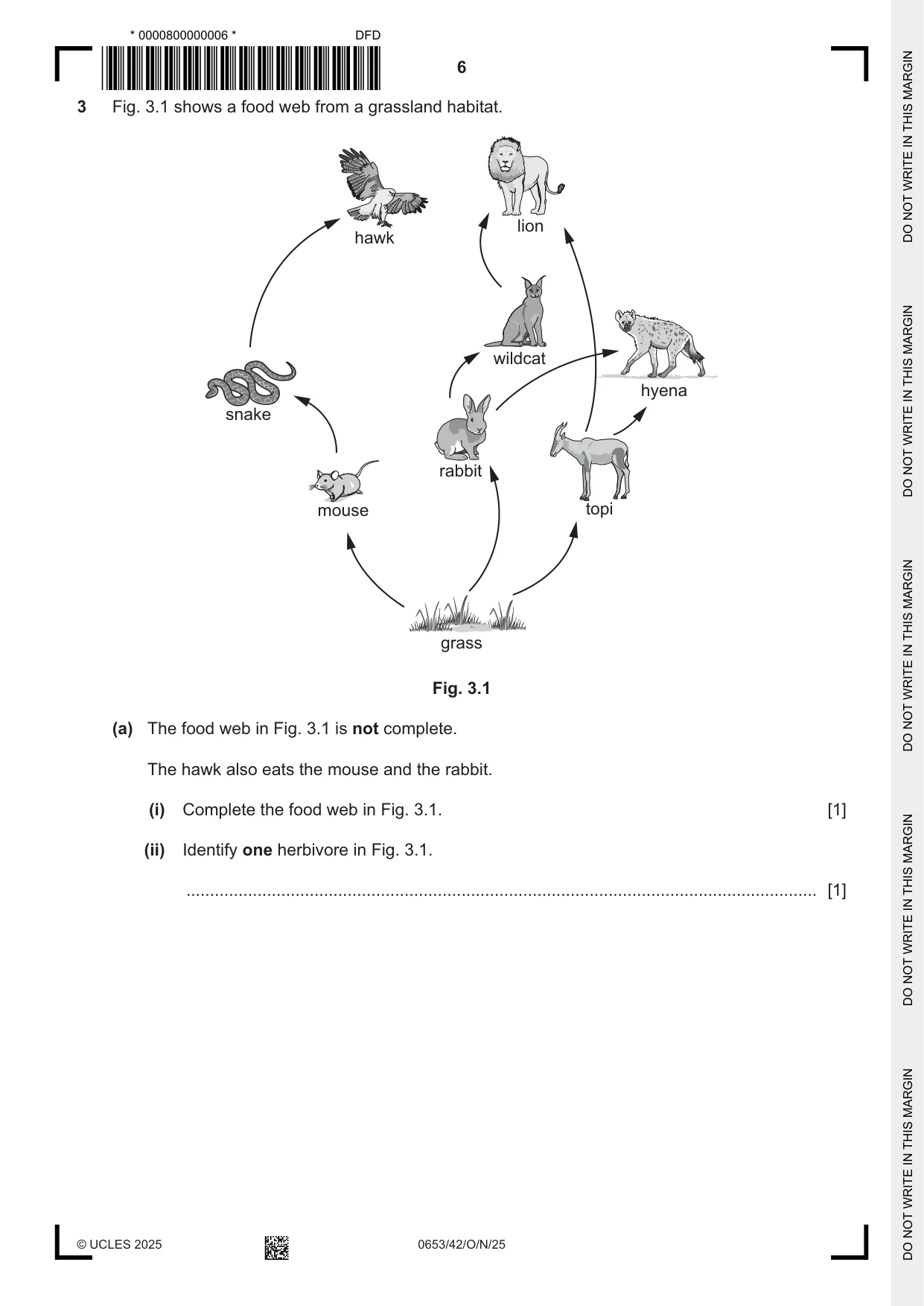
3 Fig. 3.1 shows a food web from a grassland habitat. lion hawk wildcat hyena snake rabbit mouse topi grass Fig. 3.1 (a) The food web in Fig. 3.1 is not complete. The hawk also eats the mouse and the rabbit. (i) Complete the food web in Fig. 3.1. [1] (ii) Identify one herbivore in Fig. 3.1. ..................................................................................................................................... [1] (b) People living near the grassland habitat burn areas of grassland to clear the ground for growing crops. Replacing grassland with crops is causing the lions in the area to become endangered. (i) Use information from Fig. 3.1 to explain why the lions are becoming endangered. ........................................................................................................................................... ........................................................................................................................................... ........................................................................................................................................... ..................................................................................................................................... [2] (ii) Captive breeding programmes are one method of conserving endangered species. State what is meant by a captive breeding programme. ........................................................................................................................................... ........................................................................................................................................... ........................................................................................................................................... ..................................................................................................................................... [2] [Total: 6]
Mark scheme: 3(a)(i) arrow from mouse to hawk AND arrow from rabbit to hawk ; 1 3(a)(ii) mouse / rabbit / topi ; 1 3(b)(i) lion’s prey have less food / move to new habitats ; 2 (so) reduced number of prey / less food for lions ; 3(b)(ii) idea of keeping biological species in a controlled environment such as a zoo, wildlife reserve, sanctuary, botanic garden, 2 OR isolated from their natural habitat OR away from predators etc. ; for the purposes of reproduction / increasing populations ;
Q4 · A student investigates the reaction between aqueous sodium hydroxide, NaOH, and dilute…
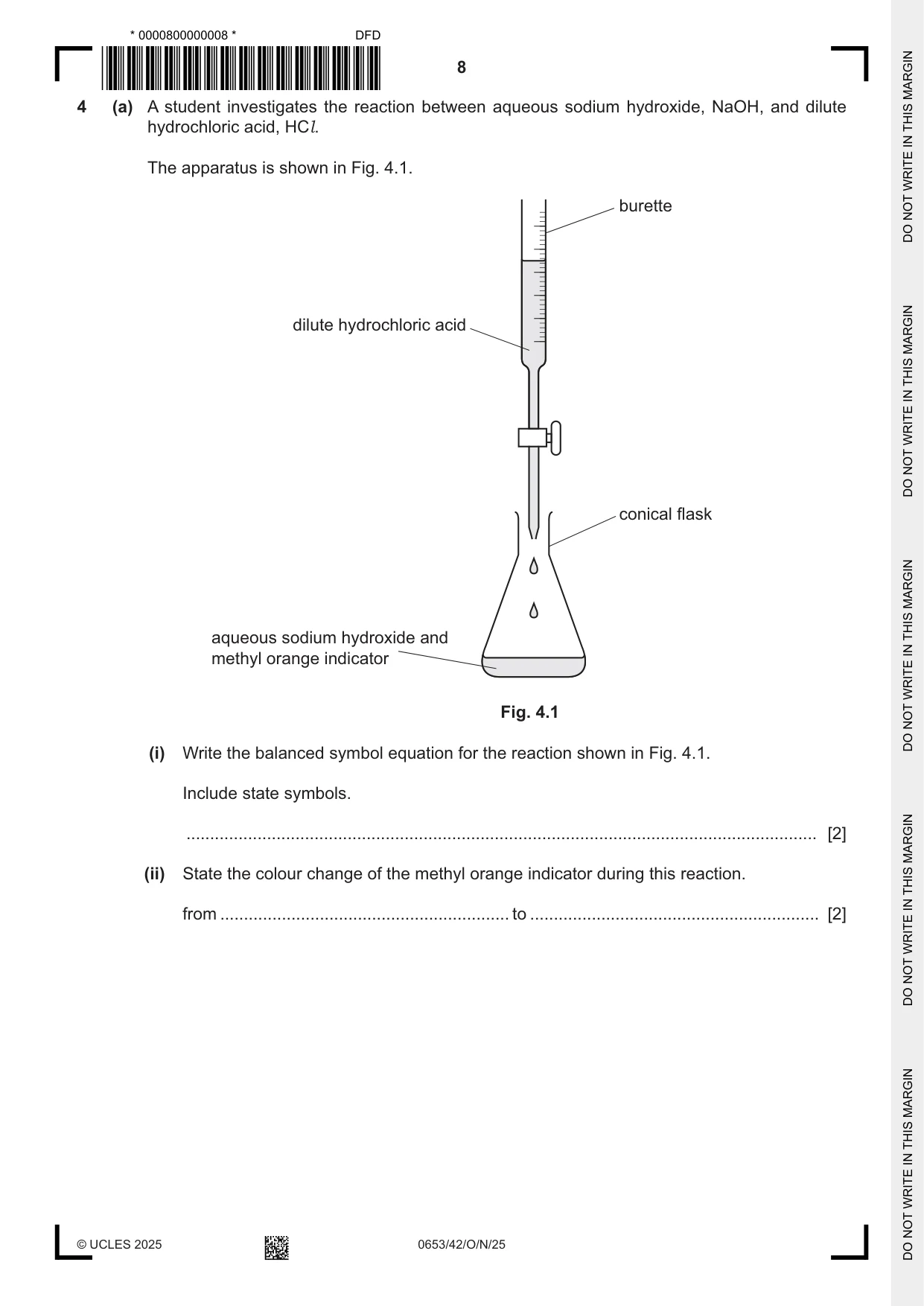
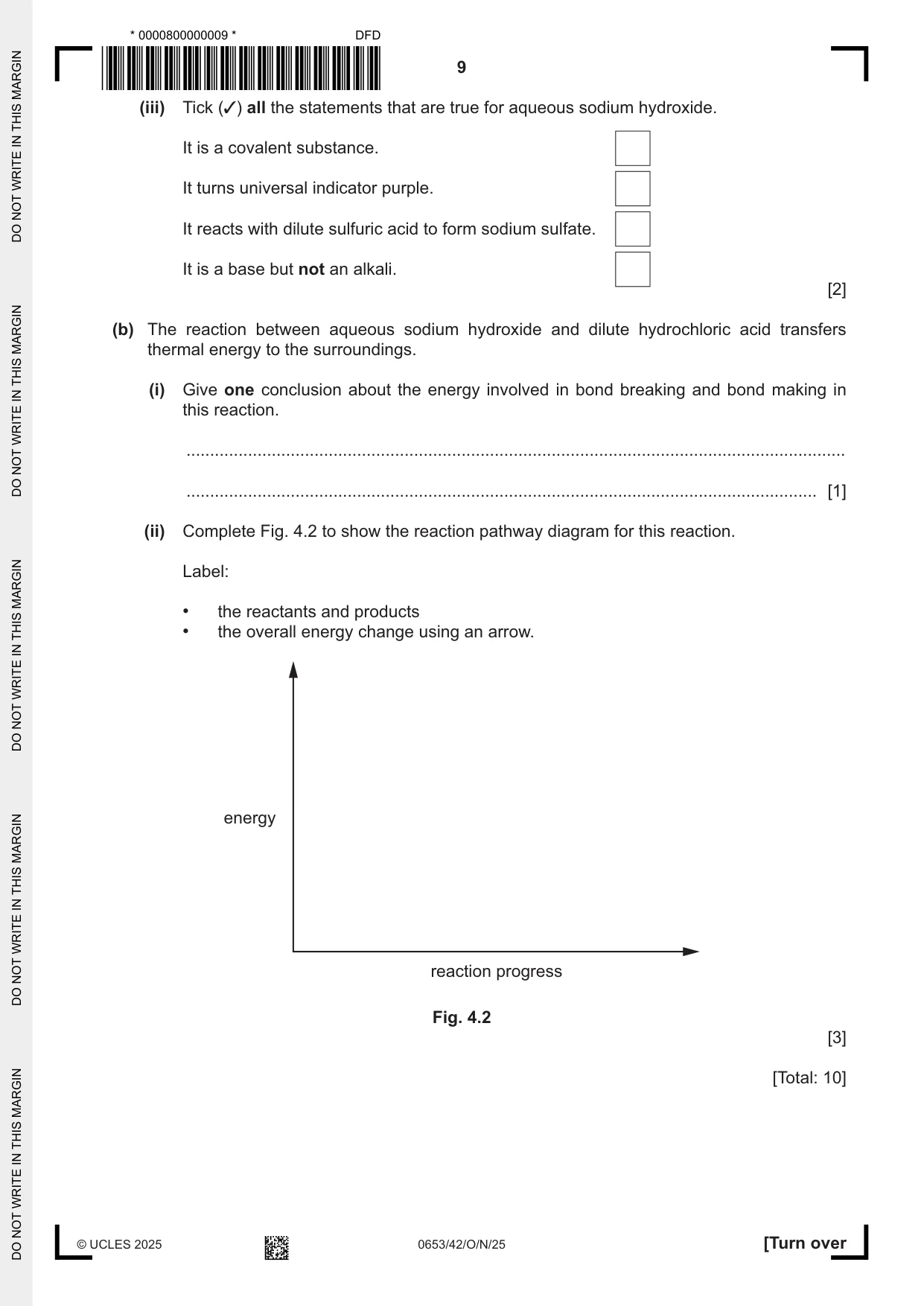
4 (a) A student investigates the reaction between aqueous sodium hydroxide, NaOH, and dilute hydrochloric acid, HCl. The apparatus is shown in Fig. 4.1. burette dilute hydrochloric acid conical flask aqueous sodium hydroxide and methyl orange indicator Fig. 4.1 (i) Write the balanced symbol equation for the reaction shown in Fig. 4.1. Include state symbols. ..................................................................................................................................... [2] (ii) State the colour change of the methyl orange indicator during this reaction. from ............................................................. to ............................................................. [2] (iii) Tick (✓) all the statements that are true for aqueous sodium hydroxide. It is a covalent substance. It turns universal indicator purple. It reacts with dilute sulfuric acid to form sodium sulfate. It is a base but not an alkali. [2] (b) The reaction between aqueous sodium hydroxide and dilute hydrochloric acid transfers thermal energy to the surroundings. (i) Give one conclusion about the energy involved in bond breaking and bond making in this reaction. ........................................................................................................................................... ..................................................................................................................................... [1] (ii) Complete Fig. 4.2 to show the reaction pathway diagram for this reaction. Label: • the reactants and products • the overall energy change using an arrow. energy reaction progress Fig. 4.2 [3] [Total: 10]
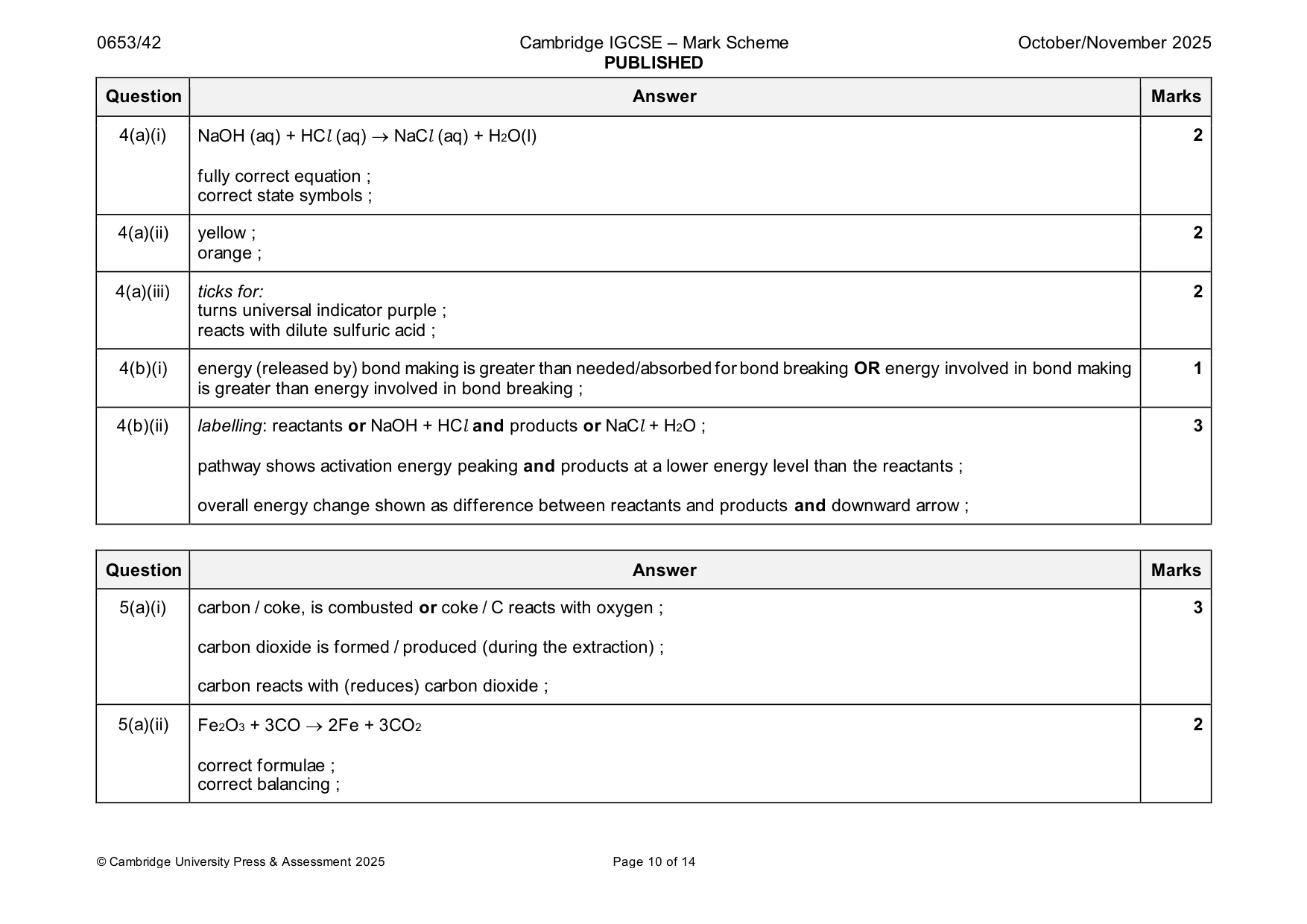
Mark scheme: 4(a)(i) NaOH (aq) + HCl (aq) → NaCl (aq) + H2O(l) 2 fully correct equation ; correct state symbols ; 4(a)(ii) yellow ; 2 orange ; 4(a)(iii) ticks for: 2 turns universal indicator purple ; reacts with dilute sulfuric acid ; 4(b)(i) energy (released by) bond making is greater than needed/absorbed for bond breaking OR energy involved in bond making 1 is greater than energy involved in bond breaking ; 4(b)(ii) labelling: reactants or NaOH + HCl and products or NaCl + H2O ; 3 pathway shows activation energy peaking and products at a lower energy level than the reactants ; overall energy change shown as difference between reactants and products and downward arrow ;
Q5 · Iron is extracted from hematite in the blast furnace
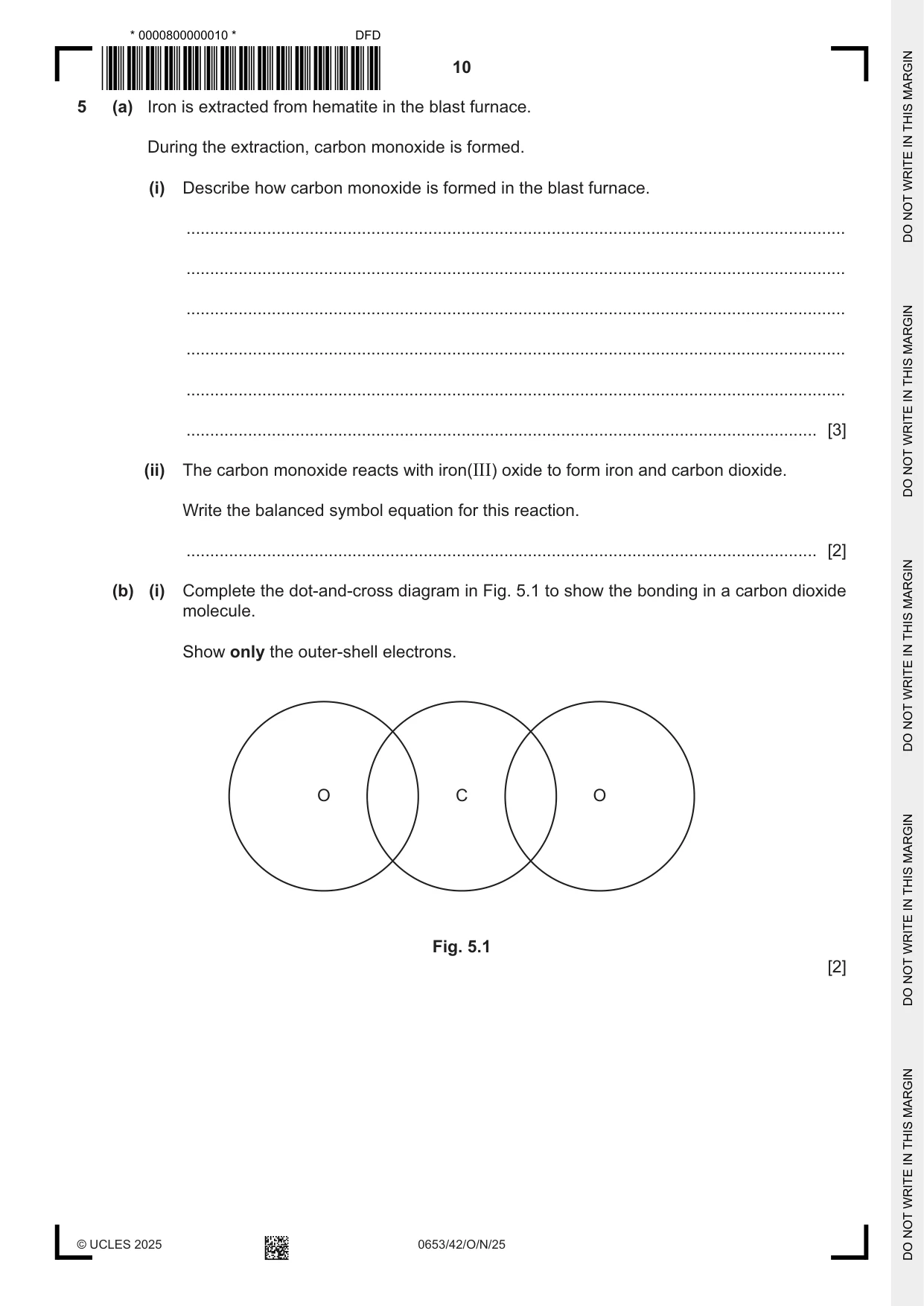
5 (a) Iron is extracted from hematite in the blast furnace. During the extraction, carbon monoxide is formed. (i) Describe how carbon monoxide is formed in the blast furnace. ........................................................................................................................................... ........................................................................................................................................... ........................................................................................................................................... ........................................................................................................................................... ........................................................................................................................................... ..................................................................................................................................... [3] (ii) The carbon monoxide reacts with iron(III) oxide to form iron and carbon dioxide. Write the balanced symbol equation for this reaction. ..................................................................................................................................... [2] (b) (i) Complete the dot-and-cross diagram in Fig. 5.1 to show the bonding in a carbon dioxide molecule. Show only the outer-shell electrons. O C O Fig. 5.1 [2] (ii) Carbon dioxide is a greenhouse gas that contributes to climate change. State two strategies to reduce the effects of climate change. 1 ........................................................................................................................................ 2 ........................................................................................................................................ [2] [Total: 9]
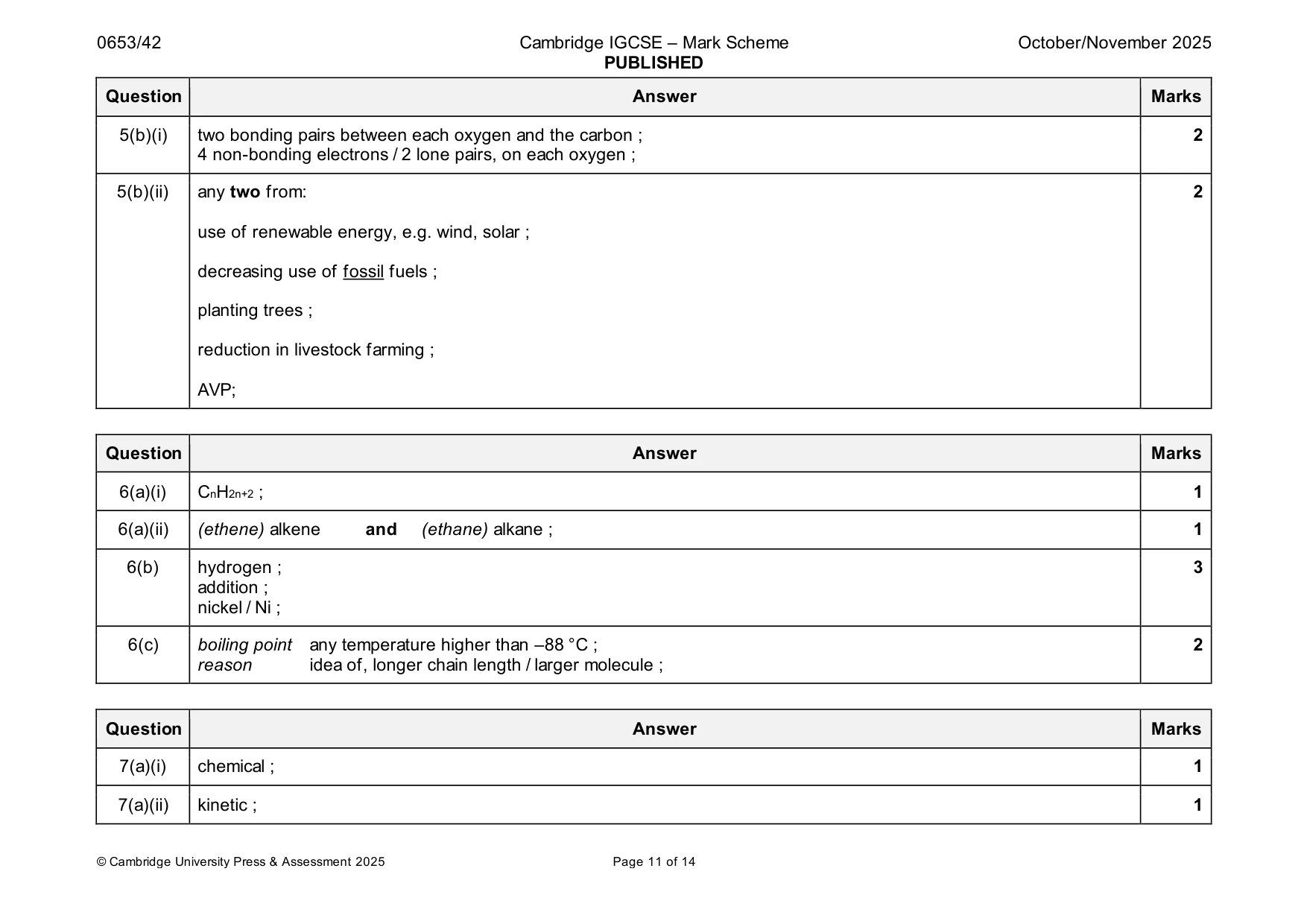
Mark scheme: 5(a)(i) carbon / coke, is combusted or coke / C reacts with oxygen ; 3 carbon dioxide is formed / produced (during the extraction) ; carbon reacts with (reduces) carbon dioxide ; 5(a)(ii) Fe2O3 + 3CO → 2Fe + 3CO2 2 correct formulae ; correct balancing ; 5(b)(i) two bonding pairs between each oxygen and the carbon ; 2 4 non-bonding electrons / 2 lone pairs, on each oxygen ; 5(b)(ii) any two from: 2 use of renewable energy, e.g. wind, solar ; decreasing use of fossil fuels ; planting trees ; reduction in livestock farming ; AVP;
Q6 · The structures of ethene and ethane
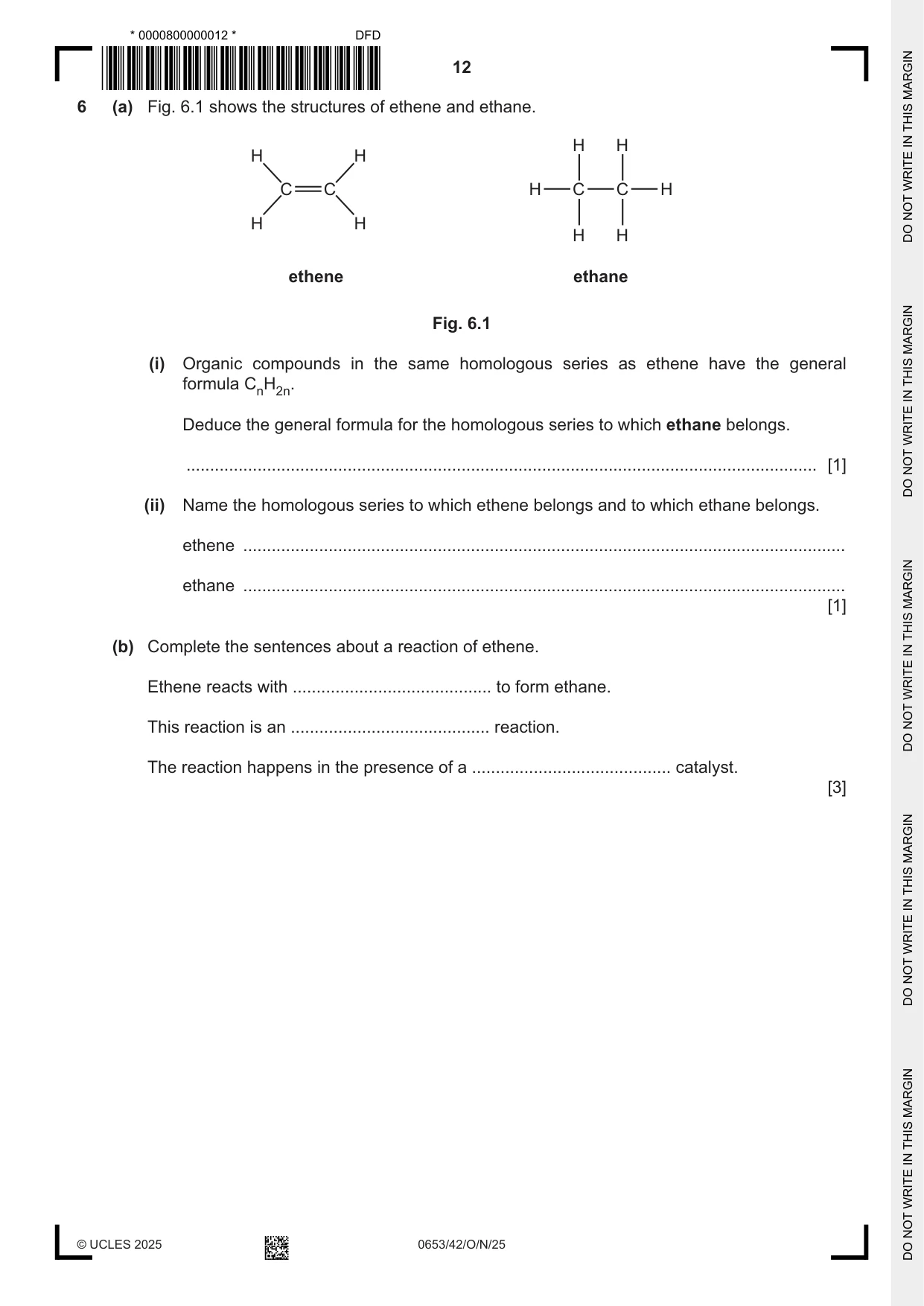
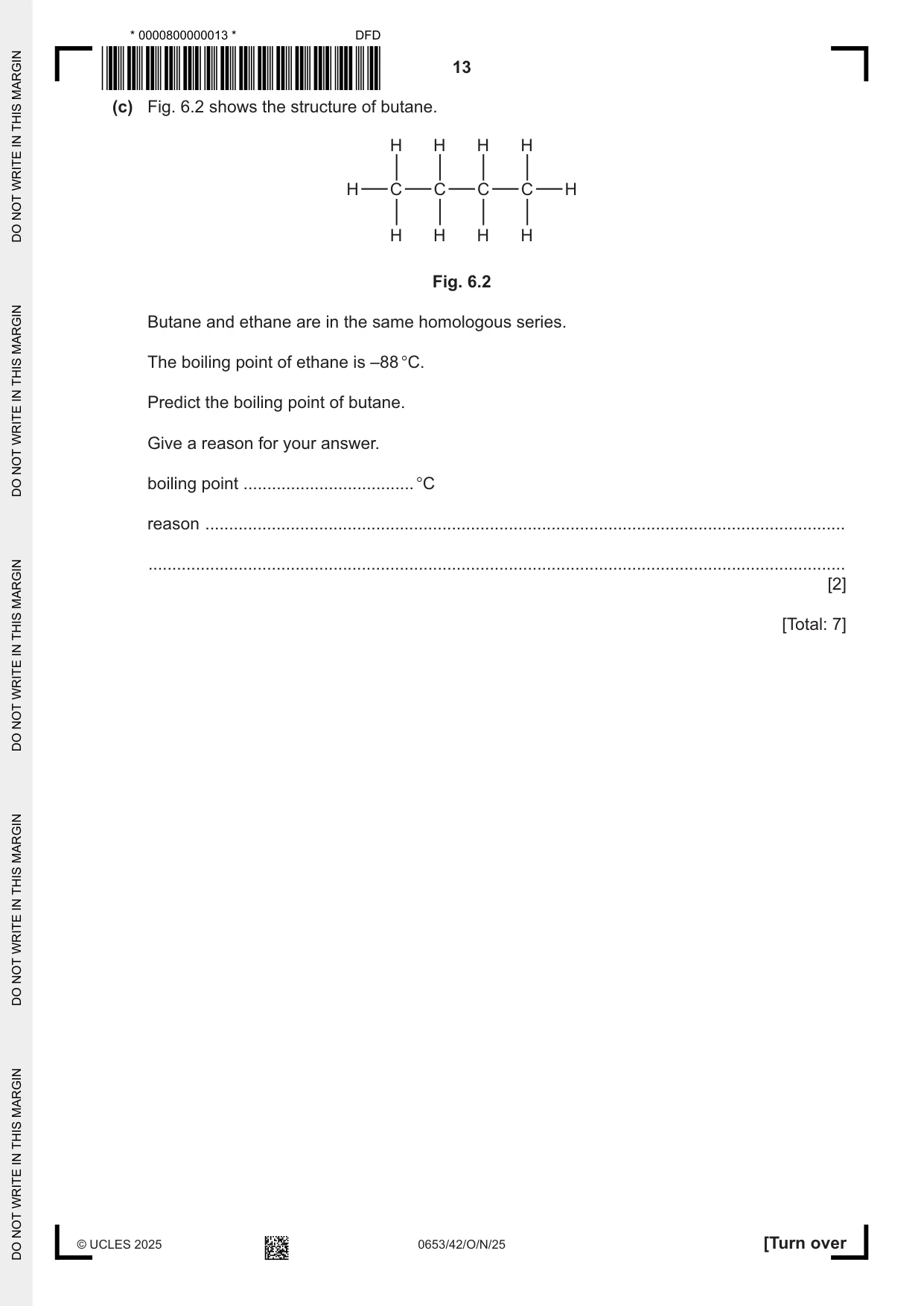
6 (a) Fig. 6.1 shows the structures of ethene and ethane. H H H H C C H C C H H H H H ethene ethane Fig. 6.1 (i) Organic compounds in the same homologous series as ethene have the general formula CnH2n. Deduce the general formula for the homologous series to which ethane belongs. ..................................................................................................................................... [1] (ii) Name the homologous series to which ethene belongs and to which ethane belongs. ethene ............................................................................................................................... ethane ............................................................................................................................... [1] (b) Complete the sentences about a reaction of ethene. Ethene reacts with .......................................... to form ethane. This reaction is an .......................................... reaction. The reaction happens in the presence of a .......................................... catalyst. [3] (c) Fig. 6.2 shows the structure of butane. H H H H H C C C C H H H H H Fig. 6.2 Butane and ethane are in the same homologous series. The boiling point of ethane is –88 °C. Predict the boiling point of butane. Give a reason for your answer. boiling point .................................... °C reason ....................................................................................................................................... ................................................................................................................................................... [2] [Total: 7]
Mark scheme: 6(a)(i) CnH2n+2 ; 1 6(a)(ii) (ethene) alkene and (ethane) alkane ; 1 6(b) hydrogen ; 3 addition ; nickel / Ni ; 6(c) boiling point any temperature higher than –88 °C ; 2 reason idea of, longer chain length / larger molecule ;
Q7 · A toy car contains a battery and an electric motor
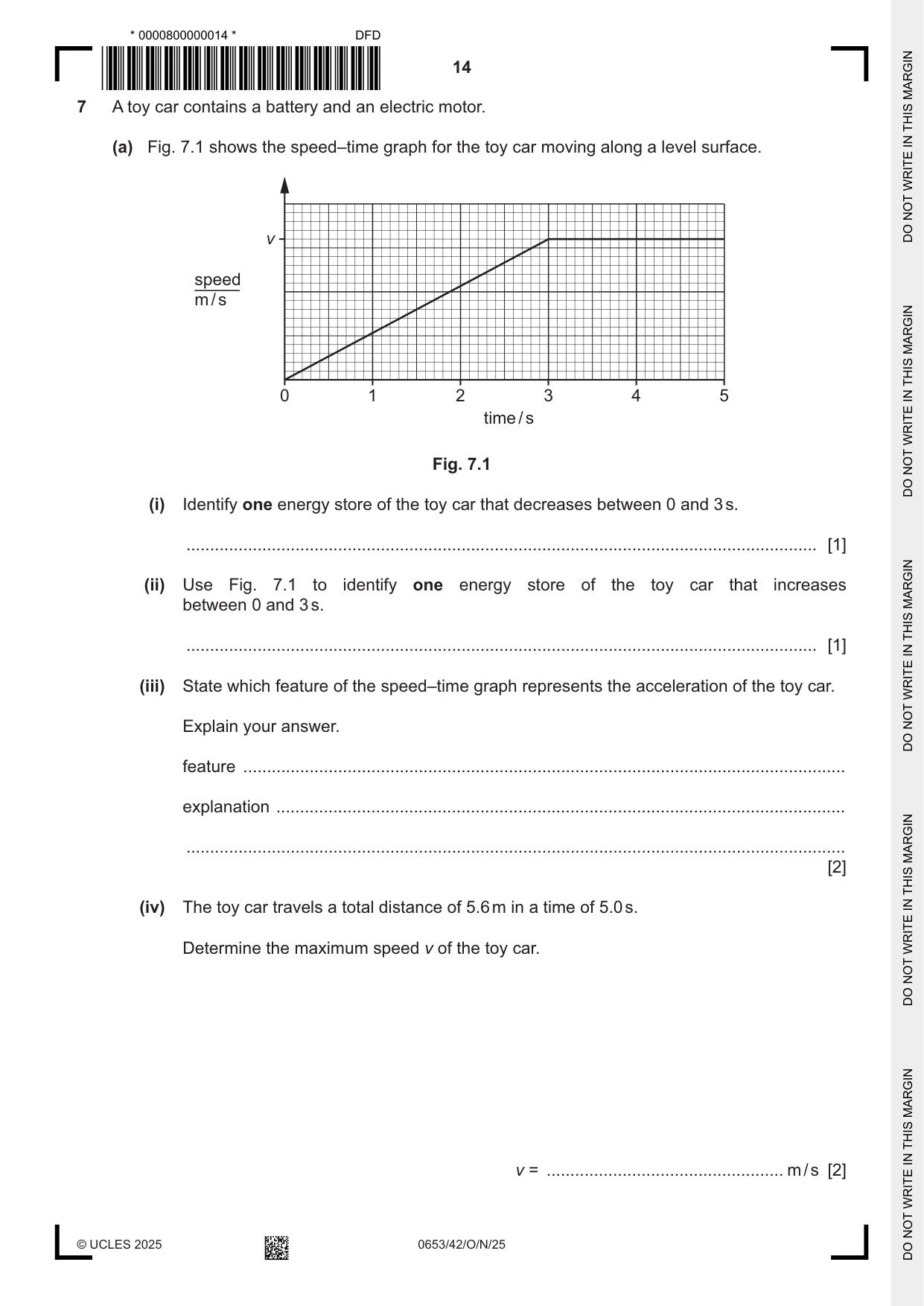
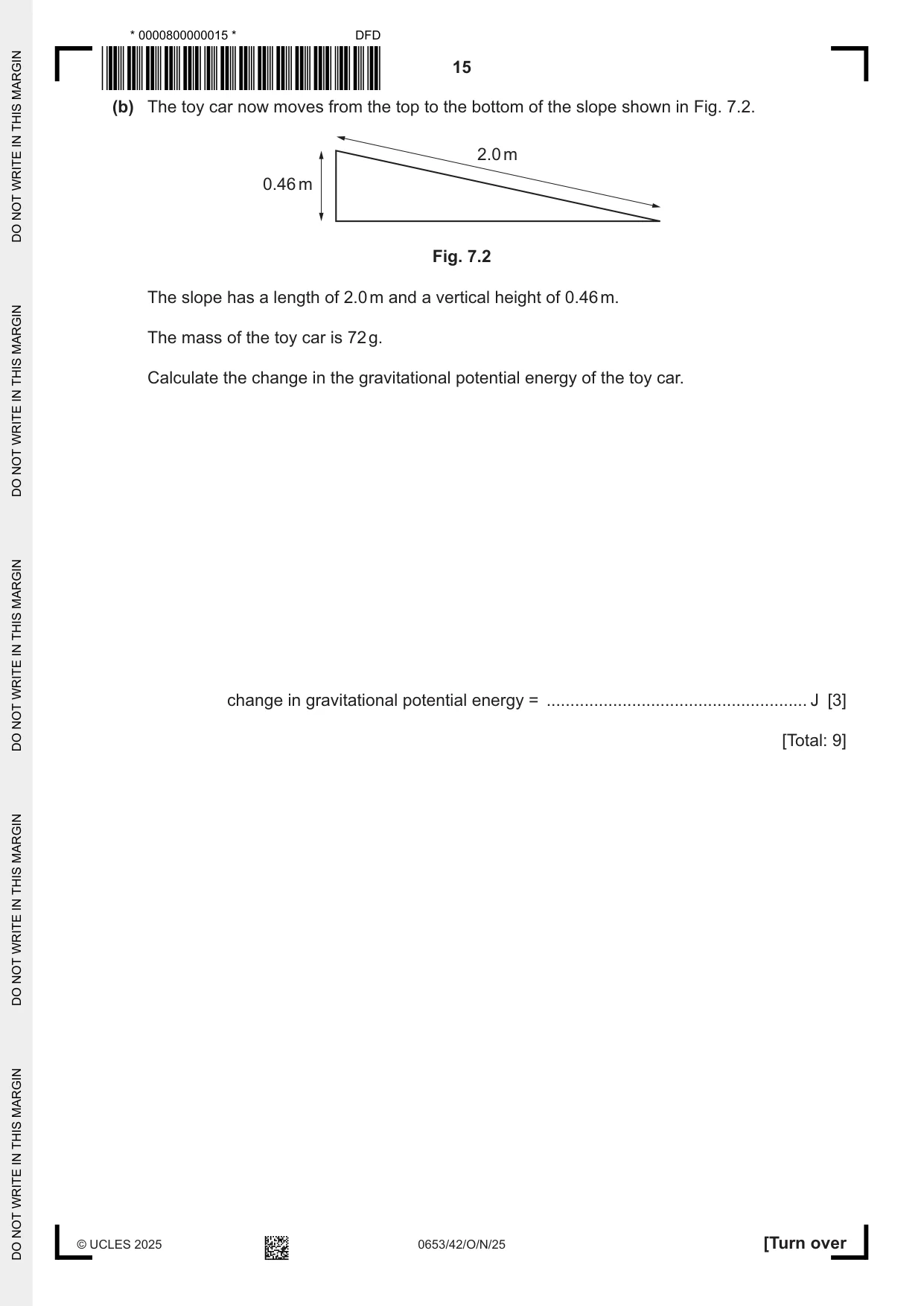
7 A toy car contains a battery and an electric motor. (a) Fig. 7.1 shows the speed–time graph for the toy car moving along a level surface. v speed m / s 0 1 2 3 4 5 time / s Fig. 7.1 (i) Identify one energy store of the toy car that decreases between 0 and 3 s. ..................................................................................................................................... [1] (ii) Use Fig. 7.1 to identify one energy store of the toy car that increases between 0 and 3 s. ..................................................................................................................................... [1] (iii) State which feature of the speed–time graph represents the acceleration of the toy car. Explain your answer. feature ............................................................................................................................... explanation ........................................................................................................................ ........................................................................................................................................... [2] (iv) The toy car travels a total distance of 5.6 m in a time of 5.0 s. Determine the maximum speed v of the toy car. v = .................................................. m / s [2] (b) The toy car now moves from the top to the bottom of the slope shown in Fig. 7.2. 2.0 m 0.46 m Fig. 7.2 The slope has a length of 2.0 m and a vertical height of 0.46 m. The mass of the toy car is 72 g. Calculate the change in the gravitational potential energy of the toy car. change in gravitational potential energy = ....................................................... J [3] [Total: 9]
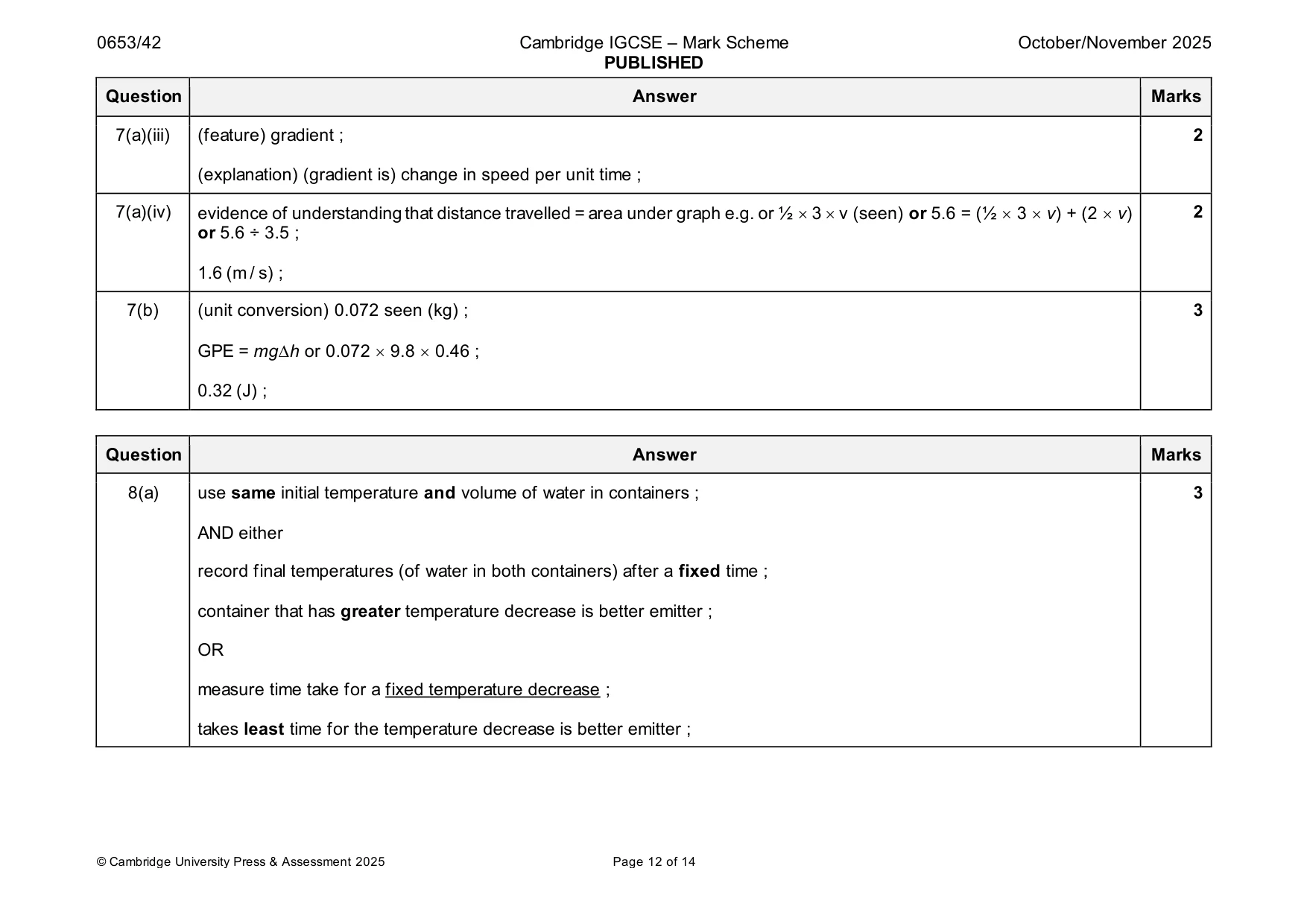
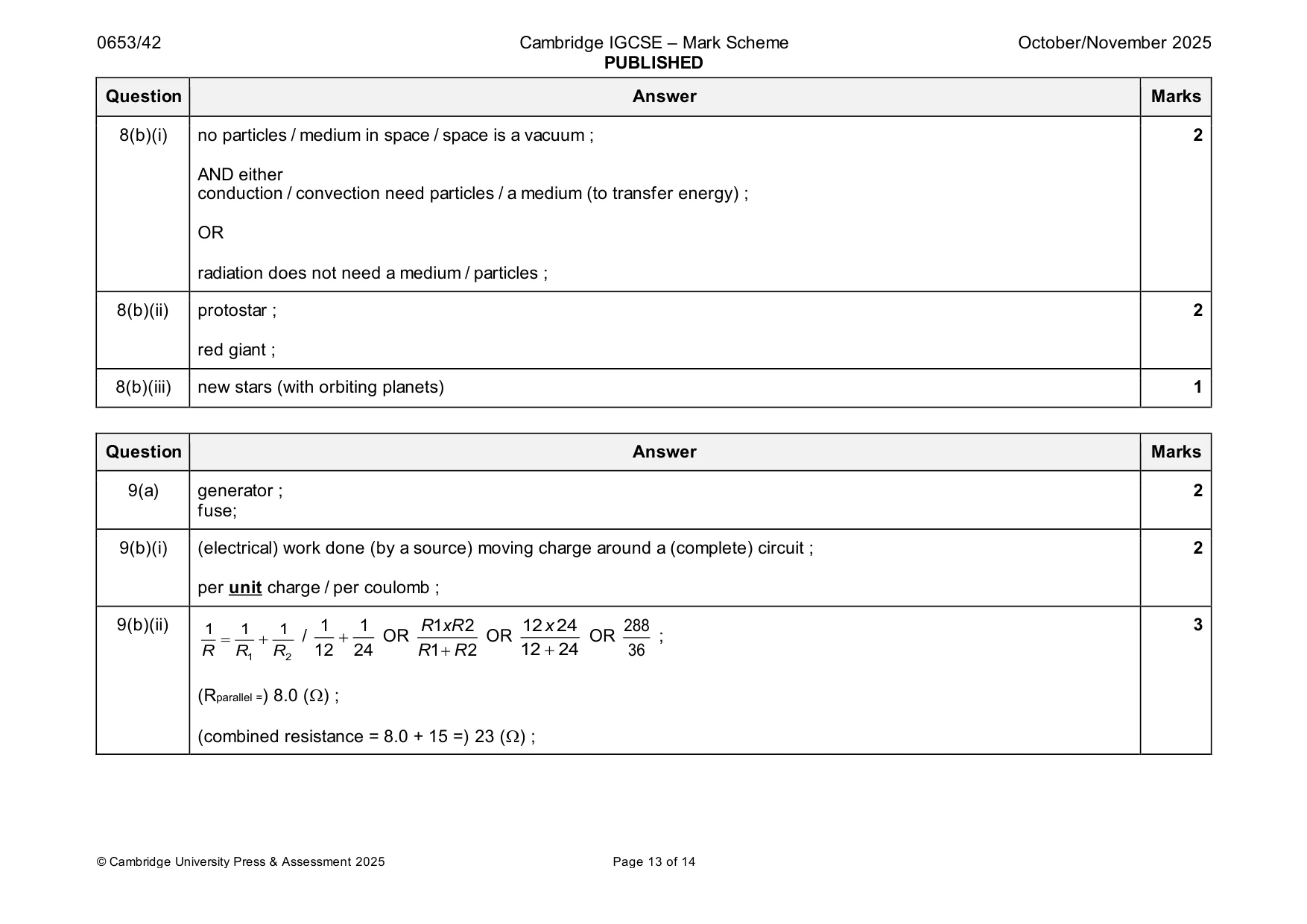
Mark scheme: 7(a)(i) chemical ; 1 7(a)(ii) kinetic ; 1 7(a)(iii) (feature) gradient ; 2 (explanation) (gradient is) change in speed per unit time ; 7(a)(iv) evidence of understanding that distance travelled = area under graph e.g. or ½ 3 v (seen) or 5.6 = (½ 3 v) + (2 v) 2 or 5.6 ÷ 3.5 ; 1.6 (m / s) ; 7(b) (unit conversion) 0.072 seen (kg) ; 3 GPE = mgh or 0.072 9.8 0.46 ; 0.32 (J) ;
Q8 · A student uses the apparatus shown in Fig
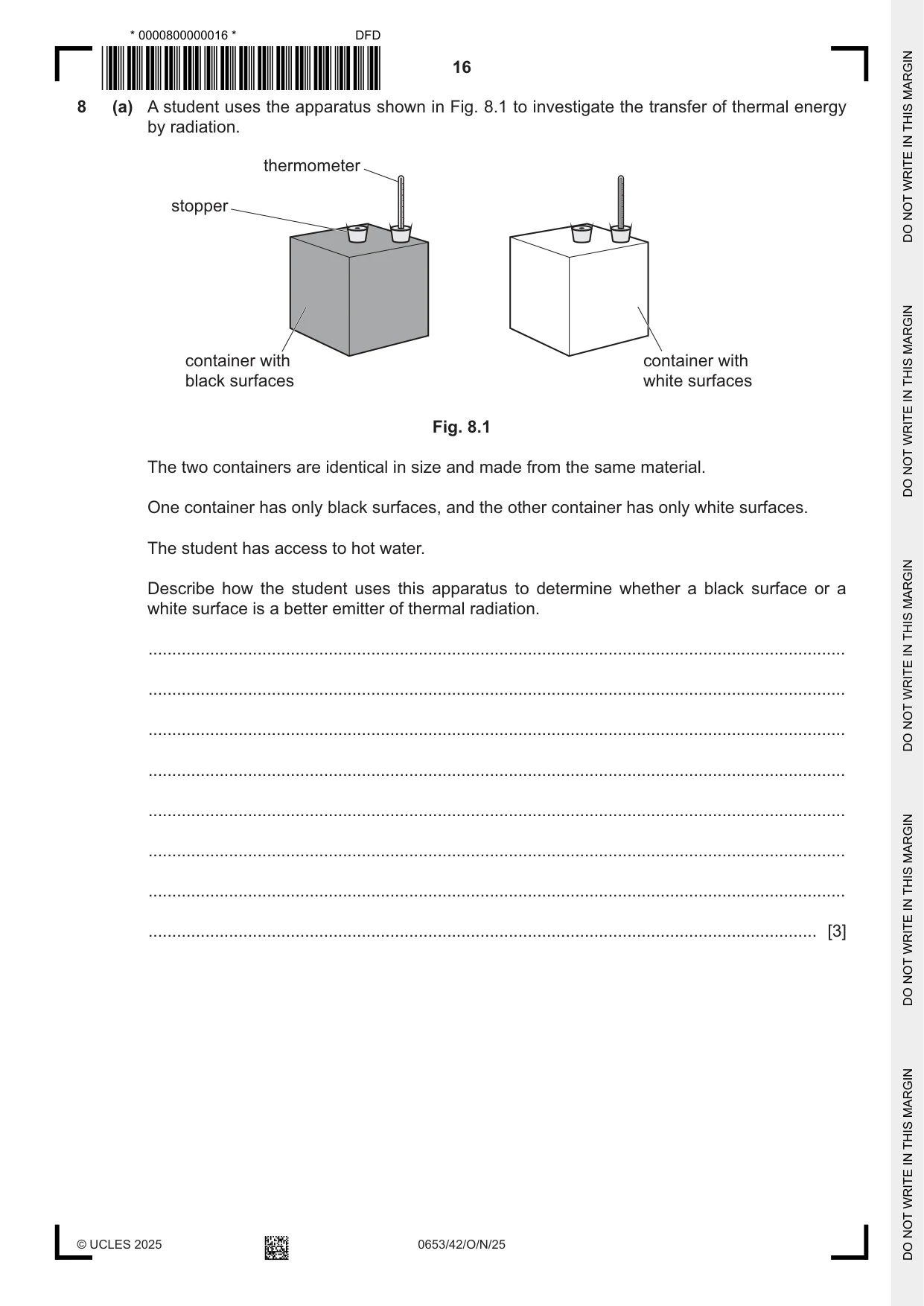
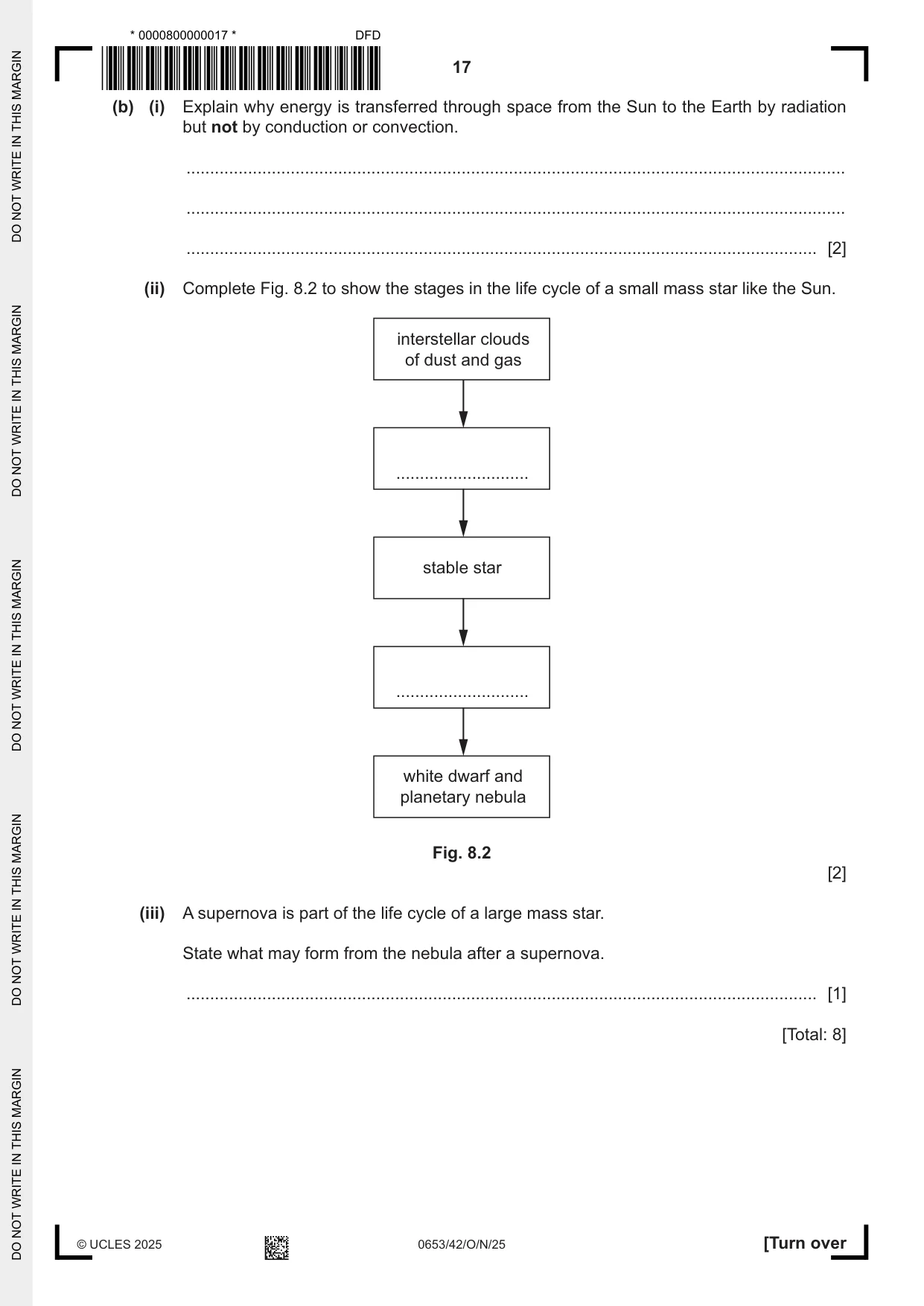
8 (a) A student uses the apparatus shown in Fig. 8.1 to investigate the transfer of thermal energy by radiation. thermometer stopper container with container with black surfaces white surfaces Fig. 8.1 The two containers are identical in size and made from the same material. One container has only black surfaces, and the other container has only white surfaces. The student has access to hot water. Describe how the student uses this apparatus to determine whether a black surface or a white surface is a better emitter of thermal radiation. ................................................................................................................................................... ................................................................................................................................................... ................................................................................................................................................... ................................................................................................................................................... ................................................................................................................................................... ................................................................................................................................................... ................................................................................................................................................... ............................................................................................................................................. [3] (b) (i) Explain why energy is transferred through space from the Sun to the Earth by radiation but not by conduction or convection. ........................................................................................................................................... ........................................................................................................................................... ..................................................................................................................................... [2] (ii) Complete Fig. 8.2 to show the stages in the life cycle of a small mass star like the Sun. interstellar clouds of dust and gas ............................ stable star ............................ white dwarf and planetary nebula Fig. 8.2 [2] (iii) A supernova is part of the life cycle of a large mass star. State what may form from the nebula after a supernova. ..................................................................................................................................... [1] [Total: 8]
Mark scheme: 8(a) use same initial temperature and volume of water in containers ; 3 AND either record final temperatures (of water in both containers) after a fixed time ; container that has greater temperature decrease is better emitter ; OR measure time take for a fixed temperature decrease ; takes least time for the temperature decrease is better emitter ; 8(b)(i) no particles / medium in space / space is a vacuum ; 2 AND either conduction / convection need particles / a medium (to transfer energy) ; OR radiation does not need a medium / particles ; 8(b)(ii) protostar ; 2 red giant ; 8(b)(iii) new stars (with orbiting planets) 1
Q9 · State the names of the electrical components with the symbols shown
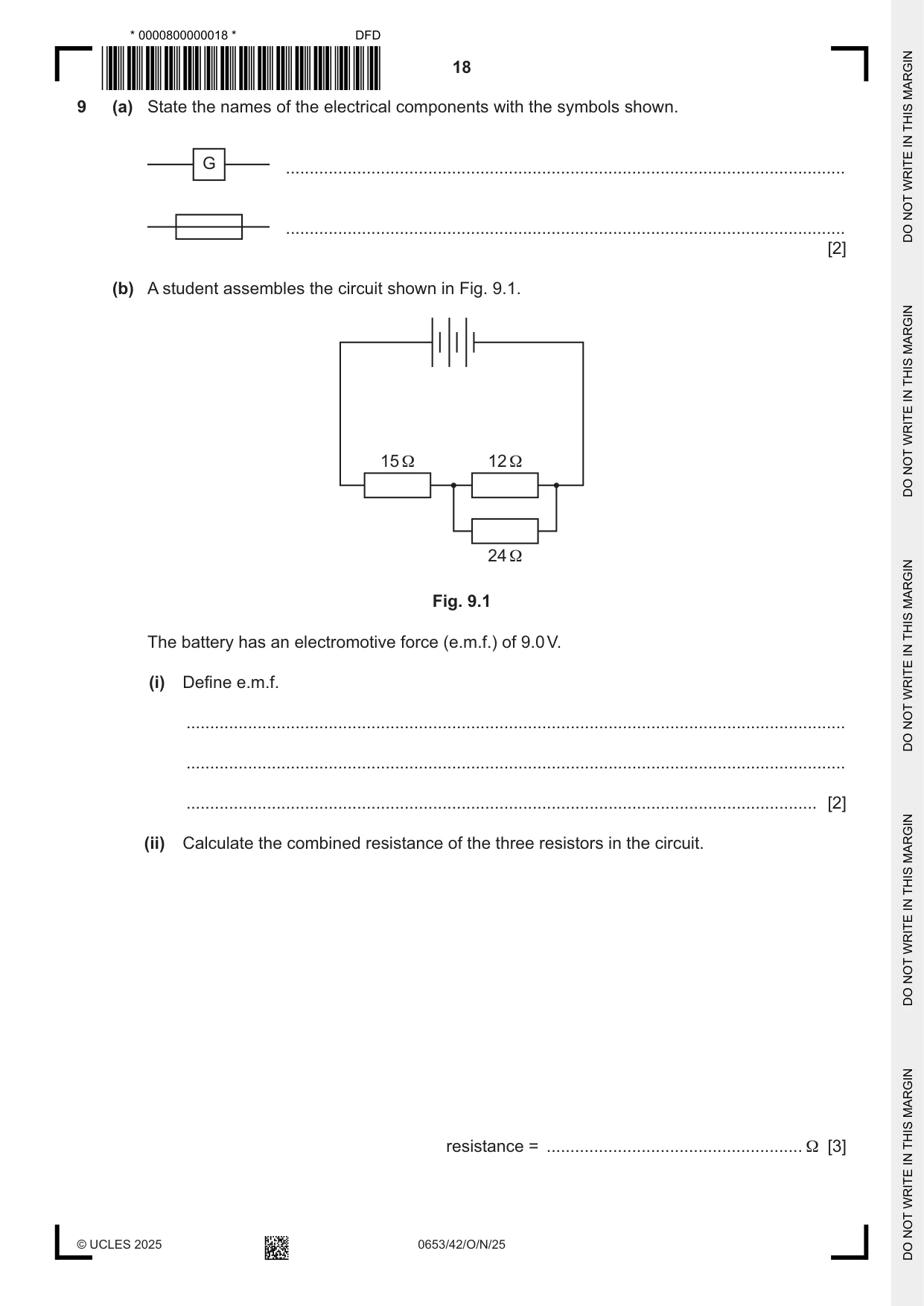
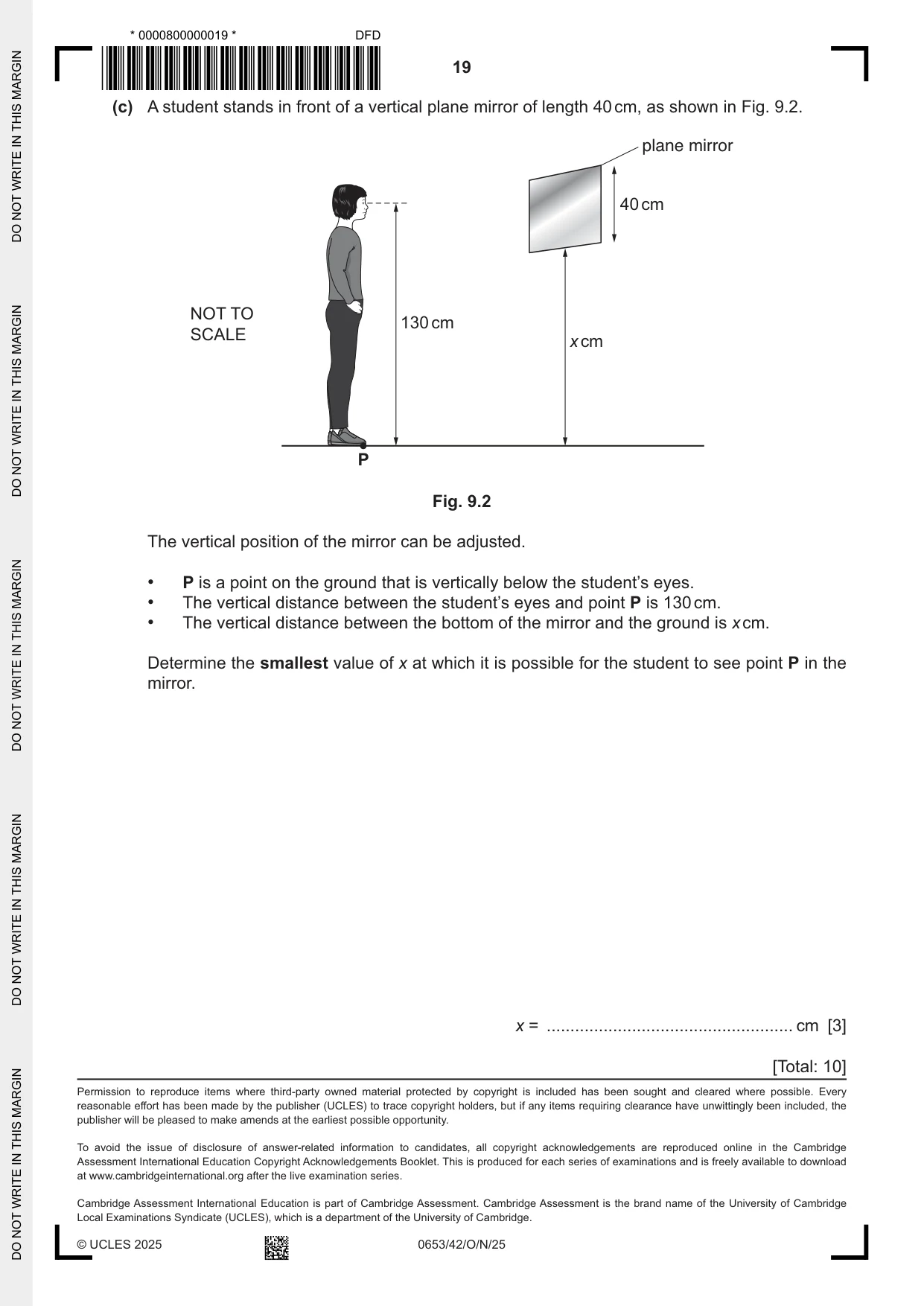
9 (a) State the names of the electrical components with the symbols shown. G ...................................................................................................................... ...................................................................................................................... [2] (b) A student assembles the circuit shown in Fig. 9.1. 15 Ω 12 Ω 24 Ω Fig. 9.1 The battery has an electromotive force (e.m.f.) of 9.0 V. (i) Define e.m.f. ........................................................................................................................................... ........................................................................................................................................... ..................................................................................................................................... [2] (ii) Calculate the combined resistance of the three resistors in the circuit. resistance = ...................................................... Ω [3] (c) A student stands in front of a vertical plane mirror of length 40 cm, as shown in Fig. 9.2. plane mirror 40 cm NOT TO 130 cm SCALE x cm P Fig. 9.2 The vertical position of the mirror can be adjusted. • P is a point on the ground that is vertically below the student’s eyes. • The vertical distance between the student’s eyes and point P is 130 cm. • The vertical distance between the bottom of the mirror and the ground is x cm. Determine the smallest value of x at which it is possible for the student to see point P in the mirror. x = .................................................... cm [3] [Total: 10]
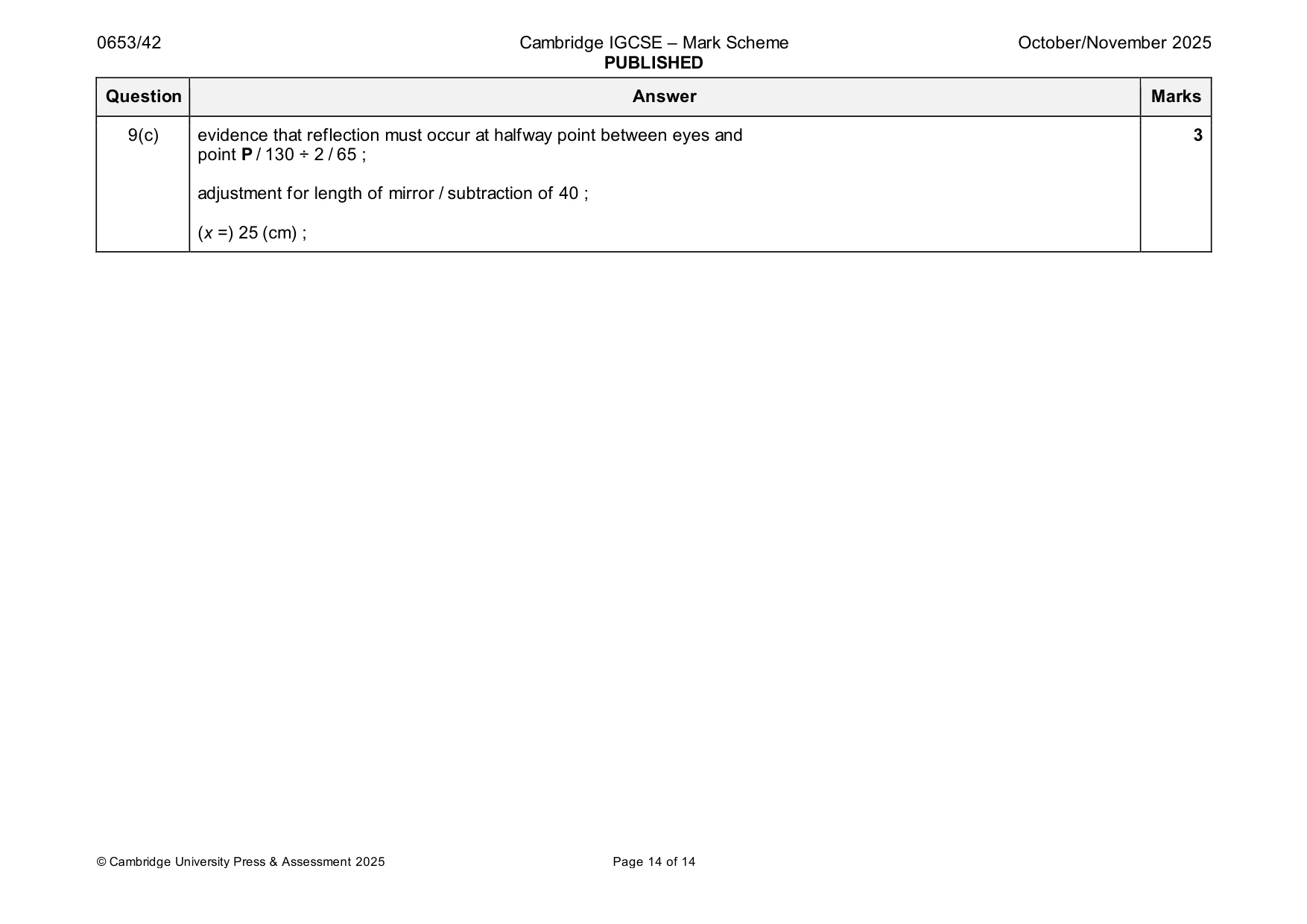
Mark scheme: 9(a) generator ; 2 fuse; 9(b)(i) (electrical) work done (by a source) moving charge around a (complete) circuit ; 2 per unit charge / per coulomb ; 9(b)(ii) 1 1 1 1 1 R1 xR 2 12 x 24 288 3 = + / + OR OR OR ; R R1 R2 12 24 R1 + R 2 12 + 24 36 (Rparallel =) 8.0 () ; (combined resistance = 8.0 + 15 =) 23 () ; 9(c) evidence that reflection must occur at halfway point between eyes and 3 point P / 130 ÷ 2 / 65 ; adjustment for length of mirror / subtraction of 40 ; (x =) 25 (cm) ;
What was in this paper
The subtopics covered by these 9 questions, and how many questions each got. Open one in a new tab to see every Cambridge question on it.
What you needed in this session
Cambridge’s own grade thresholds for 2025 Oct/Nov, Paper 4 · Variant 2. A higher threshold means an easier paper — the bar moves with how the cohort did.