Cambridge IGCSE Science - Combined 0653 — 2024 Oct/Nov Paper 4 · Variant 3
0653/43/O/N/24 · 9 questions · 80 marks · ≈90 min
The question paper and its mark scheme, free to read here and free to download. This is Cambridge’s own paper, exactly as it was sat.
Question paper20 pages

Mark scheme11 pages
Answers below. Sit the paper first if you are practising.
Questions as text
Question 1
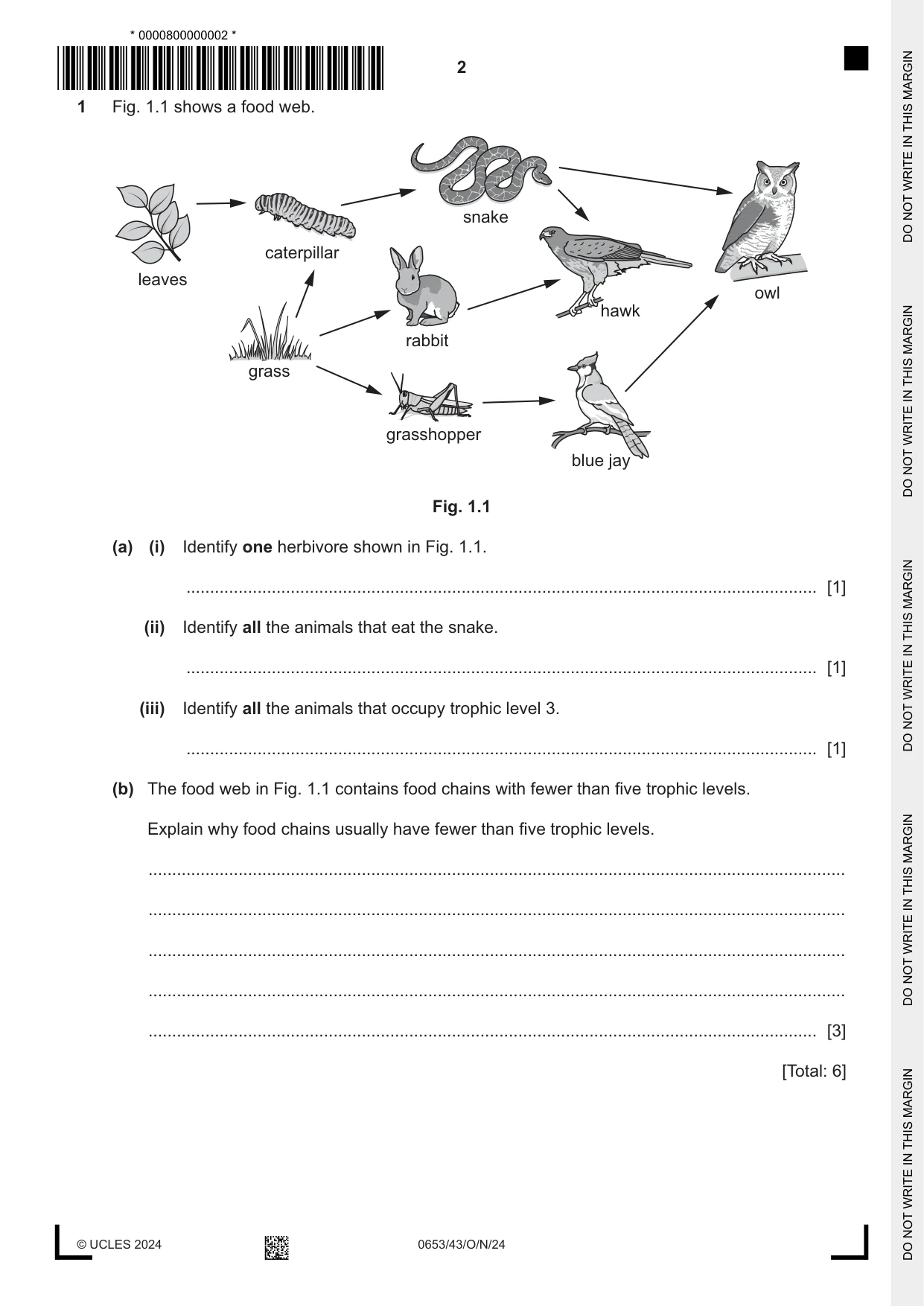
1 Fig. 1.1 shows a food web. snake caterpillar leaves owl hawk rabbit grass grasshopper blue jay Fig. 1.1 (a) (i) Identify one herbivore shown in Fig. 1.1. ..................................................................................................................................... [1] (ii) Identify all the animals that eat the snake. ..................................................................................................................................... [1] (iii) Identify all the animals that occupy trophic level 3. ..................................................................................................................................... [1] (b) The food web in Fig. 1.1 contains food chains with fewer than five trophic levels. Explain why food chains usually have fewer than five trophic levels. ................................................................................................................................................... ................................................................................................................................................... ................................................................................................................................................... ................................................................................................................................................... ............................................................................................................................................. [3] [Total: 6]
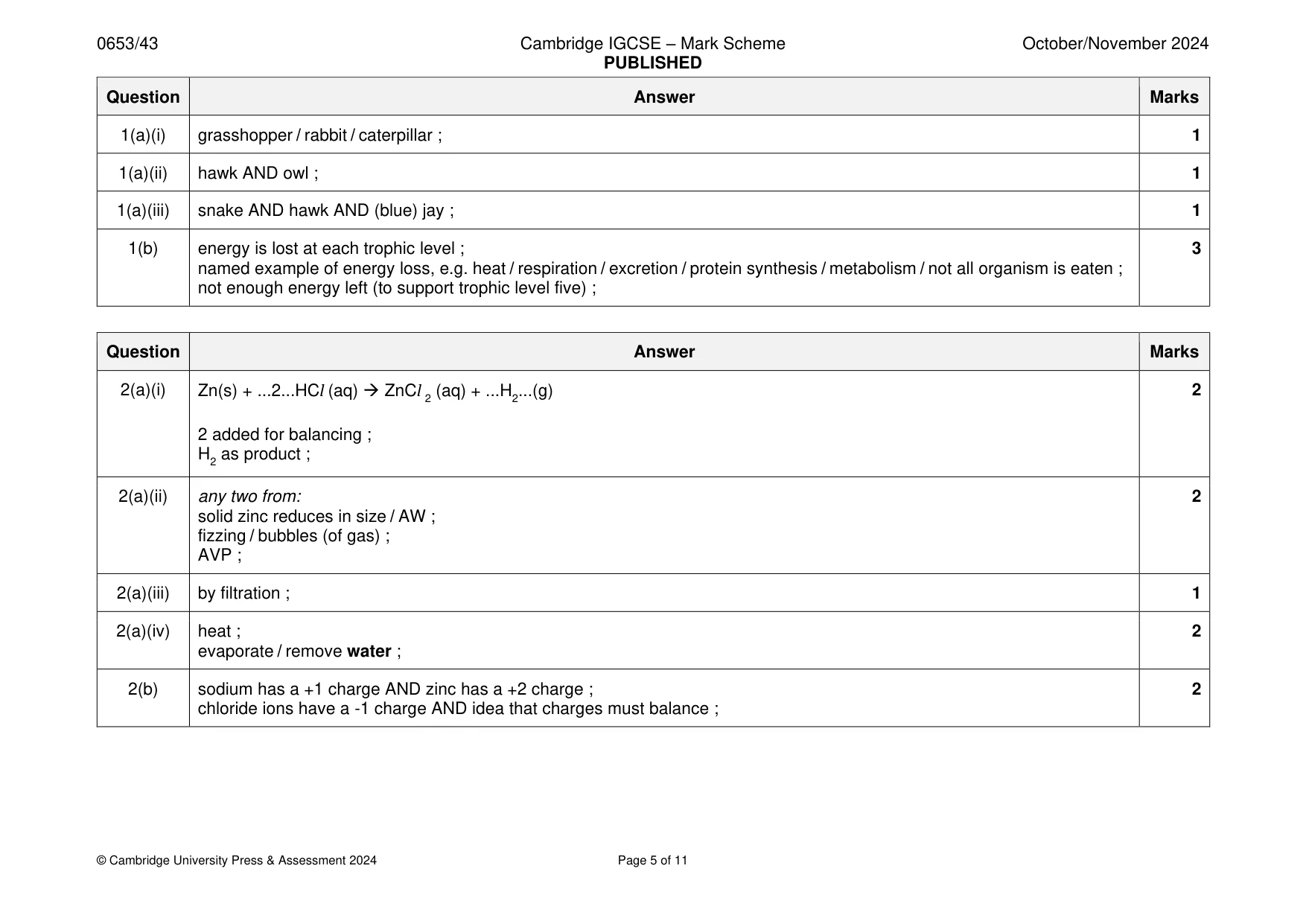
Mark scheme: Question Answer Marks 1(a)(i) grasshopper / rabbit / caterpillar ; 1 1(a)(ii) hawk AND owl ; 1 1(a)(iii) snake AND hawk AND (blue) jay ; 1 1(b) energy is lost at each trophic level ; 3 named example of energy loss, e.g. heat / respiration / excretion / protein synthesis / metabolism / not all organism is eaten ; not enough energy left (to support trophic level five) ;
Q2 · Excess solid zinc is added to dilute hydrochloric acid in a conical flask
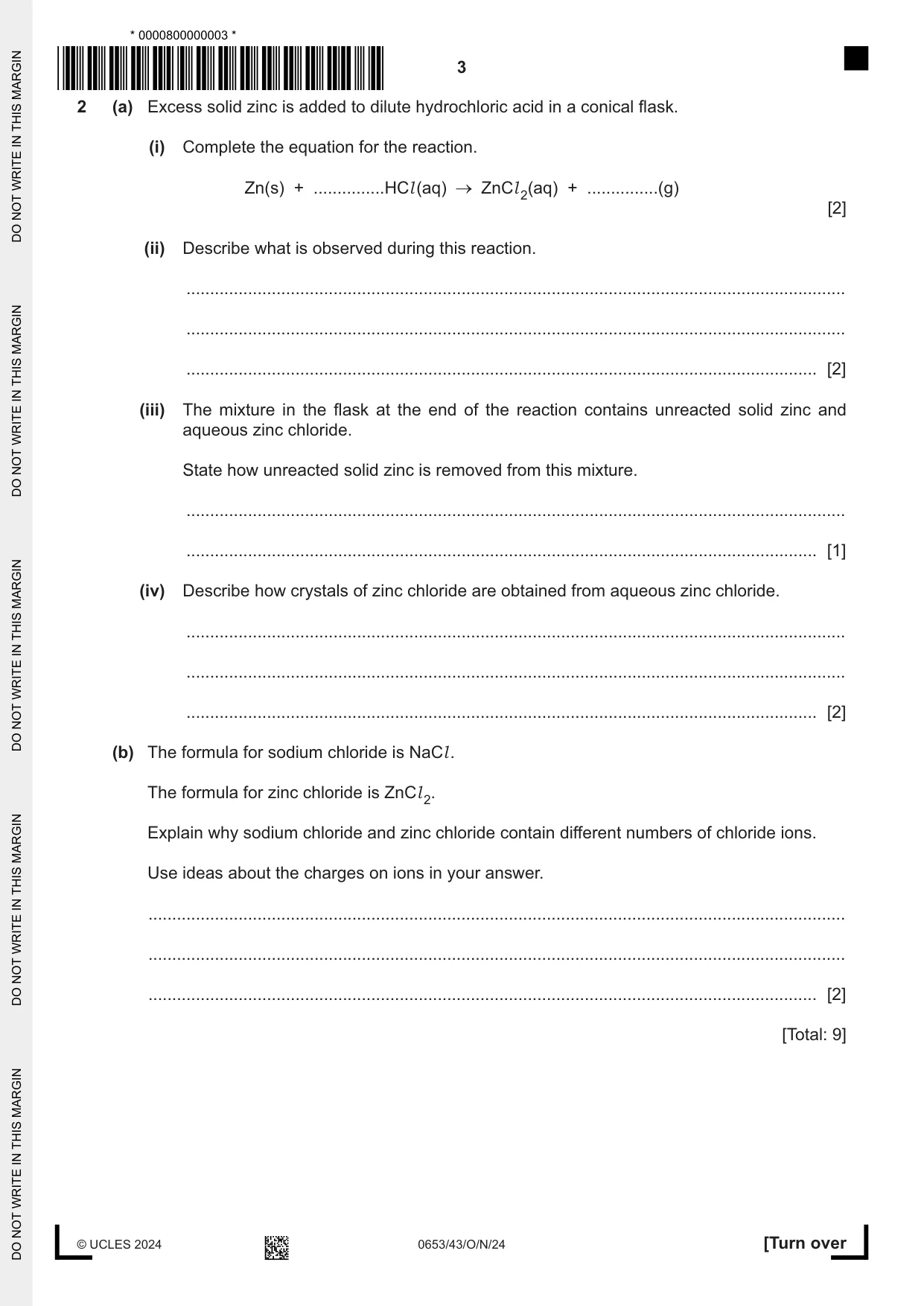
2 (a) Excess solid zinc is added to dilute hydrochloric acid in a conical flask. (i) Complete the equation for the reaction. Zn(s) + ...............HCl (aq) ZnCl 2(aq) + ...............(g) [2] (ii) Describe what is observed during this reaction. ........................................................................................................................................... ........................................................................................................................................... ..................................................................................................................................... [2] (iii) The mixture in the flask at the end of the reaction contains unreacted solid zinc and aqueous zinc chloride. State how unreacted solid zinc is removed from this mixture. ........................................................................................................................................... ..................................................................................................................................... [1] (iv) Describe how crystals of zinc chloride are obtained from aqueous zinc chloride. ........................................................................................................................................... ........................................................................................................................................... ..................................................................................................................................... [2] (b) The formula for sodium chloride is NaCl . The formula for zinc chloride is ZnCl 2. Explain why sodium chloride and zinc chloride contain different numbers of chloride ions. Use ideas about the charges on ions in your answer. ................................................................................................................................................... ................................................................................................................................................... ............................................................................................................................................. [2] [Total: 9]
Mark scheme: 2(a)(i) Zn(s) + ...2...HCl (aq) → ZnCl (aq) + 2 2 ...H2...(g) 2 added for balancing ; H2 as product ; 2(a)(ii) any two from: 2 solid zinc reduces in size / AW ; fizzing / bubbles (of gas) ; AVP ; 2(a)(iii) by filtration ; 1 2(a)(iv) heat ; 2 evaporate / remove water ; 2(b) sodium has a +1 charge AND zinc has a +2 charge ; 2 chloride ions have a -1 charge AND idea that charges must balance ;
Q3 · Complete the sentences about sound
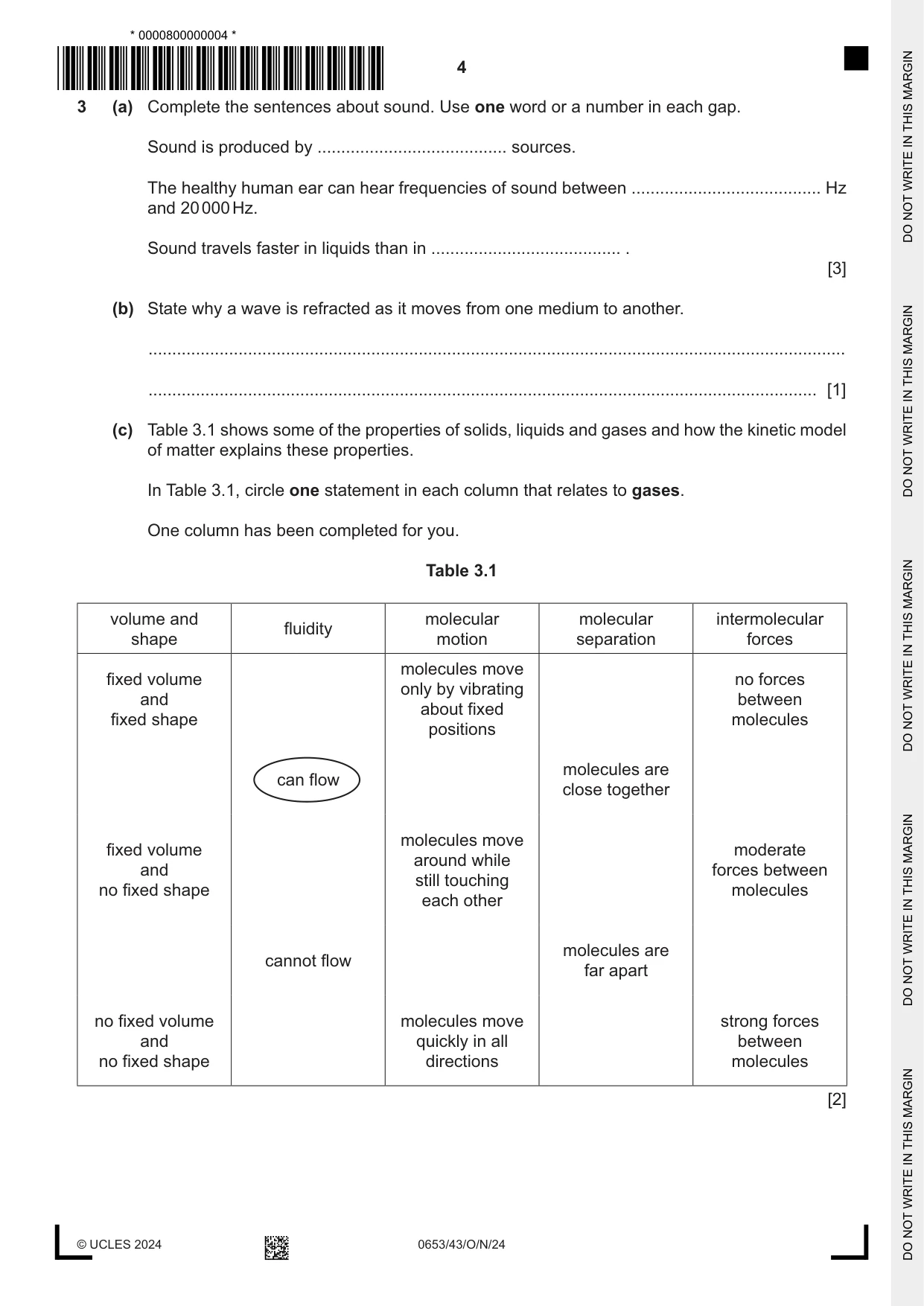
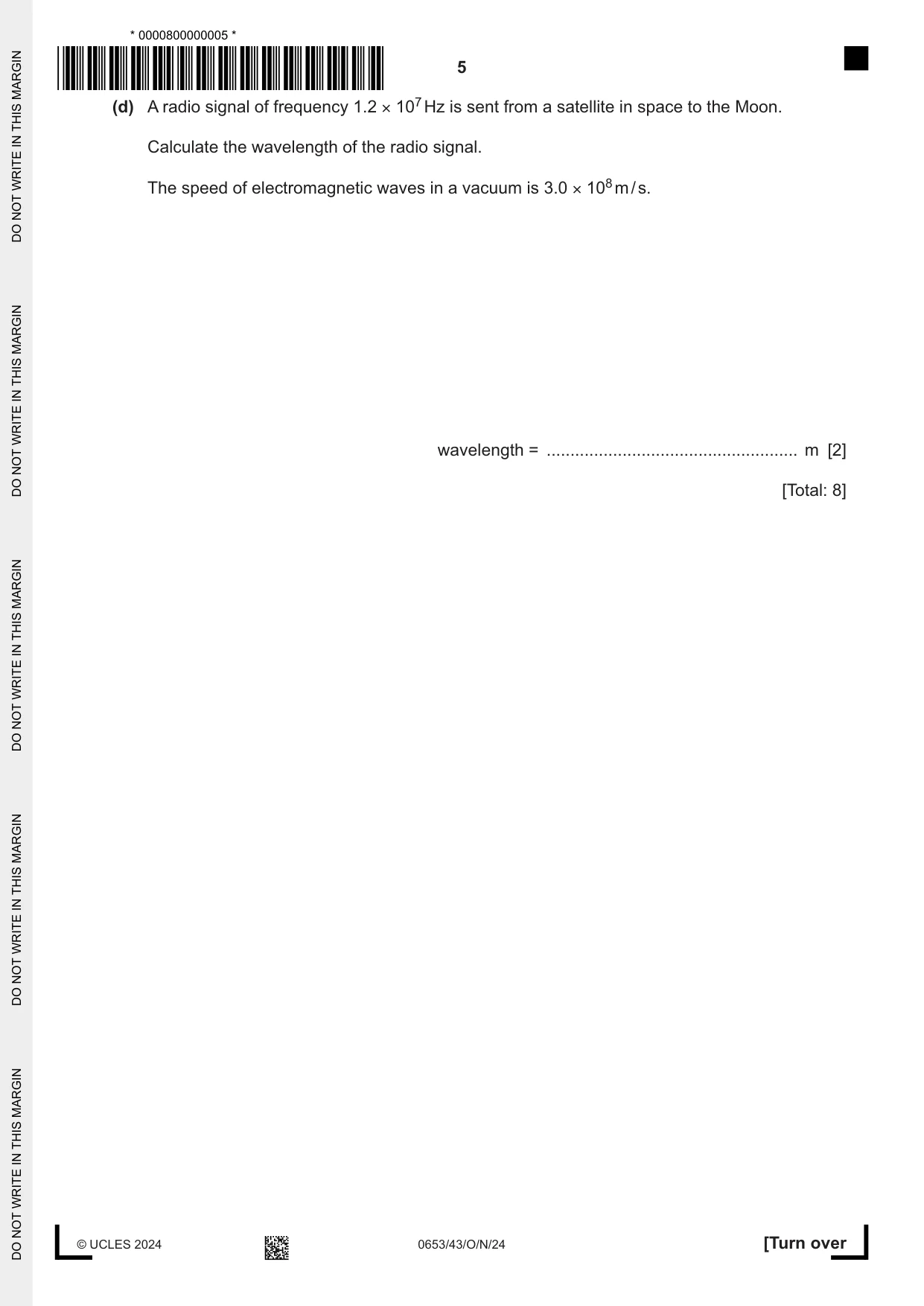
3 (a) Complete the sentences about sound. Use one word or a number in each gap. Sound is produced by ........................................ sources. The healthy human ear can hear frequencies of sound between ........................................ Hz and 20 000 Hz. Sound travels faster in liquids than in ........................................ . [3] (b) State why a wave is refracted as it moves from one medium to another. ................................................................................................................................................... ............................................................................................................................................. [1] (c) Table 3.1 shows some of the properties of solids, liquids and gases and how the kinetic model of matter explains these properties. In Table 3.1, circle one statement in each column that relates to gases. One column has been completed for you. Table 3.1 volume and molecular molecular intermolecular fluidity shape motion separation forces molecules move fixed volume no forces only by vibrating and between about fixed fixed shape molecules positions molecules are can flow close together molecules move fixed volume moderate around while and forces between still touching no fixed shape molecules each other molecules are cannot flow far apart no fixed volume molecules move strong forces and quickly in all between no fixed shape directions molecules [2] (d) A radio signal of frequency 1.2 × 10⁷ Hz is sent from a satellite in space to the Moon. Calculate the wavelength of the radio signal. The speed of electromagnetic waves in a vacuum is 3.0 × 10⁸ m / s. wavelength = ..................................................... m [2] [Total: 8]
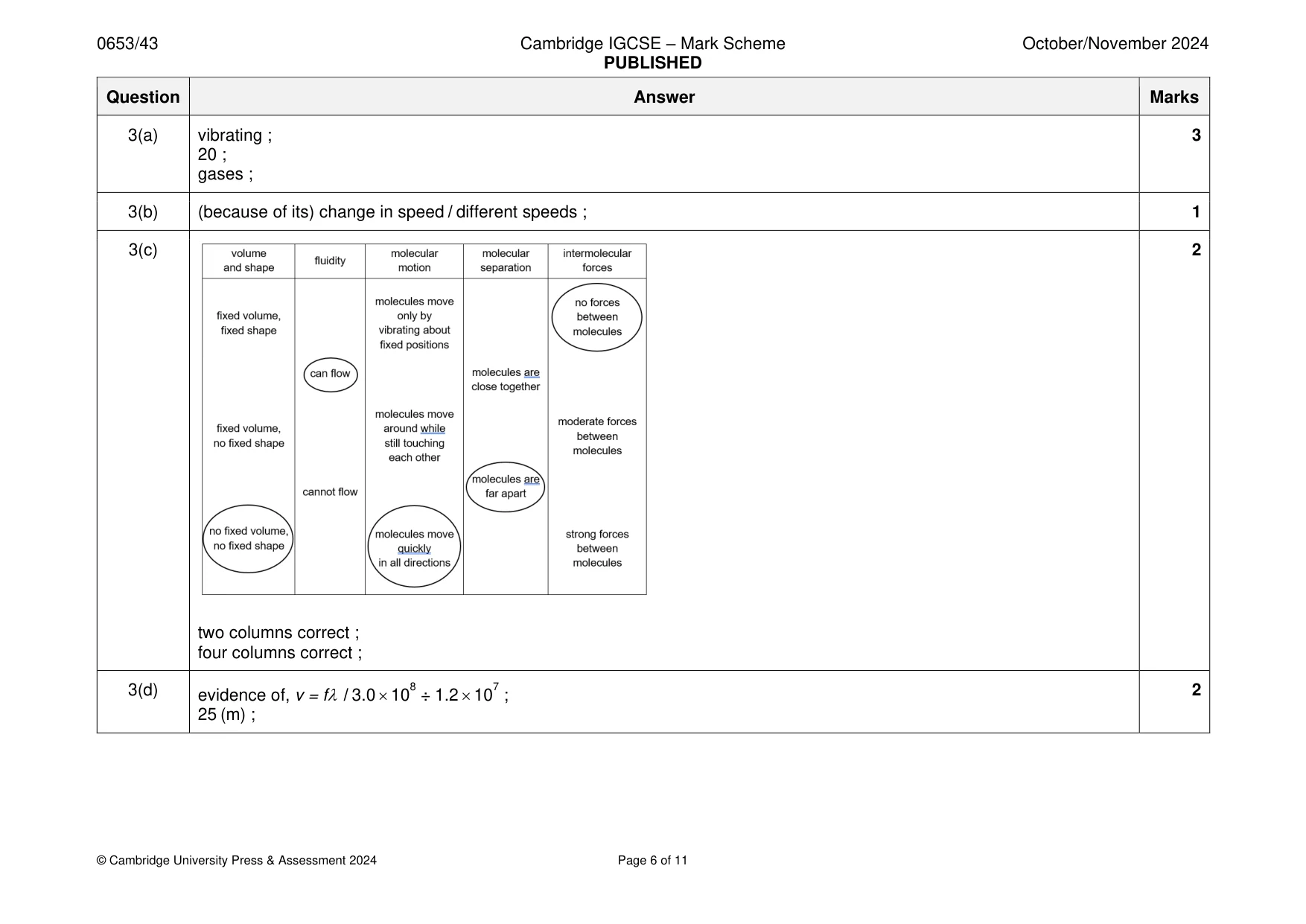
Mark scheme: 3(a) vibrating ; 3 20 ; gases ; 3(b) (because of its) change in speed / different speeds ; 1 3(c) 2 two columns correct ; four columns correct ; 3(d) evidence of, v = f / 3.0 10 8 ÷ 1.2 10 7 ; 2 25 (m) ;
Q4 · The photosynthesis reaction in plants is controlled by enzymes
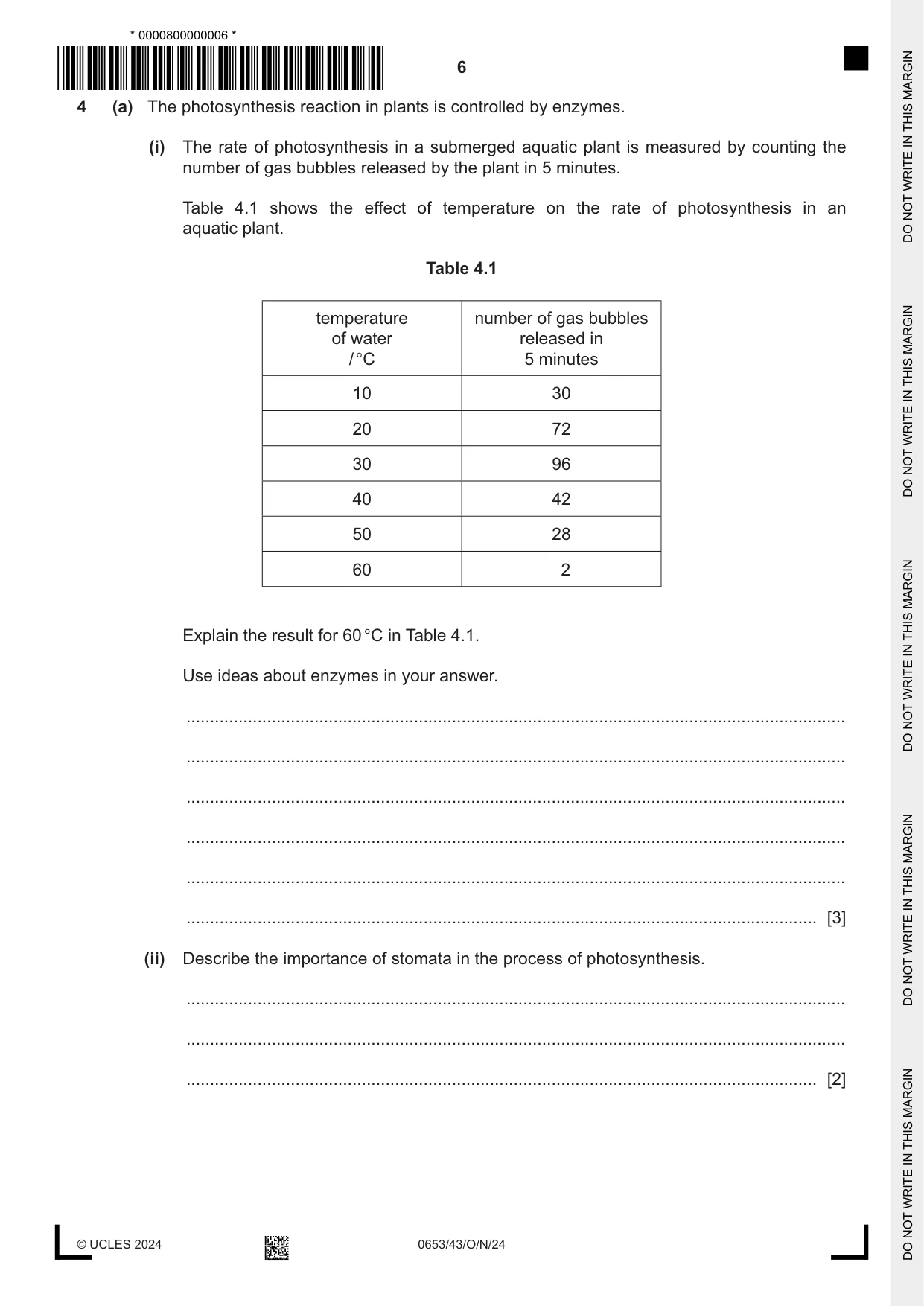
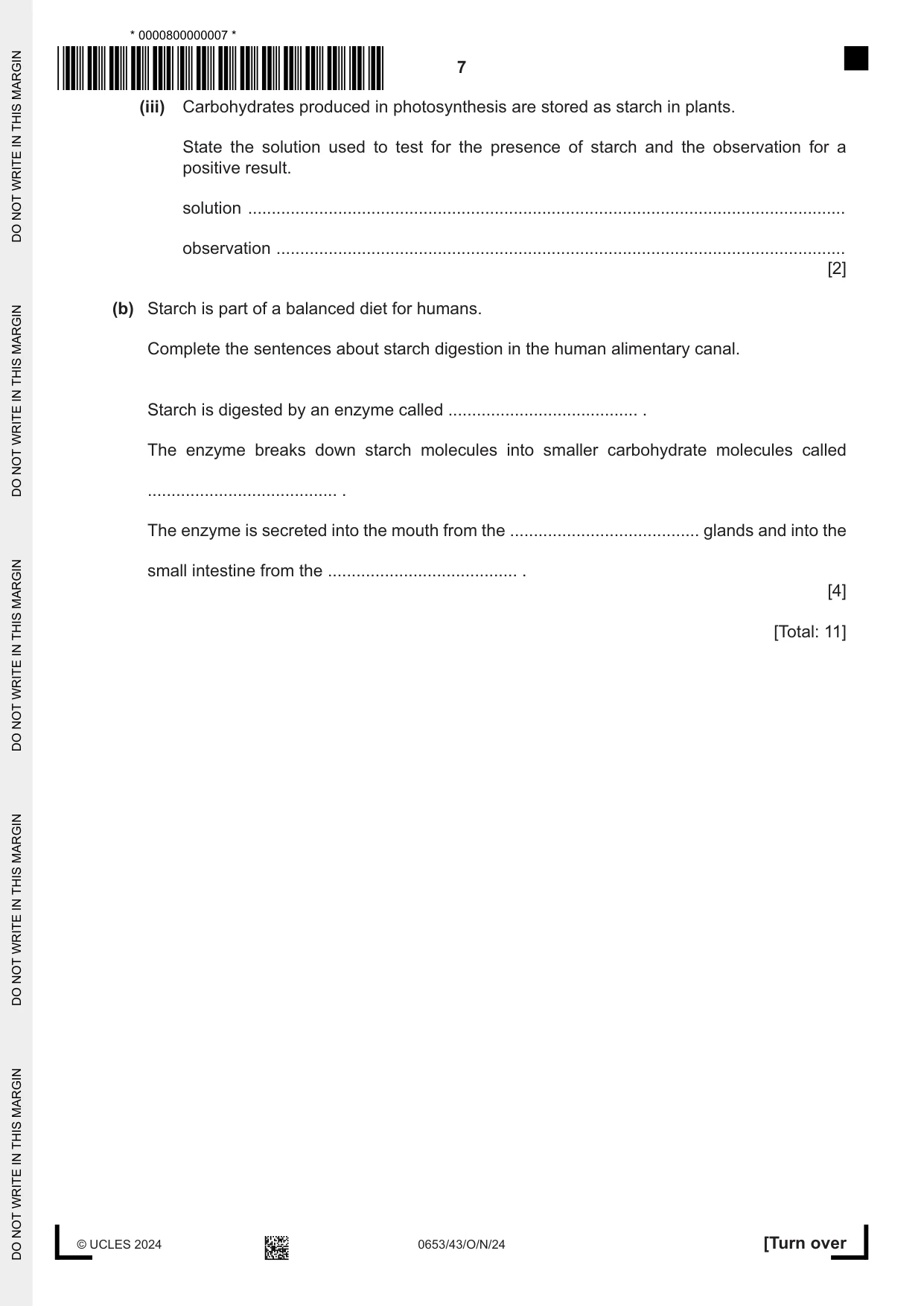
4 (a) The photosynthesis reaction in plants is controlled by enzymes. (i) The rate of photosynthesis in a submerged aquatic plant is measured by counting the number of gas bubbles released by the plant in 5 minutes. Table 4.1 shows the effect of temperature on the rate of photosynthesis in an aquatic plant. Table 4.1 temperature number of gas bubbles of water released in / °C 5 minutes 10 30 20 72 30 96 40 42 50 28 60 2 Explain the result for 60 °C in Table 4.1. Use ideas about enzymes in your answer. ........................................................................................................................................... ........................................................................................................................................... ........................................................................................................................................... ........................................................................................................................................... ........................................................................................................................................... ..................................................................................................................................... [3] (ii) Describe the importance of stomata in the process of photosynthesis. ........................................................................................................................................... ........................................................................................................................................... ..................................................................................................................................... [2] (iii) Carbohydrates produced in photosynthesis are stored as starch in plants. State the solution used to test for the presence of starch and the observation for a positive result. solution .............................................................................................................................. observation ........................................................................................................................ [2] (b) Starch is part of a balanced diet for humans. Complete the sentences about starch digestion in the human alimentary canal. Starch is digested by an enzyme called ........................................ . The enzyme breaks down starch molecules into smaller carbohydrate molecules called ........................................ . The enzyme is secreted into the mouth from the ........................................ glands and into the small intestine from the ........................................ . [4] [Total: 11]
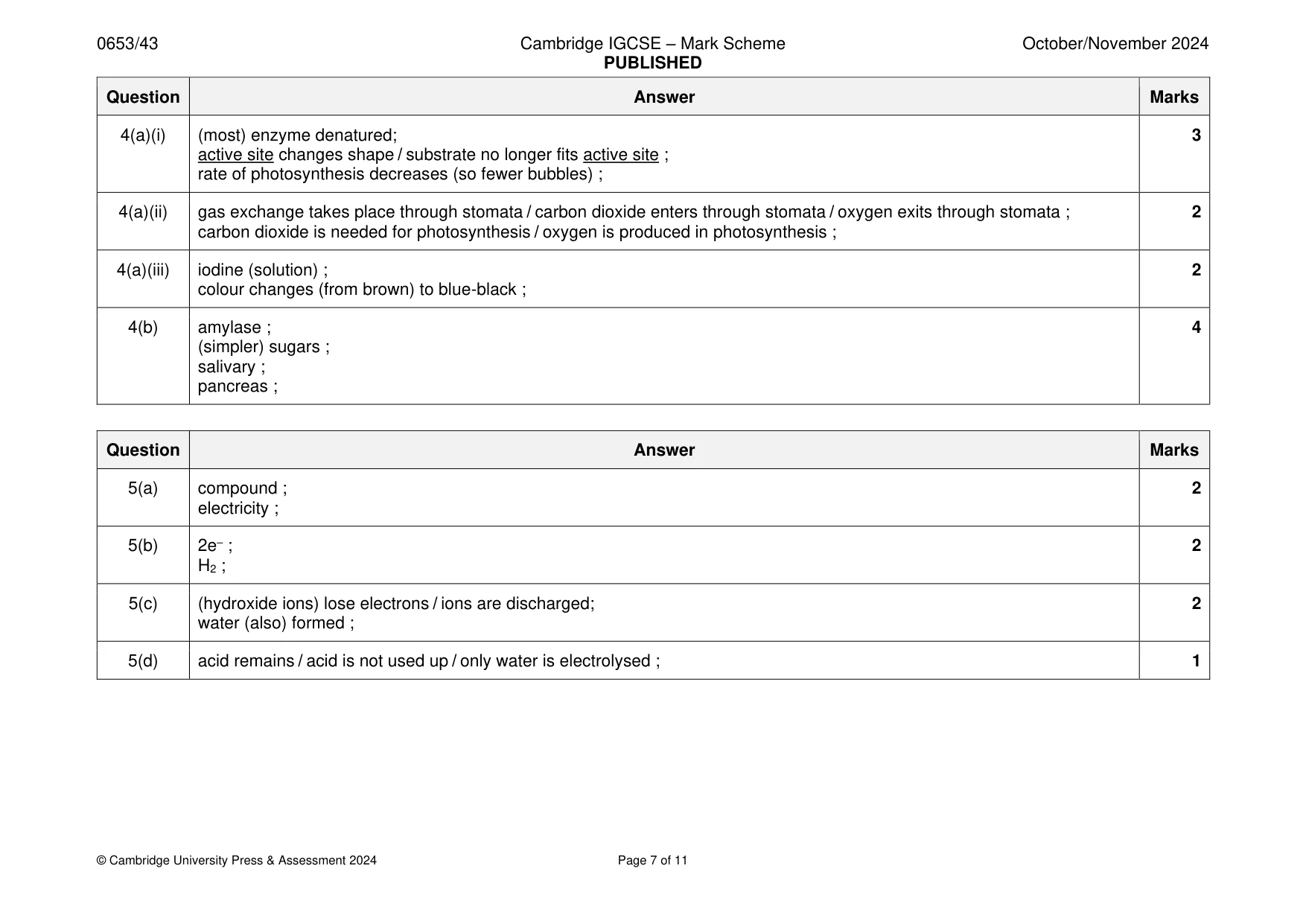
Mark scheme: 4(a)(i) (most) enzyme denatured; 3 active site changes shape / substrate no longer fits active site ; rate of photosynthesis decreases (so fewer bubbles) ; 4(a)(ii) gas exchange takes place through stomata / carbon dioxide enters through stomata / oxygen exits through stomata ; 2 carbon dioxide is needed for photosynthesis / oxygen is produced in photosynthesis ; 4(a)(iii) iodine (solution) ; 2 colour changes (from brown) to blue-black ; 4(b) amylase ; 4 (simpler) sugars ; salivary ; pancreas ;
Q5 · Dilute sulfuric acid is electrolysed using inert electrodes as shown in Fig
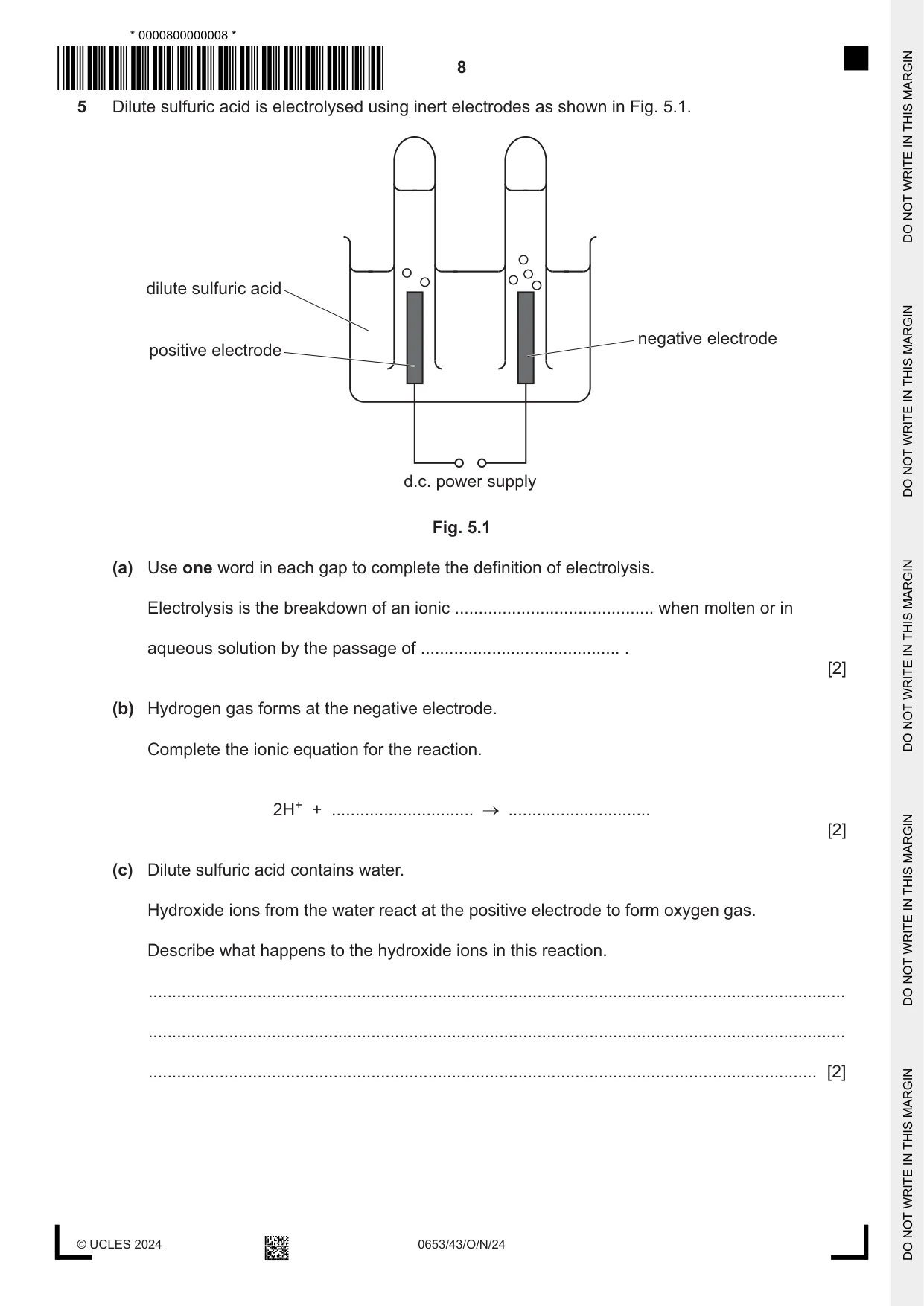
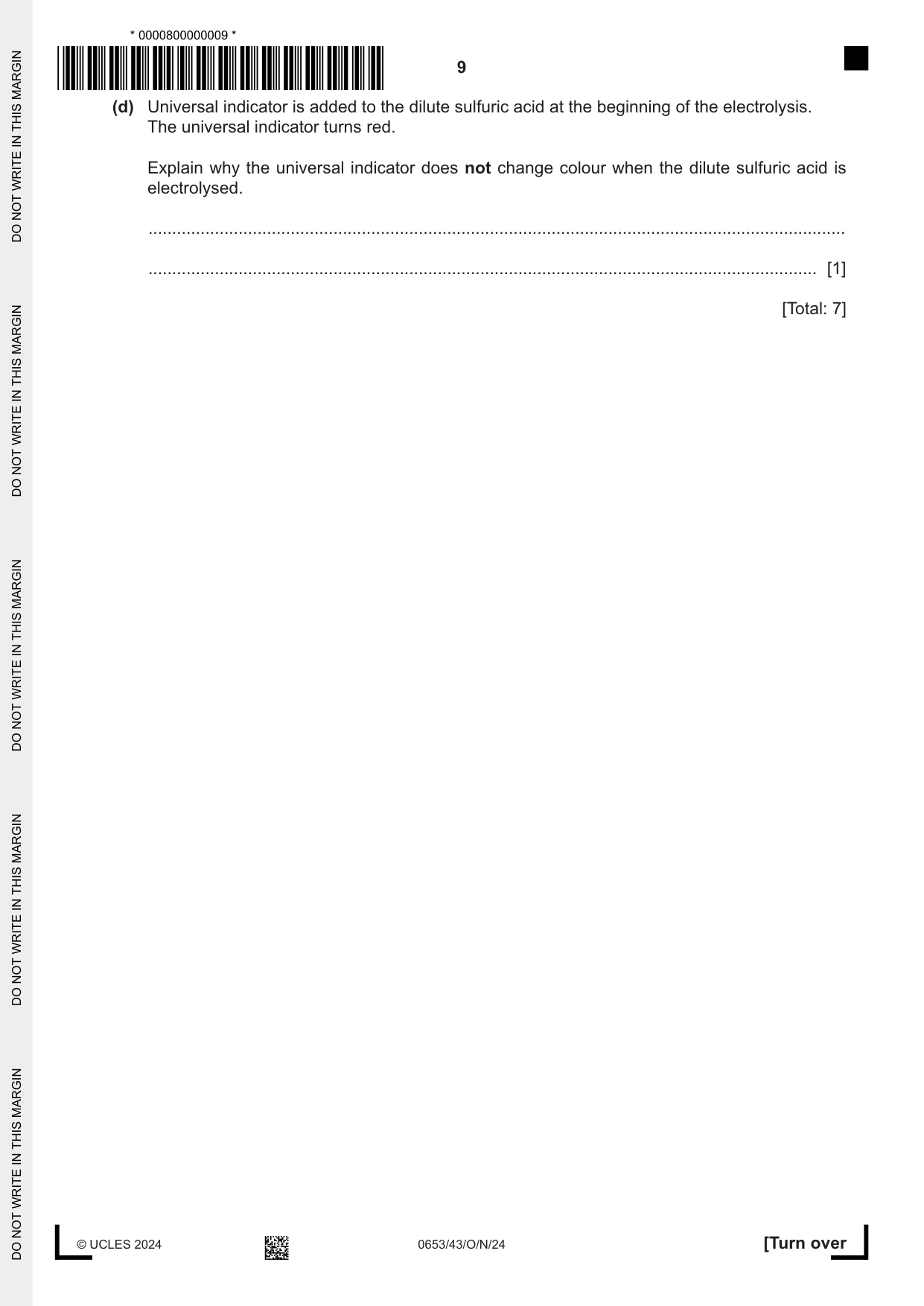
5 Dilute sulfuric acid is electrolysed using inert electrodes as shown in Fig. 5.1. dilute sulfuric acid negative electrode positive electrode d.c. power supply Fig. 5.1 (a) Use one word in each gap to complete the definition of electrolysis. Electrolysis is the breakdown of an ionic .......................................... when molten or in aqueous solution by the passage of .......................................... . [2] (b) Hydrogen gas forms at the negative electrode. Complete the ionic equation for the reaction. 2H+ + .............................. .............................. [2] (c) Dilute sulfuric acid contains water. Hydroxide ions from the water react at the positive electrode to form oxygen gas. Describe what happens to the hydroxide ions in this reaction. ................................................................................................................................................... ................................................................................................................................................... ............................................................................................................................................. [2] (d) Universal indicator is added to the dilute sulfuric acid at the beginning of the electrolysis. The universal indicator turns red. Explain why the universal indicator does not change colour when the dilute sulfuric acid is electrolysed. ................................................................................................................................................... ............................................................................................................................................. [1] [Total: 7]
Mark scheme: 5(a) compound ; 2 electricity ; 5(b) 2e– ; 2 H2 ; 5(c) (hydroxide ions) lose electrons / ions are discharged; 2 water (also) formed ; 5(d) acid remains / acid is not used up / only water is electrolysed ; 1
Q6 · An ox pulling a plough along horizontal ground
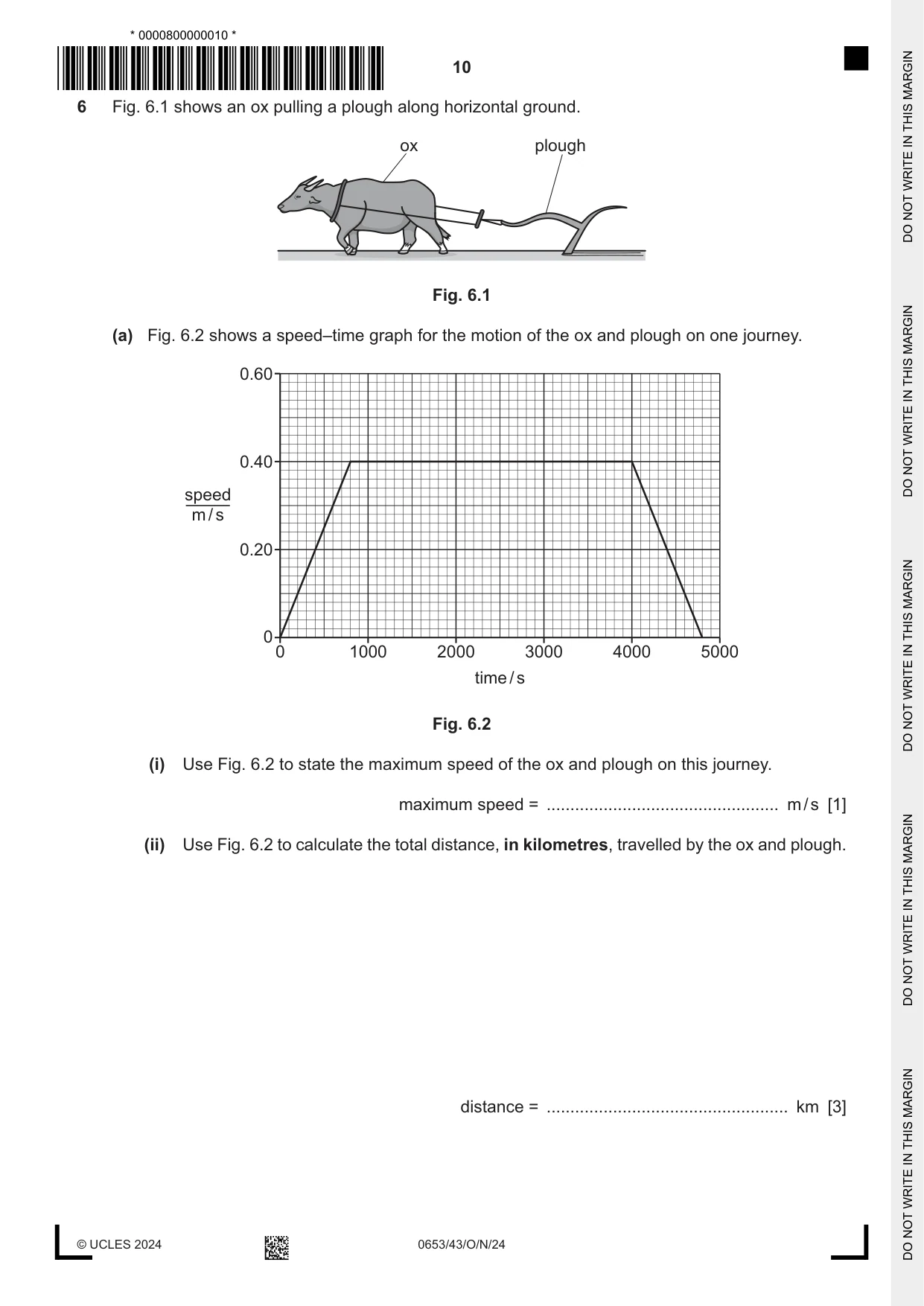
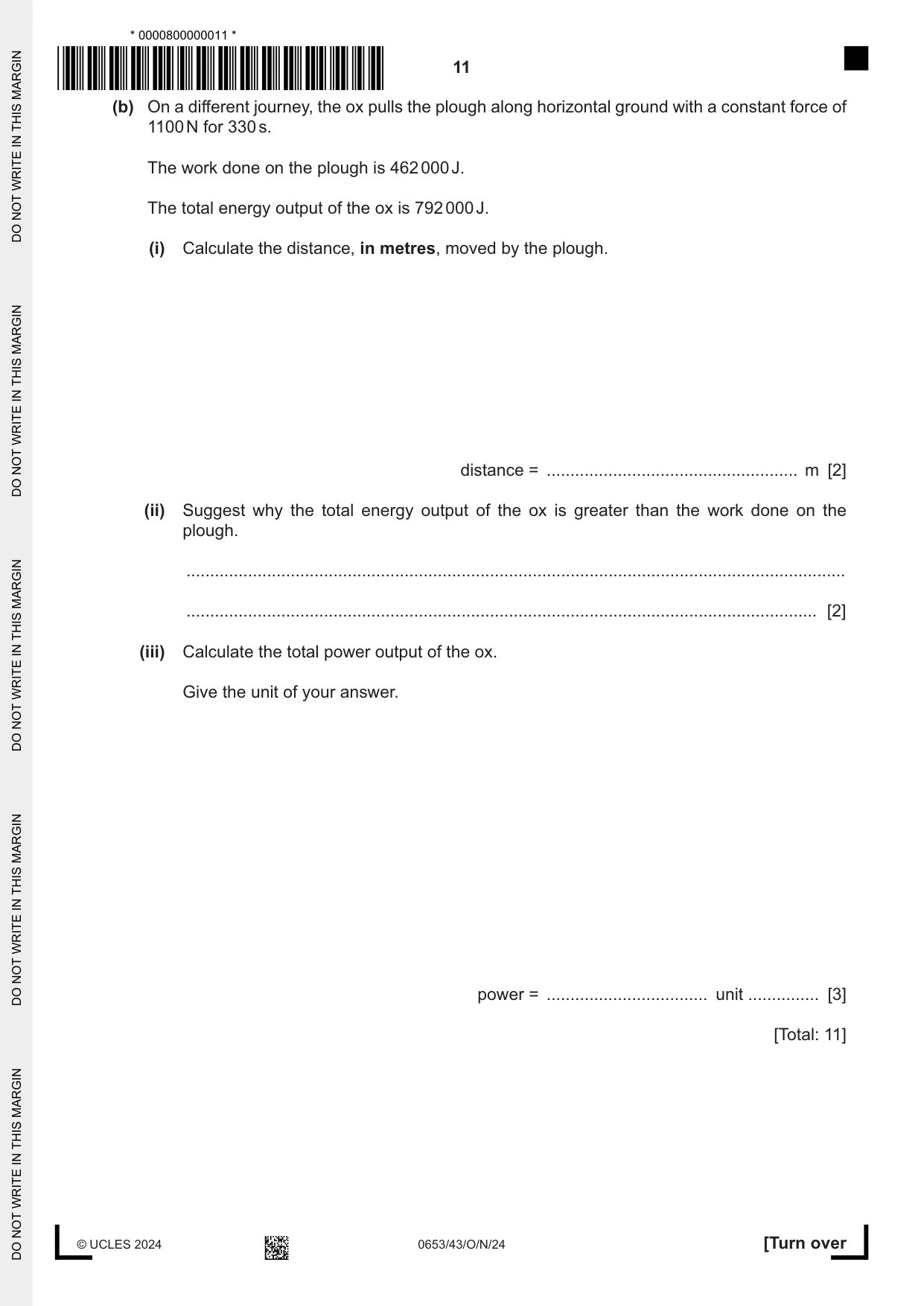
6 Fig. 6.1 shows an ox pulling a plough along horizontal ground. ox plough Fig. 6.1 (a) Fig. 6.2 shows a speed–time graph for the motion of the ox and plough on one journey. 0.60 0.40 speed m / s 0.20 0 0 1000 2000 3000 4000 5000 time / s Fig. 6.2 (i) Use Fig. 6.2 to state the maximum speed of the ox and plough on this journey. maximum speed = ................................................. m / s [1] (ii) Use Fig. 6.2 to calculate the total distance, in kilometres, travelled by the ox and plough. distance = ................................................... km [3] (b) On a different journey, the ox pulls the plough along horizontal ground with a constant force of 1100 N for 330 s. The work done on the plough is 462 000 J. The total energy output of the ox is 792 000 J. (i) Calculate the distance, in metres, moved by the plough. distance = ..................................................... m [2] (ii) Suggest why the total energy output of the ox is greater than the work done on the plough. ........................................................................................................................................... ..................................................................................................................................... [2] (iii) Calculate the total power output of the ox. Give the unit of your answer. power = .................................. unit ............... [3] [Total: 11]
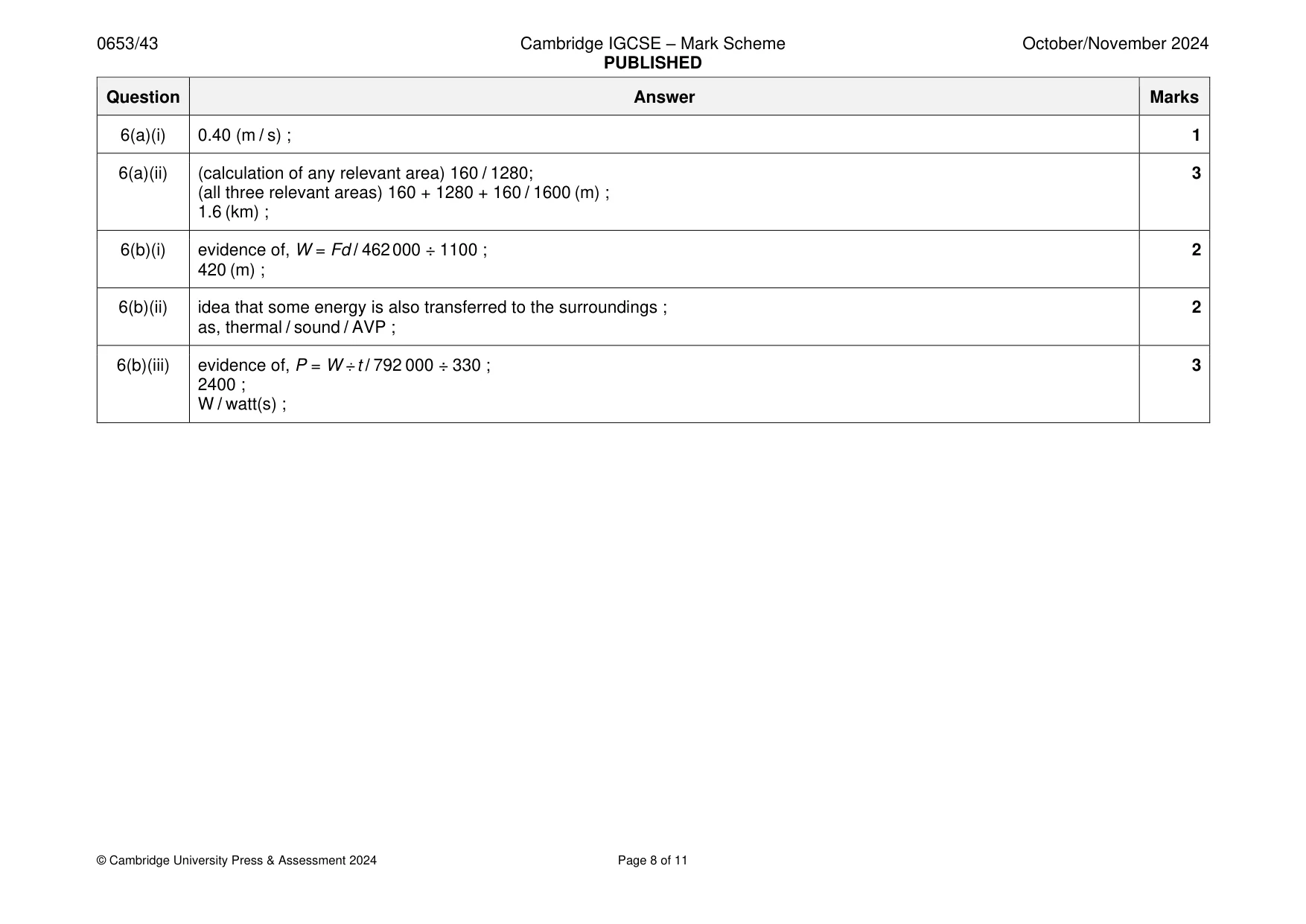
Mark scheme: 6(a)(i) 0.40 (m / s) ; 1 6(a)(ii) (calculation of any relevant area) 160 / 1280; 3 (all three relevant areas) 160 + 1280 + 160 / 1600 (m) ; 1.6 (km) ; 6(b)(i) evidence of, W = Fd / 462 000 ÷ 1100 ; 2 420 (m) ; 6(b)(ii) idea that some energy is also transferred to the surroundings ; 2 as, thermal / sound / AVP ; 6(b)(iii) evidence of, P = W ÷ t / 792 000 ÷ 330 ; 3 2400 ; W / watt(s) ;
Q7 · A diagram of the double circulatory system in humans
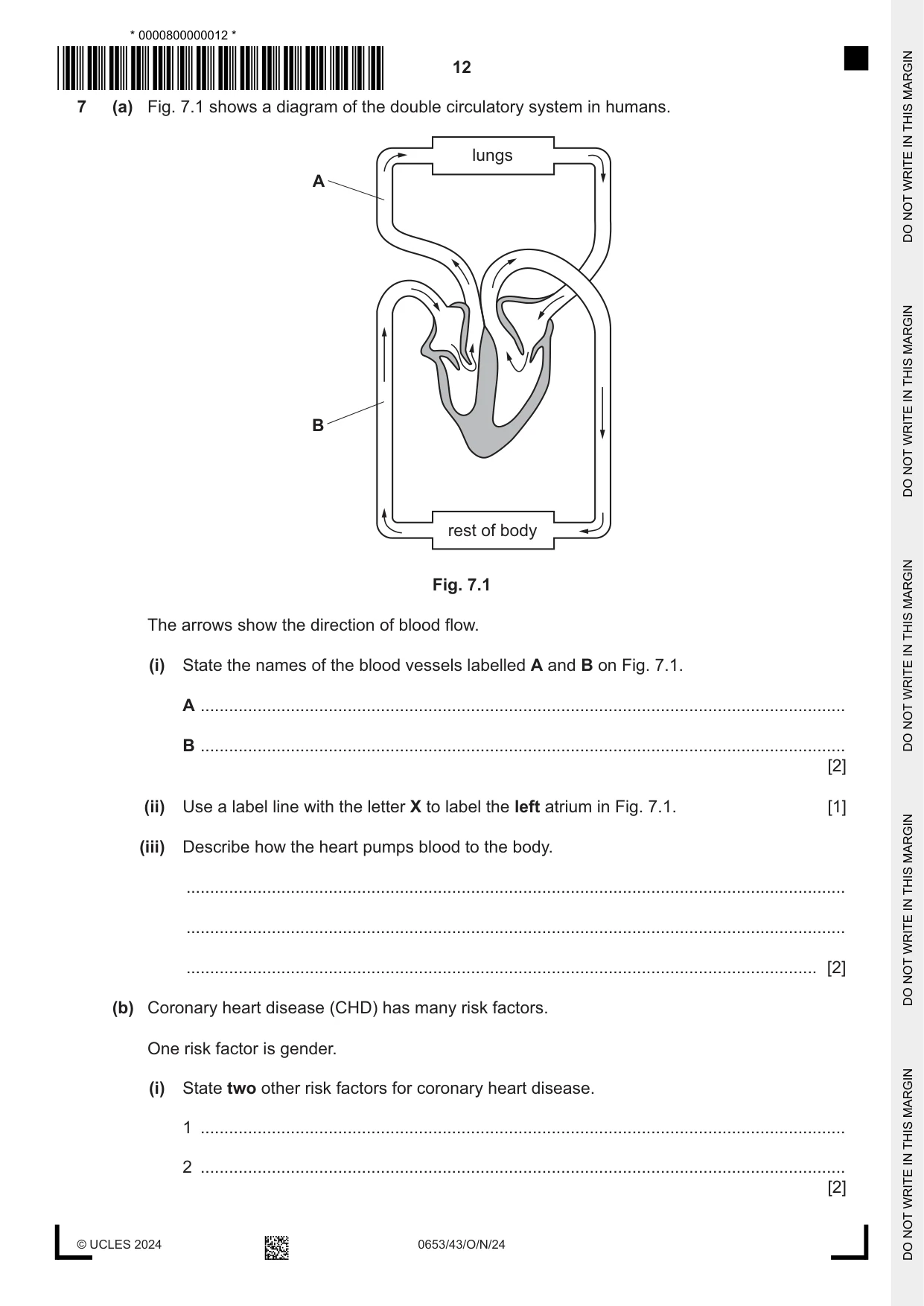
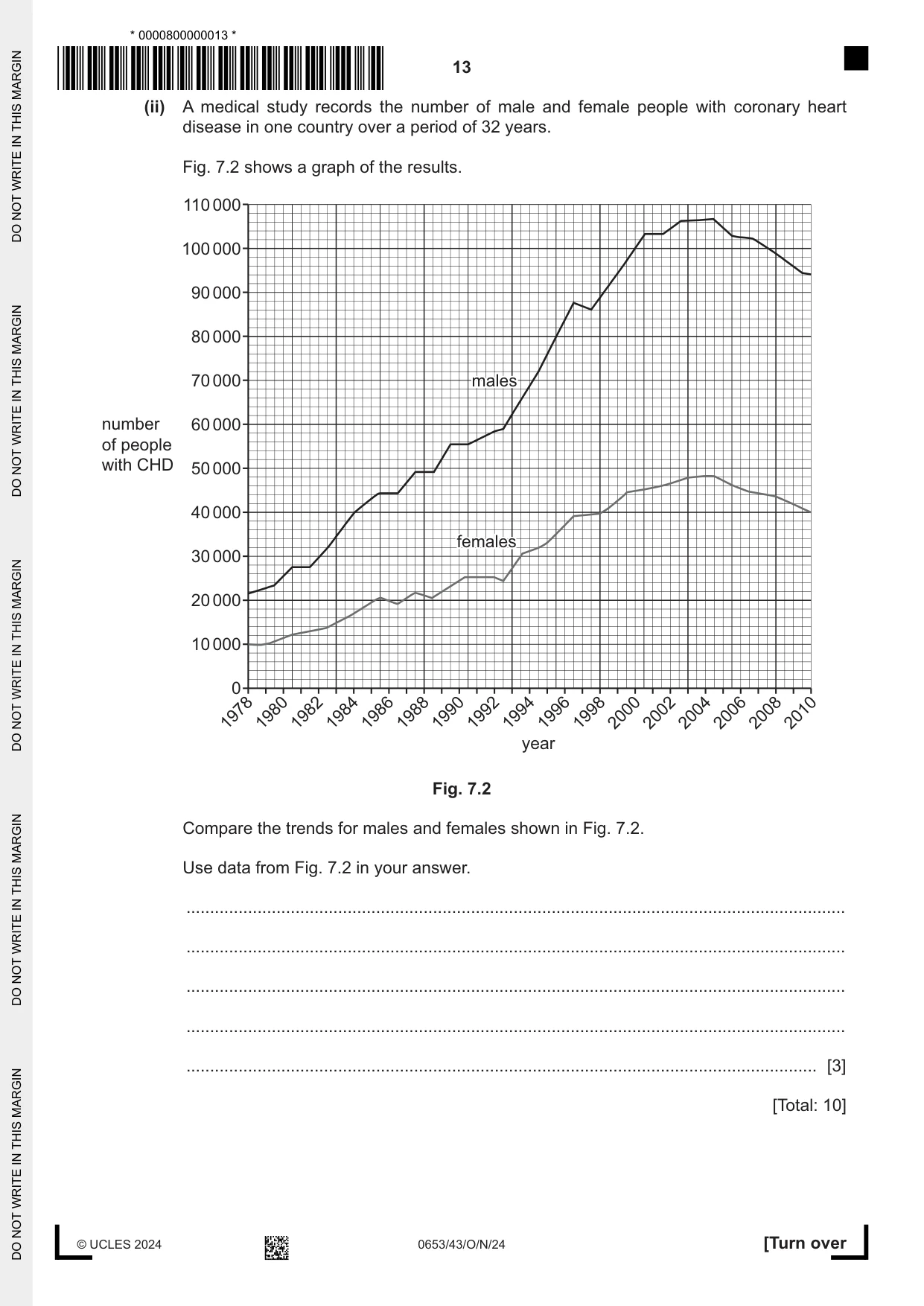
7 (a) Fig. 7.1 shows a diagram of the double circulatory system in humans. lungs A B rest of body Fig. 7.1 The arrows show the direction of blood flow. (i) State the names of the blood vessels labelled A and B on Fig. 7.1. A ........................................................................................................................................ B ........................................................................................................................................ [2] (ii) Use a label line with the letter X to label the left atrium in Fig. 7.1. [1] (iii) Describe how the heart pumps blood to the body. ........................................................................................................................................... ........................................................................................................................................... ..................................................................................................................................... [2] (b) Coronary heart disease (CHD) has many risk factors. One risk factor is gender. (i) State two other risk factors for coronary heart disease. 1 ........................................................................................................................................ 2 ........................................................................................................................................ [2] (ii) A medical study records the number of male and female people with coronary heart disease in one country over a period of 32 years. Fig. 7.2 shows a graph of the results. 110 000 100 000 90 000 80 000 70 000 malesmales number 60 000 of people with CHD 50 000 40 000 femalesfemales 30 000 20 000 10 000 0 19781980198219841986198819901992199419961998200020022004200620082010 year Fig. 7.2 Compare the trends for males and females shown in Fig. 7.2. Use data from Fig. 7.2 in your answer. ........................................................................................................................................... ........................................................................................................................................... ........................................................................................................................................... ........................................................................................................................................... ..................................................................................................................................... [3] [Total: 10]
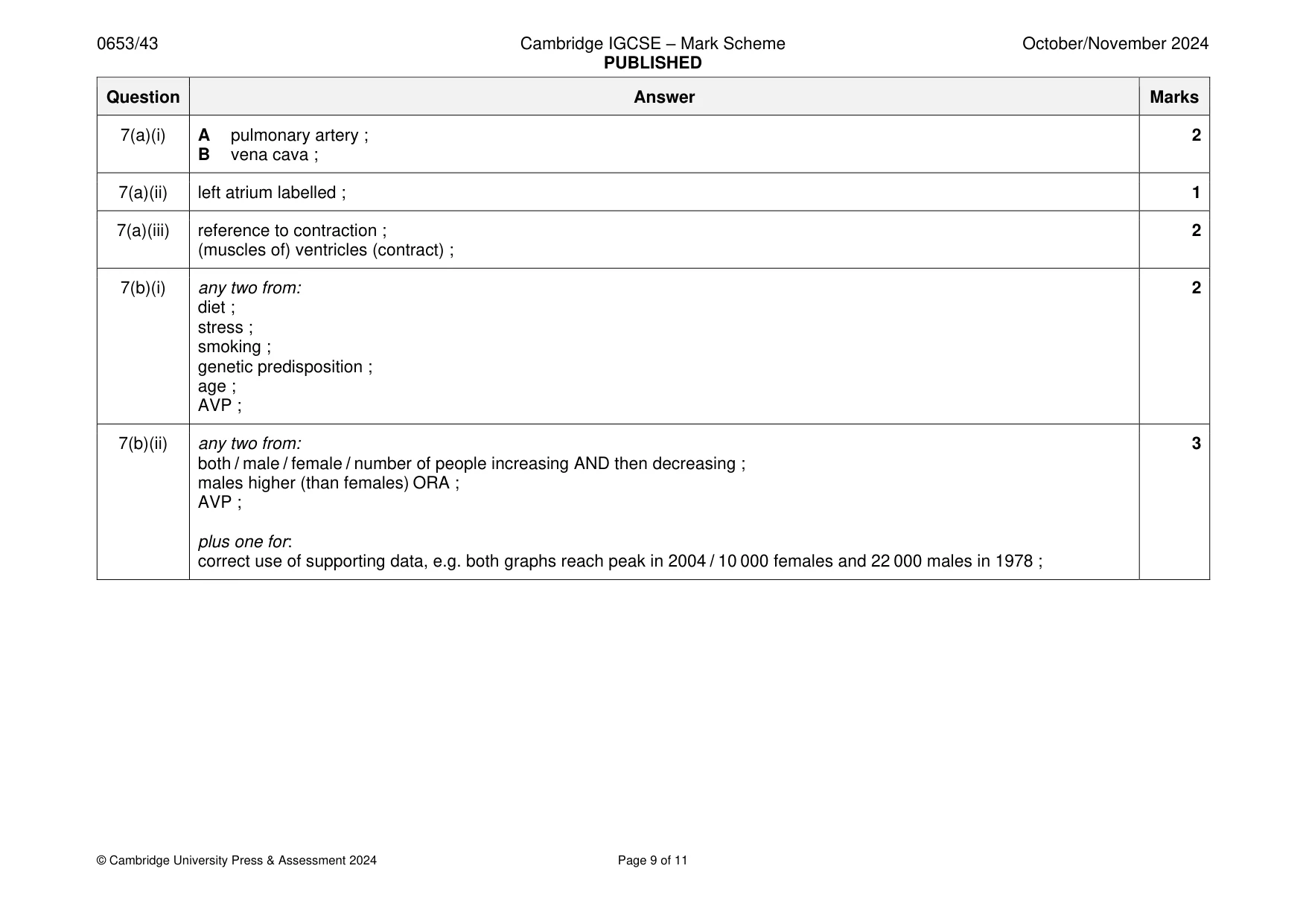
Mark scheme: 7(a)(i) A pulmonary artery ; 2 B vena cava ; 7(a)(ii) left atrium labelled ; 1 7(a)(iii) reference to contraction ; 2 (muscles of) ventricles (contract) ; 7(b)(i) any two from: 2 diet ; stress ; smoking ; genetic predisposition ; age ; AVP ; 7(b)(ii) any two from: 3 both / male / female / number of people increasing AND then decreasing ; males higher (than females) ORA ; AVP ; plus one for: correct use of supporting data, e.g. both graphs reach peak in 2004 / 10 000 females and 22 000 males in 1978 ;
Q8 · The formula for methanol is CH3OH
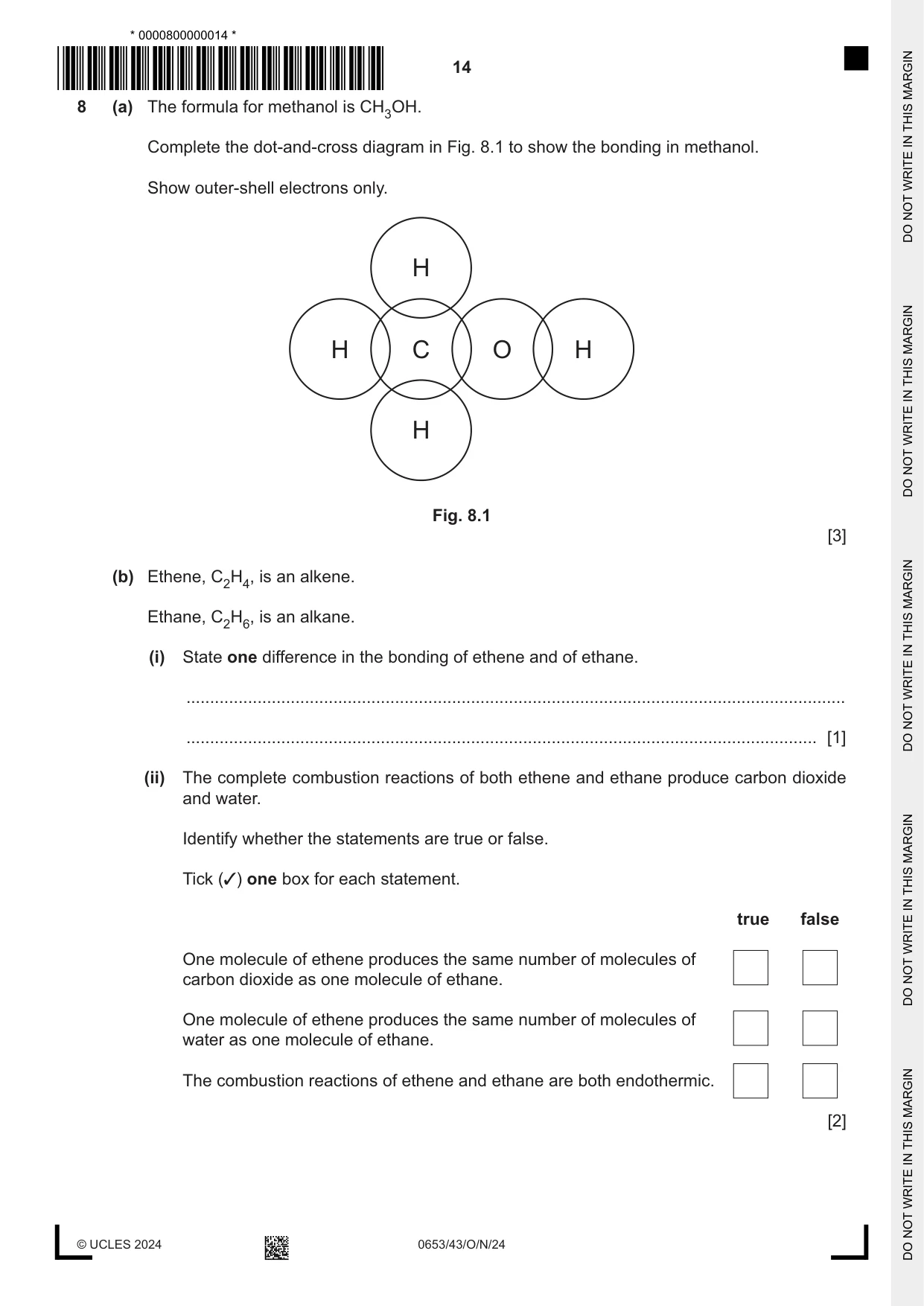
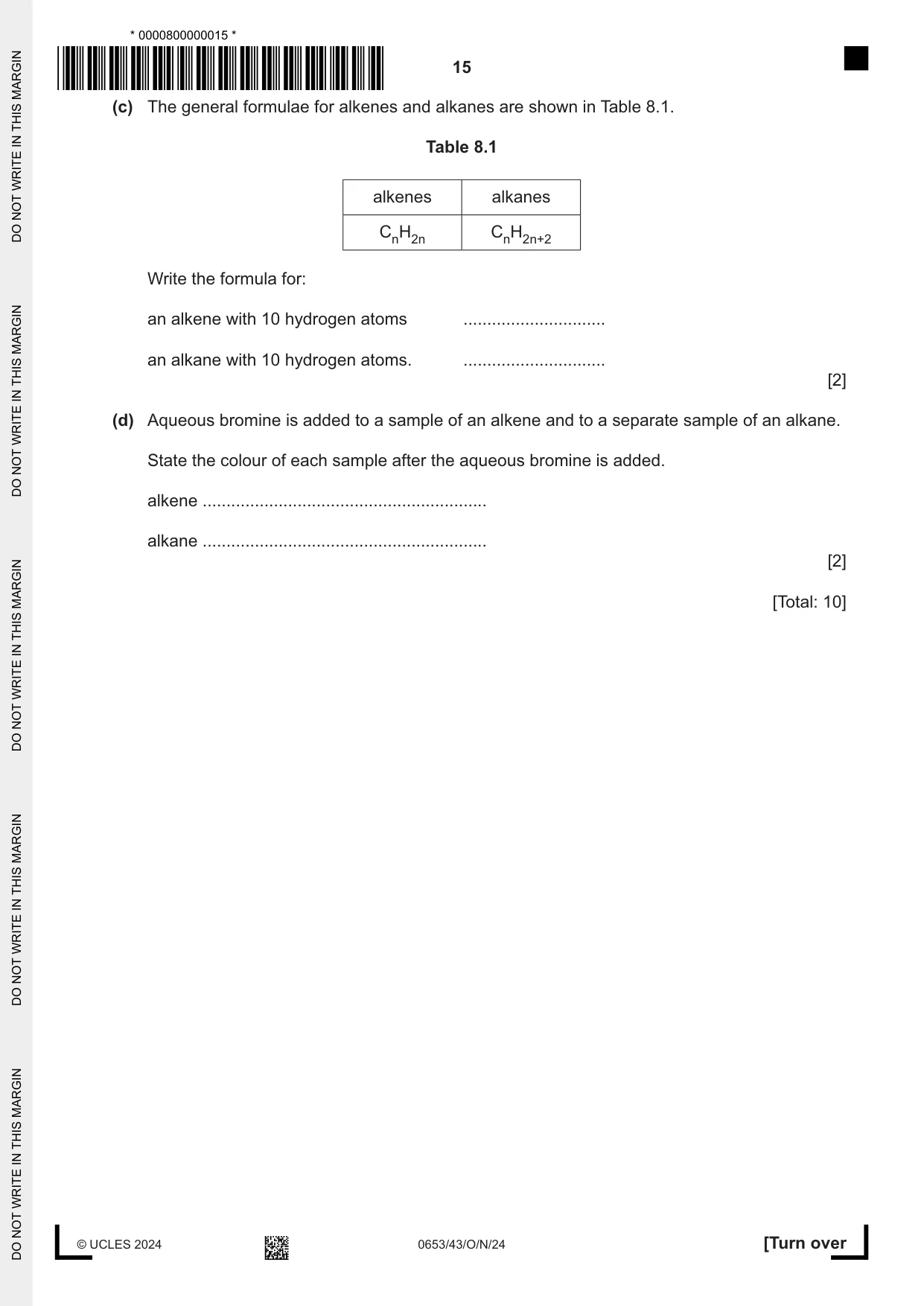
8 (a) The formula for methanol is CH3OH. Complete the dot-and-cross diagram in Fig. 8.1 to show the bonding in methanol. Show outer-shell electrons only. H H C O H H Fig. 8.1 [3] (b) Ethene, C2H4, is an alkene. Ethane, C2H6, is an alkane. (i) State one difference in the bonding of ethene and of ethane. ........................................................................................................................................... ..................................................................................................................................... [1] (ii) The complete combustion reactions of both ethene and ethane produce carbon dioxide and water. Identify whether the statements are true or false. Tick (3) one box for each statement. true false One molecule of ethene produces the same number of molecules of carbon dioxide as one molecule of ethane. One molecule of ethene produces the same number of molecules of water as one molecule of ethane. The combustion reactions of ethene and ethane are both endothermic. [2] (c) The general formulae for alkenes and alkanes are shown in Table 8.1. Table 8.1 alkenes alkanes CnH2n CnH2n+2 Write the formula for: an alkene with 10 hydrogen atoms .............................. an alkane with 10 hydrogen atoms. .............................. [2] (d) Aqueous bromine is added to a sample of an alkene and to a separate sample of an alkane. State the colour of each sample after the aqueous bromine is added. alkene ............................................................ alkane ............................................................ [2] [Total: 10]
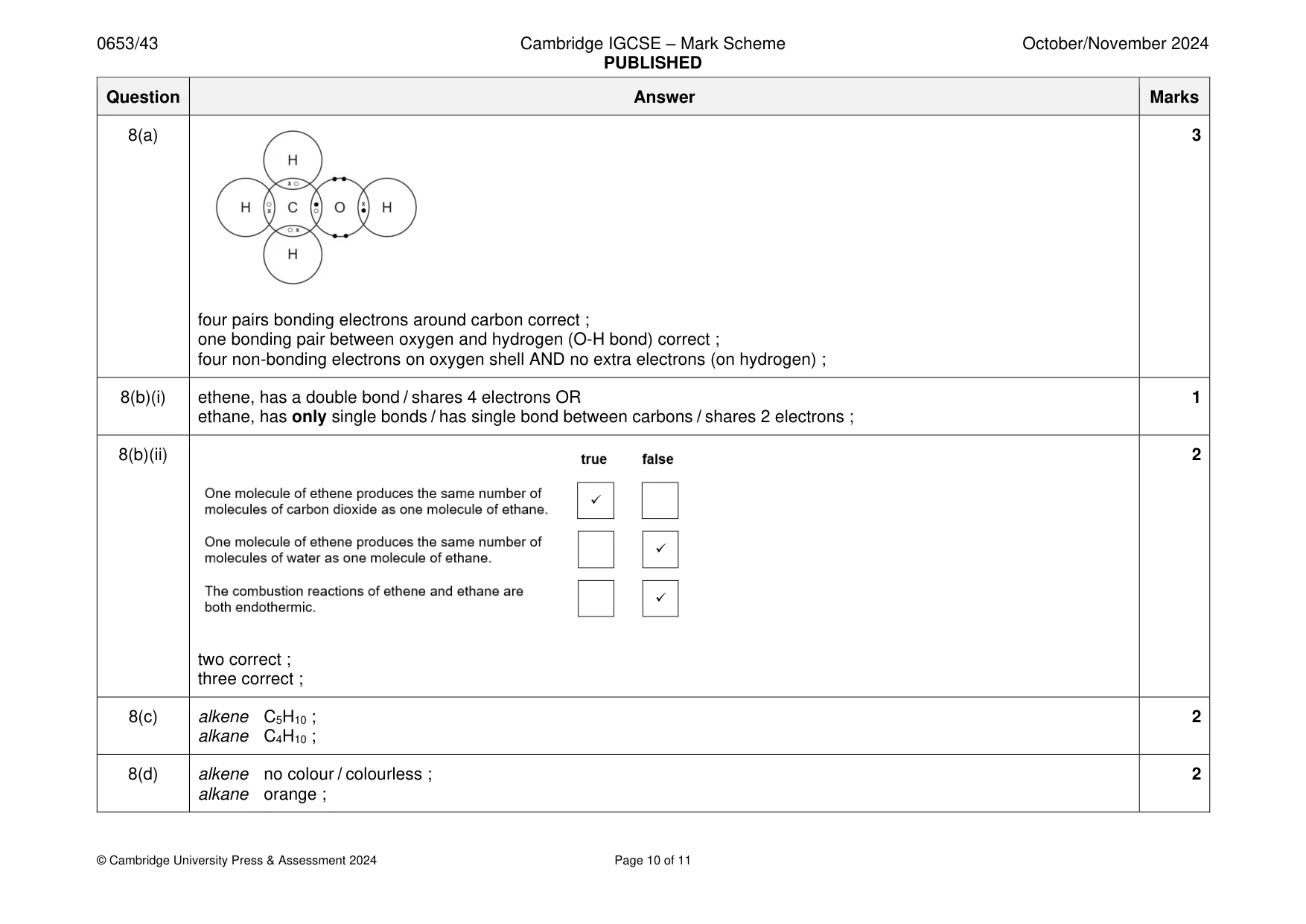
Mark scheme: 8(a) 3 four pairs bonding electrons around carbon correct ; one bonding pair between oxygen and hydrogen (O-H bond) correct ; four non-bonding electrons on oxygen shell AND no extra electrons (on hydrogen) ; 8(b)(i) ethene, has a double bond / shares 4 electrons OR 1 ethane, has only single bonds / has single bond between carbons / shares 2 electrons ; 8(b)(ii) 2 two correct ; three correct ; 8(c) alkene C5H10 ; 2 alkane C4H10 ; 8(d) alkene no colour / colourless ; 2 alkane orange ;
Q9 · State the name of the component with the electrical symbol shown
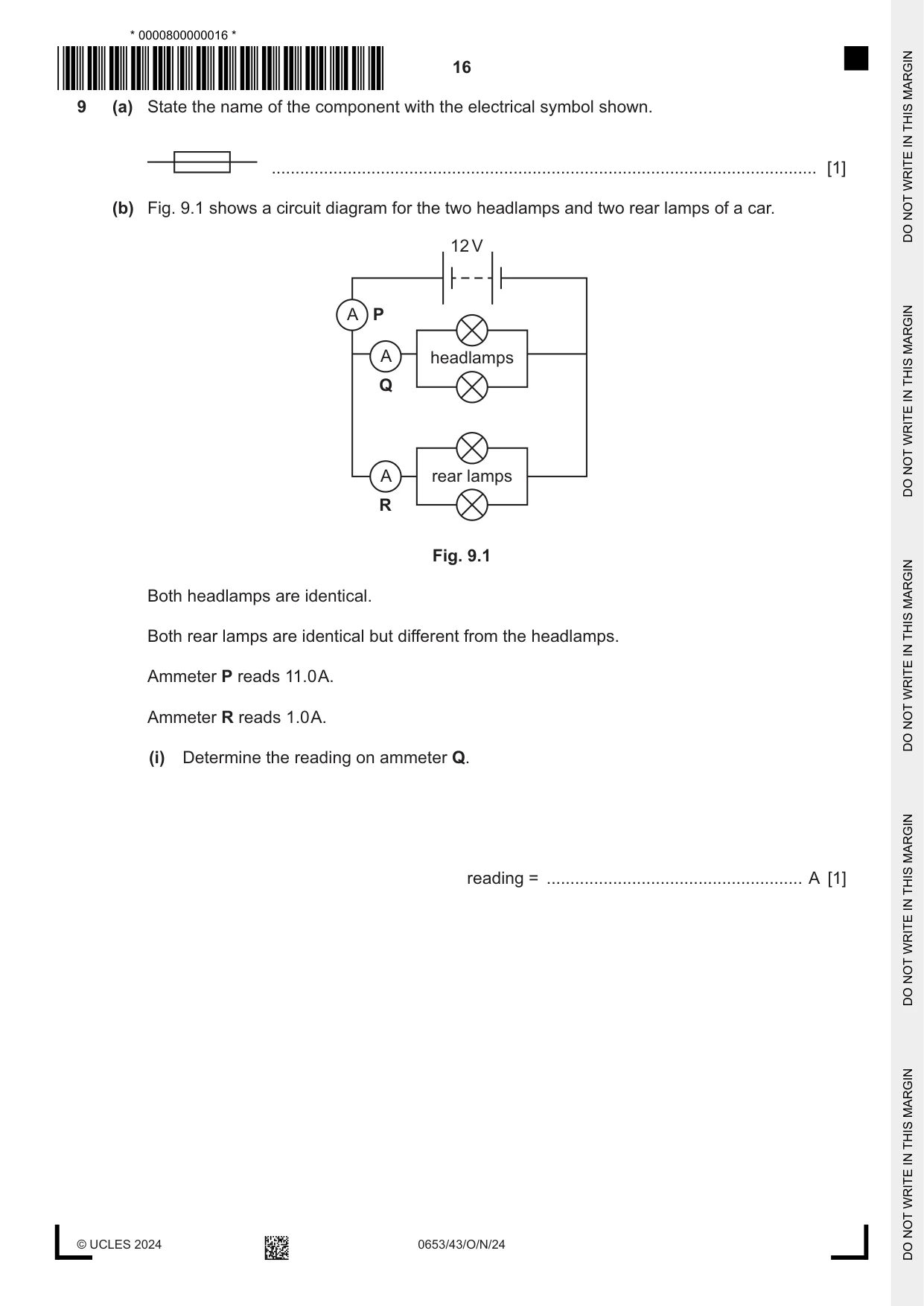
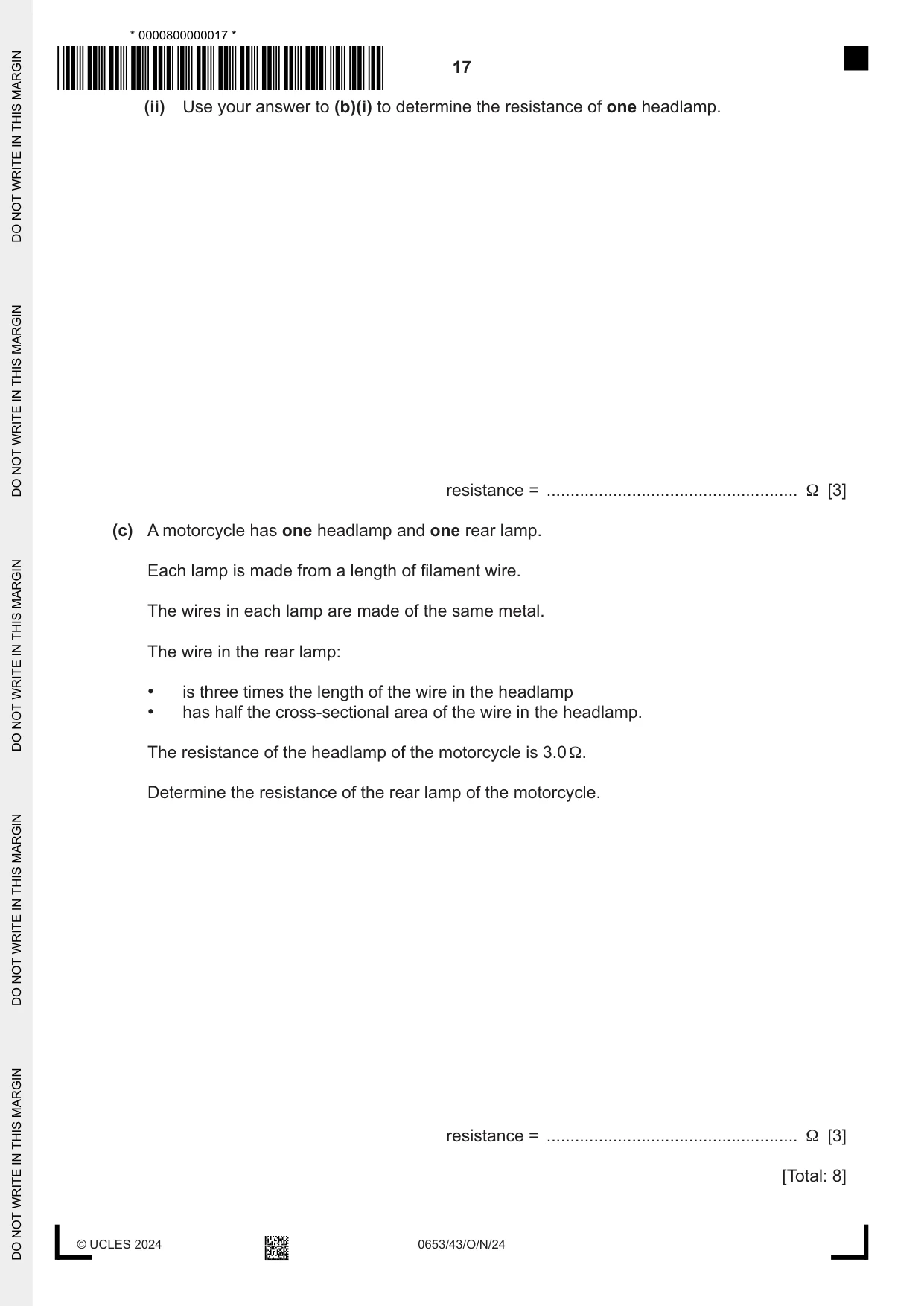
9 (a) State the name of the component with the electrical symbol shown. ................................................................................................................... [1] (b) Fig. 9.1 shows a circuit diagram for the two headlamps and two rear lamps of a car. 12 V A P A headlamps Q A rear lamps R Fig. 9.1 Both headlamps are identical. Both rear lamps are identical but different from the headlamps. Ammeter P reads 11.0 A. Ammeter R reads 1.0 A. (i) Determine the reading on ammeter Q. reading = ...................................................... A [1] (ii) Use your answer to (b)(i) to determine the resistance of one headlamp. resistance = ..................................................... Ω [3] (c) A motorcycle has one headlamp and one rear lamp. Each lamp is made from a length of filament wire. The wires in each lamp are made of the same metal. The wire in the rear lamp: • is three times the length of the wire in the headlamp • has half the cross-sectional area of the wire in the headlamp. The resistance of the headlamp of the motorcycle is 3.0 Ω. Determine the resistance of the rear lamp of the motorcycle. resistance = ..................................................... Ω [3] [Total: 8]
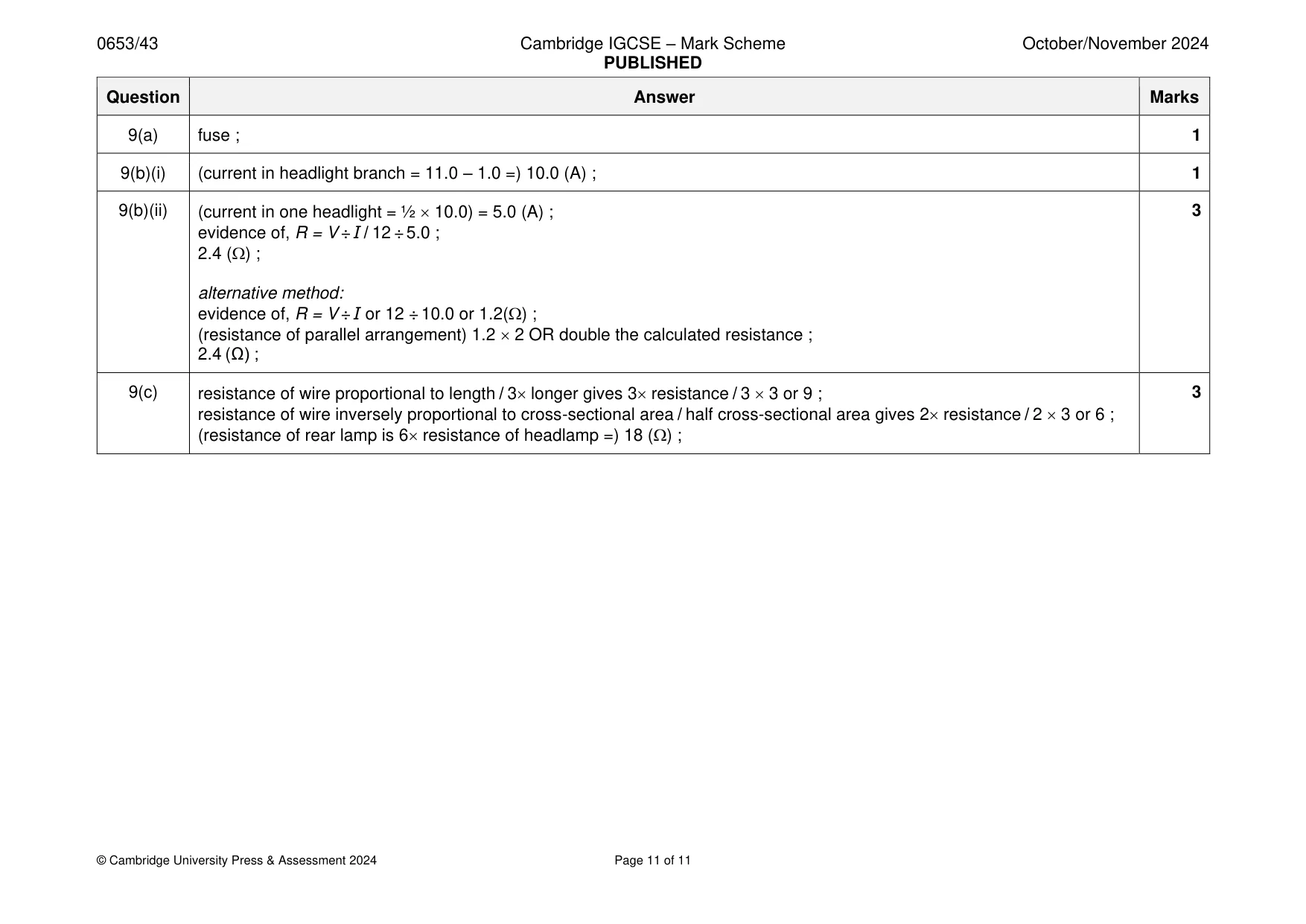
Mark scheme: 9(a) fuse ; 1 9(b)(i) (current in headlight branch = 11.0 – 1.0 =) 10.0 (A) ; 1 9(b)(ii) (current in one headlight = ½ 10.0) = 5.0 (A) ; 3 evidence of, R = V ÷ I / 12 ÷ 5.0 ; 2.4 () ; alternative method: evidence of, R = V ÷ I or 12 ÷ 10.0 or 1.2() ; (resistance of parallel arrangement) 1.2 2 OR double the calculated resistance ; 2.4 (Ω) ; 9(c) resistance of wire proportional to length / 3 longer gives 3 resistance / 3 3 or 9 ; 3 resistance of wire inversely proportional to cross-sectional area / half cross-sectional area gives 2 resistance / 2 3 or 6 ; (resistance of rear lamp is 6 resistance of headlamp =) 18 () ;
What was in this paper
The subtopics covered by these 9 questions, and how many questions each got. Open one in a new tab to see every Cambridge question on it.
What you needed in this session
Cambridge’s own grade thresholds for 2024 Oct/Nov, Paper 4 · Variant 3. A higher threshold means an easier paper — the bar moves with how the cohort did.