Cambridge IGCSE Science - Combined 0653 — 2017 May/June Paper 4 · Variant 3
0653/43/M/J/17 · 9 questions · 80 marks · ≈90 min
The question paper and its mark scheme, free to read here and free to download. This is Cambridge’s own paper, exactly as it was sat.
Question paper24 pages


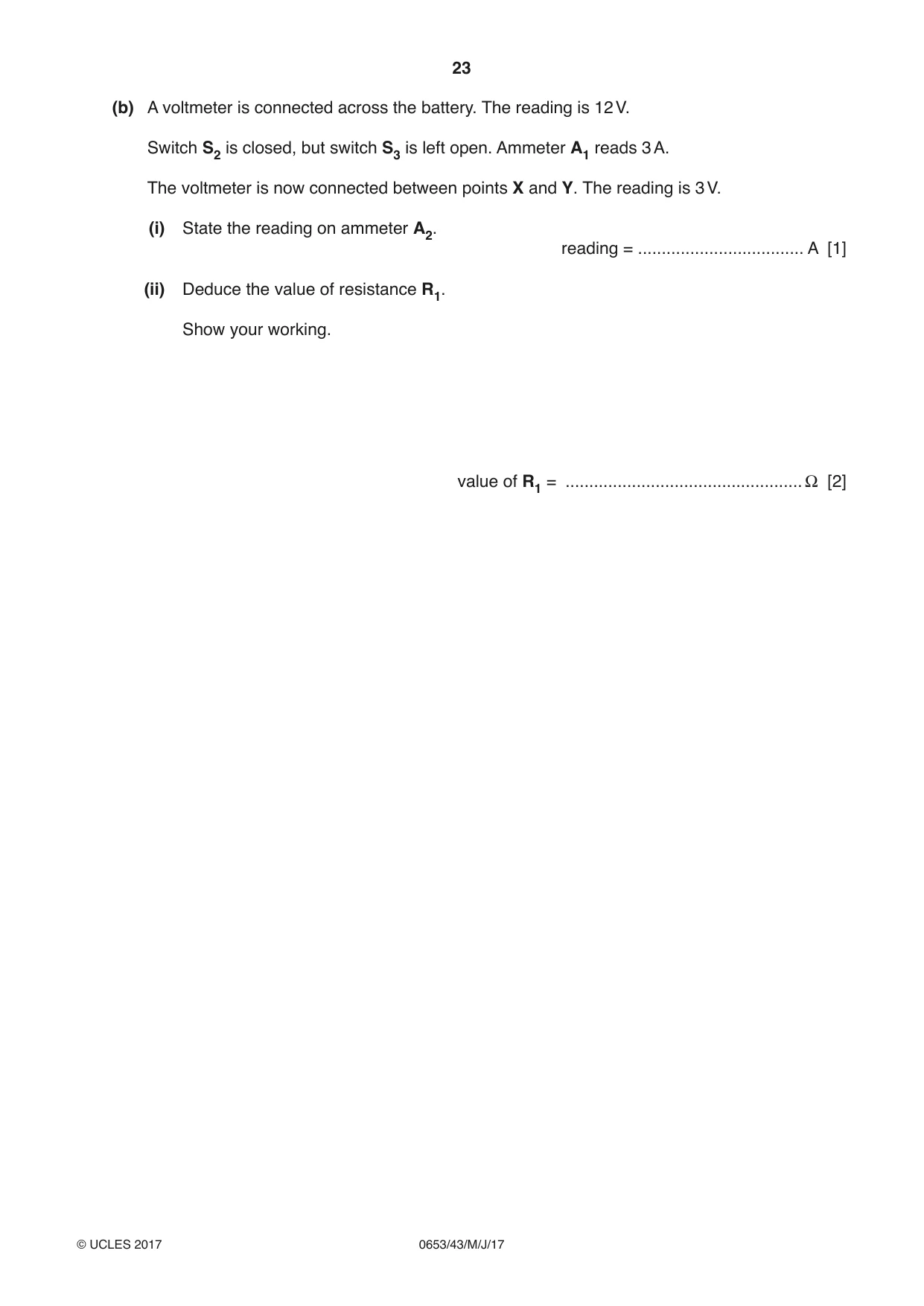
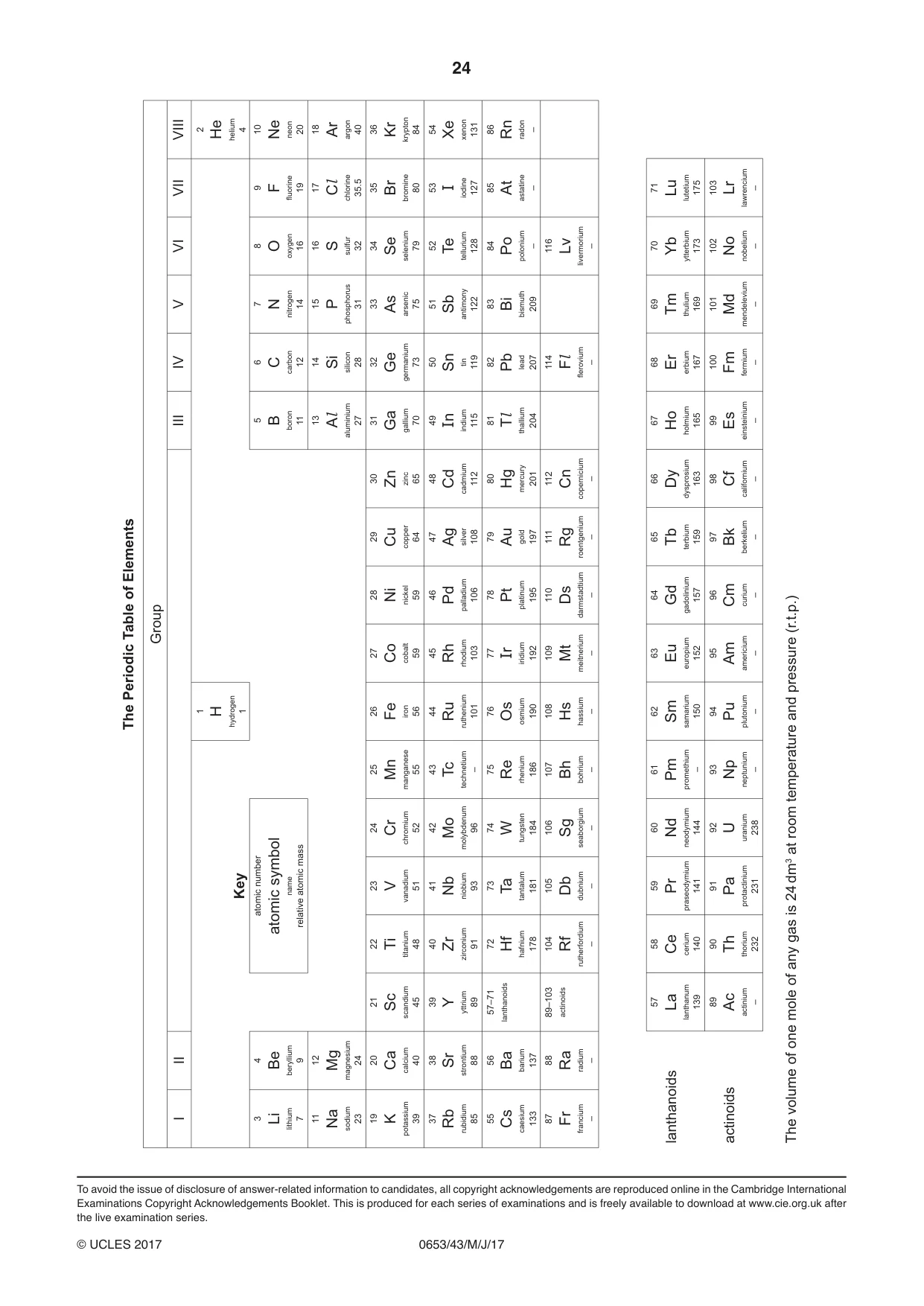
Mark scheme10 pages
Answers below. Sit the paper first if you are practising.
Questions as text
Q1 · Use lines to connect the box on the left to different boxes on the right to make correct…
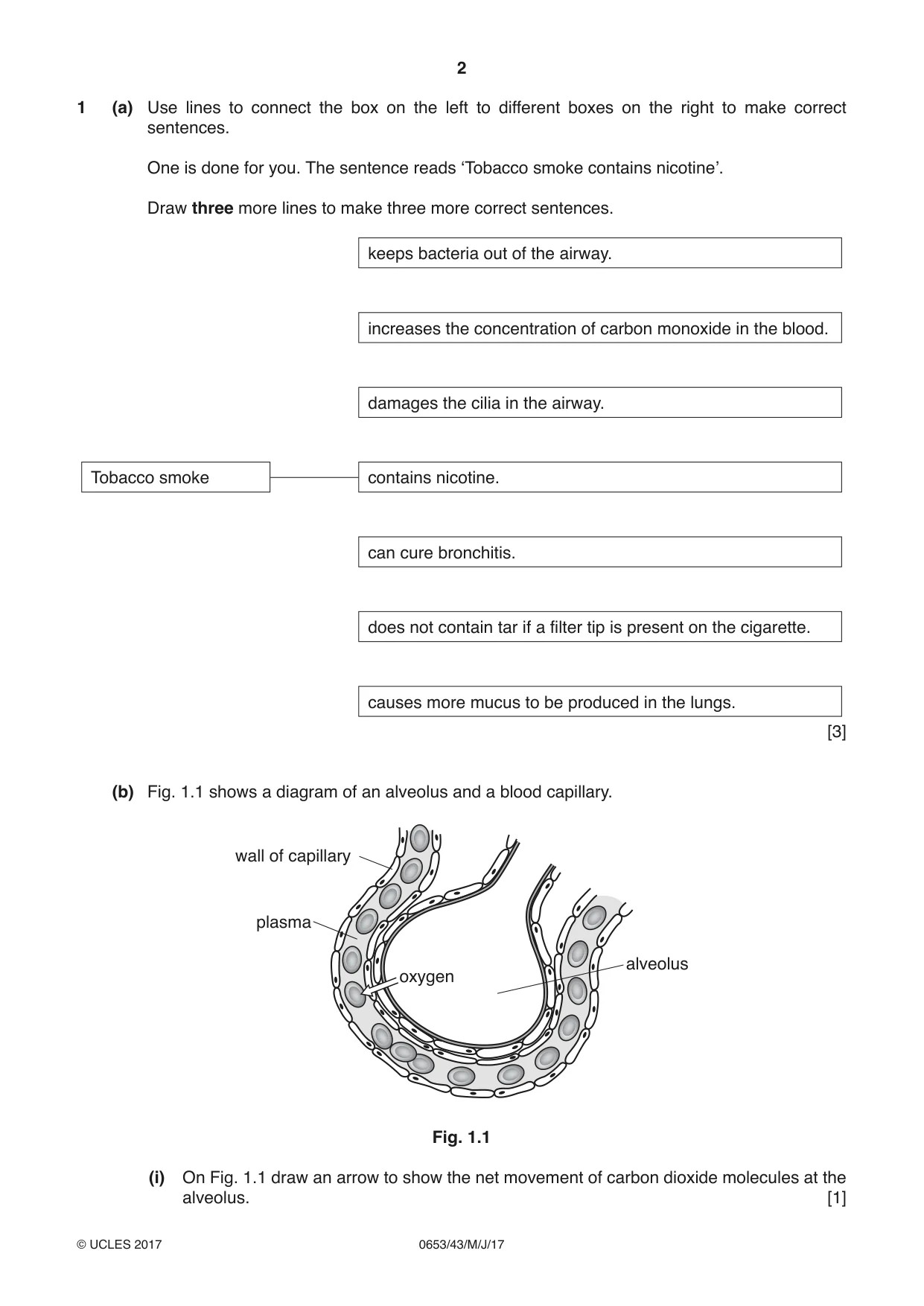
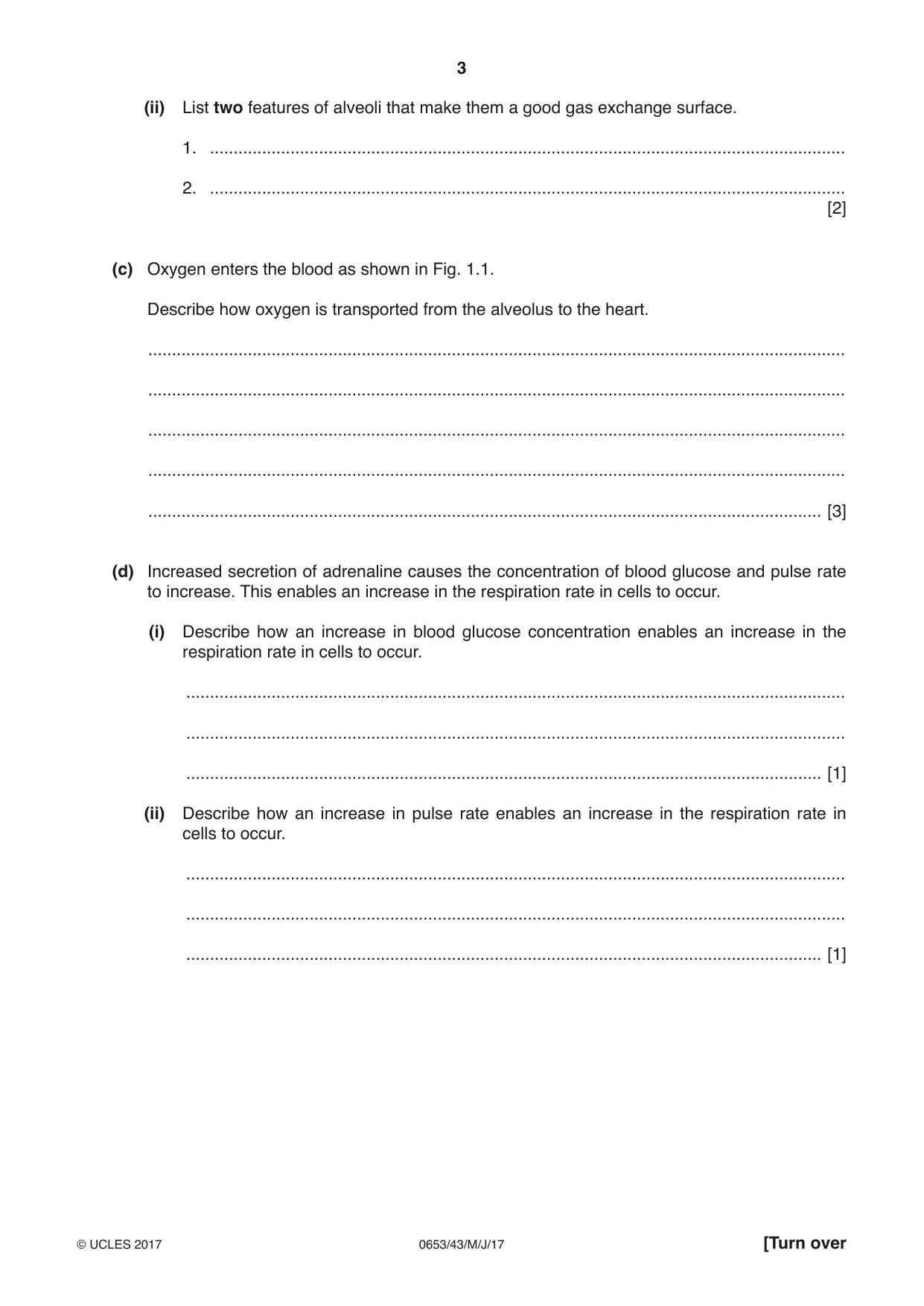
1 (a) Use lines to connect the box on the left to different boxes on the right to make correct sentences. One is done for you. The sentence reads ‘Tobacco smoke contains nicotine’. Draw three more lines to make three more correct sentences. keeps bacteria out of the airway. increases the concentration of carbon monoxide in the blood. damages the cilia in the airway. Tobacco smoke contains nicotine. can cure bronchitis. does not contain tar if a filter tip is present on the cigarette. causes more mucus to be produced in the lungs. [3] (b) Fig. 1.1 shows a diagram of an alveolus and a blood capillary. wall of capillary plasma alveolus oxygen Fig. 1.1 (i) On Fig. 1.1 draw an arrow to show the net movement of carbon dioxide molecules at the alveolus. [1] (ii) List two features of alveoli that make them a good gas exchange surface. 1. ...................................................................................................................................... 2. ...................................................................................................................................... [2] (c) Oxygen enters the blood as shown in Fig. 1.1. Describe how oxygen is transported from the alveolus to the heart. ................................................................................................................................................... ................................................................................................................................................... ................................................................................................................................................... ................................................................................................................................................... .............................................................................................................................................. [3] (d) Increased secretion of adrenaline causes the concentration of blood glucose and pulse rate to increase. This enables an increase in the respiration rate in cells to occur. (i) Describe how an increase in blood glucose concentration enables an increase in the respiration rate in cells to occur. ........................................................................................................................................... ........................................................................................................................................... ...................................................................................................................................... [1] (ii) Describe how an increase in pulse rate enables an increase in the respiration rate in cells to occur. ........................................................................................................................................... ........................................................................................................................................... ...................................................................................................................................... [1]
Mark scheme: 1(a) three lines drawn to increases the concentration of carbon monoxide in the blood ; damages the cilia in the airway ; causes more mucus to be produced in the lungs ; 3 1(b)(i) arrow drawn from plasma to alveolar sac ; 1 1(b)(ii) large surface area ; thin wall ; reference to good blood supply ; 2 1(c) carried by haemoglobin ; in red blood cells ; enters left atrium / through the pulmonary vein ; red cells carried in plasma ; max 3 1(d)(i) more glucose available to be broken down by cells / for oxidation / chemical (energy) converted to thermal / heat (energy) 1 1(d)(ii) faster delivery of oxygen / glucose to cells ; 1
Q2 · Ethane and octane are obtained from petroleum by fractional distillation
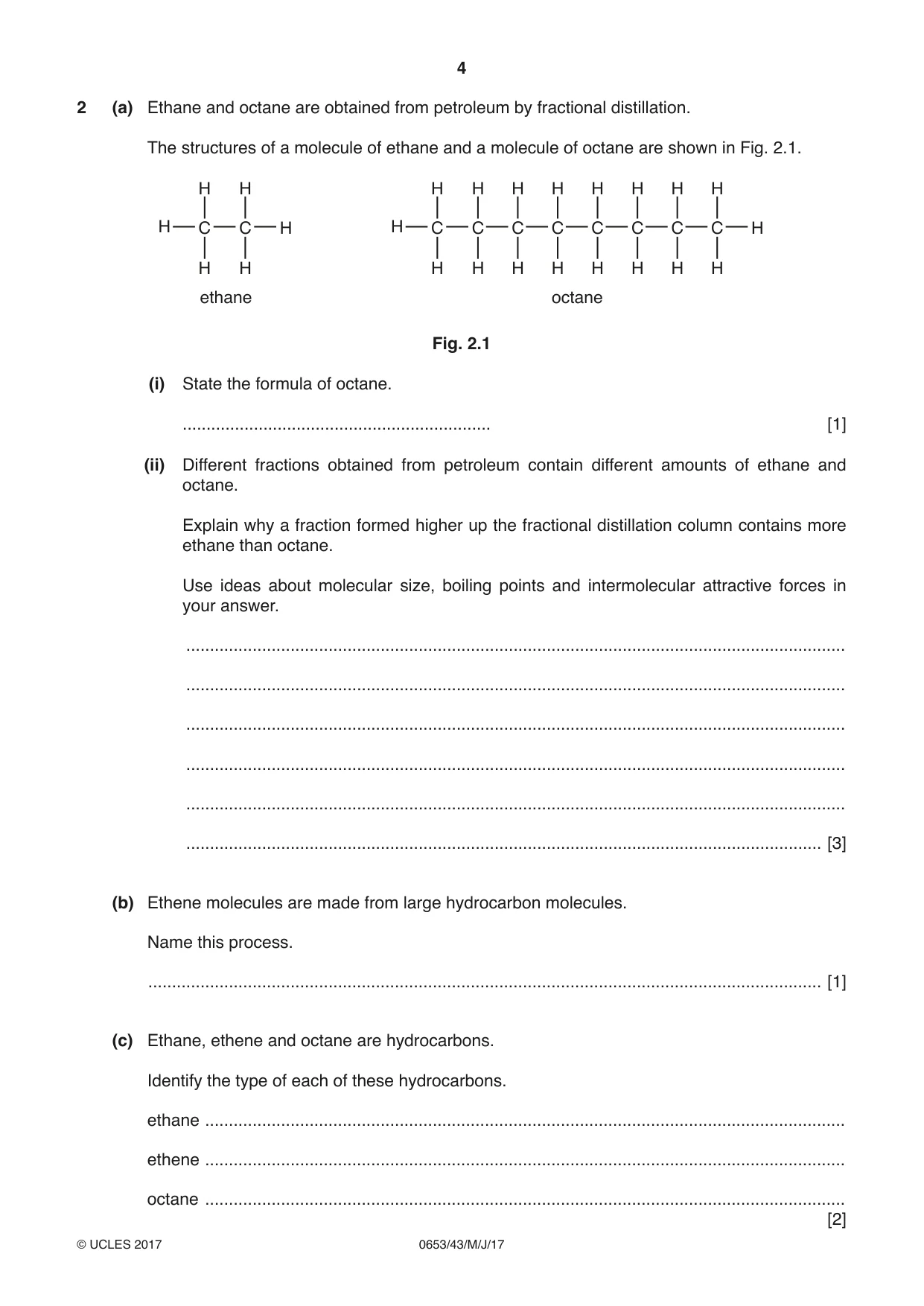
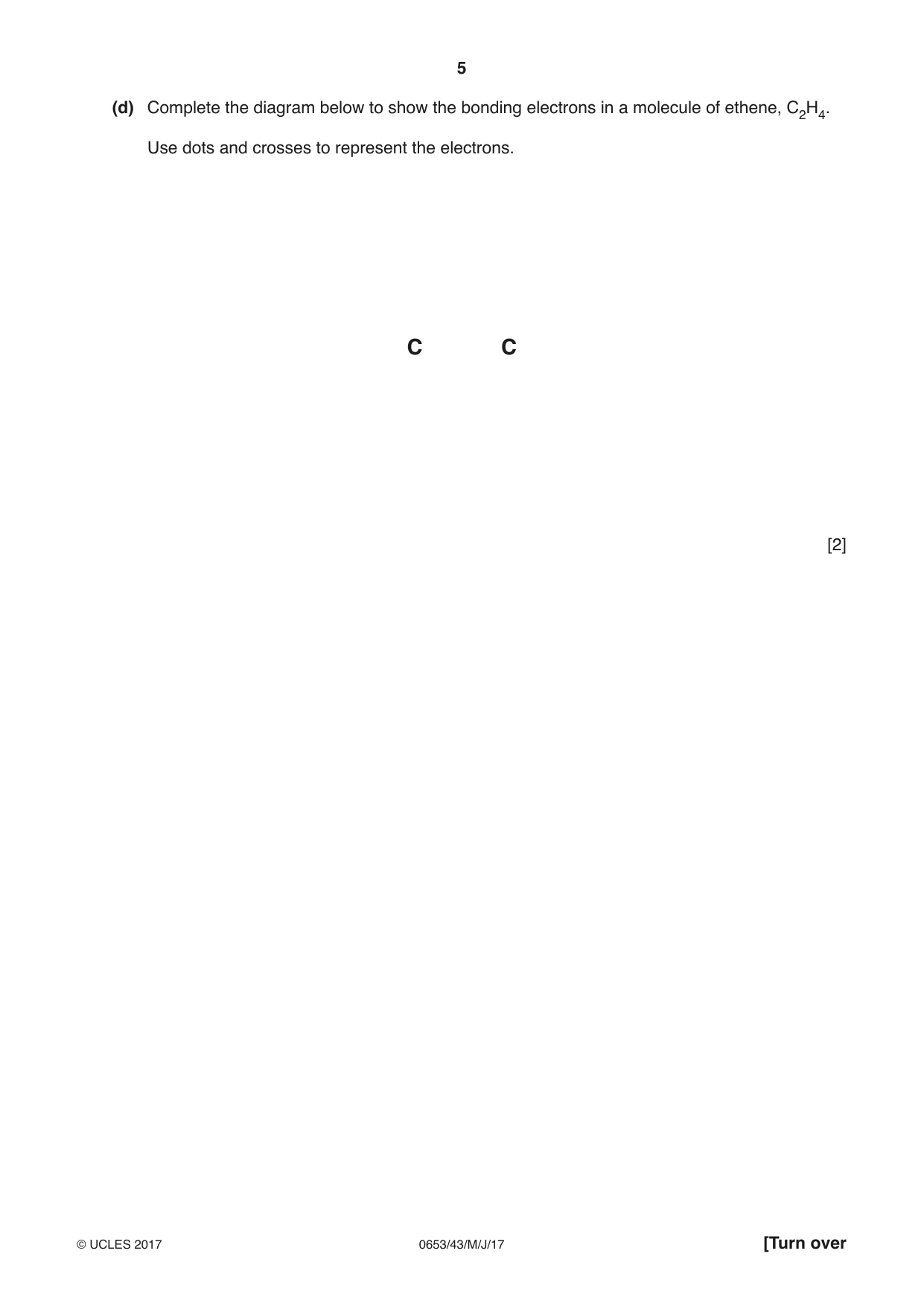
2 (a) Ethane and octane are obtained from petroleum by fractional distillation. The structures of a molecule of ethane and a molecule of octane are shown in Fig. 2.1. H H H H H H H H H H H C C H H C C C C C C C C H H H H H H H H H H H ethane octane Fig. 2.1 (i) State the formula of octane. ................................................................. [1] (ii) Different fractions obtained from petroleum contain different amounts of ethane and octane. Explain why a fraction formed higher up the fractional distillation column contains more ethane than octane. Use ideas about molecular size, boiling points and intermolecular attractive forces in your answer. ........................................................................................................................................... ........................................................................................................................................... ........................................................................................................................................... ........................................................................................................................................... ........................................................................................................................................... ...................................................................................................................................... [3] (b) Ethene molecules are made from large hydrocarbon molecules. Name this process. .............................................................................................................................................. [1] (c) Ethane, ethene and octane are hydrocarbons. Identify the type of each of these hydrocarbons. ethane ....................................................................................................................................... ethene ....................................................................................................................................... octane ....................................................................................................................................... [2] (d) Complete the diagram below to show the bonding electrons in a molecule of ethene, C2H4. Use dots and crosses to represent the electrons. C C [2]
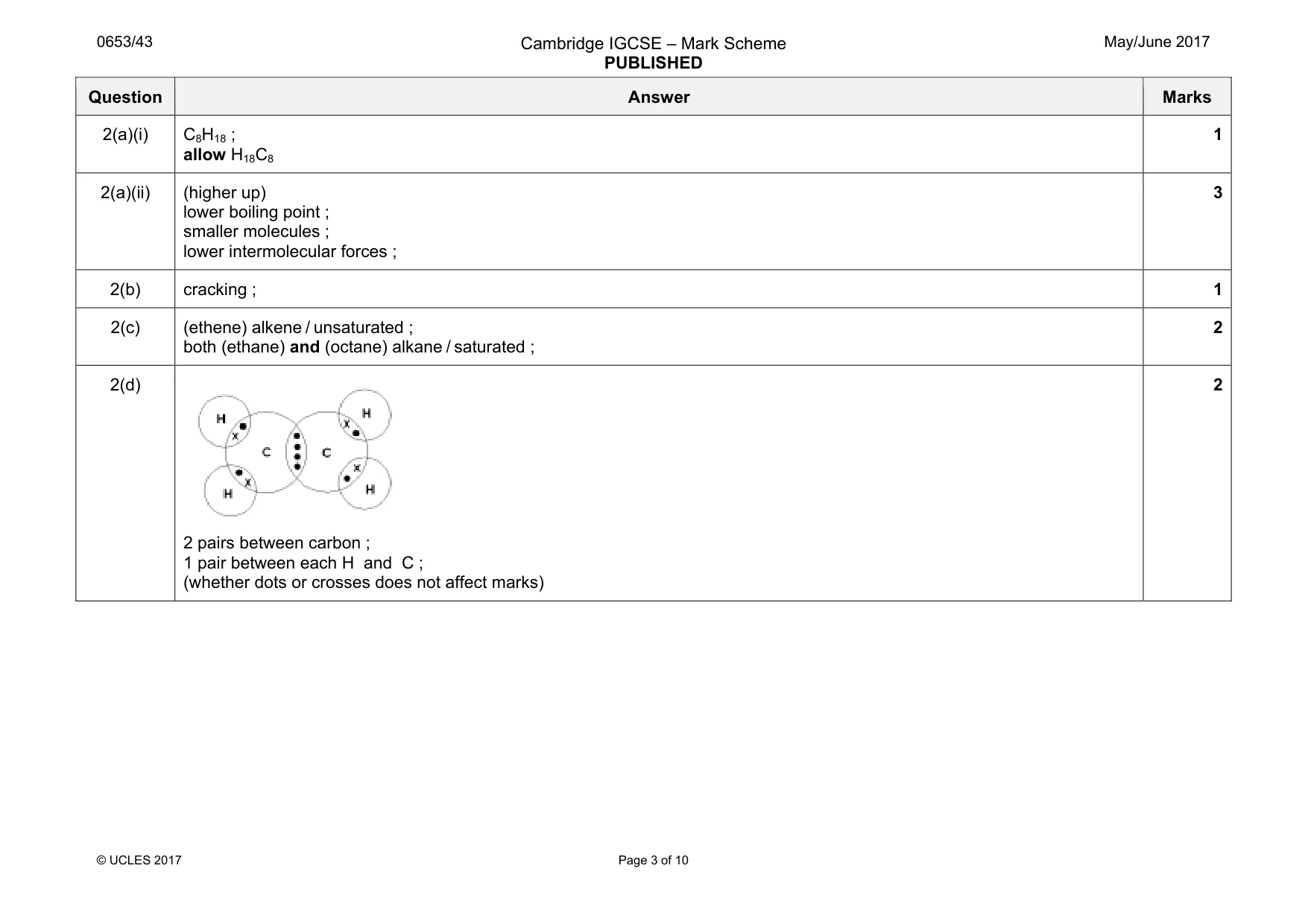
Mark scheme: 2(a)(i) C8H18 ; allow H18C8 1 2(a)(ii) (higher up) lower boiling point ; smaller molecules ; lower intermolecular forces ; 3 2(b) cracking ; 1 2(c) (ethene) alkene / unsaturated ; both (ethane) and (octane) alkane / saturated ; 2 2(d) 2 pairs between carbon ; 1 pair between each H and C ; (whether dots or crosses does not affect marks) 2
Q3 · A cyclist riding her bicycle at a constant speed along a road
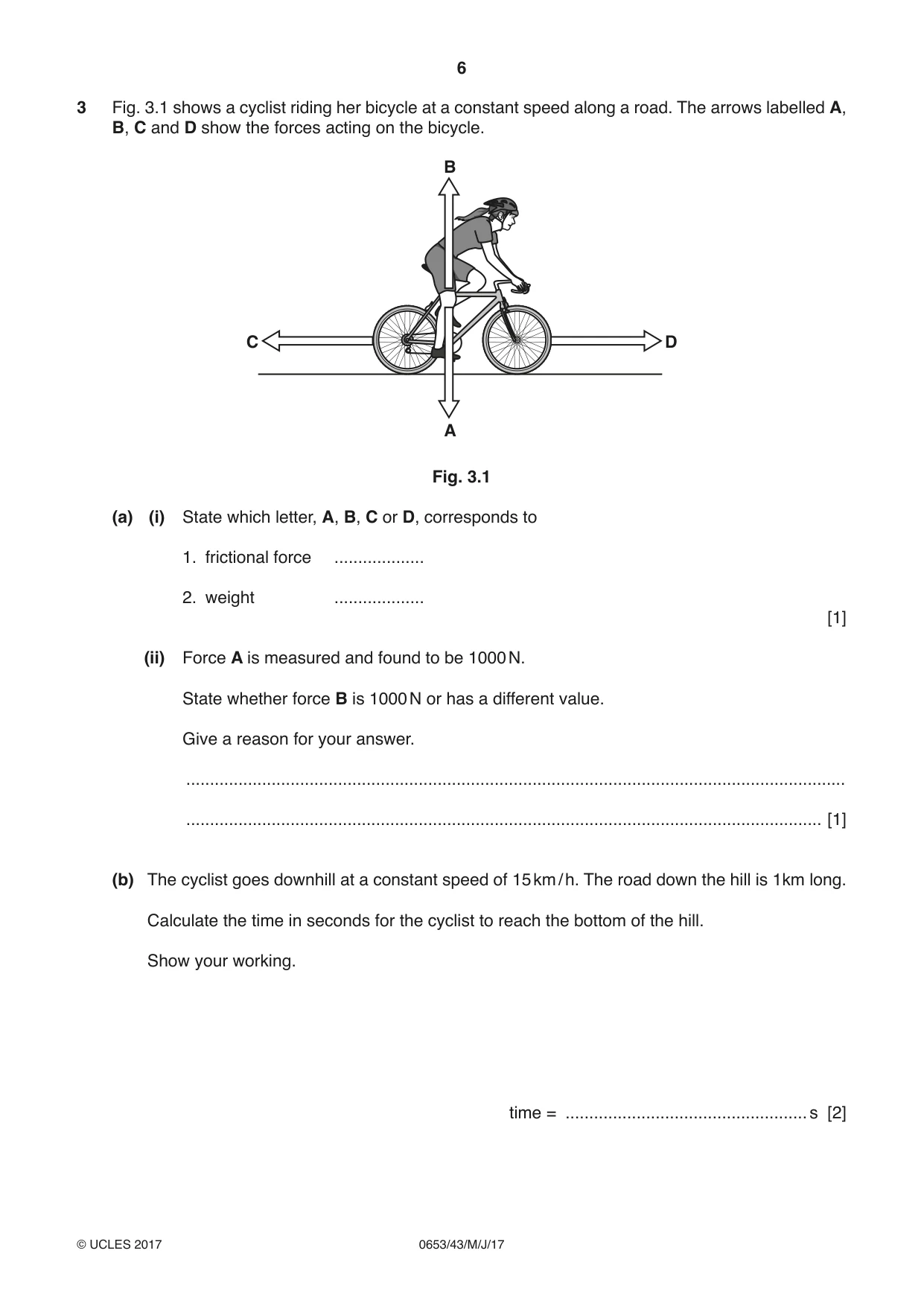
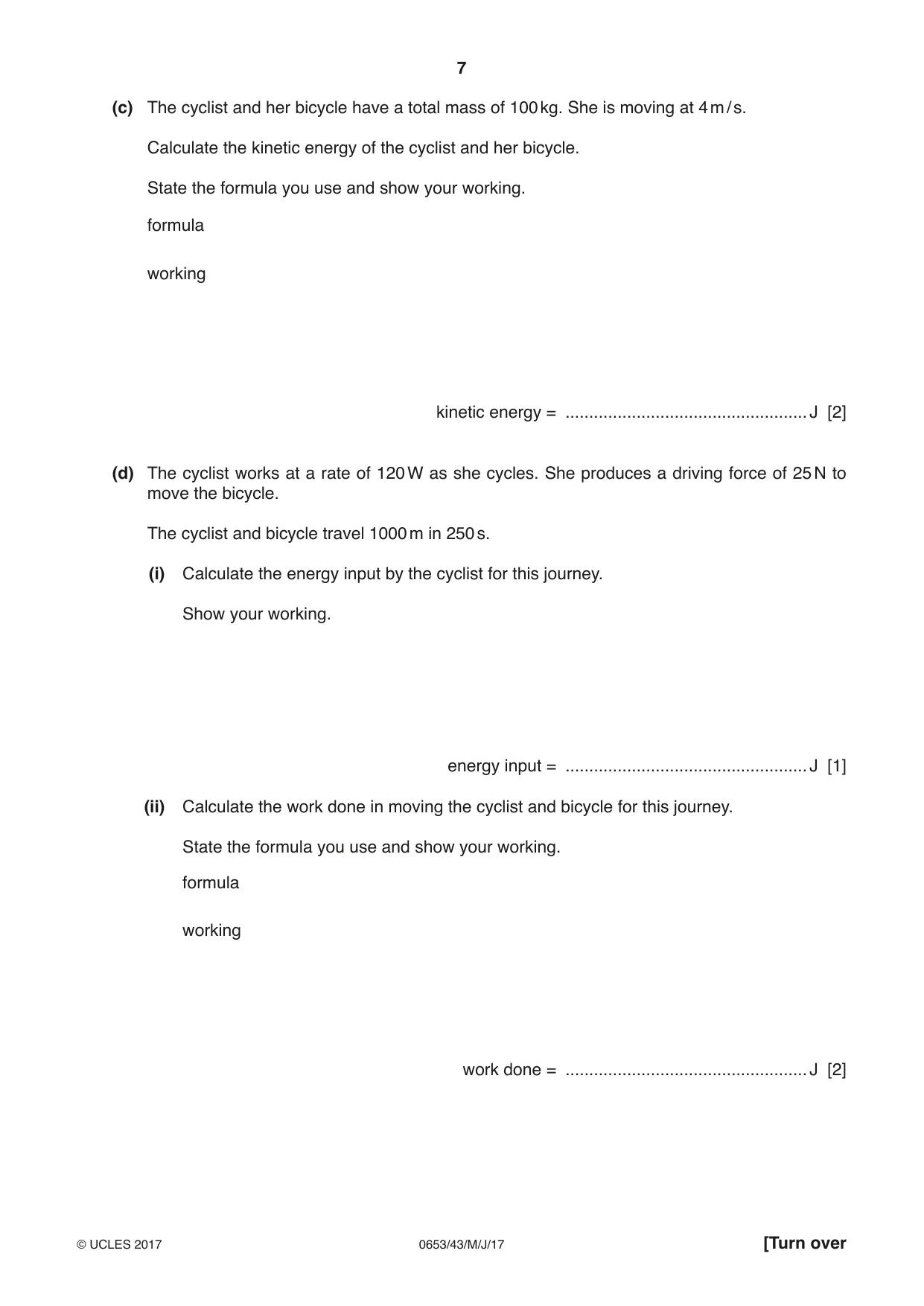
3 Fig. 3.1 shows a cyclist riding her bicycle at a constant speed along a road. The arrows labelled A, B, C and D show the forces acting on the bicycle. B C D A Fig. 3.1 (a) (i) State which letter, A, B, C or D, corresponds to 1. frictional force ................... 2. weight ................... [1] (ii) Force A is measured and found to be 1000 N. State whether force B is 1000 N or has a different value. Give a reason for your answer. ........................................................................................................................................... ...................................................................................................................................... [1] (b) The cyclist goes downhill at a constant speed of 15 km / h. The road down the hill is 1 km long. Calculate the time in seconds for the cyclist to reach the bottom of the hill. Show your working. time = ................................................... s [2] (c) The cyclist and her bicycle have a total mass of 100 kg. She is moving at 4 m / s. Calculate the kinetic energy of the cyclist and her bicycle. State the formula you use and show your working. formula working kinetic energy = ................................................... J [2] (d) The cyclist works at a rate of 120 W as she cycles. She produces a driving force of 25 N to move the bicycle. The cyclist and bicycle travel 1000 m in 250 s. (i) Calculate the energy input by the cyclist for this journey. Show your working. energy input = ................................................... J [1] (ii) Calculate the work done in moving the cyclist and bicycle for this journey. State the formula you use and show your working. formula working work done = ................................................... J [2] (iii) Calculate the percentage efficiency of the bicycle. State the formula you use and show your working. formula working efficiency = ...................................................% [2] Please turn over for Question 4
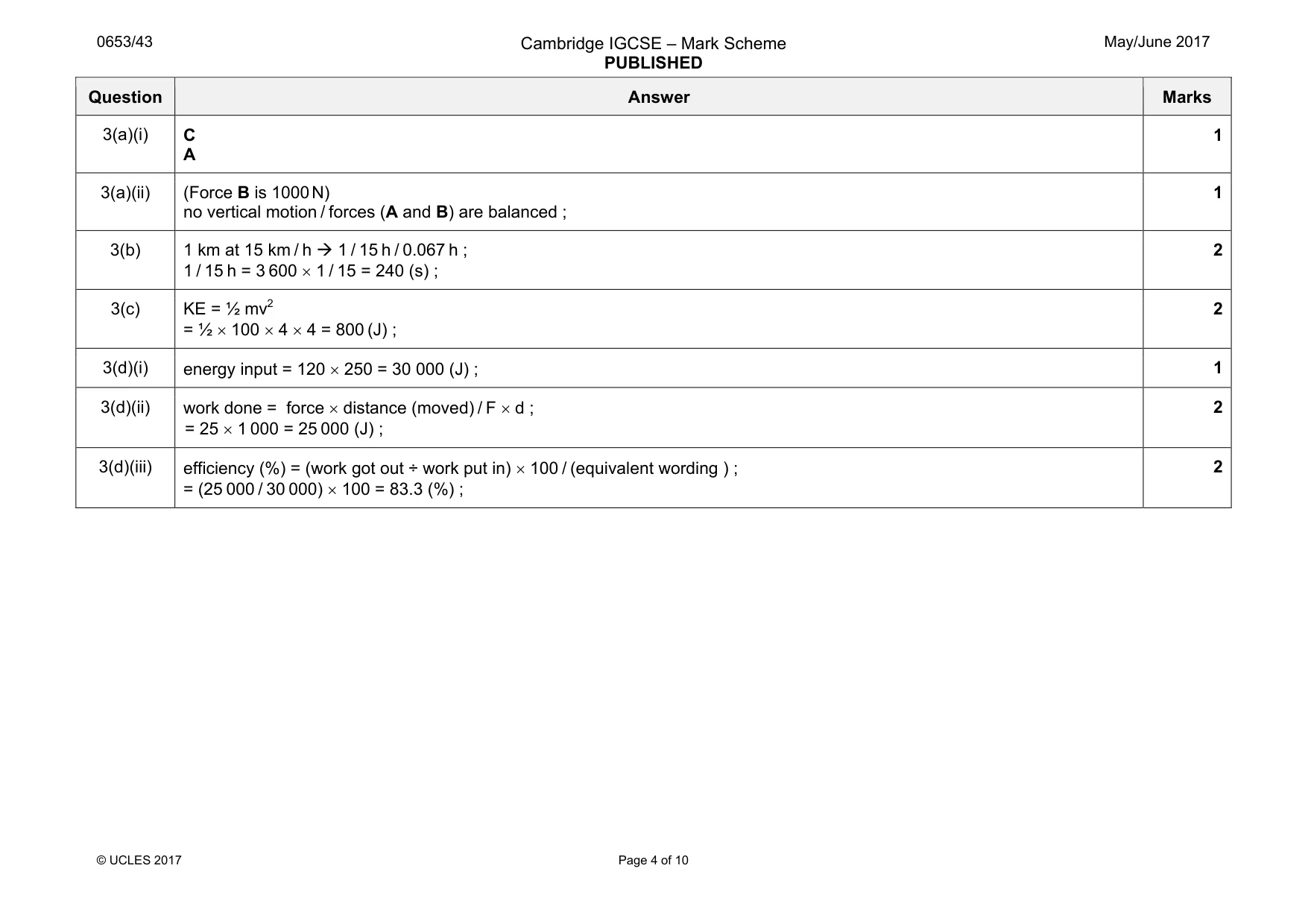
Mark scheme: 3(a)(i) C A 1 3(a)(ii) (Force B is 1000 N) no vertical motion / forces (A and B) are balanced ; 1 3(b) 1 km at 15 km / h Æ 1 / 15 h / 0.067 h ; 1 / 15 h = 3 600 × 1 / 15 = 240 (s) ; 2 3(c) KE = ½ mv2 = ½ × 100 × 4 × 4 = 800 (J) ; 2 3(d)(i) energy input = 120 × 250 = 30 000 (J) ; 1 3(d)(ii) work done = force × distance (moved) / F × d ; = 25 × 1 000 = 25 000 (J) ; 2 3(d)(iii) efficiency (%) = (work got out ÷ work put in) × 100 / (equivalent wording ) ; = (25 000 / 30 000) × 100 = 83.3 (%) ; 2
Q4 · What happens to a seed after it is planted
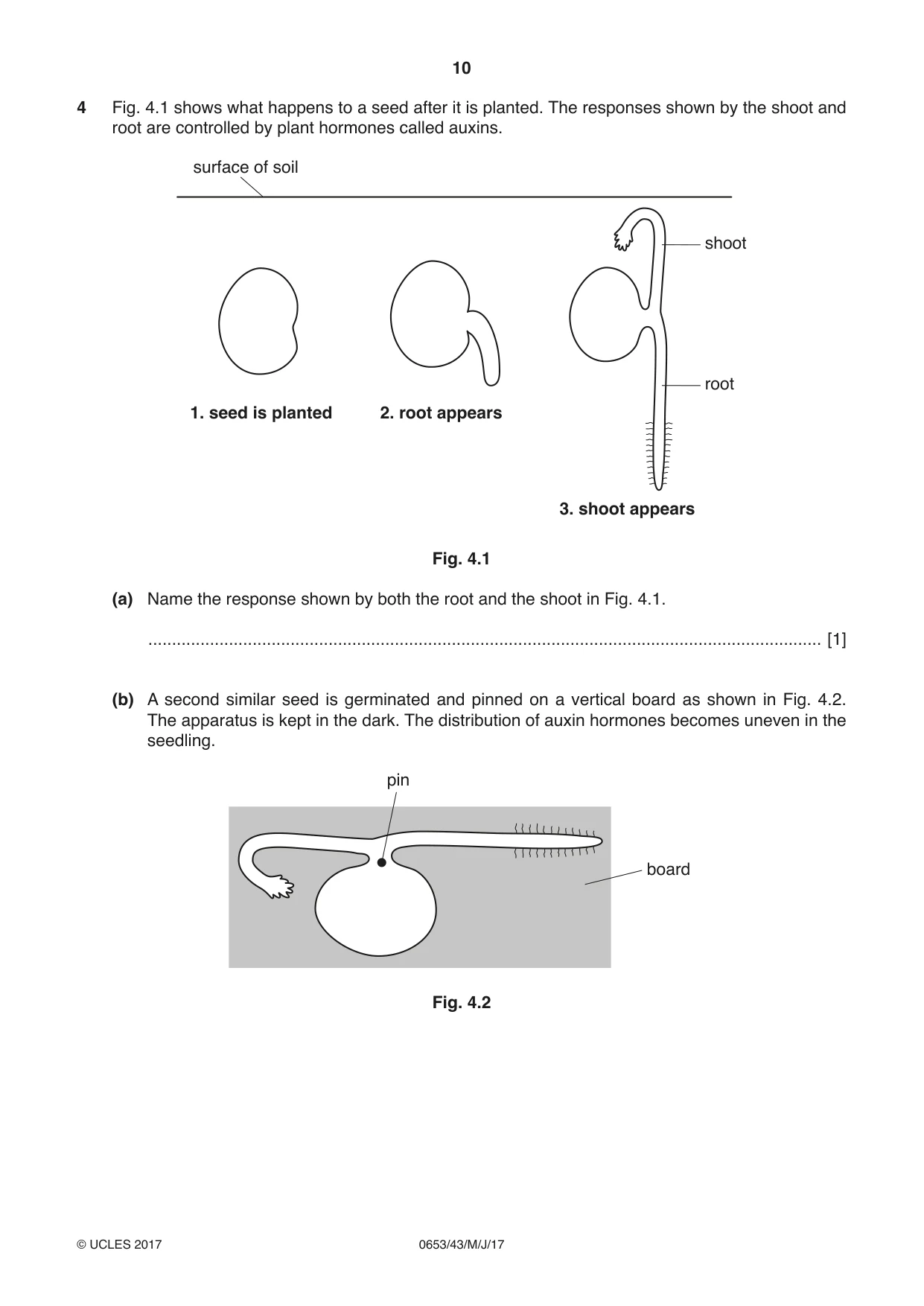
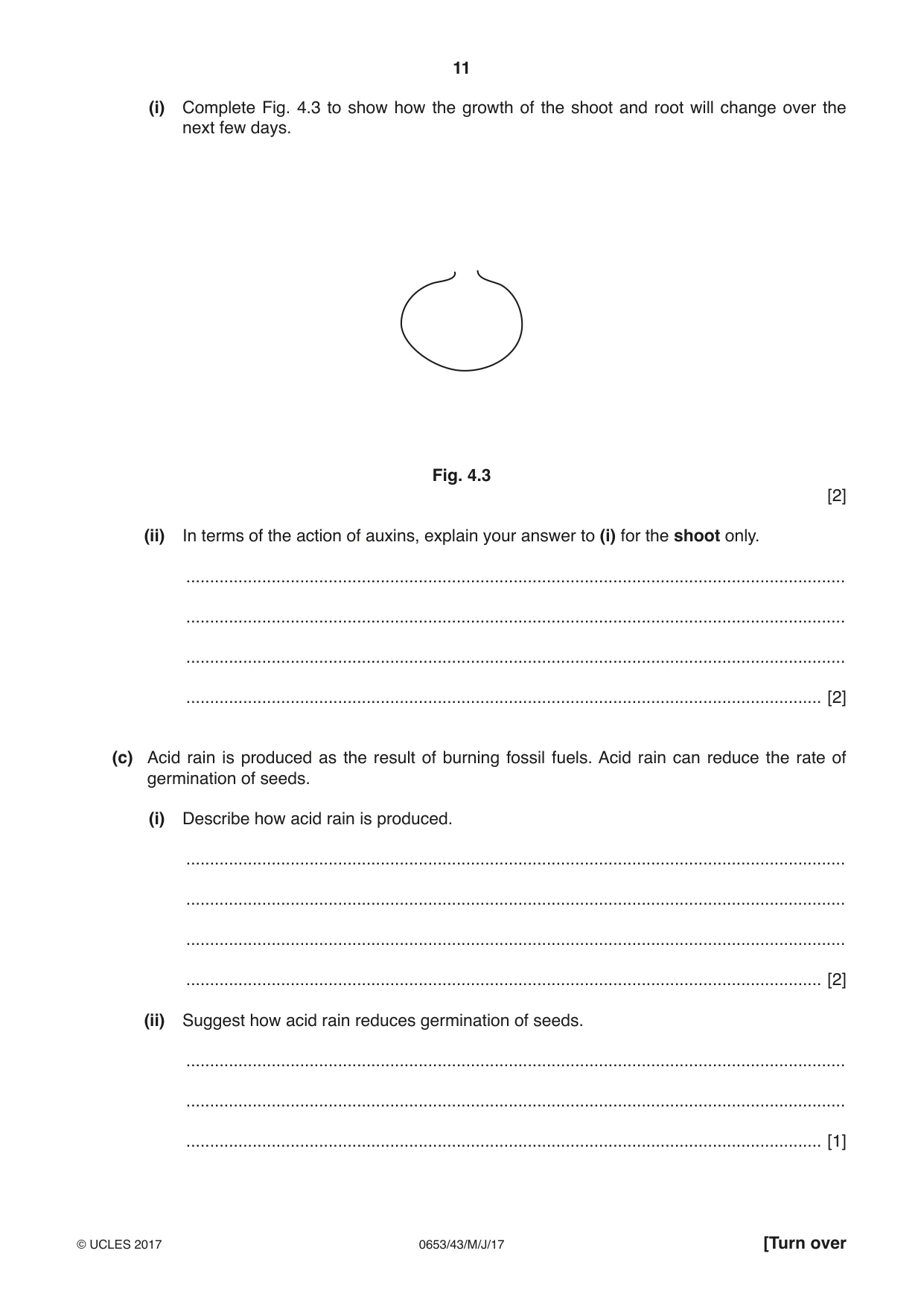
4 Fig. 4.1 shows what happens to a seed after it is planted. The responses shown by the shoot and root are controlled by plant hormones called auxins. surface of soil shoot root 1. seed is planted 2. root appears 3. shoot appears Fig. 4.1 (a) Name the response shown by both the root and the shoot in Fig. 4.1. .............................................................................................................................................. [1] (b) A second similar seed is germinated and pinned on a vertical board as shown in Fig. 4.2. The apparatus is kept in the dark. The distribution of auxin hormones becomes uneven in the seedling. pin board Fig. 4.2 (i) Complete Fig. 4.3 to show how the growth of the shoot and root will change over the next few days. Fig. 4.3 [2] (ii) In terms of the action of auxins, explain your answer to (i) for the shoot only. ........................................................................................................................................... ........................................................................................................................................... ........................................................................................................................................... ...................................................................................................................................... [2] (c) Acid rain is produced as the result of burning fossil fuels. Acid rain can reduce the rate of germination of seeds. (i) Describe how acid rain is produced. ........................................................................................................................................... ........................................................................................................................................... ........................................................................................................................................... ...................................................................................................................................... [2] (ii) Suggest how acid rain reduces germination of seeds. ........................................................................................................................................... ........................................................................................................................................... ...................................................................................................................................... [1]
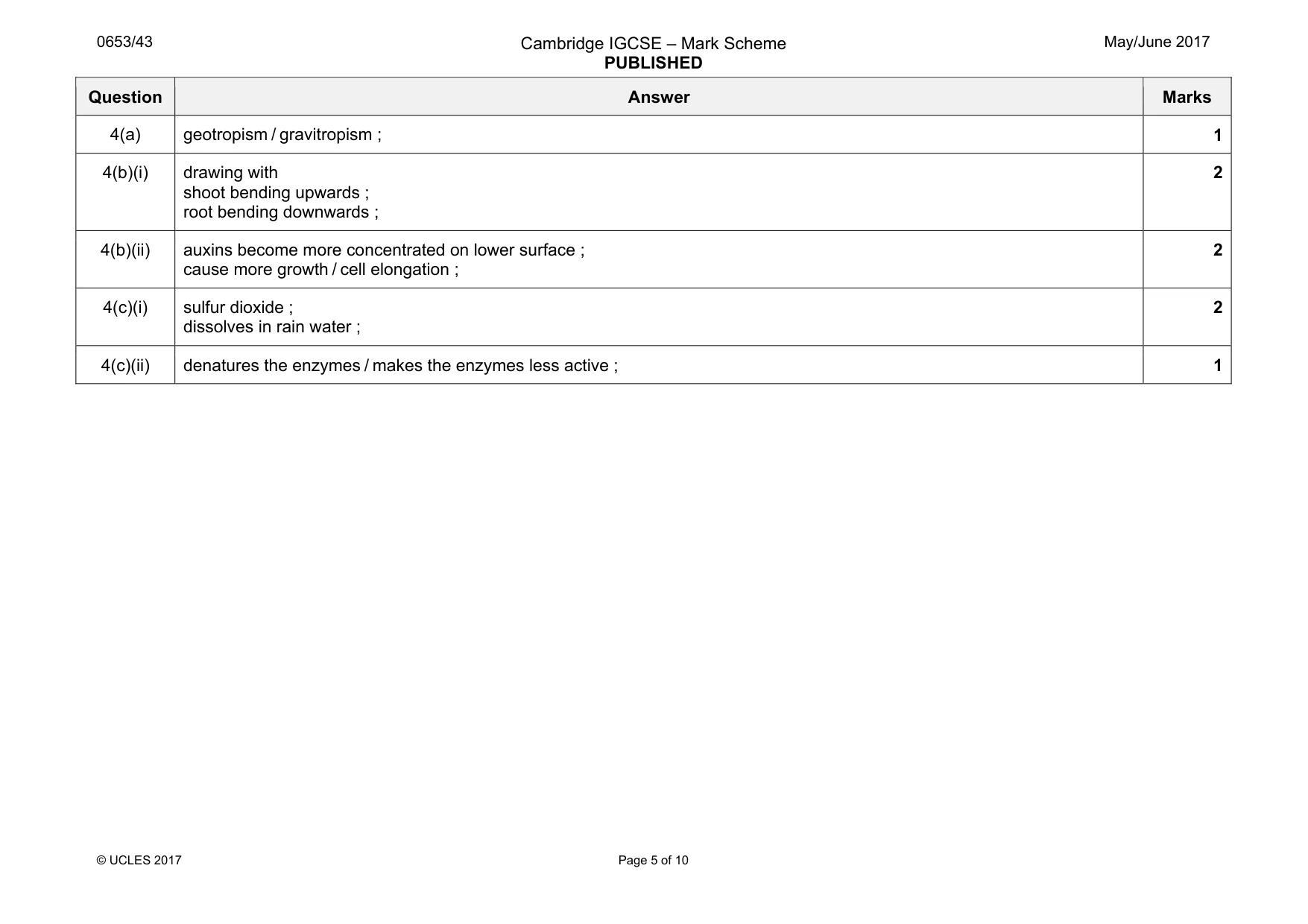
Mark scheme: 4(a) geotropism / gravitropism ; 1 4(b)(i) drawing with shoot bending upwards ; root bending downwards ; 2 4(b)(ii) auxins become more concentrated on lower surface ; cause more growth / cell elongation ; 2 4(c)(i) sulfur dioxide ; dissolves in rain water ; 2 4(c)(ii) denatures the enzymes / makes the enzymes less active ; 1
Q5 · The atomic number of magnesium is 12
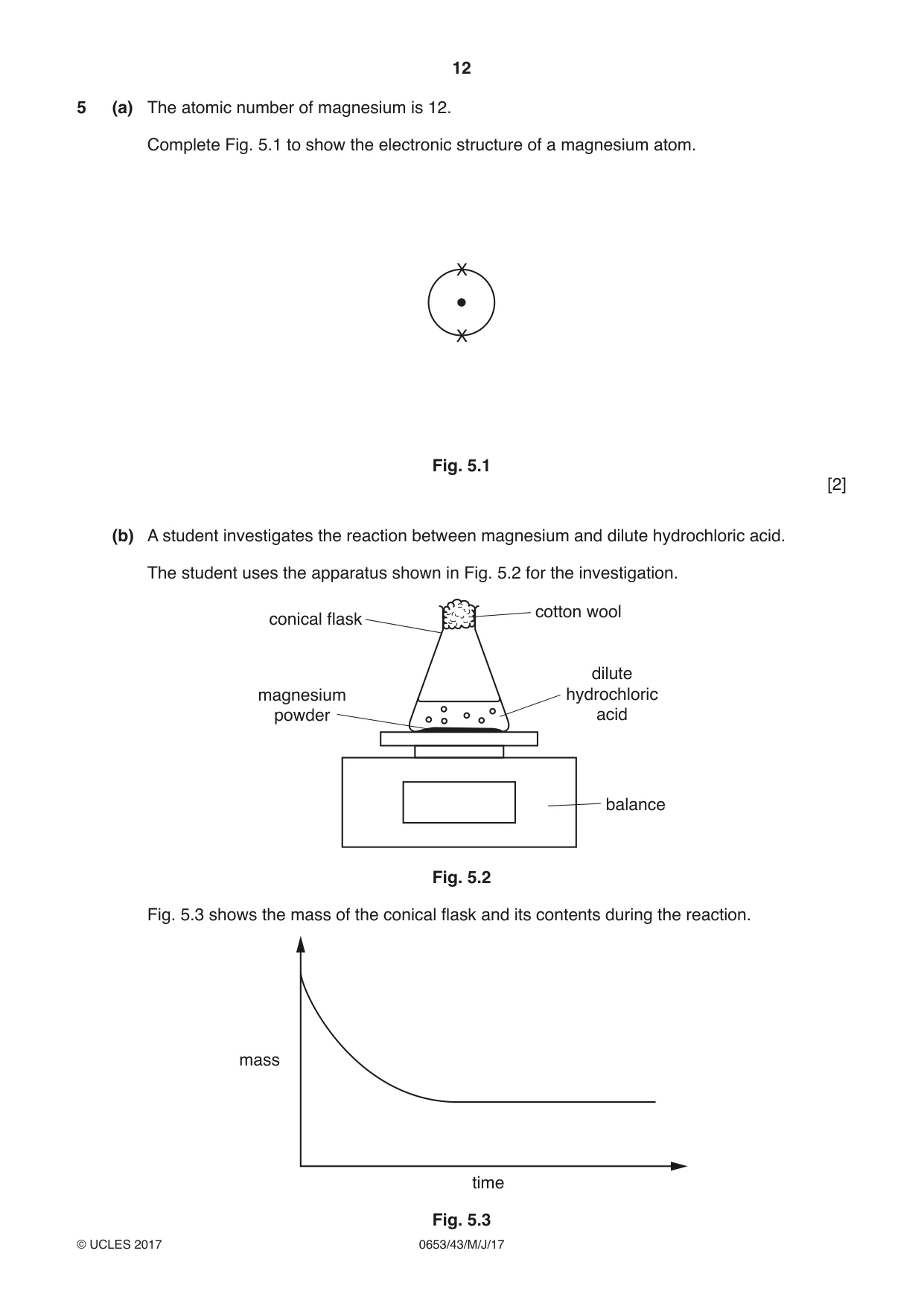
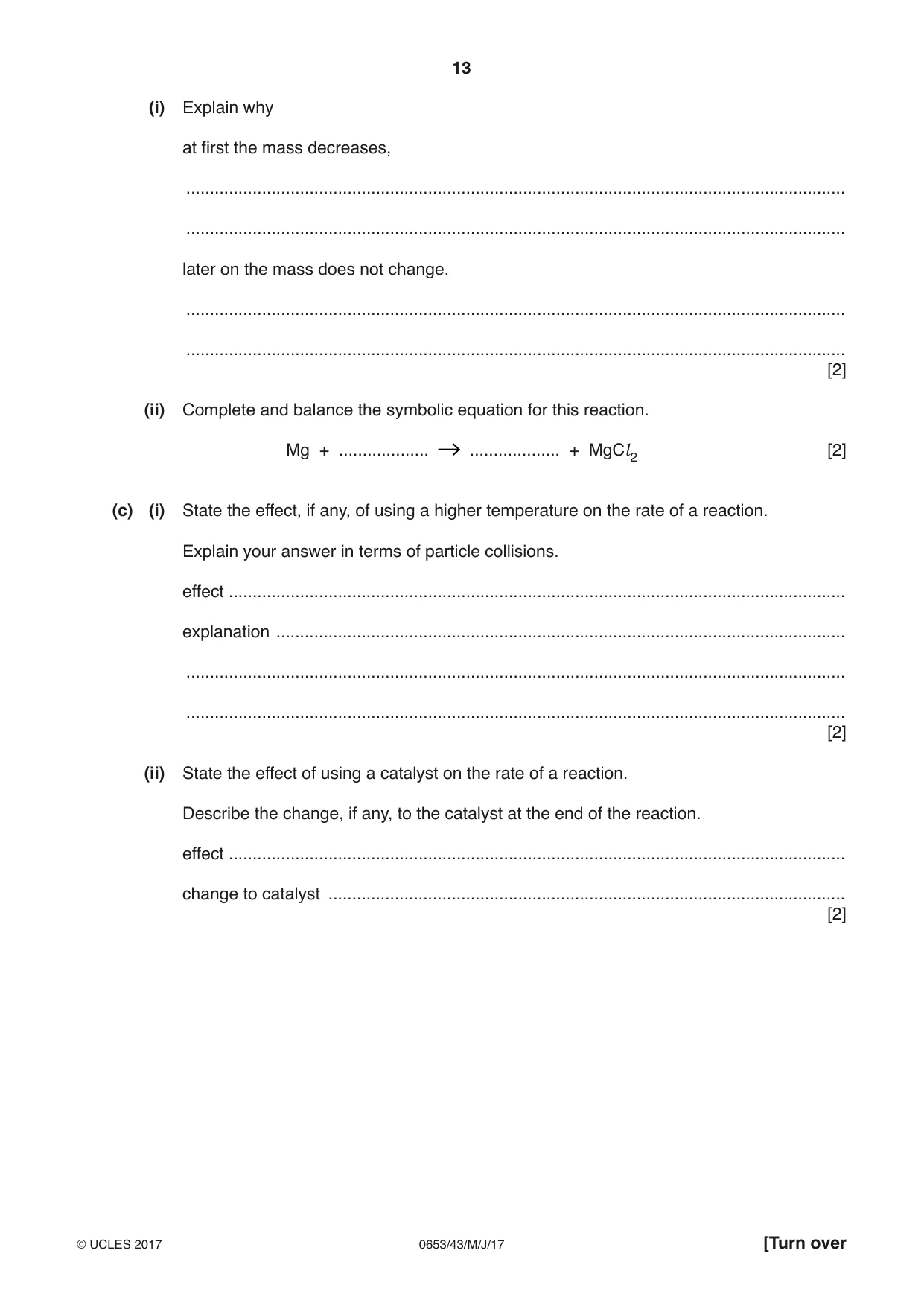
5 (a) The atomic number of magnesium is 12. Complete Fig. 5.1 to show the electronic structure of a magnesium atom. X X Fig. 5.1 [2] (b) A student investigates the reaction between magnesium and dilute hydrochloric acid. The student uses the apparatus shown in Fig. 5.2 for the investigation. cotton wool conical flask dilute magnesium hydrochloric powder acid balance Fig. 5.2 Fig. 5.3 shows the mass of the conical flask and its contents during the reaction. mass time Fig. 5.3 (i) Explain why at first the mass decreases, ........................................................................................................................................... ........................................................................................................................................... later on the mass does not change. ........................................................................................................................................... ........................................................................................................................................... [2] (ii) Complete and balance the symbolic equation for this reaction. Mg + ................... ................... + MgCl2 [2] (c) (i) State the effect, if any, of using a higher temperature on the rate of a reaction. Explain your answer in terms of particle collisions. effect .................................................................................................................................. explanation ........................................................................................................................ ........................................................................................................................................... ........................................................................................................................................... [2] (ii) State the effect of using a catalyst on the rate of a reaction. Describe the change, if any, to the catalyst at the end of the reaction. effect .................................................................................................................................. change to catalyst ............................................................................................................. [2]
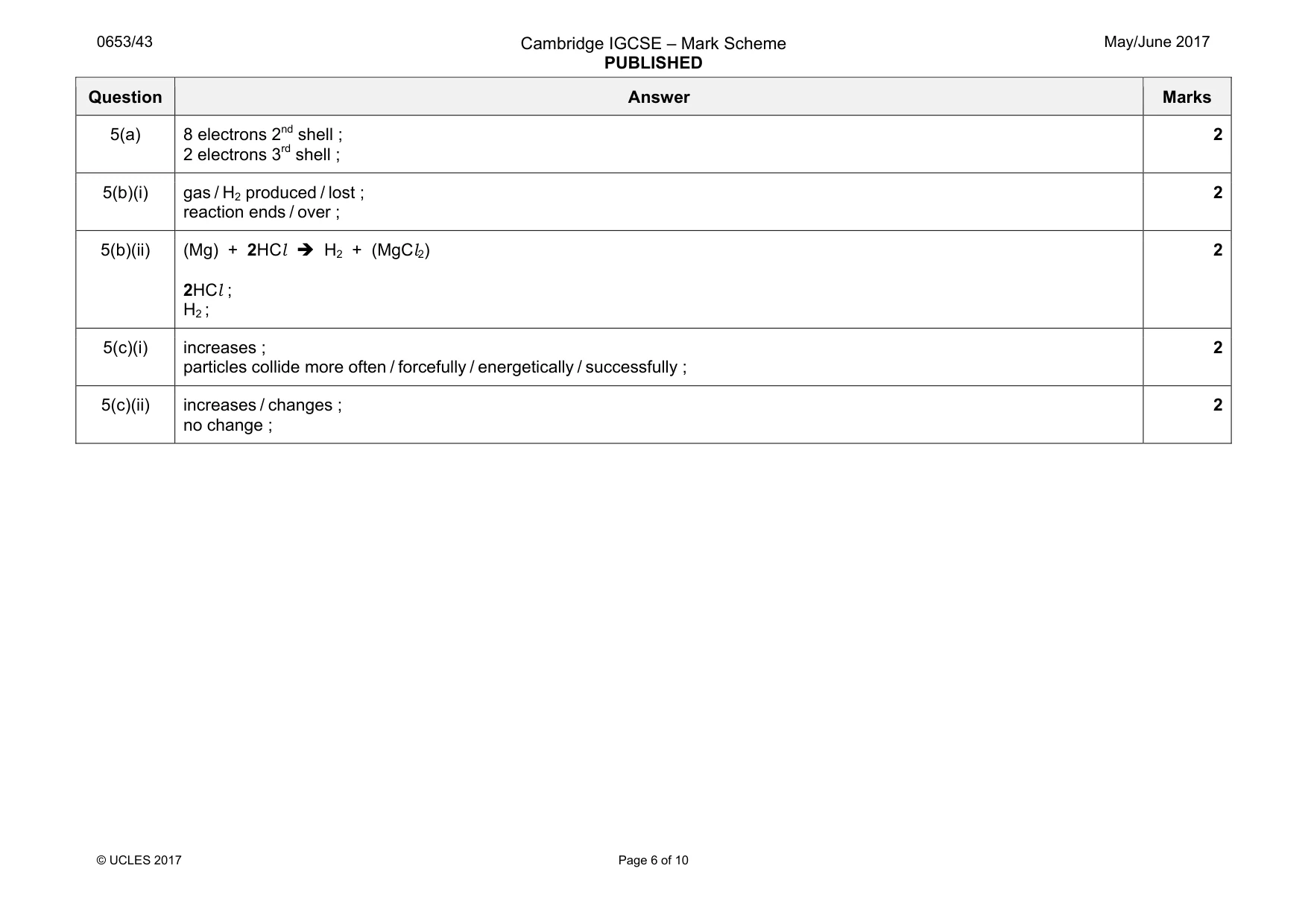
Mark scheme: 5(a) 2 electrons 3rd shell ; 2 5(b)(i) gas / H2 produced / lost ; reaction ends / over ; 2 5(b)(ii) (Mg) + 2HCl Î H2 + (MgCl2) 2HCl ; H2 ; 2 5(c)(i) increases ; particles collide more often / forcefully / energetically / successfully ; 2 5(c)(ii) increases / changes ; no change ; 2
Q6 · A man riding a snowmobile across snow and ice at a research station in Antarctica
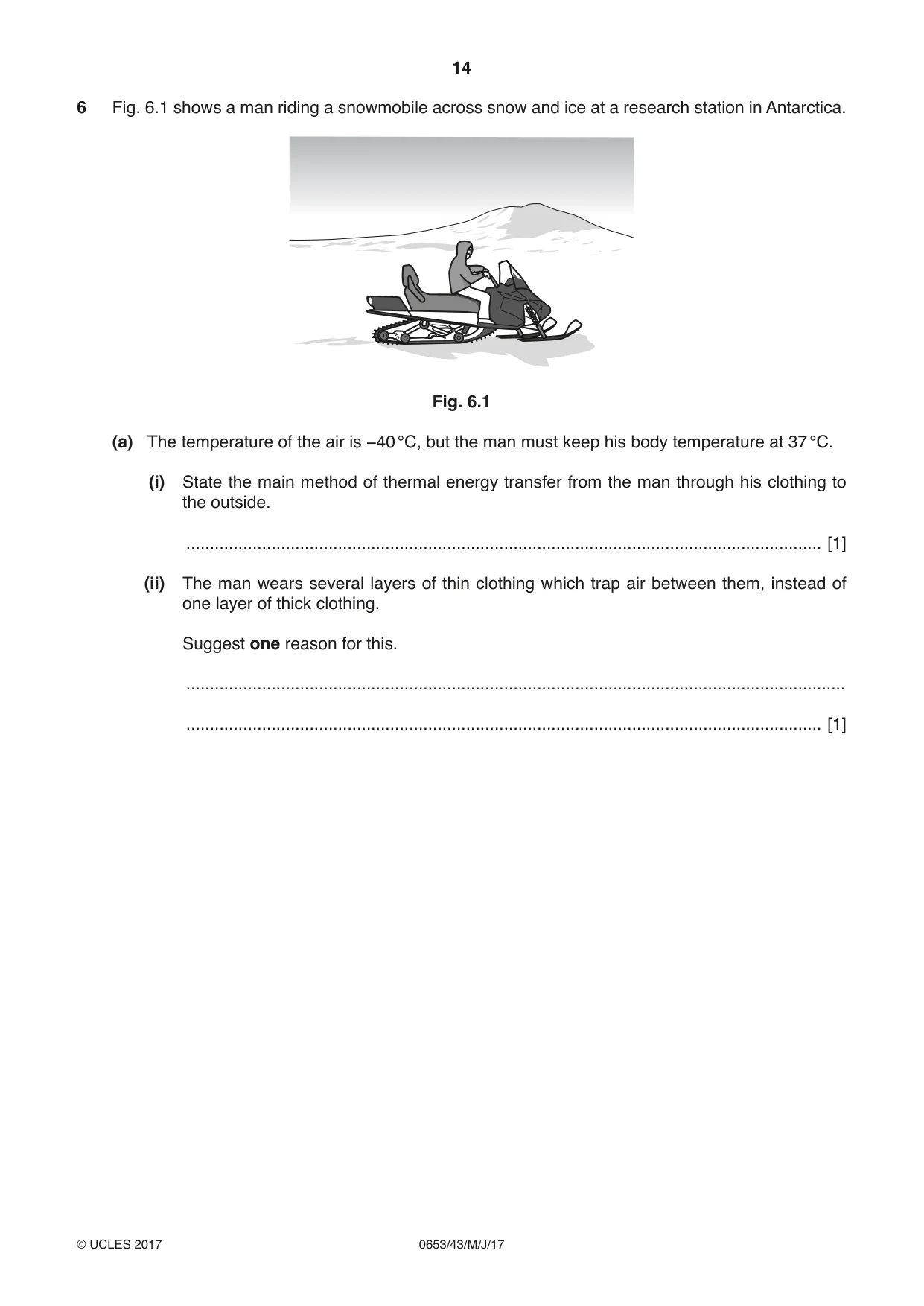
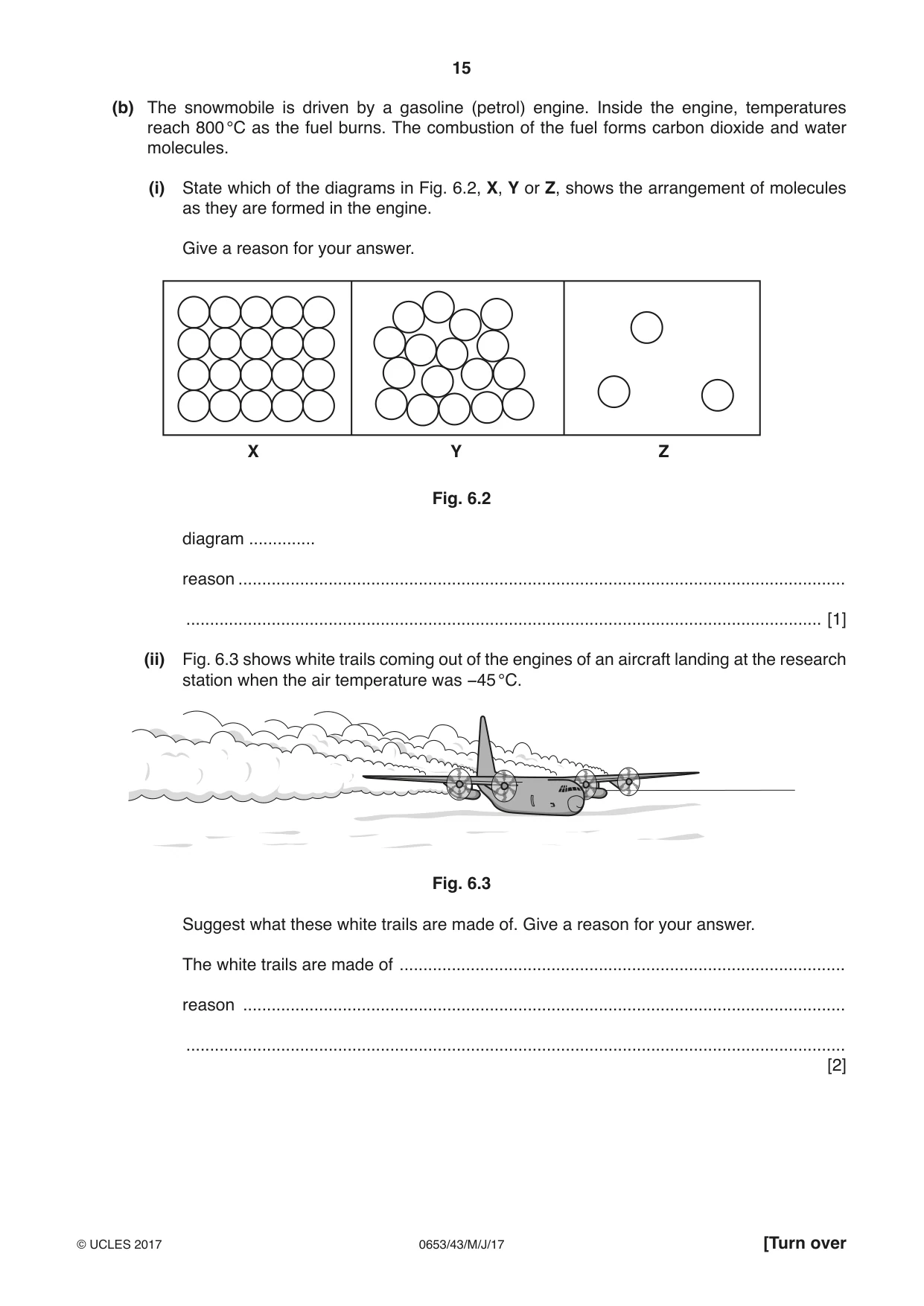
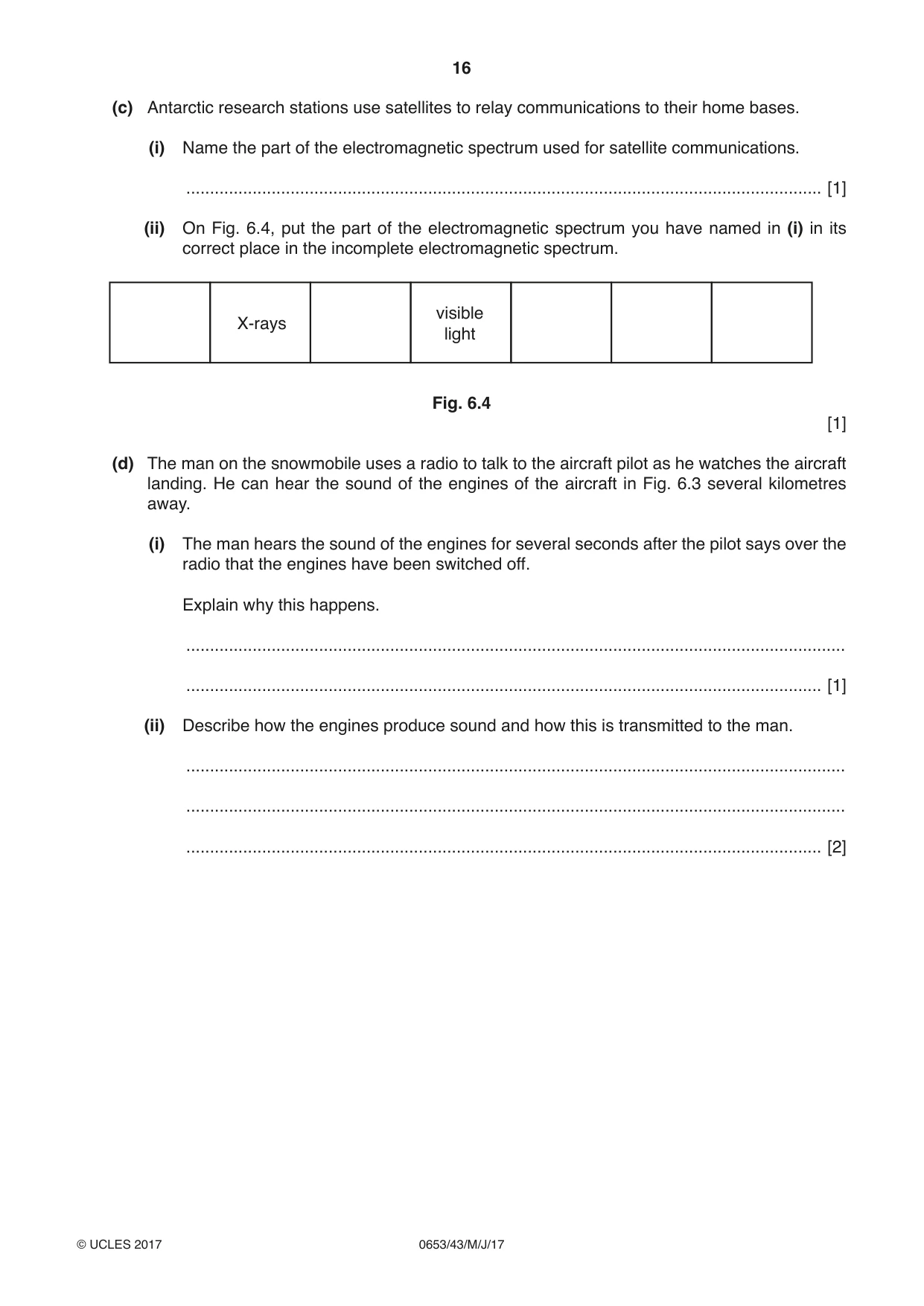
6 Fig. 6.1 shows a man riding a snowmobile across snow and ice at a research station in Antarctica. Fig. 6.1 (a) The temperature of the air is −40 °C, but the man must keep his body temperature at 37 °C. (i) State the main method of thermal energy transfer from the man through his clothing to the outside. ...................................................................................................................................... [1] (ii) The man wears several layers of thin clothing which trap air between them, instead of one layer of thick clothing. Suggest one reason for this. ........................................................................................................................................... ...................................................................................................................................... [1] (b) The snowmobile is driven by a gasoline (petrol) engine. Inside the engine, temperatures reach 800 °C as the fuel burns. The combustion of the fuel forms carbon dioxide and water molecules. (i) State which of the diagrams in Fig. 6.2, X, Y or Z, shows the arrangement of molecules as they are formed in the engine. Give a reason for your answer. X Y Z Fig. 6.2 diagram .............. reason ................................................................................................................................ ...................................................................................................................................... [1] (ii) Fig. 6.3 shows white trails coming out of the engines of an aircraft landing at the research station when the air temperature was −45 °C. Fig. 6.3 Suggest what these white trails are made of. Give a reason for your answer. The white trails are made of .............................................................................................. reason ............................................................................................................................... ........................................................................................................................................... [2] (c) Antarctic research stations use satellites to relay communications to their home bases. (i) Name the part of the electromagnetic spectrum used for satellite communications. ...................................................................................................................................... [1] (ii) On Fig. 6.4, put the part of the electromagnetic spectrum you have named in (i) in its correct place in the incomplete electromagnetic spectrum. visible X-rays light Fig. 6.4 [1] (d) The man on the snowmobile uses a radio to talk to the aircraft pilot as he watches the aircraft landing. He can hear the sound of the engines of the aircraft in Fig. 6.3 several kilometres away. (i) The man hears the sound of the engines for several seconds after the pilot says over the radio that the engines have been switched off. Explain why this happens. ........................................................................................................................................... ...................................................................................................................................... [1] (ii) Describe how the engines produce sound and how this is transmitted to the man. ........................................................................................................................................... ........................................................................................................................................... ...................................................................................................................................... [2] Please turn over for Question 7
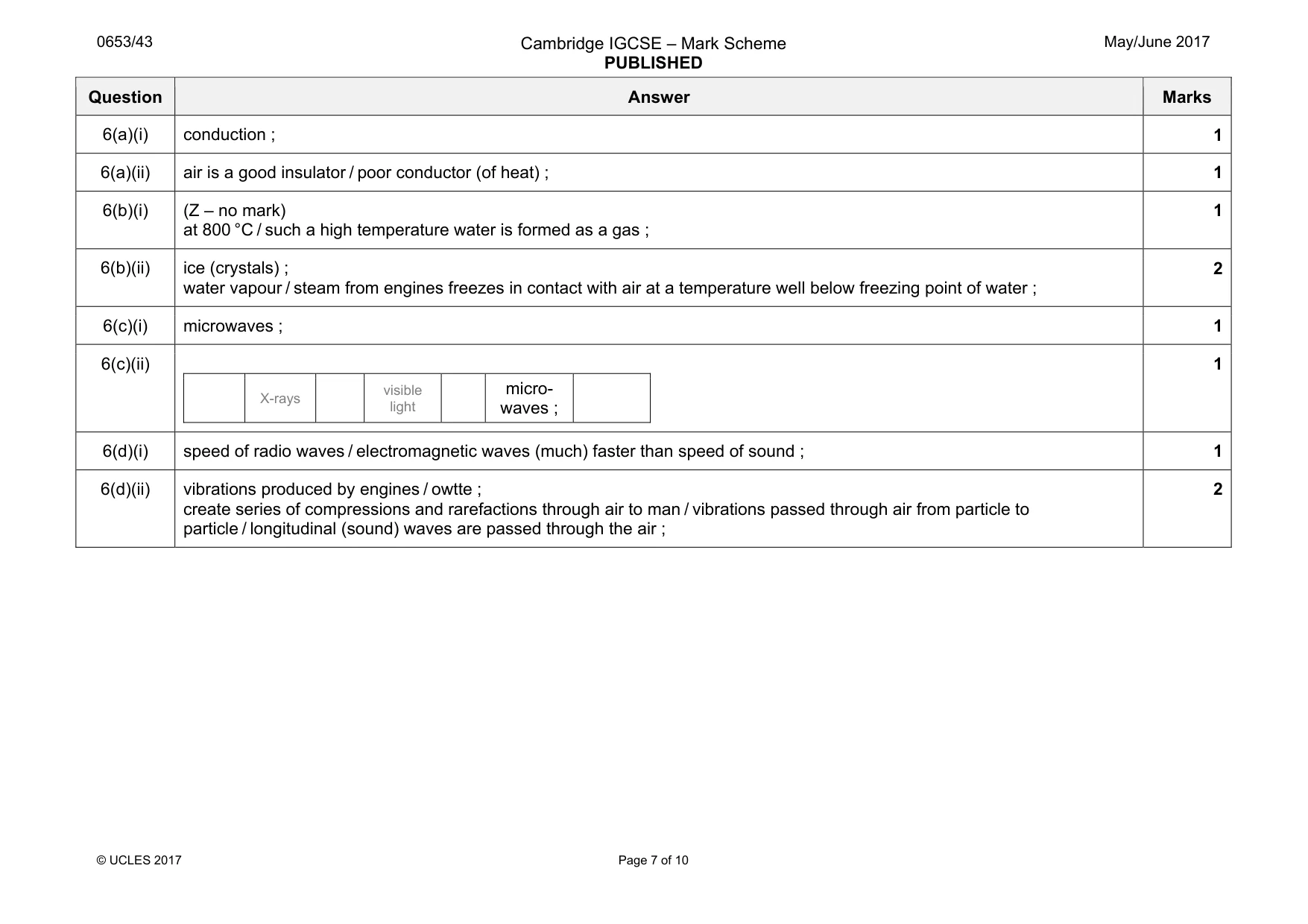
Mark scheme: 6(a)(i) conduction ; 1 6(a)(ii) air is a good insulator / poor conductor (of heat) ; 1 6(b)(i) (Z – no mark) at 800 °C / such a high temperature water is formed as a gas ; 1 6(b)(ii) ice (crystals) ; water vapour / steam from engines freezes in contact with air at a temperature well below freezing point of water ; 2 6(c)(i) microwaves ; 1 6(c)(ii) X-rays visible light micro- waves ; 1 6(d)(i) speed of radio waves / electromagnetic waves (much) faster than speed of sound ; 1 6(d)(ii) vibrations produced by engines / owtte ; create series of compressions and rarefactions through air to man / vibrations passed through air from particle to particle / longitudinal (sound) waves are passed through the air ; 2
Q7 · A diagram of the cells in a cross section of a leaf
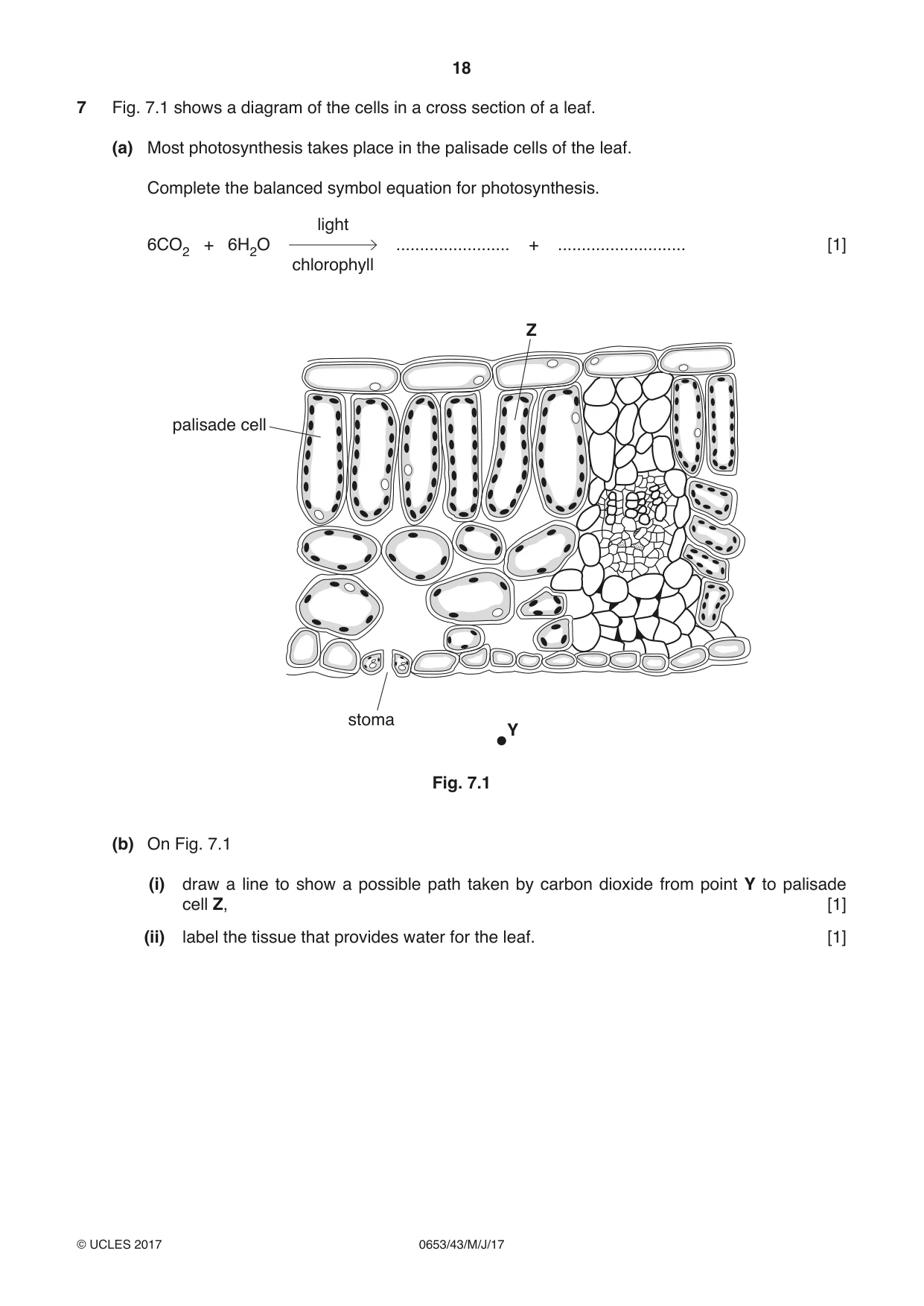
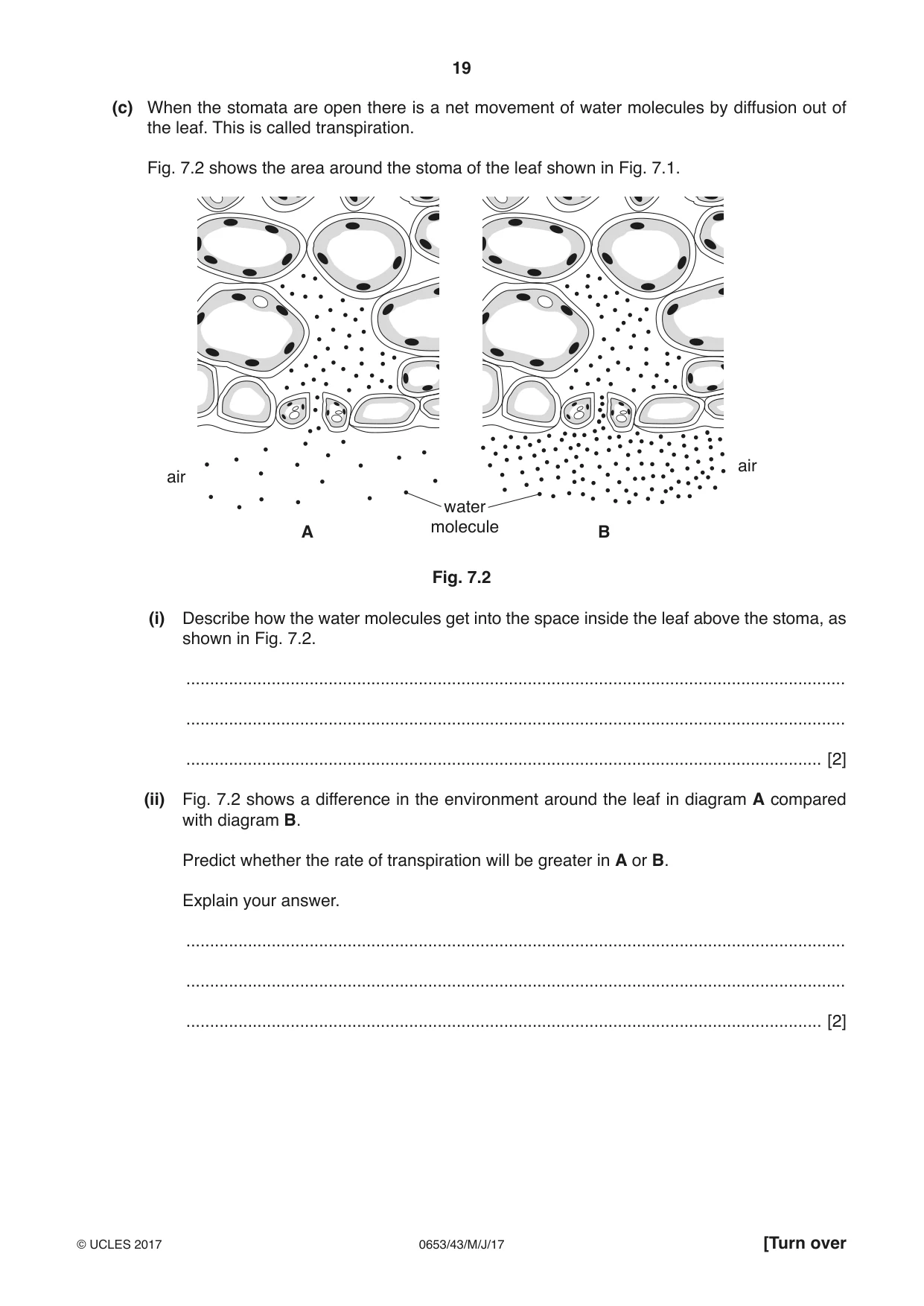
7 Fig. 7.1 shows a diagram of the cells in a cross section of a leaf. (a) Most photosynthesis takes place in the palisade cells of the leaf. Complete the balanced symbol equation for photosynthesis. light 6CO2 + 6H2O ........................ + ........................... [1] chlorophyll Z palisade cell stoma Y Fig. 7.1 (b) On Fig. 7.1 (i) draw a line to show a possible path taken by carbon dioxide from point Y to palisade cell Z, [1] (ii) label the tissue that provides water for the leaf. [1] (c) When the stomata are open there is a net movement of water molecules by diffusion out of the leaf. This is called transpiration. Fig. 7.2 shows the area around the stoma of the leaf shown in Fig. 7.1. air air water A molecule B Fig. 7.2 (i) Describe how the water molecules get into the space inside the leaf above the stoma, as shown in Fig. 7.2. ........................................................................................................................................... ........................................................................................................................................... ...................................................................................................................................... [2] (ii) Fig. 7.2 shows a difference in the environment around the leaf in diagram A compared with diagram B. Predict whether the rate of transpiration will be greater in A or B. Explain your answer. ........................................................................................................................................... ........................................................................................................................................... ...................................................................................................................................... [2]
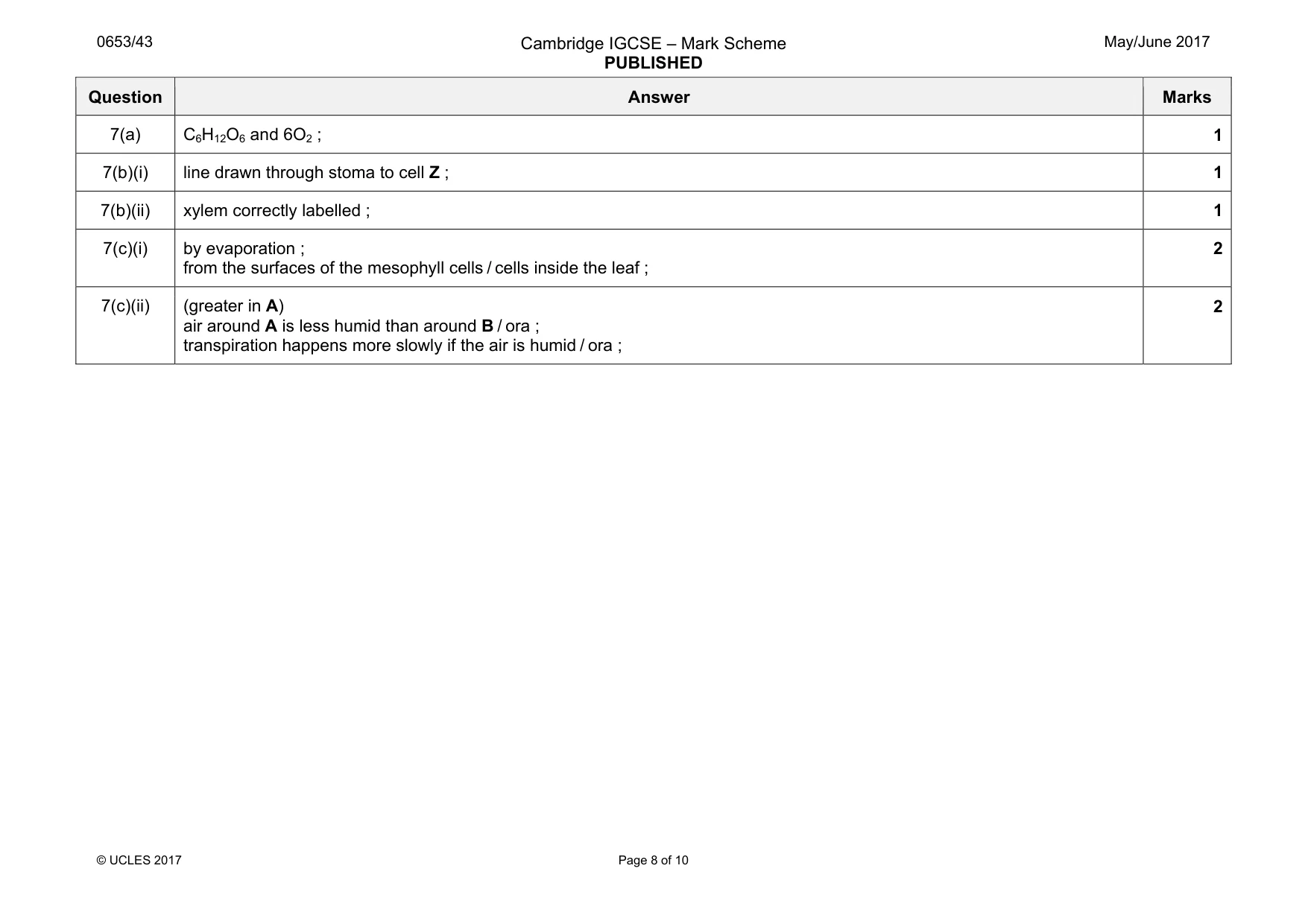
Mark scheme: 7(a) C6H12O6 and 6O2 ; 1 7(b)(i) line drawn through stoma to cell Z ; 1 7(b)(ii) xylem correctly labelled ; 1 7(c)(i) by evaporation ; from the surfaces of the mesophyll cells / cells inside the leaf ; 2 7(c)(ii) (greater in A) air around A is less humid than around B / ora ; transpiration happens more slowly if the air is humid / ora ; 2
Q8 · The melting points of the first four Group I metals are shown in Table 8.1
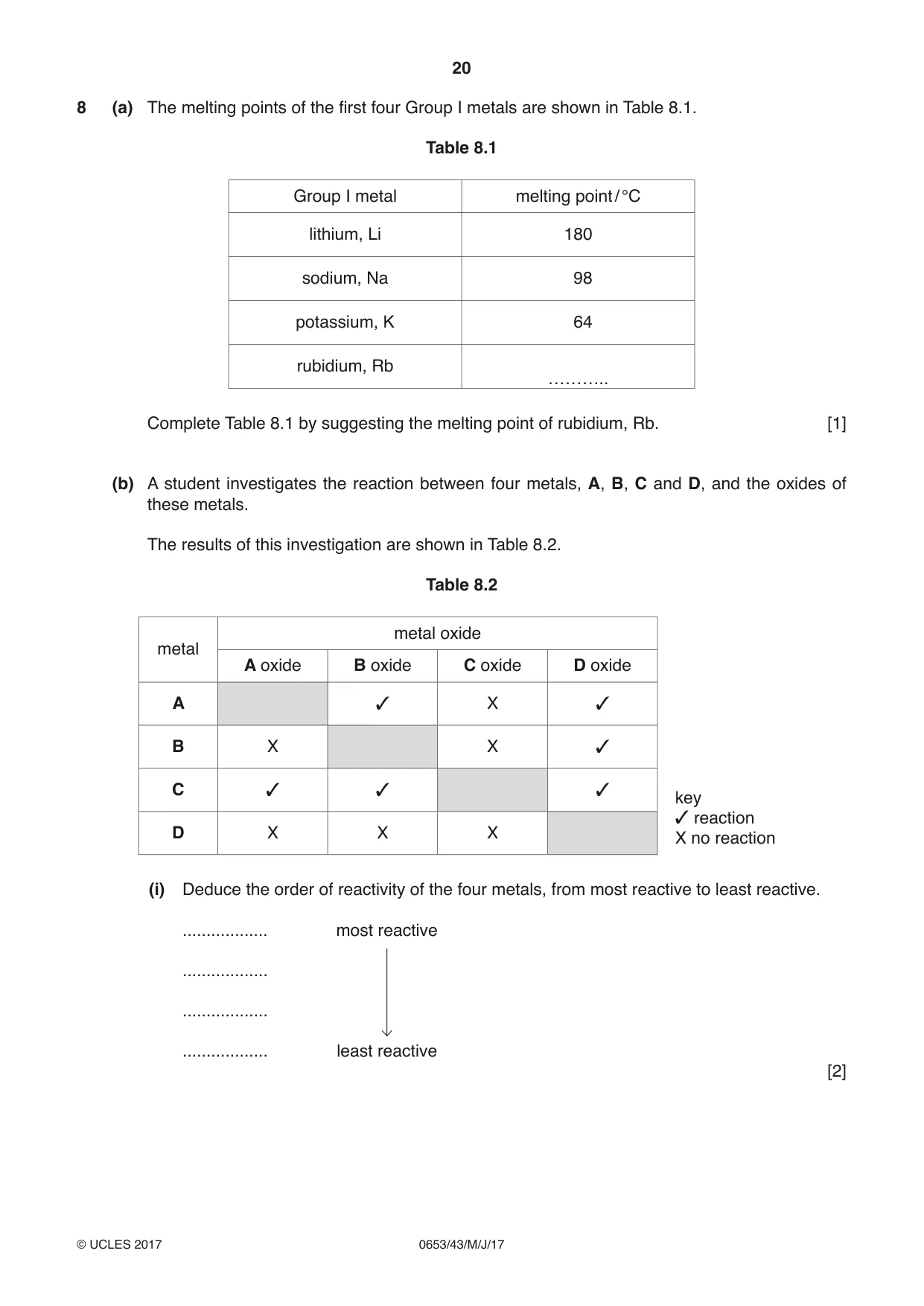
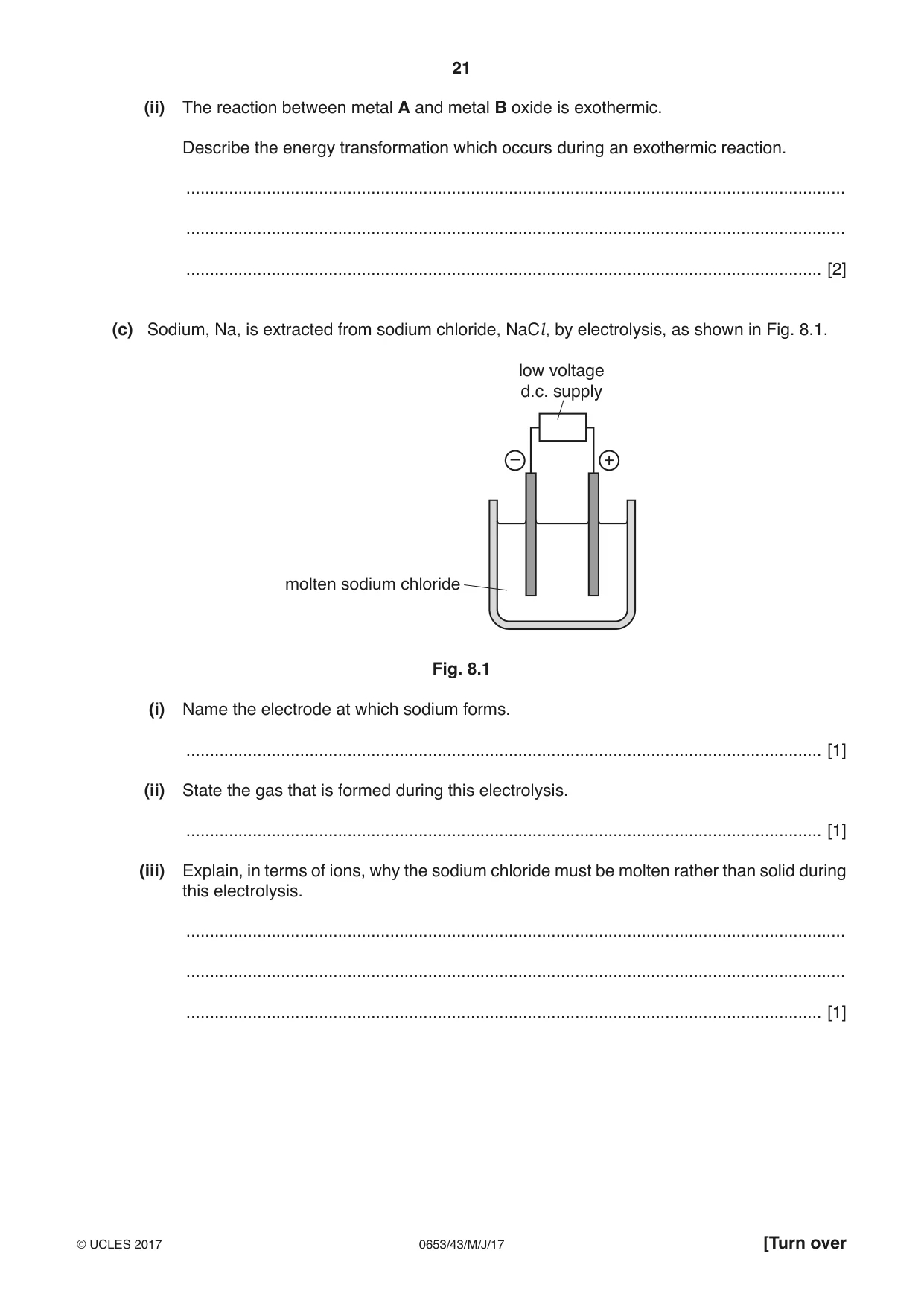
8 (a) The melting points of the first four Group I metals are shown in Table 8.1. Table 8.1 Group I metal melting point / °C lithium, Li 180 sodium, Na 98 potassium, K 64 rubidium, Rb ……….. Complete Table 8.1 by suggesting the melting point of rubidium, Rb. [1] (b) A student investigates the reaction between four metals, A, B, C and D, and the oxides of these metals. The results of this investigation are shown in Table 8.2. Table 8.2 metal oxide metal A oxide B oxide C oxide D oxide A ✓ X ✓ B X X ✓ C ✓ ✓ ✓ key ✓ reaction D X X X X no reaction (i) Deduce the order of reactivity of the four metals, from most reactive to least reactive. .................. most reactive .................. .................. .................. least reactive [2] (ii) The reaction between metal A and metal B oxide is exothermic. Describe the energy transformation which occurs during an exothermic reaction. ........................................................................................................................................... ........................................................................................................................................... ...................................................................................................................................... [2] (c) Sodium, Na, is extracted from sodium chloride, NaCl, by electrolysis, as shown in Fig. 8.1. low voltage d.c. supply – + molten sodium chloride Fig. 8.1 (i) Name the electrode at which sodium forms. ...................................................................................................................................... [1] (ii) State the gas that is formed during this electrolysis. ...................................................................................................................................... [1] (iii) Explain, in terms of ions, why the sodium chloride must be molten rather than solid during this electrolysis. ........................................................................................................................................... ........................................................................................................................................... ...................................................................................................................................... [1]
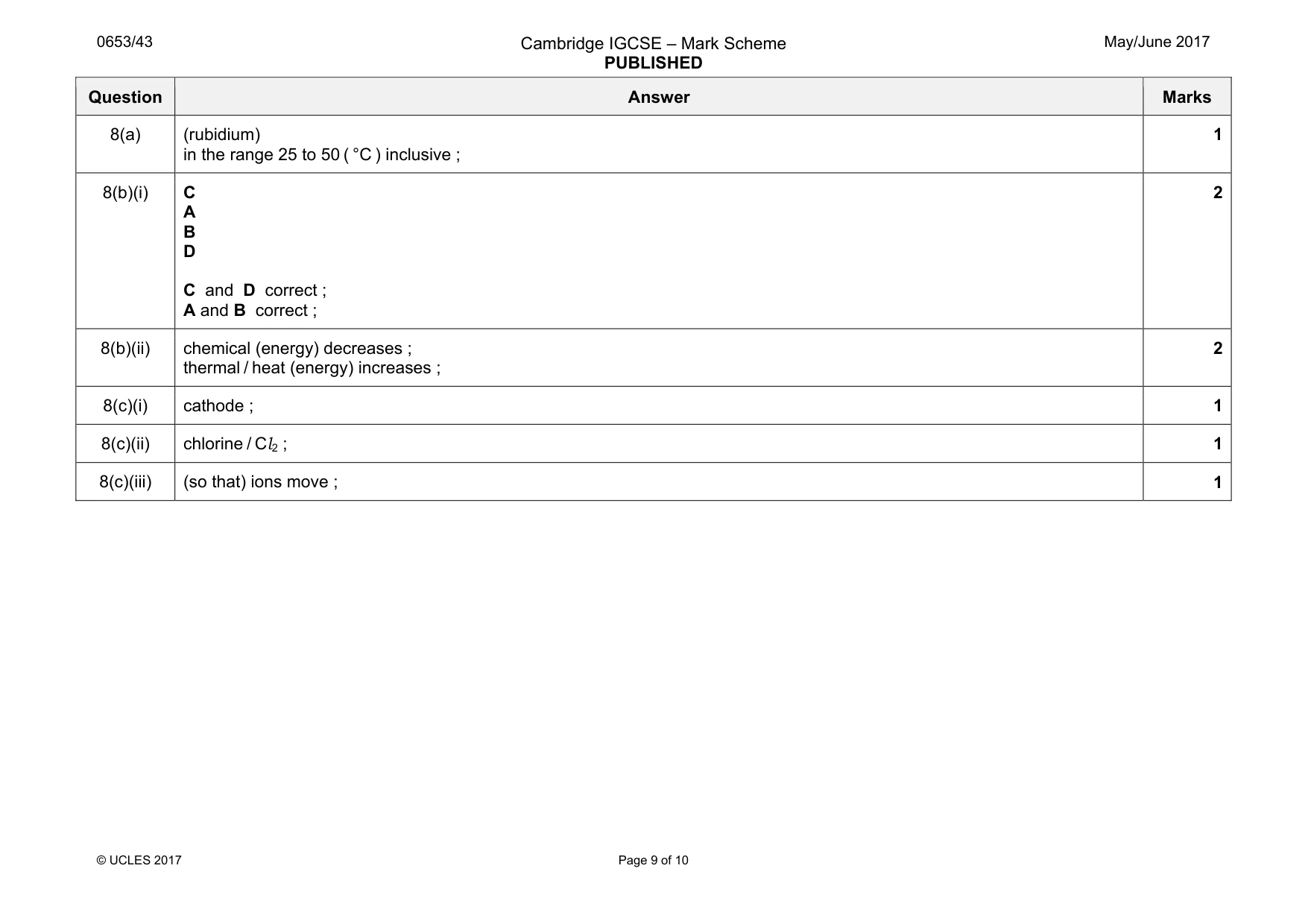
Mark scheme: 8(a) (rubidium) in the range 25 to 50 ( °C ) inclusive ; 1 8(b)(i) C A B D C and D correct ; A and B correct ; 2 8(b)(ii) chemical (energy) decreases ; thermal / heat (energy) increases ; 2 8(c)(i) cathode ; 1 8(c)(ii) chlorine / Cl2 ; 1 8(c)(iii) (so that) ions move ; 1
Q9 · A circuit set up to measure the current in different parts of a circuit
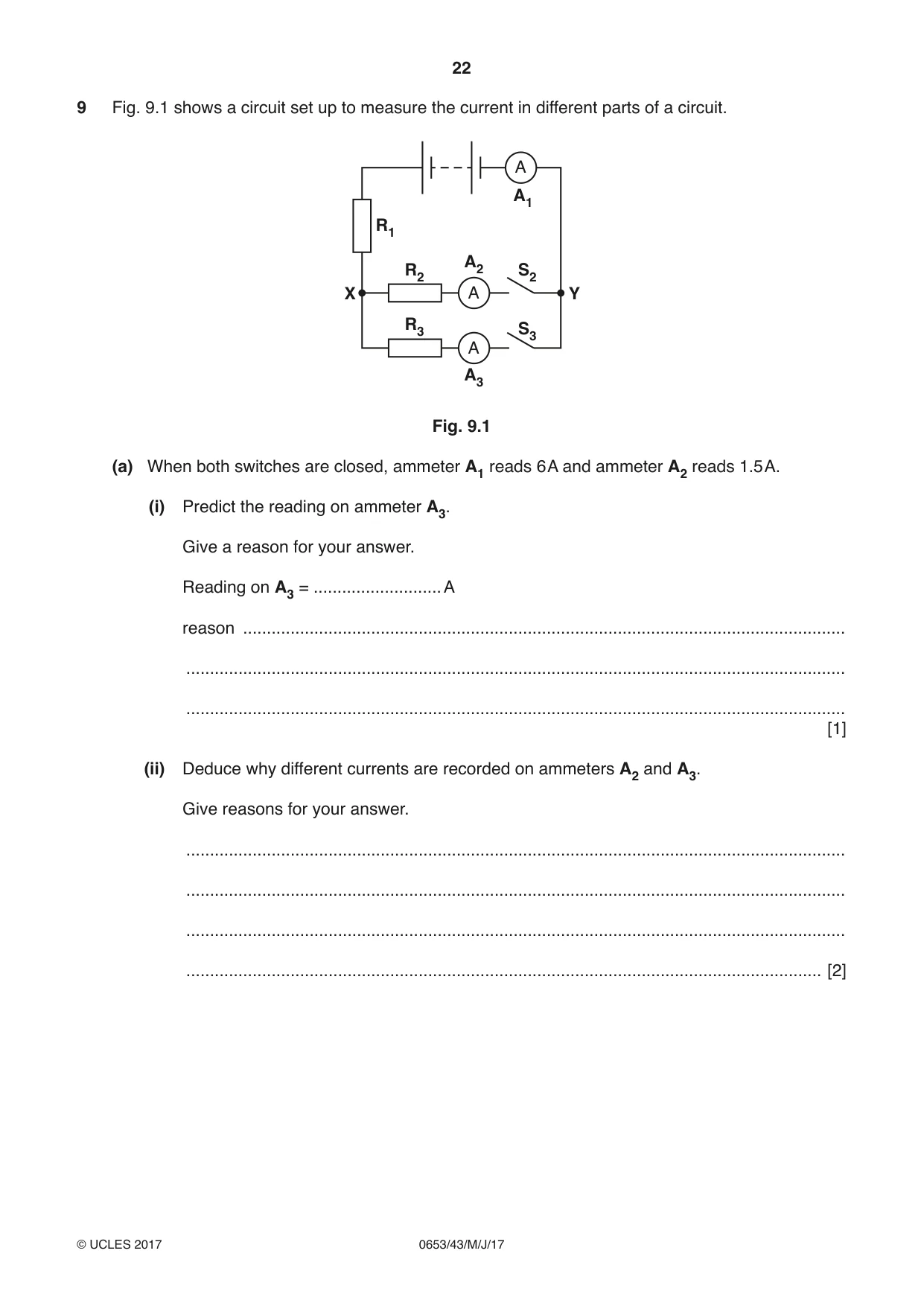
9 Fig. 9.1 shows a circuit set up to measure the current in different parts of a circuit. A A1 R1 A2 R2 S2 X A Y R3 S3 A A3 Fig. 9.1 (a) When both switches are closed, ammeter A1 reads 6 A and ammeter A2 reads 1.5 A. (i) Predict the reading on ammeter A3. Give a reason for your answer. Reading on A3 = ........................... A reason ............................................................................................................................... ........................................................................................................................................... ........................................................................................................................................... [1] (ii) Deduce why different currents are recorded on ammeters A2 and A3. Give reasons for your answer. ........................................................................................................................................... ........................................................................................................................................... ........................................................................................................................................... ...................................................................................................................................... [2] (b) A voltmeter is connected across the battery. The reading is 12 V. Switch S2 is closed, but switch S3 is left open. Ammeter A1 reads 3 A. The voltmeter is now connected between points X and Y. The reading is 3 V. (i) State the reading on ammeter A2. reading = ................................... A [1] (ii) Deduce the value of resistance R1. Show your working. value of R1 = .................................................. Ω [2]
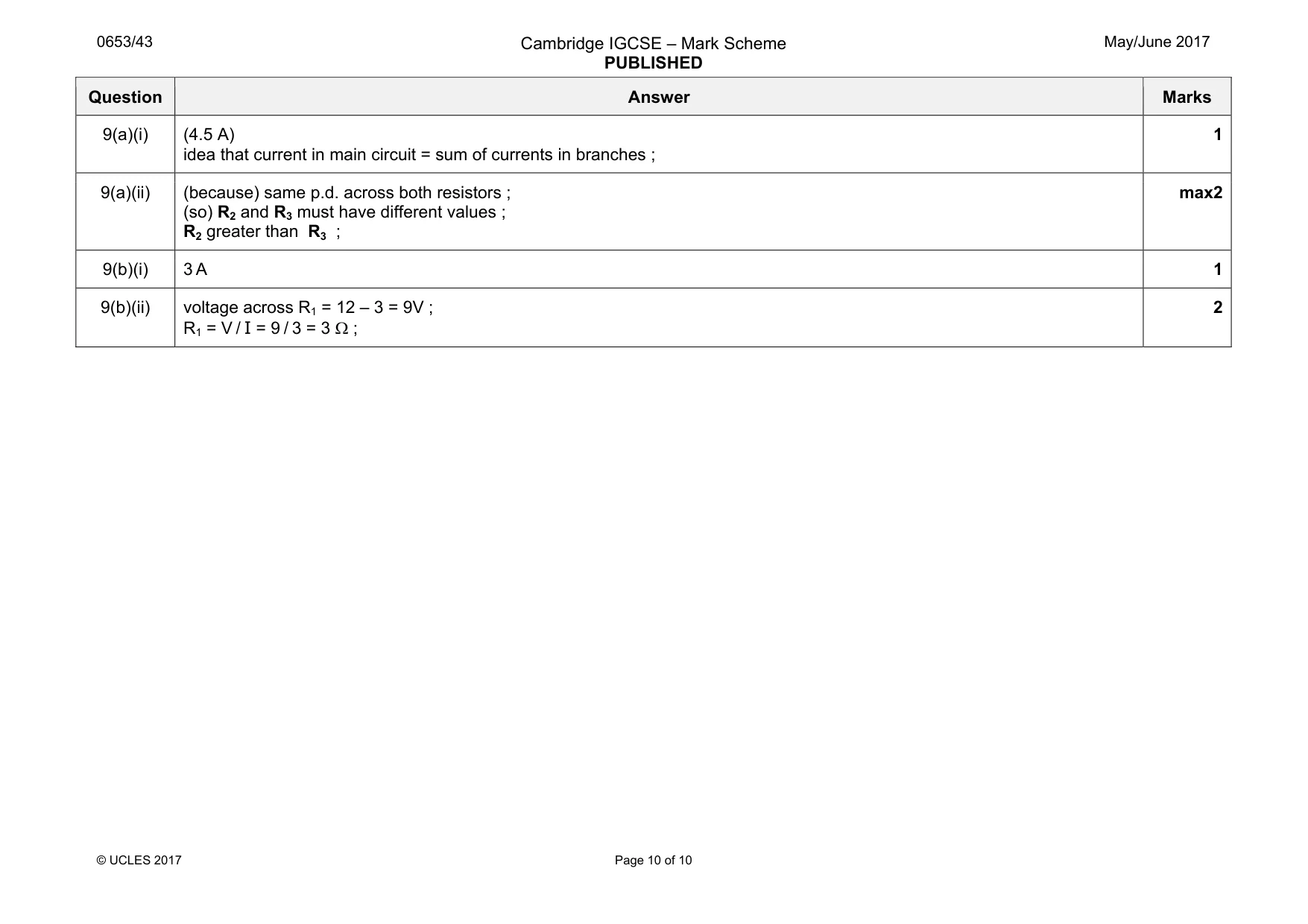
Mark scheme: 9(a)(i) (4.5 A) idea that current in main circuit = sum of currents in branches ; 1 9(a)(ii) (because) same p.d. across both resistors ; (so) R2 and R3 must have different values ; R2 greater than R3 ; max2 9(b)(i) 3 A 1 9(b)(ii) voltage across R1 = 12 – 3 = 9V ; R1 = V / I = 9 / 3 = 3 Ω ; 2
What was in this paper
The subtopics covered by these 9 questions, and how many questions each got. Open one in a new tab to see every Cambridge question on it.
What you needed in this session
Cambridge’s own grade thresholds for 2017 May/June, Paper 4 · Variant 3. A higher threshold means an easier paper — the bar moves with how the cohort did.