Cambridge IGCSE Science - Combined 0653 — 2023 May/June Paper 4 · Variant 3
0653/43/M/J/23 · 9 questions · 80 marks · ≈90 min
The question paper and its mark scheme, free to read here and free to download. This is Cambridge’s own paper, exactly as it was sat.
Question paper20 pages
Mark scheme12 pages
Answers below. Sit the paper first if you are practising.
Questions as text
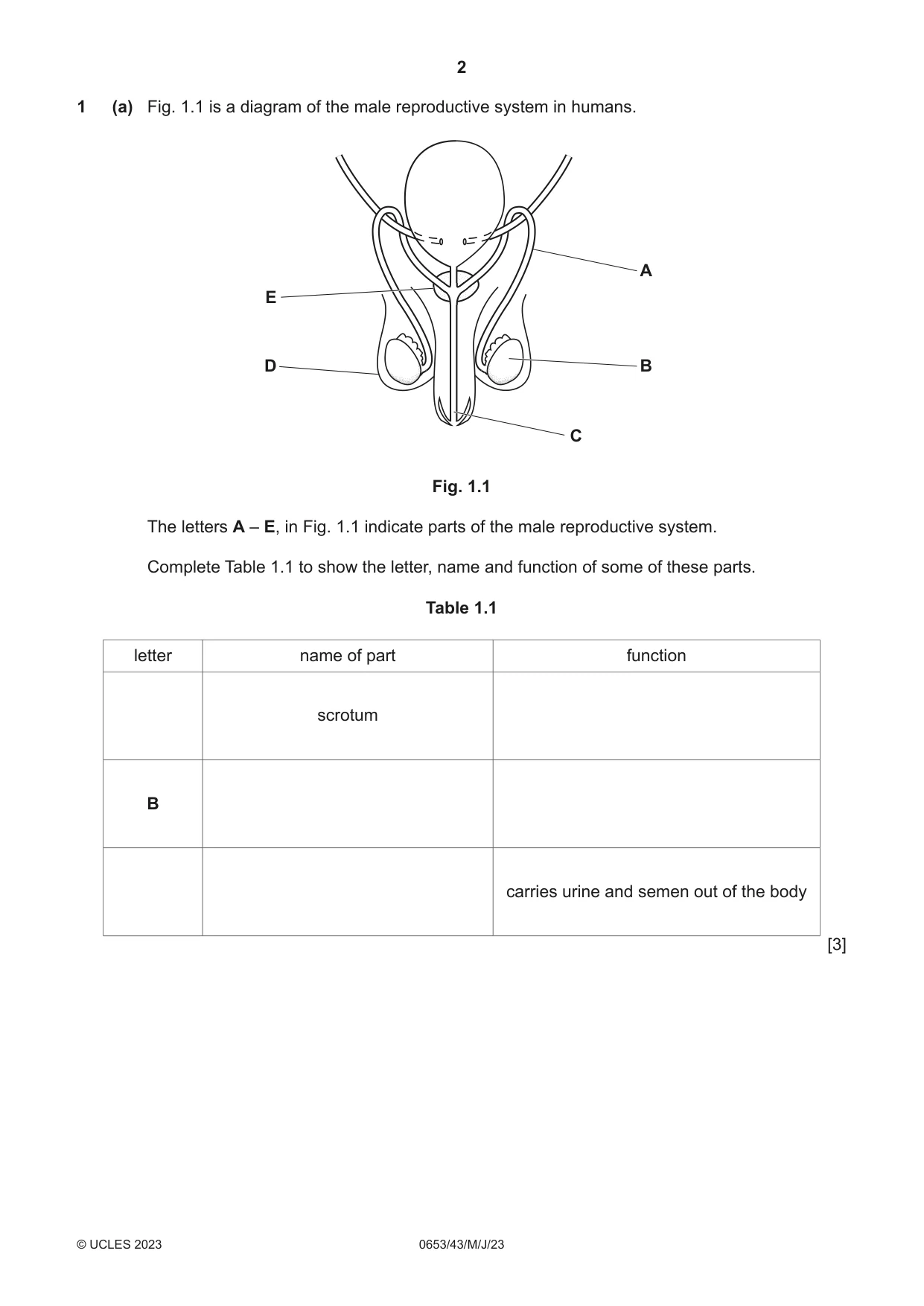
Q1 · A diagram of the male reproductive system in humans
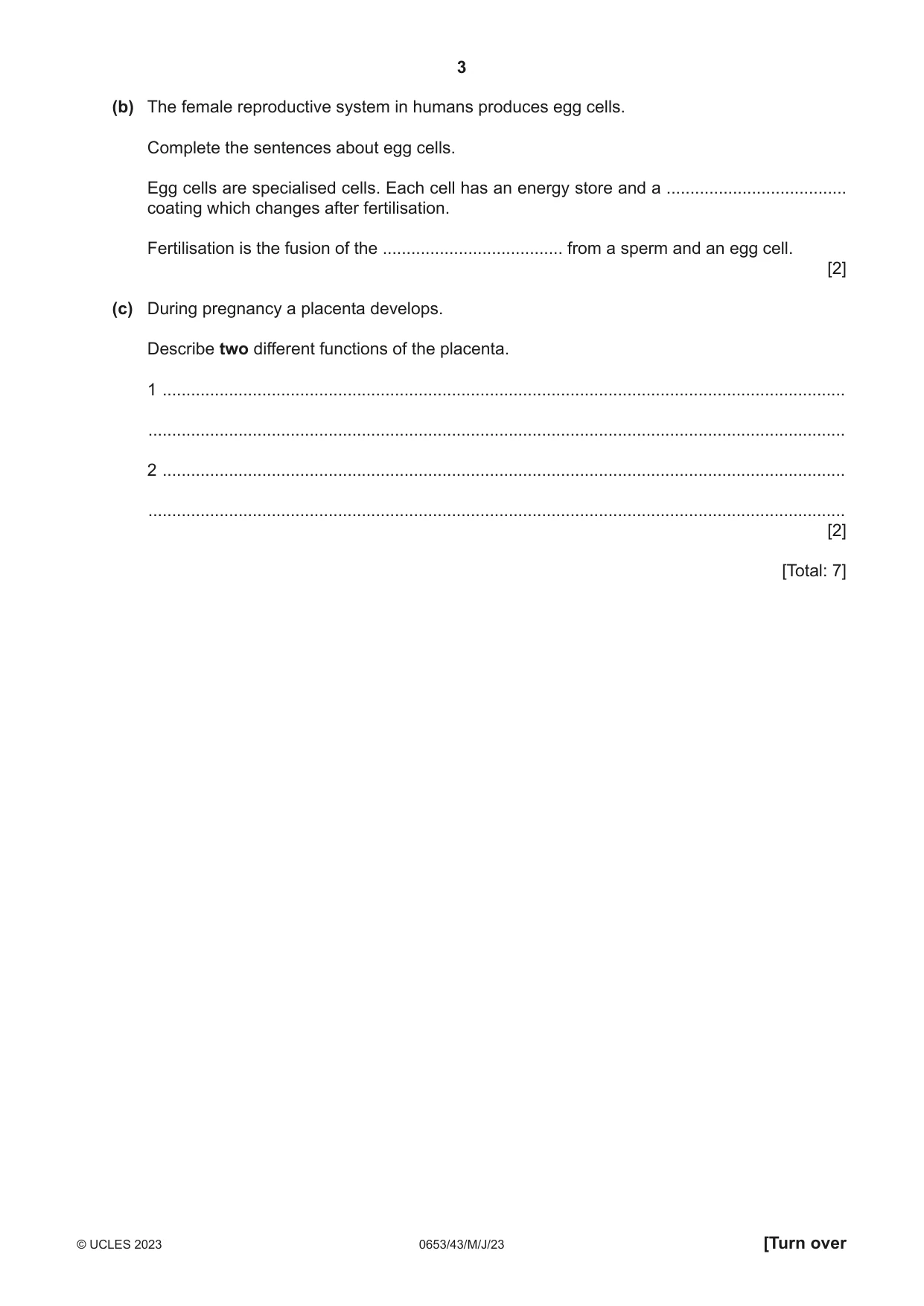
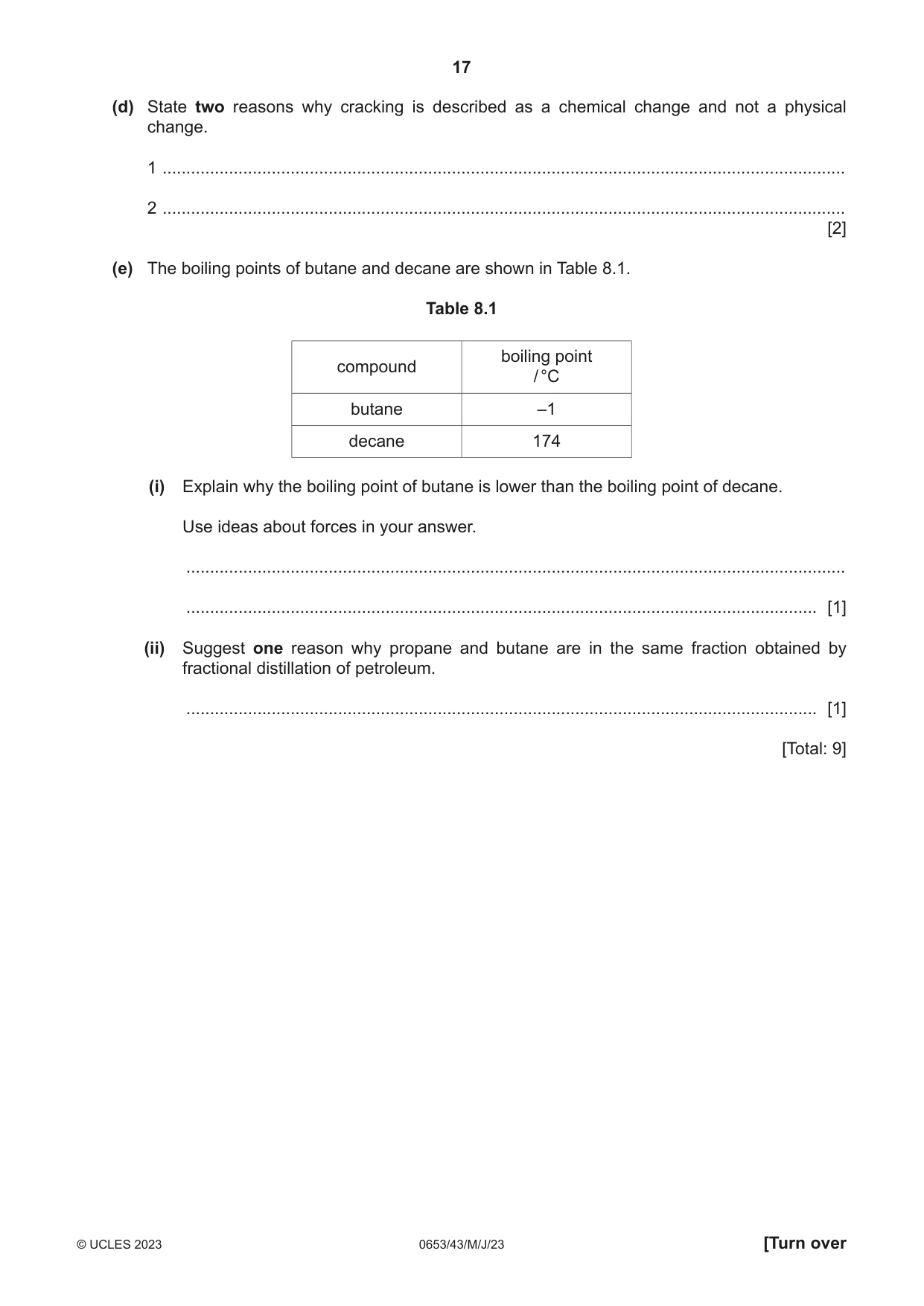
1 (a) Fig. 1.1 is a diagram of the male reproductive system in humans. A E D B C Fig. 1.1 The letters A – E, in Fig. 1.1 indicate parts of the male reproductive system. Complete Table 1.1 to show the letter, name and function of some of these parts. Table 1.1 letter name of part function scrotum B carries urine and semen out of the body [3] (b) The female reproductive system in humans produces egg cells. Complete the sentences about egg cells. Egg cells are specialised cells. Each cell has an energy store and a ...................................... coating which changes after fertilisation. Fertilisation is the fusion of the ...................................... from a sperm and an egg cell. [2] (c) During pregnancy a placenta develops. Describe two different functions of the placenta. 1 ................................................................................................................................................ ................................................................................................................................................... 2 ................................................................................................................................................ ................................................................................................................................................... [2] [Total: 7]
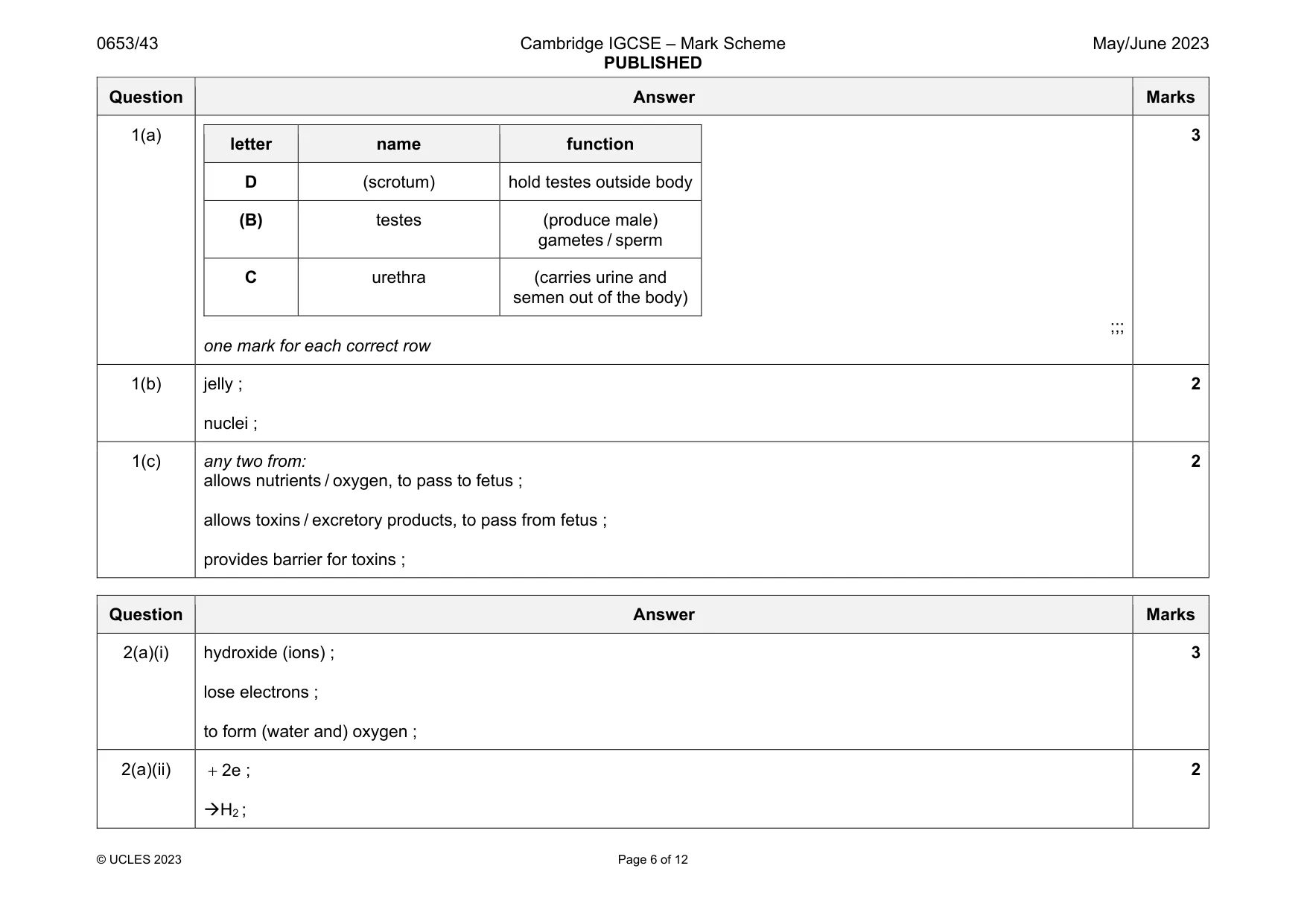
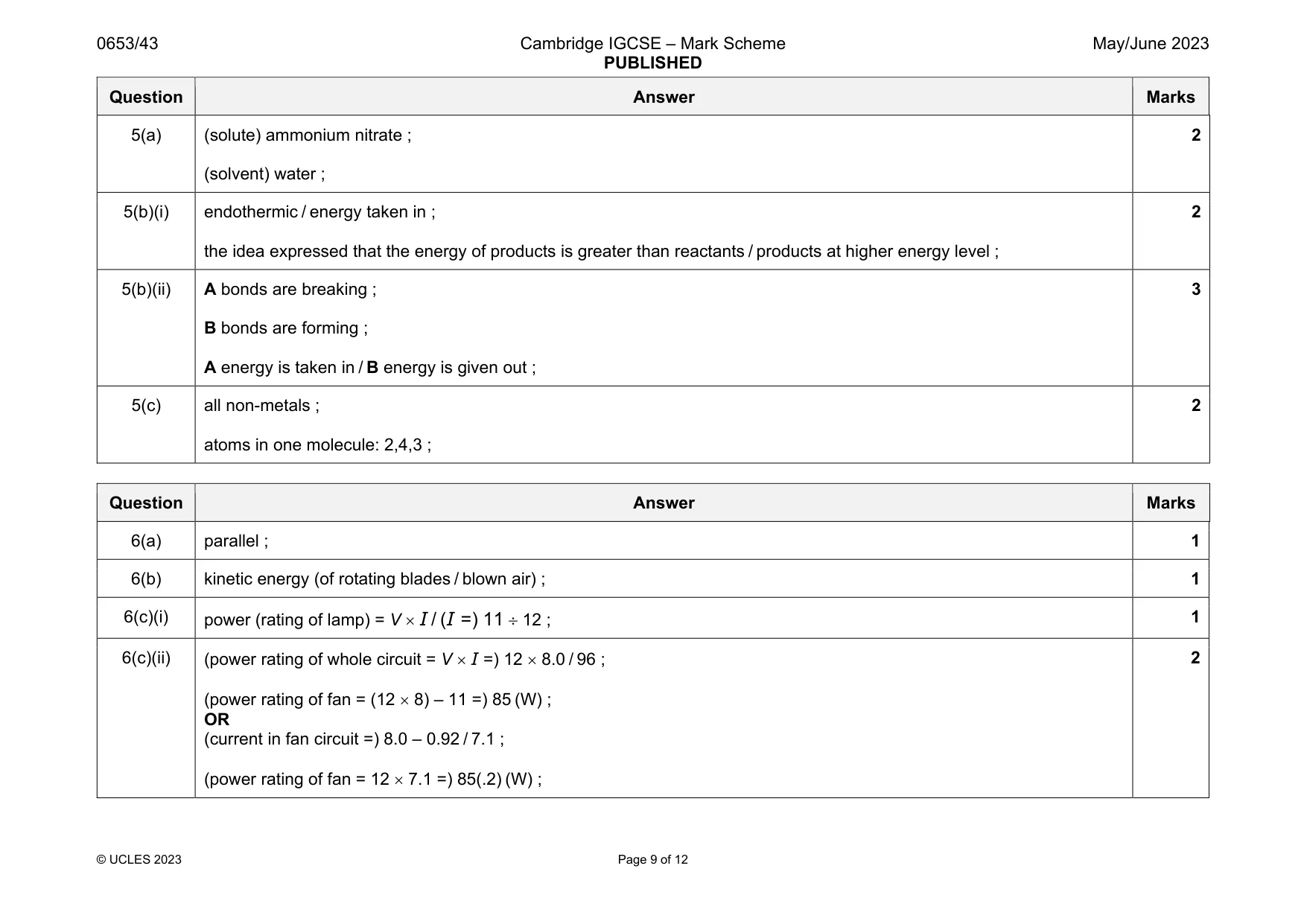
Mark scheme: 1(a) letter name function D (scrotum) hold testes outside body (B) testes (produce male) gametes / sperm C urethra (carries urine and semen out of the body) ;;; one mark for each correct row 3 1(b) jelly ; nuclei ; 2 1(c) any two from: allows nutrients / oxygen, to pass to fetus ; allows toxins / excretory products, to pass from fetus ; provides barrier for toxins ; 2
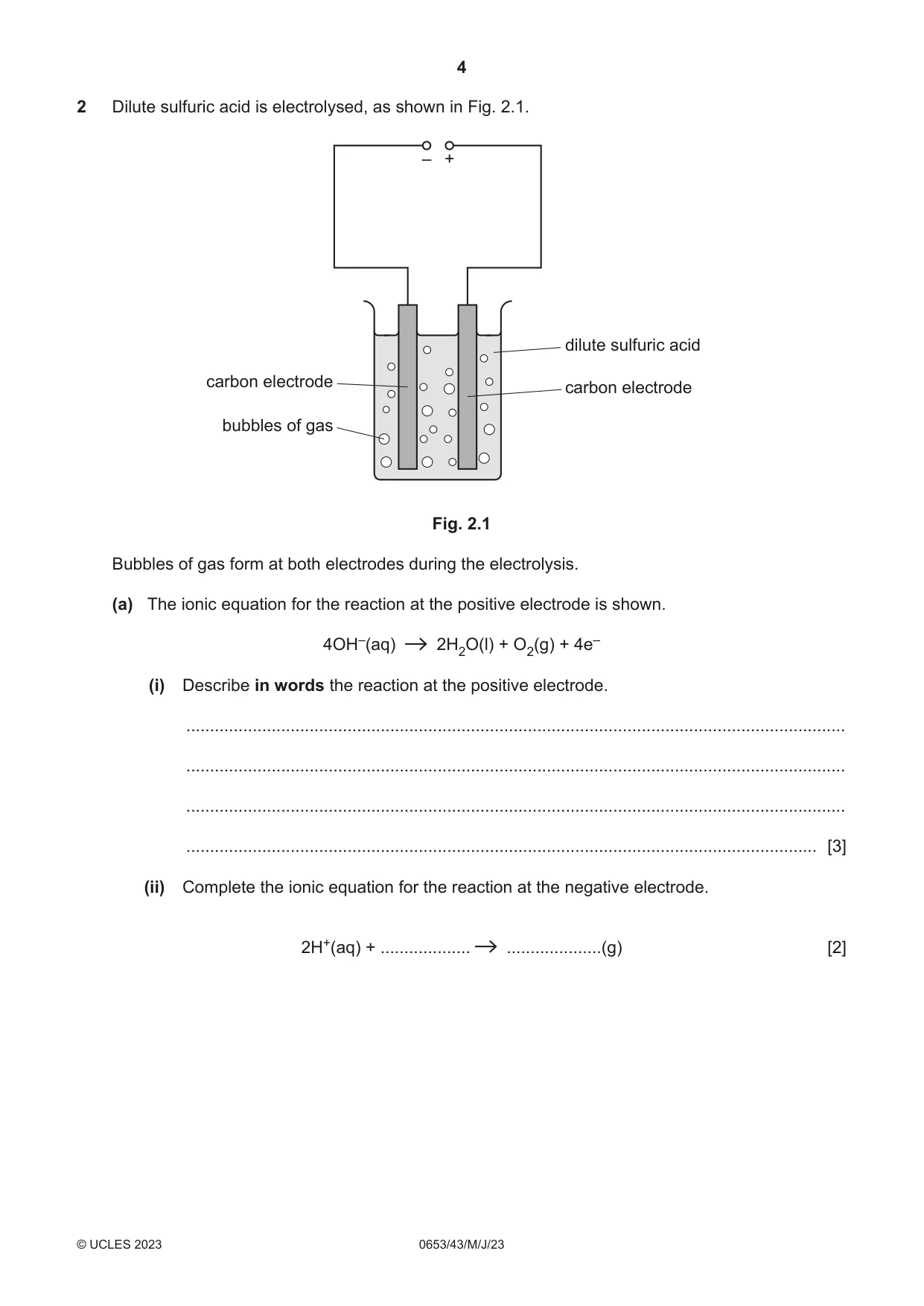
Q2 · Dilute sulfuric acid is electrolysed, as shown in Fig
2 Dilute sulfuric acid is electrolysed, as shown in Fig. 2.1. – + dilute sulfuric acid carbon electrode carbon electrode bubbles of gas Fig. 2.1 Bubbles of gas form at both electrodes during the electrolysis. (a) The ionic equation for the reaction at the positive electrode is shown. 4OH–(aq) 2H2O(l) + O2(g) + 4e– (i) Describe in words the reaction at the positive electrode. ........................................................................................................................................... ........................................................................................................................................... ........................................................................................................................................... ..................................................................................................................................... [3] (ii) Complete the ionic equation for the reaction at the negative electrode. 2H+(aq) + ................... ....................(g) [2] (b) Dilute sulfuric acid is the electrolyte in this electrolysis. State the meaning of electrolyte. ................................................................................................................................................... ................................................................................................................................................... ............................................................................................................................................. [2] (c) A different aqueous solution is electrolysed. The products of this electrolysis are hydrogen and chlorine. Suggest the identity of this aqueous solution. ............................................................................................................................................. [1] [Total: 8]
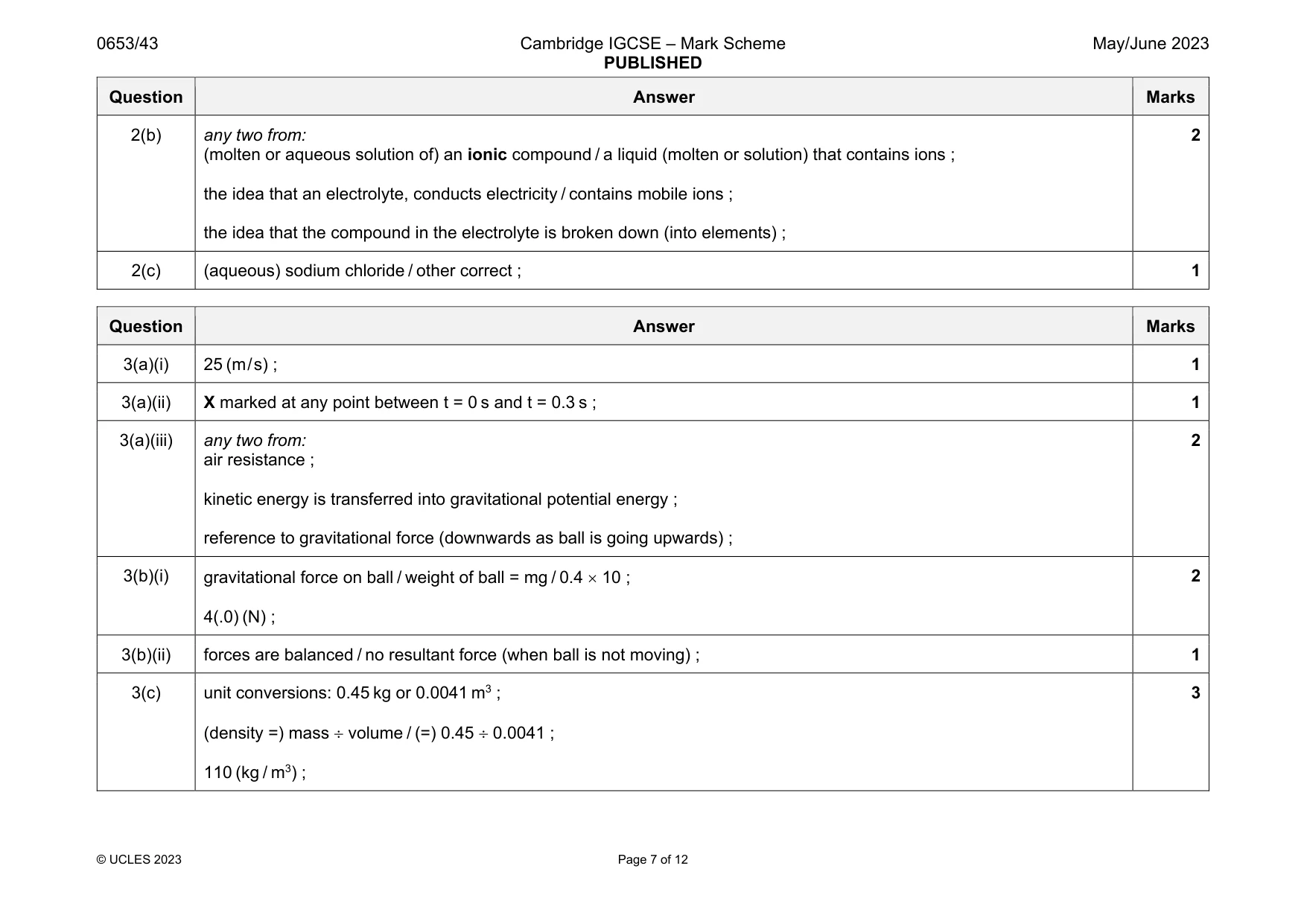
Mark scheme: 2(a)(i) hydroxide (ions) ; lose electrons ; to form (water and) oxygen ; 2(a)(ii) 2e ; H2 ; 2 Question Answer Marks 2(b) any two from: (molten or aqueous solution of) an ionic compound / a liquid (molten or solution) that contains ions ; the idea that an electrolyte, conducts electricity / contains mobile ions ; the idea that the compound in the electrolyte is broken down (into elements) ; 2 2(c) (aqueous) sodium chloride / other correct ; 1
Q3 · A football player kicking a football
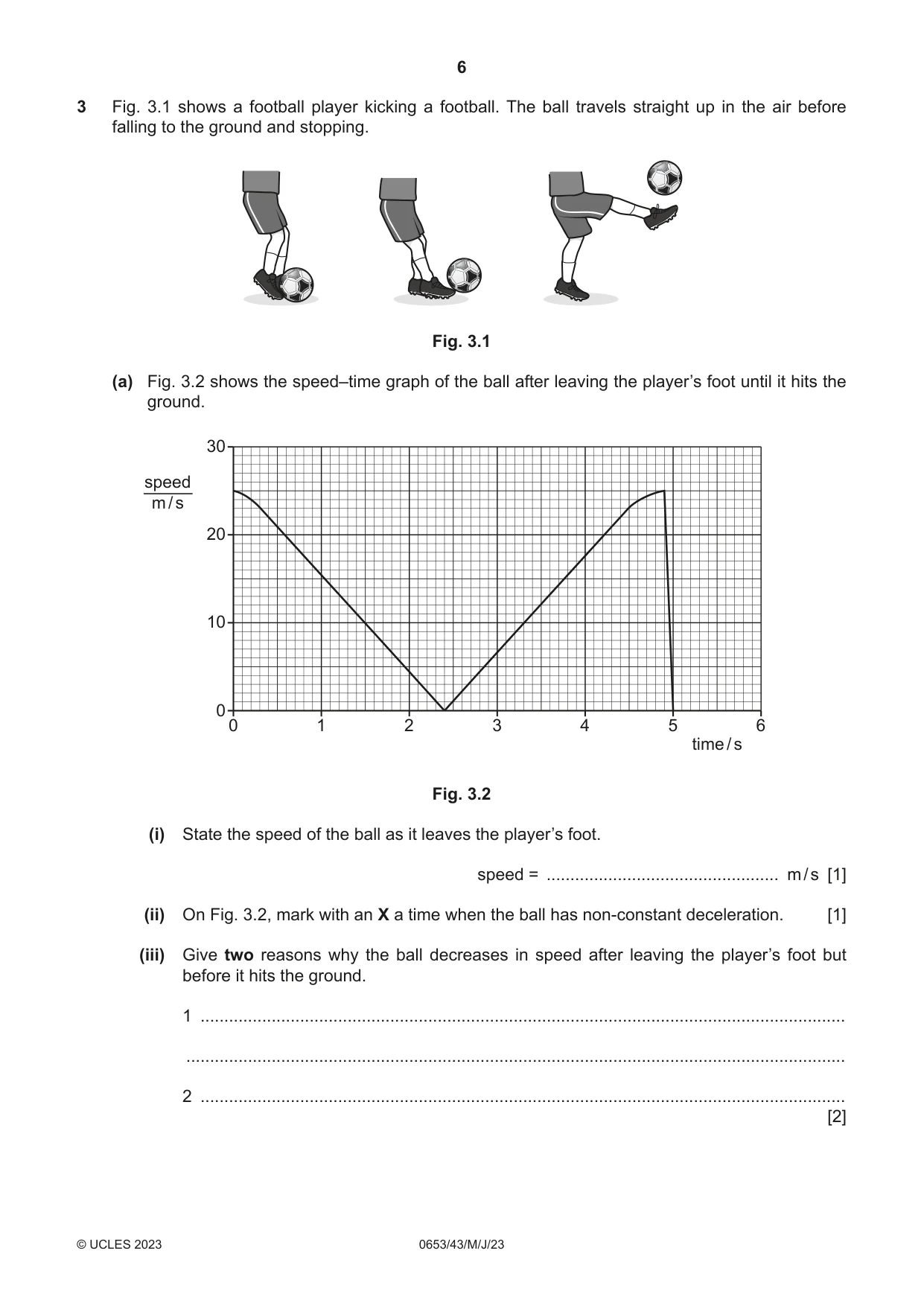
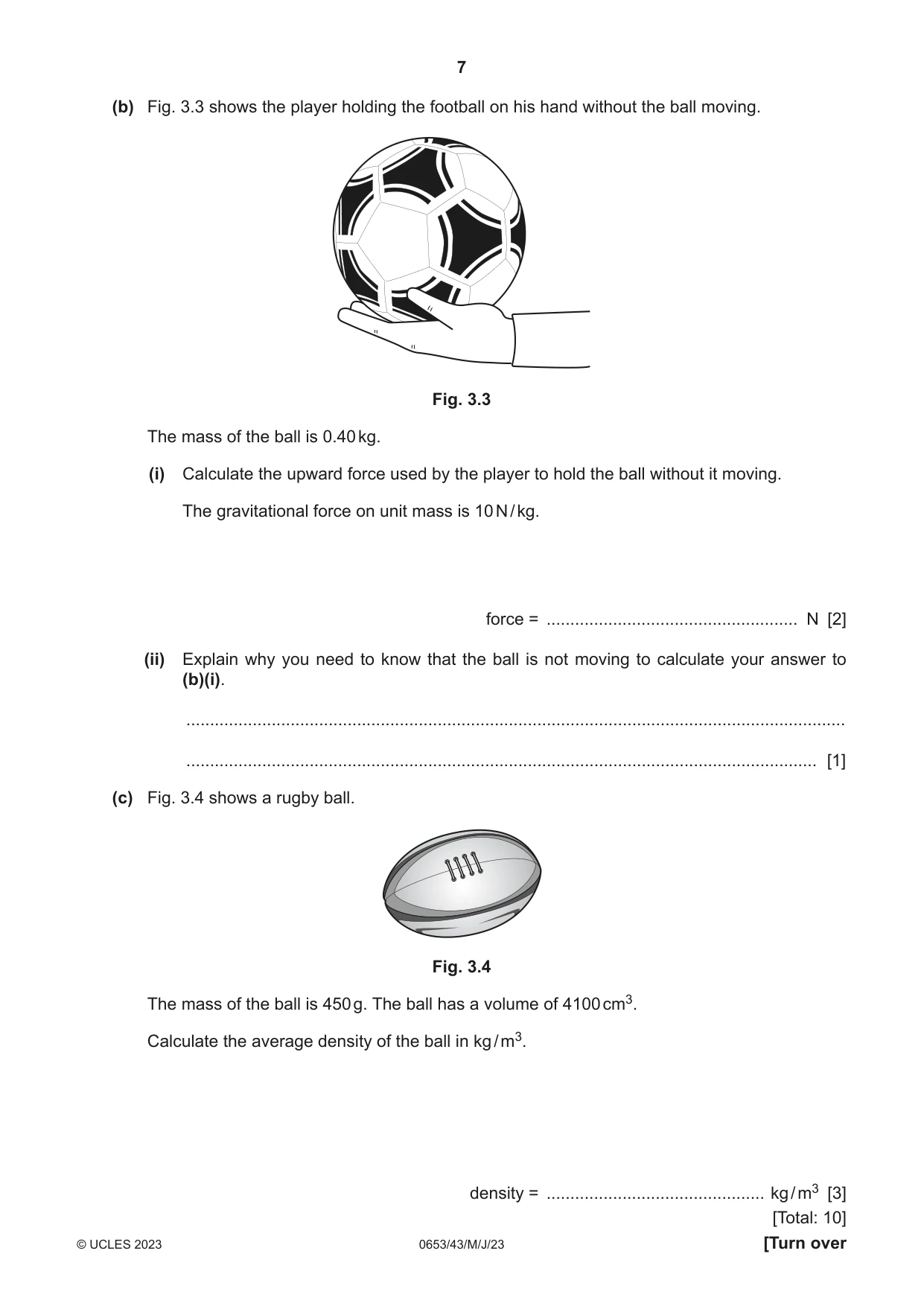
3 Fig. 3.1 shows a football player kicking a football. The ball travels straight up in the air before falling to the ground and stopping. Fig. 3.1 (a) Fig. 3.2 shows the speed–time graph of the ball after leaving the player’s foot until it hits the ground. 30 speed m / s 20 10 0 0 1 2 3 4 5 6 time / s Fig. 3.2 (i) State the speed of the ball as it leaves the player’s foot. speed = ................................................. m / s [1] (ii) On Fig. 3.2, mark with an X a time when the ball has non-constant deceleration. [1] (iii) Give two reasons why the ball decreases in speed after leaving the player’s foot but before it hits the ground. 1 ........................................................................................................................................ ........................................................................................................................................... 2 ........................................................................................................................................ [2] (b) Fig. 3.3 shows the player holding the football on his hand without the ball moving. Fig. 3.3 The mass of the ball is 0.40 kg. (i) Calculate the upward force used by the player to hold the ball without it moving. The gravitational force on unit mass is 10 N / kg. force = ..................................................... N [2] (ii) Explain why you need to know that the ball is not moving to calculate your answer to (b)(i). ........................................................................................................................................... ..................................................................................................................................... [1] (c) Fig. 3.4 shows a rugby ball. Fig. 3.4 The mass of the ball is 450 g. The ball has a volume of 4100 cm3. Calculate the average density of the ball in kg / m3. density = .............................................. kg / m3 [3] [Total: 10]
Mark scheme: 3(a)(i) 25 (m / s) ; 1 3(a)(ii) X marked at any point between t = 0 s and t = 0.3 s ; 1 3(a)(iii) any two from: air resistance ; kinetic energy is transferred into gravitational potential energy ; reference to gravitational force (downwards as ball is going upwards) ; 2 3(b)(i) gravitational force on ball / weight of ball = mg / 0.4 10 ; 4(.0) (N) ; 2 3(b)(ii) forces are balanced / no resultant force (when ball is not moving) ; 1 3(c) unit conversions: 0.45 kg or 0.0041 m3 ; (density =) mass volume / (=) 0.45 0.0041 ; 110 (kg / m3) ; 3
Q4 · A diagram of a palisade cell and a root hair cell
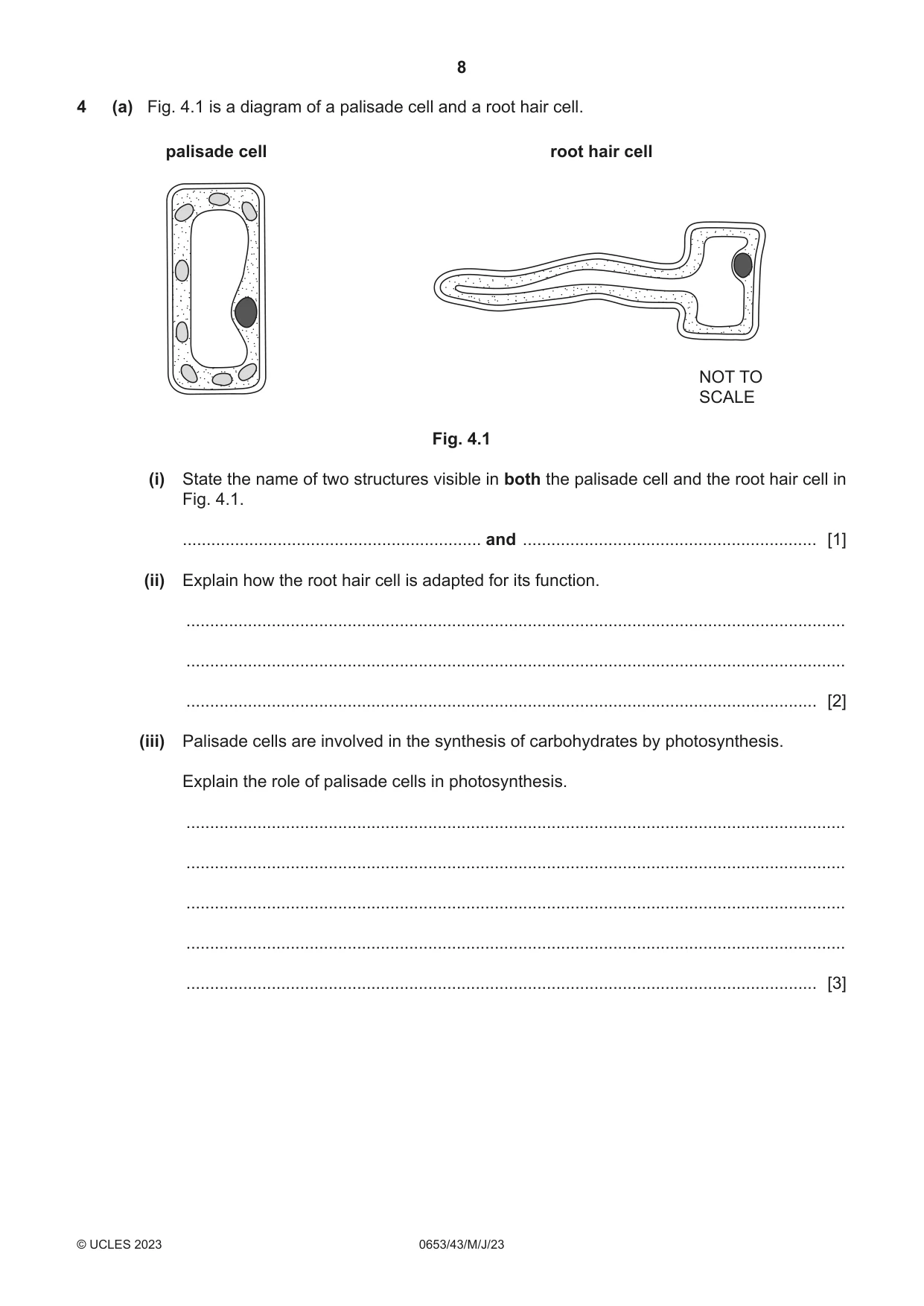
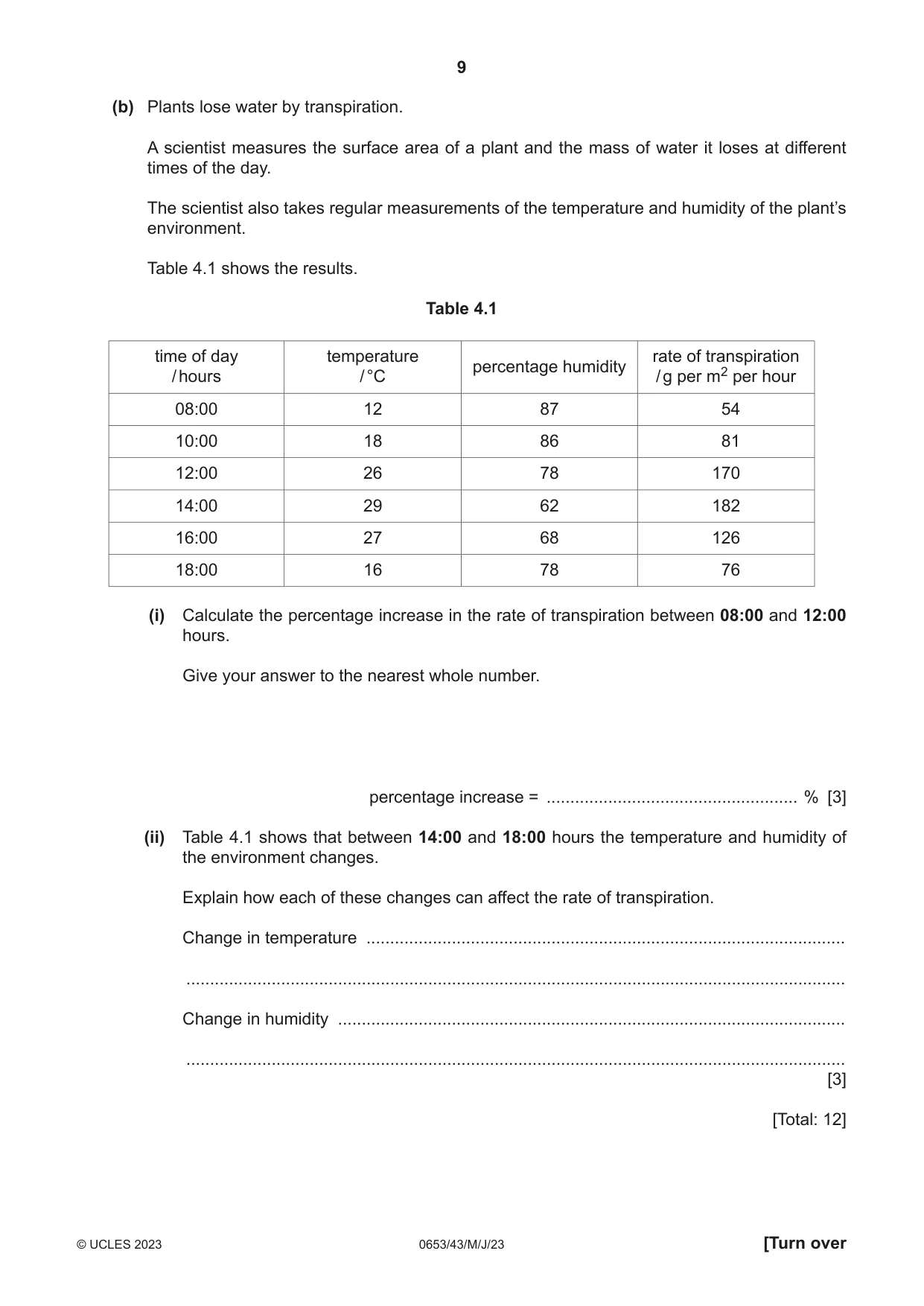
4 (a) Fig. 4.1 is a diagram of a palisade cell and a root hair cell. palisade cell root hair cell NOT TO SCALE Fig. 4.1 (i) State the name of two structures visible in both the palisade cell and the root hair cell in Fig. 4.1. ............................................................... and .............................................................. [1] (ii) Explain how the root hair cell is adapted for its function. ........................................................................................................................................... ........................................................................................................................................... ..................................................................................................................................... [2] (iii) Palisade cells are involved in the synthesis of carbohydrates by photosynthesis. Explain the role of palisade cells in photosynthesis. ........................................................................................................................................... ........................................................................................................................................... ........................................................................................................................................... ........................................................................................................................................... ..................................................................................................................................... [3] (b) Plants lose water by transpiration. A scientist measures the surface area of a plant and the mass of water it loses at different times of the day. The scientist also takes regular measurements of the temperature and humidity of the plant’s environment. Table 4.1 shows the results. Table 4.1 time of day temperature rate of transpiration percentage humidity / hours / °C / g per m2 per hour 08:00 12 87 54 10:00 18 86 81 12:00 26 78 170 14:00 29 62 182 16:00 27 68 126 18:00 16 78 76 (i) Calculate the percentage increase in the rate of transpiration between 08:00 and 12:00 hours. Give your answer to the nearest whole number. percentage increase = ..................................................... % [3] (ii) Table 4.1 shows that between 14:00 and 18:00 hours the temperature and humidity of the environment changes. Explain how each of these changes can affect the rate of transpiration. Change in temperature ..................................................................................................... ........................................................................................................................................... Change in humidity ........................................................................................................... ........................................................................................................................................... [3] [Total: 12]
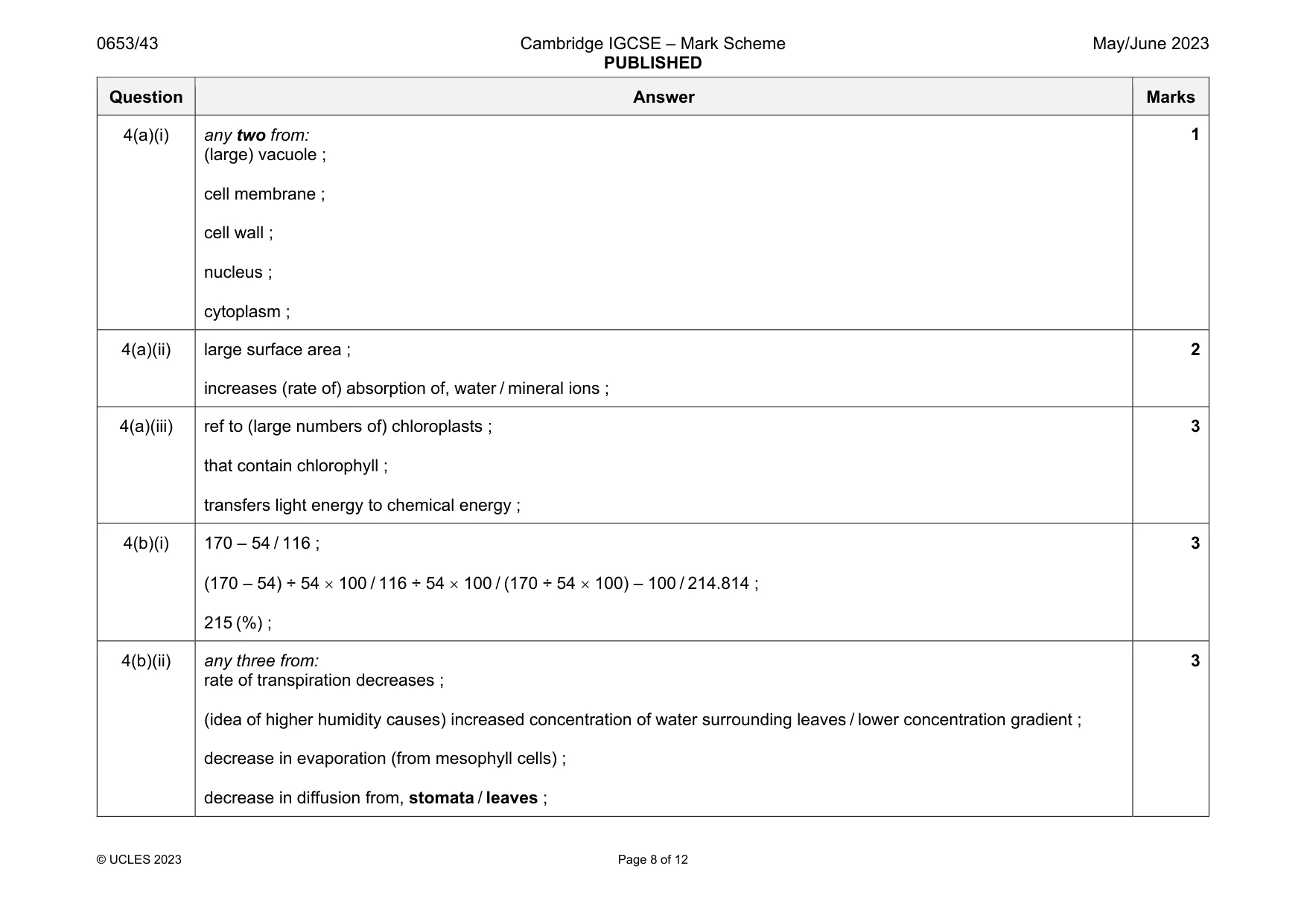
Mark scheme: 4(a)(i) any two from: (large) vacuole ; cell membrane ; cell wall ; nucleus ; cytoplasm ; 4(a)(ii) large surface area ; increases (rate of) absorption of, water / mineral ions ; 2 4(a)(iii) ref to (large numbers of) chloroplasts ; that contain chlorophyll ; transfers light energy to chemical energy ; 3 4(b)(i) 170 – 54 / 116 ; (170 – 54) ÷ 54 100 / 116 ÷ 54 100 / (170 ÷ 54 100) – 100 / 214.814 ; 215 (%) ; 3 4(b)(ii) any three from: rate of transpiration decreases ; (idea of higher humidity causes) increased concentration of water surrounding leaves / lower concentration gradient ; decrease in evaporation (from mesophyll cells) ; decrease in diffusion from, stomata / leaves ; 3
Q5 · Solid ammonium nitrate, NH4NO3, dissolves to form aqueous ammonium nitrate
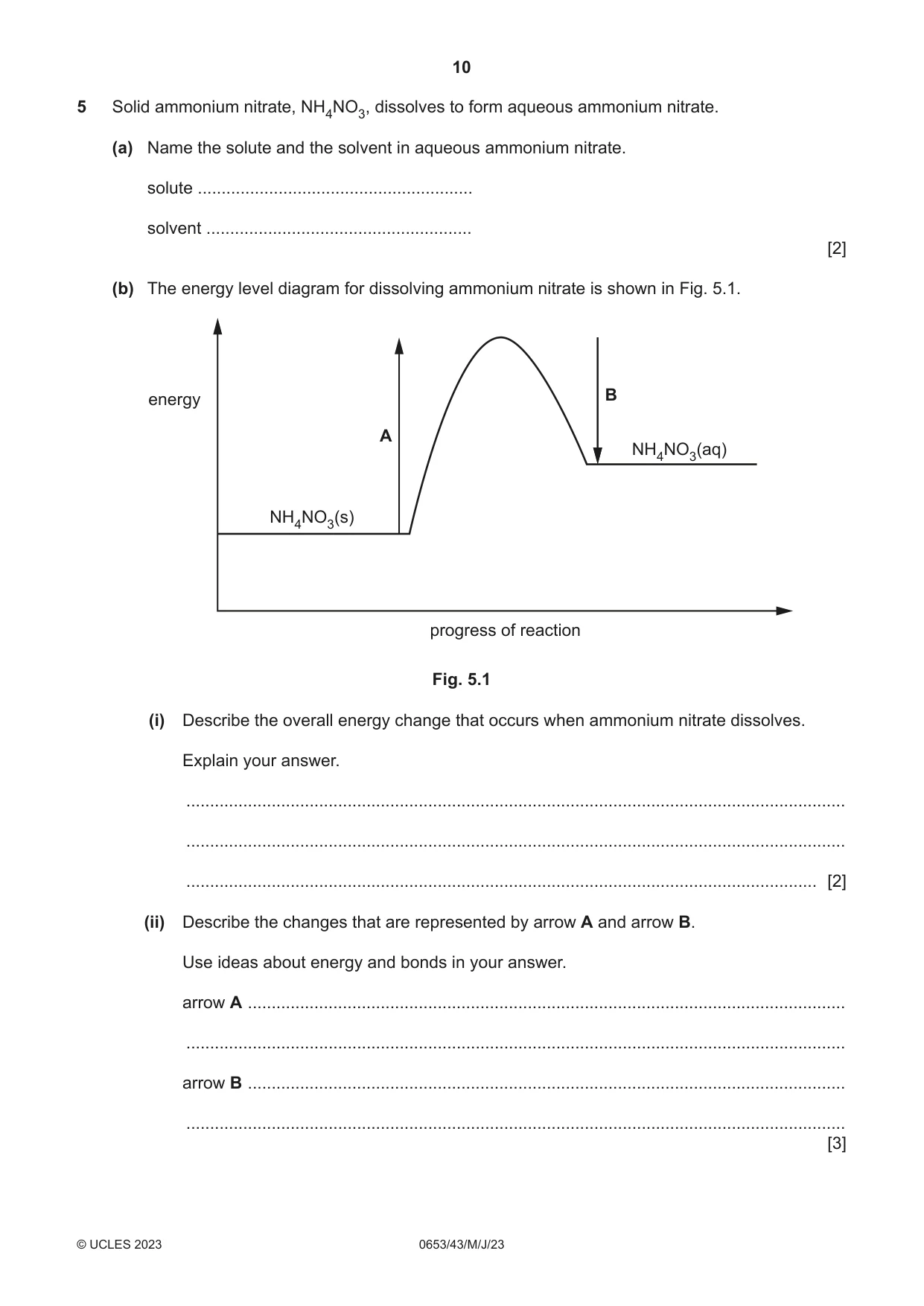
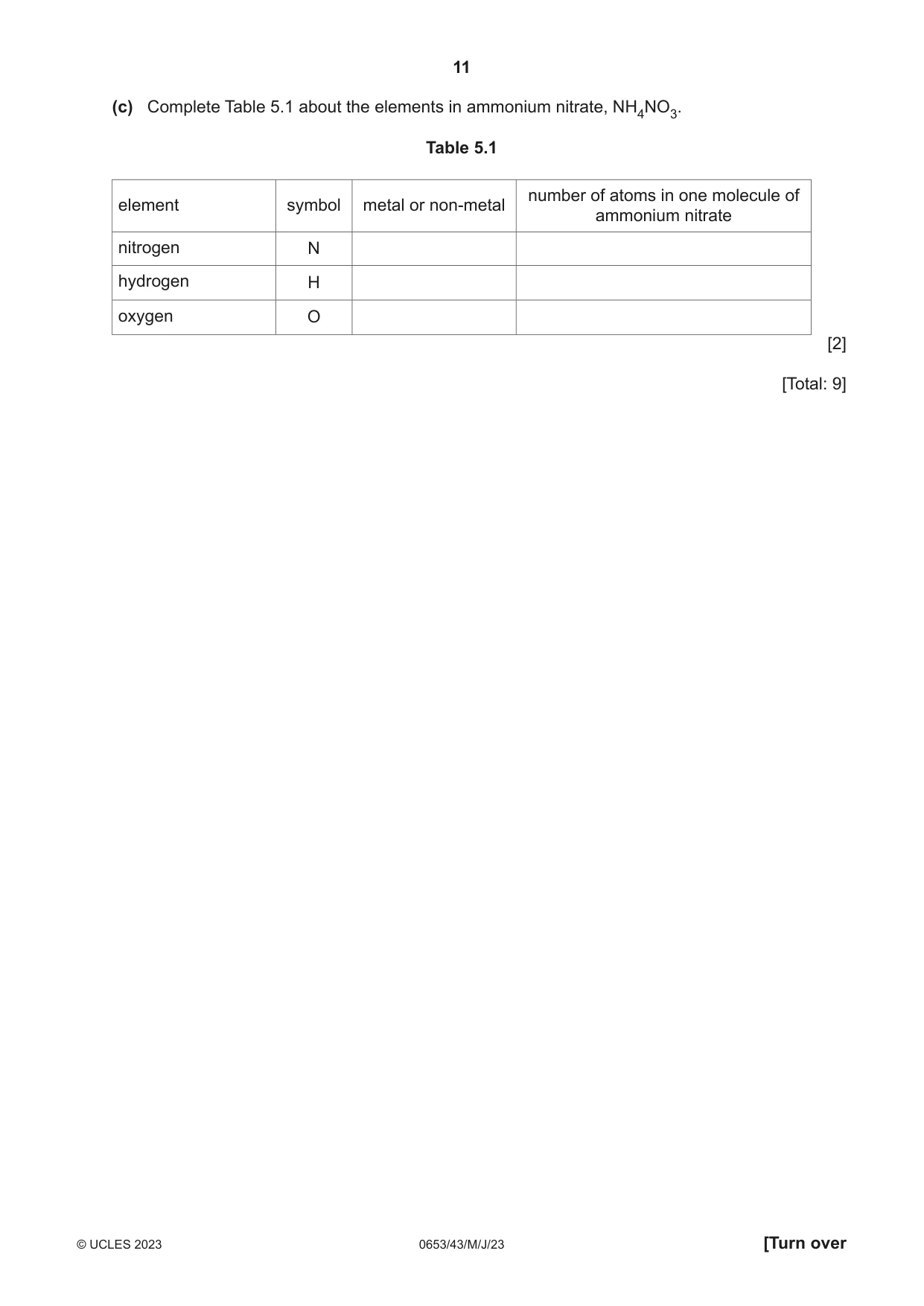
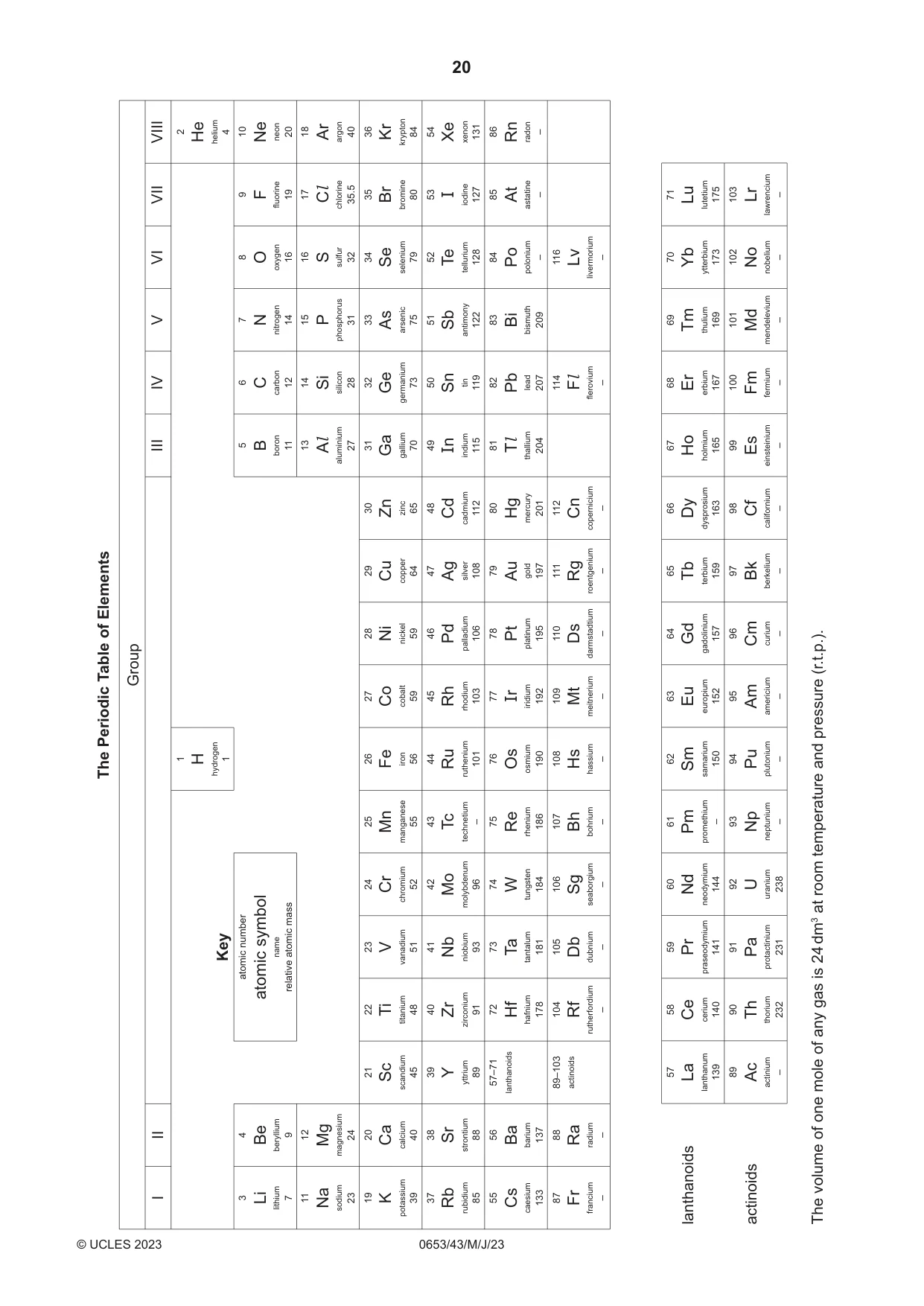
5 Solid ammonium nitrate, NH4NO3, dissolves to form aqueous ammonium nitrate. (a) Name the solute and the solvent in aqueous ammonium nitrate. solute .......................................................... solvent ........................................................ [2] (b) The energy level diagram for dissolving ammonium nitrate is shown in Fig. 5.1. energy B A NH4NO3(aq) NH4NO3(s) progress of reaction Fig. 5.1 (i) Describe the overall energy change that occurs when ammonium nitrate dissolves. Explain your answer. ........................................................................................................................................... ........................................................................................................................................... ..................................................................................................................................... [2] (ii) Describe the changes that are represented by arrow A and arrow B. Use ideas about energy and bonds in your answer. arrow A .............................................................................................................................. ........................................................................................................................................... arrow B .............................................................................................................................. ........................................................................................................................................... [3] (c) Complete Table 5.1 about the elements in ammonium nitrate, NH4NO3. Table 5.1 number of atoms in one molecule of element symbol metal or non-metal ammonium nitrate nitrogen N hydrogen H oxygen O [2] [Total: 9]
Mark scheme: 5(a) (solute) ammonium nitrate ; (solvent) water ; 2 5(b)(i) endothermic / energy taken in ; the idea expressed that the energy of products is greater than reactants / products at higher energy level ; 2 5(b)(ii) A bonds are breaking ; B bonds are forming ; A energy is taken in / B energy is given out ; 3 5(c) all non-metals ; atoms in one molecule: 2,4,3 ; 2
Q6 · An electric fan and a lighting unit with two lamps, connected to a car battery
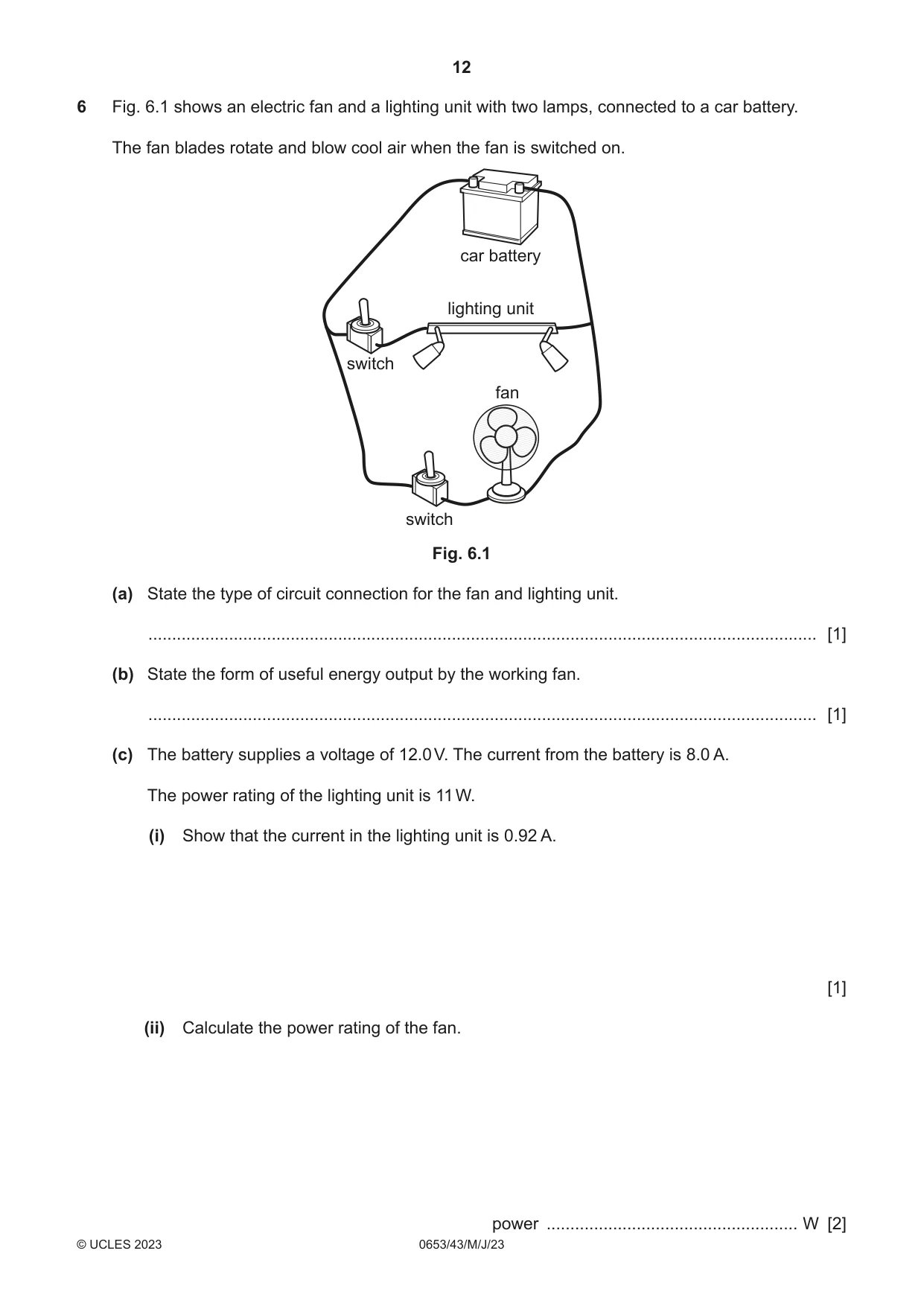
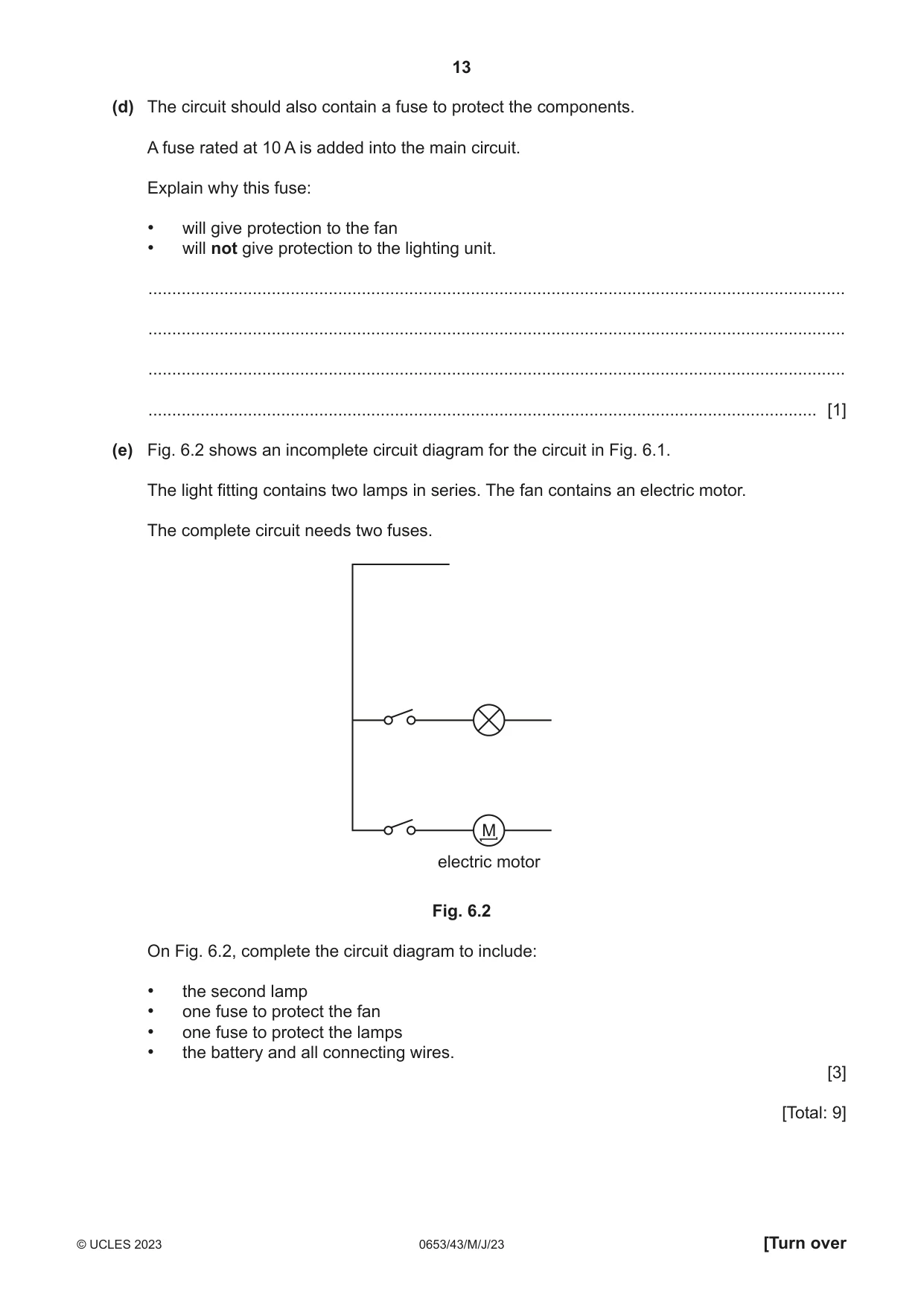
6 Fig. 6.1 shows an electric fan and a lighting unit with two lamps, connected to a car battery. The fan blades rotate and blow cool air when the fan is switched on. car battery lighting unit switch fan switch Fig. 6.1 (a) State the type of circuit connection for the fan and lighting unit. ............................................................................................................................................. [1] (b) State the form of useful energy output by the working fan. ............................................................................................................................................. [1] (c) The battery supplies a voltage of 12.0 V. The current from the battery is 8.0 A. The power rating of the lighting unit is 11 W. (i) Show that the current in the lighting unit is 0.92 A. [1] (ii) Calculate the power rating of the fan. power ..................................................... W [2] (d) The circuit should also contain a fuse to protect the components. A fuse rated at 10 A is added into the main circuit. Explain why this fuse: • will give protection to the fan • will not give protection to the lighting unit. ................................................................................................................................................... ................................................................................................................................................... ................................................................................................................................................... ............................................................................................................................................. [1] (e) Fig. 6.2 shows an incomplete circuit diagram for the circuit in Fig. 6.1. The light fitting contains two lamps in series. The fan contains an electric motor. The complete circuit needs two fuses. M electric motor Fig. 6.2 On Fig. 6.2, complete the circuit diagram to include: • the second lamp • one fuse to protect the fan • one fuse to protect the lamps • the battery and all connecting wires. [3] [Total: 9]
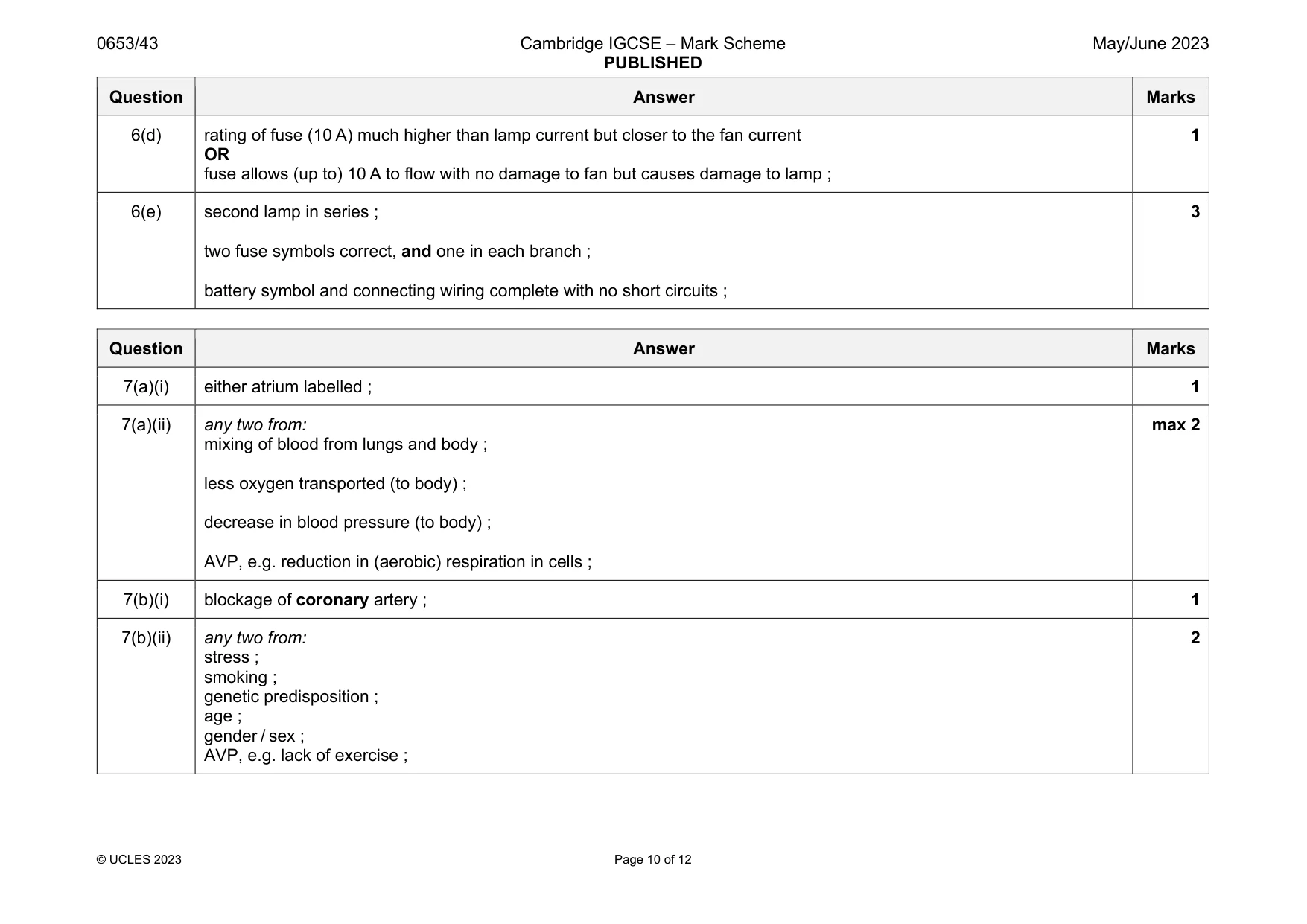
Mark scheme: 6(a) parallel ; 1 6(b) kinetic energy (of rotating blades / blown air) ; 1 6(c)(i) power (rating of lamp) = V I / (I =) 11 12 ; 1 6(c)(ii) (power rating of whole circuit = V I =) 12 8.0 / 96 ; (power rating of fan = (12 8) – 11 =) 85 (W) ; OR (current in fan circuit =) 8.0 – 0.92 / 7.1 ; (power rating of fan = 12 7.1 =) 85(.2) (W) ; 2 Question Answer Marks 6(d) rating of fuse (10 A) much higher than lamp current but closer to the fan current OR fuse allows (up to) 10 A to flow with no damage to fan but causes damage to lamp ; 1 6(e) second lamp in series ; two fuse symbols correct, and one in each branch ; battery symbol and connecting wiring complete with no short circuits ; 3
Q7 · The structure of the human heart
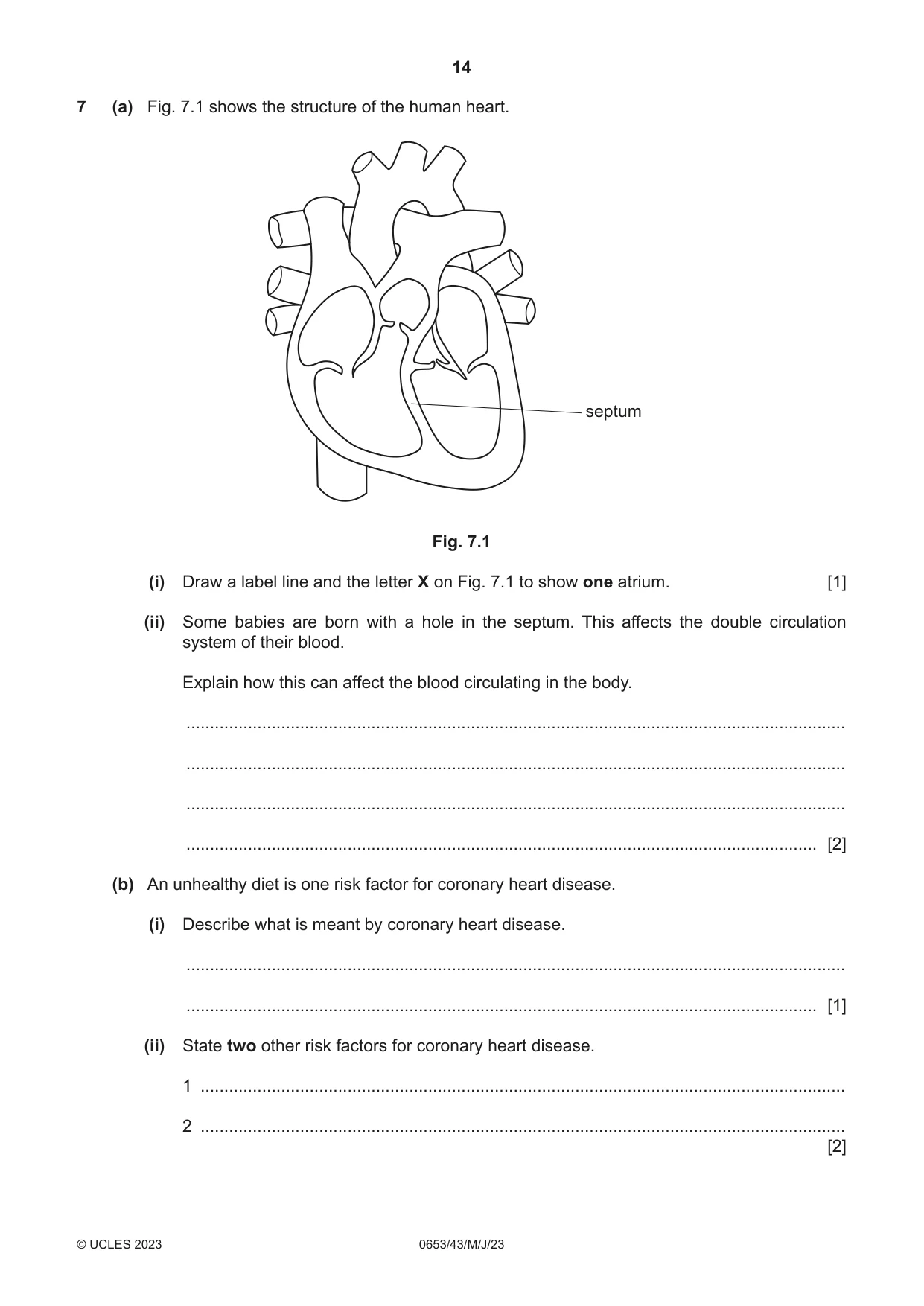
7 (a) Fig. 7.1 shows the structure of the human heart. septum Fig. 7.1 (i) Draw a label line and the letter X on Fig. 7.1 to show one atrium. [1] (ii) Some babies are born with a hole in the septum. This affects the double circulation system of their blood. Explain how this can affect the blood circulating in the body. ........................................................................................................................................... ........................................................................................................................................... ........................................................................................................................................... ..................................................................................................................................... [2] (b) An unhealthy diet is one risk factor for coronary heart disease. (i) Describe what is meant by coronary heart disease. ........................................................................................................................................... ..................................................................................................................................... [1] (ii) State two other risk factors for coronary heart disease. 1 ........................................................................................................................................ 2 ........................................................................................................................................ [2] (c) Glucose is transported in the blood. Glucose is needed for aerobic respiration. Define aerobic respiration. ................................................................................................................................................... ................................................................................................................................................... ............................................................................................................................................. [2] [Total: 8]
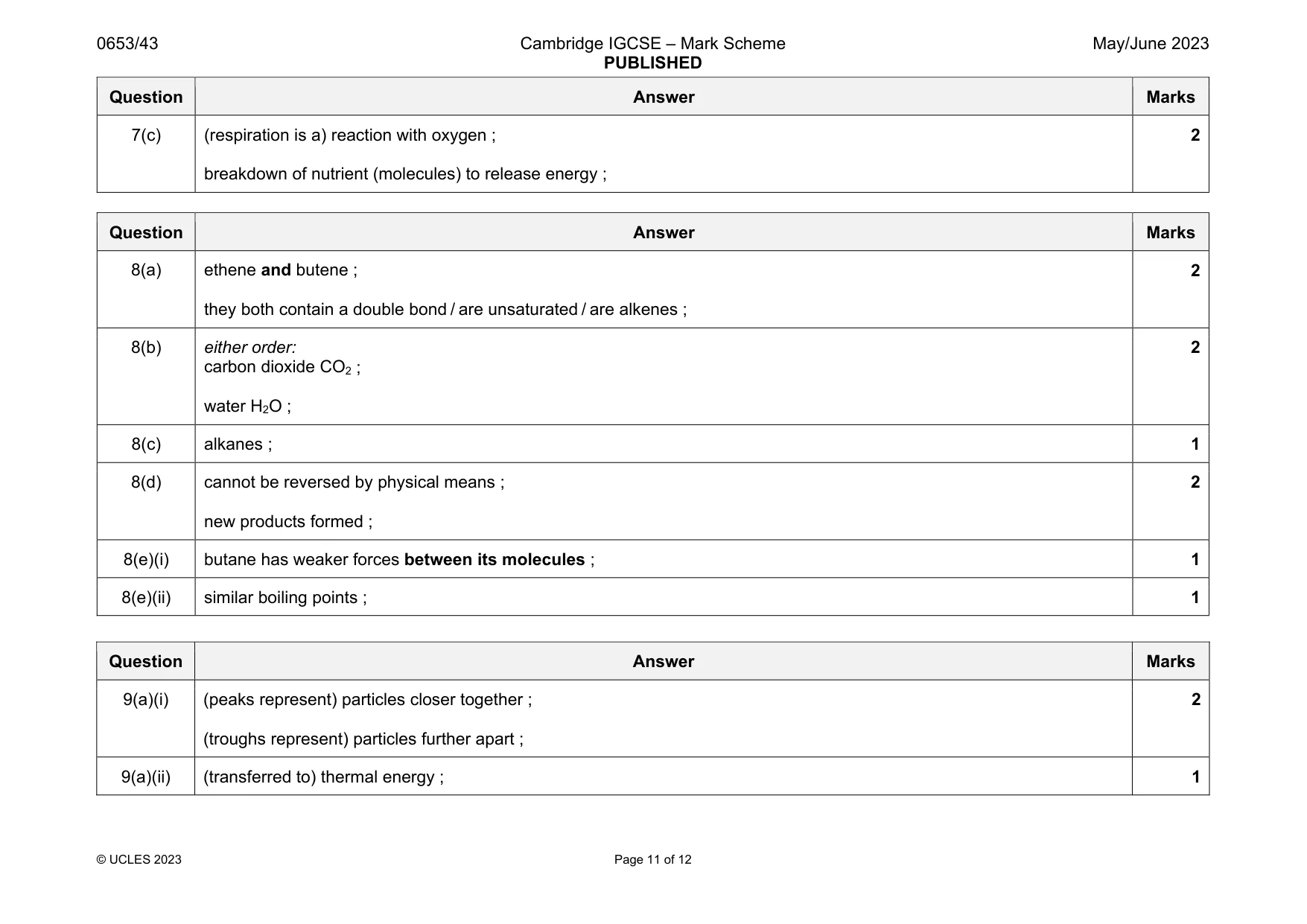
Mark scheme: 7(a)(i) either atrium labelled ; 1 7(a)(ii) any two from: mixing of blood from lungs and body ; less oxygen transported (to body) ; decrease in blood pressure (to body) ; AVP, e.g. reduction in (aerobic) respiration in cells ; max 2 7(b)(i) blockage of coronary artery ; 1 7(b)(ii) any two from: stress ; smoking ; genetic predisposition ; age ; gender / sex ; AVP, e.g. lack of exercise ; 2 Question Answer Marks 7(c) (respiration is a) reaction with oxygen ; breakdown of nutrient (molecules) to release energy ; 2
Q8 · Cracking decane, C10H22, forms three compounds, as shown in Fig
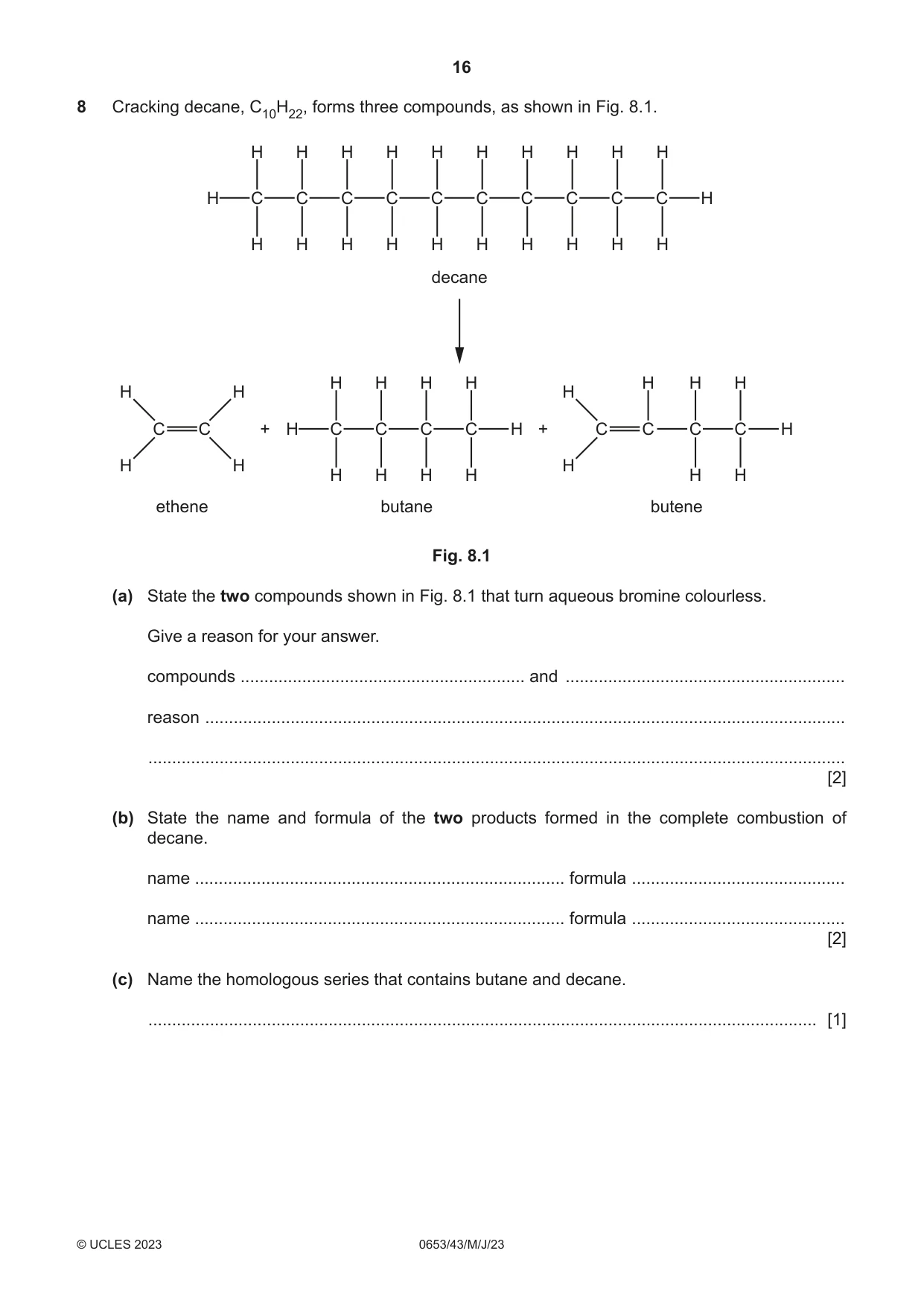
8 Cracking decane, C10H22, forms three compounds, as shown in Fig. 8.1. H H H H H H H H H H H C C C C C C C C C C H H H H H H H H H H H decane H H H H H H H H H H C C + H C C C C H + C C C C H H H H H H H H H H ethene butane butene Fig. 8.1 (a) State the two compounds shown in Fig. 8.1 that turn aqueous bromine colourless. Give a reason for your answer. compounds ............................................................ and ........................................................... reason ....................................................................................................................................... ................................................................................................................................................... [2] (b) State the name and formula of the two products formed in the complete combustion of decane. name .............................................................................. formula ............................................. name .............................................................................. formula ............................................. [2] (c) Name the homologous series that contains butane and decane. ............................................................................................................................................. [1] (d) State two reasons why cracking is described as a chemical change and not a physical change. 1 ................................................................................................................................................ 2 ................................................................................................................................................ [2] (e) The boiling points of butane and decane are shown in Table 8.1. Table 8.1 boiling point compound / °C butane –1 decane 174 (i) Explain why the boiling point of butane is lower than the boiling point of decane. Use ideas about forces in your answer. ........................................................................................................................................... ..................................................................................................................................... [1] (ii) Suggest one reason why propane and butane are in the same fraction obtained by fractional distillation of petroleum. ..................................................................................................................................... [1] [Total: 9]
Mark scheme: 8(a) ethene and butene ; they both contain a double bond / are unsaturated / are alkenes ; 2 8(b) either order: carbon dioxide CO2 ; water H2O ; 2 8(c) alkanes ; 1 8(d) cannot be reversed by physical means ; new products formed ; 2 8(e)(i) butane has weaker forces between its molecules ; 1 8(e)(ii) similar boiling points ; 1
Q9 · A sound wave travelling through air between two people
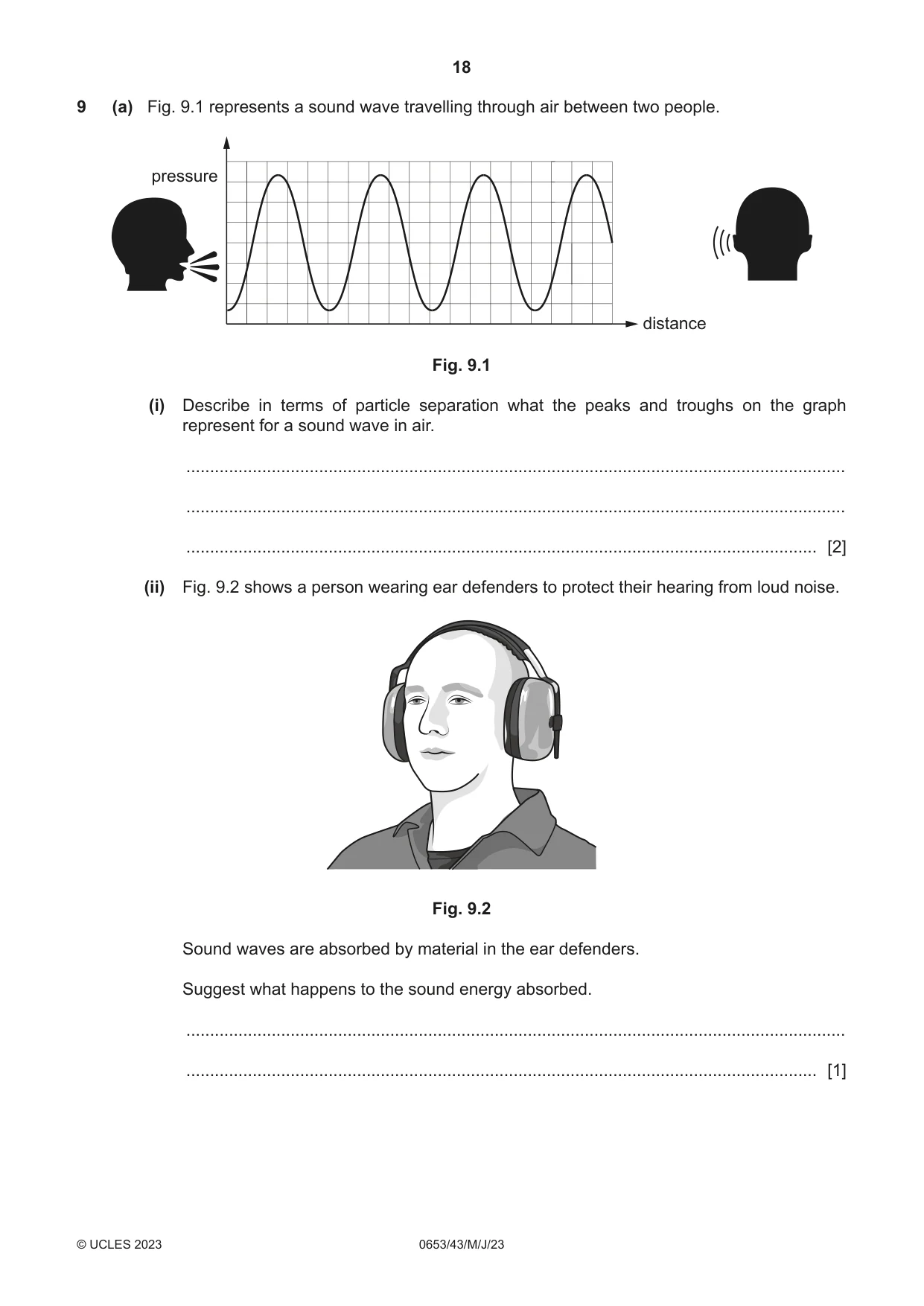
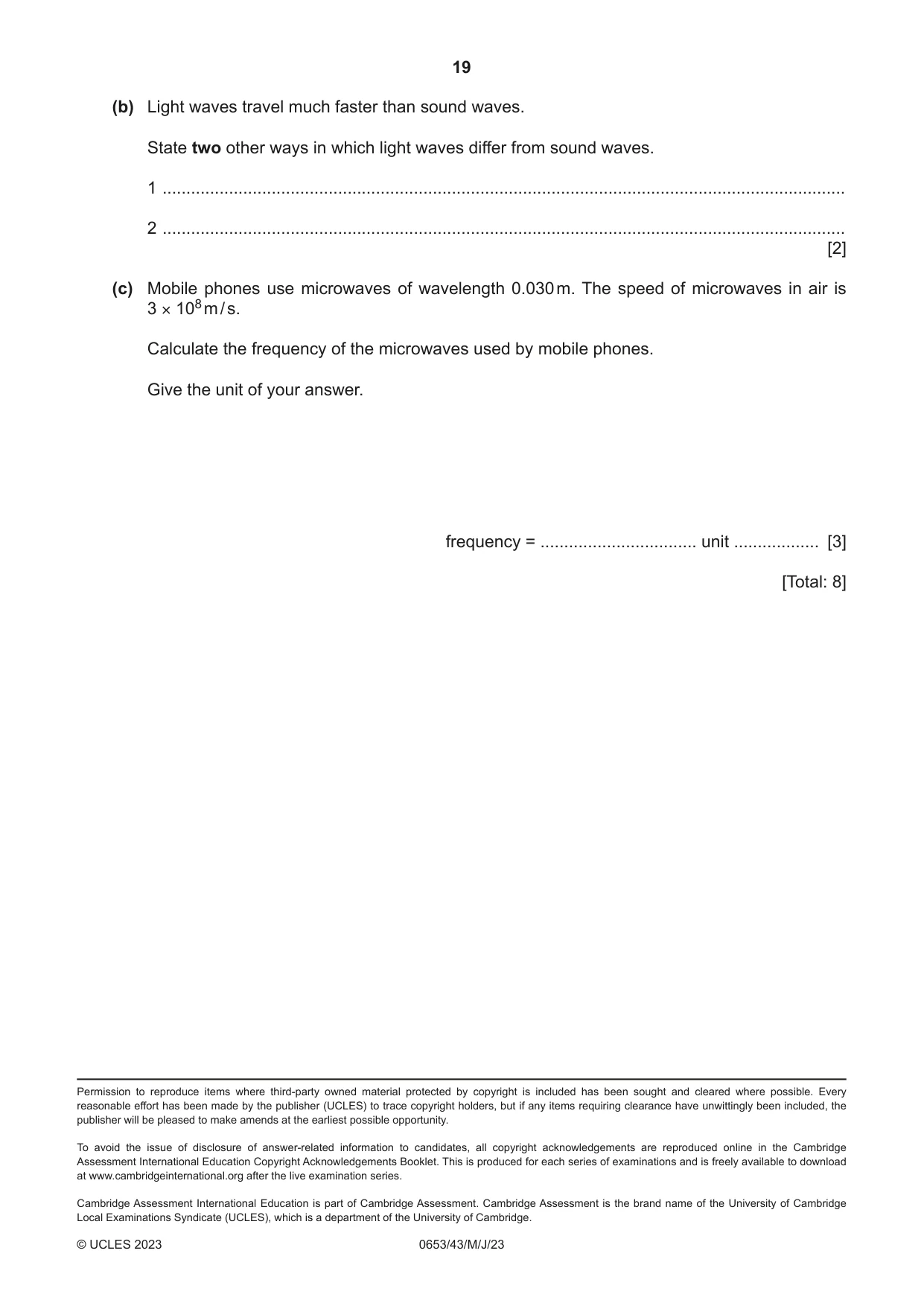
9 (a) Fig. 9.1 represents a sound wave travelling through air between two people. pressure distance Fig. 9.1 (i) Describe in terms of particle separation what the peaks and troughs on the graph represent for a sound wave in air. ........................................................................................................................................... ........................................................................................................................................... ..................................................................................................................................... [2] (ii) Fig. 9.2 shows a person wearing ear defenders to protect their hearing from loud noise. Fig. 9.2 Sound waves are absorbed by material in the ear defenders. Suggest what happens to the sound energy absorbed. ........................................................................................................................................... ..................................................................................................................................... [1] (b) Light waves travel much faster than sound waves. State two other ways in which light waves differ from sound waves. 1 ................................................................................................................................................ 2 ................................................................................................................................................ [2] (c) Mobile phones use microwaves of wavelength 0.030 m. The speed of microwaves in air is 3 × 10⁸ m / s. Calculate the frequency of the microwaves used by mobile phones. Give the unit of your answer. frequency = ................................. unit .................. [3] [Total: 8]
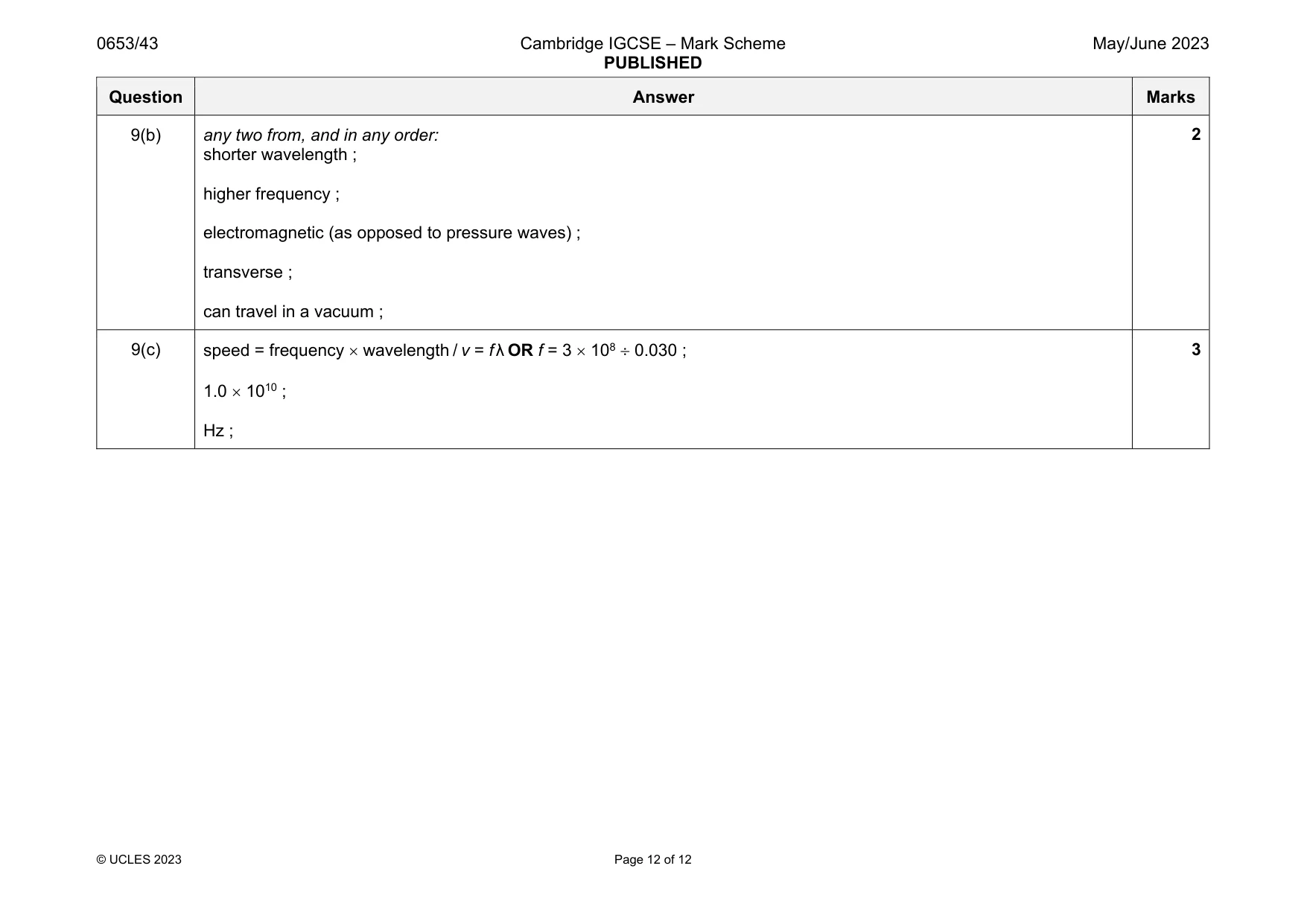
Mark scheme: 9(a)(i) (peaks represent) particles closer together ; (troughs represent) particles further apart ; 2 9(a)(ii) (transferred to) thermal energy ; 1 Question Answer Marks 9(b) any two from, and in any order: shorter wavelength ; higher frequency ; electromagnetic (as opposed to pressure waves) ; transverse ; can travel in a vacuum ; 2 9(c) speed = frequency wavelength / v = f λ OR f = 3 108 0.030 ; 1.0 1010 ; Hz ; 3
What was in this paper
The subtopics covered by these 9 questions, and how many questions each got. Open one in a new tab to see every Cambridge question on it.
What you needed in this session
Cambridge’s own grade thresholds for 2023 May/June, Paper 4 · Variant 3. A higher threshold means an easier paper — the bar moves with how the cohort did.