Cambridge IGCSE Science - Combined 0653 — 2018 May/June Paper 4 · Variant 3
0653/43/M/J/18 · 9 questions · 80 marks · ≈90 min
The question paper and its mark scheme, free to read here and free to download. This is Cambridge’s own paper, exactly as it was sat.
Question paper20 pages

Mark scheme9 pages
Answers below. Sit the paper first if you are practising.
Questions as text
Q1 · A diagram of a duckweed plant
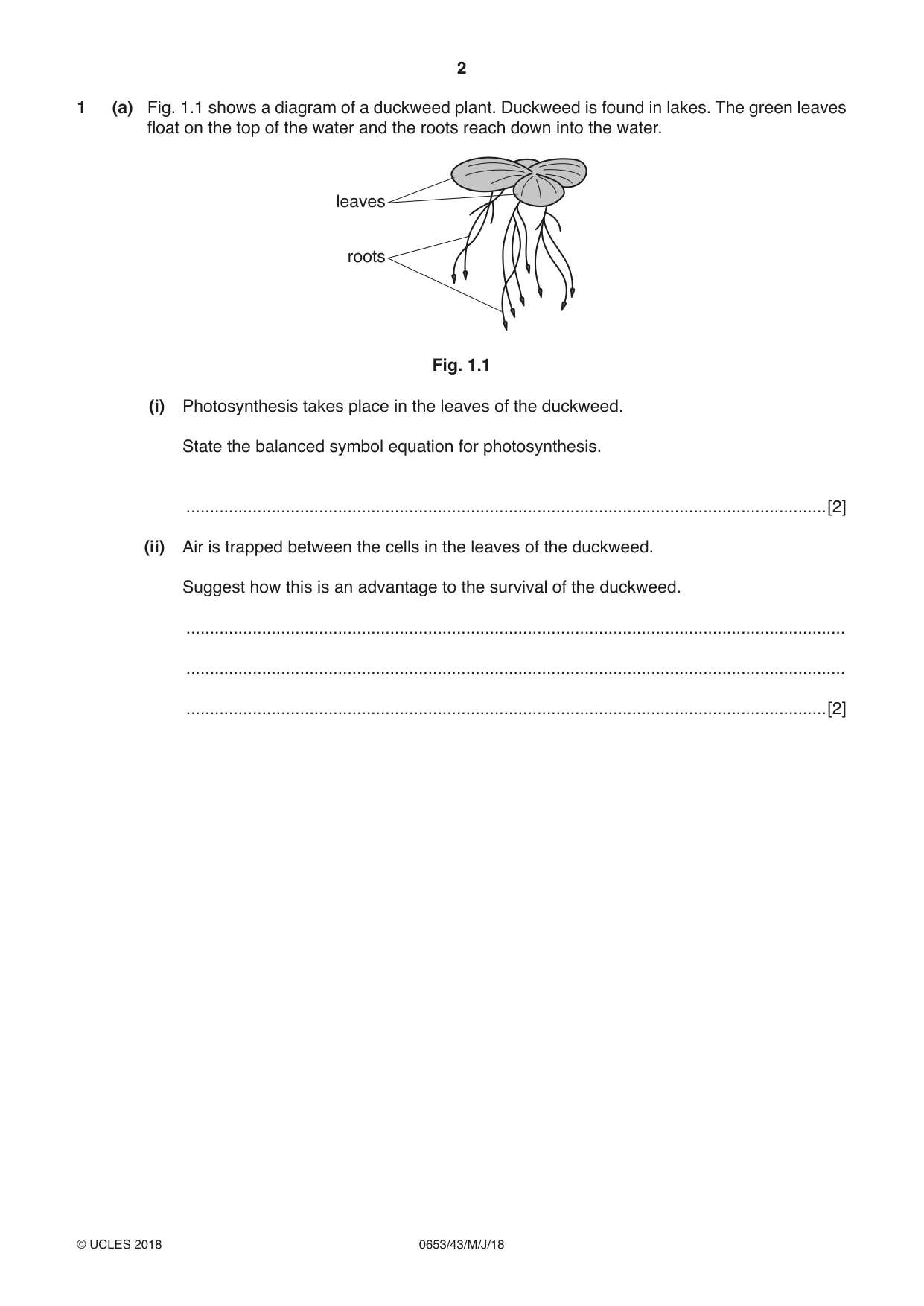
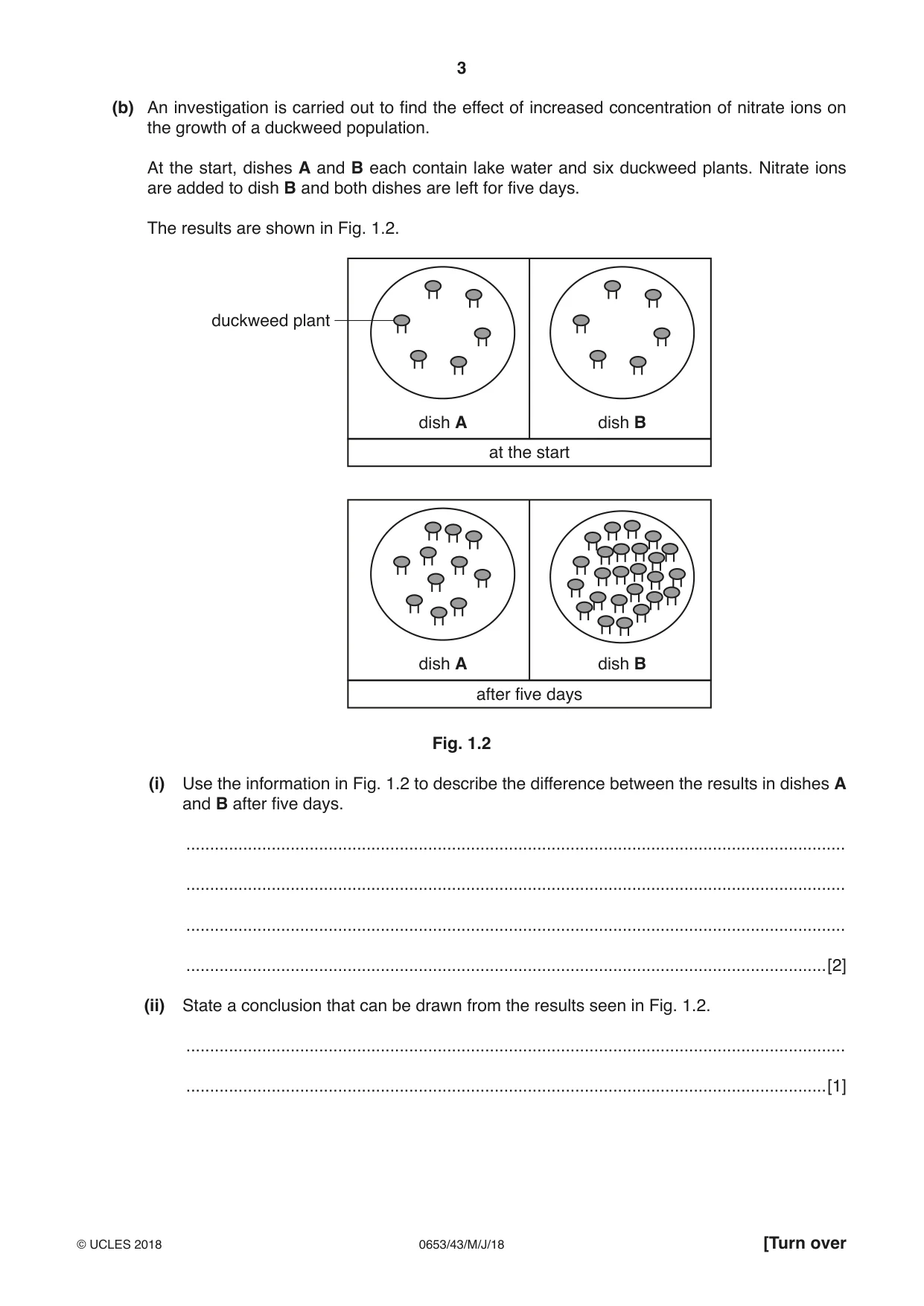
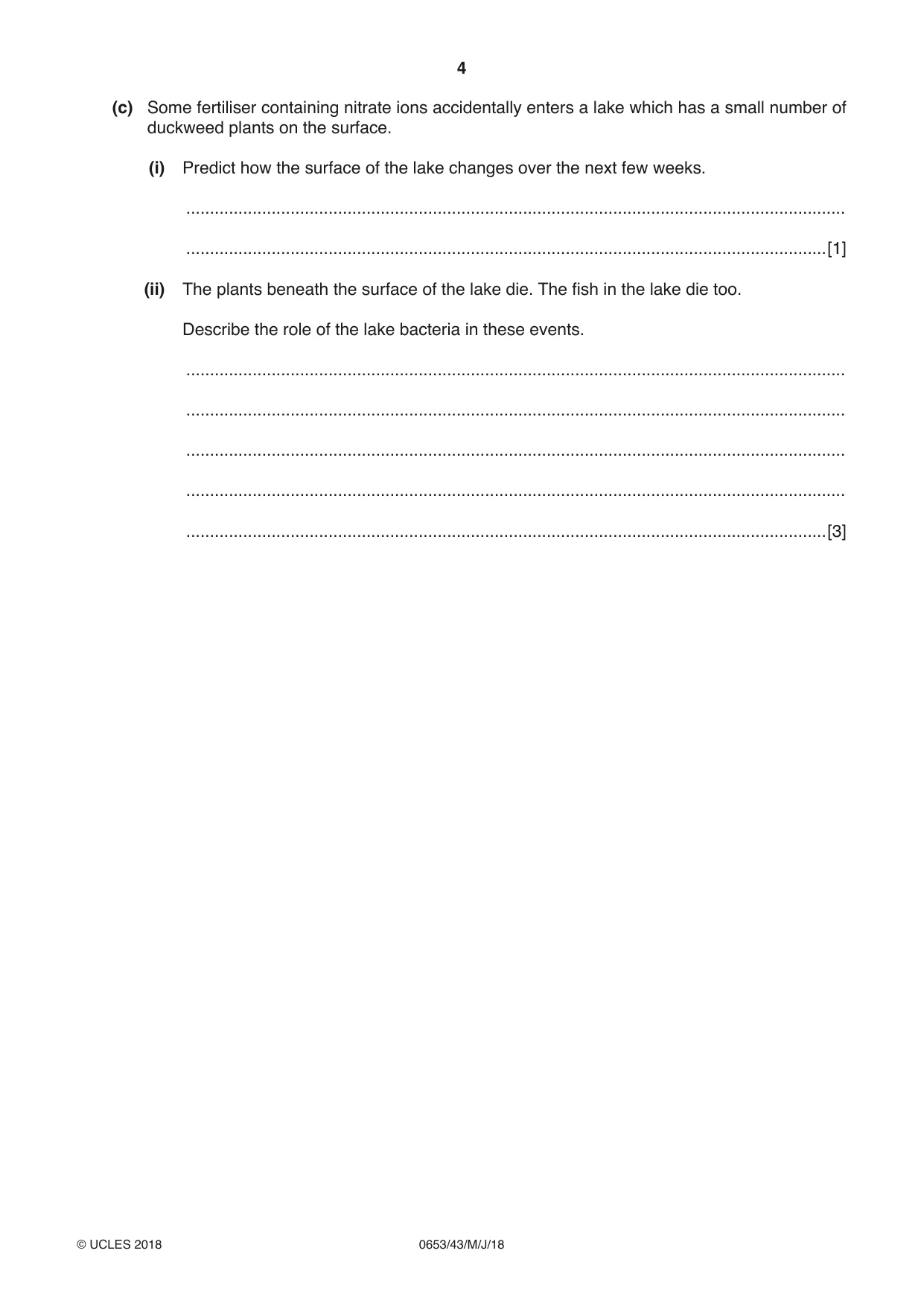
1 (a) Fig. 1.1 shows a diagram of a duckweed plant. Duckweed is found in lakes. The green leaves float on the top of the water and the roots reach down into the water. leaves roots Fig. 1.1 (i) Photosynthesis takes place in the leaves of the duckweed. State the balanced symbol equation for photosynthesis. .......................................................................................................................................[2] (ii) Air is trapped between the cells in the leaves of the duckweed. Suggest how this is an advantage to the survival of the duckweed. ........................................................................................................................................... ........................................................................................................................................... .......................................................................................................................................[2] (b) An investigation is carried out to find the effect of increased concentration of nitrate ions on the growth of a duckweed population. At the start, dishes A and B each contain lake water and six duckweed plants. Nitrate ions are added to dish B and both dishes are left for five days. The results are shown in Fig. 1.2. duckweed plant dish A dish B at the start dish A dish B after five days Fig. 1.2 (i) Use the information in Fig. 1.2 to describe the difference between the results in dishes A and B after five days. ........................................................................................................................................... ........................................................................................................................................... ........................................................................................................................................... .......................................................................................................................................[2] (ii) State a conclusion that can be drawn from the results seen in Fig. 1.2. ........................................................................................................................................... .......................................................................................................................................[1] (c) Some fertiliser containing nitrate ions accidentally enters a lake which has a small number of duckweed plants on the surface. (i) Predict how the surface of the lake changes over the next few weeks. ........................................................................................................................................... .......................................................................................................................................[1] (ii) The plants beneath the surface of the lake die. The fish in the lake die too. Describe the role of the lake bacteria in these events. ........................................................................................................................................... ........................................................................................................................................... ........................................................................................................................................... ........................................................................................................................................... .......................................................................................................................................[3]
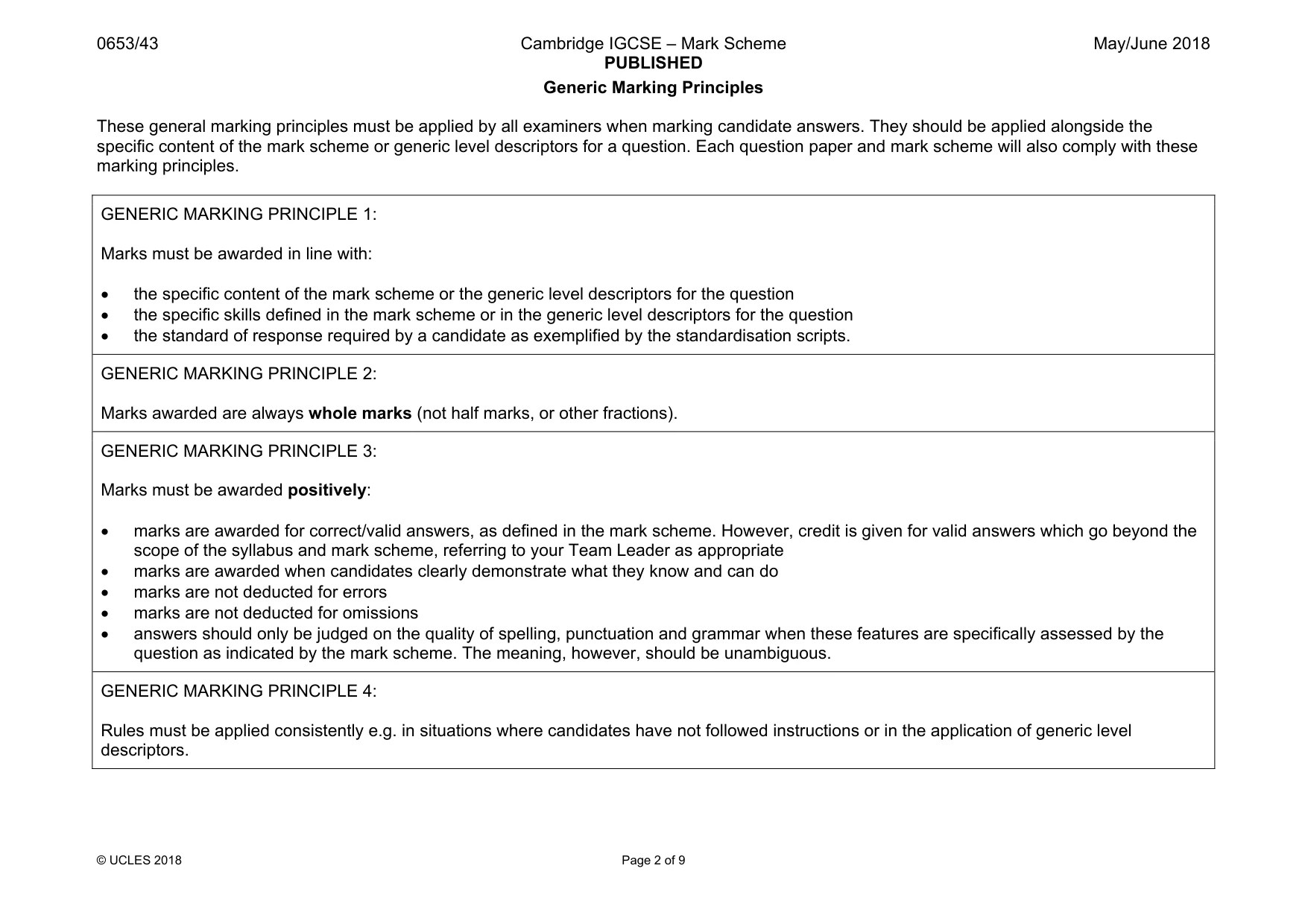
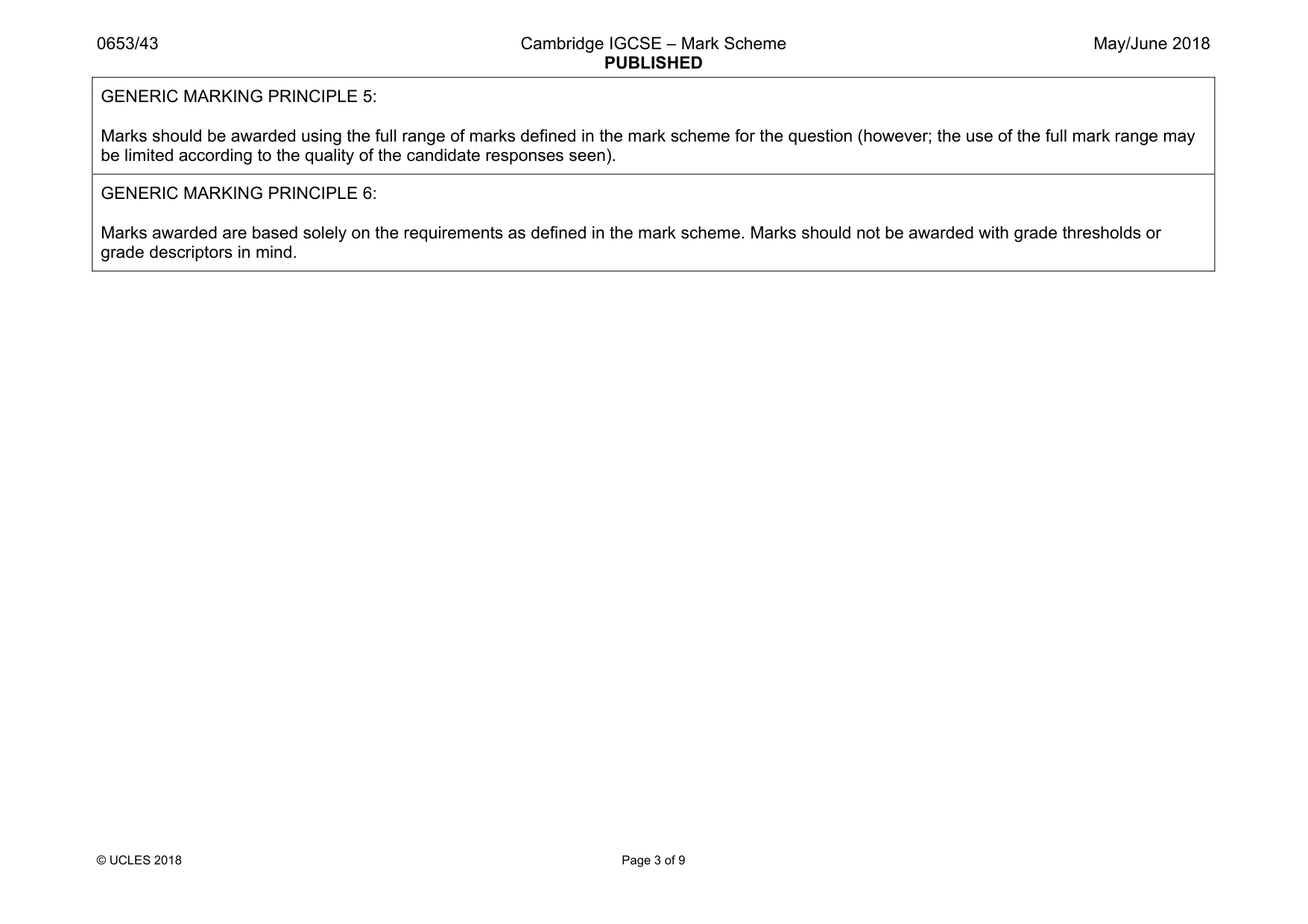
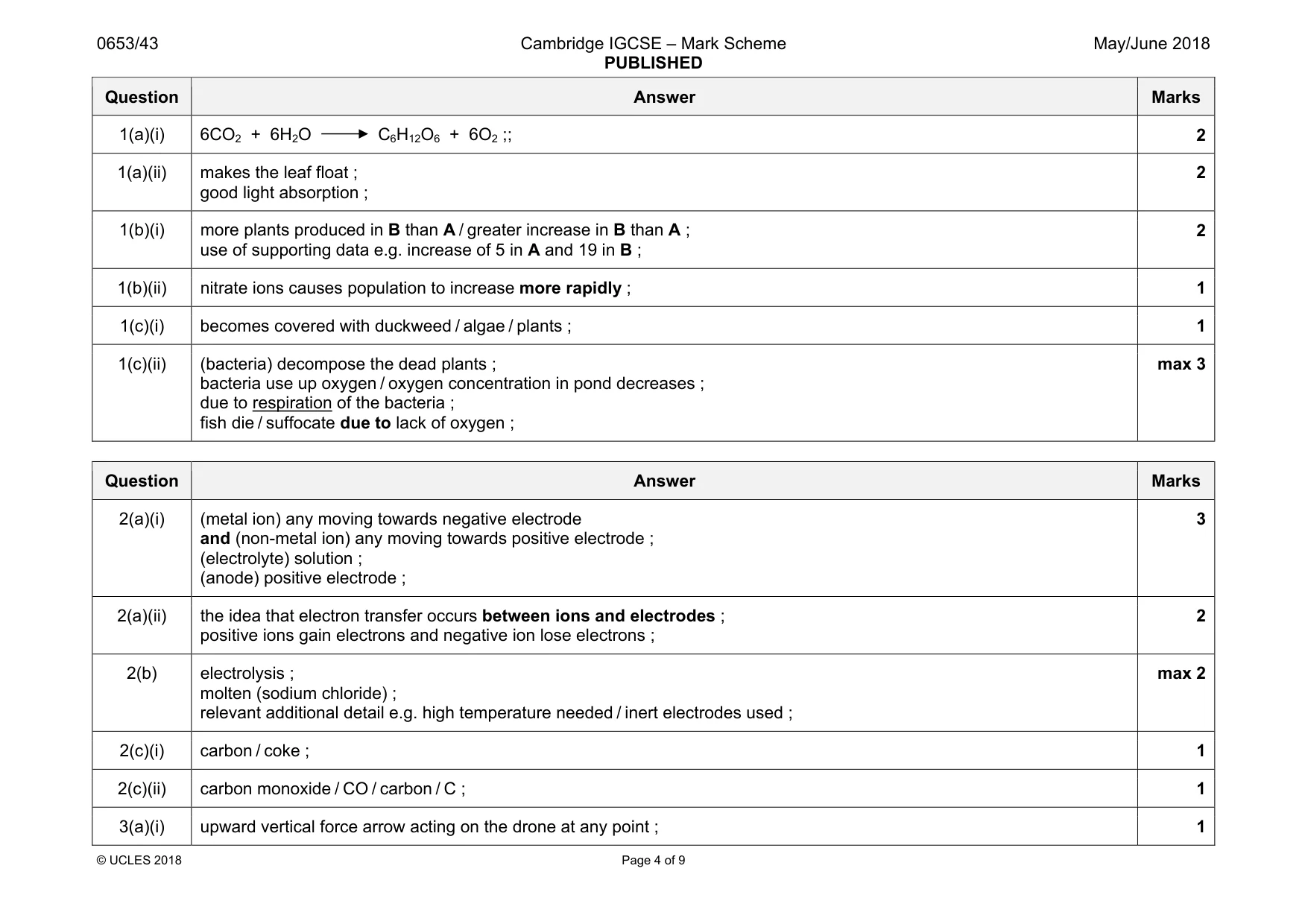
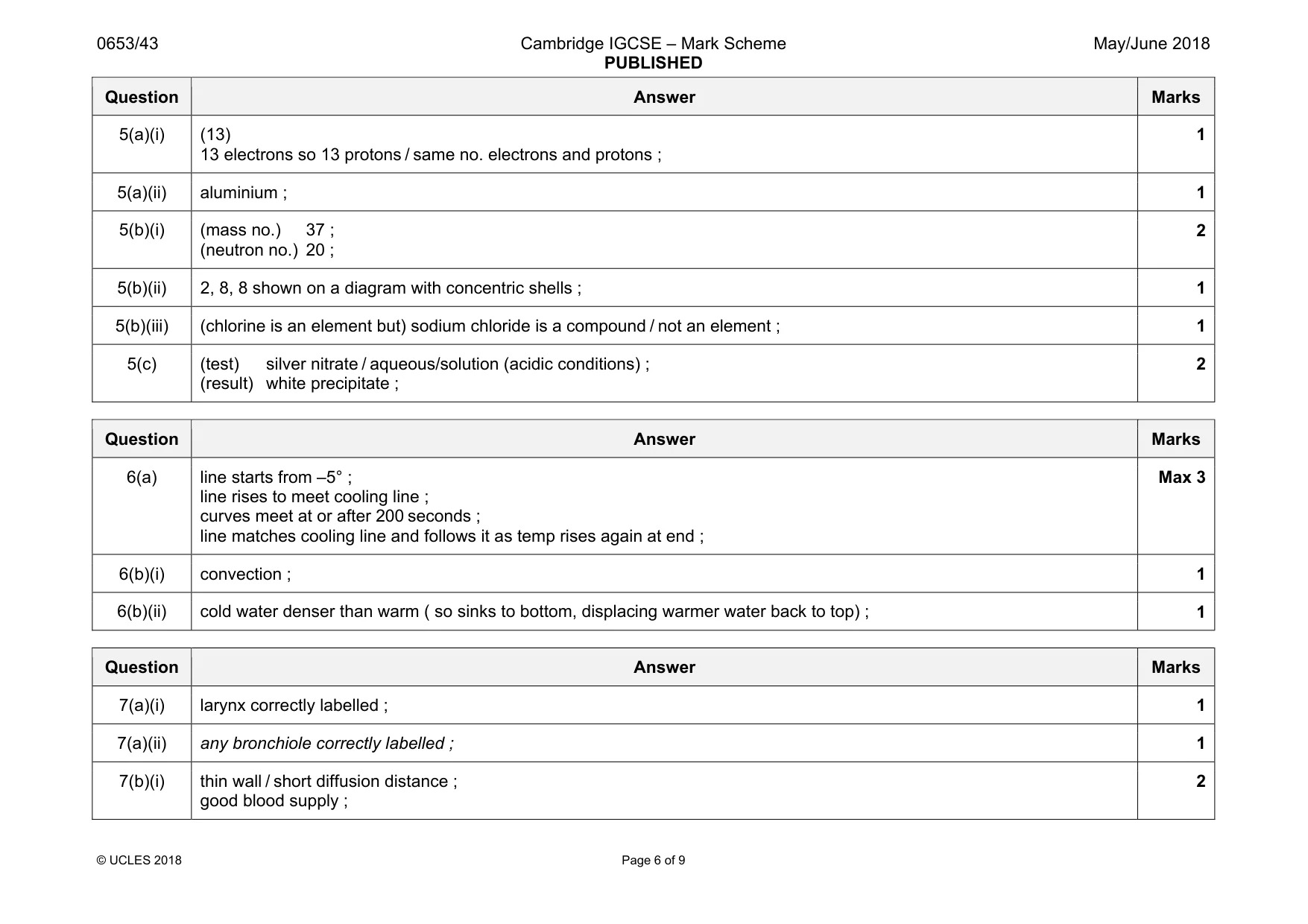
Mark scheme: 1(a)(i) 6CO2 + 6H2O C6H12O6 + 6O2 ;; 2 1(a)(ii) makes the leaf float ; good light absorption ; 2 1(b)(i) more plants produced in B than A / greater increase in B than A ; use of supporting data e.g. increase of 5 in A and 19 in B ; 2 1(b)(ii) nitrate ions causes population to increase more rapidly ; 1 1(c)(i) becomes covered with duckweed / algae / plants ; 1 1(c)(ii) (bacteria) decompose the dead plants ; bacteria use up oxygen / oxygen concentration in pond decreases ; due to respiration of the bacteria ; fish die / suffocate due to lack of oxygen ; max 3
Q2 · An aqueous solution of an ionic compound is electrolysed using inert electrodes
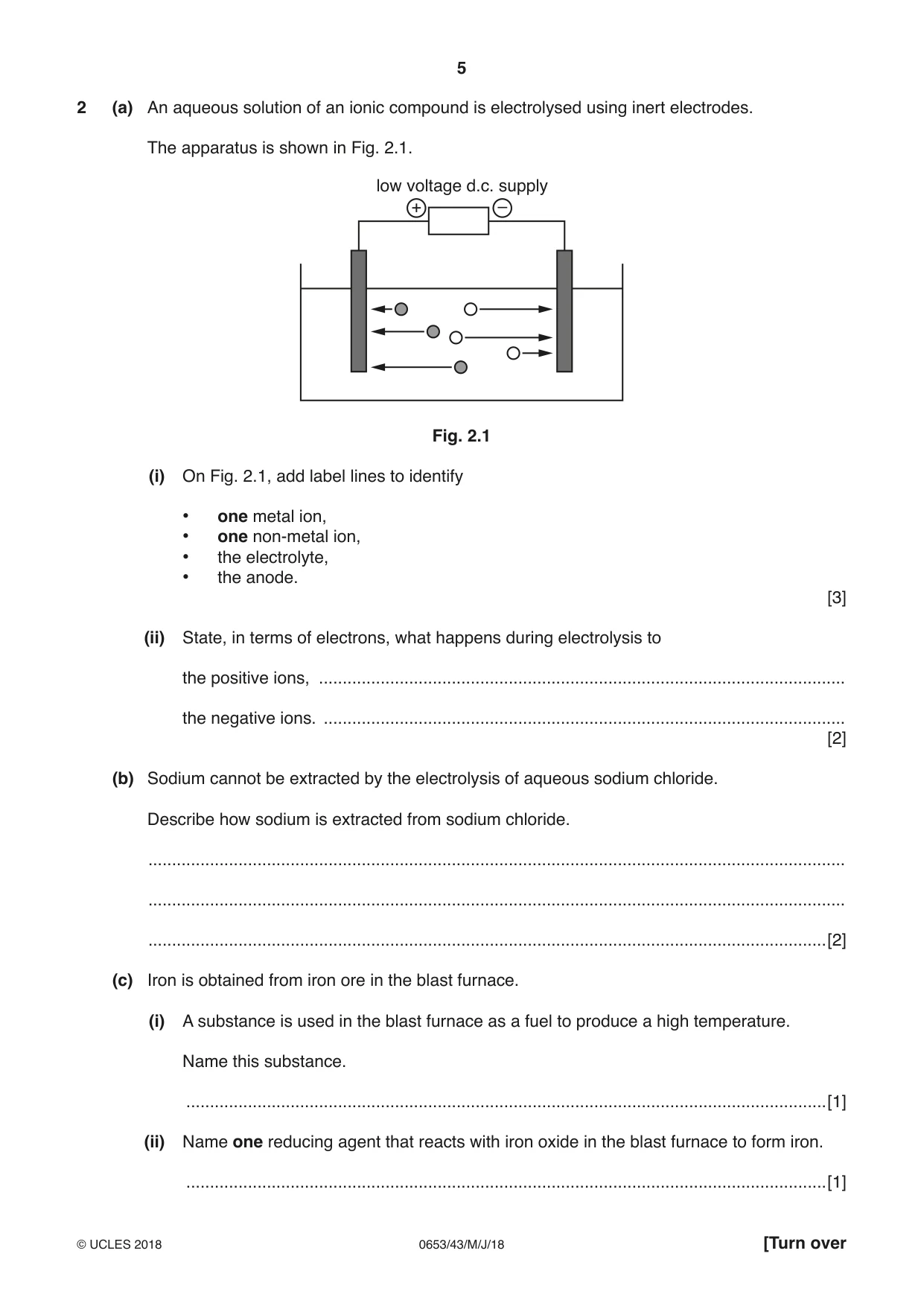
2 (a) An aqueous solution of an ionic compound is electrolysed using inert electrodes. The apparatus is shown in Fig. 2.1. low voltage d.c. supply + – Fig. 2.1 (i) On Fig. 2.1, add label lines to identify • one metal ion, • one non-metal ion, • the electrolyte, • the anode. [3] (ii) State, in terms of electrons, what happens during electrolysis to the positive ions, ............................................................................................................... the negative ions. .............................................................................................................. [2] (b) Sodium cannot be extracted by the electrolysis of aqueous sodium chloride. Describe how sodium is extracted from sodium chloride. ................................................................................................................................................... ................................................................................................................................................... ...............................................................................................................................................[2] (c) Iron is obtained from iron ore in the blast furnace. (i) A substance is used in the blast furnace as a fuel to produce a high temperature. Name this substance. .......................................................................................................................................[1] (ii) Name one reducing agent that reacts with iron oxide in the blast furnace to form iron. .......................................................................................................................................[1]
Mark scheme: 2(a)(i) (metal ion) any moving towards negative electrode and (non-metal ion) any moving towards positive electrode ; (electrolyte) solution ; (anode) positive electrode ; 3 2(a)(ii) the idea that electron transfer occurs between ions and electrodes ; positive ions gain electrons and negative ion lose electrons ; 2 2(b) electrolysis ; molten (sodium chloride) ; relevant additional detail e.g. high temperature needed / inert electrodes used ; max 2 2(c)(i) carbon / coke ; 1 2(c)(ii) carbon monoxide / CO / carbon / C ; 1
Q3 · A small quadcopter (drone with four rotors) being operated by radio control
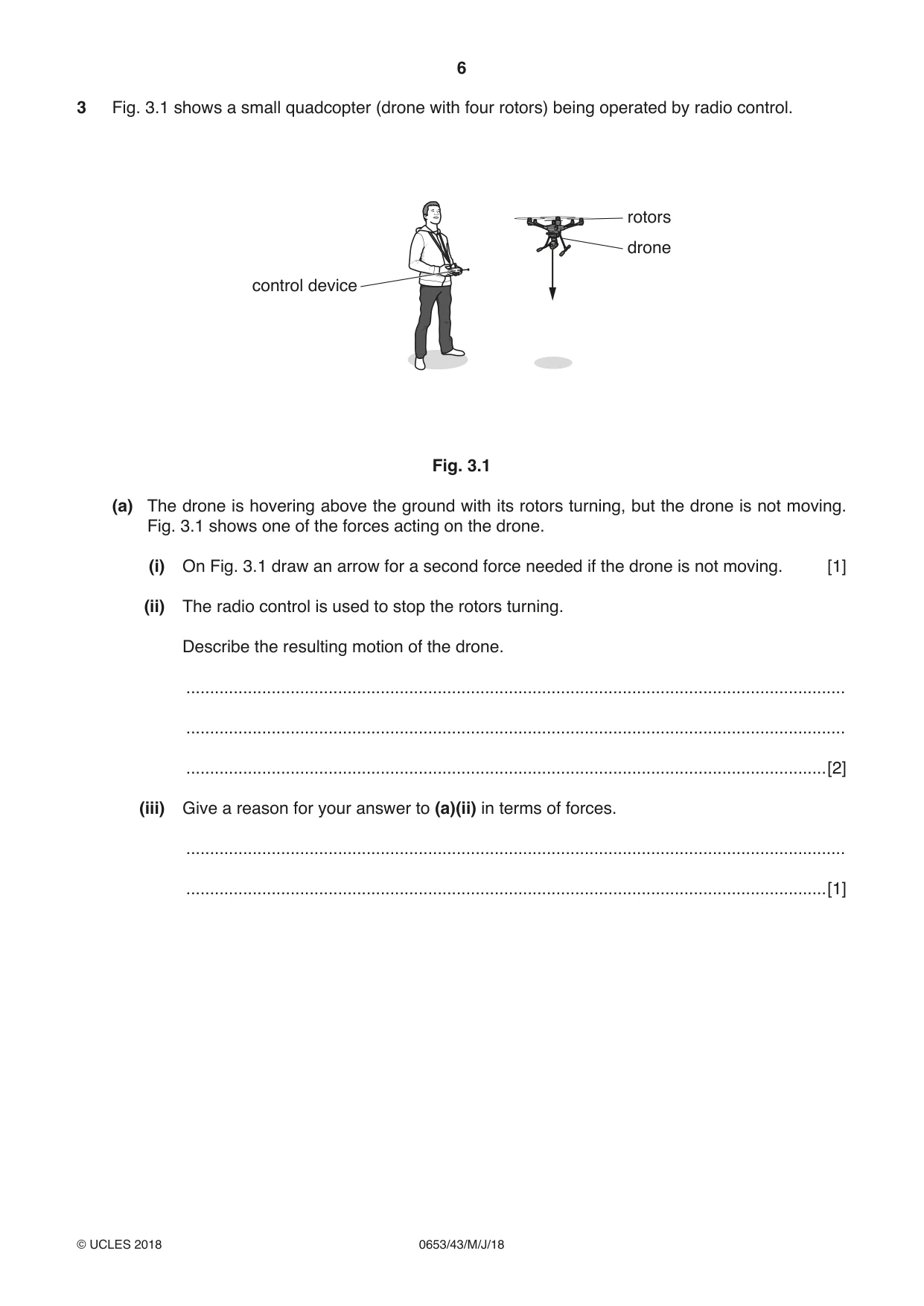
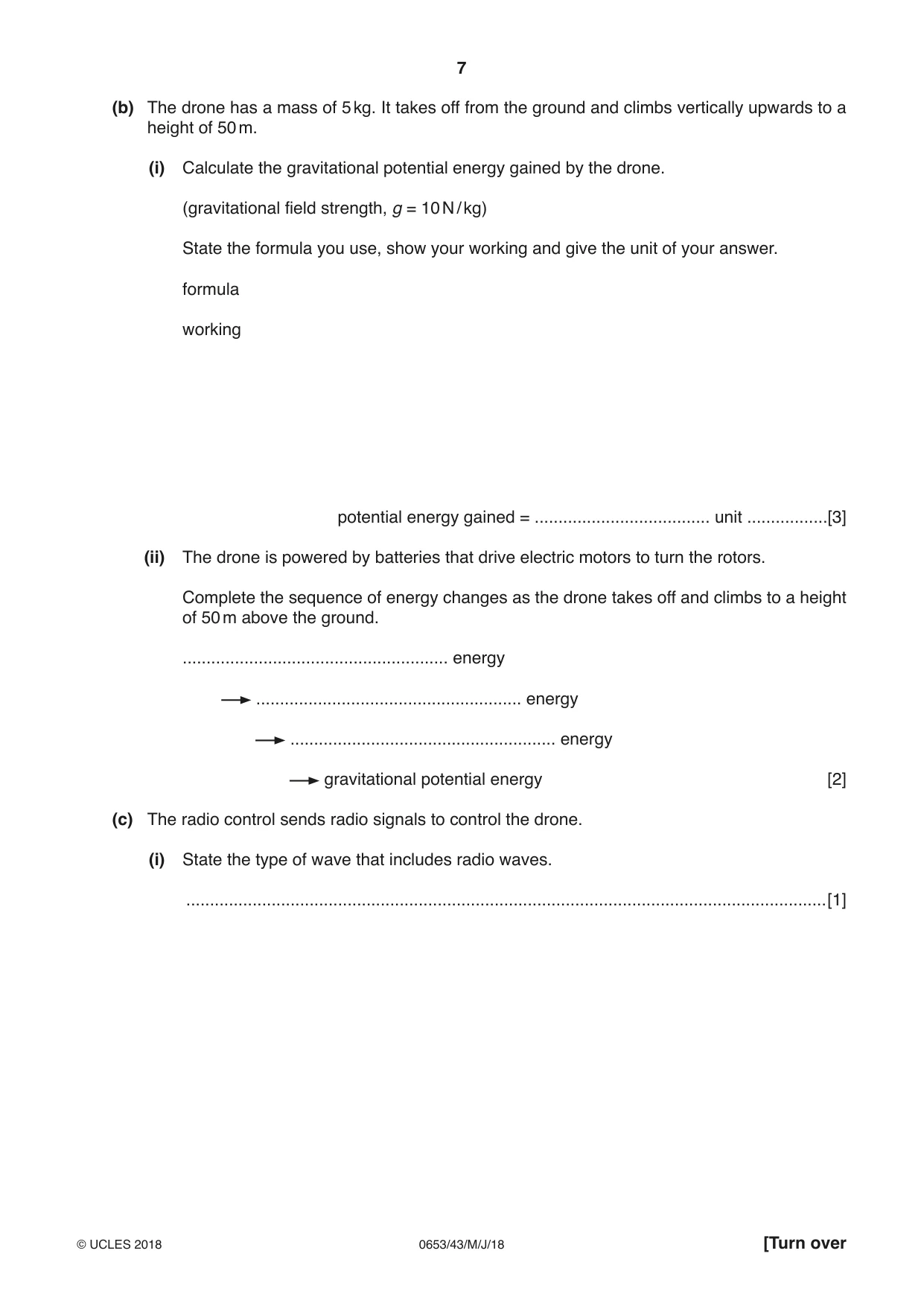
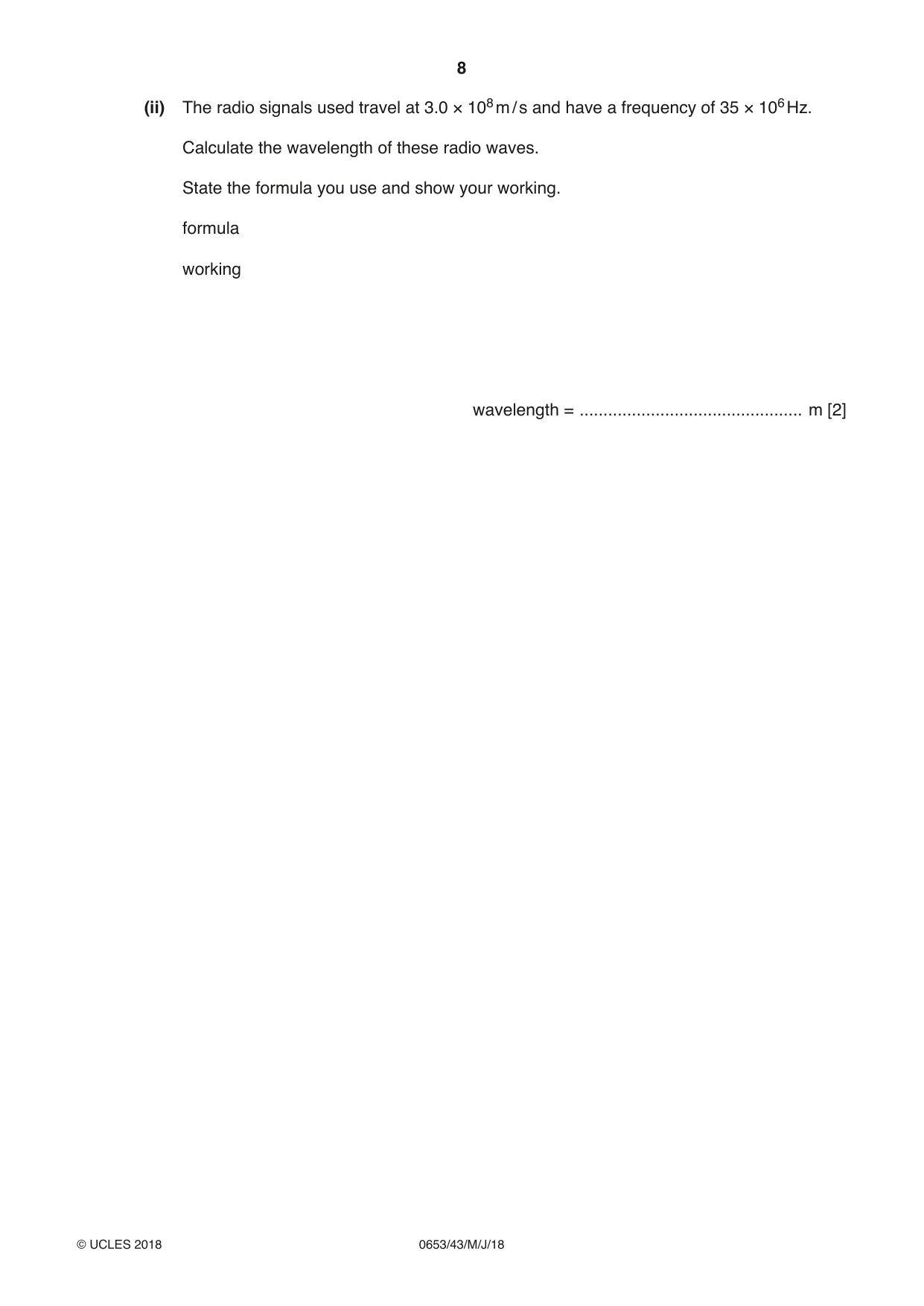
3 Fig. 3.1 shows a small quadcopter (drone with four rotors) being operated by radio control. rotors drone control device Fig. 3.1 (a) The drone is hovering above the ground with its rotors turning, but the drone is not moving. Fig. 3.1 shows one of the forces acting on the drone. (i) On Fig. 3.1 draw an arrow for a second force needed if the drone is not moving. [1] (ii) The radio control is used to stop the rotors turning. Describe the resulting motion of the drone. ........................................................................................................................................... ........................................................................................................................................... .......................................................................................................................................[2] (iii) Give a reason for your answer to (a)(ii) in terms of forces. ........................................................................................................................................... .......................................................................................................................................[1] (b) The drone has a mass of 5 kg. It takes off from the ground and climbs vertically upwards to a height of 50 m. (i) Calculate the gravitational potential energy gained by the drone. (gravitational field strength, g = 10 N / kg) State the formula you use, show your working and give the unit of your answer. formula working potential energy gained = ..................................... unit .................[3] (ii) The drone is powered by batteries that drive electric motors to turn the rotors. Complete the sequence of energy changes as the drone takes off and climbs to a height of 50 m above the ground. ........................................................ energy ........................................................ energy ........................................................ energy gravitational potential energy [2] (c) The radio control sends radio signals to control the drone. (i) State the type of wave that includes radio waves. .......................................................................................................................................[1] (ii) The radio signals used travel at 3.0 × 10⁸ m / s and have a frequency of 35 × 106 Hz. Calculate the wavelength of these radio waves. State the formula you use and show your working. formula working wavelength = ............................................... m [2]
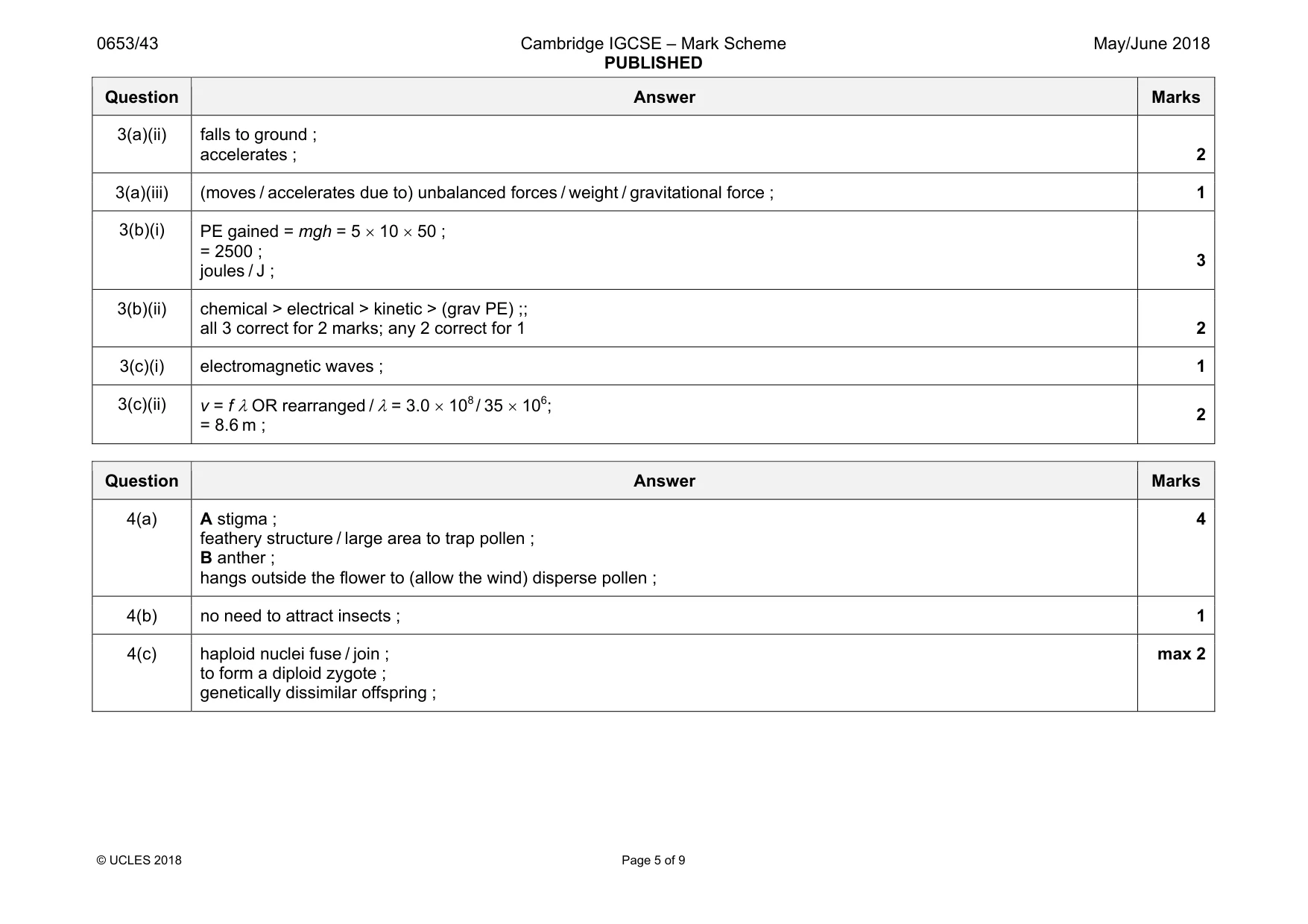
Mark scheme: 3(a)(i) upward vertical force arrow acting on the drone at any point ; 1 Question Answer Marks 3(a)(ii) falls to ground ; accelerates ; 2 3(a)(iii) (moves / accelerates due to) unbalanced forces / weight / gravitational force ; 1 3(b)(i) PE gained = mgh = 5 × 10 × 50 ; = 2500 ; joules / J ; 3 3(b)(ii) chemical > electrical > kinetic > (grav PE) ;; all 3 correct for 2 marks; any 2 correct for 1 2 3(c)(i) electromagnetic waves ; 1 3(c)(ii) v = f λ OR rearranged / λ = 3.0 × 10⁸/ 35 × 106; = 8.6 m ; 2
Question 4
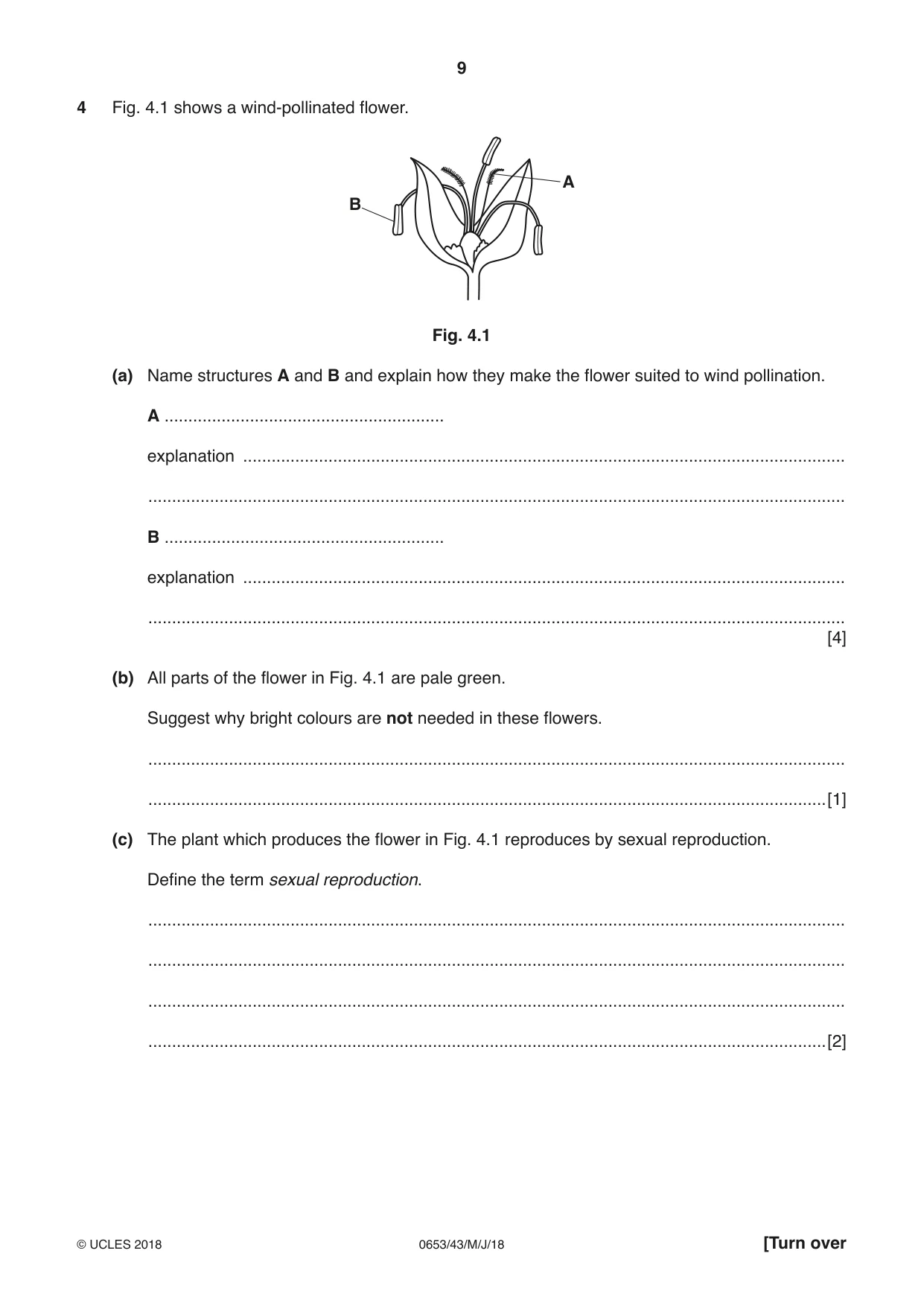
4 Fig. 4.1 shows a wind-pollinated flower. A B Fig. 4.1 (a) Name structures A and B and explain how they make the flower suited to wind pollination. A ........................................................... explanation ............................................................................................................................... ................................................................................................................................................... B ........................................................... explanation ............................................................................................................................... ................................................................................................................................................... [4] (b) All parts of the flower in Fig. 4.1 are pale green. Suggest why bright colours are not needed in these flowers. ................................................................................................................................................... ...............................................................................................................................................[1] (c) The plant which produces the flower in Fig. 4.1 reproduces by sexual reproduction. Define the term sexual reproduction. ................................................................................................................................................... ................................................................................................................................................... ................................................................................................................................................... ...............................................................................................................................................[2]
Mark scheme: 4(a) A stigma ; feathery structure / large area to trap pollen ; B anther ; hangs outside the flower to (allow the wind) disperse pollen ; 4 4(b) no need to attract insects ; 1 4(c) haploid nuclei fuse / join ; to form a diploid zygote ; genetically dissimilar offspring ; max 2
Q5 · The electronic structure of an atom of element E is shown in Fig
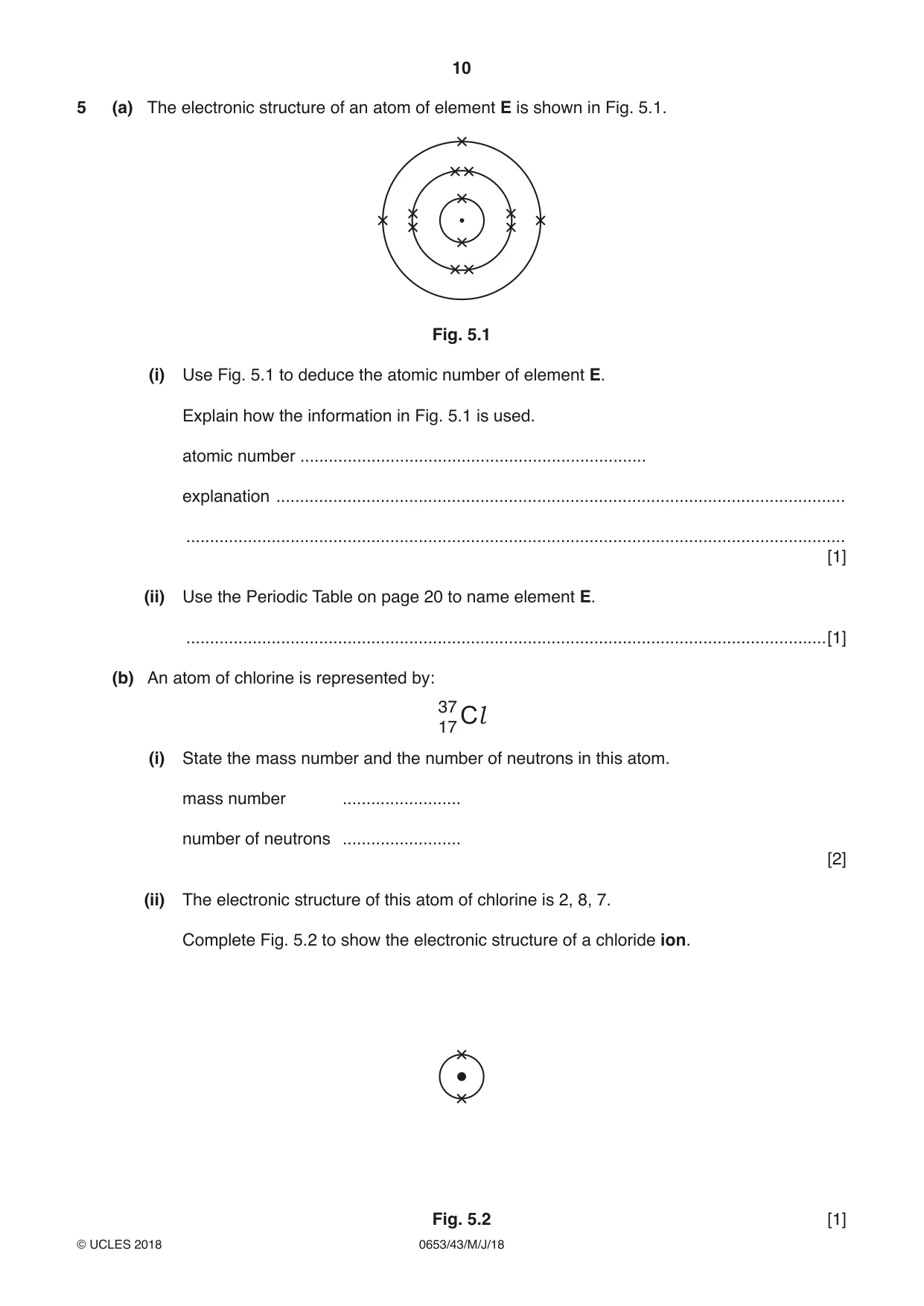
5 (a) The electronic structure of an atom of element E is shown in Fig. 5.1. Fig. 5.1 (i) Use Fig. 5.1 to deduce the atomic number of element E. Explain how the information in Fig. 5.1 is used. atomic number ......................................................................... explanation ........................................................................................................................ ........................................................................................................................................... [1] (ii) Use the Periodic Table on page 20 to name element E. .......................................................................................................................................[1] (b) An atom of chlorine is represented by: 3717Cl (i) State the mass number and the number of neutrons in this atom. mass number ......................... number of neutrons ......................... [2] (ii) The electronic structure of this atom of chlorine is 2, 8, 7. Complete Fig. 5.2 to show the electronic structure of a chloride ion. Fig. 5.2 [1] (iii) Explain why chlorine is shown in the Periodic Table, but sodium chloride is not. ........................................................................................................................................... .......................................................................................................................................[1] (c) An aqueous solution is tested to find out if chloride ions are present. Describe the test and state the positive result. test ............................................................................................................................................ result ......................................................................................................................................... [2]
Mark scheme: 5(a)(i) (13) 13 electrons so 13 protons / same no. electrons and protons ; 1 5(a)(ii) aluminium ; 1 5(b)(i) (mass no.) 37 ; (neutron no.) 20 ; 2 5(b)(ii) 2, 8, 8 shown on a diagram with concentric shells ; 1 5(b)(iii) (chlorine is an element but) sodium chloride is a compound / not an element ; 1 5(c) (test) silver nitrate / aqueous/solution (acidic conditions) ; (result) white precipitate ; 2
Q6 · Ice cubes being added to a drink at 25 °C to cool the drink down
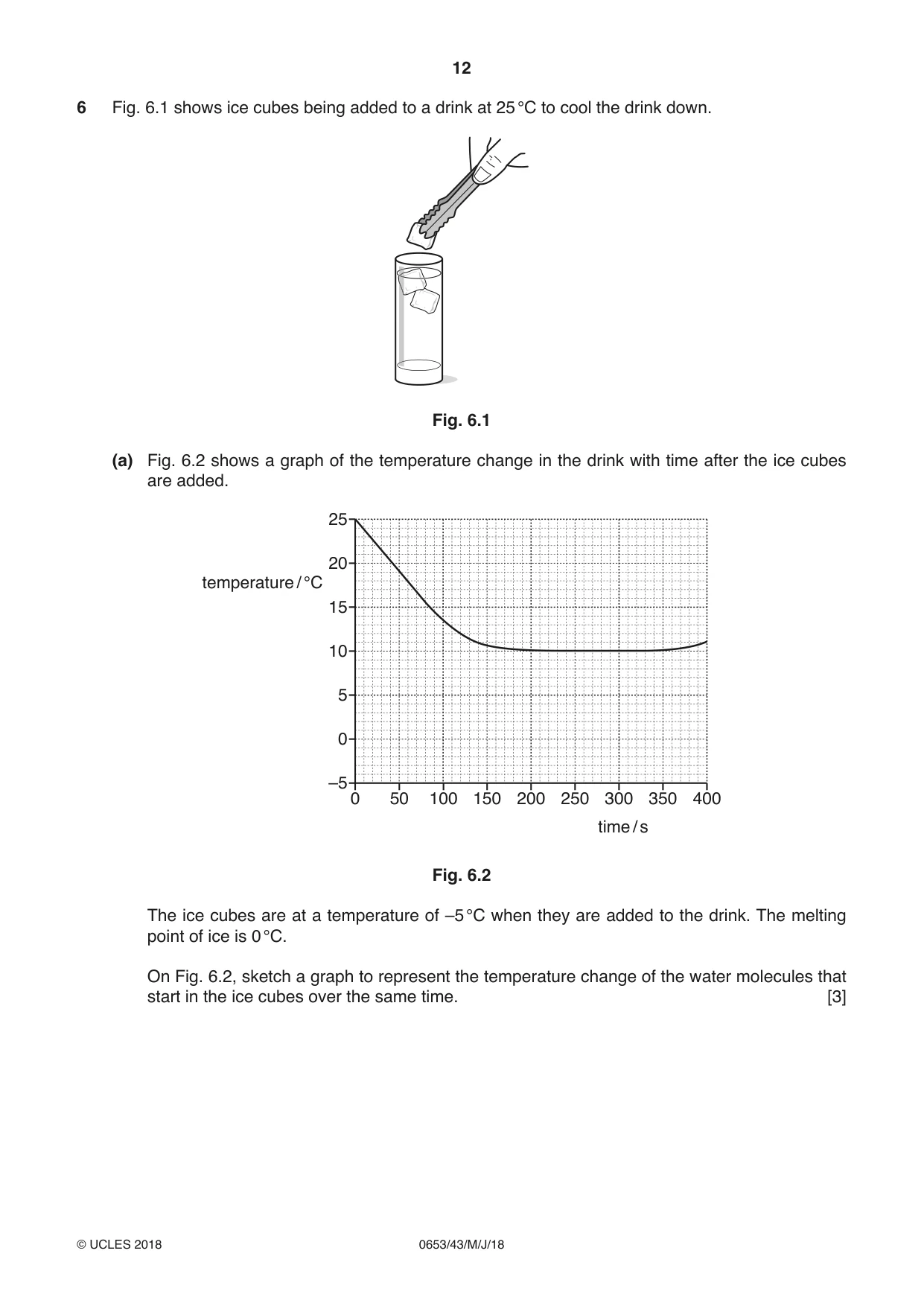
6 Fig. 6.1 shows ice cubes being added to a drink at 25 °C to cool the drink down. Fig. 6.1 (a) Fig. 6.2 shows a graph of the temperature change in the drink with time after the ice cubes are added. 25 20 temperature / °C 15 10 5 0 –5 0 50 100 150 200 250 300 350 400 time / s Fig. 6.2 The ice cubes are at a temperature of –5 °C when they are added to the drink. The melting point of ice is 0 °C. On Fig. 6.2, sketch a graph to represent the temperature change of the water molecules that start in the ice cubes over the same time. [3] (b) As the ice melts at the top of the drink, the cold liquid formed sinks to the bottom. This makes warmer liquid come up to the surface where the ice is floating. (i) State the name of the method of thermal energy transfer that is happening as the cold liquid sinks, and warmer liquid rises. .......................................................................................................................................[1] (ii) Explain why this circulation of liquid occurs as the ice melts. ........................................................................................................................................... ........................................................................................................................................... .......................................................................................................................................[1]
Mark scheme: 6(a) line starts from –5° ; line rises to meet cooling line ; curves meet at or after 200 seconds ; line matches cooling line and follows it as temp rises again at end ; Max 3 6(b)(i) convection ; 1 6(b)(ii) cold water denser than warm ( so sinks to bottom, displacing warmer water back to top) ; 1
Q7 · A diagram of the human gas exchange system
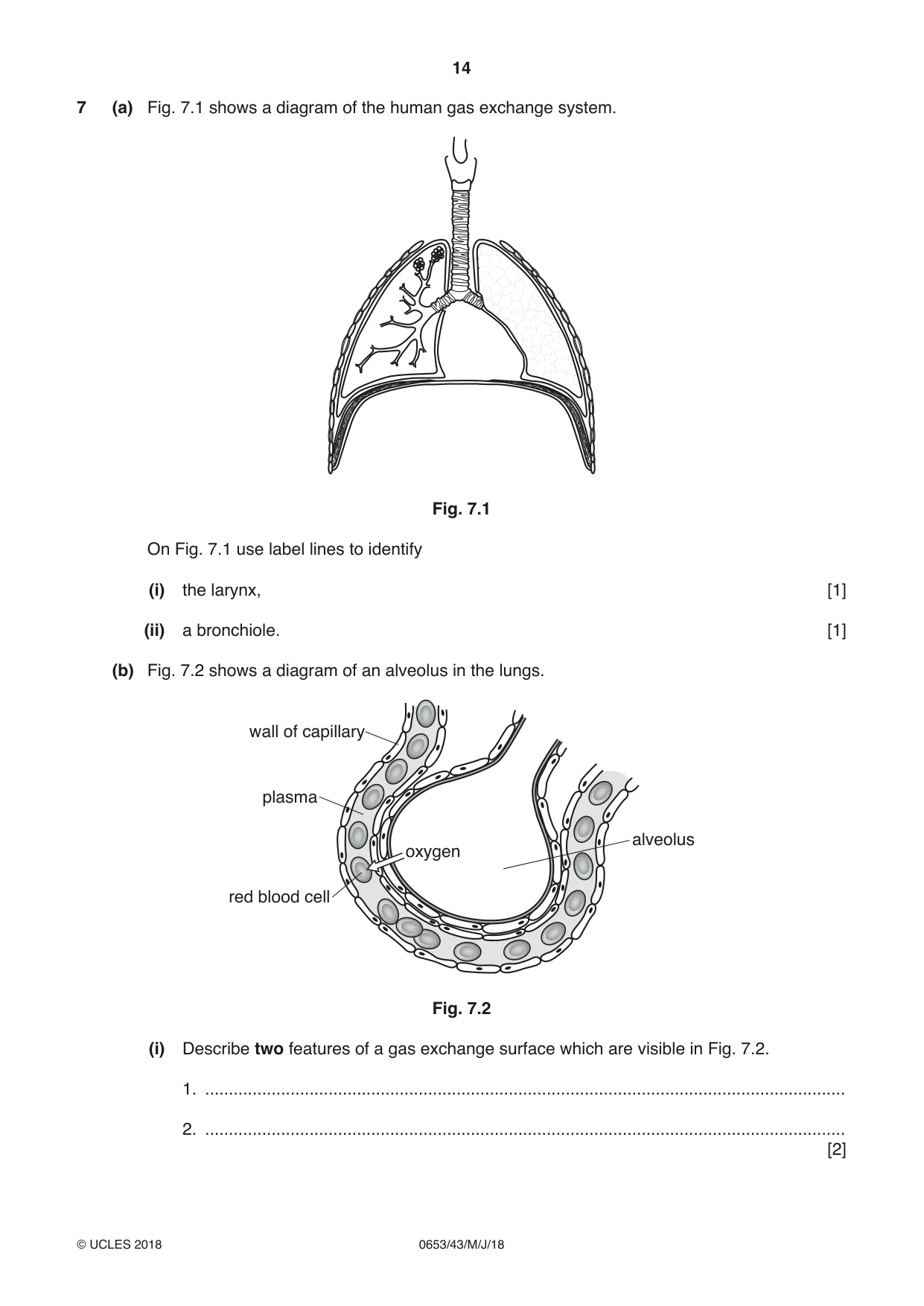
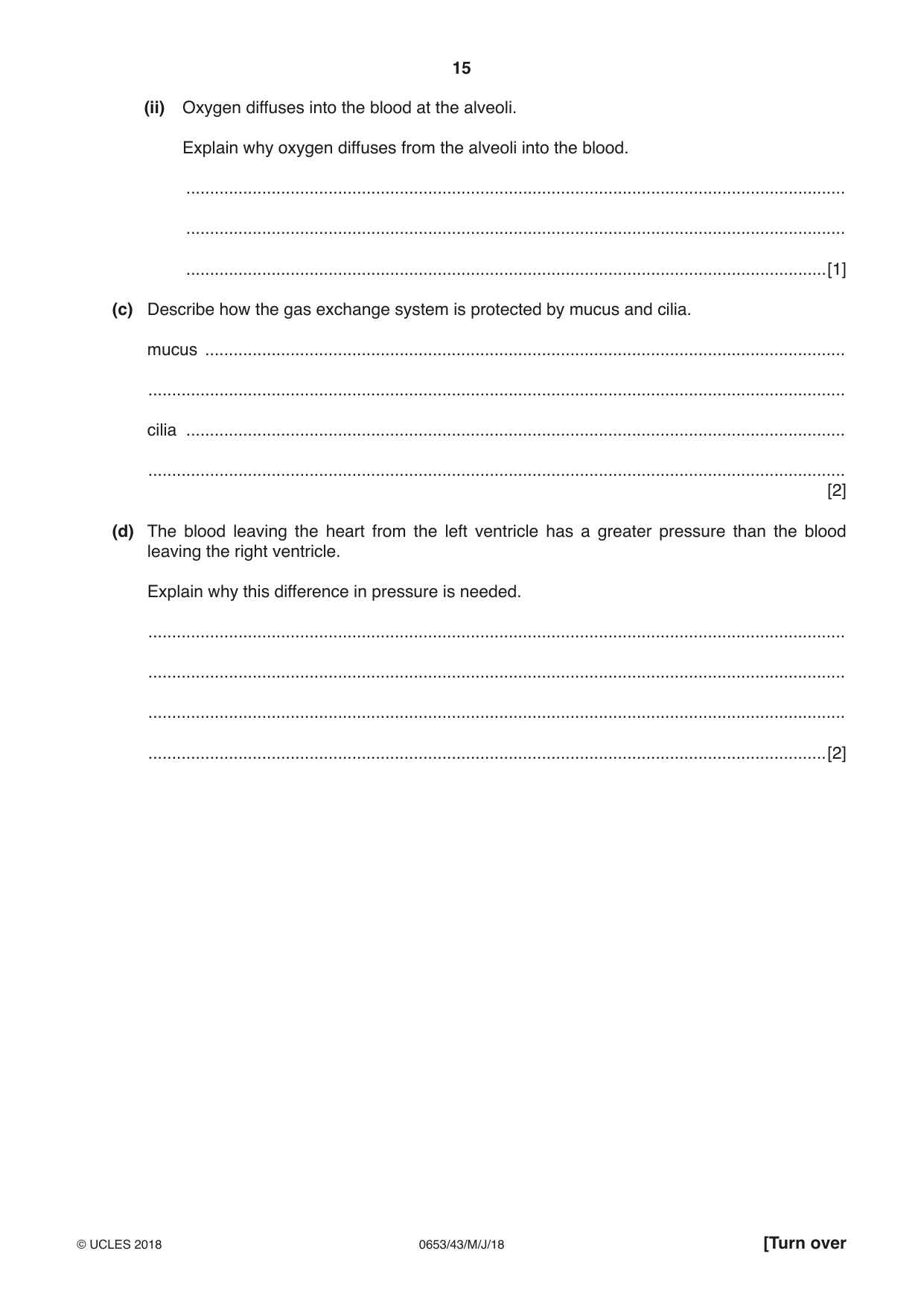
7 (a) Fig. 7.1 shows a diagram of the human gas exchange system. Fig. 7.1 On Fig. 7.1 use label lines to identify (i) the larynx, [1] (ii) a bronchiole. [1] (b) Fig. 7.2 shows a diagram of an alveolus in the lungs. wall of capillary plasma alveolus oxygen red blood cell Fig. 7.2 (i) Describe two features of a gas exchange surface which are visible in Fig. 7.2. 1. ....................................................................................................................................... 2. ....................................................................................................................................... [2] (ii) Oxygen diffuses into the blood at the alveoli. Explain why oxygen diffuses from the alveoli into the blood. ........................................................................................................................................... ........................................................................................................................................... .......................................................................................................................................[1] (c) Describe how the gas exchange system is protected by mucus and cilia. mucus ....................................................................................................................................... ................................................................................................................................................... cilia ........................................................................................................................................... ................................................................................................................................................... [2] (d) The blood leaving the heart from the left ventricle has a greater pressure than the blood leaving the right ventricle. Explain why this difference in pressure is needed. ................................................................................................................................................... ................................................................................................................................................... ................................................................................................................................................... ...............................................................................................................................................[2]
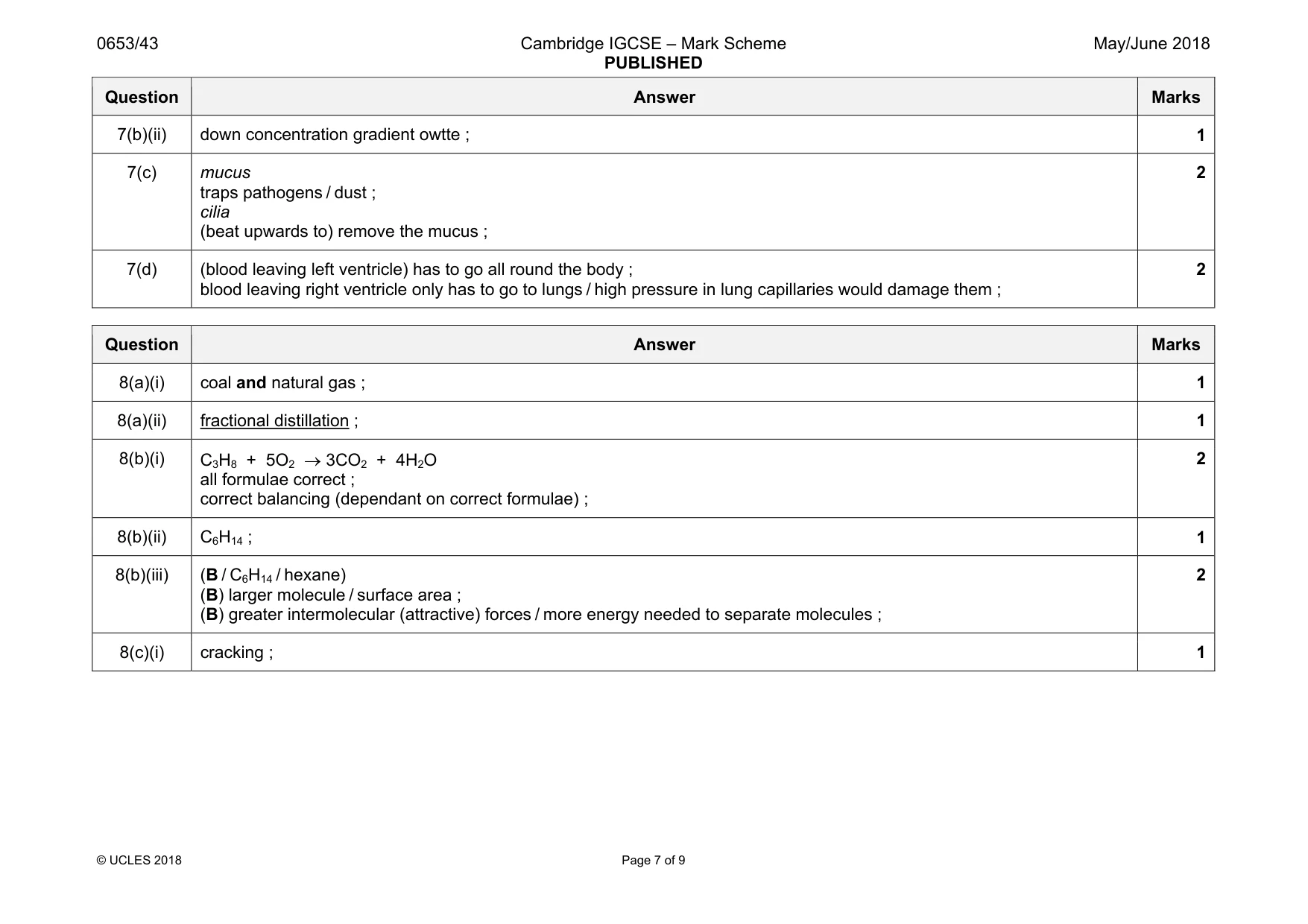
Mark scheme: 7(a)(i) larynx correctly labelled ; 1 7(a)(ii) any bronchiole correctly labelled ; 1 7(b)(i) thin wall / short diffusion distance ; good blood supply ; 2 Question Answer Marks 7(b)(ii) down concentration gradient owtte ; 1 7(c) mucus traps pathogens / dust ; cilia (beat upwards to) remove the mucus ; 2 7(d) (blood leaving left ventricle) has to go all round the body ; blood leaving right ventricle only has to go to lungs / high pressure in lung capillaries would damage them ; 2
Q8 · Petroleum is a fossil fuel
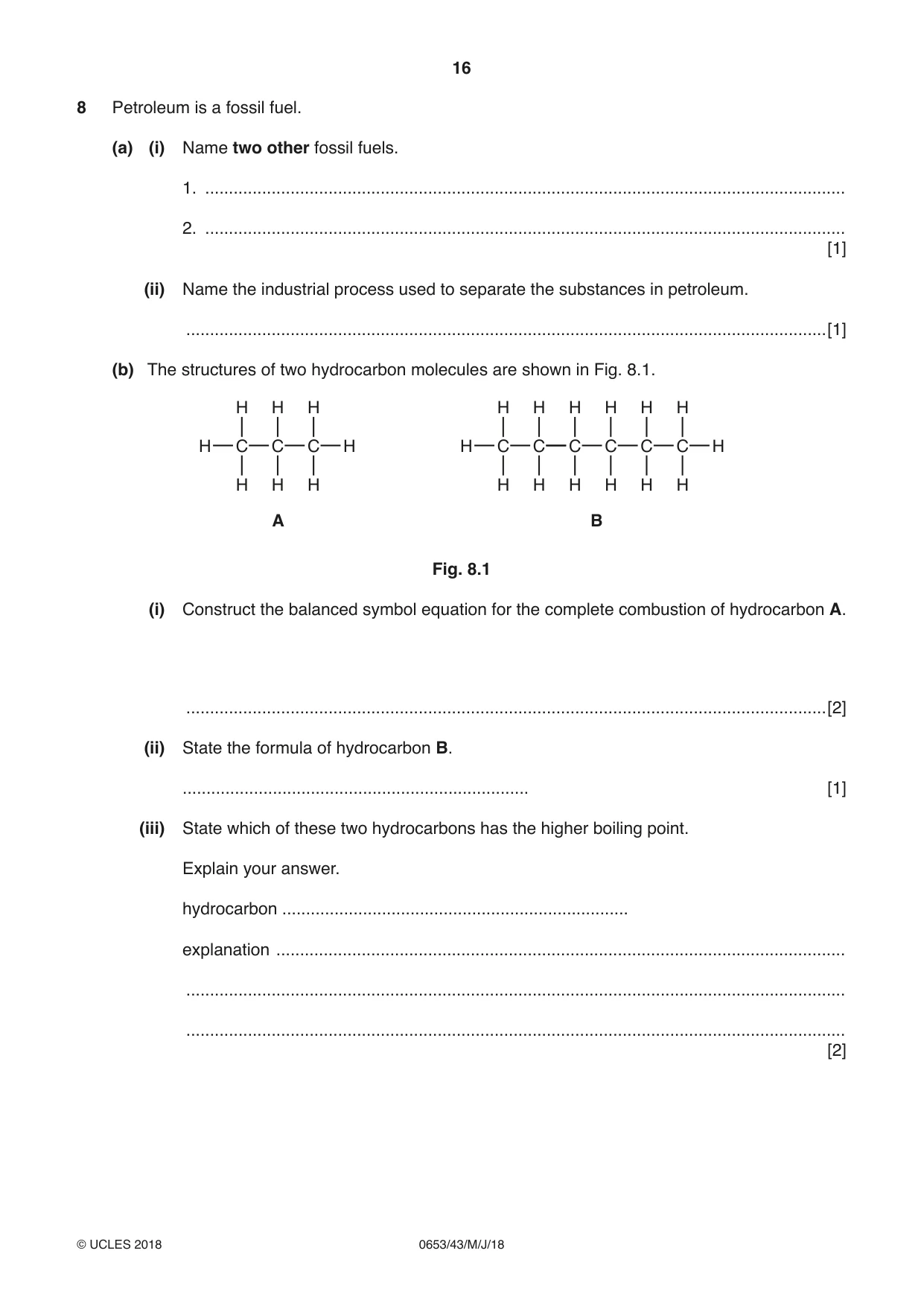
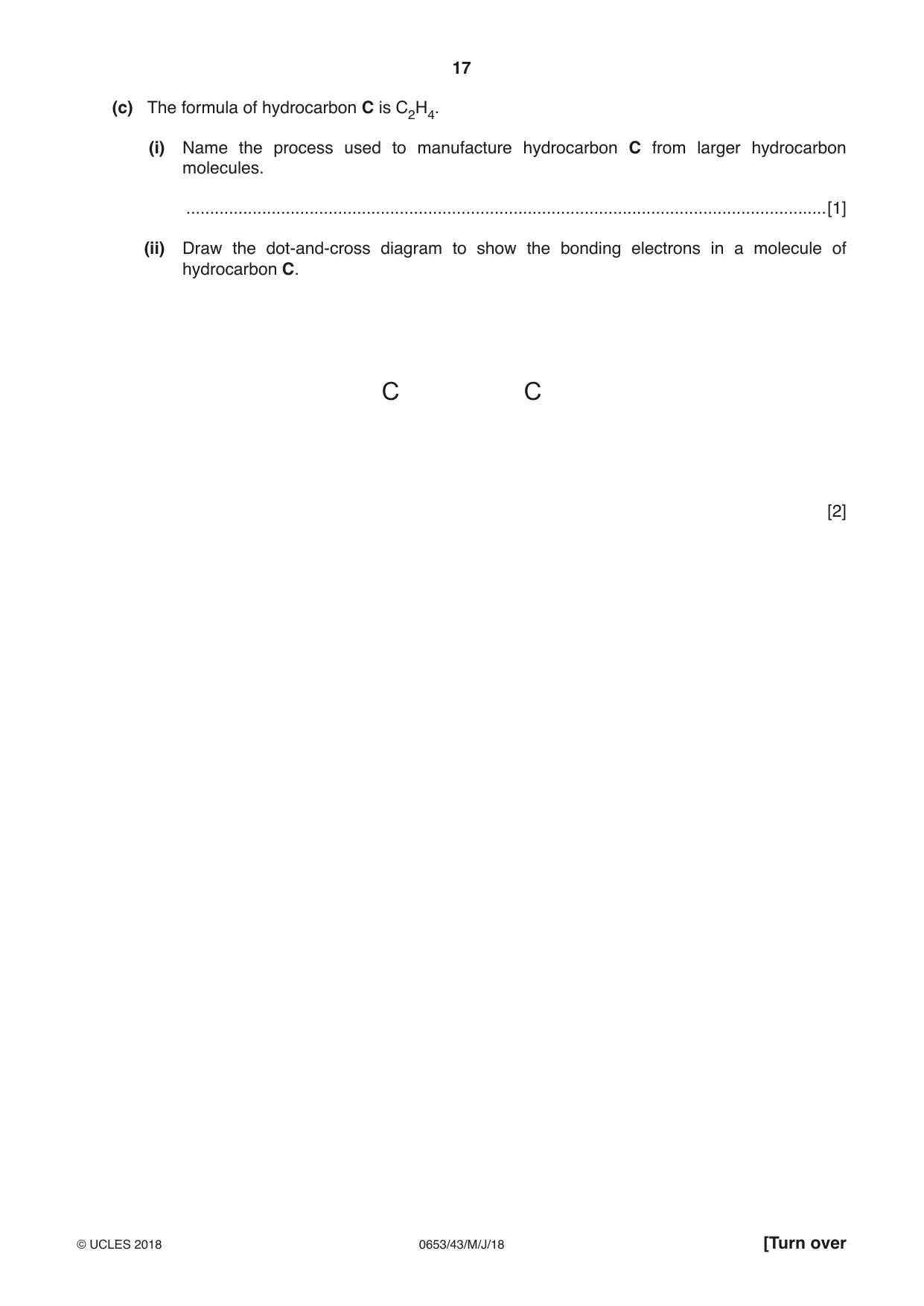
8 Petroleum is a fossil fuel. (a) (i) Name two other fossil fuels. 1. ....................................................................................................................................... 2. ....................................................................................................................................... [1] (ii) Name the industrial process used to separate the substances in petroleum. .......................................................................................................................................[1] (b) The structures of two hydrocarbon molecules are shown in Fig. 8.1. H H H H H H H H H H C C C H H C C C C C C H H H H H H H H H H A B Fig. 8.1 (i) Construct the balanced symbol equation for the complete combustion of hydrocarbon A. .......................................................................................................................................[2] (ii) State the formula of hydrocarbon B. ......................................................................... [1] (iii) State which of these two hydrocarbons has the higher boiling point. Explain your answer. hydrocarbon ......................................................................... explanation ........................................................................................................................ ........................................................................................................................................... ........................................................................................................................................... [2] (c) The formula of hydrocarbon C is C2H4. (i) Name the process used to manufacture hydrocarbon C from larger hydrocarbon molecules. .......................................................................................................................................[1] (ii) Draw the dot-and-cross diagram to show the bonding electrons in a molecule of hydrocarbon C. C C [2]
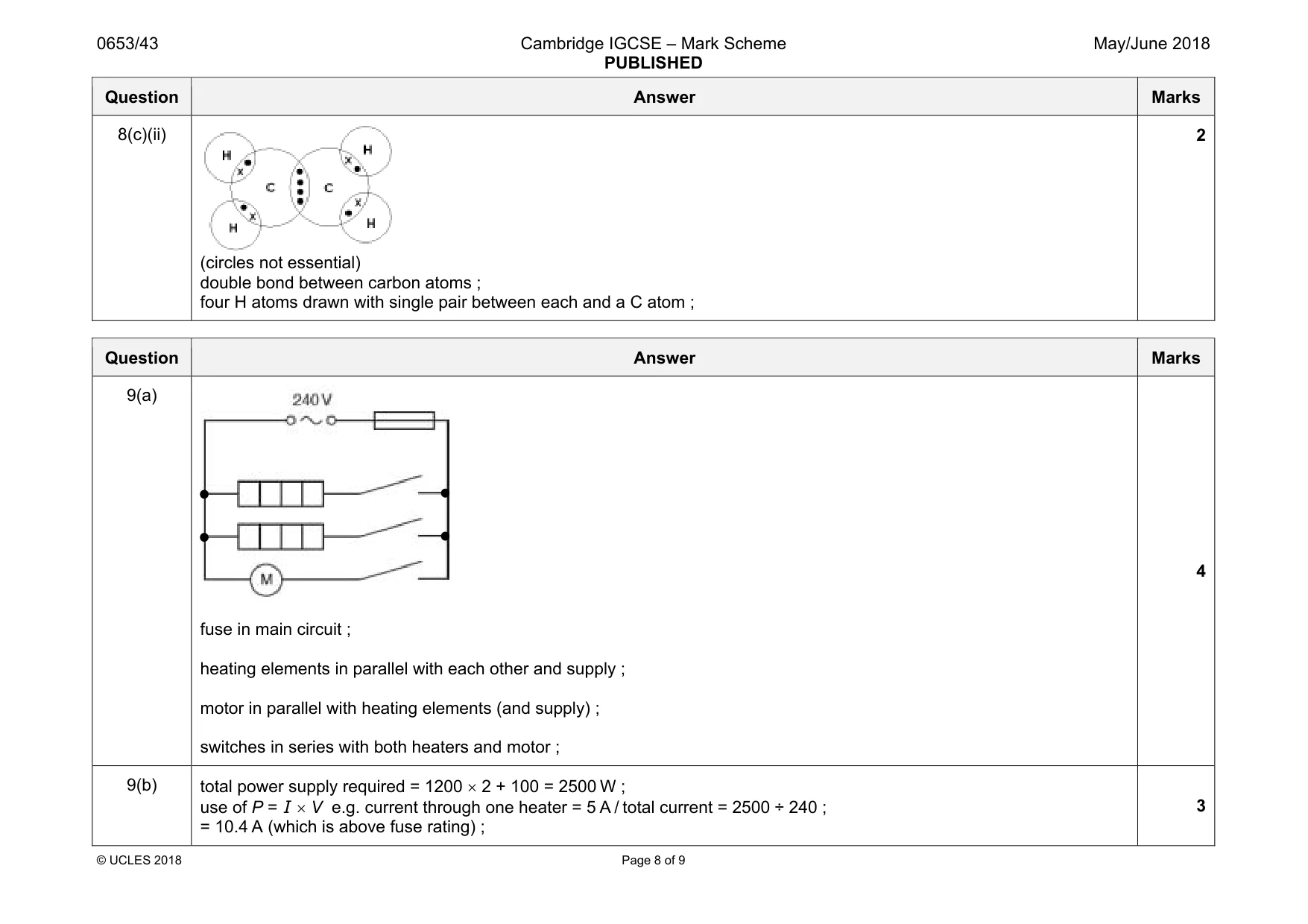
Mark scheme: 8(a)(i) coal and natural gas ; 1 8(a)(ii) fractional distillation ; 1 8(b)(i) C3H8 + 5O2 → 3CO2 + 4H2O all formulae correct ; correct balancing (dependant on correct formulae) ; 2 8(b)(ii) C6H14 ; 1 8(b)(iii) (B / C6H14 / hexane) (B) larger molecule / surface area ; (B) greater intermolecular (attractive) forces / more energy needed to separate molecules ; 2 8(c)(i) cracking ; 1 Question Answer Marks 8(c)(ii) (circles not essential) double bond between carbon atoms ; four H atoms drawn with single pair between each and a C atom ; 2 Question Answer Marks 9(a) fuse in main circuit ; heating elements in parallel with each other and supply ; motor in parallel with heating elements (and supply) ; switches in series with both heaters and motor ; 4 9(b) total power supply required = 1200 × 2 + 100 = 2500 W ; use of P = I × V e.g. current through one heater = 5 A / total current = 2500 ÷ 240 ; = 10.4 A (which is above fuse rating) ; 3 Question Answer Marks 9(c) value within range 10–15 kHz ; top end of normal range is 20 kHz / older residents can hear up to 15 kHz ; 2
Q9 · An electric toaster used for toasting bread slices in a hotel dining room
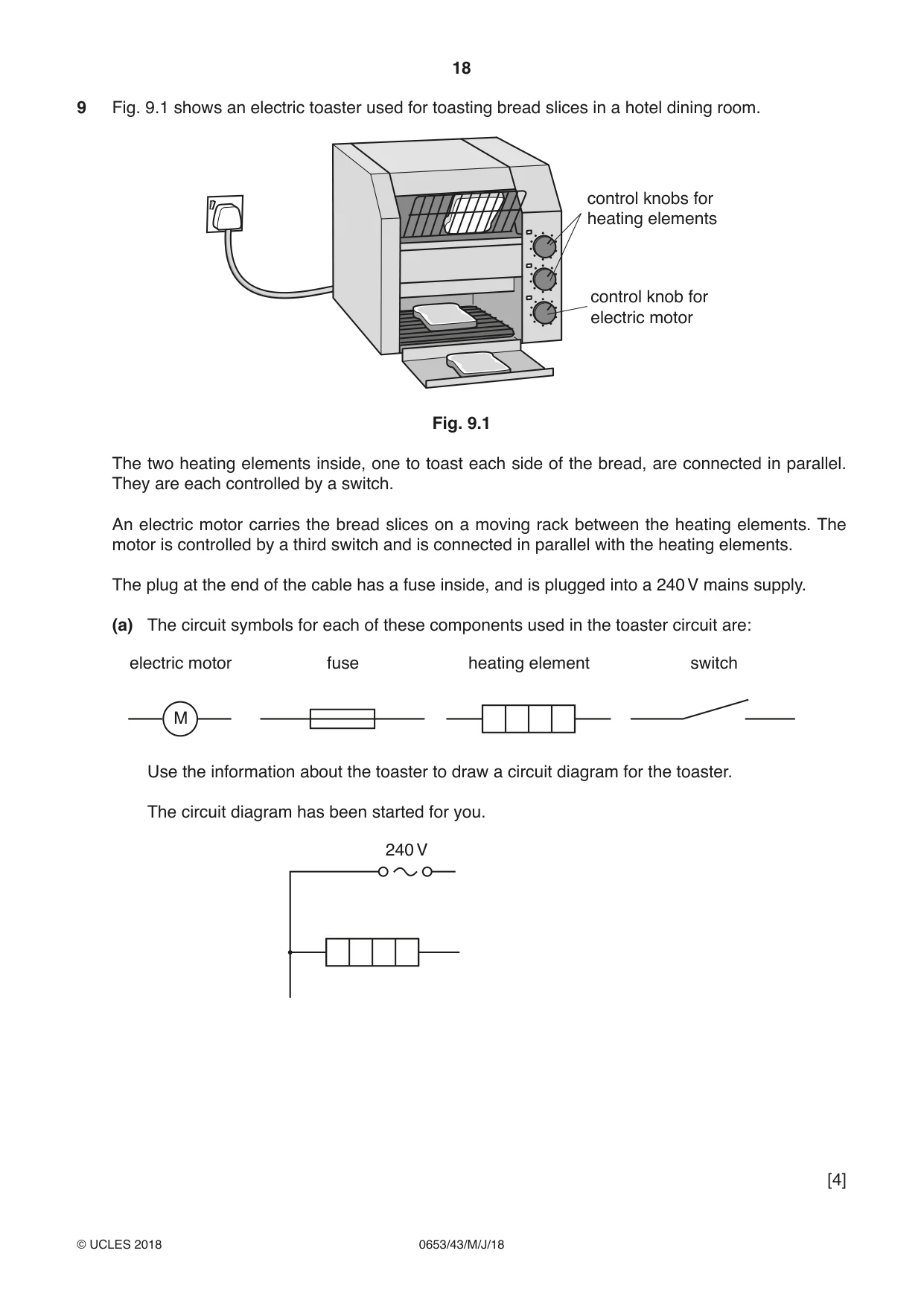
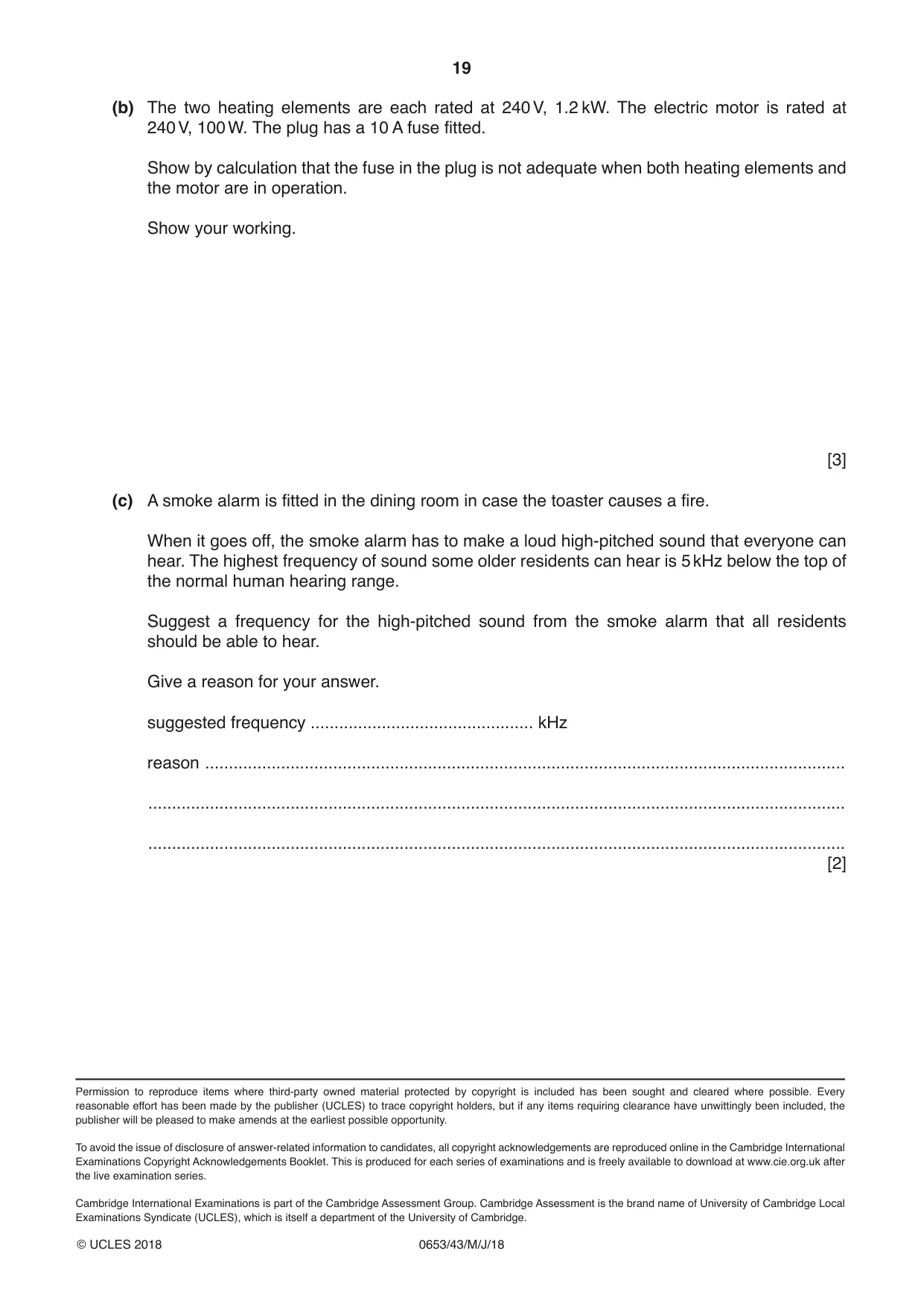
9 Fig. 9.1 shows an electric toaster used for toasting bread slices in a hotel dining room. control knobs for heating elements control knob for electric motor Fig. 9.1 The two heating elements inside, one to toast each side of the bread, are connected in parallel. They are each controlled by a switch. An electric motor carries the bread slices on a moving rack between the heating elements. The motor is controlled by a third switch and is connected in parallel with the heating elements. The plug at the end of the cable has a fuse inside, and is plugged into a 240 V mains supply. (a) The circuit symbols for each of these components used in the toaster circuit are: electric motor fuse heating element switch M Use the information about the toaster to draw a circuit diagram for the toaster. The circuit diagram has been started for you. 240 V [4] (b) The two heating elements are each rated at 240 V, 1.2 kW. The electric motor is rated at 240 V, 100 W. The plug has a 10 A fuse fitted. Show by calculation that the fuse in the plug is not adequate when both heating elements and the motor are in operation. Show your working. [3] (c) A smoke alarm is fitted in the dining room in case the toaster causes a fire. When it goes off, the smoke alarm has to make a loud high-pitched sound that everyone can hear. The highest frequency of sound some older residents can hear is 5 kHz below the top of the normal human hearing range. Suggest a frequency for the high-pitched sound from the smoke alarm that all residents should be able to hear. Give a reason for your answer. suggested frequency ............................................... kHz reason ....................................................................................................................................... ................................................................................................................................................... ................................................................................................................................................... [2]
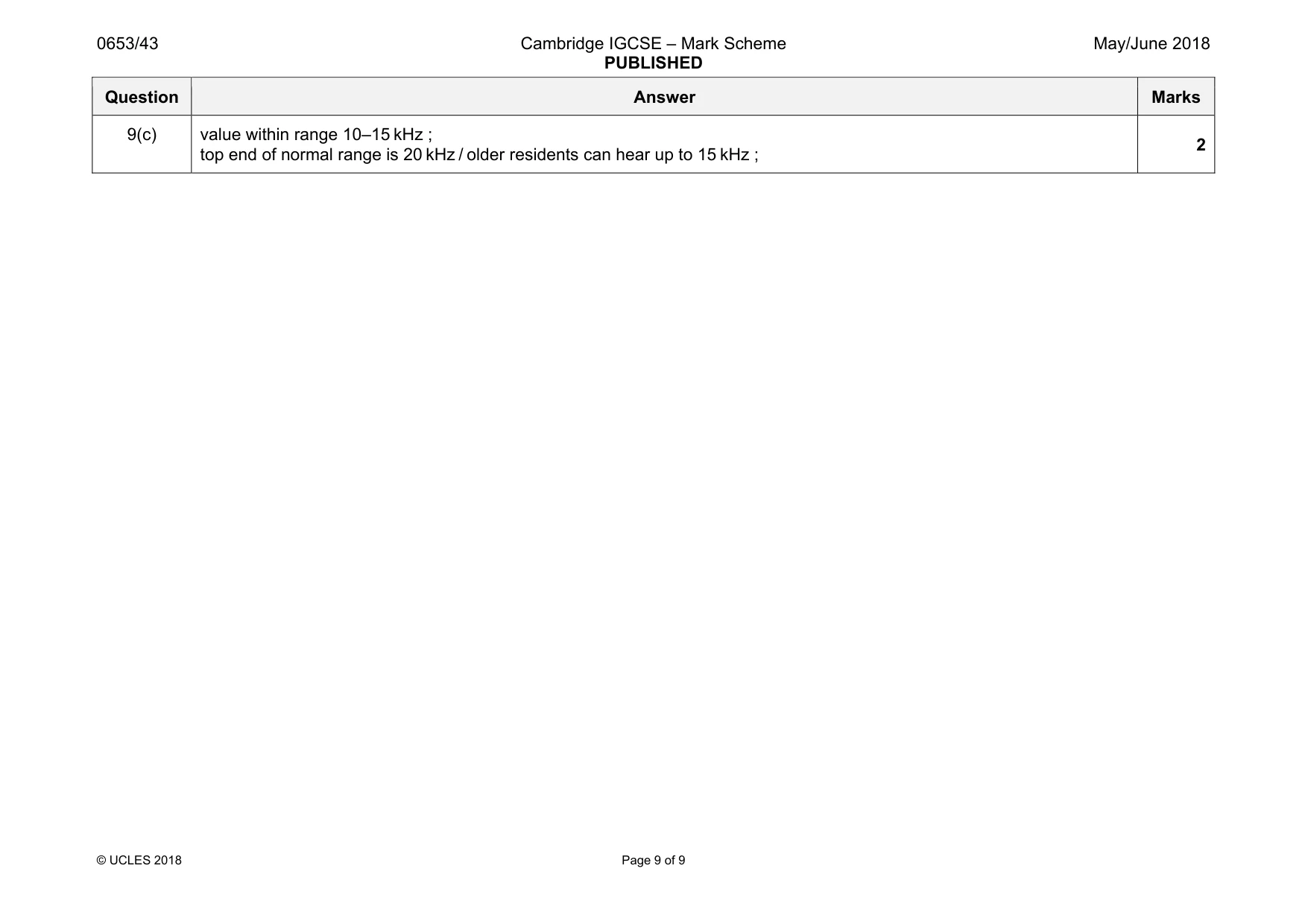
Mark scheme: 9(a) fuse in main circuit ; heating elements in parallel with each other and supply ; motor in parallel with heating elements (and supply) ; switches in series with both heaters and motor ; 4 9(b) total power supply required = 1200 × 2 + 100 = 2500 W ; use of P = I × V e.g. current through one heater = 5 A / total current = 2500 ÷ 240 ; = 10.4 A (which is above fuse rating) ; 3 Question Answer Marks 9(c) value within range 10–15 kHz ; top end of normal range is 20 kHz / older residents can hear up to 15 kHz ; 2
What was in this paper
The subtopics covered by these 9 questions, and how many questions each got. Open one in a new tab to see every Cambridge question on it.
What you needed in this session
Cambridge’s own grade thresholds for 2018 May/June, Paper 4 · Variant 3. A higher threshold means an easier paper — the bar moves with how the cohort did.