Cambridge IGCSE Science - Combined 0653 — 2024 Oct/Nov Paper 4 · Variant 1
0653/41/O/N/24 · 9 questions · 80 marks · ≈90 min
The question paper and its mark scheme, free to read here and free to download. This is Cambridge’s own paper, exactly as it was sat.
Question paper20 pages

Mark scheme12 pages
Answers below. Sit the paper first if you are practising.
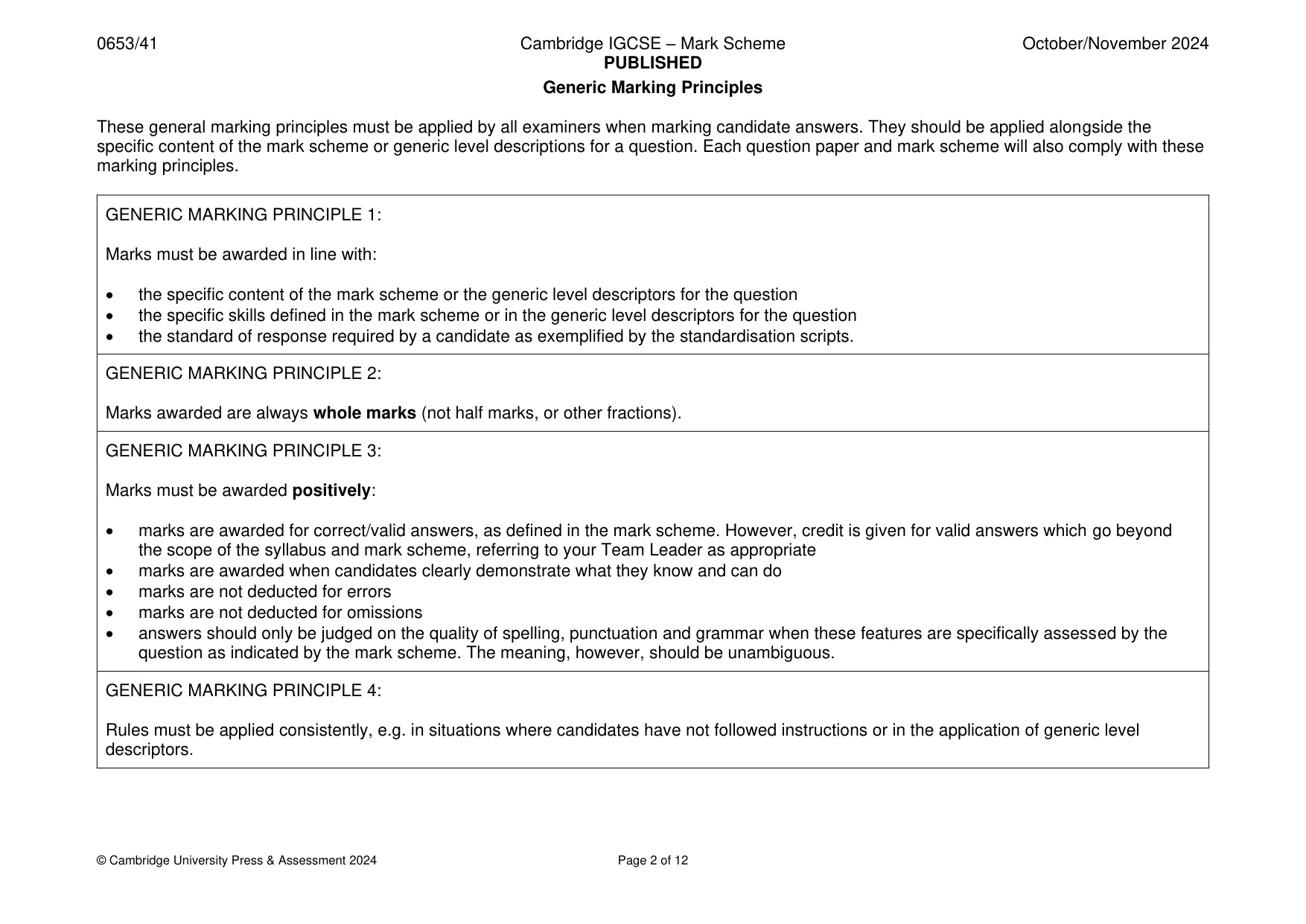
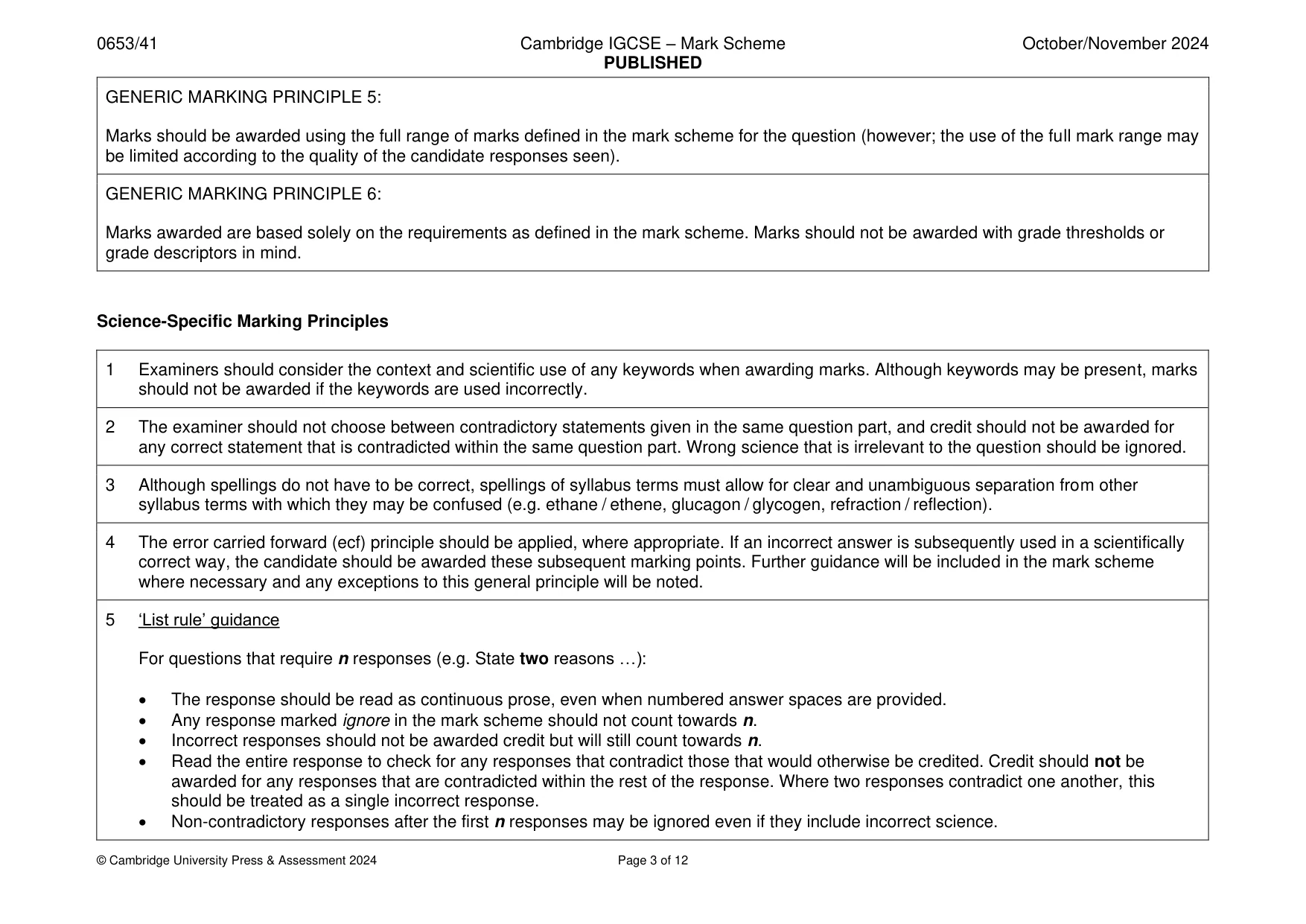
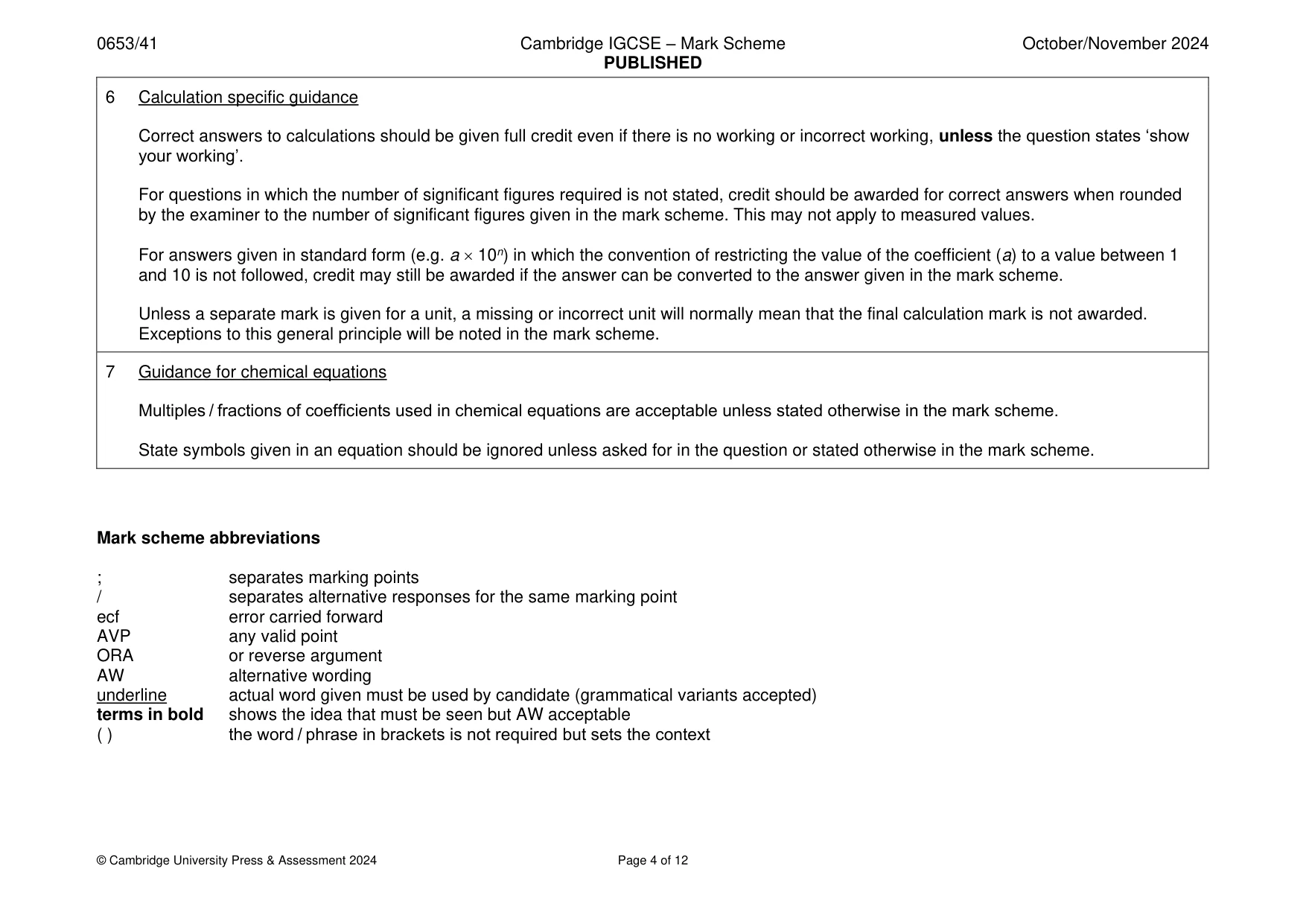
Questions as text
Q1 · The female human reproductive system
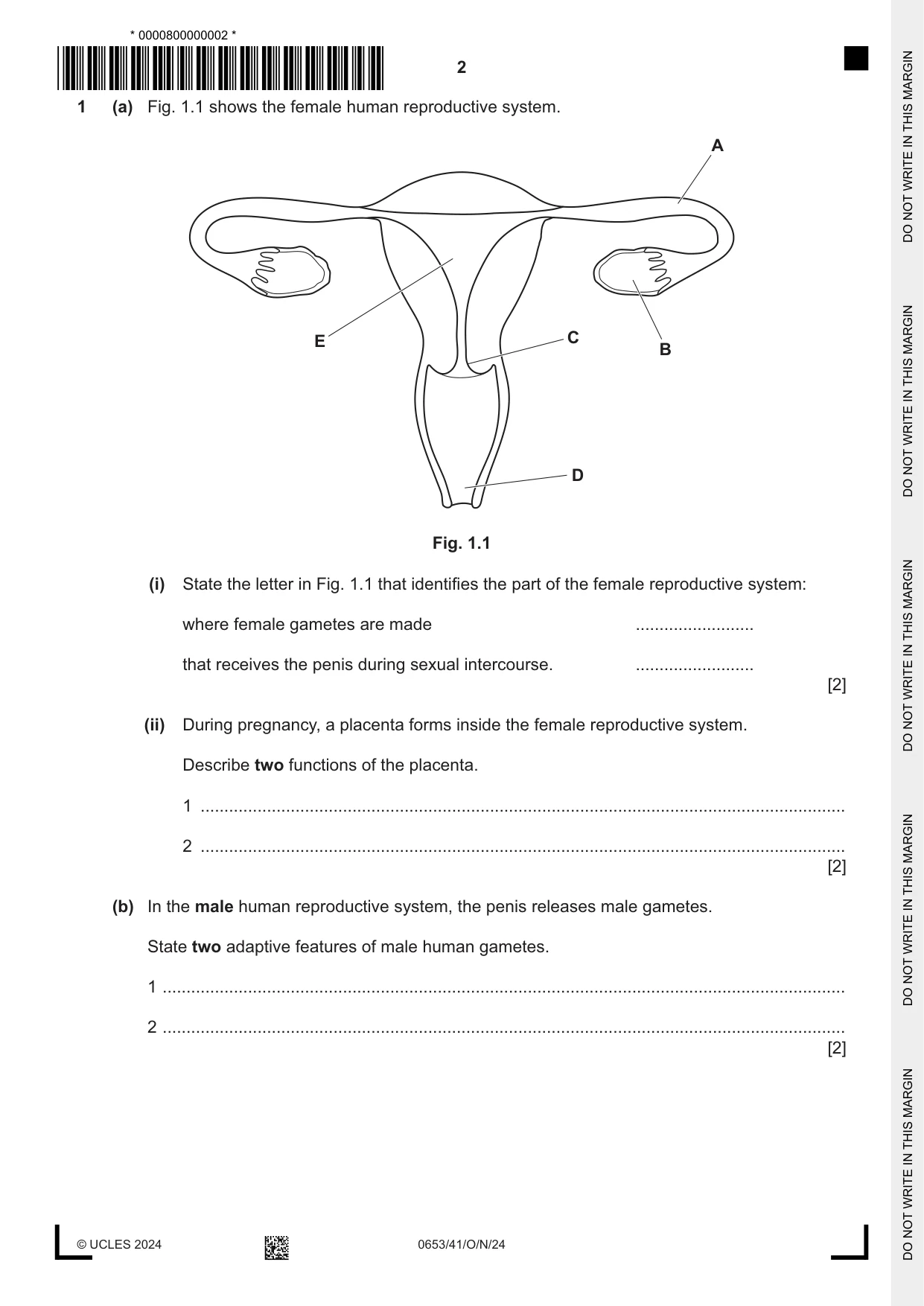
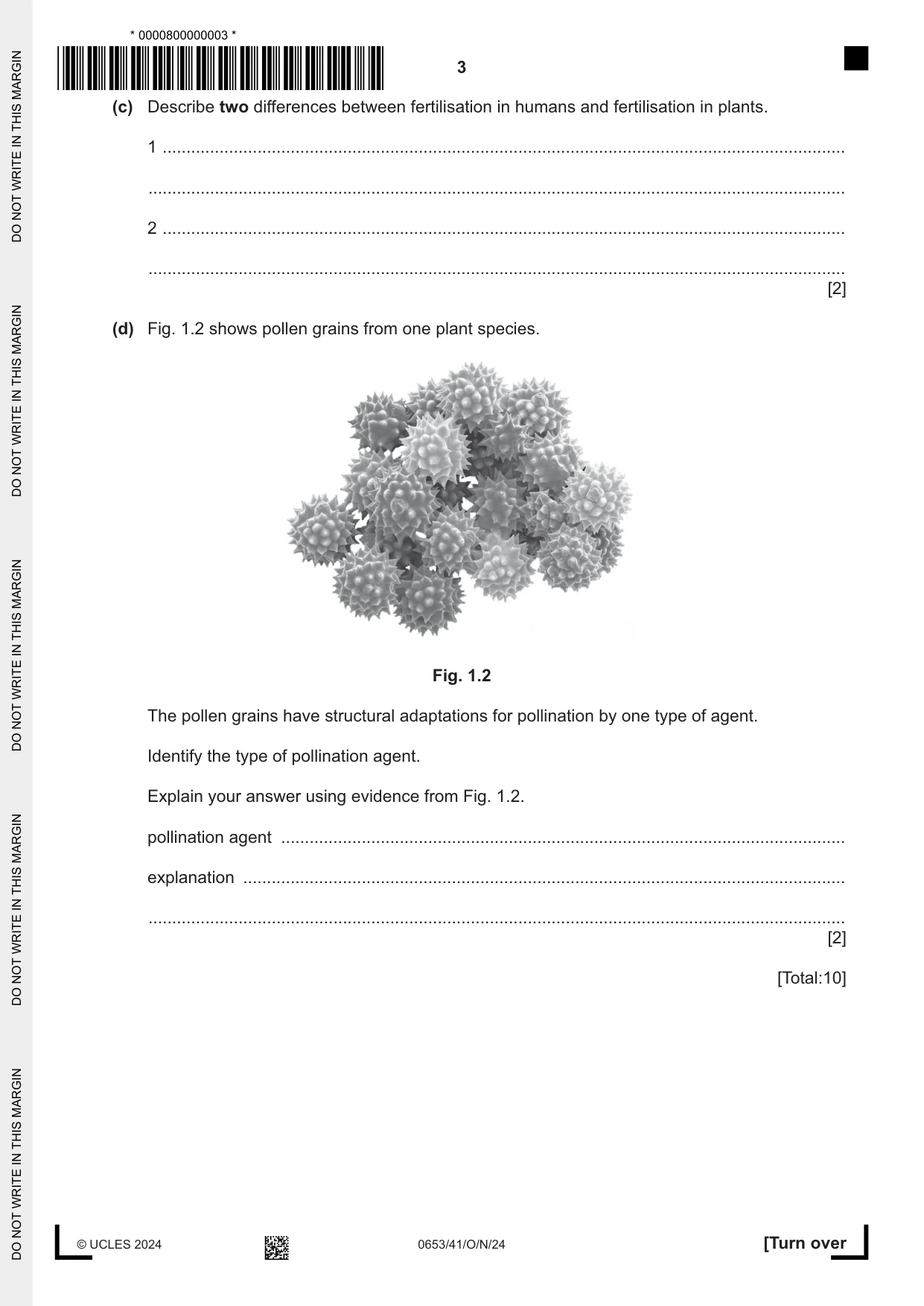
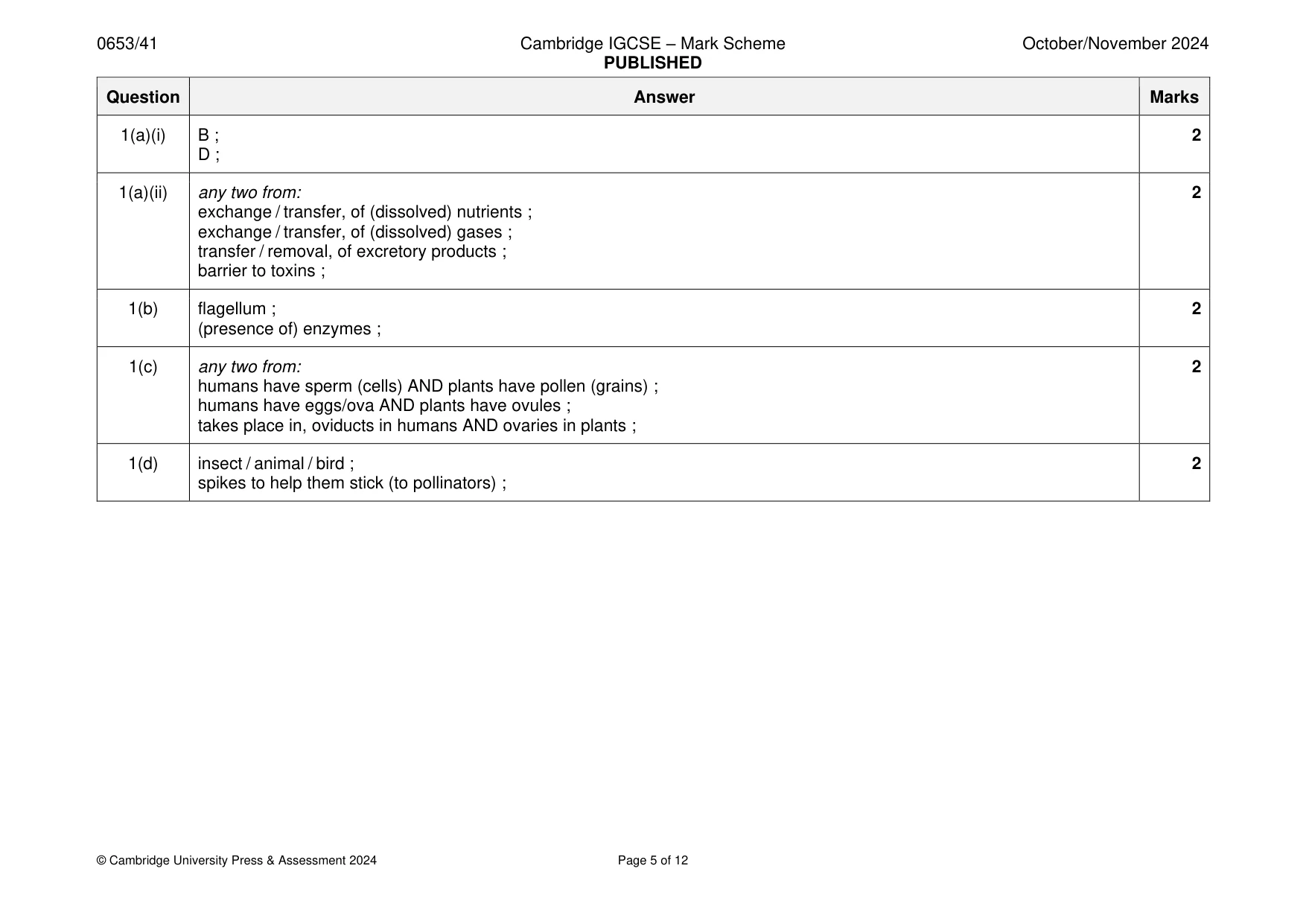
1 (a) Fig. 1.1 shows the female human reproductive system. A E C B D Fig. 1.1 (i) State the letter in Fig. 1.1 that identifies the part of the female reproductive system: where female gametes are made ......................... that receives the penis during sexual intercourse. ......................... [2] (ii) During pregnancy, a placenta forms inside the female reproductive system. Describe two functions of the placenta. 1 ........................................................................................................................................ 2 ........................................................................................................................................ [2] (b) In the male human reproductive system, the penis releases male gametes. State two adaptive features of male human gametes. 1 ................................................................................................................................................ 2 ................................................................................................................................................ [2] (c) Describe two differences between fertilisation in humans and fertilisation in plants. 1 ................................................................................................................................................ ................................................................................................................................................... 2 ................................................................................................................................................ ................................................................................................................................................... [2] (d) Fig. 1.2 shows pollen grains from one plant species. Fig. 1.2 The pollen grains have structural adaptations for pollination by one type of agent. Identify the type of pollination agent. Explain your answer using evidence from Fig. 1.2. pollination agent ....................................................................................................................... explanation ............................................................................................................................... ................................................................................................................................................... [2] [Total:10]
Mark scheme: Question Answer Marks 1(a)(i) B ; 2 D ; 1(a)(ii) any two from: 2 exchange / transfer, of (dissolved) nutrients ; exchange / transfer, of (dissolved) gases ; transfer / removal, of excretory products ; barrier to toxins ; 1(b) flagellum ; 2 (presence of) enzymes ; 1(c) any two from: 2 humans have sperm (cells) AND plants have pollen (grains) ; humans have eggs/ova AND plants have ovules ; takes place in, oviducts in humans AND ovaries in plants ; 1(d) insect / animal / bird ; 2 spikes to help them stick (to pollinators) ;
Q2 · The position of an element in the Periodic Table is related to its atomic structure
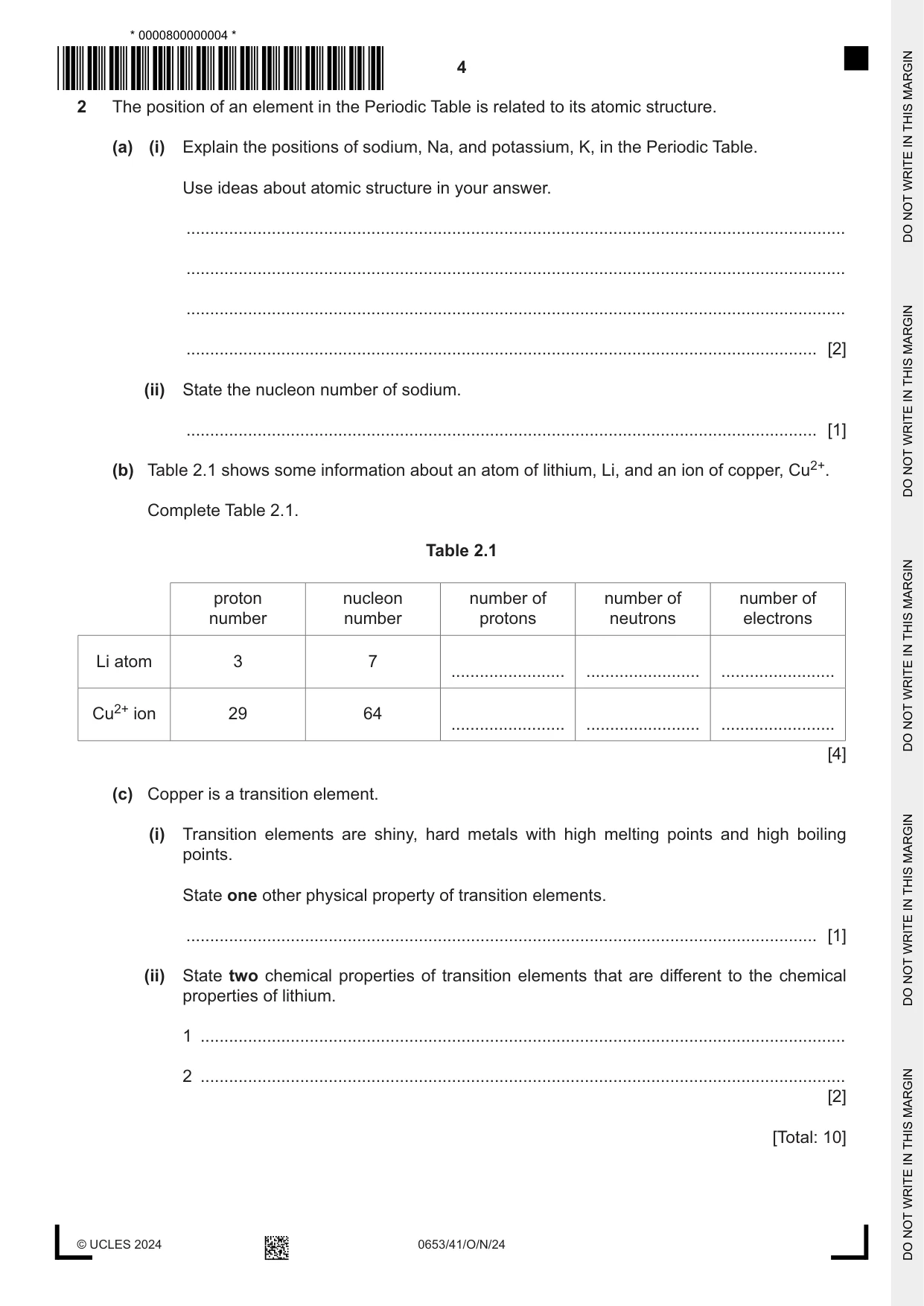
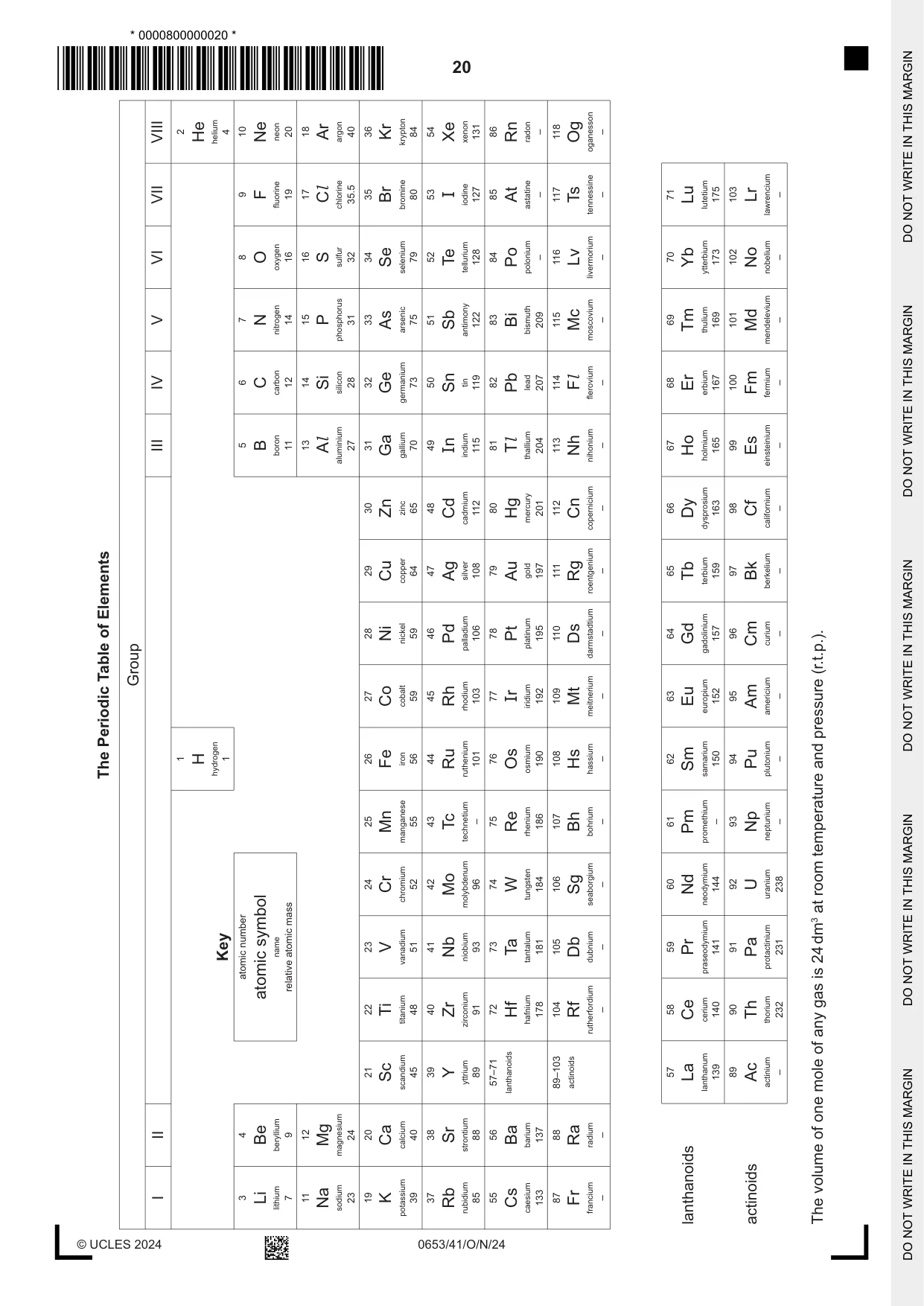
2 The position of an element in the Periodic Table is related to its atomic structure. (a) (i) Explain the positions of sodium, Na, and potassium, K, in the Periodic Table. Use ideas about atomic structure in your answer. ........................................................................................................................................... ........................................................................................................................................... ........................................................................................................................................... ..................................................................................................................................... [2] (ii) State the nucleon number of sodium. ..................................................................................................................................... [1] (b) Table 2.1 shows some information about an atom of lithium, Li, and an ion of copper, Cu2+. Complete Table 2.1. Table 2.1 proton nucleon number of number of number of number number protons neutrons electrons Li atom 3 7 ........................ ........................ ........................ Cu2+ ion 29 64 ........................ ........................ ........................ [4] (c) Copper is a transition element. (i) Transition elements are shiny, hard metals with high melting points and high boiling points. State one other physical property of transition elements. ..................................................................................................................................... [1] (ii) State two chemical properties of transition elements that are different to the chemical properties of lithium. 1 ........................................................................................................................................ 2 ........................................................................................................................................ [2] [Total: 10]
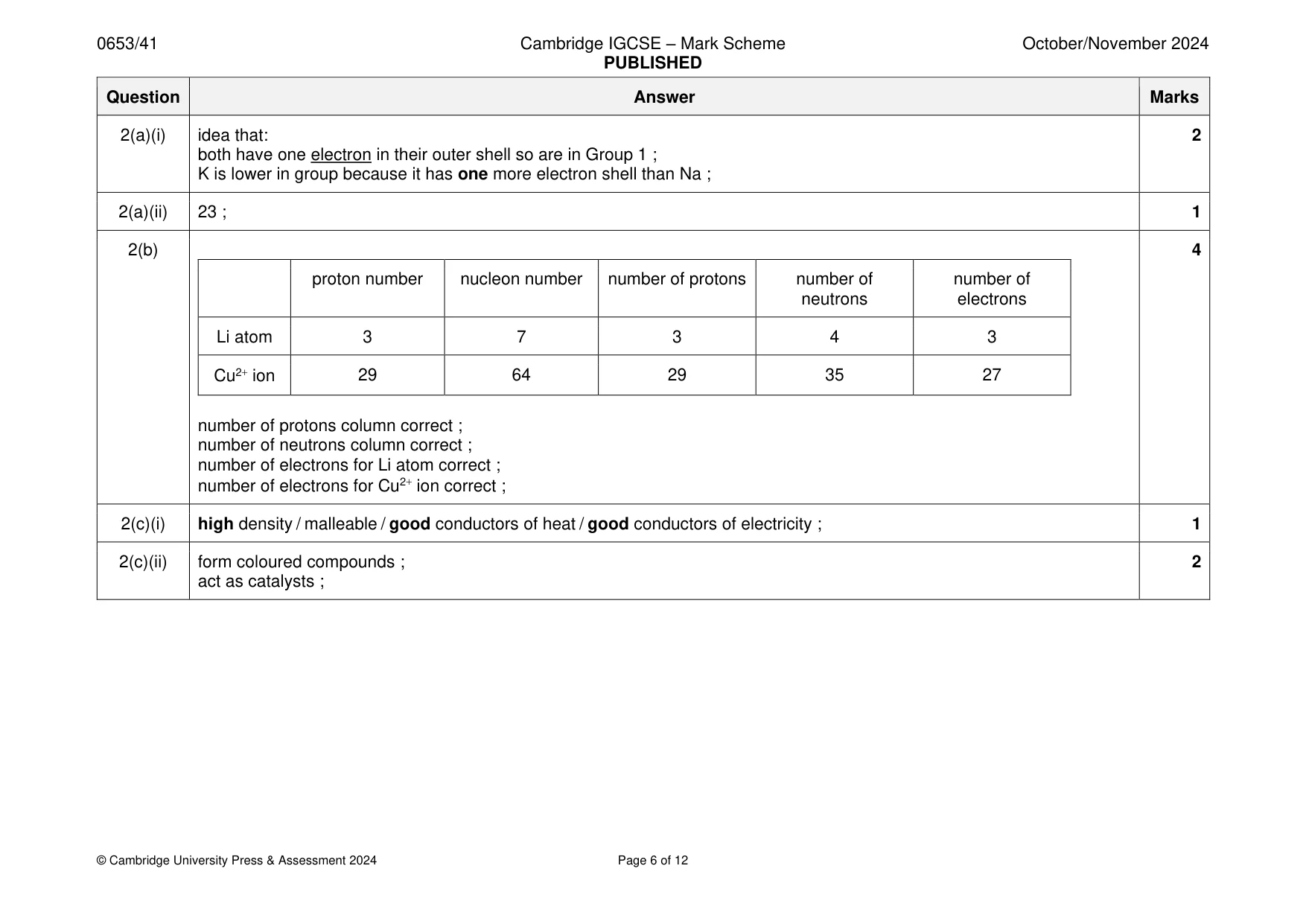
Mark scheme: 2(a)(i) idea that: 2 both have one electron in their outer shell so are in Group 1 ; K is lower in group because it has one more electron shell than Na ; 2(a)(ii) 23 ; 1 2(b) 4 proton number nucleon number number of protons number of number of neutrons electrons Li atom 3 7 3 4 3 Cu2+ ion 29 64 29 35 27 number of protons column correct ; number of neutrons column correct ; number of electrons for Li atom correct ; number of electrons for Cu2+ ion correct ; 2(c)(i) high density / malleable / good conductors of heat / good conductors of electricity ; 1 2(c)(ii) form coloured compounds ; 2 act as catalysts ;
Q3 · A block of wood has a weight of 24.1 N
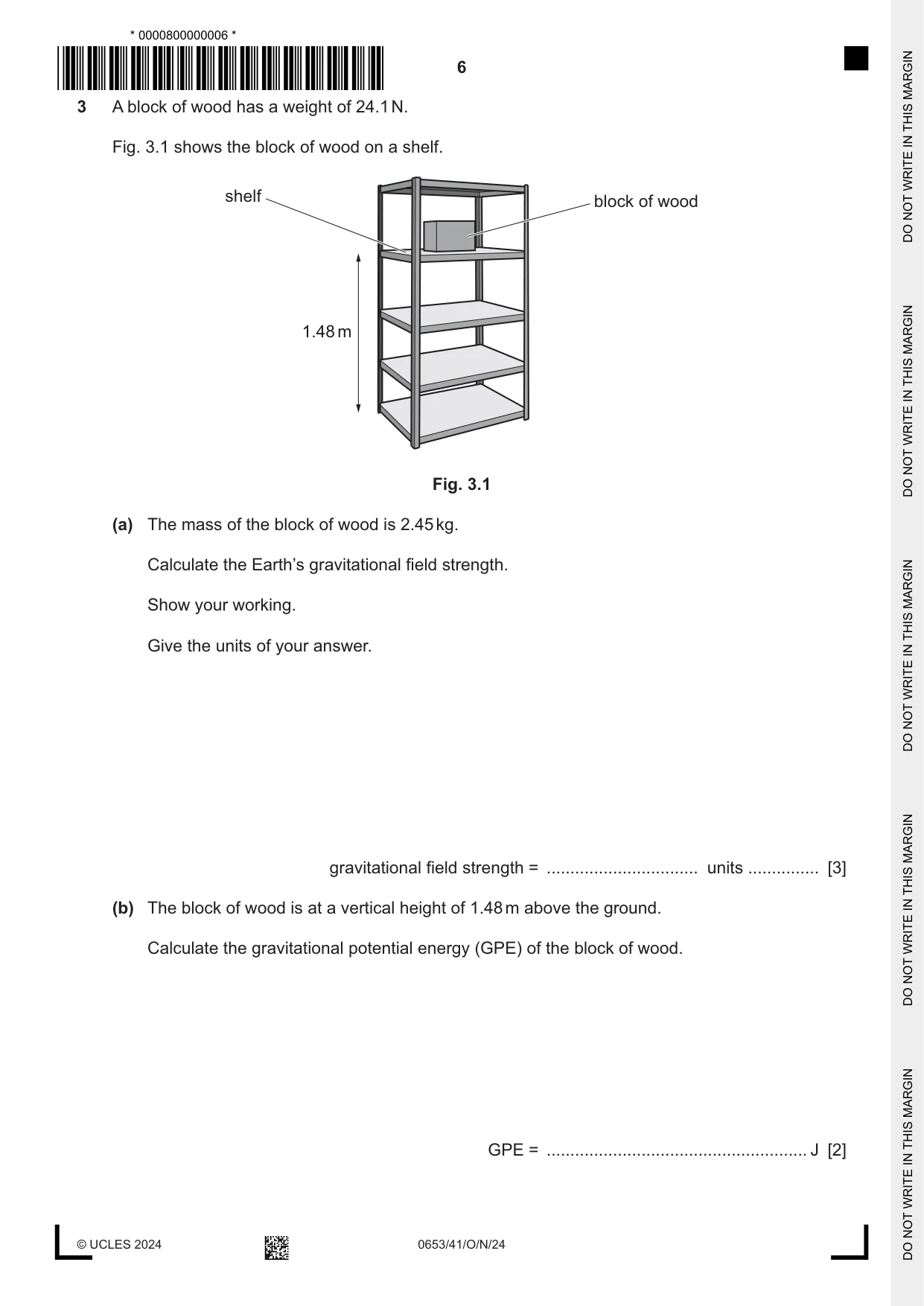
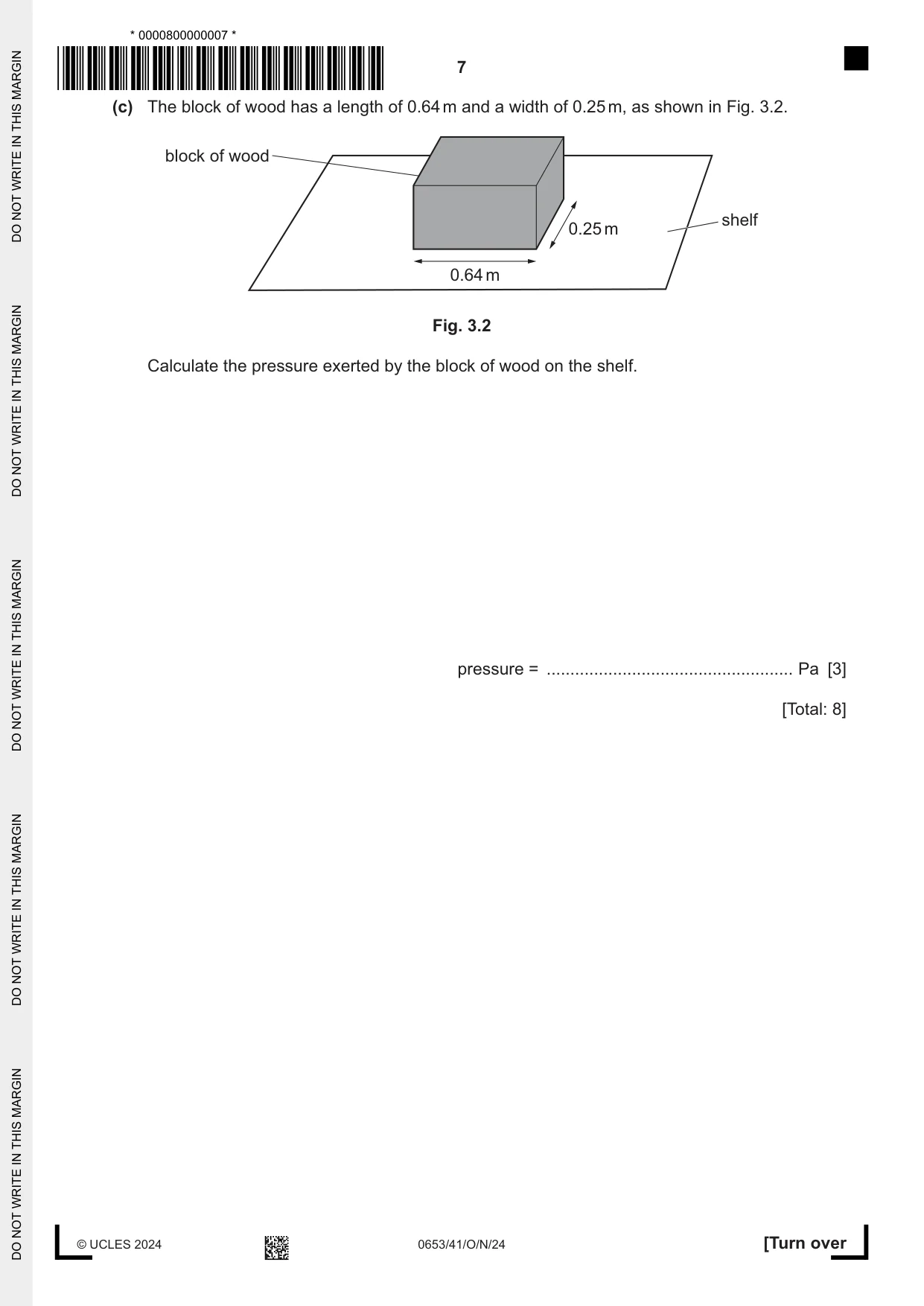
3 A block of wood has a weight of 24.1 N. Fig. 3.1 shows the block of wood on a shelf. shelf block of wood 1.48 m Fig. 3.1 (a) The mass of the block of wood is 2.45 kg. Calculate the Earth’s gravitational field strength. Show your working. Give the units of your answer. gravitational field strength = ................................ units ............... [3] (b) The block of wood is at a vertical height of 1.48 m above the ground. Calculate the gravitational potential energy (GPE) of the block of wood. GPE = ....................................................... J [2] (c) The block of wood has a length of 0.64 m and a width of 0.25 m, as shown in Fig. 3.2. block of wood shelf 0.25 m 0.64 m Fig. 3.2 Calculate the pressure exerted by the block of wood on the shelf. pressure = .................................................... Pa [3] [Total: 8]
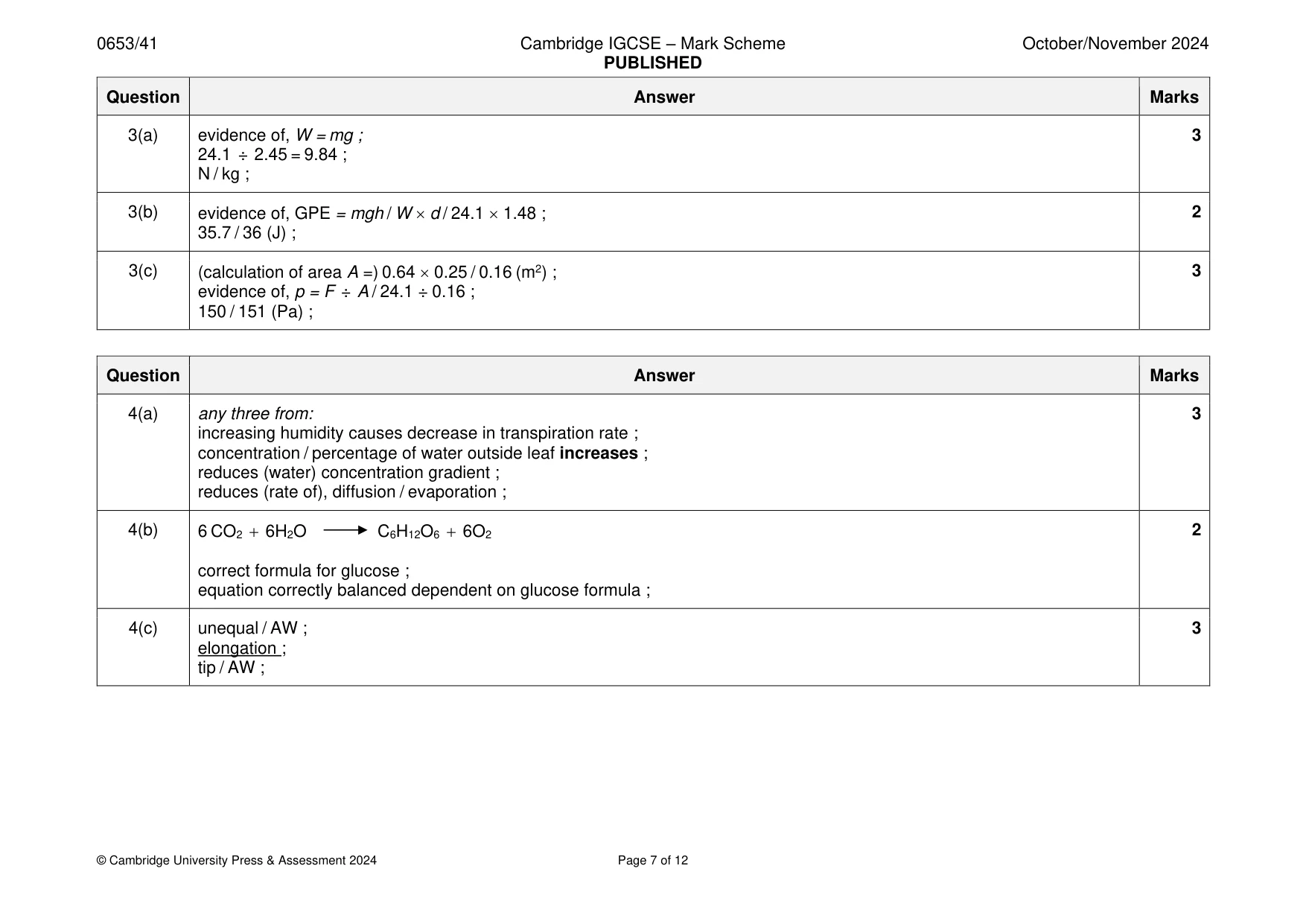
Mark scheme: 3(a) evidence of, W = mg ; 3 24.1 ÷ 2.45 = 9.84 ; N / kg ; 3(b) evidence of, GPE = mgh / W d / 24.1 1.48 ; 2 35.7 / 36 (J) ; 3(c) (calculation of area A =) 0.64 0.25 / 0.16 (m2) ; 3 evidence of, p = F ÷ A / 24.1 ÷ 0.16 ; 150 / 151 (Pa) ;
Q4 · A graph showing the effect of humidity on the rate of transpiration in a plant
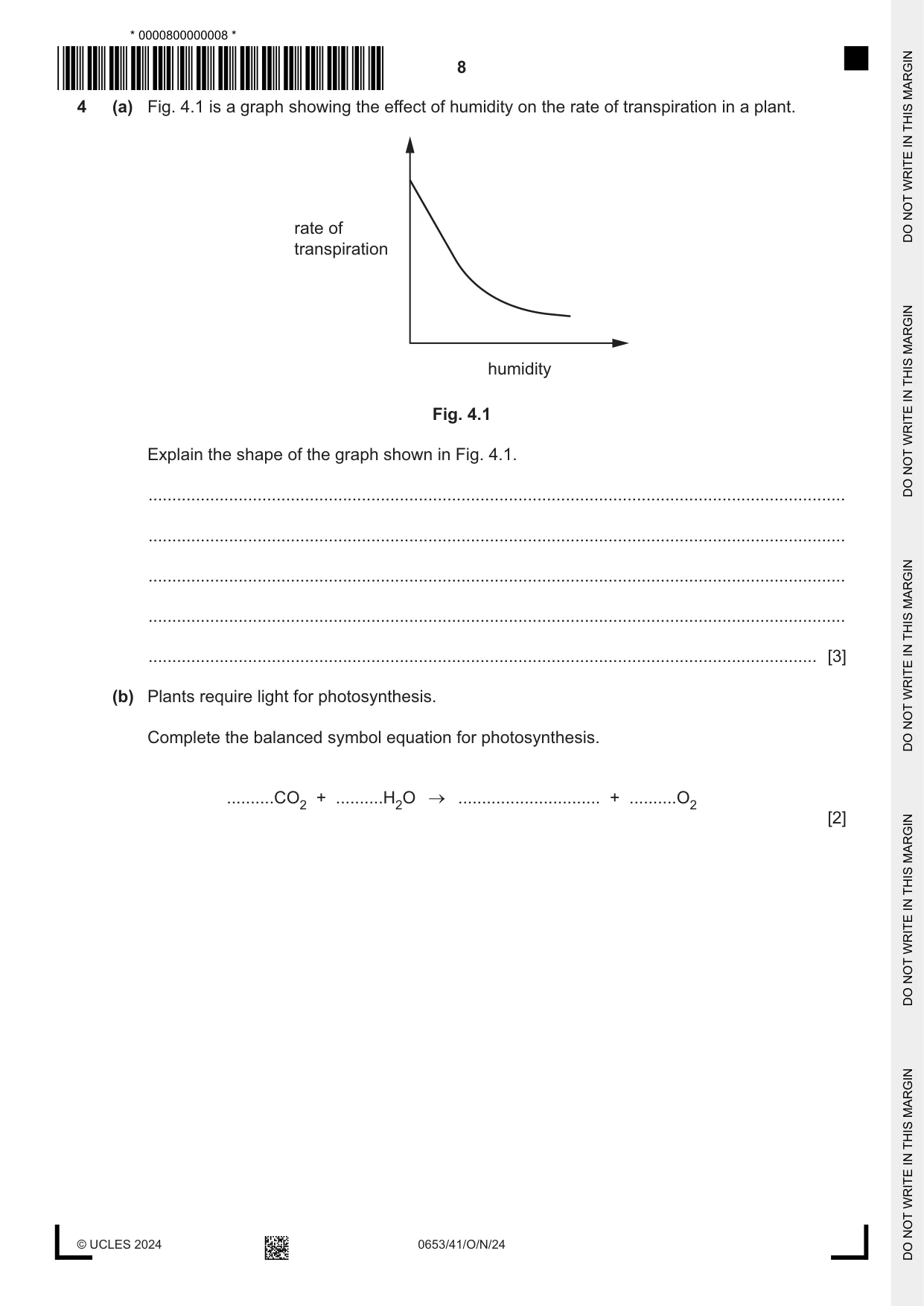
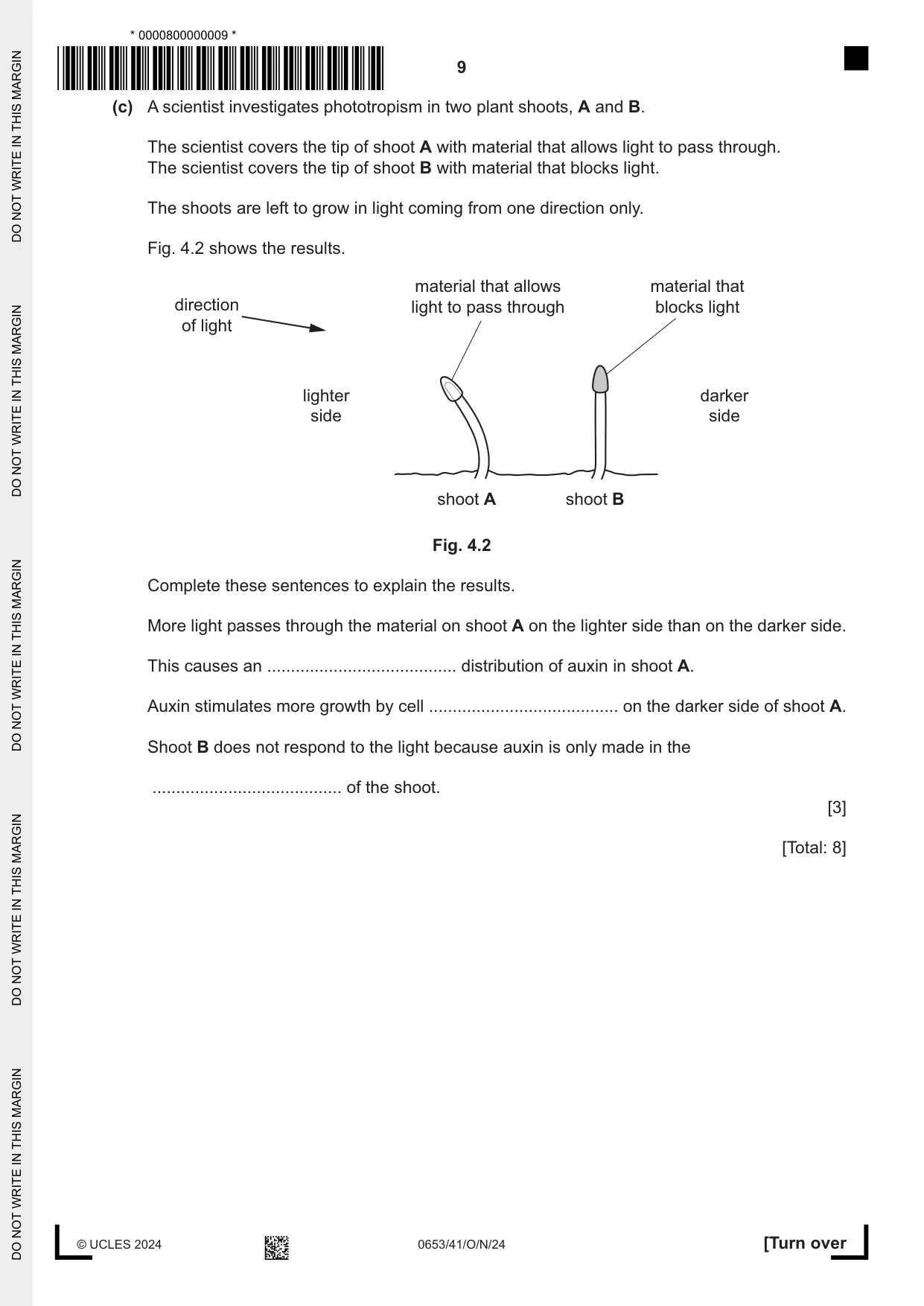
4 (a) Fig. 4.1 is a graph showing the effect of humidity on the rate of transpiration in a plant. rate of transpiration humidity Fig. 4.1 Explain the shape of the graph shown in Fig. 4.1. ................................................................................................................................................... ................................................................................................................................................... ................................................................................................................................................... ................................................................................................................................................... ............................................................................................................................................. [3] (b) Plants require light for photosynthesis. Complete the balanced symbol equation for photosynthesis. ..........CO2 + ..........H2O .............................. + ..........O2 [2] (c) A scientist investigates phototropism in two plant shoots, A and B. The scientist covers the tip of shoot A with material that allows light to pass through. The scientist covers the tip of shoot B with material that blocks light. The shoots are left to grow in light coming from one direction only. Fig. 4.2 shows the results. material that allows material that direction light to pass through blocks light of light lighter darker side side shoot A shoot B Fig. 4.2 Complete these sentences to explain the results. More light passes through the material on shoot A on the lighter side than on the darker side. This causes an ........................................ distribution of auxin in shoot A. Auxin stimulates more growth by cell ........................................ on the darker side of shoot A. Shoot B does not respond to the light because auxin is only made in the ........................................ of the shoot. [3] [Total: 8]
Mark scheme: 4(a) any three from: 3 increasing humidity causes decrease in transpiration rate ; concentration / percentage of water outside leaf increases ; reduces (water) concentration gradient ; reduces (rate of), diffusion / evaporation ; 4(b) 6 CO2 + 6H2O C6H12O6 + 6O2 2 correct formula for glucose ; equation correctly balanced dependent on glucose formula ; 4(c) unequal / AW ; 3 elongation ; tip / AW ;
Q5 · Silver chloride, magnesium chloride and sodium chloride are salts
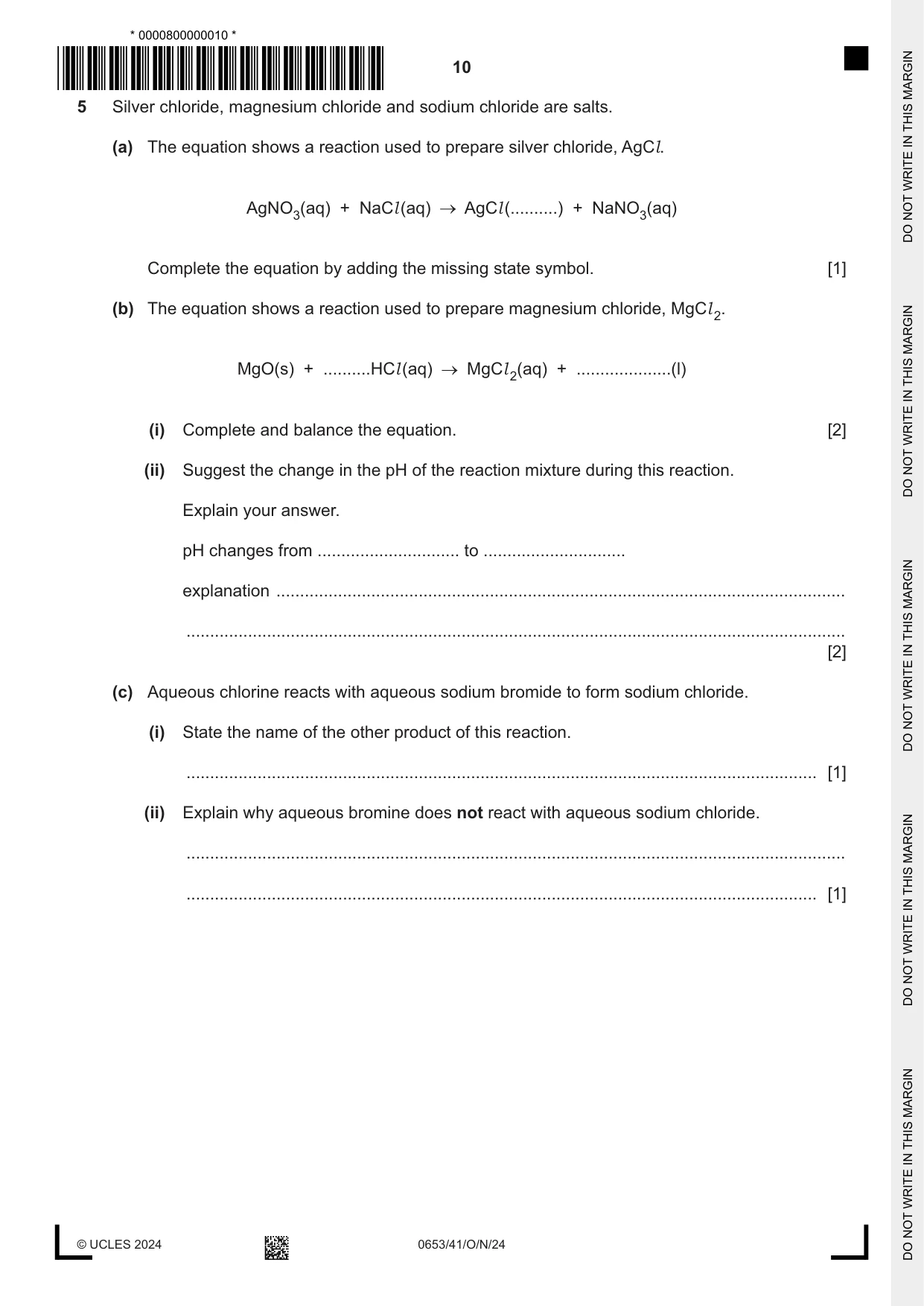
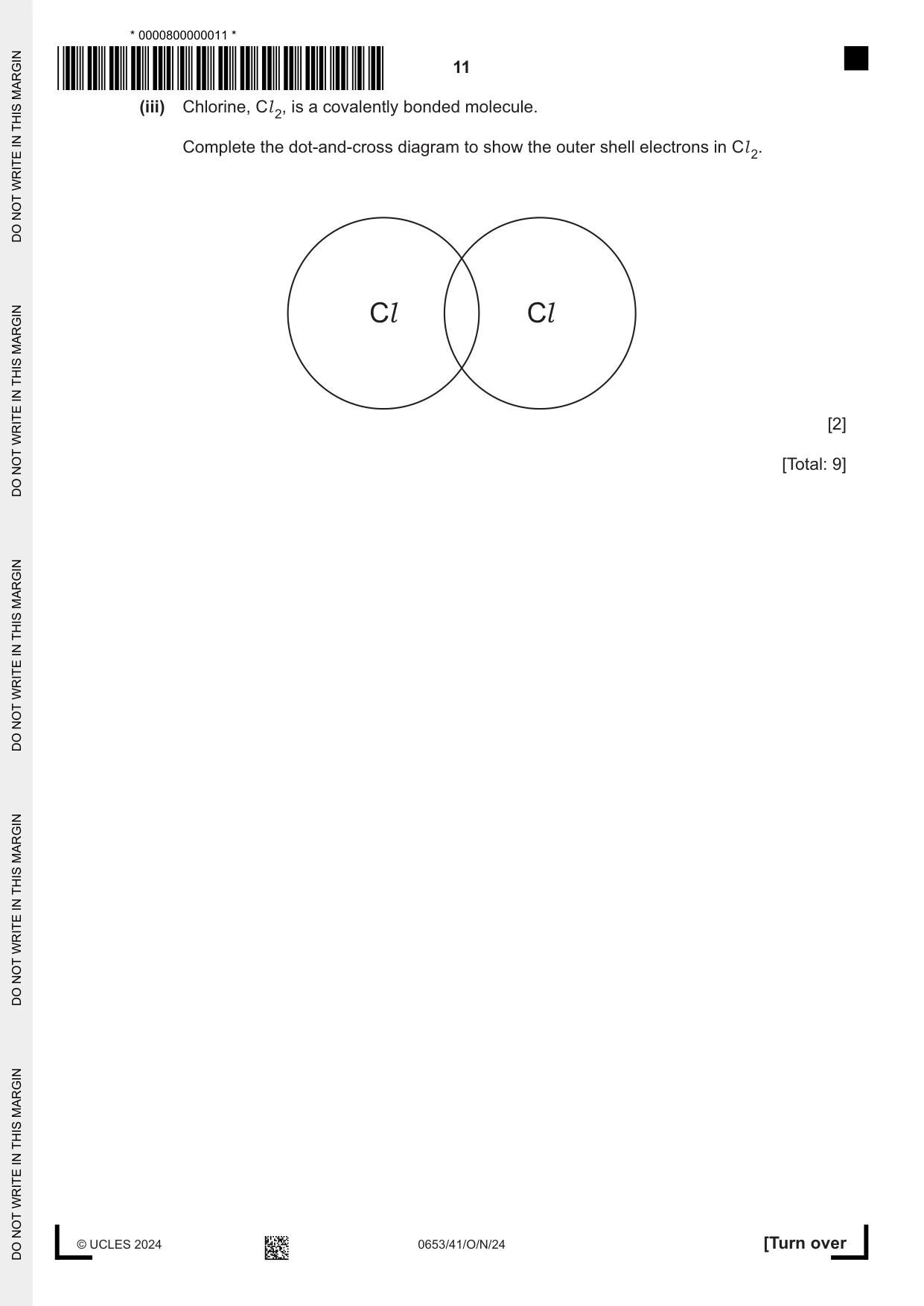
5 Silver chloride, magnesium chloride and sodium chloride are salts. (a) The equation shows a reaction used to prepare silver chloride, AgCl. AgNO3(aq) + NaCl (aq) AgCl (..........) + NaNO3(aq) Complete the equation by adding the missing state symbol. [1] (b) The equation shows a reaction used to prepare magnesium chloride, MgCl 2. MgO(s) + ..........HCl (aq) MgCl 2(aq) + ....................(l) (i) Complete and balance the equation. [2] (ii) Suggest the change in the pH of the reaction mixture during this reaction. Explain your answer. pH changes from .............................. to .............................. explanation ........................................................................................................................ ........................................................................................................................................... [2] (c) Aqueous chlorine reacts with aqueous sodium bromide to form sodium chloride. (i) State the name of the other product of this reaction. ..................................................................................................................................... [1] (ii) Explain why aqueous bromine does not react with aqueous sodium chloride. ........................................................................................................................................... ..................................................................................................................................... [1] (iii) Chlorine, Cl 2, is a covalently bonded molecule. Complete the dot-and-cross diagram to show the outer shell electrons in Cl 2. Cl Cl [2] [Total: 9]
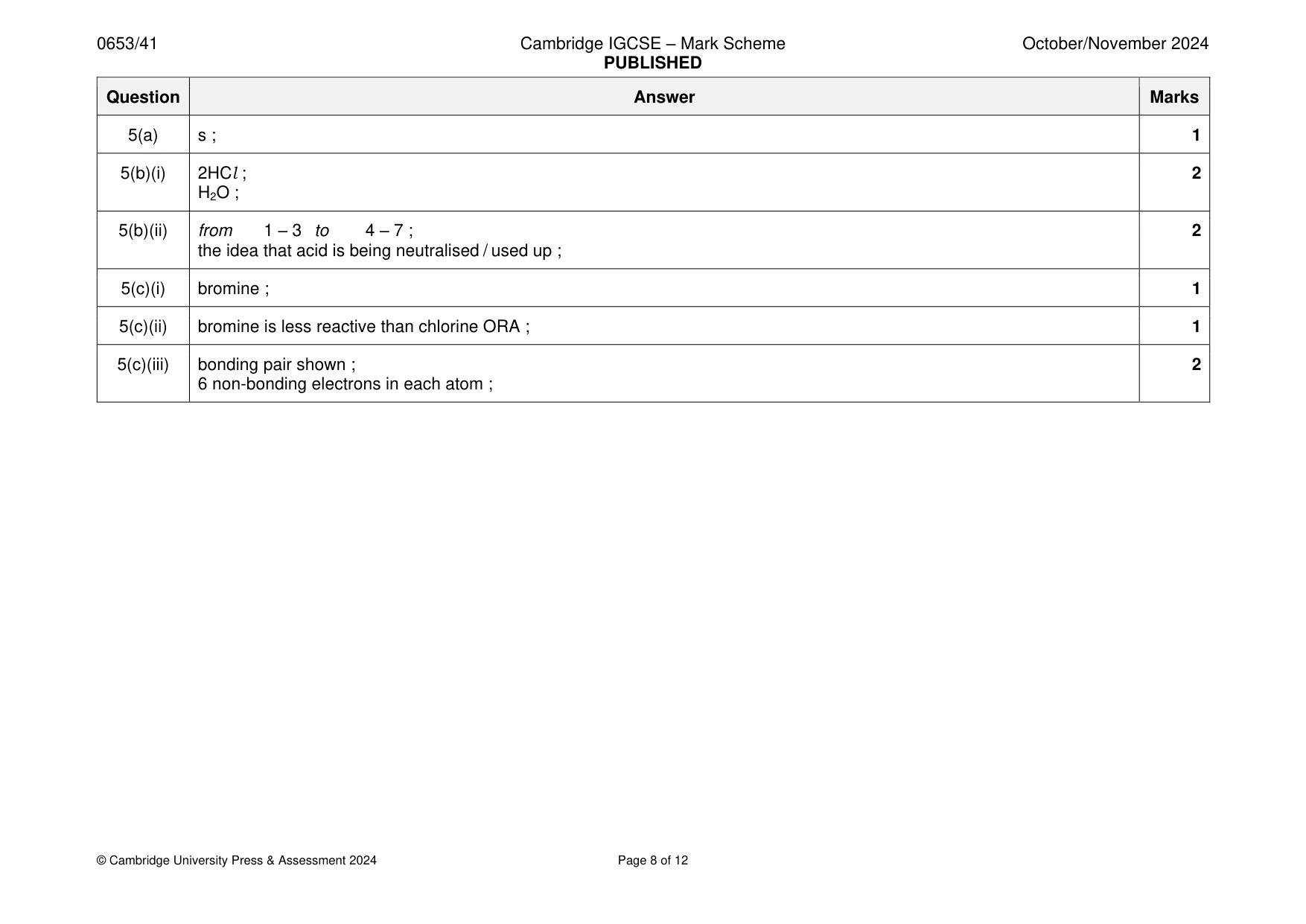
Mark scheme: 5(a) s ; 1 5(b)(i) 2HCl ; 2 H2O ; 5(b)(ii) from 1 – 3 to 4 – 7 ; 2 the idea that acid is being neutralised / used up ; 5(c)(i) bromine ; 1 5(c)(ii) bromine is less reactive than chlorine ORA ; 1 5(c)(iii) bonding pair shown ; 2 6 non-bonding electrons in each atom ;
Q6 · A musical instrument called a glockenspiel
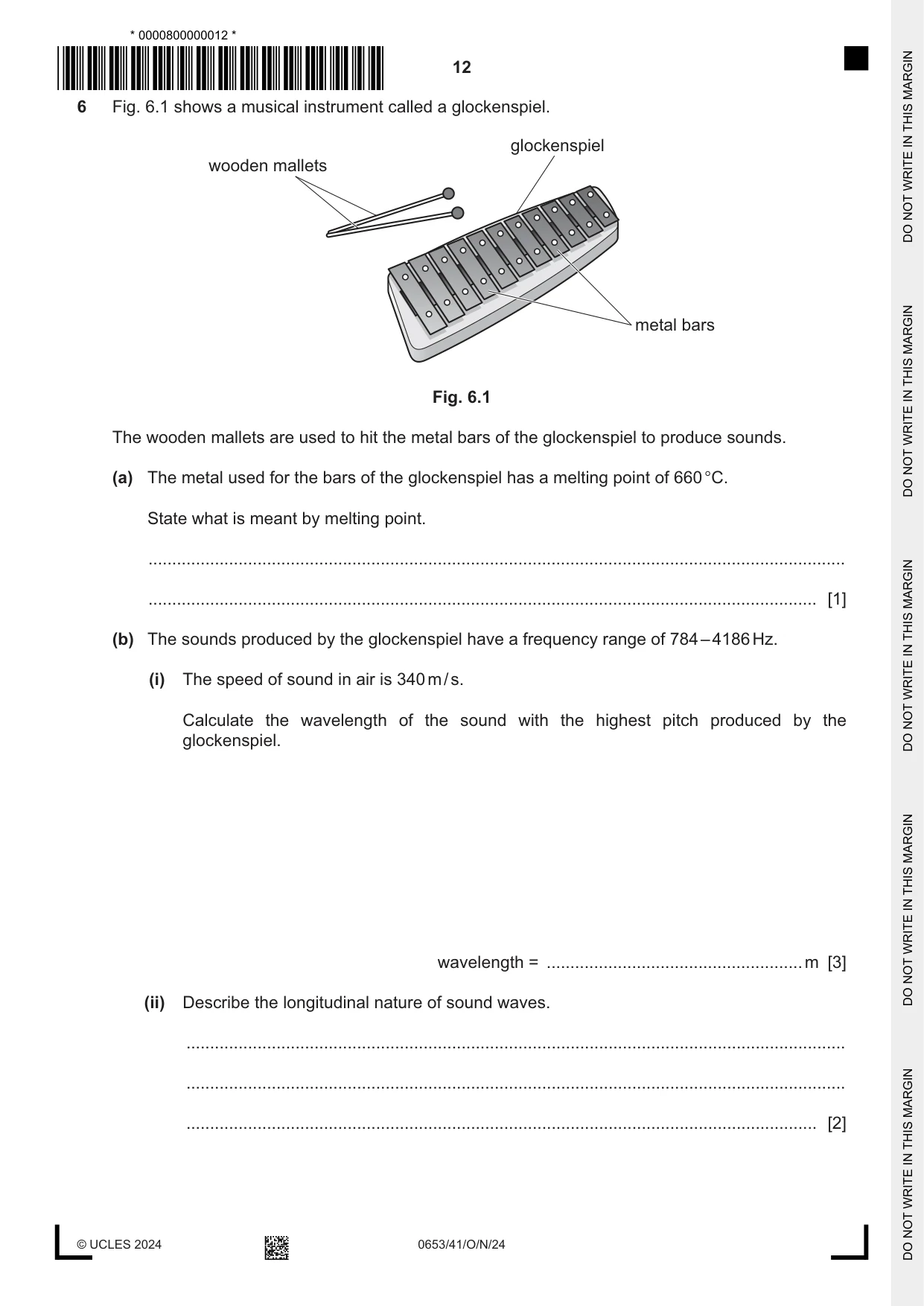
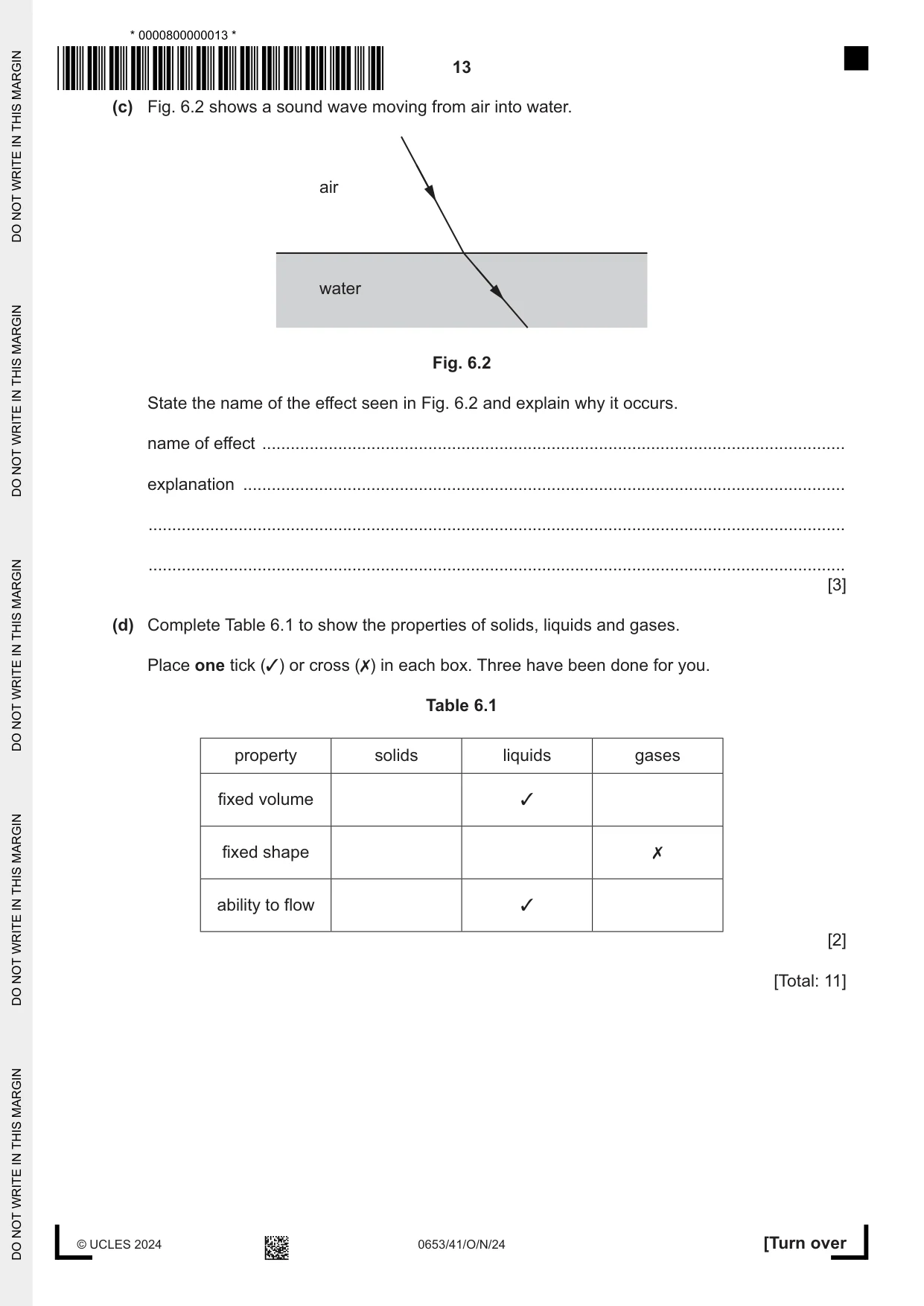
6 Fig. 6.1 shows a musical instrument called a glockenspiel. glockenspiel wooden mallets metal bars Fig. 6.1 The wooden mallets are used to hit the metal bars of the glockenspiel to produce sounds. (a) The metal used for the bars of the glockenspiel has a melting point of 660 °C. State what is meant by melting point. ................................................................................................................................................... ............................................................................................................................................. [1] (b) The sounds produced by the glockenspiel have a frequency range of 784 – 4186 Hz. (i) The speed of sound in air is 340 m / s. Calculate the wavelength of the sound with the highest pitch produced by the glockenspiel. wavelength = ...................................................... m [3] (ii) Describe the longitudinal nature of sound waves. ........................................................................................................................................... ........................................................................................................................................... ..................................................................................................................................... [2] (c) Fig. 6.2 shows a sound wave moving from air into water. air water Fig. 6.2 State the name of the effect seen in Fig. 6.2 and explain why it occurs. name of effect ........................................................................................................................... explanation ............................................................................................................................... ................................................................................................................................................... ................................................................................................................................................... [3] (d) Complete Table 6.1 to show the properties of solids, liquids and gases. Place one tick (✓) or cross (✗) in each box. Three have been done for you. Table 6.1 property solids liquids gases fixed volume ✓ fixed shape ✗ ability to flow ✓ [2] [Total: 11]
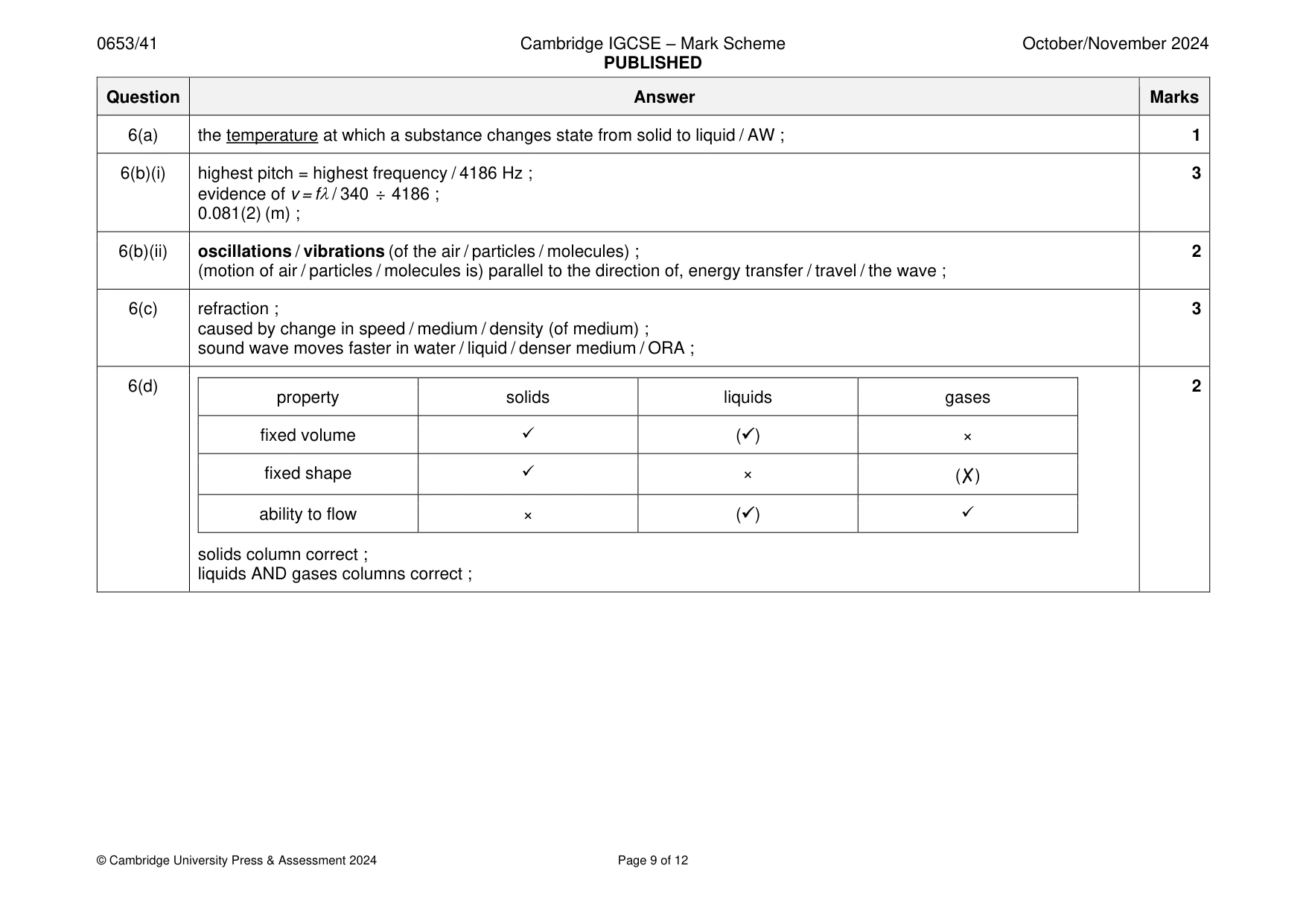
Mark scheme: 6(a) the temperature at which a substance changes state from solid to liquid / AW ; 1 6(b)(i) highest pitch = highest frequency / 4186 Hz ; 3 evidence of v = f / 340 ÷ 4186 ; 0.081(2) (m) ; 6(b)(ii) oscillations / vibrations (of the air / particles / molecules) ; 2 (motion of air / particles / molecules is) parallel to the direction of, energy transfer / travel / the wave ; 6(c) refraction ; 3 caused by change in speed / medium / density (of medium) ; sound wave moves faster in water / liquid / denser medium / ORA ; 6(d) 2 property solids liquids gases fixed volume ✓ (✓) × fixed shape ✓ × (✗) ability to flow × (✓) ✓ solids column correct ; liquids AND gases columns correct ;
Question 7
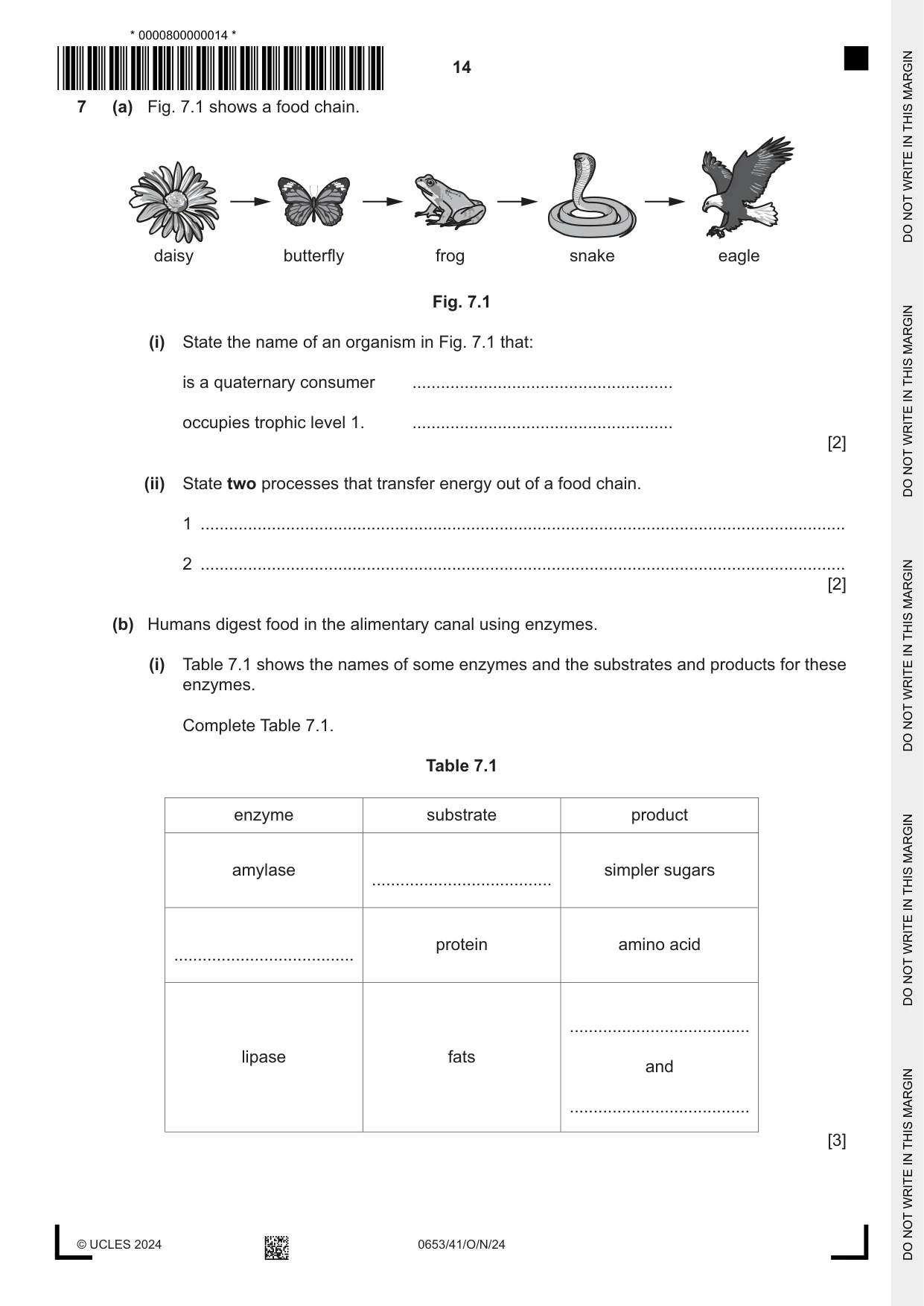
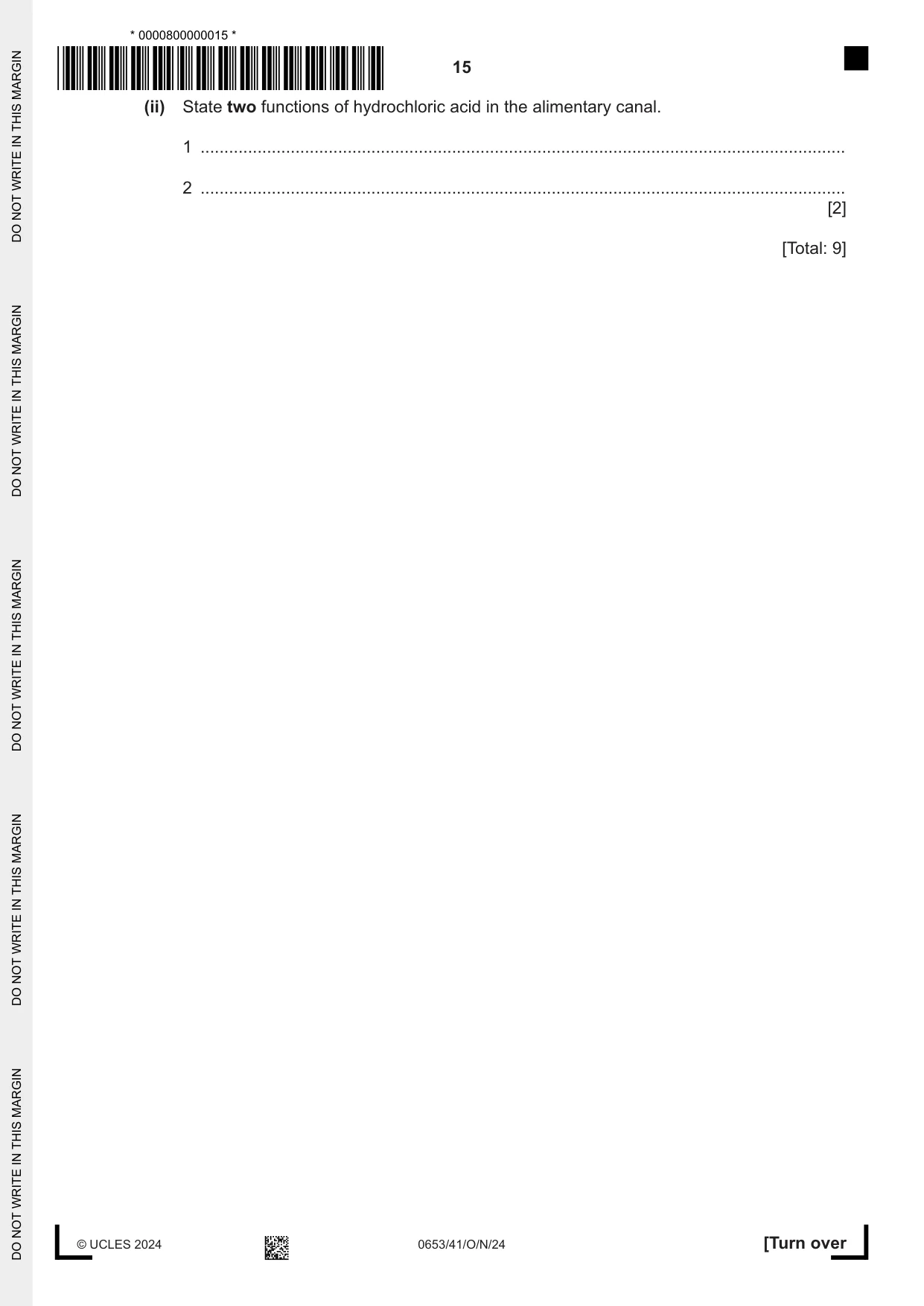
7 (a) Fig. 7.1 shows a food chain. daisy butterfly frog snake eagle Fig. 7.1 (i) State the name of an organism in Fig. 7.1 that: is a quaternary consumer ....................................................... occupies trophic level 1. ....................................................... [2] (ii) State two processes that transfer energy out of a food chain. 1 ........................................................................................................................................ 2 ........................................................................................................................................ [2] (b) Humans digest food in the alimentary canal using enzymes. (i) Table 7.1 shows the names of some enzymes and the substrates and products for these enzymes. Complete Table 7.1. Table 7.1 enzyme substrate product amylase simpler sugars ...................................... protein amino acid ...................................... ...................................... lipase fats and ...................................... [3] (ii) State two functions of hydrochloric acid in the alimentary canal. 1 ........................................................................................................................................ 2 ........................................................................................................................................ [2] [Total: 9]
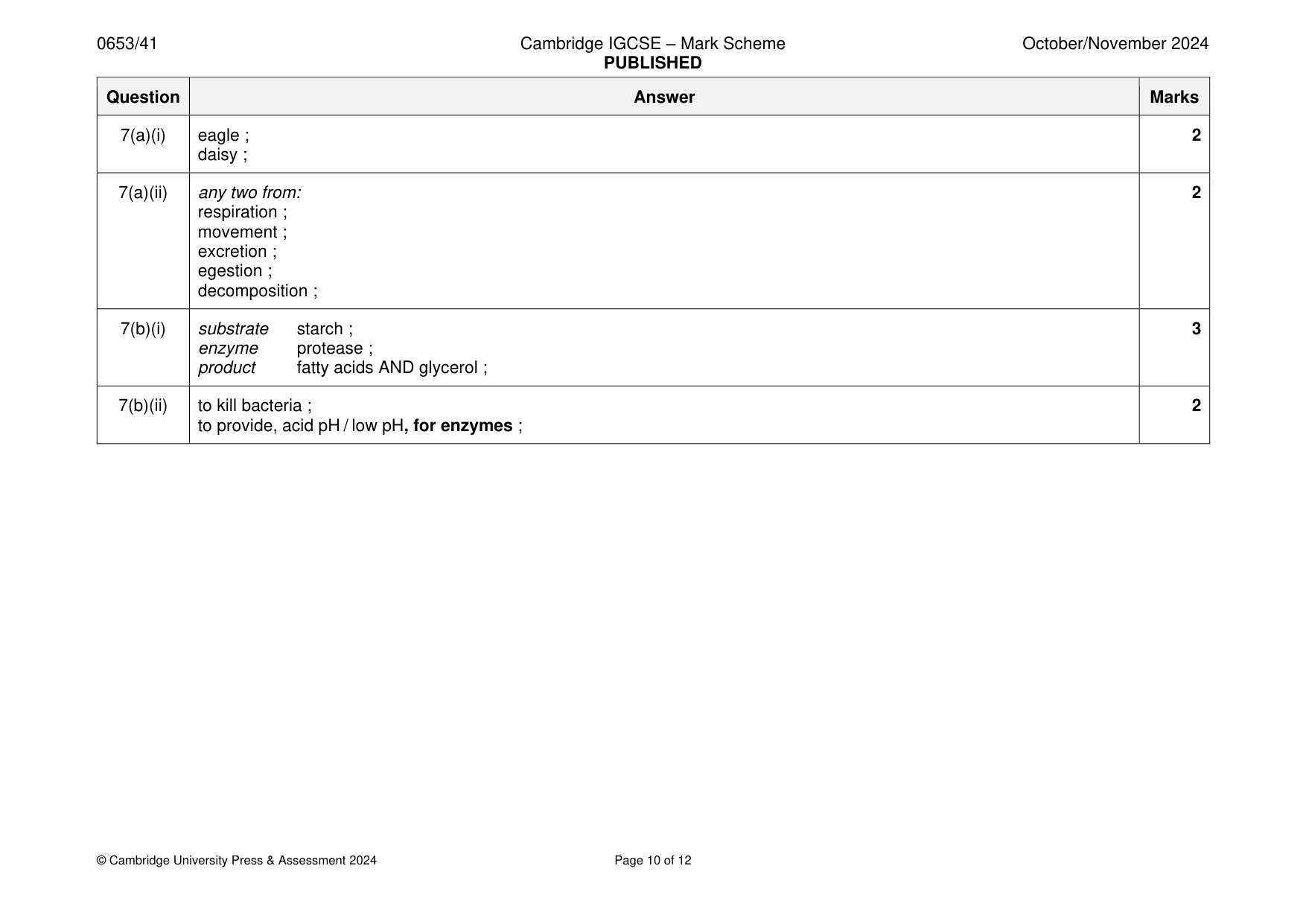
Mark scheme: 7(a)(i) eagle ; 2 daisy ; 7(a)(ii) any two from: 2 respiration ; movement ; excretion ; egestion ; decomposition ; 7(b)(i) substrate starch ; 3 enzyme protease ; product fatty acids AND glycerol ; 7(b)(ii) to kill bacteria ; 2 to provide, acid pH / low pH, for enzymes ;
Q8 · Carbon dioxide is a greenhouse gas
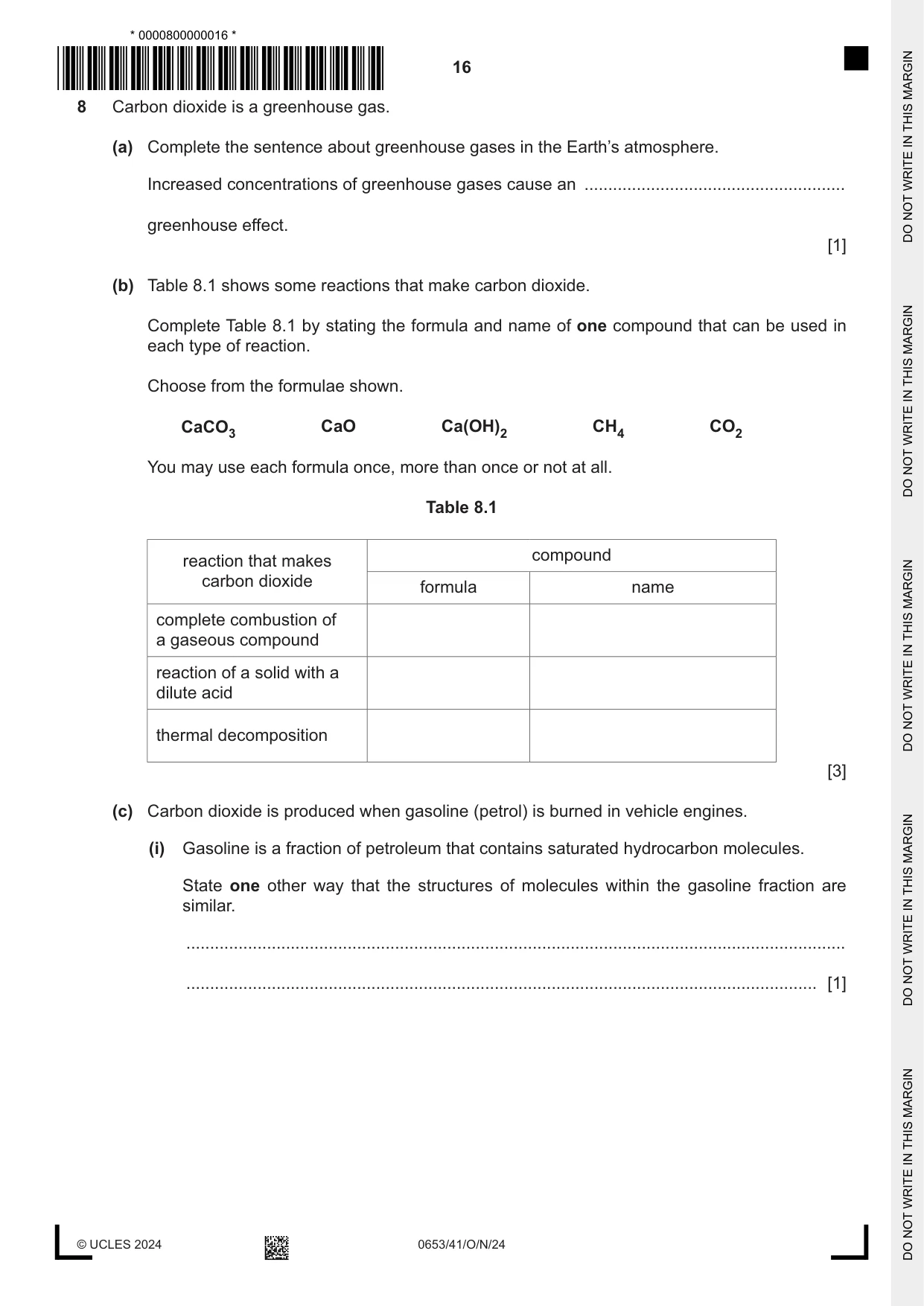
8 Carbon dioxide is a greenhouse gas. (a) Complete the sentence about greenhouse gases in the Earth’s atmosphere. Increased concentrations of greenhouse gases cause an ....................................................... greenhouse effect. [1] (b) Table 8.1 shows some reactions that make carbon dioxide. Complete Table 8.1 by stating the formula and name of one compound that can be used in each type of reaction. Choose from the formulae shown. CaCO3 CaO Ca(OH)2 CH4 CO2 You may use each formula once, more than once or not at all. Table 8.1 compound reaction that makes carbon dioxide formula name complete combustion of a gaseous compound reaction of a solid with a dilute acid thermal decomposition [3] (c) Carbon dioxide is produced when gasoline (petrol) is burned in vehicle engines. (i) Gasoline is a fraction of petroleum that contains saturated hydrocarbon molecules. State one other way that the structures of molecules within the gasoline fraction are similar. ........................................................................................................................................... ..................................................................................................................................... [1] (ii) The cracking of larger alkanes makes smaller alkanes and alkenes. State two conditions required for cracking. 1 ........................................................................................................................................ 2 ........................................................................................................................................ [2] [Total: 7]
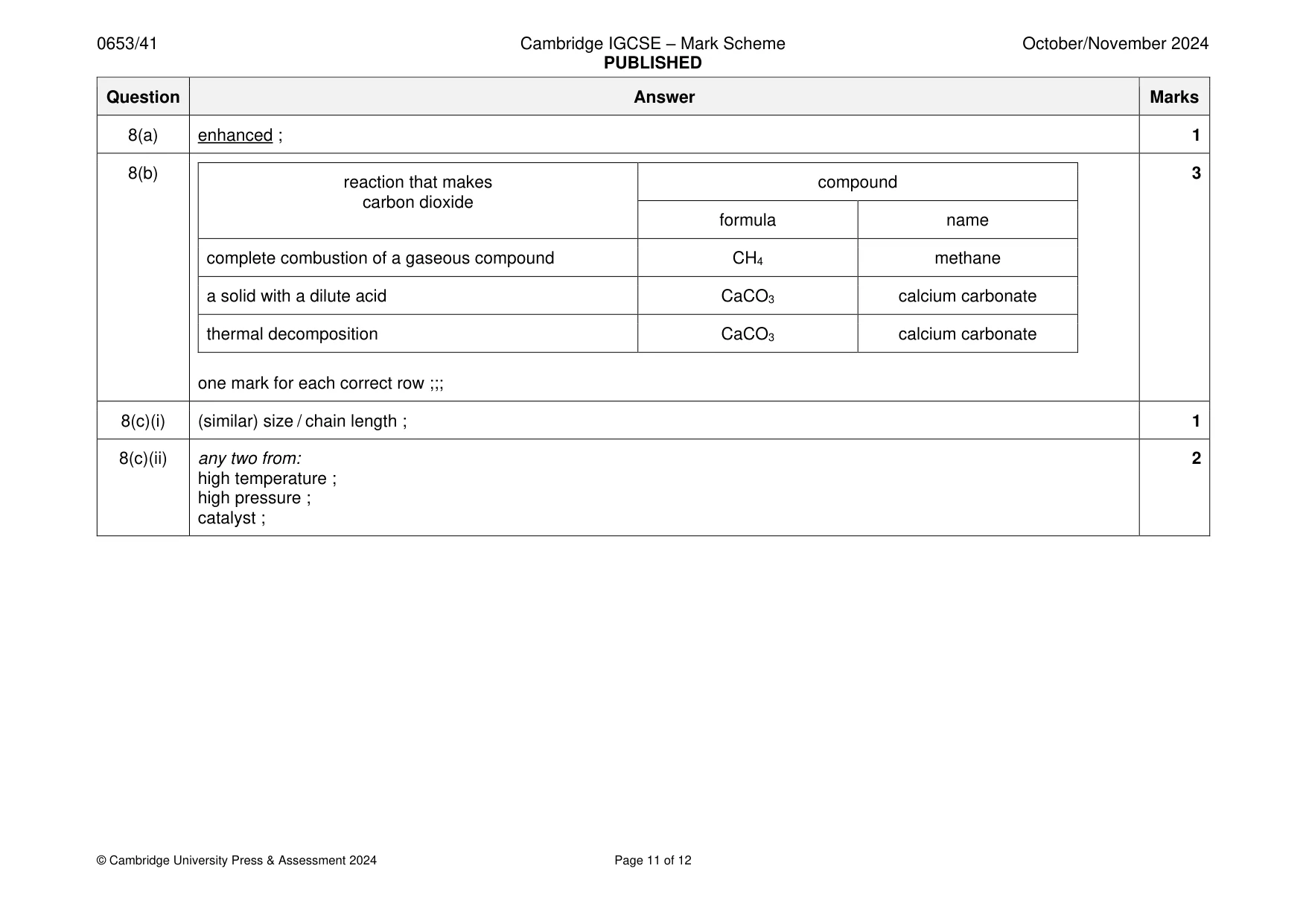
Mark scheme: 8(a) enhanced ; 1 8(b) 3 reaction that makes compound carbon dioxide formula name complete combustion of a gaseous compound CH4 methane a solid with a dilute acid CaCO3 calcium carbonate thermal decomposition CaCO3 calcium carbonate one mark for each correct row ;;; 8(c)(i) (similar) size / chain length ; 1 8(c)(ii) any two from: 2 high temperature ; high pressure ; catalyst ;
Q9 · An electrical circuit that includes three identical lamps and a fixed resistor
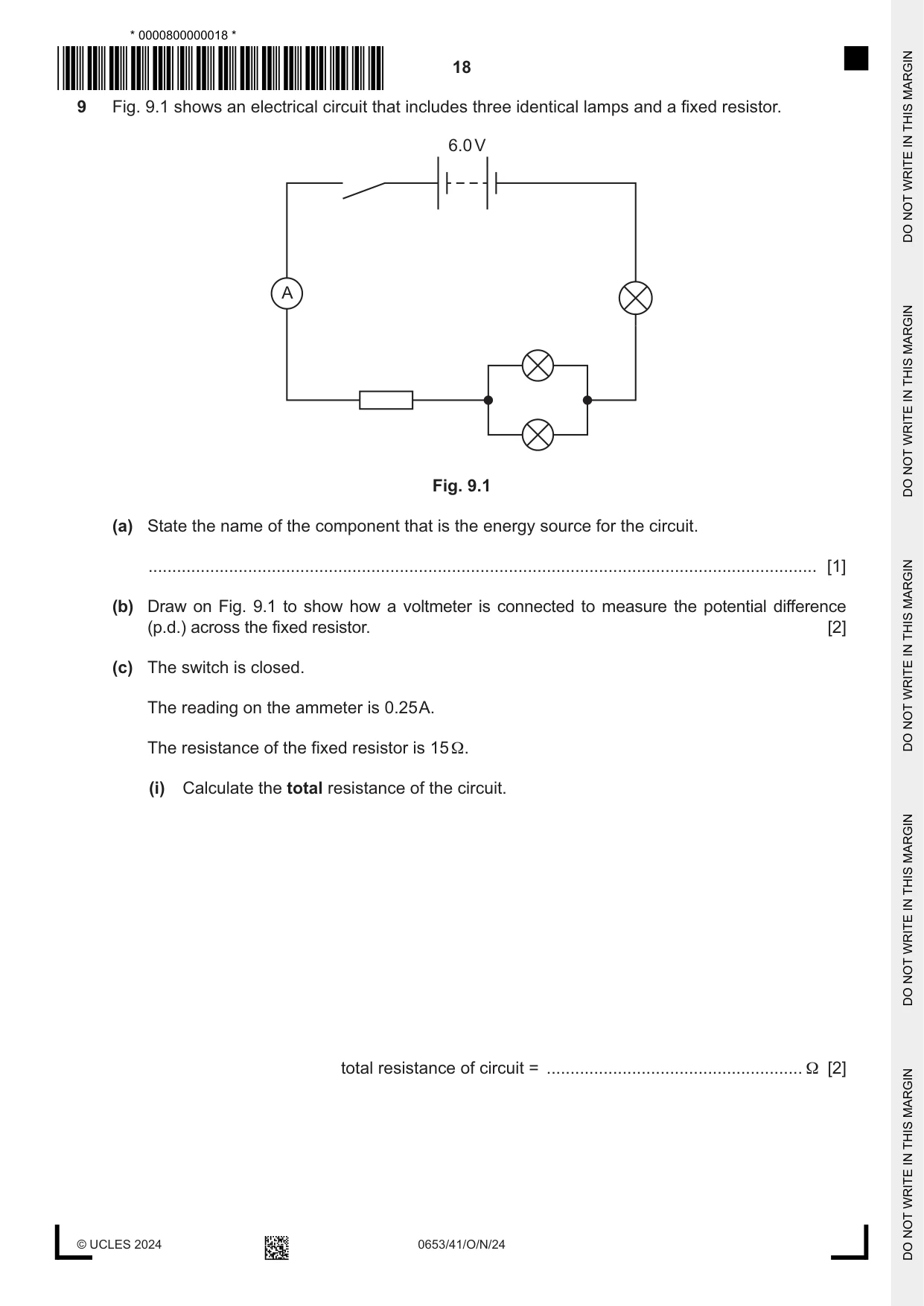
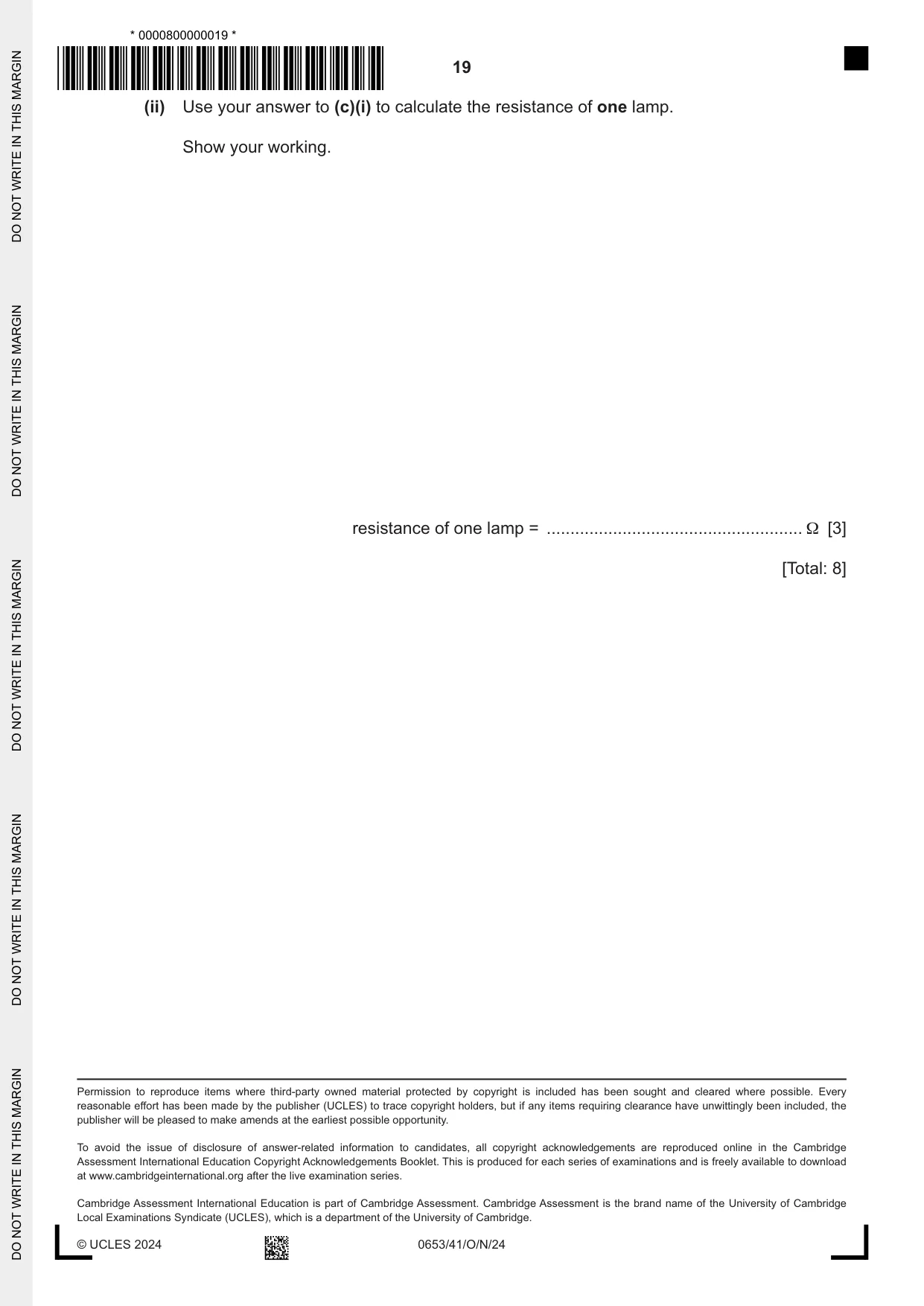
9 Fig. 9.1 shows an electrical circuit that includes three identical lamps and a fixed resistor. 6.0 V A Fig. 9.1 (a) State the name of the component that is the energy source for the circuit. ............................................................................................................................................. [1] (b) Draw on Fig. 9.1 to show how a voltmeter is connected to measure the potential difference (p.d.) across the fixed resistor. [2] (c) The switch is closed. The reading on the ammeter is 0.25 A. The resistance of the fixed resistor is 15 Ω. (i) Calculate the total resistance of the circuit. total resistance of circuit = ...................................................... Ω [2] (ii) Use your answer to (c)(i) to calculate the resistance of one lamp. Show your working. resistance of one lamp = ...................................................... Ω [3] [Total: 8]
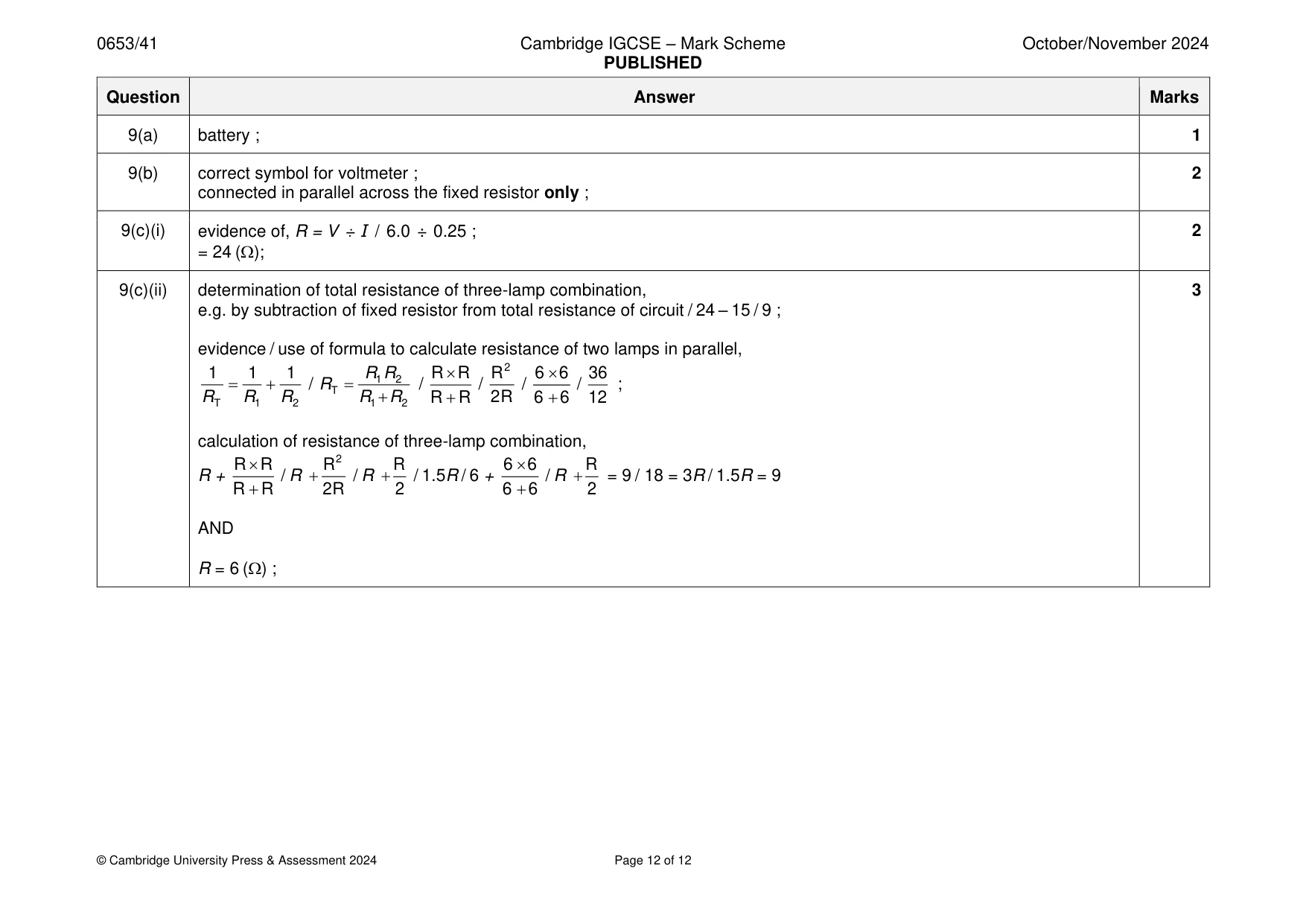
Mark scheme: 9(a) battery ; 1 9(b) correct symbol for voltmeter ; 2 connected in parallel across the fixed resistor only ; 9(c)(i) evidence of, R = V ÷ I / 6.0 ÷ 0.25 ; 2 = 24 (); 9(c)(ii) determination of total resistance of three-lamp combination, 3 e.g. by subtraction of fixed resistor from total resistance of circuit / 24 – 15 / 9 ; evidence / use of formula to calculate resistance of two lamps in parallel, 1 1 1 R1 R2 R R R 2 6 6 36 = + / RT = / / / / ; RT R1 R2 R1 + R2 R + R 2R 6 + 6 12 calculation of resistance of three-lamp combination, R R R 2 R 6 6 R R + / R + / R + / 1.5R / 6 + / R + = 9 / 18 = 3R / 1.5R = 9 R + R 2R 2 6 + 6 2 AND R = 6 () ;
What was in this paper
The subtopics covered by these 9 questions, and how many questions each got. Open one in a new tab to see every Cambridge question on it.
What you needed in this session
Cambridge’s own grade thresholds for 2024 Oct/Nov, Paper 4 · Variant 1. A higher threshold means an easier paper — the bar moves with how the cohort did.