Cambridge IGCSE Science - Combined 0653 — 2019 May/June Paper 4 · Variant 2
0653/42/M/J/19 · 9 questions · 80 marks · ≈90 min
The question paper and its mark scheme, free to read here and free to download. This is Cambridge’s own paper, exactly as it was sat.
Question paper20 pages
Mark scheme9 pages
Answers below. Sit the paper first if you are practising.
Questions as text
Q1 · When apples are cut open the exposed surface turns from white to brown
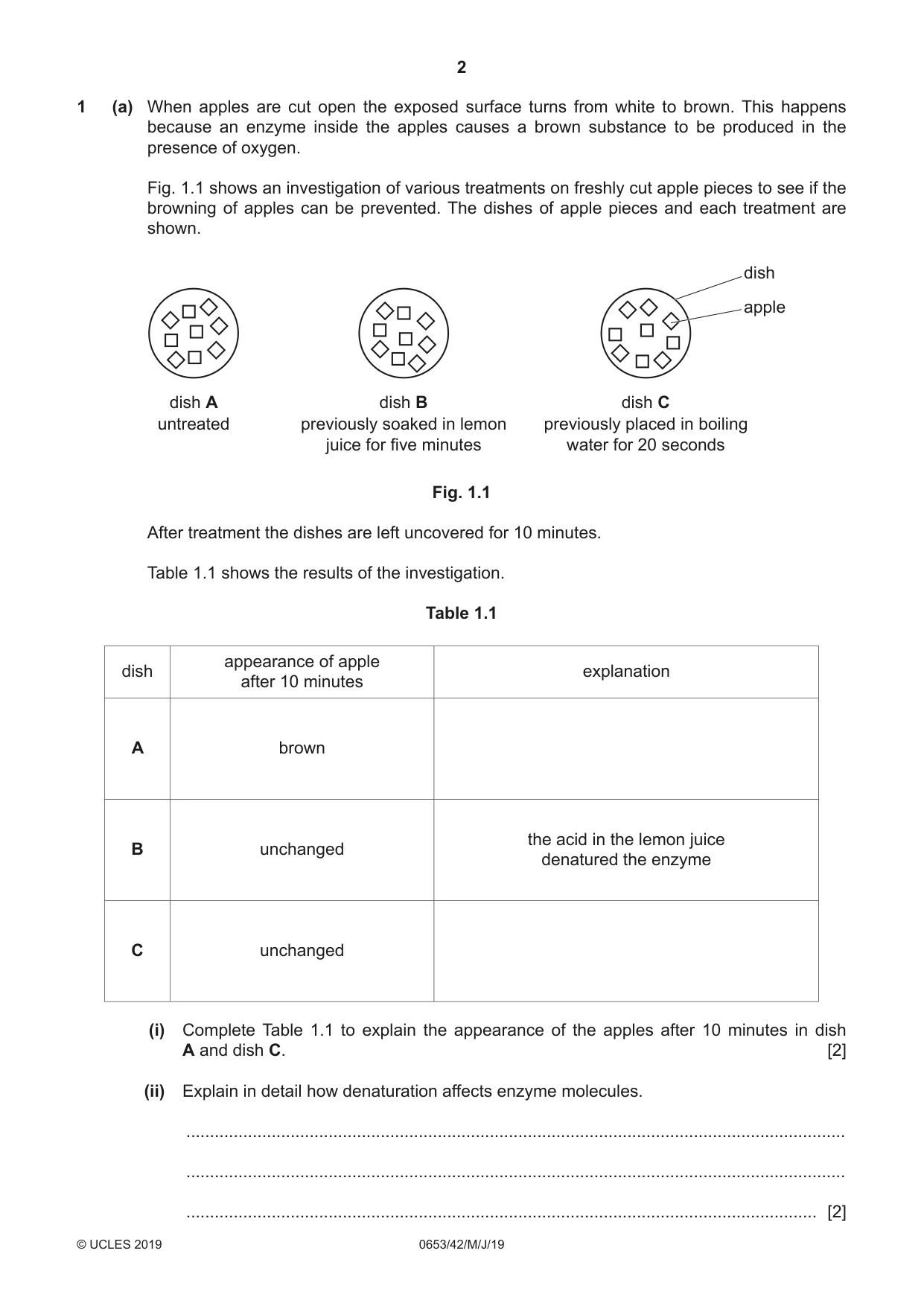
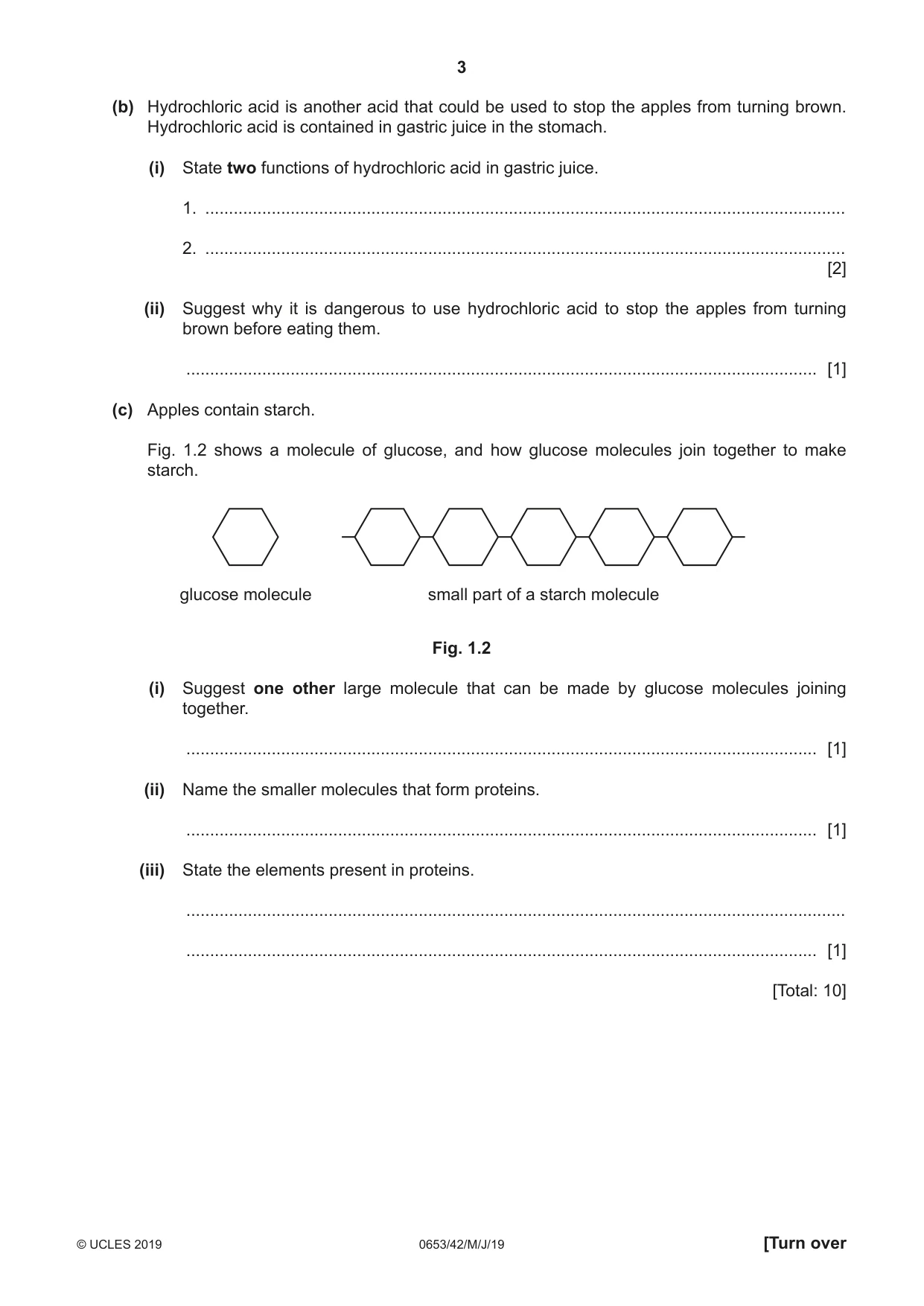
1 (a) When apples are cut open the exposed surface turns from white to brown. This happens because an enzyme inside the apples causes a brown substance to be produced in the presence of oxygen. Fig. 1.1 shows an investigation of various treatments on freshly cut apple pieces to see if the browning of apples can be prevented. The dishes of apple pieces and each treatment are shown. dish apple dish A dish B dish C untreated previously soaked in lemon previously placed in boiling juice for five minutes water for 20 seconds Fig. 1.1 After treatment the dishes are left uncovered for 10 minutes. Table 1.1 shows the results of the investigation. Table 1.1 appearance of apple dish explanation after 10 minutes A brown the acid in the lemon juice B unchanged denatured the enzyme C unchanged (i) Complete Table 1.1 to explain the appearance of the apples after 10 minutes in dish A and dish C. [2] (ii) Explain in detail how denaturation affects enzyme molecules. ........................................................................................................................................... ........................................................................................................................................... ..................................................................................................................................... [2] (b) Hydrochloric acid is another acid that could be used to stop the apples from turning brown. Hydrochloric acid is contained in gastric juice in the stomach. (i) State two functions of hydrochloric acid in gastric juice. 1. ....................................................................................................................................... 2. ....................................................................................................................................... [2] (ii) Suggest why it is dangerous to use hydrochloric acid to stop the apples from turning brown before eating them. ..................................................................................................................................... [1] (c) Apples contain starch. Fig. 1.2 shows a molecule of glucose, and how glucose molecules join together to make starch. glucose molecule small part of a starch molecule Fig. 1.2 (i) Suggest one other large molecule that can be made by glucose molecules joining together. ..................................................................................................................................... [1] (ii) Name the smaller molecules that form proteins. ..................................................................................................................................... [1] (iii) State the elements present in proteins. ........................................................................................................................................... ..................................................................................................................................... [1] [Total: 10]
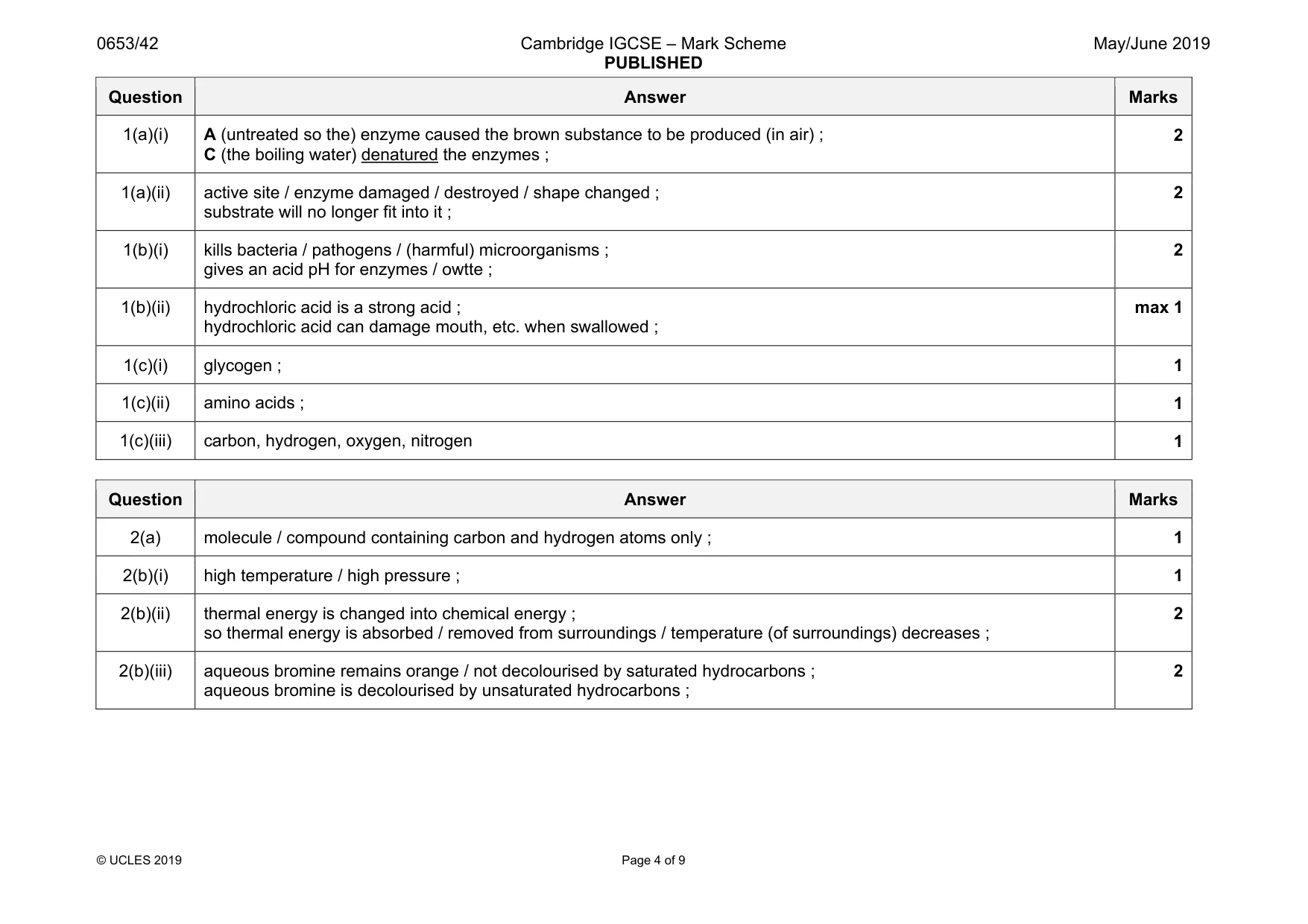
Mark scheme: 1(a)(i) A (untreated so the) enzyme caused the brown substance to be produced (in air) ; C (the boiling water) denatured the enzymes ; 2 1(a)(ii) active site / enzyme damaged / destroyed / shape changed ; substrate will no longer fit into it ; 2 1(b)(i) kills bacteria / pathogens / (harmful) microorganisms ; gives an acid pH for enzymes / owtte ; 2 1(b)(ii) hydrochloric acid is a strong acid ; hydrochloric acid can damage mouth, etc. when swallowed ; max 1 1(c)(i) glycogen ; 1 1(c)(ii) amino acids ; 1 1(c)(iii) carbon, hydrogen, oxygen, nitrogen 1
Q2 · Catalytic cracking breaks down large saturated hydrocarbon molecules into smaller…
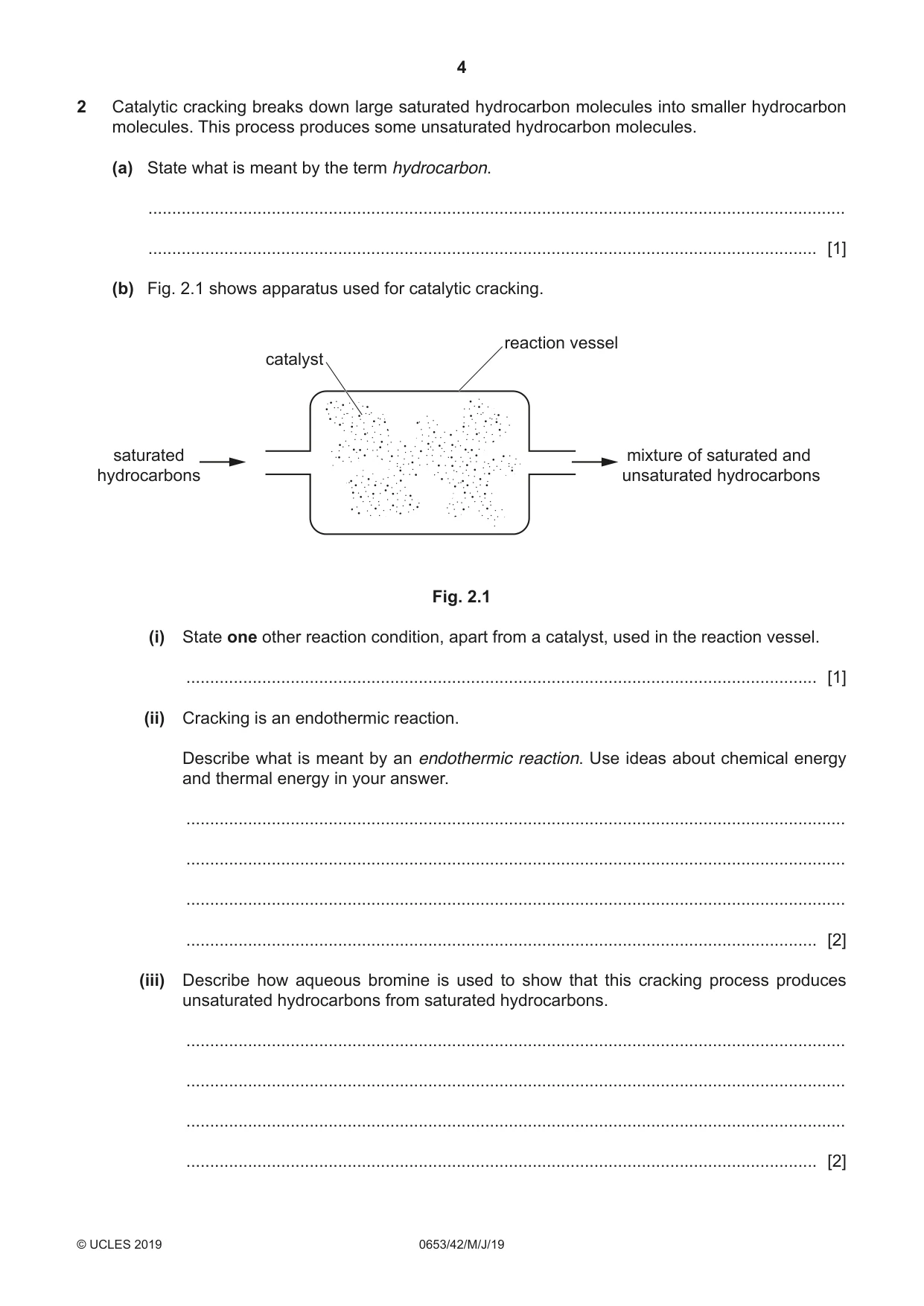
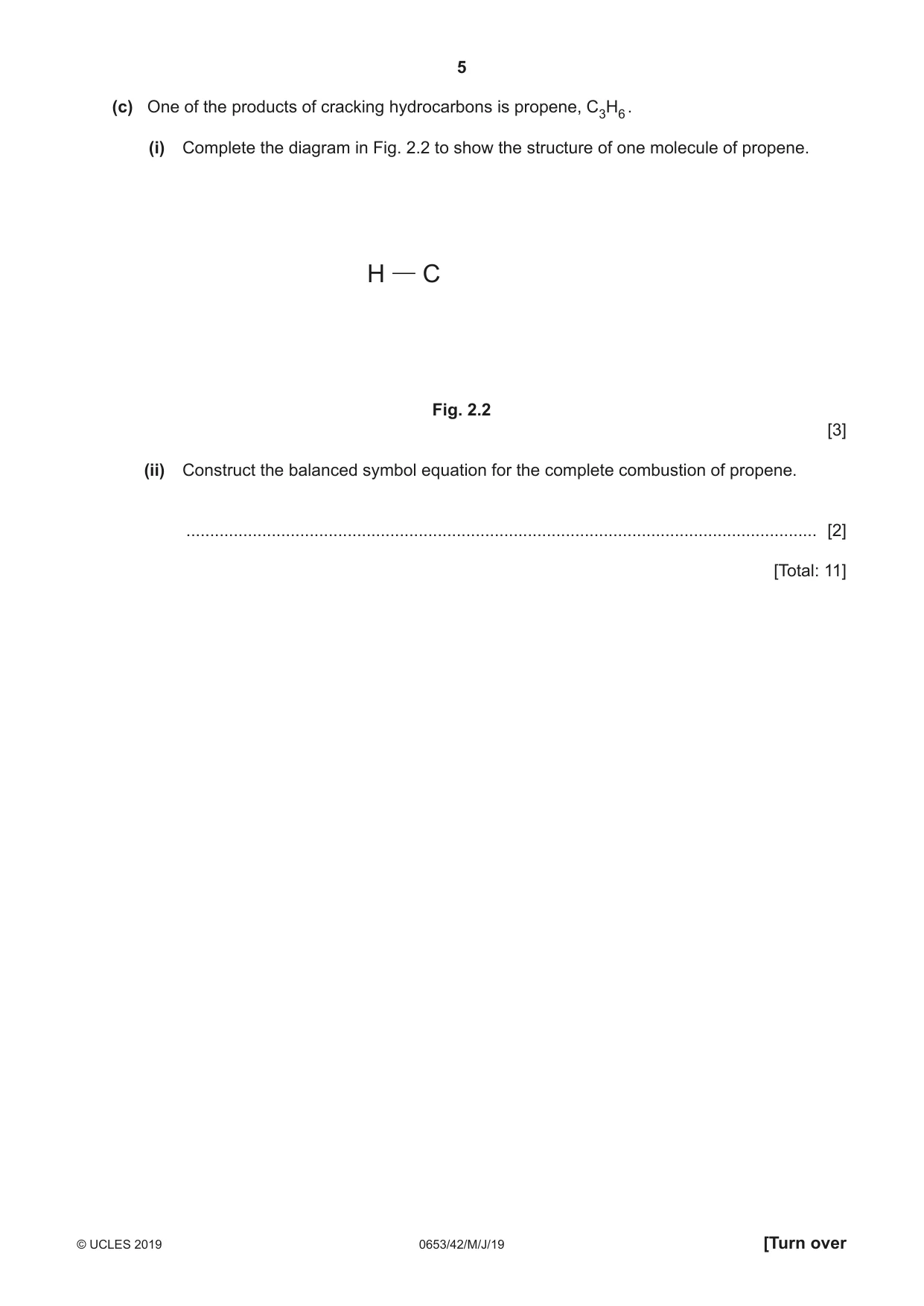
2 Catalytic cracking breaks down large saturated hydrocarbon molecules into smaller hydrocarbon molecules. This process produces some unsaturated hydrocarbon molecules. (a) State what is meant by the term hydrocarbon. ................................................................................................................................................... ............................................................................................................................................. [1] (b) Fig. 2.1 shows apparatus used for catalytic cracking. reaction vessel catalyst saturated mixture of saturated and hydrocarbons unsaturated hydrocarbons Fig. 2.1 (i) State one other reaction condition, apart from a catalyst, used in the reaction vessel. ..................................................................................................................................... [1] (ii) Cracking is an endothermic reaction. Describe what is meant by an endothermic reaction. Use ideas about chemical energy and thermal energy in your answer. ........................................................................................................................................... ........................................................................................................................................... ........................................................................................................................................... ..................................................................................................................................... [2] (iii) Describe how aqueous bromine is used to show that this cracking process produces unsaturated hydrocarbons from saturated hydrocarbons. ........................................................................................................................................... ........................................................................................................................................... ........................................................................................................................................... ..................................................................................................................................... [2] (c) One of the products of cracking hydrocarbons is propene, C3H6 . (i) Complete the diagram in Fig. 2.2 to show the structure of one molecule of propene. H C Fig. 2.2 [3] (ii) Construct the balanced symbol equation for the complete combustion of propene. ..................................................................................................................................... [2] [Total: 11]
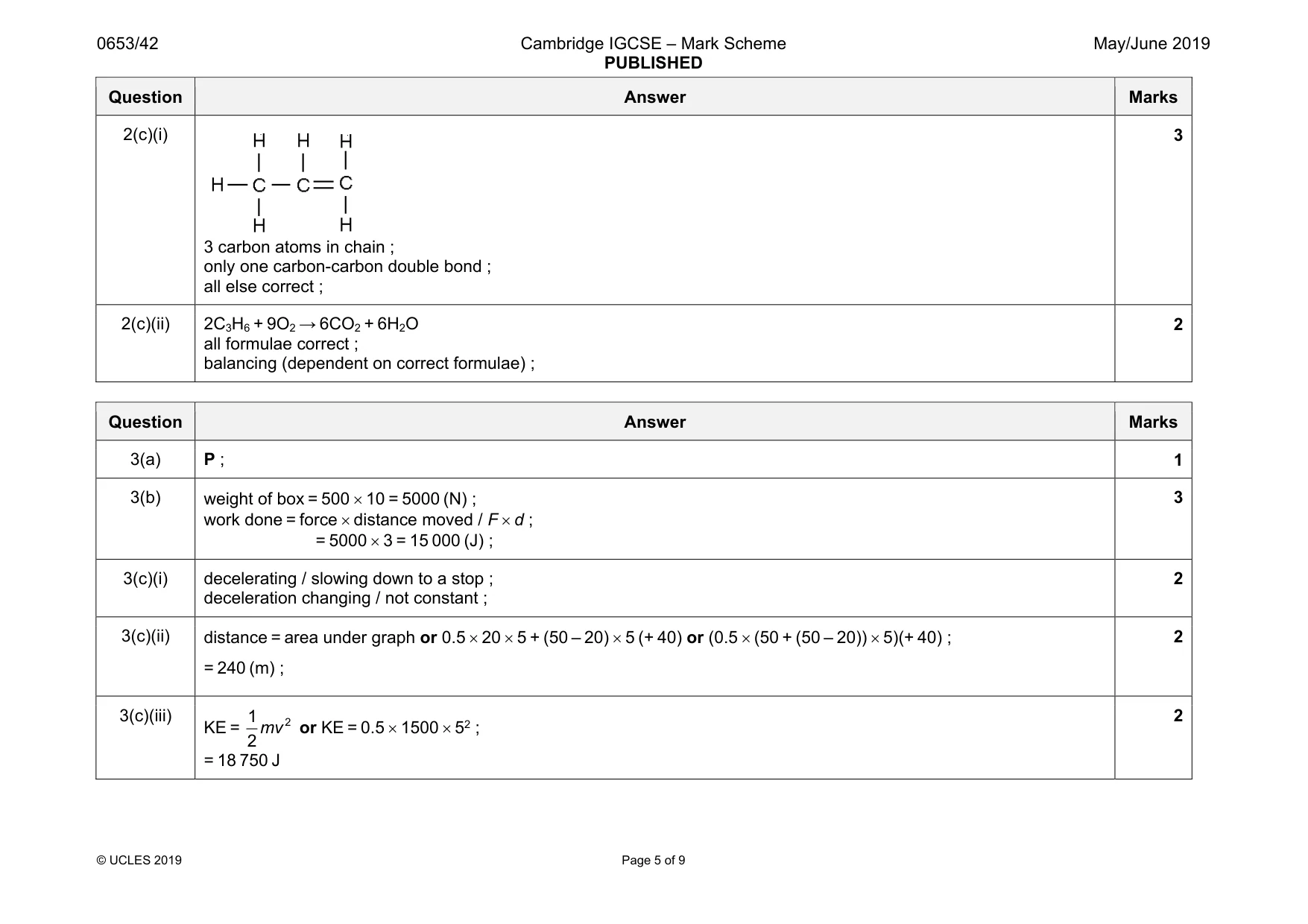
Mark scheme: 2(a) molecule / compound containing carbon and hydrogen atoms only ; 1 2(b)(i) high temperature / high pressure ; 1 2(b)(ii) thermal energy is changed into chemical energy ; so thermal energy is absorbed / removed from surroundings / temperature (of surroundings) decreases ; 2 2(b)(iii) aqueous bromine remains orange / not decolourised by saturated hydrocarbons ; aqueous bromine is decolourised by unsaturated hydrocarbons ; 2 Question Answer Marks 2(c)(i) 3 carbon atoms in chain ; only one carbon-carbon double bond ; all else correct ; 3 2(c)(ii) 2C3H6 + 9O2 → 6CO2 + 6H2O all formulae correct ; balancing (dependent on correct formulae) ; 2
Q3 · A forklift truck moving a large heavy box towards a shelf
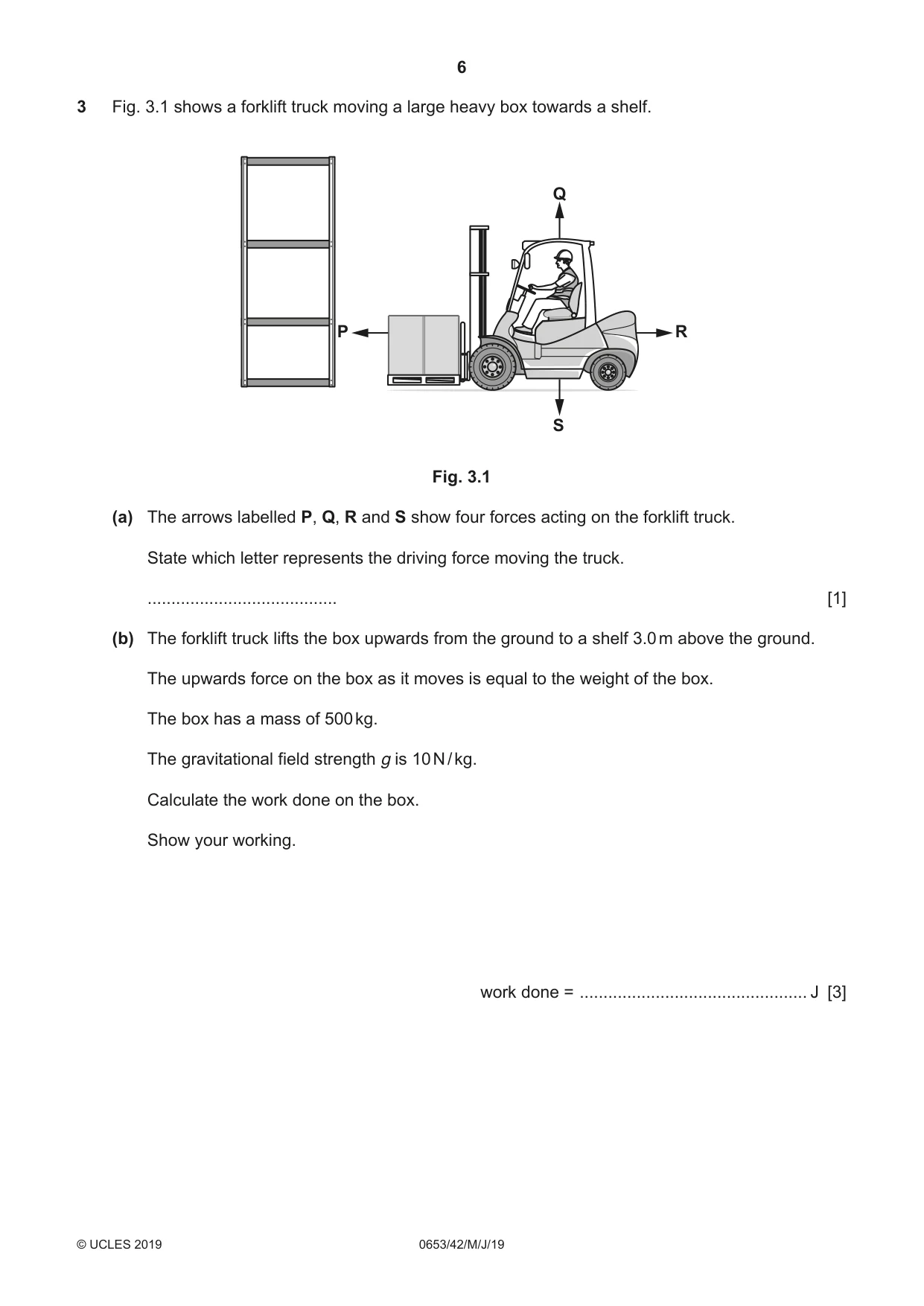
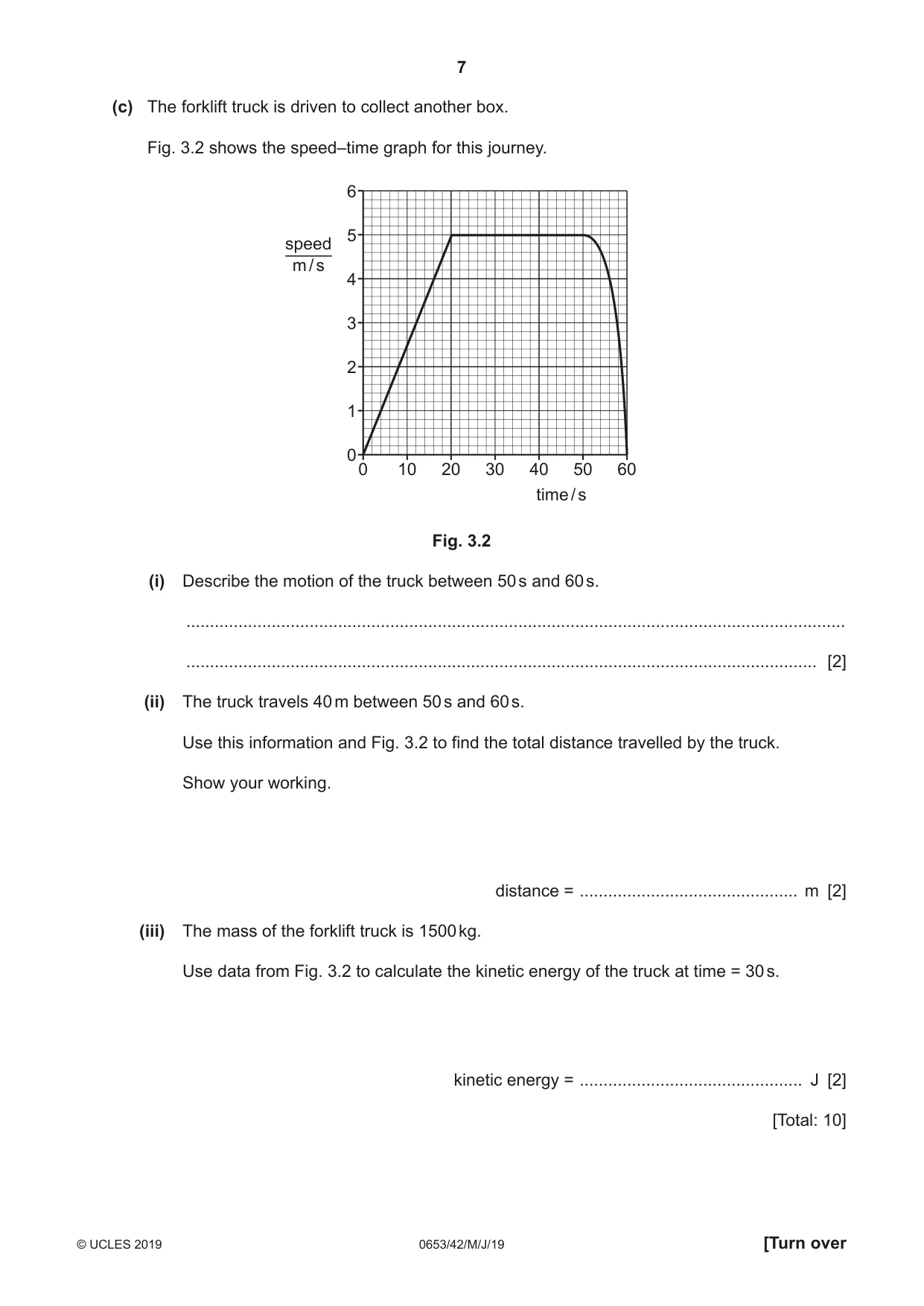
3 Fig. 3.1 shows a forklift truck moving a large heavy box towards a shelf. Q P R S Fig. 3.1 (a) The arrows labelled P, Q, R and S show four forces acting on the forklift truck. State which letter represents the driving force moving the truck. ........................................ [1] (b) The forklift truck lifts the box upwards from the ground to a shelf 3.0 m above the ground. The upwards force on the box as it moves is equal to the weight of the box. The box has a mass of 500 kg. The gravitational field strength g is 10 N / kg. Calculate the work done on the box. Show your working. work done = ................................................ J [3] (c) The forklift truck is driven to collect another box. Fig. 3.2 shows the speed–time graph for this journey. 6 5 speed m / s 4 3 2 1 0 0 10 20 30 40 50 60 time / s Fig. 3.2 (i) Describe the motion of the truck between 50 s and 60 s. ........................................................................................................................................... ..................................................................................................................................... [2] (ii) The truck travels 40 m between 50 s and 60 s. Use this information and Fig. 3.2 to find the total distance travelled by the truck. Show your working. distance = .............................................. m [2] (iii) The mass of the forklift truck is 1500 kg. Use data from Fig. 3.2 to calculate the kinetic energy of the truck at time = 30 s. kinetic energy = ............................................... J [2] [Total: 10]
Mark scheme: 3(a) P ; 1 3(b) weight of box = 500 × 10 = 5000 (N) ; work done = force × distance moved / F × d ; = 5000 × 3 = 15 000 (J) ; 3 3(c)(i) decelerating / slowing down to a stop ; deceleration changing / not constant ; 2 3(c)(ii) distance = area under graph or 0.5 × 20 × 5 + (50 – 20) × 5 (+ 40) or (0.5 × (50 + (50 – 20)) × 5)(+ 40) ; = 240 (m) ; 2 3(c)(iii) KE = 2 1 2 mv or KE = 0.5 × 1500 × 52 ; = 18 750 J 2
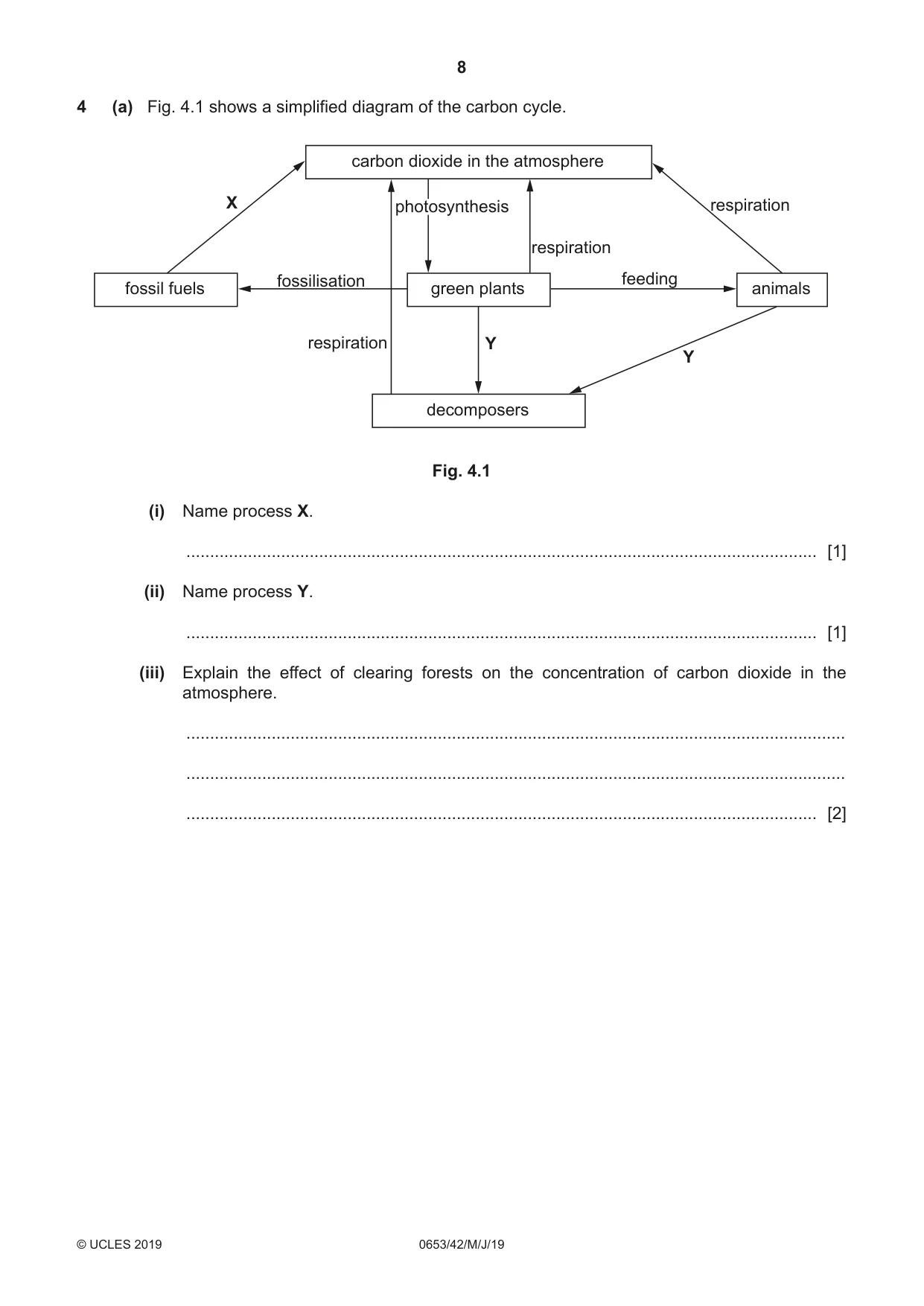
Q4 · A simplified diagram of the carbon cycle
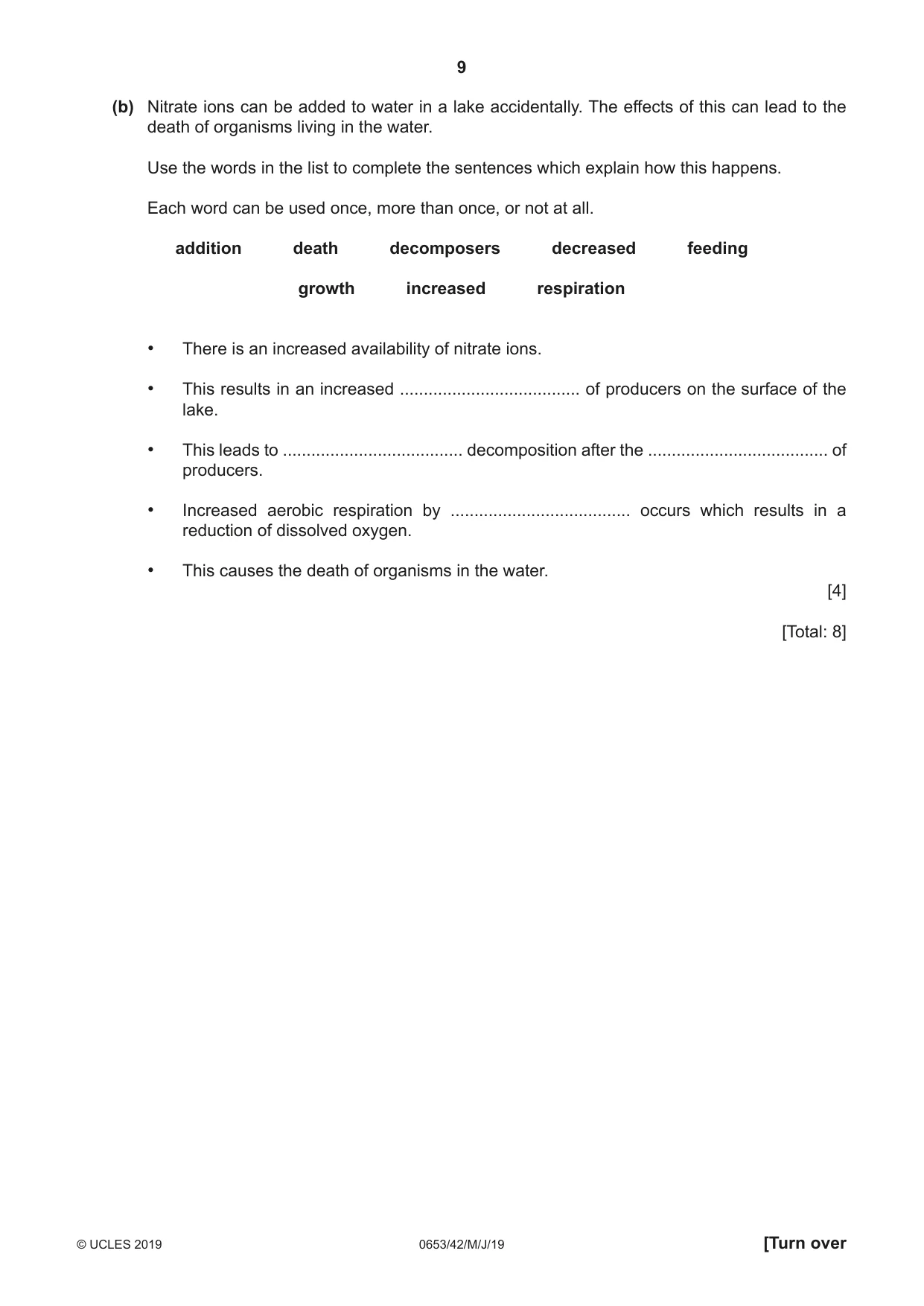
4 (a) Fig. 4.1 shows a simplified diagram of the carbon cycle. carbon dioxide in the atmosphere X photosynthesis respiration respiration fossilisation feeding fossil fuels green plants animals respiration Y Y decomposers Fig. 4.1 (i) Name process X. ..................................................................................................................................... [1] (ii) Name process Y. ..................................................................................................................................... [1] (iii) Explain the effect of clearing forests on the concentration of carbon dioxide in the atmosphere. ........................................................................................................................................... ........................................................................................................................................... ..................................................................................................................................... [2] (b) Nitrate ions can be added to water in a lake accidentally. The effects of this can lead to the death of organisms living in the water. Use the words in the list to complete the sentences which explain how this happens. Each word can be used once, more than once, or not at all. addition death decomposers decreased feeding growth increased respiration • There is an increased availability of nitrate ions. • This results in an increased ...................................... of producers on the surface of the lake. • This leads to ...................................... decomposition after the ...................................... of producers. • Increased aerobic respiration by ...................................... occurs which results in a reduction of dissolved oxygen. • This causes the death of organisms in the water. [4] [Total: 8]
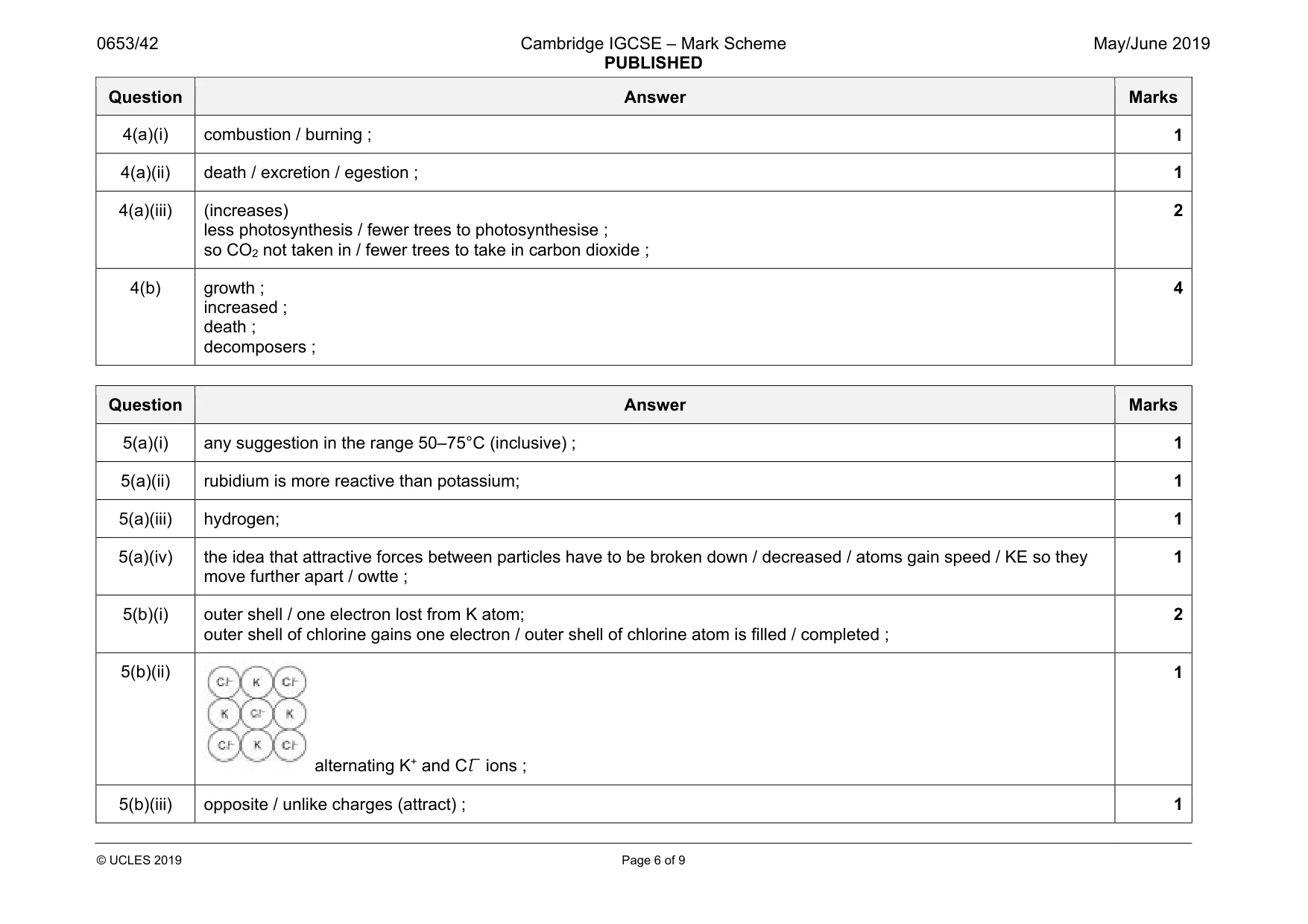
Mark scheme: 4(a)(i) combustion / burning ; 1 4(a)(ii) death / excretion / egestion ; 1 4(a)(iii) (increases) less photosynthesis / fewer trees to photosynthesise ; so CO2 not taken in / fewer trees to take in carbon dioxide ; 2 4(b) growth ; increased ; death ; decomposers ; 4
Q5 · The melting points of some Group I elements
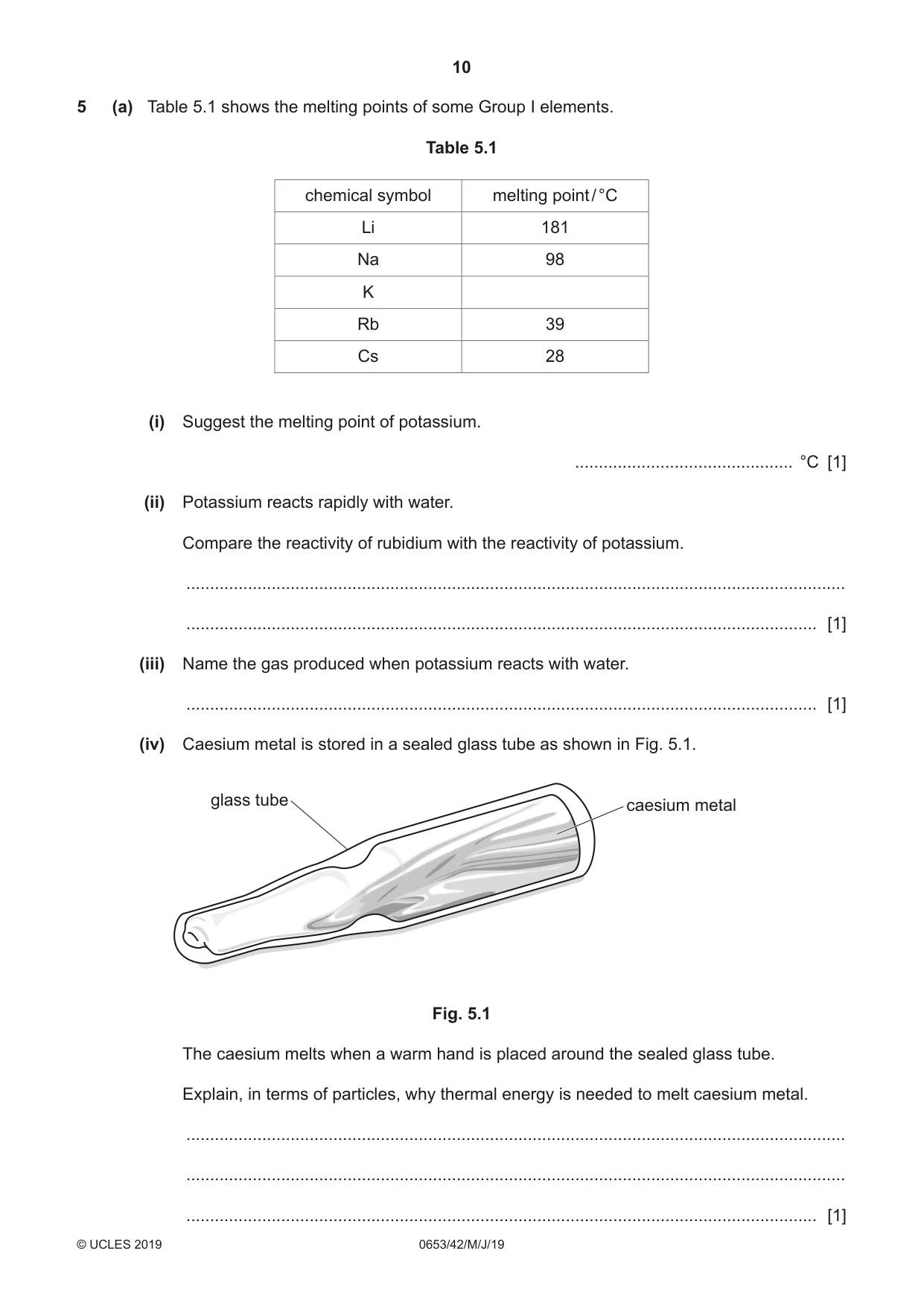
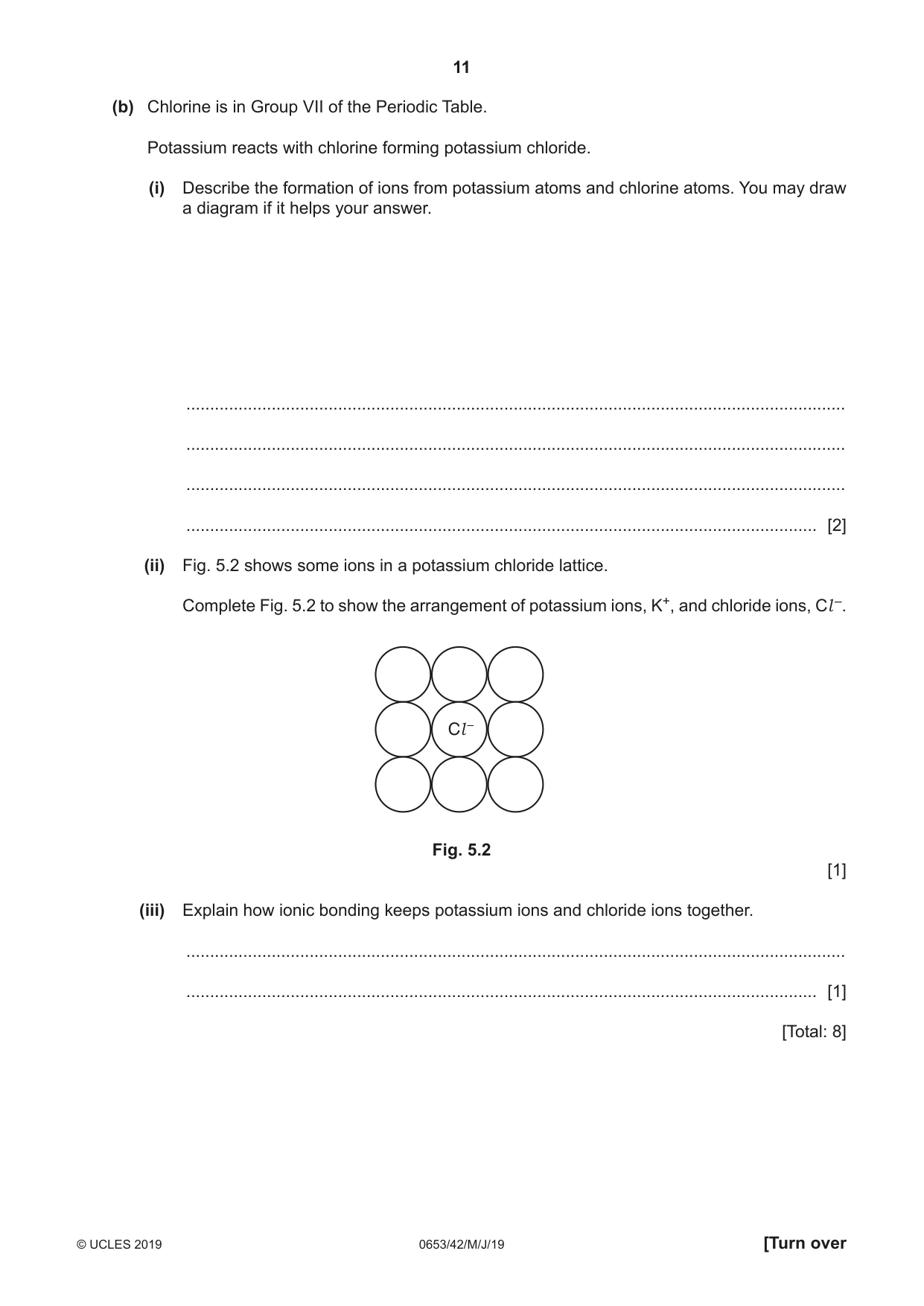
5 (a) Table 5.1 shows the melting points of some Group I elements. Table 5.1 chemical symbol melting point / °C Li 181 Na 98 K Rb 39 Cs 28 (i) Suggest the melting point of potassium. .............................................. °C [1] (ii) Potassium reacts rapidly with water. Compare the reactivity of rubidium with the reactivity of potassium. ........................................................................................................................................... ..................................................................................................................................... [1] (iii) Name the gas produced when potassium reacts with water. ..................................................................................................................................... [1] (iv) Caesium metal is stored in a sealed glass tube as shown in Fig. 5.1. glass tube caesium metal Fig. 5.1 The caesium melts when a warm hand is placed around the sealed glass tube. Explain, in terms of particles, why thermal energy is needed to melt caesium metal. ........................................................................................................................................... ........................................................................................................................................... ..................................................................................................................................... [1] (b) Chlorine is in Group VII of the Periodic Table. Potassium reacts with chlorine forming potassium chloride. (i) Describe the formation of ions from potassium atoms and chlorine atoms. You may draw a diagram if it helps your answer. ........................................................................................................................................... ........................................................................................................................................... ........................................................................................................................................... ..................................................................................................................................... [2] (ii) Fig. 5.2 shows some ions in a potassium chloride lattice. Complete Fig. 5.2 to show the arrangement of potassium ions, K+, and chloride ions, Cl –. Cl – Fig. 5.2 [1] (iii) Explain how ionic bonding keeps potassium ions and chloride ions together. ........................................................................................................................................... ..................................................................................................................................... [1] [Total: 8]
Mark scheme: 5(a)(i) any suggestion in the range 50–75°C (inclusive) ; 1 5(a)(ii) rubidium is more reactive than potassium; 1 5(a)(iii) hydrogen; 1 5(a)(iv) the idea that attractive forces between particles have to be broken down / decreased / atoms gain speed / KE so they move further apart / owtte ; 1 5(b)(i) outer shell / one electron lost from K atom; outer shell of chlorine gains one electron / outer shell of chlorine atom is filled / completed ; 2 5(b)(ii) alternating K+ and Cl– ions ; 1 5(b)(iii) opposite / unlike charges (attract) ; 1
Q6 · The Sun is made of very hot gases
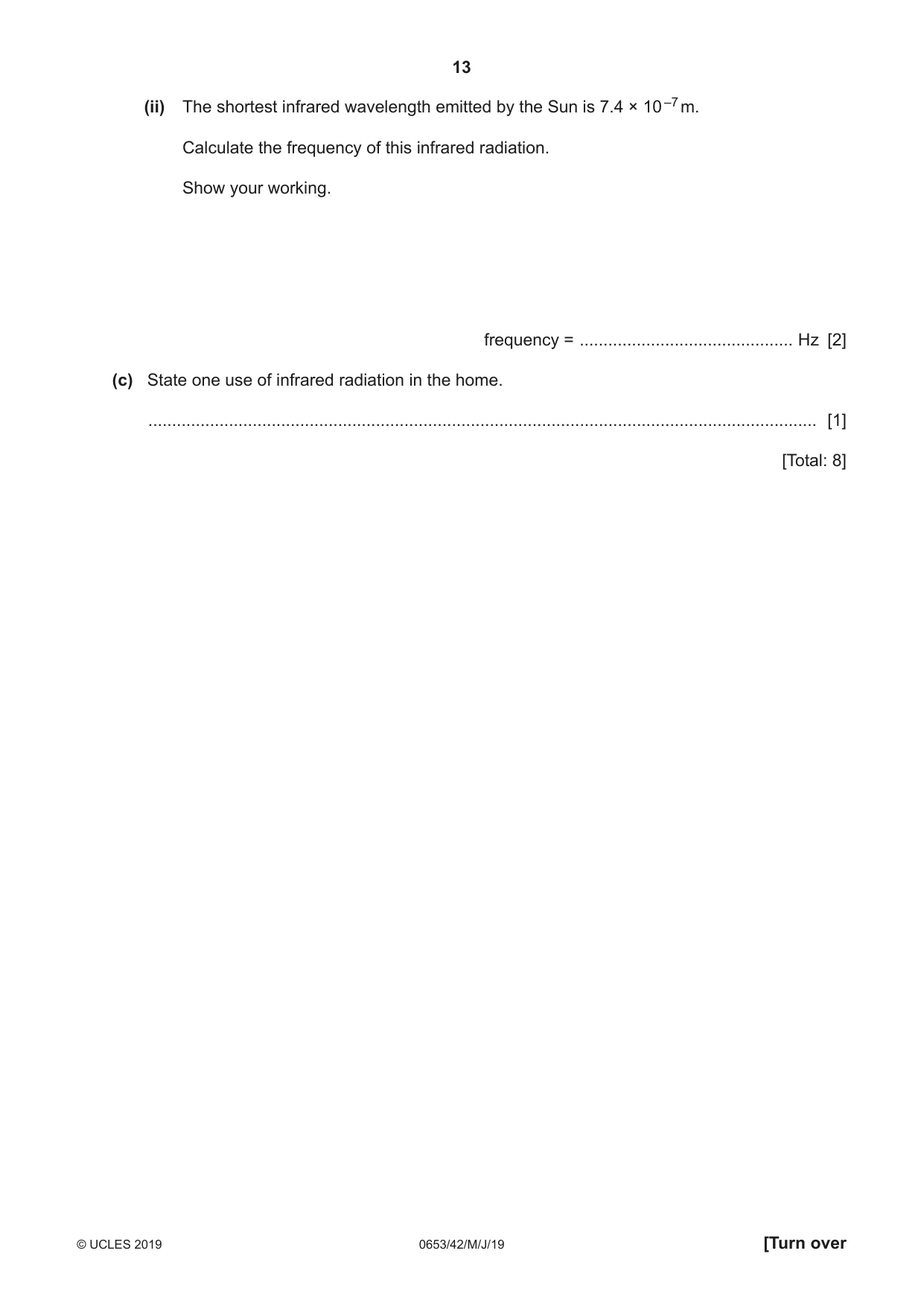
6 (a) The Sun is made of very hot gases. Near the surface of the Sun most of the thermal energy is transferred to the surface by convection. Describe how convection is able to transfer thermal energy from inside the Sun to the surface of the Sun. ................................................................................................................................................... ................................................................................................................................................... ............................................................................................................................................. [2] (b) Some of the energy emitted from the surface of the Sun is transferred to Earth as infrared radiation. Infrared radiation travels between the Sun and the Earth at a speed of 3.0 × 10⁸ m / s. (i) The radiation travels 150 000 000 km from the Sun to Earth. Show that it takes approximately 8 minutes to travel from the Sun to the Earth. [3] (ii) The shortest infrared wavelength emitted by the Sun is 7.4 × 10 –7 m. Calculate the frequency of this infrared radiation. Show your working. frequency = ............................................. Hz [2] (c) State one use of infrared radiation in the home. ............................................................................................................................................. [1] [Total: 8]
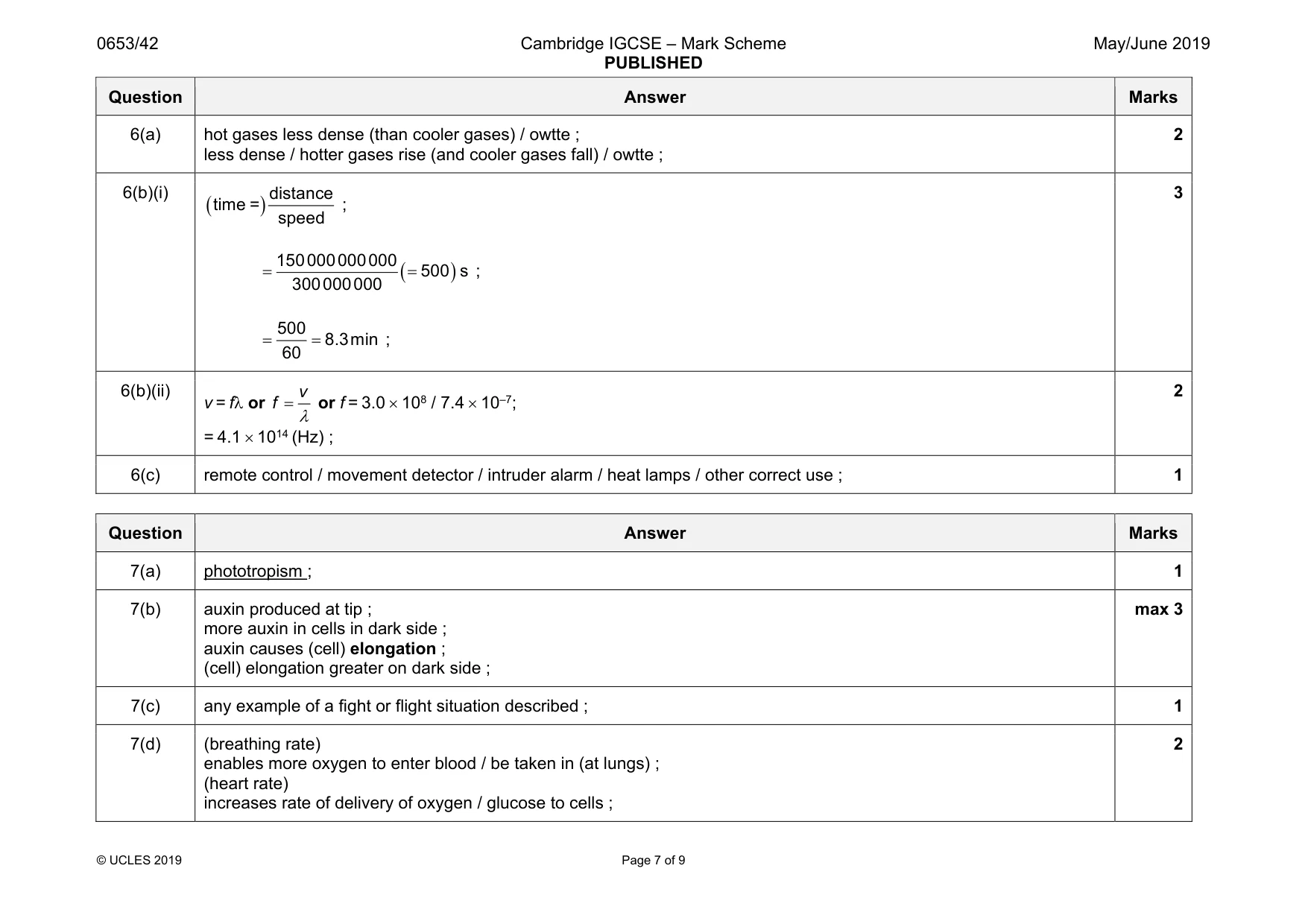
Mark scheme: 6(a) hot gases less dense (than cooler gases) / owtte ; less dense / hotter gases rise (and cooler gases fall) / owtte ; 2 6(b)(i) ( ) distance time = speed ; ( ) = = 150000000000 500 s 300000000 ; = = 500 8.3min 60 ; 3 6(b)(ii) v = fλ or λ = v f or f = 3.0 × 10⁸ / 7.4 × 10⁻⁷; = 4.1 × 10¹⁴ (Hz) ; 2 6(c) remote control / movement detector / intruder alarm / heat lamps / other correct use ; 1
Q7 · A plant responding to light coming from one side
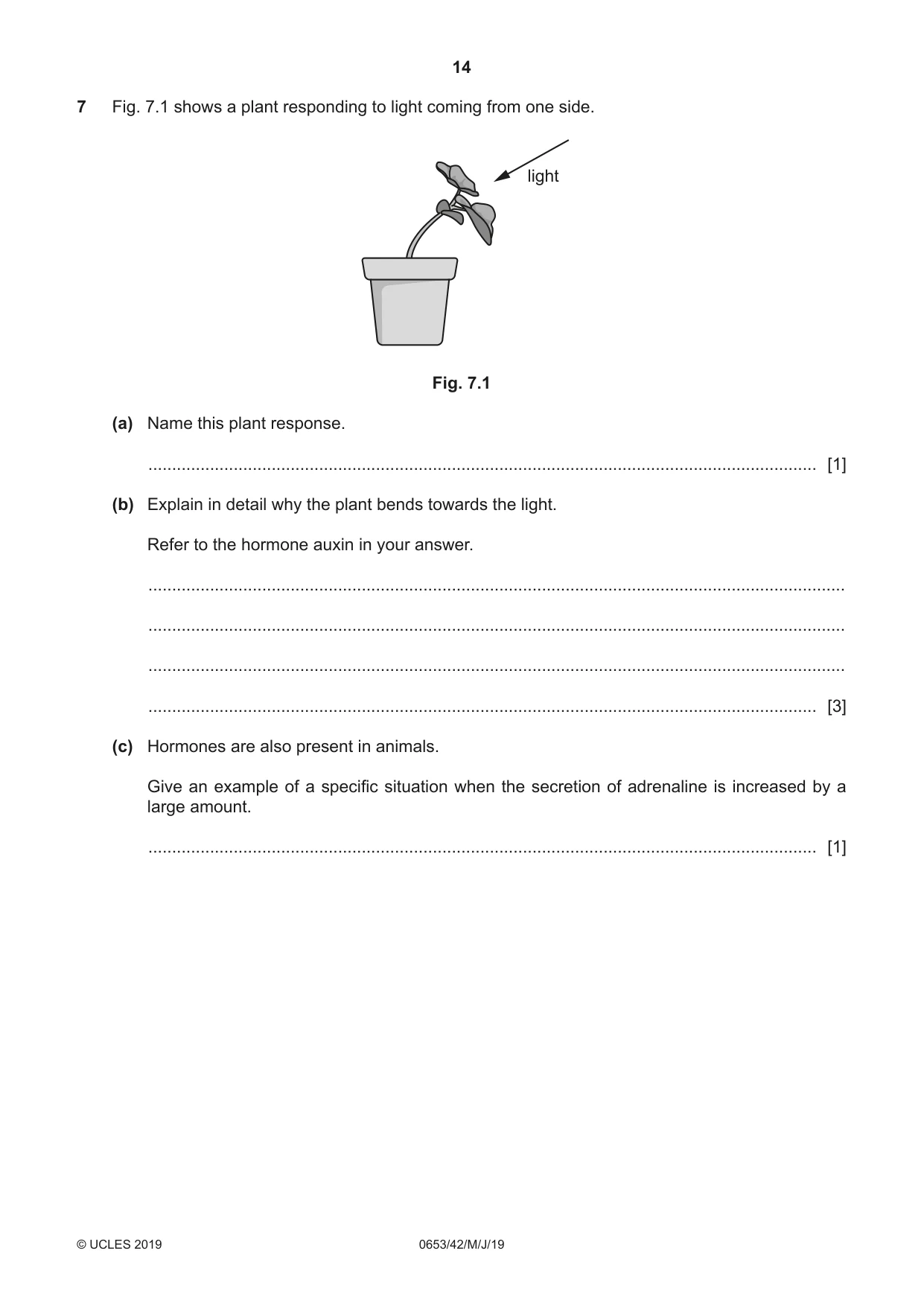
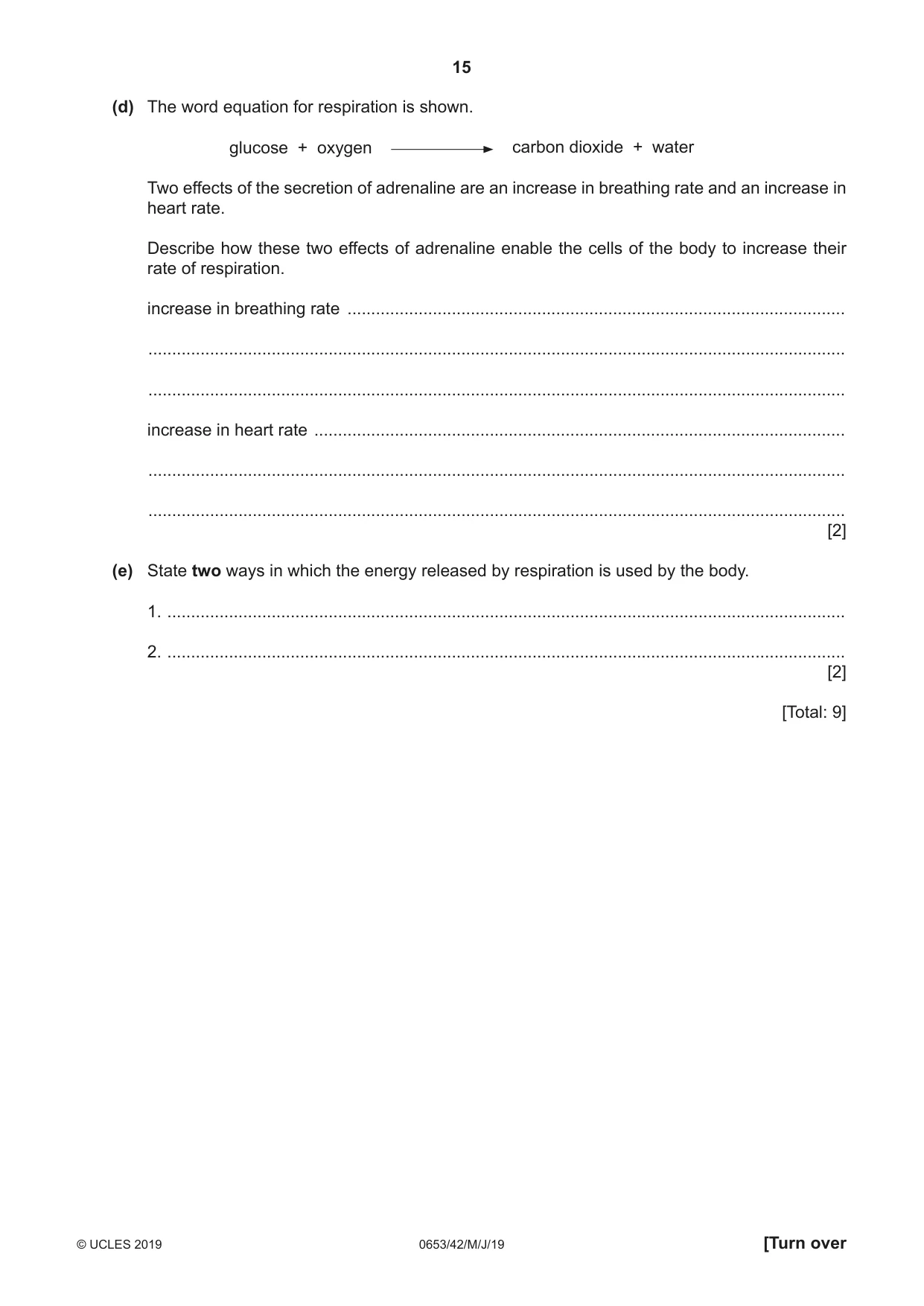
7 Fig. 7.1 shows a plant responding to light coming from one side. light Fig. 7.1 (a) Name this plant response. ............................................................................................................................................. [1] (b) Explain in detail why the plant bends towards the light. Refer to the hormone auxin in your answer. ................................................................................................................................................... ................................................................................................................................................... ................................................................................................................................................... ............................................................................................................................................. [3] (c) Hormones are also present in animals. Give an example of a specific situation when the secretion of adrenaline is increased by a large amount. ............................................................................................................................................. [1] (d) The word equation for respiration is shown. glucose + oxygen carbon dioxide + water Two effects of the secretion of adrenaline are an increase in breathing rate and an increase in heart rate. Describe how these two effects of adrenaline enable the cells of the body to increase their rate of respiration. increase in breathing rate ......................................................................................................... ................................................................................................................................................... ................................................................................................................................................... increase in heart rate ................................................................................................................ ................................................................................................................................................... ................................................................................................................................................... [2] (e) State two ways in which the energy released by respiration is used by the body. 1. ............................................................................................................................................... 2. ............................................................................................................................................... [2] [Total: 9]
Mark scheme: 7(a) phototropism ; 1 7(b) auxin produced at tip ; more auxin in cells in dark side ; auxin causes (cell) elongation ; (cell) elongation greater on dark side ; max 3 7(c) any example of a fight or flight situation described ; 1 7(d) (breathing rate) enables more oxygen to enter blood / be taken in (at lungs) ; (heart rate) increases rate of delivery of oxygen / glucose to cells ; 2 Question Answer Marks 7(e) any two from muscle contraction protein synthesis growth maintenance of body temperature ;; 2
Q8 · A scientist analyses solution Q using chromatography
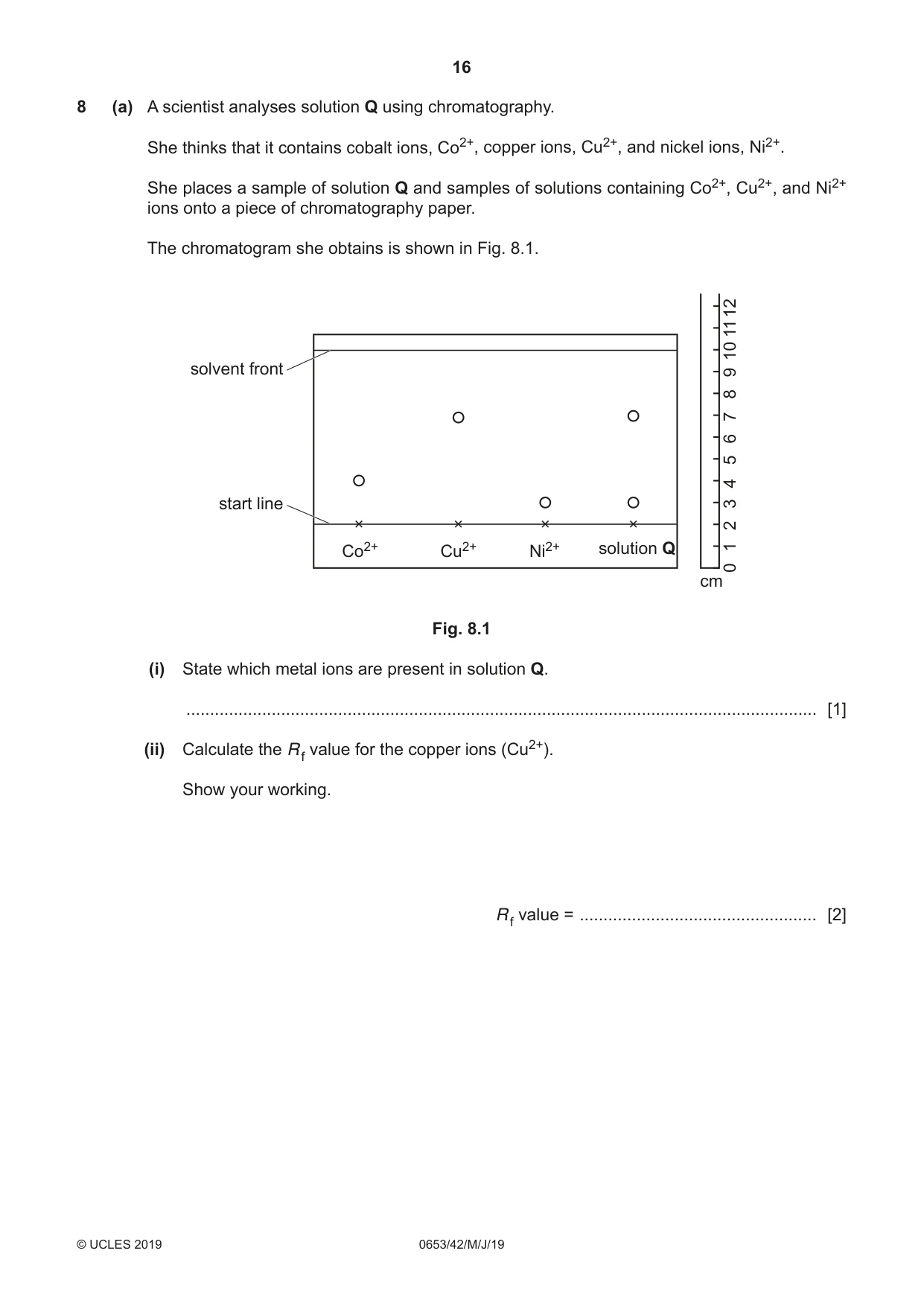
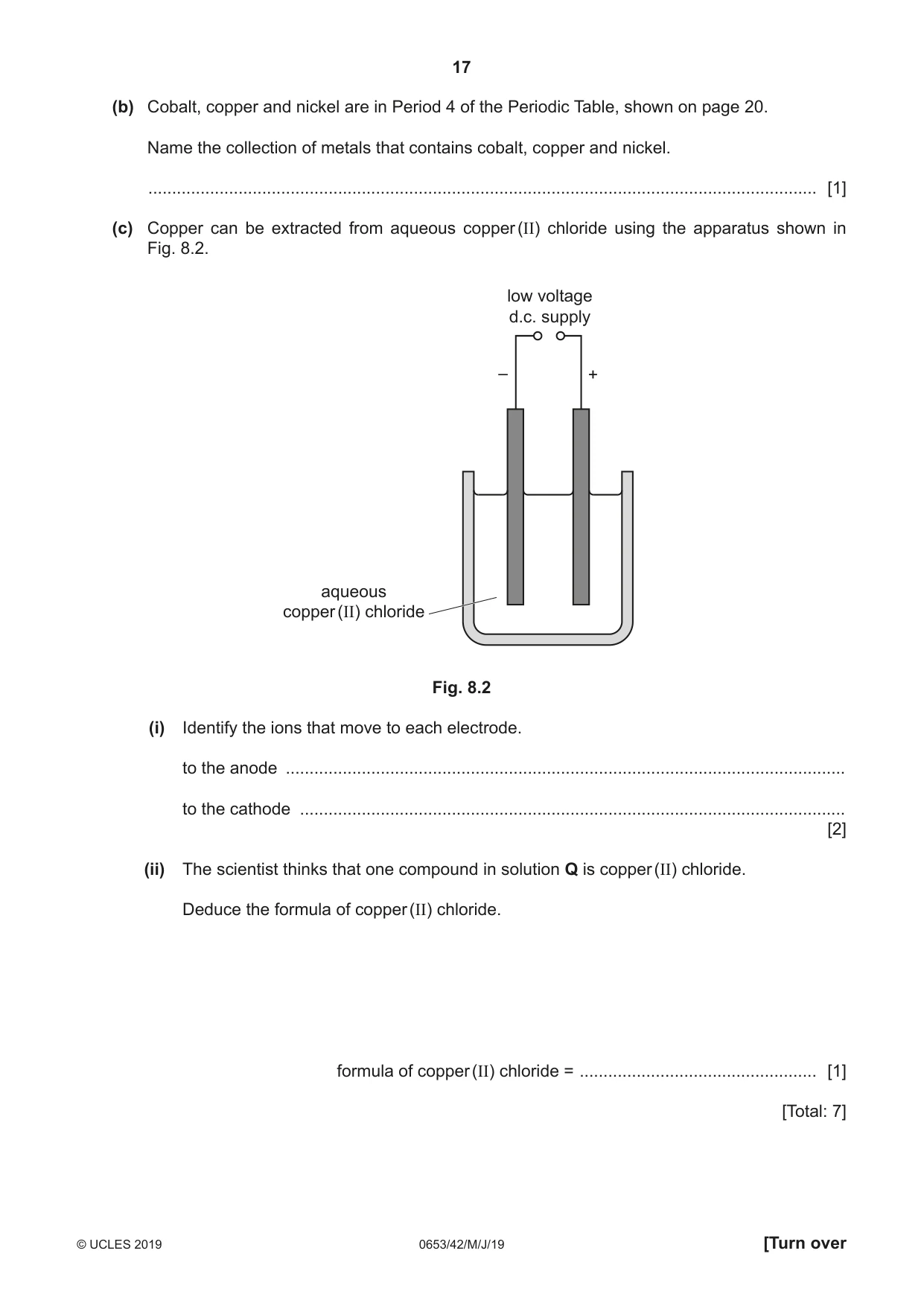
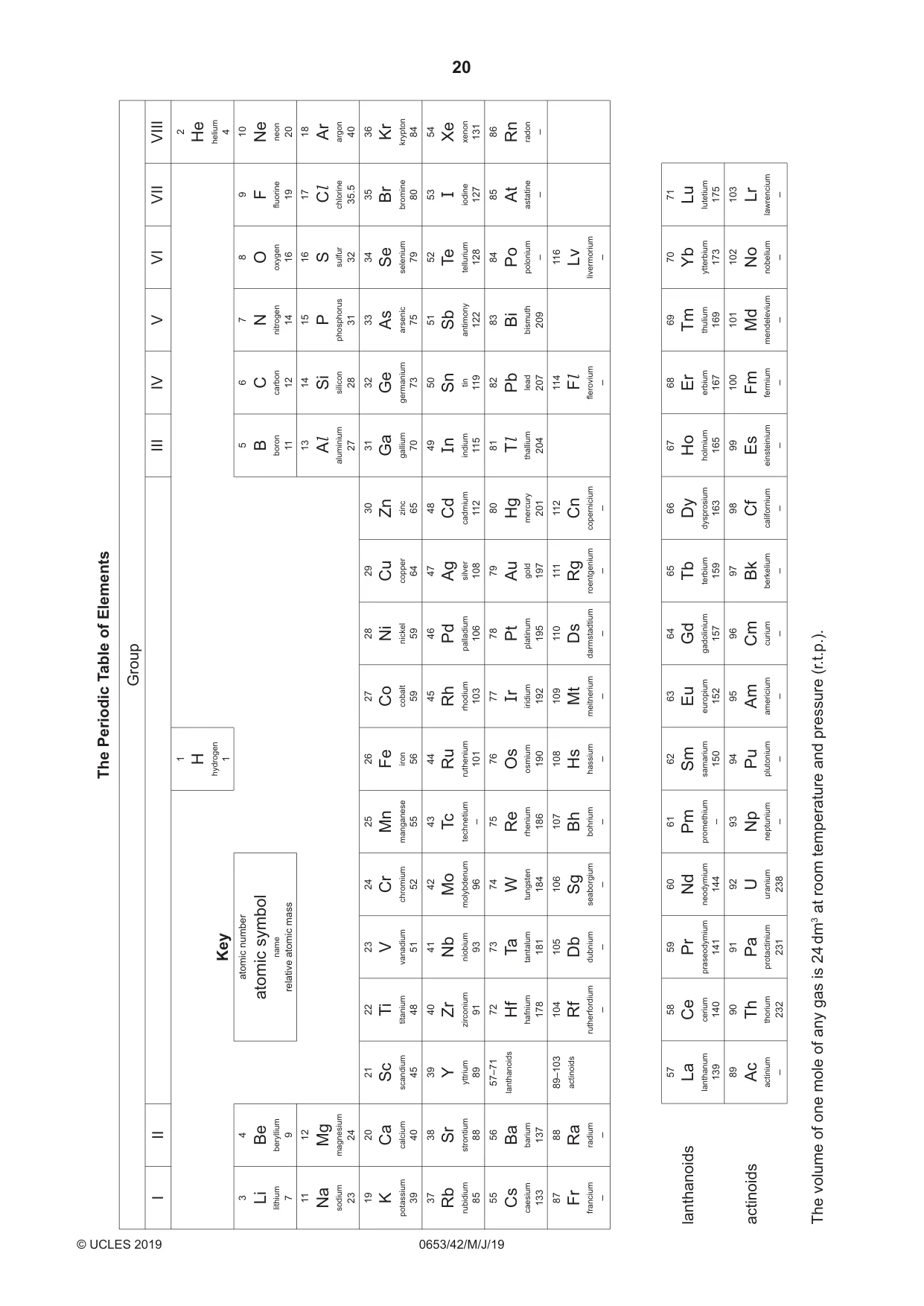
8 (a) A scientist analyses solution Q using chromatography. She thinks that it contains cobalt ions, Co2+, copper ions, Cu2+, and nickel ions, Ni2+. She places a sample of solution Q and samples of solutions containing Co2+, Cu2+, and Ni2+ ions onto a piece of chromatography paper. The chromatogram she obtains is shown in Fig. 8.1. 1112 10 solvent front 9 8 7 6 5 4 3 start line 2 Co2+ Cu2+ Ni2+ solution Q 1 0 cm Fig. 8.1 (i) State which metal ions are present in solution Q. ..................................................................................................................................... [1] (ii) Calculate the R f value for the copper ions (Cu2+). Show your working. R f value = .................................................. [2] (b) Cobalt, copper and nickel are in Period 4 of the Periodic Table, shown on page 20. Name the collection of metals that contains cobalt, copper and nickel. ............................................................................................................................................. [1] (c) Copper can be extracted from aqueous copper (II) chloride using the apparatus shown in Fig. 8.2. low voltage d.c. supply – + aqueous copper (II) chloride Fig. 8.2 (i) Identify the ions that move to each electrode. to the anode ...................................................................................................................... to the cathode ................................................................................................................... [2] (ii) The scientist thinks that one compound in solution Q is copper (II) chloride. Deduce the formula of copper (II) chloride. formula of copper (II) chloride = .................................................. [1] [Total: 7]
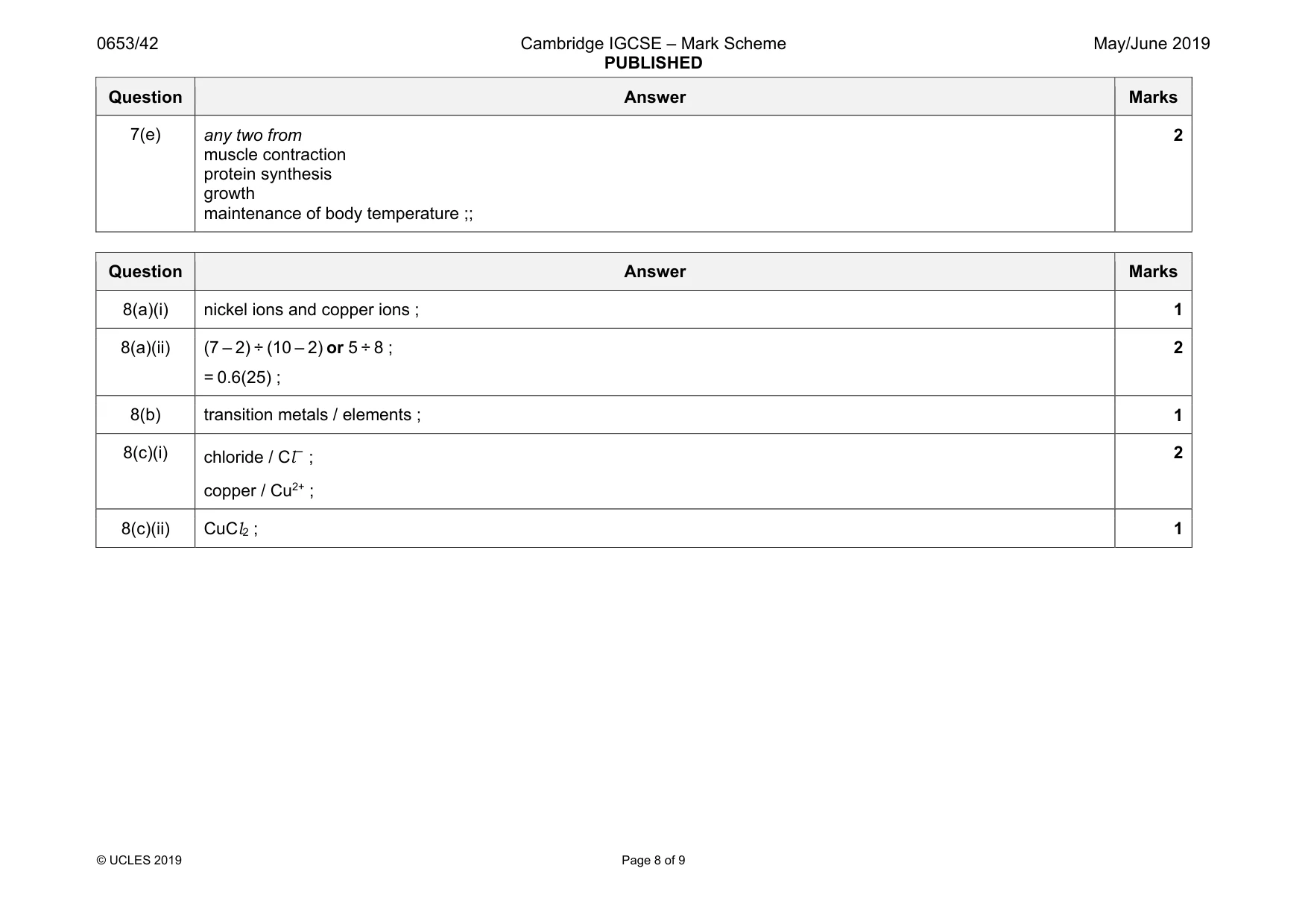
Mark scheme: 8(a)(i) nickel ions and copper ions ; 1 8(a)(ii) (7 – 2) ÷ (10 – 2) or 5 ÷ 8 ; = 0.6(25) ; 2 8(b) transition metals / elements ; 1 8(c)(i) chloride / Cl– ; copper / Cu2+ ; 2 8(c)(ii) CuCl2 ; 1
Question 9
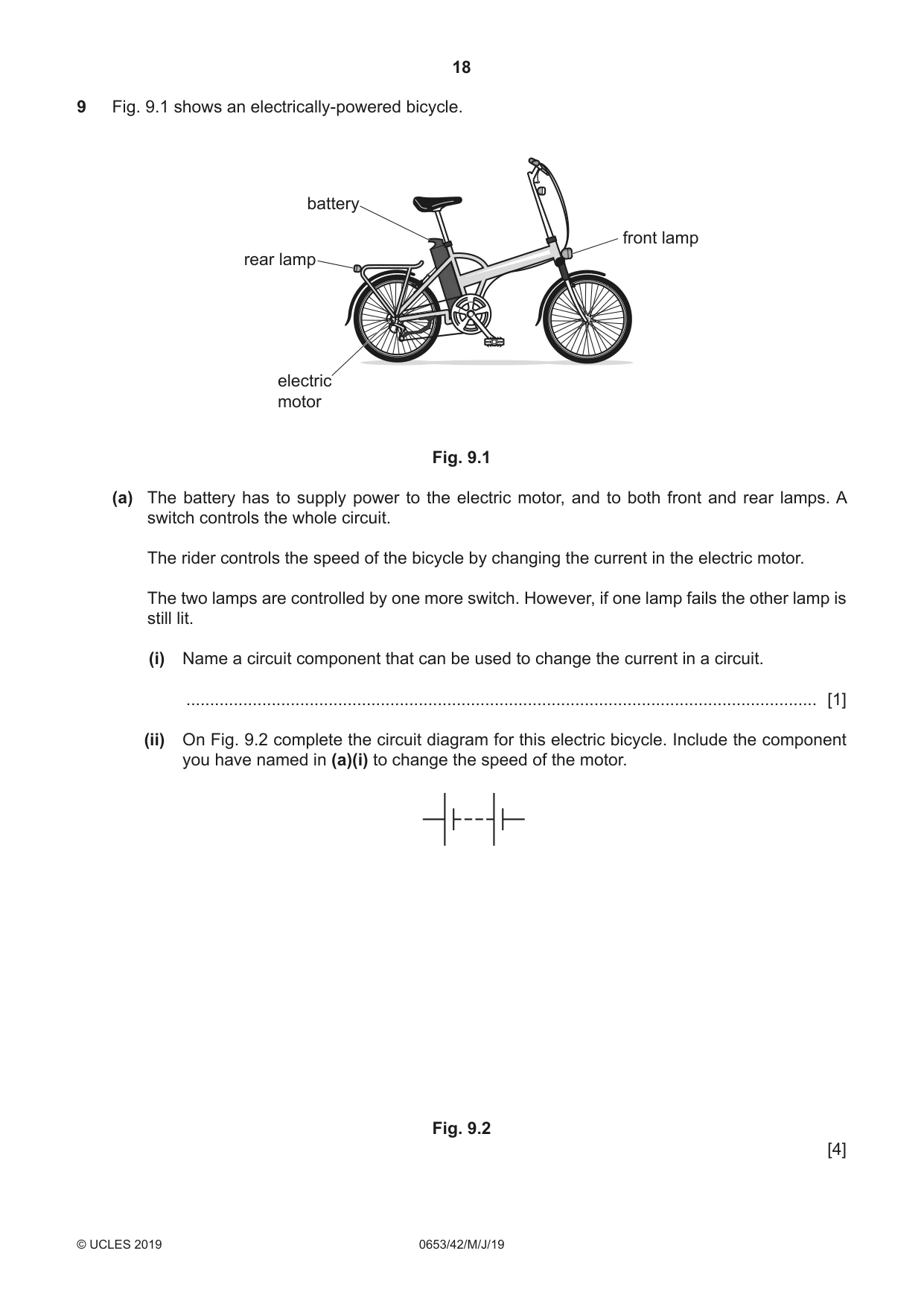
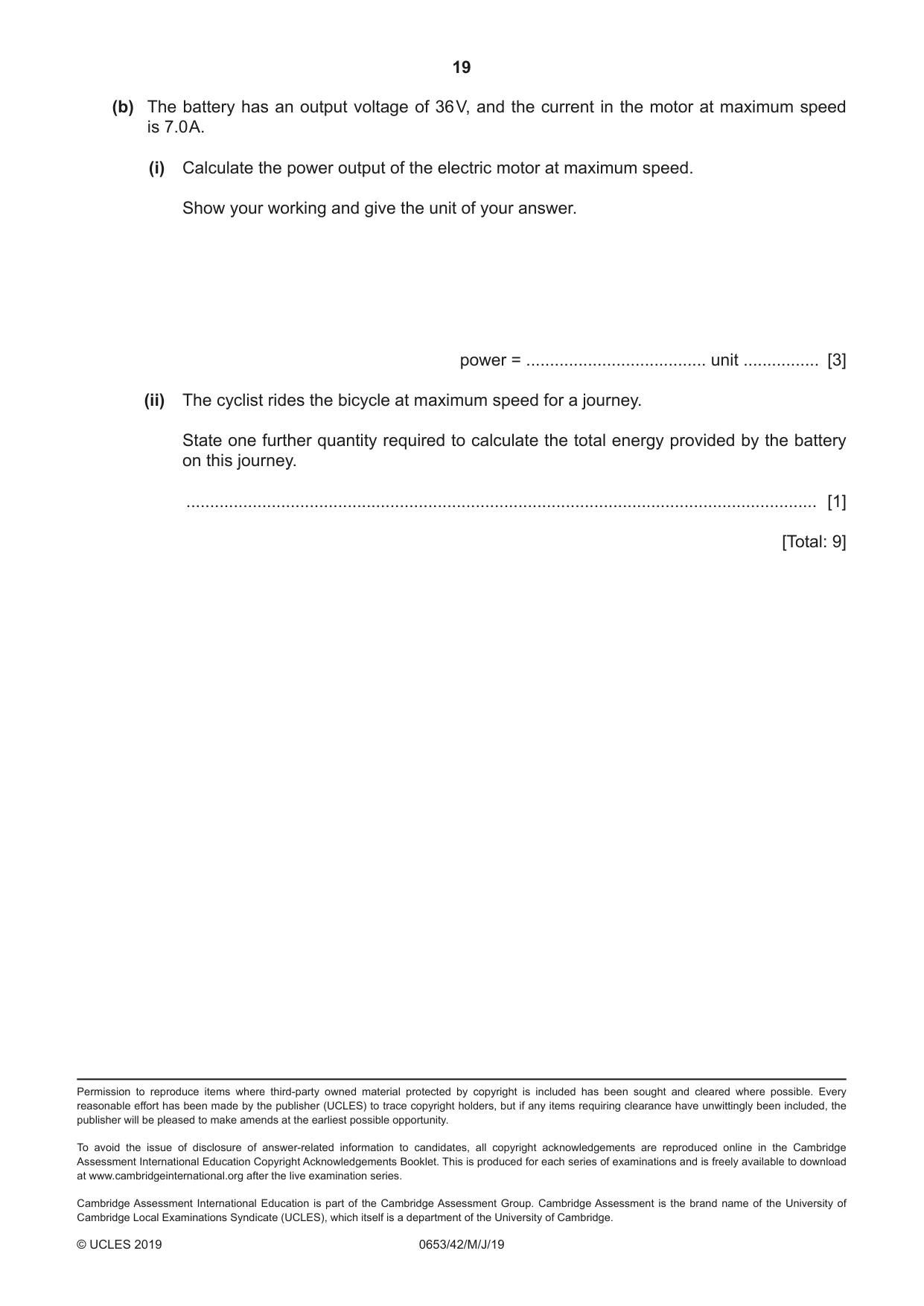
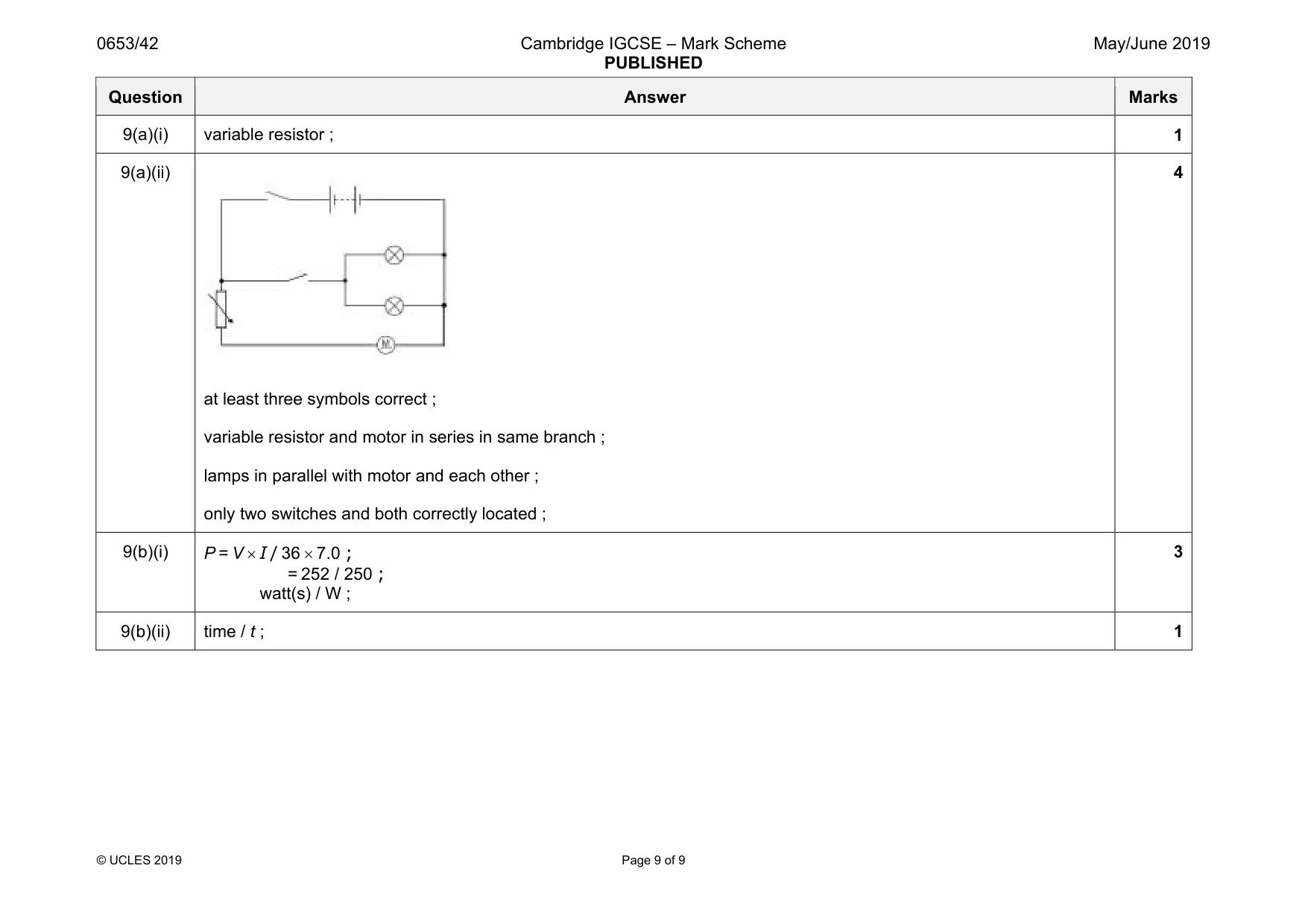
9 Fig. 9.1 shows an electrically-powered bicycle. battery front lamp rear lamp electric motor Fig. 9.1 (a) The battery has to supply power to the electric motor, and to both front and rear lamps. A switch controls the whole circuit. The rider controls the speed of the bicycle by changing the current in the electric motor. The two lamps are controlled by one more switch. However, if one lamp fails the other lamp is still lit. (i) Name a circuit component that can be used to change the current in a circuit. ..................................................................................................................................... [1] (ii) On Fig. 9.2 complete the circuit diagram for this electric bicycle. Include the component you have named in (a)(i) to change the speed of the motor. Fig. 9.2 [4] (b) The battery has an output voltage of 36 V, and the current in the motor at maximum speed is 7.0 A. (i) Calculate the power output of the electric motor at maximum speed. Show your working and give the unit of your answer. power = ...................................... unit ................ [3] (ii) The cyclist rides the bicycle at maximum speed for a journey. State one further quantity required to calculate the total energy provided by the battery on this journey. ..................................................................................................................................... [1] [Total: 9]
Mark scheme: 9(a)(i) variable resistor ; 1 9(a)(ii) at least three symbols correct ; variable resistor and motor in series in same branch ; lamps in parallel with motor and each other ; only two switches and both correctly located ; 4 9(b)(i) P = V × I / 36 × 7.0 ; = 252 / 250 ; watt(s) / W ; 3 9(b)(ii) time / t ; 1
What was in this paper
The subtopics covered by these 9 questions, and how many questions each got. Open one in a new tab to see every Cambridge question on it.
What you needed in this session
Cambridge’s own grade thresholds for 2019 May/June, Paper 4 · Variant 2. A higher threshold means an easier paper — the bar moves with how the cohort did.