Cambridge IGCSE Science - Combined 0653 — 2024 May/June Paper 4 · Variant 2
0653/42/M/J/24 · 9 questions · 80 marks · ≈90 min
The question paper and its mark scheme, free to read here and free to download. This is Cambridge’s own paper, exactly as it was sat.
Question paper20 pages
Mark scheme11 pages
Answers below. Sit the paper first if you are practising.
Questions as text
Q1 · The alimentary canal and associated organs in humans
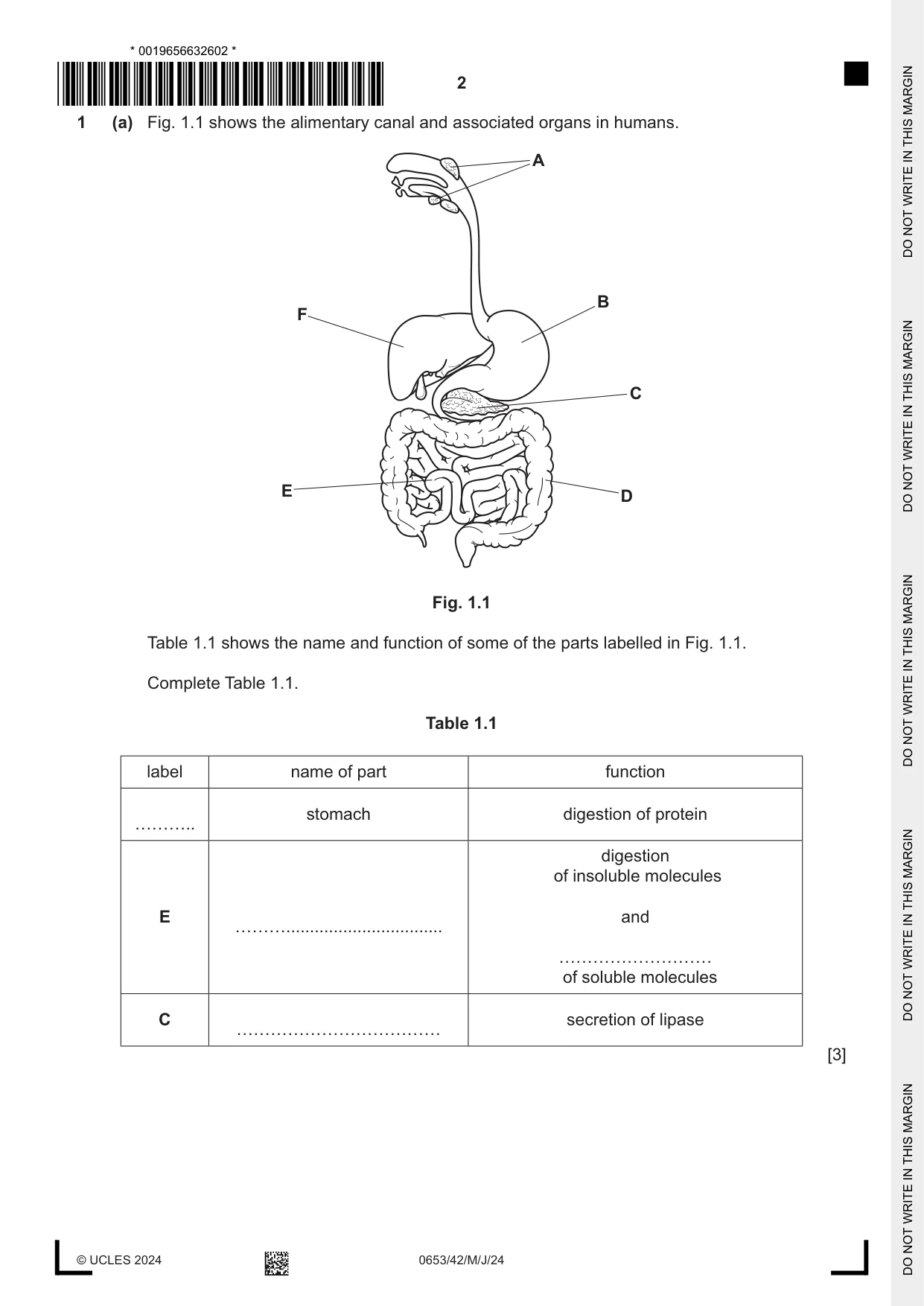
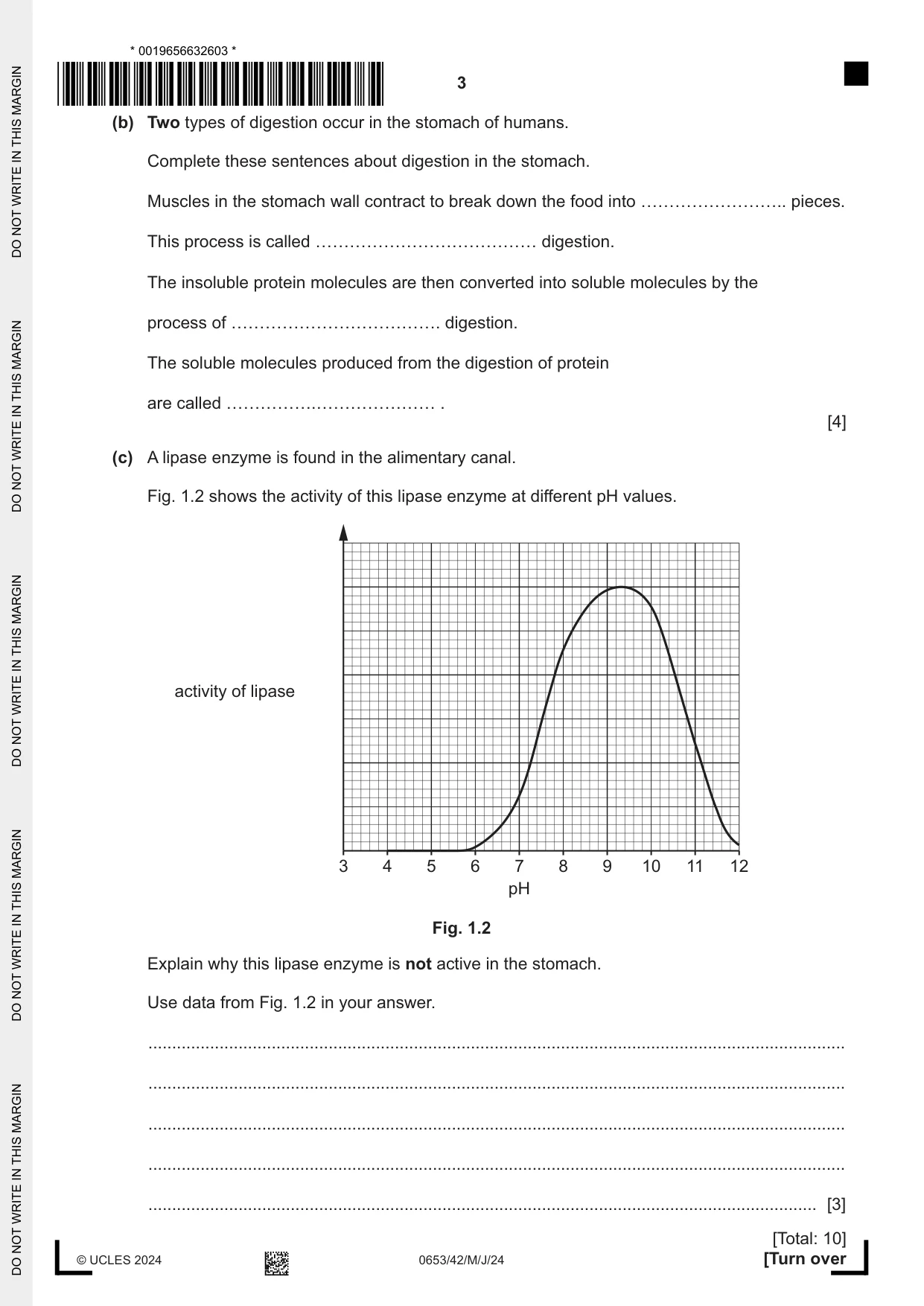
1 (a) Fig. 1.1 shows the alimentary canal and associated organs in humans. A B F C E D Fig. 1.1 Table 1.1 shows the name and function of some of the parts labelled in Fig. 1.1. Complete Table 1.1. Table 1.1 label name of part function stomach digestion of protein ……….. digestion of insoluble molecules E and ………................................. of soluble molecules C secretion of lipase [3] (b) Two types of digestion occur in the stomach of humans. Complete these sentences about digestion in the stomach. Muscles in the stomach wall contract to break down the food into …………………….. pieces. This process is called ………………………………… digestion. The insoluble protein molecules are then converted into soluble molecules by the process of ………………………………. digestion. The soluble molecules produced from the digestion of protein are called …………….………………… . [4] (c) A lipase enzyme is found in the alimentary canal. Fig. 1.2 shows the activity of this lipase enzyme at different pH values. activity of lipase 3 4 5 6 7 8 9 10 11 12 pH Fig. 1.2 Explain why this lipase enzyme is not active in the stomach. Use data from Fig. 1.2 in your answer. ................................................................................................................................................... ................................................................................................................................................... ................................................................................................................................................... ................................................................................................................................................... ............................................................................................................................................. [3] [Total: 10]
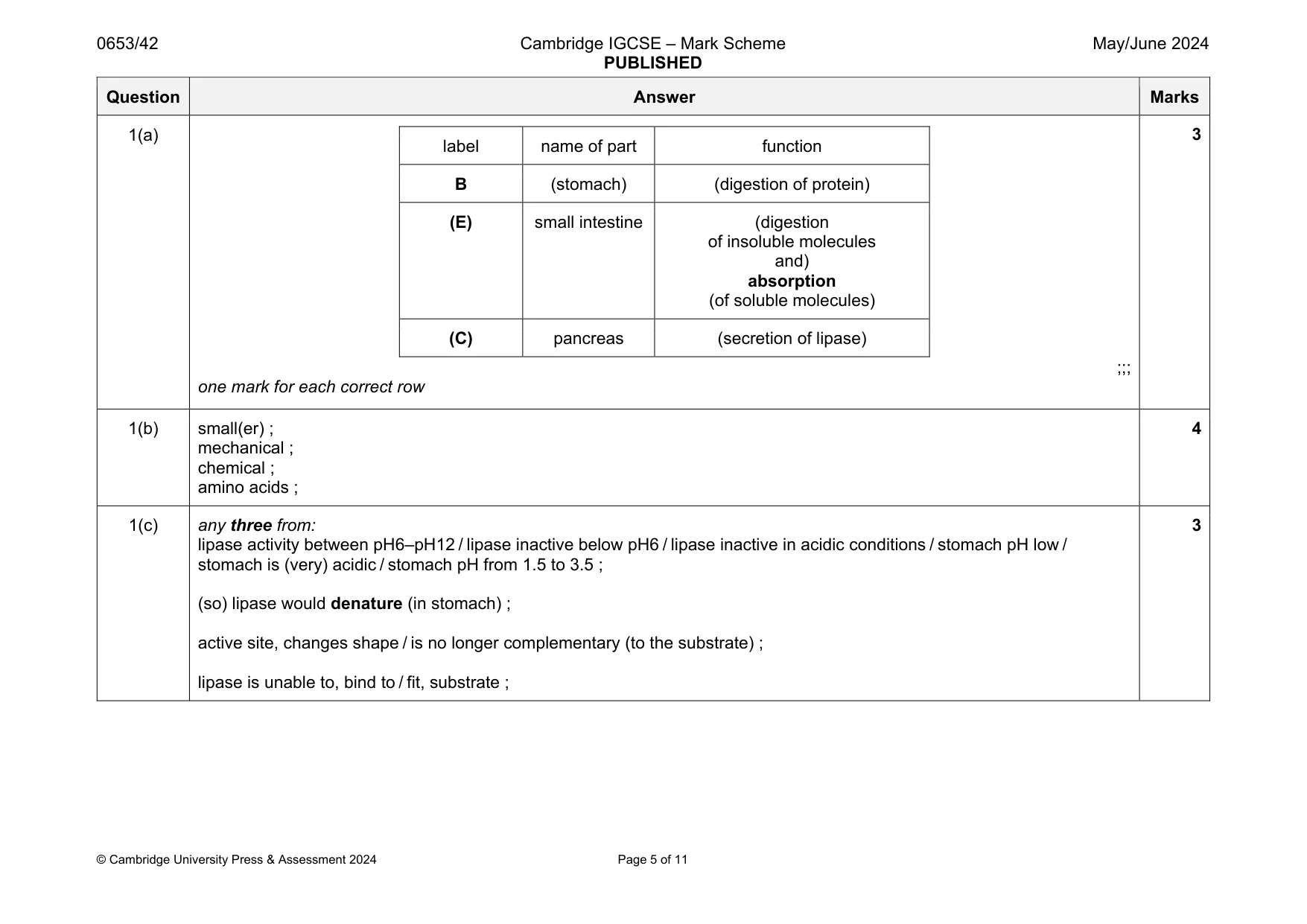
Mark scheme: 1(a) label name of part function B (stomach) (digestion of protein) (E) small intestine (digestion of insoluble molecules and) absorption (of soluble molecules) (C) pancreas (secretion of lipase) ;;; one mark for each correct row 1(b) small(er) ; mechanical ; chemical ; amino acids ; 4 1(c) any three from: lipase activity between pH6–pH12 / lipase inactive below pH6 / lipase inactive in acidic conditions / stomach pH low / stomach is (very) acidic / stomach pH from 1.5 to 3.5 ; (so) lipase would denature (in stomach) ; active site, changes shape / is no longer complementary (to the substrate) ; lipase is unable to, bind to / fit, substrate ; 3
Q2 · Different types of mixtures need different separation processes to isolate the pure…
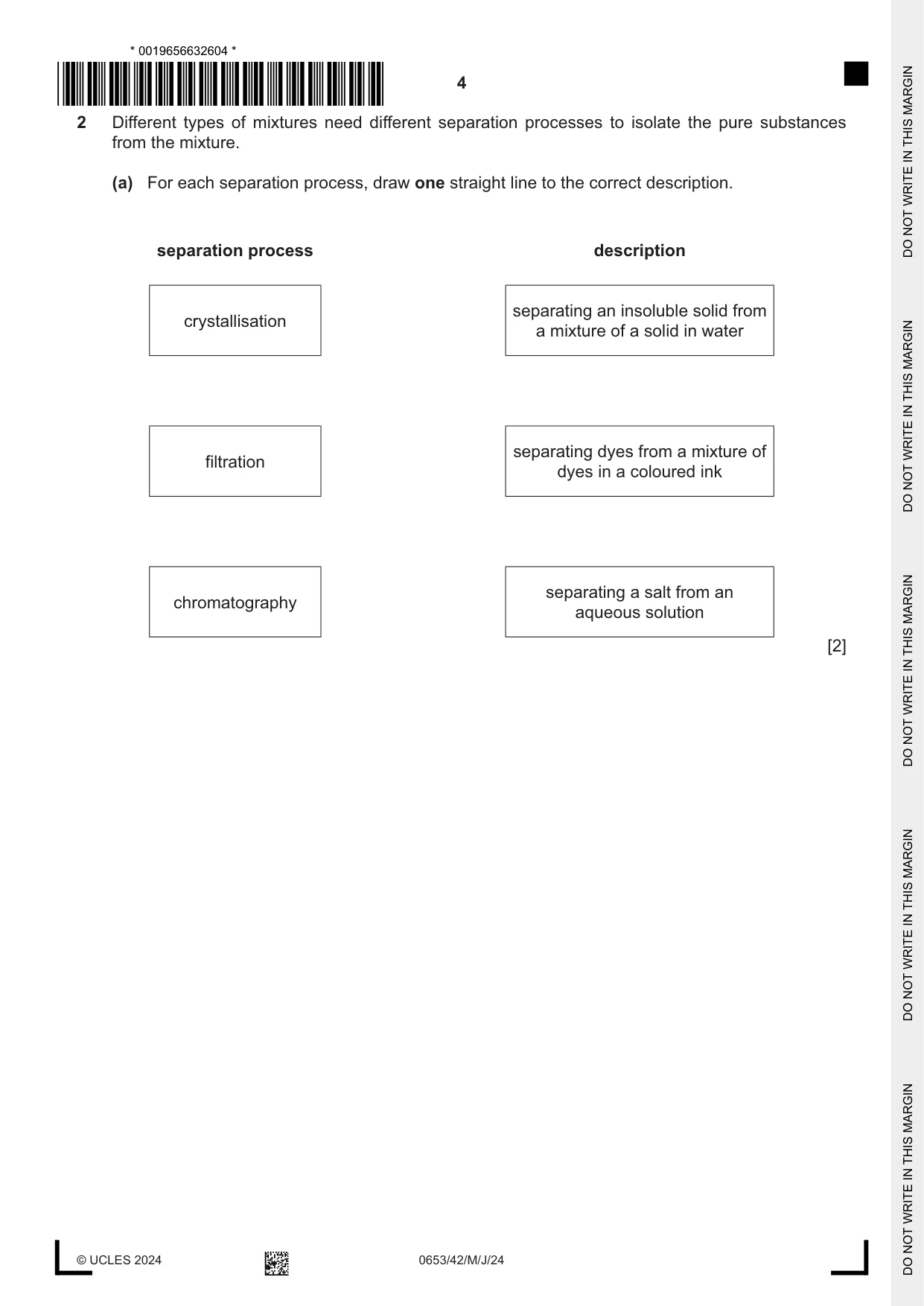
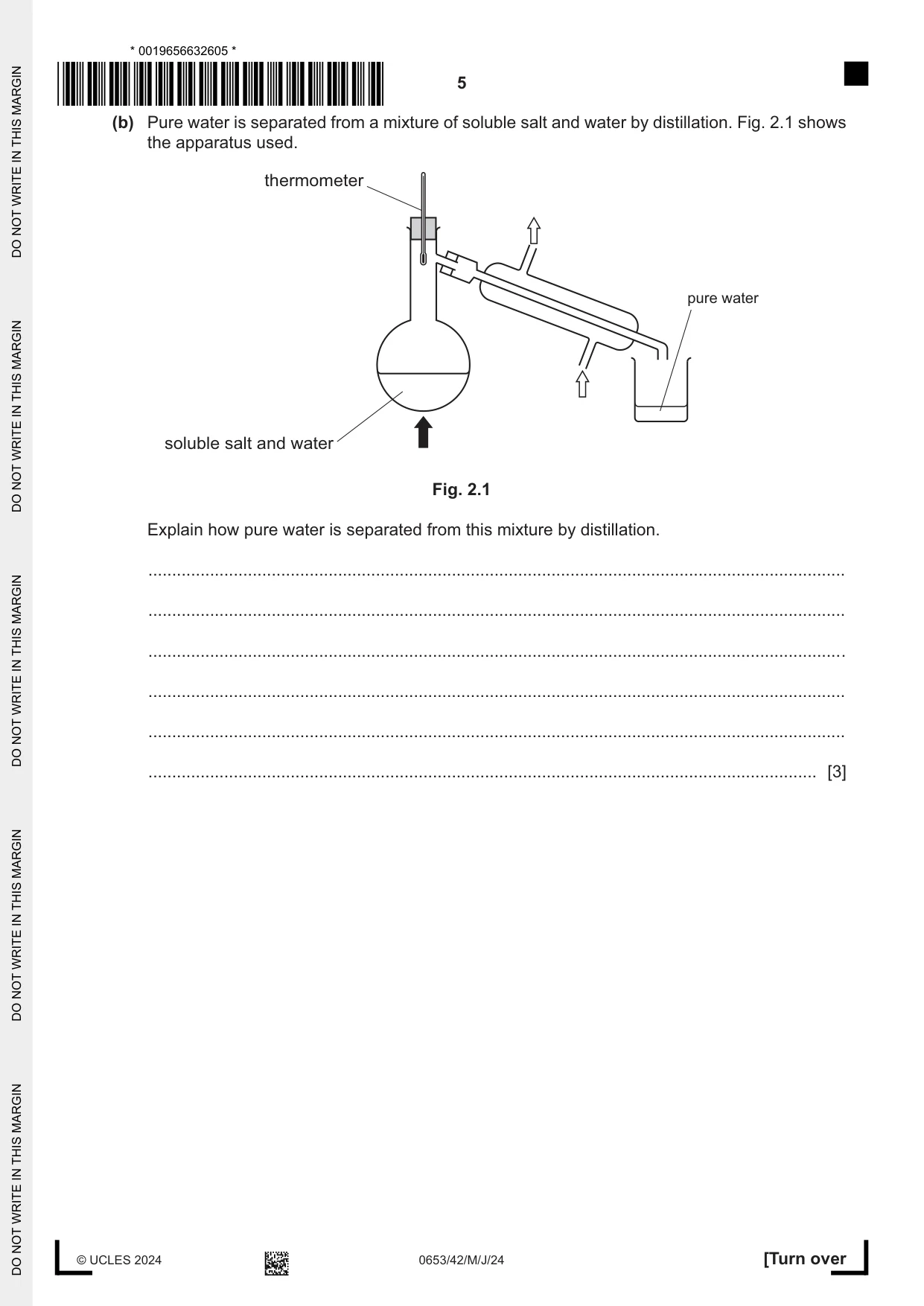
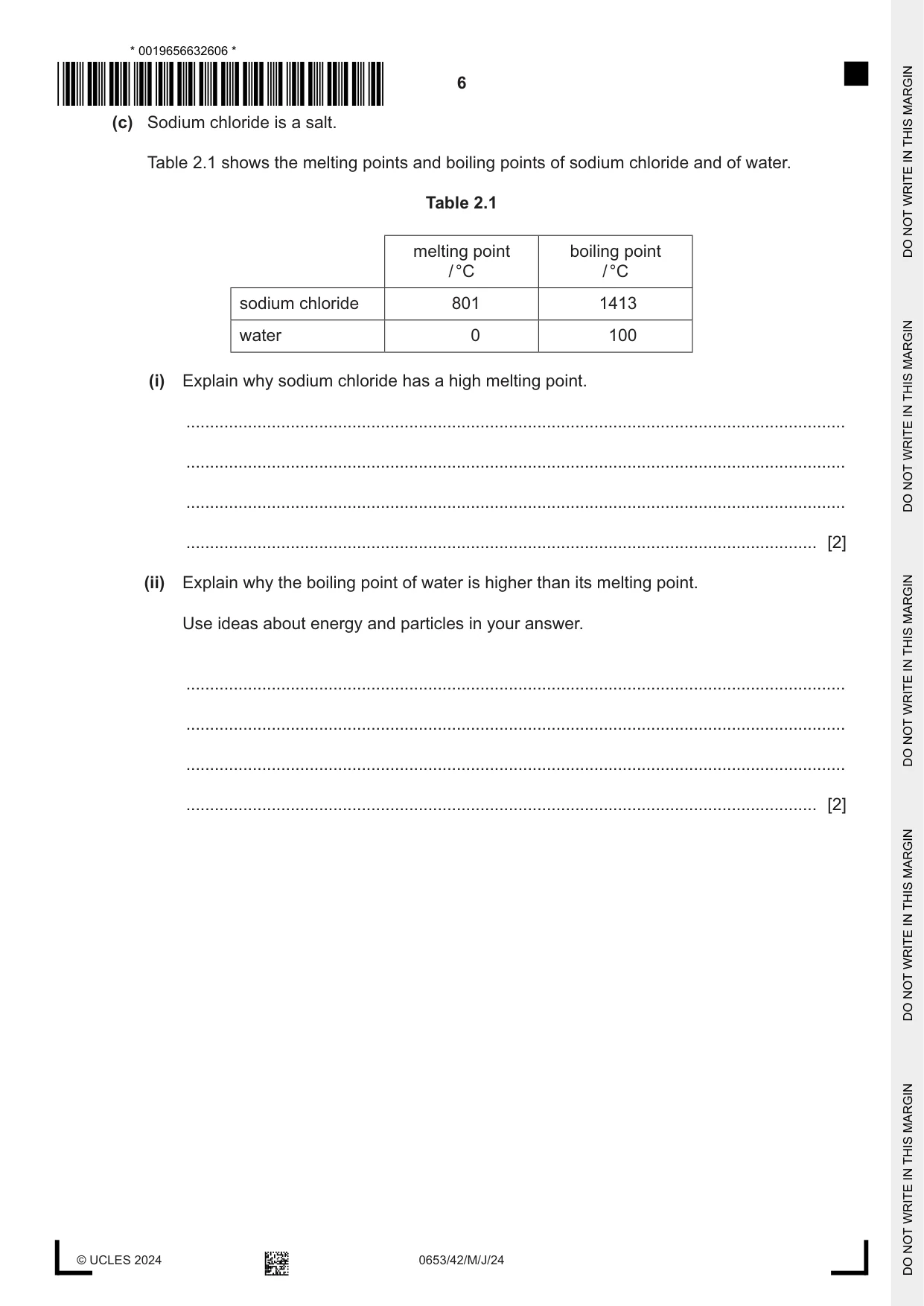
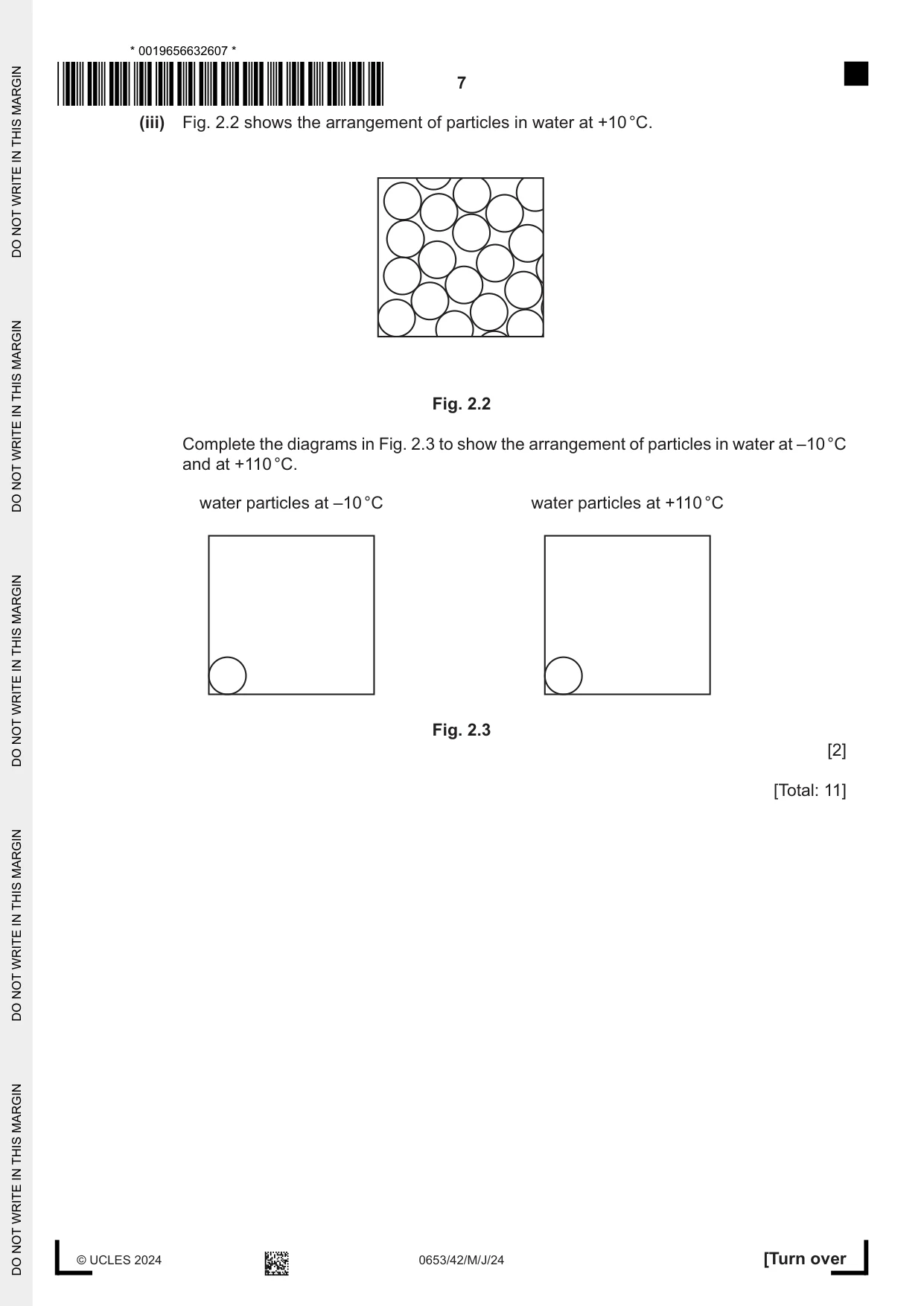
2 Different types of mixtures need different separation processes to isolate the pure substances from the mixture. (a) For each separation process, draw one straight line to the correct description. separation process description separating an insoluble solid from crystallisation a mixture of a solid in water separating dyes from a mixture of filtration dyes in a coloured ink separating a salt from an chromatography aqueous solution [2] (b) Pure water is separated from a mixture of soluble salt and water by distillation. Fig. 2.1 shows the apparatus used. thermometer pure water soluble salt and water Fig. 2.1 Explain how pure water is separated from this mixture by distillation. ................................................................................................................................................... ................................................................................................................................................... ................................................................................................................................................... ................................................................................................................................................... ................................................................................................................................................... ............................................................................................................................................. [3] (c) Sodium chloride is a salt. Table 2.1 shows the melting points and boiling points of sodium chloride and of water. Table 2.1 melting point boiling point / °C / °C sodium chloride 801 1413 water 0 100 (i) Explain why sodium chloride has a high melting point. ........................................................................................................................................... ........................................................................................................................................... ........................................................................................................................................... ..................................................................................................................................... [2] (ii) Explain why the boiling point of water is higher than its melting point. Use ideas about energy and particles in your answer. ........................................................................................................................................... ........................................................................................................................................... ........................................................................................................................................... ..................................................................................................................................... [2] (iii) Fig. 2.2 shows the arrangement of particles in water at +10 °C. Fig. 2.2 Complete the diagrams in Fig. 2.3 to show the arrangement of particles in water at –10 °C and at +110 °C. water particles at –10 °C water particles at +110 °C Fig. 2.3 [2] [Total: 11]
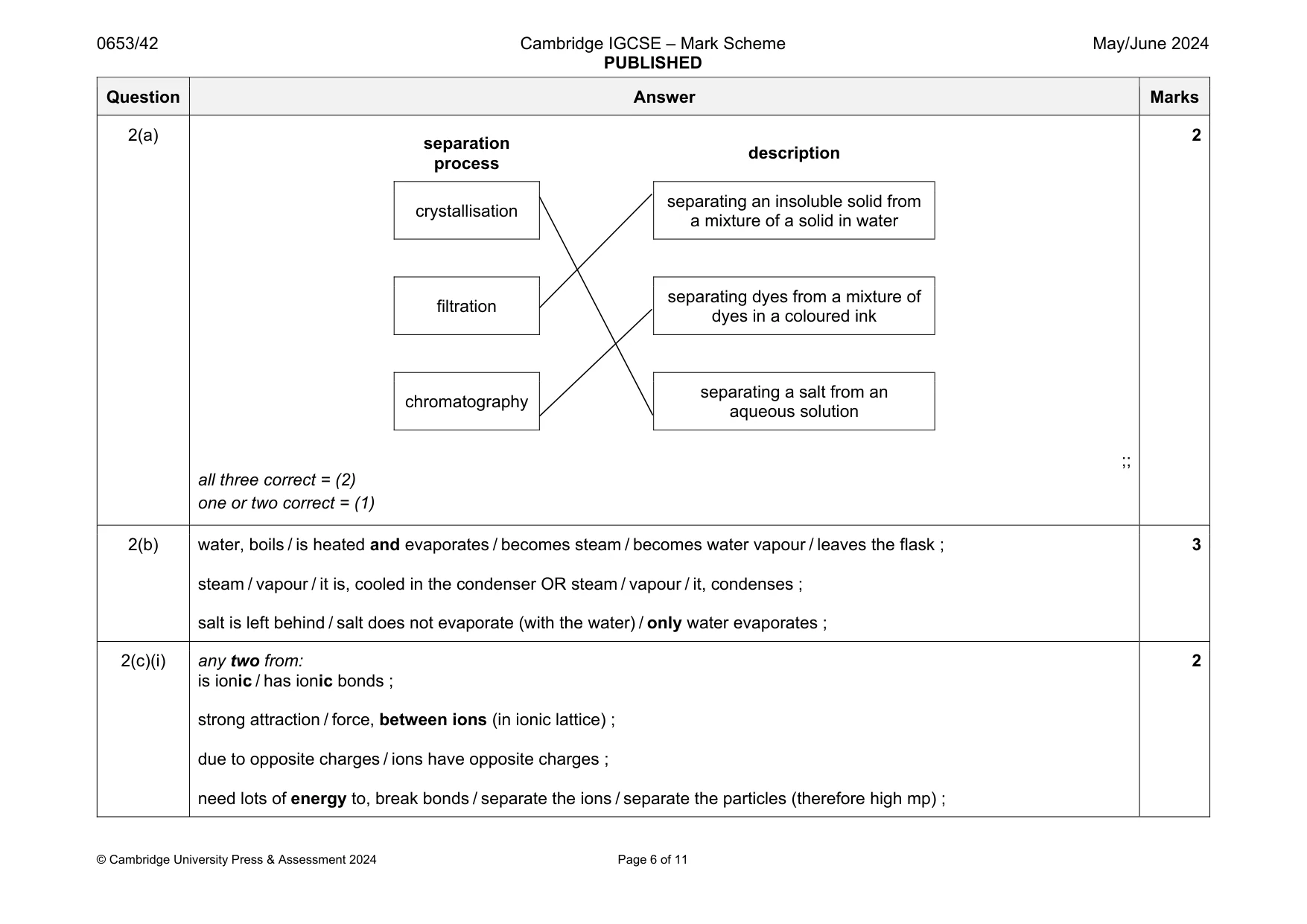
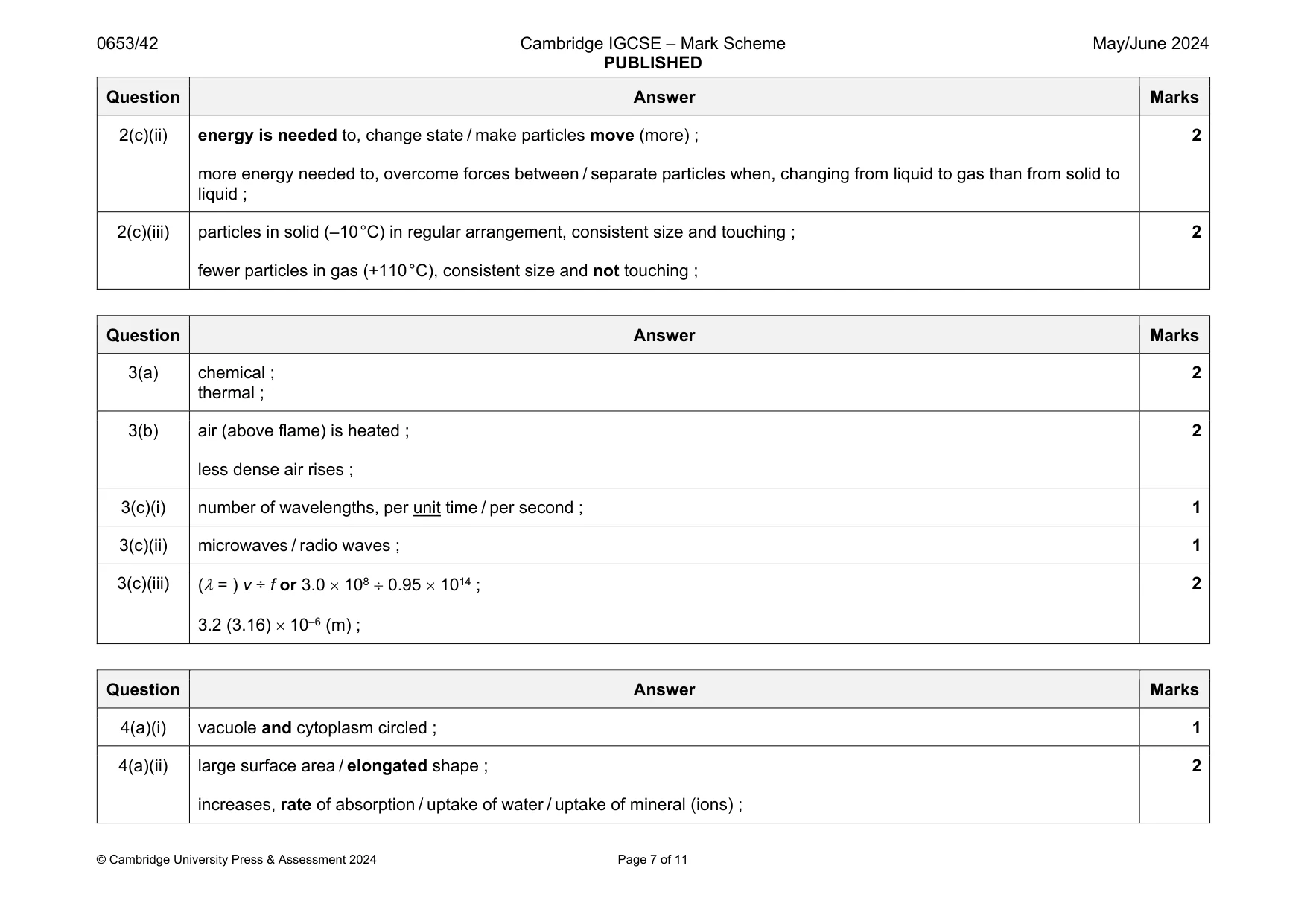
Mark scheme: 2(a) separation process description crystallisation separating an insoluble solid from a mixture of a solid in water filtration separating dyes from a mixture of dyes in a coloured ink chromatography separating a salt from an aqueous solution ;; all three correct = (2) one or two correct = (1) 2 2(b) water, boils / is heated and evaporates / becomes steam / becomes water vapour / leaves the flask ; steam / vapour / it is, cooled in the condenser OR steam / vapour / it, condenses ; salt is left behind / salt does not evaporate (with the water) / only water evaporates ; 3 2(c)(i) any two from: is ionic / has ionic bonds ; strong attraction / force, between ions (in ionic lattice) ; due to opposite charges / ions have opposite charges ; need lots of energy to, break bonds / separate the ions / separate the particles (therefore high mp) ; 2 Question Answer Marks 2(c)(ii) energy is needed to, change state / make particles move (more) ; more energy needed to, overcome forces between / separate particles when, changing from liquid to gas than from solid to liquid ; 2 2(c)(iii) particles in solid (–10 °C) in regular arrangement, consistent size and touching ; fewer particles in gas (+110 °C), consistent size and not touching ; 2
Q3 · An old-fashioned room heater made of iron
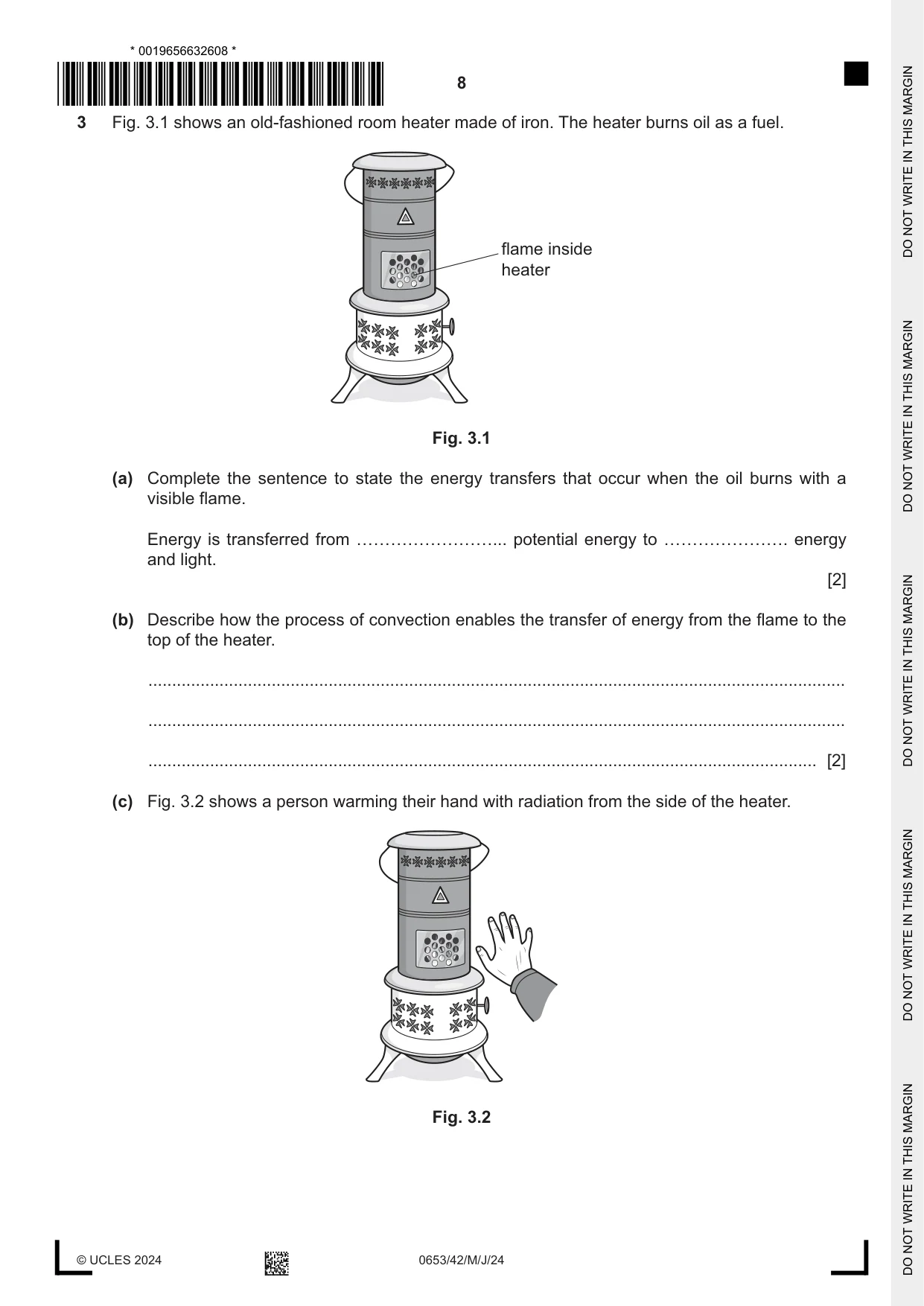
3 Fig. 3.1 shows an old-fashioned room heater made of iron. The heater burns oil as a fuel. flame inside heater Fig. 3.1 (a) Complete the sentence to state the energy transfers that occur when the oil burns with a visible flame. Energy is transferred from ……………………... potential energy to …………………. energy and light. [2] (b) Describe how the process of convection enables the transfer of energy from the flame to the top of the heater. ................................................................................................................................................... ................................................................................................................................................... ............................................................................................................................................. [2] (c) Fig. 3.2 shows a person warming their hand with radiation from the side of the heater. Fig. 3.2 Radiation from the heater is mainly in the infrared region of the electromagnetic spectrum. The flame emits infrared radiation from the heater with a frequency of 0.95 × 10¹⁴ Hz. (i) State what is meant by frequency. ........................................................................................................................................... ..................................................................................................................................... [1] (ii) State one region of the electromagnetic spectrum that has a lower frequency than infrared. ..................................................................................................................................... [1] (iii) Calculate the wavelength of radiation with a frequency of 0.95 × 10¹⁴ Hz. The speed of electromagnetic waves = 3.0 × 10⁸ m / s. wavelength = ...................................................... m [2] [Total: 8]
Mark scheme: 3(a) chemical ; thermal ; 3(b) air (above flame) is heated ; less dense air rises ; 2 3(c)(i) number of wavelengths, per unit time / per second ; 1 3(c)(ii) microwaves / radio waves ; 1 3(c)(iii) ( = ) v ÷ f or 3.0 108 0.95 1014 ; 3.2 (3.16) 10–6 (m) ; 2
Q4 · A student labels a diagram of a plant cell
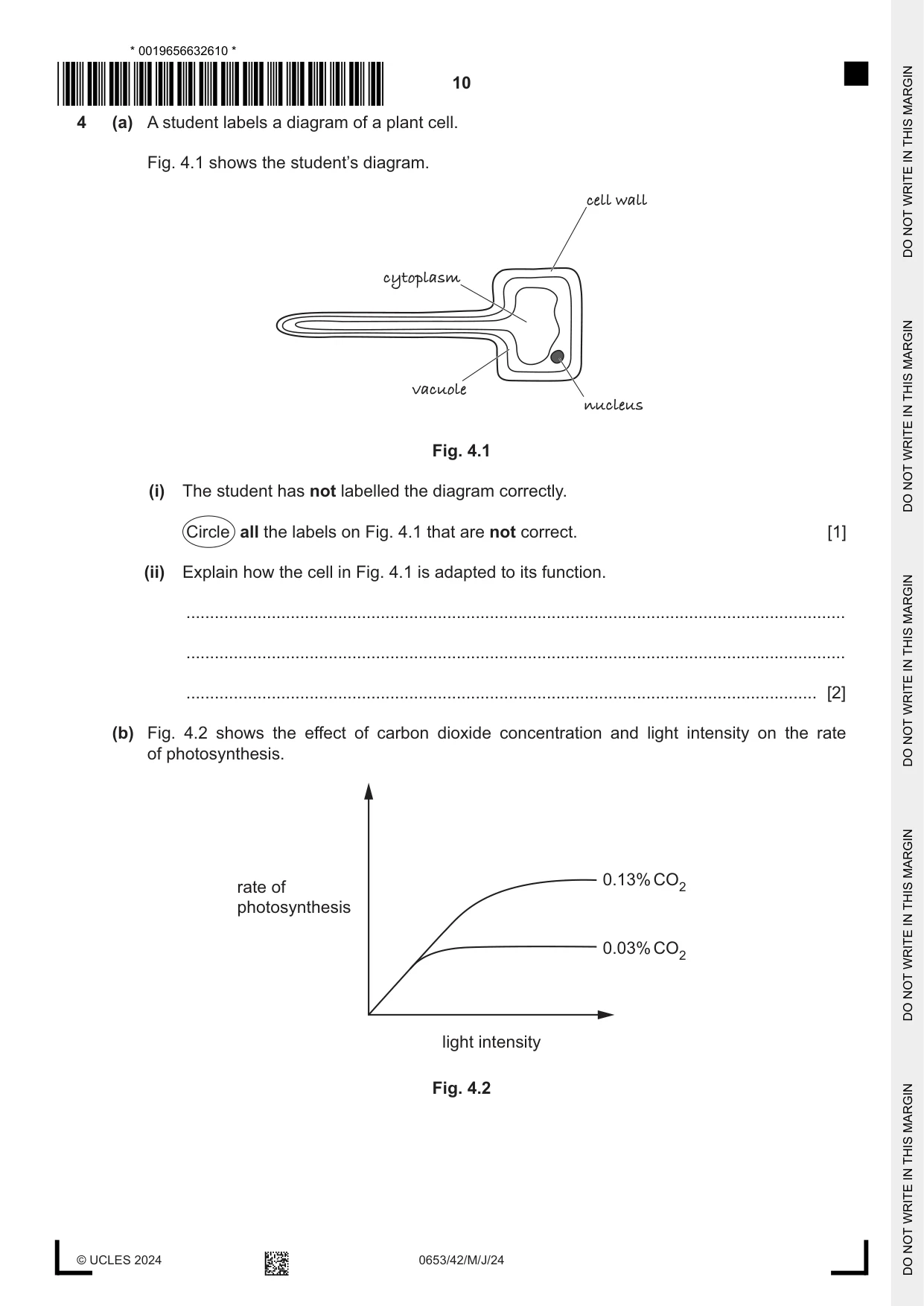
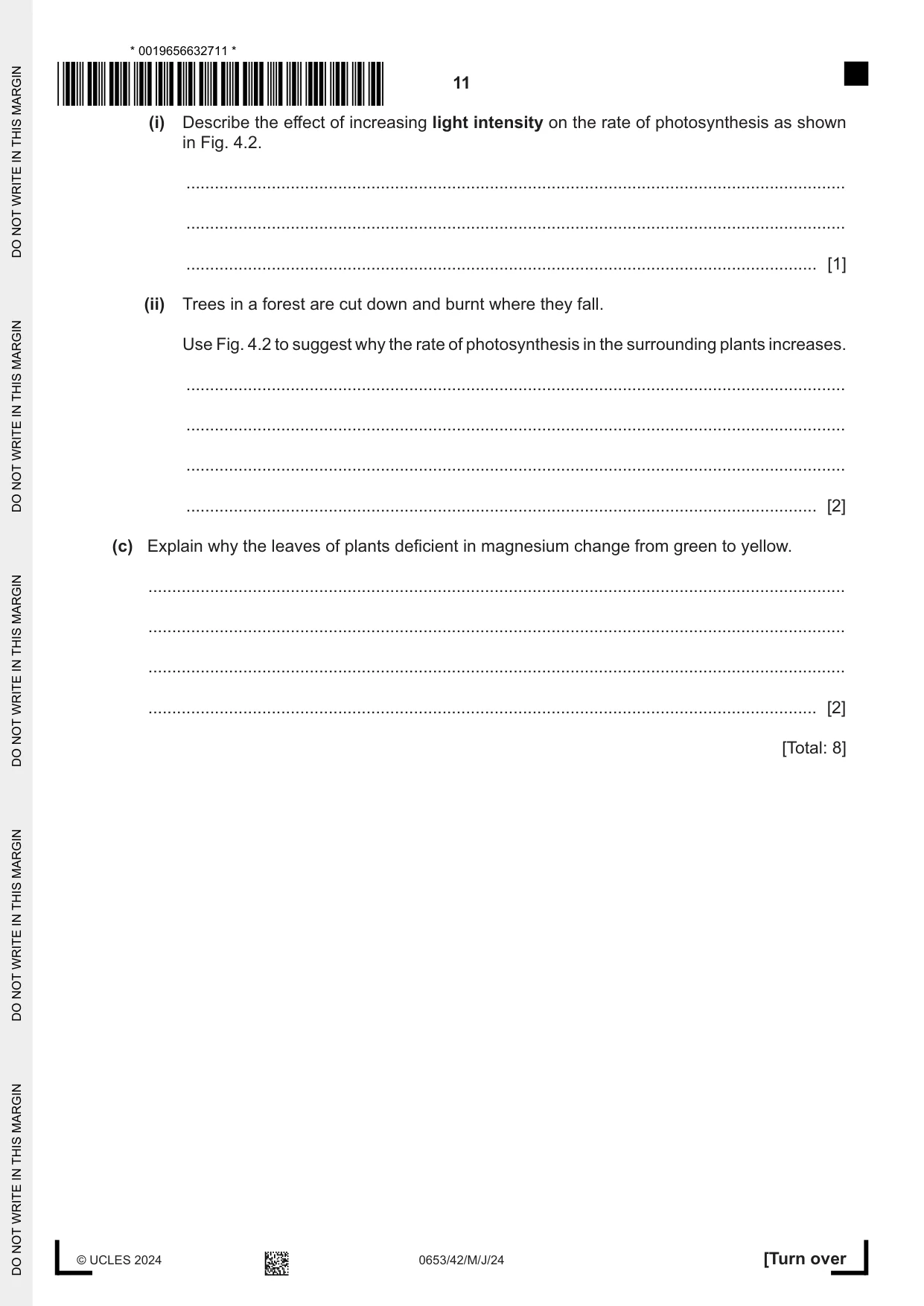
4 (a) A student labels a diagram of a plant cell. Fig. 4.1 shows the student’s diagram. cell wall cytoplasm vacuole nucleus Fig. 4.1 (i) The student has not labelled the diagram correctly. Circle all the labels on Fig. 4.1 that are not correct. [1] (ii) Explain how the cell in Fig. 4.1 is adapted to its function. ........................................................................................................................................... ........................................................................................................................................... ..................................................................................................................................... [2] (b) Fig. 4.2 shows the effect of carbon dioxide concentration and light intensity on the rate of photosynthesis. 0.13% CO2 rate of photosynthesis 0.03% CO2 light intensity Fig. 4.2 (i) Describe the effect of increasing light intensity on the rate of photosynthesis as shown in Fig. 4.2. ........................................................................................................................................... ........................................................................................................................................... ..................................................................................................................................... [1] (ii) Trees in a forest are cut down and burnt where they fall. Use Fig. 4.2 to suggest why the rate of photosynthesis in the surrounding plants increases. ........................................................................................................................................... ........................................................................................................................................... ........................................................................................................................................... ..................................................................................................................................... [2] (c) Explain why the leaves of plants deficient in magnesium change from green to yellow. ................................................................................................................................................... ................................................................................................................................................... ................................................................................................................................................... ............................................................................................................................................. [2] [Total: 8]
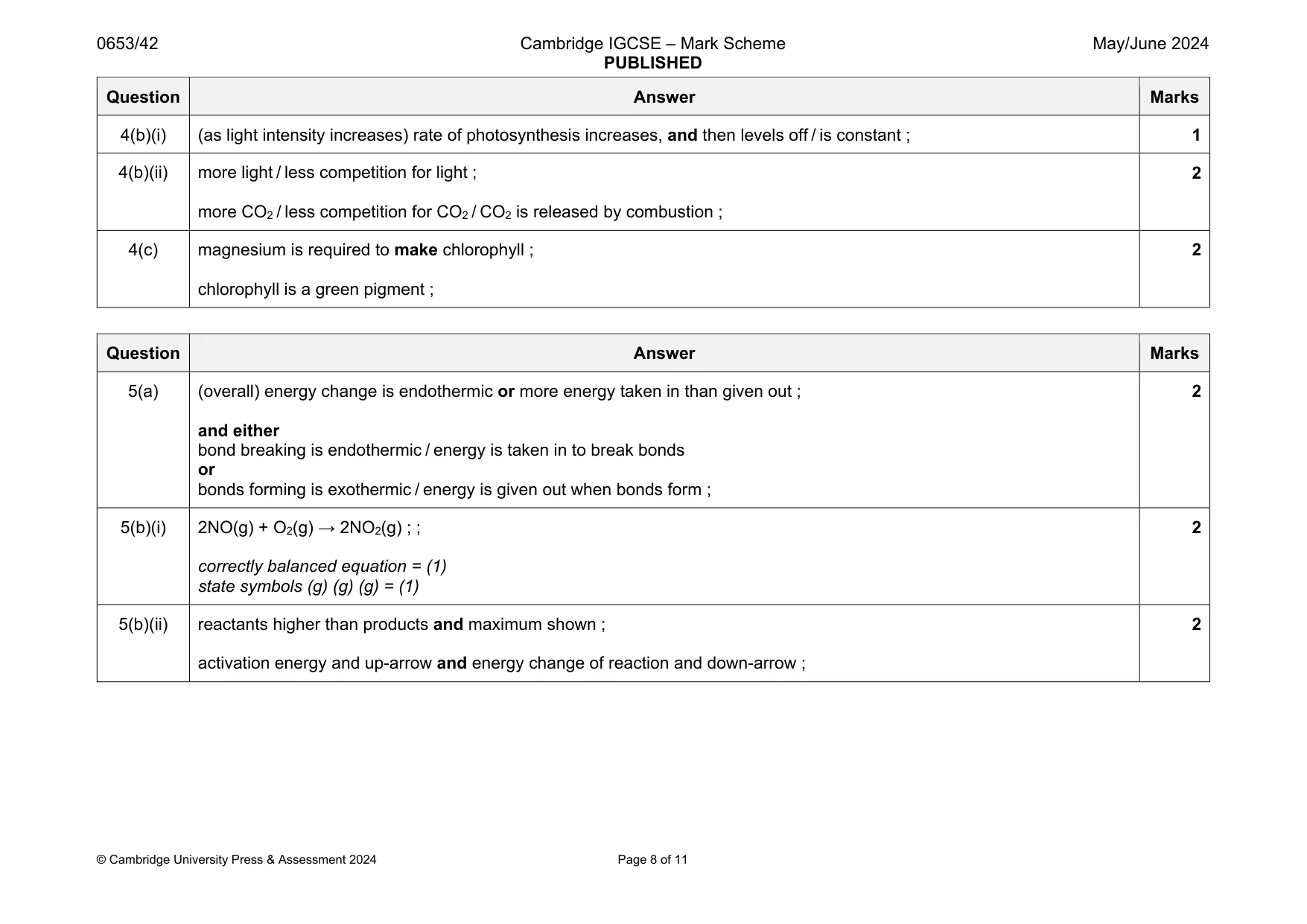
Mark scheme: 4(a)(i) vacuole and cytoplasm circled ; 1 4(a)(ii) large surface area / elongated shape ; increases, rate of absorption / uptake of water / uptake of mineral (ions) ; 2 Question Answer Marks 4(b)(i) (as light intensity increases) rate of photosynthesis increases, and then levels off / is constant ; 1 4(b)(ii) more light / less competition for light ; more CO2 / less competition for CO2 / CO2 is released by combustion ; 2 4(c) magnesium is required to make chlorophyll ; chlorophyll is a green pigment ; 2
Q5 · Nitrogen and oxygen react together at high temperatures in car engines to form oxides of…
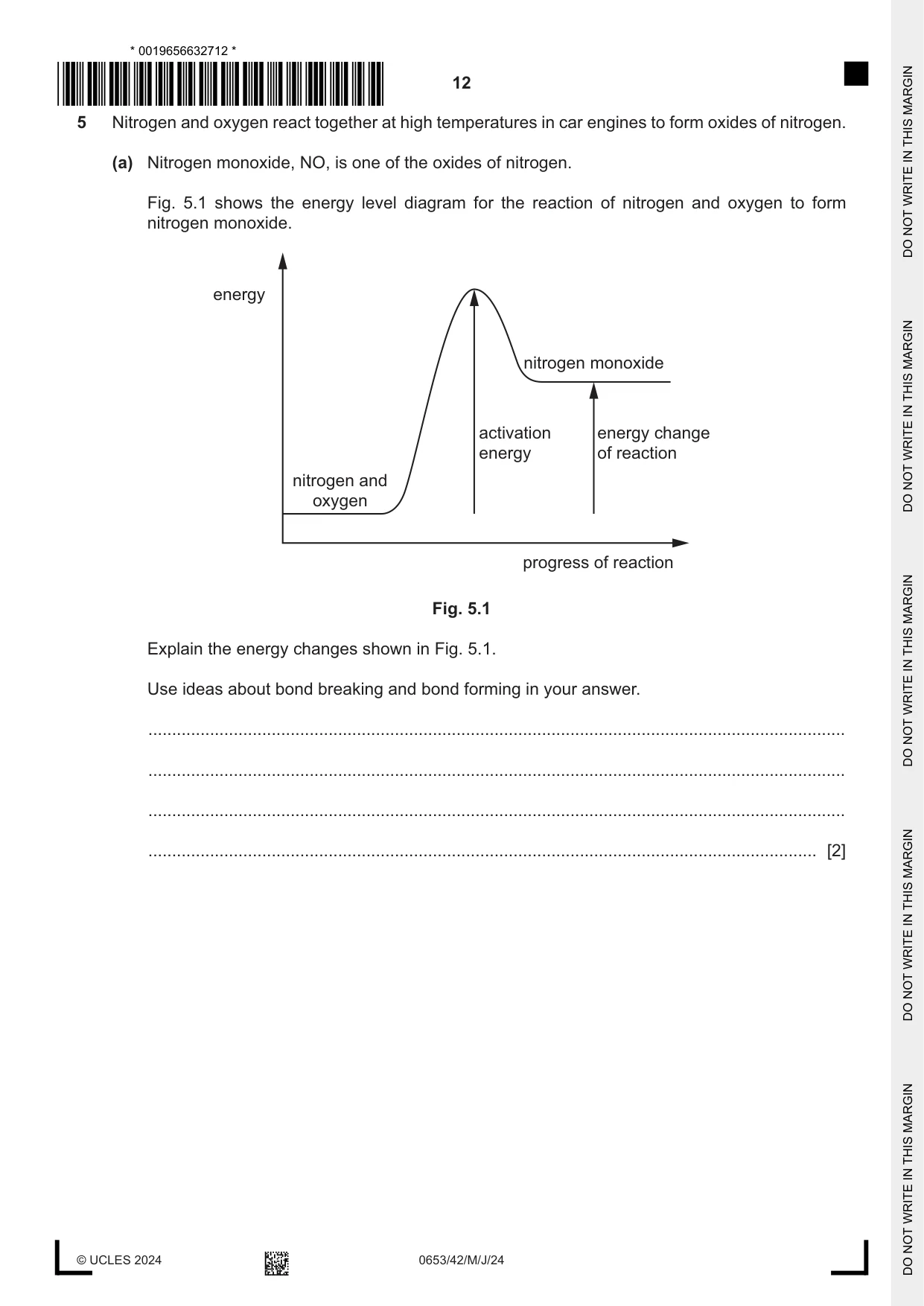
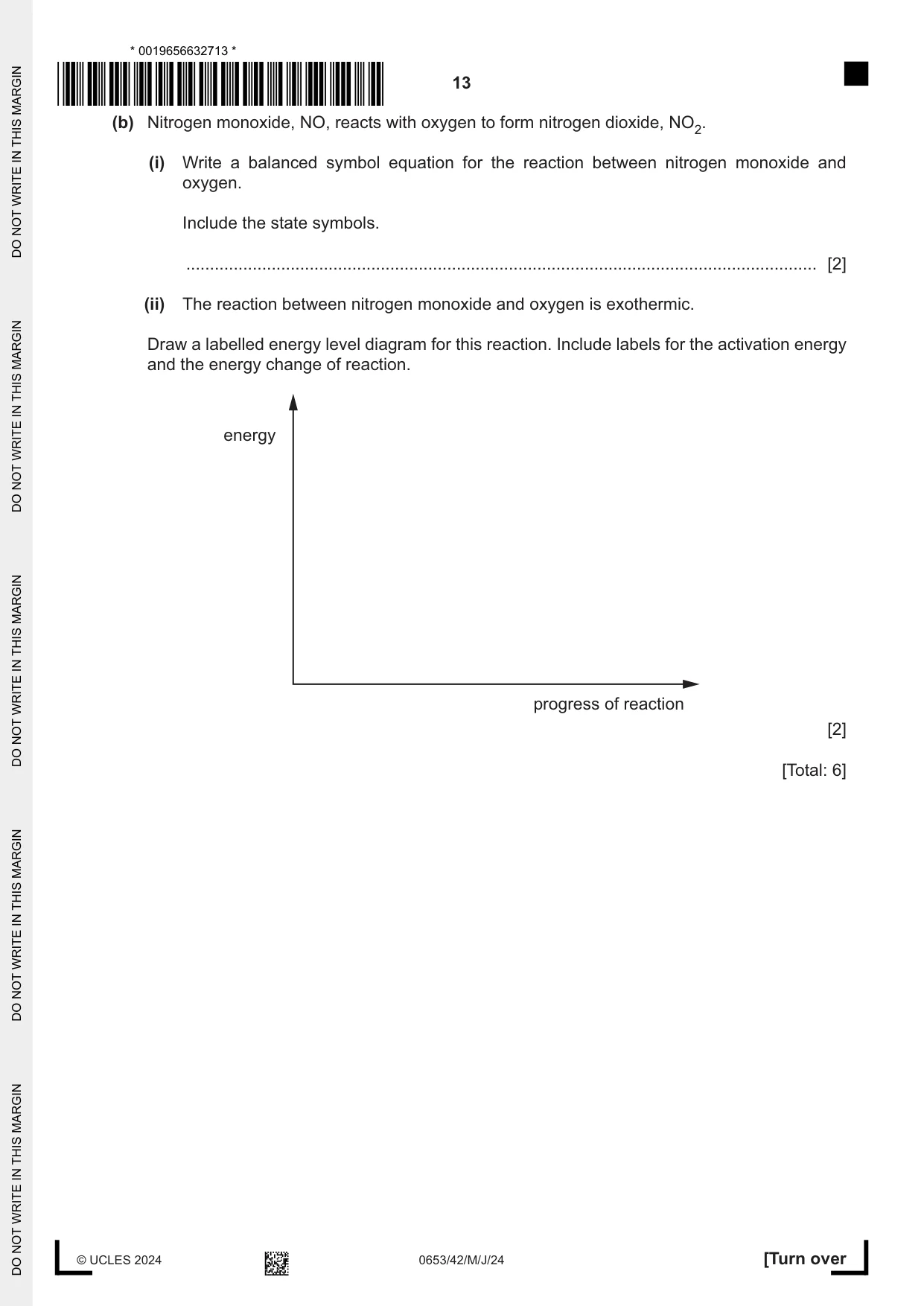
5 Nitrogen and oxygen react together at high temperatures in car engines to form oxides of nitrogen. (a) Nitrogen monoxide, NO, is one of the oxides of nitrogen. Fig. 5.1 shows the energy level diagram for the reaction of nitrogen and oxygen to form nitrogen monoxide. energy nitrogen monoxide activation energy change energy of reaction nitrogen and oxygen progress of reaction Fig. 5.1 Explain the energy changes shown in Fig. 5.1. Use ideas about bond breaking and bond forming in your answer. ................................................................................................................................................... ................................................................................................................................................... ................................................................................................................................................... ............................................................................................................................................. [2] (b) Nitrogen monoxide, NO, reacts with oxygen to form nitrogen dioxide, NO2. (i) Write a balanced symbol equation for the reaction between nitrogen monoxide and oxygen. Include the state symbols. ..................................................................................................................................... [2] (ii) The reaction between nitrogen monoxide and oxygen is exothermic. Draw a labelled energy level diagram for this reaction. Include labels for the activation energy and the energy change of reaction. energy progress of reaction [2] [Total: 6]
Mark scheme: 5(a) (overall) energy change is endothermic or more energy taken in than given out ; and either bond breaking is endothermic / energy is taken in to break bonds or bonds forming is exothermic / energy is given out when bonds form ; 5(b)(i) 2NO(g) + O2(g) → 2NO2(g) ; ; correctly balanced equation = (1) state symbols (g) (g) (g) = (1) 2 5(b)(ii) reactants higher than products and maximum shown ; activation energy and up-arrow and energy change of reaction and down-arrow ; 2
Q6 · A rover vehicle on the planet Mars
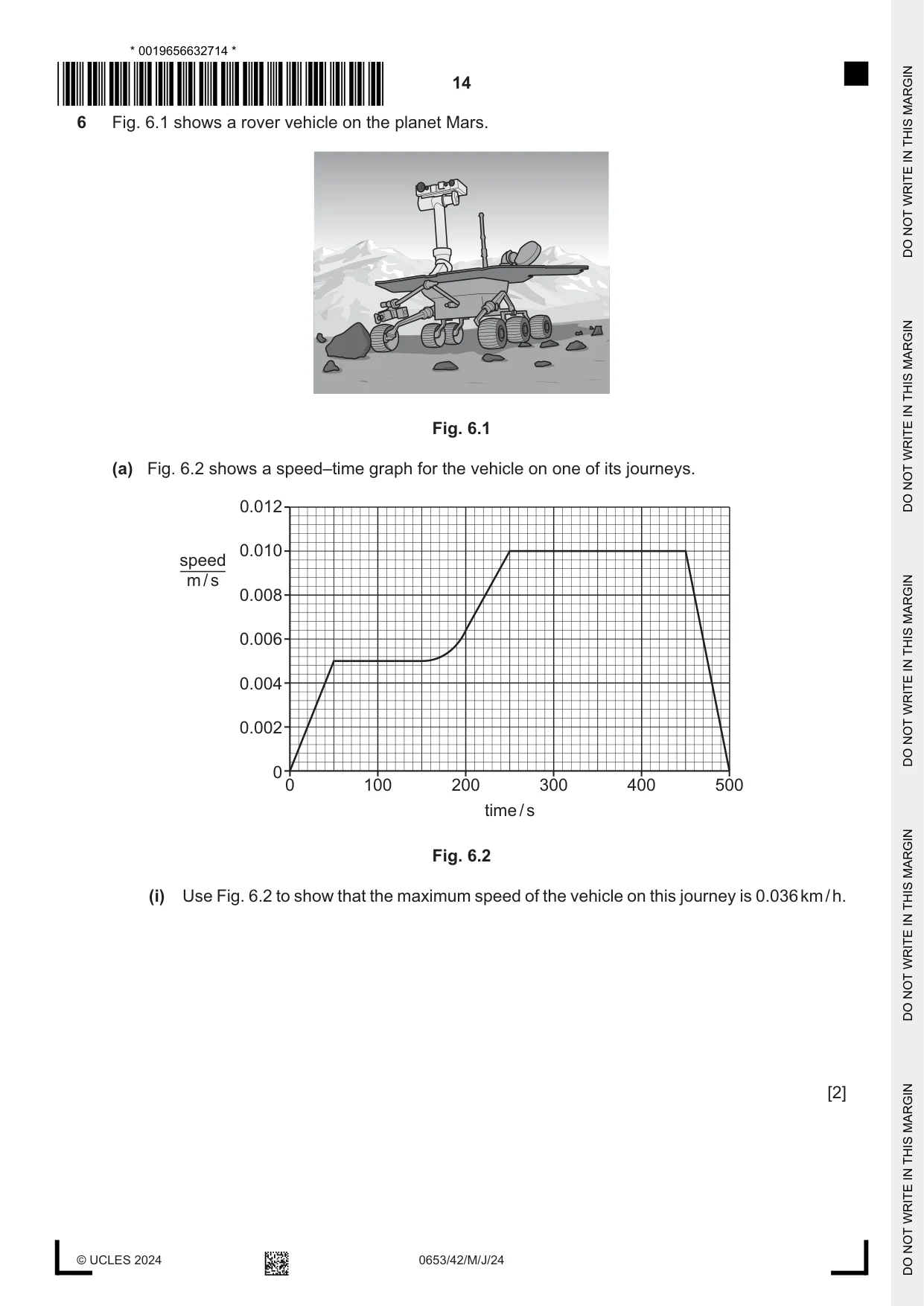
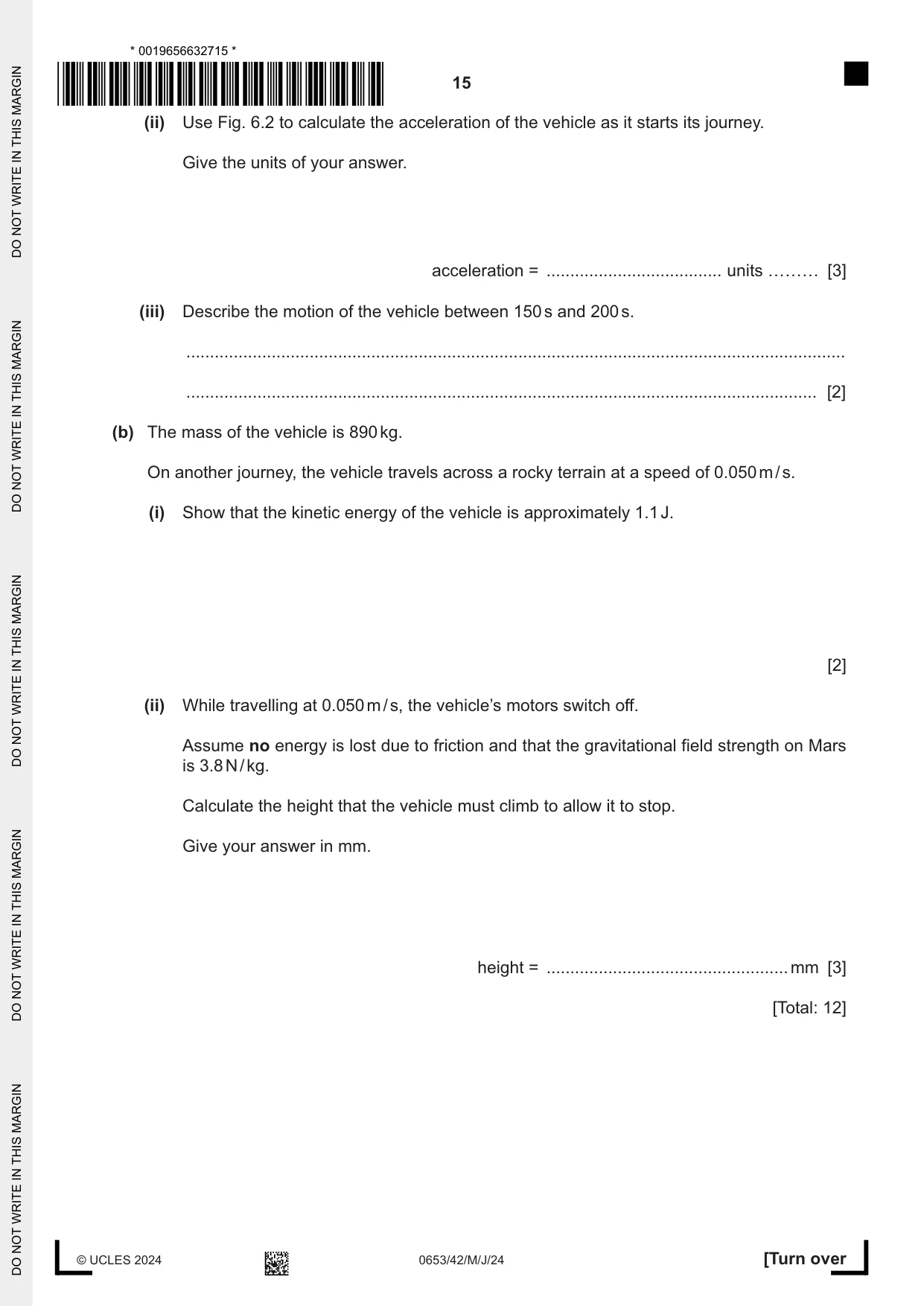
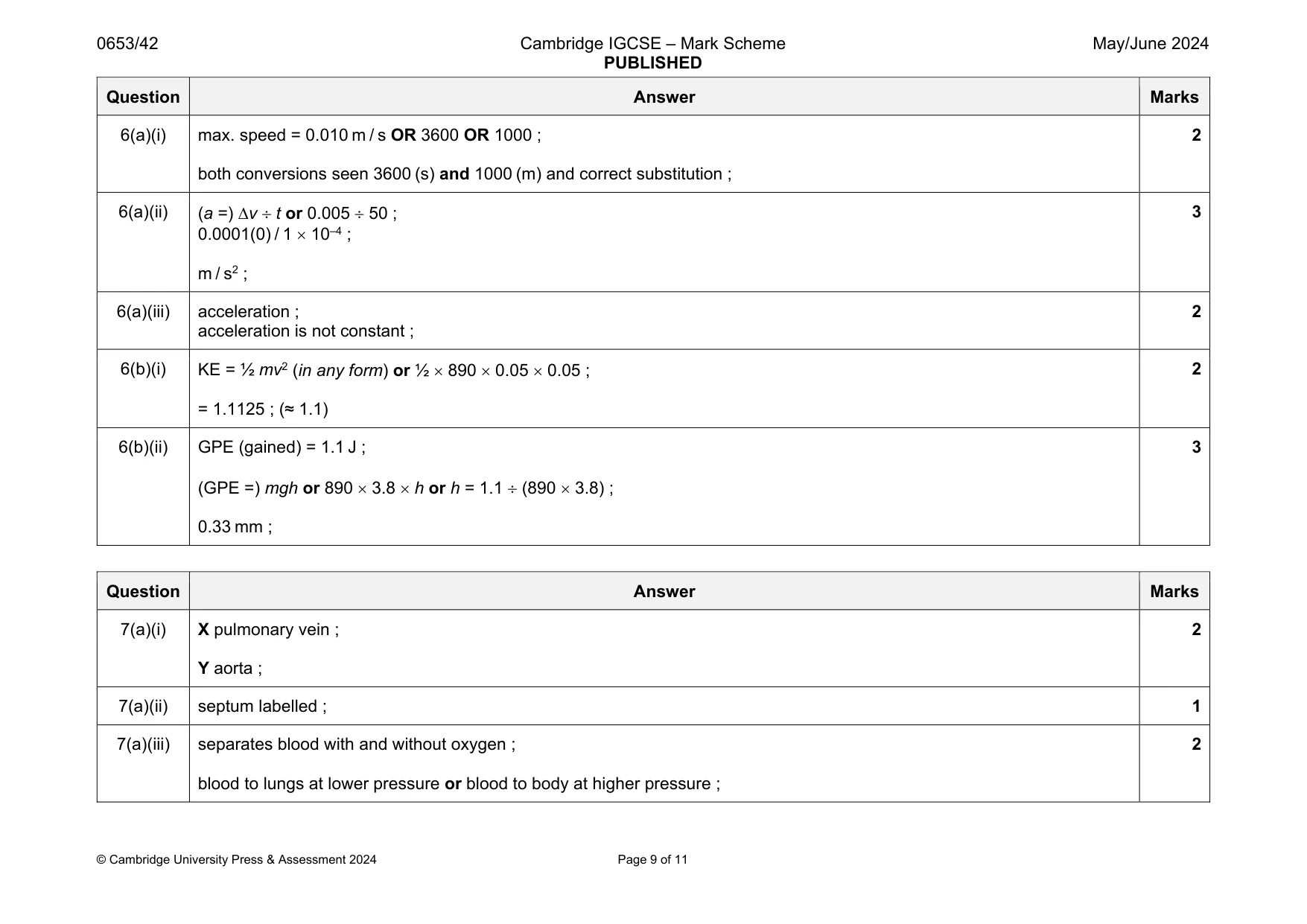
6 Fig. 6.1 shows a rover vehicle on the planet Mars. Fig. 6.1 (a) Fig. 6.2 shows a speed–time graph for the vehicle on one of its journeys. 0.012 0.010 speed m / s 0.008 0.006 0.004 0.002 0 0 100 200 300 400 500 time / s Fig. 6.2 (i) Use Fig. 6.2 to show that the maximum speed of the vehicle on this journey is 0.036 km / h. [2] (ii) Use Fig. 6.2 to calculate the acceleration of the vehicle as it starts its journey. Give the units of your answer. acceleration = ..................................... units ……… [3] (iii) Describe the motion of the vehicle between 150 s and 200 s. ........................................................................................................................................... ..................................................................................................................................... [2] (b) The mass of the vehicle is 890 kg. On another journey, the vehicle travels across a rocky terrain at a speed of 0.050 m / s. (i) Show that the kinetic energy of the vehicle is approximately 1.1 J. [2] (ii) While travelling at 0.050 m / s, the vehicle’s motors switch off. Assume no energy is lost due to friction and that the gravitational field strength on Mars is 3.8 N / kg. Calculate the height that the vehicle must climb to allow it to stop. Give your answer in mm. height = ................................................... mm [3] [Total: 12]
Mark scheme: 6(a)(i) max. speed = 0.010 m / s OR 3600 OR 1000 ; both conversions seen 3600 (s) and 1000 (m) and correct substitution ; 2 6(a)(ii) (a =) v t or 0.005 50 ; 0.0001(0) / 1 10–4 ; m / s2 ; 3 6(a)(iii) acceleration ; acceleration is not constant ; 2 6(b)(i) KE = ½ mv2 (in any form) or ½ 890 0.05 0.05 ; = 1.1125 ; (≈ 1.1) 2 6(b)(ii) GPE (gained) = 1.1 J ; (GPE =) mgh or 890 3.8 h or h = 1.1 (890 3.8) ; 0.33 mm ; 3
Q7 · The double circulatory system in humans
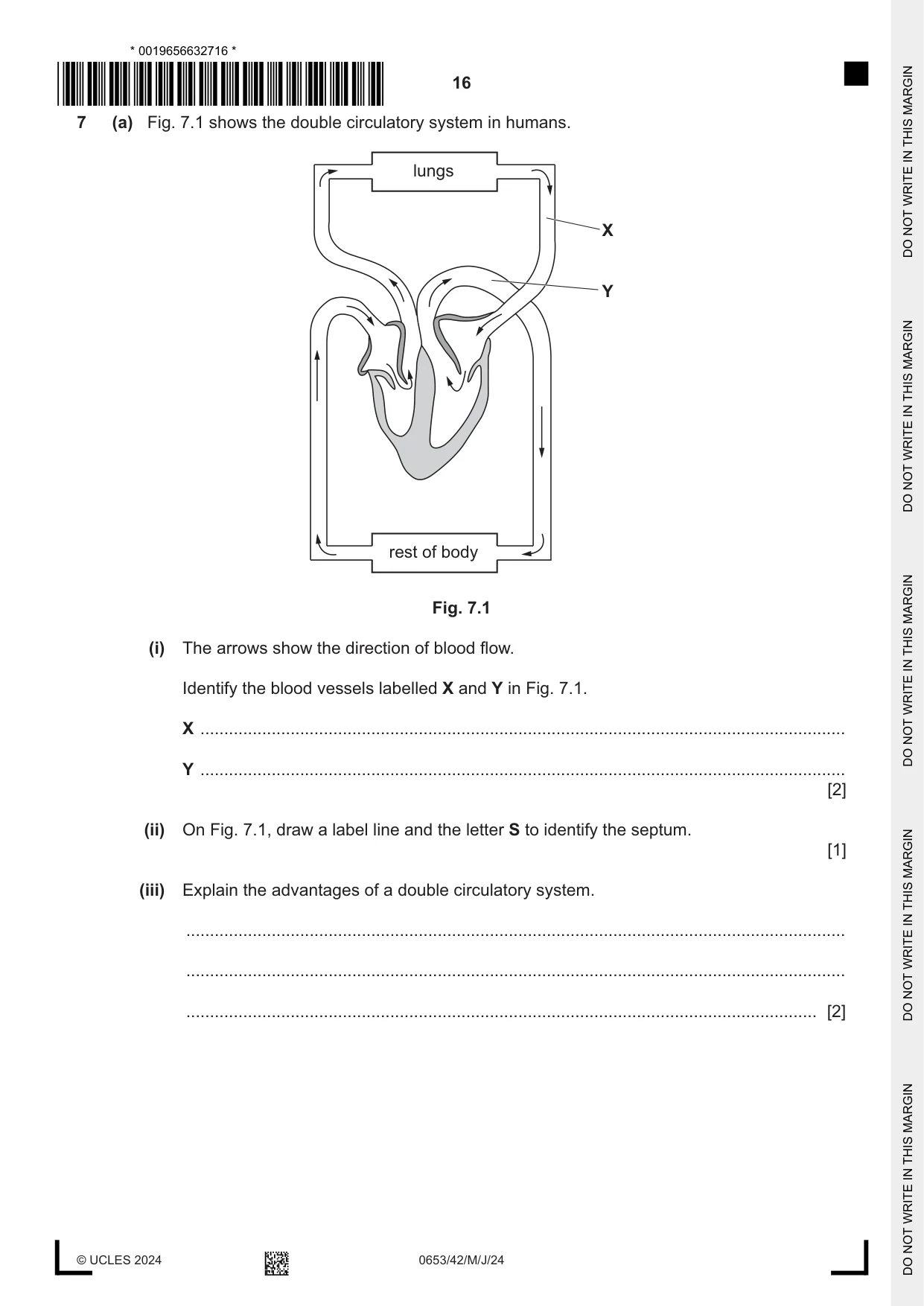
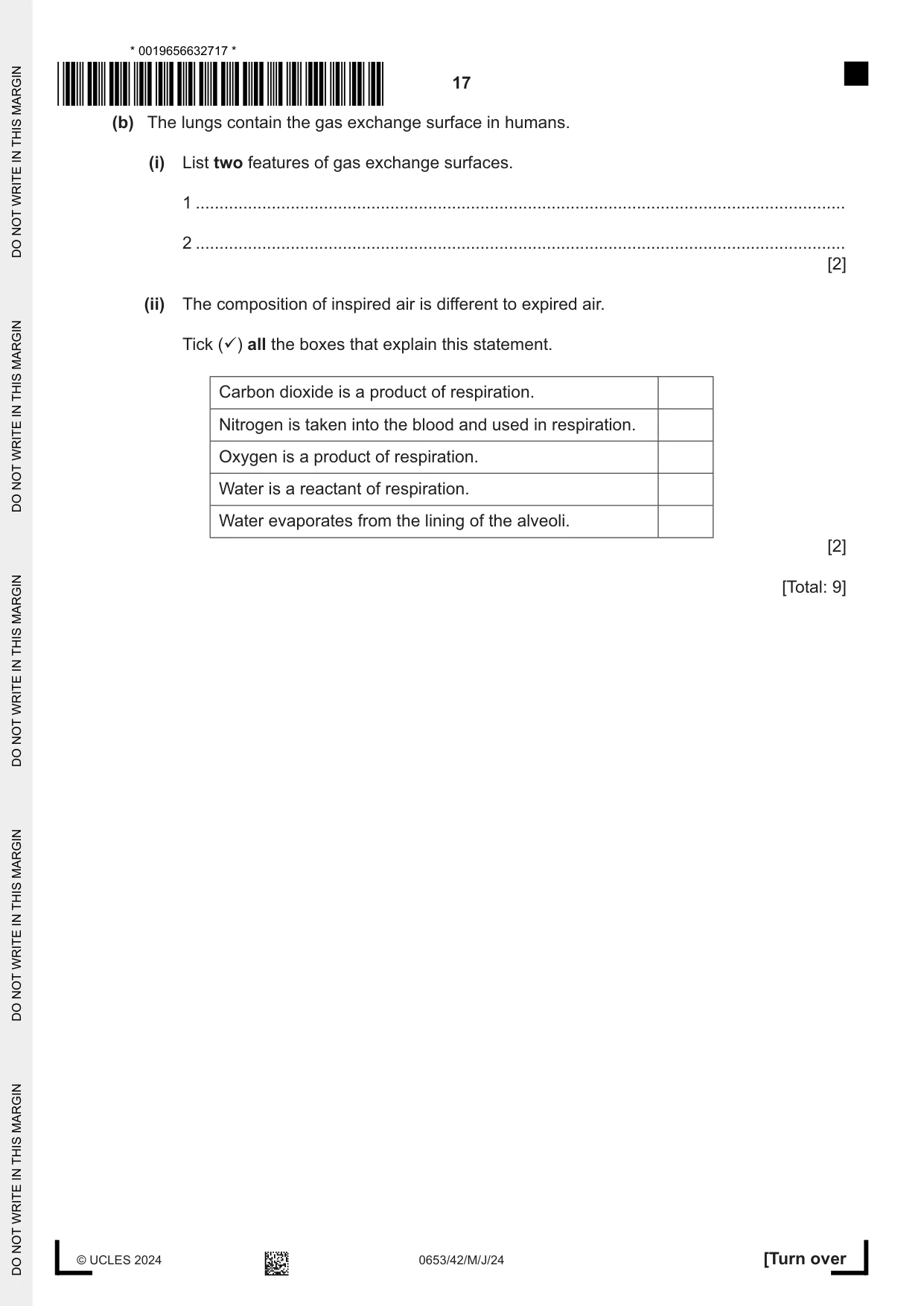
7 (a) Fig. 7.1 shows the double circulatory system in humans. lungs X Y rest of body Fig. 7.1 (i) The arrows show the direction of blood flow. Identify the blood vessels labelled X and Y in Fig. 7.1. X ........................................................................................................................................ Y ........................................................................................................................................ [2] (ii) On Fig. 7.1, draw a label line and the letter S to identify the septum. [1] (iii) Explain the advantages of a double circulatory system. ........................................................................................................................................... ........................................................................................................................................... ..................................................................................................................................... [2] (b) The lungs contain the gas exchange surface in humans. (i) List two features of gas exchange surfaces. 1 ......................................................................................................................................... 2 ......................................................................................................................................... [2] (ii) The composition of inspired air is different to expired air. Tick () all the boxes that explain this statement. Carbon dioxide is a product of respiration. Nitrogen is taken into the blood and used in respiration. Oxygen is a product of respiration. Water is a reactant of respiration. Water evaporates from the lining of the alveoli. [2] [Total: 9]
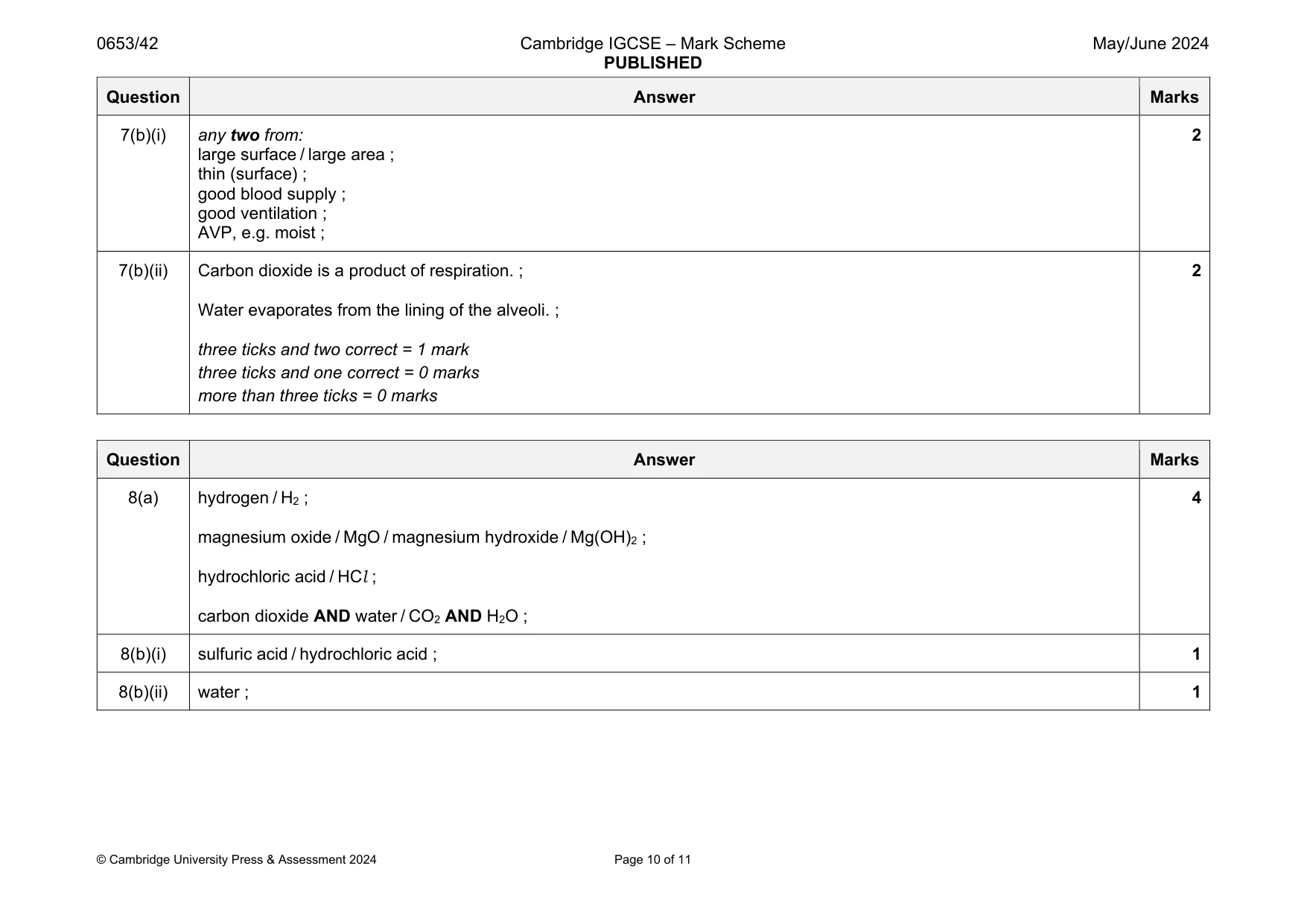
Mark scheme: 7(a)(i) X pulmonary vein ; Y aorta ; 2 7(a)(ii) septum labelled ; 1 7(a)(iii) separates blood with and without oxygen ; blood to lungs at lower pressure or blood to body at higher pressure ; 2 Question Answer Marks 7(b)(i) any two from: large surface / large area ; thin (surface) ; good blood supply ; good ventilation ; AVP, e.g. moist ; 2 7(b)(ii) Carbon dioxide is a product of respiration. ; Water evaporates from the lining of the alveoli. ; three ticks and two correct = 1 mark three ticks and one correct = 0 marks more than three ticks = 0 marks 2
Q8 · Solid magnesium and some magnesium compounds react with dilute acids to make salts
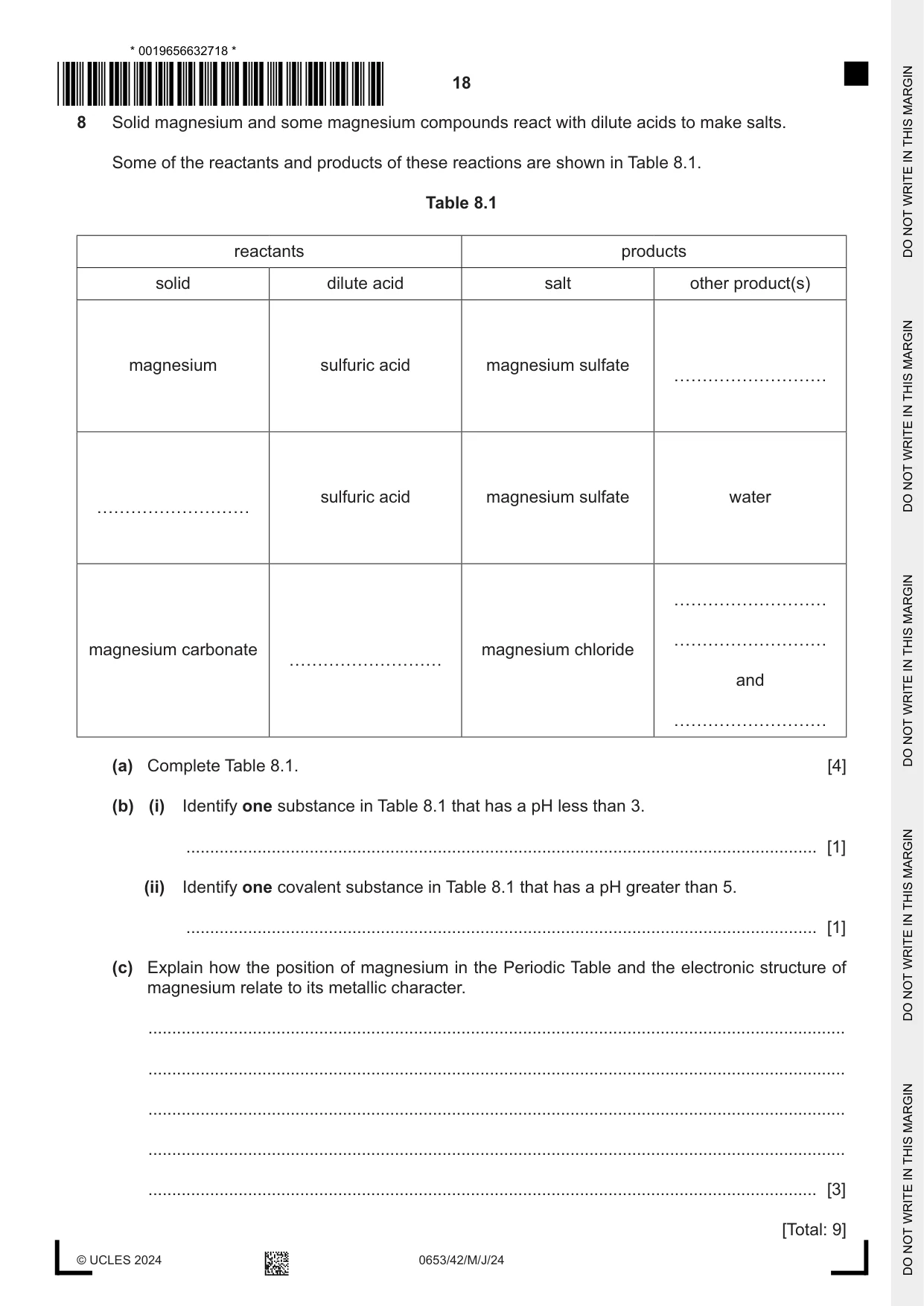
8 Solid magnesium and some magnesium compounds react with dilute acids to make salts. Some of the reactants and products of these reactions are shown in Table 8.1. Table 8.1 reactants products solid dilute acid salt other product(s) magnesium sulfuric acid magnesium sulfate sulfuric acid magnesium sulfate water magnesium carbonate magnesium chloride and (a) Complete Table 8.1. [4] (b) (i) Identify one substance in Table 8.1 that has a pH less than 3. ..................................................................................................................................... [1] (ii) Identify one covalent substance in Table 8.1 that has a pH greater than 5. ..................................................................................................................................... [1] (c) Explain how the position of magnesium in the Periodic Table and the electronic structure of magnesium relate to its metallic character. ................................................................................................................................................... ................................................................................................................................................... ................................................................................................................................................... ................................................................................................................................................... ............................................................................................................................................. [3] [Total: 9]
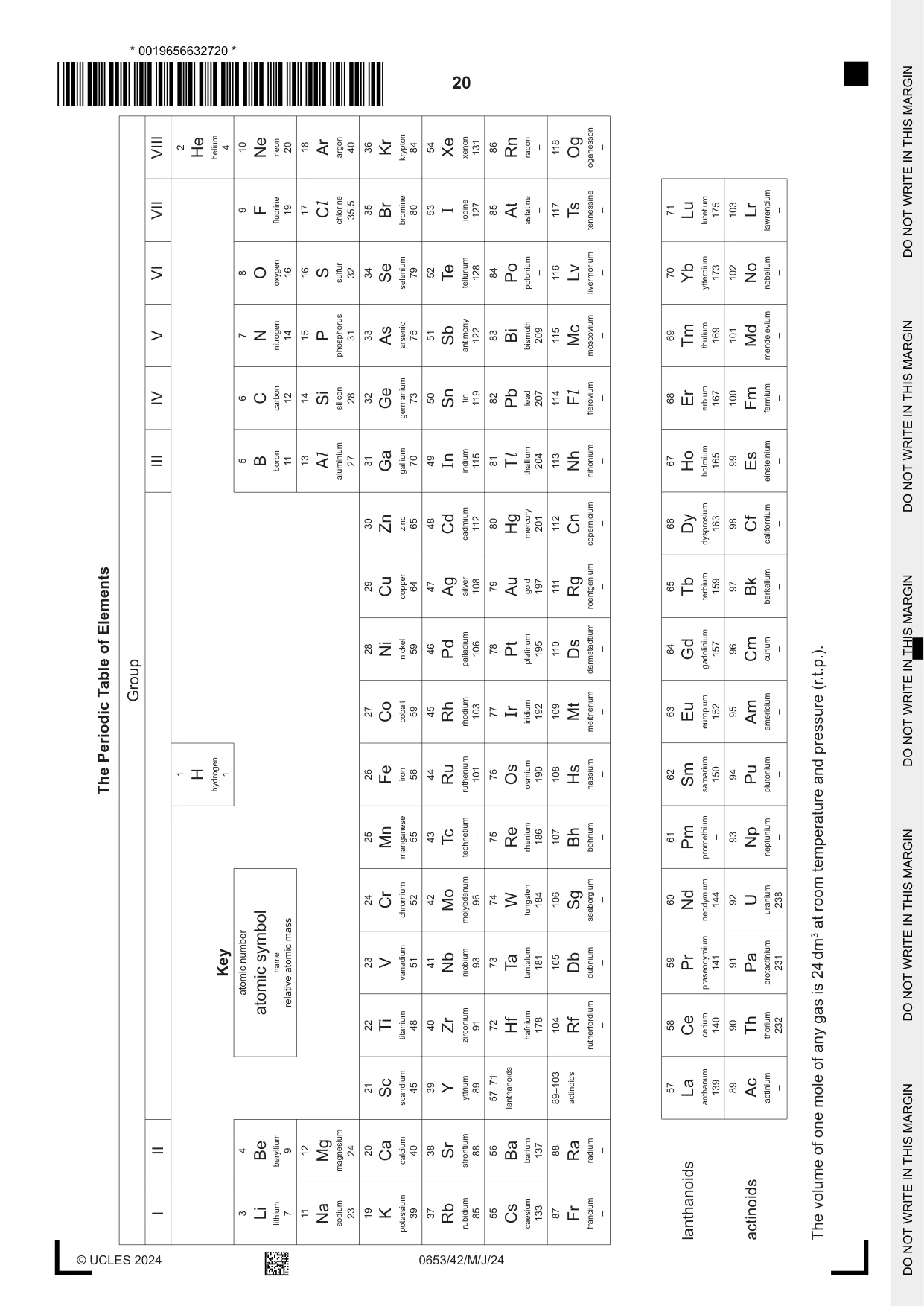
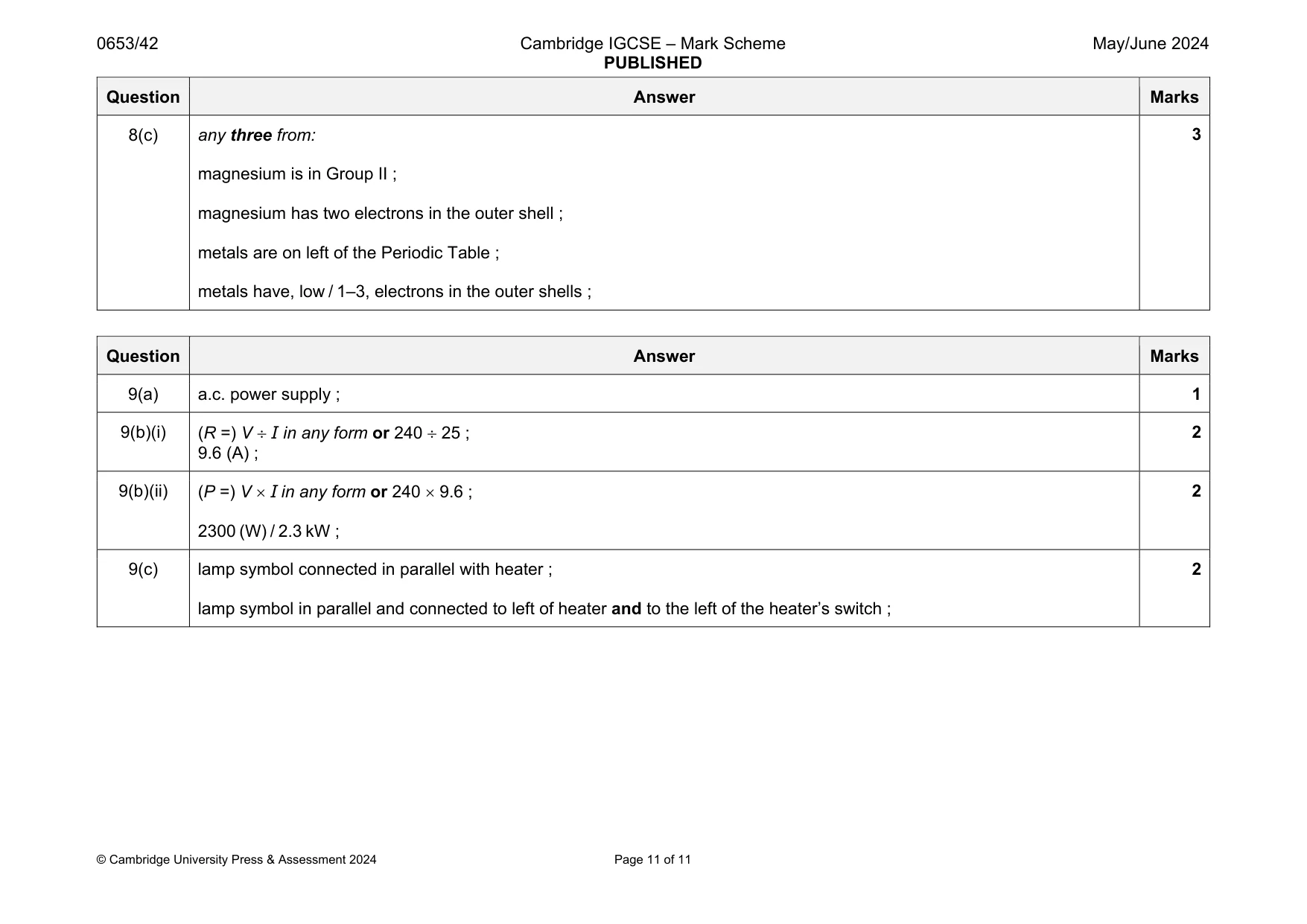
Mark scheme: 8(a) hydrogen / H2 ; magnesium oxide / MgO / magnesium hydroxide / Mg(OH)2 ; hydrochloric acid / HCl ; carbon dioxide AND water / CO2 AND H2O ; 4 8(b)(i) sulfuric acid / hydrochloric acid ; 1 8(b)(ii) water ; 1 Question Answer Marks 8(c) any three from: magnesium is in Group II ; magnesium has two electrons in the outer shell ; metals are on left of the Periodic Table ; metals have, low / 1–3, electrons in the outer shells ; 3
Q9 · A circuit diagram for part of an electric dishwashing machine
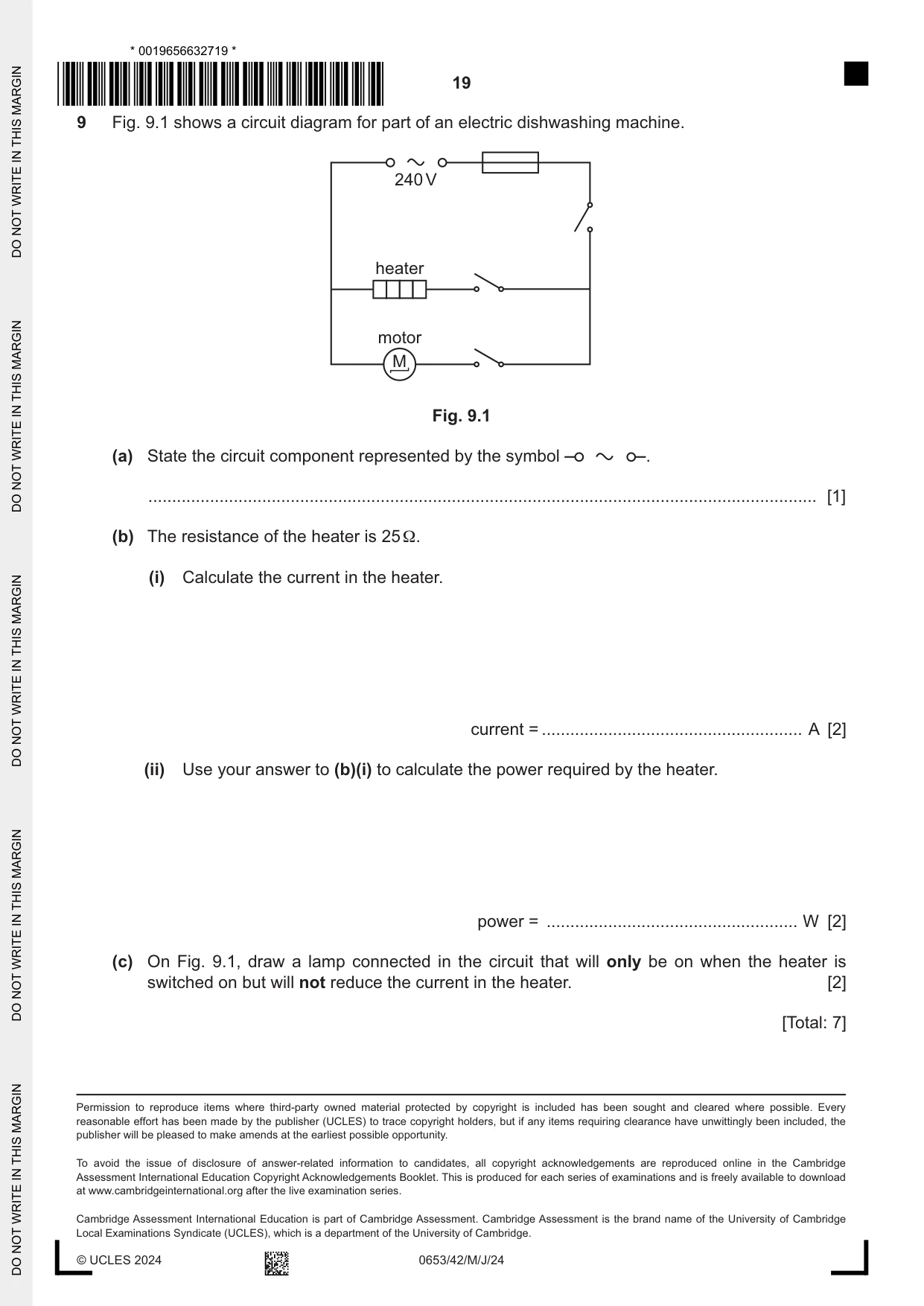
9 Fig. 9.1 shows a circuit diagram for part of an electric dishwashing machine. 240 V heater motor M Fig. 9.1 (a) State the circuit component represented by the symbol . ............................................................................................................................................. [1] (b) The resistance of the heater is 25 Ω. (i) Calculate the current in the heater. current = ....................................................... A [2] (ii) Use your answer to (b)(i) to calculate the power required by the heater. power = ..................................................... W [2] (c) On Fig. 9.1, draw a lamp connected in the circuit that will only be on when the heater is switched on but will not reduce the current in the heater. [2] [Total: 7]
Mark scheme: 9(a) a.c. power supply ; 1 9(b)(i) (R =) V I in any form or 240 25 ; 9.6 (A) ; 2 9(b)(ii) (P =) V I in any form or 240 9.6 ; 2300 (W) / 2.3 kW ; 2 9(c) lamp symbol connected in parallel with heater ; lamp symbol in parallel and connected to left of heater and to the left of the heater’s switch ; 2
What was in this paper
The subtopics covered by these 9 questions, and how many questions each got. Open one in a new tab to see every Cambridge question on it.
What you needed in this session
Cambridge’s own grade thresholds for 2024 May/June, Paper 4 · Variant 2. A higher threshold means an easier paper — the bar moves with how the cohort did.