Cambridge IGCSE Science - Combined 0653 — 2023 May/June Paper 4 · Variant 1
0653/41/M/J/23 · 9 questions · 80 marks · ≈90 min
The question paper and its mark scheme, free to read here and free to download. This is Cambridge’s own paper, exactly as it was sat.
Question paper24 pages




Mark scheme12 pages
Answers below. Sit the paper first if you are practising.

Questions as text
Q1 · The circulatory system of frogs and the circulatory system of humans
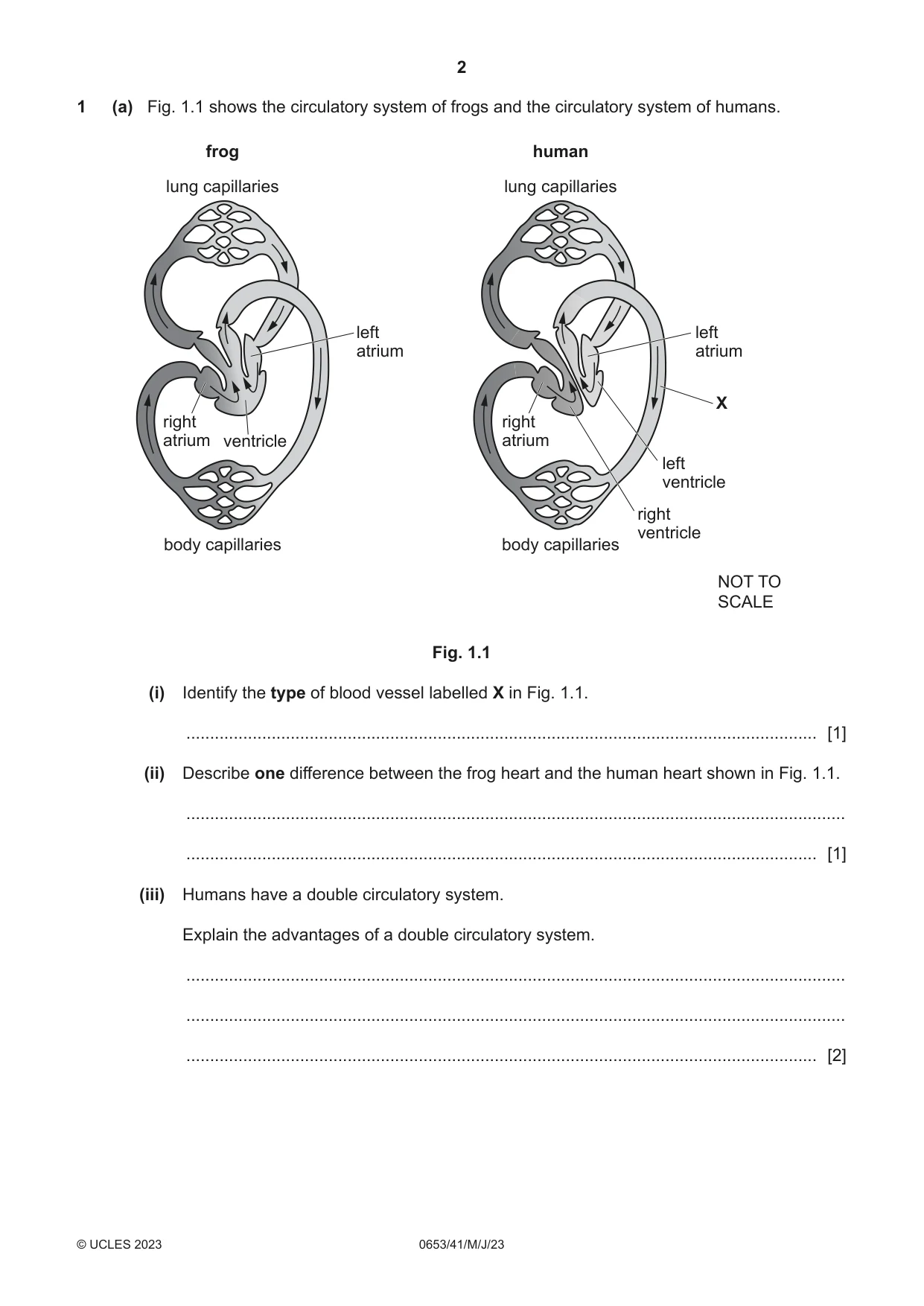
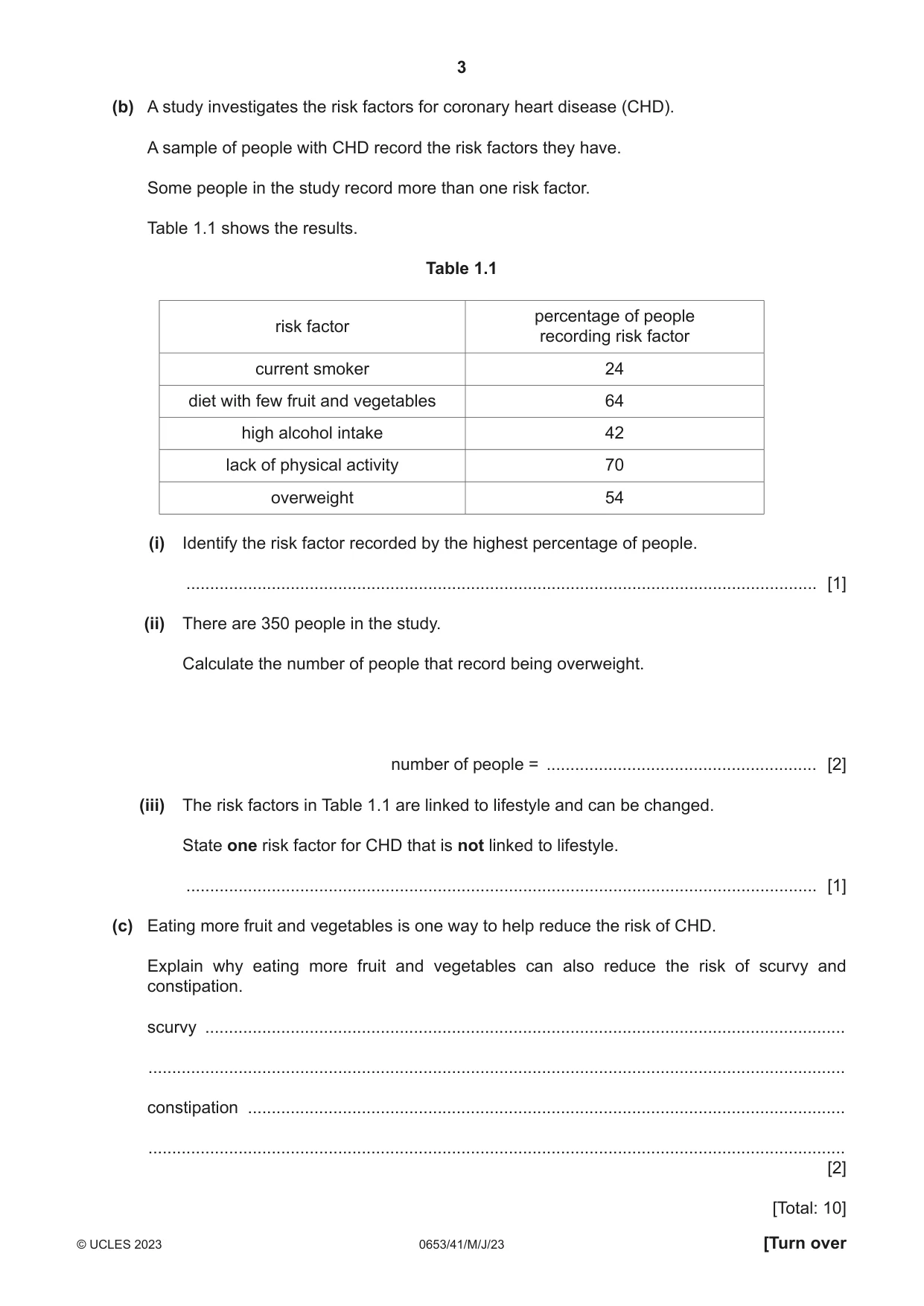
1 (a) Fig. 1.1 shows the circulatory system of frogs and the circulatory system of humans. frog human lung capillaries lung capillaries left left atrium atrium X right right atrium ventricle atrium left ventricle right ventricle body capillaries body capillaries NOT TO SCALE Fig. 1.1 (i) Identify the type of blood vessel labelled X in Fig. 1.1. ..................................................................................................................................... [1] (ii) Describe one difference between the frog heart and the human heart shown in Fig. 1.1. ........................................................................................................................................... ..................................................................................................................................... [1] (iii) Humans have a double circulatory system. Explain the advantages of a double circulatory system. ........................................................................................................................................... ........................................................................................................................................... ..................................................................................................................................... [2] (b) A study investigates the risk factors for coronary heart disease (CHD). A sample of people with CHD record the risk factors they have. Some people in the study record more than one risk factor. Table 1.1 shows the results. Table 1.1 percentage of people risk factor recording risk factor current smoker 24 diet with few fruit and vegetables 64 high alcohol intake 42 lack of physical activity 70 overweight 54 (i) Identify the risk factor recorded by the highest percentage of people. ..................................................................................................................................... [1] (ii) There are 350 people in the study. Calculate the number of people that record being overweight. number of people = ......................................................... [2] (iii) The risk factors in Table 1.1 are linked to lifestyle and can be changed. State one risk factor for CHD that is not linked to lifestyle. ..................................................................................................................................... [1] (c) Eating more fruit and vegetables is one way to help reduce the risk of CHD. Explain why eating more fruit and vegetables can also reduce the risk of scurvy and constipation. scurvy ....................................................................................................................................... ................................................................................................................................................... constipation .............................................................................................................................. ................................................................................................................................................... [2] [Total: 10]
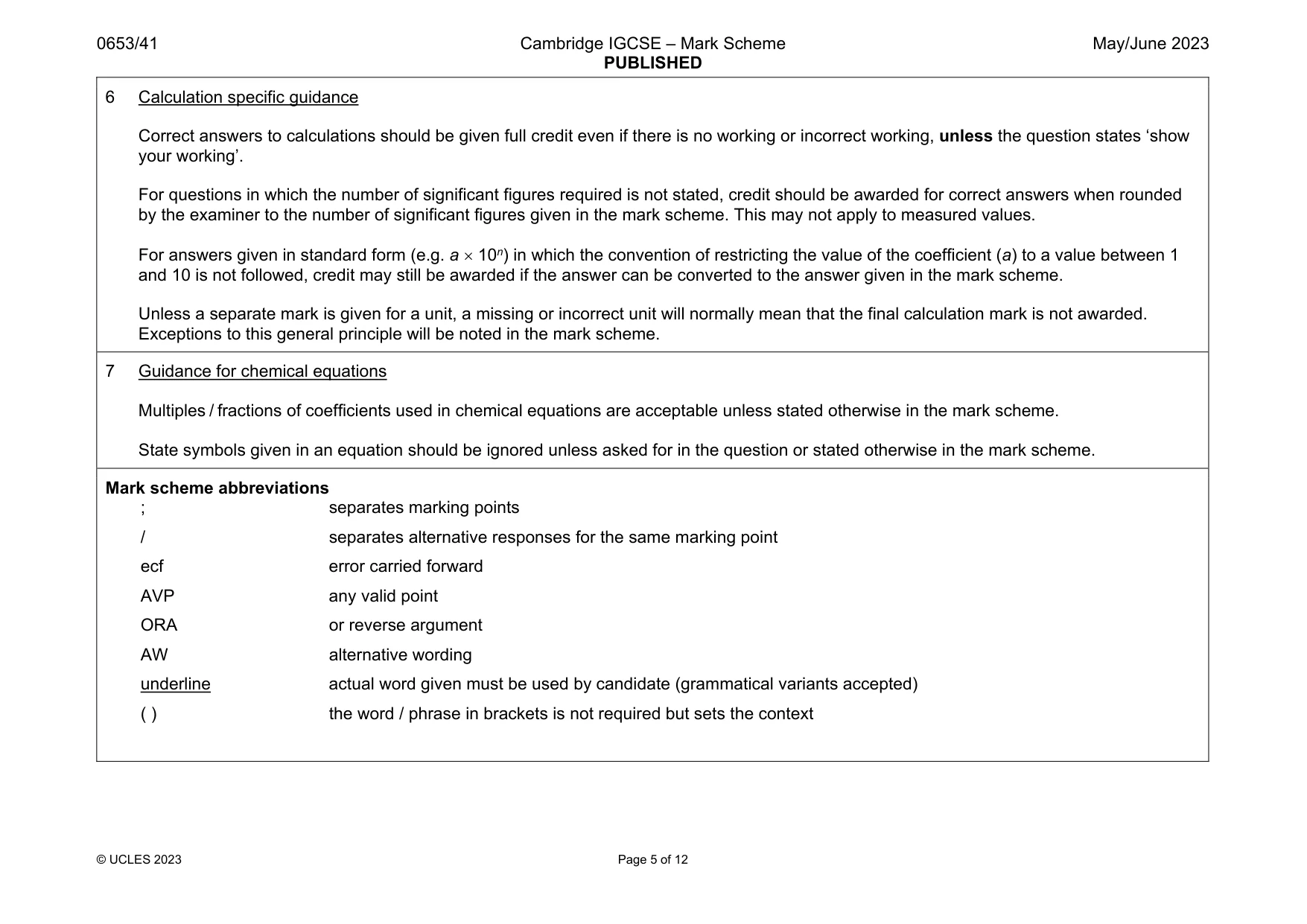
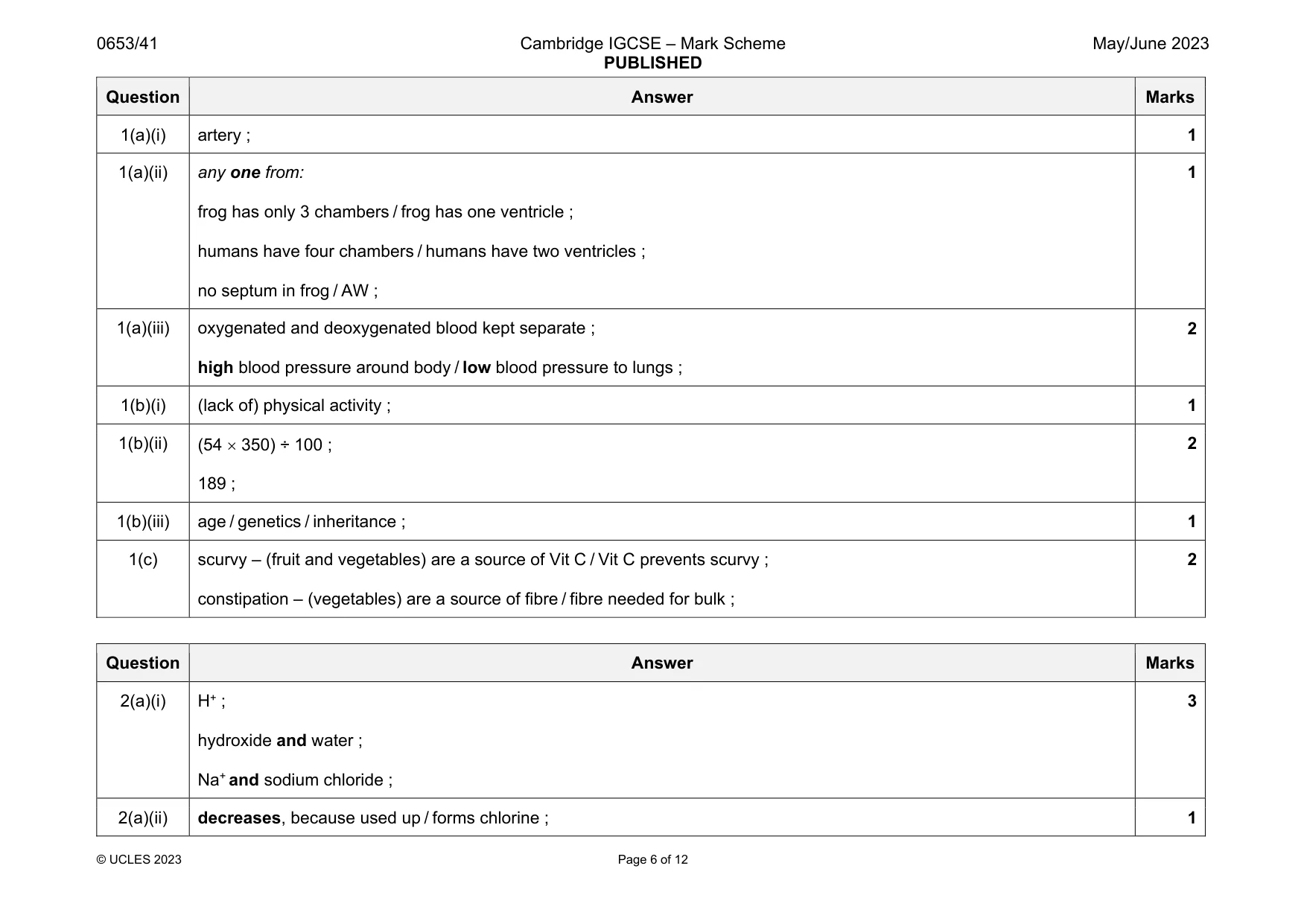
Mark scheme: 1(a)(i) artery ; 1 1(a)(ii) any one from: frog has only 3 chambers / frog has one ventricle ; humans have four chambers / humans have two ventricles ; no septum in frog / AW ; 1 1(a)(iii) oxygenated and deoxygenated blood kept separate ; high blood pressure around body / low blood pressure to lungs ; 2 1(b)(i) (lack of) physical activity ; 1 1(b)(ii) (54 350) ÷ 100 ; 189 ; 2 1(b)(iii) age / genetics / inheritance ; 1 1(c) scurvy – (fruit and vegetables) are a source of Vit C / Vit C prevents scurvy ; constipation – (vegetables) are a source of fibre / fibre needed for bulk ; 2
Q2 · An electric current is passed through concentrated aqueous sodium chloride using inert…
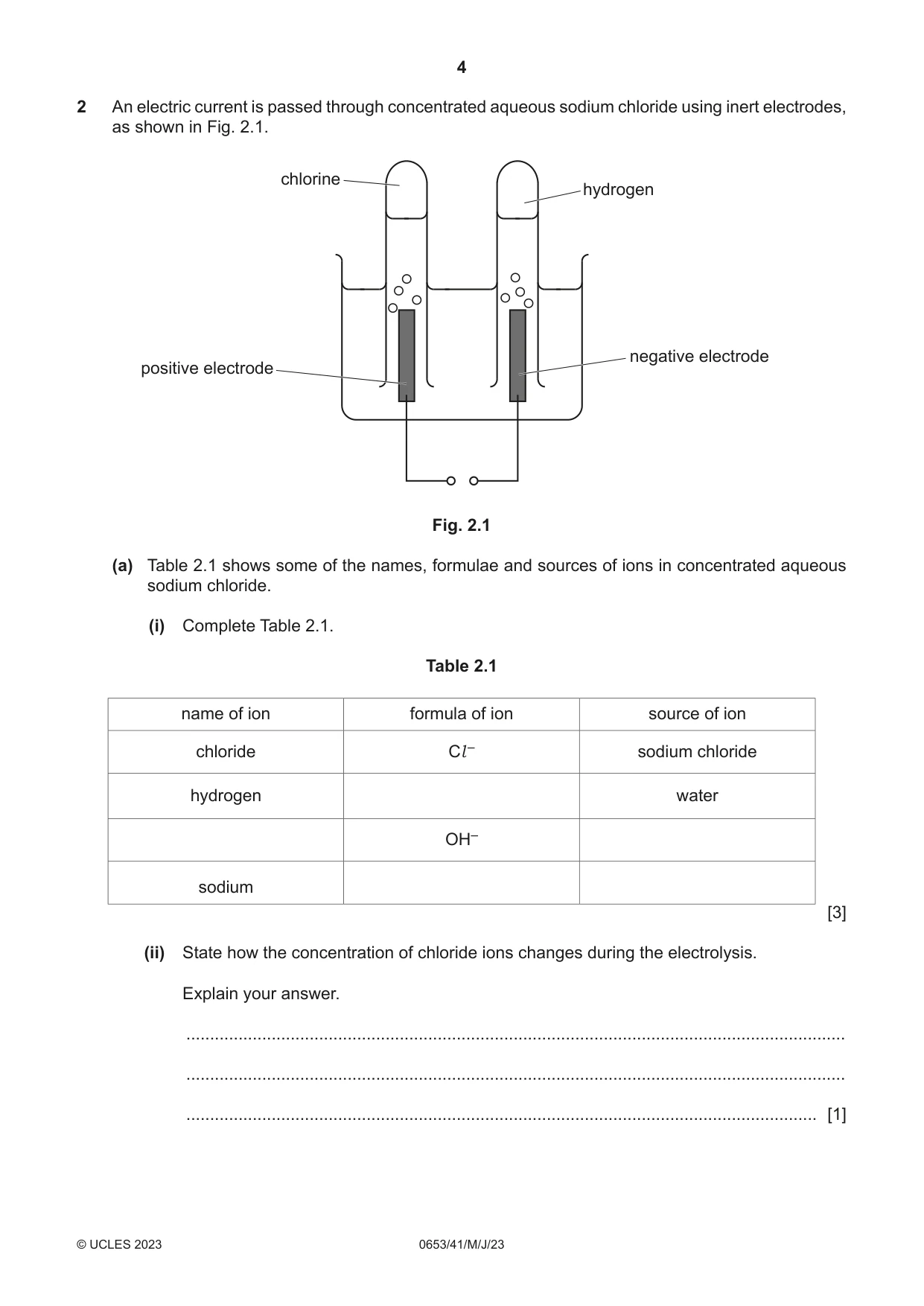
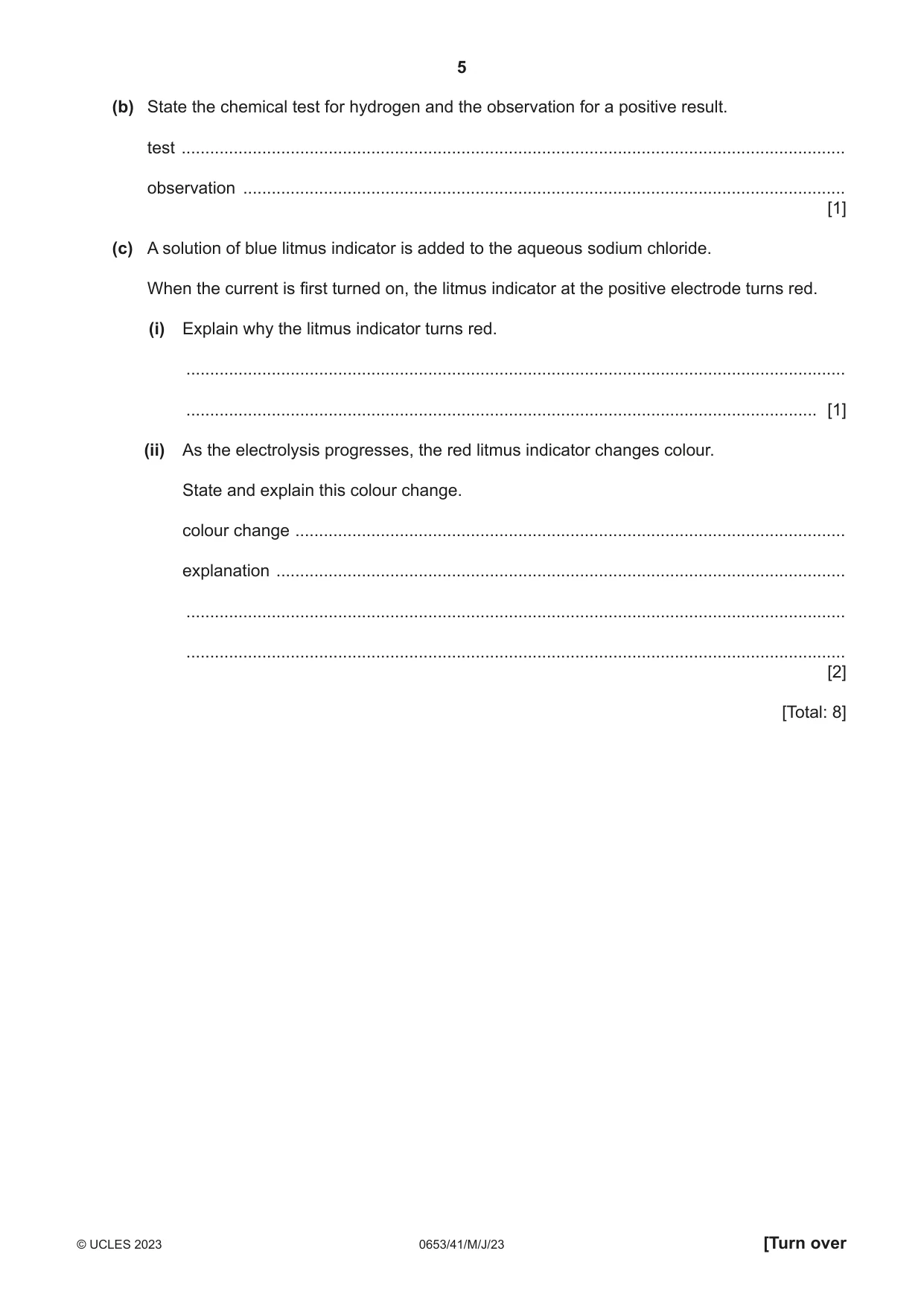
2 An electric current is passed through concentrated aqueous sodium chloride using inert electrodes, as shown in Fig. 2.1. chlorine hydrogen negative electrode positive electrode Fig. 2.1 (a) Table 2.1 shows some of the names, formulae and sources of ions in concentrated aqueous sodium chloride. (i) Complete Table 2.1. Table 2.1 name of ion formula of ion source of ion chloride Cl – sodium chloride hydrogen water OH– sodium [3] (ii) State how the concentration of chloride ions changes during the electrolysis. Explain your answer. ........................................................................................................................................... ........................................................................................................................................... ..................................................................................................................................... [1] (b) State the chemical test for hydrogen and the observation for a positive result. test ............................................................................................................................................ observation ............................................................................................................................... [1] (c) A solution of blue litmus indicator is added to the aqueous sodium chloride. When the current is first turned on, the litmus indicator at the positive electrode turns red. (i) Explain why the litmus indicator turns red. ........................................................................................................................................... ..................................................................................................................................... [1] (ii) As the electrolysis progresses, the red litmus indicator changes colour. State and explain this colour change. colour change .................................................................................................................... explanation ........................................................................................................................ ........................................................................................................................................... ........................................................................................................................................... [2] [Total: 8]
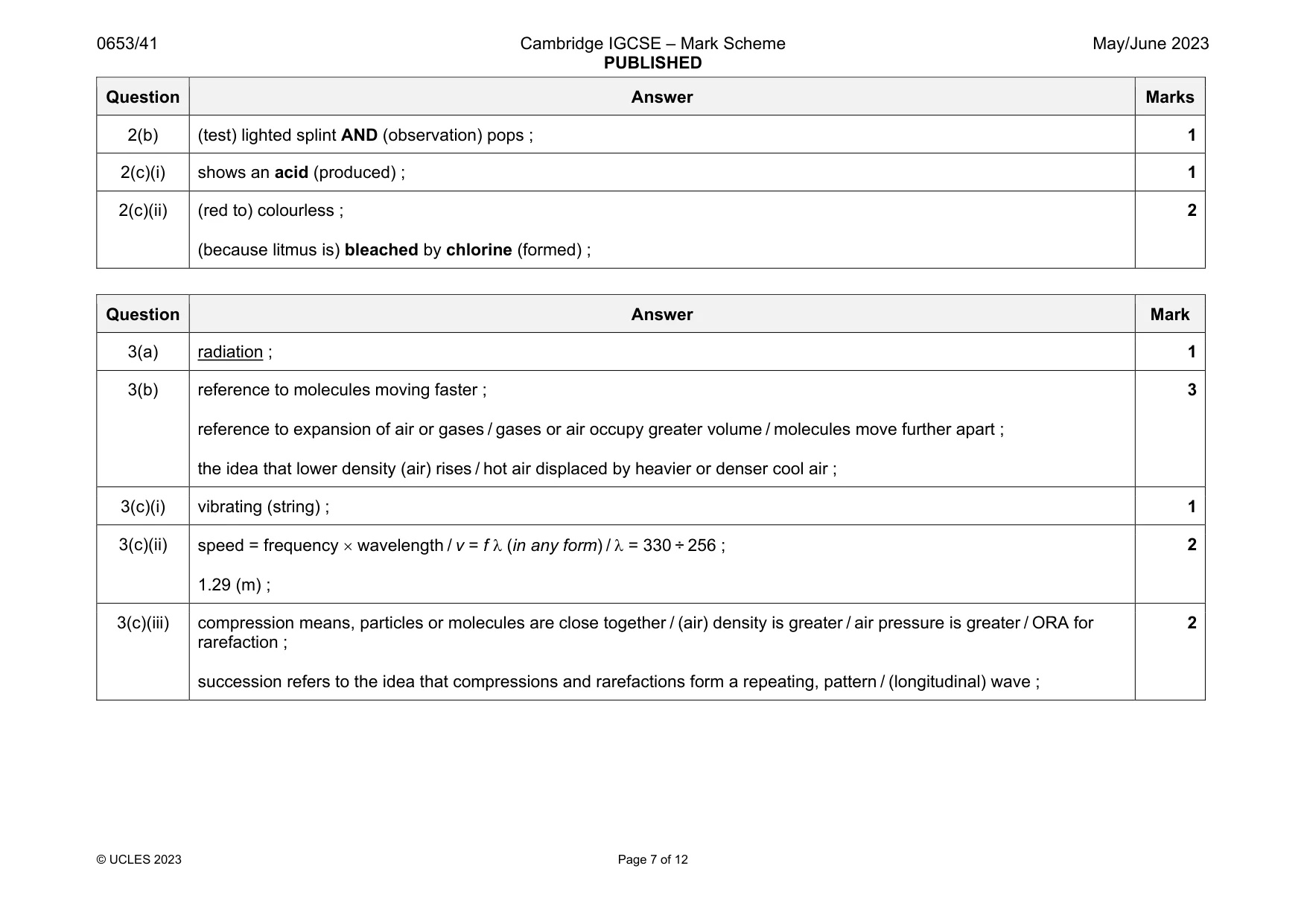
Mark scheme: 2(a)(i) H+ ; hydroxide and water ; Na+ and sodium chloride ; 2(a)(ii) decreases, because used up / forms chlorine ; 1 Question Answer Marks 2(b) (test) lighted splint AND (observation) pops ; 1 2(c)(i) shows an acid (produced) ; 1 2(c)(ii) (red to) colourless ; (because litmus is) bleached by chlorine (formed) ; 2
Q3 · Two people keeping warm by a campfire and one is playing a guitar
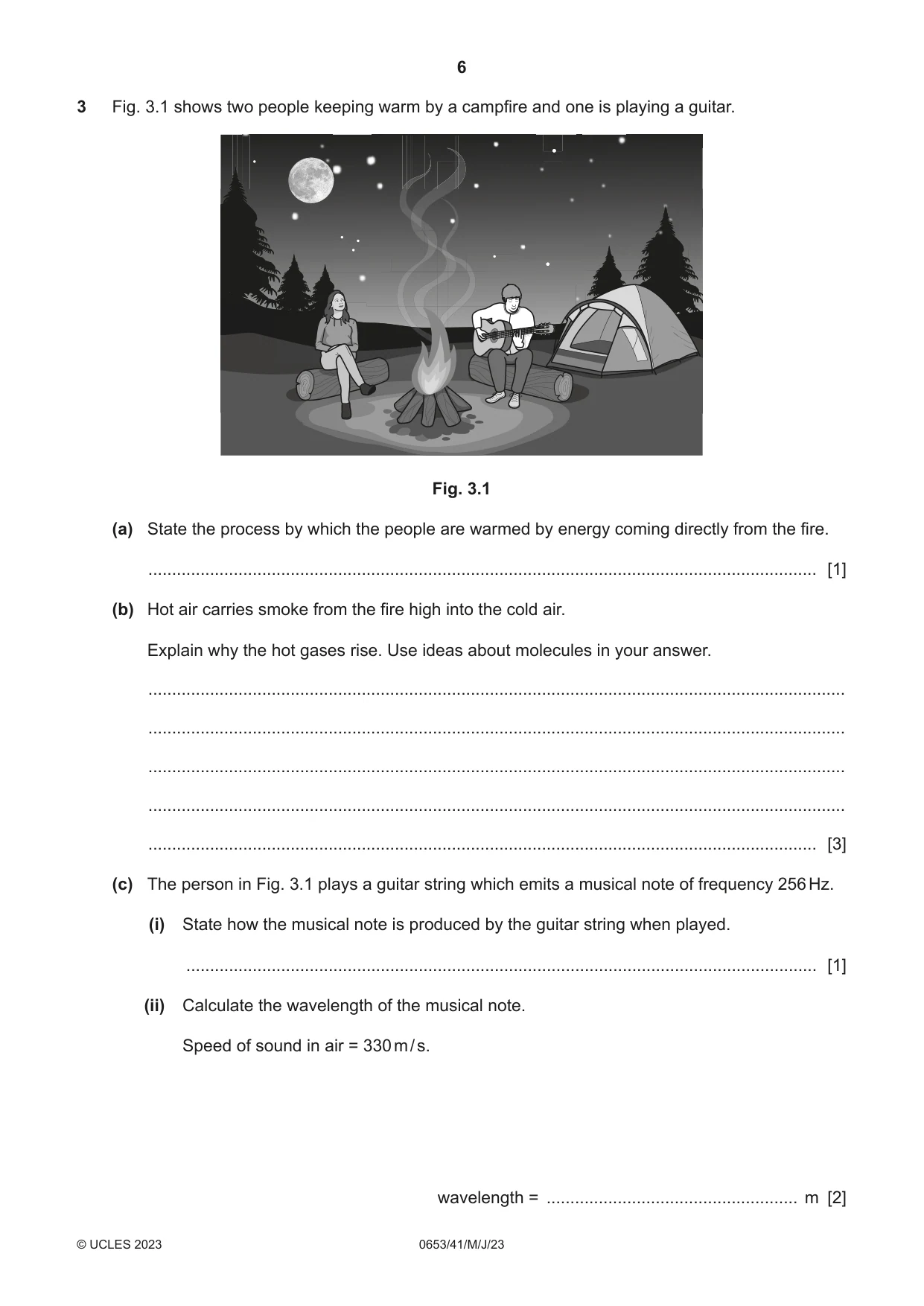
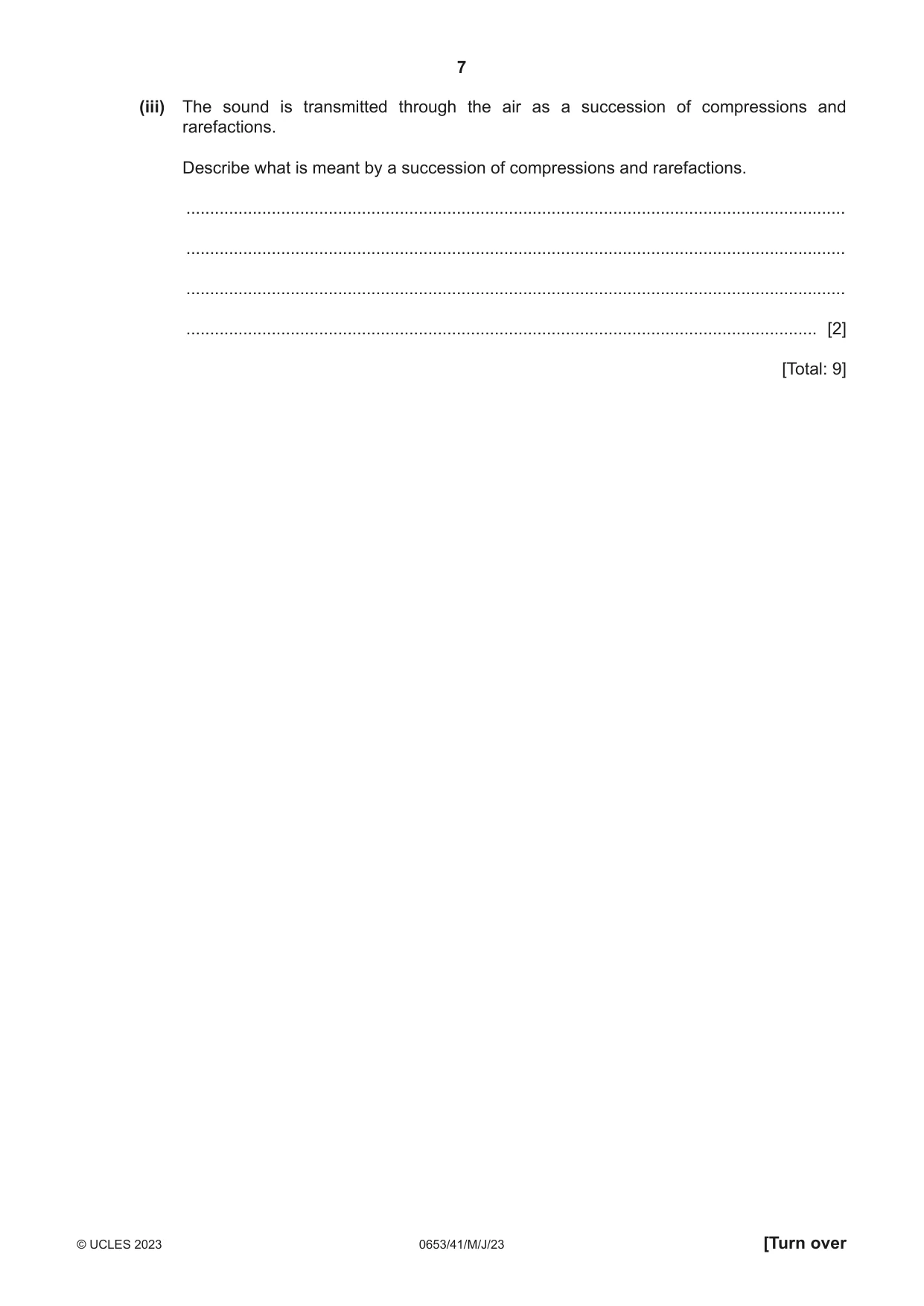
3 Fig. 3.1 shows two people keeping warm by a campfire and one is playing a guitar. Fig. 3.1 (a) State the process by which the people are warmed by energy coming directly from the fire. ............................................................................................................................................. [1] (b) Hot air carries smoke from the fire high into the cold air. Explain why the hot gases rise. Use ideas about molecules in your answer. ................................................................................................................................................... ................................................................................................................................................... ................................................................................................................................................... ................................................................................................................................................... ............................................................................................................................................. [3] (c) The person in Fig. 3.1 plays a guitar string which emits a musical note of frequency 256 Hz. (i) State how the musical note is produced by the guitar string when played. ..................................................................................................................................... [1] (ii) Calculate the wavelength of the musical note. Speed of sound in air = 330 m / s. wavelength = ..................................................... m [2] (iii) The sound is transmitted through the air as a succession of compressions and rarefactions. Describe what is meant by a succession of compressions and rarefactions. ........................................................................................................................................... ........................................................................................................................................... ........................................................................................................................................... ..................................................................................................................................... [2] [Total: 9]
Mark scheme: 3(a) radiation ; 1 3(b) reference to molecules moving faster ; reference to expansion of air or gases / gases or air occupy greater volume / molecules move further apart ; the idea that lower density (air) rises / hot air displaced by heavier or denser cool air ; 3 3(c)(i) vibrating (string) ; 1 3(c)(ii) speed = frequency wavelength / v = f (in any form) / = 330 ÷ 256 ; 1.29 (m) ; 2 3(c)(iii) compression means, particles or molecules are close together / (air) density is greater / air pressure is greater / ORA for rarefaction ; succession refers to the idea that compressions and rarefactions form a repeating, pattern / (longitudinal) wave ; 2
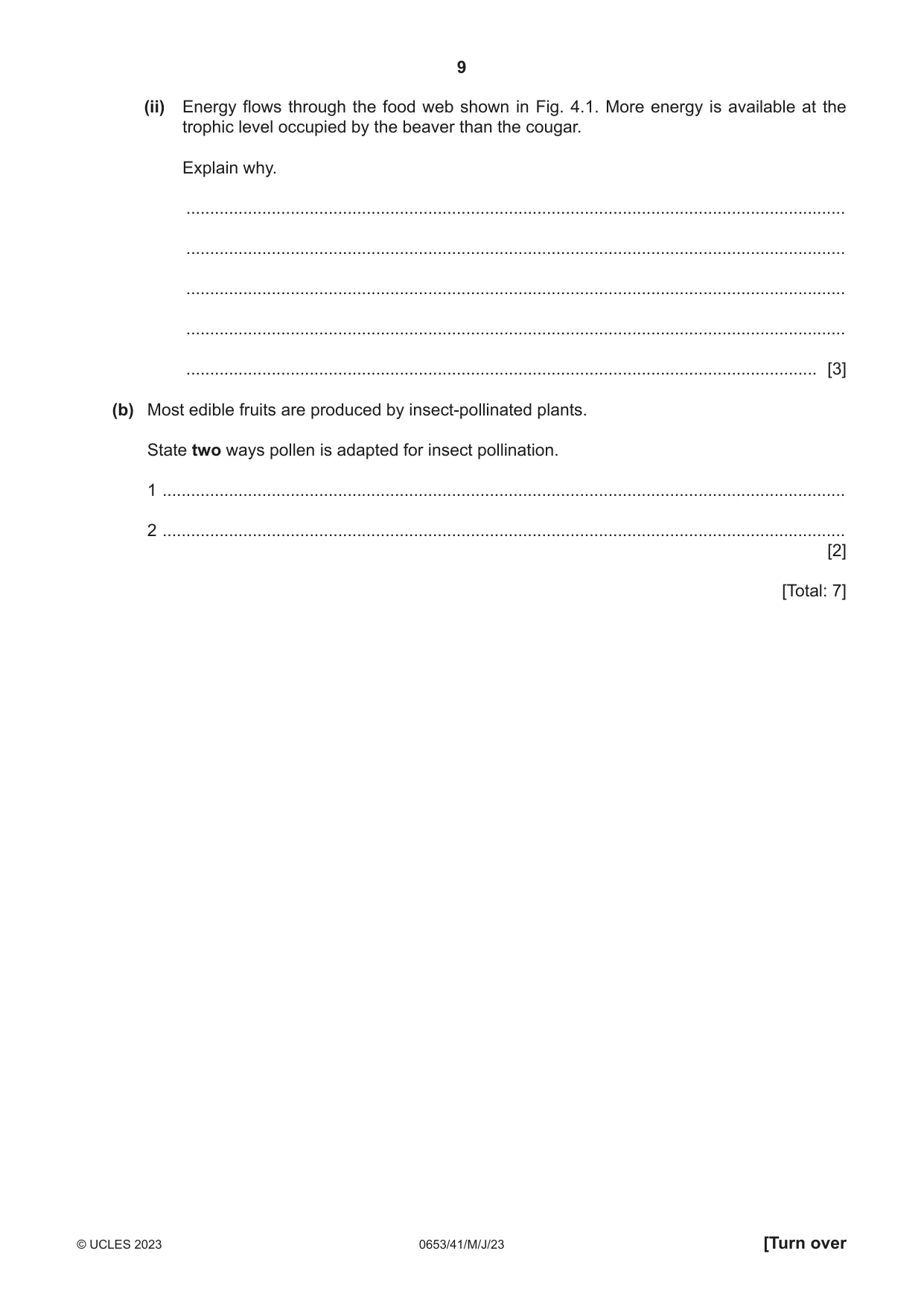
Q4 · Part of a food web
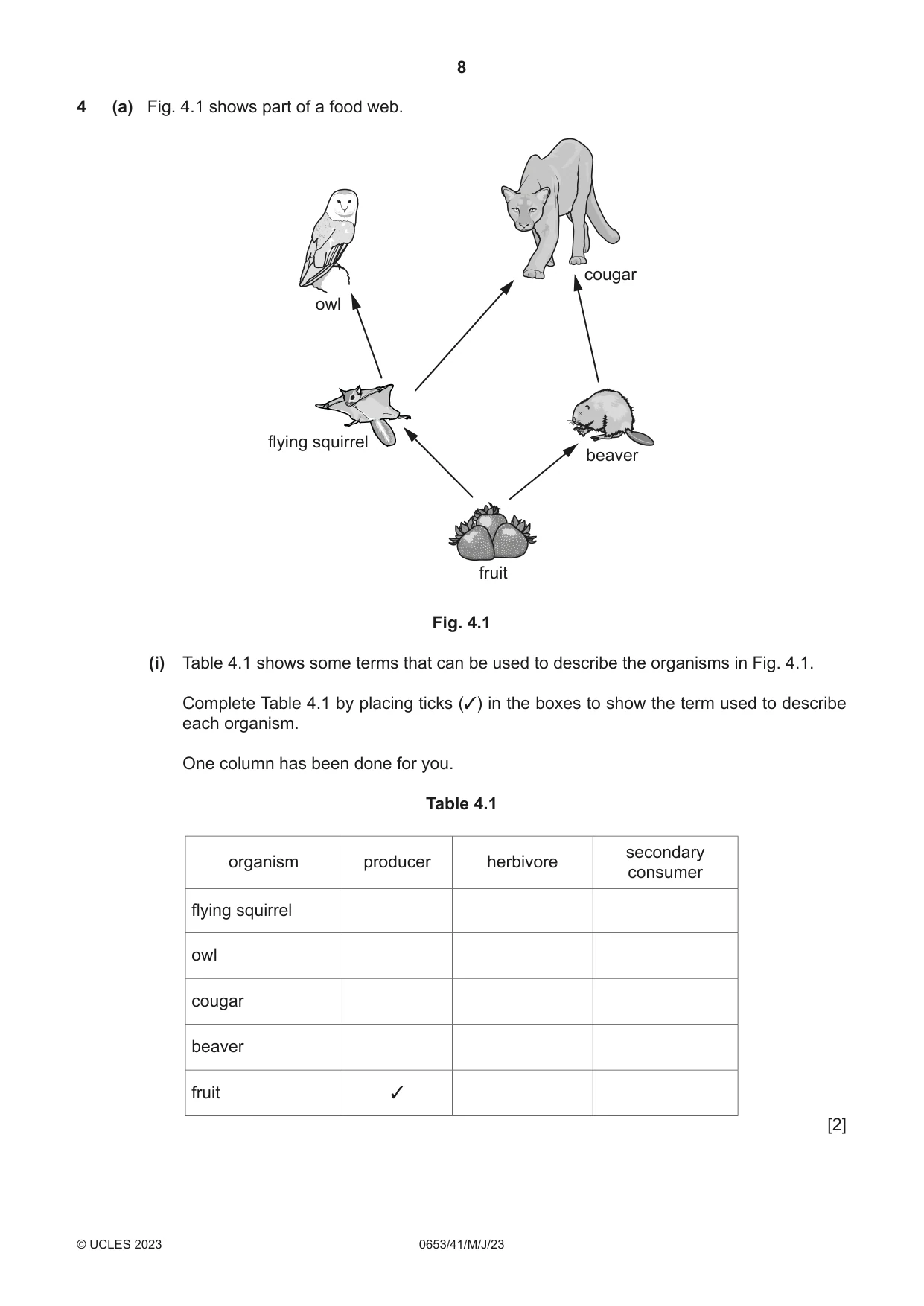
4 (a) Fig. 4.1 shows part of a food web. cougar owl flying squirrel beaver fruit Fig. 4.1 (i) Table 4.1 shows some terms that can be used to describe the organisms in Fig. 4.1. Complete Table 4.1 by placing ticks (3) in the boxes to show the term used to describe each organism. One column has been done for you. Table 4.1 secondary organism producer herbivore consumer flying squirrel owl cougar beaver fruit 3 [2] (ii) Energy flows through the food web shown in Fig. 4.1. More energy is available at the trophic level occupied by the beaver than the cougar. Explain why. ........................................................................................................................................... ........................................................................................................................................... ........................................................................................................................................... ........................................................................................................................................... ..................................................................................................................................... [3] (b) Most edible fruits are produced by insect-pollinated plants. State two ways pollen is adapted for insect pollination. 1 ................................................................................................................................................ 2 ................................................................................................................................................ [2] [Total: 7]
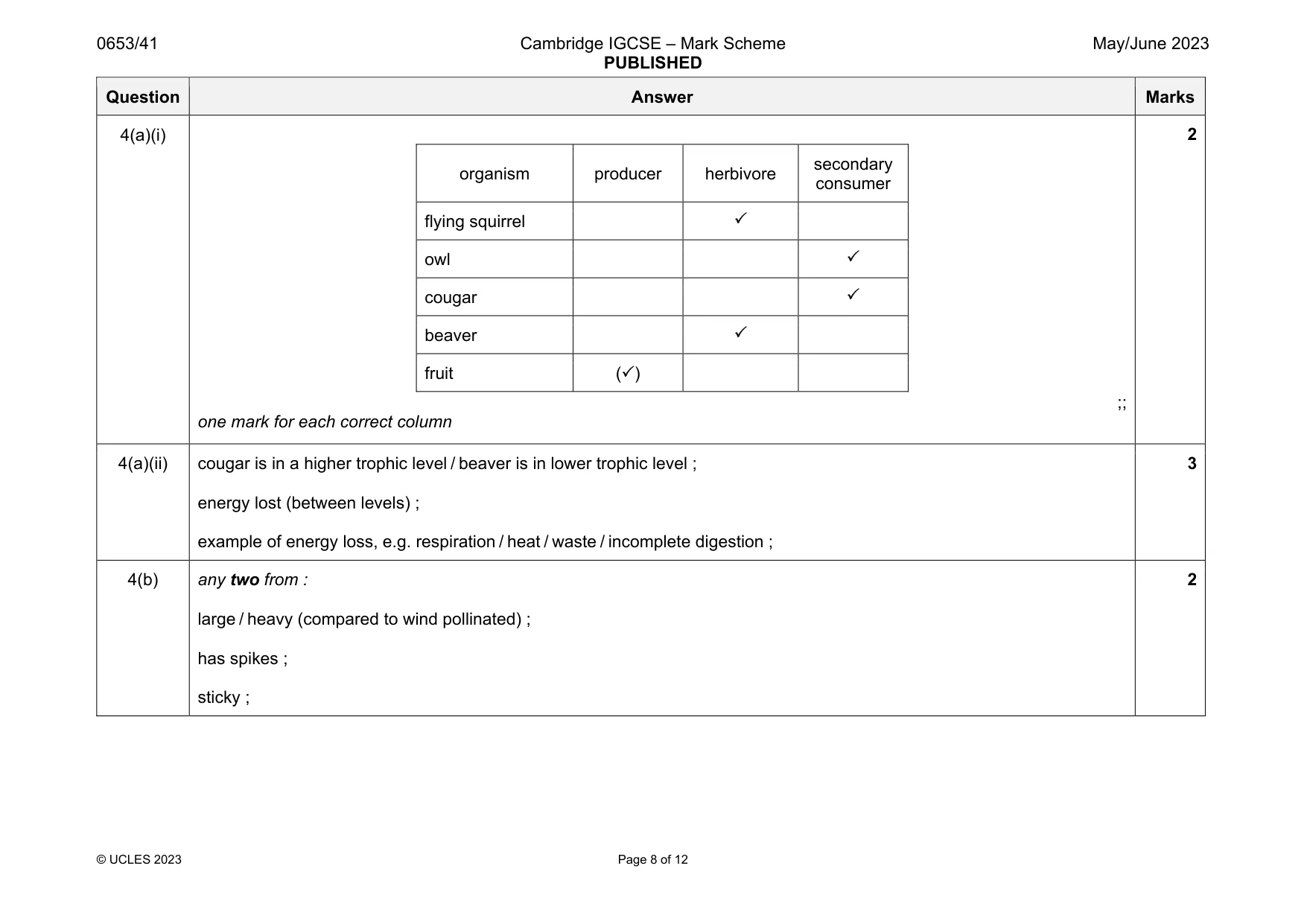
Mark scheme: 4(a)(i) organism producer herbivore secondary consumer flying squirrel owl cougar beaver fruit () ;; one mark for each correct column 4(a)(ii) cougar is in a higher trophic level / beaver is in lower trophic level ; energy lost (between levels) ; example of energy loss, e.g. respiration / heat / waste / incomplete digestion ; 3 4(b) any two from : large / heavy (compared to wind pollinated) ; has spikes ; sticky ; 2
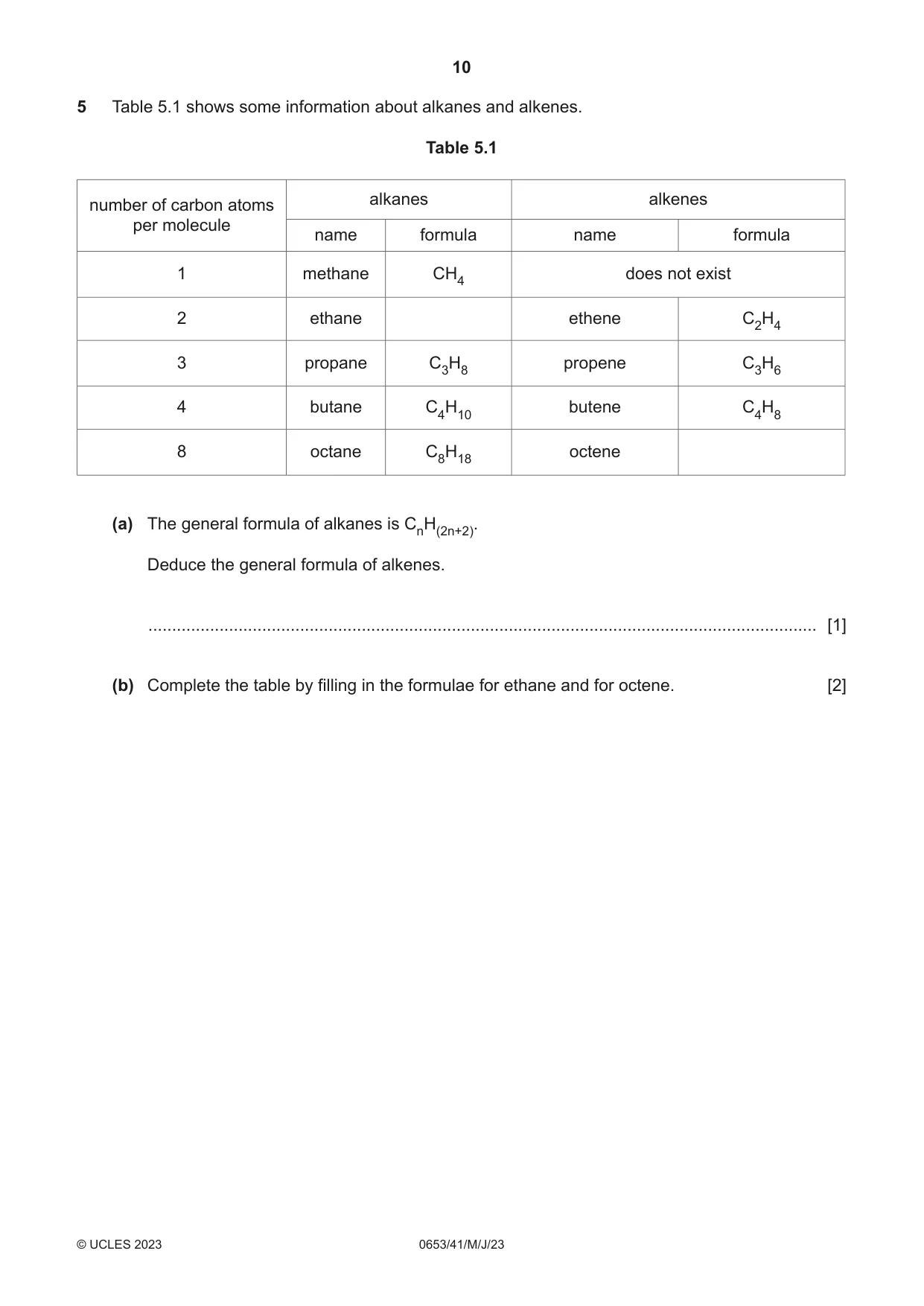
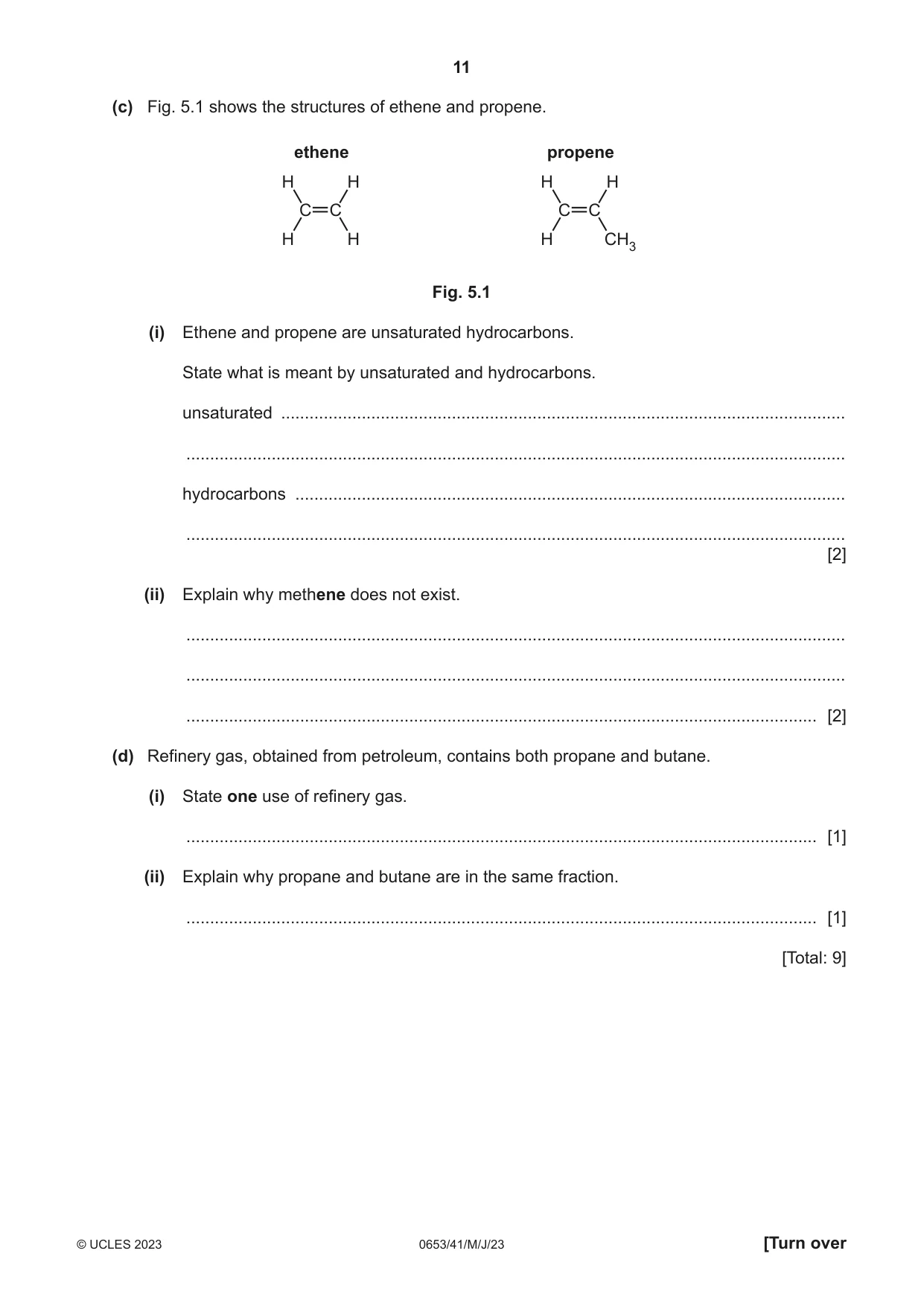
Q5 · Some information about alkanes and alkenes
5 Table 5.1 shows some information about alkanes and alkenes. Table 5.1 alkanes alkenes number of carbon atoms per molecule name formula name formula 1 methane CH4 does not exist 2 ethane ethene C2H4 3 propane C3H8 propene C3H6 4 butane C4H10 butene C4H8 8 octane C8H18 octene (a) The general formula of alkanes is CnH(2n+2). Deduce the general formula of alkenes. ............................................................................................................................................. [1] (b) Complete the table by filling in the formulae for ethane and for octene. [2] (c) Fig. 5.1 shows the structures of ethene and propene. ethene propene H H H H C C C C H H H CH3 Fig. 5.1 (i) Ethene and propene are unsaturated hydrocarbons. State what is meant by unsaturated and hydrocarbons. unsaturated ....................................................................................................................... ........................................................................................................................................... hydrocarbons .................................................................................................................... ........................................................................................................................................... [2] (ii) Explain why methene does not exist. ........................................................................................................................................... ........................................................................................................................................... ..................................................................................................................................... [2] (d) Refinery gas, obtained from petroleum, contains both propane and butane. (i) State one use of refinery gas. ..................................................................................................................................... [1] (ii) Explain why propane and butane are in the same fraction. ..................................................................................................................................... [1] [Total: 9]
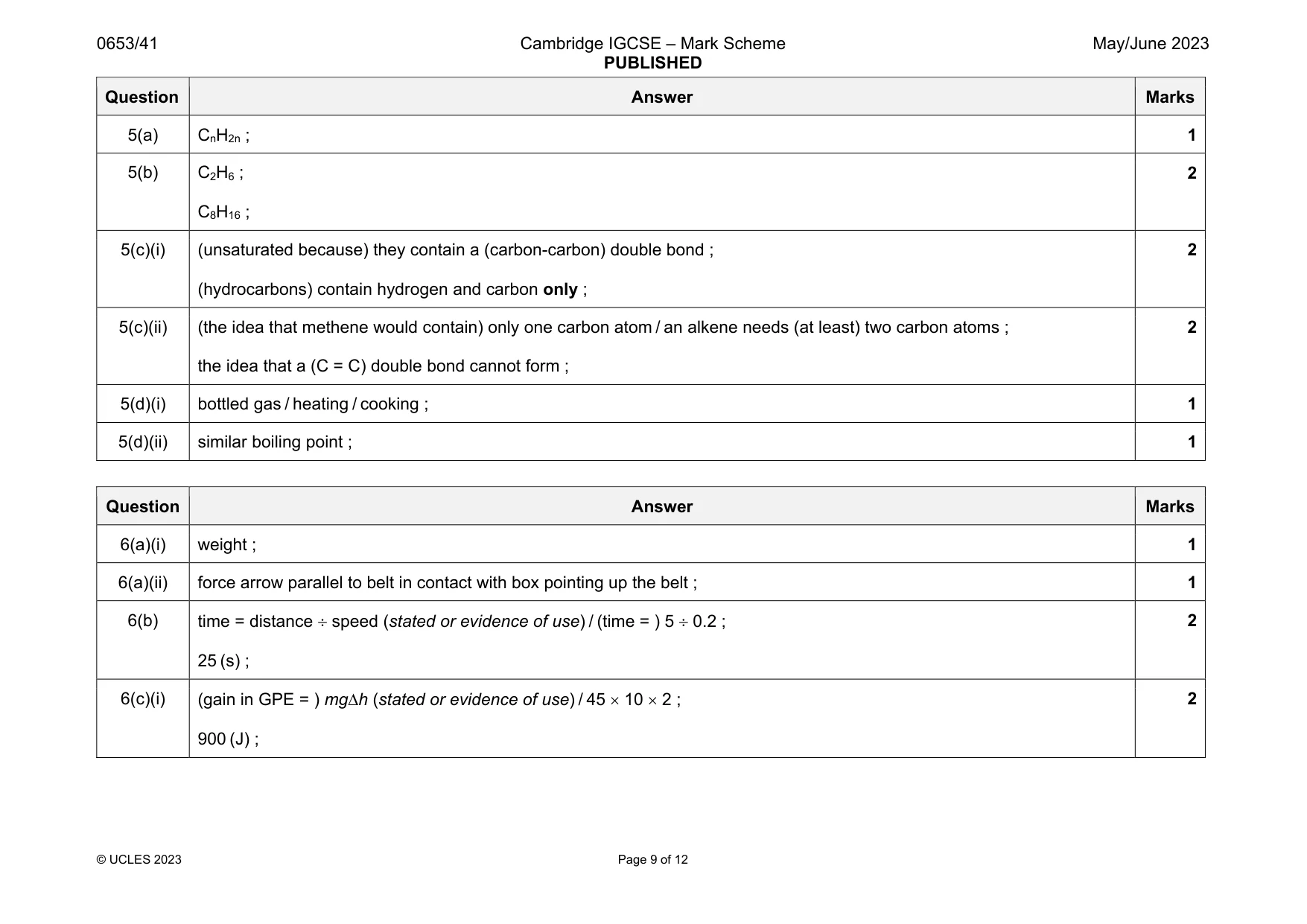
Mark scheme: 5(a) CnH2n ; 1 5(b) C2H6 ; C8H16 ; 2 5(c)(i) (unsaturated because) they contain a (carbon-carbon) double bond ; (hydrocarbons) contain hydrogen and carbon only ; 2 5(c)(ii) (the idea that methene would contain) only one carbon atom / an alkene needs (at least) two carbon atoms ; the idea that a (C = C) double bond cannot form ; 2 5(d)(i) bottled gas / heating / cooking ; 1 5(d)(ii) similar boiling point ; 1
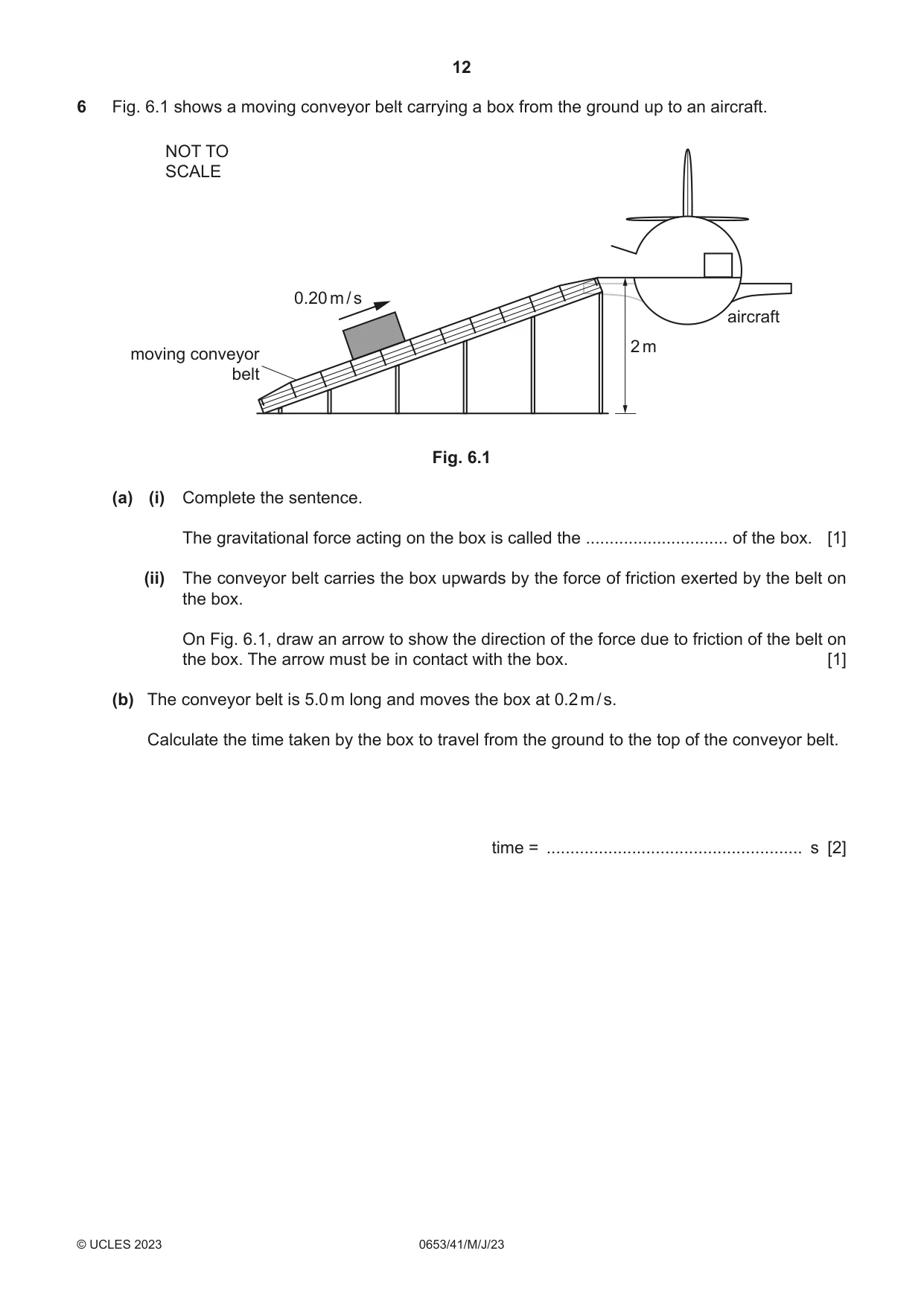
Q6 · A moving conveyor belt carrying a box from the ground up to an aircraft
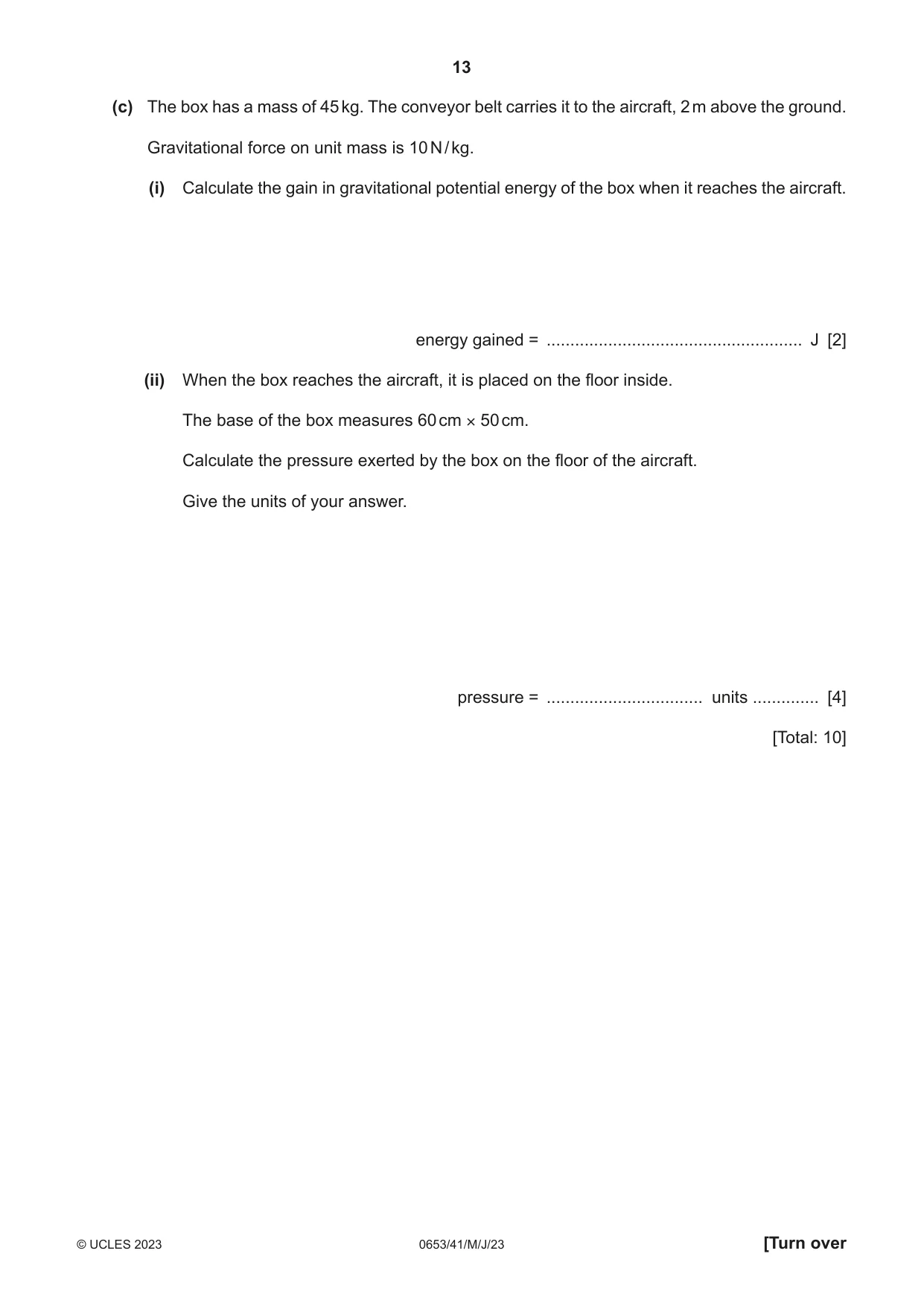
6 Fig. 6.1 shows a moving conveyor belt carrying a box from the ground up to an aircraft. NOT TO SCALE 0.20 m / s aircraft 2 m moving conveyor belt Fig. 6.1 (a) (i) Complete the sentence. The gravitational force acting on the box is called the .............................. of the box. [1] (ii) The conveyor belt carries the box upwards by the force of friction exerted by the belt on the box. On Fig. 6.1, draw an arrow to show the direction of the force due to friction of the belt on the box. The arrow must be in contact with the box. [1] (b) The conveyor belt is 5.0 m long and moves the box at 0.2 m / s. Calculate the time taken by the box to travel from the ground to the top of the conveyor belt. time = ...................................................... s [2] (c) The box has a mass of 45 kg. The conveyor belt carries it to the aircraft, 2 m above the ground. Gravitational force on unit mass is 10 N / kg. (i) Calculate the gain in gravitational potential energy of the box when it reaches the aircraft. energy gained = ...................................................... J [2] (ii) When the box reaches the aircraft, it is placed on the floor inside. The base of the box measures 60 cm × 50 cm. Calculate the pressure exerted by the box on the floor of the aircraft. Give the units of your answer. pressure = ................................. units .............. [4] [Total: 10]
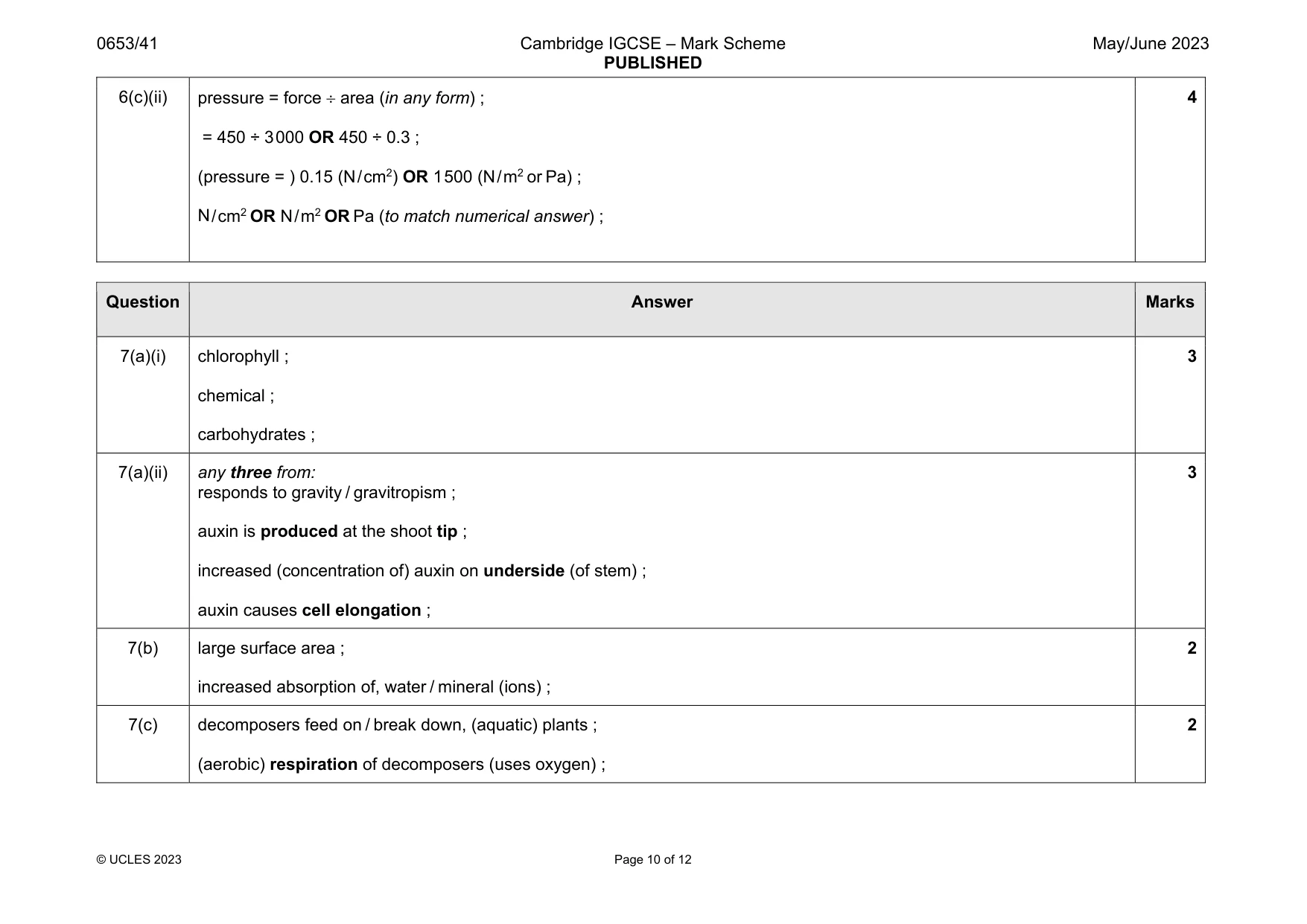
Mark scheme: 6(a)(i) weight ; 1 6(a)(ii) force arrow parallel to belt in contact with box pointing up the belt ; 1 6(b) time = distance speed (stated or evidence of use) / (time = ) 5 0.2 ; 25 (s) ; 2 6(c)(i) (gain in GPE = ) mgh (stated or evidence of use) / 45 10 2 ; 900 (J) ; 2 6(c)(ii) pressure = force area (in any form) ; = 450 ÷ 3 000 OR 450 ÷ 0.3 ; (pressure = ) 0.15 (N / cm2) OR 1 500 (N / m2 or Pa) ; N / cm2 OR N / m2 OR Pa (to match numerical answer) ; 4
Q7 · Two young potted plants are left to grow in a room with no light
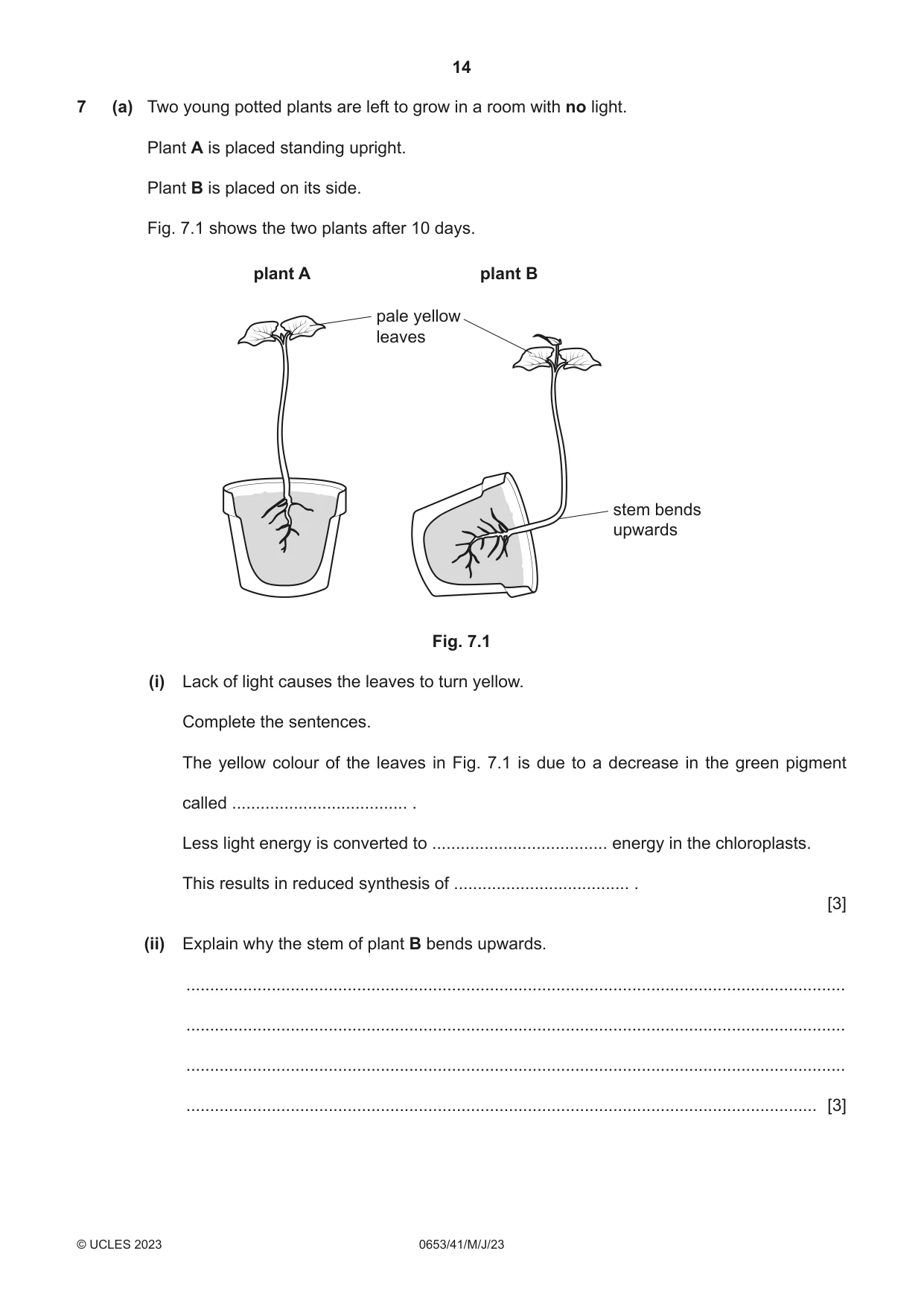
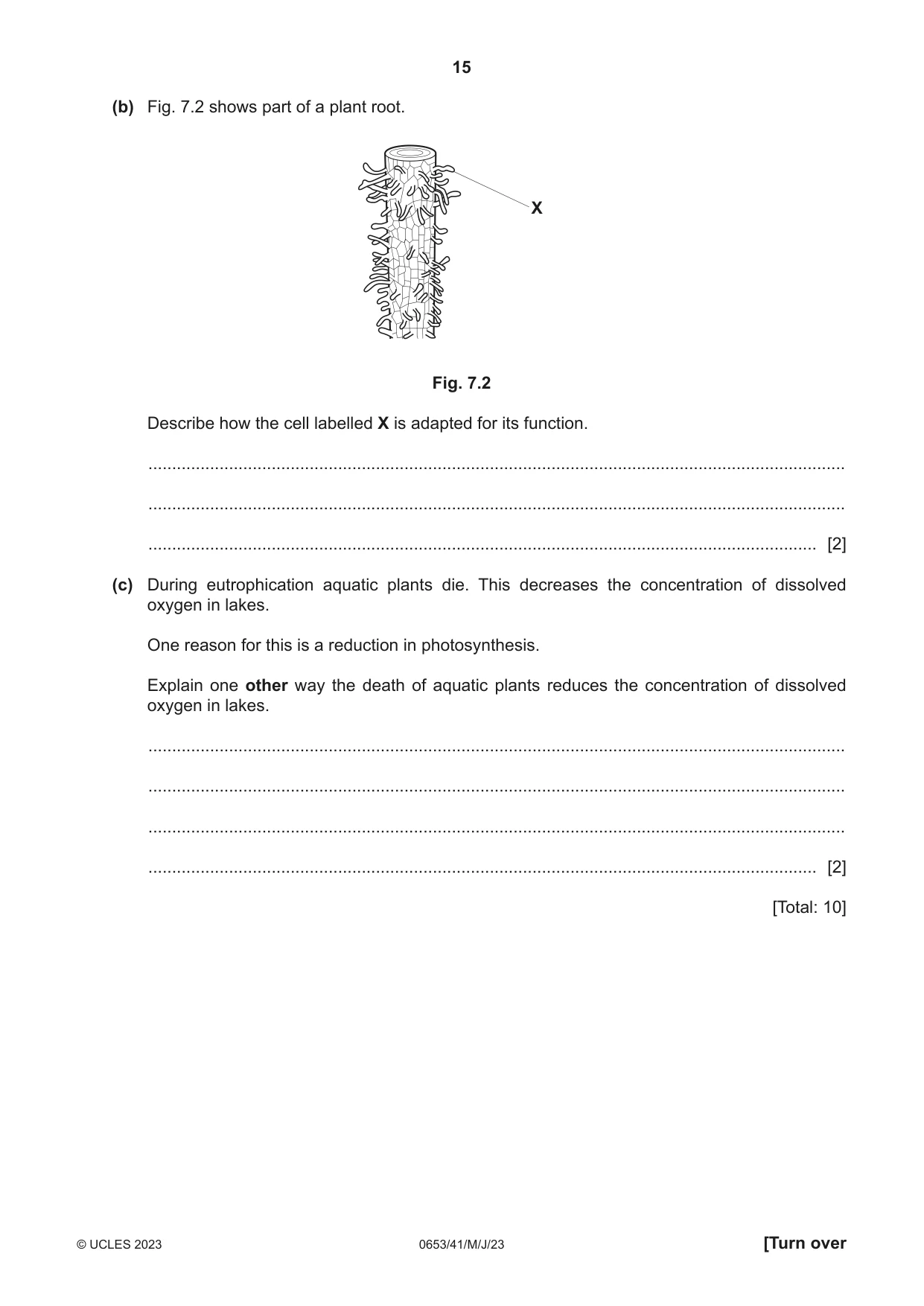
7 (a) Two young potted plants are left to grow in a room with no light. Plant A is placed standing upright. Plant B is placed on its side. Fig. 7.1 shows the two plants after 10 days. plant A plant B pale yellow leaves stem bends upwards Fig. 7.1 (i) Lack of light causes the leaves to turn yellow. Complete the sentences. The yellow colour of the leaves in Fig. 7.1 is due to a decrease in the green pigment called ..................................... . Less light energy is converted to ..................................... energy in the chloroplasts. This results in reduced synthesis of ..................................... . [3] (ii) Explain why the stem of plant B bends upwards. ........................................................................................................................................... ........................................................................................................................................... ........................................................................................................................................... ..................................................................................................................................... [3] (b) Fig. 7.2 shows part of a plant root. X Fig. 7.2 Describe how the cell labelled X is adapted for its function. ................................................................................................................................................... ................................................................................................................................................... ............................................................................................................................................. [2] (c) During eutrophication aquatic plants die. This decreases the concentration of dissolved oxygen in lakes. One reason for this is a reduction in photosynthesis. Explain one other way the death of aquatic plants reduces the concentration of dissolved oxygen in lakes. ................................................................................................................................................... ................................................................................................................................................... ................................................................................................................................................... ............................................................................................................................................. [2] [Total: 10]
Mark scheme: 7(a)(i) chlorophyll ; chemical ; carbohydrates ; 7(a)(ii) any three from: responds to gravity / gravitropism ; auxin is produced at the shoot tip ; increased (concentration of) auxin on underside (of stem) ; auxin causes cell elongation ; 3 7(b) large surface area ; increased absorption of, water / mineral (ions) ; 2 7(c) decomposers feed on / break down, (aquatic) plants ; (aerobic) respiration of decomposers (uses oxygen) ; 2
Q8 · An iron nail is placed in a test-tube, as shown in Fig
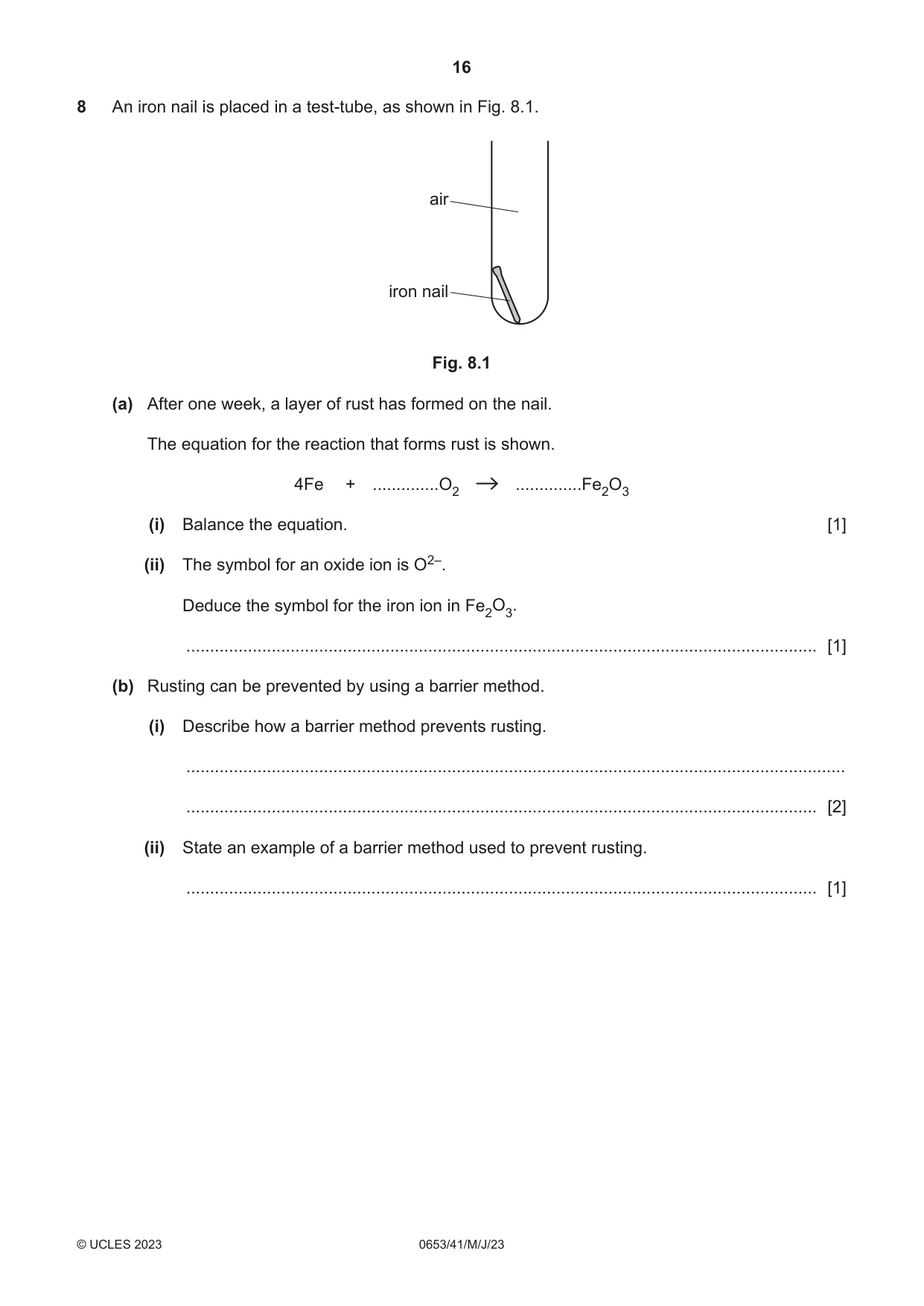
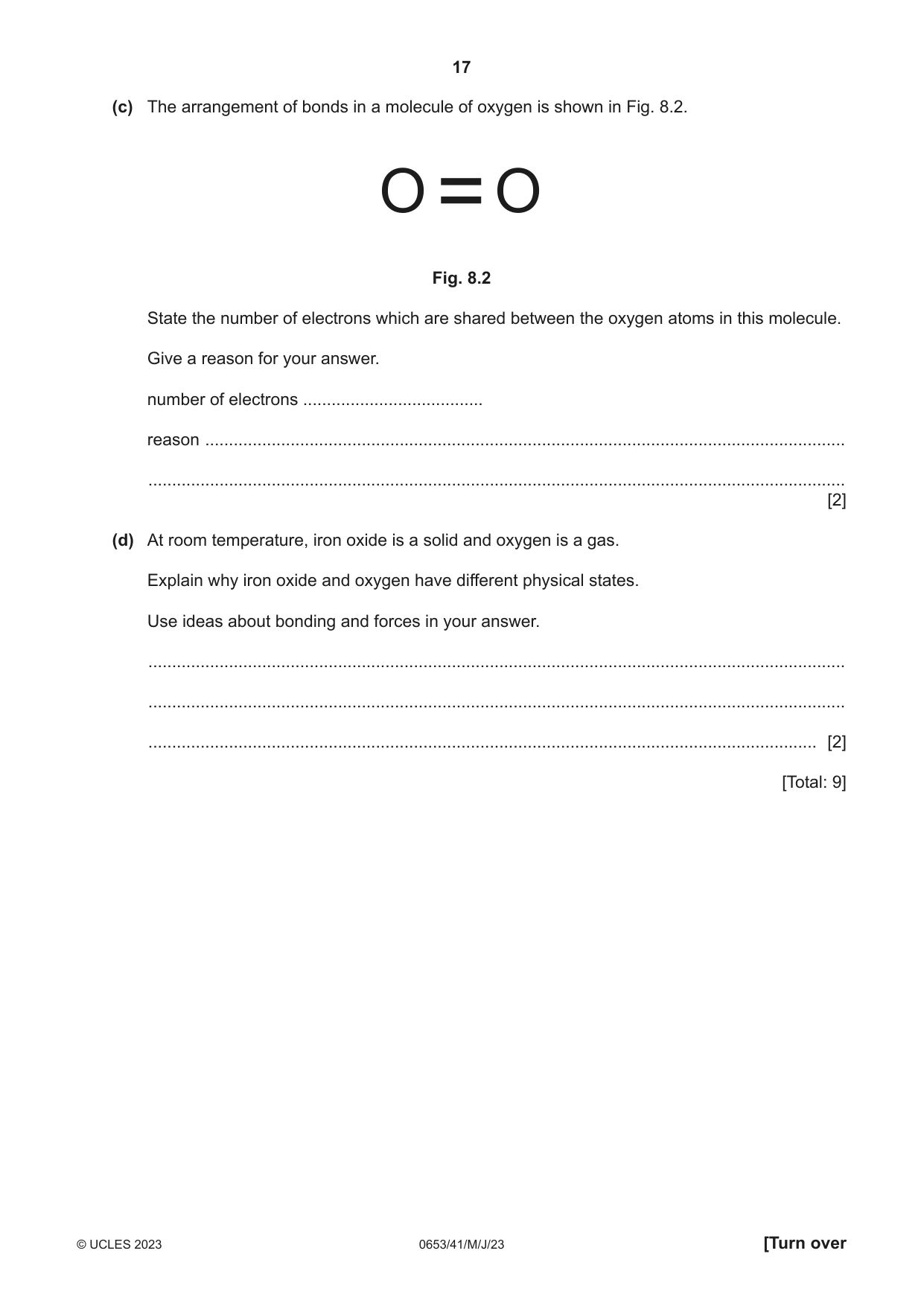
8 An iron nail is placed in a test-tube, as shown in Fig. 8.1. air iron nail Fig. 8.1 (a) After one week, a layer of rust has formed on the nail. The equation for the reaction that forms rust is shown. 4Fe + ..............O2 ..............Fe2O3 (i) Balance the equation. [1] (ii) The symbol for an oxide ion is O2–. Deduce the symbol for the iron ion in Fe2O3. ..................................................................................................................................... [1] (b) Rusting can be prevented by using a barrier method. (i) Describe how a barrier method prevents rusting. ........................................................................................................................................... ..................................................................................................................................... [2] (ii) State an example of a barrier method used to prevent rusting. ..................................................................................................................................... [1] (c) The arrangement of bonds in a molecule of oxygen is shown in Fig. 8.2. O O Fig. 8.2 State the number of electrons which are shared between the oxygen atoms in this molecule. Give a reason for your answer. number of electrons ...................................... reason ....................................................................................................................................... ................................................................................................................................................... [2] (d) At room temperature, iron oxide is a solid and oxygen is a gas. Explain why iron oxide and oxygen have different physical states. Use ideas about bonding and forces in your answer. ................................................................................................................................................... ................................................................................................................................................... ............................................................................................................................................. [2] [Total: 9]
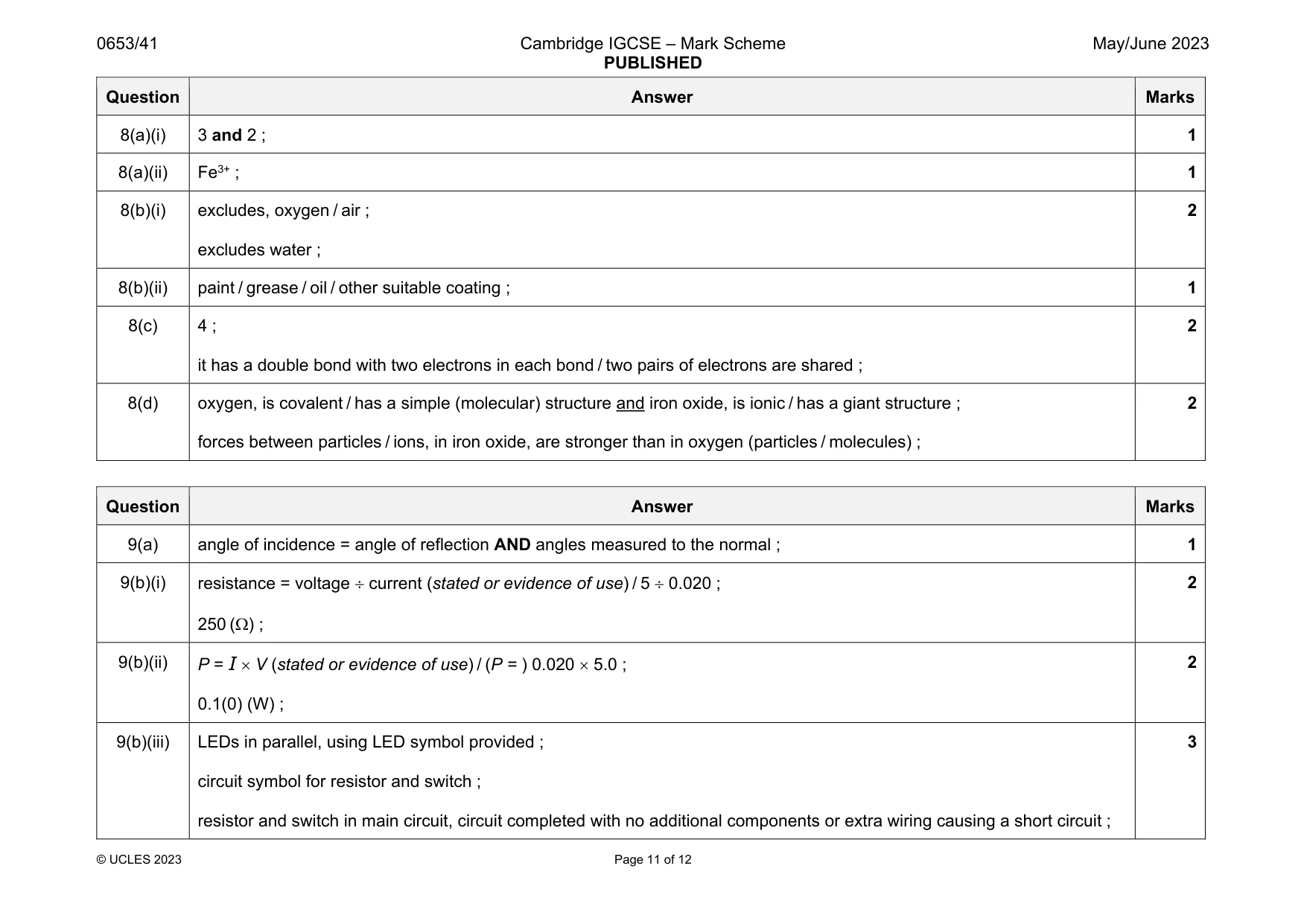
Mark scheme: 8(a)(i) 3 and 2 ; 1 8(a)(ii) Fe3+ ; 1 8(b)(i) excludes, oxygen / air ; excludes water ; 2 8(b)(ii) paint / grease / oil / other suitable coating ; 1 8(c) 4 ; it has a double bond with two electrons in each bond / two pairs of electrons are shared ; 2 8(d) oxygen, is covalent / has a simple (molecular) structure and iron oxide, is ionic / has a giant structure ; forces between particles / ions, in iron oxide, are stronger than in oxygen (particles / molecules) ; 2
Q9 · A student using a laptop computer
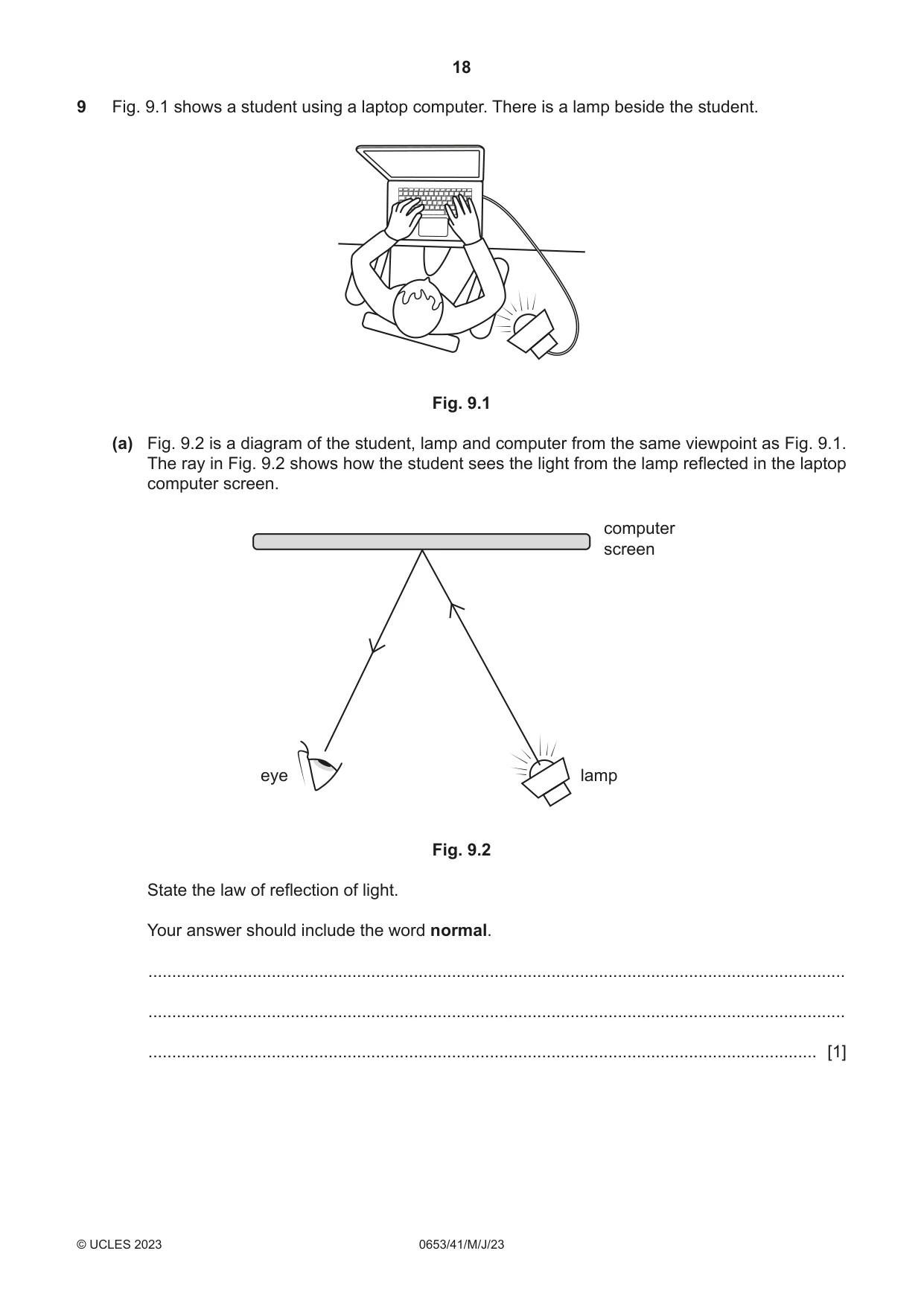
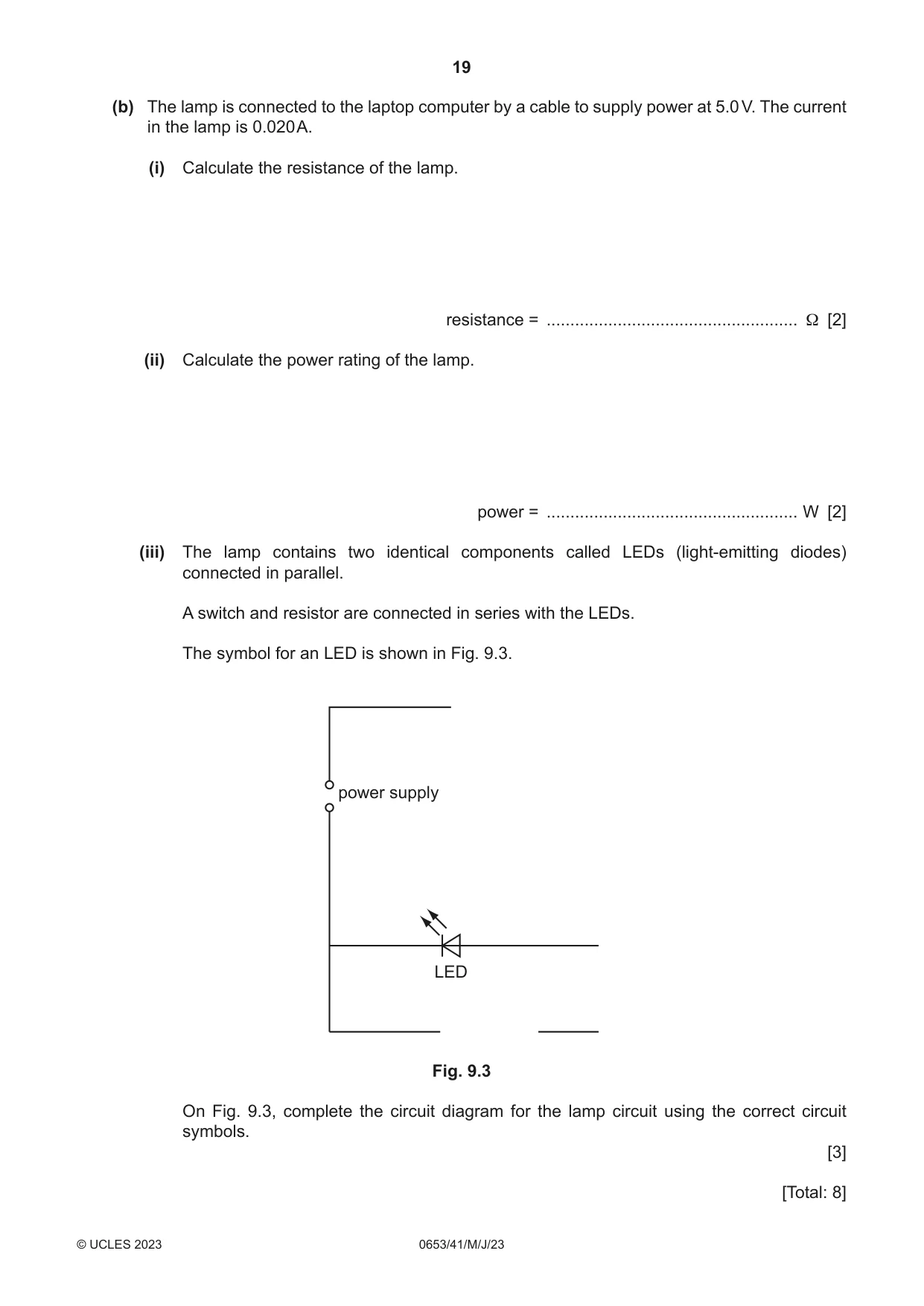
9 Fig. 9.1 shows a student using a laptop computer. There is a lamp beside the student. Fig. 9.1 (a) Fig. 9.2 is a diagram of the student, lamp and computer from the same viewpoint as Fig. 9.1. The ray in Fig. 9.2 shows how the student sees the light from the lamp reflected in the laptop computer screen. computer screen eye lamp Fig. 9.2 State the law of reflection of light. Your answer should include the word normal. ................................................................................................................................................... ................................................................................................................................................... ............................................................................................................................................. [1] (b) The lamp is connected to the laptop computer by a cable to supply power at 5.0 V. The current in the lamp is 0.020 A. (i) Calculate the resistance of the lamp. resistance = ..................................................... Ω [2] (ii) Calculate the power rating of the lamp. power = ..................................................... W [2] (iii) The lamp contains two identical components called LEDs (light-emitting diodes) connected in parallel. A switch and resistor are connected in series with the LEDs. The symbol for an LED is shown in Fig. 9.3. power supply LED Fig. 9.3 On Fig. 9.3, complete the circuit diagram for the lamp circuit using the correct circuit symbols. [3] [Total: 8]
Mark scheme: 9(a) angle of incidence = angle of reflection AND angles measured to the normal ; 1 9(b)(i) resistance = voltage current (stated or evidence of use) / 5 0.020 ; 250 () ; 2 9(b)(ii) P = I V (stated or evidence of use) / (P = ) 0.020 5.0 ; 0.1(0) (W) ; 2 9(b)(iii) LEDs in parallel, using LED symbol provided ; circuit symbol for resistor and switch ; resistor and switch in main circuit, circuit completed with no additional components or extra wiring causing a short circuit ; 3
What was in this paper
The subtopics covered by these 9 questions, and how many questions each got. Open one in a new tab to see every Cambridge question on it.
What you needed in this session
Cambridge’s own grade thresholds for 2023 May/June, Paper 4 · Variant 1. A higher threshold means an easier paper — the bar moves with how the cohort did.