Cambridge IGCSE Science - Combined 0653 — 2017 Oct/Nov Paper 4 · Variant 2
0653/42/O/N/17 · 9 questions · 80 marks · ≈90 min
The question paper and its mark scheme, free to read here and free to download. This is Cambridge’s own paper, exactly as it was sat.
Question paper24 pages


Mark scheme6 pages
Answers below. Sit the paper first if you are practising.
Questions as text
Q1 · A fetus is the name given to a developing baby in the later stages of pregnancy
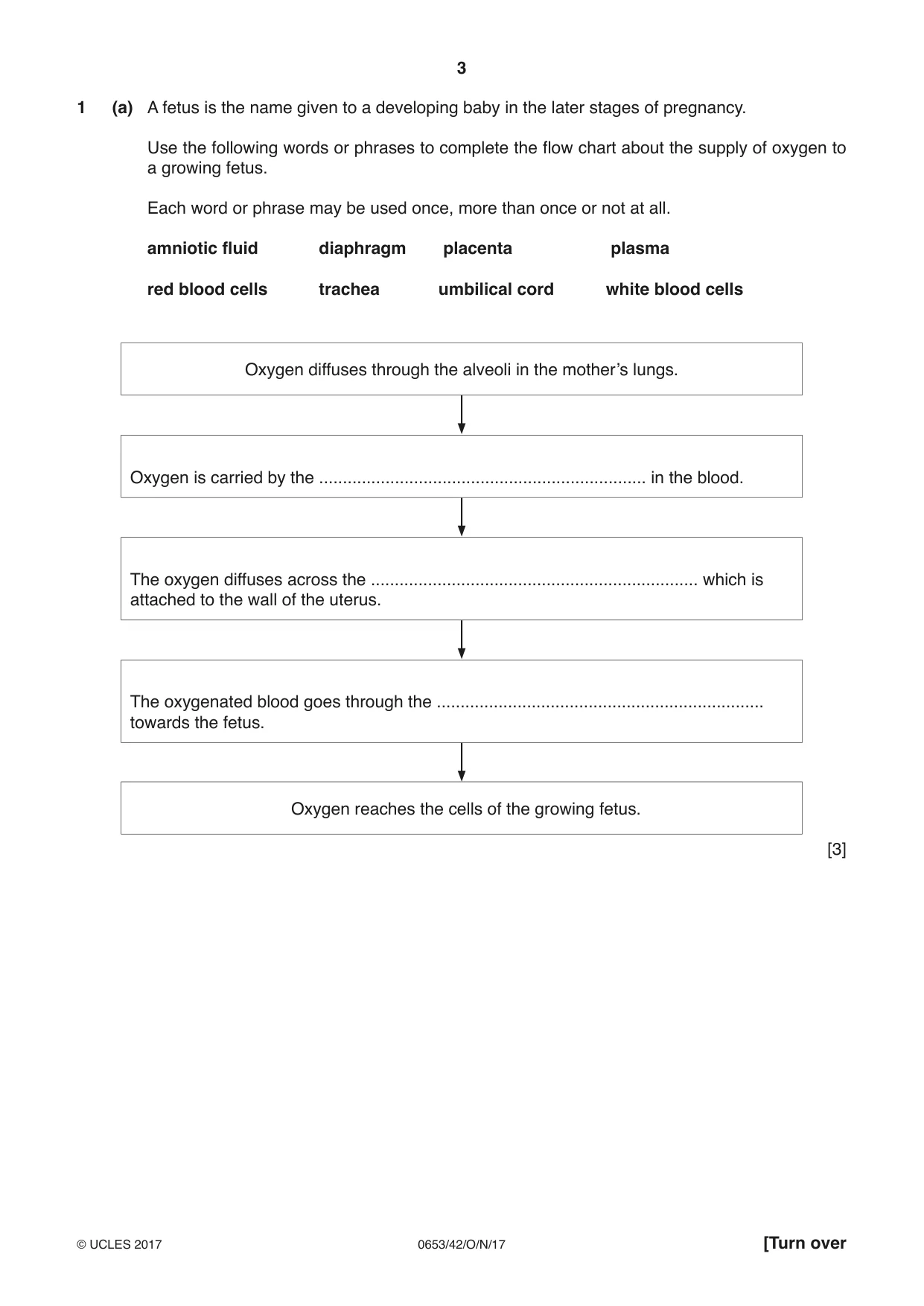
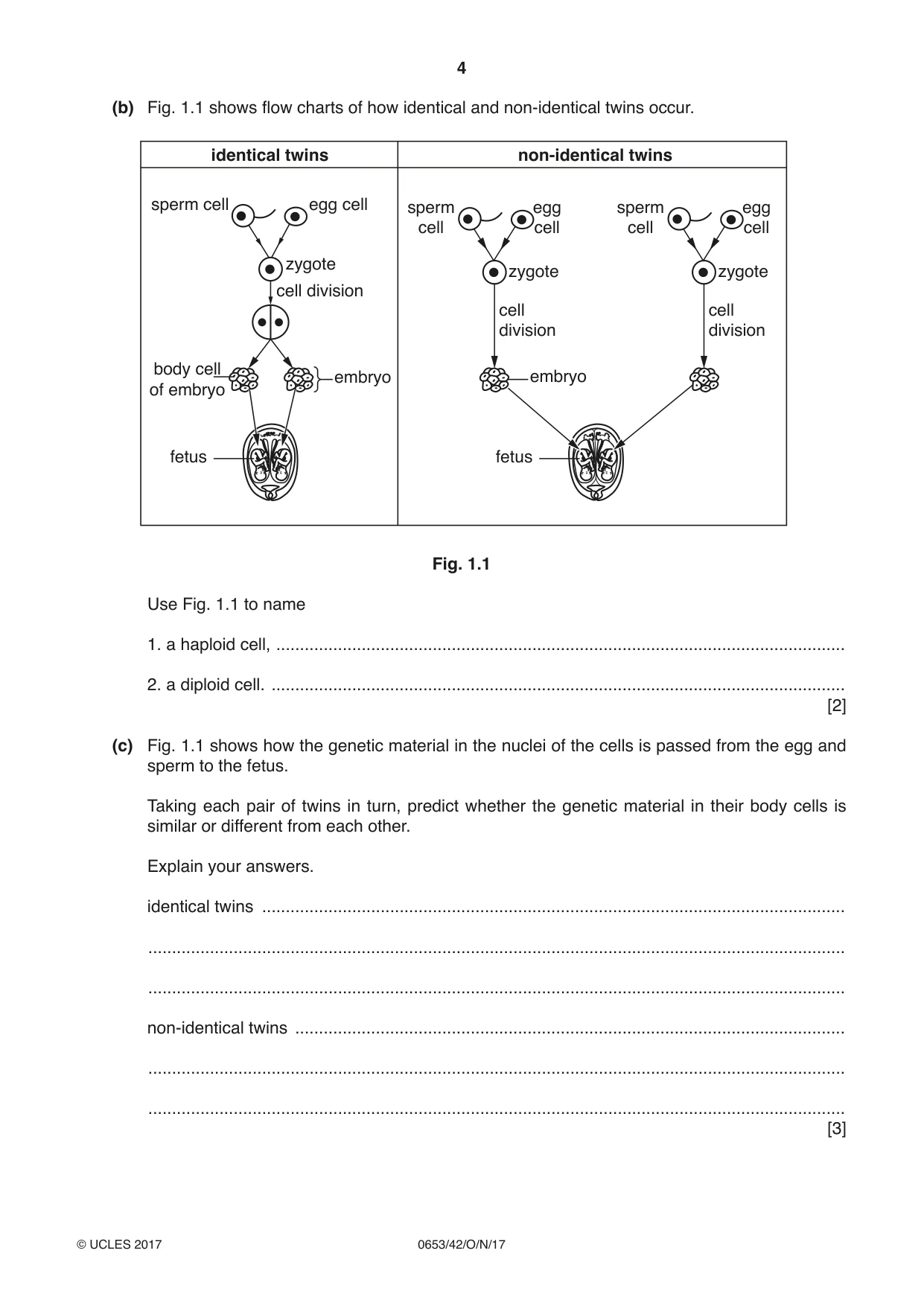
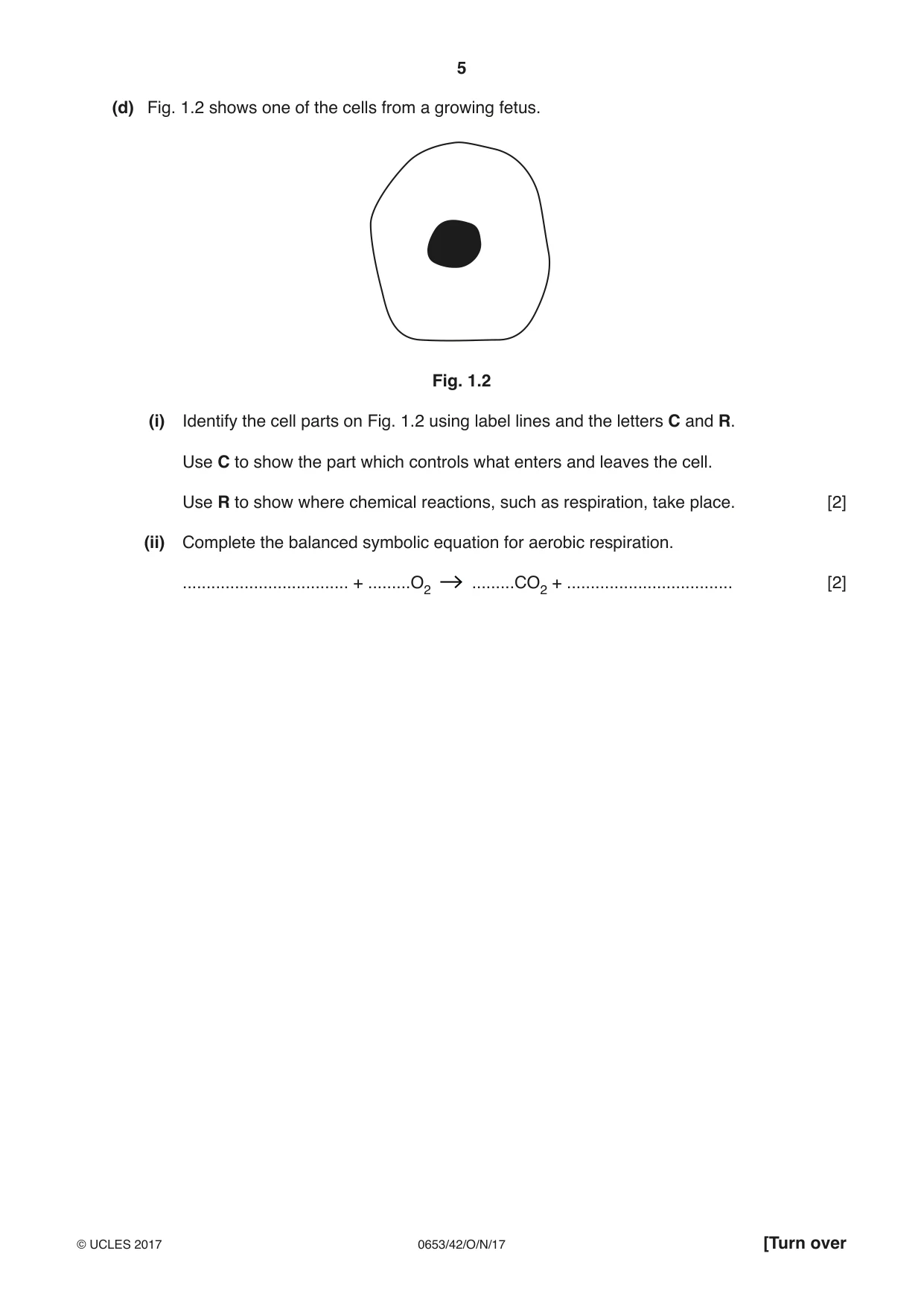
1 (a) A fetus is the name given to a developing baby in the later stages of pregnancy. Use the following words or phrases to complete the flow chart about the supply of oxygen to a growing fetus. Each word or phrase may be used once, more than once or not at all. amniotic fluid diaphragm placenta plasma red blood cells trachea umbilical cord white blood cells Oxygen diffuses through the alveoli in the mother’s lungs. Oxygen is carried by the ..................................................................... in the blood. The oxygen diffuses across the ..................................................................... which is attached to the wall of the uterus. The oxygenated blood goes through the ..................................................................... towards the fetus. Oxygen reaches the cells of the growing fetus. [3] (b) Fig. 1.1 shows flow charts of how identical and non-identical twins occur. identical twins non-identical twins sperm cell egg cell sperm egg sperm egg cell cell cell cell zygote zygote zygote cell division cell cell division division body cell embryo embryo of embryo fetus fetus Fig. 1.1 Use Fig. 1.1 to name 1. a haploid cell, ........................................................................................................................ 2. a diploid cell. ......................................................................................................................... [2] (c) Fig. 1.1 shows how the genetic material in the nuclei of the cells is passed from the egg and sperm to the fetus. Taking each pair of twins in turn, predict whether the genetic material in their body cells is similar or different from each other. Explain your answers. identical twins ........................................................................................................................... ................................................................................................................................................... ................................................................................................................................................... non-identical twins .................................................................................................................... ................................................................................................................................................... ................................................................................................................................................... [3] (d) Fig. 1.2 shows one of the cells from a growing fetus. Fig. 1.2 (i) Identify the cell parts on Fig. 1.2 using label lines and the letters C and R. Use C to show the part which controls what enters and leaves the cell. Use R to show where chemical reactions, such as respiration, take place. [2] (ii) Complete the balanced symbolic equation for aerobic respiration. ................................... + .........O2 .........CO2 + ................................... [2]
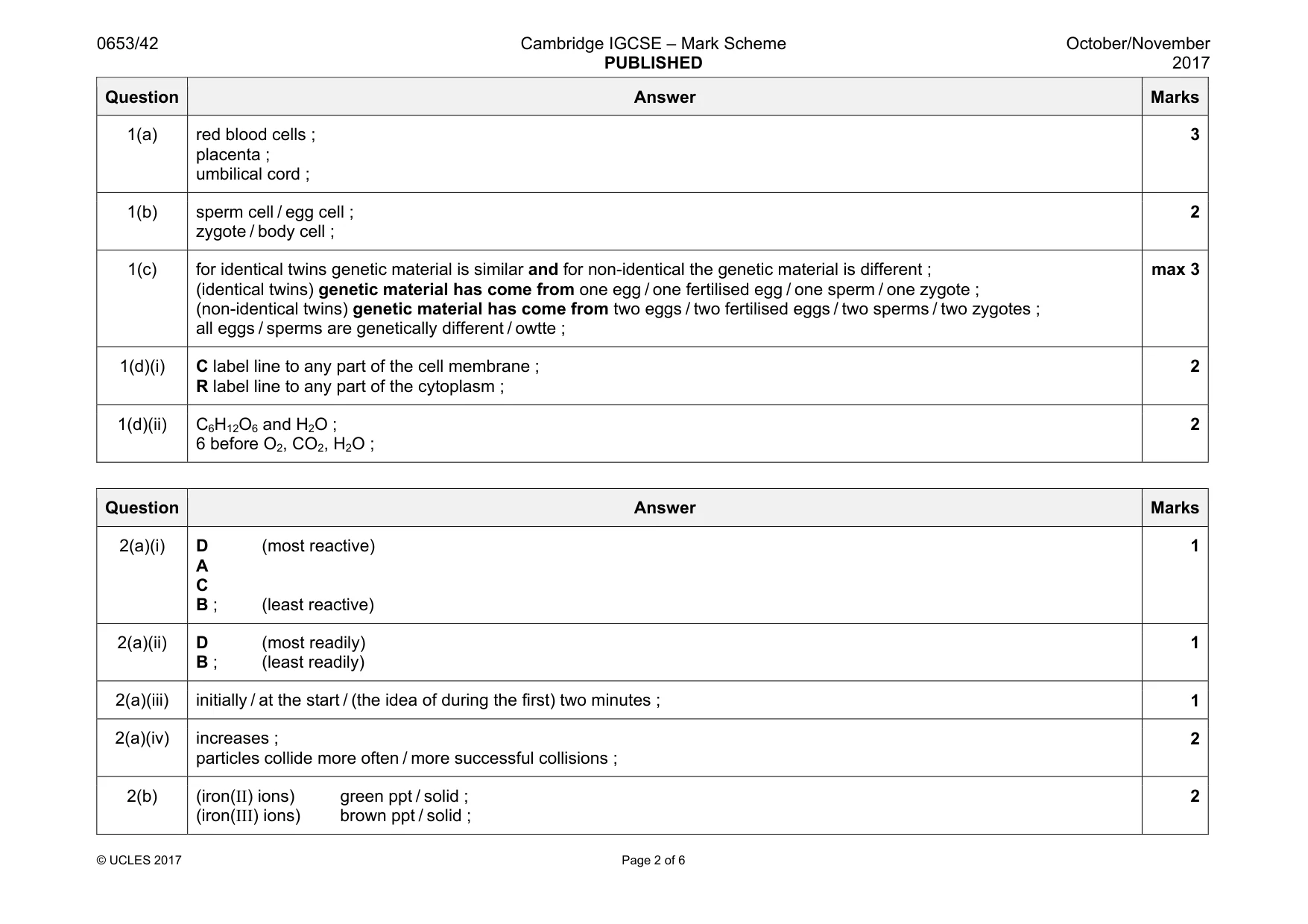
Mark scheme: 1(a) red blood cells ; placenta ; umbilical cord ; 3 1(b) sperm cell / egg cell ; zygote / body cell ; 2 1(c) for identical twins genetic material is similar and for non-identical the genetic material is different ; (identical twins) genetic material has come from one egg / one fertilised egg / one sperm / one zygote ; (non-identical twins) genetic material has come from two eggs / two fertilised eggs / two sperms / two zygotes ; all eggs / sperms are genetically different / owtte ; max 3 1(d)(i) C label line to any part of the cell membrane ; R label line to any part of the cytoplasm ; 2 1(d)(ii) C6H12O6 and H2O ; 6 before O2, CO2, H2O ; 2
Q2 · A student places identical sized pieces of four metals, A, B, C and D, into separate…
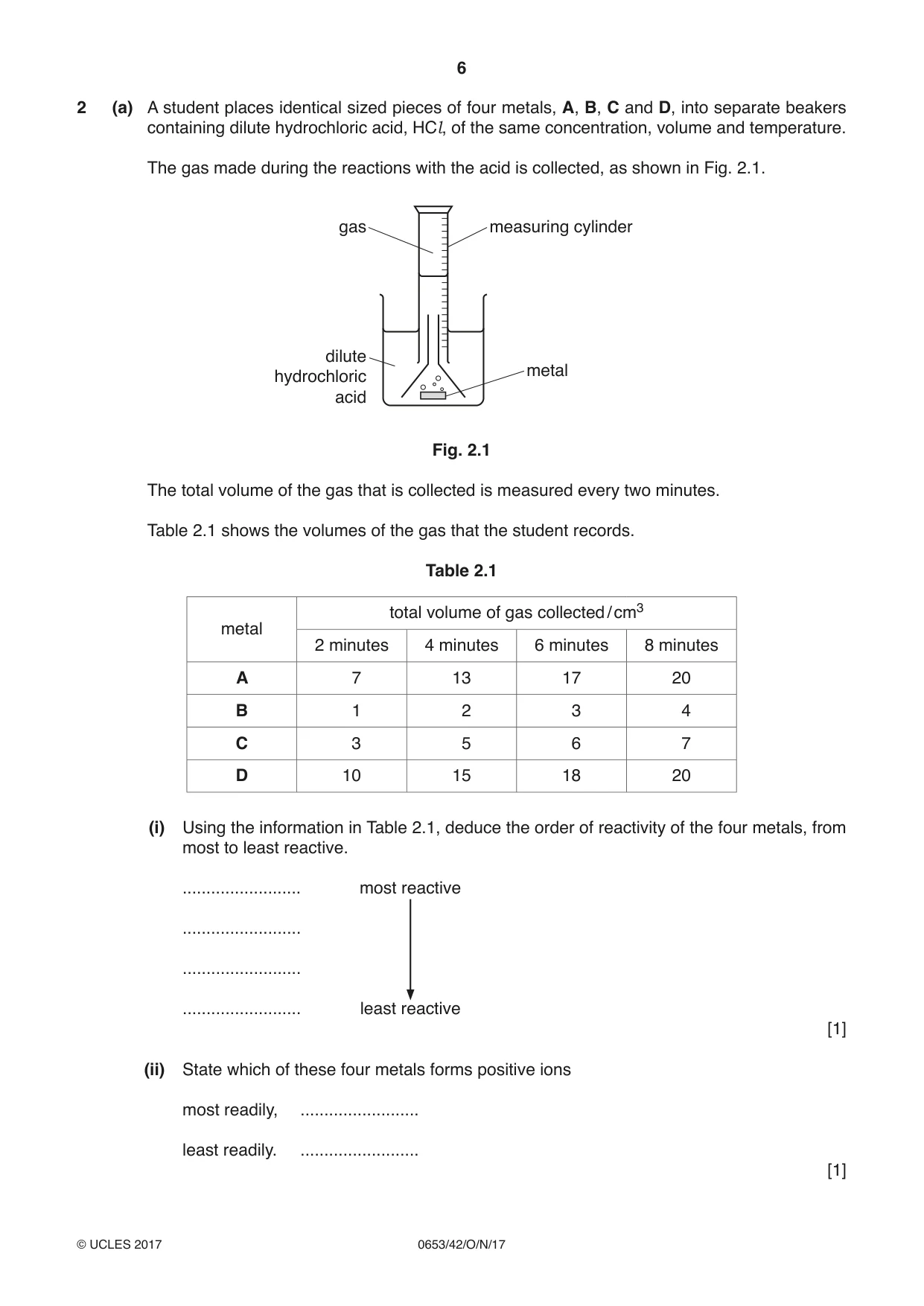
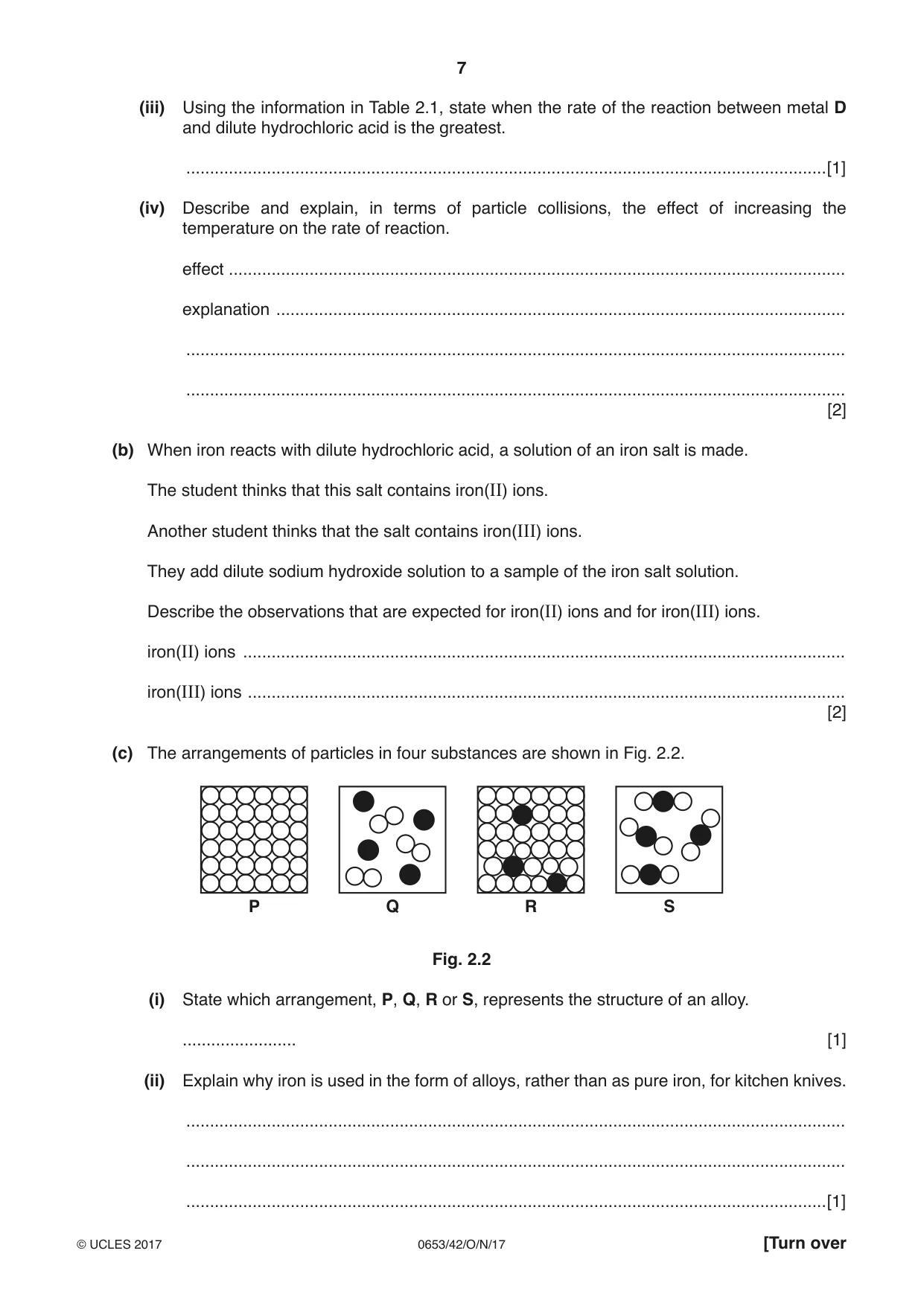
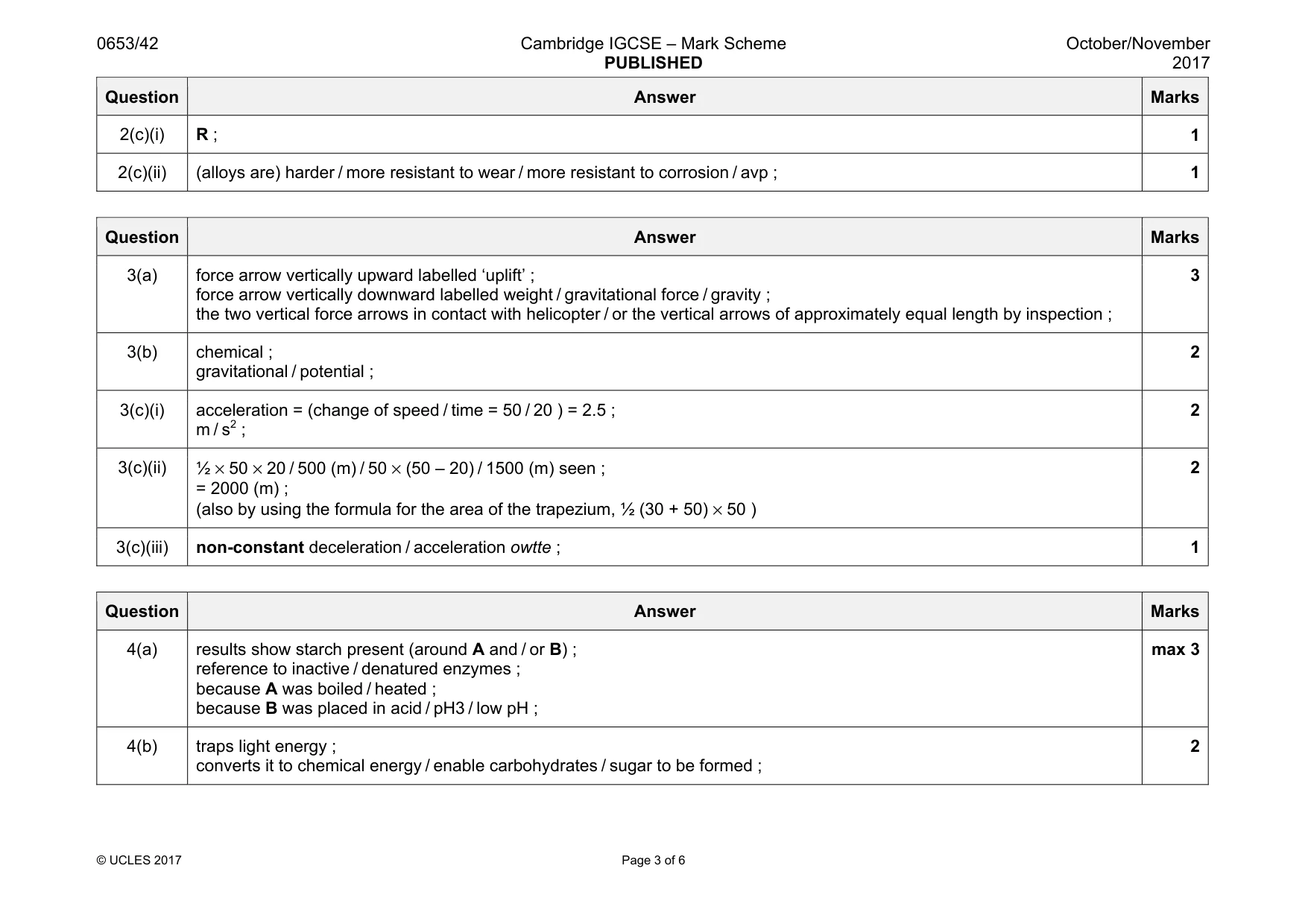
2 (a) A student places identical sized pieces of four metals, A, B, C and D, into separate beakers containing dilute hydrochloric acid, HCl, of the same concentration, volume and temperature. The gas made during the reactions with the acid is collected, as shown in Fig. 2.1. gas measuring cylinder dilute metal hydrochloric acid Fig. 2.1 The total volume of the gas that is collected is measured every two minutes. Table 2.1 shows the volumes of the gas that the student records. Table 2.1 total volume of gas collected / cm3 metal 2 minutes 4 minutes 6 minutes 8 minutes A 7 13 17 20 B 1 2 3 4 C 3 5 6 7 D 10 15 18 20 (i) Using the information in Table 2.1, deduce the order of reactivity of the four metals, from most to least reactive. ......................... most reactive ......................... ......................... ......................... least reactive [1] (ii) State which of these four metals forms positive ions most readily, ......................... least readily. ......................... [1] (iii) Using the information in Table 2.1, state when the rate of the reaction between metal D and dilute hydrochloric acid is the greatest. .......................................................................................................................................[1] (iv) Describe and explain, in terms of particle collisions, the effect of increasing the temperature on the rate of reaction. effect .................................................................................................................................. explanation ........................................................................................................................ ........................................................................................................................................... ........................................................................................................................................... [2] (b) When iron reacts with dilute hydrochloric acid, a solution of an iron salt is made. The student thinks that this salt contains iron(II) ions. Another student thinks that the salt contains iron(III) ions. They add dilute sodium hydroxide solution to a sample of the iron salt solution. Describe the observations that are expected for iron(II) ions and for iron(III) ions. iron(II) ions ............................................................................................................................... iron(III) ions .............................................................................................................................. [2] (c) The arrangements of particles in four substances are shown in Fig. 2.2. P Q R S Fig. 2.2 (i) State which arrangement, P, Q, R or S, represents the structure of an alloy. ........................ [1] (ii) Explain why iron is used in the form of alloys, rather than as pure iron, for kitchen knives. ........................................................................................................................................... ........................................................................................................................................... .......................................................................................................................................[1]
Mark scheme: 2(a)(i) D (most reactive) A C B ; (least reactive) 1 2(a)(ii) D (most readily) B ; (least readily) 1 2(a)(iii) initially / at the start / (the idea of during the first) two minutes ; 1 2(a)(iv) increases ; particles collide more often / more successful collisions ; 2 2(b) (iron(II) ions) green ppt / solid ; (iron(III) ions) brown ppt / solid ; 2 Question Answer Marks 2(c)(i) R ; 1 2(c)(ii) (alloys are) harder / more resistant to wear / more resistant to corrosion / avp ; 1
Q3 · A helicopter hovering above the ground
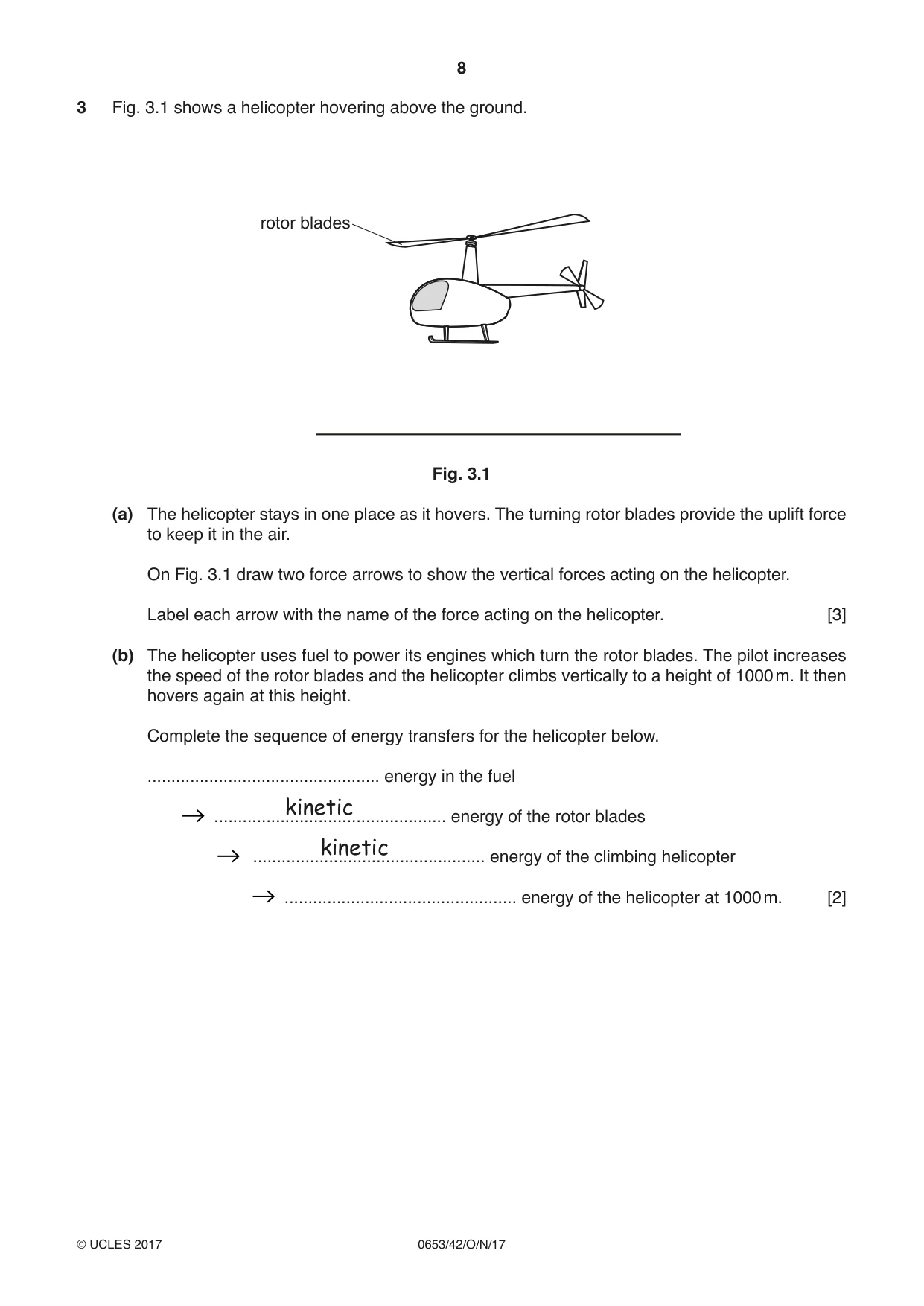
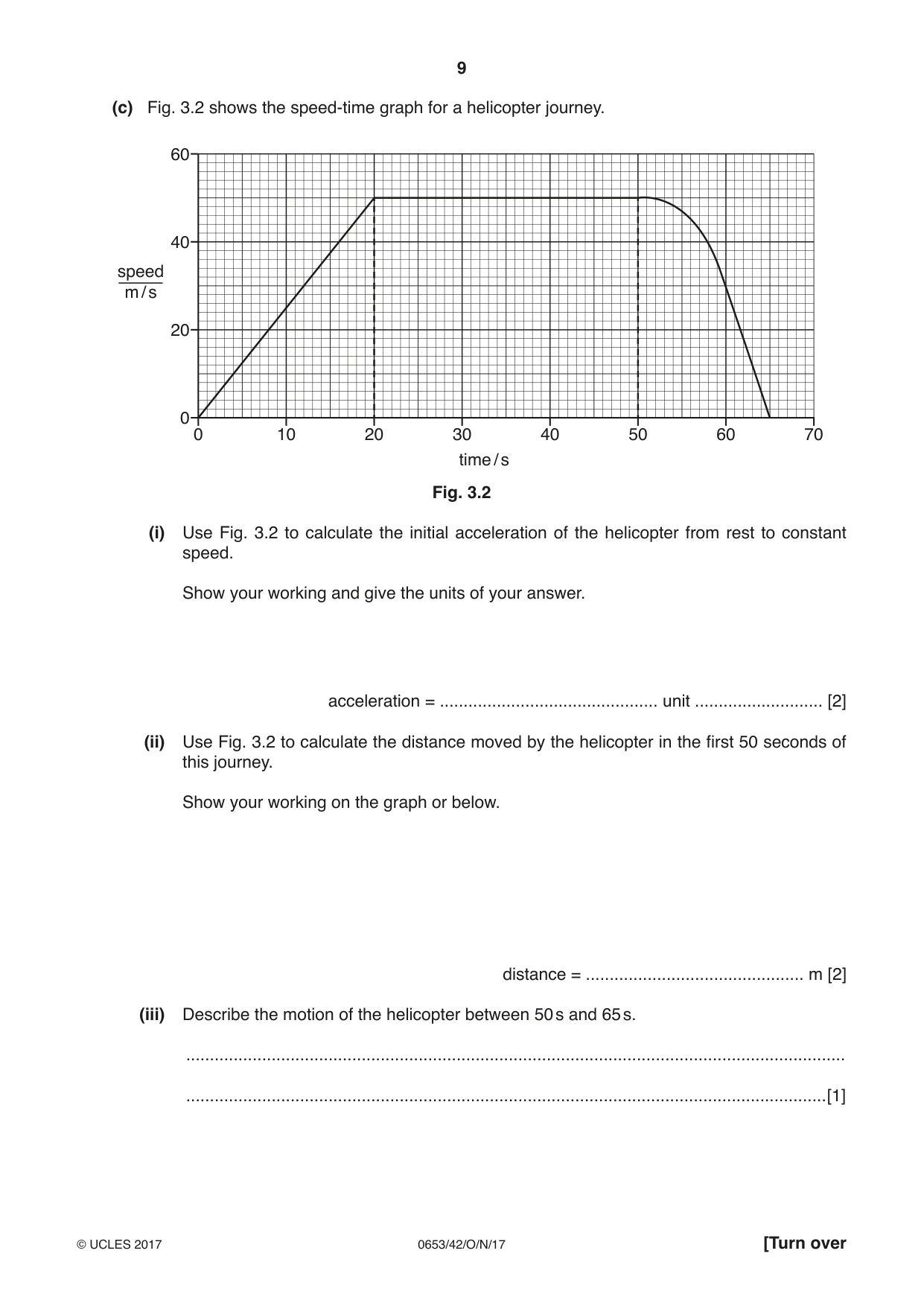
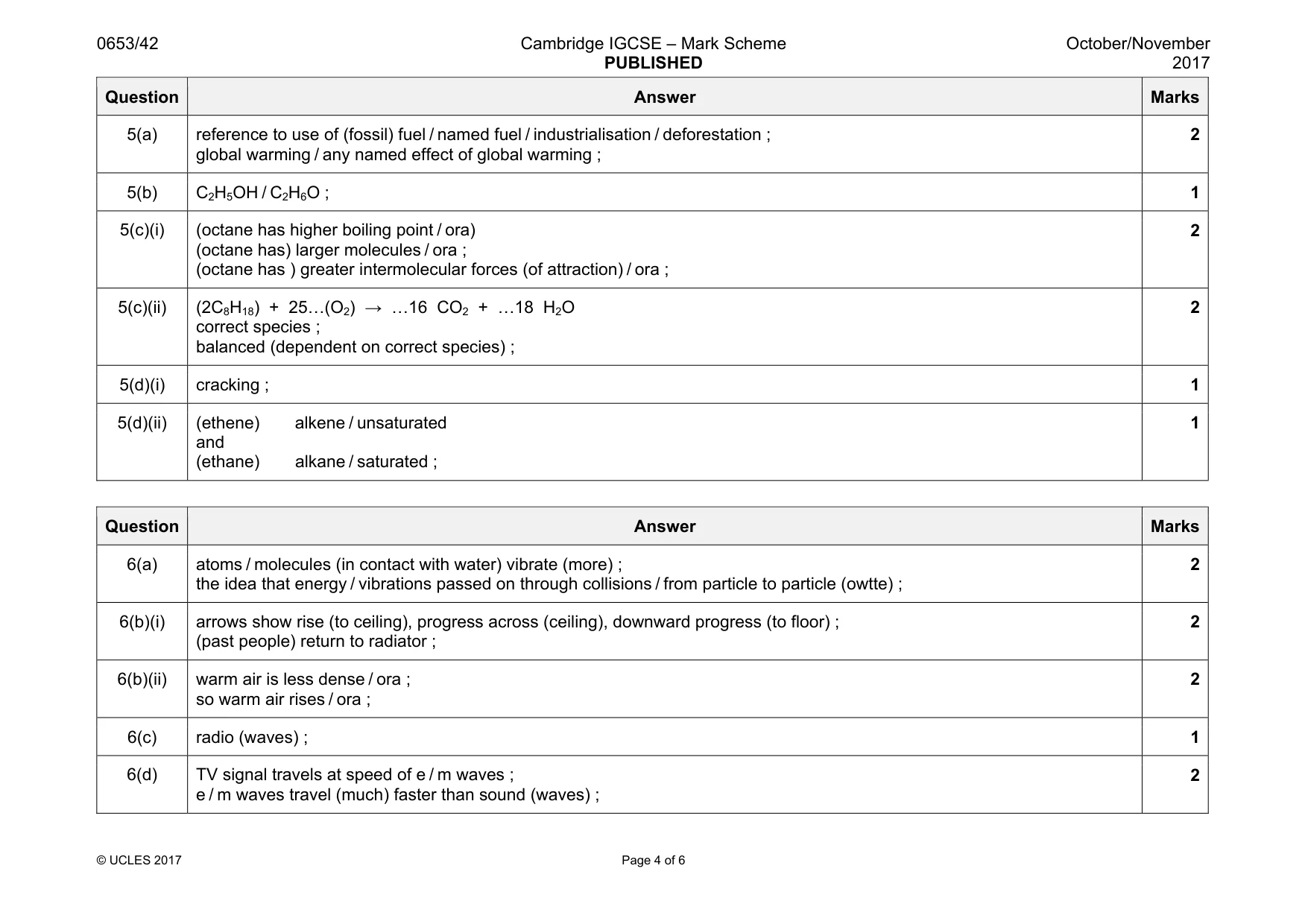
3 Fig. 3.1 shows a helicopter hovering above the ground. rotor blades Fig. 3.1 (a) The helicopter stays in one place as it hovers. The turning rotor blades provide the uplift force to keep it in the air. On Fig. 3.1 draw two force arrows to show the vertical forces acting on the helicopter. Label each arrow with the name of the force acting on the helicopter. [3] (b) The helicopter uses fuel to power its engines which turn the rotor blades. The pilot increases the speed of the rotor blades and the helicopter climbs vertically to a height of 1000 m. It then hovers again at this height. Complete the sequence of energy transfers for the helicopter below. ................................................. energy in the fuel kinetic ................................................. energy of the rotor blades kinetic ................................................. energy of the climbing helicopter ................................................. energy of the helicopter at 1000 m. [2] (c) Fig. 3.2 shows the speed-time graph for a helicopter journey. 60 40 speed m / s 20 0 0 10 20 30 40 50 60 70 time / s Fig. 3.2 (i) Use Fig. 3.2 to calculate the initial acceleration of the helicopter from rest to constant speed. Show your working and give the units of your answer. acceleration = .............................................. unit ........................... [2] (ii) Use Fig. 3.2 to calculate the distance moved by the helicopter in the first 50 seconds of this journey. Show your working on the graph or below. distance = .............................................. m [2] (iii) Describe the motion of the helicopter between 50 s and 65 s. ........................................................................................................................................... .......................................................................................................................................[1]
Mark scheme: 3(a) force arrow vertically upward labelled ‘uplift’ ; force arrow vertically downward labelled weight / gravitational force / gravity ; the two vertical force arrows in contact with helicopter / or the vertical arrows of approximately equal length by inspection ; 3 3(b) chemical ; gravitational / potential ; 2 3(c)(i) acceleration = (change of speed / time = 50 / 20 ) = 2.5 ; m / s2 ; 2 3(c)(ii) ½ × 50 × 20 / 500 (m) / 50 × (50 – 20) / 1500 (m) seen ; = 2000 (m) ; (also by using the formula for the area of the trapezium, ½ (30 + 50) × 50 ) 2 3(c)(iii) non-constant deceleration / acceleration owtte ; 1
Q4 · A student does an experiment to investigate the germination of barley seeds
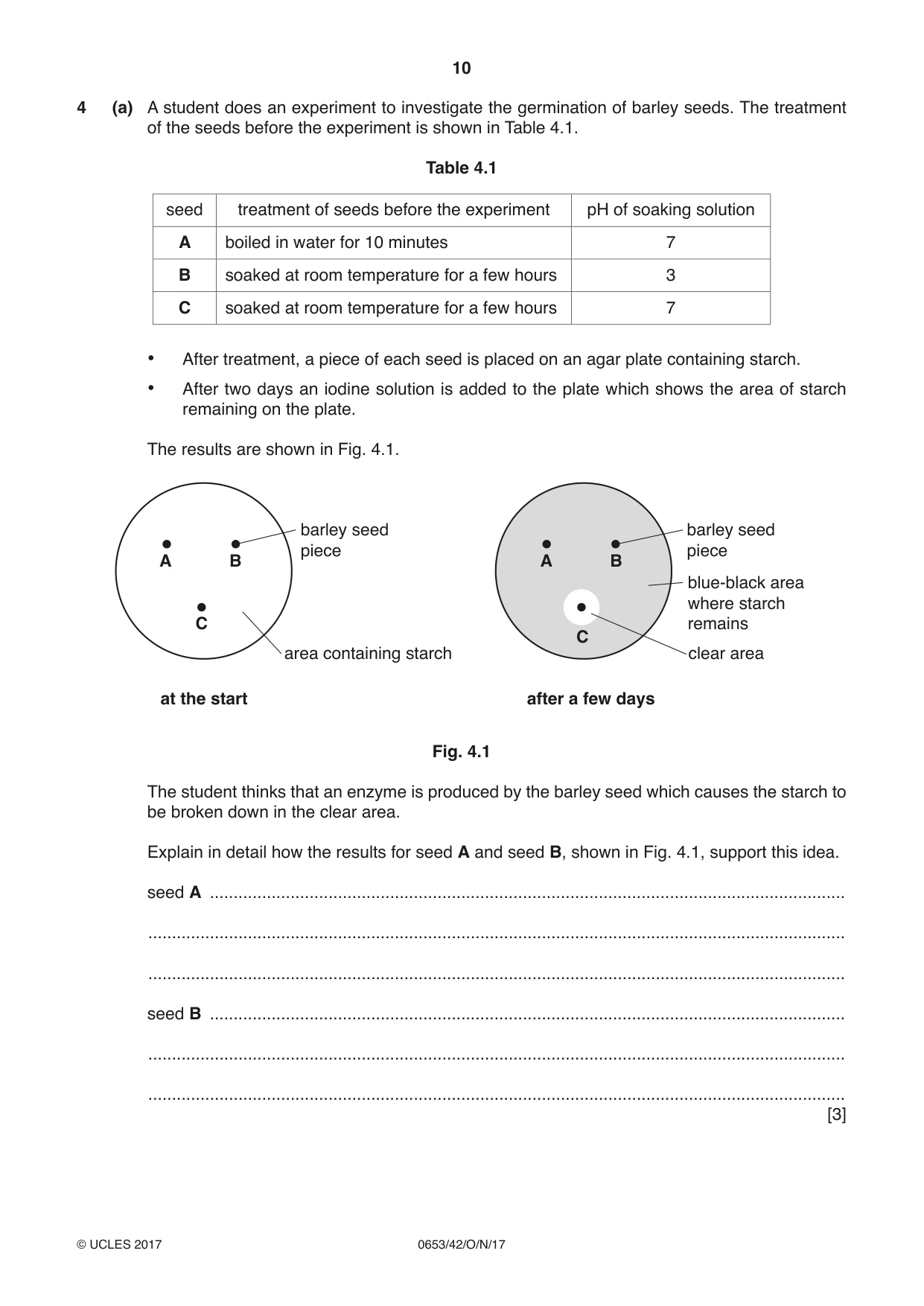
4 (a) A student does an experiment to investigate the germination of barley seeds. The treatment of the seeds before the experiment is shown in Table 4.1. Table 4.1 seed treatment of seeds before the experiment pH of soaking solution A boiled in water for 10 minutes 7 B soaked at room temperature for a few hours 3 C soaked at room temperature for a few hours 7 • After treatment, a piece of each seed is placed on an agar plate containing starch. • After two days an iodine solution is added to the plate which shows the area of starch remaining on the plate. The results are shown in Fig. 4.1. barley seed barley seed piece piece A B A B blue-black area where starch C remains C area containing starch clear area at the start after a few days Fig. 4.1 The student thinks that an enzyme is produced by the barley seed which causes the starch to be broken down in the clear area. Explain in detail how the results for seed A and seed B, shown in Fig. 4.1, support this idea. seed A ...................................................................................................................................... ................................................................................................................................................... ................................................................................................................................................... seed B ...................................................................................................................................... ................................................................................................................................................... ................................................................................................................................................... [3] (b) Germinating seeds use their store of energy until the young seedlings have chlorophyll in their leaves. Chlorophyll is needed for photosynthesis. Describe the role of chlorophyll in photosynthesis. ................................................................................................................................................... ................................................................................................................................................... ...............................................................................................................................................[2]
Mark scheme: 4(a) results show starch present (around A and / or B) ; reference to inactive / denatured enzymes ; because A was boiled / heated ; because B was placed in acid / pH3 / low pH ; max 3 4(b) traps light energy ; converts it to chemical energy / enable carbohydrates / sugar to be formed ; 2
Q5 · Explain why the proportion of carbon dioxide in the air is increasing
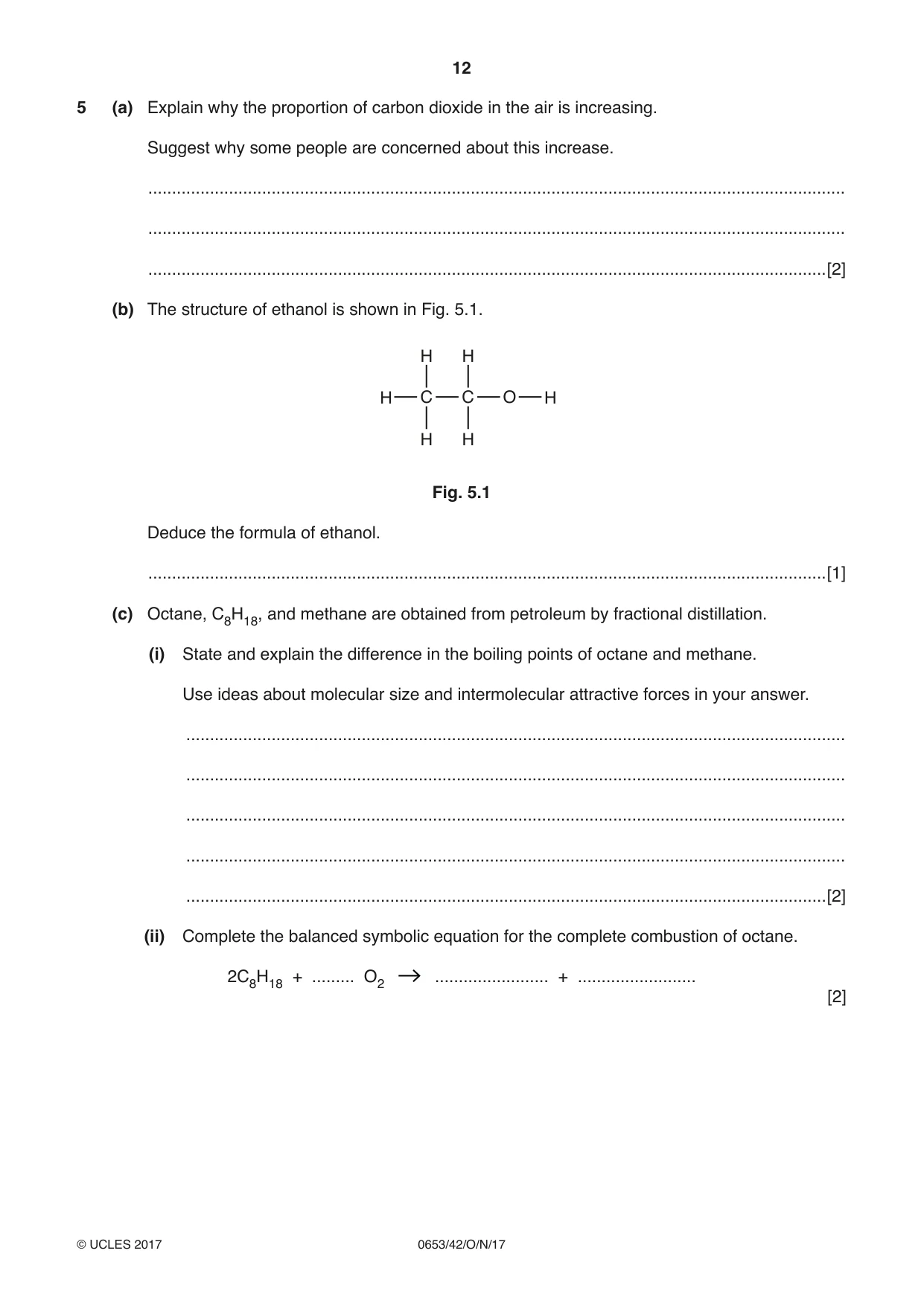
5 (a) Explain why the proportion of carbon dioxide in the air is increasing. Suggest why some people are concerned about this increase. ................................................................................................................................................... ................................................................................................................................................... ...............................................................................................................................................[2] (b) The structure of ethanol is shown in Fig. 5.1. H H H C C O H H H Fig. 5.1 Deduce the formula of ethanol. ...............................................................................................................................................[1] (c) Octane, C8H18, and methane are obtained from petroleum by fractional distillation. (i) State and explain the difference in the boiling points of octane and methane. Use ideas about molecular size and intermolecular attractive forces in your answer. ........................................................................................................................................... ........................................................................................................................................... ........................................................................................................................................... ........................................................................................................................................... .......................................................................................................................................[2] (ii) Complete the balanced symbolic equation for the complete combustion of octane. 2C8H18 + ......... O2 ........................ + ......................... [2] (d) Ethene is manufactured by breaking down larger hydrocarbon molecules obtained from the fractional distillation of petroleum. (i) Name this process. .......................................................................................................................................[1] (ii) Ethene and ethane are two different types of hydrocarbon. Name these two different types of hydrocarbon. ethene ............................................................................................................................... ethane ............................................................................................................................... [1]
Mark scheme: 5(a) reference to use of (fossil) fuel / named fuel / industrialisation / deforestation ; global warming / any named effect of global warming ; 2 5(b) C2H5OH / C2H6O ; 1 5(c)(i) (octane has higher boiling point / ora) (octane has) larger molecules / ora ; (octane has ) greater intermolecular forces (of attraction) / ora ; 2 5(c)(ii) (2C8H18) + 25«(O2) → «16 CO2 + «18 H2O correct species ; balanced (dependent on correct species) ; 2 5(d)(i) cracking ; 1 5(d)(ii) (ethene) alkene / unsaturated and (ethane) alkane / saturated ; 1
Q6 · A radiator which uses hot water to provide heating for people sitting in a room watching…
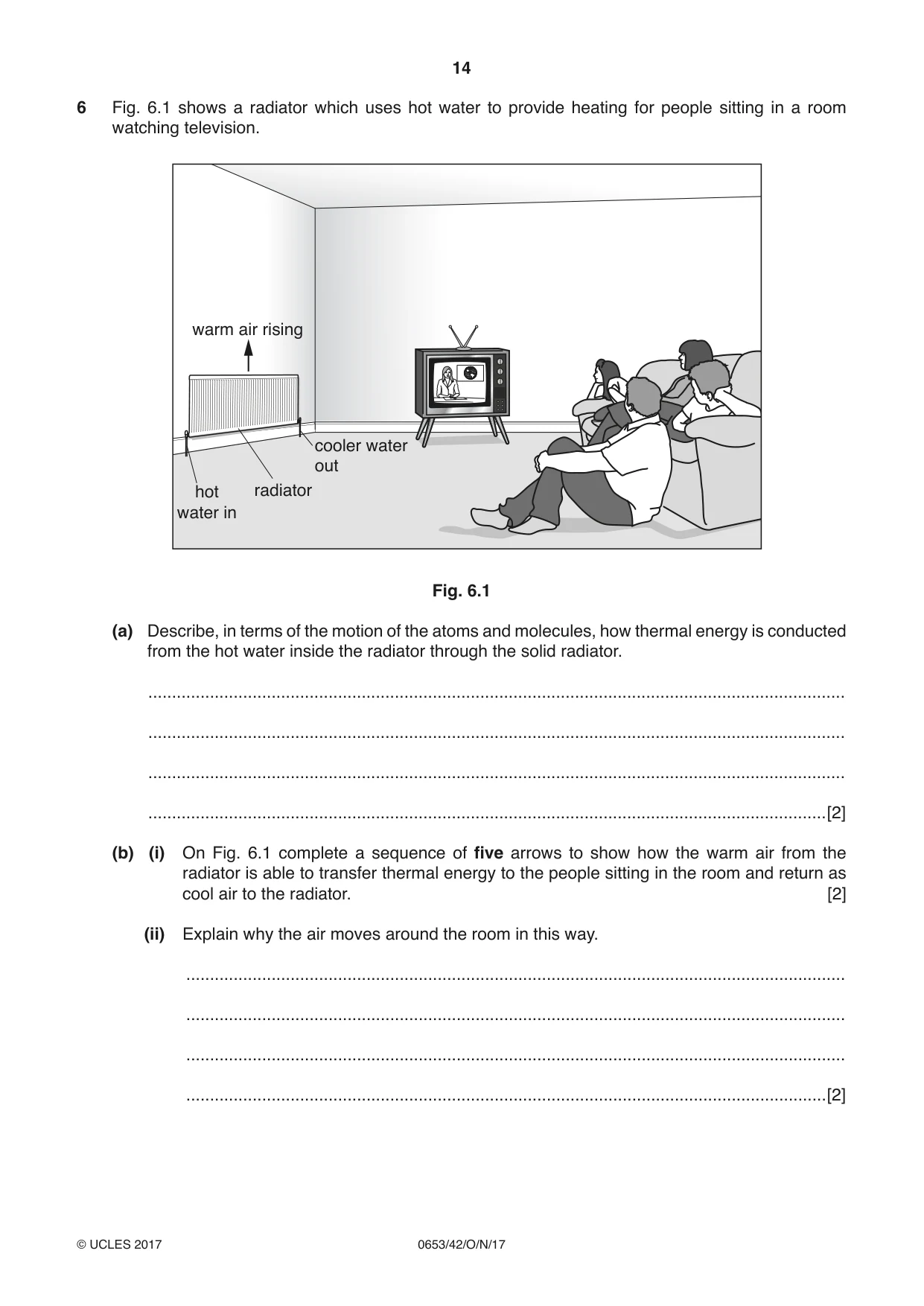
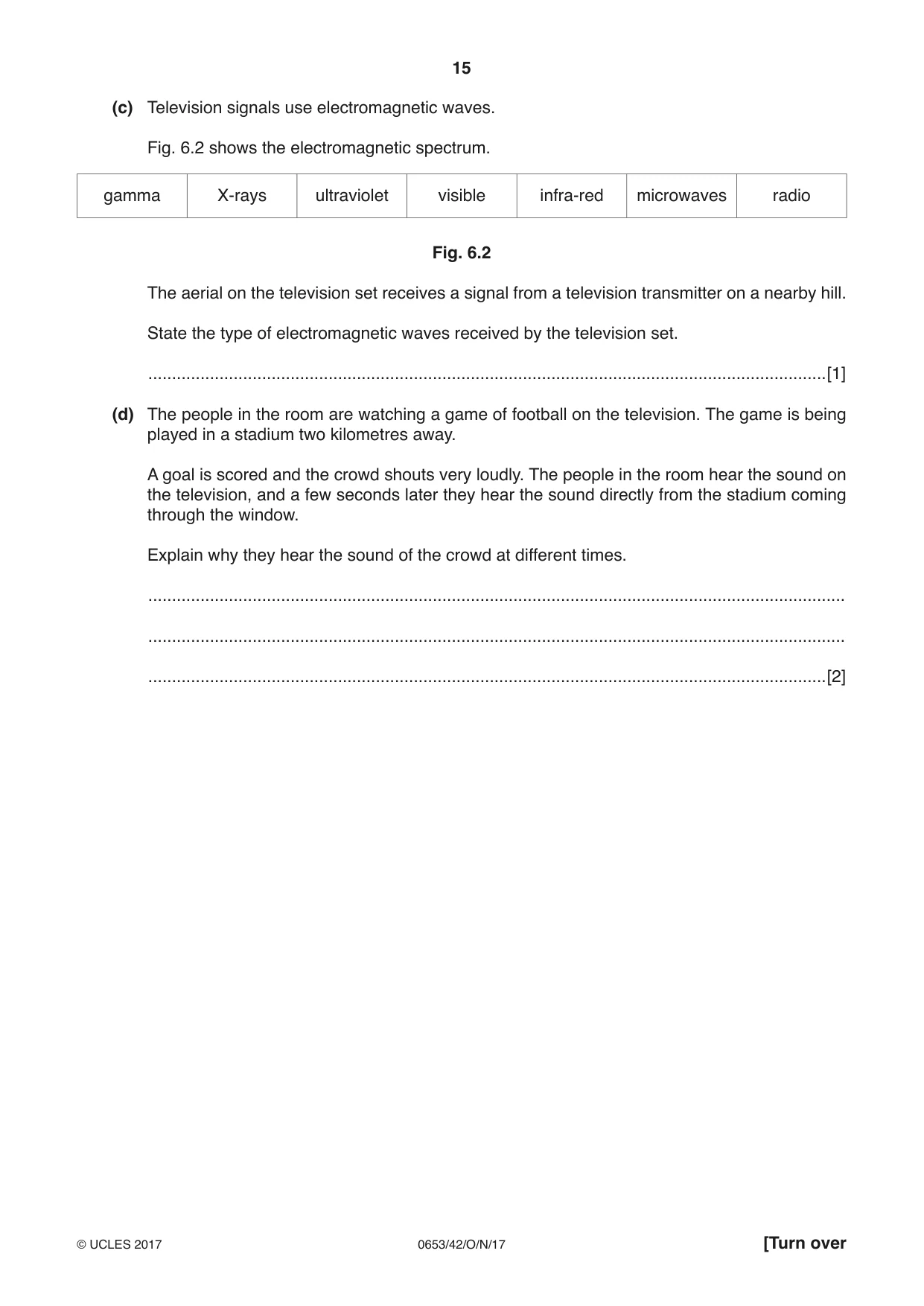
6 Fig. 6.1 shows a radiator which uses hot water to provide heating for people sitting in a room watching television. warm air rising cooler water out hot radiator water in Fig. 6.1 (a) Describe, in terms of the motion of the atoms and molecules, how thermal energy is conducted from the hot water inside the radiator through the solid radiator. ................................................................................................................................................... ................................................................................................................................................... ................................................................................................................................................... ...............................................................................................................................................[2] (b) (i) On Fig. 6.1 complete a sequence of five arrows to show how the warm air from the radiator is able to transfer thermal energy to the people sitting in the room and return as cool air to the radiator. [2] (ii) Explain why the air moves around the room in this way. ........................................................................................................................................... ........................................................................................................................................... ........................................................................................................................................... .......................................................................................................................................[2] (c) Television signals use electromagnetic waves. Fig. 6.2 shows the electromagnetic spectrum. gamma X-rays ultraviolet visible infra-red microwaves radio Fig. 6.2 The aerial on the television set receives a signal from a television transmitter on a nearby hill. State the type of electromagnetic waves received by the television set. ...............................................................................................................................................[1] (d) The people in the room are watching a game of football on the television. The game is being played in a stadium two kilometres away. A goal is scored and the crowd shouts very loudly. The people in the room hear the sound on the television, and a few seconds later they hear the sound directly from the stadium coming through the window. Explain why they hear the sound of the crowd at different times. ................................................................................................................................................... ................................................................................................................................................... ...............................................................................................................................................[2]
Mark scheme: 6(a) atoms / molecules (in contact with water) vibrate (more) ; the idea that energy / vibrations passed on through collisions / from particle to particle (owtte) ; 2 6(b)(i) arrows show rise (to ceiling), progress across (ceiling), downward progress (to floor) ; (past people) return to radiator ; 2 6(b)(ii) warm air is less dense / ora ; so warm air rises / ora ; 2 6(c) radio (waves) ; 1 6(d) TV signal travels at speed of e / m waves ; e / m waves travel (much) faster than sound (waves) ; 2
Q7 · A longitudinal section of a capillary next to some tissue cells
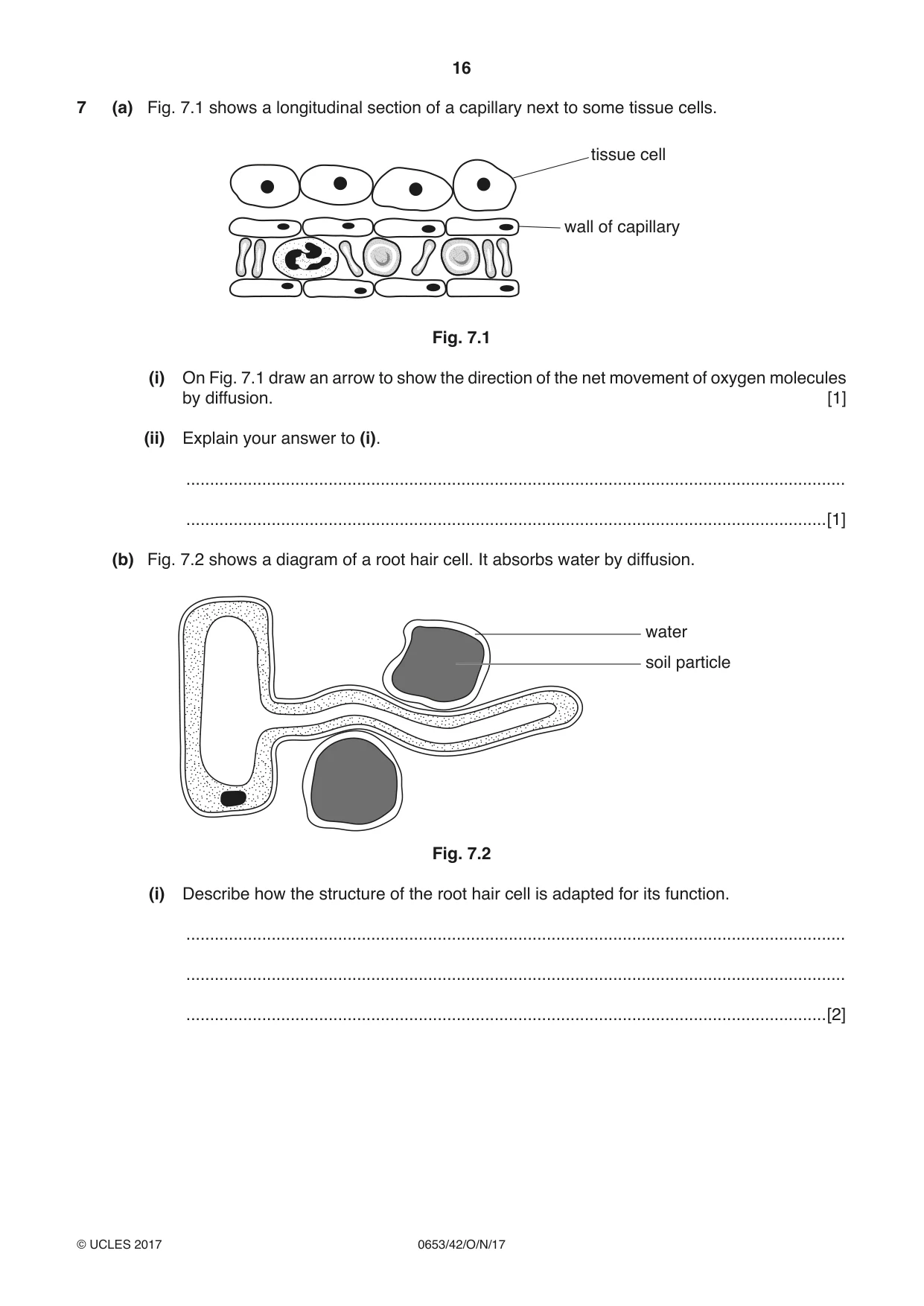
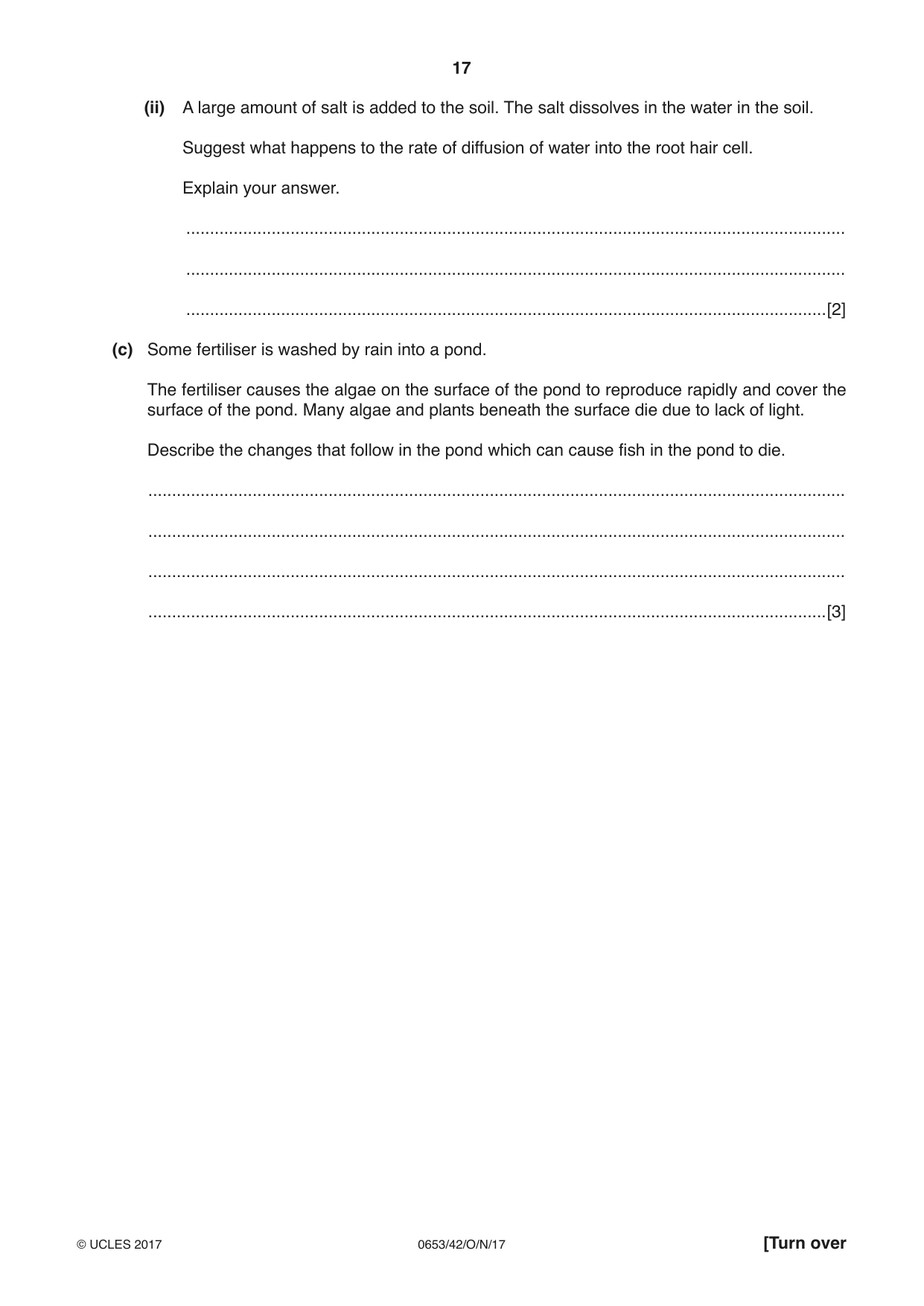
7 (a) Fig. 7.1 shows a longitudinal section of a capillary next to some tissue cells. tissue cell wall of capillary Fig. 7.1 (i) On Fig. 7.1 draw an arrow to show the direction of the net movement of oxygen molecules by diffusion. [1] (ii) Explain your answer to (i). ........................................................................................................................................... .......................................................................................................................................[1] (b) Fig. 7.2 shows a diagram of a root hair cell. It absorbs water by diffusion. water soil particle Fig. 7.2 (i) Describe how the structure of the root hair cell is adapted for its function. ........................................................................................................................................... ........................................................................................................................................... .......................................................................................................................................[2] (ii) A large amount of salt is added to the soil. The salt dissolves in the water in the soil. Suggest what happens to the rate of diffusion of water into the root hair cell. Explain your answer. ........................................................................................................................................... ........................................................................................................................................... .......................................................................................................................................[2] (c) Some fertiliser is washed by rain into a pond. The fertiliser causes the algae on the surface of the pond to reproduce rapidly and cover the surface of the pond. Many algae and plants beneath the surface die due to lack of light. Describe the changes that follow in the pond which can cause fish in the pond to die. ................................................................................................................................................... ................................................................................................................................................... ................................................................................................................................................... ...............................................................................................................................................[3]
Mark scheme: 7(a)(i) arrow drawn on Fig. 3.1 from red blood cell to any tissue cell ; 1 7(a)(ii) lower concentration in tissue cells than in the red blood cells / blood ; 1 7(b)(i) elongated shape / large surface area ; for increased rate / efficiency of uptake (of water) ; max 2 7(b)(ii) diffusion rate would slow down / stop ; because the water / solution concentrations have become similar to / the same as each other ; or water diffuses from cells into the soil (water) ; because the concentration of water is now higher inside the cell / concentration of salt is now higher outside the cell ; max 2 7(c) bacteria feed on dead organisms / bacteria population increases ; bacteria respire ; bacteria / respiration use up oxygen ; no oxygen left for fish ; max 3
Q8 · A student tries to produce chlorine gas and copper by electrolysis
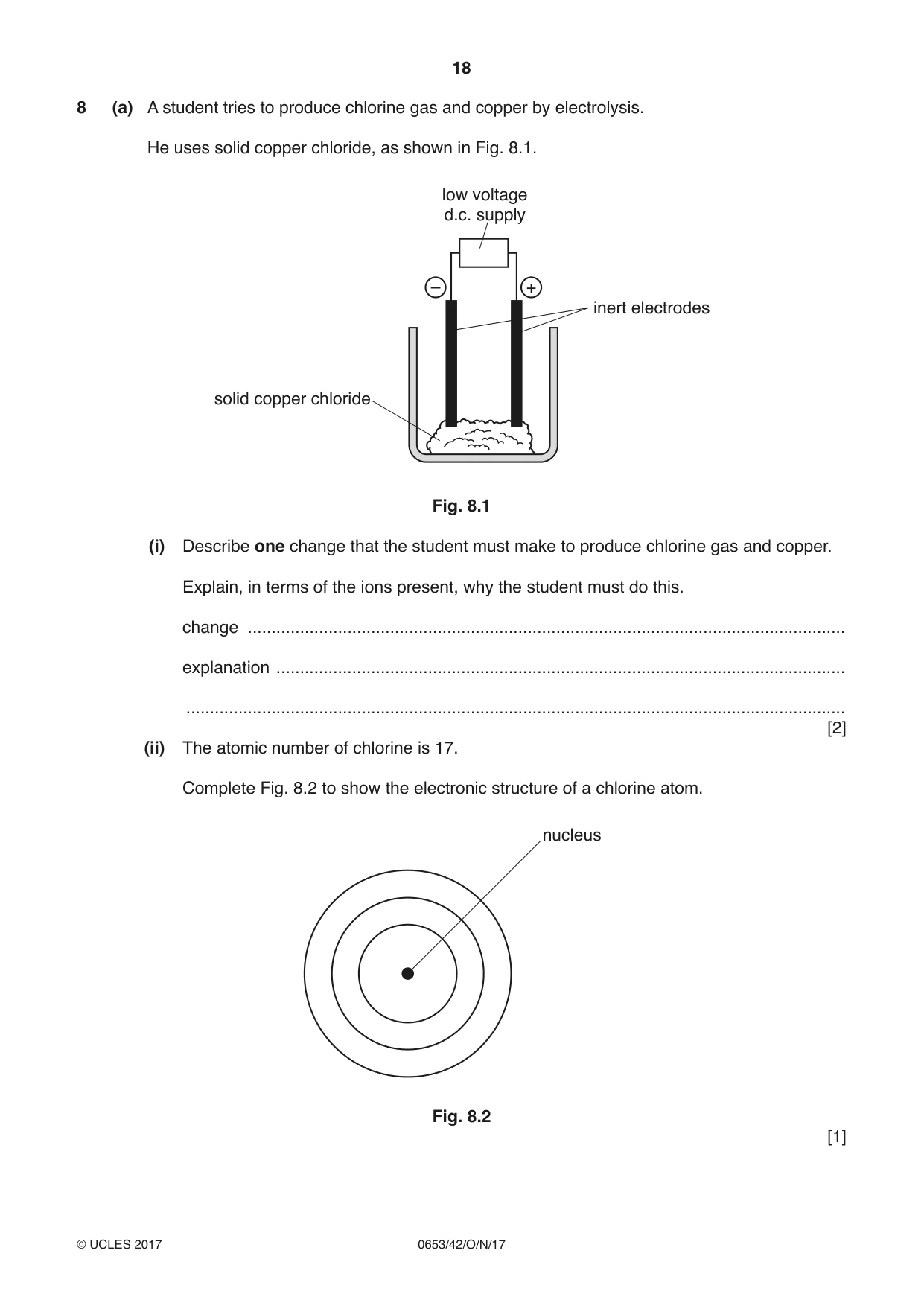
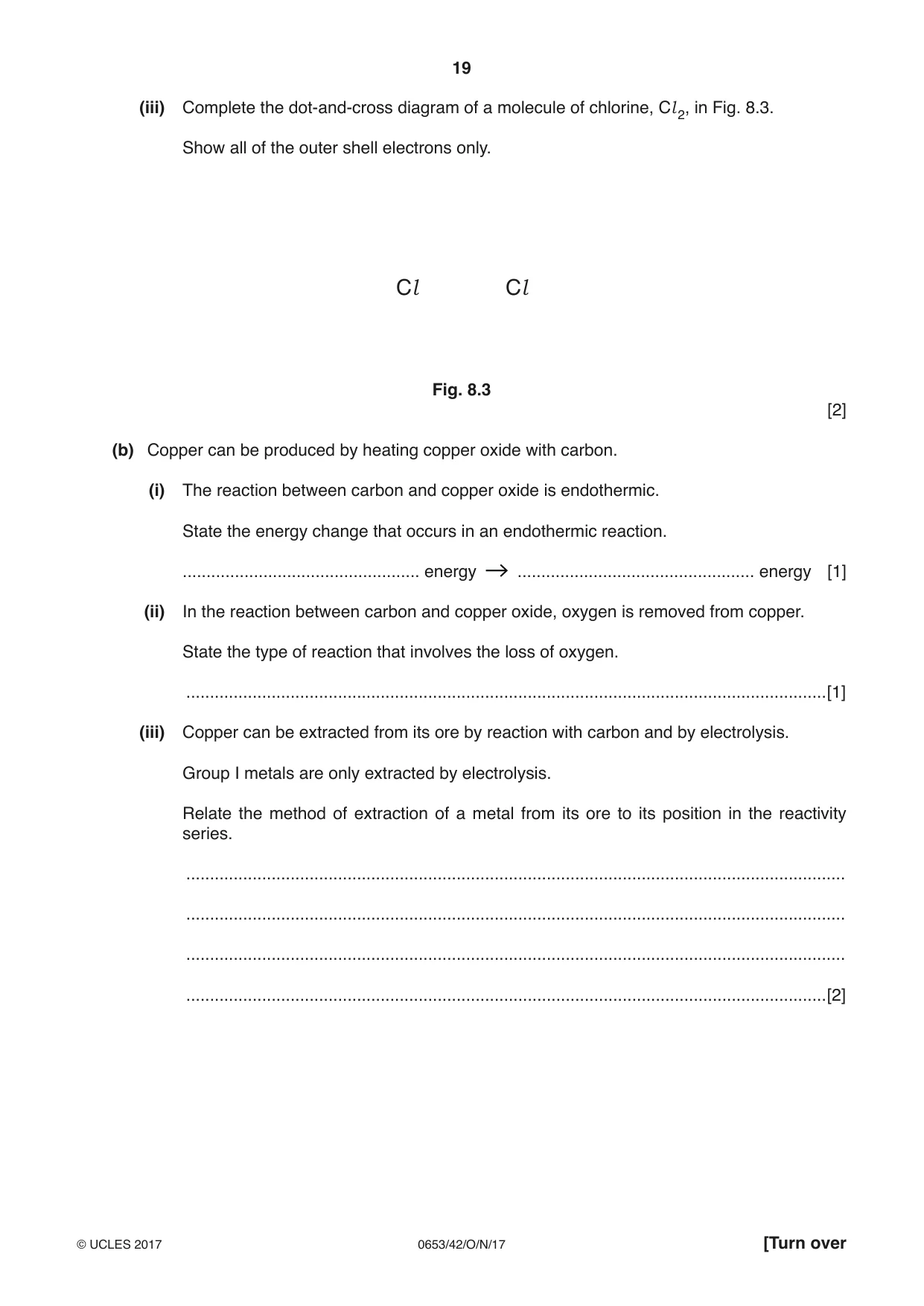
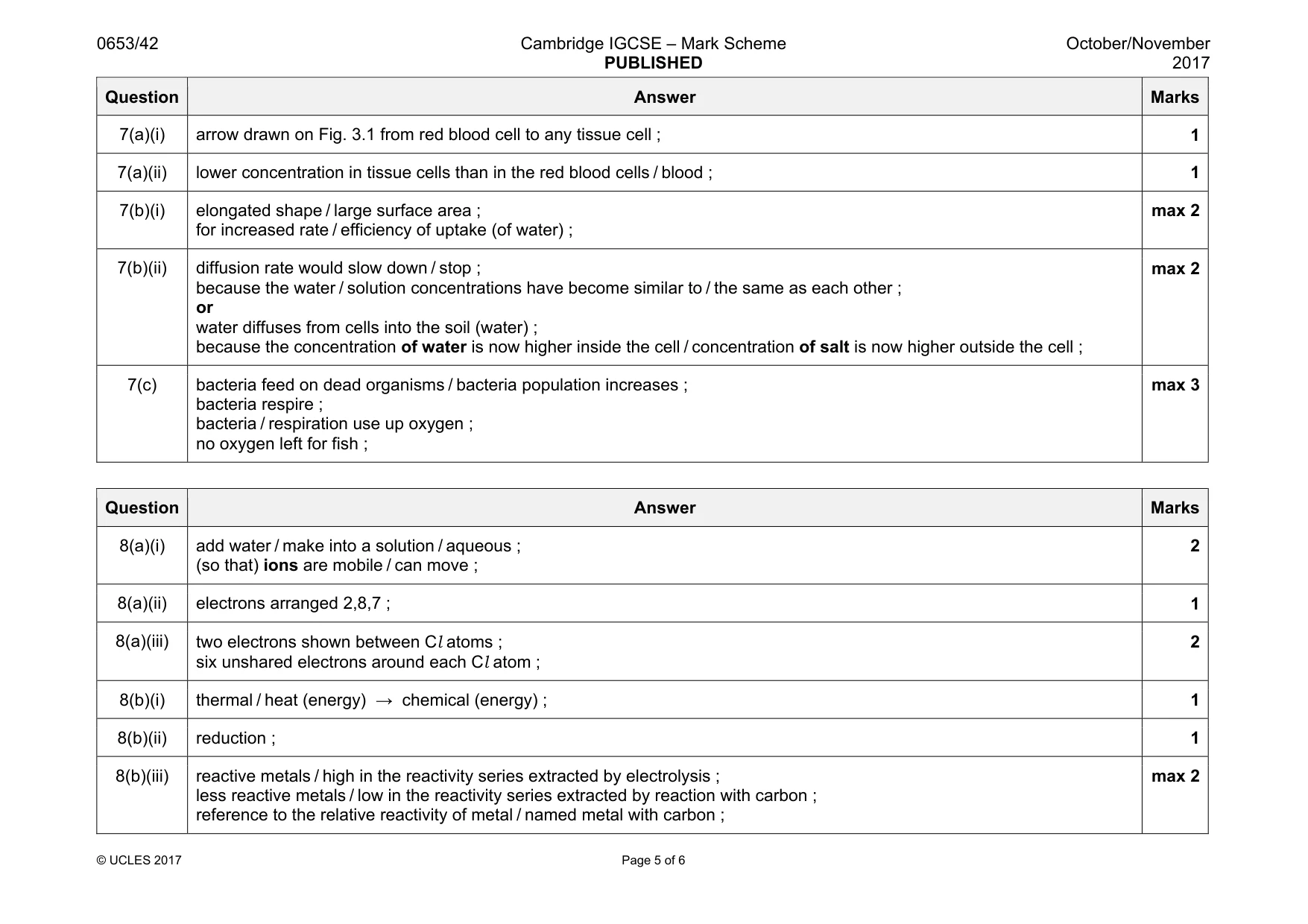
8 (a) A student tries to produce chlorine gas and copper by electrolysis. He uses solid copper chloride, as shown in Fig. 8.1. low voltage d.c. supply – + inert electrodes solid copper chloride Fig. 8.1 (i) Describe one change that the student must make to produce chlorine gas and copper. Explain, in terms of the ions present, why the student must do this. change .............................................................................................................................. explanation ........................................................................................................................ ........................................................................................................................................... [2] (ii) The atomic number of chlorine is 17. Complete Fig. 8.2 to show the electronic structure of a chlorine atom. nucleus Fig. 8.2 [1] (iii) Complete the dot-and-cross diagram of a molecule of chlorine, Cl 2, in Fig. 8.3. Show all of the outer shell electrons only. Cl Cl Fig. 8.3 [2] (b) Copper can be produced by heating copper oxide with carbon. (i) The reaction between carbon and copper oxide is endothermic. State the energy change that occurs in an endothermic reaction. .................................................. energy .................................................. energy [1] (ii) In the reaction between carbon and copper oxide, oxygen is removed from copper. State the type of reaction that involves the loss of oxygen. .......................................................................................................................................[1] (iii) Copper can be extracted from its ore by reaction with carbon and by electrolysis. Group I metals are only extracted by electrolysis. Relate the method of extraction of a metal from its ore to its position in the reactivity series. ........................................................................................................................................... ........................................................................................................................................... ........................................................................................................................................... .......................................................................................................................................[2]
Mark scheme: 8(a)(i) add water / make into a solution / aqueous ; (so that) ions are mobile / can move ; 2 8(a)(ii) electrons arranged 2,8,7 ; 1 8(a)(iii) two electrons shown between Cl atoms ; six unshared electrons around each Cl atom ; 2 8(b)(i) thermal / heat (energy) → chemical (energy) ; 1 8(b)(ii) reduction ; 1 8(b)(iii) reactive metals / high in the reactivity series extracted by electrolysis ; less reactive metals / low in the reactivity series extracted by reaction with carbon ; reference to the relative reactivity of metal / named metal with carbon ; max 2
Q9 · In a theatre, spotlights are used to shine a beam of light on one person on the stage
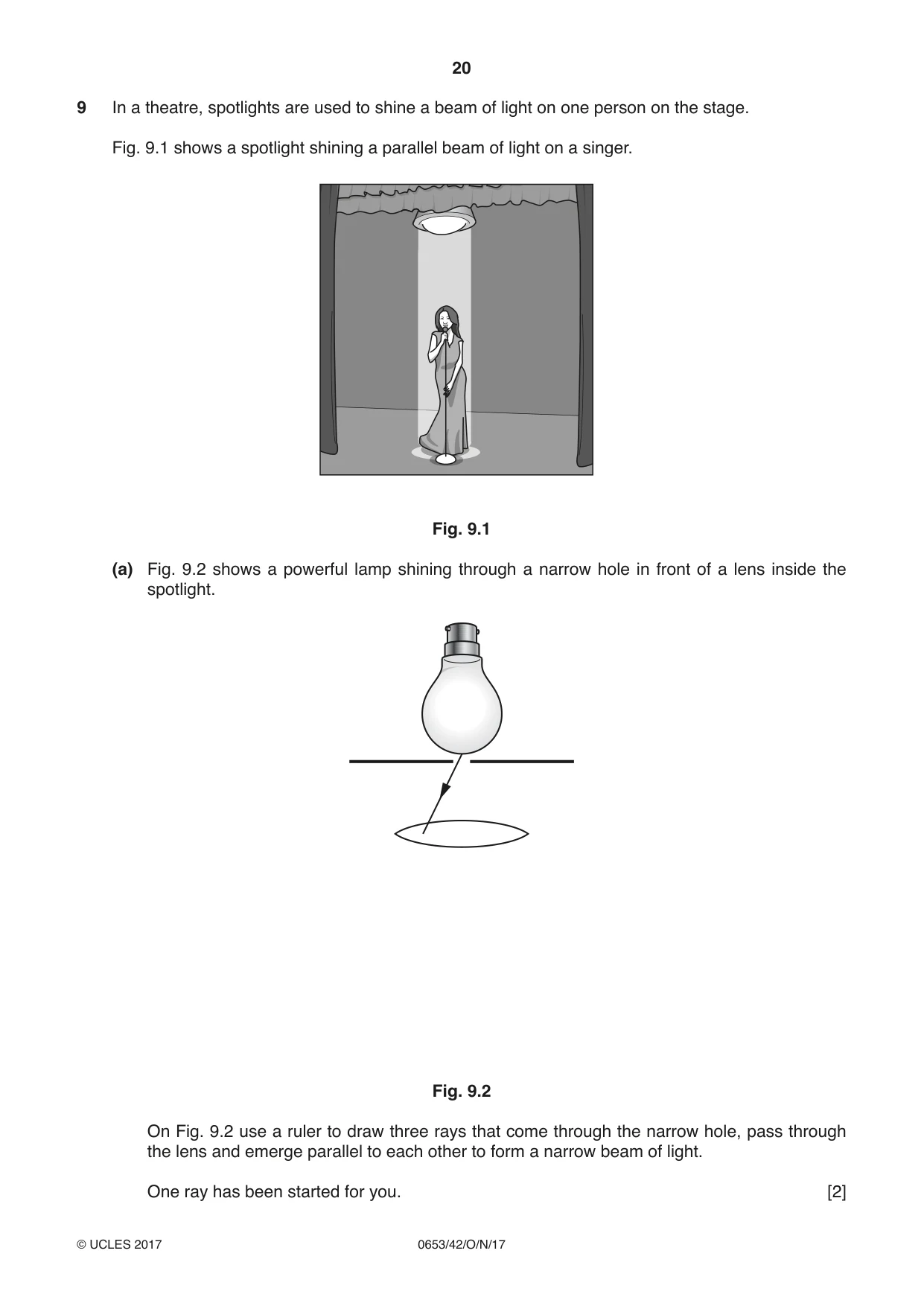
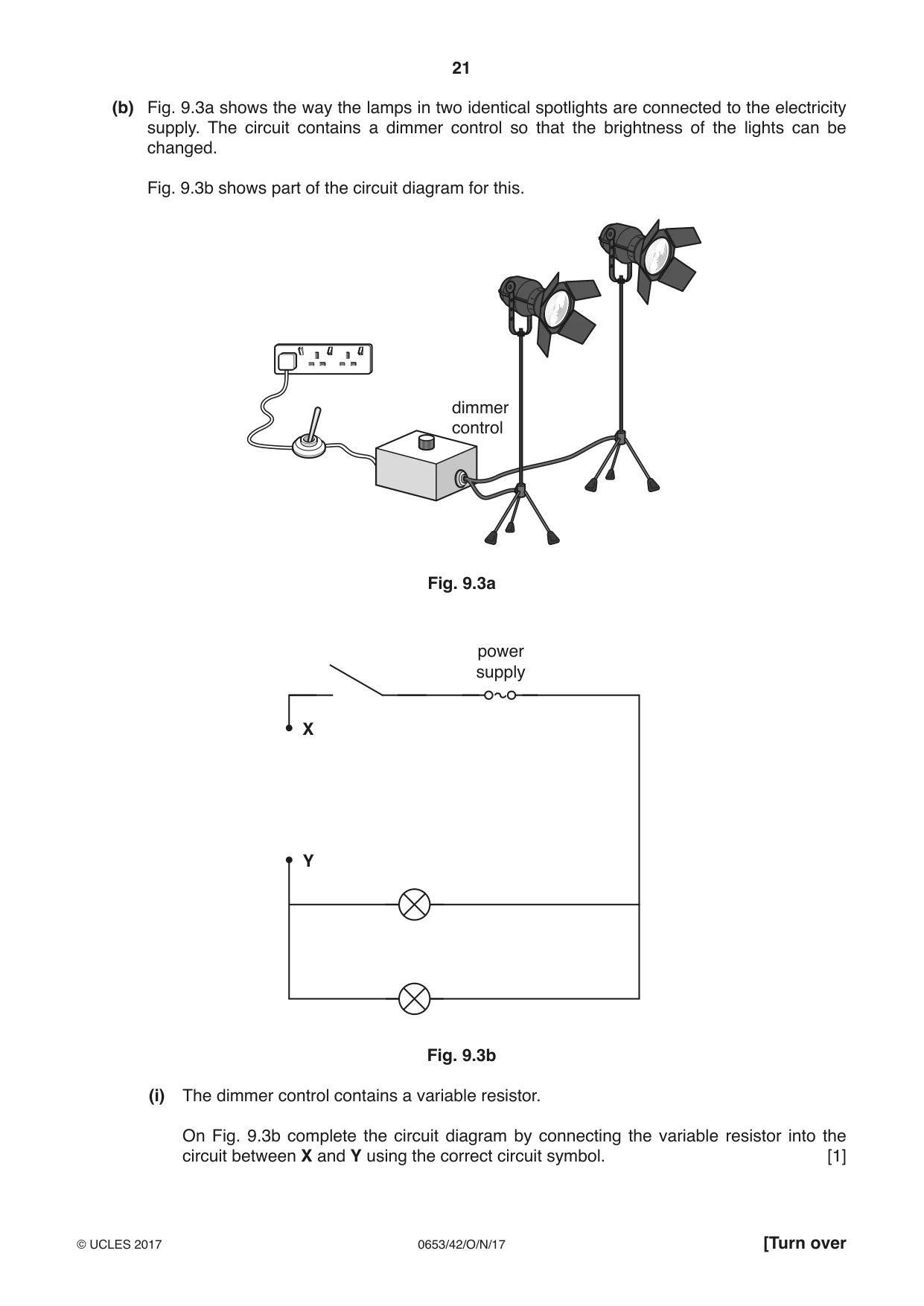
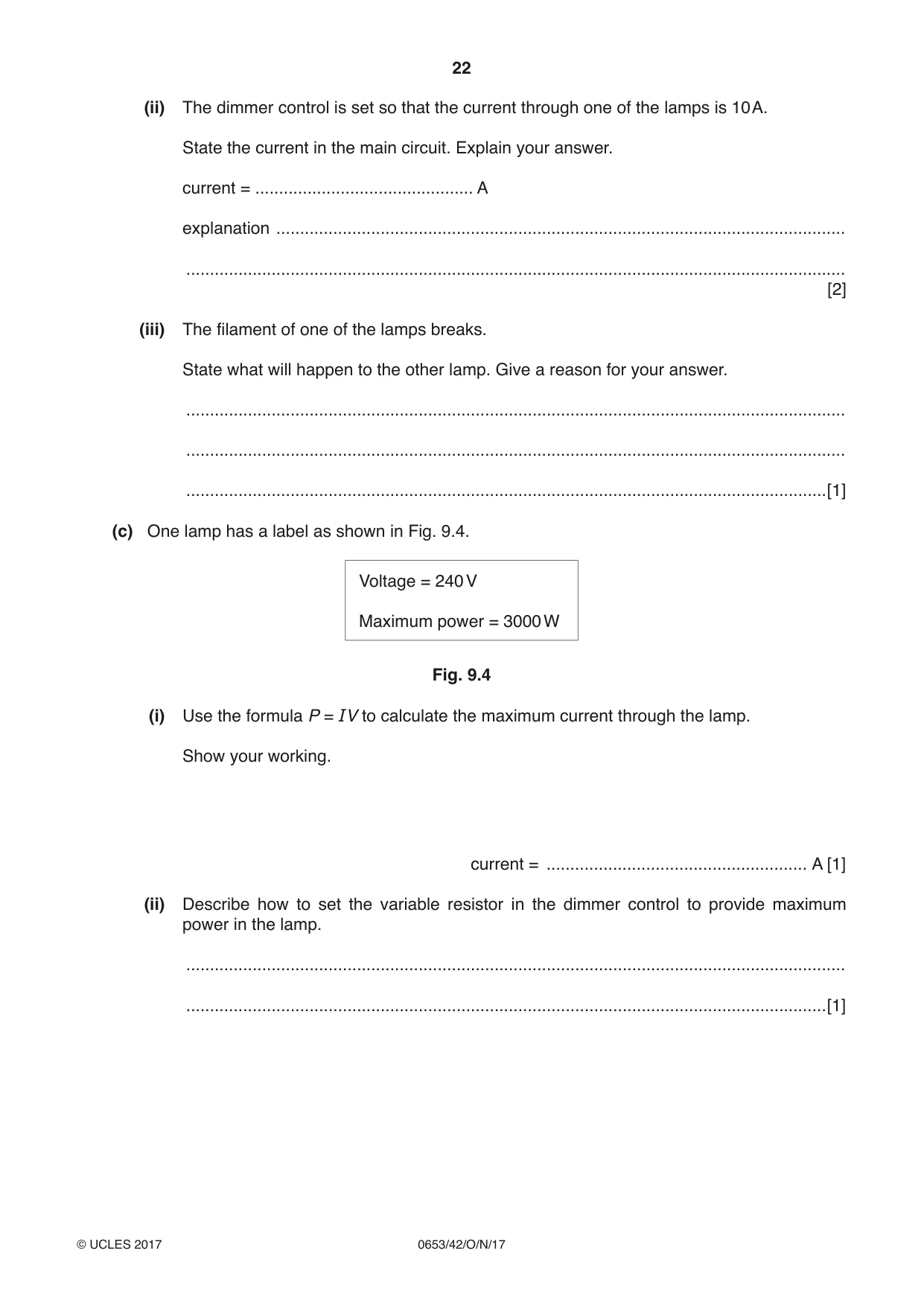
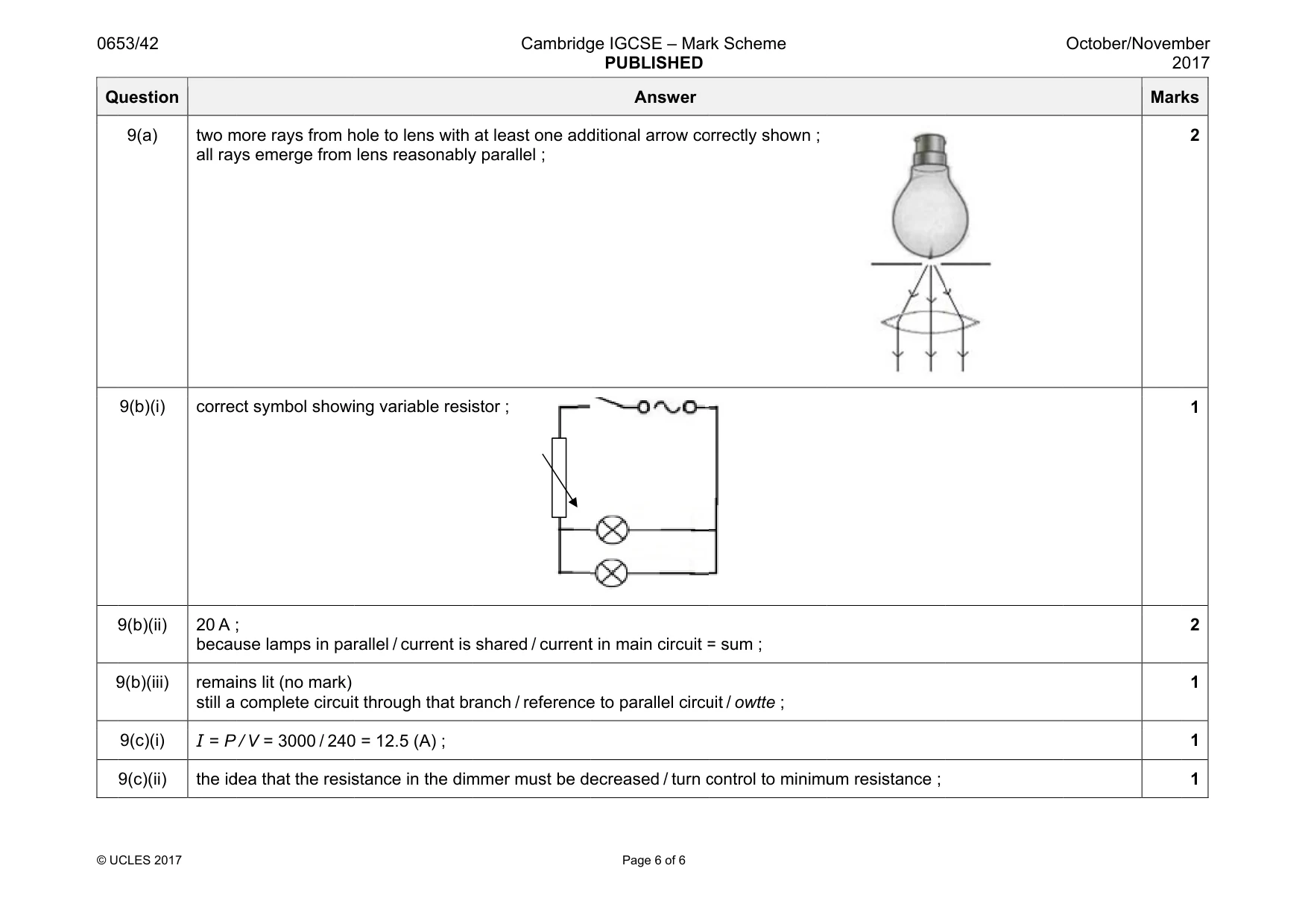
9 In a theatre, spotlights are used to shine a beam of light on one person on the stage. Fig. 9.1 shows a spotlight shining a parallel beam of light on a singer. Fig. 9.1 (a) Fig. 9.2 shows a powerful lamp shining through a narrow hole in front of a lens inside the spotlight. Fig. 9.2 On Fig. 9.2 use a ruler to draw three rays that come through the narrow hole, pass through the lens and emerge parallel to each other to form a narrow beam of light. One ray has been started for you. [2] (b) Fig. 9.3a shows the way the lamps in two identical spotlights are connected to the electricity supply. The circuit contains a dimmer control so that the brightness of the lights can be changed. Fig. 9.3b shows part of the circuit diagram for this. dimmer control Fig. 9.3a power supply X Y Fig. 9.3b (i) The dimmer control contains a variable resistor. On Fig. 9.3b complete the circuit diagram by connecting the variable resistor into the circuit between X and Y using the correct circuit symbol. [1] (ii) The dimmer control is set so that the current through one of the lamps is 10 A. State the current in the main circuit. Explain your answer. current = .............................................. A explanation ........................................................................................................................ ........................................................................................................................................... [2] (iii) The filament of one of the lamps breaks. State what will happen to the other lamp. Give a reason for your answer. ........................................................................................................................................... ........................................................................................................................................... .......................................................................................................................................[1] (c) One lamp has a label as shown in Fig. 9.4. Voltage = 240 V Maximum power = 3000 W Fig. 9.4 (i) Use the formula P = IV to calculate the maximum current through the lamp. Show your working. current = ....................................................... A [1] (ii) Describe how to set the variable resistor in the dimmer control to provide maximum power in the lamp. ........................................................................................................................................... .......................................................................................................................................[1]
Mark scheme: 9 9 9(a) two m all ray 9(b)(i) correc 9(b)(ii) 20 A ; becau 9(b)(iii) remai still a 9(c)(i) I = P 9(c)(ii) the id more rays from h ys emerge from ct symbol showi ; use lamps in par ins lit (no mark) complete circuit / V = 3000 / 240 dea that the resis hole to lens with lens reasonably ing variable resis rallel / current is t through that br 0 = 12.5 (A) ; stance in the dim at least one add y parallel ; stor ; shared / current ranch / reference mmer must be de ditional arrow co t in main circuit = e to parallel circu ecreased / turn c orrectly shown ; = sum ; uit / owtte ; control to minimu um resistance ; 2 1 2 1 1 1
What was in this paper
The subtopics covered by these 9 questions, and how many questions each got. Open one in a new tab to see every Cambridge question on it.
What you needed in this session
Cambridge’s own grade thresholds for 2017 Oct/Nov, Paper 4 · Variant 2. A higher threshold means an easier paper — the bar moves with how the cohort did.