Cambridge IGCSE Science - Combined 0653 — 2023 May/June Paper 4 · Variant 2
0653/42/M/J/23 · 9 questions · 80 marks · ≈90 min
The question paper and its mark scheme, free to read here and free to download. This is Cambridge’s own paper, exactly as it was sat.
Question paper24 pages



Mark scheme10 pages
Answers below. Sit the paper first if you are practising.
Questions as text
Question 1
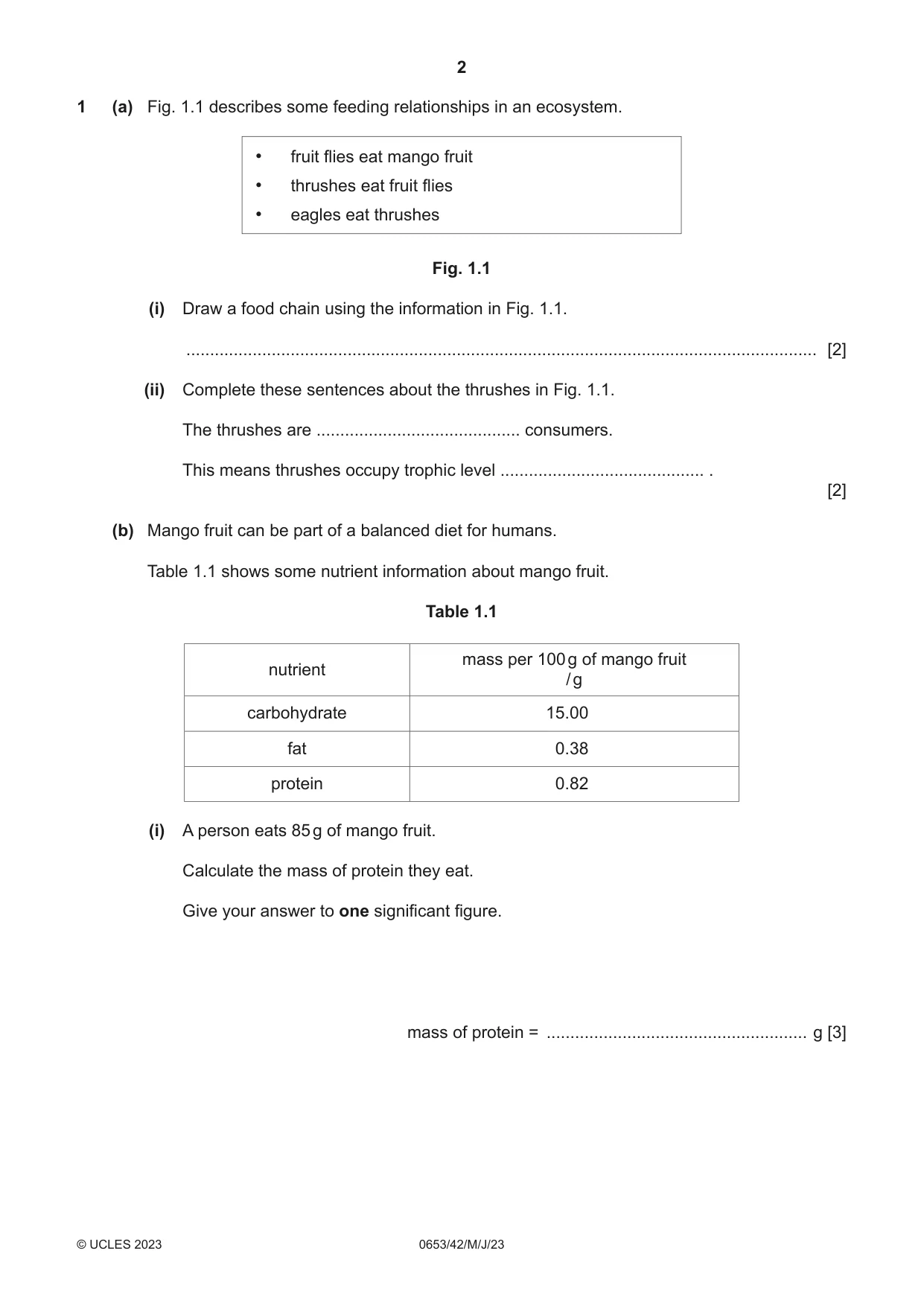
1 (a) Fig. 1.1 describes some feeding relationships in an ecosystem. • fruit flies eat mango fruit • thrushes eat fruit flies • eagles eat thrushes Fig. 1.1 (i) Draw a food chain using the information in Fig. 1.1. ..................................................................................................................................... [2] (ii) Complete these sentences about the thrushes in Fig. 1.1. The thrushes are ........................................... consumers. This means thrushes occupy trophic level ........................................... . [2] (b) Mango fruit can be part of a balanced diet for humans. Table 1.1 shows some nutrient information about mango fruit. Table 1.1 mass per 100 g of mango fruit nutrient / g carbohydrate 15.00 fat 0.38 protein 0.82 (i) A person eats 85 g of mango fruit. Calculate the mass of protein they eat. Give your answer to one significant figure. mass of protein = ....................................................... g [3] (ii) Fat in the mango fruit is digested by enzymes in the small intestine. State the name of the enzyme and the products of fat digestion. enzyme .............................................................................................................................. products ............................................................................................................................ [2] (iii) Suggest why eating mango fruit could help prevent constipation. ..................................................................................................................................... [1] [Total: 10]
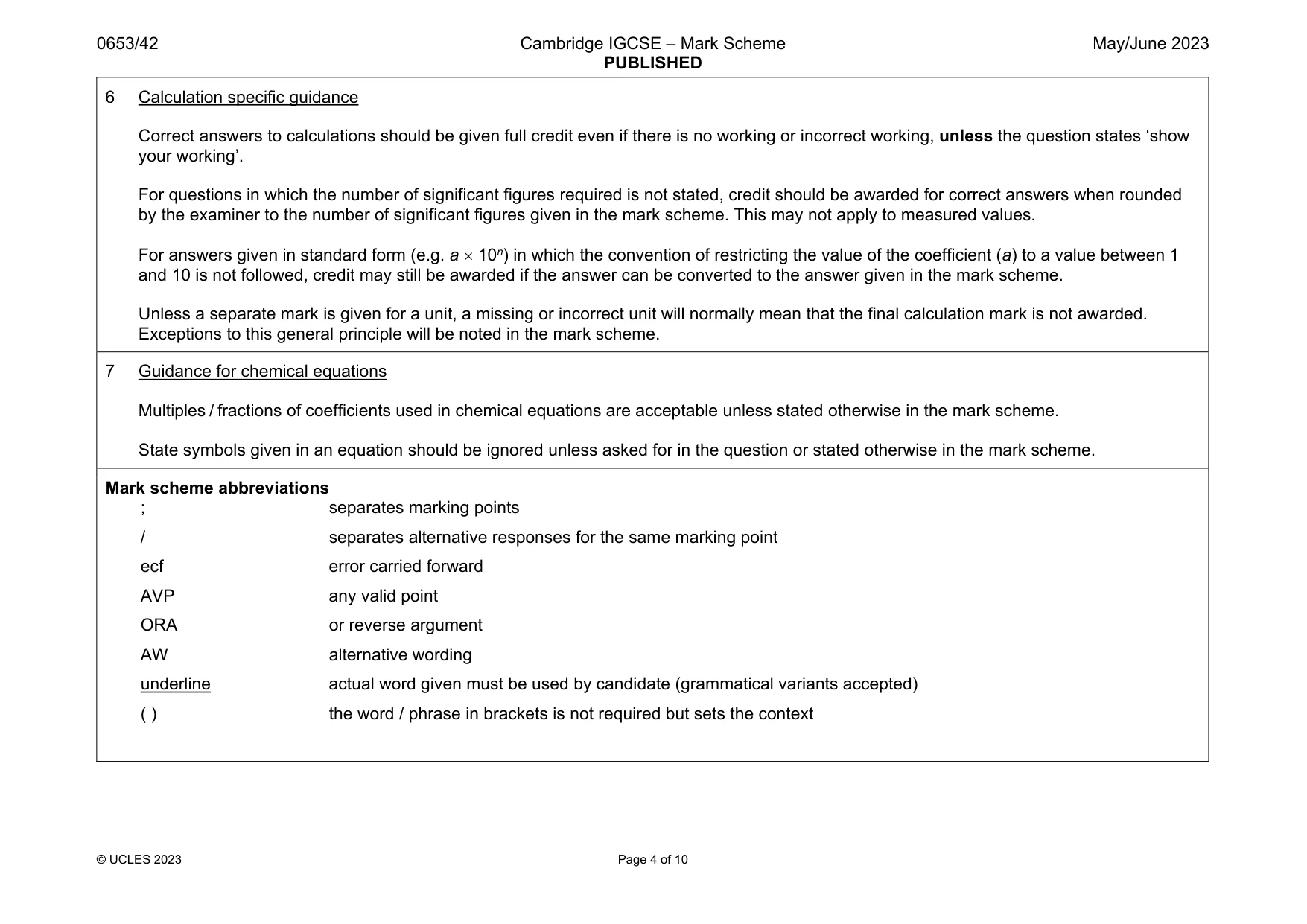
Mark scheme: 1(a)(i) mango (fruit) (fruit) flies thrushes eagle ;; correct order = one mark arrows in correct direction = one mark 2 1(a)(ii) secondary ; three ; 2 1(b)(i) 0.82 85 ; 100 0.697 ; 0.7 ; 3 1(b)(ii) lipase ; fatty acids and glycerol ; 2 1(b)(iii) contains fibre ; 1
Q2 · Concentrated aqueous sodium chloride is electrolysed using platinum electrodes, as shown…
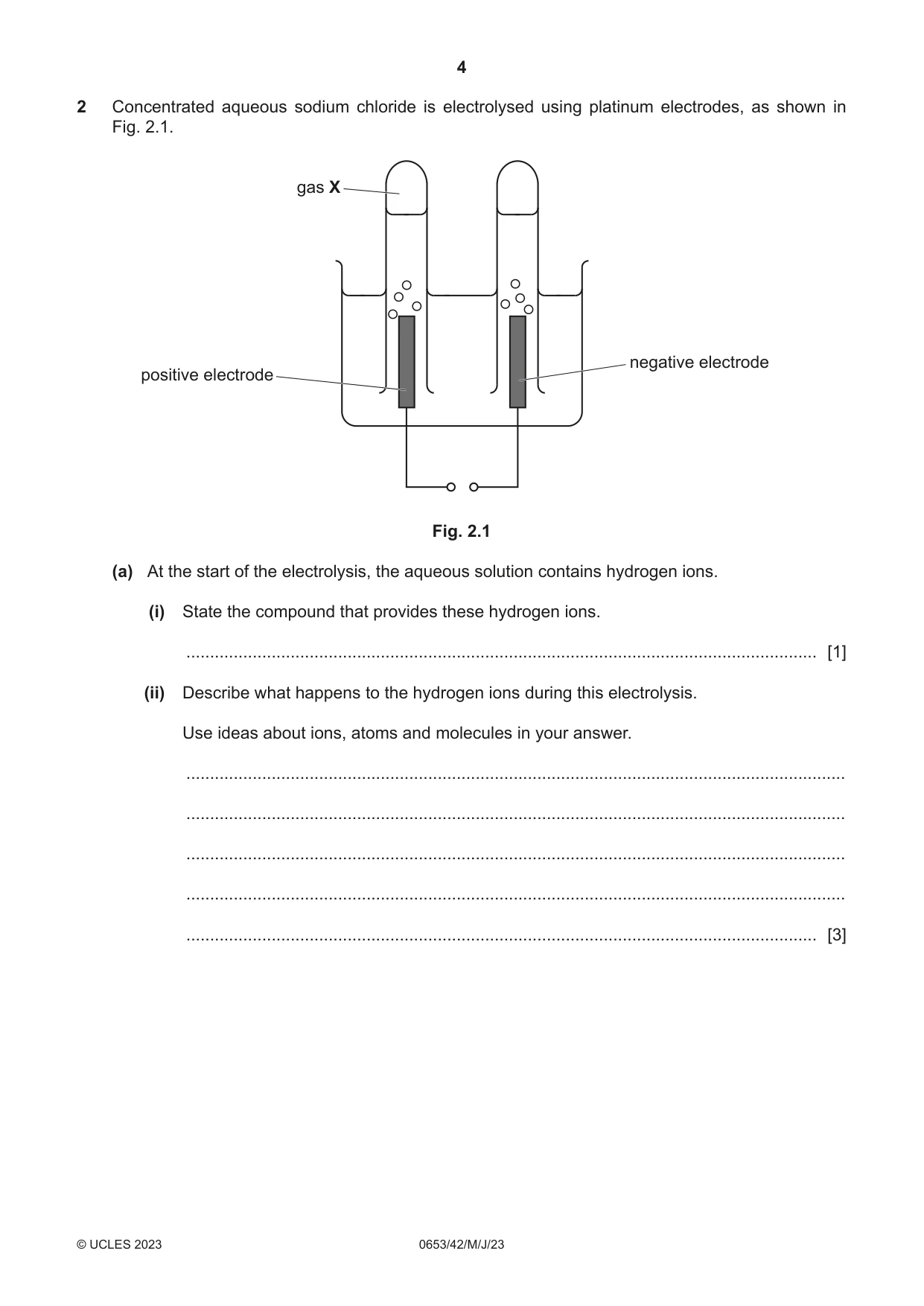
2 Concentrated aqueous sodium chloride is electrolysed using platinum electrodes, as shown in Fig. 2.1. gas X negative electrode positive electrode Fig. 2.1 (a) At the start of the electrolysis, the aqueous solution contains hydrogen ions. (i) State the compound that provides these hydrogen ions. ..................................................................................................................................... [1] (ii) Describe what happens to the hydrogen ions during this electrolysis. Use ideas about ions, atoms and molecules in your answer. ........................................................................................................................................... ........................................................................................................................................... ........................................................................................................................................... ........................................................................................................................................... ..................................................................................................................................... [3] (b) (i) State the name of gas X shown in Fig. 2.1. ..................................................................................................................................... [1] (ii) Describe the test for gas X and state the observation for a positive result. test .................................................................................................................................... observation ........................................................................................................................ ........................................................................................................................................... [1] (c) (i) State two properties of platinum that make it suitable for use as an electrode. ..................................................................................................................................... [1] (ii) The atomic number of platinum is 78. State the name of the collection of metals in the Periodic Table that includes platinum. Use the Periodic Table to help you. ..................................................................................................................................... [1] [Total: 8]
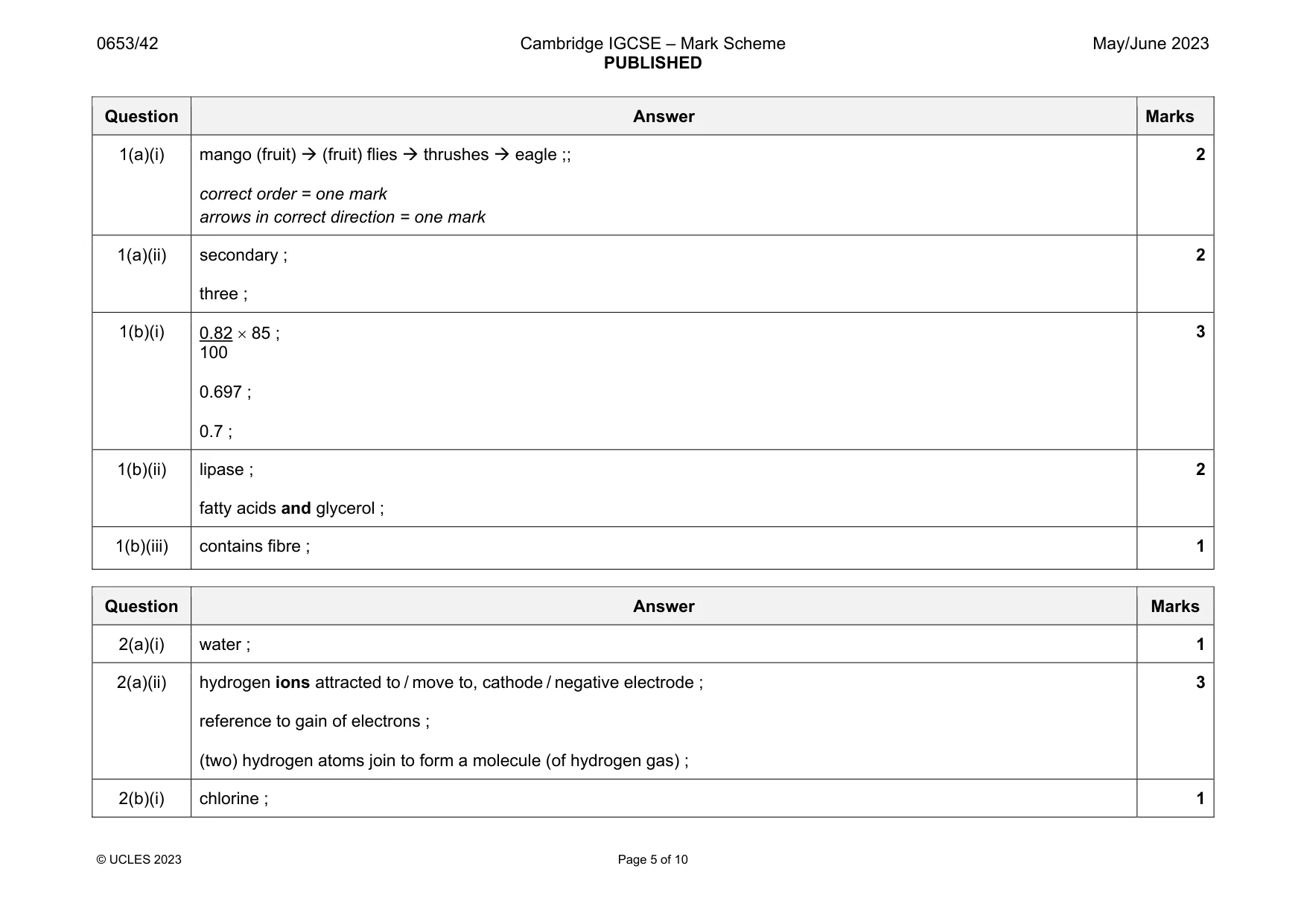
Mark scheme: 2(a)(i) water ; 1 2(a)(ii) hydrogen ions attracted to / move to, cathode / negative electrode ; reference to gain of electrons ; (two) hydrogen atoms join to form a molecule (of hydrogen gas) ; 3 2(b)(i) chlorine ; 1 Question Answer Marks 2(b)(ii) (damp) litmus (paper) and bleached / goes white ; 1 2(c)(i) is inert / is unreactive and conducts (electricity) ; 1 2(c)(ii) transition (elements / metals) ; 1
Q3 · A speed–time graph for a car on a journey along a road
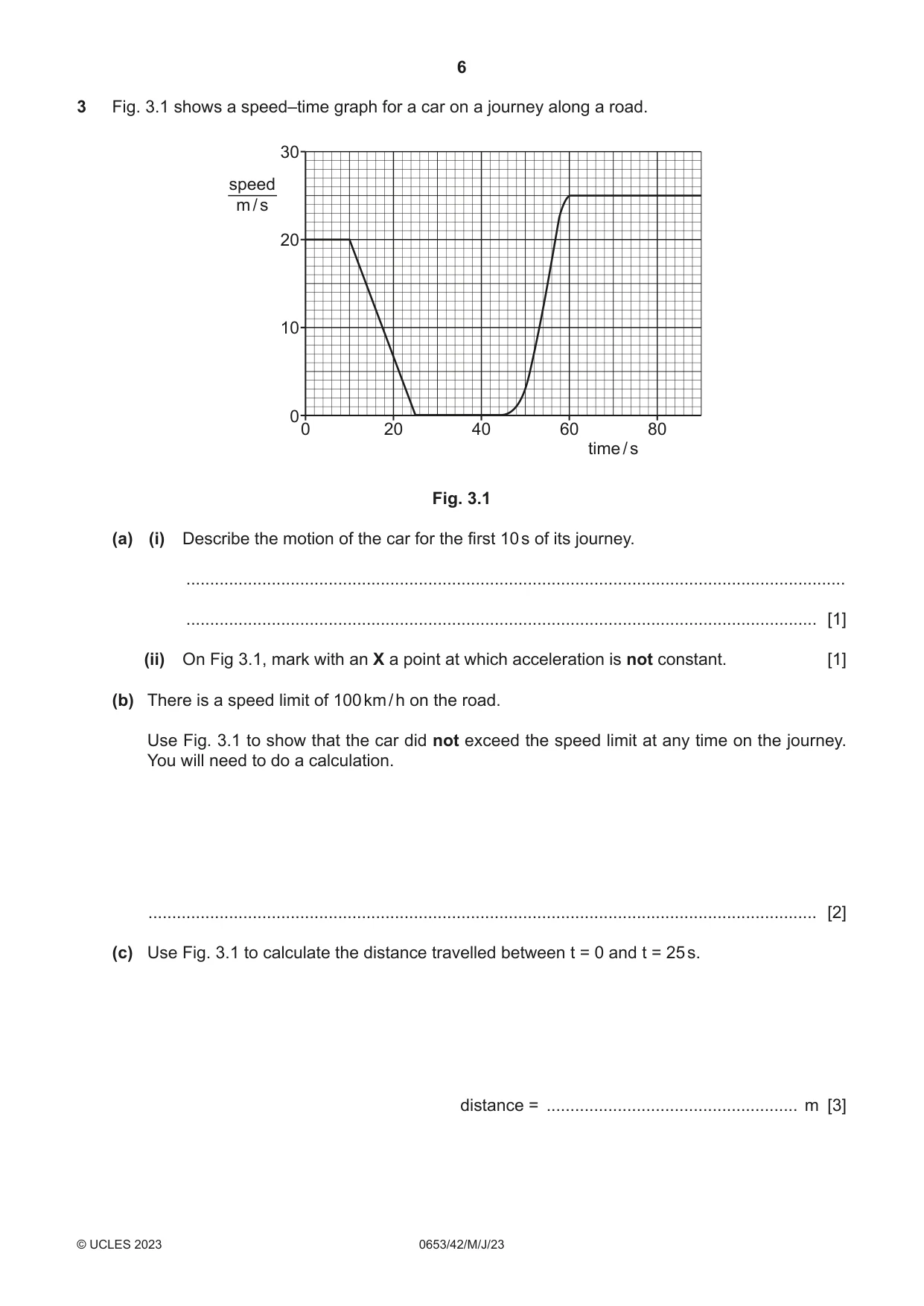
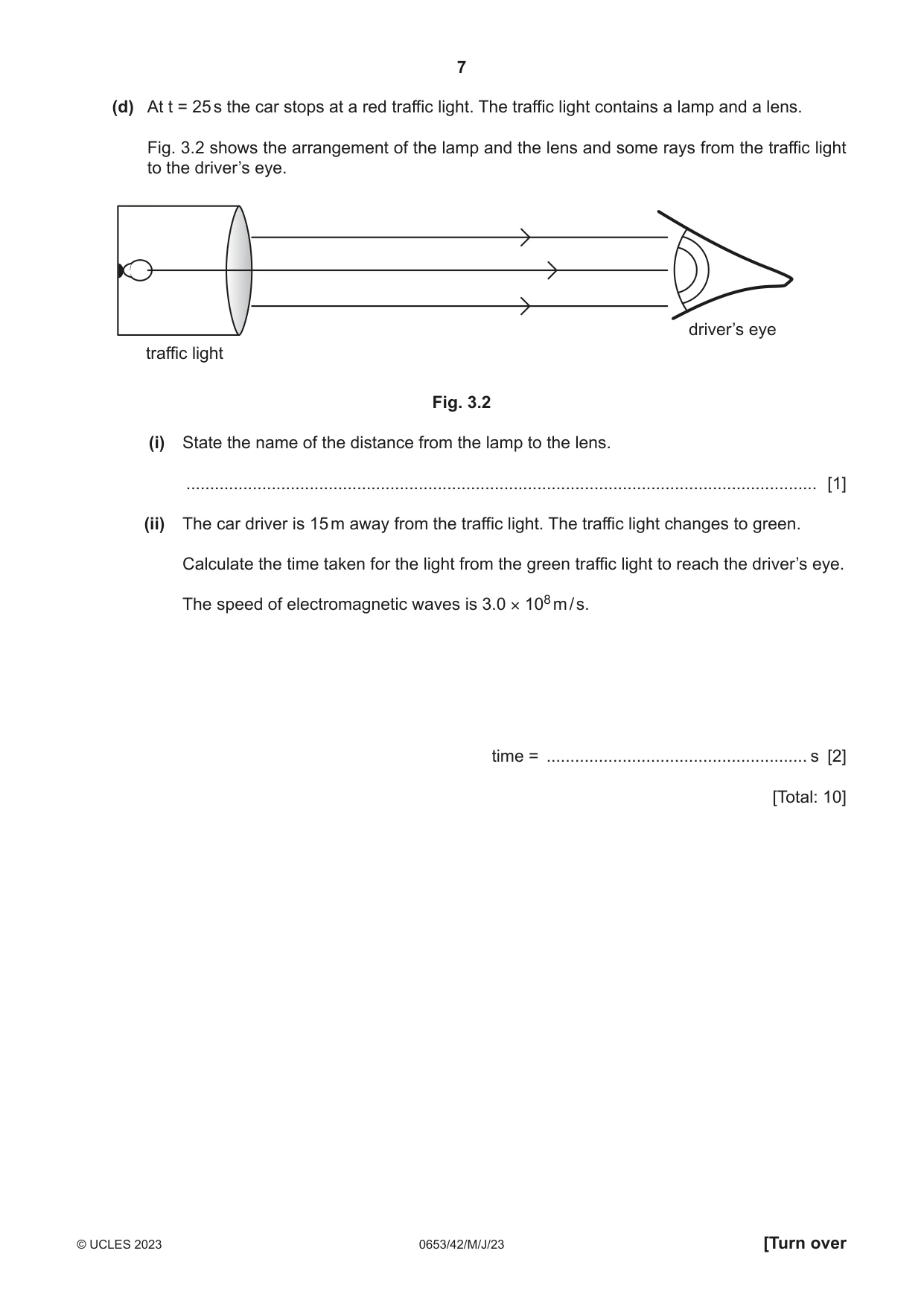
3 Fig. 3.1 shows a speed–time graph for a car on a journey along a road. 30 speed m / s 20 10 00 20 40 60 80 time / s Fig. 3.1 (a) (i) Describe the motion of the car for the first 10 s of its journey. ........................................................................................................................................... ..................................................................................................................................... [1] (ii) On Fig 3.1, mark with an X a point at which acceleration is not constant. [1] (b) There is a speed limit of 100 km / h on the road. Use Fig. 3.1 to show that the car did not exceed the speed limit at any time on the journey. You will need to do a calculation. ............................................................................................................................................. [2] (c) Use Fig. 3.1 to calculate the distance travelled between t = 0 and t = 25 s. distance = ..................................................... m [3] (d) At t = 25 s the car stops at a red traffic light. The traffic light contains a lamp and a lens. Fig. 3.2 shows the arrangement of the lamp and the lens and some rays from the traffic light to the driver’s eye. driver’s eye traffic light Fig. 3.2 (i) State the name of the distance from the lamp to the lens. ..................................................................................................................................... [1] (ii) The car driver is 15 m away from the traffic light. The traffic light changes to green. Calculate the time taken for the light from the green traffic light to reach the driver’s eye. The speed of electromagnetic waves is 3.0 × 10⁸ m / s. time = ....................................................... s [2] [Total: 10]
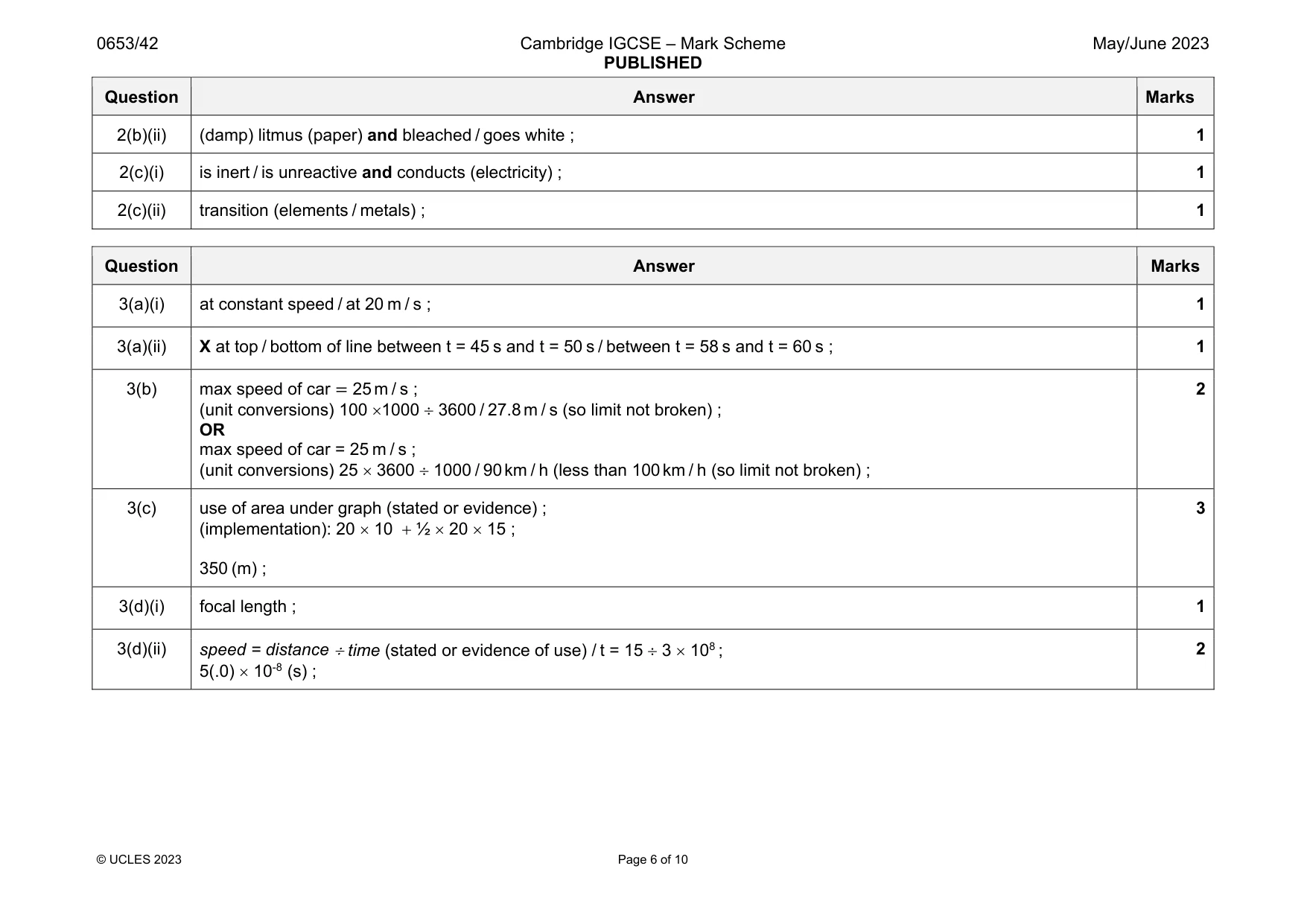
Mark scheme: 3(a)(i) at constant speed / at 20 m / s ; 1 3(a)(ii) X at top / bottom of line between t = 45 s and t = 50 s / between t = 58 s and t = 60 s ; 1 3(b) max speed of car = 25 m / s ; (unit conversions) 100 1000 3600 / 27.8 m / s (so limit not broken) ; OR max speed of car = 25 m / s ; (unit conversions) 25 3600 1000 / 90 km / h (less than 100 km / h (so limit not broken) ; 2 3(c) use of area under graph (stated or evidence) ; (implementation): 20 10 ½ 20 15 ; 350 (m) ; 3 3(d)(i) focal length ; 1 3(d)(ii) speed = distance time (stated or evidence of use) / t = 15 3 108 ; 5(.0) 10-8 (s) ; 2
Q4 · A student’s diagram of a cross-section through a leaf
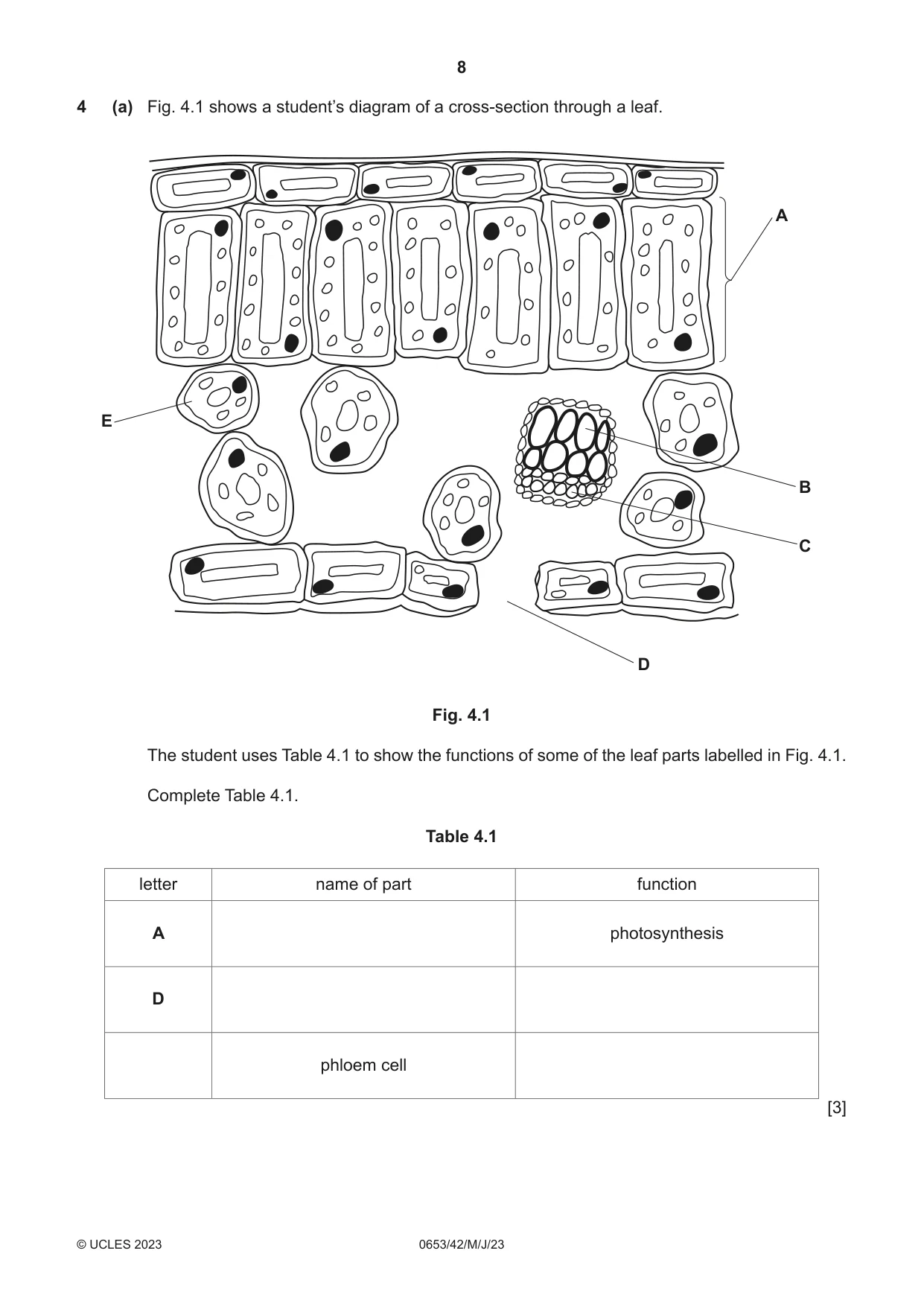
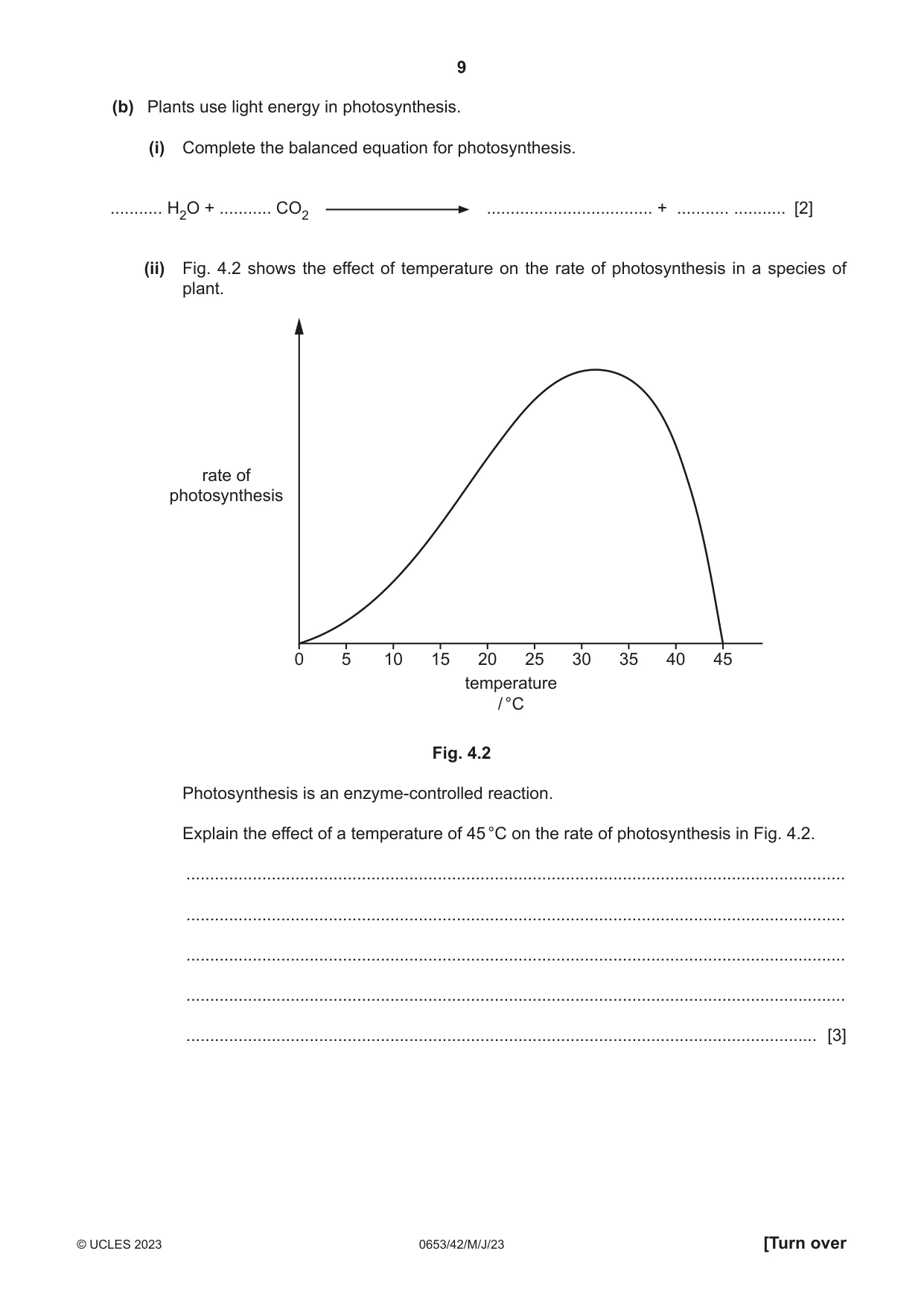
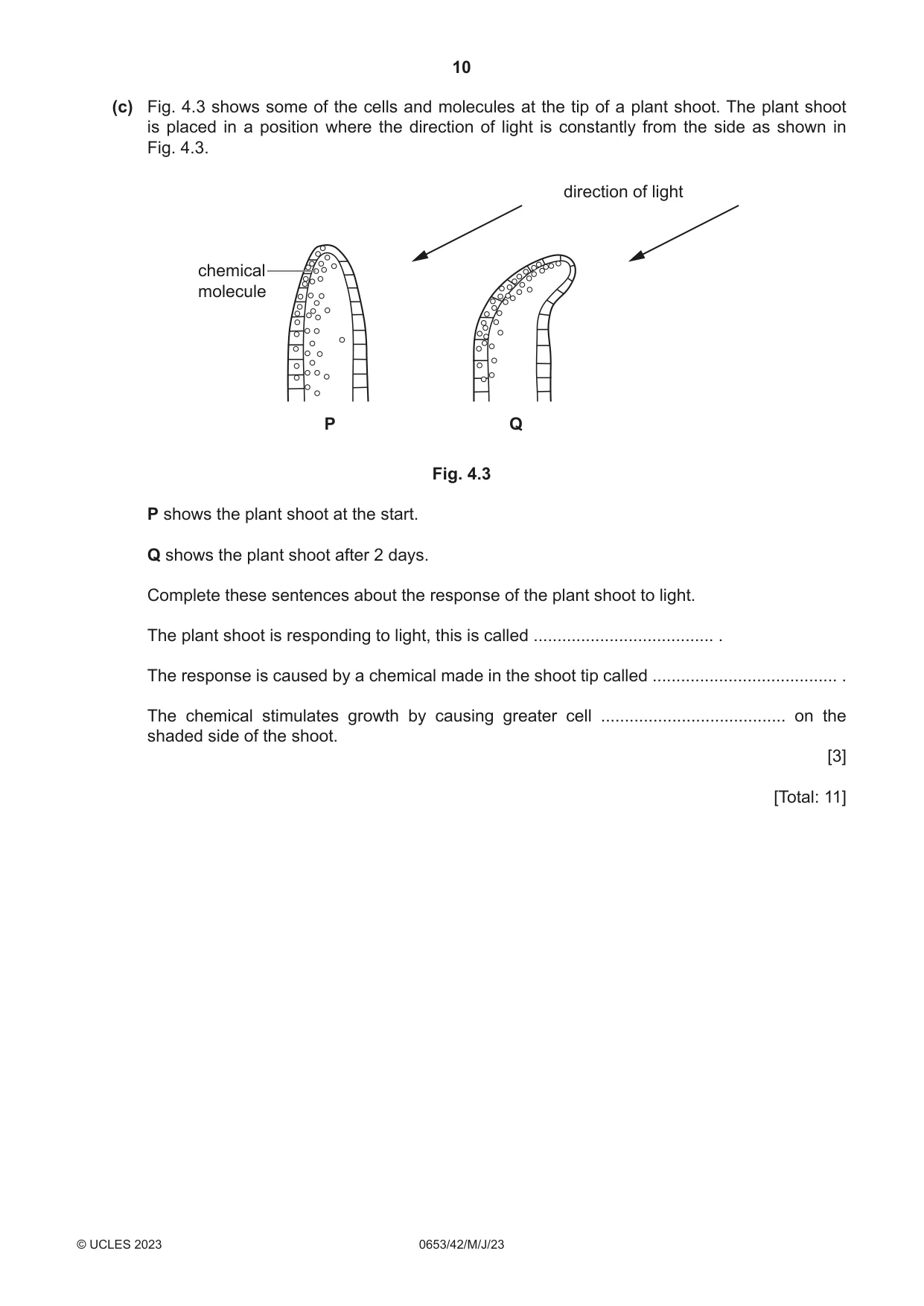
4 (a) Fig. 4.1 shows a student’s diagram of a cross-section through a leaf. A E B C D Fig. 4.1 The student uses Table 4.1 to show the functions of some of the leaf parts labelled in Fig. 4.1. Complete Table 4.1. Table 4.1 letter name of part function A photosynthesis D phloem cell [3] (b) Plants use light energy in photosynthesis. (i) Complete the balanced equation for photosynthesis. ........... H2O + ........... CO2 ................................... + ........... ........... [2] (ii) Fig. 4.2 shows the effect of temperature on the rate of photosynthesis in a species of plant. rate of photosynthesis 0 5 10 15 20 25 30 35 40 45 temperature / °C Fig. 4.2 Photosynthesis is an enzyme-controlled reaction. Explain the effect of a temperature of 45 °C on the rate of photosynthesis in Fig. 4.2. ........................................................................................................................................... ........................................................................................................................................... ........................................................................................................................................... ........................................................................................................................................... ..................................................................................................................................... [3] (c) Fig. 4.3 shows some of the cells and molecules at the tip of a plant shoot. The plant shoot is placed in a position where the direction of light is constantly from the side as shown in Fig. 4.3. direction of light chemical molecule P Q Fig. 4.3 P shows the plant shoot at the start. Q shows the plant shoot after 2 days. Complete these sentences about the response of the plant shoot to light. The plant shoot is responding to light, this is called ...................................... . The response is caused by a chemical made in the shoot tip called ....................................... . The chemical stimulates growth by causing greater cell ....................................... on the shaded side of the shoot. [3] [Total: 11]
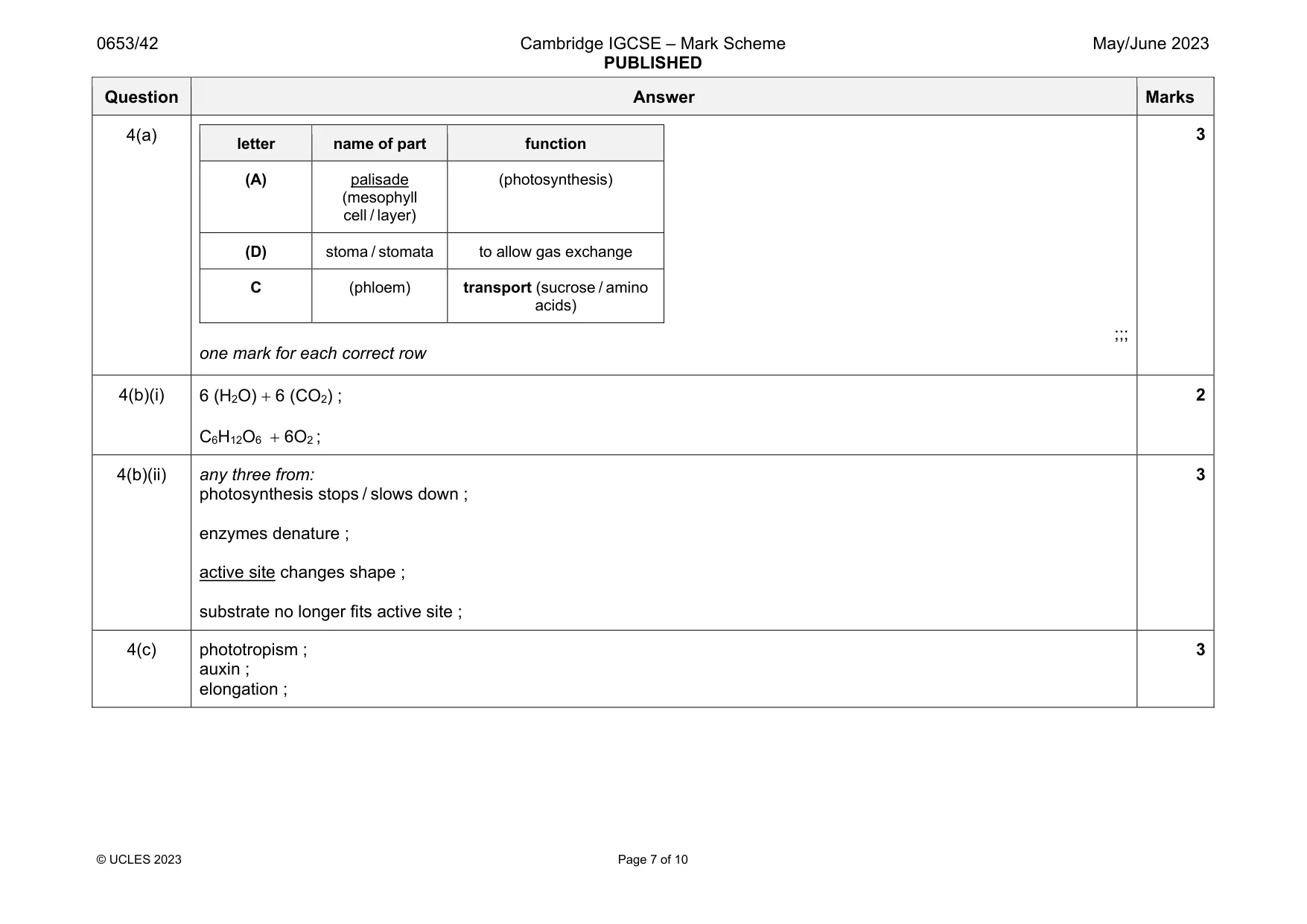
Mark scheme: 4(a) letter name of part function (A) palisade (mesophyll cell / layer) (photosynthesis) (D) stoma / stomata to allow gas exchange C (phloem) transport (sucrose / amino acids) ;;; one mark for each correct row 4(b)(i) 6 (H2O) 6 (CO2) ; C6H12O6 6O2 ; 2 4(b)(ii) any three from: photosynthesis stops / slows down ; enzymes denature ; active site changes shape ; substrate no longer fits active site ; 3 4(c) phototropism ; auxin ; elongation ; 3
Q5 · A student does five experiments to investigate the reaction between magnesium and dilute…
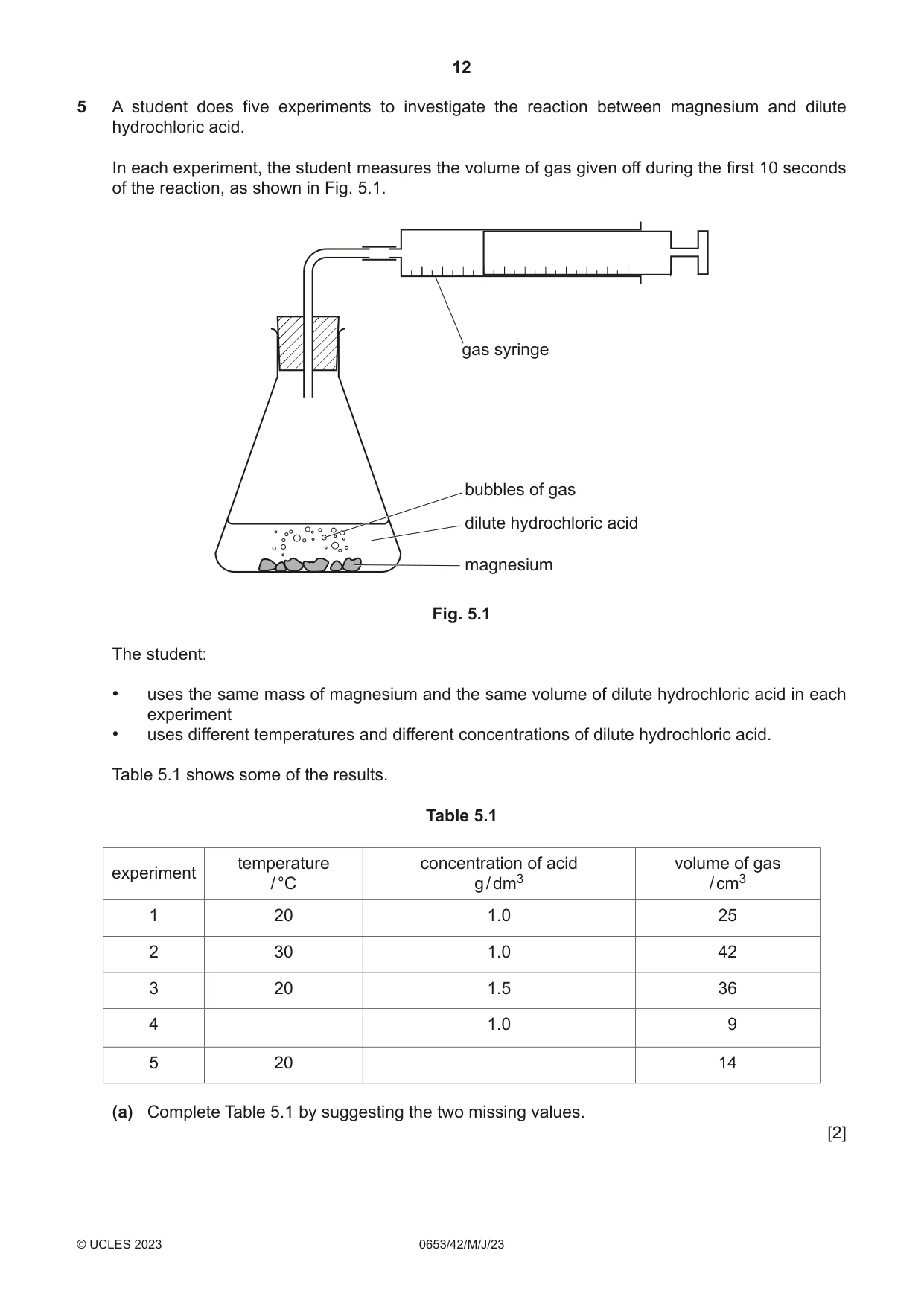
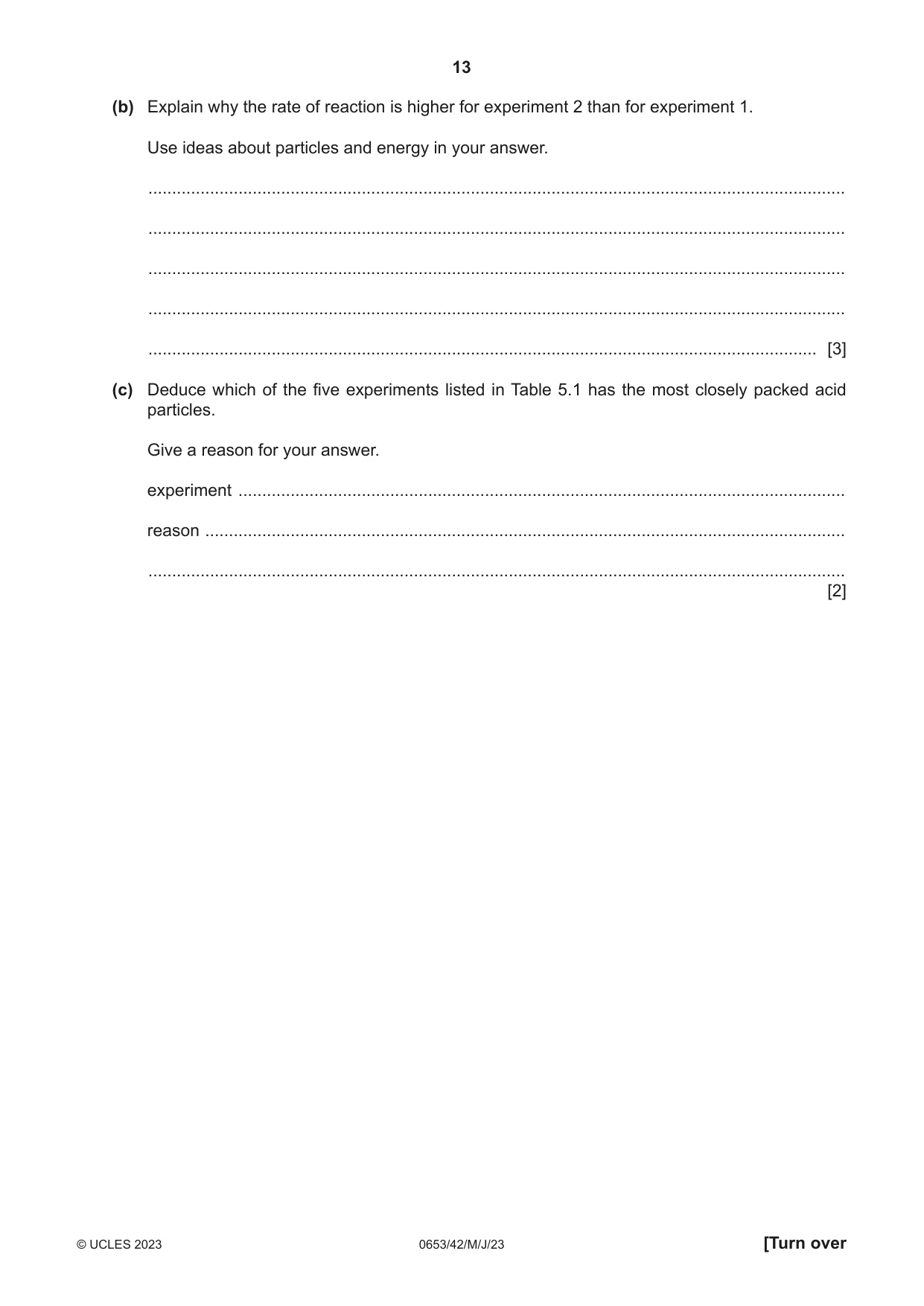
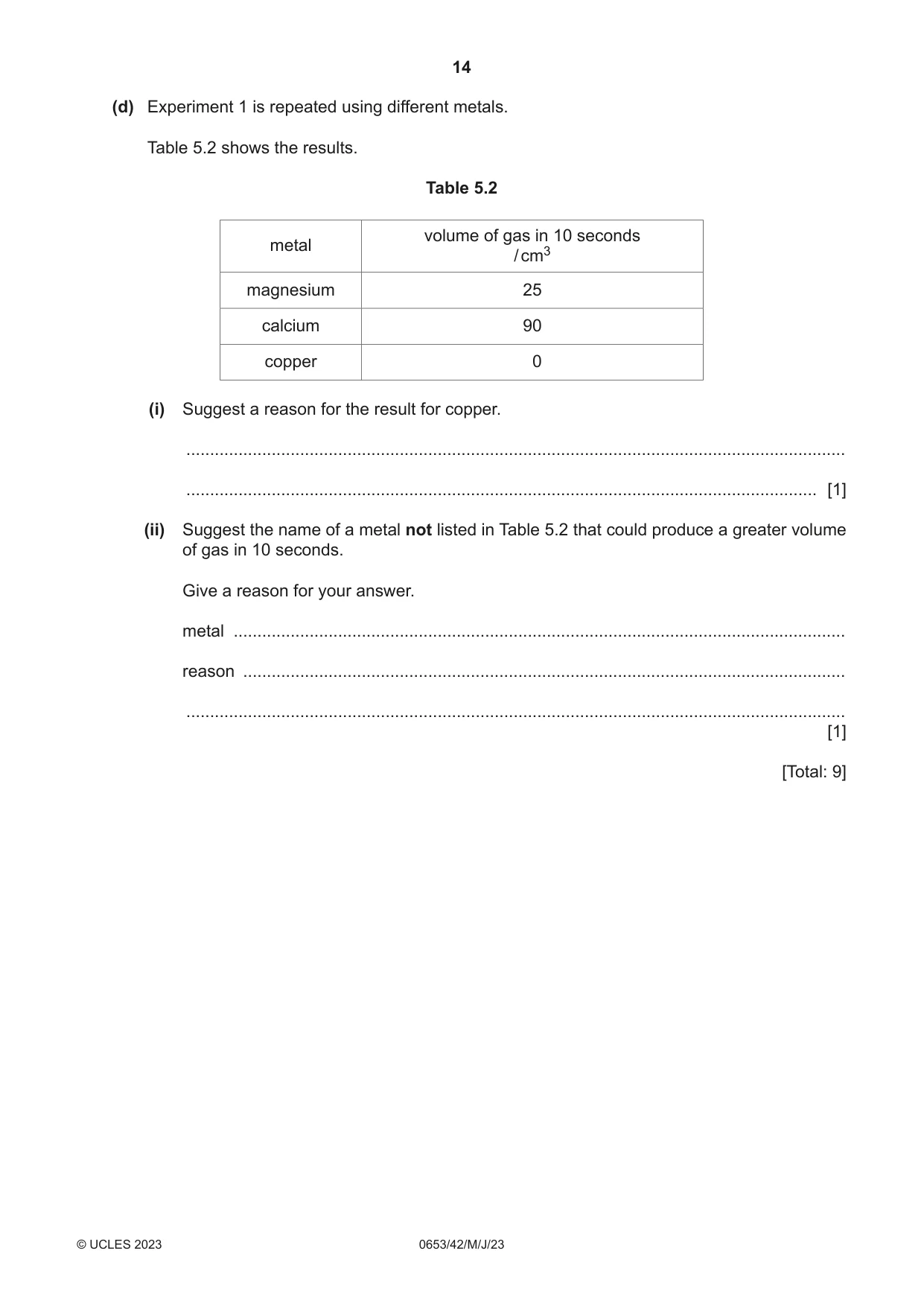
5 A student does five experiments to investigate the reaction between magnesium and dilute hydrochloric acid. In each experiment, the student measures the volume of gas given off during the first 10 seconds of the reaction, as shown in Fig. 5.1. gas syringe bubbles of gas dilute hydrochloric acid magnesium Fig. 5.1 The student: • uses the same mass of magnesium and the same volume of dilute hydrochloric acid in each experiment • uses different temperatures and different concentrations of dilute hydrochloric acid. Table 5.1 shows some of the results. Table 5.1 temperature concentration of acid volume of gas experiment / °C g / dm3 / cm3 1 20 1.0 25 2 30 1.0 42 3 20 1.5 36 4 1.0 9 5 20 14 (a) Complete Table 5.1 by suggesting the two missing values. [2] (b) Explain why the rate of reaction is higher for experiment 2 than for experiment 1. Use ideas about particles and energy in your answer. ................................................................................................................................................... ................................................................................................................................................... ................................................................................................................................................... ................................................................................................................................................... ............................................................................................................................................. [3] (c) Deduce which of the five experiments listed in Table 5.1 has the most closely packed acid particles. Give a reason for your answer. experiment ................................................................................................................................ reason ....................................................................................................................................... ................................................................................................................................................... [2] (d) Experiment 1 is repeated using different metals. Table 5.2 shows the results. Table 5.2 volume of gas in 10 seconds metal / cm3 magnesium 25 calcium 90 copper 0 (i) Suggest a reason for the result for copper. ........................................................................................................................................... ..................................................................................................................................... [1] (ii) Suggest the name of a metal not listed in Table 5.2 that could produce a greater volume of gas in 10 seconds. Give a reason for your answer. metal ................................................................................................................................. reason ............................................................................................................................... ........................................................................................................................................... [1] [Total: 9]
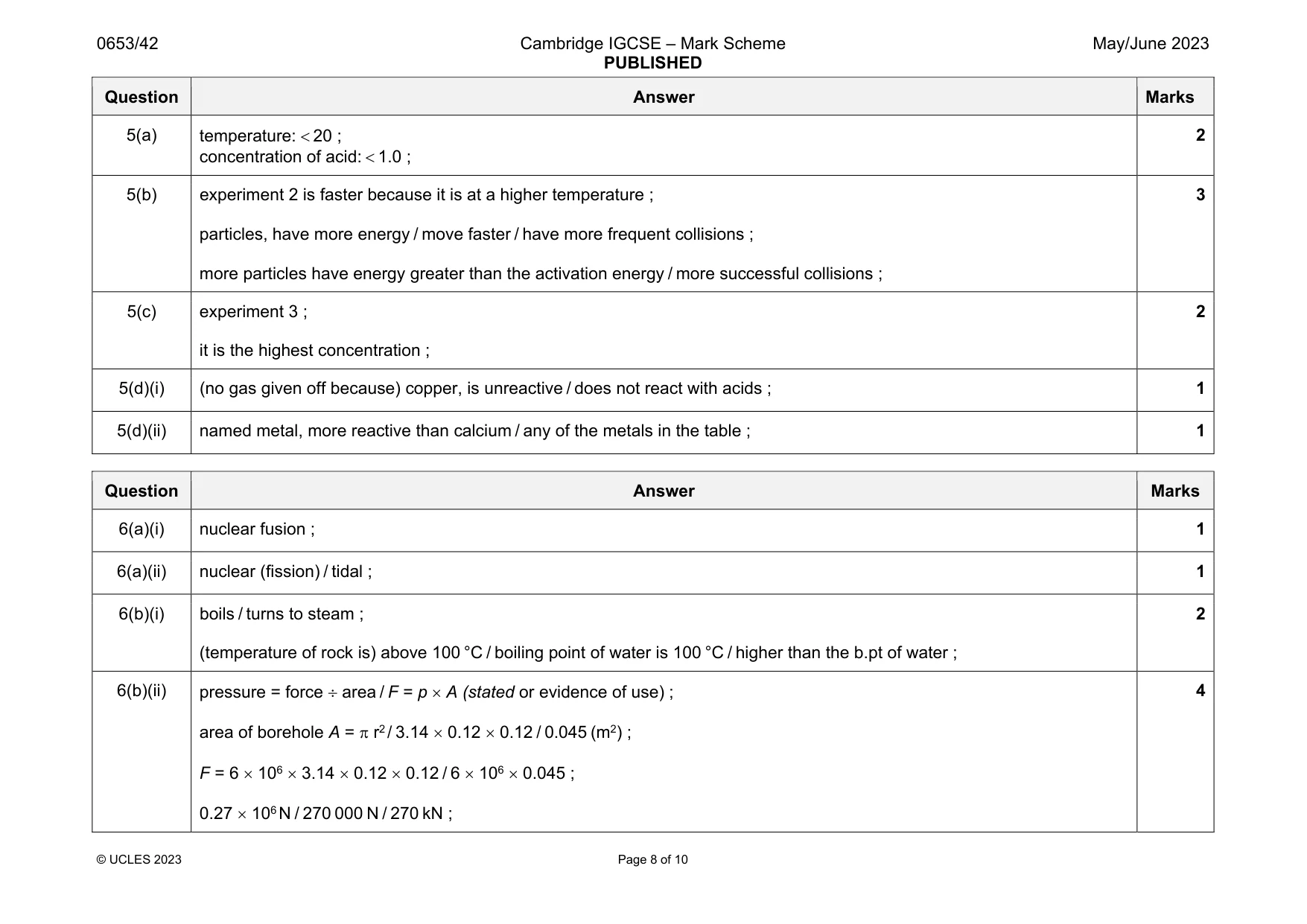
Mark scheme: 5(a) concentration of acid: 1.0 ; 2 5(b) experiment 2 is faster because it is at a higher temperature ; particles, have more energy / move faster / have more frequent collisions ; more particles have energy greater than the activation energy / more successful collisions ; 3 5(c) experiment 3 ; it is the highest concentration ; 2 5(d)(i) (no gas given off because) copper, is unreactive / does not react with acids ; 1 5(d)(ii) named metal, more reactive than calcium / any of the metals in the table ; 1
Q6 · The Sun is the source of energy for most of our energy resources
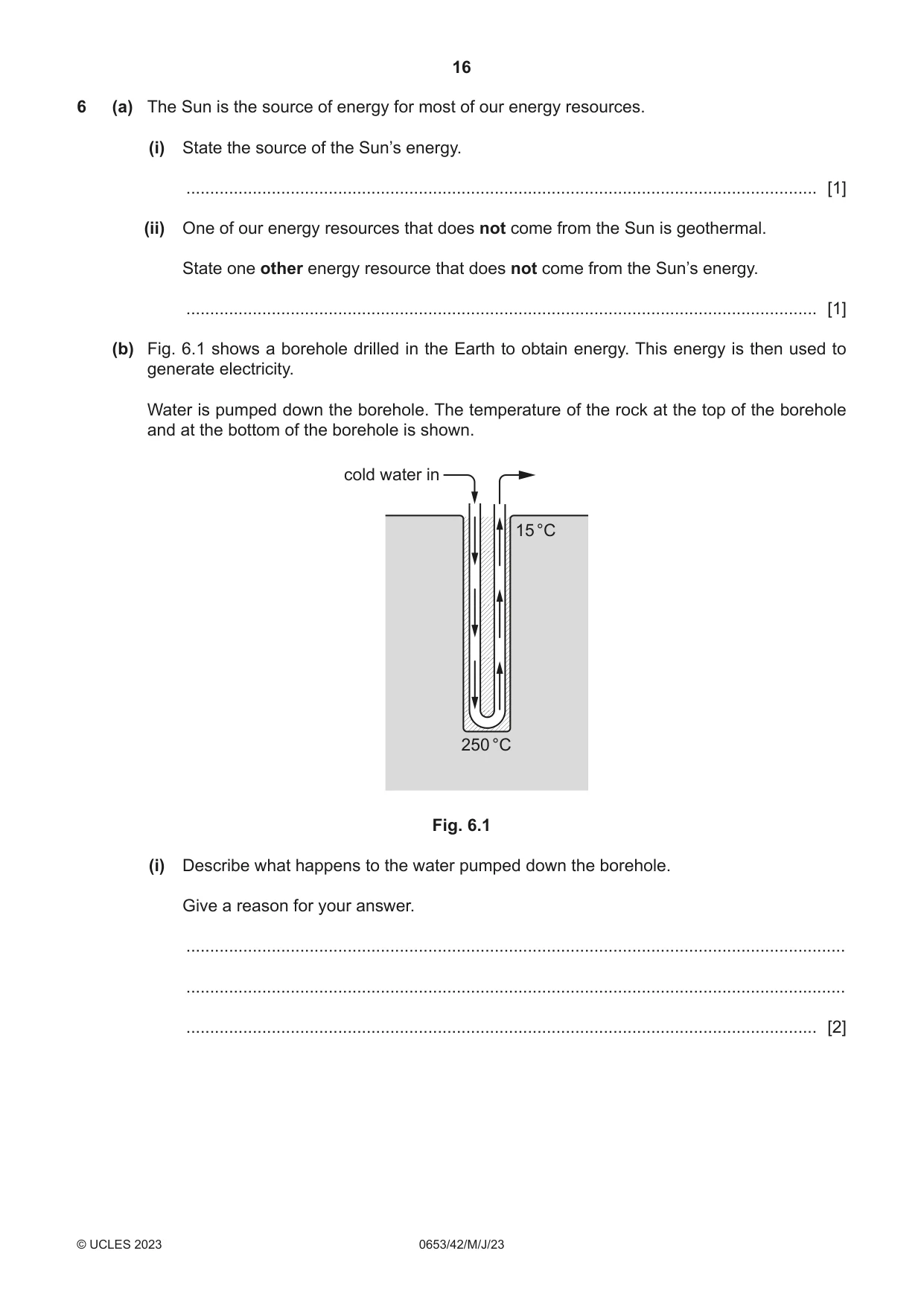
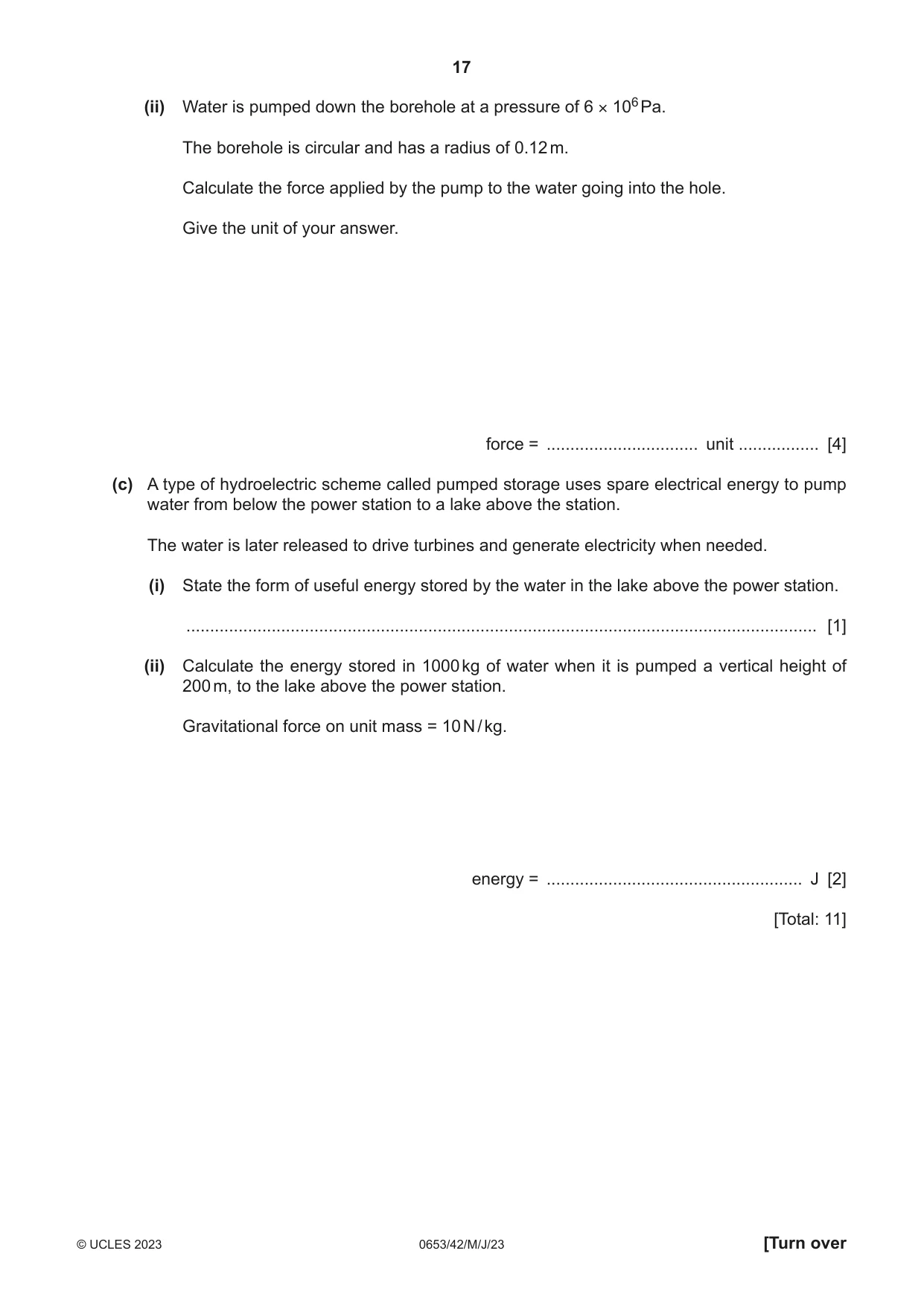
6 (a) The Sun is the source of energy for most of our energy resources. (i) State the source of the Sun’s energy. ..................................................................................................................................... [1] (ii) One of our energy resources that does not come from the Sun is geothermal. State one other energy resource that does not come from the Sun’s energy. ..................................................................................................................................... [1] (b) Fig. 6.1 shows a borehole drilled in the Earth to obtain energy. This energy is then used to generate electricity. Water is pumped down the borehole. The temperature of the rock at the top of the borehole and at the bottom of the borehole is shown. cold water in 15 °C 250 °C Fig. 6.1 (i) Describe what happens to the water pumped down the borehole. Give a reason for your answer. ........................................................................................................................................... ........................................................................................................................................... ..................................................................................................................................... [2] (ii) Water is pumped down the borehole at a pressure of 6 × 10⁶ Pa. The borehole is circular and has a radius of 0.12 m. Calculate the force applied by the pump to the water going into the hole. Give the unit of your answer. force = ................................ unit ................. [4] (c) A type of hydroelectric scheme called pumped storage uses spare electrical energy to pump water from below the power station to a lake above the station. The water is later released to drive turbines and generate electricity when needed. (i) State the form of useful energy stored by the water in the lake above the power station. ..................................................................................................................................... [1] (ii) Calculate the energy stored in 1000 kg of water when it is pumped a vertical height of 200 m, to the lake above the power station. Gravitational force on unit mass = 10 N / kg. energy = ...................................................... J [2] [Total: 11]
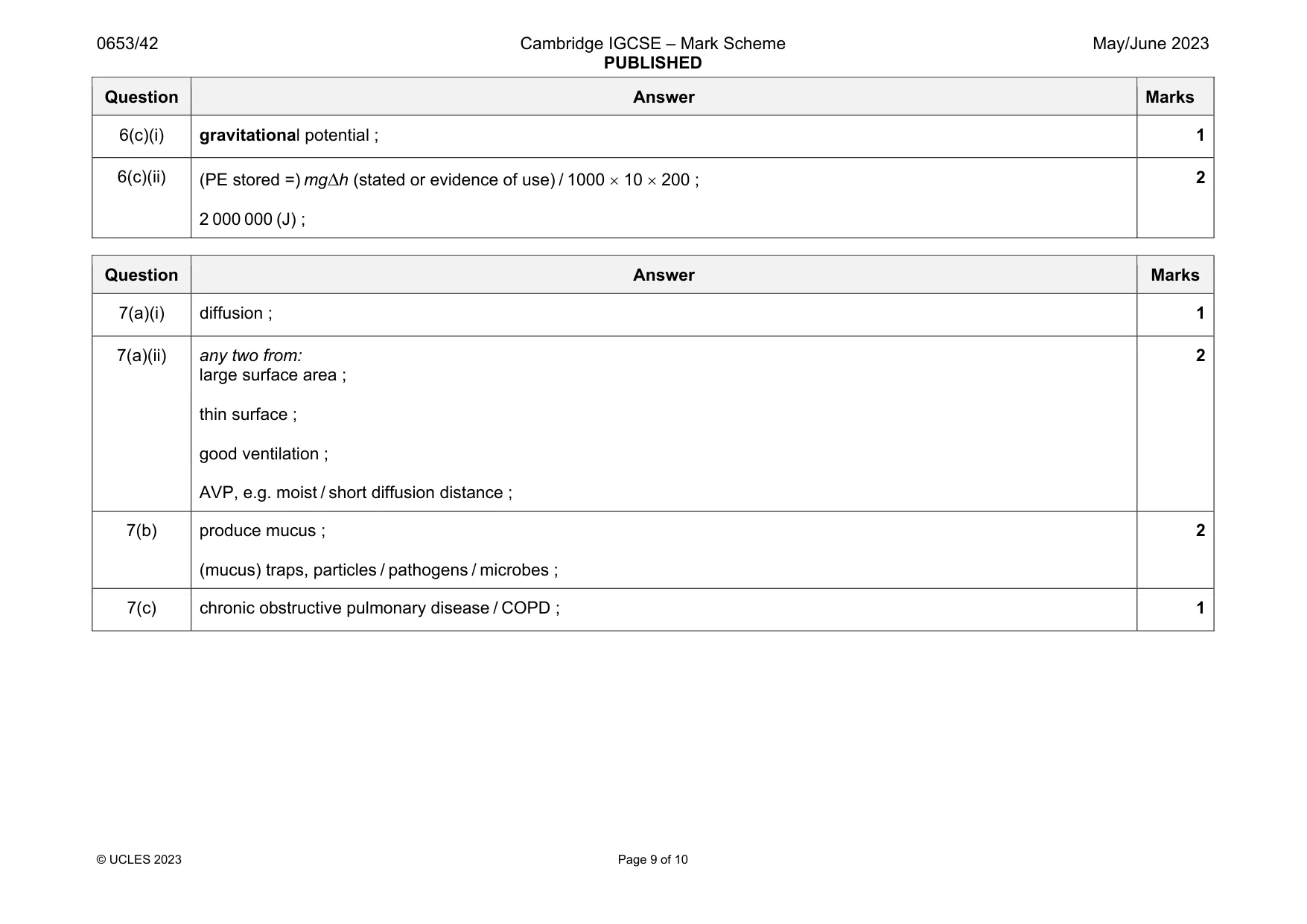
Mark scheme: 6(a)(i) nuclear fusion ; 1 6(a)(ii) nuclear (fission) / tidal ; 1 6(b)(i) boils / turns to steam ; (temperature of rock is) above 100 °C / boiling point of water is 100 °C / higher than the b.pt of water ; 2 6(b)(ii) pressure = force area / F = p A (stated or evidence of use) ; area of borehole A = r2 / 3.14 0.12 0.12 / 0.045 (m2) ; F = 6 106 3.14 0.12 0.12 / 6 106 0.045 ; 0.27 106 N / 270 000 N / 270 kN ; 4 Question Answer Marks 6(c)(i) gravitational potential ; 1 6(c)(ii) (PE stored =) mgh (stated or evidence of use) / 1000 10 200 ; 2 000 000 (J) ; 2
Q7 · The gas exchange surface in humans
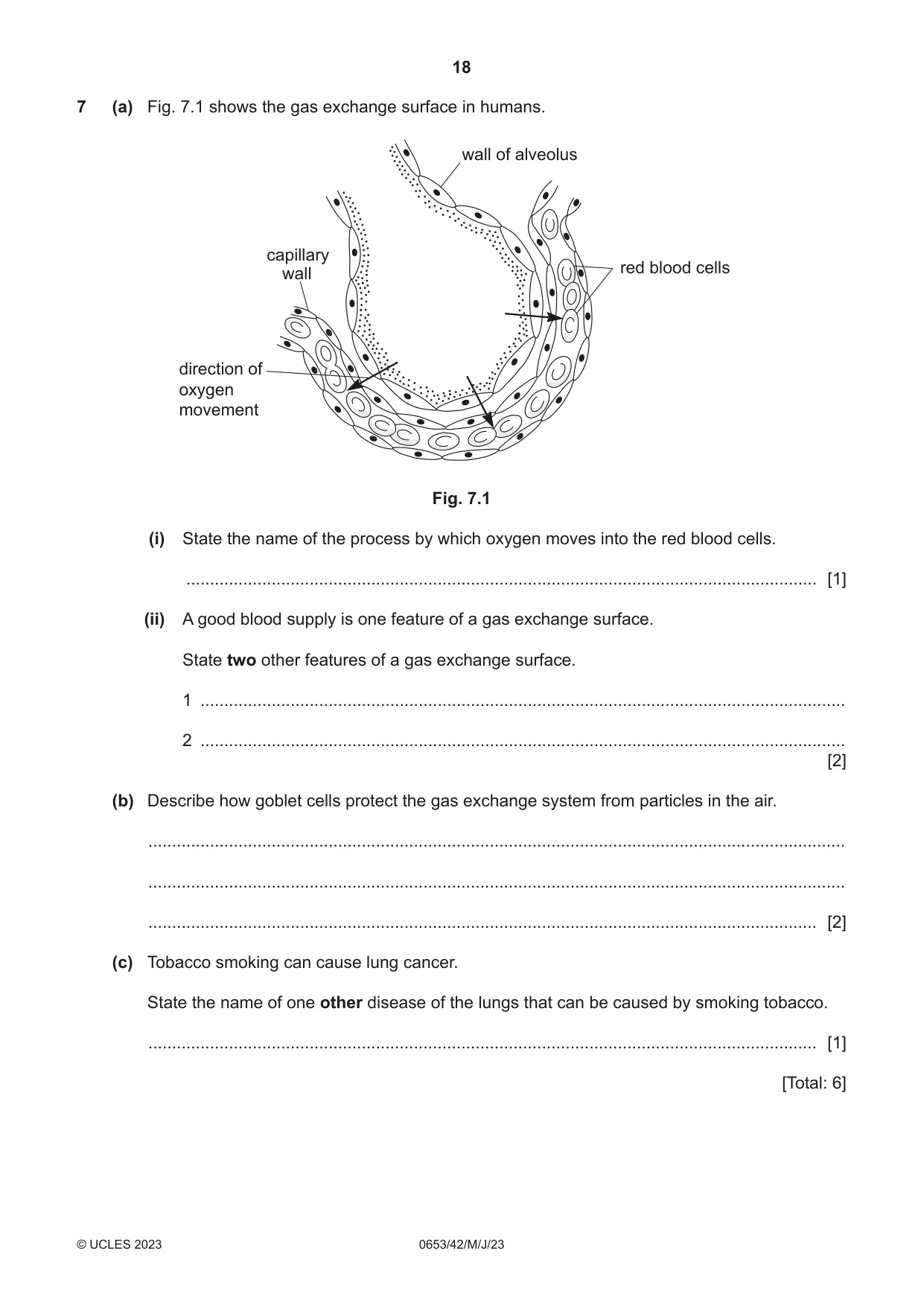
7 (a) Fig. 7.1 shows the gas exchange surface in humans. wall of alveolus capillary red blood cells wall direction of oxygen movement Fig. 7.1 (i) State the name of the process by which oxygen moves into the red blood cells. ..................................................................................................................................... [1] (ii) A good blood supply is one feature of a gas exchange surface. State two other features of a gas exchange surface. 1 ........................................................................................................................................ 2 ........................................................................................................................................ [2] (b) Describe how goblet cells protect the gas exchange system from particles in the air. ................................................................................................................................................... ................................................................................................................................................... ............................................................................................................................................. [2] (c) Tobacco smoking can cause lung cancer. State the name of one other disease of the lungs that can be caused by smoking tobacco. ............................................................................................................................................. [1] [Total: 6]
Mark scheme: 7(a)(i) diffusion ; 1 7(a)(ii) any two from: large surface area ; thin surface ; good ventilation ; AVP, e.g. moist / short diffusion distance ; 2 7(b) produce mucus ; (mucus) traps, particles / pathogens / microbes ; 2 7(c) chronic obstructive pulmonary disease / COPD ; 1
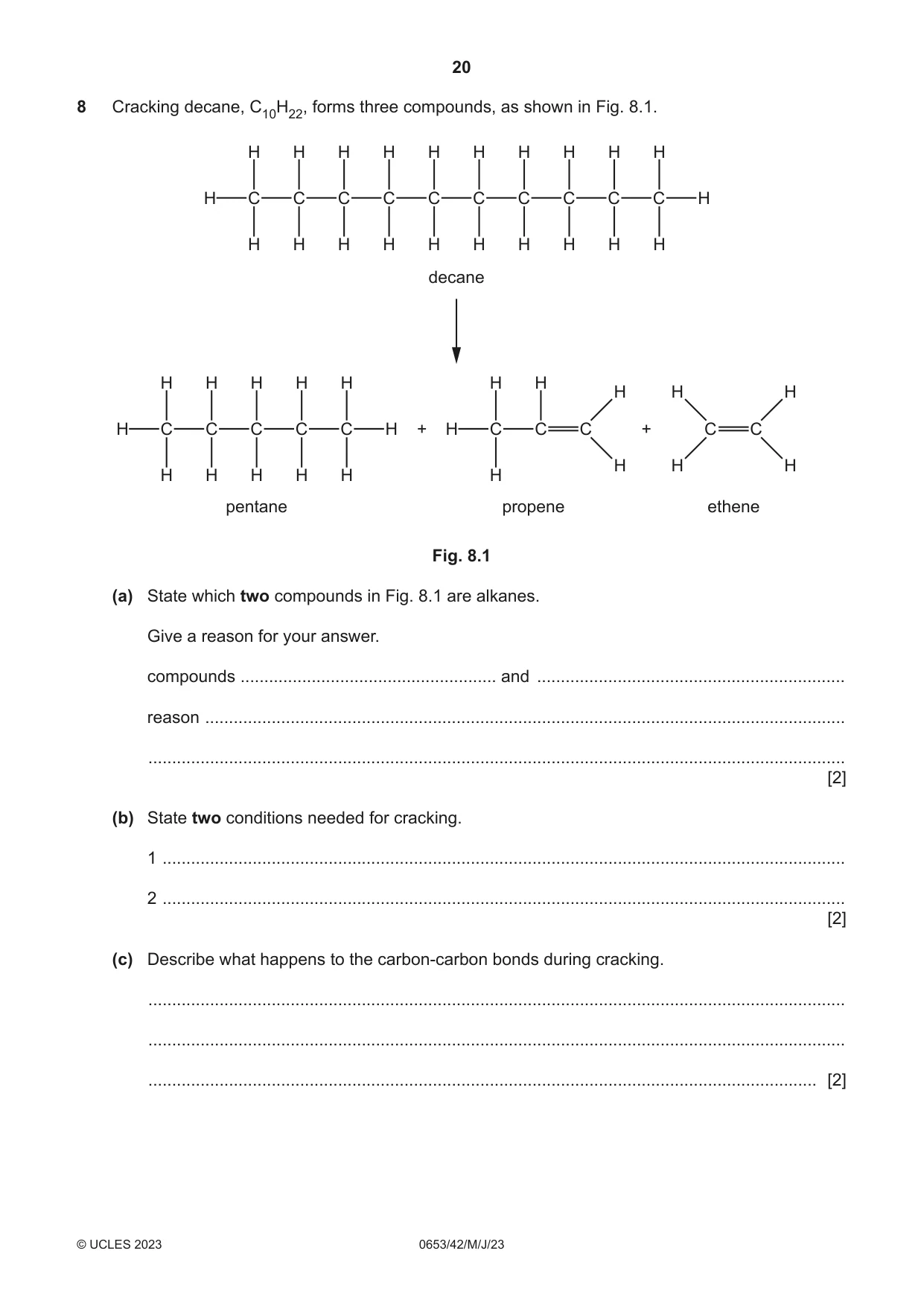
Q8 · Cracking decane, C10H22, forms three compounds, as shown in Fig
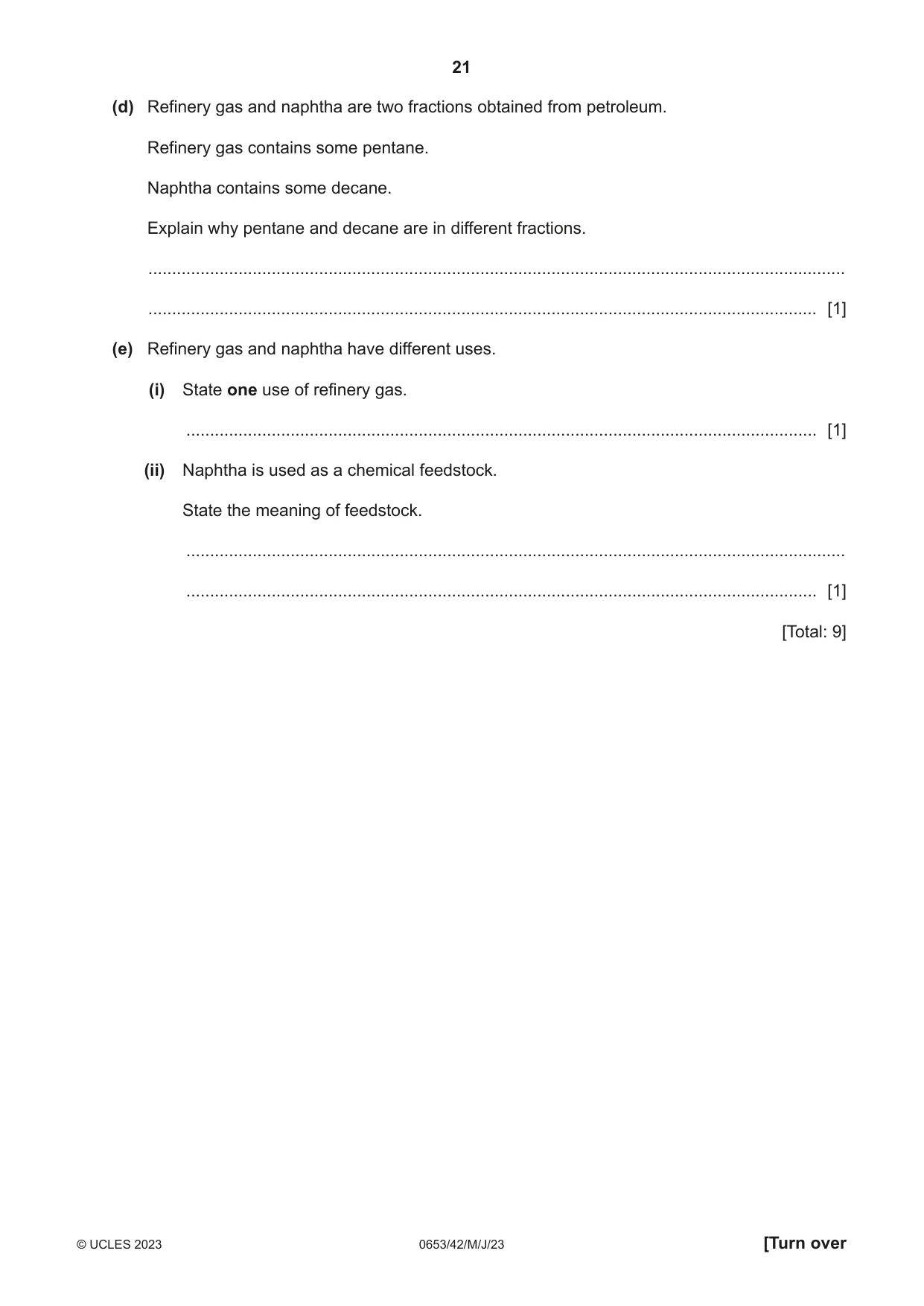
8 Cracking decane, C10H22, forms three compounds, as shown in Fig. 8.1. H H H H H H H H H H H C C C C C C C C C C H H H H H H H H H H H decane H H H H H H H H H H H C C C C C H + H C C C + C C H H H H H H H H H pentane propene ethene Fig. 8.1 (a) State which two compounds in Fig. 8.1 are alkanes. Give a reason for your answer. compounds ...................................................... and ................................................................. reason ....................................................................................................................................... ................................................................................................................................................... [2] (b) State two conditions needed for cracking. 1 ................................................................................................................................................ 2 ................................................................................................................................................ [2] (c) Describe what happens to the carbon-carbon bonds during cracking. ................................................................................................................................................... ................................................................................................................................................... ............................................................................................................................................. [2] (d) Refinery gas and naphtha are two fractions obtained from petroleum. Refinery gas contains some pentane. Naphtha contains some decane. Explain why pentane and decane are in different fractions. ................................................................................................................................................... ............................................................................................................................................. [1] (e) Refinery gas and naphtha have different uses. (i) State one use of refinery gas. ..................................................................................................................................... [1] (ii) Naphtha is used as a chemical feedstock. State the meaning of feedstock. ........................................................................................................................................... ..................................................................................................................................... [1] [Total: 9]
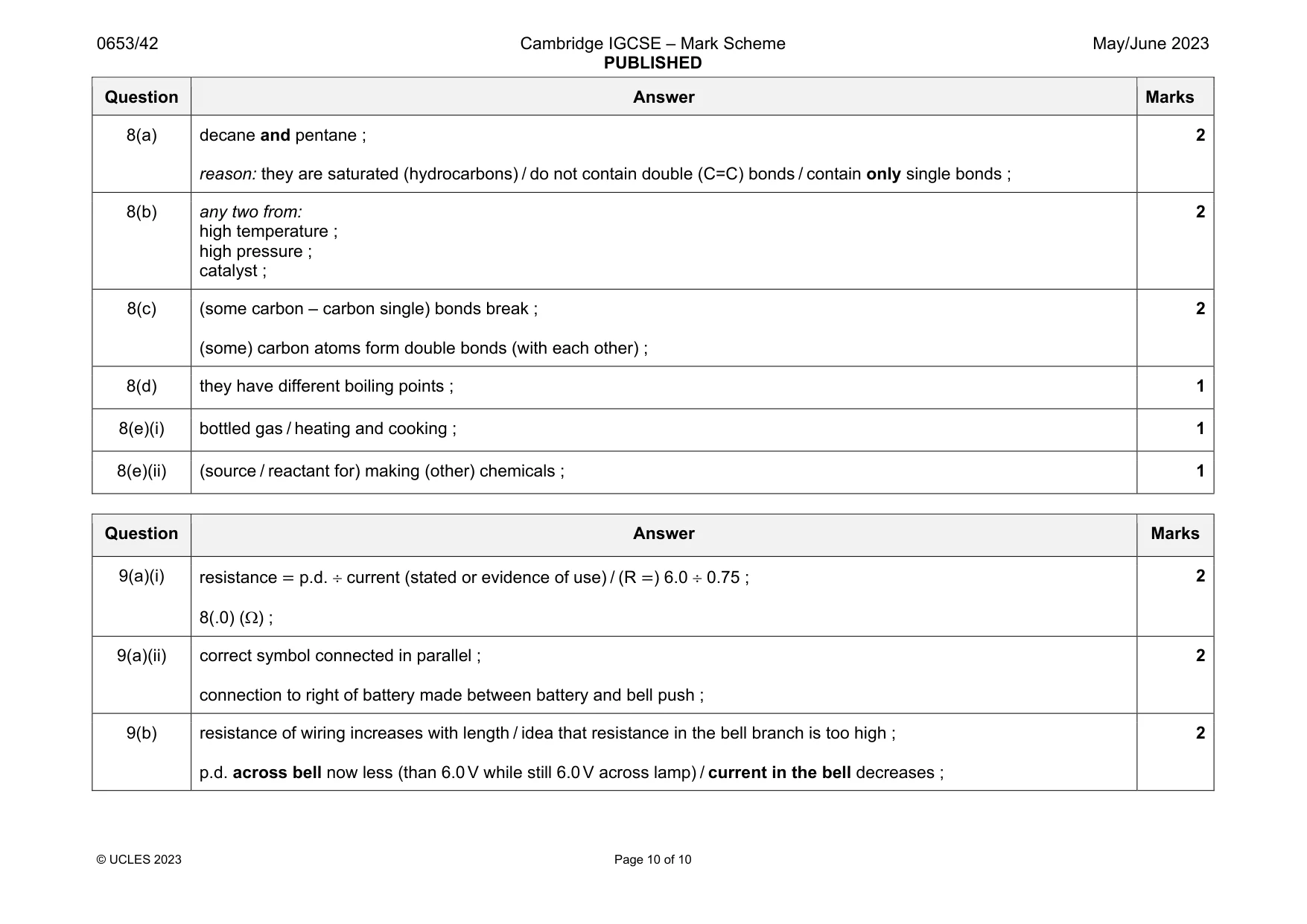
Mark scheme: 8(a) decane and pentane ; reason: they are saturated (hydrocarbons) / do not contain double (C=C) bonds / contain only single bonds ; 2 8(b) any two from: high temperature ; high pressure ; catalyst ; 2 8(c) (some carbon – carbon single) bonds break ; (some) carbon atoms form double bonds (with each other) ; 2 8(d) they have different boiling points ; 1 8(e)(i) bottled gas / heating and cooking ; 1 8(e)(ii) (source / reactant for) making (other) chemicals ; 1
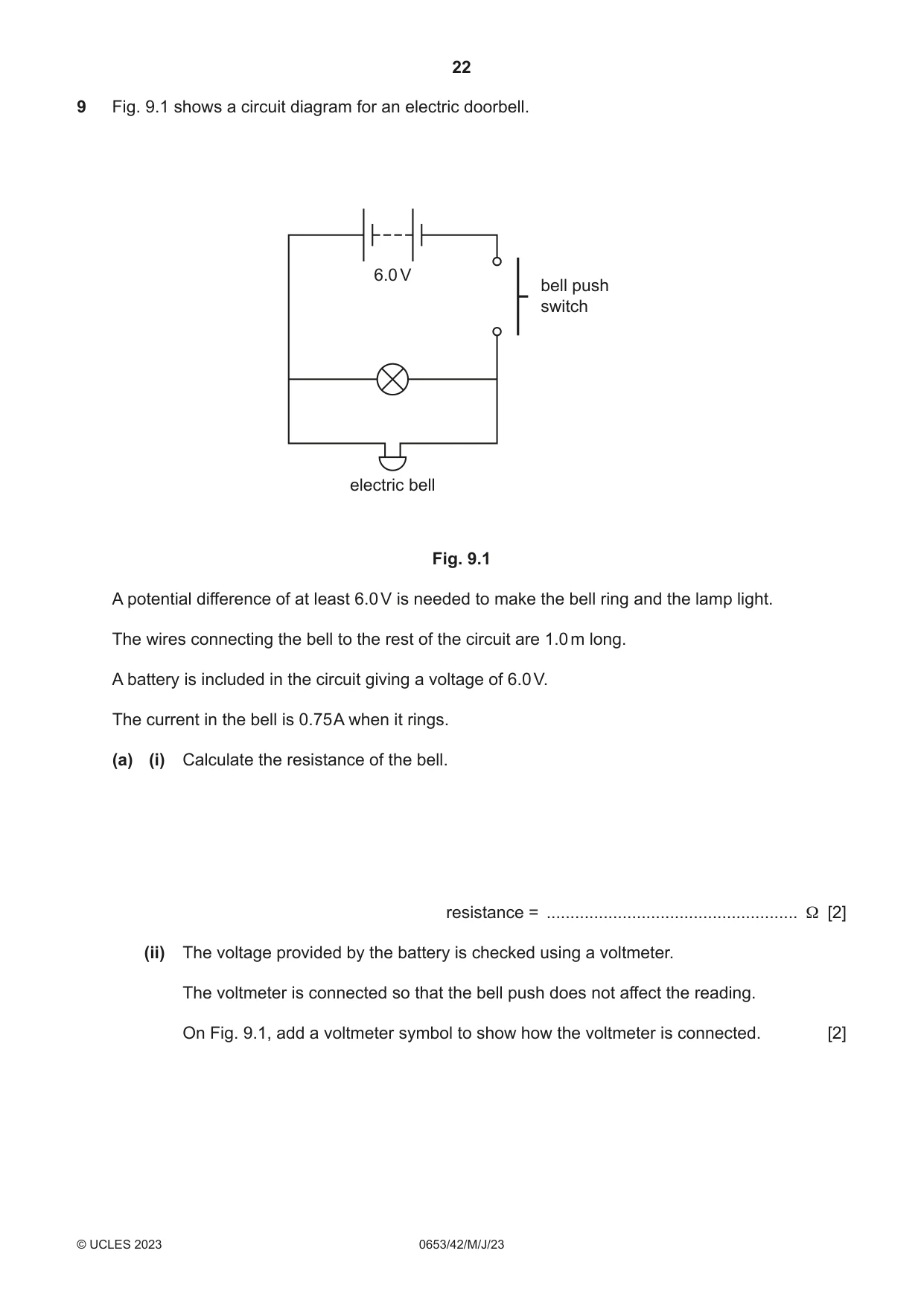
Q9 · A circuit diagram for an electric doorbell
9 Fig. 9.1 shows a circuit diagram for an electric doorbell. 6.0 V bell push switch electric bell Fig. 9.1 A potential difference of at least 6.0 V is needed to make the bell ring and the lamp light. The wires connecting the bell to the rest of the circuit are 1.0 m long. A battery is included in the circuit giving a voltage of 6.0 V. The current in the bell is 0.75 A when it rings. (a) (i) Calculate the resistance of the bell. resistance = ..................................................... Ω [2] (ii) The voltage provided by the battery is checked using a voltmeter. The voltmeter is connected so that the bell push does not affect the reading. On Fig. 9.1, add a voltmeter symbol to show how the voltmeter is connected. [2] (b) The length of wire connecting the bell to the rest of the circuit is increased from 1.0 m to 100 m. The lamp lights but the bell does not work. Suggest why the bell no longer works, but the lamp still works. ................................................................................................................................................... ................................................................................................................................................... ............................................................................................................................................. [2] [Total: 6]
Mark scheme: 9(a)(i) 8(.0) () ; 9(a)(ii) correct symbol connected in parallel ; connection to right of battery made between battery and bell push ; 2 9(b) resistance of wiring increases with length / idea that resistance in the bell branch is too high ; p.d. across bell now less (than 6.0 V while still 6.0 V across lamp) / current in the bell decreases ; 2
What was in this paper
The subtopics covered by these 9 questions, and how many questions each got. Open one in a new tab to see every Cambridge question on it.
What you needed in this session
Cambridge’s own grade thresholds for 2023 May/June, Paper 4 · Variant 2. A higher threshold means an easier paper — the bar moves with how the cohort did.