Cambridge IGCSE Science - Combined 0653 — 2018 Oct/Nov Paper 4 · Variant 2
0653/42/O/N/18 · 9 questions · 80 marks · ≈90 min
The question paper and its mark scheme, free to read here and free to download. This is Cambridge’s own paper, exactly as it was sat.
Question paper24 pages

Mark scheme8 pages
Answers below. Sit the paper first if you are practising.
Questions as text
Q1 · A farm tractor pulling a trailer
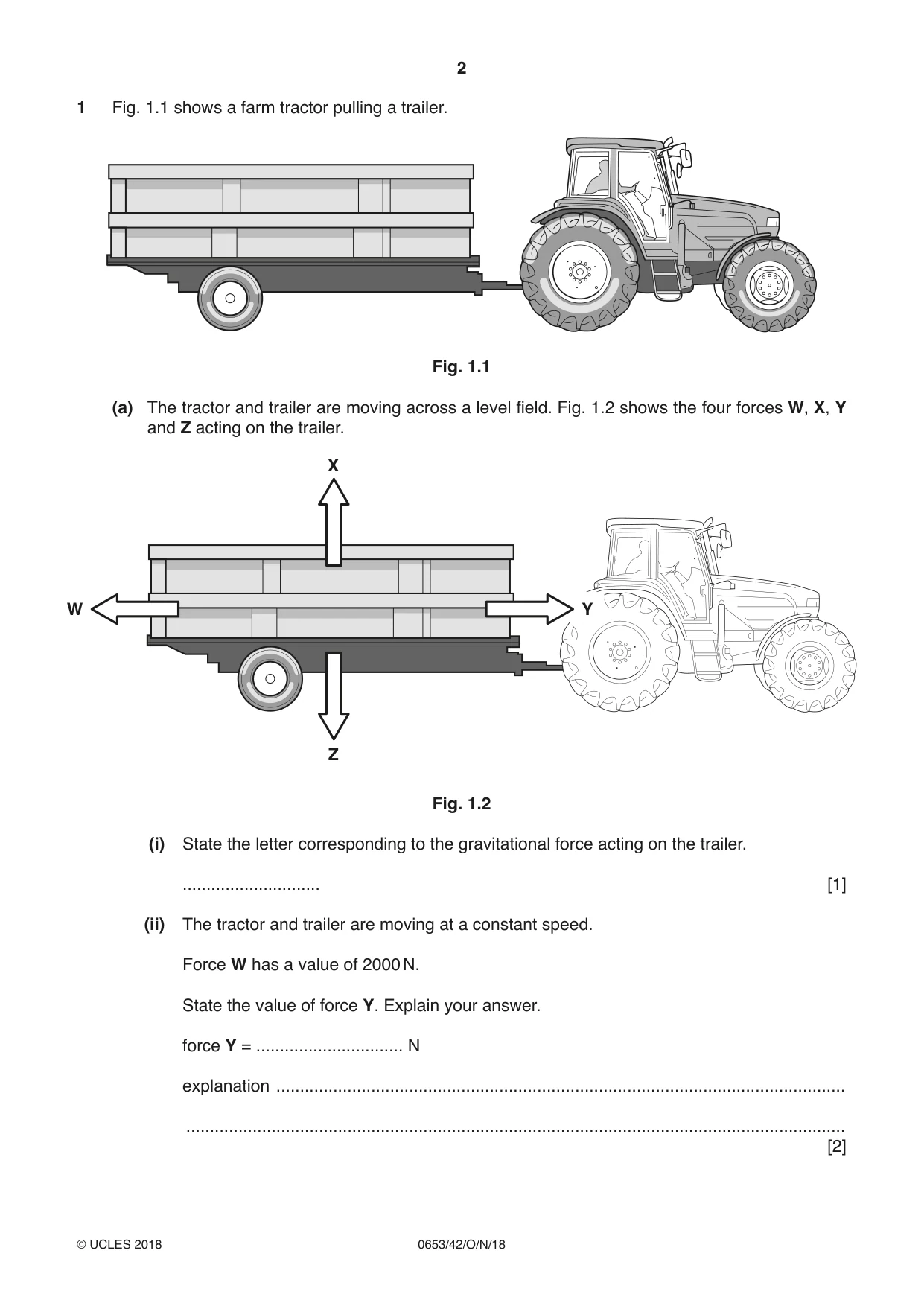
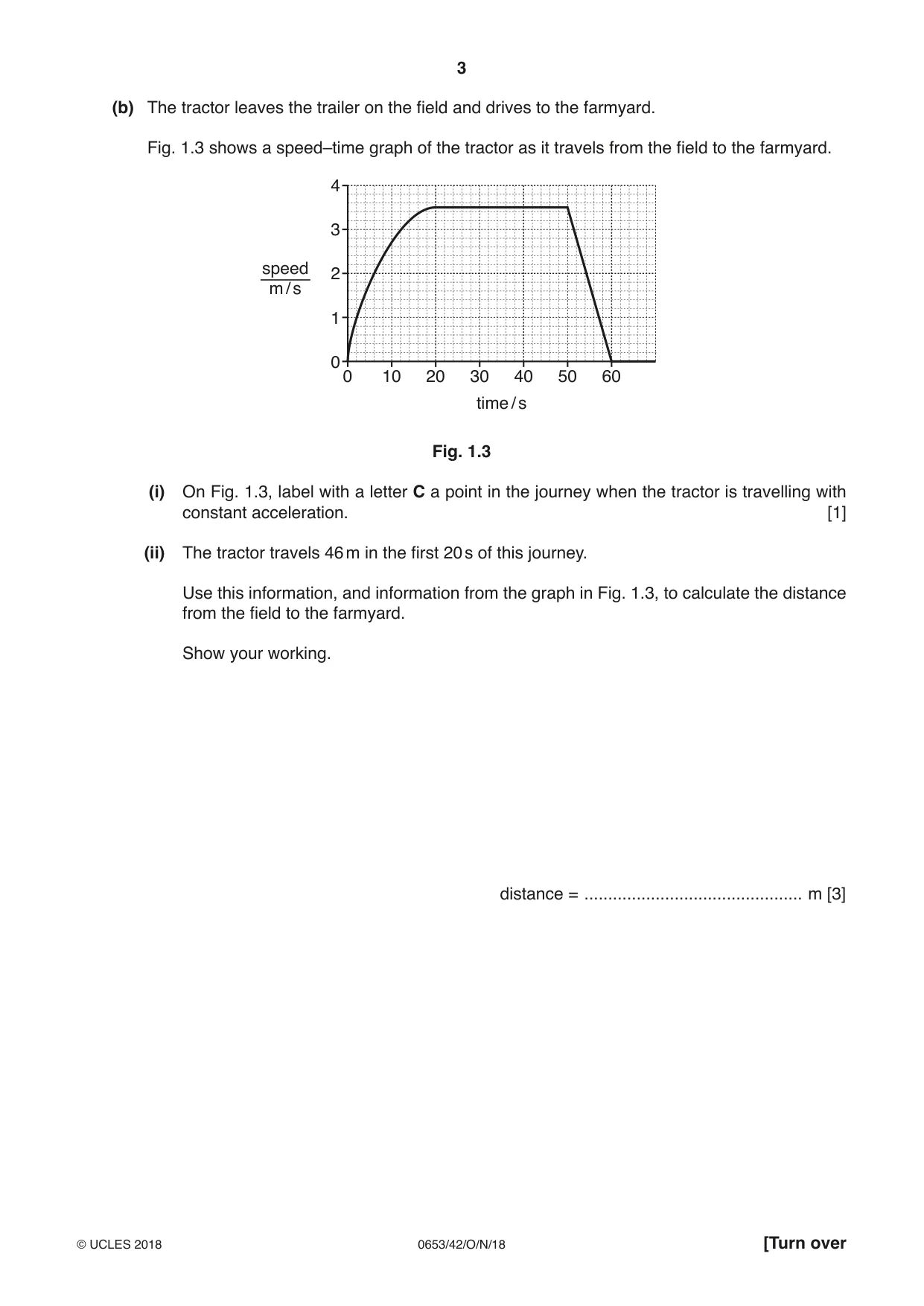
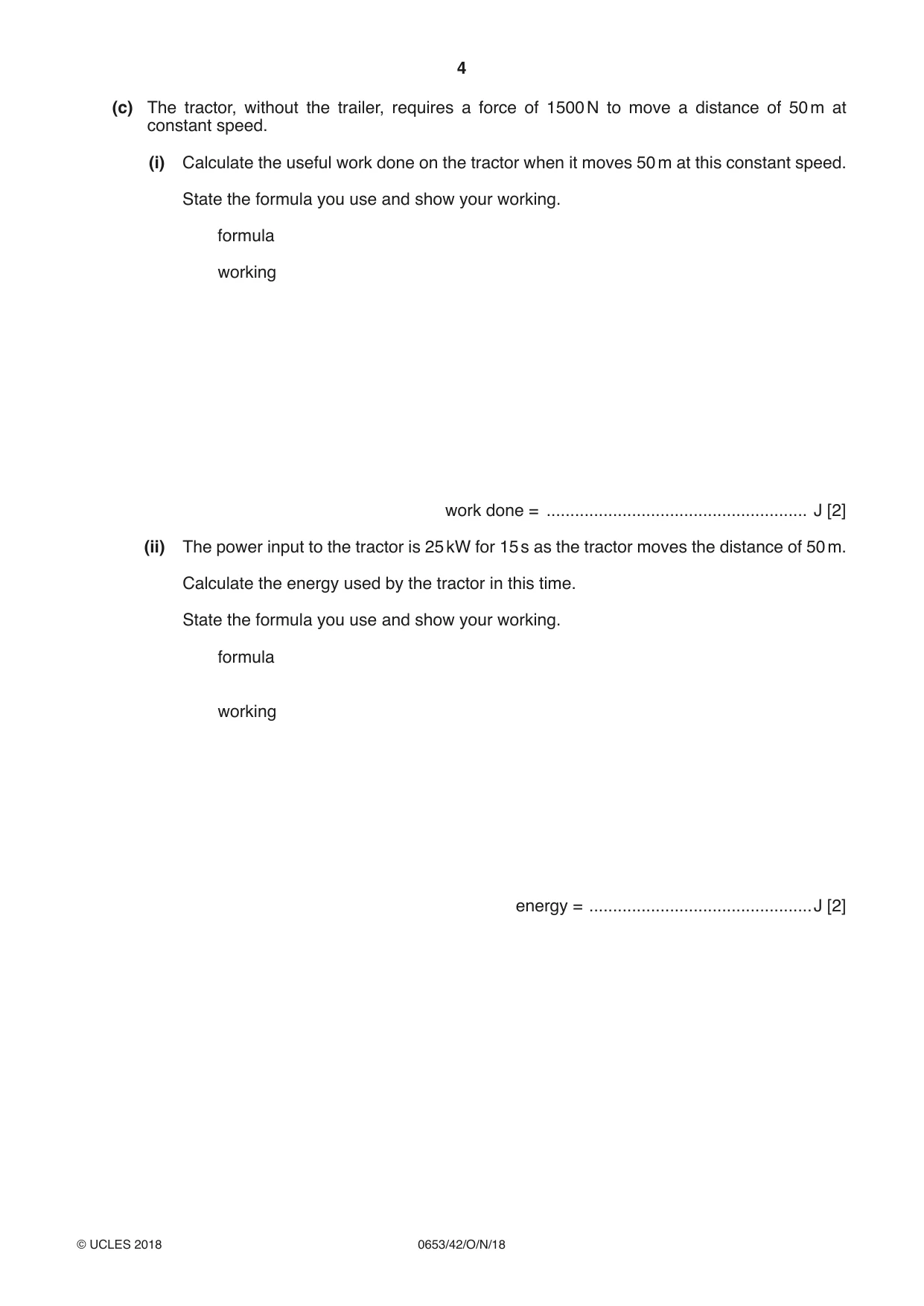
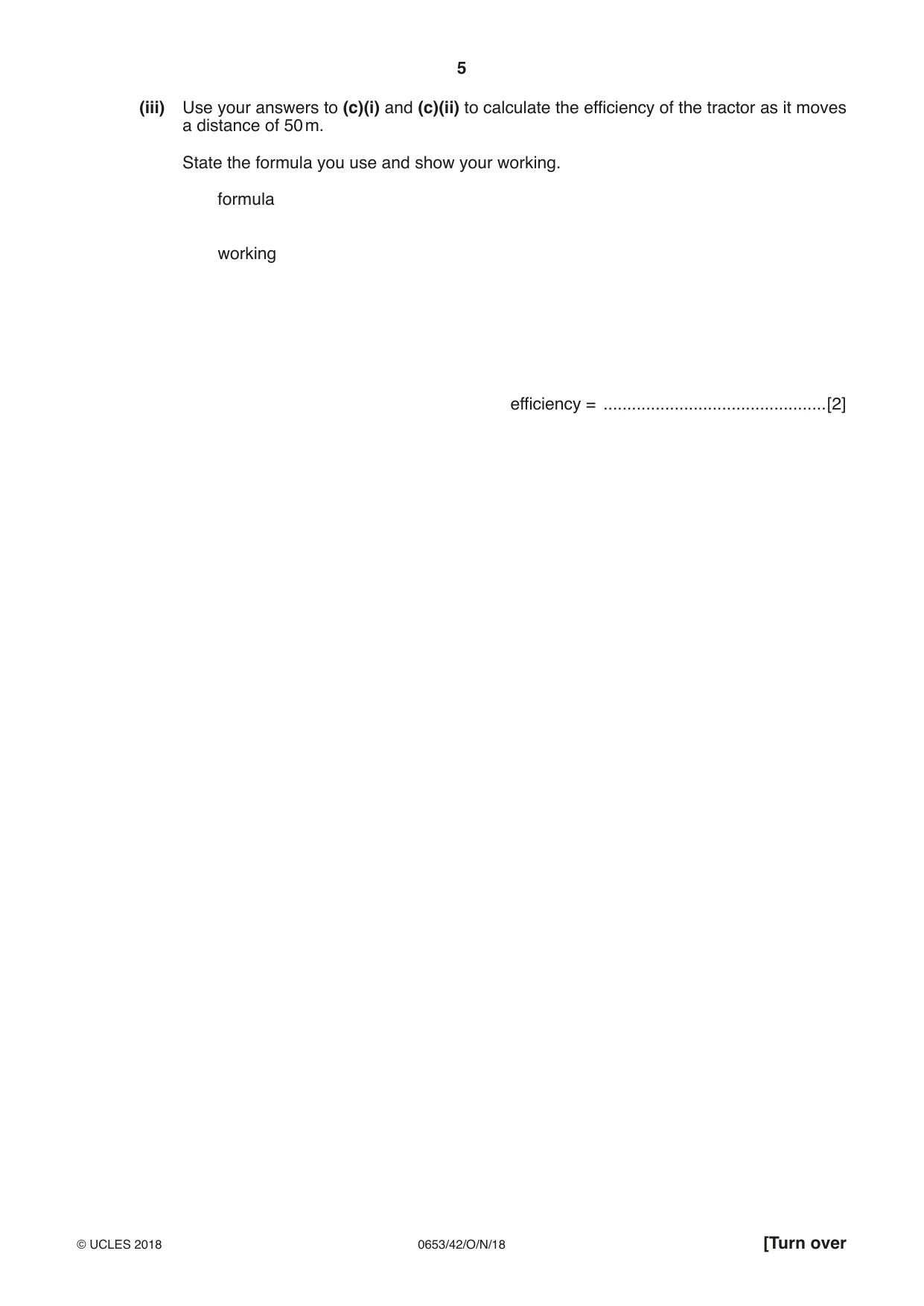
1 Fig. 1.1 shows a farm tractor pulling a trailer. Fig. 1.1 (a) The tractor and trailer are moving across a level field. Fig. 1.2 shows the four forces W, X, Y and Z acting on the trailer. X W Y Z Fig. 1.2 (i) State the letter corresponding to the gravitational force acting on the trailer. ............................. [1] (ii) The tractor and trailer are moving at a constant speed. Force W has a value of 2000 N. State the value of force Y. Explain your answer. force Y = ............................... N explanation ........................................................................................................................ ........................................................................................................................................... [2] (b) The tractor leaves the trailer on the field and drives to the farmyard. Fig. 1.3 shows a speed–time graph of the tractor as it travels from the field to the farmyard. 4 3 speed 2 m / s 1 0 0 10 20 30 40 50 60 time / s Fig. 1.3 (i) On Fig. 1.3, label with a letter C a point in the journey when the tractor is travelling with constant acceleration. [1] (ii) The tractor travels 46 m in the first 20 s of this journey. Use this information, and information from the graph in Fig. 1.3, to calculate the distance from the field to the farmyard. Show your working. distance = .............................................. m [3] (c) The tractor, without the trailer, requires a force of 1500 N to move a distance of 50 m at constant speed. (i) Calculate the useful work done on the tractor when it moves 50 m at this constant speed. State the formula you use and show your working. formula working work done = ....................................................... J [2] (ii) The power input to the tractor is 25 kW for 15 s as the tractor moves the distance of 50 m. Calculate the energy used by the tractor in this time. State the formula you use and show your working. formula working energy = ...............................................J [2] (iii) Use your answers to (c)(i) and (c)(ii) to calculate the efficiency of the tractor as it moves a distance of 50 m. State the formula you use and show your working. formula working efficiency = ...............................................[2]
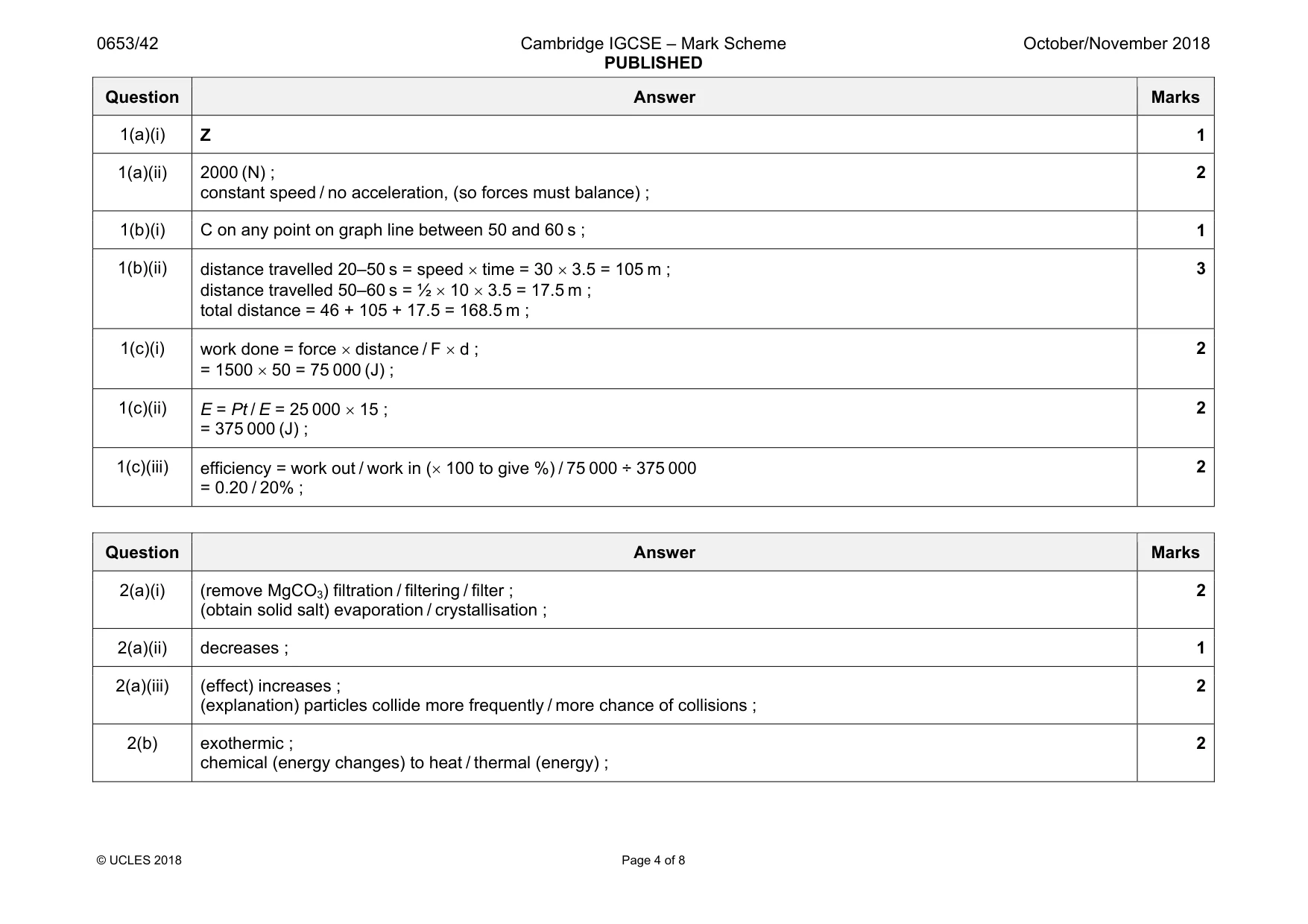
Mark scheme: 1(a)(i) Z 1 1(a)(ii) 2000 (N) ; constant speed / no acceleration, (so forces must balance) ; 2 1(b)(i) C on any point on graph line between 50 and 60 s ; 1 1(b)(ii) distance travelled 20–50 s = speed × time = 30 × 3.5 = 105 m ; distance travelled 50–60 s = ½ × 10 × 3.5 = 17.5 m ; total distance = 46 + 105 + 17.5 = 168.5 m ; 3 1(c)(i) work done = force × distance / F × d ; = 1500 × 50 = 75 000 (J) ; 2 1(c)(ii) E = Pt / E = 25 000 × 15 ; = 375 000 (J) ; 2 1(c)(iii) efficiency = work out / work in (× 100 to give %) / 75 000 ÷ 375 000 = 0.20 / 20% ; 2
Q2 · Magnesium chloride is a soluble salt
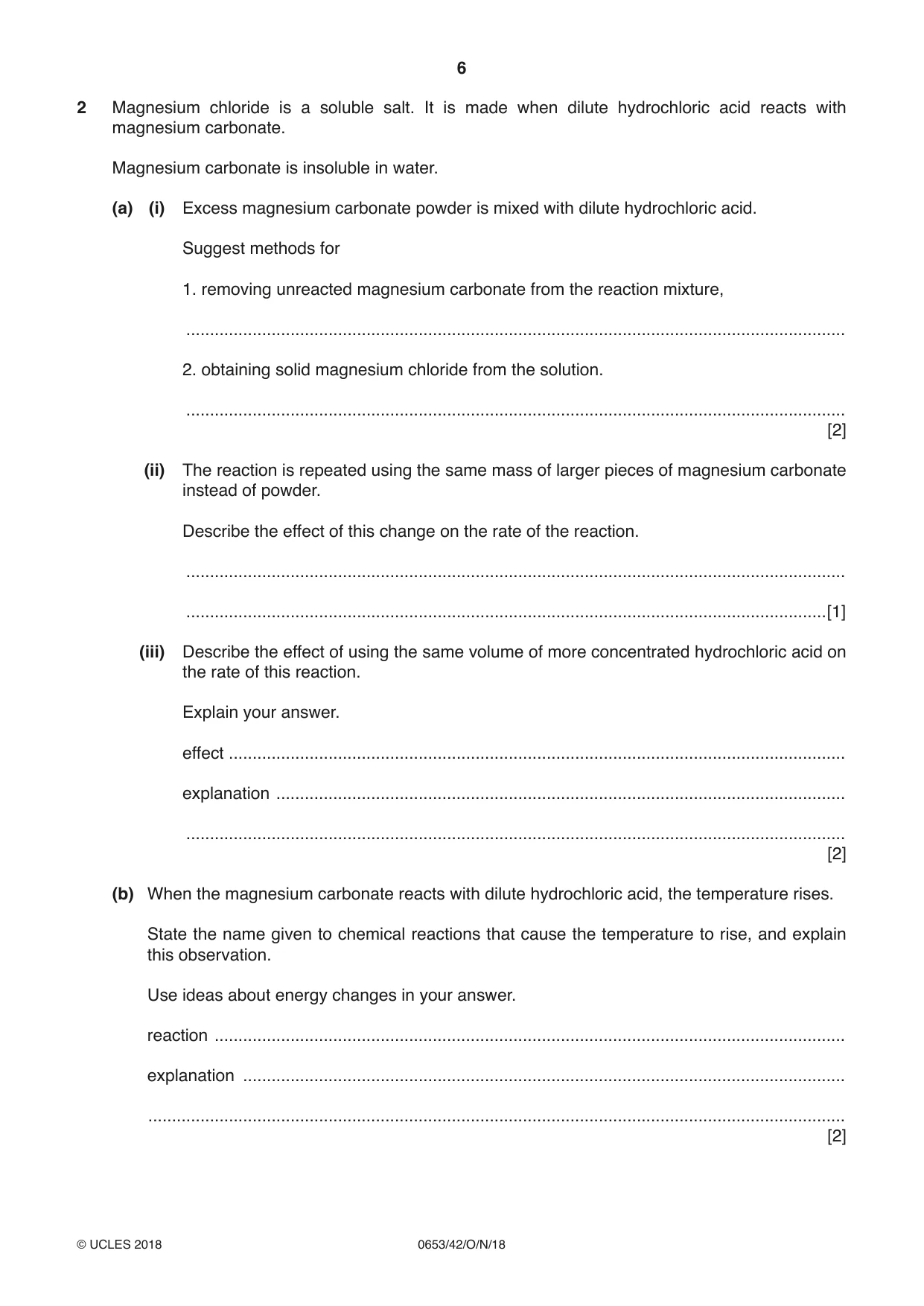
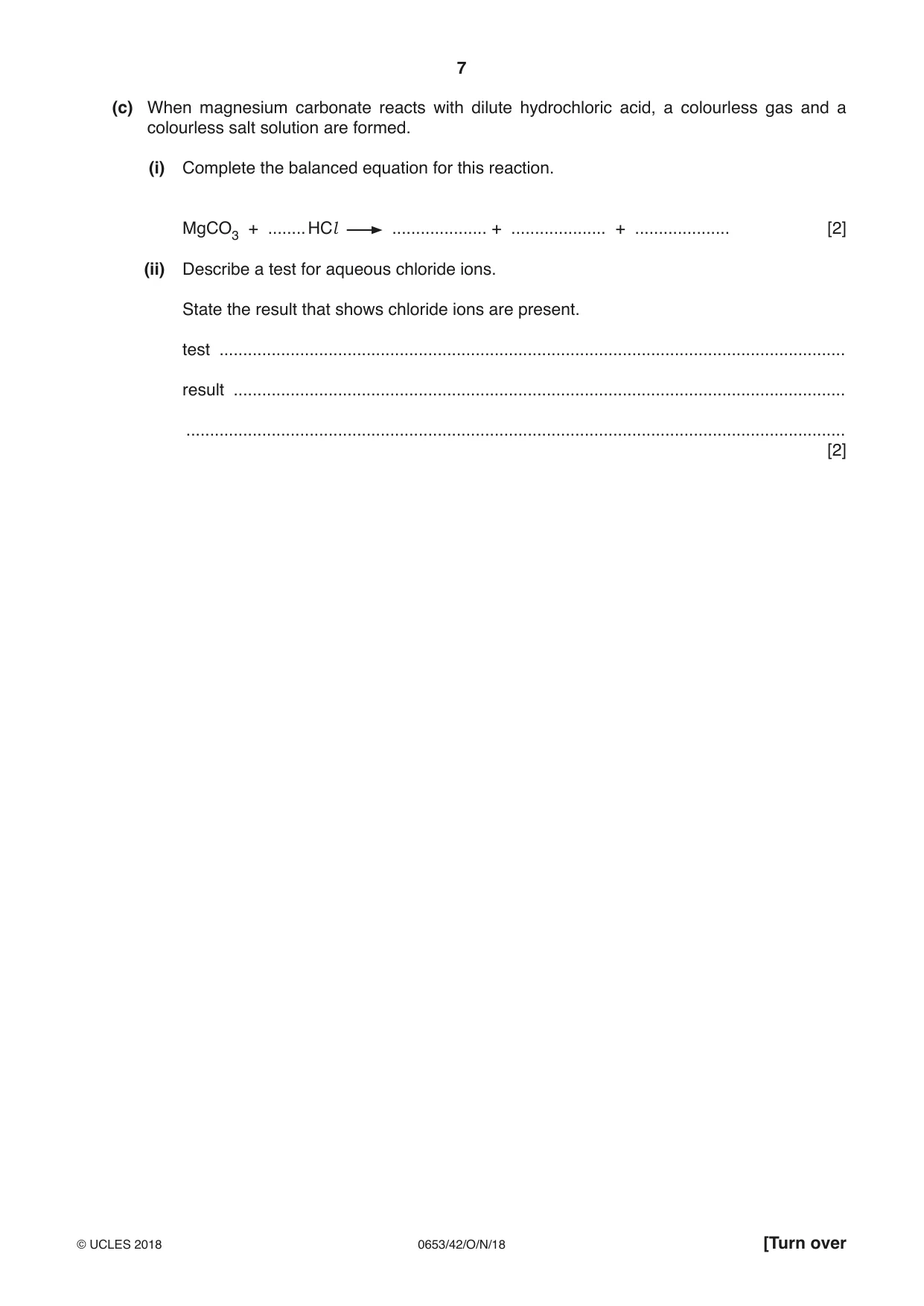
2 Magnesium chloride is a soluble salt. It is made when dilute hydrochloric acid reacts with magnesium carbonate. Magnesium carbonate is insoluble in water. (a) (i) Excess magnesium carbonate powder is mixed with dilute hydrochloric acid. Suggest methods for 1. removing unreacted magnesium carbonate from the reaction mixture, ........................................................................................................................................... 2. obtaining solid magnesium chloride from the solution. ........................................................................................................................................... [2] (ii) The reaction is repeated using the same mass of larger pieces of magnesium carbonate instead of powder. Describe the effect of this change on the rate of the reaction. ........................................................................................................................................... .......................................................................................................................................[1] (iii) Describe the effect of using the same volume of more concentrated hydrochloric acid on the rate of this reaction. Explain your answer. effect .................................................................................................................................. explanation ........................................................................................................................ ........................................................................................................................................... [2] (b) When the magnesium carbonate reacts with dilute hydrochloric acid, the temperature rises. State the name given to chemical reactions that cause the temperature to rise, and explain this observation. Use ideas about energy changes in your answer. reaction ..................................................................................................................................... explanation ............................................................................................................................... ................................................................................................................................................... [2] (c) When magnesium carbonate reacts with dilute hydrochloric acid, a colourless gas and a colourless salt solution are formed. (i) Complete the balanced equation for this reaction. MgCO3 + ........ HCl .................... + .................... + .................... [2] (ii) Describe a test for aqueous chloride ions. State the result that shows chloride ions are present. test .................................................................................................................................... result ................................................................................................................................. ........................................................................................................................................... [2]
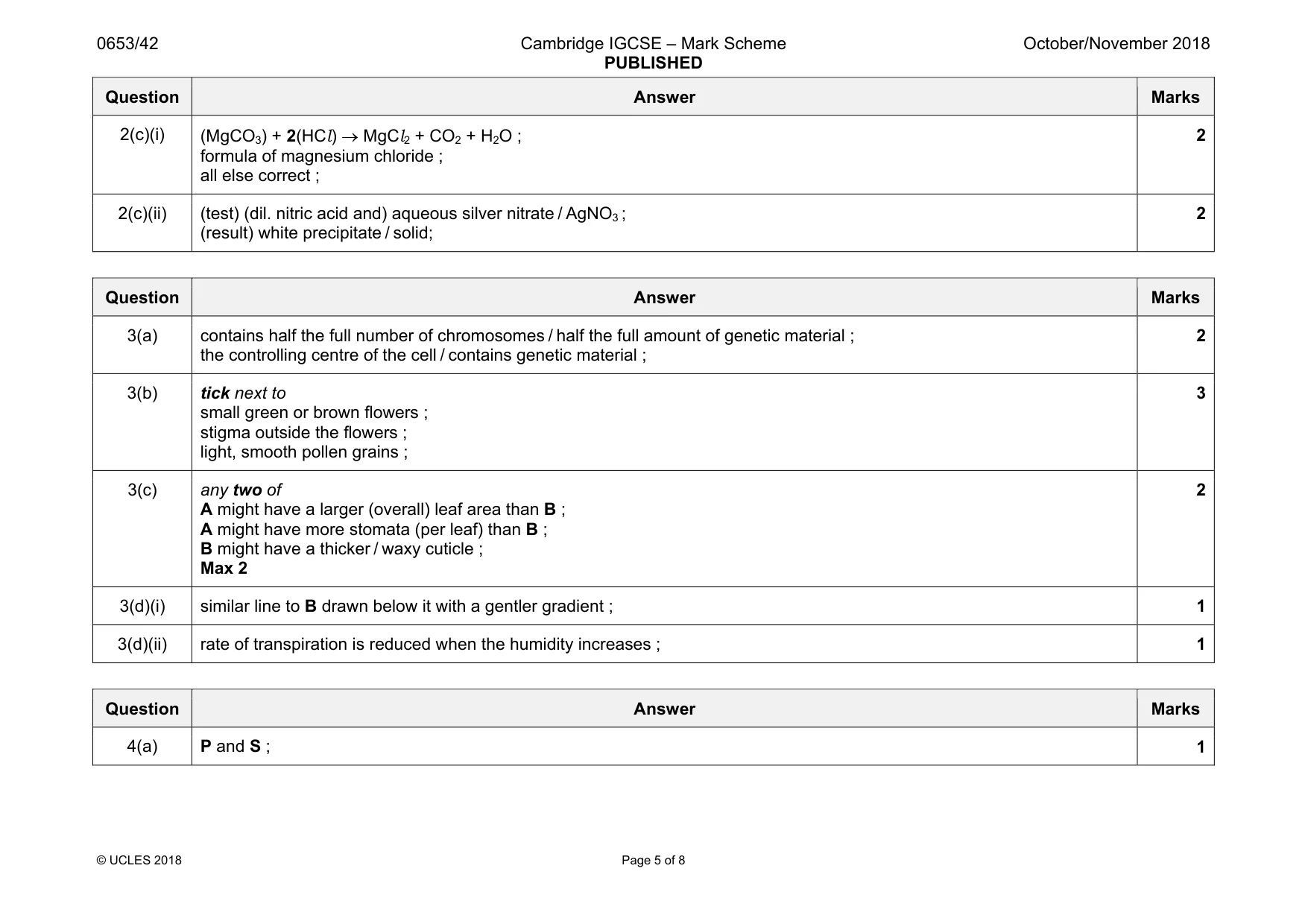
Mark scheme: 2(a)(i) (remove MgCO3) filtration / filtering / filter ; (obtain solid salt) evaporation / crystallisation ; 2 2(a)(ii) decreases ; 1 2(a)(iii) (effect) increases ; (explanation) particles collide more frequently / more chance of collisions ; 2 2(b) exothermic ; chemical (energy changes) to heat / thermal (energy) ; 2 Question Answer Marks 2(c)(i) (MgCO3) + 2(HCl) → MgCl2 + CO2 + H2O ; formula of magnesium chloride ; all else correct ; 2 2(c)(ii) (test) (dil. nitric acid and) aqueous silver nitrate / AgNO3 ; (result) white precipitate / solid; 2
Q3 · Pollen is used by flowering plants to reproduce by sexual reproduction
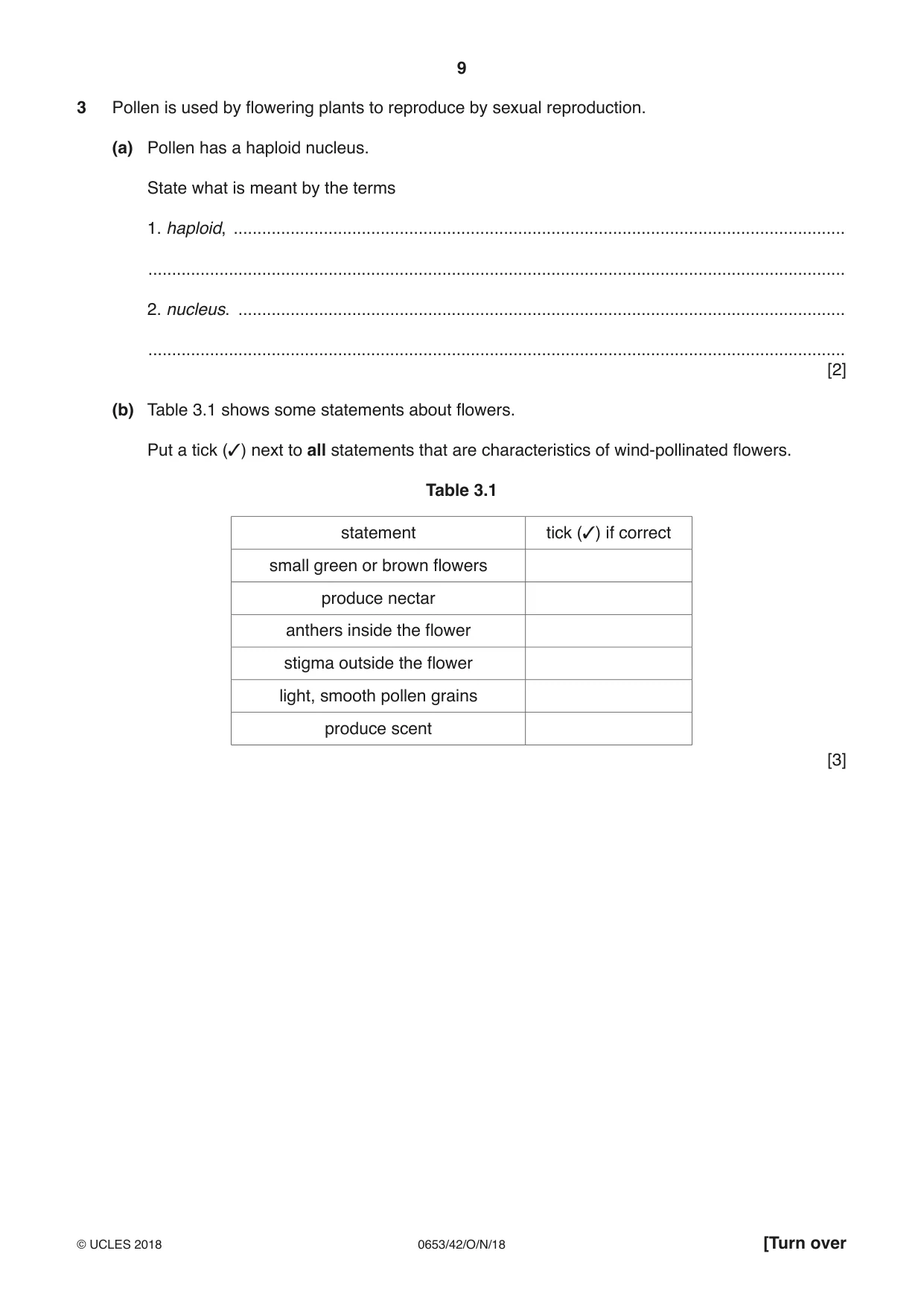
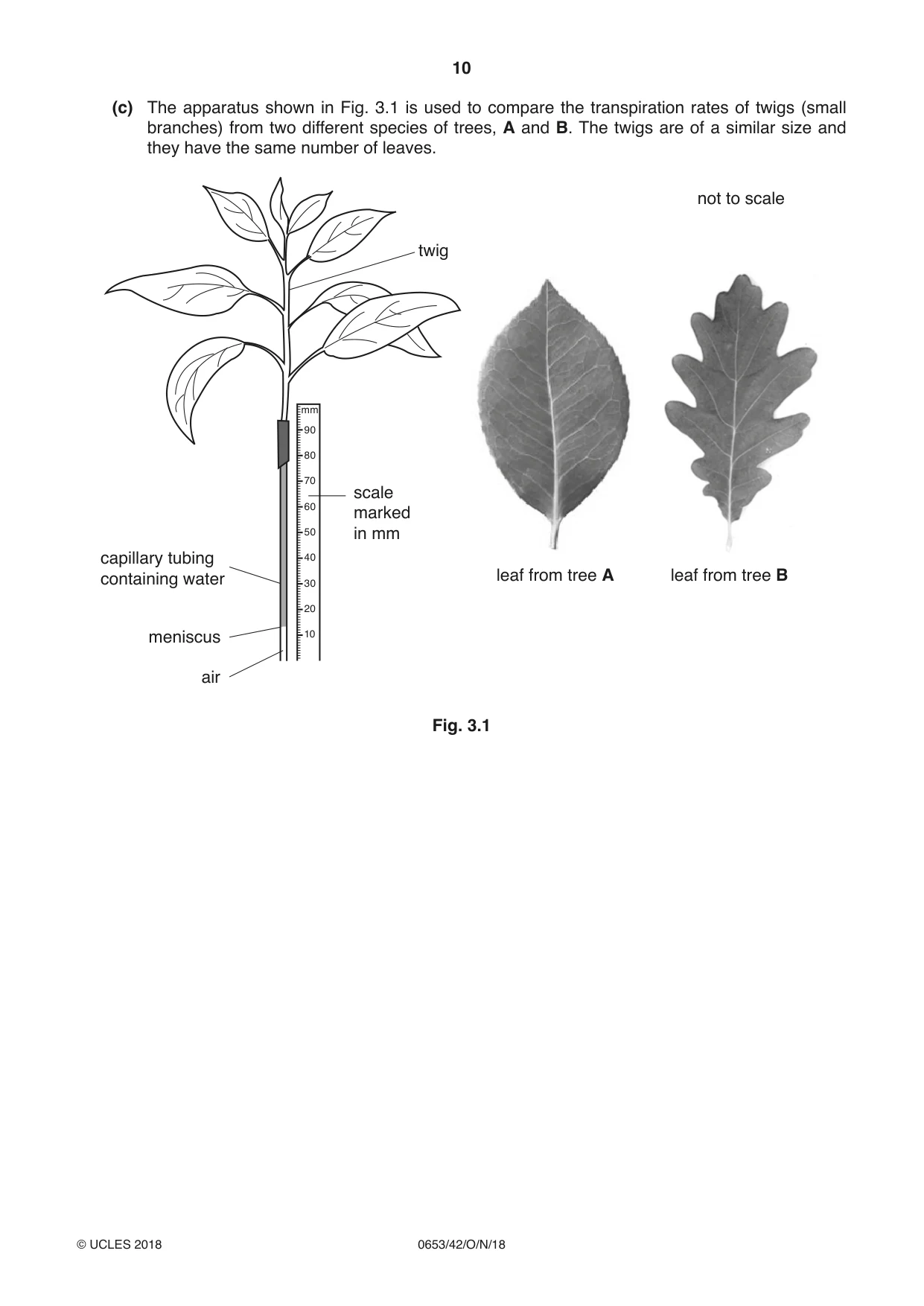
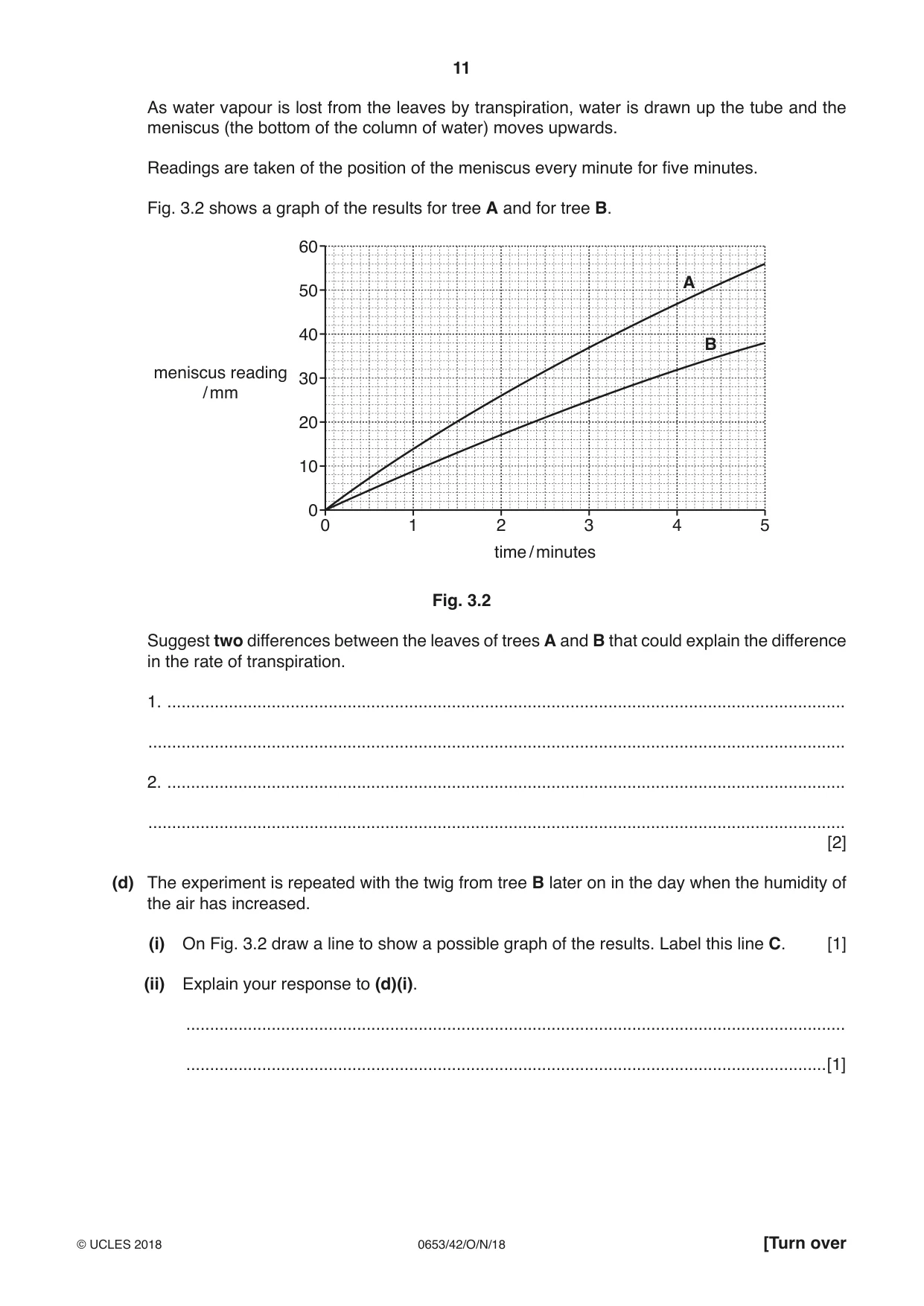
3 Pollen is used by flowering plants to reproduce by sexual reproduction. (a) Pollen has a haploid nucleus. State what is meant by the terms 1. haploid, ................................................................................................................................. ................................................................................................................................................... 2. nucleus. ................................................................................................................................ ................................................................................................................................................... [2] (b) Table 3.1 shows some statements about flowers. Put a tick (3) next to all statements that are characteristics of wind-pollinated flowers. Table 3.1 statement tick (3) if correct small green or brown flowers produce nectar anthers inside the flower stigma outside the flower light, smooth pollen grains produce scent [3] (c) The apparatus shown in Fig. 3.1 is used to compare the transpiration rates of twigs (small branches) from two different species of trees, A and B. The twigs are of a similar size and they have the same number of leaves. not to scale twig mm 90 80 70 scale 60 marked 50 in mm capillary tubing 40 containing water 30 leaf from tree A leaf from tree B 20 meniscus 10 air Fig. 3.1 As water vapour is lost from the leaves by transpiration, water is drawn up the tube and the meniscus (the bottom of the column of water) moves upwards. Readings are taken of the position of the meniscus every minute for five minutes. Fig. 3.2 shows a graph of the results for tree A and for tree B. 60 A 50 40 B meniscus reading 30 / mm 20 10 0 0 1 2 3 4 5 time / minutes Fig. 3.2 Suggest two differences between the leaves of trees A and B that could explain the difference in the rate of transpiration. 1. ............................................................................................................................................... ................................................................................................................................................... 2. ............................................................................................................................................... ................................................................................................................................................... [2] (d) The experiment is repeated with the twig from tree B later on in the day when the humidity of the air has increased. (i) On Fig. 3.2 draw a line to show a possible graph of the results. Label this line C. [1] (ii) Explain your response to (d)(i). ........................................................................................................................................... .......................................................................................................................................[1]
Mark scheme: 3(a) contains half the full number of chromosomes / half the full amount of genetic material ; the controlling centre of the cell / contains genetic material ; 2 3(b) tick next to small green or brown flowers ; stigma outside the flowers ; light, smooth pollen grains ; 3 3(c) any two of A might have a larger (overall) leaf area than B ; A might have more stomata (per leaf) than B ; B might have a thicker / waxy cuticle ; Max 2 2 3(d)(i) similar line to B drawn below it with a gentler gradient ; 1 3(d)(ii) rate of transpiration is reduced when the humidity increases ; 1
Q4 · A diagram of the internal structure of the heart
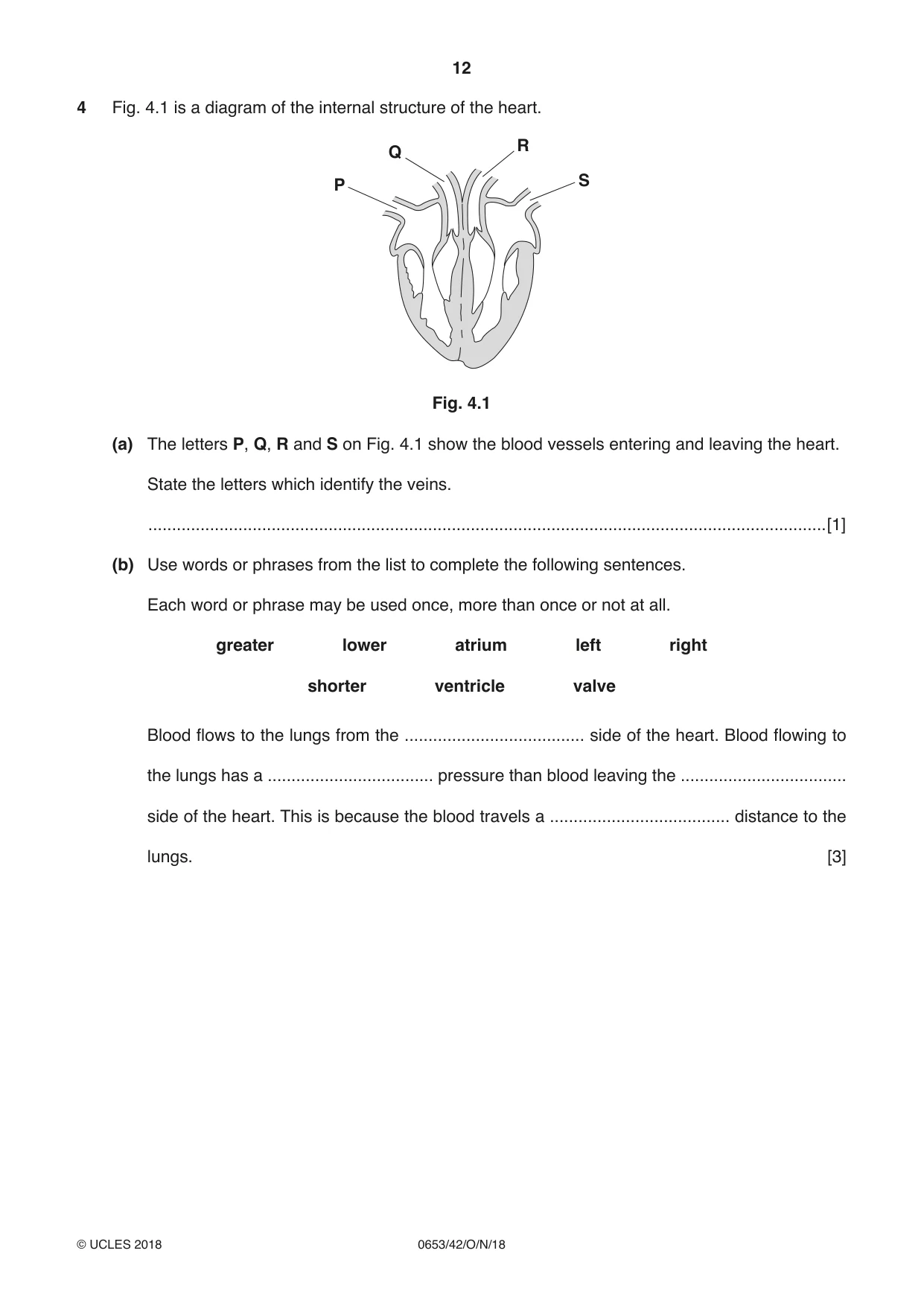
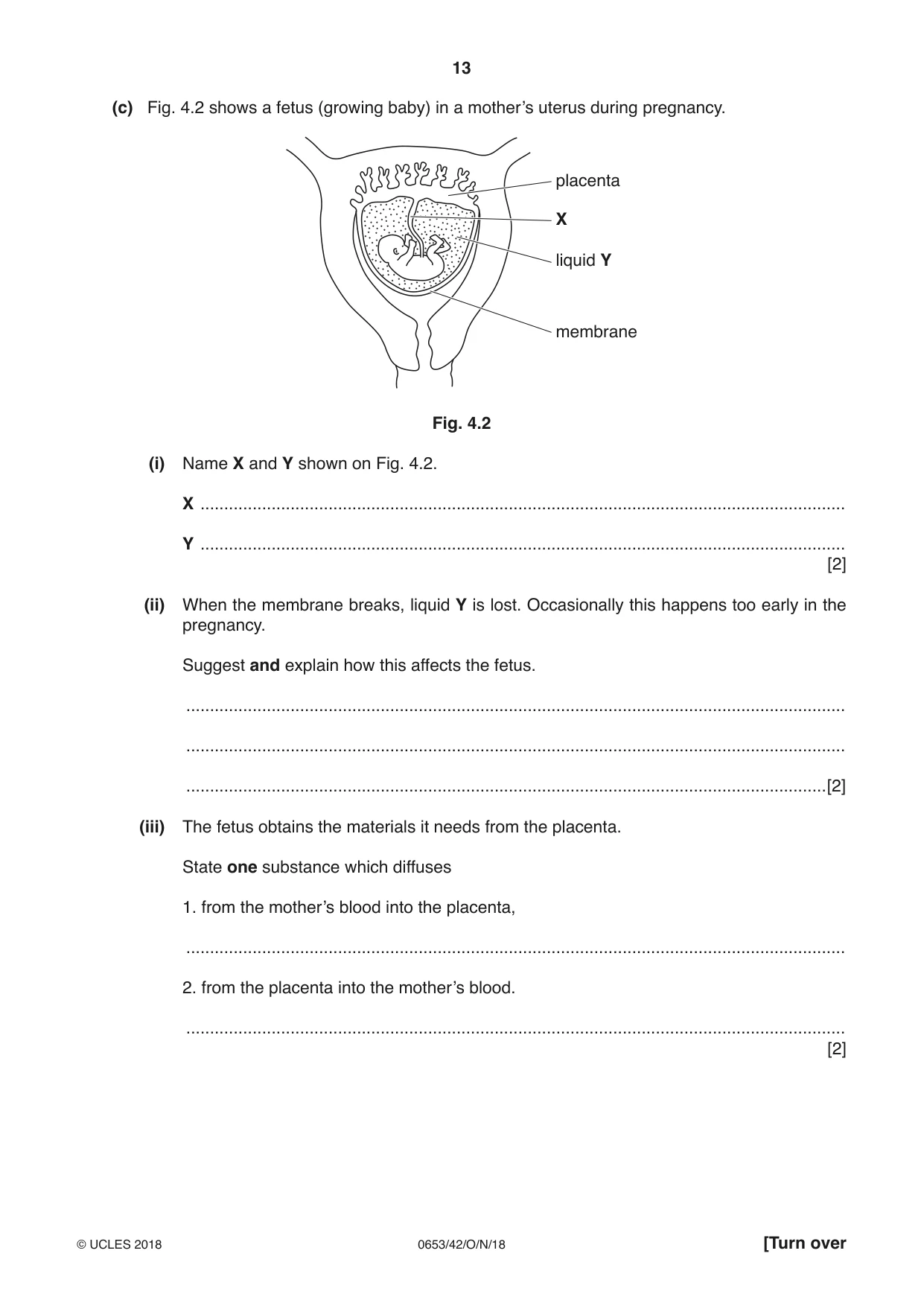
4 Fig. 4.1 is a diagram of the internal structure of the heart. R Q S P Fig. 4.1 (a) The letters P, Q, R and S on Fig. 4.1 show the blood vessels entering and leaving the heart. State the letters which identify the veins. ...............................................................................................................................................[1] (b) Use words or phrases from the list to complete the following sentences. Each word or phrase may be used once, more than once or not at all. greater lower atrium left right shorter ventricle valve Blood flows to the lungs from the ...................................... side of the heart. Blood flowing to the lungs has a ................................... pressure than blood leaving the ................................... side of the heart. This is because the blood travels a ...................................... distance to the lungs. [3] (c) Fig. 4.2 shows a fetus (growing baby) in a mother’s uterus during pregnancy. placenta X liquid Y membrane Fig. 4.2 (i) Name X and Y shown on Fig. 4.2. X ........................................................................................................................................ Y ........................................................................................................................................ [2] (ii) When the membrane breaks, liquid Y is lost. Occasionally this happens too early in the pregnancy. Suggest and explain how this affects the fetus. ........................................................................................................................................... ........................................................................................................................................... .......................................................................................................................................[2] (iii) The fetus obtains the materials it needs from the placenta. State one substance which diffuses 1. from the mother’s blood into the placenta, ........................................................................................................................................... 2. from the placenta into the mother’s blood. ........................................................................................................................................... [2]
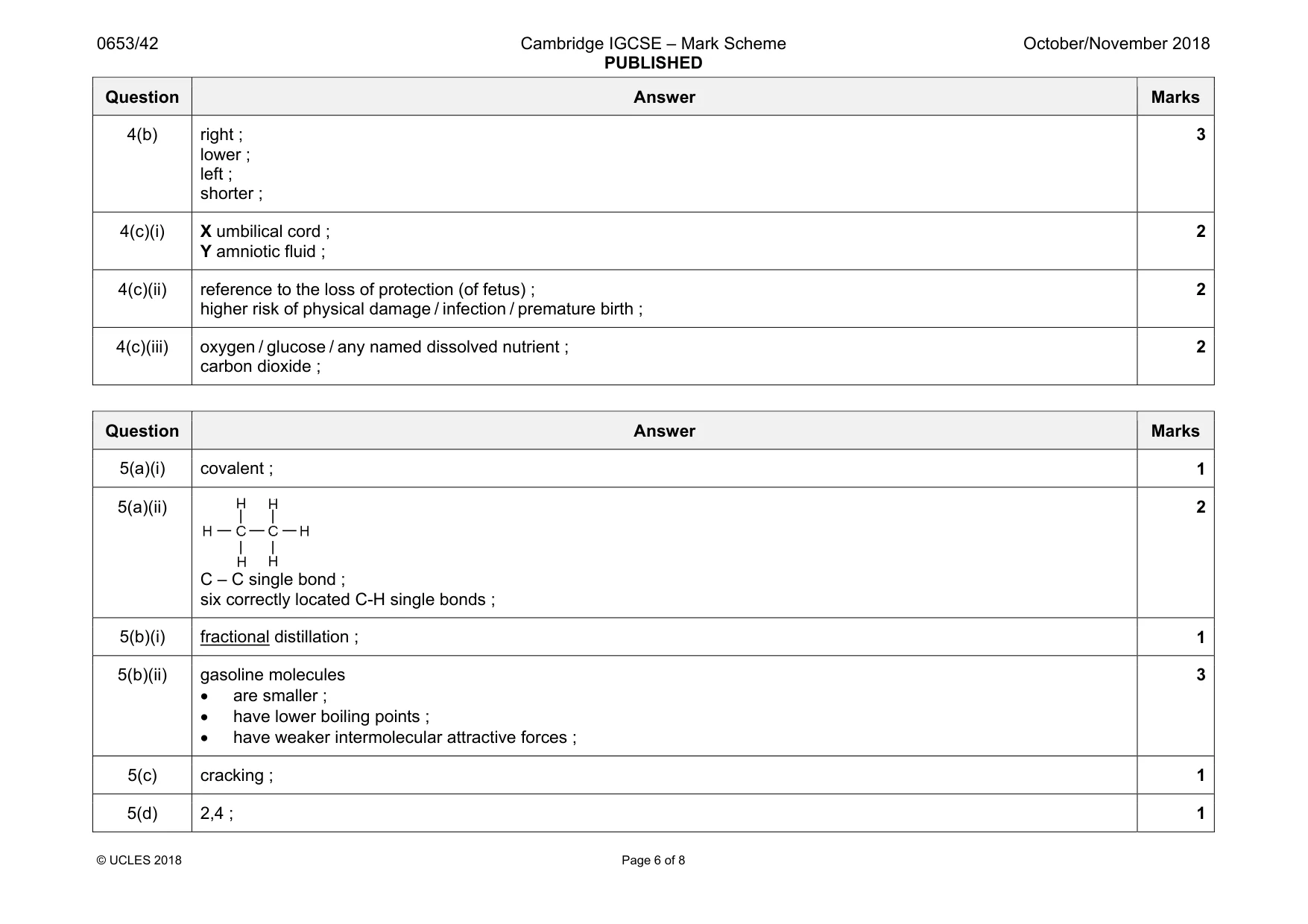
Mark scheme: 4(a) P and S ; 1 Question Answer Marks 4(b) right ; lower ; left ; shorter ; 3 4(c)(i) X umbilical cord ; Y amniotic fluid ; 2 4(c)(ii) reference to the loss of protection (of fetus) ; higher risk of physical damage / infection / premature birth ; 2 4(c)(iii) oxygen / glucose / any named dissolved nutrient ; carbon dioxide ; 2
Q5 · Ethane, C2H6, is an alkane
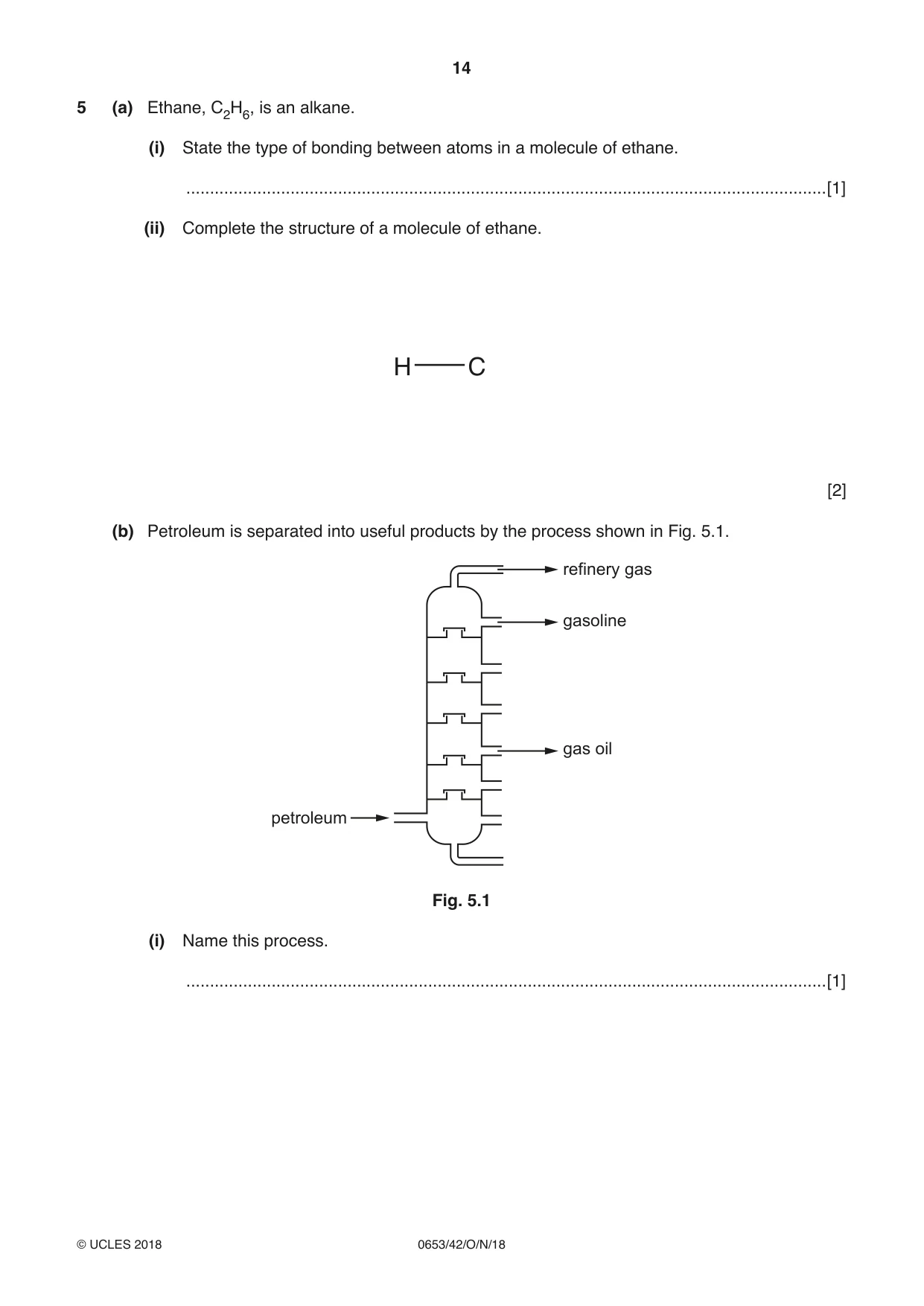
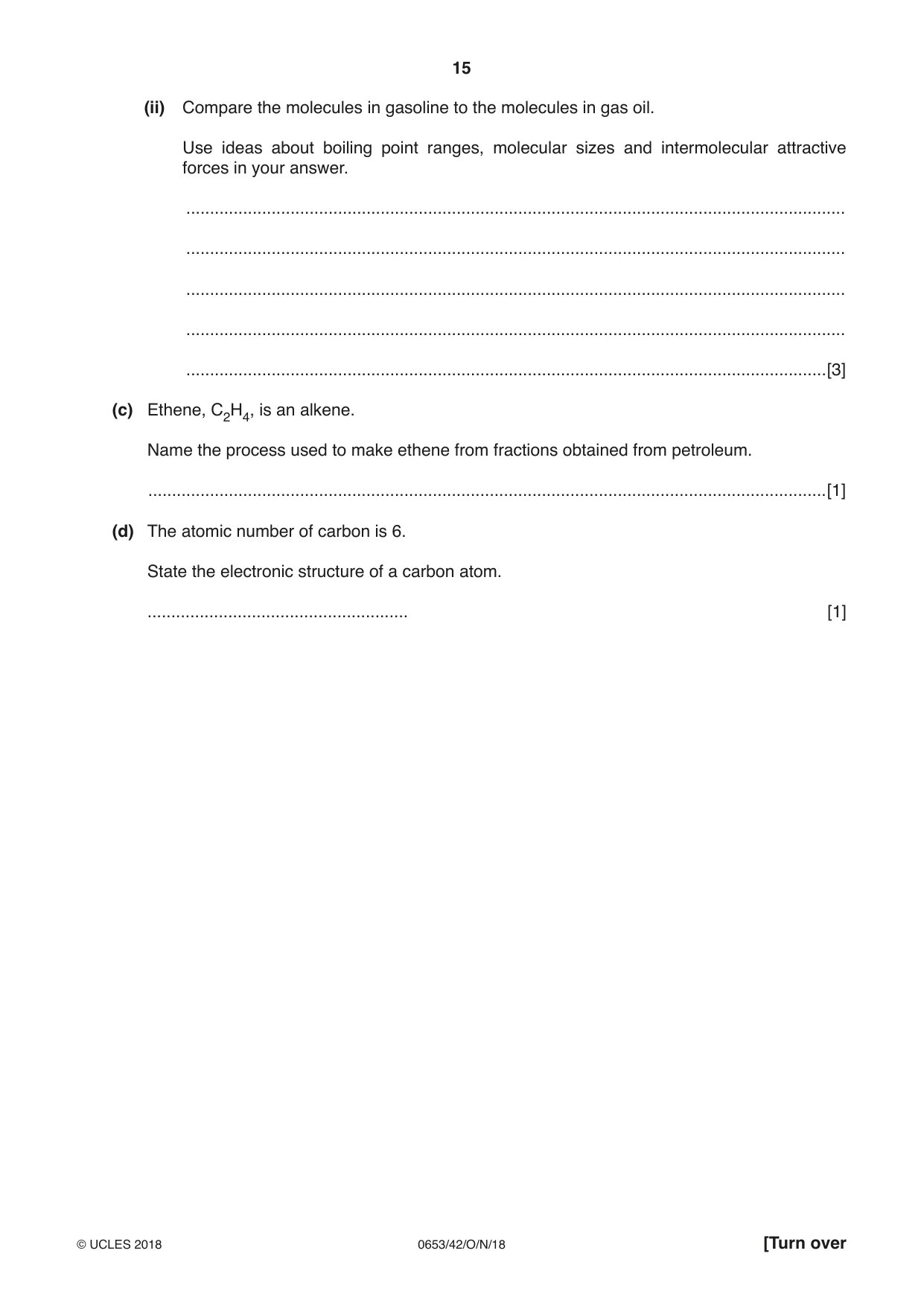
5 (a) Ethane, C2H6, is an alkane. (i) State the type of bonding between atoms in a molecule of ethane. .......................................................................................................................................[1] (ii) Complete the structure of a molecule of ethane. H C [2] (b) Petroleum is separated into useful products by the process shown in Fig. 5.1. refinery gas gasoline gas oil petroleum Fig. 5.1 (i) Name this process. .......................................................................................................................................[1] (ii) Compare the molecules in gasoline to the molecules in gas oil. Use ideas about boiling point ranges, molecular sizes and intermolecular attractive forces in your answer. ........................................................................................................................................... ........................................................................................................................................... ........................................................................................................................................... ........................................................................................................................................... .......................................................................................................................................[3] (c) Ethene, C2H4, is an alkene. Name the process used to make ethene from fractions obtained from petroleum. ...............................................................................................................................................[1] (d) The atomic number of carbon is 6. State the electronic structure of a carbon atom. ....................................................... [1]
Mark scheme: 5(a)(i) covalent ; 1 5(a)(ii) C – C single bond ; six correctly located C-H single bonds ; 2 5(b)(i) fractional distillation ; 1 5(b)(ii) gasoline molecules • are smaller ; • have lower boiling points ; • have weaker intermolecular attractive forces ; 3 5(c) cracking ; 1 5(d) 2,4 ; 1
Q6 · A liquid is able to flow and will take the shape of its container
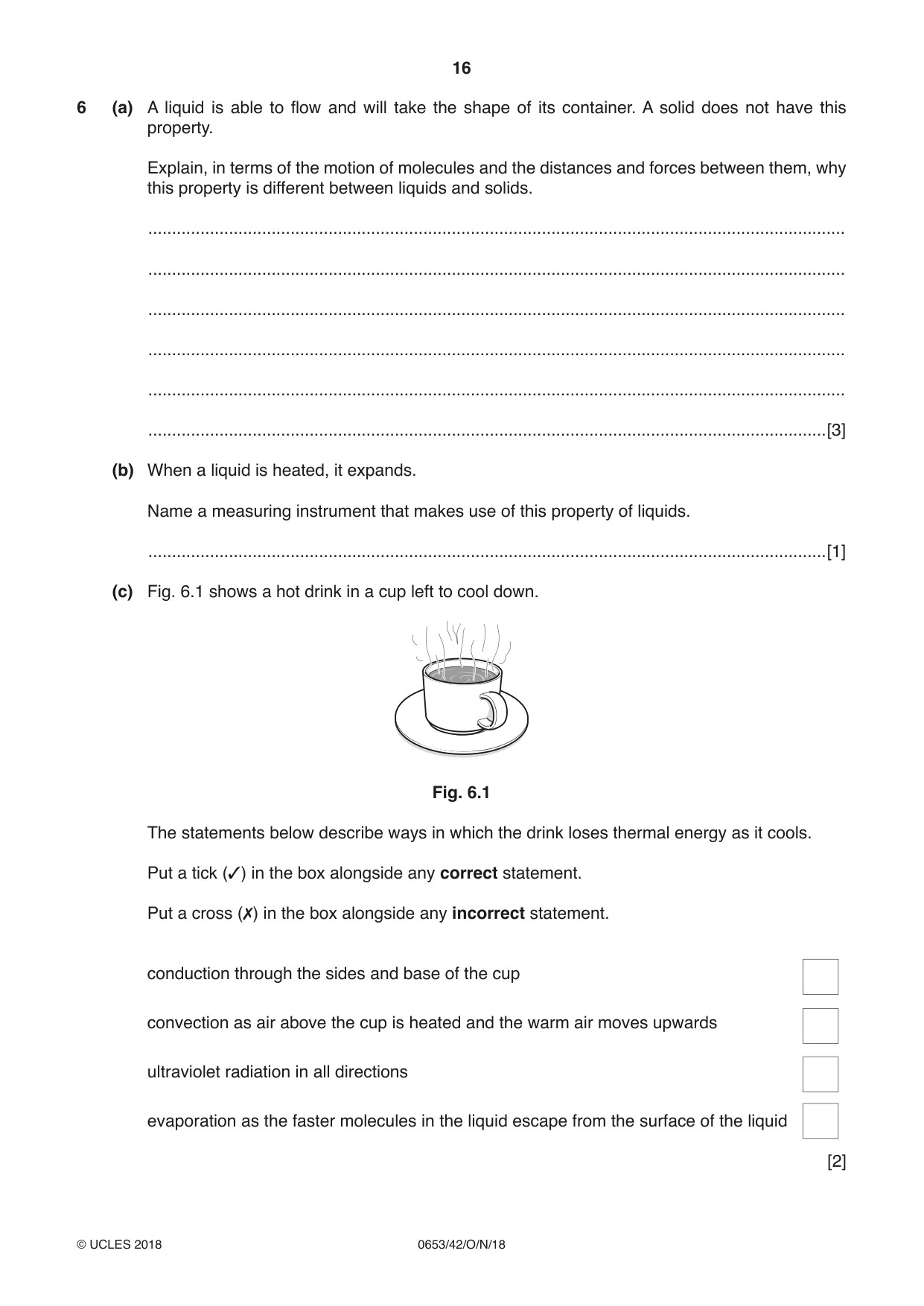
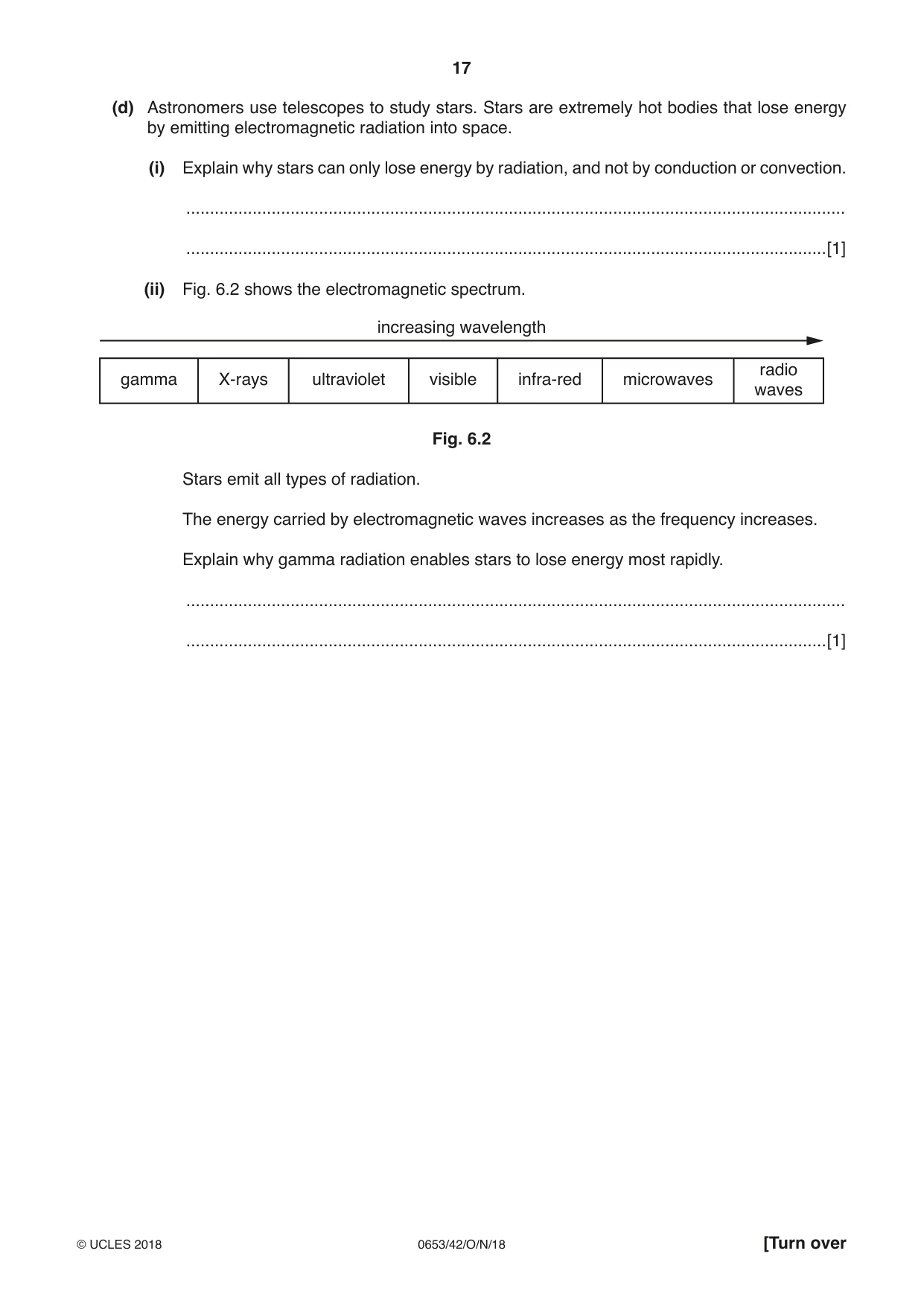
6 (a) A liquid is able to flow and will take the shape of its container. A solid does not have this property. Explain, in terms of the motion of molecules and the distances and forces between them, why this property is different between liquids and solids. ................................................................................................................................................... ................................................................................................................................................... ................................................................................................................................................... ................................................................................................................................................... ................................................................................................................................................... ...............................................................................................................................................[3] (b) When a liquid is heated, it expands. Name a measuring instrument that makes use of this property of liquids. ...............................................................................................................................................[1] (c) Fig. 6.1 shows a hot drink in a cup left to cool down. Fig. 6.1 The statements below describe ways in which the drink loses thermal energy as it cools. Put a tick (3) in the box alongside any correct statement. Put a cross (7) in the box alongside any incorrect statement. conduction through the sides and base of the cup convection as air above the cup is heated and the warm air moves upwards ultraviolet radiation in all directions evaporation as the faster molecules in the liquid escape from the surface of the liquid [2] (d) Astronomers use telescopes to study stars. Stars are extremely hot bodies that lose energy by emitting electromagnetic radiation into space. (i) Explain why stars can only lose energy by radiation, and not by conduction or convection. ........................................................................................................................................... .......................................................................................................................................[1] (ii) Fig. 6.2 shows the electromagnetic spectrum. increasing wavelength radio gamma X-rays ultraviolet visible infra-red microwaves waves Fig. 6.2 Stars emit all types of radiation. The energy carried by electromagnetic waves increases as the frequency increases. Explain why gamma radiation enables stars to lose energy most rapidly. ........................................................................................................................................... .......................................................................................................................................[1]
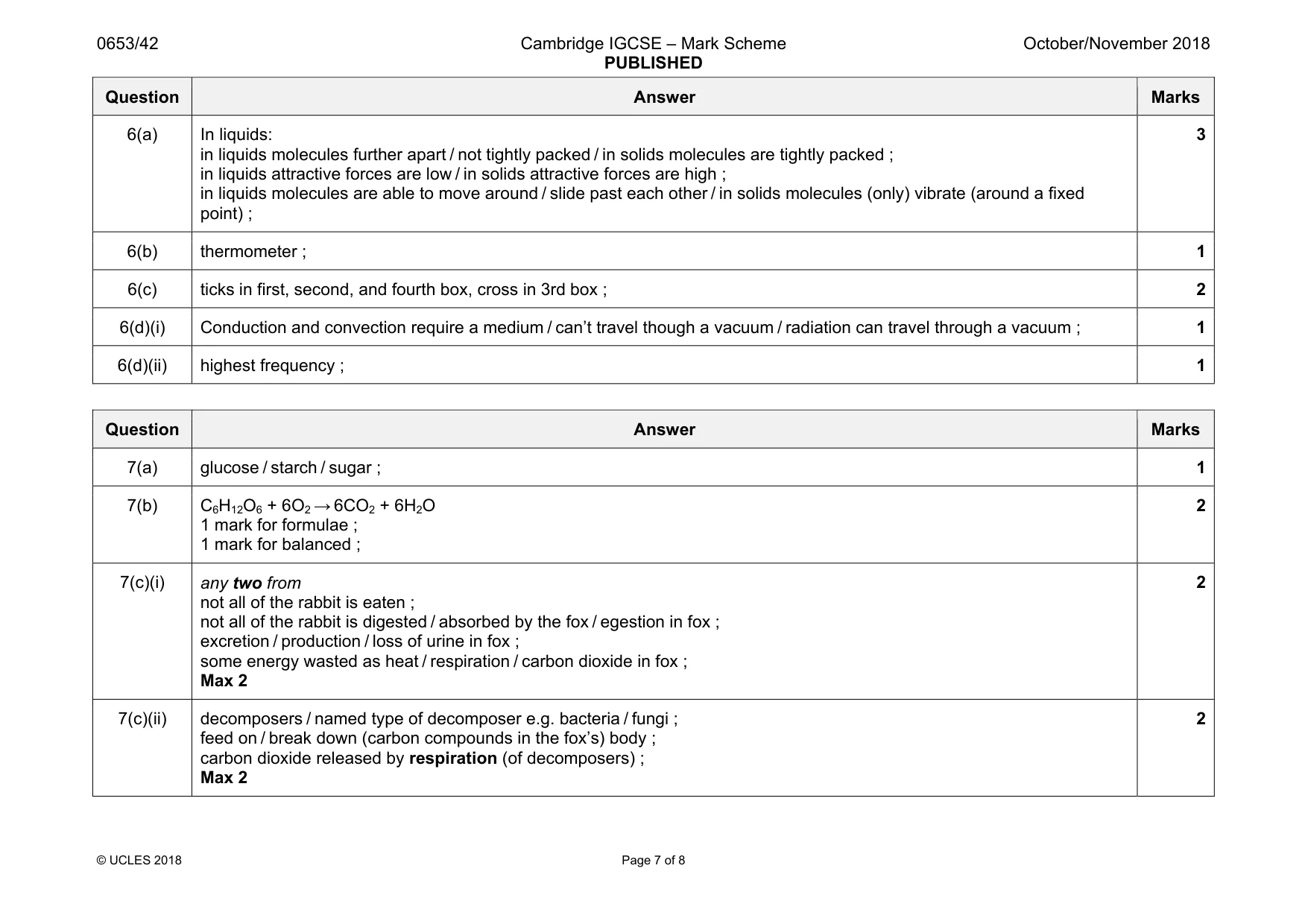
Mark scheme: 6(a) In liquids: in liquids molecules further apart / not tightly packed / in solids molecules are tightly packed ; in liquids attractive forces are low / in solids attractive forces are high ; in liquids molecules are able to move around / slide past each other / in solids molecules (only) vibrate (around a fixed point) ; 3 6(b) thermometer ; 1 6(c) ticks in first, second, and fourth box, cross in 3rd box ; 2 6(d)(i) Conduction and convection require a medium / can’t travel though a vacuum / radiation can travel through a vacuum ; 1 6(d)(ii) highest frequency ; 1
Q7 · A simplified version of the carbon cycle
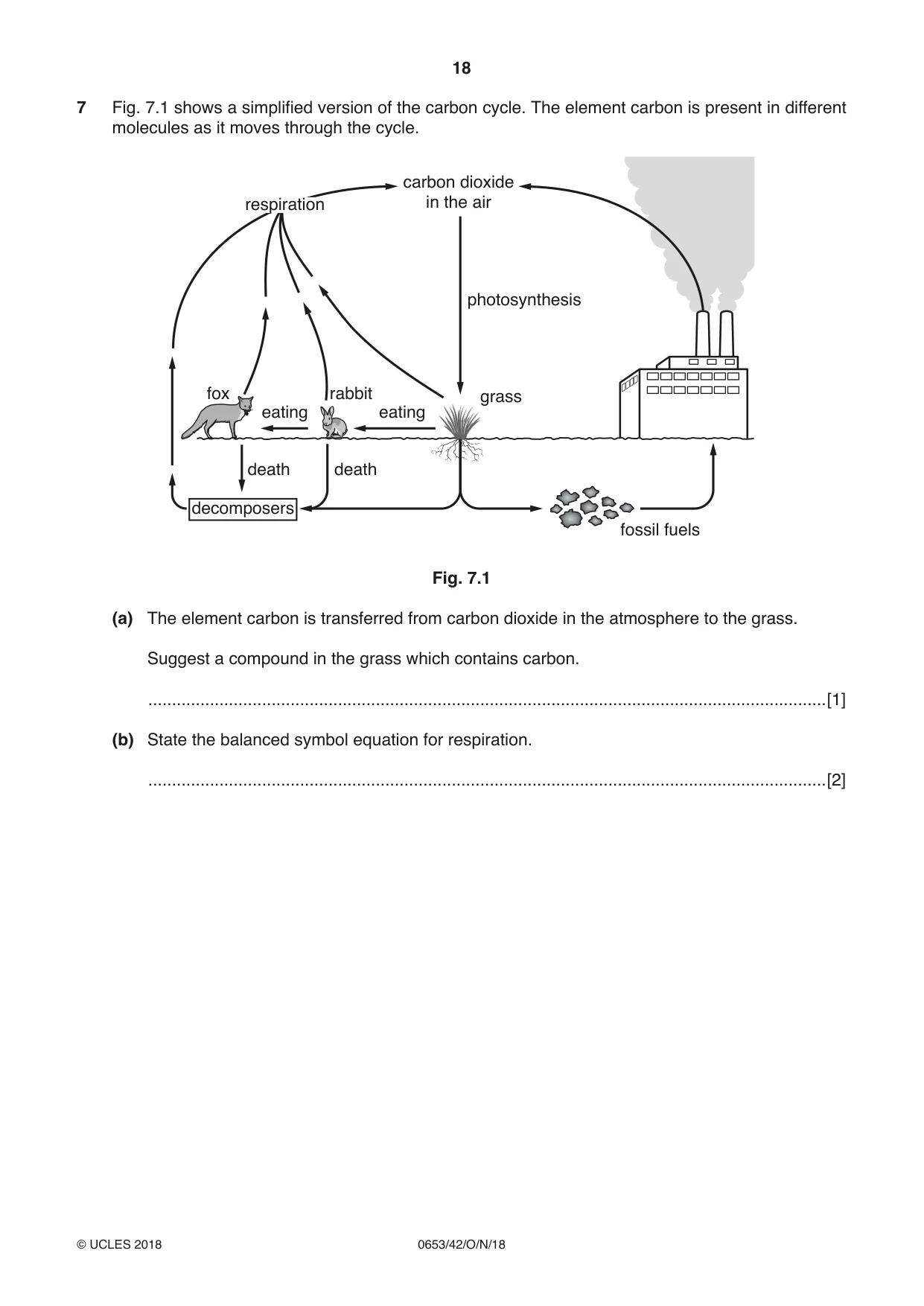
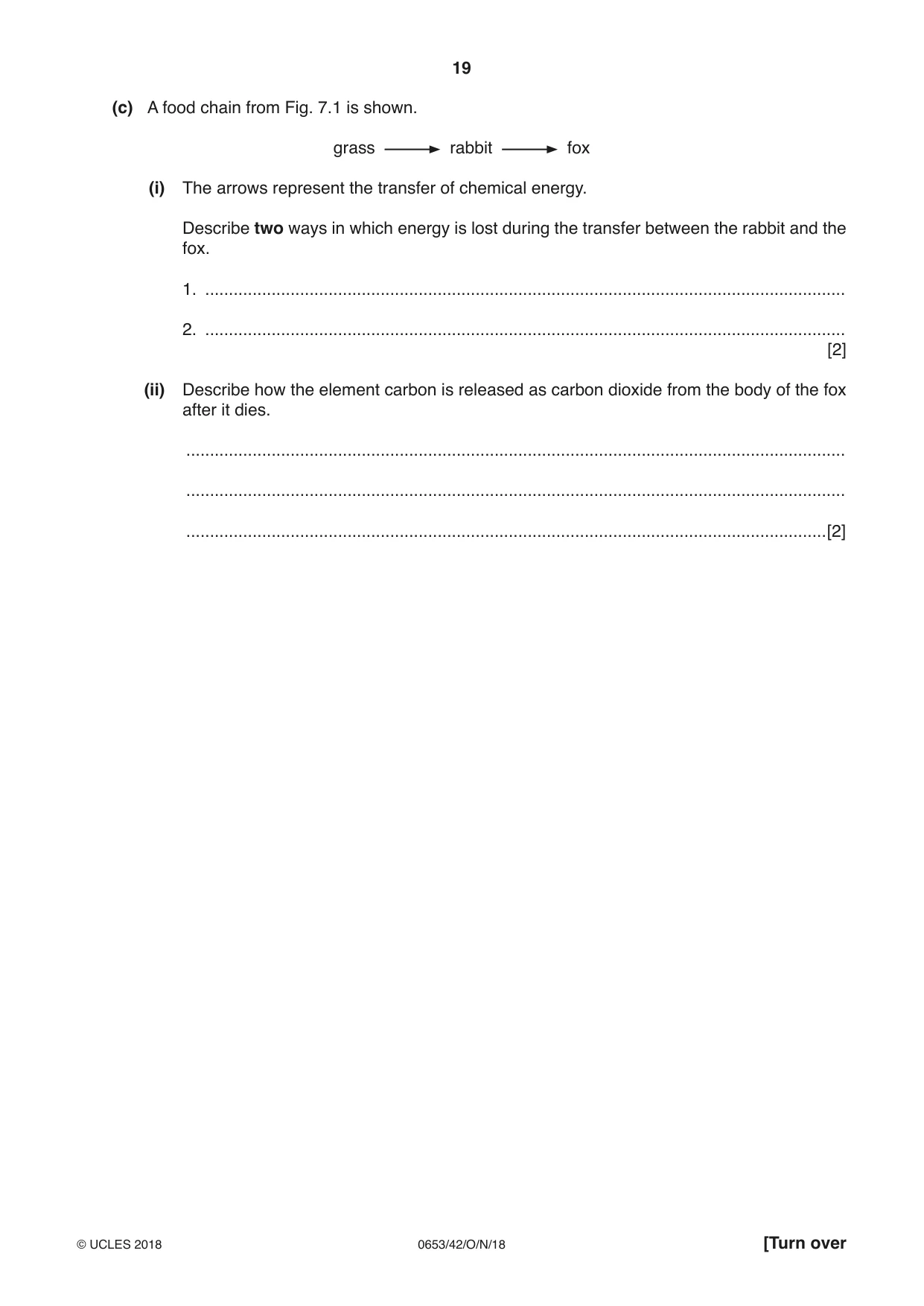
7 Fig. 7.1 shows a simplified version of the carbon cycle. The element carbon is present in different molecules as it moves through the cycle. carbon dioxide respiration in the air photosynthesis fox rabbit grass eating eating death death decomposers fossil fuels Fig. 7.1 (a) The element carbon is transferred from carbon dioxide in the atmosphere to the grass. Suggest a compound in the grass which contains carbon. ...............................................................................................................................................[1] (b) State the balanced symbol equation for respiration. ...............................................................................................................................................[2] (c) A food chain from Fig. 7.1 is shown. grass rabbit fox (i) The arrows represent the transfer of chemical energy. Describe two ways in which energy is lost during the transfer between the rabbit and the fox. 1. ....................................................................................................................................... 2. ....................................................................................................................................... [2] (ii) Describe how the element carbon is released as carbon dioxide from the body of the fox after it dies. ........................................................................................................................................... ........................................................................................................................................... .......................................................................................................................................[2]
Mark scheme: 7(a) glucose / starch / sugar ; 1 7(b) C6H12O6 + 6O2 → 6CO2 + 6H2O 1 mark for formulae ; 1 mark for balanced ; 2 7(c)(i) any two from not all of the rabbit is eaten ; not all of the rabbit is digested / absorbed by the fox / egestion in fox ; excretion / production / loss of urine in fox ; some energy wasted as heat / respiration / carbon dioxide in fox ; Max 2 2 7(c)(ii) decomposers / named type of decomposer e.g. bacteria / fungi ; feed on / break down (carbon compounds in the fox’s) body ; carbon dioxide released by respiration (of decomposers) ; Max 2 2
Q8 · A teacher tries to use the apparatus shown in Fig
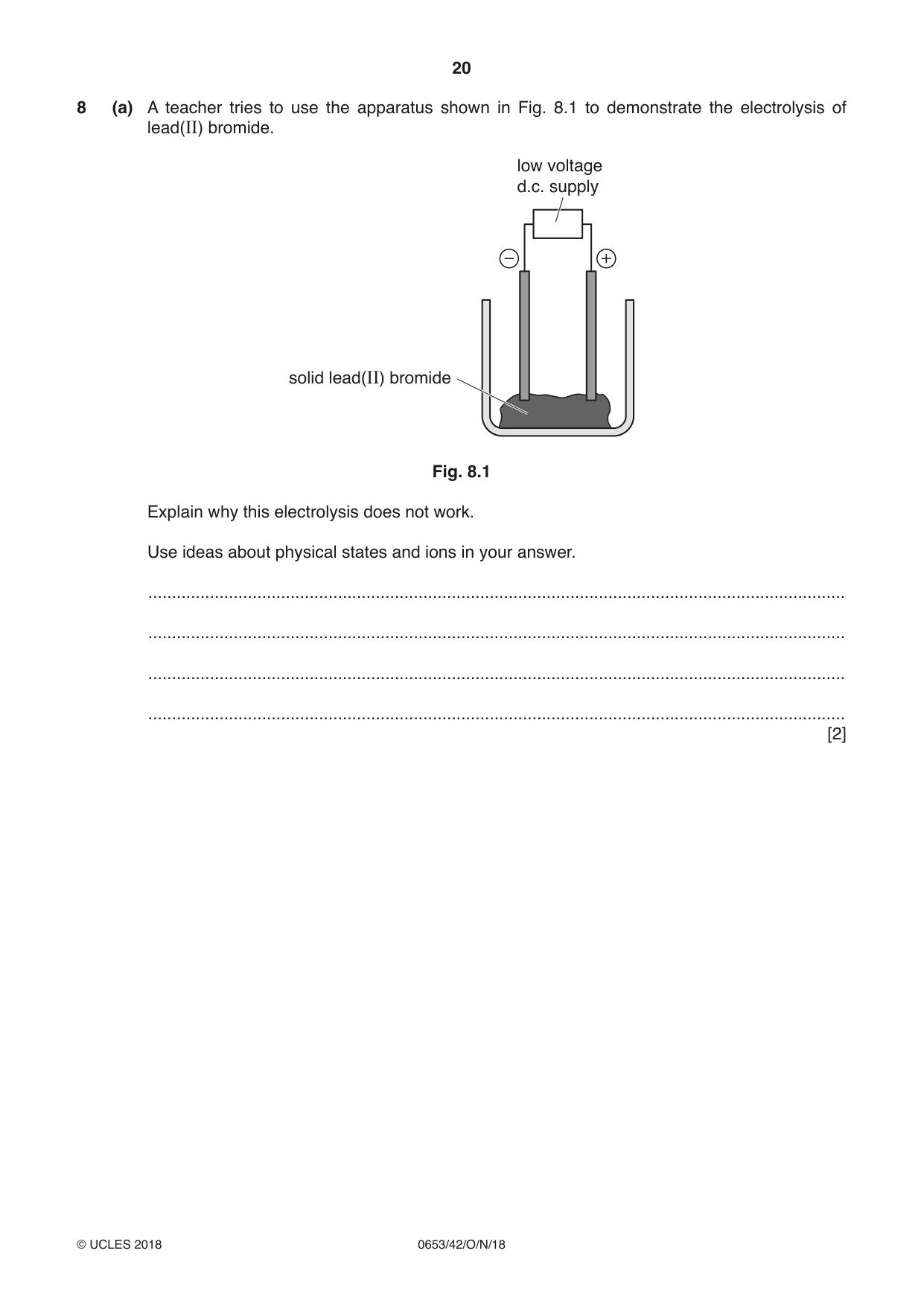
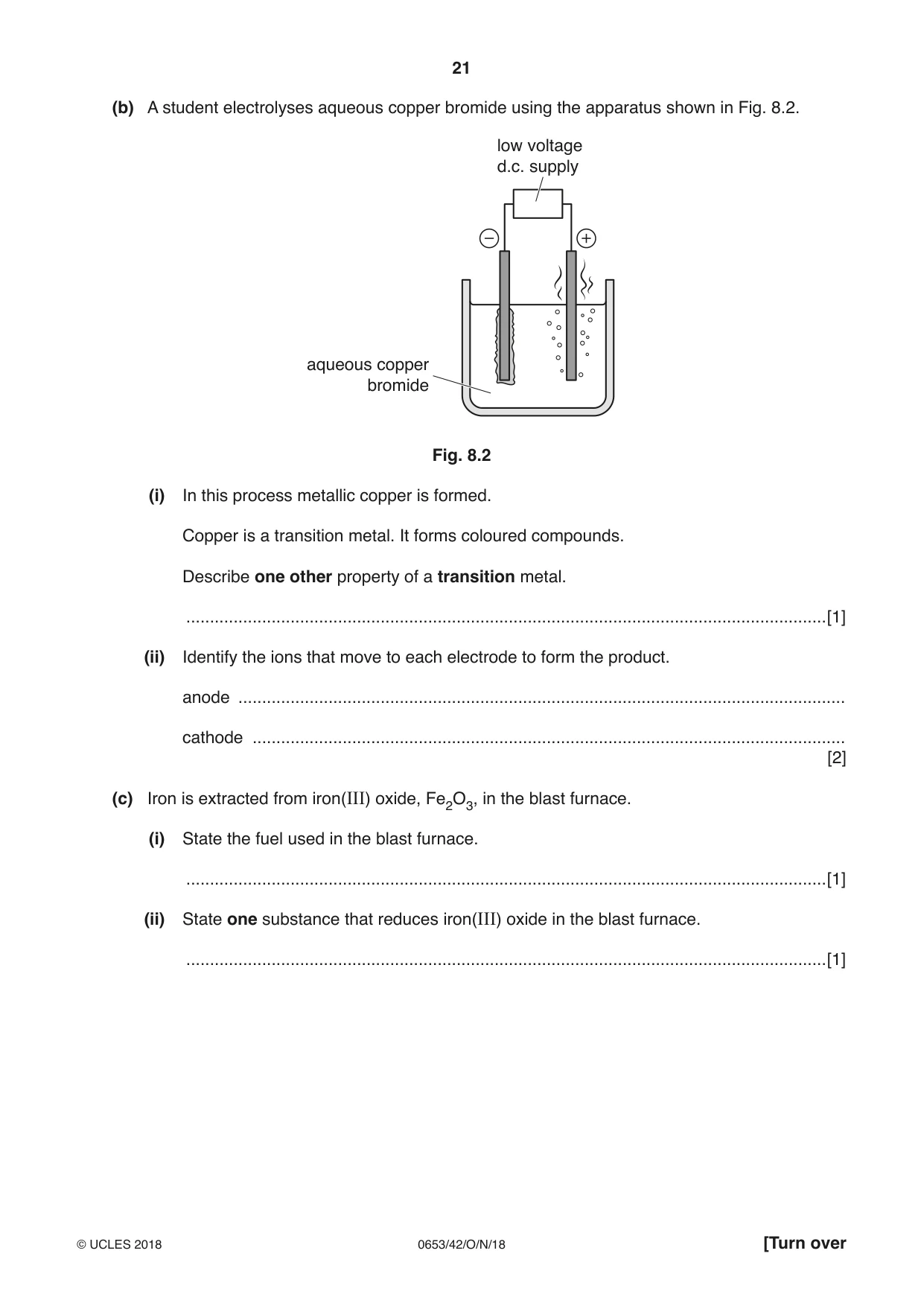
8 (a) A teacher tries to use the apparatus shown in Fig. 8.1 to demonstrate the electrolysis of lead(II) bromide. low voltage d.c. supply solid lead(II) bromide Fig. 8.1 Explain why this electrolysis does not work. Use ideas about physical states and ions in your answer. ................................................................................................................................................... ................................................................................................................................................... ................................................................................................................................................... ................................................................................................................................................... [2] (b) A student electrolyses aqueous copper bromide using the apparatus shown in Fig. 8.2. low voltage d.c. supply aqueous copper bromide Fig. 8.2 (i) In this process metallic copper is formed. Copper is a transition metal. It forms coloured compounds. Describe one other property of a transition metal. .......................................................................................................................................[1] (ii) Identify the ions that move to each electrode to form the product. anode ................................................................................................................................ cathode ............................................................................................................................. [2] (c) Iron is extracted from iron(III) oxide, Fe2O3, in the blast furnace. (i) State the fuel used in the blast furnace. .......................................................................................................................................[1] (ii) State one substance that reduces iron(III) oxide in the blast furnace. .......................................................................................................................................[1]
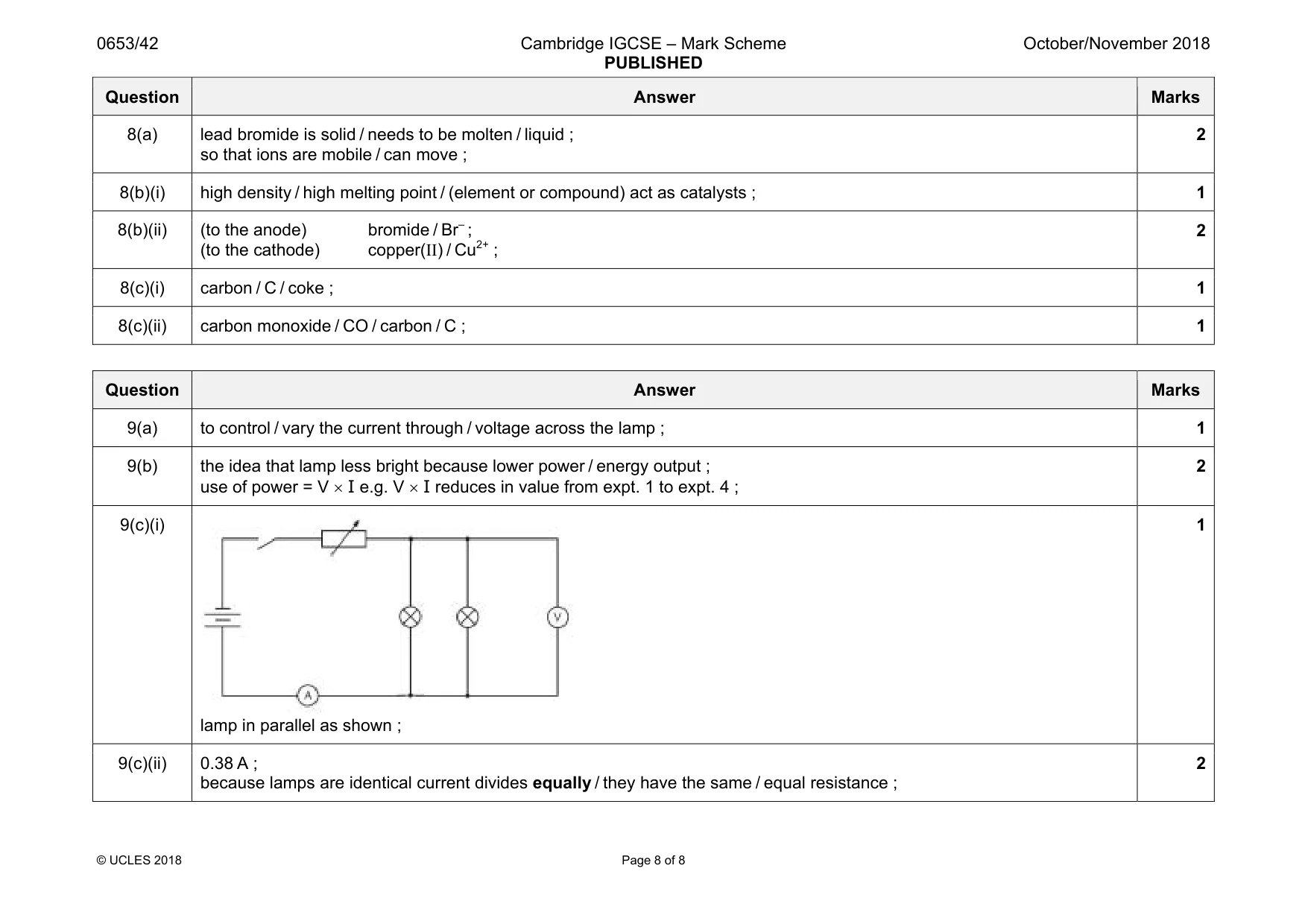
Mark scheme: 8(a) lead bromide is solid / needs to be molten / liquid ; so that ions are mobile / can move ; 2 8(b)(i) high density / high melting point / (element or compound) act as catalysts ; 1 8(b)(ii) (to the anode) bromide / Br– ; (to the cathode) copper(II) / Cu2+ ; 2 8(c)(i) carbon / C / coke ; 1 8(c)(ii) carbon monoxide / CO / carbon / C ; 1
Q9 · A circuit diagram for an investigation into how the resistance of a lamp changes with the…
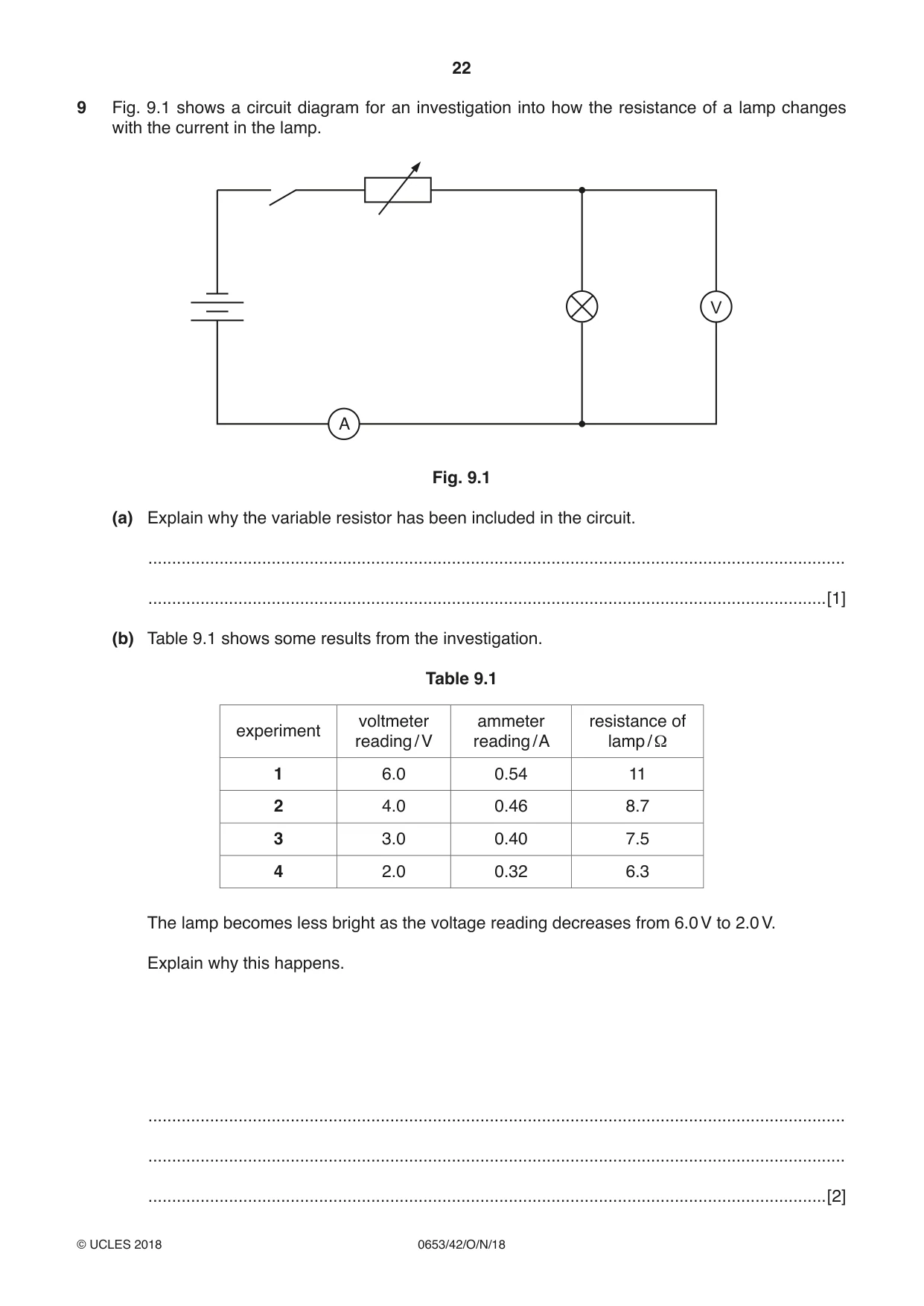
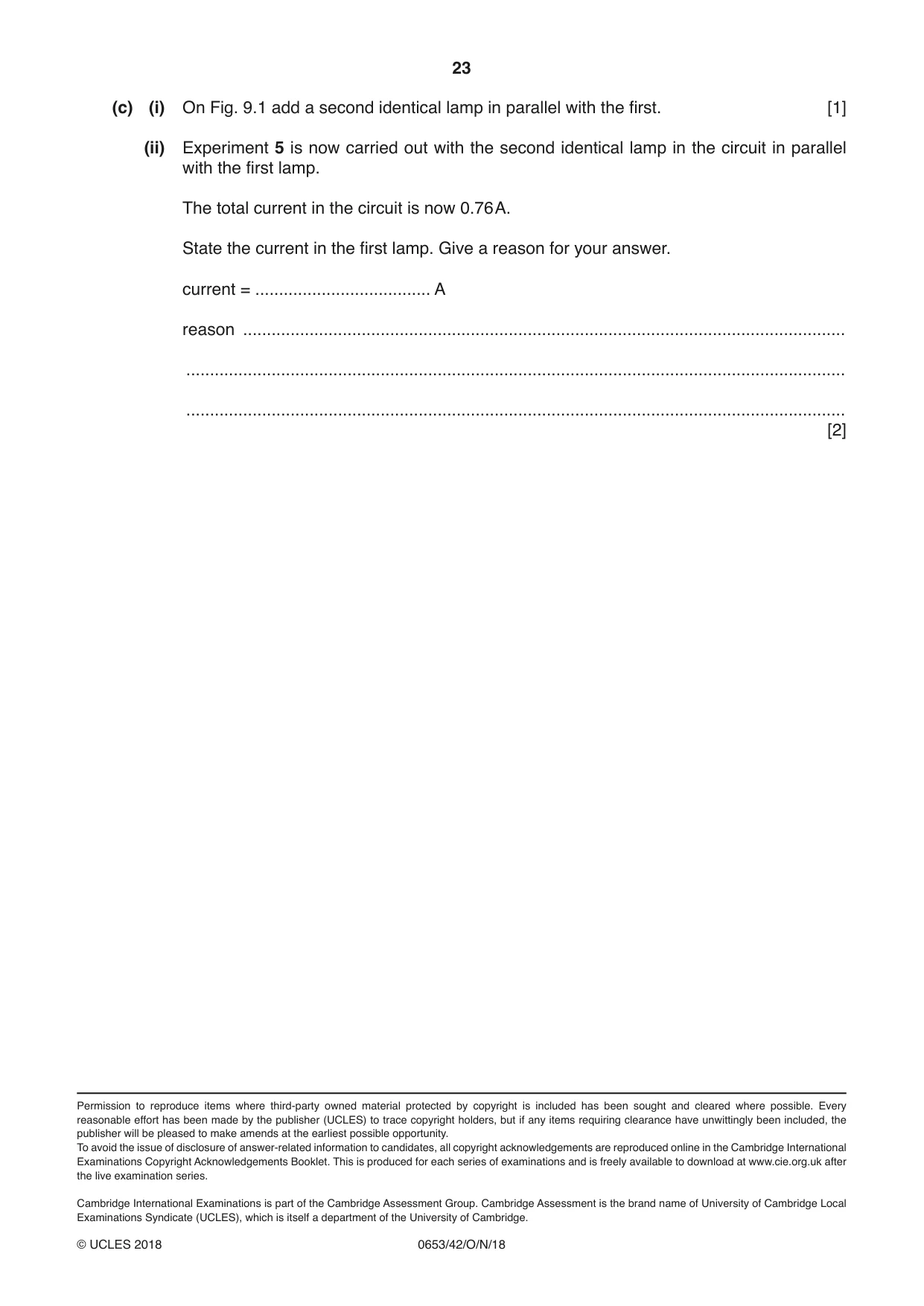
9 Fig. 9.1 shows a circuit diagram for an investigation into how the resistance of a lamp changes with the current in the lamp. V A Fig. 9.1 (a) Explain why the variable resistor has been included in the circuit. ................................................................................................................................................... ...............................................................................................................................................[1] (b) Table 9.1 shows some results from the investigation. Table 9.1 voltmeter ammeter resistance of experiment reading / V reading / A lamp / Ω 1 6.0 0.54 11 2 4.0 0.46 8.7 3 3.0 0.40 7.5 4 2.0 0.32 6.3 The lamp becomes less bright as the voltage reading decreases from 6.0 V to 2.0 V. Explain why this happens. ................................................................................................................................................... ................................................................................................................................................... ...............................................................................................................................................[2] (c) (i) On Fig. 9.1 add a second identical lamp in parallel with the first. [1] (ii) Experiment 5 is now carried out with the second identical lamp in the circuit in parallel with the first lamp. The total current in the circuit is now 0.76 A. State the current in the first lamp. Give a reason for your answer. current = ..................................... A reason ............................................................................................................................... ........................................................................................................................................... ........................................................................................................................................... [2]
Mark scheme: 9(a) to control / vary the current through / voltage across the lamp ; 1 9(b) the idea that lamp less bright because lower power / energy output ; use of power = V × I e.g. V × I reduces in value from expt. 1 to expt. 4 ; 2 9(c)(i) lamp in parallel as shown ; 1 9(c)(ii) 0.38 A ; because lamps are identical current divides equally / they have the same / equal resistance ; 2
What was in this paper
The subtopics covered by these 9 questions, and how many questions each got. Open one in a new tab to see every Cambridge question on it.
What you needed in this session
Cambridge’s own grade thresholds for 2018 Oct/Nov, Paper 4 · Variant 2. A higher threshold means an easier paper — the bar moves with how the cohort did.