Cambridge IGCSE Science - Combined 0653 — 2021 May/June Paper 4 · Variant 2
0653/42/M/J/21 · 9 questions · 80 marks · ≈90 min
The question paper and its mark scheme, free to read here and free to download. This is Cambridge’s own paper, exactly as it was sat.
Question paper20 pages
Mark scheme9 pages
Answers below. Sit the paper first if you are practising.
Questions as text
Q1 · The flowers of a wind-pollinated plant
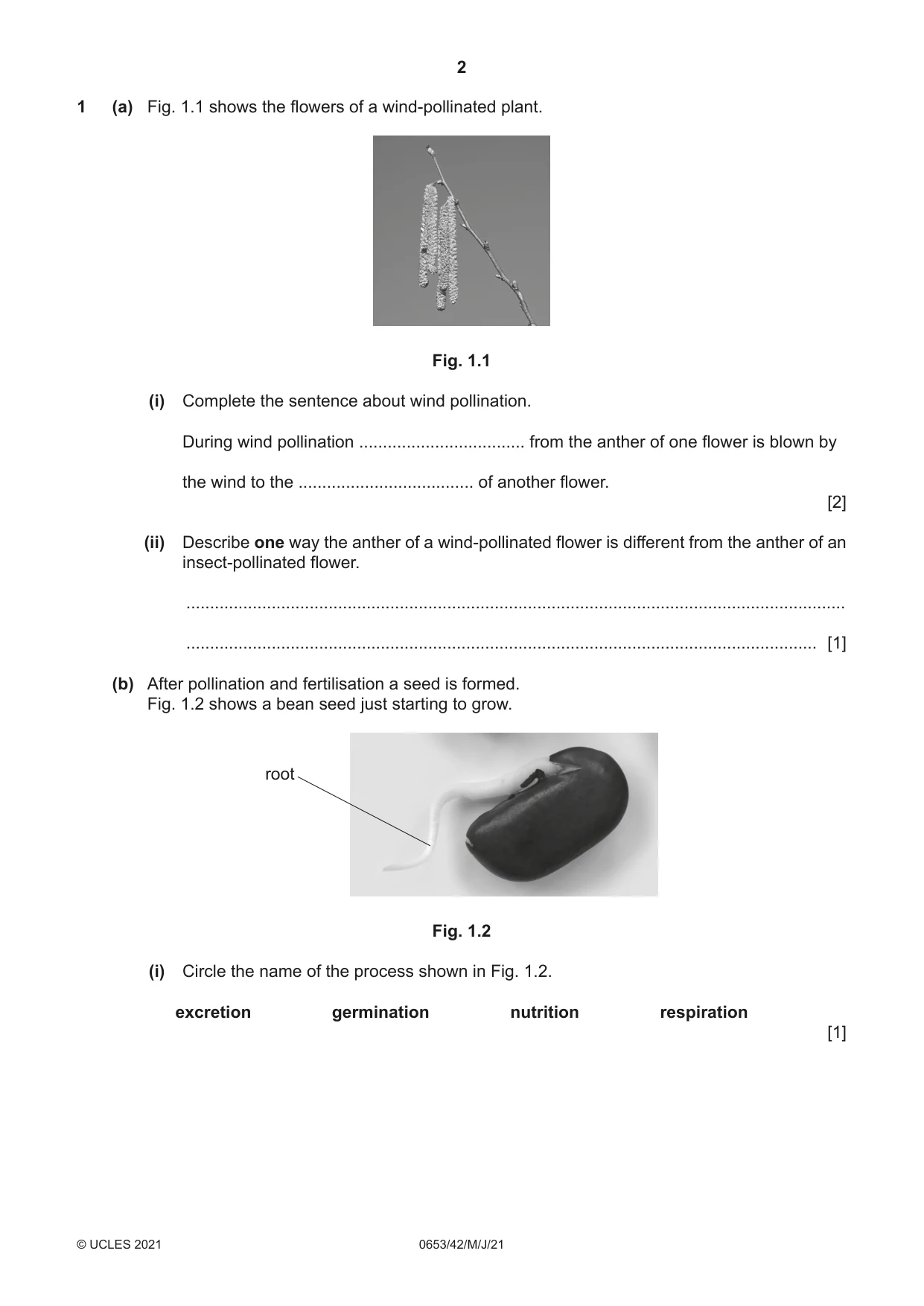
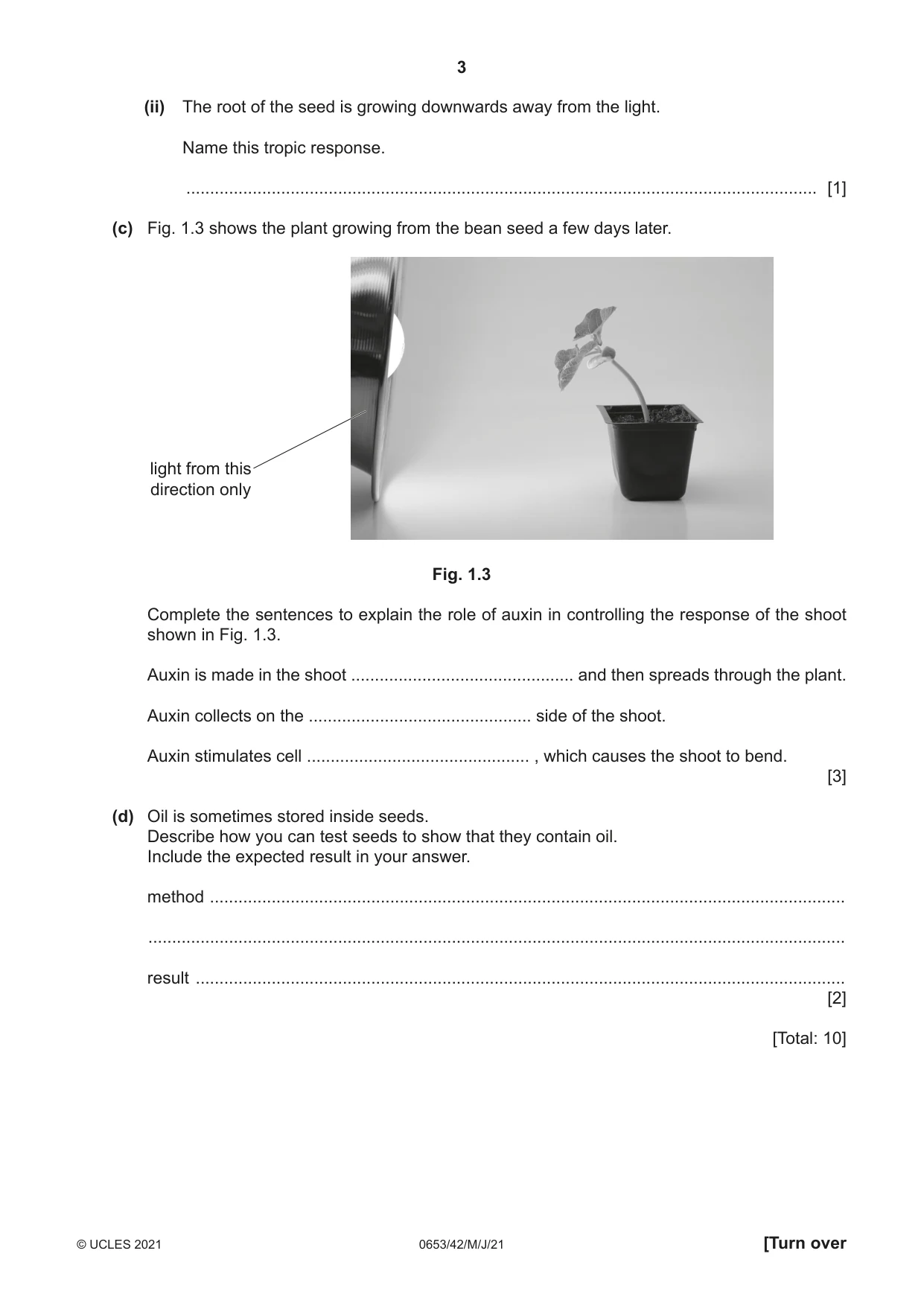
1 (a) Fig. 1.1 shows the flowers of a wind-pollinated plant. Fig. 1.1 (i) Complete the sentence about wind pollination. During wind pollination ................................... from the anther of one flower is blown by the wind to the ..................................... of another flower. [2] (ii) Describe one way the anther of a wind-pollinated flower is different from the anther of an insect-pollinated flower. ........................................................................................................................................... ..................................................................................................................................... [1] (b) After pollination and fertilisation a seed is formed. Fig. 1.2 shows a bean seed just starting to grow. root Fig. 1.2 (i) Circle the name of the process shown in Fig. 1.2. excretion germination nutrition respiration [1] (ii) The root of the seed is growing downwards away from the light. Name this tropic response. ..................................................................................................................................... [1] (c) Fig. 1.3 shows the plant growing from the bean seed a few days later. light from this direction only Fig. 1.3 Complete the sentences to explain the role of auxin in controlling the response of the shoot shown in Fig. 1.3. Auxin is made in the shoot ............................................... and then spreads through the plant. Auxin collects on the ............................................... side of the shoot. Auxin stimulates cell ............................................... , which causes the shoot to bend. [3] (d) Oil is sometimes stored inside seeds. Describe how you can test seeds to show that they contain oil. Include the expected result in your answer. method ...................................................................................................................................... ................................................................................................................................................... result ......................................................................................................................................... [2] [Total: 10]
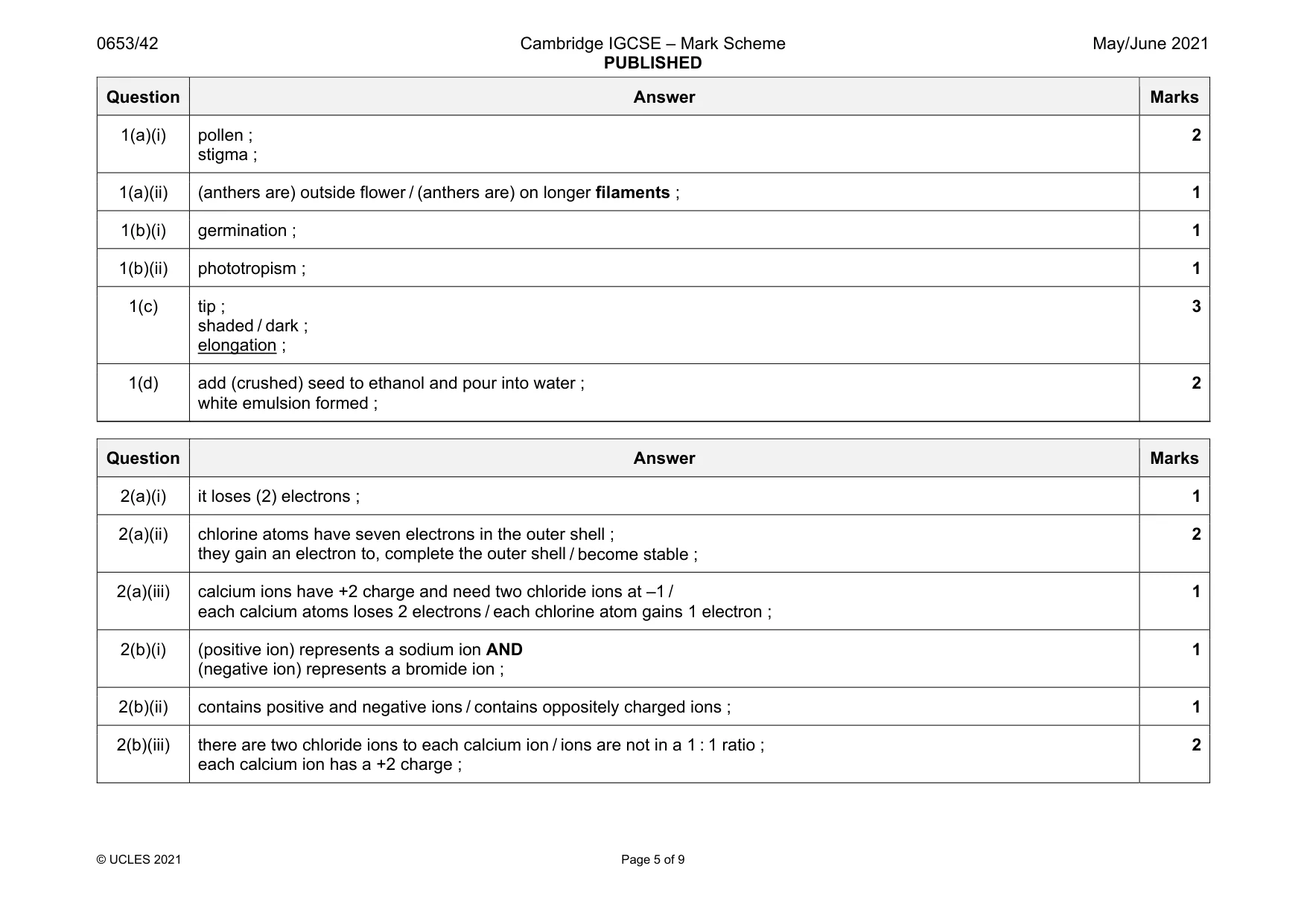
Mark scheme: 1(a)(i) pollen ; stigma ; 2 1(a)(ii) (anthers are) outside flower / (anthers are) on longer filaments ; 1 1(b)(i) germination ; 1 1(b)(ii) phototropism ; 1 1(c) tip ; shaded / dark ; elongation ; 3 1(d) add (crushed) seed to ethanol and pour into water ; white emulsion formed ; 2
Q2 · Calcium chloride, CaCl2, is an ionic compound
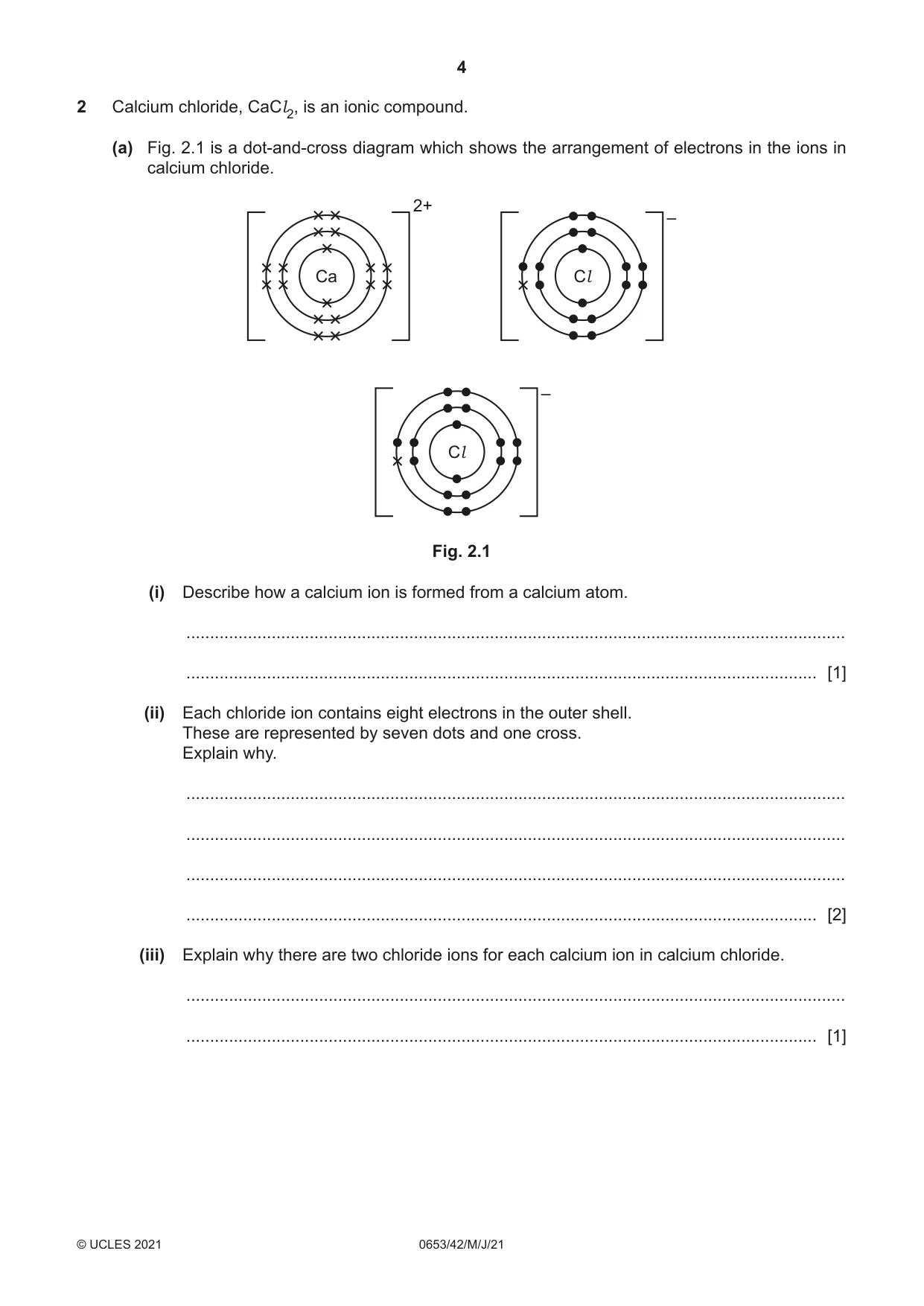
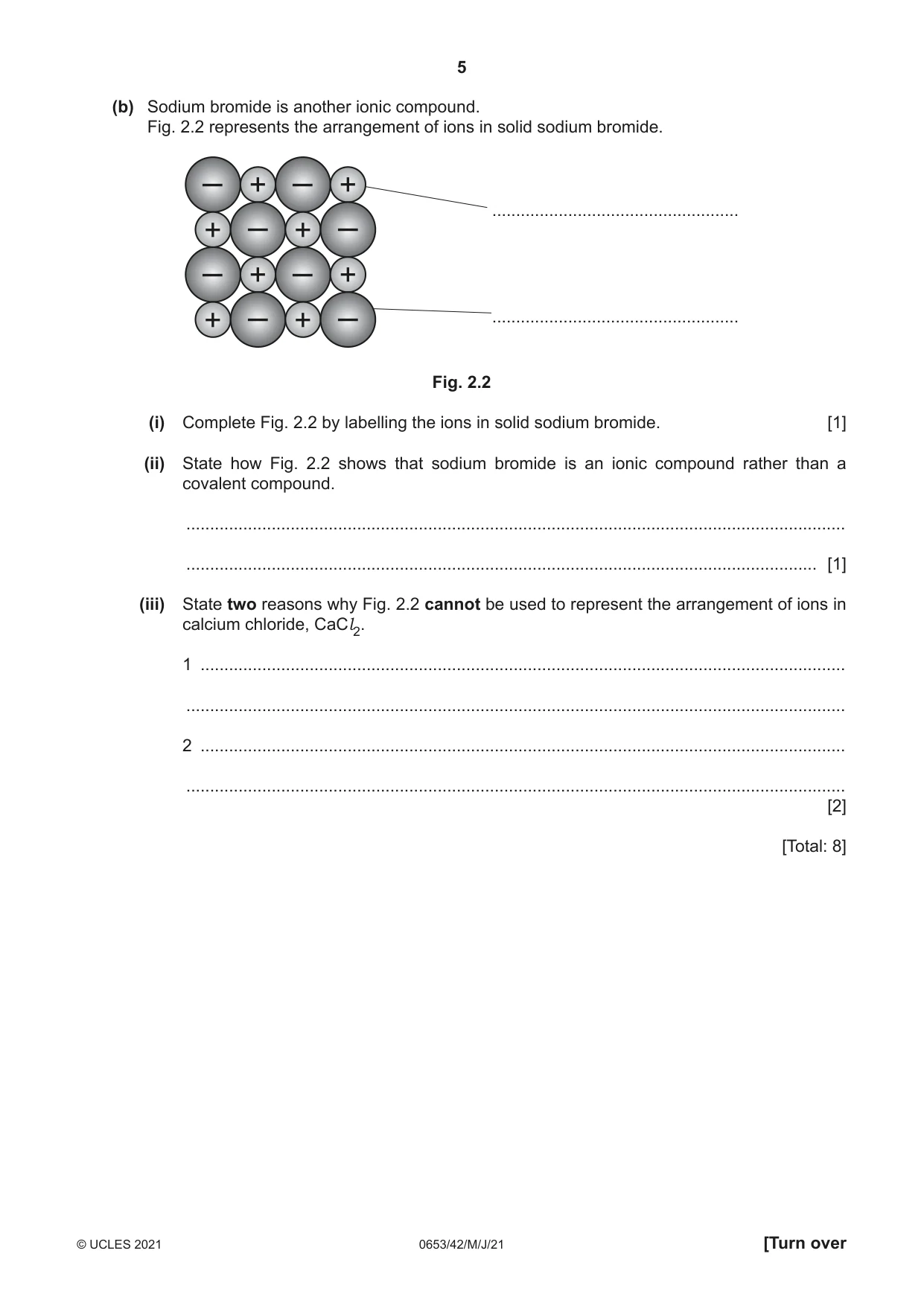
2 Calcium chloride, CaCl2, is an ionic compound. (a) Fig. 2.1 is a dot-and-cross diagram which shows the arrangement of electrons in the ions in calcium chloride. 2+ – Ca Cl – Cl Fig. 2.1 (i) Describe how a calcium ion is formed from a calcium atom. ........................................................................................................................................... ..................................................................................................................................... [1] (ii) Each chloride ion contains eight electrons in the outer shell. These are represented by seven dots and one cross. Explain why. ........................................................................................................................................... ........................................................................................................................................... ........................................................................................................................................... ..................................................................................................................................... [2] (iii) Explain why there are two chloride ions for each calcium ion in calcium chloride. ........................................................................................................................................... ..................................................................................................................................... [1] (b) Sodium bromide is another ionic compound. Fig. 2.2 represents the arrangement of ions in solid sodium bromide. – + – + .................................................... + – + – – + – + .................................................... + – + – Fig. 2.2 (i) Complete Fig. 2.2 by labelling the ions in solid sodium bromide. [1] (ii) State how Fig. 2.2 shows that sodium bromide is an ionic compound rather than a covalent compound. ........................................................................................................................................... ..................................................................................................................................... [1] (iii) State two reasons why Fig. 2.2 cannot be used to represent the arrangement of ions in calcium chloride, CaCl2. 1 ........................................................................................................................................ ........................................................................................................................................... 2 ........................................................................................................................................ ........................................................................................................................................... [2] [Total: 8]
Mark scheme: 2(a)(i) it loses (2) electrons ; 1 2(a)(ii) chlorine atoms have seven electrons in the outer shell ; they gain an electron to, complete the outer shell / become stable ; 2 2(a)(iii) calcium ions have +2 charge and need two chloride ions at –1 / each calcium atoms loses 2 electrons / each chlorine atom gains 1 electron ; 1 2(b)(i) (positive ion) represents a sodium ion AND (negative ion) represents a bromide ion ; 1 2(b)(ii) contains positive and negative ions / contains oppositely charged ions ; 1 2(b)(iii) there are two chloride ions to each calcium ion / ions are not in a 1 : 1 ratio ; each calcium ion has a +2 charge ; 2
Q3 · A battery-powered electric bus
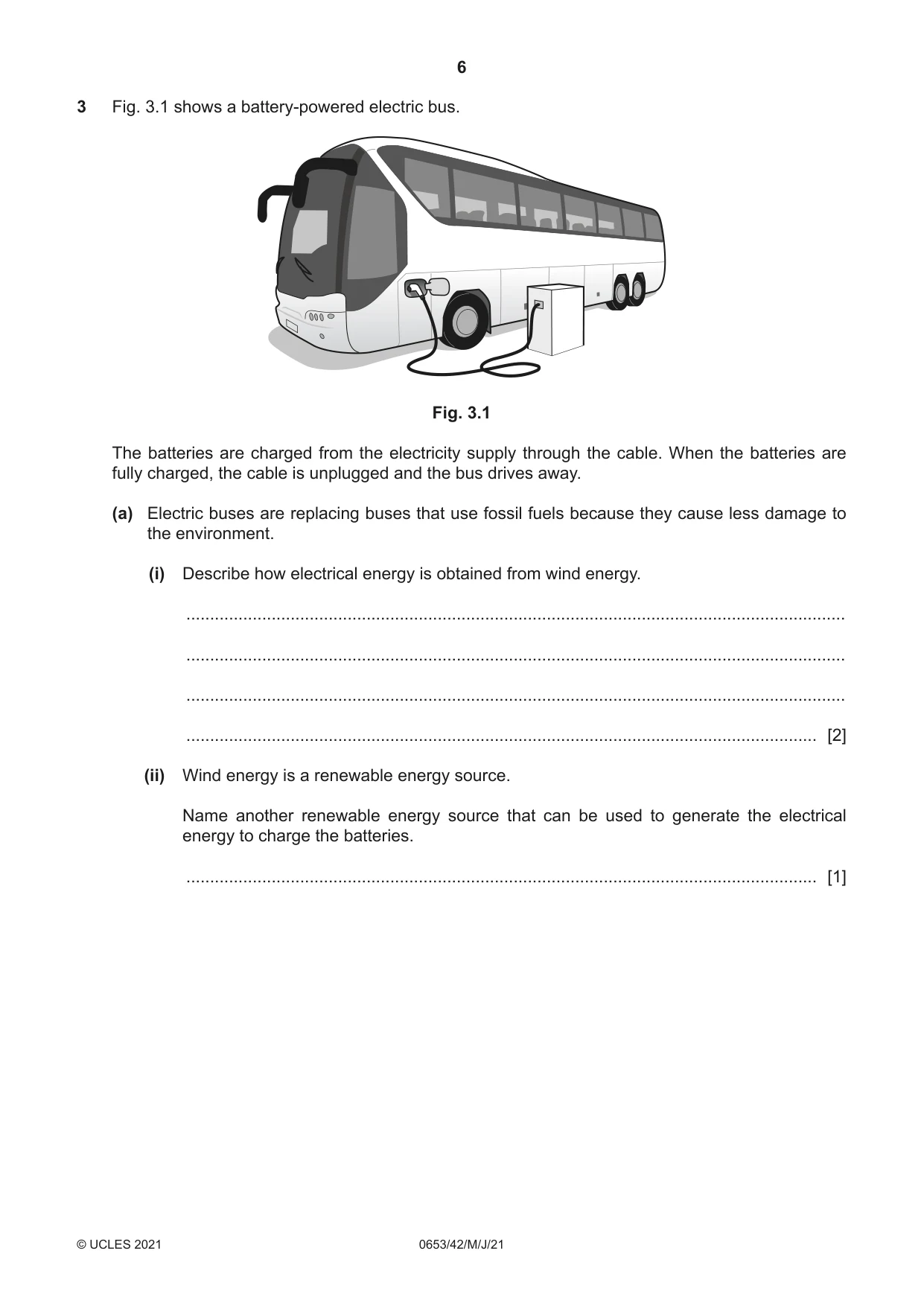
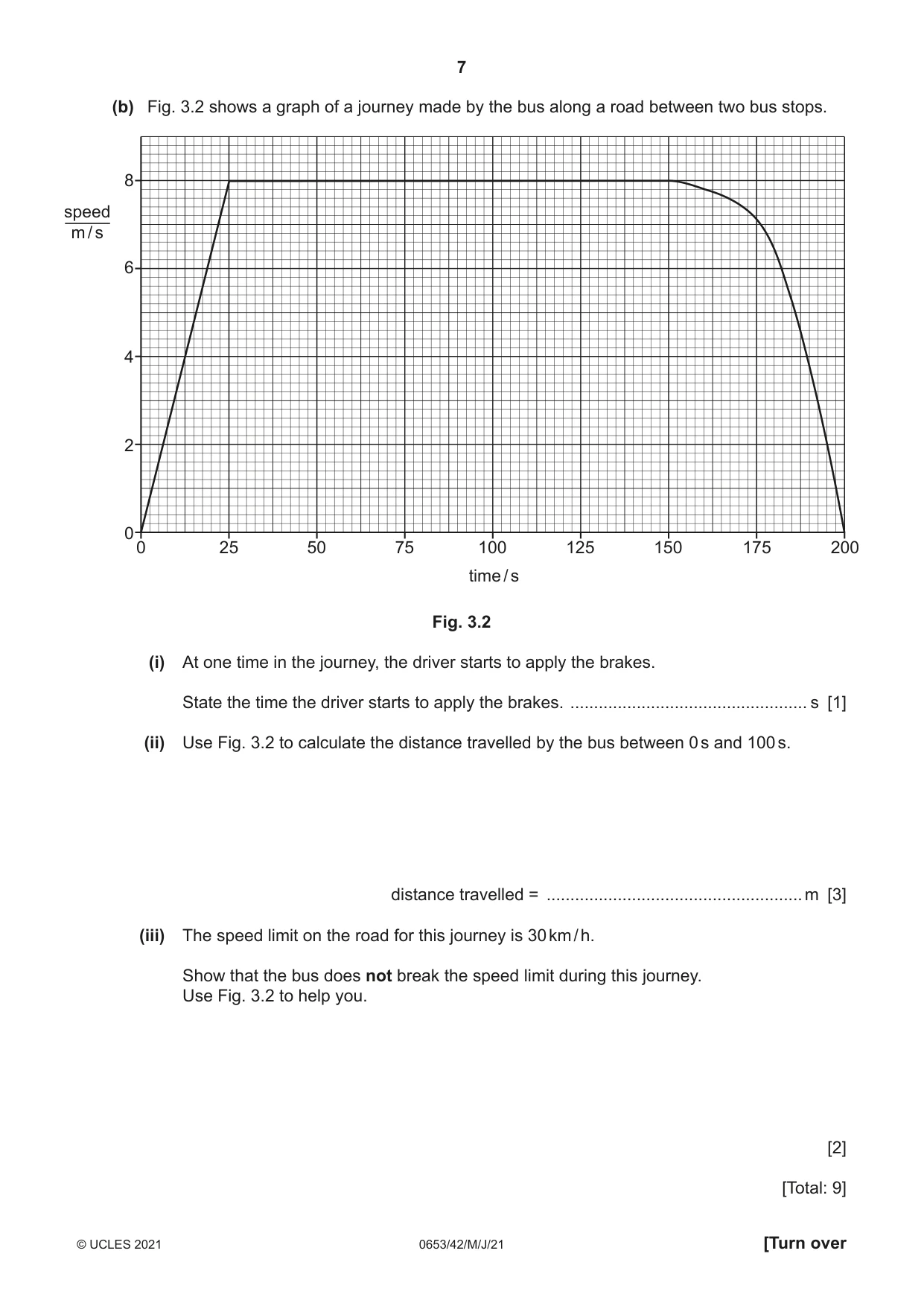
3 Fig. 3.1 shows a battery-powered electric bus. Fig. 3.1 The batteries are charged from the electricity supply through the cable. When the batteries are fully charged, the cable is unplugged and the bus drives away. (a) Electric buses are replacing buses that use fossil fuels because they cause less damage to the environment. (i) Describe how electrical energy is obtained from wind energy. ........................................................................................................................................... ........................................................................................................................................... ........................................................................................................................................... ..................................................................................................................................... [2] (ii) Wind energy is a renewable energy source. Name another renewable energy source that can be used to generate the electrical energy to charge the batteries. ..................................................................................................................................... [1] (b) Fig. 3.2 shows a graph of a journey made by the bus along a road between two bus stops. 8 speed m / s 6 4 2 0 0 25 50 75 100 125 150 175 200 time / s Fig. 3.2 (i) At one time in the journey, the driver starts to apply the brakes. State the time the driver starts to apply the brakes. .................................................. s [1] (ii) Use Fig. 3.2 to calculate the distance travelled by the bus between 0 s and 100 s. distance travelled = ...................................................... m [3] (iii) The speed limit on the road for this journey is 30 km / h. Show that the bus does not break the speed limit during this journey. Use Fig. 3.2 to help you. [2] [Total: 9]
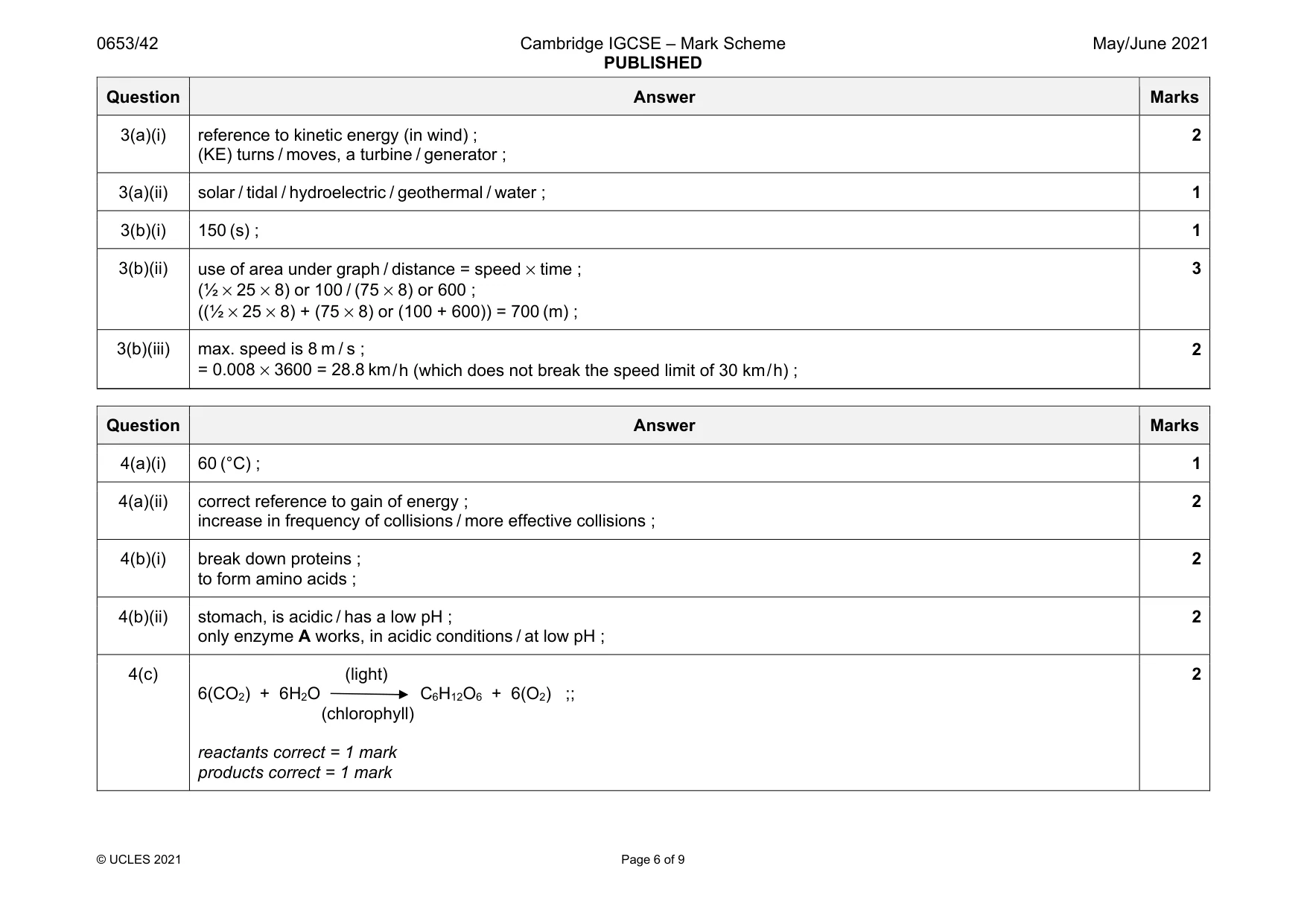
Mark scheme: 3(a)(i) reference to kinetic energy (in wind) ; (KE) turns / moves, a turbine / generator ; 2 3(a)(ii) solar / tidal / hydroelectric / geothermal / water ; 1 3(b)(i) 150 (s) ; 1 3(b)(ii) use of area under graph / distance = speed × time ; (½ × 25 × 8) or 100 / (75 × 8) or 600 ; ((½ × 25 × 8) + (75 × 8) or (100 + 600)) = 700 (m) ; 3 3(b)(iii) max. speed is 8 m / s ; = 0.008 × 3600 = 28.8 km / h (which does not break the speed limit of 30 km / h) ; 2
Q4 · A graph showing the effect of temperature on the activity of an enzyme
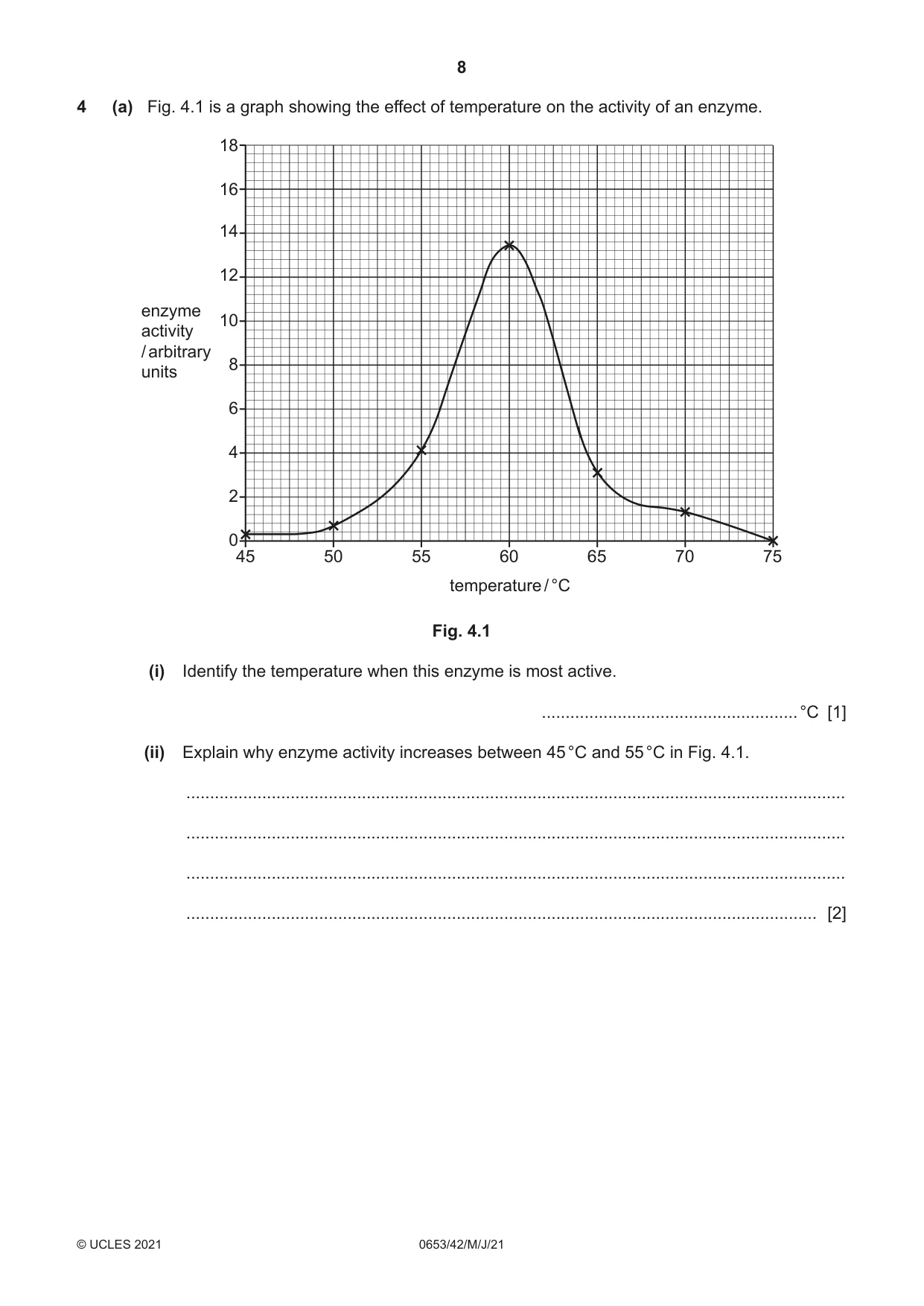
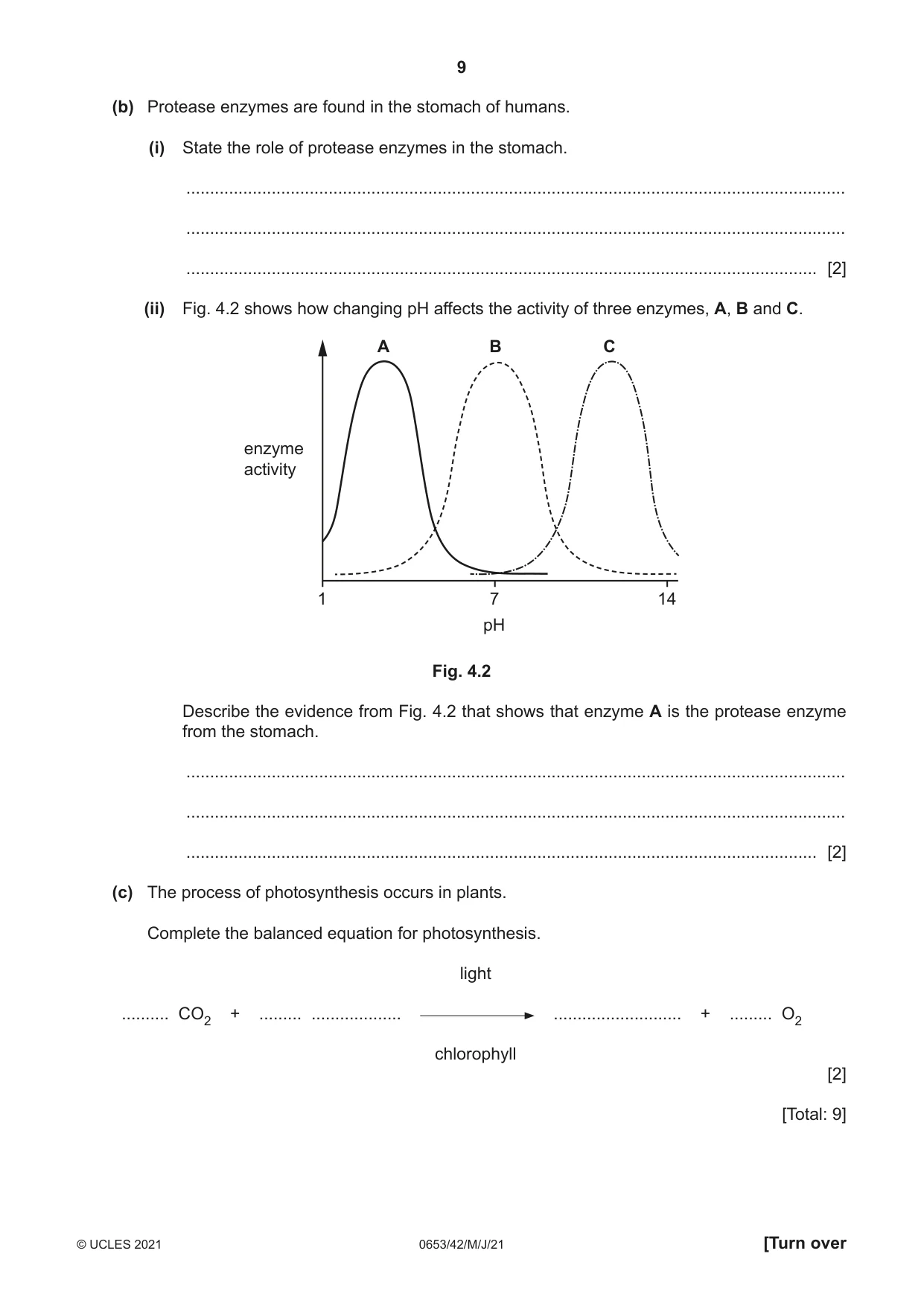
4 (a) Fig. 4.1 is a graph showing the effect of temperature on the activity of an enzyme. 18 16 14 12 enzyme 10 activity / arbitrary 8 units 6 4 2 0 45 50 55 60 65 70 75 temperature / °C Fig. 4.1 (i) Identify the temperature when this enzyme is most active. ...................................................... °C [1] (ii) Explain why enzyme activity increases between 45 °C and 55 °C in Fig. 4.1. ........................................................................................................................................... ........................................................................................................................................... ........................................................................................................................................... ..................................................................................................................................... [2] (b) Protease enzymes are found in the stomach of humans. (i) State the role of protease enzymes in the stomach. ........................................................................................................................................... ........................................................................................................................................... ..................................................................................................................................... [2] (ii) Fig. 4.2 shows how changing pH affects the activity of three enzymes, A, B and C. A B C enzyme activity 1 7 14 pH Fig. 4.2 Describe the evidence from Fig. 4.2 that shows that enzyme A is the protease enzyme from the stomach. ........................................................................................................................................... ........................................................................................................................................... ..................................................................................................................................... [2] (c) The process of photosynthesis occurs in plants. Complete the balanced equation for photosynthesis. light .......... CO2 + ......... ................... ........................... + ......... O2 chlorophyll [2] [Total: 9]
Mark scheme: 4(a)(i) 60 (°C) ; 1 4(a)(ii) correct reference to gain of energy ; increase in frequency of collisions / more effective collisions ; 2 4(b)(i) break down proteins ; to form amino acids ; 2 4(b)(ii) stomach, is acidic / has a low pH ; only enzyme A works, in acidic conditions / at low pH ; 2 4(c) (light) 6(CO2) + 6H2O C6H12O6 + 6(O2) ;; (chlorophyll) reactants correct = 1 mark products correct = 1 mark 2
Q5 · A student investigates the rate of reaction between solid calcium carbonate and dilute…
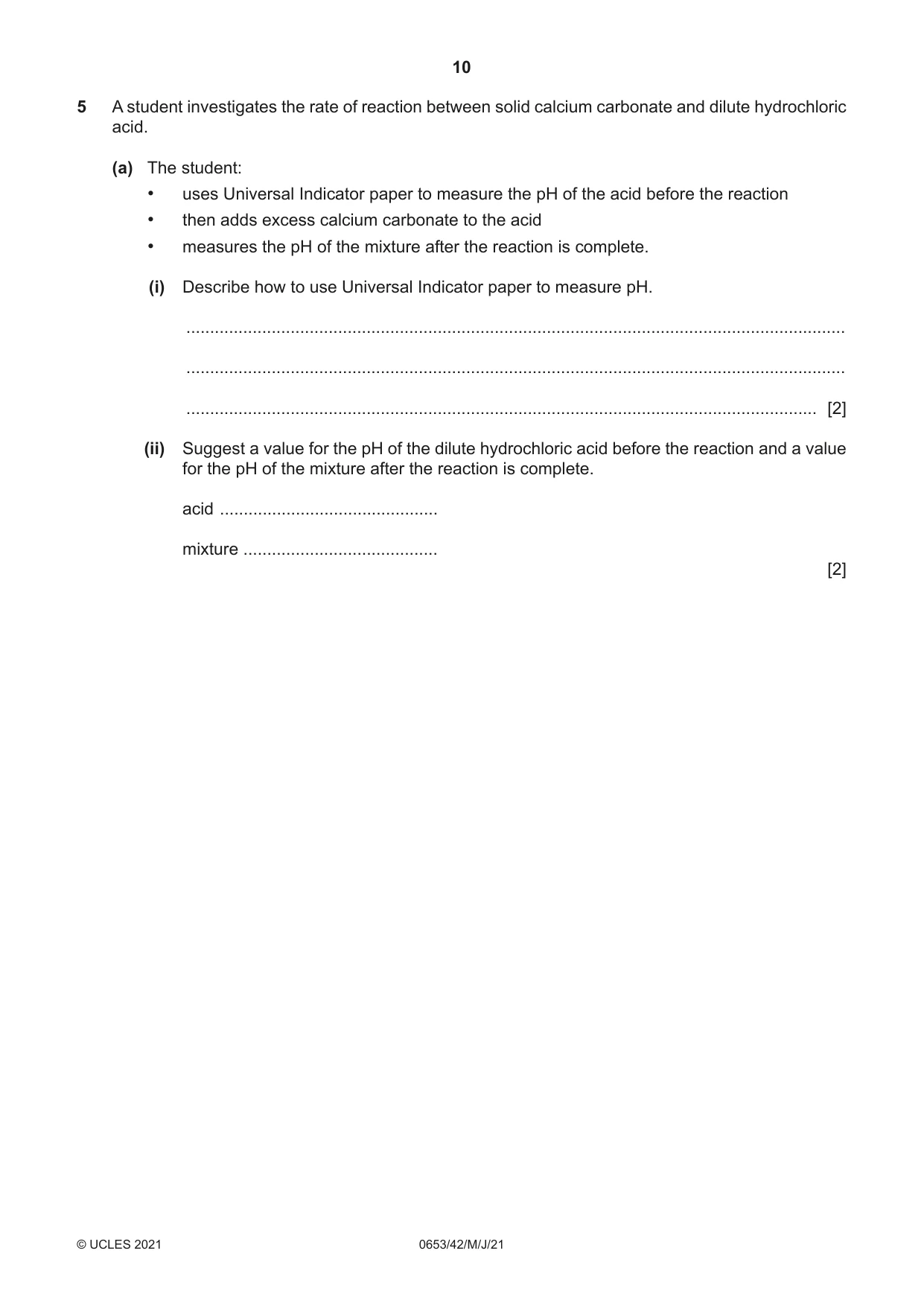
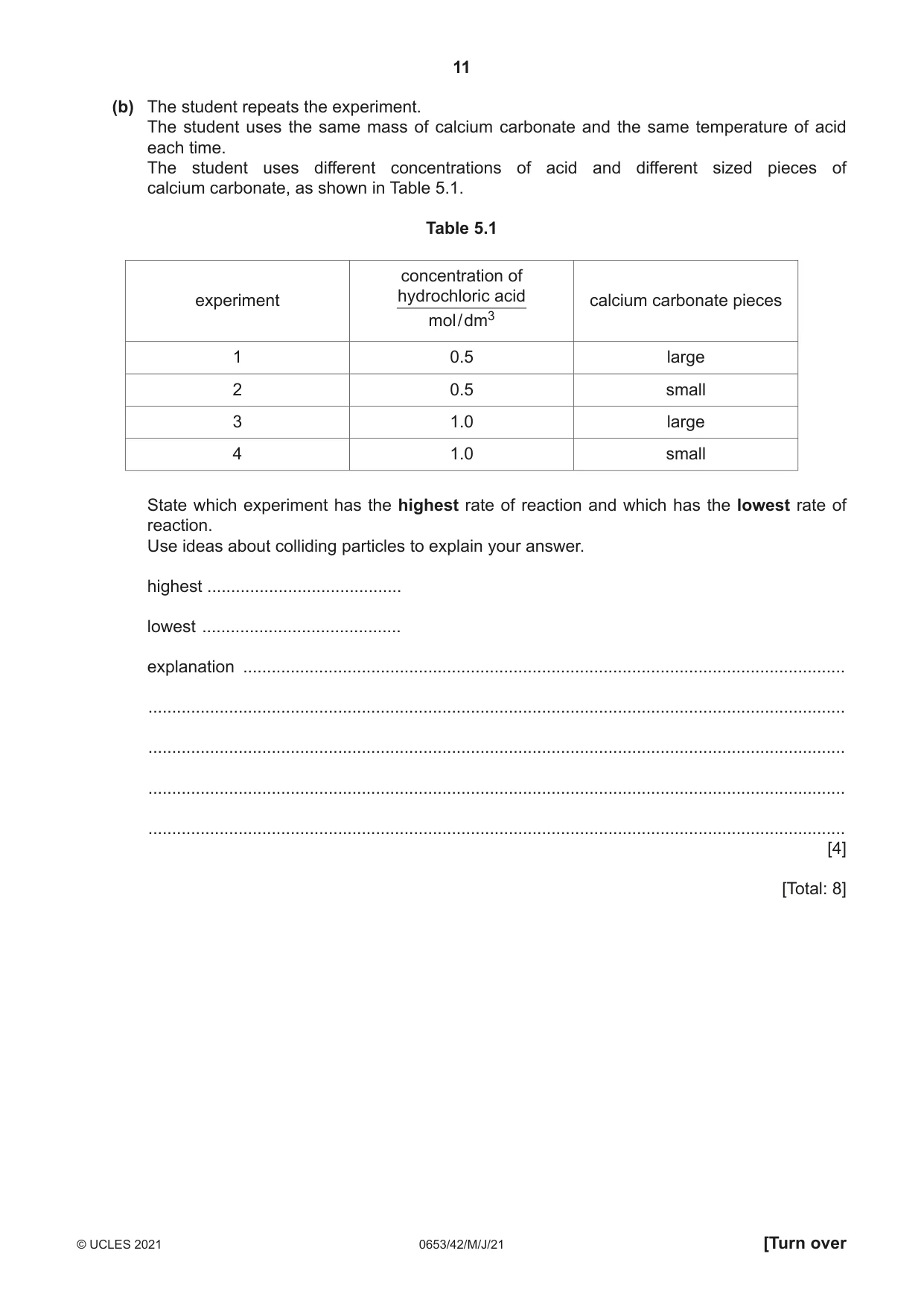
5 A student investigates the rate of reaction between solid calcium carbonate and dilute hydrochloric acid. (a) The student: • uses Universal Indicator paper to measure the pH of the acid before the reaction • then adds excess calcium carbonate to the acid • measures the pH of the mixture after the reaction is complete. (i) Describe how to use Universal Indicator paper to measure pH. ........................................................................................................................................... ........................................................................................................................................... ..................................................................................................................................... [2] (ii) Suggest a value for the pH of the dilute hydrochloric acid before the reaction and a value for the pH of the mixture after the reaction is complete. acid .............................................. mixture ......................................... [2] (b) The student repeats the experiment. The student uses the same mass of calcium carbonate and the same temperature of acid each time. The student uses different concentrations of acid and different sized pieces of calcium carbonate, as shown in Table 5.1. Table 5.1 concentration of experiment hydrochloric acid calcium carbonate pieces mol / dm3 1 0.5 large 2 0.5 small 3 1.0 large 4 1.0 small State which experiment has the highest rate of reaction and which has the lowest rate of reaction. Use ideas about colliding particles to explain your answer. highest ......................................... lowest .......................................... explanation ............................................................................................................................... ................................................................................................................................................... ................................................................................................................................................... ................................................................................................................................................... ................................................................................................................................................... [4] [Total: 8]
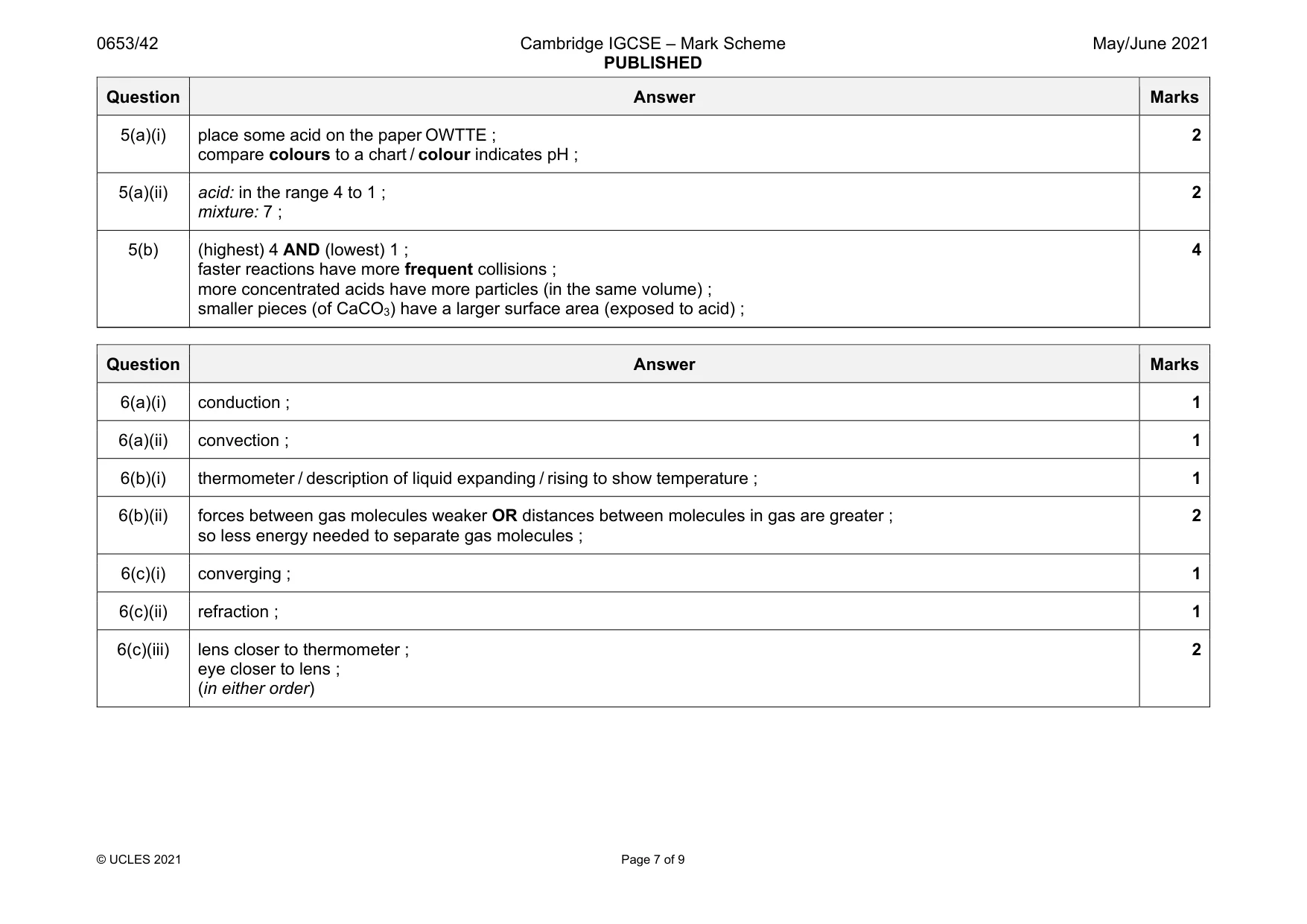
Mark scheme: 5(a)(i) place some acid on the paper OWTTE ; compare colours to a chart / colour indicates pH ; 2 5(a)(ii) acid: in the range 4 to 1 ; mixture: 7 ; 2 5(b) (highest) 4 AND (lowest) 1 ; faster reactions have more frequent collisions ; more concentrated acids have more particles (in the same volume) ; smaller pieces (of CaCO3) have a larger surface area (exposed to acid) ; 4
More questions on The characteristic properties of acids and bases
Q6 · Thermal energy being transferred to a beaker of water
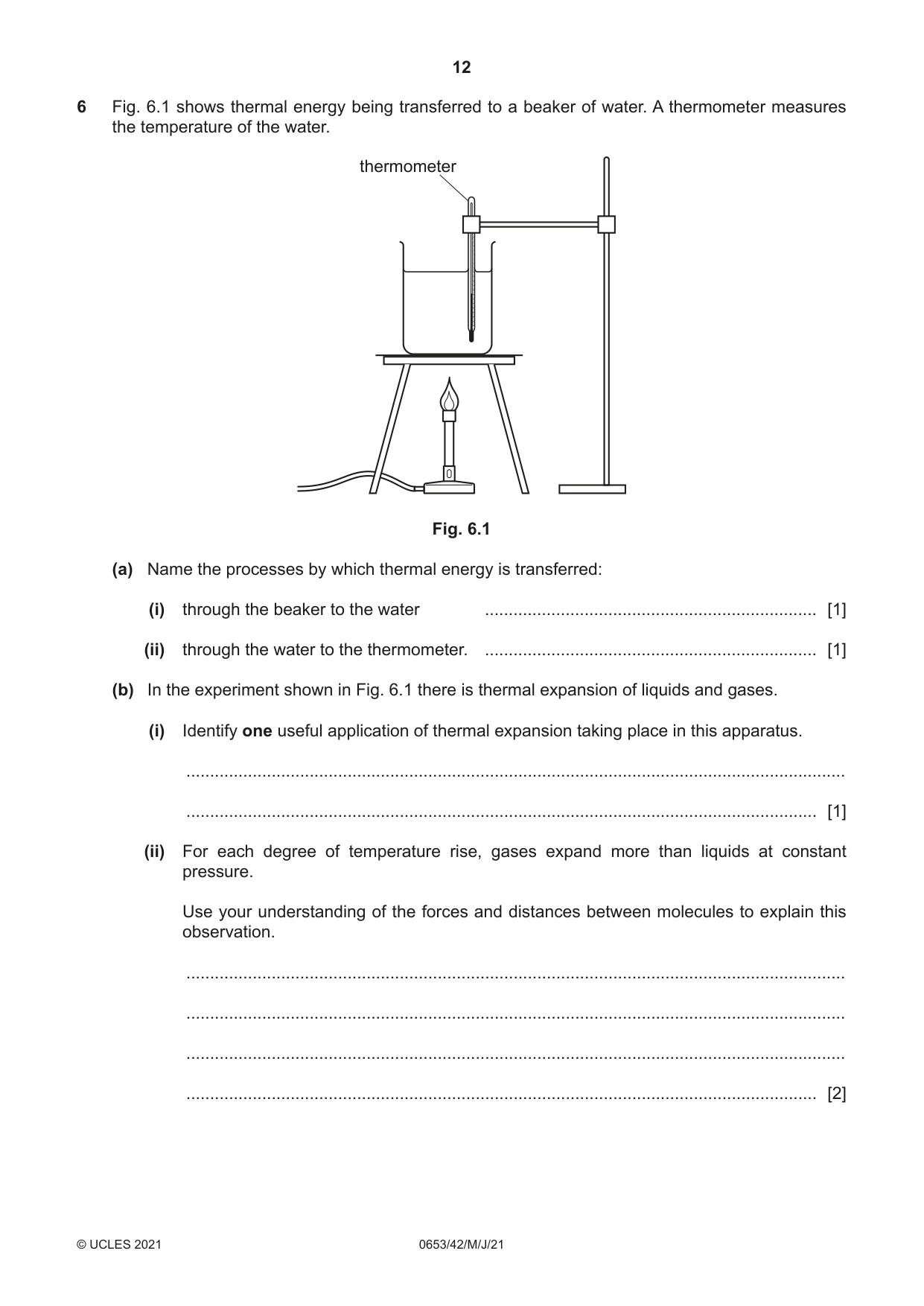
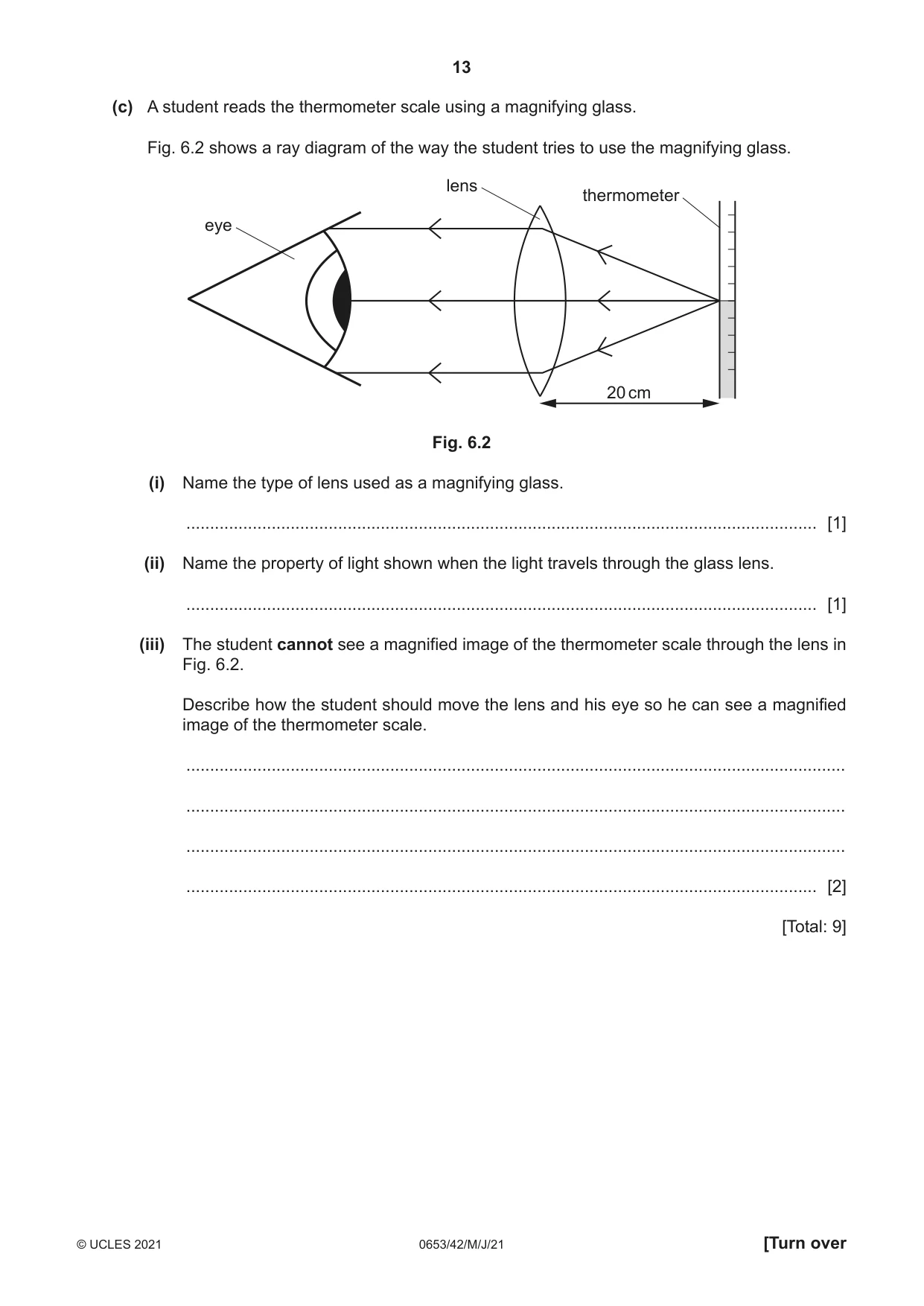
6 Fig. 6.1 shows thermal energy being transferred to a beaker of water. A thermometer measures the temperature of the water. thermometer Fig. 6.1 (a) Name the processes by which thermal energy is transferred: (i) through the beaker to the water ...................................................................... [1] (ii) through the water to the thermometer. ...................................................................... [1] (b) In the experiment shown in Fig. 6.1 there is thermal expansion of liquids and gases. (i) Identify one useful application of thermal expansion taking place in this apparatus. ........................................................................................................................................... ..................................................................................................................................... [1] (ii) For each degree of temperature rise, gases expand more than liquids at constant pressure. Use your understanding of the forces and distances between molecules to explain this observation. ........................................................................................................................................... ........................................................................................................................................... ........................................................................................................................................... ..................................................................................................................................... [2] (c) A student reads the thermometer scale using a magnifying glass. Fig. 6.2 shows a ray diagram of the way the student tries to use the magnifying glass. lens thermometer eye 20 cm Fig. 6.2 (i) Name the type of lens used as a magnifying glass. ..................................................................................................................................... [1] (ii) Name the property of light shown when the light travels through the glass lens. ..................................................................................................................................... [1] (iii) The student cannot see a magnified image of the thermometer scale through the lens in Fig. 6.2. Describe how the student should move the lens and his eye so he can see a magnified image of the thermometer scale. ........................................................................................................................................... ........................................................................................................................................... ........................................................................................................................................... ..................................................................................................................................... [2] [Total: 9]
Mark scheme: 6(a)(i) conduction ; 1 6(a)(ii) convection ; 1 6(b)(i) thermometer / description of liquid expanding / rising to show temperature ; 1 6(b)(ii) forces between gas molecules weaker OR distances between molecules in gas are greater ; so less energy needed to separate gas molecules ; 2 6(c)(i) converging ; 1 6(c)(ii) refraction ; 1 6(c)(iii) lens closer to thermometer ; eye closer to lens ; (in either order) 2
Q7 · Define the term ecosystem
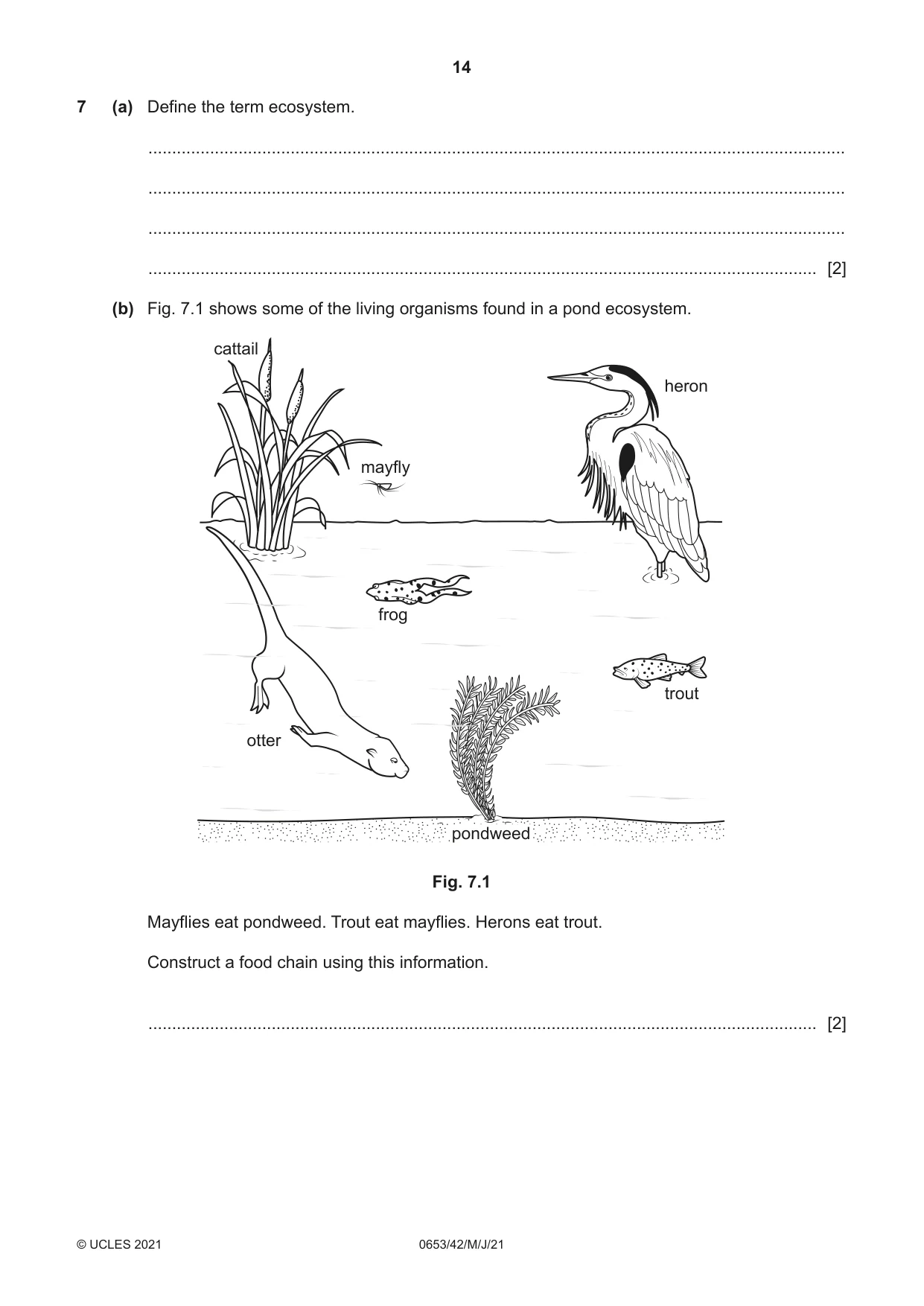
7 (a) Define the term ecosystem. ................................................................................................................................................... ................................................................................................................................................... ................................................................................................................................................... ............................................................................................................................................. [2] (b) Fig. 7.1 shows some of the living organisms found in a pond ecosystem. cattail heron mayfly frog trout otter pondweed Fig. 7.1 Mayflies eat pondweed. Trout eat mayflies. Herons eat trout. Construct a food chain using this information. ............................................................................................................................................. [2] (c) Fertilisers high in nitrates pollute the pond in Fig. 7.1 causing algae to grow on the surface of the water. (i) Explain why producers under the surface of the water die. ........................................................................................................................................... ..................................................................................................................................... [1] (ii) Explain why the death of producers causes a lack of oxygen in the water. ........................................................................................................................................... ..................................................................................................................................... [1] (iii) Explain why a lack of oxygen in the water causes a reduction in the population of herons. ........................................................................................................................................... ........................................................................................................................................... ........................................................................................................................................... ..................................................................................................................................... [2] [Total: 8]
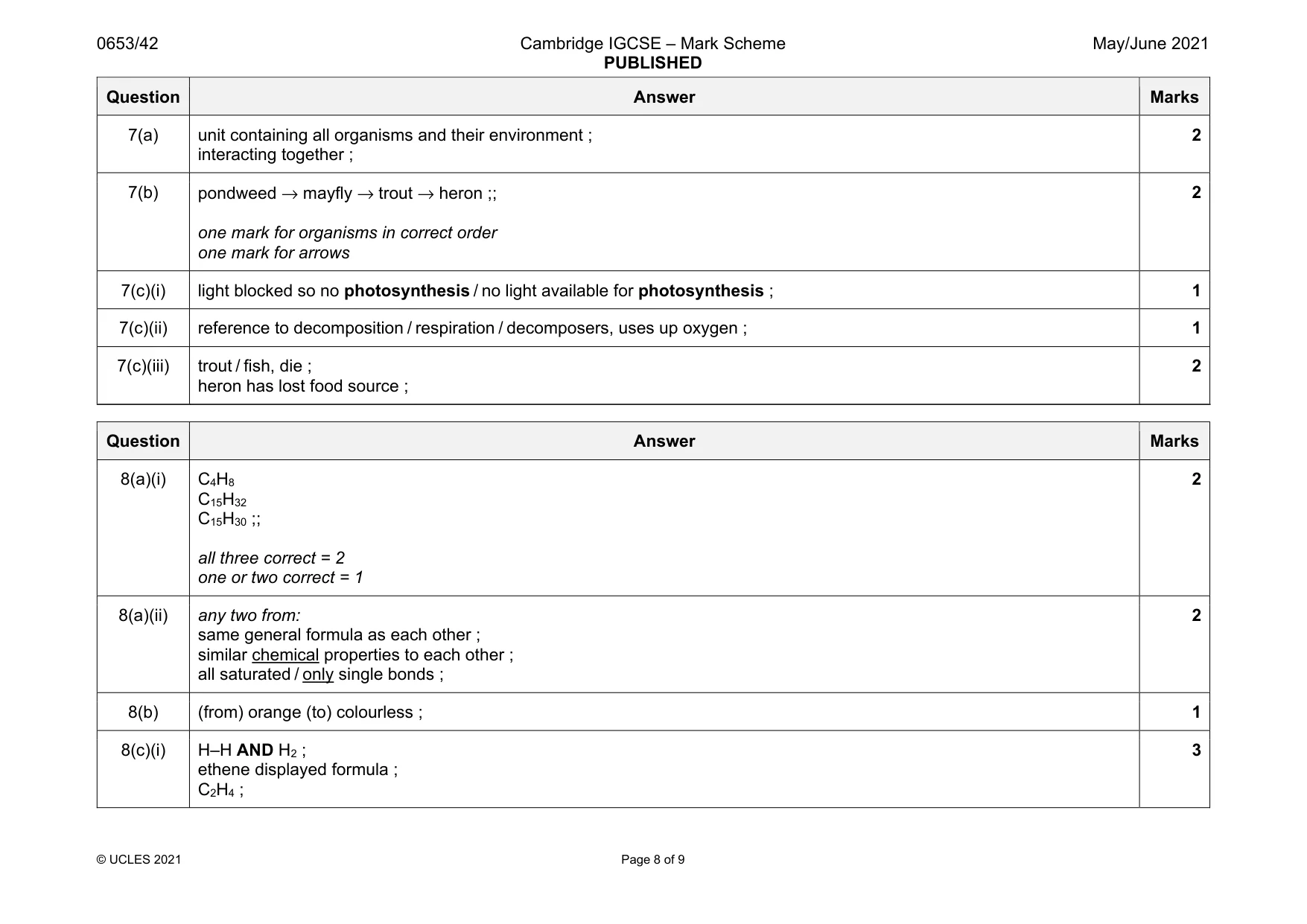
Mark scheme: 7(a) unit containing all organisms and their environment ; interacting together ; 2 7(b) pondweed → mayfly → trout → heron ;; one mark for organisms in correct order one mark for arrows 2 7(c)(i) light blocked so no photosynthesis / no light available for photosynthesis ; 1 7(c)(ii) reference to decomposition / respiration / decomposers, uses up oxygen ; 1 7(c)(iii) trout / fish, die ; heron has lost food source ; 2
Q8 · The alkanes and the alkenes are both homologous series
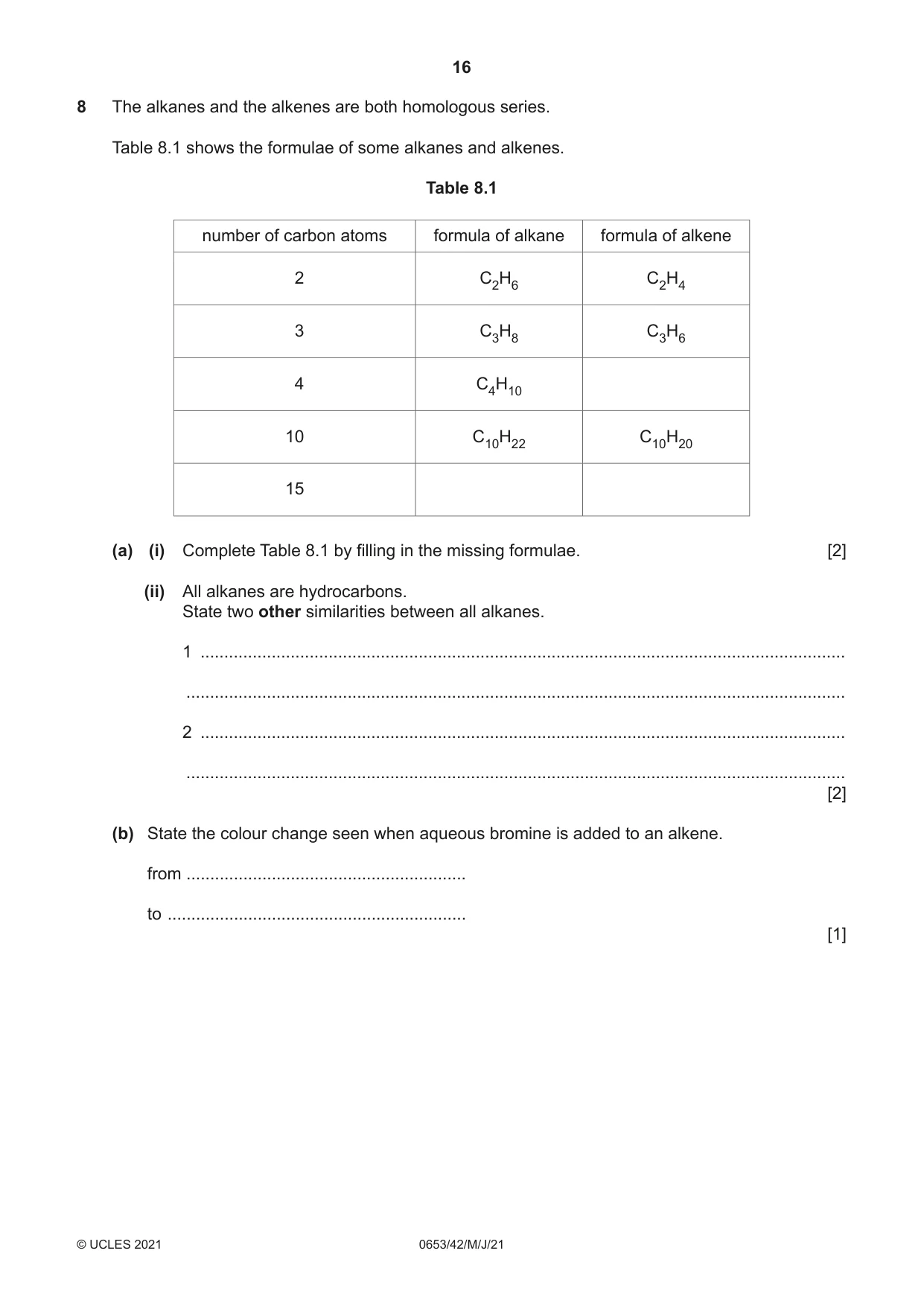
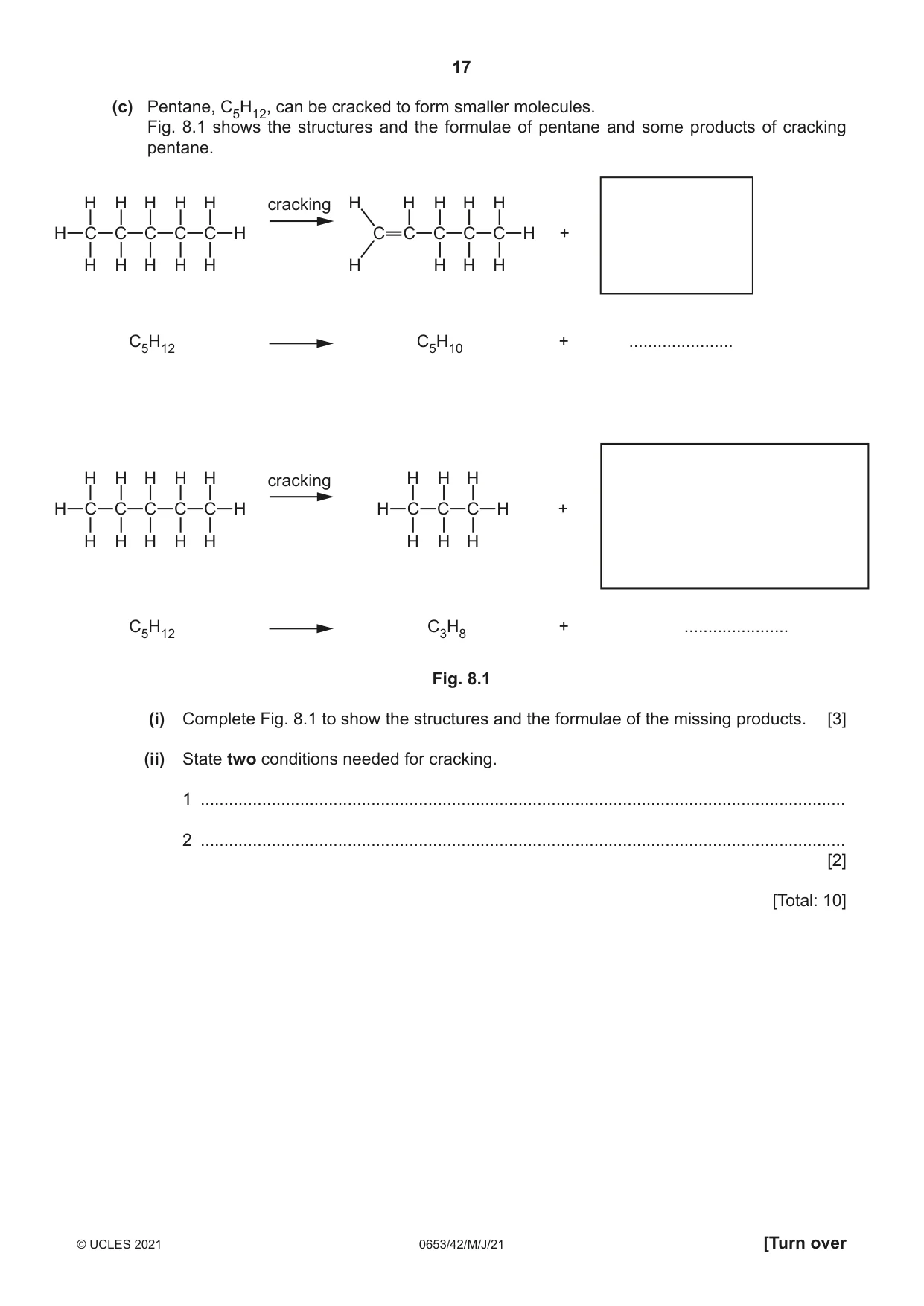
8 The alkanes and the alkenes are both homologous series. Table 8.1 shows the formulae of some alkanes and alkenes. Table 8.1 number of carbon atoms formula of alkane formula of alkene 2 C2H6 C2H4 3 C3H8 C3H6 4 C4H10 10 C10H22 C10H20 15 (a) (i) Complete Table 8.1 by filling in the missing formulae. [2] (ii) All alkanes are hydrocarbons. State two other similarities between all alkanes. 1 ........................................................................................................................................ ........................................................................................................................................... 2 ........................................................................................................................................ ........................................................................................................................................... [2] (b) State the colour change seen when aqueous bromine is added to an alkene. from ........................................................... to ............................................................... [1] (c) Pentane, C5H12, can be cracked to form smaller molecules. Fig. 8.1 shows the structures and the formulae of pentane and some products of cracking pentane. H H H H H cracking H H H H H H C C C C C H C C C C C H + H H H H H H H H H C5H12 C5H10 + ...................... H H H H H cracking H H H H C C C C C H H C C C H + H H H H H H H H C5H12 C3H8 + ...................... Fig. 8.1 (i) Complete Fig. 8.1 to show the structures and the formulae of the missing products. [3] (ii) State two conditions needed for cracking. 1 ........................................................................................................................................ 2 ........................................................................................................................................ [2] [Total: 10]
Mark scheme: 8(a)(i) C4H8 C15H32 C15H30 ;; all three correct = 2 one or two correct = 1 8(a)(ii) any two from: same general formula as each other ; similar chemical properties to each other ; all saturated / only single bonds ; 2 8(b) (from) orange (to) colourless ; 1 8(c)(i) H–H AND H2 ; ethene displayed formula ; C2H4 ; 3 Question Answer Marks 8(c)(ii) high temperature ; catalyst / high pressure ; 2
Q9 · A car powered by a battery
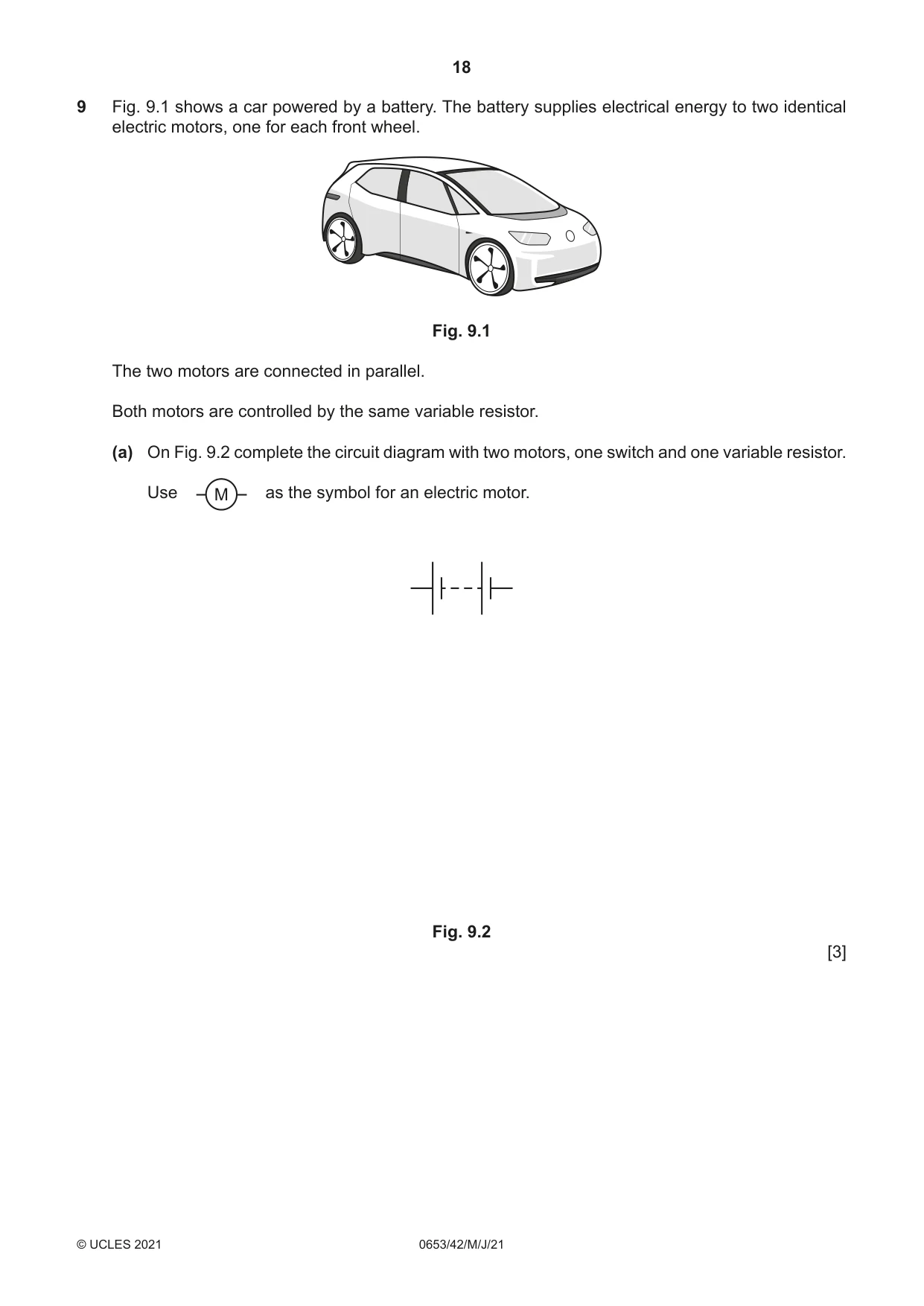
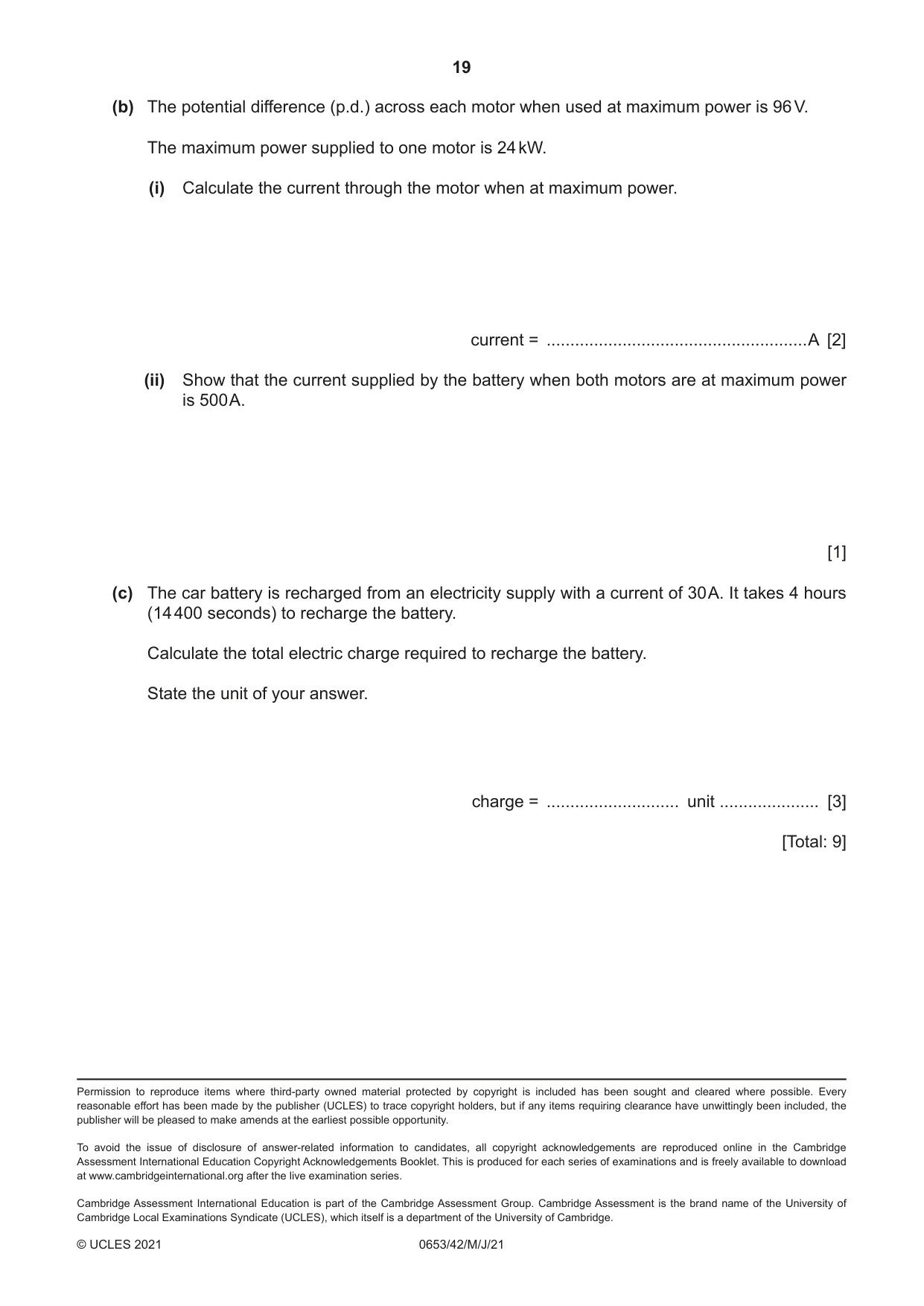
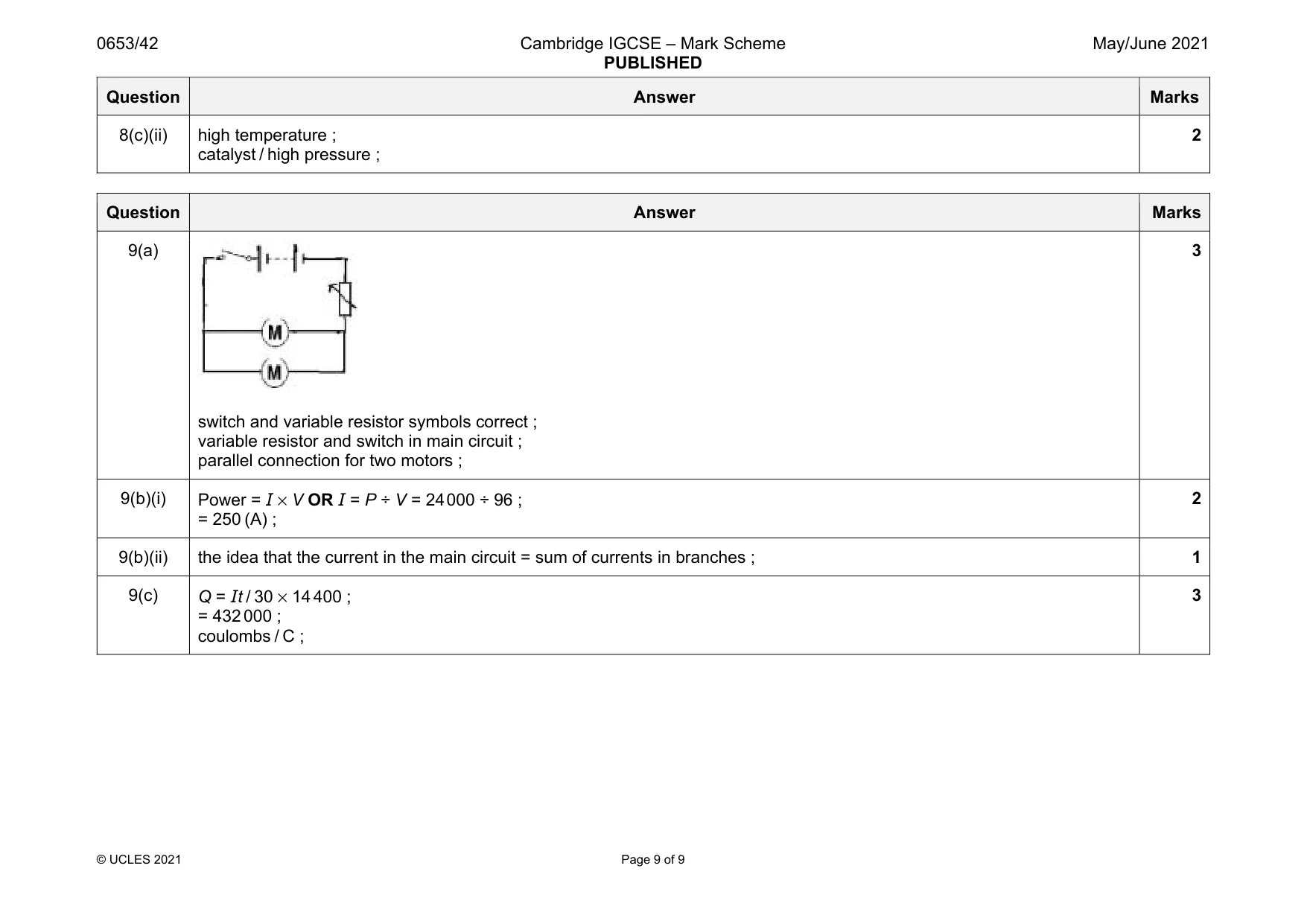
9 Fig. 9.1 shows a car powered by a battery. The battery supplies electrical energy to two identical electric motors, one for each front wheel. Fig. 9.1 The two motors are connected in parallel. Both motors are controlled by the same variable resistor. (a) On Fig. 9.2 complete the circuit diagram with two motors, one switch and one variable resistor. Use M as the symbol for an electric motor. Fig. 9.2 [3] (b) The potential difference (p.d.) across each motor when used at maximum power is 96 V. The maximum power supplied to one motor is 24 kW. (i) Calculate the current through the motor when at maximum power. current = ....................................................... A [2] (ii) Show that the current supplied by the battery when both motors are at maximum power is 500 A. [1] (c) The car battery is recharged from an electricity supply with a current of 30 A. It takes 4 hours (14 400 seconds) to recharge the battery. Calculate the total electric charge required to recharge the battery. State the unit of your answer. charge = ............................ unit ..................... [3] [Total: 9]
Mark scheme: 9(a) switch and variable resistor symbols correct ; variable resistor and switch in main circuit ; parallel connection for two motors ; 3 9(b)(i) Power = I × V OR I = P ÷ V = 24 000 ÷ 96 ; = 250 (A) ; 2 9(b)(ii) the idea that the current in the main circuit = sum of currents in branches ; 1 9(c) Q = It / 30 × 14 400 ; = 432 000 ; coulombs / C ; 3
What was in this paper
The subtopics covered by these 9 questions, and how many questions each got. Open one in a new tab to see every Cambridge question on it.
What you needed in this session
Cambridge’s own grade thresholds for 2021 May/June, Paper 4 · Variant 2. A higher threshold means an easier paper — the bar moves with how the cohort did.