Cambridge IGCSE Science - Combined 0653 — 2025 Oct/Nov Paper 4 · Variant 1
0653/41/O/N/25 · 9 questions · 80 marks · 75 min
The question paper and its mark scheme, free to read here and free to download. This is Cambridge’s own paper, exactly as it was sat.
Question paper20 pages
Mark scheme13 pages
Answers below. Sit the paper first if you are practising.
Questions as text
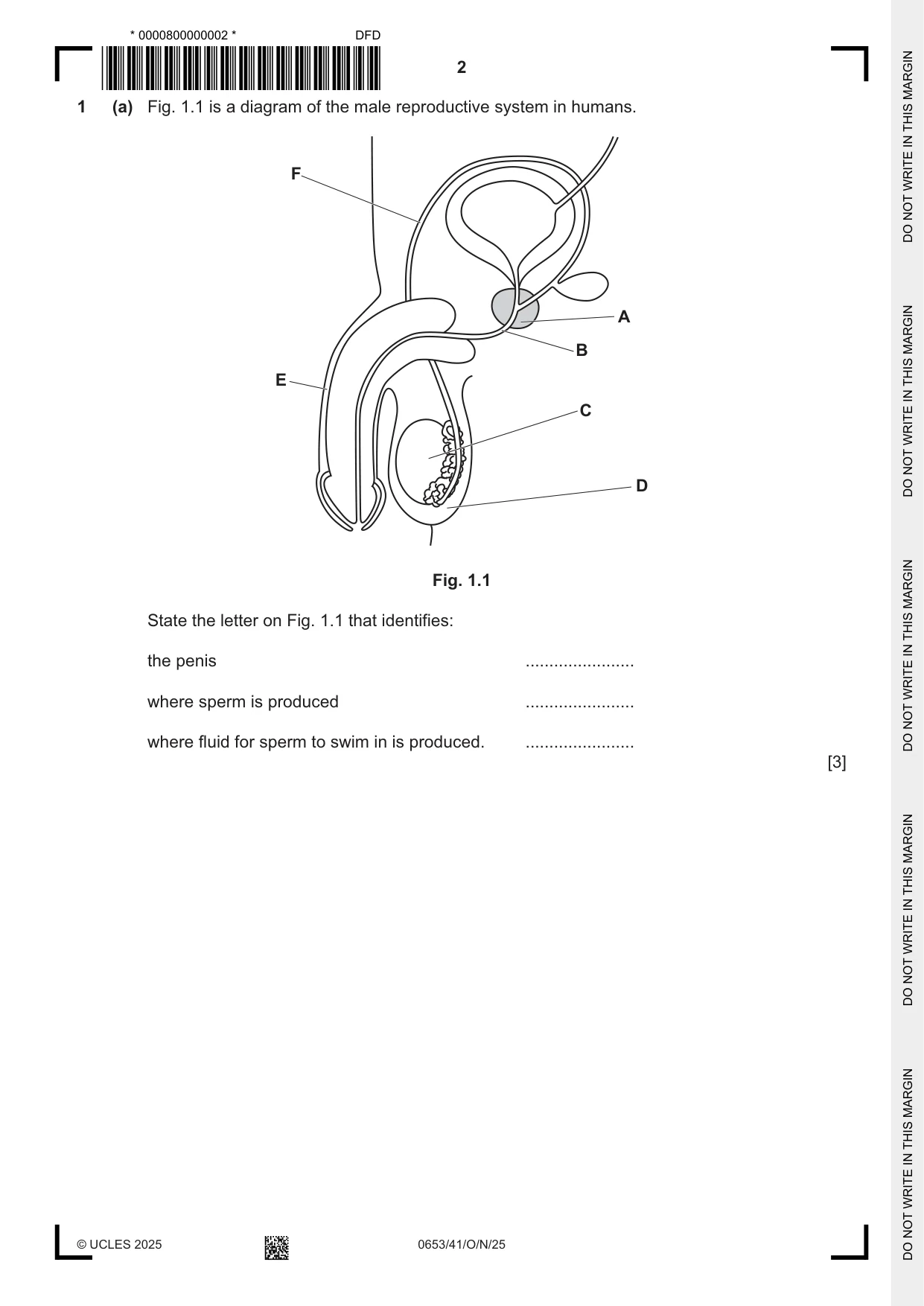
Q1 · A diagram of the male reproductive system in humans
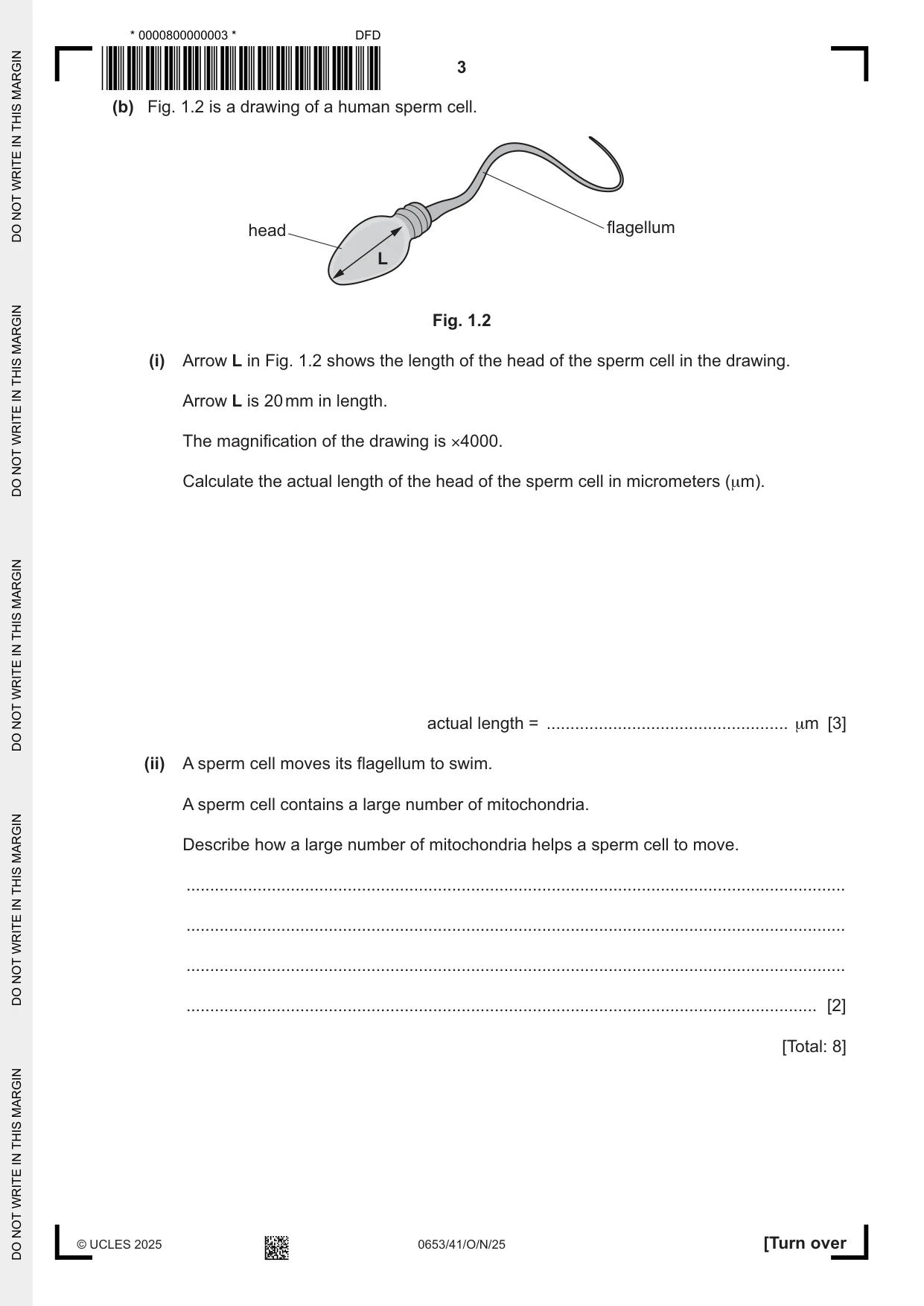
1 (a) Fig. 1.1 is a diagram of the male reproductive system in humans. F A B E C D Fig. 1.1 State the letter on Fig. 1.1 that identifies: the penis ....................... where sperm is produced ....................... where fluid for sperm to swim in is produced. ....................... [3] (b) Fig. 1.2 is a drawing of a human sperm cell. head flagellum L Fig. 1.2 (i) Arrow L in Fig. 1.2 shows the length of the head of the sperm cell in the drawing. Arrow L is 20 mm in length. The magnification of the drawing is ×4000. Calculate the actual length of the head of the sperm cell in micrometers (μm). actual length = ................................................... μm [3] (ii) A sperm cell moves its flagellum to swim. A sperm cell contains a large number of mitochondria. Describe how a large number of mitochondria helps a sperm cell to move. ........................................................................................................................................... ........................................................................................................................................... ........................................................................................................................................... ..................................................................................................................................... [2] [Total: 8]
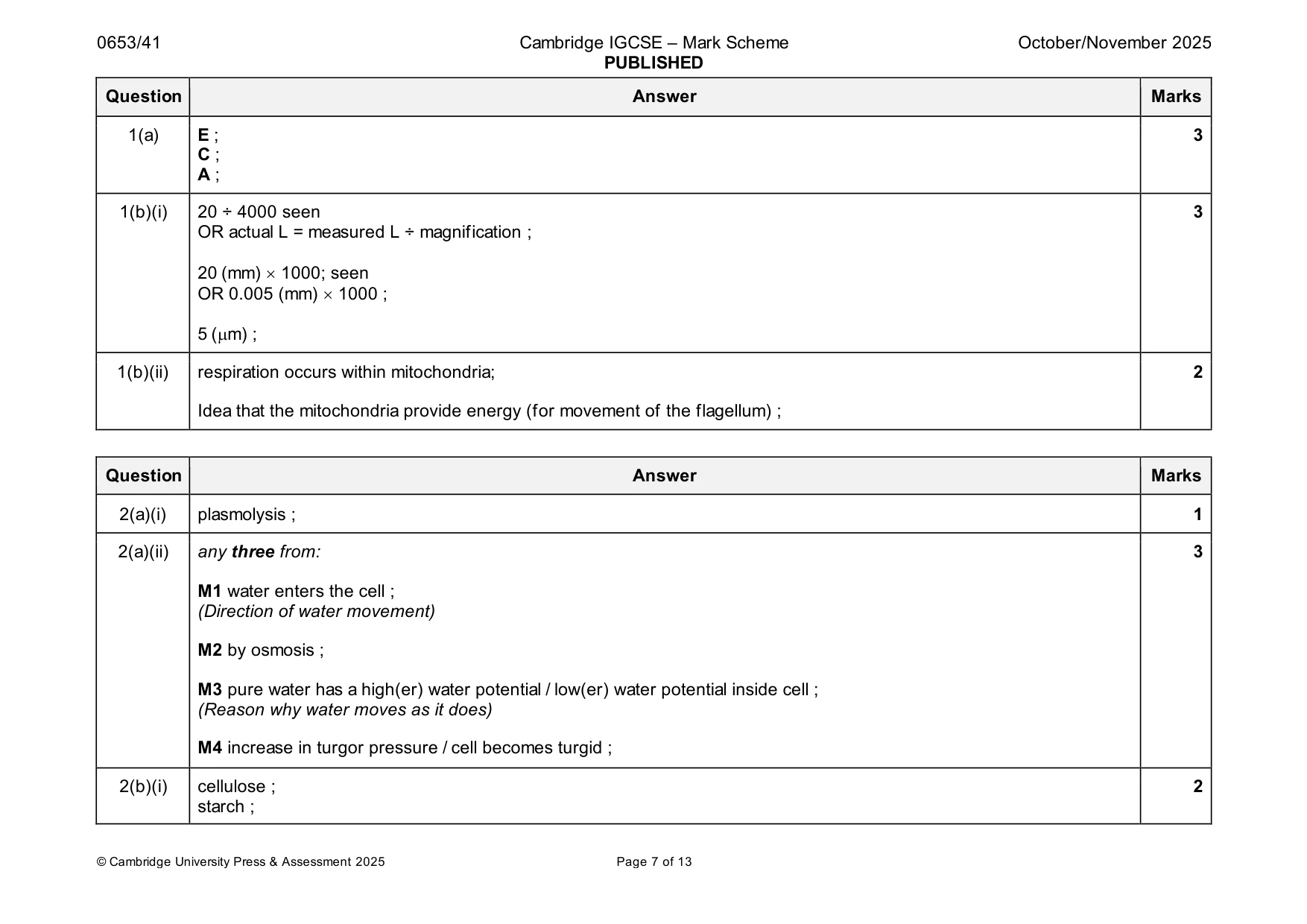
Mark scheme: Question Answer Marks 1(a) E ; 3 C ; A ; 1(b)(i) 20 ÷ 4000 seen 3 OR actual L = measured L ÷ magnification ; 20 (mm) 1000; seen OR 0.005 (mm) 1000 ; 5 (m) ; 1(b)(ii) respiration occurs within mitochondria; 2 Idea that the mitochondria provide energy (for movement of the flagellum) ;
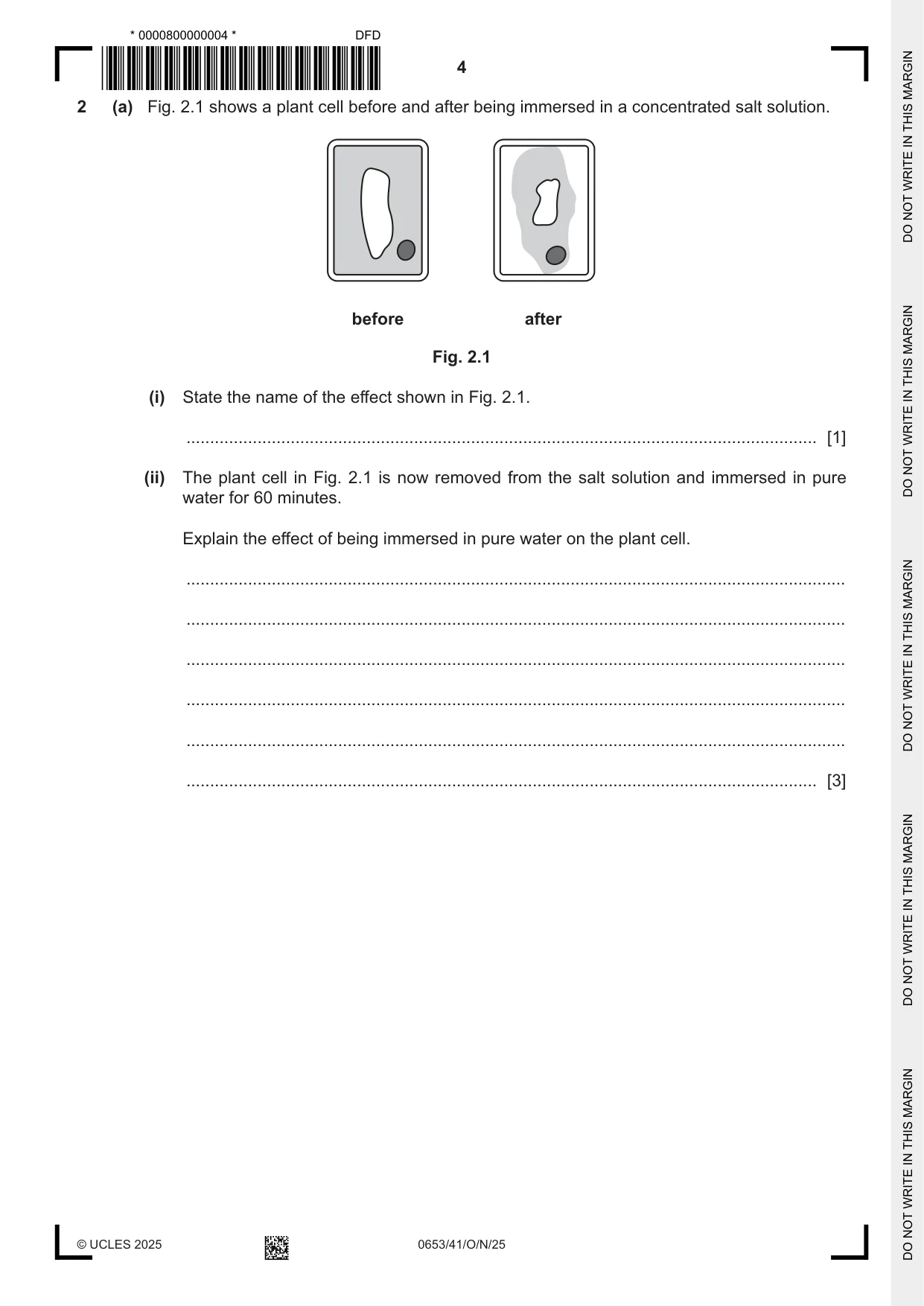
Q2 · A plant cell before and after being immersed in a concentrated salt solution
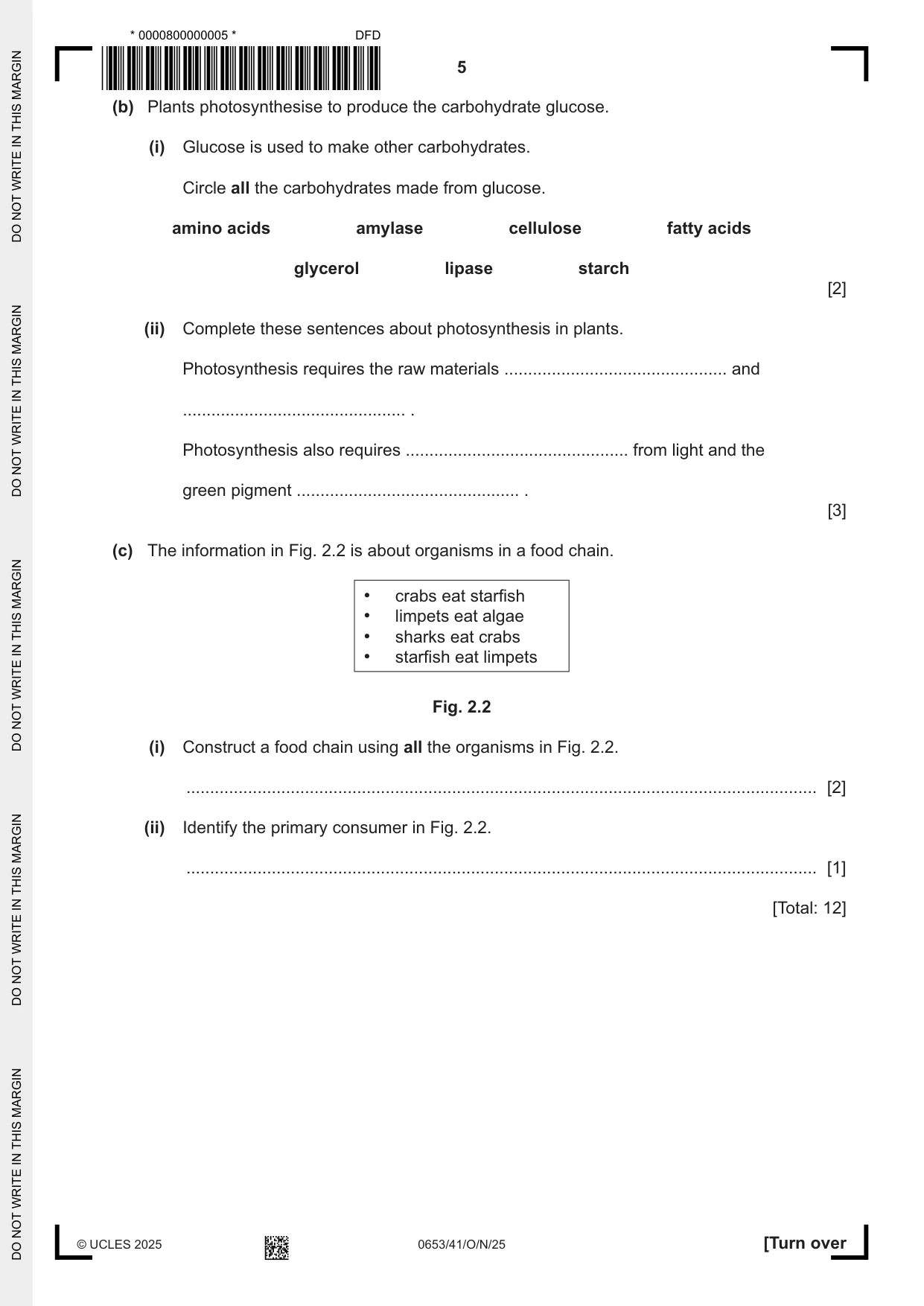
2 (a) Fig. 2.1 shows a plant cell before and after being immersed in a concentrated salt solution. before after Fig. 2.1 (i) State the name of the effect shown in Fig. 2.1. ..................................................................................................................................... [1] (ii) The plant cell in Fig. 2.1 is now removed from the salt solution and immersed in pure water for 60 minutes. Explain the effect of being immersed in pure water on the plant cell. ........................................................................................................................................... ........................................................................................................................................... ........................................................................................................................................... ........................................................................................................................................... ........................................................................................................................................... ..................................................................................................................................... [3] (b) Plants photosynthesise to produce the carbohydrate glucose. (i) Glucose is used to make other carbohydrates. Circle all the carbohydrates made from glucose. amino acids amylase cellulose fatty acids glycerol lipase starch [2] (ii) Complete these sentences about photosynthesis in plants. Photosynthesis requires the raw materials ............................................... and ............................................... . Photosynthesis also requires ............................................... from light and the green pigment ............................................... . [3] (c) The information in Fig. 2.2 is about organisms in a food chain. • crabs eat starfish • limpets eat algae • sharks eat crabs • starfish eat limpets Fig. 2.2 (i) Construct a food chain using all the organisms in Fig. 2.2. ..................................................................................................................................... [2] (ii) Identify the primary consumer in Fig. 2.2. ..................................................................................................................................... [1] [Total: 12]
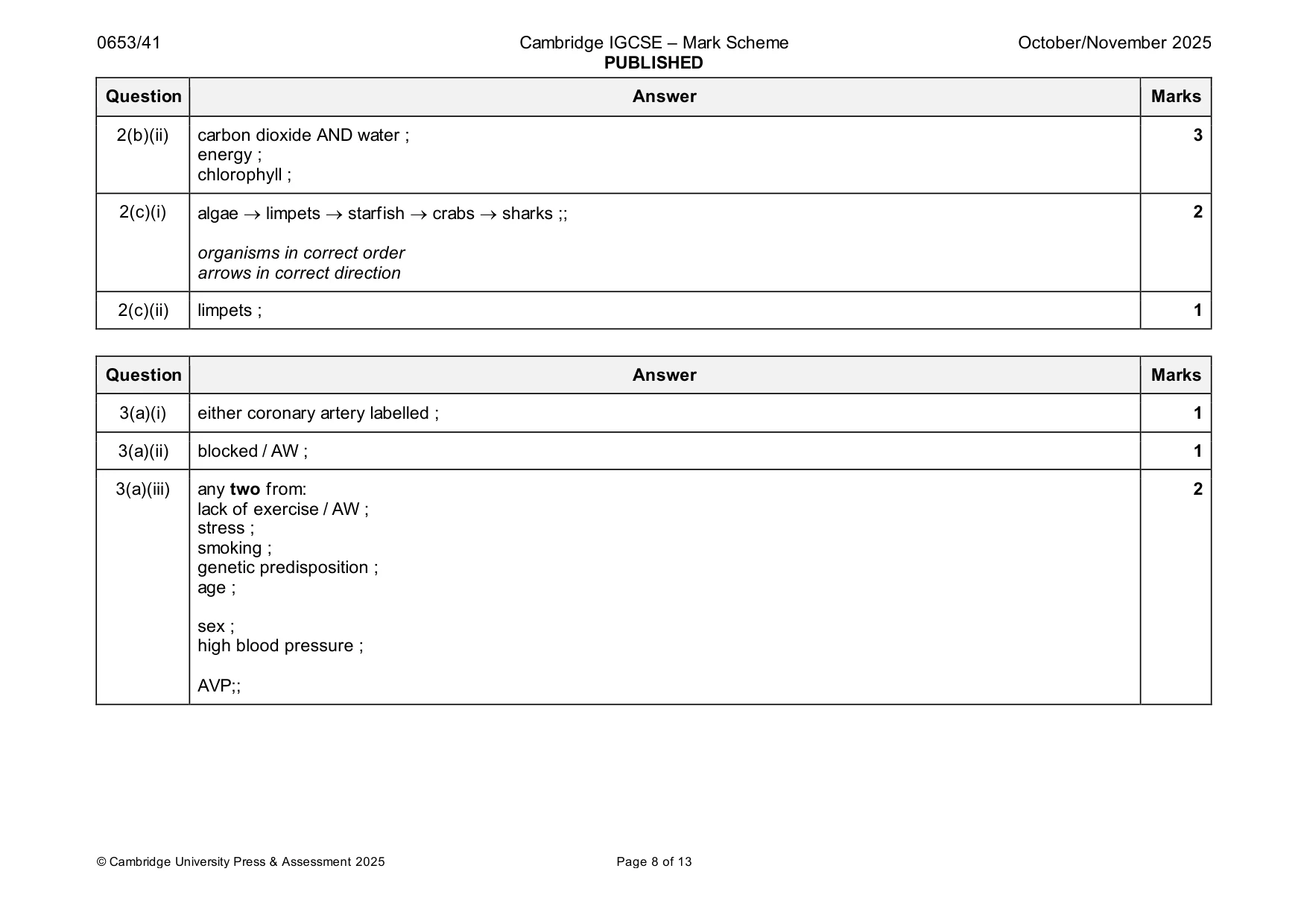
Mark scheme: 2(a)(i) plasmolysis ; 1 2(a)(ii) any three from: 3 M1 water enters the cell ; (Direction of water movement) M2 by osmosis ; M3 pure water has a high(er) water potential / low(er) water potential inside cell ; (Reason why water moves as it does) M4 increase in turgor pressure / cell becomes turgid ; 2(b)(i) cellulose ; 2 starch ; 2(b)(ii) carbon dioxide AND water ; 3 energy ; chlorophyll ; 2(c)(i) algae → limpets → starfish → crabs → sharks ;; 2 organisms in correct order arrows in correct direction 2(c)(ii) limpets ; 1
Q3 · A diagram of a human heart
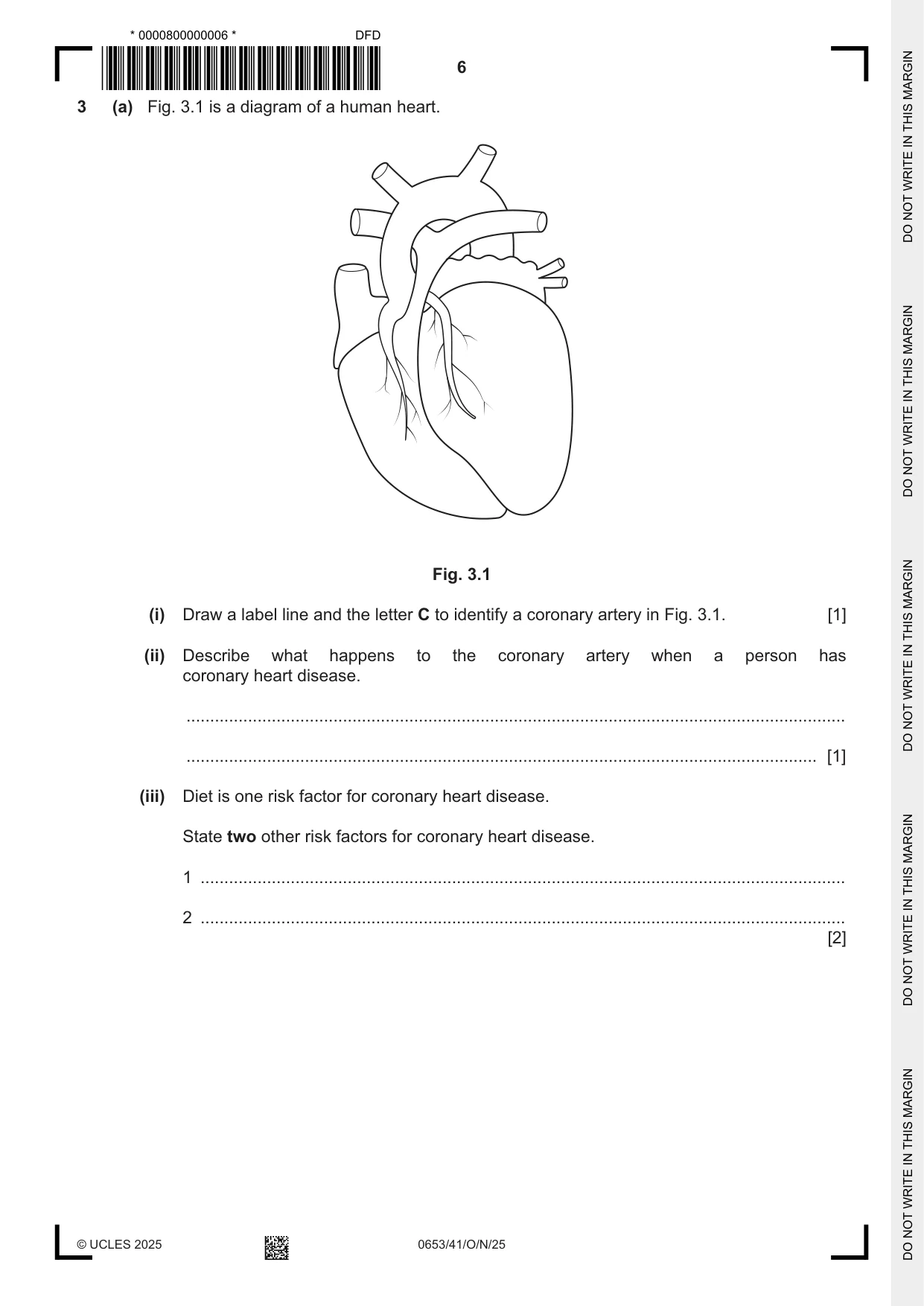
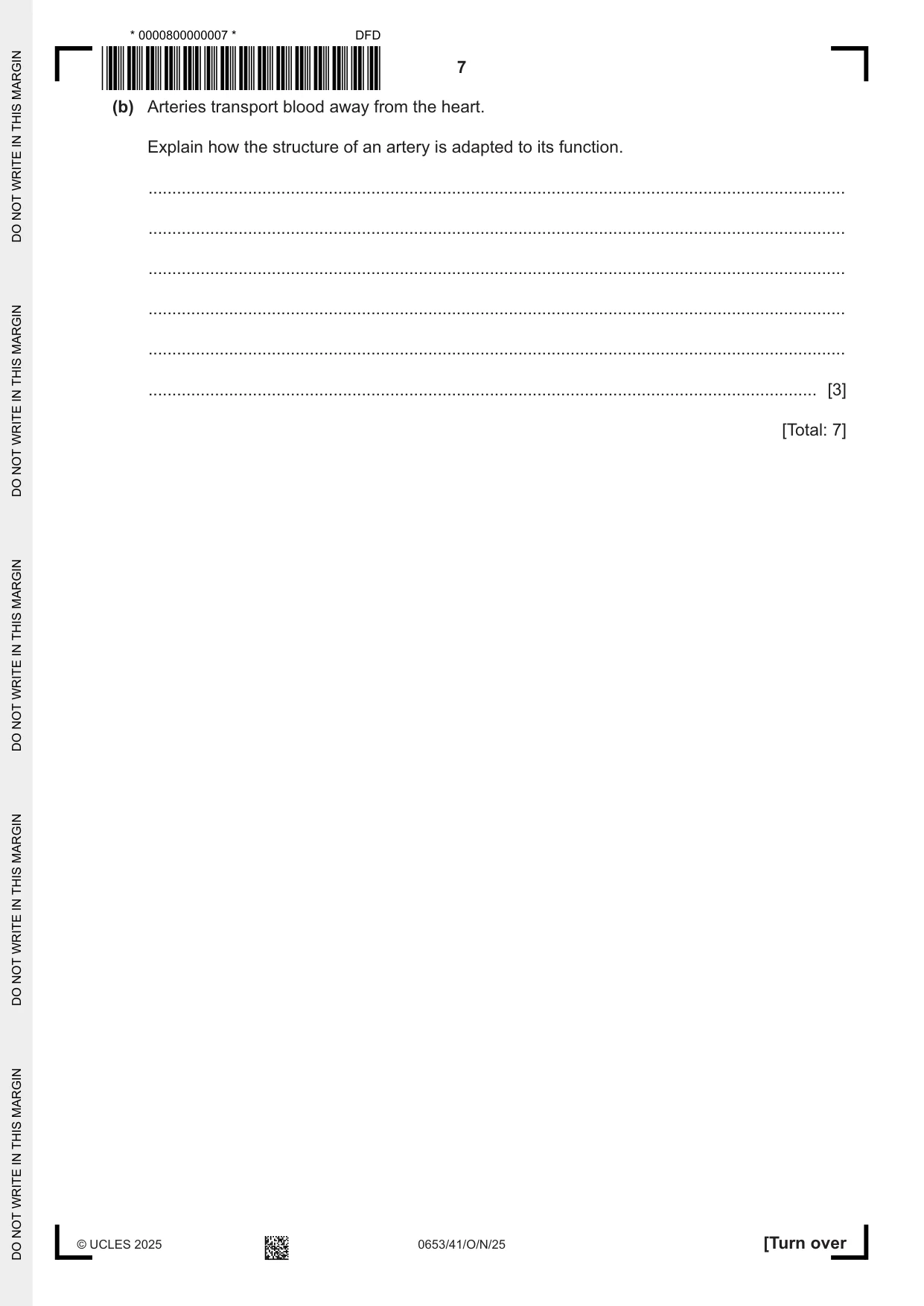
3 (a) Fig. 3.1 is a diagram of a human heart. Fig. 3.1 (i) Draw a label line and the letter C to identify a coronary artery in Fig. 3.1. [1] (ii) Describe what happens to the coronary artery when a person has coronary heart disease. ........................................................................................................................................... ..................................................................................................................................... [1] (iii) Diet is one risk factor for coronary heart disease. State two other risk factors for coronary heart disease. 1 ........................................................................................................................................ 2 ........................................................................................................................................ [2] (b) Arteries transport blood away from the heart. Explain how the structure of an artery is adapted to its function. ................................................................................................................................................... ................................................................................................................................................... ................................................................................................................................................... ................................................................................................................................................... ................................................................................................................................................... ............................................................................................................................................. [3] [Total: 7]
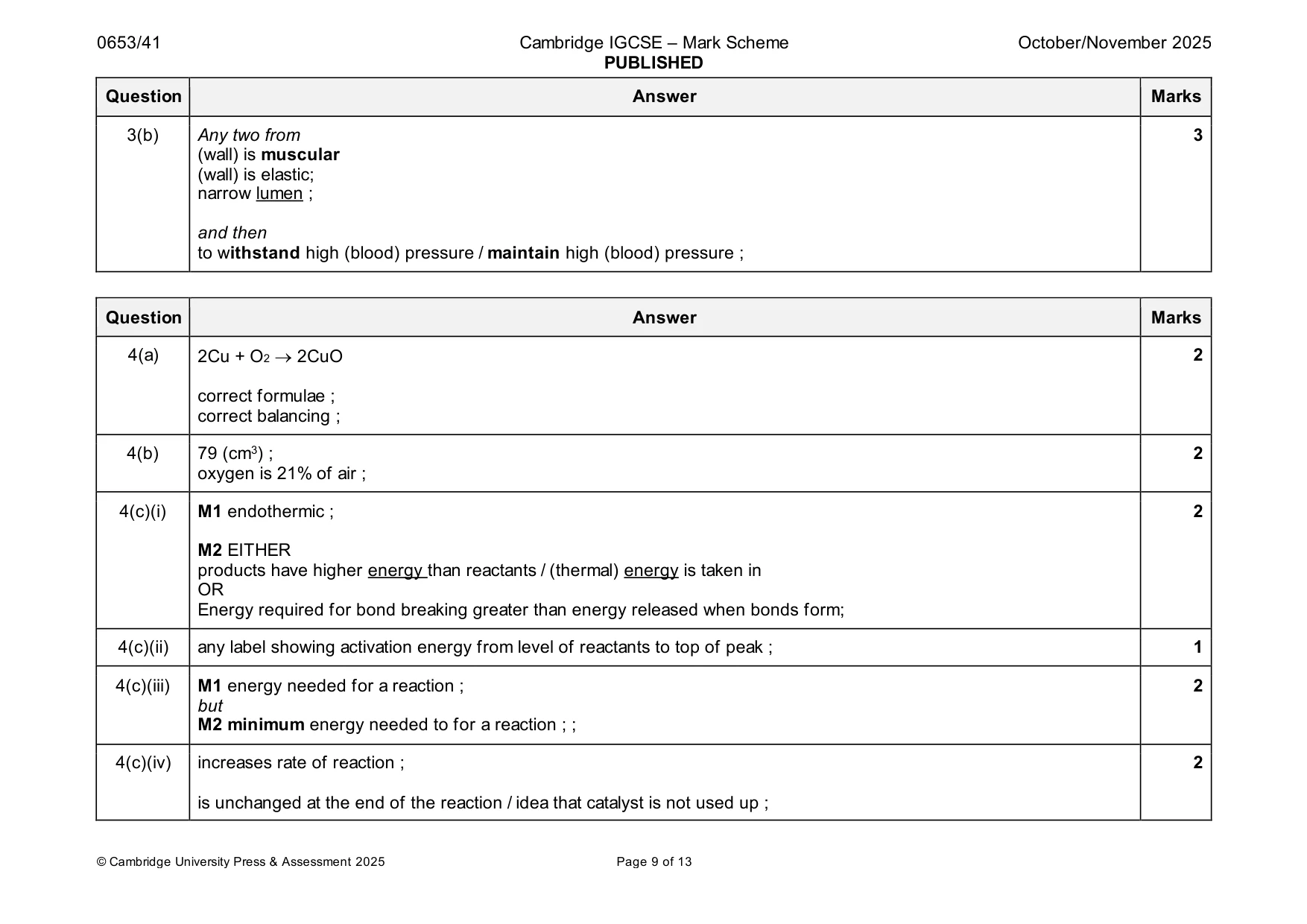
Mark scheme: 3(a)(i) either coronary artery labelled ; 1 3(a)(ii) blocked / AW ; 1 3(a)(iii) any two from: 2 lack of exercise / AW ; stress ; smoking ; genetic predisposition ; age ; sex ; high blood pressure ; AVP;; 3(b) Any two from 3 (wall) is muscular (wall) is elastic; narrow lumen ; and then to withstand high (blood) pressure / maintain high (blood) pressure ;
Q4 · Copper metal reacts with oxygen to form copper oxide, CuO
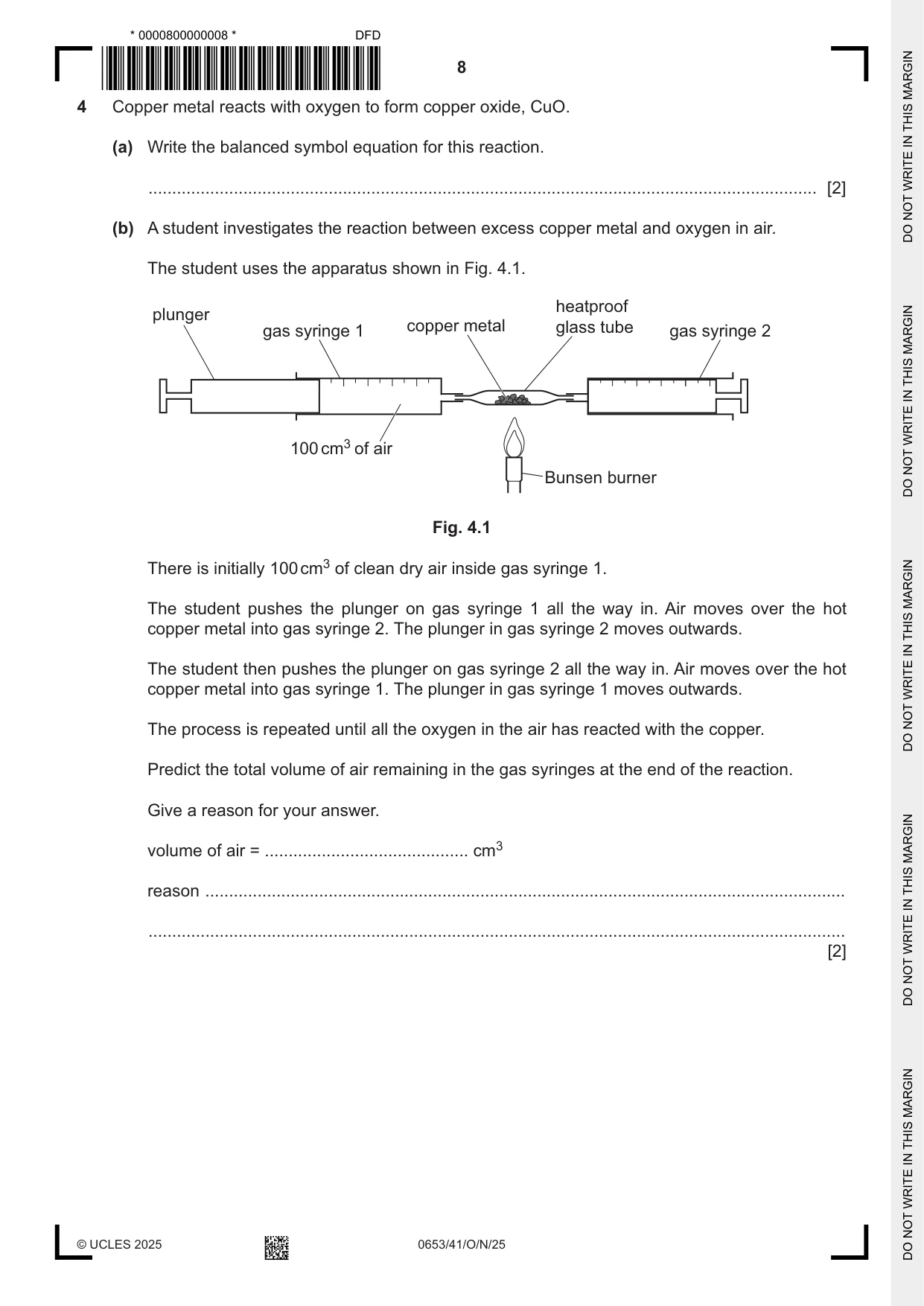
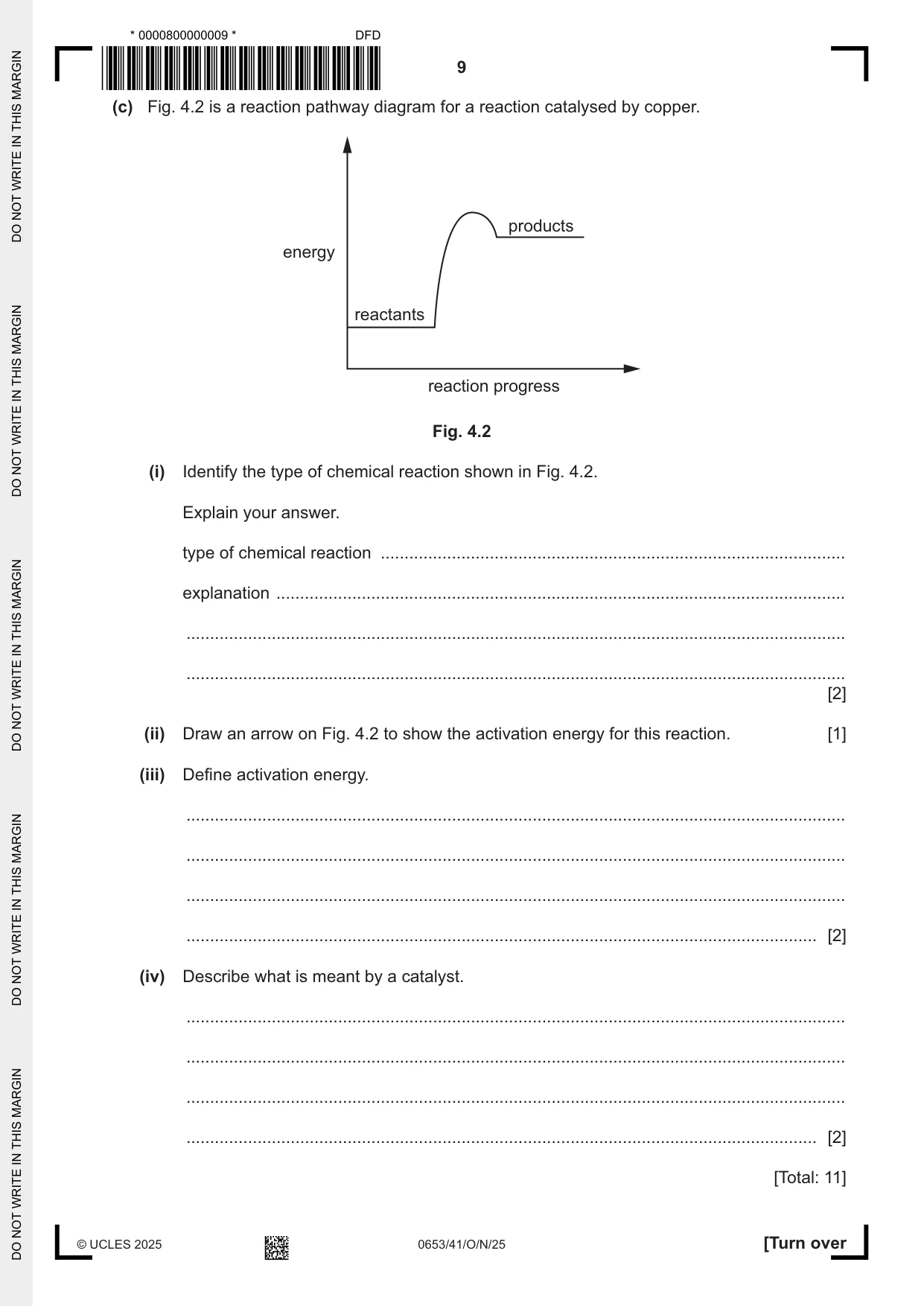
4 Copper metal reacts with oxygen to form copper oxide, CuO. (a) Write the balanced symbol equation for this reaction. ............................................................................................................................................. [2] (b) A student investigates the reaction between excess copper metal and oxygen in air. The student uses the apparatus shown in Fig. 4.1. heatproof plunger gas syringe 1 copper metal glass tube gas syringe 2 100 cm3 of air Bunsen burner Fig. 4.1 There is initially 100 cm3 of clean dry air inside gas syringe 1. The student pushes the plunger on gas syringe 1 all the way in. Air moves over the hot copper metal into gas syringe 2. The plunger in gas syringe 2 moves outwards. The student then pushes the plunger on gas syringe 2 all the way in. Air moves over the hot copper metal into gas syringe 1. The plunger in gas syringe 1 moves outwards. The process is repeated until all the oxygen in the air has reacted with the copper. Predict the total volume of air remaining in the gas syringes at the end of the reaction. Give a reason for your answer. volume of air = ........................................... cm3 reason ....................................................................................................................................... ................................................................................................................................................... [2] (c) Fig. 4.2 is a reaction pathway diagram for a reaction catalysed by copper. products energy reactants reaction progress Fig. 4.2 (i) Identify the type of chemical reaction shown in Fig. 4.2. Explain your answer. type of chemical reaction .................................................................................................. explanation ........................................................................................................................ ........................................................................................................................................... ........................................................................................................................................... [2] (ii) Draw an arrow on Fig. 4.2 to show the activation energy for this reaction. [1] (iii) Define activation energy. ........................................................................................................................................... ........................................................................................................................................... ........................................................................................................................................... ..................................................................................................................................... [2] (iv) Describe what is meant by a catalyst. ........................................................................................................................................... ........................................................................................................................................... ........................................................................................................................................... ..................................................................................................................................... [2] [Total: 11]
Mark scheme: 4(a) 2Cu + O2 → 2CuO 2 correct formulae ; correct balancing ; 4(b) 79 (cm3) ; 2 oxygen is 21% of air ; 4(c)(i) M1 endothermic ; 2 M2 EITHER products have higher energy than reactants / (thermal) energy is taken in OR Energy required for bond breaking greater than energy released when bonds form; 4(c)(ii) any label showing activation energy from level of reactants to top of peak ; 1 4(c)(iii) M1 energy needed for a reaction ; 2 but M2 minimum energy needed to for a reaction ; ; 4(c)(iv) increases rate of reaction ; 2 is unchanged at the end of the reaction / idea that catalyst is not used up ;
Q5 · The electrolysis of molten zinc chloride, ZnCl 2, using inert electrodes
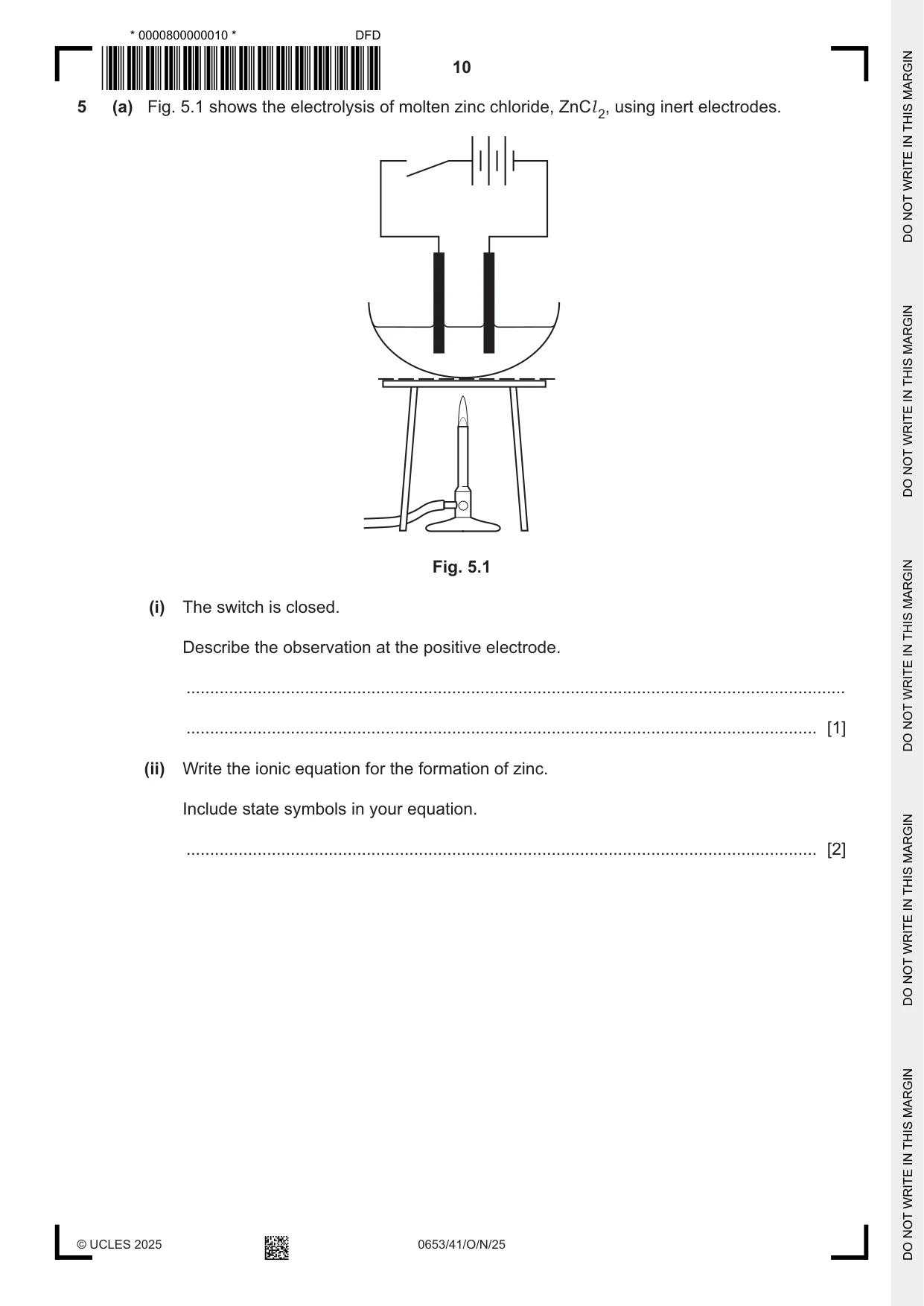
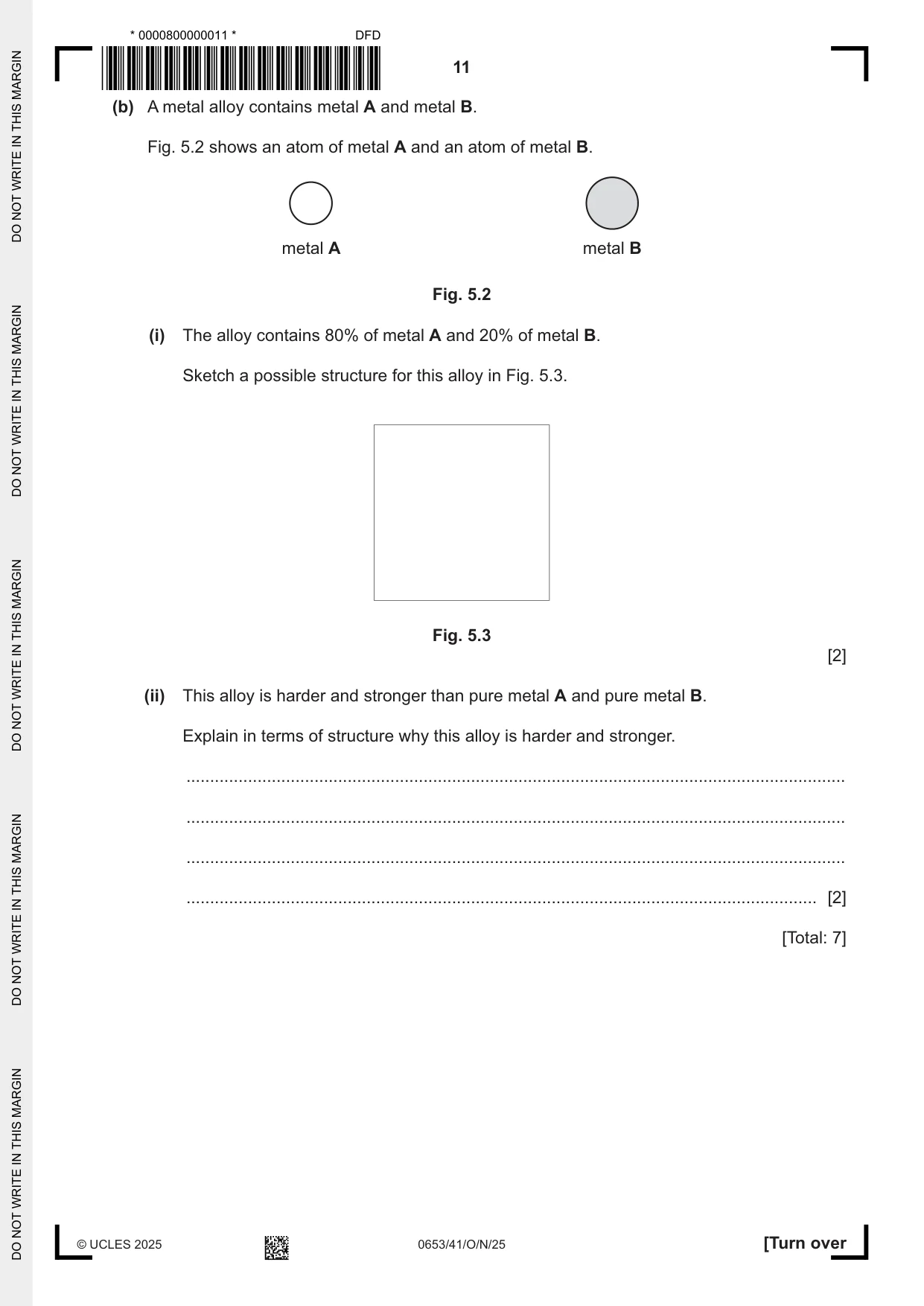
5 (a) Fig. 5.1 shows the electrolysis of molten zinc chloride, ZnCl 2, using inert electrodes. Fig. 5.1 (i) The switch is closed. Describe the observation at the positive electrode. ........................................................................................................................................... ..................................................................................................................................... [1] (ii) Write the ionic equation for the formation of zinc. Include state symbols in your equation. ..................................................................................................................................... [2] (b) A metal alloy contains metal A and metal B. Fig. 5.2 shows an atom of metal A and an atom of metal B. metal A metal B Fig. 5.2 (i) The alloy contains 80% of metal A and 20% of metal B. Sketch a possible structure for this alloy in Fig. 5.3. Fig. 5.3 [2] (ii) This alloy is harder and stronger than pure metal A and pure metal B. Explain in terms of structure why this alloy is harder and stronger. ........................................................................................................................................... ........................................................................................................................................... ........................................................................................................................................... ..................................................................................................................................... [2] [Total: 7]
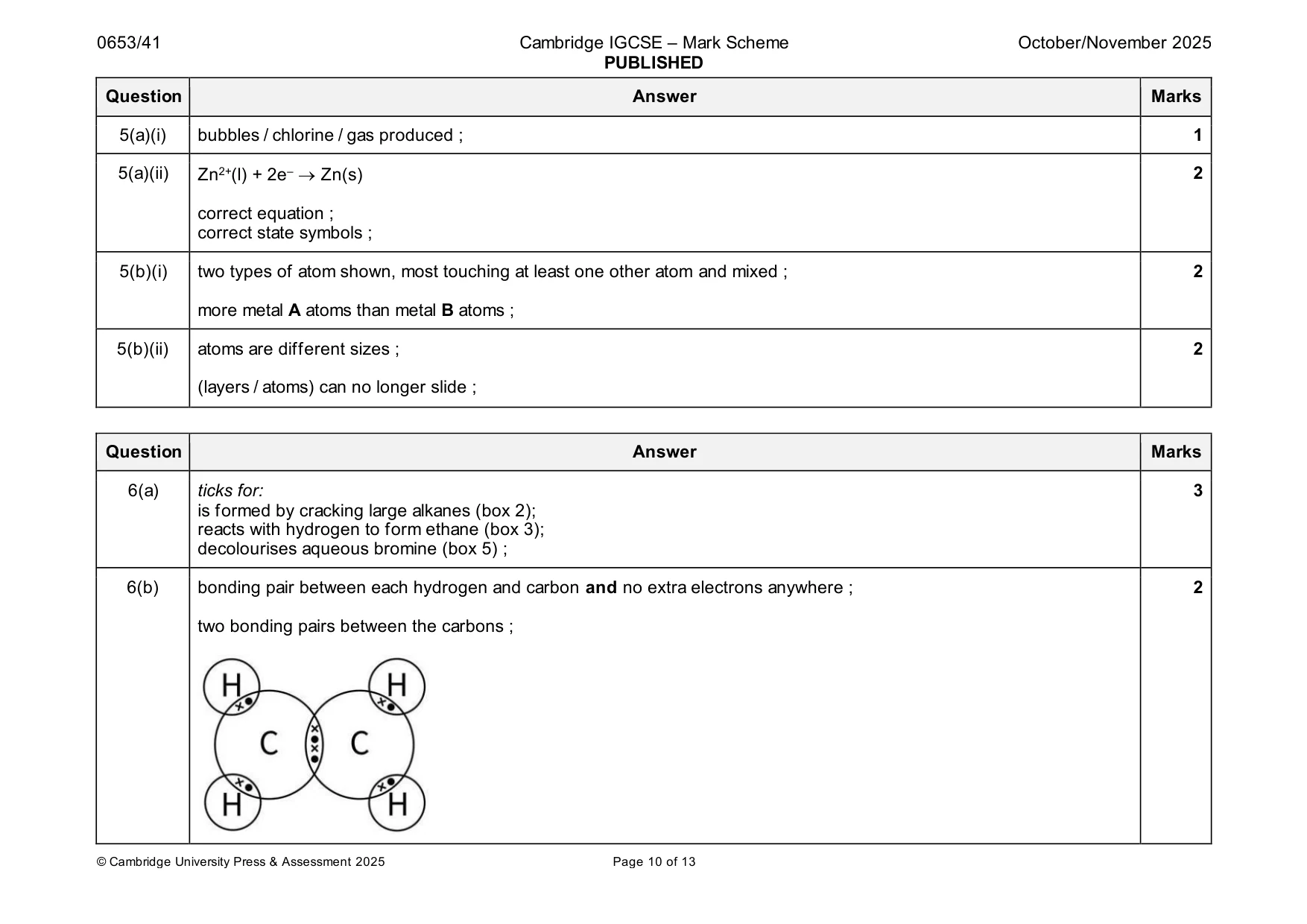
Mark scheme: 5(a)(i) bubbles / chlorine / gas produced ; 1 5(a)(ii) Zn2+(l) + 2e– → Zn(s) 2 correct equation ; correct state symbols ; 5(b)(i) two types of atom shown, most touching at least one other atom and mixed ; 2 more metal A atoms than metal B atoms ; 5(b)(ii) atoms are different sizes ; 2 (layers / atoms) can no longer slide ;
Q6 · The structure of ethene
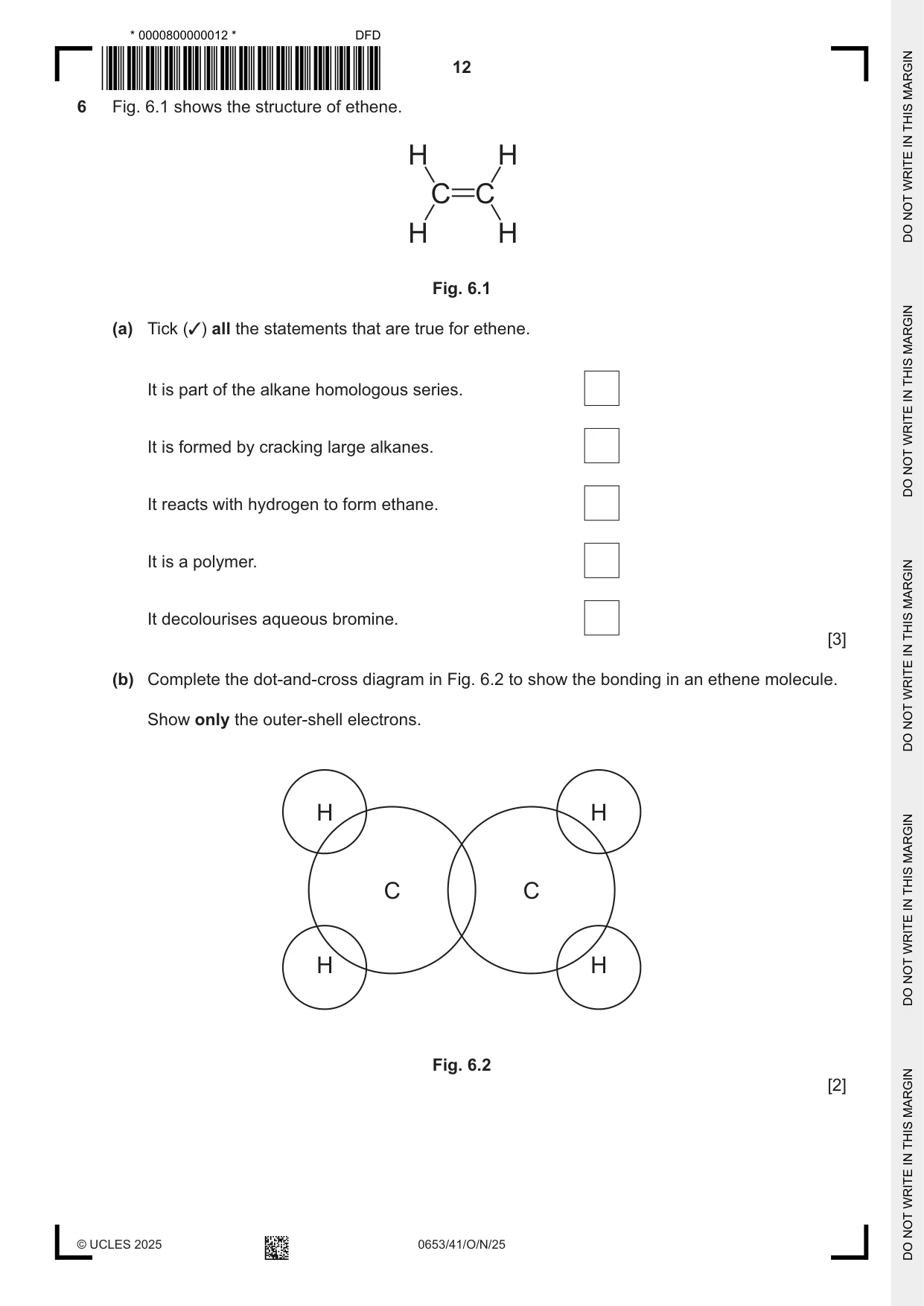
6 Fig. 6.1 shows the structure of ethene. H H C C H H Fig. 6.1 (a) Tick (✓) all the statements that are true for ethene. It is part of the alkane homologous series. It is formed by cracking large alkanes. It reacts with hydrogen to form ethane. It is a polymer. It decolourises aqueous bromine. [3] (b) Complete the dot-and-cross diagram in Fig. 6.2 to show the bonding in an ethene molecule. Show only the outer-shell electrons. H H C C H H Fig. 6.2 [2] (c) Complete the sentences about a reaction of ethene. Ethene reacts with .................................... to form ethanol. This is an .................................... reaction. The reaction happens in the presence of an .................................... catalyst. [3] [Total: 8]
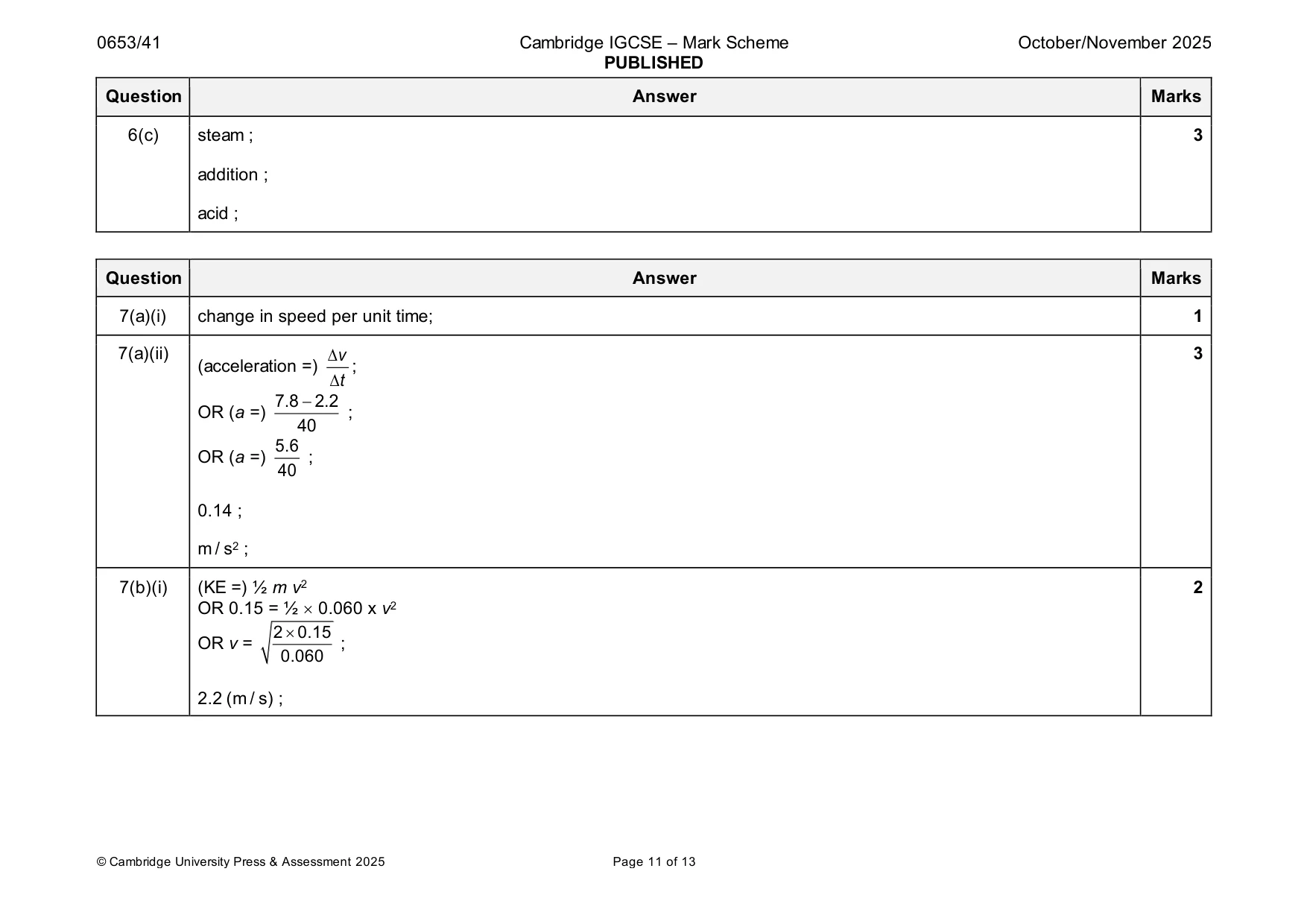
Mark scheme: 6(a) ticks for: 3 is formed by cracking large alkanes (box 2); reacts with hydrogen to form ethane (box 3); decolourises aqueous bromine (box 5) ; 6(b) bonding pair between each hydrogen and carbon and no extra electrons anywhere ; 2 two bonding pairs between the carbons ; 6(c) steam ; 3 addition ; acid ;
Q7 · A student rides a bicycle along a straight, level road
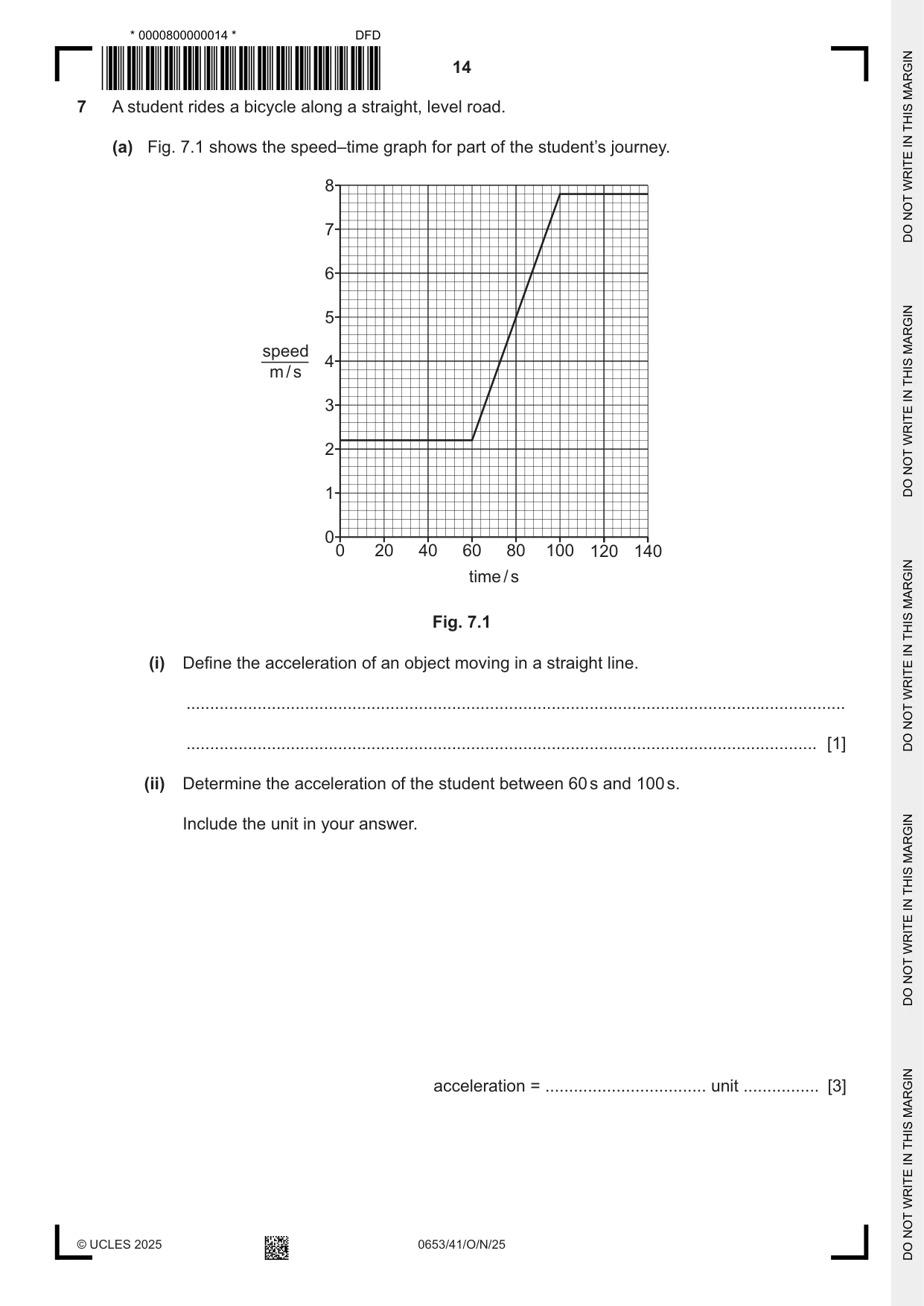
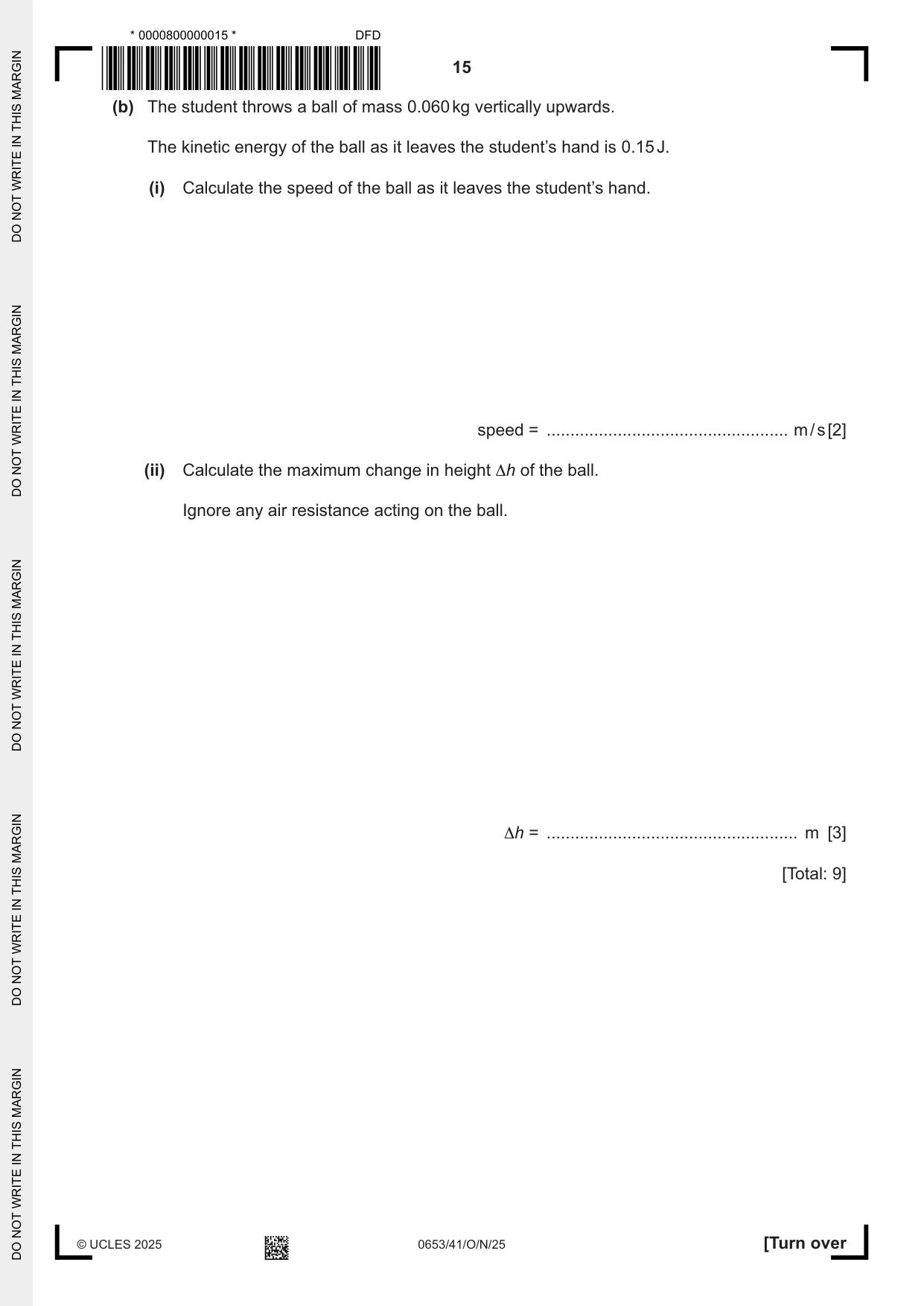
7 A student rides a bicycle along a straight, level road. (a) Fig. 7.1 shows the speed–time graph for part of the student’s journey. 8 7 6 5 speed 4 m / s 3 2 1 0 0 20 40 60 80 100 120 140 time / s Fig. 7.1 (i) Define the acceleration of an object moving in a straight line. ........................................................................................................................................... ..................................................................................................................................... [1] (ii) Determine the acceleration of the student between 60 s and 100 s. Include the unit in your answer. acceleration = .................................. unit ................ [3] (b) The student throws a ball of mass 0.060 kg vertically upwards. The kinetic energy of the ball as it leaves the student’s hand is 0.15 J. (i) Calculate the speed of the ball as it leaves the student’s hand. speed = ................................................... m / s [2] (ii) Calculate the maximum change in height Δh of the ball. Ignore any air resistance acting on the ball. Δh = ..................................................... m [3] [Total: 9]
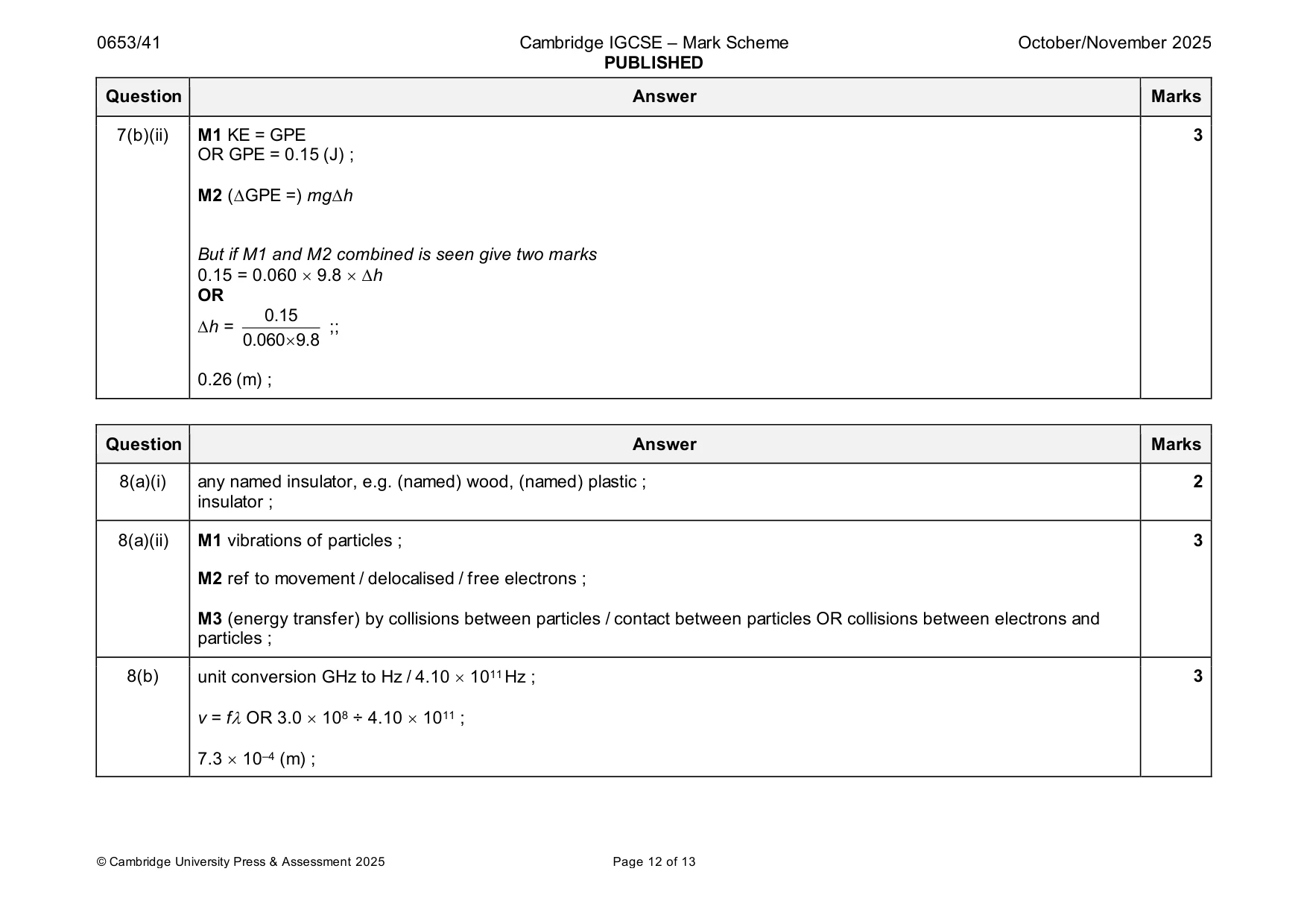
Mark scheme: 7(a)(i) change in speed per unit time; 1 7(a)(ii) v 3 (acceleration =) ;t 7.8 − 2.2 OR (a =) ; 40 5.6 OR (a =) ; 40 0.14 ; m / s2 ; 7(b)(i) (KE =) ½ m v2 2 OR 0.15 = ½ 0.060 x v2 2 0.15 OR v = ; 0.060 2.2 (m / s) ; 7(b)(ii) M1 KE = GPE 3 OR GPE = 0.15 (J) ; M2 (GPE =) mgh But if M1 and M2 combined is seen give two marks 0.15 = 0.060 9.8 h OR 0.15 h = ;; 0.060 9.8 0.26 (m) ;
Q8 · This question is about the transfer of thermal energy
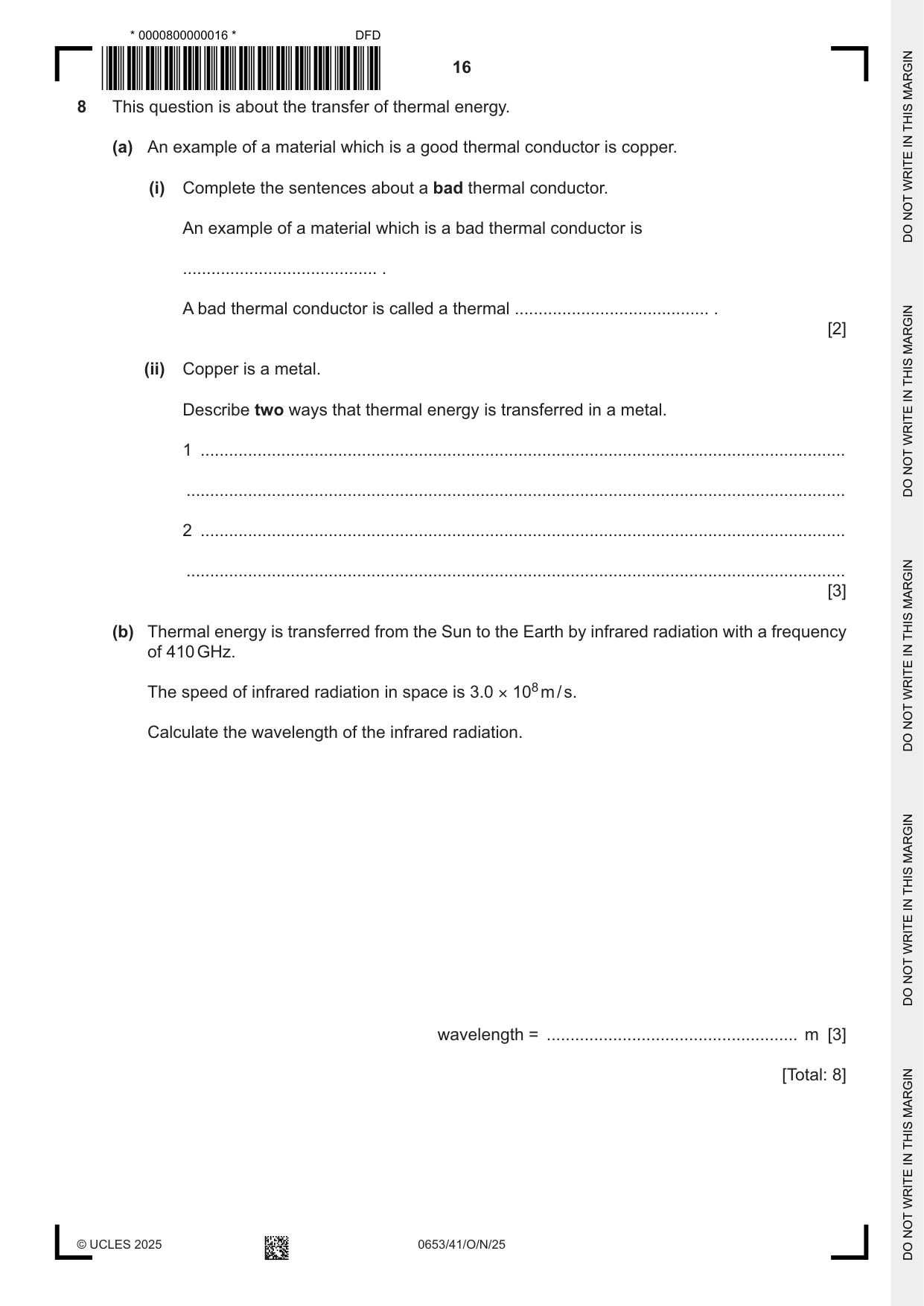
8 This question is about the transfer of thermal energy. (a) An example of a material which is a good thermal conductor is copper. (i) Complete the sentences about a bad thermal conductor. An example of a material which is a bad thermal conductor is ......................................... . A bad thermal conductor is called a thermal ......................................... . [2] (ii) Copper is a metal. Describe two ways that thermal energy is transferred in a metal. 1 ........................................................................................................................................ ........................................................................................................................................... 2 ........................................................................................................................................ ........................................................................................................................................... [3] (b) Thermal energy is transferred from the Sun to the Earth by infrared radiation with a frequency of 410 GHz. The speed of infrared radiation in space is 3.0 × 10⁸ m / s. Calculate the wavelength of the infrared radiation. wavelength = ..................................................... m [3] [Total: 8]
Mark scheme: 8(a)(i) any named insulator, e.g. (named) wood, (named) plastic ; 2 insulator ; 8(a)(ii) M1 vibrations of particles ; 3 M2 ref to movement / delocalised / free electrons ; M3 (energy transfer) by collisions between particles / contact between particles OR collisions between electrons and particles ; 8(b) unit conversion GHz to Hz / 4.10 1011 Hz ; 3 v = fOR 3.0 108 ÷ 4.10 1011 ; 7.3 10–4 (m) ;
Q9 · Complete the definition of potential difference (p.d.)
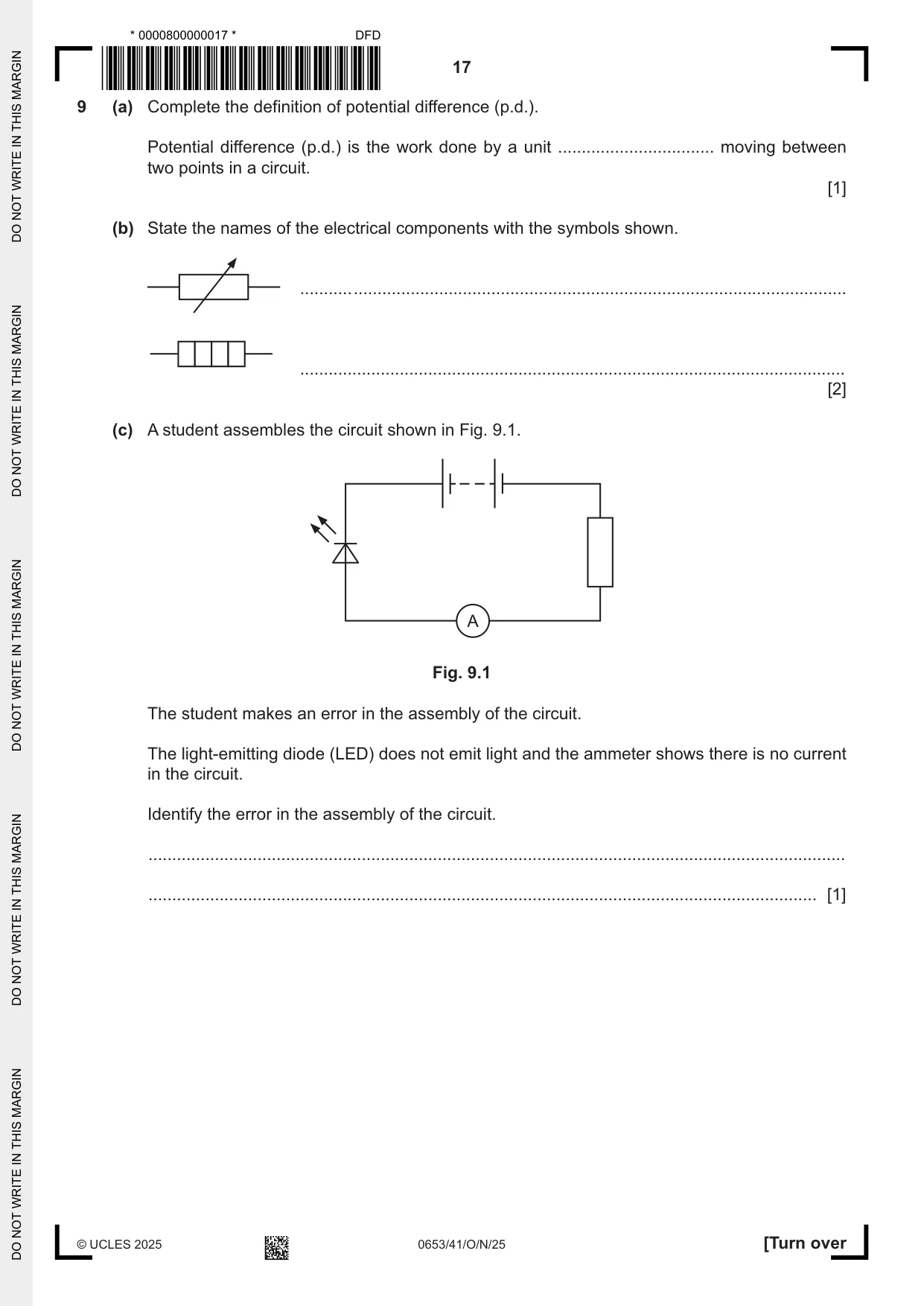
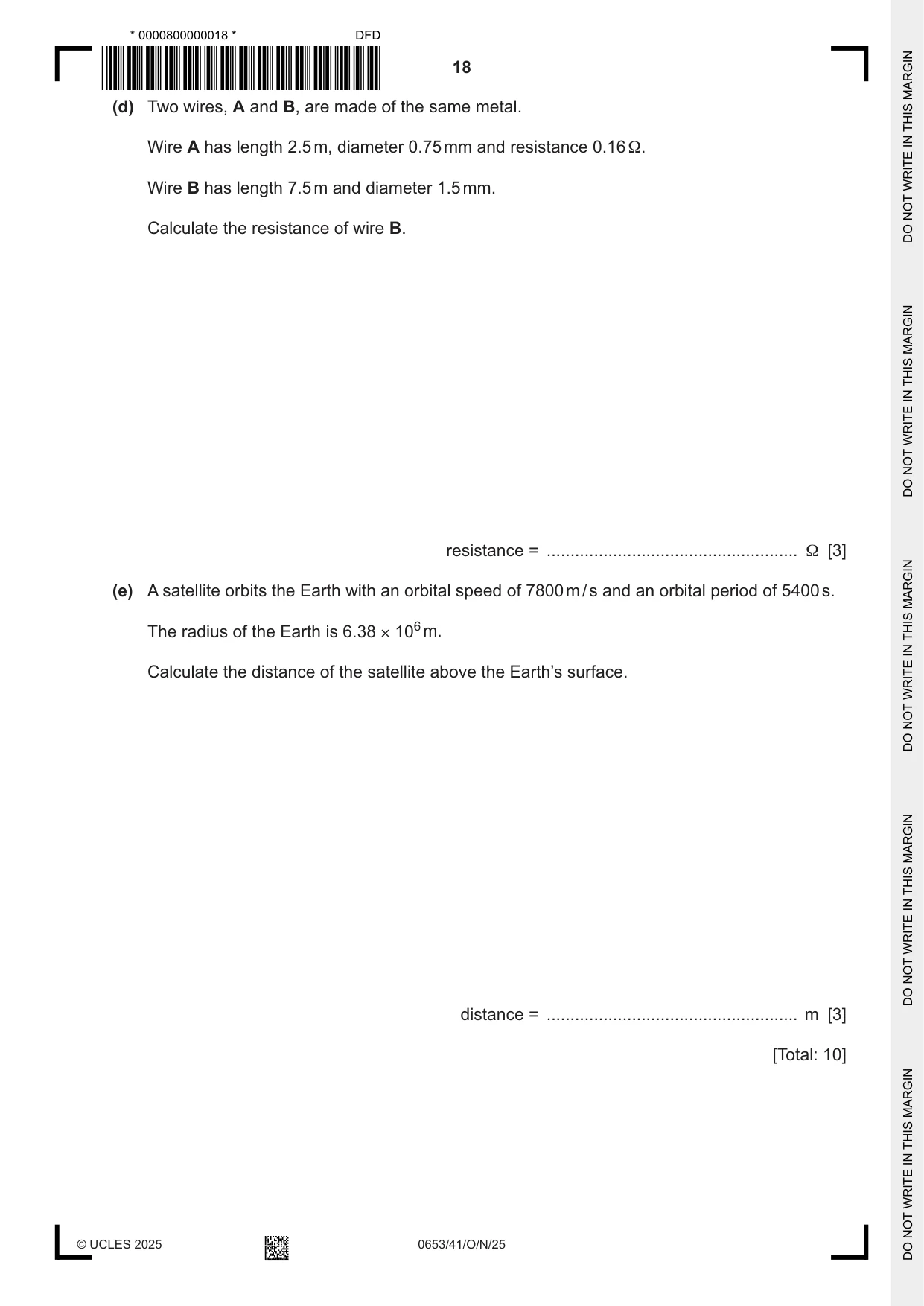
9 (a) Complete the definition of potential difference (p.d.). Potential difference (p.d.) is the work done by a unit ................................. moving between two points in a circuit. [1] (b) State the names of the electrical components with the symbols shown. ................................................................................................................... ................................................................................................................... [2] (c) A student assembles the circuit shown in Fig. 9.1. A Fig. 9.1 The student makes an error in the assembly of the circuit. The light-emitting diode (LED) does not emit light and the ammeter shows there is no current in the circuit. Identify the error in the assembly of the circuit. ................................................................................................................................................... ............................................................................................................................................. [1] (d) Two wires, A and B, are made of the same metal. Wire A has length 2.5 m, diameter 0.75 mm and resistance 0.16 Ω. Wire B has length 7.5 m and diameter 1.5 mm. Calculate the resistance of wire B. resistance = ..................................................... Ω [3] (e) A satellite orbits the Earth with an orbital speed of 7800 m / s and an orbital period of 5400 s. The radius of the Earth is 6.38 × 10⁶ m. Calculate the distance of the satellite above the Earth’s surface. distance = ..................................................... m [3] [Total: 10]
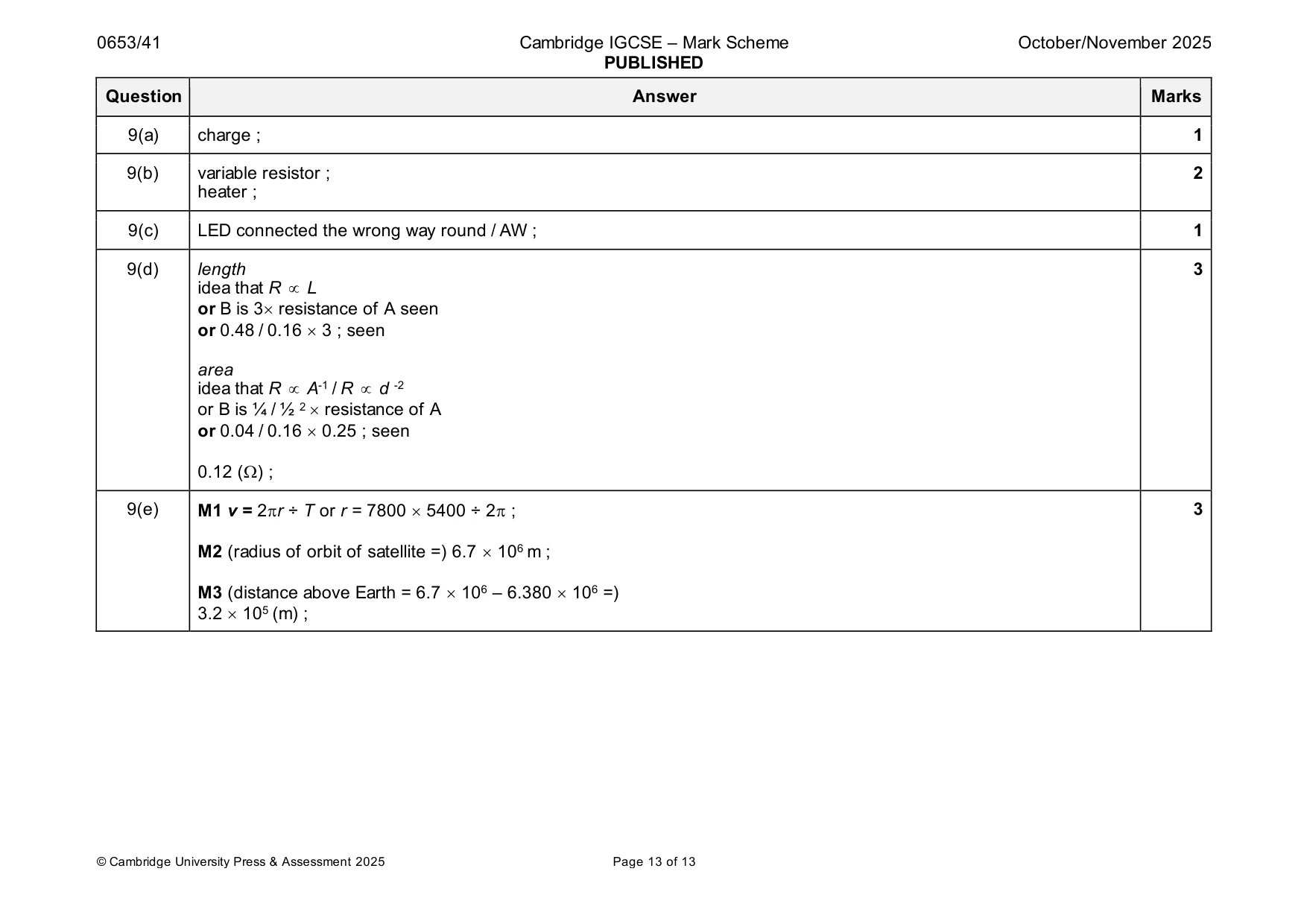
Mark scheme: 9(a) charge ; 1 9(b) variable resistor ; 2 heater ; 9(c) LED connected the wrong way round / AW ; 1 9(d) length 3 idea that R L or B is 3 resistance of A seen or 0.48 / 0.16 3 ; seen area idea that R A-1 / R d -2 or B is ¼ / ½ 2 resistance of A or 0.04 / 0.16 0.25 ; seen 0.12 () ; 9(e) M1 v = 2r ÷ T or r = 7800 5400 ÷ 2 ; 3 M2 (radius of orbit of satellite =) 6.7 106 m ; M3 (distance above Earth = 6.7 106 – 6.380 106 =) 3.2 105 (m) ;
What was in this paper
The subtopics covered by these 9 questions, and how many questions each got. Open one in a new tab to see every Cambridge question on it.
What you needed in this session
Cambridge’s own grade thresholds for 2025 Oct/Nov, Paper 4 · Variant 1. A higher threshold means an easier paper — the bar moves with how the cohort did.