Cambridge IGCSE Science - Combined 0653 — 2020 Oct/Nov Paper 4 · Variant 3
0653/43/O/N/20 · 9 questions · 80 marks · ≈90 min
The question paper and its mark scheme, free to read here and free to download. This is Cambridge’s own paper, exactly as it was sat.
Question paper24 pages


Mark scheme9 pages
Answers below. Sit the paper first if you are practising.
Questions as text
Q1 · Red blood cells and white blood cells
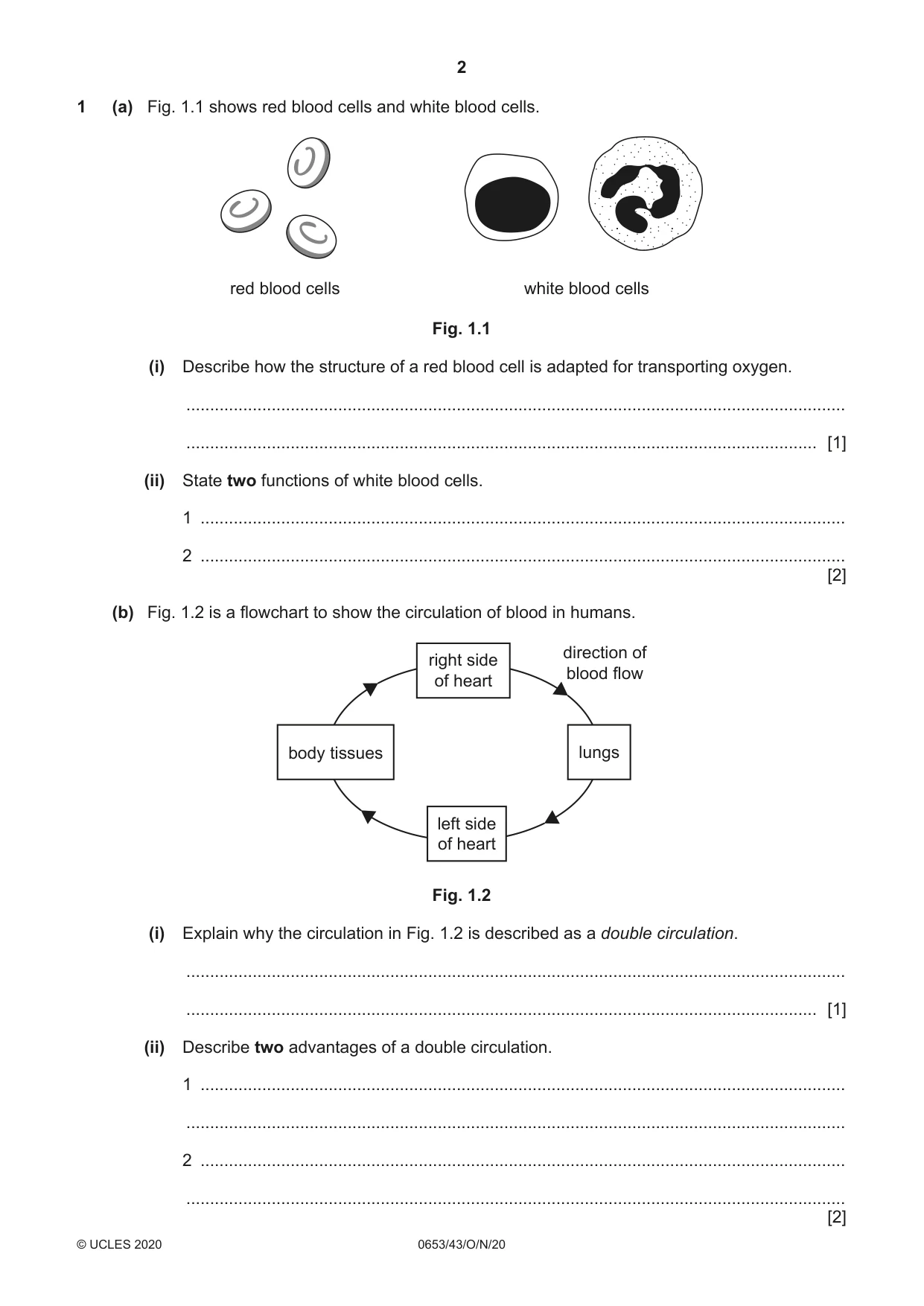
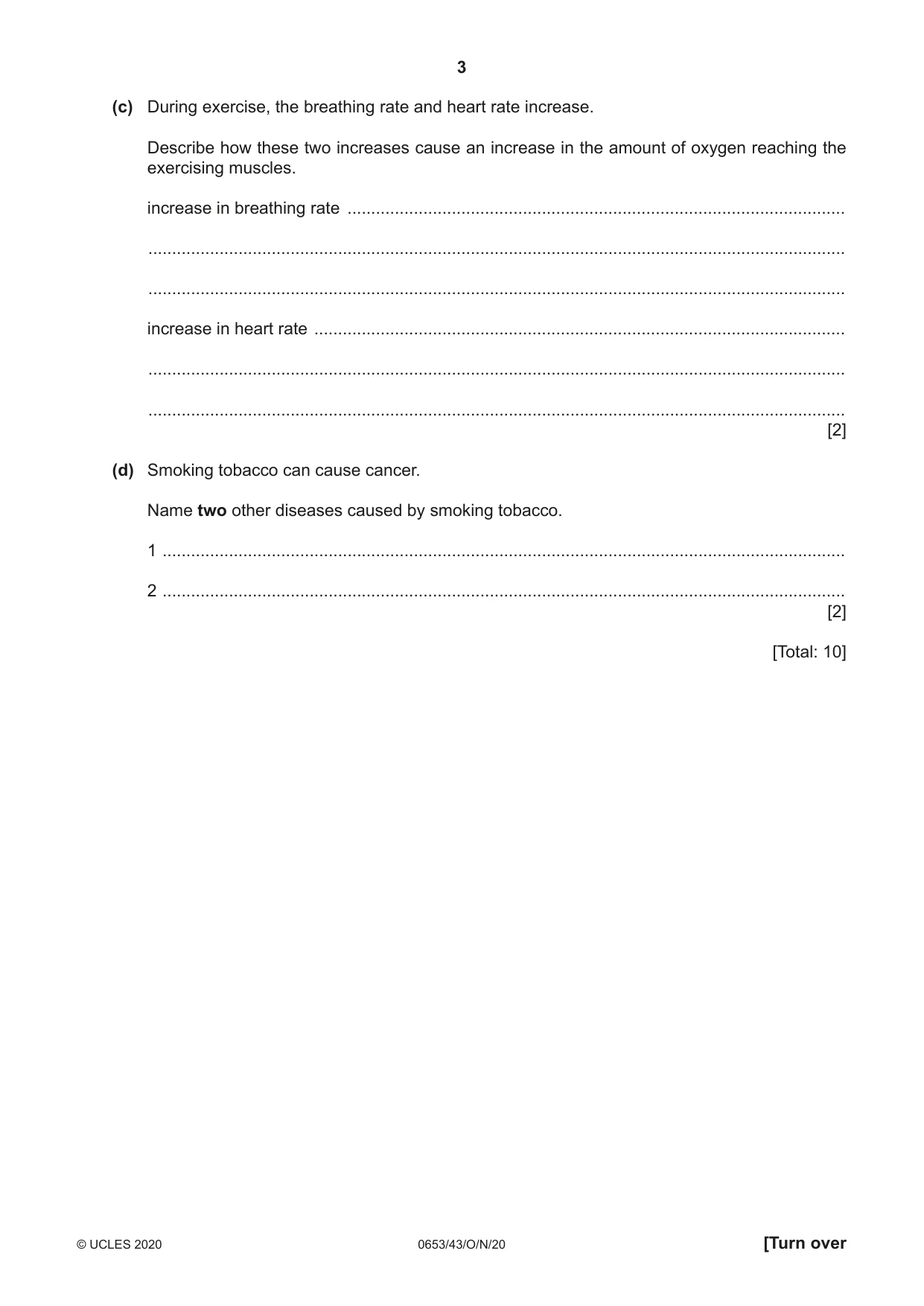
1 (a) Fig. 1.1 shows red blood cells and white blood cells. red blood cells white blood cells Fig. 1.1 (i) Describe how the structure of a red blood cell is adapted for transporting oxygen. ........................................................................................................................................... ..................................................................................................................................... [1] (ii) State two functions of white blood cells. 1 ........................................................................................................................................ 2 ........................................................................................................................................ [2] (b) Fig. 1.2 is a flowchart to show the circulation of blood in humans. direction of right side blood flow of heart body tissues lungs left side of heart Fig. 1.2 (i) Explain why the circulation in Fig. 1.2 is described as a double circulation. ........................................................................................................................................... ..................................................................................................................................... [1] (ii) Describe two advantages of a double circulation. 1 ........................................................................................................................................ ........................................................................................................................................... 2 ........................................................................................................................................ ........................................................................................................................................... [2] (c) During exercise, the breathing rate and heart rate increase. Describe how these two increases cause an increase in the amount of oxygen reaching the exercising muscles. increase in breathing rate ......................................................................................................... ................................................................................................................................................... ................................................................................................................................................... increase in heart rate ................................................................................................................ ................................................................................................................................................... ................................................................................................................................................... [2] (d) Smoking tobacco can cause cancer. Name two other diseases caused by smoking tobacco. 1 ................................................................................................................................................ 2 ................................................................................................................................................ [2] [Total: 10]
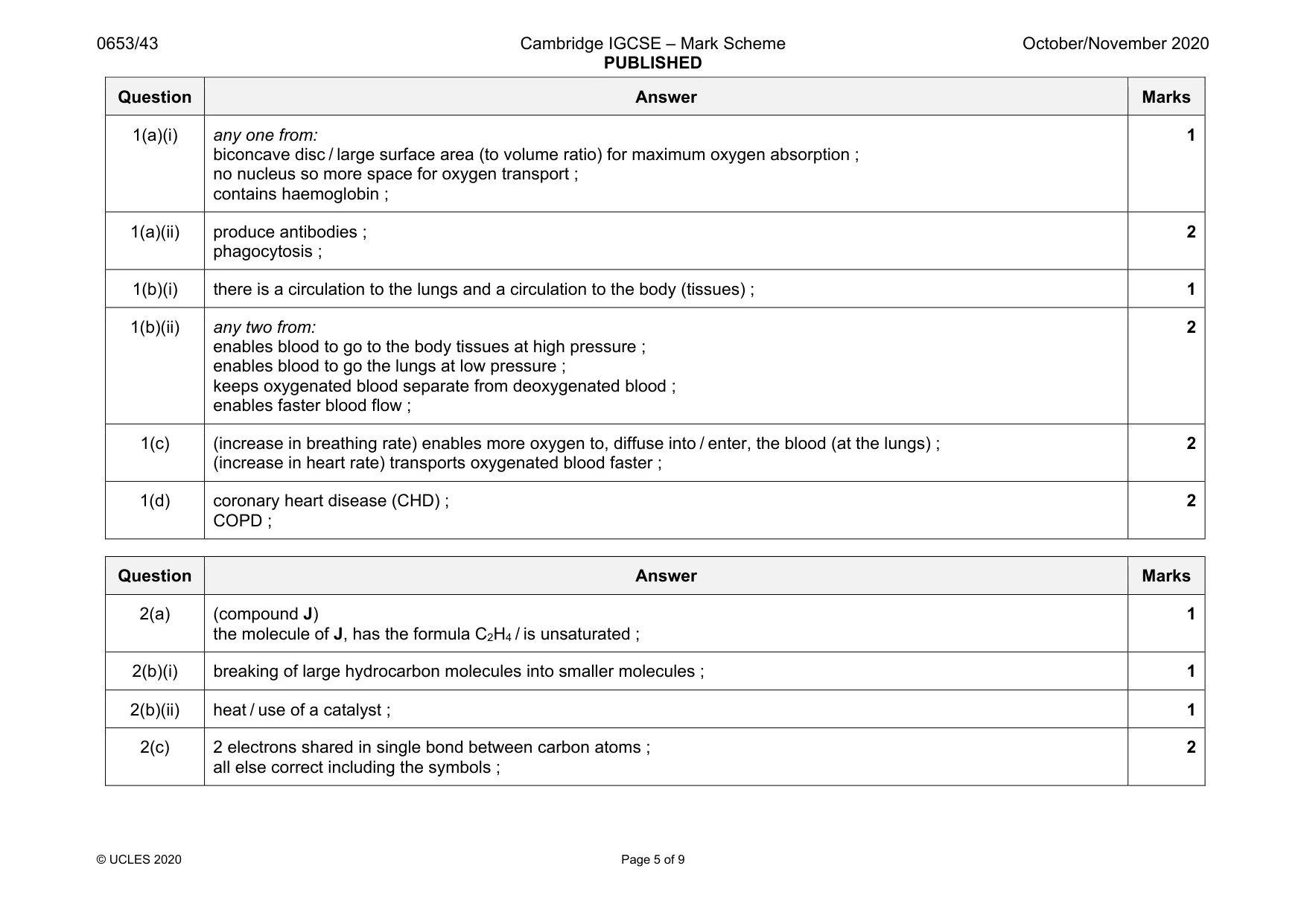
Mark scheme: 1(a)(i) any one from: biconcave disc / large surface area (to volume ratio) for maximum oxygen absorption ; no nucleus so more space for oxygen transport ; contains haemoglobin ; 1 1(a)(ii) produce antibodies ; phagocytosis ; 2 1(b)(i) there is a circulation to the lungs and a circulation to the body (tissues) ; 1 1(b)(ii) any two from: enables blood to go to the body tissues at high pressure ; enables blood to go the lungs at low pressure ; keeps oxygenated blood separate from deoxygenated blood ; enables faster blood flow ; 2 1(c) (increase in breathing rate) enables more oxygen to, diffuse into / enter, the blood (at the lungs) ; (increase in heart rate) transports oxygenated blood faster ; 2 1(d) coronary heart disease (CHD) ; COPD ; 2
Q2 · Compounds J, K and L are hydrocarbons
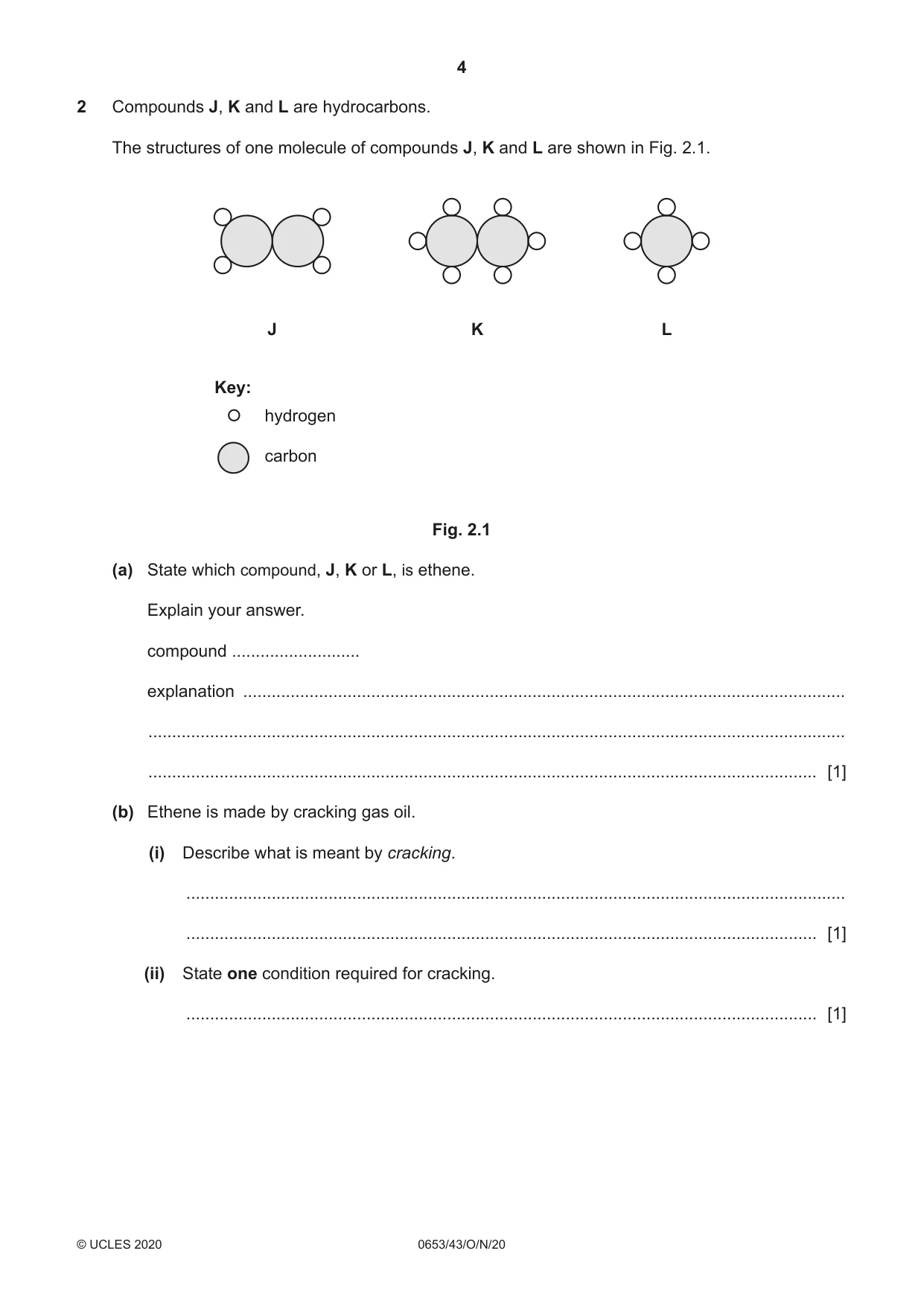
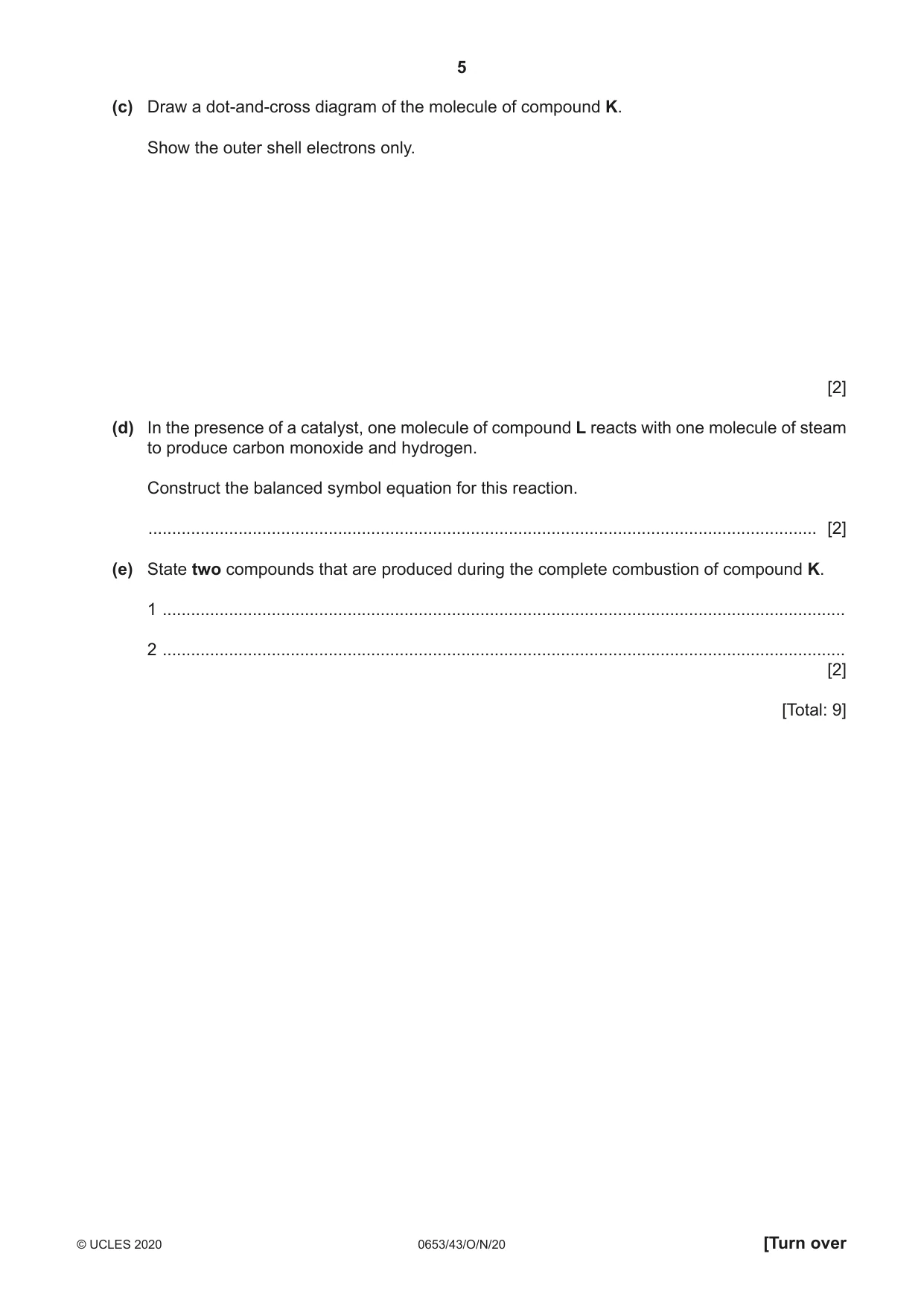
2 Compounds J, K and L are hydrocarbons. The structures of one molecule of compounds J, K and L are shown in Fig. 2.1. J K L Key: hydrogen carbon Fig. 2.1 (a) State which compound, J, K or L, is ethene. Explain your answer. compound ........................... explanation ............................................................................................................................... ................................................................................................................................................... ............................................................................................................................................. [1] (b) Ethene is made by cracking gas oil. (i) Describe what is meant by cracking. ........................................................................................................................................... ..................................................................................................................................... [1] (ii) State one condition required for cracking. ..................................................................................................................................... [1] (c) Draw a dot-and-cross diagram of the molecule of compound K. Show the outer shell electrons only. [2] (d) In the presence of a catalyst, one molecule of compound L reacts with one molecule of steam to produce carbon monoxide and hydrogen. Construct the balanced symbol equation for this reaction. ............................................................................................................................................. [2] (e) State two compounds that are produced during the complete combustion of compound K. 1 ................................................................................................................................................ 2 ................................................................................................................................................ [2] [Total: 9]
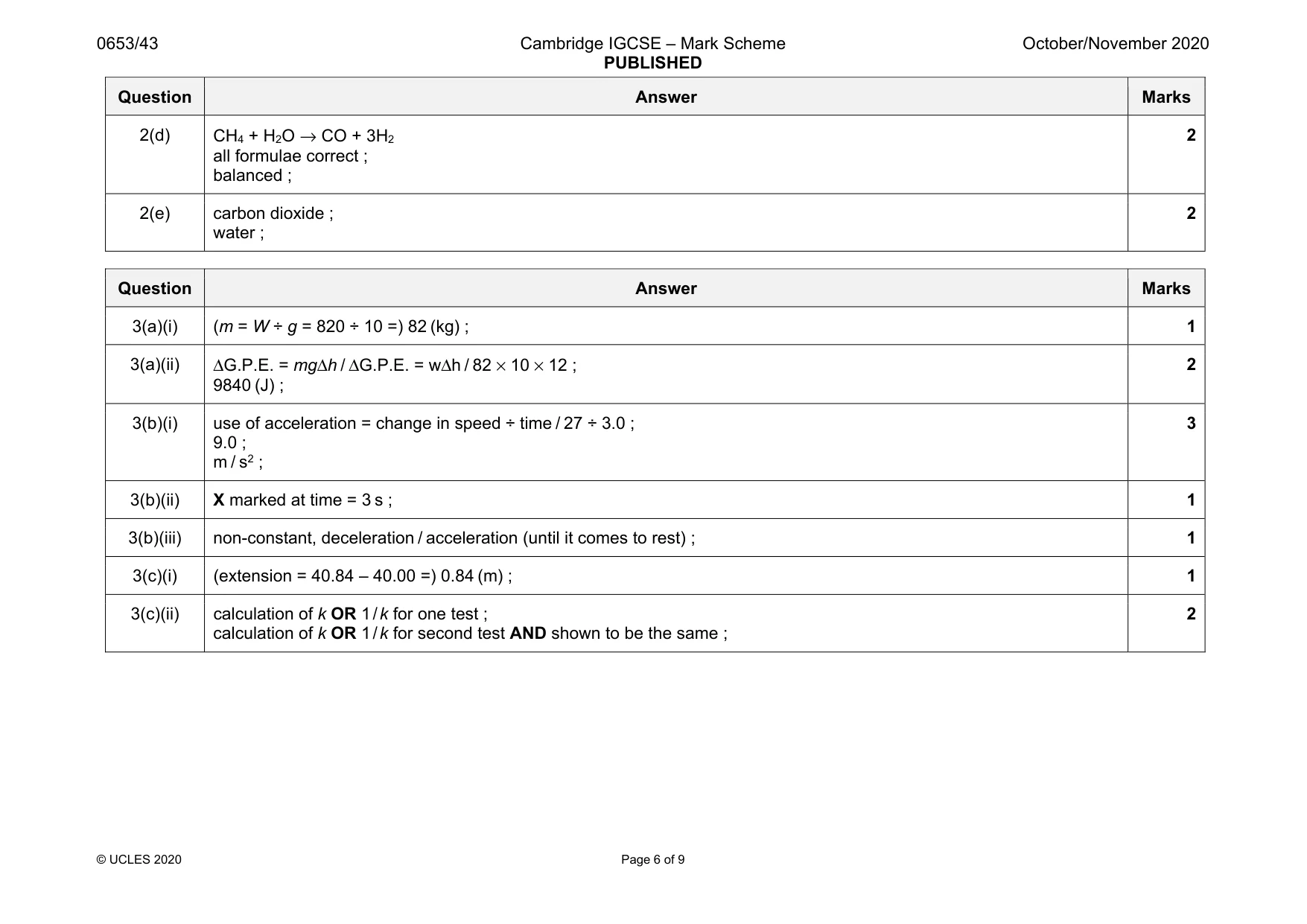
Mark scheme: 2(a) (compound J) the molecule of J, has the formula C2H4 / is unsaturated ; 1 2(b)(i) breaking of large hydrocarbon molecules into smaller molecules ; 1 2(b)(ii) heat / use of a catalyst ; 1 2(c) 2 electrons shared in single bond between carbon atoms ; all else correct including the symbols ; 2 Question Answer Marks 2(d) CH4 + H2O → CO + 3H2 all formulae correct ; balanced ; 2 2(e) carbon dioxide ; water ; 2
Q3 · A climber using a safety rope to climb a rock face
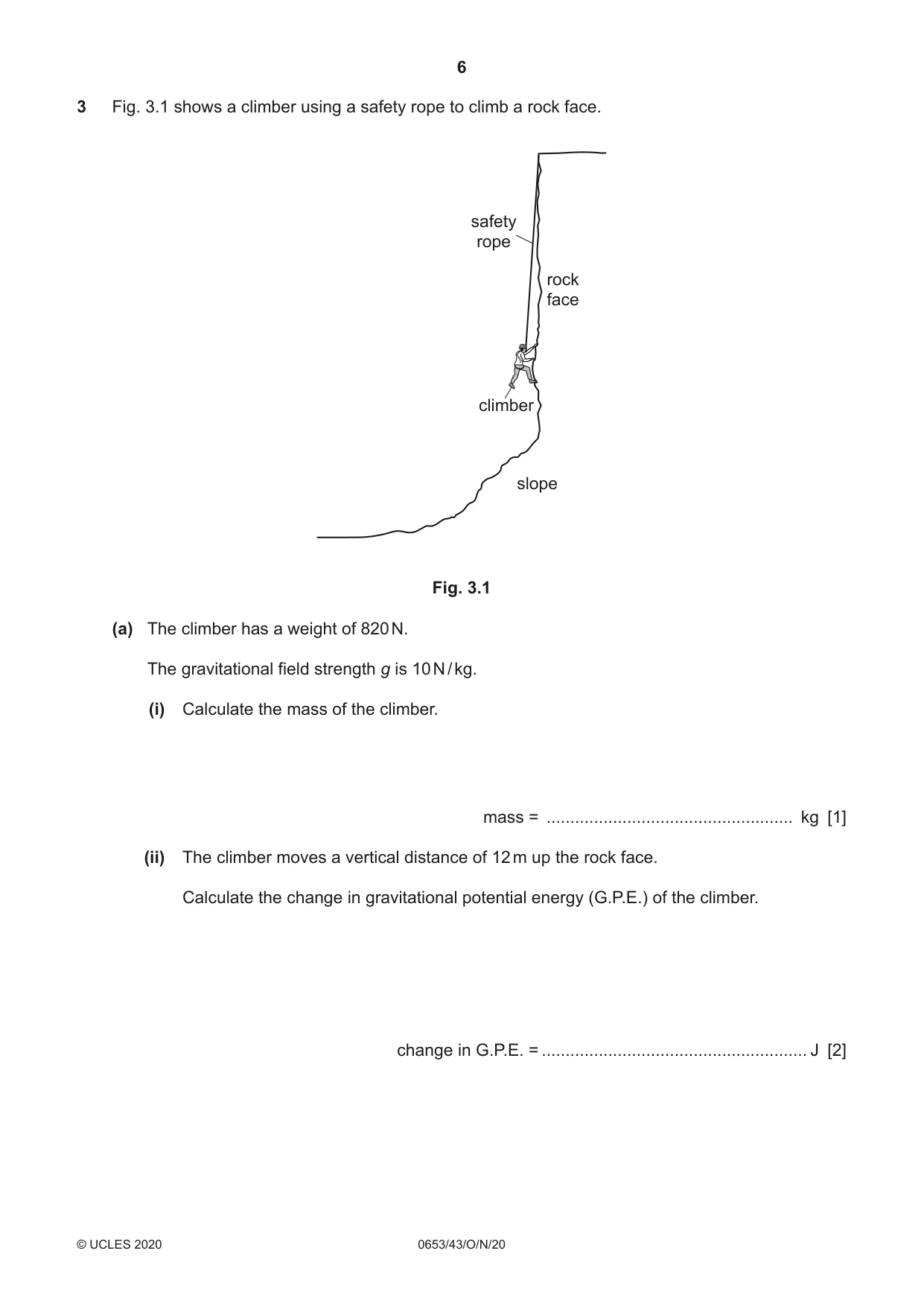
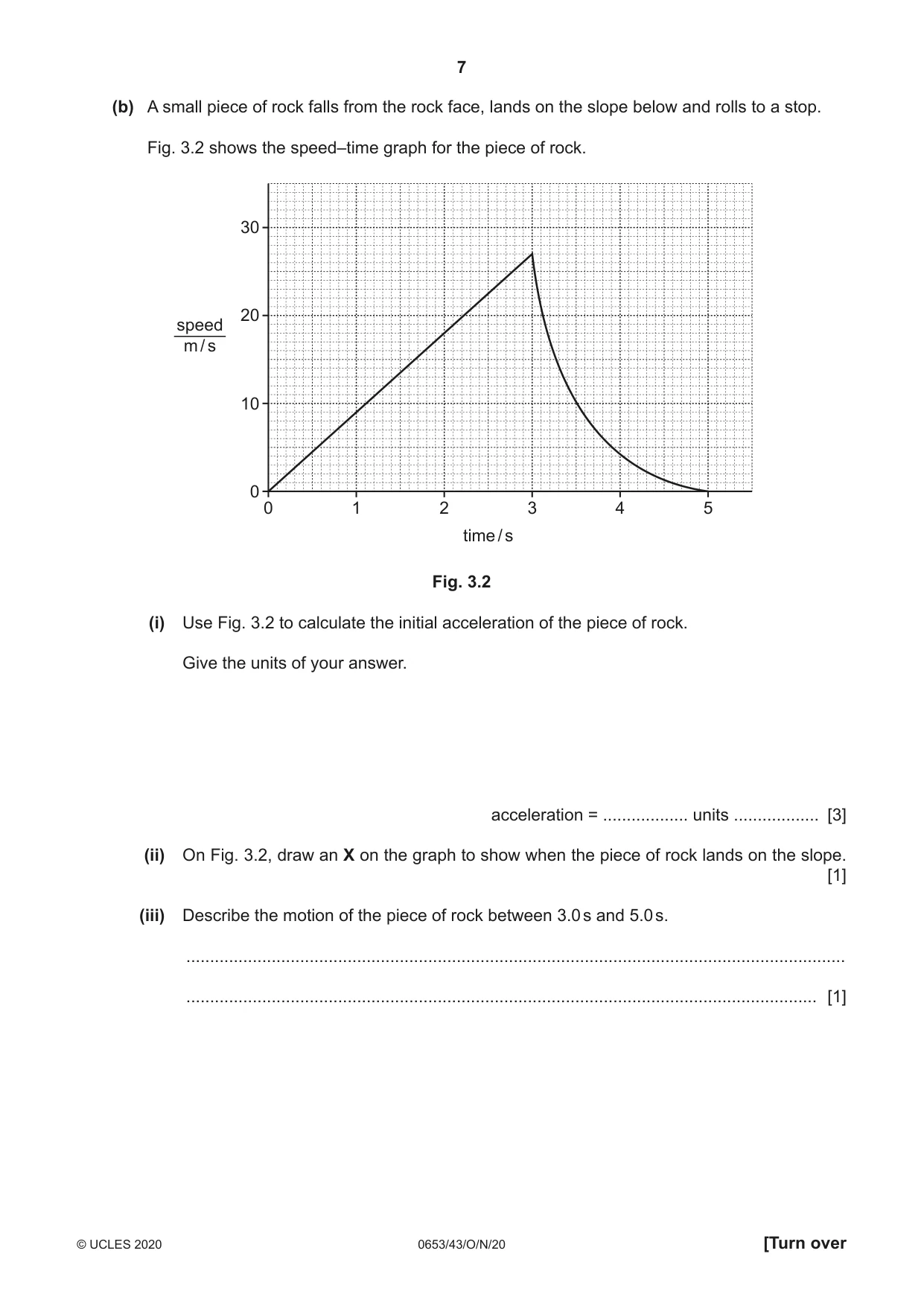
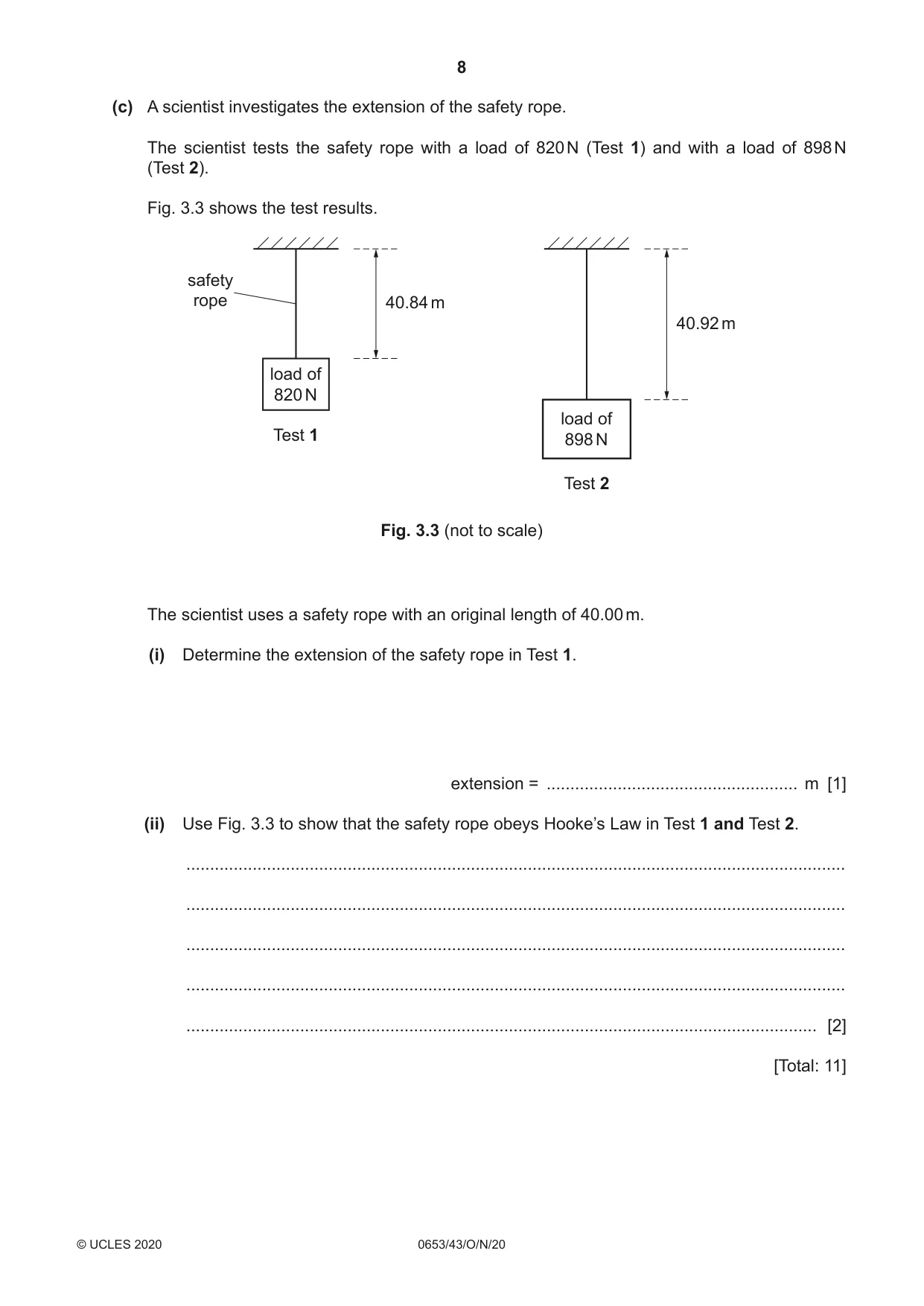
3 Fig. 3.1 shows a climber using a safety rope to climb a rock face. safety rope rock face climber slope Fig. 3.1 (a) The climber has a weight of 820 N. The gravitational field strength g is 10 N / kg. (i) Calculate the mass of the climber. mass = .................................................... kg [1] (ii) The climber moves a vertical distance of 12 m up the rock face. Calculate the change in gravitational potential energy (G.P.E.) of the climber. change in G.P.E. = ........................................................ J [2] (b) A small piece of rock falls from the rock face, lands on the slope below and rolls to a stop. Fig. 3.2 shows the speed–time graph for the piece of rock. 30 20 speed m / s 10 0 0 1 2 3 4 5 time / s Fig. 3.2 (i) Use Fig. 3.2 to calculate the initial acceleration of the piece of rock. Give the units of your answer. acceleration = .................. units .................. [3] (ii) On Fig. 3.2, draw an X on the graph to show when the piece of rock lands on the slope. [1] (iii) Describe the motion of the piece of rock between 3.0 s and 5.0 s. ........................................................................................................................................... ..................................................................................................................................... [1] (c) A scientist investigates the extension of the safety rope. The scientist tests the safety rope with a load of 820 N (Test 1) and with a load of 898 N (Test 2). Fig. 3.3 shows the test results. safety rope 40.84 m 40.92 m load of 820 N load of Test 1 898 N Test 2 Fig. 3.3 (not to scale) The scientist uses a safety rope with an original length of 40.00 m. (i) Determine the extension of the safety rope in Test 1. extension = ..................................................... m [1] (ii) Use Fig. 3.3 to show that the safety rope obeys Hooke’s Law in Test 1 and Test 2. ........................................................................................................................................... ........................................................................................................................................... ........................................................................................................................................... ........................................................................................................................................... ..................................................................................................................................... [2] [Total: 11]
Mark scheme: 3(a)(i) (m = W ÷ g = 820 ÷ 10 =) 82 (kg) ; 1 3(a)(ii) ΔG.P.E. = mgΔh / ΔG.P.E. = wΔh / 82 × 10 × 12 ; 9840 (J) ; 2 3(b)(i) use of acceleration = change in speed ÷ time / 27 ÷ 3.0 ; 9.0 ; m / s2 ; 3 3(b)(ii) X marked at time = 3 s ; 1 3(b)(iii) non-constant, deceleration / acceleration (until it comes to rest) ; 1 3(c)(i) (extension = 40.84 – 40.00 =) 0.84 (m) ; 1 3(c)(ii) calculation of k OR 1 / k for one test ; calculation of k OR 1 / k for second test AND shown to be the same ; 2
Q4 · A balanced diet contains all the nutrients in the correct proportions to meet a person’s…
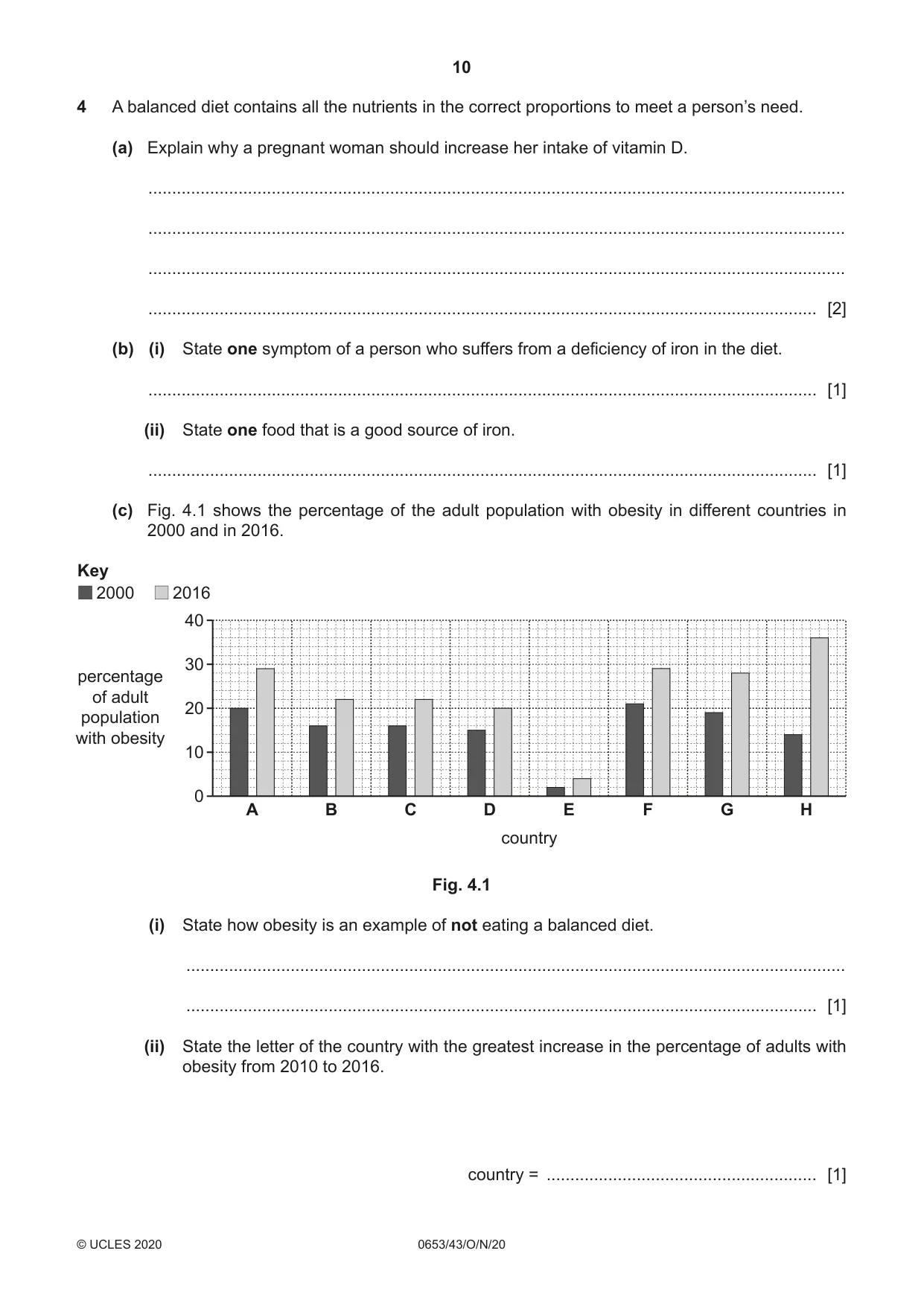
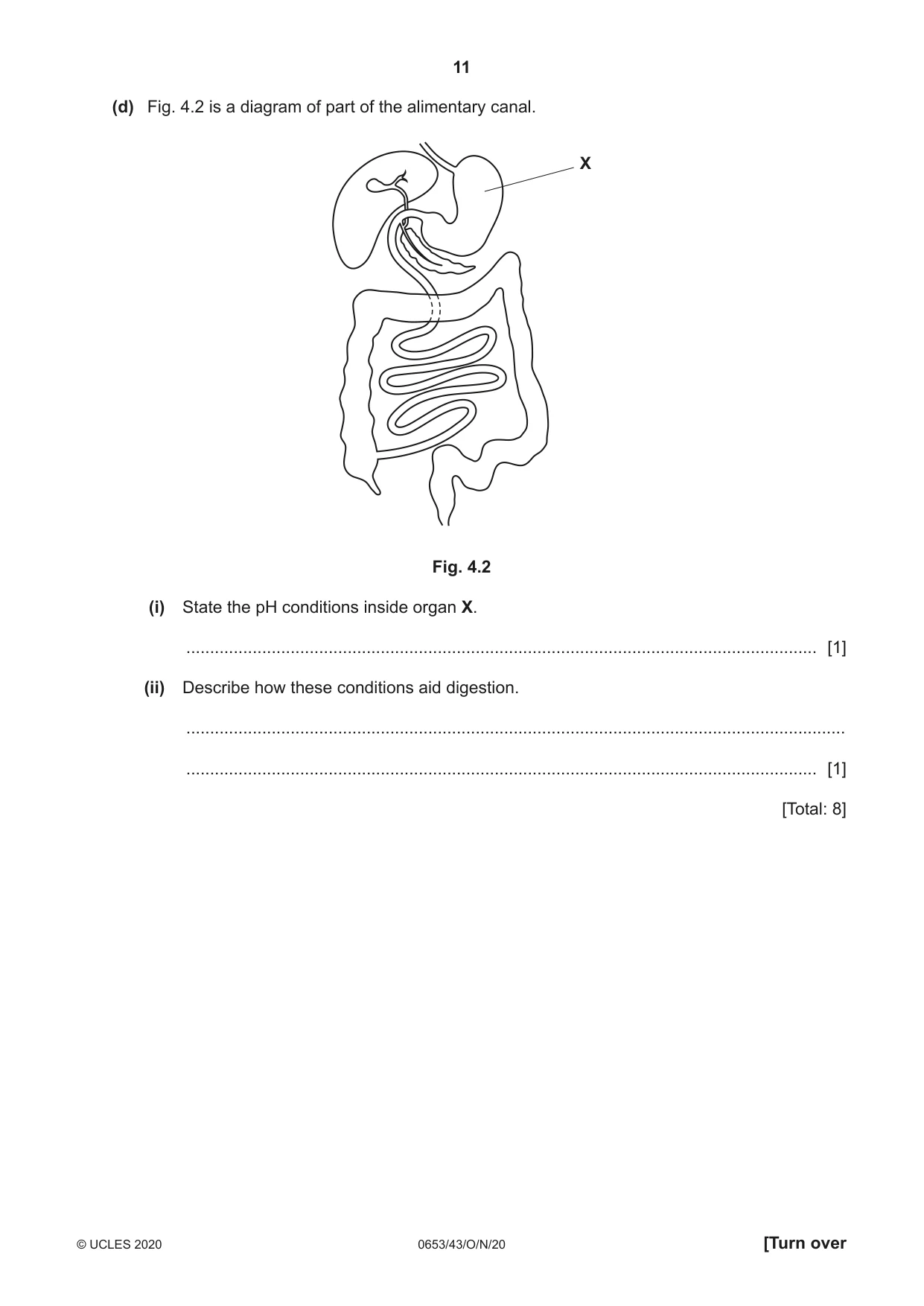
4 A balanced diet contains all the nutrients in the correct proportions to meet a person’s need. (a) Explain why a pregnant woman should increase her intake of vitamin D. ................................................................................................................................................... ................................................................................................................................................... ................................................................................................................................................... ............................................................................................................................................. [2] (b) (i) State one symptom of a person who suffers from a deficiency of iron in the diet. ............................................................................................................................................. [1] (ii) State one food that is a good source of iron. ............................................................................................................................................. [1] (c) Fig. 4.1 shows the percentage of the adult population with obesity in different countries in 2000 and in 2016. Key 2000 2016 40 30 percentage of adult 20 population with obesity 10 0 A B C D E F G H country Fig. 4.1 (i) State how obesity is an example of not eating a balanced diet. ........................................................................................................................................... ..................................................................................................................................... [1] (ii) State the letter of the country with the greatest increase in the percentage of adults with obesity from 2010 to 2016. country = ......................................................... [1] (d) Fig. 4.2 is a diagram of part of the alimentary canal. X Fig. 4.2 (i) State the pH conditions inside organ X. ..................................................................................................................................... [1] (ii) Describe how these conditions aid digestion. ........................................................................................................................................... ..................................................................................................................................... [1] [Total: 8]
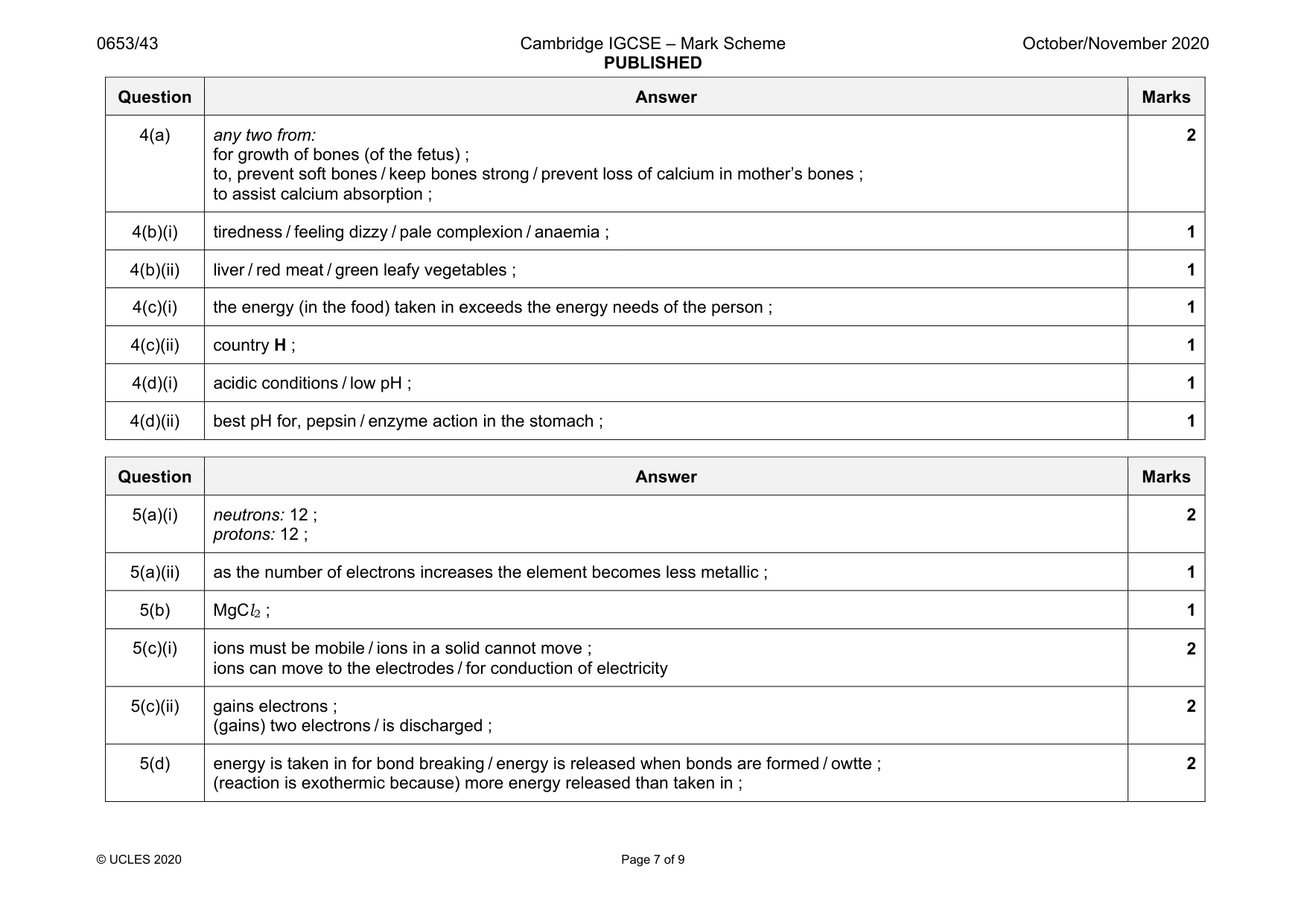
Mark scheme: 4(a) any two from: for growth of bones (of the fetus) ; to, prevent soft bones / keep bones strong / prevent loss of calcium in mother’s bones ; to assist calcium absorption ; 2 4(b)(i) tiredness / feeling dizzy / pale complexion / anaemia ; 1 4(b)(ii) liver / red meat / green leafy vegetables ; 1 4(c)(i) the energy (in the food) taken in exceeds the energy needs of the person ; 1 4(c)(ii) country H ; 1 4(d)(i) acidic conditions / low pH ; 1 4(d)(ii) best pH for, pepsin / enzyme action in the stomach ; 1
Q5 · Magnesium is an element in Group II and Period 3 of the Periodic Table
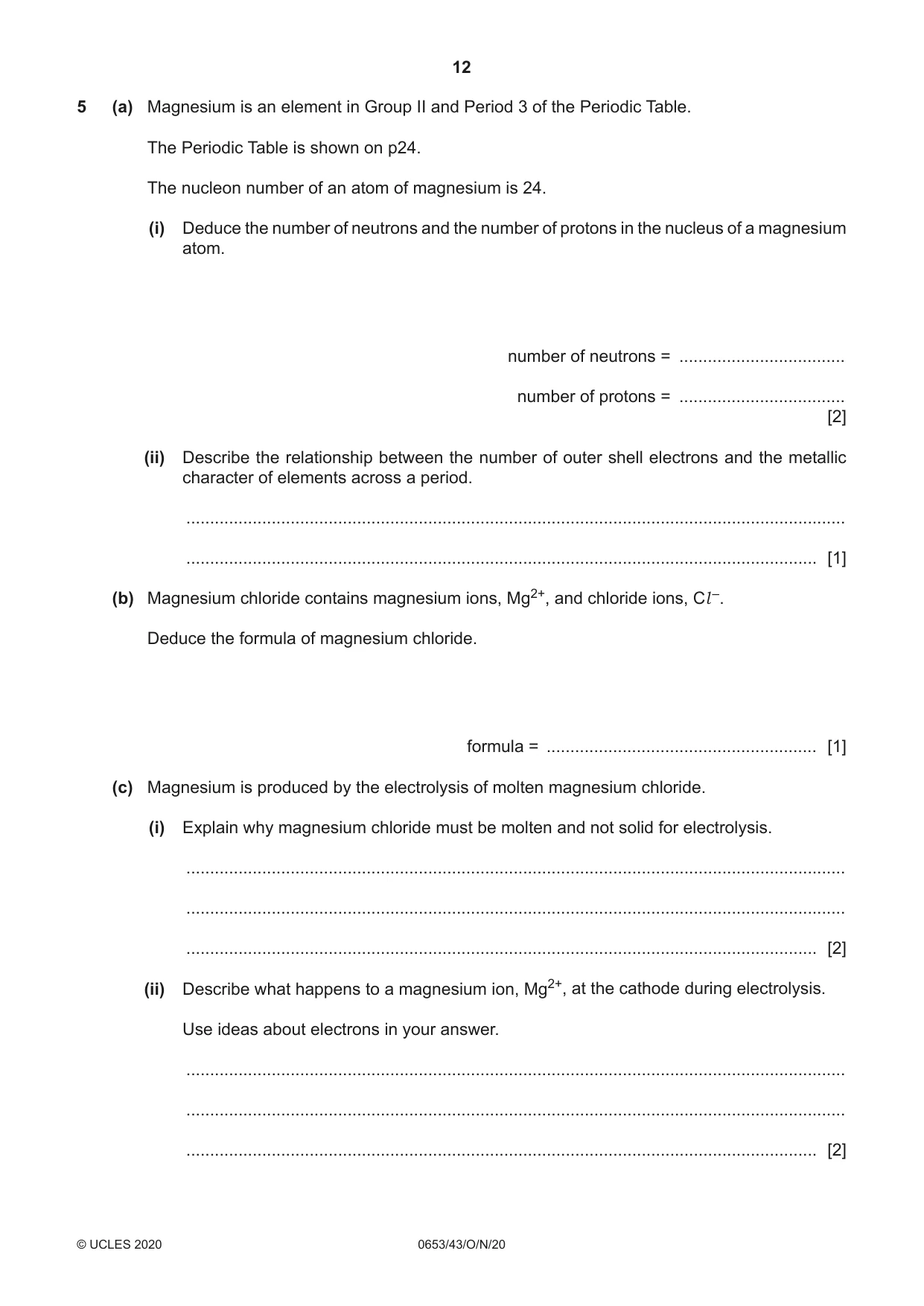
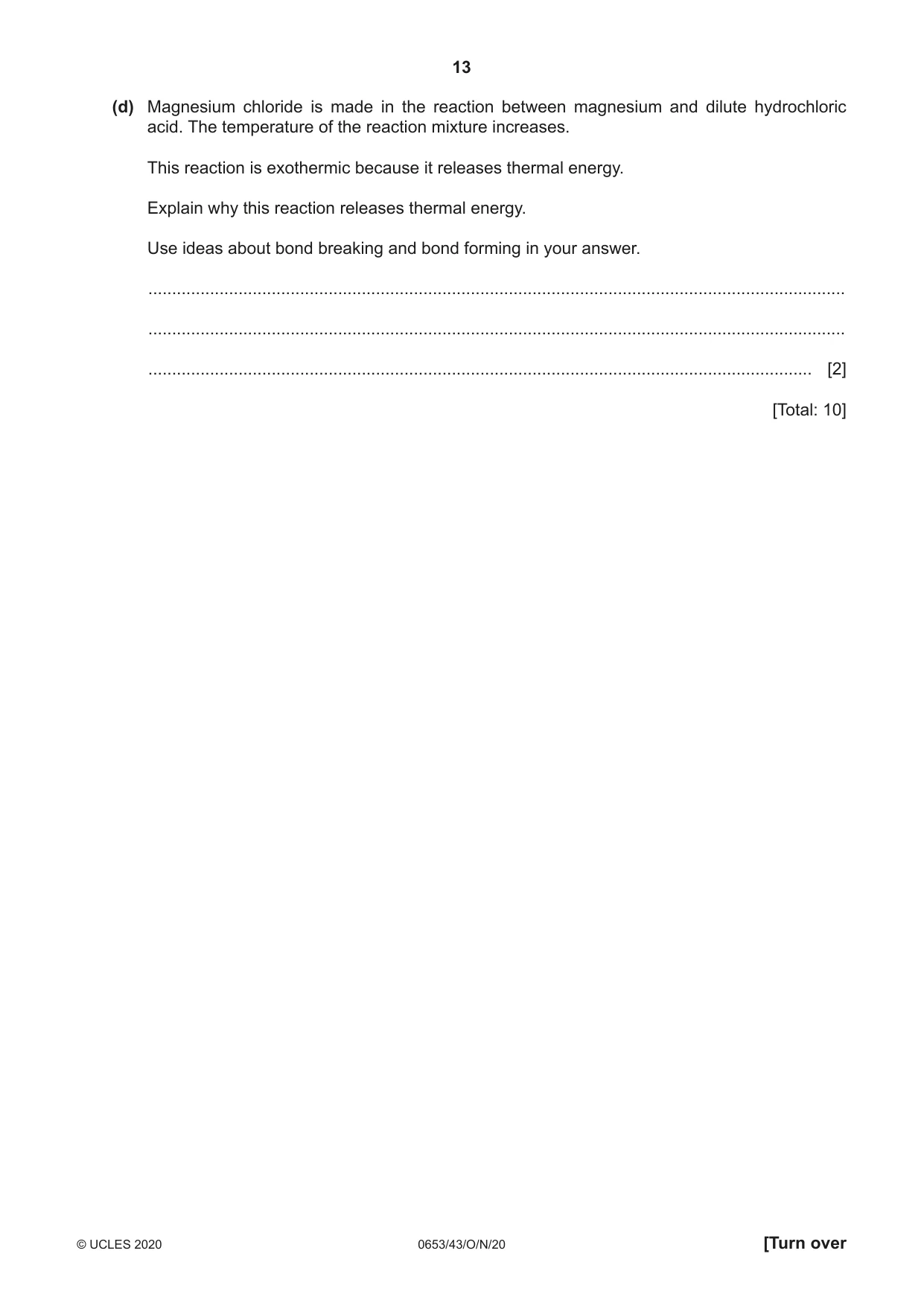
5 (a) Magnesium is an element in Group II and Period 3 of the Periodic Table. The Periodic Table is shown on p24. The nucleon number of an atom of magnesium is 24. (i) Deduce the number of neutrons and the number of protons in the nucleus of a magnesium atom. number of neutrons = ................................... number of protons = ................................... [2] (ii) Describe the relationship between the number of outer shell electrons and the metallic character of elements across a period. ........................................................................................................................................... ..................................................................................................................................... [1] (b) Magnesium chloride contains magnesium ions, Mg2+, and chloride ions, Cl –. Deduce the formula of magnesium chloride. formula = ......................................................... [1] (c) Magnesium is produced by the electrolysis of molten magnesium chloride. (i) Explain why magnesium chloride must be molten and not solid for electrolysis. ........................................................................................................................................... ........................................................................................................................................... ..................................................................................................................................... [2] (ii) Describe what happens to a magnesium ion, Mg2+, at the cathode during electrolysis. Use ideas about electrons in your answer. ........................................................................................................................................... ........................................................................................................................................... ..................................................................................................................................... [2] (d) Magnesium chloride is made in the reaction between magnesium and dilute hydrochloric acid. The temperature of the reaction mixture increases. This reaction is exothermic because it releases thermal energy. Explain why this reaction releases thermal energy. Use ideas about bond breaking and bond forming in your answer. ................................................................................................................................................... ................................................................................................................................................... ............................................................................................................................................ [2] [Total: 10]
Mark scheme: 5(a)(i) neutrons: 12 ; protons: 12 ; 2 5(a)(ii) as the number of electrons increases the element becomes less metallic ; 1 5(b) MgCl2 ; 1 5(c)(i) ions must be mobile / ions in a solid cannot move ; ions can move to the electrodes / for conduction of electricity 2 5(c)(ii) gains electrons ; (gains) two electrons / is discharged ; 2 5(d) energy is taken in for bond breaking / energy is released when bonds are formed / owtte ; (reaction is exothermic because) more energy released than taken in ; 2
Q6 · A space telescope for detecting gamma radiation from distant stars
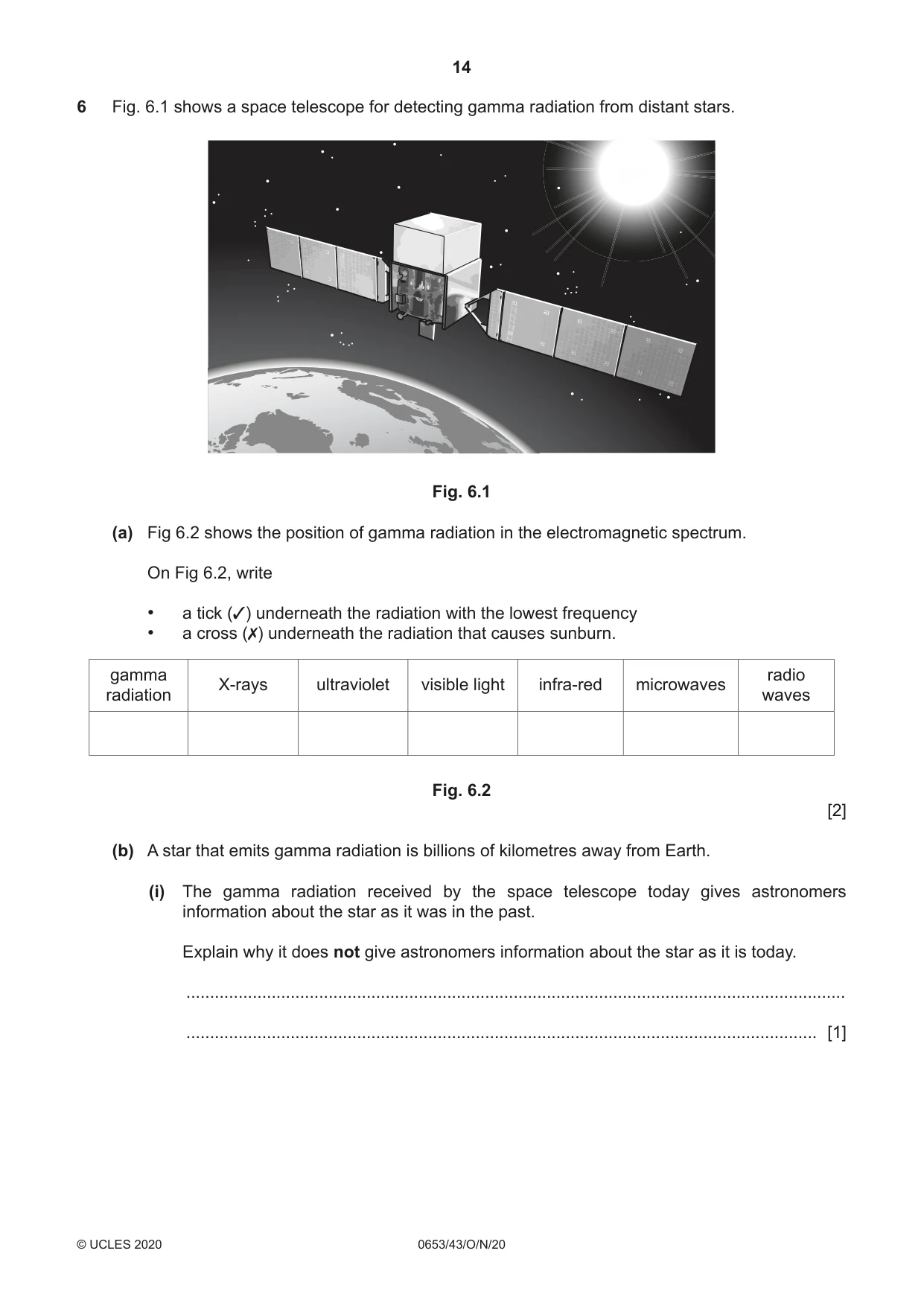
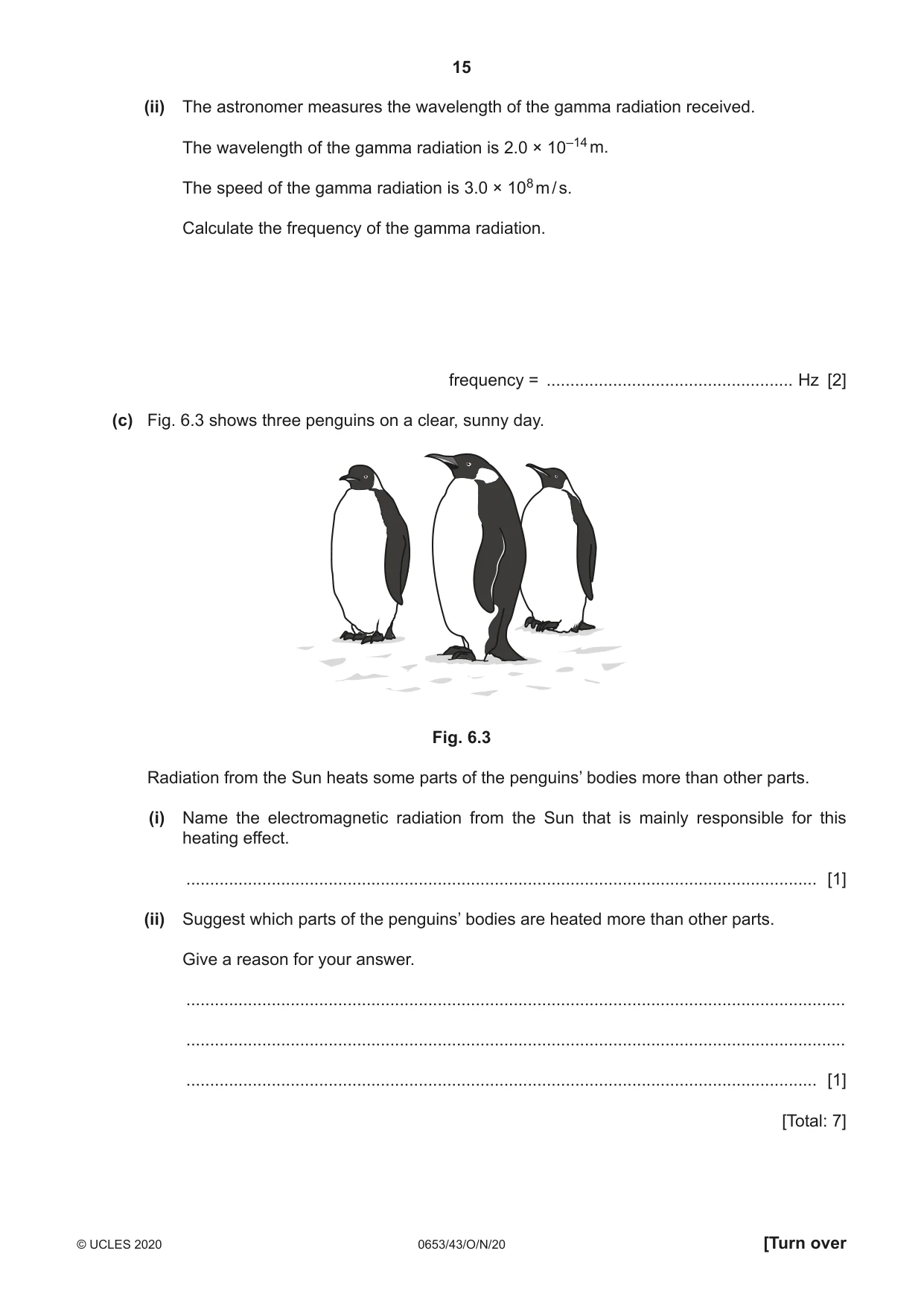
6 Fig. 6.1 shows a space telescope for detecting gamma radiation from distant stars. Fig. 6.1 (a) Fig 6.2 shows the position of gamma radiation in the electromagnetic spectrum. On Fig 6.2, write • a tick (✓) underneath the radiation with the lowest frequency • a cross (✗) underneath the radiation that causes sunburn. gamma radio X-rays ultraviolet visible light infra-red microwaves radiation waves Fig. 6.2 [2] (b) A star that emits gamma radiation is billions of kilometres away from Earth. (i) The gamma radiation received by the space telescope today gives astronomers information about the star as it was in the past. Explain why it does not give astronomers information about the star as it is today. ........................................................................................................................................... ..................................................................................................................................... [1] (ii) The astronomer measures the wavelength of the gamma radiation received. The wavelength of the gamma radiation is 2.0 × 10⁻¹⁴ m. The speed of the gamma radiation is 3.0 × 10⁸ m / s. Calculate the frequency of the gamma radiation. frequency = .................................................... Hz [2] (c) Fig. 6.3 shows three penguins on a clear, sunny day. Fig. 6.3 Radiation from the Sun heats some parts of the penguins’ bodies more than other parts. (i) Name the electromagnetic radiation from the Sun that is mainly responsible for this heating effect. ..................................................................................................................................... [1] (ii) Suggest which parts of the penguins’ bodies are heated more than other parts. Give a reason for your answer. ........................................................................................................................................... ........................................................................................................................................... ..................................................................................................................................... [1] [Total: 7]
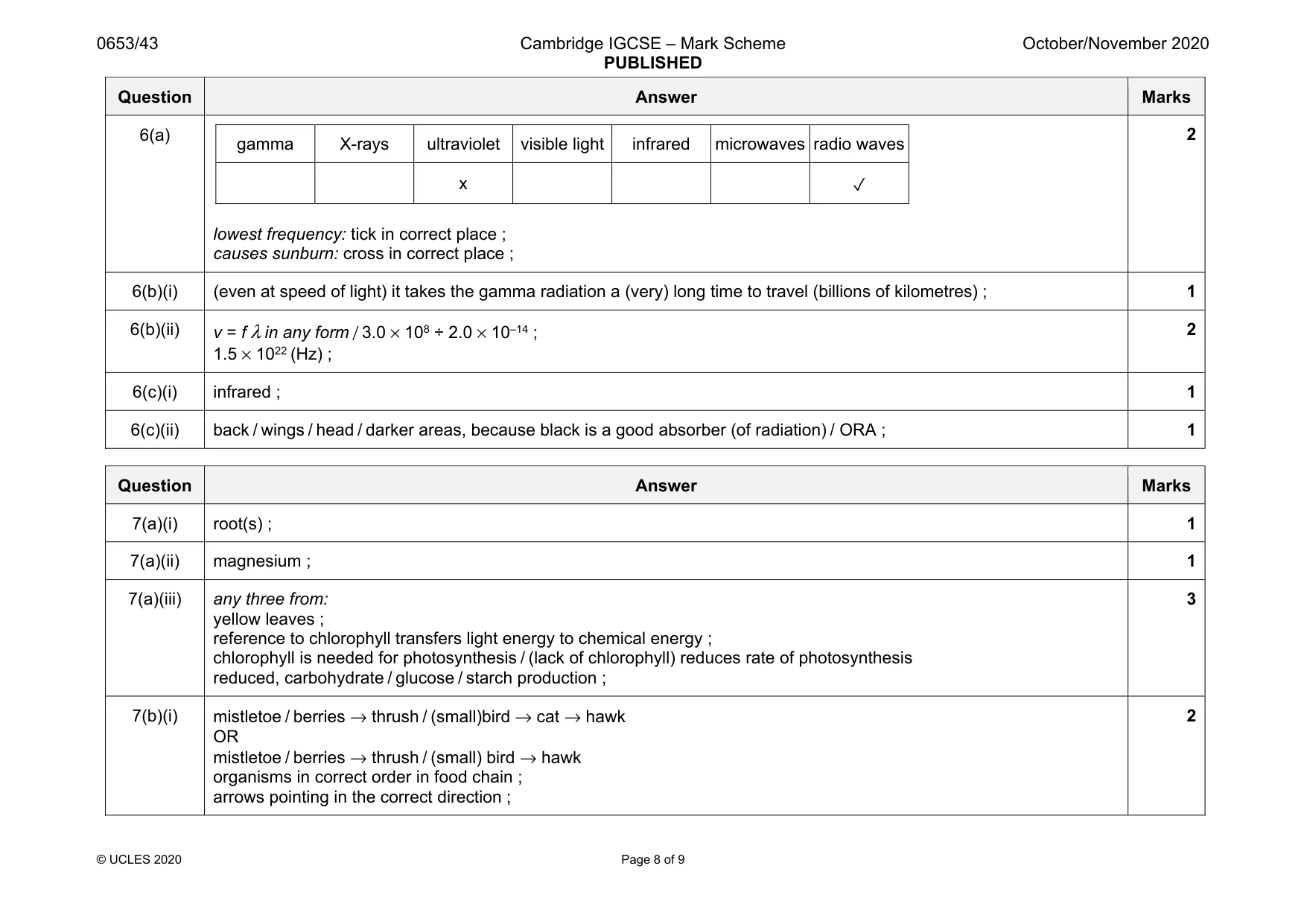
Mark scheme: 6(a) gamma X-rays ultraviolet visible light infrared microwaves radio waves x ✓ lowest frequency: tick in correct place ; causes sunburn: cross in correct place ; 6(b)(i) (even at speed of light) it takes the gamma radiation a (very) long time to travel (billions of kilometres) ; 1 6(b)(ii) v = f λ in any form / 3.0 × 10⁸ ÷ 2.0 × 10⁻¹⁴ ; 1.5 × 10²² (Hz) ; 2 6(c)(i) infrared ; 1 6(c)(ii) back / wings / head / darker areas, because black is a good absorber (of radiation) / ORA ; 1
Q7 · A mistletoe plant growing on a tree branch
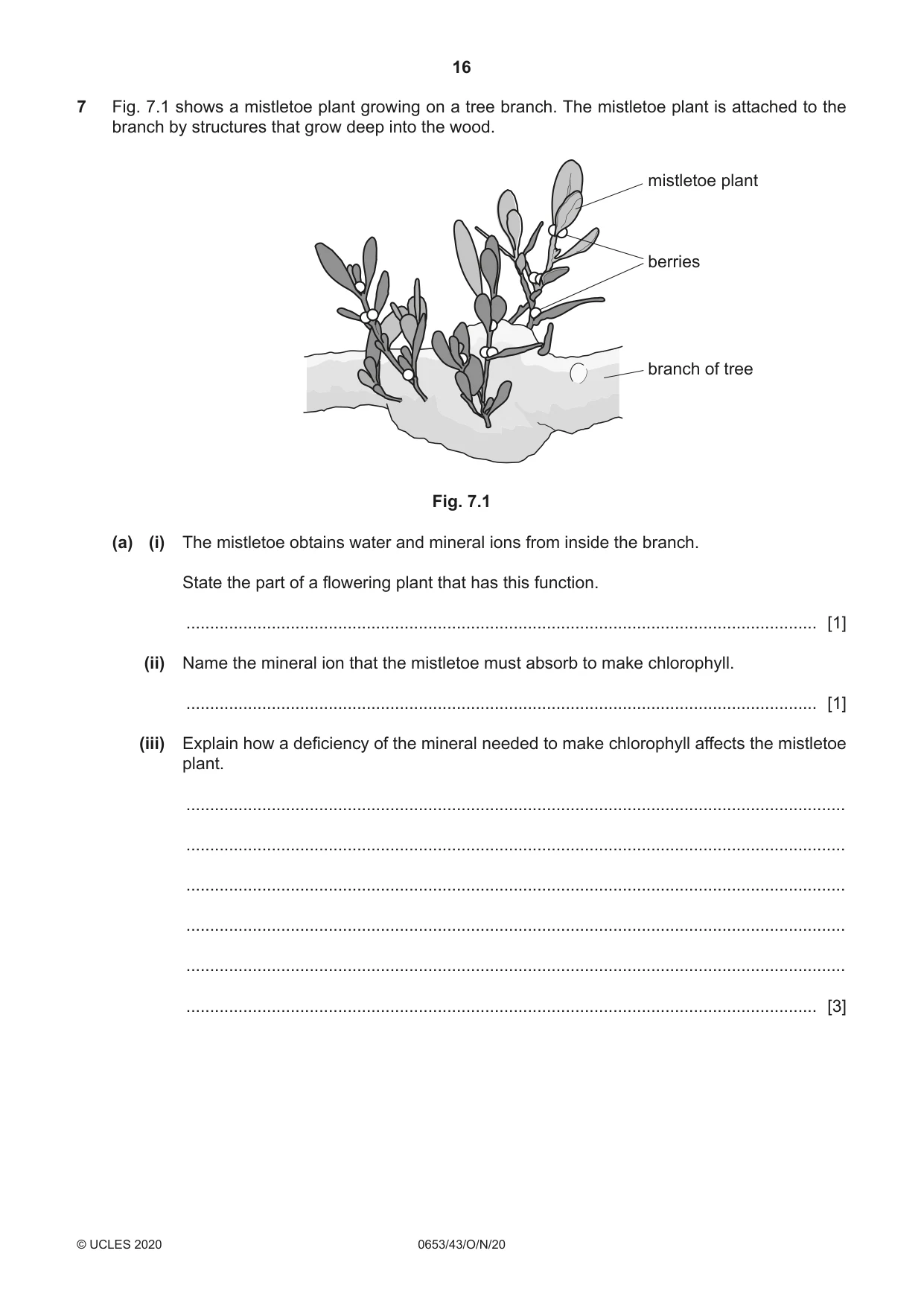
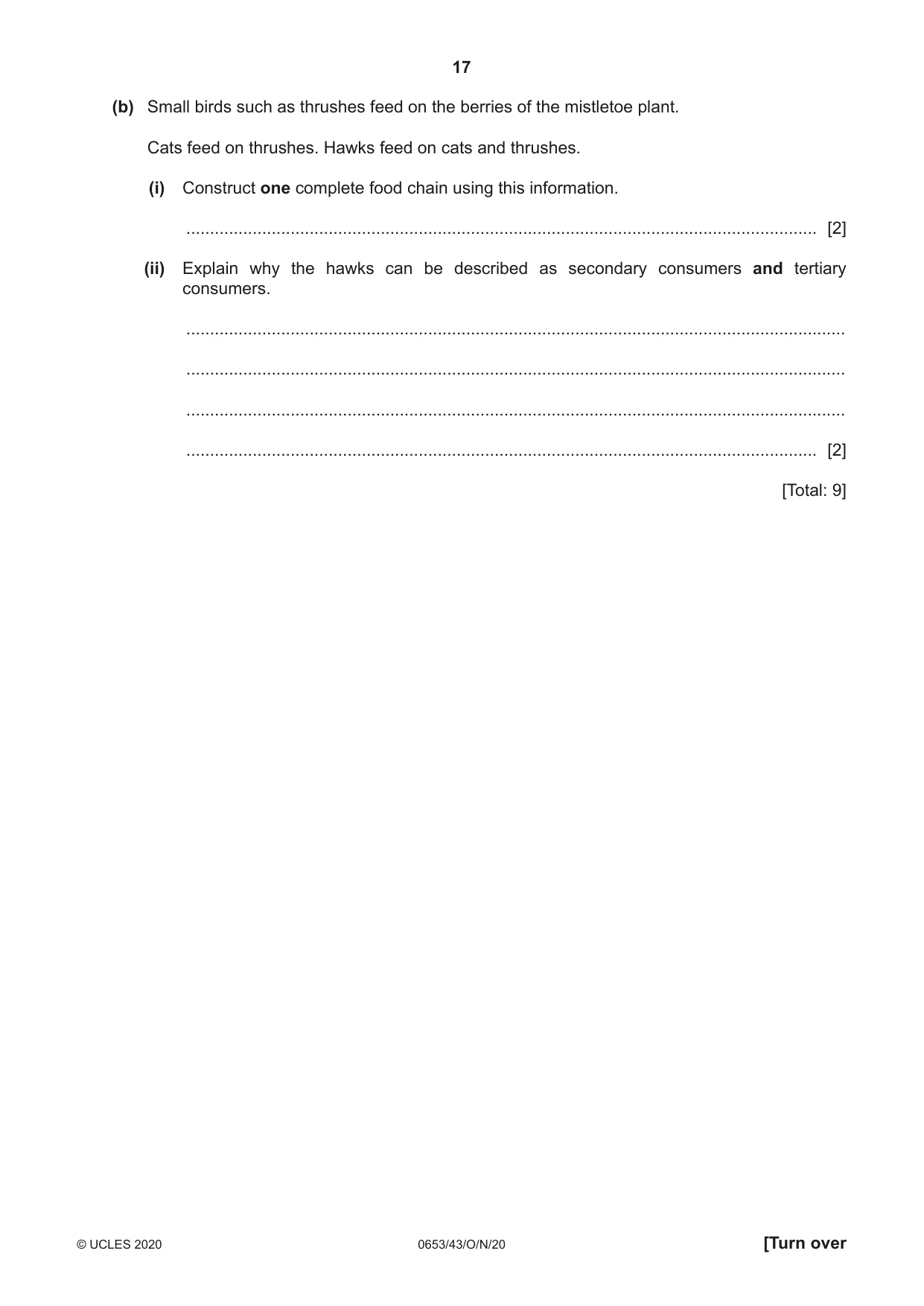
7 Fig. 7.1 shows a mistletoe plant growing on a tree branch. The mistletoe plant is attached to the branch by structures that grow deep into the wood. mistletoe plant berries branch of tree Fig. 7.1 (a) (i) The mistletoe obtains water and mineral ions from inside the branch. State the part of a flowering plant that has this function. ..................................................................................................................................... [1] (ii) Name the mineral ion that the mistletoe must absorb to make chlorophyll. ..................................................................................................................................... [1] (iii) Explain how a deficiency of the mineral needed to make chlorophyll affects the mistletoe plant. ........................................................................................................................................... ........................................................................................................................................... ........................................................................................................................................... ........................................................................................................................................... ........................................................................................................................................... ..................................................................................................................................... [3] (b) Small birds such as thrushes feed on the berries of the mistletoe plant. Cats feed on thrushes. Hawks feed on cats and thrushes. (i) Construct one complete food chain using this information. ..................................................................................................................................... [2] (ii) Explain why the hawks can be described as secondary consumers and tertiary consumers. ........................................................................................................................................... ........................................................................................................................................... ........................................................................................................................................... ..................................................................................................................................... [2] [Total: 9]
Mark scheme: 7(a)(i) root(s) ; 1 7(a)(ii) magnesium ; 1 7(a)(iii) any three from: yellow leaves ; reference to chlorophyll transfers light energy to chemical energy ; chlorophyll is needed for photosynthesis / (lack of chlorophyll) reduces rate of photosynthesis reduced, carbohydrate / glucose / starch production ; 3 7(b)(i) mistletoe / berries → thrush / (small)bird → cat → hawk OR mistletoe / berries → thrush / (small) bird → hawk organisms in correct order in food chain ; arrows pointing in the correct direction ; 2 Question Answer Marks 7(b)(ii) hawks feed on thrushes which are primary consumers / at the second trophic level (so they are secondary consumers) ; hawks feed on cats which are secondary consumers / at the third trophic level (so they are tertiary consumers) ; 2
Q8 · Copper chloride is made when copper oxide reacts with dilute hydrochloric acid
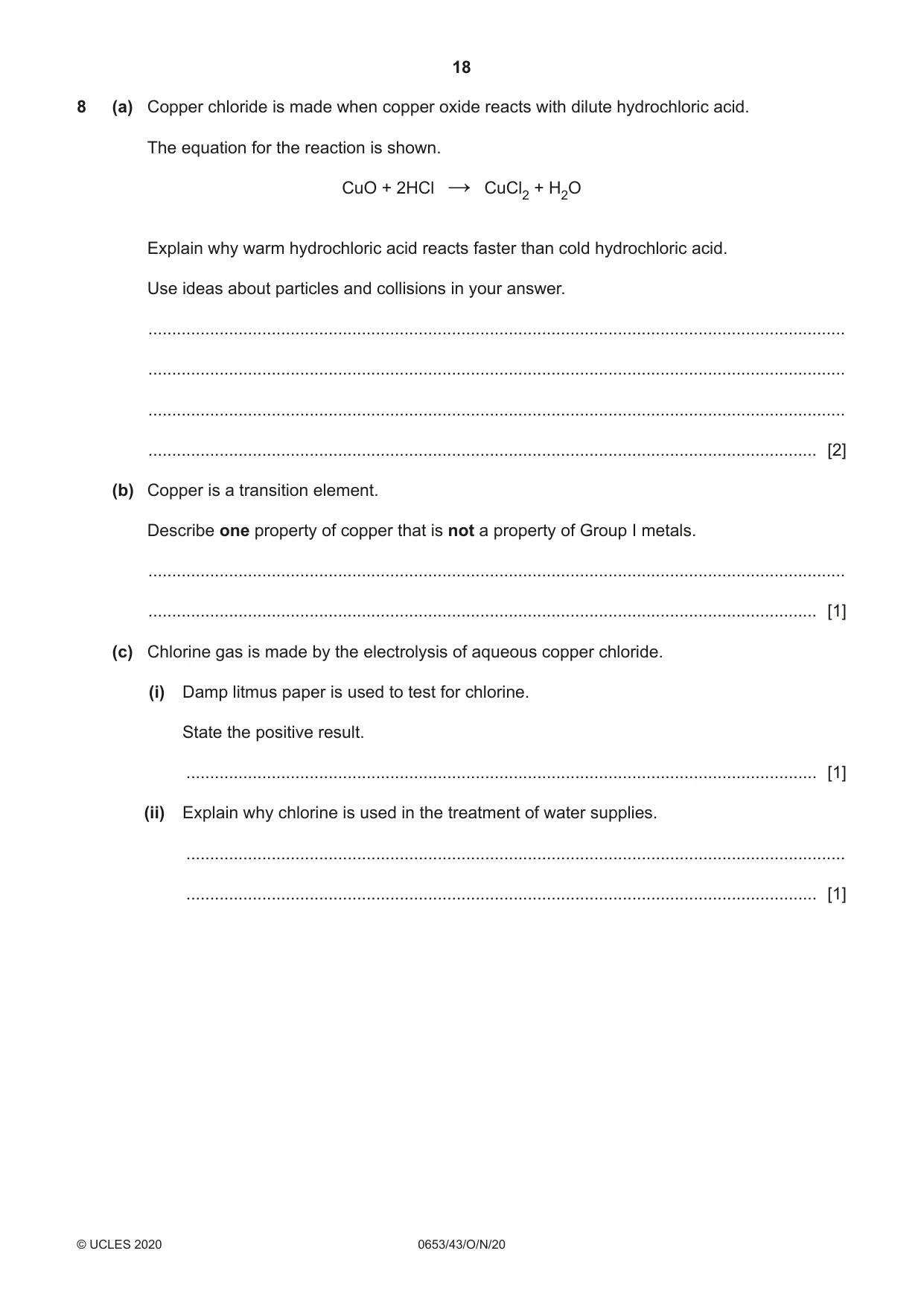
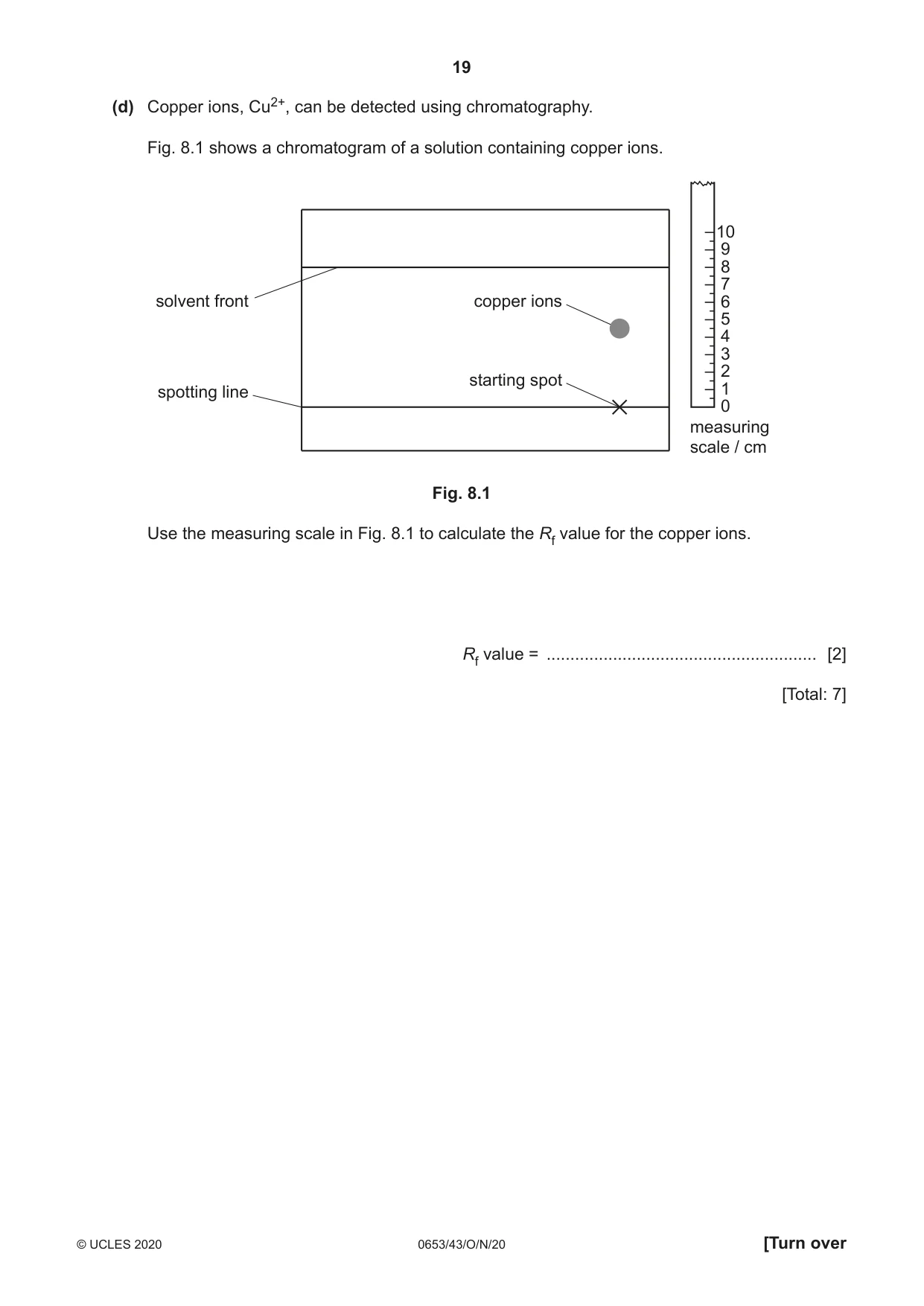
8 (a) Copper chloride is made when copper oxide reacts with dilute hydrochloric acid. The equation for the reaction is shown. CuO + 2HCl CuCl2 + H2O → Explain why warm hydrochloric acid reacts faster than cold hydrochloric acid. Use ideas about particles and collisions in your answer. ................................................................................................................................................... ................................................................................................................................................... ................................................................................................................................................... ............................................................................................................................................. [2] (b) Copper is a transition element. Describe one property of copper that is not a property of Group I metals. ................................................................................................................................................... ............................................................................................................................................. [1] (c) Chlorine gas is made by the electrolysis of aqueous copper chloride. (i) Damp litmus paper is used to test for chlorine. State the positive result. ..................................................................................................................................... [1] (ii) Explain why chlorine is used in the treatment of water supplies. ........................................................................................................................................... ..................................................................................................................................... [1] (d) Copper ions, Cu2+, can be detected using chromatography. Fig. 8.1 shows a chromatogram of a solution containing copper ions. 10 9 8 7 solvent front copper ions 6 5 4 3 2 starting spot spotting line 1 0 measuring scale / cm Fig. 8.1 Use the measuring scale in Fig. 8.1 to calculate the Rf value for the copper ions. Rf value = ......................................................... [2] [Total: 7]
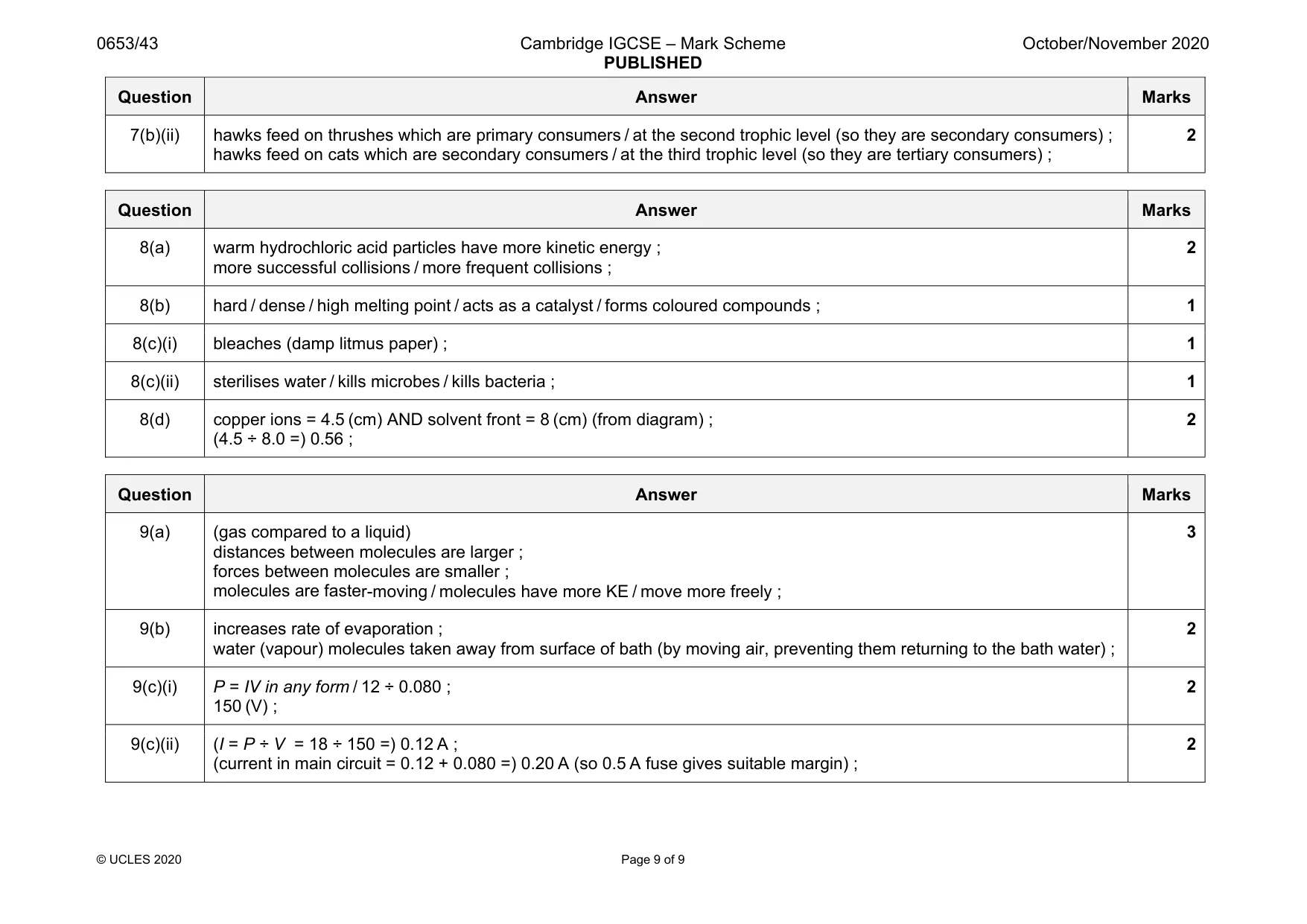
Mark scheme: 8(a) warm hydrochloric acid particles have more kinetic energy ; more successful collisions / more frequent collisions ; 2 8(b) hard / dense / high melting point / acts as a catalyst / forms coloured compounds ; 1 8(c)(i) bleaches (damp litmus paper) ; 1 8(c)(ii) sterilises water / kills microbes / kills bacteria ; 1 8(d) copper ions = 4.5 (cm) AND solvent front = 8 (cm) (from diagram) ; (4.5 ÷ 8.0 =) 0.56 ; 2
Q9 · An extractor fan in the wall of a bathroom
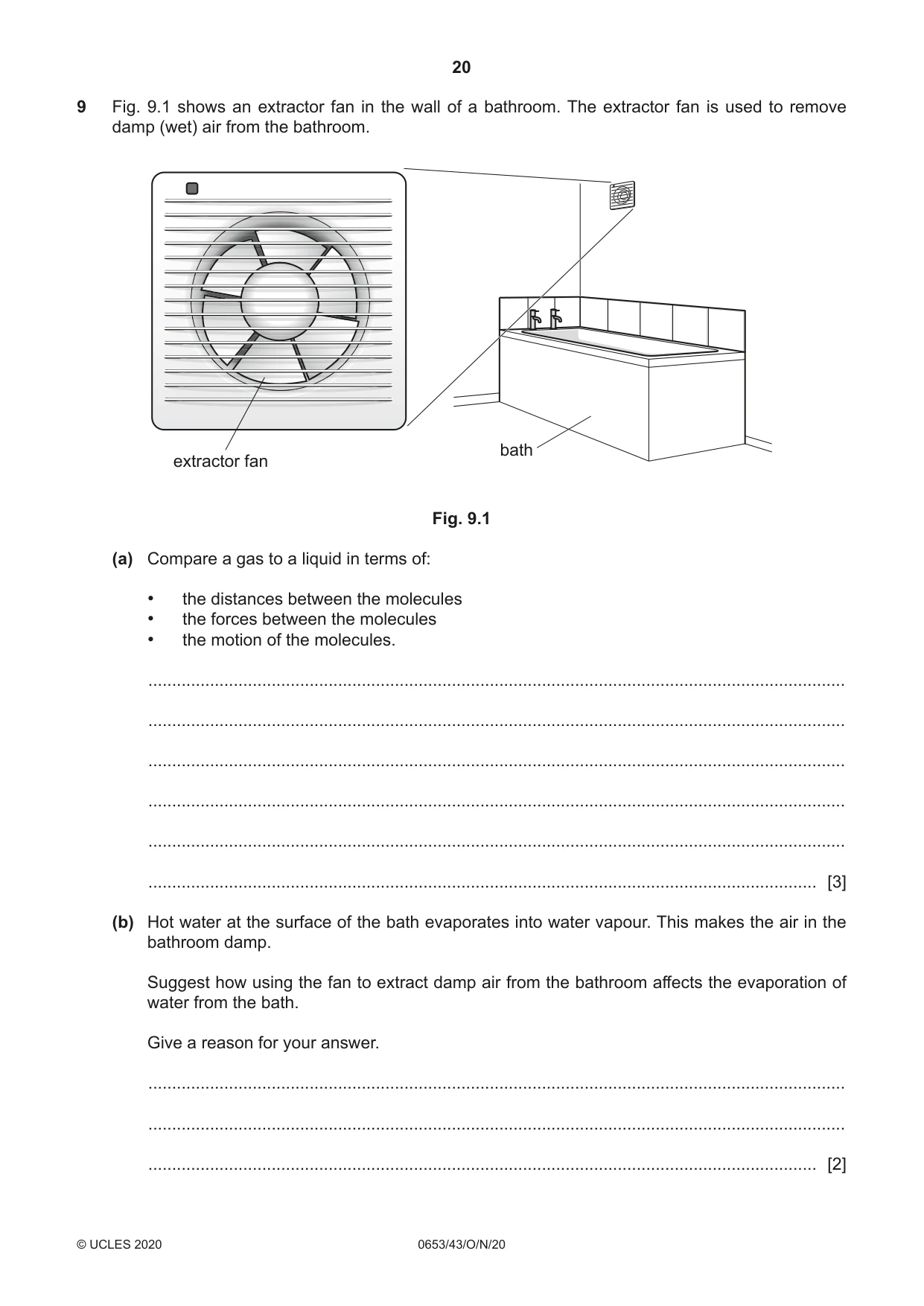
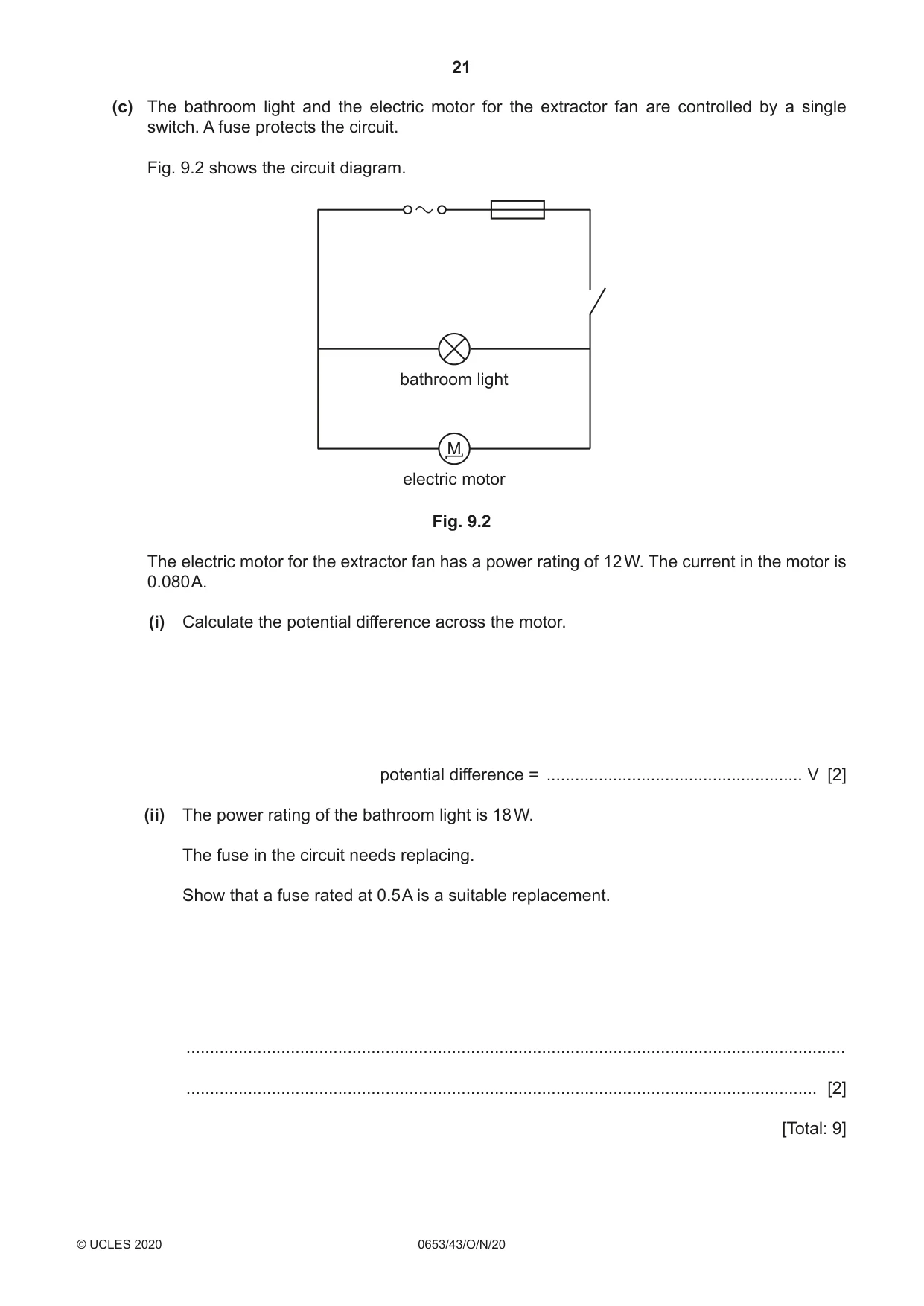
9 Fig. 9.1 shows an extractor fan in the wall of a bathroom. The extractor fan is used to remove damp (wet) air from the bathroom. bath extractor fan Fig. 9.1 (a) Compare a gas to a liquid in terms of: • the distances between the molecules • the forces between the molecules • the motion of the molecules. ................................................................................................................................................... ................................................................................................................................................... ................................................................................................................................................... ................................................................................................................................................... ................................................................................................................................................... ............................................................................................................................................. [3] (b) Hot water at the surface of the bath evaporates into water vapour. This makes the air in the bathroom damp. Suggest how using the fan to extract damp air from the bathroom affects the evaporation of water from the bath. Give a reason for your answer. ................................................................................................................................................... ................................................................................................................................................... ............................................................................................................................................. [2] (c) The bathroom light and the electric motor for the extractor fan are controlled by a single switch. A fuse protects the circuit. Fig. 9.2 shows the circuit diagram. bathroom light M electric motor Fig. 9.2 The electric motor for the extractor fan has a power rating of 12 W. The current in the motor is 0.080 A. (i) Calculate the potential difference across the motor. potential difference = ...................................................... V [2] (ii) The power rating of the bathroom light is 18 W. The fuse in the circuit needs replacing. Show that a fuse rated at 0.5 A is a suitable replacement. ........................................................................................................................................... ..................................................................................................................................... [2] [Total: 9]
Mark scheme: 9(a) (gas compared to a liquid) distances between molecules are larger ; forces between molecules are smaller ; molecules are faster-moving / molecules have more KE / move more freely ; 3 9(b) increases rate of evaporation ; water (vapour) molecules taken away from surface of bath (by moving air, preventing them returning to the bath water) ; 2 9(c)(i) P = IV in any form / 12 ÷ 0.080 ; 150 (V) ; 2 9(c)(ii) (I = P ÷ V = 18 ÷ 150 =) 0.12 A ; (current in main circuit = 0.12 + 0.080 =) 0.20 A (so 0.5 A fuse gives suitable margin) ; 2
What was in this paper
The subtopics covered by these 9 questions, and how many questions each got. Open one in a new tab to see every Cambridge question on it.
What you needed in this session
Cambridge’s own grade thresholds for 2020 Oct/Nov, Paper 4 · Variant 3. A higher threshold means an easier paper — the bar moves with how the cohort did.