Cambridge IGCSE Science - Combined 0653 — 2019 Oct/Nov Paper 4 · Variant 1
0653/41/O/N/19 · 9 questions · 80 marks · ≈90 min
The question paper and its mark scheme, free to read here and free to download. This is Cambridge’s own paper, exactly as it was sat.
Question paper20 pages

Mark scheme12 pages
Answers below. Sit the paper first if you are practising.
Questions as text
Question 1
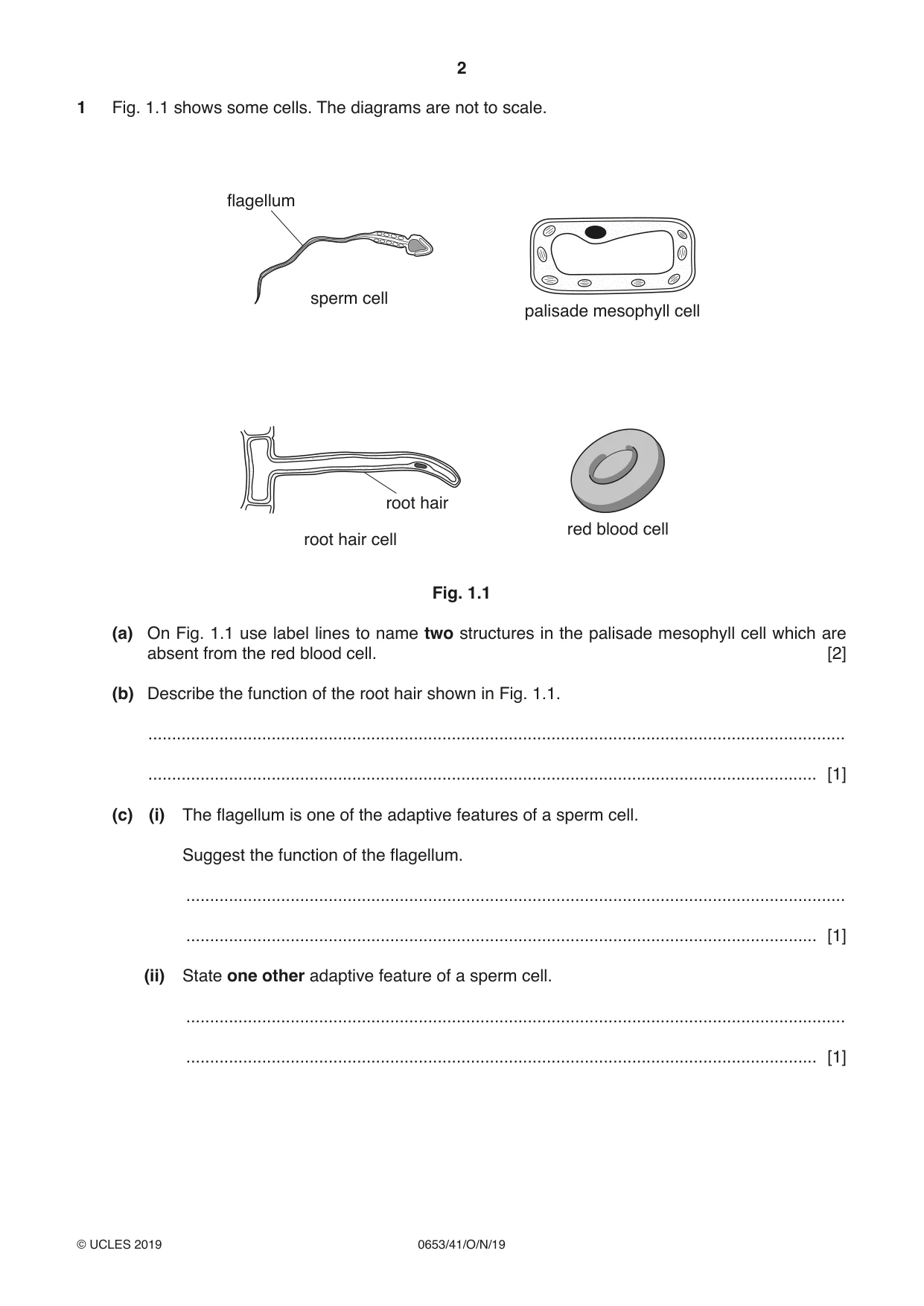
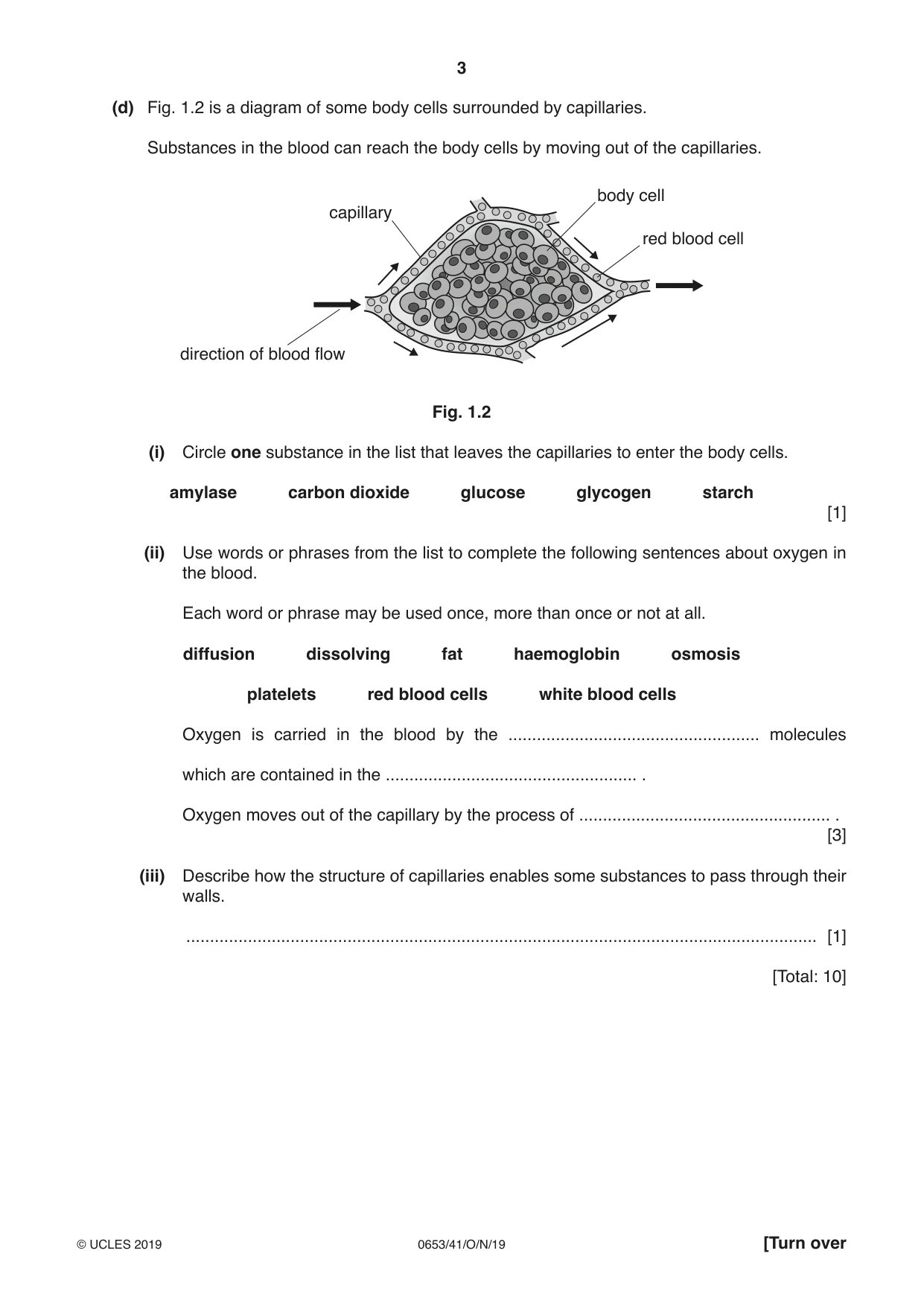
1 Fig. 1.1 shows some cells. The diagrams are not to scale. flagellum sperm cell palisade mesophyll cell root hair red blood cell root hair cell Fig. 1.1 (a) On Fig. 1.1 use label lines to name two structures in the palisade mesophyll cell which are absent from the red blood cell. [2] (b) Describe the function of the root hair shown in Fig. 1.1. ................................................................................................................................................... ............................................................................................................................................. [1] (c) (i) The flagellum is one of the adaptive features of a sperm cell. Suggest the function of the flagellum. ........................................................................................................................................... ..................................................................................................................................... [1] (ii) State one other adaptive feature of a sperm cell. ........................................................................................................................................... ..................................................................................................................................... [1] (d) Fig. 1.2 is a diagram of some body cells surrounded by capillaries. Substances in the blood can reach the body cells by moving out of the capillaries. body cell capillary red blood cell direction of blood flow Fig. 1.2 (i) Circle one substance in the list that leaves the capillaries to enter the body cells. amylase carbon dioxide glucose glycogen starch [1] (ii) Use words or phrases from the list to complete the following sentences about oxygen in the blood. Each word or phrase may be used once, more than once or not at all. diffusion dissolving fat haemoglobin osmosis platelets red blood cells white blood cells Oxygen is carried in the blood by the ..................................................... molecules which are contained in the ..................................................... . Oxygen moves out of the capillary by the process of ..................................................... . [3] (iii) Describe how the structure of capillaries enables some substances to pass through their walls. ..................................................................................................................................... [1] [Total: 10]
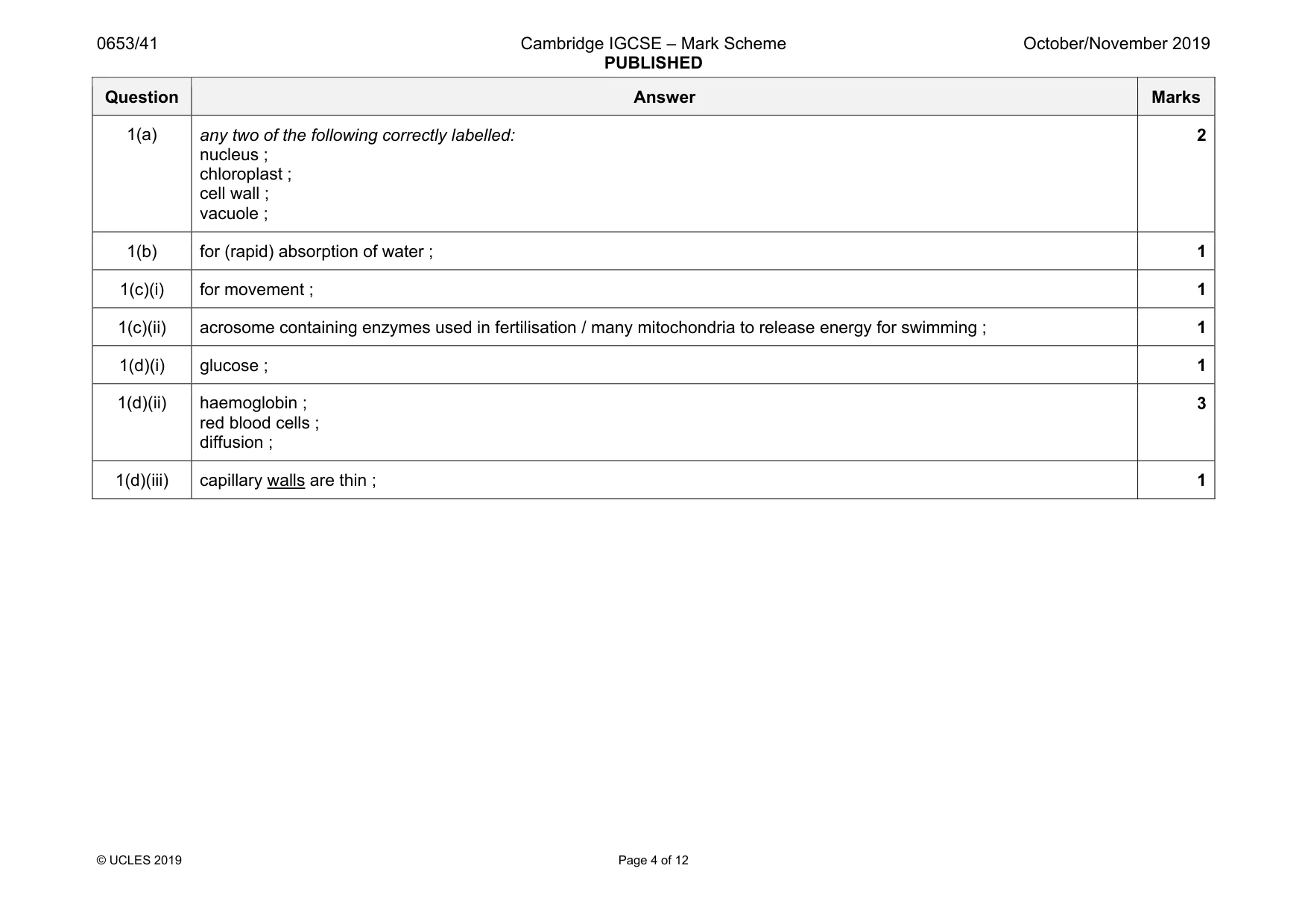
Mark scheme: 1(a) any two of the following correctly labelled: nucleus ; chloroplast ; cell wall ; vacuole ; 2 1(b) for (rapid) absorption of water ; 1 1(c)(i) for movement ; 1 1(c)(ii) acrosome containing enzymes used in fertilisation / many mitochondria to release energy for swimming ; 1 1(d)(i) glucose ; 1 1(d)(ii) haemoglobin ; red blood cells ; diffusion ; 3 1(d)(iii) capillary walls are thin ; 1
Q2 · Hydrocarbons are composed of the two elements carbon and hydrogen
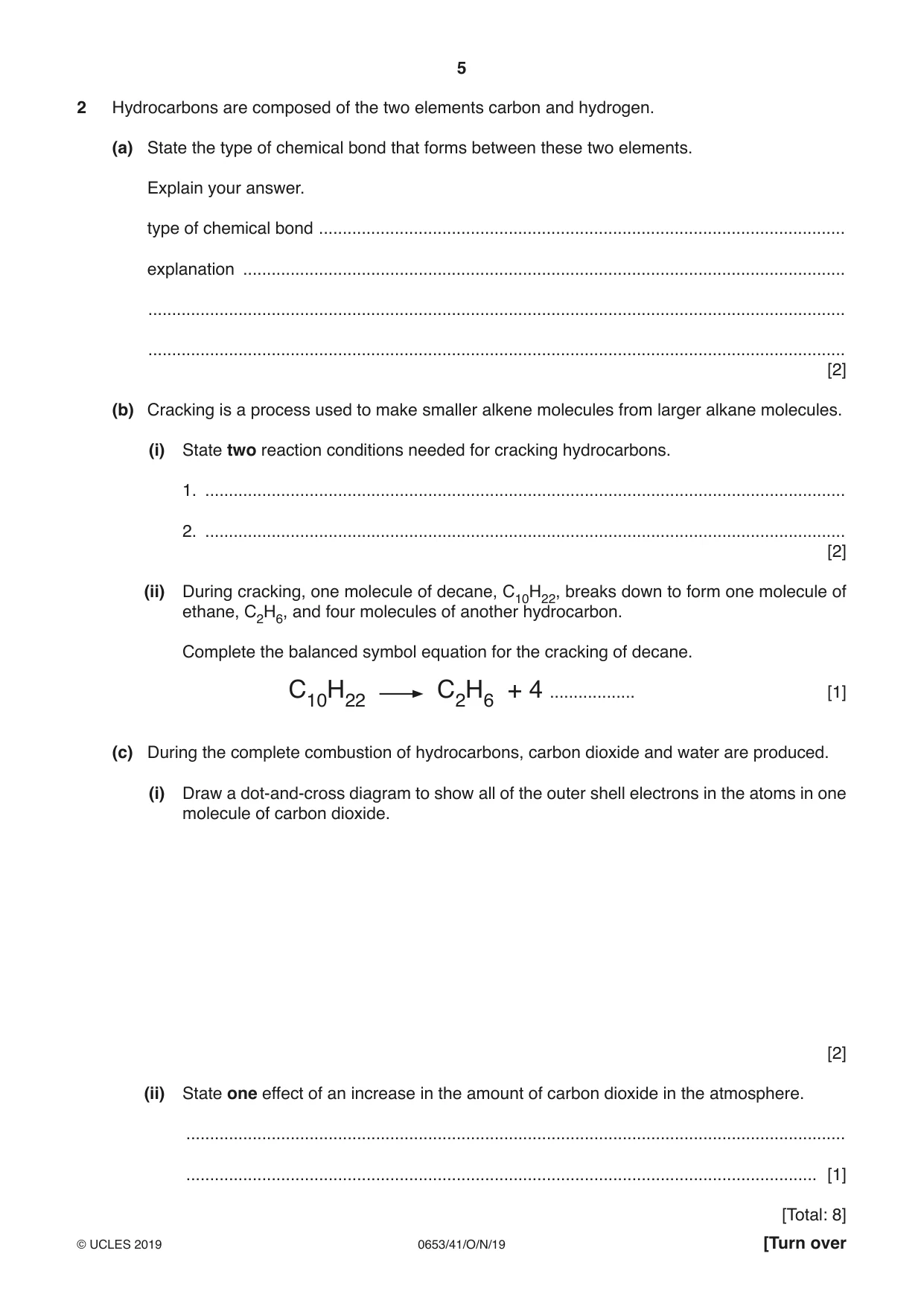
2 Hydrocarbons are composed of the two elements carbon and hydrogen. (a) State the type of chemical bond that forms between these two elements. Explain your answer. type of chemical bond ............................................................................................................... explanation ............................................................................................................................... ................................................................................................................................................... ................................................................................................................................................... [2] (b) Cracking is a process used to make smaller alkene molecules from larger alkane molecules. (i) State two reaction conditions needed for cracking hydrocarbons. 1. ....................................................................................................................................... 2. ....................................................................................................................................... [2] (ii) During cracking, one molecule of decane, C10H22, breaks down to form one molecule of ethane, C2H6, and four molecules of another hydrocarbon. Complete the balanced symbol equation for the cracking of decane. .................. [1] C10H22 C2H6 + 4 (c) During the complete combustion of hydrocarbons, carbon dioxide and water are produced. (i) Draw a dot-and-cross diagram to show all of the outer shell electrons in the atoms in one molecule of carbon dioxide. [2] (ii) State one effect of an increase in the amount of carbon dioxide in the atmosphere. ........................................................................................................................................... ..................................................................................................................................... [1] [Total: 8]
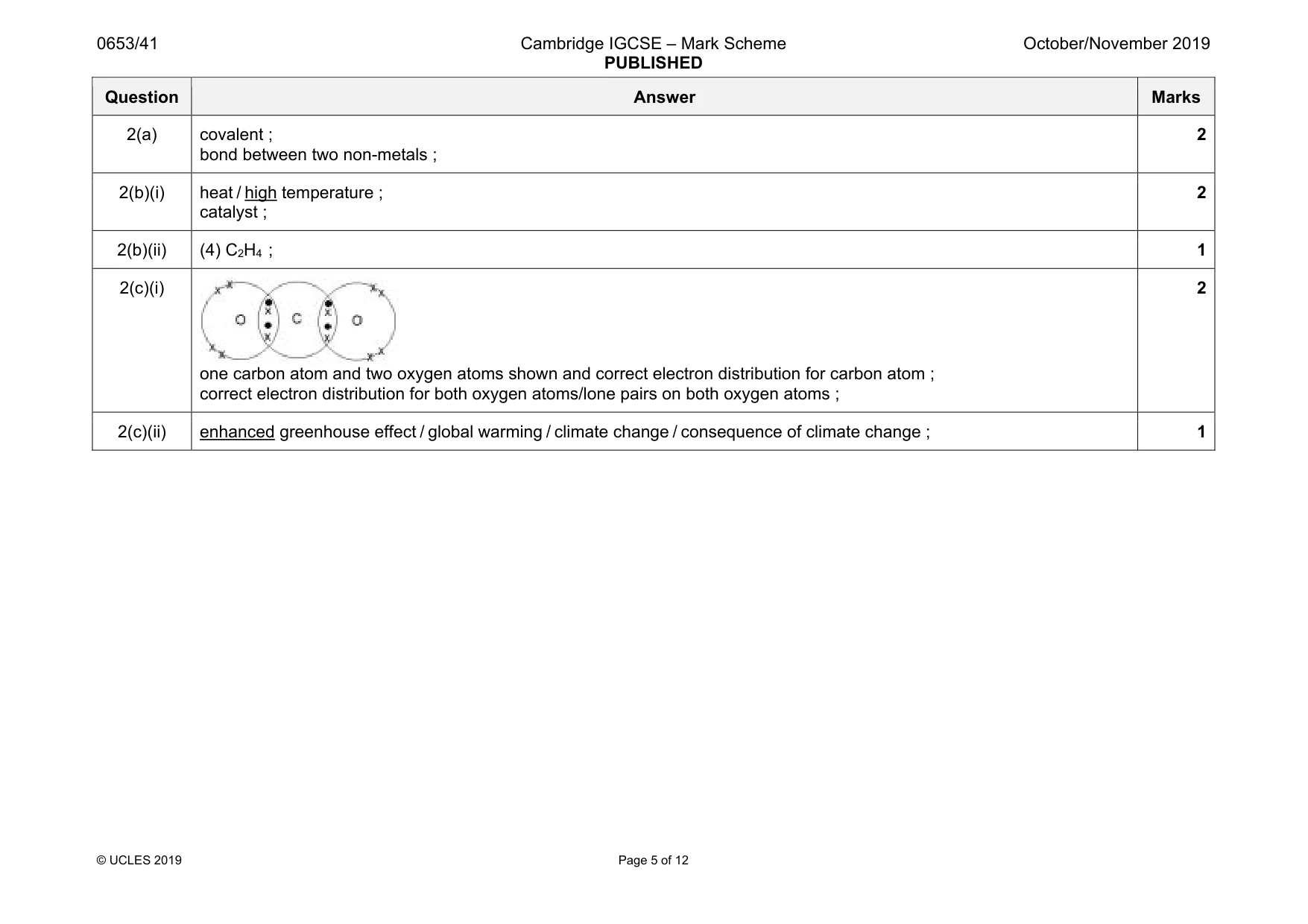
Mark scheme: 2(a) covalent ; bond between two non-metals ; 2 2(b)(i) heat / high temperature ; catalyst ; 2 2(b)(ii) (4) C2H4 ; 1 2(c)(i) one carbon atom and two oxygen atoms shown and correct electron distribution for carbon atom ; correct electron distribution for both oxygen atoms/lone pairs on both oxygen atoms ; 2 2(c)(ii) enhanced greenhouse effect / global warming / climate change / consequence of climate change ; 1
Q3 · How a small hydroelectric power station is used to supply electricity
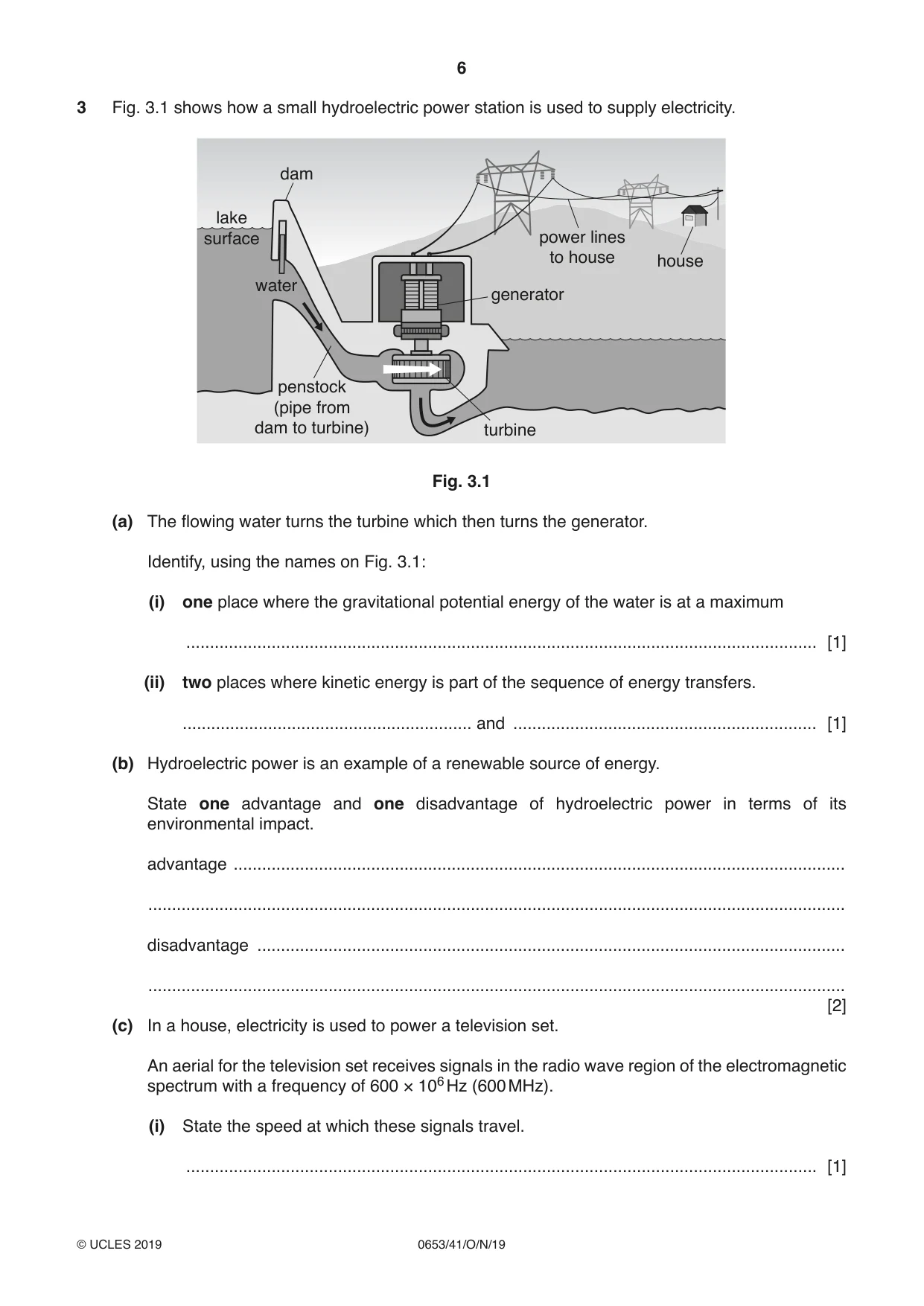
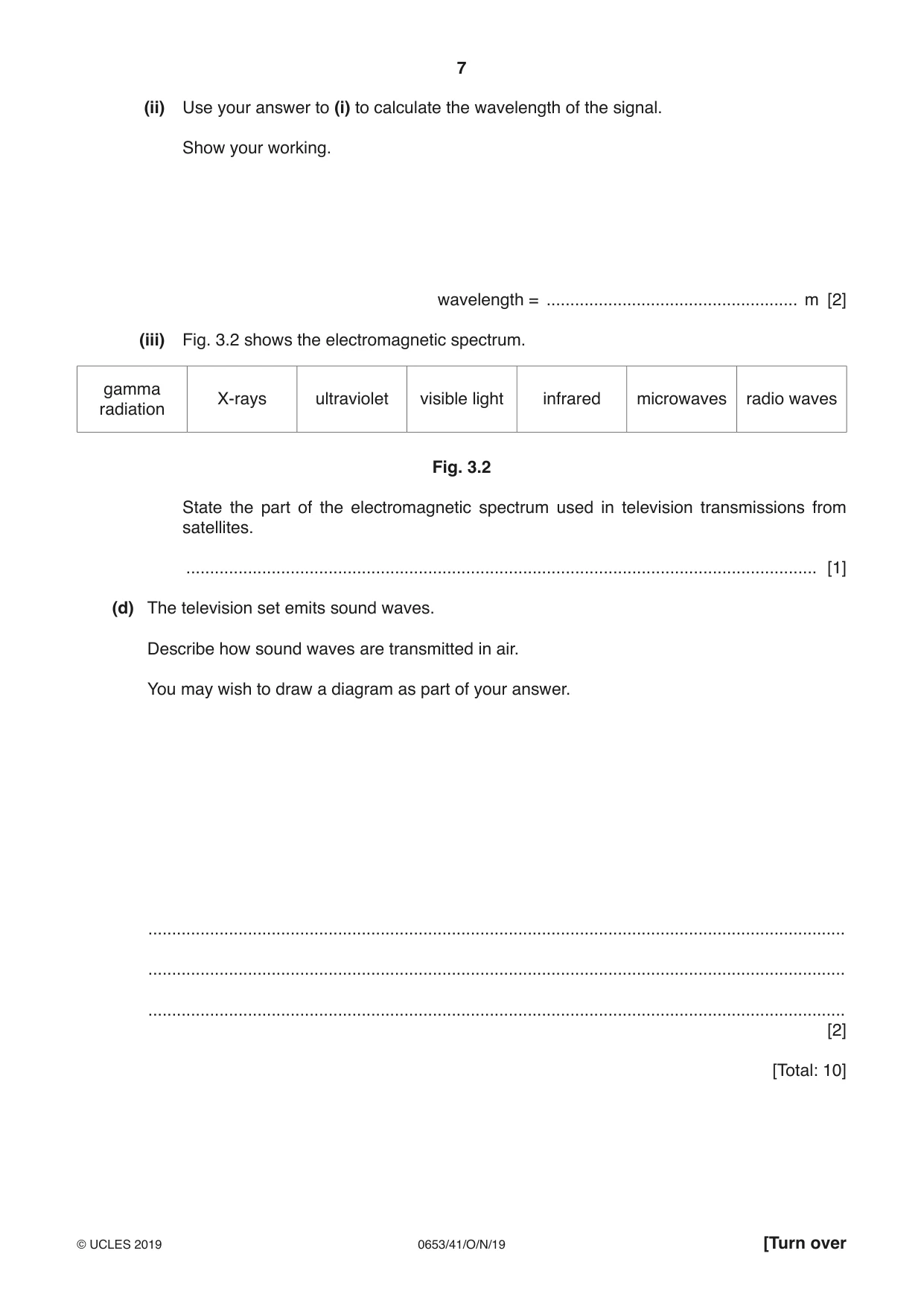
3 Fig. 3.1 shows how a small hydroelectric power station is used to supply electricity. dam lake surface power lines to house house water generator penstock (pipe from dam to turbine) turbine Fig. 3.1 (a) The flowing water turns the turbine which then turns the generator. Identify, using the names on Fig. 3.1: (i) one place where the gravitational potential energy of the water is at a maximum ..................................................................................................................................... [1] (ii) two places where kinetic energy is part of the sequence of energy transfers. ............................................................. and ................................................................ [1] (b) Hydroelectric power is an example of a renewable source of energy. State one advantage and one disadvantage of hydroelectric power in terms of its environmental impact. advantage ................................................................................................................................. ................................................................................................................................................... disadvantage ............................................................................................................................ ................................................................................................................................................... [2] (c) In a house, electricity is used to power a television set. An aerial for the television set receives signals in the radio wave region of the electromagnetic spectrum with a frequency of 600 × 106 Hz (600 MHz). (i) State the speed at which these signals travel. ..................................................................................................................................... [1] (ii) Use your answer to (i) to calculate the wavelength of the signal. Show your working. wavelength = ..................................................... m [2] (iii) Fig. 3.2 shows the electromagnetic spectrum. gamma X-rays ultraviolet visible light infrared microwaves radio wavesradiation Fig. 3.2 State the part of the electromagnetic spectrum used in television transmissions from satellites. ..................................................................................................................................... [1] (d) The television set emits sound waves. Describe how sound waves are transmitted in air. You may wish to draw a diagram as part of your answer. ................................................................................................................................................... ................................................................................................................................................... ................................................................................................................................................... [2] [Total: 10]
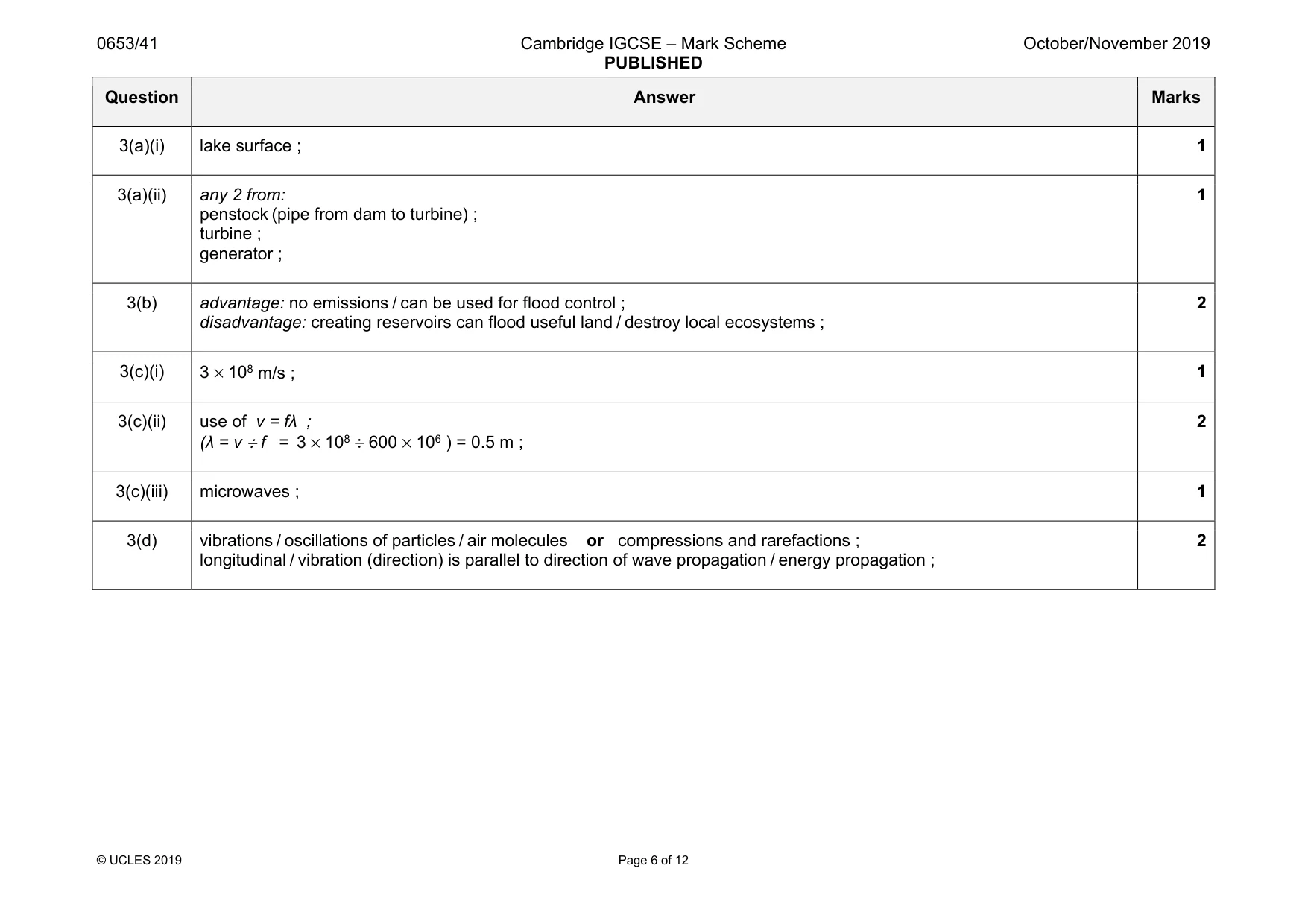
Mark scheme: 3(a)(i) lake surface ; 1 3(a)(ii) any 2 from: penstock (pipe from dam to turbine) ; turbine ; generator ; 1 3(b) advantage: no emissions / can be used for flood control ; disadvantage: creating reservoirs can flood useful land / destroy local ecosystems ; 2 3(c)(i) 3 × 10⁸ m/s ; 1 3(c)(ii) use of v = fλ ; (λ = v ÷ f = 3 × 10⁸ ÷ 600 × 106 ) = 0.5 m ; 2 3(c)(iii) microwaves ; 1 3(d) vibrations / oscillations of particles / air molecules or compressions and rarefactions ; longitudinal / vibration (direction) is parallel to direction of wave propagation / energy propagation ; 2
Q4 · Plants make glucose by the process of photosynthesis
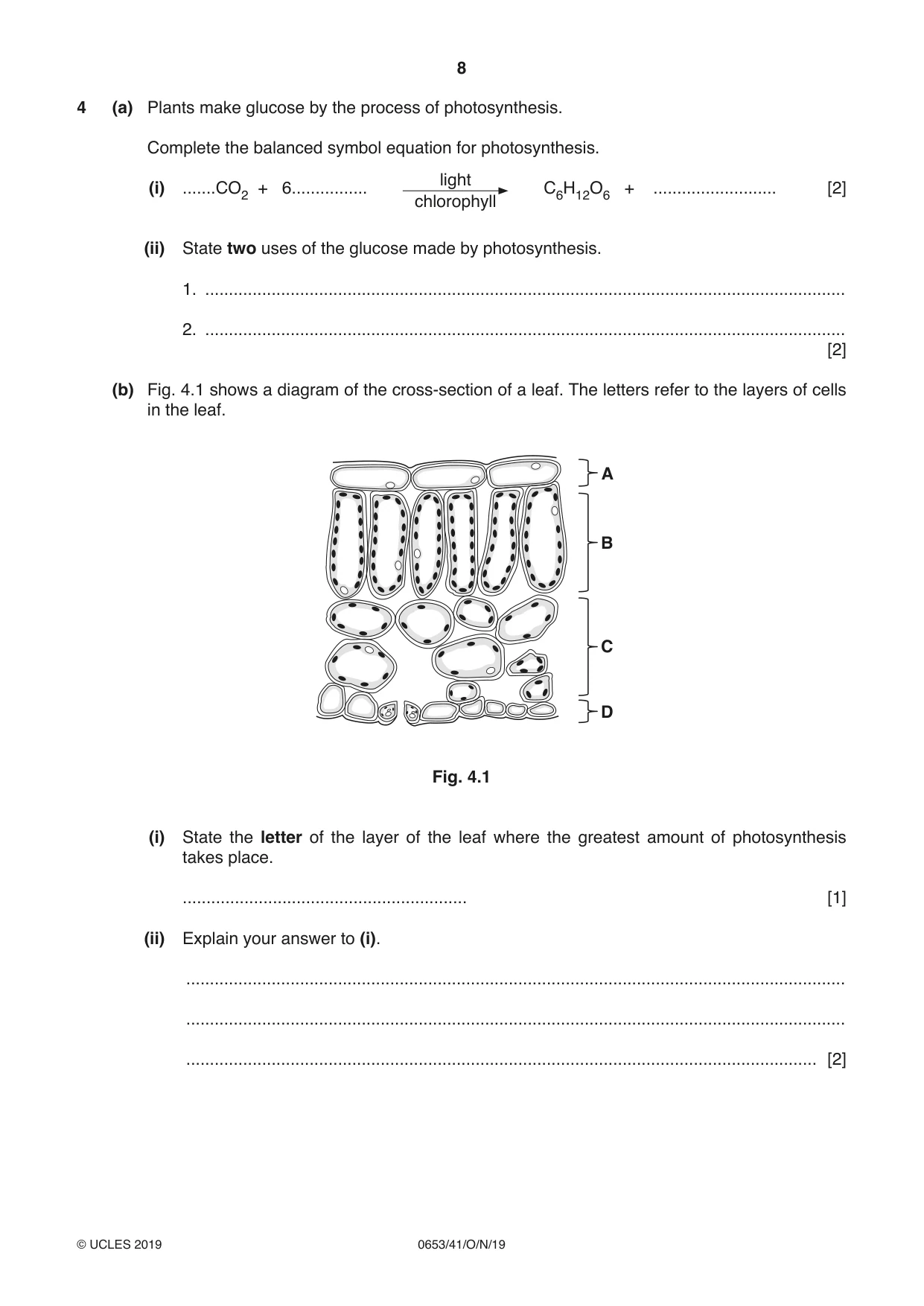
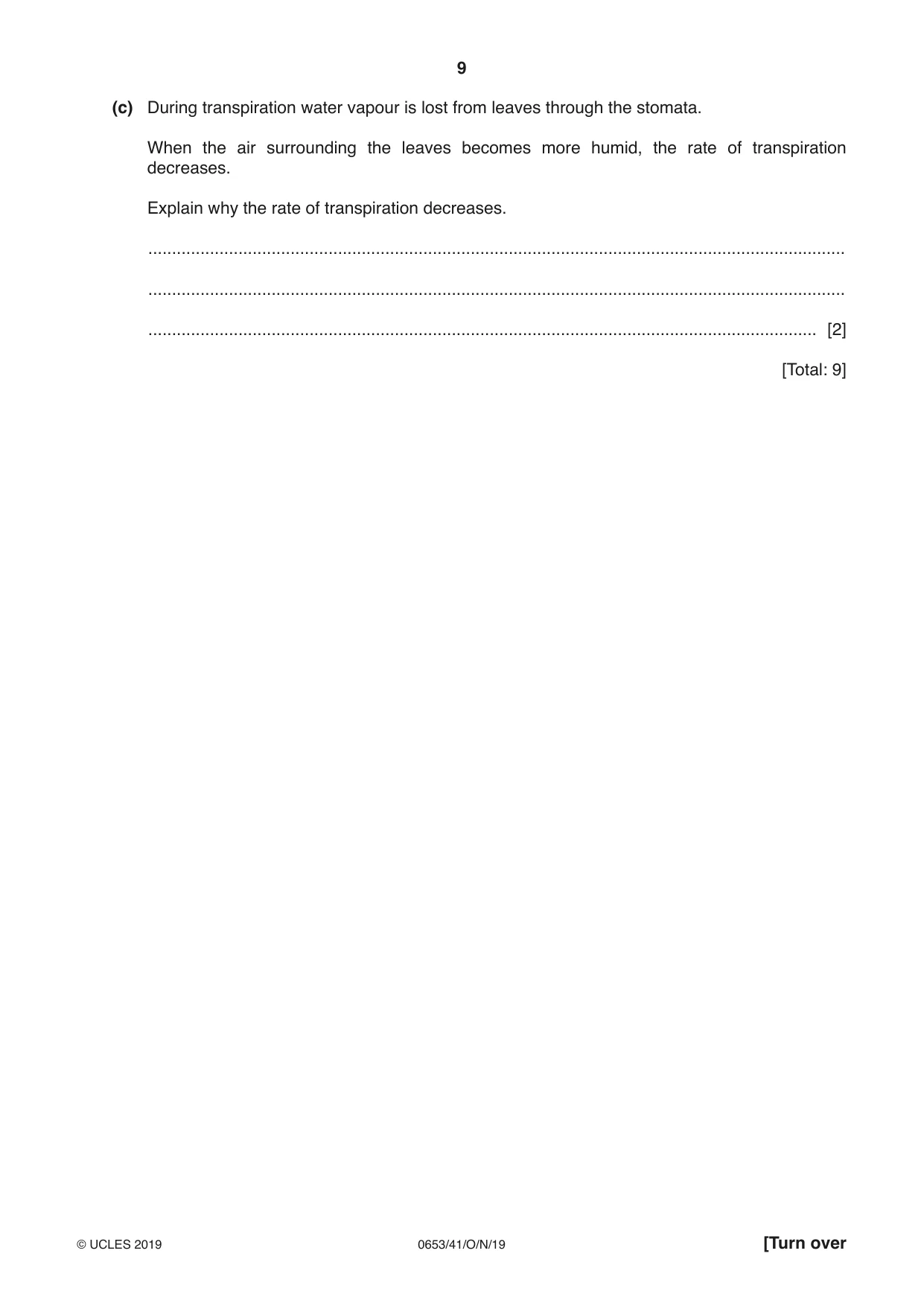
4 (a) Plants make glucose by the process of photosynthesis. Complete the balanced symbol equation for photosynthesis. light (i) .......CO2 + 6................ C6H12O6 + .......................... [2] chlorophyll (ii) State two uses of the glucose made by photosynthesis. 1. ....................................................................................................................................... 2. ....................................................................................................................................... [2] (b) Fig. 4.1 shows a diagram of the cross-section of a leaf. The letters refer to the layers of cells in the leaf. A B C D Fig. 4.1 (i) State the letter of the layer of the leaf where the greatest amount of photosynthesis takes place. ............................................................ [1] (ii) Explain your answer to (i). ........................................................................................................................................... ........................................................................................................................................... ..................................................................................................................................... [2] (c) During transpiration water vapour is lost from leaves through the stomata. When the air surrounding the leaves becomes more humid, the rate of transpiration decreases. Explain why the rate of transpiration decreases. ................................................................................................................................................... ................................................................................................................................................... ............................................................................................................................................. [2] [Total: 9]
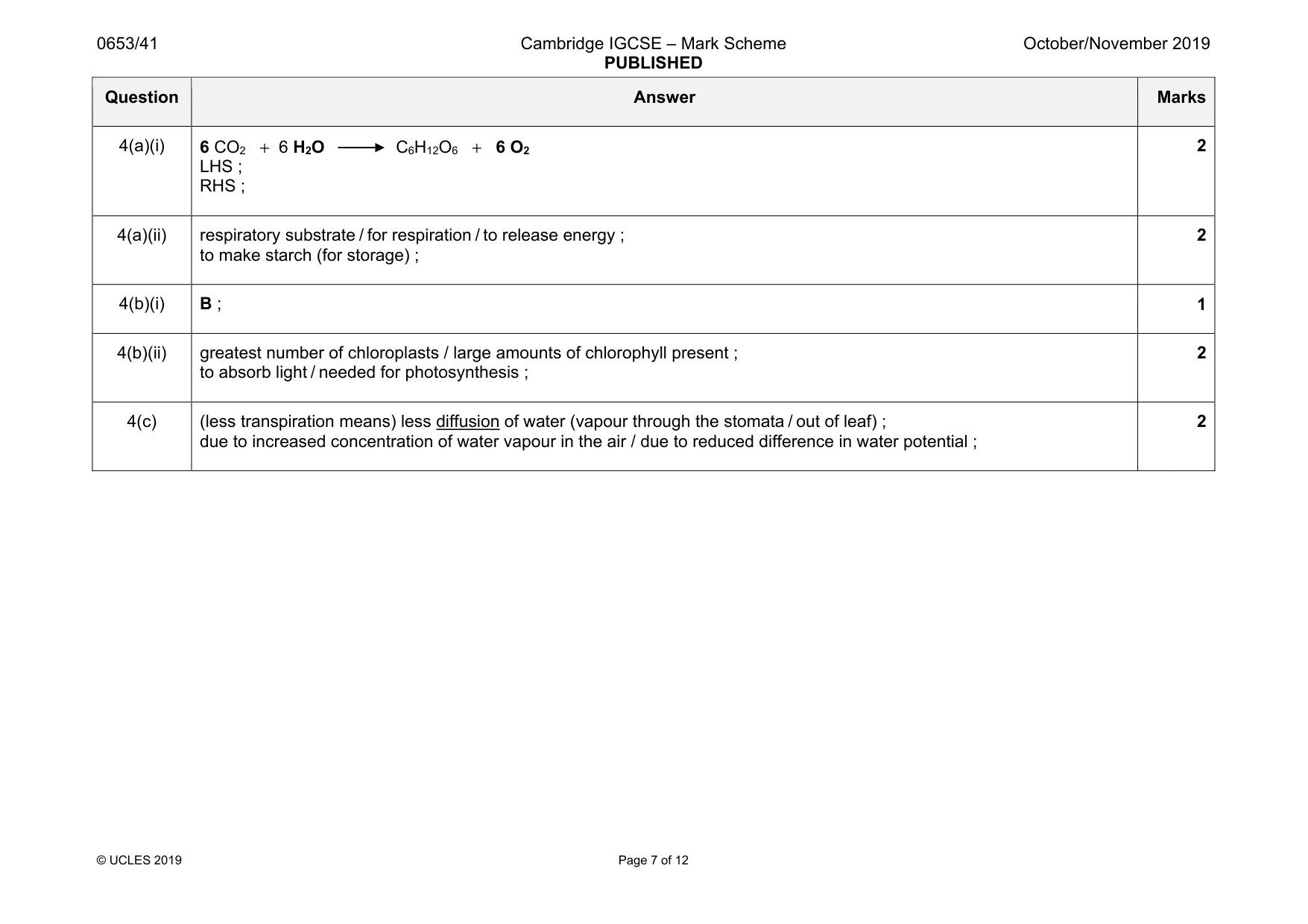
Mark scheme: 4(a)(i) LHS ; RHS ; 2 4(a)(ii) respiratory substrate / for respiration / to release energy ; to make starch (for storage) ; 2 4(b)(i) B ; 1 4(b)(ii) greatest number of chloroplasts / large amounts of chlorophyll present ; to absorb light / needed for photosynthesis ; 2 4(c) (less transpiration means) less diffusion of water (vapour through the stomata / out of leaf) ; due to increased concentration of water vapour in the air / due to reduced difference in water potential ; 2
Q5 · Aluminium is a Group III metal
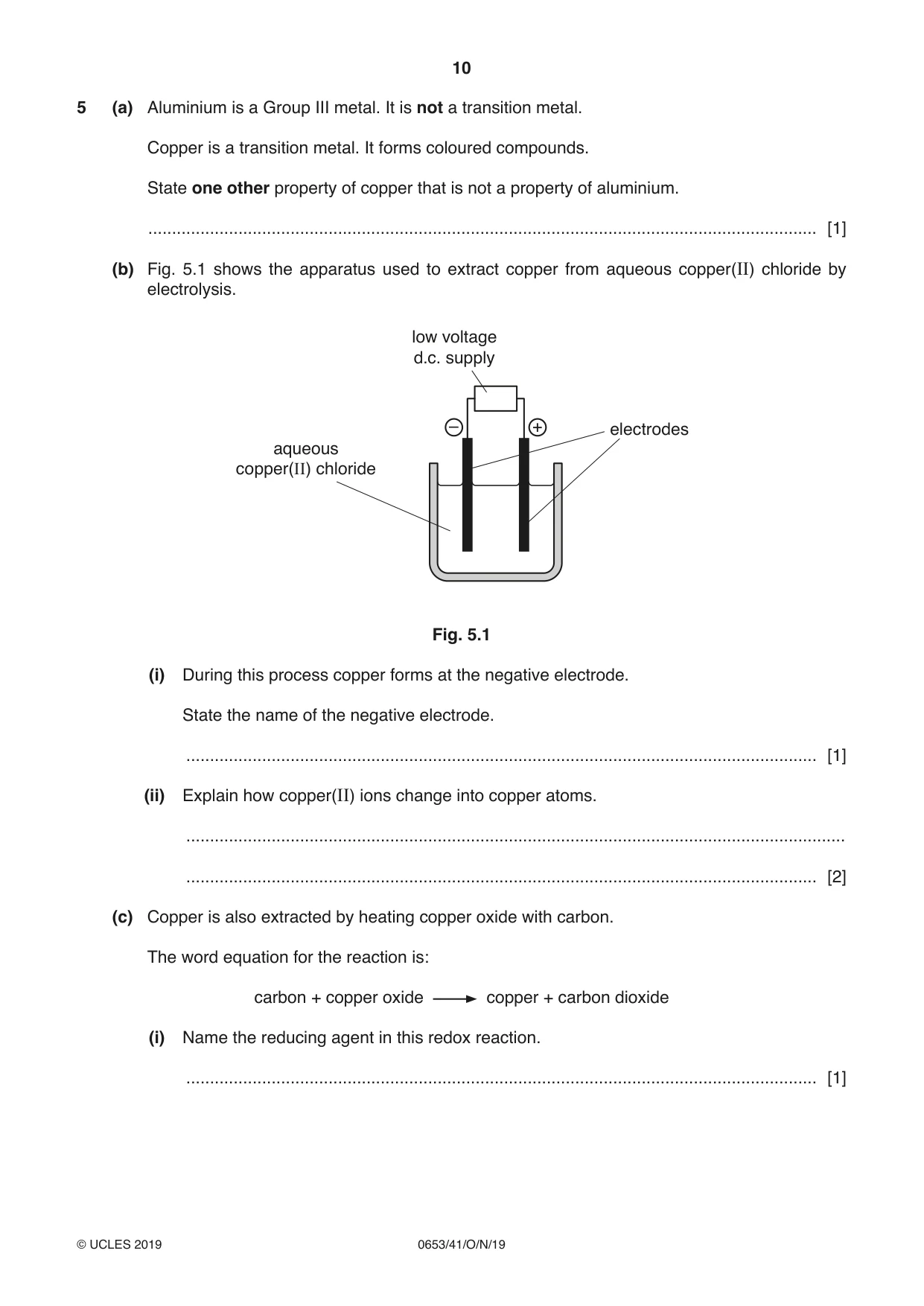
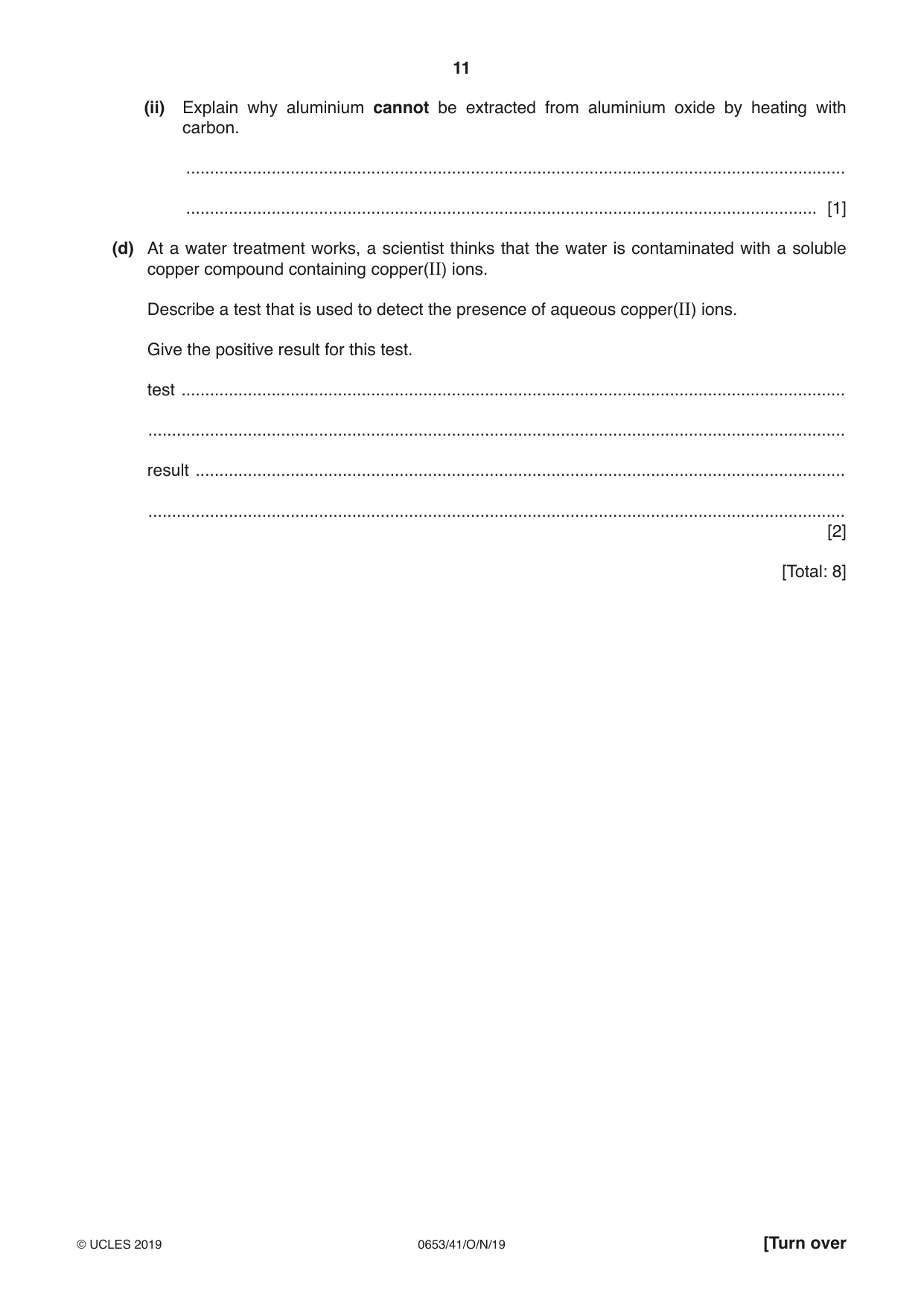
5 (a) Aluminium is a Group III metal. It is not a transition metal. Copper is a transition metal. It forms coloured compounds. State one other property of copper that is not a property of aluminium. ............................................................................................................................................. [1] (b) Fig. 5.1 shows the apparatus used to extract copper from aqueous copper(II) chloride by electrolysis. low voltage d.c. supply – + electrodes aqueous copper(II) chloride Fig. 5.1 (i) During this process copper forms at the negative electrode. State the name of the negative electrode. ..................................................................................................................................... [1] (ii) Explain how copper(II) ions change into copper atoms. ........................................................................................................................................... ..................................................................................................................................... [2] (c) Copper is also extracted by heating copper oxide with carbon. The word equation for the reaction is: carbon + copper oxide copper + carbon dioxide (i) Name the reducing agent in this redox reaction. ..................................................................................................................................... [1] (ii) Explain why aluminium cannot be extracted from aluminium oxide by heating with carbon. ........................................................................................................................................... ..................................................................................................................................... [1] (d) At a water treatment works, a scientist thinks that the water is contaminated with a soluble copper compound containing copper(II) ions. Describe a test that is used to detect the presence of aqueous copper(II) ions. Give the positive result for this test. test ............................................................................................................................................ ................................................................................................................................................... result ......................................................................................................................................... ................................................................................................................................................... [2] [Total: 8]
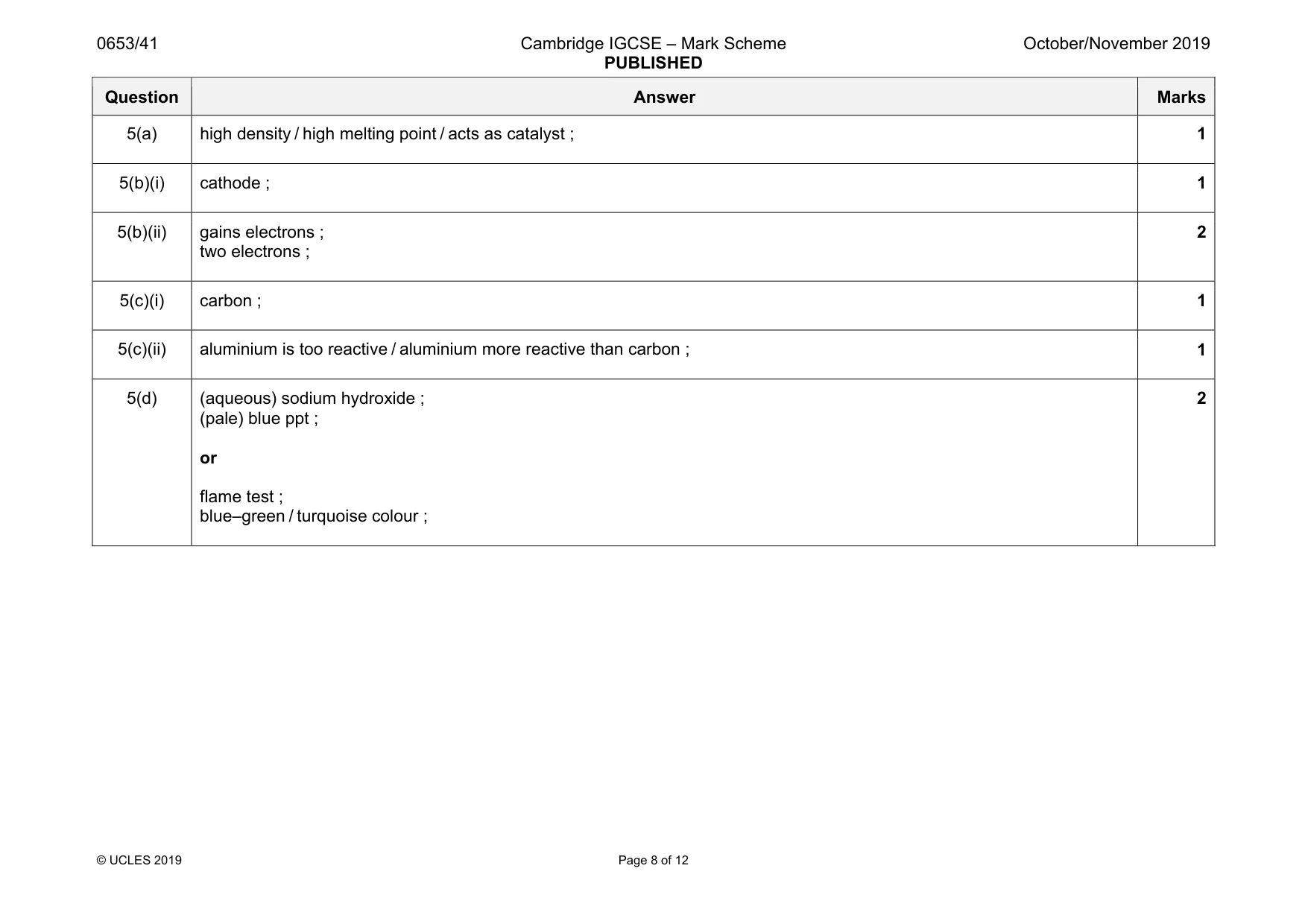
Mark scheme: 5(a) high density / high melting point / acts as catalyst ; 1 5(b)(i) cathode ; 1 5(b)(ii) gains electrons ; two electrons ; 2 5(c)(i) carbon ; 1 5(c)(ii) aluminium is too reactive / aluminium more reactive than carbon ; 1 5(d) (aqueous) sodium hydroxide ; (pale) blue ppt ; or flame test ; blue–green / turquoise colour ; 2
Q6 · Some data about the planets Earth, Mars, Mercury and Venus
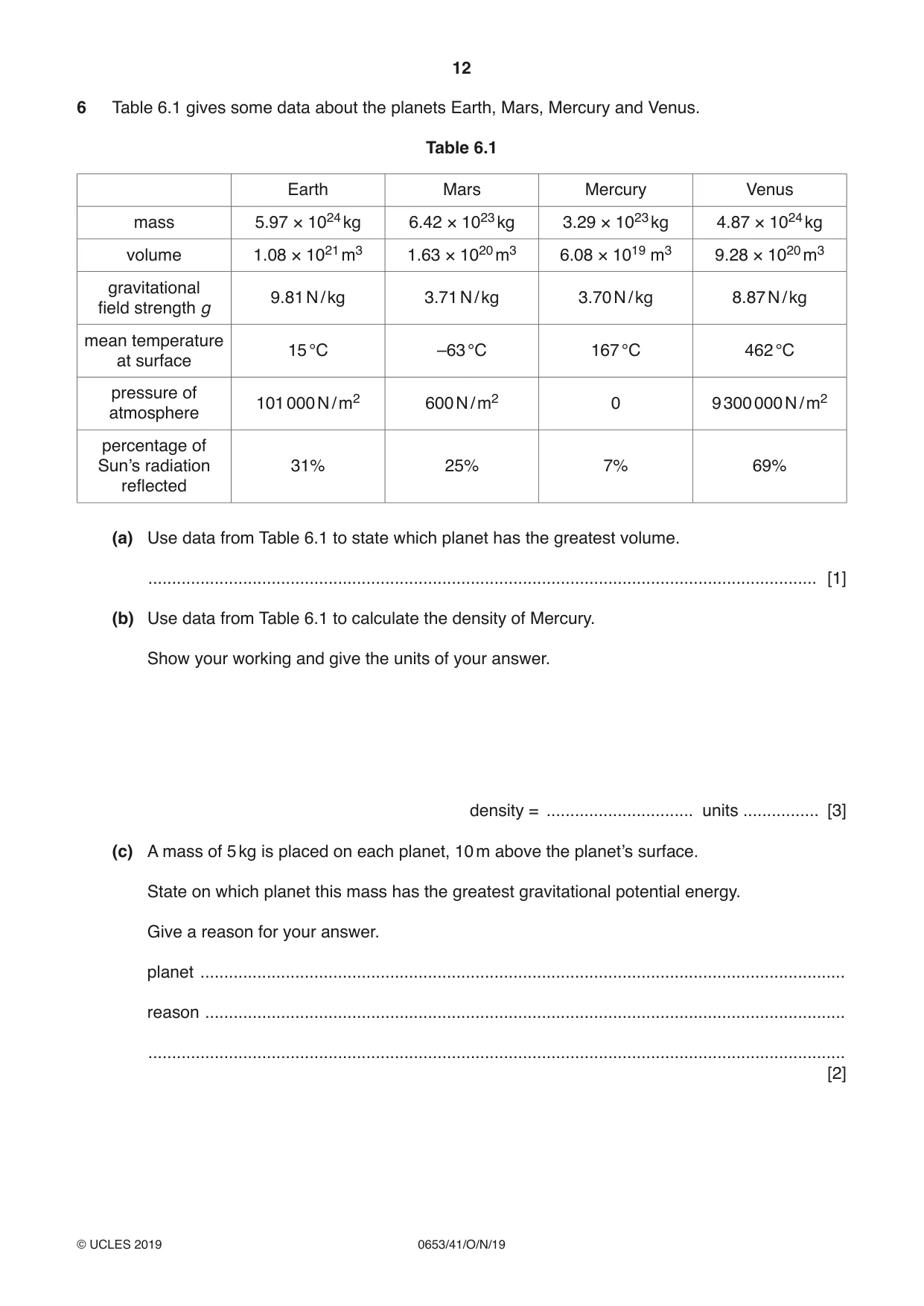
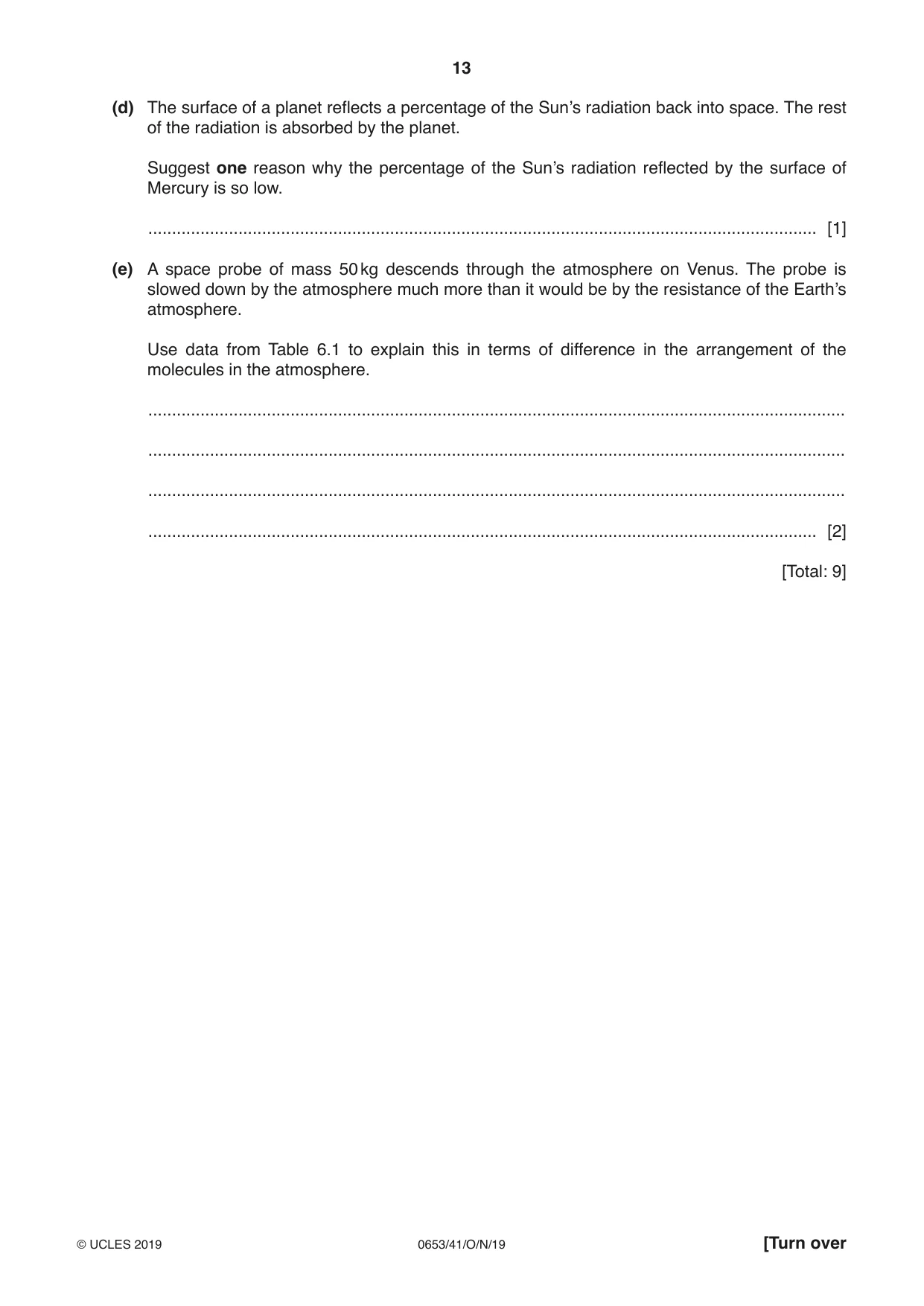
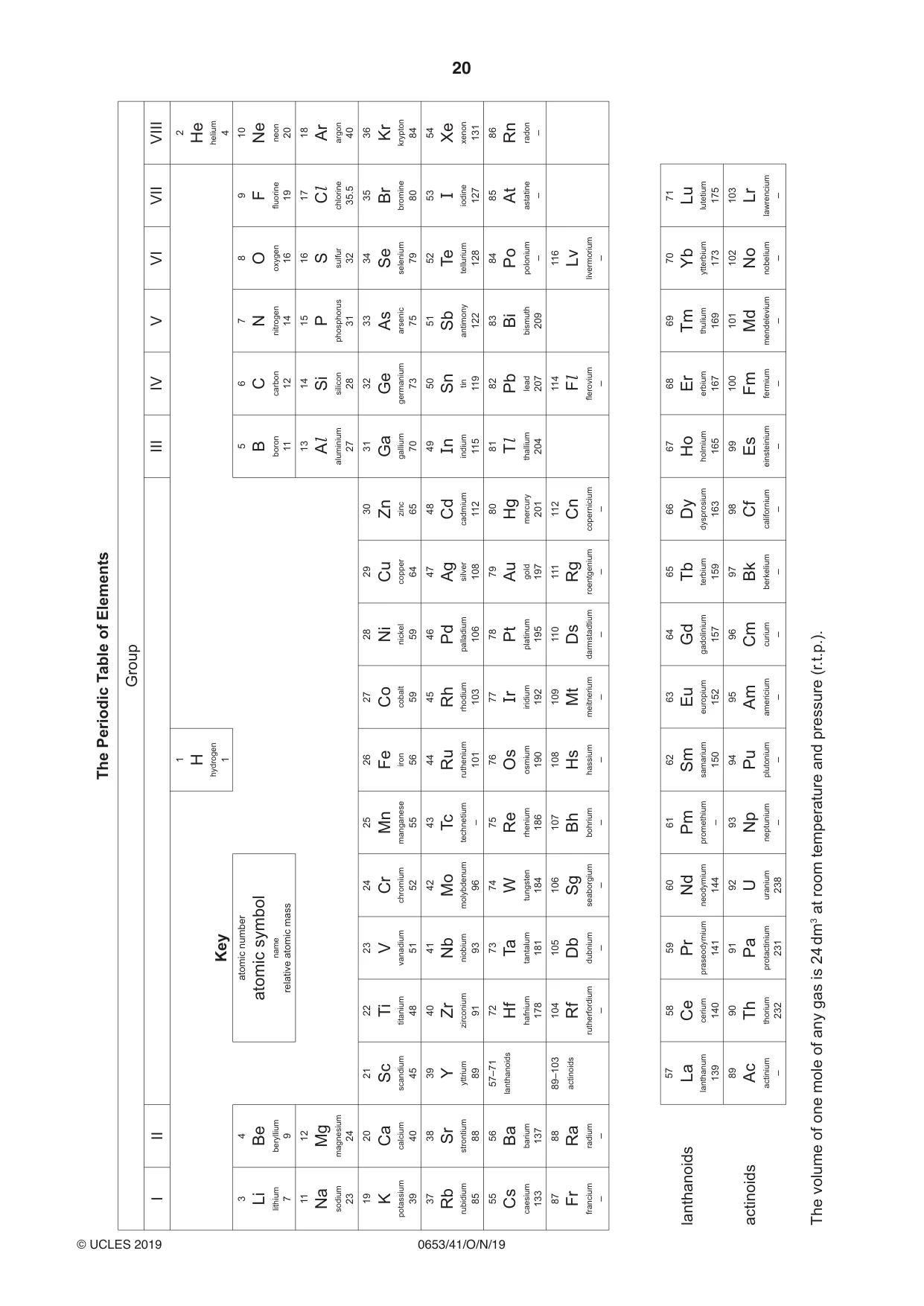
6 Table 6.1 gives some data about the planets Earth, Mars, Mercury and Venus. Table 6.1 Earth Mars Mercury Venus mass 5.97 × 1024 kg 6.42 × 10²³ kg 3.29 × 10²³ kg 4.87 × 1024 kg volume 1.08 × 10²¹ m3 1.63 × 10²⁰ m3 6.08 × 10¹⁹ m3 9.28 × 10²⁰ m3 gravitational 9.81 N / kg 3.71 N / kg 3.70 N / kg 8.87 N / kg field strength g mean temperature 15 °C –63 °C 167 °C 462 °C at surface pressure of 101 000 N / m2 600 N / m2 0 9 300 000 N / m2 atmosphere percentage of Sun’s radiation 31% 25% 7% 69% reflected (a) Use data from Table 6.1 to state which planet has the greatest volume. ............................................................................................................................................. [1] (b) Use data from Table 6.1 to calculate the density of Mercury. Show your working and give the units of your answer. density = ............................... units ................ [3] (c) A mass of 5 kg is placed on each planet, 10 m above the planet’s surface. State on which planet this mass has the greatest gravitational potential energy. Give a reason for your answer. planet ........................................................................................................................................ reason ....................................................................................................................................... ................................................................................................................................................... [2] (d) The surface of a planet reflects a percentage of the Sun’s radiation back into space. The rest of the radiation is absorbed by the planet. Suggest one reason why the percentage of the Sun’s radiation reflected by the surface of Mercury is so low. ............................................................................................................................................. [1] (e) A space probe of mass 50 kg descends through the atmosphere on Venus. The probe is slowed down by the atmosphere much more than it would be by the resistance of the Earth’s atmosphere. Use data from Table 6.1 to explain this in terms of difference in the arrangement of the molecules in the atmosphere. ................................................................................................................................................... ................................................................................................................................................... ................................................................................................................................................... ............................................................................................................................................. [2] [Total: 9]
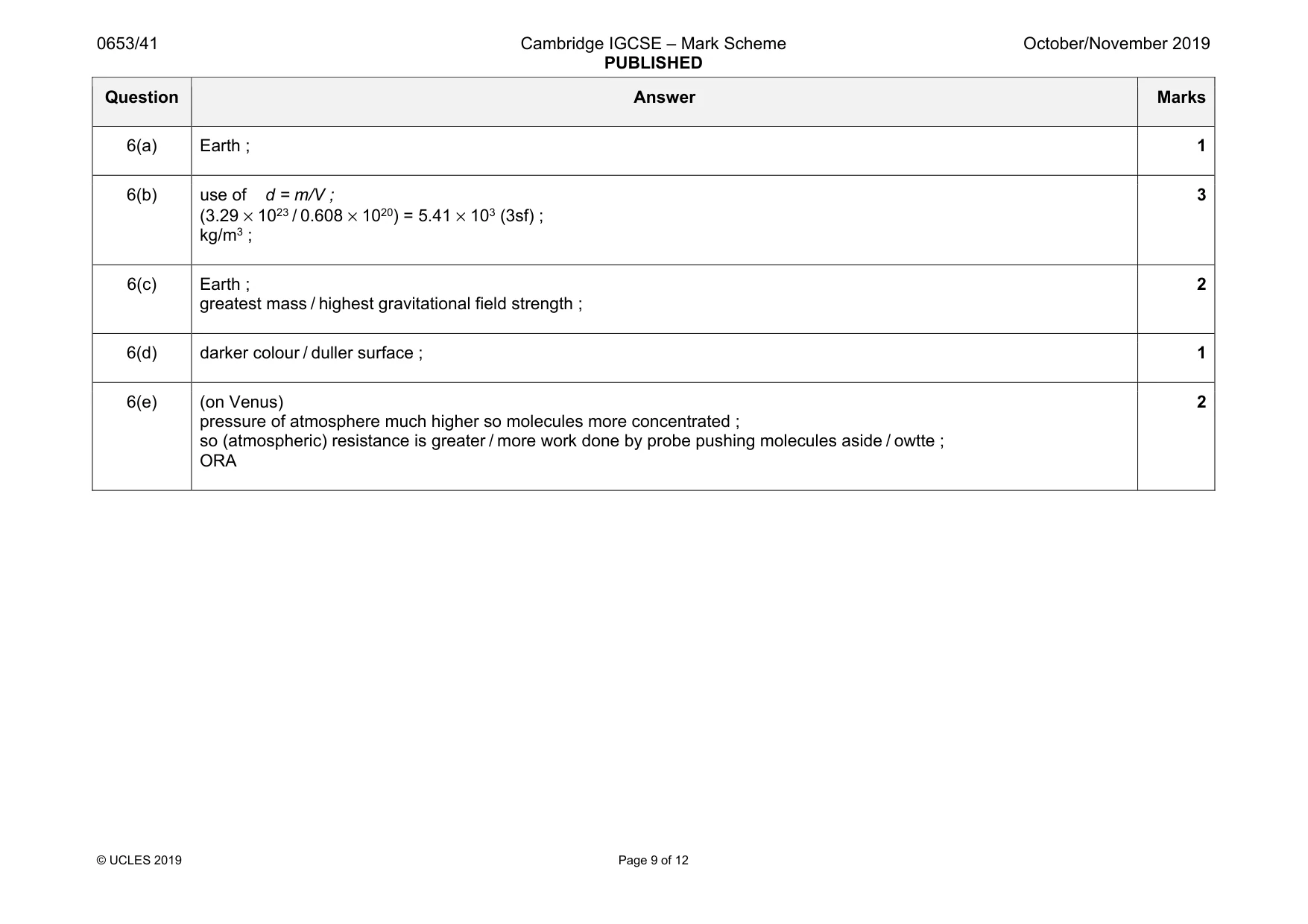
Mark scheme: 6(a) Earth ; 1 6(b) use of d = m/V ; (3.29 × 10²³ / 0.608 × 10²⁰) = 5.41 × 10³ (3sf) ; kg/m3 ; 3 6(c) Earth ; greatest mass / highest gravitational field strength ; 2 6(d) darker colour / duller surface ; 1 6(e) (on Venus) pressure of atmosphere much higher so molecules more concentrated ; so (atmospheric) resistance is greater / more work done by probe pushing molecules aside / owtte ; ORA 2
Q7 · The flow of energy through a forest ecosystem
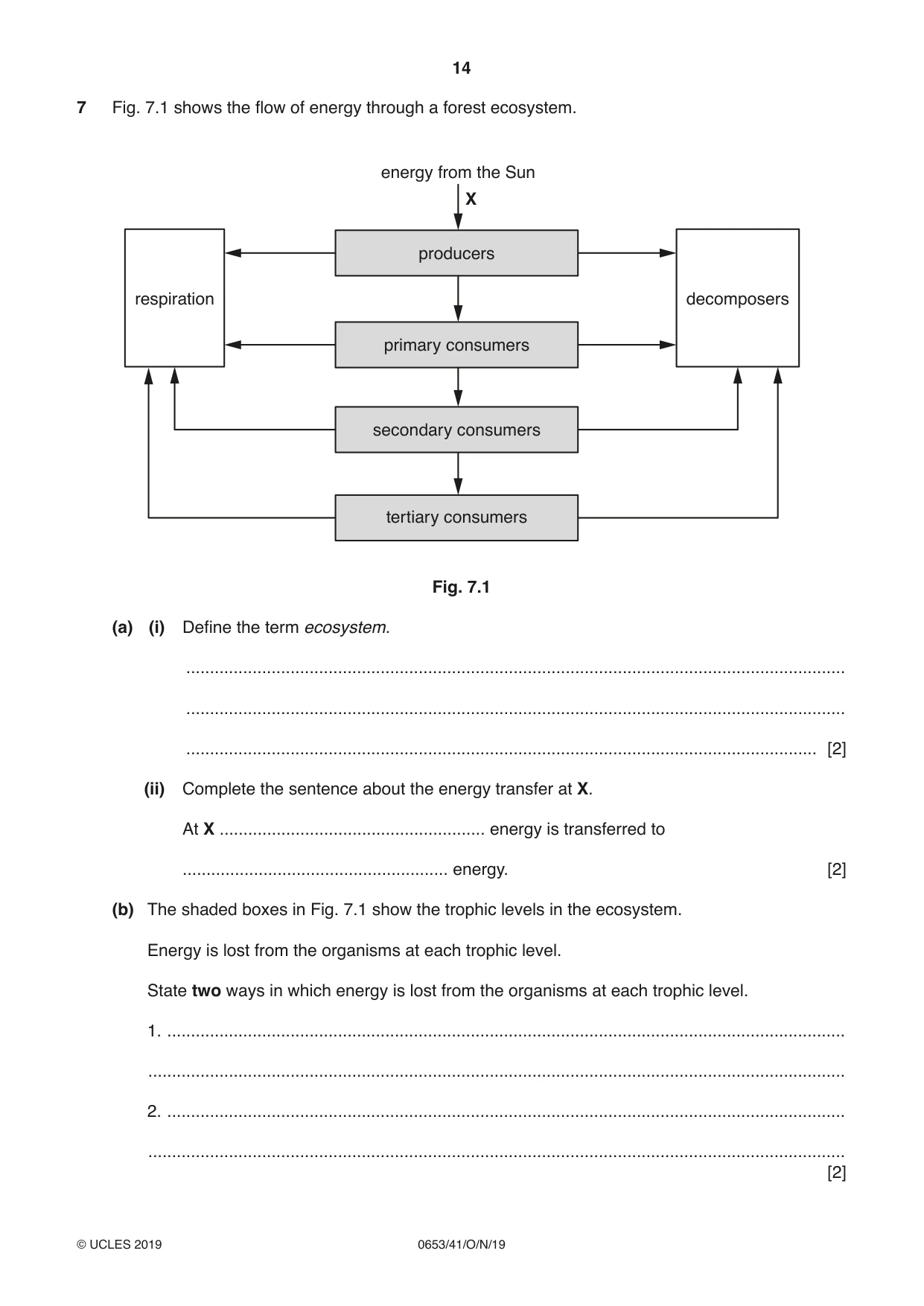
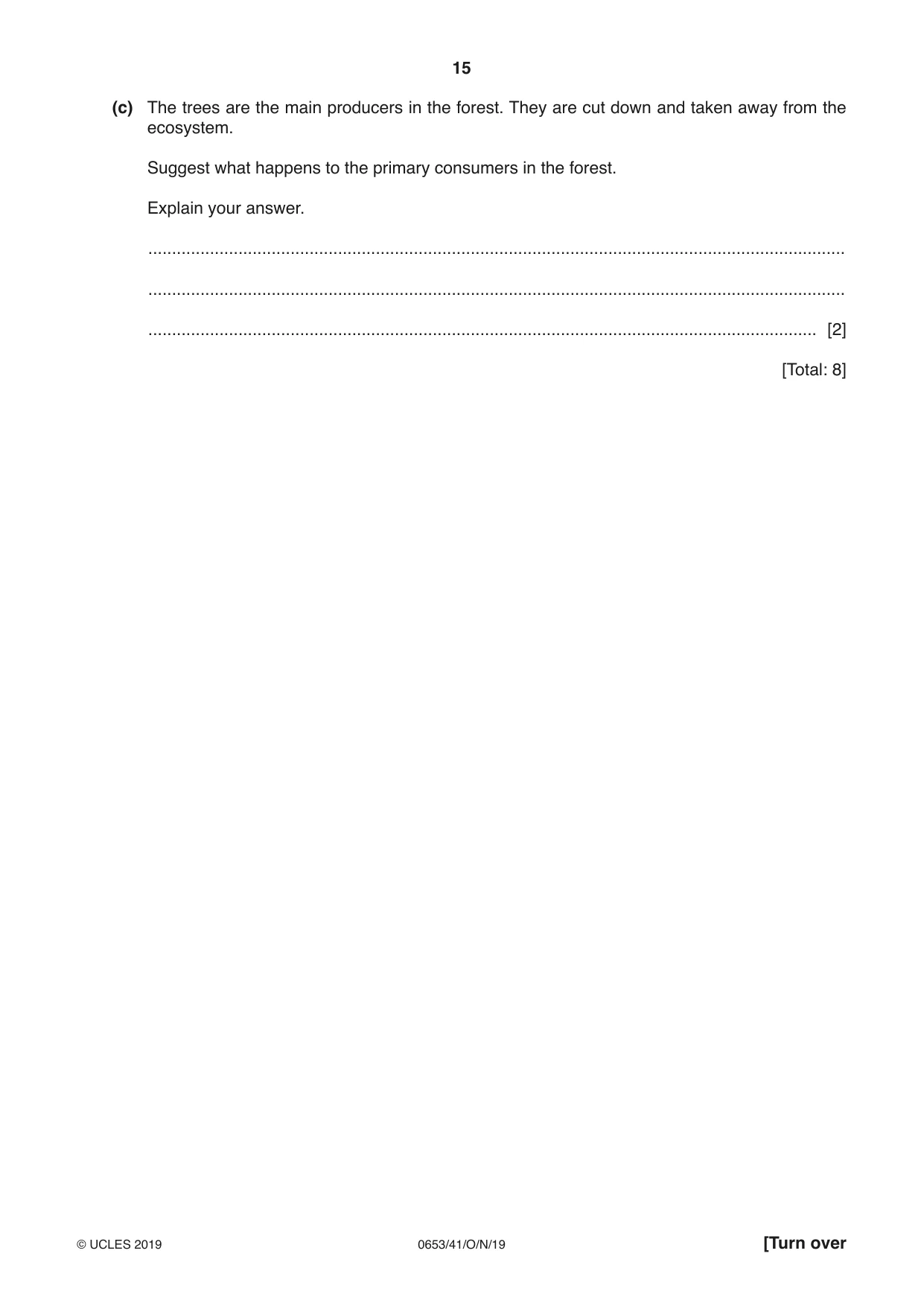
7 Fig. 7.1 shows the flow of energy through a forest ecosystem. energy from the Sun X producers respiration decomposers primary consumers secondary consumers tertiary consumers Fig. 7.1 (a) (i) Define the term ecosystem. ........................................................................................................................................... ........................................................................................................................................... ..................................................................................................................................... [2] (ii) Complete the sentence about the energy transfer at X. At X ........................................................ energy is transferred to ........................................................ energy. [2] (b) The shaded boxes in Fig. 7.1 show the trophic levels in the ecosystem. Energy is lost from the organisms at each trophic level. State two ways in which energy is lost from the organisms at each trophic level. 1. ............................................................................................................................................... ................................................................................................................................................... 2. ............................................................................................................................................... ................................................................................................................................................... [2] (c) The trees are the main producers in the forest. They are cut down and taken away from the ecosystem. Suggest what happens to the primary consumers in the forest. Explain your answer. ................................................................................................................................................... ................................................................................................................................................... ............................................................................................................................................. [2] [Total: 8]
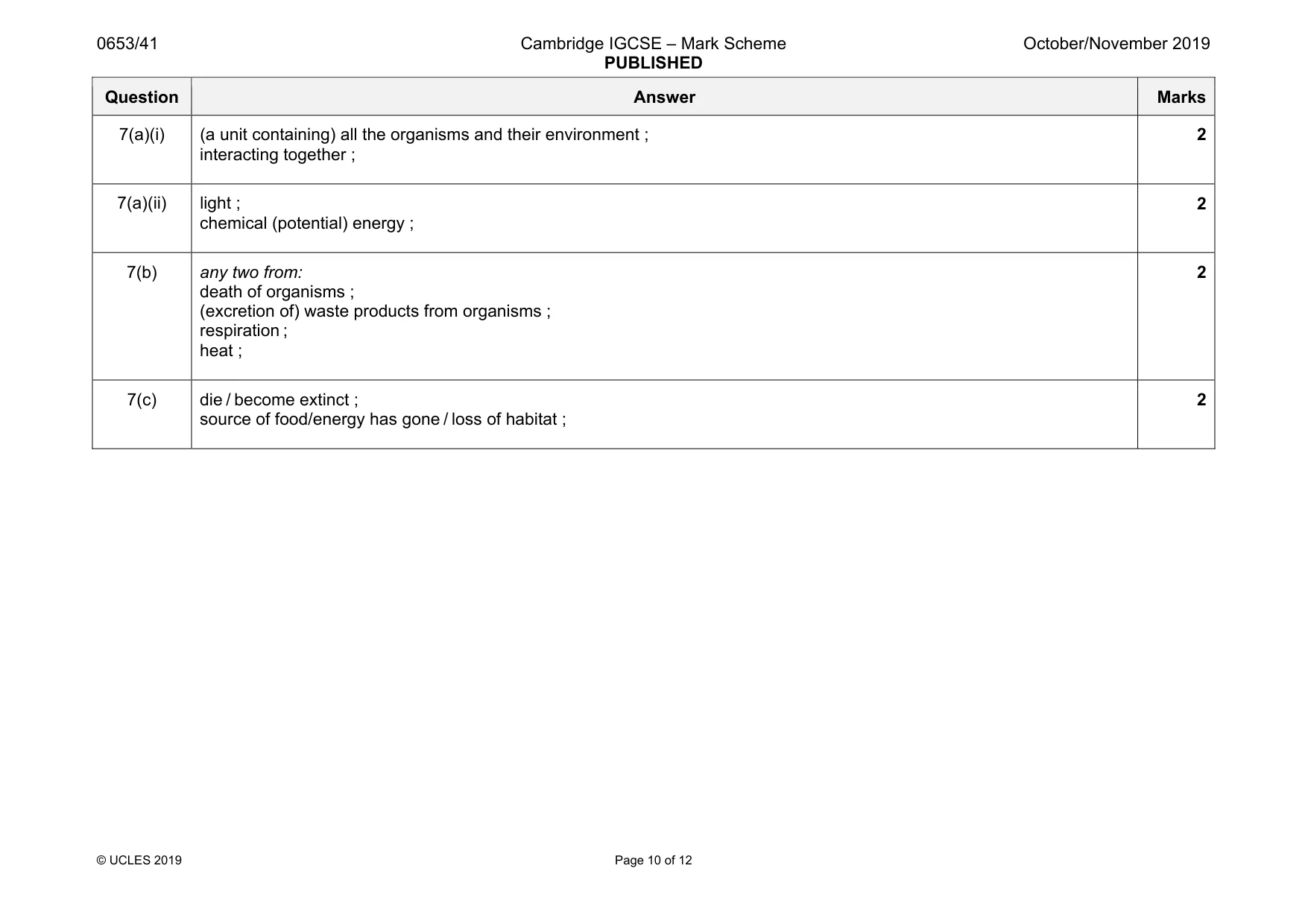
Mark scheme: 7(a)(i) (a unit containing) all the organisms and their environment ; interacting together ; 2 7(a)(ii) light ; chemical (potential) energy ; 2 7(b) any two from: death of organisms ; (excretion of) waste products from organisms ; respiration ; heat ; 2 7(c) die / become extinct ; source of food/energy has gone / loss of habitat ; 2
Q8 · Data about Group I metals
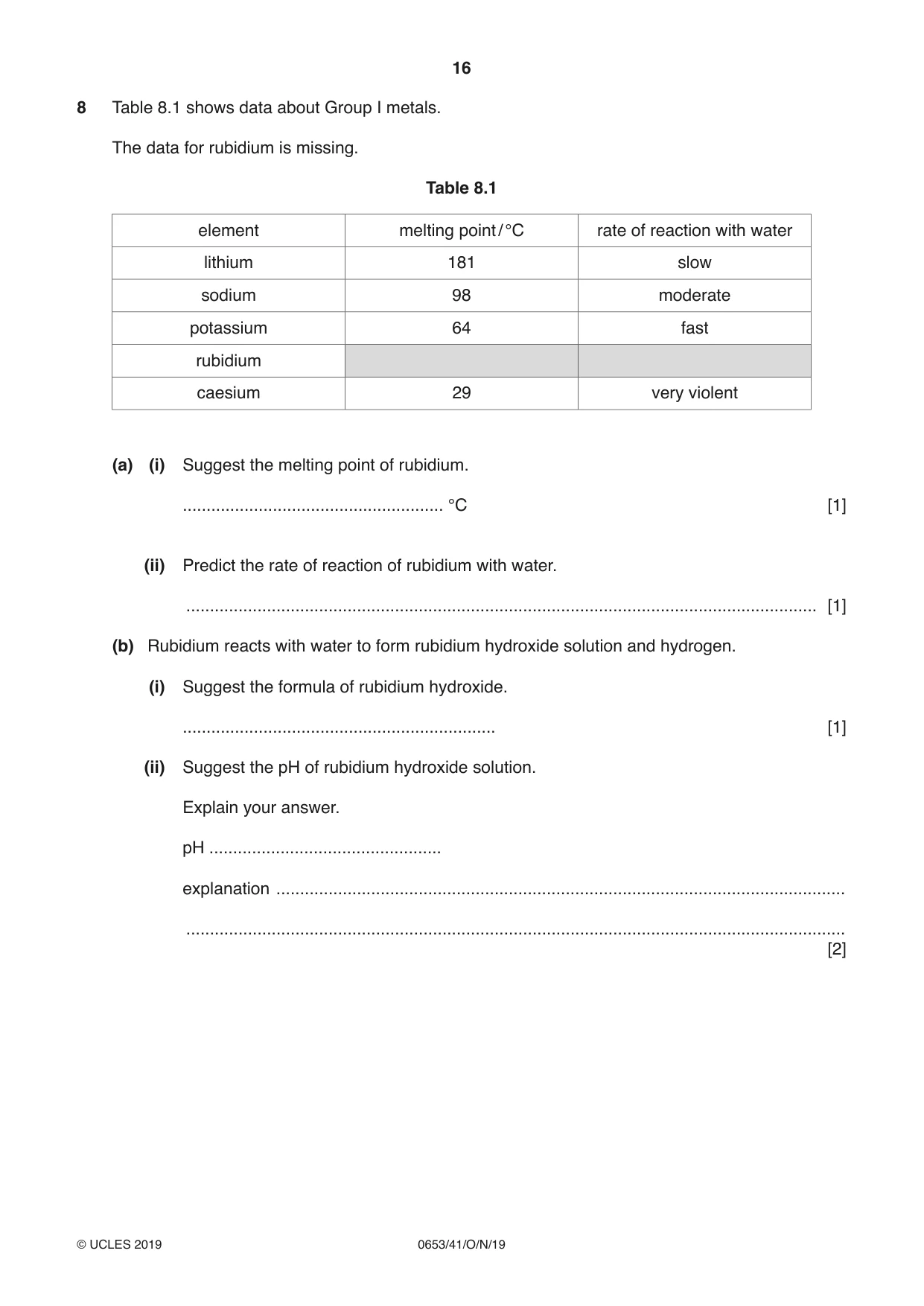
8 Table 8.1 shows data about Group I metals. The data for rubidium is missing. Table 8.1 element melting point / °C rate of reaction with water lithium 181 slow sodium 98 moderate potassium 64 fast rubidium caesium 29 very violent (a) (i) Suggest the melting point of rubidium. ....................................................... °C [1] (ii) Predict the rate of reaction of rubidium with water. ..................................................................................................................................... [1] (b) Rubidium reacts with water to form rubidium hydroxide solution and hydrogen. (i) Suggest the formula of rubidium hydroxide. .................................................................. [1] (ii) Suggest the pH of rubidium hydroxide solution. Explain your answer. pH ................................................. explanation ........................................................................................................................ ........................................................................................................................................... [2] (c) Rubidium hydroxide has a higher melting point than water. Explain the difference in the melting point of rubidium hydroxide and of water. In your answer refer to the type of bonds and the attractive forces. ................................................................................................................................................... ................................................................................................................................................... ................................................................................................................................................... ................................................................................................................................................... ................................................................................................................................................... ............................................................................................................................................. [3] (d) The reaction between rubidium and water is exothermic. Describe what happens during an exothermic reaction. Use ideas about chemical energy and thermal energy in your answer. ................................................................................................................................................... ................................................................................................................................................... ................................................................................................................................................... ............................................................................................................................................. [2] [Total: 10]
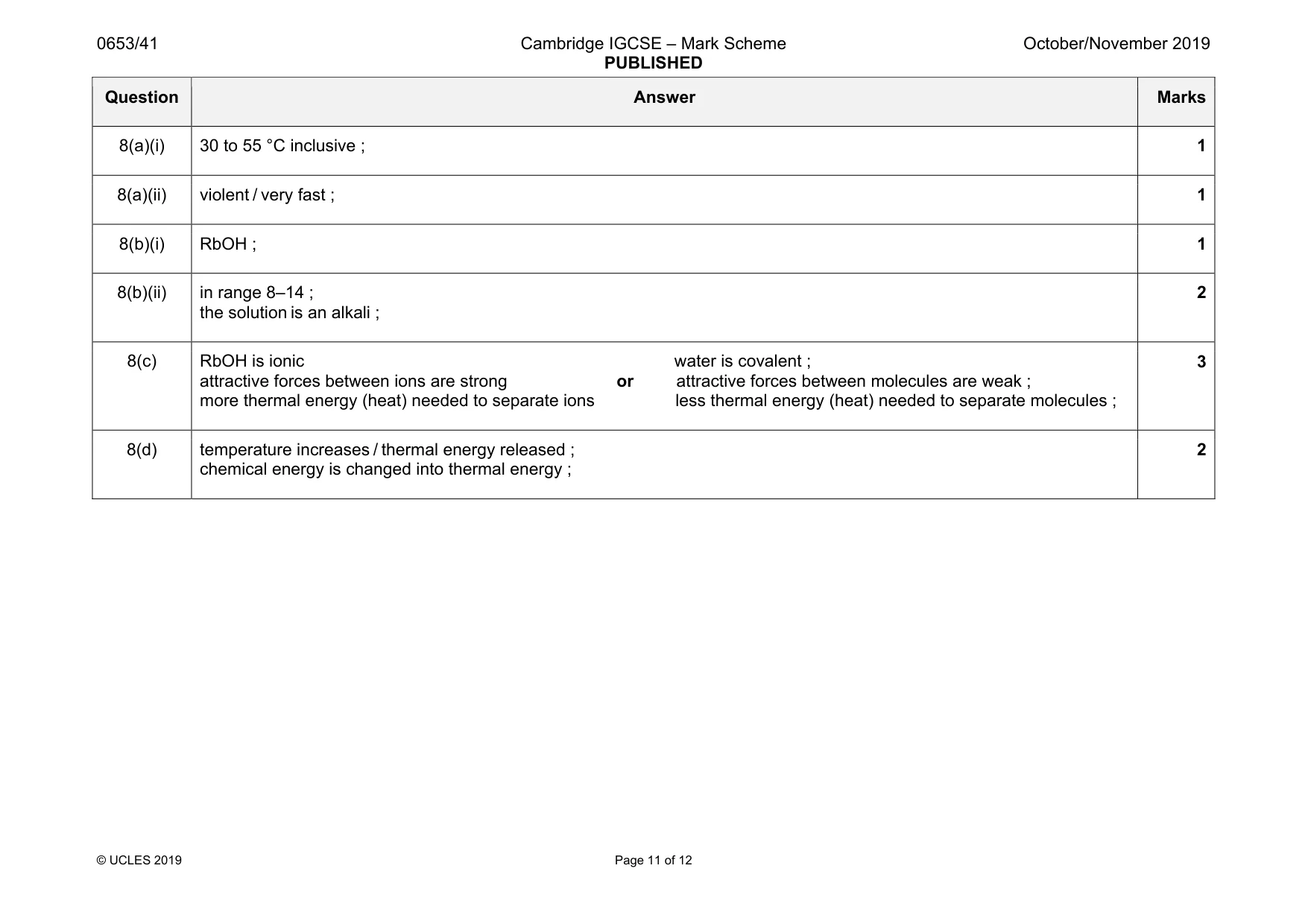
Mark scheme: 8(a)(i) 30 to 55 °C inclusive ; 1 8(a)(ii) violent / very fast ; 1 8(b)(i) RbOH ; 1 8(b)(ii) in range 8–14 ; the solution is an alkali ; 2 8(c) RbOH is ionic water is covalent ; attractive forces between ions are strong or attractive forces between molecules are weak ; more thermal energy (heat) needed to separate ions less thermal energy (heat) needed to separate molecules ; 3 8(d) temperature increases / thermal energy released ; chemical energy is changed into thermal energy ; 2
Q9 · A circuit containing three resistors, R1, R2 and R3
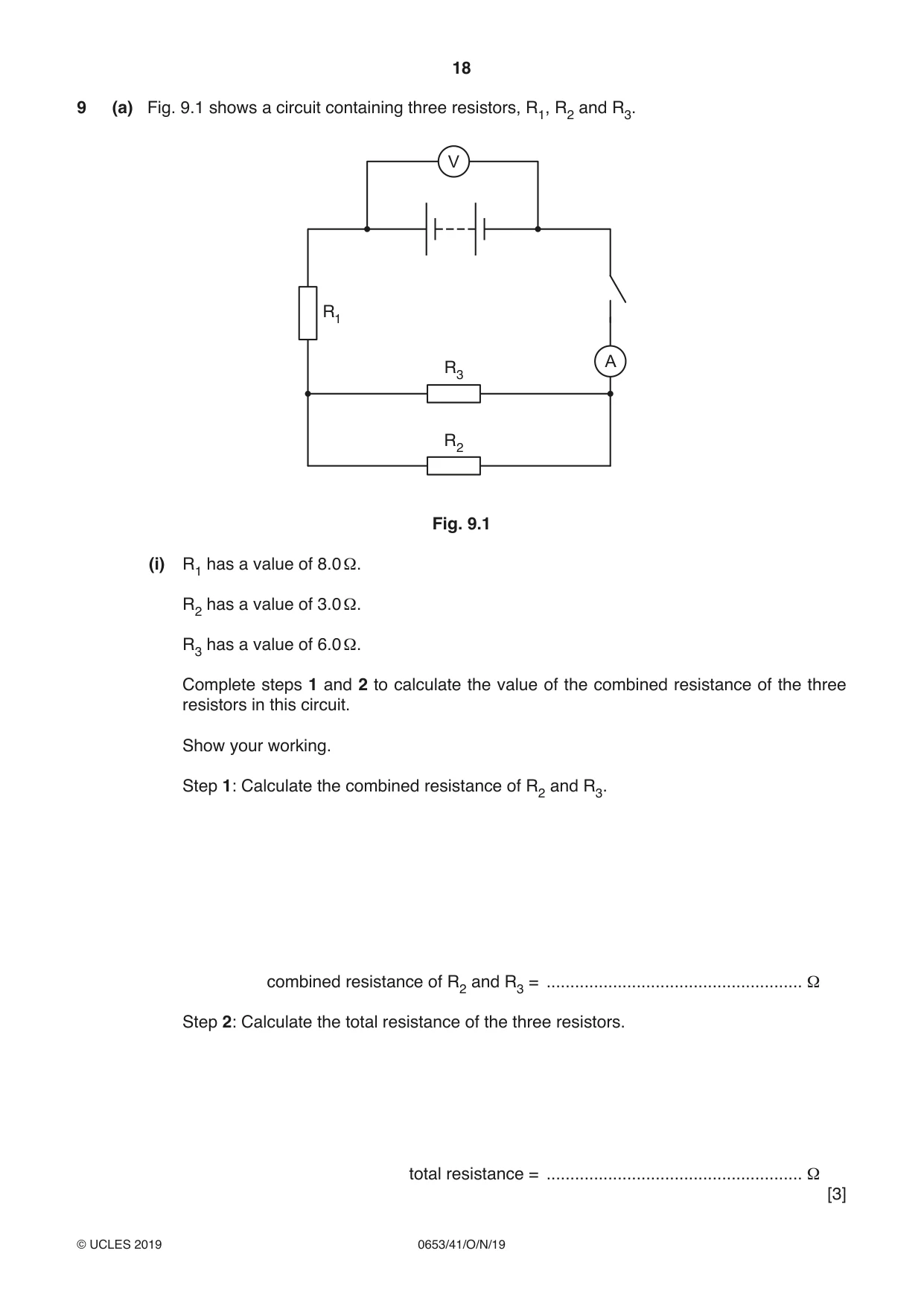
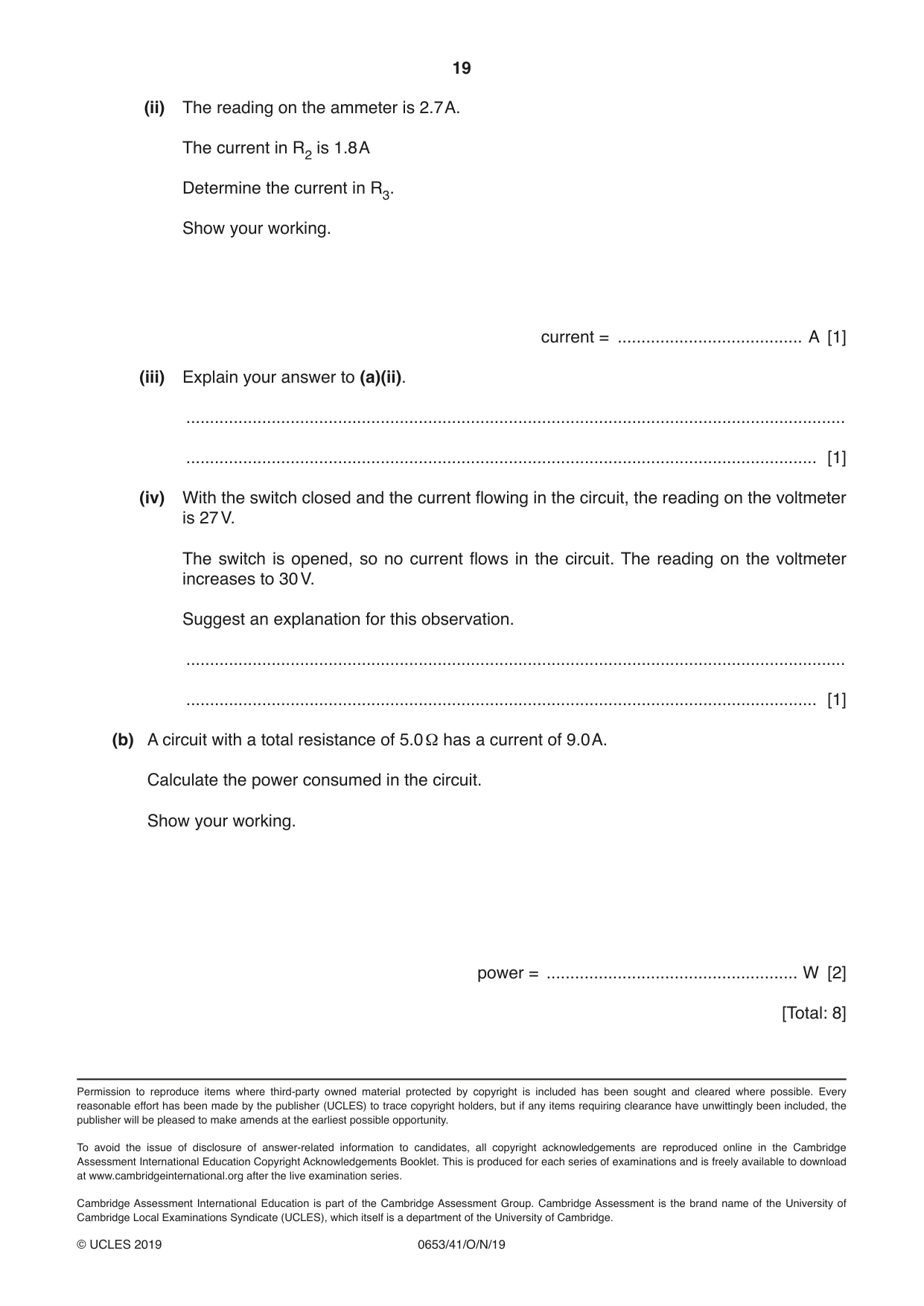
9 (a) Fig. 9.1 shows a circuit containing three resistors, R1, R2 and R3. V R1 R3 A R2 Fig. 9.1 (i) R1 has a value of 8.0 Ω. R2 has a value of 3.0 Ω. R3 has a value of 6.0 Ω. Complete steps 1 and 2 to calculate the value of the combined resistance of the three resistors in this circuit. Show your working. Step 1: Calculate the combined resistance of R2 and R3. Ω combined resistance of R2 and R3 = ...................................................... Step 2: Calculate the total resistance of the three resistors. total resistance = ...................................................... Ω [3] (ii) The reading on the ammeter is 2.7 A. The current in R2 is 1.8 A Determine the current in R3. Show your working. current = ....................................... A [1] (iii) Explain your answer to (a)(ii). ........................................................................................................................................... ..................................................................................................................................... [1] (iv) With the switch closed and the current flowing in the circuit, the reading on the voltmeter is 27 V. The switch is opened, so no current flows in the circuit. The reading on the voltmeter increases to 30 V. Suggest an explanation for this observation. ........................................................................................................................................... ..................................................................................................................................... [1] (b) A circuit with a total resistance of 5.0 Ω has a current of 9.0 A. Calculate the power consumed in the circuit. Show your working. power = ..................................................... W [2] [Total: 8]
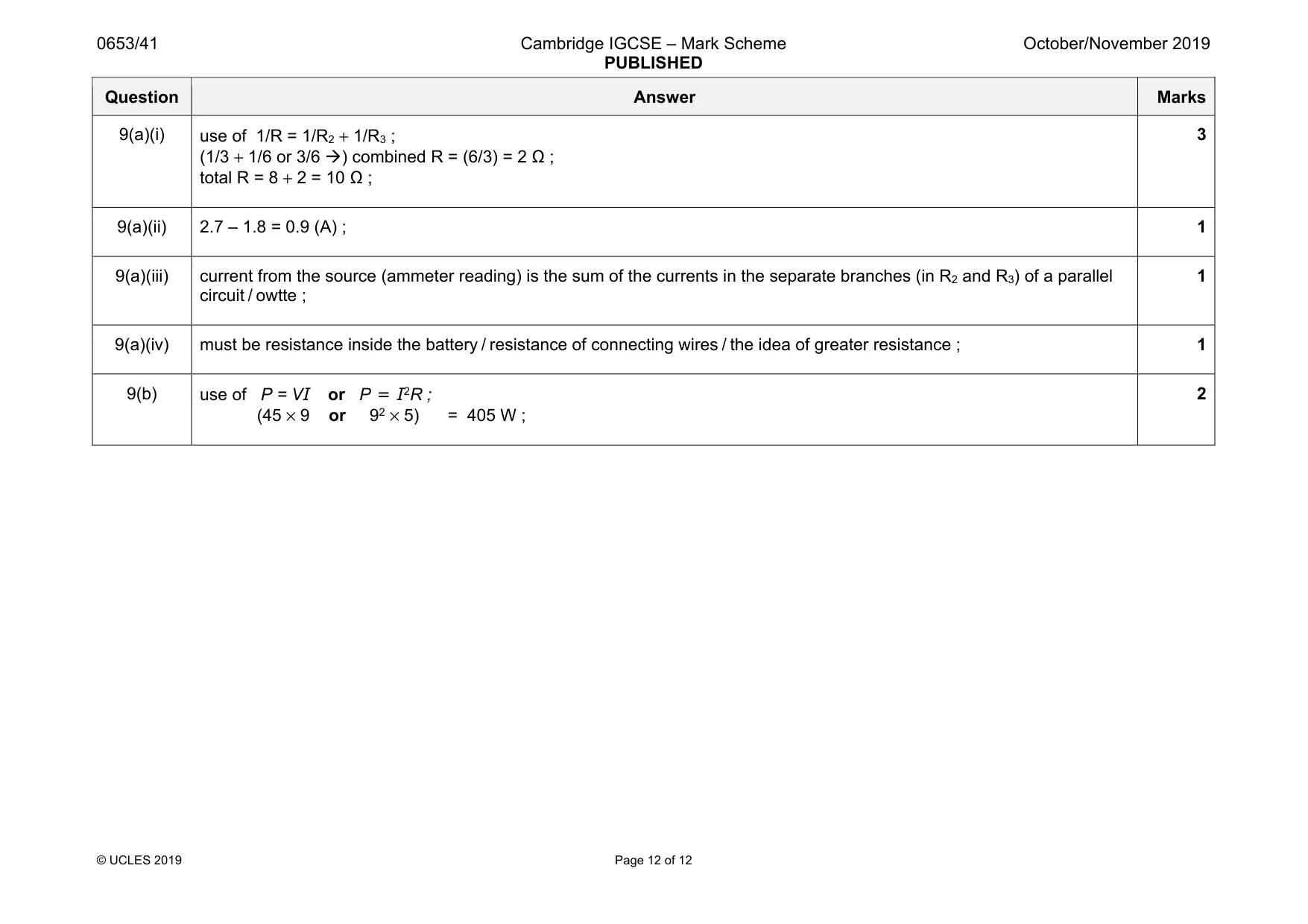
Mark scheme: 9(a)(i) (1/3 + 1/6 or 3/6 Æ) combined R = (6/3) = 2 Ω ; total R = 8 + 2 = 10 Ω ; 3 9(a)(ii) 2.7 – 1.8 = 0.9 (A) ; 1 9(a)(iii) current from the source (ammeter reading) is the sum of the currents in the separate branches (in R2 and R3) of a parallel circuit / owtte ; 1 9(a)(iv) must be resistance inside the battery / resistance of connecting wires / the idea of greater resistance ; 1 9(b) use of P = VI or P = I2R ; (45 × 9 or 92 × 5) = 405 W ; 2
What was in this paper
The subtopics covered by these 9 questions, and how many questions each got. Open one in a new tab to see every Cambridge question on it.
What you needed in this session
Cambridge’s own grade thresholds for 2019 Oct/Nov, Paper 4 · Variant 1. A higher threshold means an easier paper — the bar moves with how the cohort did.