Cambridge IGCSE Science - Combined 0653 — 2024 Oct/Nov Paper 4 · Variant 2
0653/42/O/N/24 · 9 questions · 80 marks · ≈90 min
The question paper and its mark scheme, free to read here and free to download. This is Cambridge’s own paper, exactly as it was sat.
Question paper20 pages


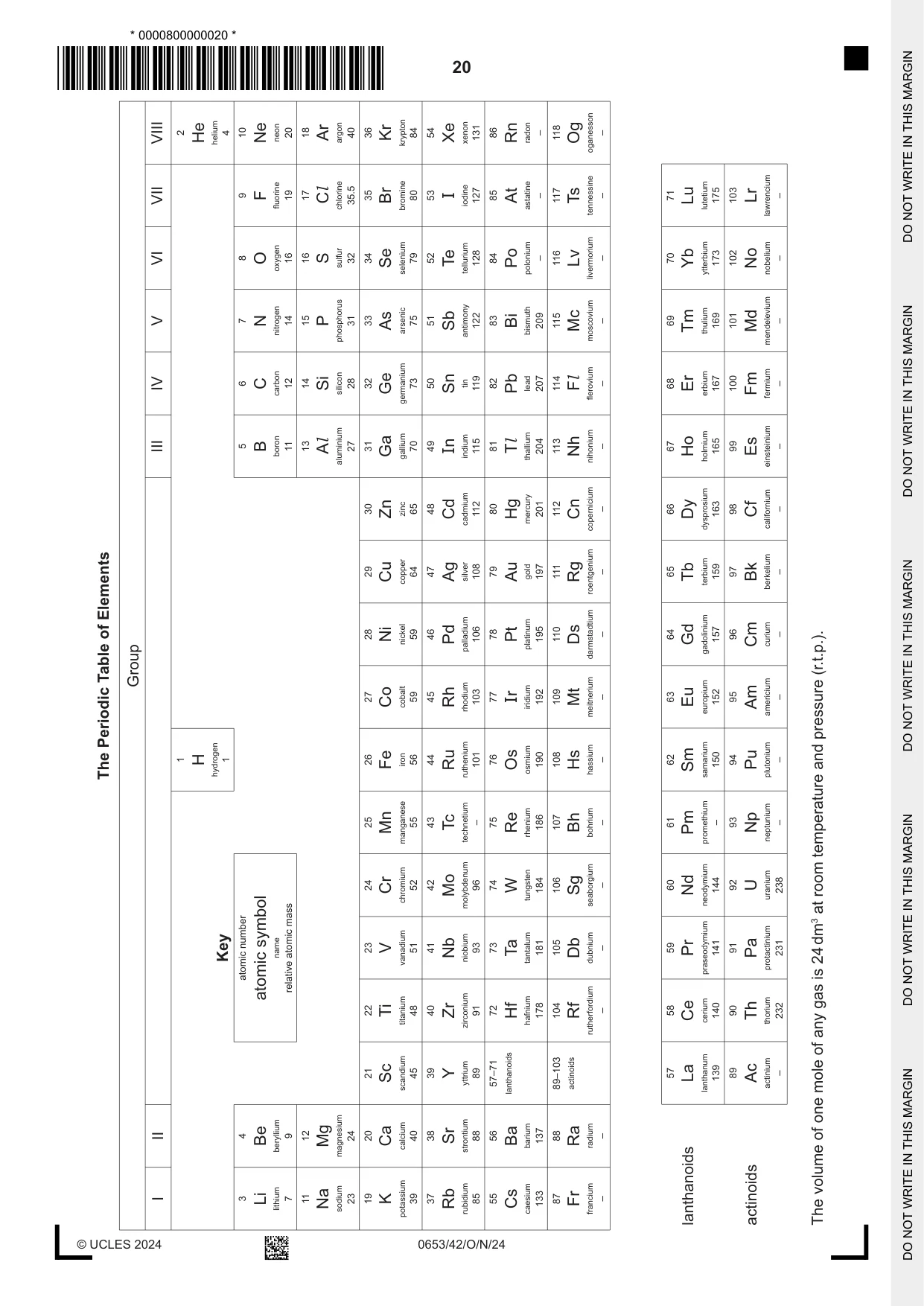
Mark scheme11 pages
Answers below. Sit the paper first if you are practising.
Questions as text
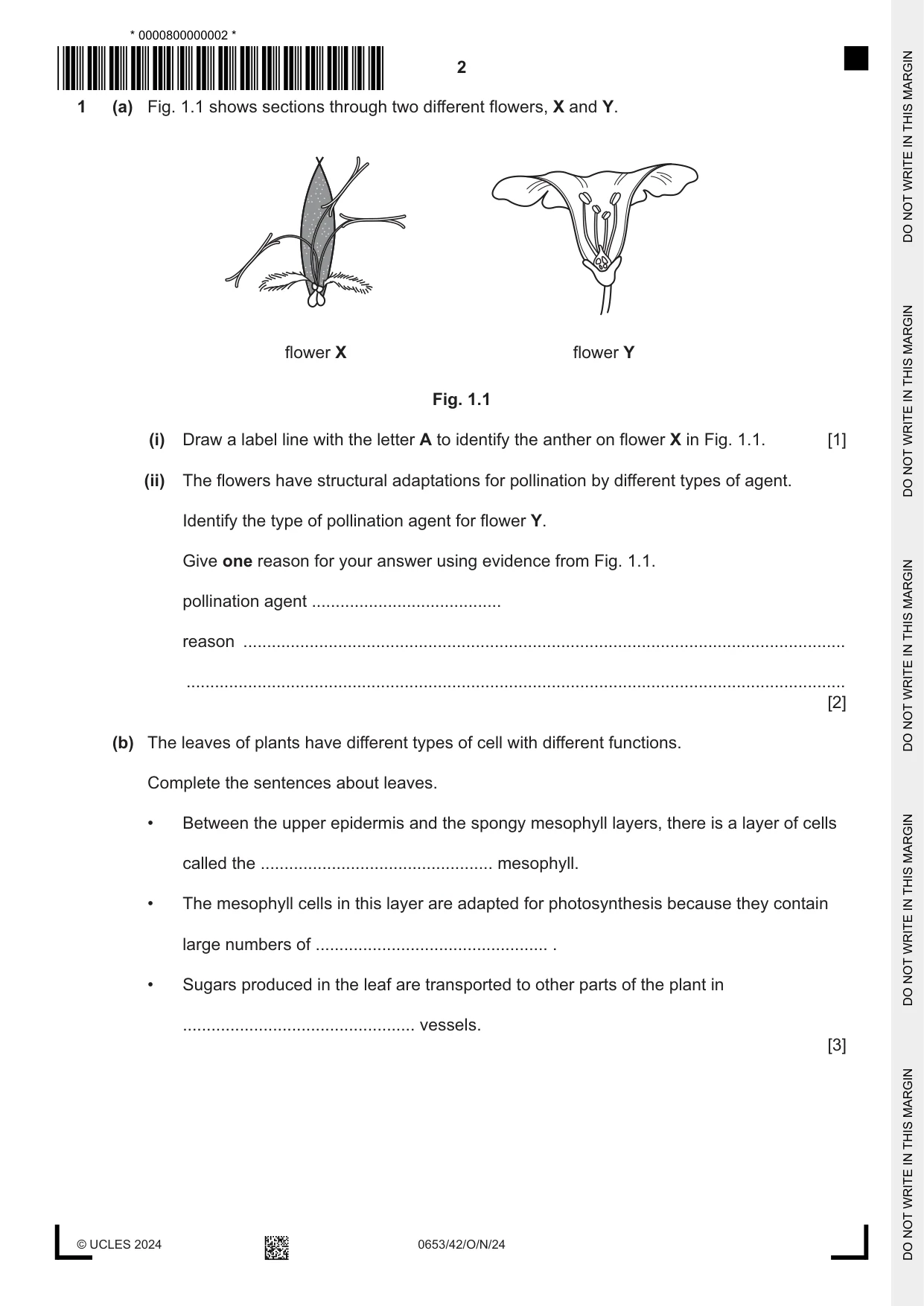
Q1 · Sections through two different flowers, X and Y
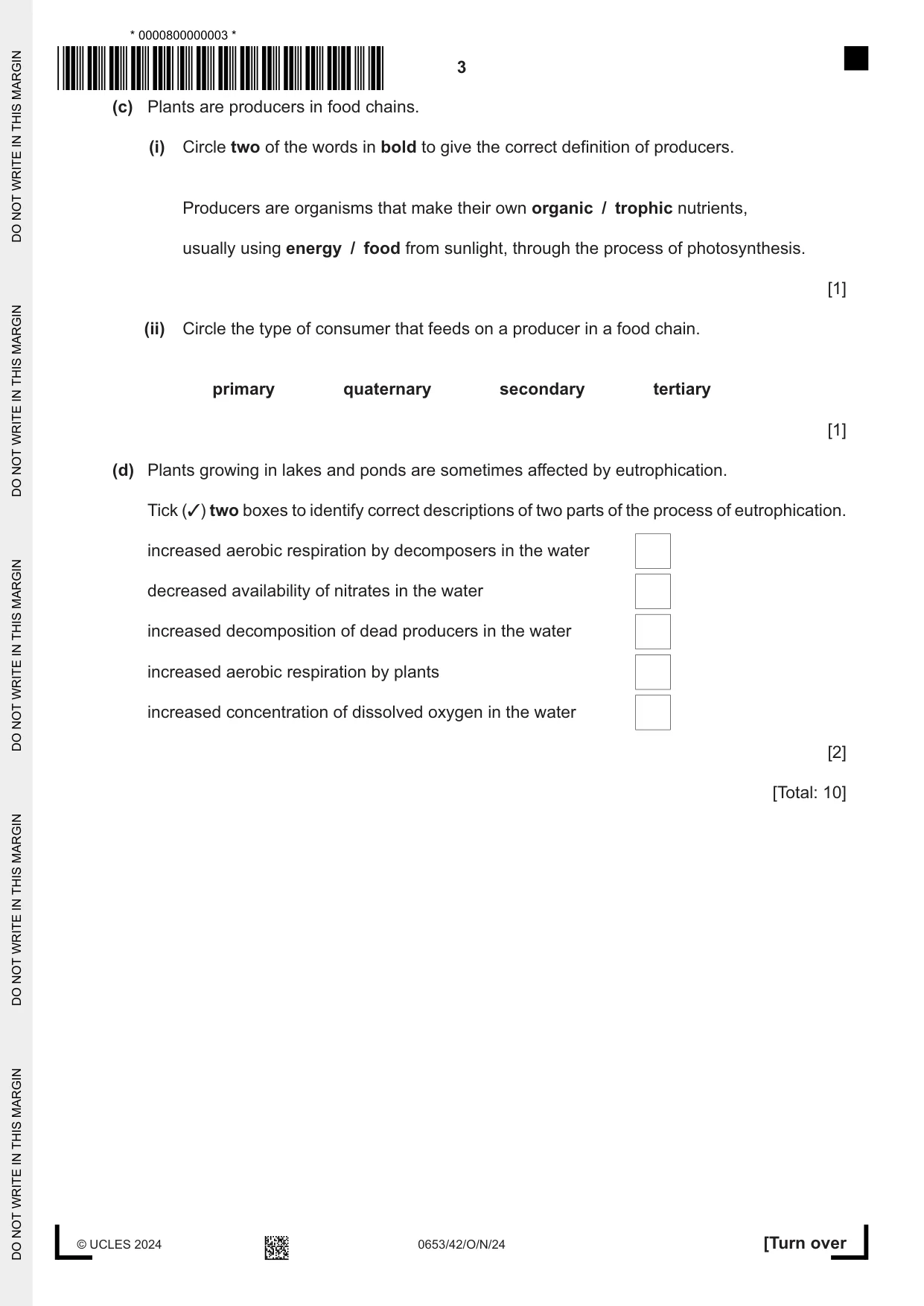
1 (a) Fig. 1.1 shows sections through two different flowers, X and Y. flower X flower Y Fig. 1.1 (i) Draw a label line with the letter A to identify the anther on flower X in Fig. 1.1. [1] (ii) The flowers have structural adaptations for pollination by different types of agent. Identify the type of pollination agent for flower Y. Give one reason for your answer using evidence from Fig. 1.1. pollination agent ........................................ reason ............................................................................................................................... ........................................................................................................................................... [2] (b) The leaves of plants have different types of cell with different functions. Complete the sentences about leaves. • Between the upper epidermis and the spongy mesophyll layers, there is a layer of cells called the ................................................. mesophyll. • The mesophyll cells in this layer are adapted for photosynthesis because they contain large numbers of ................................................. . • Sugars produced in the leaf are transported to other parts of the plant in ................................................. vessels. [3] (c) Plants are producers in food chains. (i) Circle two of the words in bold to give the correct definition of producers. Producers are organisms that make their own organic / trophic nutrients, usually using energy / food from sunlight, through the process of photosynthesis. [1] (ii) Circle the type of consumer that feeds on a producer in a food chain. primary quaternary secondary tertiary [1] (d) Plants growing in lakes and ponds are sometimes affected by eutrophication. Tick (✓) two boxes to identify correct descriptions of two parts of the process of eutrophication. increased aerobic respiration by decomposers in the water decreased availability of nitrates in the water increased decomposition of dead producers in the water increased aerobic respiration by plants increased concentration of dissolved oxygen in the water [2] [Total: 10]
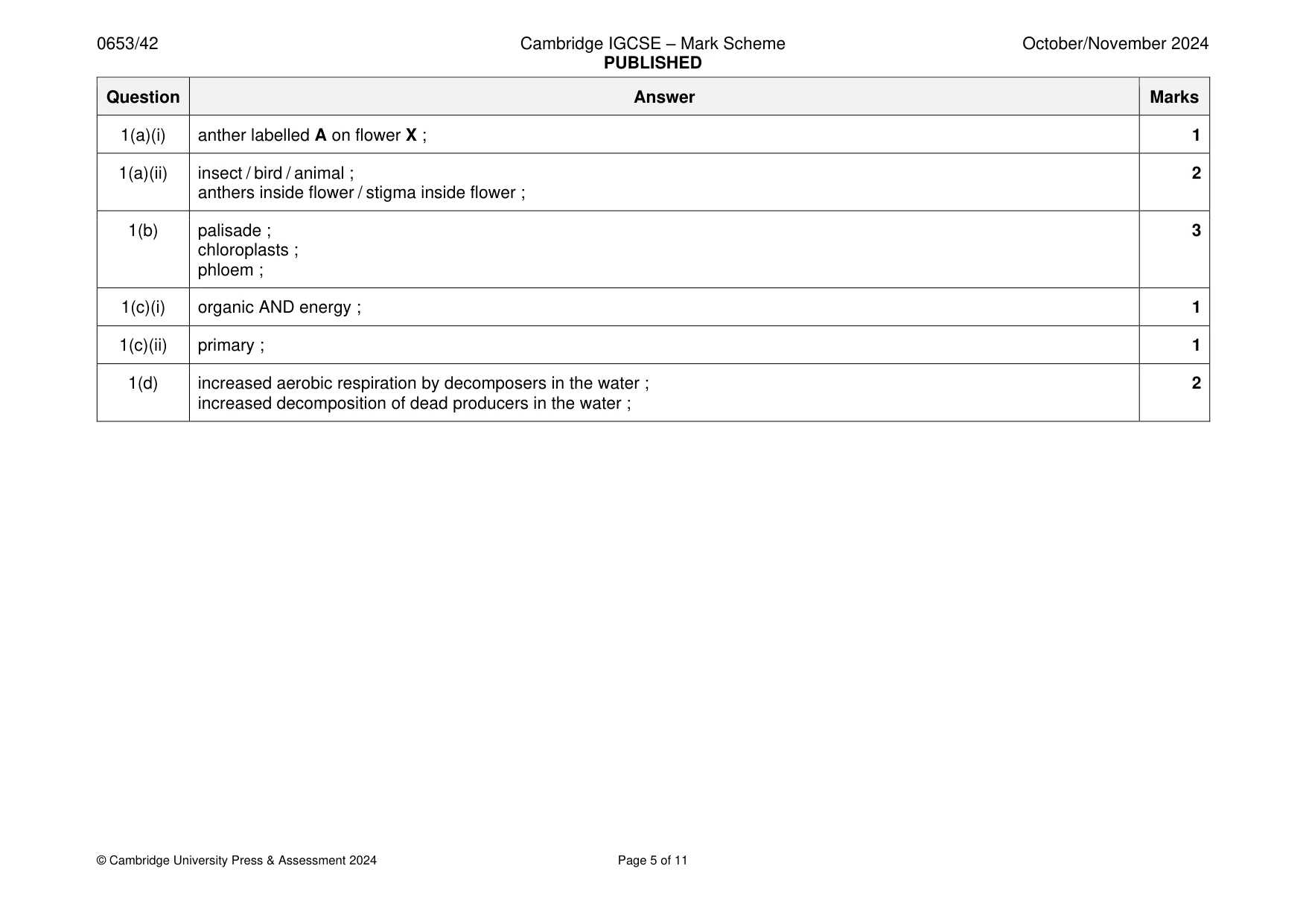
Mark scheme: Question Answer Marks 1(a)(i) anther labelled A on flower X ; 1 1(a)(ii) insect / bird / animal ; 2 anthers inside flower / stigma inside flower ; 1(b) palisade ; 3 chloroplasts ; phloem ; 1(c)(i) organic AND energy ; 1 1(c)(ii) primary ; 1 1(d) increased aerobic respiration by decomposers in the water ; 2 increased decomposition of dead producers in the water ;
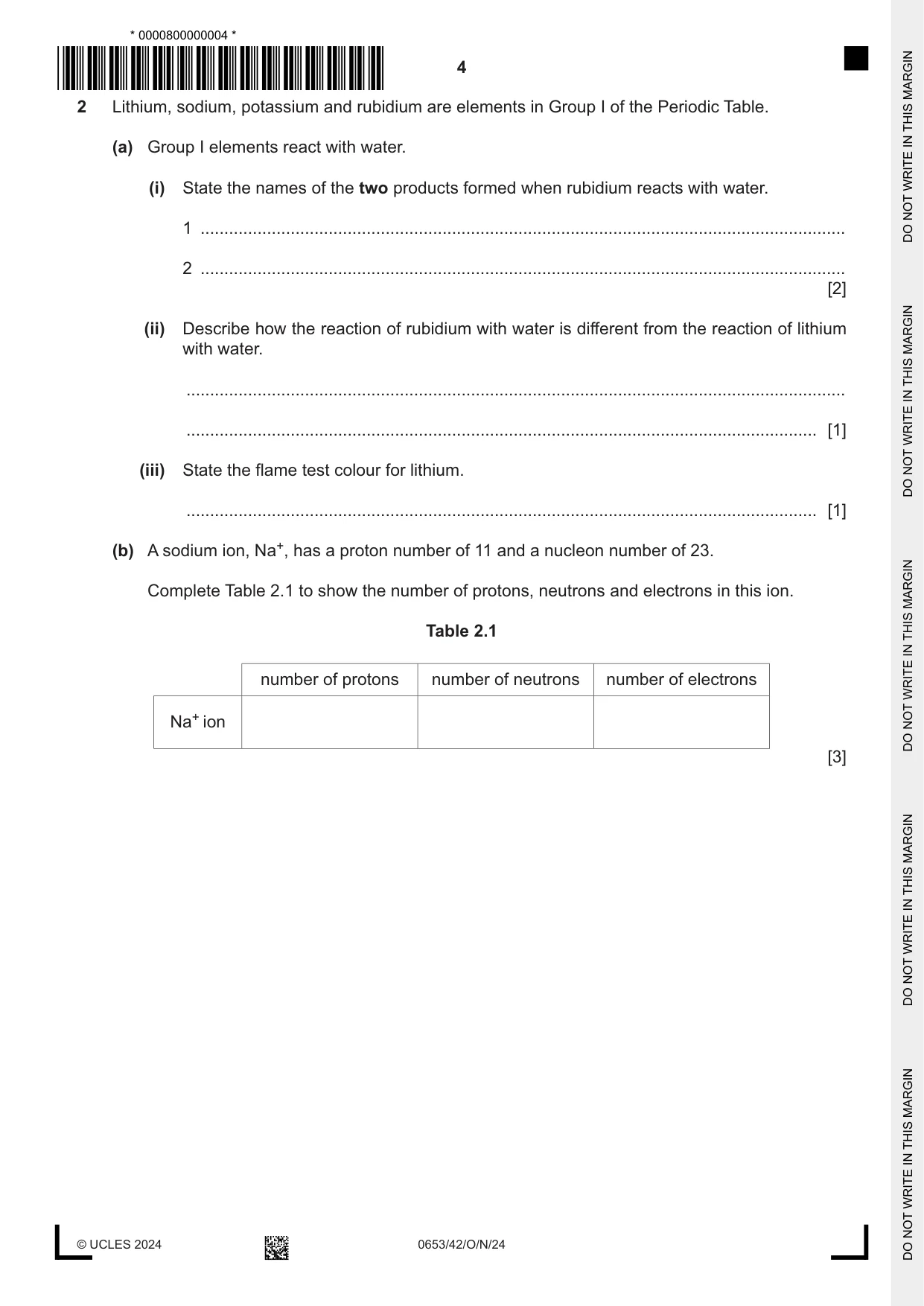
Q2 · Lithium, sodium, potassium and rubidium are elements in Group I of the Periodic Table
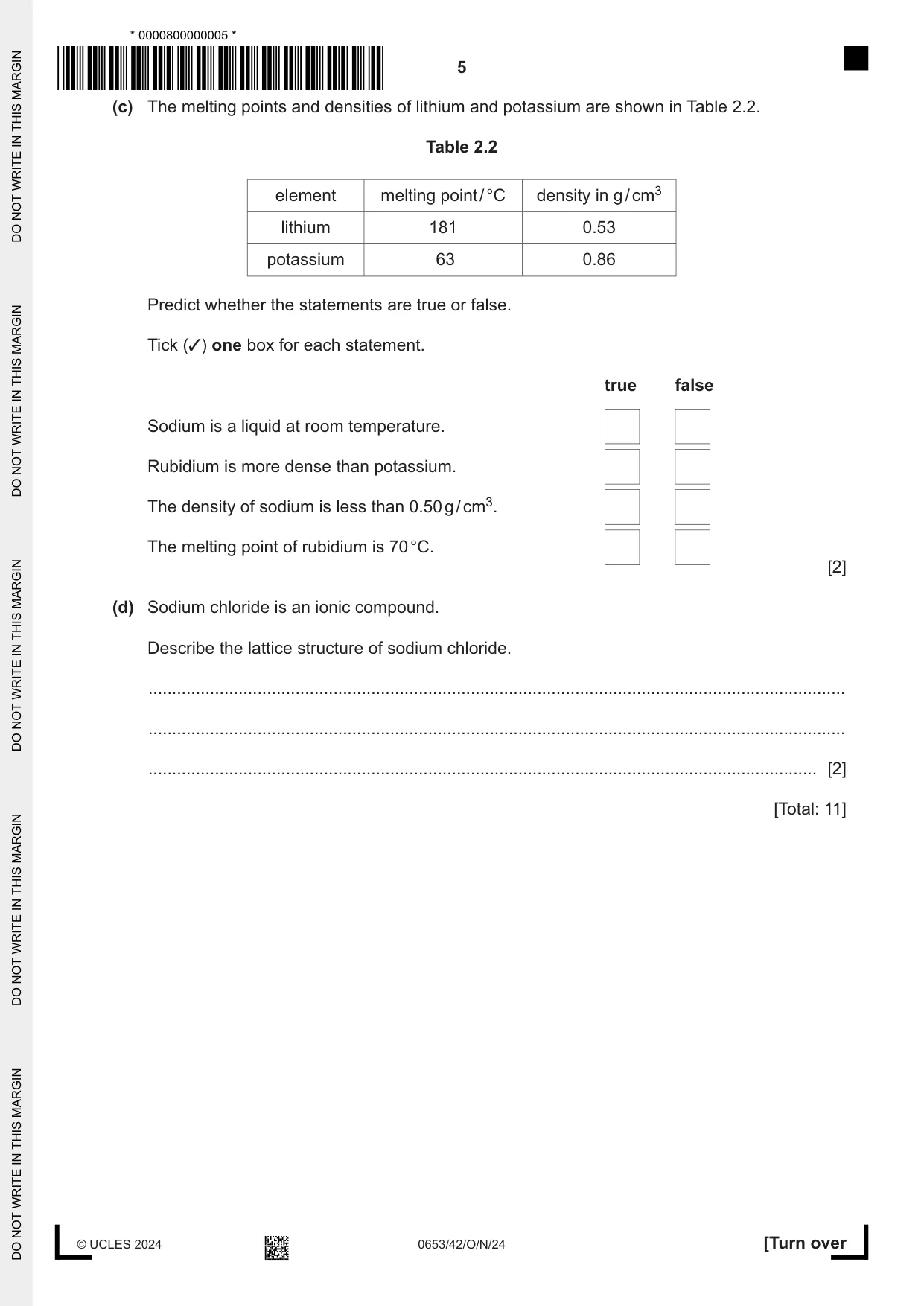
2 Lithium, sodium, potassium and rubidium are elements in Group I of the Periodic Table. (a) Group I elements react with water. (i) State the names of the two products formed when rubidium reacts with water. 1 ........................................................................................................................................ 2 ........................................................................................................................................ [2] (ii) Describe how the reaction of rubidium with water is different from the reaction of lithium with water. ........................................................................................................................................... ..................................................................................................................................... [1] (iii) State the flame test colour for lithium. ..................................................................................................................................... [1] (b) A sodium ion, Na+, has a proton number of 11 and a nucleon number of 23. Complete Table 2.1 to show the number of protons, neutrons and electrons in this ion. Table 2.1 number of protons number of neutrons number of electrons Na+ ion [3] (c) The melting points and densities of lithium and potassium are shown in Table 2.2. Table 2.2 element melting point / °C density in g / cm3 lithium 181 0.53 potassium 63 0.86 Predict whether the statements are true or false. Tick (✓) one box for each statement. true false Sodium is a liquid at room temperature. Rubidium is more dense than potassium. The density of sodium is less than 0.50 g / cm3. The melting point of rubidium is 70 °C. [2] (d) Sodium chloride is an ionic compound. Describe the lattice structure of sodium chloride. ................................................................................................................................................... ................................................................................................................................................... ............................................................................................................................................. [2] [Total: 11]
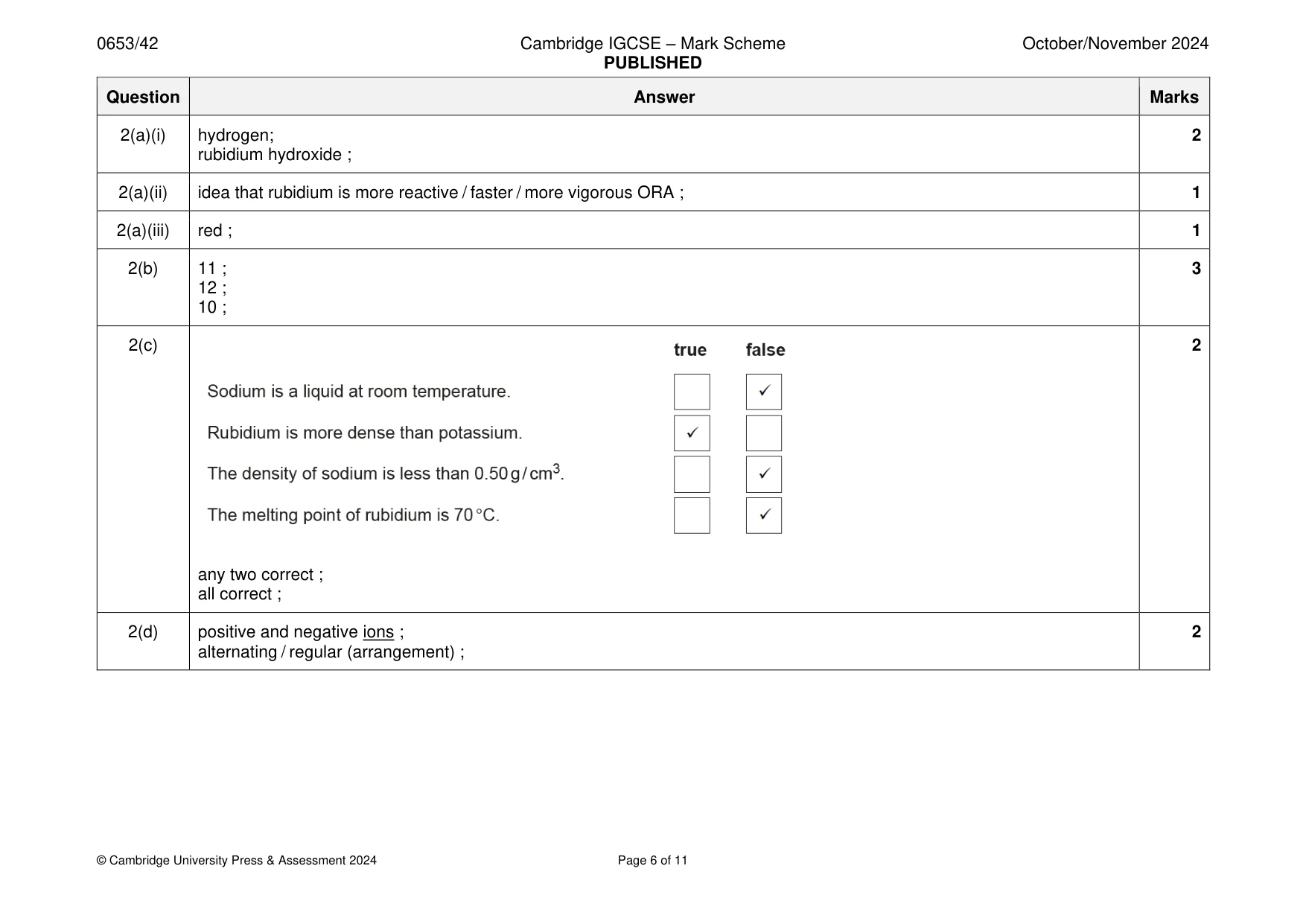
Mark scheme: 2(a)(i) hydrogen; 2 rubidium hydroxide ; 2(a)(ii) idea that rubidium is more reactive / faster / more vigorous ORA ; 1 2(a)(iii) red ; 1 2(b) 11 ; 3 12 ; 10 ; 2(c) 2 any two correct ; all correct ; 2(d) positive and negative ions ; 2 alternating / regular (arrangement) ;
Q3 · An electric car with solar cells on its roof
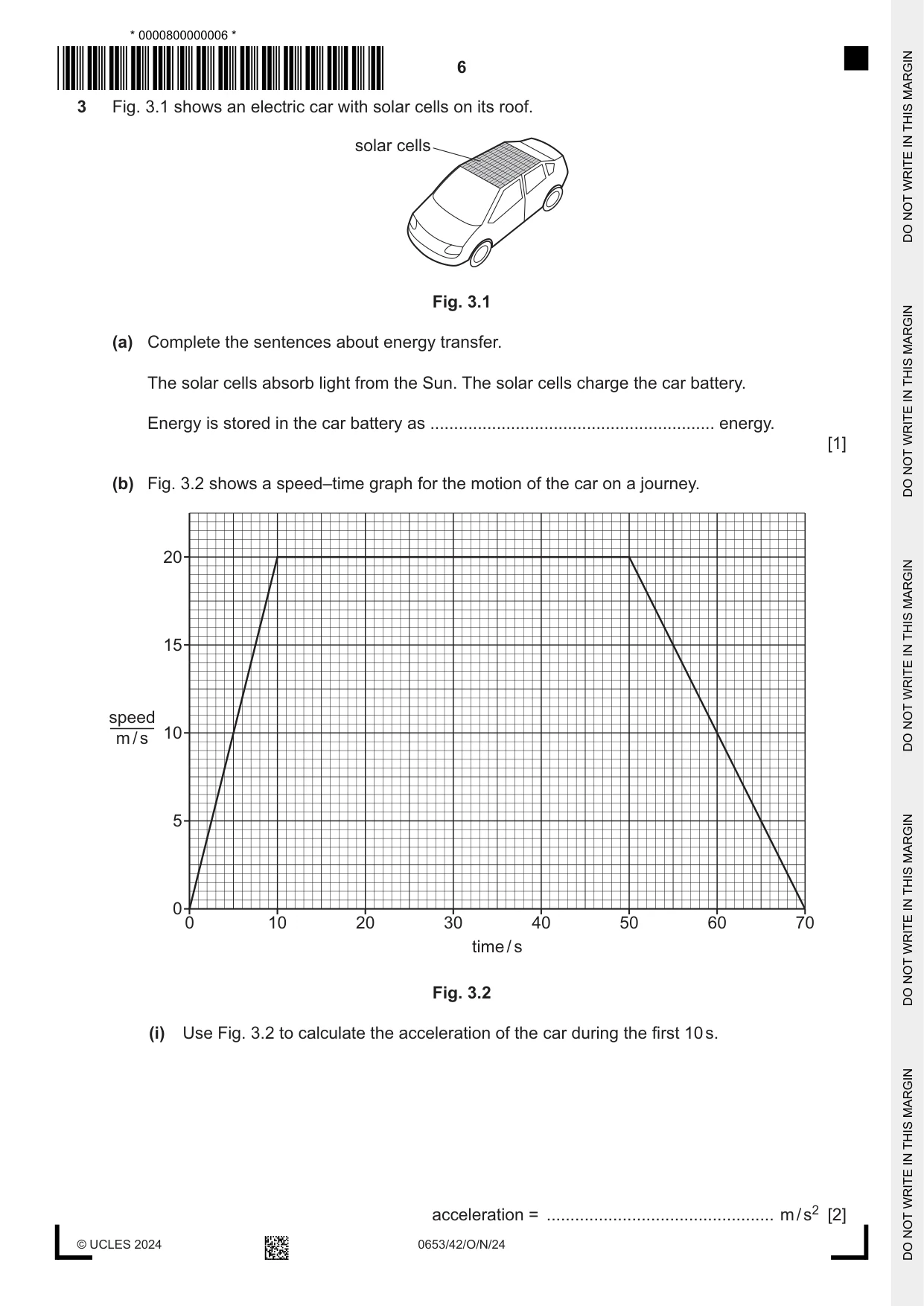
3 Fig. 3.1 shows an electric car with solar cells on its roof. solar cells Fig. 3.1 (a) Complete the sentences about energy transfer. The solar cells absorb light from the Sun. The solar cells charge the car battery. Energy is stored in the car battery as ............................................................ energy. [1] (b) Fig. 3.2 shows a speed–time graph for the motion of the car on a journey. 20 15 speed 10 m / s 5 0 0 10 20 30 40 50 60 70 time / s Fig. 3.2 (i) Use Fig. 3.2 to calculate the acceleration of the car during the first 10 s. acceleration = ................................................ m / s2 [2] (ii) Calculate the total distance, in kilometres, travelled by the car on the journey. distance = ................................................... km [3] (iii) The mass of the car is 1200 kg. Calculate the kinetic energy of the car at maximum speed. kinetic energy = ...................................................... J [3] [Total: 9]
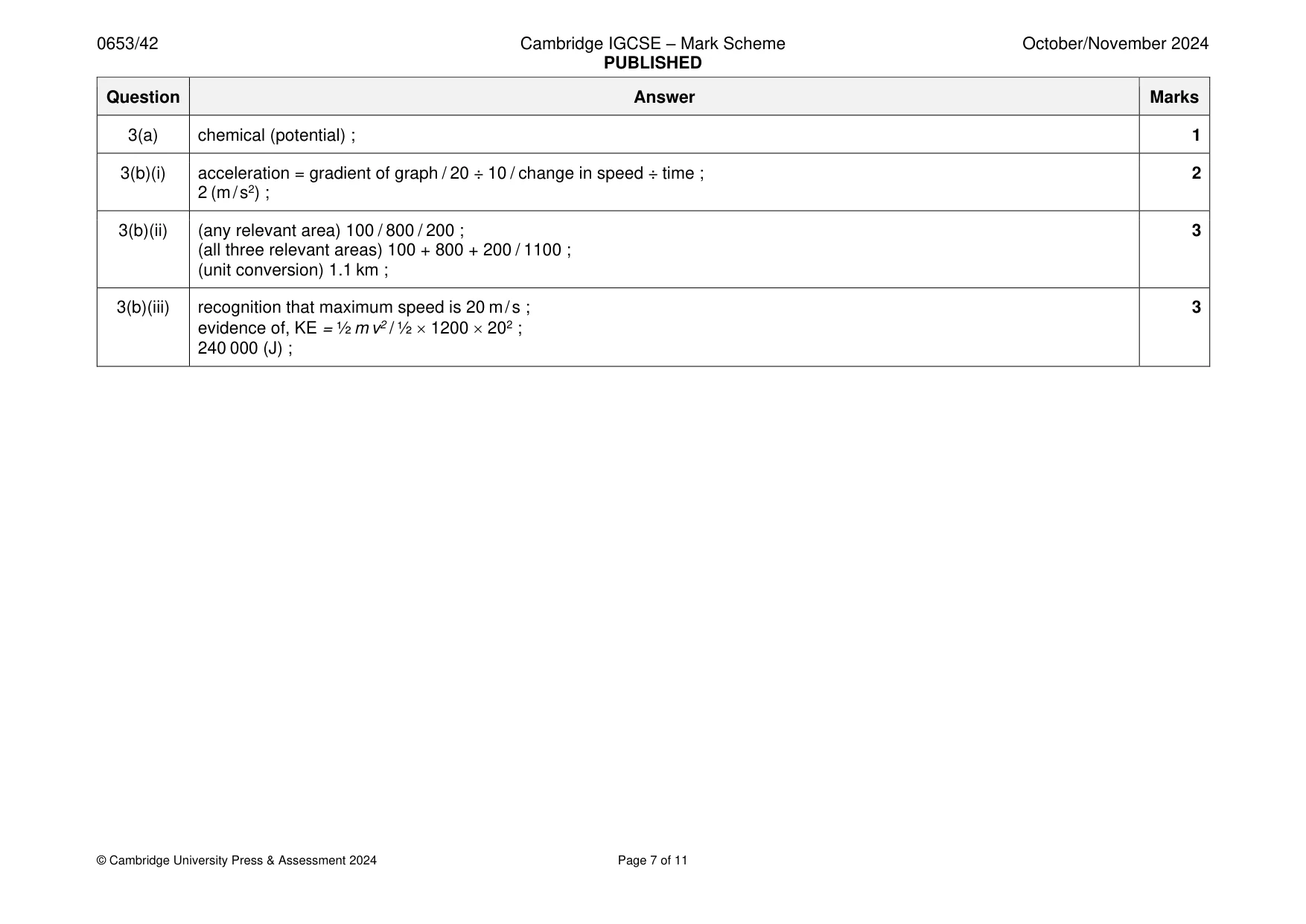
Mark scheme: 3(a) chemical (potential) ; 1 3(b)(i) acceleration = gradient of graph / 20 ÷ 10 / change in speed ÷ time ; 2 2 (m / s2) ; 3(b)(ii) (any relevant area) 100 / 800 / 200 ; 3 (all three relevant areas) 100 + 800 + 200 / 1100 ; (unit conversion) 1.1 km ; 3(b)(iii) recognition that maximum speed is 20 m / s ; 3 evidence of, KE = ½ m v2 / ½ 1200 202 ; 240 000 (J) ;
Q4 · Drawings of three different blood vessels, W, X and Y
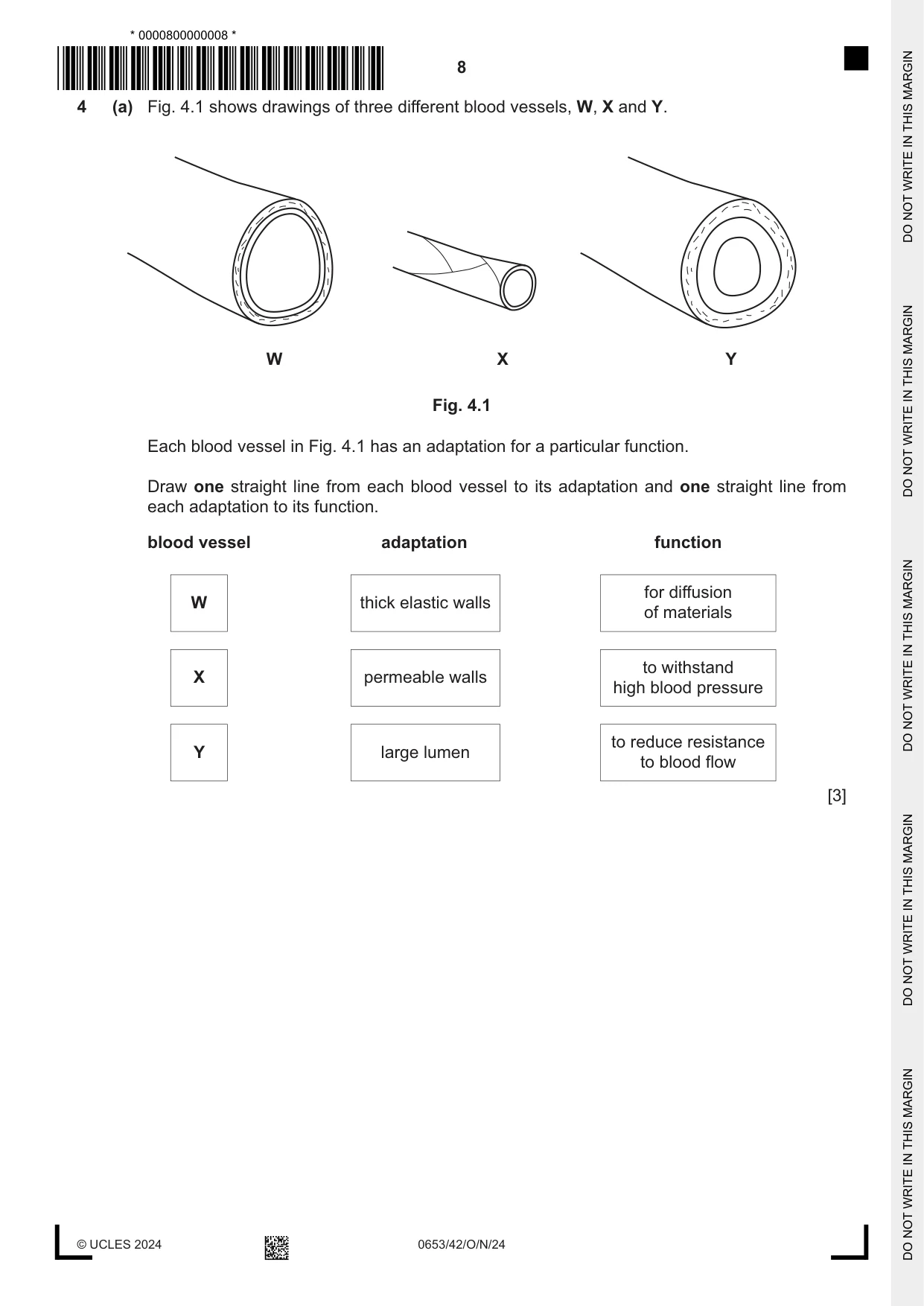
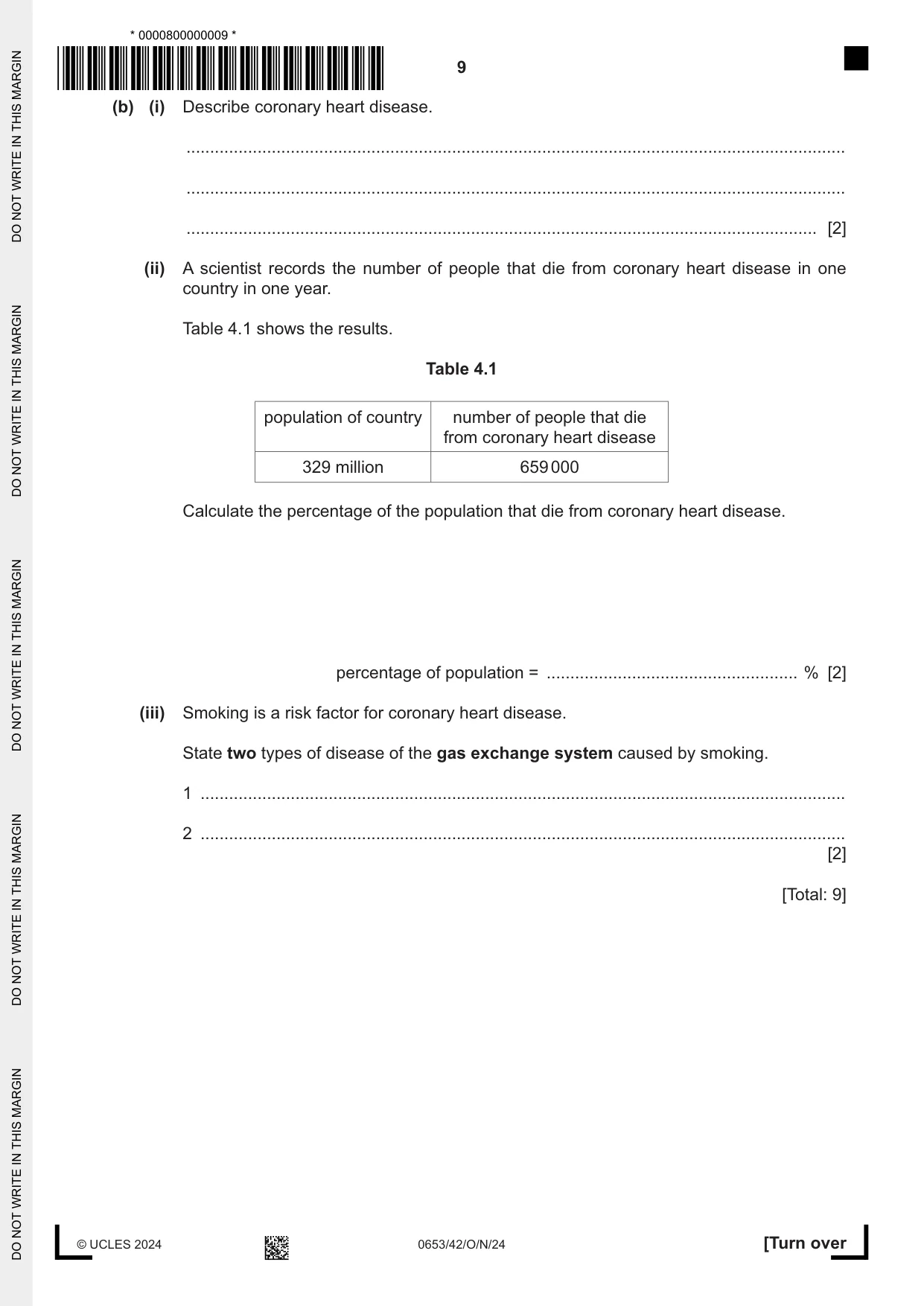
4 (a) Fig. 4.1 shows drawings of three different blood vessels, W, X and Y. W X Y Fig. 4.1 Each blood vessel in Fig. 4.1 has an adaptation for a particular function. Draw one straight line from each blood vessel to its adaptation and one straight line from each adaptation to its function. blood vessel adaptation function for diffusion W thick elastic walls of materials to withstand X permeable walls high blood pressure to reduce resistance Y large lumen to blood flow [3] (b) (i) Describe coronary heart disease. ........................................................................................................................................... ........................................................................................................................................... ..................................................................................................................................... [2] (ii) A scientist records the number of people that die from coronary heart disease in one country in one year. Table 4.1 shows the results. Table 4.1 population of country number of people that die from coronary heart disease 329 million 659 000 Calculate the percentage of the population that die from coronary heart disease. percentage of population = ..................................................... % [2] (iii) Smoking is a risk factor for coronary heart disease. State two types of disease of the gas exchange system caused by smoking. 1 ........................................................................................................................................ 2 ........................................................................................................................................ [2] [Total: 9]
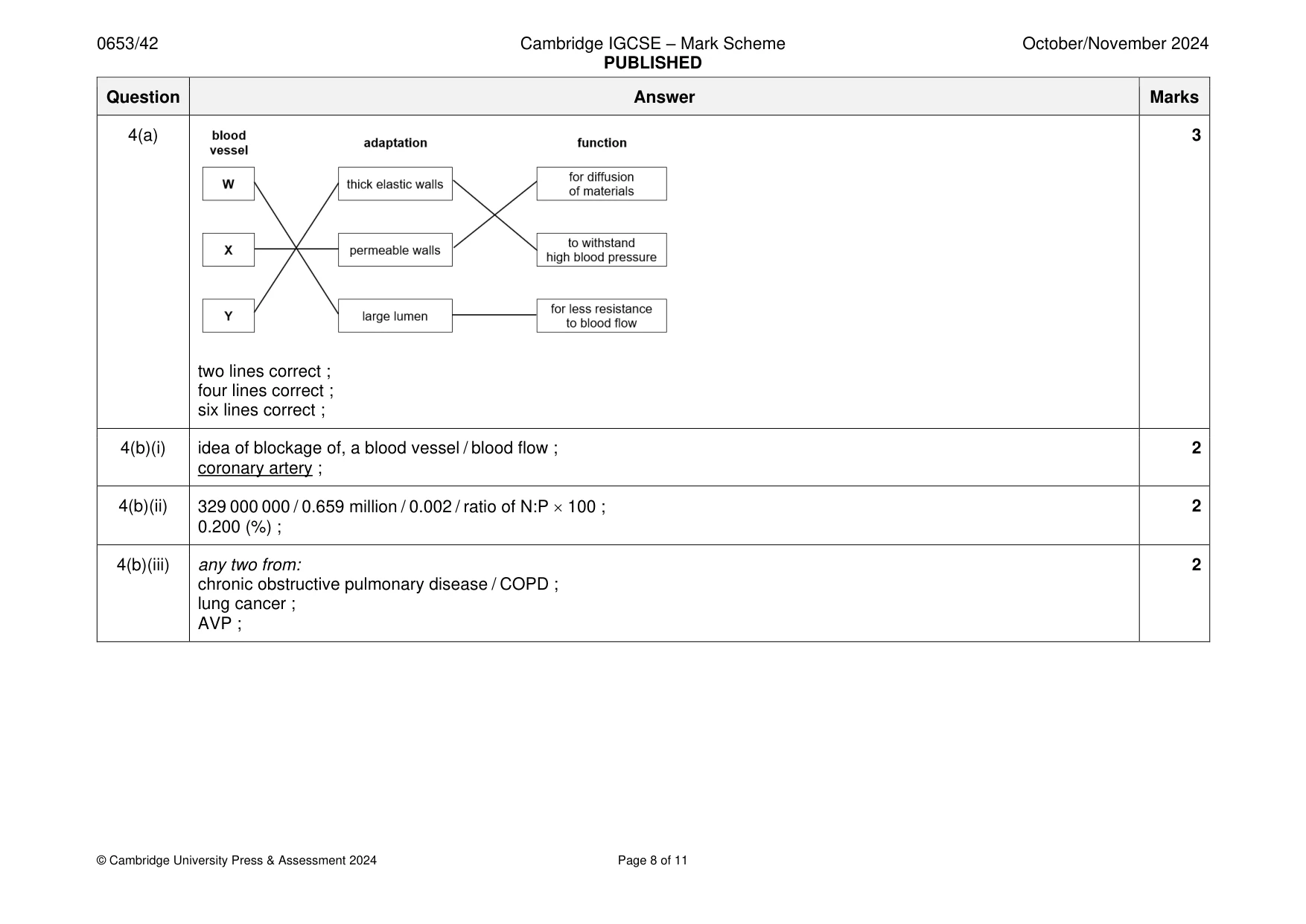
Mark scheme: 4(a) 3 two lines correct ; four lines correct ; six lines correct ; 4(b)(i) idea of blockage of, a blood vessel / blood flow ; 2 coronary artery ; 4(b)(ii) 329 000 000 / 0.659 million / 0.002 / ratio of N:P 100 ; 2 0.200 (%) ; 4(b)(iii) any two from: 2 chronic obstructive pulmonary disease / COPD ; lung cancer ; AVP ;
Q5 · State the names of two elements that are used to make inert electrodes for electrolysis
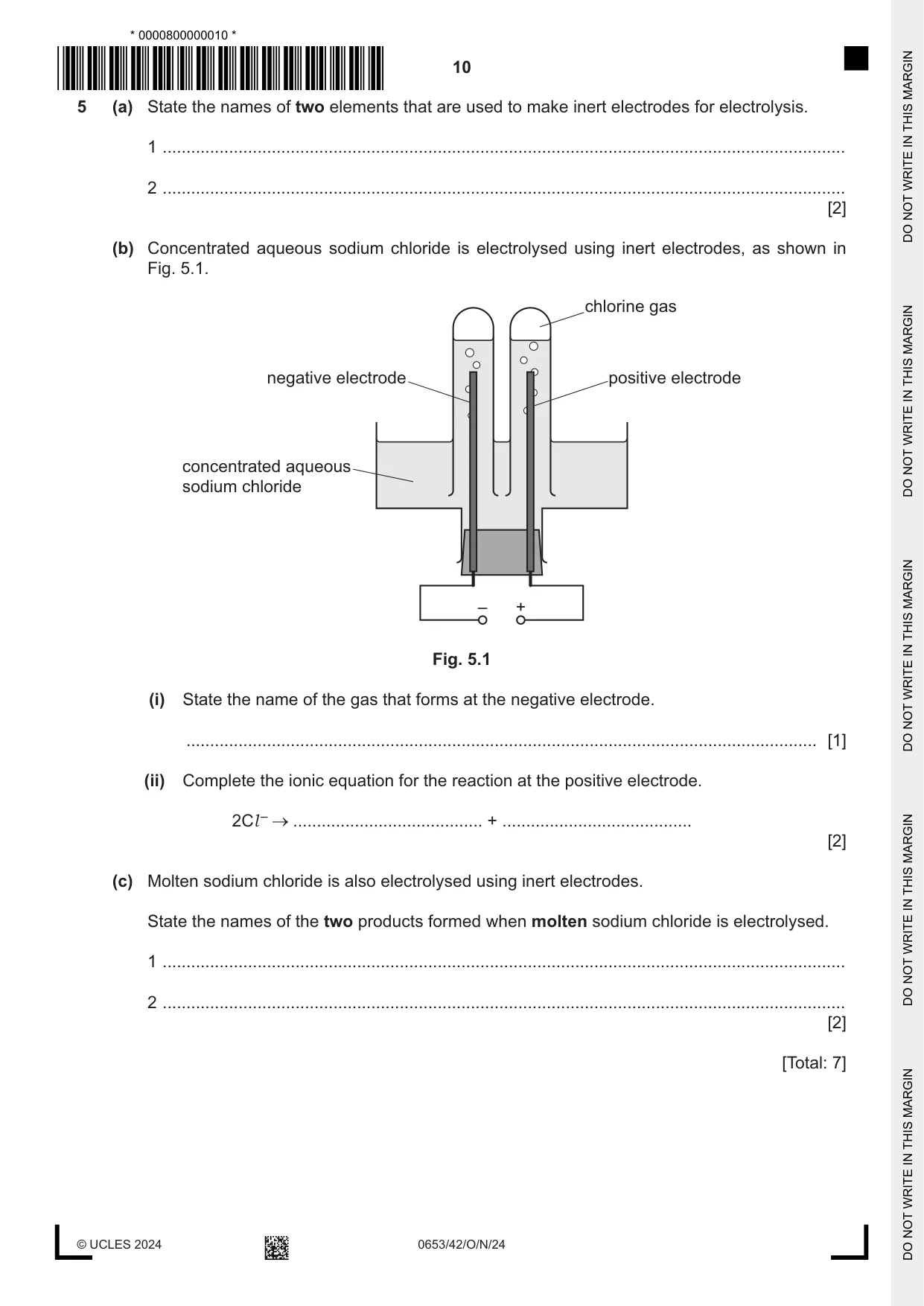
5 (a) State the names of two elements that are used to make inert electrodes for electrolysis. 1 ................................................................................................................................................ 2 ................................................................................................................................................ [2] (b) Concentrated aqueous sodium chloride is electrolysed using inert electrodes, as shown in Fig. 5.1. chlorine gas negative electrode positive electrode concentrated aqueous sodium chloride – + Fig. 5.1 (i) State the name of the gas that forms at the negative electrode. ..................................................................................................................................... [1] (ii) Complete the ionic equation for the reaction at the positive electrode. 2Cl – ........................................ + ........................................ [2] (c) Molten sodium chloride is also electrolysed using inert electrodes. State the names of the two products formed when molten sodium chloride is electrolysed. 1 ................................................................................................................................................ 2 ................................................................................................................................................ [2] [Total: 7]
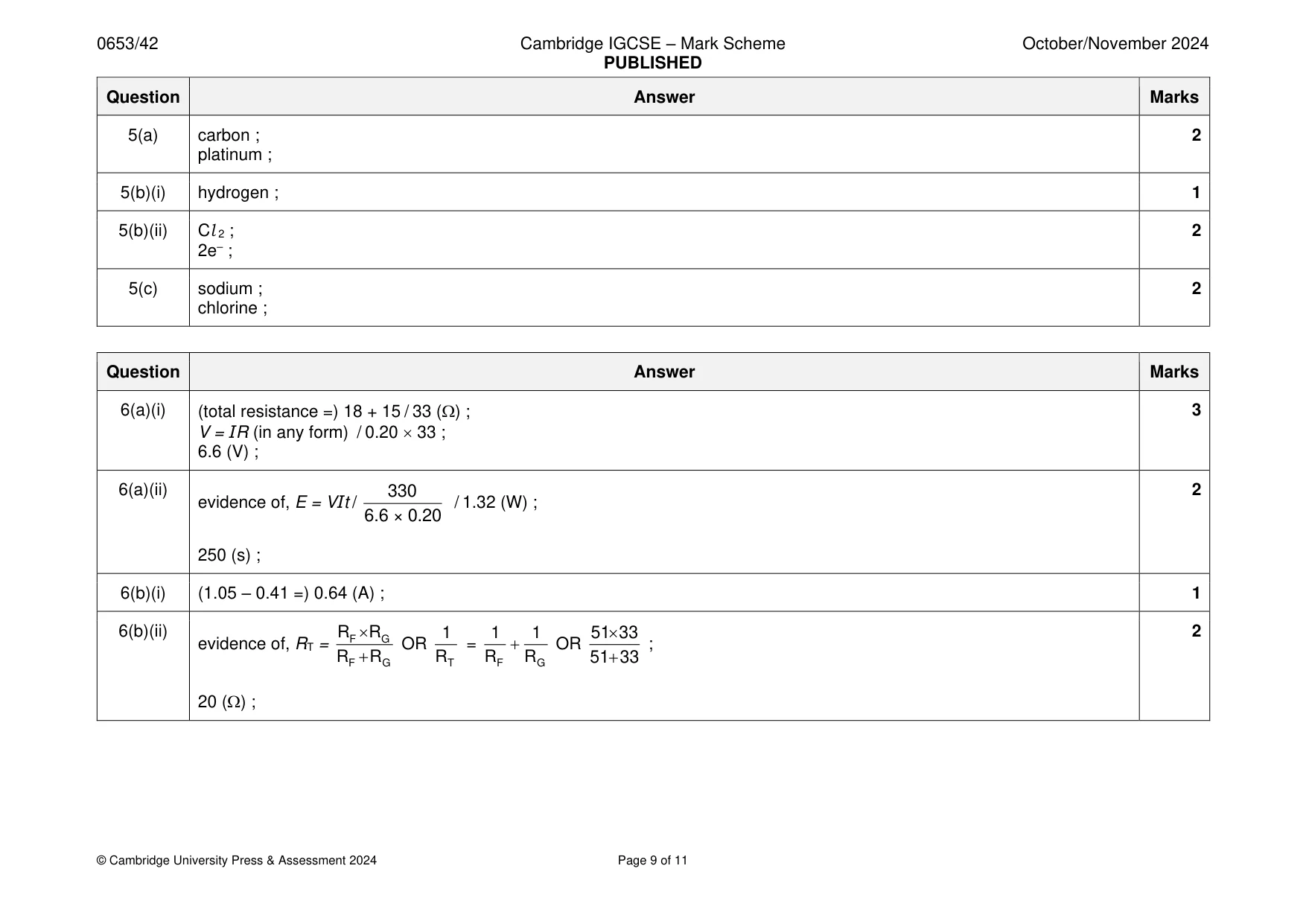
Mark scheme: 5(a) carbon ; 2 platinum ; 5(b)(i) hydrogen ; 1 5(b)(ii) Cl 2 ; 2 2e– ; 5(c) sodium ; 2 chlorine ;
Q6 · A circuit with two resistors, X and Y, connected in series
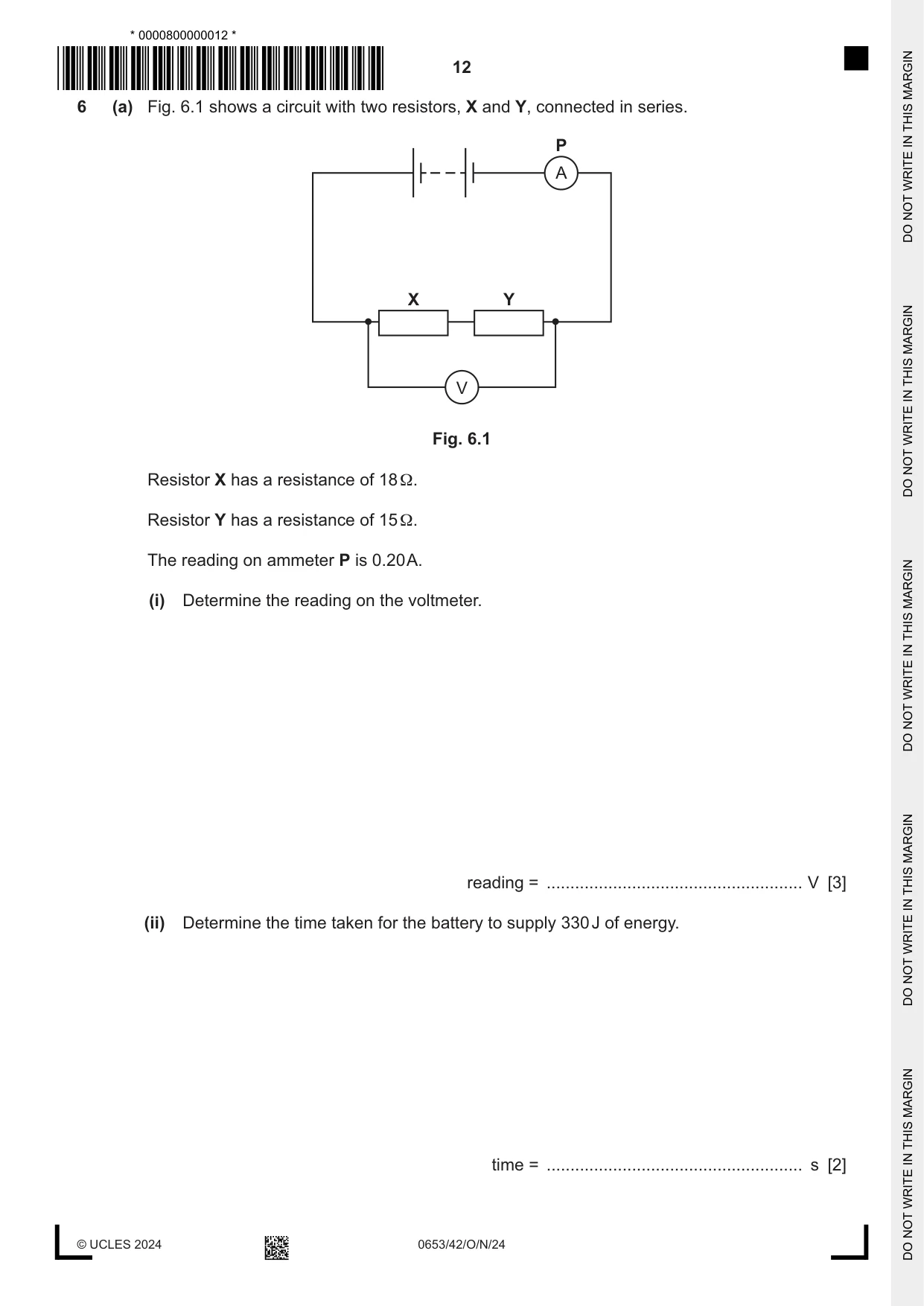
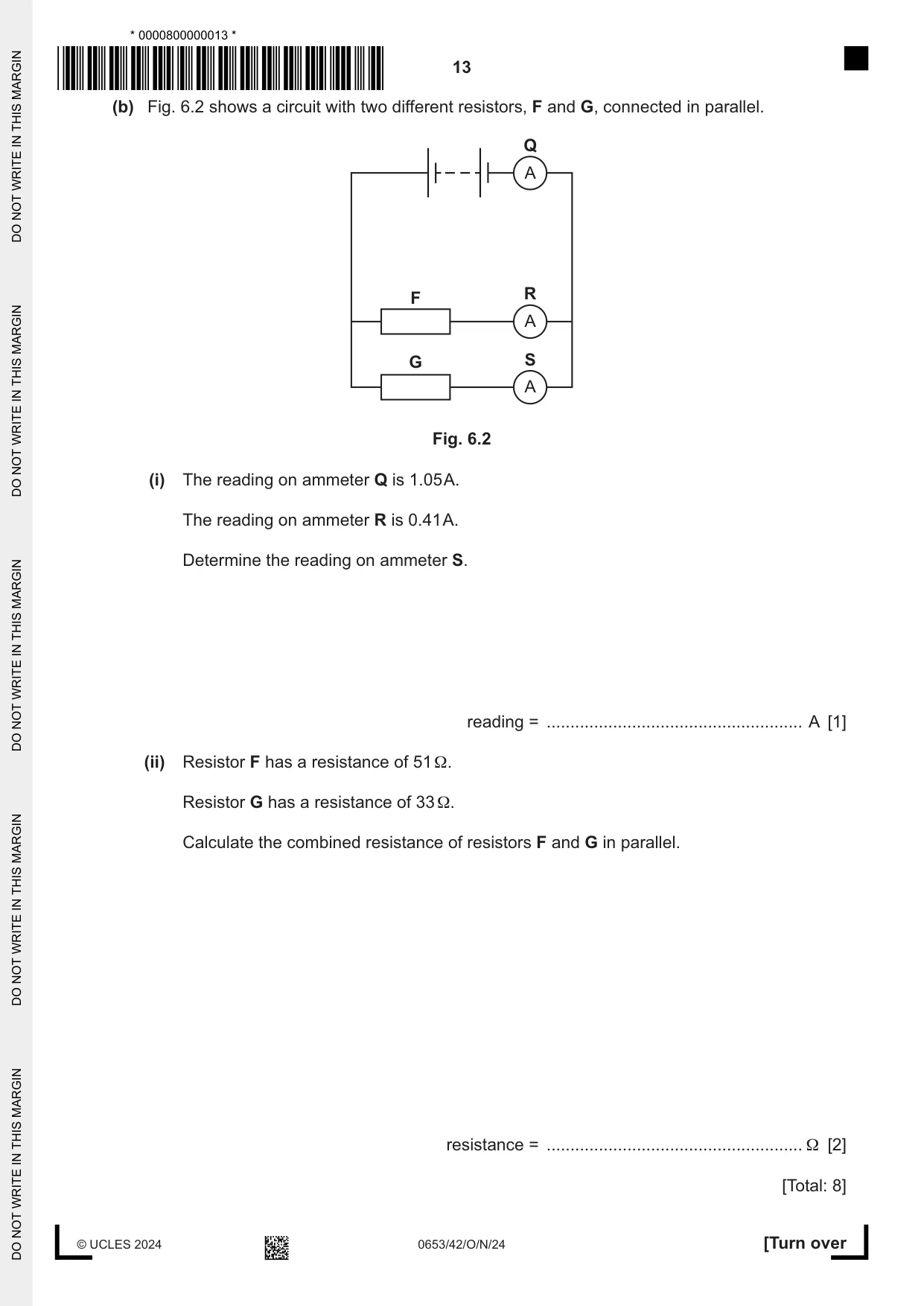
6 (a) Fig. 6.1 shows a circuit with two resistors, X and Y, connected in series. P A X Y V Fig. 6.1 Resistor X has a resistance of 18 Ω. Resistor Y has a resistance of 15 Ω. The reading on ammeter P is 0.20 A. (i) Determine the reading on the voltmeter. reading = ...................................................... V [3] (ii) Determine the time taken for the battery to supply 330 J of energy. time = ...................................................... s [2] (b) Fig. 6.2 shows a circuit with two different resistors, F and G, connected in parallel. Q A F R A G S A Fig. 6.2 (i) The reading on ammeter Q is 1.05 A. The reading on ammeter R is 0.41 A. Determine the reading on ammeter S. reading = ...................................................... A [1] (ii) Resistor F has a resistance of 51 Ω. Resistor G has a resistance of 33 Ω. Calculate the combined resistance of resistors F and G in parallel. resistance = ...................................................... Ω [2] [Total: 8]
Mark scheme: 6(a)(i) (total resistance =) 18 + 15 / 33 () ; 3 V = IR (in any form) / 0.20 33 ; 6.6 (V) ; 6(a)(ii) 330 2 evidence of, E = VIt / / 1.32 (W) ; 6.6 × 0.20 250 (s) ; 6(b)(i) (1.05 – 0.41 =) 0.64 (A) ; 1 6(b)(ii) RF R G 1 1 1 51 33 2 evidence of, RT = OR = + OR ; RF + R G R T R F R G 51+ 33 20 () ;
Question 7
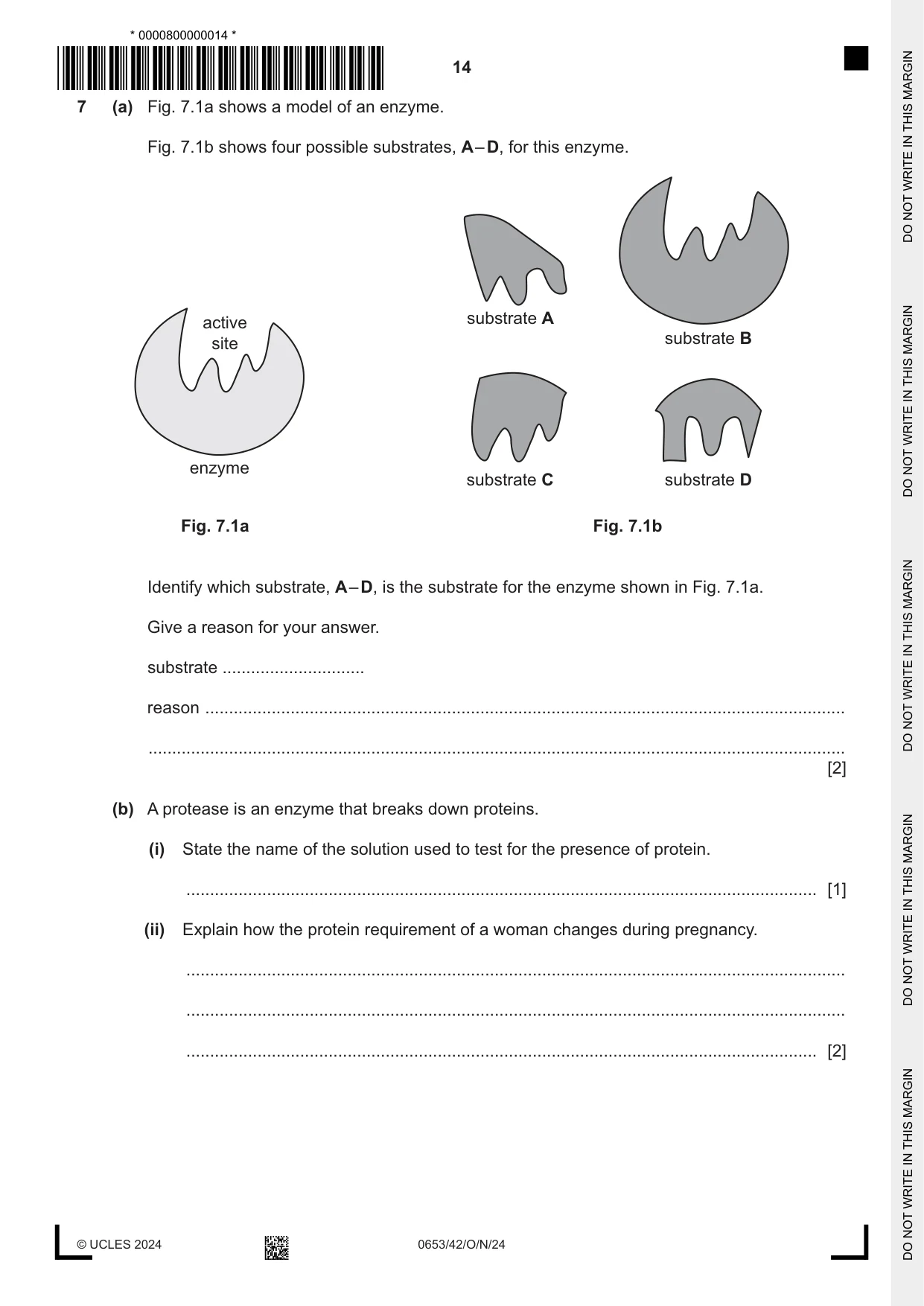
7 (a) Fig. 7.1a shows a model of an enzyme. Fig. 7.1b shows four possible substrates, A – D, for this enzyme. substrate A active substrate B site enzyme substrate C substrate D Fig. 7.1a Fig. 7.1b Identify which substrate, A – D, is the substrate for the enzyme shown in Fig. 7.1a. Give a reason for your answer. substrate .............................. reason ....................................................................................................................................... ................................................................................................................................................... [2] (b) A protease is an enzyme that breaks down proteins. (i) State the name of the solution used to test for the presence of protein. ..................................................................................................................................... [1] (ii) Explain how the protein requirement of a woman changes during pregnancy. ........................................................................................................................................... ........................................................................................................................................... ..................................................................................................................................... [2] (iii) The small intestine has a pH range of 6.0 to 7.4. Explain why the protease in gastric juice stops working when it reaches the small intestine. ........................................................................................................................................... ........................................................................................................................................... ........................................................................................................................................... ..................................................................................................................................... [3] [Total: 8]
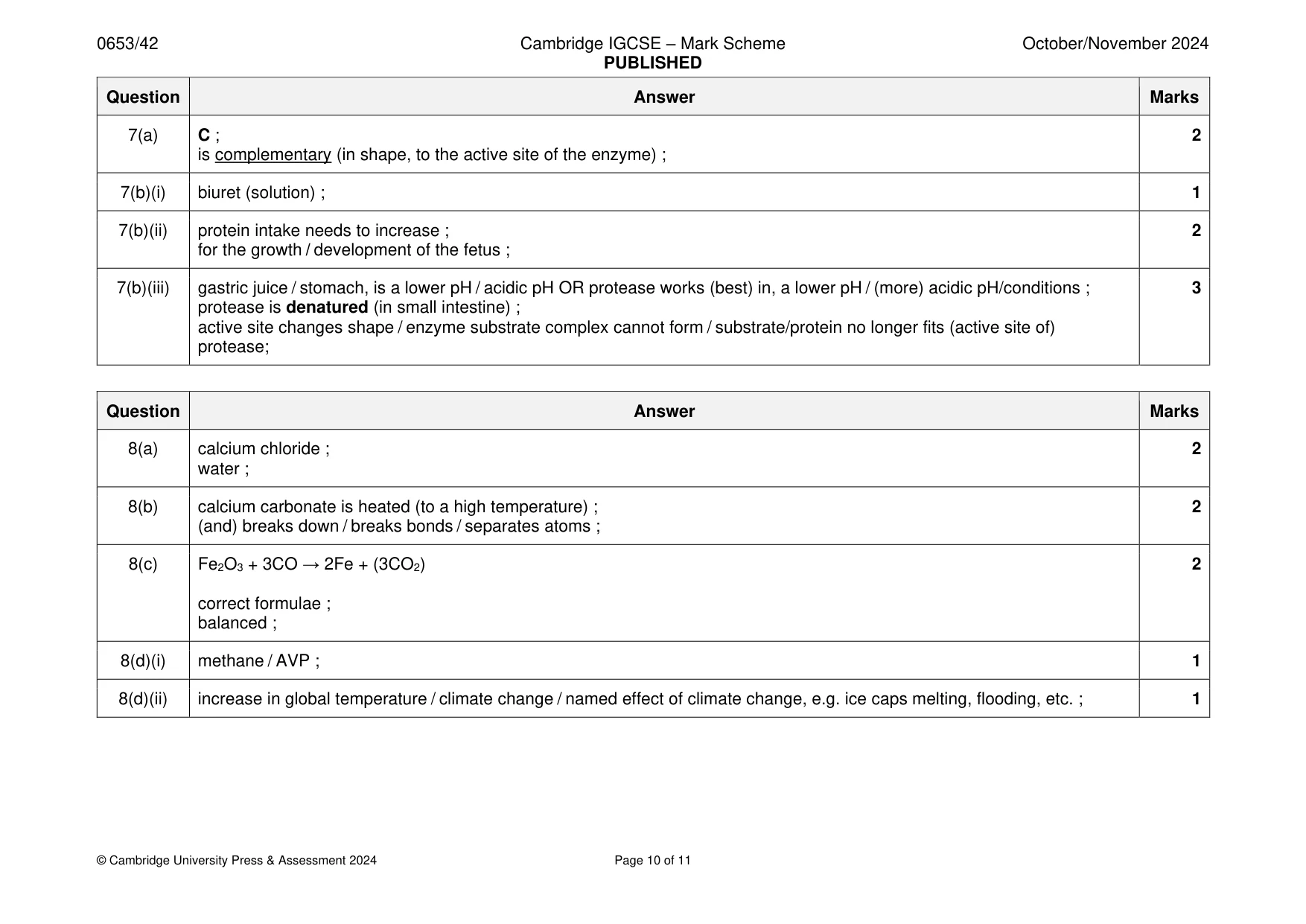
Mark scheme: 7(a) C ; 2 is complementary (in shape, to the active site of the enzyme) ; 7(b)(i) biuret (solution) ; 1 7(b)(ii) protein intake needs to increase ; 2 for the growth / development of the fetus ; 7(b)(iii) gastric juice / stomach, is a lower pH / acidic pH OR protease works (best) in, a lower pH / (more) acidic pH/conditions ; 3 protease is denatured (in small intestine) ; active site changes shape / enzyme substrate complex cannot form / substrate/protein no longer fits (active site of) protease;
Q8 · Carbon dioxide is a gas in air
8 Carbon dioxide is a gas in air. (a) Dilute hydrochloric acid reacts with calcium carbonate to form carbon dioxide. State the names of the two other products formed when dilute hydrochloric acid reacts with calcium carbonate. 1 ................................................................................................................................................ 2 ................................................................................................................................................ [2] (b) Carbon dioxide is made from calcium carbonate by thermal decomposition. Describe the thermal decomposition of calcium carbonate. ................................................................................................................................................... ................................................................................................................................................... ............................................................................................................................................. [2] (c) Carbon dioxide is also formed in the blast furnace by the combustion of carbon. Complete the balanced equation for one other reaction in the blast furnace that produces carbon dioxide. ........................................ + ........................................ ........................................ + 3CO2 [2] (d) Carbon dioxide is a greenhouse gas. (i) State the name of one other greenhouse gas. ..................................................................................................................................... [1] (ii) Suggest why scientists are concerned about the enhanced greenhouse effect. ........................................................................................................................................... ..................................................................................................................................... [1] [Total: 8]
Mark scheme: 8(a) calcium chloride ; 2 water ; 8(b) calcium carbonate is heated (to a high temperature) ; 2 (and) breaks down / breaks bonds / separates atoms ; 8(c) Fe2O3 + 3CO → 2Fe + (3CO2) 2 correct formulae ; balanced ; 8(d)(i) methane / AVP ; 1 8(d)(ii) increase in global temperature / climate change / named effect of climate change, e.g. ice caps melting, flooding, etc. ; 1
Q9 · A candle made of wax
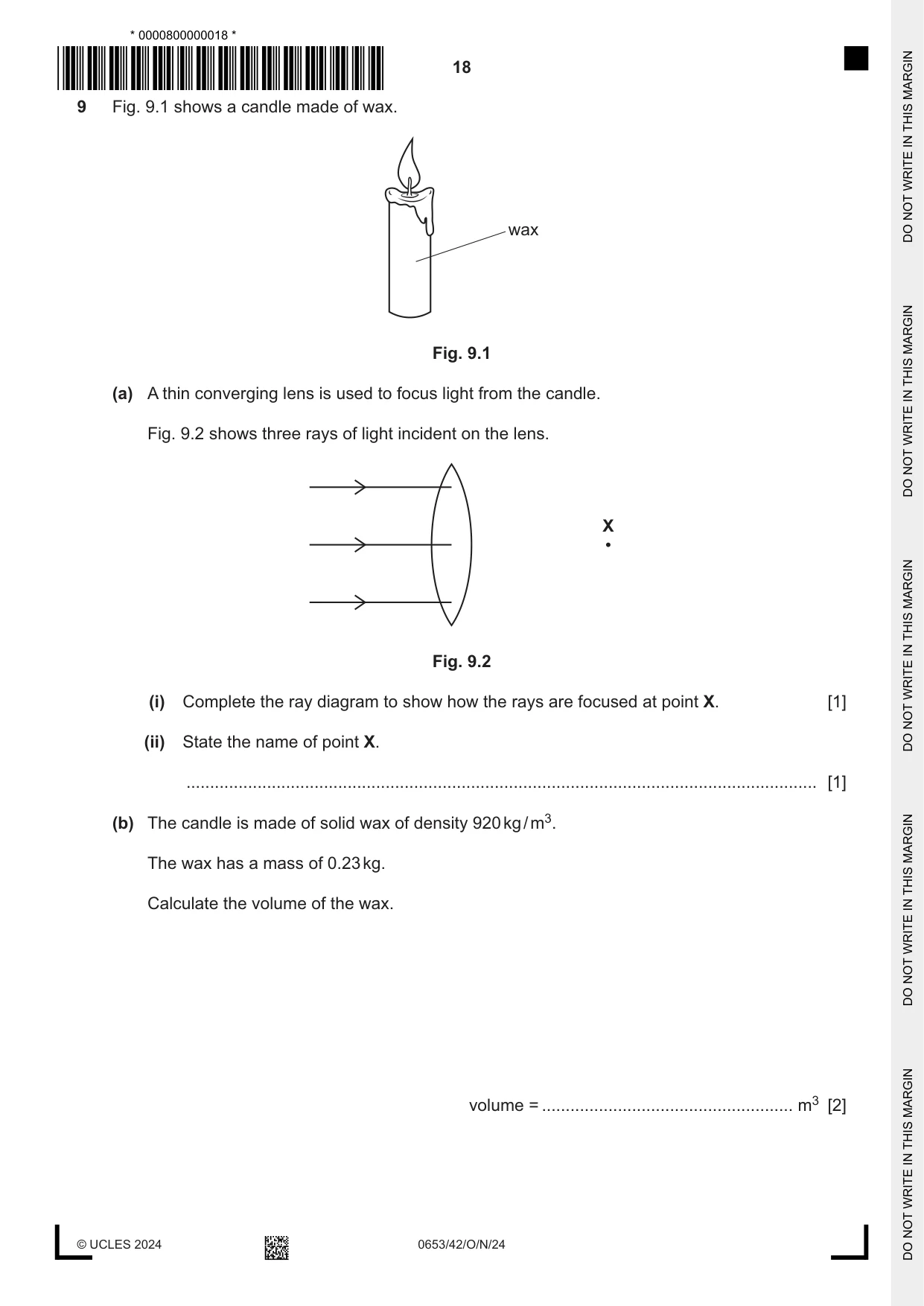
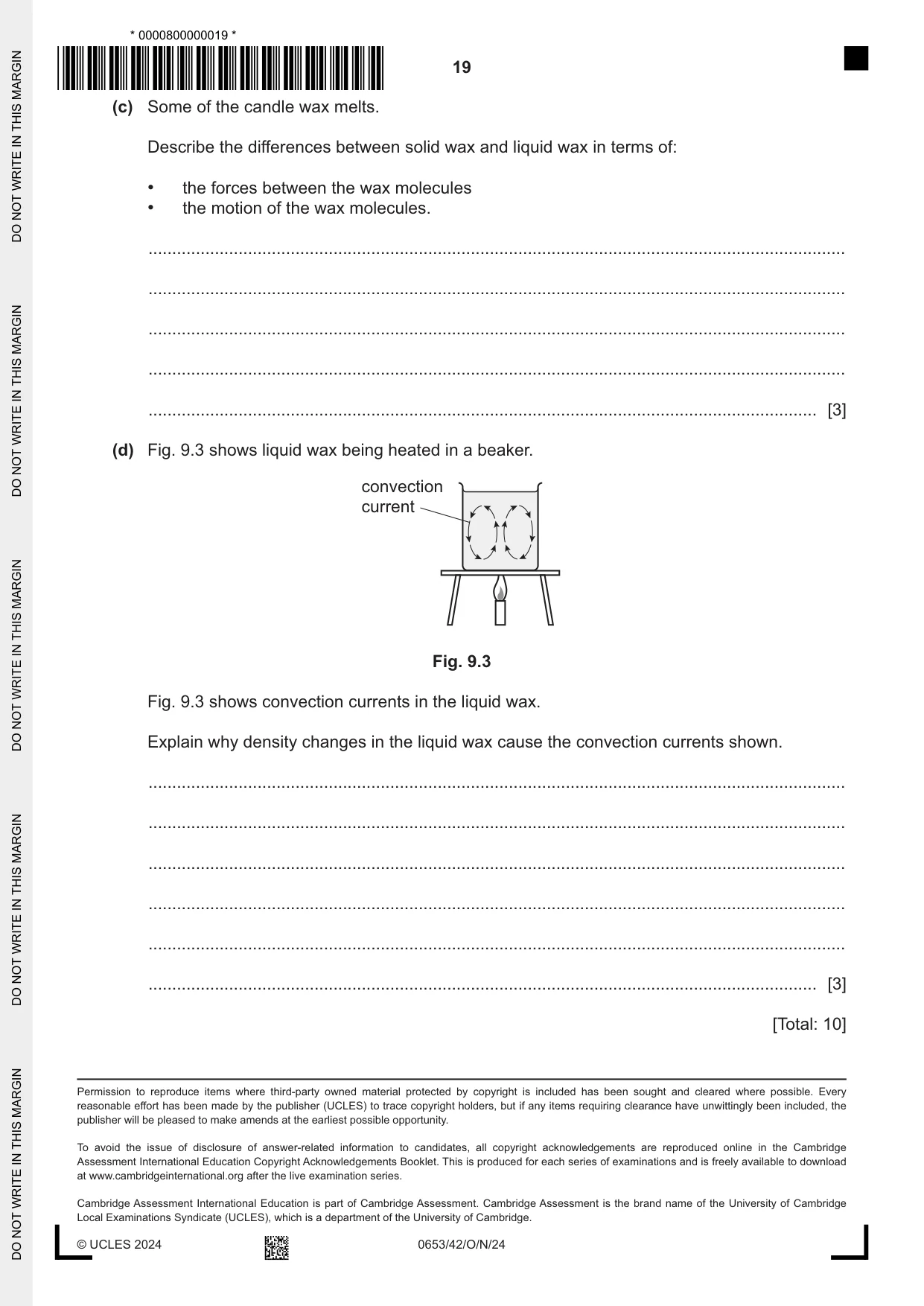
9 Fig. 9.1 shows a candle made of wax. wax Fig. 9.1 (a) A thin converging lens is used to focus light from the candle. Fig. 9.2 shows three rays of light incident on the lens. X Fig. 9.2 (i) Complete the ray diagram to show how the rays are focused at point X. [1] (ii) State the name of point X. ..................................................................................................................................... [1] (b) The candle is made of solid wax of density 920 kg / m3. The wax has a mass of 0.23 kg. Calculate the volume of the wax. volume = ..................................................... m3 [2] (c) Some of the candle wax melts. Describe the differences between solid wax and liquid wax in terms of: • the forces between the wax molecules • the motion of the wax molecules. ................................................................................................................................................... ................................................................................................................................................... ................................................................................................................................................... ................................................................................................................................................... ............................................................................................................................................. [3] (d) Fig. 9.3 shows liquid wax being heated in a beaker. convection current Fig. 9.3 Fig. 9.3 shows convection currents in the liquid wax. Explain why density changes in the liquid wax cause the convection currents shown. ................................................................................................................................................... ................................................................................................................................................... ................................................................................................................................................... ................................................................................................................................................... ................................................................................................................................................... ............................................................................................................................................. [3] [Total: 10]
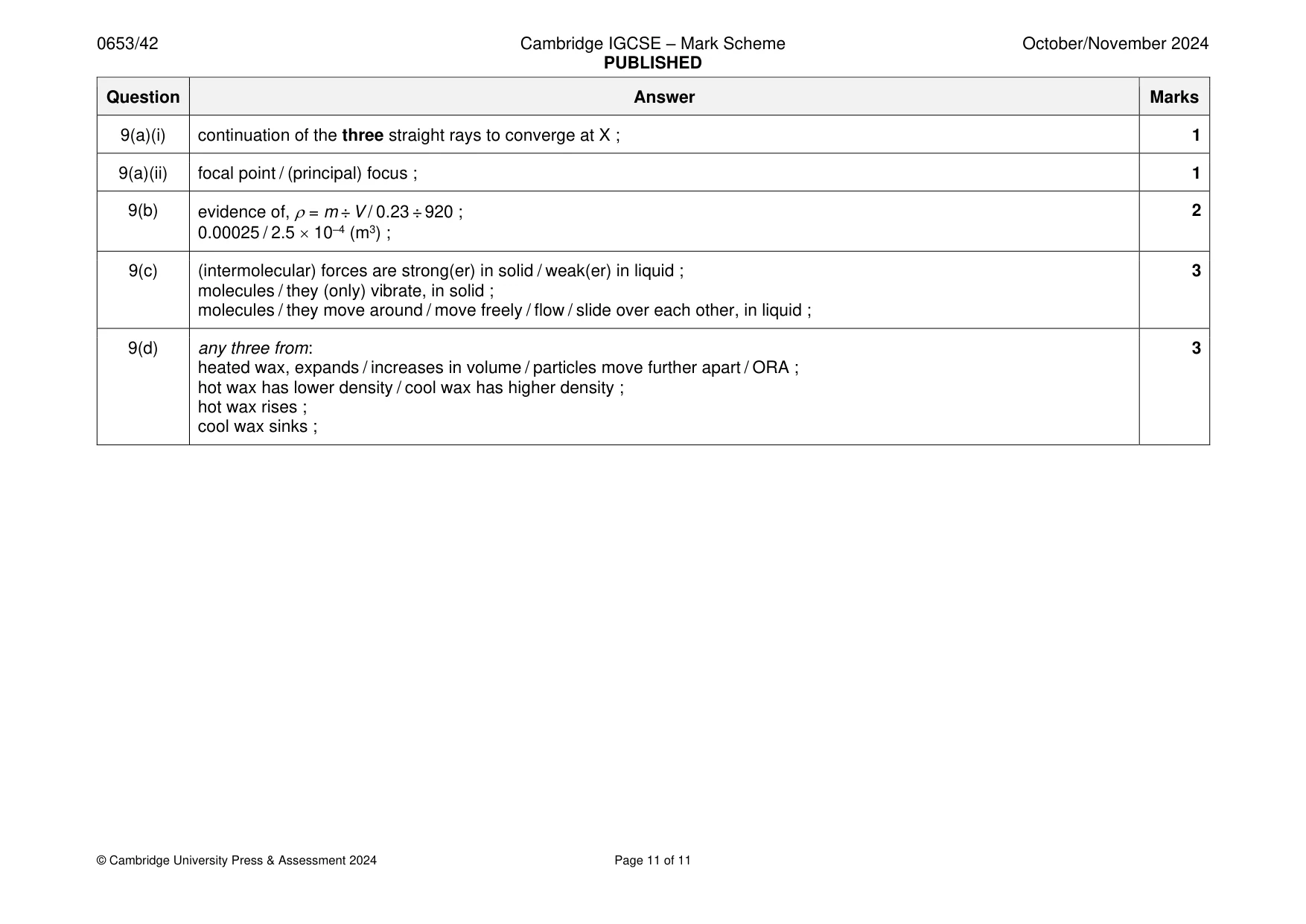
Mark scheme: 9(a)(i) continuation of the three straight rays to converge at X ; 1 9(a)(ii) focal point / (principal) focus ; 1 9(b) evidence of, = m ÷ V / 0.23 ÷ 920 ; 2 0.00025 / 2.5 10–4 (m3) ; 9(c) (intermolecular) forces are strong(er) in solid / weak(er) in liquid ; 3 molecules / they (only) vibrate, in solid ; molecules / they move around / move freely / flow / slide over each other, in liquid ; 9(d) any three from: 3 heated wax, expands / increases in volume / particles move further apart / ORA ; hot wax has lower density / cool wax has higher density ; hot wax rises ; cool wax sinks ;
What was in this paper
The subtopics covered by these 9 questions, and how many questions each got. Open one in a new tab to see every Cambridge question on it.
What you needed in this session
Cambridge’s own grade thresholds for 2024 Oct/Nov, Paper 4 · Variant 2. A higher threshold means an easier paper — the bar moves with how the cohort did.