Cambridge IGCSE Science - Combined 0653 — 2019 Oct/Nov Paper 4 · Variant 2
0653/42/O/N/19 · 9 questions · 80 marks · ≈90 min
The question paper and its mark scheme, free to read here and free to download. This is Cambridge’s own paper, exactly as it was sat.
Question paper20 pages
Mark scheme12 pages
Answers below. Sit the paper first if you are practising.
Questions as text
Q1 · A student investigates the volumes of air breathed in and out of their lungs before and…
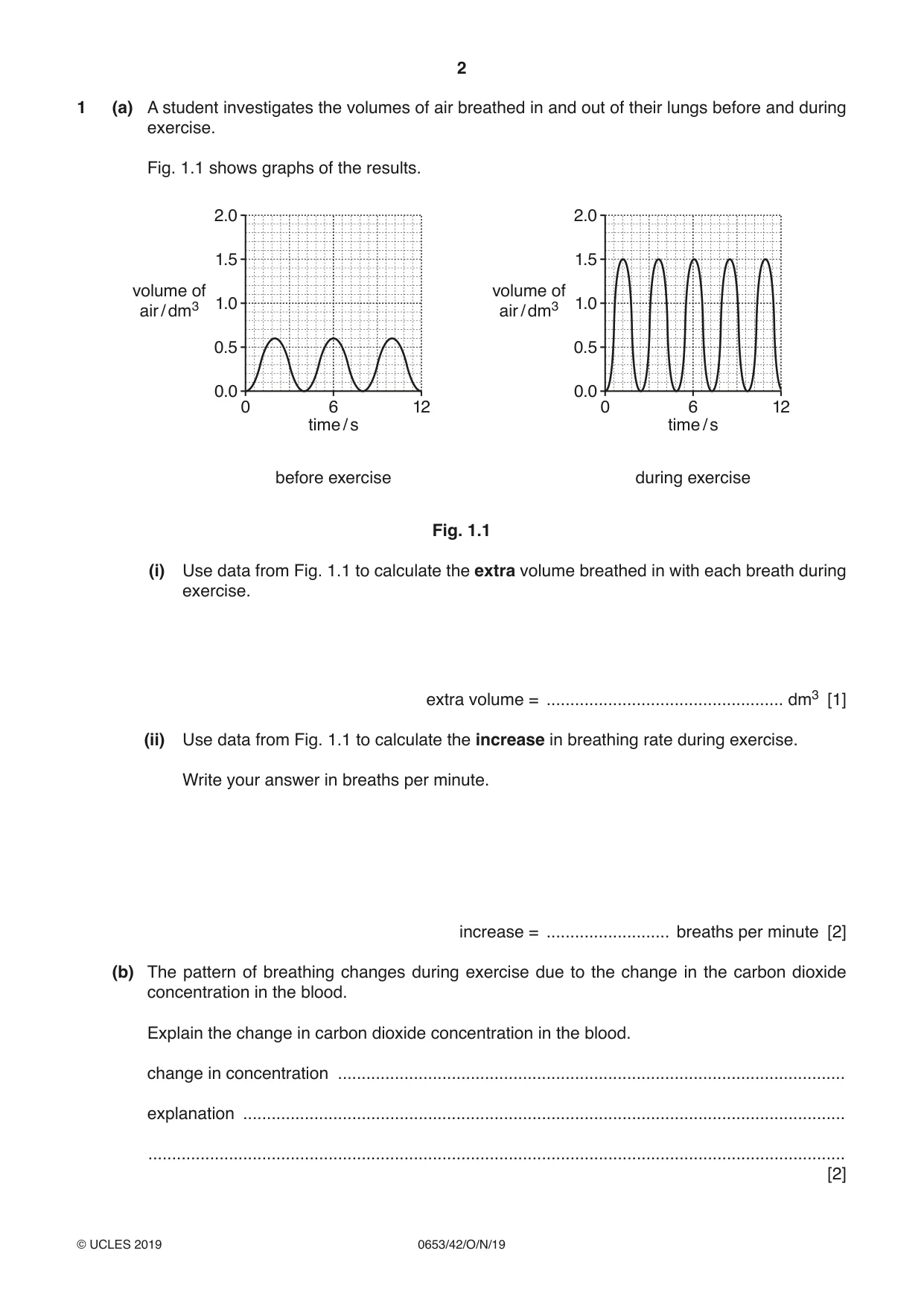
1 (a) A student investigates the volumes of air breathed in and out of their lungs before and during exercise. Fig. 1.1 shows graphs of the results. 2.0 2.0 1.5 1.5 volume of volume of 1.0 1.0 air / dm3 air / dm3 0.5 0.5 0.0 0.0 0 6 12 0 6 12 time / s time / s before exercise during exercise Fig. 1.1 (i) Use data from Fig. 1.1 to calculate the extra volume breathed in with each breath during exercise. extra volume = .................................................. dm3 [1] (ii) Use data from Fig. 1.1 to calculate the increase in breathing rate during exercise. Write your answer in breaths per minute. increase = .......................... breaths per minute [2] (b) The pattern of breathing changes during exercise due to the change in the carbon dioxide concentration in the blood. Explain the change in carbon dioxide concentration in the blood. change in concentration ........................................................................................................... explanation ............................................................................................................................... ................................................................................................................................................... [2] (c) Smoking tobacco has harmful effects on the gas exchange system. Describe the effect of carbon monoxide in tobacco smoke. ................................................................................................................................................... ................................................................................................................................................... ............................................................................................................................................. [2] (d) Suggest one disease caused by the tar in tobacco smoke. ............................................................................................................................................. [1] [Total: 8]
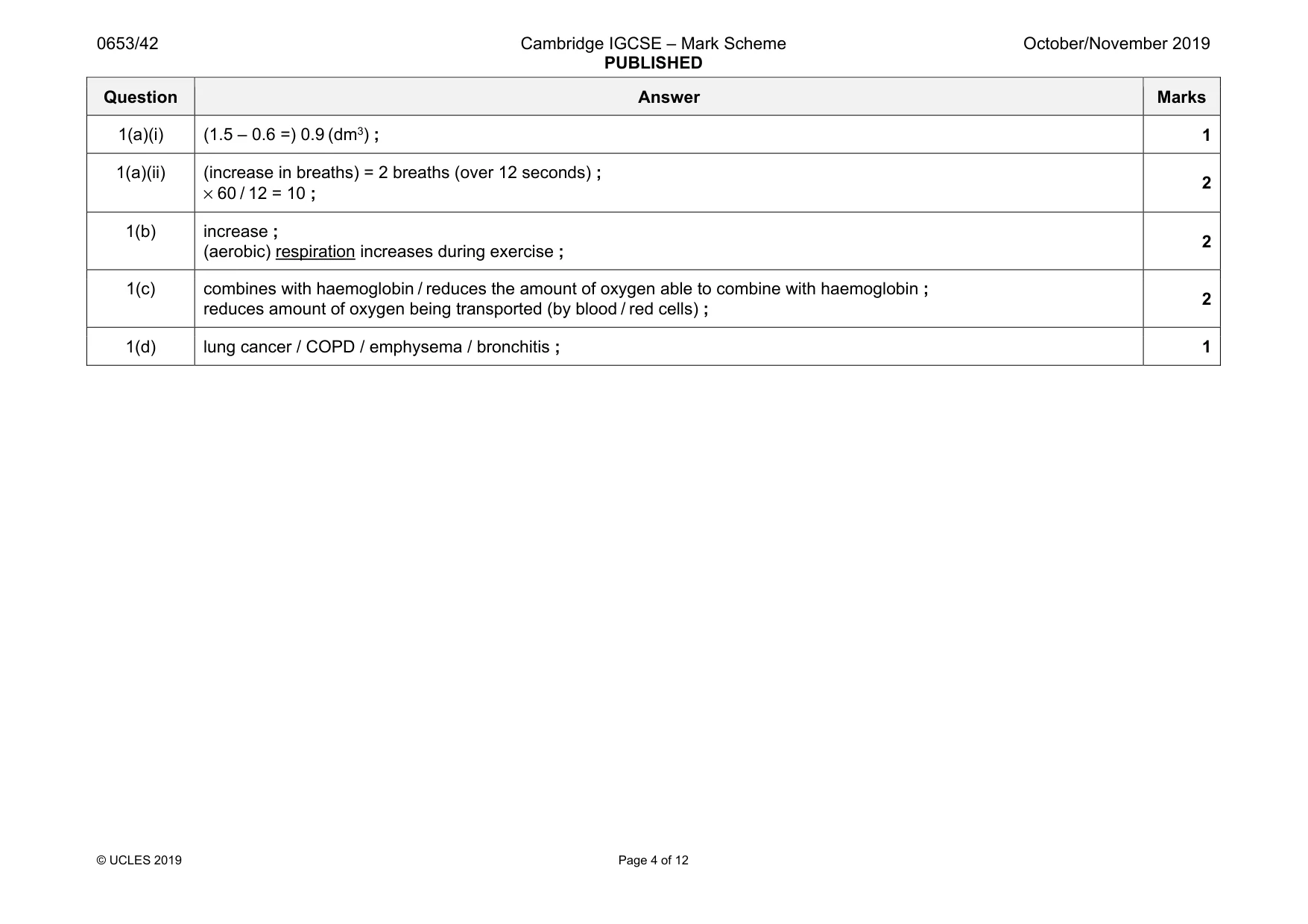
Mark scheme: 1(a)(i) (1.5 – 0.6 =) 0.9 (dm3) ; 1 1(a)(ii) (increase in breaths) = 2 breaths (over 12 seconds) ; × 60 / 12 = 10 ; 2 1(b) increase ; (aerobic) respiration increases during exercise ; 2 1(c) combines with haemoglobin / reduces the amount of oxygen able to combine with haemoglobin ; reduces amount of oxygen being transported (by blood / red cells) ; 2 1(d) lung cancer / COPD / emphysema / bronchitis ; 1
Q2 · A fractional distillation column used in the separation of petroleum
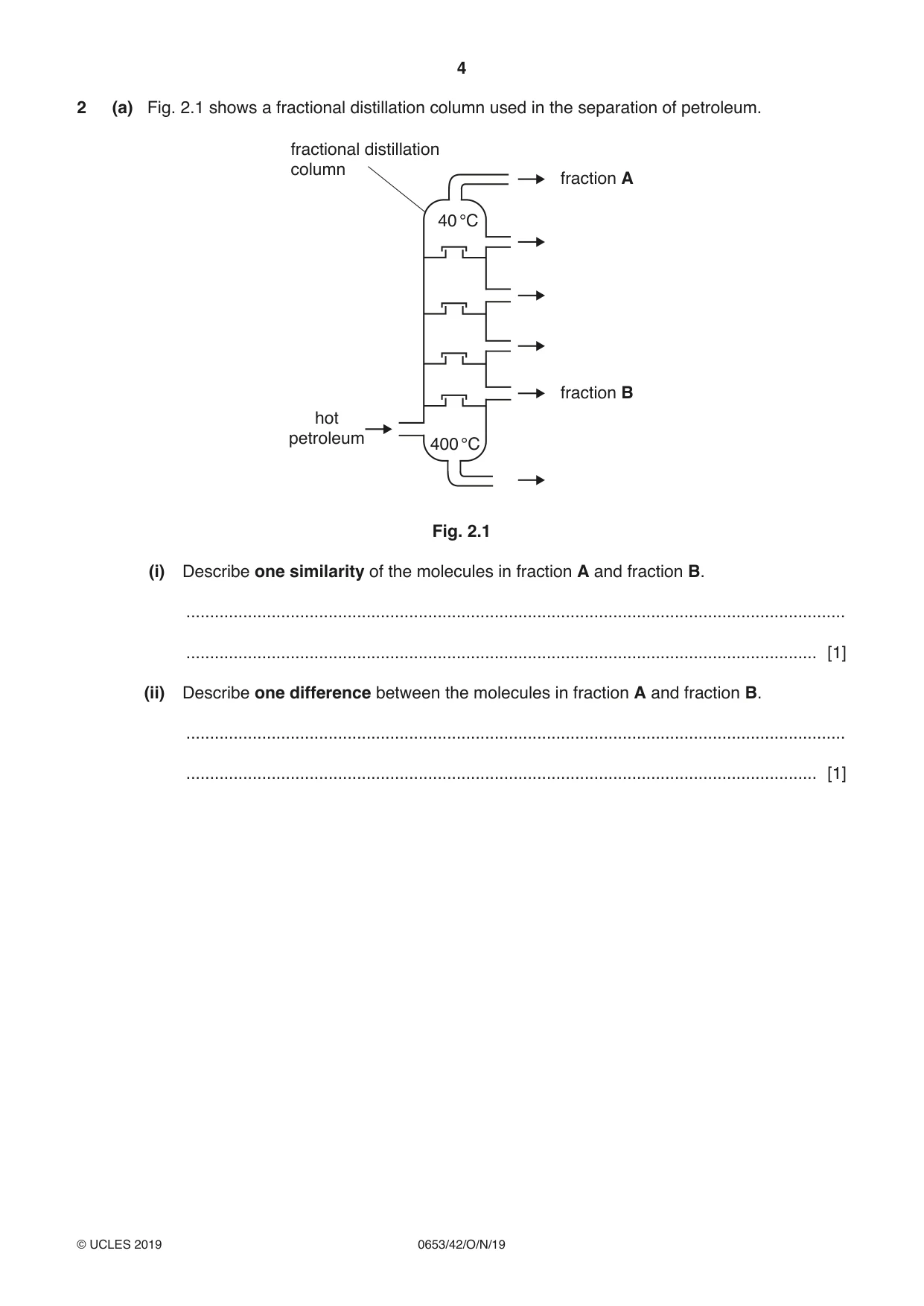
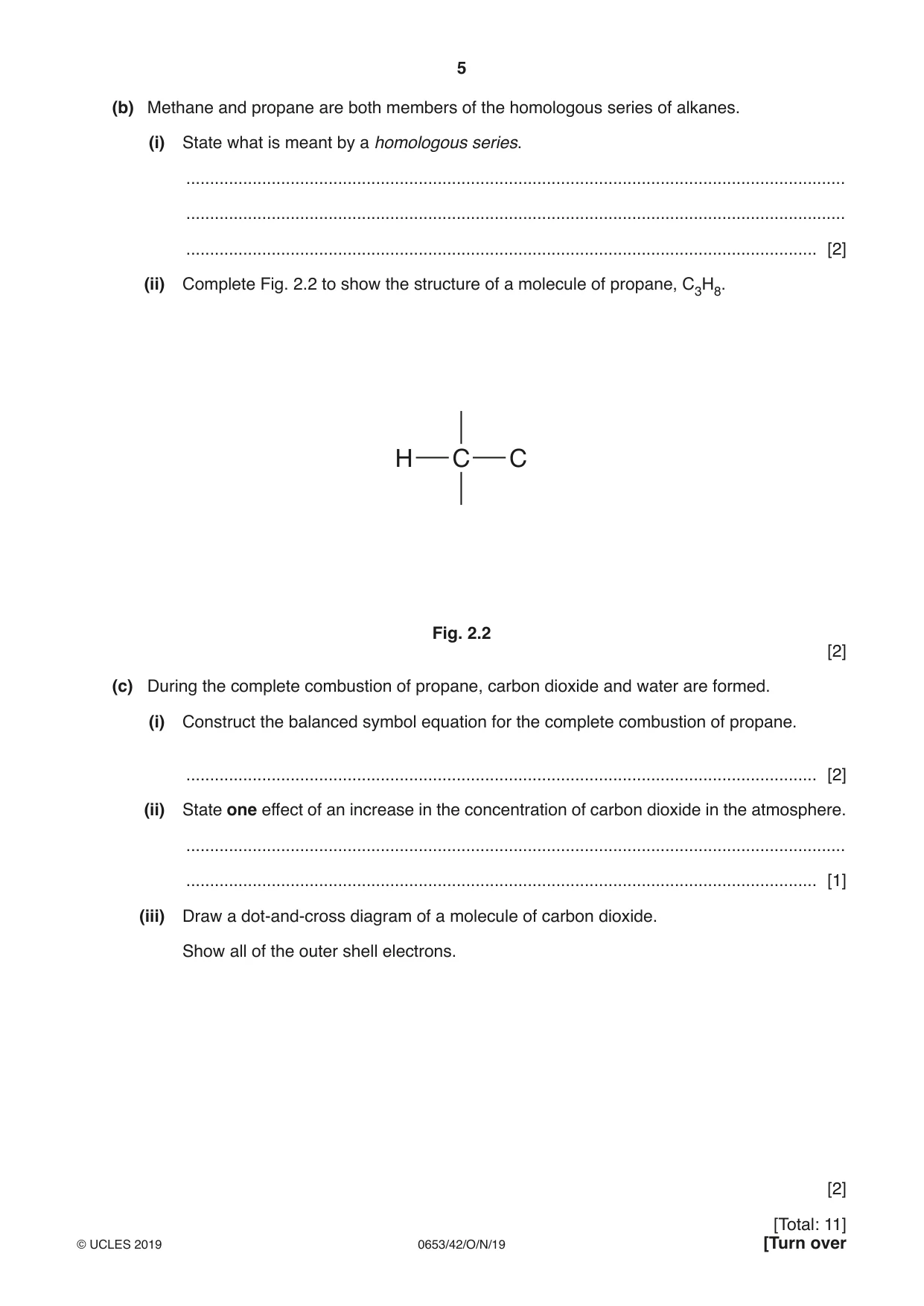
2 (a) Fig. 2.1 shows a fractional distillation column used in the separation of petroleum. fractional distillation column fraction A 40 °C fraction B hot petroleum 400 °C Fig. 2.1 (i) Describe one similarity of the molecules in fraction A and fraction B. ........................................................................................................................................... ..................................................................................................................................... [1] (ii) Describe one difference between the molecules in fraction A and fraction B. ........................................................................................................................................... ..................................................................................................................................... [1] (b) Methane and propane are both members of the homologous series of alkanes. (i) State what is meant by a homologous series. ........................................................................................................................................... ........................................................................................................................................... ..................................................................................................................................... [2] (ii) Complete Fig. 2.2 to show the structure of a molecule of propane, C3H8. H C C Fig. 2.2 [2] (c) During the complete combustion of propane, carbon dioxide and water are formed. (i) Construct the balanced symbol equation for the complete combustion of propane. ..................................................................................................................................... [2] (ii) State one effect of an increase in the concentration of carbon dioxide in the atmosphere. ........................................................................................................................................... ..................................................................................................................................... [1] (iii) Draw a dot-and-cross diagram of a molecule of carbon dioxide. Show all of the outer shell electrons. [2]
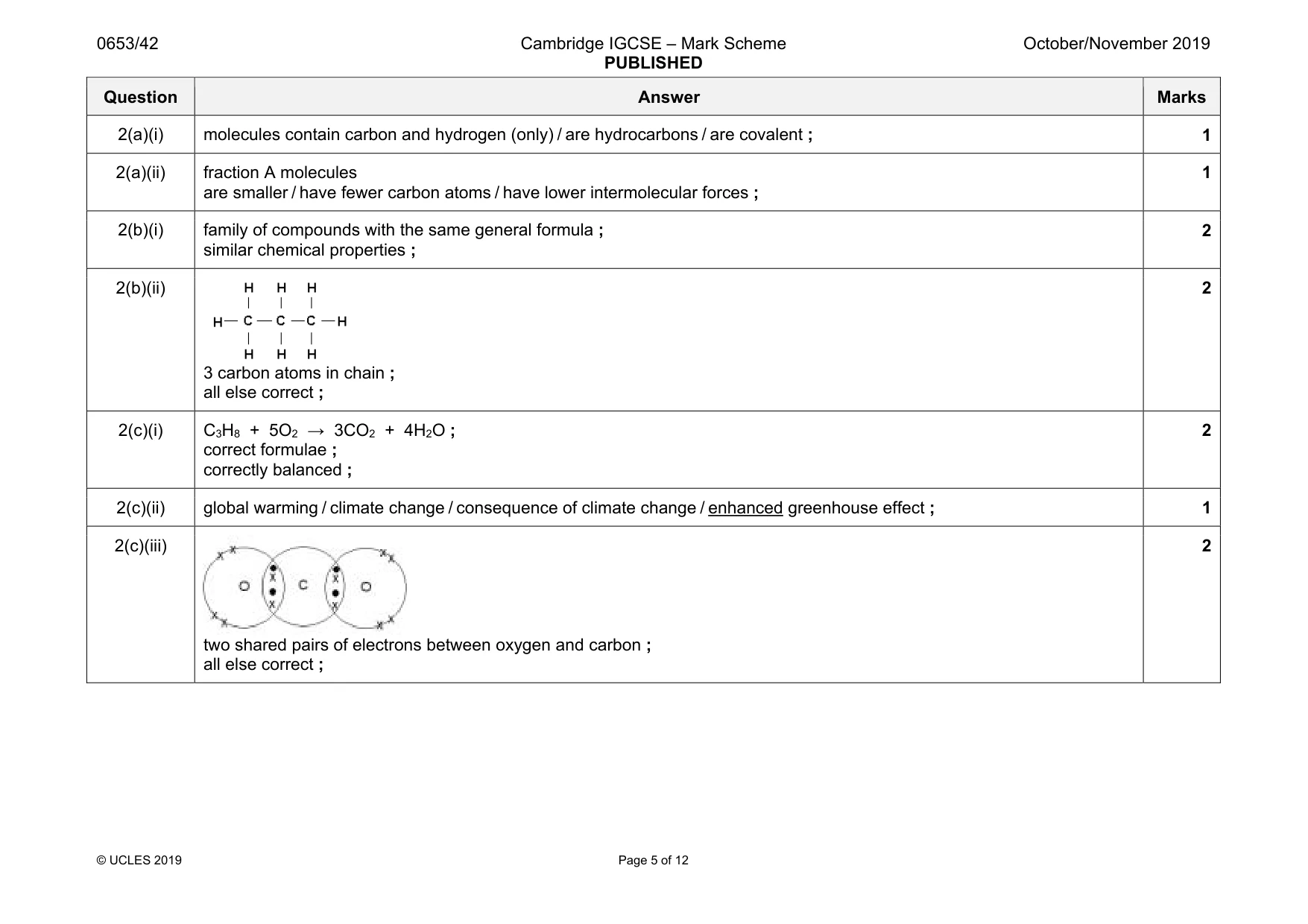
Mark scheme: 2(a)(i) molecules contain carbon and hydrogen (only) / are hydrocarbons / are covalent ; 1 2(a)(ii) fraction A molecules are smaller / have fewer carbon atoms / have lower intermolecular forces ; 1 2(b)(i) family of compounds with the same general formula ; similar chemical properties ; 2 2(b)(ii) 3 carbon atoms in chain ; all else correct ; 2 2(c)(i) C3H8 + 5O2 → 3CO2 + 4H2O ; correct formulae ; correctly balanced ; 2 2(c)(ii) global warming / climate change / consequence of climate change / enhanced greenhouse effect ; 1 2(c)(iii) two shared pairs of electrons between oxygen and carbon ; all else correct ; 2
Q3 · How a spring is stretched when a force is applied to one end
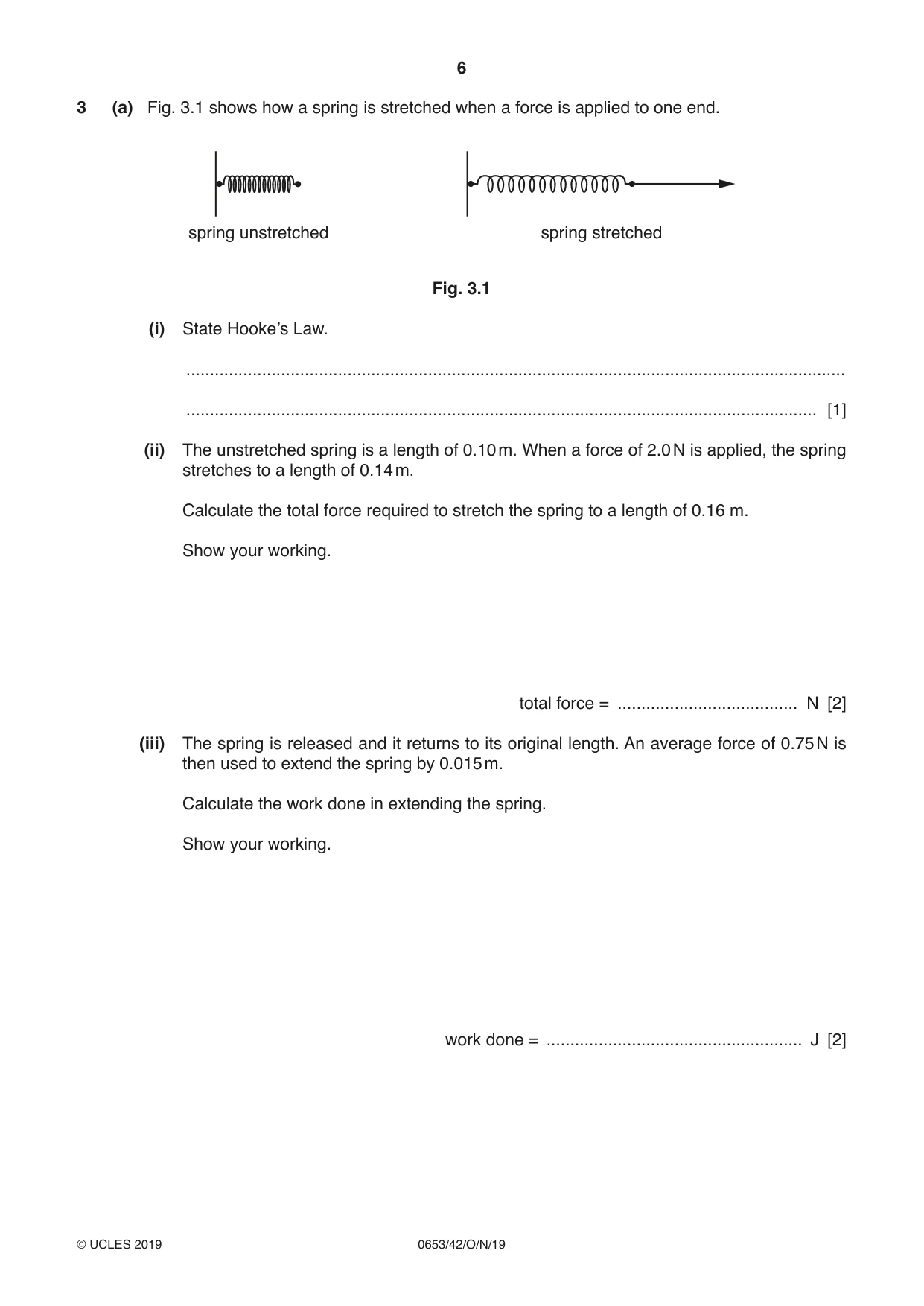
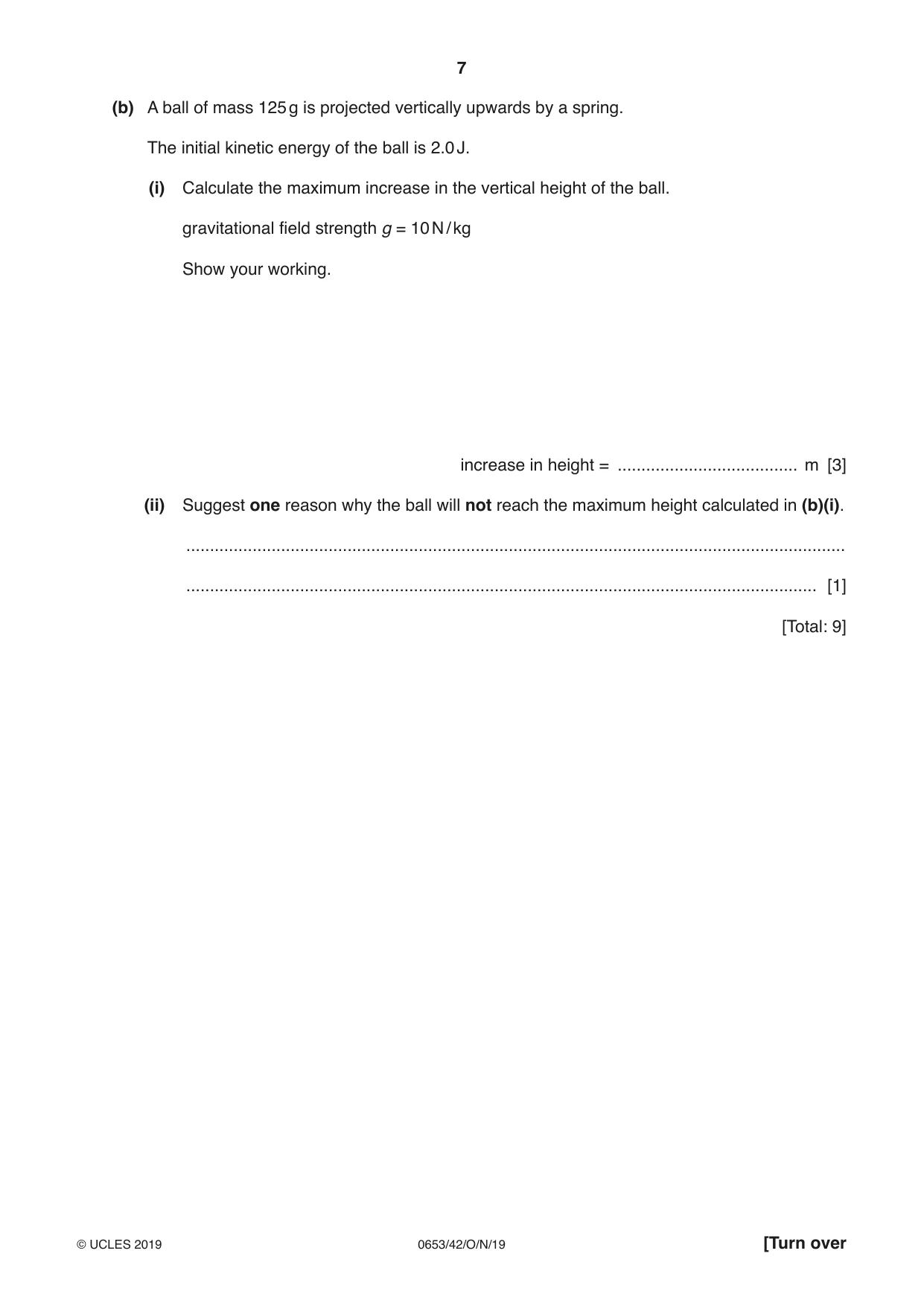
3 (a) Fig. 3.1 shows how a spring is stretched when a force is applied to one end. spring unstretched spring stretched Fig. 3.1 (i) State Hooke’s Law. ........................................................................................................................................... ..................................................................................................................................... [1] (ii) The unstretched spring is a length of 0.10 m. When a force of 2.0 N is applied, the spring stretches to a length of 0.14 m. Calculate the total force required to stretch the spring to a length of 0.16 m. Show your working. total force = ...................................... N [2] (iii) The spring is released and it returns to its original length. An average force of 0.75 N is then used to extend the spring by 0.015 m. Calculate the work done in extending the spring. Show your working. work done = ...................................................... J [2] (b) A ball of mass 125 g is projected vertically upwards by a spring. The initial kinetic energy of the ball is 2.0 J. (i) Calculate the maximum increase in the vertical height of the ball. gravitational field strength g = 10 N / kg Show your working. increase in height = ...................................... m [3] (ii) Suggest one reason why the ball will not reach the maximum height calculated in (b)(i). ........................................................................................................................................... ..................................................................................................................................... [1] [Total: 9]
Mark scheme: 3(a)(i) The extension (of an elastic object) is (directly) proportional to the force (applied to it) ; 1 3(a)(ii) correct calculation of extension x = 0.04 or spring constant k = 50 ; (F= k x = 50 × 0.06) = 3.0 (N) ; 2 3(a)(iii) use of work done = force × distance ; (W = F x = 0.75 × 0.015) = 0.011 (J) ; 2 3(b)(i) use of conservation of energy (mgh = KE = 2) ; 0.125 × 10 × h = 2 ; = 1.6 (m) ; 3 3(b)(ii) friction / air resistance ; 1
Q4 · A root hair cell and soil particles
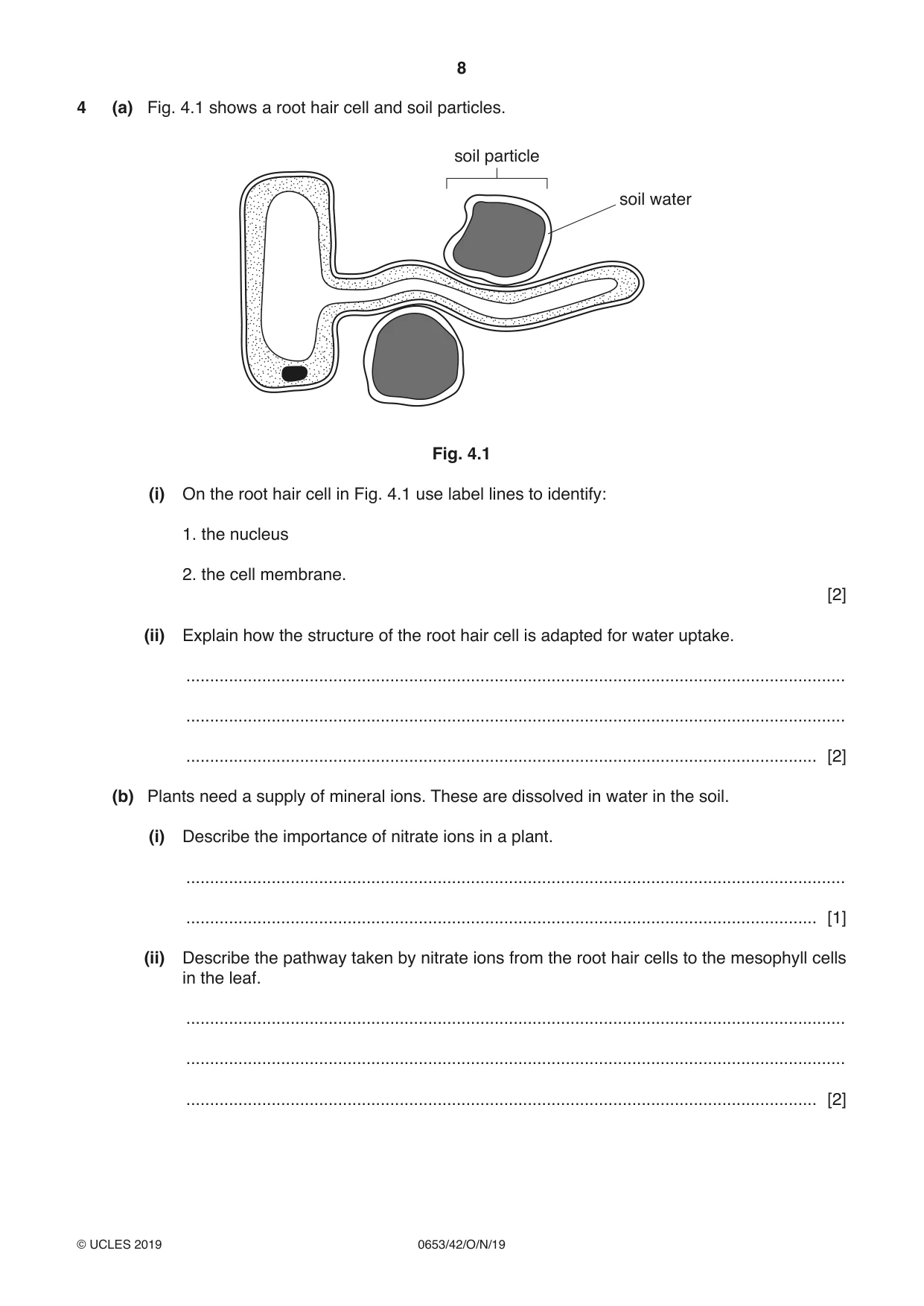
4 (a) Fig. 4.1 shows a root hair cell and soil particles. soil particle soil water Fig. 4.1 (i) On the root hair cell in Fig. 4.1 use label lines to identify: 1. the nucleus 2. the cell membrane. [2] (ii) Explain how the structure of the root hair cell is adapted for water uptake. ........................................................................................................................................... ........................................................................................................................................... ..................................................................................................................................... [2] (b) Plants need a supply of mineral ions. These are dissolved in water in the soil. (i) Describe the importance of nitrate ions in a plant. ........................................................................................................................................... ..................................................................................................................................... [1] (ii) Describe the pathway taken by nitrate ions from the root hair cells to the mesophyll cells in the leaf. ........................................................................................................................................... ........................................................................................................................................... ..................................................................................................................................... [2] (c) Humans need vitamin D. (i) Describe one effect of vitamin D deficiency in humans. ..................................................................................................................................... [1] (ii) Name a food which is a rich source of vitamin D. ..................................................................................................................................... [1] [Total: 9]
Mark scheme: 4(a)(i) nucleus correctly labelled ; cell membrane correctly labelled ; 2 4(a)(ii) large surface area ; increases rate of water uptake ; 2 4(b)(i) needed to make amino acids ; 1 4(b)(ii) across root cortex ; up stem ; in xylem ; Max. 2 4(c)(i) rickets / soft (and deformed) bones ; 1 4(c)(ii) butter / margarine / egg (yolks) / milk ; 1
Q5 · Aluminium ore is mainly aluminium oxide
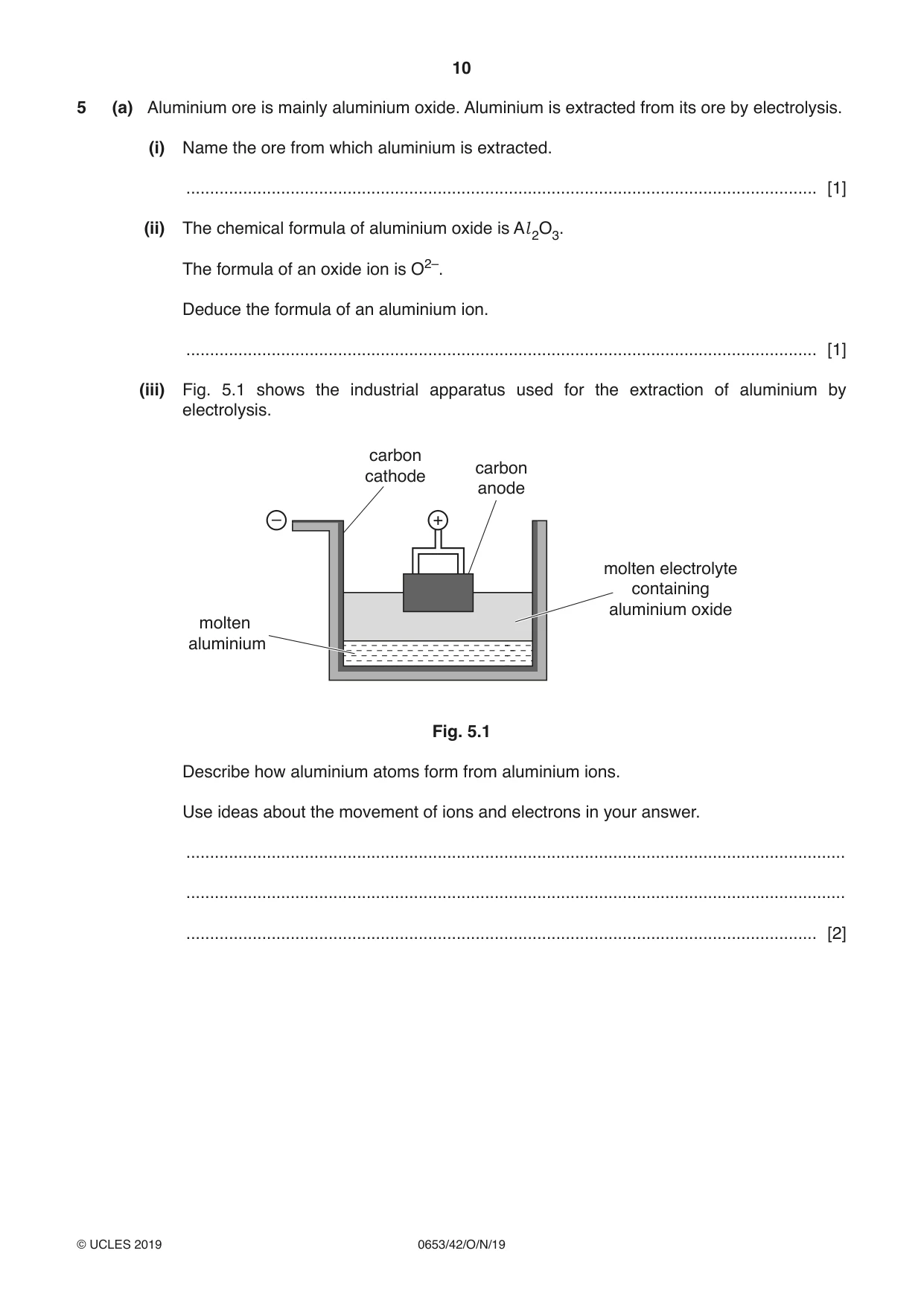
5 (a) Aluminium ore is mainly aluminium oxide. Aluminium is extracted from its ore by electrolysis. (i) Name the ore from which aluminium is extracted. ..................................................................................................................................... [1] (ii) The chemical formula of aluminium oxide is Al 2O3. The formula of an oxide ion is O2–. Deduce the formula of an aluminium ion. ..................................................................................................................................... [1] (iii) Fig. 5.1 shows the industrial apparatus used for the extraction of aluminium by electrolysis. carbon carbon cathode anode – + molten electrolyte containing aluminium oxide molten aluminium Fig. 5.1 Describe how aluminium atoms form from aluminium ions. Use ideas about the movement of ions and electrons in your answer. ........................................................................................................................................... ........................................................................................................................................... ..................................................................................................................................... [2] (iv) Copper is extracted from copper oxide by heating with carbon. Explain why aluminium cannot be extracted from aluminium oxide by heating with carbon. ........................................................................................................................................... ..................................................................................................................................... [1] (b) Explain why aluminium alloys, rather than pure aluminium, are used in aircraft construction. ................................................................................................................................................... ............................................................................................................................................. [1] [Total: 6]
Mark scheme: 5(a)(i) bauxite ; 1 5(a)(ii) Al 3+ ; 1 5(a)(iii) (positive) aluminium ions move to / are attracted to (negative) cathode ; and gain (three) electrons ; 2 5(a)(iv) aluminium is too reactive / aluminium above carbon in reactivity series / aluminium is more reactive than carbon ; 1 5(b) (alloys are) stronger / more resistant to corrosion ; 1
Q6 · An electric hair dryer
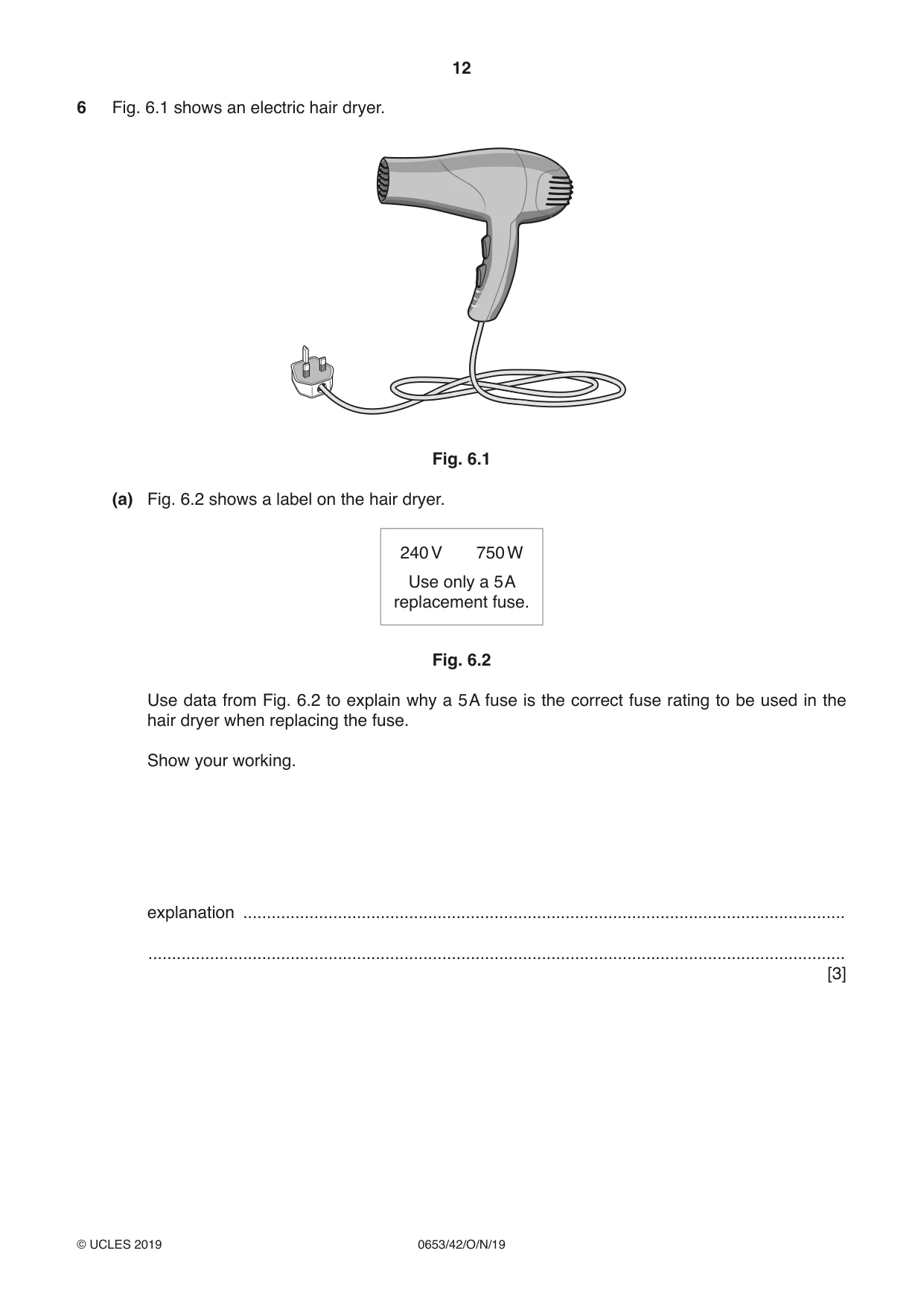
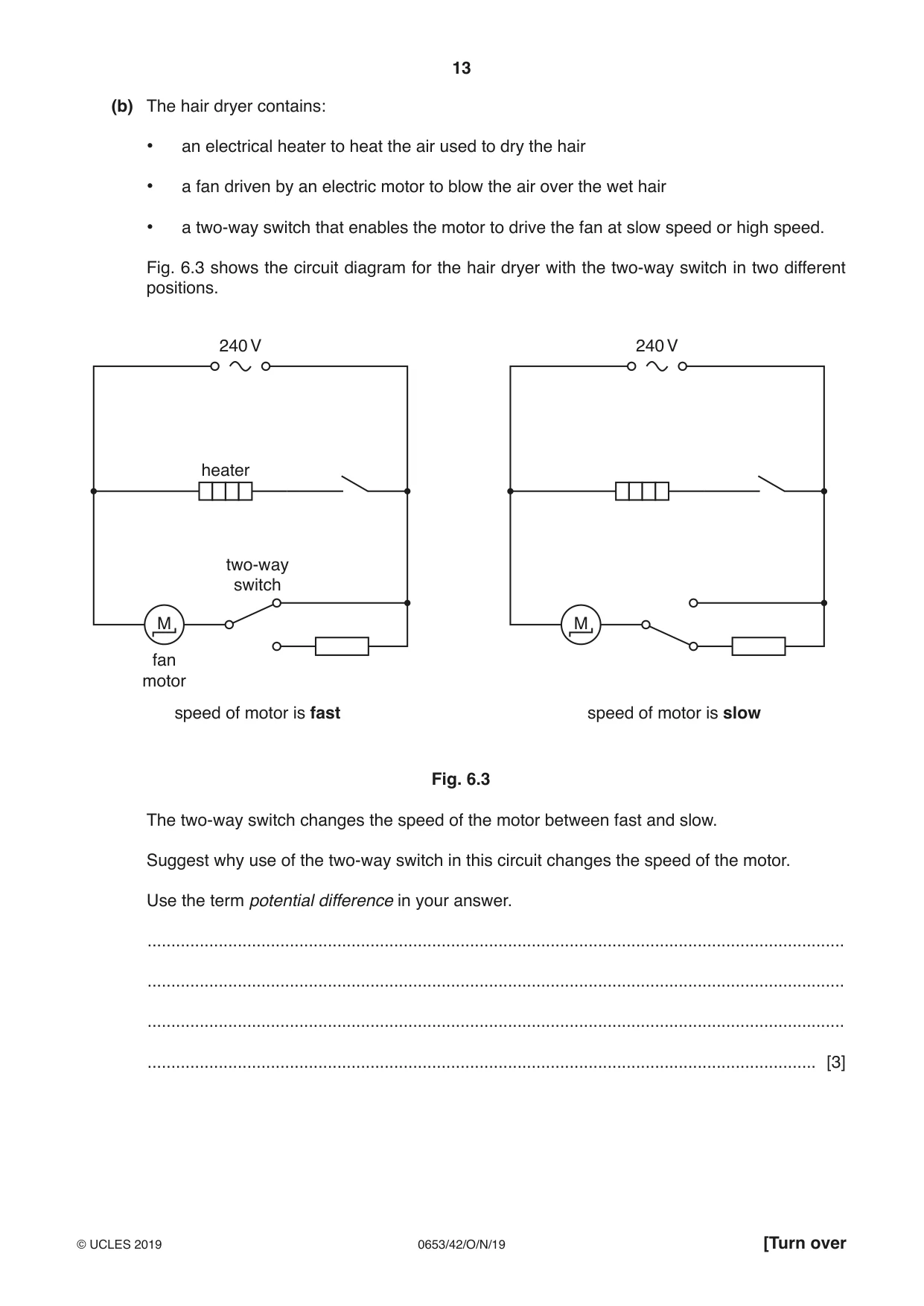
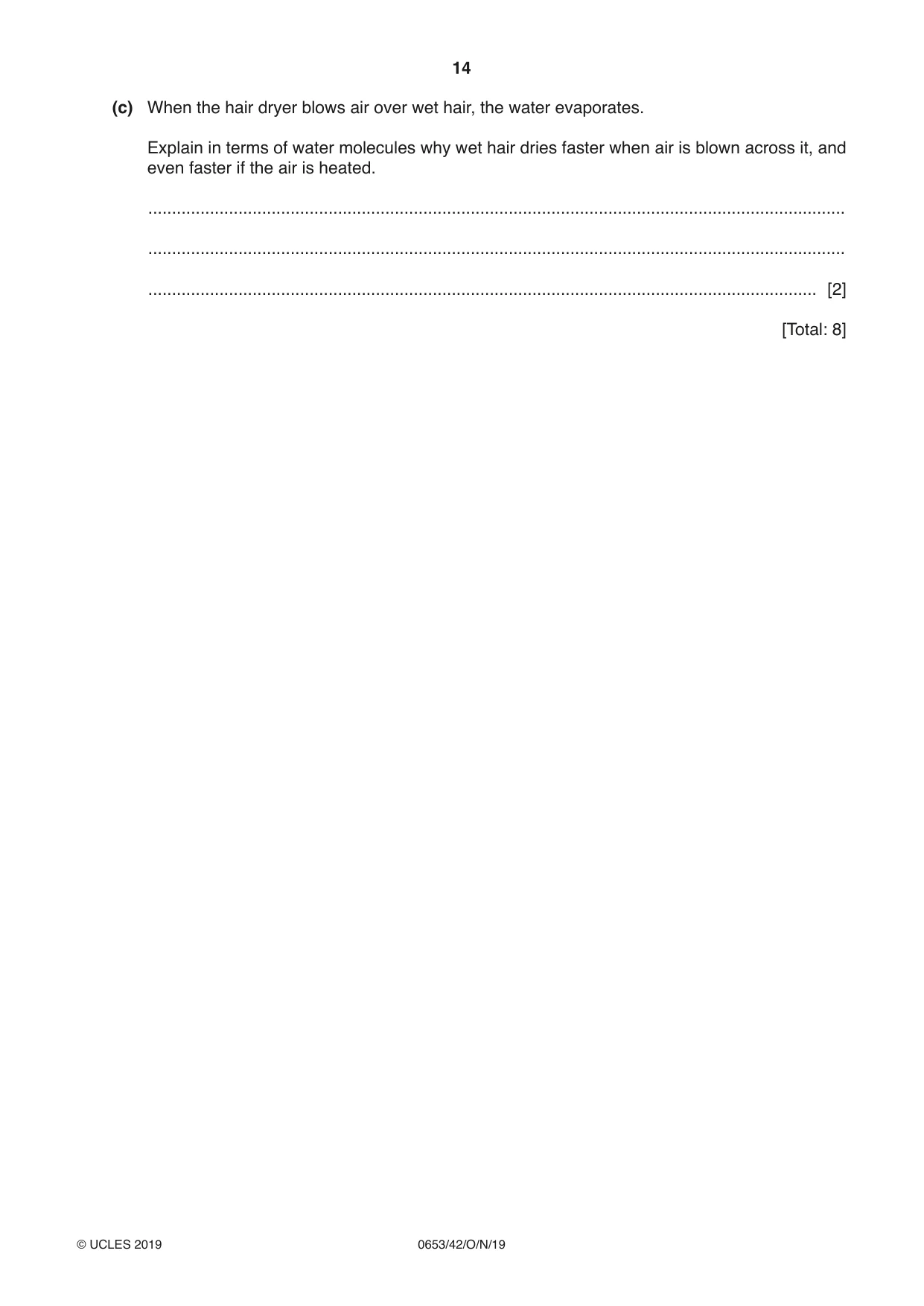
6 Fig. 6.1 shows an electric hair dryer. Fig. 6.1 (a) Fig. 6.2 shows a label on the hair dryer. 240 V 750 W Use only a 5 A replacement fuse. Fig. 6.2 Use data from Fig. 6.2 to explain why a 5 A fuse is the correct fuse rating to be used in the hair dryer when replacing the fuse. Show your working. explanation ............................................................................................................................... ................................................................................................................................................... [3] (b) The hair dryer contains: • an electrical heater to heat the air used to dry the hair • a fan driven by an electric motor to blow the air over the wet hair • a two-way switch that enables the motor to drive the fan at slow speed or high speed. Fig. 6.3 shows the circuit diagram for the hair dryer with the two-way switch in two different positions. 240 V 240 V heater two-way switch M M fan motor speed of motor is fast speed of motor is slow Fig. 6.3 The two-way switch changes the speed of the motor between fast and slow. Suggest why use of the two-way switch in this circuit changes the speed of the motor. Use the term potential difference in your answer. ................................................................................................................................................... ................................................................................................................................................... ................................................................................................................................................... ............................................................................................................................................. [3] (c) When the hair dryer blows air over wet hair, the water evaporates. Explain in terms of water molecules why wet hair dries faster when air is blown across it, and even faster if the air is heated. ................................................................................................................................................... ................................................................................................................................................... ............................................................................................................................................. [2] [Total: 8]
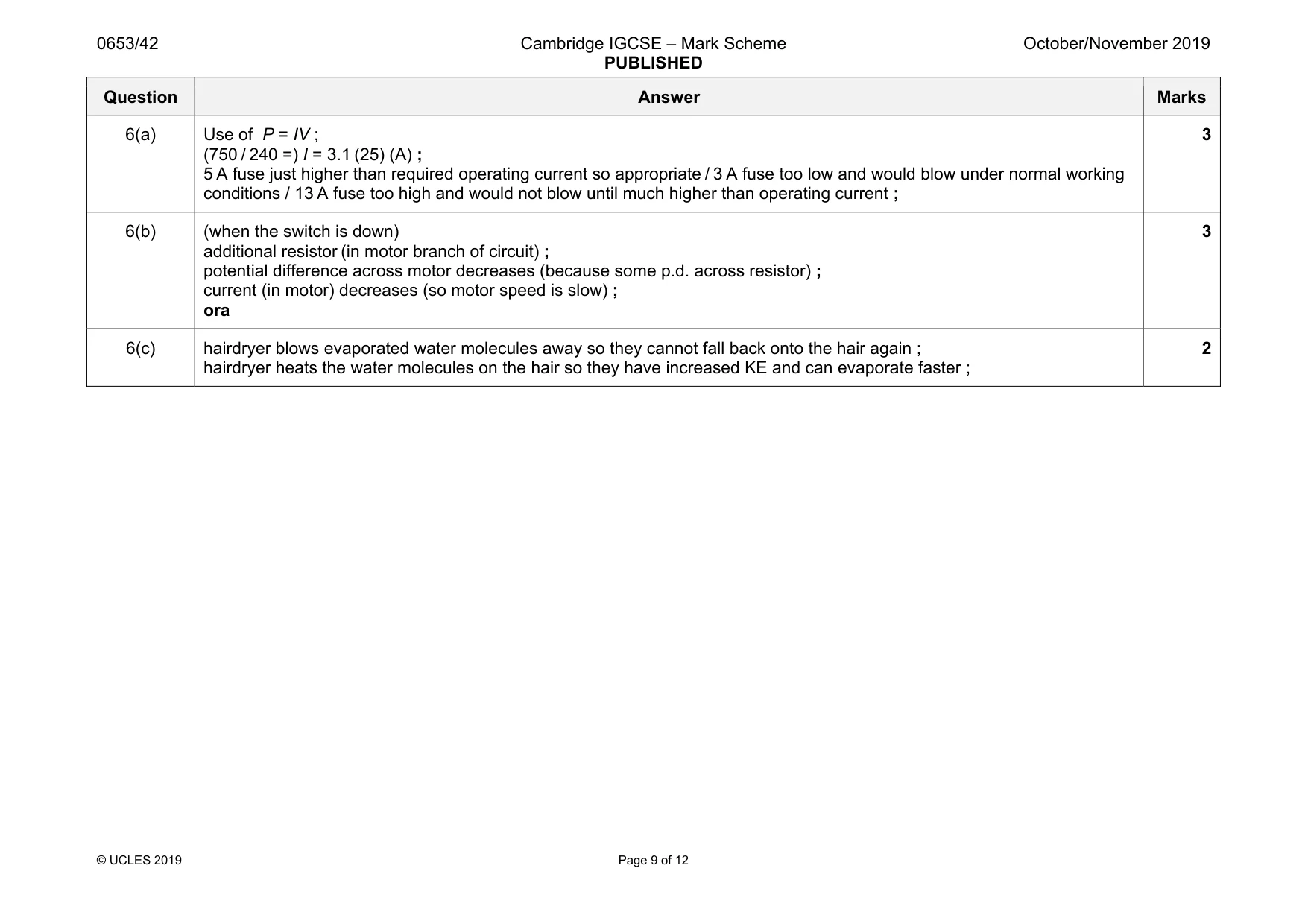
Mark scheme: 6(a) Use of P = IV ; (750 / 240 =) I = 3.1 (25) (A) ; 5 A fuse just higher than required operating current so appropriate / 3 A fuse too low and would blow under normal working conditions / 13 A fuse too high and would not blow until much higher than operating current ; 3 6(b) (when the switch is down) additional resistor (in motor branch of circuit) ; potential difference across motor decreases (because some p.d. across resistor) ; current (in motor) decreases (so motor speed is slow) ; ora 3 6(c) hairdryer blows evaporated water molecules away so they cannot fall back onto the hair again ; hairdryer heats the water molecules on the hair so they have increased KE and can evaporate faster ; 2
Q7 · A person is investigating the effect of the enzyme lipase on milk
7 (a) A person is investigating the effect of the enzyme lipase on milk. The person adds lipase to some milk in a test-tube. After 10 minutes the contents of the test-tube are tested with Universal Indicator. The results show that the contents of the test-tube have become more acidic. (i) Explain why the contents of the test-tube have become more acidic. ........................................................................................................................................... ........................................................................................................................................... ..................................................................................................................................... [2] (ii) Chemical digestion takes place in the test-tube. Explain what is meant by chemical digestion. ........................................................................................................................................... ........................................................................................................................................... ..................................................................................................................................... [2] (iii) Name one area in the body where lipase is secreted. ..................................................................................................................................... [1] (b) The investigation in (a) is repeated with boiled lipase. There is no change in the acidity of the contents of the test-tube. Explain in detail the effect of boiling the lipase on the action of the enzyme. ................................................................................................................................................... ................................................................................................................................................... ................................................................................................................................................... ............................................................................................................................................. [3] (c) Food is chewed in the mouth before swallowing. Explain why the chewing of food is an example of mechanical digestion. ................................................................................................................................................... ................................................................................................................................................... ............................................................................................................................................. [2] [Total: 10]
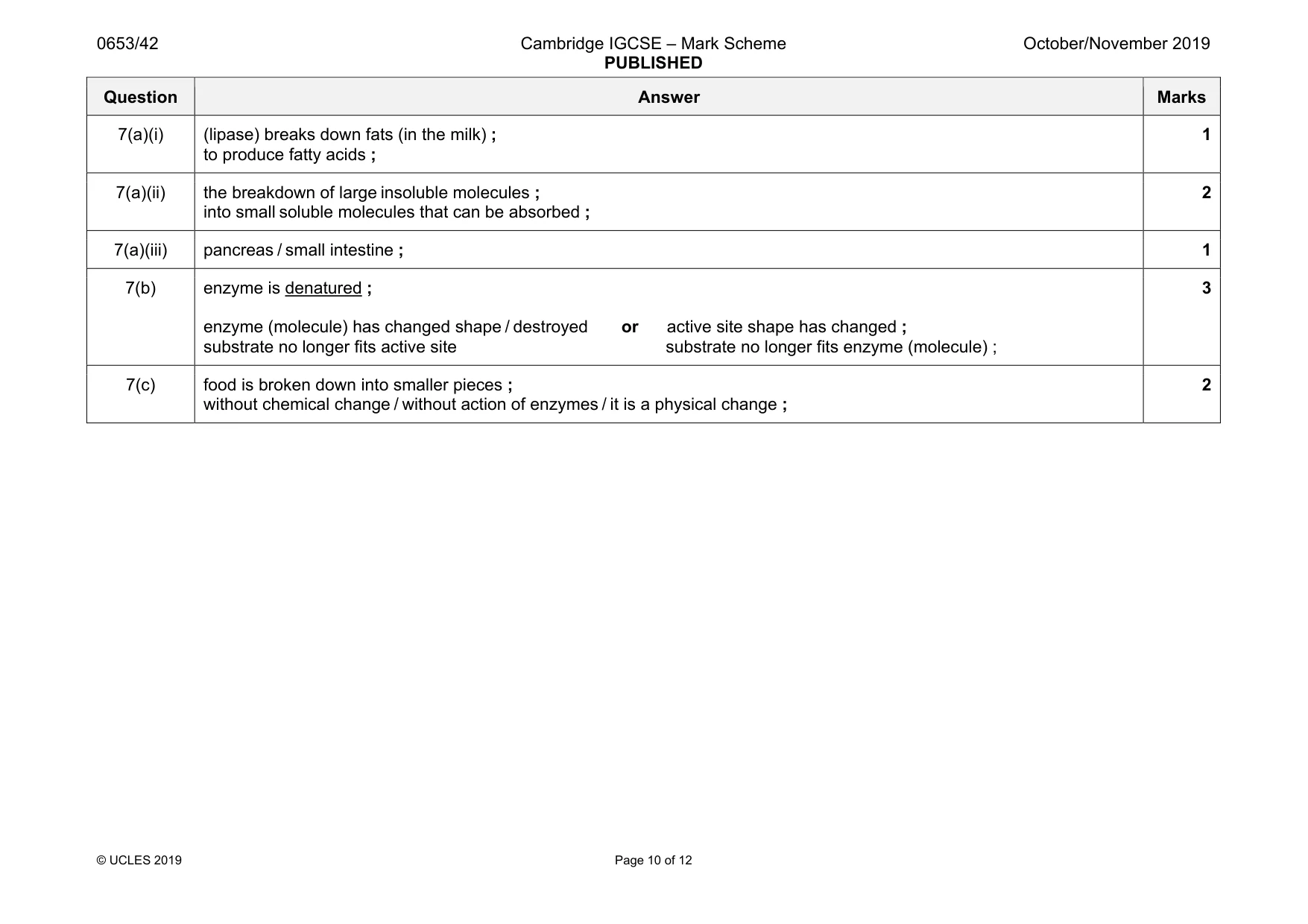
Mark scheme: 7(a)(i) (lipase) breaks down fats (in the milk) ; to produce fatty acids ; 1 7(a)(ii) the breakdown of large insoluble molecules ; into small soluble molecules that can be absorbed ; 2 7(a)(iii) pancreas / small intestine ; 1 7(b) enzyme is denatured ; enzyme (molecule) has changed shape / destroyed or active site shape has changed ; substrate no longer fits active site substrate no longer fits enzyme (molecule) ; 3 7(c) food is broken down into smaller pieces ; without chemical change / without action of enzymes / it is a physical change ; 2
Q8 · Chlorine and astatine are two Group VII elements
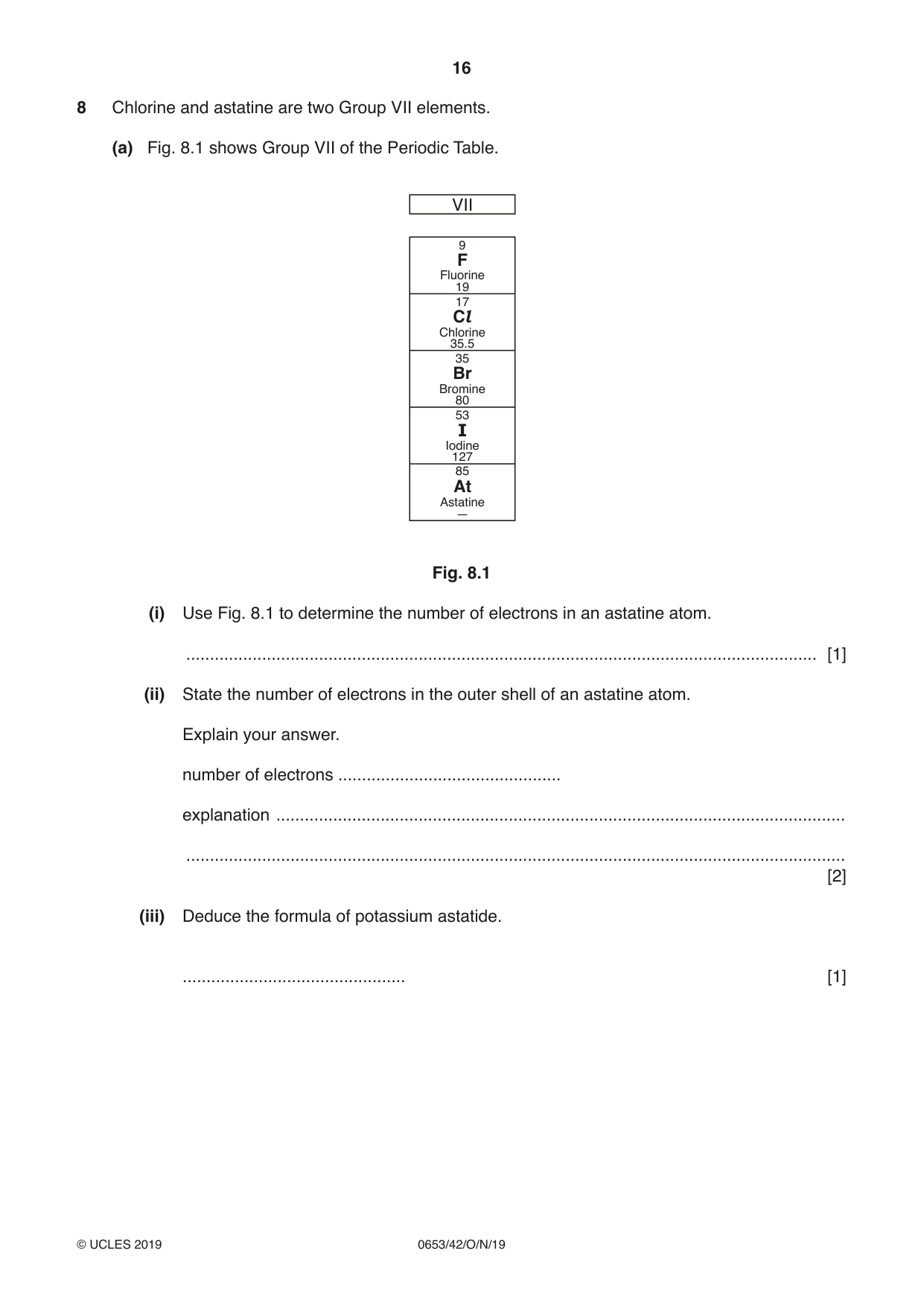
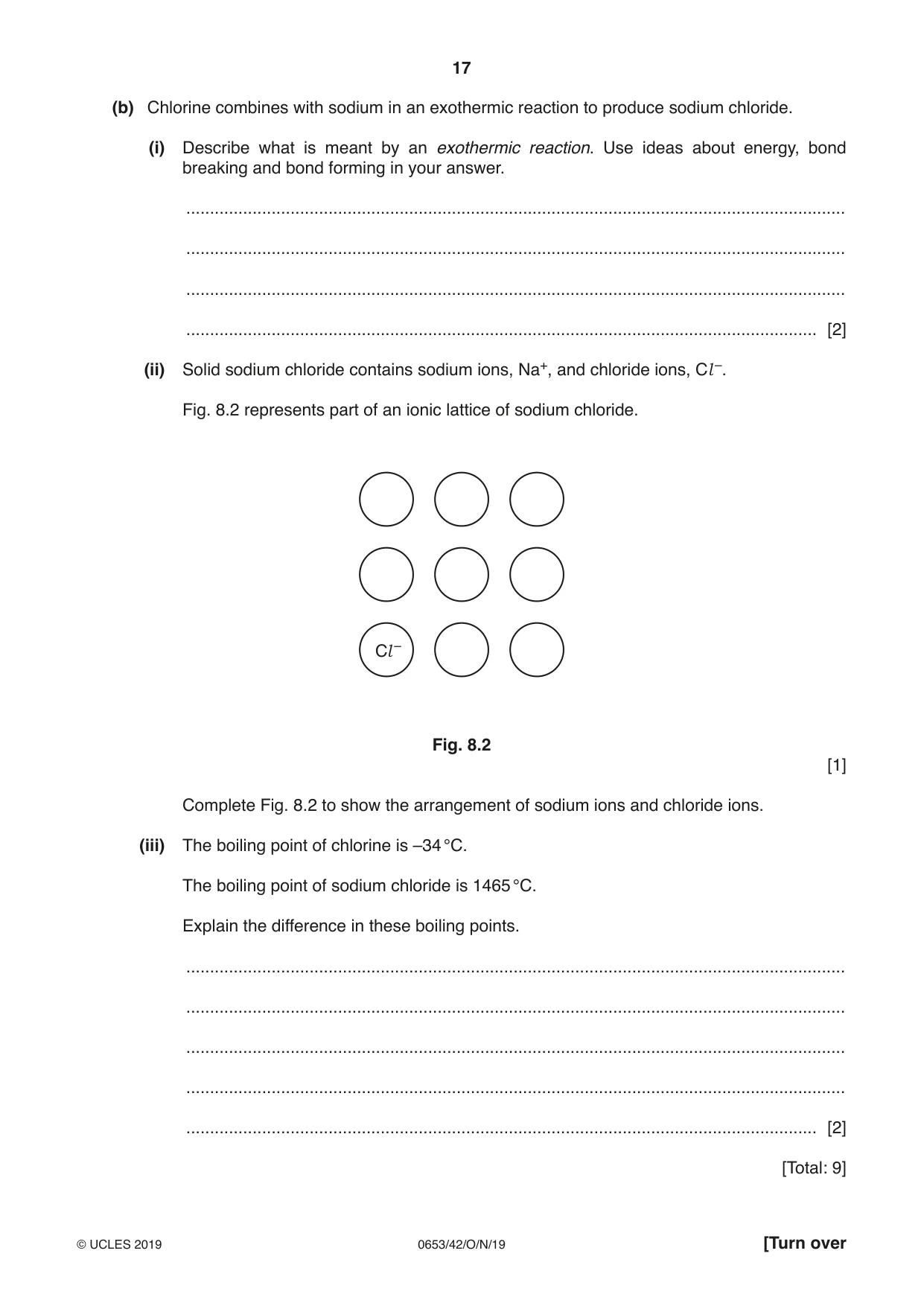
8 Chlorine and astatine are two Group VII elements. (a) Fig. 8.1 shows Group VII of the Periodic Table. VII 9 F Fluorine 19 17 Cl Chlorine 35.5 35 Br Bromine 80 53 I Iodine 127 85 At Astatine — Fig. 8.1 (i) Use Fig. 8.1 to determine the number of electrons in an astatine atom. ..................................................................................................................................... [1] (ii) State the number of electrons in the outer shell of an astatine atom. Explain your answer. number of electrons ............................................... explanation ........................................................................................................................ ........................................................................................................................................... [2] (iii) Deduce the formula of potassium astatide. ............................................... [1] (b) Chlorine combines with sodium in an exothermic reaction to produce sodium chloride. (i) Describe what is meant by an exothermic reaction. Use ideas about energy, bond breaking and bond forming in your answer. ........................................................................................................................................... ........................................................................................................................................... ........................................................................................................................................... ..................................................................................................................................... [2] (ii) Solid sodium chloride contains sodium ions, Na+, and chloride ions, Cl –. Fig. 8.2 represents part of an ionic lattice of sodium chloride. Cl – Fig. 8.2 [1] Complete Fig. 8.2 to show the arrangement of sodium ions and chloride ions. (iii) The boiling point of chlorine is –34 °C. The boiling point of sodium chloride is 1465 °C. Explain the difference in these boiling points. ........................................................................................................................................... ........................................................................................................................................... ........................................................................................................................................... ........................................................................................................................................... ..................................................................................................................................... [2] [Total: 9]
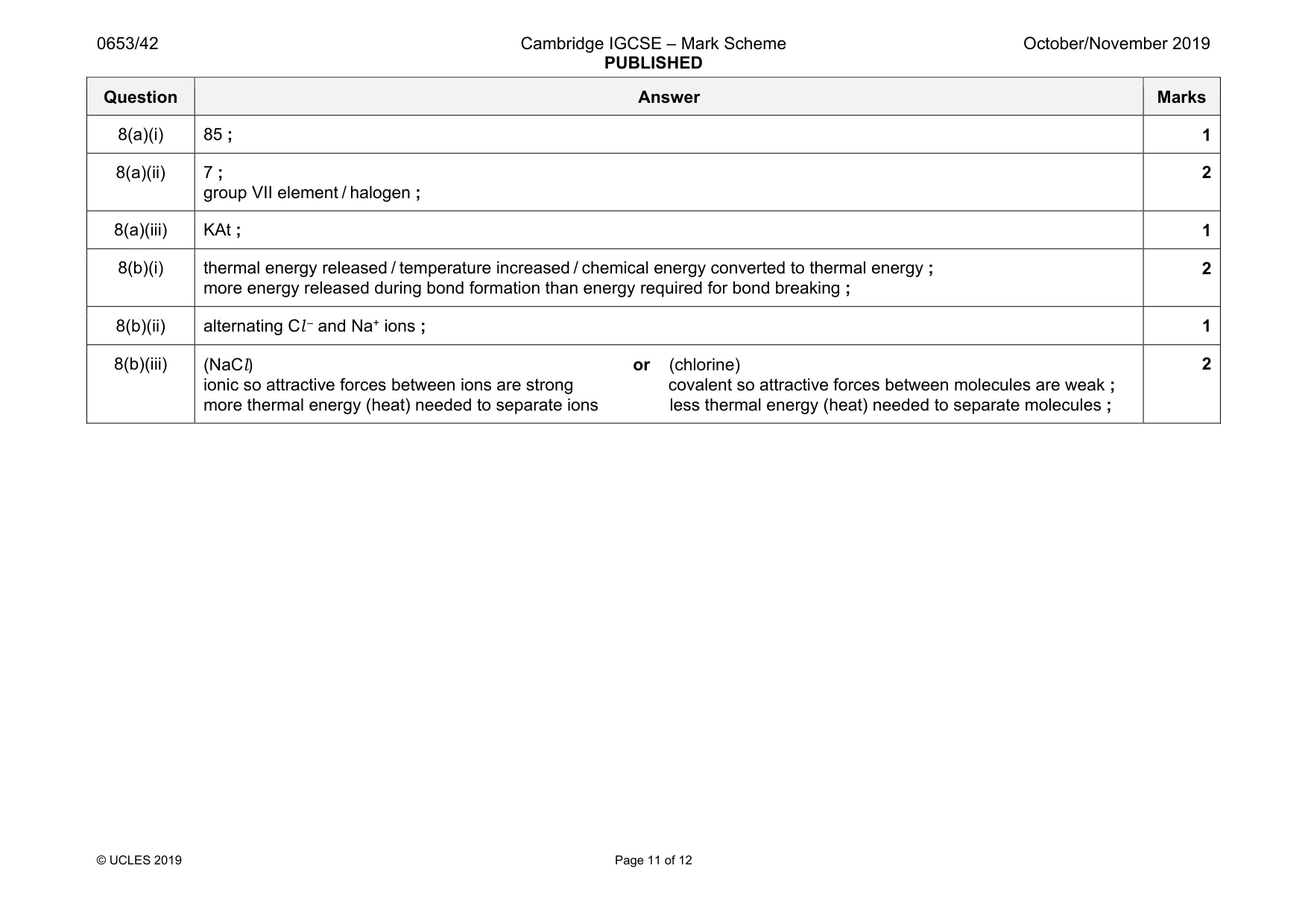
Mark scheme: 8(a)(i) 85 ; 1 8(a)(ii) 7 ; group VII element / halogen ; 2 8(a)(iii) KAt ; 1 8(b)(i) thermal energy released / temperature increased / chemical energy converted to thermal energy ; more energy released during bond formation than energy required for bond breaking ; 2 8(b)(ii) alternating Cl – and Na+ ions ; 1 8(b)(iii) (NaCl) or (chlorine) ionic so attractive forces between ions are strong covalent so attractive forces between molecules are weak ; more thermal energy (heat) needed to separate ions less thermal energy (heat) needed to separate molecules ; 2
Q9 · A lightning bolt, which is a form of electrostatic discharge
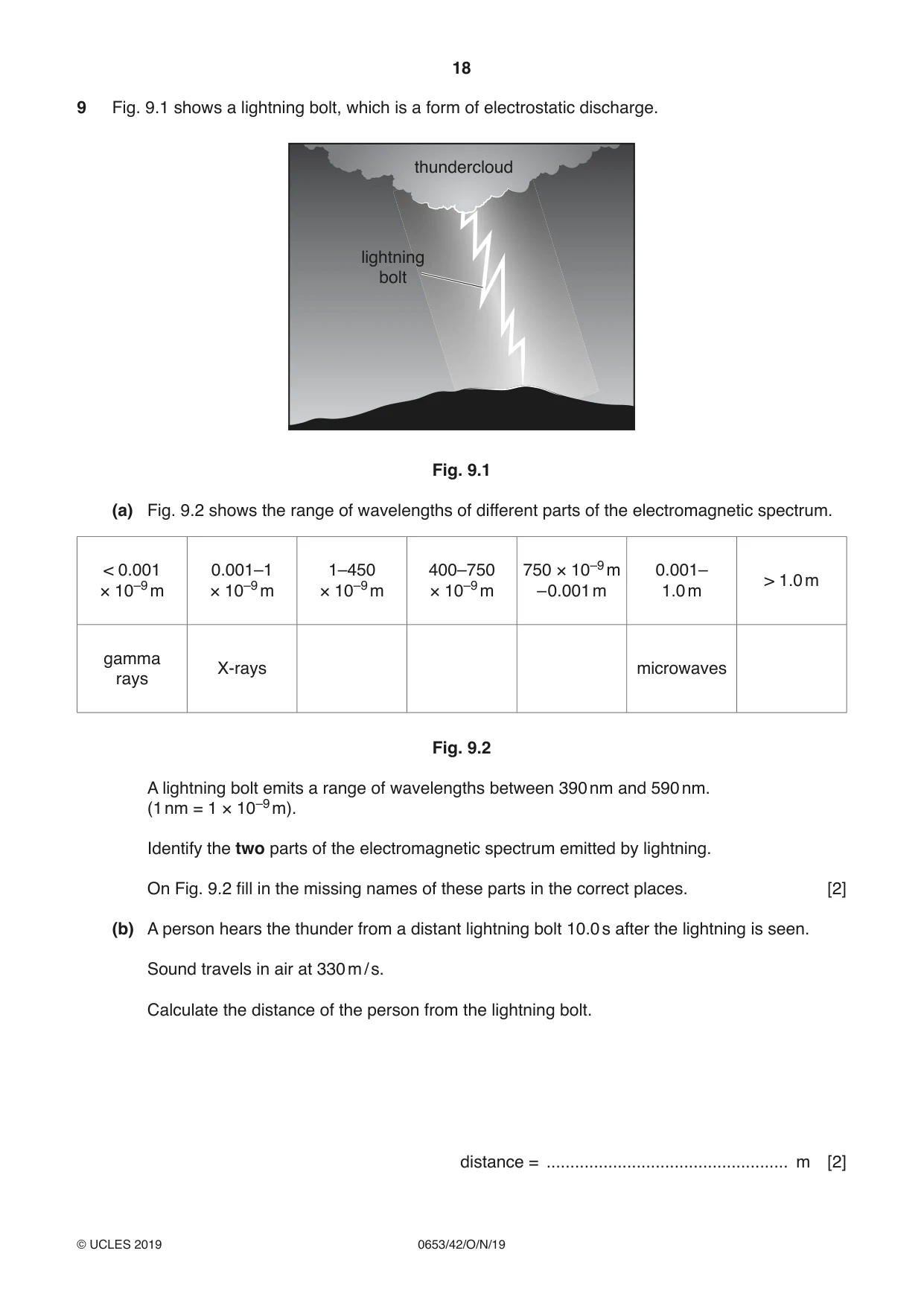
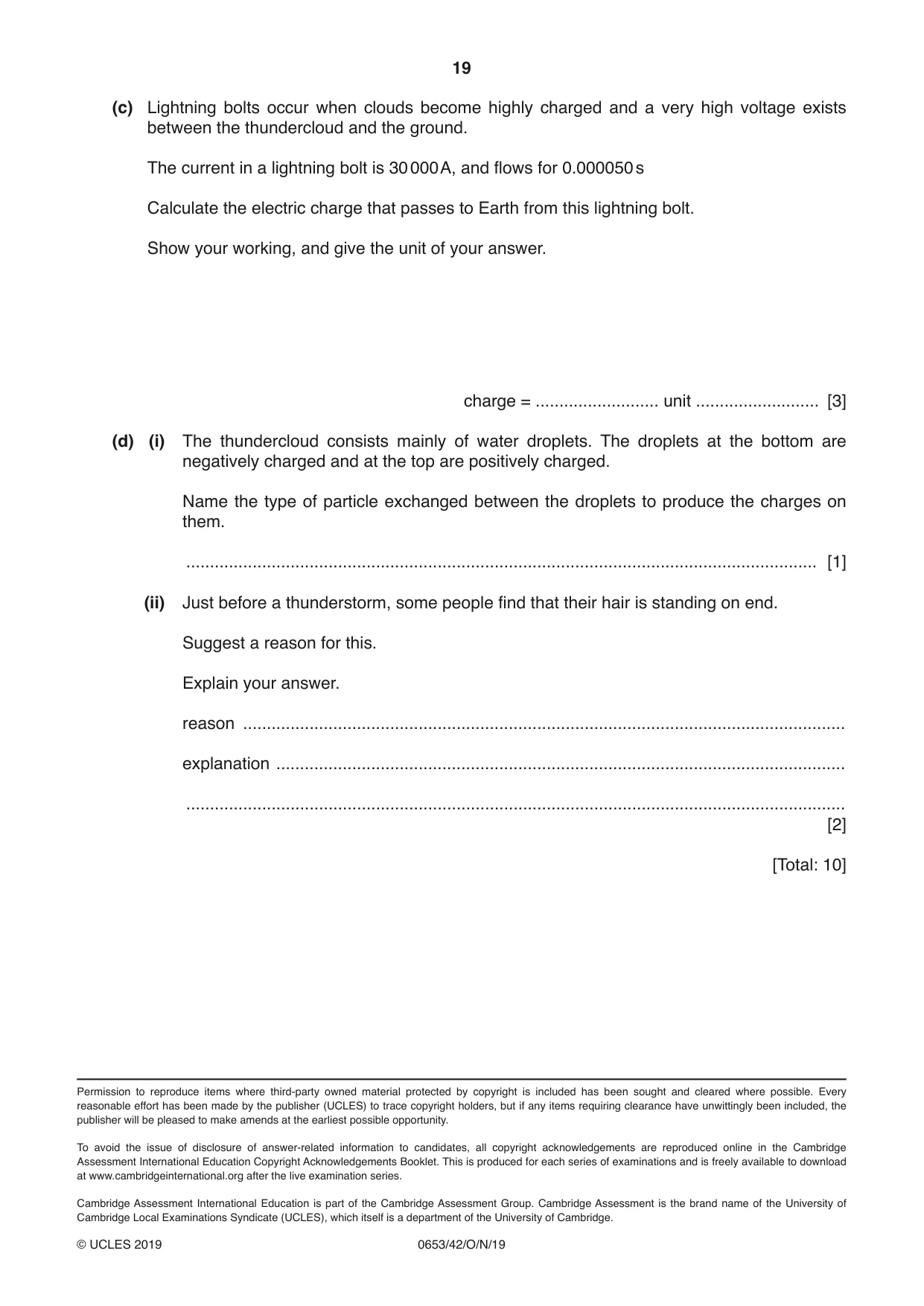
9 Fig. 9.1 shows a lightning bolt, which is a form of electrostatic discharge. thundercloud lightning bolt Fig. 9.1 (a) Fig. 9.2 shows the range of wavelengths of different parts of the electromagnetic spectrum. < 0.001 0.001–1 1–450 400–750 750 × 10–9 m 0.001– > 1.0 m × 10–9 m × 10–9 m × 10–9 m × 10–9 m – 0.001 m 1.0 m gamma X-rays microwaves rays Fig. 9.2 A lightning bolt emits a range of wavelengths between 390 nm and 590 nm. (1 nm = 1 × 10⁻⁹ m). Identify the two parts of the electromagnetic spectrum emitted by lightning. On Fig. 9.2 fill in the missing names of these parts in the correct places. [2] (b) A person hears the thunder from a distant lightning bolt 10.0 s after the lightning is seen. Sound travels in air at 330 m / s. Calculate the distance of the person from the lightning bolt. distance = ................................................... m [2] (c) Lightning bolts occur when clouds become highly charged and a very high voltage exists between the thundercloud and the ground. The current in a lightning bolt is 30 000 A, and flows for 0.000050 s Calculate the electric charge that passes to Earth from this lightning bolt. Show your working, and give the unit of your answer. charge = .......................... unit .......................... [3] (d) (i) The thundercloud consists mainly of water droplets. The droplets at the bottom are negatively charged and at the top are positively charged. Name the type of particle exchanged between the droplets to produce the charges on them. ..................................................................................................................................... [1] (ii) Just before a thunderstorm, some people find that their hair is standing on end. Suggest a reason for this. Explain your answer. reason ............................................................................................................................... explanation ........................................................................................................................ ........................................................................................................................................... [2] [Total: 10]
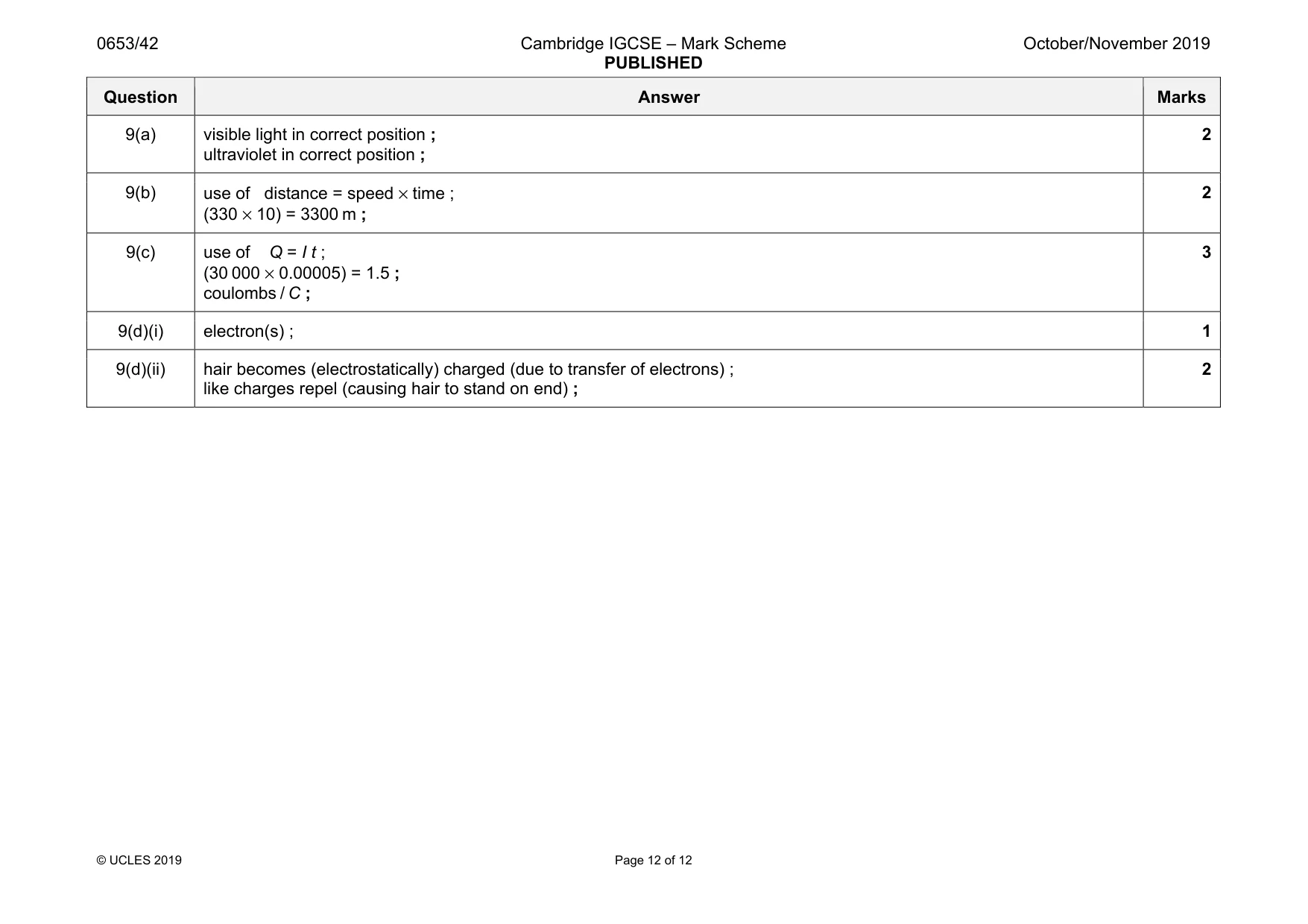
Mark scheme: 9(a) visible light in correct position ; ultraviolet in correct position ; 2 9(b) use of distance = speed × time ; (330 × 10) = 3300 m ; 2 9(c) use of Q = I t ; (30 000 × 0.00005) = 1.5 ; coulombs / C ; 3 9(d)(i) electron(s) ; 1 9(d)(ii) hair becomes (electrostatically) charged (due to transfer of electrons) ; like charges repel (causing hair to stand on end) ; 2
What was in this paper
The subtopics covered by these 9 questions, and how many questions each got. Open one in a new tab to see every Cambridge question on it.
What you needed in this session
Cambridge’s own grade thresholds for 2019 Oct/Nov, Paper 4 · Variant 2. A higher threshold means an easier paper — the bar moves with how the cohort did.