Cambridge IGCSE Science - Combined 0653 — 2025 Feb/March Paper 4 · Variant 2
0653/42/F/M/25 · 9 questions · 80 marks · 75 min
The question paper and its mark scheme, free to read here and free to download. This is Cambridge’s own paper, exactly as it was sat.
Question paper24 pages
Mark scheme12 pages
Answers below. Sit the paper first if you are practising.
Questions as text
Q1 · A food web from land owned by one farmer
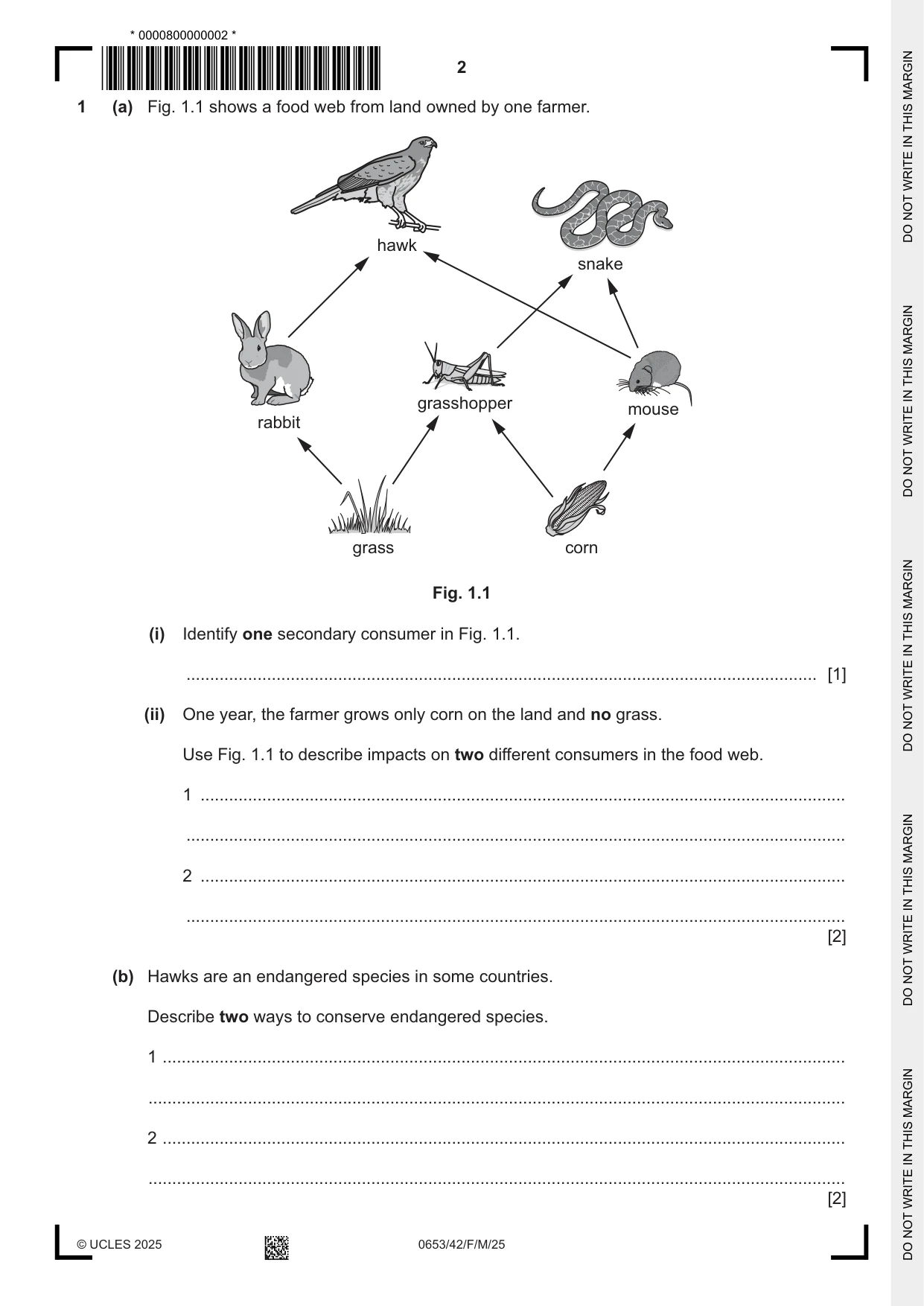
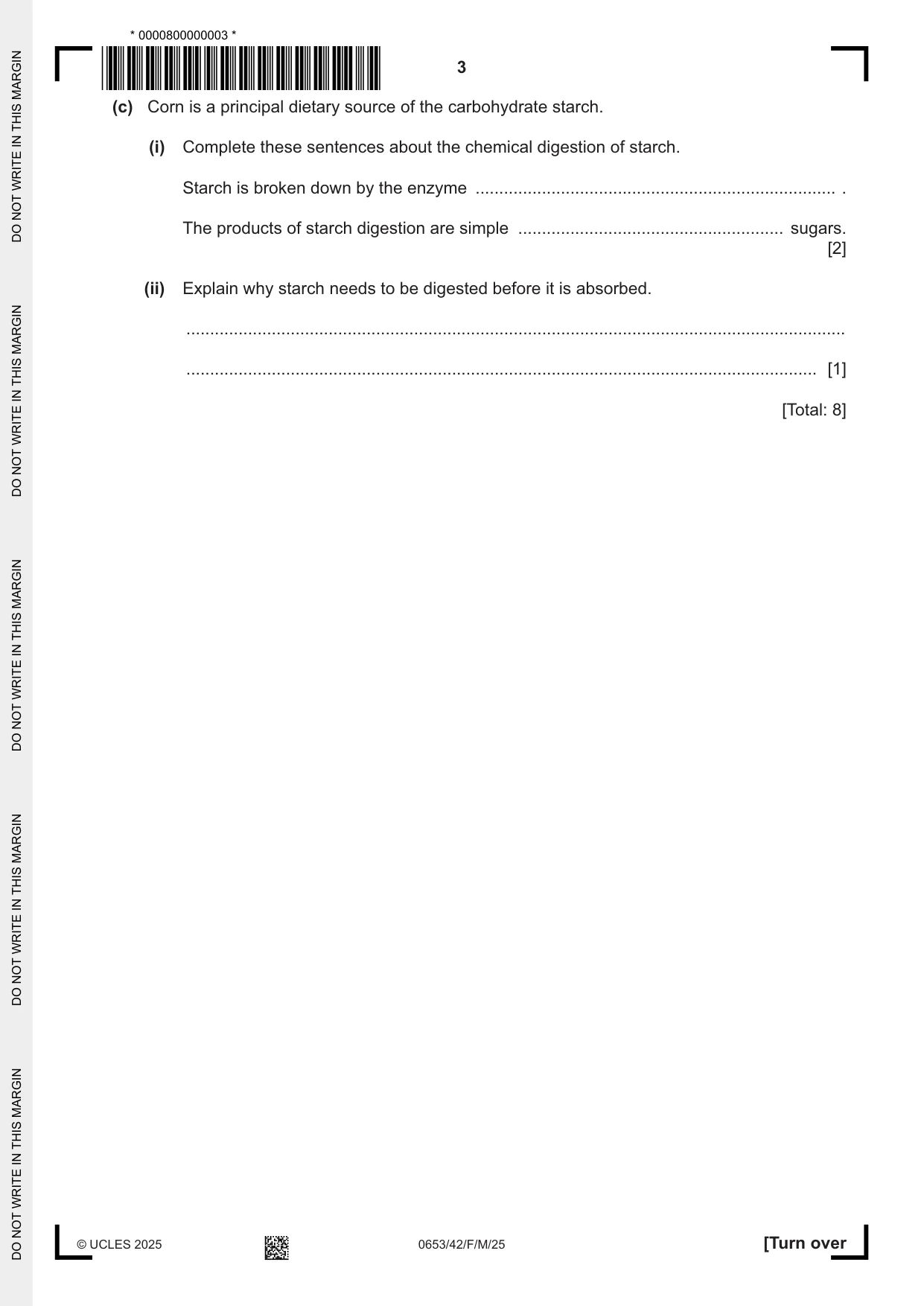
1 (a) Fig. 1.1 shows a food web from land owned by one farmer. hawk snake grasshopper mouse rabbit grass corn Fig. 1.1 (i) Identify one secondary consumer in Fig. 1.1. ..................................................................................................................................... [1] (ii) One year, the farmer grows only corn on the land and no grass. Use Fig. 1.1 to describe impacts on two different consumers in the food web. 1 ........................................................................................................................................ ........................................................................................................................................... 2 ........................................................................................................................................ ........................................................................................................................................... [2] (b) Hawks are an endangered species in some countries. Describe two ways to conserve endangered species. 1 ................................................................................................................................................ ................................................................................................................................................... 2 ................................................................................................................................................ ................................................................................................................................................... [2] (c) Corn is a principal dietary source of the carbohydrate starch. (i) Complete these sentences about the chemical digestion of starch. Starch is broken down by the enzyme ............................................................................ . The products of starch digestion are simple ........................................................ sugars. [2] (ii) Explain why starch needs to be digested before it is absorbed. ........................................................................................................................................... ..................................................................................................................................... [1] [Total: 8]
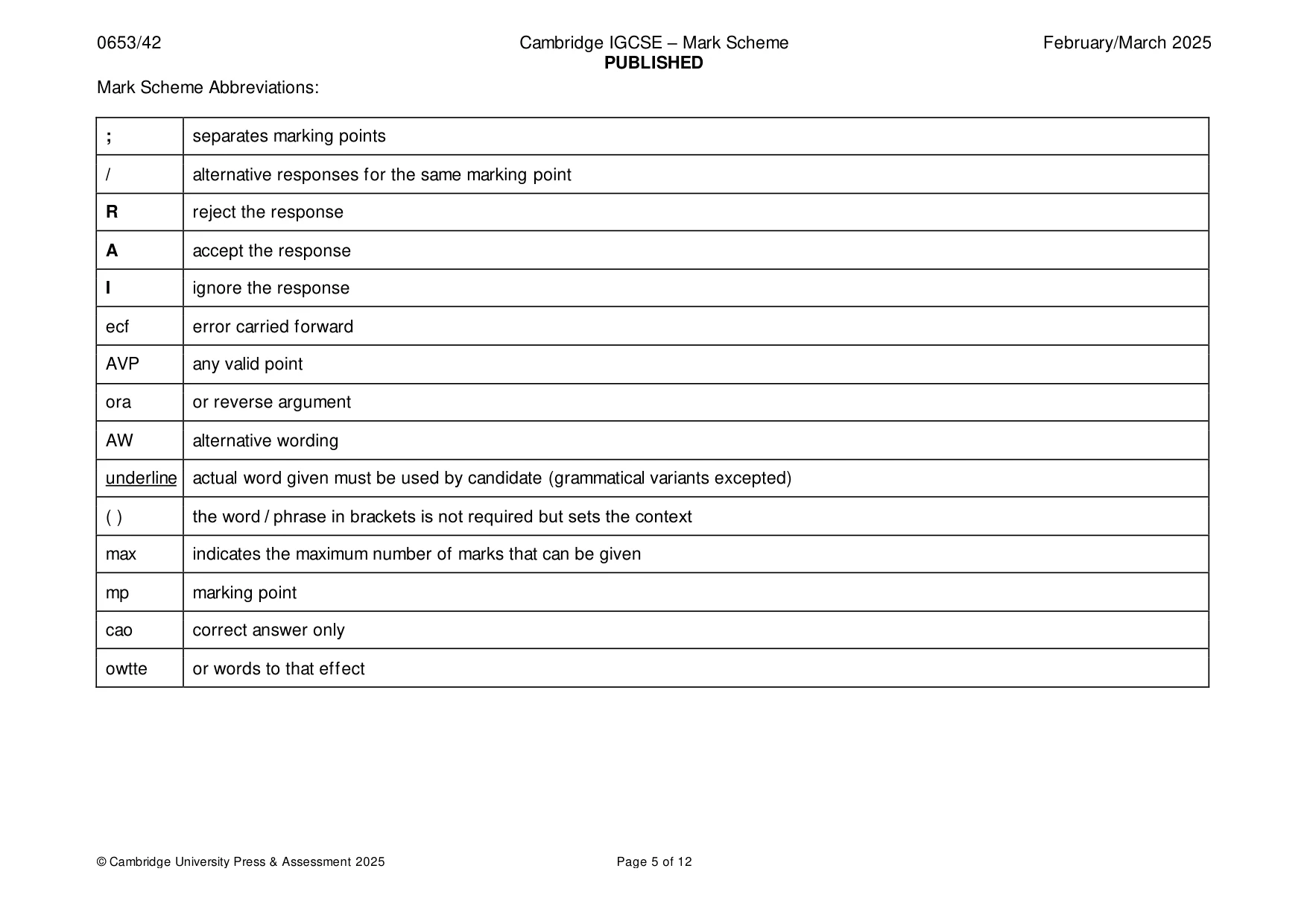
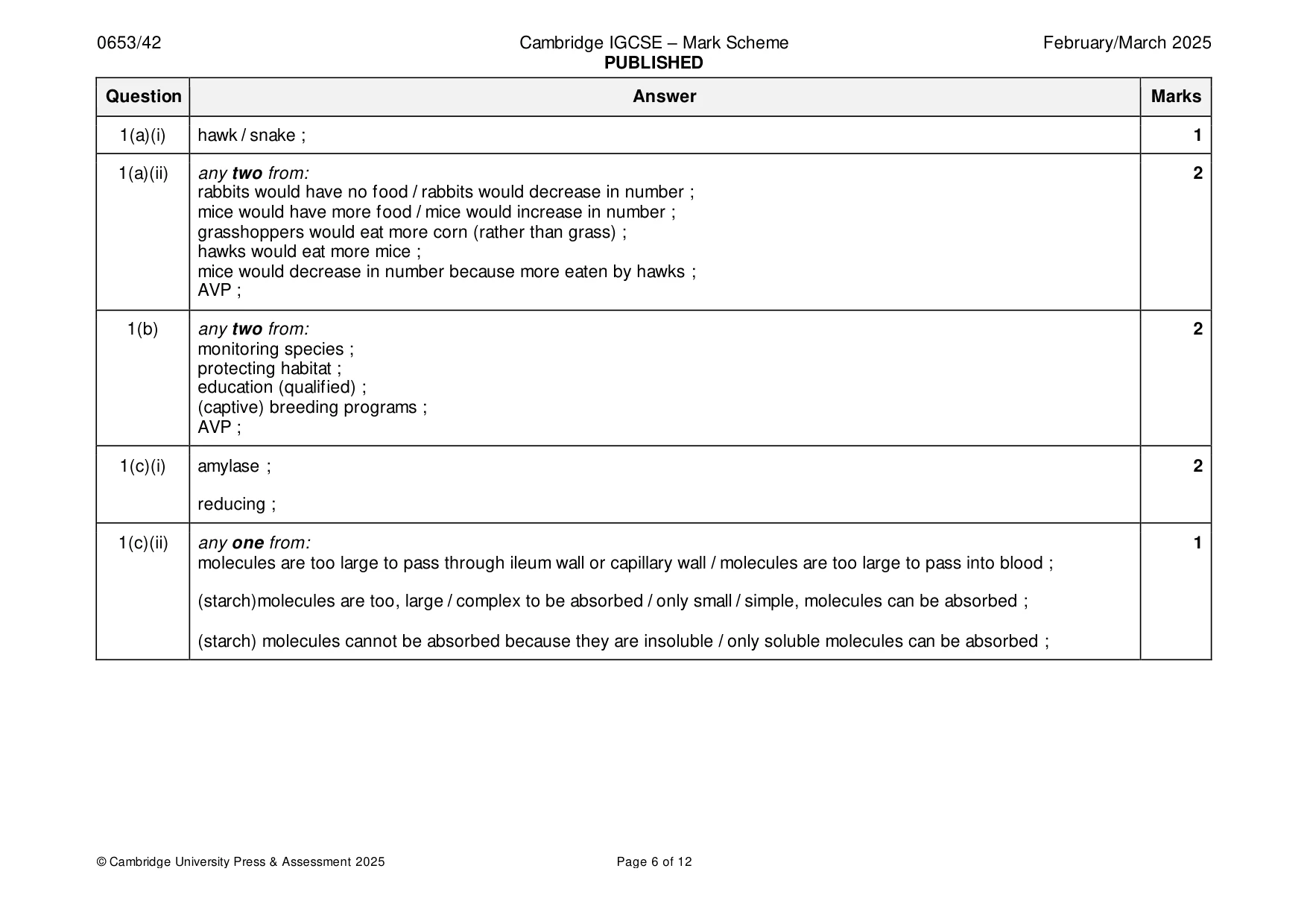
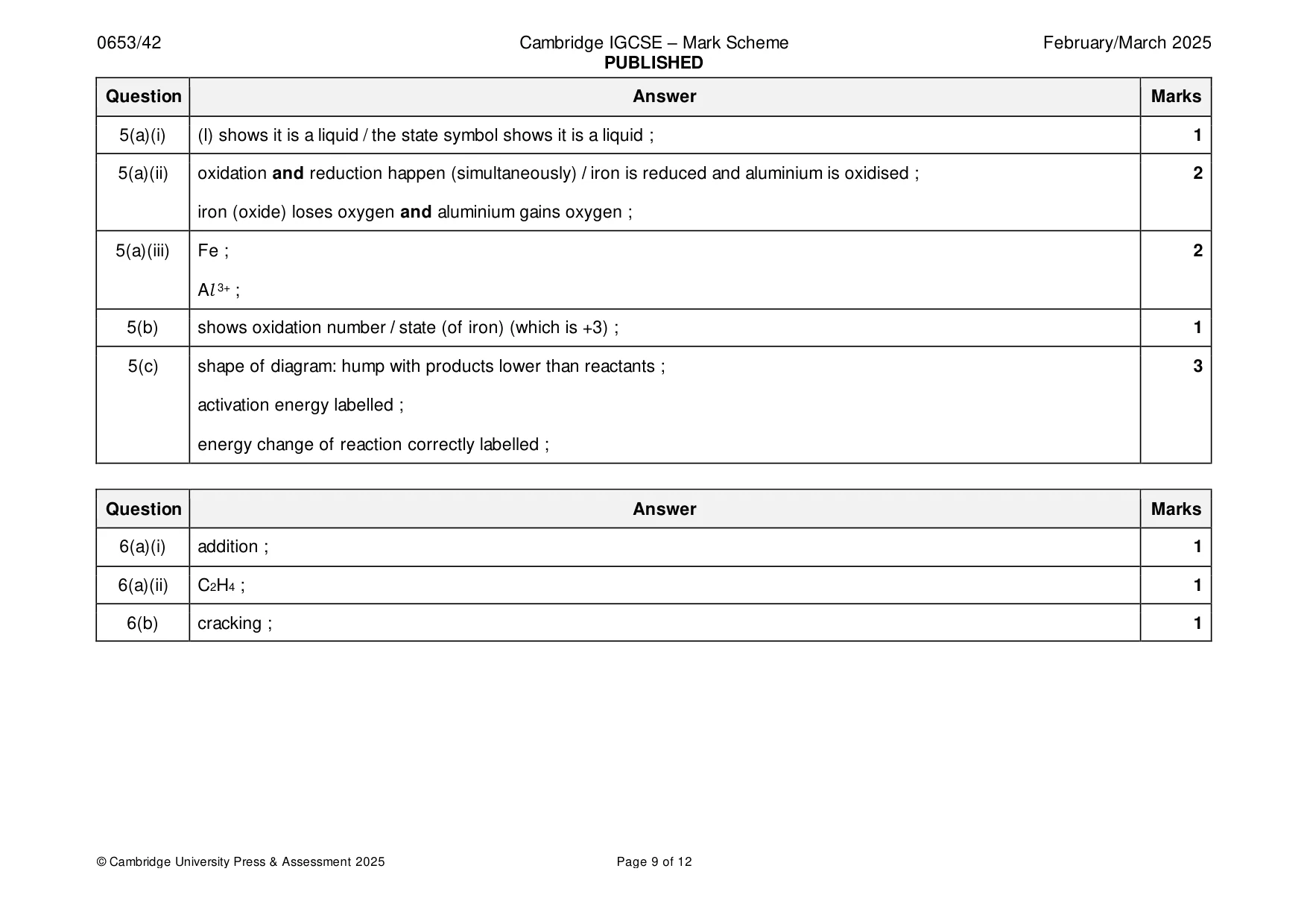
Mark scheme: Question Answer Marks 1(a)(i) hawk / snake ; 1 1(a)(ii) any two from: 2 rabbits would have no food / rabbits would decrease in number ; mice would have more food / mice would increase in number ; grasshoppers would eat more corn (rather than grass) ; hawks would eat more mice ; mice would decrease in number because more eaten by hawks ; AVP ; 1(b) any two from: 2 monitoring species ; protecting habitat ; education (qualified) ; (captive) breeding programs ; AVP ; 1(c)(i) amylase ; 2 reducing ; 1(c)(ii) any one from: 1 molecules are too large to pass through ileum wall or capillary wall / molecules are too large to pass into blood ; (starch)molecules are too, large / complex to be absorbed / only small / simple, molecules can be absorbed ; (starch) molecules cannot be absorbed because they are insoluble / only soluble molecules can be absorbed ;
Q2 · A diagram of the structure of the human heart
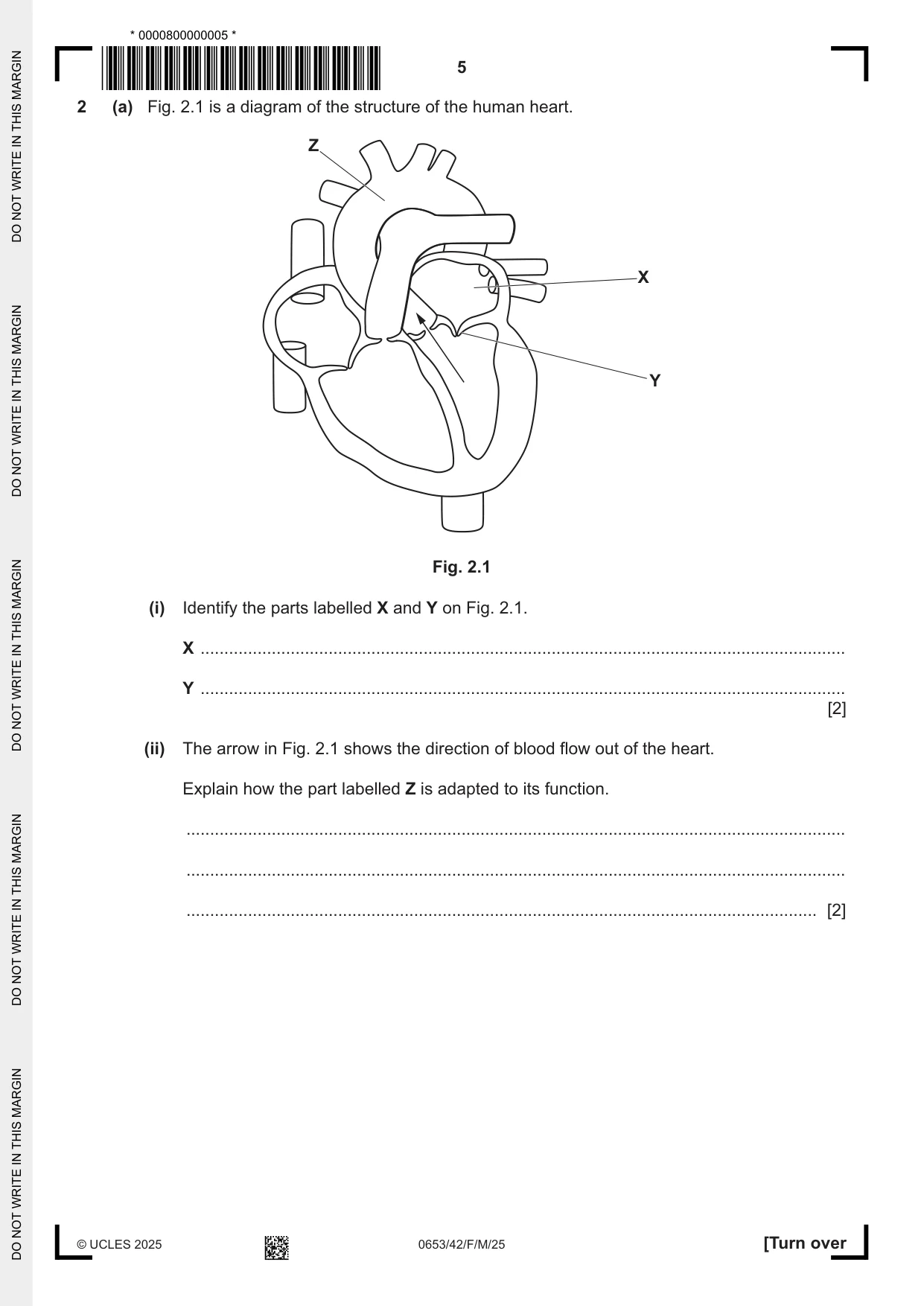
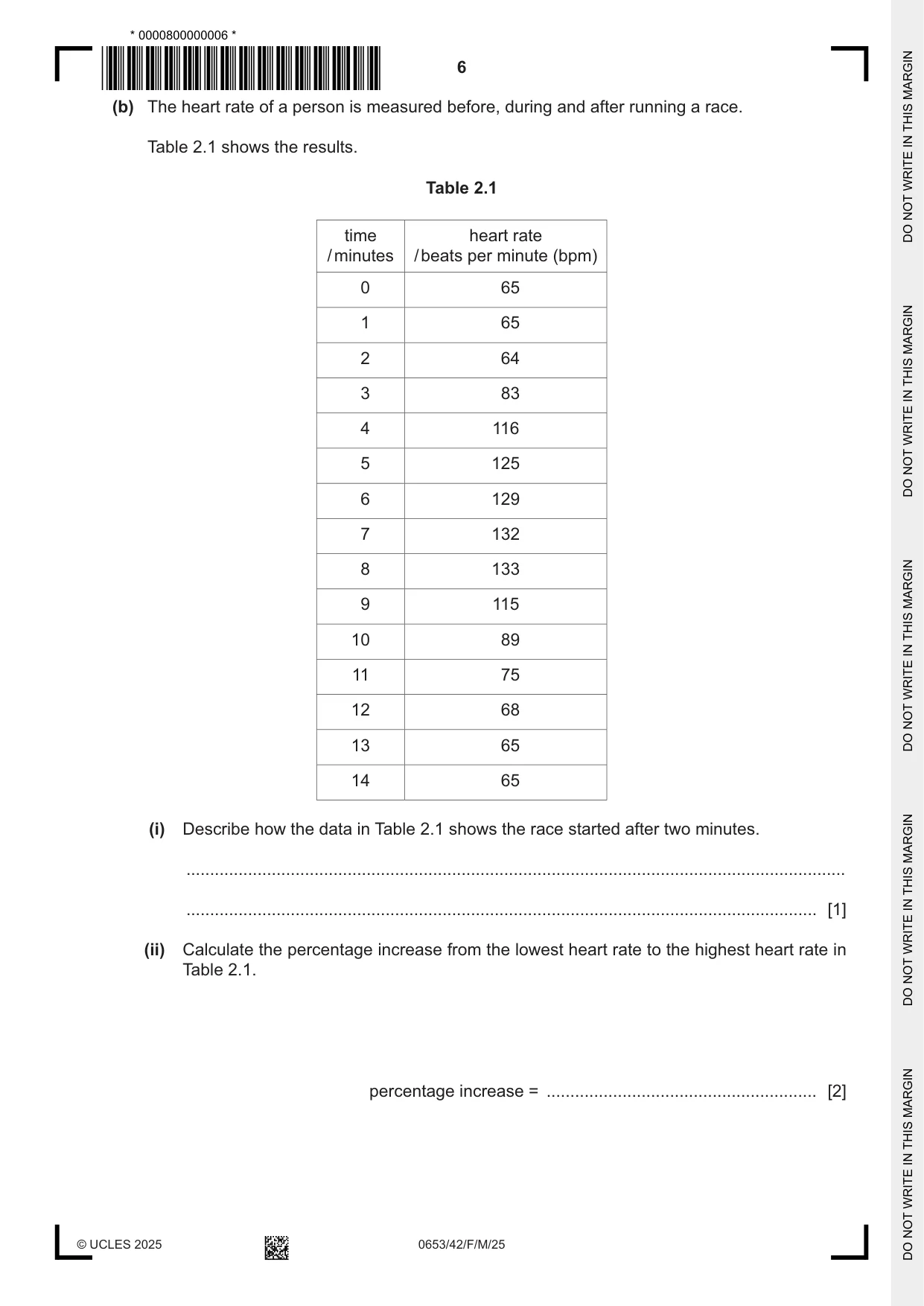
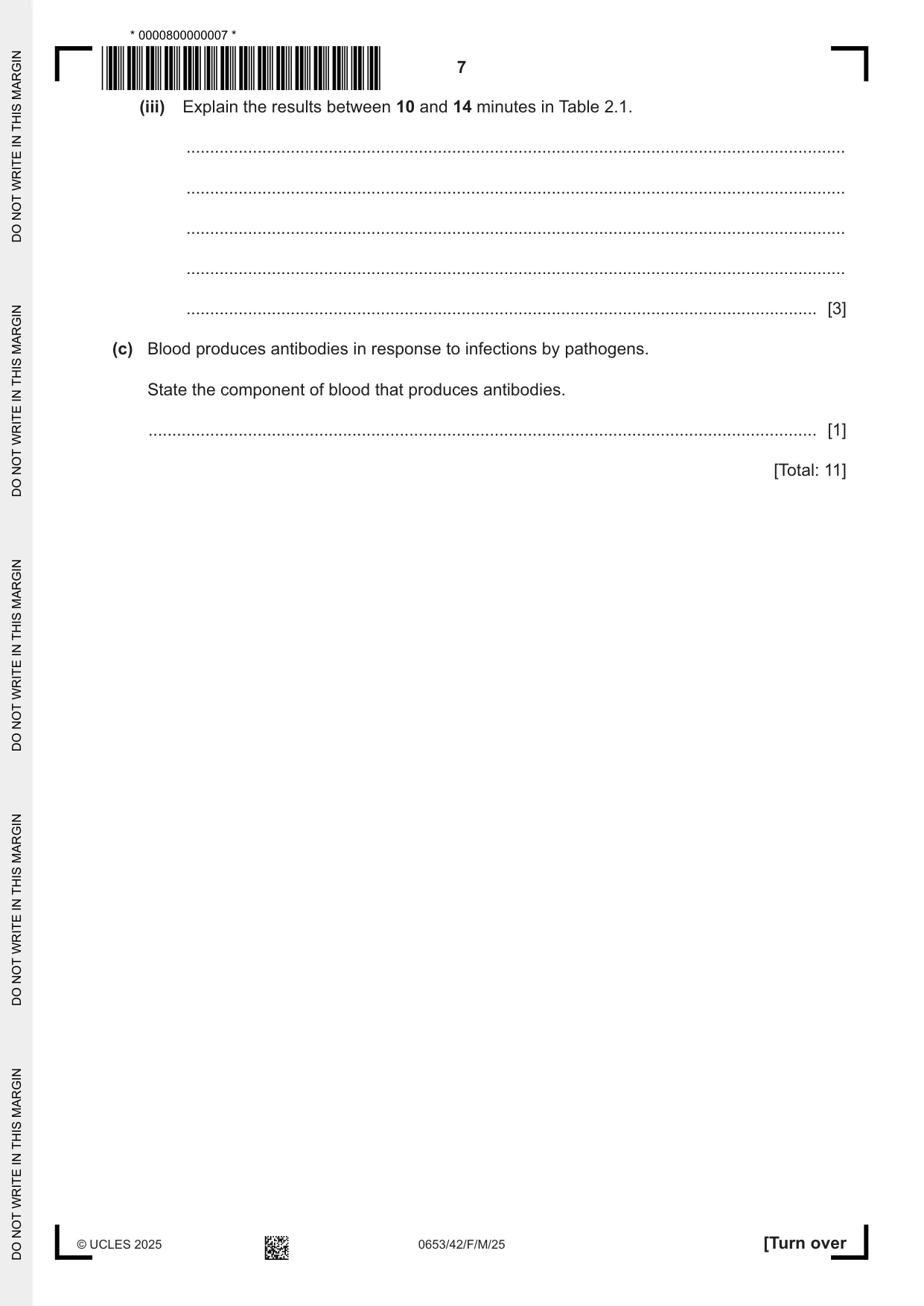
2 (a) Fig. 2.1 is a diagram of the structure of the human heart. Z X Y Fig. 2.1 (i) Identify the parts labelled X and Y on Fig. 2.1. X ........................................................................................................................................ Y ........................................................................................................................................ [2] (ii) The arrow in Fig. 2.1 shows the direction of blood flow out of the heart. Explain how the part labelled Z is adapted to its function. ........................................................................................................................................... ........................................................................................................................................... ..................................................................................................................................... [2] (b) The heart rate of a person is measured before, during and after running a race. Table 2.1 shows the results. Table 2.1 time heart rate / minutes / beats per minute (bpm) 0 65 1 65 2 64 3 83 4 116 5 125 6 129 7 132 8 133 9 115 10 89 11 75 12 68 13 65 14 65 (i) Describe how the data in Table 2.1 shows the race started after two minutes. ........................................................................................................................................... ..................................................................................................................................... [1] (ii) Calculate the percentage increase from the lowest heart rate to the highest heart rate in Table 2.1. percentage increase = ......................................................... [2] (iii) Explain the results between 10 and 14 minutes in Table 2.1. ........................................................................................................................................... ........................................................................................................................................... ........................................................................................................................................... ........................................................................................................................................... ..................................................................................................................................... [3] (c) Blood produces antibodies in response to infections by pathogens. State the component of blood that produces antibodies. ............................................................................................................................................. [1] [Total: 11]
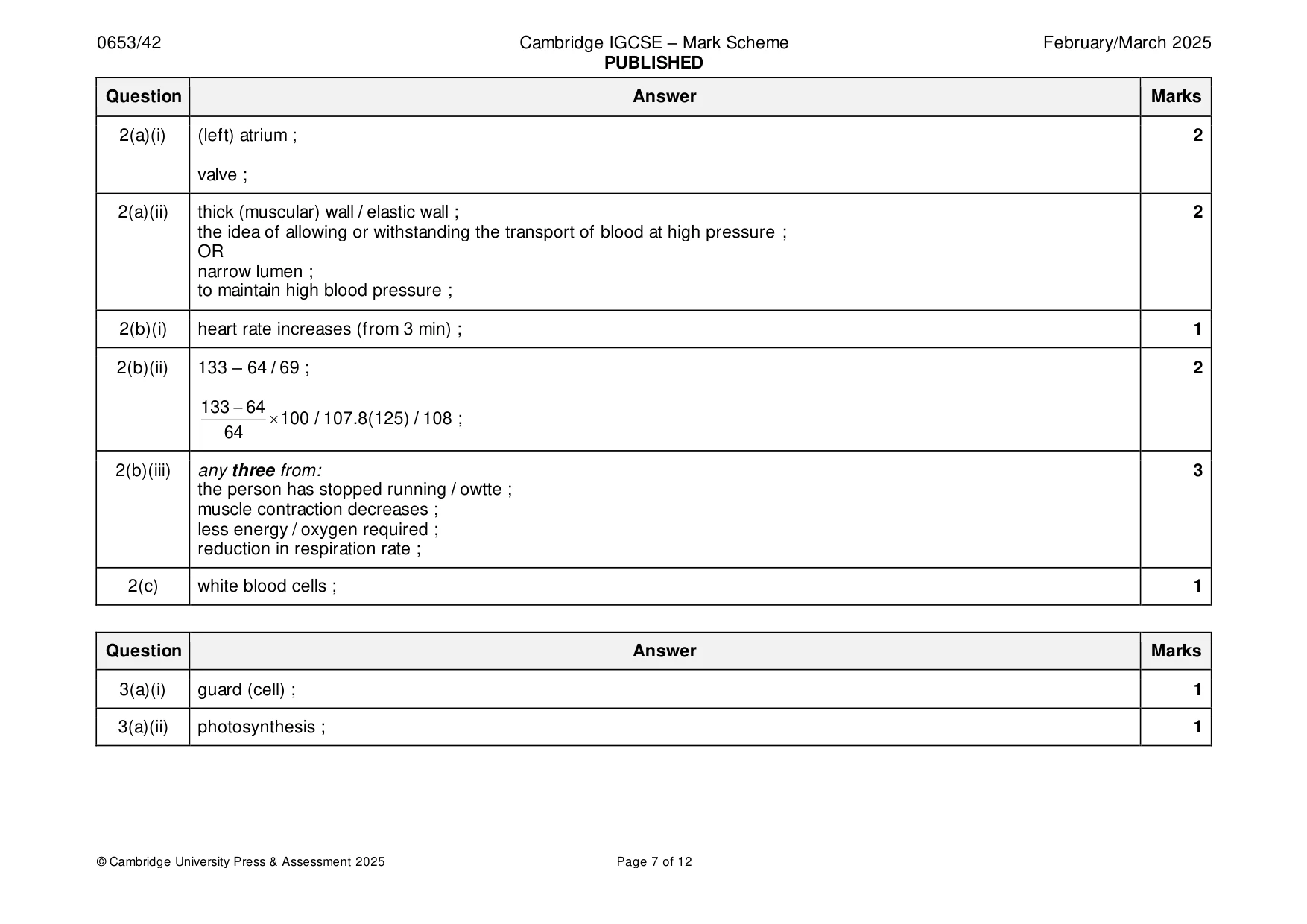
Mark scheme: 2(a)(i) (left) atrium ; 2 valve ; 2(a)(ii) thick (muscular) wall / elastic wall ; 2 the idea of allowing or withstanding the transport of blood at high pressure ; OR narrow lumen ; to maintain high blood pressure ; 2(b)(i) heart rate increases (from 3 min) ; 1 2(b)(ii) 133 – 64 / 69 ; 2 133 − 64 100 / 107.8(125) / 108 ; 64 2(b)(iii) any three from: 3 the person has stopped running / owtte ; muscle contraction decreases ; less energy / oxygen required ; reduction in respiration rate ; 2(c) white blood cells ; 1
Q3 · A cross-section of a leaf
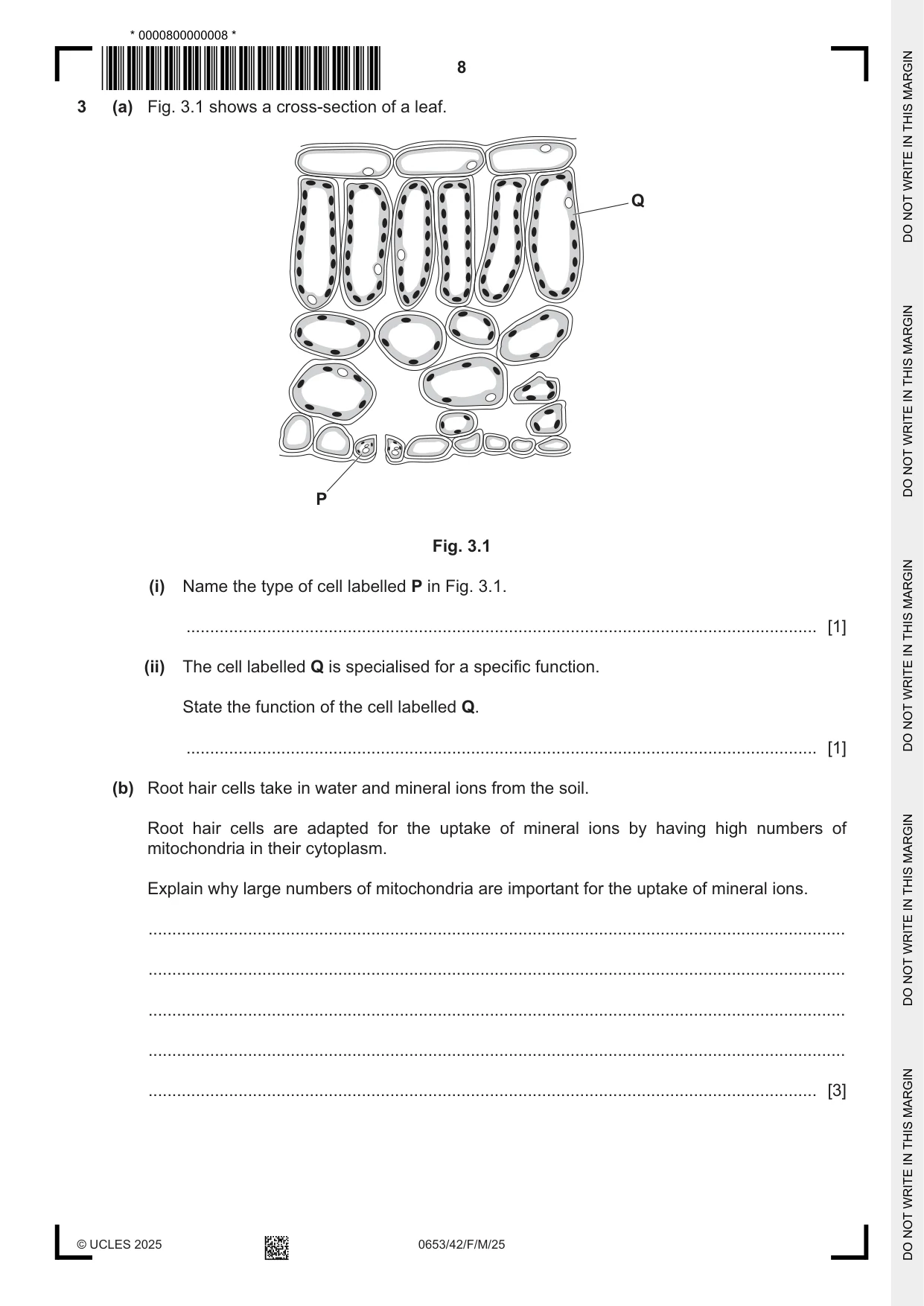
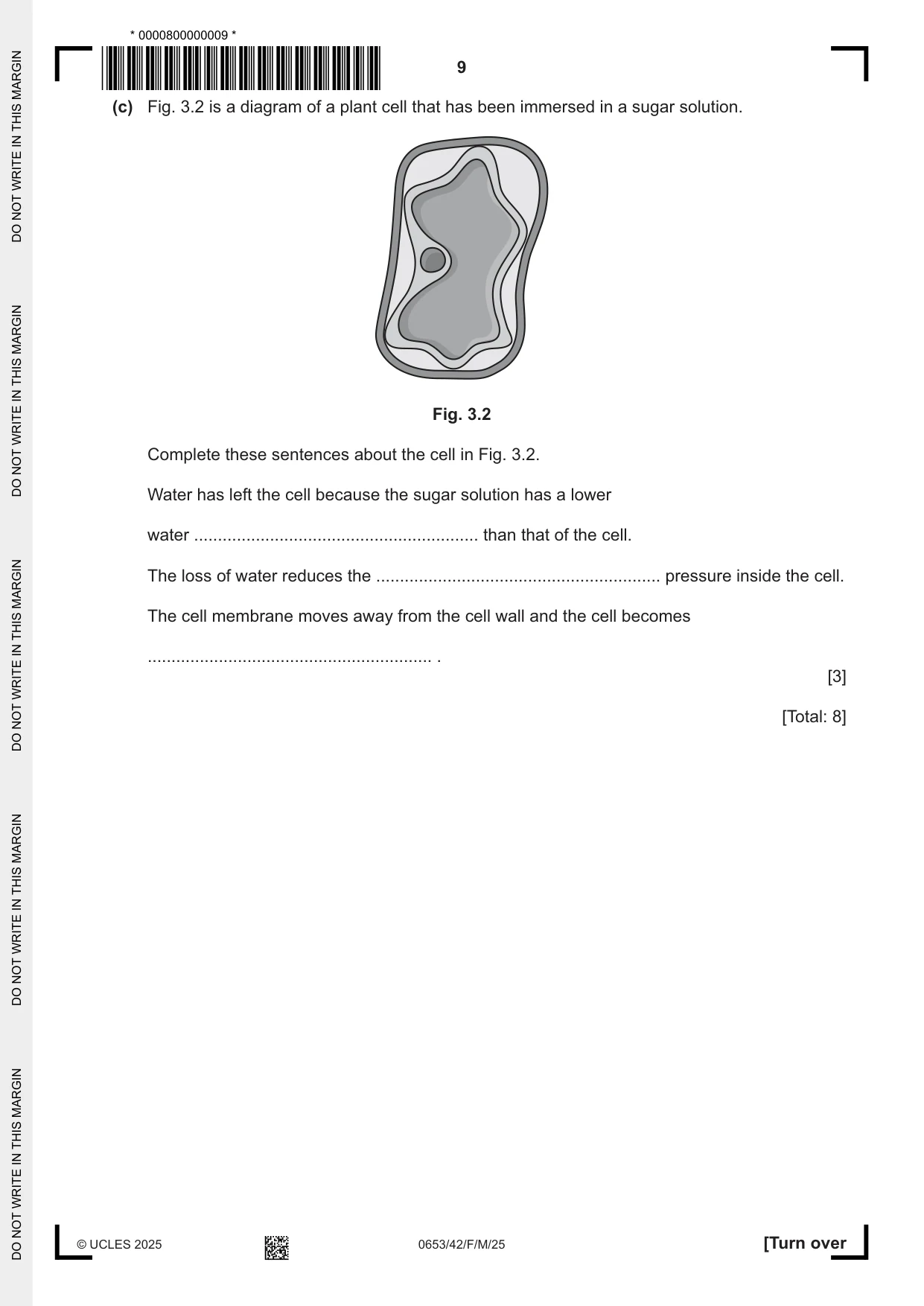
3 (a) Fig. 3.1 shows a cross-section of a leaf. Q P Fig. 3.1 (i) Name the type of cell labelled P in Fig. 3.1. ..................................................................................................................................... [1] (ii) The cell labelled Q is specialised for a specific function. State the function of the cell labelled Q. ..................................................................................................................................... [1] (b) Root hair cells take in water and mineral ions from the soil. Root hair cells are adapted for the uptake of mineral ions by having high numbers of mitochondria in their cytoplasm. Explain why large numbers of mitochondria are important for the uptake of mineral ions. ................................................................................................................................................... ................................................................................................................................................... ................................................................................................................................................... ................................................................................................................................................... ............................................................................................................................................. [3] (c) Fig. 3.2 is a diagram of a plant cell that has been immersed in a sugar solution. Fig. 3.2 Complete these sentences about the cell in Fig. 3.2. Water has left the cell because the sugar solution has a lower water ............................................................ than that of the cell. The loss of water reduces the ............................................................ pressure inside the cell. The cell membrane moves away from the cell wall and the cell becomes ............................................................ . [3] [Total: 8]
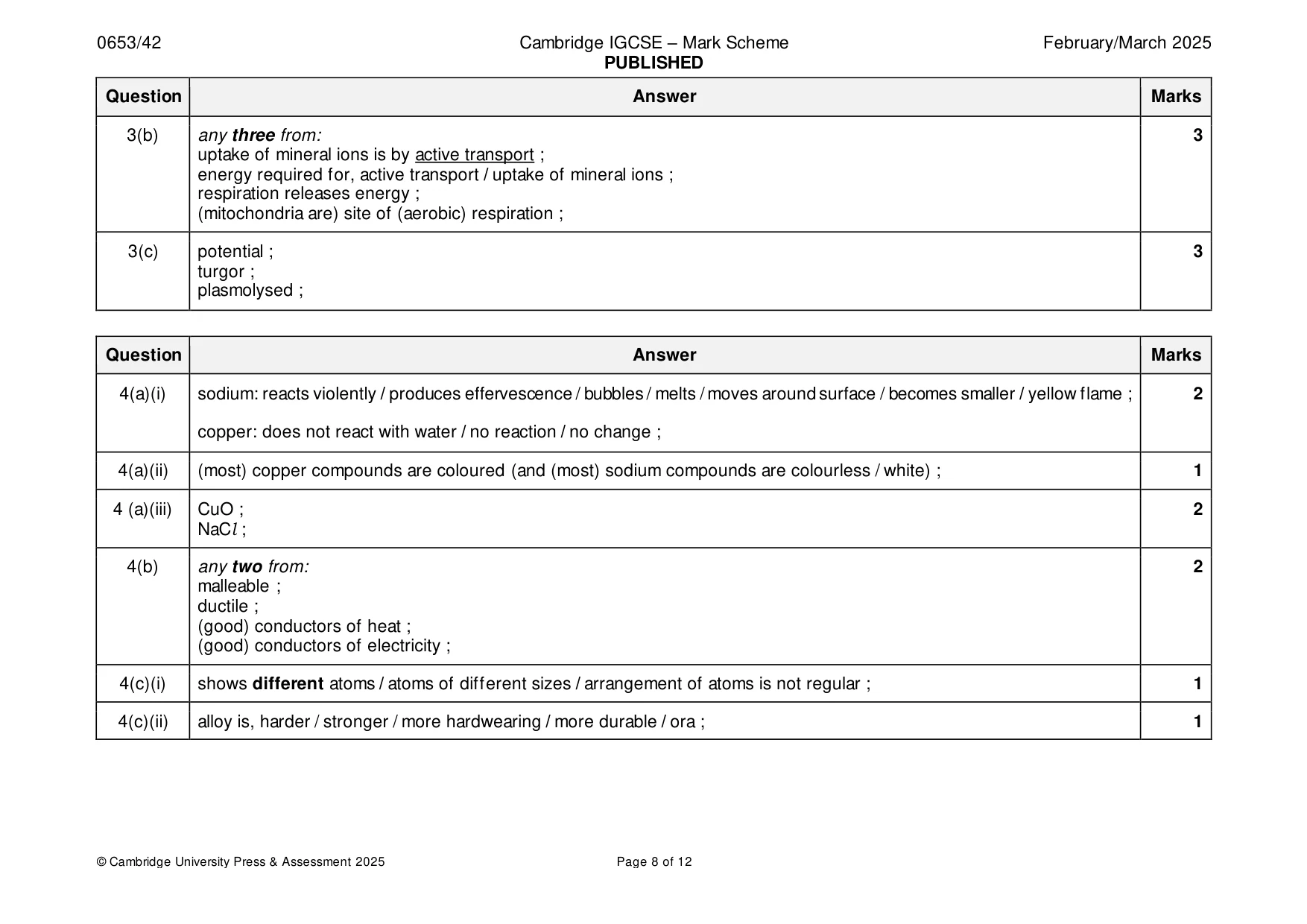
Mark scheme: 3(a)(i) guard (cell) ; 1 3(a)(ii) photosynthesis ; 1 3(b) any three from: 3 uptake of mineral ions is by active transport ; energy required for, active transport / uptake of mineral ions ; respiration releases energy ; (mitochondria are) site of (aerobic) respiration ; 3(c) potential ; 3 turgor ; plasmolysed ;
Q4 · Sodium is in Group I of the Periodic Table
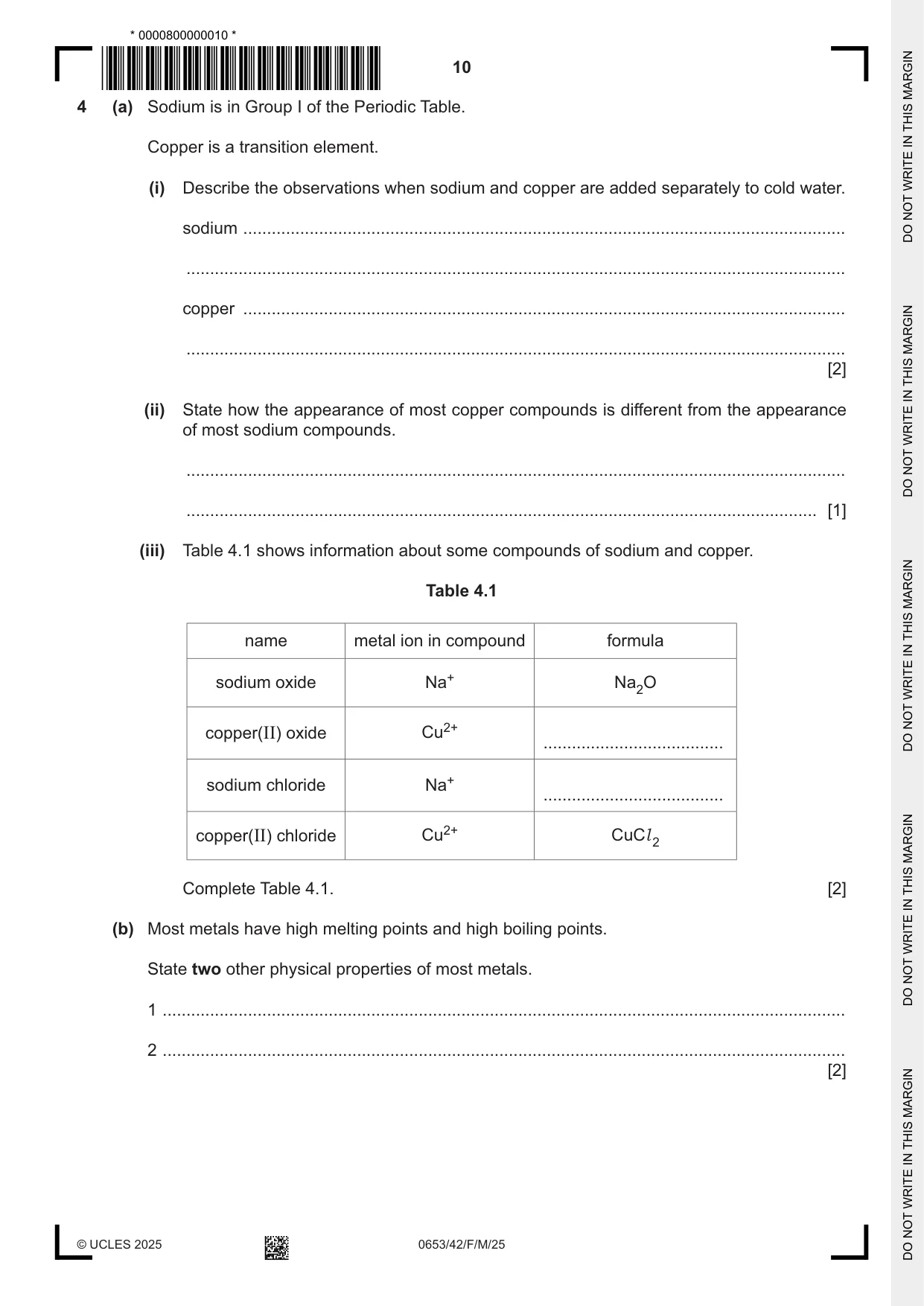
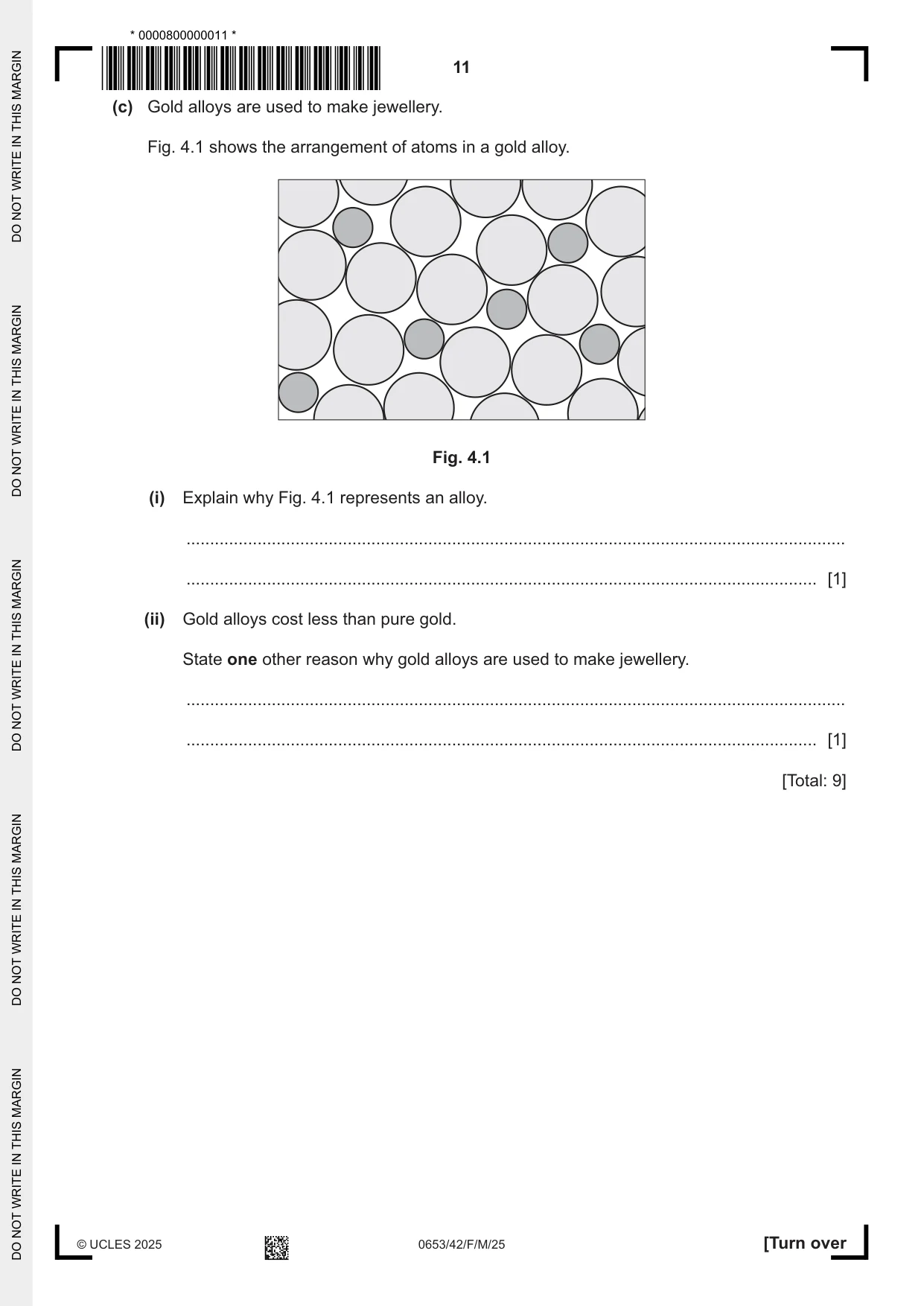
4 (a) Sodium is in Group I of the Periodic Table. Copper is a transition element. (i) Describe the observations when sodium and copper are added separately to cold water. sodium ............................................................................................................................... ........................................................................................................................................... copper ............................................................................................................................... ........................................................................................................................................... [2] (ii) State how the appearance of most copper compounds is different from the appearance of most sodium compounds. ........................................................................................................................................... ..................................................................................................................................... [1] (iii) Table 4.1 shows information about some compounds of sodium and copper. Table 4.1 name metal ion in compound formula sodium oxide Na+ Na2O copper(II) oxide Cu2+ ...................................... sodium chloride Na+ ...................................... copper(II) chloride Cu2+ CuCl 2 Complete Table 4.1. [2] (b) Most metals have high melting points and high boiling points. State two other physical properties of most metals. 1 ................................................................................................................................................ 2 ................................................................................................................................................ [2] (c) Gold alloys are used to make jewellery. Fig. 4.1 shows the arrangement of atoms in a gold alloy. Fig. 4.1 (i) Explain why Fig. 4.1 represents an alloy. ........................................................................................................................................... ..................................................................................................................................... [1] (ii) Gold alloys cost less than pure gold. State one other reason why gold alloys are used to make jewellery. ........................................................................................................................................... ..................................................................................................................................... [1] [Total: 9]
Mark scheme: 4(a)(i) sodium: reacts violently / produces effervescence / bubbles / melts / moves around surface / becomes smaller / yellow flame ; 2 copper: does not react with water / no reaction / no change ; 4(a)(ii) (most) copper compounds are coloured (and (most) sodium compounds are colourless / white) ; 1 4 (a)(iii) CuO ; 2 NaCl ; 4(b) any two from: 2 malleable ; ductile ; (good) conductors of heat ; (good) conductors of electricity ; 4(c)(i) shows different atoms / atoms of different sizes / arrangement of atoms is not regular ; 1 4(c)(ii) alloy is, harder / stronger / more hardwearing / more durable / ora ; 1
Q5 · The reaction between aluminium and iron(III) oxide is used to join iron railway lines…
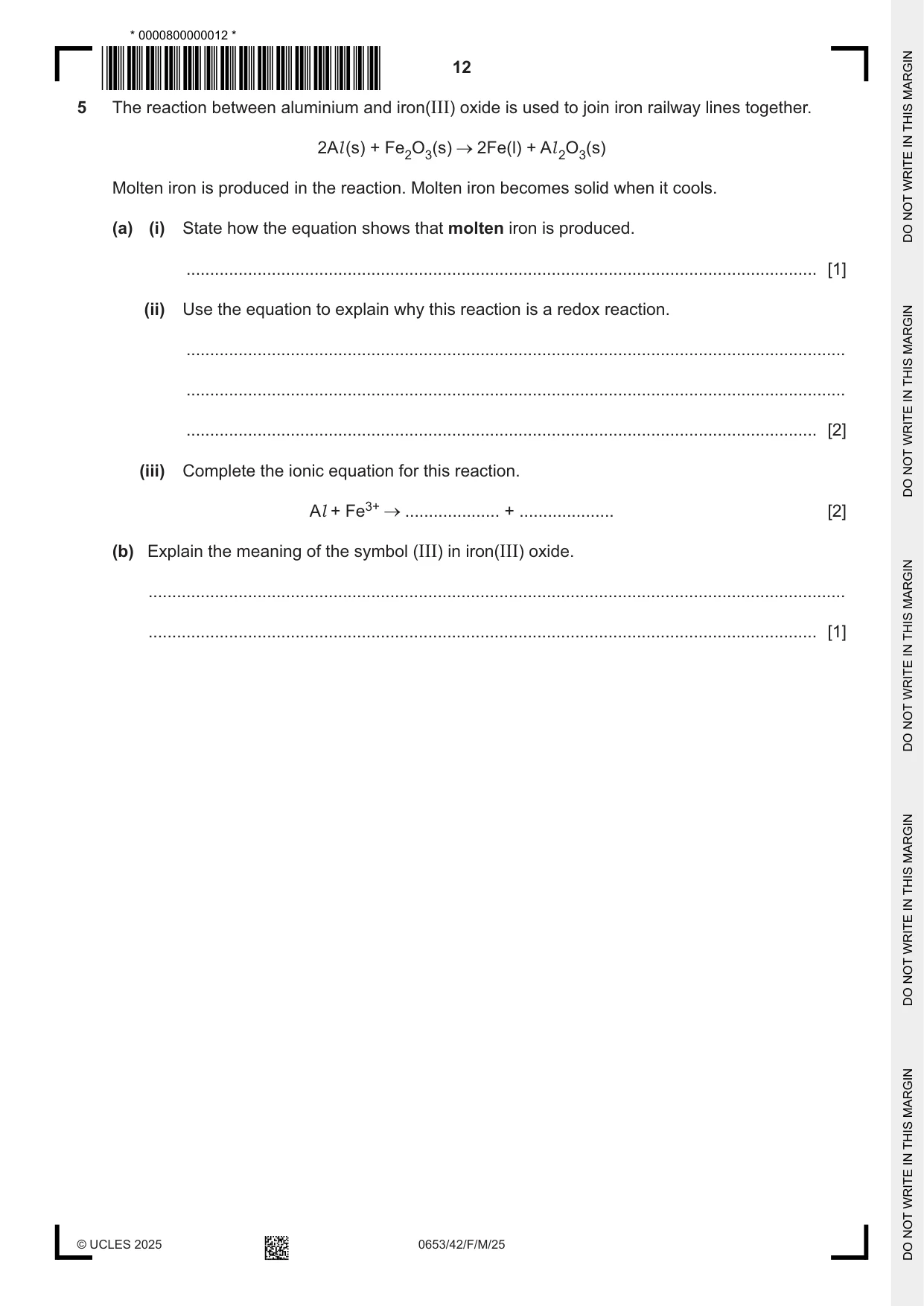
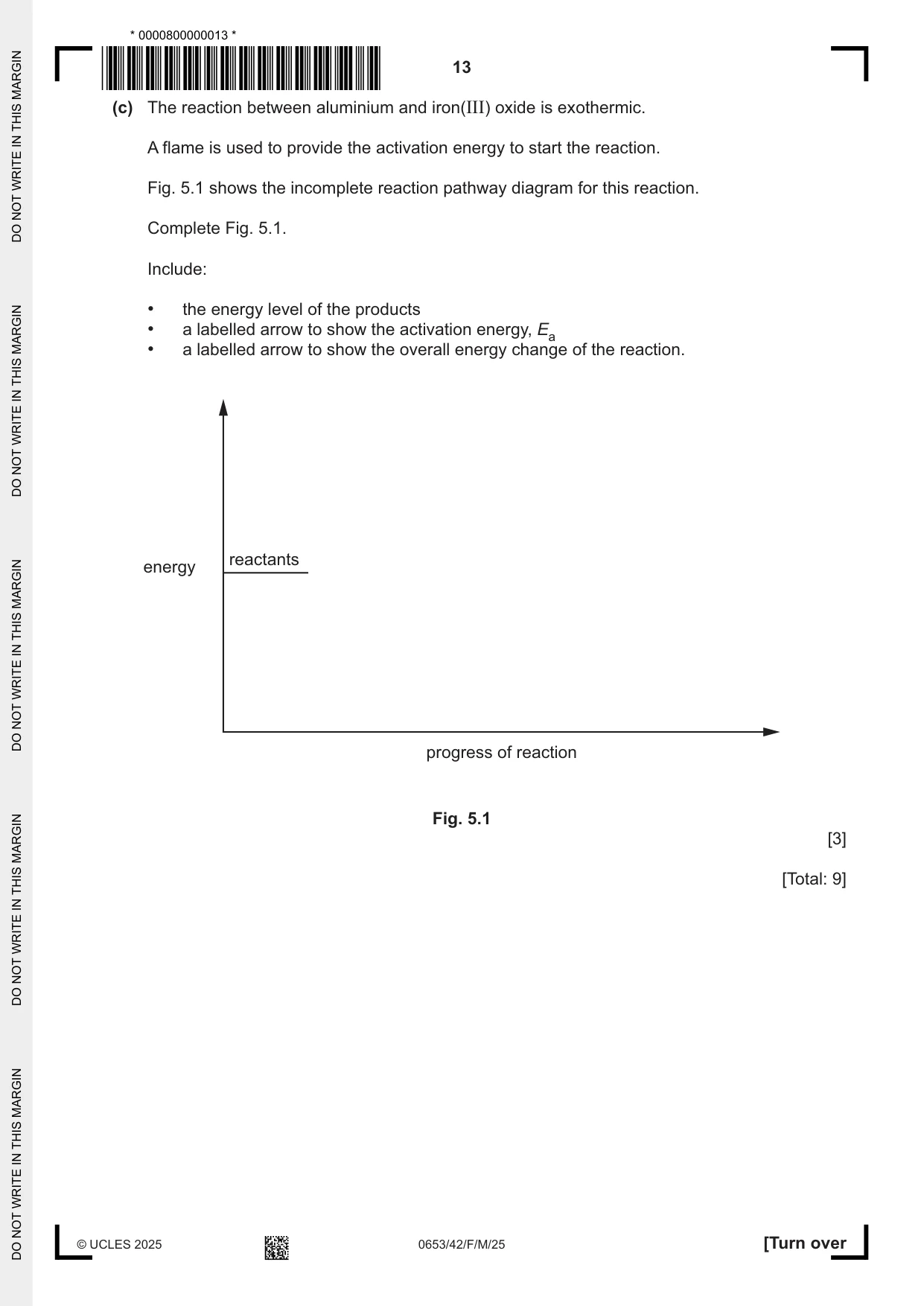
5 The reaction between aluminium and iron(III) oxide is used to join iron railway lines together. 2Al (s) + Fe2O3(s) 2Fe(l) + Al 2O3(s) Molten iron is produced in the reaction. Molten iron becomes solid when it cools. (a) (i) State how the equation shows that molten iron is produced. ..................................................................................................................................... [1] (ii) Use the equation to explain why this reaction is a redox reaction. ........................................................................................................................................... ........................................................................................................................................... ..................................................................................................................................... [2] (iii) Complete the ionic equation for this reaction. Al + Fe3+ .................... + .................... [2] (b) Explain the meaning of the symbol (III) in iron(III) oxide. ................................................................................................................................................... ............................................................................................................................................. [1] (c) The reaction between aluminium and iron(III) oxide is exothermic. A flame is used to provide the activation energy to start the reaction. Fig. 5.1 shows the incomplete reaction pathway diagram for this reaction. Complete Fig. 5.1. Include: • the energy level of the products • a labelled arrow to show the activation energy, Ea • a labelled arrow to show the overall energy change of the reaction. reactants energy progress of reaction Fig. 5.1 [3] [Total: 9]
Mark scheme: 5(a)(i) (l) shows it is a liquid / the state symbol shows it is a liquid ; 1 5(a)(ii) oxidation and reduction happen (simultaneously) / iron is reduced and aluminium is oxidised ; 2 iron (oxide) loses oxygen and aluminium gains oxygen ; 5(a)(iii) Fe ; 2 Al 3+ ; 5(b) shows oxidation number / state (of iron) (which is +3) ; 1 5(c) shape of diagram: hump with products lower than reactants ; 3 activation energy labelled ; energy change of reaction correctly labelled ;
Q6 · Poly(ethene) is a polymer made from alkene monomers
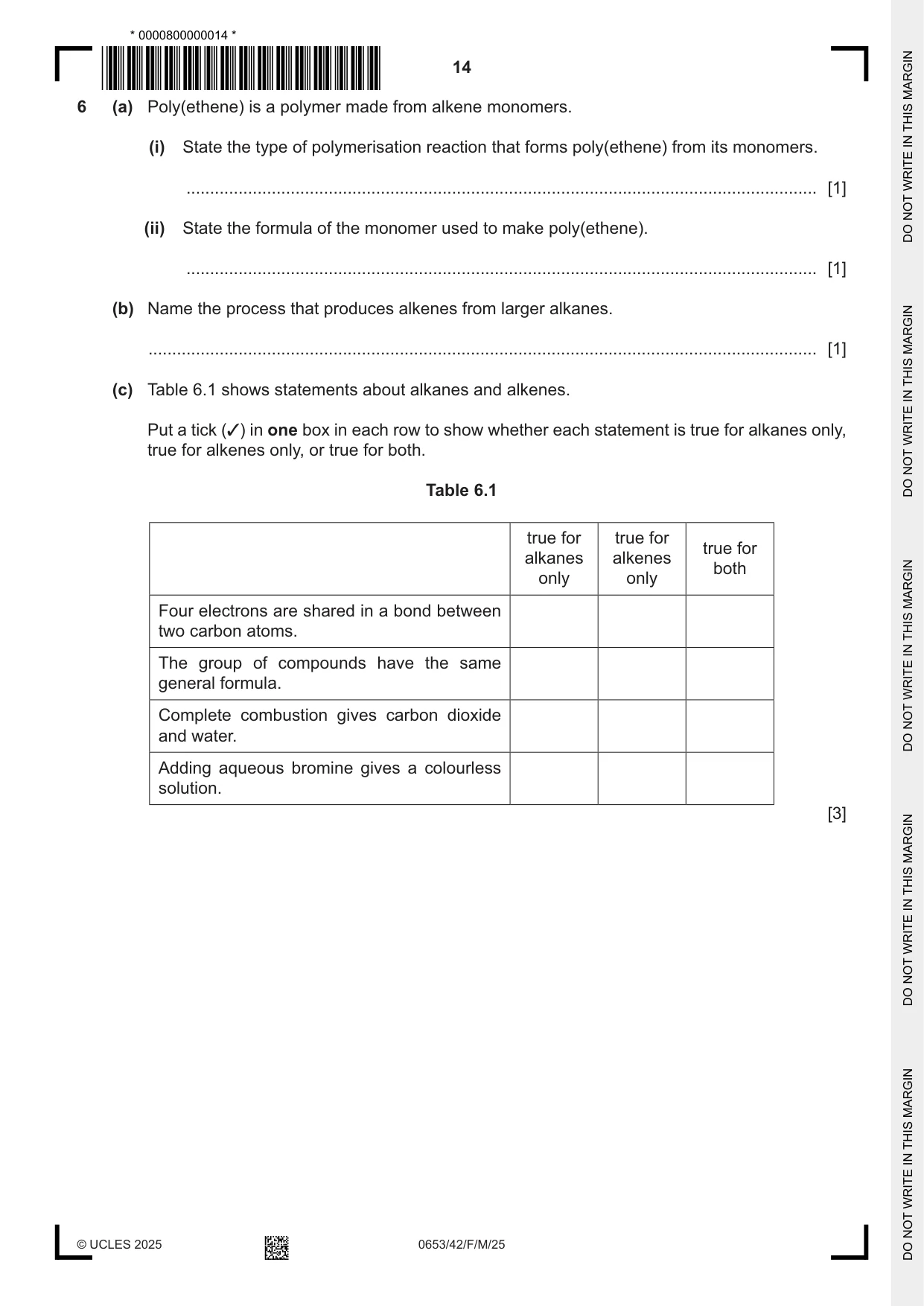
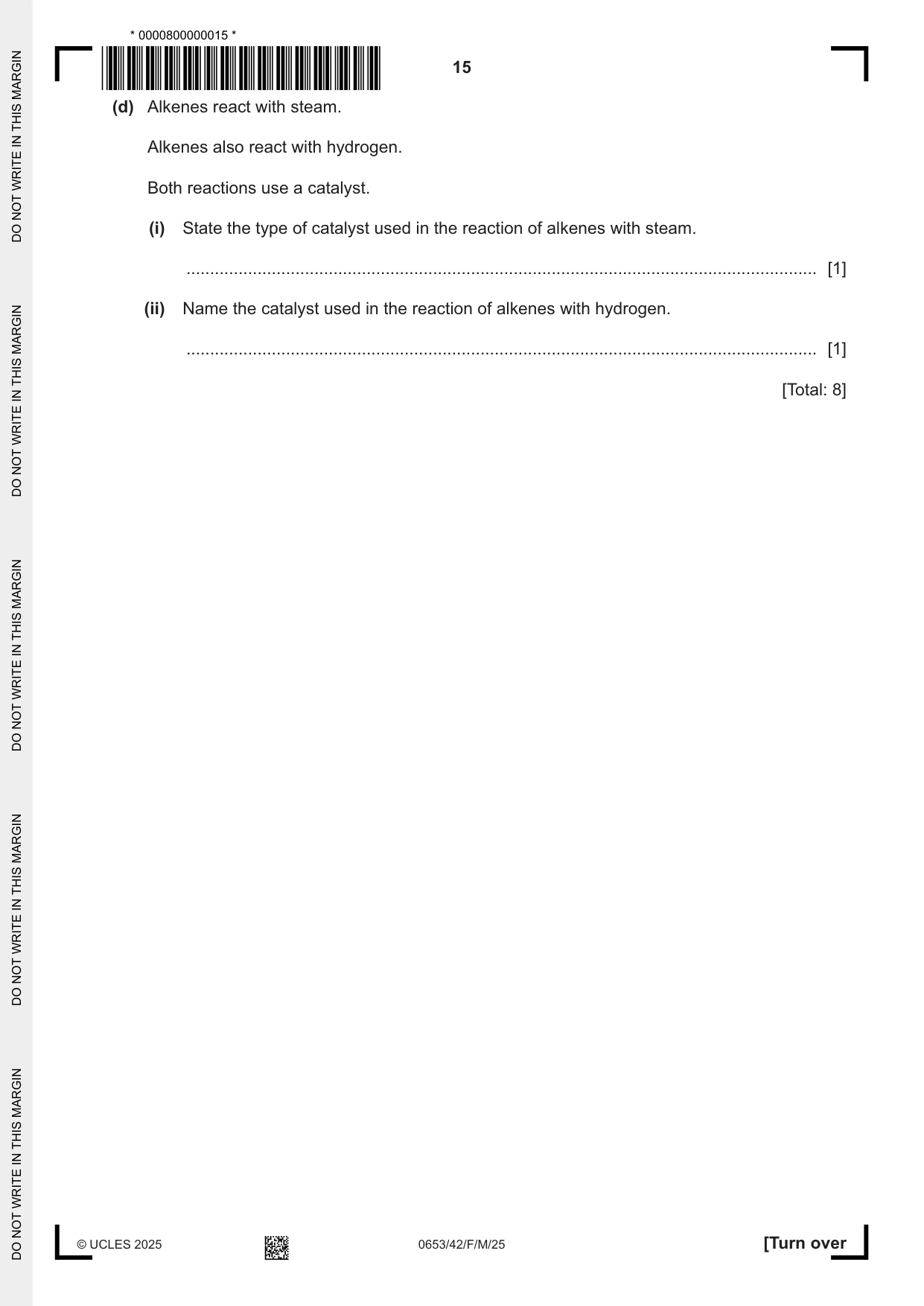
6 (a) Poly(ethene) is a polymer made from alkene monomers. (i) State the type of polymerisation reaction that forms poly(ethene) from its monomers. ..................................................................................................................................... [1] (ii) State the formula of the monomer used to make poly(ethene). ..................................................................................................................................... [1] (b) Name the process that produces alkenes from larger alkanes. ............................................................................................................................................. [1] (c) Table 6.1 shows statements about alkanes and alkenes. Put a tick (✓) in one box in each row to show whether each statement is true for alkanes only, true for alkenes only, or true for both. Table 6.1 true for true for true for alkanes alkenes both only only Four electrons are shared in a bond between two carbon atoms. The group of compounds have the same general formula. Complete combustion gives carbon dioxide and water. Adding aqueous bromine gives a colourless solution. [3] (d) Alkenes react with steam. Alkenes also react with hydrogen. Both reactions use a catalyst. (i) State the type of catalyst used in the reaction of alkenes with steam. ..................................................................................................................................... [1] (ii) Name the catalyst used in the reaction of alkenes with hydrogen. ..................................................................................................................................... [1] [Total: 8]
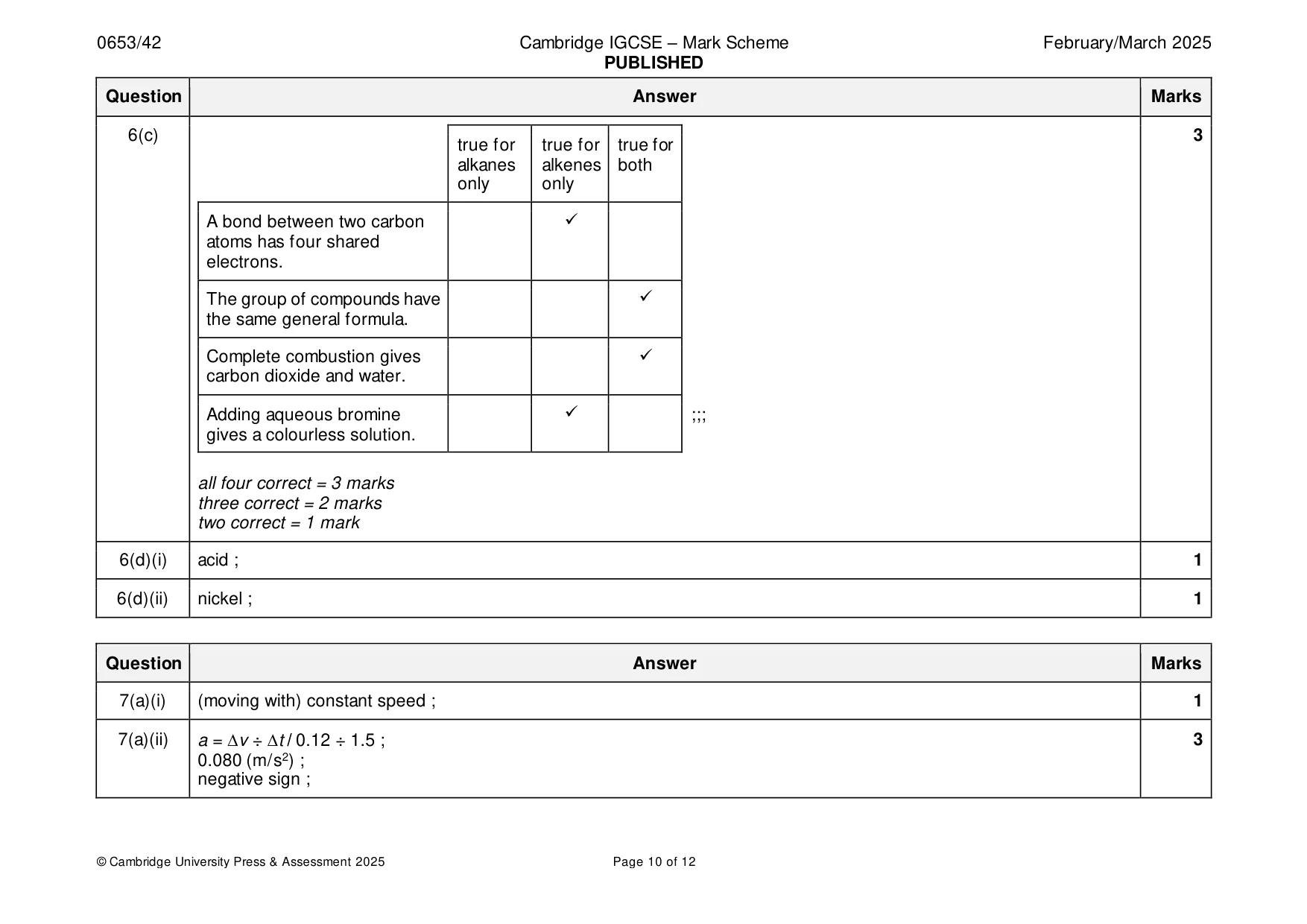
Mark scheme: 6(a)(i) addition ; 1 6(a)(ii) C2H4 ; 1 6(b) cracking ; 1 6(c) 3 true for true for true for alkanes alkenes both only only A bond between two carbon ✓ atoms has four shared electrons. The group of compounds have ✓ the same general formula. Complete combustion gives ✓ carbon dioxide and water. Adding aqueous bromine ✓ ;;; gives a colourless solution. all four correct = 3 marks three correct = 2 marks two correct = 1 mark 6(d)(i) acid ; 1 6(d)(ii) nickel ; 1
Q7 · An electric motor is connected to a battery
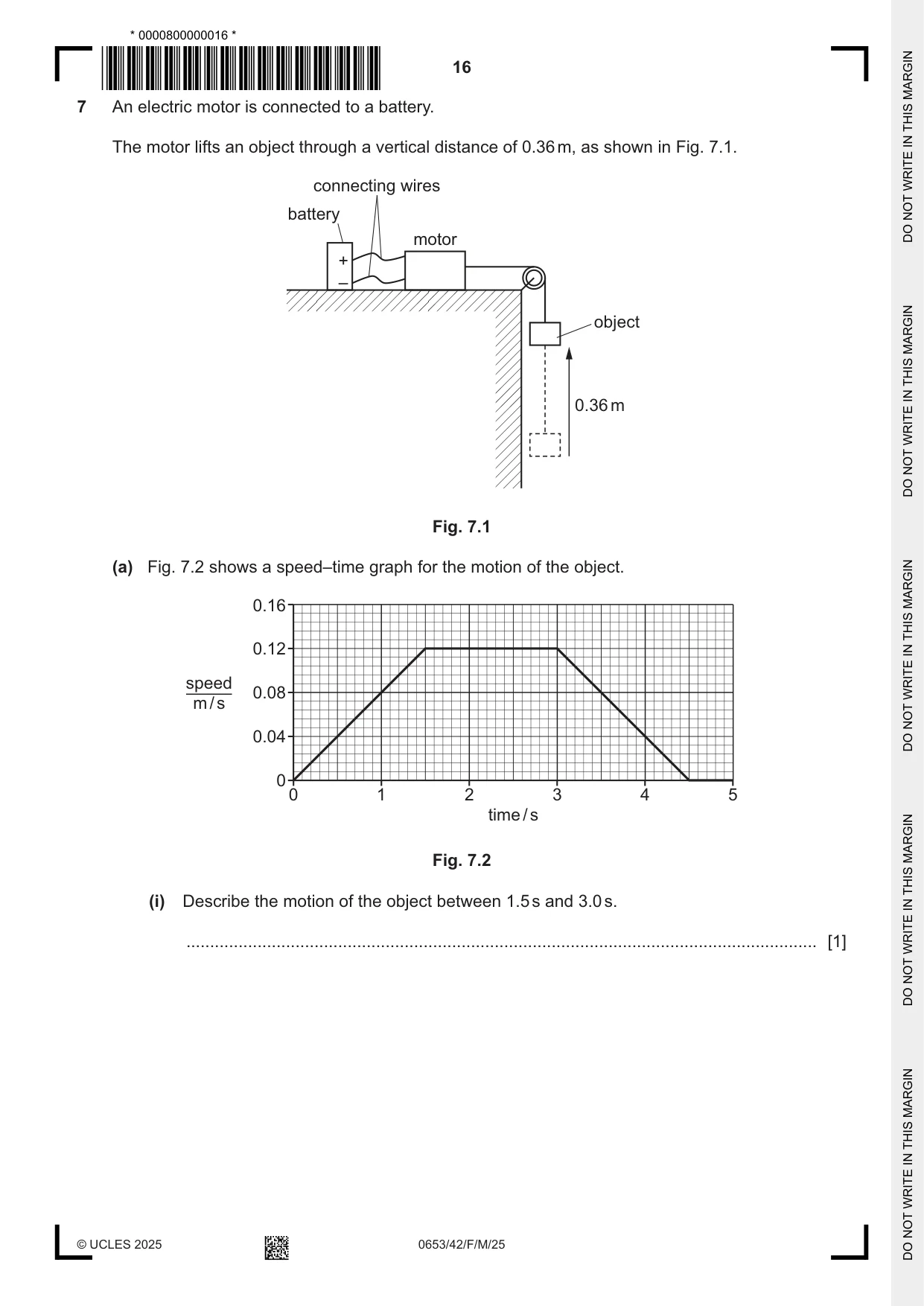
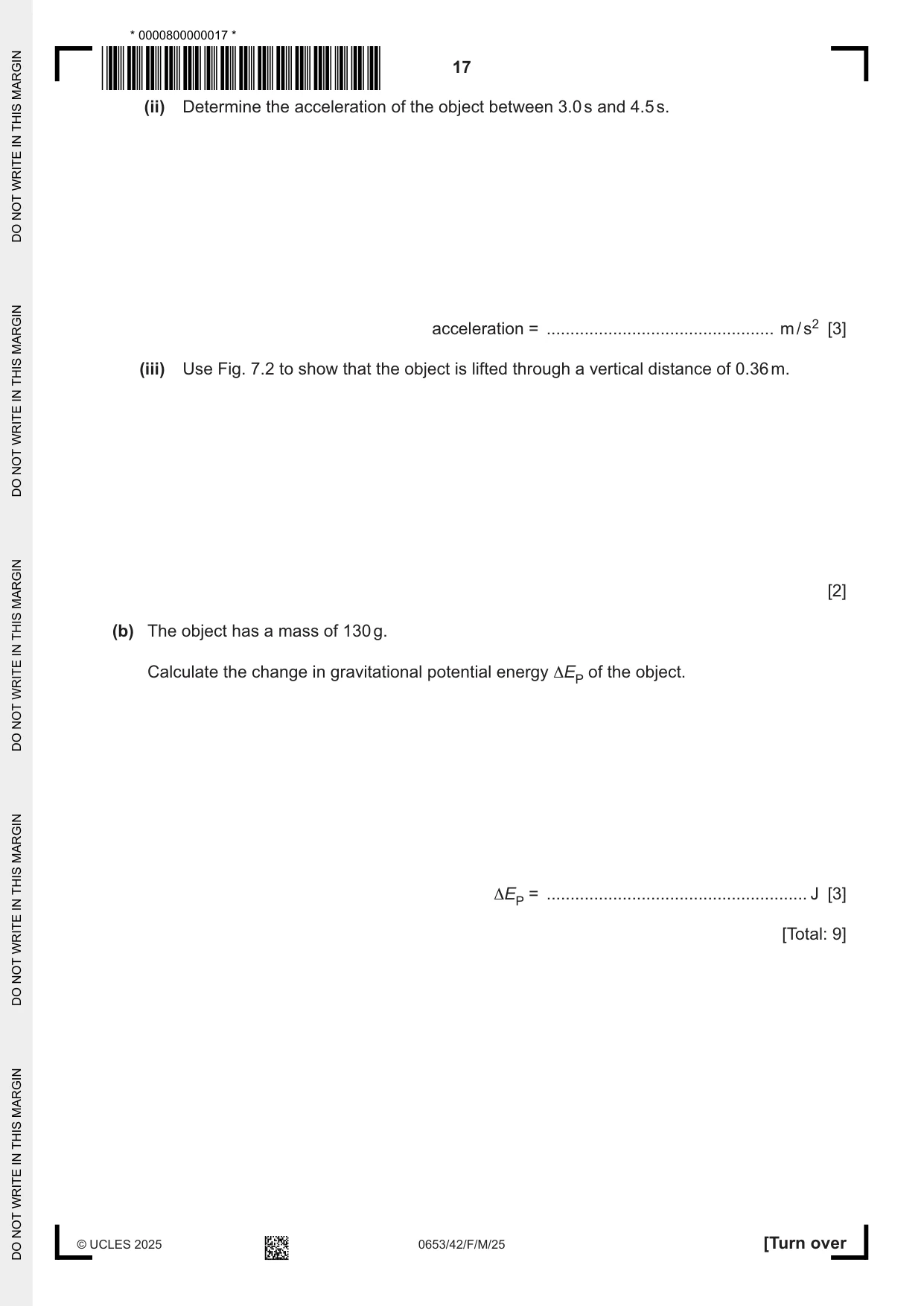
7 An electric motor is connected to a battery. The motor lifts an object through a vertical distance of 0.36 m, as shown in Fig. 7.1. connecting wires battery motor + – object 0.36 m Fig. 7.1 (a) Fig. 7.2 shows a speed–time graph for the motion of the object. 0.16 0.12 speed 0.08 m / s 0.04 0 0 1 2 3 4 5 time / s Fig. 7.2 (i) Describe the motion of the object between 1.5 s and 3.0 s. ..................................................................................................................................... [1] (ii) Determine the acceleration of the object between 3.0 s and 4.5 s. acceleration = ................................................ m / s2 [3] (iii) Use Fig. 7.2 to show that the object is lifted through a vertical distance of 0.36 m. [2] (b) The object has a mass of 130 g. Calculate the change in gravitational potential energy ΔEP of the object. ΔEP = ....................................................... J [3] [Total: 9]
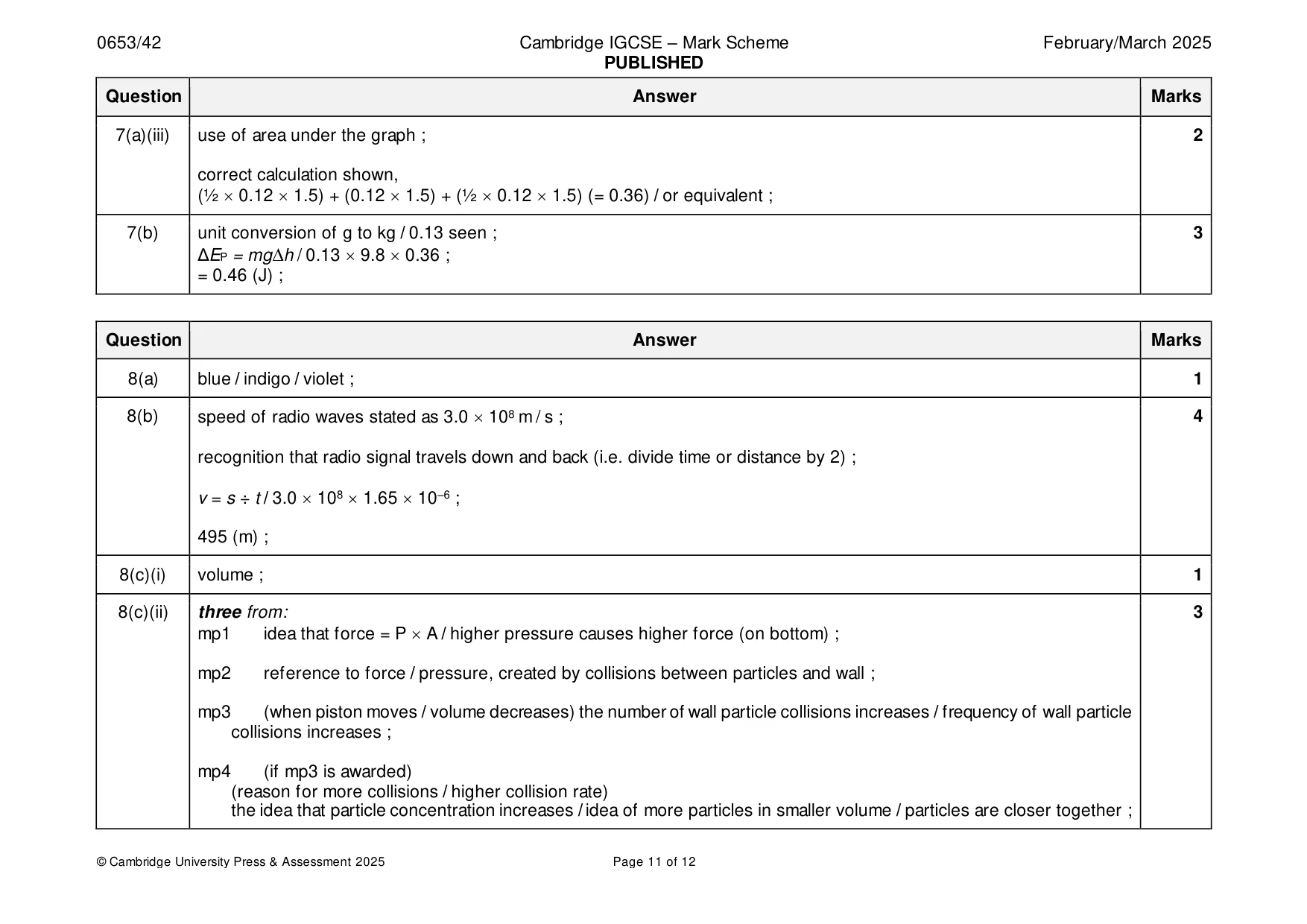
Mark scheme: 7(a)(i) (moving with) constant speed ; 1 7(a)(ii) a = v ÷ t / 0.12 ÷ 1.5 ; 3 0.080 (m / s2) ; negative sign ; 7(a)(iii) use of area under the graph ; 2 correct calculation shown, (½ 0.12 1.5) + (0.12 1.5) + (½ 0.12 1.5) (= 0.36) / or equivalent ; 7(b) unit conversion of g to kg / 0.13 seen ; 3 ΔEP = mgh / 0.13 9.8 0.36 ; = 0.46 (J) ;
Q8 · A helicopter hovering above the ground
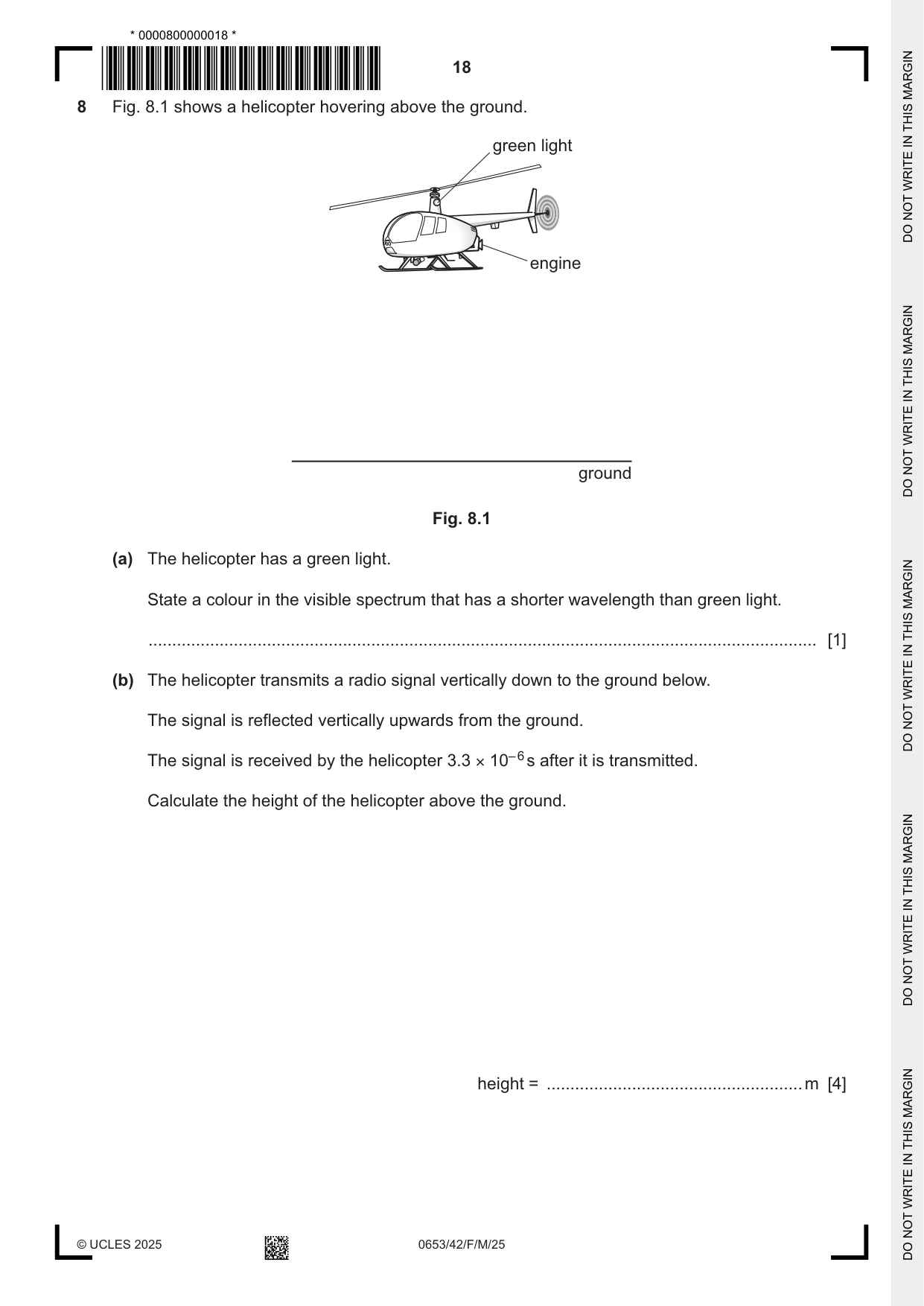
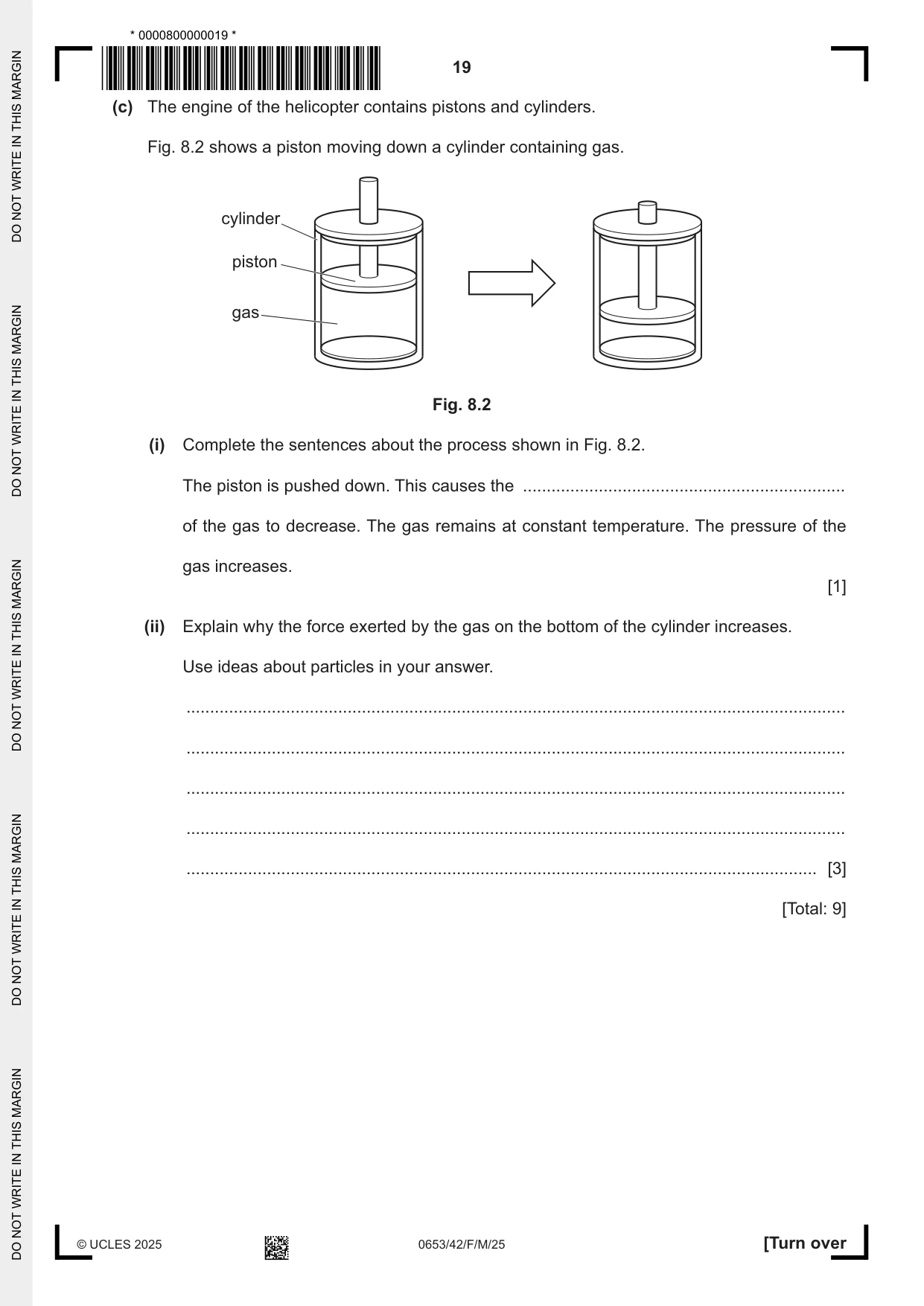
8 Fig. 8.1 shows a helicopter hovering above the ground. green light engine ground Fig. 8.1 (a) The helicopter has a green light. State a colour in the visible spectrum that has a shorter wavelength than green light. ............................................................................................................................................. [1] (b) The helicopter transmits a radio signal vertically down to the ground below. The signal is reflected vertically upwards from the ground. The signal is received by the helicopter 3.3 × 10– 6 s after it is transmitted. Calculate the height of the helicopter above the ground. height = ...................................................... m [4] (c) The engine of the helicopter contains pistons and cylinders. Fig. 8.2 shows a piston moving down a cylinder containing gas. cylinder piston gas Fig. 8.2 (i) Complete the sentences about the process shown in Fig. 8.2. The piston is pushed down. This causes the .................................................................... of the gas to decrease. The gas remains at constant temperature. The pressure of the gas increases. [1] (ii) Explain why the force exerted by the gas on the bottom of the cylinder increases. Use ideas about particles in your answer. ........................................................................................................................................... ........................................................................................................................................... ........................................................................................................................................... ........................................................................................................................................... ..................................................................................................................................... [3] [Total: 9]
Mark scheme: 8(a) blue / indigo / violet ; 1 8(b) speed of radio waves stated as 3.0 108 m / s ; 4 recognition that radio signal travels down and back (i.e. divide time or distance by 2) ; v = s ÷ t / 3.0 108 1.65 10–6 ; 495 (m) ; 8(c)(i) volume ; 1 8(c)(ii) three from: 3 mp1 idea that force = P A / higher pressure causes higher force (on bottom) ; mp2 reference to force / pressure, created by collisions between particles and wall ; mp3 (when piston moves / volume decreases) the number of wall particle collisions increases / frequency of wall particle collisions increases ; mp4 (if mp3 is awarded) (reason for more collisions / higher collision rate) the idea that particle concentration increases / idea of more particles in smaller volume / particles are closer together ;
Question 9
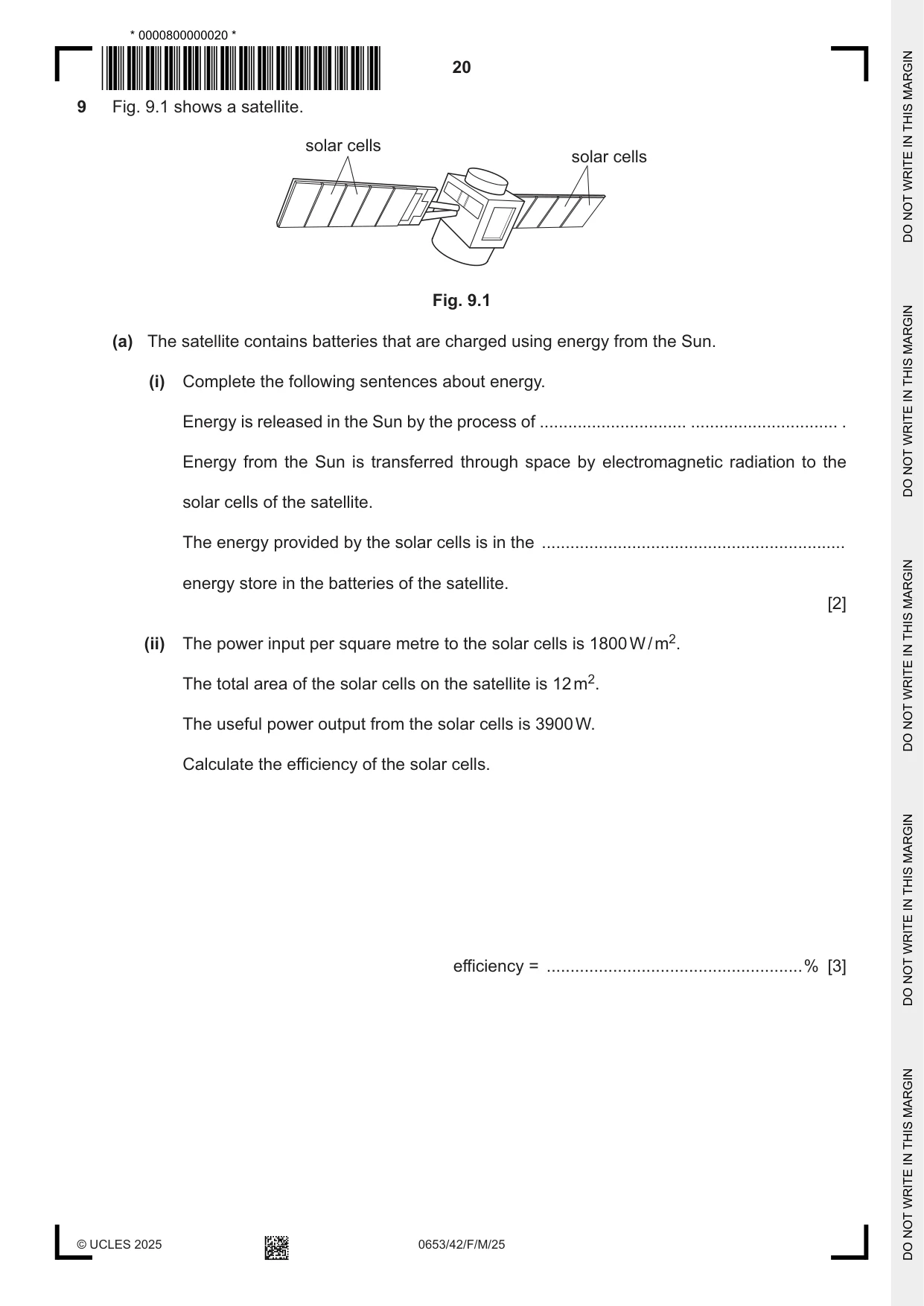
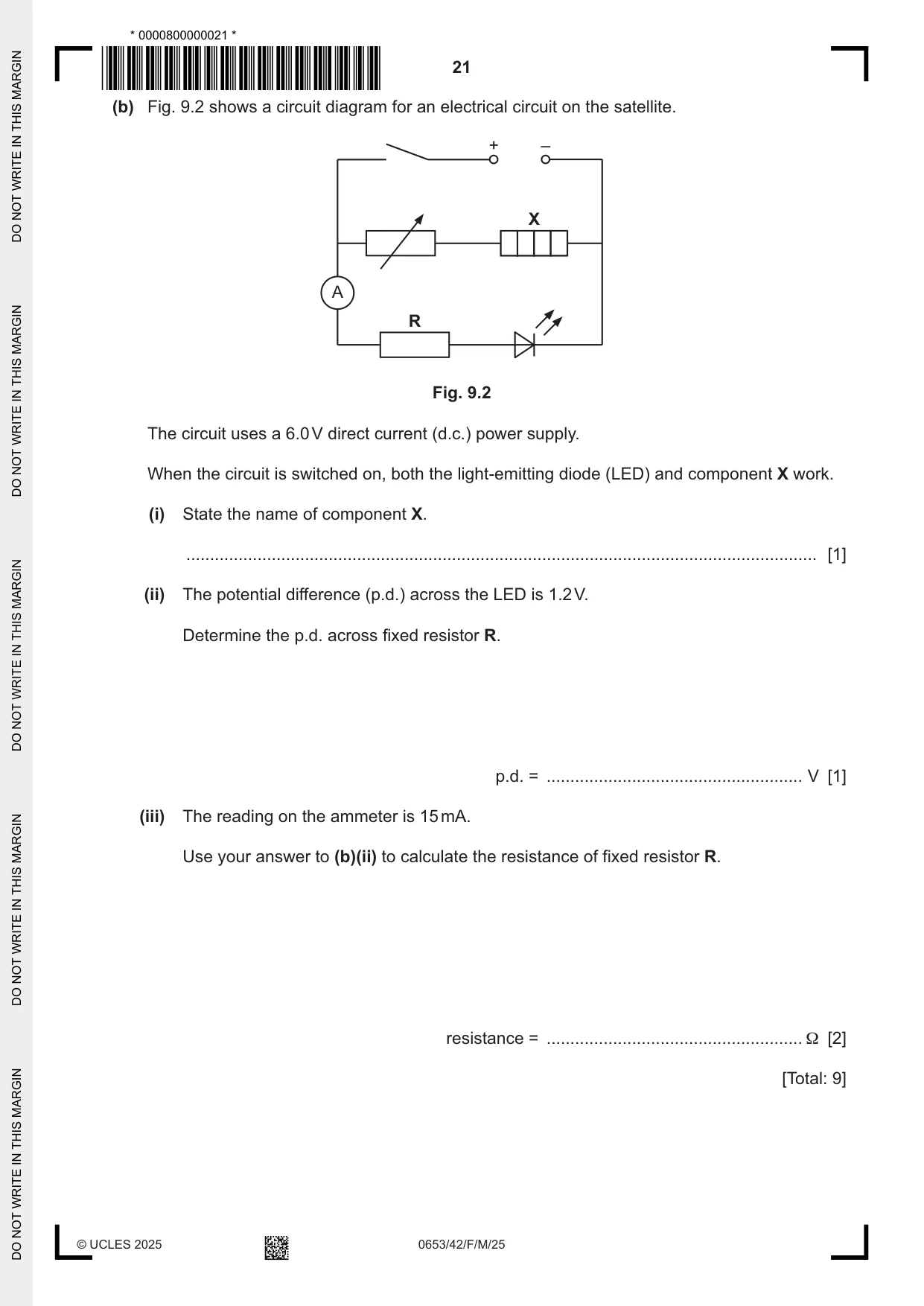
9 Fig. 9.1 shows a satellite. solar cells solar cells Fig. 9.1 (a) The satellite contains batteries that are charged using energy from the Sun. (i) Complete the following sentences about energy. Energy is released in the Sun by the process of ............................... ............................... . Energy from the Sun is transferred through space by electromagnetic radiation to the solar cells of the satellite. The energy provided by the solar cells is in the ................................................................ energy store in the batteries of the satellite. [2] (ii) The power input per square metre to the solar cells is 1800 W / m2. The total area of the solar cells on the satellite is 12 m2. The useful power output from the solar cells is 3900 W. Calculate the efficiency of the solar cells. efficiency = ......................................................% [3] (b) Fig. 9.2 shows a circuit diagram for an electrical circuit on the satellite. + – X A R Fig. 9.2 The circuit uses a 6.0 V direct current (d.c.) power supply. When the circuit is switched on, both the light-emitting diode (LED) and component X work. (i) State the name of component X. ..................................................................................................................................... [1] (ii) The potential difference (p.d.) across the LED is 1.2 V. Determine the p.d. across fixed resistor R. p.d. = ...................................................... V [1] (iii) The reading on the ammeter is 15 mA. Use your answer to (b)(ii) to calculate the resistance of fixed resistor R. resistance = ...................................................... Ω [2] [Total: 9]
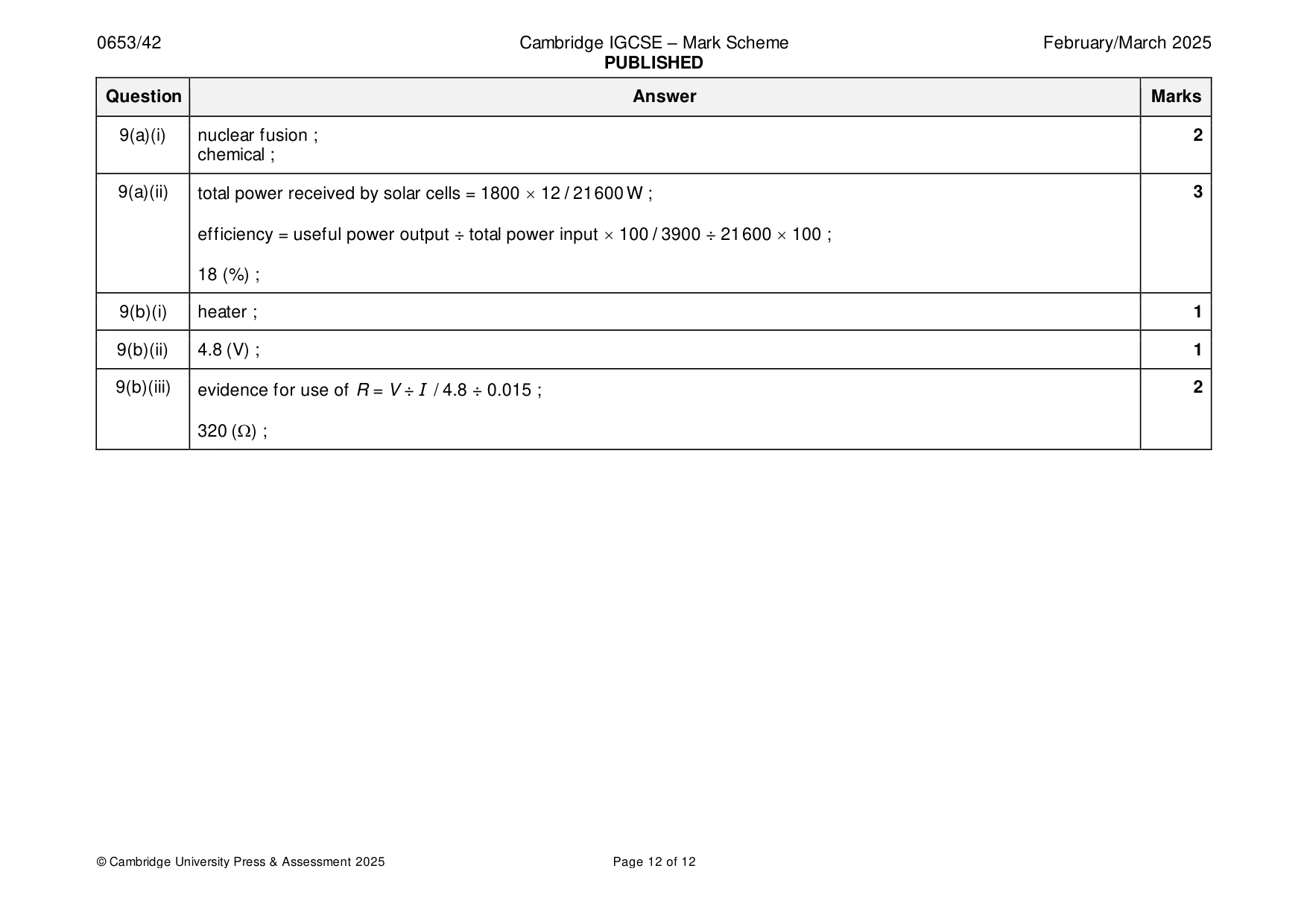
Mark scheme: 9(a)(i) nuclear fusion ; 2 chemical ; 9(a)(ii) total power received by solar cells = 1800 12 / 21 600 W ; 3 efficiency = useful power output ÷ total power input 100 / 3900 ÷ 21 600 100 ; 18 (%) ; 9(b)(i) heater ; 1 9(b)(ii) 4.8 (V) ; 1 9(b)(iii) evidence for use of R = V ÷ I / 4.8 ÷ 0.015 ; 2 320 () ;
What was in this paper
The subtopics covered by these 9 questions, and how many questions each got. Open one in a new tab to see every Cambridge question on it.
What you needed in this session
Cambridge’s own grade thresholds for 2025 Feb/March, Paper 4 · Variant 2. A higher threshold means an easier paper — the bar moves with how the cohort did.