Cambridge IGCSE Science - Combined 0653 — 2025 Oct/Nov Paper 4 · Variant 3
0653/43/O/N/25 · 9 questions · 80 marks · 75 min
The question paper and its mark scheme, free to read here and free to download. This is Cambridge’s own paper, exactly as it was sat.
Question paper20 pages

Mark scheme13 pages
Answers below. Sit the paper first if you are practising.
Questions as text
Q1 · Part of the human alimentary canal and associated organs
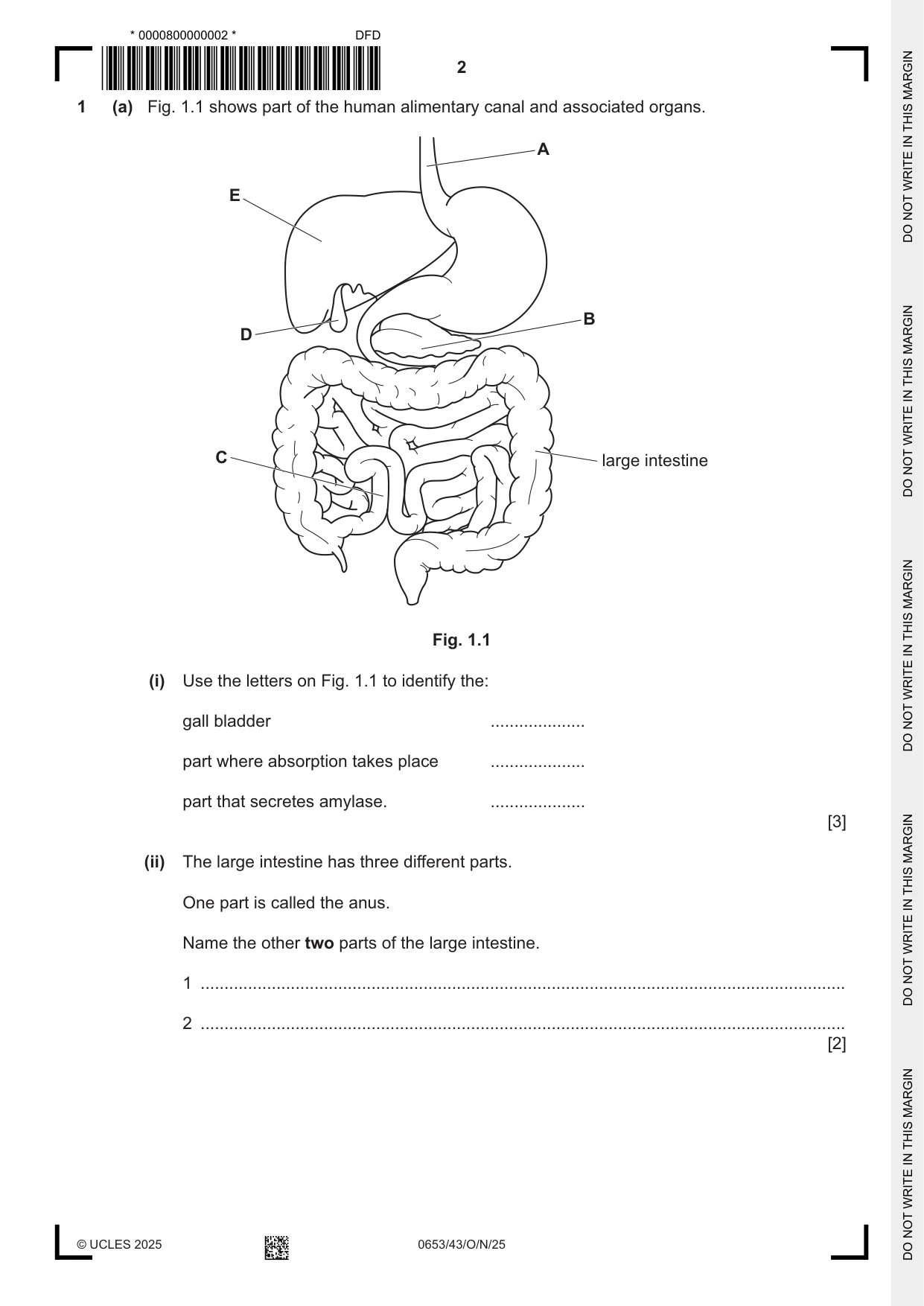
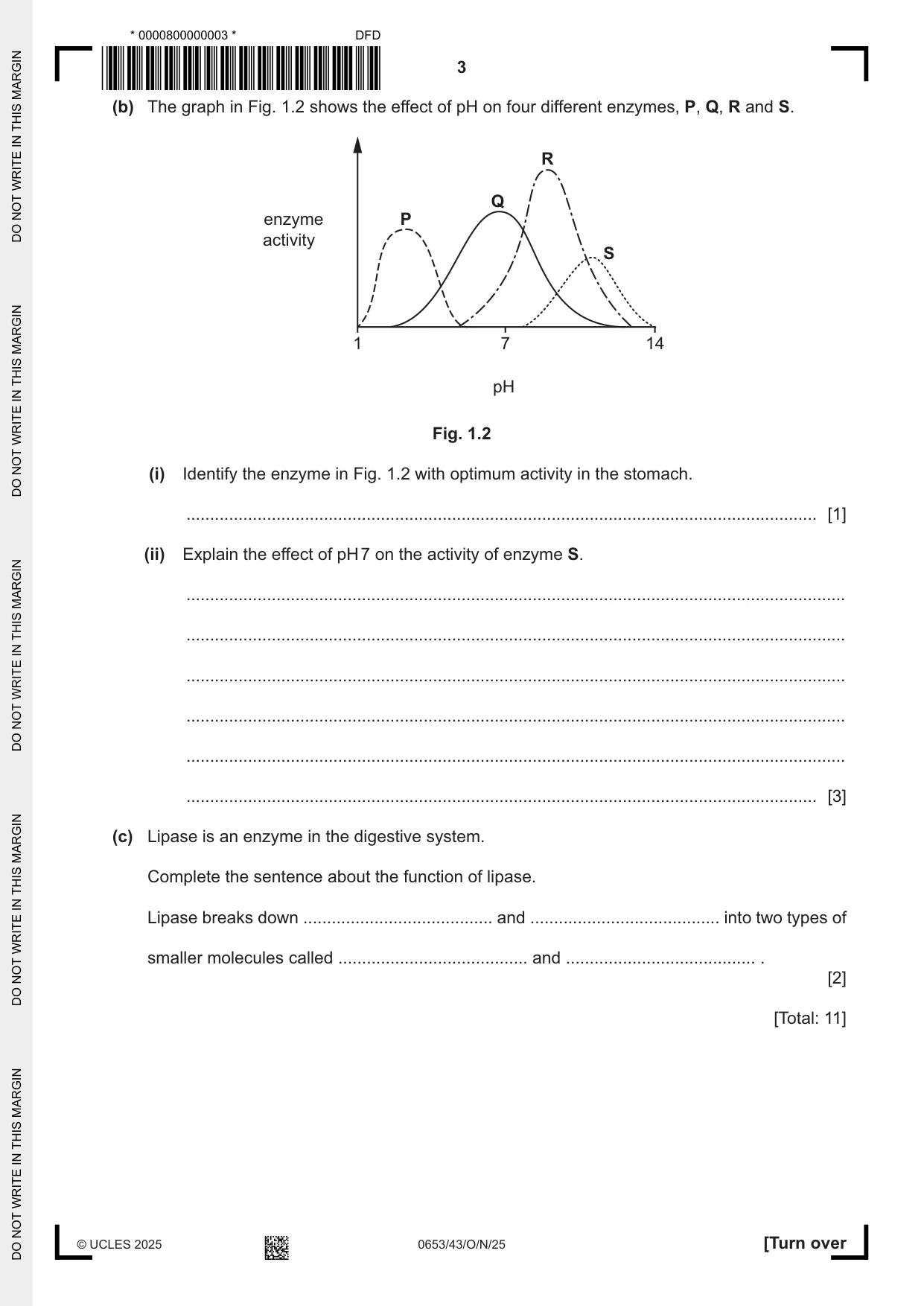
1 (a) Fig. 1.1 shows part of the human alimentary canal and associated organs. A E B D C large intestine Fig. 1.1 (i) Use the letters on Fig. 1.1 to identify the: gall bladder .................... part where absorption takes place .................... part that secretes amylase. .................... [3] (ii) The large intestine has three different parts. One part is called the anus. Name the other two parts of the large intestine. 1 ........................................................................................................................................ 2 ........................................................................................................................................ [2] (b) The graph in Fig. 1.2 shows the effect of pH on four different enzymes, P, Q, R and S. R Q enzyme P activity S 1 7 14 pH Fig. 1.2 (i) Identify the enzyme in Fig. 1.2 with optimum activity in the stomach. ..................................................................................................................................... [1] (ii) Explain the effect of pH 7 on the activity of enzyme S. ........................................................................................................................................... ........................................................................................................................................... ........................................................................................................................................... ........................................................................................................................................... ........................................................................................................................................... ..................................................................................................................................... [3] (c) Lipase is an enzyme in the digestive system. Complete the sentence about the function of lipase. Lipase breaks down ........................................ and ........................................ into two types of smaller molecules called ........................................ and ........................................ . [2] [Total: 11]
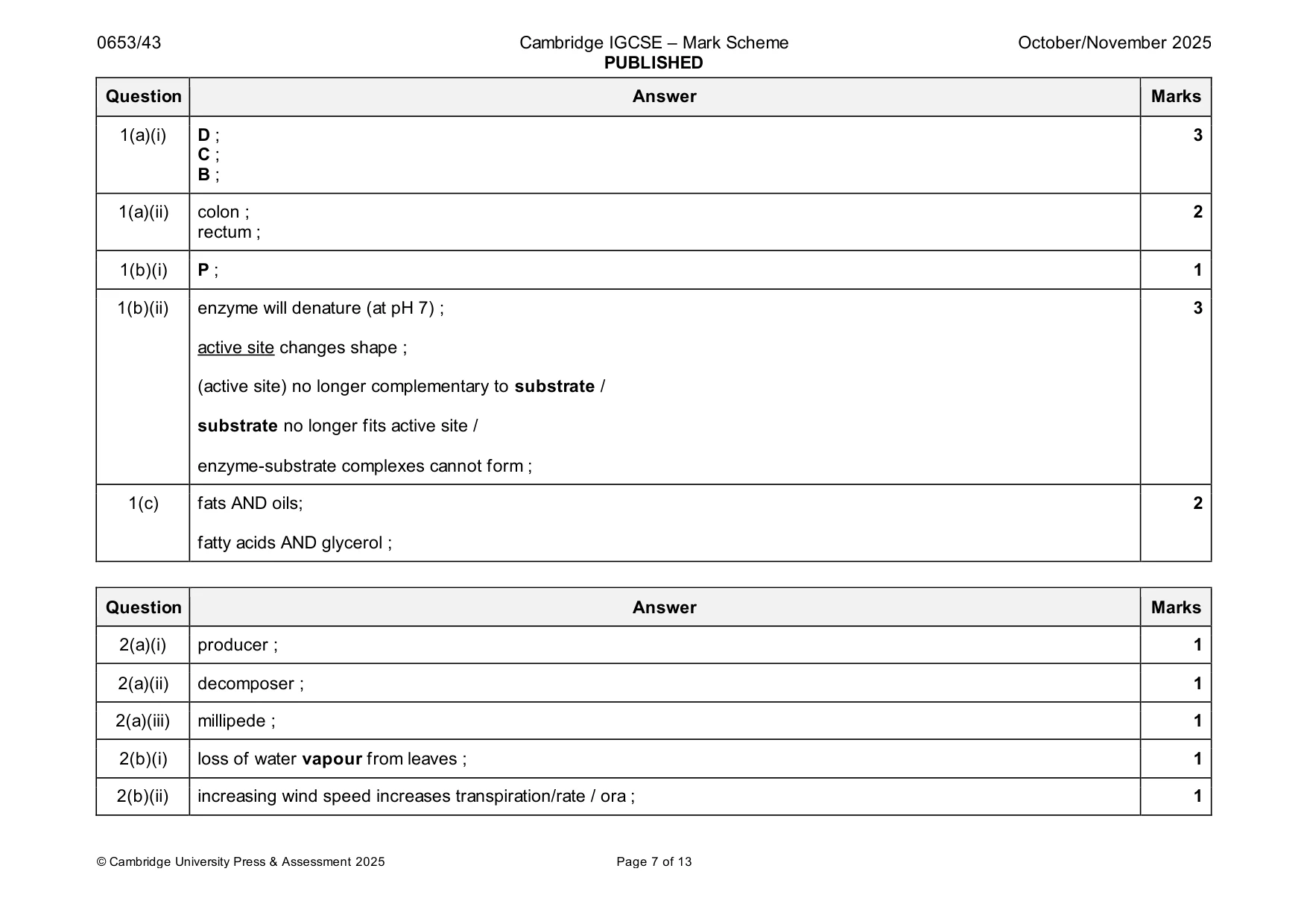
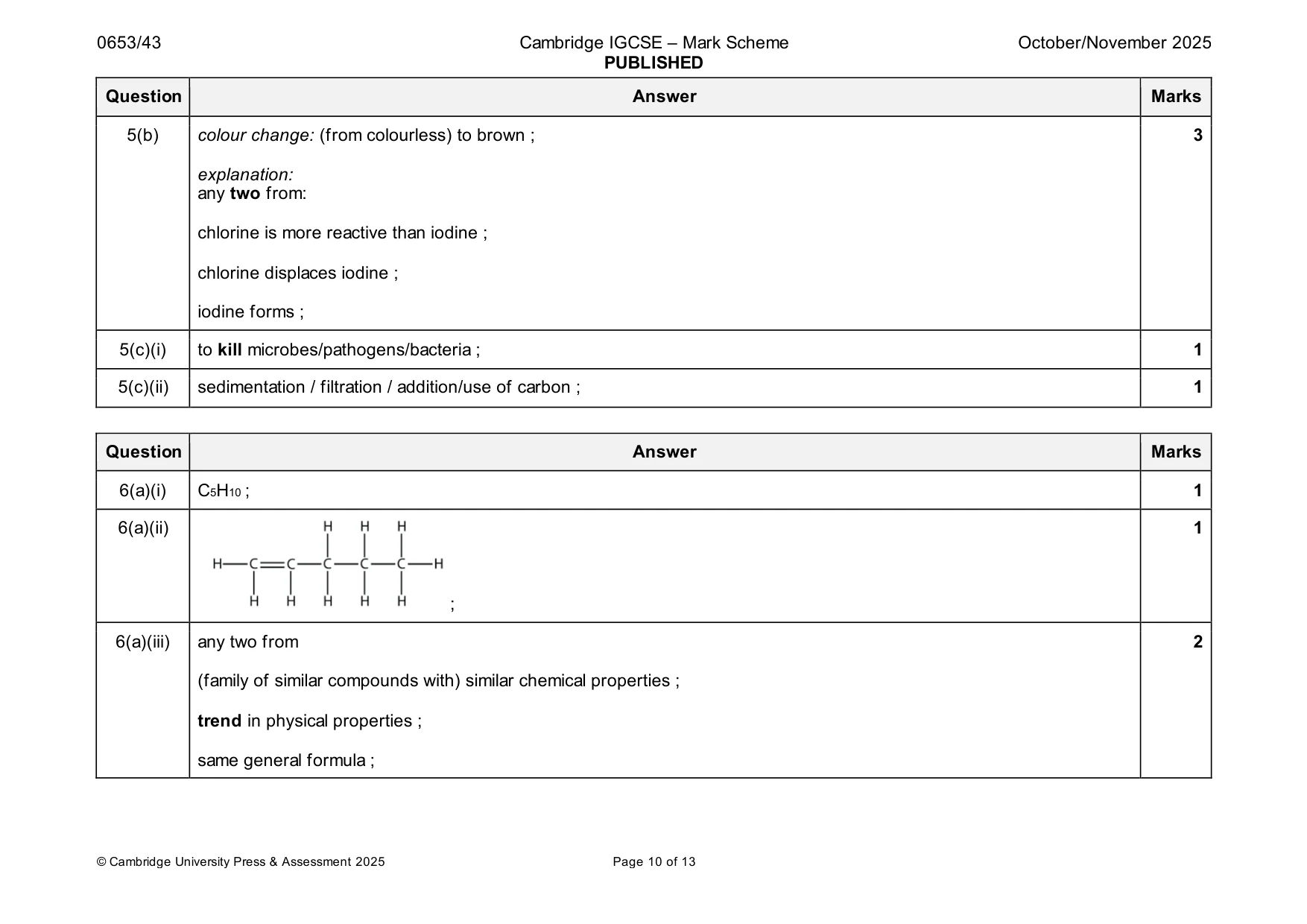
Mark scheme: Question Answer Marks 1(a)(i) D ; 3 C ; B ; 1(a)(ii) colon ; 2 rectum ; 1(b)(i) P ; 1 1(b)(ii) enzyme will denature (at pH 7) ; 3 active site changes shape ; (active site) no longer complementary to substrate / substrate no longer fits active site / enzyme-substrate complexes cannot form ; 1(c) fats AND oils; 2 fatty acids AND glycerol ;
Question 2
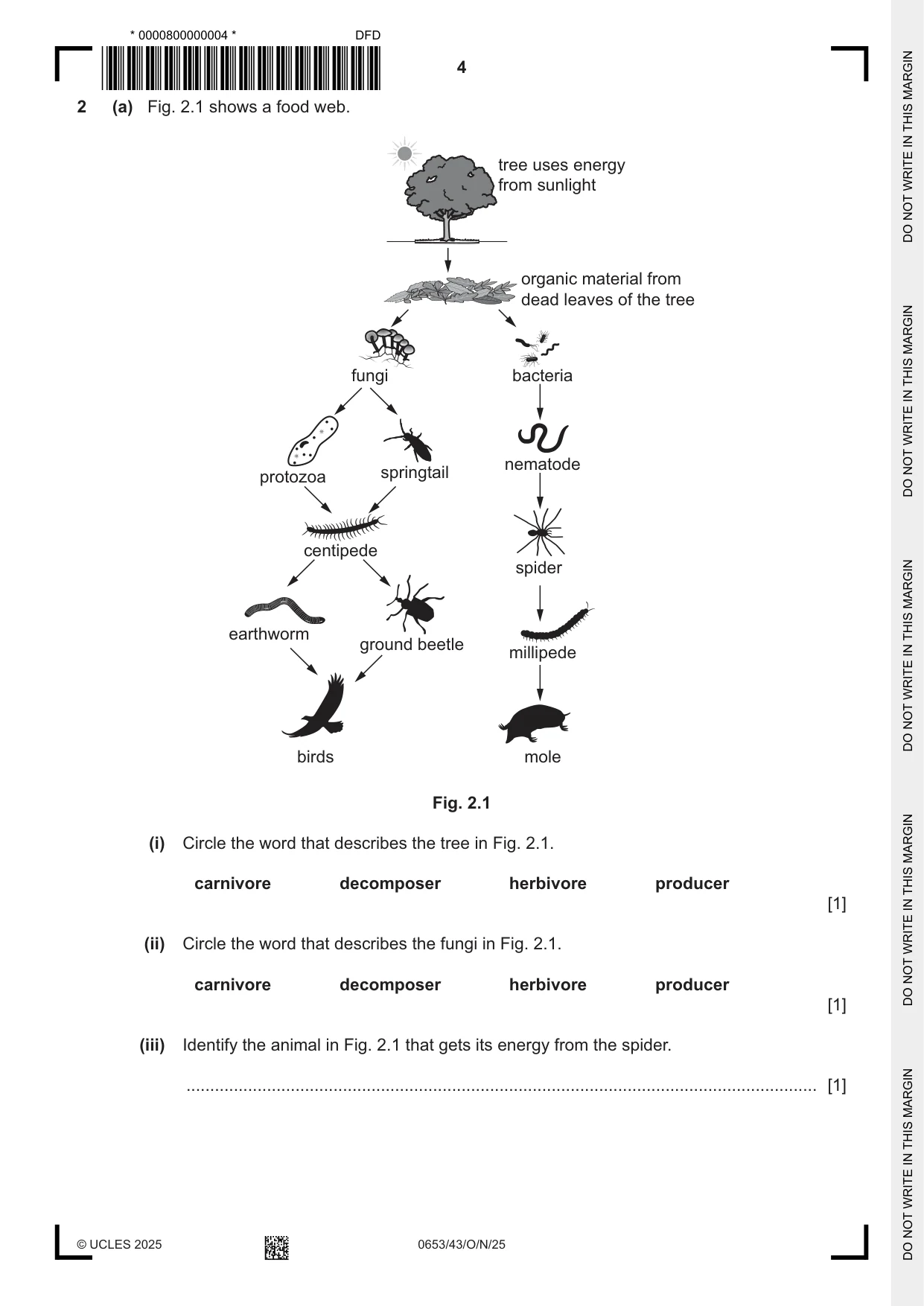
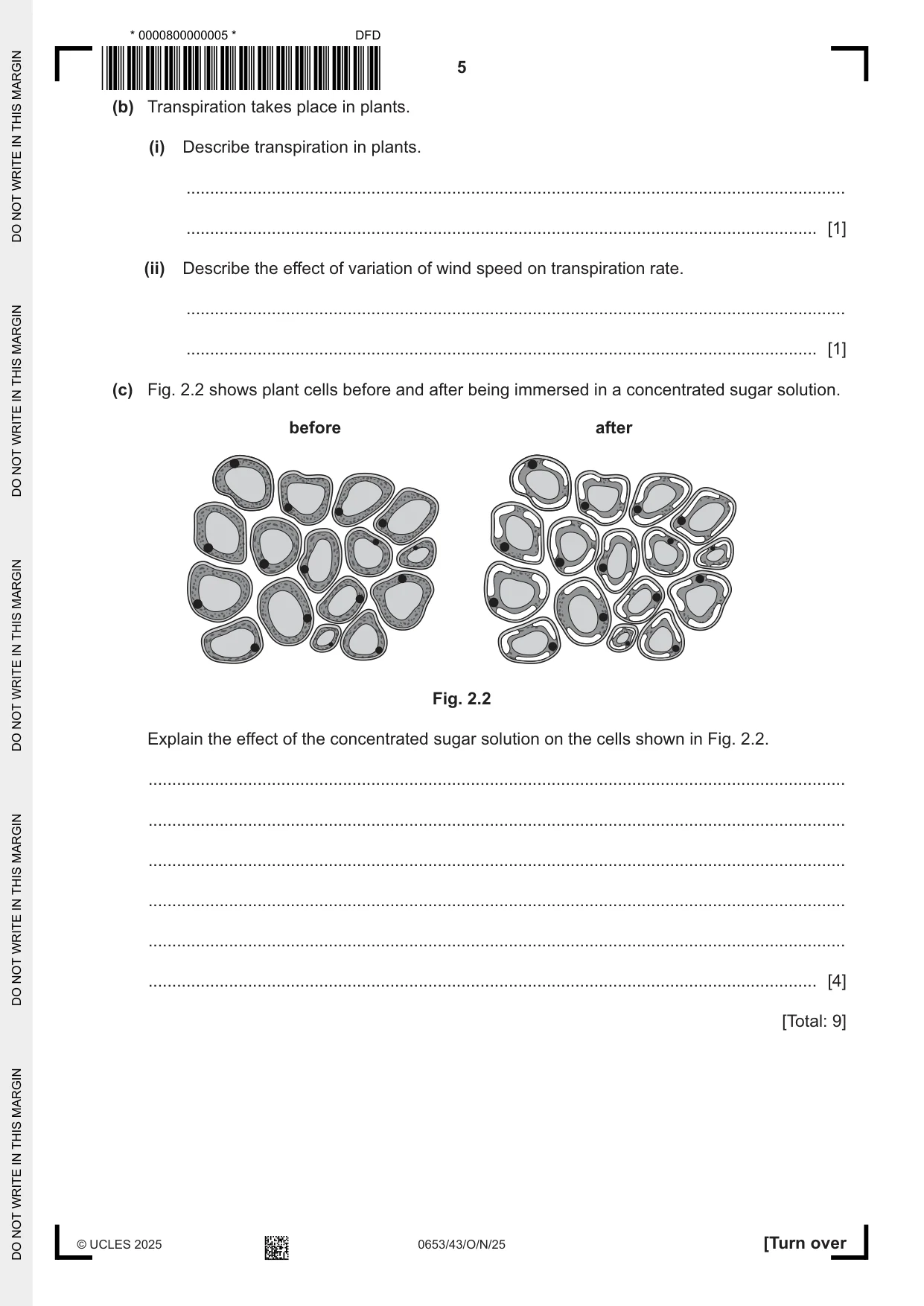
2 (a) Fig. 2.1 shows a food web. tree uses energy from sunlight organic material from dead leaves of the tree fungi bacteria nematode protozoa springtail centipede spider earthworm ground beetle millipede birds mole Fig. 2.1 (i) Circle the word that describes the tree in Fig. 2.1. carnivore decomposer herbivore producer [1] (ii) Circle the word that describes the fungi in Fig. 2.1. carnivore decomposer herbivore producer [1] (iii) Identify the animal in Fig. 2.1 that gets its energy from the spider. ..................................................................................................................................... [1] (b) Transpiration takes place in plants. (i) Describe transpiration in plants. ........................................................................................................................................... ..................................................................................................................................... [1] (ii) Describe the effect of variation of wind speed on transpiration rate. ........................................................................................................................................... ..................................................................................................................................... [1] (c) Fig. 2.2 shows plant cells before and after being immersed in a concentrated sugar solution. before after Fig. 2.2 Explain the effect of the concentrated sugar solution on the cells shown in Fig. 2.2. ................................................................................................................................................... ................................................................................................................................................... ................................................................................................................................................... ................................................................................................................................................... ................................................................................................................................................... ............................................................................................................................................. [4] [Total: 9]
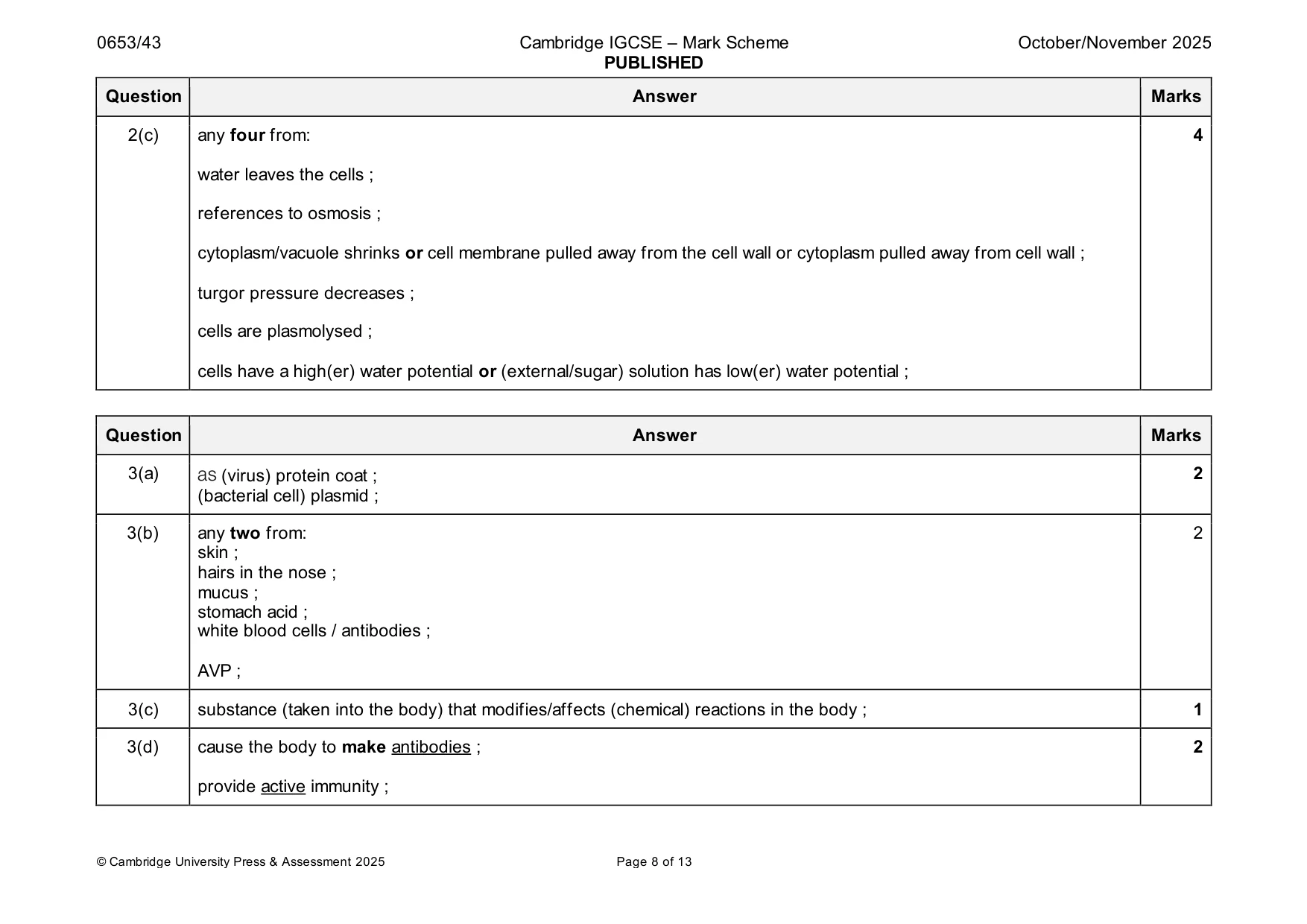
Mark scheme: 2(a)(i) producer ; 1 2(a)(ii) decomposer ; 1 2(a)(iii) millipede ; 1 2(b)(i) loss of water vapour from leaves ; 1 2(b)(ii) increasing wind speed increases transpiration/rate / ora ; 1 2(c) any four from: 4 water leaves the cells ; references to osmosis ; cytoplasm/vacuole shrinks or cell membrane pulled away from the cell wall or cytoplasm pulled away from cell wall ; turgor pressure decreases ; cells are plasmolysed ; cells have a high(er) water potential or (external/sugar) solution has low(er) water potential ;
Q3 · The structure of a virus and a bacterial cell
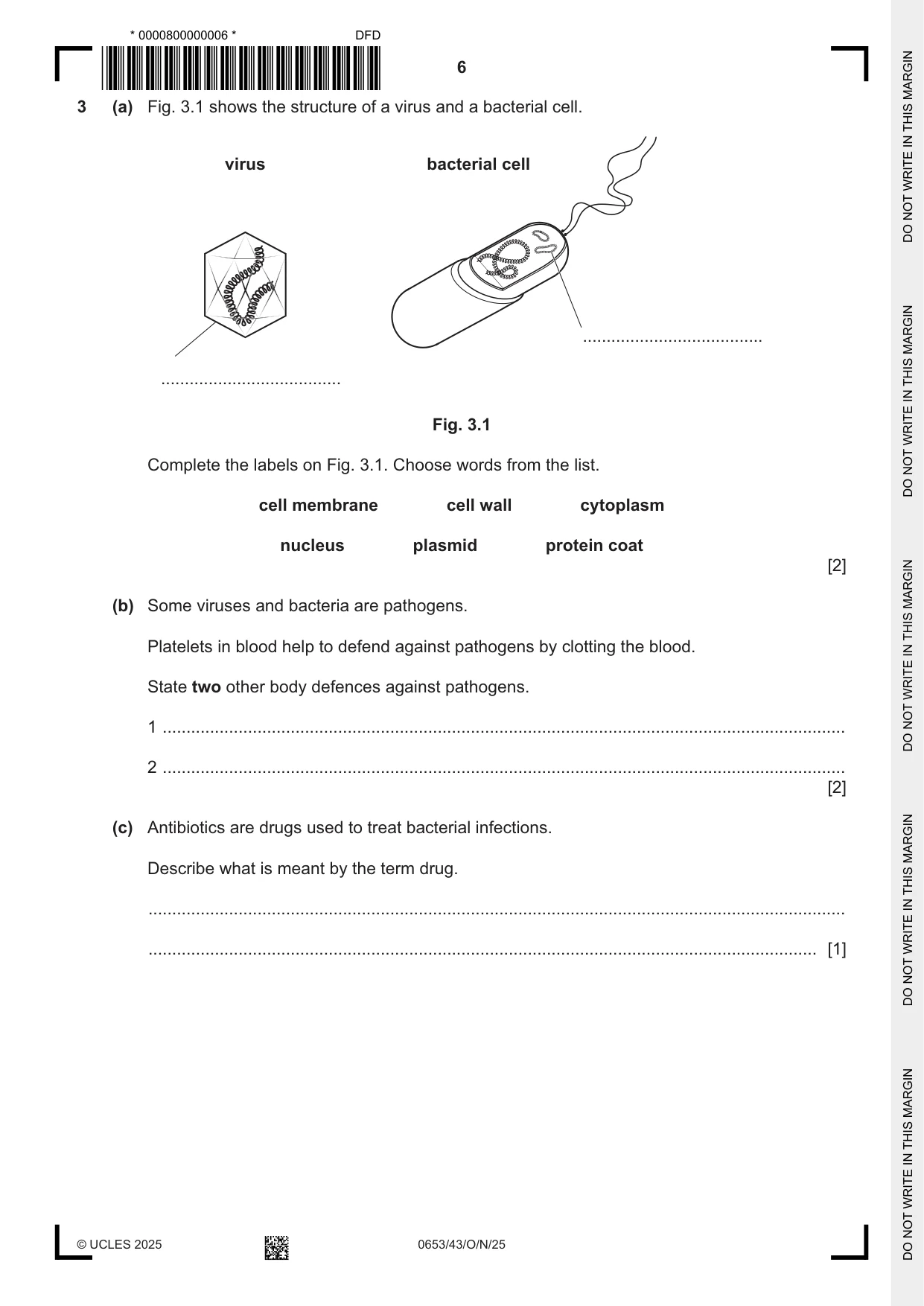
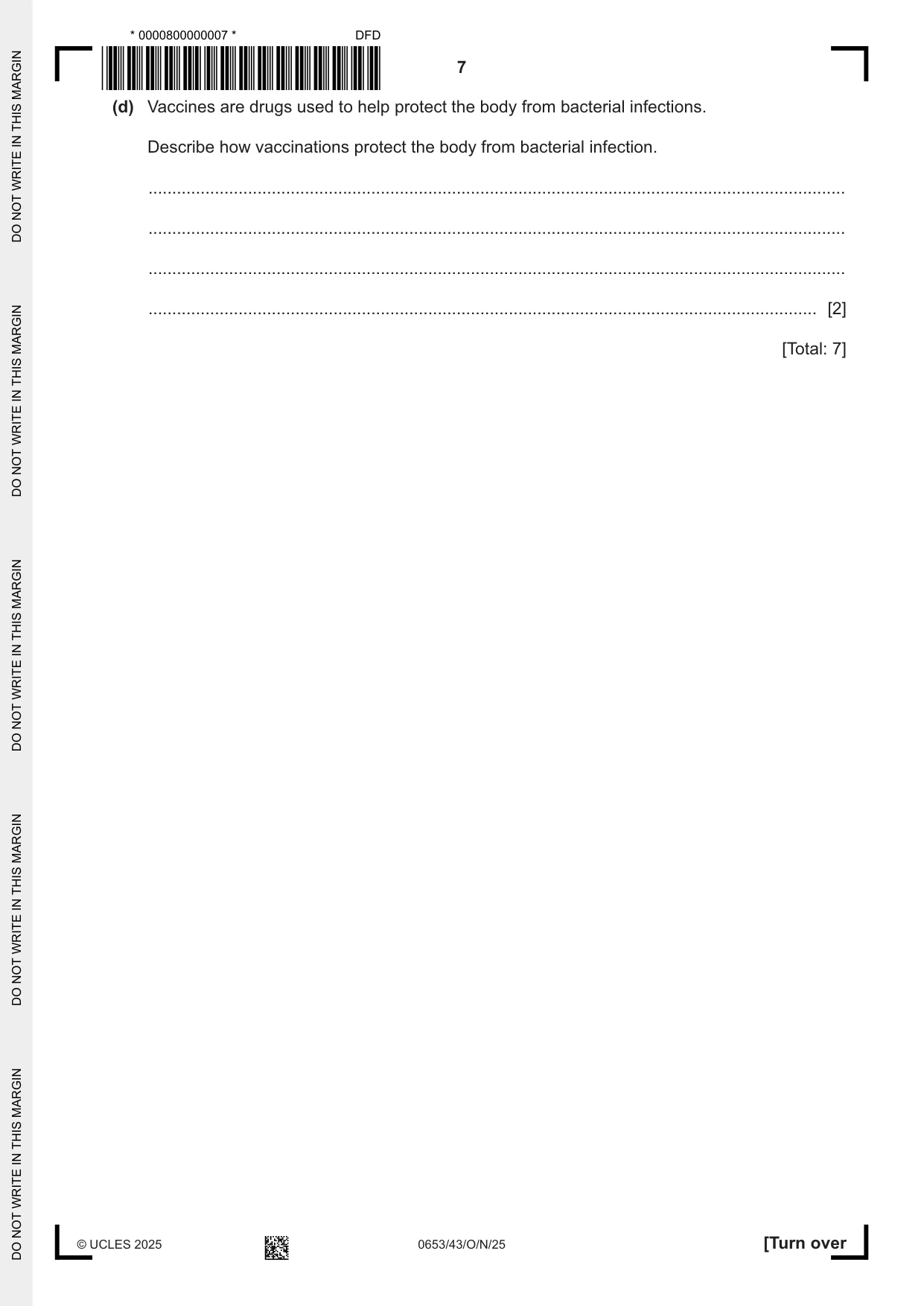
3 (a) Fig. 3.1 shows the structure of a virus and a bacterial cell. virus bacterial cell ...................................... ...................................... Fig. 3.1 Complete the labels on Fig. 3.1. Choose words from the list. cell membrane cell wall cytoplasm nucleus plasmid protein coat [2] (b) Some viruses and bacteria are pathogens. Platelets in blood help to defend against pathogens by clotting the blood. State two other body defences against pathogens. 1 ................................................................................................................................................ 2 ................................................................................................................................................ [2] (c) Antibiotics are drugs used to treat bacterial infections. Describe what is meant by the term drug. ................................................................................................................................................... ............................................................................................................................................. [1] (d) Vaccines are drugs used to help protect the body from bacterial infections. Describe how vaccinations protect the body from bacterial infection. ................................................................................................................................................... ................................................................................................................................................... ................................................................................................................................................... ............................................................................................................................................. [2] [Total: 7]
Mark scheme: 3(a) as (virus) protein coat ; 2 (bacterial cell) plasmid ; 3(b) any two from: 2 skin ; hairs in the nose ; mucus ; stomach acid ; white blood cells / antibodies ; AVP ; 3(c) substance (taken into the body) that modifies/affects (chemical) reactions in the body ; 1 3(d) cause the body to make antibodies ; 2 provide active immunity ;
Q4 · A student investigates the rate of reaction between large pieces of magnesium carbonate…
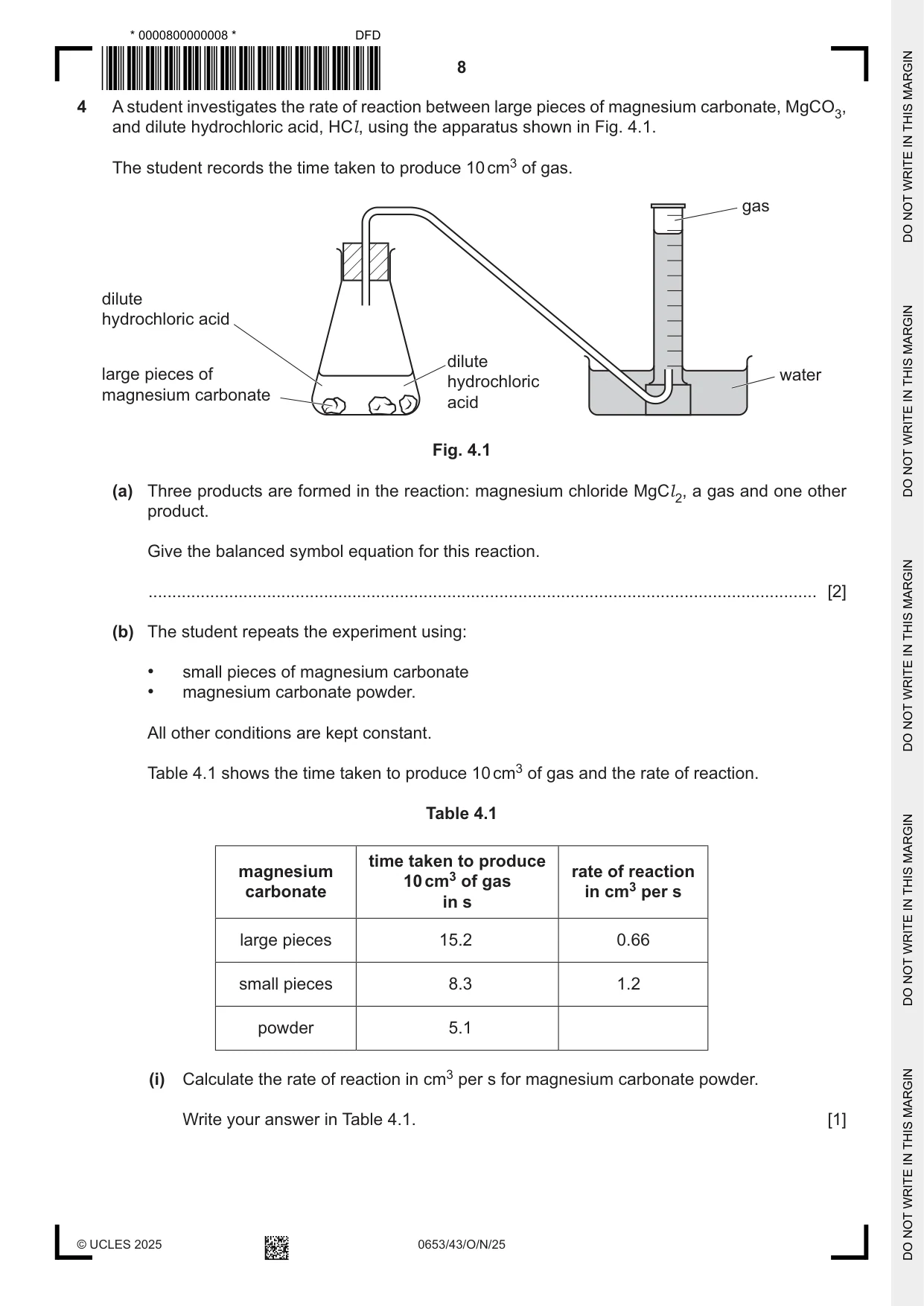
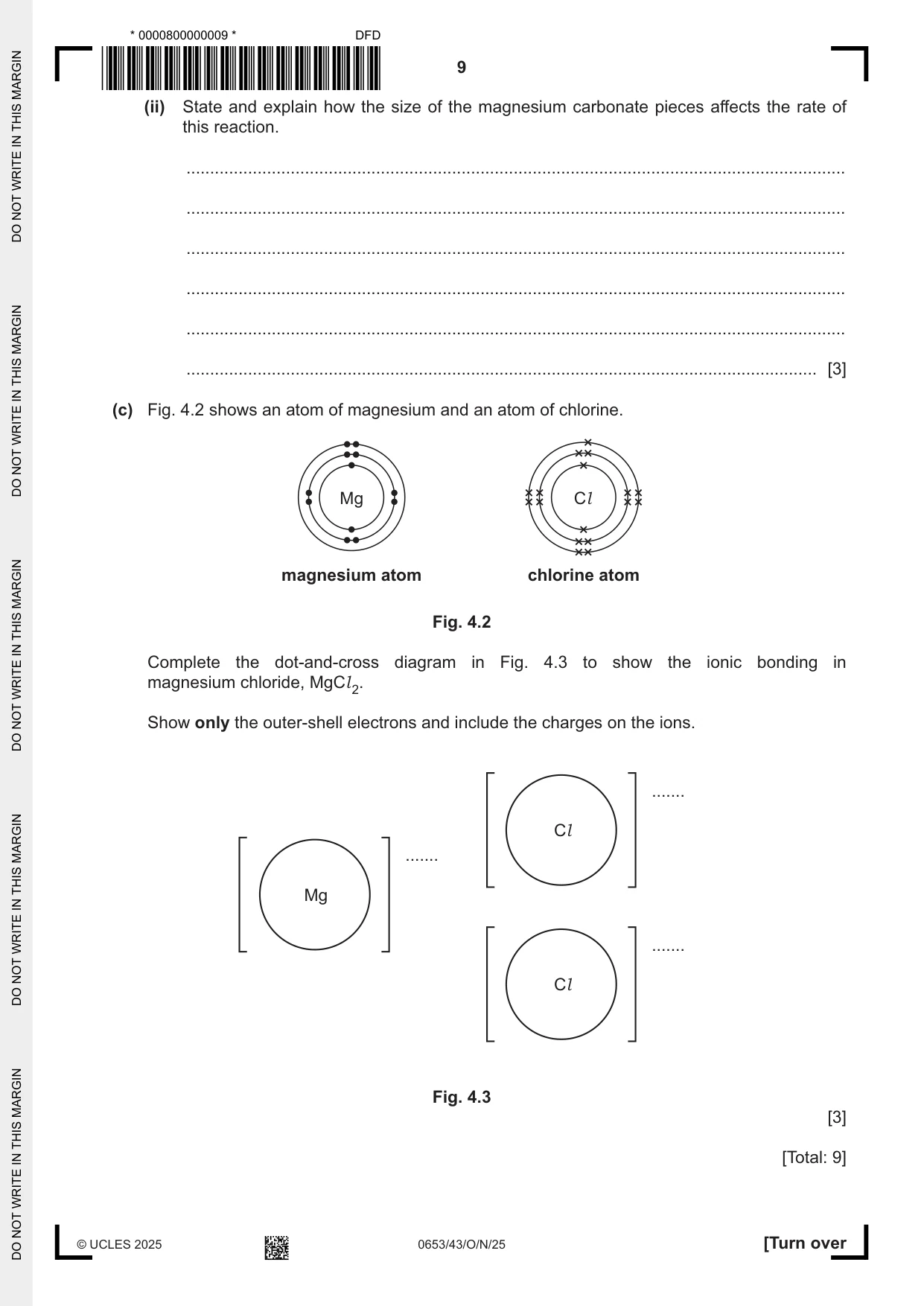
4 A student investigates the rate of reaction between large pieces of magnesium carbonate, MgCO3, and dilute hydrochloric acid, HCl , using the apparatus shown in Fig. 4.1. The student records the time taken to produce 10 cm3 of gas. gas dilute hydrochloric acid dilute large pieces of water hydrochloric magnesium carbonate acid Fig. 4.1 (a) Three products are formed in the reaction: magnesium chloride MgCl 2, a gas and one other product. Give the balanced symbol equation for this reaction. ............................................................................................................................................. [2] (b) The student repeats the experiment using: • small pieces of magnesium carbonate • magnesium carbonate powder. All other conditions are kept constant. Table 4.1 shows the time taken to produce 10 cm3 of gas and the rate of reaction. Table 4.1 time taken to produce magnesium rate of reaction 10 cm3 of gas carbonate in cm3 per s in s large pieces 15.2 0.66 small pieces 8.3 1.2 powder 5.1 (i) Calculate the rate of reaction in cm3 per s for magnesium carbonate powder. Write your answer in Table 4.1. [1] (ii) State and explain how the size of the magnesium carbonate pieces affects the rate of this reaction. ........................................................................................................................................... ........................................................................................................................................... ........................................................................................................................................... ........................................................................................................................................... ........................................................................................................................................... ..................................................................................................................................... [3] (c) Fig. 4.2 shows an atom of magnesium and an atom of chlorine. Mg Cl magnesium atom chlorine atom Fig. 4.2 Complete the dot-and-cross diagram in Fig. 4.3 to show the ionic bonding in magnesium chloride, MgCl 2. Show only the outer-shell electrons and include the charges on the ions. ....... Cl ....... Mg ....... Cl Fig. 4.3 [3] [Total: 9]
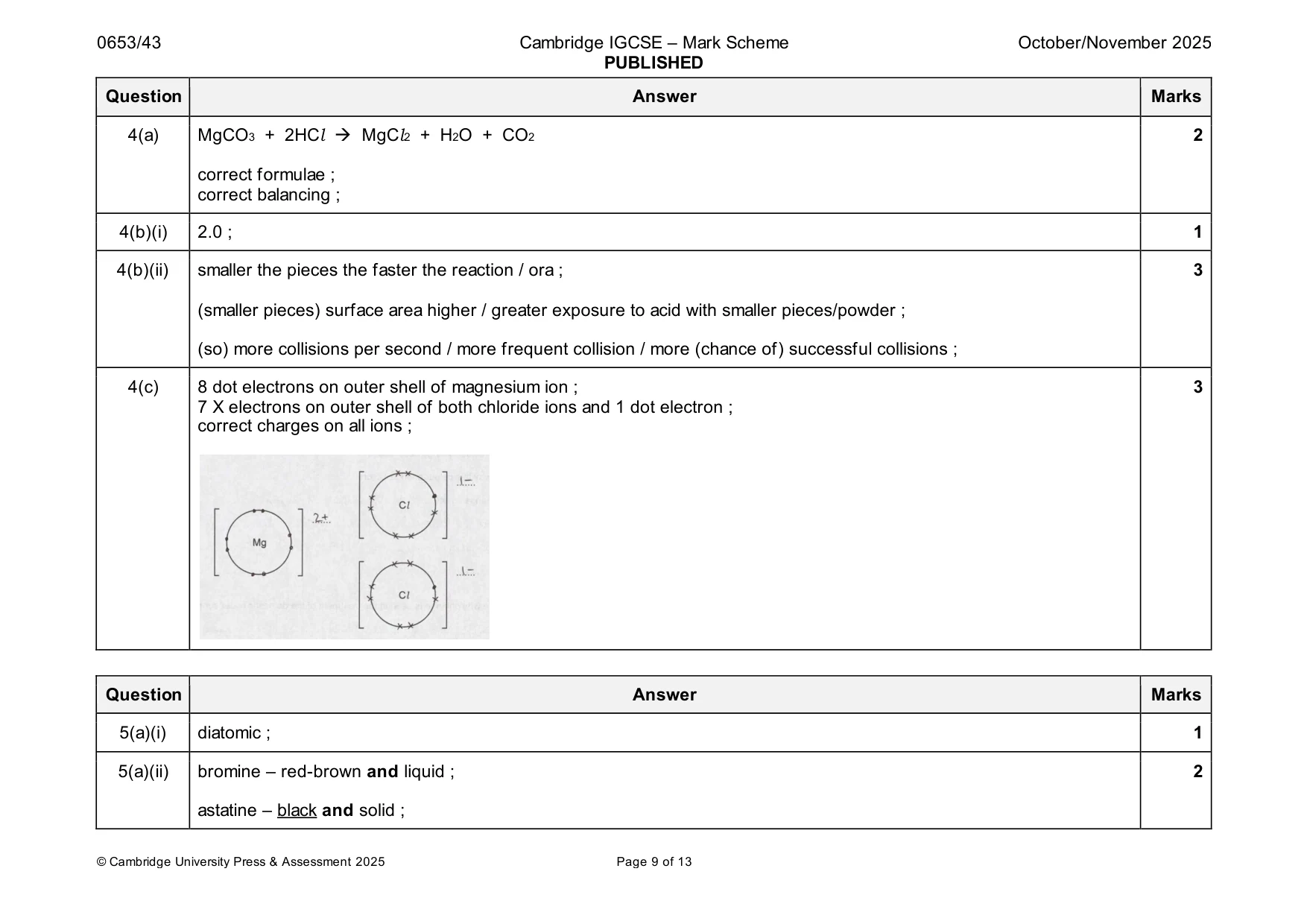
Mark scheme: 4(a) MgCO3 + 2HCl → MgCl2 + H2O + CO2 2 correct formulae ; correct balancing ; 4(b)(i) 2.0 ; 1 4(b)(ii) smaller the pieces the faster the reaction / ora ; 3 (smaller pieces) surface area higher / greater exposure to acid with smaller pieces/powder ; (so) more collisions per second / more frequent collision / more (chance of) successful collisions ; 4(c) 8 dot electrons on outer shell of magnesium ion ; 3 7 X electrons on outer shell of both chloride ions and 1 dot electron ; correct charges on all ions ;
Q5 · Group VII elements are known as the halogens
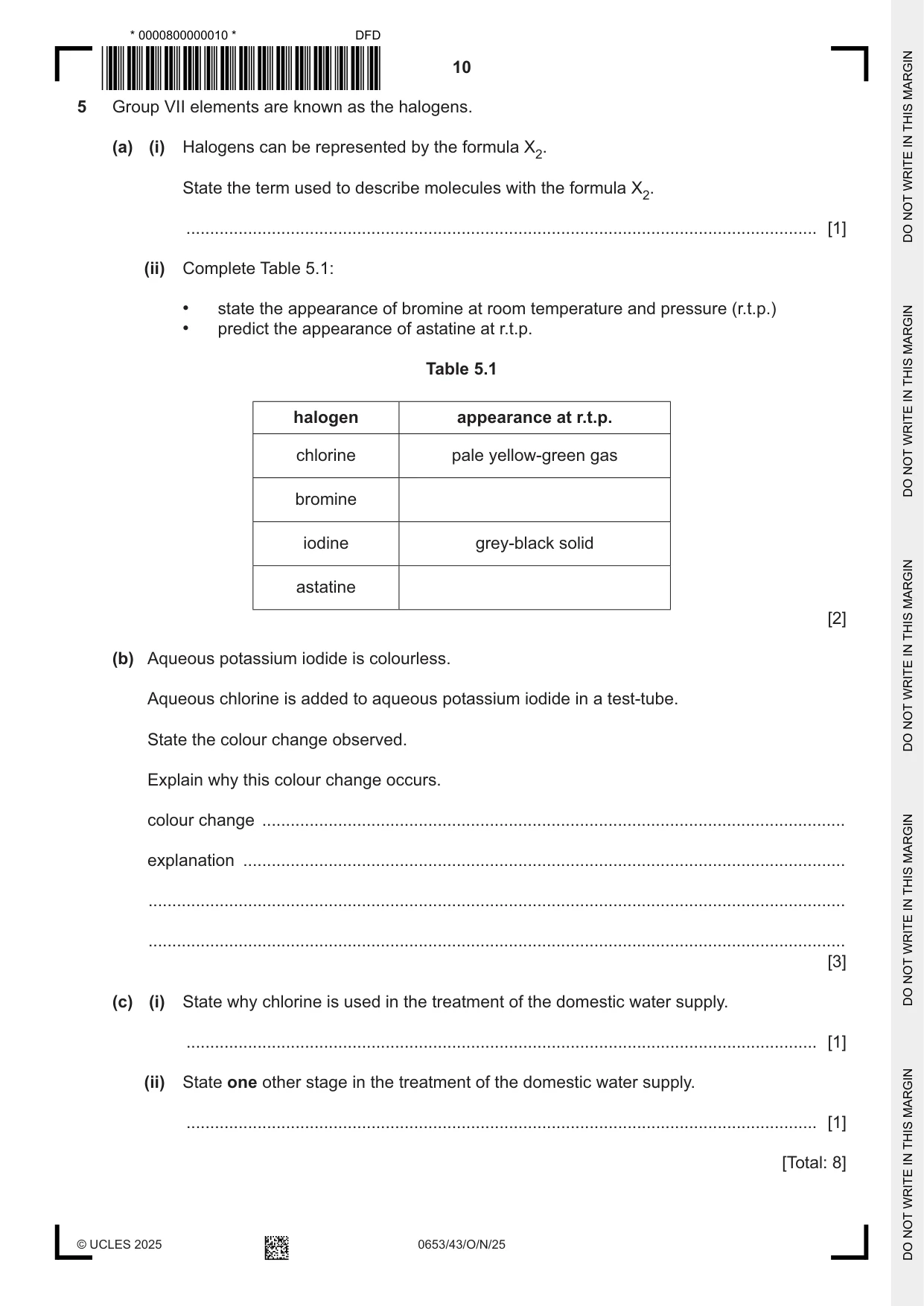
5 Group VII elements are known as the halogens. (a) (i) Halogens can be represented by the formula X2. State the term used to describe molecules with the formula X2. ..................................................................................................................................... [1] (ii) Complete Table 5.1: • state the appearance of bromine at room temperature and pressure (r.t.p.) • predict the appearance of astatine at r.t.p. Table 5.1 halogen appearance at r.t.p. chlorine pale yellow-green gas bromine iodine grey-black solid astatine [2] (b) Aqueous potassium iodide is colourless. Aqueous chlorine is added to aqueous potassium iodide in a test-tube. State the colour change observed. Explain why this colour change occurs. colour change ........................................................................................................................... explanation ............................................................................................................................... ................................................................................................................................................... ................................................................................................................................................... [3] (c) (i) State why chlorine is used in the treatment of the domestic water supply. ..................................................................................................................................... [1] (ii) State one other stage in the treatment of the domestic water supply. ..................................................................................................................................... [1] [Total: 8]
Mark scheme: 5(a)(i) diatomic ; 1 5(a)(ii) bromine – red-brown and liquid ; 2 astatine – black and solid ; 5(b) colour change: (from colourless) to brown ; 3 explanation: any two from: chlorine is more reactive than iodine ; chlorine displaces iodine ; iodine forms ; 5(c)(i) to kill microbes/pathogens/bacteria ; 1 5(c)(ii) sedimentation / filtration / addition/use of carbon ; 1
Q6 · Pentene is an alkene that contains one double carbon–carbon bond
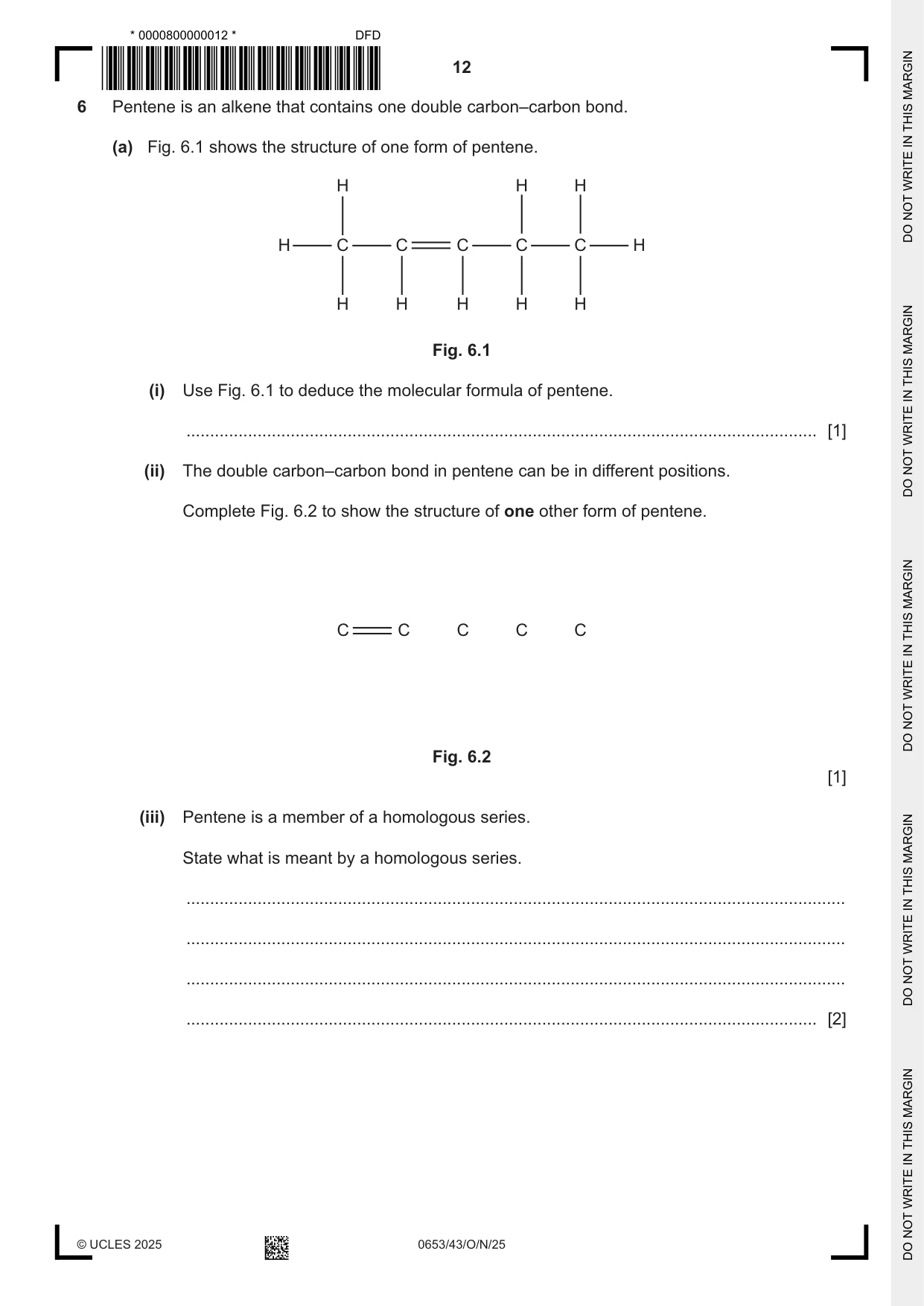
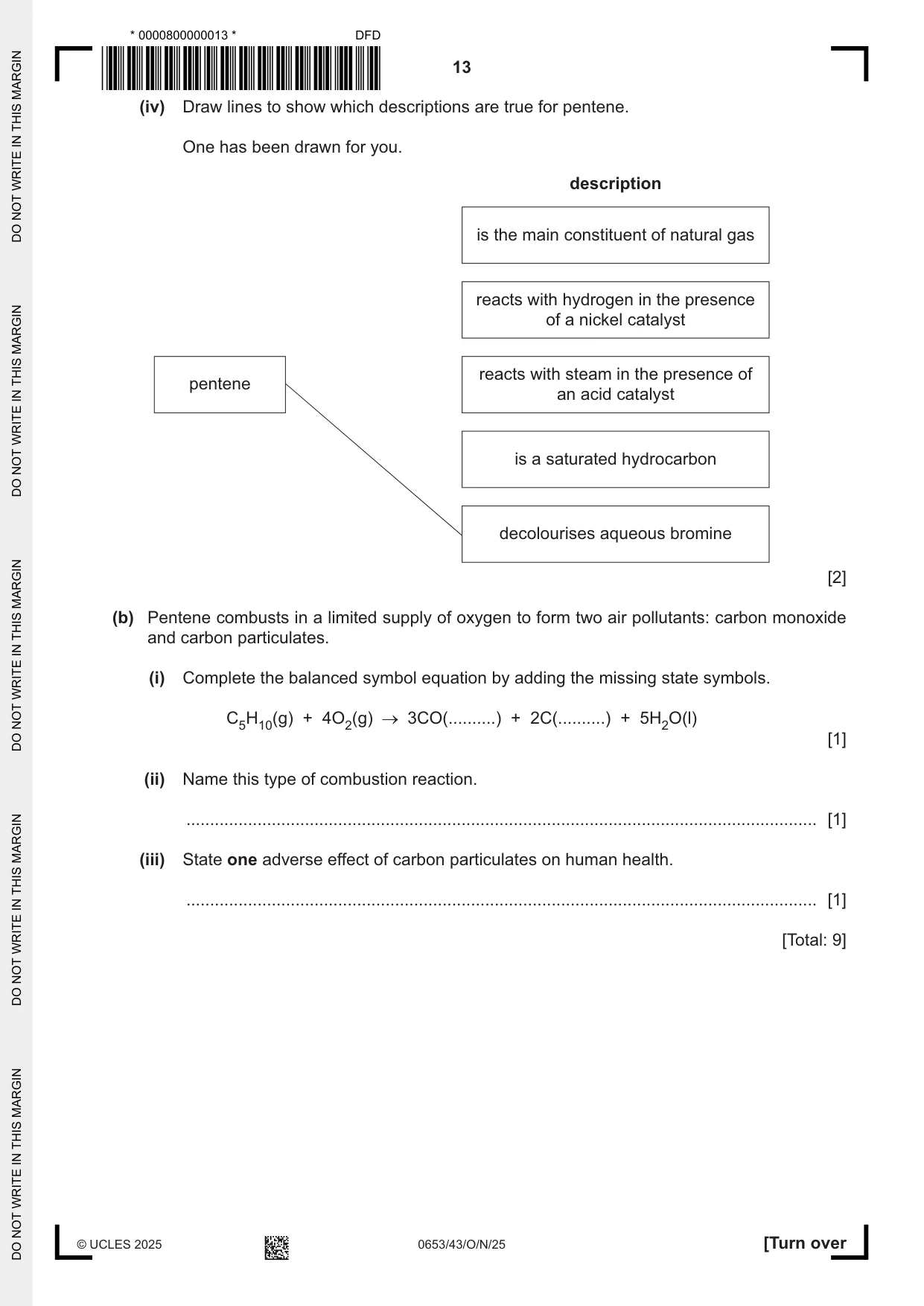
6 Pentene is an alkene that contains one double carbon–carbon bond. (a) Fig. 6.1 shows the structure of one form of pentene. H H H H C C C C C H H H H H H Fig. 6.1 (i) Use Fig. 6.1 to deduce the molecular formula of pentene. ..................................................................................................................................... [1] (ii) The double carbon–carbon bond in pentene can be in different positions. Complete Fig. 6.2 to show the structure of one other form of pentene. C C C C C Fig. 6.2 [1] (iii) Pentene is a member of a homologous series. State what is meant by a homologous series. ........................................................................................................................................... ........................................................................................................................................... ........................................................................................................................................... ..................................................................................................................................... [2] (iv) Draw lines to show which descriptions are true for pentene. One has been drawn for you. description is the main constituent of natural gas reacts with hydrogen in the presence of a nickel catalyst reacts with steam in the presence of pentene an acid catalyst is a saturated hydrocarbon decolourises aqueous bromine [2] (b) Pentene combusts in a limited supply of oxygen to form two air pollutants: carbon monoxide and carbon particulates. (i) Complete the balanced symbol equation by adding the missing state symbols. C5H10(g) + 4O2(g) 3CO(..........) + 2C(..........) + 5H2O(l) [1] (ii) Name this type of combustion reaction. ..................................................................................................................................... [1] (iii) State one adverse effect of carbon particulates on human health. ..................................................................................................................................... [1] [Total: 9]
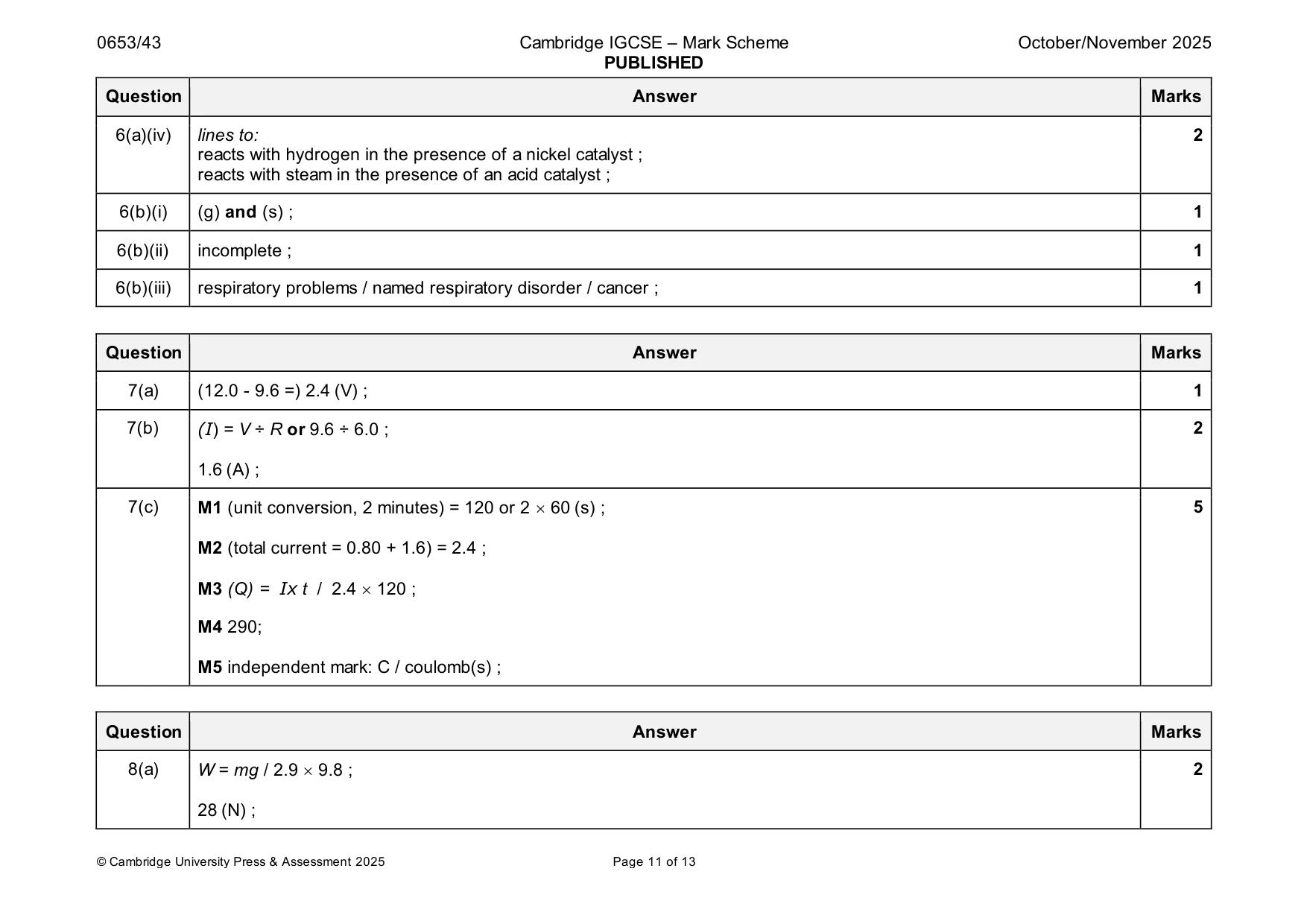
Mark scheme: 6(a)(i) C5H10 ; 1 6(a)(ii) 1 ; 6(a)(iii) any two from 2 (family of similar compounds with) similar chemical properties ; trend in physical properties ; same general formula ; 6(a)(iv) lines to: 2 reacts with hydrogen in the presence of a nickel catalyst ; reacts with steam in the presence of an acid catalyst ; 6(b)(i) (g) and (s) ; 1 6(b)(ii) incomplete ; 1 6(b)(iii) respiratory problems / named respiratory disorder / cancer ; 1
Q7 · A student assembles the circuit in Fig
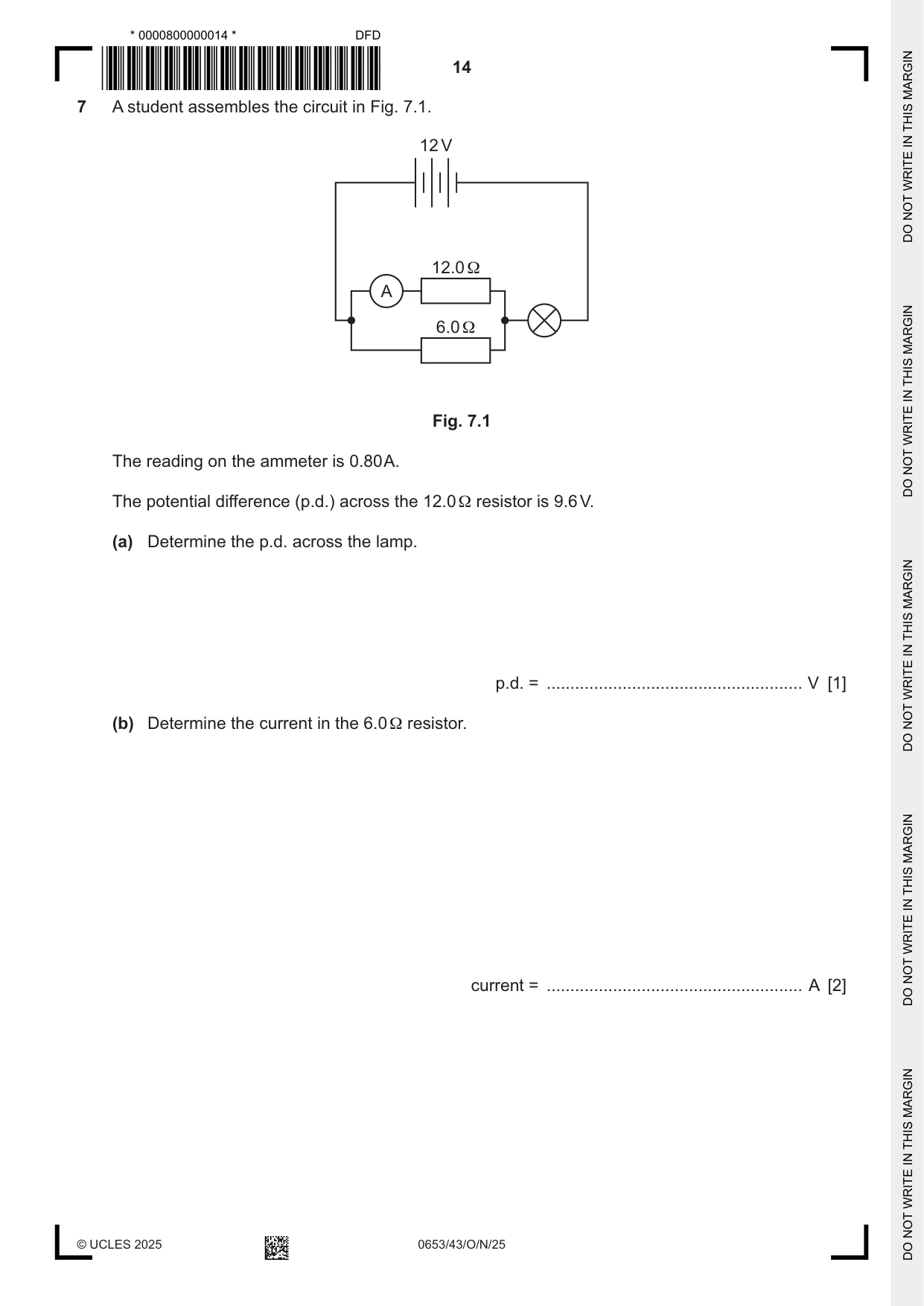
7 A student assembles the circuit in Fig. 7.1. 12 V 12.0 Ω A 6.0 Ω Fig. 7.1 The reading on the ammeter is 0.80 A. The potential difference (p.d.) across the 12.0 Ω resistor is 9.6 V. (a) Determine the p.d. across the lamp. p.d. = ...................................................... V [1] (b) Determine the current in the 6.0 Ω resistor. current = ...................................................... A [2] (c) Calculate the charge flowing through the lamp in 2.0 minutes. State the unit of charge. charge = .................................. unit ............... [5] [Total: 8]
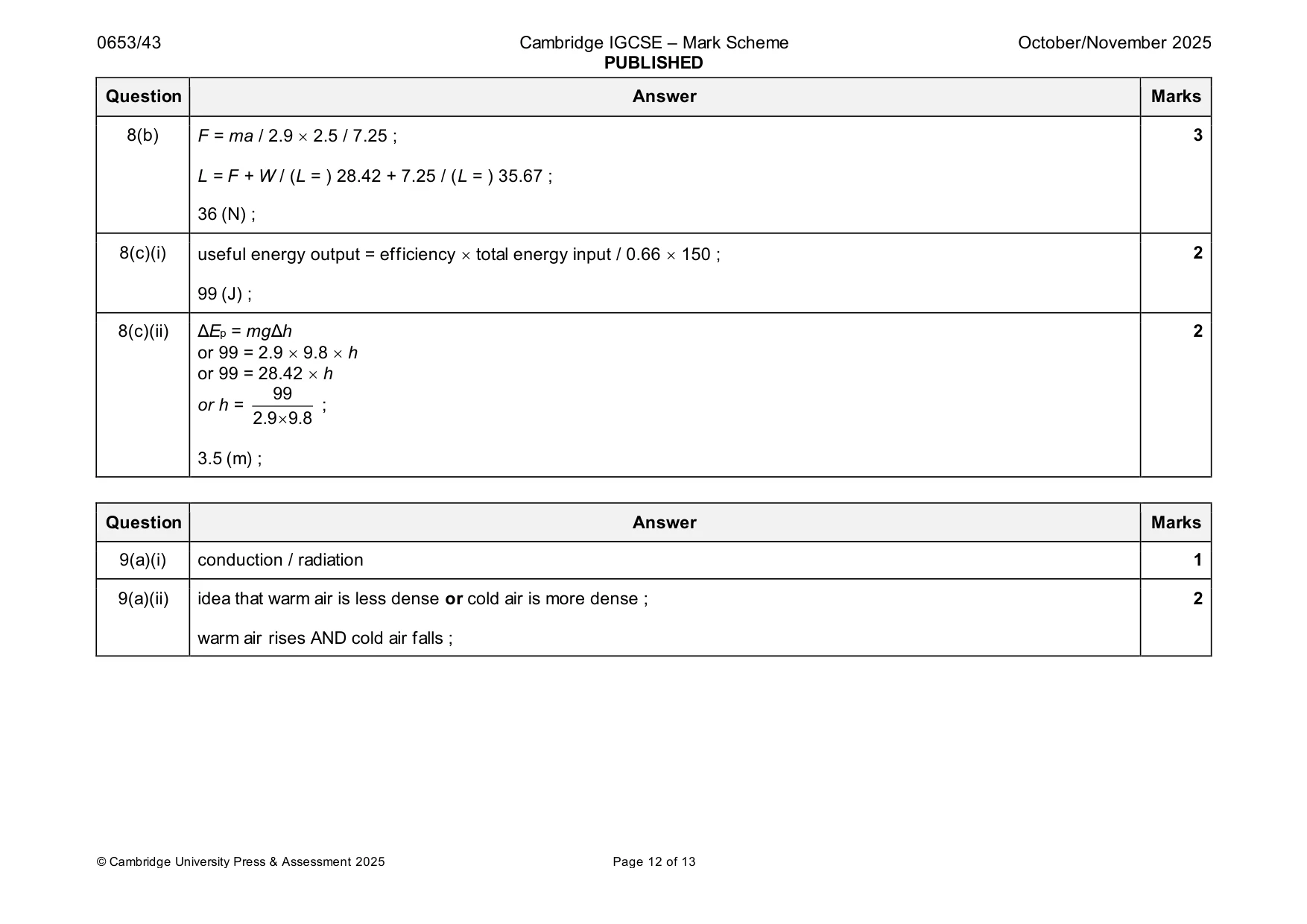
Mark scheme: 7(a) (12.0 - 9.6 =) 2.4 (V) ; 1 7(b) (I) = V ÷ R or 9.6 ÷ 6.0 ; 2 1.6 (A) ; 7(c) M1 (unit conversion, 2 minutes) = 120 or 2 60 (s) ; 5 M2 (total current = 0.80 + 1.6) = 2.4 ; M3 (Q) = Ix t / 2.4 120 ; M4 290; M5 independent mark: C / coulomb(s) ;
Q8 · A motor and an object at rest on the ground
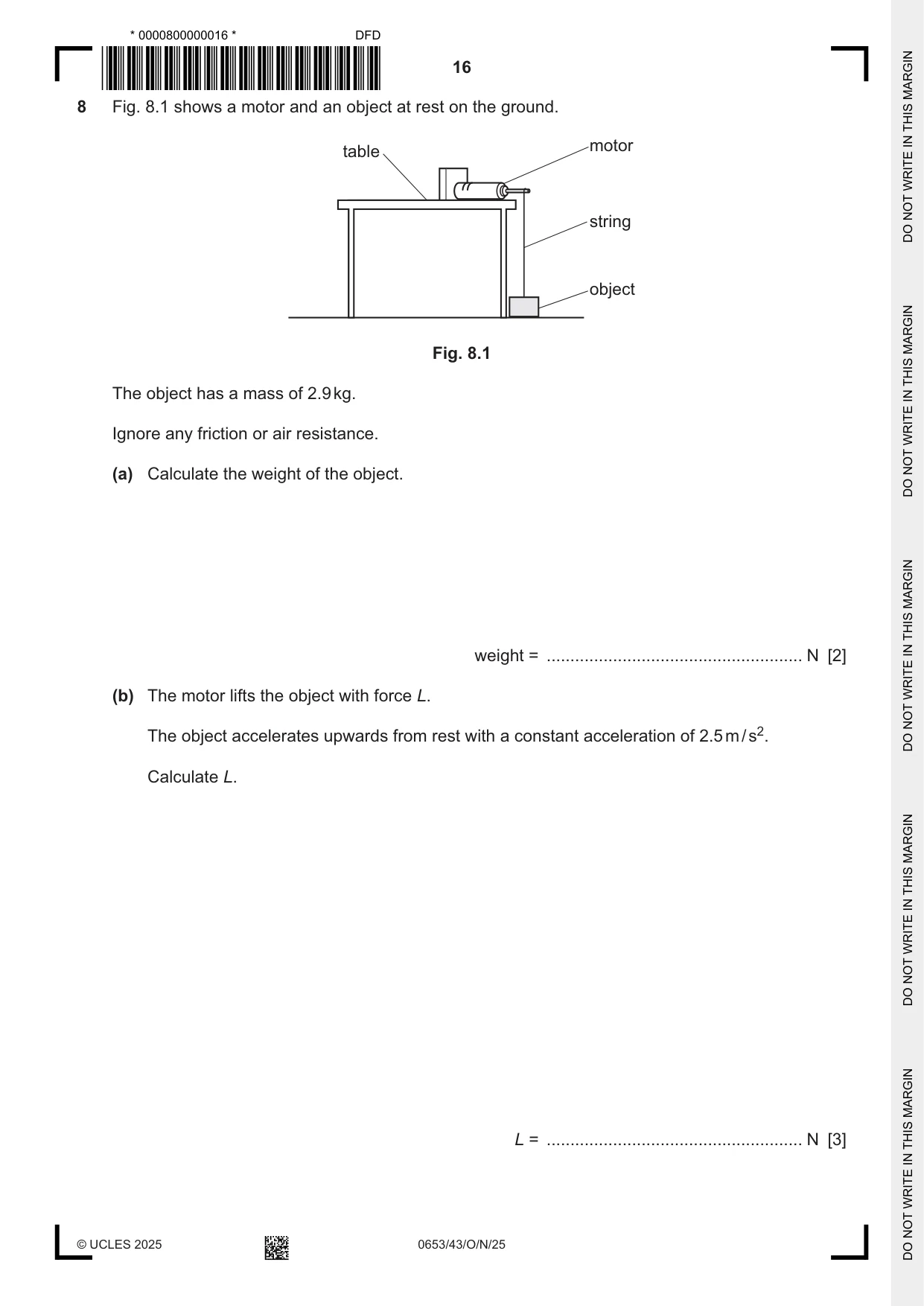
8 Fig. 8.1 shows a motor and an object at rest on the ground. motor table string object Fig. 8.1 The object has a mass of 2.9 kg. Ignore any friction or air resistance. (a) Calculate the weight of the object. weight = ...................................................... N [2] (b) The motor lifts the object with force L. The object accelerates upwards from rest with a constant acceleration of 2.5 m / s2. Calculate L. L = ...................................................... N [3] (c) The motor now lifts the object upwards at constant speed through vertical distance h. (i) The total energy input to the motor is 150 J. The motor has an efficiency of 66%. Calculate the useful energy output of the motor. useful energy output = ....................................................... J [2] (ii) Use your answer in (c)(i) to calculate h. h = ...................................................... m [2] [Total: 9]
Mark scheme: 8(a) W = mg / 2.9 9.8 ; 2 28 (N) ; 8(b) F = ma / 2.9 2.5 / 7.25 ; 3 L = F + W / (L = ) 28.42 + 7.25 / (L = ) 35.67 ; 36 (N) ; 8(c)(i) useful energy output = efficiency total energy input / 0.66 150 ; 2 99 (J) ; 8(c)(ii) ΔEp = mgΔh 2 or 99 = 2.9 9.8 h or 99 = 28.42 h 99 or h = ; 2.9 9.8 3.5 (m) ;
Q9 · A convection heater in a closed room
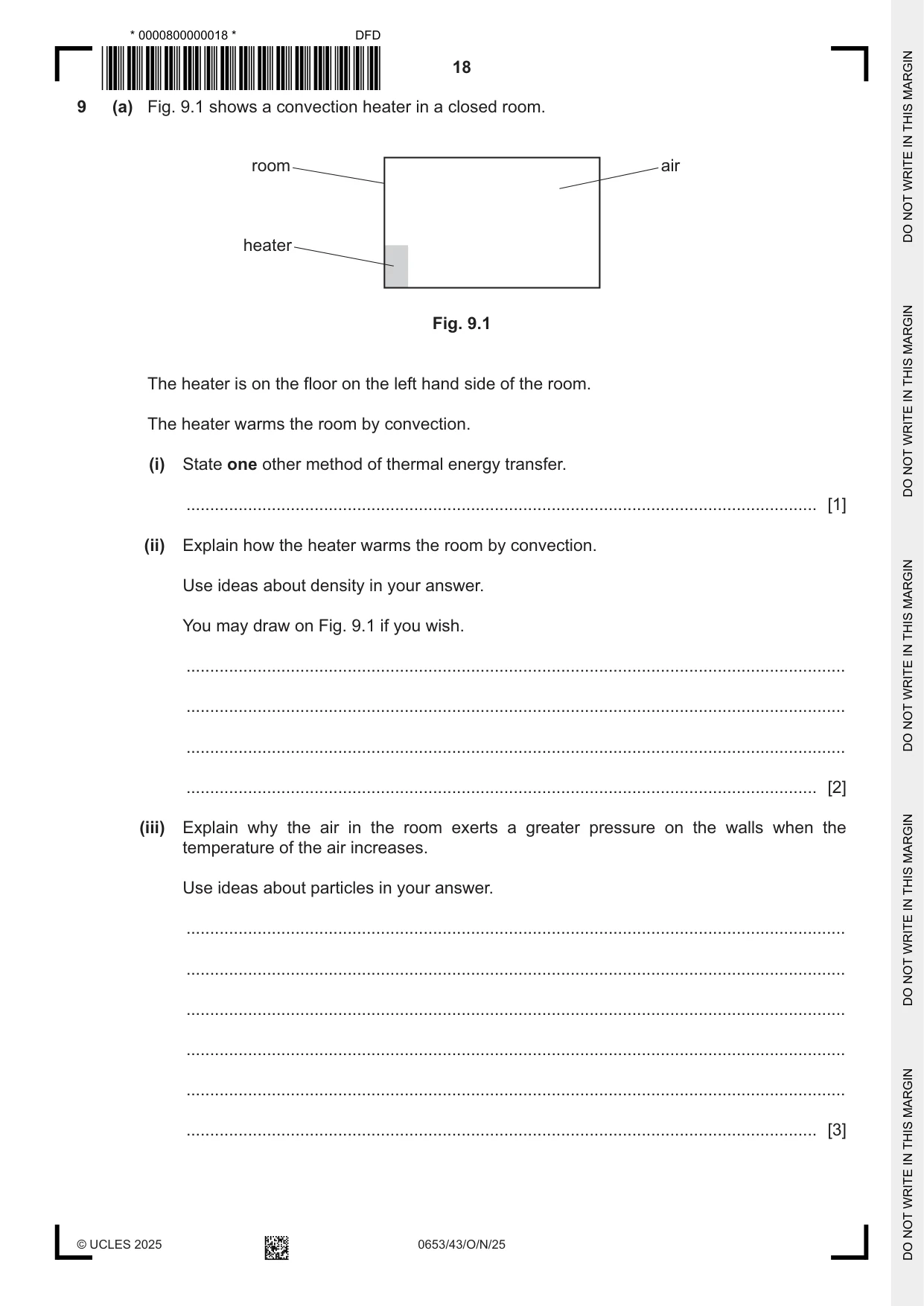
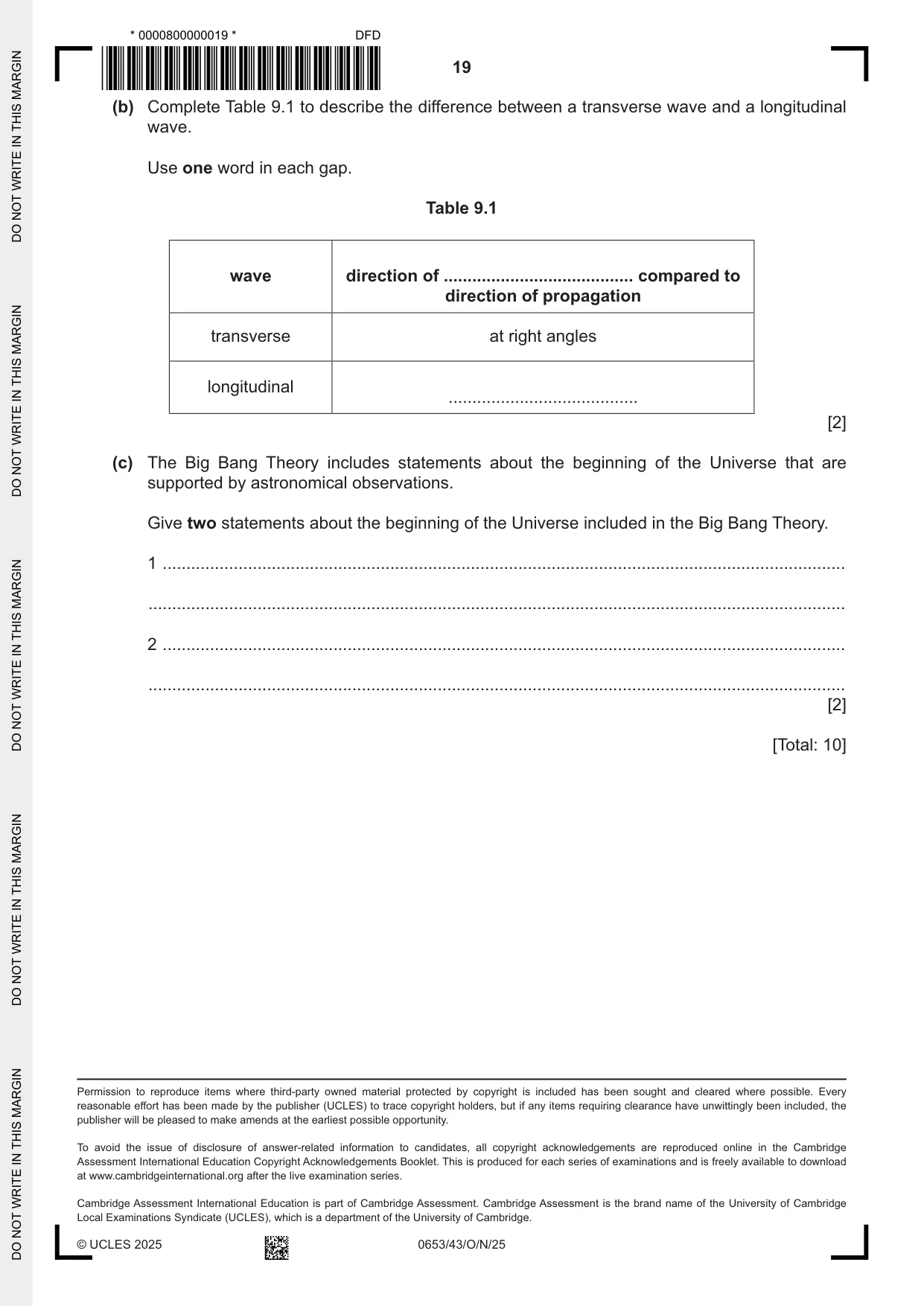
9 (a) Fig. 9.1 shows a convection heater in a closed room. room air heater Fig. 9.1 The heater is on the floor on the left hand side of the room. The heater warms the room by convection. (i) State one other method of thermal energy transfer. ..................................................................................................................................... [1] (ii) Explain how the heater warms the room by convection. Use ideas about density in your answer. You may draw on Fig. 9.1 if you wish. ........................................................................................................................................... ........................................................................................................................................... ........................................................................................................................................... ..................................................................................................................................... [2] (iii) Explain why the air in the room exerts a greater pressure on the walls when the temperature of the air increases. Use ideas about particles in your answer. ........................................................................................................................................... ........................................................................................................................................... ........................................................................................................................................... ........................................................................................................................................... ........................................................................................................................................... ..................................................................................................................................... [3] (b) Complete Table 9.1 to describe the difference between a transverse wave and a longitudinal wave. Use one word in each gap. Table 9.1 wave direction of ........................................ compared to direction of propagation transverse at right angles longitudinal ........................................ [2] (c) The Big Bang Theory includes statements about the beginning of the Universe that are supported by astronomical observations. Give two statements about the beginning of the Universe included in the Big Bang Theory. 1 ................................................................................................................................................ ................................................................................................................................................... 2 ................................................................................................................................................ ................................................................................................................................................... [2] [Total: 10]
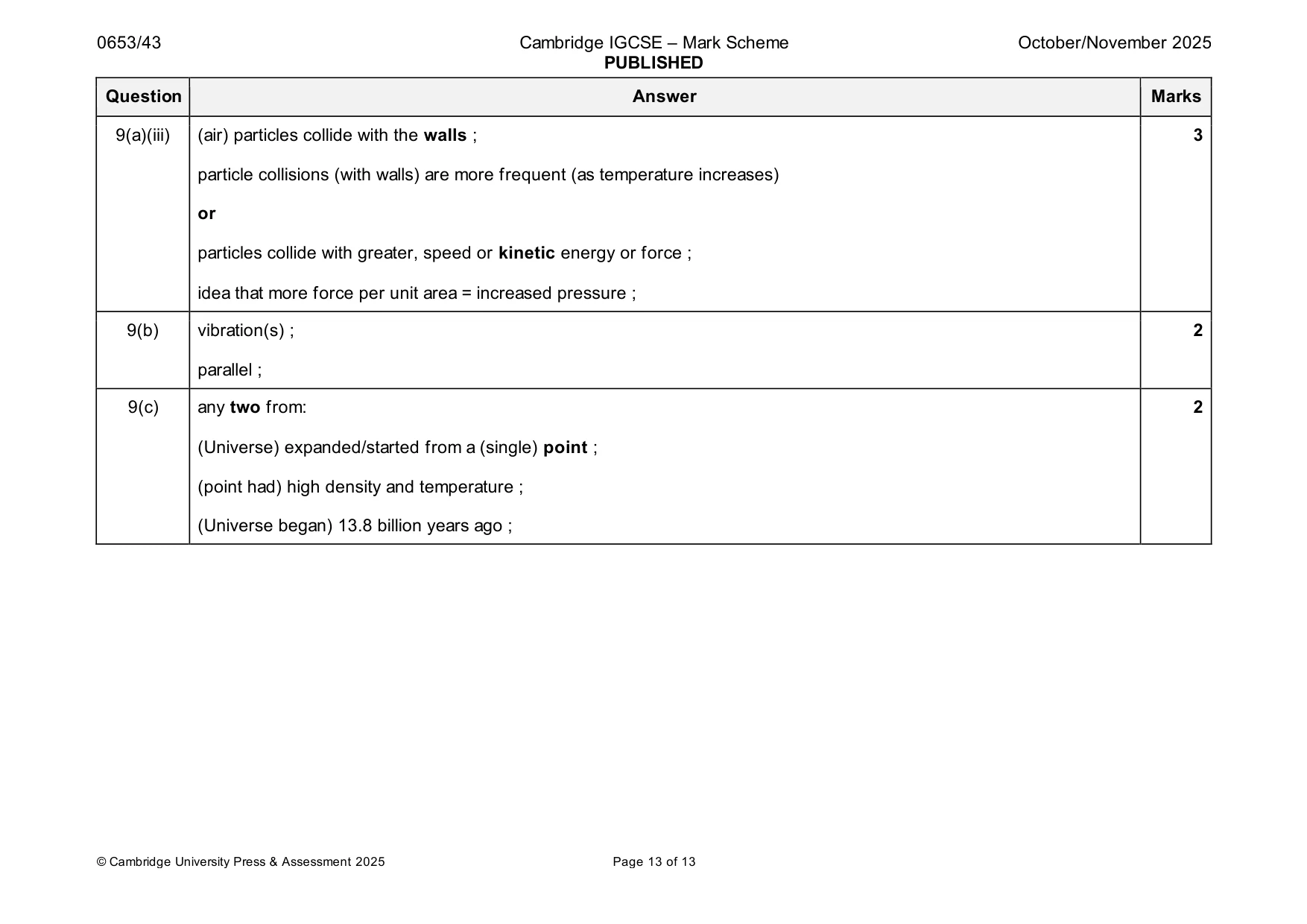
Mark scheme: 9(a)(i) conduction / radiation 1 9(a)(ii) idea that warm air is less dense or cold air is more dense ; 2 warm air rises AND cold air falls ; 9(a)(iii) (air) particles collide with the walls ; 3 particle collisions (with walls) are more frequent (as temperature increases) or particles collide with greater, speed or kinetic energy or force ; idea that more force per unit area = increased pressure ; 9(b) vibration(s) ; 2 parallel ; 9(c) any two from: 2 (Universe) expanded/started from a (single) point ; (point had) high density and temperature ; (Universe began) 13.8 billion years ago ;
What was in this paper
The subtopics covered by these 9 questions, and how many questions each got. Open one in a new tab to see every Cambridge question on it.
What you needed in this session
Cambridge’s own grade thresholds for 2025 Oct/Nov, Paper 4 · Variant 3. A higher threshold means an easier paper — the bar moves with how the cohort did.