Cambridge IGCSE Science - Combined 0653 — 2023 Feb/March Paper 4 · Variant 2
0653/42/F/M/23 · 9 questions · 80 marks · ≈90 min
The question paper and its mark scheme, free to read here and free to download. This is Cambridge’s own paper, exactly as it was sat.
Question paper20 pages
Mark scheme11 pages
Answers below. Sit the paper first if you are practising.
Questions as text
Q1 · An insect-pollinated flower cut open to show the internal structures
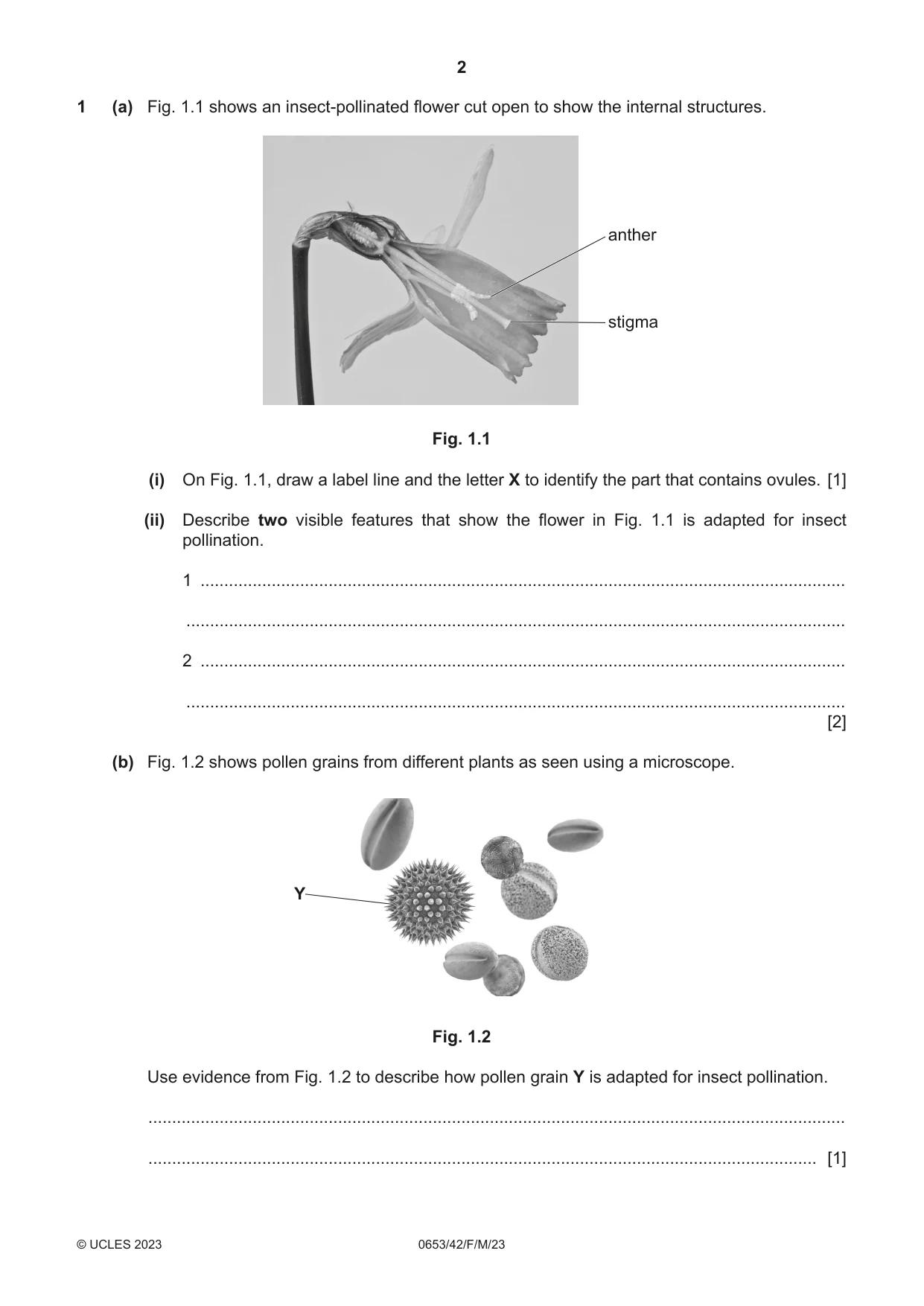
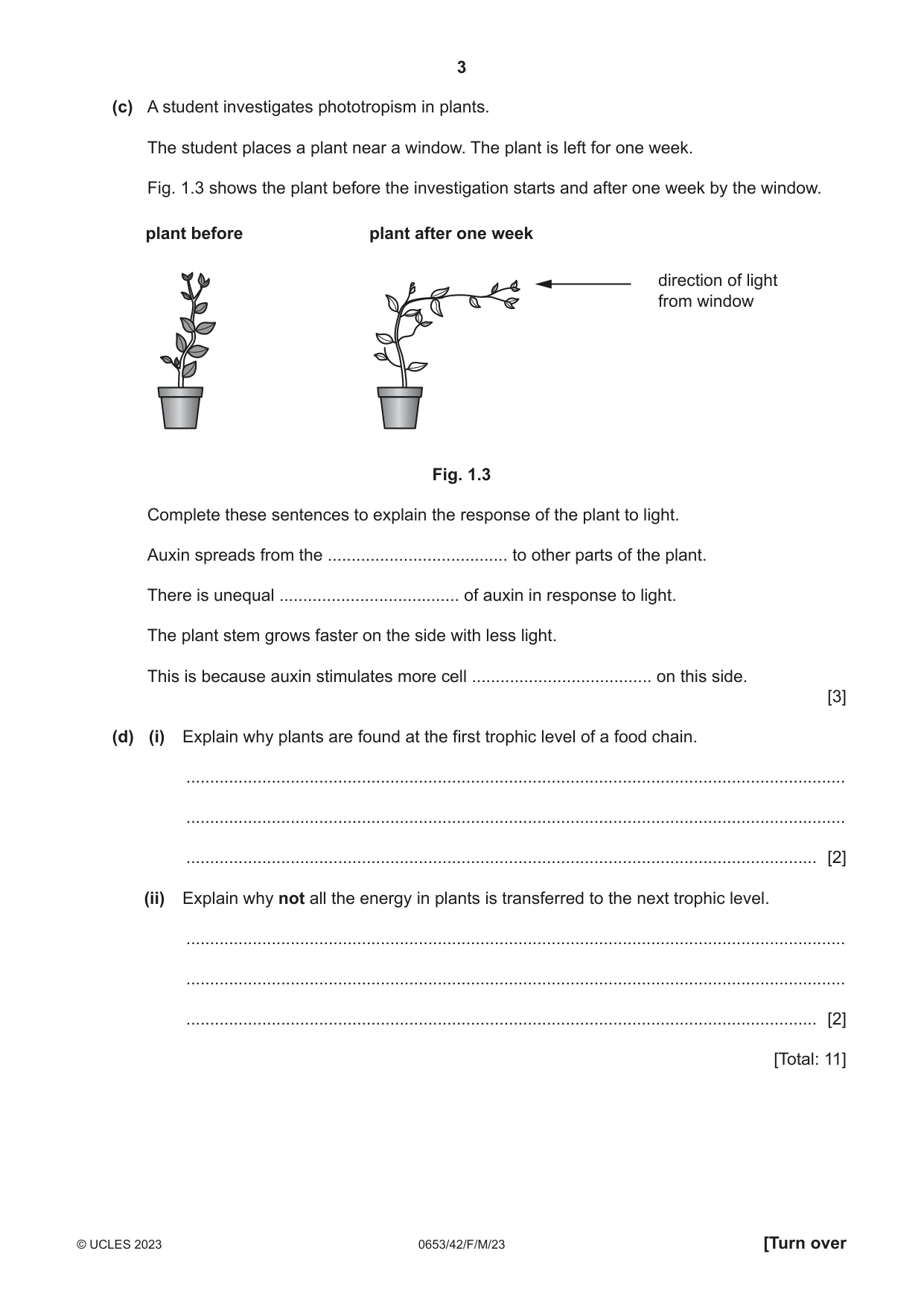
1 (a) Fig. 1.1 shows an insect-pollinated flower cut open to show the internal structures. anther stigma Fig. 1.1 (i) On Fig. 1.1, draw a label line and the letter X to identify the part that contains ovules. [1] (ii) Describe two visible features that show the flower in Fig. 1.1 is adapted for insect pollination. 1 ........................................................................................................................................ ........................................................................................................................................... 2 ........................................................................................................................................ ........................................................................................................................................... [2] (b) Fig. 1.2 shows pollen grains from different plants as seen using a microscope. Y Fig. 1.2 Use evidence from Fig. 1.2 to describe how pollen grain Y is adapted for insect pollination. ................................................................................................................................................... ............................................................................................................................................. [1] (c) A student investigates phototropism in plants. The student places a plant near a window. The plant is left for one week. Fig. 1.3 shows the plant before the investigation starts and after one week by the window. plant before plant after one week direction of light from window Fig. 1.3 Complete these sentences to explain the response of the plant to light. Auxin spreads from the ...................................... to other parts of the plant. There is unequal ...................................... of auxin in response to light. The plant stem grows faster on the side with less light. This is because auxin stimulates more cell ...................................... on this side. [3] (d) (i) Explain why plants are found at the first trophic level of a food chain. ........................................................................................................................................... ........................................................................................................................................... ..................................................................................................................................... [2] (ii) Explain why not all the energy in plants is transferred to the next trophic level. ........................................................................................................................................... ........................................................................................................................................... ..................................................................................................................................... [2] [Total: 11]
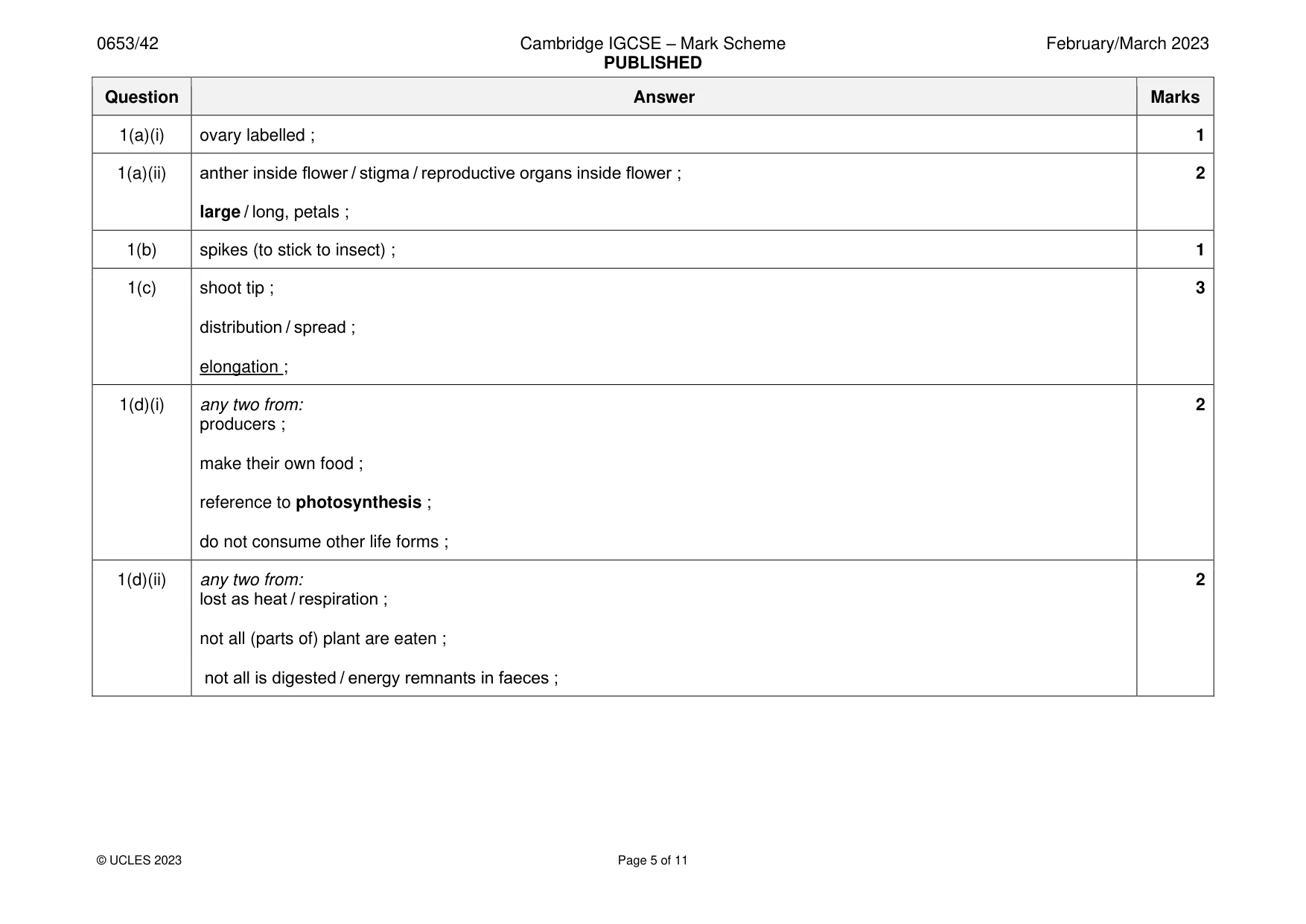
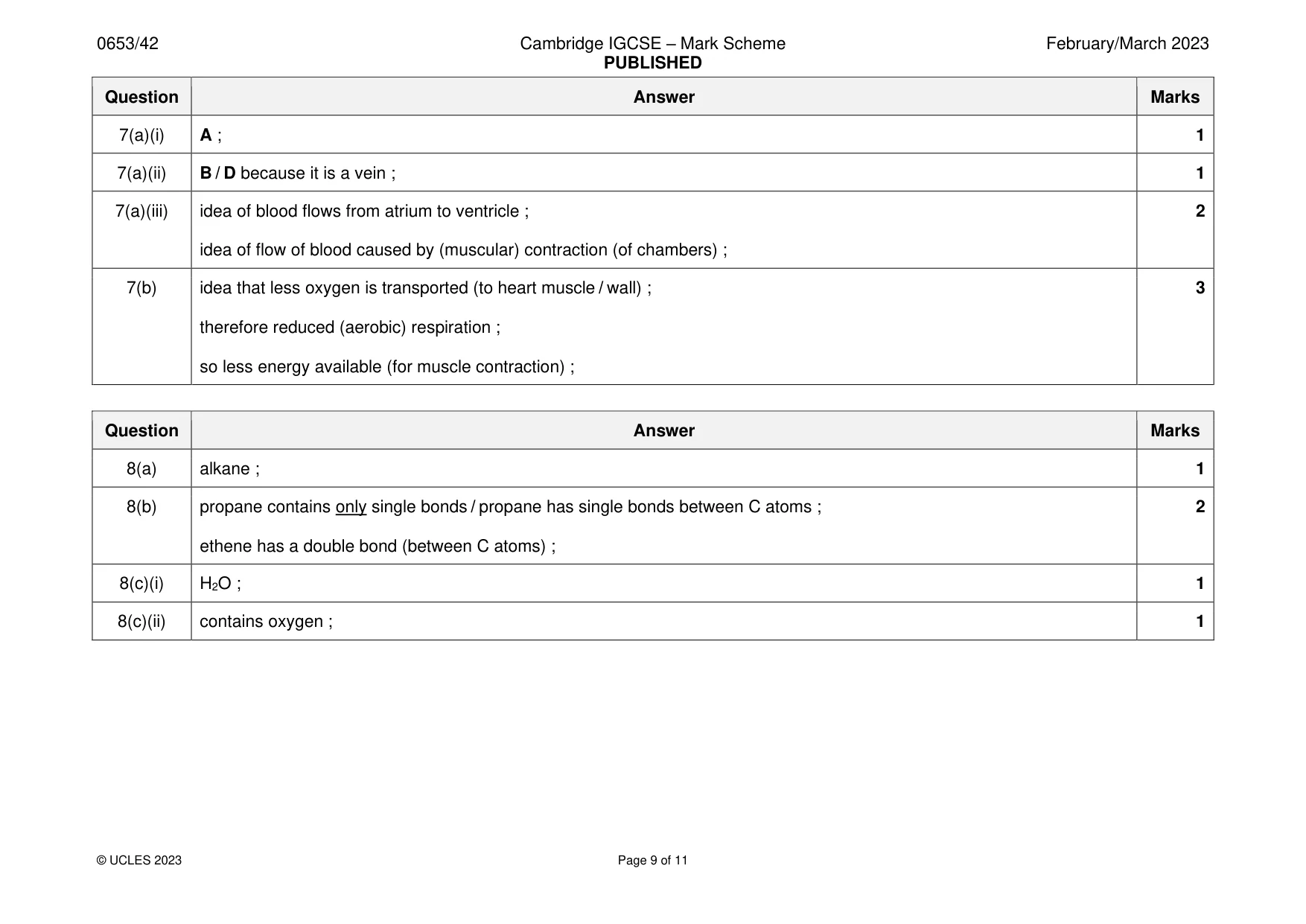
Mark scheme: Question Answer Marks 1(a)(i) ovary labelled ; 1 1(a)(ii) anther inside flower / stigma / reproductive organs inside flower ; 2 large / long, petals ; 1(b) spikes (to stick to insect) ; 1 1(c) shoot tip ; 3 distribution / spread ; elongation ; 1(d)(i) any two from: 2 producers ; make their own food ; reference to photosynthesis ; do not consume other life forms ; 1(d)(ii) any two from: 2 lost as heat / respiration ; not all (parts of) plant are eaten ; not all is digested / energy remnants in faeces ;
Q2 · Lead(II) chloride is electrolysed using the apparatus shown in Fig
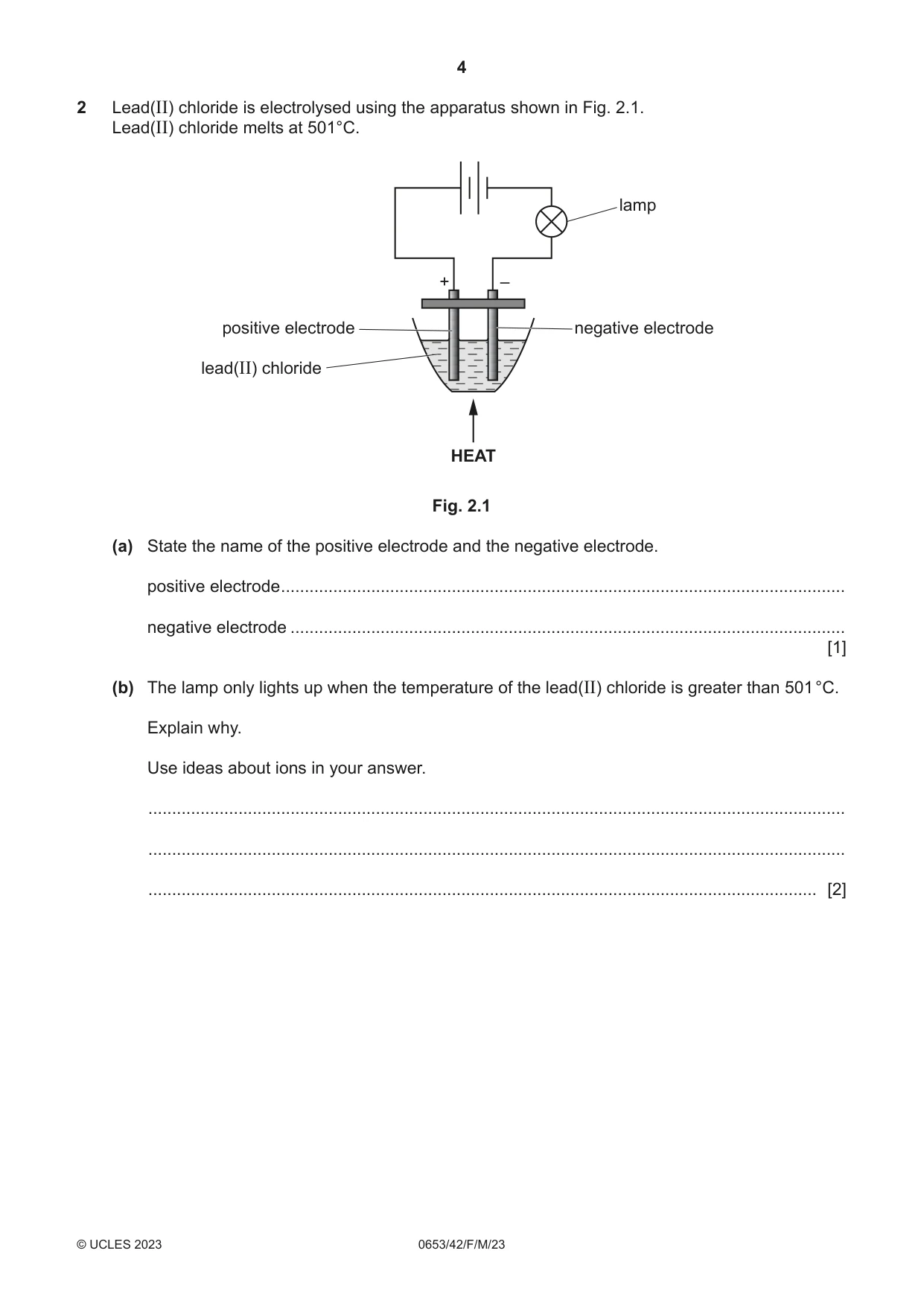
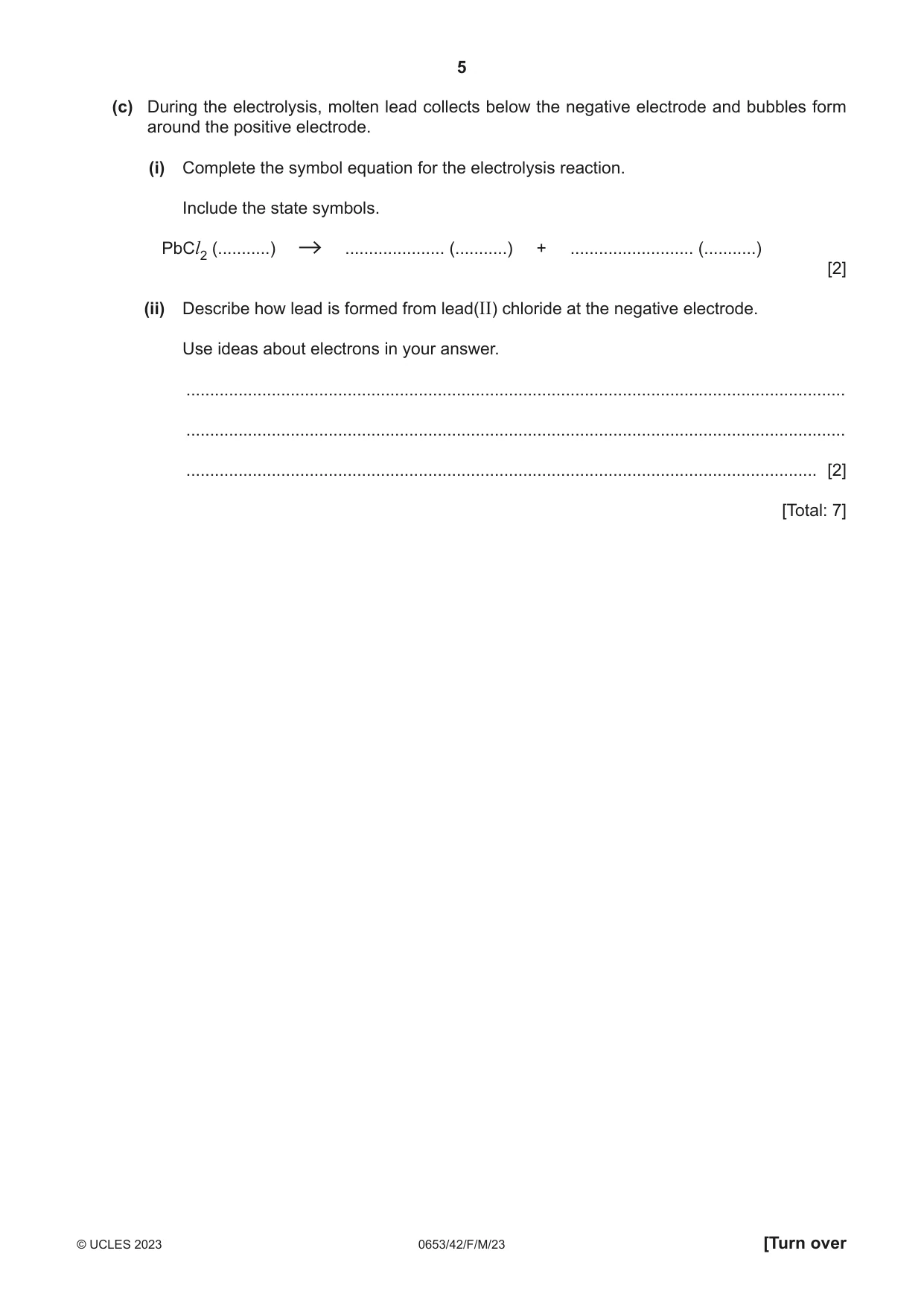
2 Lead(II) chloride is electrolysed using the apparatus shown in Fig. 2.1. Lead(II) chloride melts at 501°C. lamp + – positive electrode negative electrode lead(II) chloride HEAT Fig. 2.1 (a) State the name of the positive electrode and the negative electrode. positive electrode ....................................................................................................................... negative electrode ..................................................................................................................... [1] (b) The lamp only lights up when the temperature of the lead(II) chloride is greater than 501 °C. Explain why. Use ideas about ions in your answer. ................................................................................................................................................... ................................................................................................................................................... ............................................................................................................................................. [2] (c) During the electrolysis, molten lead collects below the negative electrode and bubbles form around the positive electrode. (i) Complete the symbol equation for the electrolysis reaction. Include the state symbols. PbCl2 (...........) ..................... (...........) + .......................... (...........) [2] (ii) Describe how lead is formed from lead(II) chloride at the negative electrode. Use ideas about electrons in your answer. ........................................................................................................................................... ........................................................................................................................................... ..................................................................................................................................... [2] [Total: 7]
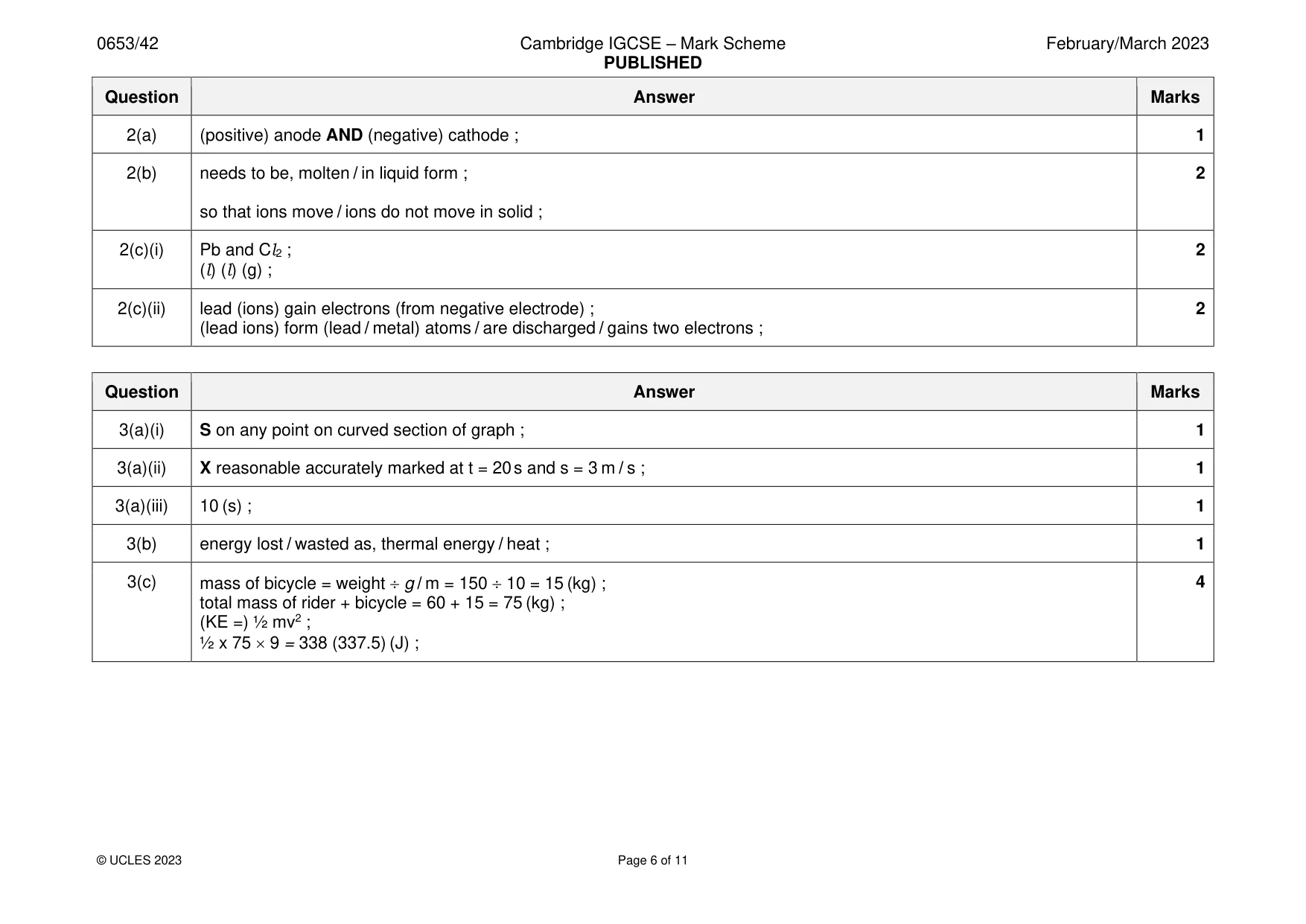
Mark scheme: 2(a) (positive) anode AND (negative) cathode ; 1 2(b) needs to be, molten / in liquid form ; 2 so that ions move / ions do not move in solid ; 2(c)(i) Pb and Cl2 ; 2 (l) (l) (g) ; 2(c)(ii) lead (ions) gain electrons (from negative electrode) ; 2 (lead ions) form (lead / metal) atoms / are discharged / gains two electrons ;
Q3 · A speed–time graph for a student riding a bicycle
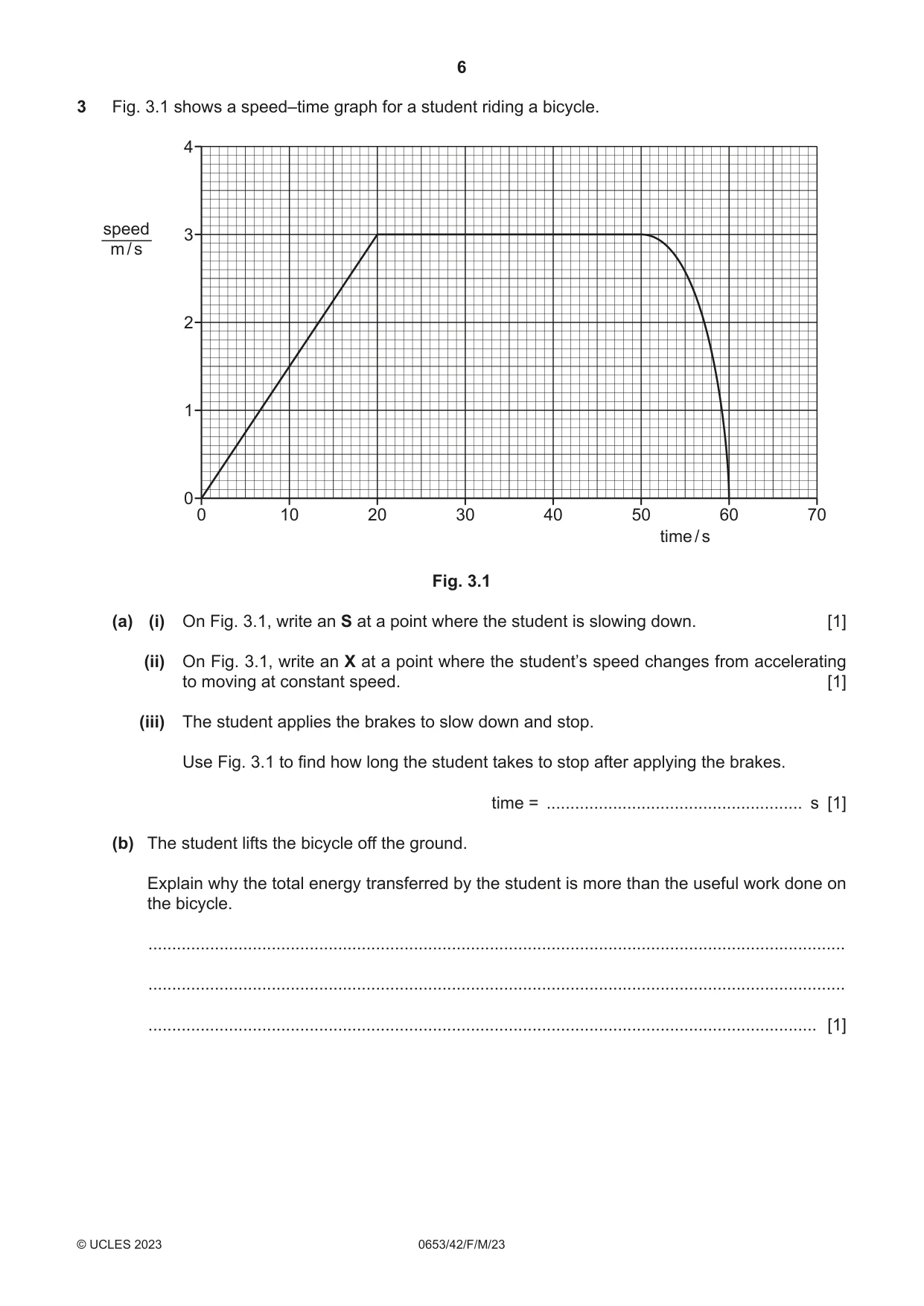
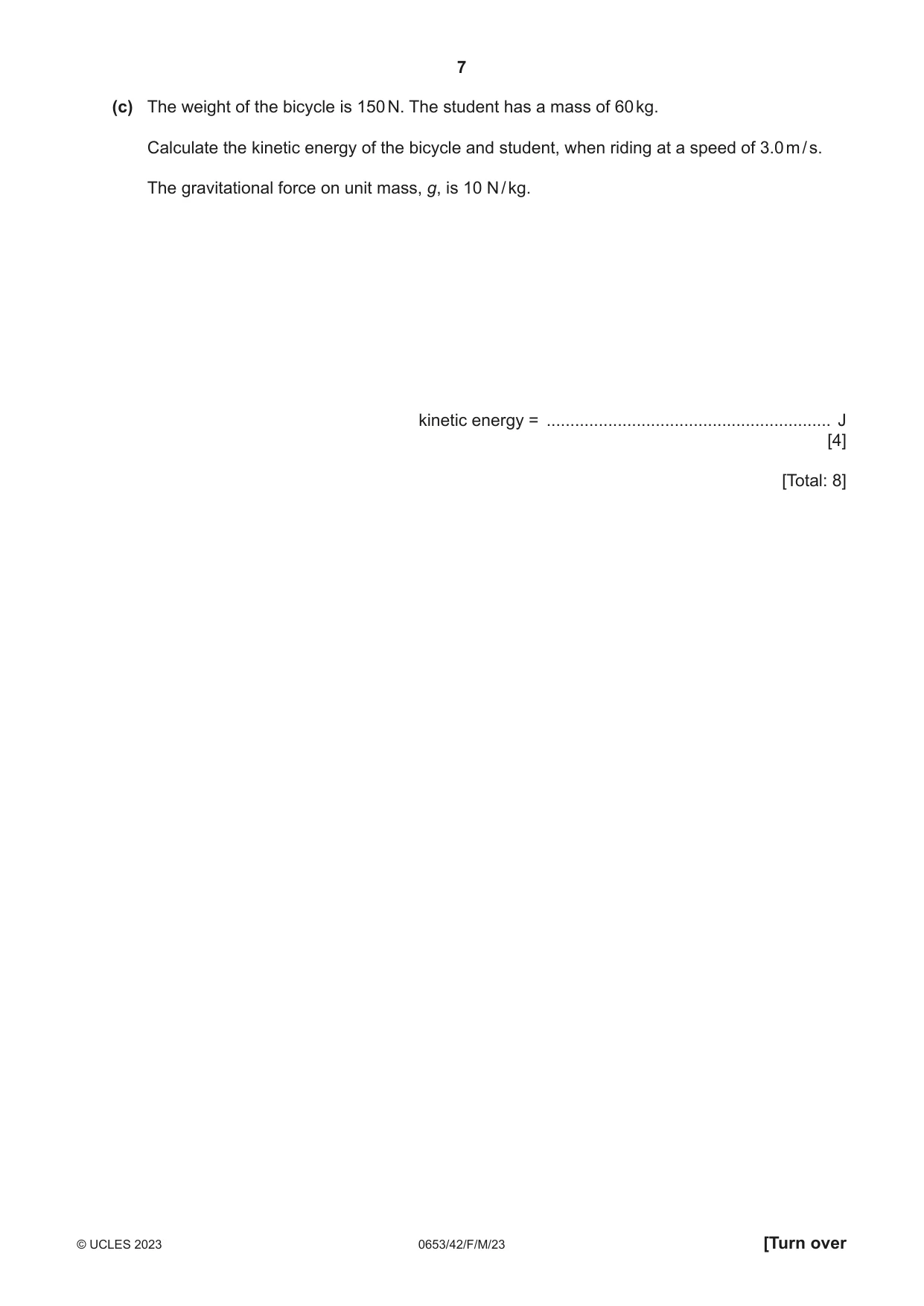
3 Fig. 3.1 shows a speed–time graph for a student riding a bicycle. 4 speed 3 m / s 2 1 0 0 10 20 30 40 50 60 70 time / s Fig. 3.1 (a) (i) On Fig. 3.1, write an S at a point where the student is slowing down. [1] (ii) On Fig. 3.1, write an X at a point where the student’s speed changes from accelerating to moving at constant speed. [1] (iii) The student applies the brakes to slow down and stop. Use Fig. 3.1 to find how long the student takes to stop after applying the brakes. time = ...................................................... s [1] (b) The student lifts the bicycle off the ground. Explain why the total energy transferred by the student is more than the useful work done on the bicycle. ................................................................................................................................................... ................................................................................................................................................... ............................................................................................................................................. [1] (c) The weight of the bicycle is 150 N. The student has a mass of 60 kg. Calculate the kinetic energy of the bicycle and student, when riding at a speed of 3.0 m / s. The gravitational force on unit mass, g, is 10 N / kg. kinetic energy = ............................................................ J [4] [Total: 8]
Mark scheme: 3(a)(i) S on any point on curved section of graph ; 1 3(a)(ii) X reasonable accurately marked at t = 20 s and s = 3 m / s ; 1 3(a)(iii) 10 (s) ; 1 3(b) energy lost / wasted as, thermal energy / heat ; 1 3(c) mass of bicycle = weight g / m = 150 10 = 15 (kg) ; 4 total mass of rider + bicycle = 60 + 15 = 75 (kg) ; (KE =) ½ mv2 ; ½ x 75 9 = 338 (337.5) (J) ;
Q4 · Enzymes are found in living organisms
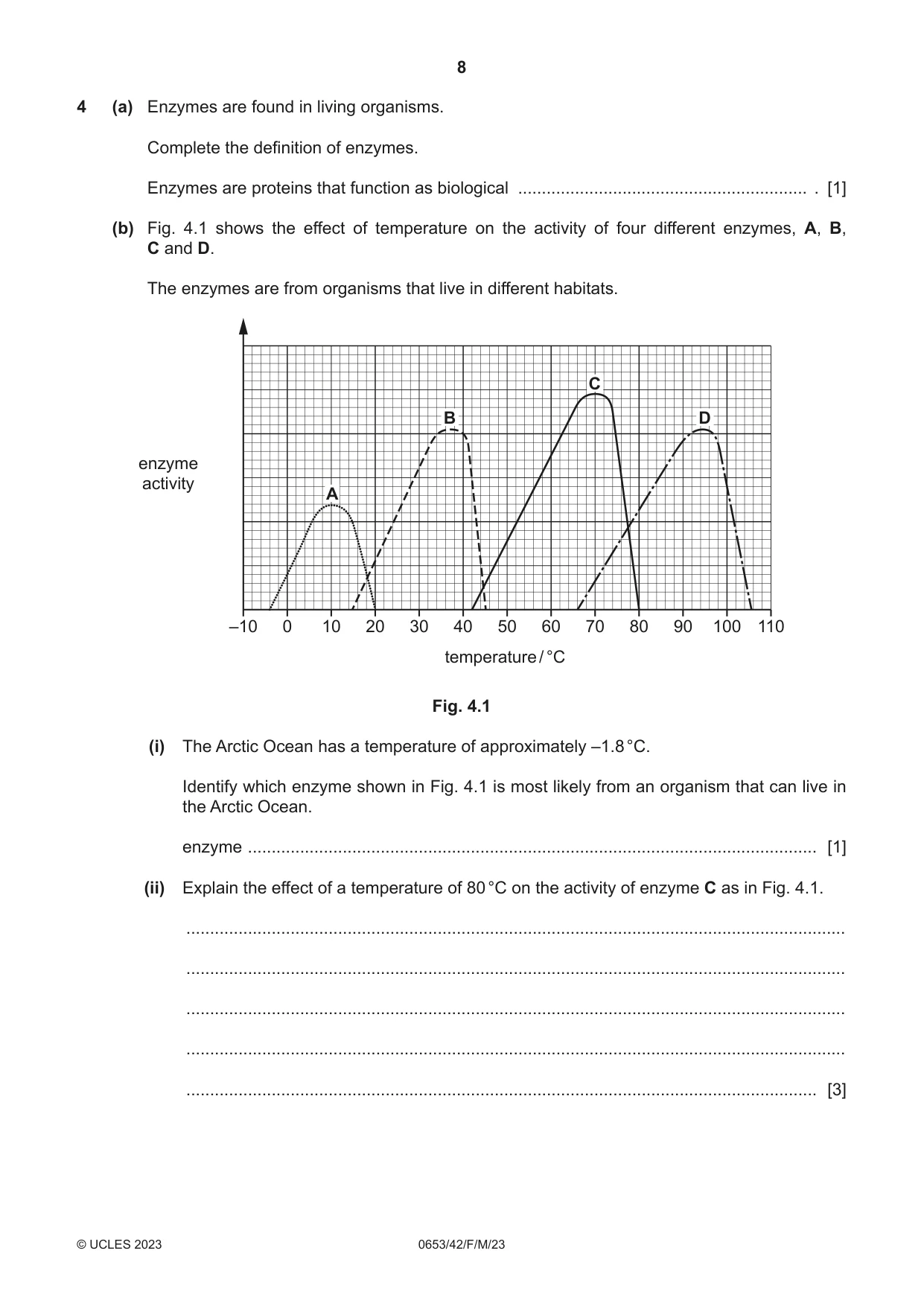
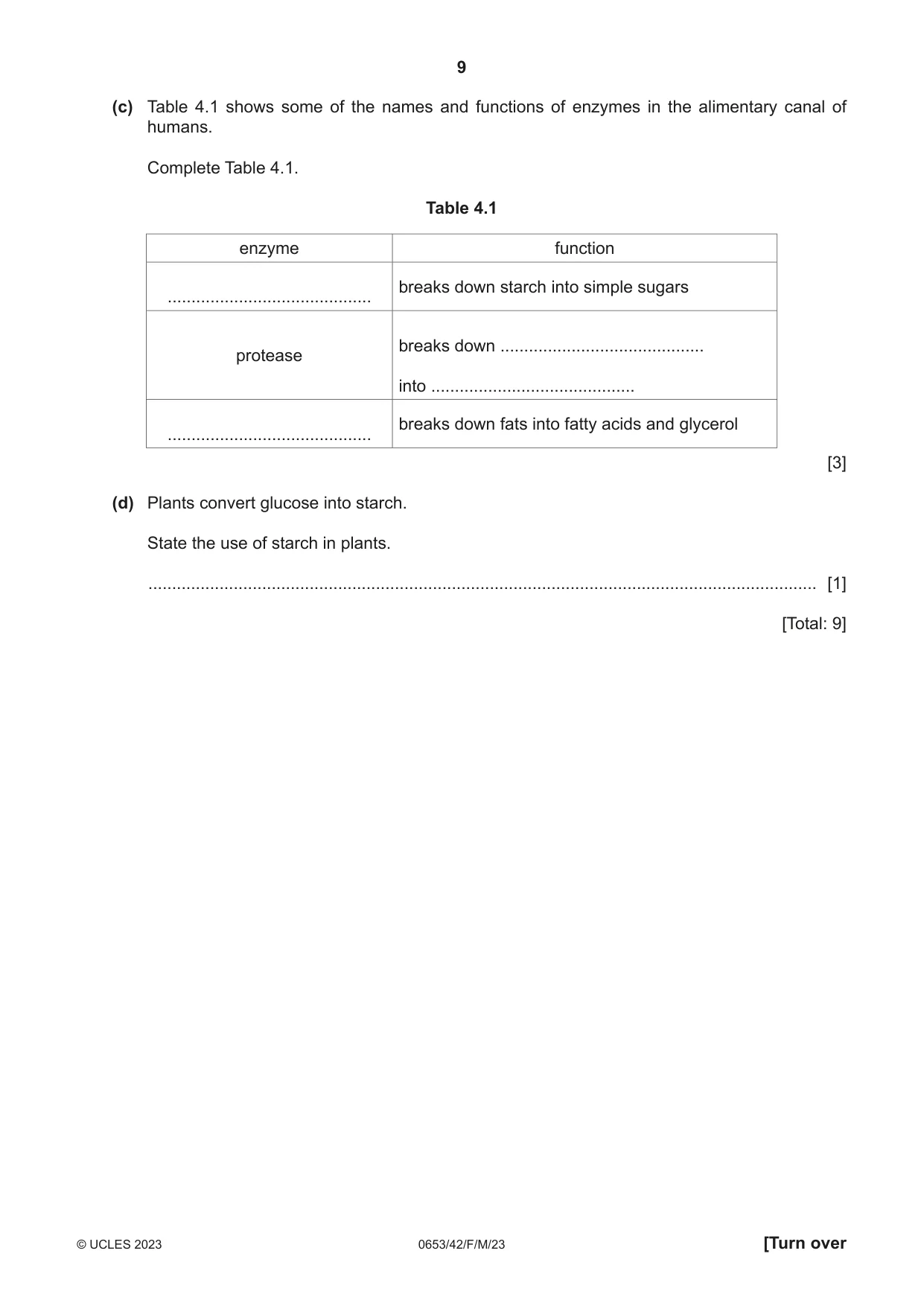
4 (a) Enzymes are found in living organisms. Complete the definition of enzymes. Enzymes are proteins that function as biological ............................................................. . [1] (b) Fig. 4.1 shows the effect of temperature on the activity of four different enzymes, A, B, C and D. The enzymes are from organisms that live in different habitats. C B D enzyme activity A –10 0 10 20 30 40 50 60 70 80 90 100 110 temperature / °C Fig. 4.1 (i) The Arctic Ocean has a temperature of approximately –1.8 °C. Identify which enzyme shown in Fig. 4.1 is most likely from an organism that can live in the Arctic Ocean. enzyme ........................................................................................................................ [1] (ii) Explain the effect of a temperature of 80 °C on the activity of enzyme C as in Fig. 4.1. ........................................................................................................................................... ........................................................................................................................................... ........................................................................................................................................... ........................................................................................................................................... ..................................................................................................................................... [3] (c) Table 4.1 shows some of the names and functions of enzymes in the alimentary canal of humans. Complete Table 4.1. Table 4.1 enzyme function breaks down starch into simple sugars ........................................... breaks down ........................................... protease into ........................................... breaks down fats into fatty acids and glycerol ........................................... [3] (d) Plants convert glucose into starch. State the use of starch in plants. ............................................................................................................................................. [1] [Total: 9]
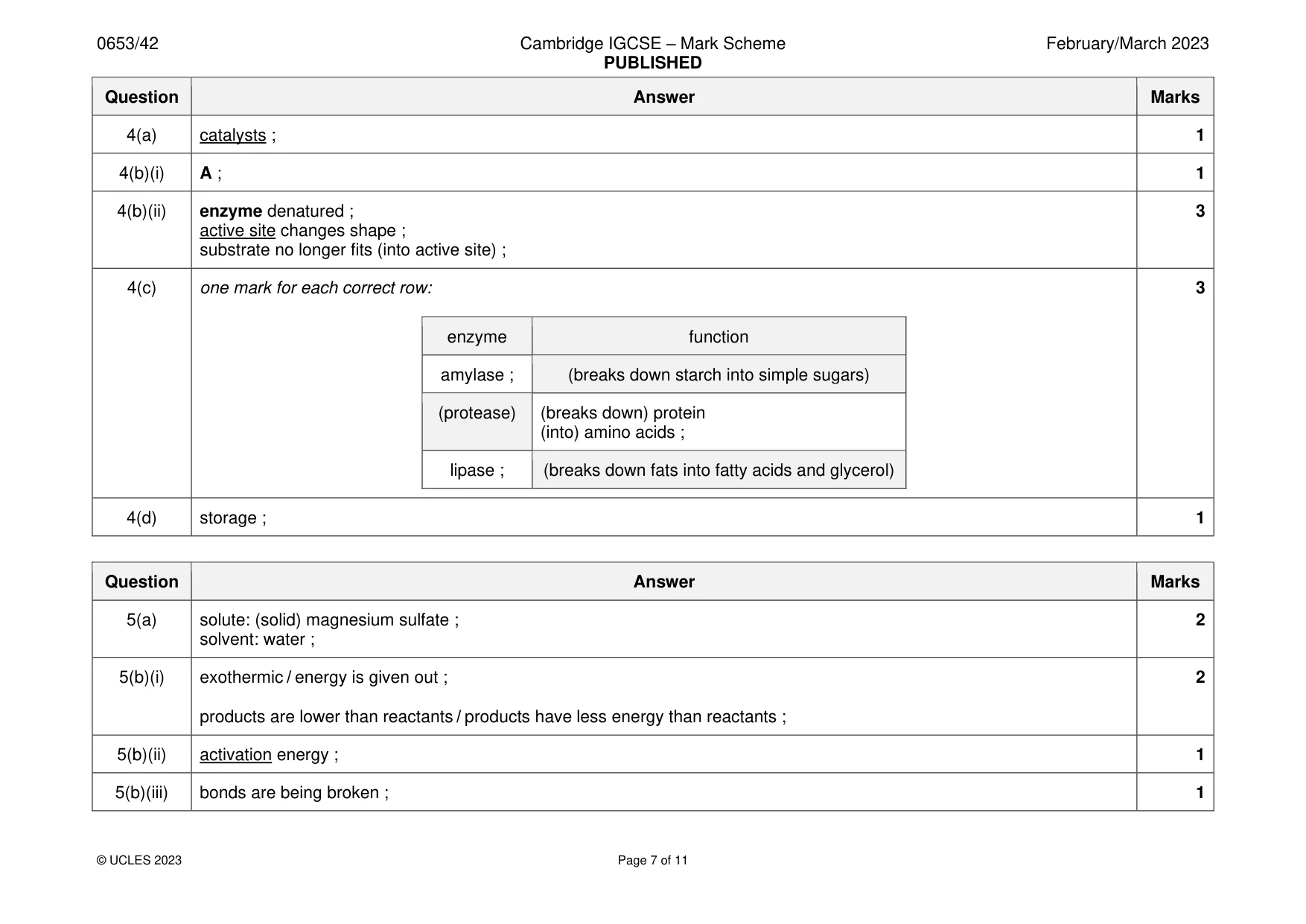
Mark scheme: 4(a) catalysts ; 1 4(b)(i) A ; 1 4(b)(ii) enzyme denatured ; 3 active site changes shape ; substrate no longer fits (into active site) ; 4(c) one mark for each correct row: 3 enzyme function amylase ; (breaks down starch into simple sugars) (protease) (breaks down) protein (into) amino acids ; lipase ; (breaks down fats into fatty acids and glycerol) 4(d) storage ; 1
Q5 · Solid magnesium sulfate, MgSO4, dissolves to form aqueous magnesium sulfate
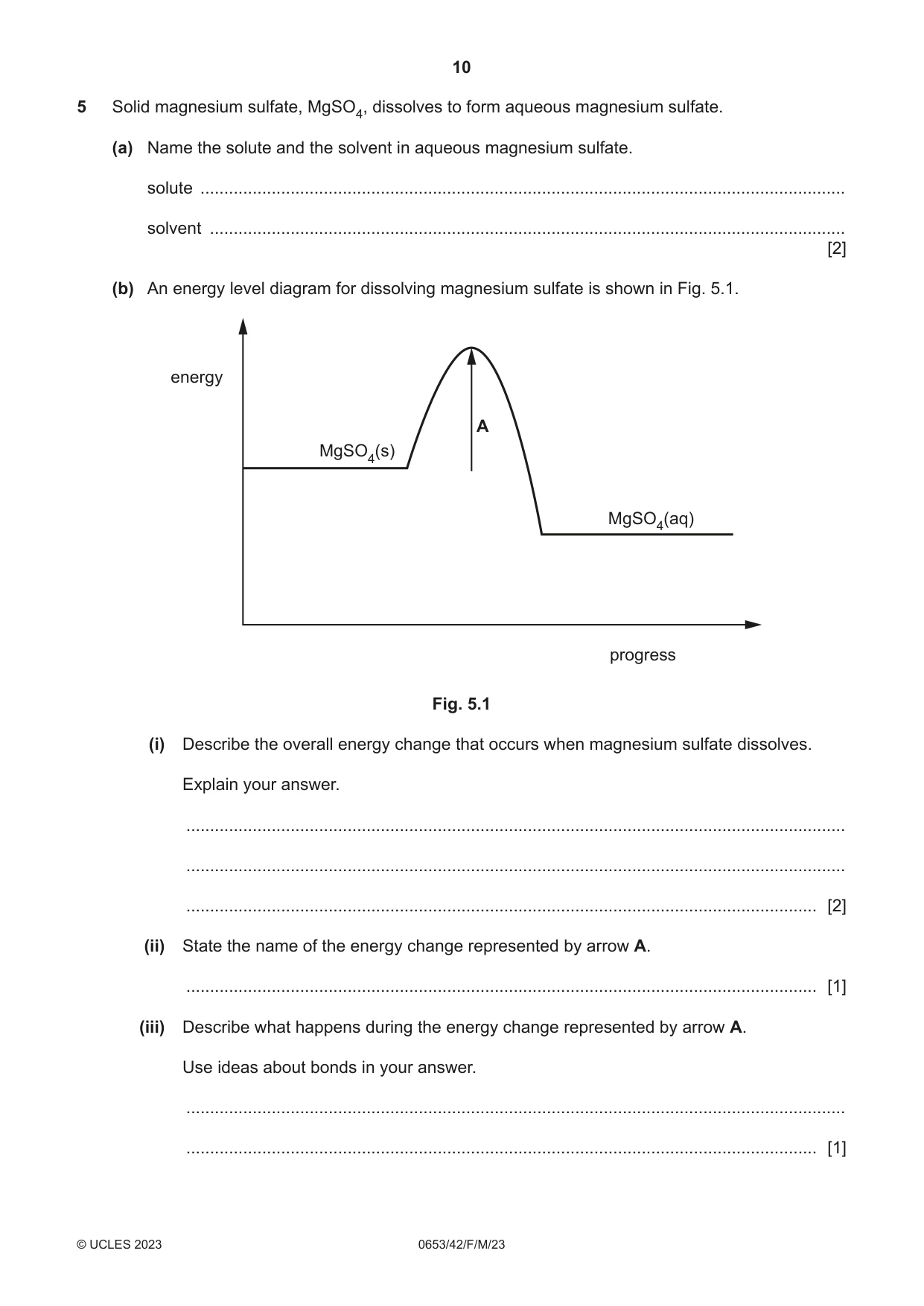
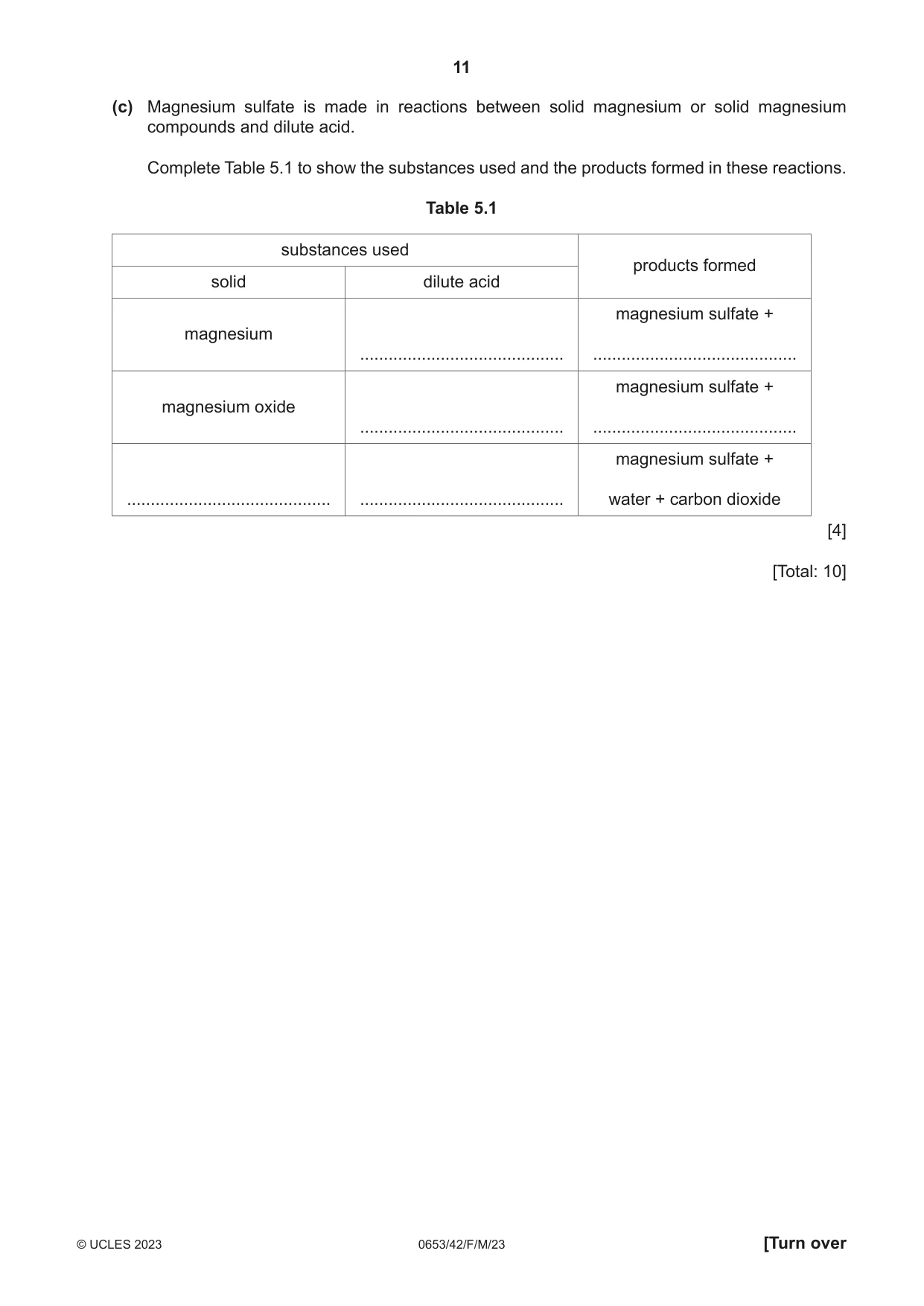
5 Solid magnesium sulfate, MgSO4, dissolves to form aqueous magnesium sulfate. (a) Name the solute and the solvent in aqueous magnesium sulfate. solute ........................................................................................................................................ solvent ...................................................................................................................................... [2] (b) An energy level diagram for dissolving magnesium sulfate is shown in Fig. 5.1. energy A MgSO4(s) MgSO4(aq) progress Fig. 5.1 (i) Describe the overall energy change that occurs when magnesium sulfate dissolves. Explain your answer. ........................................................................................................................................... ........................................................................................................................................... ..................................................................................................................................... [2] (ii) State the name of the energy change represented by arrow A. ..................................................................................................................................... [1] (iii) Describe what happens during the energy change represented by arrow A. Use ideas about bonds in your answer. ........................................................................................................................................... ..................................................................................................................................... [1] (c) Magnesium sulfate is made in reactions between solid magnesium or solid magnesium compounds and dilute acid. Complete Table 5.1 to show the substances used and the products formed in these reactions. Table 5.1 substances used products formed solid dilute acid magnesium sulfate + magnesium ........................................... ........................................... magnesium sulfate + magnesium oxide ........................................... ........................................... magnesium sulfate + ........................................... ........................................... water + carbon dioxide [4] [Total: 10]
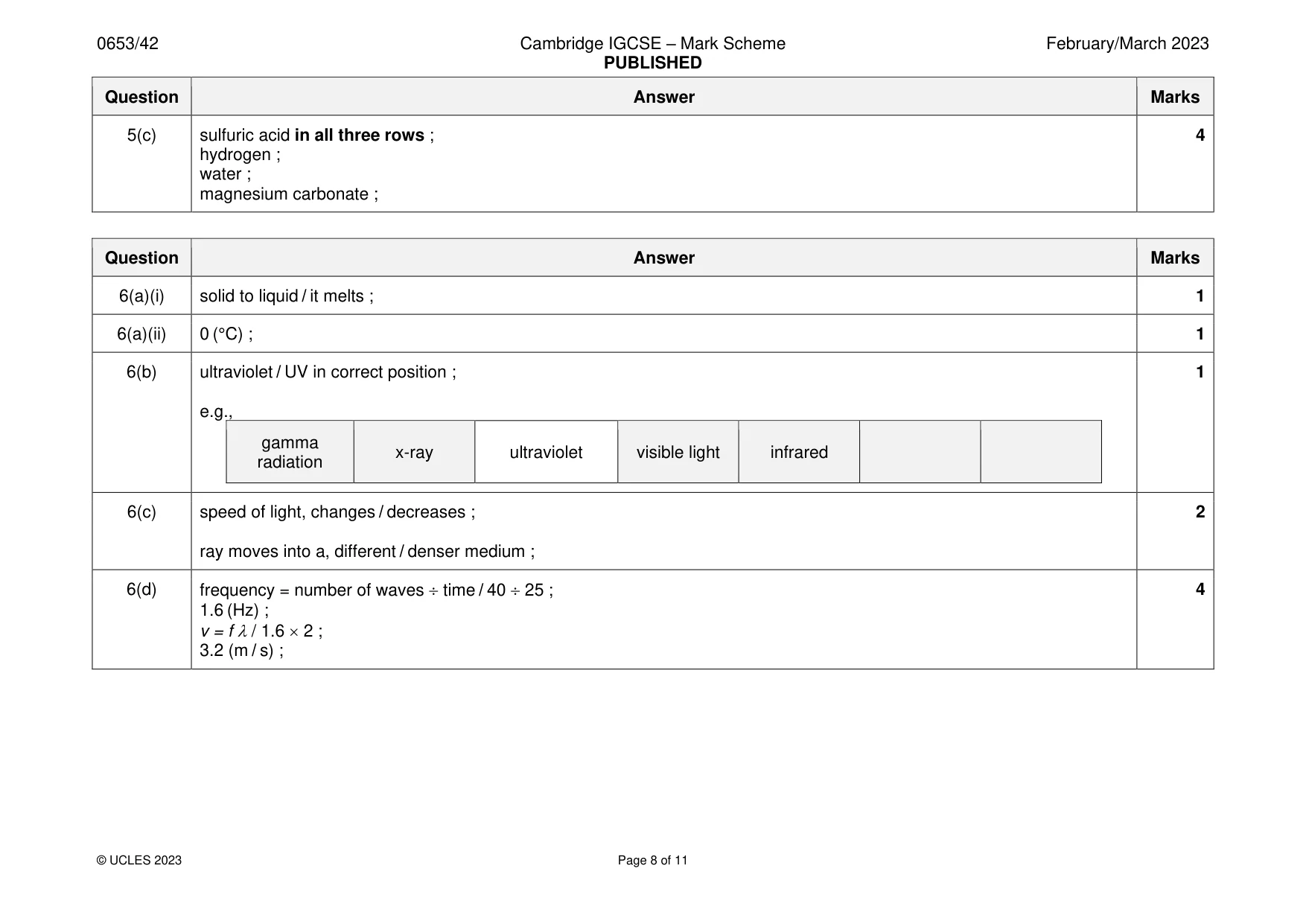
Mark scheme: 5(a) solute: (solid) magnesium sulfate ; 2 solvent: water ; 5(b)(i) exothermic / energy is given out ; 2 products are lower than reactants / products have less energy than reactants ; 5(b)(ii) activation energy ; 1 5(b)(iii) bonds are being broken ; 1 5(c) sulfuric acid in all three rows ; 4 hydrogen ; water ; magnesium carbonate ;
Q6 · A house in the Himalayan mountain range
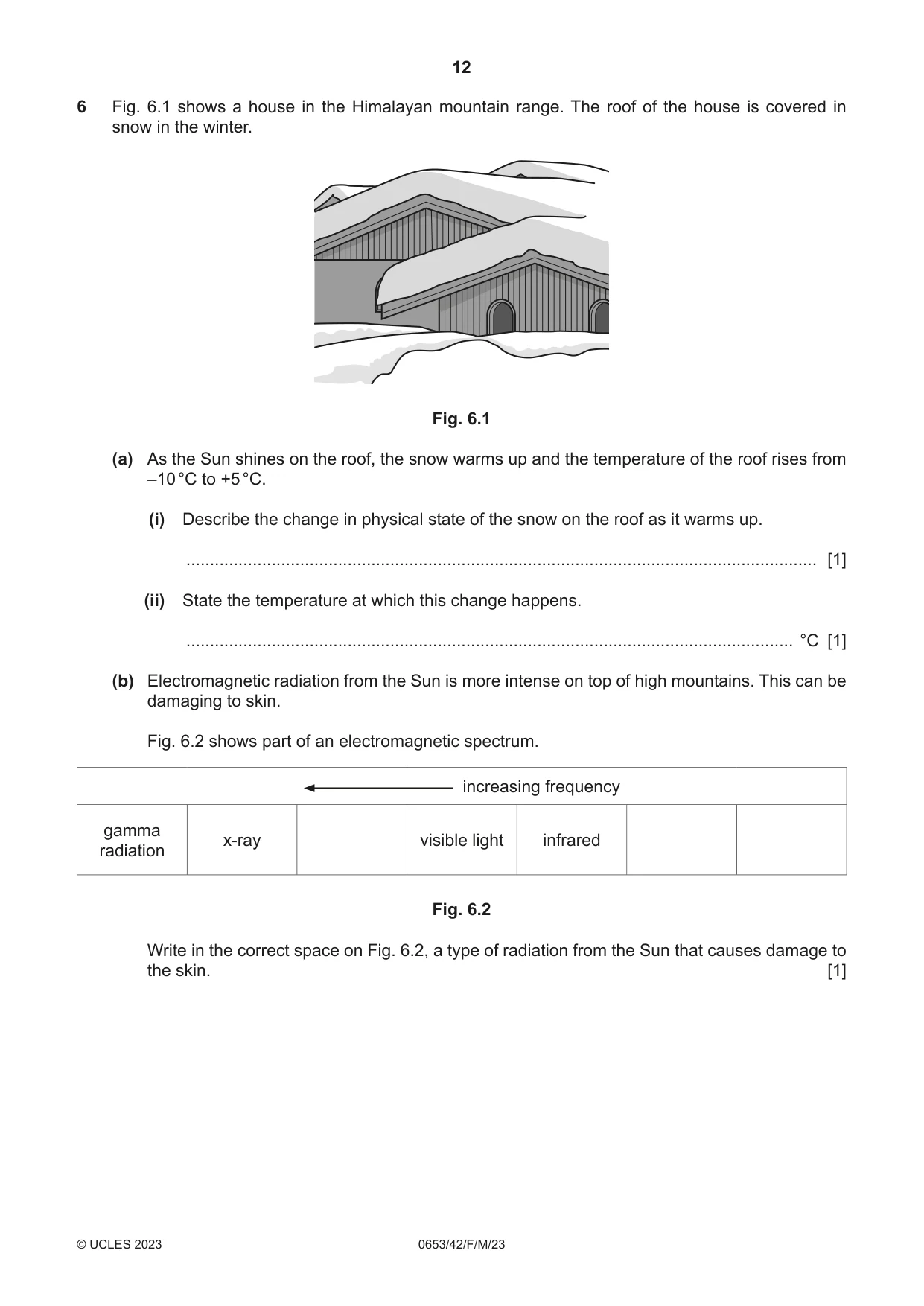
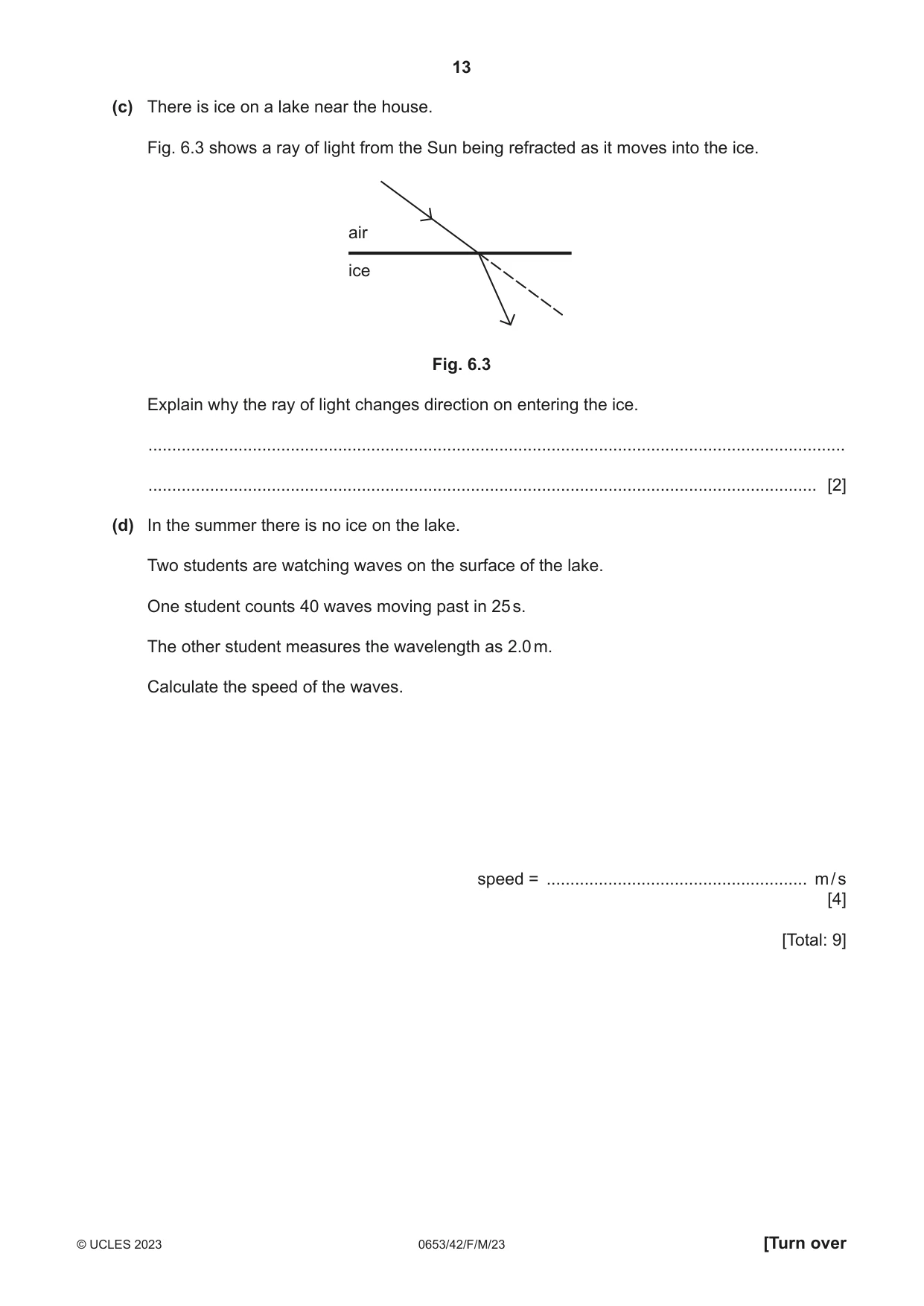
6 Fig. 6.1 shows a house in the Himalayan mountain range. The roof of the house is covered in snow in the winter. Fig. 6.1 (a) As the Sun shines on the roof, the snow warms up and the temperature of the roof rises from –10 °C to +5 °C. (i) Describe the change in physical state of the snow on the roof as it warms up. ..................................................................................................................................... [1] (ii) State the temperature at which this change happens. ................................................................................................................................ °C [1] (b) Electromagnetic radiation from the Sun is more intense on top of high mountains. This can be damaging to skin. Fig. 6.2 shows part of an electromagnetic spectrum. increasing frequency gamma x-ray visible light infrared radiation Fig. 6.2 Write in the correct space on Fig. 6.2, a type of radiation from the Sun that causes damage to the skin. [1] (c) There is ice on a lake near the house. Fig. 6.3 shows a ray of light from the Sun being refracted as it moves into the ice. air ice Fig. 6.3 Explain why the ray of light changes direction on entering the ice. ................................................................................................................................................... ............................................................................................................................................. [2] (d) In the summer there is no ice on the lake. Two students are watching waves on the surface of the lake. One student counts 40 waves moving past in 25 s. The other student measures the wavelength as 2.0 m. Calculate the speed of the waves. speed = ....................................................... m / s [4] [Total: 9]
Mark scheme: 6(a)(i) solid to liquid / it melts ; 1 6(a)(ii) 0 (°C) ; 1 6(b) ultraviolet / UV in correct position ; 1 e.g., gamma x-ray ultraviolet visible light infrared radiation 6(c) speed of light, changes / decreases ; 2 ray moves into a, different / denser medium ; 6(d) frequency = number of waves time / 40 25 ; 4 1.6 (Hz) ; v = f / 1.6 2 ; 3.2 (m / s) ;
Q7 · A diagram of a heart
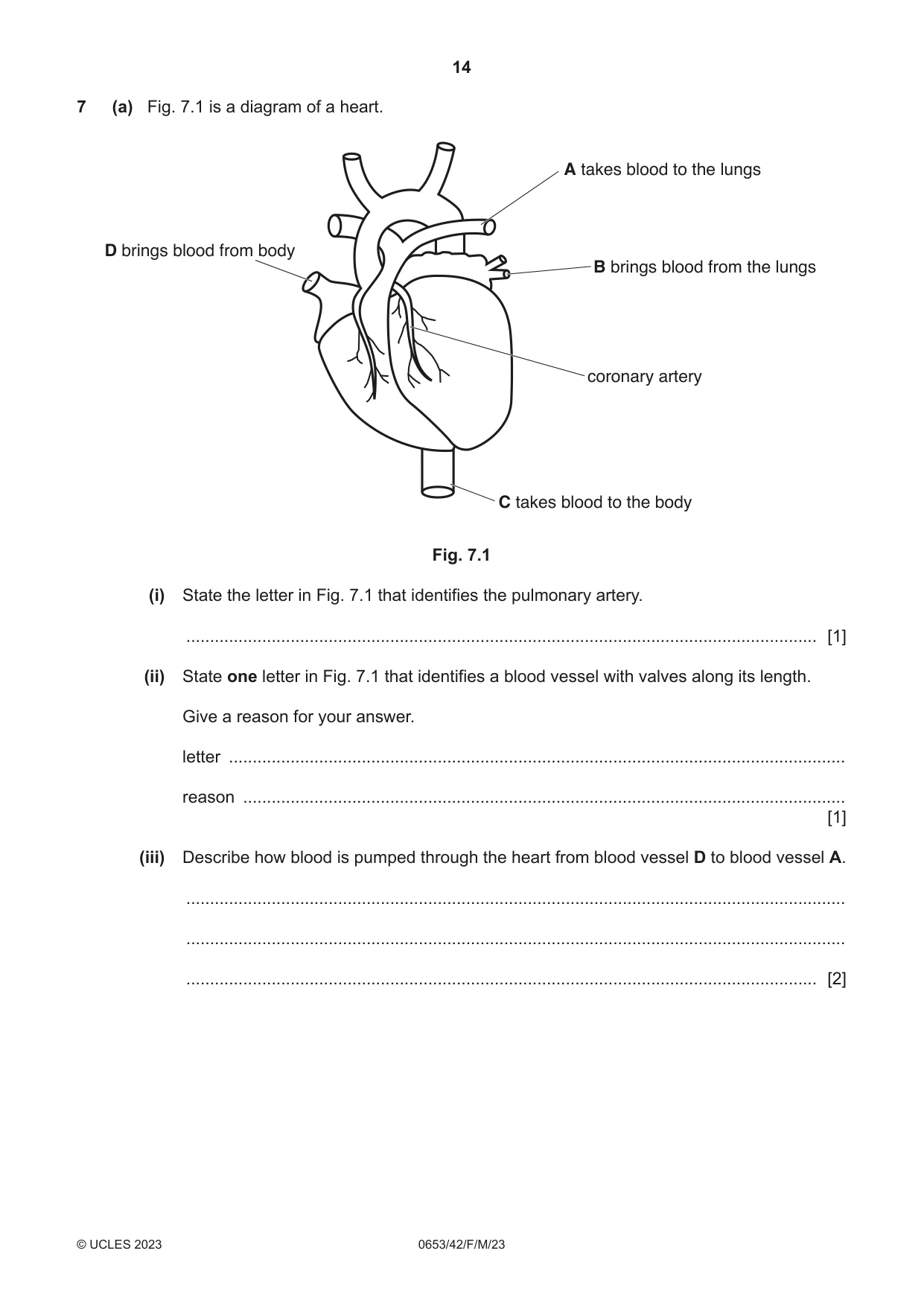
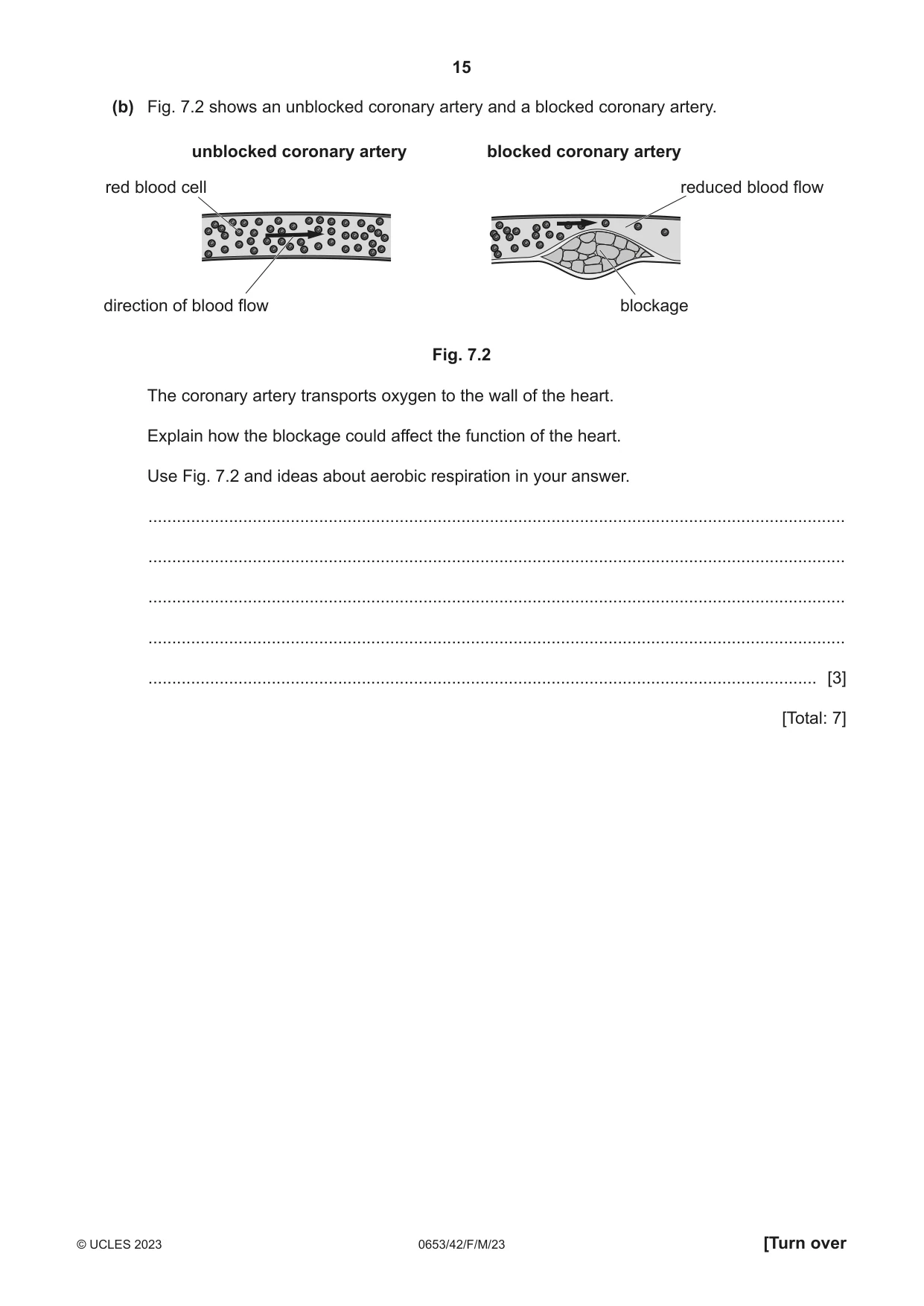
7 (a) Fig. 7.1 is a diagram of a heart. A takes blood to the lungs D brings blood from body B brings blood from the lungs coronary artery C takes blood to the body Fig. 7.1 (i) State the letter in Fig. 7.1 that identifies the pulmonary artery. ..................................................................................................................................... [1] (ii) State one letter in Fig. 7.1 that identifies a blood vessel with valves along its length. Give a reason for your answer. letter .................................................................................................................................. reason ............................................................................................................................... [1] (iii) Describe how blood is pumped through the heart from blood vessel D to blood vessel A. ........................................................................................................................................... ........................................................................................................................................... ..................................................................................................................................... [2] (b) Fig. 7.2 shows an unblocked coronary artery and a blocked coronary artery. unblocked coronary artery blocked coronary artery red blood cell reduced blood flow direction of blood flow blockage Fig. 7.2 The coronary artery transports oxygen to the wall of the heart. Explain how the blockage could affect the function of the heart. Use Fig. 7.2 and ideas about aerobic respiration in your answer. ................................................................................................................................................... ................................................................................................................................................... ................................................................................................................................................... ................................................................................................................................................... ............................................................................................................................................. [3] [Total: 7]
Mark scheme: 7(a)(i) A ; 1 7(a)(ii) B / D because it is a vein ; 1 7(a)(iii) idea of blood flows from atrium to ventricle ; 2 idea of flow of blood caused by (muscular) contraction (of chambers) ; 7(b) idea that less oxygen is transported (to heart muscle / wall) ; 3 therefore reduced (aerobic) respiration ; so less energy available (for muscle contraction) ;
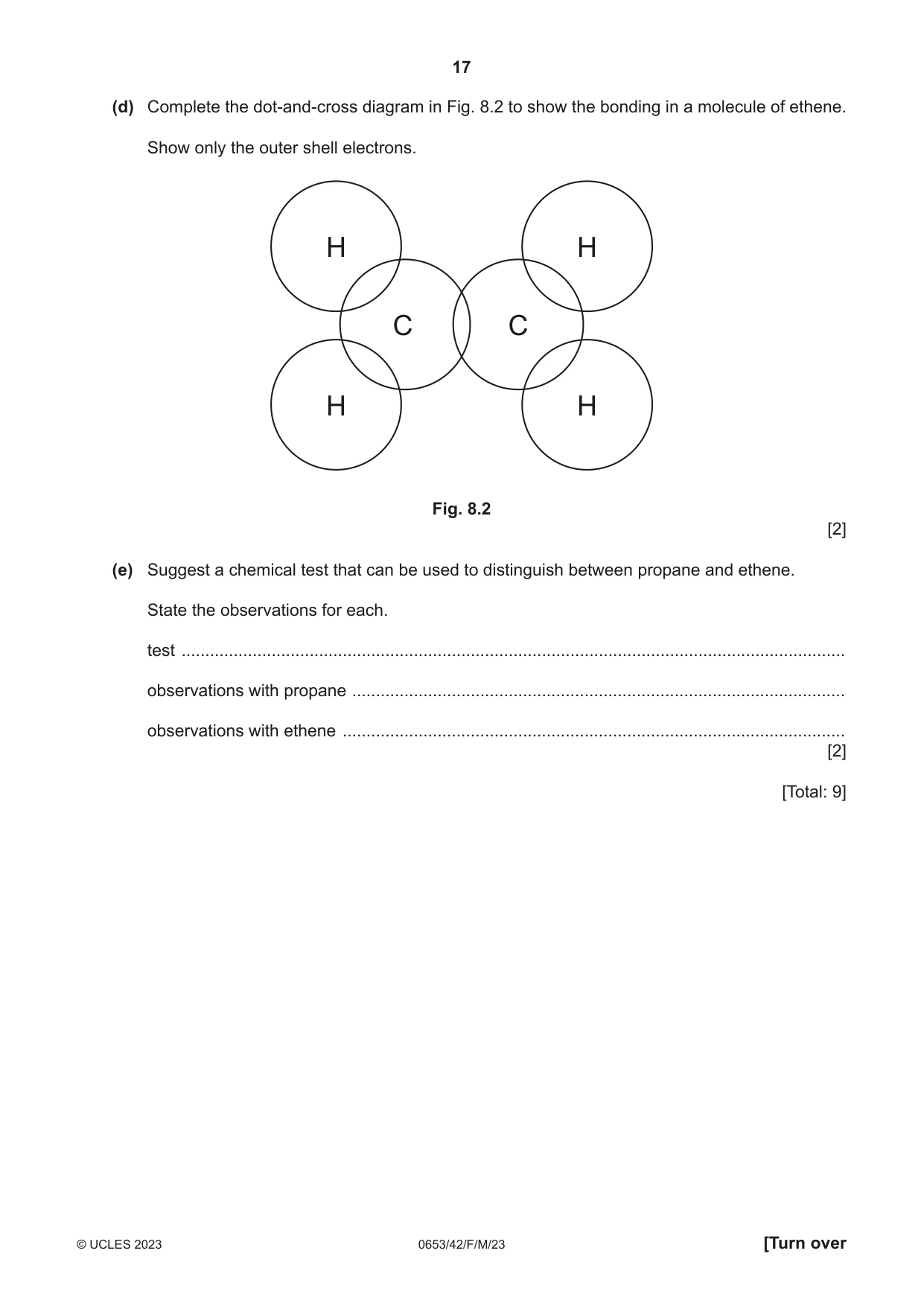
Q8 · The structures of the hydrocarbons propane and ethene are shown in Fig
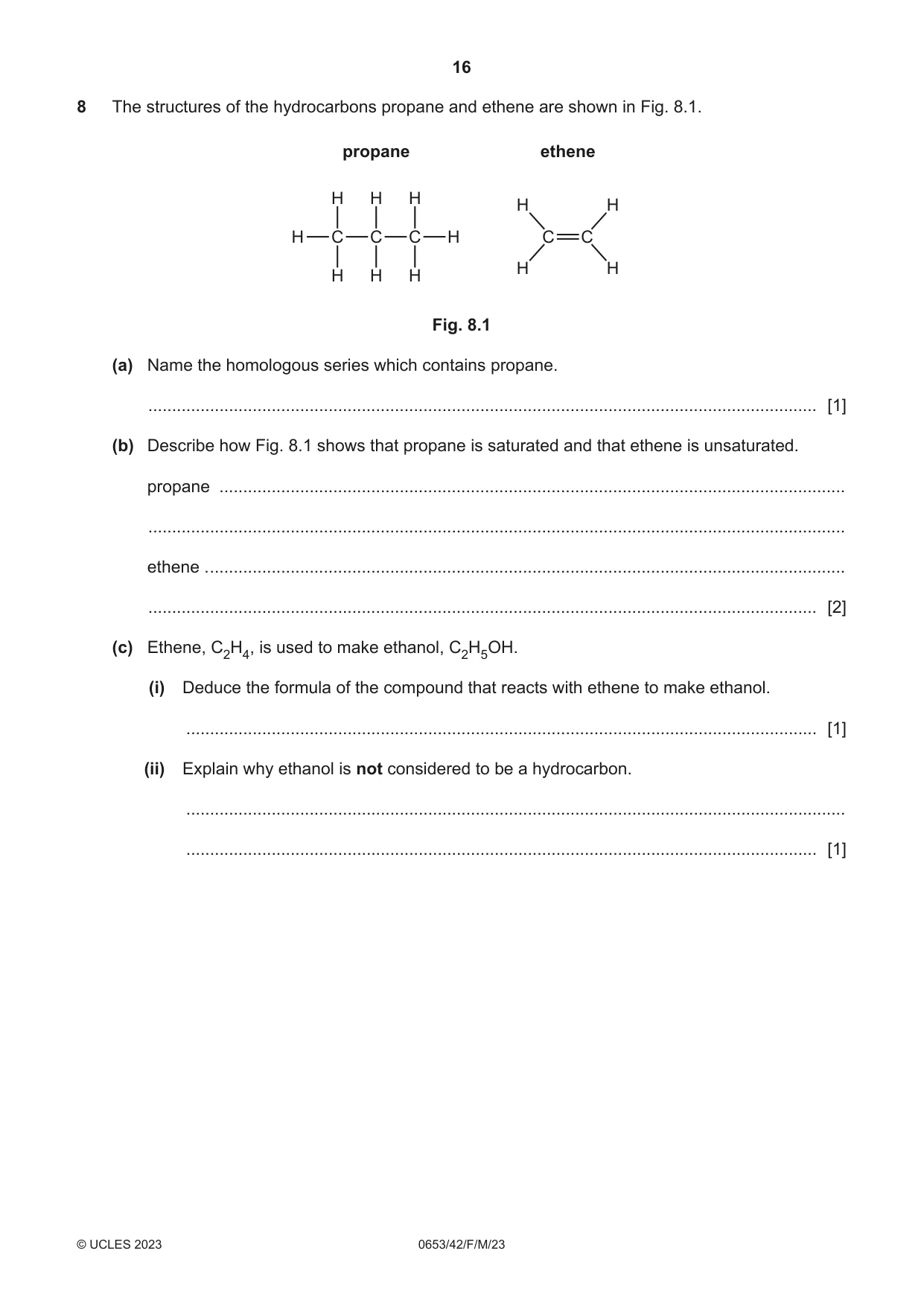
8 The structures of the hydrocarbons propane and ethene are shown in Fig. 8.1. propane ethene H H H H H H C C C H C C H H H H H Fig. 8.1 (a) Name the homologous series which contains propane. ............................................................................................................................................. [1] (b) Describe how Fig. 8.1 shows that propane is saturated and that ethene is unsaturated. propane .................................................................................................................................... ................................................................................................................................................... ethene . ...................................................................................................................................... ............................................................................................................................................. [2] (c) Ethene, C2H4, is used to make ethanol, C2H5OH. (i) Deduce the formula of the compound that reacts with ethene to make ethanol. ..................................................................................................................................... [1] (ii) Explain why ethanol is not considered to be a hydrocarbon. ........................................................................................................................................... ..................................................................................................................................... [1] (d) Complete the dot-and-cross diagram in Fig. 8.2 to show the bonding in a molecule of ethene. Show only the outer shell electrons. H H C C H H Fig. 8.2 [2] (e) Suggest a chemical test that can be used to distinguish between propane and ethene. State the observations for each. test ............................................................................................................................................ observations with propane ........................................................................................................ observations with ethene .......................................................................................................... [2] [Total: 9]
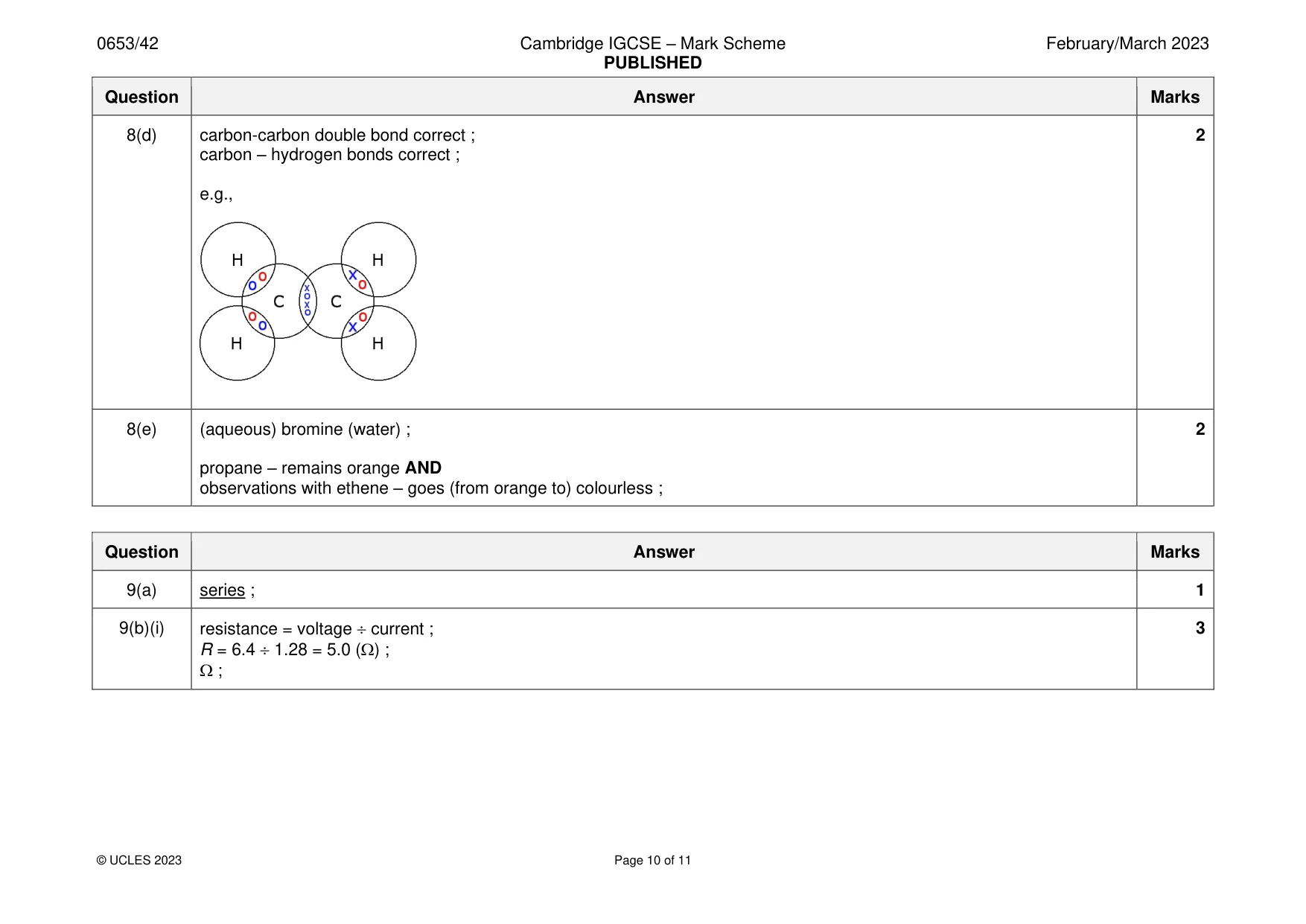
Mark scheme: 8(a) alkane ; 1 8(b) propane contains only single bonds / propane has single bonds between C atoms ; 2 ethene has a double bond (between C atoms) ; 8(c)(i) H2O ; 1 8(c)(ii) contains oxygen ; 1 8(d) carbon-carbon double bond correct ; 2 carbon – hydrogen bonds correct ; e.g., 8(e) (aqueous) bromine (water) ; 2 propane – remains orange AND observations with ethene – goes (from orange to) colourless ;
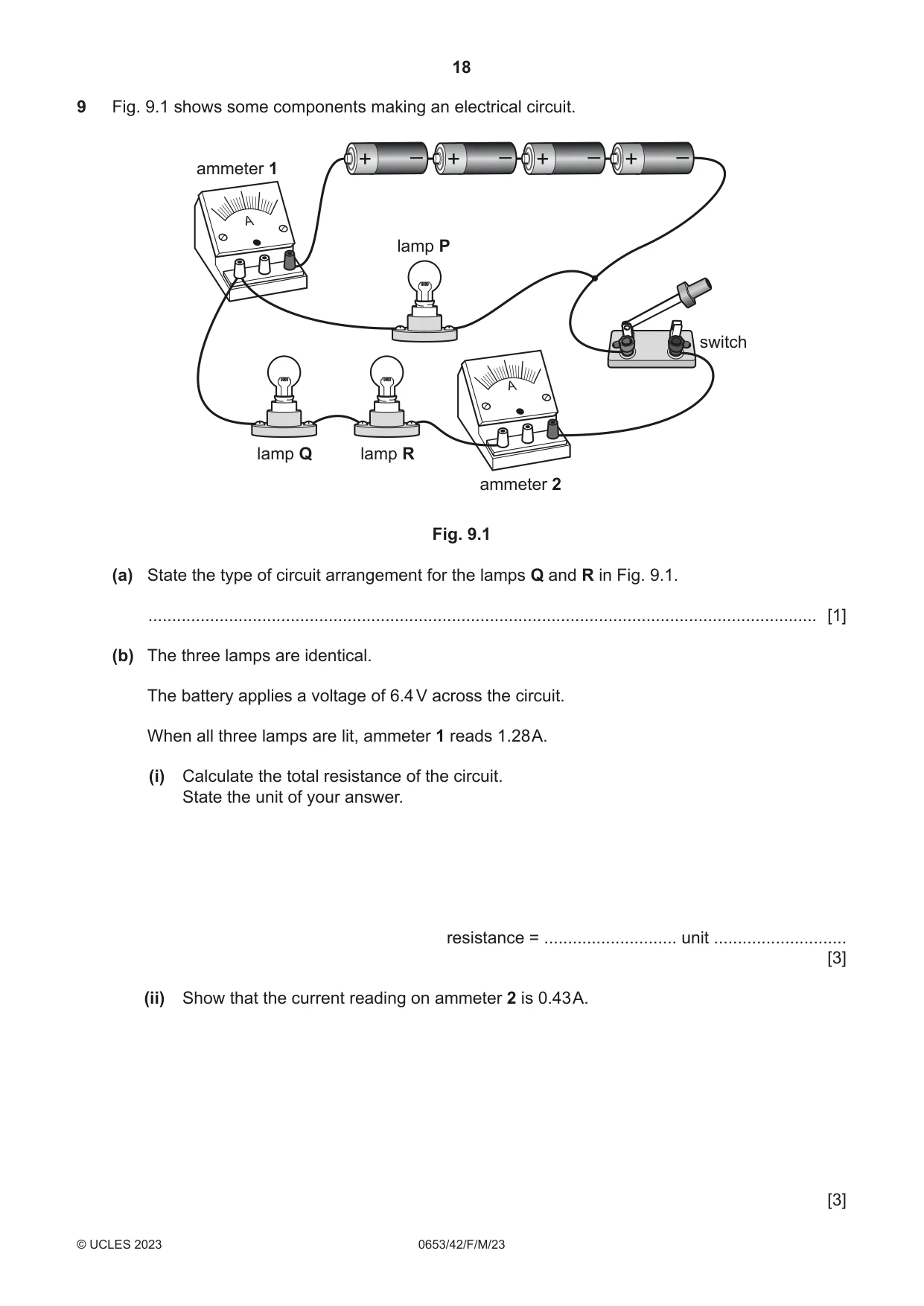
Q9 · Some components making an electrical circuit
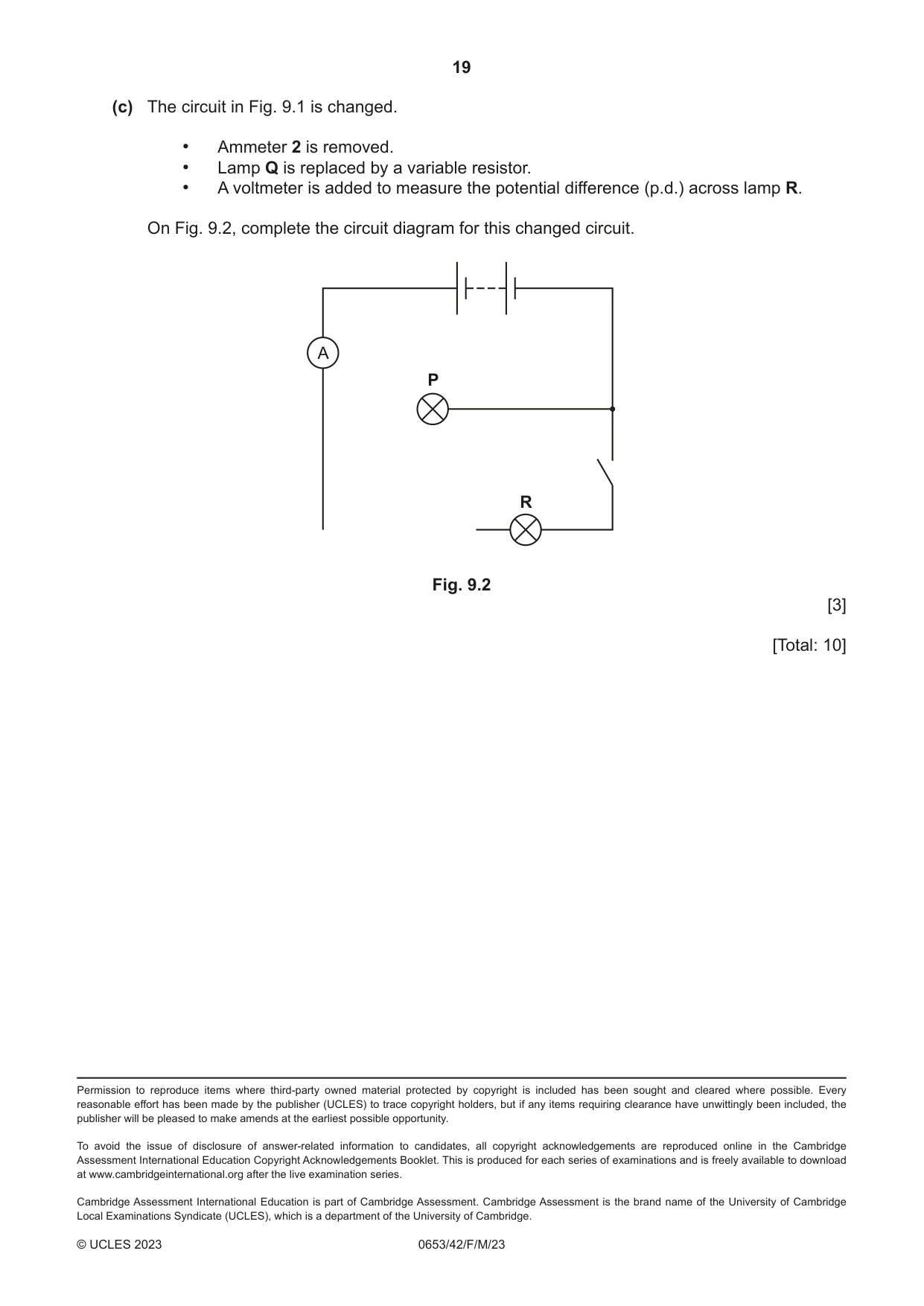
9 Fig. 9.1 shows some components making an electrical circuit. + – + – + – + – ammeter 1 A lamp P switch A lamp Q lamp R ammeter 2 Fig. 9.1 (a) State the type of circuit arrangement for the lamps Q and R in Fig. 9.1. ............................................................................................................................................. [1] (b) The three lamps are identical. The battery applies a voltage of 6.4 V across the circuit. When all three lamps are lit, ammeter 1 reads 1.28 A. (i) Calculate the total resistance of the circuit. State the unit of your answer. resistance = ............................ unit ............................ [3] (ii) Show that the current reading on ammeter 2 is 0.43 A. [3] (c) The circuit in Fig. 9.1 is changed. • Ammeter 2 is removed. • Lamp Q is replaced by a variable resistor. • A voltmeter is added to measure the potential difference (p.d.) across lamp R. On Fig. 9.2, complete the circuit diagram for this changed circuit. A P R Fig. 9.2 [3] [Total: 10]
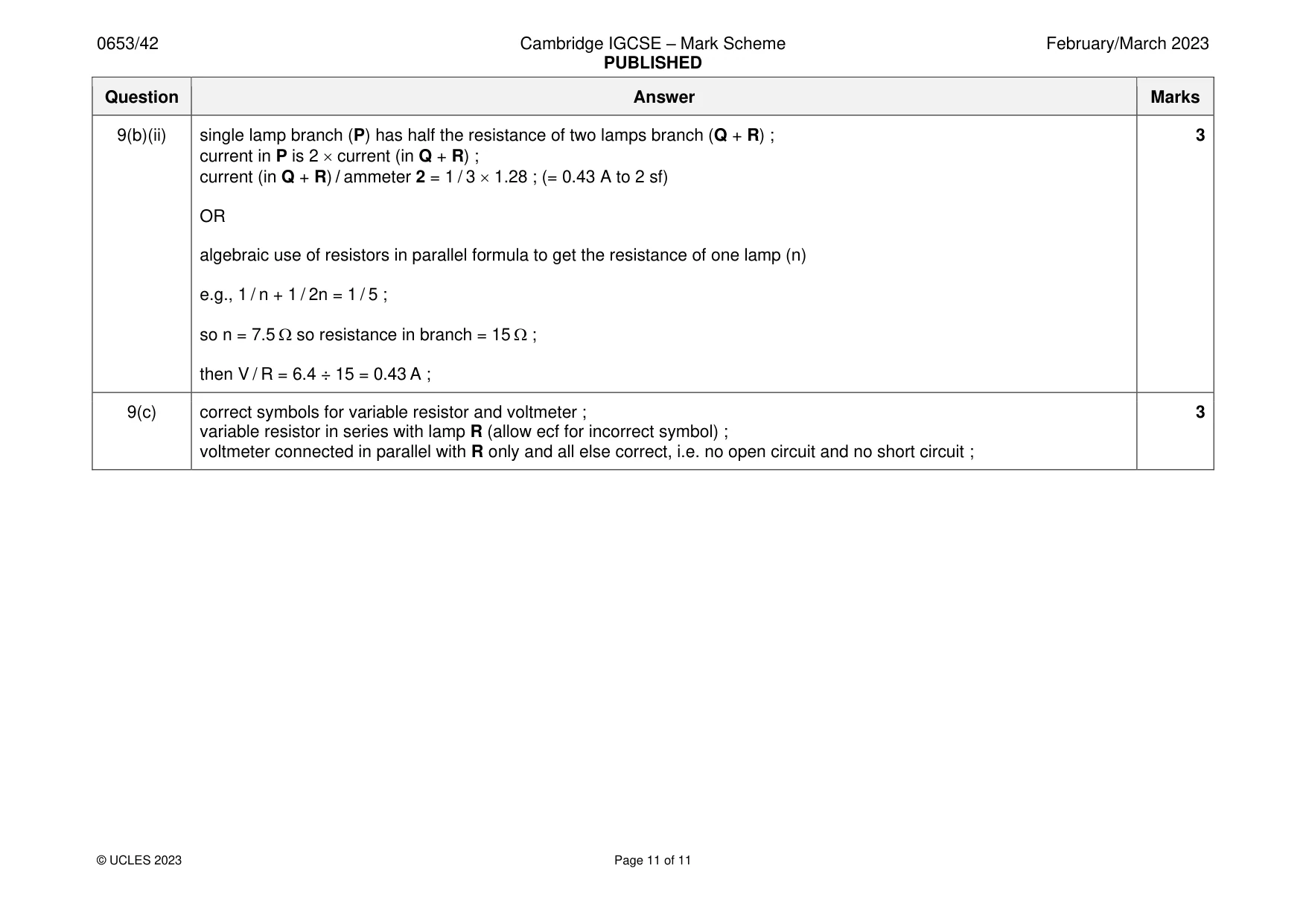
Mark scheme: 9(a) series ; 1 9(b)(i) resistance = voltage current ; 3 R = 6.4 1.28 = 5.0 () ; ; 9(b)(ii) single lamp branch (P) has half the resistance of two lamps branch (Q + R) ; 3 current in P is 2 current (in Q + R) ; current (in Q + R) / ammeter 2 = 1 / 3 1.28 ; (= 0.43 A to 2 sf) OR algebraic use of resistors in parallel formula to get the resistance of one lamp (n) e.g., 1 / n + 1 / 2n = 1 / 5 ; so n = 7.5 so resistance in branch = 15 ; then V / R = 6.4 ÷ 15 = 0.43 A ; 9(c) correct symbols for variable resistor and voltmeter ; 3 variable resistor in series with lamp R (allow ecf for incorrect symbol) ; voltmeter connected in parallel with R only and all else correct, i.e. no open circuit and no short circuit ;
What was in this paper
The subtopics covered by these 9 questions, and how many questions each got. Open one in a new tab to see every Cambridge question on it.
What you needed in this session
Cambridge’s own grade thresholds for 2023 Feb/March, Paper 4 · Variant 2. A higher threshold means an easier paper — the bar moves with how the cohort did.