Cambridge IGCSE Science - Combined 0653 — 2021 Oct/Nov Paper 4 · Variant 1
0653/41/O/N/21 · 9 questions · 80 marks · ≈90 min
The question paper and its mark scheme, free to read here and free to download. This is Cambridge’s own paper, exactly as it was sat.
Question paper20 pages
Mark scheme11 pages
Answers below. Sit the paper first if you are practising.
Questions as text
Q1 · The boxes on the left show the names of different types of cell
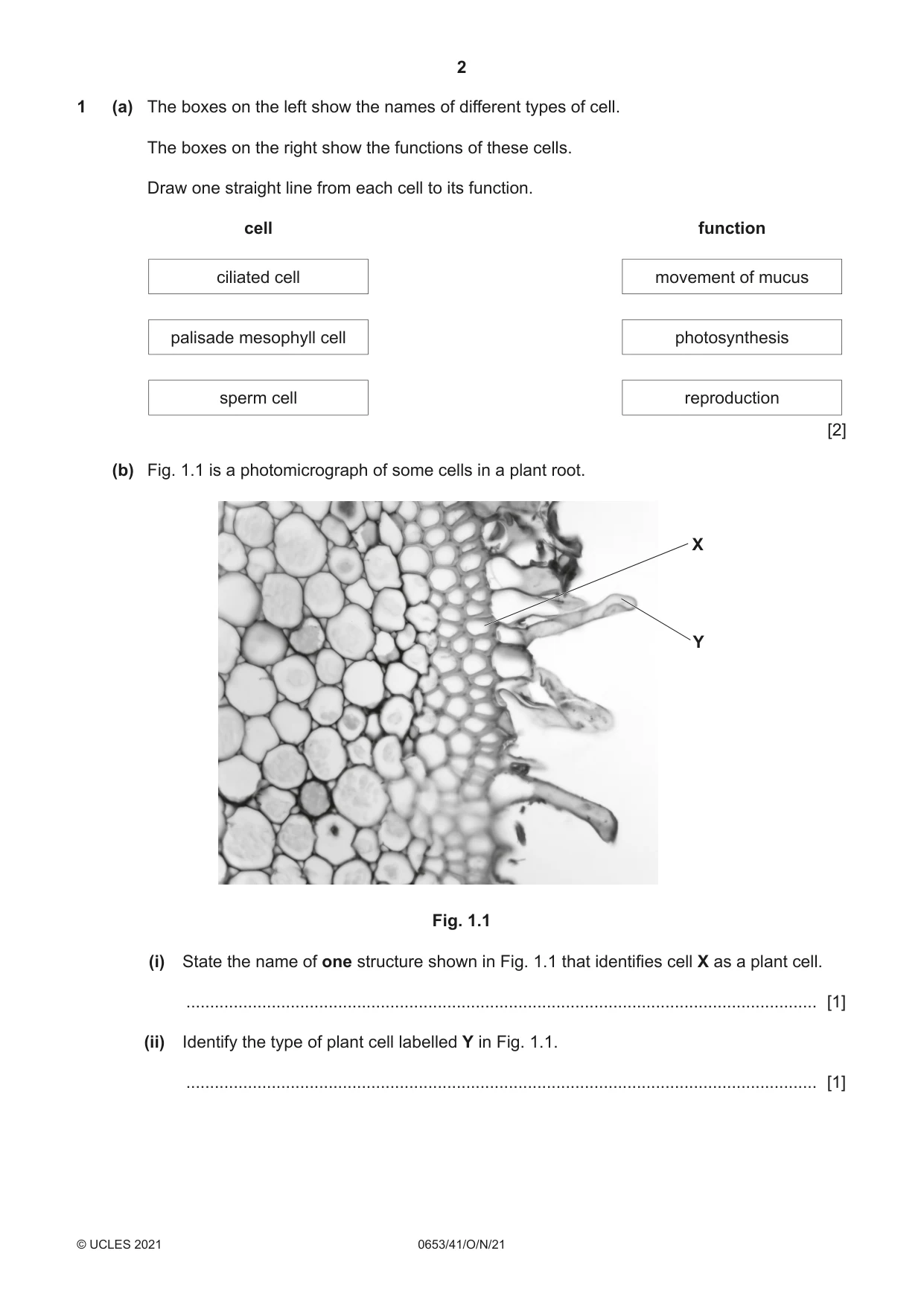
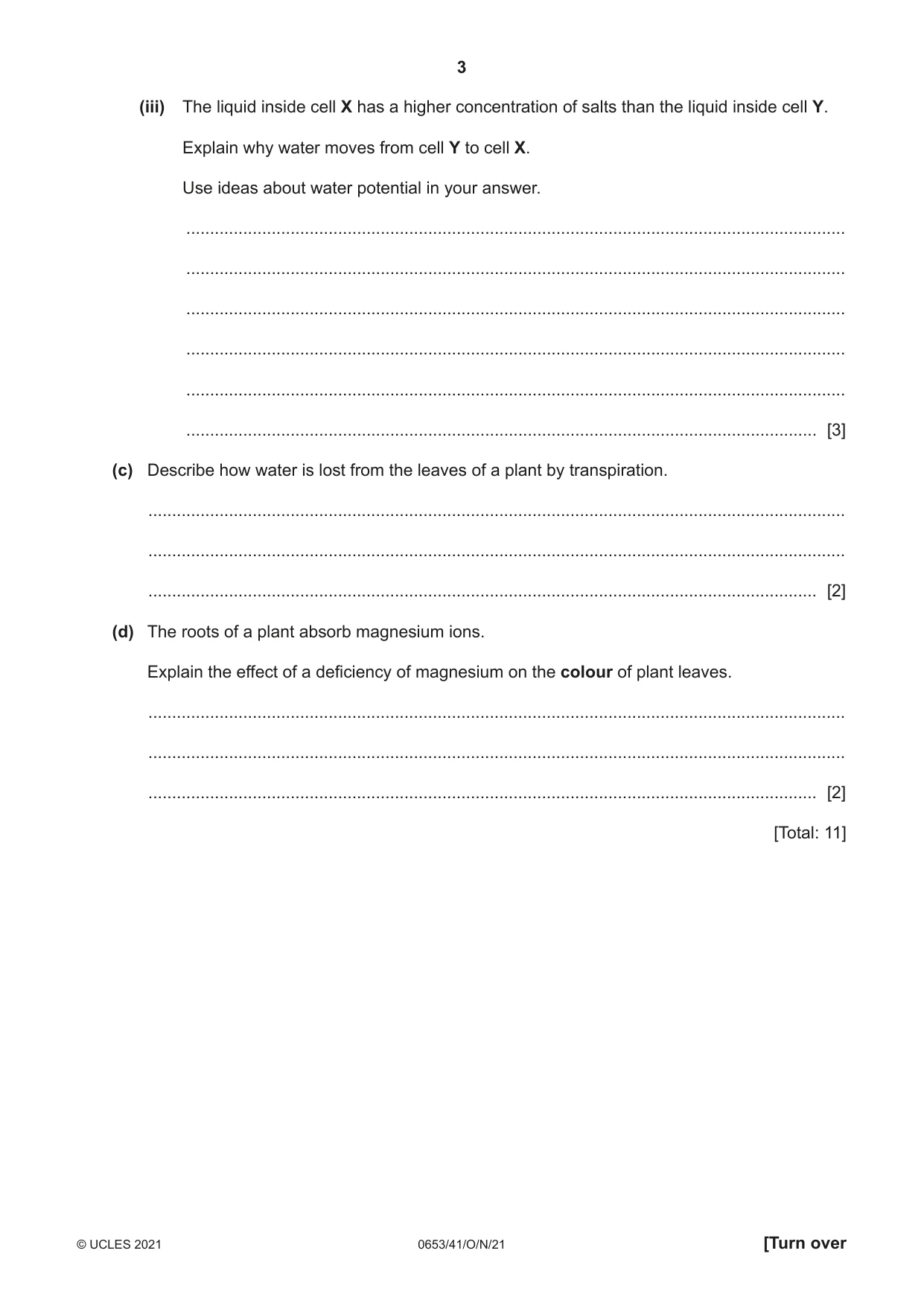
1 (a) The boxes on the left show the names of different types of cell. The boxes on the right show the functions of these cells. Draw one straight line from each cell to its function. cell function ciliated cell movement of mucus palisade mesophyll cell photosynthesis sperm cell reproduction [2] (b) Fig. 1.1 is a photomicrograph of some cells in a plant root. X Y Fig. 1.1 (i) State the name of one structure shown in Fig. 1.1 that identifies cell X as a plant cell. ..................................................................................................................................... [1] (ii) Identify the type of plant cell labelled Y in Fig. 1.1. ..................................................................................................................................... [1] (iii) The liquid inside cell X has a higher concentration of salts than the liquid inside cell Y. Explain why water moves from cell Y to cell X. Use ideas about water potential in your answer. ........................................................................................................................................... ........................................................................................................................................... ........................................................................................................................................... ........................................................................................................................................... ........................................................................................................................................... ..................................................................................................................................... [3] (c) Describe how water is lost from the leaves of a plant by transpiration. ................................................................................................................................................... ................................................................................................................................................... ............................................................................................................................................. [2] (d) The roots of a plant absorb magnesium ions. Explain the effect of a deficiency of magnesium on the colour of plant leaves. ................................................................................................................................................... ................................................................................................................................................... ............................................................................................................................................. [2] [Total: 11]
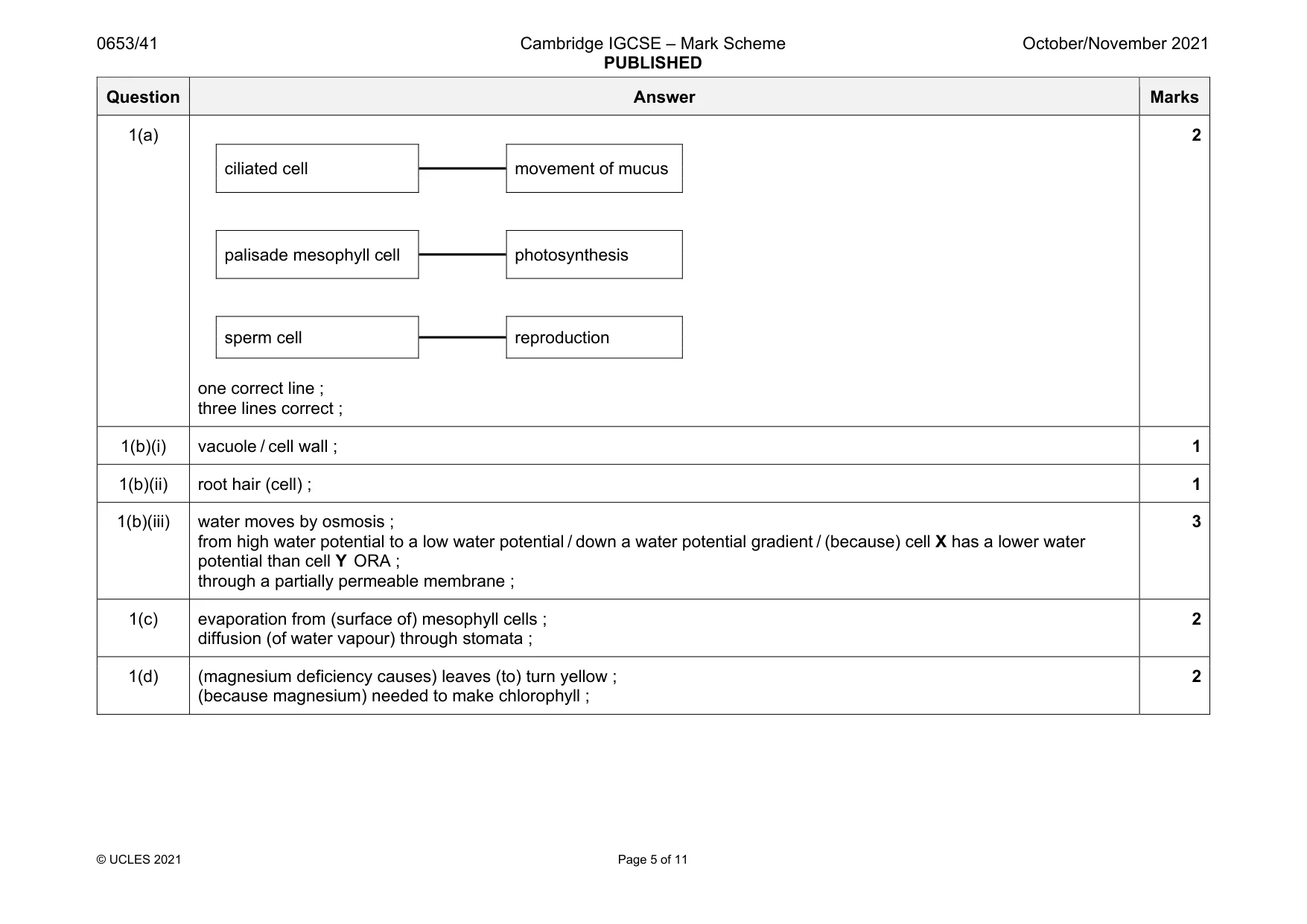
Mark scheme: 1(a) ciliated cell movement of mucus palisade mesophyll cell photosynthesis sperm cell reproduction one correct line ; three lines correct ; 2 1(b)(i) vacuole / cell wall ; 1 1(b)(ii) root hair (cell) ; 1 1(b)(iii) water moves by osmosis ; from high water potential to a low water potential / down a water potential gradient / (because) cell X has a lower water potential than cell Y ORA ; through a partially permeable membrane ; 3 1(c) evaporation from (surface of) mesophyll cells ; diffusion (of water vapour) through stomata ; 2 1(d) (magnesium deficiency causes) leaves (to) turn yellow ; (because magnesium) needed to make chlorophyll ; 2
Q2 · The energy and state changes for water when it is heated from –10 °C to 120 °C
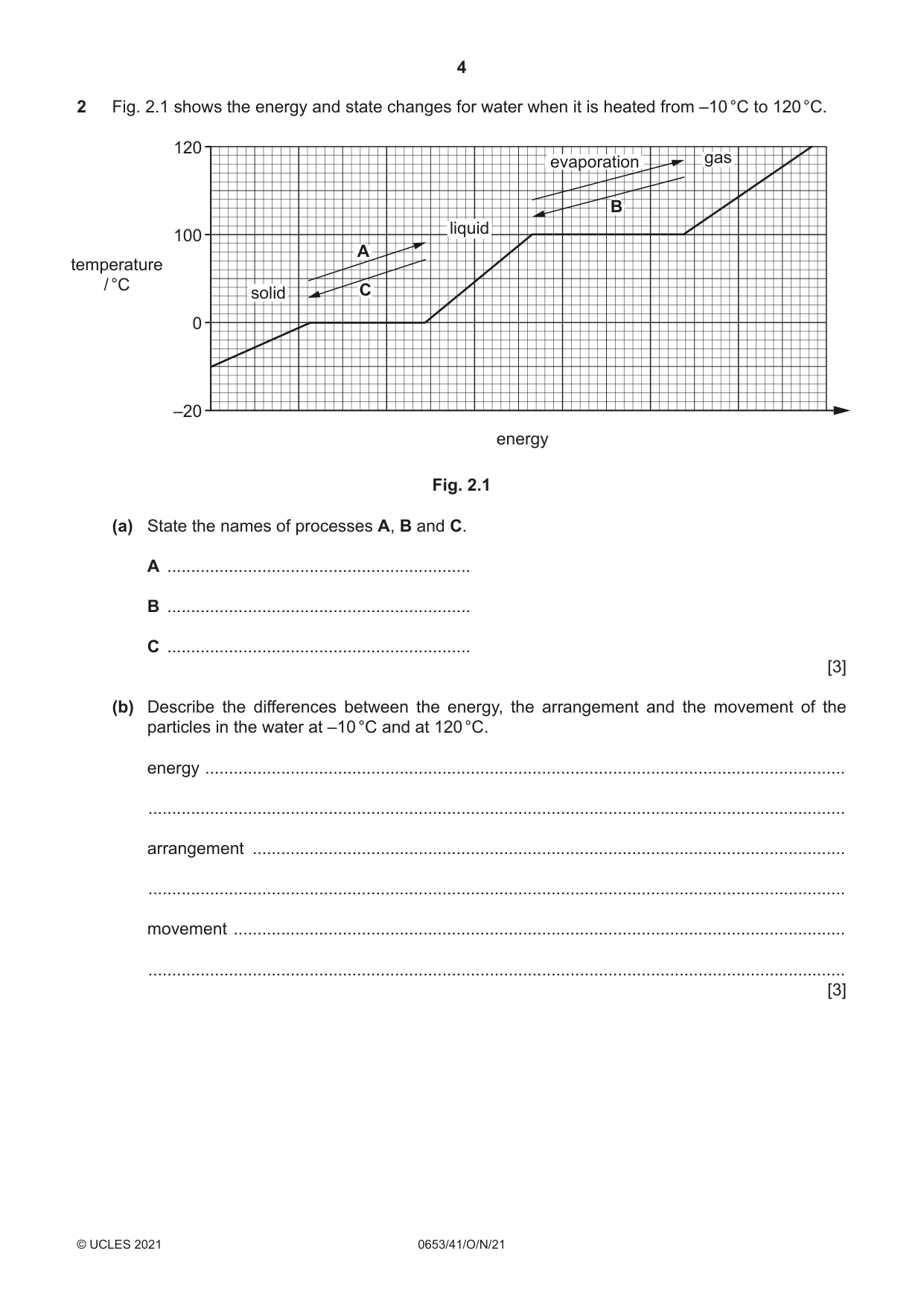
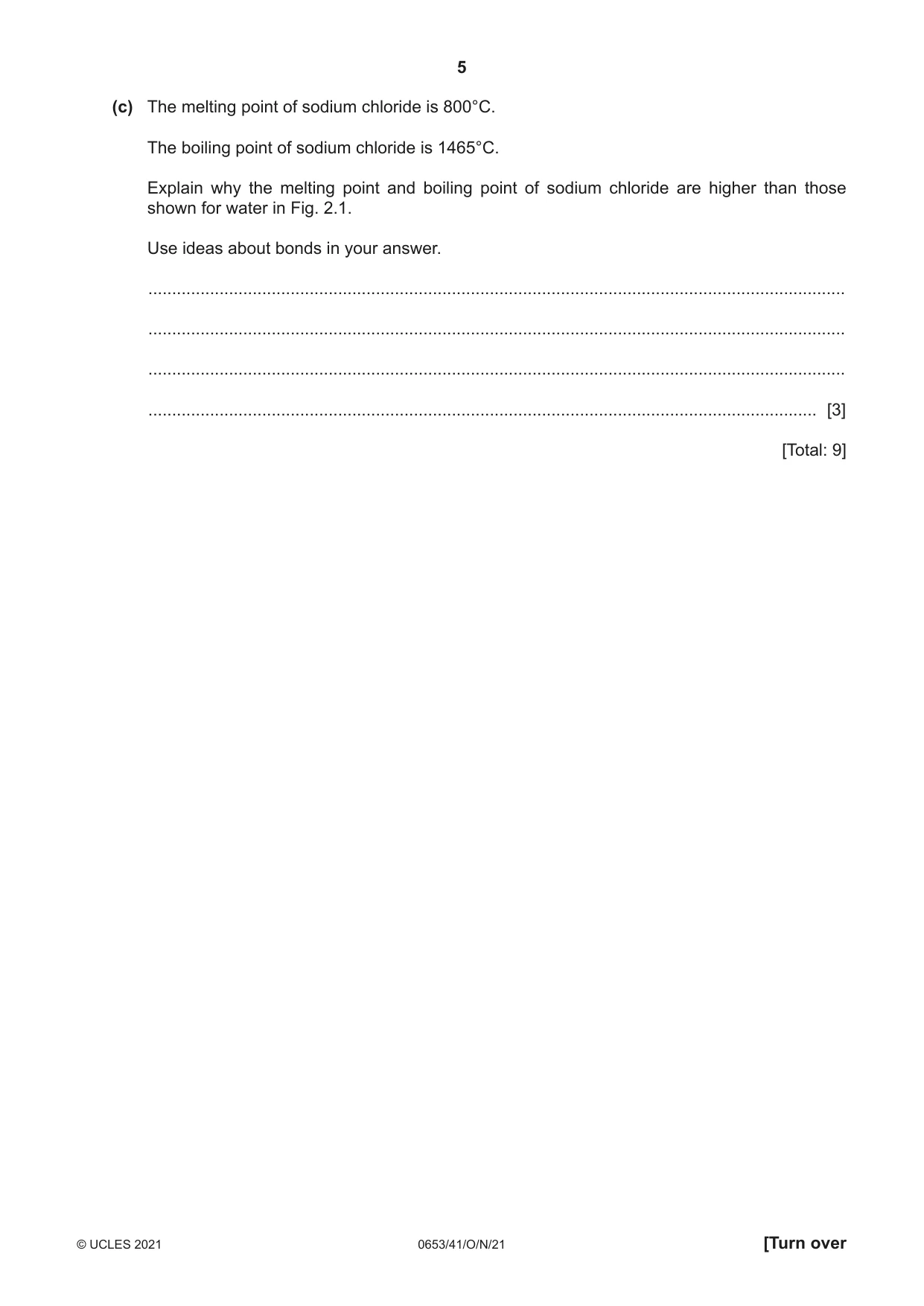
2 Fig. 2.1 shows the energy and state changes for water when it is heated from –10 °C to 120 °C. 120 evaporation gas B liquid 100 A temperature / °C solid C 0 –20 energy Fig. 2.1 (a) State the names of processes A, B and C. A ................................................................ B ................................................................ C ................................................................ [3] (b) Describe the differences between the energy, the arrangement and the movement of the particles in the water at –10 °C and at 120 °C. energy ....................................................................................................................................... ................................................................................................................................................... arrangement ............................................................................................................................. ................................................................................................................................................... movement ................................................................................................................................. ................................................................................................................................................... [3] (c) The melting point of sodium chloride is 800°C. The boiling point of sodium chloride is 1465°C. Explain why the melting point and boiling point of sodium chloride are higher than those shown for water in Fig. 2.1. Use ideas about bonds in your answer. ................................................................................................................................................... ................................................................................................................................................... ................................................................................................................................................... ............................................................................................................................................. [3] [Total: 9]
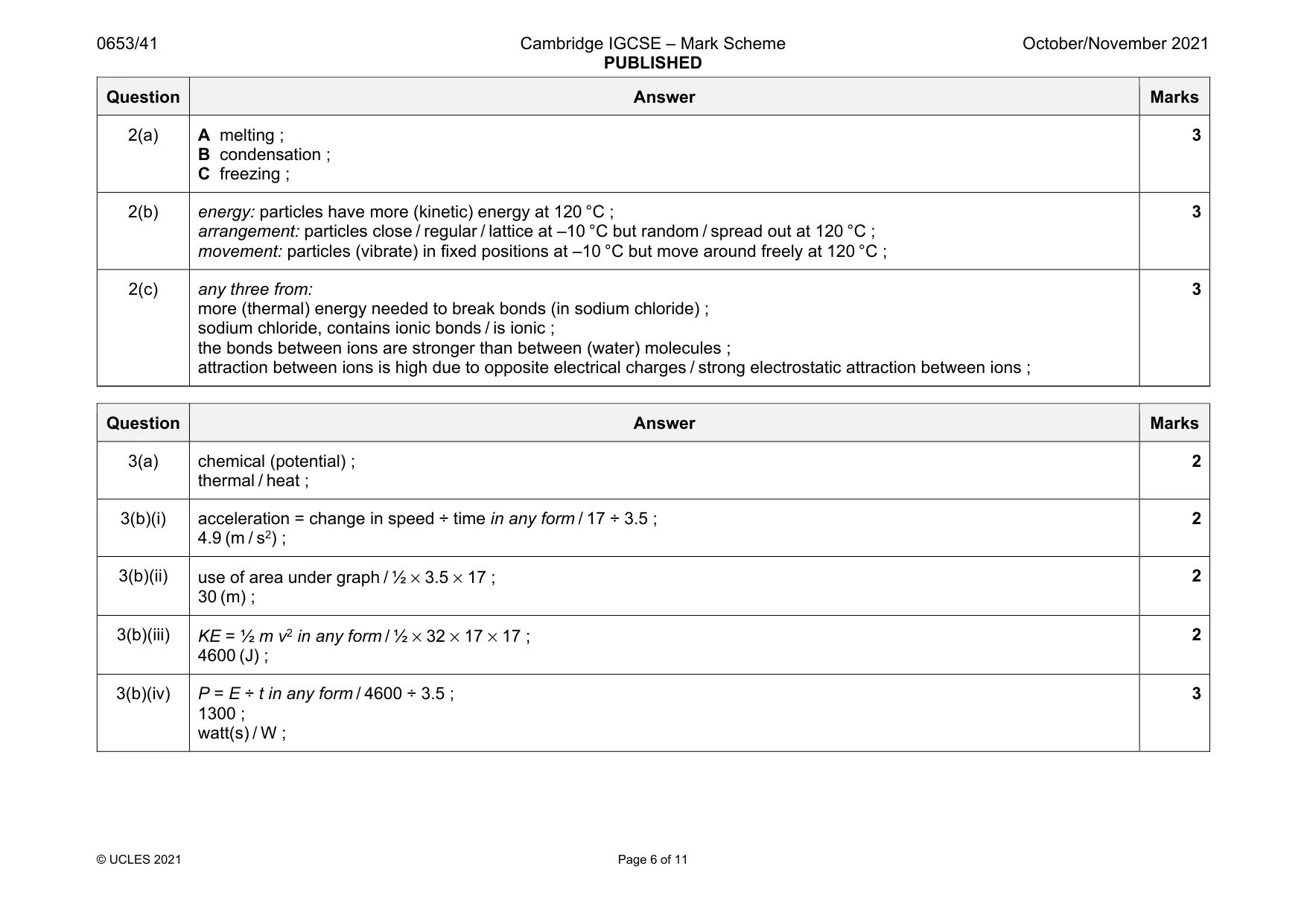
Mark scheme: 2(a) A melting ; B condensation ; C freezing ; 3 2(b) energy: particles have more (kinetic) energy at 120 °C ; arrangement: particles close / regular / lattice at –10 °C but random / spread out at 120 °C ; movement: particles (vibrate) in fixed positions at –10 °C but move around freely at 120 °C ; 3 2(c) any three from: more (thermal) energy needed to break bonds (in sodium chloride) ; sodium chloride, contains ionic bonds / is ionic ; the bonds between ions are stronger than between (water) molecules ; attraction between ions is high due to opposite electrical charges / strong electrostatic attraction between ions ; 3
Q3 · A dog accelerates from rest to a maximum constant speed
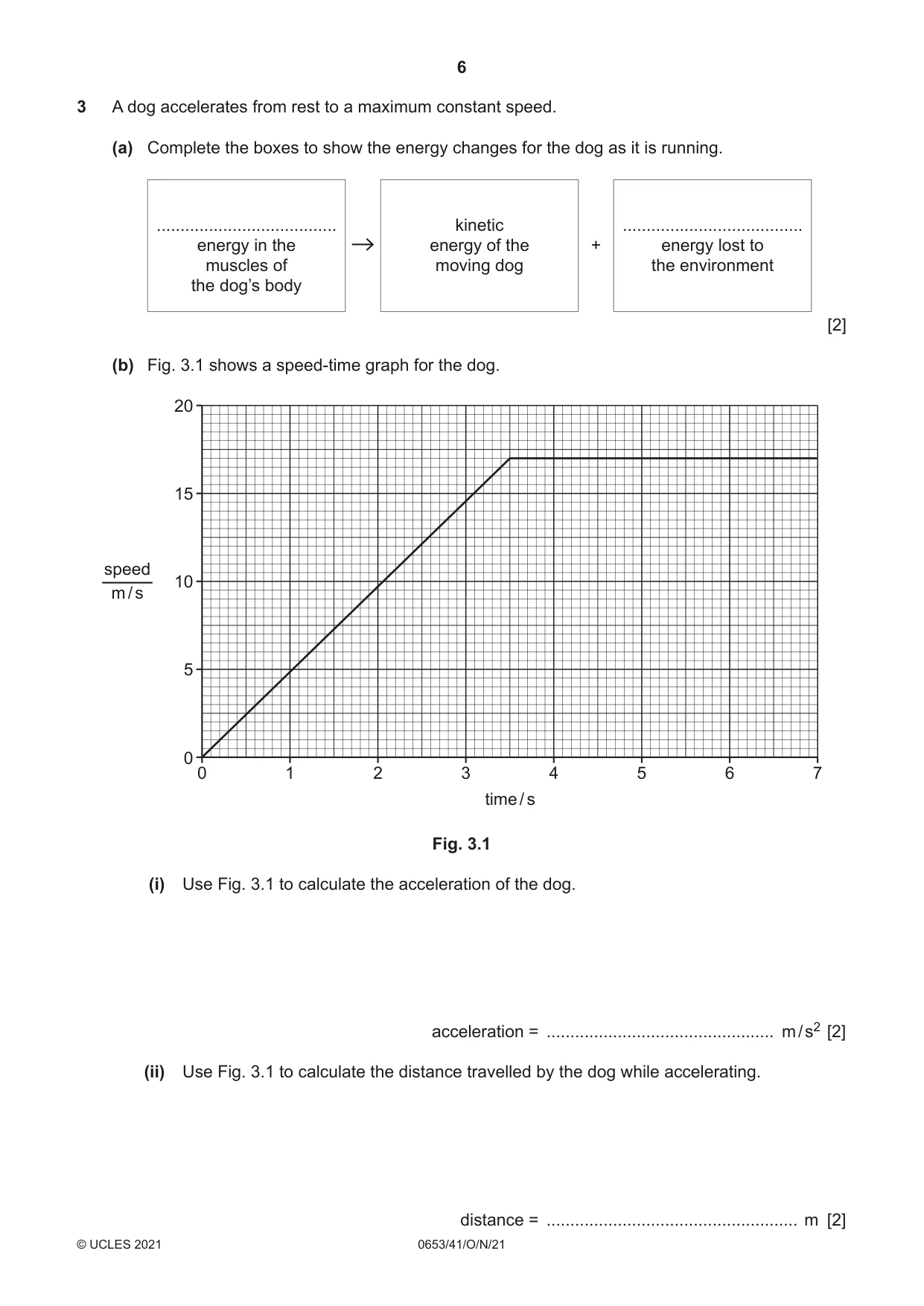
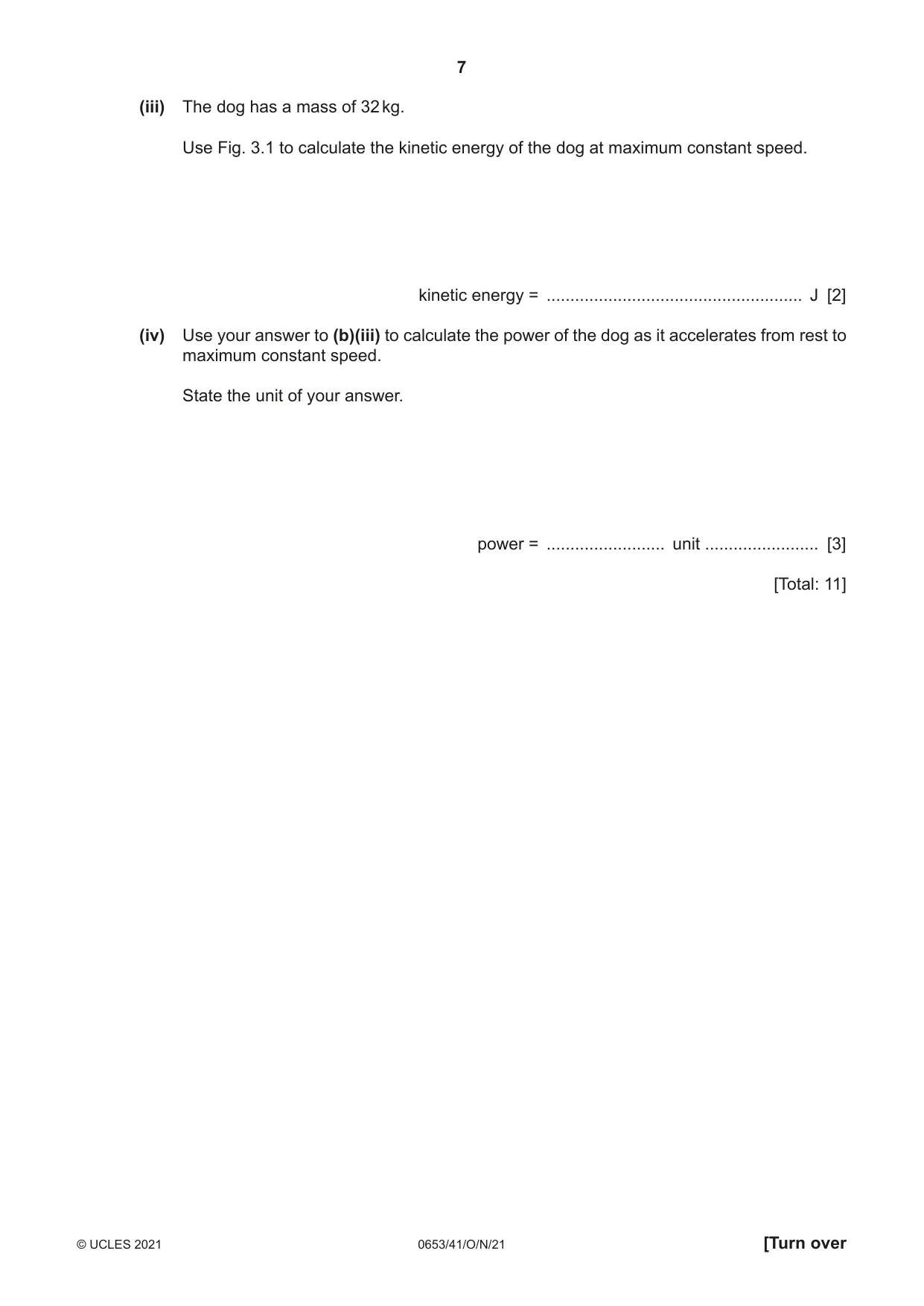
3 A dog accelerates from rest to a maximum constant speed. (a) Complete the boxes to show the energy changes for the dog as it is running. ...................................... kinetic ...................................... energy in the energy of the + energy lost to muscles of moving dog the environment the dog’s body [2] (b) Fig. 3.1 shows a speed-time graph for the dog. 20 15 speed 10 m / s 5 0 0 1 2 3 4 5 6 7 time / s Fig. 3.1 (i) Use Fig. 3.1 to calculate the acceleration of the dog. acceleration = ................................................ m / s2 [2] (ii) Use Fig. 3.1 to calculate the distance travelled by the dog while accelerating. distance = ..................................................... m [2] (iii) The dog has a mass of 32 kg. Use Fig. 3.1 to calculate the kinetic energy of the dog at maximum constant speed. kinetic energy = ...................................................... J [2] (iv) Use your answer to (b)(iii) to calculate the power of the dog as it accelerates from rest to maximum constant speed. State the unit of your answer. power = ......................... unit ........................ [3] [Total: 11]
Mark scheme: 3(a) chemical (potential) ; thermal / heat ; 2 3(b)(i) acceleration = change in speed ÷ time in any form / 17 ÷ 3.5 ; 4.9 (m / s2) ; 2 3(b)(ii) use of area under graph / ½ × 3.5 × 17 ; 30 (m) ; 2 3(b)(iii) KE = ½ m v2 in any form / ½ × 32 × 17 × 17 ; 4600 (J) ; 2 3(b)(iv) P = E ÷ t in any form / 4600 ÷ 3.5 ; 1300 ; watt(s) / W ; 3
Q4 · Complete the sentence to define an ecosystem
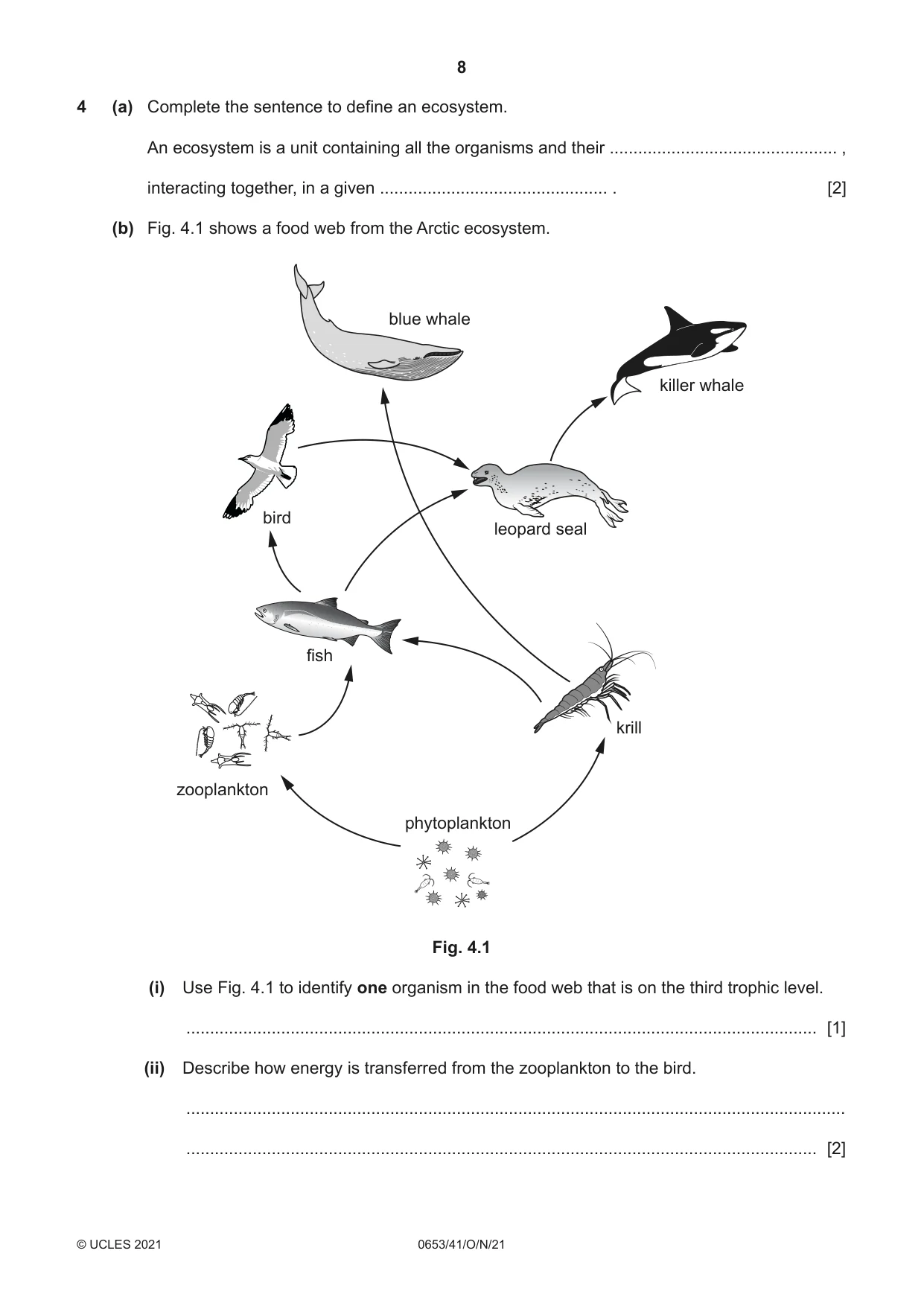
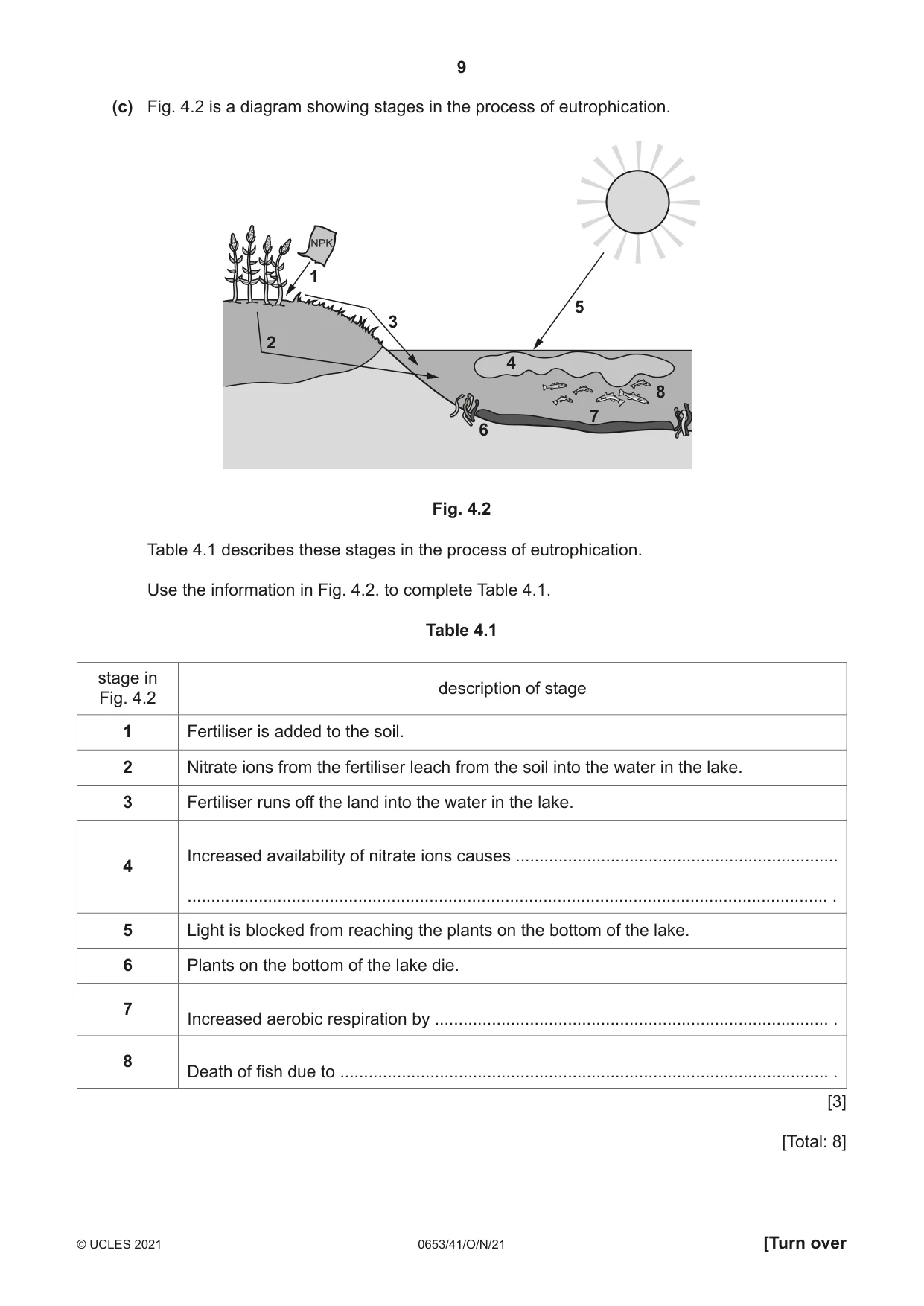
4 (a) Complete the sentence to define an ecosystem. An ecosystem is a unit containing all the organisms and their ................................................ , interacting together, in a given ................................................ . [2] (b) Fig. 4.1 shows a food web from the Arctic ecosystem. blue whale killer whale bird leopard seal fish krill zooplankton phytoplankton Fig. 4.1 (i) Use Fig. 4.1 to identify one organism in the food web that is on the third trophic level. ..................................................................................................................................... [1] (ii) Describe how energy is transferred from the zooplankton to the bird. ........................................................................................................................................... ..................................................................................................................................... [2] (c) Fig. 4.2 is a diagram showing stages in the process of eutrophication. 1 5 3 2 4 8 7 6 Fig. 4.2 Table 4.1 describes these stages in the process of eutrophication. Use the information in Fig. 4.2. to complete Table 4.1. Table 4.1 stage in description of stageFig. 4.2 1 Fertiliser is added to the soil. 2 Nitrate ions from the fertiliser leach from the soil into the water in the lake. 3 Fertiliser runs off the land into the water in the lake. Increased availability of nitrate ions causes .................................................................... 4 ....................................................................................................................................... . 5 Light is blocked from reaching the plants on the bottom of the lake. 6 Plants on the bottom of the lake die. 7 Increased aerobic respiration by ................................................................................... . 8 Death of fish due to ....................................................................................................... . [3] [Total: 8]
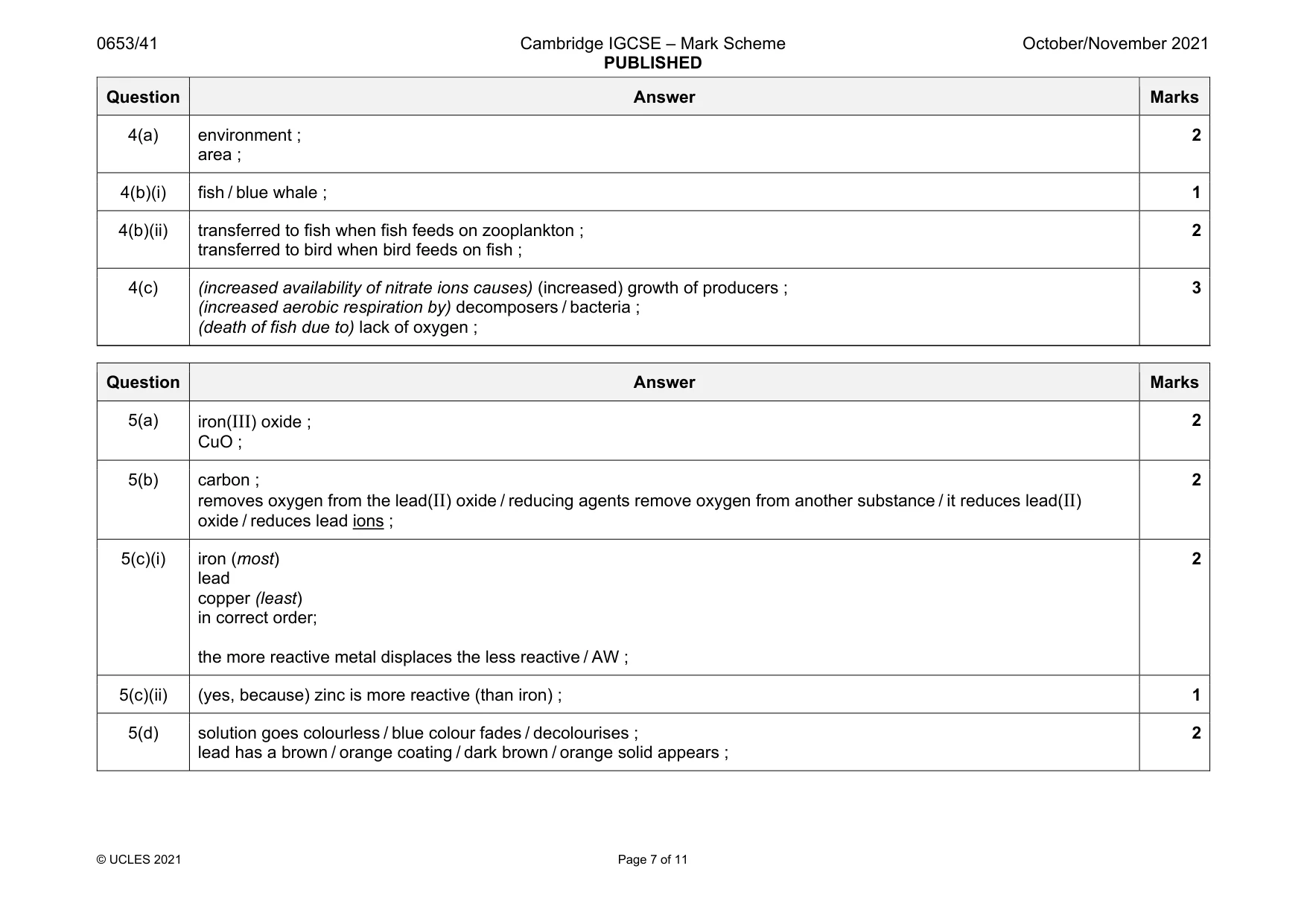
Mark scheme: 4(a) environment ; area ; 2 4(b)(i) fish / blue whale ; 1 4(b)(ii) transferred to fish when fish feeds on zooplankton ; transferred to bird when bird feeds on fish ; 2 4(c) (increased availability of nitrate ions causes) (increased) growth of producers ; (increased aerobic respiration by) decomposers / bacteria ; (death of fish due to) lack of oxygen ; 3
Q5 · Some names and some formulae of four metal oxides
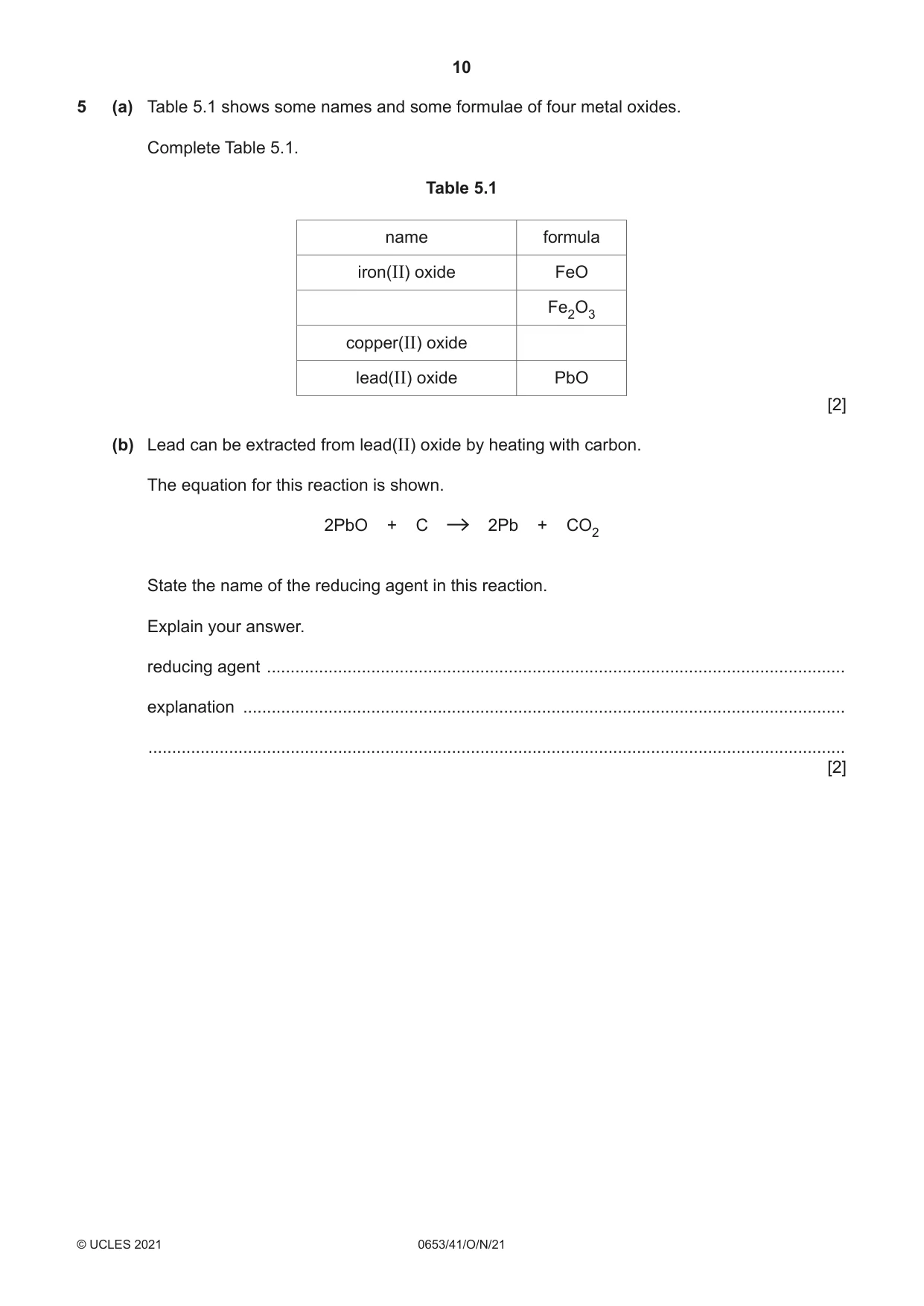
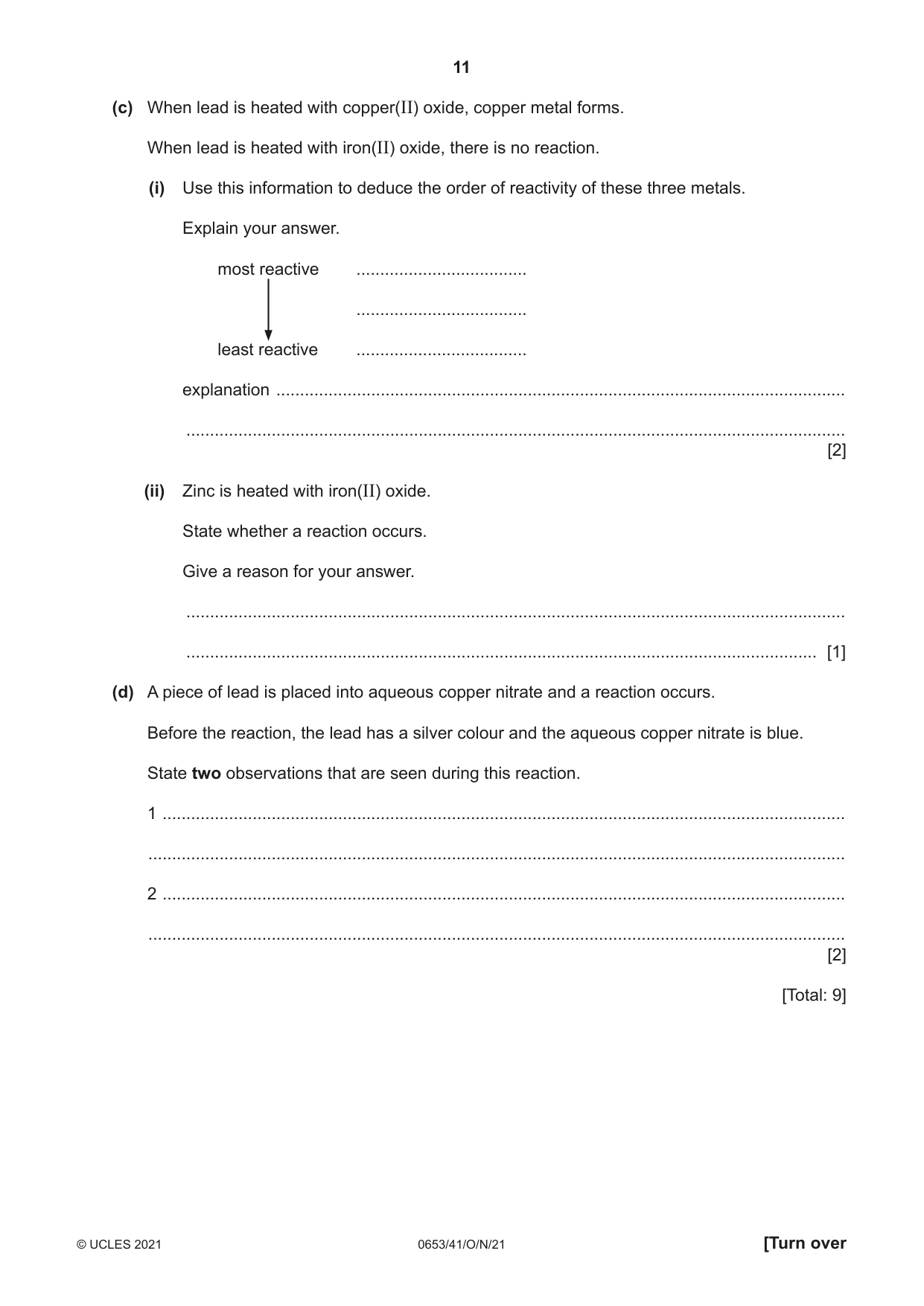
5 (a) Table 5.1 shows some names and some formulae of four metal oxides. Complete Table 5.1. Table 5.1 name formula iron(II) oxide FeO Fe2O3 copper(II) oxide lead(II) oxide PbO [2] (b) Lead can be extracted from lead(II) oxide by heating with carbon. The equation for this reaction is shown. 2PbO + C 2Pb + CO2 State the name of the reducing agent in this reaction. Explain your answer. reducing agent .......................................................................................................................... explanation ............................................................................................................................... ................................................................................................................................................... [2] (c) When lead is heated with copper(II) oxide, copper metal forms. When lead is heated with iron(II) oxide, there is no reaction. (i) Use this information to deduce the order of reactivity of these three metals. Explain your answer. most reactive .................................... .................................... least reactive .................................... explanation ........................................................................................................................ ........................................................................................................................................... [2] (ii) Zinc is heated with iron(II) oxide. State whether a reaction occurs. Give a reason for your answer. ........................................................................................................................................... ..................................................................................................................................... [1] (d) A piece of lead is placed into aqueous copper nitrate and a reaction occurs. Before the reaction, the lead has a silver colour and the aqueous copper nitrate is blue. State two observations that are seen during this reaction. 1 ................................................................................................................................................ ................................................................................................................................................... 2 ................................................................................................................................................ ................................................................................................................................................... [2] [Total: 9]
Mark scheme: 5(a) iron(III) oxide ; CuO ; 2 5(b) carbon ; removes oxygen from the lead(II) oxide / reducing agents remove oxygen from another substance / it reduces lead(II) oxide / reduces lead ions ; 2 5(c)(i) iron (most) lead copper (least) in correct order; the more reactive metal displaces the less reactive / AW ; 2 5(c)(ii) (yes, because) zinc is more reactive (than iron) ; 1 5(d) solution goes colourless / blue colour fades / decolourises ; lead has a brown / orange coating / dark brown / orange solid appears ; 2
Q6 · The compressions and rarefactions of a sound wave in air
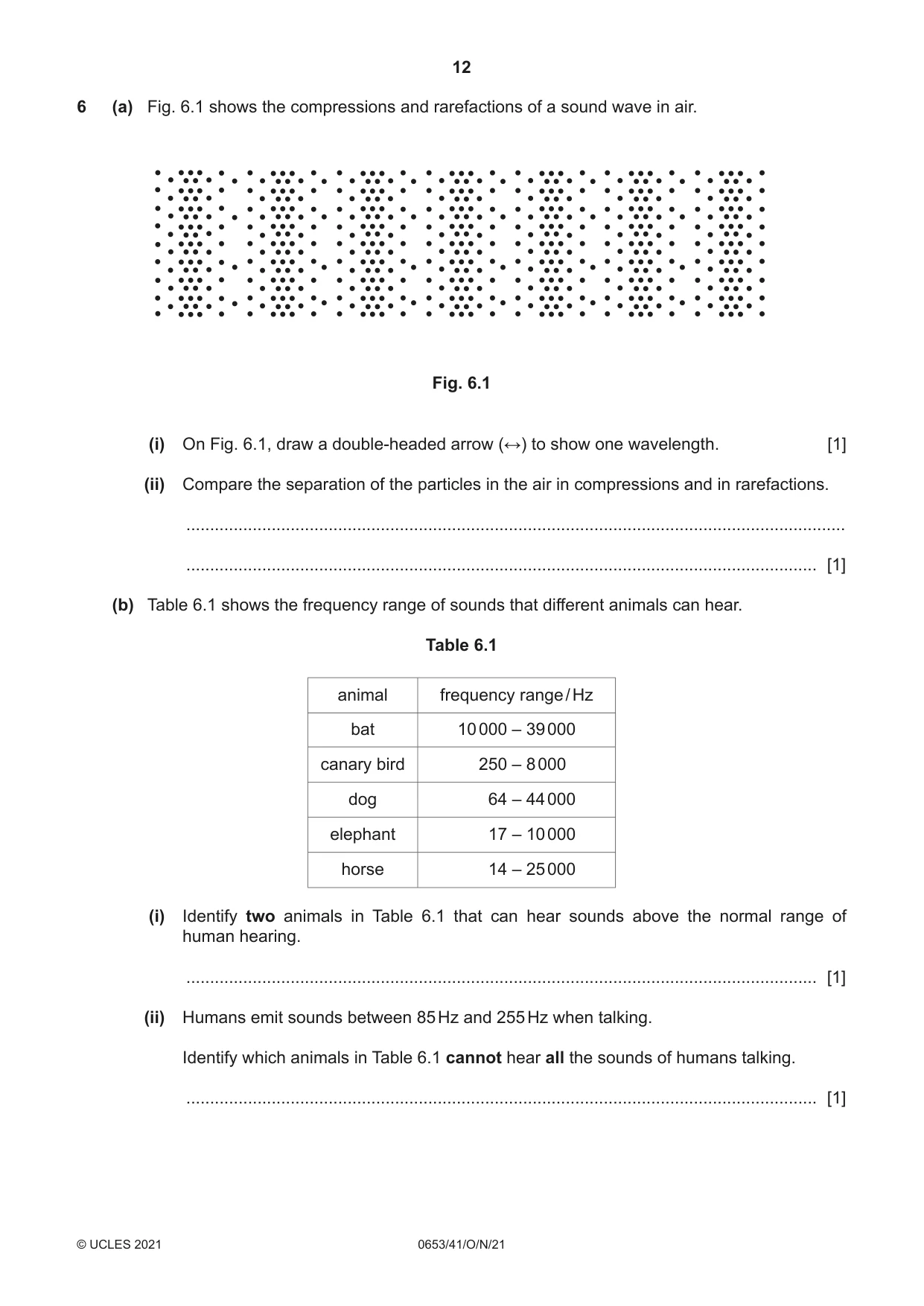
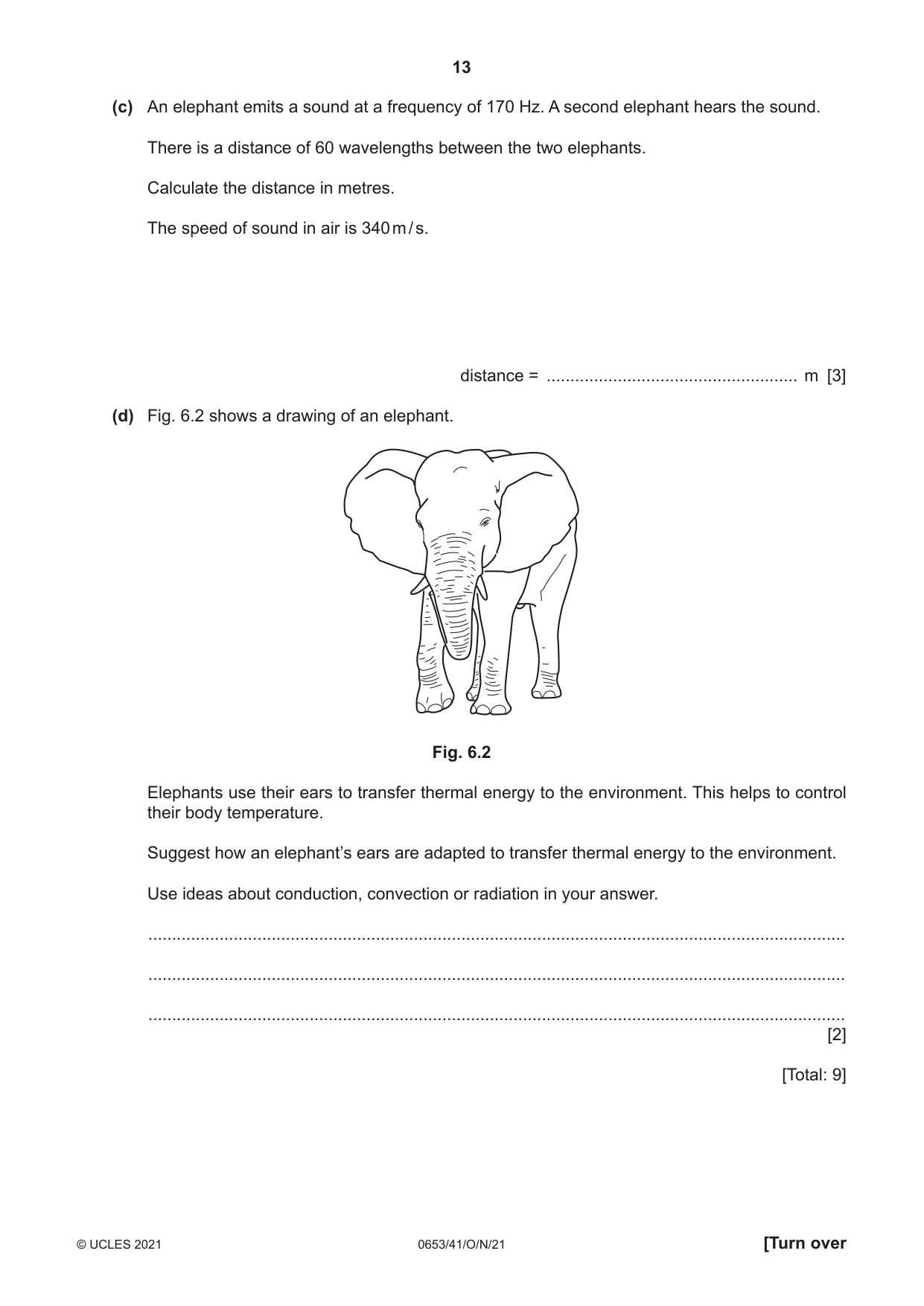
6 (a) Fig. 6.1 shows the compressions and rarefactions of a sound wave in air. Fig. 6.1 (i) On Fig. 6.1, draw a double-headed arrow (↔) to show one wavelength. [1] (ii) Compare the separation of the particles in the air in compressions and in rarefactions. ........................................................................................................................................... ..................................................................................................................................... [1] (b) Table 6.1 shows the frequency range of sounds that different animals can hear. Table 6.1 animal frequency range / Hz bat 10 000 – 39 000 canary bird 250 – 8 000 dog 64 – 44 000 elephant 17 – 10 000 horse 14 – 25 000 (i) Identify two animals in Table 6.1 that can hear sounds above the normal range of human hearing. ..................................................................................................................................... [1] (ii) Humans emit sounds between 85 Hz and 255 Hz when talking. Identify which animals in Table 6.1 cannot hear all the sounds of humans talking. ..................................................................................................................................... [1] (c) An elephant emits a sound at a frequency of 170 Hz. A second elephant hears the sound. There is a distance of 60 wavelengths between the two elephants. Calculate the distance in metres. The speed of sound in air is 340 m / s. distance = ..................................................... m [3] (d) Fig. 6.2 shows a drawing of an elephant. Fig. 6.2 Elephants use their ears to transfer thermal energy to the environment. This helps to control their body temperature. Suggest how an elephant’s ears are adapted to transfer thermal energy to the environment. Use ideas about conduction, convection or radiation in your answer. ................................................................................................................................................... ................................................................................................................................................... ................................................................................................................................................... [2] [Total: 9]
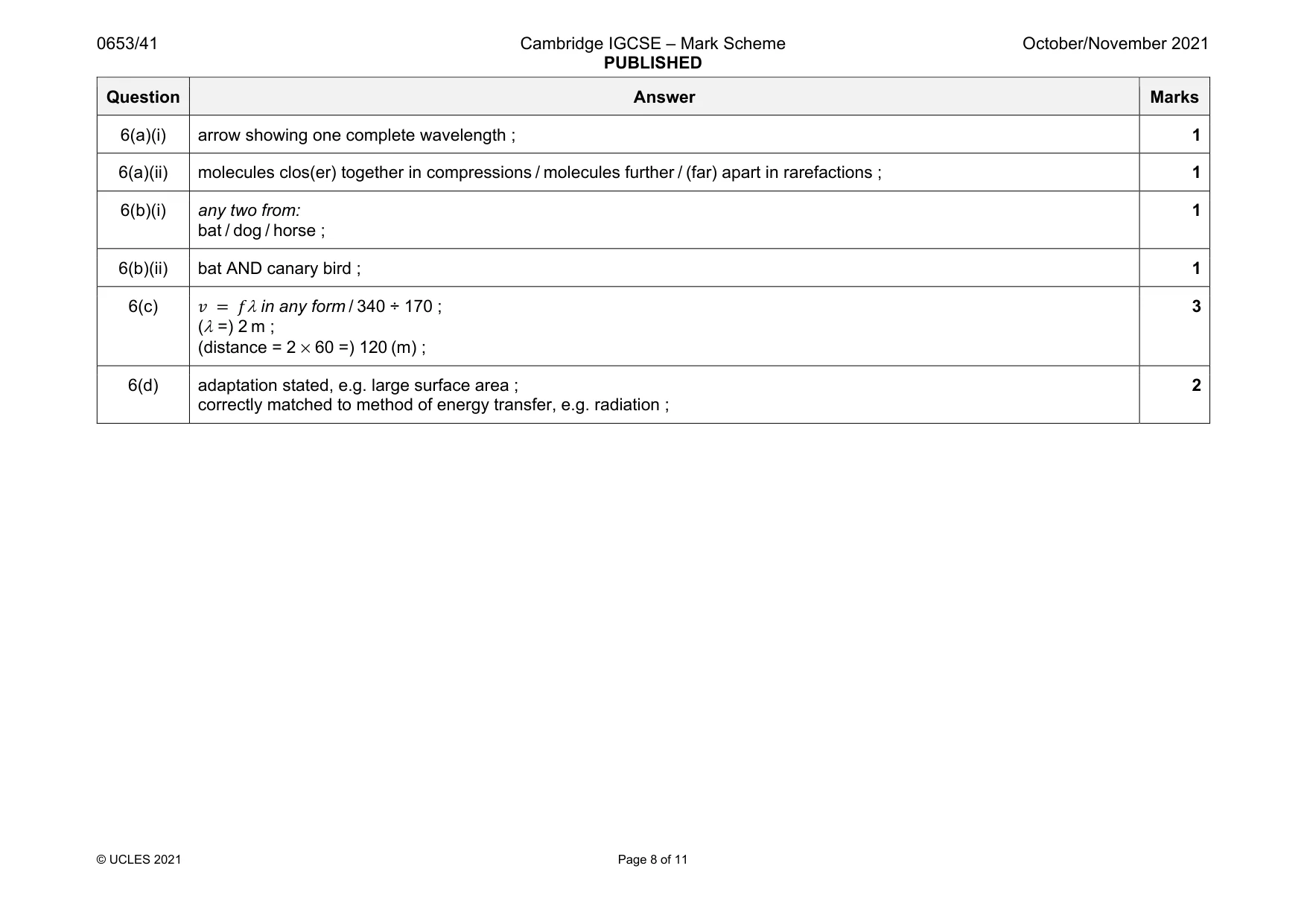
Mark scheme: 6(a)(i) arrow showing one complete wavelength ; 1 6(a)(ii) molecules clos(er) together in compressions / molecules further / (far) apart in rarefactions ; 1 6(b)(i) any two from: bat / dog / horse ; 1 6(b)(ii) bat AND canary bird ; 1 6(c) 𝑣 = 𝑓 in any form / 340 ÷ 170 ; ( =) 2 m ; (distance = 2 × 60 =) 120 (m) ; 3 6(d) adaptation stated, e.g. large surface area ; correctly matched to method of energy transfer, e.g. radiation ; 2
Q7 · A diagram of the gas exchange system in humans
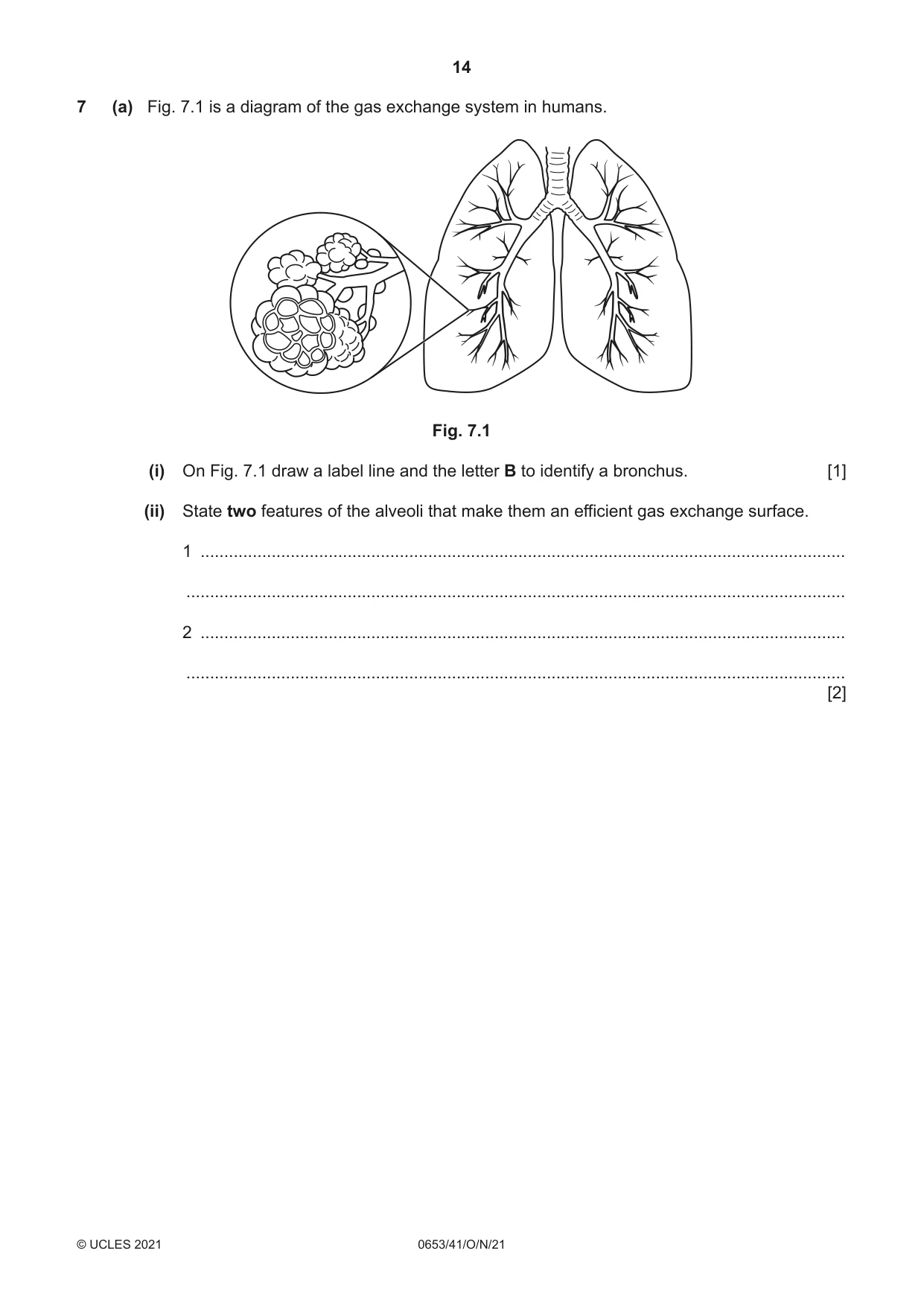
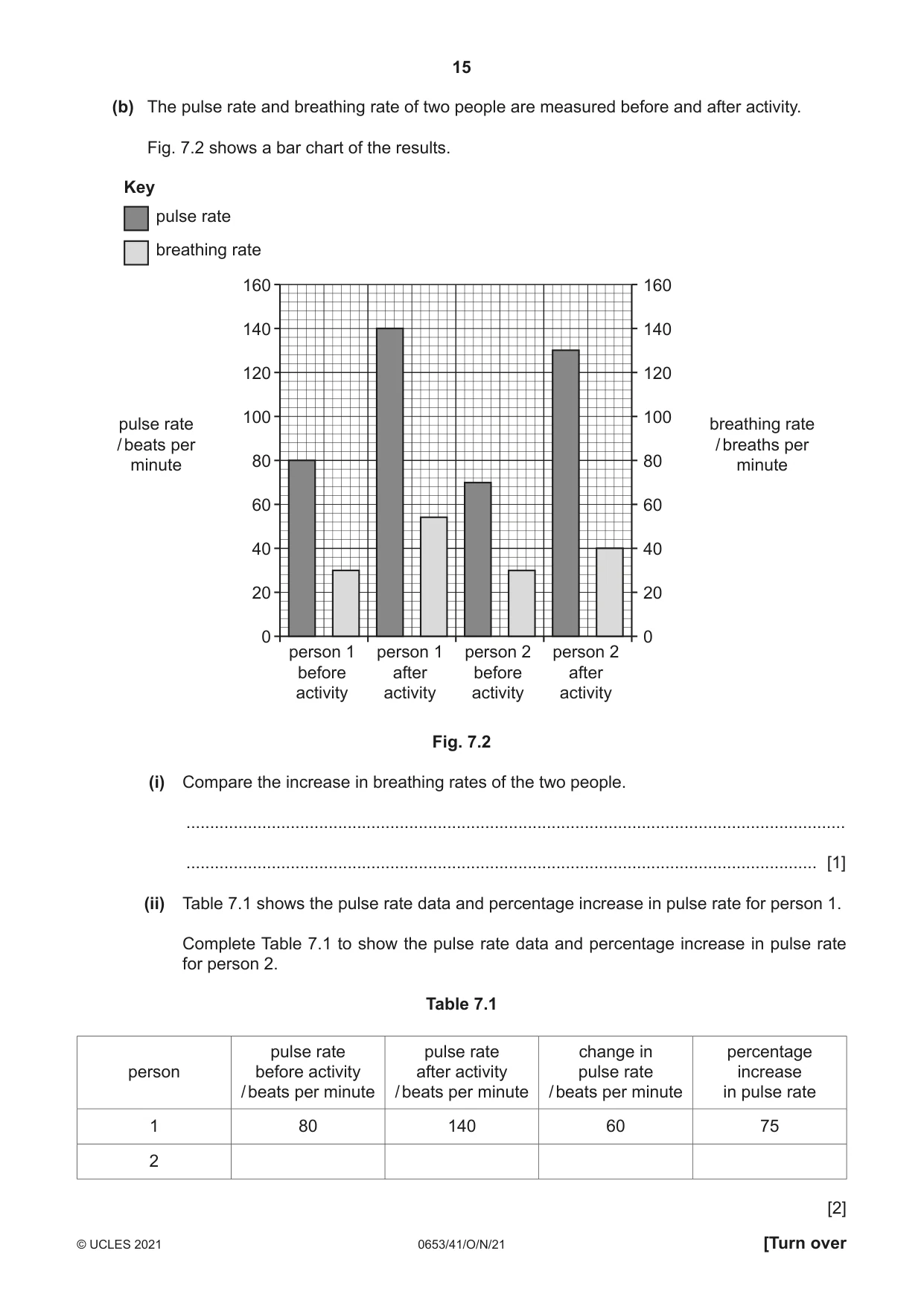
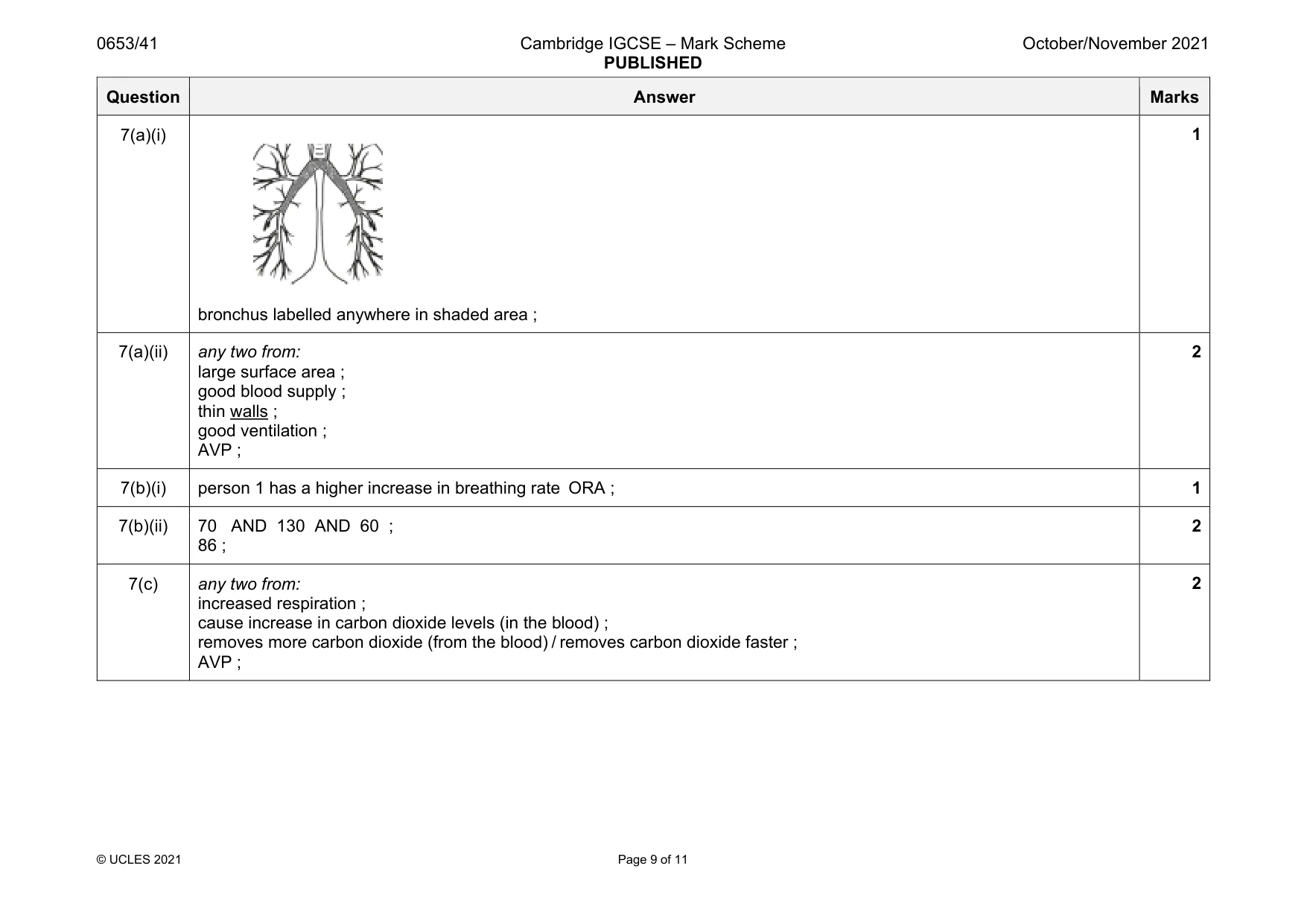
7 (a) Fig. 7.1 is a diagram of the gas exchange system in humans. Fig. 7.1 (i) On Fig. 7.1 draw a label line and the letter B to identify a bronchus. [1] (ii) State two features of the alveoli that make them an efficient gas exchange surface. 1 ........................................................................................................................................ ........................................................................................................................................... 2 ........................................................................................................................................ ........................................................................................................................................... [2] (b) The pulse rate and breathing rate of two people are measured before and after activity. Fig. 7.2 shows a bar chart of the results. Key pulse rate breathing rate 160 160 140 140 120 120 100 100 pulse rate breathing rate / beats per / breaths per minute 80 80 minute 60 60 40 40 20 20 0 0 person 1 person 1 person 2 person 2 before after before after activity activity activity activity Fig. 7.2 (i) Compare the increase in breathing rates of the two people. ........................................................................................................................................... ..................................................................................................................................... [1] (ii) Table 7.1 shows the pulse rate data and percentage increase in pulse rate for person 1. Complete Table 7.1 to show the pulse rate data and percentage increase in pulse rate for person 2. Table 7.1 pulse rate pulse rate change in percentage person before activity after activity pulse rate increase / beats per minute / beats per minute / beats per minute in pulse rate 1 80 140 60 75 2 [2] (c) One reason why breathing rate increases during activity is the need for more oxygen. Explain one other reason why breathing rate increases during activity. ................................................................................................................................................... ................................................................................................................................................... ................................................................................................................................................... ............................................................................................................................................. [2] [Total: 8]
Mark scheme: 7(a)(i) bronchus labelled anywhere in shaded area ; 7(a)(ii) any two from: large surface area ; good blood supply ; thin walls ; good ventilation ; AVP ; 2 7(b)(i) person 1 has a higher increase in breathing rate ORA ; 1 7(b)(ii) 70 AND 130 AND 60 ; 86 ; 2 7(c) any two from: increased respiration ; cause increase in carbon dioxide levels (in the blood) ; removes more carbon dioxide (from the blood) / removes carbon dioxide faster ; AVP ; 2
Q8 · A scientist uses three processes to treat a sample of sea water to make it safe to drink…
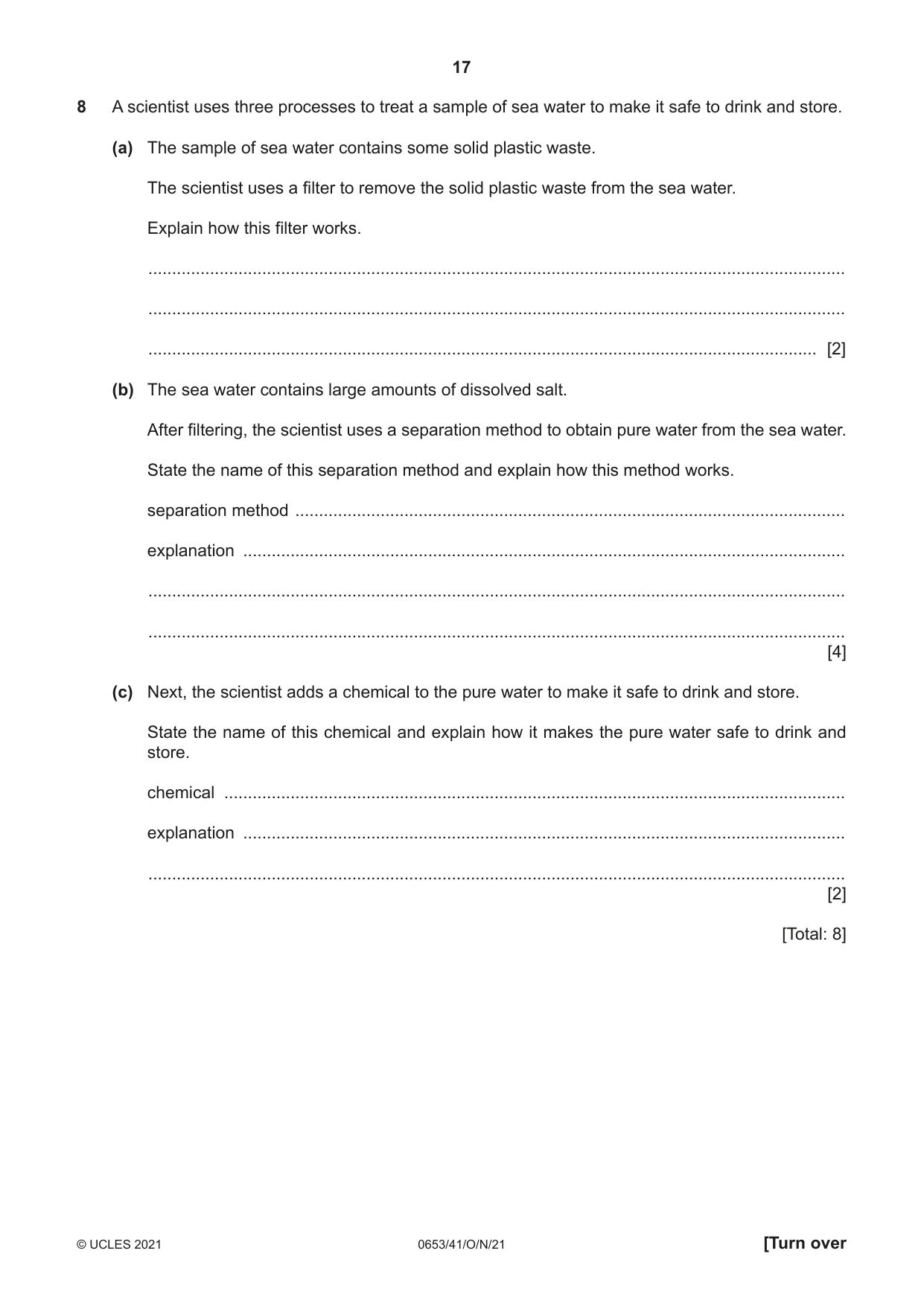
8 A scientist uses three processes to treat a sample of sea water to make it safe to drink and store. (a) The sample of sea water contains some solid plastic waste. The scientist uses a filter to remove the solid plastic waste from the sea water. Explain how this filter works. ................................................................................................................................................... ................................................................................................................................................... ............................................................................................................................................. [2] (b) The sea water contains large amounts of dissolved salt. After filtering, the scientist uses a separation method to obtain pure water from the sea water. State the name of this separation method and explain how this method works. separation method .................................................................................................................... explanation ............................................................................................................................... ................................................................................................................................................... ................................................................................................................................................... [4] (c) Next, the scientist adds a chemical to the pure water to make it safe to drink and store. State the name of this chemical and explain how it makes the pure water safe to drink and store. chemical ................................................................................................................................... explanation ............................................................................................................................... ................................................................................................................................................... [2] [Total: 8]
Mark scheme: 8(a) any two from: (sea) water / solutions, pass through filter ; insoluble materials / plastic / solids, do not pass through filter ; description of, filter / filter paper, as being, porous / having (small) holes ; 2 8(b) distillation ; heat / boil / evaporate, (sea) water ; salt is left behind ; condense / cool, steam / water vapour (to obtain pure water); 4 8(c) chlorine ; kills any bacteria in the water ; 2
Q9 · A student connects a heater and four identical lamps to a battery
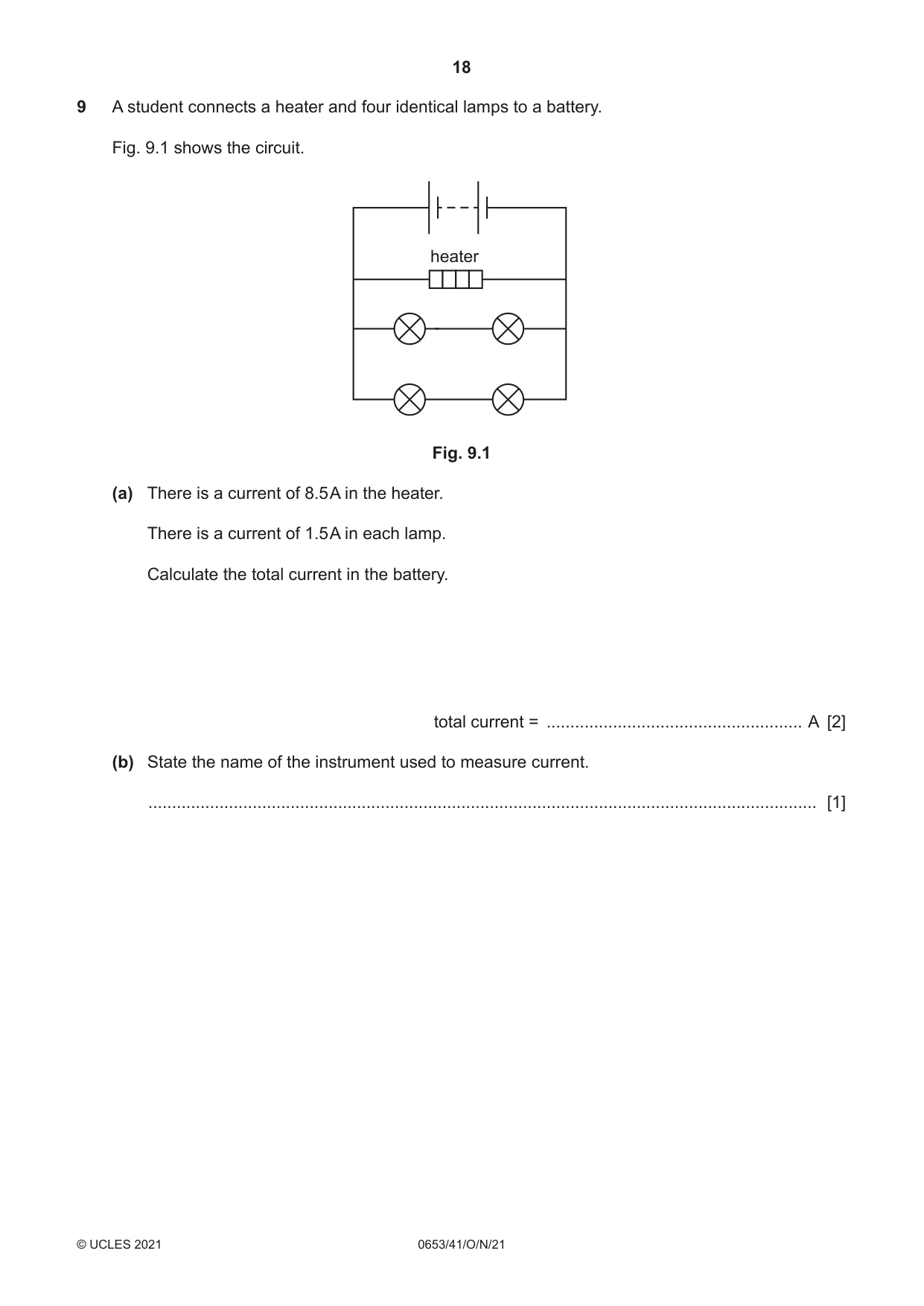
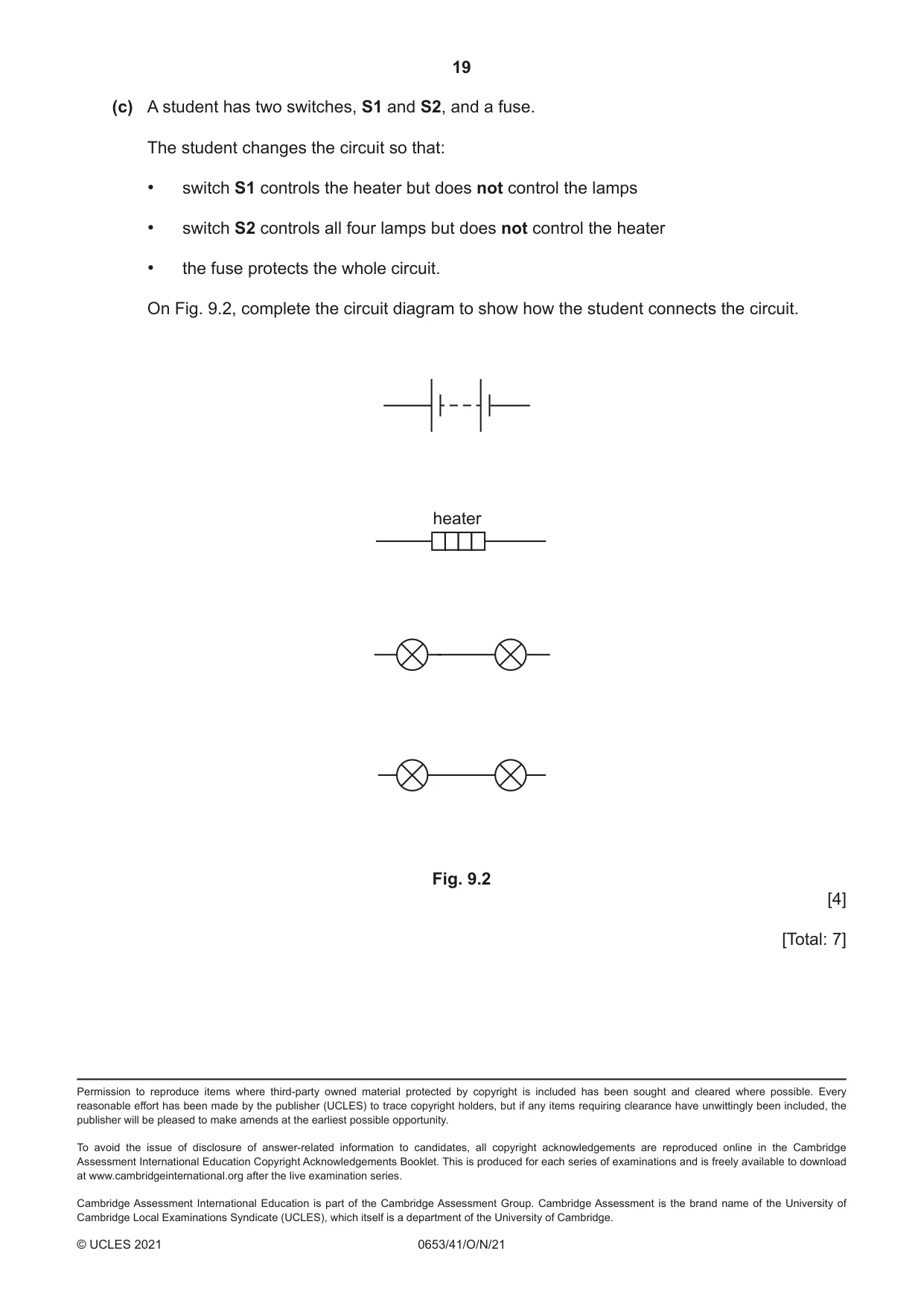
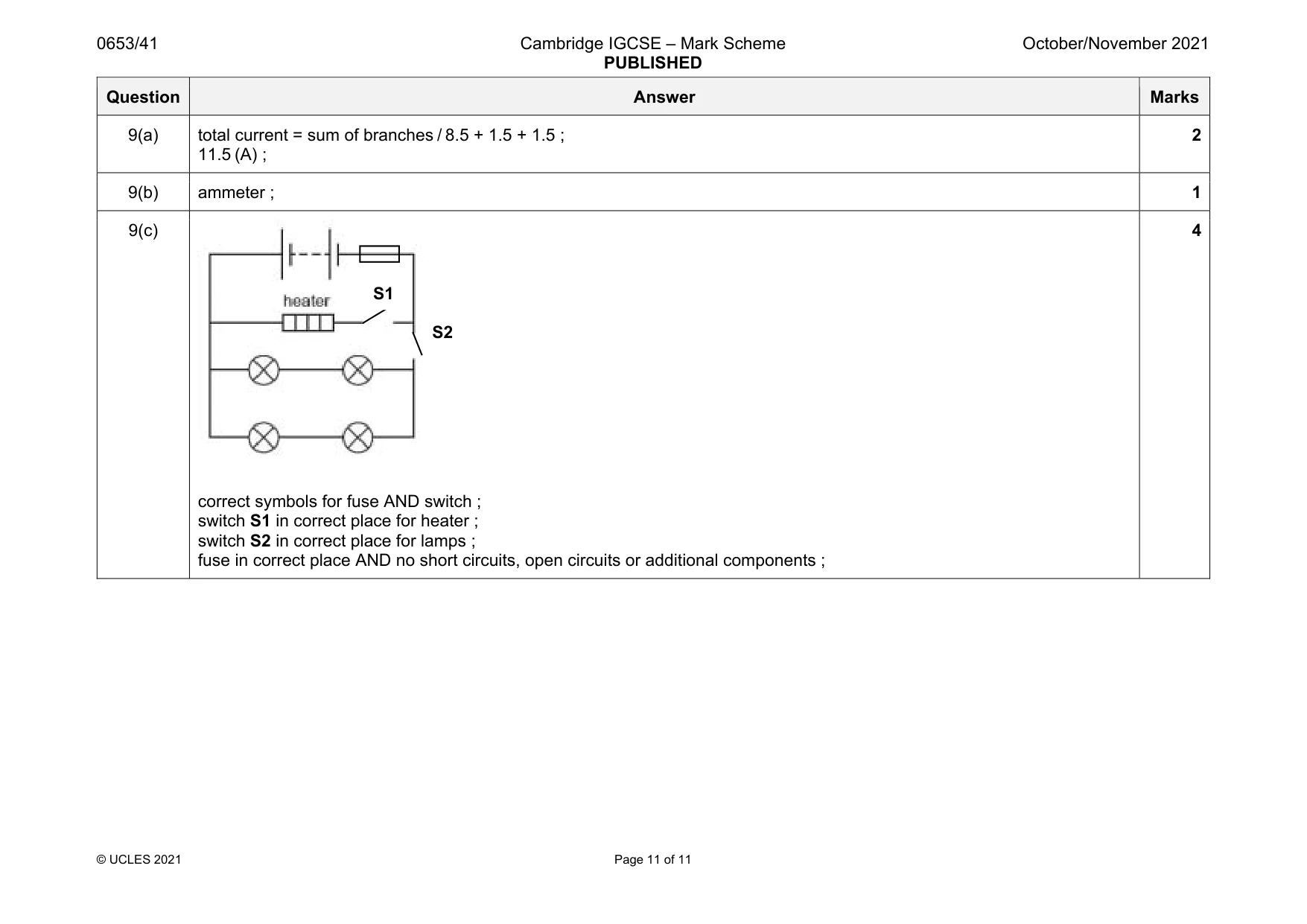
9 A student connects a heater and four identical lamps to a battery. Fig. 9.1 shows the circuit. heater Fig. 9.1 (a) There is a current of 8.5 A in the heater. There is a current of 1.5 A in each lamp. Calculate the total current in the battery. total current = ...................................................... A [2] (b) State the name of the instrument used to measure current. ............................................................................................................................................. [1] (c) A student has two switches, S1 and S2, and a fuse. The student changes the circuit so that: • switch S1 controls the heater but does not control the lamps • switch S2 controls all four lamps but does not control the heater • the fuse protects the whole circuit. On Fig. 9.2, complete the circuit diagram to show how the student connects the circuit. heater Fig. 9.2 [4] [Total: 7]
Mark scheme: 9(a) total current = sum of branches / 8.5 + 1.5 + 1.5 ; 11.5 (A) ; 2 9(b) ammeter ; 1 9(c) correct symbols for fuse AND switch ; switch S1 in correct place for heater ; switch S2 in correct place for lamps ; fuse in correct place AND no short circuits, open circuits or additional components ; 4 S1 S2
What was in this paper
The subtopics covered by these 9 questions, and how many questions each got. Open one in a new tab to see every Cambridge question on it.
What you needed in this session
Cambridge’s own grade thresholds for 2021 Oct/Nov, Paper 4 · Variant 1. A higher threshold means an easier paper — the bar moves with how the cohort did.