Cambridge IGCSE Science - Combined 0653 — 2025 May/June Paper 4 · Variant 1
0653/41/M/J/25 · 9 questions · 80 marks · 75 min
The question paper and its mark scheme, free to read here and free to download. This is Cambridge’s own paper, exactly as it was sat.
Question paper24 pages

Mark scheme11 pages
Answers below. Sit the paper first if you are practising.
Questions as text
Q1 · Fats are broken down in the small intestine by chemical digestion
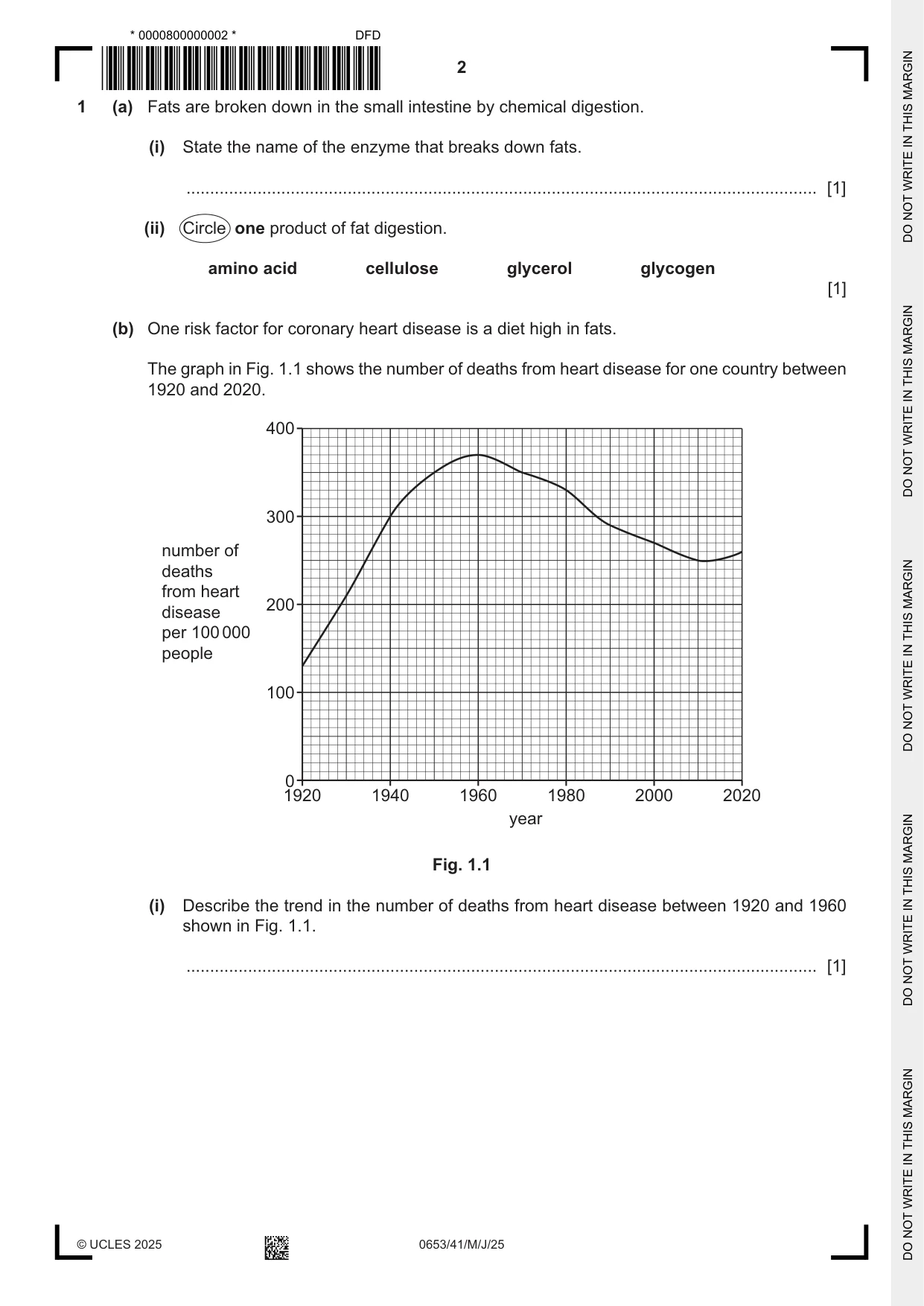
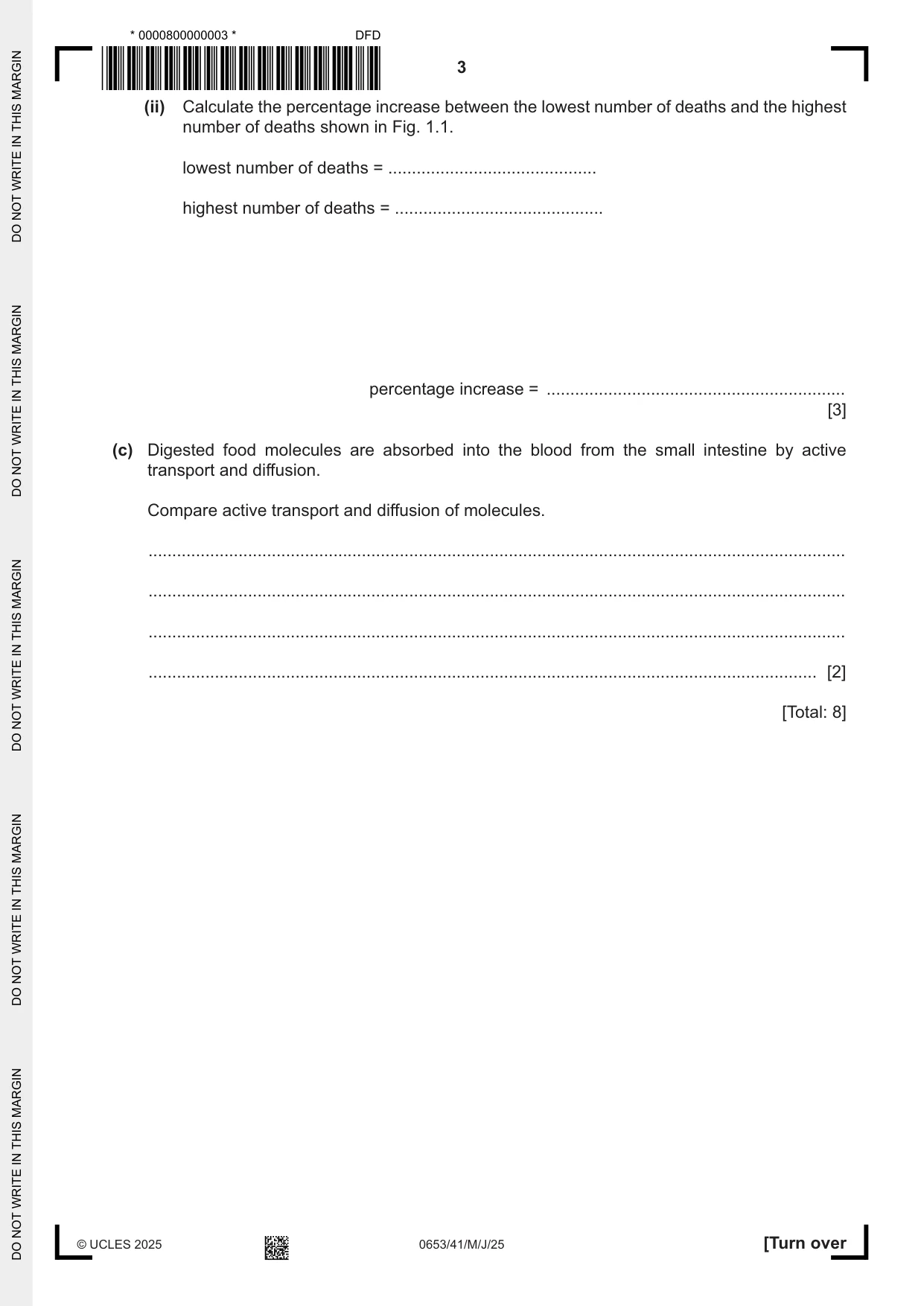
1 (a) Fats are broken down in the small intestine by chemical digestion. (i) State the name of the enzyme that breaks down fats. ..................................................................................................................................... [1] (ii) Circle one product of fat digestion. amino acid cellulose glycerol glycogen [1] (b) One risk factor for coronary heart disease is a diet high in fats. The graph in Fig. 1.1 shows the number of deaths from heart disease for one country between 1920 and 2020. 400 300 number of deaths from heart 200 disease per 100 000 people 100 0 1920 1940 1960 1980 2000 2020 year Fig. 1.1 (i) Describe the trend in the number of deaths from heart disease between 1920 and 1960 shown in Fig. 1.1. ..................................................................................................................................... [1] (ii) Calculate the percentage increase between the lowest number of deaths and the highest number of deaths shown in Fig. 1.1. lowest number of deaths = ............................................ highest number of deaths = ............................................ percentage increase = ............................................................... [3] (c) Digested food molecules are absorbed into the blood from the small intestine by active transport and diffusion. Compare active transport and diffusion of molecules. ................................................................................................................................................... ................................................................................................................................................... ................................................................................................................................................... ............................................................................................................................................. [2] [Total: 8]
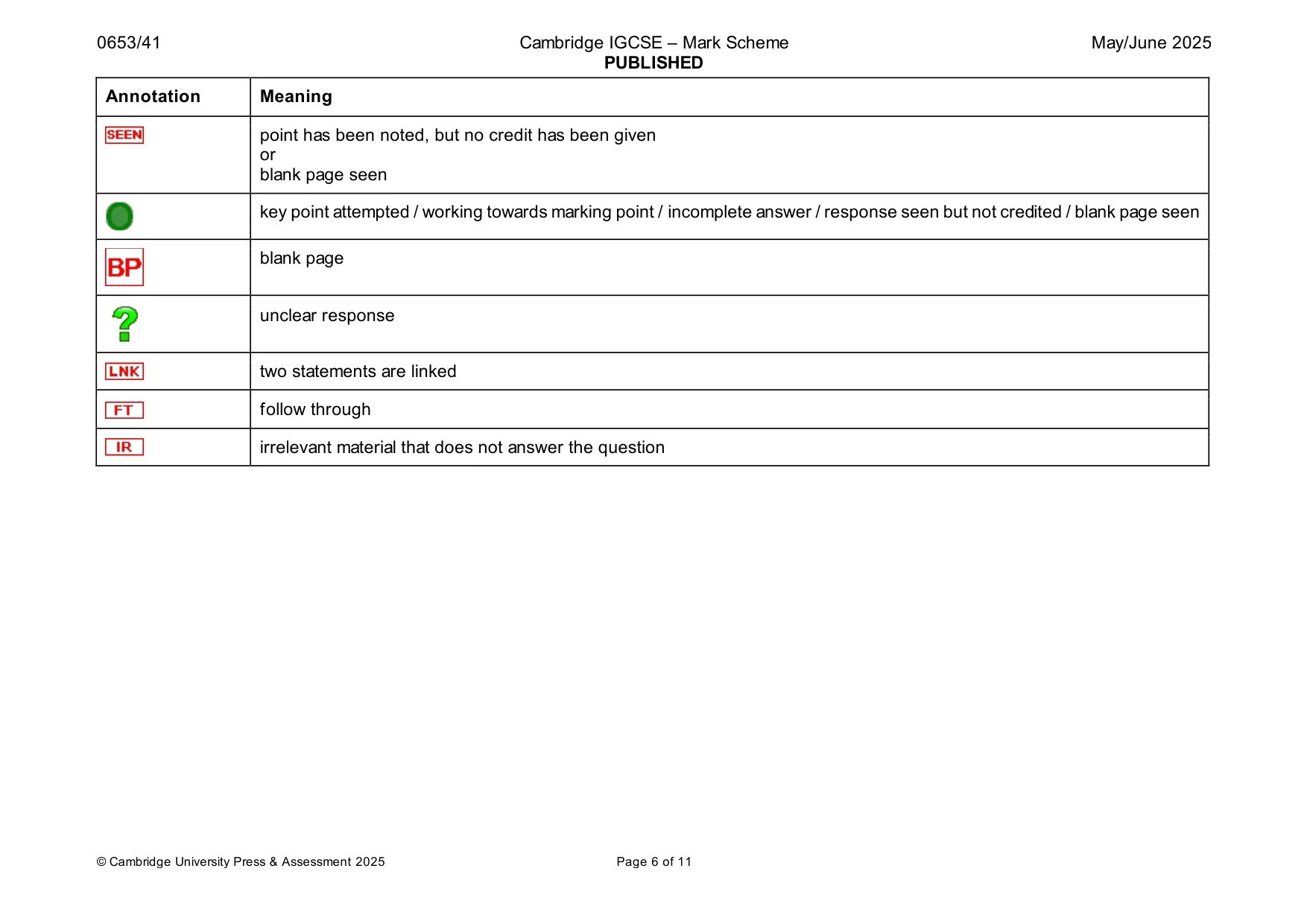
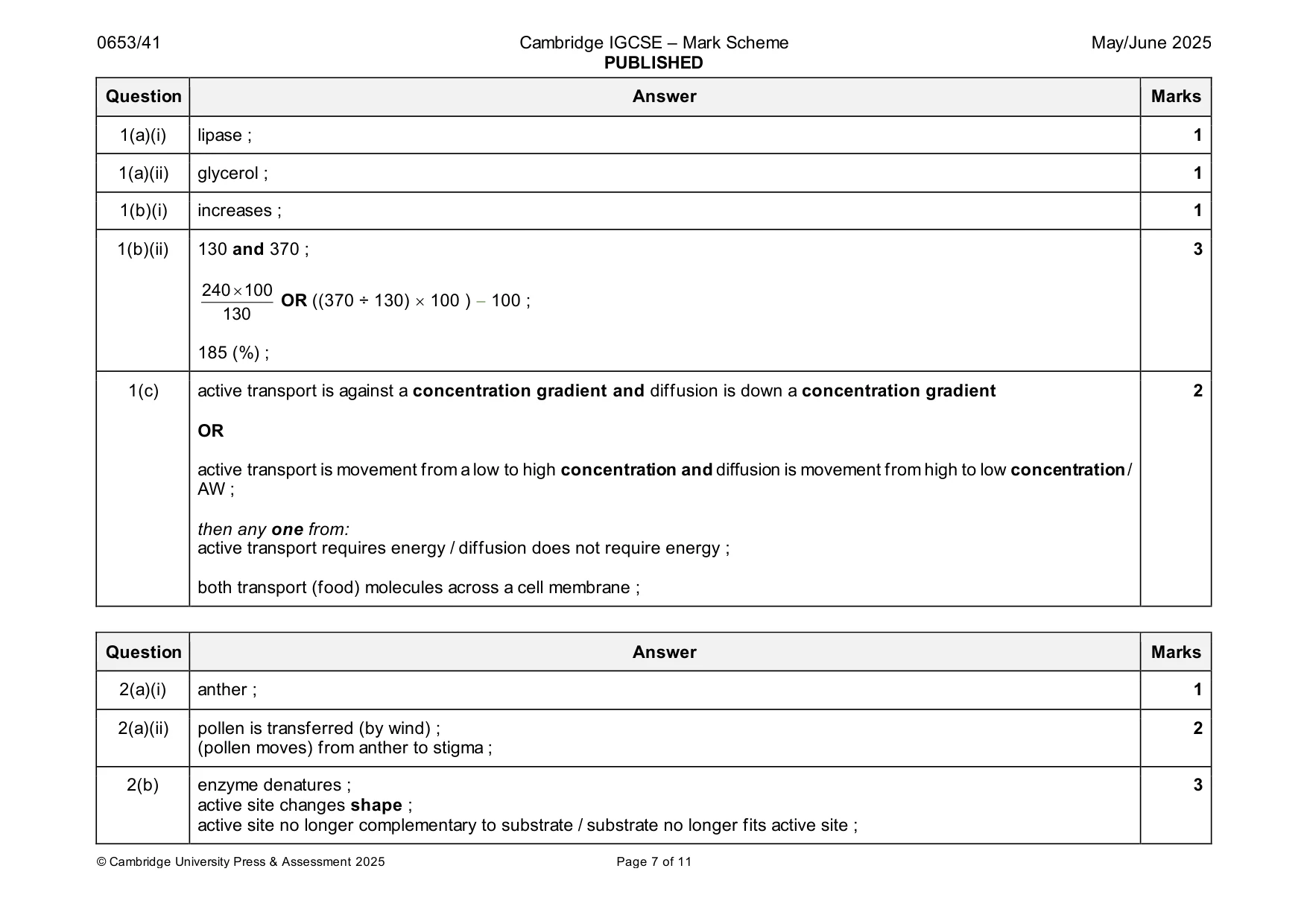
Mark scheme: Question Answer Marks 1(a)(i) lipase ; 1 1(a)(ii) glycerol ; 1 1(b)(i) increases ; 1 1(b)(ii) 130 and 370 ; 3 240 100 OR ((370 ÷ 130) 100 ) − 100 ; 130 185 (%) ; 1(c) active transport is against a concentration gradient and diffusion is down a concentration gradient 2 OR active transport is movement from a low to high concentration and diffusion is movement from high to low concentration / AW ; then any one from: active transport requires energy / diffusion does not require energy ; both transport (food) molecules across a cell membrane ;
Q2 · A photograph of a wind‑pollinated flower
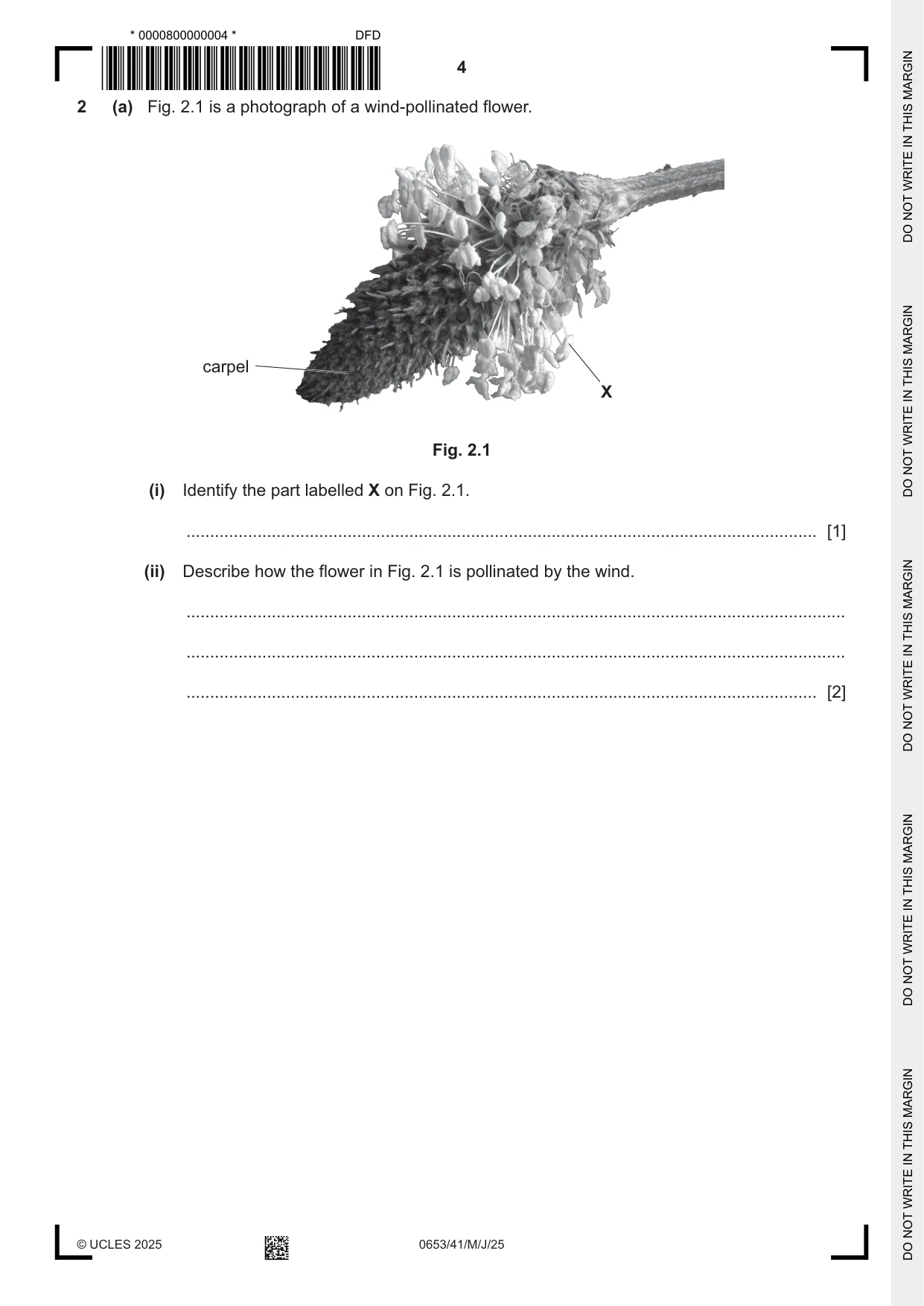
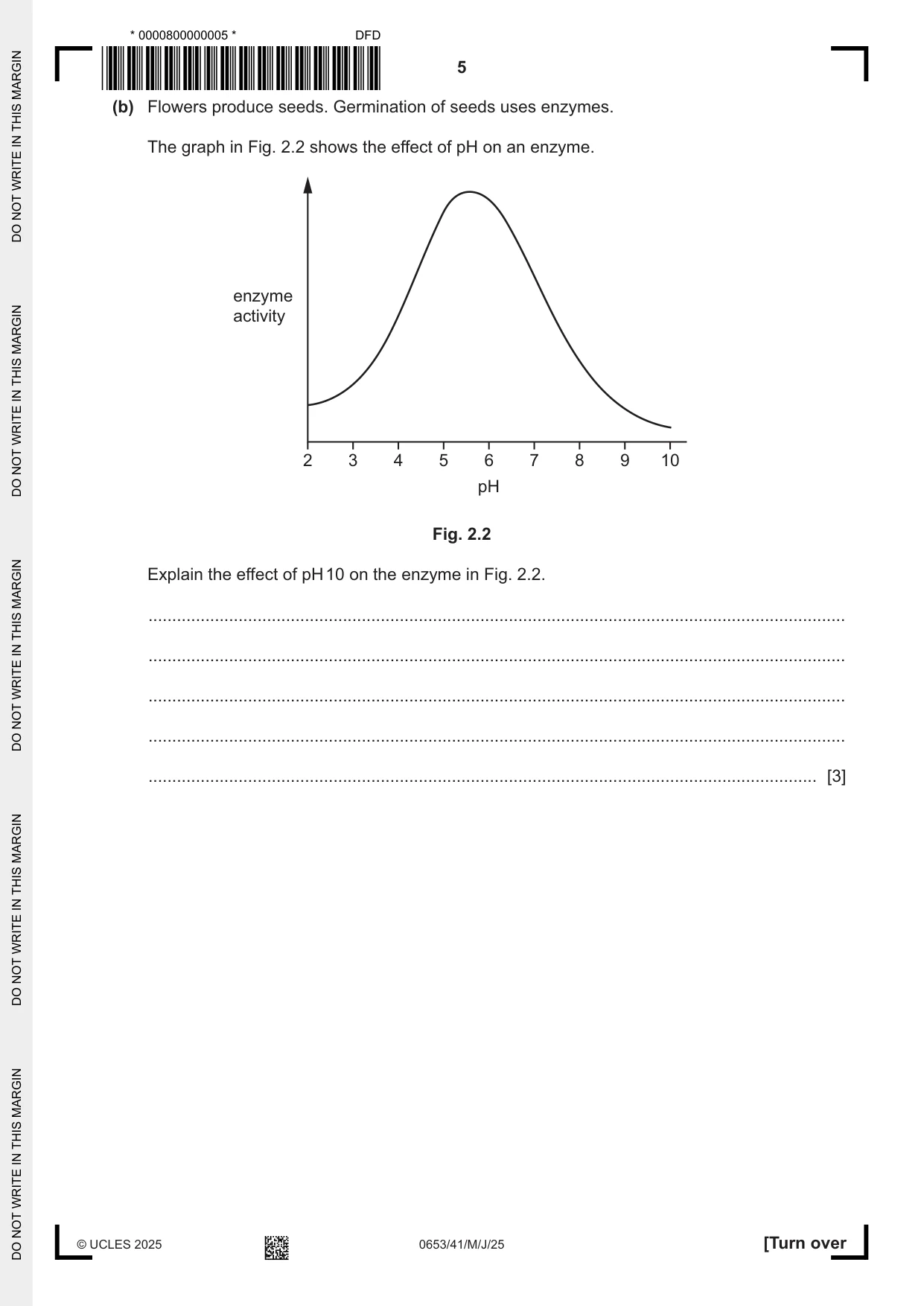
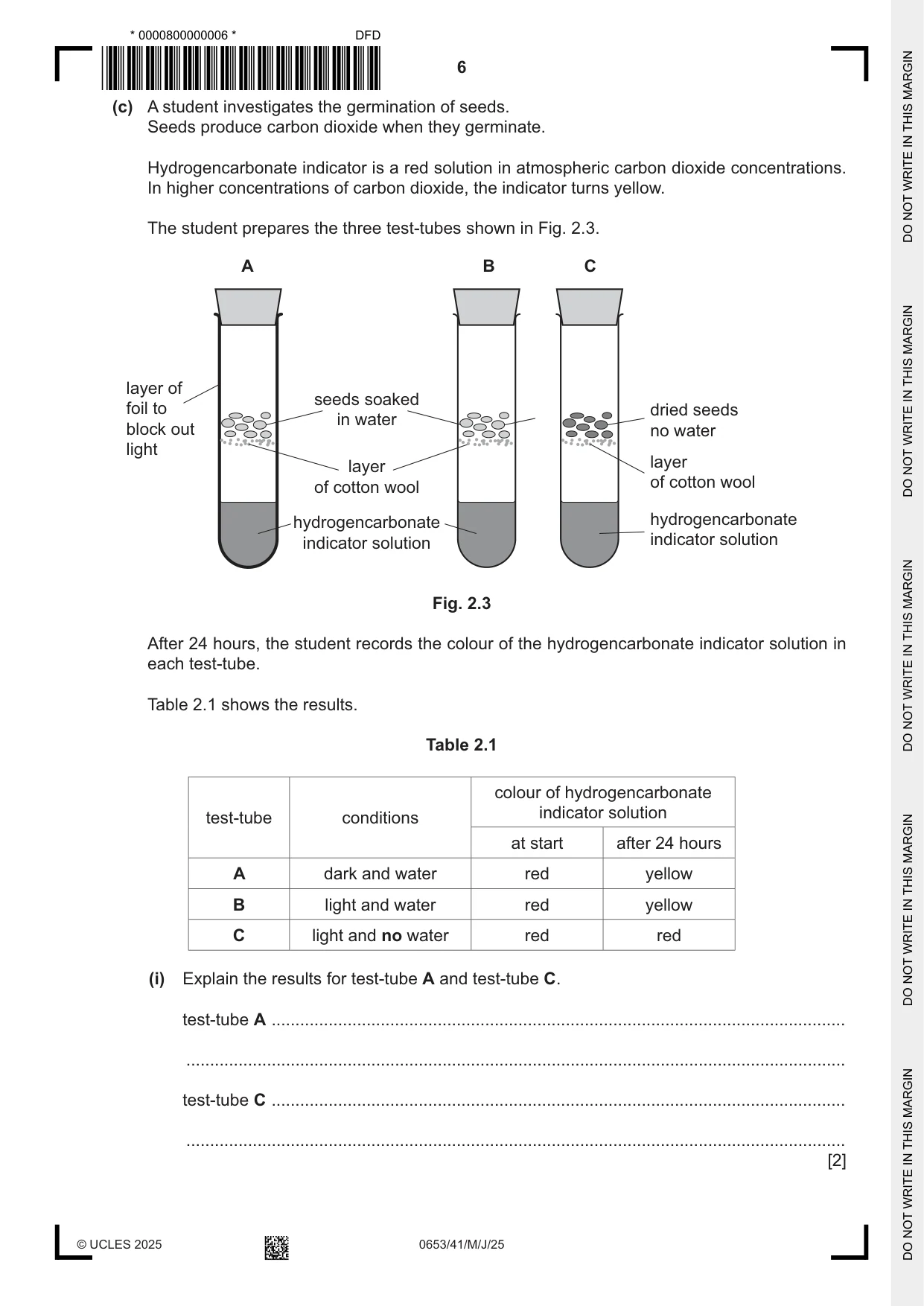
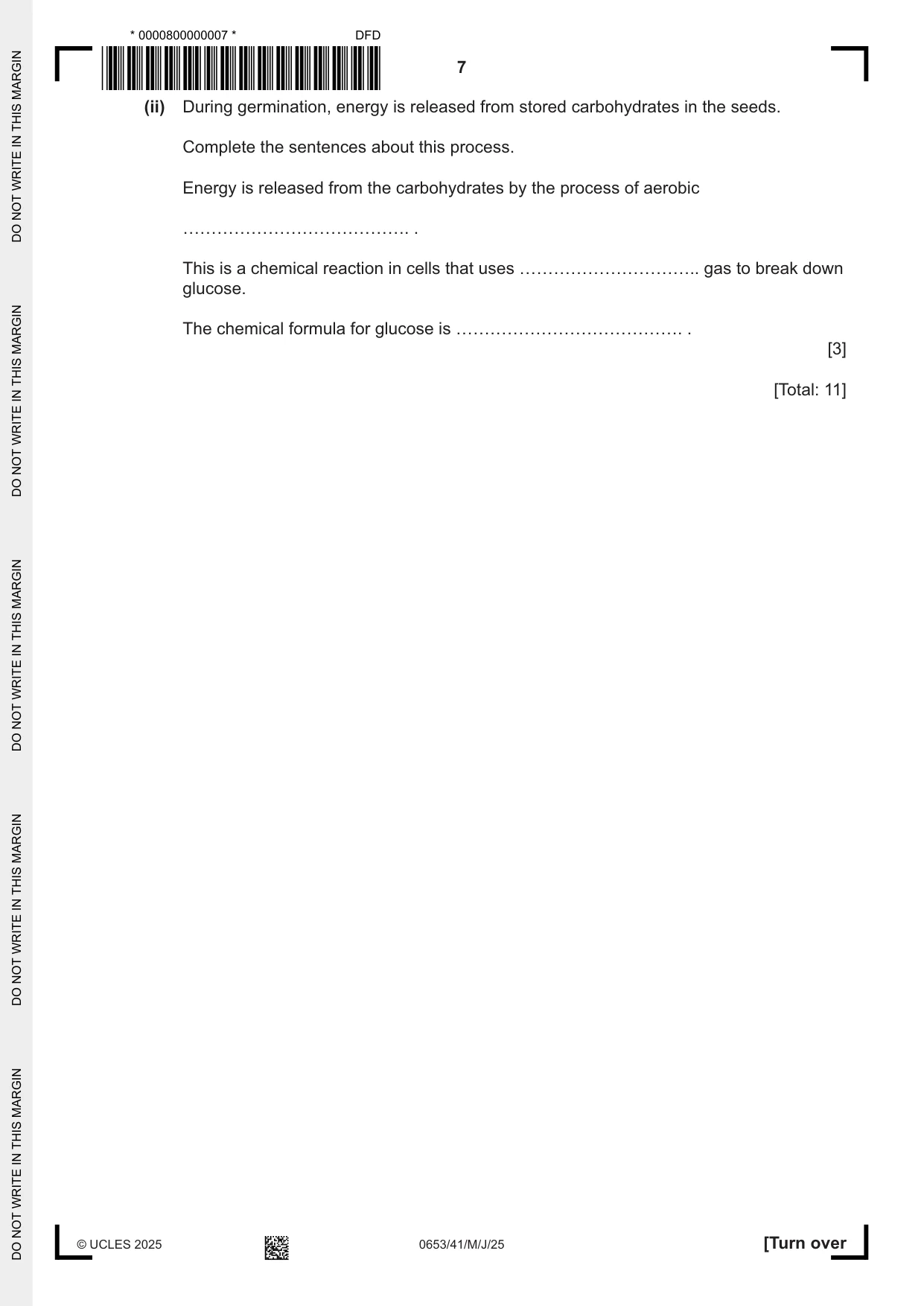
2 (a) Fig. 2.1 is a photograph of a wind‑pollinated flower. carpel X Fig. 2.1 (i) Identify the part labelled X on Fig. 2.1. ..................................................................................................................................... [1] (ii) Describe how the flower in Fig. 2.1 is pollinated by the wind. ........................................................................................................................................... ........................................................................................................................................... ..................................................................................................................................... [2] (b) Flowers produce seeds. Germination of seeds uses enzymes. The graph in Fig. 2.2 shows the effect of pH on an enzyme. enzyme activity 2 3 4 5 6 7 8 9 10 pH Fig. 2.2 Explain the effect of pH 10 on the enzyme in Fig. 2.2. ................................................................................................................................................... ................................................................................................................................................... ................................................................................................................................................... ................................................................................................................................................... ............................................................................................................................................. [3] (c) A student investigates the germination of seeds. Seeds produce carbon dioxide when they germinate. Hydrogencarbonate indicator is a red solution in atmospheric carbon dioxide concentrations. In higher concentrations of carbon dioxide, the indicator turns yellow. The student prepares the three test‑tubes shown in Fig. 2.3. A B C layer of seeds soaked foil to dried seeds in water block out no water light layer layer of cotton wool of cotton wool hydrogencarbonate hydrogencarbonate indicator solution indicator solution Fig. 2.3 After 24 hours, the student records the colour of the hydrogencarbonate indicator solution in each test‑tube. Table 2.1 shows the results. Table 2.1 colour of hydrogencarbonate indicator solution test‑tube conditions at start after 24 hours A dark and water red yellow B light and water red yellow C light and no water red red (i) Explain the results for test‑tube A and test‑tube C. test‑tube A ......................................................................................................................... ........................................................................................................................................... test‑tube C ......................................................................................................................... ........................................................................................................................................... [2] (ii) During germination, energy is released from stored carbohydrates in the seeds. Complete the sentences about this process. Energy is released from the carbohydrates by the process of aerobic This is a chemical reaction in cells that uses ………………………….. gas to break down glucose. The chemical formula for glucose is …………………………………. . [3] [Total: 11]
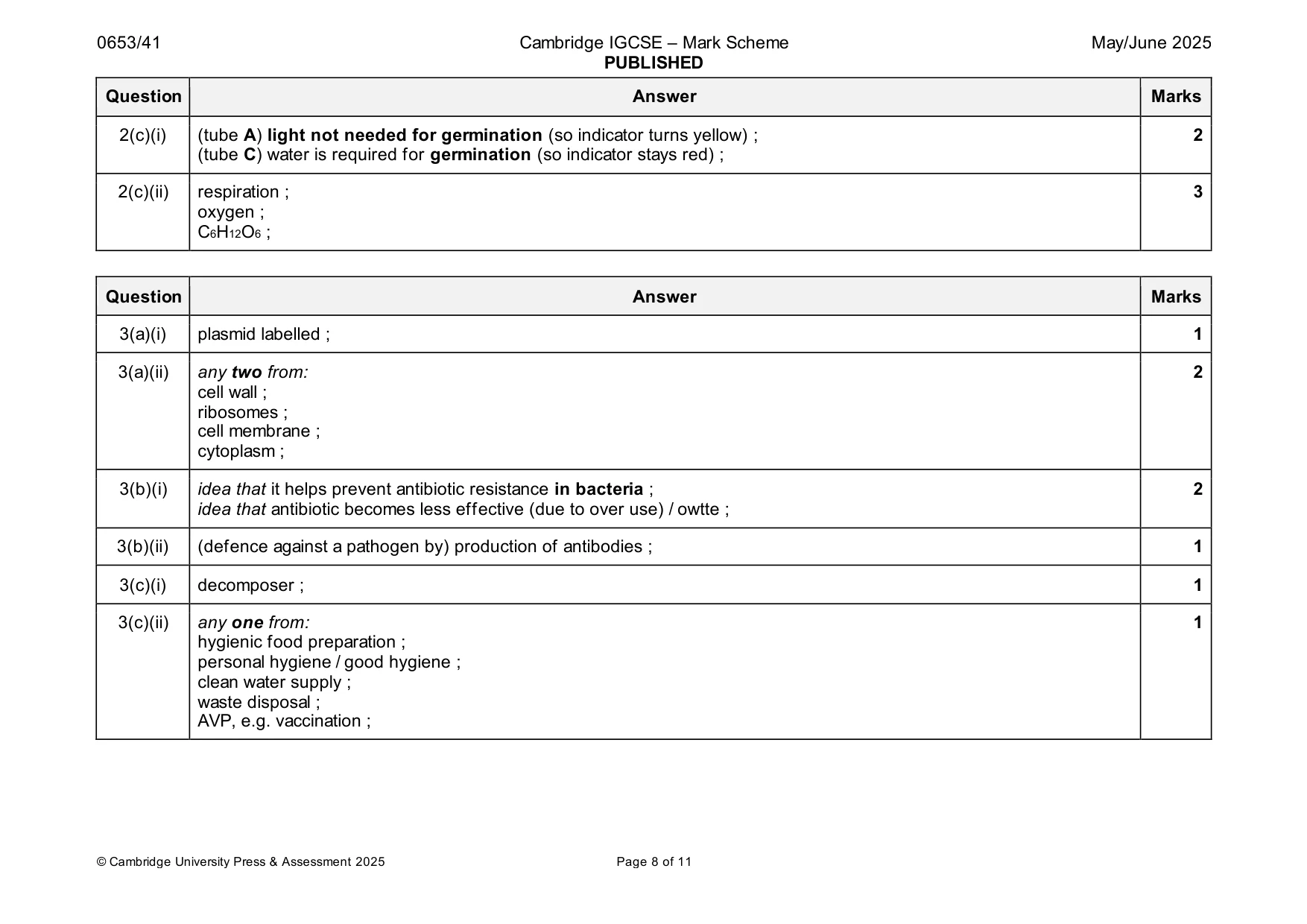
Mark scheme: 2(a)(i) anther ; 1 2(a)(ii) pollen is transferred (by wind) ; 2 (pollen moves) from anther to stigma ; 2(b) enzyme denatures ; 3 active site changes shape ; active site no longer complementary to substrate / substrate no longer fits active site ; 2(c)(i) (tube A) light not needed for germination (so indicator turns yellow) ; 2 (tube C) water is required for germination (so indicator stays red) ; 2(c)(ii) respiration ; 3 oxygen ; C6H12O6 ;
Q3 · A diagram showing a cross‑section of a bacterial cell
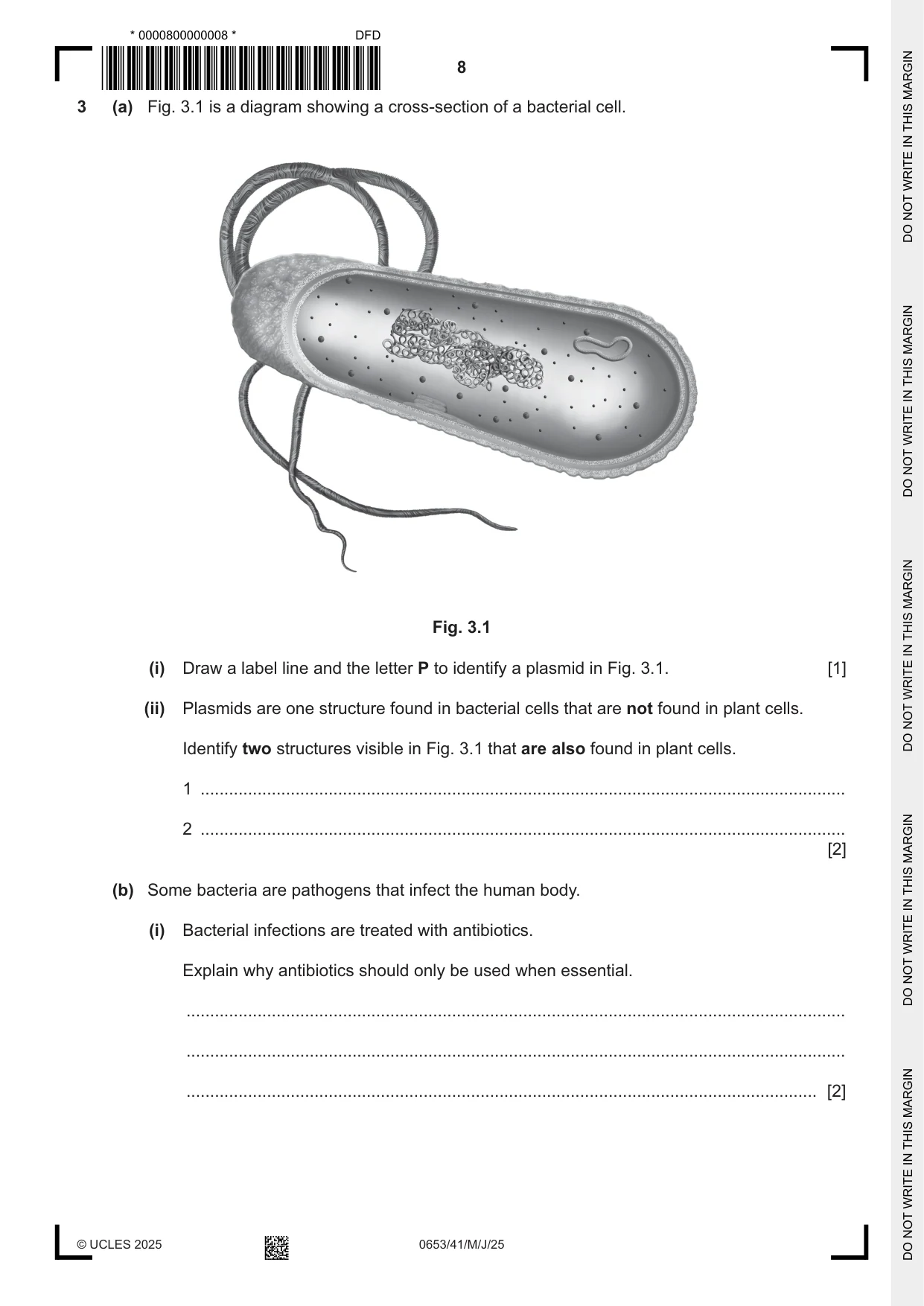
3 (a) Fig. 3.1 is a diagram showing a cross‑section of a bacterial cell. Fig. 3.1 (i) Draw a label line and the letter P to identify a plasmid in Fig. 3.1. [1] (ii) Plasmids are one structure found in bacterial cells that are not found in plant cells. Identify two structures visible in Fig. 3.1 that are also found in plant cells. 1 ........................................................................................................................................ 2 ........................................................................................................................................ [2] (b) Some bacteria are pathogens that infect the human body. (i) Bacterial infections are treated with antibiotics. Explain why antibiotics should only be used when essential. ........................................................................................................................................... ........................................................................................................................................... ..................................................................................................................................... [2] (ii) The body can develop active immunity after infection by some bacteria. Describe what is meant by active immunity. ........................................................................................................................................... ........................................................................................................................................... ..................................................................................................................................... [1] (c) Some bacteria gain energy from waste organic material in sewage. (i) Name the type of organism that gains energy from waste organic material. ..................................................................................................................................... [1] (ii) Sewage treatment is one way to control the spread of disease. State one other way to control the spread of disease. ........................................................................................................................................... ..................................................................................................................................... [1] [Total: 8]
Mark scheme: 3(a)(i) plasmid labelled ; 1 3(a)(ii) any two from: 2 cell wall ; ribosomes ; cell membrane ; cytoplasm ; 3(b)(i) idea that it helps prevent antibiotic resistance in bacteria ; 2 idea that antibiotic becomes less effective (due to over use) / owtte ; 3(b)(ii) (defence against a pathogen by) production of antibodies ; 1 3(c)(i) decomposer ; 1 3(c)(ii) any one from: 1 hygienic food preparation ; personal hygiene / good hygiene ; clean water supply ; waste disposal ; AVP, e.g. vaccination ;
Q4 · Iron is a metal
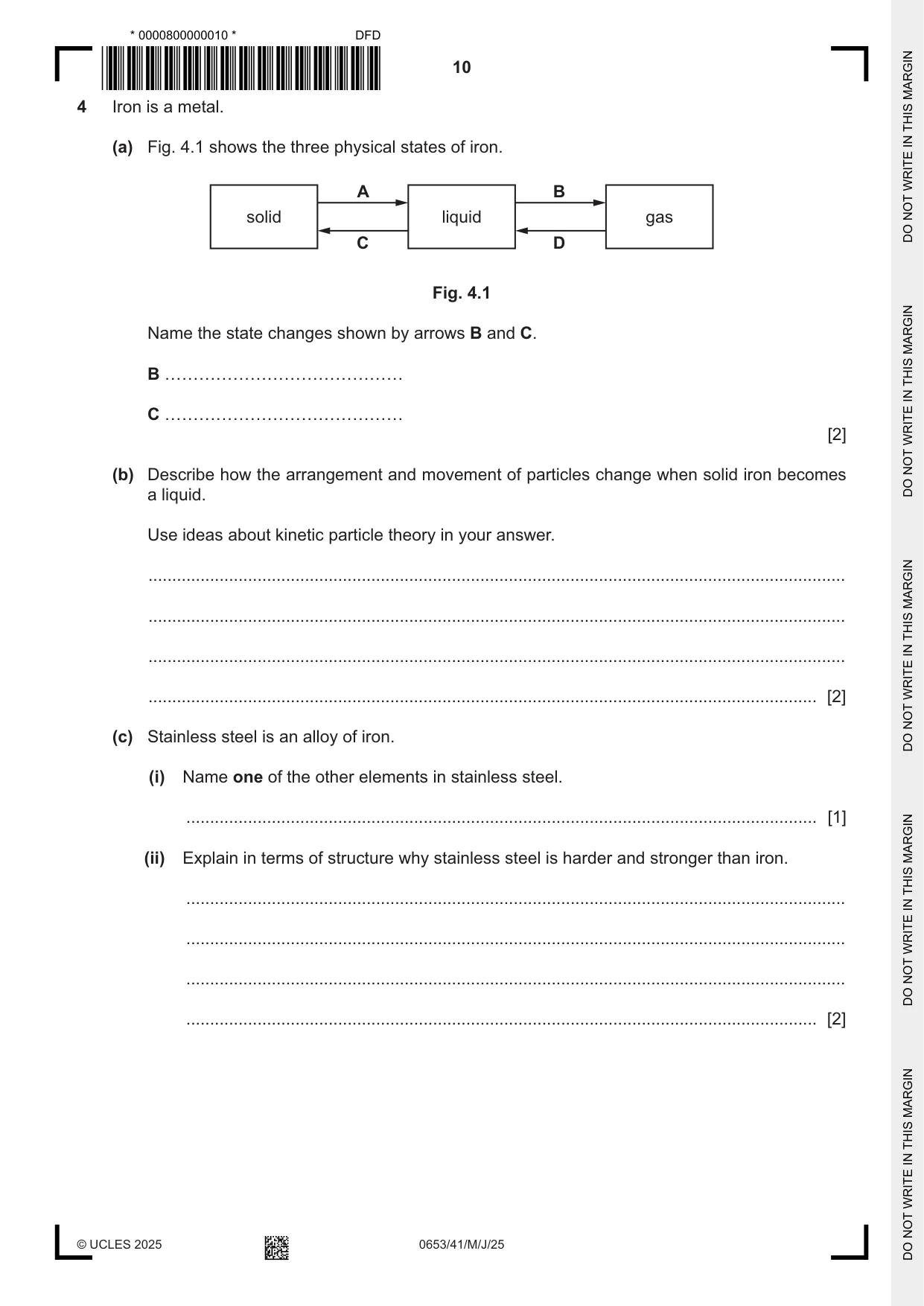
4 Iron is a metal. (a) Fig. 4.1 shows the three physical states of iron. A B solid liquid gas C D Fig. 4.1 Name the state changes shown by arrows B and C. B …………………………………… C …………………………………… [2] (b) Describe how the arrangement and movement of particles change when solid iron becomes a liquid. Use ideas about kinetic particle theory in your answer. ................................................................................................................................................... ................................................................................................................................................... ................................................................................................................................................... ............................................................................................................................................. [2] (c) Stainless steel is an alloy of iron. (i) Name one of the other elements in stainless steel. ..................................................................................................................................... [1] (ii) Explain in terms of structure why stainless steel is harder and stronger than iron. ........................................................................................................................................... ........................................................................................................................................... ........................................................................................................................................... ..................................................................................................................................... [2] (d) Iron is extracted from iron(III) oxide in the blast furnace. Iron(III) oxide reacts with carbon monoxide to form iron. The equation for the reaction is shown. Fe2O3 + 3CO 2Fe + 3CO2 Explain how the equation shows the iron(III) oxide is reduced. ................................................................................................................................................... ............................................................................................................................................. [1] [Total: 8]
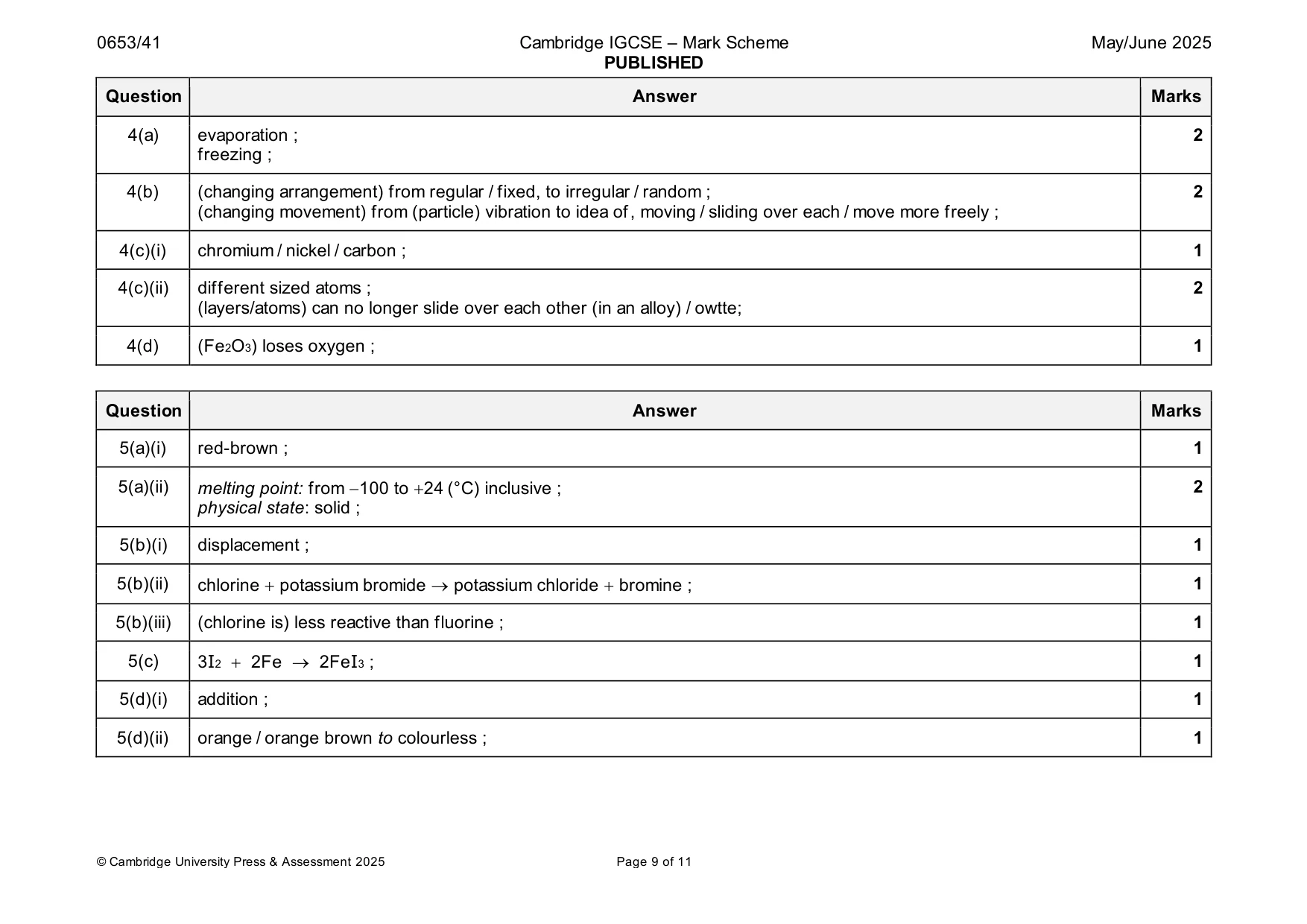
Mark scheme: 4(a) evaporation ; 2 freezing ; 4(b) (changing arrangement) from regular / fixed, to irregular / random ; 2 (changing movement) from (particle) vibration to idea of, moving / sliding over each / move more freely ; 4(c)(i) chromium / nickel / carbon ; 1 4(c)(ii) different sized atoms ; 2 (layers/atoms) can no longer slide over each other (in an alloy) / owtte; 4(d) (Fe2O3) loses oxygen ; 1
Q5 · Properties of some halogens at room temperature (25 °C) and pressure
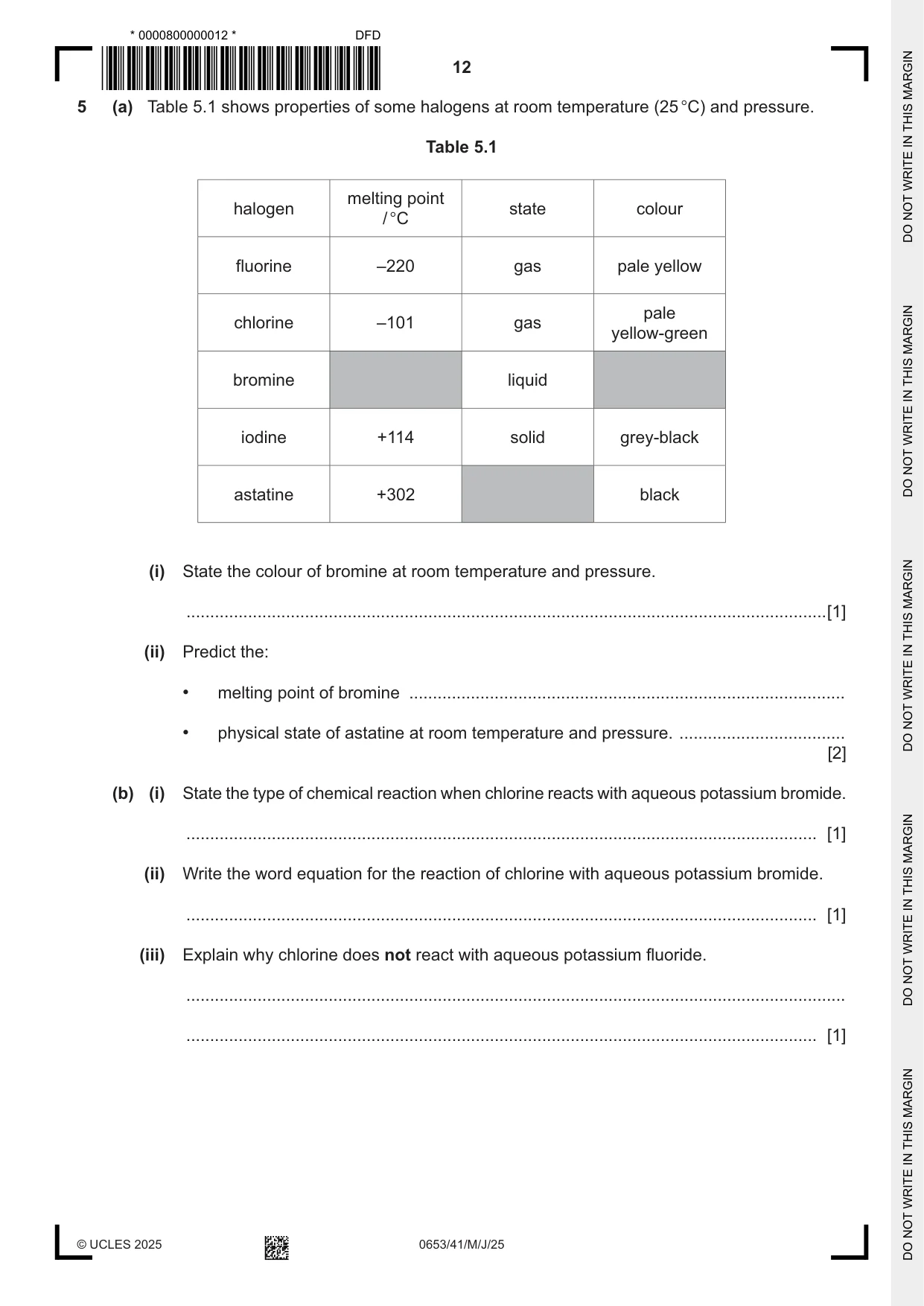
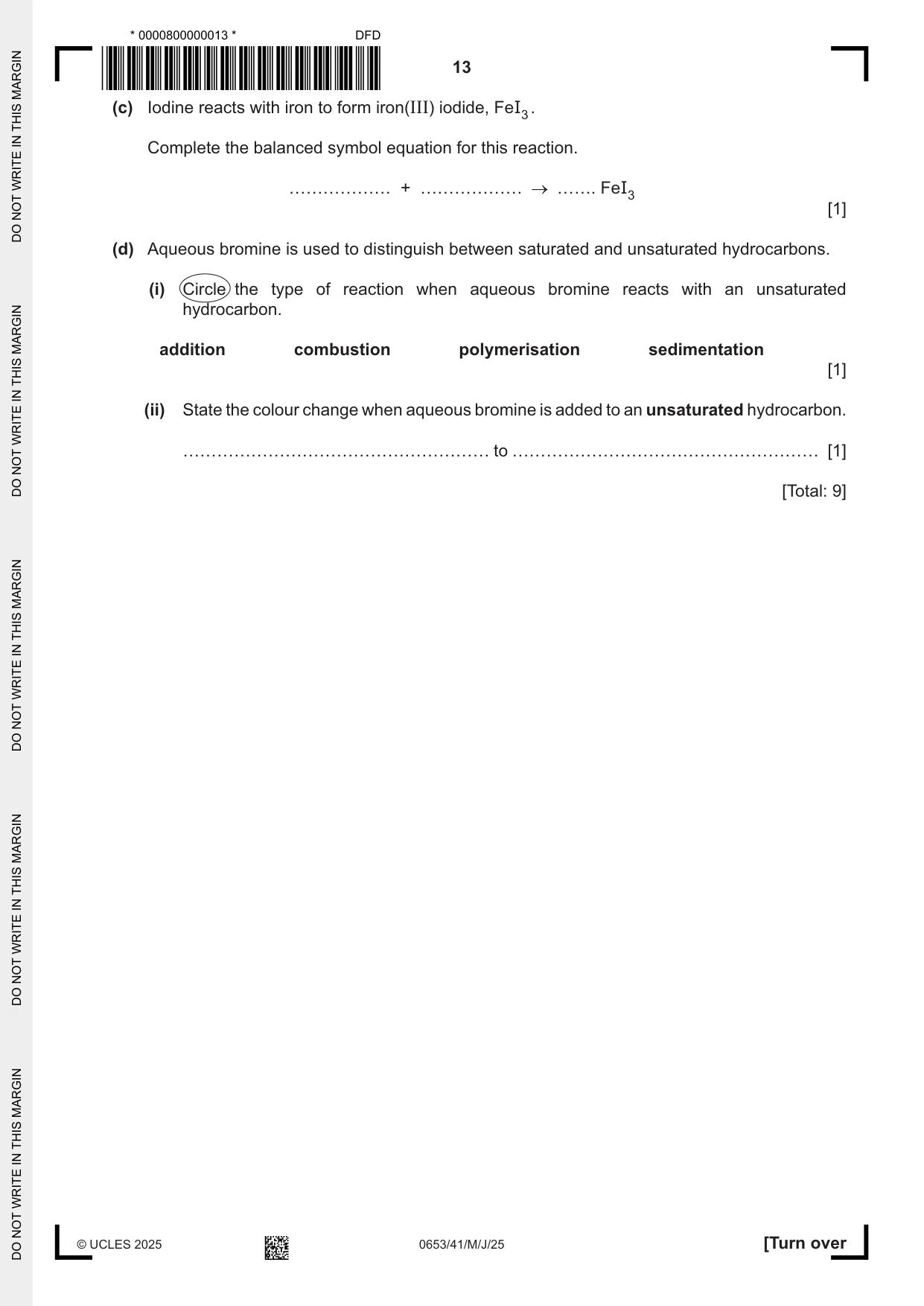
5 (a) Table 5.1 shows properties of some halogens at room temperature (25 °C) and pressure. Table 5.1 melting point halogen state colour / °C fluorine –220 gas pale yellow pale chlorine –101 gas yellow‑green bromine liquid iodine +114 solid grey‑black astatine +302 black (i) State the colour of bromine at room temperature and pressure. .......................................................................................................................................[1] (ii) Predict the: • melting point of bromine ............................................................................................ • physical state of astatine at room temperature and pressure. ................................... [2] (b) (i) State the type of chemical reaction when chlorine reacts with aqueous potassium bromide. ..................................................................................................................................... [1] (ii) Write the word equation for the reaction of chlorine with aqueous potassium bromide. ..................................................................................................................................... [1] (iii) Explain why chlorine does not react with aqueous potassium fluoride. ........................................................................................................................................... ..................................................................................................................................... [1] (c) Iodine reacts with iron to form iron(III) iodide, FeI3 . Complete the balanced symbol equation for this reaction. ……. FeI3 [1] (d) Aqueous bromine is used to distinguish between saturated and unsaturated hydrocarbons. (i) Circle the type of reaction when aqueous bromine reacts with an unsaturated hydrocarbon. addition combustion polymerisation sedimentation [1] (ii) State the colour change when aqueous bromine is added to an unsaturated hydrocarbon. ……………………………………………… to ……………………………………………… [1] [Total: 9]
Mark scheme: 5(a)(i) red-brown ; 1 5(a)(ii) melting point: from −100 to +24 (°C) inclusive ; 2 physical state: solid ; 5(b)(i) displacement ; 1 5(b)(ii) chlorine + potassium bromide → potassium chloride + bromine ; 1 5(b)(iii) (chlorine is) less reactive than fluorine ; 1 5(c) 3I2 + 2Fe → 2FeI3 ; 1 5(d)(i) addition ; 1 5(d)(ii) orange / orange brown to colourless ; 1
Q6 · This question is about ionic compounds
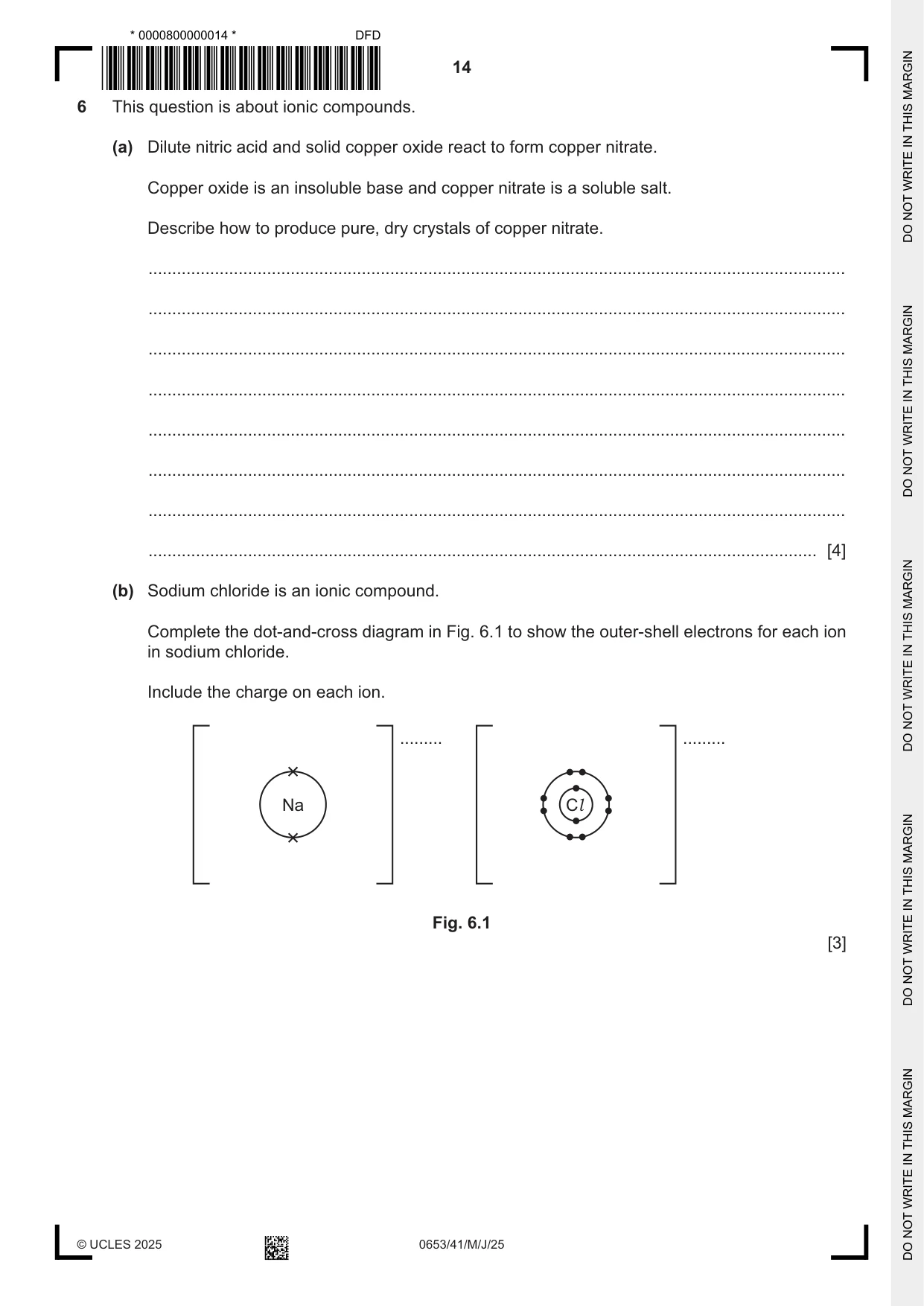
6 This question is about ionic compounds. (a) Dilute nitric acid and solid copper oxide react to form copper nitrate. Copper oxide is an insoluble base and copper nitrate is a soluble salt. Describe how to produce pure, dry crystals of copper nitrate. ................................................................................................................................................... ................................................................................................................................................... ................................................................................................................................................... ................................................................................................................................................... ................................................................................................................................................... ................................................................................................................................................... ................................................................................................................................................... ............................................................................................................................................. [4] (b) Sodium chloride is an ionic compound. Complete the dot‑and‑cross diagram in Fig. 6.1 to show the outer‑shell electrons for each ion in sodium chloride. Include the charge on each ion. ......... ......... Na Cl Fig. 6.1 [3] (c) Describe the arrangement of ions in solid sodium chloride. ................................................................................................................................................... ................................................................................................................................................... ................................................................................................................................................... ............................................................................................................................................. [2] [Total: 9]
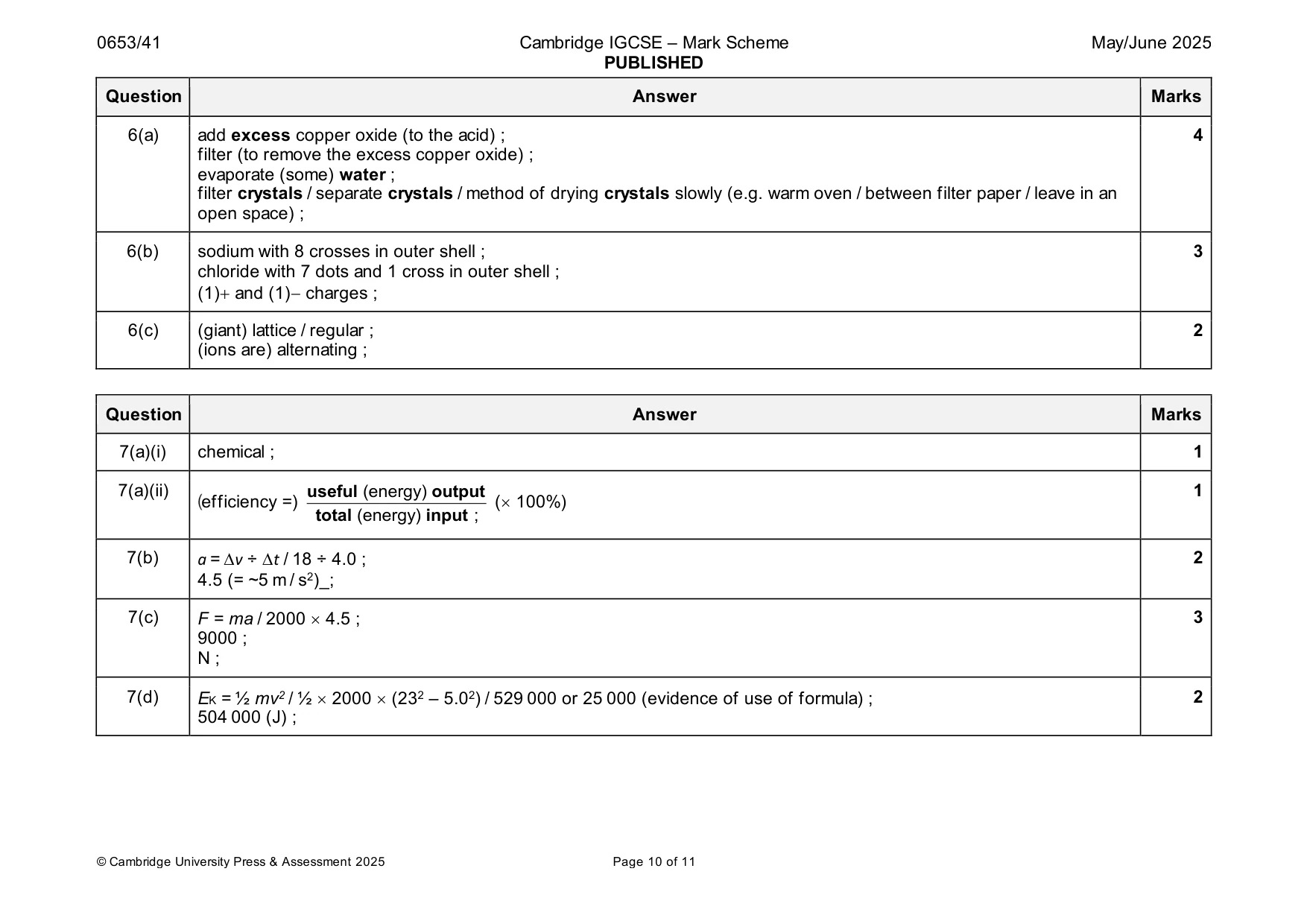
Mark scheme: 6(a) add excess copper oxide (to the acid) ; 4 filter (to remove the excess copper oxide) ; evaporate (some) water ; filter crystals / separate crystals / method of drying crystals slowly (e.g. warm oven / between filter paper / leave in an open space) ; 6(b) sodium with 8 crosses in outer shell ; 3 chloride with 7 dots and 1 cross in outer shell ; (1)+ and (1)− charges ; 6(c) (giant) lattice / regular ; 2 (ions are) alternating ;
Question 7
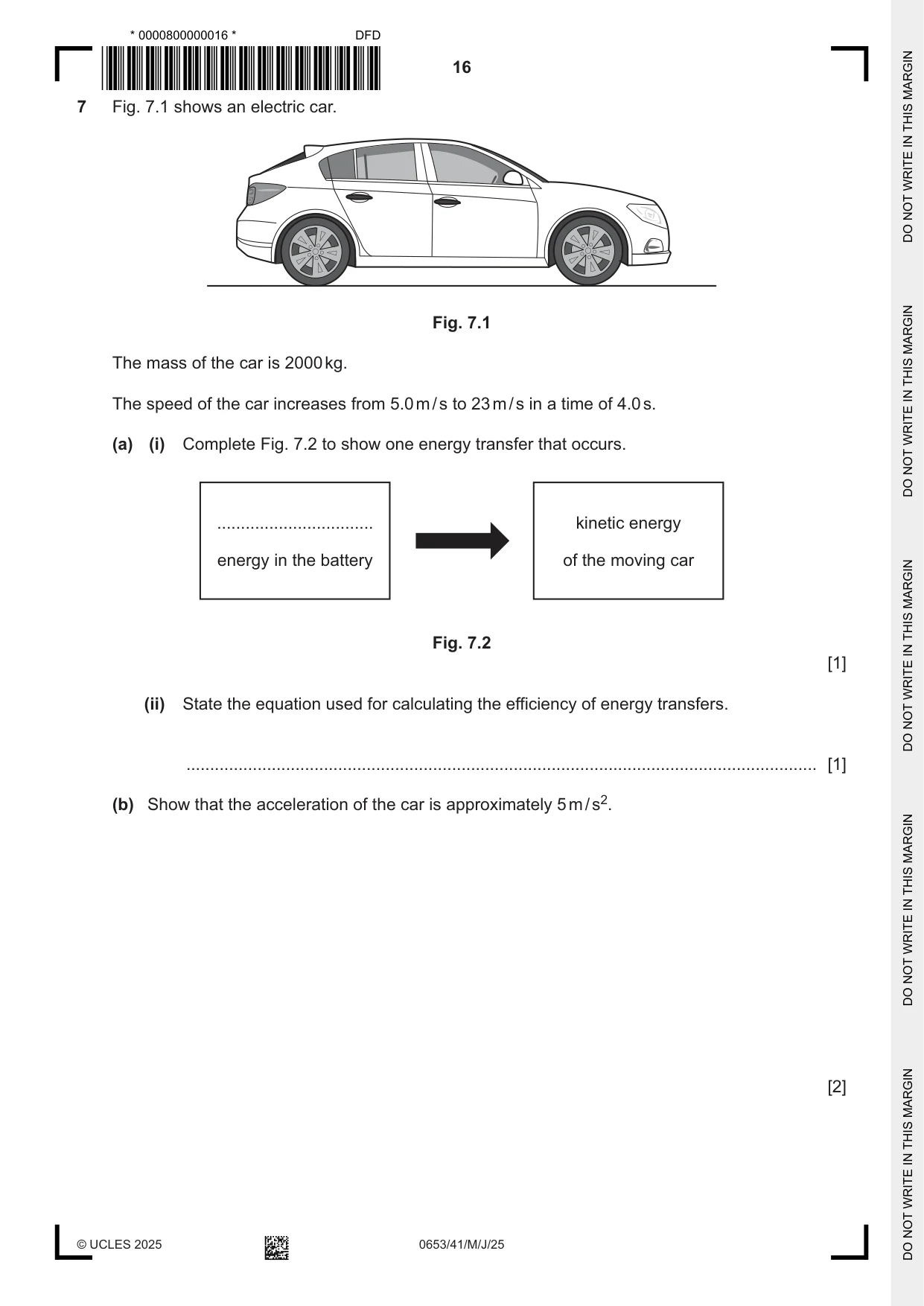
7 Fig. 7.1 shows an electric car. Fig. 7.1 The mass of the car is 2000 kg. The speed of the car increases from 5.0 m / s to 23 m / s in a time of 4.0 s. (a) (i) Complete Fig. 7.2 to show one energy transfer that occurs. ................................. kinetic energy energy in the battery of the moving car Fig. 7.2 [1] (ii) State the equation used for calculating the efficiency of energy transfers. ..................................................................................................................................... [1] (b) Show that the acceleration of the car is approximately 5 m / s2. [2] (c) Calculate the resultant force acting on the car. Include the unit in your answer. force = ................................... unit .............. [3] (d) Calculate the increase in the kinetic energy of the car. increase in kinetic energy = ...................................................... J [2] [Total: 9]
Mark scheme: 7(a)(i) chemical ; 1 7(a)(ii) useful (energy) output 1 efficiency =) ( 100%) total (energy) input ; 7(b) a = v ÷ t / 18 ÷ 4.0 ; 2 4.5 (= ~5 m / s2)_; 7(c) F = ma / 2000 4.5 ; 3 9000 ; N ; 7(d) EK = ½ mv2 / ½ 2000 (232 – 5.02) / 529 000 or 25 000 (evidence of use of formula) ; 2 504 000 (J) ;
Q8 · The two tyres of a motorcycle
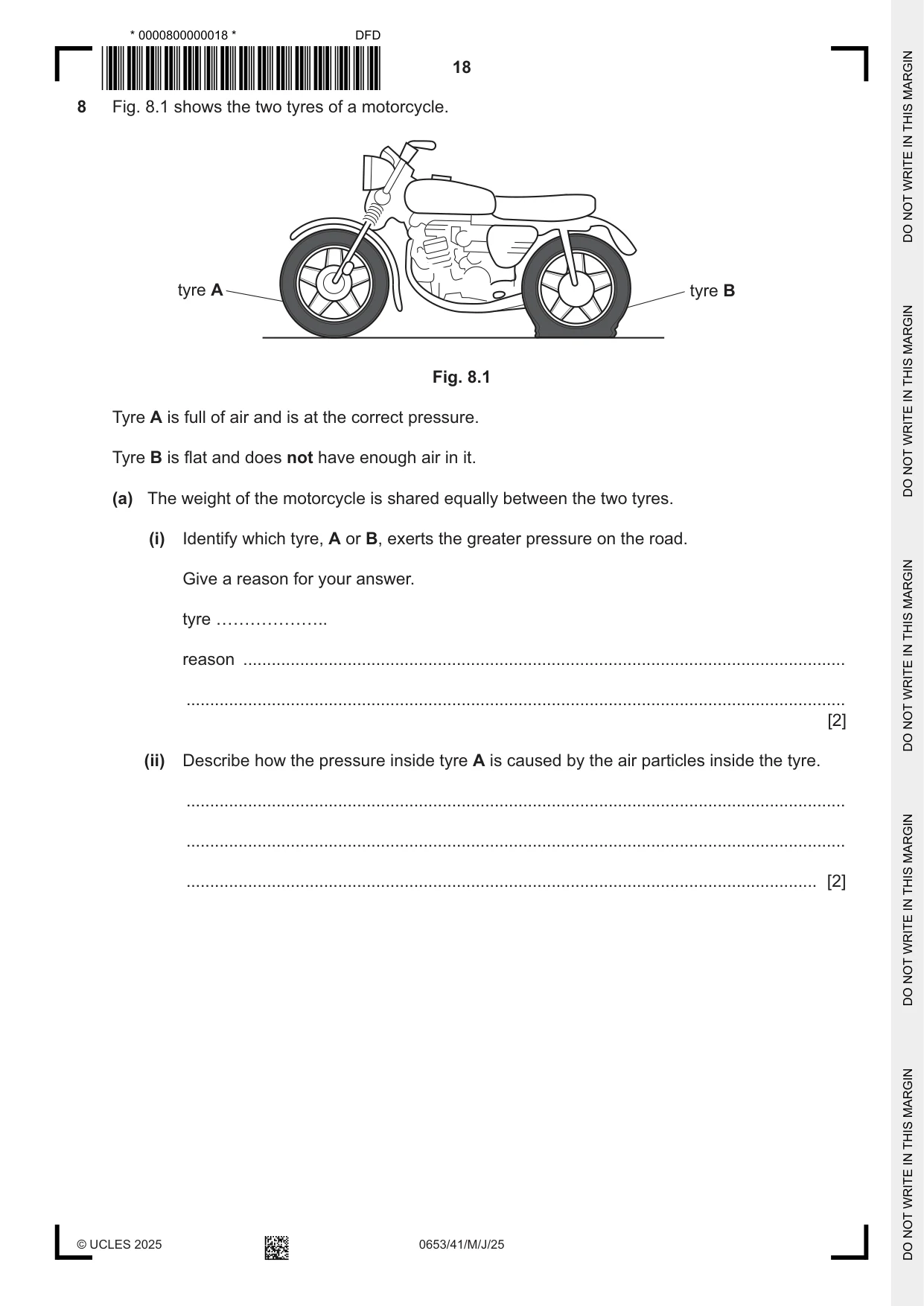
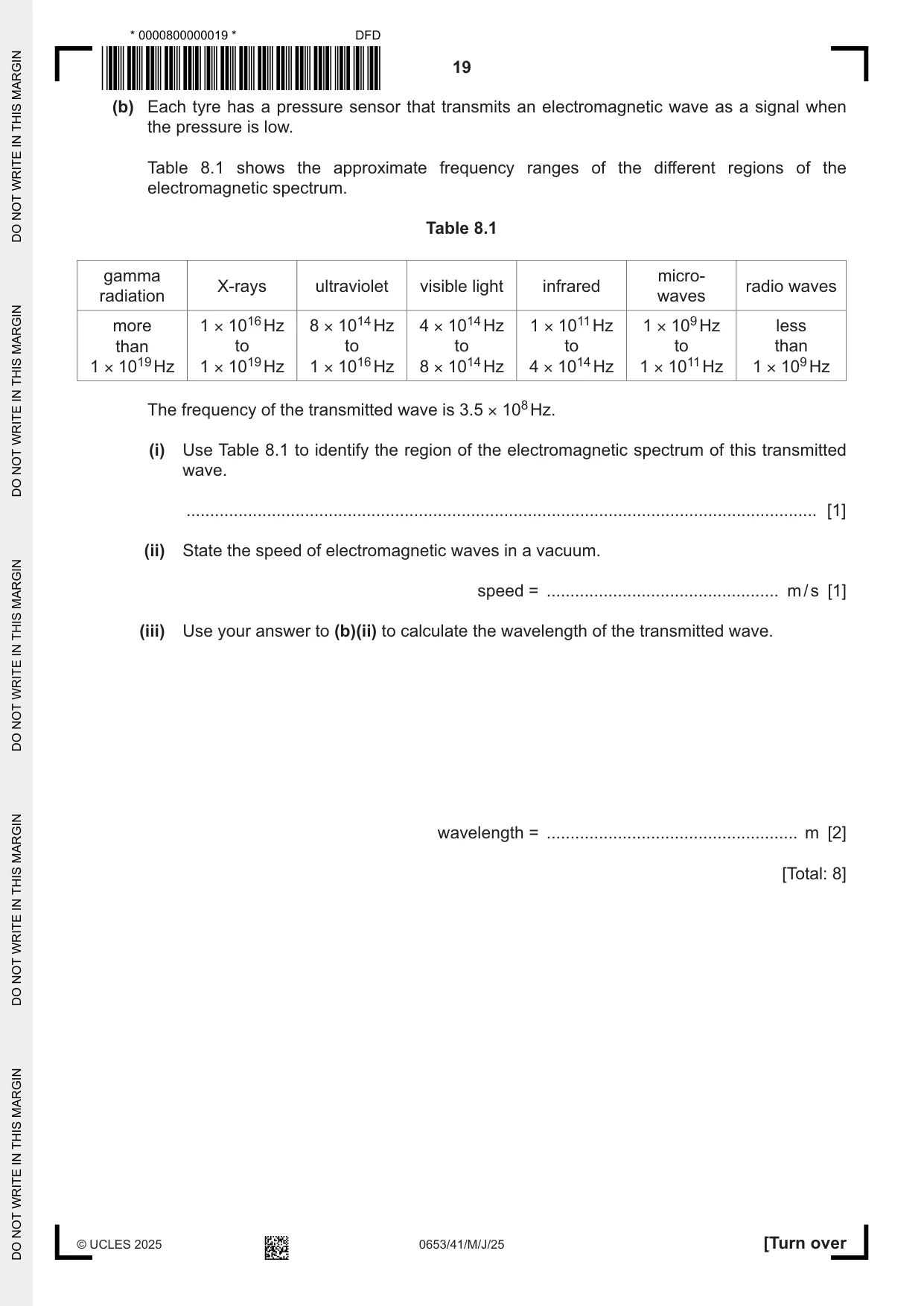
8 Fig. 8.1 shows the two tyres of a motorcycle. tyre A tyre B Fig. 8.1 Tyre A is full of air and is at the correct pressure. Tyre B is flat and does not have enough air in it. (a) The weight of the motorcycle is shared equally between the two tyres. (i) Identify which tyre, A or B, exerts the greater pressure on the road. Give a reason for your answer. tyre ……………….. reason ............................................................................................................................... ........................................................................................................................................... [2] (ii) Describe how the pressure inside tyre A is caused by the air particles inside the tyre. ........................................................................................................................................... ........................................................................................................................................... ..................................................................................................................................... [2] (b) Each tyre has a pressure sensor that transmits an electromagnetic wave as a signal when the pressure is low. Table 8.1 shows the approximate frequency ranges of the different regions of the electromagnetic spectrum. Table 8.1 gamma micro‑ X‑rays ultraviolet visible light infrared radio waves radiation waves more 1 × 10¹⁶ Hz 8 × 10¹⁴ Hz 4 × 10¹⁴ Hz 1 × 10¹¹ Hz 1 × 10⁹ Hz less than to to to to to than 1 × 10¹⁹ Hz 1 × 10¹⁹ Hz 1 × 10¹⁶ Hz 8 × 10¹⁴ Hz 4 × 10¹⁴ Hz 1 × 10¹¹ Hz 1 × 10⁹ Hz The frequency of the transmitted wave is 3.5 × 10⁸ Hz. (i) Use Table 8.1 to identify the region of the electromagnetic spectrum of this transmitted wave. ..................................................................................................................................... [1] (ii) State the speed of electromagnetic waves in a vacuum. speed = ................................................. m / s [1] (iii) Use your answer to (b)(ii) to calculate the wavelength of the transmitted wave. wavelength = ..................................................... m [2] [Total: 8]
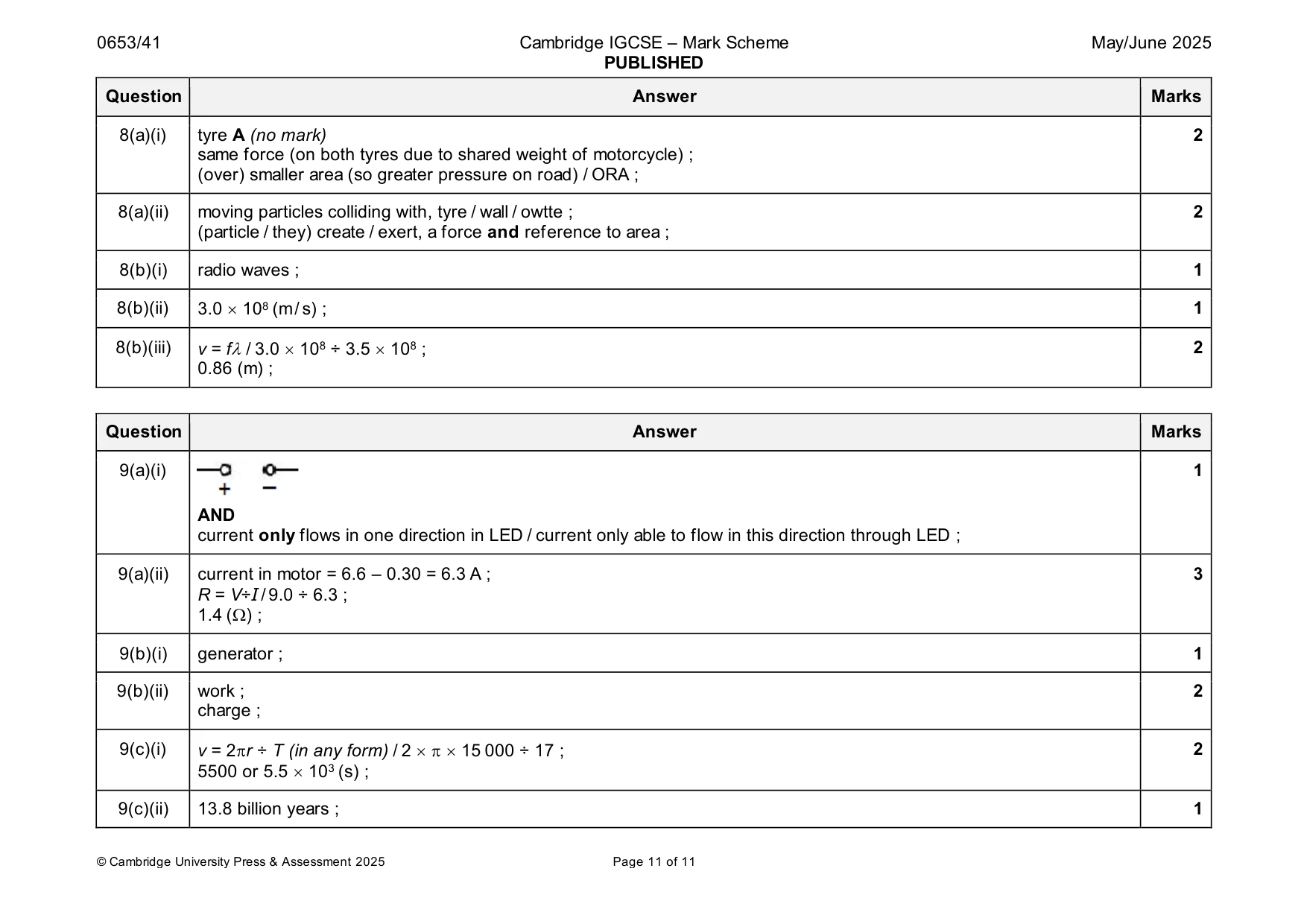
Mark scheme: 8(a)(i) tyre A (no mark) 2 same force (on both tyres due to shared weight of motorcycle) ; (over) smaller area (so greater pressure on road) / ORA ; 8(a)(ii) moving particles colliding with, tyre / wall / owtte ; 2 (particle / they) create / exert, a force and reference to area ; 8(b)(i) radio waves ; 1 8(b)(ii) 3.0 108 (m / s) ; 1 8(b)(iii) v = f/ 3.0 108 ÷ 3.5 108 ; 2 0.86 (m) ;
Q9 · A circuit that contains an electric motor and a light‑emitting diode (LED) connected to a…
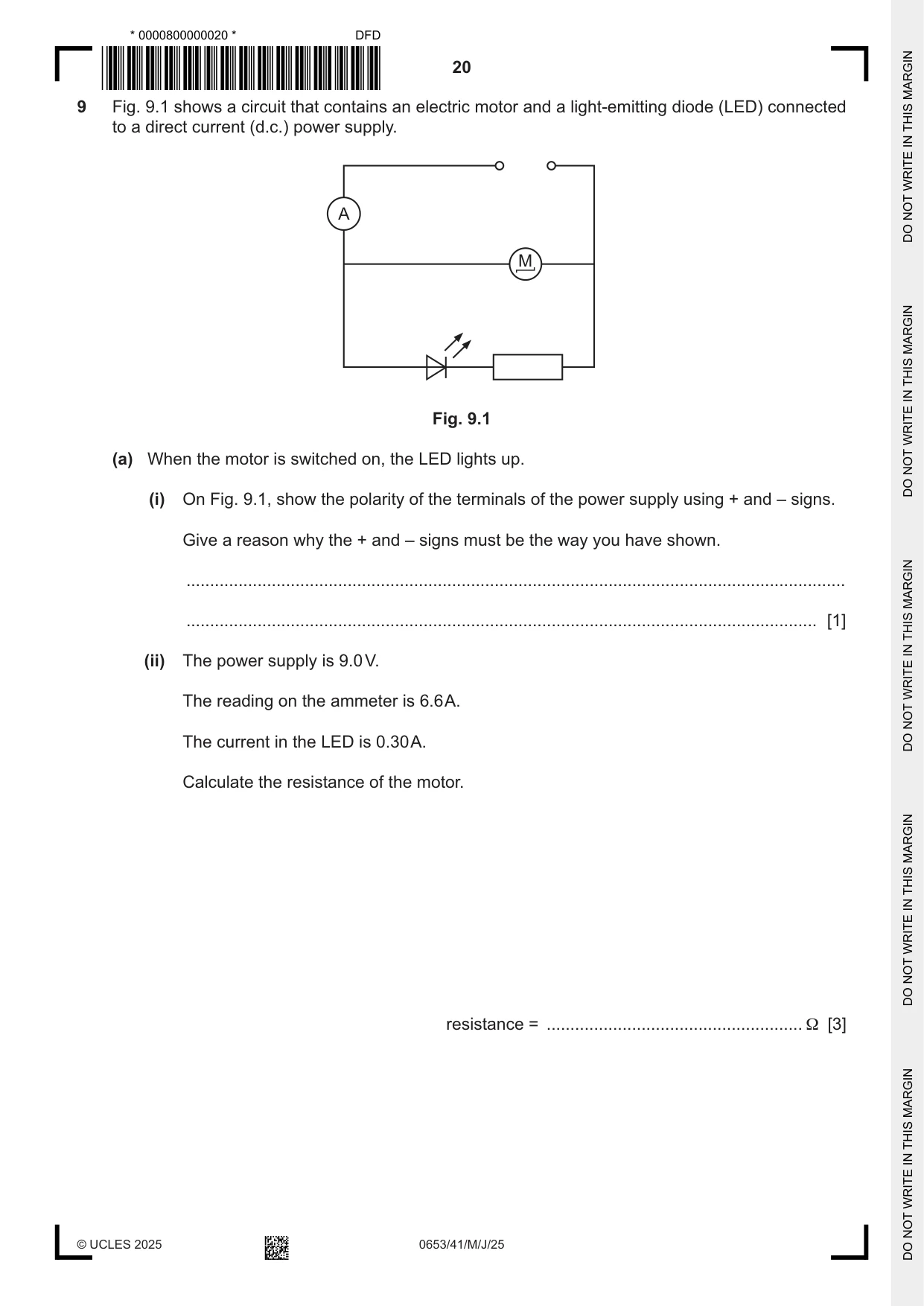
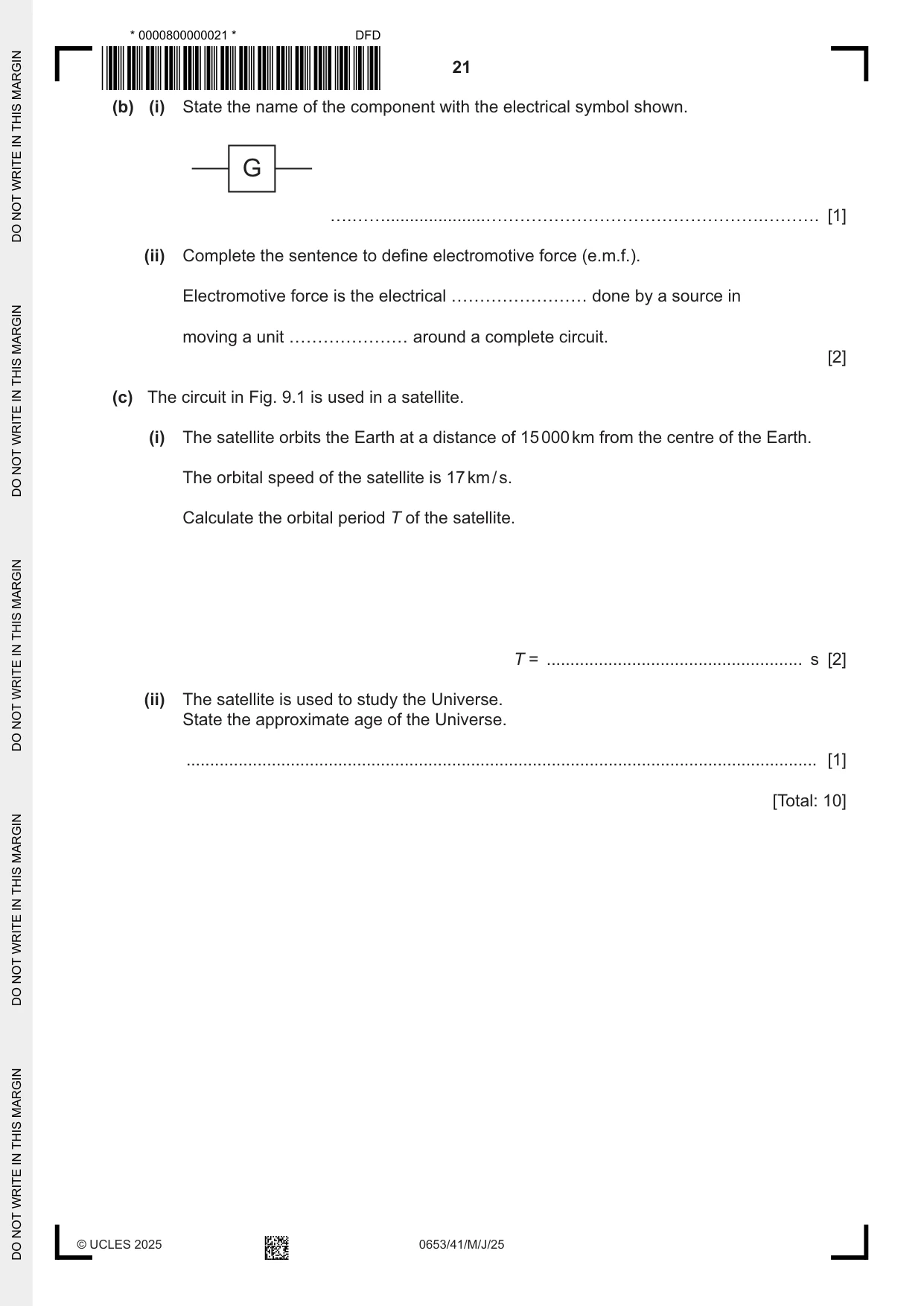
9 Fig. 9.1 shows a circuit that contains an electric motor and a light‑emitting diode (LED) connected to a direct current (d.c.) power supply. A M Fig. 9.1 (a) When the motor is switched on, the LED lights up. (i) On Fig. 9.1, show the polarity of the terminals of the power supply using + and – signs. Give a reason why the + and – signs must be the way you have shown. ........................................................................................................................................... ..................................................................................................................................... [1] (ii) The power supply is 9.0 V. The reading on the ammeter is 6.6 A. The current in the LED is 0.30 A. Calculate the resistance of the motor. resistance = ...................................................... Ω [3] (b) (i) State the name of the component with the electrical symbol shown. G ….…….....................………………………………………….………. [1] (ii) Complete the sentence to define electromotive force (e.m.f.). Electromotive force is the electrical …………………… done by a source in moving a unit ………………… around a complete circuit. [2] (c) The circuit in Fig. 9.1 is used in a satellite. (i) The satellite orbits the Earth at a distance of 15 000 km from the centre of the Earth. The orbital speed of the satellite is 17 km / s. Calculate the orbital period T of the satellite. T = ...................................................... s [2] (ii) The satellite is used to study the Universe. State the approximate age of the Universe. ..................................................................................................................................... [1] [Total: 10]
Mark scheme: 9(a)(i) 1 AND current only flows in one direction in LED / current only able to flow in this direction through LED ; 9(a)(ii) current in motor = 6.6 – 0.30 = 6.3 A ; 3 R = V÷I / 9.0 ÷ 6.3 ; 1.4 () ; 9(b)(i) generator ; 1 9(b)(ii) work ; 2 charge ; 9(c)(i) v = 2r ÷ T (in any form) / 2 15 000 ÷ 17 ; 2 5500 or 5.5 103 (s) ; 9(c)(ii) 13.8 billion years ; 1
What was in this paper
The subtopics covered by these 9 questions, and how many questions each got. Open one in a new tab to see every Cambridge question on it.
What you needed in this session
Cambridge’s own grade thresholds for 2025 May/June, Paper 4 · Variant 1. A higher threshold means an easier paper — the bar moves with how the cohort did.