Cambridge IGCSE Science - Combined 0653 — 2017 May/June Paper 4 · Variant 1
0653/41/M/J/17 · 9 questions · 80 marks · ≈90 min
The question paper and its mark scheme, free to read here and free to download. This is Cambridge’s own paper, exactly as it was sat.
Question paper24 pages



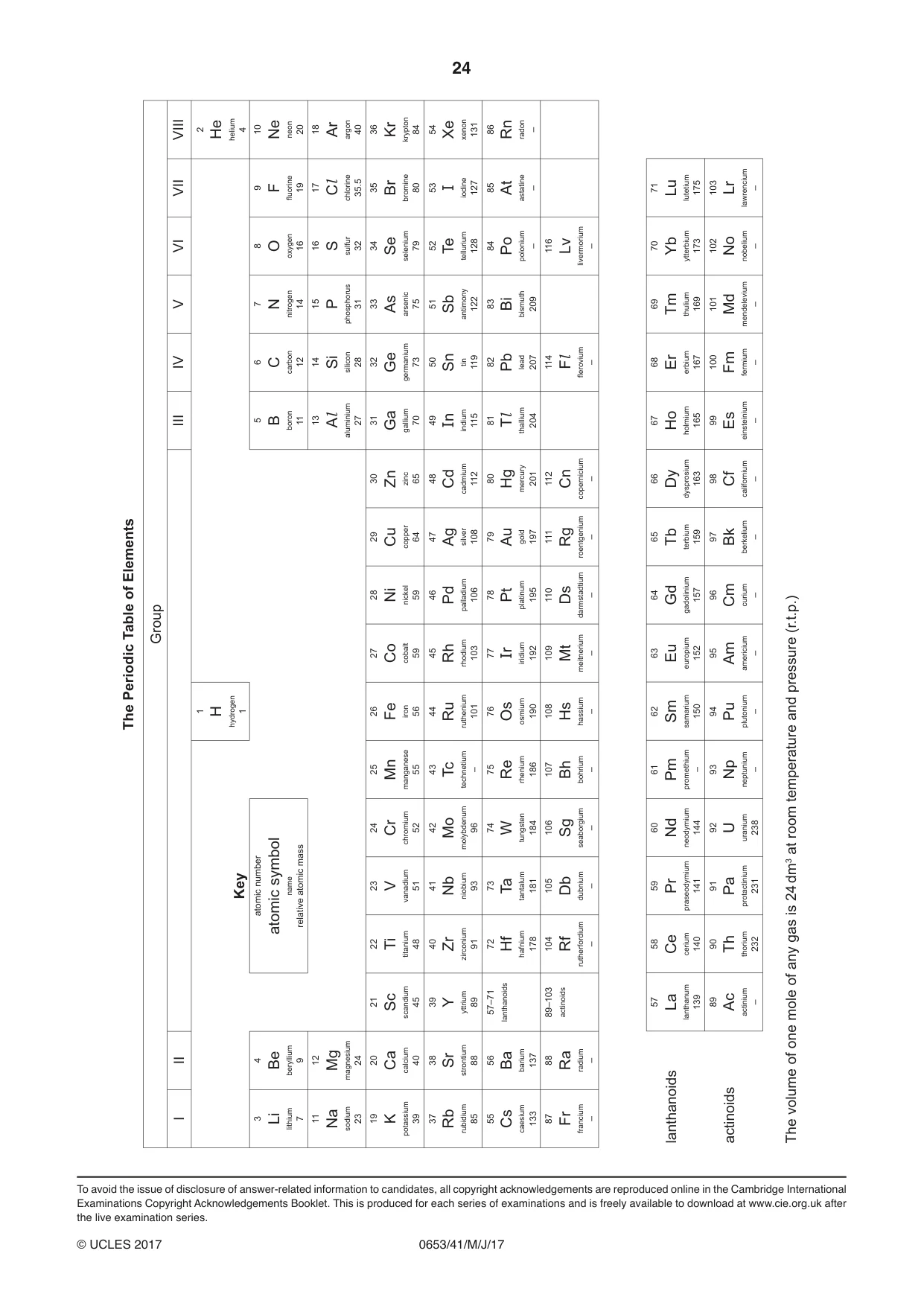
Mark scheme10 pages
Answers below. Sit the paper first if you are practising.
Questions as text
Q1 · Use lines to connect the box on the left to different boxes on the right to make correct…
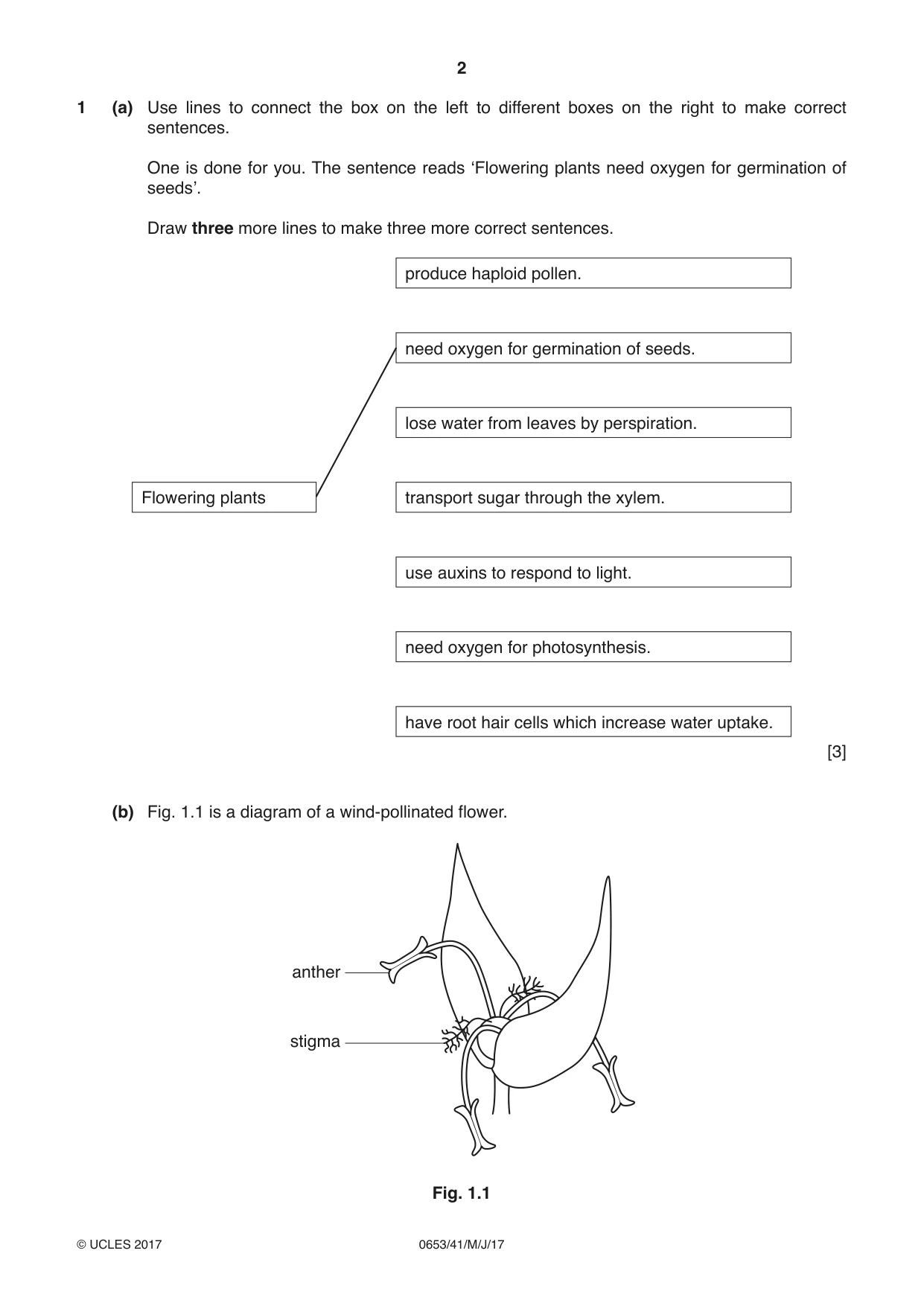
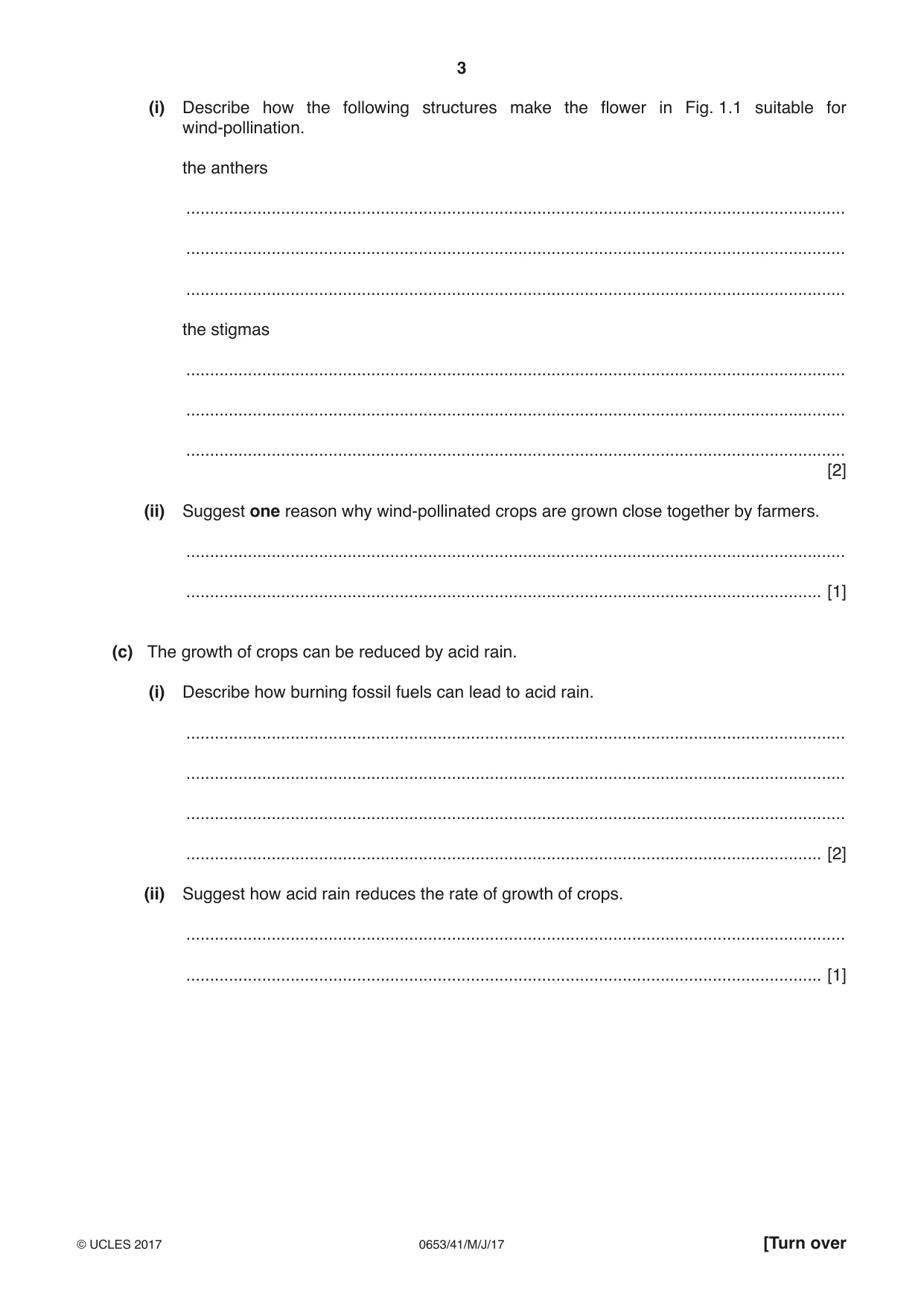
1 (a) Use lines to connect the box on the left to different boxes on the right to make correct sentences. One is done for you. The sentence reads ‘Flowering plants need oxygen for germination of seeds’. Draw three more lines to make three more correct sentences. produce haploid pollen. need oxygen for germination of seeds. lose water from leaves by perspiration. Flowering plants transport sugar through the xylem. use auxins to respond to light. need oxygen for photosynthesis. have root hair cells which increase water uptake. [3] (b) Fig. 1.1 is a diagram of a wind-pollinated flower. anther stigma Fig. 1.1 (i) Describe how the following structures make the flower in Fig. 1.1 suitable for wind-pollination. the anthers ........................................................................................................................................... ........................................................................................................................................... ........................................................................................................................................... the stigmas ........................................................................................................................................... ........................................................................................................................................... ........................................................................................................................................... [2] (ii) Suggest one reason why wind-pollinated crops are grown close together by farmers. ........................................................................................................................................... ...................................................................................................................................... [1] (c) The growth of crops can be reduced by acid rain. (i) Describe how burning fossil fuels can lead to acid rain. ........................................................................................................................................... ........................................................................................................................................... ........................................................................................................................................... ...................................................................................................................................... [2] (ii) Suggest how acid rain reduces the rate of growth of crops. ........................................................................................................................................... ...................................................................................................................................... [1]
Mark scheme: 1(a) lines drawn from Flowering plants to produce haploid pollen ; use auxins to respond to light ; have root hair cells which increase water uptake ; 3 1(b)(i) (anthers) hang outside the flower so pollen is easily picked up by wind ; (stigmas) feathery / large surface area to collect pollen ; 2 1(b)(ii) to increase the chances of pollination between plants ; 1 1(c)(i) the idea that fossil fuels contain sulfur / sulfur compounds ; sulfur dioxide produced ; dissolves in water in the air ; Max 2 1(c)(ii) reduces activity / denatures enzymes present in the plants ; 1
Q2 · A dot-and-cross diagram to show the outer-shell electrons in a molecule of hydrogen…
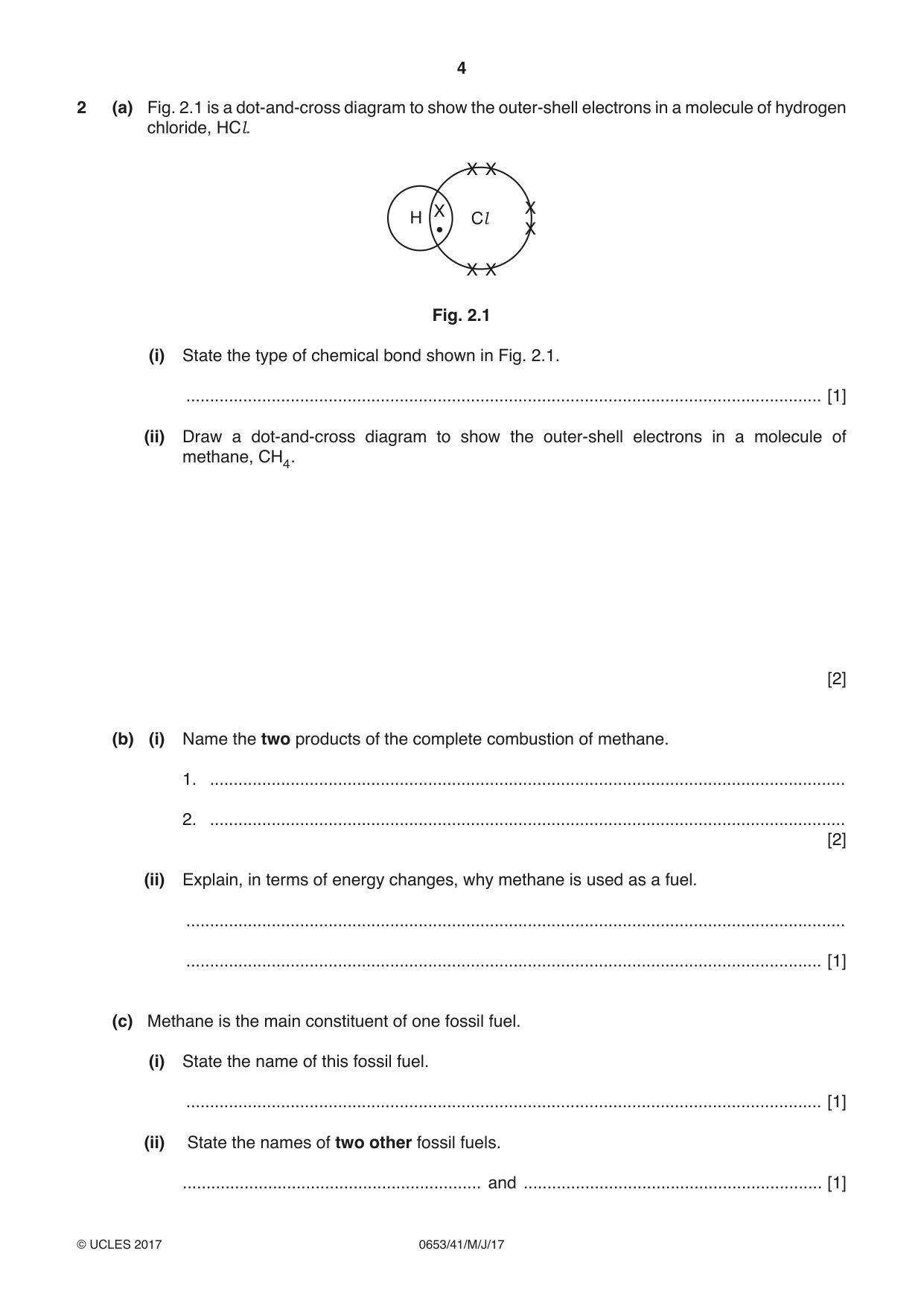
2 (a) Fig. 2.1 is a dot-and-cross diagram to show the outer-shell electrons in a molecule of hydrogen chloride, HCl. X X X X H Cl X X X Fig. 2.1 (i) State the type of chemical bond shown in Fig. 2.1. ...................................................................................................................................... [1] (ii) Draw a dot-and-cross diagram to show the outer-shell electrons in a molecule of methane, CH4. [2] (b) (i) Name the two products of the complete combustion of methane. 1. ...................................................................................................................................... 2. ...................................................................................................................................... [2] (ii) Explain, in terms of energy changes, why methane is used as a fuel. ........................................................................................................................................... ...................................................................................................................................... [1] (c) Methane is the main constituent of one fossil fuel. (i) State the name of this fossil fuel. ...................................................................................................................................... [1] (ii) State the names of two other fossil fuels. ............................................................... and ............................................................... [1]
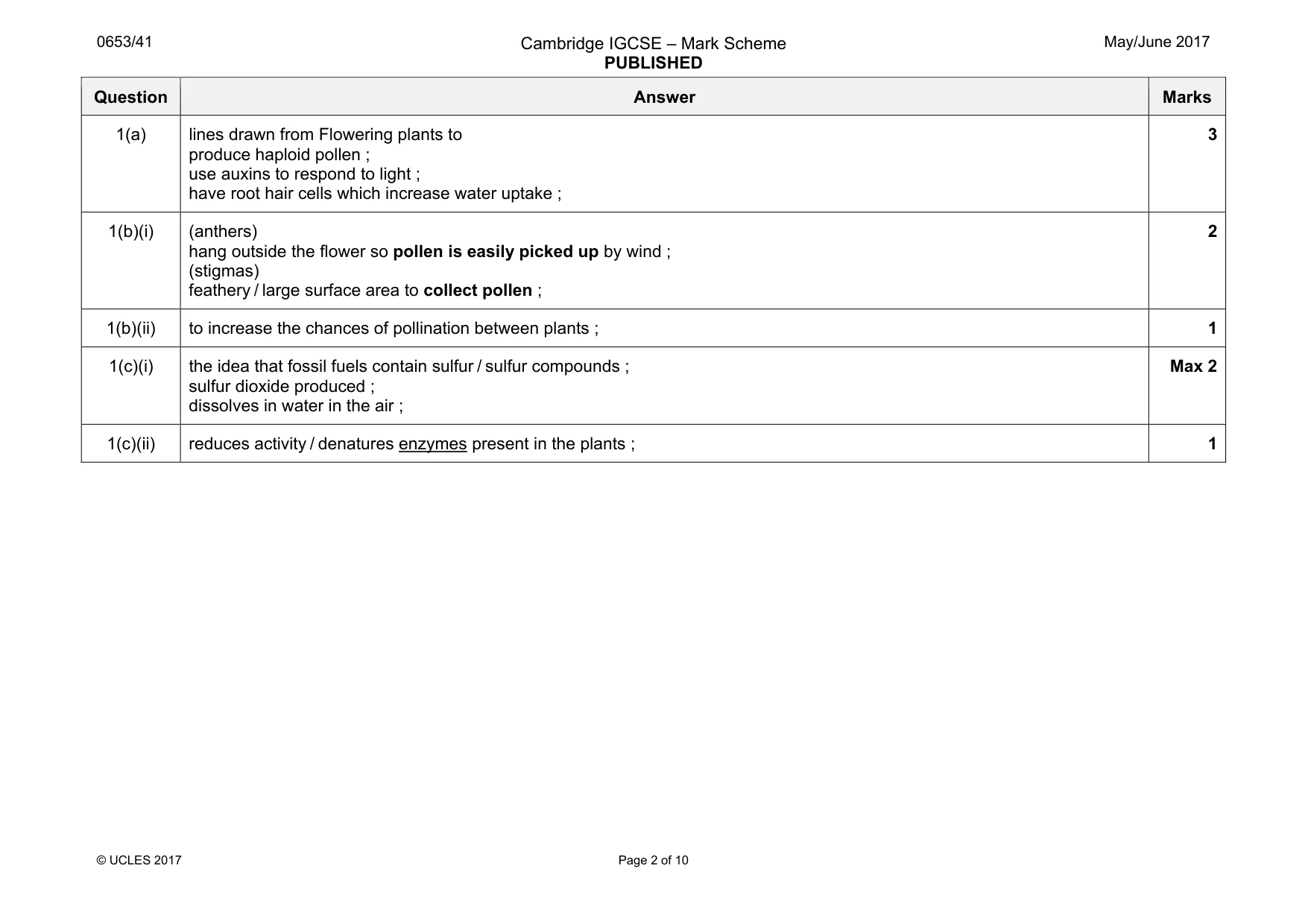
Mark scheme: 2(a)(i) 1 2(a)(ii) four shared pairs between C and four H atoms ; all symbols correctly shown ; 2 2(b)(i) carbon dioxide ; water ; 2 2(b)(ii) releases heat / thermal energy when it reacts / burns / is used ; 1 2(c)(i) natural gas ; 1 2(c)(ii) coal and petroleum ; 1
Q3 · A wind surfer on a surf board, driven by the wind, sailing at a constant speed across the…
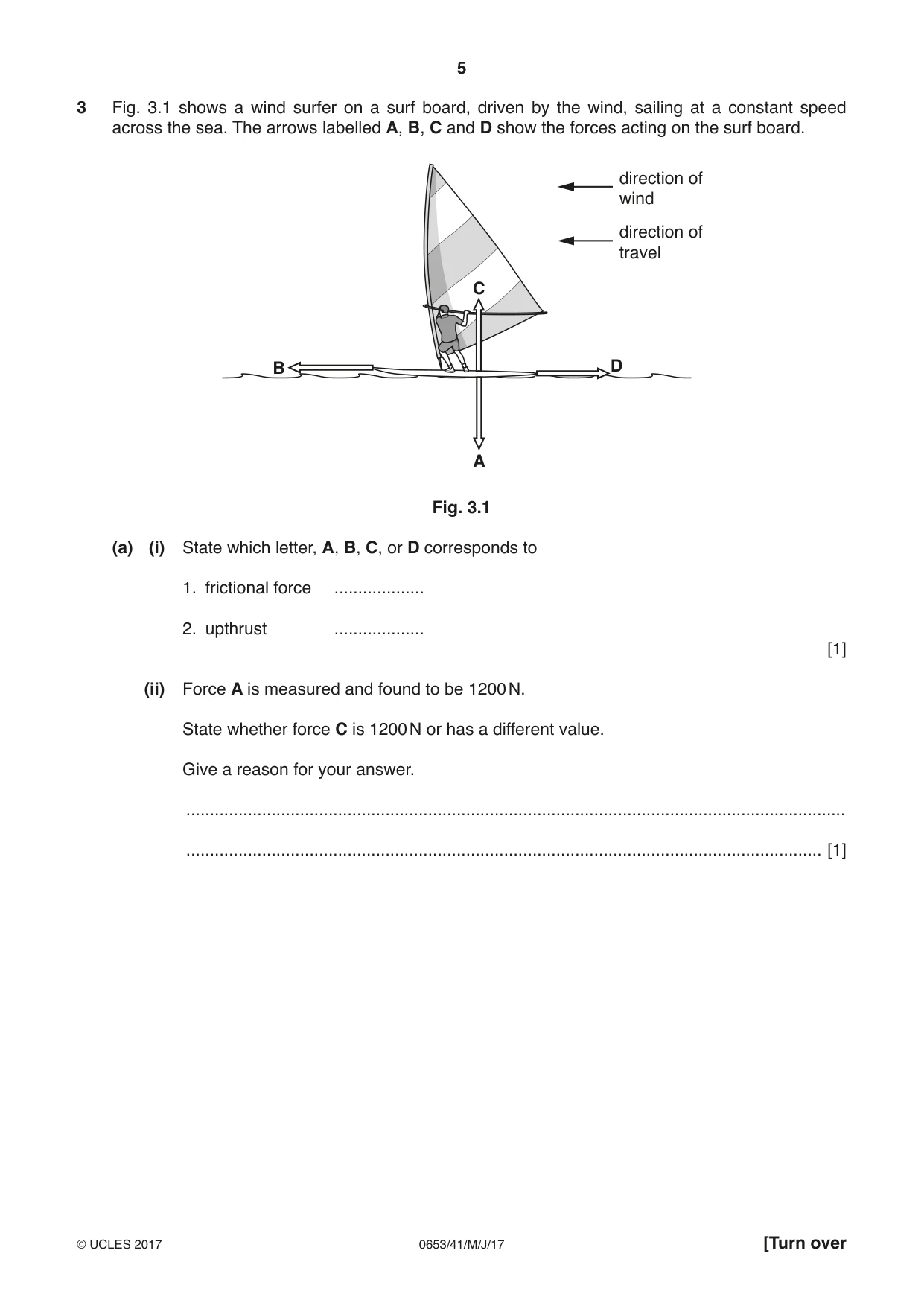
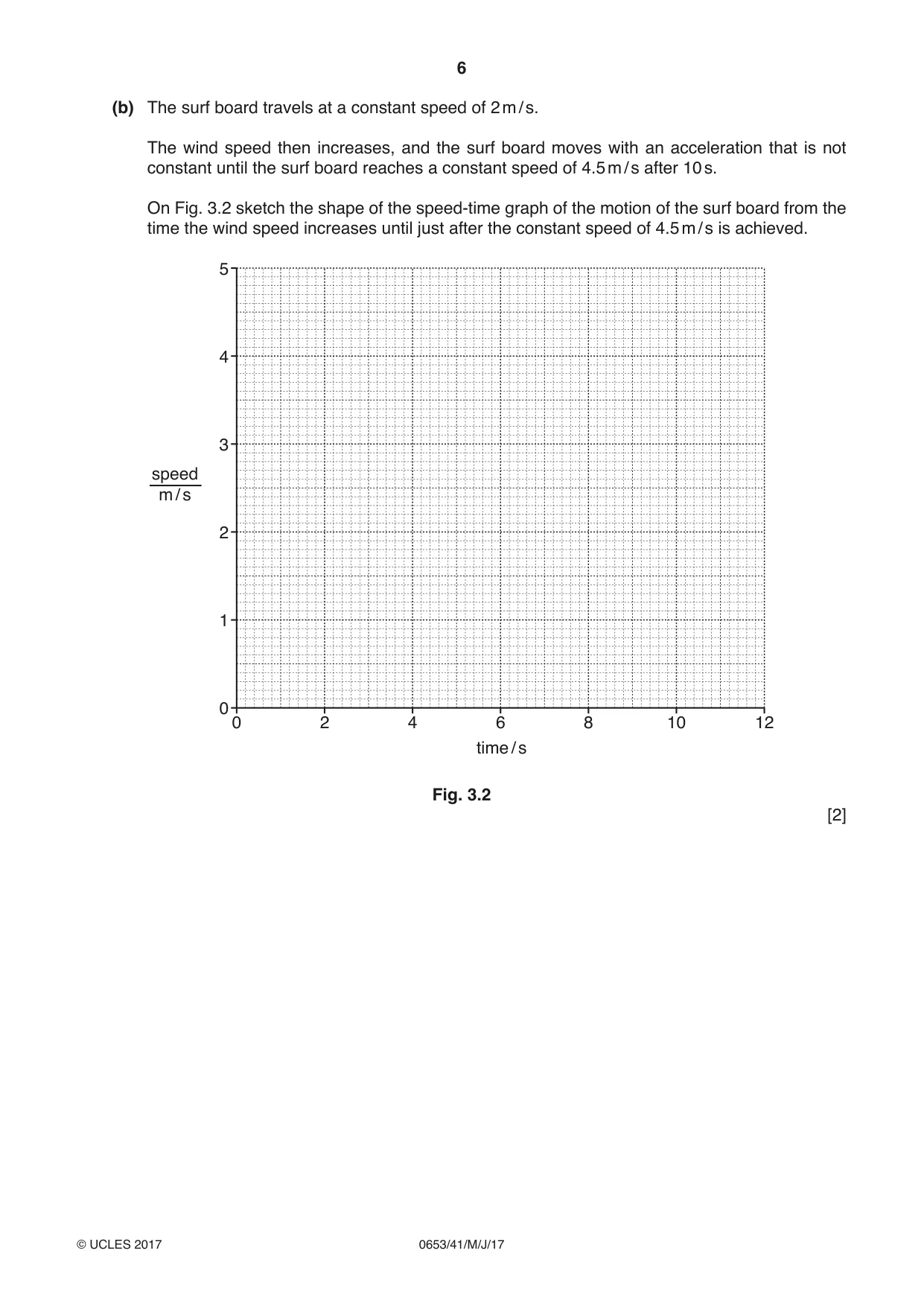
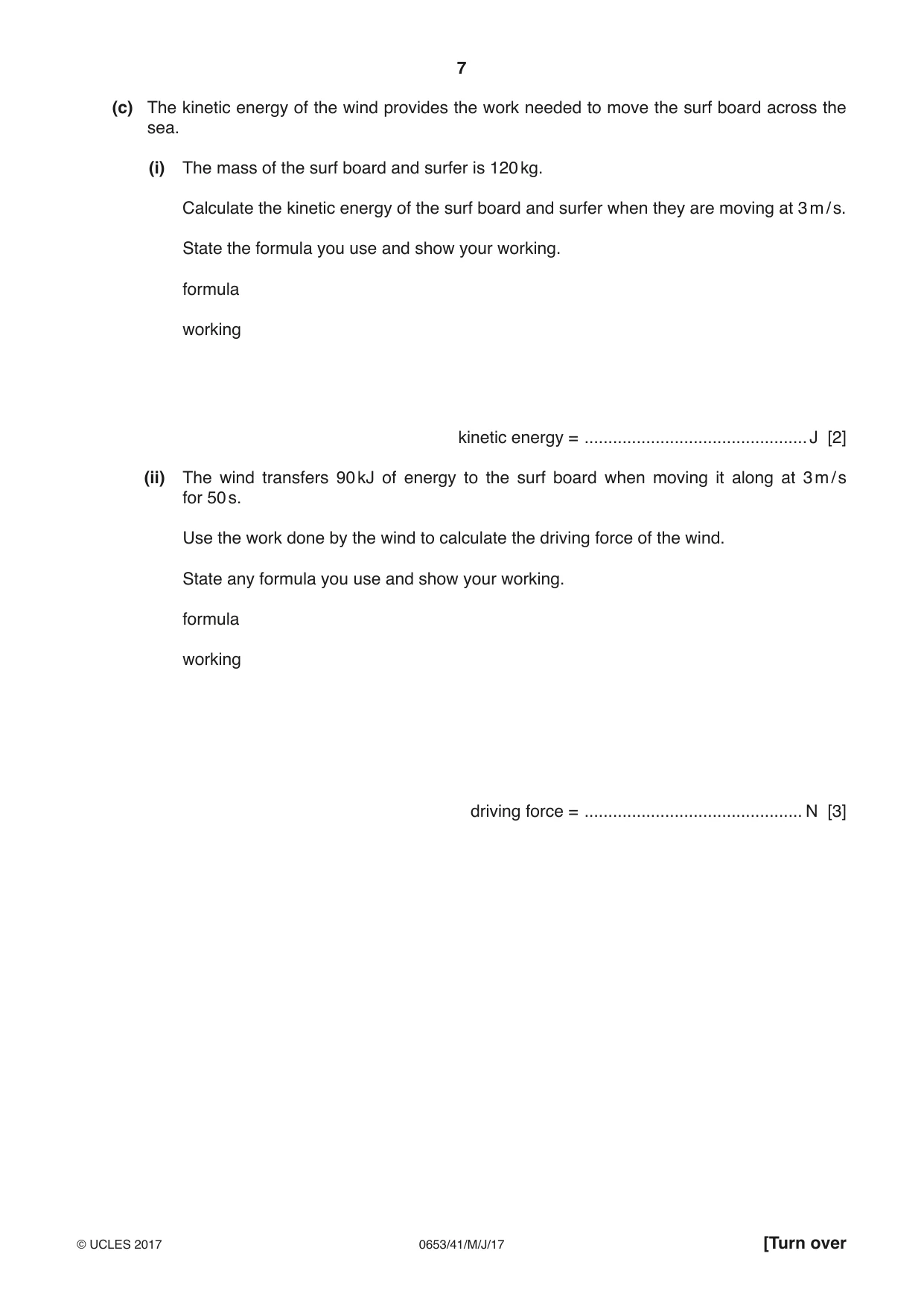
3 Fig. 3.1 shows a wind surfer on a surf board, driven by the wind, sailing at a constant speed across the sea. The arrows labelled A, B, C and D show the forces acting on the surf board. direction of wind direction of travel C B D A Fig. 3.1 (a) (i) State which letter, A, B, C, or D corresponds to 1. frictional force ................... 2. upthrust ................... [1] (ii) Force A is measured and found to be 1200 N. State whether force C is 1200 N or has a different value. Give a reason for your answer. ........................................................................................................................................... ...................................................................................................................................... [1] (b) The surf board travels at a constant speed of 2 m / s. The wind speed then increases, and the surf board moves with an acceleration that is not constant until the surf board reaches a constant speed of 4.5 m / s after 10 s. On Fig. 3.2 sketch the shape of the speed-time graph of the motion of the surf board from the time the wind speed increases until just after the constant speed of 4.5 m / s is achieved. 5 4 3 speed m / s 2 1 0 0 2 4 6 8 10 12 time / s Fig. 3.2 [2] (c) The kinetic energy of the wind provides the work needed to move the surf board across the sea. (i) The mass of the surf board and surfer is 120 kg. Calculate the kinetic energy of the surf board and surfer when they are moving at 3 m / s. State the formula you use and show your working. formula working kinetic energy = ............................................... J [2] (ii) The wind transfers 90 kJ of energy to the surf board when moving it along at 3 m / s for 50 s. Use the work done by the wind to calculate the driving force of the wind. State any formula you use and show your working. formula working driving force = .............................................. N [3]
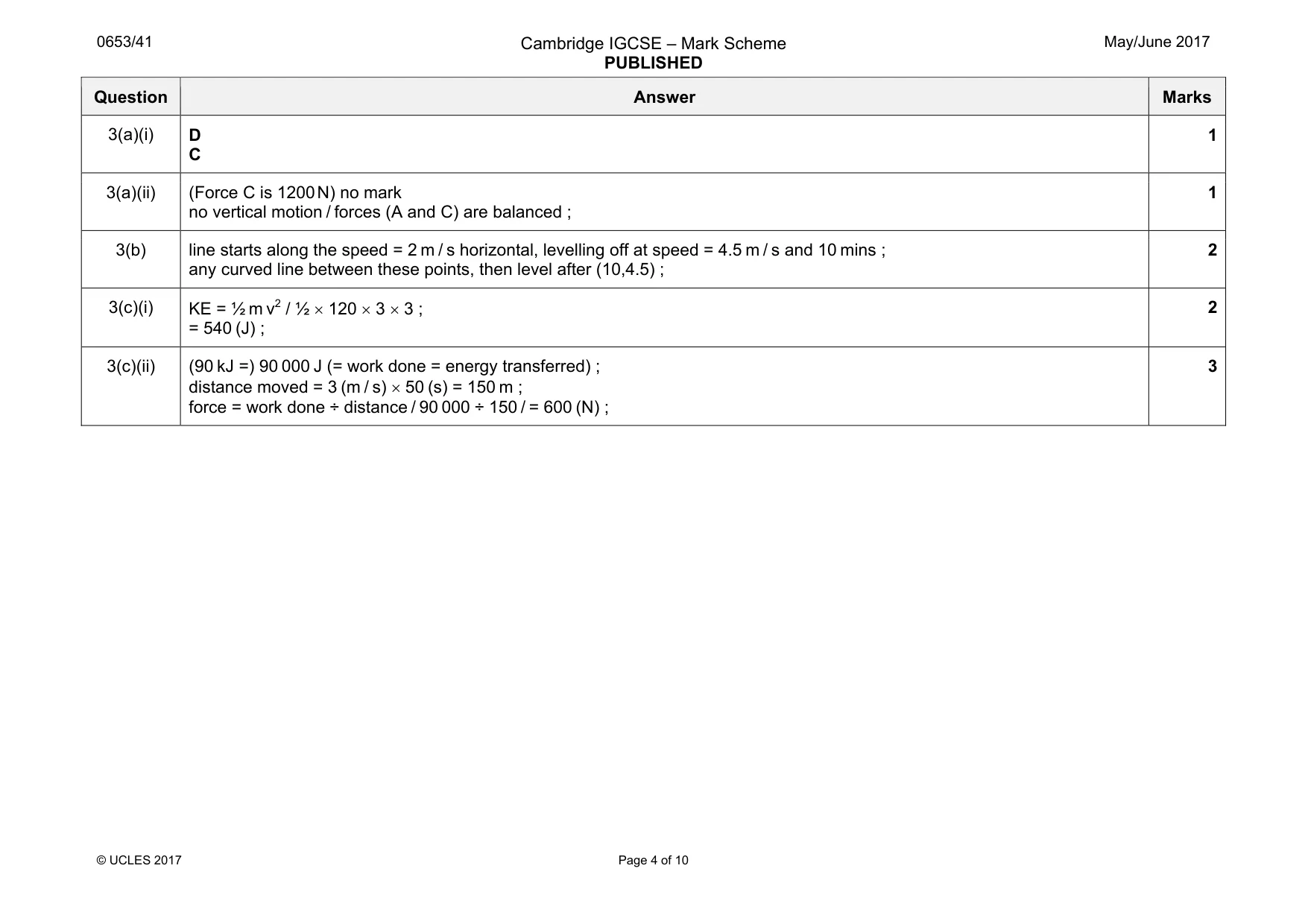
Mark scheme: 3(a)(i) D C 1 3(a)(ii) (Force C is 1200 N) no mark no vertical motion / forces (A and C) are balanced ; 1 3(b) line starts along the speed = 2 m / s horizontal, levelling off at speed = 4.5 m / s and 10 mins ; any curved line between these points, then level after (10,4.5) ; 2 3(c)(i) KE = ½ m v2 / ½ × 120 × 3 × 3 ; = 540 (J) ; 2 3(c)(ii) (90 kJ =) 90 000 J (= work done = energy transferred) ; distance moved = 3 (m / s) × 50 (s) = 150 m ; force = work done ÷ distance / 90 000 ÷ 150 / = 600 (N) ; 3
Q4 · A drawing of a single-celled organism called Euglena as seen using a light microscope
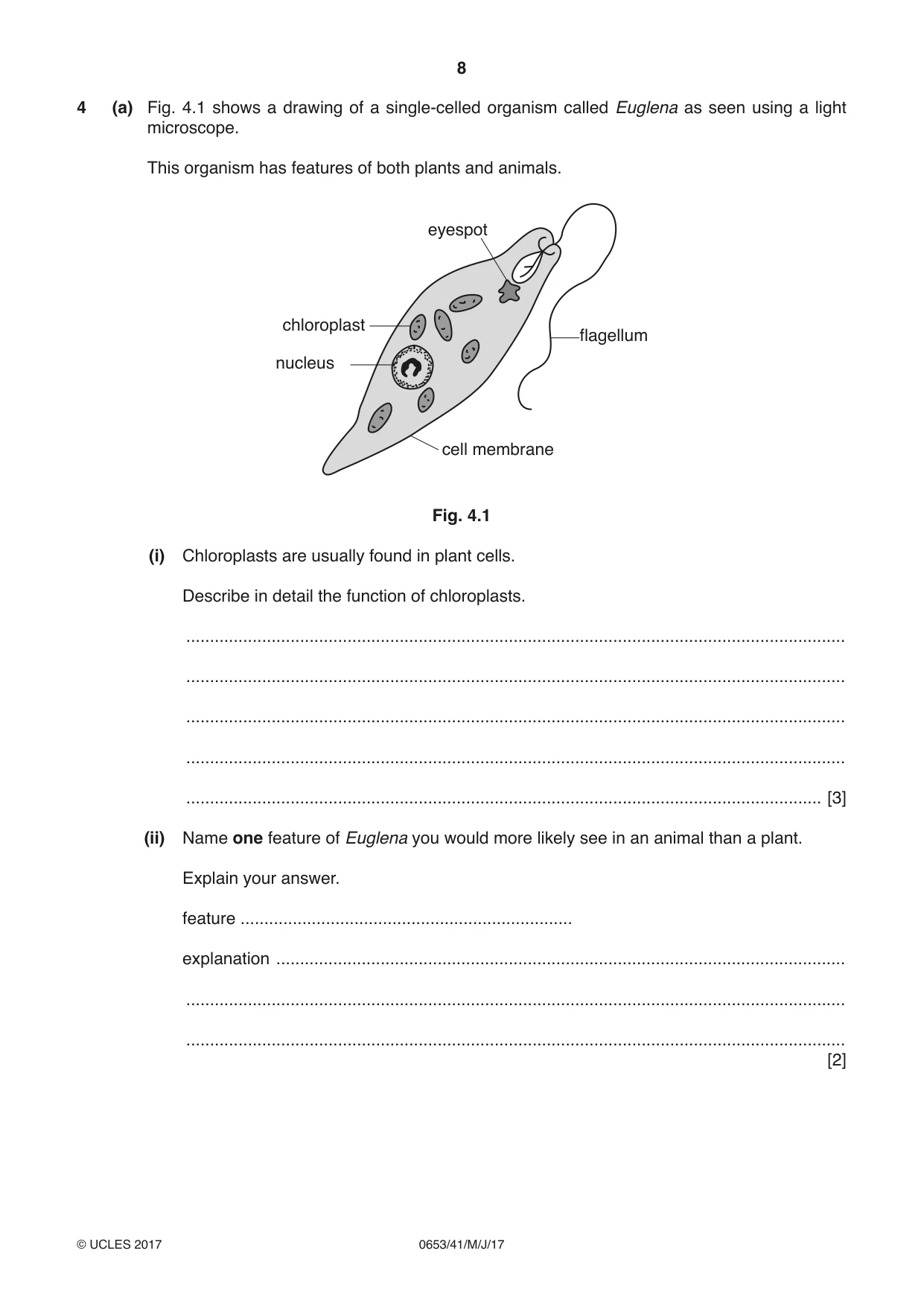
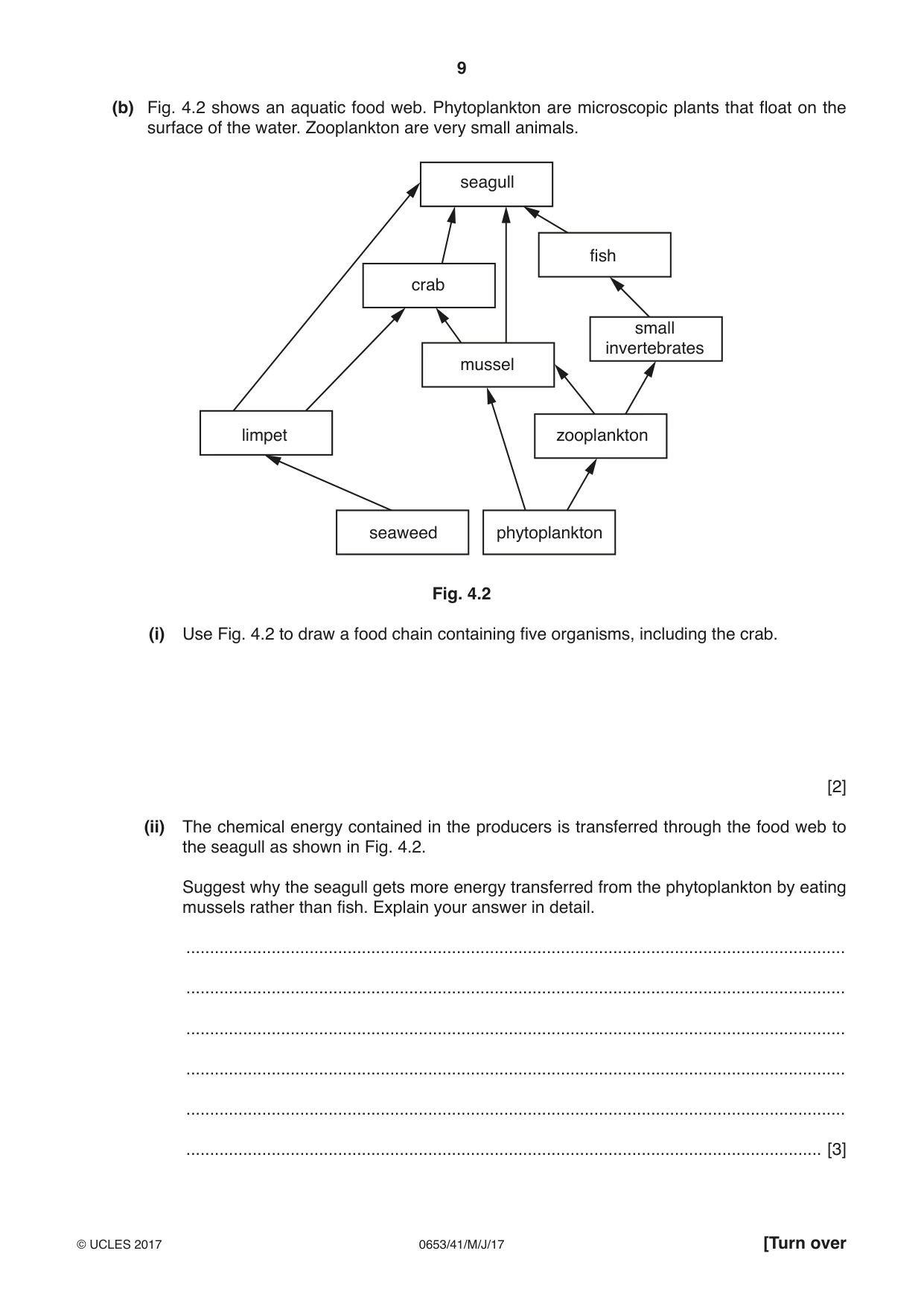
4 (a) Fig. 4.1 shows a drawing of a single-celled organism called Euglena as seen using a light microscope. This organism has features of both plants and animals. eyespot chloroplast flagellum nucleus cell membrane Fig. 4.1 (i) Chloroplasts are usually found in plant cells. Describe in detail the function of chloroplasts. ........................................................................................................................................... ........................................................................................................................................... ........................................................................................................................................... ........................................................................................................................................... ...................................................................................................................................... [3] (ii) Name one feature of Euglena you would more likely see in an animal than a plant. Explain your answer. feature ...................................................................... explanation ........................................................................................................................ ........................................................................................................................................... ........................................................................................................................................... [2] (b) Fig. 4.2 shows an aquatic food web. Phytoplankton are microscopic plants that float on the surface of the water. Zooplankton are very small animals. seagull fish crab small invertebrates mussel limpet zooplankton seaweed phytoplankton Fig. 4.2 (i) Use Fig. 4.2 to draw a food chain containing five organisms, including the crab. [2] (ii) The chemical energy contained in the producers is transferred through the food web to the seagull as shown in Fig. 4.2. Suggest why the seagull gets more energy transferred from the phytoplankton by eating mussels rather than fish. Explain your answer in detail. ........................................................................................................................................... ........................................................................................................................................... ........................................................................................................................................... ........................................................................................................................................... ........................................................................................................................................... ...................................................................................................................................... [3]
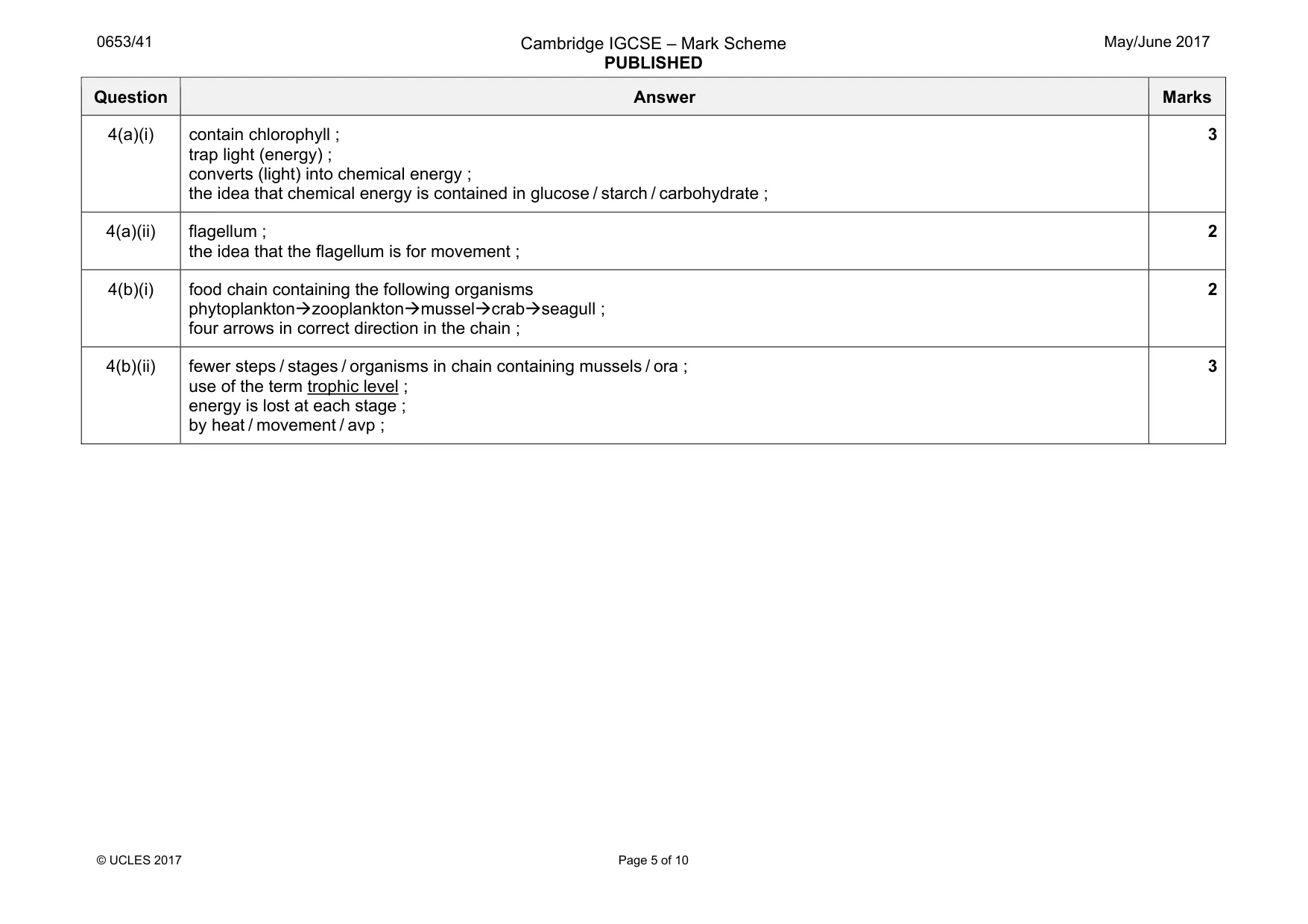
Mark scheme: 4(a)(i) contain chlorophyll ; trap light (energy) ; converts (light) into chemical energy ; the idea that chemical energy is contained in glucose / starch / carbohydrate ; 3 4(a)(ii) flagellum ; the idea that the flagellum is for movement ; 2 4(b)(i) food chain containing the following organisms phytoplanktonÆzooplanktonÆmusselÆcrabÆseagull ; four arrows in correct direction in the chain ; 2 4(b)(ii) fewer steps / stages / organisms in chain containing mussels / ora ; use of the term trophic level ; energy is lost at each stage ; by heat / movement / avp ; 3
Q5 · A student investigates the reaction between dilute sulfuric acid and excess copper(II)…
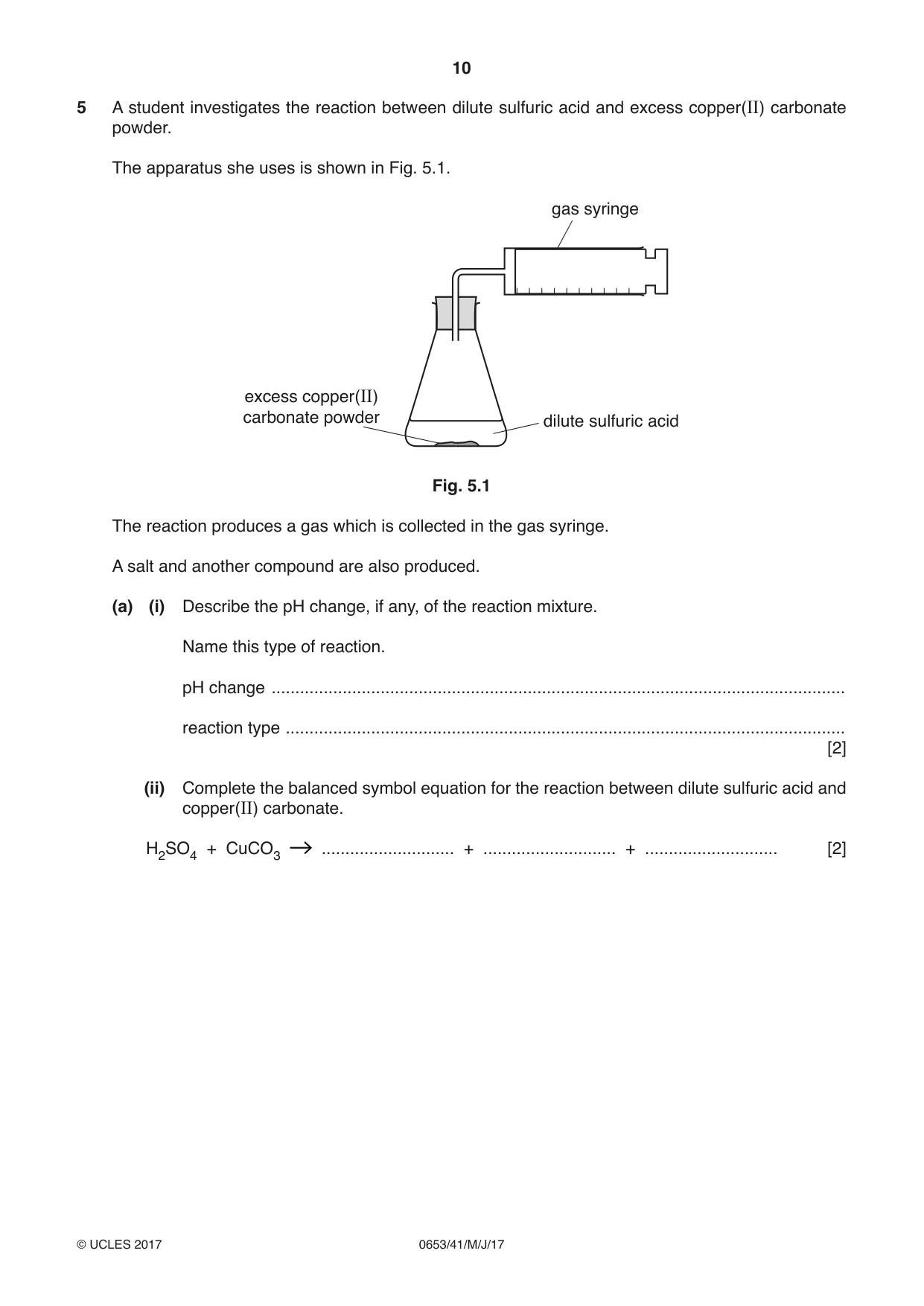
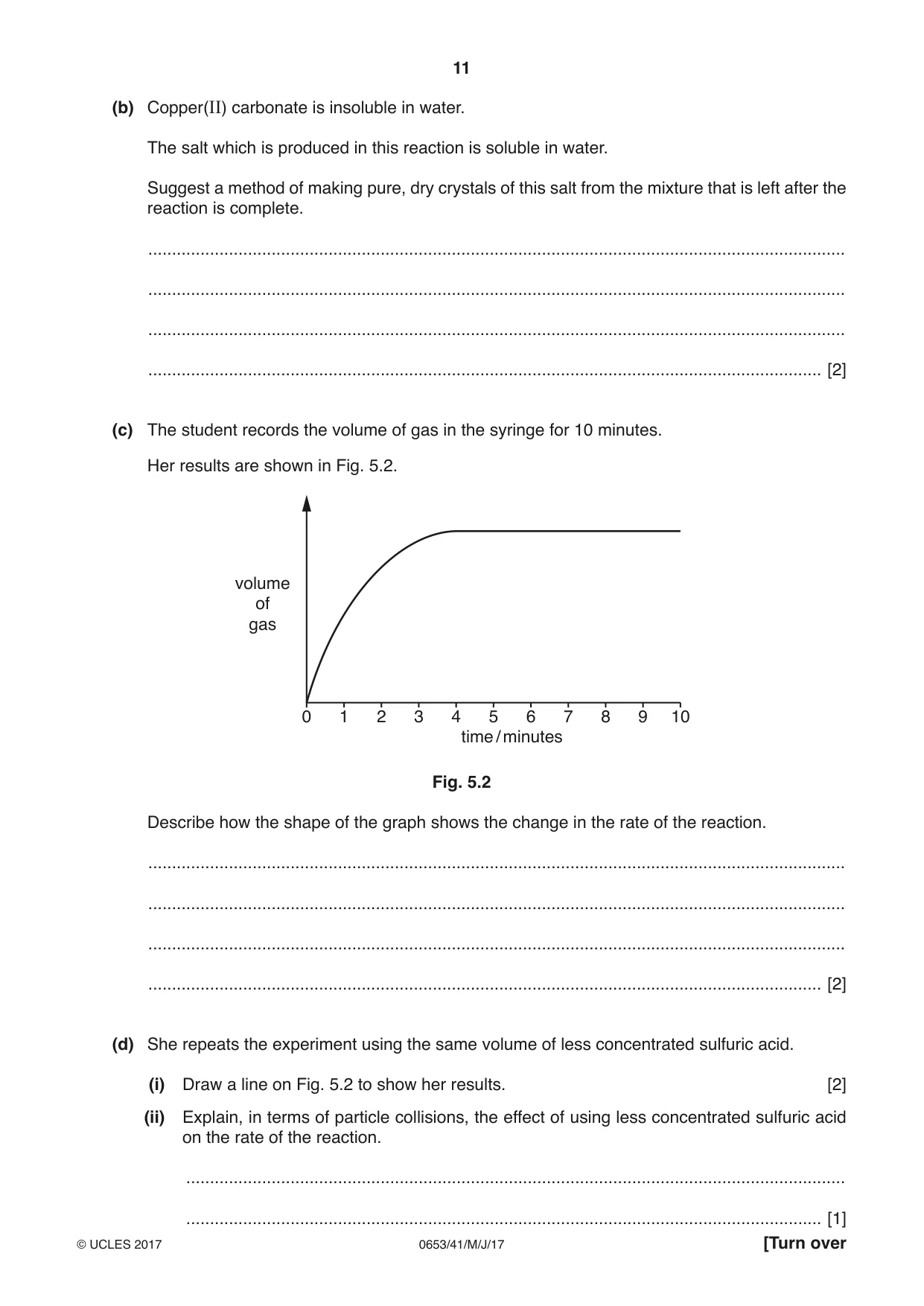
5 A student investigates the reaction between dilute sulfuric acid and excess copper(II) carbonate powder. The apparatus she uses is shown in Fig. 5.1. gas syringe excess copper(II) carbonate powder dilute sulfuric acid Fig. 5.1 The reaction produces a gas which is collected in the gas syringe. A salt and another compound are also produced. (a) (i) Describe the pH change, if any, of the reaction mixture. Name this type of reaction. pH change ......................................................................................................................... reaction type ...................................................................................................................... [2] (ii) Complete the balanced symbol equation for the reaction between dilute sulfuric acid and copper(II) carbonate. H2SO4 + CuCO3 ............................ + ............................ + ............................ [2] (b) Copper(II) carbonate is insoluble in water. The salt which is produced in this reaction is soluble in water. Suggest a method of making pure, dry crystals of this salt from the mixture that is left after the reaction is complete. ................................................................................................................................................... ................................................................................................................................................... ................................................................................................................................................... .............................................................................................................................................. [2] (c) The student records the volume of gas in the syringe for 10 minutes. Her results are shown in Fig. 5.2. volume of gas 0 1 2 3 4 5 6 7 8 9 10 time / minutes Fig. 5.2 Describe how the shape of the graph shows the change in the rate of the reaction. ................................................................................................................................................... ................................................................................................................................................... ................................................................................................................................................... .............................................................................................................................................. [2] (d) She repeats the experiment using the same volume of less concentrated sulfuric acid. (i) Draw a line on Fig. 5.2 to show her results. [2] (ii) Explain, in terms of particle collisions, the effect of using less concentrated sulfuric acid on the rate of the reaction. ........................................................................................................................................... ...................................................................................................................................... [1]
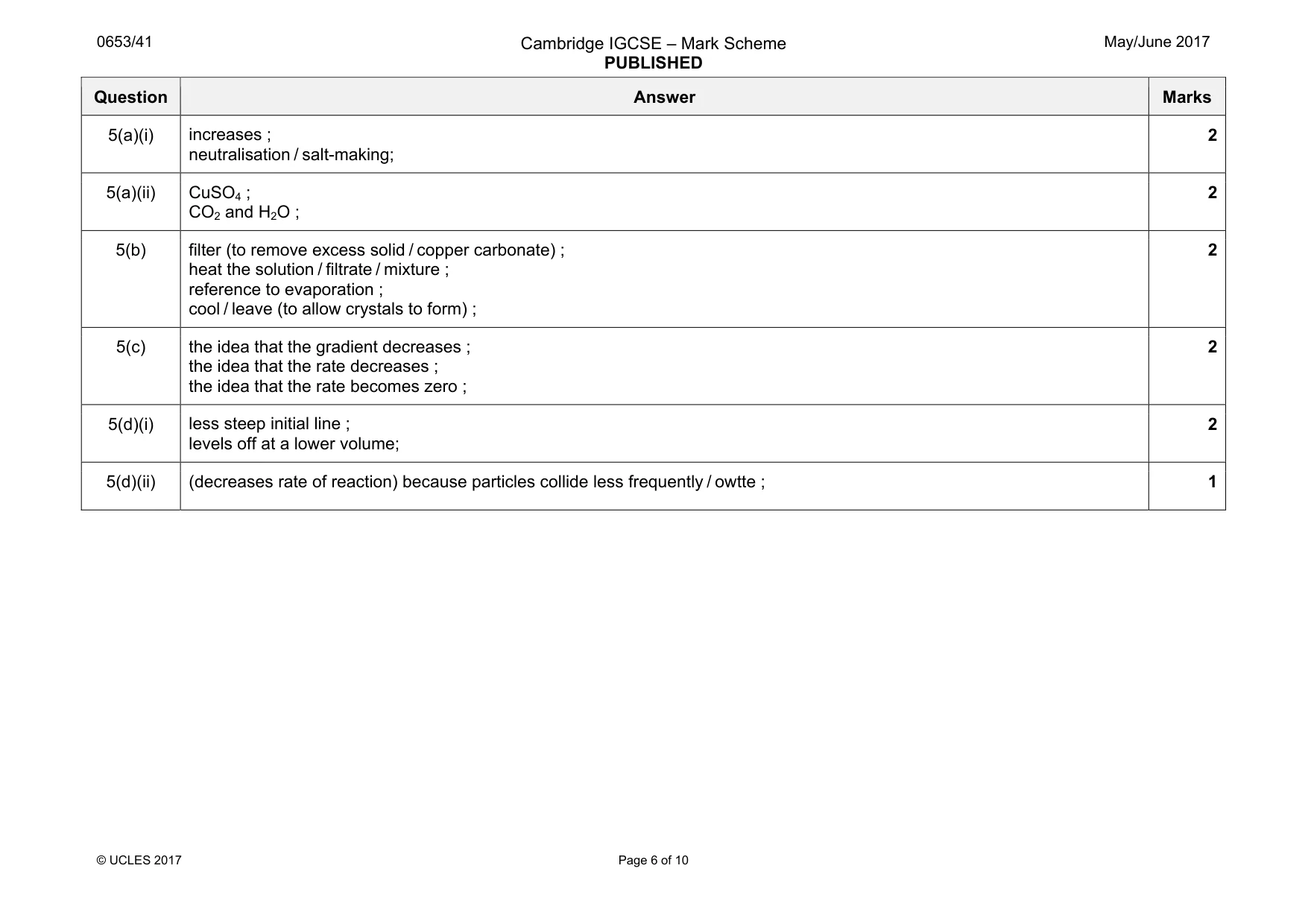
Mark scheme: 5(a)(i) neutralisation / salt-making; 2 5(a)(ii) CuSO4 ; CO2 and H2O ; 2 5(b) filter (to remove excess solid / copper carbonate) ; heat the solution / filtrate / mixture ; reference to evaporation ; cool / leave (to allow crystals to form) ; 2 5(c) the idea that the gradient decreases ; the idea that the rate decreases ; the idea that the rate becomes zero ; 2 5(d)(i) less steep initial line ; levels off at a lower volume; 2 5(d)(ii) (decreases rate of reaction) because particles collide less frequently / owtte ; 1
Q6 · A man standing in the sea on a sunny day
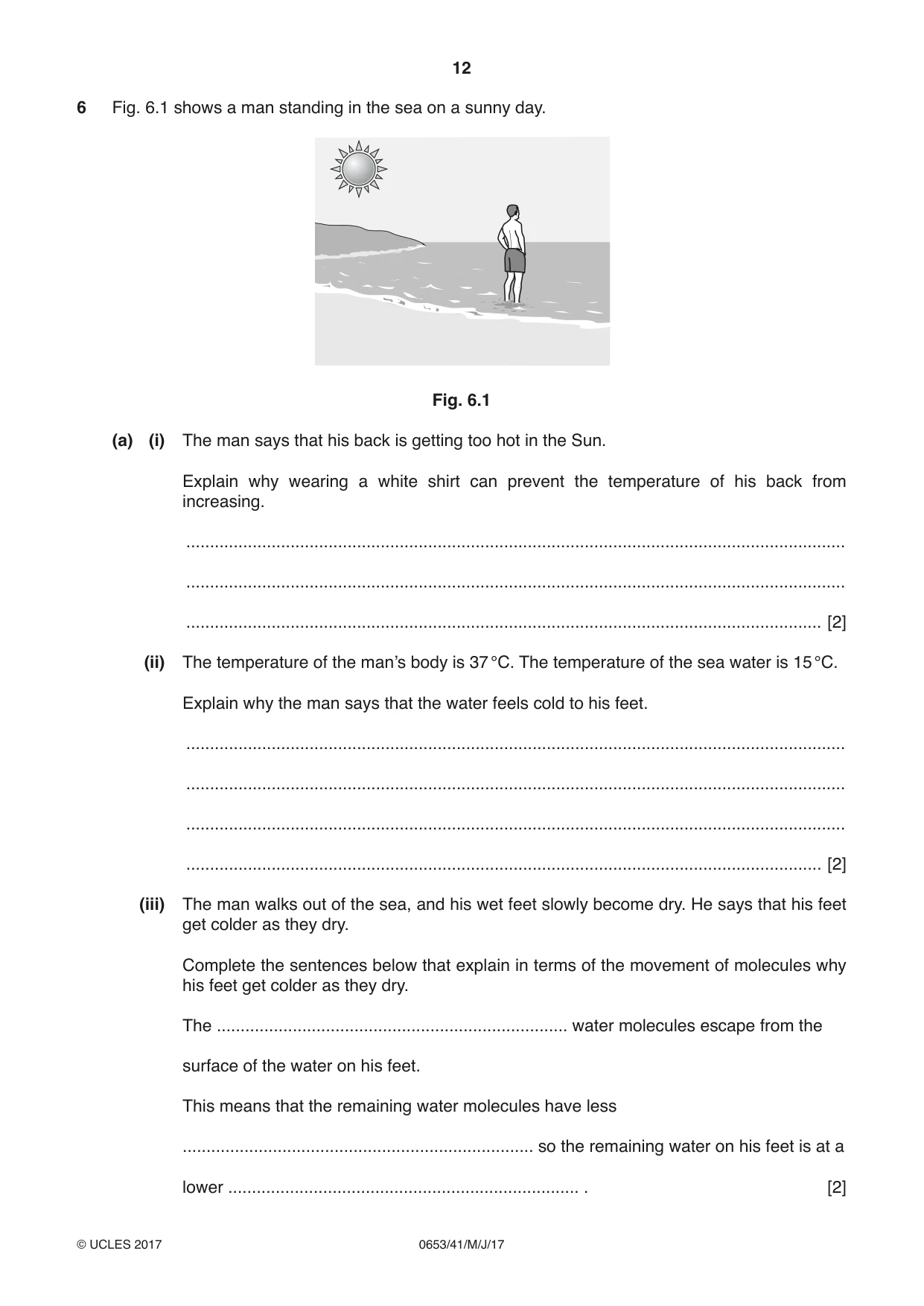
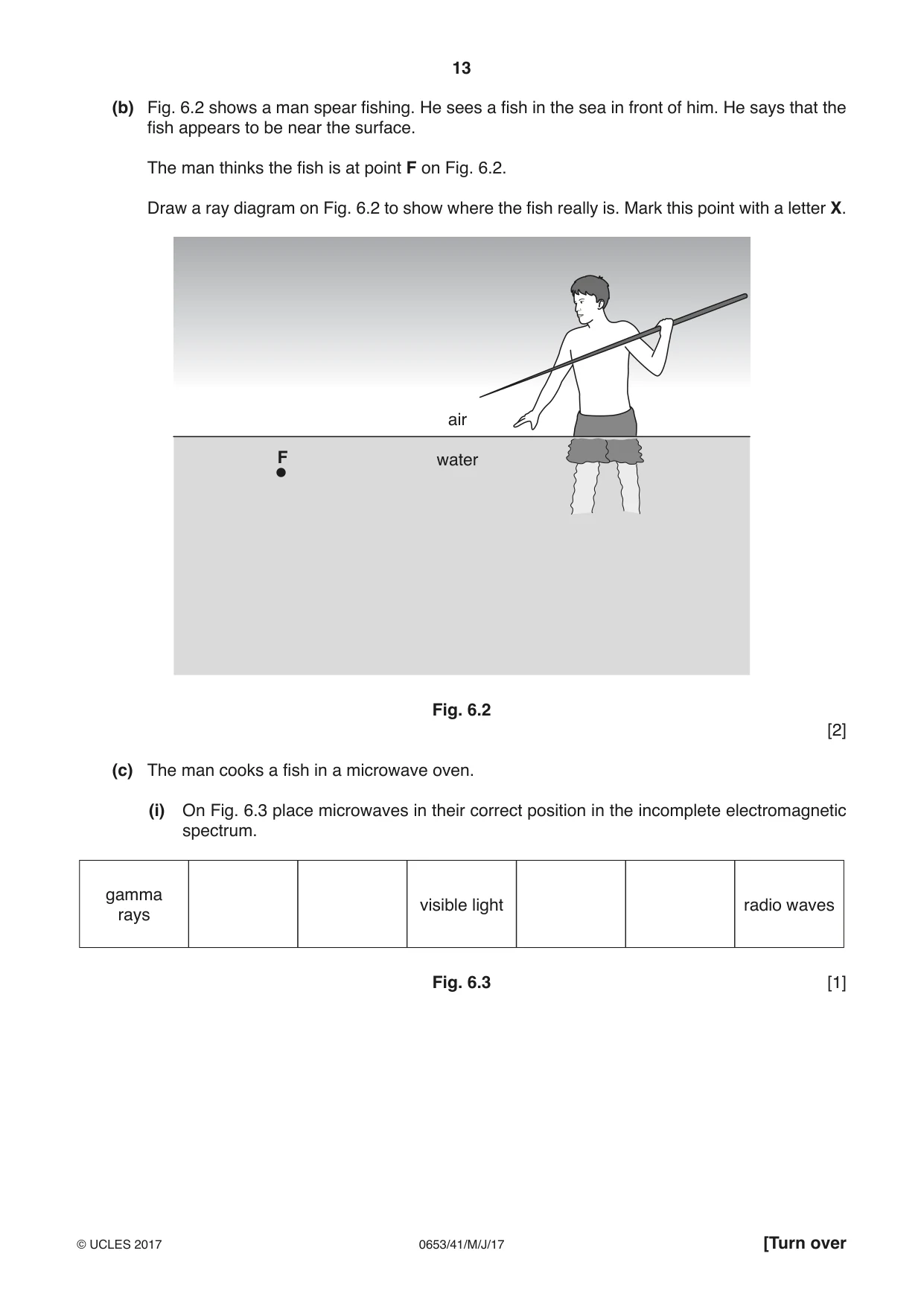
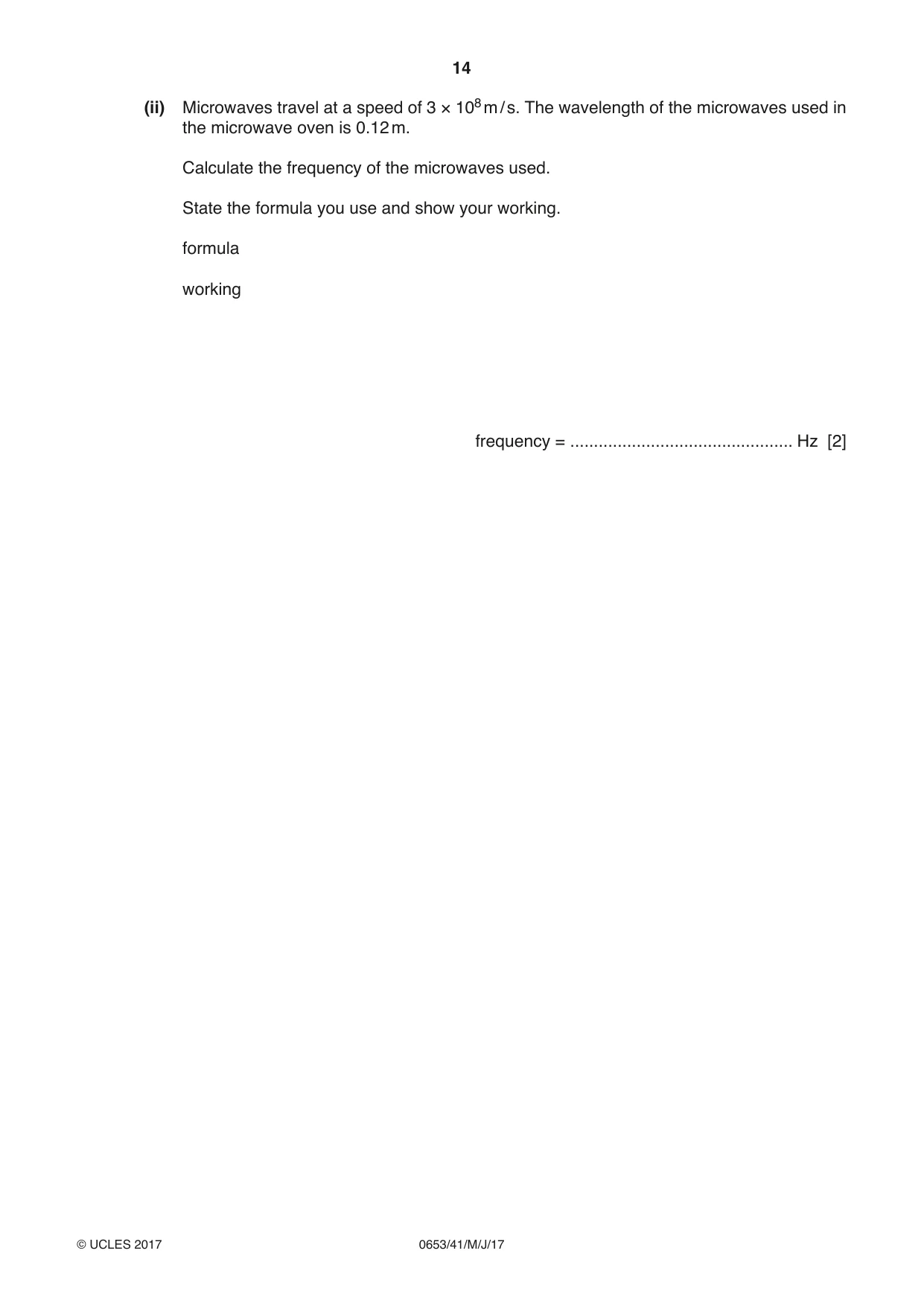
6 Fig. 6.1 shows a man standing in the sea on a sunny day. Fig. 6.1 (a) (i) The man says that his back is getting too hot in the Sun. Explain why wearing a white shirt can prevent the temperature of his back from increasing. ........................................................................................................................................... ........................................................................................................................................... ...................................................................................................................................... [2] (ii) The temperature of the man’s body is 37 °C. The temperature of the sea water is 15 °C. Explain why the man says that the water feels cold to his feet. ........................................................................................................................................... ........................................................................................................................................... ........................................................................................................................................... ...................................................................................................................................... [2] (iii) The man walks out of the sea, and his wet feet slowly become dry. He says that his feet get colder as they dry. Complete the sentences below that explain in terms of the movement of molecules why his feet get colder as they dry. The .......................................................................... water molecules escape from the surface of the water on his feet. This means that the remaining water molecules have less .......................................................................... so the remaining water on his feet is at a lower .......................................................................... . [2] (b) Fig. 6.2 shows a man spear fishing. He sees a fish in the sea in front of him. He says that the fish appears to be near the surface. The man thinks the fish is at point F on Fig. 6.2. Draw a ray diagram on Fig. 6.2 to show where the fish really is. Mark this point with a letter X. air F water Fig. 6.2 [2] (c) The man cooks a fish in a microwave oven. (i) On Fig. 6.3 place microwaves in their correct position in the incomplete electromagnetic spectrum. gamma visible light radio waves rays Fig. 6.3 [1] (ii) Microwaves travel at a speed of 3 × 10⁸ m / s. The wavelength of the microwaves used in the microwave oven is 0.12 m. Calculate the frequency of the microwaves used. State the formula you use and show your working. formula working frequency = ............................................... Hz [2]
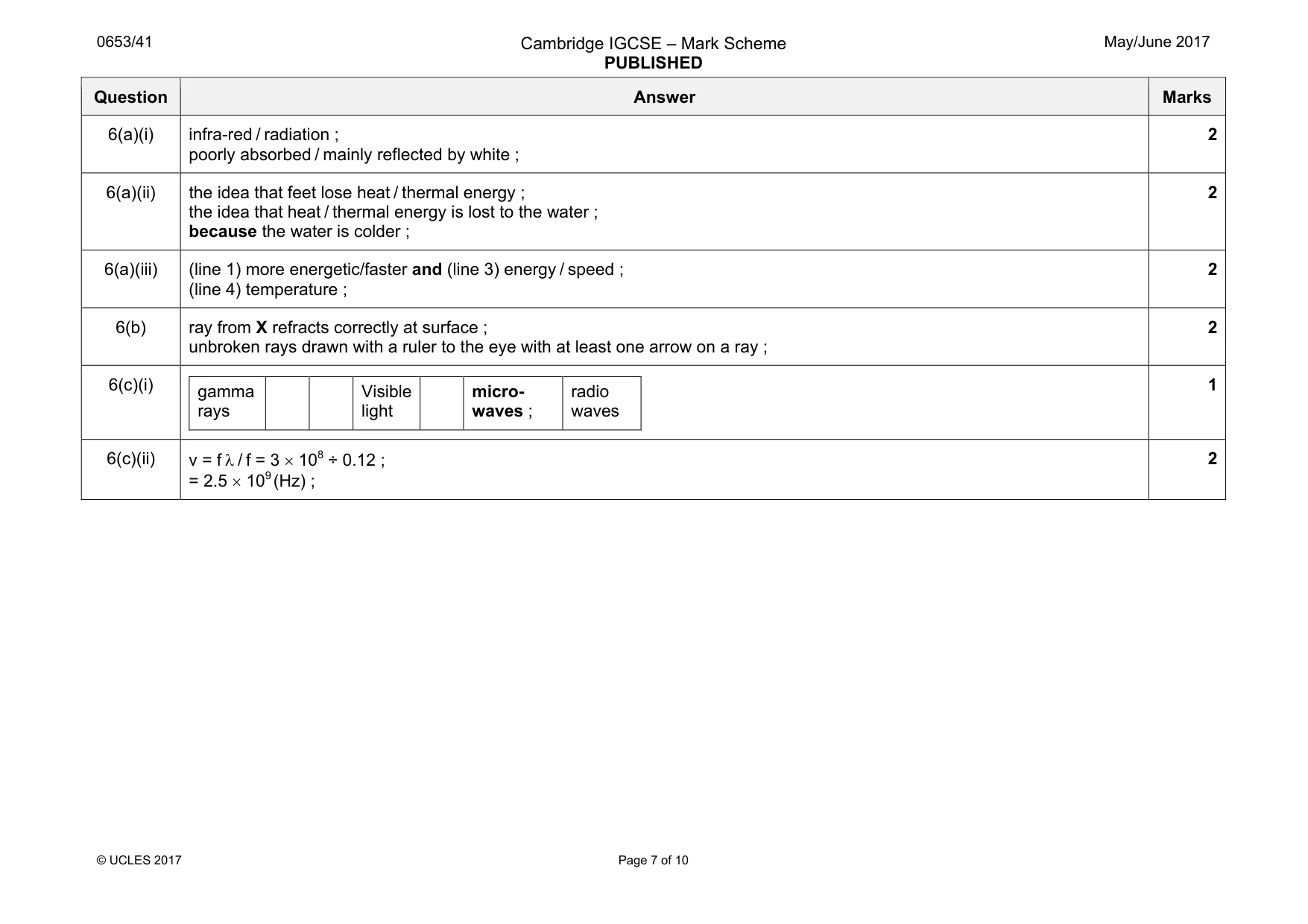
Mark scheme: 6(a)(i) infra-red / radiation ; poorly absorbed / mainly reflected by white ; 2 6(a)(ii) the idea that feet lose heat / thermal energy ; the idea that heat / thermal energy is lost to the water ; because the water is colder ; 2 6(a)(iii) (line 1) more energetic/faster and (line 3) energy / speed ; (line 4) temperature ; 2 6(b) ray from X refracts correctly at surface ; unbroken rays drawn with a ruler to the eye with at least one arrow on a ray ; 2 6(c)(i) gamma rays Visible light micro- waves ; radio waves 1 6(c)(ii) v = f λ / f = 3 × 10⁸ ÷ 0.12 ; = 2.5 × 10⁹ (Hz) ; 2
Q7 · The mass of some of the contents of three foods in a 100 gram sample of each food
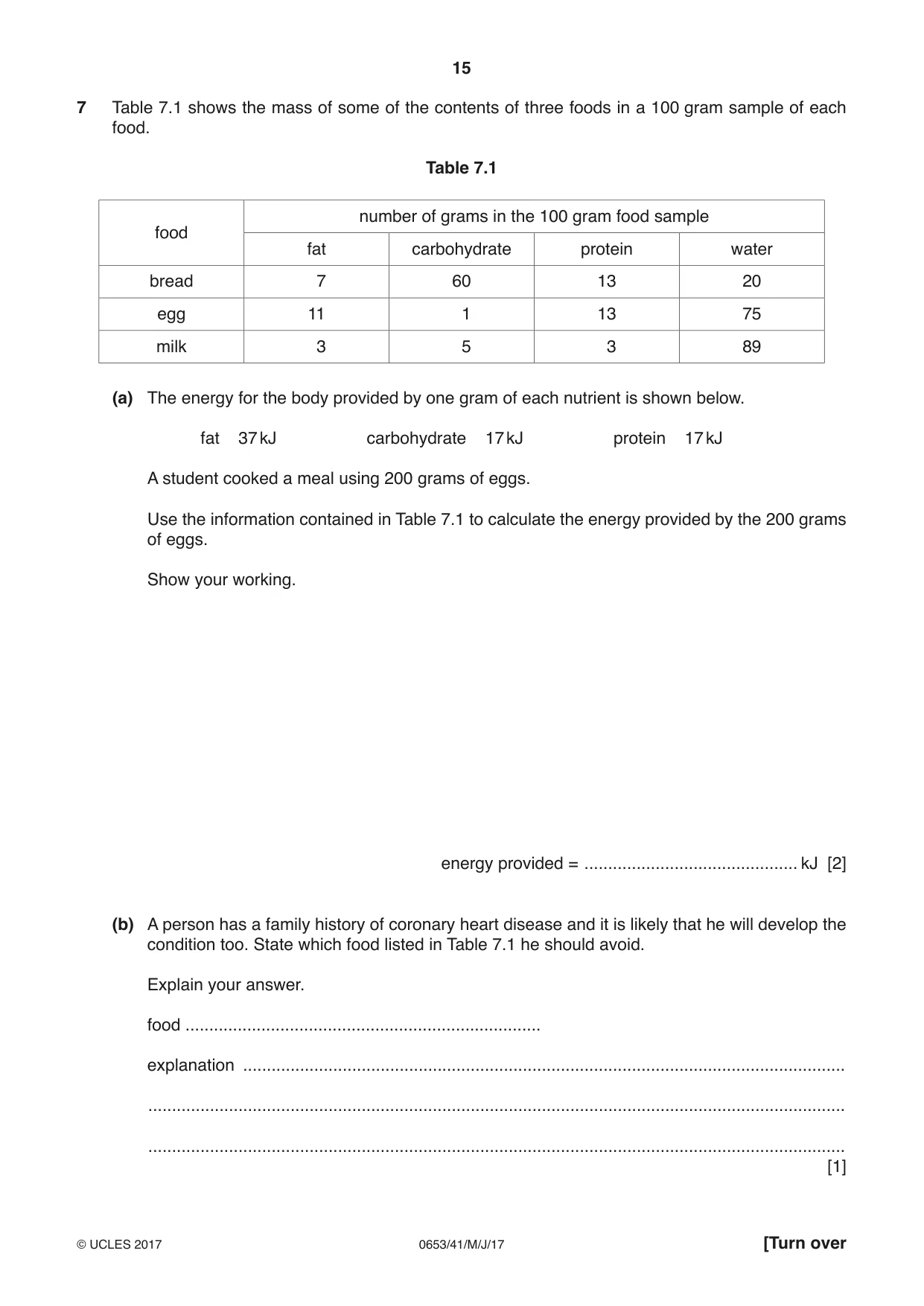
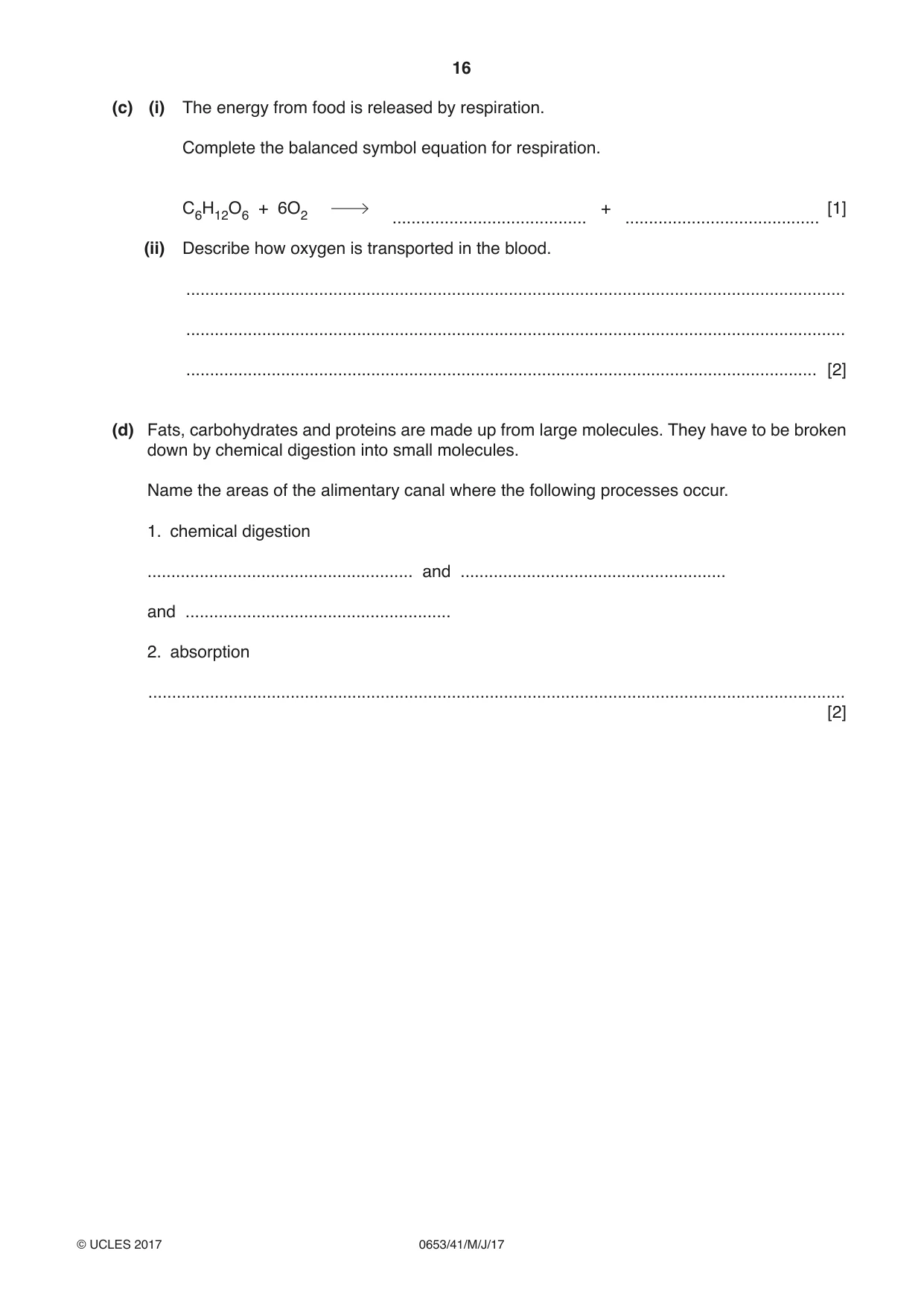
7 Table 7.1 shows the mass of some of the contents of three foods in a 100 gram sample of each food. Table 7.1 number of grams in the 100 gram food sample food fat carbohydrate protein water bread 7 60 13 20 egg 11 1 13 75 milk 3 5 3 89 (a) The energy for the body provided by one gram of each nutrient is shown below. fat 37 kJ carbohydrate 17 kJ protein 17 kJ A student cooked a meal using 200 grams of eggs. Use the information contained in Table 7.1 to calculate the energy provided by the 200 grams of eggs. Show your working. energy provided = ............................................. kJ [2] (b) A person has a family history of coronary heart disease and it is likely that he will develop the condition too. State which food listed in Table 7.1 he should avoid. Explain your answer. food ........................................................................... explanation ............................................................................................................................... ................................................................................................................................................... ................................................................................................................................................... [1] (c) (i) The energy from food is released by respiration. Complete the balanced symbol equation for respiration. C6H12O6 + 6O2 + [1] ......................................... ......................................... (ii) Describe how oxygen is transported in the blood. ........................................................................................................................................... ........................................................................................................................................... ..................................................................................................................................... [2] (d) Fats, carbohydrates and proteins are made up from large molecules. They have to be broken down by chemical digestion into small molecules. Name the areas of the alimentary canal where the following processes occur. 1. chemical digestion ........................................................ and ........................................................ and ........................................................ 2. absorption ................................................................................................................................................... [2] Please turn over for Question 8
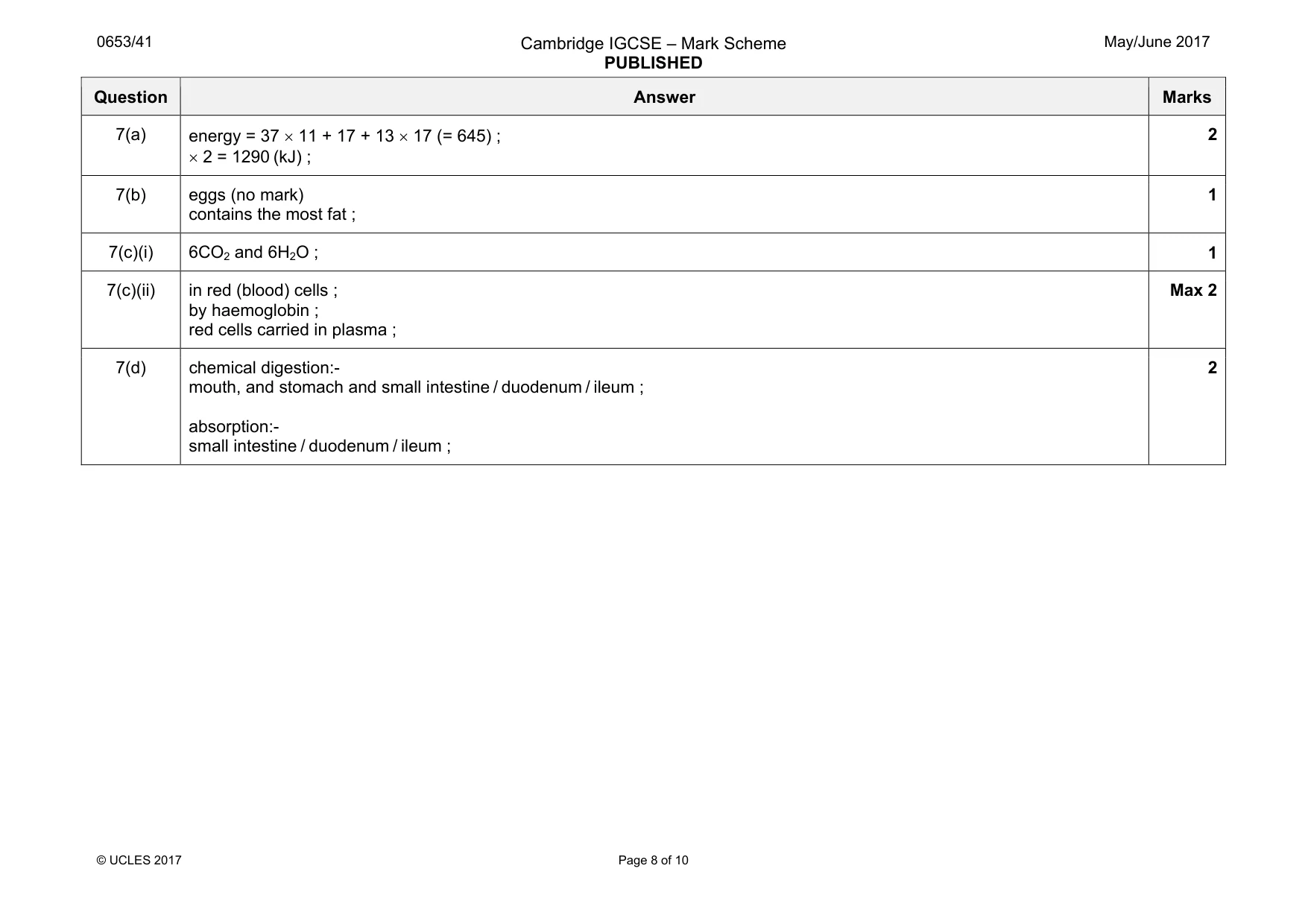
Mark scheme: 7(a) × 2 = 1290 (kJ) ; 2 7(b) eggs (no mark) contains the most fat ; 1 7(c)(i) 6CO2 and 6H2O ; 1 7(c)(ii) in red (blood) cells ; by haemoglobin ; red cells carried in plasma ; Max 2 7(d) chemical digestion:- mouth, and stomach and small intestine / duodenum / ileum ; absorption:- small intestine / duodenum / ileum ; 2
Q8 · Use the Periodic Table on page 24 to determine the electronic structure of an aluminium…
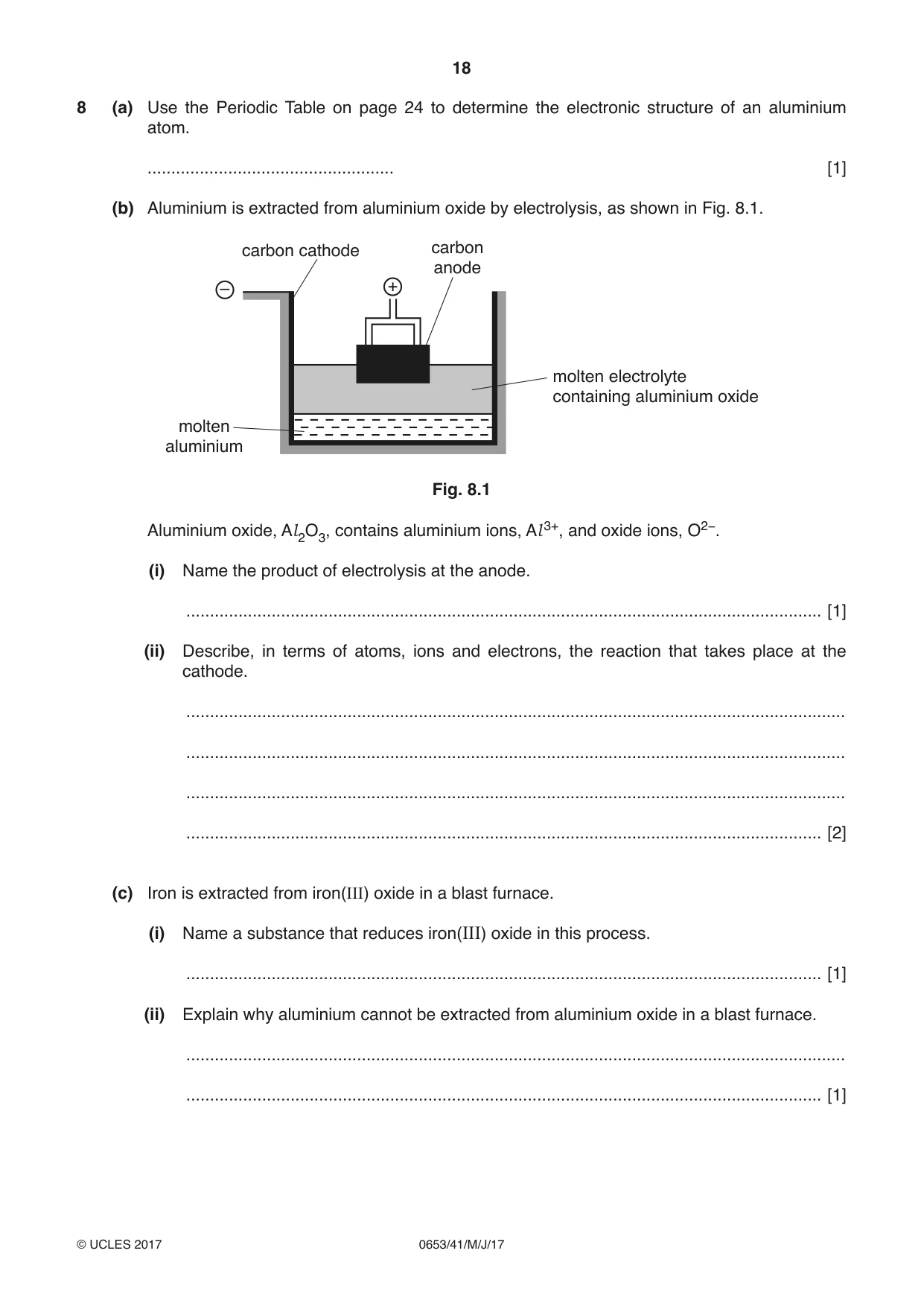
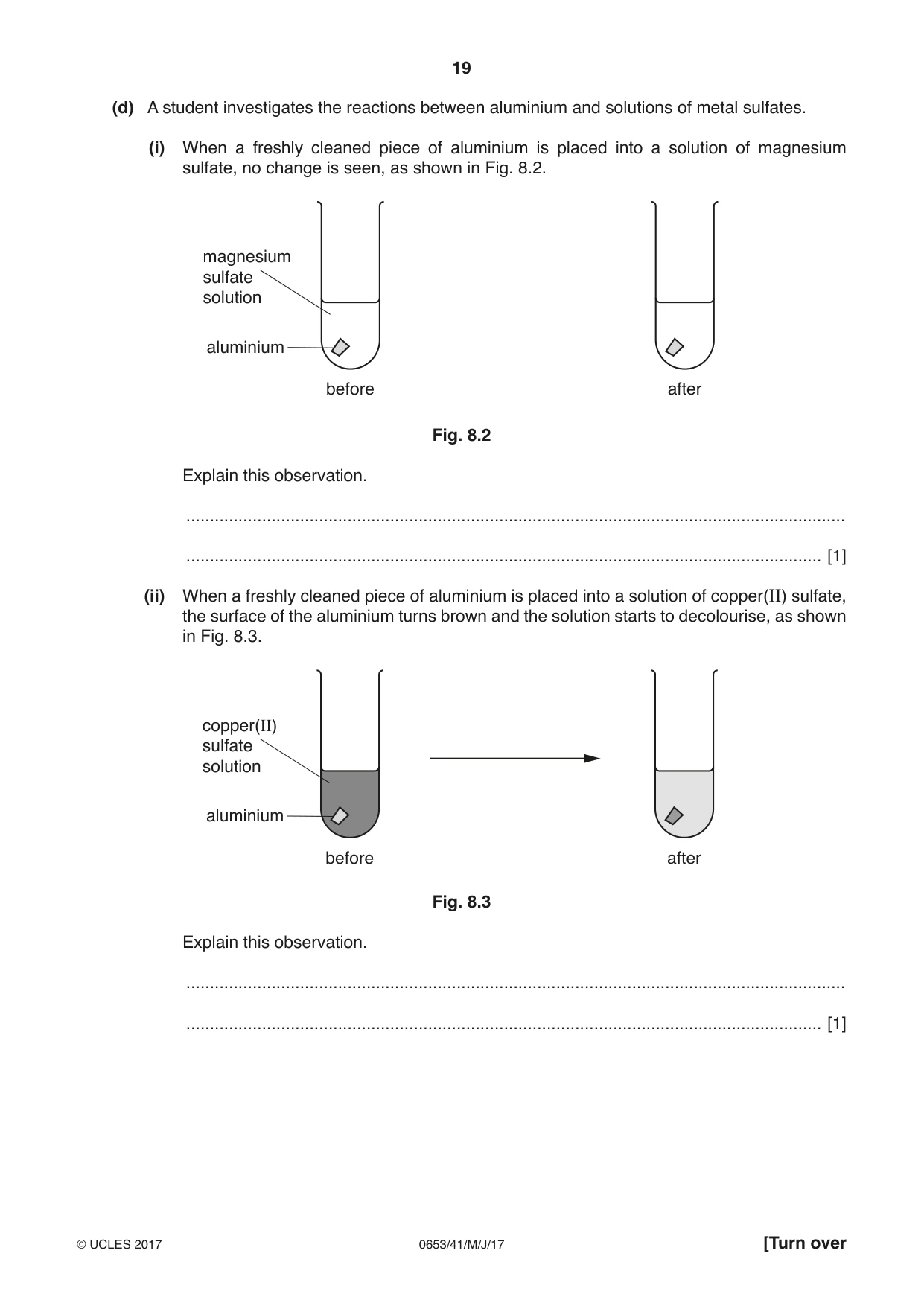
8 (a) Use the Periodic Table on page 24 to determine the electronic structure of an aluminium atom. .................................................... [1] (b) Aluminium is extracted from aluminium oxide by electrolysis, as shown in Fig. 8.1. carbon cathode carbon anode – + molten electrolyte containing aluminium oxide molten aluminium Fig. 8.1 Aluminium oxide, Al2O3, contains aluminium ions, Al 3+, and oxide ions, O2−. (i) Name the product of electrolysis at the anode. ...................................................................................................................................... [1] (ii) Describe, in terms of atoms, ions and electrons, the reaction that takes place at the cathode. ........................................................................................................................................... ........................................................................................................................................... ........................................................................................................................................... ...................................................................................................................................... [2] (c) Iron is extracted from iron(III) oxide in a blast furnace. (i) Name a substance that reduces iron(III) oxide in this process. ...................................................................................................................................... [1] (ii) Explain why aluminium cannot be extracted from aluminium oxide in a blast furnace. ........................................................................................................................................... ...................................................................................................................................... [1] (d) A student investigates the reactions between aluminium and solutions of metal sulfates. (i) When a freshly cleaned piece of aluminium is placed into a solution of magnesium sulfate, no change is seen, as shown in Fig. 8.2. magnesium sulfate solution aluminium before after Fig. 8.2 Explain this observation. ........................................................................................................................................... ...................................................................................................................................... [1] (ii) When a freshly cleaned piece of aluminium is placed into a solution of copper(II) sulfate, the surface of the aluminium turns brown and the solution starts to decolourise, as shown in Fig. 8.3. copper(II) sulfate solution aluminium before after Fig. 8.3 Explain this observation. ........................................................................................................................................... ...................................................................................................................................... [1]
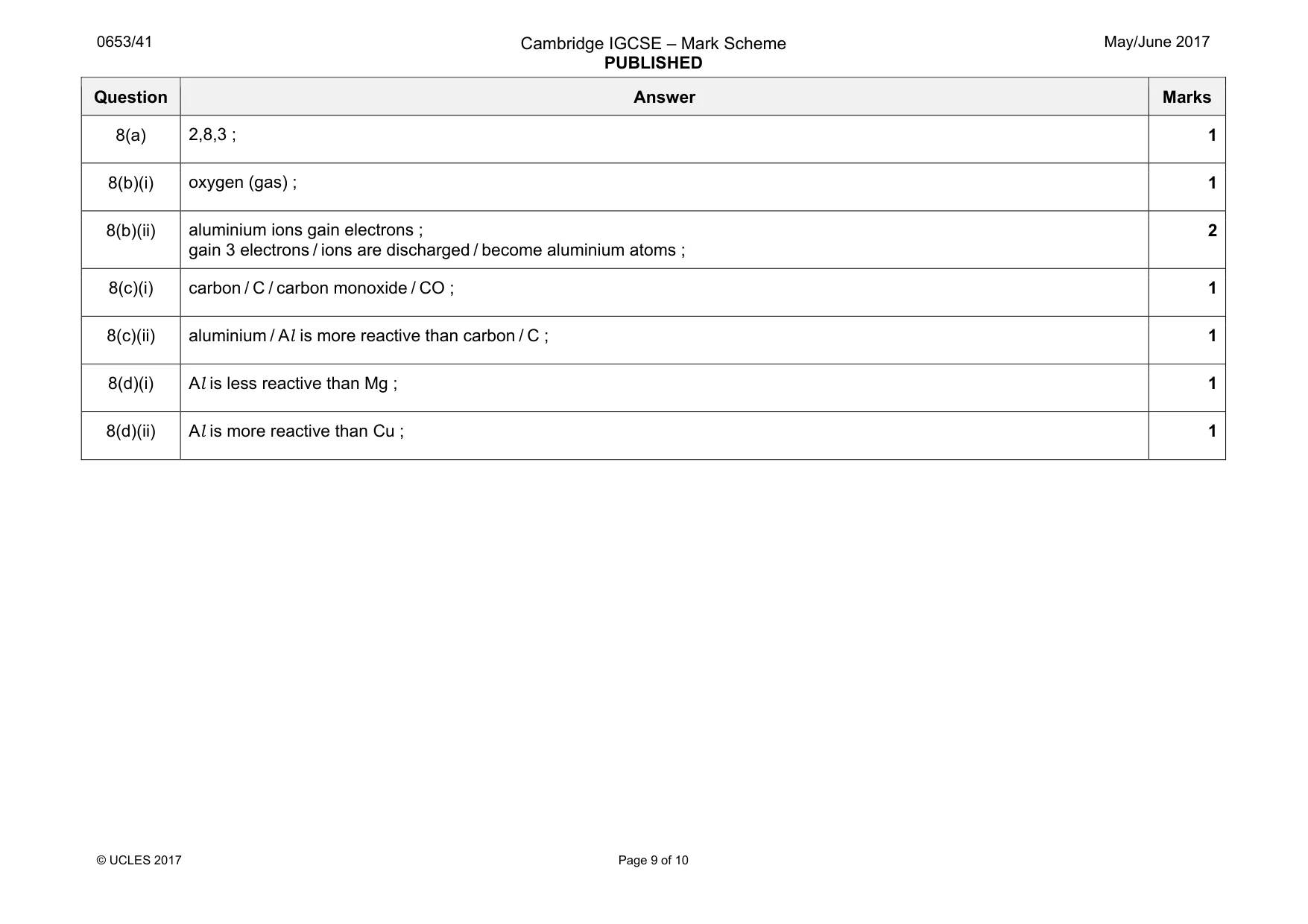
Mark scheme: 8(a) 1 8(b)(i) oxygen (gas) ; 1 8(b)(ii) aluminium ions gain electrons ; gain 3 electrons / ions are discharged / become aluminium atoms ; 2 8(c)(i) carbon / C / carbon monoxide / CO ; 1 8(c)(ii) aluminium / Al is more reactive than carbon / C ; 1 8(d)(i) Al is less reactive than Mg ; 1 8(d)(ii) Al is more reactive than Cu ; 1
Q9 · A simple test circuit for testing different materials to see how well they conduct…
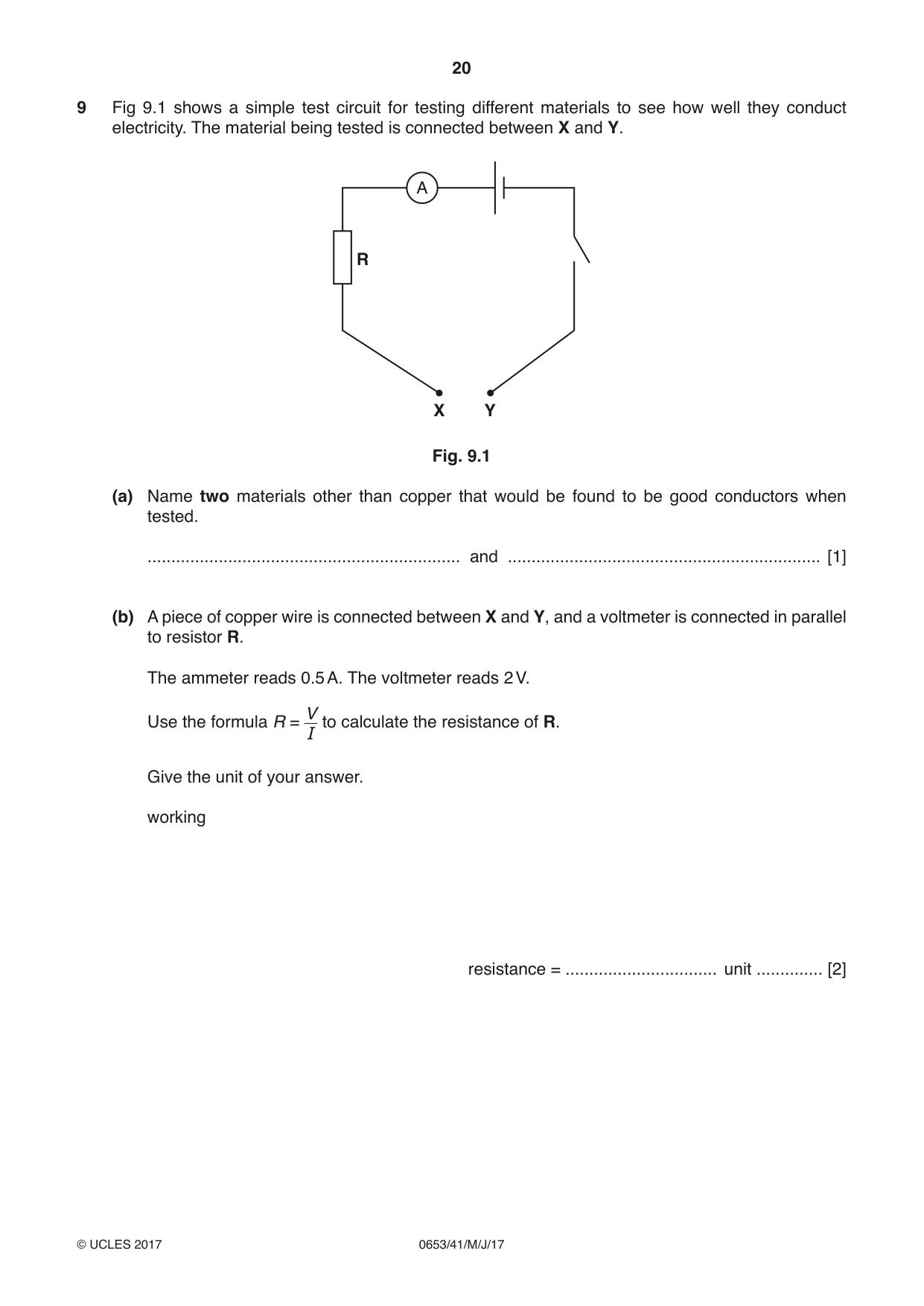
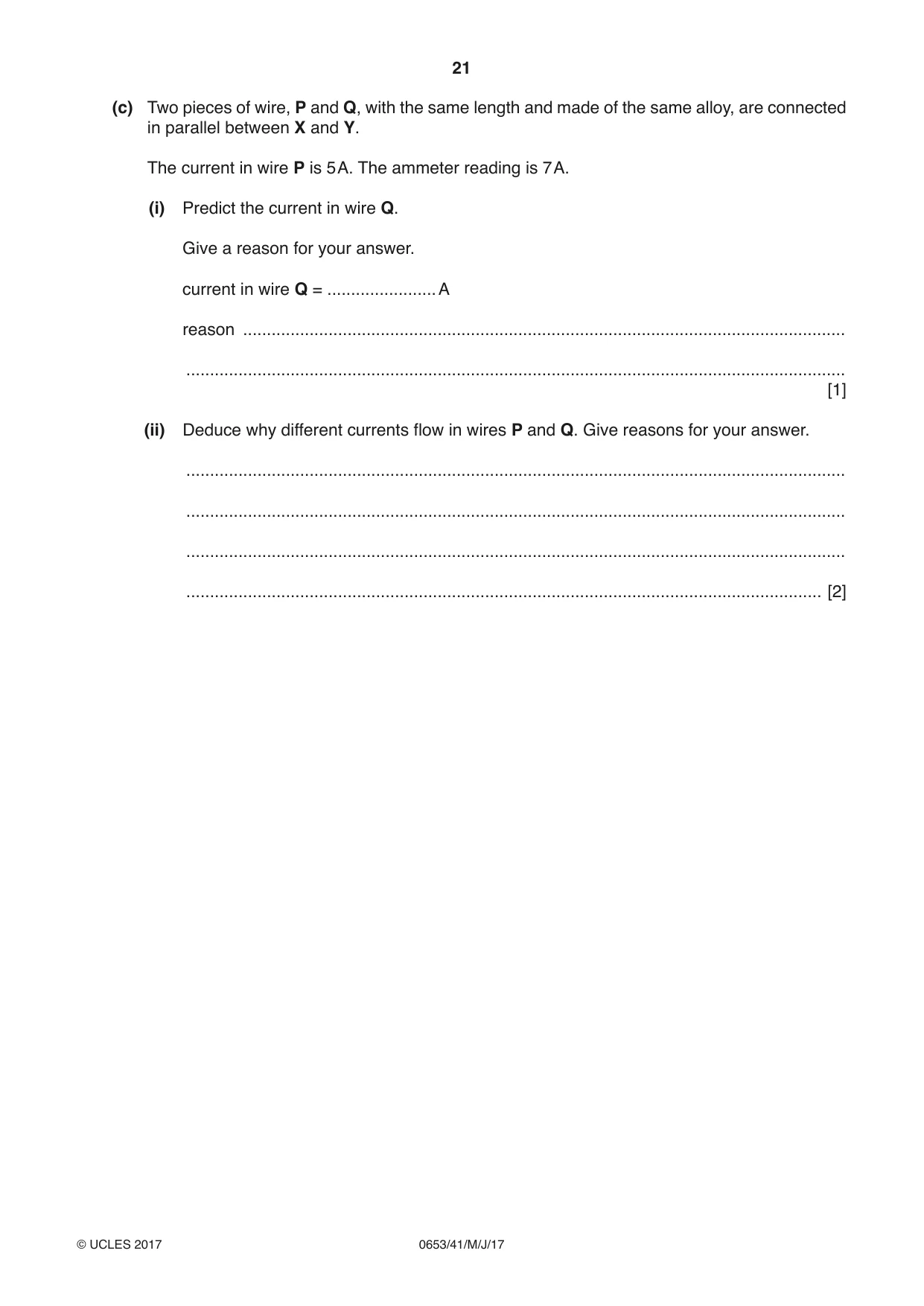
9 Fig 9.1 shows a simple test circuit for testing different materials to see how well they conduct electricity. The material being tested is connected between X and Y. A R X Y Fig. 9.1 (a) Name two materials other than copper that would be found to be good conductors when tested. .................................................................. and .................................................................. [1] (b) A piece of copper wire is connected between X and Y, and a voltmeter is connected in parallel to resistor R. The ammeter reads 0.5 A. The voltmeter reads 2 V. V Use the formula R = to calculate the resistance of R. I Give the unit of your answer. working resistance = ................................ unit .............. [2] (c) Two pieces of wire, P and Q, with the same length and made of the same alloy, are connected in parallel between X and Y. The current in wire P is 5 A. The ammeter reading is 7 A. (i) Predict the current in wire Q. Give a reason for your answer. current in wire Q = ....................... A reason ............................................................................................................................... ........................................................................................................................................... [1] (ii) Deduce why different currents flow in wires P and Q. Give reasons for your answer. ........................................................................................................................................... ........................................................................................................................................... ........................................................................................................................................... ...................................................................................................................................... [2]
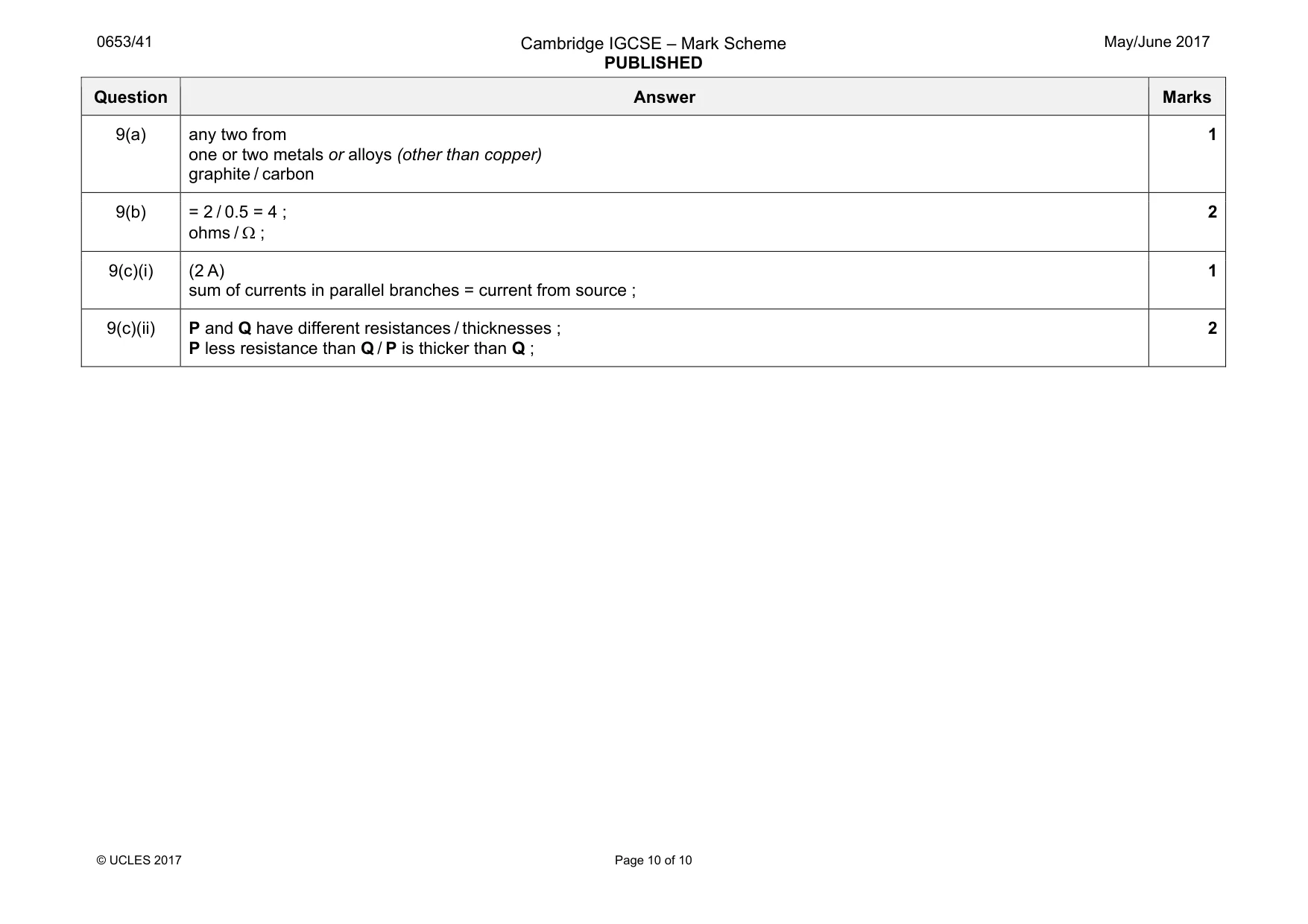
Mark scheme: 9(a) any two from one or two metals or alloys (other than copper) graphite / carbon 1 9(b) = 2 / 0.5 = 4 ; ohms / Ω ; 2 9(c)(i) (2 A) sum of currents in parallel branches = current from source ; 1 9(c)(ii) P and Q have different resistances / thicknesses ; P less resistance than Q / P is thicker than Q ; 2
What was in this paper
The subtopics covered by these 9 questions, and how many questions each got. Open one in a new tab to see every Cambridge question on it.
What you needed in this session
Cambridge’s own grade thresholds for 2017 May/June, Paper 4 · Variant 1. A higher threshold means an easier paper — the bar moves with how the cohort did.