Cambridge IGCSE Science - Combined 0653 — 2019 Feb/March Paper 4 · Variant 2
0653/42/F/M/19 · 9 questions · 80 marks · ≈90 min
The question paper and its mark scheme, free to read here and free to download. This is Cambridge’s own paper, exactly as it was sat.
Question paper24 pages



Mark scheme9 pages
Answers below. Sit the paper first if you are practising.
Questions as text
Q1 · A food chain of some organisms in a garden
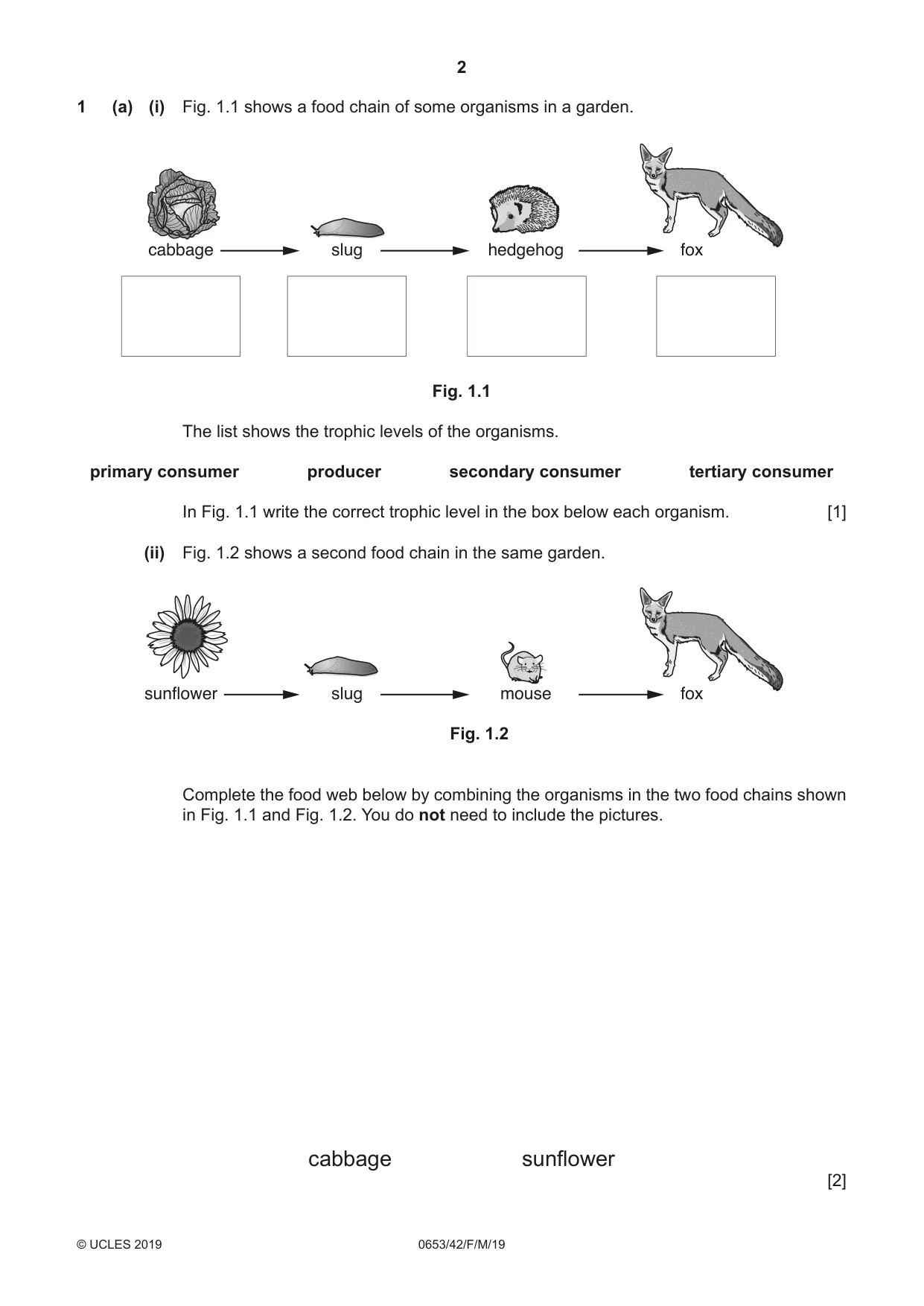
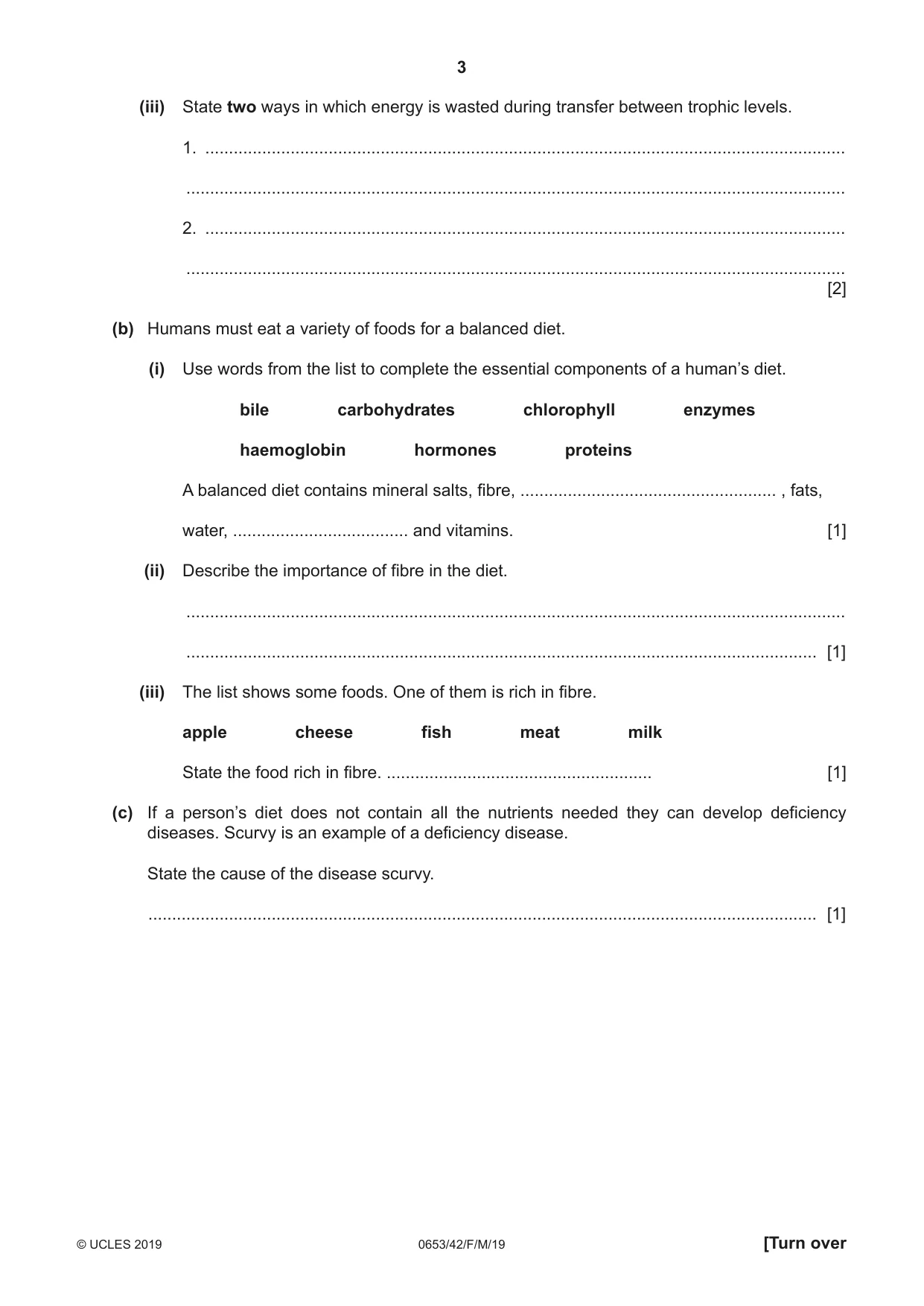
1 (a) (i) Fig. 1.1 shows a food chain of some organisms in a garden. cabbage slug hedgehog fox Fig. 1.1 The list shows the trophic levels of the organisms. primary consumer producer secondary consumer tertiary consumer In Fig. 1.1 write the correct trophic level in the box below each organism. [1] (ii) Fig. 1.2 shows a second food chain in the same garden. sunflower slug mouse fox Fig. 1.2 Complete the food web below by combining the organisms in the two food chains shown in Fig. 1.1 and Fig. 1.2. You do not need to include the pictures. cabbage sunflower [2] (iii) State two ways in which energy is wasted during transfer between trophic levels. 1. ....................................................................................................................................... ........................................................................................................................................... 2. ....................................................................................................................................... ........................................................................................................................................... [2] (b) Humans must eat a variety of foods for a balanced diet. (i) Use words from the list to complete the essential components of a human’s diet. bile carbohydrates chlorophyll enzymes haemoglobin hormones proteins A balanced diet contains mineral salts, fibre, ...................................................... , fats, water, ..................................... and vitamins. [1] (ii) Describe the importance of fibre in the diet. ........................................................................................................................................... ..................................................................................................................................... [1] (iii) The list shows some foods. One of them is rich in fibre. apple cheese fish meat milk State the food rich in fibre. ........................................................ [1] (c) If a person’s diet does not contain all the nutrients needed they can develop deficiency diseases. Scurvy is an example of a deficiency disease. State the cause of the disease scurvy. ............................................................................................................................................. [1] (d) The amount of each nutrient in a balanced diet varies according to a person’s need. The list describes four people A, B, C and D. person A is an adult male office worker person B is an adult male gardener person C is a teenage boy person D is a teenage girl (i) Suggest which person, A or B, needs more energy supplied by their diet. Give a reason for your answer. person .............................................. reason ............................................................................................................................... ..................................................................................................................................... [1] (ii) Suggest which person, C or D, needs more energy supplied by their diet. Give a reason for your answer. person .............................................. reason ............................................................................................................................... ..................................................................................................................................... [1] [Total: 11]
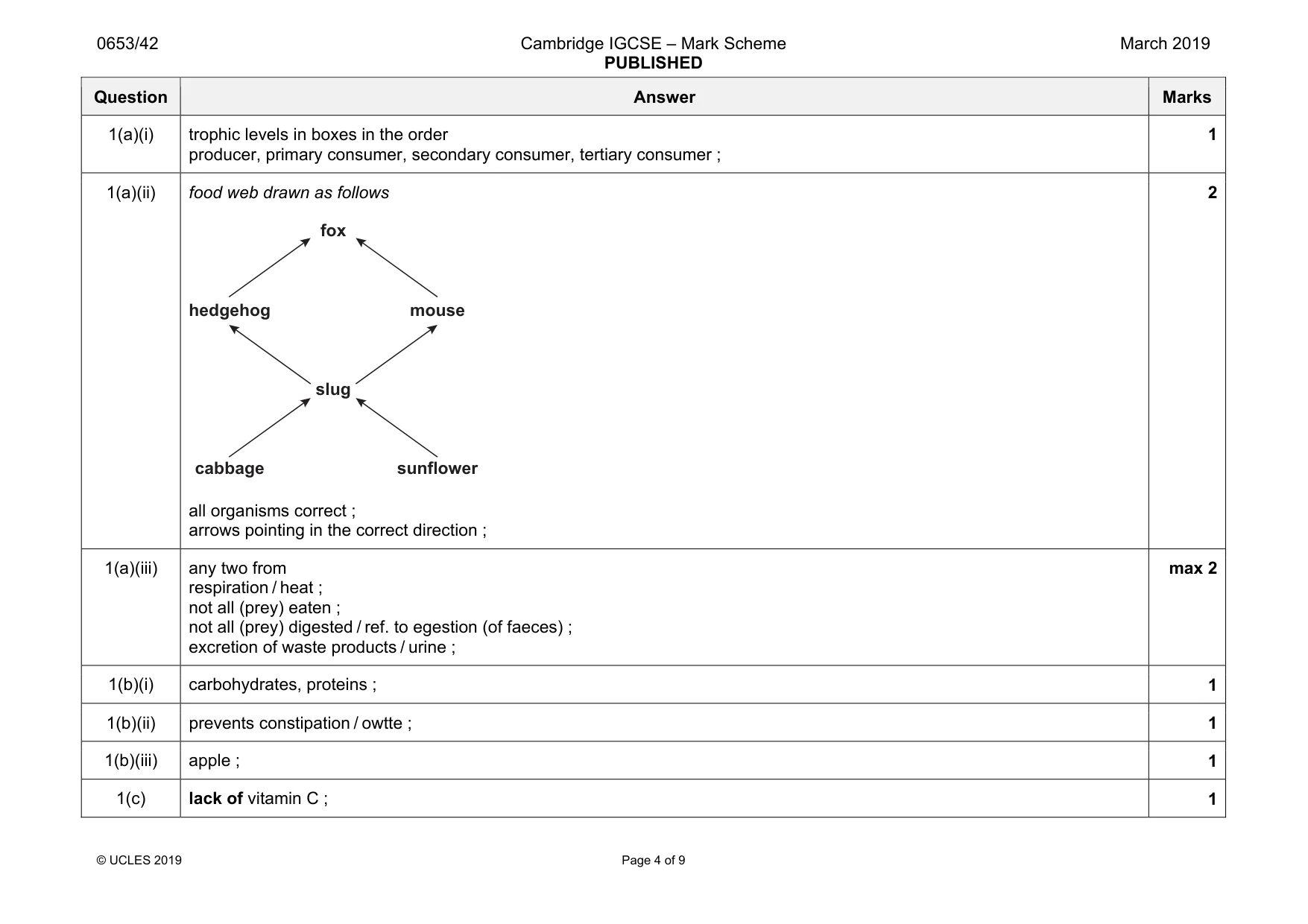
Mark scheme: 1(a)(i) trophic levels in boxes in the order producer, primary consumer, secondary consumer, tertiary consumer ; 1 1(a)(ii) food web drawn as follows all organisms correct ; arrows pointing in the correct direction ; 2 1(a)(iii) any two from respiration / heat ; not all (prey) eaten ; not all (prey) digested / ref. to egestion (of faeces) ; excretion of waste products / urine ; max 2 1(b)(i) carbohydrates, proteins ; 1 1(b)(ii) prevents constipation / owtte ; 1 1(b)(iii) apple ; 1 1(c) lack of vitamin C ; 1 fox slug cabbage sunflower hedgehog mouse Question Answer Marks 1(d)(i) (person B) reference to a more active occupation ; 1 1(d)(ii) (person C) males need more energy than females ; 1
Q2 · The processes of fractional distillation and cracking
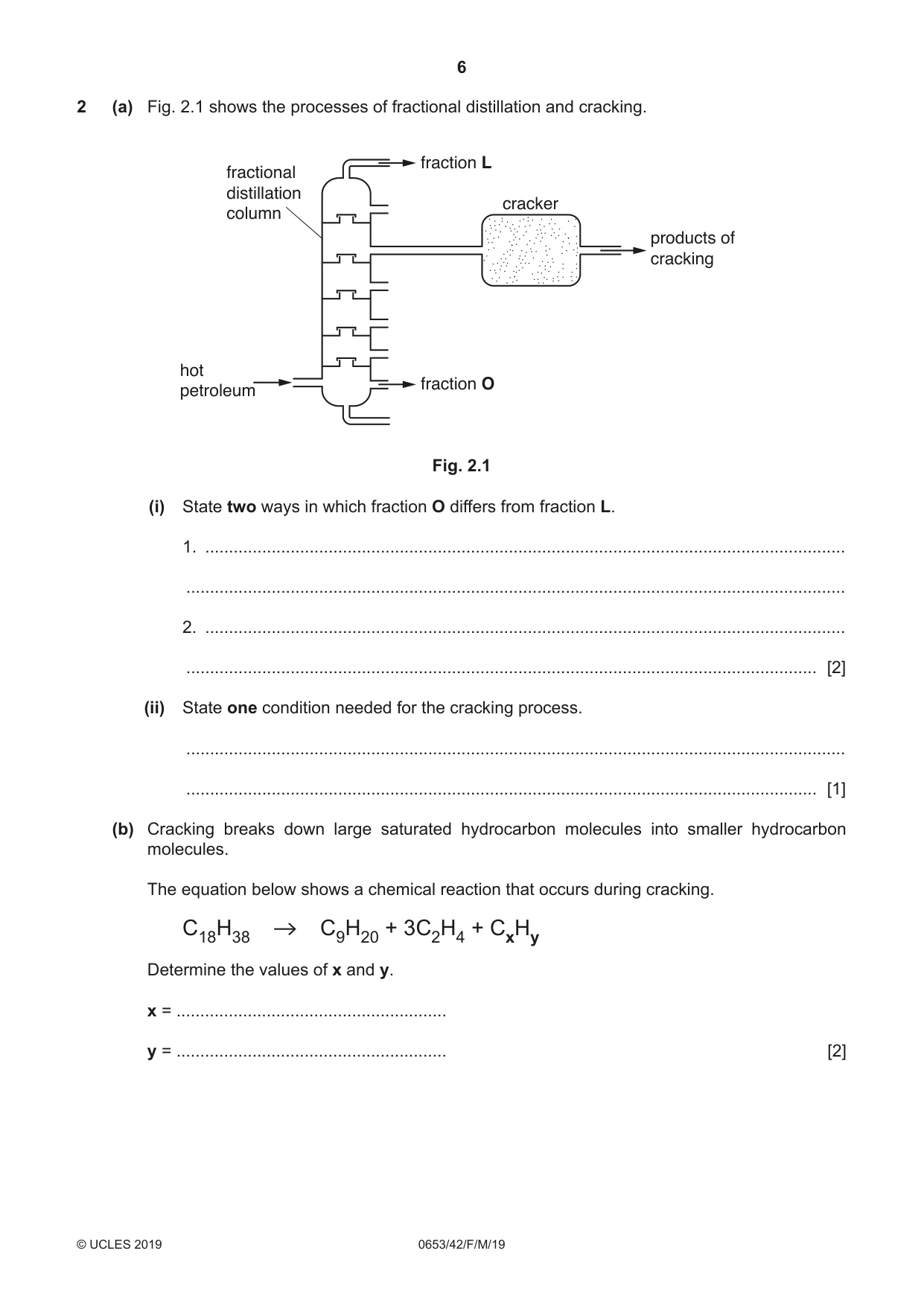
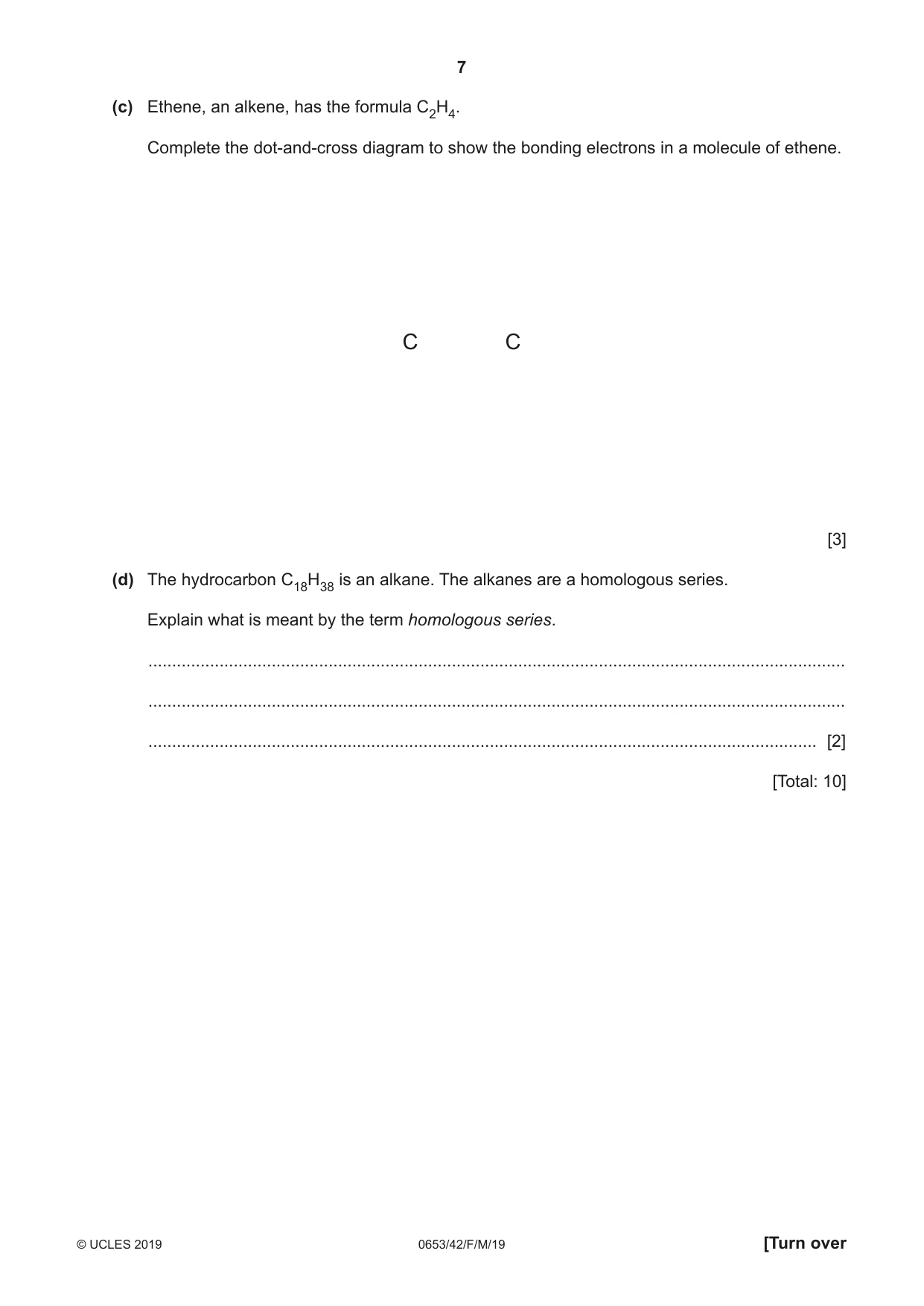
2 (a) Fig. 2.1 shows the processes of fractional distillation and cracking. fraction L fractional distillation cracker column products of cracking hot fraction O petroleum Fig. 2.1 (i) State two ways in which fraction O differs from fraction L. 1. ....................................................................................................................................... ........................................................................................................................................... 2. ....................................................................................................................................... ..................................................................................................................................... [2] (ii) State one condition needed for the cracking process. ........................................................................................................................................... ..................................................................................................................................... [1] (b) Cracking breaks down large saturated hydrocarbon molecules into smaller hydrocarbon molecules. The equation below shows a chemical reaction that occurs during cracking. C18H38 C9H20 + 3C2H4 + CxHy Determine the values of x and y. x = ......................................................... y = ......................................................... [2] (c) Ethene, an alkene, has the formula C2H4. Complete the dot-and-cross diagram to show the bonding electrons in a molecule of ethene. C C [3] (d) The hydrocarbon C18H38 is an alkane. The alkanes are a homologous series. Explain what is meant by the term homologous series. ................................................................................................................................................... ................................................................................................................................................... ............................................................................................................................................. [2] [Total: 10]
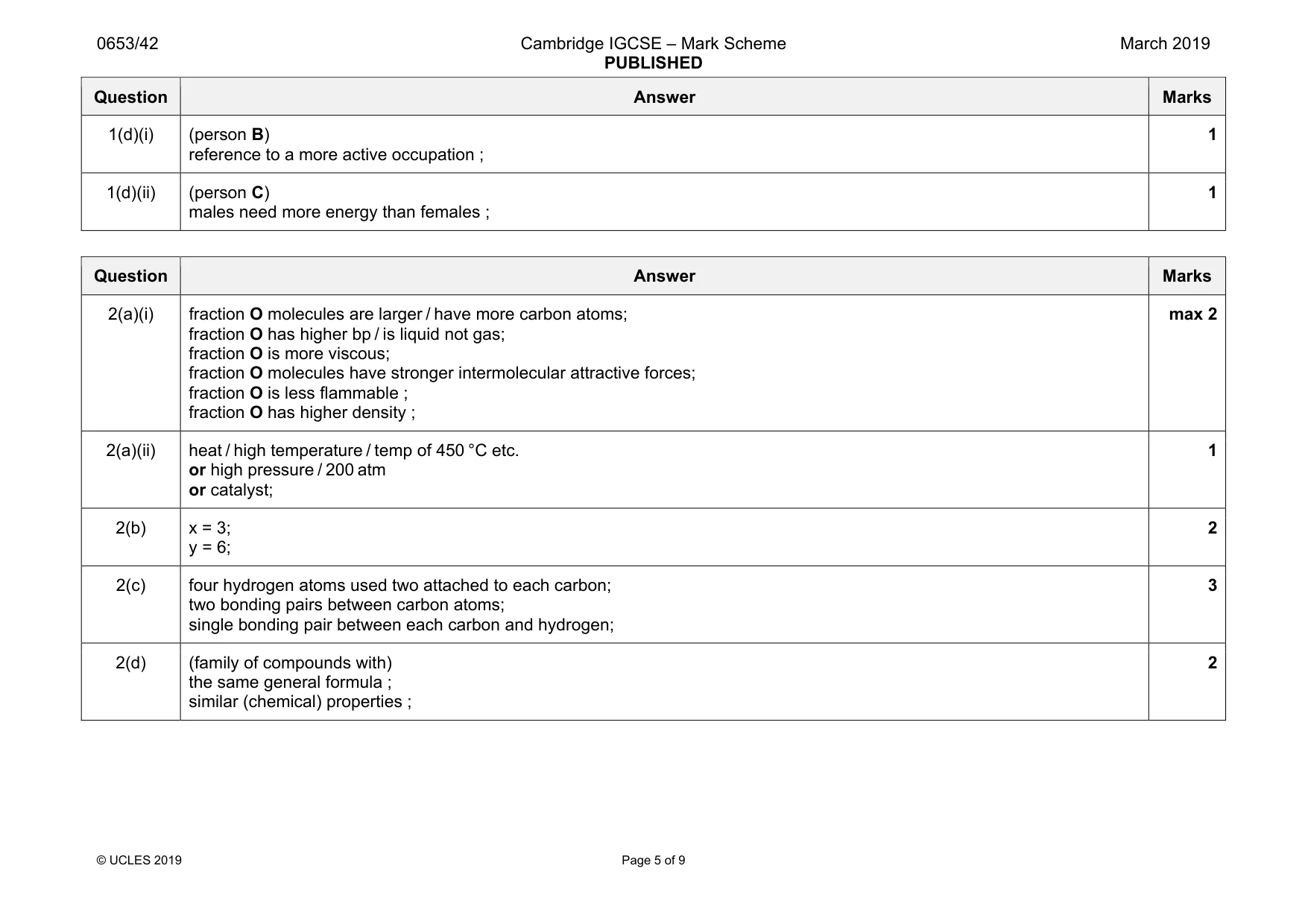
Mark scheme: 2(a)(i) fraction O molecules are larger / have more carbon atoms; fraction O has higher bp / is liquid not gas; fraction O is more viscous; fraction O molecules have stronger intermolecular attractive forces; fraction O is less flammable ; fraction O has higher density ; max 2 2(a)(ii) heat / high temperature / temp of 450 °C etc. or high pressure / 200 atm or catalyst; 1 2(b) x = 3; y = 6; 2 2(c) four hydrogen atoms used two attached to each carbon; two bonding pairs between carbon atoms; single bonding pair between each carbon and hydrogen; 3 2(d) (family of compounds with) the same general formula ; similar (chemical) properties ; 2
Q3 · A girl throwing a beach ball up in the air
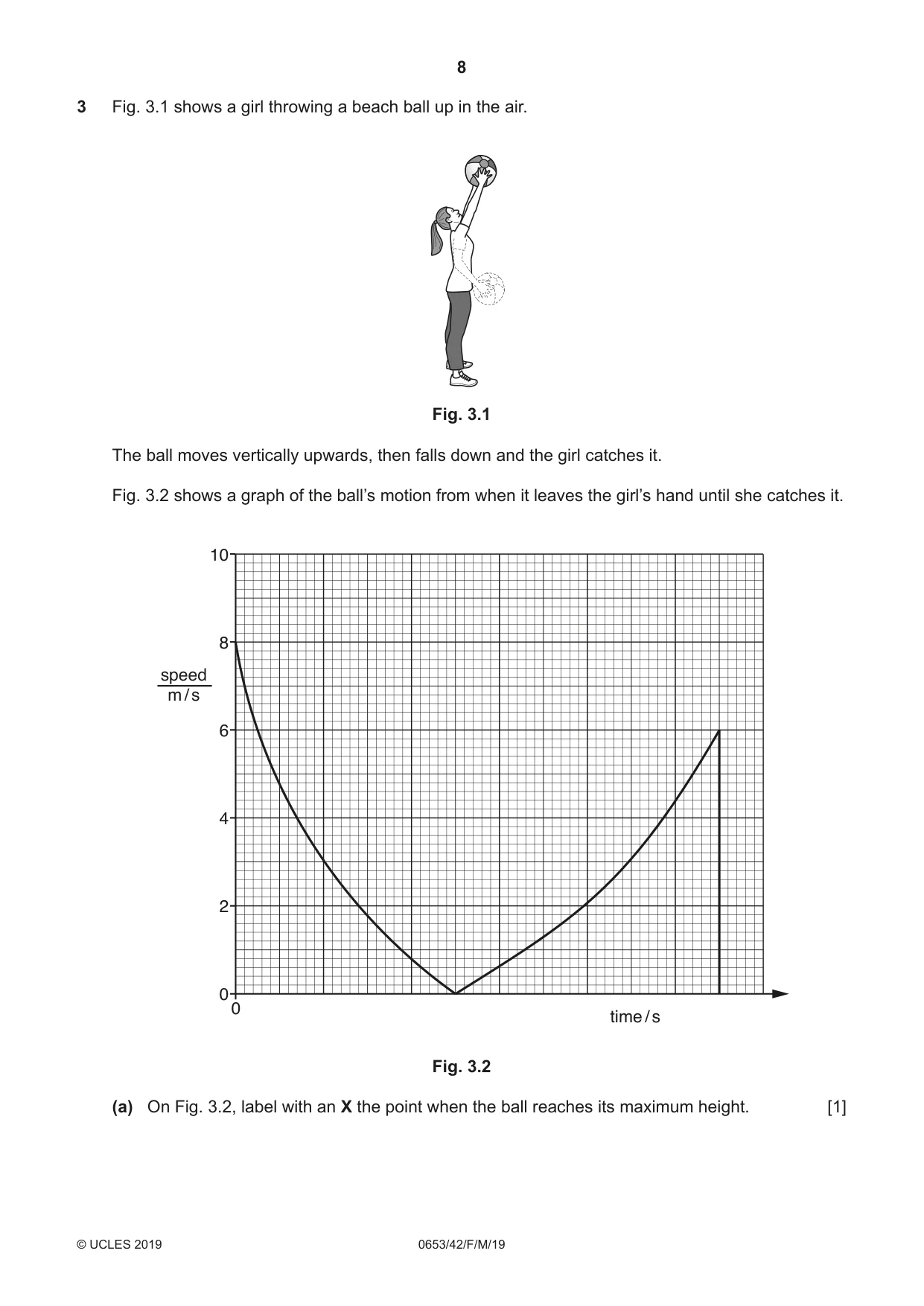
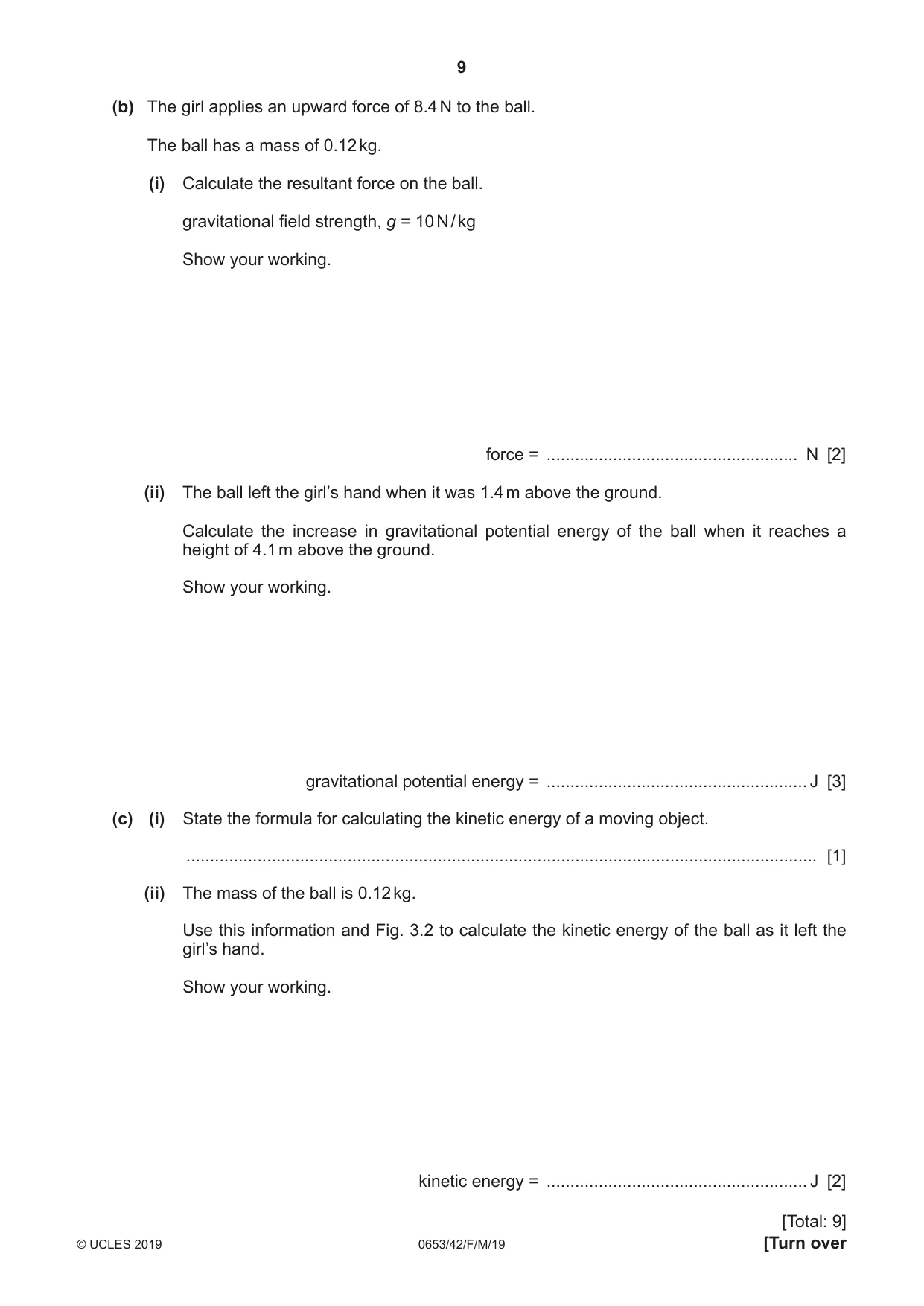
3 Fig. 3.1 shows a girl throwing a beach ball up in the air. Fig. 3.1 The ball moves vertically upwards, then falls down and the girl catches it. Fig. 3.2 shows a graph of the ball’s motion from when it leaves the girl’s hand until she catches it. 10 8 speed m / s 6 4 2 0 0 time / s Fig. 3.2 (a) On Fig. 3.2, label with an X the point when the ball reaches its maximum height. [1] (b) The girl applies an upward force of 8.4 N to the ball. The ball has a mass of 0.12 kg. (i) Calculate the resultant force on the ball. gravitational field strength, g = 10 N / kg Show your working. force = ..................................................... N [2] (ii) The ball left the girl’s hand when it was 1.4 m above the ground. Calculate the increase in gravitational potential energy of the ball when it reaches a height of 4.1 m above the ground. Show your working. gravitational potential energy = ....................................................... J [3] (c) (i) State the formula for calculating the kinetic energy of a moving object. ..................................................................................................................................... [1] (ii) The mass of the ball is 0.12 kg. Use this information and Fig. 3.2 to calculate the kinetic energy of the ball as it left the girl’s hand. Show your working. kinetic energy = ....................................................... J [2] [Total: 9]
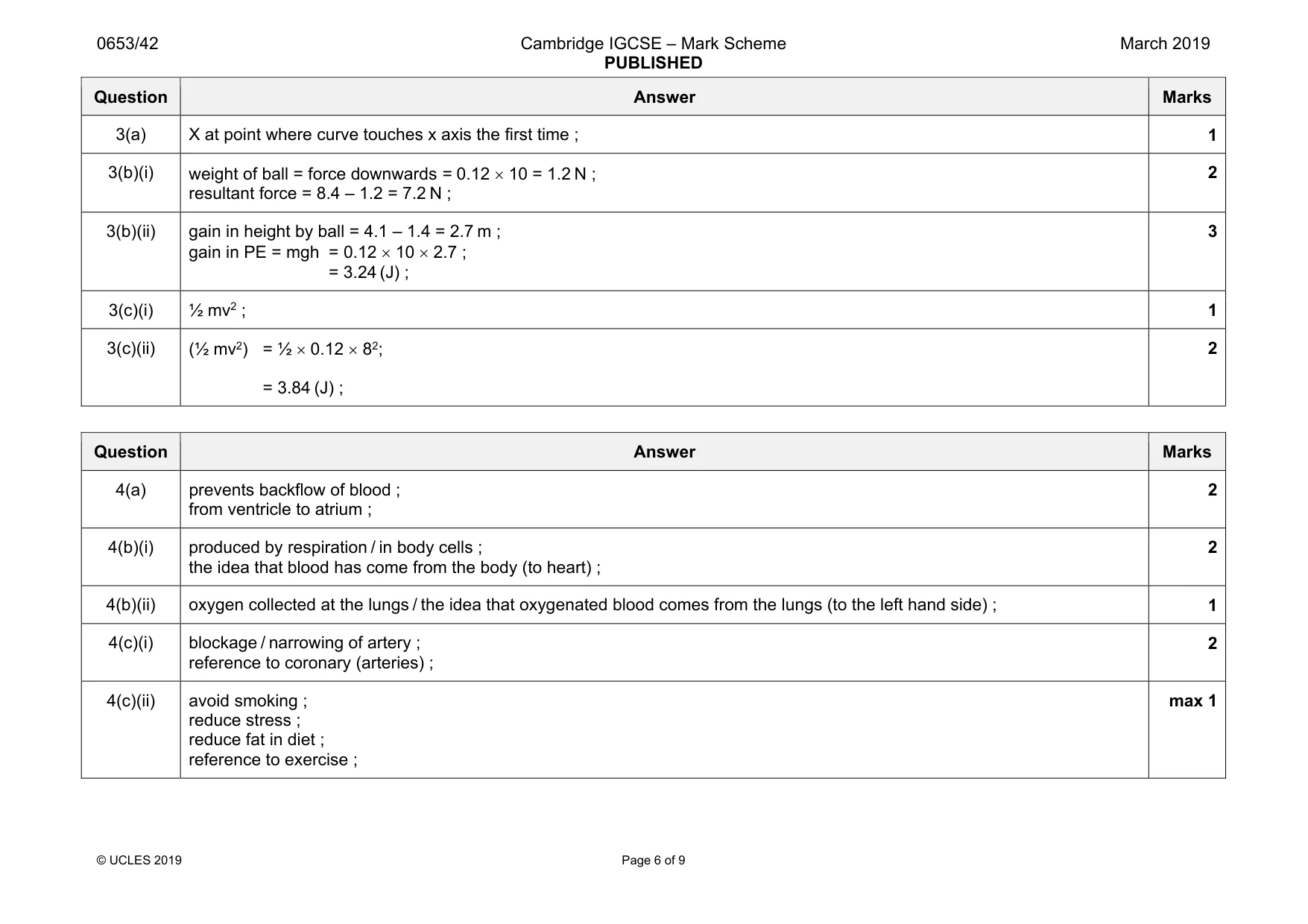
Mark scheme: 3(a) X at point where curve touches x axis the first time ; 1 3(b)(i) weight of ball = force downwards = 0.12 × 10 = 1.2 N ; resultant force = 8.4 – 1.2 = 7.2 N ; 2 3(b)(ii) gain in height by ball = 4.1 – 1.4 = 2.7 m ; gain in PE = mgh = 0.12 × 10 × 2.7 ; = 3.24 (J) ; 3 3(c)(i) ½ mv2 ; 1 3(c)(ii) (½ mv2) = ½ × 0.12 × 82; = 3.84 (J) ; 2
Q4 · A diagram of the internal structure of the heart and the blood vessels entering and…
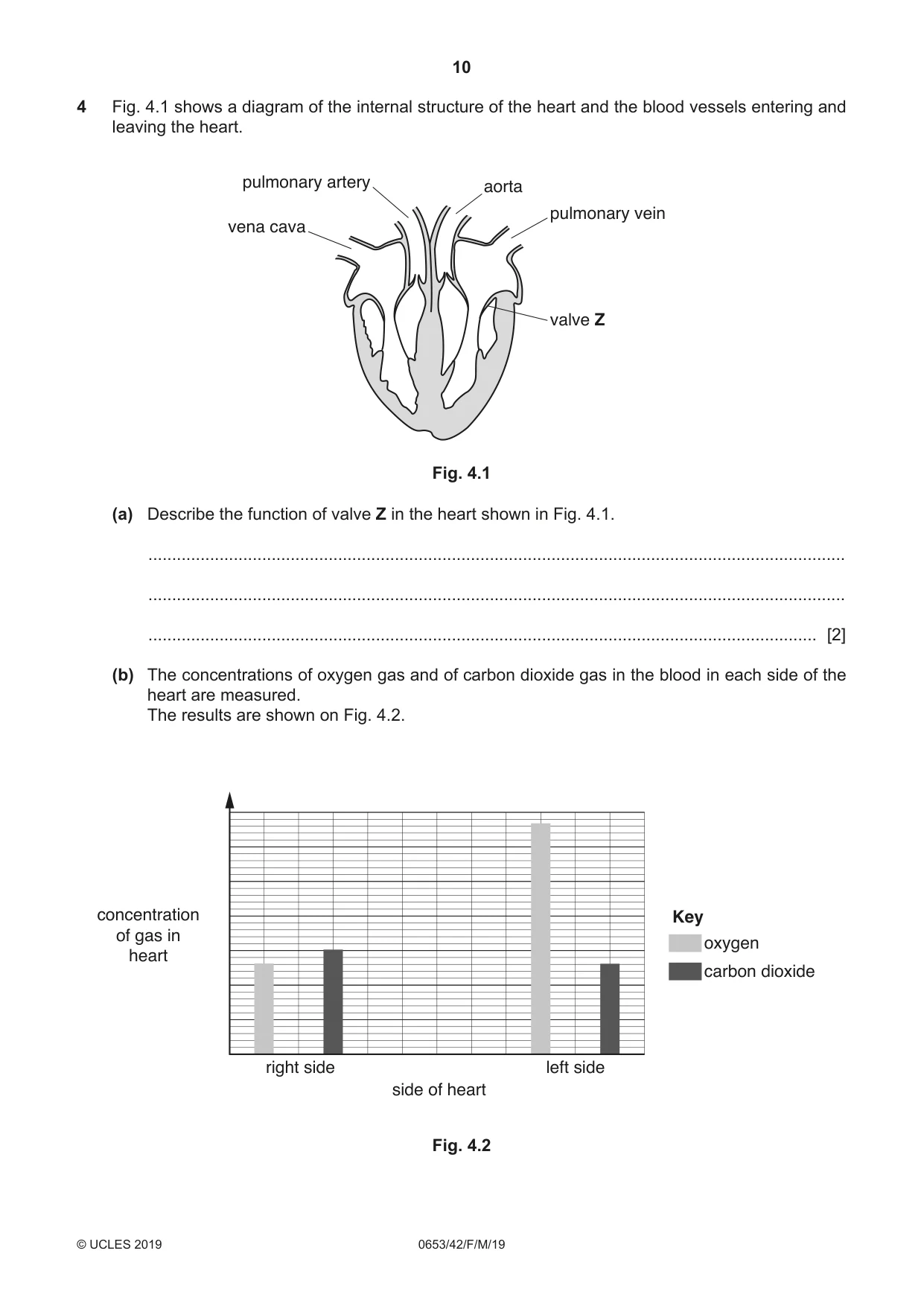
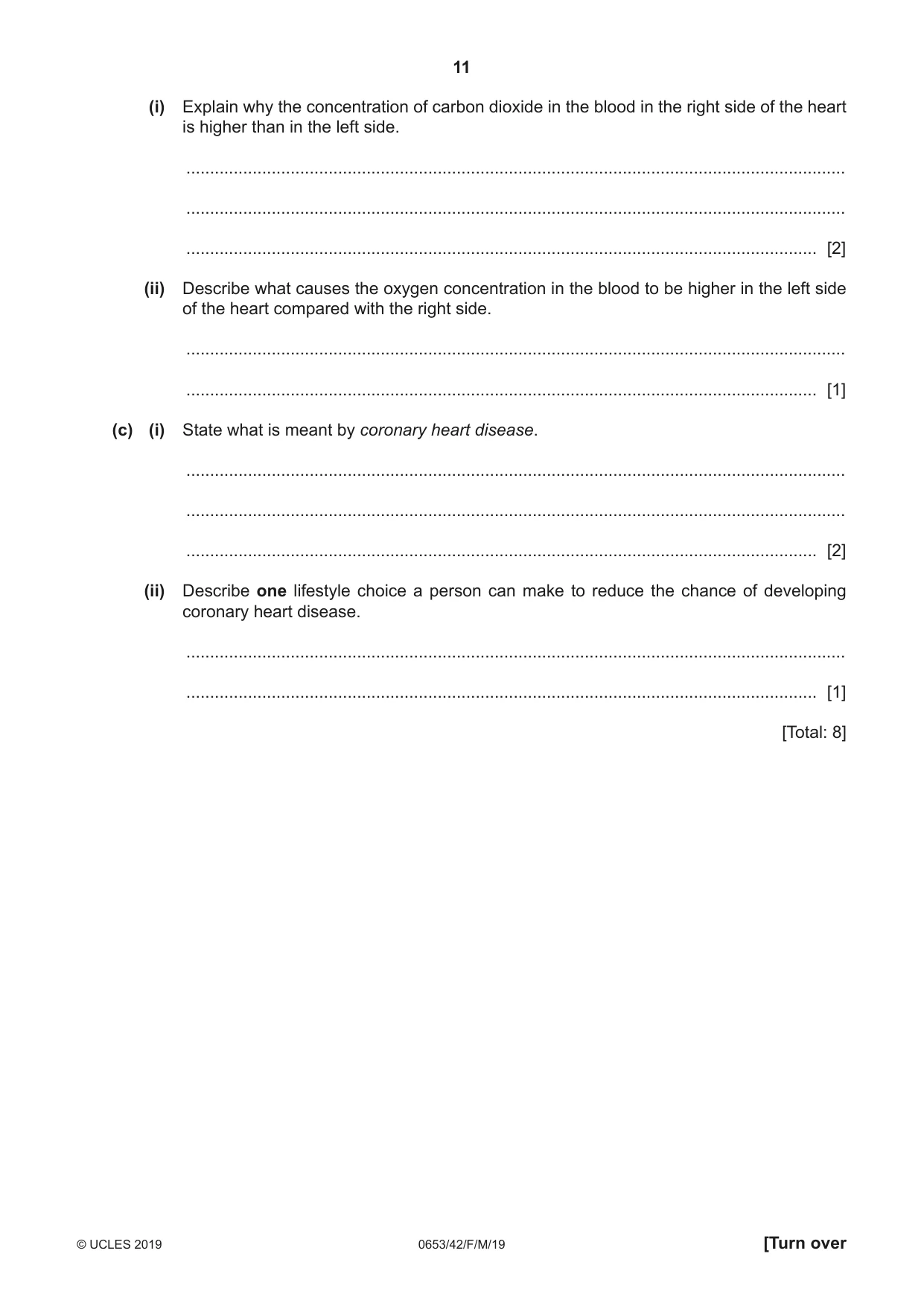
4 Fig. 4.1 shows a diagram of the internal structure of the heart and the blood vessels entering and leaving the heart. pulmonary artery aorta pulmonary vein vena cava valve Z Fig. 4.1 (a) Describe the function of valve Z in the heart shown in Fig. 4.1. ................................................................................................................................................... ................................................................................................................................................... ............................................................................................................................................. [2] (b) The concentrations of oxygen gas and of carbon dioxide gas in the blood in each side of the heart are measured. The results are shown on Fig. 4.2. concentration Key of gas in oxygen heart carbon dioxide right side left side side of heart Fig. 4.2 (i) Explain why the concentration of carbon dioxide in the blood in the right side of the heart is higher than in the left side. ........................................................................................................................................... ........................................................................................................................................... ..................................................................................................................................... [2] (ii) Describe what causes the oxygen concentration in the blood to be higher in the left side of the heart compared with the right side. ........................................................................................................................................... ..................................................................................................................................... [1] (c) (i) State what is meant by coronary heart disease. ........................................................................................................................................... ........................................................................................................................................... ..................................................................................................................................... [2] (ii) Describe one lifestyle choice a person can make to reduce the chance of developing coronary heart disease. ........................................................................................................................................... ..................................................................................................................................... [1] [Total: 8]
Mark scheme: 4(a) prevents backflow of blood ; from ventricle to atrium ; 2 4(b)(i) produced by respiration / in body cells ; the idea that blood has come from the body (to heart) ; 2 4(b)(ii) oxygen collected at the lungs / the idea that oxygenated blood comes from the lungs (to the left hand side) ; 1 4(c)(i) blockage / narrowing of artery ; reference to coronary (arteries) ; 2 4(c)(ii) avoid smoking ; reduce stress ; reduce fat in diet ; reference to exercise ; max 1
Q5 · Iron is an element in Period 4 of the Periodic Table shown on page 24
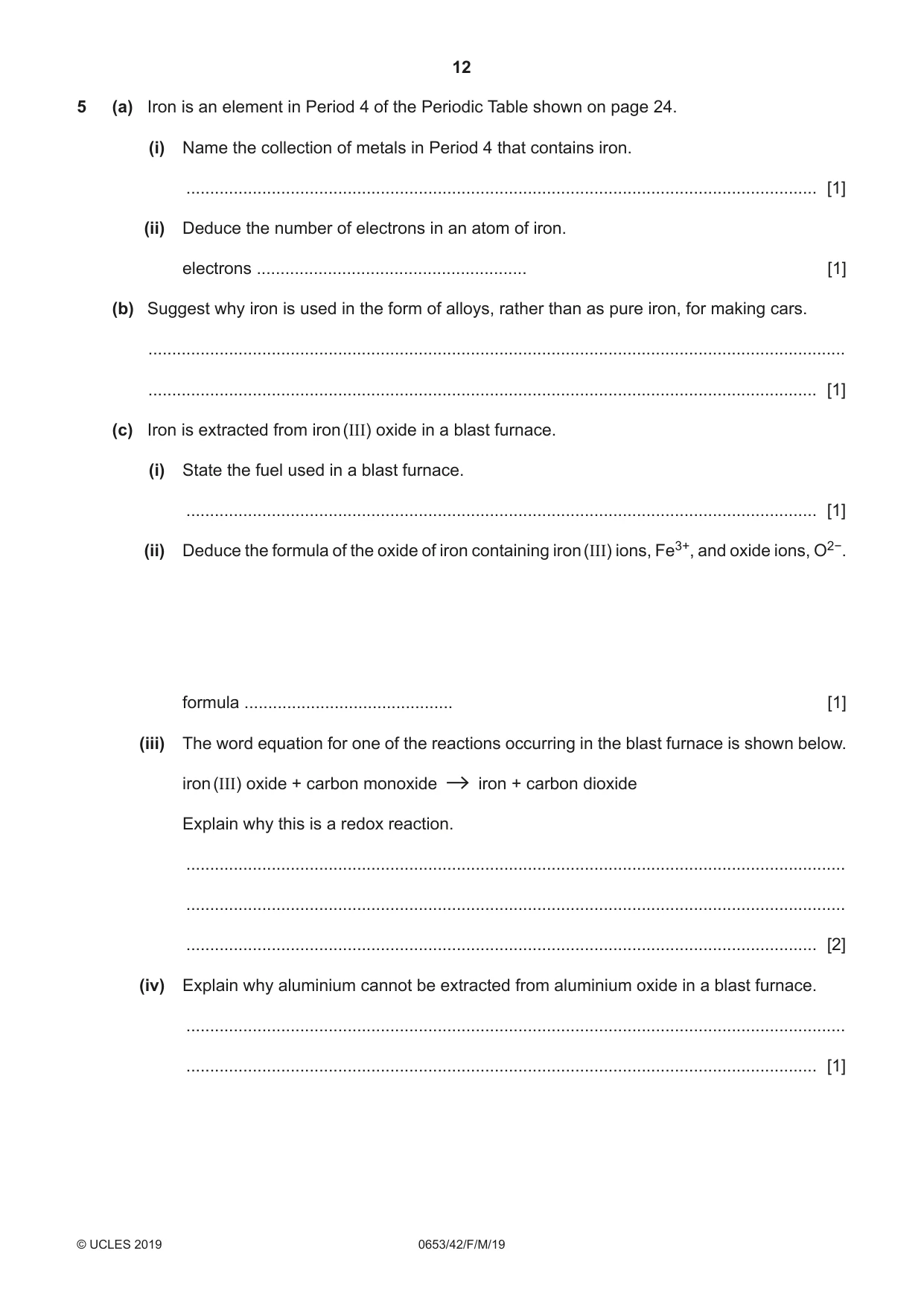
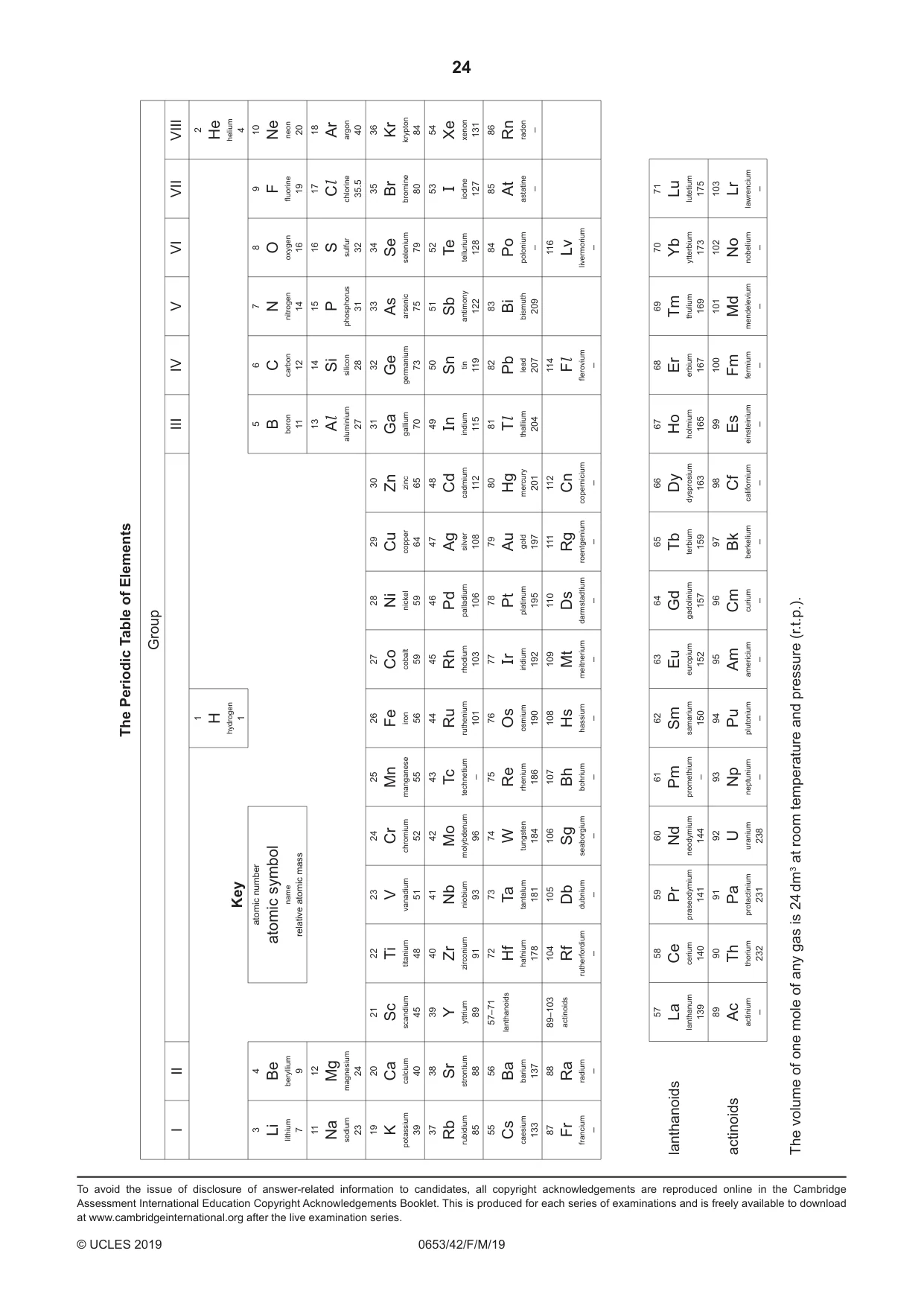
5 (a) Iron is an element in Period 4 of the Periodic Table shown on page 24. (i) Name the collection of metals in Period 4 that contains iron. ..................................................................................................................................... [1] (ii) Deduce the number of electrons in an atom of iron. electrons ......................................................... [1] (b) Suggest why iron is used in the form of alloys, rather than as pure iron, for making cars. ................................................................................................................................................... ............................................................................................................................................. [1] (c) Iron is extracted from iron (III) oxide in a blast furnace. (i) State the fuel used in a blast furnace. ..................................................................................................................................... [1] (ii) Deduce the formula of the oxide of iron containing iron (III) ions, Fe3+, and oxide ions, O2−. formula ............................................ [1] (iii) The word equation for one of the reactions occurring in the blast furnace is shown below. iron (III) oxide + carbon monoxide iron + carbon dioxide Explain why this is a redox reaction. ........................................................................................................................................... ........................................................................................................................................... ..................................................................................................................................... [2] (iv) Explain why aluminium cannot be extracted from aluminium oxide in a blast furnace. ........................................................................................................................................... ..................................................................................................................................... [1] (v) The carbon dioxide produced in a blast furnace escapes into the atmosphere. Carbon dioxide is a greenhouse gas. State one possible effect of an increase in the concentration of carbon dioxide gas in the atmosphere. ........................................................................................................................................... ..................................................................................................................................... [1] (d) Iron (III) sulfate, Fe2(SO4)3, is a soluble salt. Name two substances that react together to form iron (III) sulfate. 1. ............................................................................................................................................... 2. ......................................................................................................................................... [1] [Total: 10]
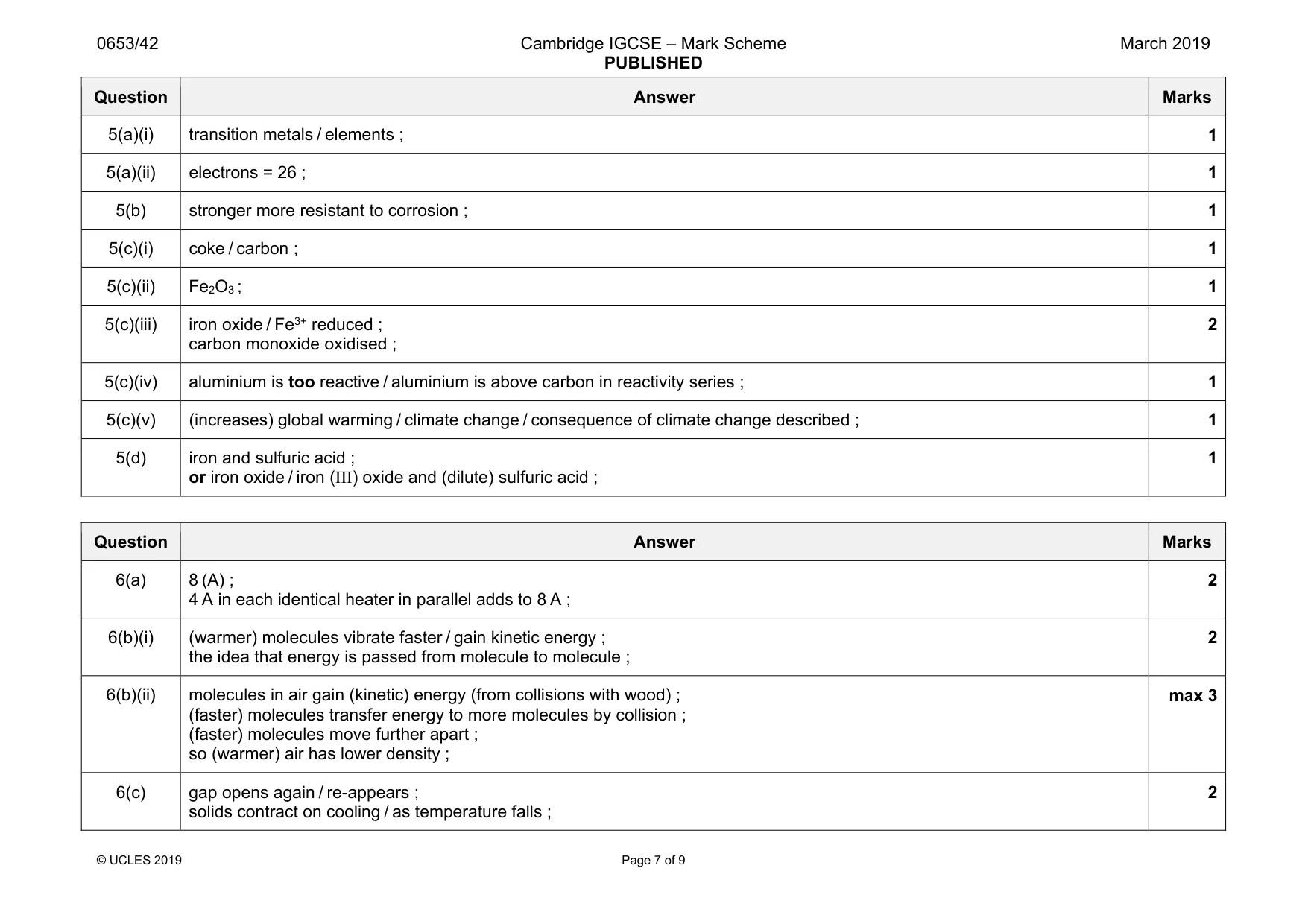
Mark scheme: 5(a)(i) transition metals / elements ; 1 5(a)(ii) electrons = 26 ; 1 5(b) stronger more resistant to corrosion ; 1 5(c)(i) coke / carbon ; 1 5(c)(ii) Fe2O3 ; 1 5(c)(iii) iron oxide / Fe3+ reduced ; carbon monoxide oxidised ; 2 5(c)(iv) aluminium is too reactive / aluminium is above carbon in reactivity series ; 1 5(c)(v) (increases) global warming / climate change / consequence of climate change described ; 1 5(d) iron and sulfuric acid ; or iron oxide / iron (III) oxide and (dilute) sulfuric acid ; 1
Q6 · The bathroom in a house has electric heating under the floor
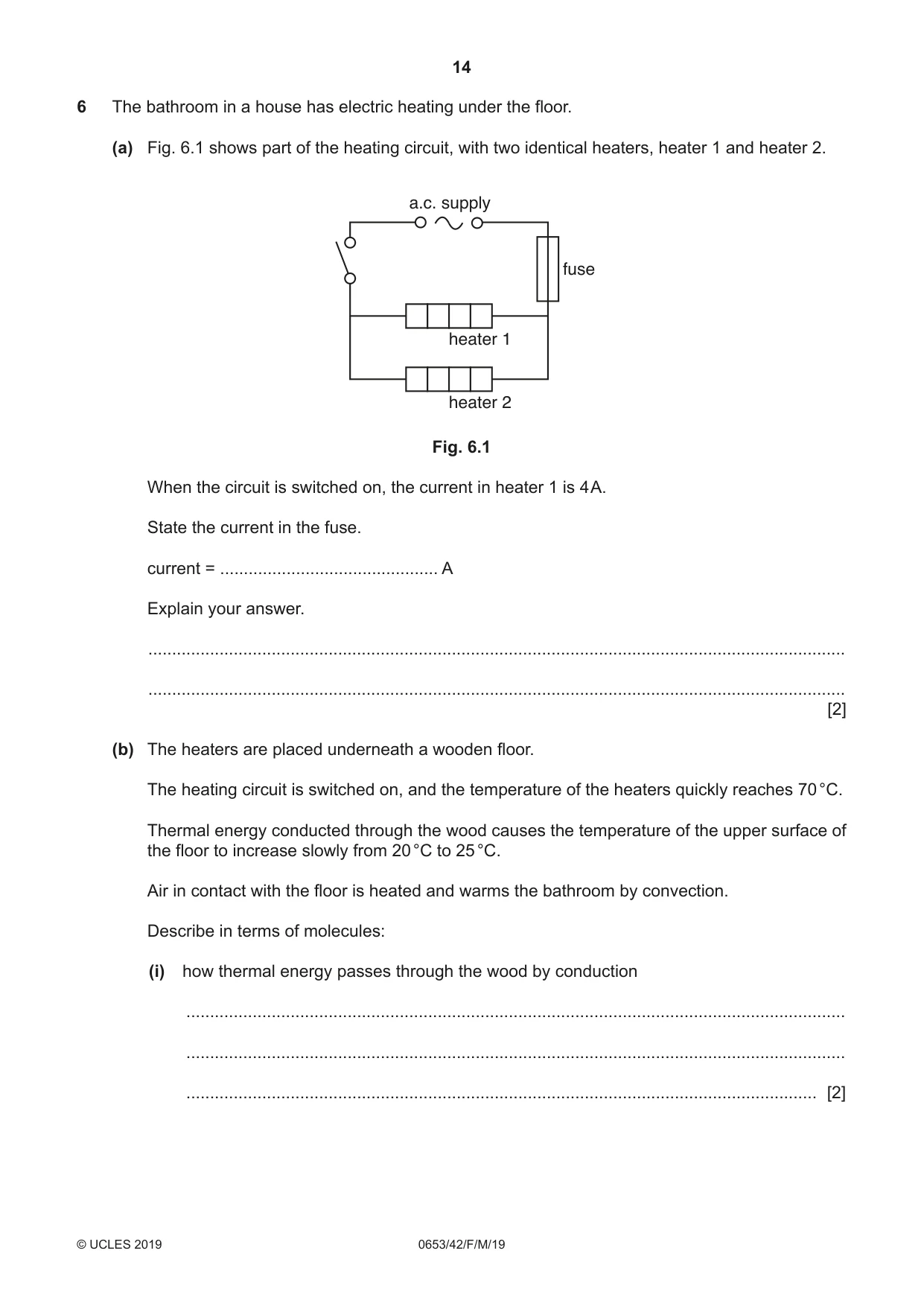
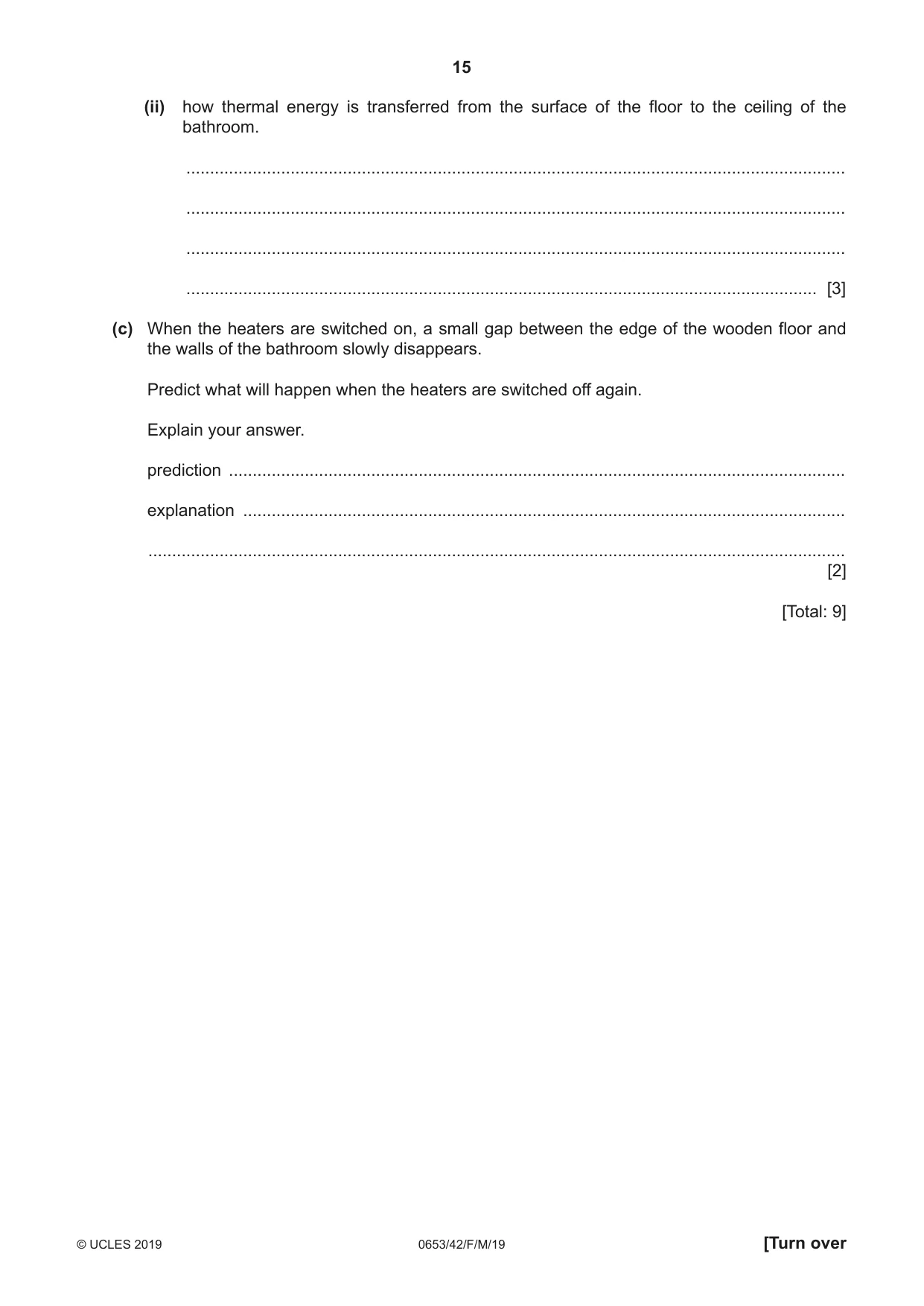
6 The bathroom in a house has electric heating under the floor. (a) Fig. 6.1 shows part of the heating circuit, with two identical heaters, heater 1 and heater 2. a.c. supply fuse heater 1 heater 2 Fig. 6.1 When the circuit is switched on, the current in heater 1 is 4 A. State the current in the fuse. current = .............................................. A Explain your answer. ................................................................................................................................................... ................................................................................................................................................... [2] (b) The heaters are placed underneath a wooden floor. The heating circuit is switched on, and the temperature of the heaters quickly reaches 70 °C. Thermal energy conducted through the wood causes the temperature of the upper surface of the floor to increase slowly from 20 °C to 25 °C. Air in contact with the floor is heated and warms the bathroom by convection. Describe in terms of molecules: (i) how thermal energy passes through the wood by conduction ........................................................................................................................................... ........................................................................................................................................... ..................................................................................................................................... [2] (ii) how thermal energy is transferred from the surface of the floor to the ceiling of the bathroom. ........................................................................................................................................... ........................................................................................................................................... ........................................................................................................................................... ..................................................................................................................................... [3] (c) When the heaters are switched on, a small gap between the edge of the wooden floor and the walls of the bathroom slowly disappears. Predict what will happen when the heaters are switched off again. Explain your answer. prediction .................................................................................................................................. explanation ............................................................................................................................... ................................................................................................................................................... [2] [Total: 9]
Mark scheme: 6(a) 8 (A) ; 4 A in each identical heater in parallel adds to 8 A ; 2 6(b)(i) (warmer) molecules vibrate faster / gain kinetic energy ; the idea that energy is passed from molecule to molecule ; 2 6(b)(ii) molecules in air gain (kinetic) energy (from collisions with wood) ; (faster) molecules transfer energy to more molecules by collision ; (faster) molecules move further apart ; so (warmer) air has lower density ; max 3 6(c) gap opens again / re-appears ; solids contract on cooling / as temperature falls ; 2
Q7 · A diagram of a wind-pollinated flower
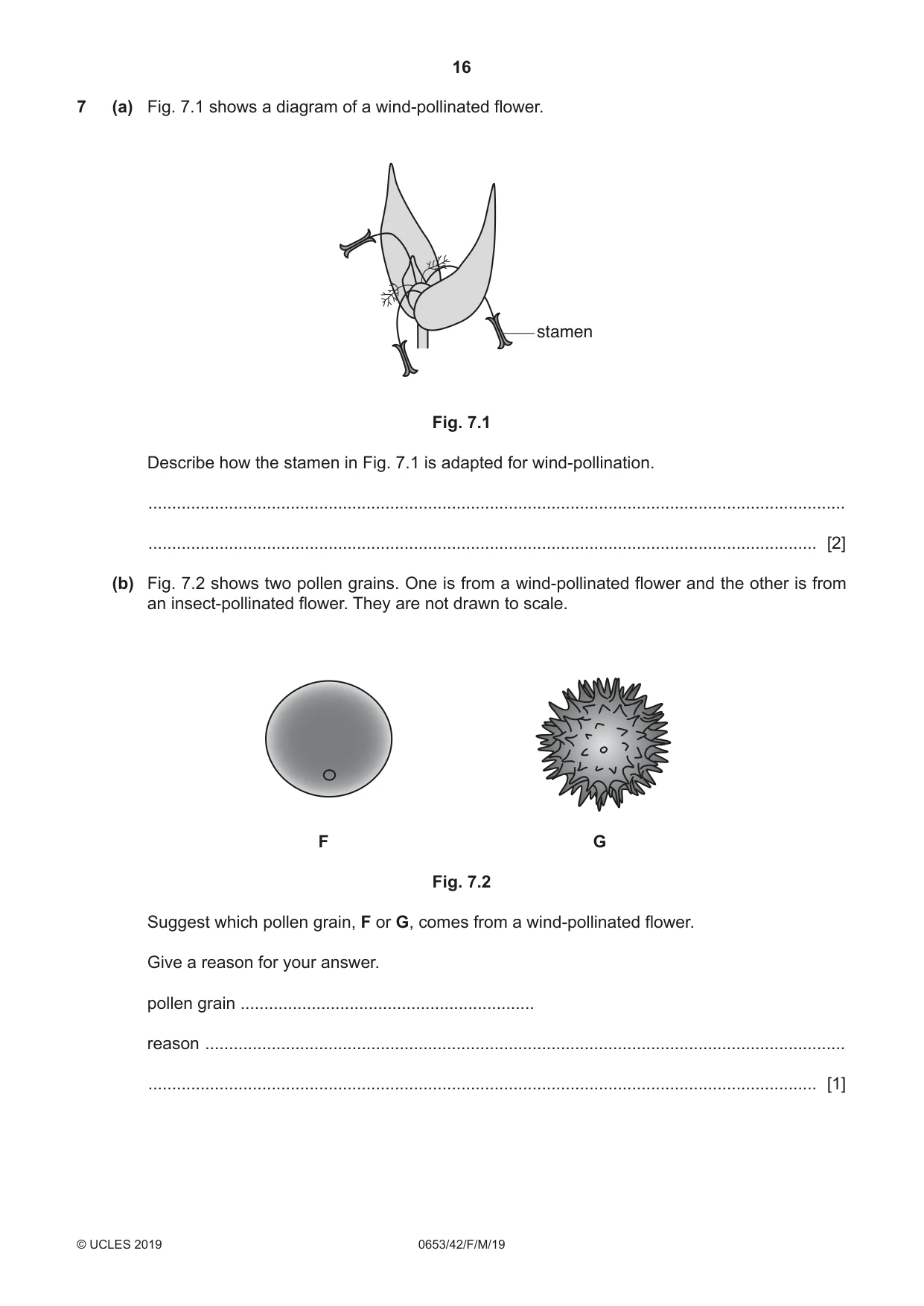
7 (a) Fig. 7.1 shows a diagram of a wind-pollinated flower. stamen Fig. 7.1 Describe how the stamen in Fig. 7.1 is adapted for wind-pollination. ................................................................................................................................................... ............................................................................................................................................. [2] (b) Fig. 7.2 shows two pollen grains. One is from a wind-pollinated flower and the other is from an insect-pollinated flower. They are not drawn to scale. F G Fig. 7.2 Suggest which pollen grain, F or G, comes from a wind-pollinated flower. Give a reason for your answer. pollen grain .............................................................. reason ....................................................................................................................................... ............................................................................................................................................. [1] (c) After pollination, fertilisation must take place before seeds can be produced. Describe the difference between pollination and fertilisation. ................................................................................................................................................... ................................................................................................................................................... ............................................................................................................................................. [2] (d) Pollen grains in the flower need energy from photosynthesis in the leaves. (i) Name the cells in the leaf where most photosynthesis takes place. ..................................................................................................................................... [1] (ii) Describe how the cells you named in (i) are adapted for photosynthesis. ........................................................................................................................................... ..................................................................................................................................... [1] (iii) Name the part of the plant that transports sugars. ..................................................................................................................................... [1] [Total: 8]
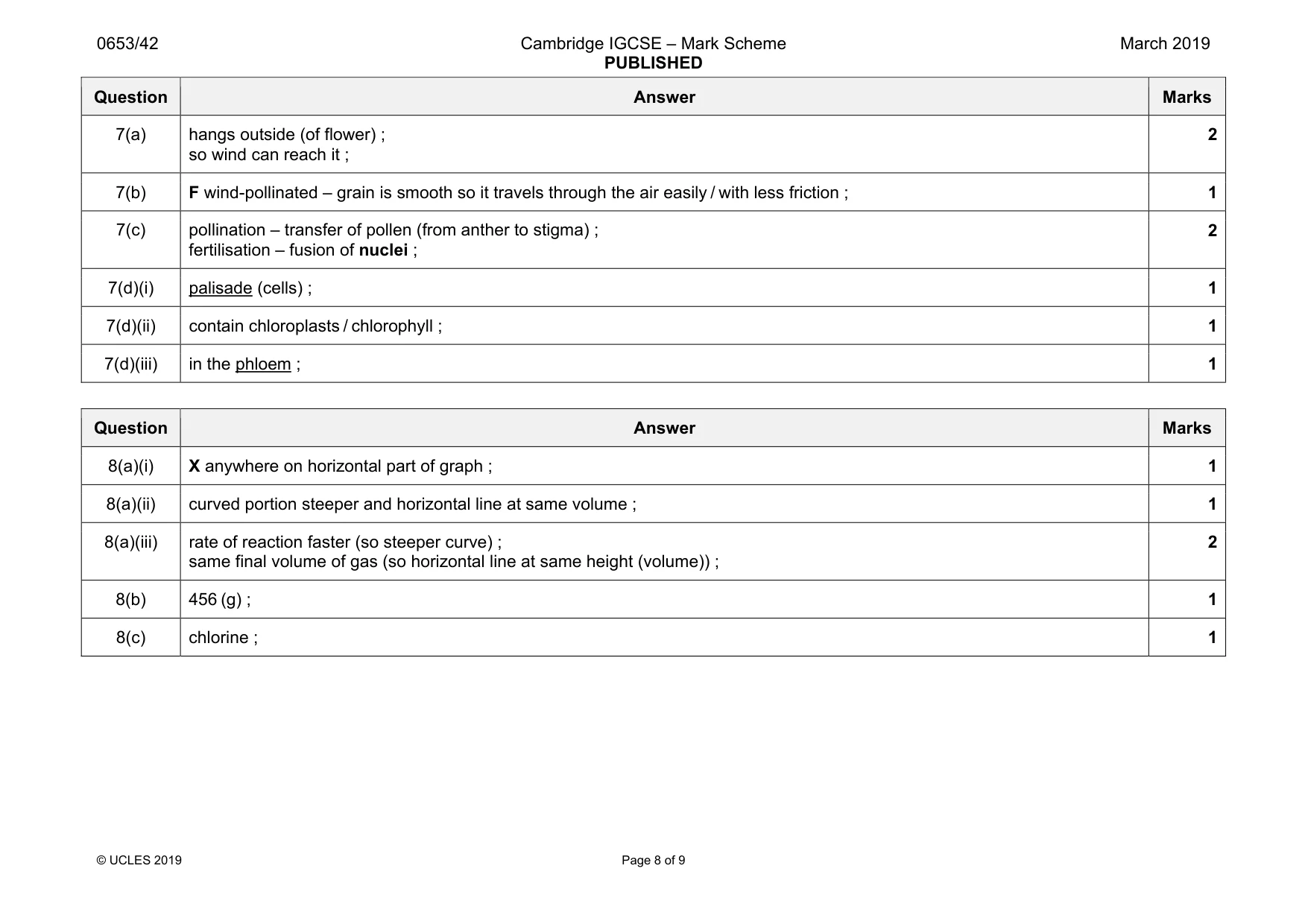
Mark scheme: 7(a) hangs outside (of flower) ; so wind can reach it ; 2 7(b) F wind-pollinated – grain is smooth so it travels through the air easily / with less friction ; 1 7(c) pollination – transfer of pollen (from anther to stigma) ; fertilisation – fusion of nuclei ; 2 7(d)(i) palisade (cells) ; 1 7(d)(ii) contain chloroplasts / chlorophyll ; 1 7(d)(iii) in the phloem ; 1
Q8 · The apparatus a student uses to investigate the reaction between magnesium powder and…
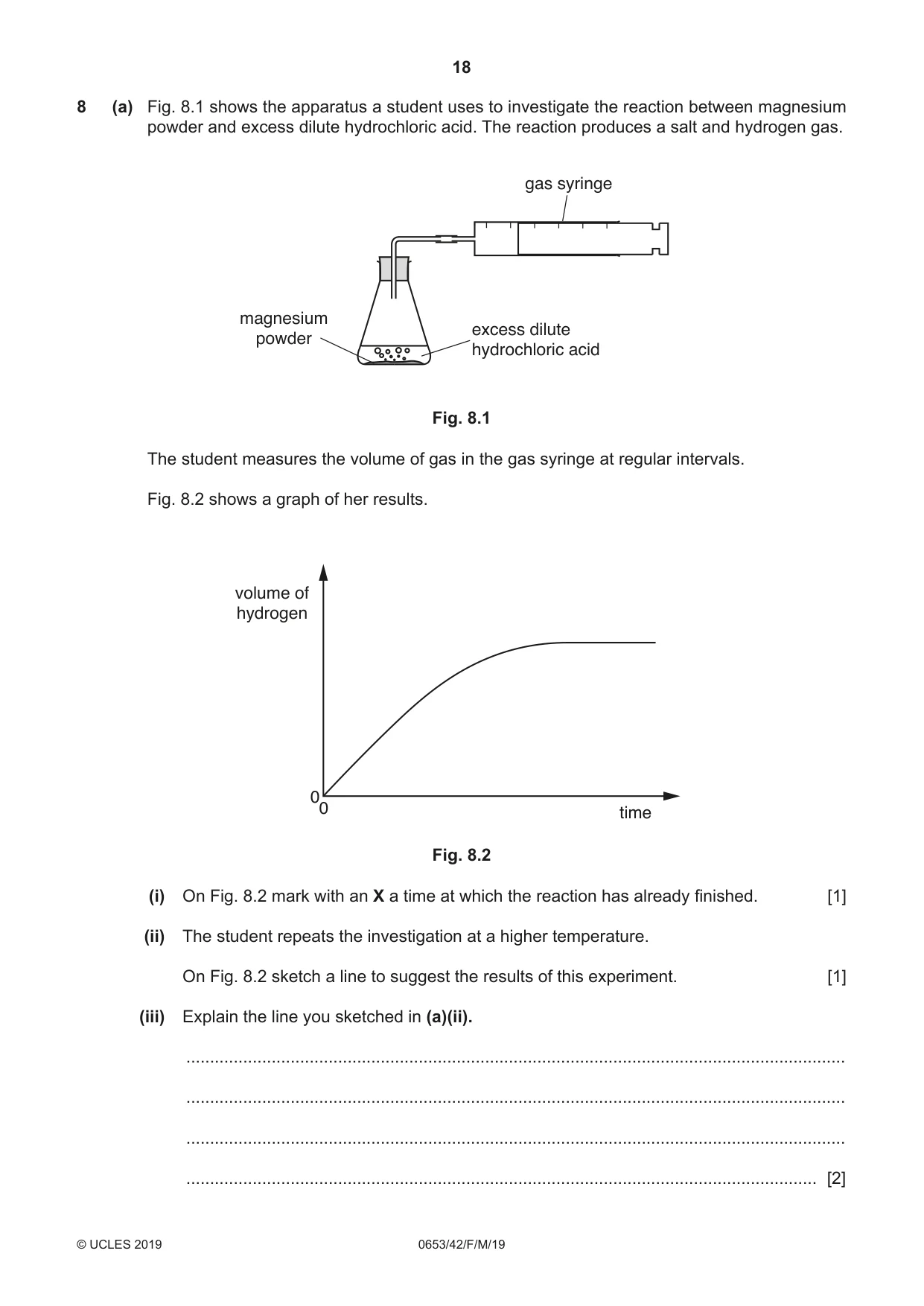
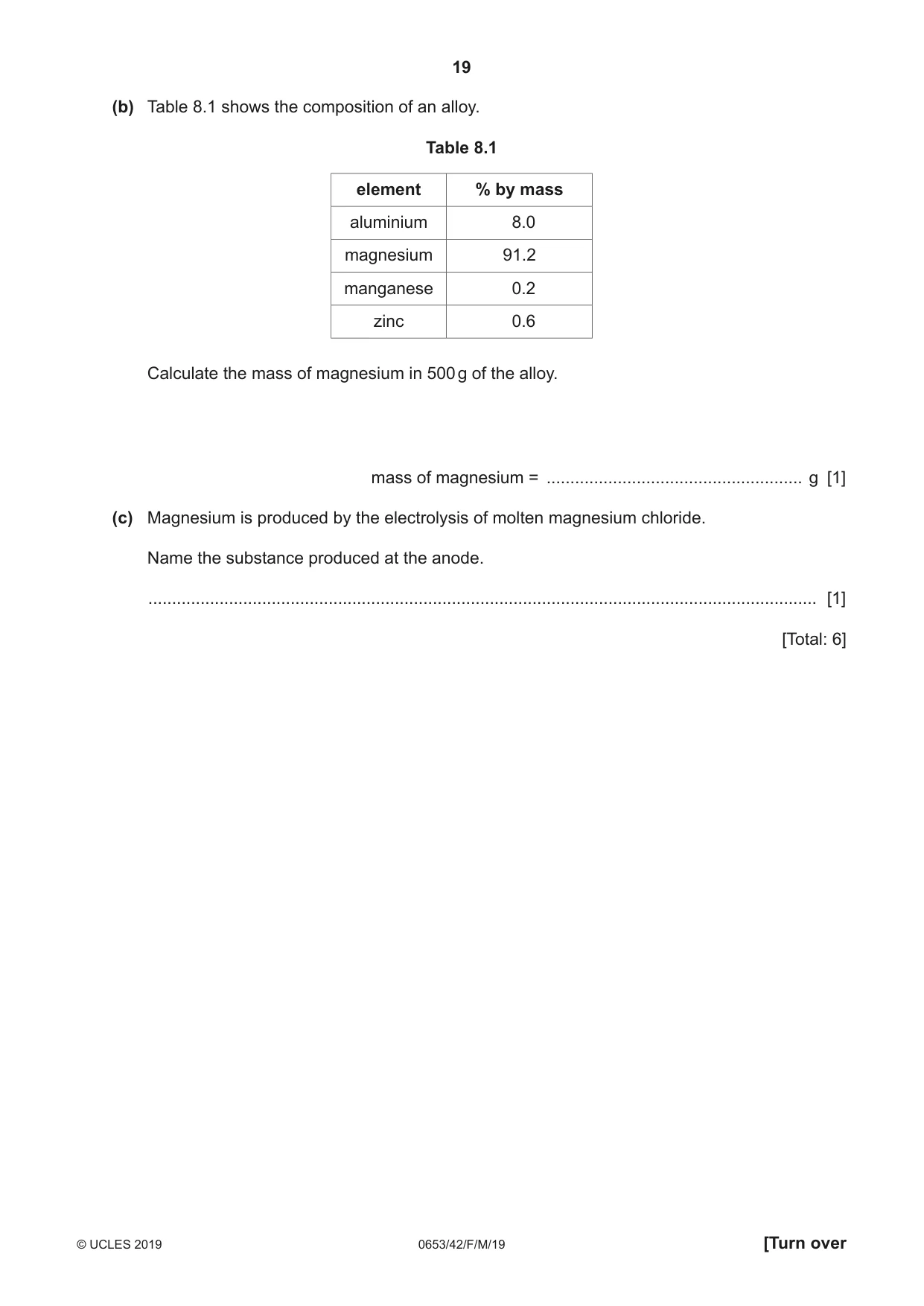
8 (a) Fig. 8.1 shows the apparatus a student uses to investigate the reaction between magnesium powder and excess dilute hydrochloric acid. The reaction produces a salt and hydrogen gas. gas syringe magnesium excess dilute powder hydrochloric acid Fig. 8.1 The student measures the volume of gas in the gas syringe at regular intervals. Fig. 8.2 shows a graph of her results. volume of hydrogen 0 0 time Fig. 8.2 (i) On Fig. 8.2 mark with an X a time at which the reaction has already finished. [1] (ii) The student repeats the investigation at a higher temperature. On Fig. 8.2 sketch a line to suggest the results of this experiment. [1] (iii) Explain the line you sketched in (a)(ii). ........................................................................................................................................... ........................................................................................................................................... ........................................................................................................................................... ..................................................................................................................................... [2] (b) Table 8.1 shows the composition of an alloy. Table 8.1 element % by mass aluminium 8.0 magnesium 91.2 manganese 0.2 zinc 0.6 Calculate the mass of magnesium in 500 g of the alloy. mass of magnesium = ...................................................... g [1] (c) Magnesium is produced by the electrolysis of molten magnesium chloride. Name the substance produced at the anode. ............................................................................................................................................. [1] [Total: 6]
Mark scheme: 8(a)(i) X anywhere on horizontal part of graph ; 1 8(a)(ii) curved portion steeper and horizontal line at same volume ; 1 8(a)(iii) rate of reaction faster (so steeper curve) ; same final volume of gas (so horizontal line at same height (volume)) ; 2 8(b) 456 (g) ; 1 8(c) chlorine ; 1
Q9 · In many cities, sodium street lamps are used at night
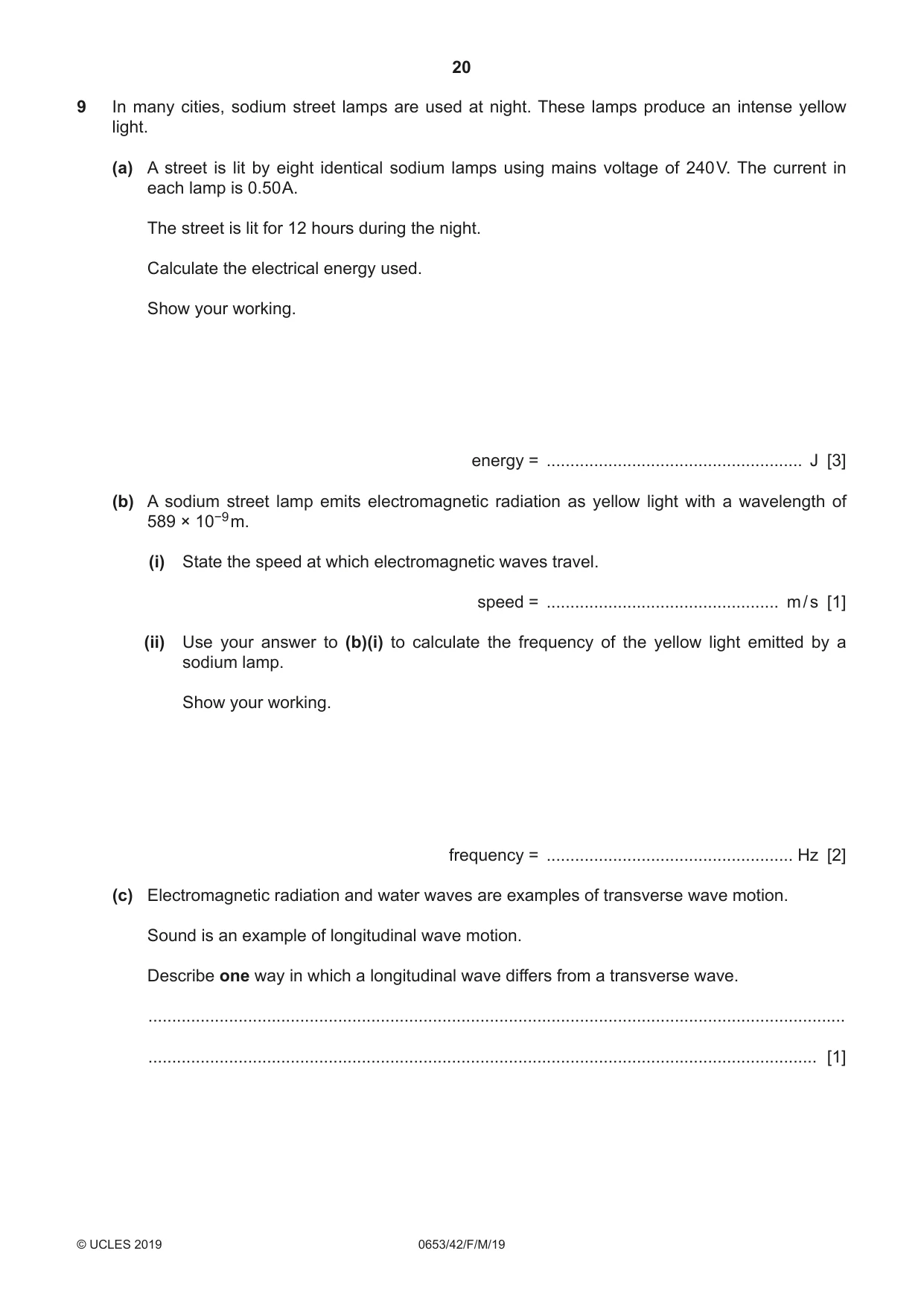
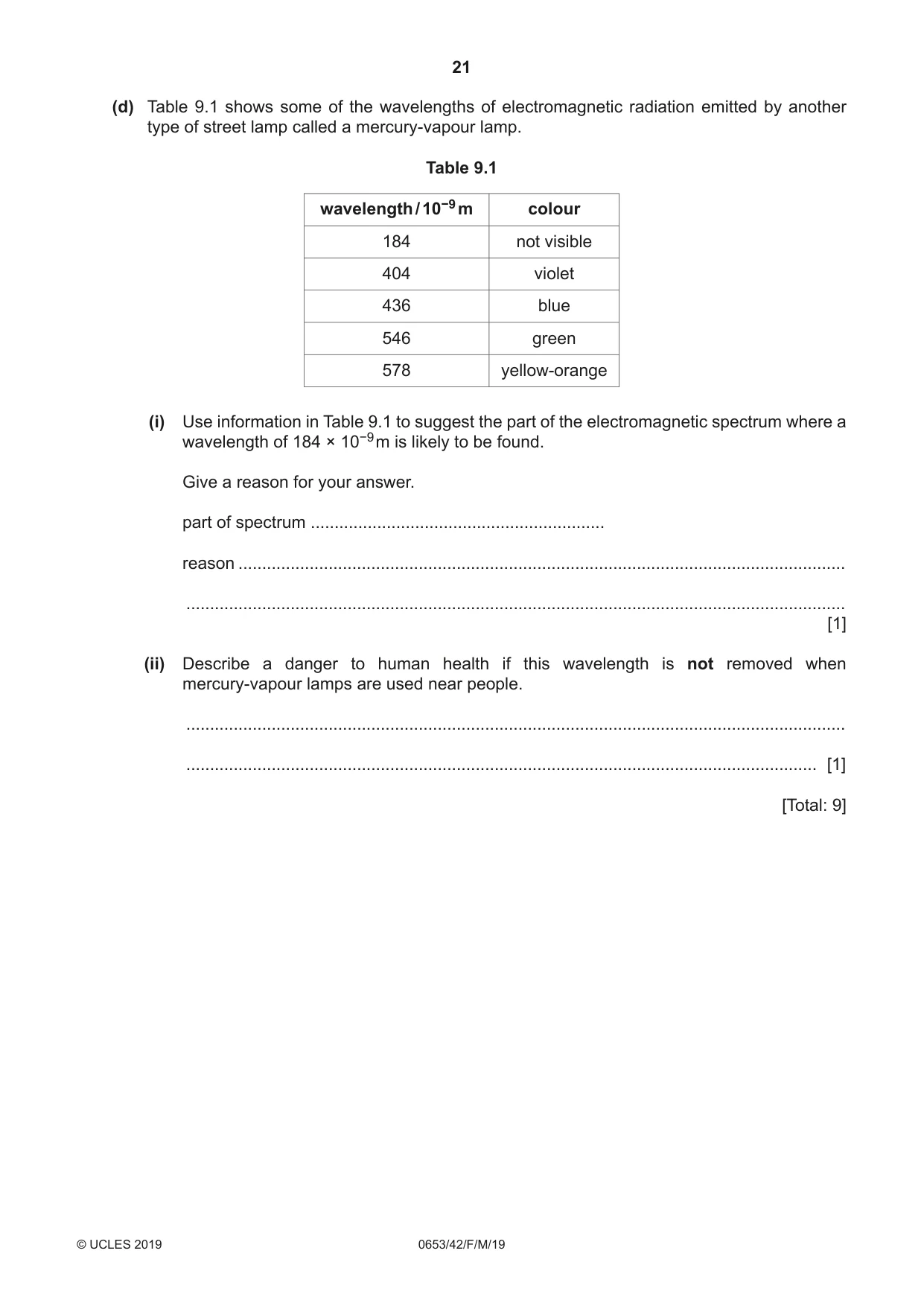
9 In many cities, sodium street lamps are used at night. These lamps produce an intense yellow light. (a) A street is lit by eight identical sodium lamps using mains voltage of 240 V. The current in each lamp is 0.50 A. The street is lit for 12 hours during the night. Calculate the electrical energy used. Show your working. energy = ...................................................... J [3] (b) A sodium street lamp emits electromagnetic radiation as yellow light with a wavelength of 589 × 10−9 m. (i) State the speed at which electromagnetic waves travel. speed = ................................................. m / s [1] (ii) Use your answer to (b)(i) to calculate the frequency of the yellow light emitted by a sodium lamp. Show your working. frequency = .................................................... Hz [2] (c) Electromagnetic radiation and water waves are examples of transverse wave motion. Sound is an example of longitudinal wave motion. Describe one way in which a longitudinal wave differs from a transverse wave. ................................................................................................................................................... ............................................................................................................................................. [1] (d) Table 9.1 shows some of the wavelengths of electromagnetic radiation emitted by another type of street lamp called a mercury-vapour lamp. Table 9.1 wavelength / 10−9 m colour 184 not visible 404 violet 436 blue 546 green 578 yellow-orange (i) Use information in Table 9.1 to suggest the part of the electromagnetic spectrum where a wavelength of 184 × 10−9 m is likely to be found. Give a reason for your answer. part of spectrum .............................................................. reason ................................................................................................................................ ........................................................................................................................................... [1] (ii) Describe a danger to human health if this wavelength is not removed when mercury-vapour lamps are used near people. ........................................................................................................................................... ..................................................................................................................................... [1] [Total: 9]
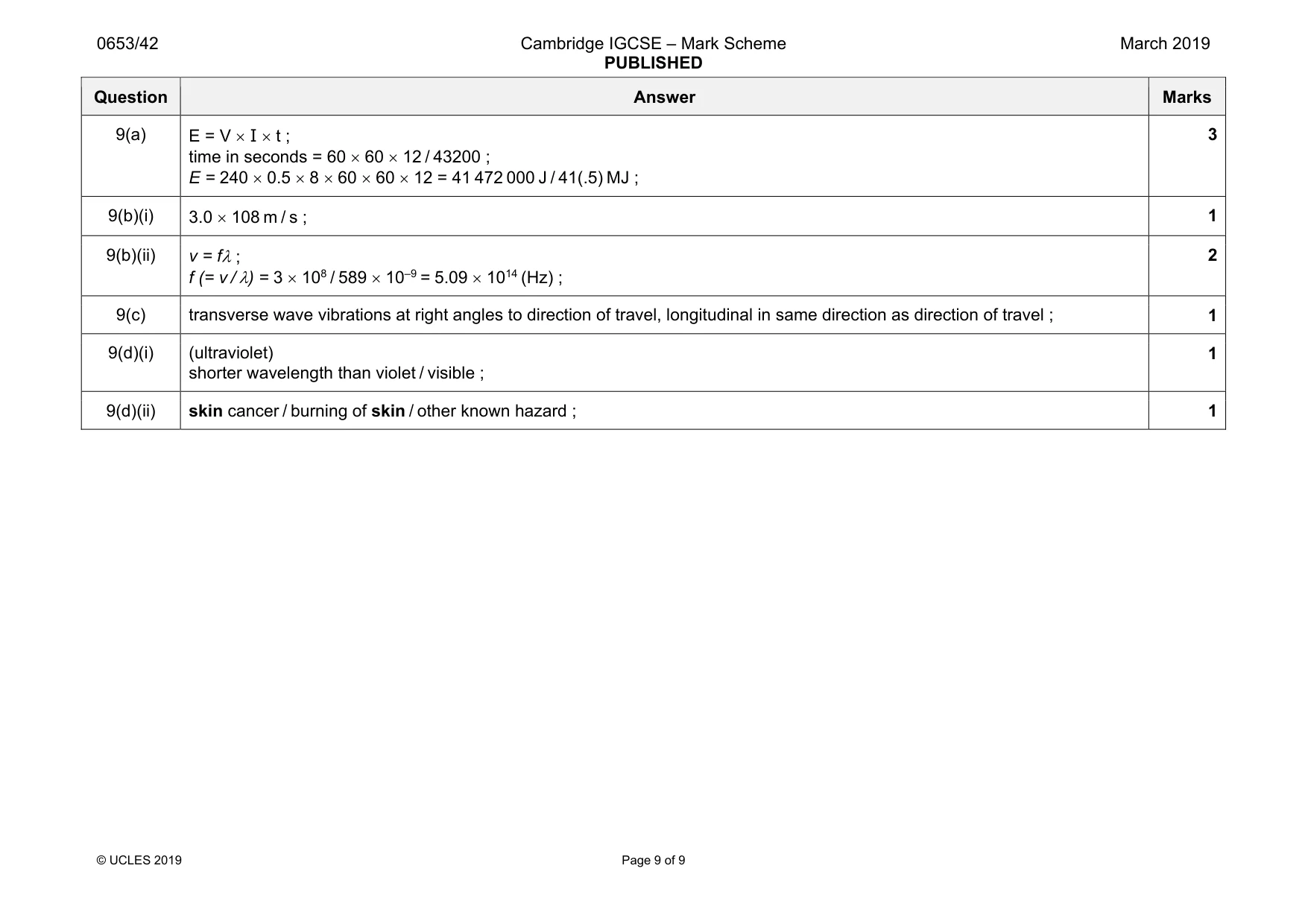
Mark scheme: 9(a) time in seconds = 60 × 60 × 12 / 43200 ; E = 240 × 0.5 × 8 × 60 × 60 × 12 = 41 472 000 J / 41(.5) MJ ; 3 9(b)(i) 3.0 × 10⁸ m / s ; 1 9(b)(ii) v = fλ ; f (= v / λ) = 3 × 10⁸ / 589 × 10–9 = 5.09 × 10¹⁴ (Hz) ; 2 9(c) transverse wave vibrations at right angles to direction of travel, longitudinal in same direction as direction of travel ; 1 9(d)(i) (ultraviolet) shorter wavelength than violet / visible ; 1 9(d)(ii) skin cancer / burning of skin / other known hazard ; 1
What was in this paper
The subtopics covered by these 9 questions, and how many questions each got. Open one in a new tab to see every Cambridge question on it.
What you needed in this session
Cambridge’s own grade thresholds for 2019 Feb/March, Paper 4 · Variant 2. A higher threshold means an easier paper — the bar moves with how the cohort did.