Questions as text
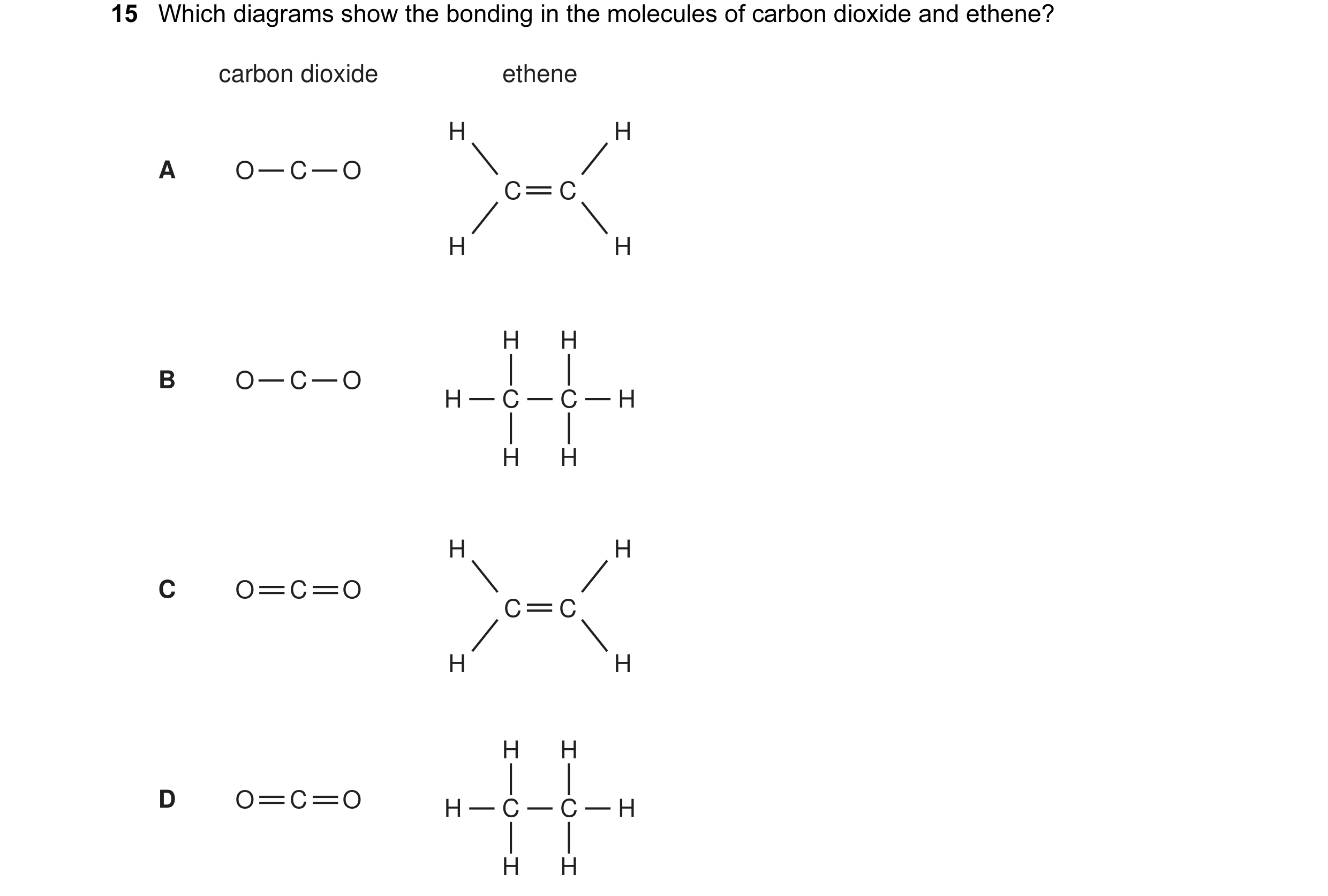
Q1 · Which diagrams show the bonding in the molecules of carbon dioxide and ethene? 0653/11 Oct/Nov 2005
15 Which diagrams show the bonding in the molecules of carbon dioxide and ethene? carbon dioxide ethene H H A O C O C C H H H H B O C O H C C H H H H H C O C O C C H H H H D O C O H C C H H H
1 marks
Answer: C
This question in 0653/11 Oct/Nov 2005
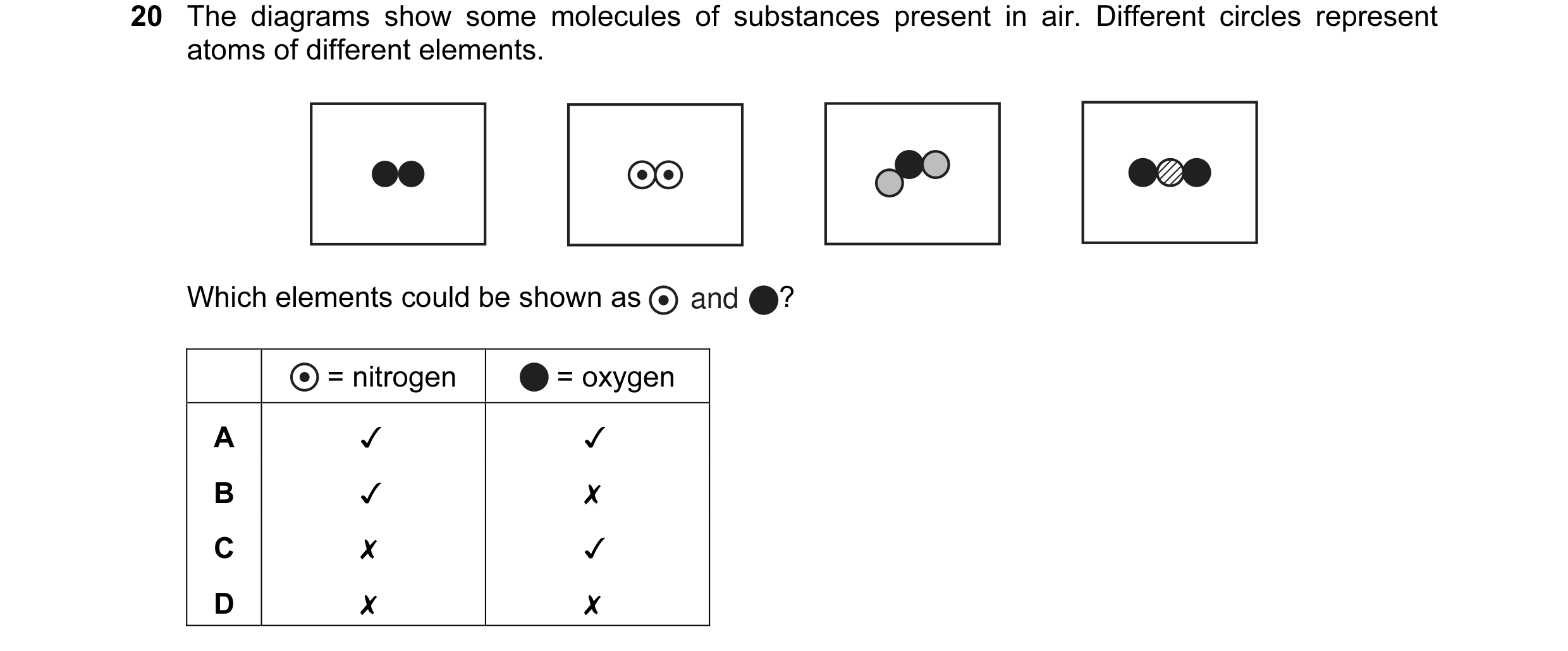
Q2 · The diagrams show some molecules of substances present in air 0653/11 Oct/Nov 2006
20 The diagrams show some molecules of substances present in air. Different circles represent
atoms of different elements.
rw} Le} lel ie
Which elements could be shown as @) and @?
© = nitrogen @ = oxygen
A Jv v
B Jv x
Cc x v
D x x
1 marks
Answer: A
This question in 0653/11 Oct/Nov 2006
Q3 · Which two elements form covalent bonds when they combine with each other? 0653/11 May/June 2007
15 Which two elements form covalent bonds when they combine with each other? A calcium and oxygen B hydrogen and oxygen C magnesium and chlorine D sodium and chlorine
1 marks
Answer: B
This question in 0653/11 May/June 2007
Q4 · Which elements exist as diatomic molecules? 0653/11 May/June 2007
18 Which elements exist as diatomic molecules?
bromine calcium chlorine magnesium
A v x x v
B v x v x
Cc x v v x
D x v x v
key
JY correct
X not correct
1 marks
Answer: B
This question in 0653/11 May/June 2007
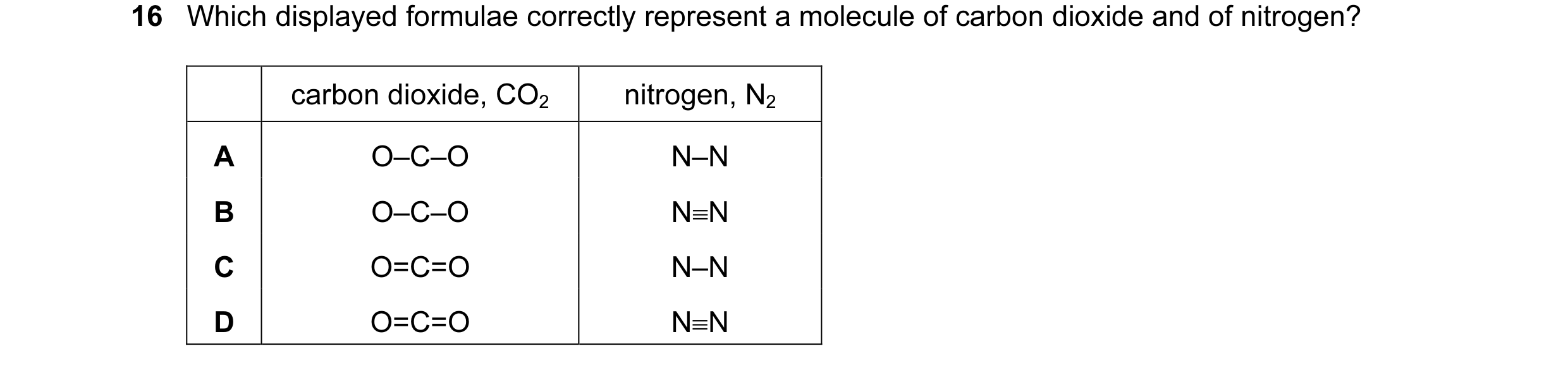
Q5 · Which displayed formulae correctly represent a molecule of carbon dioxide and of nitrogen? 0653/11 Oct/Nov 2007
16 Which displayed formulae correctly represent a molecule of carbon dioxide and of nitrogen? carbon dioxide, CO2 nitrogen, N2 A O–C–O N–N B O–C–O N≡N C O=C=O N–N D O=C=O N≡N
1 marks
Answer: D
This question in 0653/11 Oct/Nov 2007
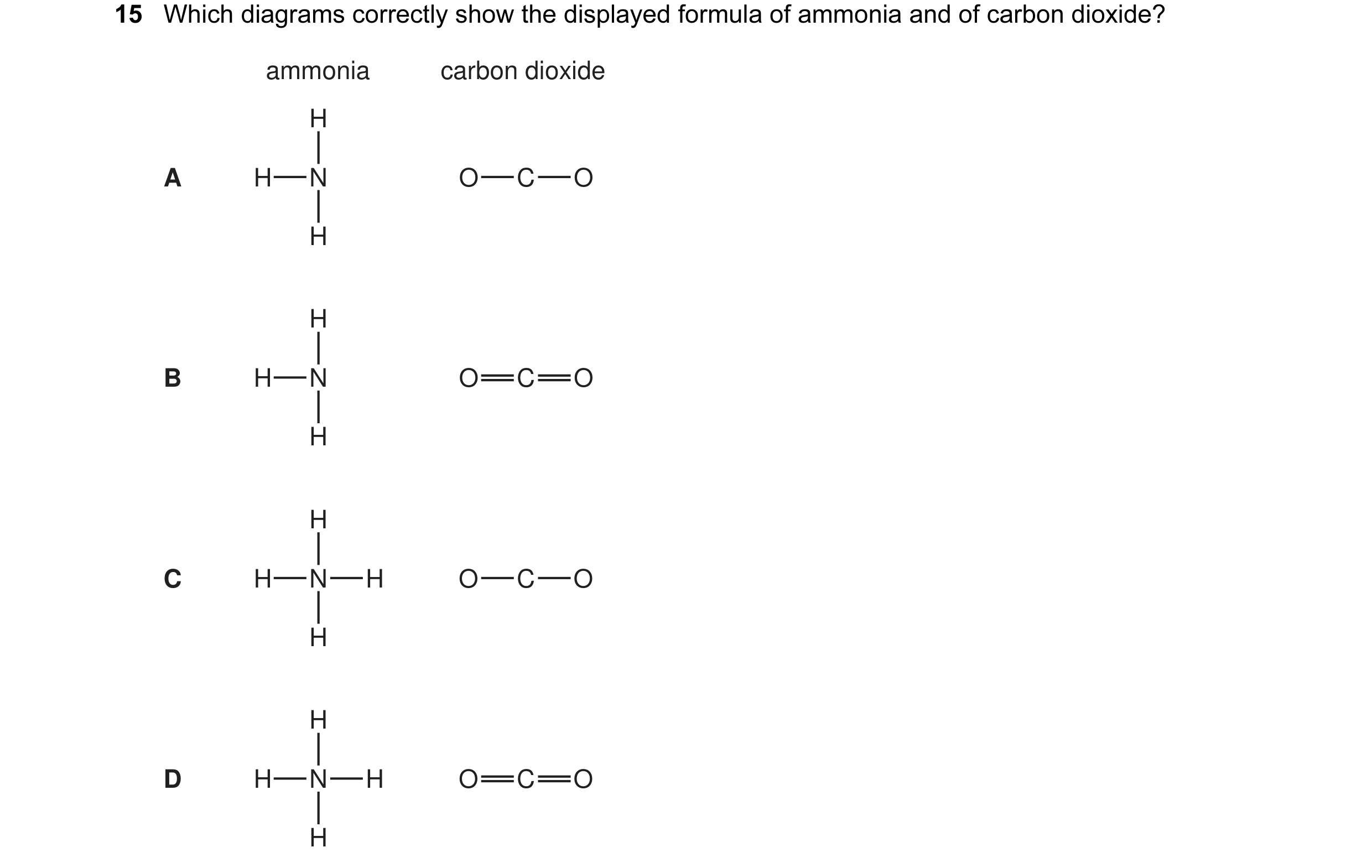
Q6 · Which diagrams correctly show the displayed formula of ammonia and of carbon dioxide? 0653/11 May/June 2008
15 Which diagrams correctly show the displayed formula of ammonia and of carbon dioxide? ammonia carbon dioxide H A H N O C O H H B H N O C O H H C H N H O C O H H D H N H O C O H
1 marks
Answer: B
This question in 0653/11 May/June 2008
Q7 · How many atoms are present in each of the molecules of the following components in air? 0653/11 May/June 2008
17 How many atoms are present in each of the molecules of the following components in air? water nitrogen noble gases oxygen vapour A 1 1 1 2 B 2 1 2 3 C 2 2 2 2 D 2 2 2 3
1 marks
Answer: B
This question in 0653/11 May/June 2008
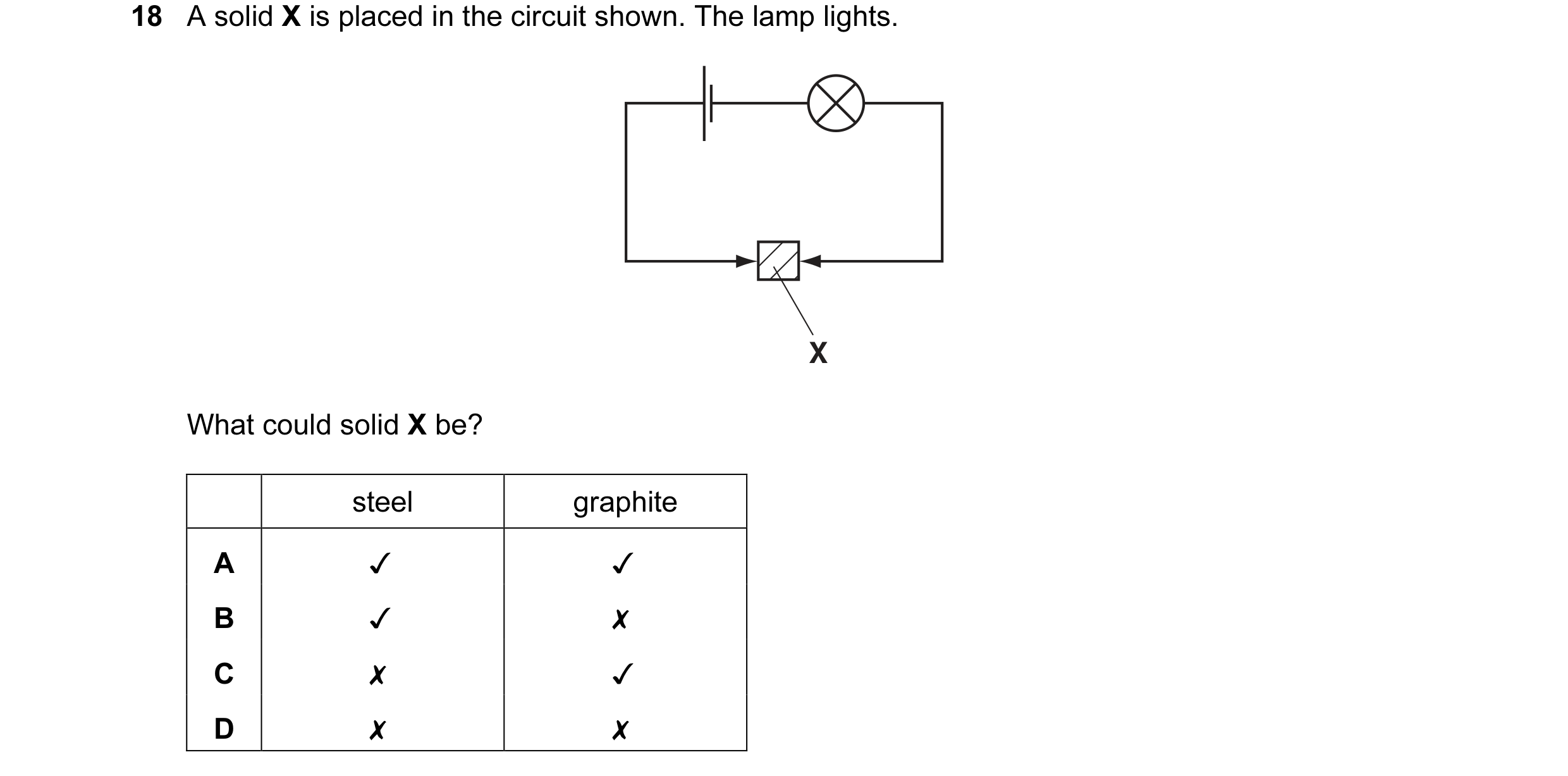
Q8 · A solid X is placed in the circuit shown 0653/11 May/June 2008
18 A solid X is placed in the circuit shown. The lamp lights.
What could solid X be?
steel graphite
A v v
B v x
Cc x v
D x x
1 marks
Answer: A
This question in 0653/11 May/June 2008
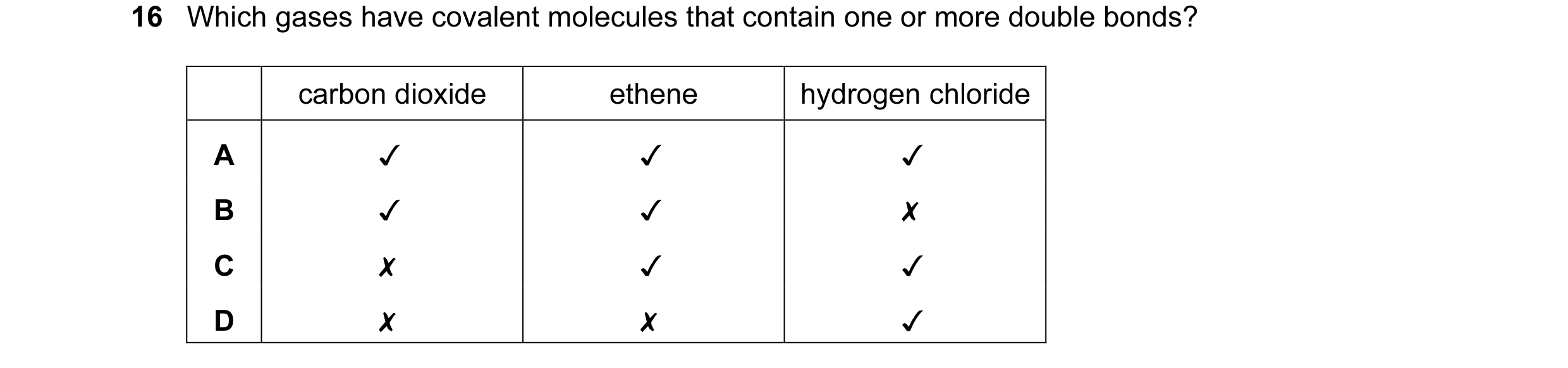
Q9 · Which gases have covalent molecules that contain one or more double bonds? 0653/11 Oct/Nov 2008
16 Which gases have covalent molecules that contain one or more double bonds?
carbon dioxide ethene hydrogen chloride
A v v v
B v v x
Cc x v v
D x x v
1 marks
Answer: B
This question in 0653/11 Oct/Nov 2008
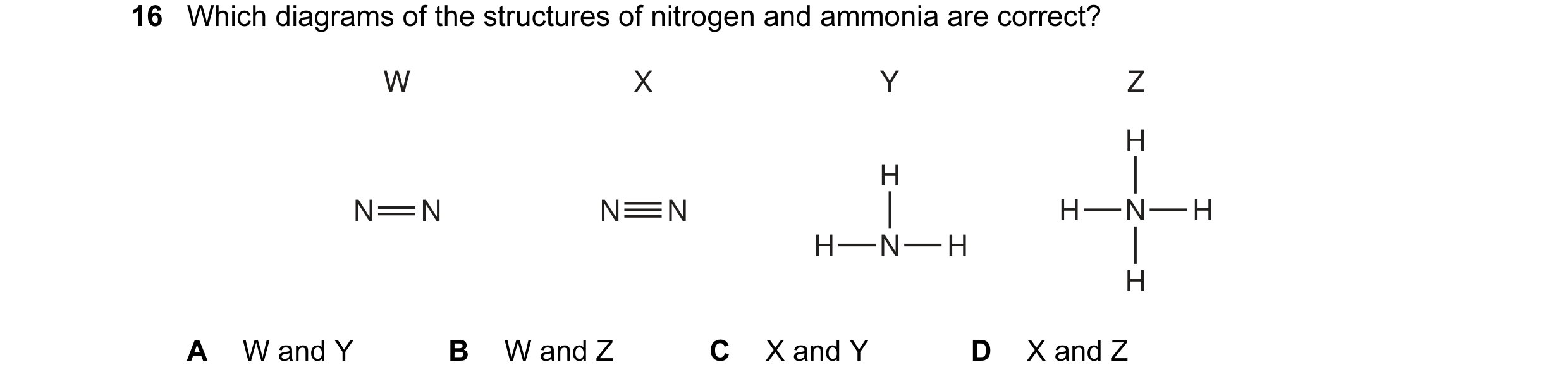
Q10 · Which diagrams of the structures of nitrogen and ammonia are correct? 0653/11 May/June 2009
16 Which diagrams of the structures of nitrogen and ammonia are correct? W X Y Z H H N N N N H N H H N H H A W and Y B W and Z C X and Y D X and Z
1 marks
Answer: C
This question in 0653/11 May/June 2009
Q11 · The table shows information about four different compounds 0653/11 Oct/Nov 2010
15 The table shows information about four different compounds. Which compound contains ionic bonds? formula of elements present compound in compound A CO2 carbon, oxygen B HCl hydrogen, chlorine C NH3 nitrogen, hydrogen D Na2O sodium, oxygen
1 marks
Answer: D
This question in 0653/11 Oct/Nov 2010
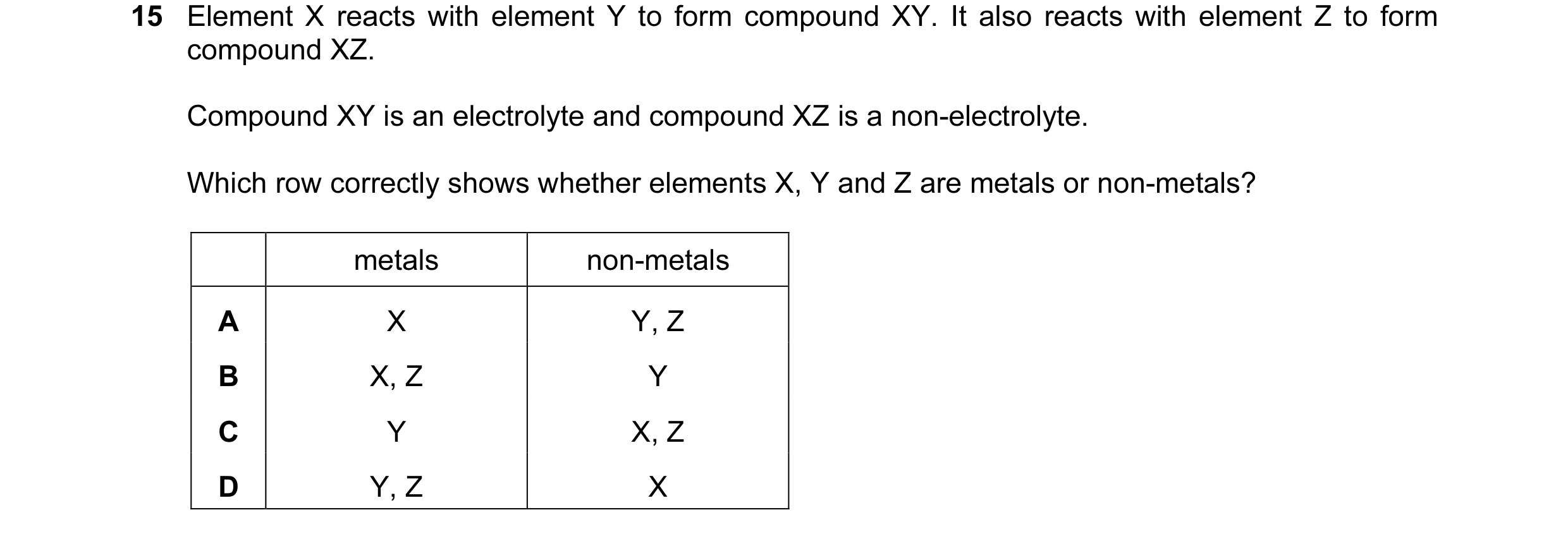
Q12 · Element X reacts with element Y to form compound XY 0653/11 May/June 2011
15 Element X reacts with element Y to form compound XY. It also reacts with element Z to form compound XZ. Compound XY is an electrolyte and compound XZ is a non-electrolyte. Which row correctly shows whether elements X, Y and Z are metals or non-metals? metals non-metals A X Y, Z B X, Z Y C Y X, Z D Y, Z X
1 marks
Answer: C
This question in 0653/11 May/June 2011
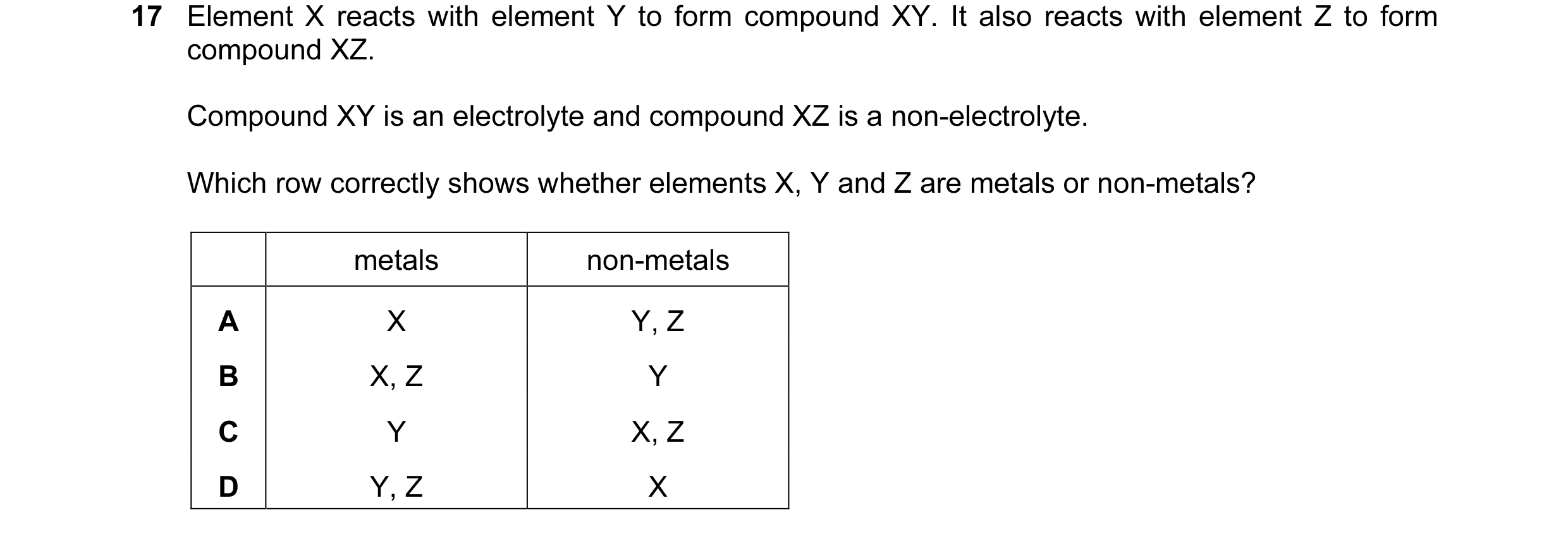
Q13 · Element X reacts with element Y to form compound XY 0653/12 May/June 2011
17 Element X reacts with element Y to form compound XY. It also reacts with element Z to form compound XZ. Compound XY is an electrolyte and compound XZ is a non-electrolyte. Which row correctly shows whether elements X, Y and Z are metals or non-metals? metals non-metals A X Y, Z B X, Z Y C Y X, Z D Y, Z X
1 marks
Answer: C
This question in 0653/12 May/June 2011
Q14 · A model of a molecule is shown 0653/11 Oct/Nov 2011
15 A model of a molecule is shown. key = hydrogen = nitrogen Which description and formula are correct for this molecule? description formula A compound NH2 B compound N2H4 C mixture NH2 D mixture N2H4
1 marks
Answer: B
This question in 0653/11 Oct/Nov 2011
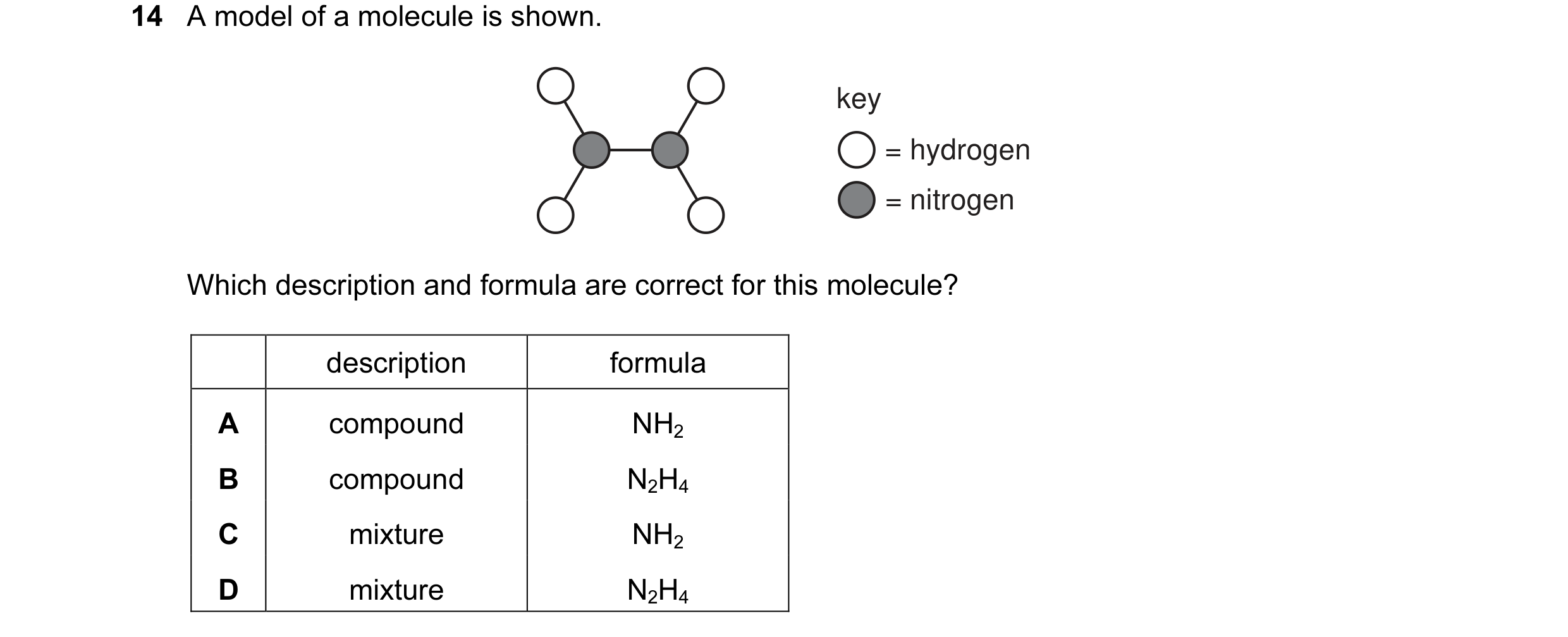
Q15 · A model of a molecule is shown 0653/12 Oct/Nov 2011
14 A model of a molecule is shown. key = hydrogen = nitrogen Which description and formula are correct for this molecule? description formula A compound NH2 B compound N2H4 C mixture NH2 D mixture N2H4
1 marks
Answer: B
This question in 0653/12 Oct/Nov 2011
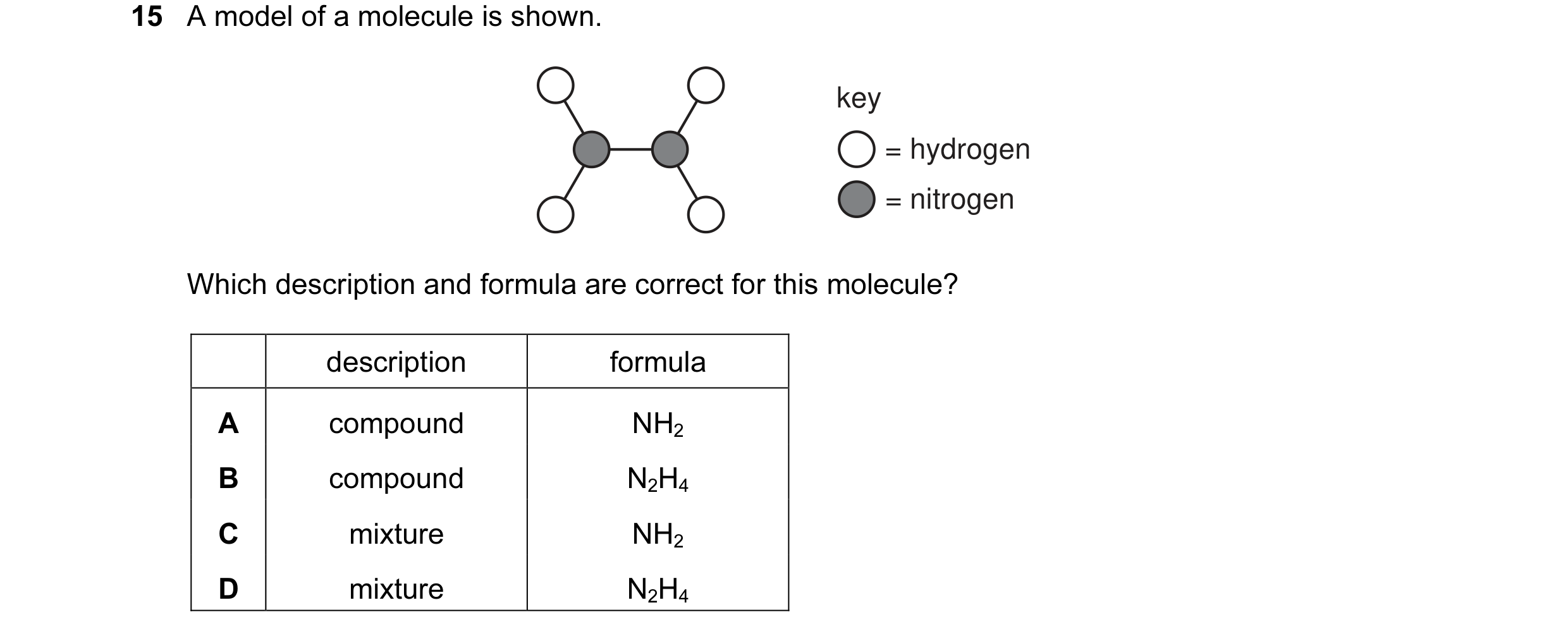
Q16 · A model of a molecule is shown 0653/13 Oct/Nov 2011
15 A model of a molecule is shown. key = hydrogen = nitrogen Which description and formula are correct for this molecule? description formula A compound NH2 B compound N2H4 C mixture NH2 D mixture N2H4
1 marks
Answer: B
This question in 0653/13 Oct/Nov 2011
Q17 · Two oxides have the formulae CaO and NO 0653/11 May/June 2012
15 Two oxides have the formulae CaO and NO. Which statement about the bonding in these oxides is correct? A Both CaO and NO are covalent. B Both CaO and NO are ionic. C CaO is covalent and NO is ionic. D CaO is ionic and NO is covalent.
1 marks
This question in 0653/11 May/June 2012
Q18 · Which statement correctly describes the bonding in compounds? 0653/12 May/June 2012
15 Which statement correctly describes the bonding in compounds? A An ionic compound contains two metallic elements. B In a compound formed between a metal and a non-metal, the metal has a negative charge. C When a metal combines with a non-metal, electrons are shared between the elements. D When two non-metals combine, molecules are formed.
1 marks
Answer: D
This question in 0653/12 May/June 2012
Q19 · Which statement correctly describes the bonding in compounds? 0653/13 May/June 2012
15 Which statement correctly describes the bonding in compounds? A An ionic compound contains two metallic elements. B In a compound formed between a metal and a non-metal, the metal has a negative charge. C When a metal combines with a non-metal, electrons are shared between the elements. D When two non-metals combine, molecules are formed.
1 marks
Answer: D
This question in 0653/13 May/June 2012
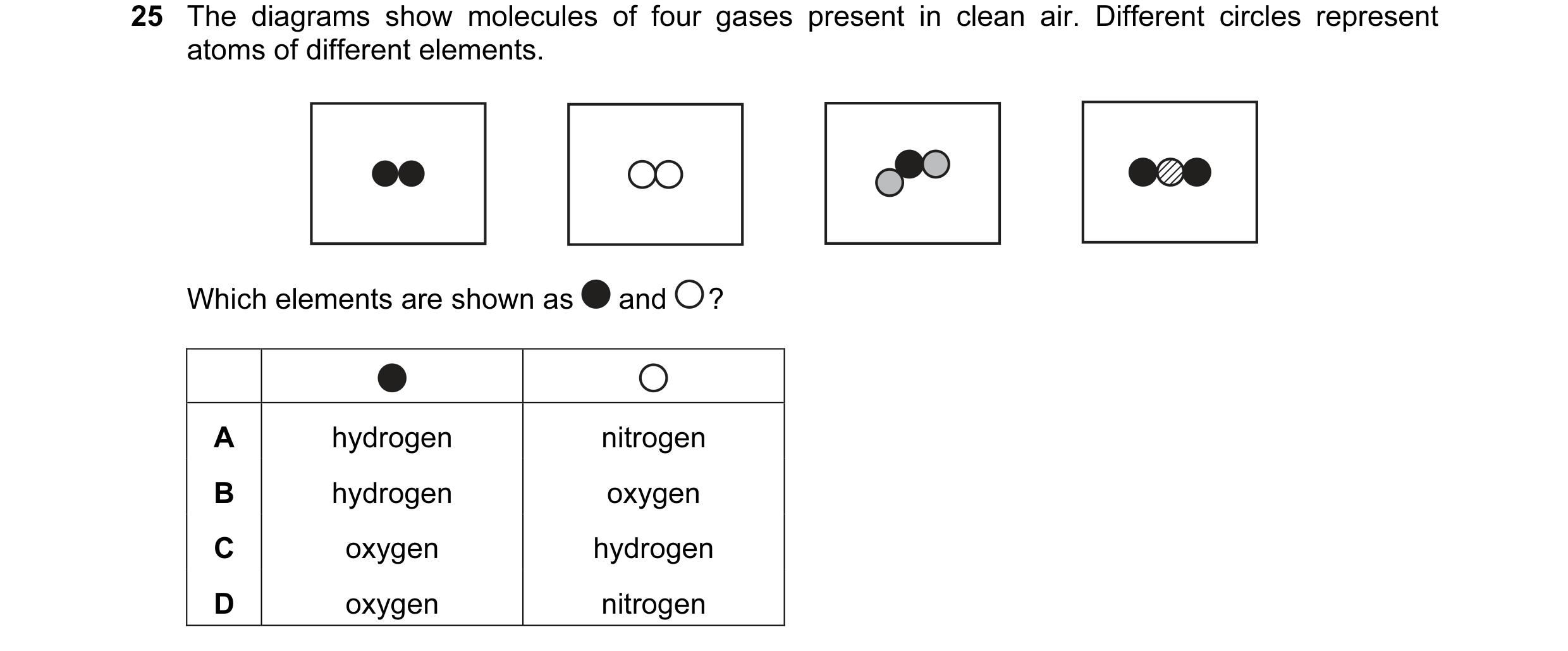
Q20 · The diagrams show molecules of four gases present in clean air 0653/13 May/June 2012
25 The diagrams show molecules of four gases present in clean air. Different circles represent atoms of different elements. Which elements are shown as and ? A hydrogen nitrogen B hydrogen oxygen C oxygen hydrogen D oxygen nitrogen
1 marks
Answer: D
This question in 0653/13 May/June 2012
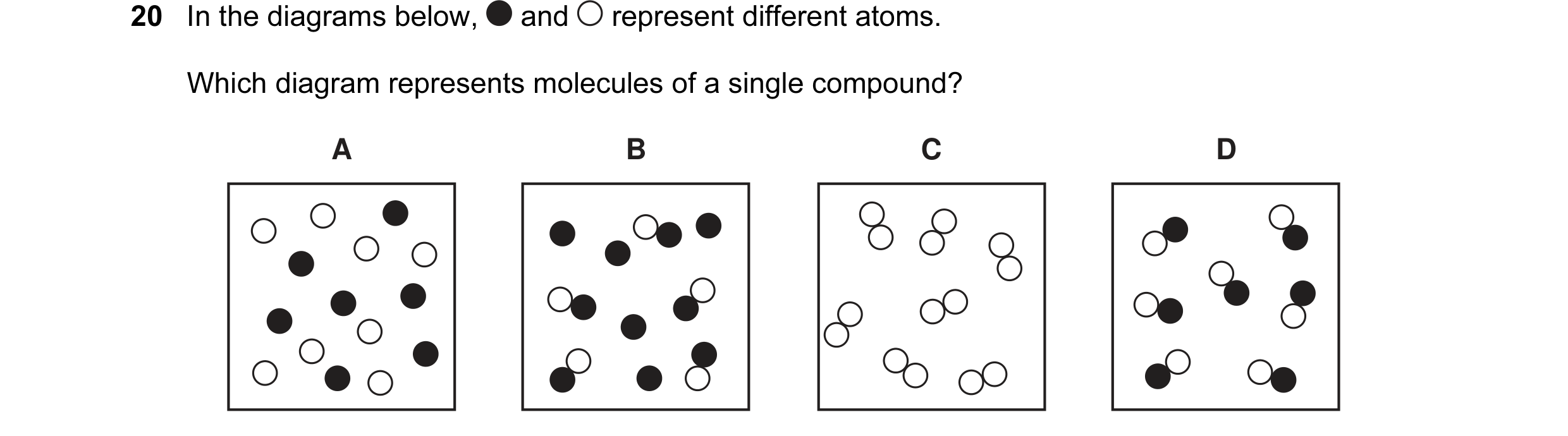
Q21 · In the diagrams below, and represent different atoms 0653/11 Oct/Nov 2013
20 In the diagrams below, and represent different atoms. Which diagram represents molecules of a single compound? A B C D
1 marks
Answer: D
This question in 0653/11 Oct/Nov 2013
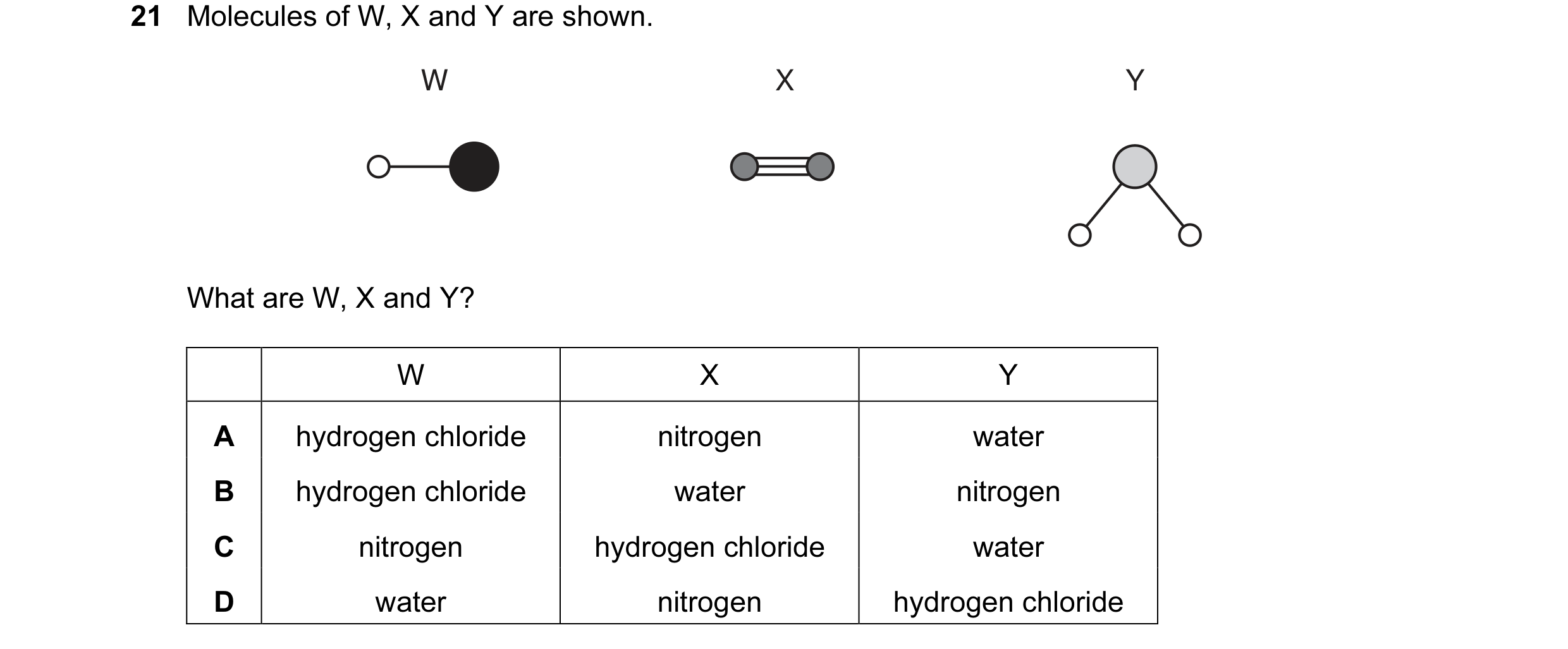
Q22 · Molecules of W, X and Y are shown 0653/11 Oct/Nov 2013
21 Molecules of W, X and Y are shown. W X Y What are W, X and Y? W X Y A hydrogen chloride nitrogen water B hydrogen chloride water nitrogen C nitrogen hydrogen chloride water D water nitrogen hydrogen chloride
1 marks
Answer: A
This question in 0653/11 Oct/Nov 2013
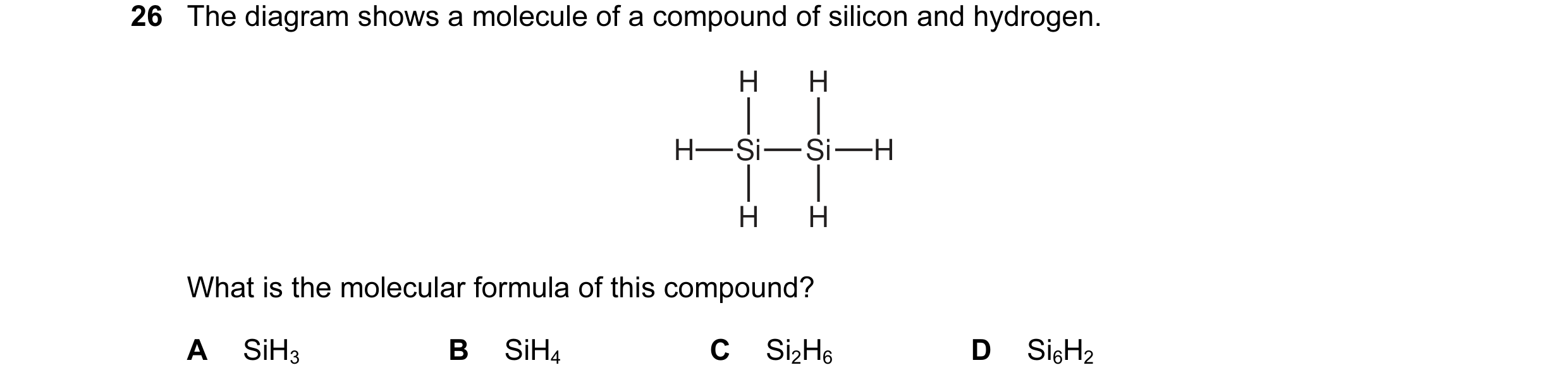
Q23 · The diagram shows a molecule of a compound of silicon and hydrogen 0653/11 Oct/Nov 2013
26 The diagram shows a molecule of a compound of silicon and hydrogen. H H H Si Si H H H What is the molecular formula of this compound? A SiH3 B SiH4 C Si2H6 D Si6H2
1 marks
Answer: C
This question in 0653/11 Oct/Nov 2013
Q24 · Molecules of W, X and Y are shown 0653/12 Oct/Nov 2013
21 Molecules of W, X and Y are shown. W X Y What are W, X and Y? W X Y A hydrogen chloride nitrogen water B hydrogen chloride water nitrogen C nitrogen hydrogen chloride water D water nitrogen hydrogen chloride
1 marks
Answer: A
This question in 0653/12 Oct/Nov 2013
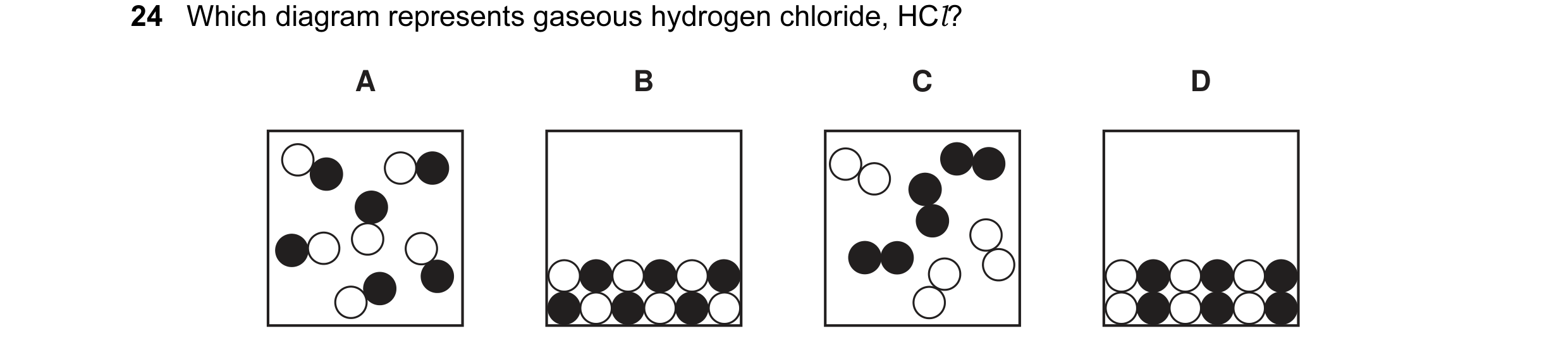
Q25 · Which diagram represents gaseous hydrogen chloride, HCl? 0653/13 Oct/Nov 2013
24 Which diagram represents gaseous hydrogen chloride, HCl? A B C D
1 marks
Answer: A
This question in 0653/13 Oct/Nov 2013
Q26 · The table shows the formulae of three substances 0653/11 May/June 2014
14 The table shows the formulae of three substances. substance formula methane CH4 water H2O oxygen O2 Which statement is correct? A Methane is made from five types of atom. B Methane, water and oxygen are molecules. C Only methane and water are molecules. D Oxygen is made from two types of atom.
1 marks
Answer: B
This question in 0653/11 May/June 2014
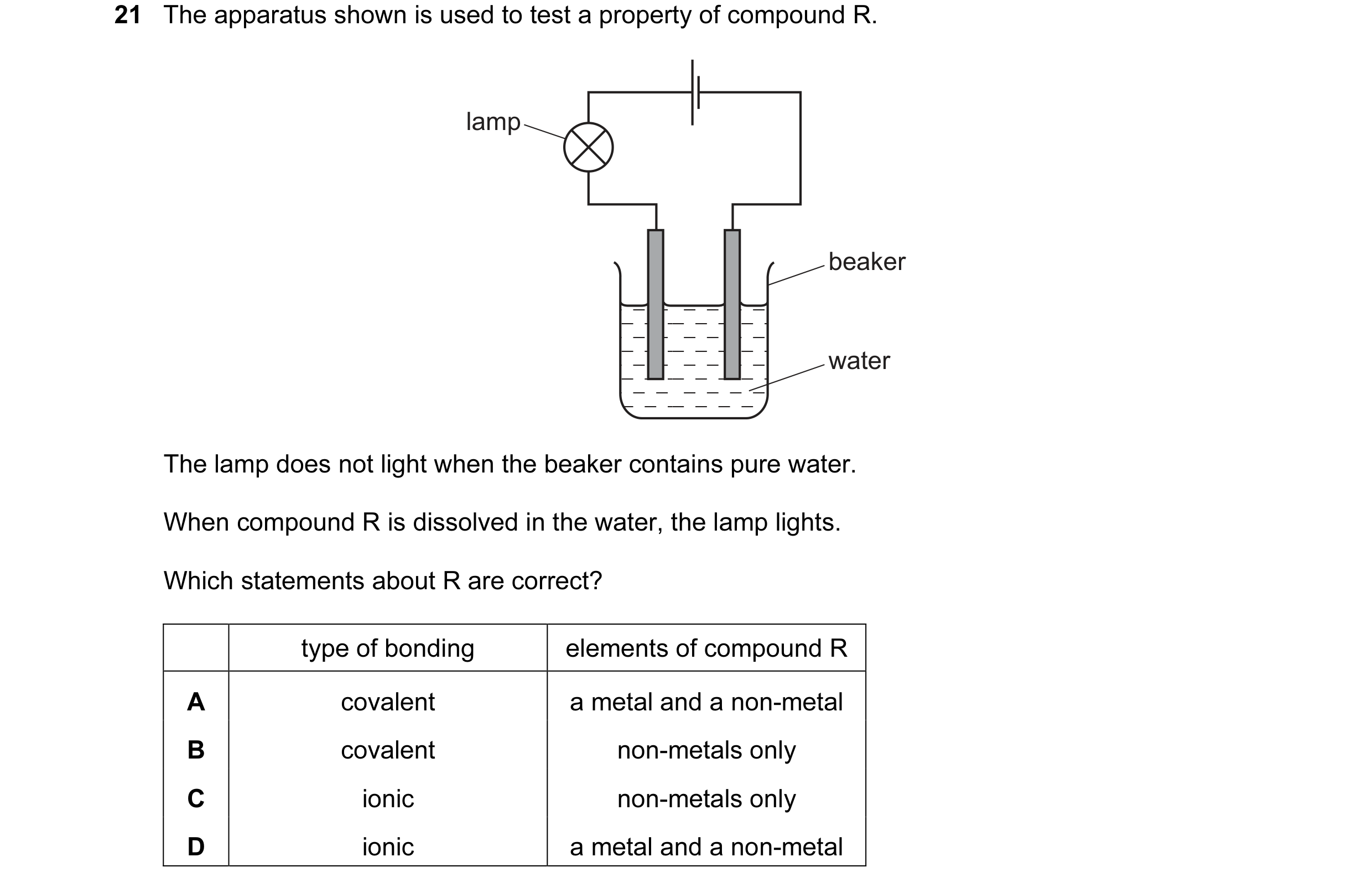
Q27 · The apparatus shown is used to test a property of compound R 0653/12 May/June 2014
21 The apparatus shown is used to test a property of compound R. lamp beaker water The lamp does not light when the beaker contains pure water. When compound R is dissolved in the water, the lamp lights. Which statements about R are correct? type of bonding elements of compound R A covalent a metal and a non-metal B covalent non-metals only C ionic non-metals only D ionic a metal and a non-metal
1 marks
Answer: D
This question in 0653/12 May/June 2014
Q28 · The table shows the formulae of three substances 0653/13 May/June 2014
14 The table shows the formulae of three substances. substance formula methane CH4 water H2O oxygen O2 Which statement is correct? A Methane is made from five types of atom. B Methane, water and oxygen are molecules. C Only methane and water are molecules. D Oxygen is made from two types of atom.
1 marks
Answer: B
This question in 0653/13 May/June 2014
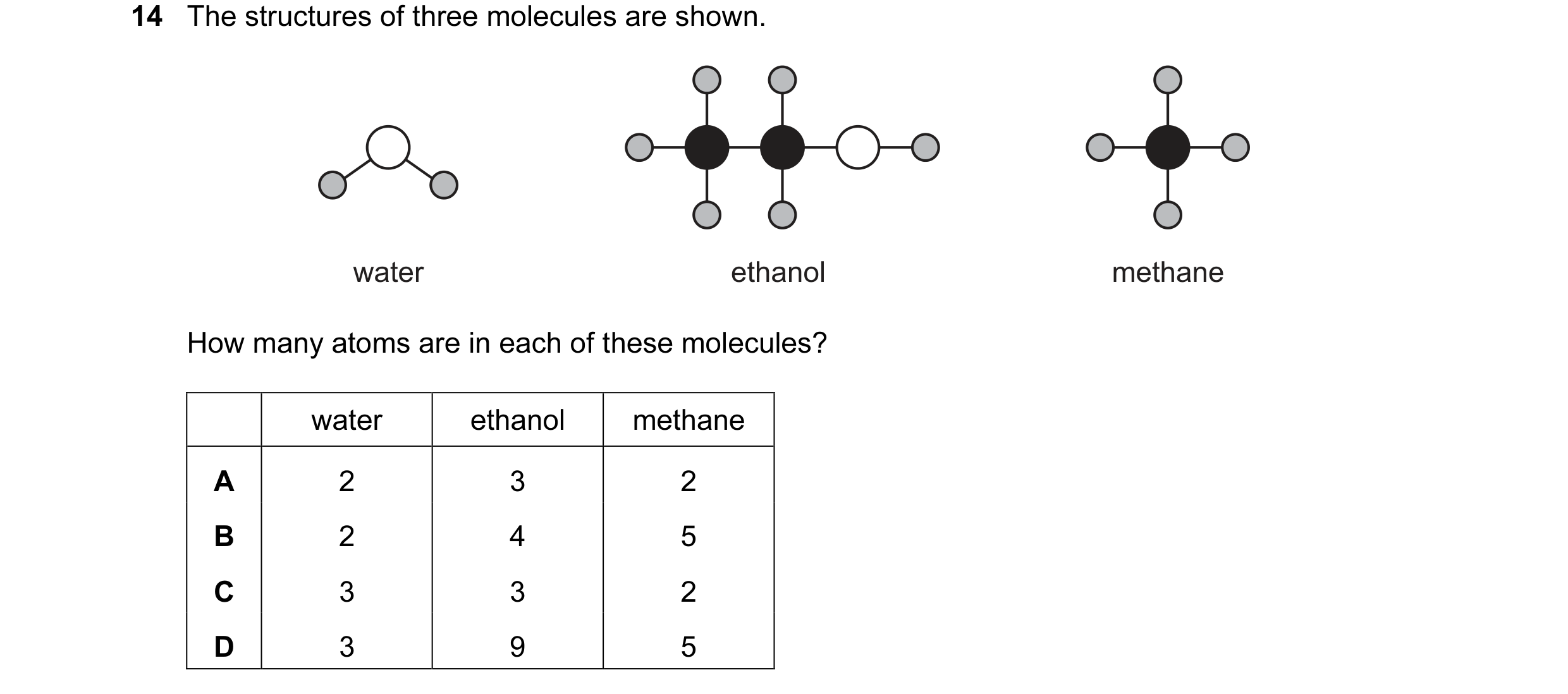
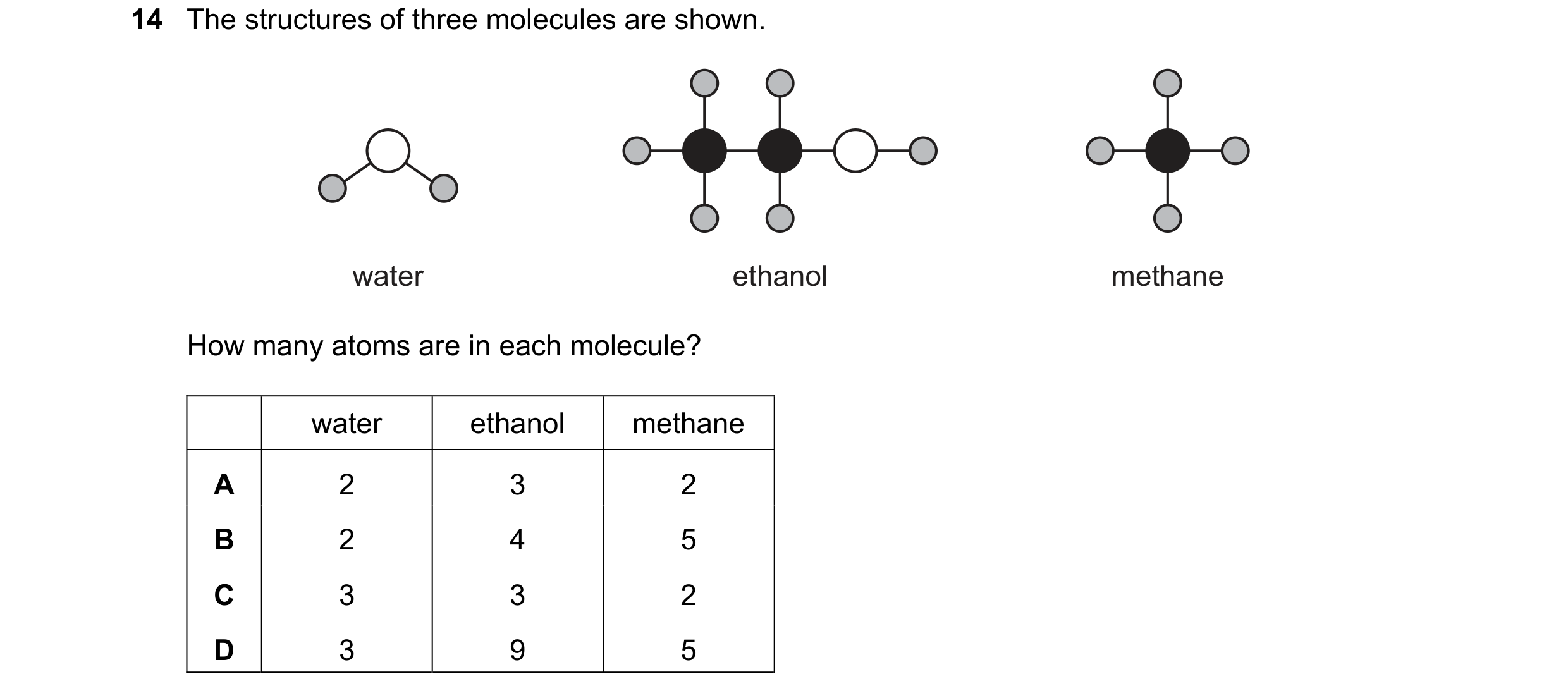
Q29 · The structures of three molecules are shown 0653/13 May/June 2015
14 The structures of three molecules are shown. water ethanol methane How many atoms are in each of these molecules? water ethanol methane A 2 3 2 B 2 4 5 C 3 3 2 D 3 9 5
1 marks
Answer: D
This question in 0653/13 May/June 2015
Q30 · Which statement about atoms and molecules is correct? 0653/11 Oct/Nov 2015
14 Which statement about atoms and molecules is correct? A Atoms gain or lose electrons to become molecules. B Atoms of the same element contain the same number of molecules. C Molecules are the simplest unit of an atom. D Molecules contain atoms which are covalently bonded.
1 marks
Answer: D
This question in 0653/11 Oct/Nov 2015
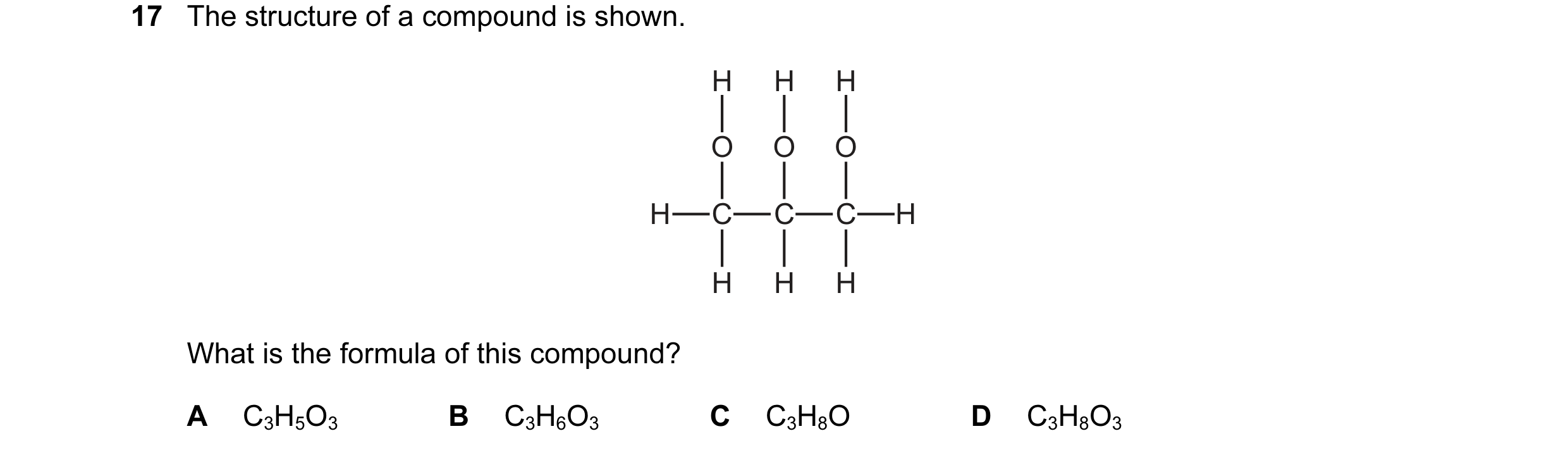
Q31 · The structure of a compound is shown 0653/11 Oct/Nov 2015
17 The structure of a compound is shown. H H H O O O H C C C H H H H What is the formula of this compound? A C3H5O3 B C3H6O3 C C3H8O D C3H8O3
1 marks
Answer: D
This question in 0653/11 Oct/Nov 2015
Q32 · And represent atoms of two different elements 0653/12 Oct/Nov 2015
14 and represent atoms of two different elements. X Y Which diagram represents molecules? A B C D Y Y Y Y Y Y Y X X X Y X Y X X X X Y Y Y Y Y Y Y Y X X X Y X Y X Y X X Y Y Y Y Y Y Y X X Y X Y X Y X Y Y Y Y Y Y Y X X X Y X Y X Y X Y Y Y Y Y Y Y
1 marks
Answer: C
This question in 0653/12 Oct/Nov 2015
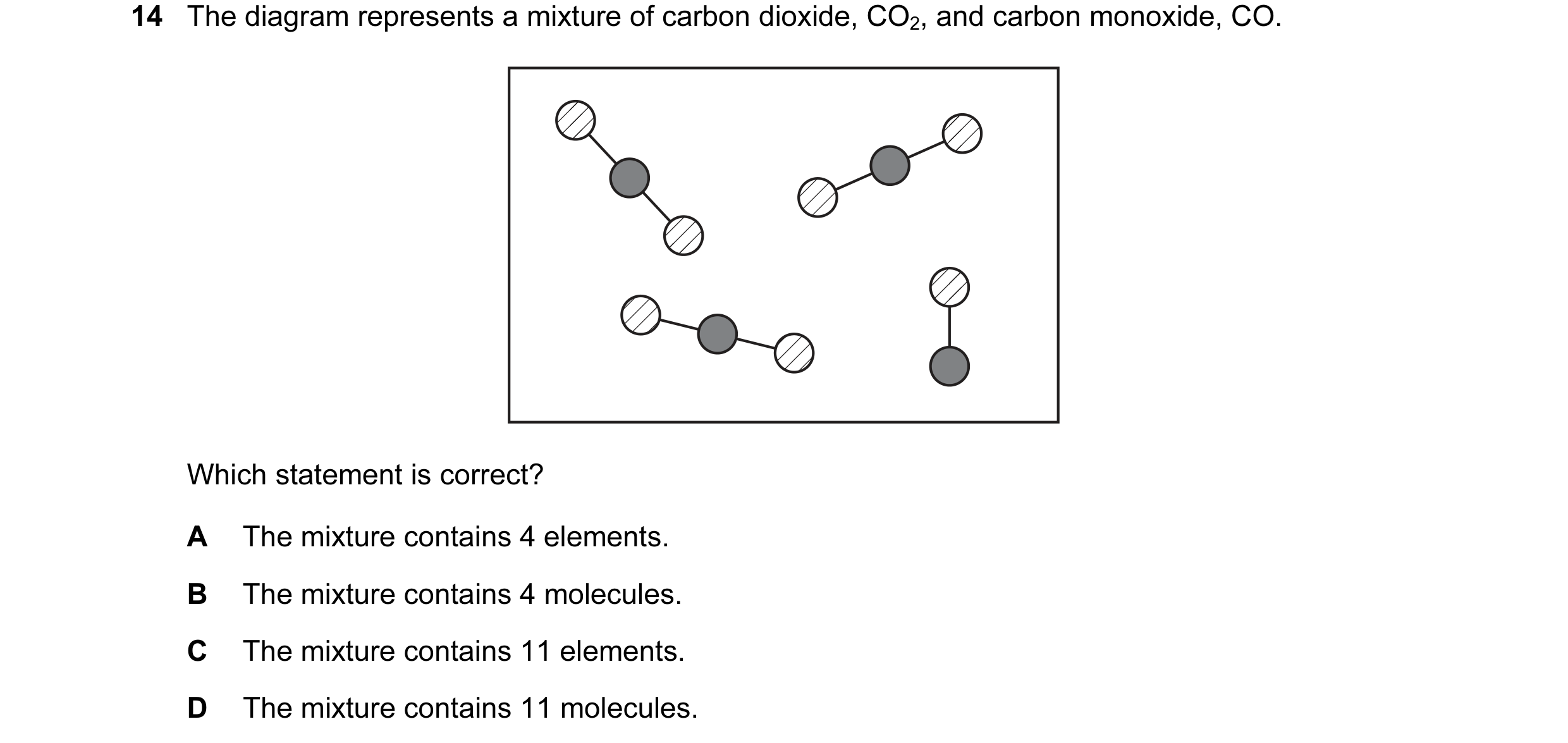
Q33 · The diagram represents a mixture of carbon dioxide, CO2, and carbon monoxide, CO 0653/13 Oct/Nov 2015
14 The diagram represents a mixture of carbon dioxide, CO2, and carbon monoxide, CO. Which statement is correct? A The mixture contains 4 elements. B The mixture contains 4 molecules. C The mixture contains 11 elements. D The mixture contains 11 molecules.
1 marks
Answer: B
This question in 0653/13 Oct/Nov 2015
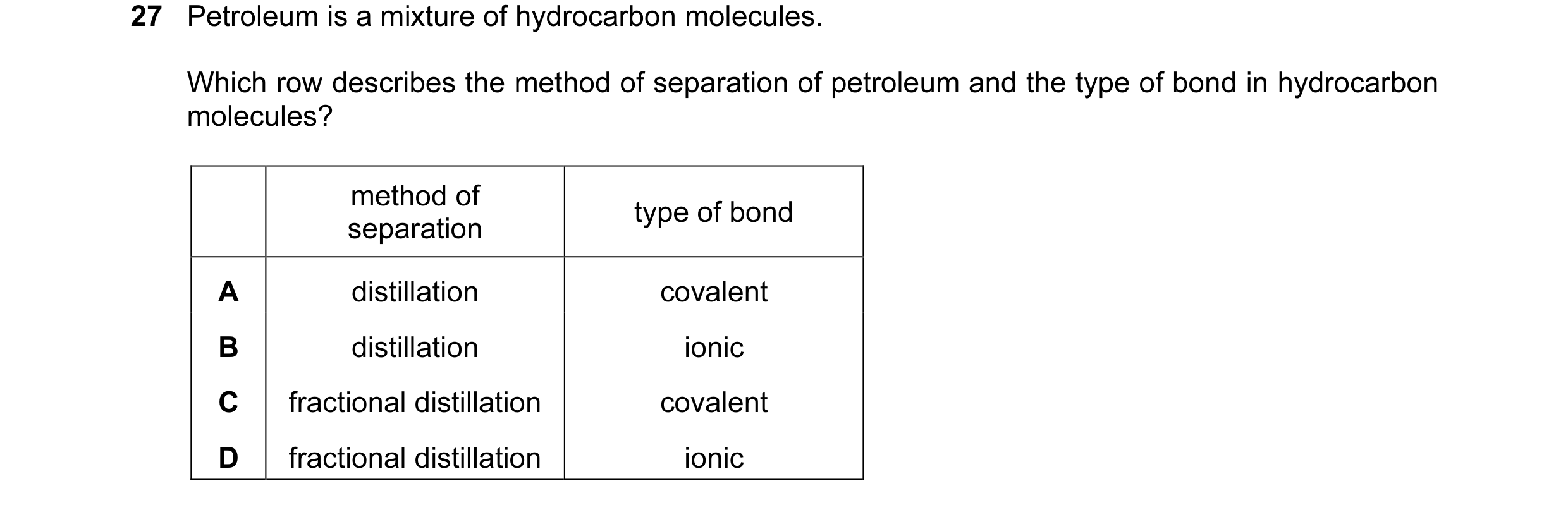
Q34 · Petroleum is a mixture of hydrocarbon molecules 0653/12 May/June 2016
27 Petroleum is a mixture of hydrocarbon molecules. Which row describes the method of separation of petroleum and the type of bond in hydrocarbon molecules? method of type of bond separation A distillation covalent B distillation ionic C fractional distillation covalent D fractional distillation ionic
1 marks
Answer: C
This question in 0653/12 May/June 2016
Q35 · Which statement about compounds is correct? 0653/11 Oct/Nov 2016
17 Which statement about compounds is correct? A An ionic compound contains two metallic elements bonded together. B In an ionic compound, metal ions are negatively charged. C When metals combine with non-metals, electrons are shared between the atoms. D When two non-metals combine, molecules are formed.
1 marks
Answer: D
This question in 0653/11 Oct/Nov 2016
Q36 · Which statement about compounds is correct? 0653/12 Oct/Nov 2016
17 Which statement about compounds is correct? A An ionic compound contains two metallic elements bonded together. B In an ionic compound, metal ions are negatively charged. C When metals combine with non-metals, electrons are shared between the atoms. D When two non-metals combine, molecules are formed.
1 marks
Answer: D
This question in 0653/12 Oct/Nov 2016
Q37 · Which statement about compounds is correct? 0653/13 Oct/Nov 2016
17 Which statement about compounds is correct? A An ionic compound contains two metallic elements bonded together. B In an ionic compound, metal ions are negatively charged. C When metals combine with non-metals, electrons are shared between the atoms. D When two non-metals combine, molecules are formed.
1 marks
Answer: D
This question in 0653/13 Oct/Nov 2016
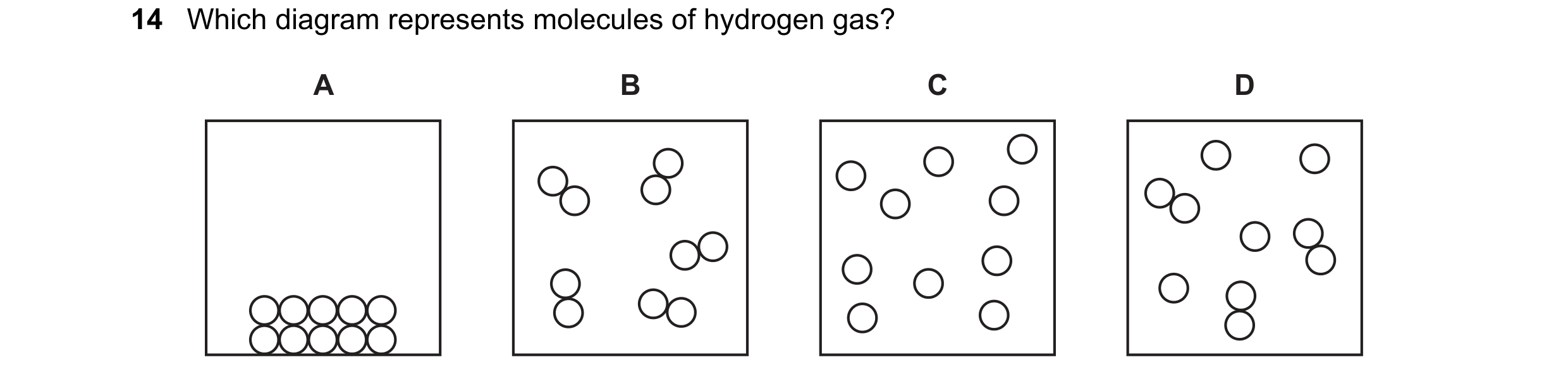
Q38 · Which diagram represents molecules of hydrogen gas? 0653/12 Feb/March 2017
14 Which diagram represents molecules of hydrogen gas? A B C D
1 marks
Answer: B
This question in 0653/12 Feb/March 2017
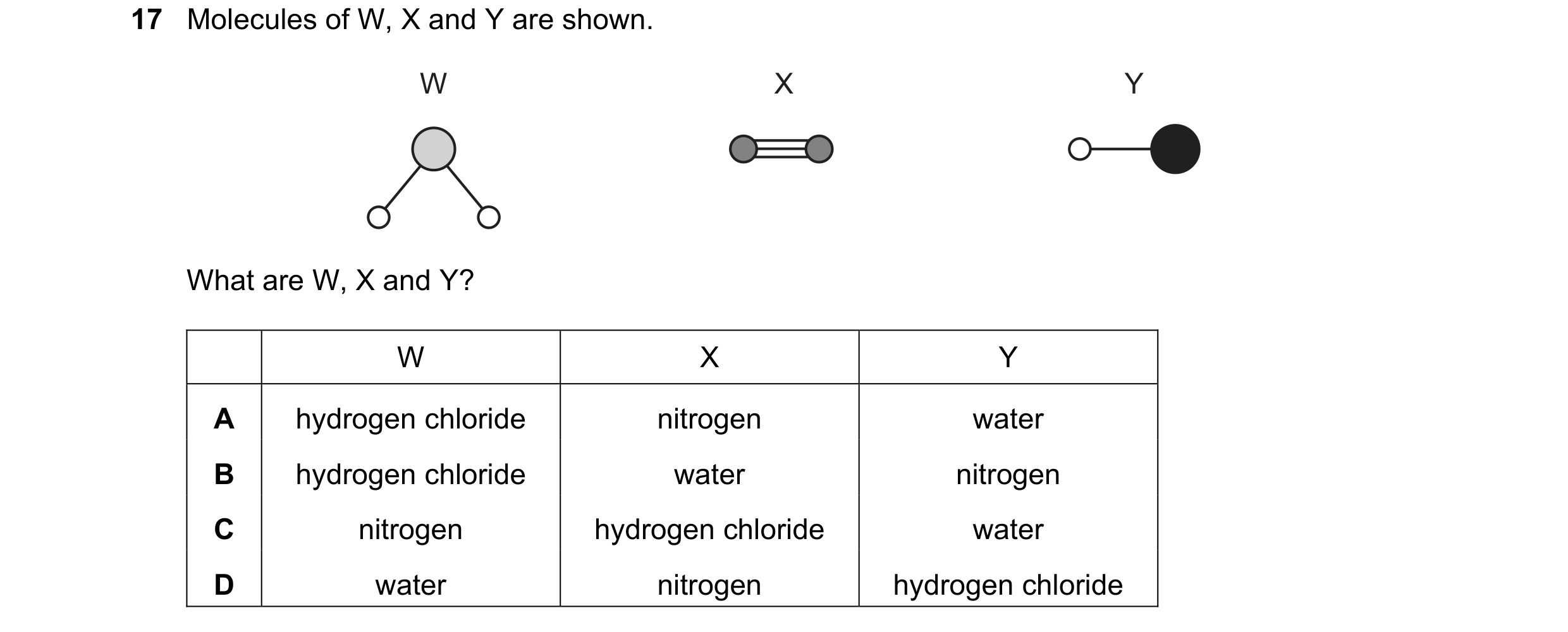
Q39 · Molecules of W, X and Y are shown 0653/12 Feb/March 2017
17 Molecules of W, X and Y are shown. W X Y What are W, X and Y? W X Y A hydrogen chloride nitrogen water B hydrogen chloride water nitrogen C nitrogen hydrogen chloride water D water nitrogen hydrogen chloride
1 marks
Answer: D
This question in 0653/12 Feb/March 2017
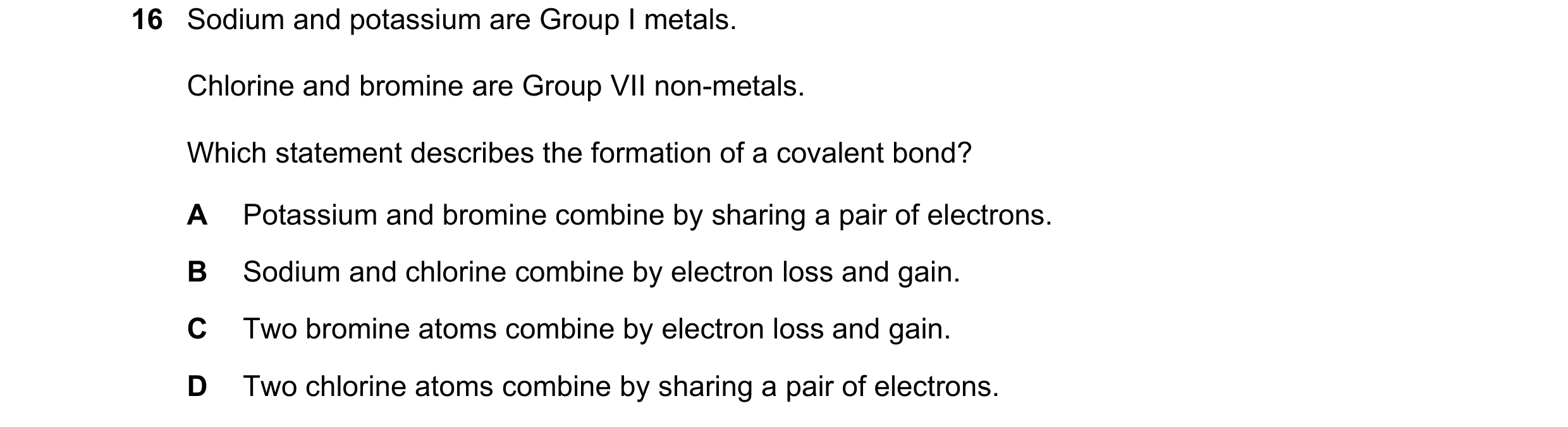
Q40 · Sodium and potassium are Group I metals 0653/11 May/June 2017
16 Sodium and potassium are Group I metals. Chlorine and bromine are Group VII non-metals. Which statement describes the formation of a covalent bond? A Potassium and bromine combine by sharing a pair of electrons. B Sodium and chlorine combine by electron loss and gain. C Two bromine atoms combine by electron loss and gain. D Two chlorine atoms combine by sharing a pair of electrons.
1 marks
Answer: D
This question in 0653/11 May/June 2017
Q41 · The formulae of three substances are shown 0653/11 Oct/Nov 2017
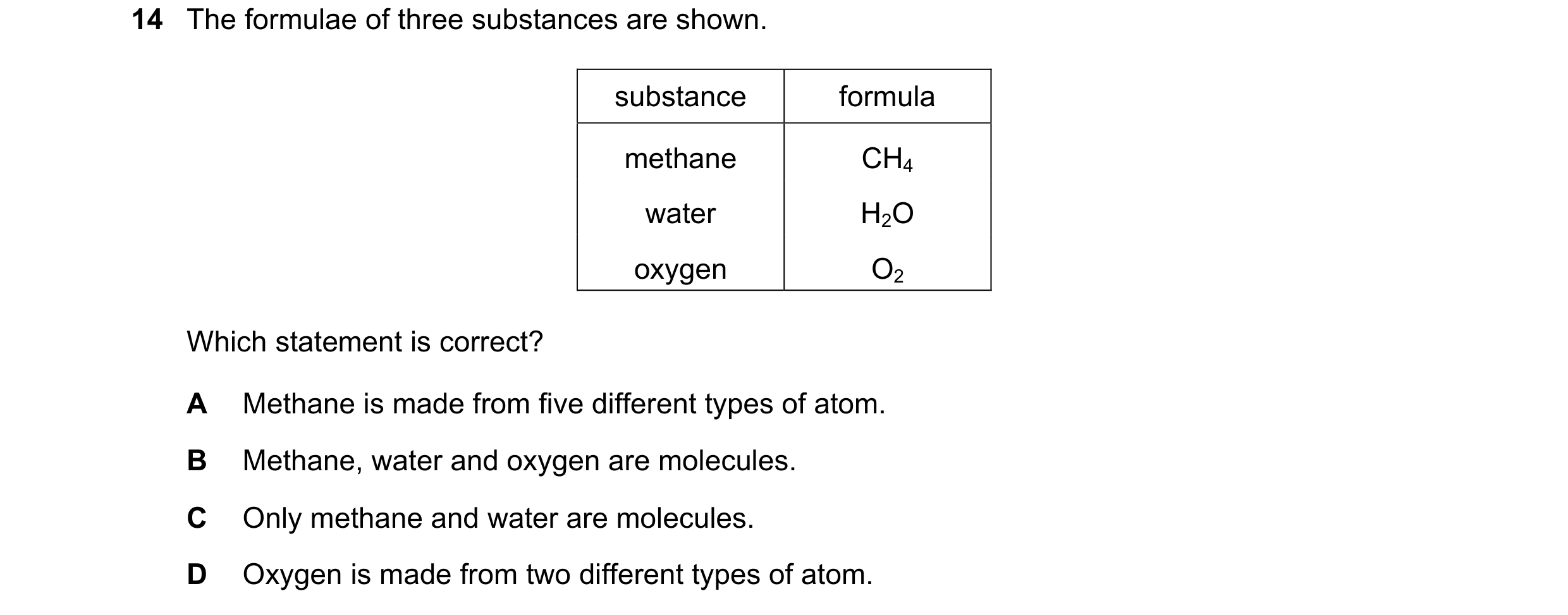
14 The formulae of three substances are shown. substance formula methane CH4 water H2O oxygen O2 Which statement is correct? A Methane is made from five different types of atom. B Methane, water and oxygen are molecules. C Only methane and water are molecules. D Oxygen is made from two different types of atom.
1 marks
Answer: B
This question in 0653/11 Oct/Nov 2017
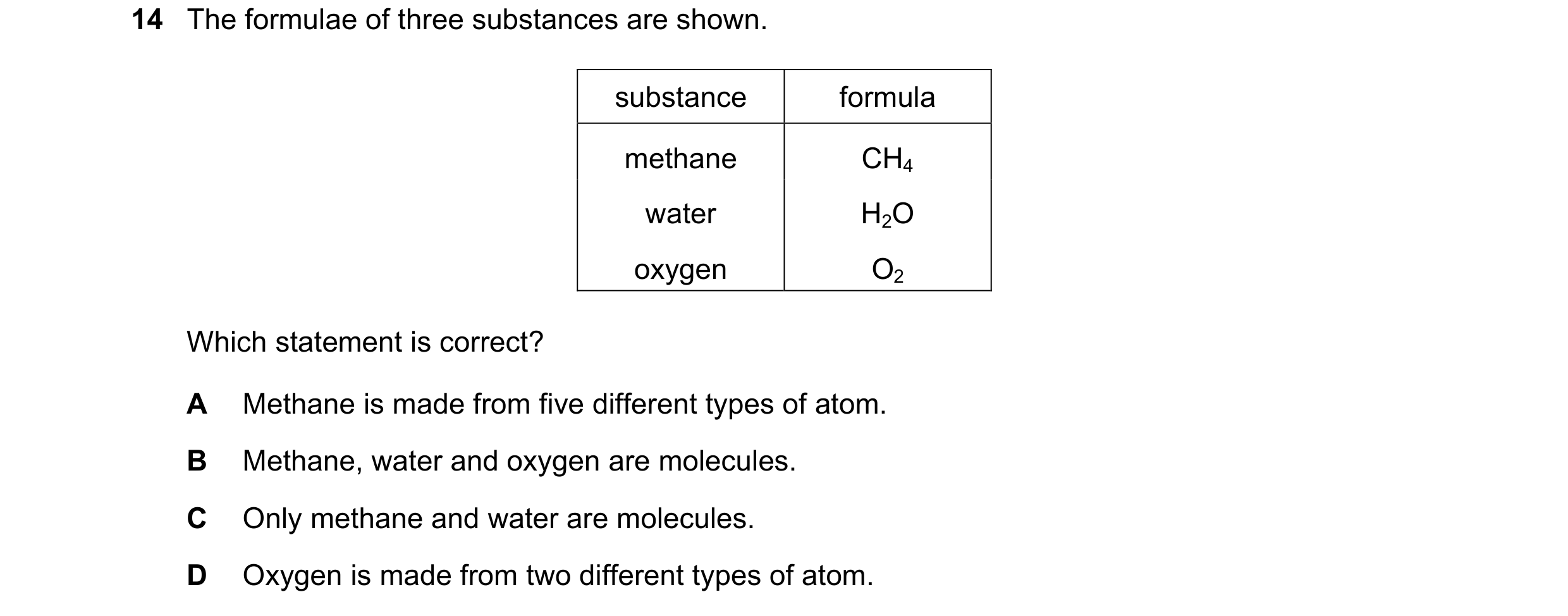
Q42 · The formulae of three substances are shown 0653/12 Oct/Nov 2017
14 The formulae of three substances are shown. substance formula methane CH4 water H2O oxygen O2 Which statement is correct? A Methane is made from five different types of atom. B Methane, water and oxygen are molecules. C Only methane and water are molecules. D Oxygen is made from two different types of atom.
1 marks
Answer: B
This question in 0653/12 Oct/Nov 2017
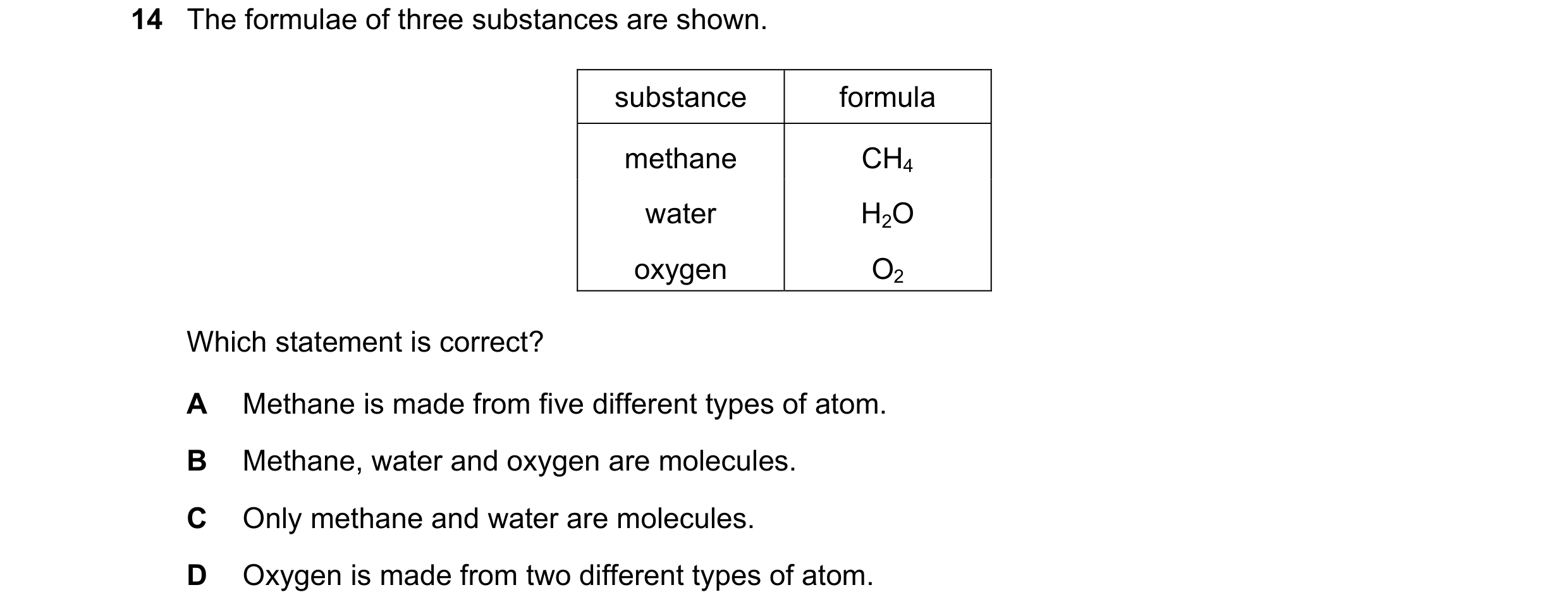
Q43 · The formulae of three substances are shown 0653/13 Oct/Nov 2017
14 The formulae of three substances are shown. substance formula methane CH4 water H2O oxygen O2 Which statement is correct? A Methane is made from five different types of atom. B Methane, water and oxygen are molecules. C Only methane and water are molecules. D Oxygen is made from two different types of atom.
1 marks
Answer: B
This question in 0653/13 Oct/Nov 2017
Q44 · One molecule of a compound contains twice as many carbon atoms as oxygen atoms, and three… 0653/13 Oct/Nov 2017
17 One molecule of a compound contains twice as many carbon atoms as oxygen atoms, and three times as many hydrogen atoms as carbon atoms. What is the formula of this compound? A C2H3O B C2H6O C C2H6O2 D C4H6O2
1 marks
Answer: B
This question in 0653/13 Oct/Nov 2017
Q45 · Which statement about atoms and molecules is correct? 0653/12 Feb/March 2018
14 Which statement about atoms and molecules is correct? A Atoms gain or lose electrons to become molecules. B Atoms of the same element contain the same number of molecules. C Molecules are the simplest unit of an atom. D Molecules contain atoms which are covalently bonded.
1 marks
Answer: D
This question in 0653/12 Feb/March 2018
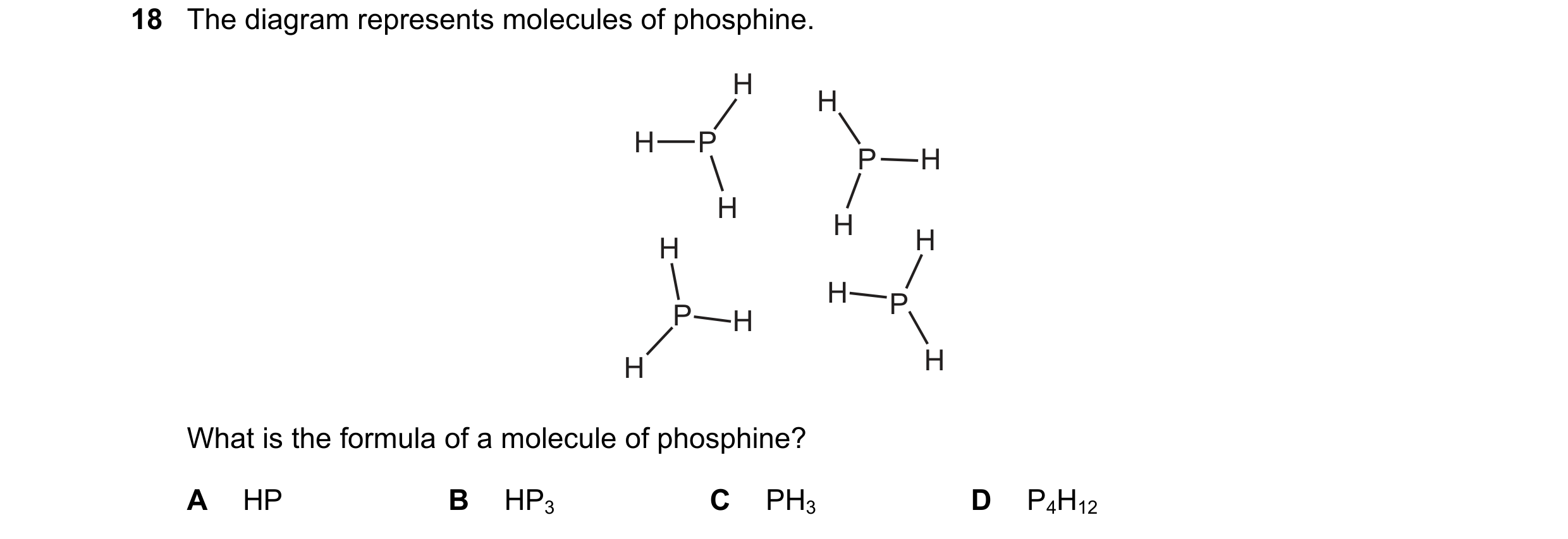
Q46 · The diagram represents molecules of phosphine 0653/11 May/June 2018
18 The diagram represents molecules of phosphine. H H H P P H H H H H H P P H H H What is the formula of a molecule of phosphine? A HP B HP3 C PH3 D P4H12
1 marks
Answer: C
This question in 0653/11 May/June 2018
Q47 · Which formula represents a molecule that contains three different elements? 0653/12 May/June 2018
18 Which formula represents a molecule that contains three different elements? A CO2 B H2O C O3 D NOCl
1 marks
Answer: D
This question in 0653/12 May/June 2018
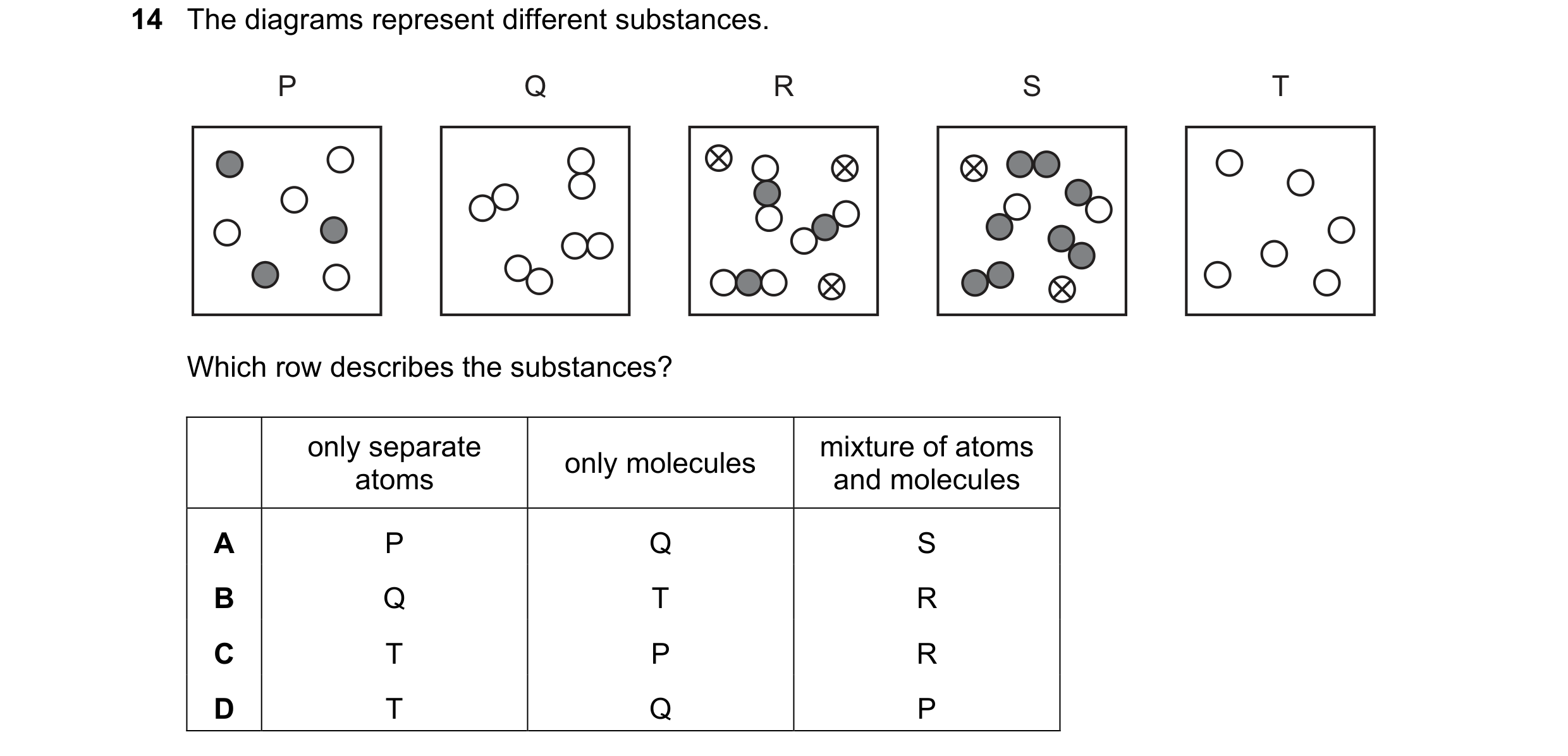
Q48 · The diagrams represent different substances 0653/13 May/June 2018
14 The diagrams represent different substances. P Q R S T Which row describes the substances? only separate mixture of atoms only molecules atoms and molecules A P Q S B Q T R C T P R D T Q P
1 marks
Answer: A
This question in 0653/13 May/June 2018
Q49 · Which formula represents a molecule that contains three different elements? 0653/13 May/June 2018
18 Which formula represents a molecule that contains three different elements? A CO2 B H2O C O3 D NOCl
1 marks
Answer: D
This question in 0653/13 May/June 2018
Q50 · The diagram represents a mixture of carbon dioxide, CO2, and carbon monoxide, CO 0653/11 Oct/Nov 2018
14 The diagram represents a mixture of carbon dioxide, CO2, and carbon monoxide, CO. Which statement is correct? A The mixture contains 4 elements. B The mixture contains 4 molecules. C The mixture contains 11 elements. D The mixture contains 11 molecules.
1 marks
Answer: B
This question in 0653/11 Oct/Nov 2018
Q51 · Which compound contains covalent bonds? 0653/12 Feb/March 2019
16 Which compound contains covalent bonds? A CuCl 2 B HCl C KCl D MgCl 2
1 marks
Answer: B
This question in 0653/12 Feb/March 2019
Q52 · A molecule of hydrogen has the formula H2 0653/12 May/June 2019
14 A molecule of hydrogen has the formula H2. A molecule of a protein contains several different elements. Which statement about these molecules is correct? A They both contain cations and anions bonded together. B They both contain different types of atom. C They both contain more than one atom bonded together. D They both contain only one type of atom.
1 marks
Answer: C
This question in 0653/12 May/June 2019
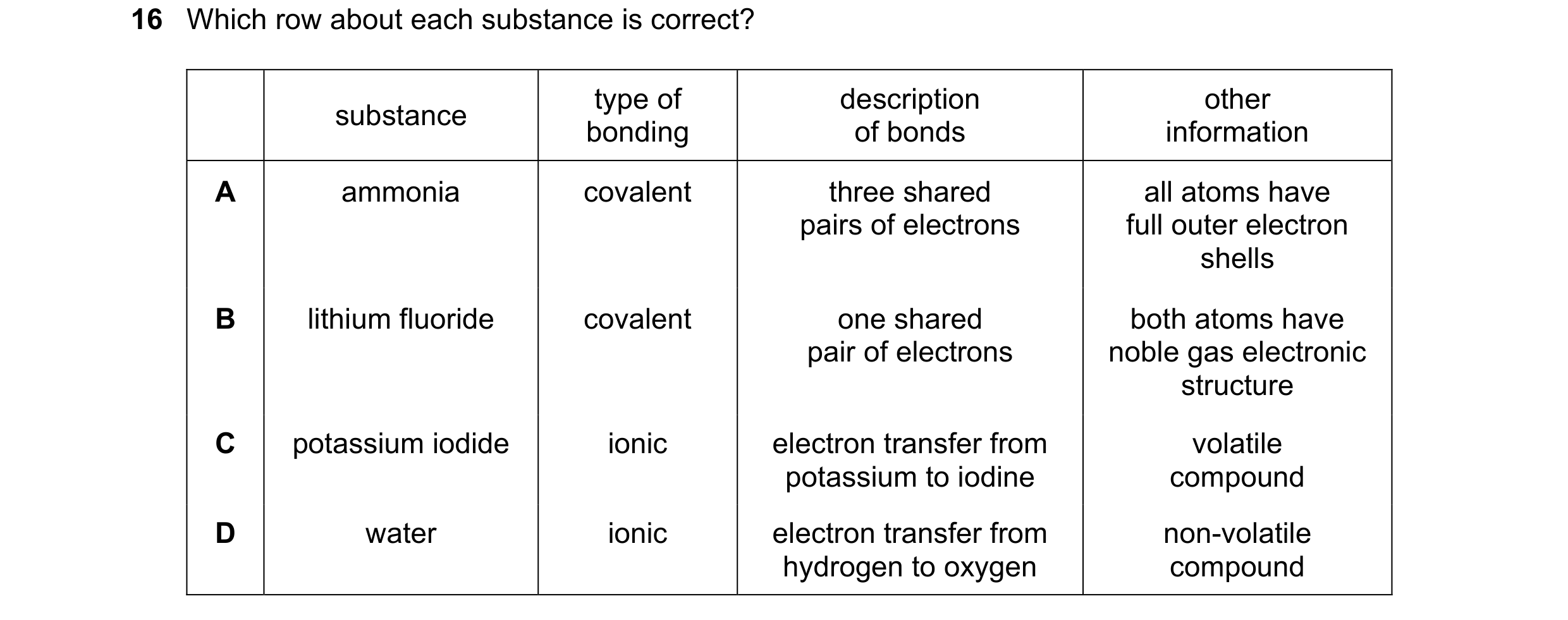
Q53 · Which row about each substance is correct? 0653/12 May/June 2019
16 Which row about each substance is correct? type of description other substance bonding of bonds information A ammonia covalent three shared all atoms have pairs of electrons full outer electron shells B lithium fluoride covalent one shared both atoms have pair of electrons noble gas electronic structure C potassium iodide ionic electron transfer from volatile potassium to iodine compound D water ionic electron transfer from non-volatile hydrogen to oxygen compound
1 marks
Answer: A
This question in 0653/12 May/June 2019
Q54 · Which row identifies a substance that exists only as separate atoms and a substance that… 0653/11 May/June 2020
14 Which row identifies a substance that exists only as separate atoms and a substance that exists as a molecule? separate atoms molecule A helium methane B hydrogen helium C neon argon D oxygen carbon dioxide
1 marks
Answer: A
This question in 0653/11 May/June 2020
Q55 · Which term describes ammonia, NH3? 0653/11 Oct/Nov 2020
14 Which term describes ammonia, NH3? A element B ion C atom D molecule
1 marks
Answer: D
This question in 0653/11 Oct/Nov 2020
Q56 · Which statement about non-metals is correct? 0653/13 Oct/Nov 2020
16 Which statement about non-metals is correct? A They are in Group I of the Periodic Table. B They are malleable and have high melting points. C They react with acids to form hydrogen gas. D They react with other non-metals to form covalent compounds.
1 marks
Answer: D
This question in 0653/13 Oct/Nov 2020
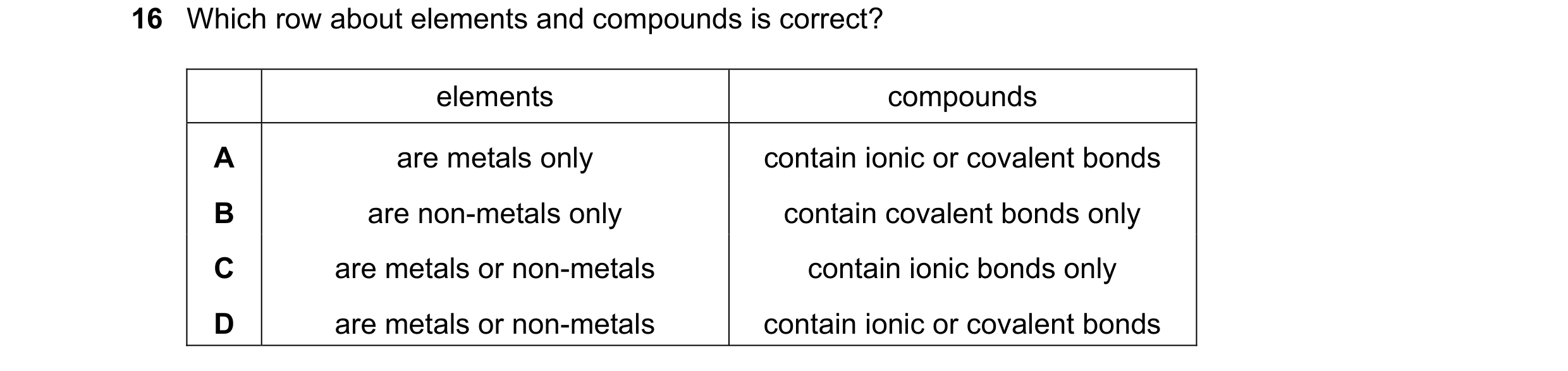
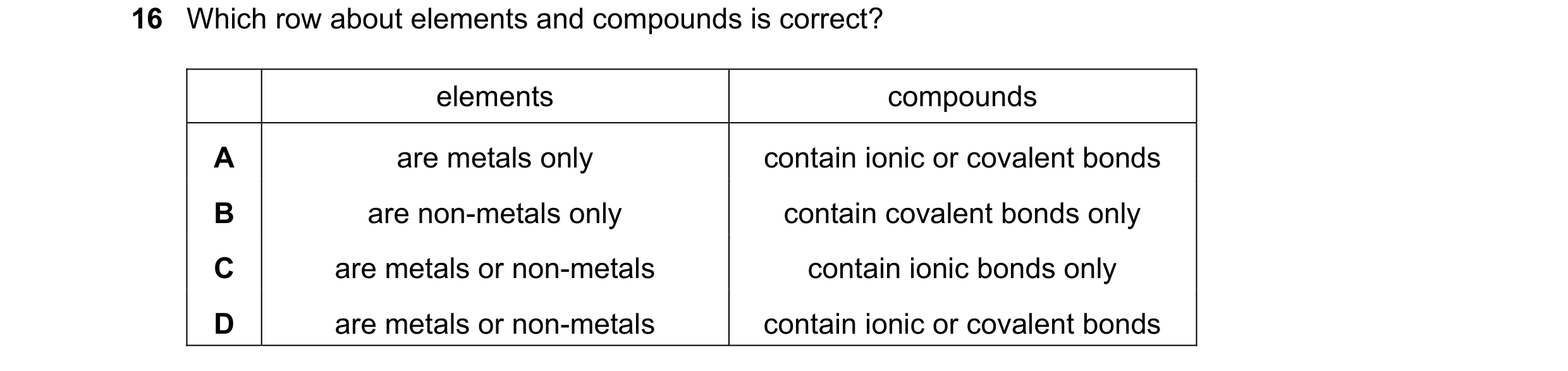
Q57 · Which row about elements and compounds is correct? 0653/11 May/June 2021
16 Which row about elements and compounds is correct? elements compounds A are metals only contain ionic or covalent bonds B are non-metals only contain covalent bonds only C are metals or non-metals contain ionic bonds only D are metals or non-metals contain ionic or covalent bonds
1 marks
Answer: D
This question in 0653/11 May/June 2021
Q58 · Which groups of the Periodic Table form compounds containing covalent bonds? 0653/11 May/June 2022
17 Which groups of the Periodic Table form compounds containing covalent bonds? A Group I and Group 0 B Group I and Group VII C Group V and Group 0 D Group V and Group VII
1 marks
Answer: D
This question in 0653/11 May/June 2022
Q59 · Which substance contains covalent bonds? 0653/12 May/June 2022
17 Which substance contains covalent bonds? A CH4 B KOH C NaCl D PbBr2
1 marks
Answer: A
This question in 0653/12 May/June 2022
Q60 · Which statement describes a molecule? 0653/13 May/June 2022
14 Which statement describes a molecule? A It consists of one nucleus surrounded by electrons. B It consists of two or more atoms bonded together. C It has a negative charge because it has gained electrons. D It has a positive charge because it has lost electrons.
1 marks
Answer: B
This question in 0653/13 May/June 2022
Q61 · Which compound contains covalent bonds? 0653/13 May/June 2022
17 Which compound contains covalent bonds? A HCl B NaCl C KCl D CaCl 2
1 marks
Answer: A
This question in 0653/13 May/June 2022
Q62 · The structures of three molecules are shown 0653/12 Feb/March 2023
14 The structures of three molecules are shown. water ethanol methane How many atoms are in each molecule? water ethanol methane A 2 3 2 B 2 4 5 C 3 3 2 D 3 9 5
1 marks
Answer: D
This question in 0653/12 Feb/March 2023
Q63 · The formulae of three substances are shown 0653/12 May/June 2023
14 The formulae of three substances are shown. substance formula methane CH4 water H2O oxygen O2 Which statement is correct? A Methane is made from five different types of atom. B Methane, water and oxygen are molecules. C Only methane and water are molecules. D Oxygen is made from two different types of atom.
1 marks
Answer: B
This question in 0653/12 May/June 2023
Q64 · Read the sentences about calcium, copper and bromine 0653/11 Oct/Nov 2023
23 Read the sentences about calcium, copper and bromine. Calcium, copper and bromine are in the same period of the Periodic Table. The metals react with bromine to form calcium bromide and copper(II) bromide. From the position of these elements in the Periodic Table, it can be predicted that the bonding in the metal bromides is … 1 … and that … 2 … coloured. The formula of calcium bromide is … 3 … . Which words correctly complete gaps 1, 2 and 3? 1 2 3 A covalent both bromides are CaBr B covalent only copper(II) bromide is CaBr2 C ionic both bromides are CaBr D ionic only copper(II) bromide is CaBr2
1 marks
Answer: D
This question in 0653/11 Oct/Nov 2023
Q65 · Substance X is an element 0653/12 Oct/Nov 2023
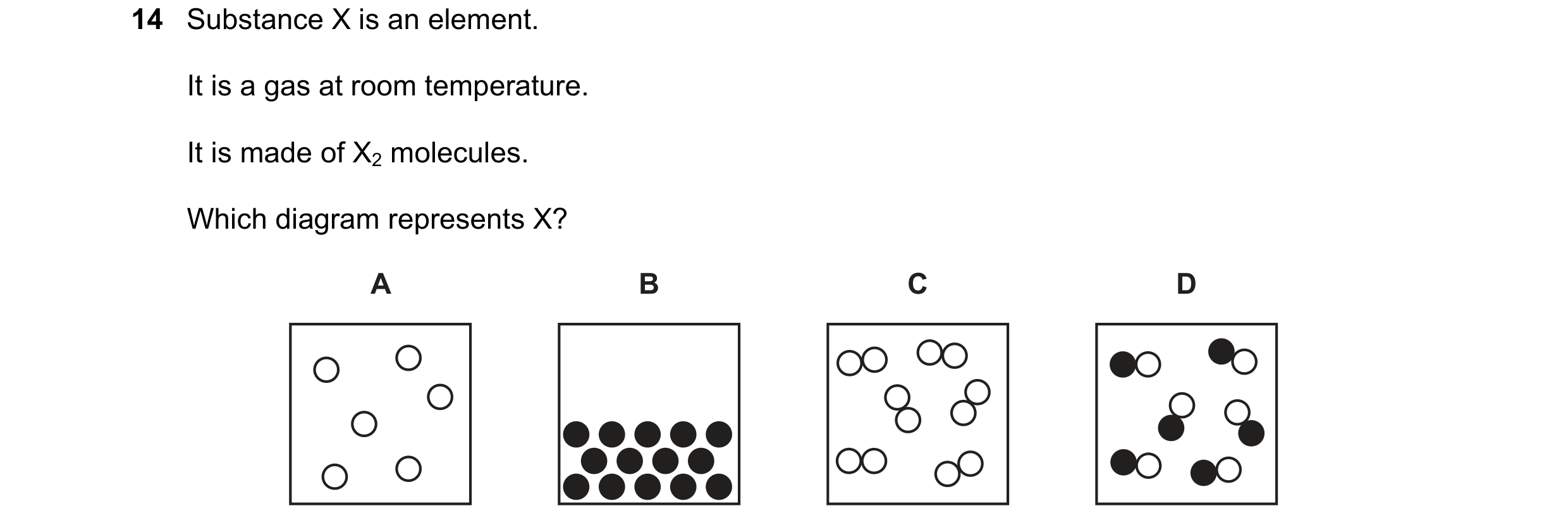
14 Substance X is an element. It is a gas at room temperature. It is made of X2 molecules. Which diagram represents X? A B C D
1 marks
Answer: C
This question in 0653/12 Oct/Nov 2023
Q66 · Substance X is an element 0653/13 Oct/Nov 2023
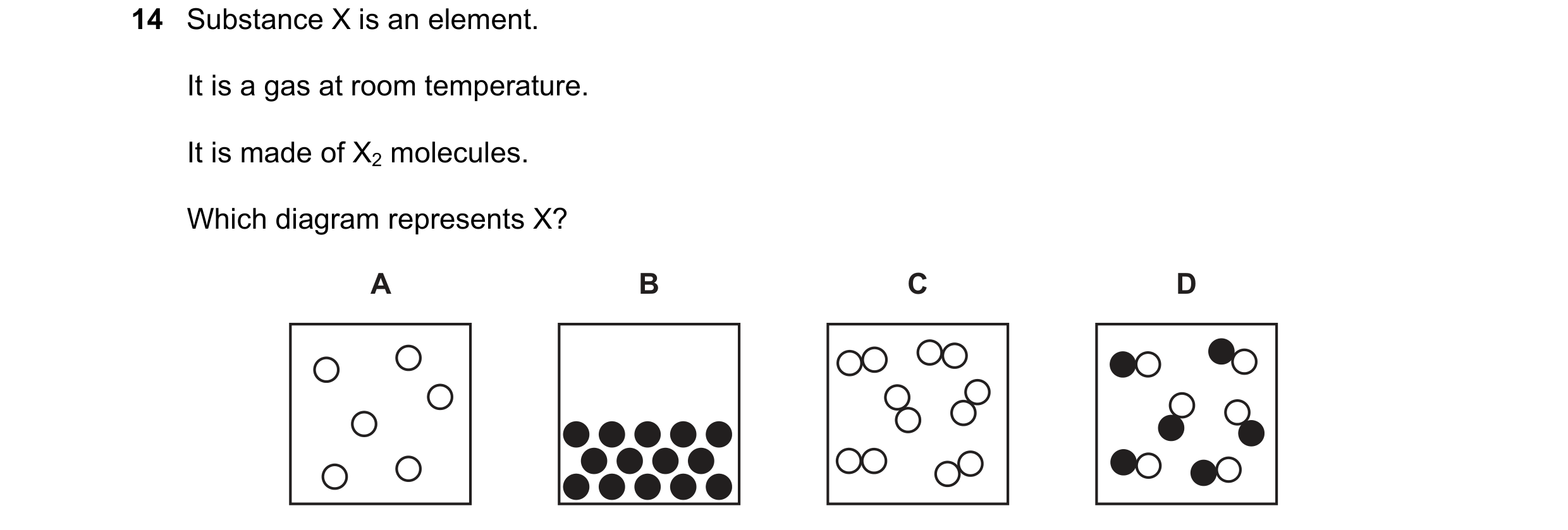
14 Substance X is an element. It is a gas at room temperature. It is made of X2 molecules. Which diagram represents X? A B C D
1 marks
Answer: C
This question in 0653/13 Oct/Nov 2023
Q67 · Which row about elements and compounds is correct? 0653/13 May/June 2024
16 Which row about elements and compounds is correct? elements compounds A are metals only contain ionic or covalent bonds B are non-metals only contain covalent bonds only C are metals or non-metals contain ionic bonds only D are metals or non-metals contain ionic or covalent bonds
1 marks
Answer: D
This question in 0653/13 May/June 2024
Q68 · Which dot-and-cross diagram represents the outer shell electrons in a water molecule? 0653/13 May/June 2024
17 Which dot-and-cross diagram represents the outer shell electrons in a water molecule? A B C D O O O O H H H H H H H H
1 marks
Answer: A
This question in 0653/13 May/June 2024
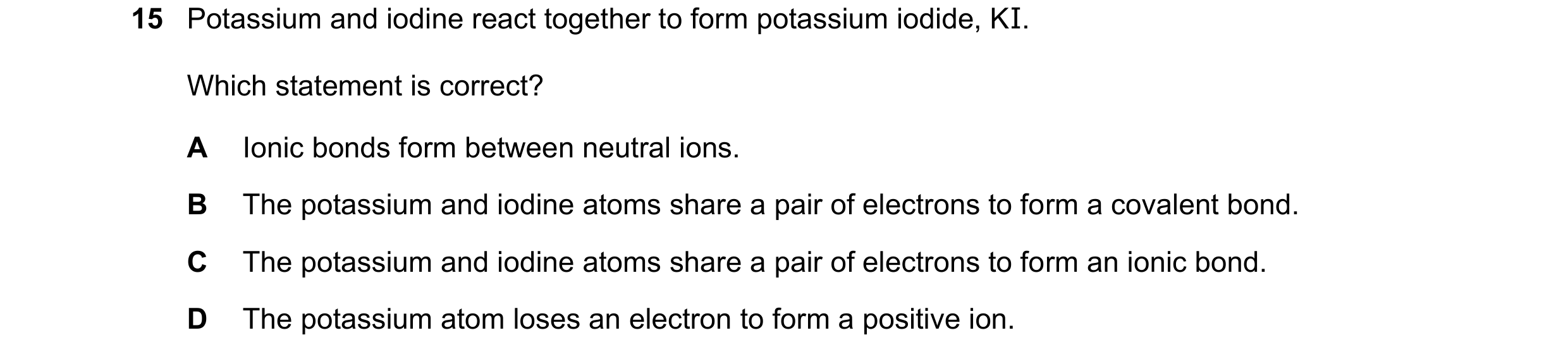
Q69 · Potassium and iodine react together to form potassium iodide, KI 0653/11 May/June 2025
15 Potassium and iodine react together to form potassium iodide, KI. Which statement is correct? A Ionic bonds form between neutral ions. B The potassium and iodine atoms share a pair of electrons to form a covalent bond. C The potassium and iodine atoms share a pair of electrons to form an ionic bond. D The potassium atom loses an electron to form a positive ion.
1 marks
Answer: D
This question in 0653/11 May/June 2025
Q70 · Which molecule contains the lowest number of outer-shell electrons? 0653/12 May/June 2025
15 Which molecule contains the lowest number of outer-shell electrons? A Cl 2 B CH4 C H2 D H2O
1 marks
Answer: C
This question in 0653/12 May/June 2025
Q71 · Which substance contains a covalent bond between two different elements? 0653/13 May/June 2025
20 Which substance contains a covalent bond between two different elements? A chlorine B potassium chloride C hydrogen D hydrogen chloride
1 marks
Answer: D
This question in 0653/13 May/June 2025
Q72 · Which compound contains covalent bonds? 0653/12 Oct/Nov 2025
15 Which compound contains covalent bonds? A LiI B HCl C KCl D NaBr
1 marks
Answer: B
This question in 0653/12 Oct/Nov 2025
Q73 · Which compound contains covalent bonds? 0653/13 Oct/Nov 2025
15 Which compound contains covalent bonds? A LiI B HCl C KCl D NaBr
1 marks
Answer: B
This question in 0653/13 Oct/Nov 2025
 1 / 18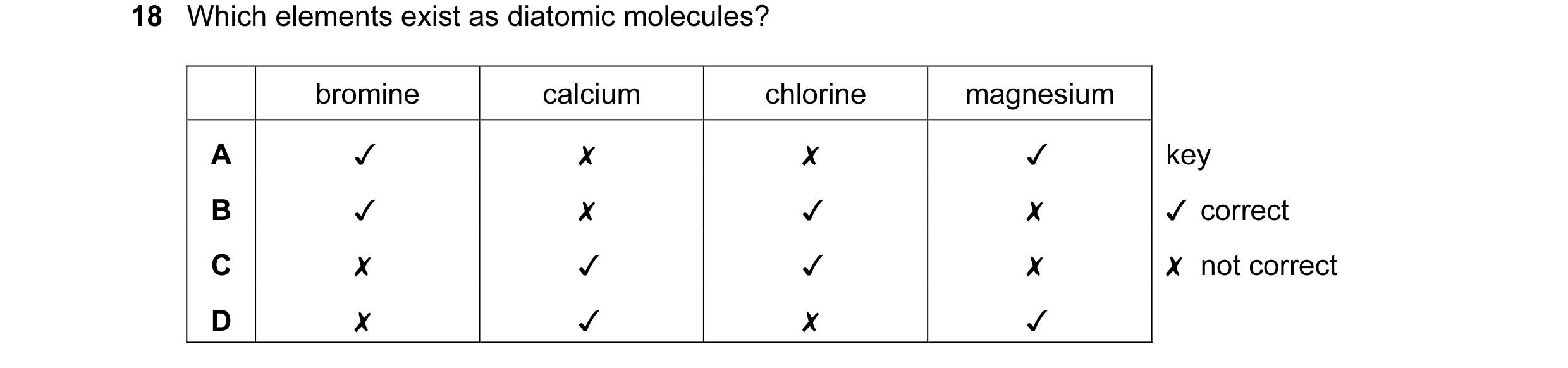
 2 / 18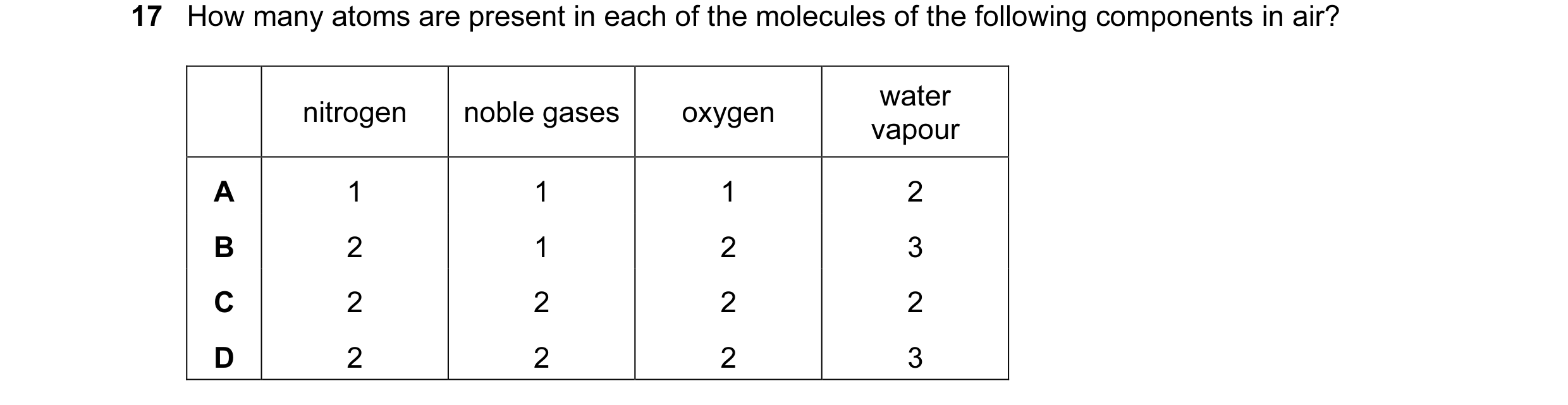
 3 / 18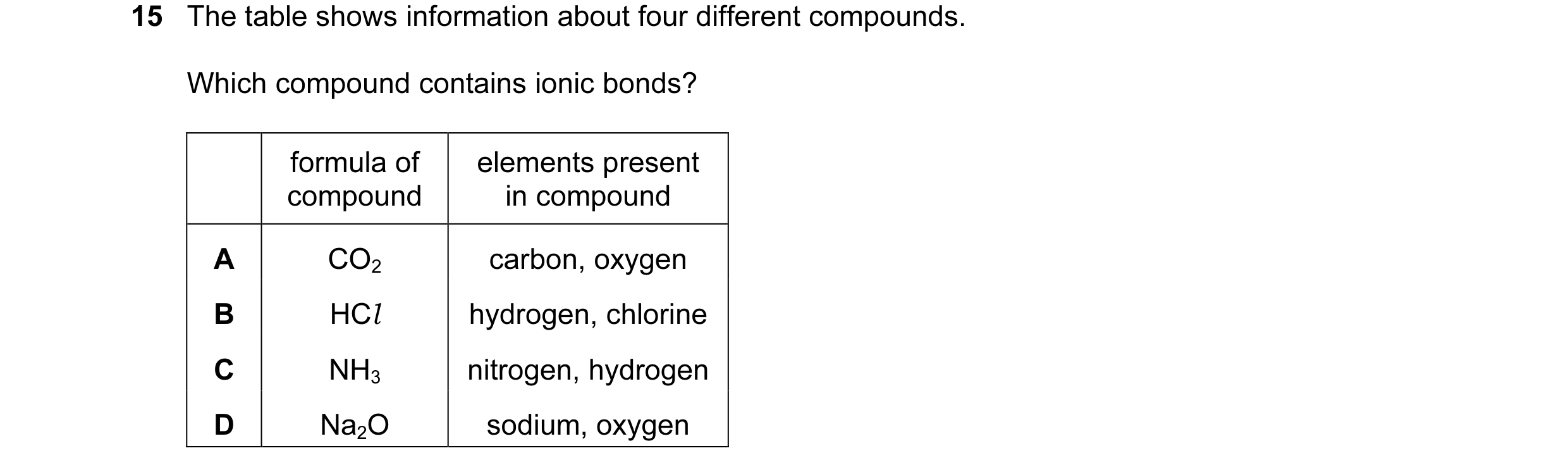
 4 / 18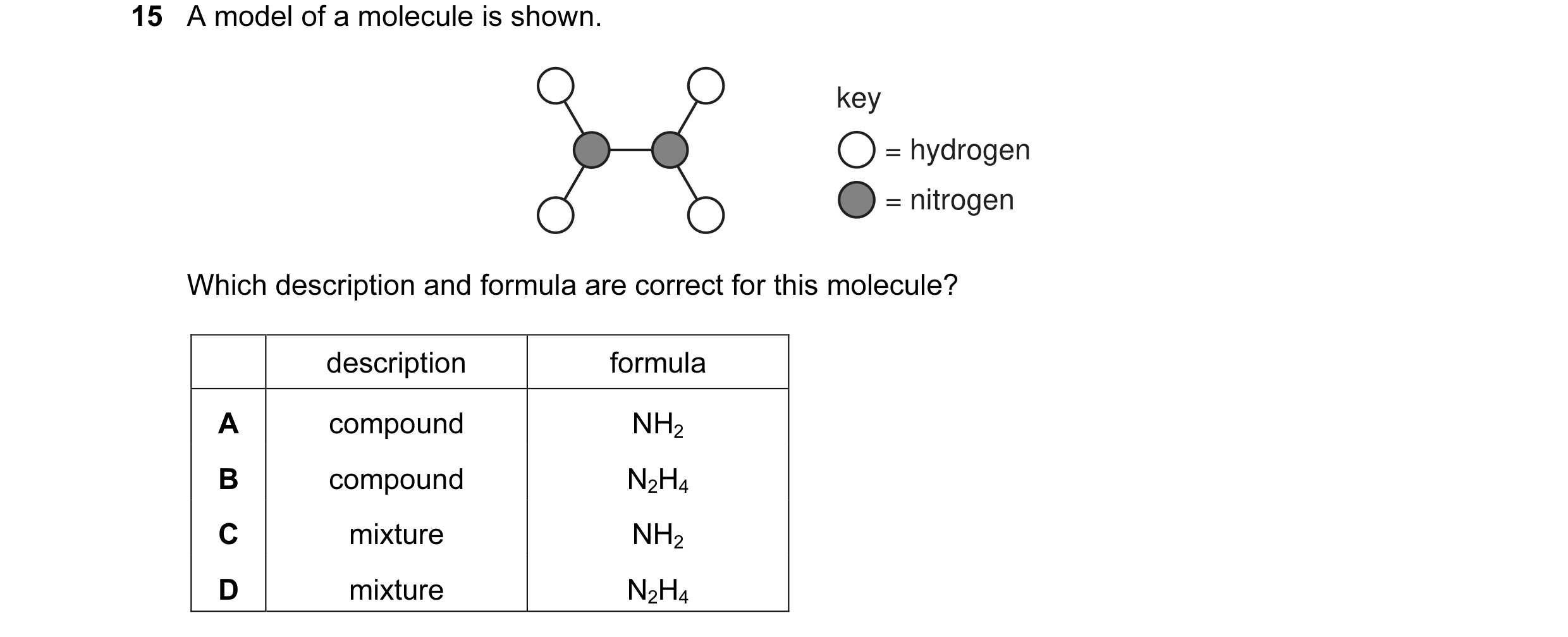
 5 / 18


 6 / 18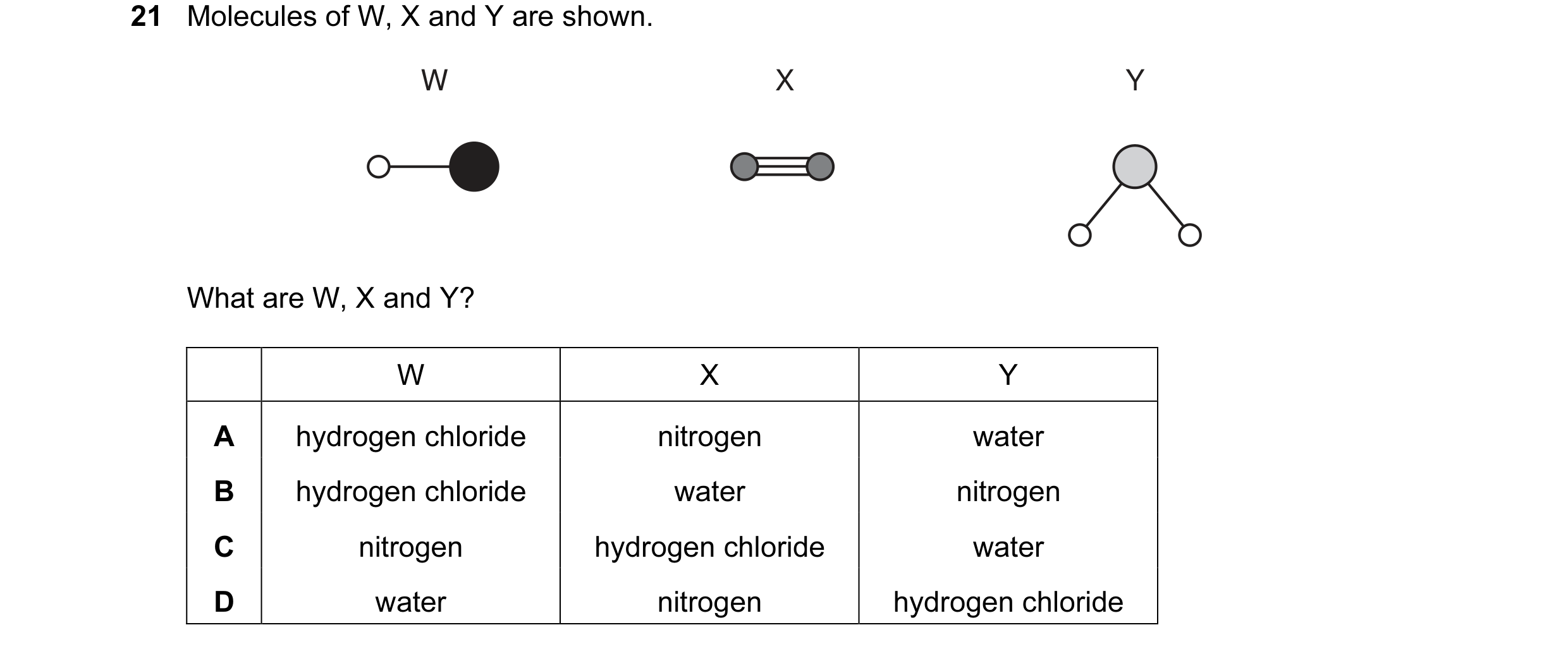
 7 / 18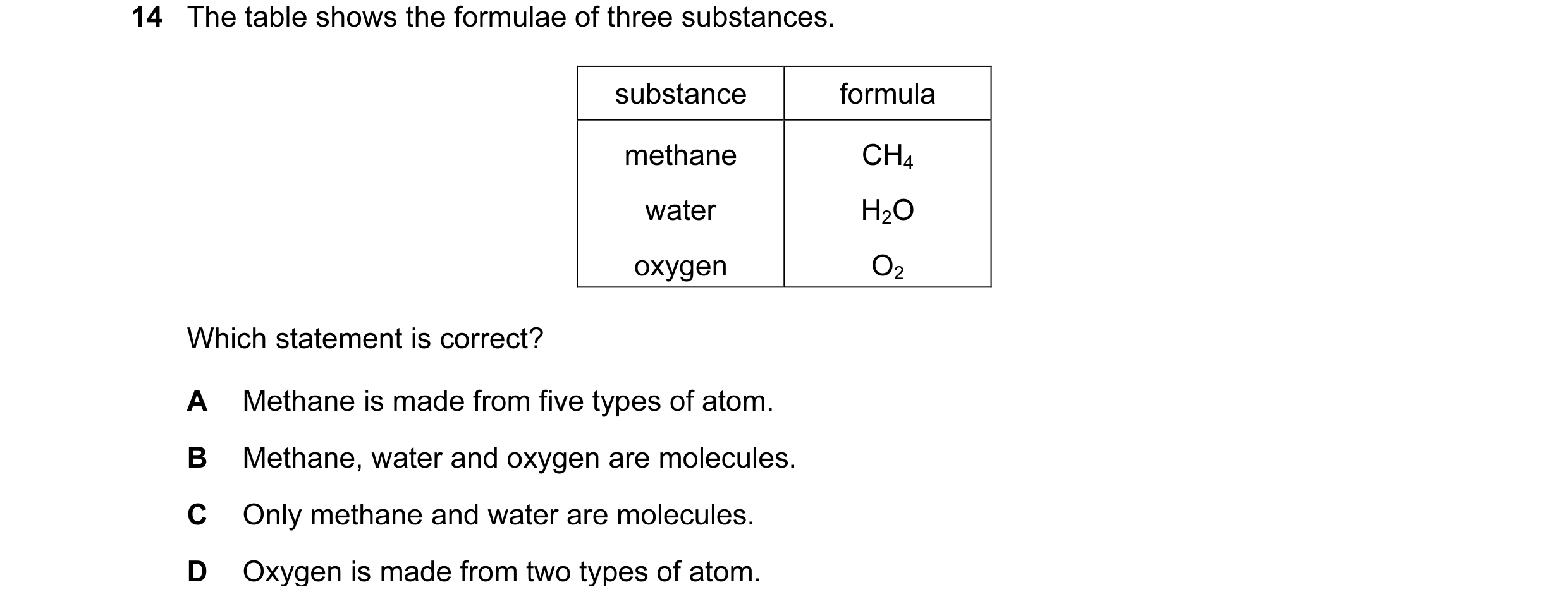
 8 / 18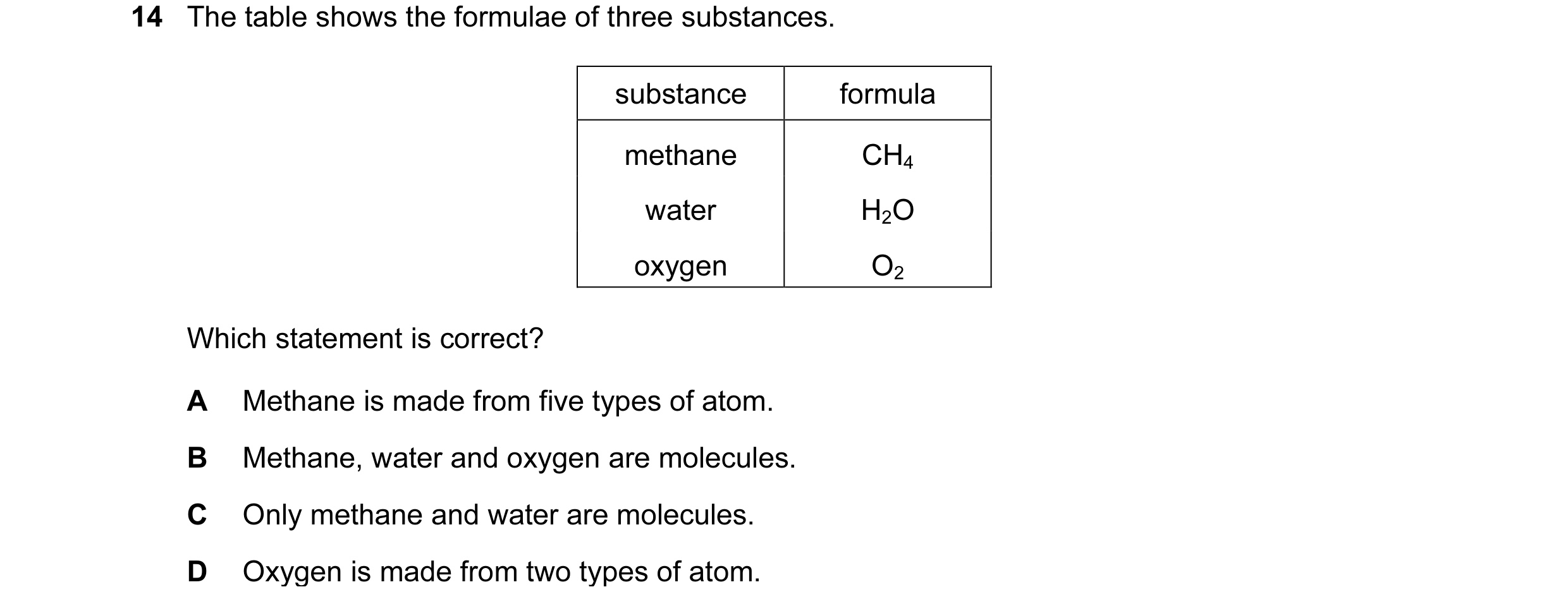

 9 / 18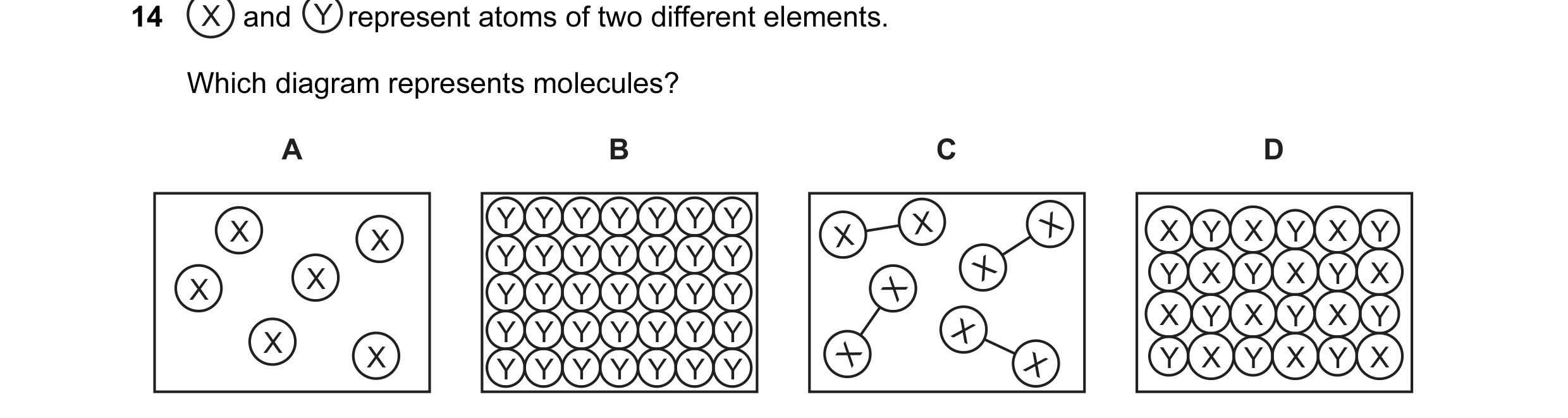
 10 / 18

 11 / 18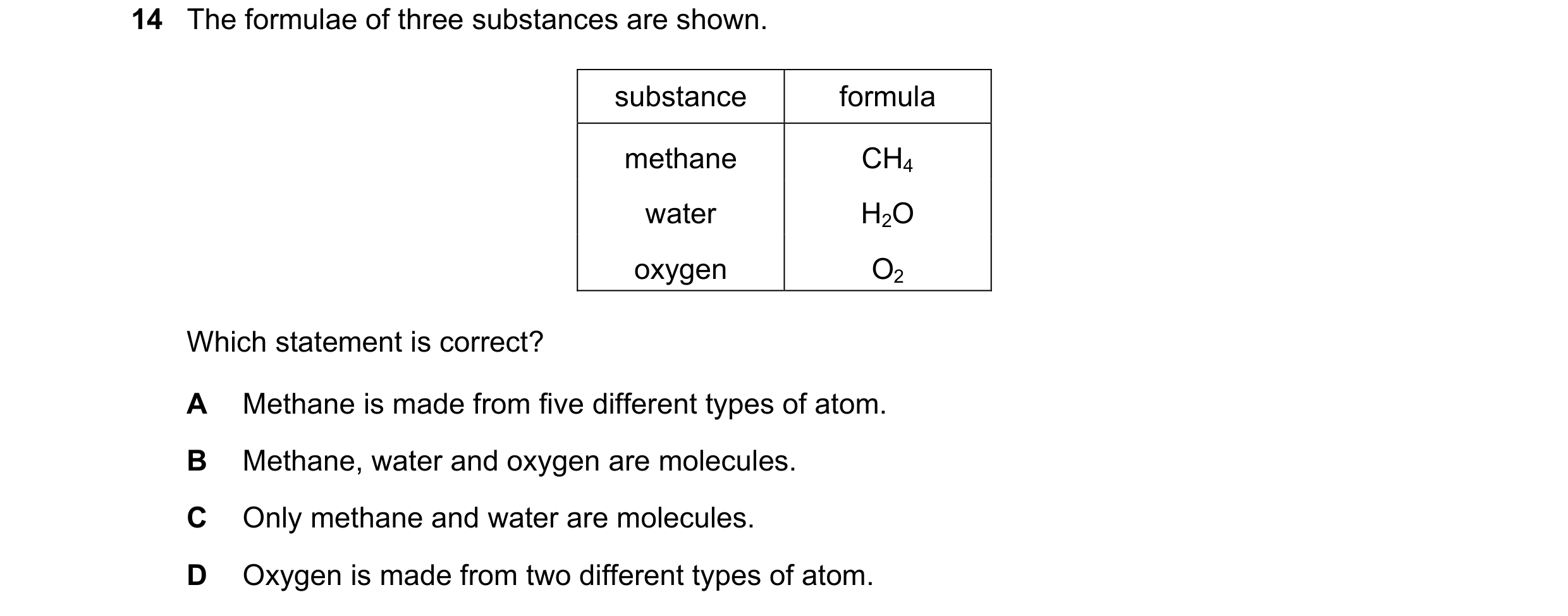
 12 / 18

 13 / 18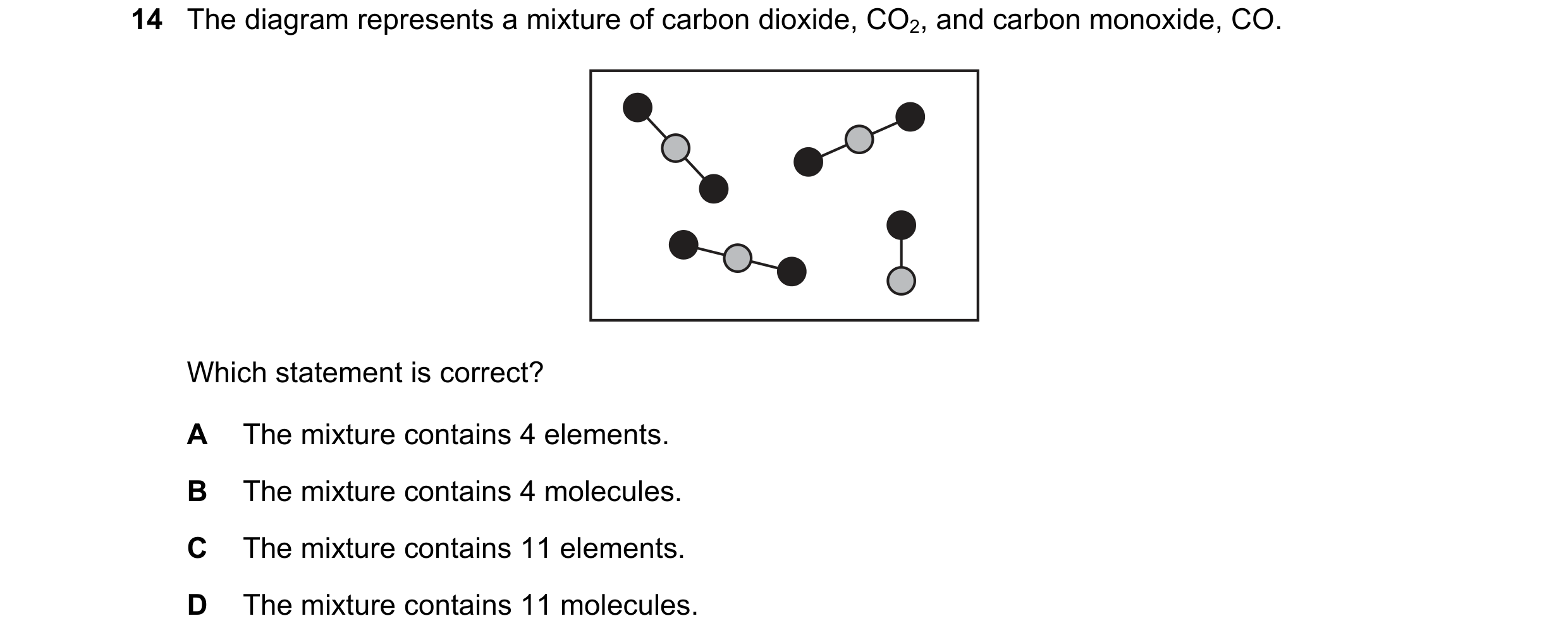

 14 / 18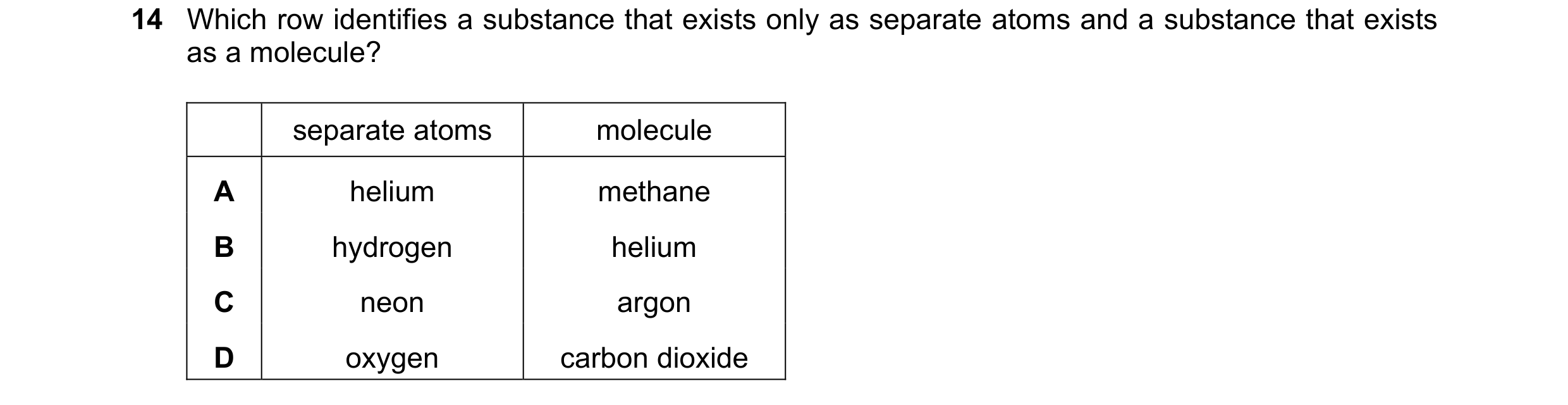



 15 / 18

 16 / 18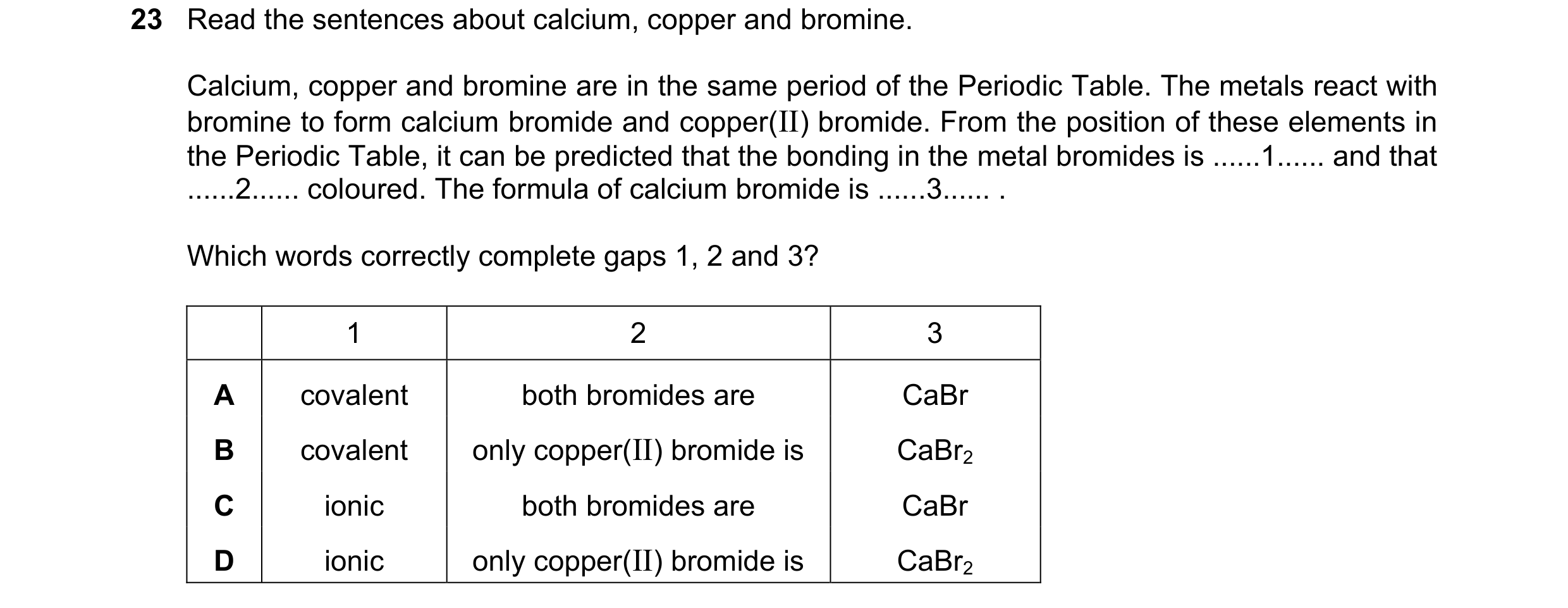
 17 / 18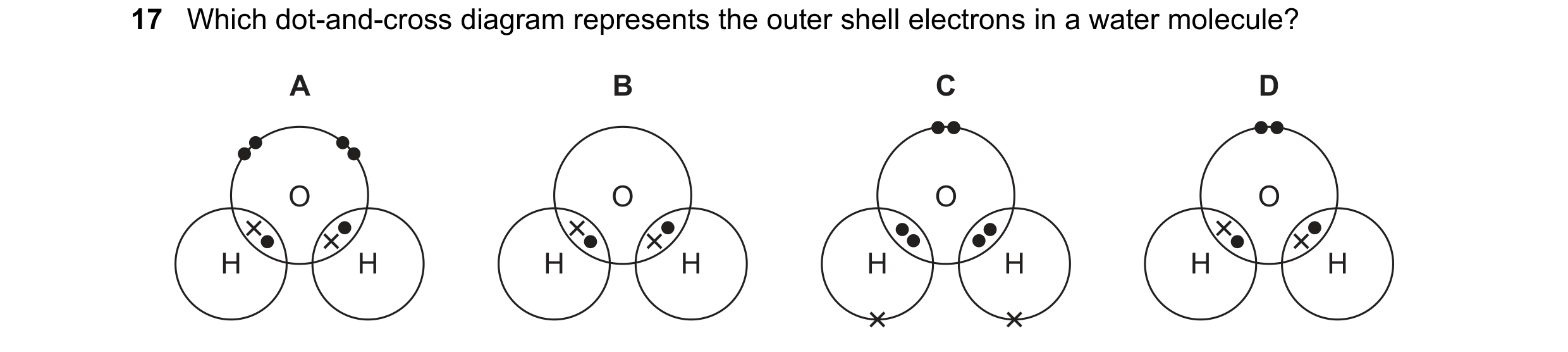



 18 / 18