Questions as text
Q1 · A dot-and-cross diagram to show the outer-shell electrons in a molecule of hydrogen… 0653/41 May/June 2017
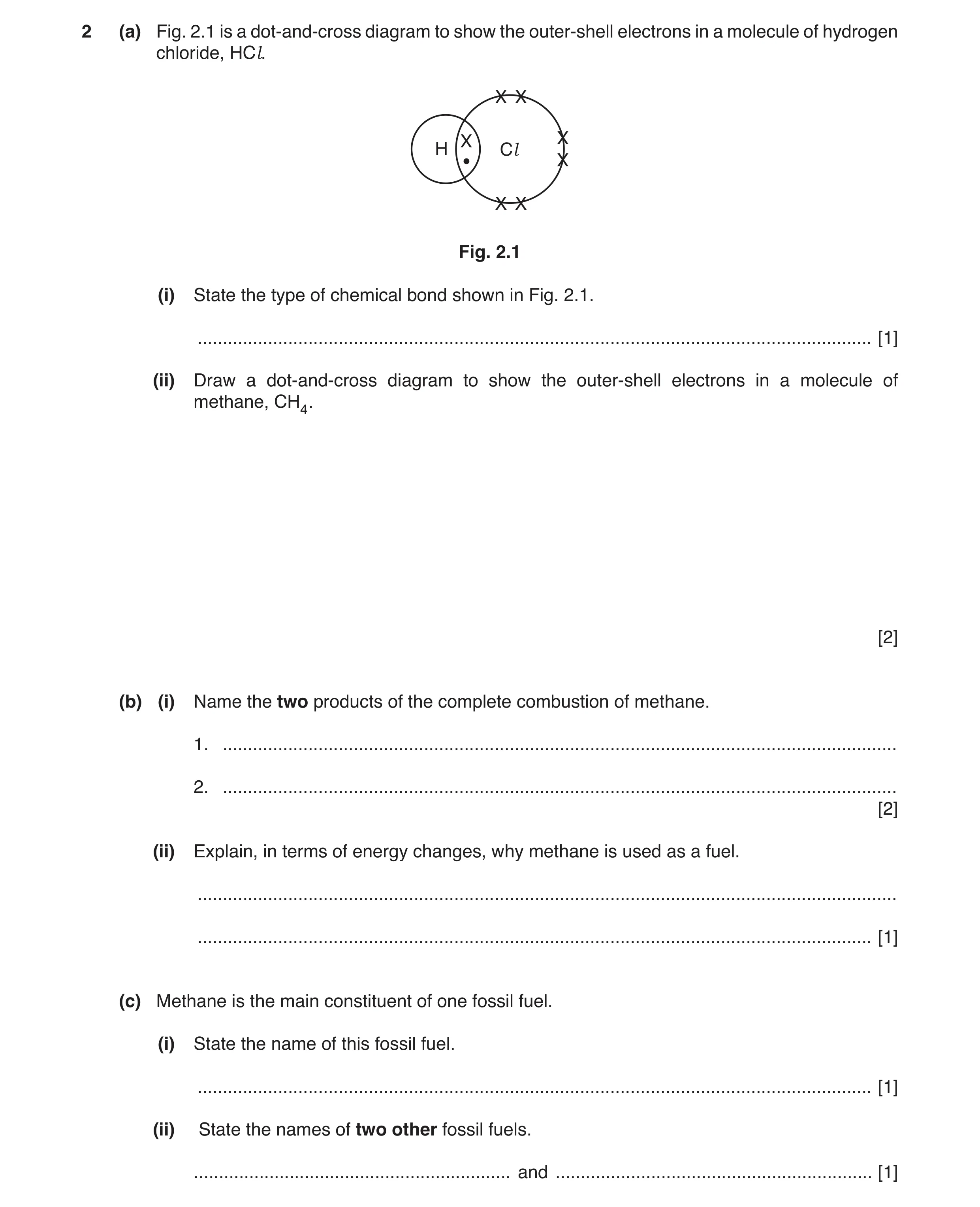
2 (a) Fig. 2.1 is a dot-and-cross diagram to show the outer-shell electrons in a molecule of hydrogen chloride, HCl. X X X X H Cl X X X Fig. 2.1 (i) State the type of chemical bond shown in Fig. 2.1. … [1] (ii) Draw a dot-and-cross diagram to show the outer-shell electrons in a molecule of methane, CH4. [2] (b) (i) Name the two products of the complete combustion of methane. 1. … 2. … [2] (ii) Explain, in terms of energy changes, why methane is used as a fuel. … … [1] (c) Methane is the main constituent of one fossil fuel. (i) State the name of this fossil fuel. … [1] (ii) State the names of two other fossil fuels. … and … [1]
8 marks
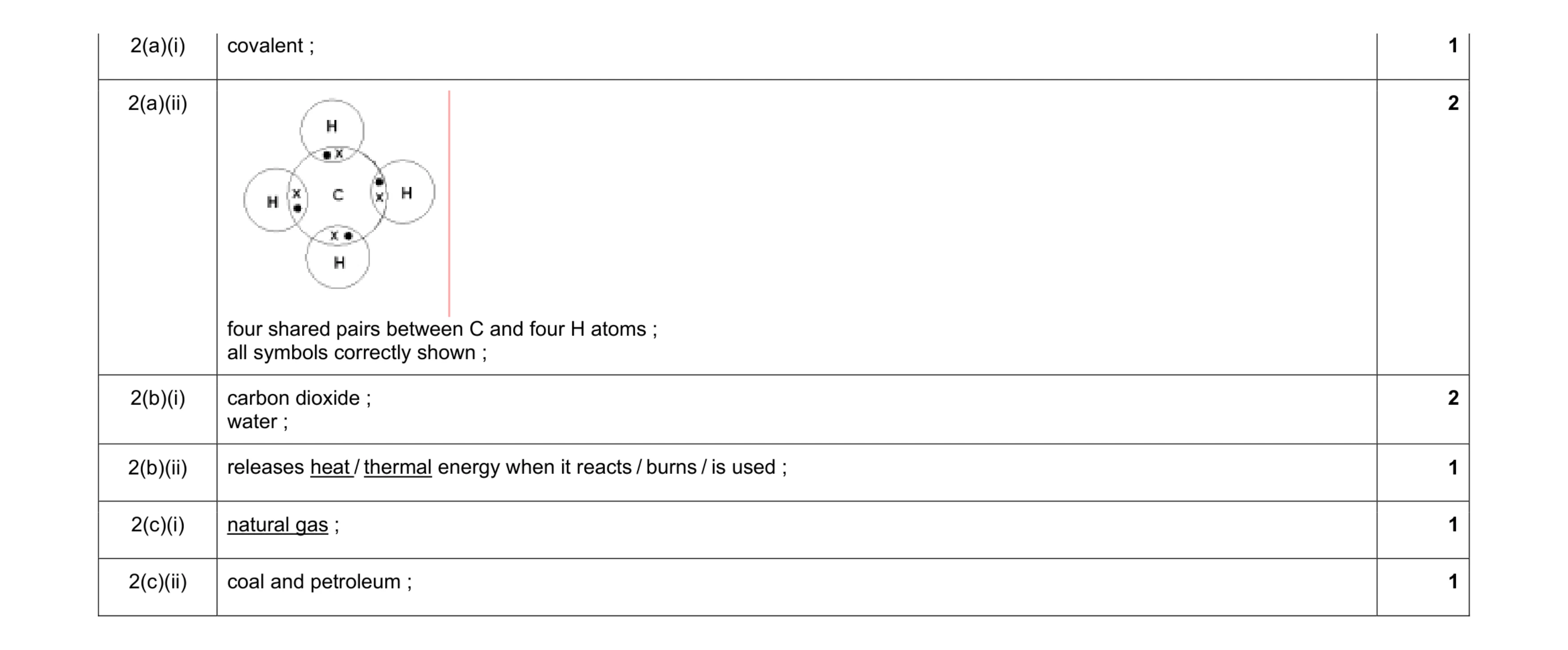
Mark scheme: 2(a)(i) 1 2(a)(ii) four shared pairs between C and four H atoms ; all symbols correctly shown ; 2 2(b)(i) carbon dioxide ; water ; 2 2(b)(ii) releases heat / thermal energy when it reacts / burns / is used ; 1 2(c)(i) natural gas ; 1 2(c)(ii) coal and petroleum ; 1
This question in 0653/41 May/June 2017
Q2 · Ethane and octane are obtained from petroleum by fractional distillation 0653/43 May/June 2017
2 (a) Ethane and octane are obtained from petroleum by fractional distillation. The structures of a molecule of ethane and a molecule of octane are shown in Fig. 2.1. H H H H H H H H H H H C C H H C C C C C C C C H H H H H H H H H H H ethane octane Fig. 2.1 (i) State the formula of octane. … [1] (ii) Different fractions obtained from petroleum contain different amounts of ethane and octane. Explain why a fraction formed higher up the fractional distillation column contains more ethane than octane. Use ideas about molecular size, boiling points and intermolecular attractive forces in your answer. … … … … … … [3] (b) Ethene molecules are made from large hydrocarbon molecules. Name this process. … [1] (c) Ethane, ethene and octane are hydrocarbons. Identify the type of each of these hydrocarbons. ethane … ethene … octane … [2] (d) Complete the diagram below to show the bonding electrons in a molecule of ethene, C2H4. Use dots and crosses to represent the electrons. C C [2]
9 marks
Mark scheme: 2(a)(i) C8H18 ; allow H18C8 1 2(a)(ii) (higher up) lower boiling point ; smaller molecules ; lower intermolecular forces ; 3 2(b) cracking ; 1 2(c) (ethene) alkene / unsaturated ; both (ethane) and (octane) alkane / saturated ; 2 2(d) 2 pairs between carbon ; 1 pair between each H and C ; (whether dots or crosses does not affect marks) 2
This question in 0653/43 May/June 2017
Q3 · The atomic number of oxygen is 8 0653/43 Oct/Nov 2017
8 (a) (i) The atomic number of oxygen is 8. Complete Fig. 8.1 to show the electronic structure of an oxygen atom. nucleus Fig. 8.1 [1] (ii) Complete the dot-and-cross diagram of a molecule of water. Show all the outer shell electrons. H O H [2] (b) Element Z has two electrons in its outer shell. Z is not the symbol for this element. (i) Predict the group number of element Z in the Periodic Table. … [1] (ii) An atom of element Z forms an ion. State the charge of this ion. Explain how this ion forms. charge … explanation … … … [2] (c) Potassium, copper and iron are extracted by different methods. Complete Table 8.1 to show the order of reactivity of these three metals. State the method of extraction of each metal from its ore. Table 8.1 order of reactivity metal method of extraction most reactive least reactive [3]
9 marks
Mark scheme: 8(a)(i) 2 electrons in 1st shell and 6 electrons in 2nd shell ; 1 8(a)(ii) 2 bonding pairs ; 2 lone pairs and no extra electrons anywhere ; 2 8(b)(i) II / 2 / two ; 1 8(b)(ii) 2+ ; loses two electrons ; 2 8(c) order of reactivity metal method of extraction most reactive least reactive potassium / K electrolysis ; iron / Fe blast furnace / reduction by C / CO ; copper / Cu ; carbon reduction / heat with carbon ; order of reactivity ; electrolysis linked to potassium ; carbon reduction owtte for both Fe and Cu ; 3
This question in 0653/43 Oct/Nov 2017
Q4 · A student investigates the combustion of a hydrocarbon, as shown in Fig 0653/42 May/June 2018
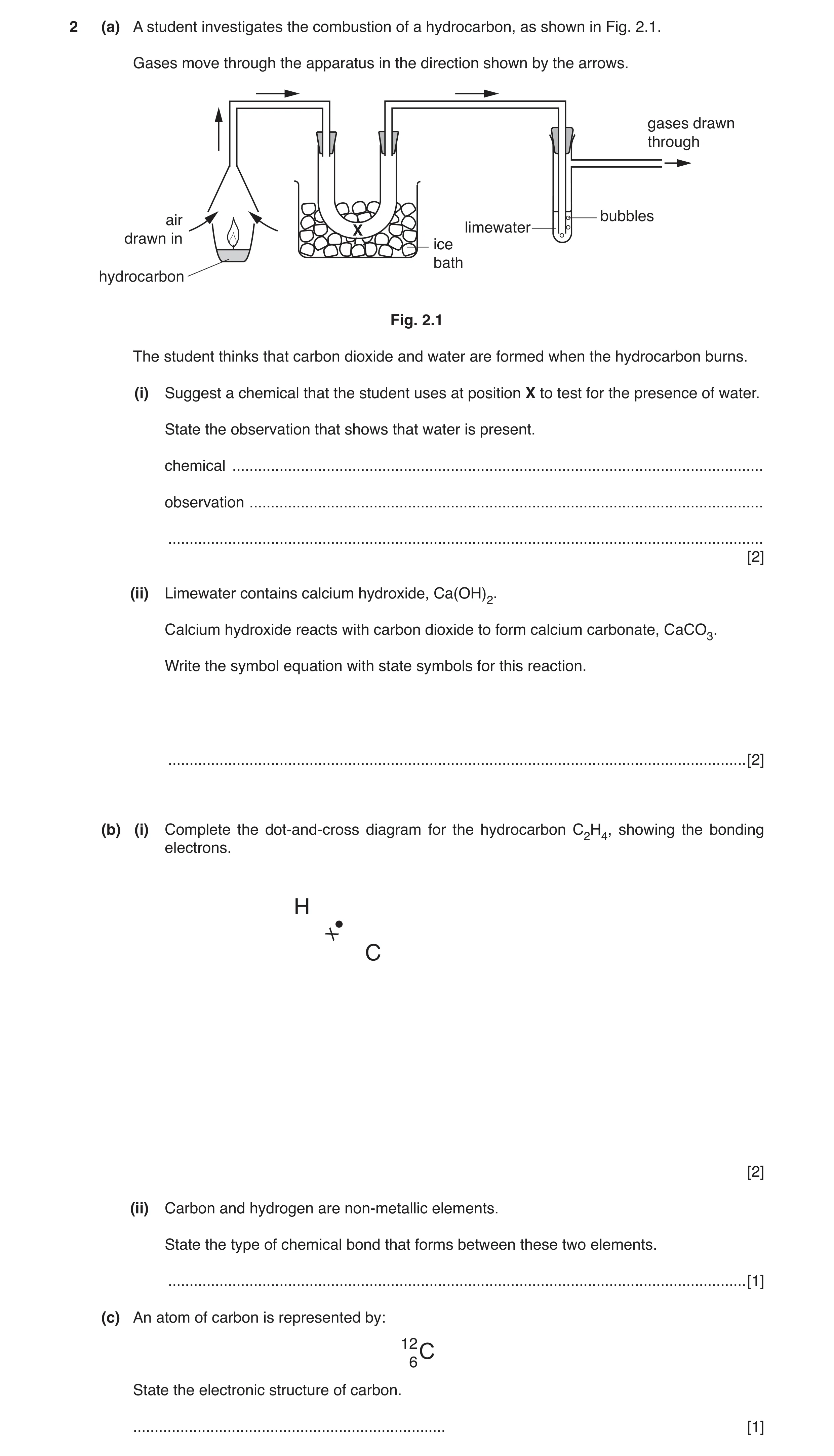
2 (a) A student investigates the combustion of a hydrocarbon, as shown in Fig. 2.1. Gases move through the apparatus in the direction shown by the arrows. gases drawn through X air bubbles X limewater drawn in ice bath hydrocarbon Fig. 2.1 The student thinks that carbon dioxide and water are formed when the hydrocarbon burns. (i) Suggest a chemical that the student uses at position X to test for the presence of water. State the observation that shows that water is present. chemical … observation … … [2] (ii) Limewater contains calcium hydroxide, Ca(OH)2. Calcium hydroxide reacts with carbon dioxide to form calcium carbonate, CaCO3. Write the symbol equation with state symbols for this reaction. … [2] (b) (i) Complete the dot-and-cross diagram for the hydrocarbon C2H4, showing the bonding electrons. H X C [2] (ii) Carbon and hydrogen are non-metallic elements. State the type of chemical bond that forms between these two elements. … [1] (c) An atom of carbon is represented by: 126C State the electronic structure of carbon. … [1]
8 marks
Mark scheme: 2(a)(i) anhydrous / blue cobalt chloride ; turns (blue to ) pink ; OR anhydrous / white copper sulfate ; turns (white to ) blue ; 2 2(a)(ii) Ca(OH)2(aq) + CO2(g) → CaCO3(g) + H2O(l) correct species both sides ; 3 or 4 correct states ; 2 Question Answer Marks 2(b)(i) (circles not essential) 4 electrons between two C atoms ; 2 electrons between each of 4 pairs of C and H atoms ; 2 2(b)(ii) covalent ; 1 2(c) 2, 4 ; 1
This question in 0653/42 May/June 2018
Q5 · Name the type of bonding in a water molecule 0653/41 Oct/Nov 2018
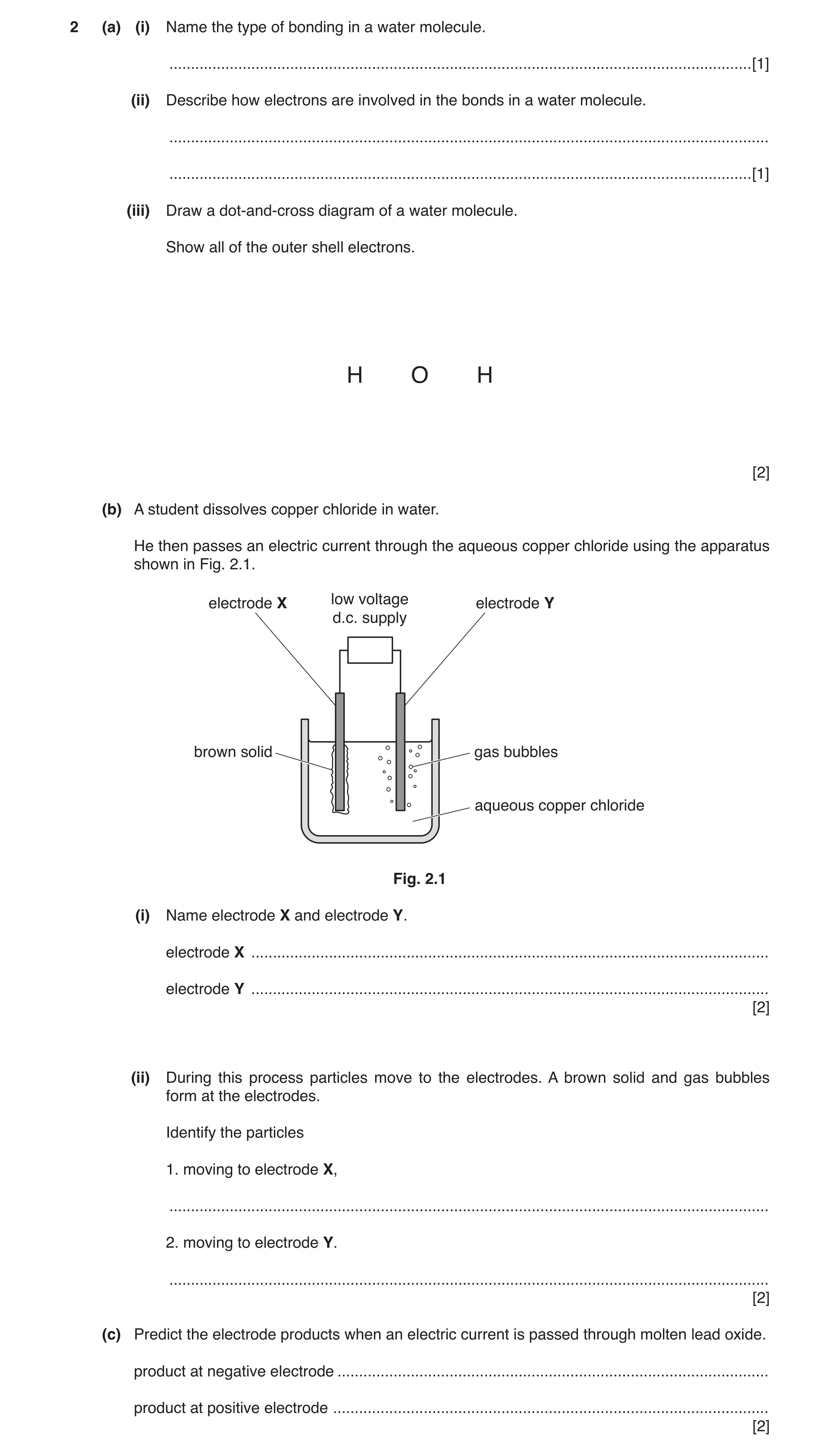
2 (a) (i) Name the type of bonding in a water molecule. … [1] (ii) Describe how electrons are involved in the bonds in a water molecule. … … [1] (iii) Draw a dot-and-cross diagram of a water molecule. Show all of the outer shell electrons. H O H [2] (b) A student dissolves copper chloride in water. He then passes an electric current through the aqueous copper chloride using the apparatus shown in Fig. 2.1. electrode X low voltage electrode Y d.c. supply brown solid gas bubbles aqueous copper chloride Fig. 2.1 (i) Name electrode X and electrode Y. electrode X … electrode Y … [2] (ii) During this process particles move to the electrodes. A brown solid and gas bubbles form at the electrodes. Identify the particles 1. moving to electrode X, … 2. moving to electrode Y. … [2] (c) Predict the electrode products when an electric current is passed through molten lead oxide. product at negative electrode … product at positive electrode … [2]
10 marks
Mark scheme: 2(a)(i) covalent ; 1 2(a)(ii) shared (pairs of) electrons ; 1 2(a)(iii) two bond pairs ; two non-bond pairs on O atom ; 2 2(b)(i) (electrode X) cathode ; (electrode Y) anode ; 2 2(b)(ii) (to electrode X) copper ions / Cu2+ ; (to electrode Y) chloride (ions) / Cl – ; 2 2(c) (negative) lead ; (positive) oxygen ; 2
This question in 0653/41 Oct/Nov 2018
Q6 · Ethane, C2H6, is an alkane 0653/42 Oct/Nov 2018
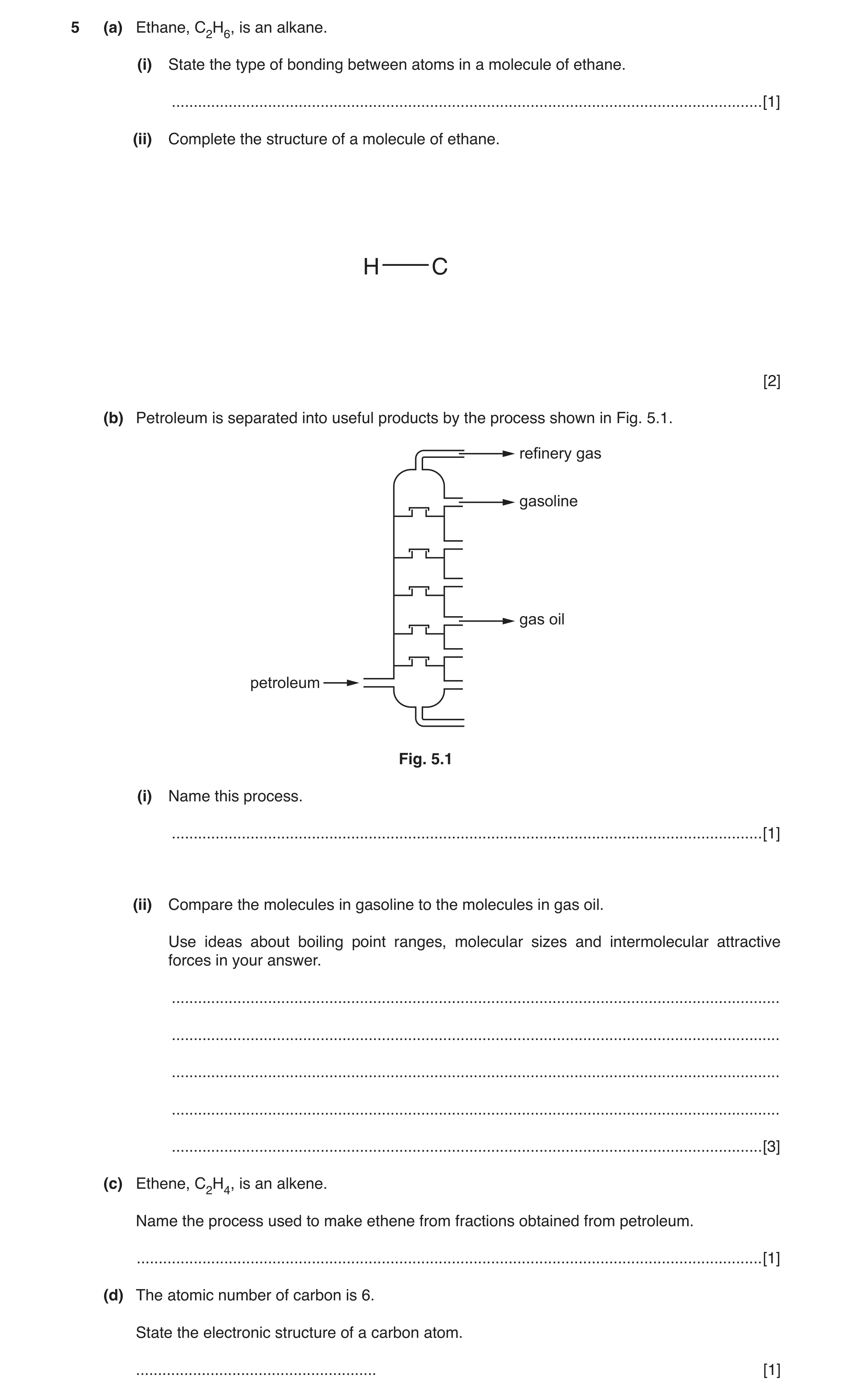
5 (a) Ethane, C2H6, is an alkane. (i) State the type of bonding between atoms in a molecule of ethane. … [1] (ii) Complete the structure of a molecule of ethane. H C [2] (b) Petroleum is separated into useful products by the process shown in Fig. 5.1. refinery gas gasoline gas oil petroleum Fig. 5.1 (i) Name this process. … [1] (ii) Compare the molecules in gasoline to the molecules in gas oil. Use ideas about boiling point ranges, molecular sizes and intermolecular attractive forces in your answer. … … … … … [3] (c) Ethene, C2H4, is an alkene. Name the process used to make ethene from fractions obtained from petroleum. … [1] (d) The atomic number of carbon is 6. State the electronic structure of a carbon atom. … [1]
9 marks
Mark scheme: 5(a)(i) covalent ; 1 5(a)(ii) C – C single bond ; six correctly located C-H single bonds ; 2 5(b)(i) fractional distillation ; 1 5(b)(ii) gasoline molecules • are smaller ; • have lower boiling points ; • have weaker intermolecular attractive forces ; 3 5(c) cracking ; 1 5(d) 2,4 ; 1
This question in 0653/42 Oct/Nov 2018
Q7 · Carbon dioxide is a product of the thermal decomposition of calcium carbonate 0653/43 Oct/Nov 2018
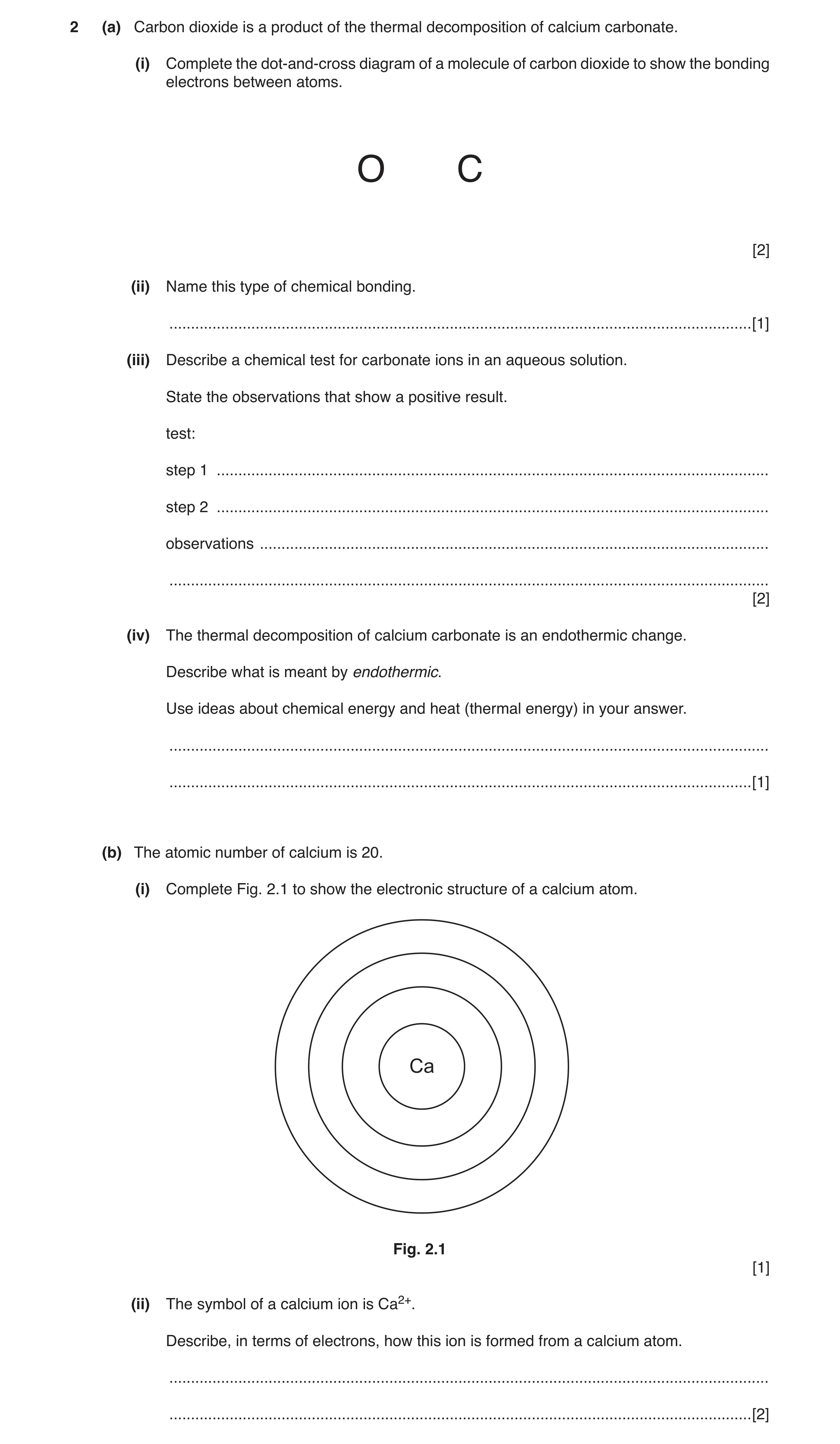
2 (a) Carbon dioxide is a product of the thermal decomposition of calcium carbonate. (i) Complete the dot-and-cross diagram of a molecule of carbon dioxide to show the bonding electrons between atoms. O C [2] (ii) Name this type of chemical bonding. … [1] (iii) Describe a chemical test for carbonate ions in an aqueous solution. State the observations that show a positive result. test: step 1 … step 2 … observations … … [2] (iv) The thermal decomposition of calcium carbonate is an endothermic change. Describe what is meant by endothermic. Use ideas about chemical energy and heat (thermal energy) in your answer. … … [1] (b) The atomic number of calcium is 20. (i) Complete Fig. 2.1 to show the electronic structure of a calcium atom. Ca Fig. 2.1 [1] (ii) The symbol of a calcium ion is Ca2+. Describe, in terms of electrons, how this ion is formed from a calcium atom. … … [2]
9 marks
Mark scheme: 2(a)(i) Two bonding pairs between C atom and each O atom ; correct non-bonding electrons on each O atom ; 2 2(a)(ii) covalent ; 1 2(a)(iii) (test) (step 1) add acid and (step 2) reference to use of limewater ; (observations) (limewater turns) milky / cloudy / white ppt. / solid ; 2 2(a)(iv) the idea that thermal (energy) / heat (changes) to chemical (energy) ; 1 2(b)(i) 2, 8, 8, 2 shown as crosses or clear dots ; 1 2(b)(ii) loss of electrons ; (reference to loss of) two electrons ; 2
This question in 0653/43 Oct/Nov 2018
Q8 · When large hydrocarbon molecules are cracked, they break down into smaller hydrocarbon… 0653/41 May/June 2019
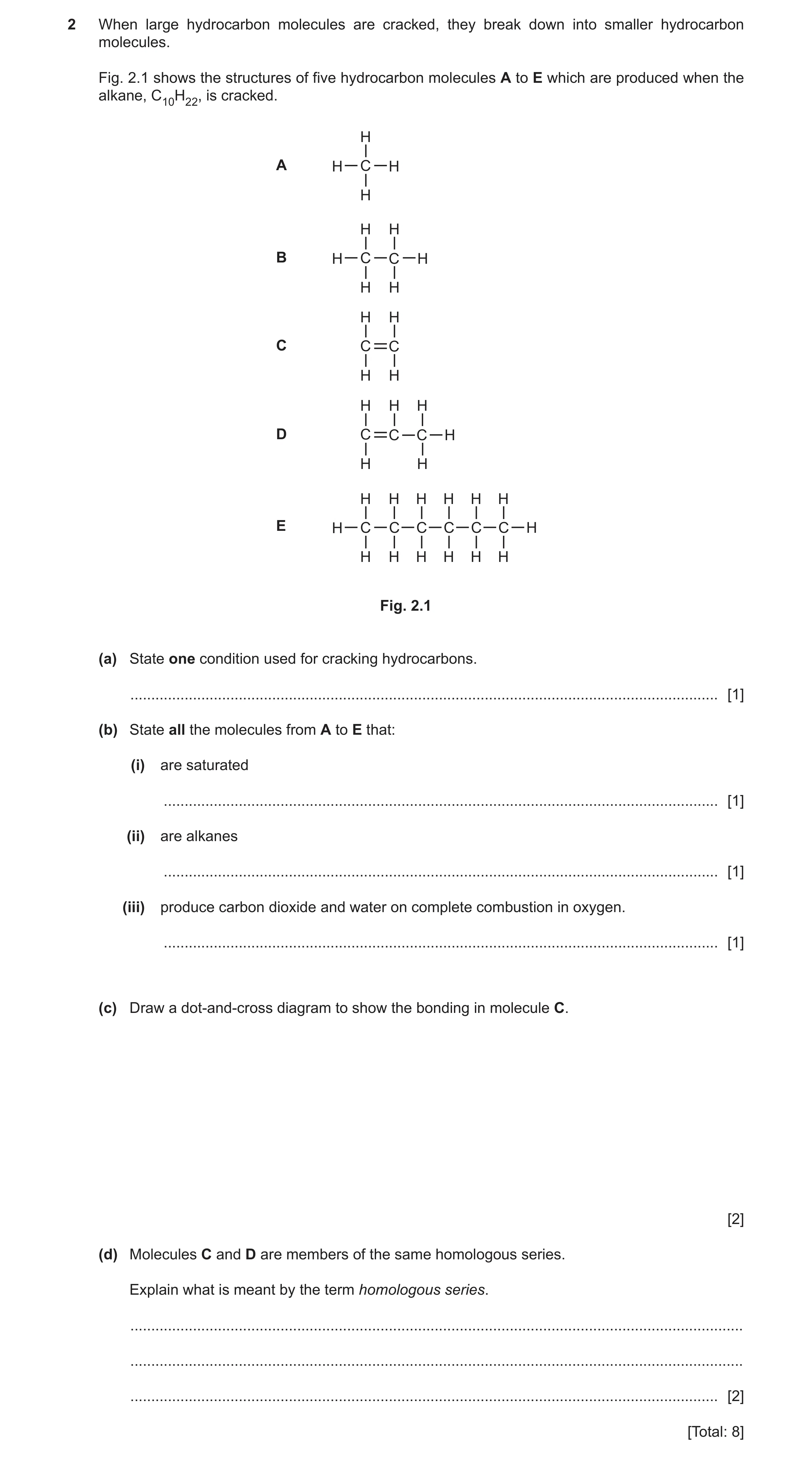
2 When large hydrocarbon molecules are cracked, they break down into smaller hydrocarbon molecules. Fig. 2.1 shows the structures of five hydrocarbon molecules A to E which are produced when the alkane, C10H22, is cracked. H A H C H H H H B H C C H H H H H C C C H H H H H D C C C H H H H H H H H H E H C C C C C C H H H H H H H Fig. 2.1 (a) State one condition used for cracking hydrocarbons. … [1] (b) State all the molecules from A to E that: (i) are saturated … [1] (ii) are alkanes … [1] (iii) produce carbon dioxide and water on complete combustion in oxygen. … [1] (c) Draw a dot-and-cross diagram to show the bonding in molecule C. [2] (d) Molecules C and D are members of the same homologous series. Explain what is meant by the term homologous series. … … … [2] [Total: 8]
8 marks
Mark scheme: 2(a) high temperature / high pressure / catalyst ; 1 2(b)(i) A, B and E ; 1 2(b)(ii) A, B and E ; 1 2(b)(iii) A, B, C, D and E / all of them ; 1 2(c) two bonding pairs between carbon atoms ; all else correct ; 2 2(d) family of compounds with a general formula ; similar chemical properties ; 2
This question in 0653/41 May/June 2019
Q9 · A simple example of cracking is the cracking of ethane to produce ethene and hydrogen 0653/43 May/June 2019
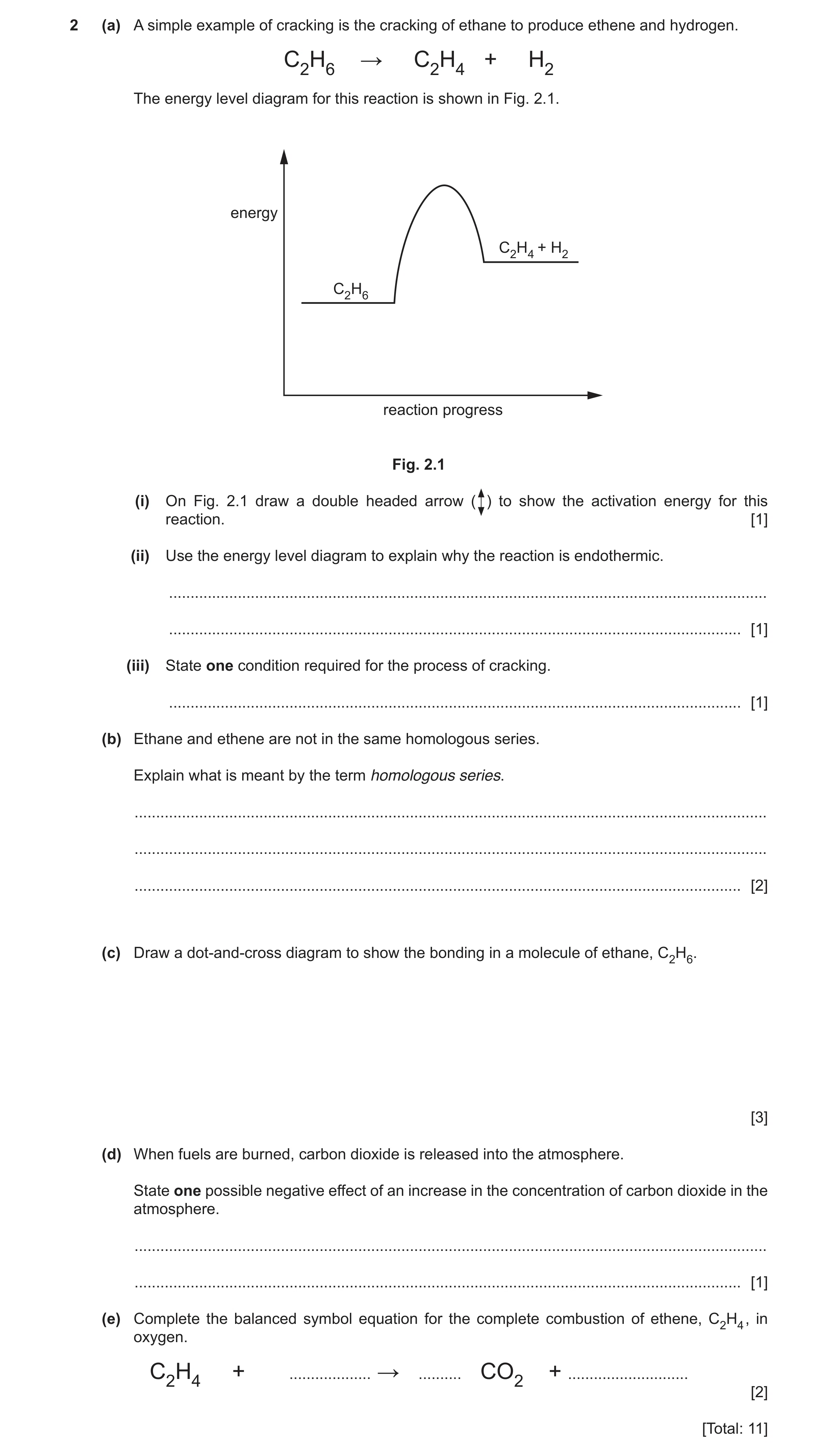
2 (a) A simple example of cracking is the cracking of ethane to produce ethene and hydrogen. C2H6 → C2H4 + H2 The energy level diagram for this reaction is shown in Fig. 2.1. energy C2H4 + H2 C2H6 reaction progress Fig. 2.1 (i) On Fig. 2.1 draw a double headed arrow ( ) to show the activation energy for this reaction. [1] (ii) Use the energy level diagram to explain why the reaction is endothermic. … … [1] (iii) State one condition required for the process of cracking. … [1] (b) Ethane and ethene are not in the same homologous series. Explain what is meant by the term homologous series. … … … [2] (c) Draw a dot-and-cross diagram to show the bonding in a molecule of ethane, C2H6. [3] (d) When fuels are burned, carbon dioxide is released into the atmosphere. State one possible negative effect of an increase in the concentration of carbon dioxide in the atmosphere. … … [1] (e) Complete the balanced symbol equation for the complete combustion of ethene, C2H4 , in oxygen. … C2H4 + … → … CO2 + [2] [Total: 11]
11 marks
Mark scheme: 2(a)(i) arrow from reactant energy level to the top of the curve ; 1 2(a)(ii) reactants have less chemical energy than products ; 1 2(a)(iii) high temperature / high pressure / catalyst ; 1 2(b) family of compounds with a general formula ; similar chemical properties ; 2 Question Answer Marks 2(c) six hydrogen atoms, three attached to each carbon ; one bonding pair between carbon atoms ; single bonding pairs between each carbon and hydrogen ; 3 2(d) global warming / enhanced greenhouse effect / climate change / named consequence of climate change ; 1 2(e) C2H4 + 3O2 � 2CO2 + 2H2O all formulae correct ; balanced (dependent on correct formulae) ; 2
This question in 0653/43 May/June 2019
Q10 · Hydrocarbons are composed of the two elements carbon and hydrogen 0653/41 Oct/Nov 2019
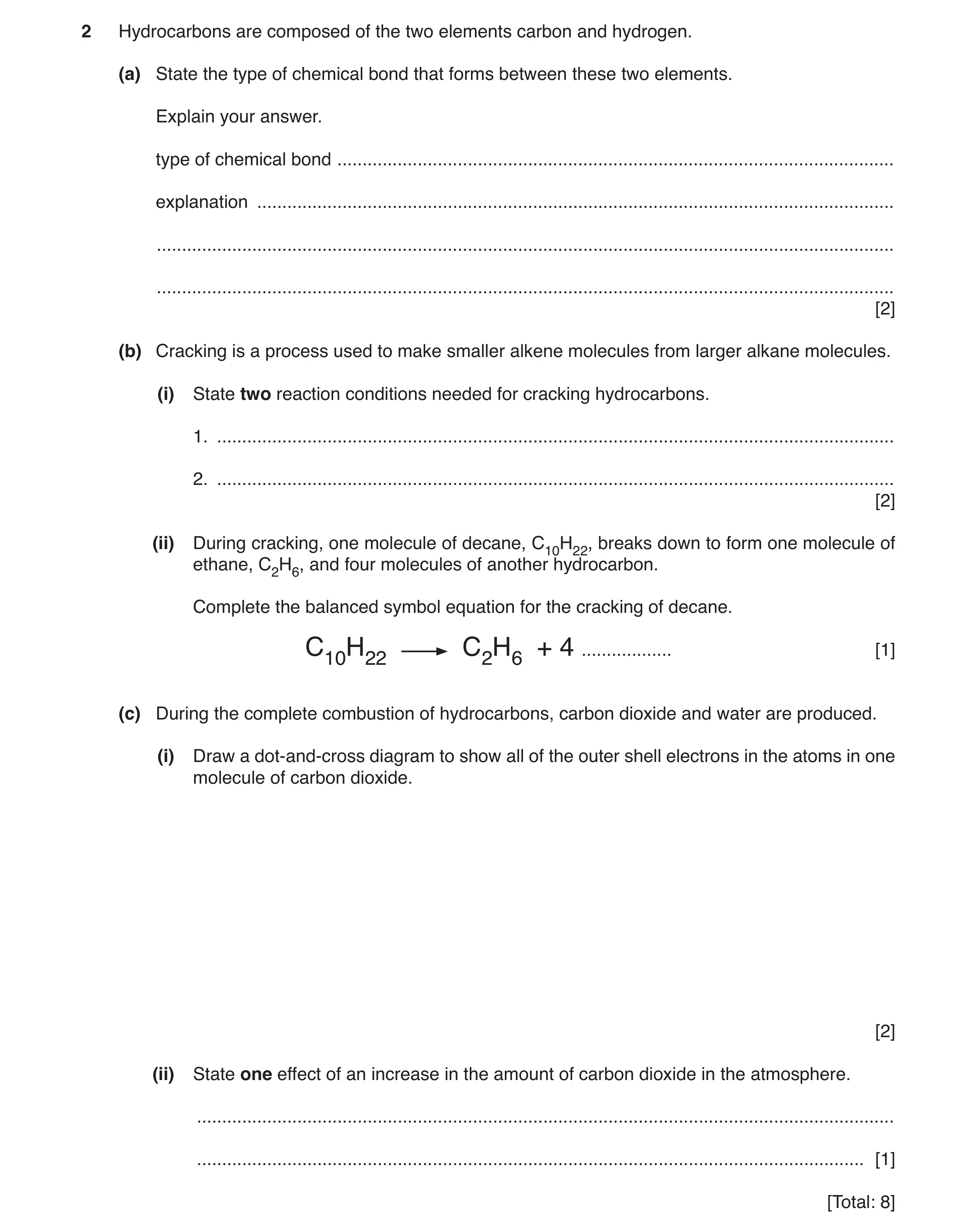
2 Hydrocarbons are composed of the two elements carbon and hydrogen. (a) State the type of chemical bond that forms between these two elements. Explain your answer. type of chemical bond … explanation … … … [2] (b) Cracking is a process used to make smaller alkene molecules from larger alkane molecules. (i) State two reaction conditions needed for cracking hydrocarbons. 1. … 2. … [2] (ii) During cracking, one molecule of decane, C10H22, breaks down to form one molecule of ethane, C2H6, and four molecules of another hydrocarbon. Complete the balanced symbol equation for the cracking of decane. … [1] C10H22 C2H6 + 4 (c) During the complete combustion of hydrocarbons, carbon dioxide and water are produced. (i) Draw a dot-and-cross diagram to show all of the outer shell electrons in the atoms in one molecule of carbon dioxide. [2] (ii) State one effect of an increase in the amount of carbon dioxide in the atmosphere. … … [1] [Total: 8]
8 marks
Mark scheme: 2(a) covalent ; bond between two non-metals ; 2 2(b)(i) heat / high temperature ; catalyst ; 2 2(b)(ii) (4) C2H4 ; 1 2(c)(i) one carbon atom and two oxygen atoms shown and correct electron distribution for carbon atom ; correct electron distribution for both oxygen atoms/lone pairs on both oxygen atoms ; 2 2(c)(ii) enhanced greenhouse effect / global warming / climate change / consequence of climate change ; 1
This question in 0653/41 Oct/Nov 2019
Q11 · Data about Group I metals 0653/41 Oct/Nov 2019
8 Table 8.1 shows data about Group I metals. The data for rubidium is missing. Table 8.1 element melting point / °C rate of reaction with water lithium 181 slow sodium 98 moderate potassium 64 fast rubidium caesium 29 very violent (a) (i) Suggest the melting point of rubidium. … °C [1] (ii) Predict the rate of reaction of rubidium with water. … [1] (b) Rubidium reacts with water to form rubidium hydroxide solution and hydrogen. (i) Suggest the formula of rubidium hydroxide. … [1] (ii) Suggest the pH of rubidium hydroxide solution. Explain your answer. pH … explanation … … [2] (c) Rubidium hydroxide has a higher melting point than water. Explain the difference in the melting point of rubidium hydroxide and of water. In your answer refer to the type of bonds and the attractive forces. … … … … … … [3] (d) The reaction between rubidium and water is exothermic. Describe what happens during an exothermic reaction. Use ideas about chemical energy and thermal energy in your answer. … … … … [2] [Total: 10]
10 marks
Mark scheme: 8(a)(i) 30 to 55 °C inclusive ; 1 8(a)(ii) violent / very fast ; 1 8(b)(i) RbOH ; 1 8(b)(ii) in range 8–14 ; the solution is an alkali ; 2 8(c) RbOH is ionic water is covalent ; attractive forces between ions are strong or attractive forces between molecules are weak ; more thermal energy (heat) needed to separate ions less thermal energy (heat) needed to separate molecules ; 3 8(d) temperature increases / thermal energy released ; chemical energy is changed into thermal energy ; 2
This question in 0653/41 Oct/Nov 2019
Q12 · The formula of methanol is CH3OH 0653/42 Feb/March 2020
2 (a) The formula of methanol is CH3OH. Complete the structure of a molecule of methanol. Include all atoms and all bonds. C O [1] (b) (i) Explain why methanol is not an alkane. … … [1] (ii) Explain why a molecule of methanol contains only covalent bonds. … … [1] (c) Methanol can be used as a fuel. It burns in oxygen and releases energy. (i) Complete the equation for the complete combustion of methanol. 2CH3OH + … … + … [2] (ii) The combustion of methanol is an exothermic reaction. Describe what is meant by exothermic. Use ideas about energy, bond breaking and bond forming in your answer. … … … [2] (d) Methane is a greenhouse gas. State one effect of increased levels of greenhouse gases in the atmosphere. … … [1] [Total: 8]
8 marks
Mark scheme: 2(a) ; 2(b)(i) contains oxygen / is not carbon and hydrogen only ; 1 2(b)(ii) all bonds are between non-metal atoms ; 1 2(c)(i) (2CH3OH +) 3O2 → 2CO2 + 4H2O all formulae correct ; (correct formulae) balanced ; 2 Question Answer Marks 2(c)(ii) idea that energy is taken in to break bonds / that energy is released when bonds form ; (exothermic means) energy released is greater (than taken in) / (during an exothermic reaction) temperature increases / chemical energy converted to thermal ; 2 2(d) global warming / climate change / consequence of climate change, e.g. extreme weather events / rising sea level ; 1
This question in 0653/42 Feb/March 2020
Q13 · A bromine atom contains seven electrons in its outer shell 0653/42 Feb/March 2020
8 (a) A bromine atom contains seven electrons in its outer shell. Complete the dot-and-cross diagram of a molecule of bromine in Fig. 8.1. Show only the outer shell electrons. Br Br Fig. 8.1 [2] (b) The boiling point of liquid bromine is 59 °C. Explain what happens to bromine molecules when liquid bromine boils. Use ideas about molecules and energy changes in your answer. … … … … [2] (c) Orange aqueous bromine is mixed with colourless aqueous potassium chloride. Predict the colour change, if any, in this reaction. Explain your answer. colour change … explanation … … [2] (d) When large hydrocarbon molecules are cracked, alkenes are produced. (i) State two conditions needed for this process. 1. … 2. … [2] (ii) Aqueous bromine is used to test for the presence of alkenes. State the colour change that indicates a positive result for this test. from … to … [1] (e) The formula of aluminium bromide is Al 2Br6. The melting point of aluminium bromide is 97 °C and the boiling point is 255 °C. Explain how this information suggests that aluminium bromide contains covalent bonds. Use ideas about attractive forces in your answer. … … … [2] [Total: 11]
11 marks
Mark scheme: 8(a) shared pair ; seven outer electrons in each bromine atom ; 8(b) distance between bromine molecules increases ; (because) energy is used to, break / overcome intermolecular forces ; 2 8(c) no colour change ; bromine is less reactive than chlorine / bromine does not displace chlorine ; 2 8(d)(i) high temperature ; catalyst ; 2 8(d)(ii) (from) orange (to) colourless ; 1 8(e) covalently bonded substances have (relatively) low melting points and boiling points / ionic compounds would have much higher melting points and boiling points ; attractive intermolecular forces are (relatively) low ; 2
This question in 0653/42 Feb/March 2020
Q14 · The formula of methanol is CH3OH 0653/41 May/June 2020
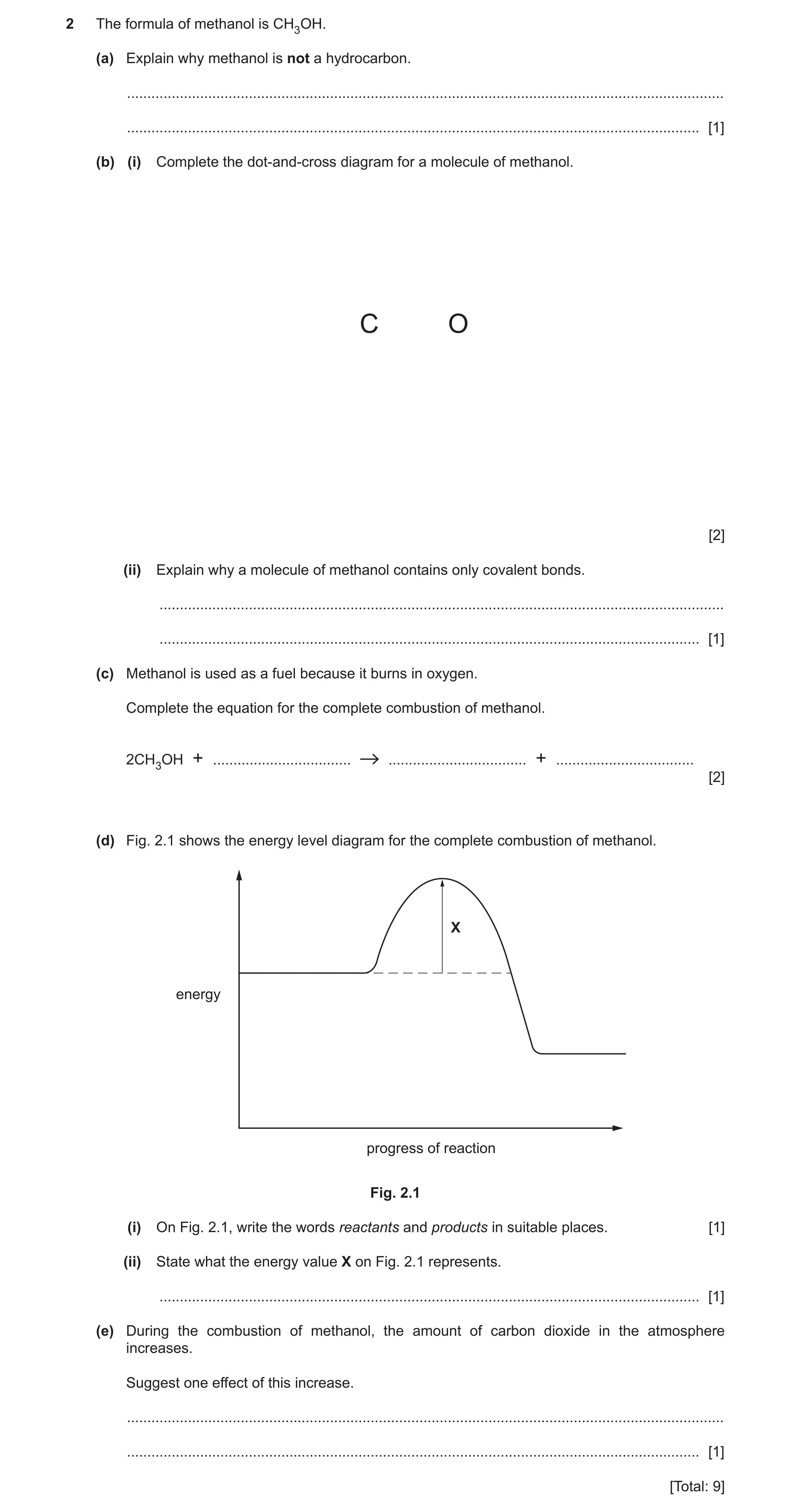
2 The formula of methanol is CH3OH. (a) Explain why methanol is not a hydrocarbon. … … [1] (b) (i) Complete the dot-and-cross diagram for a molecule of methanol. C O [2] (ii) Explain why a molecule of methanol contains only covalent bonds. … … [1] (c) Methanol is used as a fuel because it burns in oxygen. Complete the equation for the complete combustion of methanol. 2CH3OH + … … + … [2] (d) Fig. 2.1 shows the energy level diagram for the complete combustion of methanol. X energy progress of reaction Fig. 2.1 (i) On Fig. 2.1, write the words reactants and products in suitable places. [1] (ii) State what the energy value X on Fig. 2.1 represents. … [1] (e) During the combustion of methanol, the amount of carbon dioxide in the atmosphere increases. Suggest one effect of this increase. … … [1] [Total: 9]
9 marks
Mark scheme: 2(a) contains oxygen / is not just carbon and hydrogen ; 1 2(b)(i) correct electrons around carbon atom ; correct electrons around oxygen atom ; 2 2(b)(ii) all atoms are non-metallic elements ; 1 Question Answer Marks 2(c) (2CH3OH) + 3O2 → 2CO2 + 4H2O correct formulae ; correctly balanced ; 2 2(d)(i) reactants on left and products on right ; 1 2(d)(ii) activation energy ; 1 2(e) (carbon dioxide is a greenhouse gas) so enhanced greenhouse effect / global warming / climate change / example of an effect of climate change ; 1
This question in 0653/41 May/June 2020
Q15 · Naphthalene is a solid that melts at 80 °C to form a liquid 0653/41 May/June 2020
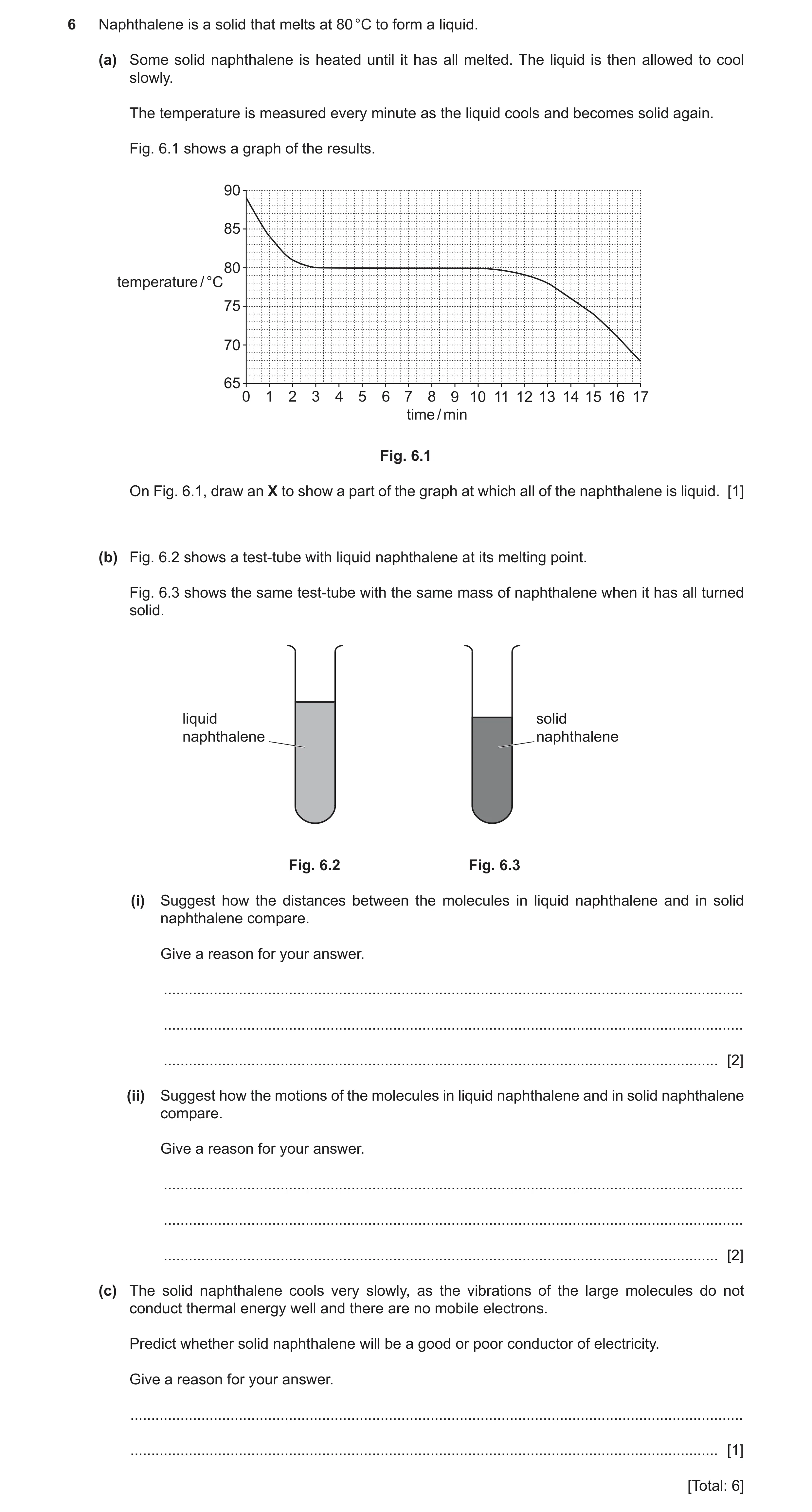
6 Naphthalene is a solid that melts at 80 °C to form a liquid. (a) Some solid naphthalene is heated until it has all melted. The liquid is then allowed to cool slowly. The temperature is measured every minute as the liquid cools and becomes solid again. Fig. 6.1 shows a graph of the results. 90 85 80 temperature / °C 75 70 65 0 1 2 3 4 5 6 7 8 9 10 11 12 13 14 15 16 17 time / min Fig. 6.1 On Fig. 6.1, draw an X to show a part of the graph at which all of the naphthalene is liquid. [1] (b) Fig. 6.2 shows a test-tube with liquid naphthalene at its melting point. Fig. 6.3 shows the same test-tube with the same mass of naphthalene when it has all turned solid. liquid solid naphthalene naphthalene Fig. 6.2 Fig. 6.3 (i) Suggest how the distances between the molecules in liquid naphthalene and in solid naphthalene compare. Give a reason for your answer. … … … [2] (ii) Suggest how the motions of the molecules in liquid naphthalene and in solid naphthalene compare. Give a reason for your answer. … … … [2] (c) The solid naphthalene cools very slowly, as the vibrations of the large molecules do not conduct thermal energy well and there are no mobile electrons. Predict whether solid naphthalene will be a good or poor conductor of electricity. Give a reason for your answer. … … [1] [Total: 6]
6 marks
Mark scheme: 6(a) X drawn anywhere on curve between 0s and 3s ; 1 6(b)(i) (molecules) closer in solid / further apart in liquid ; the idea that the regular arrangement of molecules in solid means that molecules more efficiently packed / owtte ; or in liquid, random arrangement so molecules less efficiently packed / owtte ; 2 6(b)(ii) slower in solid / faster in liquid ; in solid less (thermal / kinetic) energy / in liquid more (thermal / kinetic) energy ; 2 6(c) (poor conductor – no mark) good conductors of electricity require free electrons ; 1
This question in 0653/41 May/June 2020
Q16 · Compounds J, K and L are hydrocarbons 0653/43 Oct/Nov 2020
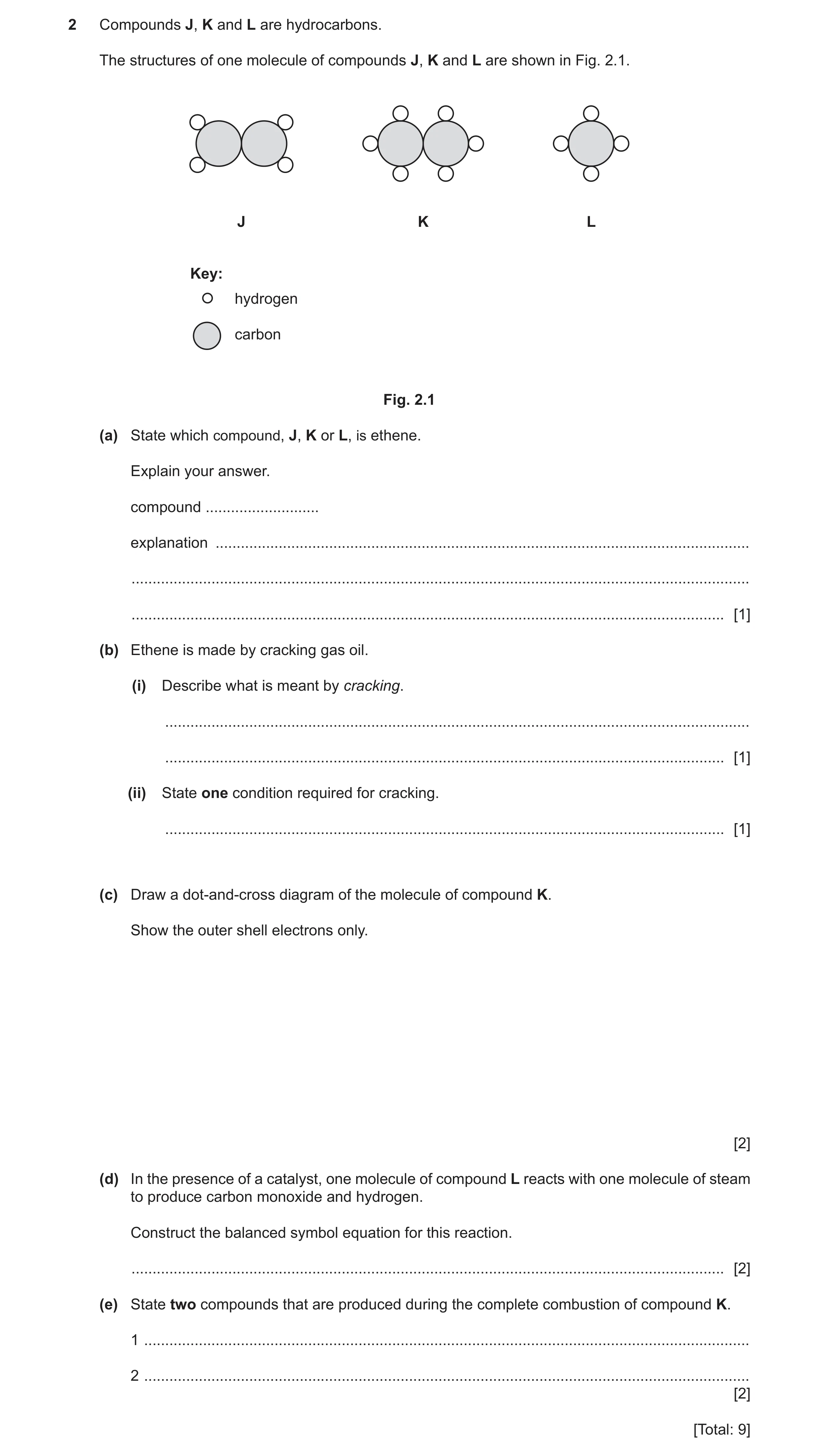
2 Compounds J, K and L are hydrocarbons. The structures of one molecule of compounds J, K and L are shown in Fig. 2.1. J K L Key: hydrogen carbon Fig. 2.1 (a) State which compound, J, K or L, is ethene. Explain your answer. compound … explanation … … … [1] (b) Ethene is made by cracking gas oil. (i) Describe what is meant by cracking. … … [1] (ii) State one condition required for cracking. … [1] (c) Draw a dot-and-cross diagram of the molecule of compound K. Show the outer shell electrons only. [2] (d) In the presence of a catalyst, one molecule of compound L reacts with one molecule of steam to produce carbon monoxide and hydrogen. Construct the balanced symbol equation for this reaction. … [2] (e) State two compounds that are produced during the complete combustion of compound K. 1 … 2 … [2] [Total: 9]
9 marks
Mark scheme: 2(a) (compound J) the molecule of J, has the formula C2H4 / is unsaturated ; 1 2(b)(i) breaking of large hydrocarbon molecules into smaller molecules ; 1 2(b)(ii) heat / use of a catalyst ; 1 2(c) 2 electrons shared in single bond between carbon atoms ; all else correct including the symbols ; 2 Question Answer Marks 2(d) CH4 + H2O → CO + 3H2 all formulae correct ; balanced ; 2 2(e) carbon dioxide ; water ; 2
This question in 0653/43 Oct/Nov 2020
Q17 · Carbon and oxygen are two elements in Period 2 of the Periodic Table 0653/42 Feb/March 2021
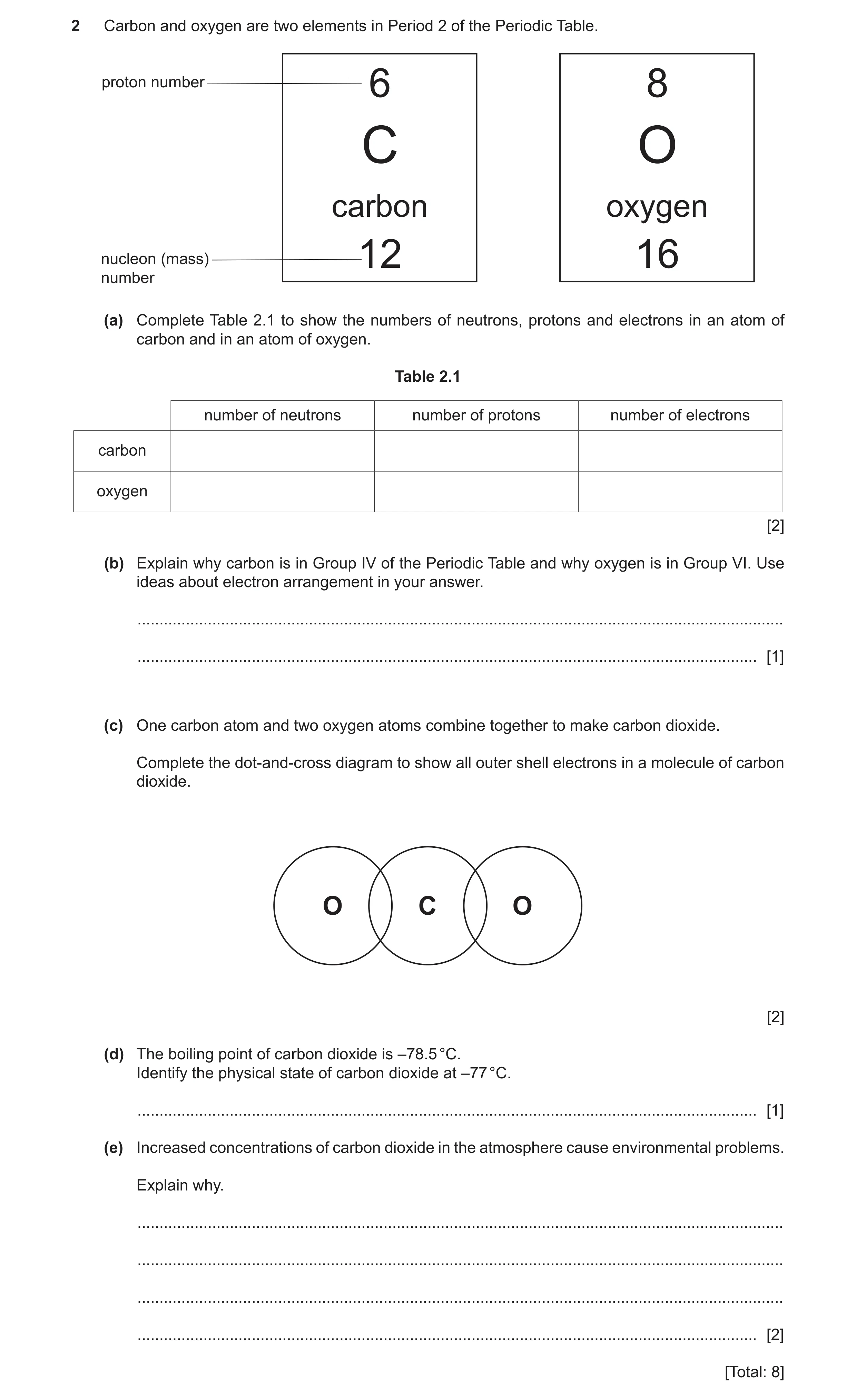
2 Carbon and oxygen are two elements in Period 2 of the Periodic Table. proton number 6 8 C O carbon oxygen nucleon (mass) 12 16 number (a) Complete Table 2.1 to show the numbers of neutrons, protons and electrons in an atom of carbon and in an atom of oxygen. Table 2.1 number of neutrons number of protons number of electrons carbon oxygen [2] (b) Explain why carbon is in Group IV of the Periodic Table and why oxygen is in Group VI. Use ideas about electron arrangement in your answer. … … [1] (c) One carbon atom and two oxygen atoms combine together to make carbon dioxide. Complete the dot-and-cross diagram to show all outer shell electrons in a molecule of carbon dioxide. O C O [2] (d) The boiling point of carbon dioxide is –78.5 °C. Identify the physical state of carbon dioxide at –77 °C. … [1] (e) Increased concentrations of carbon dioxide in the atmosphere cause environmental problems. Explain why. … … … … [2] [Total: 8]
8 marks
Mark scheme: 2(a) number of neutrons number of protons number of electrons 6 6 6 8 8 8 ;; one mark neutrons correct second mark protons and electrons correct 2 2(b) carbon has 4 outer shell electrons and oxygen has 6 ; 1 Question Answer Marks 2(c) four bonding electrons shown between carbon and each oxygen ; (dependent on MP1) rest of molecule correct ; 2 2(d) gas ; 1 2(e) one point from: CO2 is a greenhouse gas / causes enhanced greenhouse effect / causes atmosphere to heat up / traps excess heat in atmosphere / causes global warming ; and one point from: climate change ; extreme weather events / named example, e.g. hurricanes ; sea level rise / flooding (of coastal areas) ; polar ice caps melt ; 2
This question in 0653/42 Feb/March 2021
Q18 · Oxygen and hydrogen are gases 0653/41 May/June 2021
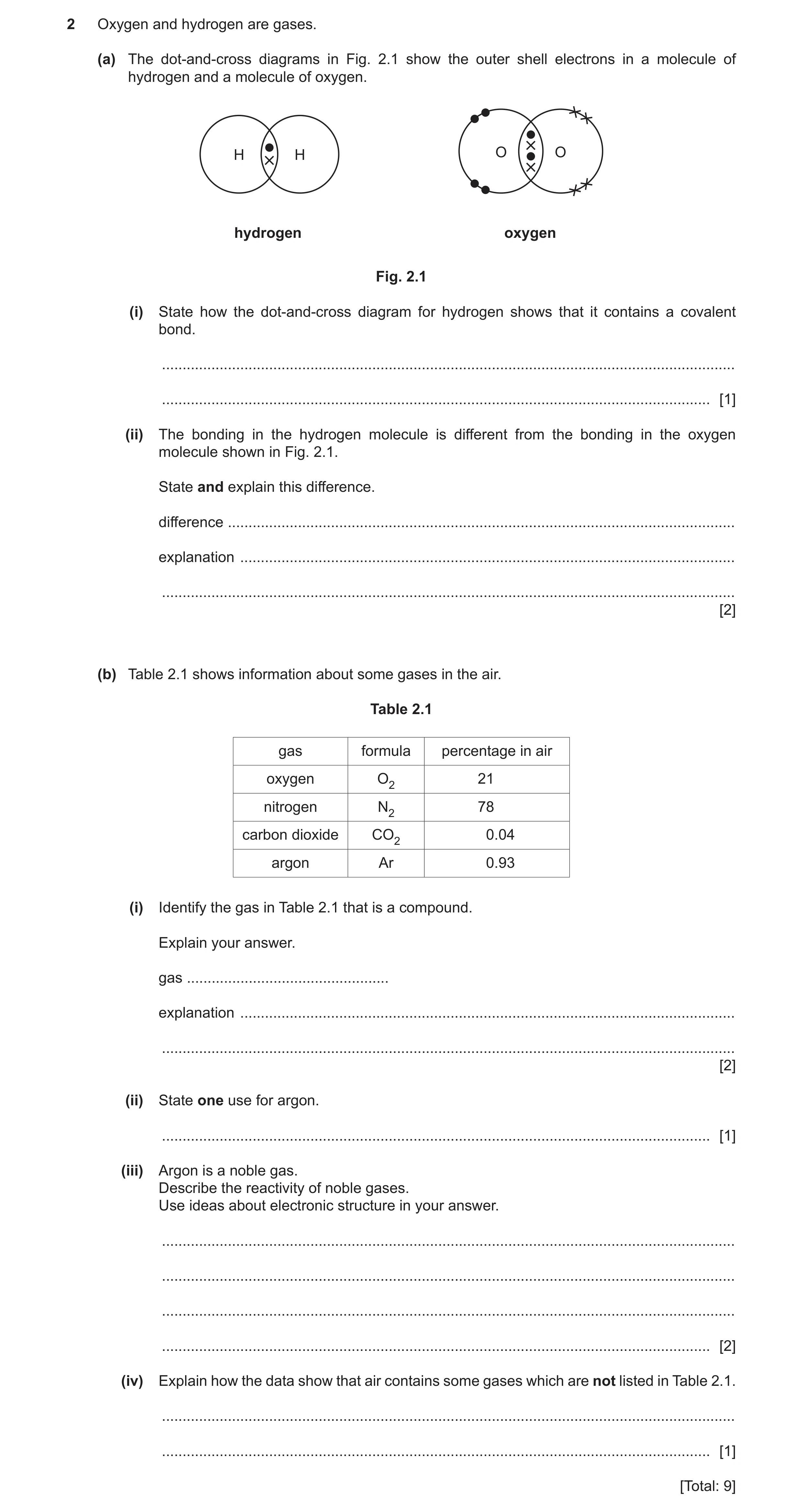
2 Oxygen and hydrogen are gases. (a) The dot-and-cross diagrams in Fig. 2.1 show the outer shell electrons in a molecule of hydrogen and a molecule of oxygen. H H O O hydrogen oxygen Fig. 2.1 (i) State how the dot-and-cross diagram for hydrogen shows that it contains a covalent bond. … … [1] (ii) The bonding in the hydrogen molecule is different from the bonding in the oxygen molecule shown in Fig. 2.1. State and explain this difference. difference … explanation … … [2] (b) Table 2.1 shows information about some gases in the air. Table 2.1 gas formula percentage in air oxygen O2 21 nitrogen N2 78 carbon dioxide CO2 0.04 argon Ar 0.93 (i) Identify the gas in Table 2.1 that is a compound. Explain your answer. gas … explanation … … [2] (ii) State one use for argon. … [1] (iii) Argon is a noble gas. Describe the reactivity of noble gases. Use ideas about electronic structure in your answer. … … … … [2] (iv) Explain how the data show that air contains some gases which are not listed in Table 2.1. … … [1] [Total: 9]
9 marks
Mark scheme: 2(a)(i) (two) electrons are shared ; 1 2(a)(ii) difference: oxygen has four electrons between atoms / hydrogen has two OR oxygen has a double bond / hydrogen has a single bond ; explanation: each atom shares electrons to, gain a full outer shell / become stable / oxygen atoms need two electrons to fill outer shell but hydrogen needs only one OWTTE ; 2 2(b)(i) gas: carbon dioxide ; explanation: two elements, bonded / joined ; 2 Question Answer Marks 2(b)(ii) in lamps / lightbulbs / lights ; 1 2(b)(iii) (they are) unreactive / inert ; (because) full (outer) shell of electrons / has a stable electron arrangement / outer shell contains 8 electrons ; 2 2(b)(iv) percentages do not add up to 100 ; 1
This question in 0653/41 May/June 2021
Q19 · Information about the electrons in atoms of elements V, W, X, Y and Z 0653/43 May/June 2021
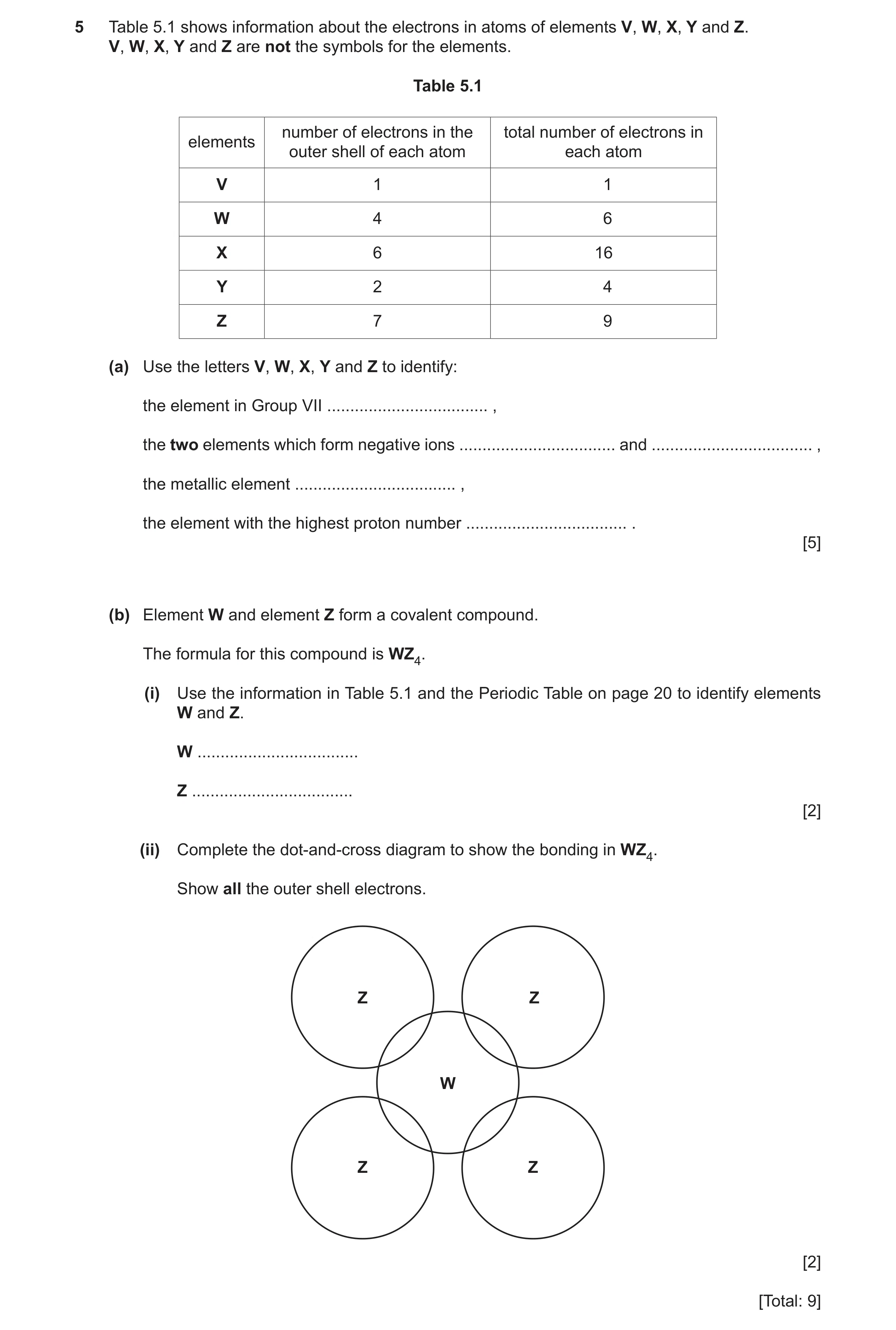
5 Table 5.1 shows information about the electrons in atoms of elements V, W, X, Y and Z. V, W, X, Y and Z are not the symbols for the elements. Table 5.1 number of electrons in the total number of electrons in elements outer shell of each atom each atom V 1 1 W 4 6 X 6 16 Y 2 4 Z 7 9 (a) Use the letters V, W, X, Y and Z to identify: the element in Group VII … , the two elements which form negative ions … and … , the metallic element … , the element with the highest proton number … . [5] (b) Element W and element Z form a covalent compound. The formula for this compound is WZ4. (i) Use the information in Table 5.1 and the Periodic Table on page 20 to identify elements W and Z. W … Z … [2] (ii) Complete the dot-and-cross diagram to show the bonding in WZ4. Show all the outer shell electrons. Z Z W Z Z [2] [Total: 9]
9 marks
Mark scheme: 5(a) the element in Group VII Z ; the two elements which form negative ions X ; and Z ; (either order) the metallic element Y ; the element with the highest proton number X ; 5(b)(i) W = carbon ; Z = fluorine ; 2 5(b)(ii) two shared electrons in each of four bonds ; three lone pairs on each atom of Z ; 2
This question in 0653/43 May/June 2021
Q20 · Some properties of three elements in Group VII of the Periodic Table 0653/43 Oct/Nov 2021
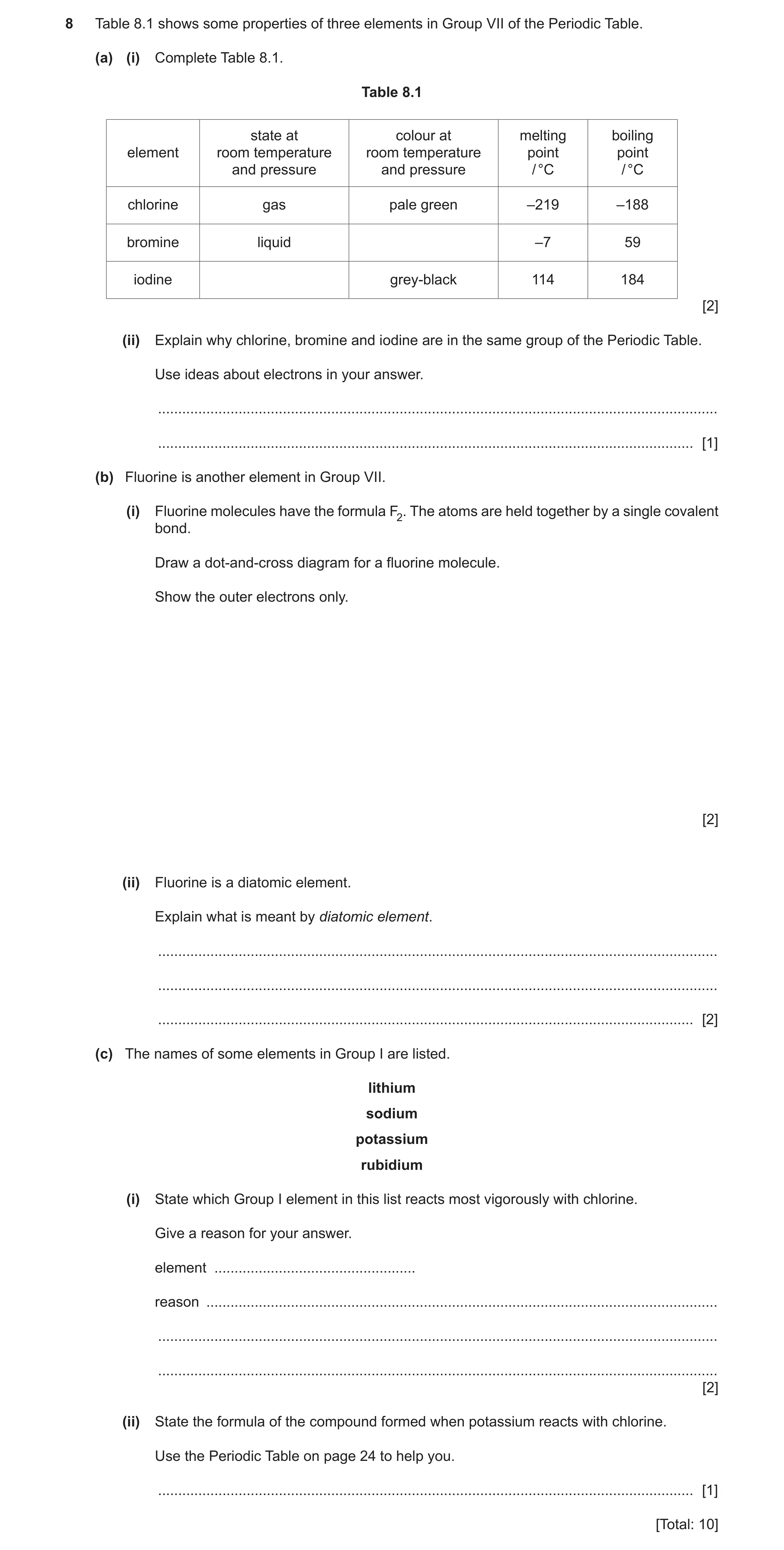
8 Table 8.1 shows some properties of three elements in Group VII of the Periodic Table. (a) (i) Complete Table 8.1. Table 8.1 state at colour at melting boiling element room temperature room temperature point point and pressure and pressure / °C / °C chlorine gas pale green –219 –188 bromine liquid –7 59 iodine grey-black 114 184 [2] (ii) Explain why chlorine, bromine and iodine are in the same group of the Periodic Table. Use ideas about electrons in your answer. … … [1] (b) Fluorine is another element in Group VII. (i) Fluorine molecules have the formula F2. The atoms are held together by a single covalent bond. Draw a dot-and-cross diagram for a fluorine molecule. Show the outer electrons only. [2] (ii) Fluorine is a diatomic element. Explain what is meant by diatomic element. … … … [2] (c) The names of some elements in Group I are listed. lithium sodium potassium rubidium (i) State which Group I element in this list reacts most vigorously with chlorine. Give a reason for your answer. element … reason … … … [2] (ii) State the formula of the compound formed when potassium reacts with chlorine. Use the Periodic Table on page 24 to help you. … [1] [Total: 10]
10 marks
Mark scheme: 8(a)(i) bromine: (dark) orange / brown ; iodine: solid ; 2 8(a)(ii) all contain the same number of electrons (seven electrons) in the outer shell ; 1 8(b)(i) single bond between atoms shown as two shared electrons ; (dependent mark) rest of molecule correct ; 2 8(b)(ii) molecules have only two atoms ; of the same type ; 2 8(c)(i) rubidium ; outer electron (is furthest from nucleus and so) more easily lost / rubidium is further down Group I ; 2 8(c)(ii) KCl ; 1
This question in 0653/43 Oct/Nov 2021
Q21 · The structures of ethane and ethene are shown in Fig 0653/42 Oct/Nov 2022
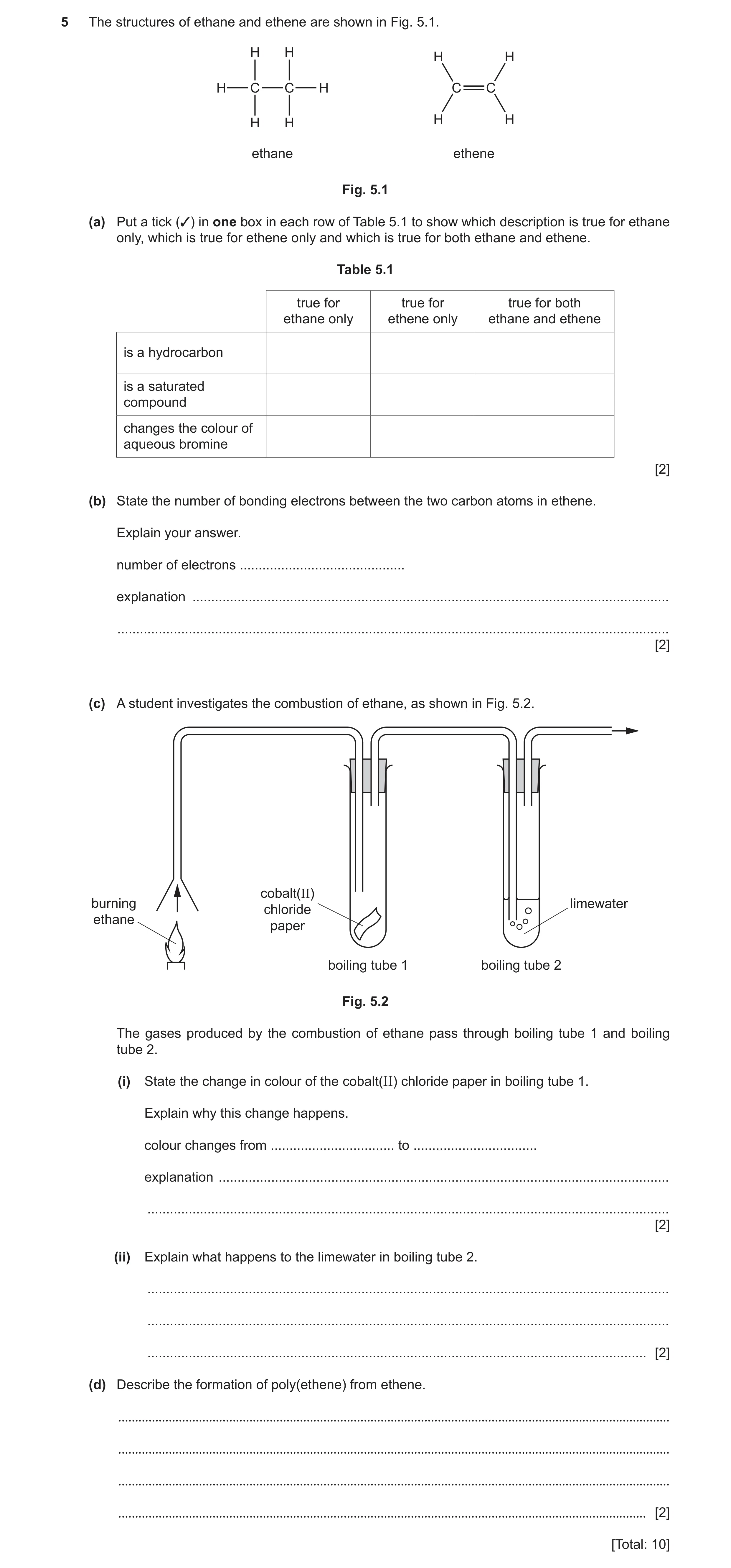
5 The structures of ethane and ethene are shown in Fig. 5.1. H H H H H C C H C C H H H H ethane ethene Fig. 5.1 (a) Put a tick (✓) in one box in each row of Table 5.1 to show which description is true for ethane only, which is true for ethene only and which is true for both ethane and ethene. Table 5.1 true for true for true for both ethane only ethene only ethane and ethene is a hydrocarbon is a saturated compound changes the colour of aqueous bromine [2] (b) State the number of bonding electrons between the two carbon atoms in ethene. Explain your answer. number of electrons … explanation … … [2] (c) A student investigates the combustion of ethane, as shown in Fig. 5.2. cobalt(II) burning limewater chloride ethane paper boiling tube 1 boiling tube 2 Fig. 5.2 The gases produced by the combustion of ethane pass through boiling tube 1 and boiling tube 2. (i) State the change in colour of the cobalt(II) chloride paper in boiling tube 1. Explain why this change happens. colour changes from … to … explanation … … [2] (ii) Explain what happens to the limewater in boiling tube 2. … … … [2] (d) Describe the formation of poly(ethene) from ethene. … … … … [2] [Total: 10]
10 marks
Mark scheme: 5(a) 2 true for true for true for both ethane only ethene only ethane and ethene is a hydrocarbon ✓ is a saturated ✓ compound changes the colour of ✓ aqueous bromine one correct ; all three correct ; 5(b) 4 ; 2 double bond / two bonds each, containing two electrons ; 5(c)(i) blue (to) pink ; 2 water (vapour) is made ; 5(c)(ii) limewater turns milky ; 2 because carbon dioxide is made ; 5(d) idea that, many (ethene) molecules join ; 2 correct reference to, monomer / (addition) polymerisation ;
This question in 0653/42 Oct/Nov 2022
Q22 · The structures of the hydrocarbons propane and ethene are shown in Fig 0653/42 Feb/March 2023
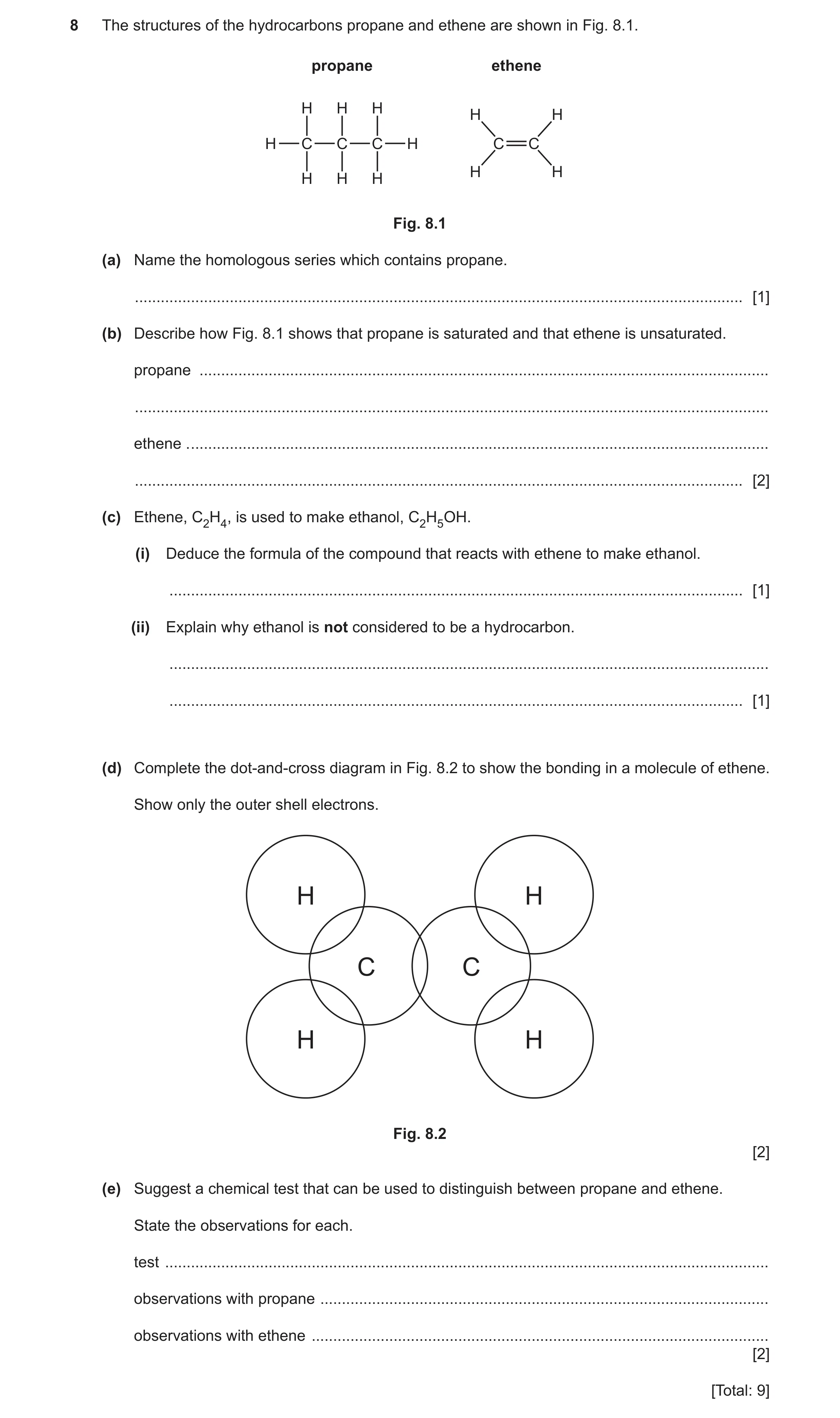
8 The structures of the hydrocarbons propane and ethene are shown in Fig. 8.1. propane ethene H H H H H H C C C H C C H H H H H Fig. 8.1 (a) Name the homologous series which contains propane. … [1] (b) Describe how Fig. 8.1 shows that propane is saturated and that ethene is unsaturated. propane … … ethene . … … [2] (c) Ethene, C2H4, is used to make ethanol, C2H5OH. (i) Deduce the formula of the compound that reacts with ethene to make ethanol. … [1] (ii) Explain why ethanol is not considered to be a hydrocarbon. … … [1] (d) Complete the dot-and-cross diagram in Fig. 8.2 to show the bonding in a molecule of ethene. Show only the outer shell electrons. H H C C H H Fig. 8.2 [2] (e) Suggest a chemical test that can be used to distinguish between propane and ethene. State the observations for each. test … observations with propane … observations with ethene … [2] [Total: 9]
9 marks
Mark scheme: 8(a) alkane ; 1 8(b) propane contains only single bonds / propane has single bonds between C atoms ; 2 ethene has a double bond (between C atoms) ; 8(c)(i) H2O ; 1 8(c)(ii) contains oxygen ; 1 8(d) carbon-carbon double bond correct ; 2 carbon – hydrogen bonds correct ; e.g., 8(e) (aqueous) bromine (water) ; 2 propane – remains orange AND observations with ethene – goes (from orange to) colourless ;
This question in 0653/42 Feb/March 2023
Q23 · An iron nail is placed in a test-tube, as shown in Fig 0653/41 May/June 2023
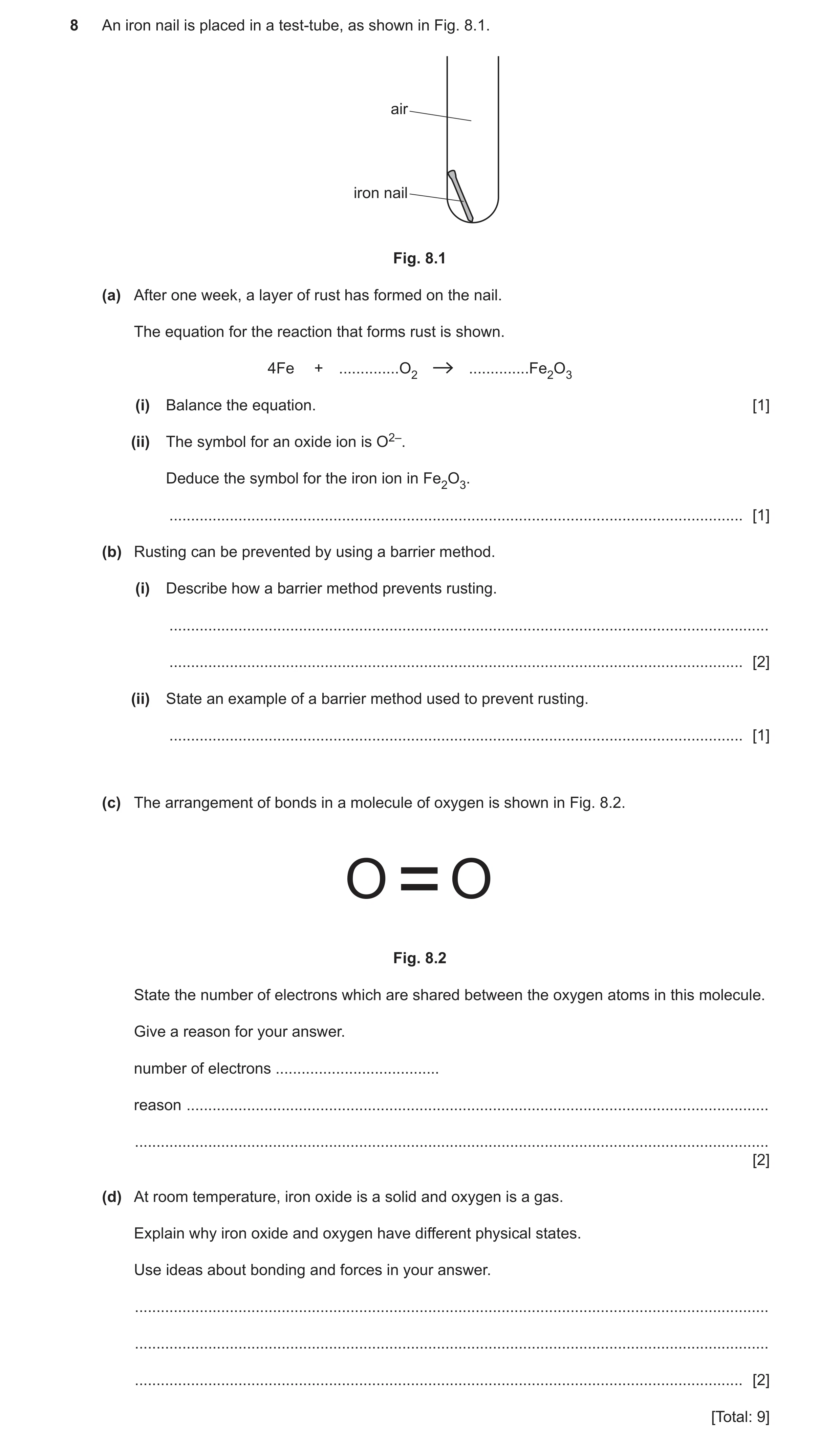
8 An iron nail is placed in a test-tube, as shown in Fig. 8.1. air iron nail Fig. 8.1 (a) After one week, a layer of rust has formed on the nail. The equation for the reaction that forms rust is shown. 4Fe + … O2 … Fe2O3 (i) Balance the equation. [1] (ii) The symbol for an oxide ion is O2–. Deduce the symbol for the iron ion in Fe2O3. … [1] (b) Rusting can be prevented by using a barrier method. (i) Describe how a barrier method prevents rusting. … … [2] (ii) State an example of a barrier method used to prevent rusting. … [1] (c) The arrangement of bonds in a molecule of oxygen is shown in Fig. 8.2. O O Fig. 8.2 State the number of electrons which are shared between the oxygen atoms in this molecule. Give a reason for your answer. number of electrons … reason … … [2] (d) At room temperature, iron oxide is a solid and oxygen is a gas. Explain why iron oxide and oxygen have different physical states. Use ideas about bonding and forces in your answer. … … … [2] [Total: 9]
9 marks
Mark scheme: 8(a)(i) 3 and 2 ; 1 8(a)(ii) Fe3+ ; 1 8(b)(i) excludes, oxygen / air ; excludes water ; 2 8(b)(ii) paint / grease / oil / other suitable coating ; 1 8(c) 4 ; it has a double bond with two electrons in each bond / two pairs of electrons are shared ; 2 8(d) oxygen, is covalent / has a simple (molecular) structure and iron oxide, is ionic / has a giant structure ; forces between particles / ions, in iron oxide, are stronger than in oxygen (particles / molecules) ; 2
This question in 0653/41 May/June 2023
Q24 · Cracking decane, C10H22, forms three compounds, as shown in Fig 0653/43 May/June 2023
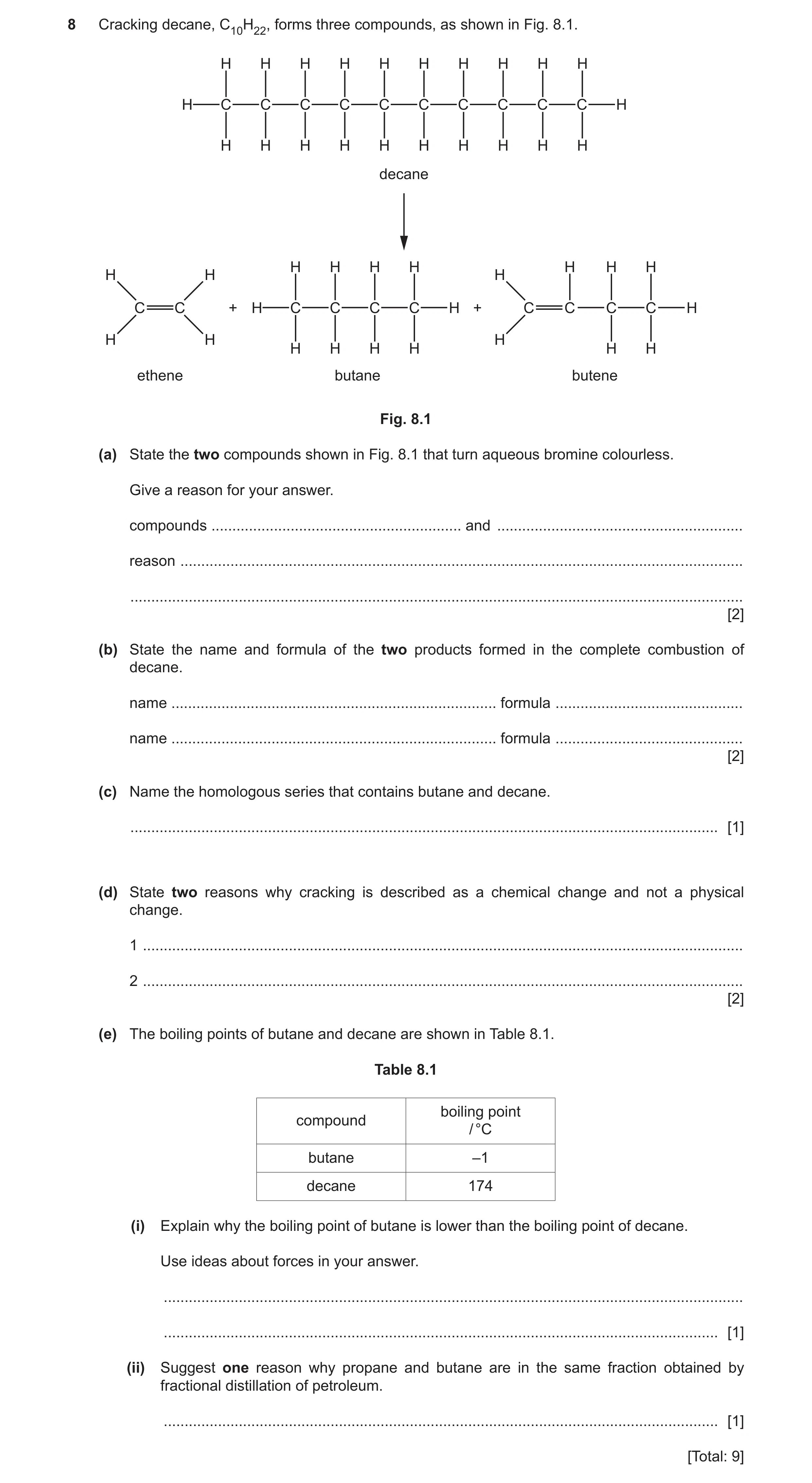
8 Cracking decane, C10H22, forms three compounds, as shown in Fig. 8.1. H H H H H H H H H H H C C C C C C C C C C H H H H H H H H H H H decane H H H H H H H H H H C C + H C C C C H + C C C C H H H H H H H H H H ethene butane butene Fig. 8.1 (a) State the two compounds shown in Fig. 8.1 that turn aqueous bromine colourless. Give a reason for your answer. compounds … and … reason … … [2] (b) State the name and formula of the two products formed in the complete combustion of decane. name … formula … name … formula … [2] (c) Name the homologous series that contains butane and decane. … [1] (d) State two reasons why cracking is described as a chemical change and not a physical change. 1 … 2 … [2] (e) The boiling points of butane and decane are shown in Table 8.1. Table 8.1 boiling point compound / °C butane –1 decane 174 (i) Explain why the boiling point of butane is lower than the boiling point of decane. Use ideas about forces in your answer. … … [1] (ii) Suggest one reason why propane and butane are in the same fraction obtained by fractional distillation of petroleum. … [1] [Total: 9]
9 marks
Mark scheme: 8(a) ethene and butene ; they both contain a double bond / are unsaturated / are alkenes ; 2 8(b) either order: carbon dioxide CO2 ; water H2O ; 2 8(c) alkanes ; 1 8(d) cannot be reversed by physical means ; new products formed ; 2 8(e)(i) butane has weaker forces between its molecules ; 1 8(e)(ii) similar boiling points ; 1
This question in 0653/43 May/June 2023
Q25 · Iron is extracted from hematite in a blast furnace 0653/42 Oct/Nov 2023
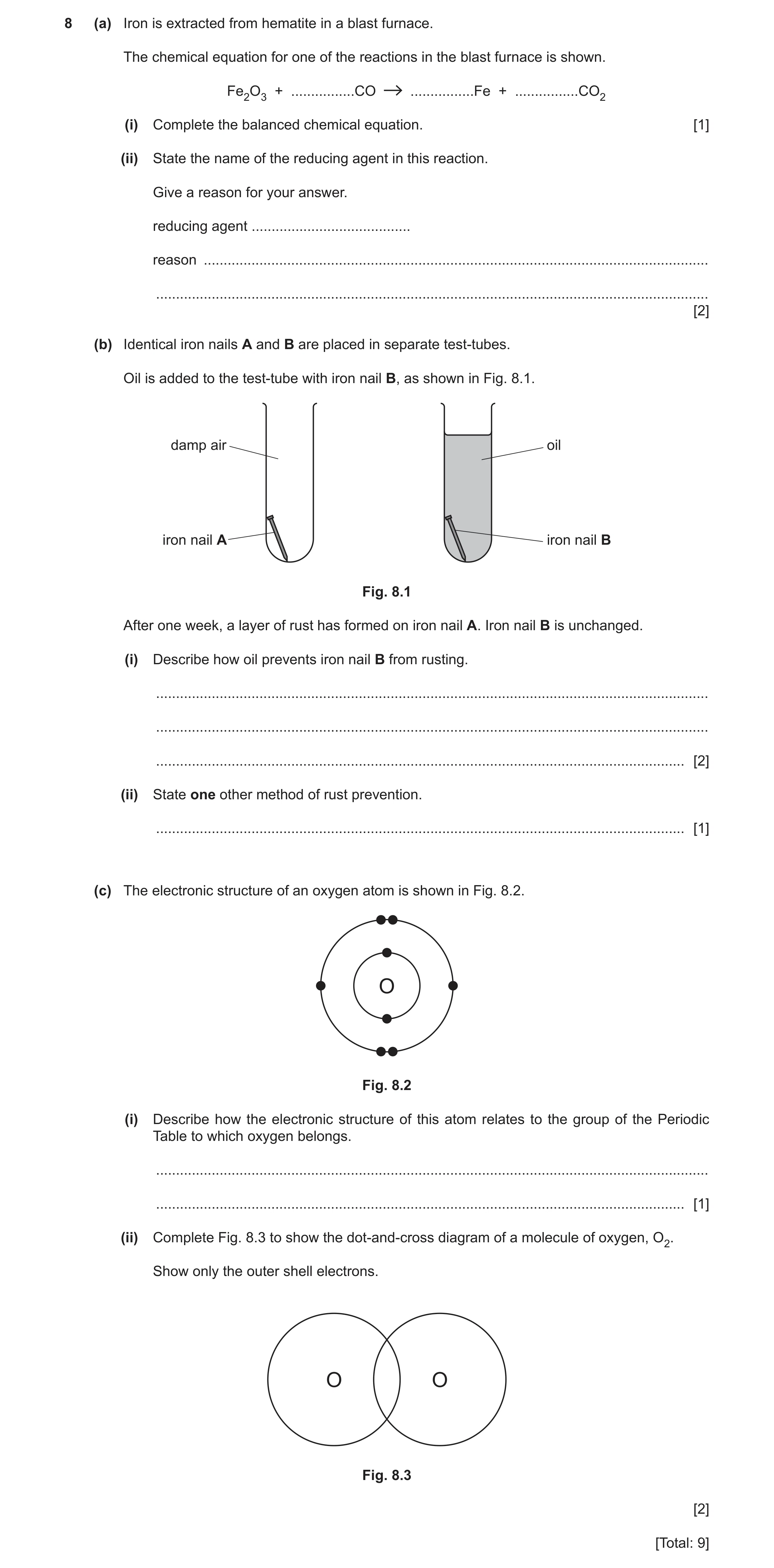
8 (a) Iron is extracted from hematite in a blast furnace. The chemical equation for one of the reactions in the blast furnace is shown. Fe2O3 + … CO … Fe + … CO2 (i) Complete the balanced chemical equation. [1] (ii) State the name of the reducing agent in this reaction. Give a reason for your answer. reducing agent … reason … … [2] (b) Identical iron nails A and B are placed in separate test-tubes. Oil is added to the test-tube with iron nail B, as shown in Fig. 8.1. damp air oil iron nail A iron nail B Fig. 8.1 After one week, a layer of rust has formed on iron nail A. Iron nail B is unchanged. (i) Describe how oil prevents iron nail B from rusting. … … … [2] (ii) State one other method of rust prevention. … [1] (c) The electronic structure of an oxygen atom is shown in Fig. 8.2. O Fig. 8.2 (i) Describe how the electronic structure of this atom relates to the group of the Periodic Table to which oxygen belongs. … … [1] (ii) Complete Fig. 8.3 to show the dot-and-cross diagram of a molecule of oxygen, O2. Show only the outer shell electrons. O O Fig. 8.3 [2] [Total: 9]
9 marks
Mark scheme: 8(a)(i) Fe2O3 + 3CO → 2Fe + 3CO2 ; 1 8(a)(ii) reducing agent carbon monoxide ; 2 reason it takes oxygen from iron (oxide) OR it reduces iron oxide (to iron) ; 8(b)(i) any two from: 2 oil acts as a barrier ; stops contact of iron with, air / oxygen ; stops contact of iron with water ; 8(b)(ii) painting / coating / AVP ; 1 8(c)(i) Group VI AND 1 has 6 electrons in the outer shell / same number of electrons in outer shell as the group number ; 8(c)(ii) 2 bonding electrons correct ; non-bonding electrons correct ;
This question in 0653/42 Oct/Nov 2023
Q26 · Information on the percentage composition of the atmosphere of the planet Mars 0653/43 Oct/Nov 2023
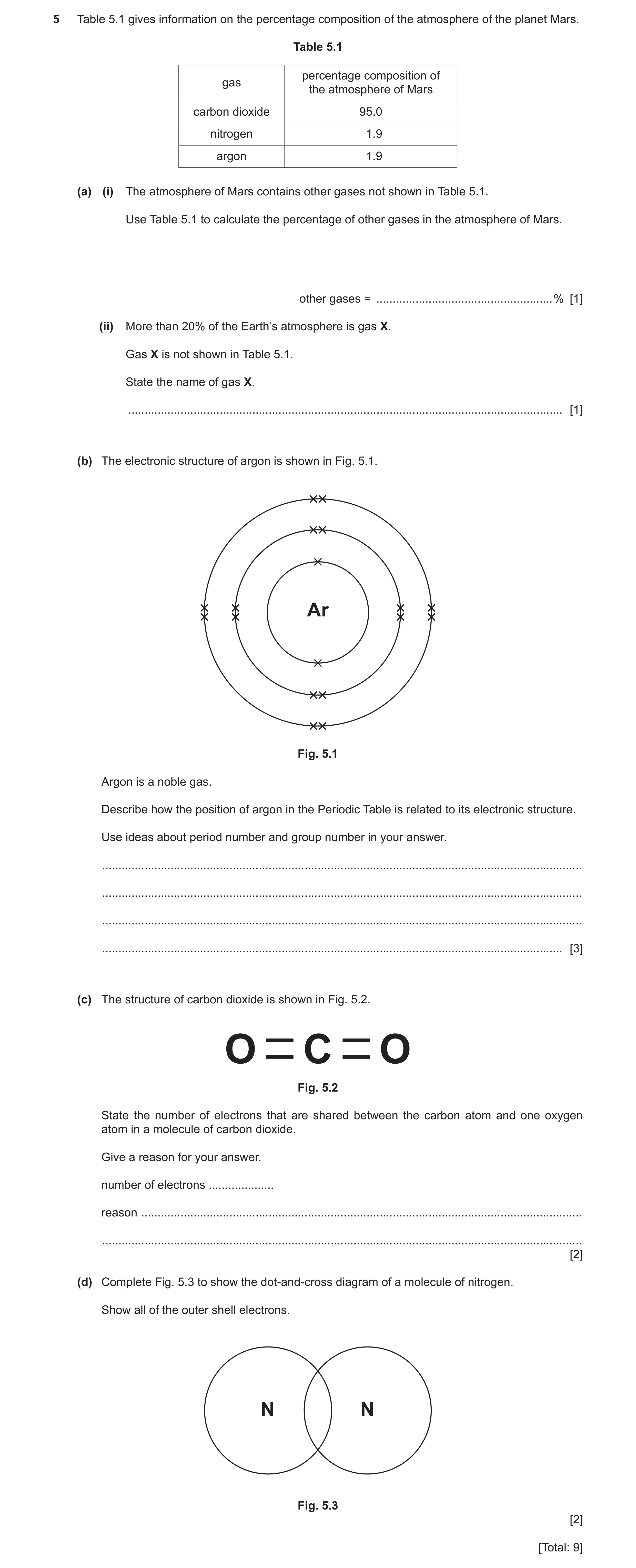
5 Table 5.1 gives information on the percentage composition of the atmosphere of the planet Mars. Table 5.1 percentage composition of gas the atmosphere of Mars carbon dioxide 95.0 nitrogen 1.9 argon 1.9 (a) (i) The atmosphere of Mars contains other gases not shown in Table 5.1. Use Table 5.1 to calculate the percentage of other gases in the atmosphere of Mars. other gases = … % [1] (ii) More than 20% of the Earth’s atmosphere is gas X. Gas X is not shown in Table 5.1. State the name of gas X. … [1] (b) The electronic structure of argon is shown in Fig. 5.1. Ar Fig. 5.1 Argon is a noble gas. Describe how the position of argon in the Periodic Table is related to its electronic structure. Use ideas about period number and group number in your answer. … … … … [3] (c) The structure of carbon dioxide is shown in Fig. 5.2. Fig. 5.2 State the number of electrons that are shared between the carbon atom and one oxygen atom in a molecule of carbon dioxide. Give a reason for your answer. number of electrons … reason … … [2] (d) Complete Fig. 5.3 to show the dot‑and‑cross diagram of a molecule of nitrogen. Show all of the outer shell electrons. N N Fig. 5.3 [2] [Total: 9]
9 marks
Mark scheme: 5(a)(i) 1.2 (%) ; 1 5(a)(ii) oxygen ; 1 5(b) in Group VIII AND period 3 ; 3 in VIII because 8 electrons in outer shell ; period 3 because 3 shells ; 5(c) 4 ; 2 it has a double bond / 2 electrons in each bond / 2 pairs of electrons are shared / oxygen shares 2 electrons and carbon shares 2 electrons ; 5(d) 2 bonding electrons correct ; non-bonding electons correct ;
This question in 0653/43 Oct/Nov 2023
Q27 · Answer the following questions using only the elements from this list 0653/42 Feb/March 2024
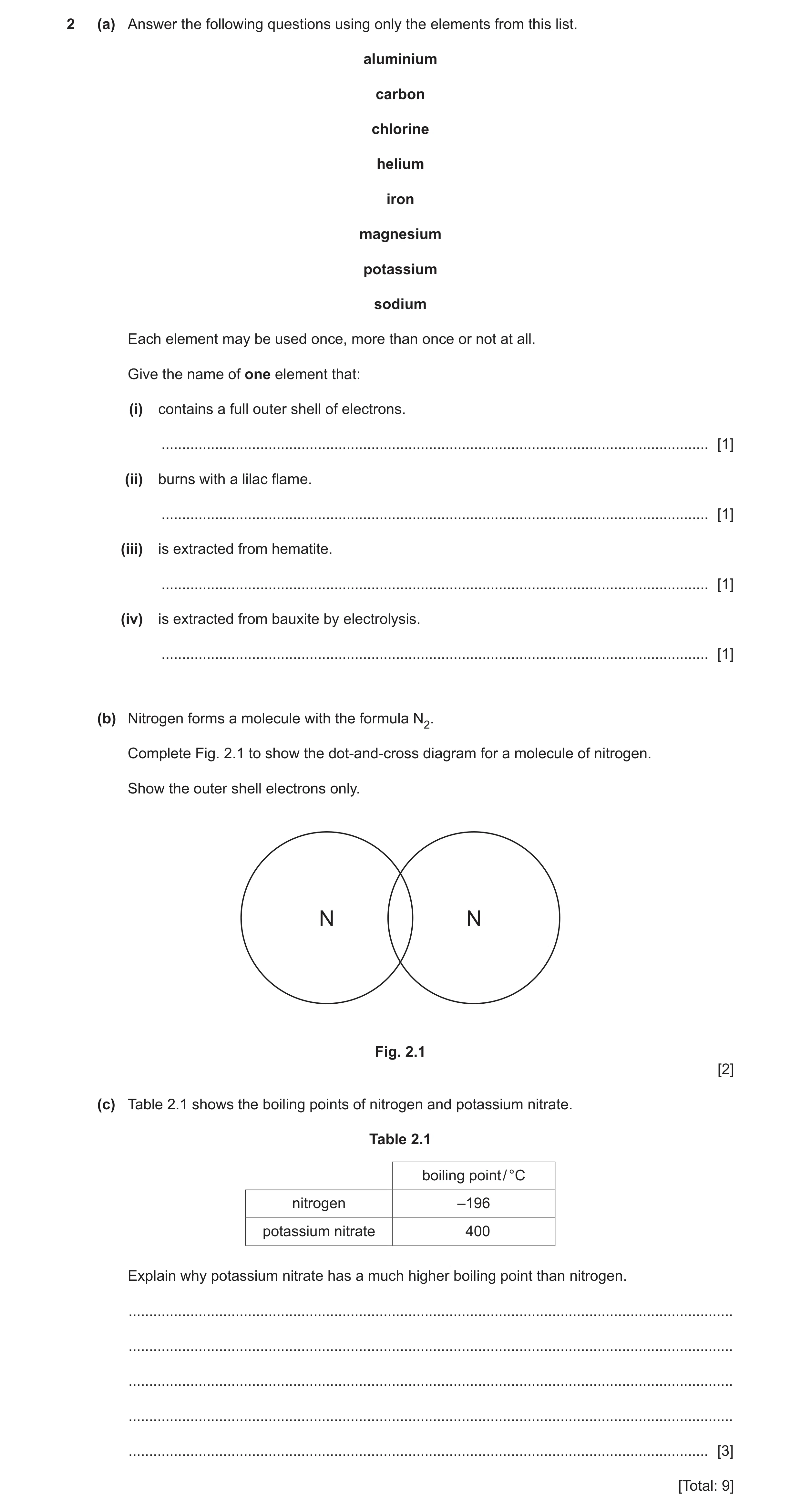
2 (a) Answer the following questions using only the elements from this list. aluminium carbon chlorine helium iron magnesium potassium sodium Each element may be used once, more than once or not at all. Give the name of one element that: (i) contains a full outer shell of electrons. … [1] (ii) burns with a lilac flame. … [1] (iii) is extracted from hematite. … [1] (iv) is extracted from bauxite by electrolysis. … [1] (b) Nitrogen forms a molecule with the formula N2. Complete Fig. 2.1 to show the dot-and-cross diagram for a molecule of nitrogen. Show the outer shell electrons only. N N Fig. 2.1 [2] (c) Table 2.1 shows the boiling points of nitrogen and potassium nitrate. Table 2.1 boiling point / °C nitrogen –196 potassium nitrate 400 Explain why potassium nitrate has a much higher boiling point than nitrogen. … … … … … [3] [Total: 9]
9 marks
Mark scheme: 2(a)(i) helium ; 1 2(a)(ii) potassium ; 1 2(a)(iii) iron ; 1 2(a)(iv) aluminium ; 1 2(b) 6 electrons shared between the two nitrogens ; 2 lone pair in each of the N atoms ; 2(c) nitrogen is, covalent / (simple) molecular and potassium nitrate is, ionic / contains ions / has a lattice structure ; 3 strong(er) attractive forces in potassium nitrate / weak(er) attractive forces in nitrogen ; more energy needed to overcome or break the attractive forces / bonds, in potassium nitrate ; ORA
This question in 0653/42 Feb/March 2024
Q28 · Oxides of nitrogen are pollutant gases formed in car engines 0653/43 May/June 2024
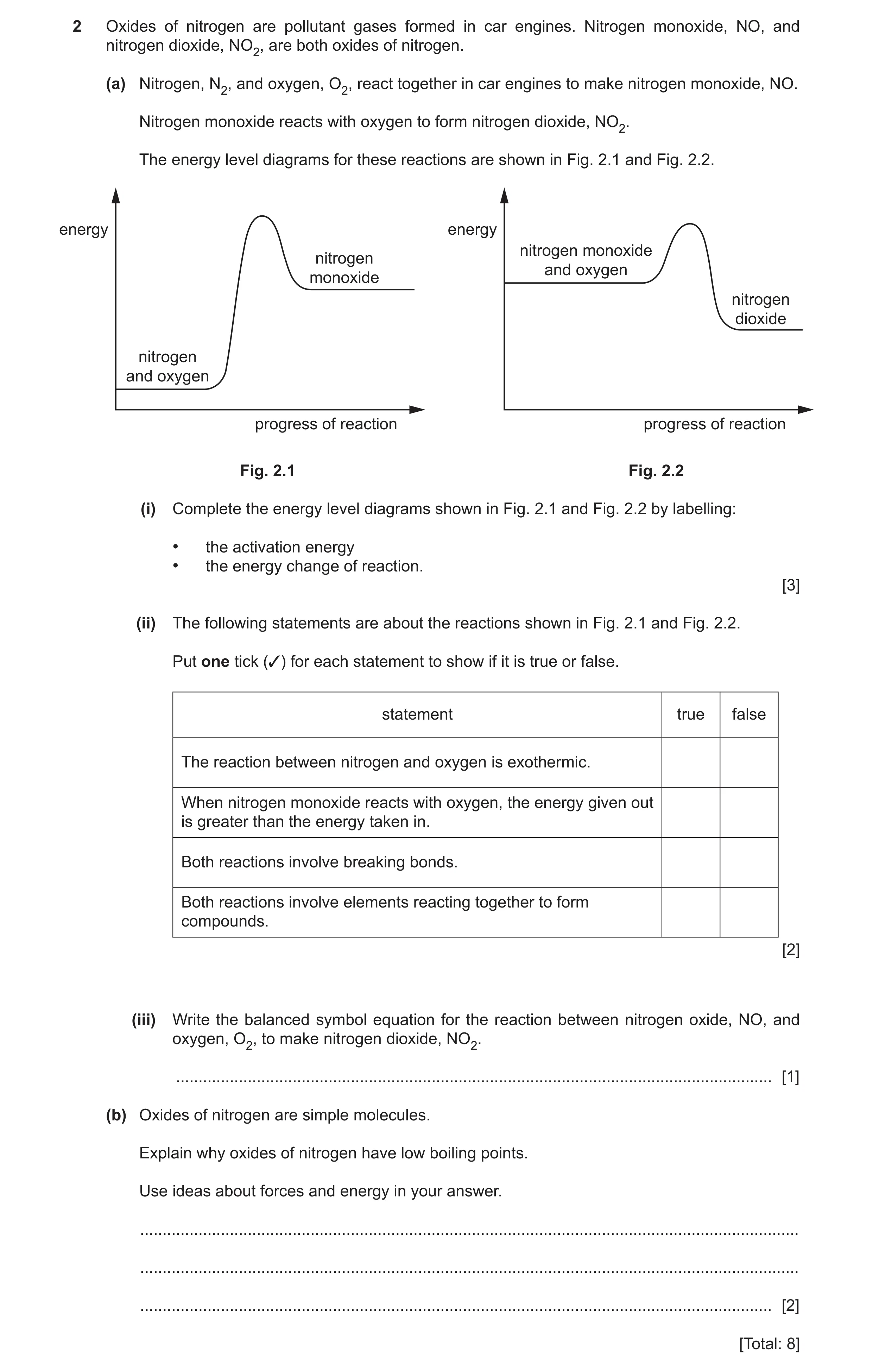
2 Oxides of nitrogen are pollutant gases formed in car engines. Nitrogen monoxide, NO, and nitrogen dioxide, NO2, are both oxides of nitrogen. (a) Nitrogen, N2, and oxygen, O2, react together in car engines to make nitrogen monoxide, NO. Nitrogen monoxide reacts with oxygen to form nitrogen dioxide, NO2. The energy level diagrams for these reactions are shown in Fig. 2.1 and Fig. 2.2. energy energy nitrogen monoxide nitrogen and oxygen monoxide nitrogen dioxide nitrogen and oxygen progress of reaction progress of reaction Fig. 2.1 Fig. 2.2 (i) Complete the energy level diagrams shown in Fig. 2.1 and Fig. 2.2 by labelling: • the activation energy • the energy change of reaction. [3] (ii) The following statements are about the reactions shown in Fig. 2.1 and Fig. 2.2. Put one tick (✓) for each statement to show if it is true or false. statement true false The reaction between nitrogen and oxygen is exothermic. When nitrogen monoxide reacts with oxygen, the energy given out is greater than the energy taken in. Both reactions involve breaking bonds. Both reactions involve elements reacting together to form compounds. [2] (iii) Write the balanced symbol equation for the reaction between nitrogen oxide, NO, and oxygen, O2, to make nitrogen dioxide, NO2. … [1] (b) Oxides of nitrogen are simple molecules. Explain why oxides of nitrogen have low boiling points. Use ideas about forces and energy in your answer. … … … [2] [Total: 8]
8 marks
Mark scheme: 2(a)(i) activation energy correctly labelled on both diagrams ; energy change of reaction shown by upward arrow for first diagram ; energy change of reaction shown by downward arrow for second diagram ; 3 Question Answer Marks 2(a)(ii) true false ;; All correct = 2 marks 2 to 3 correct = 1 mark 2 2(a)(iii) 2NO + O2 → 2NO2 ; 1 2(b) weak forces between molecules / weak intermolecular forces ; need low amounts of energy to change from liquid to gas / low amount of energy to, separate molecules / overcome / break the force ; 2
This question in 0653/43 May/June 2024
Q29 · Zinc and some zinc compounds react with dilute acids to make salts 0653/43 May/June 2024
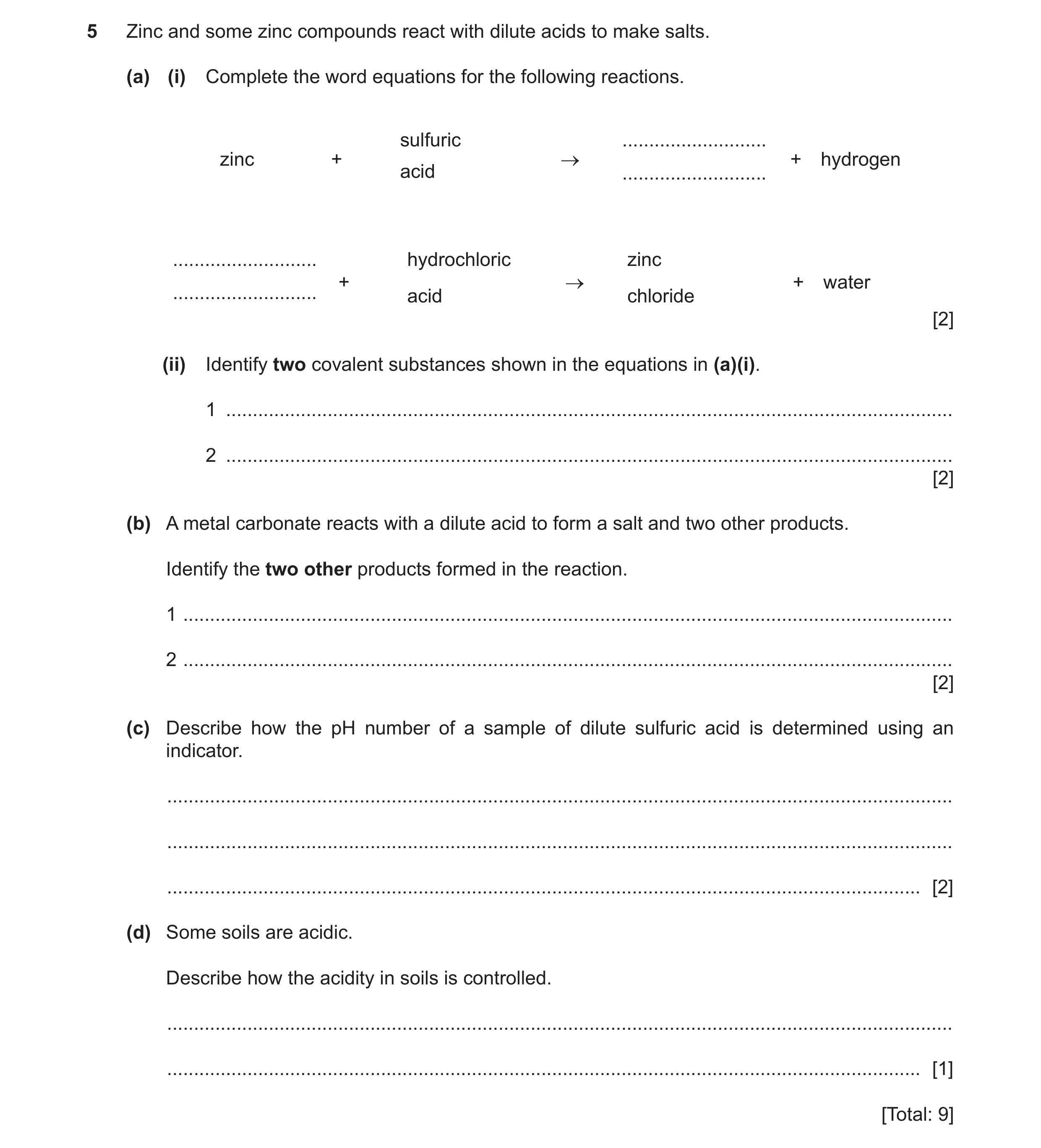
5 Zinc and some zinc compounds react with dilute acids to make salts. (a) (i) Complete the word equations for the following reactions. sulfuric … zinc + + hydrogen acid … … hydrochloric zinc + + water … acid chloride [2] (ii) Identify two covalent substances shown in the equations in (a)(i). 1 … 2 … [2] (b) A metal carbonate reacts with a dilute acid to form a salt and two other products. Identify the two other products formed in the reaction. 1 … 2 … [2] (c) Describe how the pH number of a sample of dilute sulfuric acid is determined using an indicator. … … … [2] (d) Some soils are acidic. Describe how the acidity in soils is controlled. … … [1] [Total: 9]
9 marks
Mark scheme: 5(a)(i) zinc sulfate ; zinc oxide / zinc hydroxide ; 2 5(a)(ii) hydrogen ; water ; 2 5(b) carbon dioxide ; water ; 2 Question Answer Marks 5(c) full range / universal, indicator ; compare (colours) with chart / colour corresponds to a number ; 2 5(d) add, calcium carbonate / limestone / calcium hydroxide / (slaked) lime / add a base ; 1
This question in 0653/43 May/June 2024
Q30 · The formula for methanol is CH3OH 0653/43 Oct/Nov 2024
8 (a) The formula for methanol is CH3OH. Complete the dot-and-cross diagram in Fig. 8.1 to show the bonding in methanol. Show outer-shell electrons only. H H C O H H Fig. 8.1 [3] (b) Ethene, C2H4, is an alkene. Ethane, C2H6, is an alkane. (i) State one difference in the bonding of ethene and of ethane. … … [1] (ii) The complete combustion reactions of both ethene and ethane produce carbon dioxide and water. Identify whether the statements are true or false. Tick (3) one box for each statement. true false One molecule of ethene produces the same number of molecules of carbon dioxide as one molecule of ethane. One molecule of ethene produces the same number of molecules of water as one molecule of ethane. The combustion reactions of ethene and ethane are both endothermic. [2] (c) The general formulae for alkenes and alkanes are shown in Table 8.1. Table 8.1 alkenes alkanes CnH2n CnH2n+2 Write the formula for: an alkene with 10 hydrogen atoms … an alkane with 10 hydrogen atoms. … [2] (d) Aqueous bromine is added to a sample of an alkene and to a separate sample of an alkane. State the colour of each sample after the aqueous bromine is added. alkene … alkane … [2] [Total: 10]
10 marks
Mark scheme: 8(a) 3 four pairs bonding electrons around carbon correct ; one bonding pair between oxygen and hydrogen (O-H bond) correct ; four non-bonding electrons on oxygen shell AND no extra electrons (on hydrogen) ; 8(b)(i) ethene, has a double bond / shares 4 electrons OR 1 ethane, has only single bonds / has single bond between carbons / shares 2 electrons ; 8(b)(ii) 2 two correct ; three correct ; 8(c) alkene C5H10 ; 2 alkane C4H10 ; 8(d) alkene no colour / colourless ; 2 alkane orange ;
This question in 0653/43 Oct/Nov 2024
Q31 · Information about three compounds, A, B and C 0653/43 May/June 2025
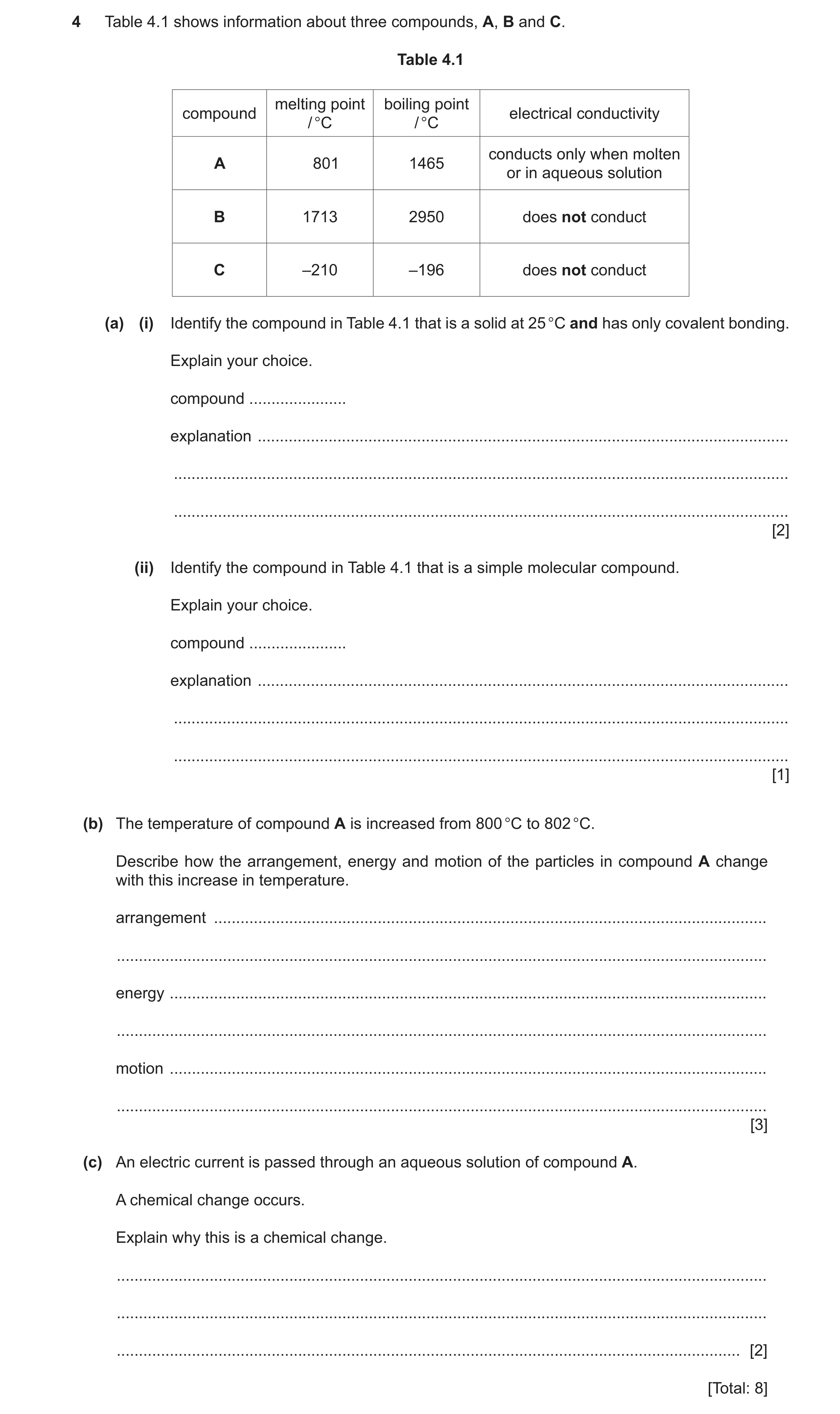
4 Table 4.1 shows information about three compounds, A, B and C. Table 4.1 melting point boiling point compound electrical conductivity / °C / °C conducts only when molten A 801 1465 or in aqueous solution B 1713 2950 does not conduct C –210 –196 does not conduct (a) (i) Identify the compound in Table 4.1 that is a solid at 25 °C and has only covalent bonding. Explain your choice. compound … explanation … … … [2] (ii) Identify the compound in Table 4.1 that is a simple molecular compound. Explain your choice. compound … explanation … … … [1] (b) The temperature of compound A is increased from 800 °C to 802 °C. Describe how the arrangement, energy and motion of the particles in compound A change with this increase in temperature. arrangement … … energy … … motion … … [3] (c) An electric current is passed through an aqueous solution of compound A. A chemical change occurs. Explain why this is a chemical change. … … … [2] [Total: 8]
8 marks
Mark scheme: 4(a)(i) (compound) B (no mark) 2 high MP (and BP) or MP (and BP) above 25 °C ; (and) does not conduct electricity ; 4(a)(ii) (compound) C and is a gas (at room temperature) / has a low BP (and MP) ; 1 4(b) arrangement: from regular to random ; 3 energy: increases ; motion: from fixed / vibrating, to, moving over each other / sliding over each other / moving around / moving freely ; 4(c) compound A breaks down / electrolysis happens ; 2 elements (from the compound) are formed ;
This question in 0653/43 May/June 2025
Q32 · The structure of ethene 0653/41 Oct/Nov 2025
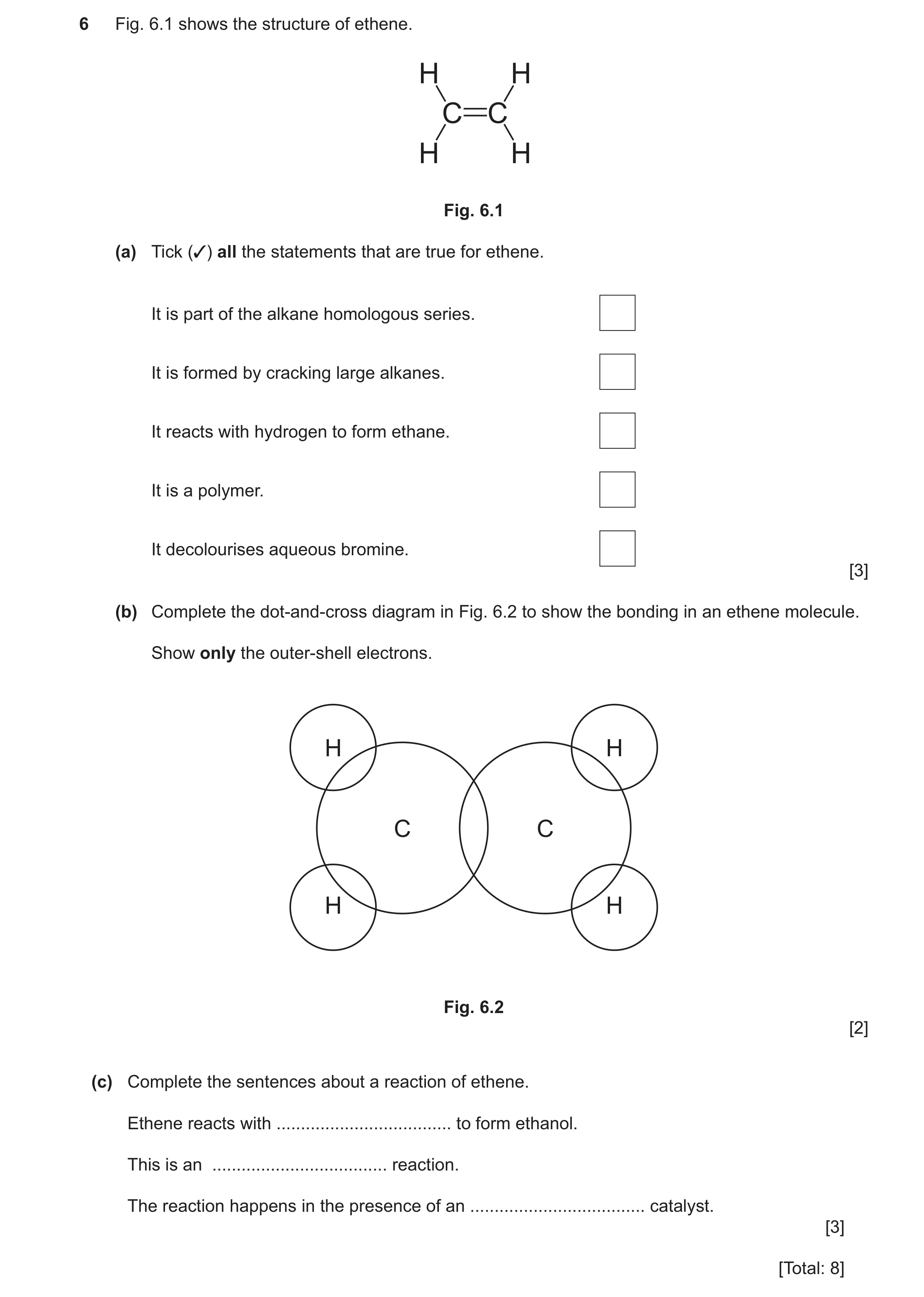
6 Fig. 6.1 shows the structure of ethene. H H C C H H Fig. 6.1 (a) Tick (✓) all the statements that are true for ethene. It is part of the alkane homologous series. It is formed by cracking large alkanes. It reacts with hydrogen to form ethane. It is a polymer. It decolourises aqueous bromine. [3] (b) Complete the dot-and-cross diagram in Fig. 6.2 to show the bonding in an ethene molecule. Show only the outer-shell electrons. H H C C H H Fig. 6.2 [2] (c) Complete the sentences about a reaction of ethene. Ethene reacts with … to form ethanol. This is an … reaction. The reaction happens in the presence of an … catalyst. [3] [Total: 8]
8 marks
Mark scheme: 6(a) ticks for: 3 is formed by cracking large alkanes (box 2); reacts with hydrogen to form ethane (box 3); decolourises aqueous bromine (box 5) ; 6(b) bonding pair between each hydrogen and carbon and no extra electrons anywhere ; 2 two bonding pairs between the carbons ; 6(c) steam ; 3 addition ; acid ;
This question in 0653/41 Oct/Nov 2025
Q33 · Group VII elements are known as the halogens 0653/43 Oct/Nov 2025
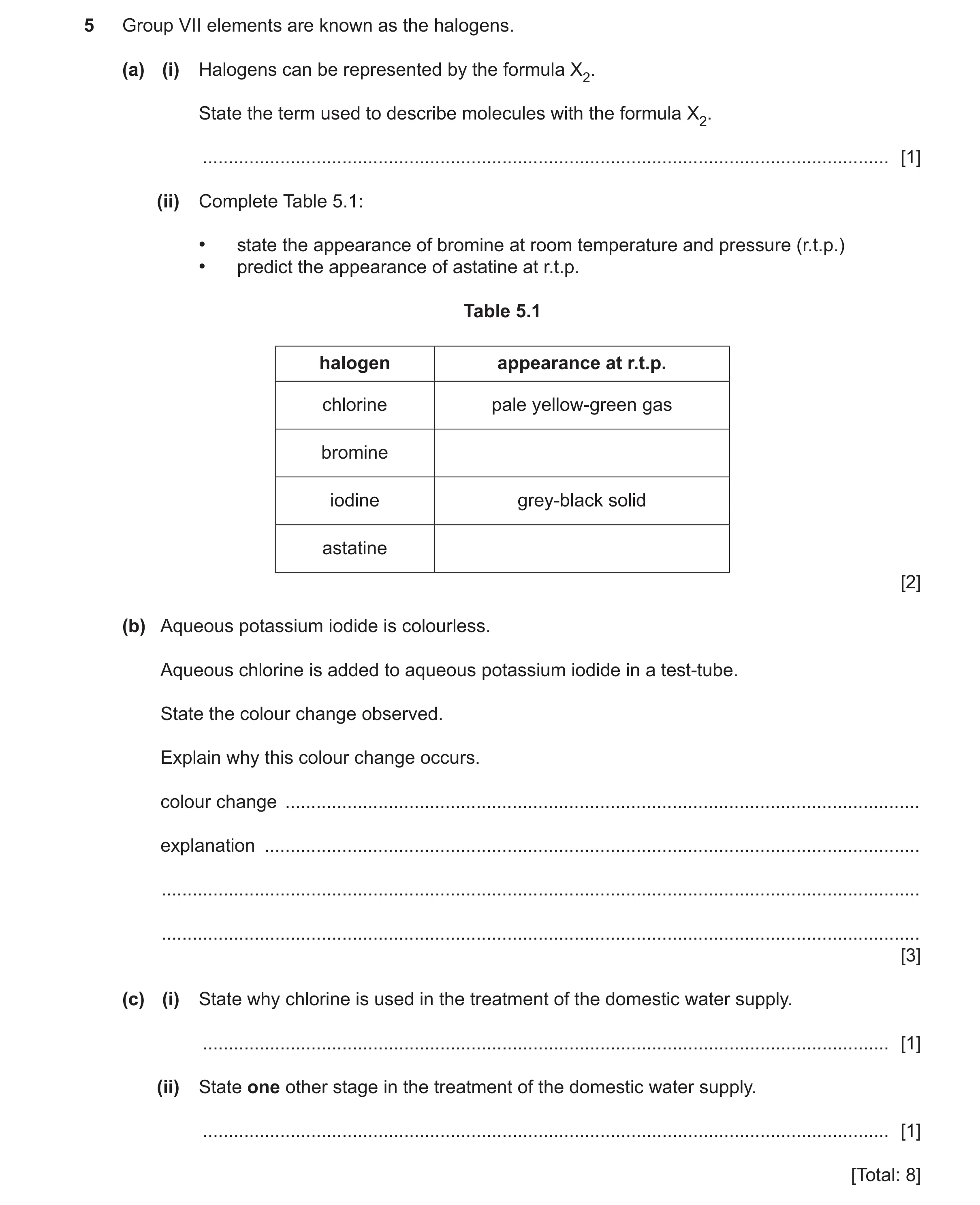
5 Group VII elements are known as the halogens. (a) (i) Halogens can be represented by the formula X2. State the term used to describe molecules with the formula X2. … [1] (ii) Complete Table 5.1: • state the appearance of bromine at room temperature and pressure (r.t.p.) • predict the appearance of astatine at r.t.p. Table 5.1 halogen appearance at r.t.p. chlorine pale yellow-green gas bromine iodine grey-black solid astatine [2] (b) Aqueous potassium iodide is colourless. Aqueous chlorine is added to aqueous potassium iodide in a test-tube. State the colour change observed. Explain why this colour change occurs. colour change … explanation … … … [3] (c) (i) State why chlorine is used in the treatment of the domestic water supply. … [1] (ii) State one other stage in the treatment of the domestic water supply. … [1] [Total: 8]
8 marks
Mark scheme: 5(a)(i) diatomic ; 1 5(a)(ii) bromine – red-brown and liquid ; 2 astatine – black and solid ; 5(b) colour change: (from colourless) to brown ; 3 explanation: any two from: chlorine is more reactive than iodine ; chlorine displaces iodine ; iodine forms ; 5(c)(i) to kill microbes/pathogens/bacteria ; 1 5(c)(ii) sedimentation / filtration / addition/use of carbon ; 1
This question in 0653/43 Oct/Nov 2025
 1 / 45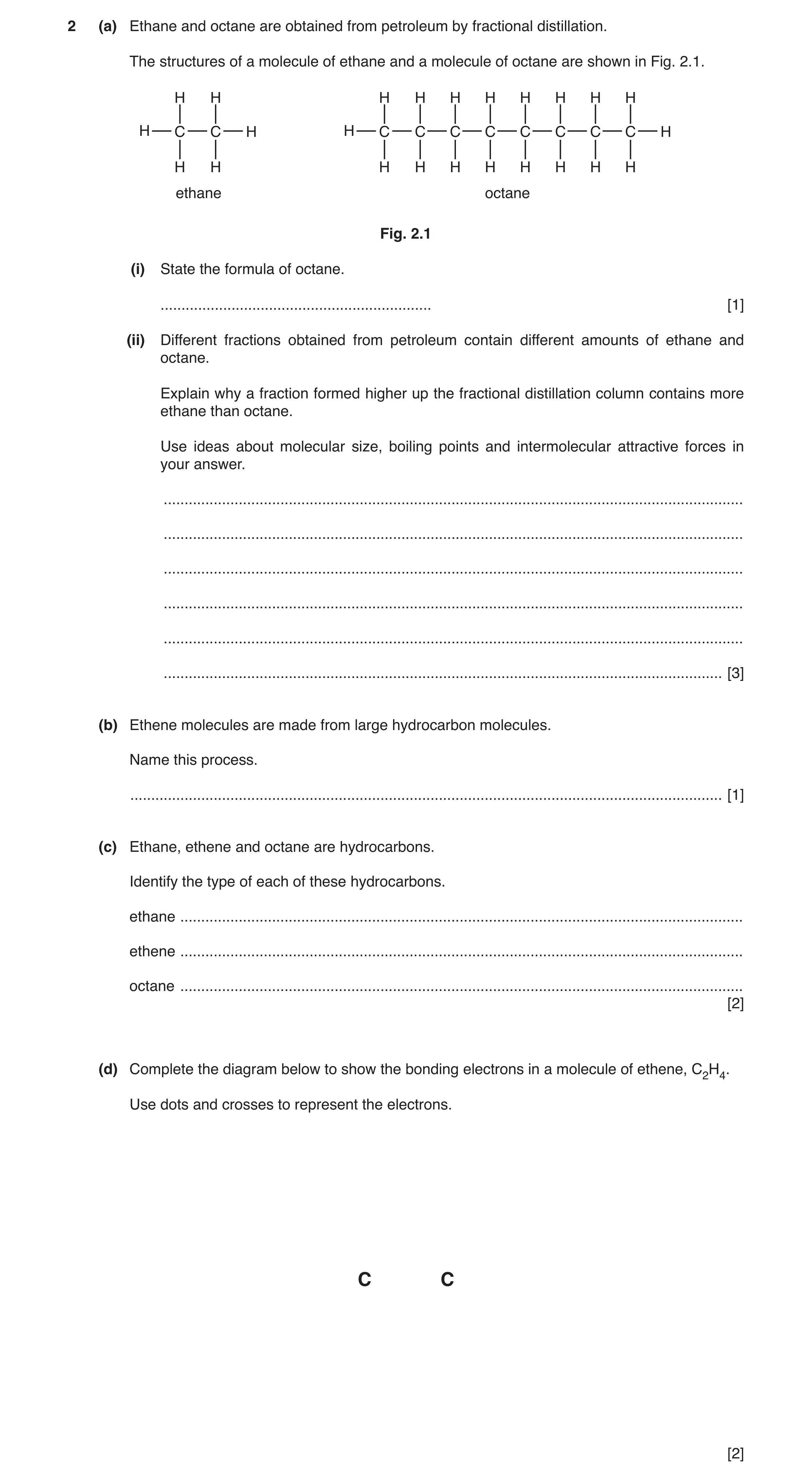
![Question 3: (a) (i) The atomic number of oxygen is 8. Complete Fig. 8.1 to show the electronic structure of an oxygen atom. nucleus Fig. 8.1 [1] (ii) C…](https://img.pastlit.com/crops/dd8e93b1-797b-4e9c-bf64-1ae7704e8796/q8.webp)
 13 / 45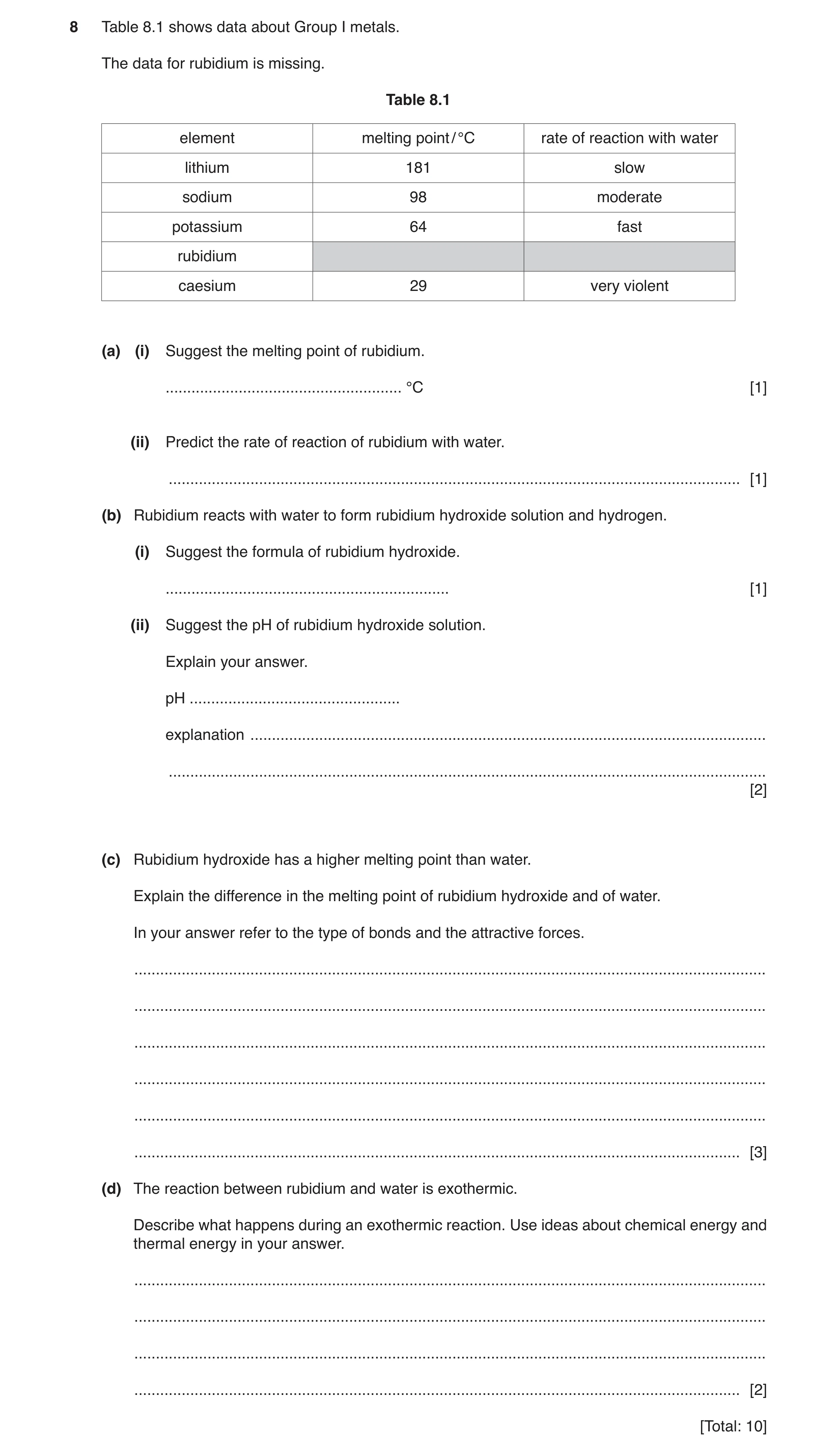
![Question 12: (a) The formula of methanol is CH3OH. Complete the structure of a molecule of methanol. Include all atoms and all bonds. C O [1] (b) (i) Ex…](https://img.pastlit.com/crops/ce89baf8-7d64-4617-851e-c29da4d5ba90/q2.webp) 16 / 45
16 / 45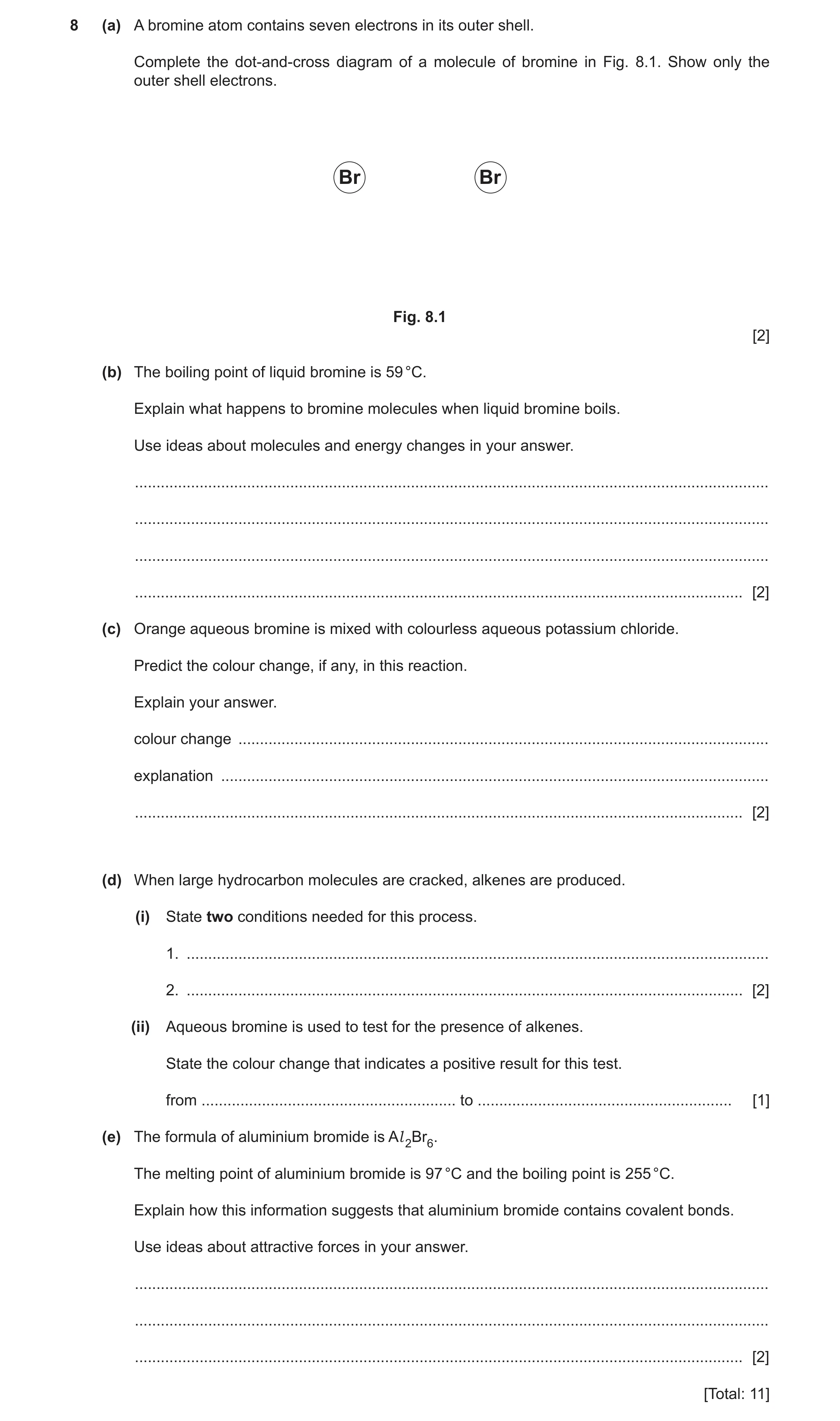
 40 / 45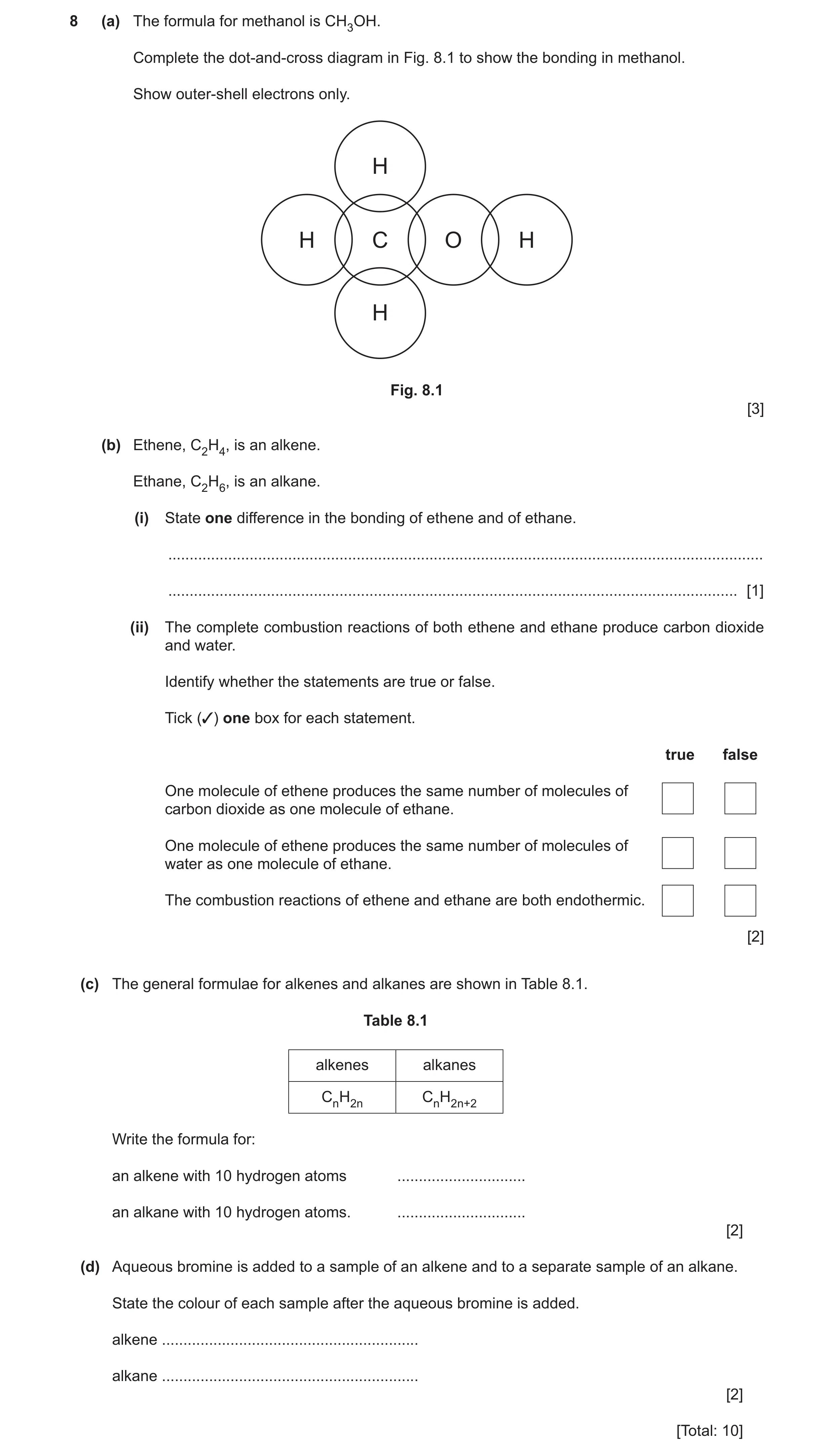
 44 / 45
 45 / 45
 8
8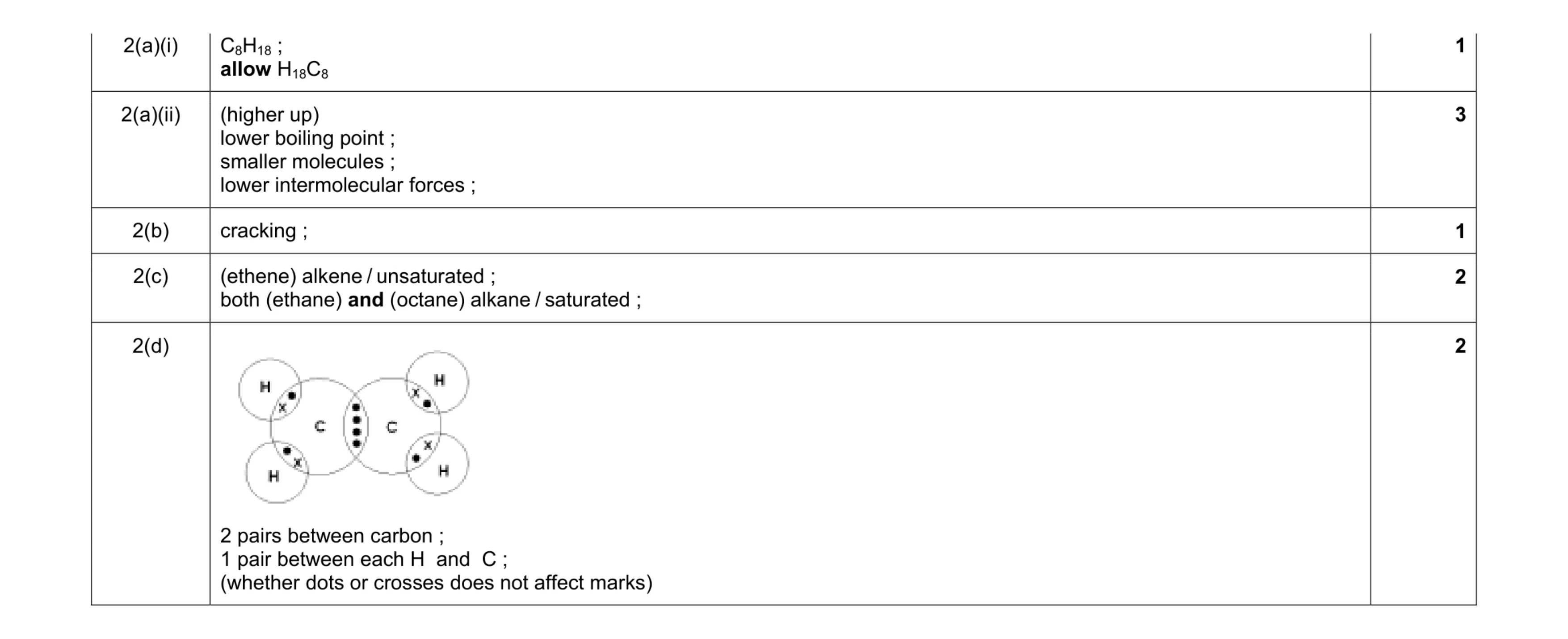 9
9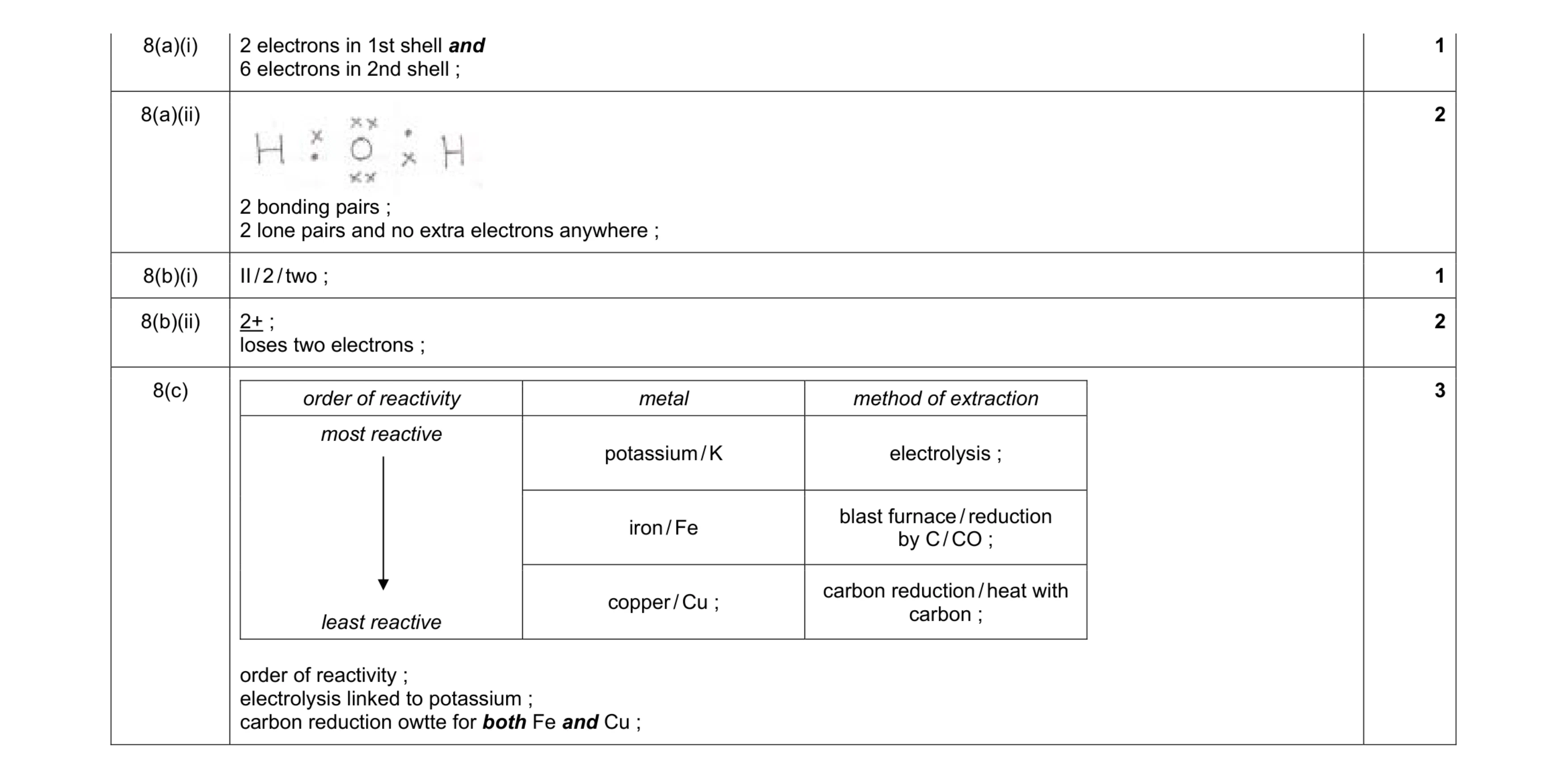 9
9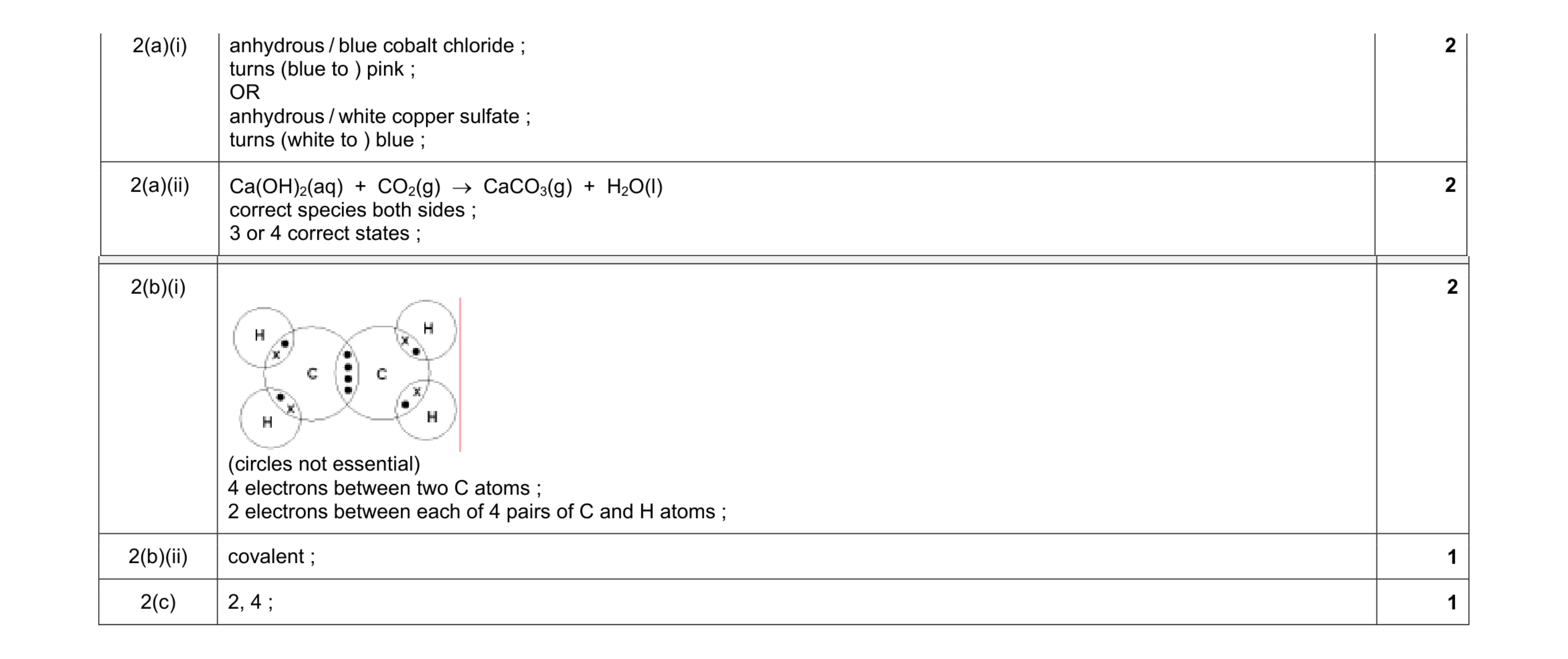 8
8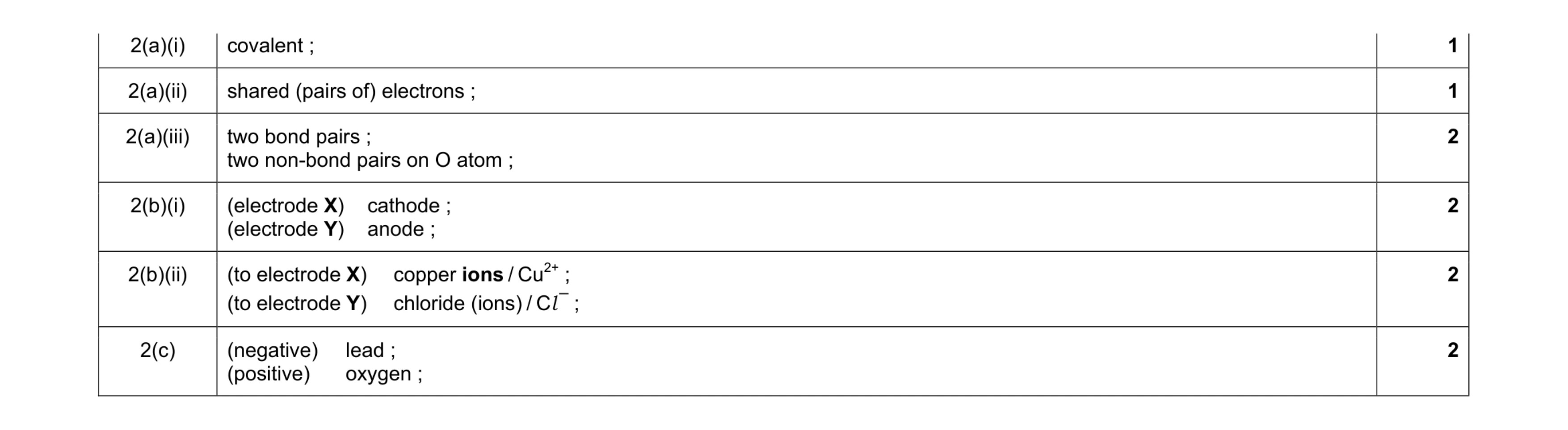 10
10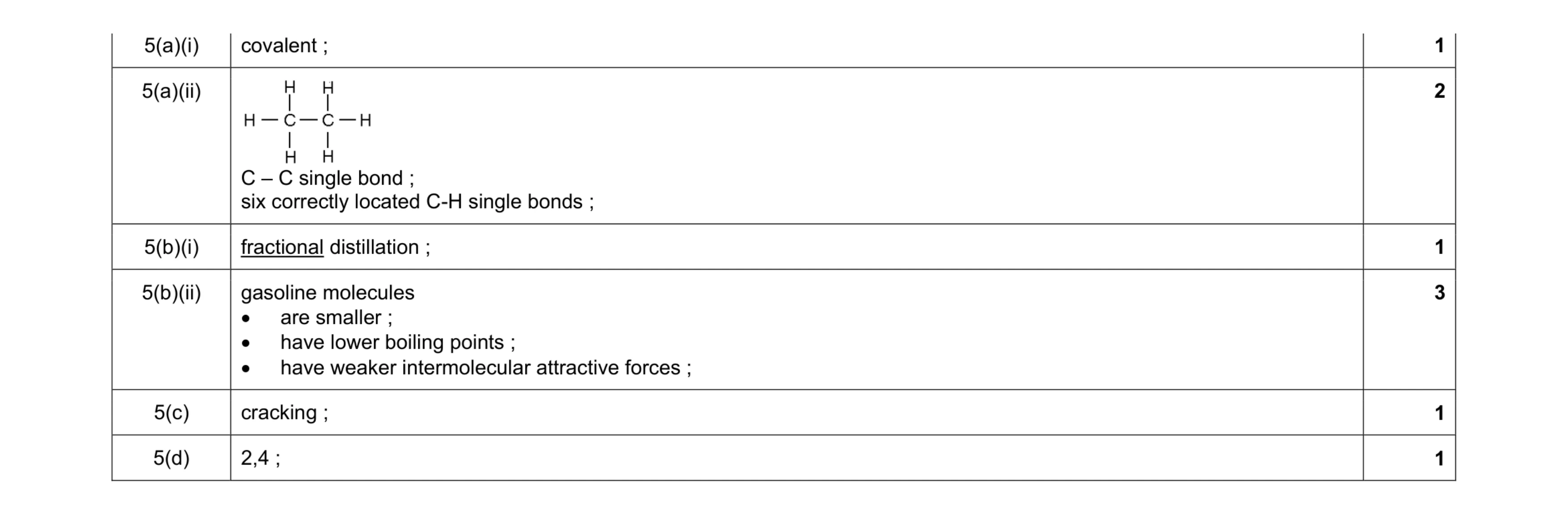 9
9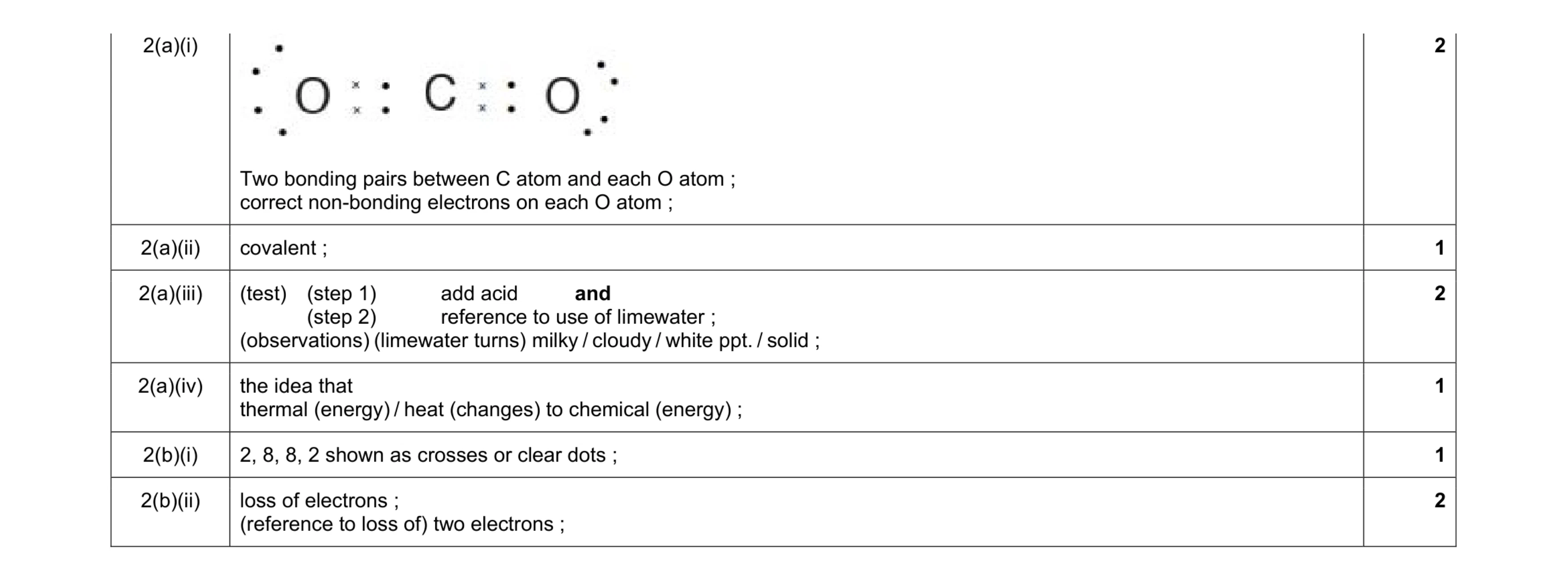 9
9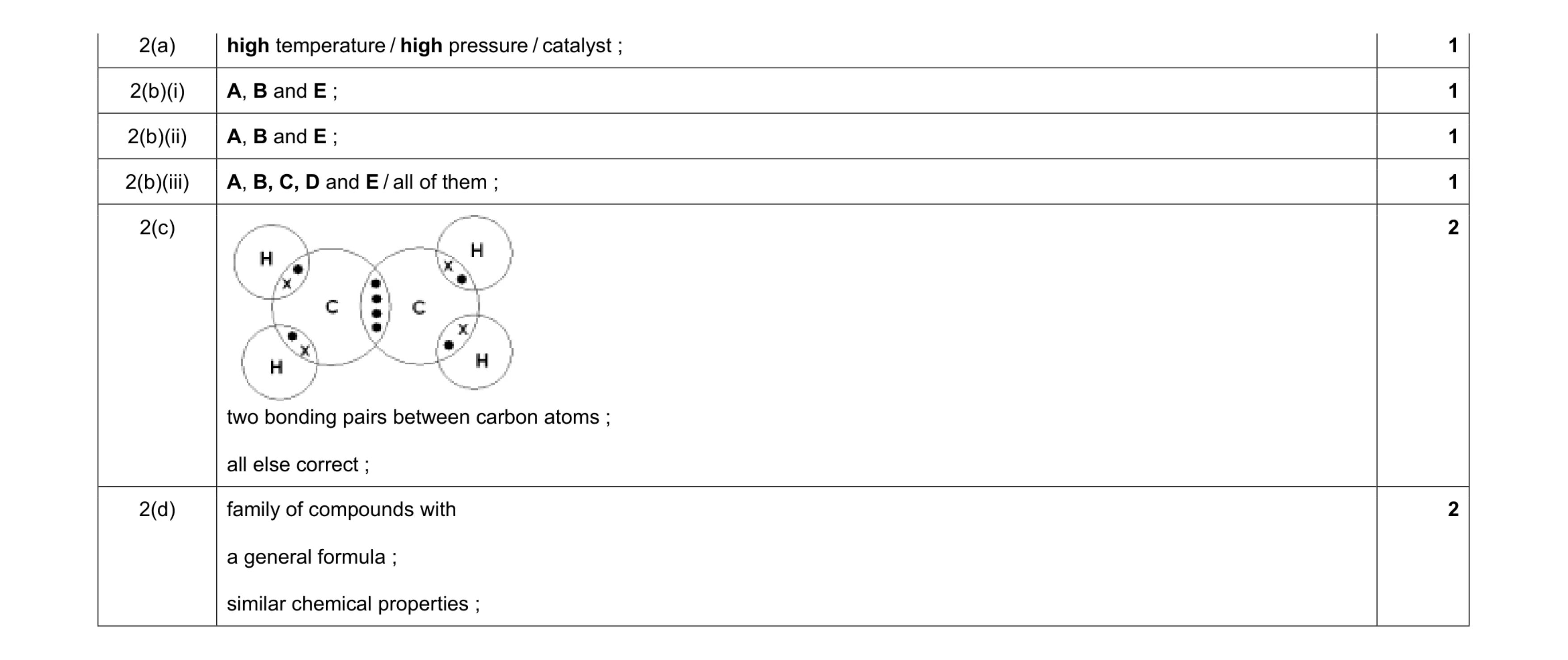 8
8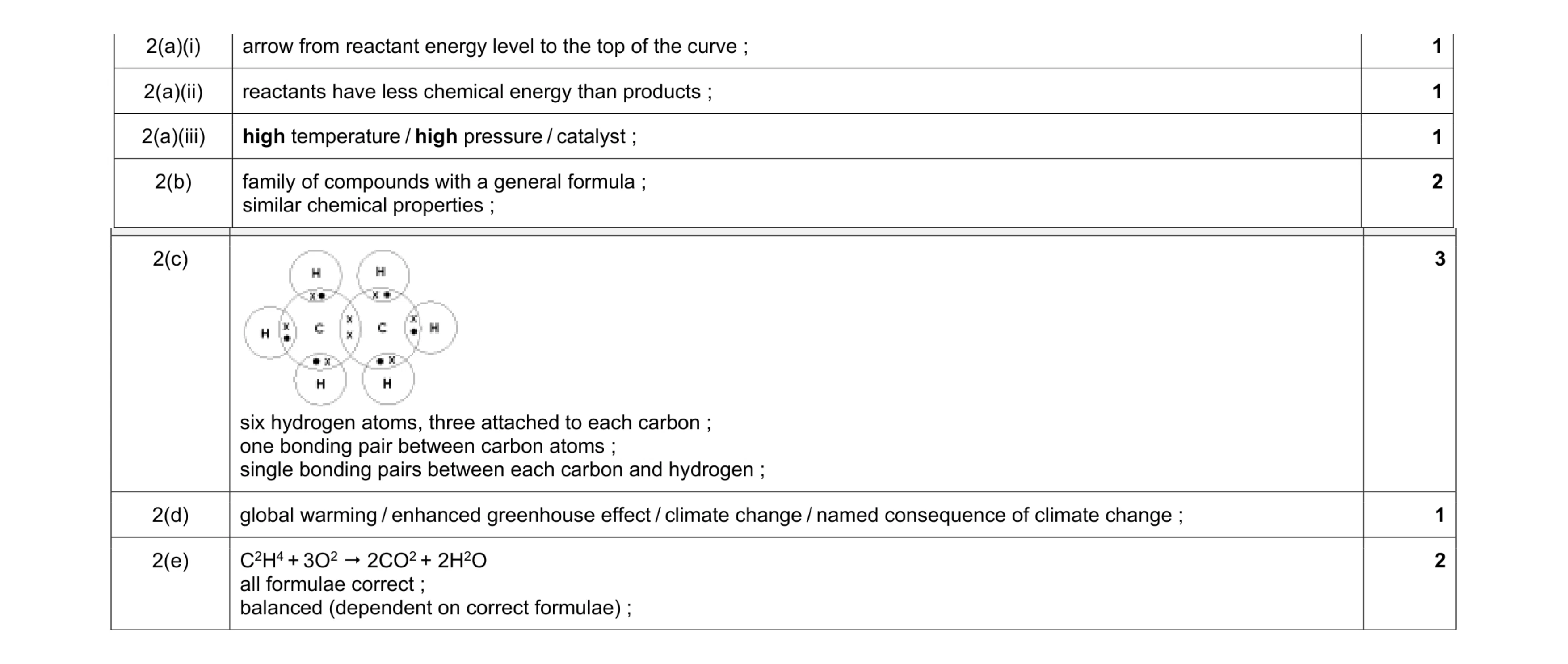 11
11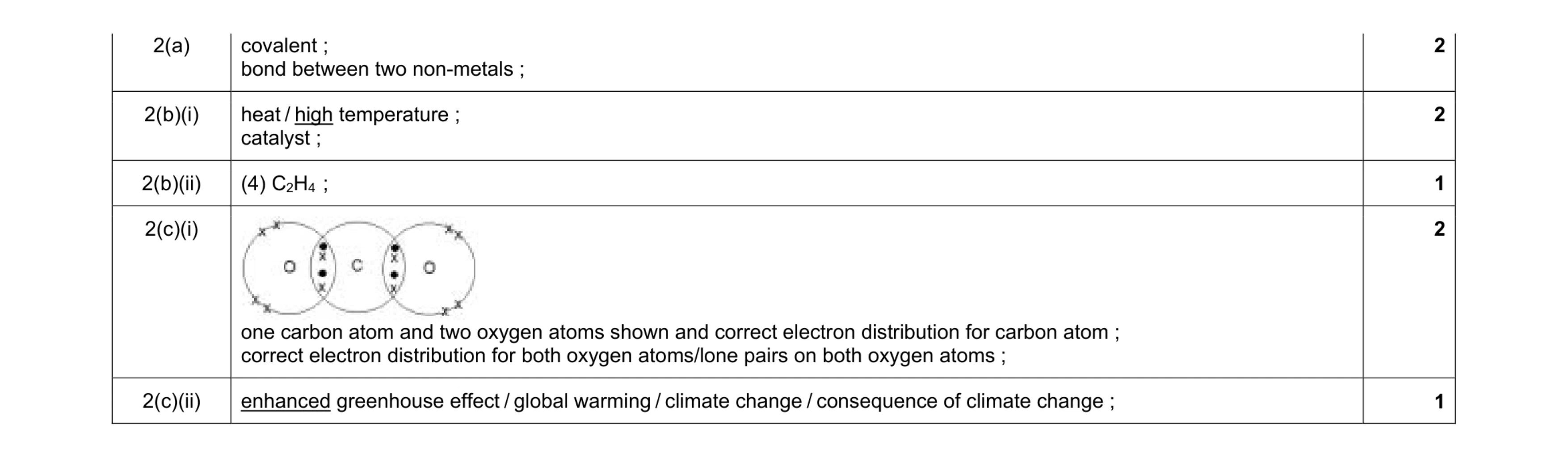 8
8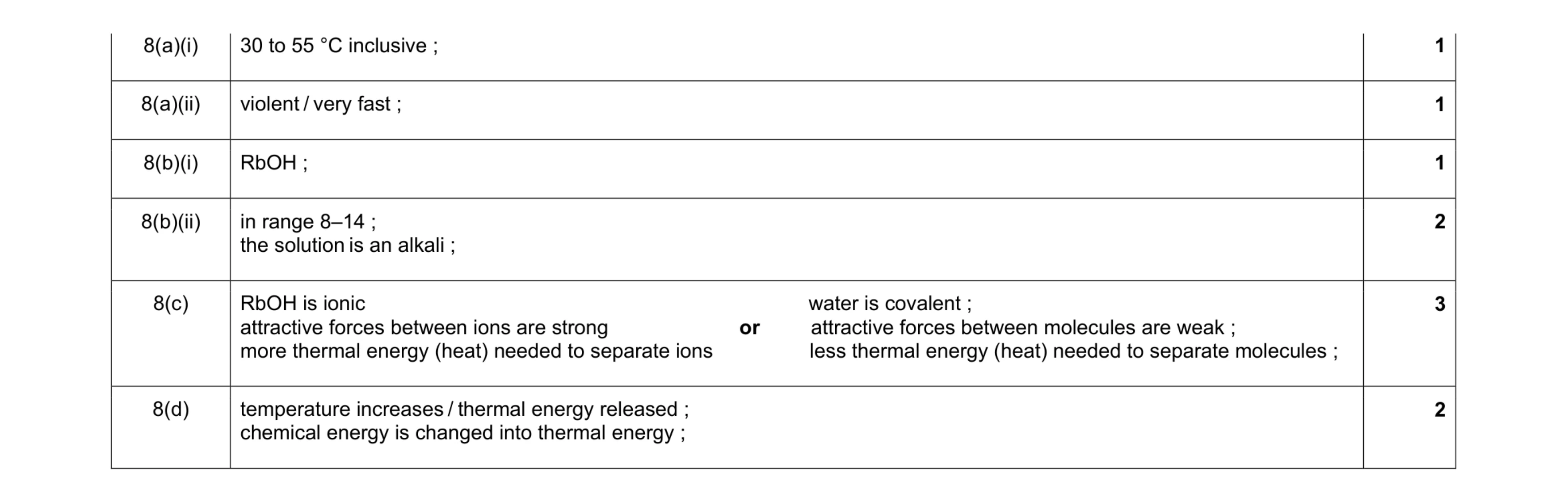 10
10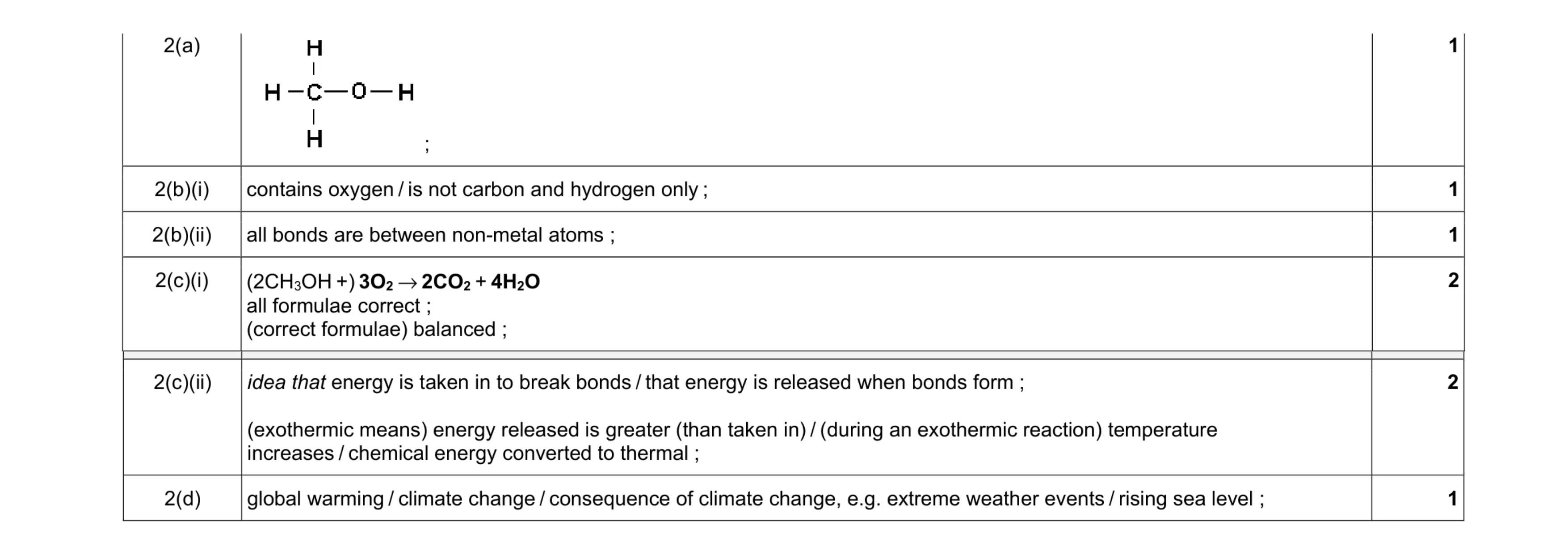 8
8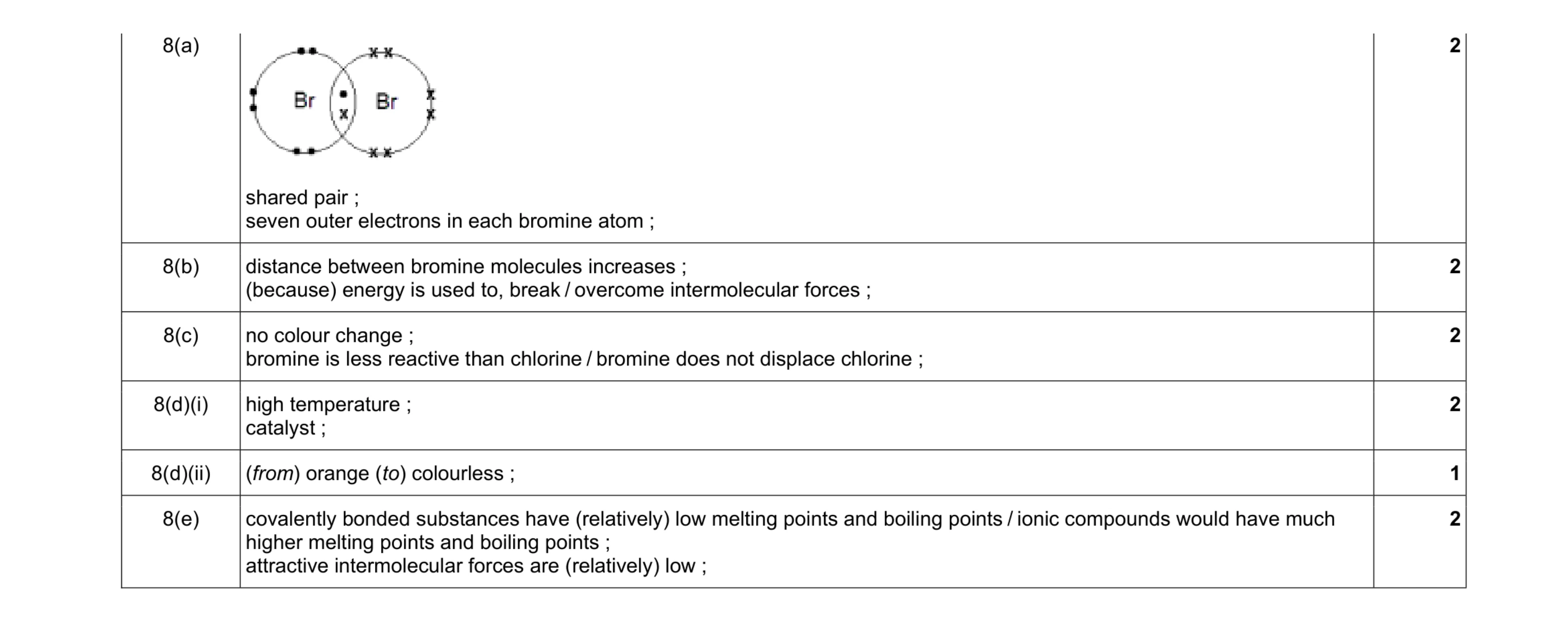 11
11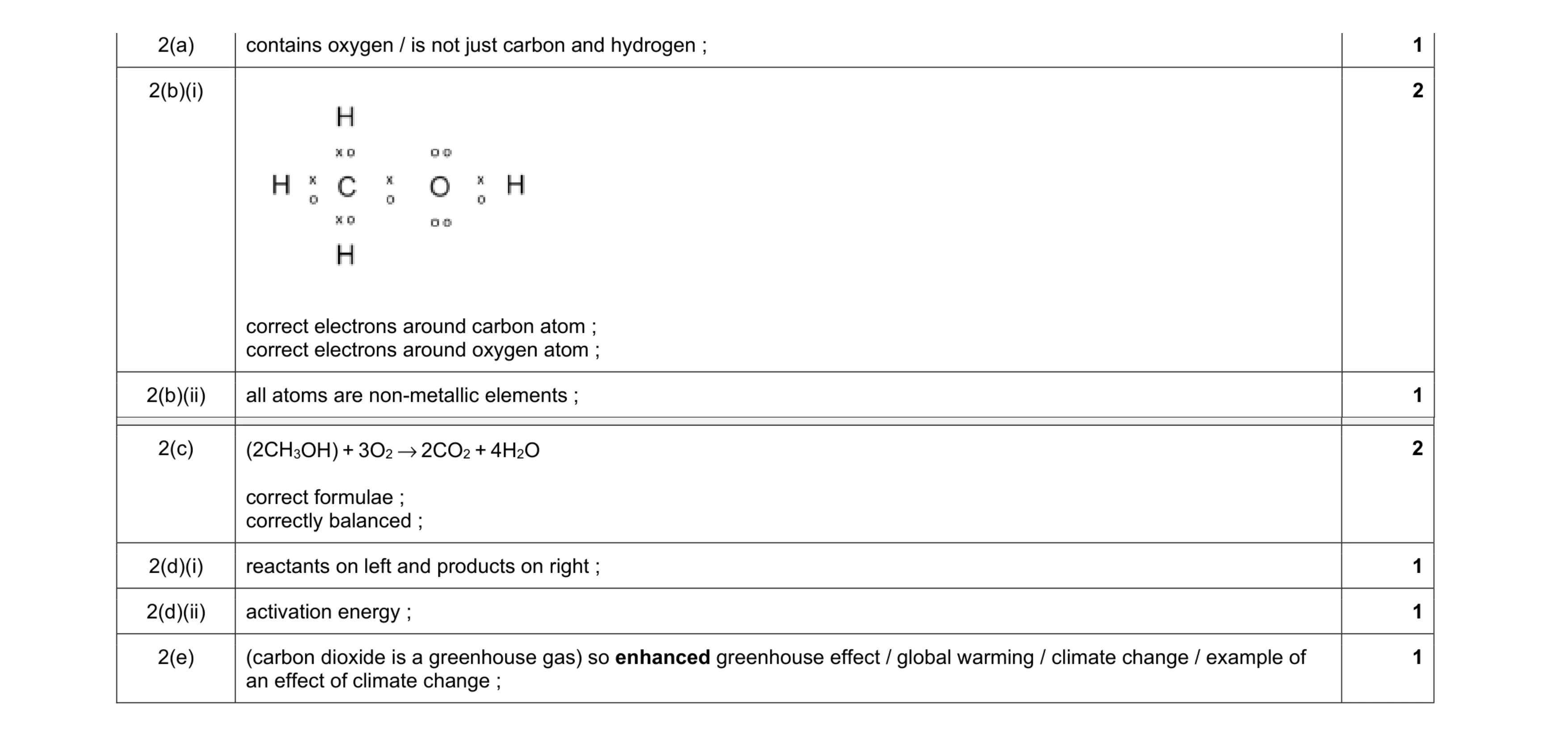 9
9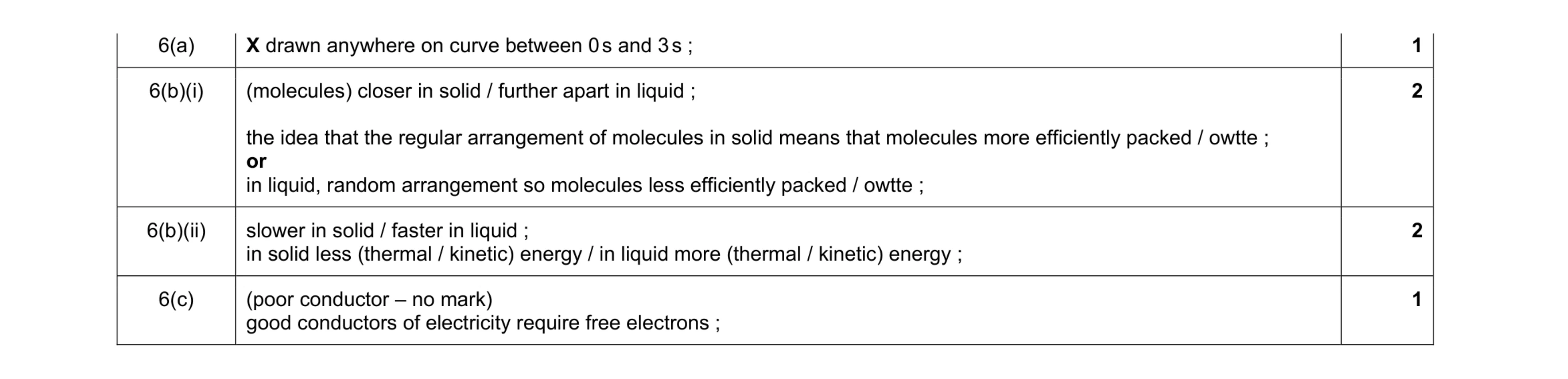 6
6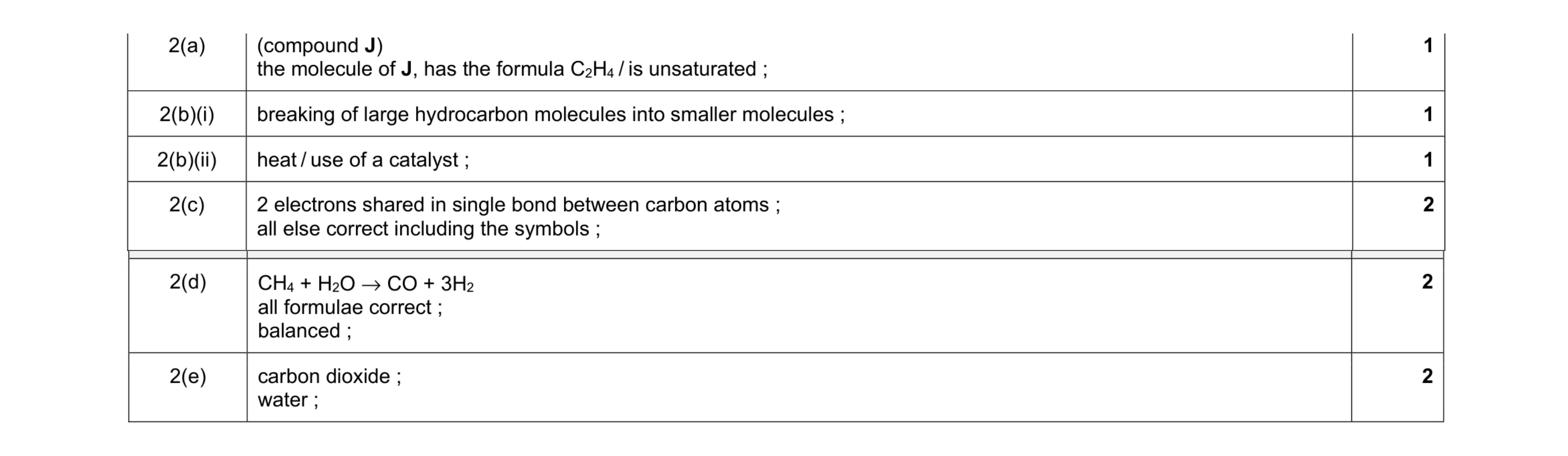 9
9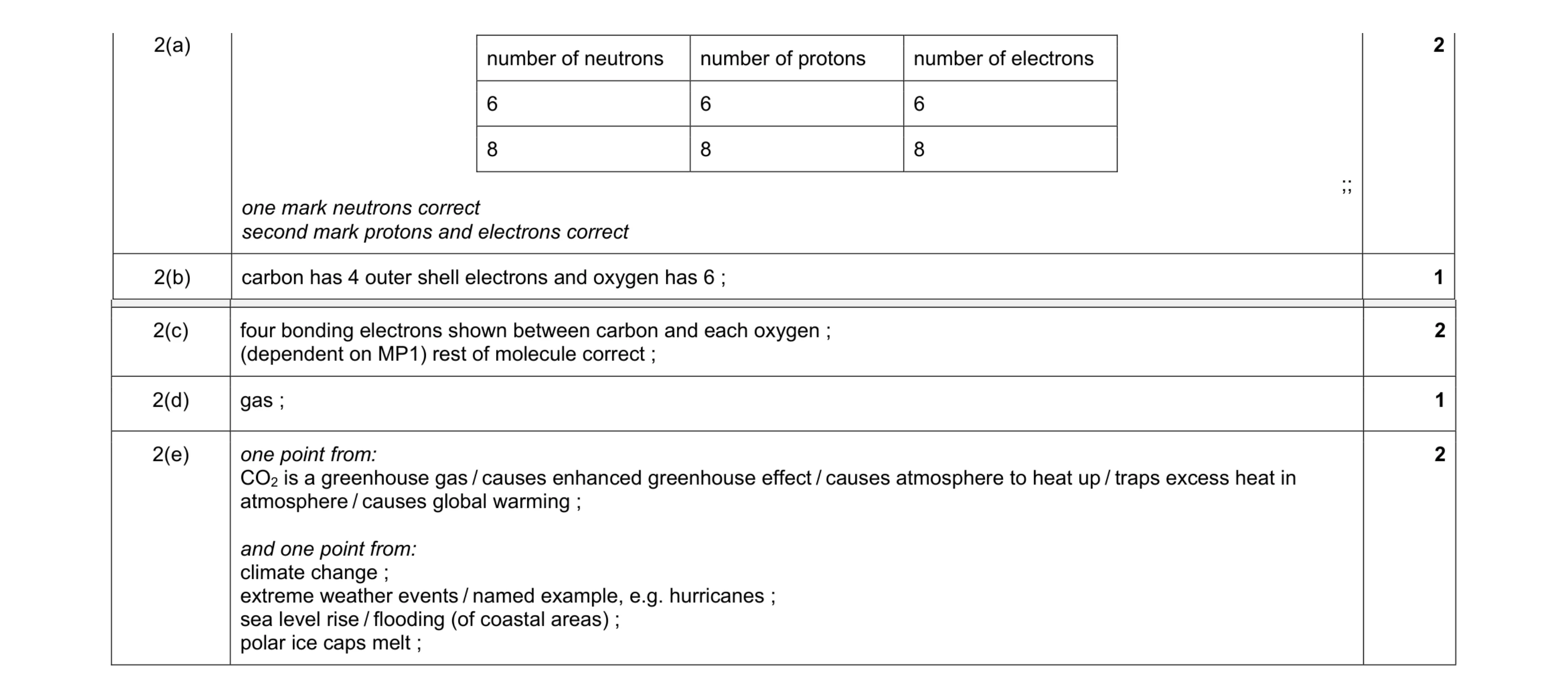 8
8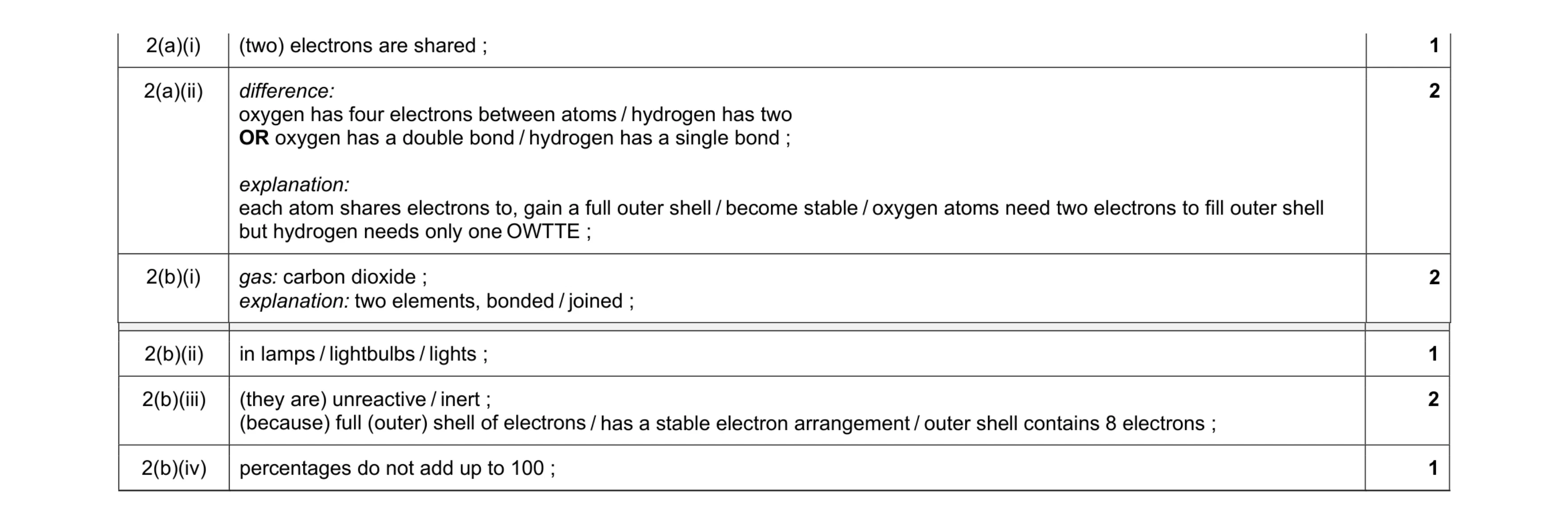 9
9 9
9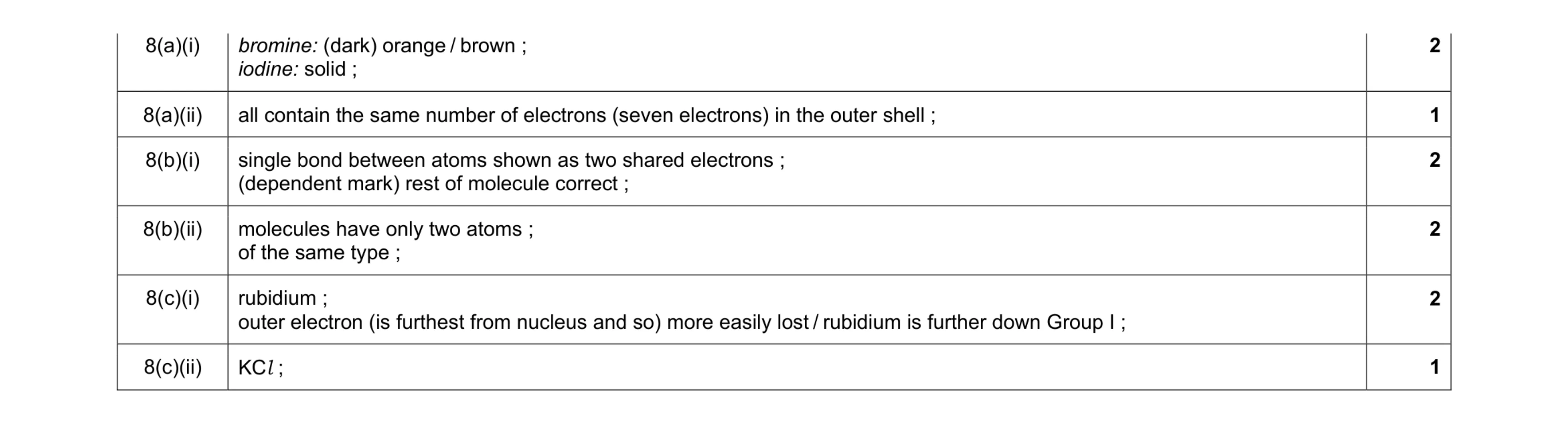 10
10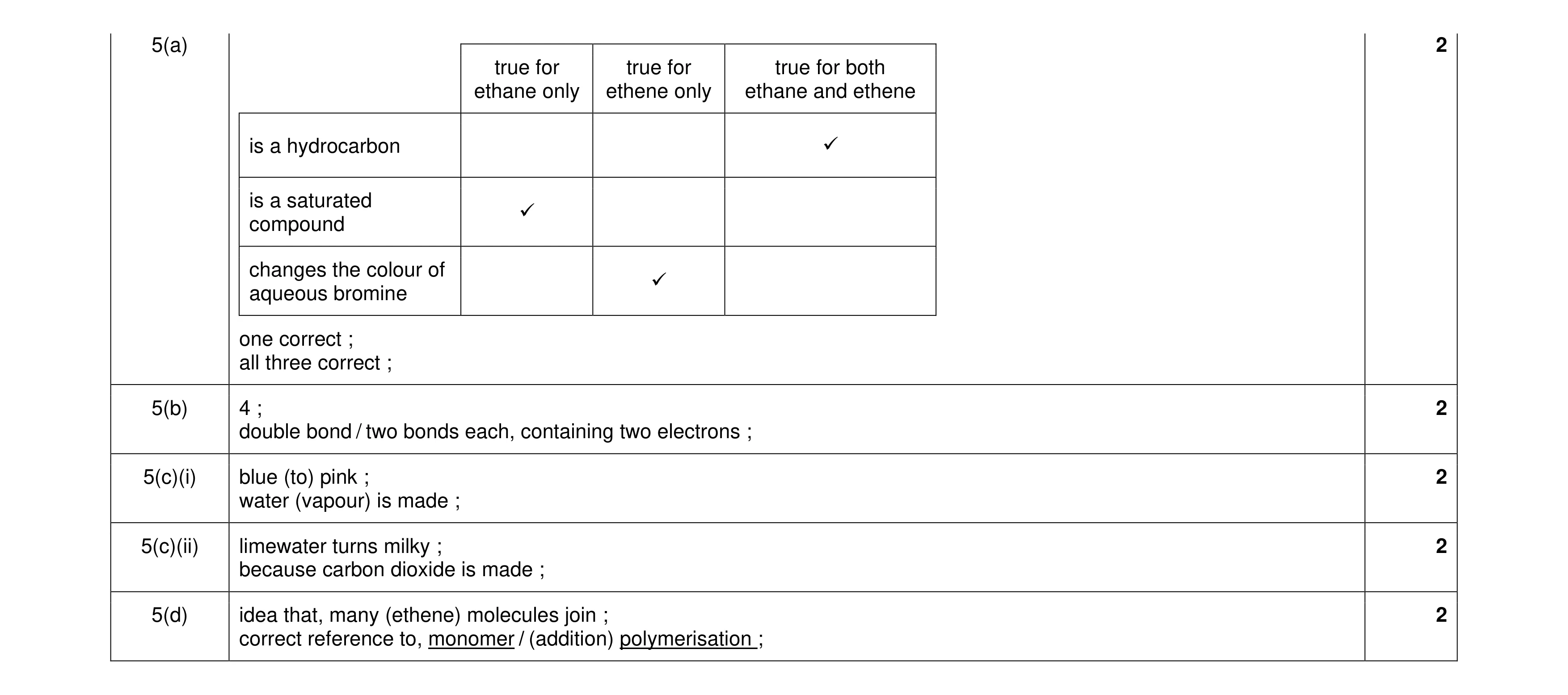 10
10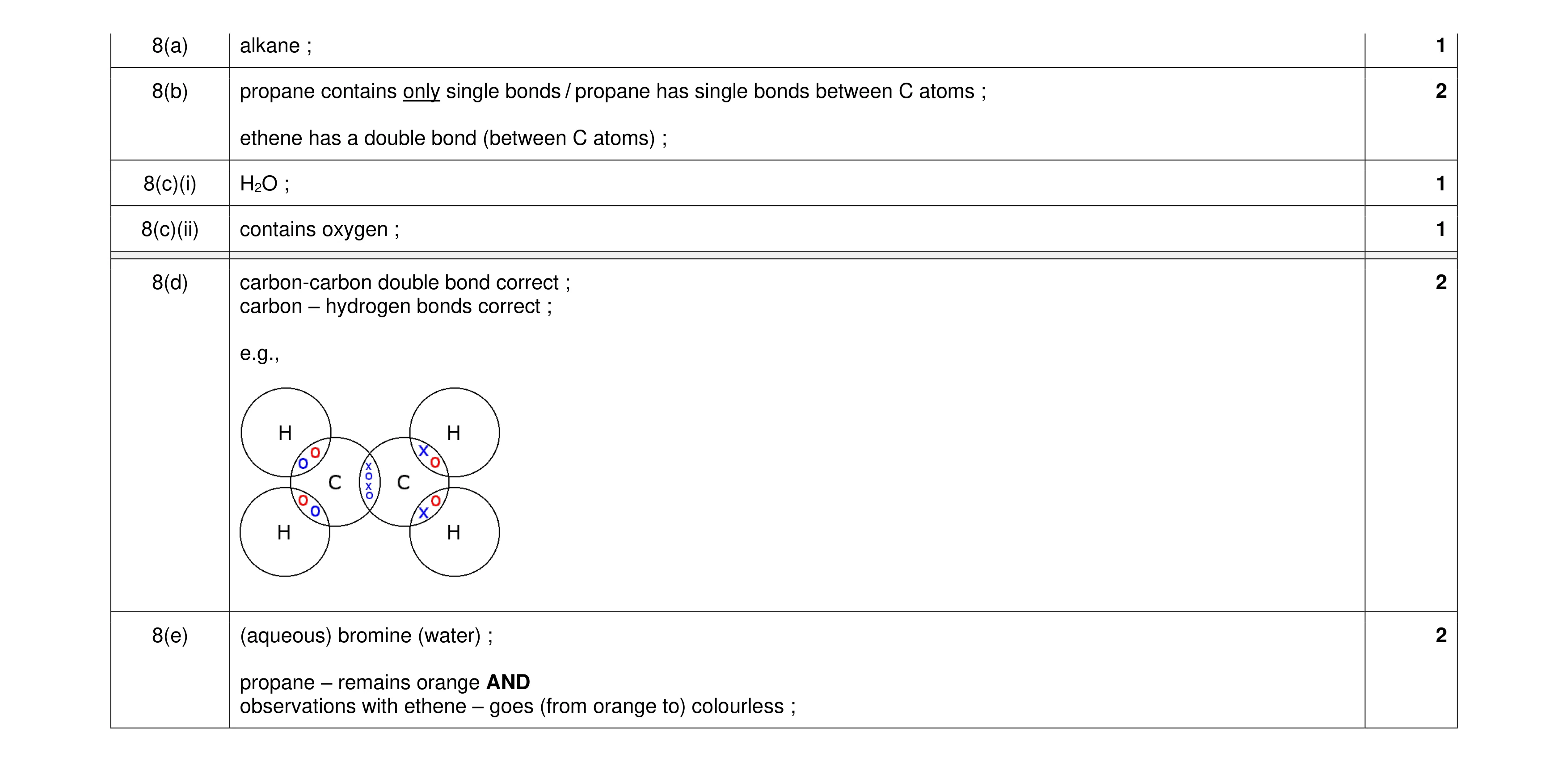 9
9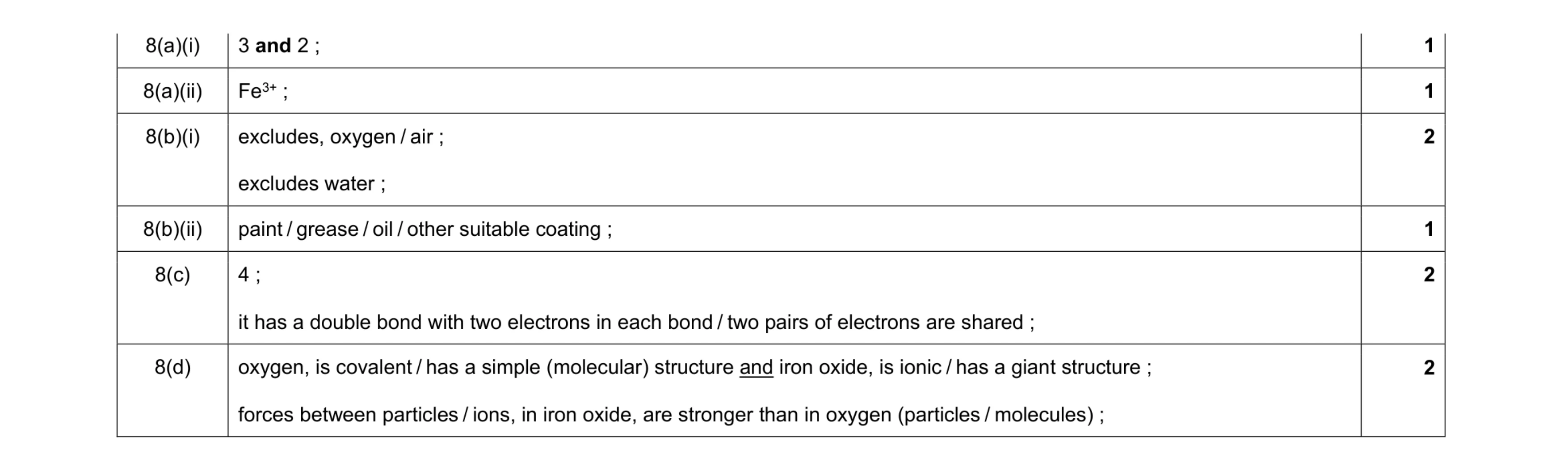 9
9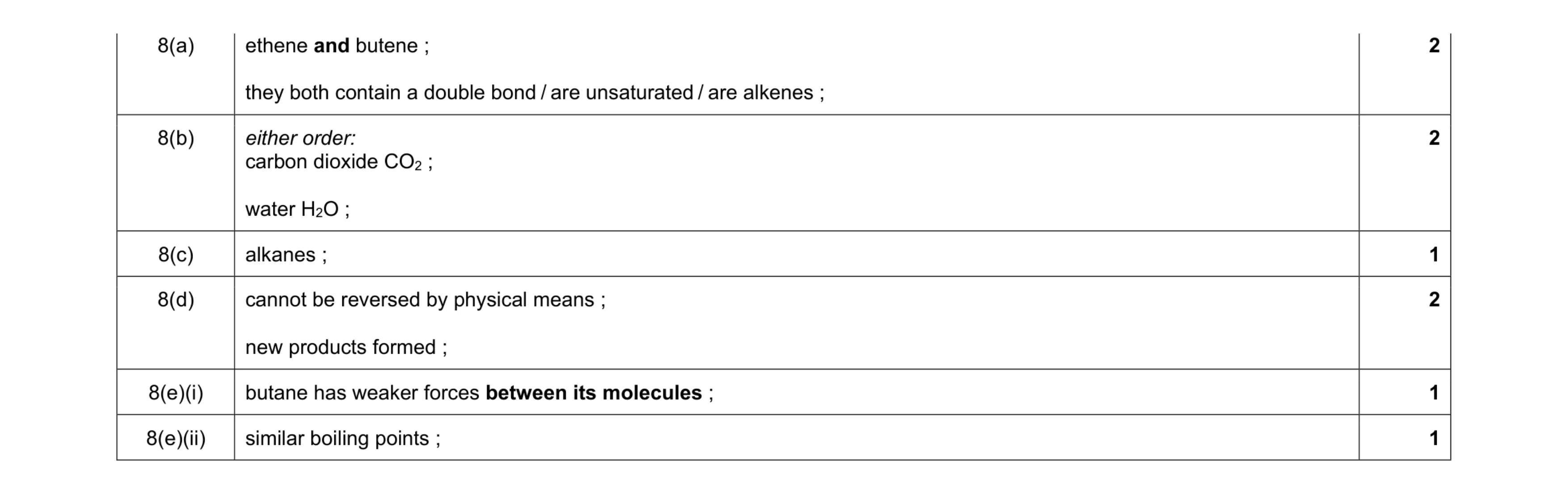 9
9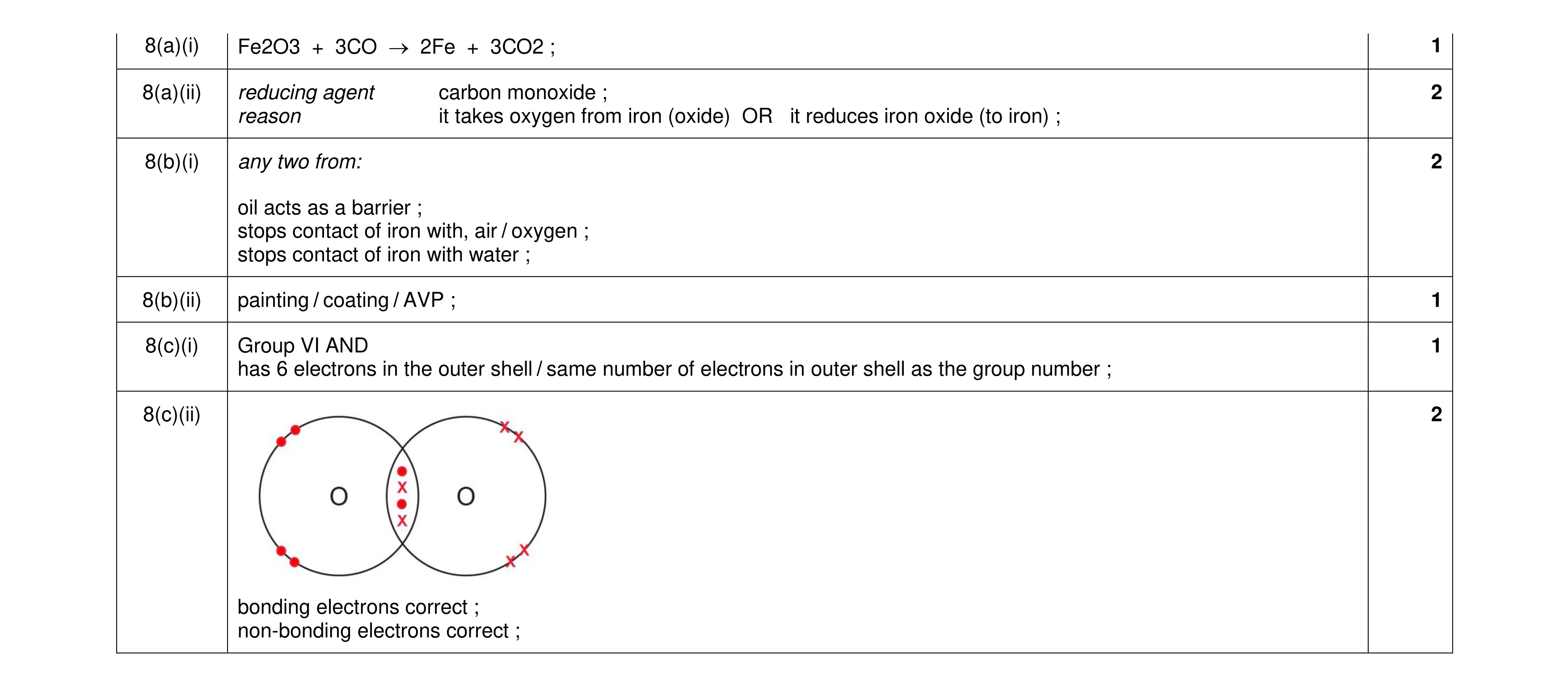 9
9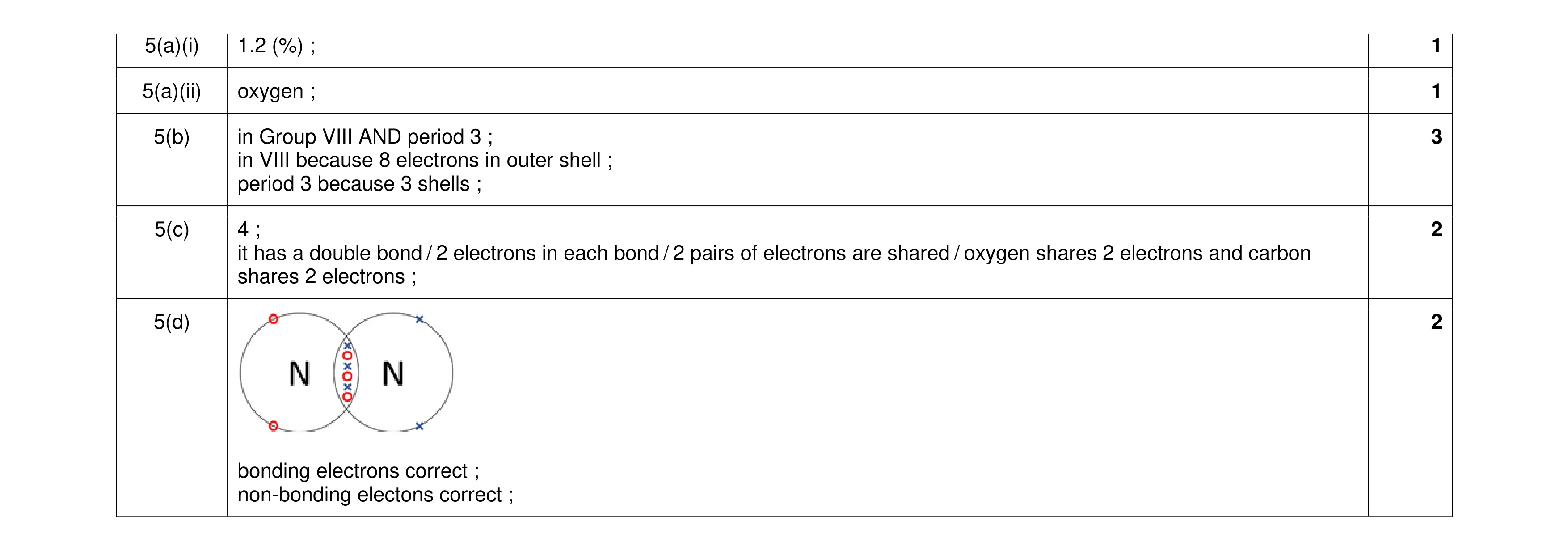 9
9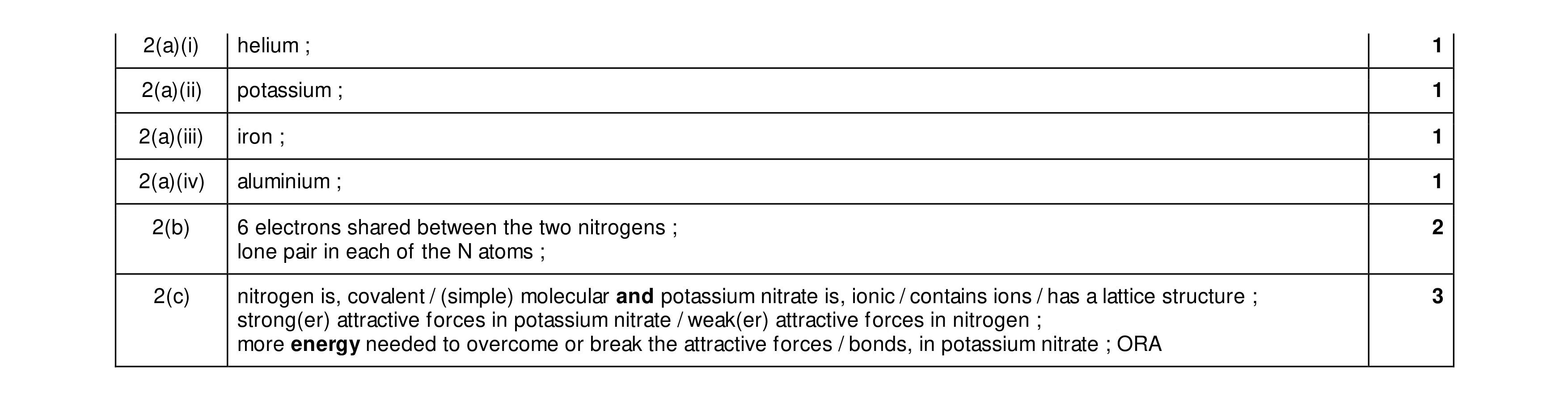 9
9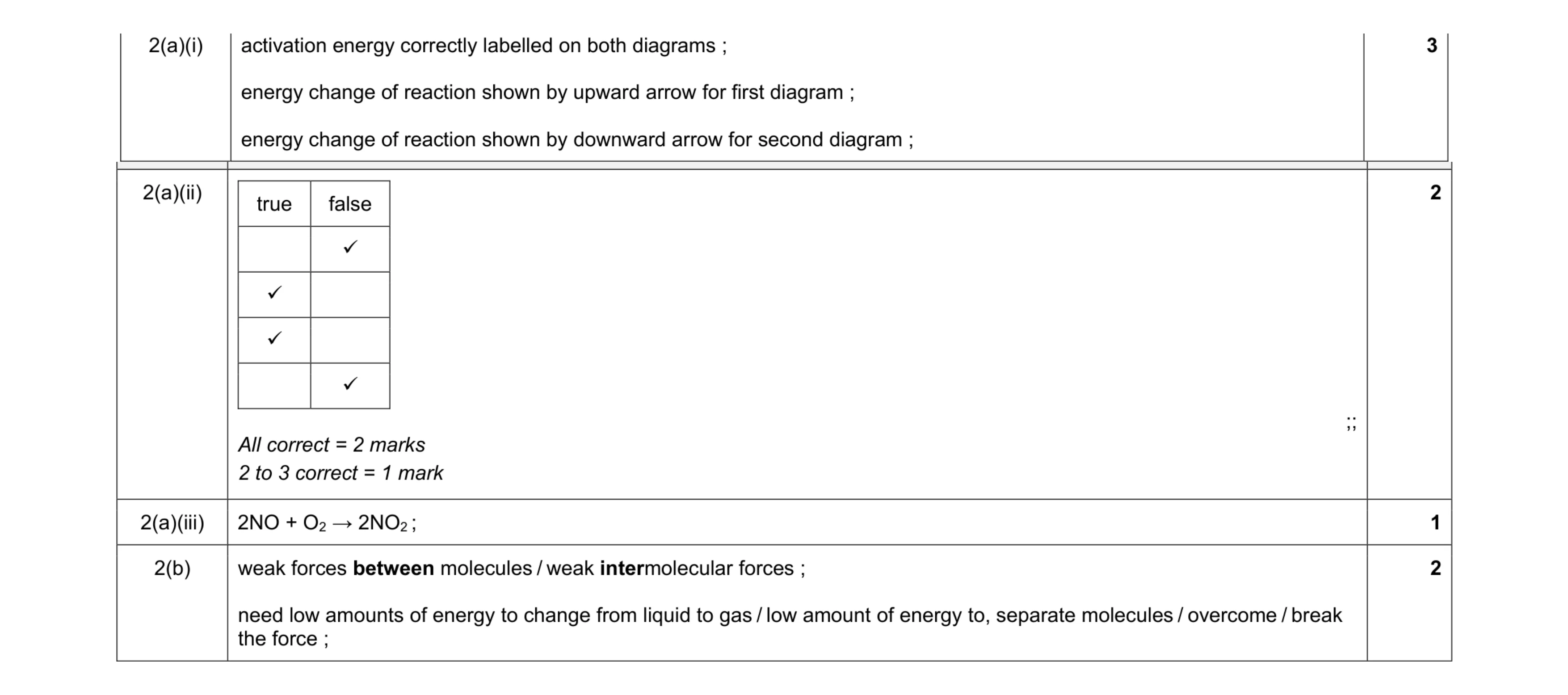 8
8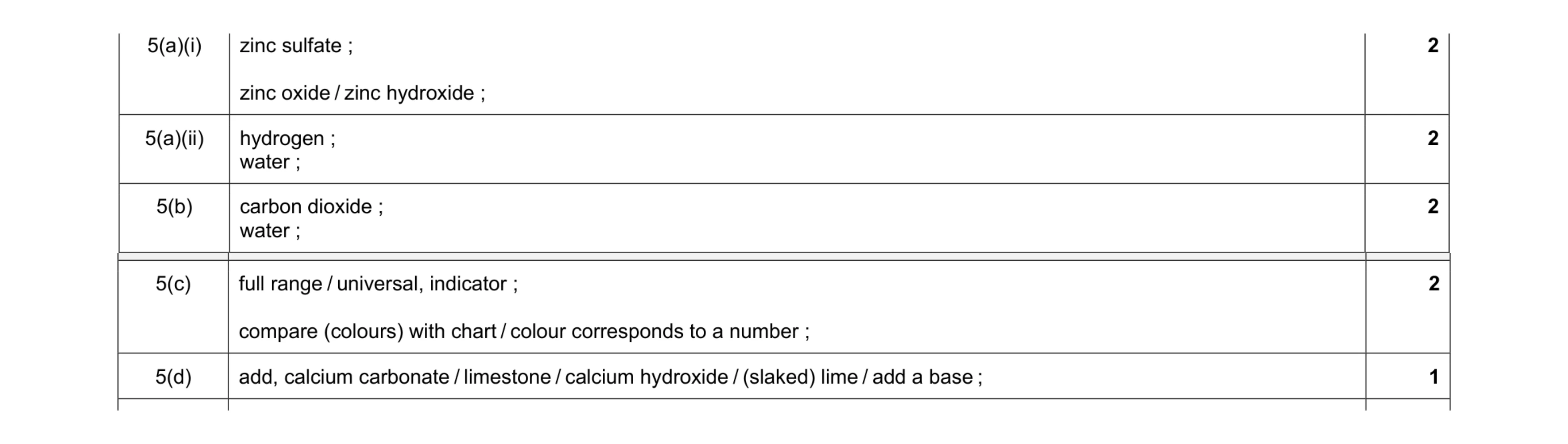 9
9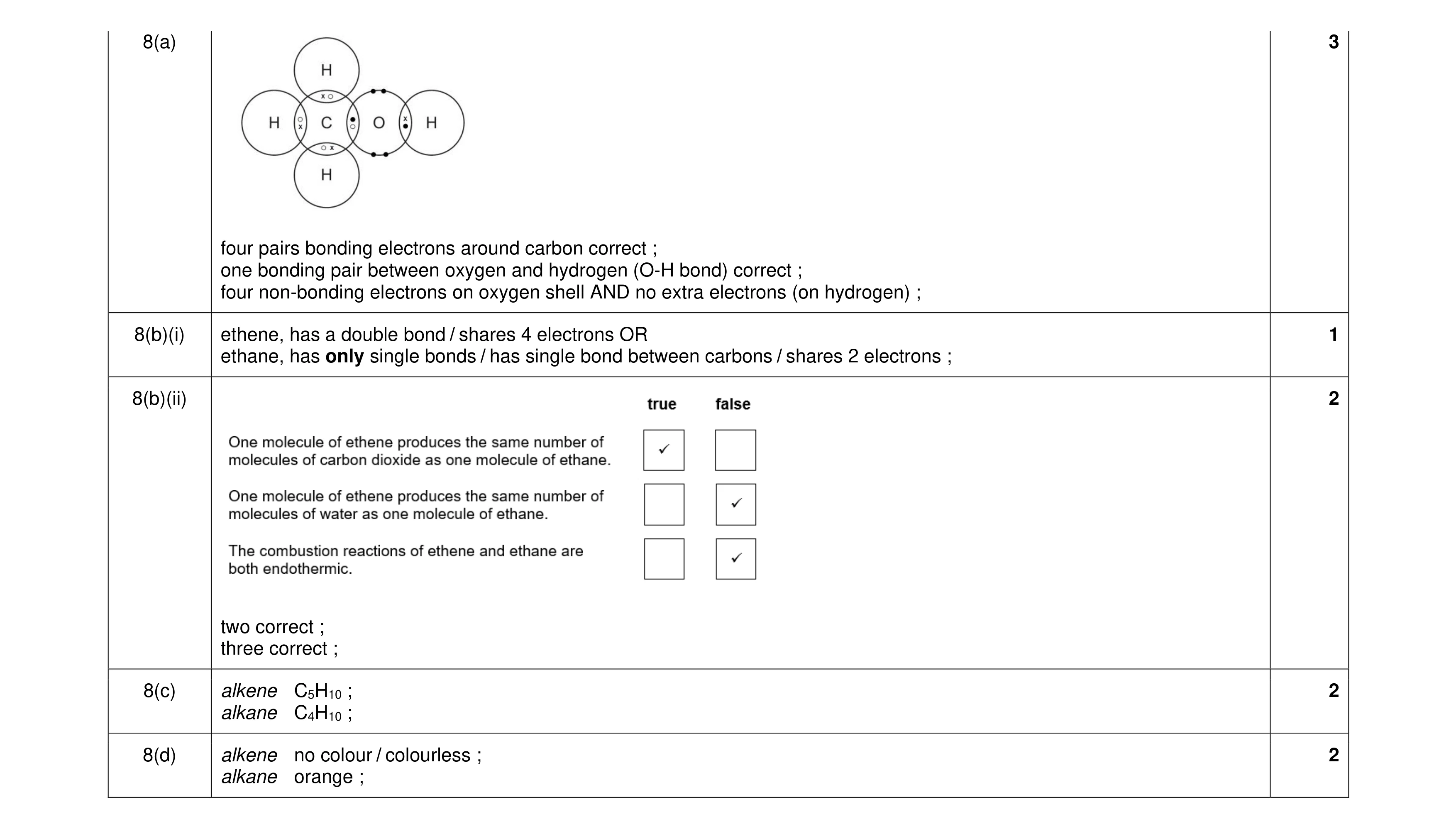 10
10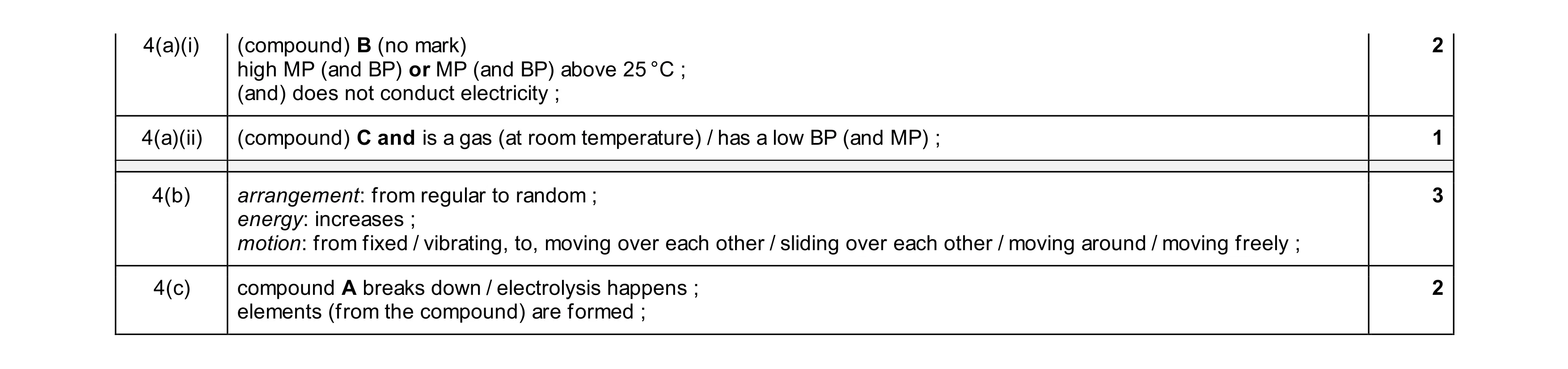 8
8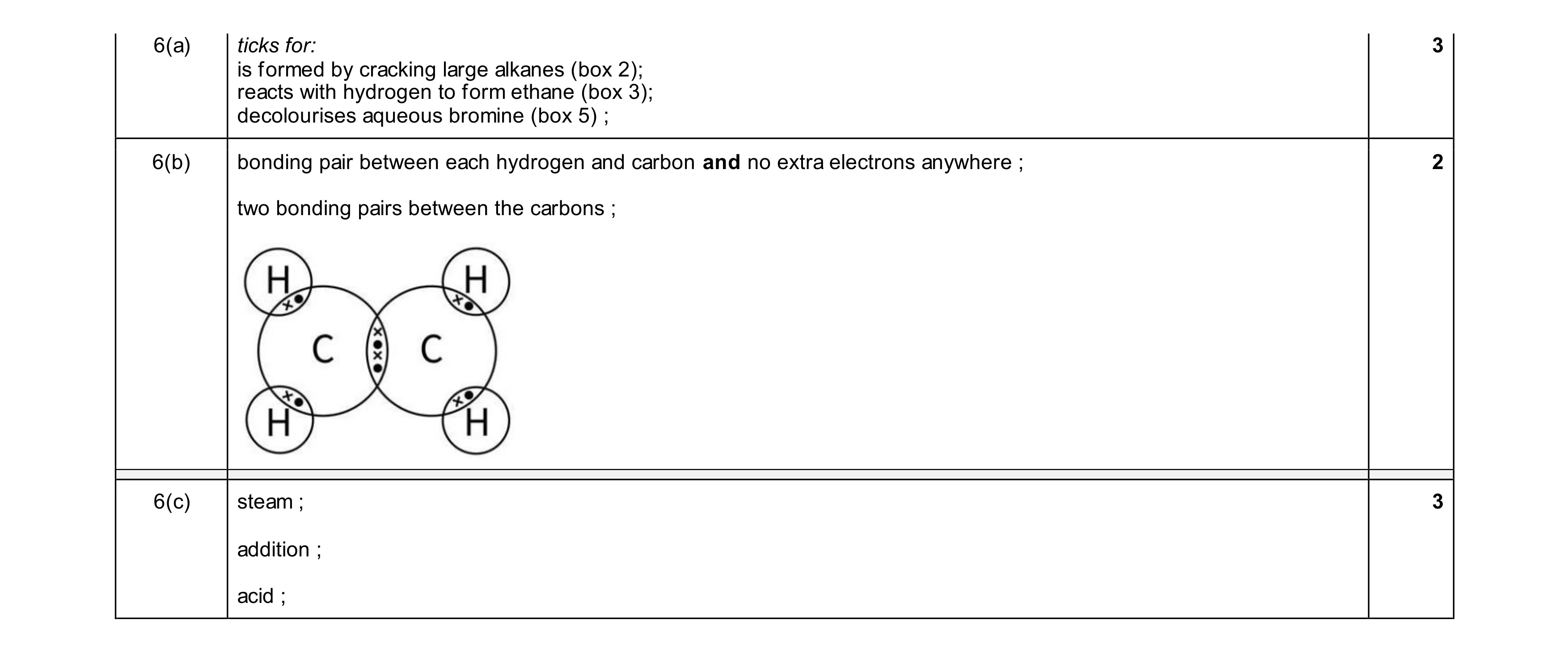 8
8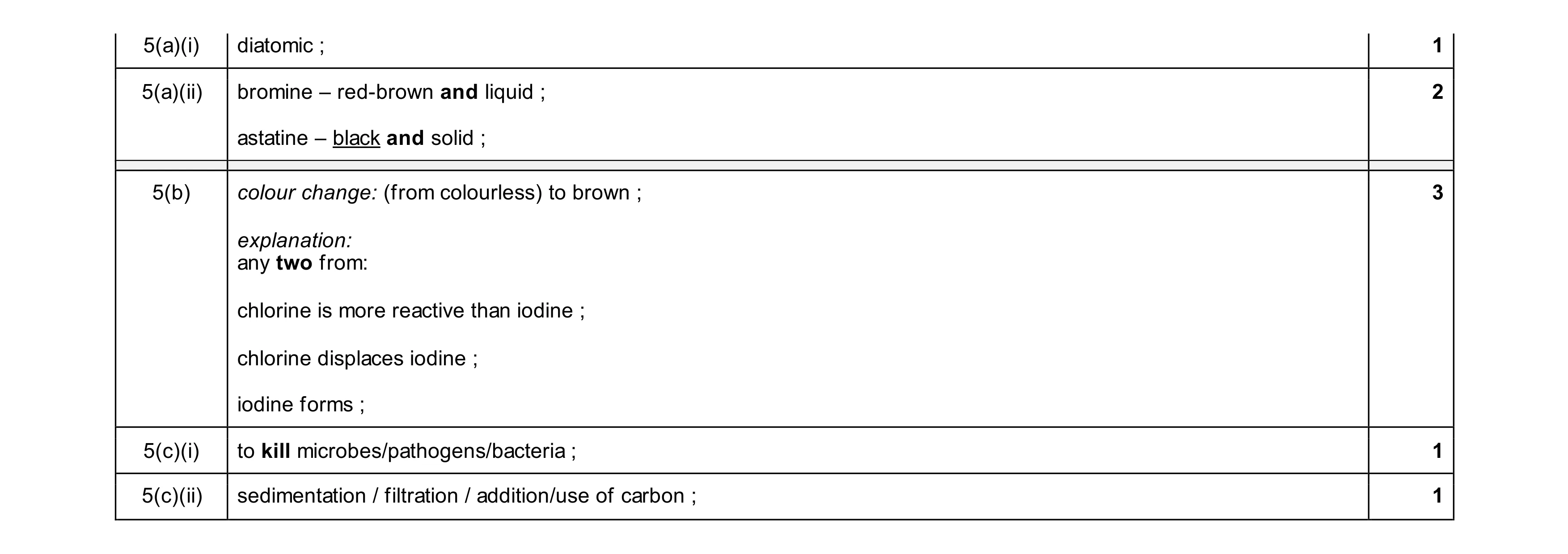 8
8