Questions as text
Q1 · A molecule of methane contains one carbon atom bonded to four hydrogen atoms 0653/31 May/June 2017
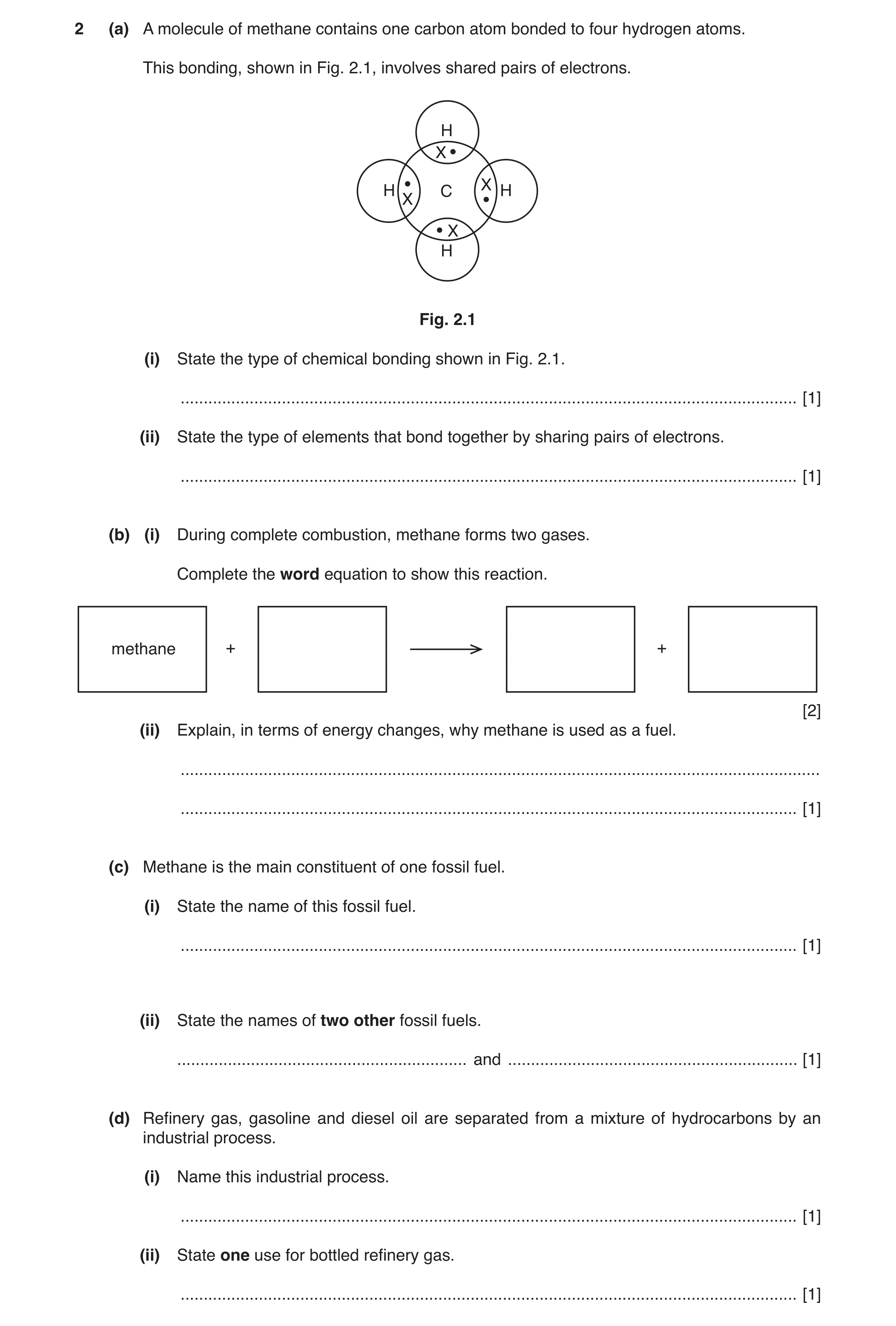
2 (a) A molecule of methane contains one carbon atom bonded to four hydrogen atoms. This bonding, shown in Fig. 2.1, involves shared pairs of electrons. H X X H C H X X H Fig. 2.1 (i) State the type of chemical bonding shown in Fig. 2.1. … [1] (ii) State the type of elements that bond together by sharing pairs of electrons. … [1] (b) (i) During complete combustion, methane forms two gases. Complete the word equation to show this reaction. methane + + [2] (ii) Explain, in terms of energy changes, why methane is used as a fuel. … … [1] (c) Methane is the main constituent of one fossil fuel. (i) State the name of this fossil fuel. … [1] (ii) State the names of two other fossil fuels. … and … [1] (d) Refinery gas, gasoline and diesel oil are separated from a mixture of hydrocarbons by an industrial process. (i) Name this industrial process. … [1] (ii) State one use for bottled refinery gas. … [1]
9 marks
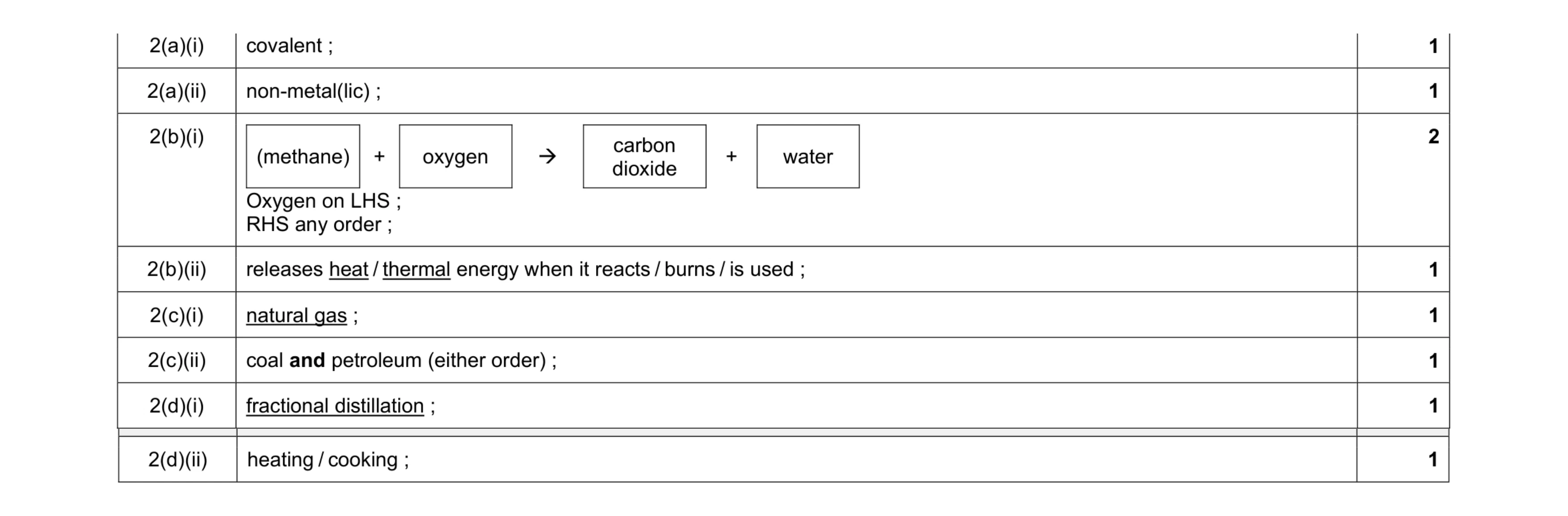
Mark scheme: 2(a)(i) covalent ; 1 2(a)(ii) non-metal(lic) ; 1 2(b)(i) (methane) + oxygen Æ carbon dioxide + water Oxygen on LHS ; RHS any order ; 2 2(b)(ii) releases heat / thermal energy when it reacts / burns / is used ; 1 2(c)(i) natural gas ; 1 2(c)(ii) coal and petroleum (either order) ; 1 2(d)(i) fractional distillation ; 1 Question Answer Marks 2(d)(ii) heating / cooking ; 1
This question in 0653/31 May/June 2017
Q2 · Water is extracted from a river and then treated to make it suitable for people to use 0653/32 May/June 2017
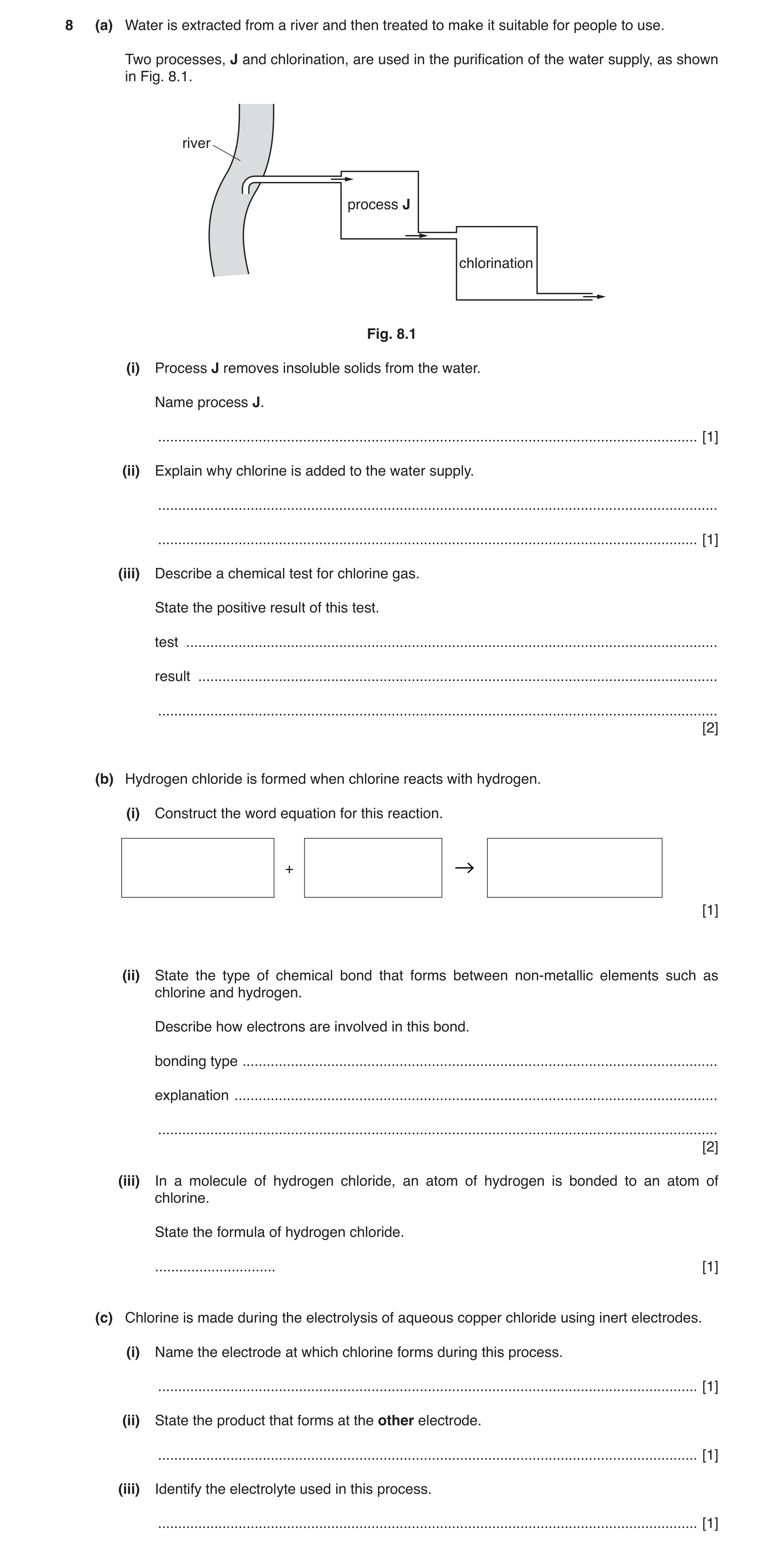
8 (a) Water is extracted from a river and then treated to make it suitable for people to use. Two processes, J and chlorination, are used in the purification of the water supply, as shown in Fig. 8.1. river process J chlorination Fig. 8.1 (i) Process J removes insoluble solids from the water. Name process J. … [1] (ii) Explain why chlorine is added to the water supply. … … [1] (iii) Describe a chemical test for chlorine gas. State the positive result of this test. test … result … … [2] (b) Hydrogen chloride is formed when chlorine reacts with hydrogen. (i) Construct the word equation for this reaction. + [1] (ii) State the type of chemical bond that forms between non-metallic elements such as chlorine and hydrogen. Describe how electrons are involved in this bond. bonding type … explanation … … [2] (iii) In a molecule of hydrogen chloride, an atom of hydrogen is bonded to an atom of chlorine. State the formula of hydrogen chloride. … [1] (c) Chlorine is made during the electrolysis of aqueous copper chloride using inert electrodes. (i) Name the electrode at which chlorine forms during this process. … [1] (ii) State the product that forms at the other electrode. … [1] (iii) Identify the electrolyte used in this process. … [1]
11 marks
Mark scheme: 8(a)(i) filtration ; 1 8(a)(ii) kill microbes / sterilise (water) ; 1 8(a)(iii) (damp) litmus (paper) ; turns white / bleached ; 2 8(b)(i) ; LHS either order chlorine + hydrogen Æ hydrogen chloride 1 8(b)(ii) covalent ; share (pair of) electrons ; 2 8(b)(iii) HCl ; 1 8(c)(i) anode ; 1 8(c)(ii) copper ; 1 8(c)(iii) copper chloride solution / aqueous copper chloride ; 1
This question in 0653/32 May/June 2017
Q3 · The process used to produce refinery gas, gasoline and gas oil from petroleum is shown in… 0653/31 May/June 2018
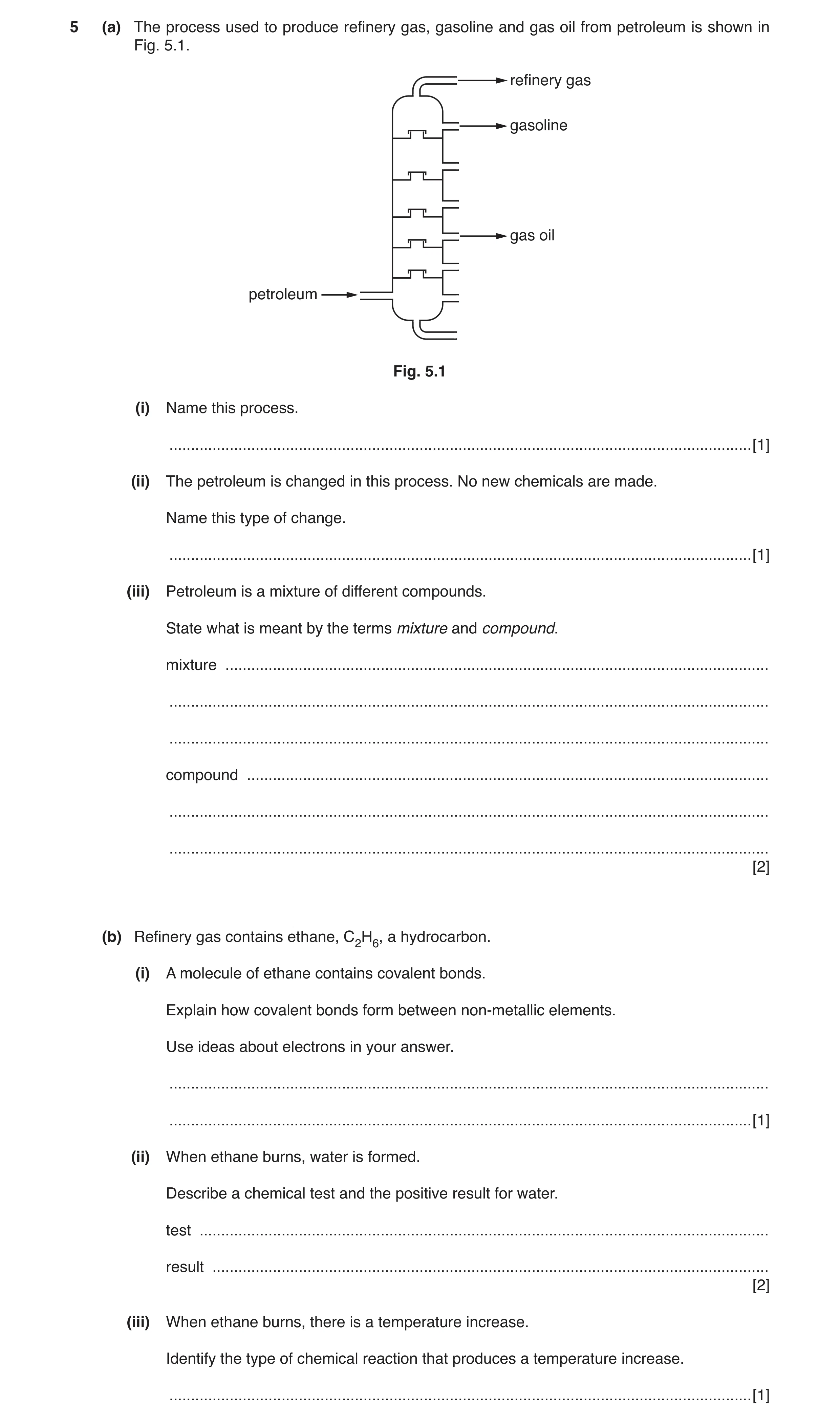
5 (a) The process used to produce refinery gas, gasoline and gas oil from petroleum is shown in Fig. 5.1. refinery gas gasoline gas oil petroleum Fig. 5.1 (i) Name this process. … [1] (ii) The petroleum is changed in this process. No new chemicals are made. Name this type of change. … [1] (iii) Petroleum is a mixture of different compounds. State what is meant by the terms mixture and compound. mixture … … … compound … … … [2] (b) Refinery gas contains ethane, C2H6, a hydrocarbon. (i) A molecule of ethane contains covalent bonds. Explain how covalent bonds form between non‑metallic elements. Use ideas about electrons in your answer. … … [1] (ii) When ethane burns, water is formed. Describe a chemical test and the positive result for water. test … result … [2] (iii) When ethane burns, there is a temperature increase. Identify the type of chemical reaction that produces a temperature increase. … [1]
8 marks
Mark scheme: 5(a)(i) fractional distillation ; 1 5(a)(ii) physical ; 1 5(a)(iii) mixture idea that the components are not joined / bonded (together) / idea that the components retain their original properties / components can be separated by physical processes ; compound different atoms / elements bonded / joined (together) / has different properties from the elements / elements cannot be separated by physical processes ; 2 5(b)(i) shared (pair of) electrons) ; 1 5(b)(ii) test white / anhydrous copper sulfate ; result (turns) blue ; or blue / anhydrous cobalt chloride (paper); result (turns) pink; 2 5(b)(iii) exothermic ; 1
This question in 0653/31 May/June 2018
Q4 · A student investigates the combustion of a hydrocarbon, as shown in Fig 0653/32 May/June 2018
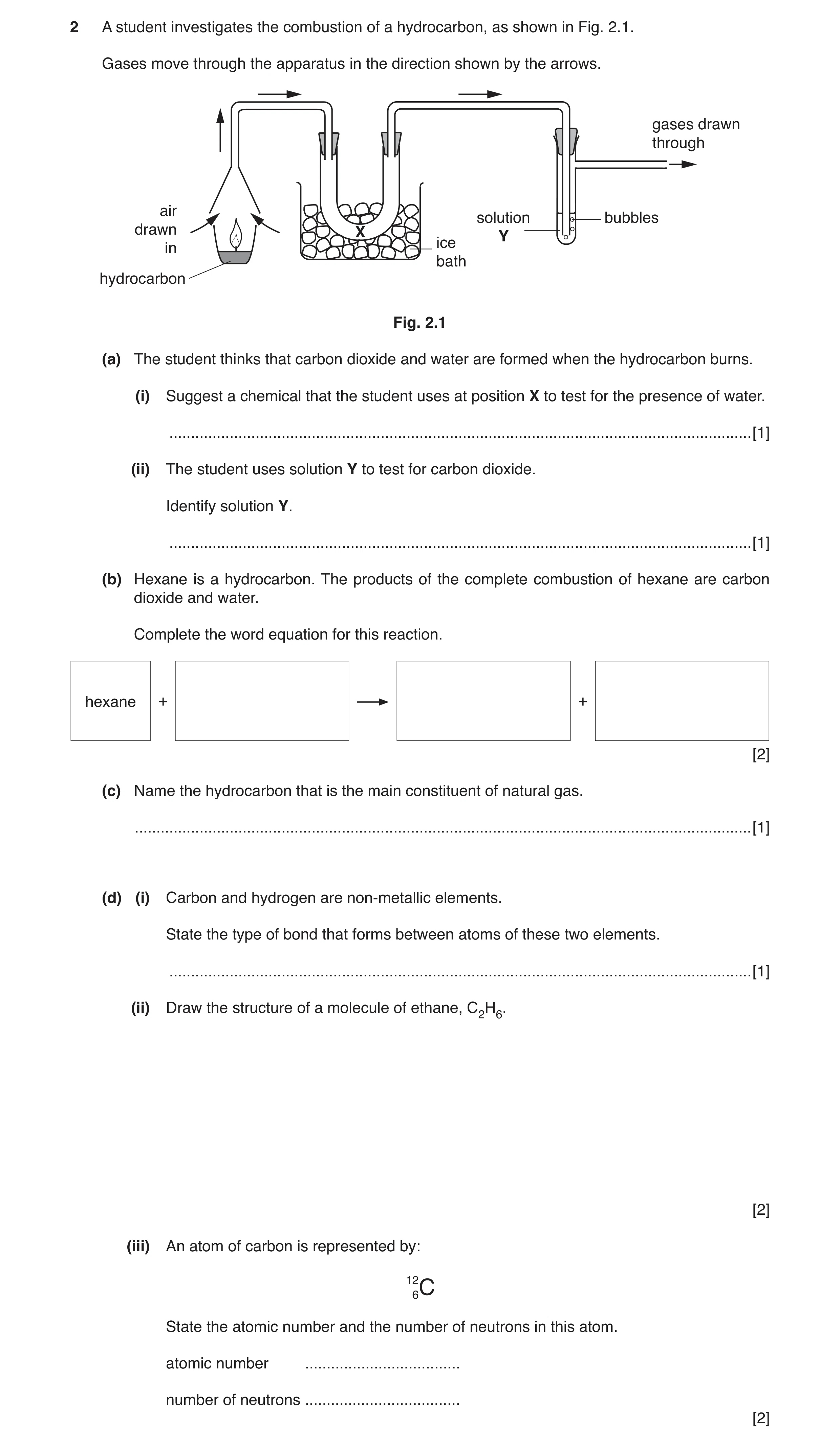
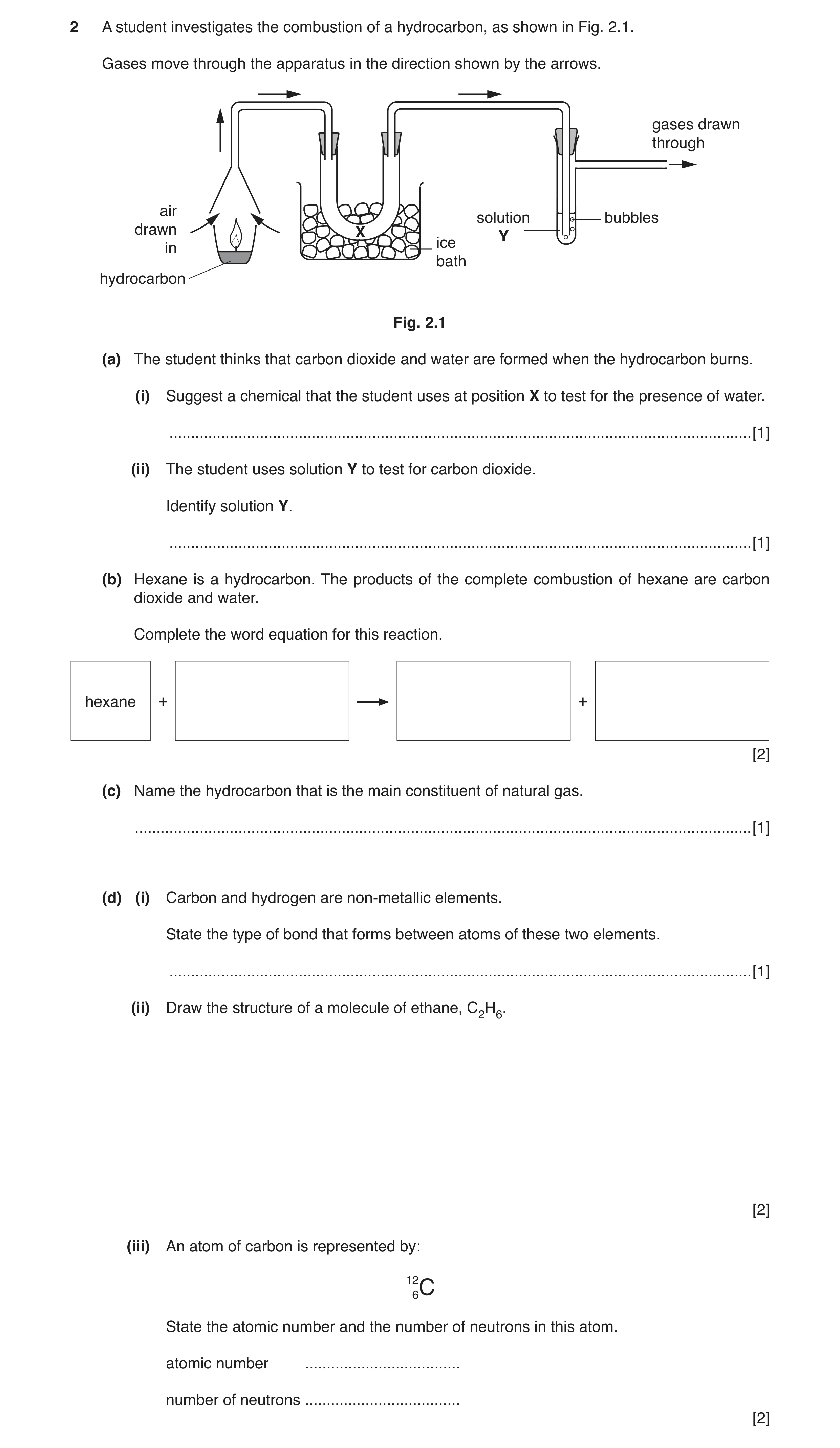
2 A student investigates the combustion of a hydrocarbon, as shown in Fig. 2.1. Gases move through the apparatus in the direction shown by the arrows. gases drawn through X air solution bubbles drawn X Y ice in bath hydrocarbon Fig. 2.1 (a) The student thinks that carbon dioxide and water are formed when the hydrocarbon burns. (i) Suggest a chemical that the student uses at position X to test for the presence of water. … [1] (ii) The student uses solution Y to test for carbon dioxide. Identify solution Y. … [1] (b) Hexane is a hydrocarbon. The products of the complete combustion of hexane are carbon dioxide and water. Complete the word equation for this reaction. hexane + + [2] (c) Name the hydrocarbon that is the main constituent of natural gas. … [1] (d) (i) Carbon and hydrogen are non‑metallic elements. State the type of bond that forms between atoms of these two elements. … [1] (ii) Draw the structure of a molecule of ethane, C2H6. [2] (iii) An atom of carbon is represented by: 126C State the atomic number and the number of neutrons in this atom. atomic number … number of neutrons … [2]
10 marks
Mark scheme: 2 2( 2 2 2 2( 2( (a)(i) white / (a)(ii) limewa 2(b) LHS ; RHS ( 2(c) metha (d)(i) covale (d)(ii) C – C Six C – (d)(iii) (atomi (numb / anhydrous copp ater ; either order) ; ne ; ent ; bond ; – H bonds ; c number) ber of neutrons) per sulphate or a (hexan 6 ; 6 ; anhydrous / blue ne) + oxy e cobalt chloride ygen Î c d ; carbon dioxide + water 1 1 2 1 1 2 2
This question in 0653/32 May/June 2018
Q5 · A student investigates the combustion of a hydrocarbon, as shown in Fig 0653/33 May/June 2018
2 A student investigates the combustion of a hydrocarbon, as shown in Fig. 2.1. Gases move through the apparatus in the direction shown by the arrows. gases drawn through X air solution bubbles drawn X Y ice in bath hydrocarbon Fig. 2.1 (a) The student thinks that carbon dioxide and water are formed when the hydrocarbon burns. (i) Suggest a chemical that the student uses at position X to test for the presence of water. … [1] (ii) The student uses solution Y to test for carbon dioxide. Identify solution Y. … [1] (b) Hexane is a hydrocarbon. The products of the complete combustion of hexane are carbon dioxide and water. Complete the word equation for this reaction. hexane + + [2] (c) Name the hydrocarbon that is the main constituent of natural gas. … [1] (d) (i) Carbon and hydrogen are non‑metallic elements. State the type of bond that forms between atoms of these two elements. … [1] (ii) Draw the structure of a molecule of ethane, C2H6. [2] (iii) An atom of carbon is represented by: 126C State the atomic number and the number of neutrons in this atom. atomic number … number of neutrons … [2]
10 marks
Mark scheme: 2 2( 2 2 2 2( 2( (a)(i) white / (a)(ii) limewa 2(b) LHS ; RHS ( 2(c) metha (d)(i) covale (d)(ii) C – C Six C – (d)(iii) (atomi (numb / anhydrous copp ater ; either order) ; ne ; ent ; bond ; – H bonds ; c number) ber of neutrons) per sulphate or a (hexan 6 ; 6 ; anhydrous / blue ne) + oxy e cobalt chloride ygen Î c d ; carbon dioxide + water 1 1 2 1 1 2 2
This question in 0653/33 May/June 2018
Q6 · Petroleum is separated into more useful substances using the process shown in Fig 0653/31 Oct/Nov 2018
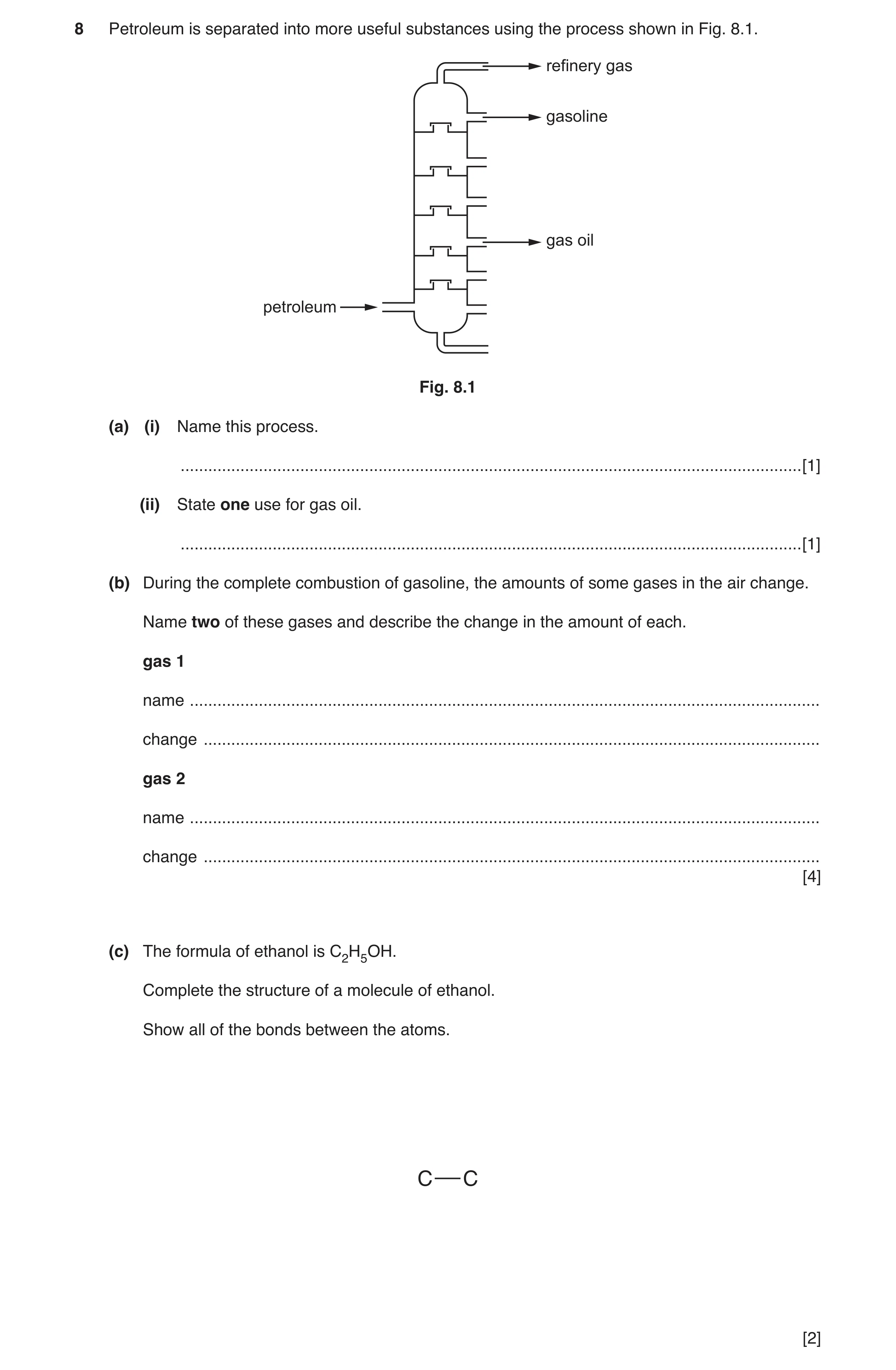
8 Petroleum is separated into more useful substances using the process shown in Fig. 8.1. refinery gas gasoline gas oil petroleum Fig. 8.1 (a) (i) Name this process. … [1] (ii) State one use for gas oil. … [1] (b) During the complete combustion of gasoline, the amounts of some gases in the air change. Name two of these gases and describe the change in the amount of each. gas 1 name … change … gas 2 name … change … [4] (c) The formula of ethanol is C2H5OH. Complete the structure of a molecule of ethanol. Show all of the bonds between the atoms. C C [2]
8 marks
Mark scheme: 8(a)(i) fractional distillation ; 1 8(a)(ii) fuel (in diesel engines) ; 1 8(b) any two gases of: name oxygen ; change decrease ; or name carbon dioxide ; change increase ; or name water (vapour) ; change increase ; 2nd mark dependent on correct gas named Max 4 4 8(c) correct arrangement of atoms ; all (single) bonds shown correctly ; 2
This question in 0653/31 Oct/Nov 2018
Q7 · The Periodic Table contains the symbols of all of the elements 0653/33 Oct/Nov 2018
2 (a) The Periodic Table contains the symbols of all of the elements. Complete the sentences about the Periodic Table. The Periodic Table lists the elements in order of their … number. The unreactive gases in Group VIII, which include helium, neon and argon, are known as the … gases. The collection of metals in the middle of the Periodic Table have high densities and form coloured compounds. They are known as the … elements. [3] (b) Carbon dioxide is a compound of carbon and oxygen, two non-metallic elements. (i) State the name of the type of bonding between a carbon atom and an oxygen atom. … [1] (ii) Describe, in terms of electrons, the bonding between a carbon atom and an oxygen atom. … … [1] (c) The compound sodium chloride contains sodium ions and chloride ions. Describe, in terms of electrons, the formation of ions from atoms. … … [1] (d) A mixture contains aqueous sodium chloride and insoluble powdered charcoal (carbon). (i) Suggest how the powdered charcoal can be separated from the mixture. … … [1] (ii) Suggest how water can be removed from aqueous sodium chloride. … … [1] (iii) State whether the separation of this mixture into charcoal, water and sodium chloride is a physical change or a chemical change. Explain your answer. change … explanation … … [1]
9 marks
Mark scheme: 2(a) atomic / proton ; noble ; transition ; 3 2(b)(i) covalent ; 1 2(b)(ii) (electrons are) shared ; 1 2(c) (electrons are) lost / gained / lost and gained ; 1 Question Answer Marks 2(d)(i) filter / filtering / filtration ; 1 2(d)(ii) evaporation ; 1 2(d)(iii) physical and no new substance(s) is / are made ; 1
This question in 0653/33 Oct/Nov 2018
Question 8 0653/32 May/June 2019
5 (a) Petroleum contains hydrocarbons. These are separated into useful fractions by fractional distillation, as shown in Fig. 5.1. refinery gas gasoline naphtha gas oil petroleum bitumen Fig. 5.1 (i) Identify a fraction shown in Fig. 5.1 used for fuel in cars. … [1] (ii) Identify a fraction shown in Fig. 5.1 used for bottled gas for heating and cooking. … [1] (b) (i) Name the type of hydrocarbon which contains only single bonds. … [1] (ii) Identify the products of the complete combustion of hydrocarbons. … and … [1] (c) Compound X is made from large hydrocarbon molecules in a reaction called cracking. Compound X reacts with aqueous bromine, changing it from orange to colourless. Molecules of compound X join together to form a polymer. (i) Suggest the identity of compound X. … [1] (ii) State the type of polymerisation in which molecules of compound X form a polymer. … [1] (d) Hydrocarbon molecules contain atoms of the elements carbon and hydrogen only. (i) A carbon atom has 6 electrons. Complete Fig. 5.2 to show the electronic structure of this carbon atom. Fig. 5.2 [1] (ii) Complete the dot-and-cross diagram in Fig. 5.3 to show the covalent bond in a molecule of hydrogen gas, H2. H H Fig. 5.3 [1] (iii) State why covalent bonds, rather than ionic bonds, form between carbon atoms and hydrogen atoms. … … [1] [Total: 9]
9 marks
Mark scheme: 5(a)(i) gasoline ; 1 5(a)(ii) refinery gas ; 1 5(b)(i) alkane(s) / saturated ; 1 5(b)(ii) carbon dioxide / CO2 and water / H2O ; 1 5(c)(i) ethene / C2H4 / any named alkene / any correct alkene formula / alkene ; 1 5(c)(ii) addition (polymerisation) ; 1 5(d)(i) 2,4 arrangement ; 1 Question Answer Marks 5(d)(ii) H H 1 5(d)(iii) they / carbon and hydrogen are (both) non-metals / it is a simple molecule ; 1 X •
This question in 0653/32 May/June 2019
Q9 · Chlorine, bromine, and iodine are Group VII elements 0653/33 May/June 2019
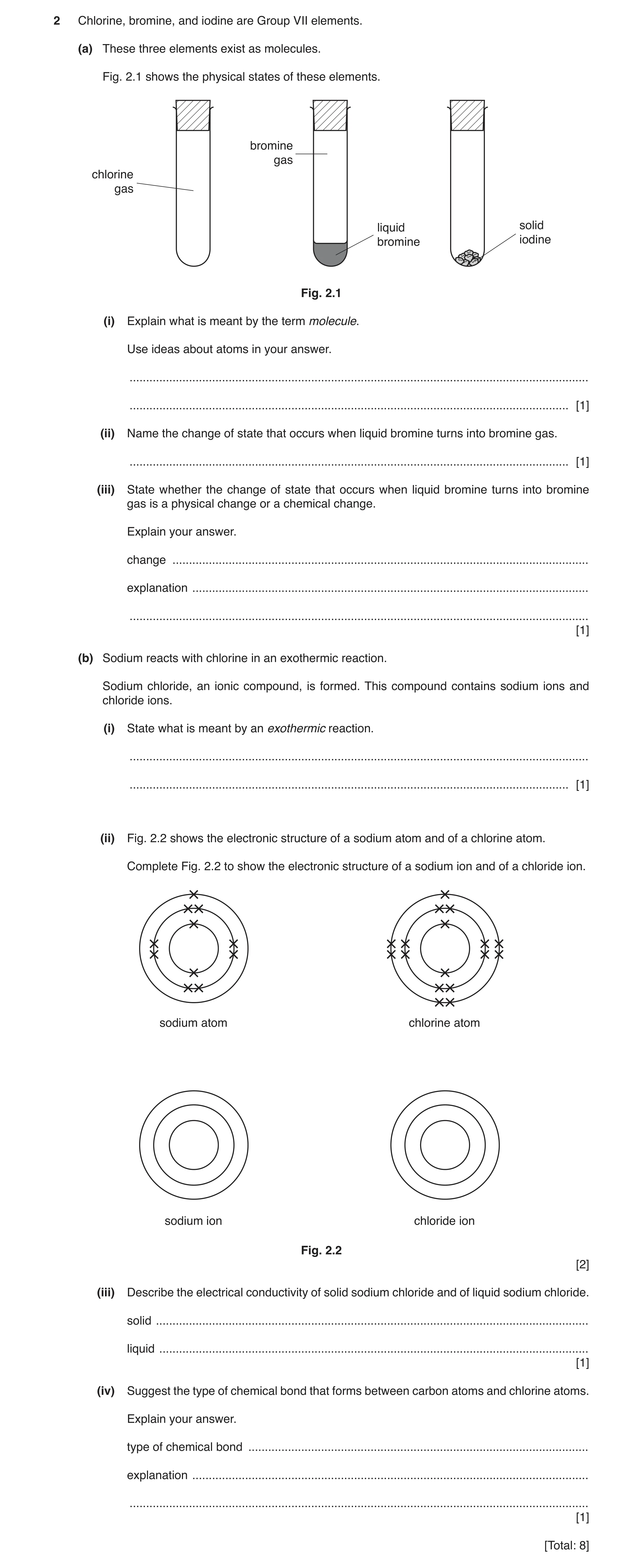
2 Chlorine, bromine, and iodine are Group VII elements. (a) These three elements exist as molecules. Fig. 2.1 shows the physical states of these elements. bromine gas chlorine gas liquid solid bromine iodine Fig. 2.1 (i) Explain what is meant by the term molecule. Use ideas about atoms in your answer. … … [1] (ii) Name the change of state that occurs when liquid bromine turns into bromine gas. … [1] (iii) State whether the change of state that occurs when liquid bromine turns into bromine gas is a physical change or a chemical change. Explain your answer. change … explanation … … [1] (b) Sodium reacts with chlorine in an exothermic reaction. Sodium chloride, an ionic compound, is formed. This compound contains sodium ions and chloride ions. (i) State what is meant by an exothermic reaction. … … [1] (ii) Fig. 2.2 shows the electronic structure of a sodium atom and of a chlorine atom. Complete Fig. 2.2 to show the electronic structure of a sodium ion and of a chloride ion. sodium atom chlorine atom sodium ion chloride ion Fig. 2.2 [2] (iii) Describe the electrical conductivity of solid sodium chloride and of liquid sodium chloride. solid … liquid … [1] (iv) Suggest the type of chemical bond that forms between carbon atoms and chlorine atoms. Explain your answer. type of chemical bond … explanation … … [1] [Total: 8]
8 marks
Mark scheme: 2(a)(i) (contains) atoms (chemically) joined / bonded / combined (together) ; 1 2(a)(ii) boiling / evaporation ; 1 2(a)(iii) (change) physical AND (explanation) no new substance(s) made ; 1 2(b)(i) releases (heat / thermal) energy ; 1 2(b)(ii) (sodium ion) drawn 2, 8 electrons (outer shell blank) ; (chloride ion) drawn 2, 8, 8 electrons ; 2 Question Answer Marks 2(b)(iii) (solid) zero / poor / non-conductor AND (liquid) good / conducts ; 1 2(b)(iv) (type) covalent AND (explanation) carbon and chlorine / both are non-metals ; 1
This question in 0653/33 May/June 2019
Q10 · Refinery gas, gasoline and gas oil are fuels obtained from petroleum in the process shown… 0653/32 Feb/March 2020
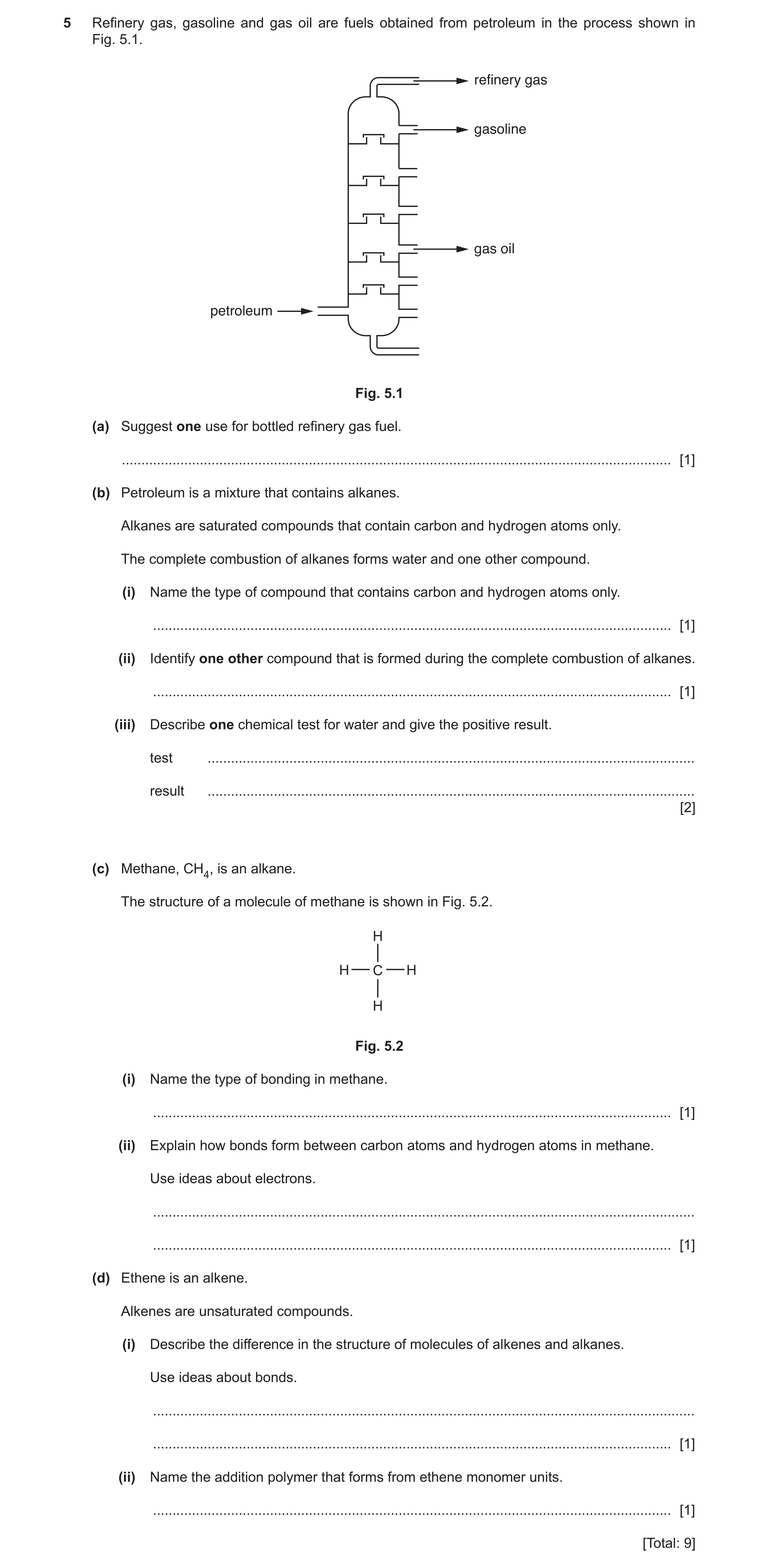
5 Refinery gas, gasoline and gas oil are fuels obtained from petroleum in the process shown in Fig. 5.1. refinery gas gasoline gas oil petroleum Fig. 5.1 (a) Suggest one use for bottled refinery gas fuel. … [1] (b) Petroleum is a mixture that contains alkanes. Alkanes are saturated compounds that contain carbon and hydrogen atoms only. The complete combustion of alkanes forms water and one other compound. (i) Name the type of compound that contains carbon and hydrogen atoms only. … [1] (ii) Identify one other compound that is formed during the complete combustion of alkanes. … [1] (iii) Describe one chemical test for water and give the positive result. test … result … [2] (c) Methane, CH4, is an alkane. The structure of a molecule of methane is shown in Fig. 5.2. H H C H H Fig. 5.2 (i) Name the type of bonding in methane. … [1] (ii) Explain how bonds form between carbon atoms and hydrogen atoms in methane. Use ideas about electrons. … … [1] (d) Ethene is an alkene. Alkenes are unsaturated compounds. (i) Describe the difference in the structure of molecules of alkenes and alkanes. Use ideas about bonds. … … [1] (ii) Name the addition polymer that forms from ethene monomer units. … [1] [Total: 9]
9 marks
Mark scheme: 5(a) heating / cooking ; 1 5(b)(i) hydrocarbon ; 1 5(b)(ii) carbon dioxide ; 1 5(b)(iii) reagent copper sulfate OR cobalt chloride ; result (white to) blue OR (blue to) pink ; result must match the reagent 2 5(c)(i) covalent ; 1 5(c)(ii) shared (pair) ; 1 5(d)(i) alkenes double (bonds) and alkanes (only) single (bonds) ; 1 5(d)(ii) poly(ethene) ; 1
This question in 0653/32 Feb/March 2020
Q11 · A molecule of methane is represented in Fig 0653/33 Oct/Nov 2020
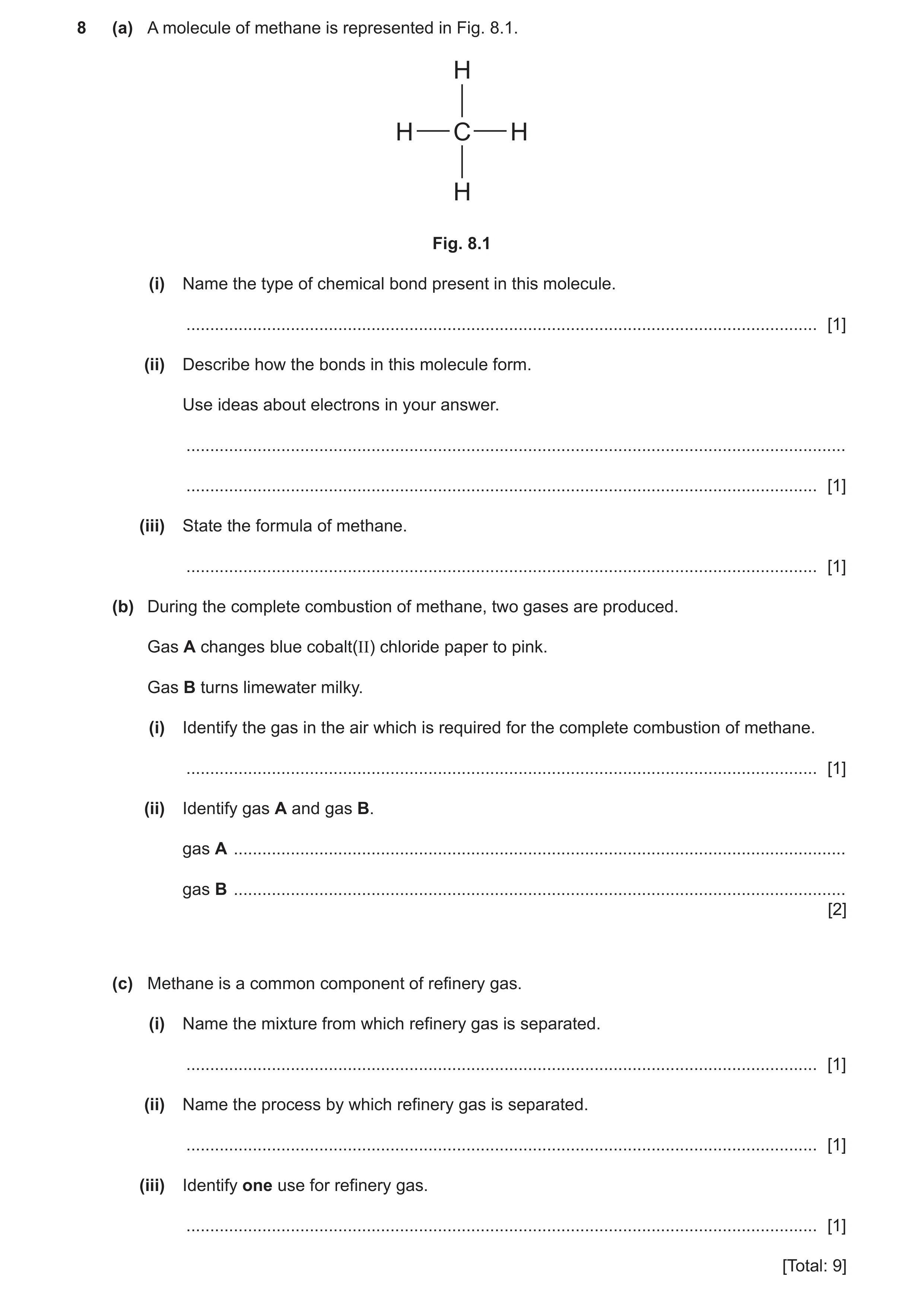
8 (a) A molecule of methane is represented in Fig. 8.1. H H C H H Fig. 8.1 (i) Name the type of chemical bond present in this molecule. … [1] (ii) Describe how the bonds in this molecule form. Use ideas about electrons in your answer. … … [1] (iii) State the formula of methane. … [1] (b) During the complete combustion of methane, two gases are produced. Gas A changes blue cobalt(II) chloride paper to pink. Gas B turns limewater milky. (i) Identify the gas in the air which is required for the complete combustion of methane. … [1] (ii) Identify gas A and gas B. gas A … gas B … [2] (c) Methane is a common component of refinery gas. (i) Name the mixture from which refinery gas is separated. … [1] (ii) Name the process by which refinery gas is separated. … [1] (iii) Identify one use for refinery gas. … [1] [Total: 9]
9 marks
Mark scheme: 8(a)(i) covalent ; 1 8(a)(ii) (electrons are) shared ; 1 8(a)(iii) CH4 ; 1 8(b)(i) oxygen / O2 ; 1 8(b)(ii) (gas A) water (vapour) / H2O ; (gas B) carbon dioxide / CO2 ; 2 8(c)(i) petroleum ; 1 8(c)(ii) fractional distillation ; 1 8(c)(iii) heating / cooking ; 1
This question in 0653/33 Oct/Nov 2020
Q12 · Chlorine and bromine are diatomic non-metals in Group VII of the Periodic Table 0653/33 May/June 2021
8 (a) Chlorine and bromine are diatomic non-metals in Group VII of the Periodic Table. Chlorine is above bromine in Group VII. (i) Explain what is meant by diatomic. … … [2] (ii) State the trend in the colour and the boiling point of the elements going down Group VII. colour … boiling point … [1] (iii) State why chlorine is used in the treatment of the water supply. … … [1] (iv) Describe a chemical test for chlorine and give the observation for a positive result. test … observation … [2] (b) Chlorine reacts with sodium in an exothermic reaction. Argon, a Group VIII element, is next to chlorine in the Periodic Table. Argon does not react with sodium. (i) State what is meant by exothermic. … … [1] (ii) Explain why argon does not react with sodium. Use ideas about electrons in your answer. … … [1] [Total: 8]
8 marks
Mark scheme: 8(a)(i) (only) two atoms ; in a molecule / bonded together ; 2 8(a)(ii) colour: darker AND boiling point: higher ; 1 8(a)(iii) to kill, bacteria / microbes / microorganisms ; 1 8(a)(iv) test: (damp blue) litmus / indicator paper ; result: (turns red then) bleaches / turns white ; 2 8(b)(i) (reaction) gives out heat energy ; 1 8(b)(ii) (argon has) full outer shell ; 1
This question in 0653/33 May/June 2021
Q13 · Methane, CH4, is a hydrocarbon 0653/31 Oct/Nov 2021
8 Methane, CH4, is a hydrocarbon. (a) State what is meant by hydrocarbon. … … [2] (b) Methane is an alkane. An alkane contains only single covalent bonds. Fig. 8.1 is a dot-and-cross diagram of a molecule of methane, CH4. Only the outer shell electrons are shown. H × H × C × H × H Fig. 8.1 Use Fig. 8.1 to describe what is meant by single covalent bonds. … … … [2] (c) The complete combustion of methane produces carbon dioxide and water. (i) Balance the equation for the complete combustion of methane. CH4 + … O2 CO2 + … H2O [2] (ii) State and explain whether the carbon in methane is oxidised or reduced in this reaction. carbon … explanation … … [1] (iii) Explain why argon, a noble gas, does not react with oxygen. Use ideas about electronic structure in your answer. … … [1] (d) Describe how the bonding in alkenes is different from the bonding in alkanes. … … [1] [Total: 9]
9 marks
Mark scheme: 8(a) (compound) containing carbon (atoms) and hydrogen (atoms) ; only ; 2 8(b) single: one pair of electrons / one dot and one cross ; covalent: electrons are shared / electrons inside two circles ; 2 8(c)(i) 2 ; 2 ; 2 8(c)(ii) oxidised AND gains oxygen ; 1 8(c)(iii) atoms of argon have full outer shells / 8 electrons in outer shells ; 1 8(d) alkenes contain a double bond / C=C (whereas alkanes contain only single bonds) ; 1
This question in 0653/31 Oct/Nov 2021
Q14 · A student separates some insoluble solid material from concentrated aqueous sodium… 0653/32 Oct/Nov 2021
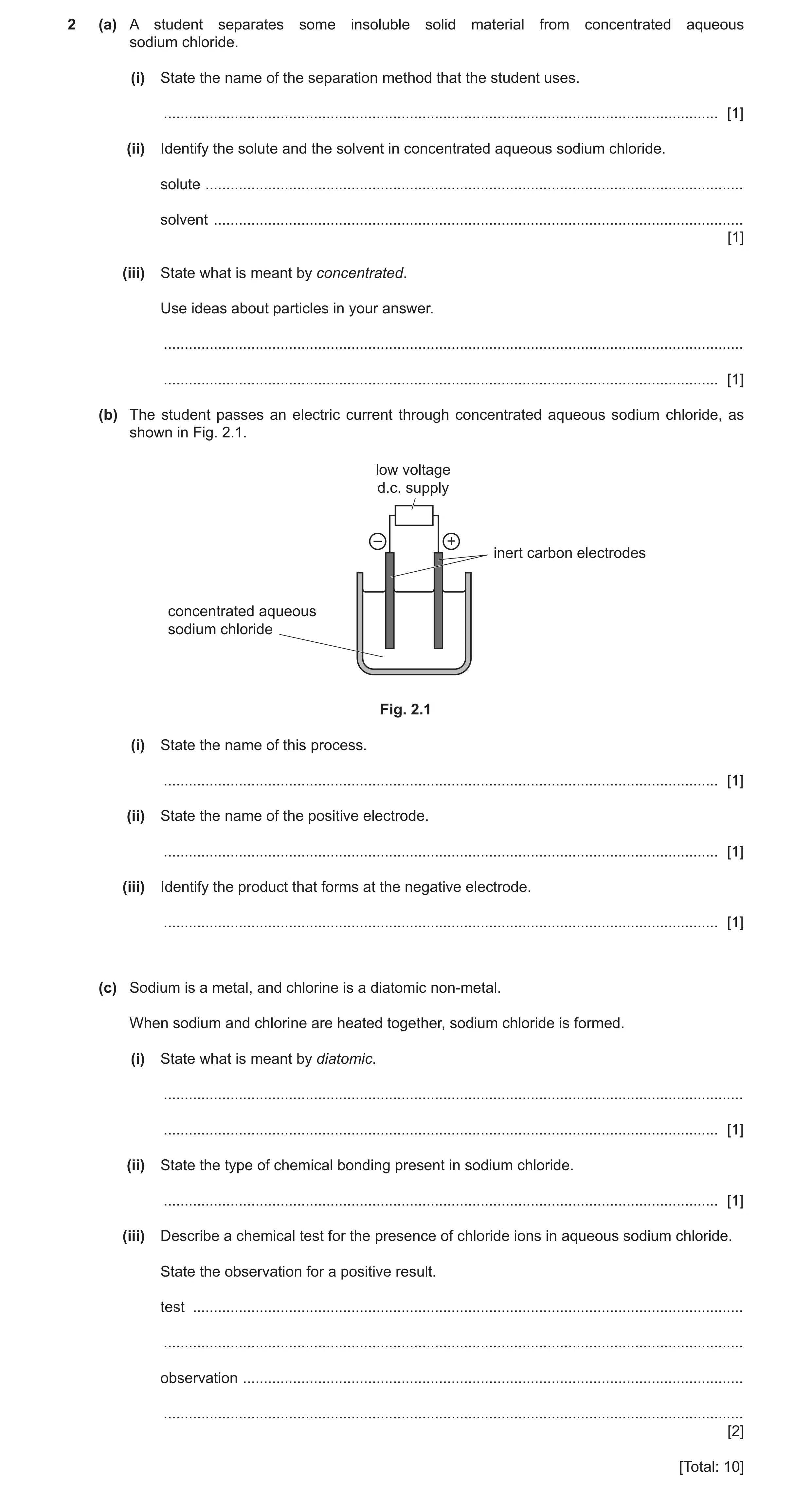
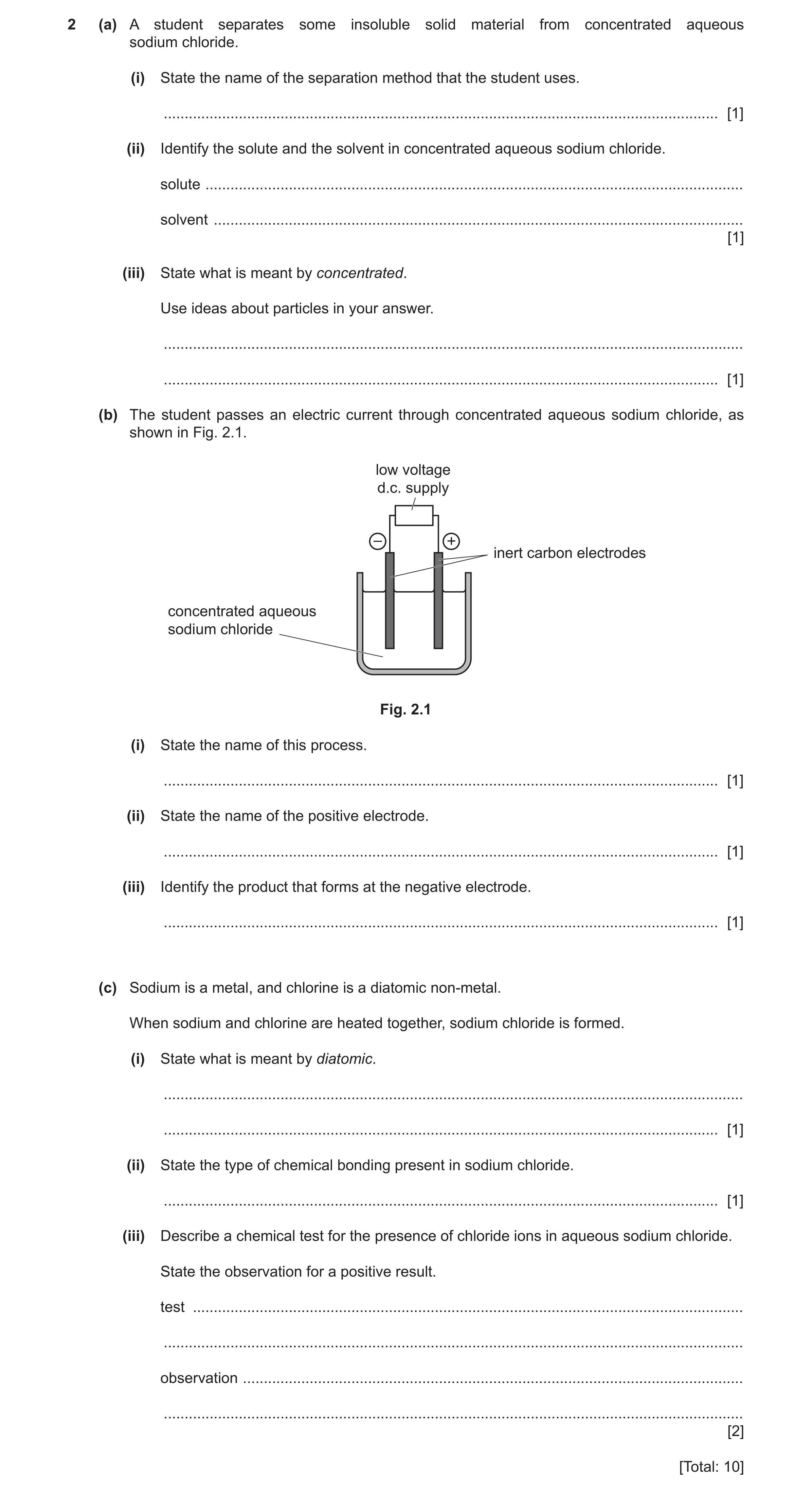
2 (a) A student separates some insoluble solid material from concentrated aqueous sodium chloride. (i) State the name of the separation method that the student uses. … [1] (ii) Identify the solute and the solvent in concentrated aqueous sodium chloride. solute … solvent … [1] (iii) State what is meant by concentrated. Use ideas about particles in your answer. … … [1] (b) The student passes an electric current through concentrated aqueous sodium chloride, as shown in Fig. 2.1. low voltage d.c. supply – + inert carbon electrodes concentrated aqueous sodium chloride Fig. 2.1 (i) State the name of this process. … [1] (ii) State the name of the positive electrode. … [1] (iii) Identify the product that forms at the negative electrode. … [1] (c) Sodium is a metal, and chlorine is a diatomic non-metal. When sodium and chlorine are heated together, sodium chloride is formed. (i) State what is meant by diatomic. … … [1] (ii) State the type of chemical bonding present in sodium chloride. … [1] (iii) Describe a chemical test for the presence of chloride ions in aqueous sodium chloride. State the observation for a positive result. test … … observation … … [2] [Total: 10]
10 marks
Mark scheme: 2(a)(i) filtration / filter(ing) ; 1 2(a)(ii) solute: sodium chloride / NaCl AND solvent: water / H2O ; 1 2(a)(iii) there are many / more solute particles in (a solution) ; 1 2(b)(i) electrolysis ; 1 2(b)(ii) anode ; 1 2(b)(iii) hydrogen ; 1 2(c)(i) (contains) only two atoms joined (in a molecule) ; 1 2(c)(ii) ionic ; 1 2(c)(iii) test: (aqueous) silver nitrate AND (dilute) nitric acid ; result: white precipitate ; 2
This question in 0653/32 Oct/Nov 2021
Q15 · A student separates some insoluble solid material from concentrated aqueous sodium… 0653/33 Oct/Nov 2021
2 (a) A student separates some insoluble solid material from concentrated aqueous sodium chloride. (i) State the name of the separation method that the student uses. … [1] (ii) Identify the solute and the solvent in concentrated aqueous sodium chloride. solute … solvent … [1] (iii) State what is meant by concentrated. Use ideas about particles in your answer. … … [1] (b) The student passes an electric current through concentrated aqueous sodium chloride, as shown in Fig. 2.1. low voltage d.c. supply – + inert carbon electrodes concentrated aqueous sodium chloride Fig. 2.1 (i) State the name of this process. … [1] (ii) State the name of the positive electrode. … [1] (iii) Identify the product that forms at the negative electrode. … [1] (c) Sodium is a metal, and chlorine is a diatomic non-metal. When sodium and chlorine are heated together, sodium chloride is formed. (i) State what is meant by diatomic. … … [1] (ii) State the type of chemical bonding present in sodium chloride. … [1] (iii) Describe a chemical test for the presence of chloride ions in aqueous sodium chloride. State the observation for a positive result. test … … observation … … [2] [Total: 10]
10 marks
Mark scheme: 2(a)(i) filtration / filter(ing) ; 1 2(a)(ii) solute: sodium chloride / NaCl AND solvent: water / H2O ; 1 2(a)(iii) there are many / more solute particles in (a solution) ; 1 2(b)(i) electrolysis ; 1 2(b)(ii) anode ; 1 2(b)(iii) hydrogen ; 1 2(c)(i) (contains) only two atoms joined (in a molecule) ; 1 2(c)(ii) ionic ; 1 2(c)(iii) test: (aqueous) silver nitrate AND (dilute) nitric acid ; result: white precipitate ; 2
This question in 0653/33 Oct/Nov 2021
Q16 · A student has two samples of pure water in test-tubes A and B, and two samples of impure… 0653/32 Feb/March 2022
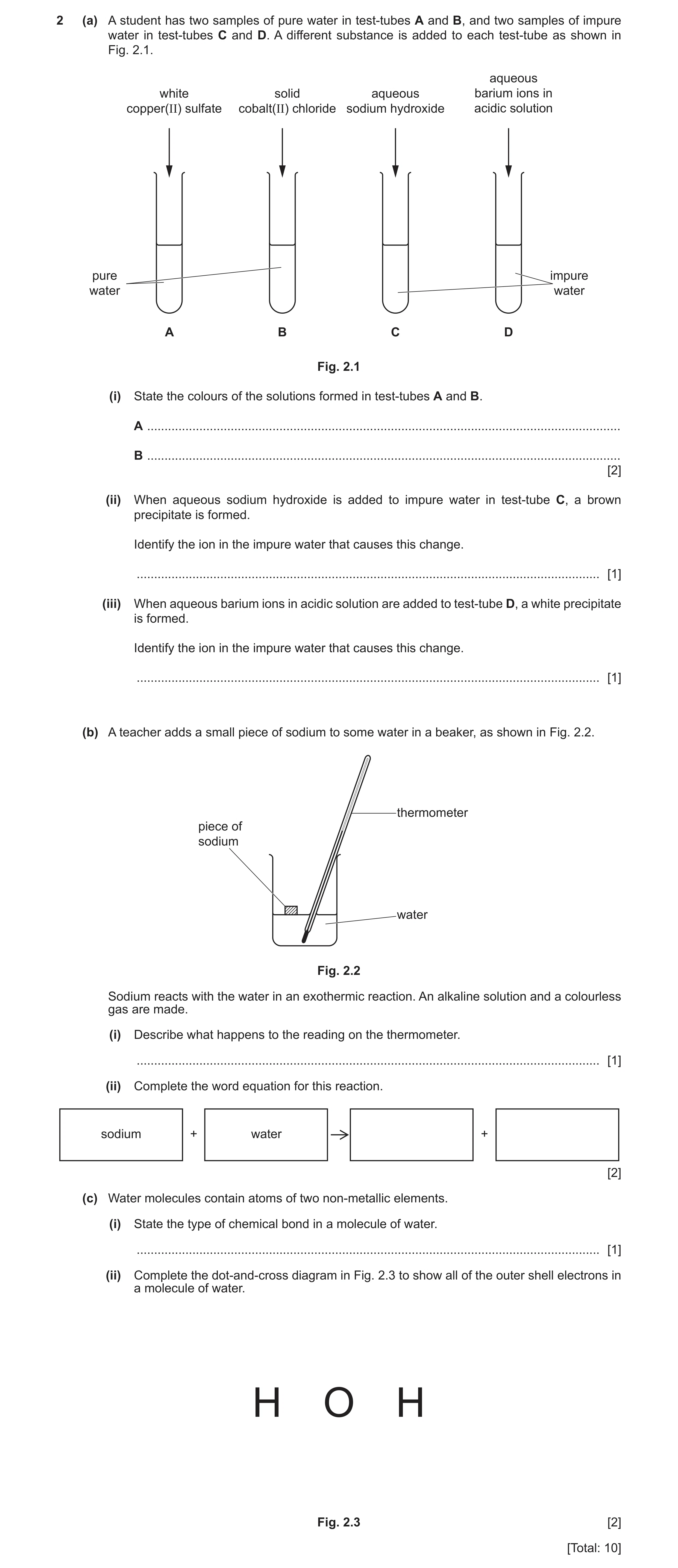
2 (a) A student has two samples of pure water in test-tubes A and B, and two samples of impure water in test-tubes C and D. A different substance is added to each test-tube as shown in Fig. 2.1. aqueous white solid aqueous barium ions in copper(II) sulfate cobalt(II) chloride sodium hydroxide acidic solution pure impure water water A B C D Fig. 2.1 (i) State the colours of the solutions formed in test-tubes A and B. A … B … [2] (ii) When aqueous sodium hydroxide is added to impure water in test-tube C, a brown precipitate is formed. Identify the ion in the impure water that causes this change. … [1] (iii) When aqueous barium ions in acidic solution are added to test-tube D, a white precipitate is formed. Identify the ion in the impure water that causes this change. … [1] (b) A teacher adds a small piece of sodium to some water in a beaker, as shown in Fig. 2.2. thermometer piece of sodium water Fig. 2.2 Sodium reacts with the water in an exothermic reaction. An alkaline solution and a colourless gas are made. (i) Describe what happens to the reading on the thermometer. … [1] (ii) Complete the word equation for this reaction. sodium + water + [2] (c) Water molecules contain atoms of two non-metallic elements. (i) State the type of chemical bond in a molecule of water. … [1] (ii) Complete the dot-and-cross diagram in Fig. 2.3 to show all of the outer shell electrons in a molecule of water. H O H Fig. 2.3 [2] [Total: 10]
10 marks
Mark scheme: 2(a)(i) A (turns) blue ; B (turns) pink ; 2 2(a)(ii) iron(III) / Fe3+ ; 1 2(a)(iii) sulfate / SO42– ; 1 2(b)(i) increases / rises ; 1 Question Answer Marks 2(b)(ii) ; IN EITHER ORDER: sodium hydroxide ; hydrogen ; 2 2(c)(i) covalent ; 1 2(c)(ii) two correct O — H electron pairs ; all else correct ; 2
This question in 0653/32 Feb/March 2022
Q17 · Part of the Periodic Table is shown in Fig 0653/32 Feb/March 2022
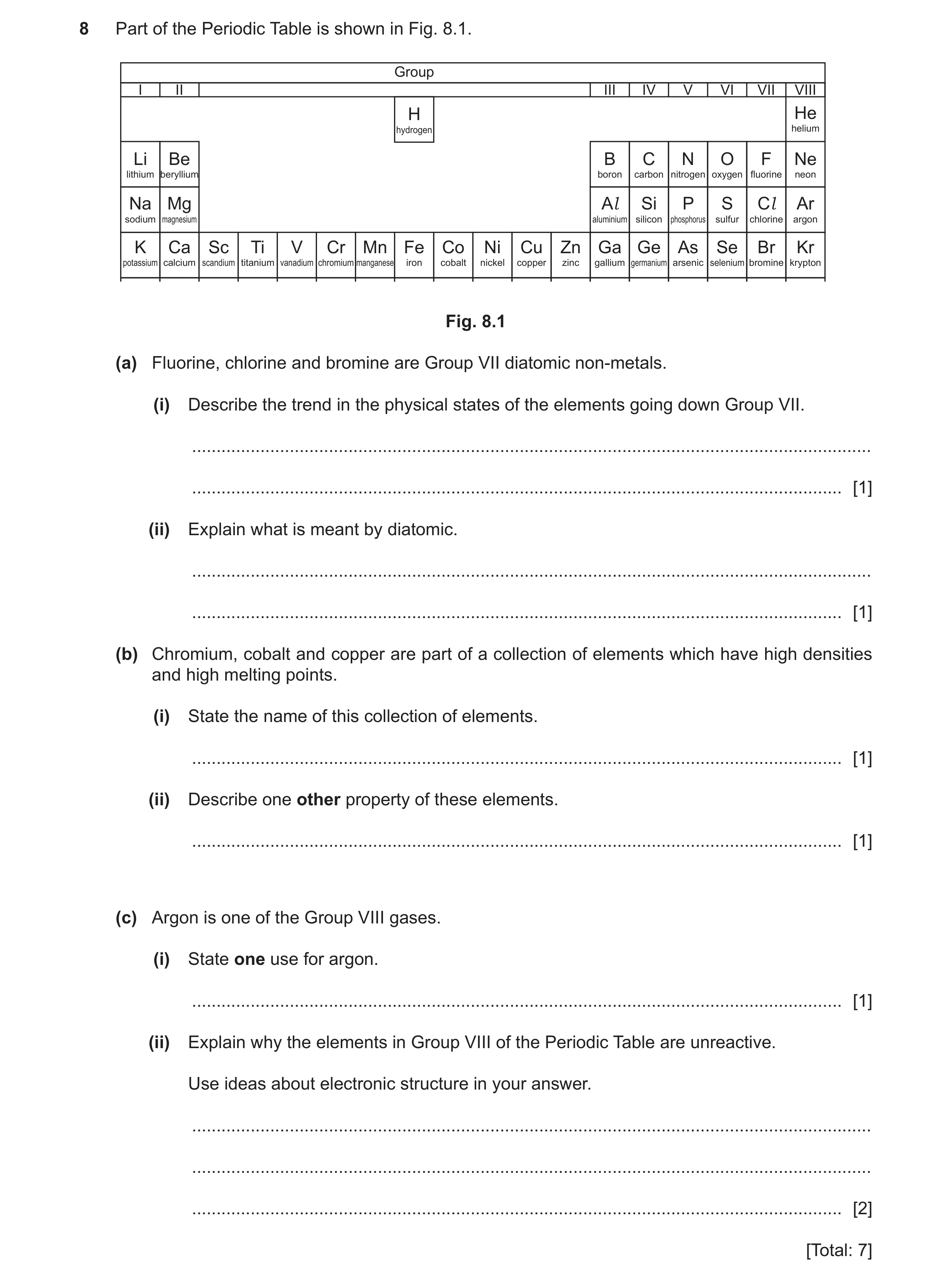
8 Part of the Periodic Table is shown in Fig. 8.1. Group I II III IV V VI VII VIII H He hydrogen helium Li Be B C N O F Ne lithium beryllium boron carbon nitrogen oxygen fluorine neon Na Mg Al Si P S Cl Ar sodium magnesium aluminium silicon phosphorus sulfur chlorine argon K Ca Sc Ti V Cr Mn Fe Co Ni Cu Zn Ga Ge As Se Br Kr potassium calcium scandium titanium vanadium chromium manganese iron cobalt nickel copper zinc gallium germanium arsenic selenium bromine krypton Fig. 8.1 (a) Fluorine, chlorine and bromine are Group VII diatomic non-metals. (i) Describe the trend in the physical states of the elements going down Group VII. … … [1] (ii) Explain what is meant by diatomic. … … [1] (b) Chromium, cobalt and copper are part of a collection of elements which have high densities and high melting points. (i) State the name of this collection of elements. … [1] (ii) Describe one other property of these elements. … [1] (c) Argon is one of the Group VIII gases. (i) State one use for argon. … [1] (ii) Explain why the elements in Group VIII of the Periodic Table are unreactive. Use ideas about electronic structure in your answer. … … … [2] [Total: 7]
7 marks
Mark scheme: 8(a)(i) gas to liquid (to solid) ; 1 8(a)(ii) two atoms in (one / each) molecule ; 1 8(b)(i) transition (elements / metals) ; 1 8(b)(ii) any one from: form coloured compounds ; (element or compounds) act as catalysts ; AVP e.g. good conductors of electricity ; 1 8(c)(i) (provides inert atmosphere) in lamps / light bulbs ; AVP e.g. used in welding 1 8(c)(ii) they have a full outer shell of electrons ; so are stable / they do not need to gain, lose or share electrons to become stable ; 2
This question in 0653/32 Feb/March 2022
Q18 · Lithium, sodium and potassium are three elements in Group I of the Periodic Table, as… 0653/33 May/June 2022
5 (a) Lithium, sodium and potassium are three elements in Group I of the Periodic Table, as shown in Fig. 5.1. 3 Li lithium 7 11 Na sodium 23 19 K potassium 39 Fig. 5.1 Identify which of these three elements has: the lowest density … the highest reactivity … the highest melting point. … [2] (b) Chlorine, bromine and iodine are three elements in Group VII of the Periodic Table. They exist as diatomic molecules. (i) Describe what is meant by diatomic. … … [1] (ii) Complete the dot‑and‑cross diagram in Fig. 5.2 to show all the outer shell electrons in a molecule of chlorine, Cl 2. Cl Cl Fig. 5.2 [2] (iii) State the type of chemical bonding in a molecule of chlorine. … [1] (c) When sodium and chlorine react together, they form sodium chloride, NaCl. (i) Describe what happens to sodium atoms and to chlorine atoms when they react together. Use ideas about electrons in your answer. sodium atoms … … chlorine atoms … … [2] (ii) Complete Table 5.1 by stating whether each substance conducts or does not conduct electricity when solid, molten (liquid) or gas. Use a tick (✓) for conducts or a cross (✗) for does not conduct in each empty box. Table 5.1 solid molten (liquid) gas sodium sodium chloride chlorine [3] [Total: 11]
11 marks
Mark scheme: 5(a) (lowest density) lithium / Li (highest reactivity) potassium / K (highest melting point) lithium / Li Three correct scores (2) ;; Two or one correct scores (1) ; 2 5(b)(i) contains only two atoms (per molecule) ; 1 5(b)(ii) correct diagram showing two shared electrons ; and 6 non-shared (3 pairs of) electrons on each chlorine ; 2 5(b)(iii) covalent ; 1 5(c)(i) (sodium atoms) lose electrons / lose one electron each ; (chlorine atoms) gain electrons / gain one electron each ; 2 5(c)(ii) ;;; (1) for each correct row 3
This question in 0653/33 May/June 2022
Q19 · A student measures the melting point of some salty water and some pure water 0653/31 May/June 2023
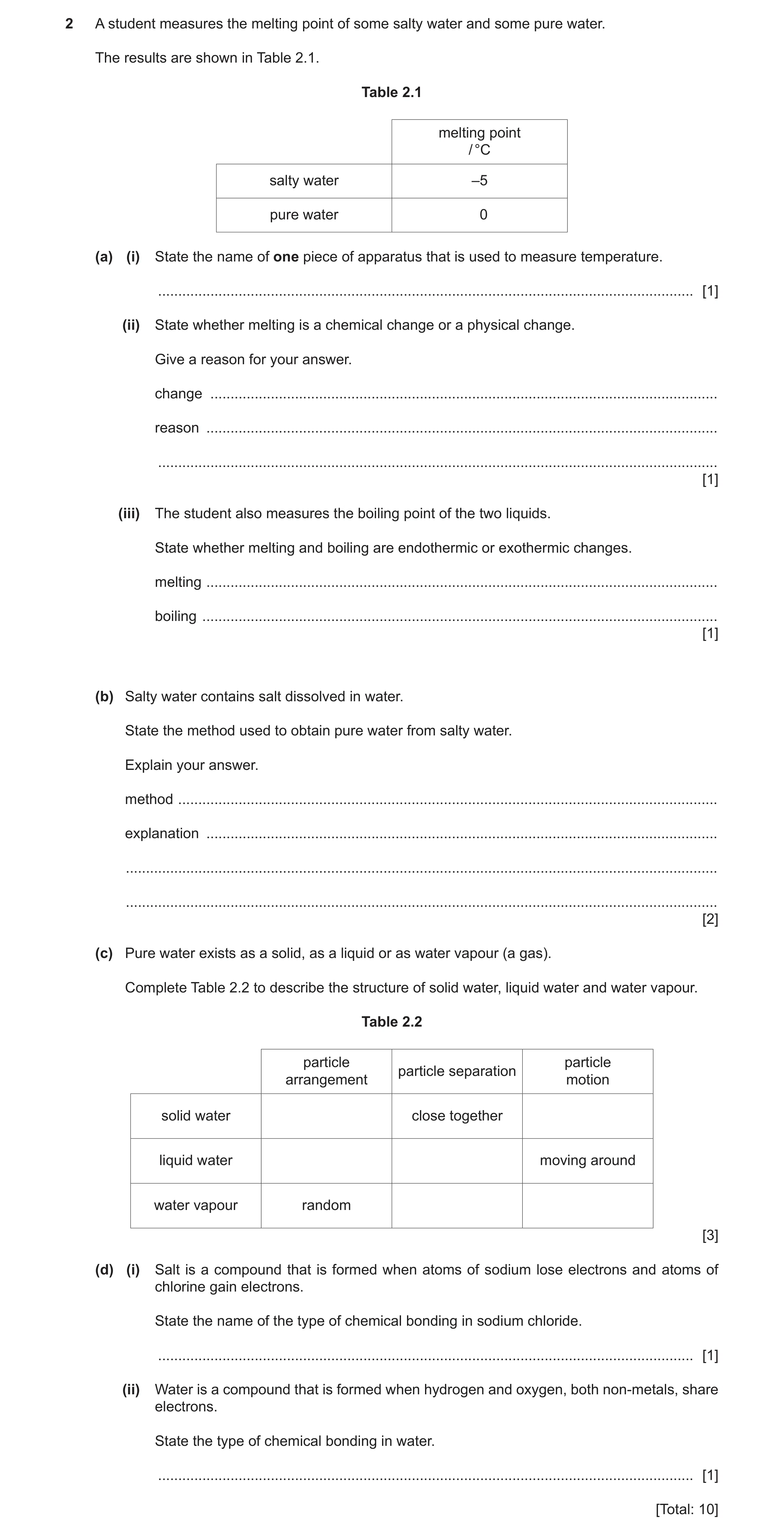
2 A student measures the melting point of some salty water and some pure water. The results are shown in Table 2.1. Table 2.1 melting point / °C salty water –5 pure water 0 (a) (i) State the name of one piece of apparatus that is used to measure temperature. … [1] (ii) State whether melting is a chemical change or a physical change. Give a reason for your answer. change … reason … … [1] (iii) The student also measures the boiling point of the two liquids. State whether melting and boiling are endothermic or exothermic changes. melting … boiling … [1] (b) Salty water contains salt dissolved in water. State the method used to obtain pure water from salty water. Explain your answer. method … explanation … … … [2] (c) Pure water exists as a solid, as a liquid or as water vapour (a gas). Complete Table 2.2 to describe the structure of solid water, liquid water and water vapour. Table 2.2 particle particle particle separation arrangement motion solid water close together liquid water moving around water vapour random [3] (d) (i) Salt is a compound that is formed when atoms of sodium lose electrons and atoms of chlorine gain electrons. State the name of the type of chemical bonding in sodium chloride. … [1] (ii) Water is a compound that is formed when hydrogen and oxygen, both non-metals, share electrons. State the type of chemical bonding in water. … [1] [Total: 10]
10 marks
Mark scheme: 2(a)(i) thermometer ; 1 2(a)(ii) (change) physical AND (reason) no new substance is made ; 1 2(a)(iii) (melting) endothermic AND (boiling) endothermic ; 1 2(b) (method) distillation ; (explanation) water evaporates and leaves the salt behind ; 2 Question Answer Marks 2(c) particle arrangement particle separation particle motion solid water regular / ordered close together vibrate / move about a fixed point liquid water random close together moving around water vapour random far apart / spread out moving rapidly ;;; 6 correct = 3 marks 3 – 5 correct = 2 marks 1 – 2 correct = 1 mark 3 2(d)(i) ionic ; 1 2(d)(ii) covalent ; 1
This question in 0653/31 May/June 2023
Q20 · A student dissolves sodium carbonate, Na2CO3, in water to form aqueous sodium carbonate 0653/31 Oct/Nov 2023
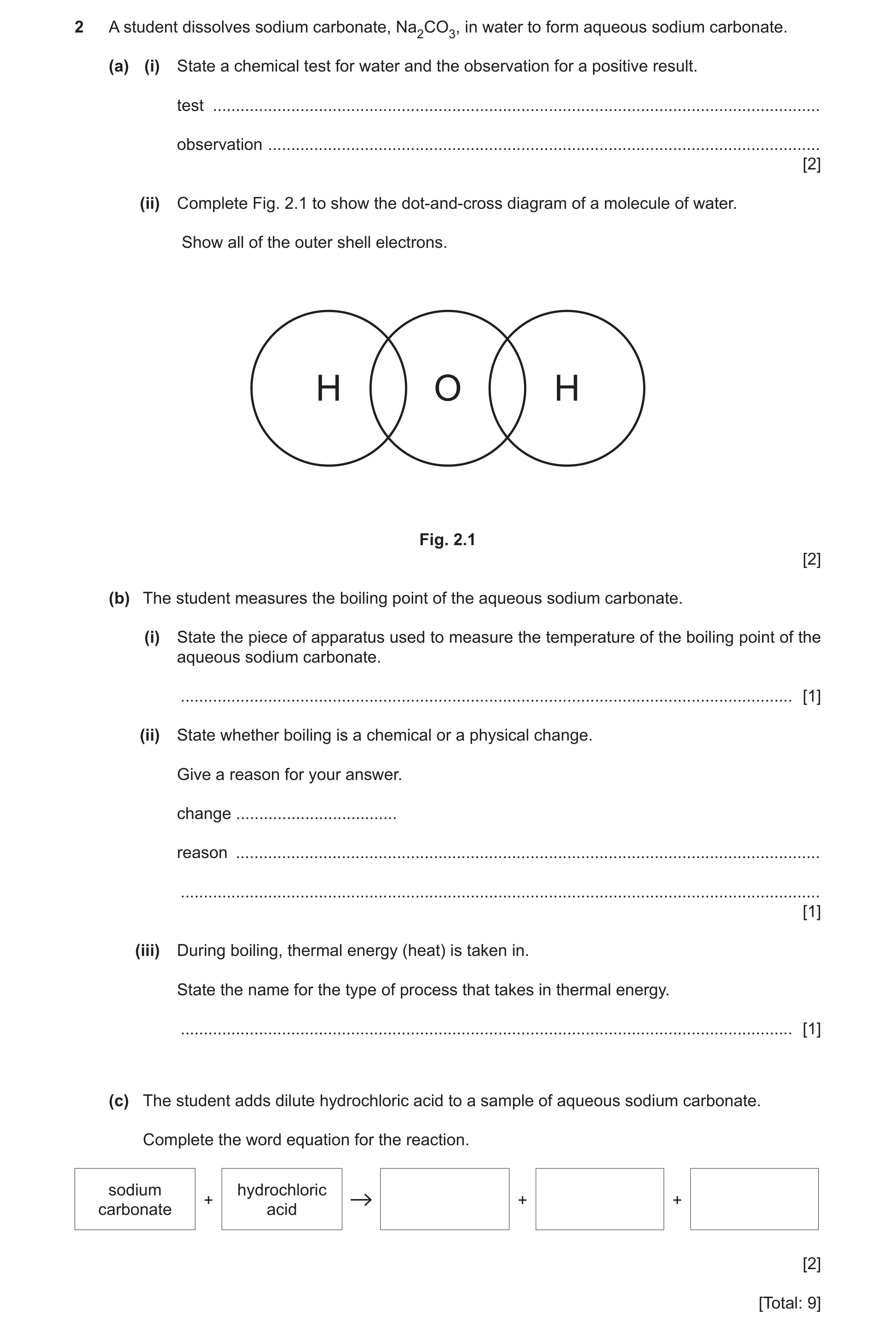
2 A student dissolves sodium carbonate, Na2CO3, in water to form aqueous sodium carbonate. (a) (i) State a chemical test for water and the observation for a positive result. test … observation … [2] (ii) Complete Fig. 2.1 to show the dot-and-cross diagram of a molecule of water. Show all of the outer shell electrons. H O H Fig. 2.1 [2] (b) The student measures the boiling point of the aqueous sodium carbonate. (i) State the piece of apparatus used to measure the temperature of the boiling point of the aqueous sodium carbonate. … [1] (ii) State whether boiling is a chemical or a physical change. Give a reason for your answer. change … reason … … [1] (iii) During boiling, thermal energy (heat) is taken in. State the name for the type of process that takes in thermal energy. … [1] (c) The student adds dilute hydrochloric acid to a sample of aqueous sodium carbonate. Complete the word equation for the reaction. sodium hydrochloric + + +carbonate acid [2] [Total: 9]
9 marks
Mark scheme: 2(a)(i) test (anhydrous) copper sulfate ; 2 observation (white to) blue ; OR test (anhydrous) cobalt chloride ; observation (blue to) pink ; 2(a)(ii) one bond pair between each H atom and O atom ; 2 two lone pairs on O atom and all else correct ; 2(b)(i) thermometer ; 1 2(b)(ii) change physical AND 1 explanation no new substance is made ; 2(b)(iii) endothermic ; 1 2(c) 2 sodium chloride correct / carbon dioxide and water correct ; all three correct ;
This question in 0653/31 Oct/Nov 2023
Q21 · Chlorine exists as diatomic molecules 0653/32 Oct/Nov 2023
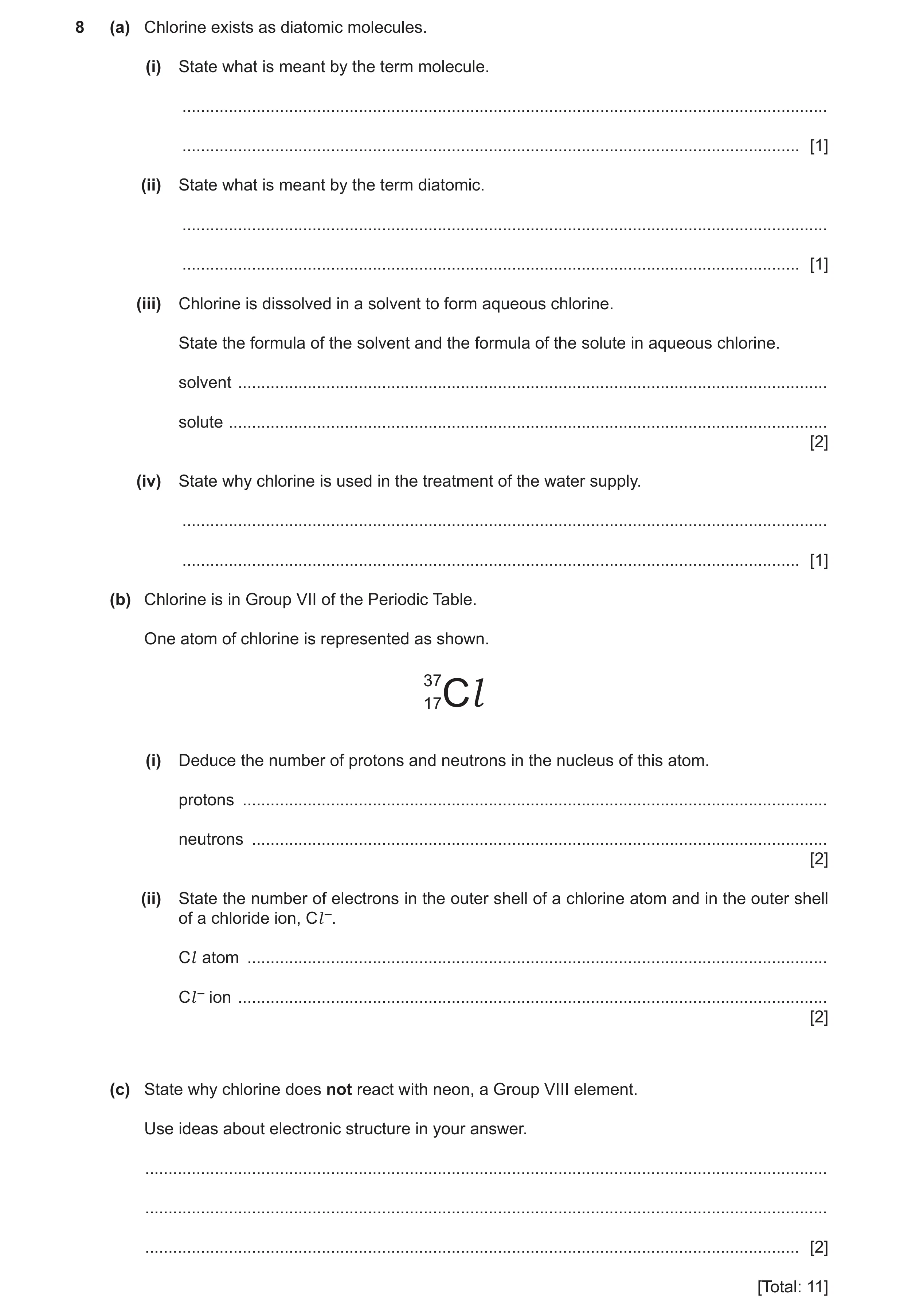
8 (a) Chlorine exists as diatomic molecules. (i) State what is meant by the term molecule. … … [1] (ii) State what is meant by the term diatomic. … … [1] (iii) Chlorine is dissolved in a solvent to form aqueous chlorine. State the formula of the solvent and the formula of the solute in aqueous chlorine. solvent … solute … [2] (iv) State why chlorine is used in the treatment of the water supply. … … [1] (b) Chlorine is in Group VII of the Periodic Table. One atom of chlorine is represented as shown. 3717Cl (i) Deduce the number of protons and neutrons in the nucleus of this atom. protons … neutrons … [2] (ii) State the number of electrons in the outer shell of a chlorine atom and in the outer shell of a chloride ion, Cl –. Cl atom … Cl – ion … [2] (c) State why chlorine does not react with neon, a Group VIII element. Use ideas about electronic structure in your answer. … … … [2] [Total: 11]
11 marks
Mark scheme: 8(a)(i) contains (two or more) atoms, bonded / chemically joined ; 1 8(a)(ii) (consisting of) two atoms ; 1 8(a)(iii) solvent: H2O ; 2 solute: Cl 2 ; 8(a)(iv) (chlorine) kills, bacteria / microbes / microorganisms ; 1 8(b)(i) protons: 17 ; 2 neutrons: 20 ; 8(b)(ii) Cl atom: 7 ; 2 Cl – ion: 8 ; 8(c) neon / Group VIII / noble gases, are unreactive ; 2 because they have, full outer shells / 8 outer shell electrons ;
This question in 0653/32 Oct/Nov 2023
Q22 · Chlorine exists as diatomic molecules 0653/33 Oct/Nov 2023
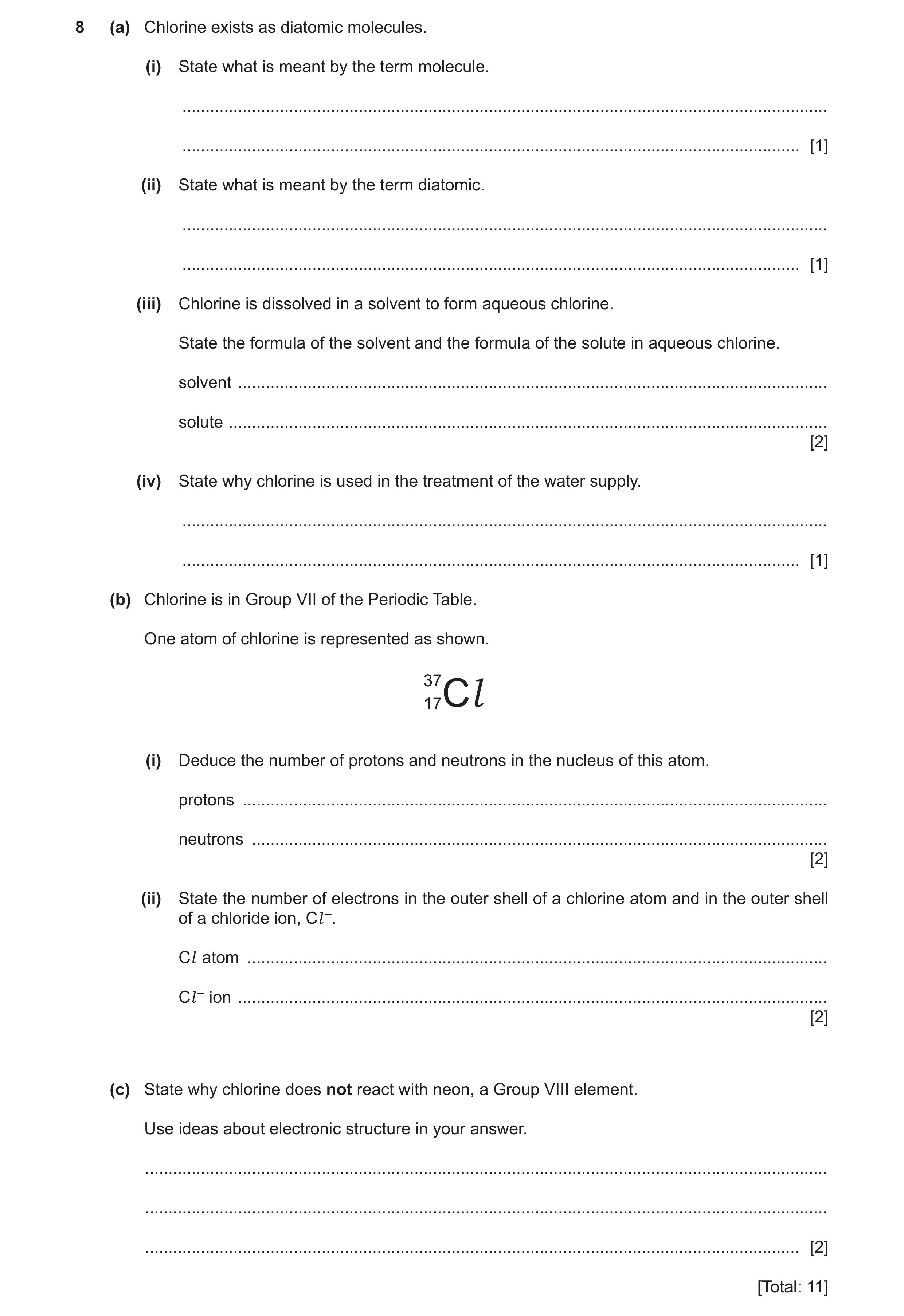
8 (a) Chlorine exists as diatomic molecules. (i) State what is meant by the term molecule. … … [1] (ii) State what is meant by the term diatomic. … … [1] (iii) Chlorine is dissolved in a solvent to form aqueous chlorine. State the formula of the solvent and the formula of the solute in aqueous chlorine. solvent … solute … [2] (iv) State why chlorine is used in the treatment of the water supply. … … [1] (b) Chlorine is in Group VII of the Periodic Table. One atom of chlorine is represented as shown. 3717Cl (i) Deduce the number of protons and neutrons in the nucleus of this atom. protons … neutrons … [2] (ii) State the number of electrons in the outer shell of a chlorine atom and in the outer shell of a chloride ion, Cl –. Cl atom … Cl – ion … [2] (c) State why chlorine does not react with neon, a Group VIII element. Use ideas about electronic structure in your answer. … … … [2] [Total: 11]
11 marks
Mark scheme: 8(a)(i) contains (two or more) atoms, bonded / chemically joined ; 1 8(a)(ii) (consisting of) two atoms ; 1 8(a)(iii) solvent: H2O ; 2 solute: Cl 2 ; 8(a)(iv) (chlorine) kills, bacteria / microbes / microorganisms ; 1 8(b)(i) protons: 17 ; 2 neutrons: 20 ; 8(b)(ii) Cl atom: 7 ; 2 Cl – ion: 8 ; 8(c) neon / Group VIII / noble gases, are unreactive ; 2 because they have, full outer shells / 8 outer shell electrons ;
This question in 0653/33 Oct/Nov 2023
Q23 · A pie chart showing the composition of clean air 0653/32 Feb/March 2024
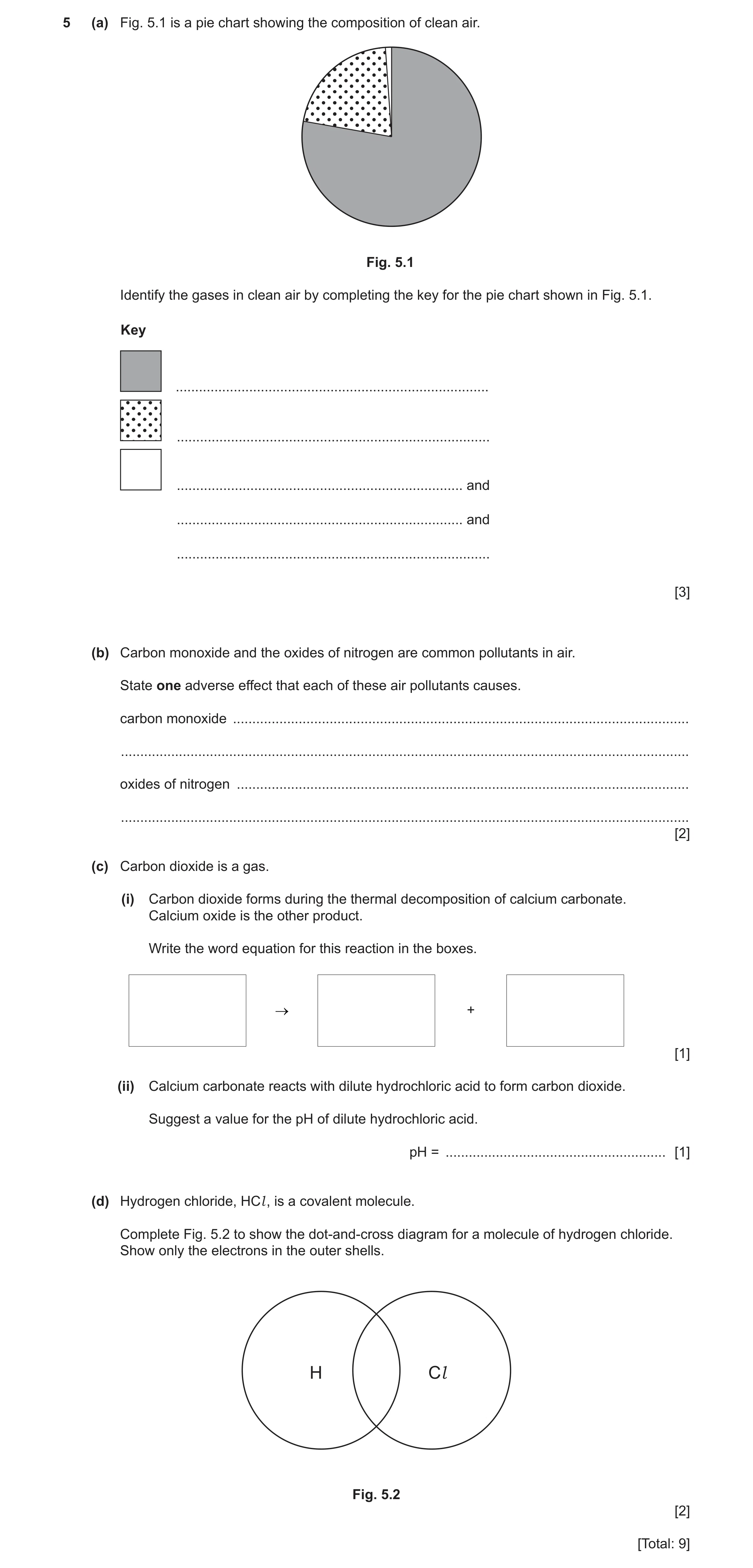
5 (a) Fig. 5.1 is a pie chart showing the composition of clean air. Fig. 5.1 Identify the gases in clean air by completing the key for the pie chart shown in Fig. 5.1. Key … … … and … and … [3] (b) Carbon monoxide and the oxides of nitrogen are common pollutants in air. State one adverse effect that each of these air pollutants causes. carbon monoxide … … oxides of nitrogen … … [2] (c) Carbon dioxide is a gas. (i) Carbon dioxide forms during the thermal decomposition of calcium carbonate. Calcium oxide is the other product. Write the word equation for this reaction in the boxes. + [1] (ii) Calcium carbonate reacts with dilute hydrochloric acid to form carbon dioxide. Suggest a value for the pH of dilute hydrochloric acid. pH = … [1] (d) Hydrogen chloride, HCl , is a covalent molecule. Complete Fig. 5.2 to show the dot-and-cross diagram for a molecule of hydrogen chloride. Show only the electrons in the outer shells. H Cl Fig. 5.2 [2] [Total: 9]
9 marks
Mark scheme: 5(a) (grey shading) nitrogen 3 (dots shading) oxygen (white shading) noble gases / named noble gas (white shading) water vapour (white shading) carbon dioxide ;;; 5 correct = [3] 3–4 correct = [2] 1–2 correct = [1] 5(b) carbon monoxide: 2 headaches / tiredness / confusion / toxic ; oxides of nitrogen: acid rain / damages buildings ; 5(c)(i) calcium carbonate → calcium oxide + carbon dioxide ; 1 5(c)(ii) 1–4 ; 1 5(d) shared pair of electrons ; 2 3 lone pairs in Cl and no other electrons in H ;
This question in 0653/32 Feb/March 2024
Q24 · The elements chlorine, bromine and iodine are diatomic covalent molecules 0653/31 May/June 2024
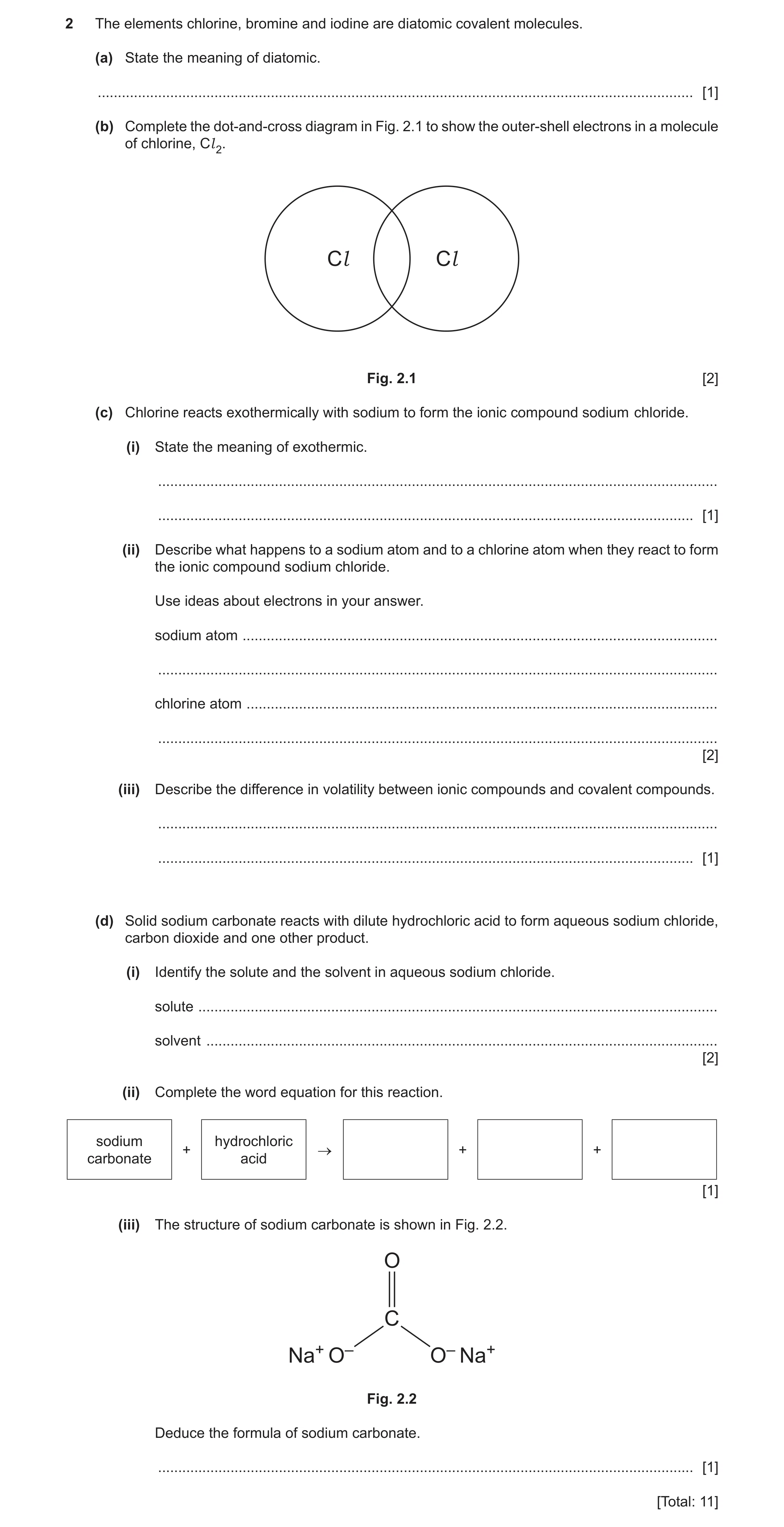
2 The elements chlorine, bromine and iodine are diatomic covalent molecules. (a) State the meaning of diatomic. … [1] (b) Complete the dot-and-cross diagram in Fig. 2.1 to show the outer-shell electrons in a molecule of chlorine, Cl2. Cl Cl Fig. 2.1 [2] (c) Chlorine reacts exothermically with sodium to form the ionic compound sodium chloride. (i) State the meaning of exothermic. … … [1] (ii) Describe what happens to a sodium atom and to a chlorine atom when they react to form the ionic compound sodium chloride. Use ideas about electrons in your answer. sodium atom … … chlorine atom … … [2] (iii) Describe the difference in volatility between ionic compounds and covalent compounds. … … [1] (d) Solid sodium carbonate reacts with dilute hydrochloric acid to form aqueous sodium chloride, carbon dioxide and one other product. (i) Identify the solute and the solvent in aqueous sodium chloride. solute … solvent … [2] (ii) Complete the word equation for this reaction. sodium hydrochloric + + +carbonate acid [1] (iii) The structure of sodium carbonate is shown in Fig. 2.2. O C Na+ O– O– Na+ Fig. 2.2 Deduce the formula of sodium carbonate. … [1] [Total: 11]
11 marks
Mark scheme: 2(a) (molecule containing) two atoms (chemically combined) ; 1 Question Answer Marks 2(b) one shared pair of electrons ; three lone pairs / six non-bonding electrons on each atom and all else correct ; 2 2(c)(i) (reaction that) gives out thermal energy ; 1 2(c)(ii) (sodium atom) loses one electron ; (chlorine atom) gains one electron ; 2 2(c)(iii) covalent are more (volatile) ; 1 2(d)(i) (solute) sodium chloride / NaCl ; (solvent) water / H2O ; 2 2(d)(ii) ; 1 2(d)(iii) Na2CO3 ; 1
This question in 0653/31 May/June 2024
Q25 · A student investigates the rate of reaction between solid magnesium carbonate and dilute… 0653/31 Oct/Nov 2024
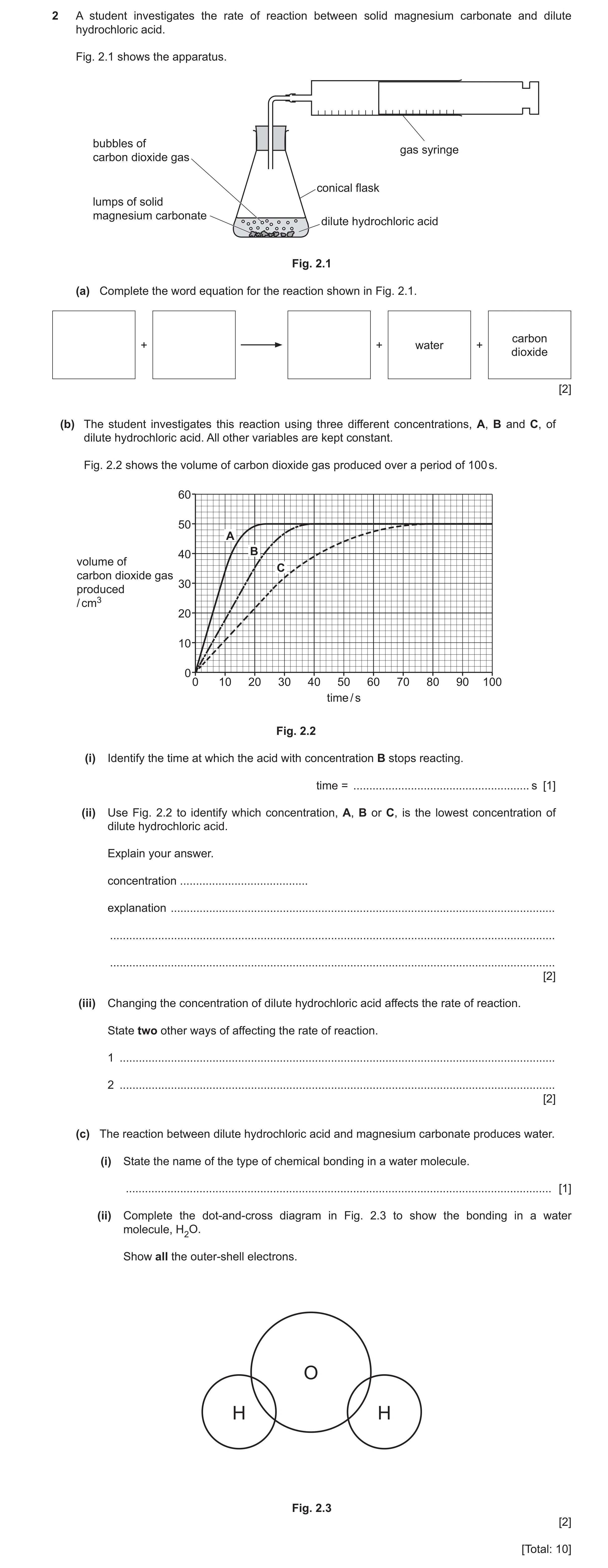
2 A student investigates the rate of reaction between solid magnesium carbonate and dilute hydrochloric acid. Fig. 2.1 shows the apparatus. bubbles of gas syringe carbon dioxide gas conical flask lumps of solid magnesium carbonate dilute hydrochloric acid Fig. 2.1 (a) Complete the word equation for the reaction shown in Fig. 2.1. carbon + + water + dioxide [2] (b) The student investigates this reaction using three different concentrations, A, B and C, of dilute hydrochloric acid. All other variables are kept constant. Fig. 2.2 shows the volume of carbon dioxide gas produced over a period of 100 s. 60 50 A 40 B volume of C carbon dioxide gas 30 produced / cm3 20 10 0 0 10 20 30 40 50 60 70 80 90 100 time / s Fig. 2.2 (i) Identify the time at which the acid with concentration B stops reacting. time = … s [1] (ii) Use Fig. 2.2 to identify which concentration, A, B or C, is the lowest concentration of dilute hydrochloric acid. Explain your answer. concentration … explanation … … … [2] (iii) Changing the concentration of dilute hydrochloric acid affects the rate of reaction. State two other ways of affecting the rate of reaction. 1 … 2 … [2] (c) The reaction between dilute hydrochloric acid and magnesium carbonate produces water. (i) State the name of the type of chemical bonding in a water molecule. … [1] (ii) Complete the dot-and-cross diagram in Fig. 2.3 to show the bonding in a water molecule, H2O. Show all the outer-shell electrons. O H H Fig. 2.3 [2] [Total: 10]
10 marks
Mark scheme: 2(a) magnesium carbonate AND hydrochloric acid ; 2 magnesium chloride ; 2(b)(i) 38–40 (s) ; 1 2(b)(ii) C ; 2 lowest rate of reaction / curve is less steep / reaction takes longer to complete ; 2(b)(iii) any two from: 2 change temperature ; use catalyst ; change, size / surface area (of particles / magnesium carbonate) ; 2(c)(i) covalent ; 1 2(c)(ii) bonding pair between each hydrogen and the oxygen ; 2 2 lone pairs / 4 non-bonding electrons on oxygen outer shell AND all else correct ;
This question in 0653/31 Oct/Nov 2024
Q26 · Scientists are investigating the use of iron as a fuel in cars 0653/33 May/June 2025
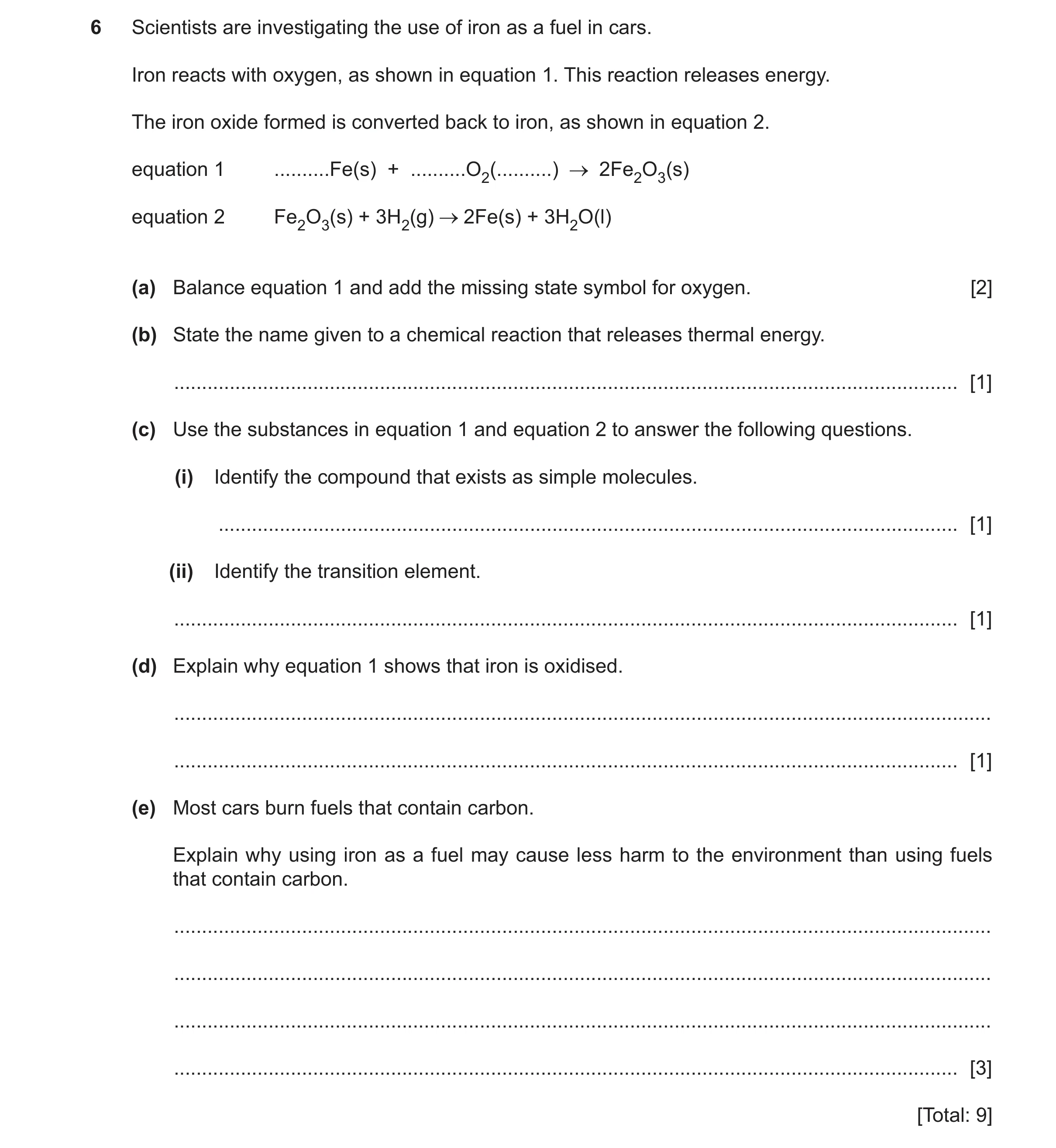
6 Scientists are investigating the use of iron as a fuel in cars. Iron reacts with oxygen, as shown in equation 1. This reaction releases energy. The iron oxide formed is converted back to iron, as shown in equation 2. equation 1 … Fe(s) + … O2( … ) 2Fe2O3(s) equation 2 Fe2O3(s) + 3H2(g) 2Fe(s) + 3H2O(l) (a) Balance equation 1 and add the missing state symbol for oxygen. [2] (b) State the name given to a chemical reaction that releases thermal energy. … [1] (c) Use the substances in equation 1 and equation 2 to answer the following questions. (i) Identify the compound that exists as simple molecules. … [1] (ii) Identify the transition element. … [1] (d) Explain why equation 1 shows that iron is oxidised. … … [1] (e) Most cars burn fuels that contain carbon. Explain why using iron as a fuel may cause less harm to the environment than using fuels that contain carbon. … … … … [3] [Total: 9]
9 marks
Mark scheme: 6(a) 4Fe + 3O2 ; 2 (g) ; 6(b) exothermic ; 1 6(c)(i) water / H2O ; 1 6(c)(ii) iron / Fe ; 1 6(d) (Fe / iron) gains oxygen ; 1 6(e) any three from: 3 iron does not produce carbon dioxide / carbon fuels produce carbon dioxide ; iron does not produce carbon monoxide / carbon fuels produce carbon monoxide ; carbon dioxide causes climate change ; carbon monoxide is toxic ; using iron as a fuel only produces water as a waste product ;
This question in 0653/33 May/June 2025
Q27 · Aqueous hydrogen peroxide, H2O2, breaks down to form oxygen and water 0653/31 Oct/Nov 2025
4 Aqueous hydrogen peroxide, H2O2, breaks down to form oxygen and water. (a) Complete the balanced symbol equation for this reaction. … H2O2 … O2 + … H2O [1] (b) A student investigates the rate of this reaction by measuring the volume of oxygen gas produced in 60 seconds. Fig. 4.1 is a diagram of the apparatus used in the investigation. A aqueous hydrogen peroxide water Fig. 4.1 (i) Name the piece of apparatus labelled A in Fig. 4.1. … [1] (ii) The volume of gas produced in 60 seconds is 22.6 cm3. Calculate the rate of reaction in cm3 per second. Give your answer to two decimal places. rate of reaction = … cm3 per second [2] (iii) Manganese(IV) oxide is a catalyst for this reaction. Describe what is meant by a catalyst. … … … [2] (iv) Name the group of elements in the Periodic Table that often act as catalysts. … [1] (c) Fig. 4.2 shows the dot-and-cross diagram for a hydrogen peroxide molecule. Only the outer-shell electrons are shown. H O O H Fig. 4.2 Name the type of bonding in a hydrogen peroxide molecule. Give a reason for your answer. type of bonding … reason … … [2] [Total: 9]
9 marks
Mark scheme: 4(a) 2H2O2 → O2 + 2H2O ; 1 4(b)(i) measuring cylinder ; 1 4(b)(ii) 0.37666 ; 2 0.38 ; 4(b)(iii) (substance that) increases the rate / speed of a reaction ; 2 unchanged at the end of the reaction ; 4(b)(iv) transition ; 1 4(c) covalent ; 2 shared electrons ;
This question in 0653/31 Oct/Nov 2025
 9 / 38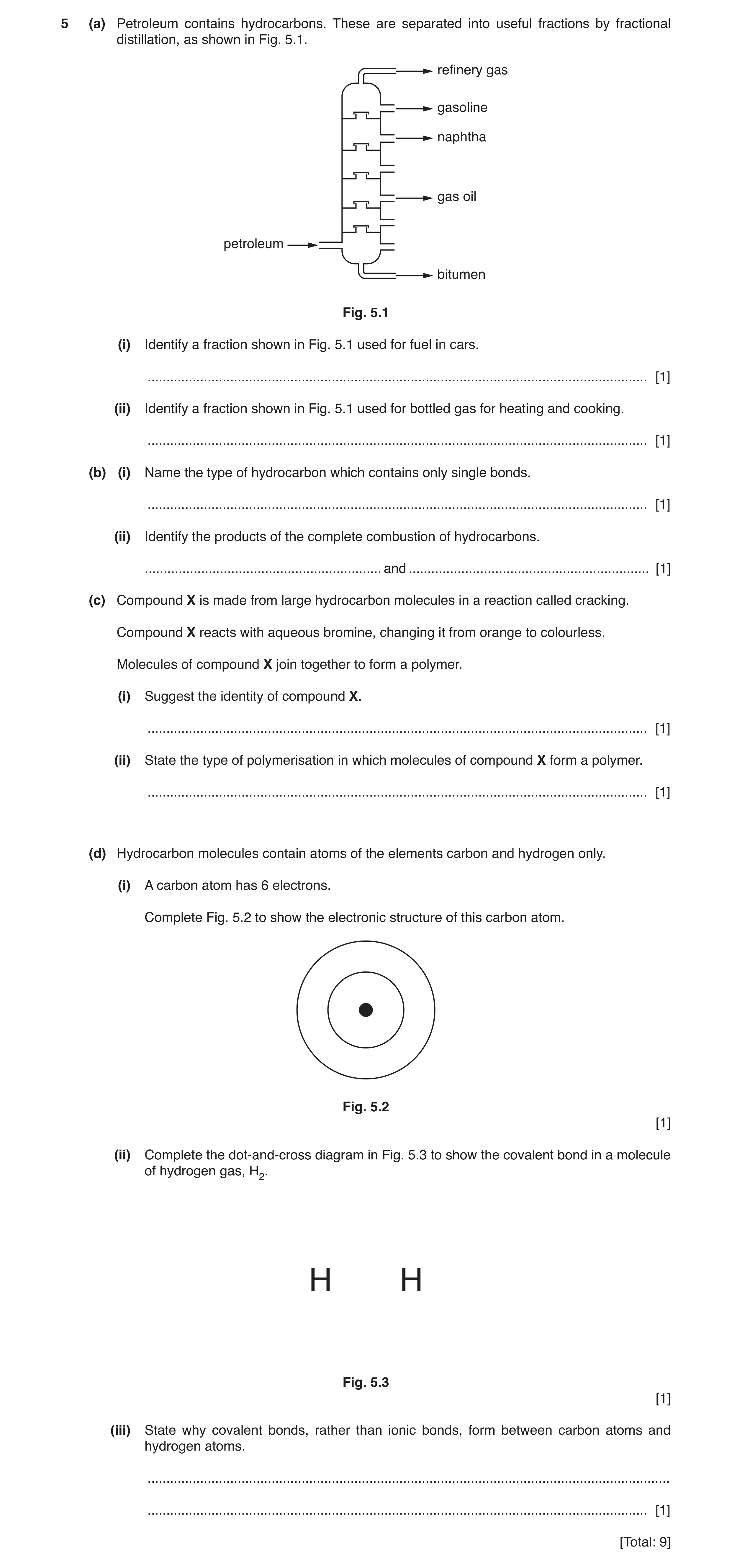
 15 / 38
 16 / 38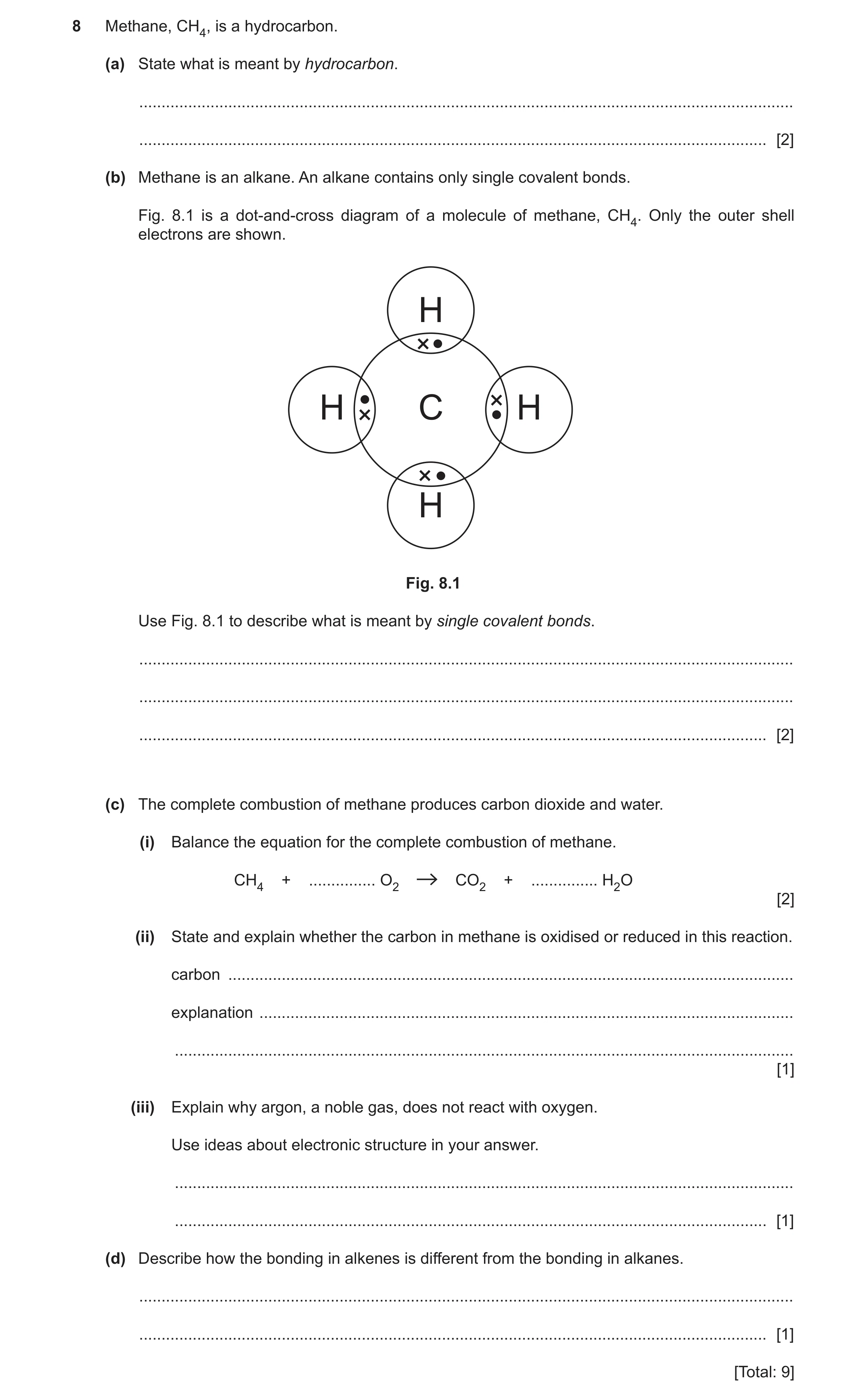
 23 / 38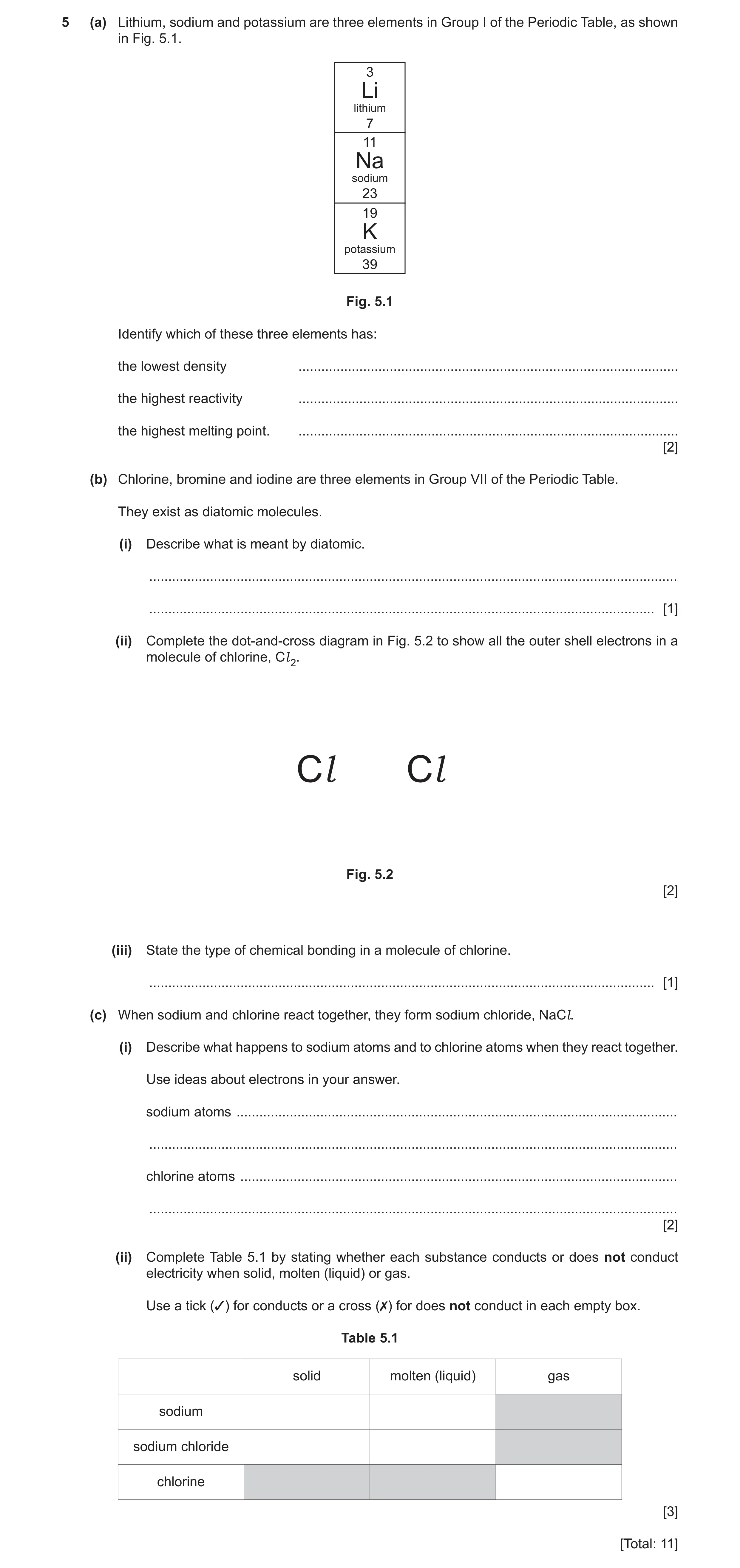
 36 / 38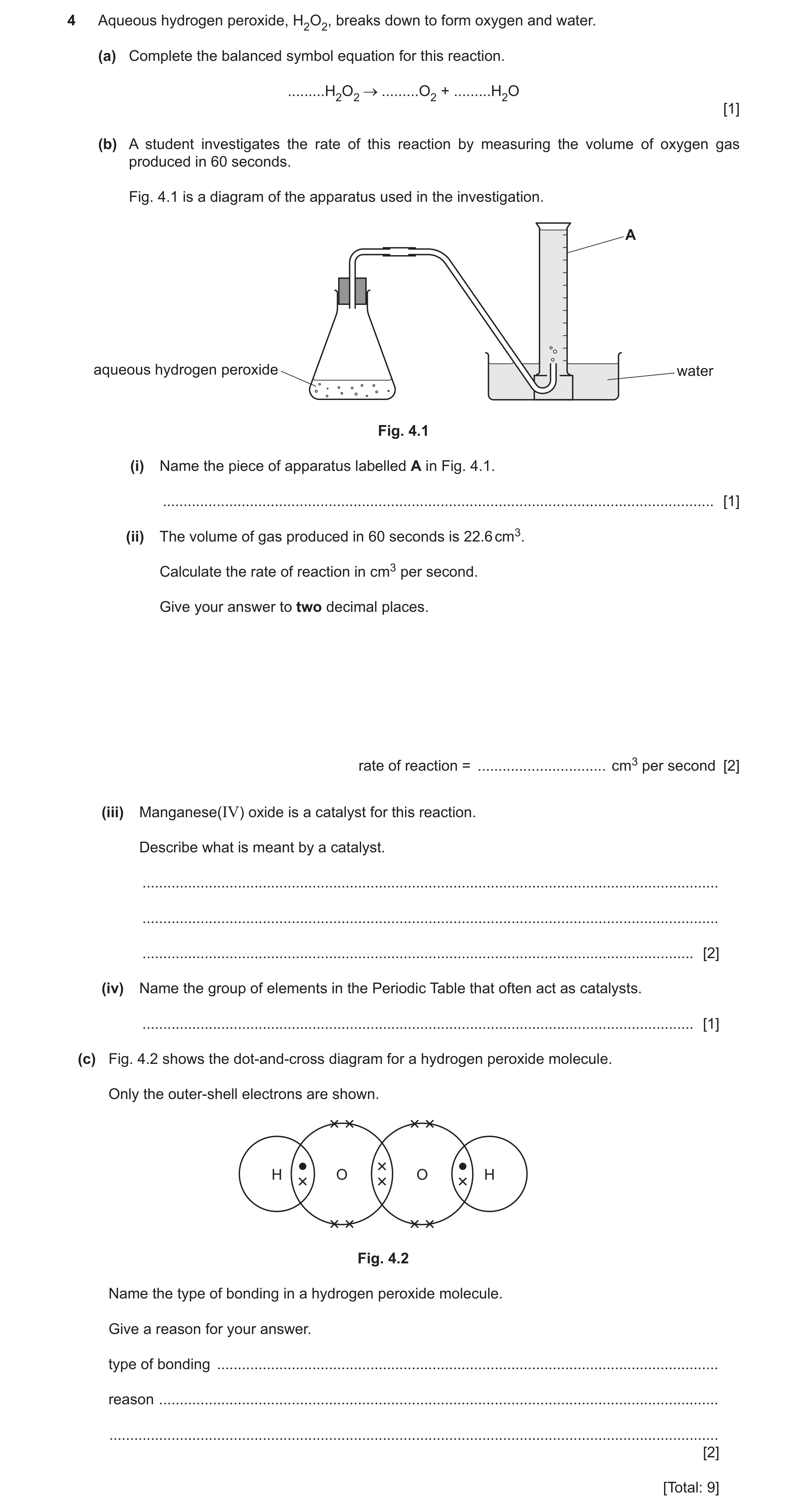
 9
9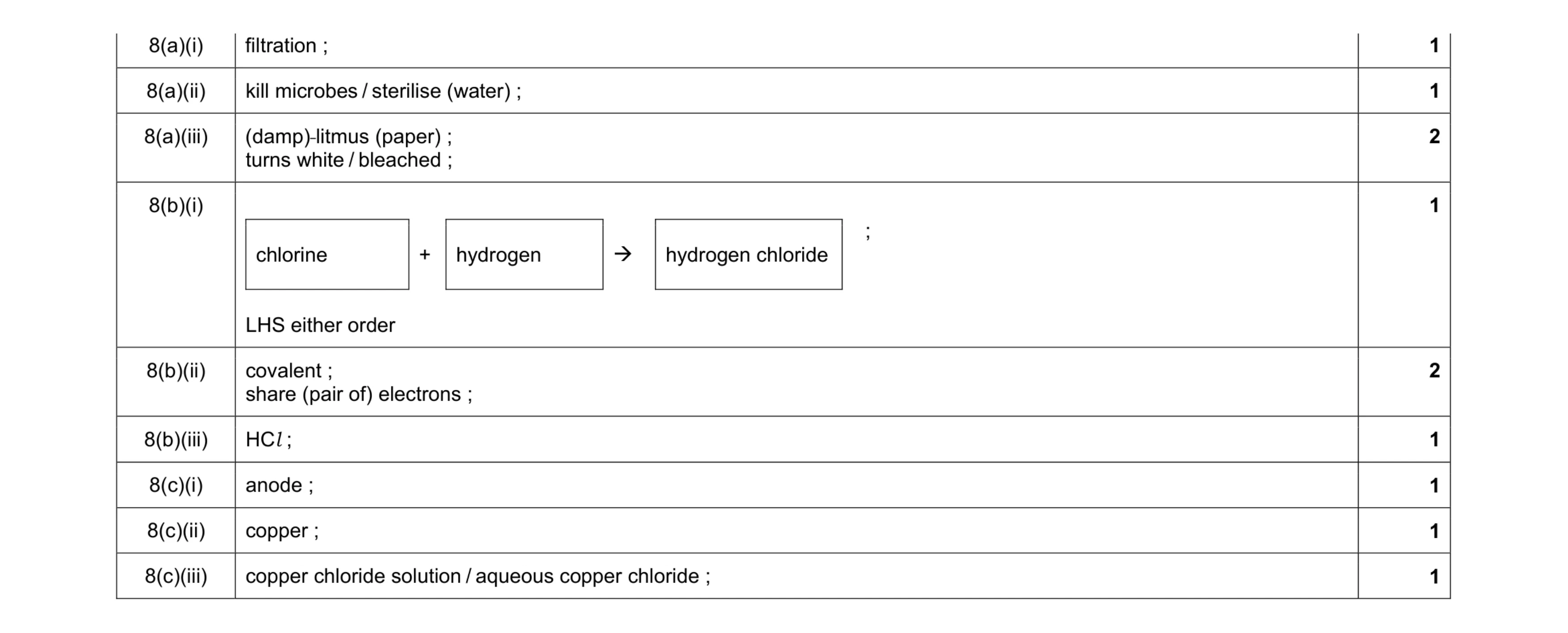 11
11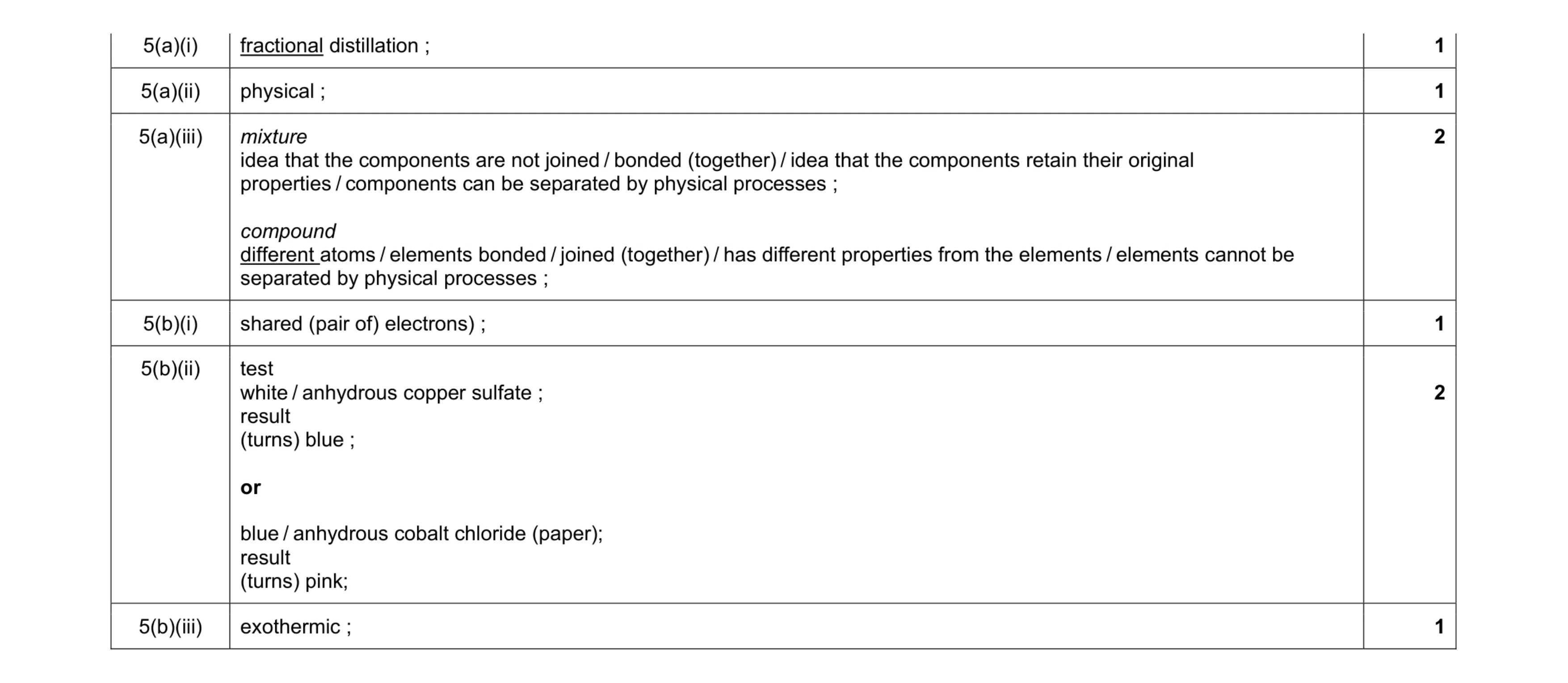 8
8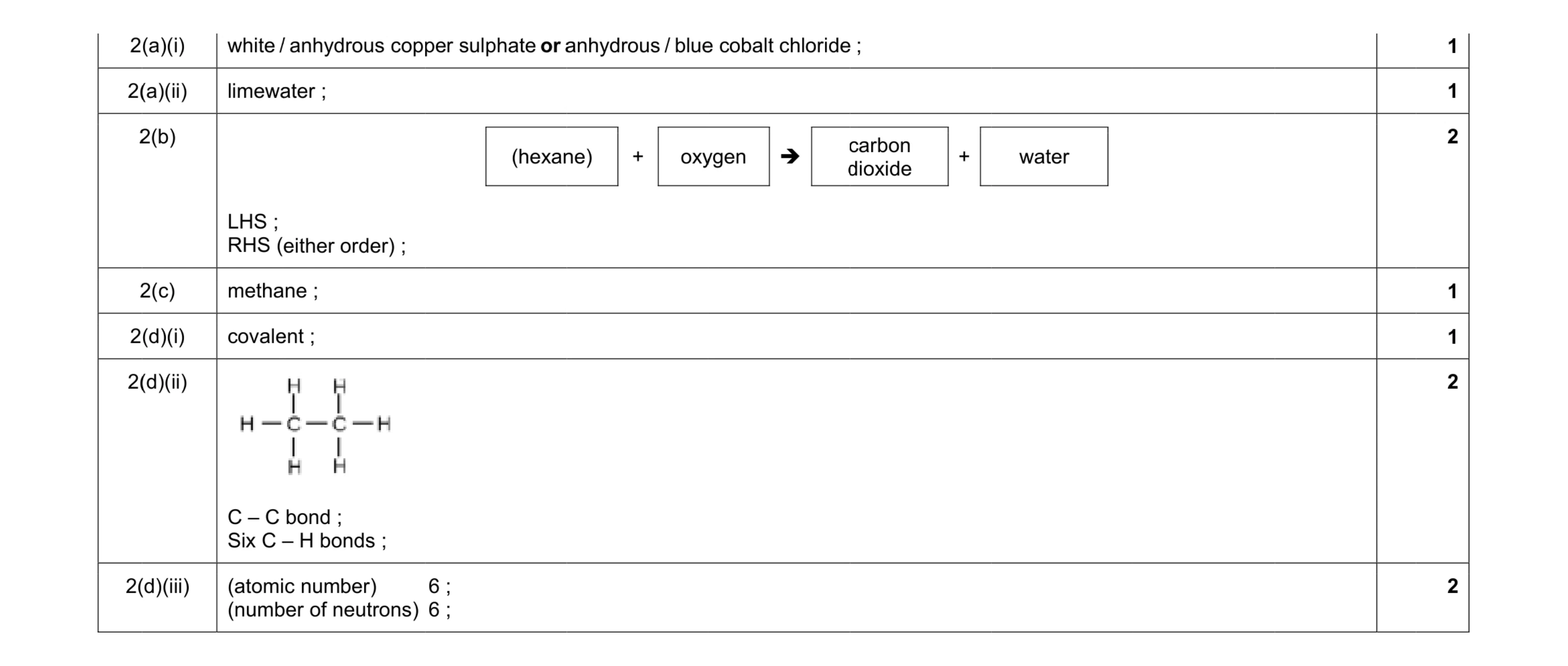 10
10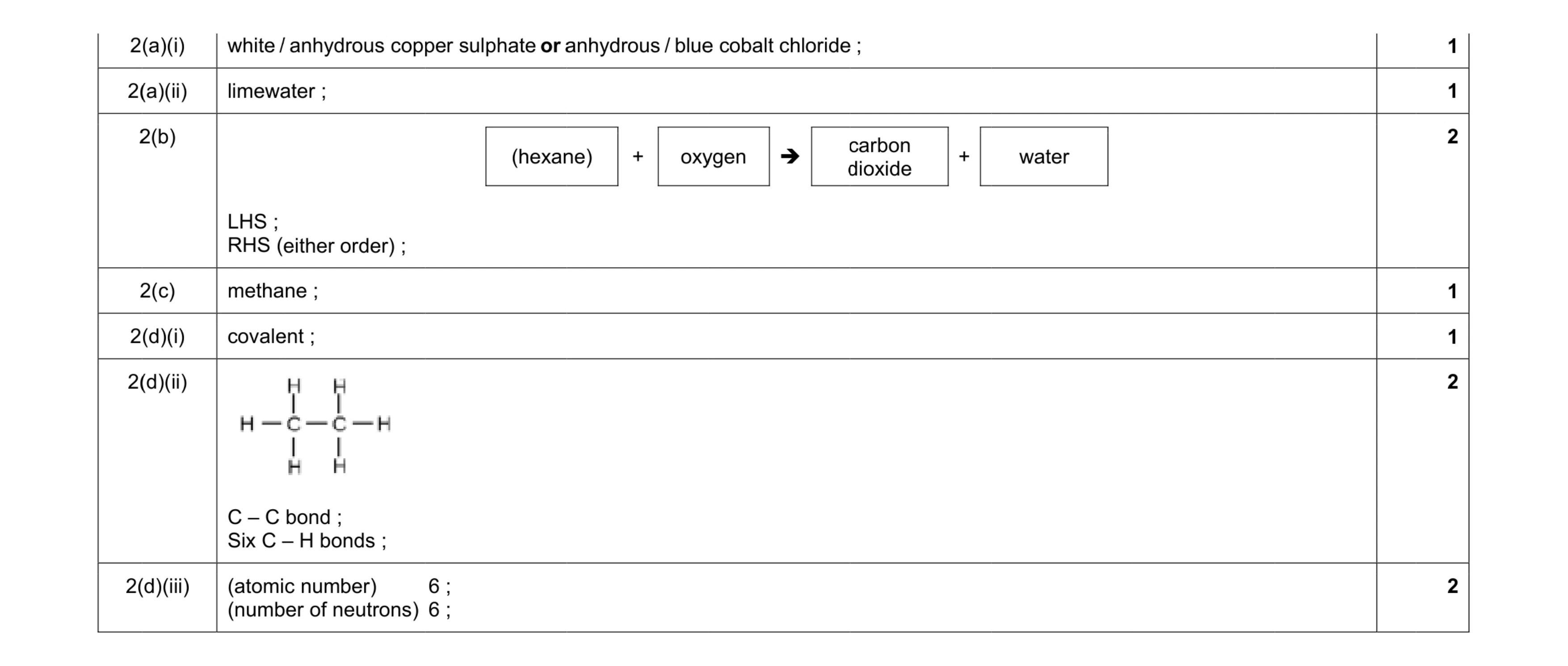 10
10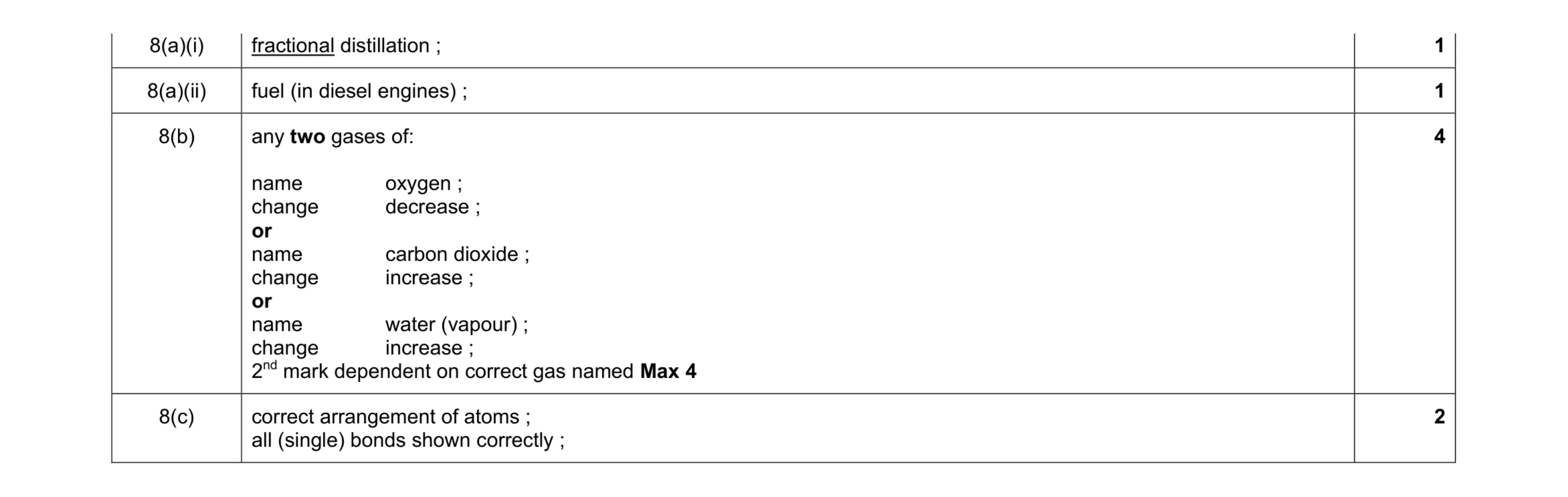 8
8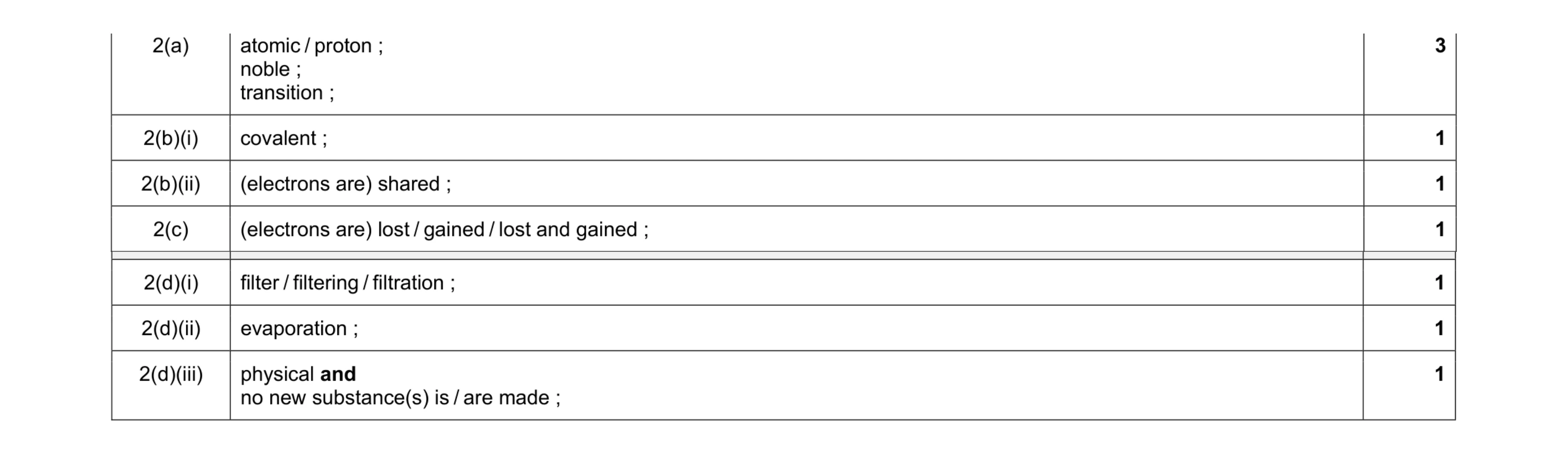 9
9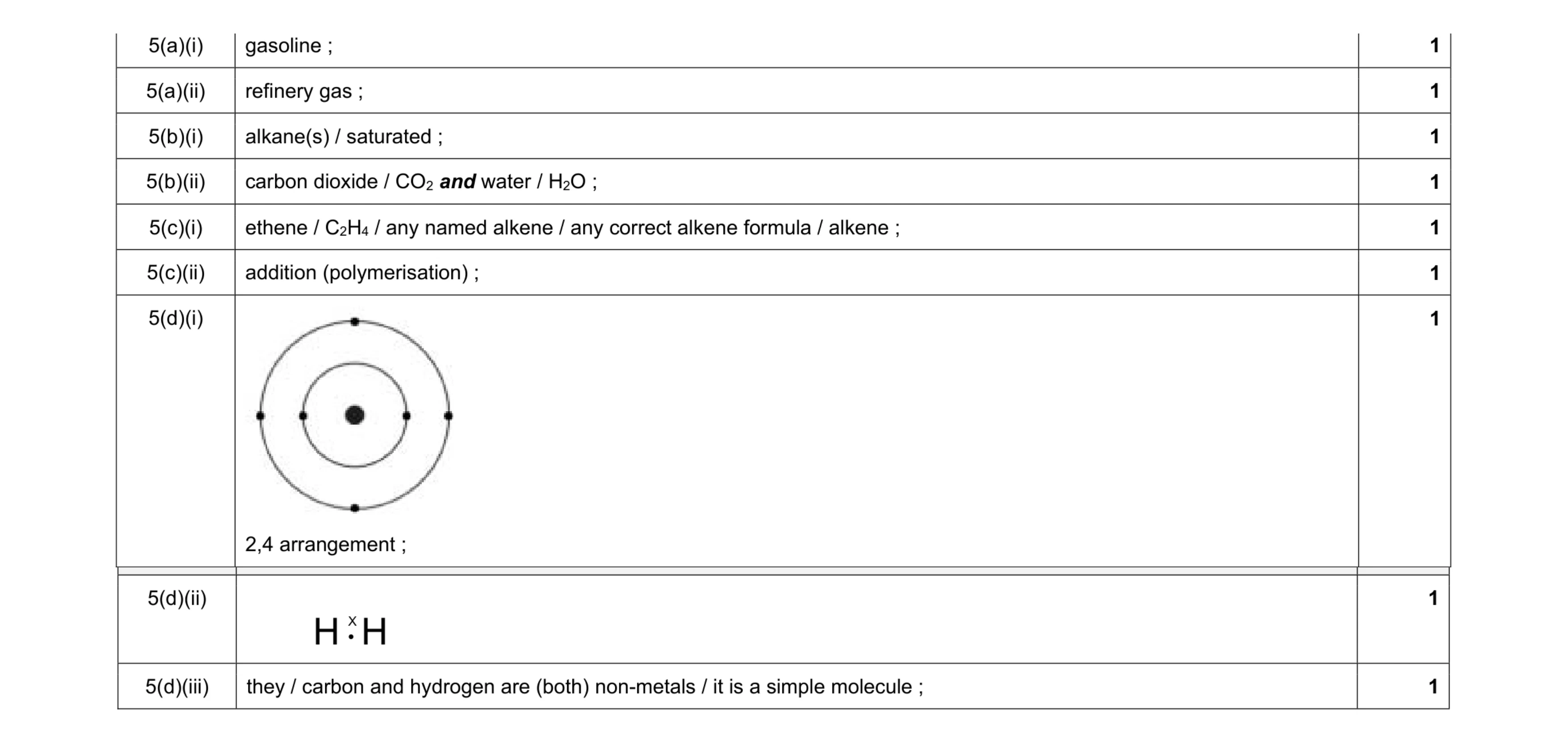 9
9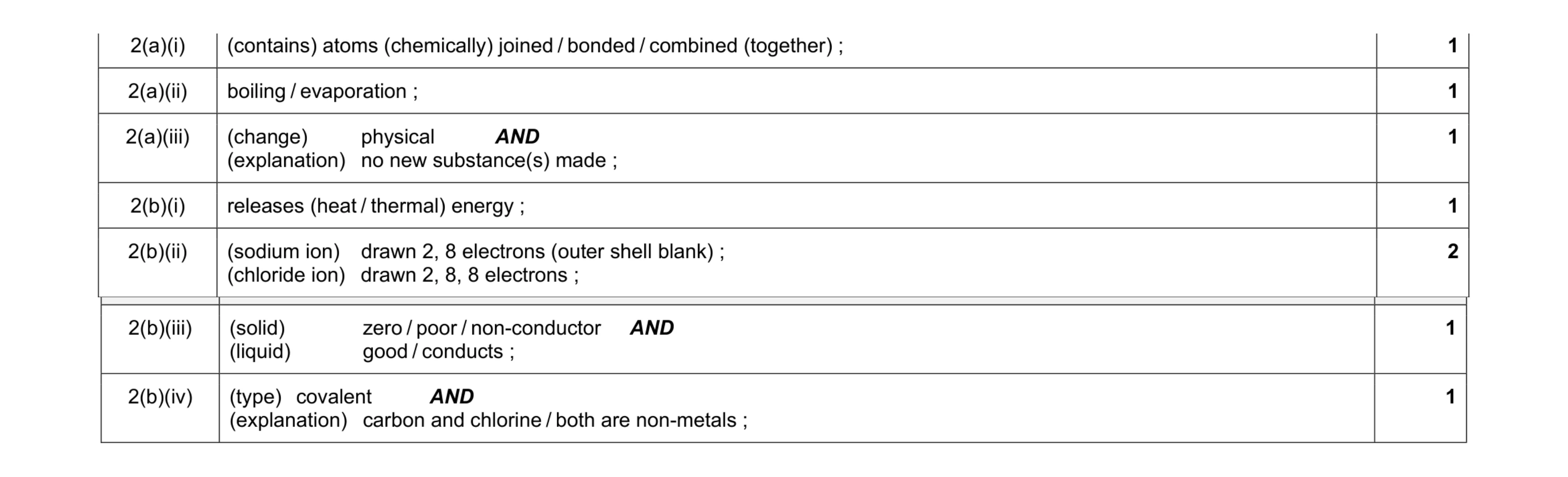 8
8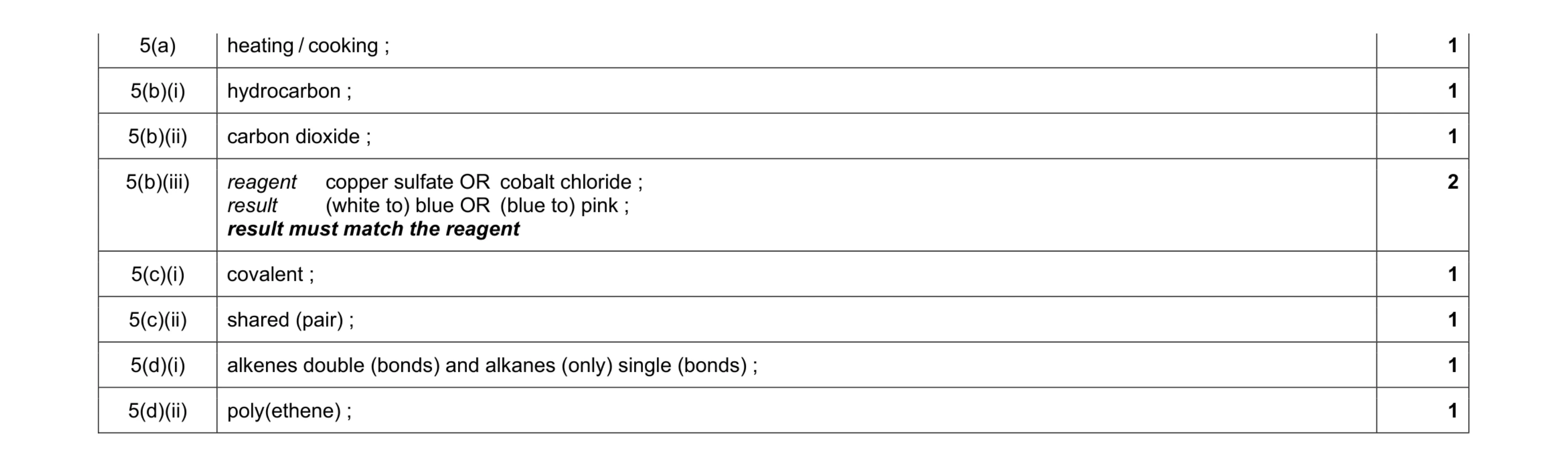 9
9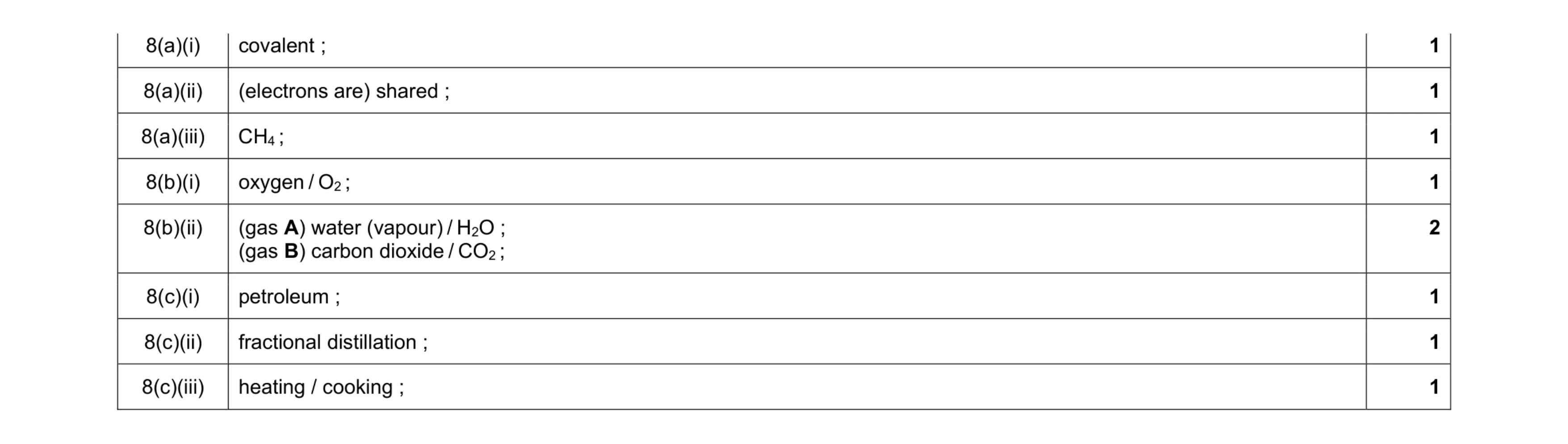 9
9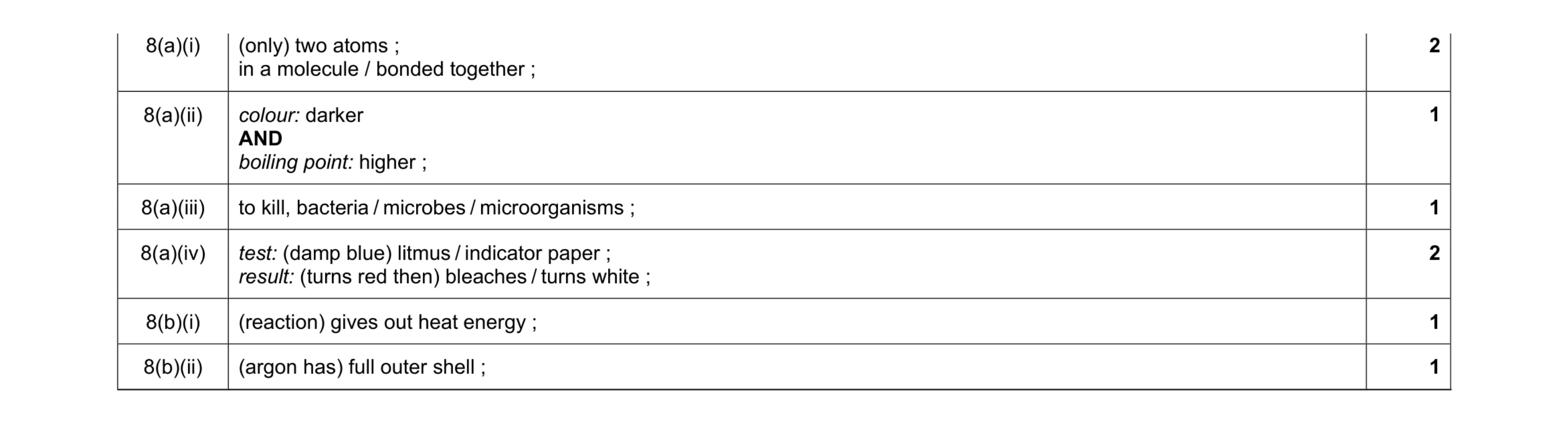 8
8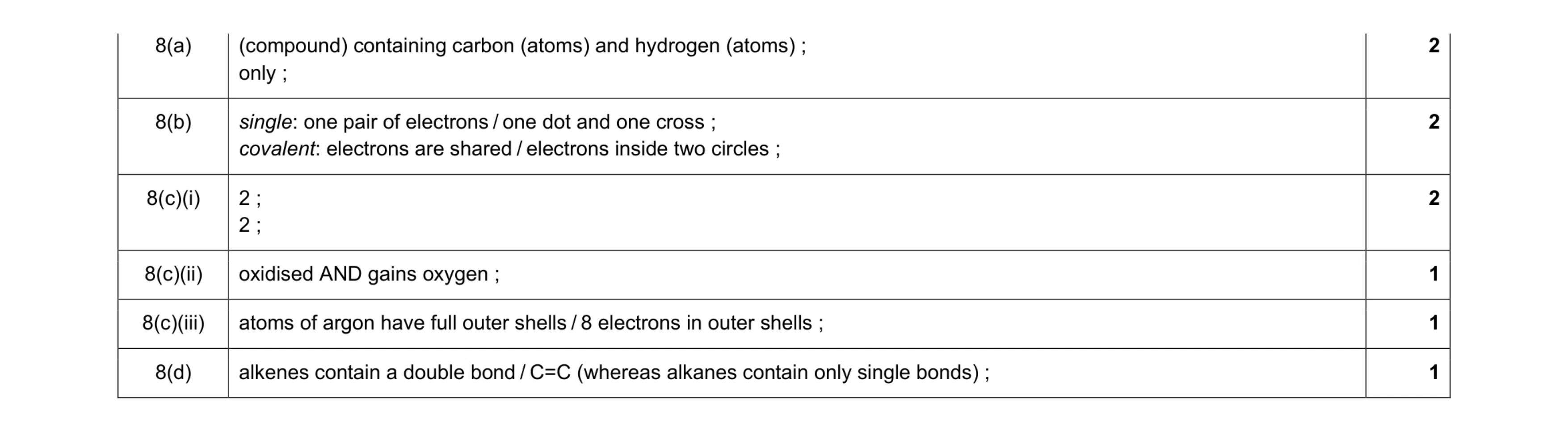 9
9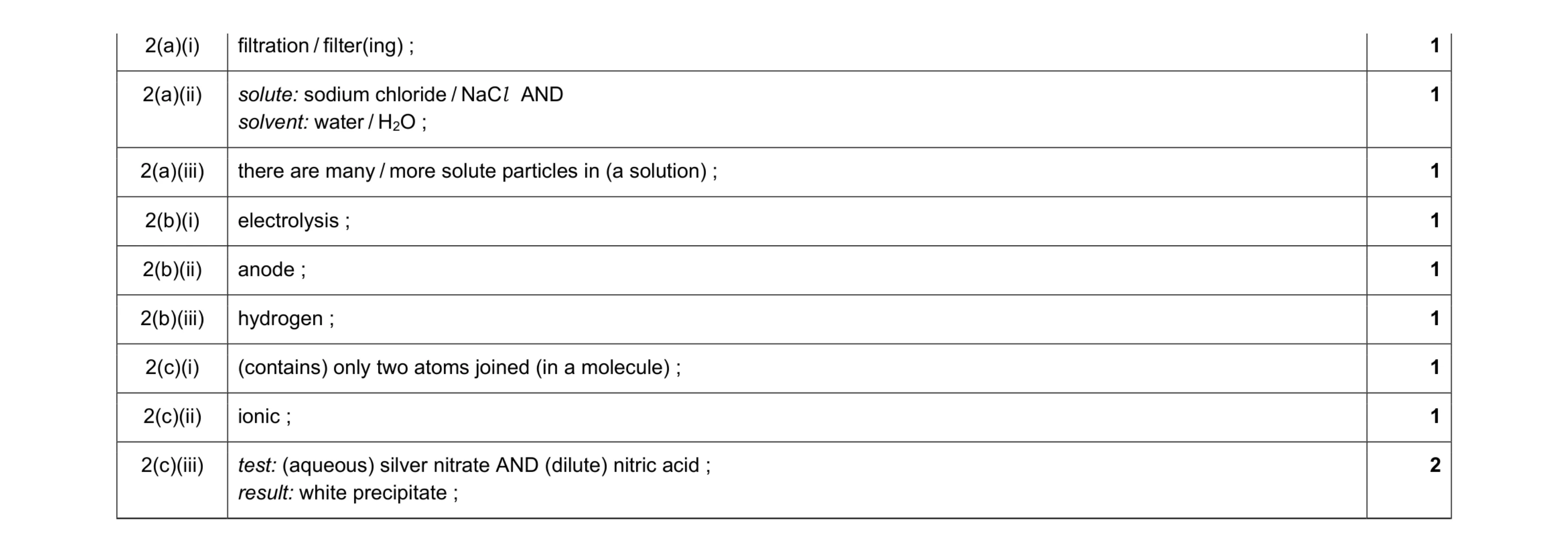 10
10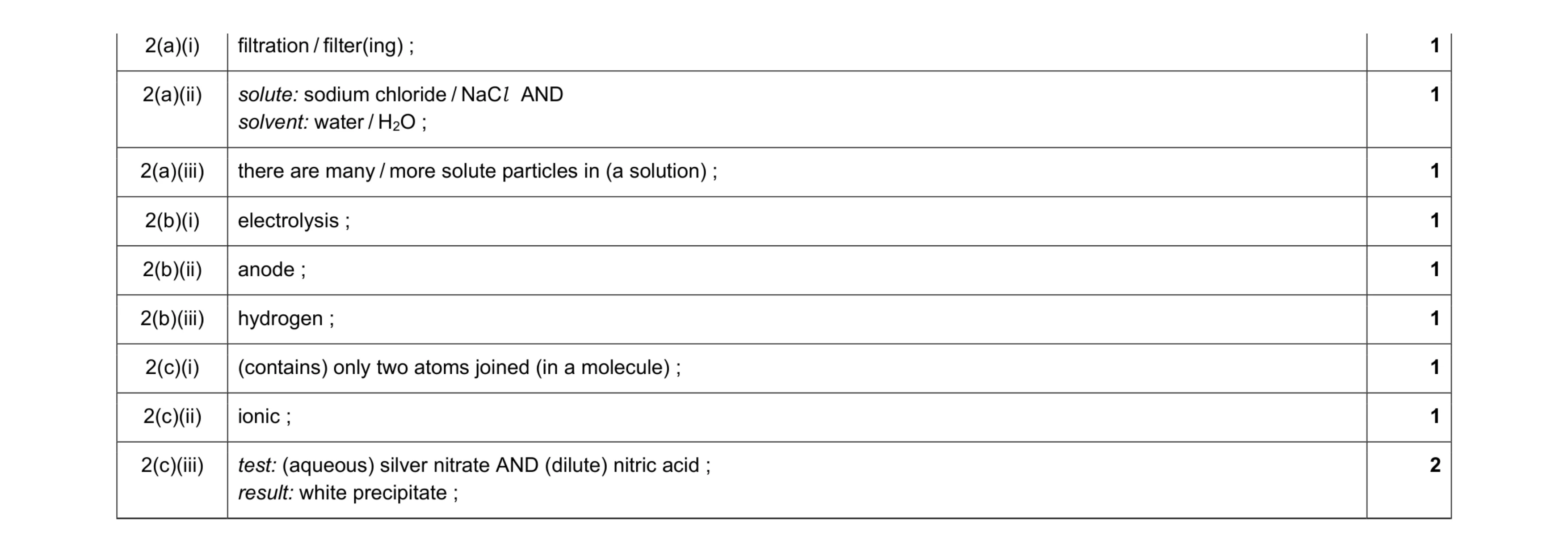 10
10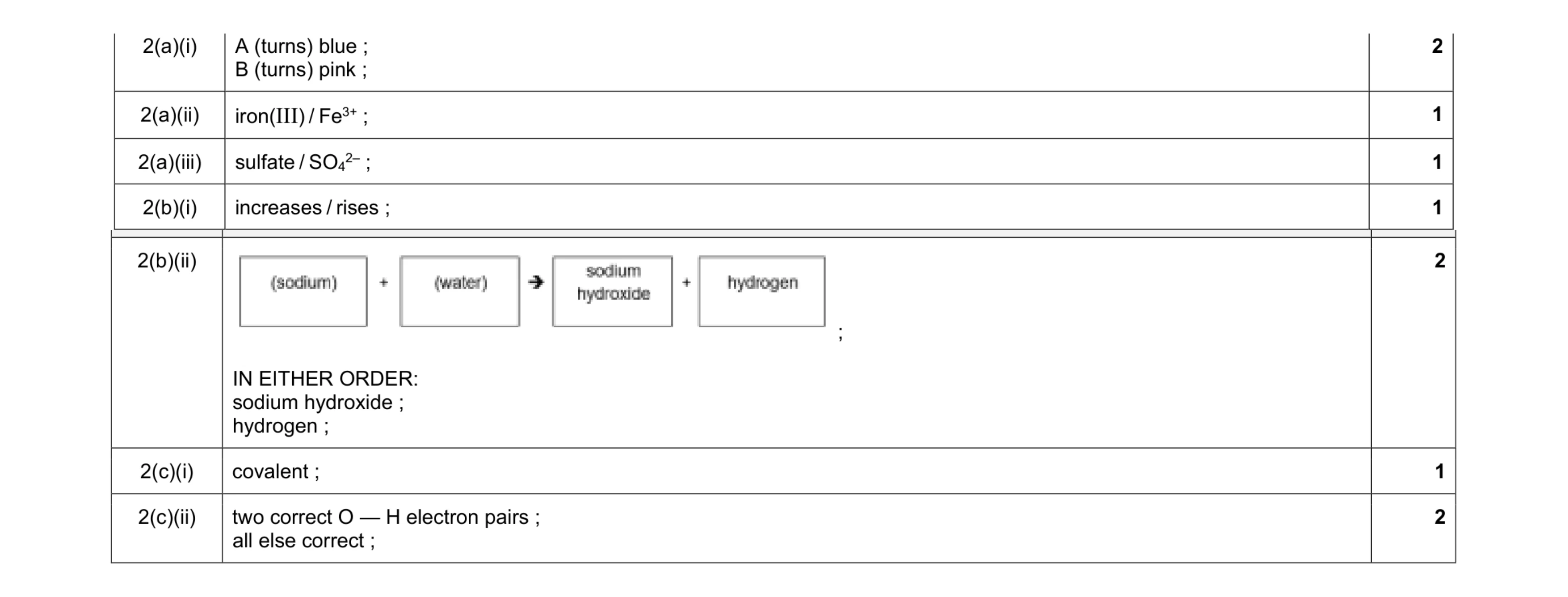 10
10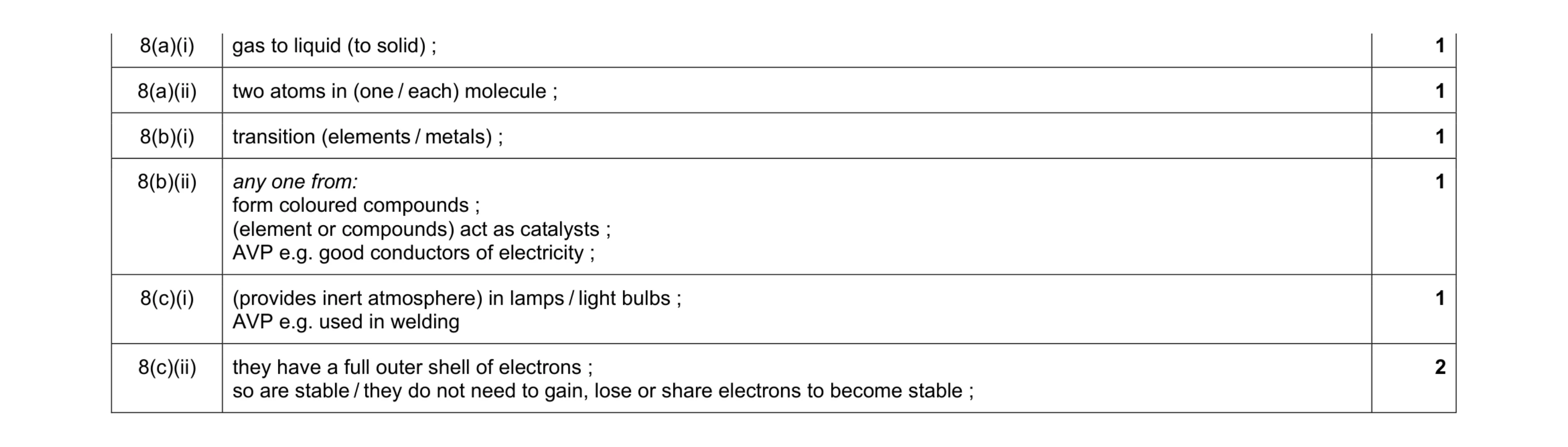 7
7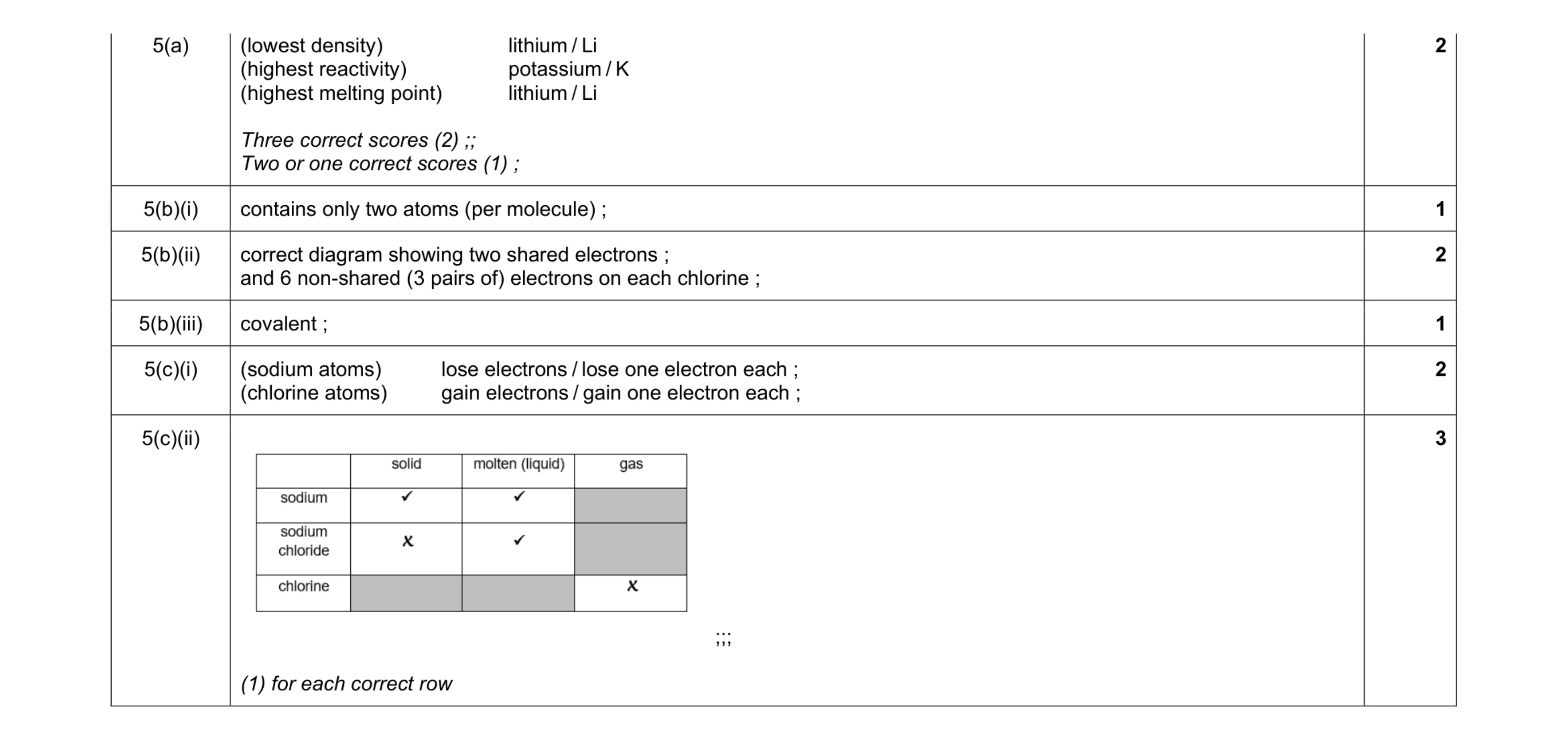 11
11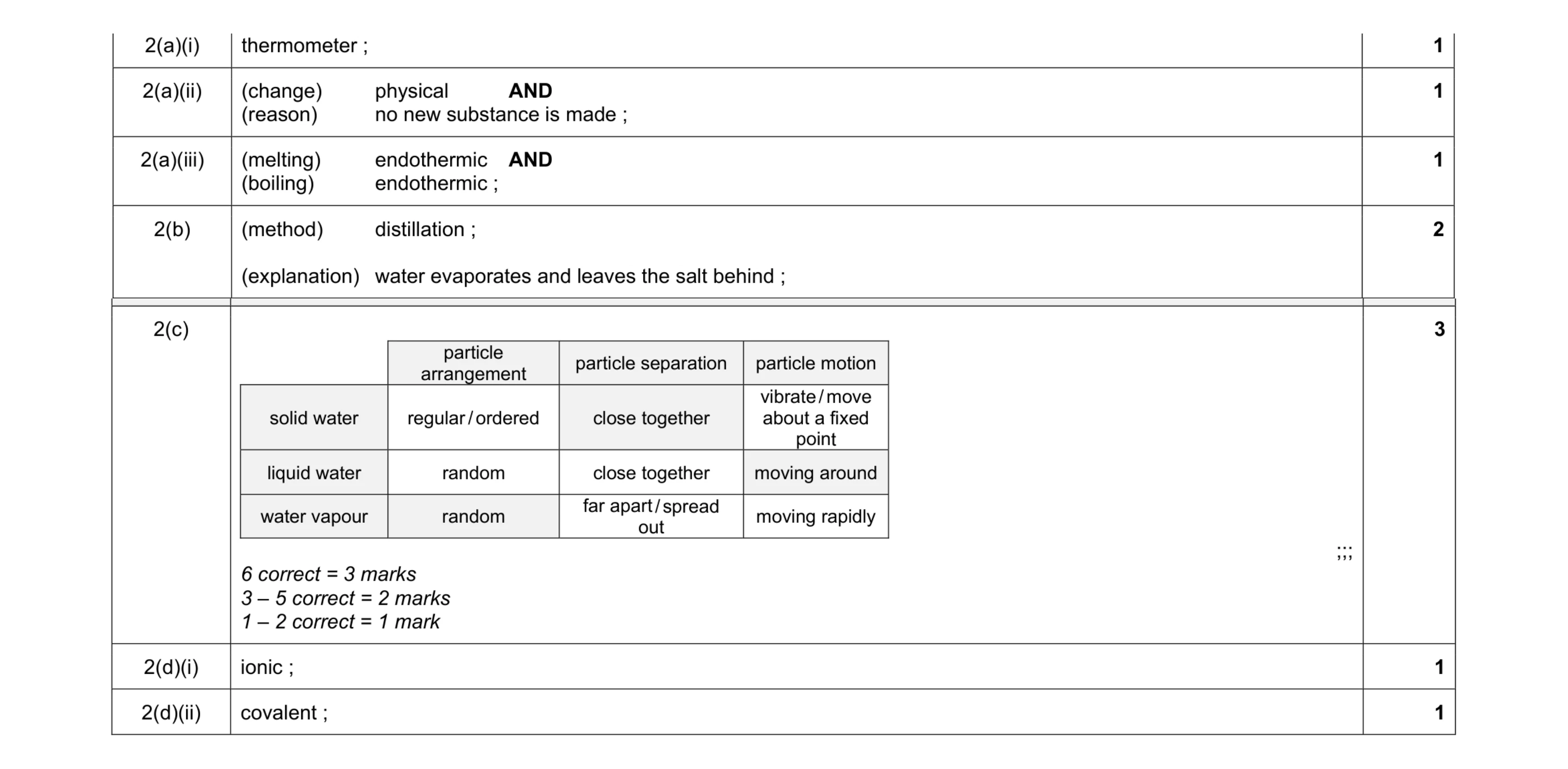 10
10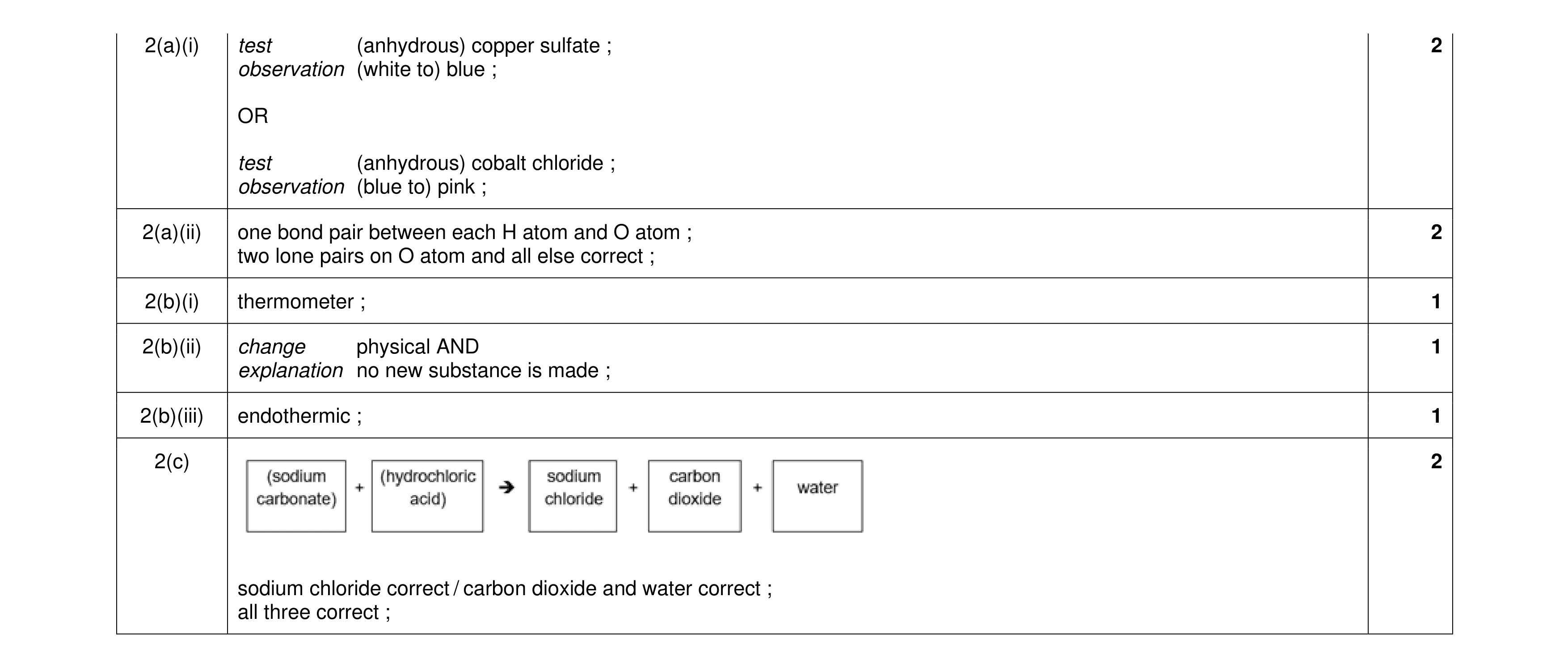 9
9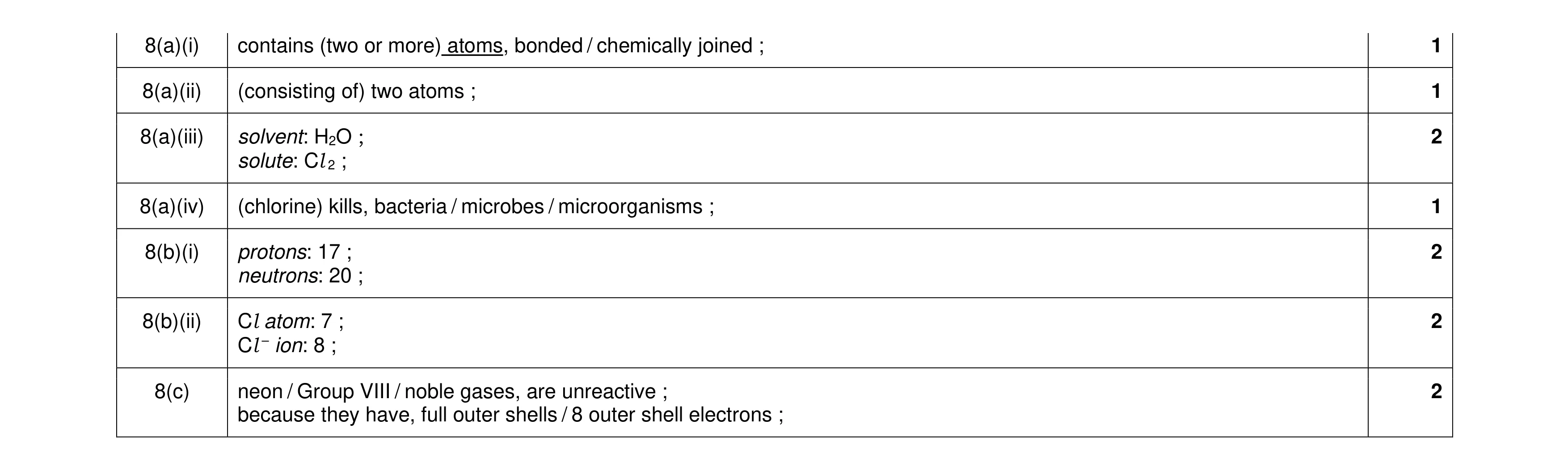 11
11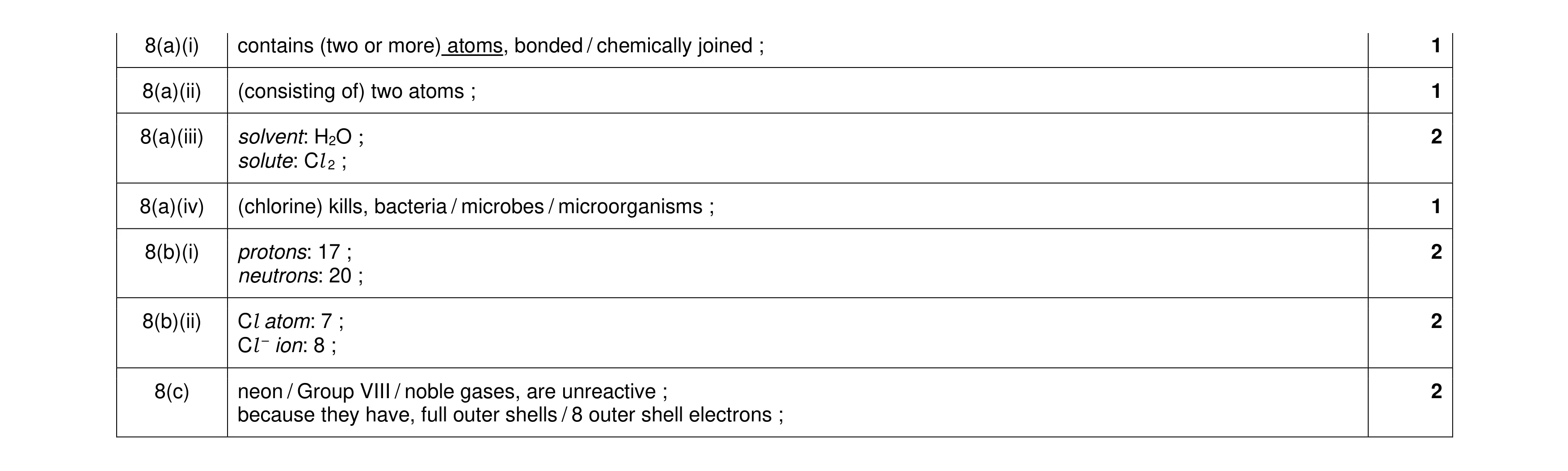 11
11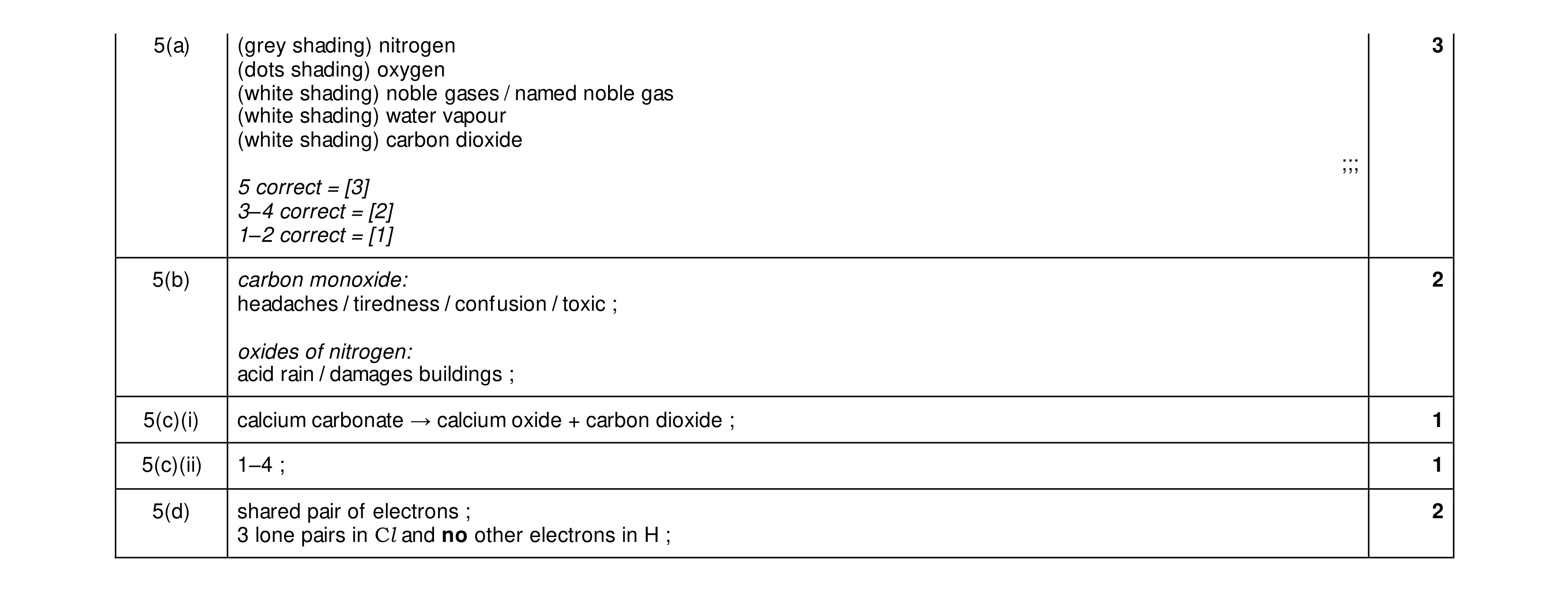 9
9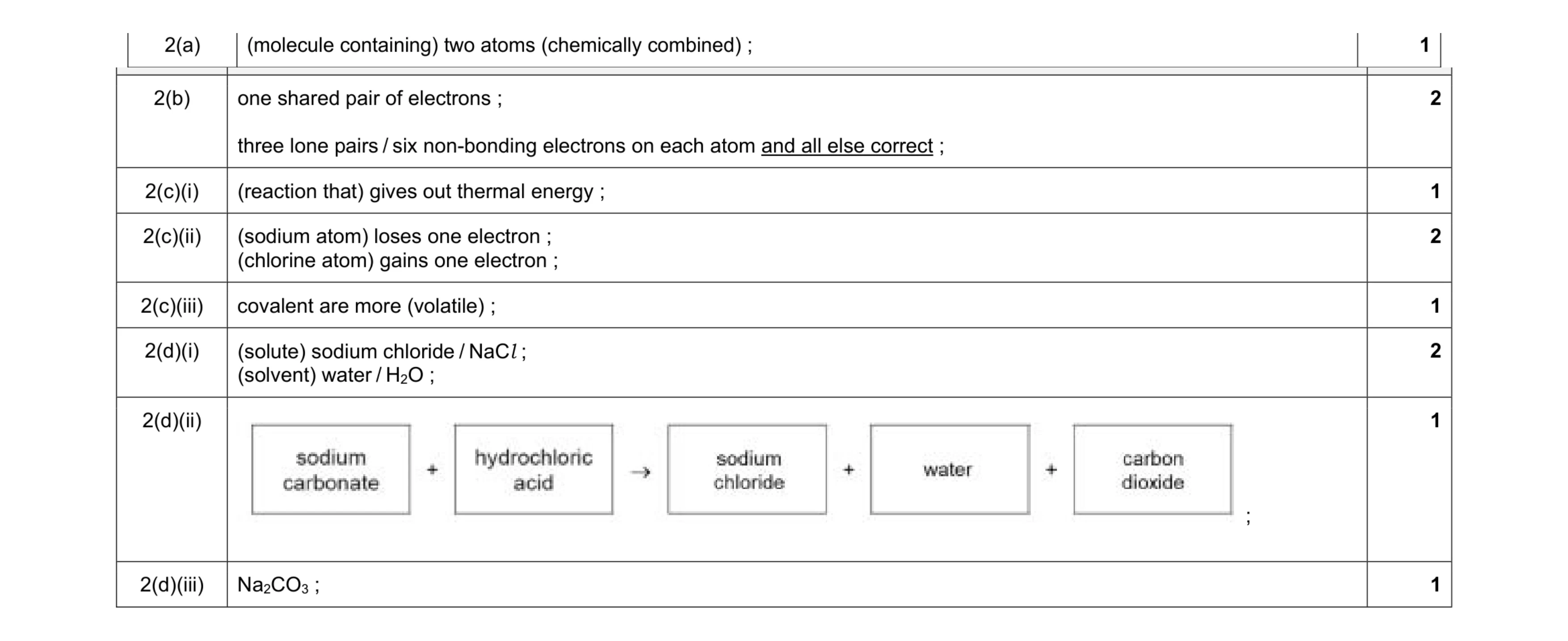 11
11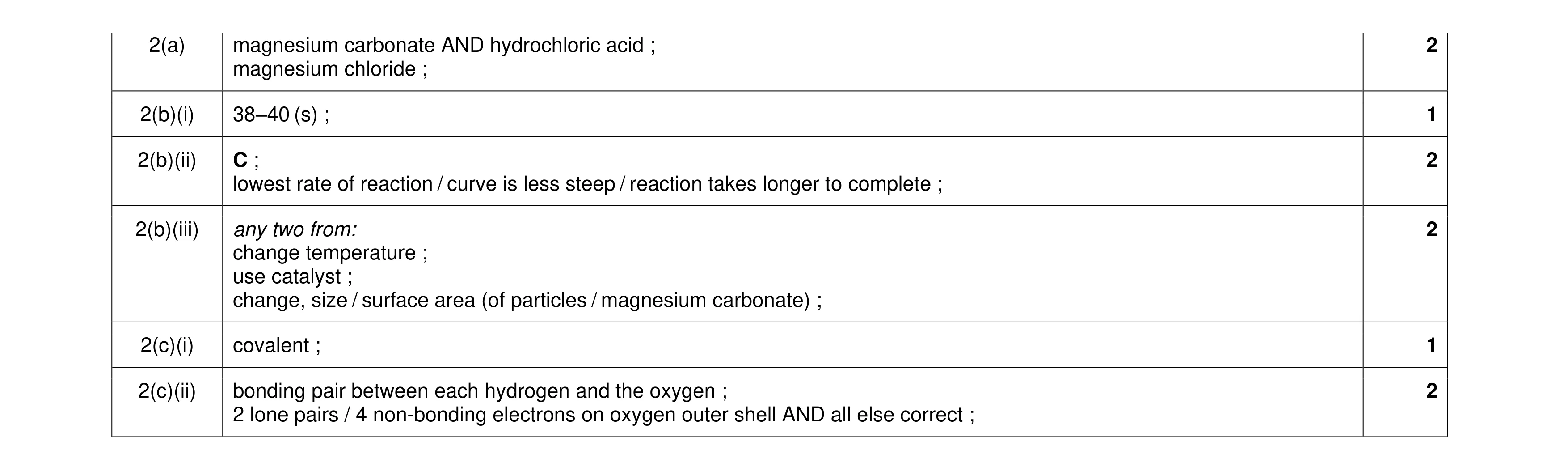 10
10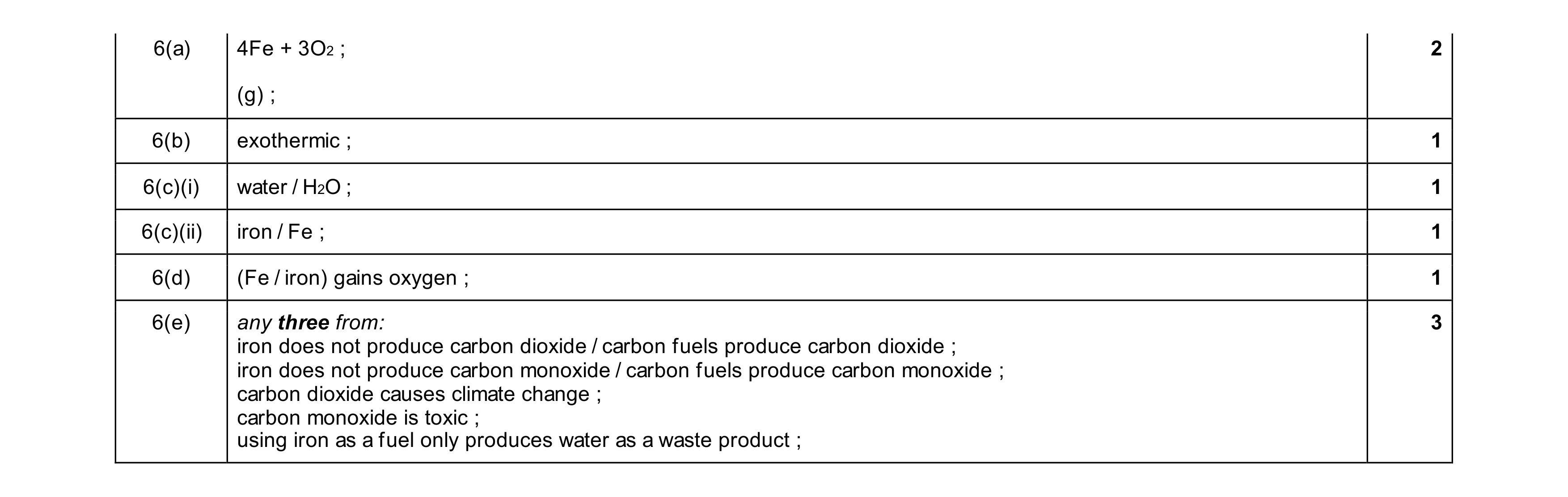 9
9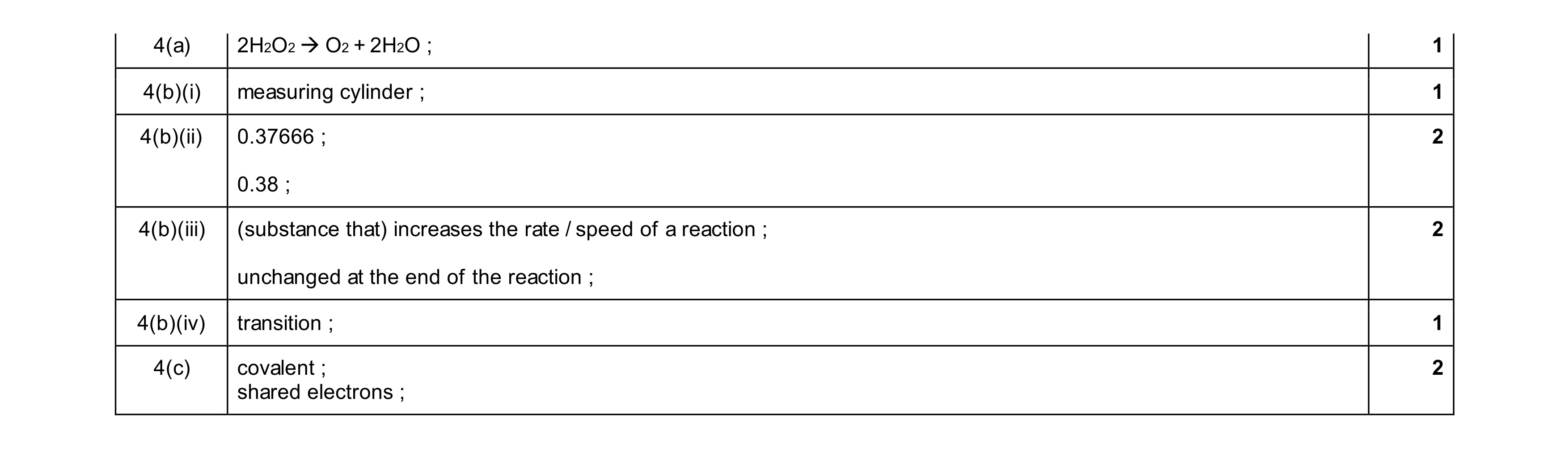 9
9