Questions as text
Q1 · A thermistor is a device whose resistance decreases as its temperature increases 0654/11 May/June 2006
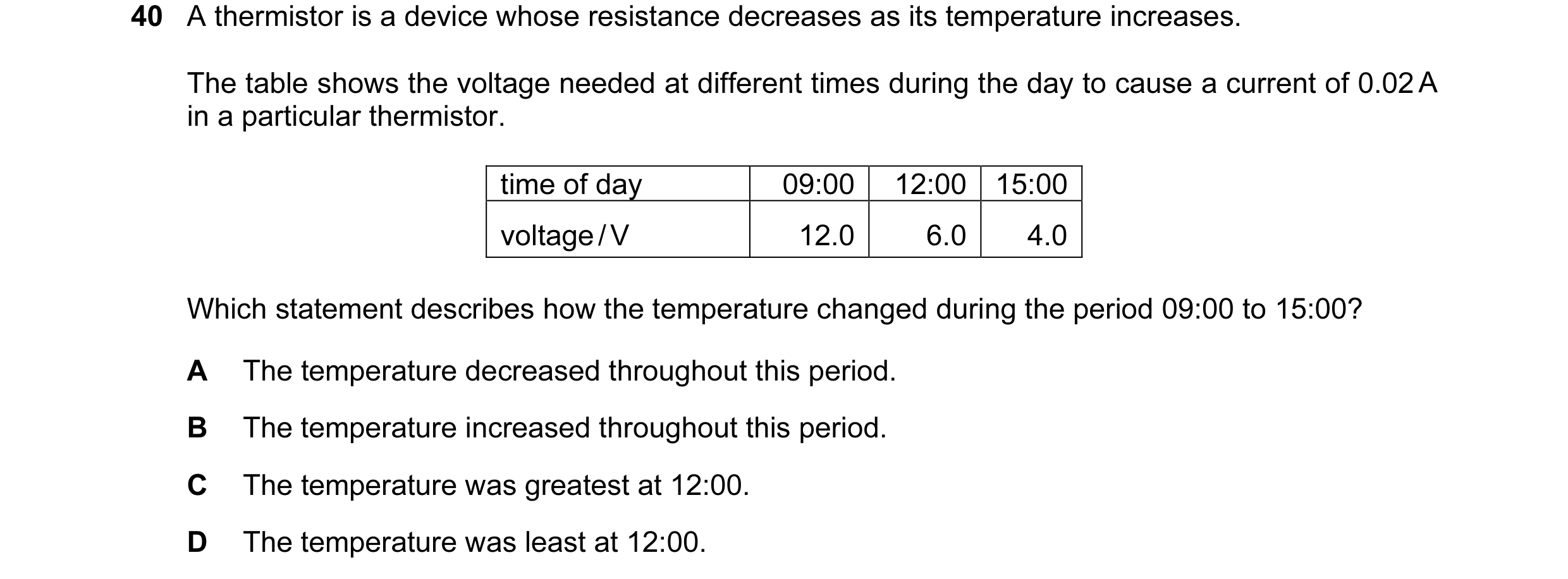
40 A thermistor is a device whose resistance decreases as its temperature increases. The table shows the voltage needed at different times during the day to cause a current of 0.02 A in a particular thermistor. time of day 09:00 12:00 15:00 voltage / V 12.0 6.0 4.0 Which statement describes how the temperature changed during the period 09:00 to 15:00? A The temperature decreased throughout this period. B The temperature increased throughout this period. C The temperature was greatest at 12:00. D The temperature was least at 12:00.
1 marks
Answer: B
This question in 0654/11 May/June 2006
Q2 · A student wishes to measure the electromotive force (e.m.f.) of a battery and the… 0654/11 Oct/Nov 2006
36 A student wishes to measure the electromotive force (e.m.f.) of a battery and the potential difference (p.d.) across a resistor. She has the resistor, the battery and some connecting wires. What else does she need? A a voltmeter only B an ammeter only C an ammeter and a voltmeter D a force meter (newton meter) and a voltmeter
1 marks
Answer: A
This question in 0654/11 Oct/Nov 2006
Q3 · Four wires are made from the same material 0654/11 May/June 2007
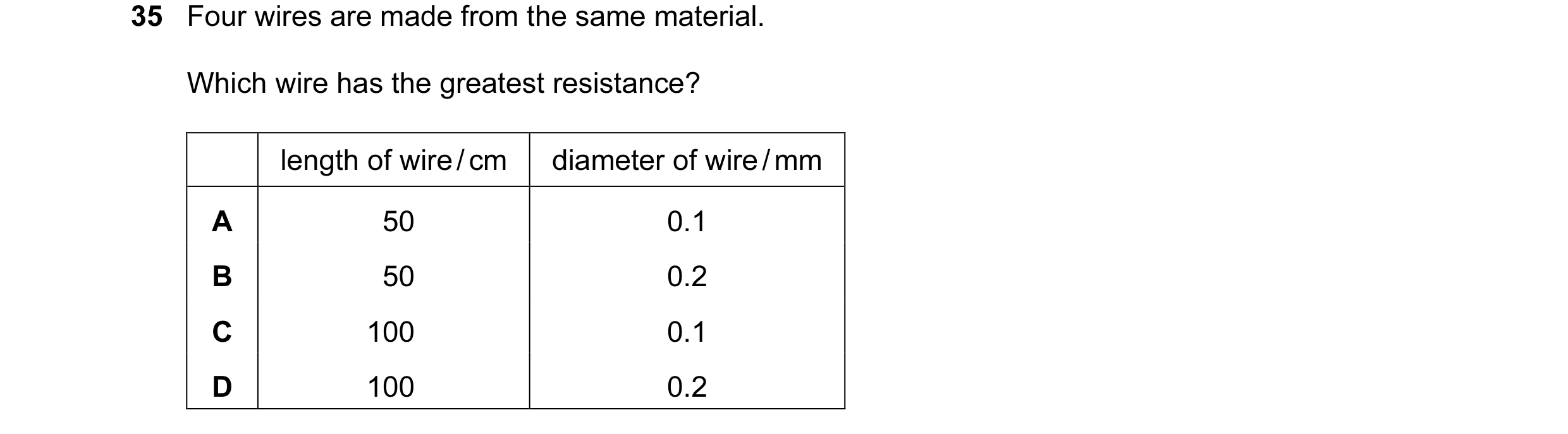
35 Four wires are made from the same material. Which wire has the greatest resistance? length of wire / cm diameter of wire / mm A 50 0.1 B 50 0.2 C 100 0.1 D 100 0.2
1 marks
Answer: C
This question in 0654/11 May/June 2007
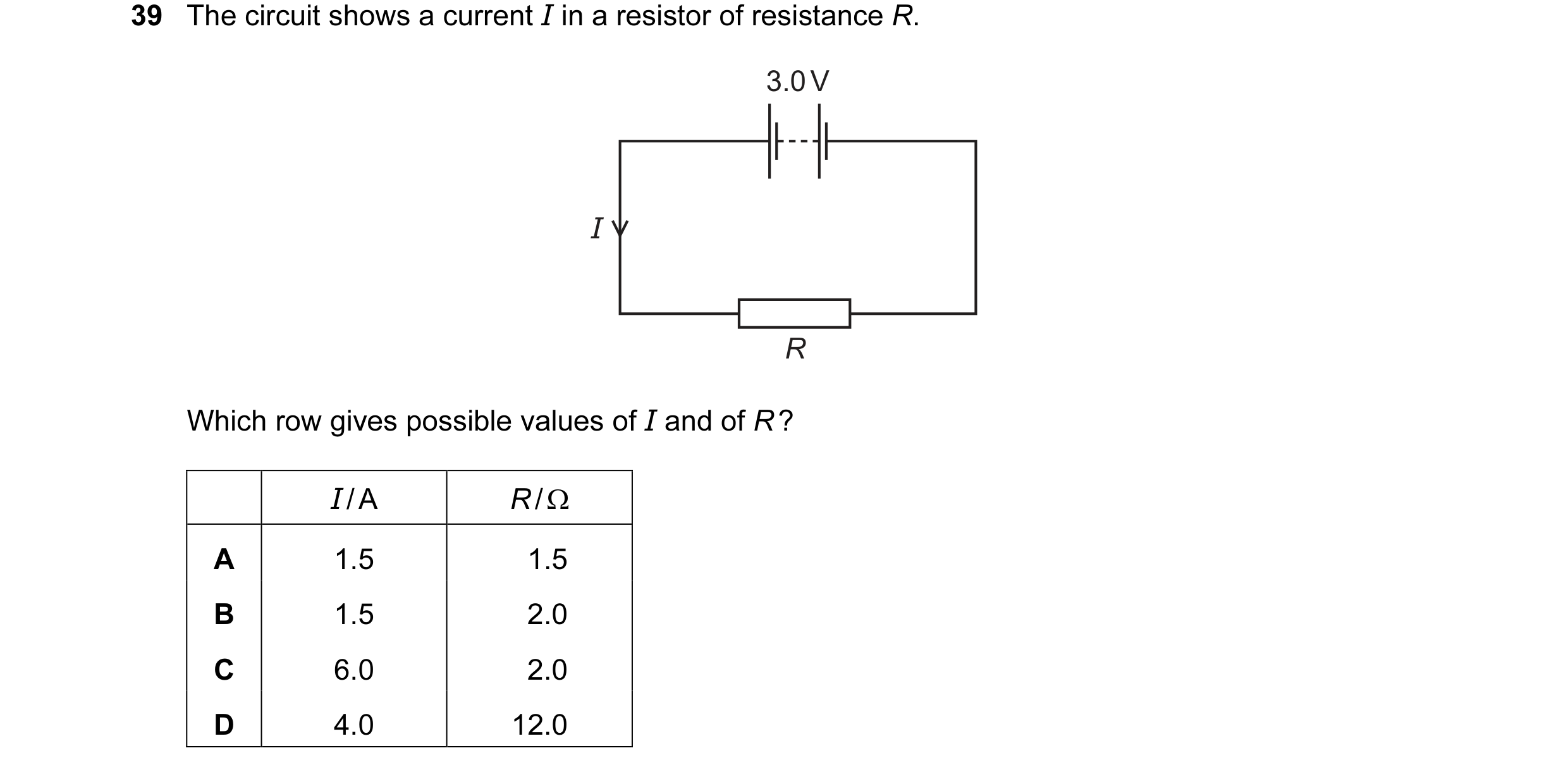
Q4 · The circuit shows a current I in a resistor of resistance R 0654/11 Oct/Nov 2007
35 The circuit shows a current I in a resistor of resistance R. 3.0 V I R Which line gives possible values of I and R? I / A R / Ω A 1.5 1.5 B 1.5 2.0 C 6.0 2.0 D 4.0 12
1 marks
Answer: B
This question in 0654/11 Oct/Nov 2007
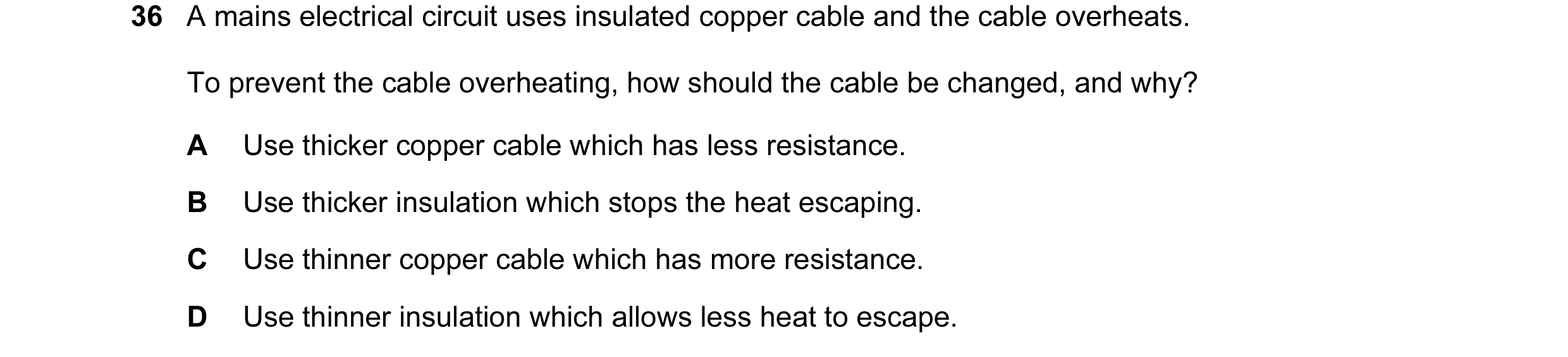
Q5 · A mains electrical circuit uses insulated copper cable and the cable overheats 0654/11 Oct/Nov 2007
36 A mains electrical circuit uses insulated copper cable and the cable overheats. To prevent the cable overheating, how should the cable be changed, and why? A Use thicker copper cable which has less resistance. B Use thicker insulation which stops the heat escaping. C Use thinner copper cable which has more resistance. D Use thinner insulation which allows less heat to escape.
1 marks
Answer: A
This question in 0654/11 Oct/Nov 2007
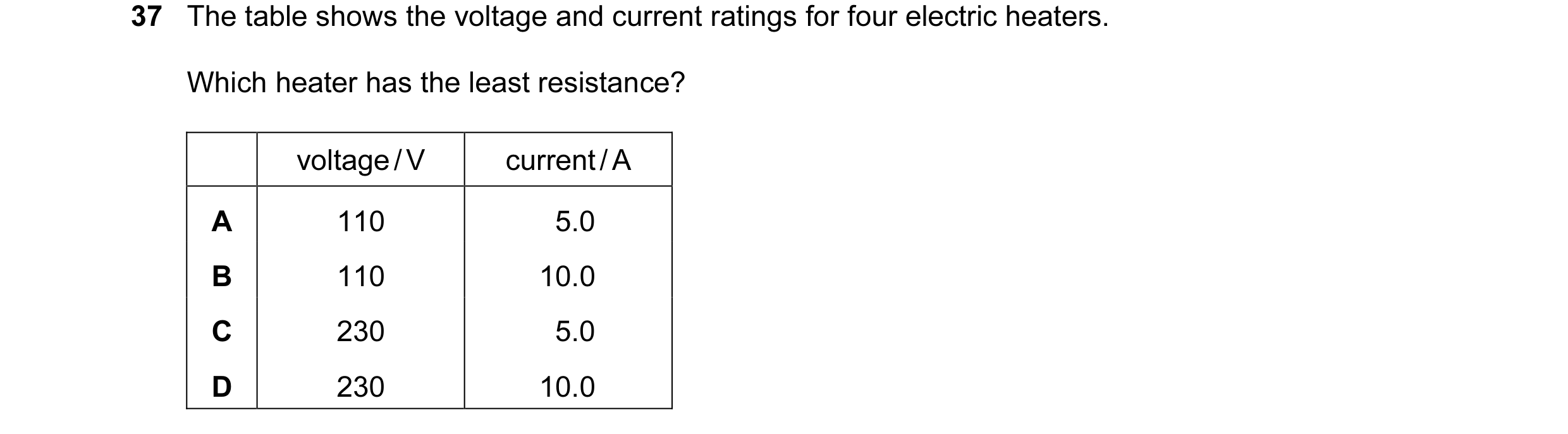
Q6 · The table shows the voltage and current ratings for four electric heaters 0654/11 Oct/Nov 2008
37 The table shows the voltage and current ratings for four electric heaters. Which heater has the least resistance? voltage / V current / A A 110 5.0 B 110 10.0 C 230 5.0 D 230 10.0
1 marks
Answer: B
This question in 0654/11 Oct/Nov 2008
Q7 · Using the circuit shown, the current I is found for various voltages V 0654/11 May/June 2009
37 Using the circuit shown, the current I is found for various voltages V. The temperature of the resistor does not change. variable direct voltage V A I Which graph shows the results obtained? A B C D I I I I 0 0 0 0 0 V 0 V 0 V 0 V
1 marks
Answer: A
This question in 0654/11 May/June 2009
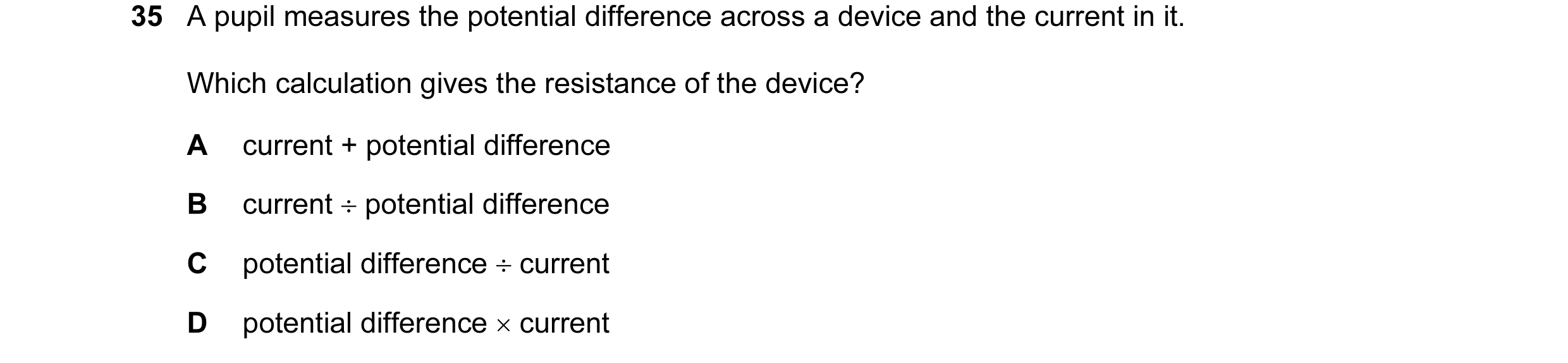
Q8 · A pupil measures the potential difference across a device and the current in it 0654/11 Oct/Nov 2009
35 A pupil measures the potential difference across a device and the current in it. Which calculation gives the resistance of the device? A current + potential difference B current ÷ potential difference C potential difference ÷ current D potential difference × current
1 marks
Answer: C
This question in 0654/11 Oct/Nov 2009
Q9 · A student uses a length of wire as a resistor 0654/11 Oct/Nov 2009
36 A student uses a length of wire as a resistor. He discovers that the resistance of the wire is too small. To be certain of making a resistor of higher value, he should use a piece of wire that is A longer and thicker. B longer and thinner. C shorter and thicker. D shorter and thinner.
1 marks
Answer: B
This question in 0654/11 Oct/Nov 2009
Q10 · Which is the correct equation for resistance? 0654/11 May/June 2010
33 Which is the correct equation for resistance? A resistance = current ÷ voltage B resistance = power ÷ current C resistance = power ÷ voltage D resistance = voltage ÷ current
1 marks
Answer: D
This question in 0654/11 May/June 2010
Q11 · A student has four pieces of resistance wire made of the same material 0654/11 May/June 2010
35 A student has four pieces of resistance wire made of the same material. Each piece is connected in turn between the terminals X and Y in the circuit. X Y In which wire will the current be the smallest? length / m diameter / mm A 0.5 0.5 B 0.5 1.0 C 1.0 0.5 D 1.0 1.0
1 marks
Answer: C
This question in 0654/11 May/June 2010
Q12 · Which is the correct equation for resistance? 0654/12 May/June 2010
29 Which is the correct equation for resistance? A resistance = current ÷ voltage B resistance = power ÷ current C resistance = power ÷ voltage D resistance = voltage ÷ current
1 marks
Answer: D
This question in 0654/12 May/June 2010
Q13 · A student has four pieces of resistance wire made of the same material 0654/12 May/June 2010
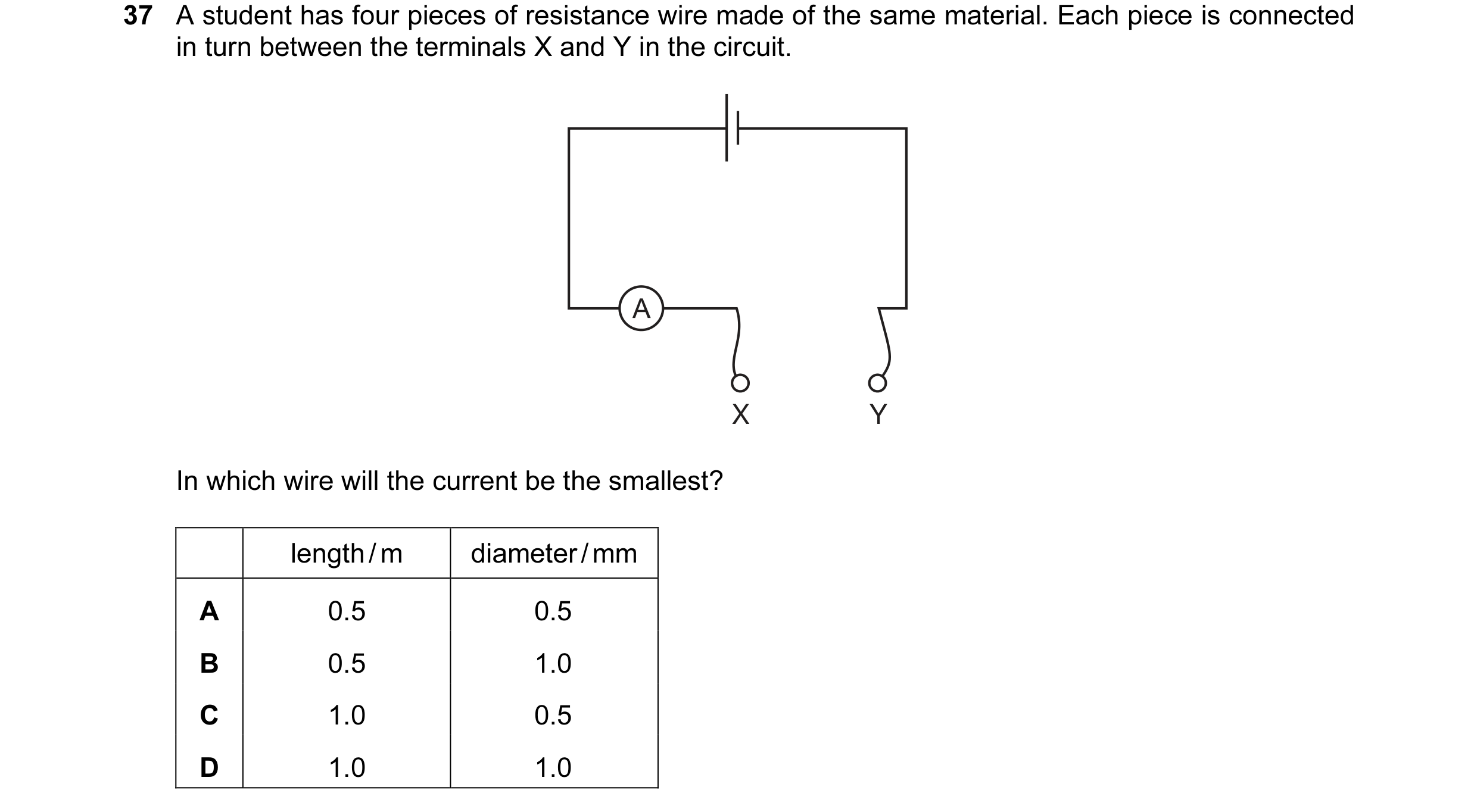
37 A student has four pieces of resistance wire made of the same material. Each piece is connected in turn between the terminals X and Y in the circuit. X Y In which wire will the current be the smallest? length / m diameter / mm A 0.5 0.5 B 0.5 1.0 C 1.0 0.5 D 1.0 1.0
1 marks
Answer: C
This question in 0654/12 May/June 2010
Q14 · What is meant by the current in a wire? 0654/11 May/June 2011
31 What is meant by the current in a wire? A the charge flowing through the wire per second B the energy the wire can transfer elsewhere per second C the power the wire can produce per second D the work the wire does per second
1 marks
Answer: A
This question in 0654/11 May/June 2011
Q15 · What is meant by the current in a wire? 0654/12 May/June 2011
34 What is meant by the current in a wire? A the charge flowing through the wire per second B the energy the wire can transfer elsewhere per second C the power the wire can produce per second D the work the wire does per second
1 marks
Answer: A
This question in 0654/12 May/June 2011
Q16 · What is meant by the current in a wire? 0654/13 May/June 2011
34 What is meant by the current in a wire? A the charge flowing through the wire per second B the energy the wire can transfer elsewhere per second C the power the wire can produce per second D the work the wire does per second
1 marks
Answer: A
This question in 0654/13 May/June 2011
Q17 · The circuit shows a lamp connected to a 6.0 V battery 0654/11 Oct/Nov 2011
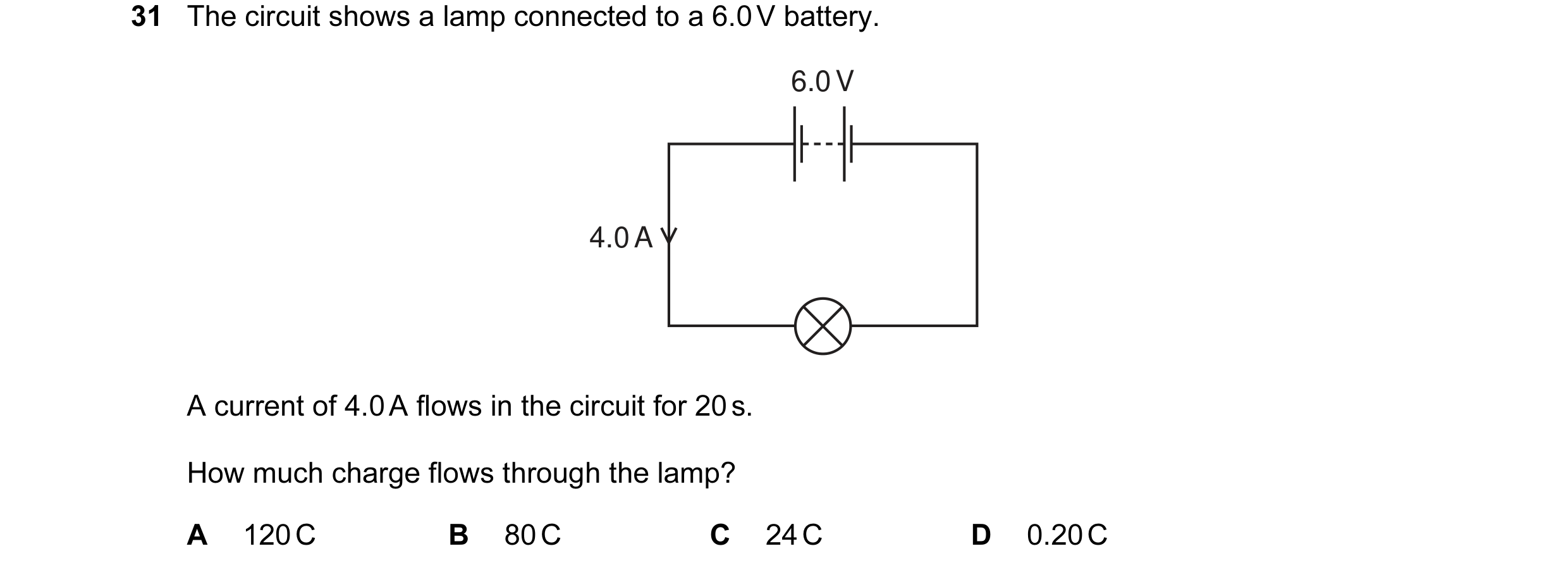
31 The circuit shows a lamp connected to a 6.0 V battery. 6.0 V 4.0 A A current of 4.0 A flows in the circuit for 20 s. How much charge flows through the lamp? A 120 C B 80 C C 24 C D 0.20 C
1 marks
Answer: B
This question in 0654/11 Oct/Nov 2011
Q18 · A light bulb is marked ‘3.0 V, 6.0 W’ 0654/11 Oct/Nov 2011
40 A light bulb is marked ‘3.0 V, 6.0 W’. How much current flows in the bulb when it operates at normal brightness? A 0.50 A B 2.0 A C 6.0 A D 18 A
1 marks
Answer: B
This question in 0654/11 Oct/Nov 2011
Q19 · The circuit shows a lamp connected to a 6.0 V battery 0654/12 Oct/Nov 2011
29 The circuit shows a lamp connected to a 6.0 V battery. 6.0 V 4.0 A A current of 4.0 A flows in the circuit for 20 s. How much charge flows through the lamp? A 120 C B 80 C C 24 C D 0.20 C
1 marks
Answer: B
This question in 0654/12 Oct/Nov 2011
Q20 · A student connects a length of metal resistance wire to a battery 0654/12 Oct/Nov 2011
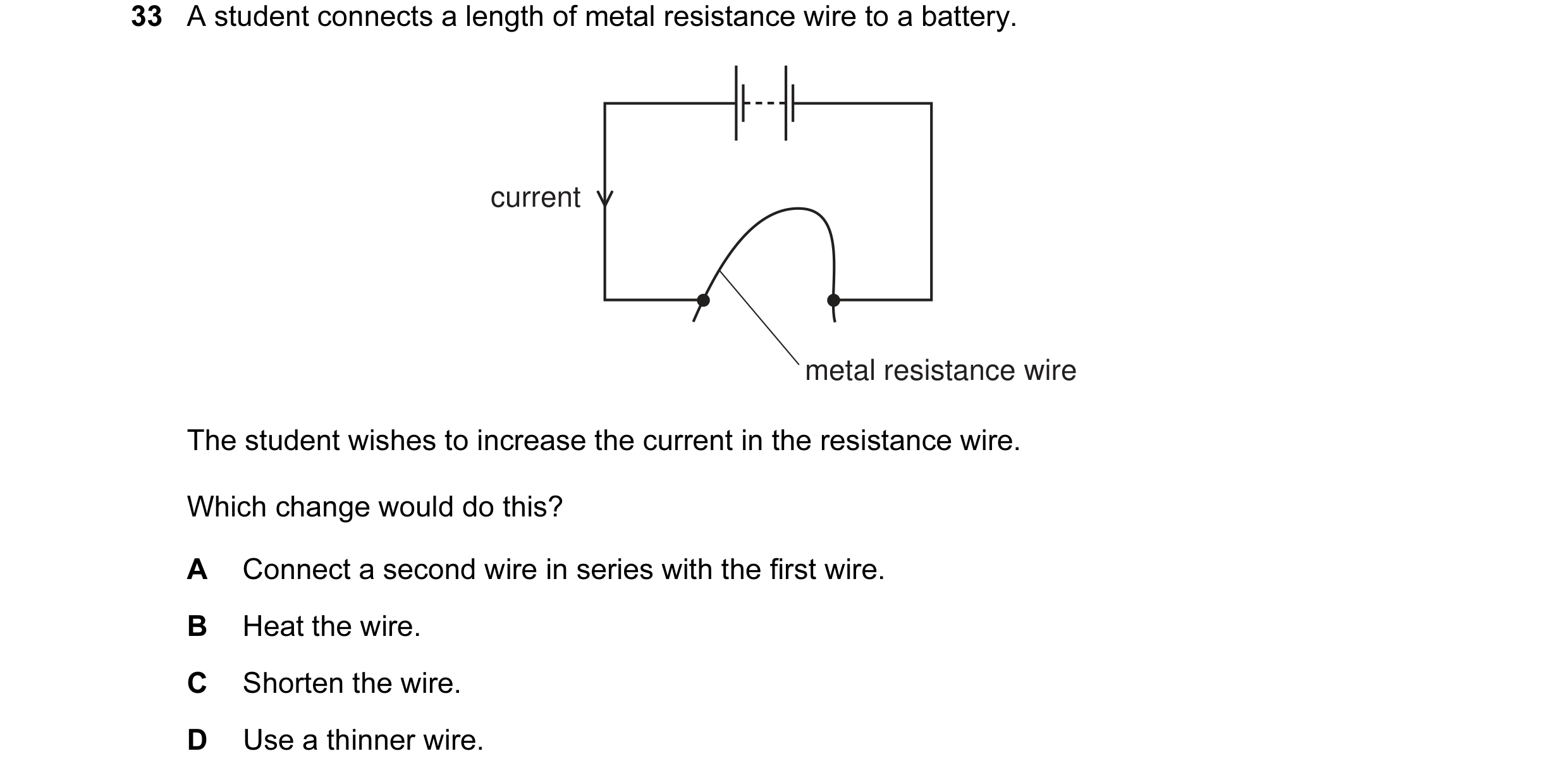
33 A student connects a length of metal resistance wire to a battery. current metal resistance wire The student wishes to increase the current in the resistance wire. Which change would do this? A Connect a second wire in series with the first wire. B Heat the wire. C Shorten the wire. D Use a thinner wire.
1 marks
Answer: C
This question in 0654/12 Oct/Nov 2011
Q21 · What are the particles given off by the heated tungsten filament in a thermionic diode? 0654/12 Oct/Nov 2011
36 What are the particles given off by the heated tungsten filament in a thermionic diode? A alpha particles B electrons C neutrons D protons
1 marks
Answer: B
This question in 0654/12 Oct/Nov 2011
Q22 · A light bulb is marked ‘3.0 V, 6.0 W’ 0654/12 Oct/Nov 2011
39 A light bulb is marked ‘3.0 V, 6.0 W’. How much current flows in the bulb when it operates at normal brightness? A 0.50 A B 2.0 A C 6.0 A D 18 A
1 marks
Answer: B
This question in 0654/12 Oct/Nov 2011
Q23 · The circuit shows a lamp connected to a 6.0 V battery 0654/13 Oct/Nov 2011
30 The circuit shows a lamp connected to a 6.0 V battery. 6.0 V 4.0 A A current of 4.0 A flows in the circuit for 20 s. How much charge flows through the lamp? A 120 C B 80 C C 24 C D 0.20 C
1 marks
Answer: B
This question in 0654/13 Oct/Nov 2011
Q24 · A light bulb is marked ‘3.0 V, 6.0 W’ 0654/13 Oct/Nov 2011
40 A light bulb is marked ‘3.0 V, 6.0 W’. How much current flows in the bulb when it operates at normal brightness? A 0.50 A B 2.0 A C 6.0 A D 18 A
1 marks
Answer: B
This question in 0654/13 Oct/Nov 2011
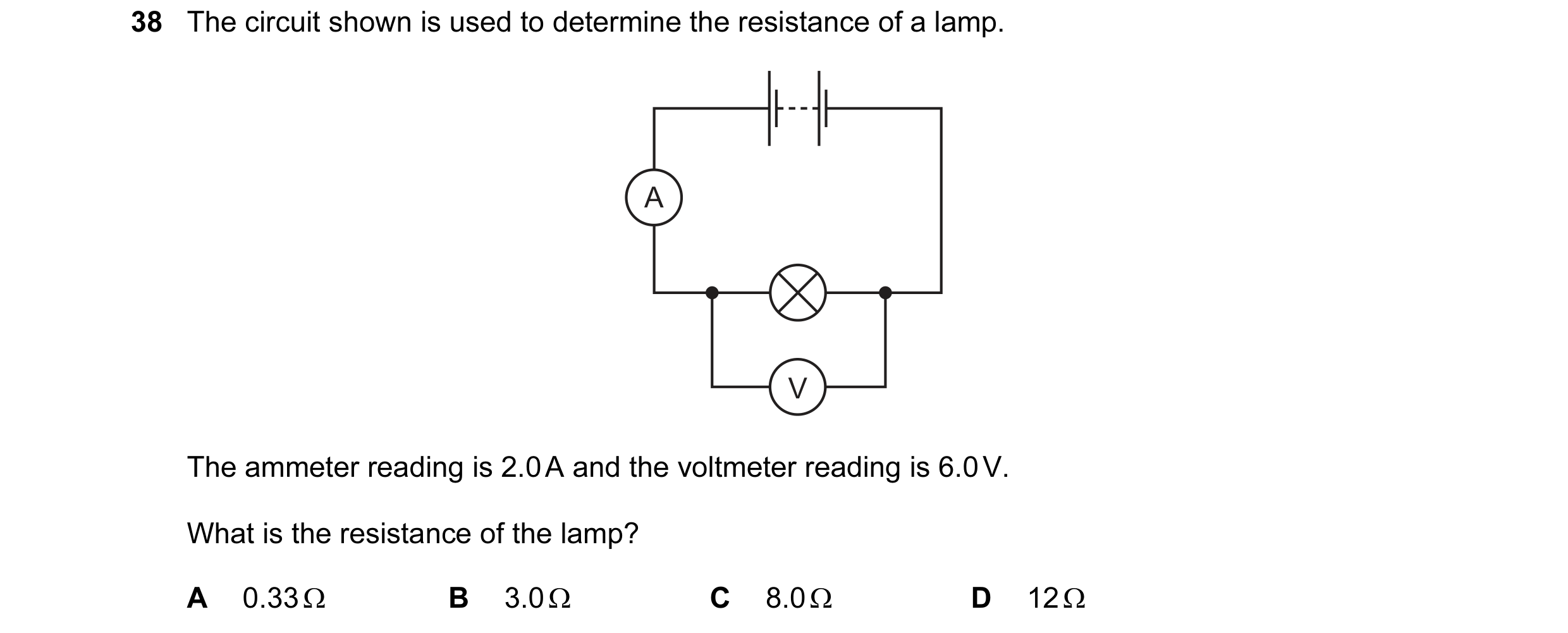
Q25 · The circuit shown is used to determine the resistance of a lamp 0654/11 May/June 2013
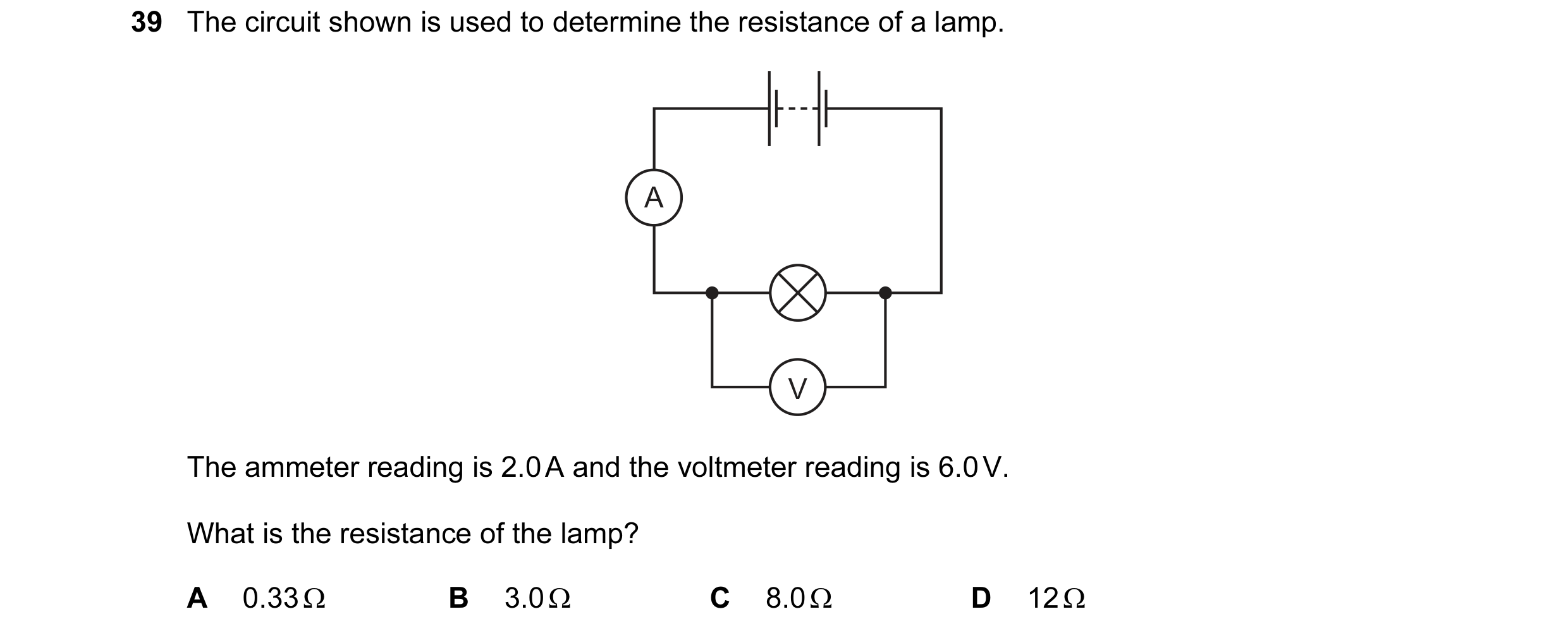
39 The circuit shown is used to determine the resistance of a lamp. A V The ammeter reading is 2.0 A and the voltmeter reading is 6.0 V. What is the resistance of the lamp? A 0.33 Ω B 3.0 Ω C 8.0 Ω D 12 Ω
1 marks
Answer: B
This question in 0654/11 May/June 2013
Q26 · The circuit shown is used to determine the resistance of a lamp 0654/13 May/June 2013
38 The circuit shown is used to determine the resistance of a lamp. A V The ammeter reading is 2.0 A and the voltmeter reading is 6.0 V. What is the resistance of the lamp? A 0.33 Ω B 3.0 Ω C 8.0 Ω D 12 Ω
1 marks
Answer: B
This question in 0654/13 May/June 2013
Q27 · The circuit shows a current I in a resistor of resistance R 0654/11 Oct/Nov 2013
38 The circuit shows a current I in a resistor of resistance R. 3.0 V I R Which row gives possible values of I and of R ? I / A R / Ω A 1.5 1.5 B 1.5 2.0 C 6.0 2.0 D 4.0 12.0
1 marks
Answer: B
This question in 0654/11 Oct/Nov 2013
Q28 · The circuit shows a current I in a resistor of resistance R 0654/12 Oct/Nov 2013
39 The circuit shows a current I in a resistor of resistance R. 3.0 V I R Which row gives possible values of I and of R ? I / A R / Ω A 1.5 1.5 B 1.5 2.0 C 6.0 2.0 D 4.0 12.0
1 marks
Answer: B
This question in 0654/12 Oct/Nov 2013
Q29 · The circuit shows a current I in a resistor of resistance R 0654/13 Oct/Nov 2013
38 The circuit shows a current I in a resistor of resistance R. 3.0 V I R Which row gives possible values of I and of R ? I / A R / Ω A 1.5 1.5 B 1.5 2.0 C 6.0 2.0 D 4.0 12.0
1 marks
Answer: B
This question in 0654/13 Oct/Nov 2013
Q30 · The current in a resistor is 0.50 A and the potential difference across the resistor is… 0654/11 Oct/Nov 2014
37 The current in a resistor is 0.50 A and the potential difference across the resistor is 4.6 V. What is the resistance of the resistor? A 0.11 Ω B 2.3 Ω C 5.1 Ω D 9.2 Ω
1 marks
Answer: D
This question in 0654/11 Oct/Nov 2014
Q31 · The current in a resistor is 0.50 A and the potential difference across the resistor is… 0654/12 Oct/Nov 2014
39 The current in a resistor is 0.50 A and the potential difference across the resistor is 4.6 V. What is the resistance of the resistor? A 0.11 Ω B 2.3 Ω C 5.1 Ω D 9.2 Ω
1 marks
Answer: D
This question in 0654/12 Oct/Nov 2014
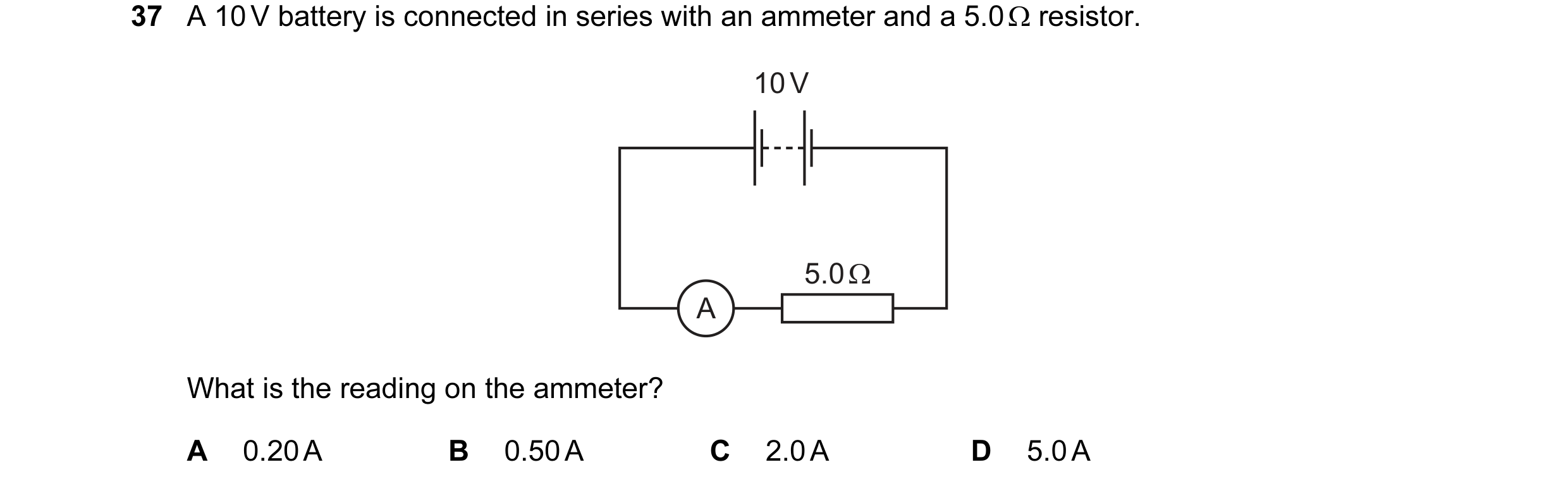
Q32 · A 10 V battery is connected in series with an ammeter and a 5.0 Ω resistor 0654/11 May/June 2016
37 A 10 V battery is connected in series with an ammeter and a 5.0 Ω resistor. 10 V 5.0 Ω A What is the reading on the ammeter? A 0.20 A B 0.50 A C 2.0 A D 5.0 A
1 marks
Answer: C
This question in 0654/11 May/June 2016
Q33 · The diagram shows a wire of length l and diameter d 0654/12 May/June 2016
37 The diagram shows a wire of length l and diameter d. l d Which pair of changes must increase the resistance of the wire? A decrease l and decrease d B decrease l and increase d C increase l and decrease d D increase l and increase d
1 marks
Answer: C
This question in 0654/12 May/June 2016
Q34 · The potential difference across a resistor is 5.0 V, and the current in it is 2.0 A 0654/12 May/June 2016
38 The potential difference across a resistor is 5.0 V, and the current in it is 2.0 A. What is the resistance of the resistor? A 0.40 Ω B 2.5 Ω C 7.0 Ω D 10 Ω
1 marks
Answer: B
This question in 0654/12 May/June 2016
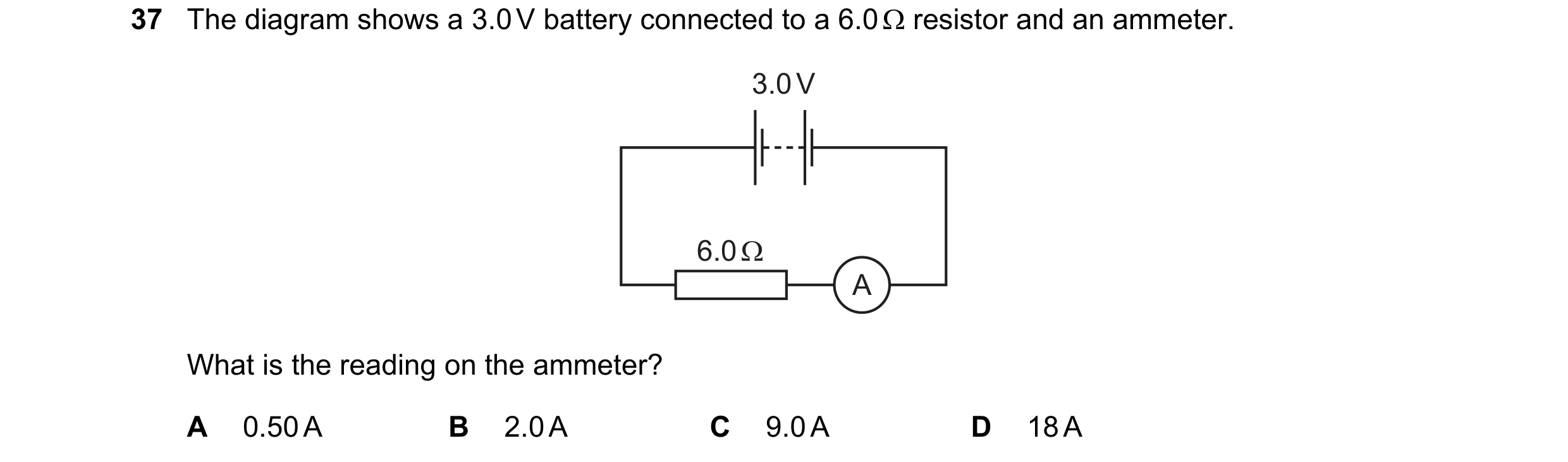
Q35 · The diagram shows a 3.0 V battery connected to a 6.0 Ω resistor and an ammeter 0654/11 Oct/Nov 2016
37 The diagram shows a 3.0 V battery connected to a 6.0 Ω resistor and an ammeter. 3.0 V 6.0 Ω A What is the reading on the ammeter? A 0.50 A B 2.0 A C 9.0 A D 18 A
1 marks
Answer: A
This question in 0654/11 Oct/Nov 2016
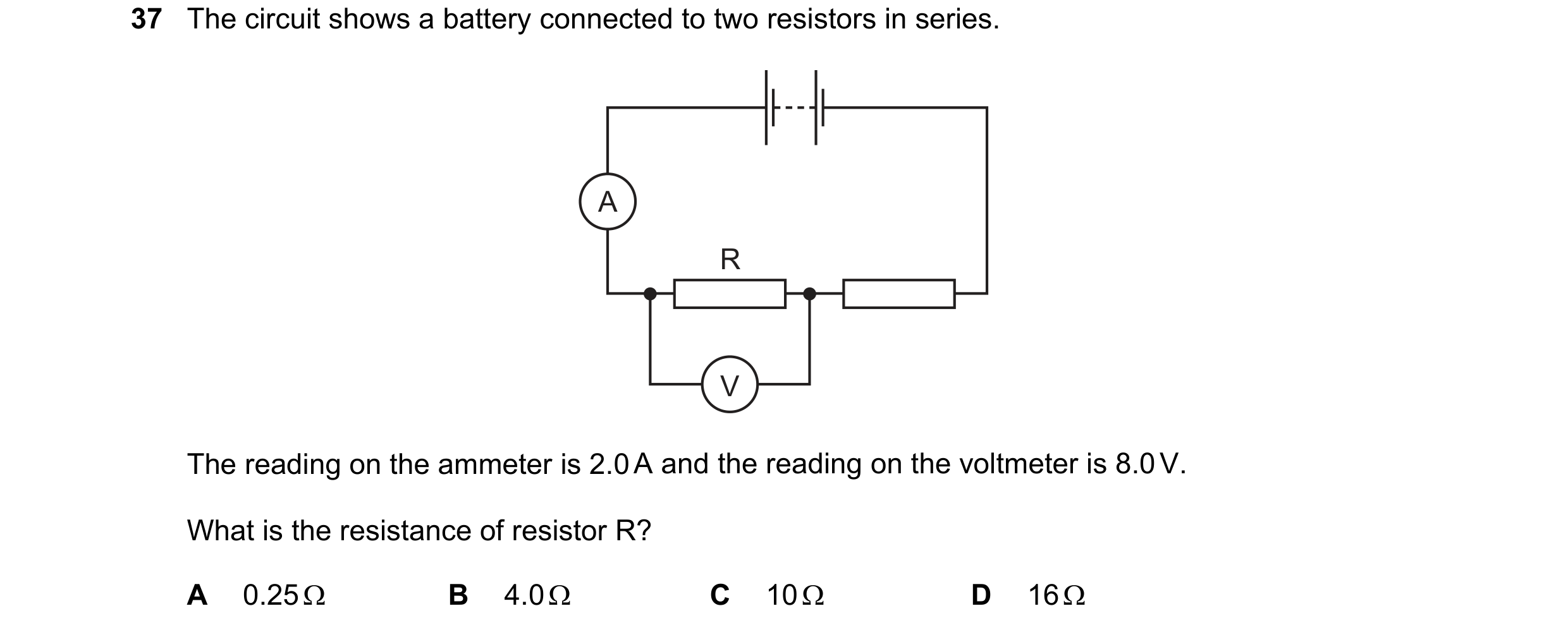
Q36 · The circuit shows a battery connected to two resistors in series 0654/12 Oct/Nov 2016
37 The circuit shows a battery connected to two resistors in series. A R V The reading on the ammeter is 2.0 A and the reading on the voltmeter is 8.0 V. What is the resistance of resistor R? A 0.25 Ω B 4.0 Ω C 10 Ω D 16 Ω
1 marks
Answer: B
This question in 0654/12 Oct/Nov 2016
Q37 · The diagram shows a battery connected to a 0.50 Ω resistor and an ammeter 0654/13 Oct/Nov 2016
37 The diagram shows a battery connected to a 0.50 Ω resistor and an ammeter. The reading on the ammeter is 0.20 A. 0.50 Ω A What is the p.d. across the resistor? A 0.10 V B 0.40 V C 0.70 V D 2.5 V
1 marks
Answer: A
This question in 0654/13 Oct/Nov 2016
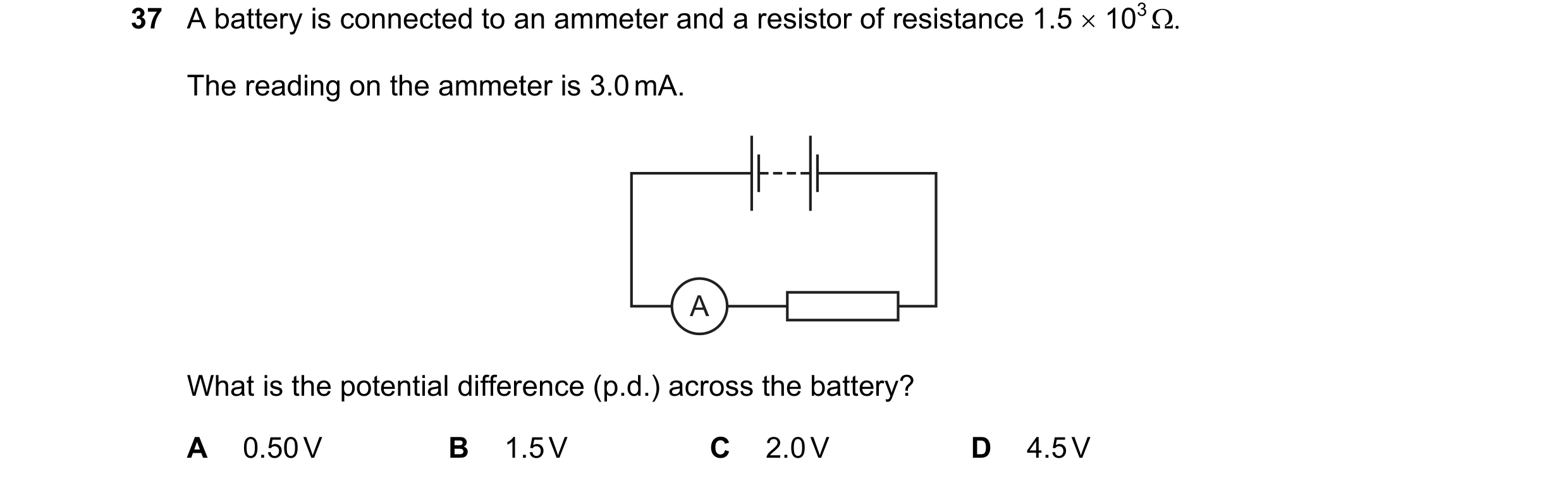
Q38 · A battery is connected to an ammeter and a resistor of resistance 1.5 × 10³ Ω 0654/11 May/June 2017
37 A battery is connected to an ammeter and a resistor of resistance 1.5 × 10³ Ω. The reading on the ammeter is 3.0 mA. A What is the potential difference (p.d.) across the battery? A 0.50 V B 1.5 V C 2.0 V D 4.5 V
1 marks
Answer: D
This question in 0654/11 May/June 2017
Q39 · There is a current of 4.0 A in a resistor 0654/12 May/June 2017
38 There is a current of 4.0 A in a resistor. The potential difference across the resistor is 8.0 V. What is the resistance of the resistor? A 0.50 Ω B 2.0 Ω C 12 Ω D 32 Ω
1 marks
Answer: B
This question in 0654/12 May/June 2017
Q40 · Which quantities can be measured using a voltmeter? 0654/13 May/June 2017
37 Which quantities can be measured using a voltmeter? A current and e.m.f. only B current and p.d. only C e.m.f. and p.d. only D e.m.f., current and p.d.
1 marks
Answer: C
This question in 0654/13 May/June 2017
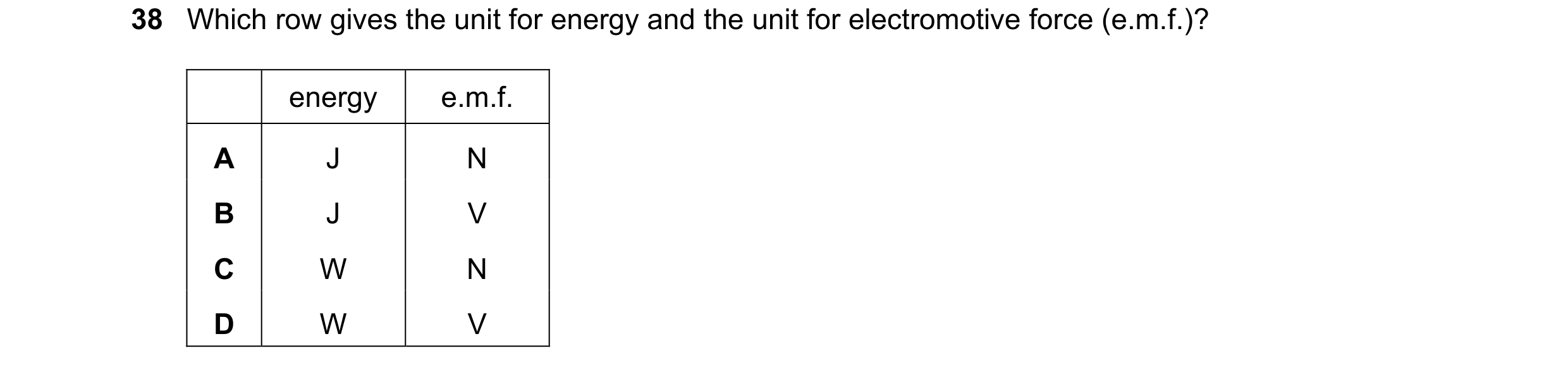
Q41 · Which row gives the unit for energy and the unit for electromotive force (e.m.f.)? 0654/11 Oct/Nov 2017
38 Which row gives the unit for energy and the unit for electromotive force (e.m.f.)? energy e.m.f. A J N B J V C W N D W V
1 marks
Answer: B
This question in 0654/11 Oct/Nov 2017
Q42 · A battery of e.m.f 0654/12 Oct/Nov 2017
37 A battery of e.m.f. V is connected across a resistor of resistance R. There is a current in the resistor. V R current Which row shows two changes that both increase the current in the resistor? change 1 change 2 A decrease V decrease R B decrease V increase R C increase V decrease R D increase V increase R
1 marks
Answer: C
This question in 0654/12 Oct/Nov 2017
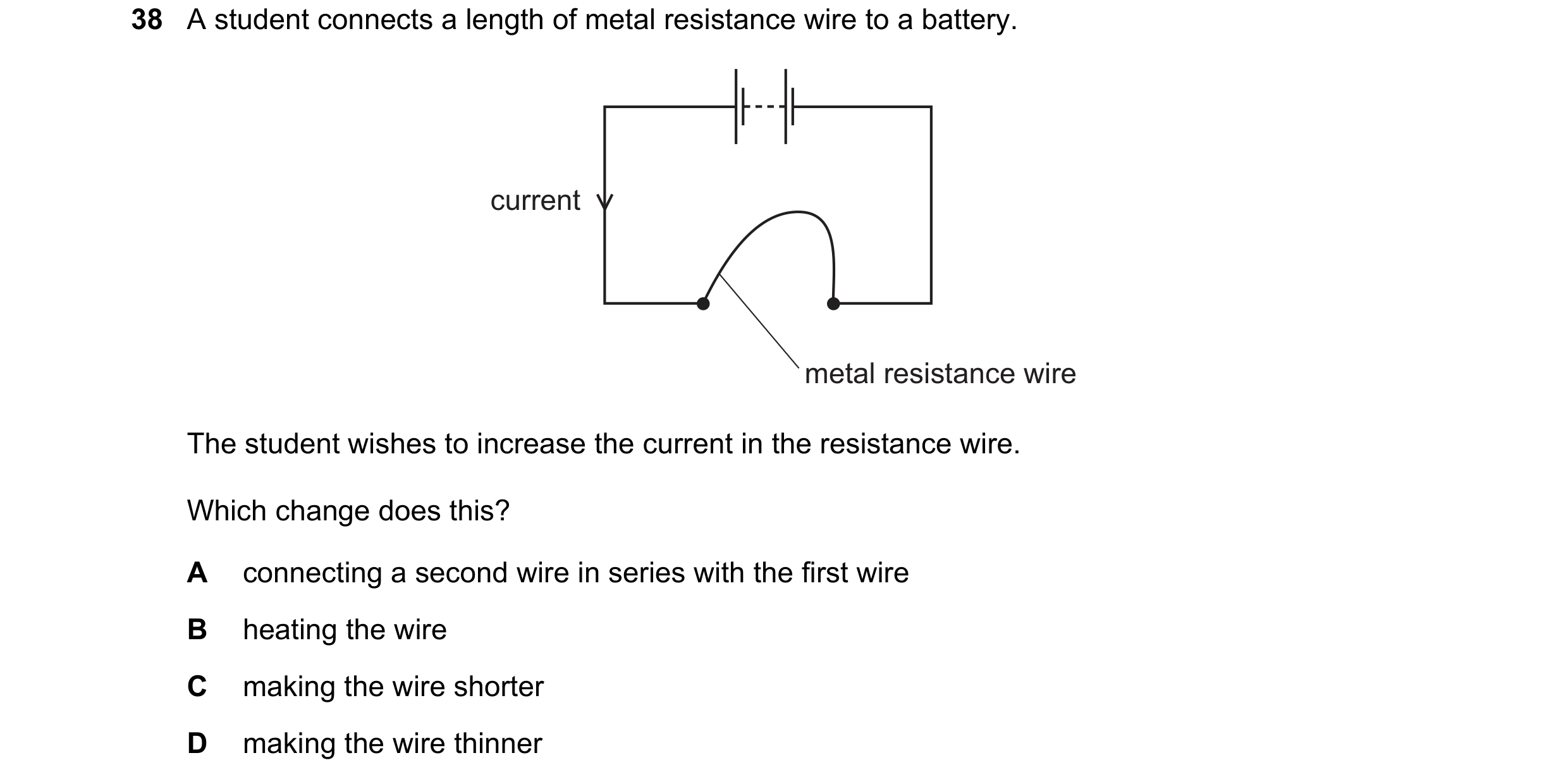
Q43 · A student connects a length of metal resistance wire to a battery 0654/11 May/June 2019
38 A student connects a length of metal resistance wire to a battery. current metal resistance wire The student wishes to increase the current in the resistance wire. Which change does this? A connecting a second wire in series with the first wire B heating the wire C making the wire shorter D making the wire thinner
1 marks
Answer: C
This question in 0654/11 May/June 2019
Q44 · A student connects a length of metal resistance wire to a battery 0654/12 May/June 2019
38 A student connects a length of metal resistance wire to a battery. current metal resistance wire The student wishes to increase the current in the resistance wire. Which change does this? A connecting a second wire in series with the first wire B heating the wire C making the wire shorter D making the wire thinner
1 marks
Answer: C
This question in 0654/12 May/June 2019
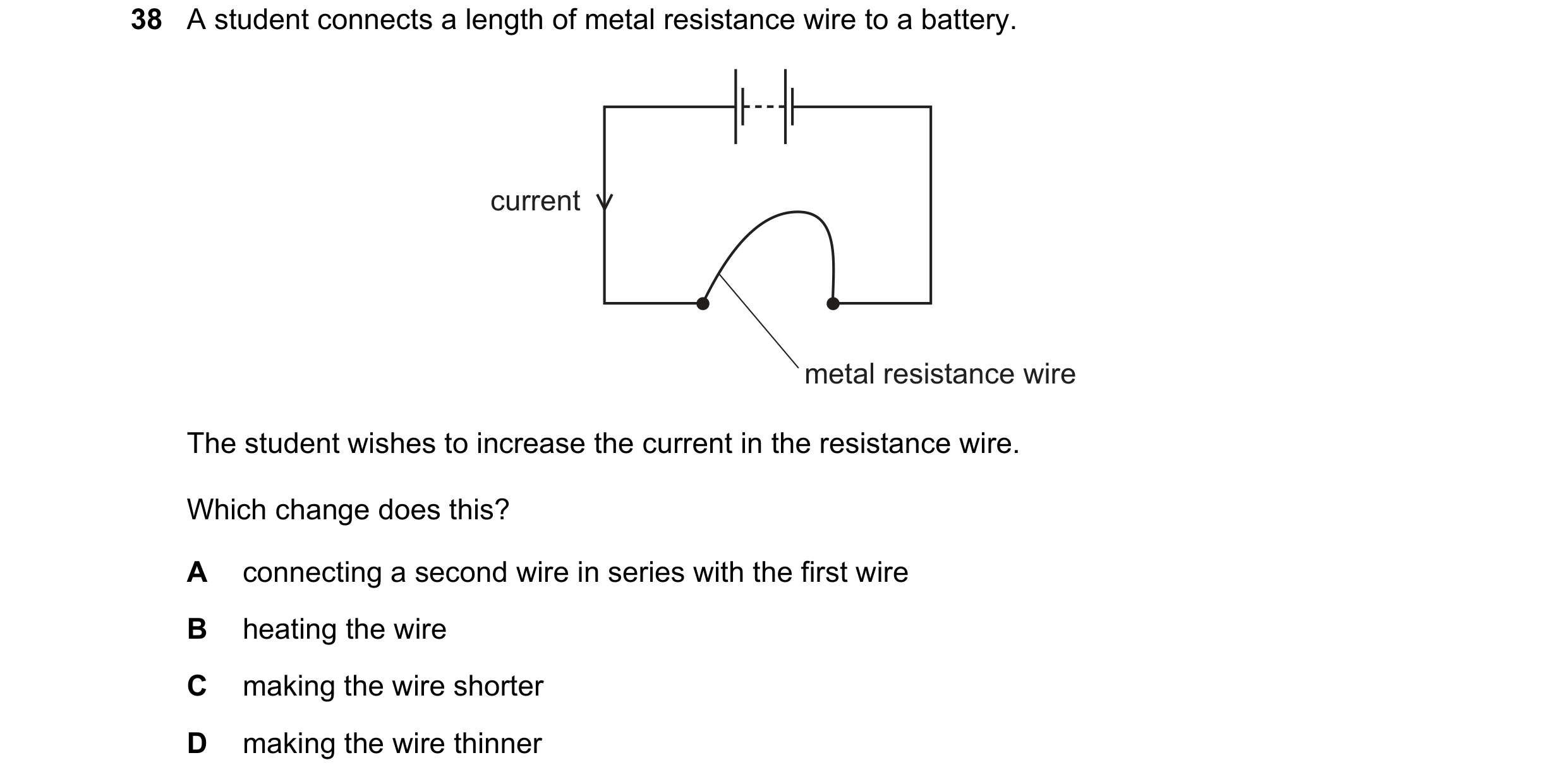
Q45 · A student connects a length of metal resistance wire to a battery 0654/13 May/June 2019
38 A student connects a length of metal resistance wire to a battery. current metal resistance wire The student wishes to increase the current in the resistance wire. Which change does this? A connecting a second wire in series with the first wire B heating the wire C making the wire shorter D making the wire thinner
1 marks
Answer: C
This question in 0654/13 May/June 2019
Q46 · There is a battery of e.m.f 0654/11 Oct/Nov 2019
35 There is a battery of e.m.f. V in a circuit of total resistance R. Which pair of changes must result in a larger current in the circuit? A decreasing V and decreasing R B decreasing V and increasing R C increasing V and decreasing R D increasing V and increasing R
1 marks
Answer: C
This question in 0654/11 Oct/Nov 2019
Q47 · There is a current of 4.0 A in a resistor and a potential difference (p.d.) of 12 V… 0654/12 Oct/Nov 2019
36 There is a current of 4.0 A in a resistor and a potential difference (p.d.) of 12 V across it. What is the resistance of the resistor? A 0.33 Ω B 3.0 Ω C 8.0 Ω D 48 Ω
1 marks
Answer: B
This question in 0654/12 Oct/Nov 2019
Q48 · The circuit shown is used when determining the resistance of a lamp 0654/11 May/June 2020
36 The circuit shown is used when determining the resistance of a lamp. A V The ammeter reading is 2.0 A and the voltmeter reading is 6.0 V. What is the resistance of the lamp? A 0.33 Ω B 3.0 Ω C 8.0 Ω D 12 Ω
1 marks
Answer: B
This question in 0654/11 May/June 2020
Q49 · The circuit shown is used when determining the resistance of a lamp 0654/12 May/June 2020
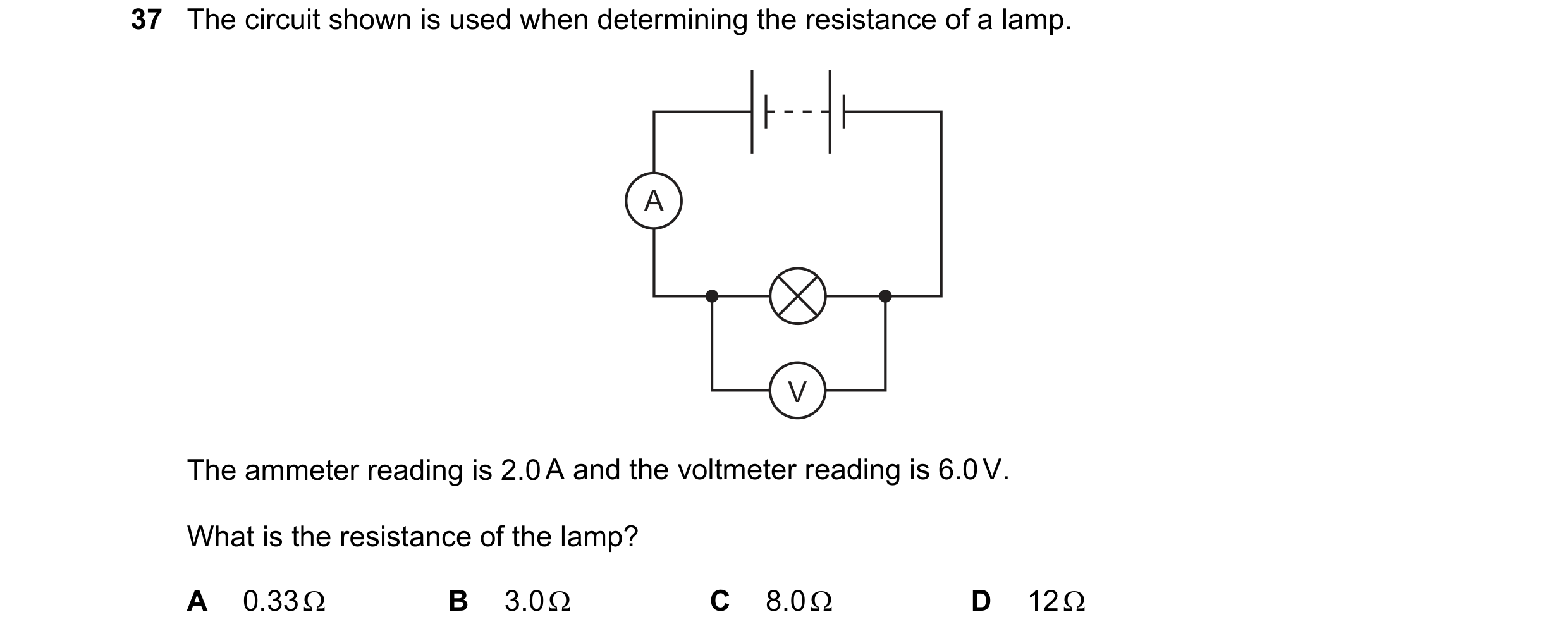
37 The circuit shown is used when determining the resistance of a lamp. A V The ammeter reading is 2.0 A and the voltmeter reading is 6.0 V. What is the resistance of the lamp? A 0.33 Ω B 3.0 Ω C 8.0 Ω D 12 Ω
1 marks
Answer: B
This question in 0654/12 May/June 2020
Q50 · The circuit shown is used when determining the resistance of a lamp 0654/13 May/June 2020
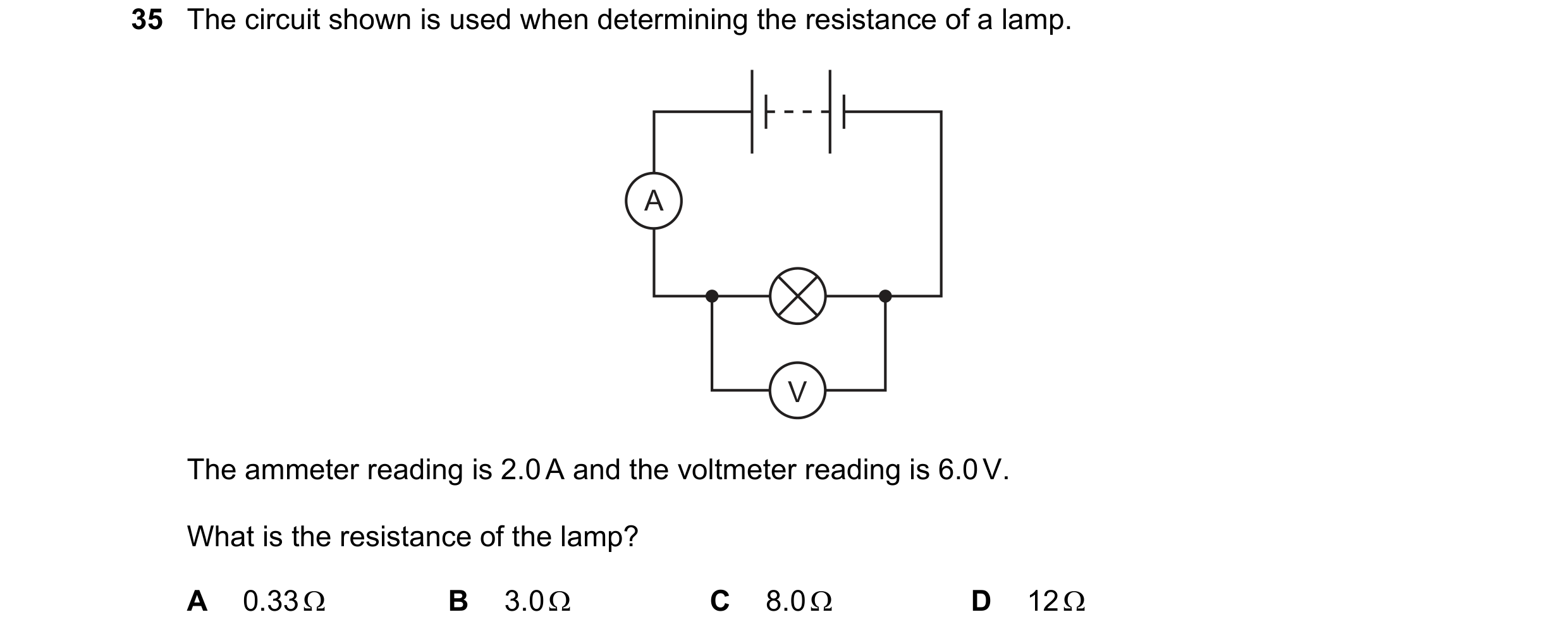
35 The circuit shown is used when determining the resistance of a lamp. A V The ammeter reading is 2.0 A and the voltmeter reading is 6.0 V. What is the resistance of the lamp? A 0.33 Ω B 3.0 Ω C 8.0 Ω D 12 Ω
1 marks
Answer: B
This question in 0654/13 May/June 2020
Q51 · A resistor R is connected to a 12 V battery and an ammeter as shown 0654/11 Oct/Nov 2020
36 A resistor R is connected to a 12 V battery and an ammeter as shown. A 12 V R The ammeter reads 6.0 A. What is the resistance of resistor R? A 0.50 B 2.0 C 18 D 72
1 marks
Answer: B
This question in 0654/11 Oct/Nov 2020
Q52 · What is the unit for electromotive force (e.m.f.)? 0654/12 Oct/Nov 2020
35 What is the unit for electromotive force (e.m.f.)? A ampere B ohm C newton D volt
1 marks
Answer: D
This question in 0654/12 Oct/Nov 2020
Q53 · What is used to measure potential difference (p.d.)? 0654/12 Feb/March 2021
36 What is used to measure potential difference (p.d.)? A ammeter B newton meter C variable resistor D voltmeter
1 marks
Answer: D
This question in 0654/12 Feb/March 2021
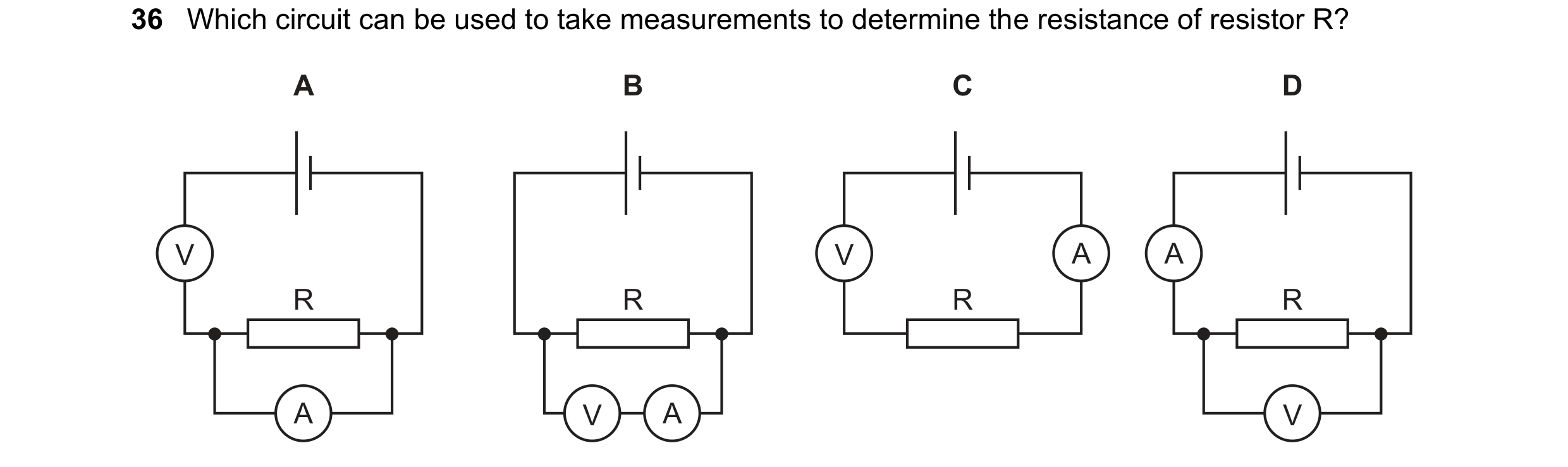
Q54 · Which circuit can be used to take measurements to determine the resistance of resistor R? 0654/12 May/June 2021
36 Which circuit can be used to take measurements to determine the resistance of resistor R? A B C D V V A A R R R R A V A V
1 marks
Answer: D
This question in 0654/12 May/June 2021
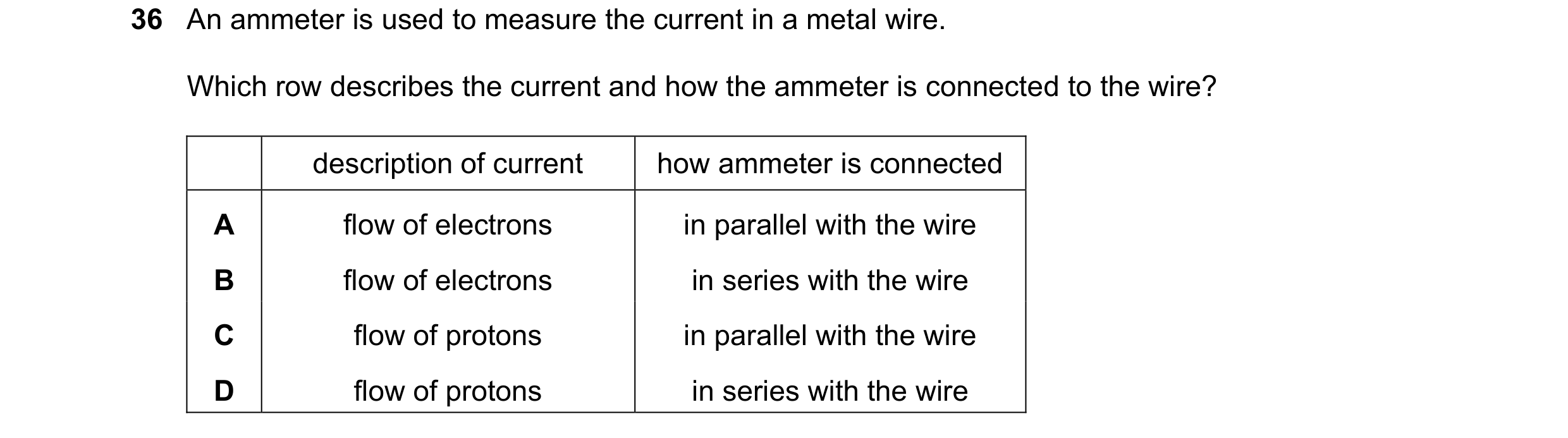
Q55 · An ammeter is used to measure the current in a metal wire 0654/13 Oct/Nov 2021
36 An ammeter is used to measure the current in a metal wire. Which row describes the current and how the ammeter is connected to the wire? description of current how ammeter is connected A flow of electrons in parallel with the wire B flow of electrons in series with the wire C flow of protons in parallel with the wire D flow of protons in series with the wire
1 marks
Answer: B
This question in 0654/13 Oct/Nov 2021
Q56 · A 6.0 V battery is connected to a lamp 0654/12 Feb/March 2022
36 A 6.0 V battery is connected to a lamp. The current in the circuit is 0.60 A. 6.0 V current = 0.60 A What is the resistance of the lamp? A 0.10 B 3.6 C 10 D 36
1 marks
Answer: C
This question in 0654/12 Feb/March 2022
Q57 · A 240 V mains lamp operating normally has a working resistance of 480 0654/11 May/June 2022
38 A 240 V mains lamp operating normally has a working resistance of 480 . Which rating of fuse is most suitable to use with this lamp? A 0.4 A B 1 A C 2 A D 4 A
1 marks
Answer: B
This question in 0654/11 May/June 2022
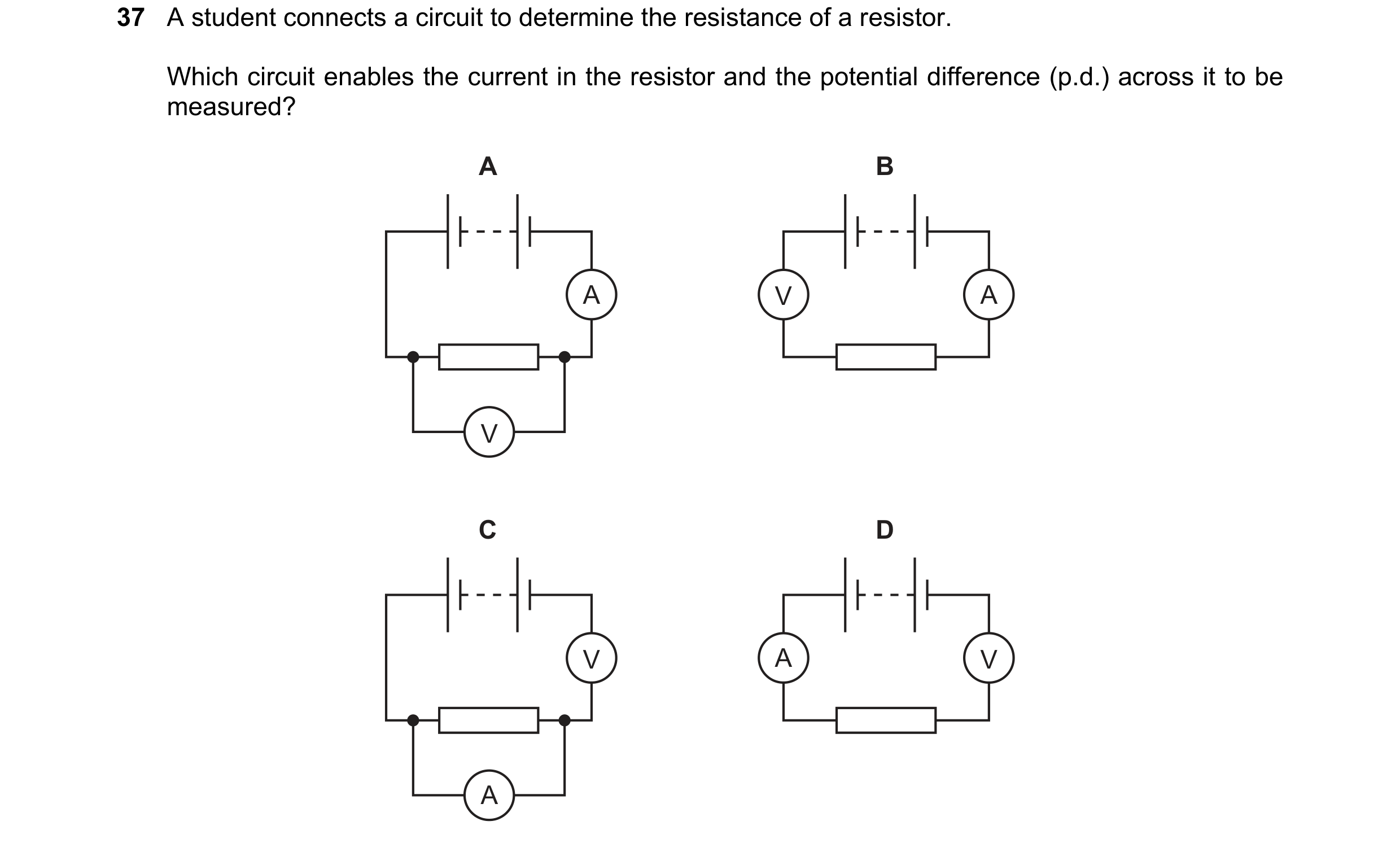
Q58 · A student connects a circuit to determine the resistance of a resistor 0654/12 May/June 2022
37 A student connects a circuit to determine the resistance of a resistor. Which circuit enables the current in the resistor and the potential difference (p.d.) across it to be measured? A B A V A V C D V A V A
1 marks
Answer: A
This question in 0654/12 May/June 2022
Q59 · A battery of e.m.f 0654/11 May/June 2023
37 A battery of e.m.f. V is connected across a resistor of resistance R. There is a current in the resistor. V R current Which row shows two changes that both increase the current in the resistor? change 1 change 2 A decrease V decrease R B decrease V increase R C increase V decrease R D increase V increase R
1 marks
Answer: C
This question in 0654/11 May/June 2023
Q60 · Which two electrical quantities are measured in the same unit? 0654/11 Oct/Nov 2023
37 Which two electrical quantities are measured in the same unit? A current and potential difference (p.d.) B current and electromotive force (e.m.f.) C potential difference (p.d.) and electromotive force (e.m.f.) D potential difference (p.d.) and resistance
1 marks
Answer: C
This question in 0654/11 Oct/Nov 2023
Q61 · What is a current in a metal wire? 0654/12 Oct/Nov 2023
36 What is a current in a metal wire? A a flow of electrons B a flow of ions C a flow of neutrons D a flow of protons
1 marks
Answer: A
This question in 0654/12 Oct/Nov 2023
Q62 · Four resistors are connected into circuits 0654/13 Oct/Nov 2023
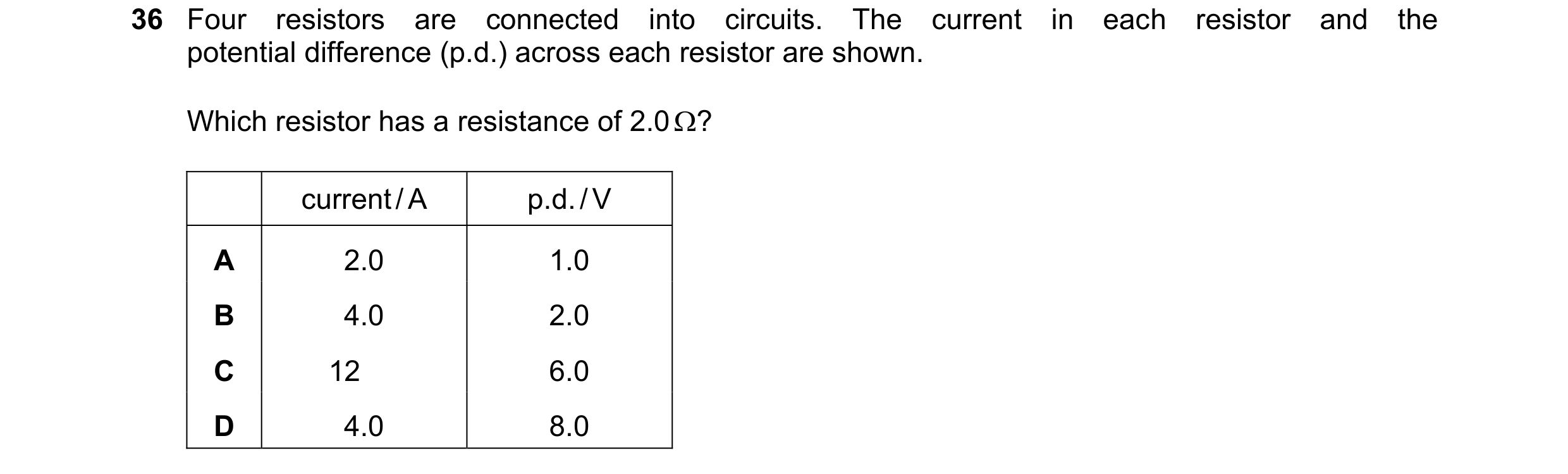
36 Four resistors are connected into circuits. The current in each resistor and the potential difference (p.d.) across each resistor are shown. Which resistor has a resistance of 2.0 ? current / A p.d. / V A 2.0 1.0 B 4.0 2.0 C 12 6.0 D 4.0 8.0
1 marks
Answer: D
This question in 0654/13 Oct/Nov 2023
Q63 · There is a current of 4.0 A in a resistor and a potential difference (p.d.) of 12 V… 0654/12 Feb/March 2024
36 There is a current of 4.0 A in a resistor and a potential difference (p.d.) of 12 V across it. What is the resistance of the resistor? A 0.33 B 3.0 C 8.0 D 48
1 marks
Answer: B
This question in 0654/12 Feb/March 2024
Q64 · A cell is connected in a circuit 0654/11 May/June 2024
36 A cell is connected in a circuit. Which statement describes how the electromotive force (e.m.f.) of the cell is measured? A It is measured in newtons using a newton meter connected in parallel with the cell. B It is measured in newtons using a newton meter connected in series with the cell. C It is measured in volts using a voltmeter connected in parallel with the cell. D It is measured in volts using a voltmeter connected in series with the cell.
1 marks
Answer: C
This question in 0654/11 May/June 2024
Q65 · For which quantities is the unit the volt? 0654/12 May/June 2024
36 For which quantities is the unit the volt? A current and potential difference (p.d.) B electromotive force (e.m.f.) and potential difference (p.d.) C electromotive force (e.m.f.) and resistance D potential difference (p.d.) and resistance
1 marks
Answer: B
This question in 0654/12 May/June 2024
Q66 · For which quantities is the unit the volt? 0654/13 May/June 2024
36 For which quantities is the unit the volt? A current and potential difference (p.d.) B electromotive force (e.m.f.) and potential difference (p.d.) C electromotive force (e.m.f.) and resistance D potential difference (p.d.) and resistance
1 marks
Answer: B
This question in 0654/13 May/June 2024
Q67 · A lamp is connected to a 3.0 V battery 0654/11 Oct/Nov 2024
36 A lamp is connected to a 3.0 V battery. The resistance of the lamp is 60 . What is the current in the lamp? A 0.050 mA B 20 mA C 50 mA D 180 mA
1 marks
Answer: C
This question in 0654/11 Oct/Nov 2024
Q68 · The diagram shows a battery connected to a 0.50 resistor and an ammeter 0654/12 Oct/Nov 2024
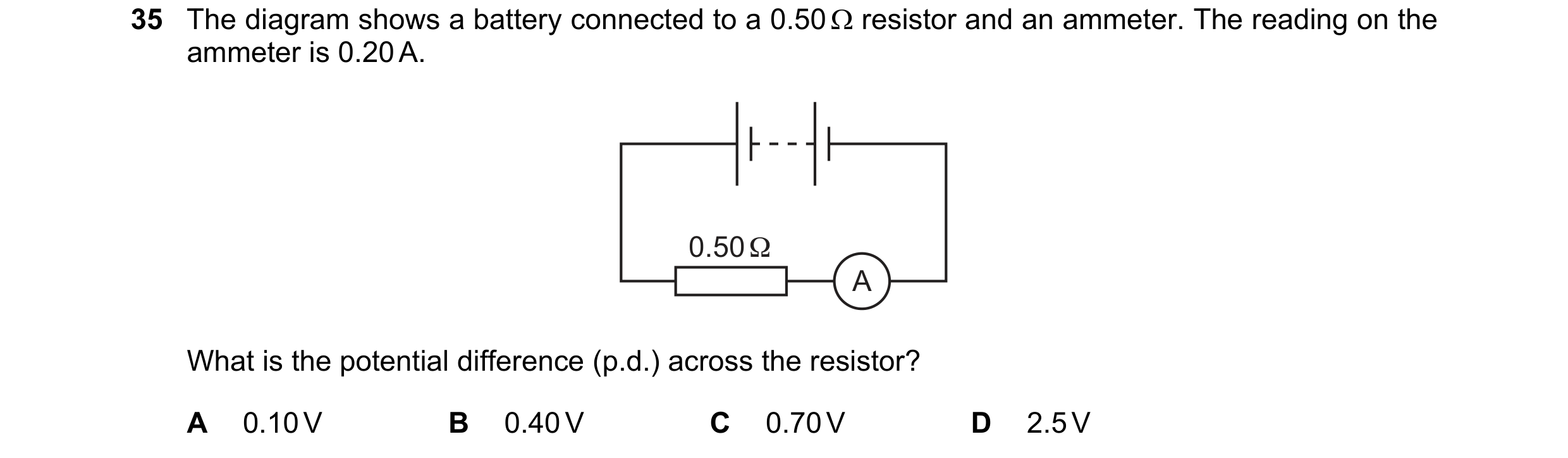
35 The diagram shows a battery connected to a 0.50 resistor and an ammeter. The reading on the ammeter is 0.20 A. 0.50 Ω A What is the potential difference (p.d.) across the resistor? A 0.10 V B 0.40 V C 0.70 V D 2.5 V
1 marks
Answer: A
This question in 0654/12 Oct/Nov 2024
Q69 · The diagram shows a battery connected to a 0.50 resistor and an ammeter 0654/13 Oct/Nov 2024
35 The diagram shows a battery connected to a 0.50 resistor and an ammeter. The reading on the ammeter is 0.20 A. 0.50 Ω A What is the potential difference (p.d.) across the resistor? A 0.10 V B 0.40 V C 0.70 V D 2.5 V
1 marks
Answer: A
This question in 0654/13 Oct/Nov 2024
Q70 · Which equation relates resistance R to current I and voltage V ? 0654/12 Feb/March 2025
37 Which equation relates resistance R to current I and voltage V ? I V A R = I V B R = C R = D R = I – V V I
1 marks
Answer: C
This question in 0654/12 Feb/March 2025
Q71 · There is a current of 4.0 A in a resistor 0654/11 Oct/Nov 2025
37 There is a current of 4.0 A in a resistor. The voltage across the resistor is 8.0 V. What is the resistance of the resistor? A 0.50 B 2.0 C 12 D 32
1 marks
Answer: B
This question in 0654/11 Oct/Nov 2025
Q72 · Which quantity is a flow of electrons through an electrical conductor? 0654/12 Oct/Nov 2025
36 Which quantity is a flow of electrons through an electrical conductor? A current B power C resistance D voltage
1 marks
Answer: A
This question in 0654/12 Oct/Nov 2025
Q73 · The table shows the voltage across and the current in four lamps 0654/12 Oct/Nov 2025
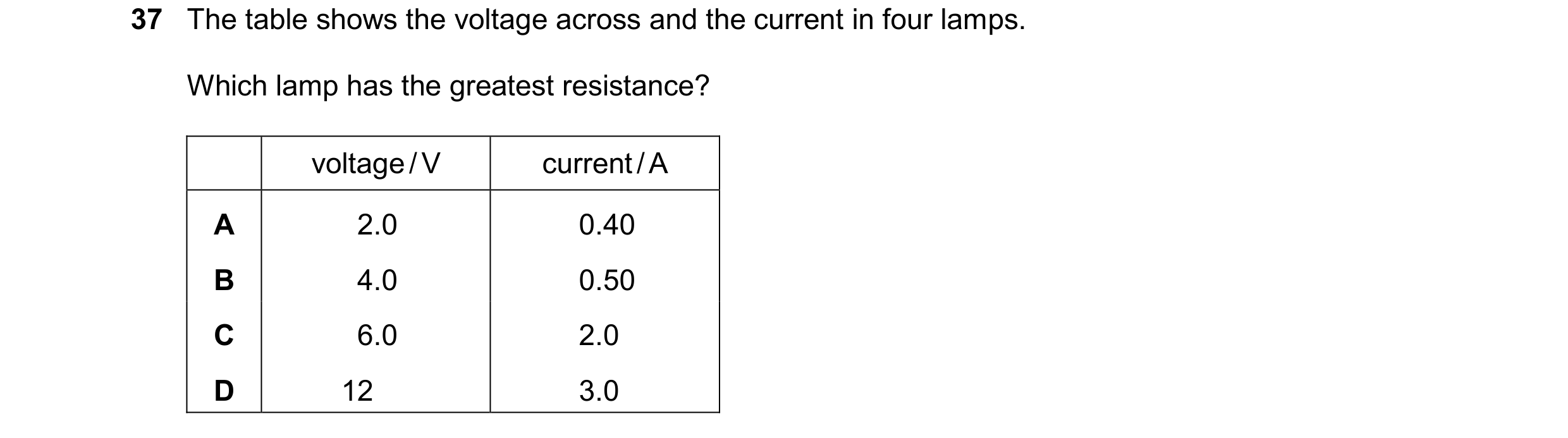
37 The table shows the voltage across and the current in four lamps. Which lamp has the greatest resistance? voltage / V current / A A 2.0 0.40 B 4.0 0.50 C 6.0 2.0 D 12 3.0
1 marks
Answer: B
This question in 0654/12 Oct/Nov 2025
Q74 · Which quantity is a flow of electrons through an electrical conductor? 0654/13 Oct/Nov 2025
36 Which quantity is a flow of electrons through an electrical conductor? A current B power C resistance D voltage
1 marks
Answer: A
This question in 0654/13 Oct/Nov 2025
Q75 · The table shows the voltage across and the current in four lamps 0654/13 Oct/Nov 2025
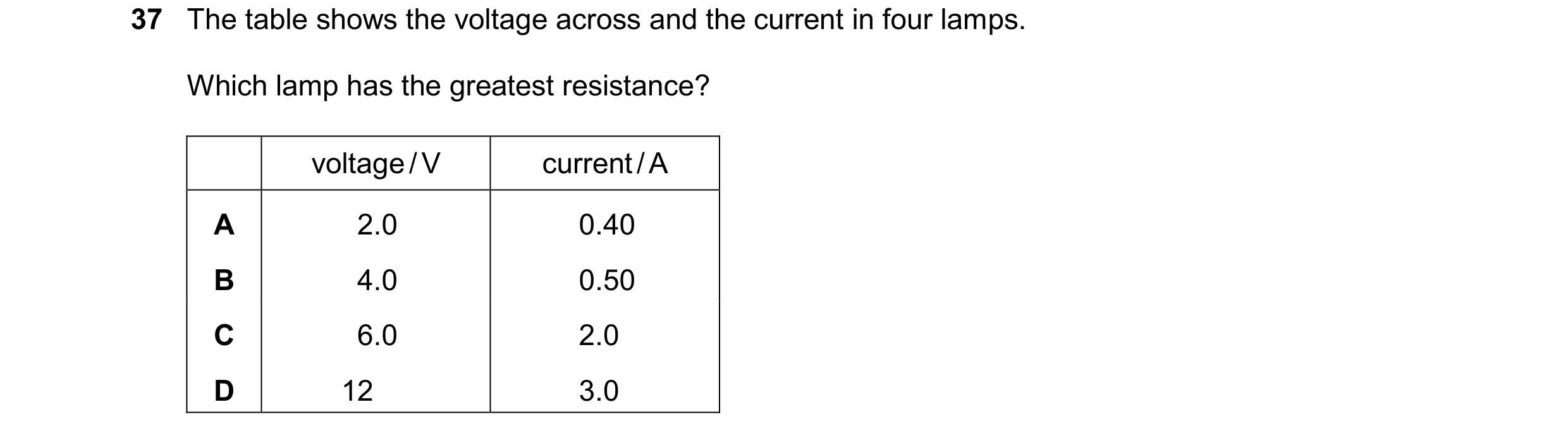
37 The table shows the voltage across and the current in four lamps. Which lamp has the greatest resistance? voltage / V current / A A 2.0 0.40 B 4.0 0.50 C 6.0 2.0 D 12 3.0
1 marks
Answer: B
This question in 0654/13 Oct/Nov 2025
 1 / 20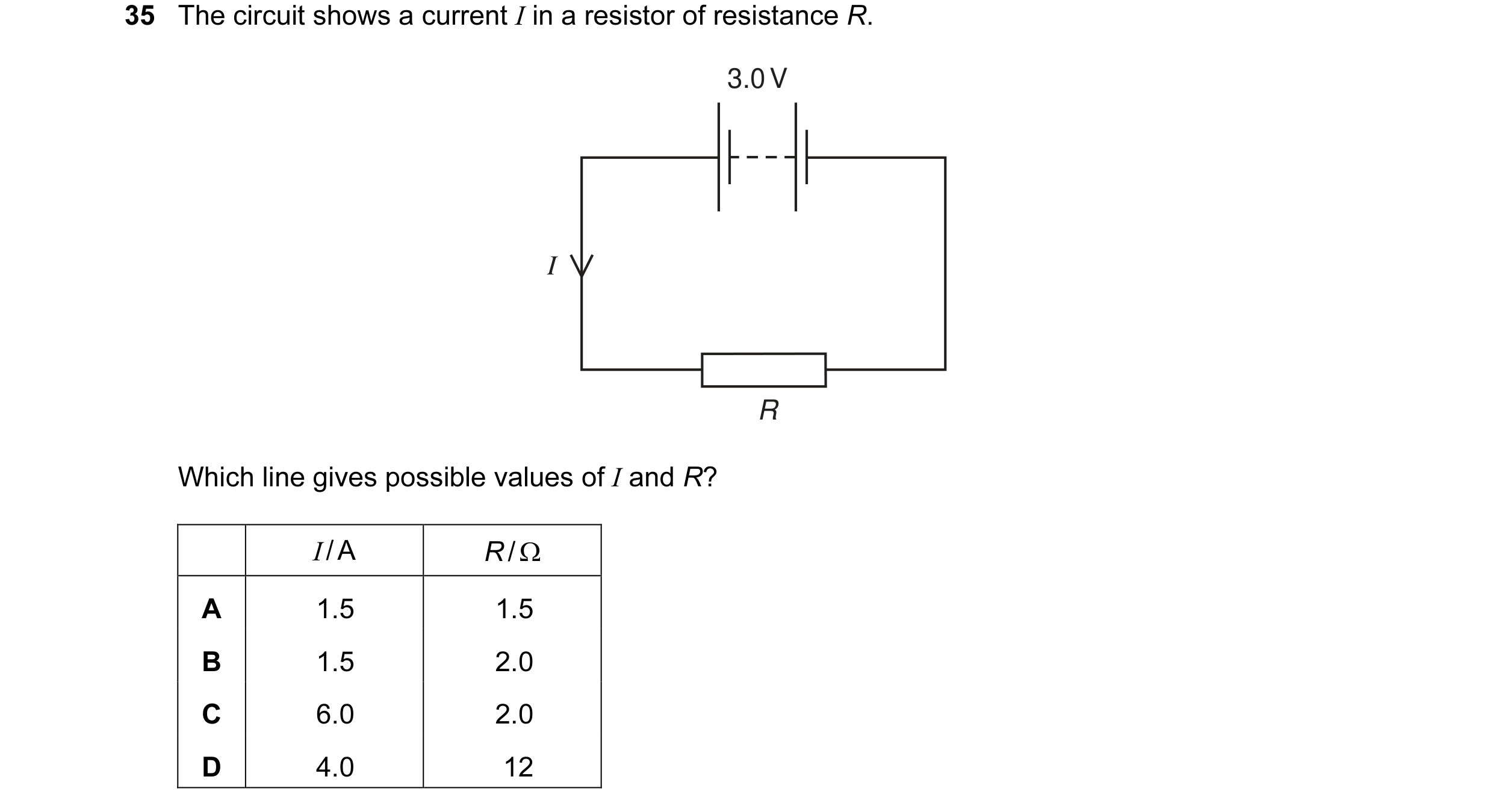
 2 / 20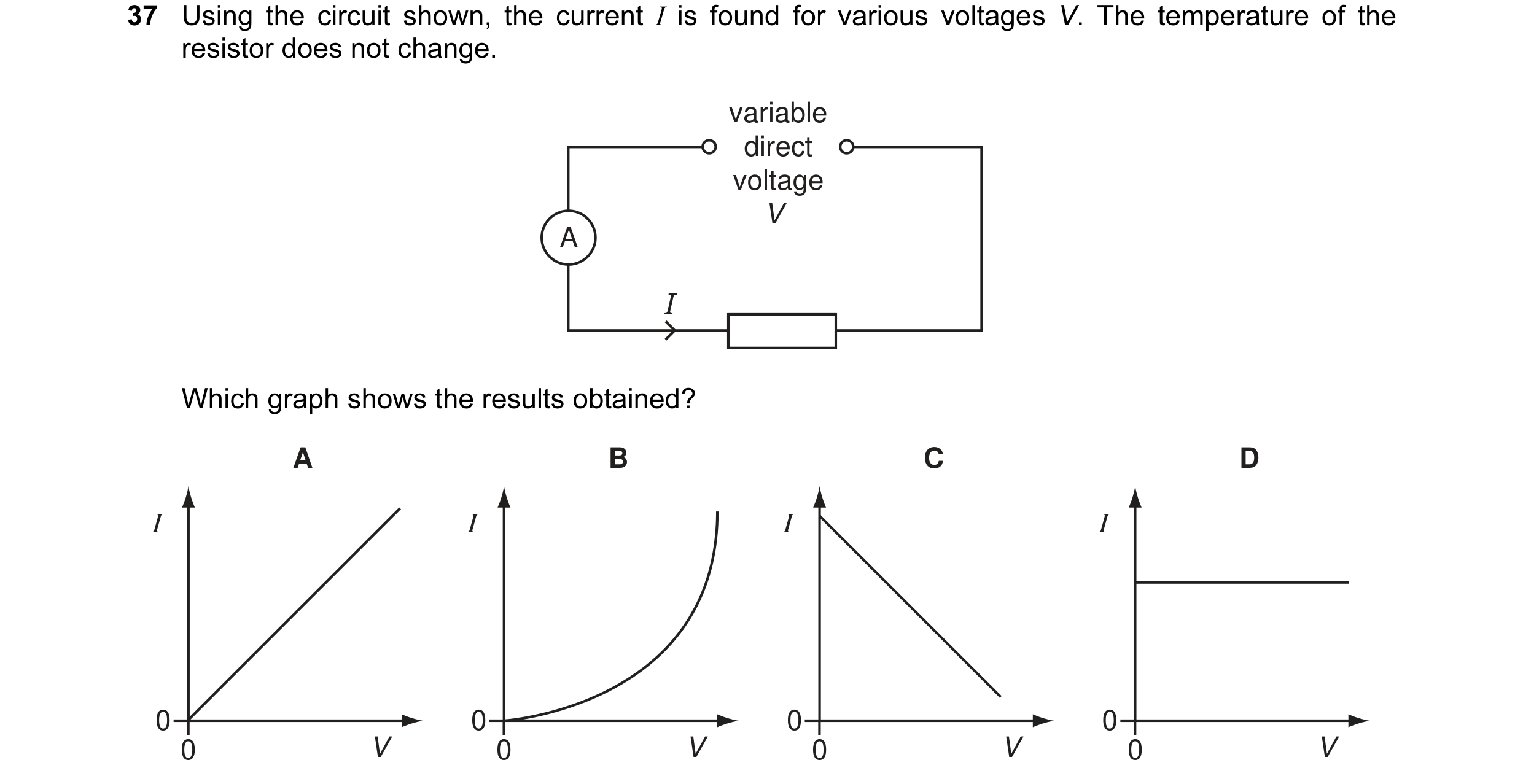
 3 / 20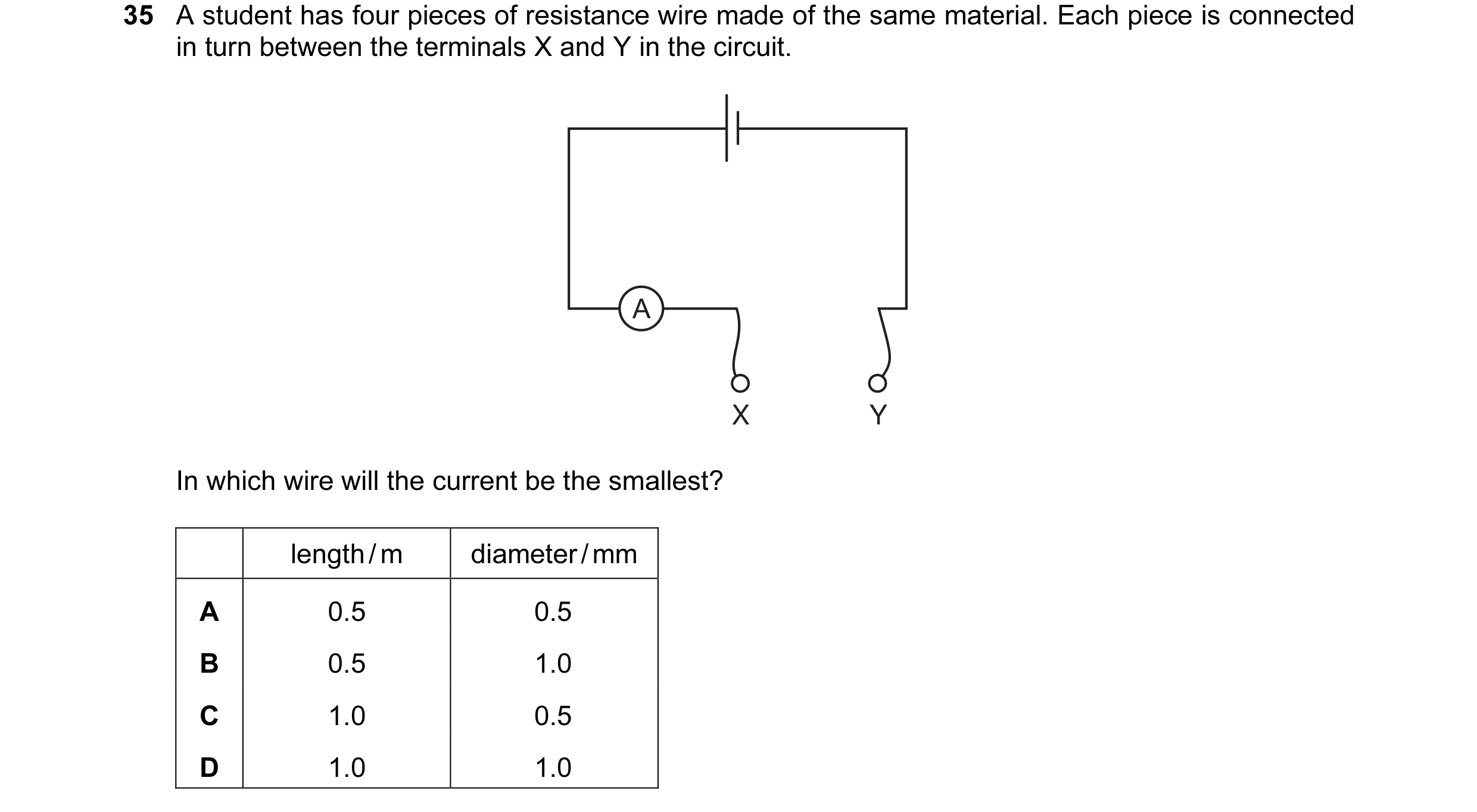

 4 / 20


 5 / 20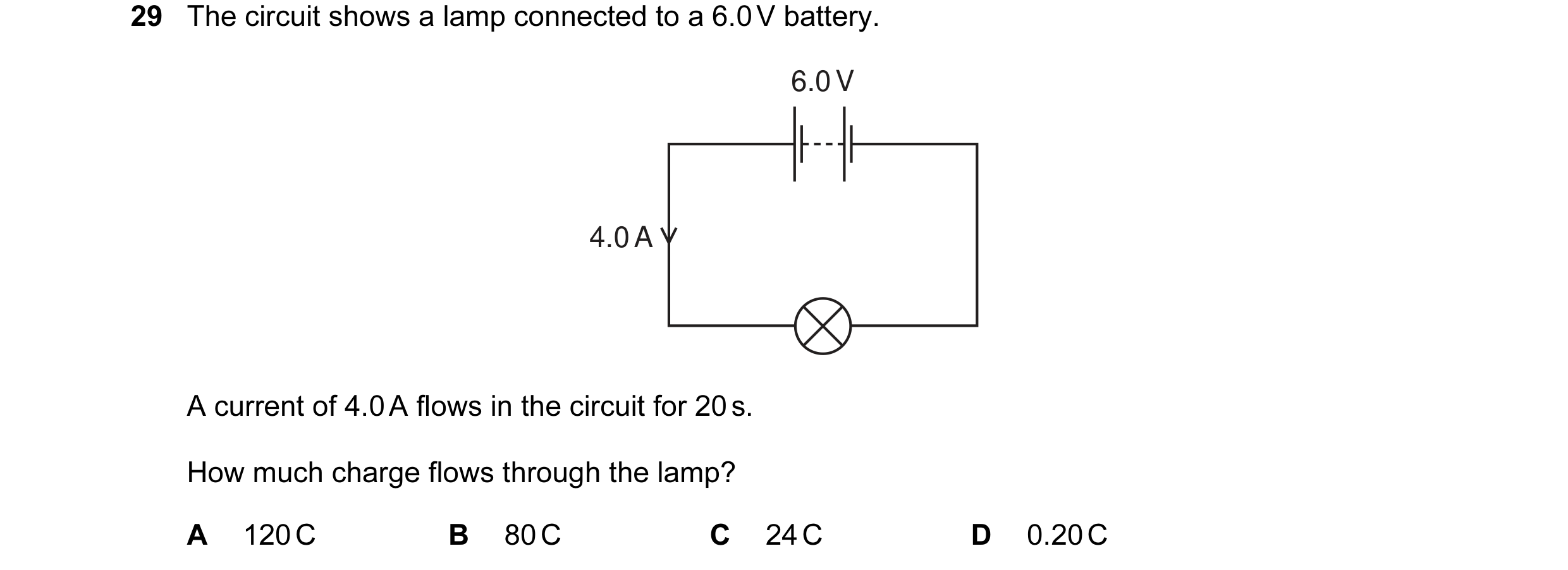

 6 / 20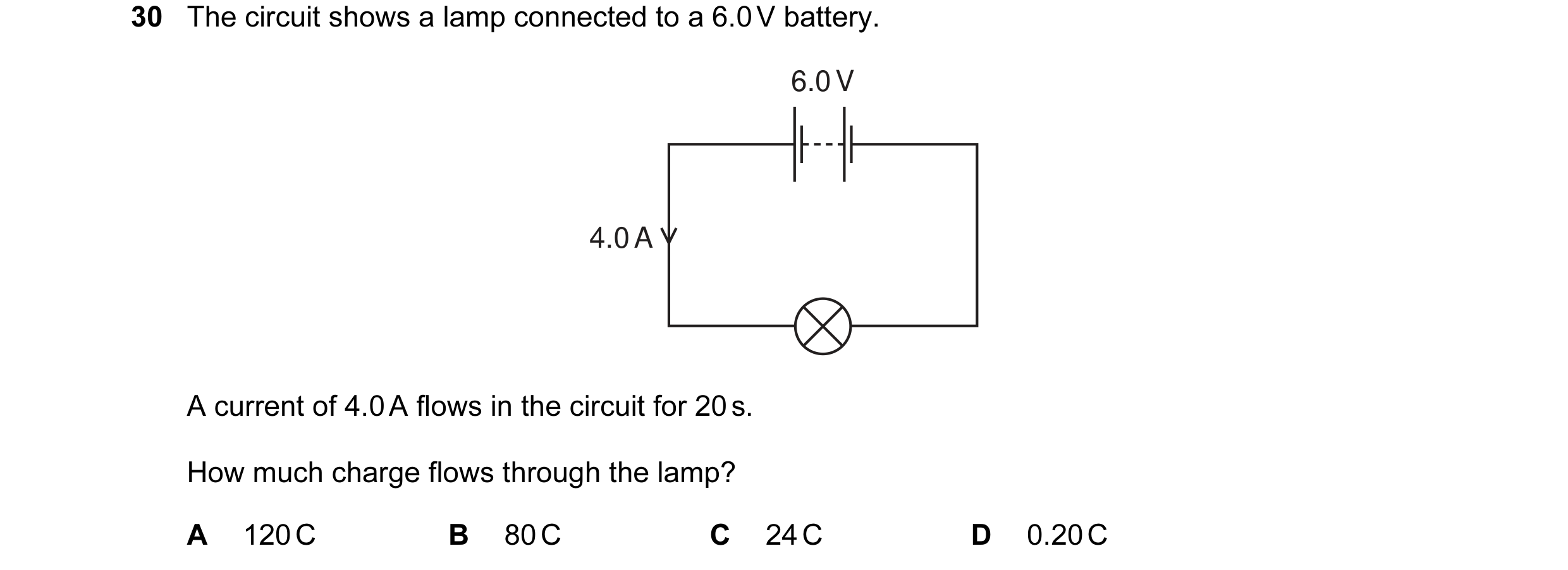

 7 / 20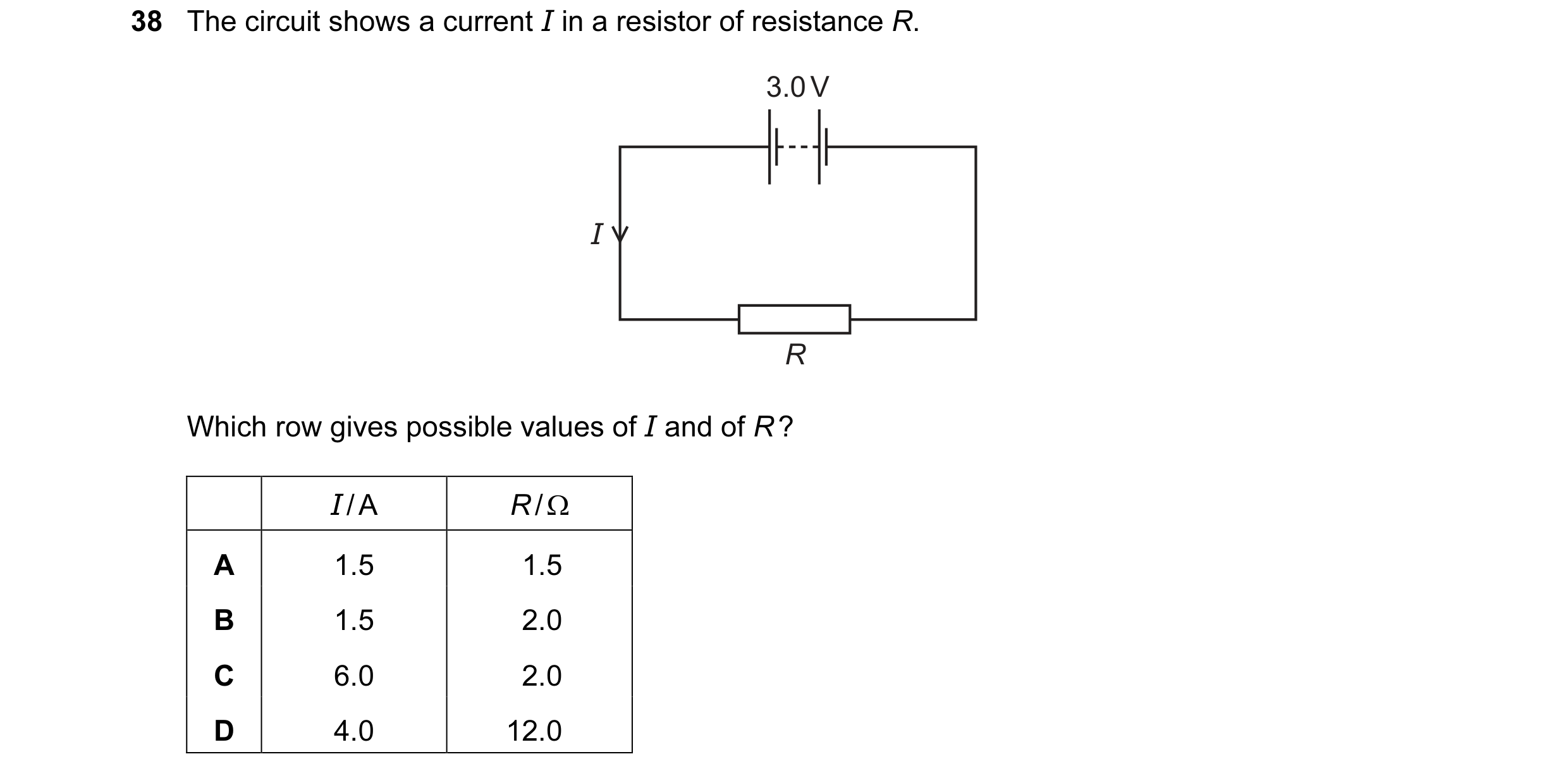
 8 / 20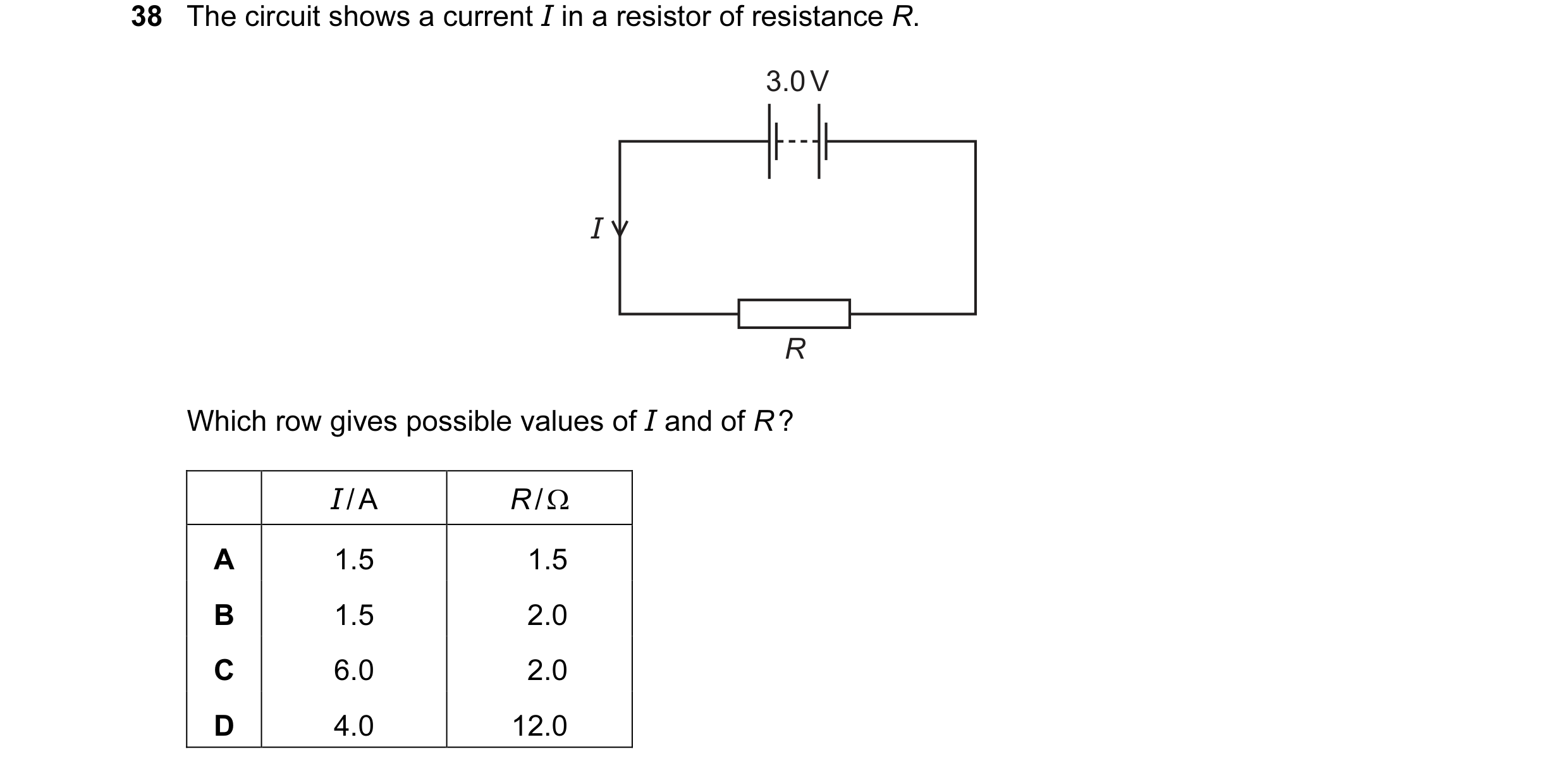


 9 / 20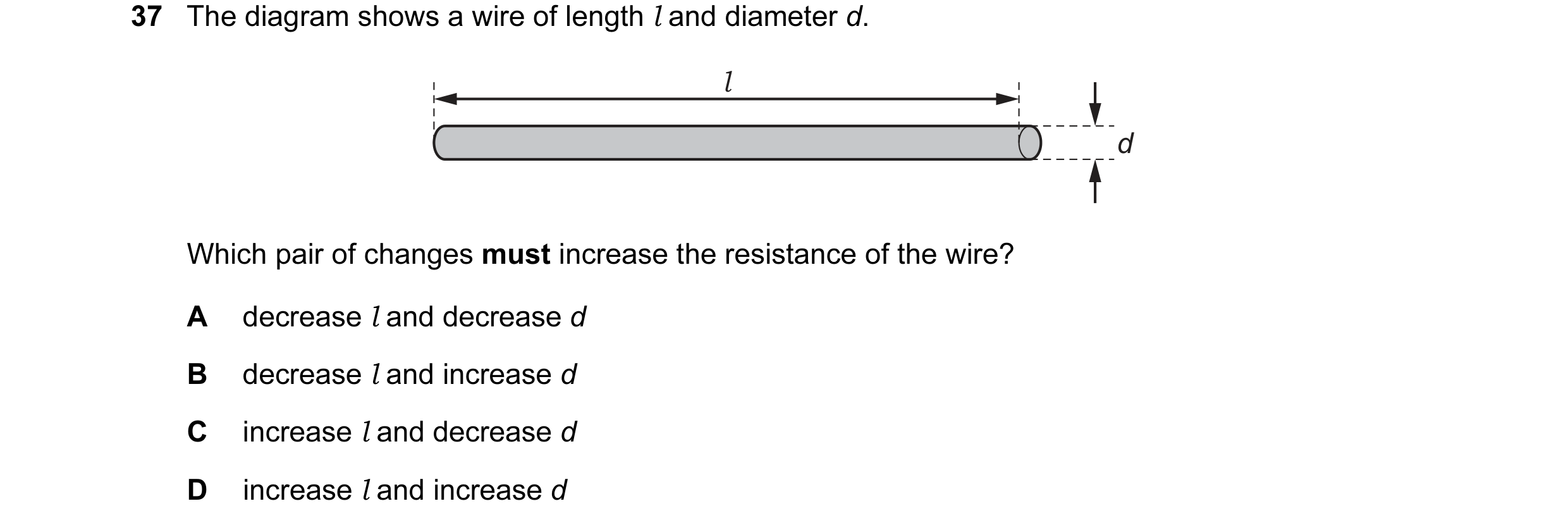

 10 / 20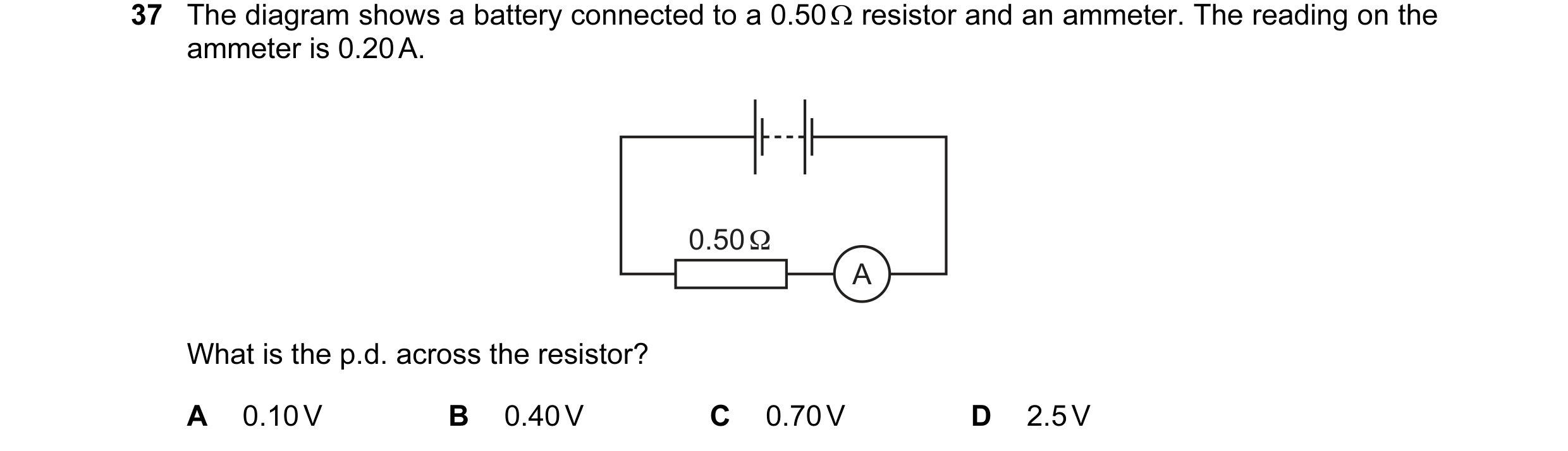


 11 / 20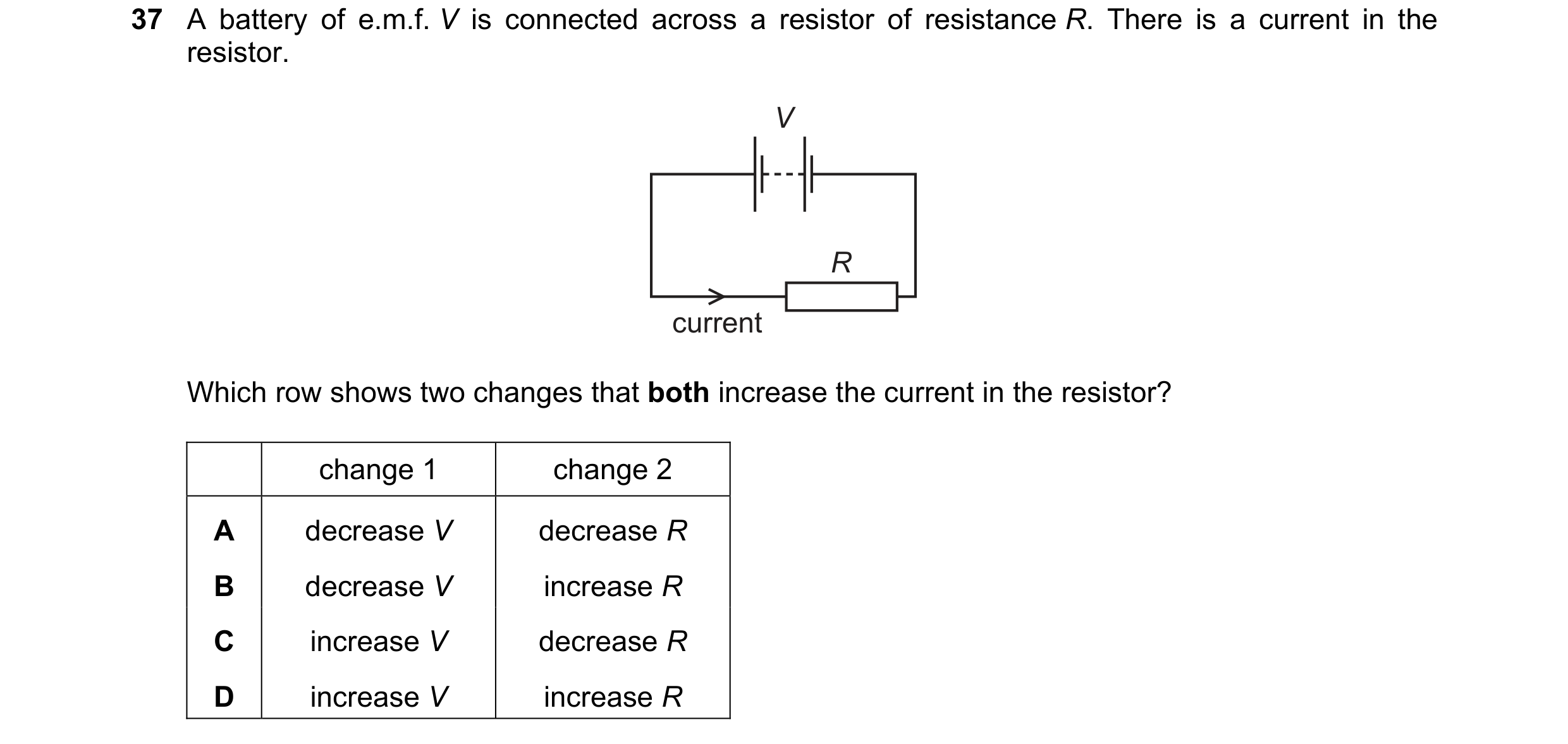
 12 / 20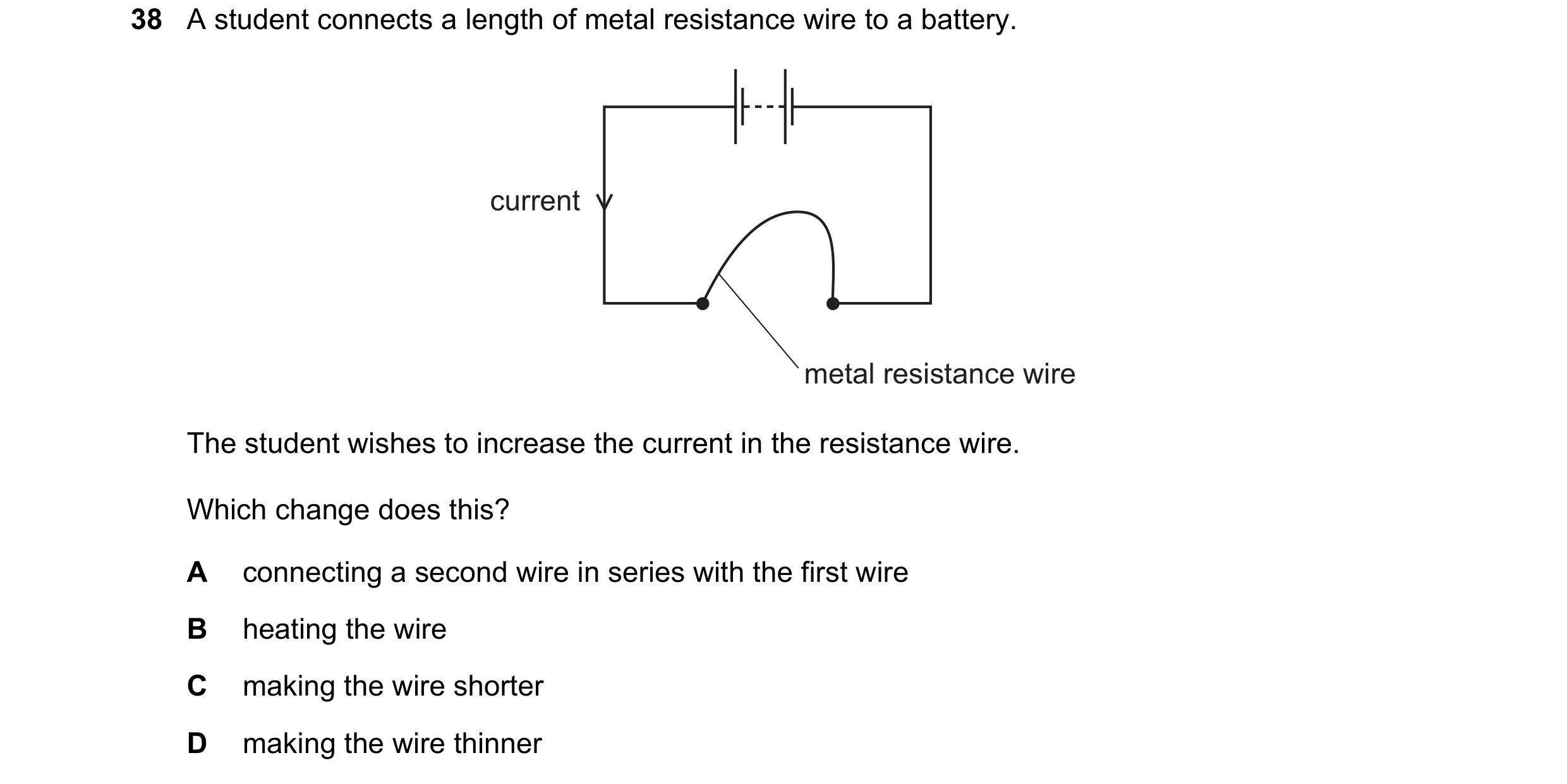
 13 / 20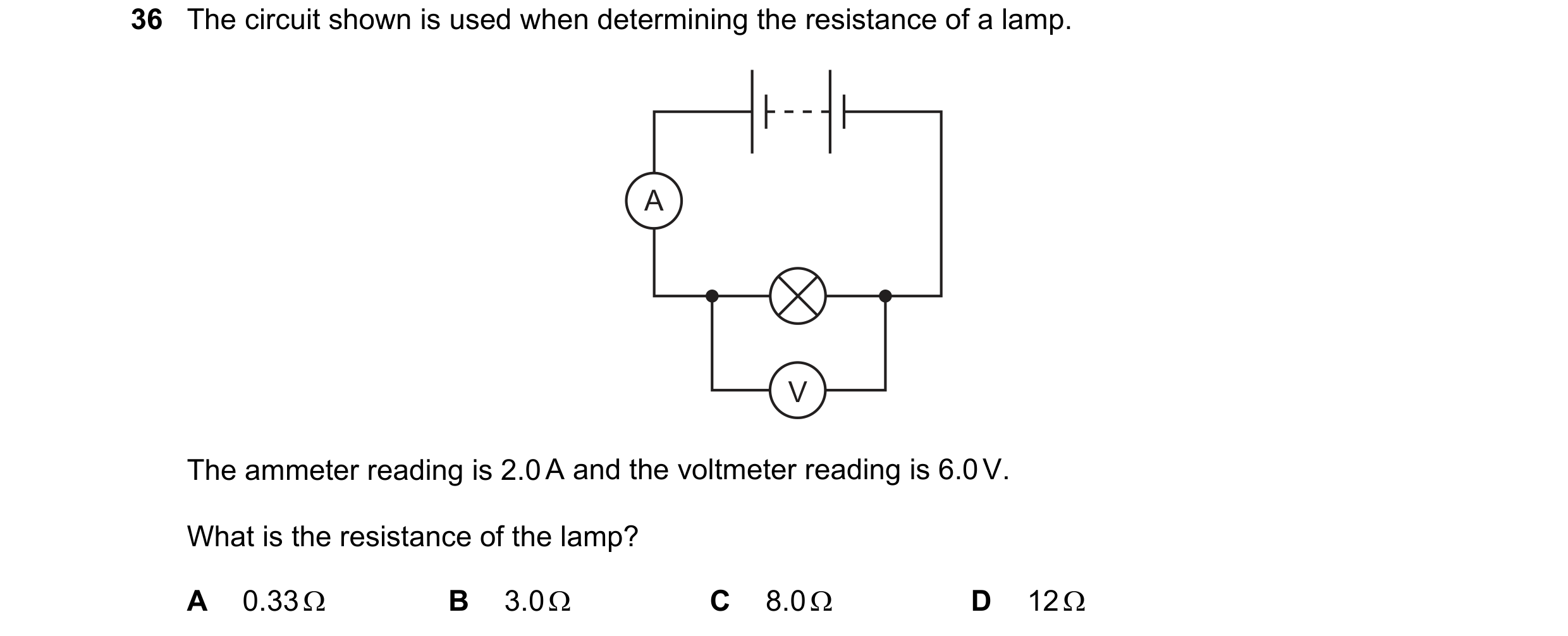
 14 / 20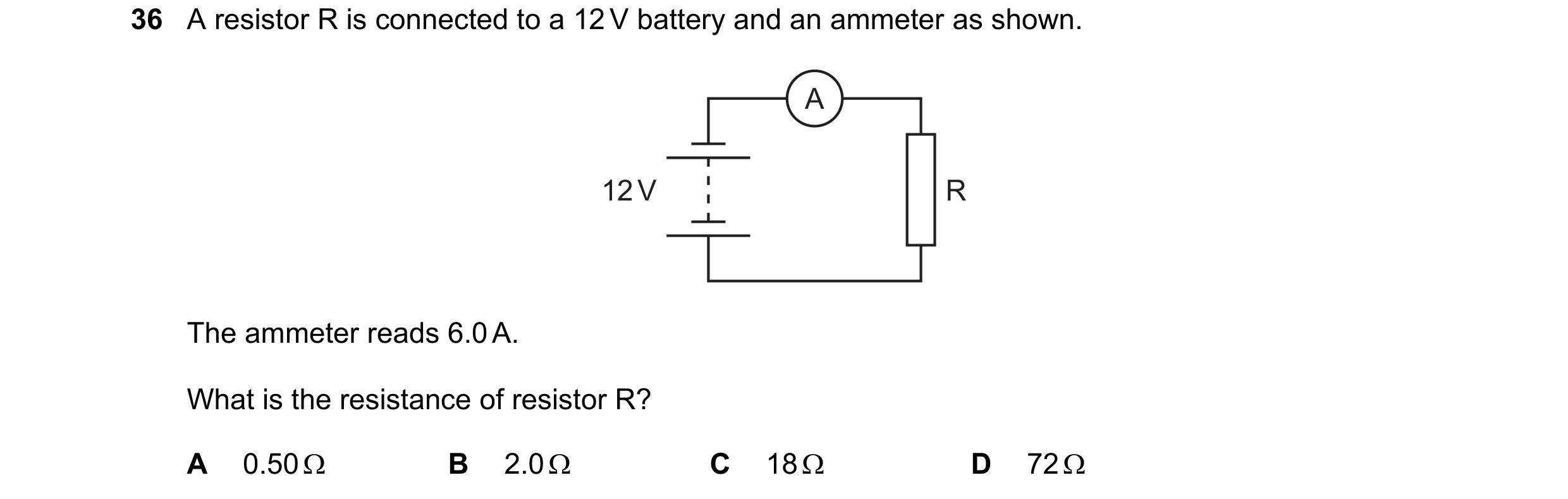


 15 / 20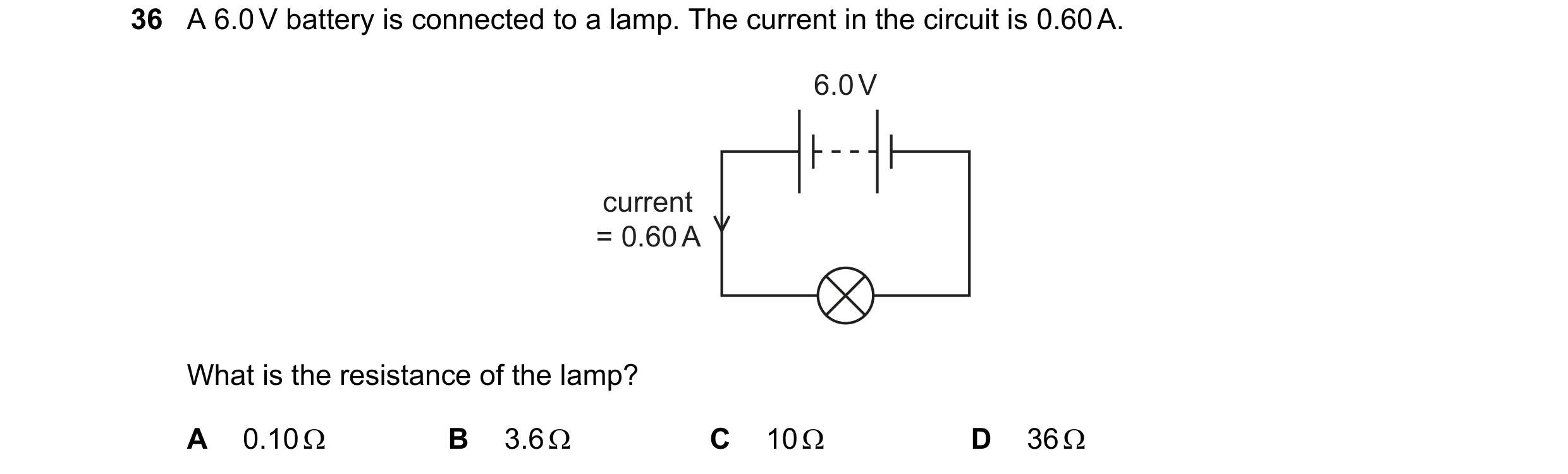

 16 / 20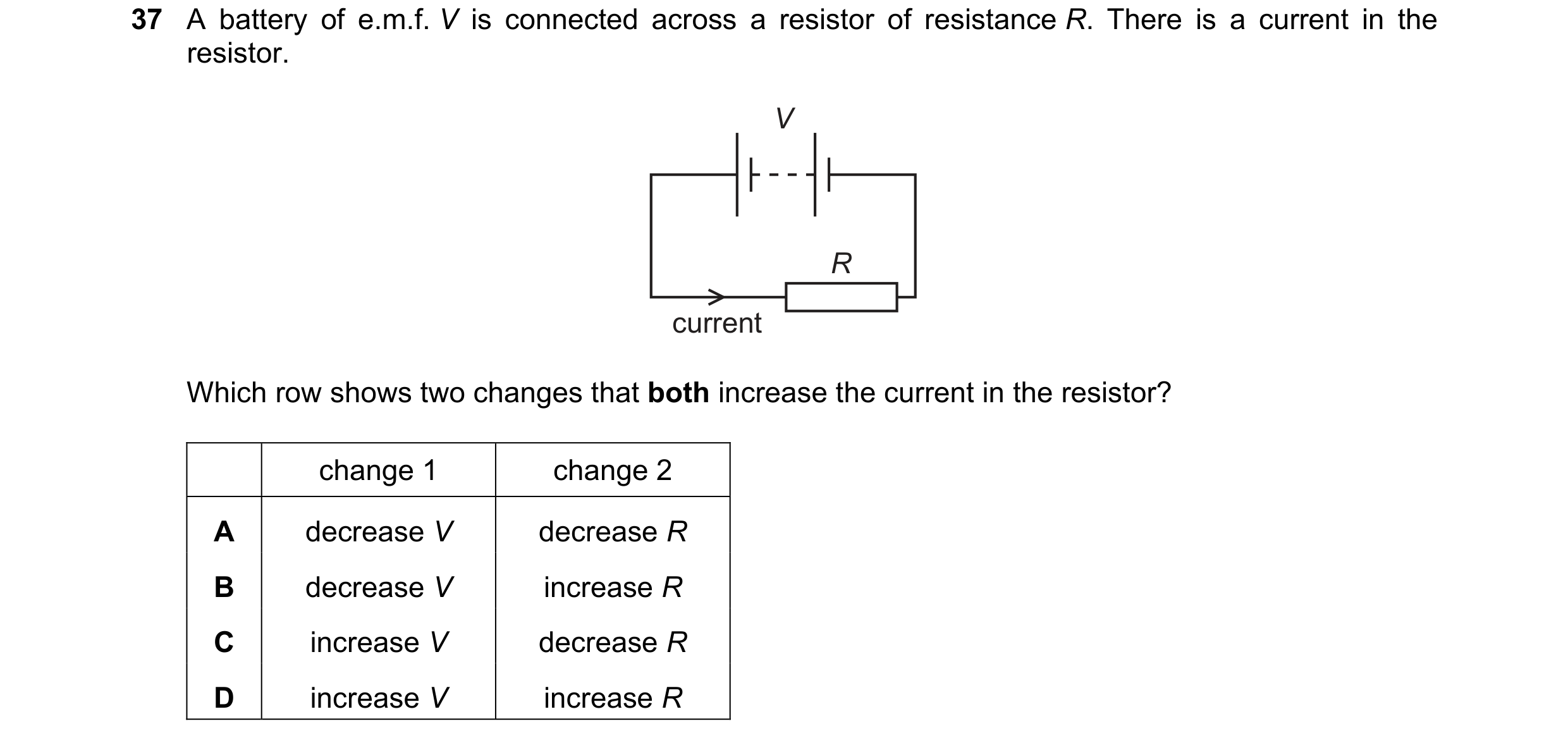


 17 / 20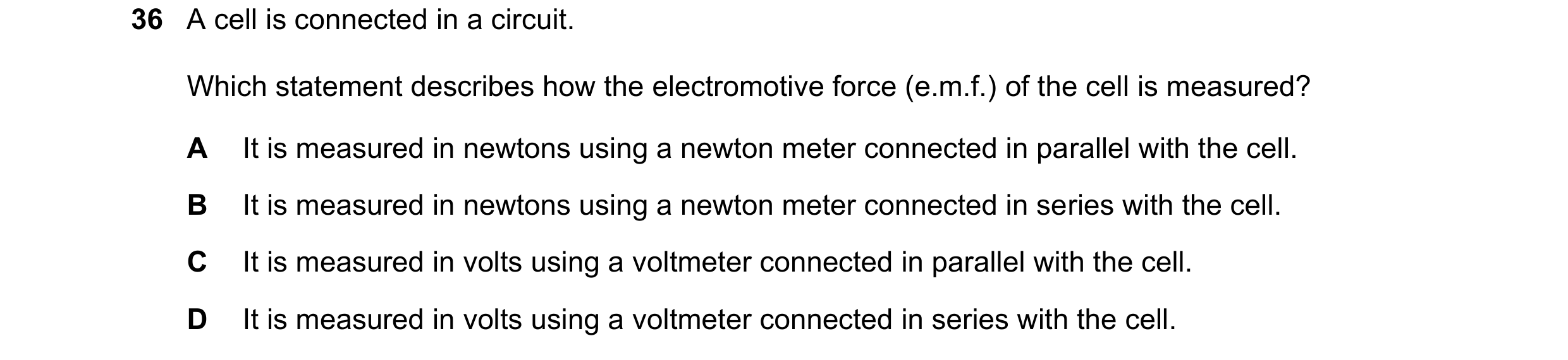



 18 / 20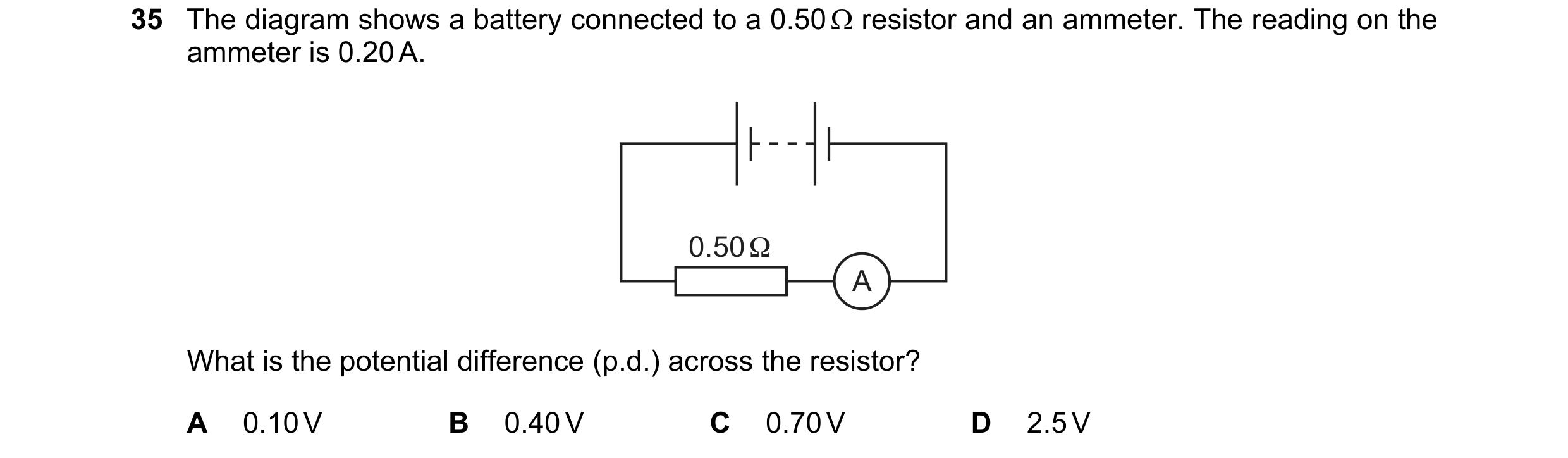



 19 / 20
 20 / 20