Questions as text
Q1 · A speed-time graph for a car over a period of 50 seconds 0654/31 May/June 2017
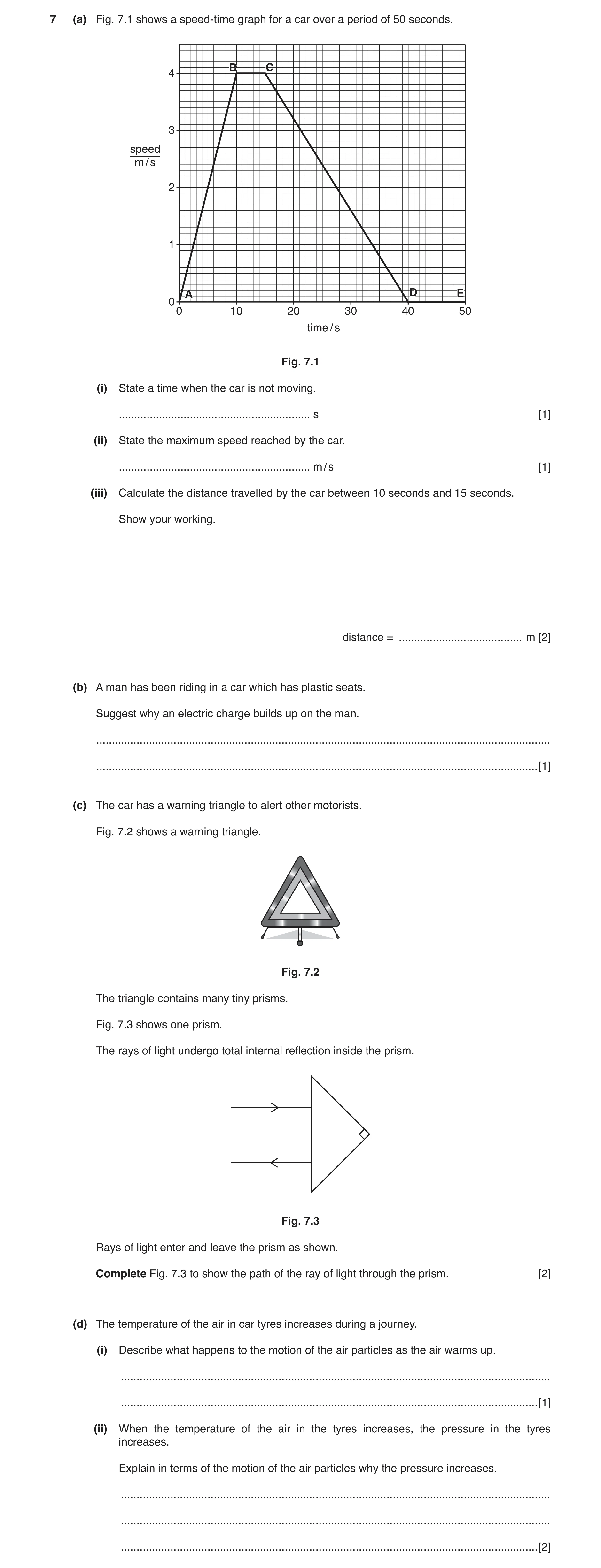
7 (a) Fig. 7.1 shows a speed-time graph for a car over a period of 50 seconds. BB CC 4 3 speed m / s 2 1 A DD EE 0 0 10 20 30 40 50 time / s Fig. 7.1 (i) State a time when the car is not moving. … s [1] (ii) State the maximum speed reached by the car. … m / s [1] (iii) Calculate the distance travelled by the car between 10 seconds and 15 seconds. Show your working. distance = … m [2] (b) A man has been riding in a car which has plastic seats. Suggest why an electric charge builds up on the man. … … [1] (c) The car has a warning triangle to alert other motorists. Fig. 7.2 shows a warning triangle. Fig. 7.2 The triangle contains many tiny prisms. Fig. 7.3 shows one prism. The rays of light undergo total internal reflection inside the prism. Fig. 7.3 Rays of light enter and leave the prism as shown. Complete Fig. 7.3 to show the path of the ray of light through the prism. [2] (d) The temperature of the air in car tyres increases during a journey. (i) Describe what happens to the motion of the air particles as the air warms up. … … [1] (ii) When the temperature of the air in the tyres increases, the pressure in the tyres increases. Explain in terms of the motion of the air particles why the pressure increases. … … … [2]
10 marks
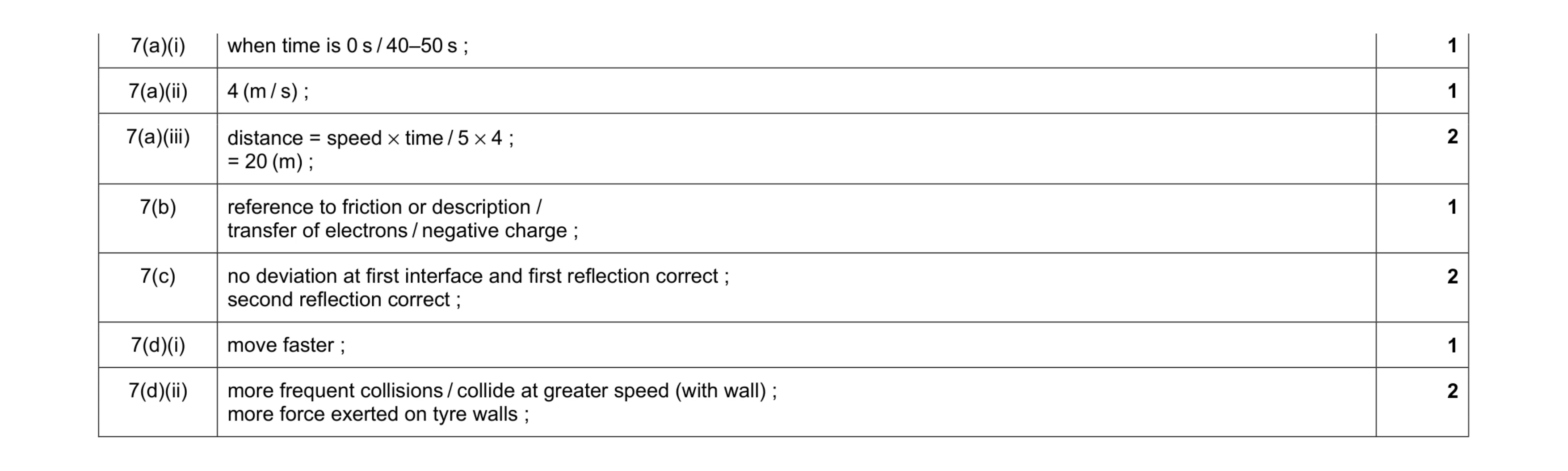
Mark scheme: 7(a)(i) when time is 0 s / 40–50 s ; 1 7(a)(ii) 4 (m / s) ; 1 7(a)(iii) distance = speed × time / 5 × 4 ; = 20 (m) ; 2 7(b) reference to friction or description / transfer of electrons / negative charge ; 1 7(c) no deviation at first interface and first reflection correct ; second reflection correct ; 2 7(d)(i) move faster ; 1 7(d)(ii) more frequent collisions / collide at greater speed (with wall) ; more force exerted on tyre walls ; 2
This question in 0654/31 May/June 2017
Q2 · A man drives a car 0654/32 Oct/Nov 2017
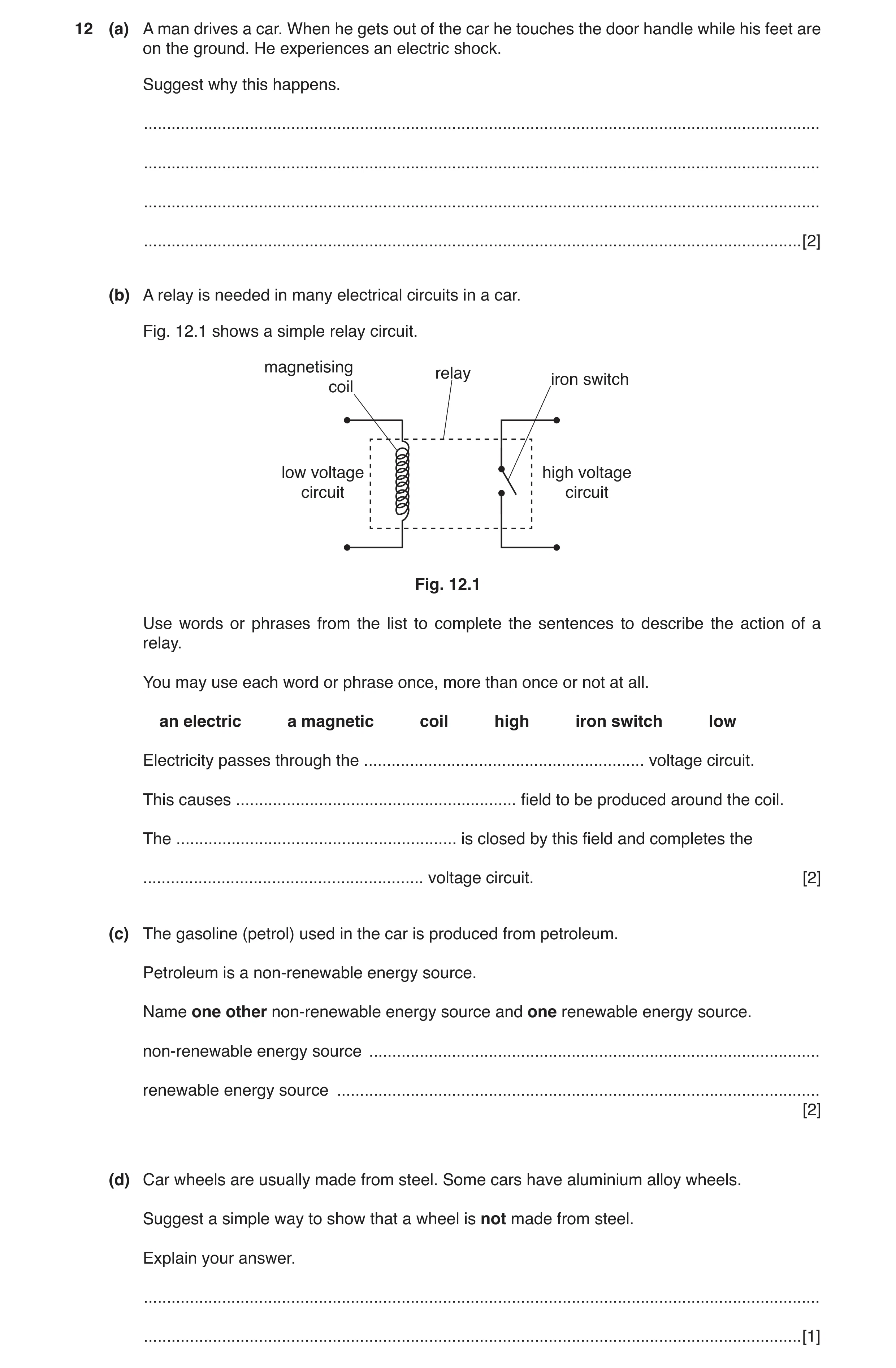
12 (a) A man drives a car. When he gets out of the car he touches the door handle while his feet are on the ground. He experiences an electric shock. Suggest why this happens. … … … … [2] (b) A relay is needed in many electrical circuits in a car. Fig. 12.1 shows a simple relay circuit. magnetising relay iron switch coil low voltage high voltage circuit circuit Fig. 12.1 Use words or phrases from the list to complete the sentences to describe the action of a relay. You may use each word or phrase once, more than once or not at all. an electric a magnetic coil high iron switch low Electricity passes through the … voltage circuit. This causes … field to be produced around the coil. The … is closed by this field and completes the … voltage circuit. [2] (c) The gasoline (petrol) used in the car is produced from petroleum. Petroleum is a non-renewable energy source. Name one other non-renewable energy source and one renewable energy source. non-renewable energy source … renewable energy source … [2] (d) Car wheels are usually made from steel. Some cars have aluminium alloy wheels. Suggest a simple way to show that a wheel is not made from steel. Explain your answer. … … [1]
7 marks
Mark scheme: 12(a) Friction / description of friction ; transfer of electrons ; 2 12(b) low a magnetic iron switch high 2 correct ; 4 correct ; 2 12(c) coal / gas ; solar / wind / waves / tides / geothermal / hydroelectricity ; 2 12(d) use a magnet (no mark) steel is magnetic / will attract magnet or aluminium is not magnetic / will not attract magnet ; 1
This question in 0654/32 Oct/Nov 2017
Q3 · Two headlamps on a truck are connected in parallel with a battery 0654/32 Oct/Nov 2018
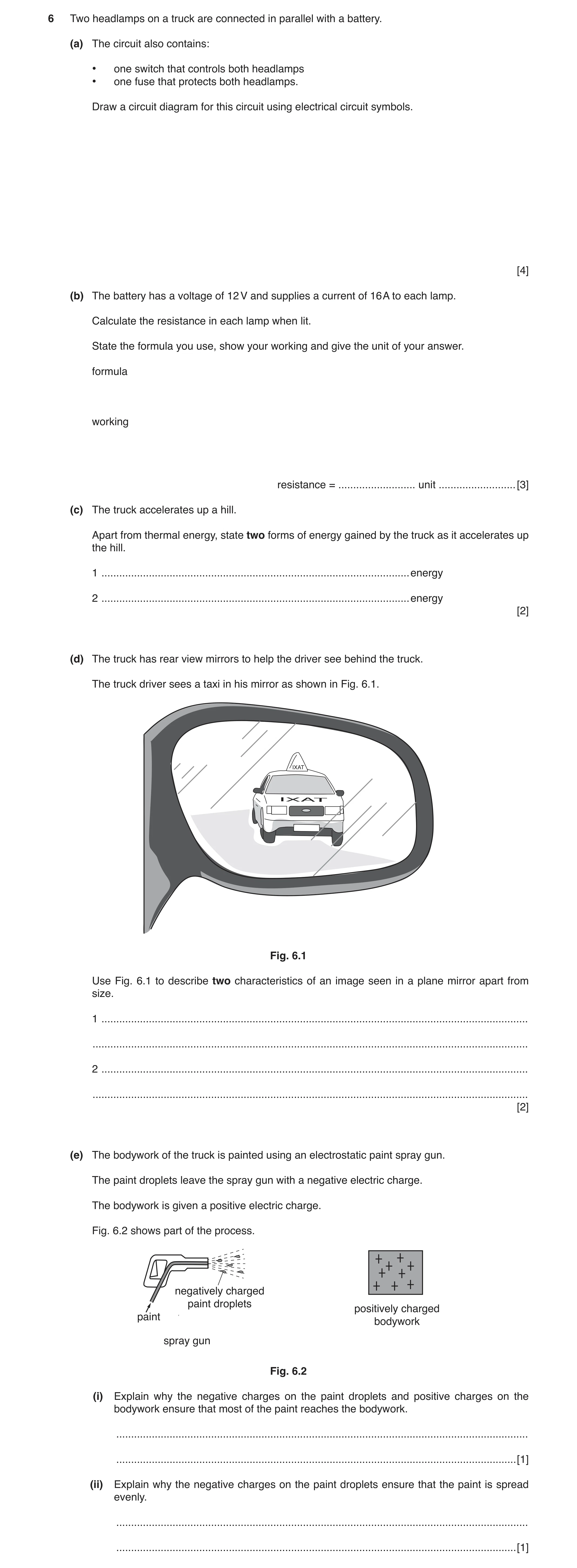
6 Two headlamps on a truck are connected in parallel with a battery. (a) The circuit also contains: • one switch that controls both headlamps • one fuse that protects both headlamps. Draw a circuit diagram for this circuit using electrical circuit symbols. [4] (b) The battery has a voltage of 12 V and supplies a current of 16 A to each lamp. Calculate the resistance in each lamp when lit. State the formula you use, show your working and give the unit of your answer. formula working resistance = … unit … [3] (c) The truck accelerates up a hill. Apart from thermal energy, state two forms of energy gained by the truck as it accelerates up the hill. 1 … energy 2 … energy [2] (d) The truck has rear view mirrors to help the driver see behind the truck. The truck driver sees a taxi in his mirror as shown in Fig. 6.1. TAXI TAXI Fig. 6.1 Use Fig. 6.1 to describe two characteristics of an image seen in a plane mirror apart from size. 1 … … 2 … … [2] (e) The bodywork of the truck is painted using an electrostatic paint spray gun. The paint droplets leave the spray gun with a negative electric charge. The bodywork is given a positive electric charge. Fig. 6.2 shows part of the process. negatively charged paint droplets positively charged paint bodywork spray gun Fig. 6.2 (i) Explain why the negative charges on the paint droplets and positive charges on the bodywork ensure that most of the paint reaches the bodywork. … … [1] (ii) Explain why the negative charges on the paint droplets ensure that the paint is spread evenly. … … [1]
13 marks
Mark scheme: 6(a) all symbols correct; lamps in parallel; switch in correct place; fuse in correct place; 4 6(b) R = V / I or 12 / 16; = 0.75; Ω; 3 6(c) kinetic; gravitational (potential); 2 6(d) upright; laterally inverted; 2 6(e)(i) opposite charges attract; 1 6(e)(ii) like charges repel; 1
This question in 0654/32 Oct/Nov 2018
Q4 · An electric kettle, an electric fan and a torch (flashlight) all transform electrical… 0654/33 Oct/Nov 2018
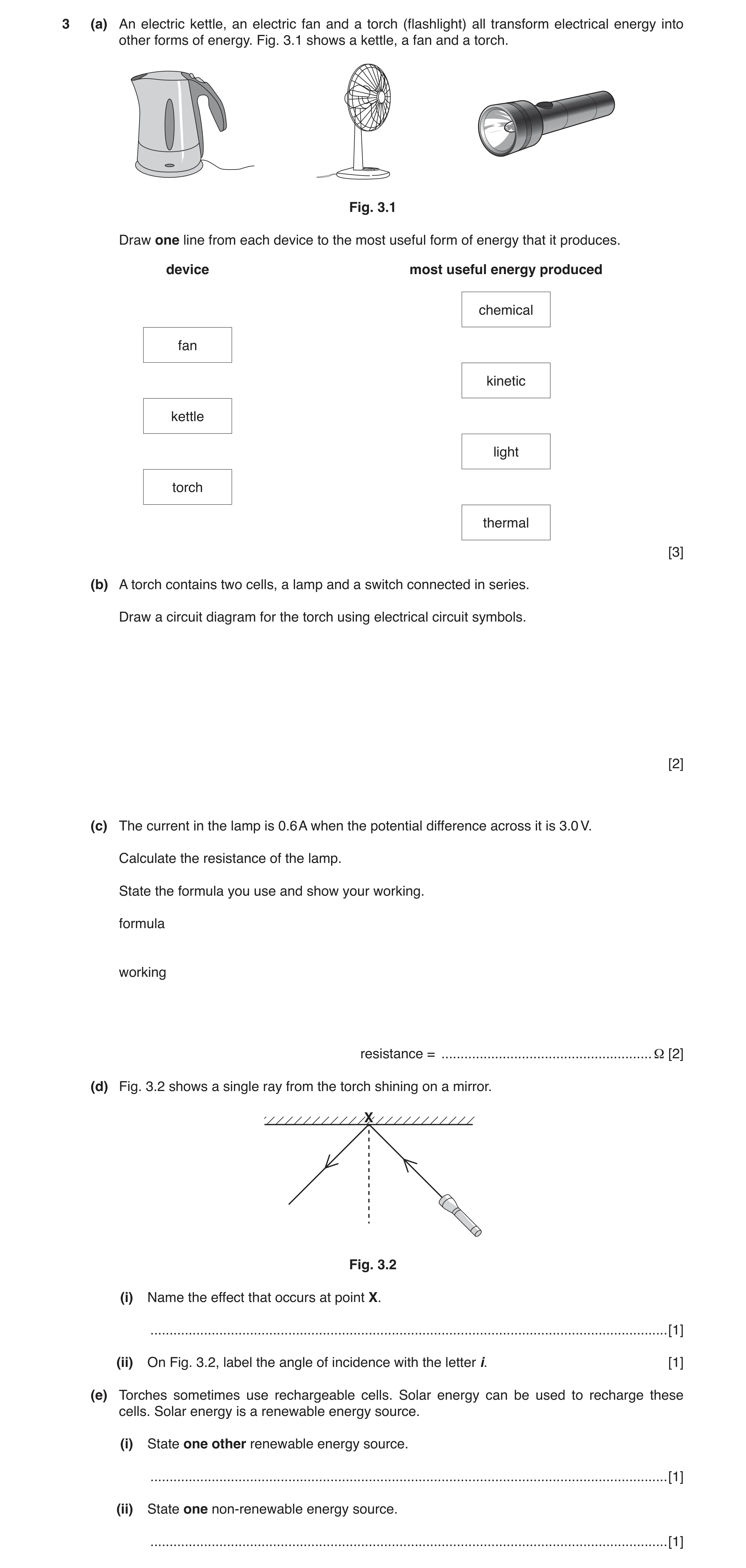
3 (a) An electric kettle, an electric fan and a torch (flashlight) all transform electrical energy into other forms of energy. Fig. 3.1 shows a kettle, a fan and a torch. Fig. 3.1 Draw one line from each device to the most useful form of energy that it produces. device most useful energy produced chemical fan kinetic kettle light torch thermal [3] (b) A torch contains two cells, a lamp and a switch connected in series. Draw a circuit diagram for the torch using electrical circuit symbols. [2] (c) The current in the lamp is 0.6 A when the potential difference across it is 3.0 V. Calculate the resistance of the lamp. State the formula you use and show your working. formula working resistance = … Ω [2] (d) Fig. 3.2 shows a single ray from the torch shining on a mirror. X Fig. 3.2 (i) Name the effect that occurs at point X. … [1] (ii) On Fig. 3.2, label the angle of incidence with the letter i. [1] (e) Torches sometimes use rechargeable cells. Solar energy can be used to recharge these cells. Solar energy is a renewable energy source. (i) State one other renewable energy source. … [1] (ii) State one non-renewable energy source. … [1]
11 marks
Mark scheme: 3(a) fan to kinetic ; kettle to thermal ; torch to light ; 3 3(b) symbols correct ; two cells, lamp and switch all in series ; 2 3(c) r = V / I or 3.0 / 0.6 ; 5 (Ω) ; 2 3(d)(i) reflection ; 1 3(d)(ii) angle of incidence (i) correctly labelled ; 1 3(e)(i) wind / waves / HEP / geothermal / tides ; 1 3(e)(ii) oil / coal / natural gas / peat ; 1
This question in 0654/33 Oct/Nov 2018
Question 5 0654/33 May/June 2020
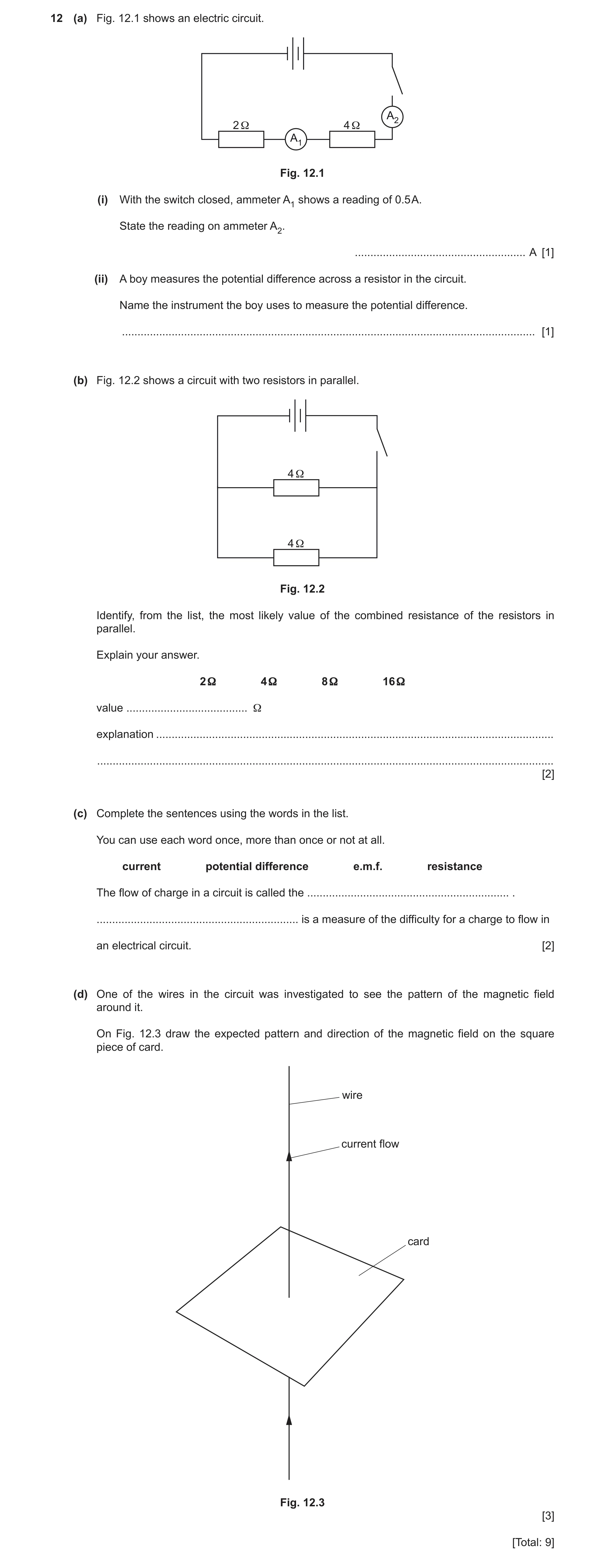
12 (a) Fig. 12.1 shows an electric circuit. A2 2 Ω 4 Ω A1 Fig. 12.1 (i) With the switch closed, ammeter A1 shows a reading of 0.5 A. State the reading on ammeter A2. … A [1] (ii) A boy measures the potential difference across a resistor in the circuit. Name the instrument the boy uses to measure the potential difference. … [1] (b) Fig. 12.2 shows a circuit with two resistors in parallel. 4 Ω 4 Ω Fig. 12.2 Identify, from the list, the most likely value of the combined resistance of the resistors in parallel. Explain your answer. 2 Ω 4 Ω 8 Ω 16 Ω value … Ω explanation … … [2] (c) Complete the sentences using the words in the list. You can use each word once, more than once or not at all. current potential difference e.m.f. resistance The flow of charge in a circuit is called the … . … is a measure of the difficulty for a charge to flow in an electrical circuit. [2] (d) One of the wires in the circuit was investigated to see the pattern of the magnetic field around it. On Fig. 12.3 draw the expected pattern and direction of the magnetic field on the square piece of card. wire current flow card Fig. 12.3 [3] [Total: 9]
9 marks
Mark scheme: 12(a)(i) 0.5 (A); 1 12(a)(ii) voltmeter; 1 12(b) 2 (Ω); the combined resistance of two resistors in parallel is less than that of either resistor by itself; 2 12(c) current; resistance; 2 12(d) concentric circles around the wire; correct ‘spacing’ of circles; correct direction ; 3
This question in 0654/33 May/June 2020
Q6 · A boy looking into a plane mirror 0654/31 Oct/Nov 2020
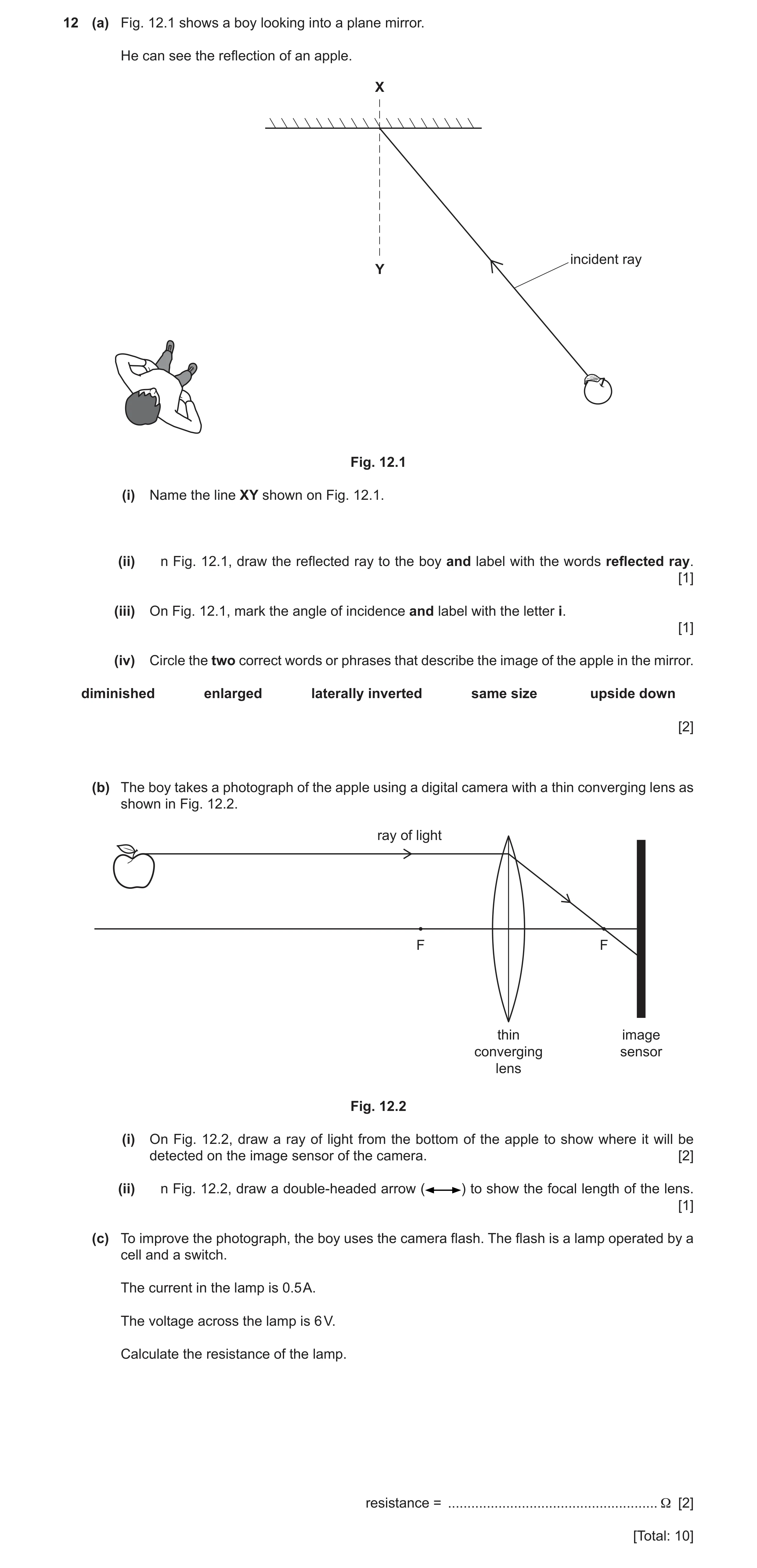
12 (a) Fig. 12.1 shows a boy looking into a plane mirror. He can see the reflection of an apple. X incident ray Y Fig. 12.1 (i) Name the line XY shown on Fig. 12.1. (ii) n Fig. 12.1, draw the reflected ray to the boy and label with the words reflected ray. [1] (iii) On Fig. 12.1, mark the angle of incidence and label with the letter i. [1] (iv) Circle the two correct words or phrases that describe the image of the apple in the mirror. diminished enlarged laterally inverted same size upside down [2] (b) The boy takes a photograph of the apple using a digital camera with a thin converging lens as shown in Fig. 12.2. ray of light F F thin image converging sensor lens Fig. 12.2 (i) On Fig. 12.2, draw a ray of light from the bottom of the apple to show where it will be detected on the image sensor of the camera. [2] (ii) n Fig. 12.2, draw a double‑headed arrow ( ) to show the focal length of the lens. [1] (c) To improve the photograph, the boy uses the camera flash. The flash is a lamp operated by a cell and a switch. The current in the lamp is 0.5 A. The voltage across the lamp is 6 V. Calculate the resistance of the lamp. resistance = ������������������������������������������������������ Ω [2] [Total: 10]
10 marks
Mark scheme: 12(a)(i) normal ; 1 12(a)(ii) ray drawn to boy from intersection of normal and mirror ; 1 12(a)(iii) angle of incidence shown and correctly labelled ; 1 12(a)(iv) laterally inverted ; same size ; 2 12(b)(i) second ray drawn from bottom of apple to lens ; ray continues to image sensor ; 2 12(b)(ii) double headed arrow from centre of lens to either point F ; 1 12(c) R = V / I or 6 / 0.5 ; 12 ; 2
This question in 0654/31 Oct/Nov 2020
Q7 · A torch (flash light) contains a cell, a switch and a lamp connected in series 0654/32 Oct/Nov 2020
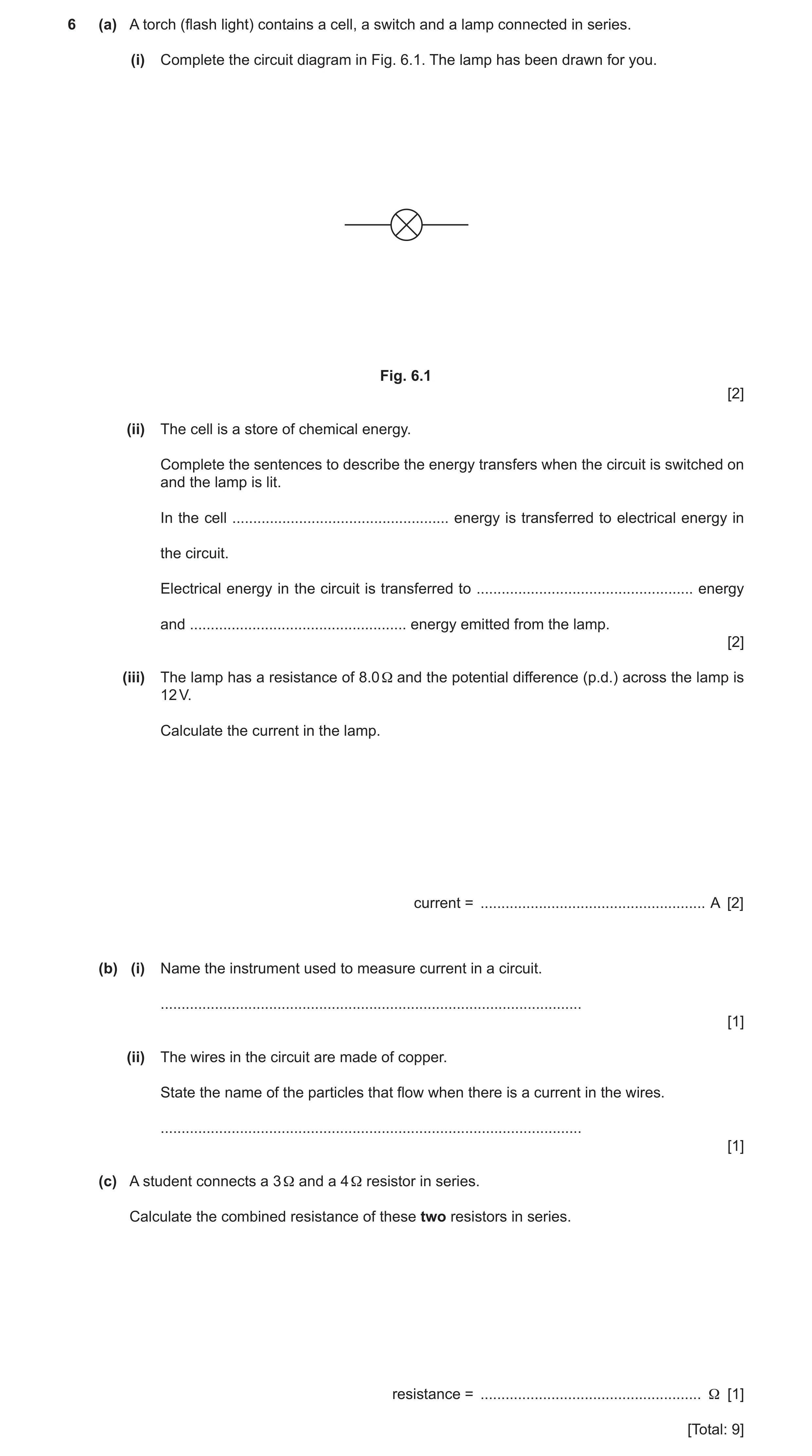
6 (a) A torch (flash light) contains a cell, a switch and a lamp connected in series. (i) Complete the circuit diagram in Fig. 6.1. The lamp has been drawn for you. Fig. 6.1 [2] (ii) The cell is a store of chemical energy. Complete the sentences to describe the energy transfers when the circuit is switched on and the lamp is lit. In the cell … energy is transferred to electrical energy in the circuit. Electrical energy in the circuit is transferred to … energy and … energy emitted from the lamp. [2] (iii) The lamp has a resistance of 8.0 Ω and the potential difference (p.d.) across the lamp is 12 V. Calculate the current in the lamp. current = … A [2] (b) (i) Name the instrument used to measure current in a circuit. … [1] (ii) The wires in the circuit are made of copper. State the name of the particles that flow when there is a current in the wires. … [1] (c) A student connects a 3 Ω and a 4 Ω resistor in series. Calculate the combined resistance of these two resistors in series. resistance = … Ω [1] [Total: 9]
9 marks
Mark scheme: 6(a)(i) correct symbol for cell and switch ; all connected in series; 2 6(a)(ii) chemical; light and thermal; 1 1 6(a)(iii) I = V/R or 12/8; (I =)1.5(A) 2 6(b)(i) ammeter; 1 6(b)(ii) electrons; 1 6(c) 3 + 4 = 7; 1
This question in 0654/32 Oct/Nov 2020
Q8 · A boy looking into a plane mirror 0654/33 Oct/Nov 2020
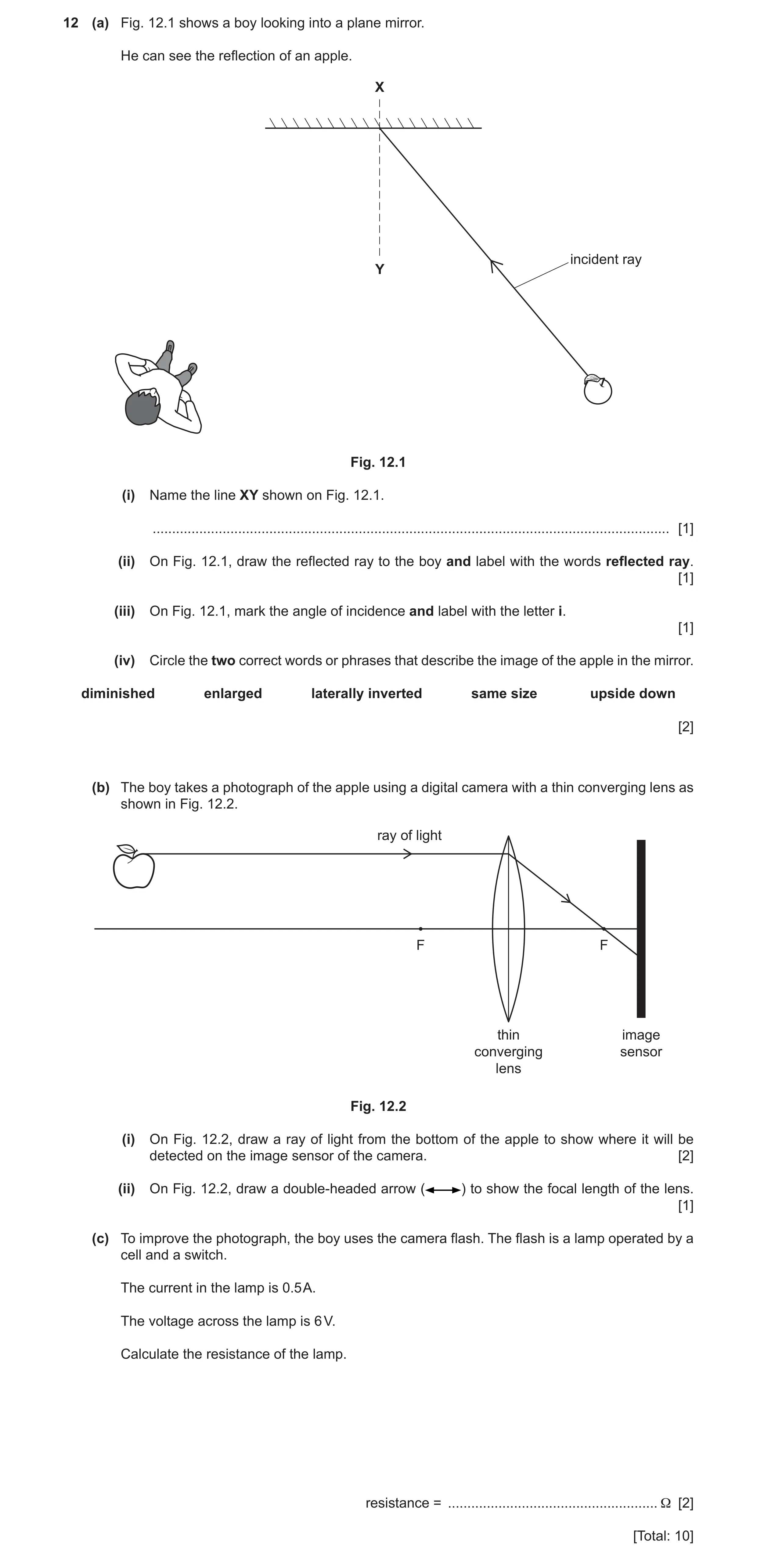
12 (a) Fig. 12.1 shows a boy looking into a plane mirror. He can see the reflection of an apple. X incident ray Y Fig. 12.1 (i) Name the line XY shown on Fig. 12.1. … [1] (ii) On Fig. 12.1, draw the reflected ray to the boy and label with the words reflected ray. [1] (iii) On Fig. 12.1, mark the angle of incidence and label with the letter i. [1] (iv) Circle the two correct words or phrases that describe the image of the apple in the mirror. diminished enlarged laterally inverted same size upside down [2] (b) The boy takes a photograph of the apple using a digital camera with a thin converging lens as shown in Fig. 12.2. ray of light F F thin image converging sensor lens Fig. 12.2 (i) On Fig. 12.2, draw a ray of light from the bottom of the apple to show where it will be detected on the image sensor of the camera. [2] (ii) On Fig. 12.2, draw a double‑headed arrow ( ) to show the focal length of the lens. [1] (c) To improve the photograph, the boy uses the camera flash. The flash is a lamp operated by a cell and a switch. The current in the lamp is 0.5 A. The voltage across the lamp is 6 V. Calculate the resistance of the lamp. resistance = … Ω [2] [Total: 10]
10 marks
Mark scheme: 12(a)(i) normal ; 1 12(a)(ii) ray drawn to boy from intersection of normal and mirror ; 1 12(a)(iii) angle of incidence shown and correctly labelled ; 1 12(a)(iv) laterally inverted ; same size ; 2 12(b)(i) second ray drawn from bottom of apple to lens ; ray continues to image sensor ; 2 12(b)(ii) double headed arrow from centre of lens to either point F ; 1 12(c) R = V / I or 6 / 0.5 ; 12 ; 2
This question in 0654/33 Oct/Nov 2020
Q9 · A bicycle has a front lamp, X, and a rear lamp, Y, connected in parallel across a battery 0654/32 Feb/March 2021
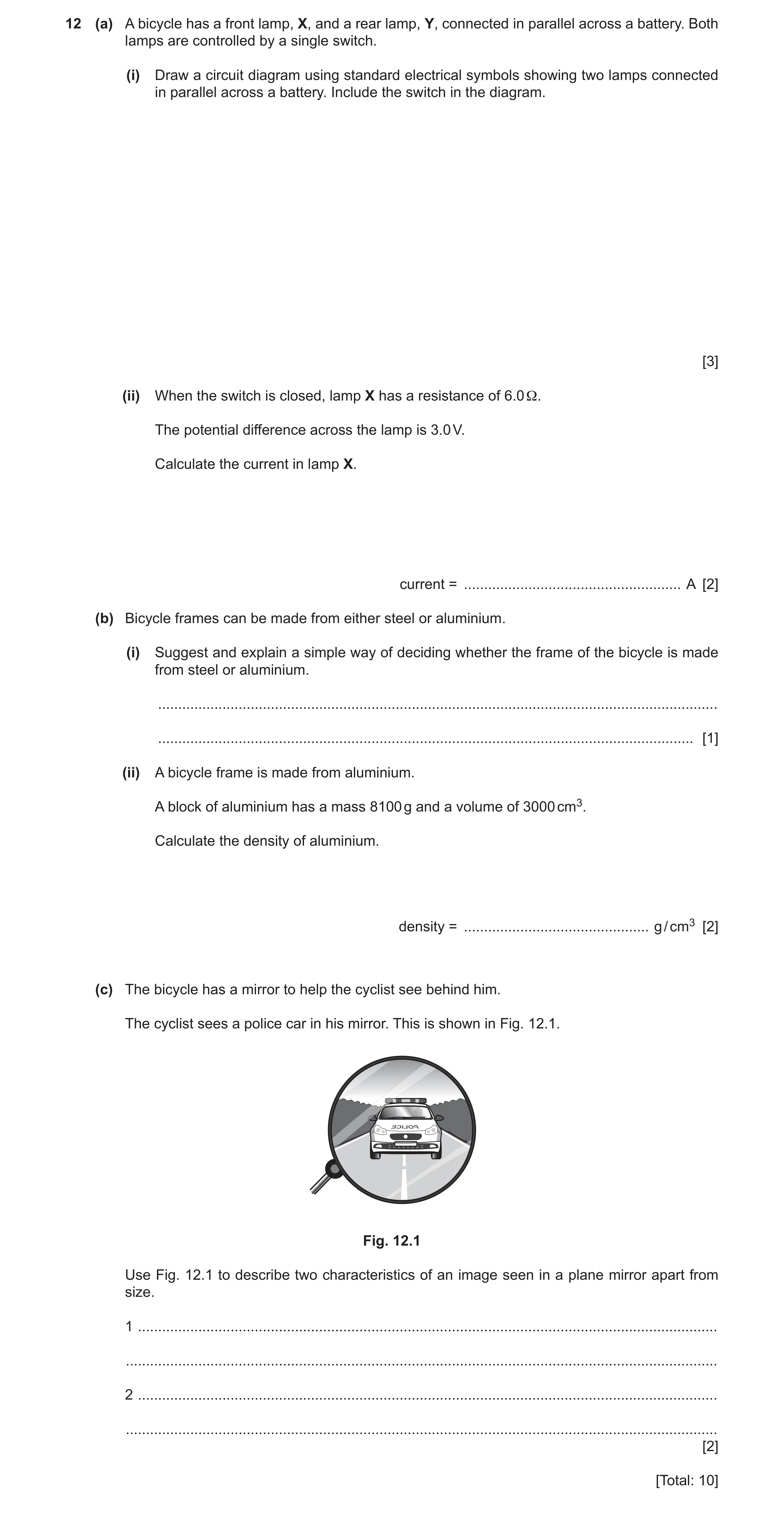
12 (a) A bicycle has a front lamp, X, and a rear lamp, Y, connected in parallel across a battery. Both lamps are controlled by a single switch. (i) Draw a circuit diagram using standard electrical symbols showing two lamps connected in parallel across a battery. Include the switch in the diagram. [3] (ii) When the switch is closed, lamp X has a resistance of 6.0 Ω. The potential difference across the lamp is 3.0 V. Calculate the current in lamp X. current = … A [2] (b) Bicycle frames can be made from either steel or aluminium. (i) Suggest and explain a simple way of deciding whether the frame of the bicycle is made from steel or aluminium. … … [1] (ii) A bicycle frame is made from aluminium. A block of aluminium has a mass 8100 g and a volume of 3000 cm3. Calculate the density of aluminium. density = … g / cm3 [2] (c) The bicycle has a mirror to help the cyclist see behind him. The cyclist sees a police car in his mirror. This is shown in Fig. 12.1. Fig. 12.1 Use Fig. 12.1 to describe two characteristics of an image seen in a plane mirror apart from size. 1 … … 2 … … [2] [Total: 10]
10 marks
Mark scheme: 12(a)(i) all symbols correct; lamps in parallel; switch in correct place and all else correct; 3 12(a)(ii) I = V / R or 3.0 / 6.0 ; = 0.5 (A) ; 2 12(b)(i) use a magnet – steel is magnetic, aluminium is not magnetic; 1 12(b)(ii) density = mass / volume or 8100 / 3000; = 2.7 (g / cm3); 2 12(c) upright ; laterally inverted; 2
This question in 0654/32 Feb/March 2021
Q10 · A copper wire connected to a battery and placed between the poles of a strong magnet 0654/31 Oct/Nov 2021
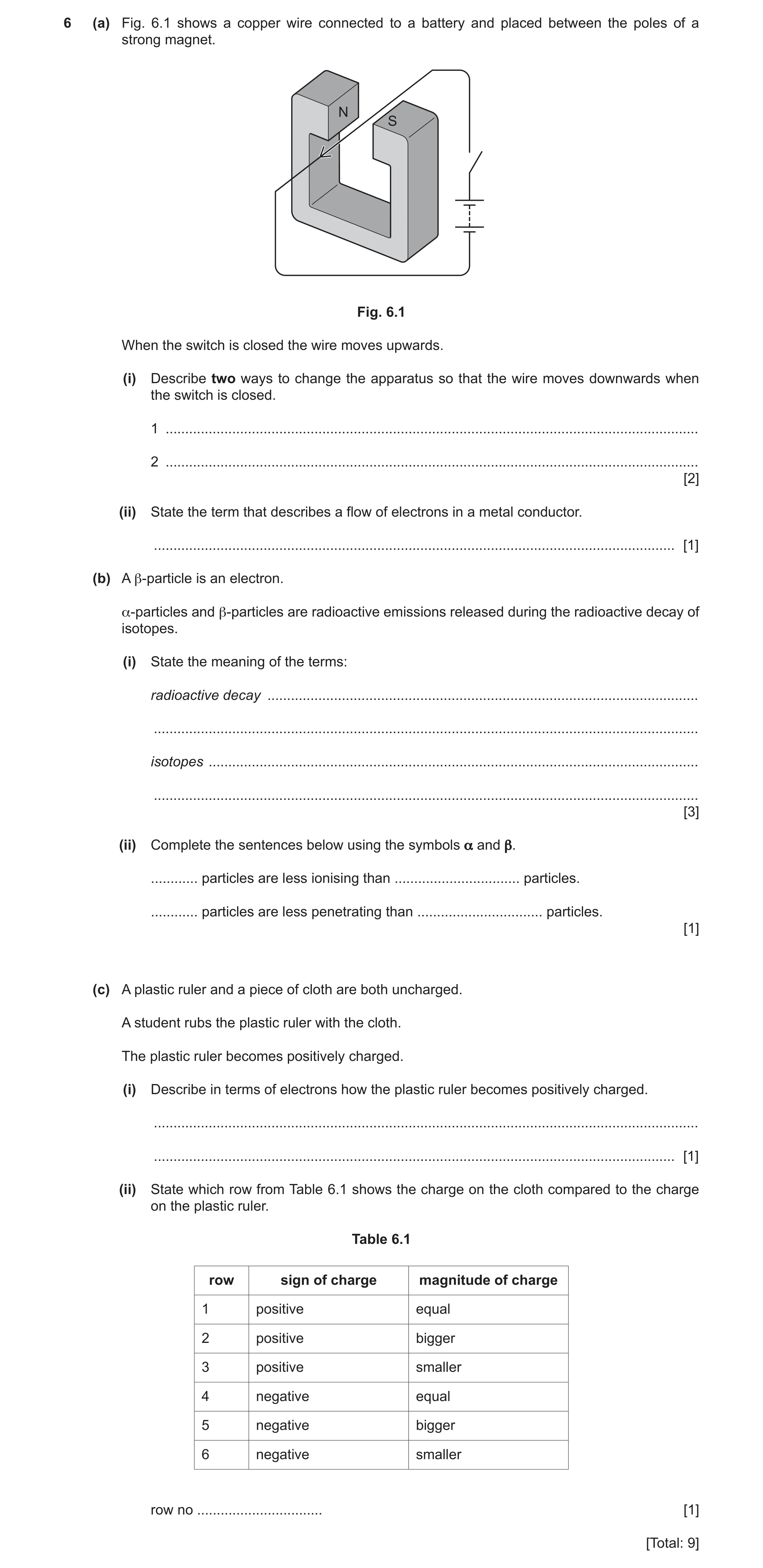
6 (a) Fig. 6.1 shows a copper wire connected to a battery and placed between the poles of a strong magnet. N S Fig. 6.1 When the switch is closed the wire moves upwards. (i) Describe two ways to change the apparatus so that the wire moves downwards when the switch is closed. 1 … 2 … [2] (ii) State the term that describes a flow of electrons in a metal conductor. … [1] (b) A β-particle is an electron. α-particles and β-particles are radioactive emissions released during the radioactive decay of isotopes. (i) State the meaning of the terms: radioactive decay … … isotopes … … [3] (ii) Complete the sentences below using the symbols α and β. … particles are less ionising than … particles. … particles are less penetrating than … particles. [1] (c) A plastic ruler and a piece of cloth are both uncharged. A student rubs the plastic ruler with the cloth. The plastic ruler becomes positively charged. (i) Describe in terms of electrons how the plastic ruler becomes positively charged. … … [1] (ii) State which row from Table 6.1 shows the charge on the cloth compared to the charge on the plastic ruler. Table 6.1 row sign of charge magnitude of charge 1 positive equal 2 positive bigger 3 positive smaller 4 negative equal 5 negative bigger 6 negative smaller row no … [1] [Total: 9]
9 marks
Mark scheme: 6(a)(i) reverse battery polarity / current ; reverse magnet polarity ; 2 6(a)(ii) current ; 1 6(b)(i) (radioactive decay is the process by which) an unstable (atomic ) nucleus ; loses energy / emits radiation ; (isotopes are) – atoms of the same element that have same proton number and different nucleon number ; 3 6(b)(ii) β particles are less ionising than α particles and α particles are less penetrating than β particles ; 1 6(c)(i) loses electrons ; 1 6(c)(ii) row 4 ; 1
This question in 0654/31 Oct/Nov 2021
Q11 · An electric heater containing two heating elements 0654/32 Oct/Nov 2021
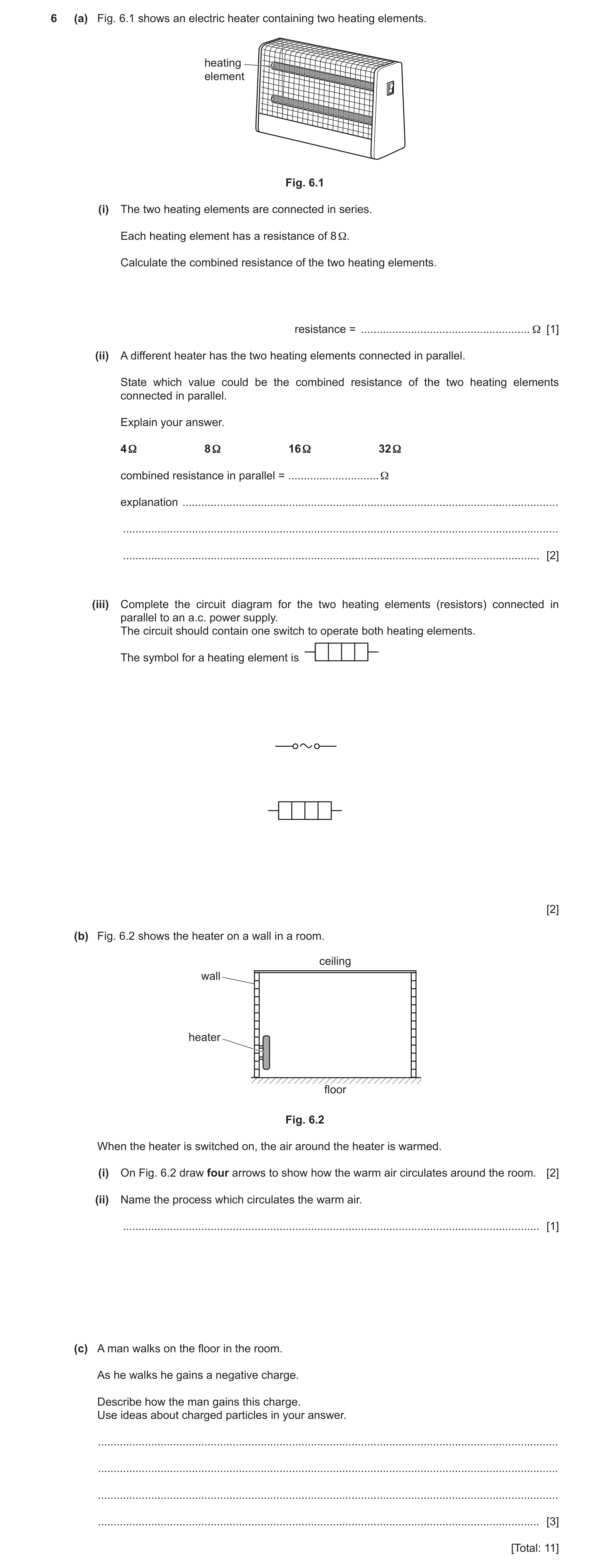
6 (a) Fig. 6.1 shows an electric heater containing two heating elements. heating element Fig. 6.1 (i) The two heating elements are connected in series. Each heating element has a resistance of 8 Ω. Calculate the combined resistance of the two heating elements. resistance = … Ω [1] (ii) A different heater has the two heating elements connected in parallel. State which value could be the combined resistance of the two heating elements connected in parallel. Explain your answer. 4 Ω 8 Ω 16 Ω 32 Ω combined resistance in parallel = … Ω explanation … … … [2] (iii) Complete the circuit diagram for the two heating elements (resistors) connected in parallel to an a.c. power supply. The circuit should contain one switch to operate both heating elements. The symbol for a heating element is [2] (b) Fig. 6.2 shows the heater on a wall in a room. ceiling wall heater floor Fig. 6.2 When the heater is switched on, the air around the heater is warmed. (i) On Fig. 6.2 draw four arrows to show how the warm air circulates around the room. [2] (ii) Name the process which circulates the warm air. … [1] (c) A man walks on the floor in the room. As he walks he gains a negative charge. Describe how the man gains this charge. Use ideas about charged particles in your answer. … … … … [3] [Total: 11]
11 marks
Mark scheme: 6(a)(i) 16 (Ω) ; 1 6(a)(ii) 4 (Ω) ; combined resistance is less than either individual resistance ; 2 6(a)(iii) heaters (resistors) in parallel ; switch controls both heaters with correct symbol and all else correct ; 2 6(b)(i) two arrow: upwards near heater and arrow downwards to the right of heater ; two horizontal arrows: from left to right near ceiling and from right to left near floor ; 2 6(b)(ii) convection ; 1 6(c) friction ; electrons transferred ; from floor to man ; 3
This question in 0654/32 Oct/Nov 2021
Question 12 0654/32 Feb/March 2022
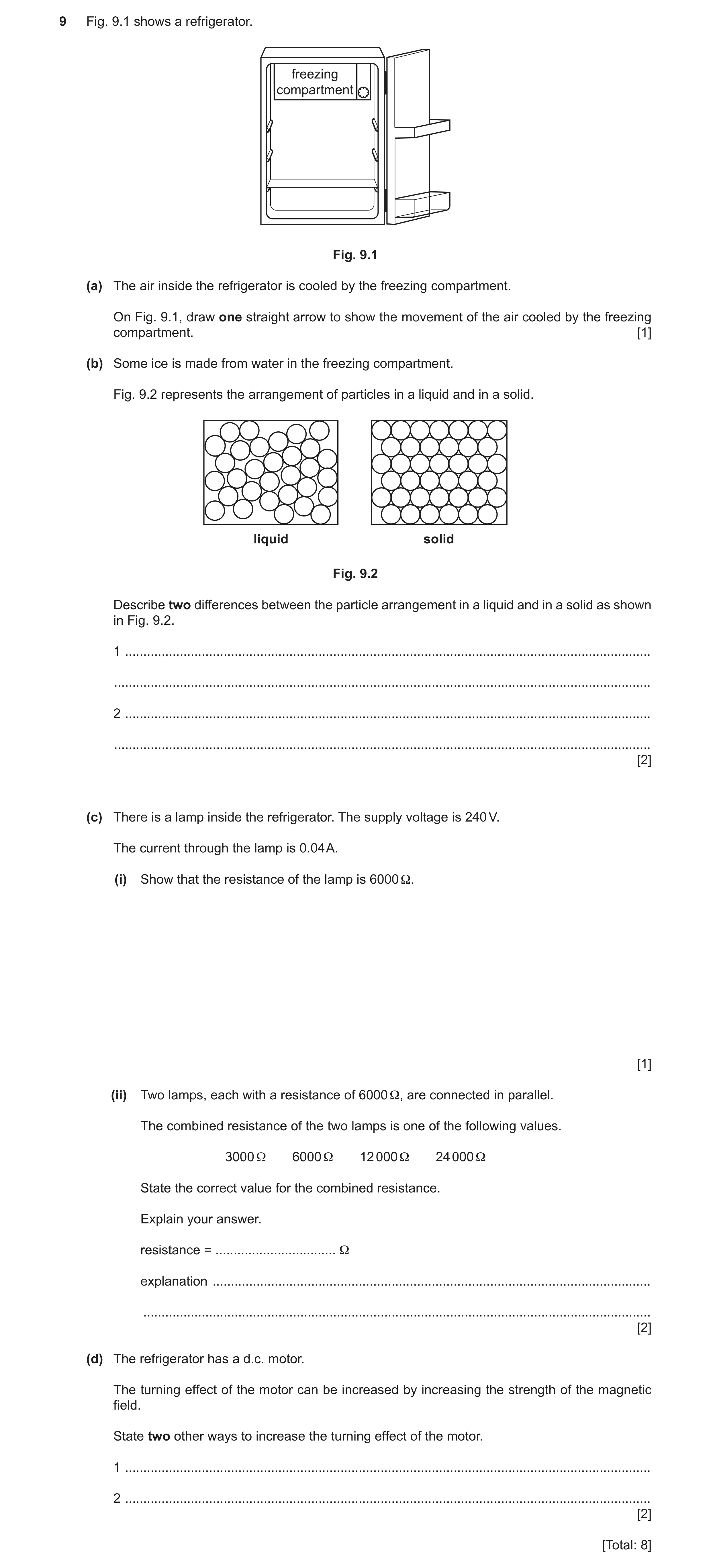
9 Fig. 9.1 shows a refrigerator. freezing compartment Fig. 9.1 (a) The air inside the refrigerator is cooled by the freezing compartment. On Fig. 9.1, draw one straight arrow to show the movement of the air cooled by the freezing compartment. [1] (b) Some ice is made from water in the freezing compartment. Fig. 9.2 represents the arrangement of particles in a liquid and in a solid. liquid solid Fig. 9.2 Describe two differences between the particle arrangement in a liquid and in a solid as shown in Fig. 9.2. 1 … … 2 … … [2] (c) There is a lamp inside the refrigerator. The supply voltage is 240 V. The current through the lamp is 0.04 A. (i) Show that the resistance of the lamp is 6000 Ω. [1] (ii) Two lamps, each with a resistance of 6000 Ω, are connected in parallel. The combined resistance of the two lamps is one of the following values. 3000 Ω 6000 Ω 12 000 Ω 24 000 Ω State the correct value for the combined resistance. Explain your answer. resistance = … Ω explanation … … [2] (d) The refrigerator has a d.c. motor. The turning effect of the motor can be increased by increasing the strength of the magnetic field. State two other ways to increase the turning effect of the motor. 1 … 2 … [2] [Total: 8]
8 marks
Mark scheme: 9(a) vertical arrow downwards; 1 9(b) solid has regular arrangement / liquid has irregular arrangement; particles are further apart in a liquid; 2 9(c)(i) (R = V / I =) 240 / 0.04 ; 1 9(c)(ii) 3000 Ω; combined resistance of two resistors in parallel is less than that of either resistor by itself; 2 9(d) increase current; increase number of turns on coil; 2
This question in 0654/32 Feb/March 2022
Q13 · Table 9.1 contains descriptions of a solid, a liquid and a gas 0654/32 May/June 2022
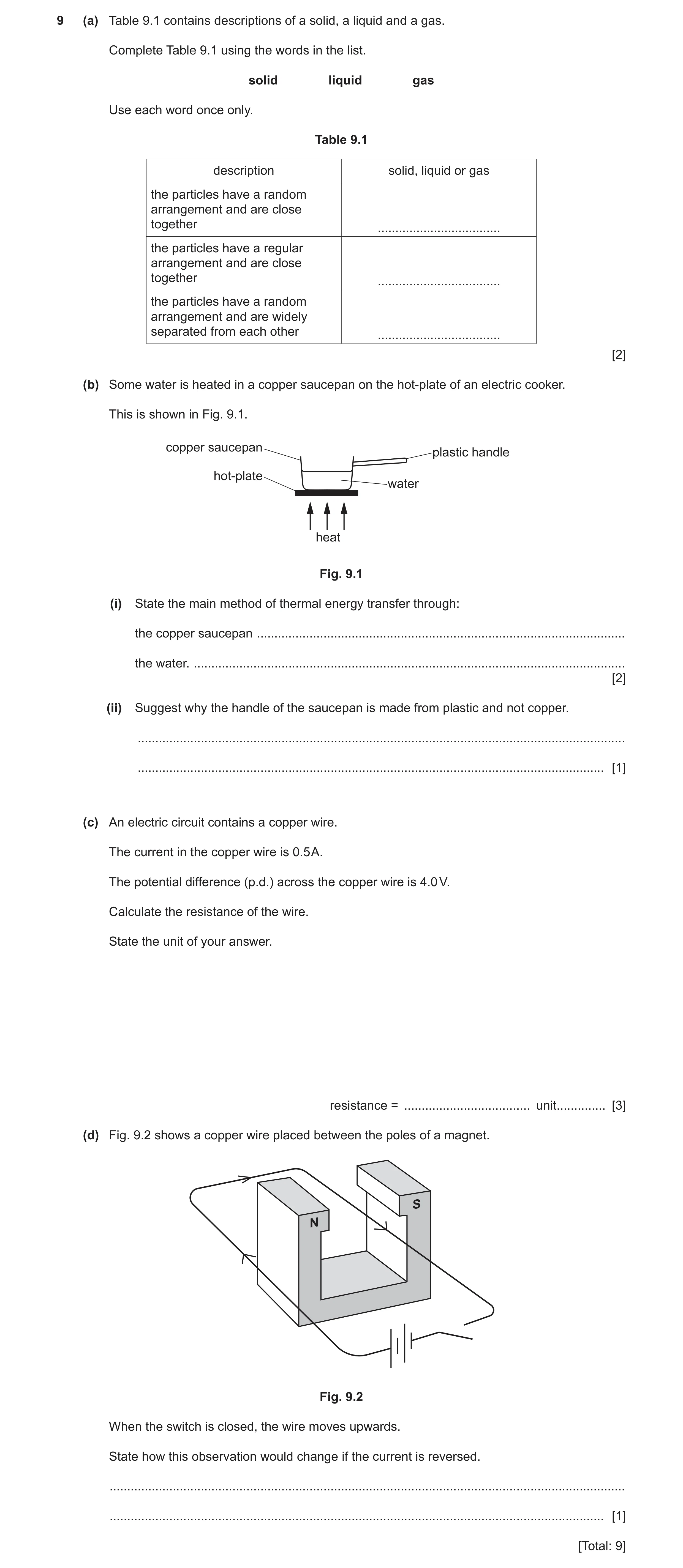
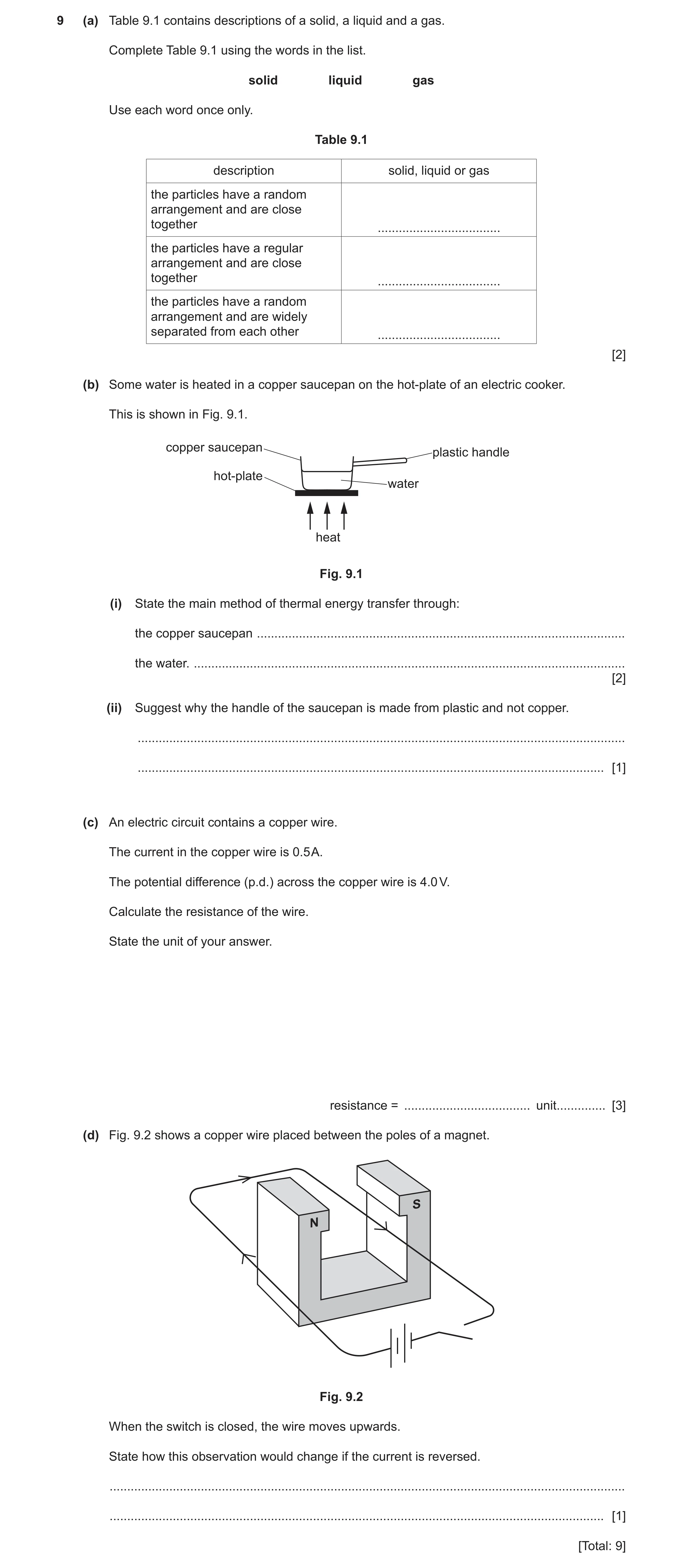
9 (a) Table 9.1 contains descriptions of a solid, a liquid and a gas. Complete Table 9.1 using the words in the list. solid liquid gas Use each word once only. Table 9.1 description solid, liquid or gas the particles have a random arrangement and are close together … the particles have a regular arrangement and are close together … the particles have a random arrangement and are widely separated from each other … [2] (b) Some water is heated in a copper saucepan on the hot-plate of an electric cooker. This is shown in Fig. 9.1. copper saucepan plastic handle hot-plate water heat Fig. 9.1 (i) State the main method of thermal energy transfer through: the copper saucepan … the water. … [2] (ii) Suggest why the handle of the saucepan is made from plastic and not copper. … … [1] (c) An electric circuit contains a copper wire. The current in the copper wire is 0.5 A. The potential difference (p.d.) across the copper wire is 4.0 V. Calculate the resistance of the wire. State the unit of your answer. resistance = … unit … [3] (d) Fig. 9.2 shows a copper wire placed between the poles of a magnet. S N Fig. 9.2 When the switch is closed, the wire moves upwards. State how this observation would change if the current is reversed. … … [1] [Total: 9]
9 marks
Mark scheme: 9(a) the particles have a random arrangement and are close together = liquid the particles have a regular arrangement and are close together = solid the particles are widely separated from each other = gas 2 9(b)(i) conduction; convection; 2 9(b)(ii) plastic is an insulator (so you don’t burn your hand); 1 Question Answer Marks 9(c) R = V / I (in any form) or 4.0 / 0.5; resistance = 8; ; 3 9(d) wire moves down / opposite way; 1
This question in 0654/32 May/June 2022
Q14 · During a journey, a car becomes positively charged with static electricity 0654/32 May/June 2022
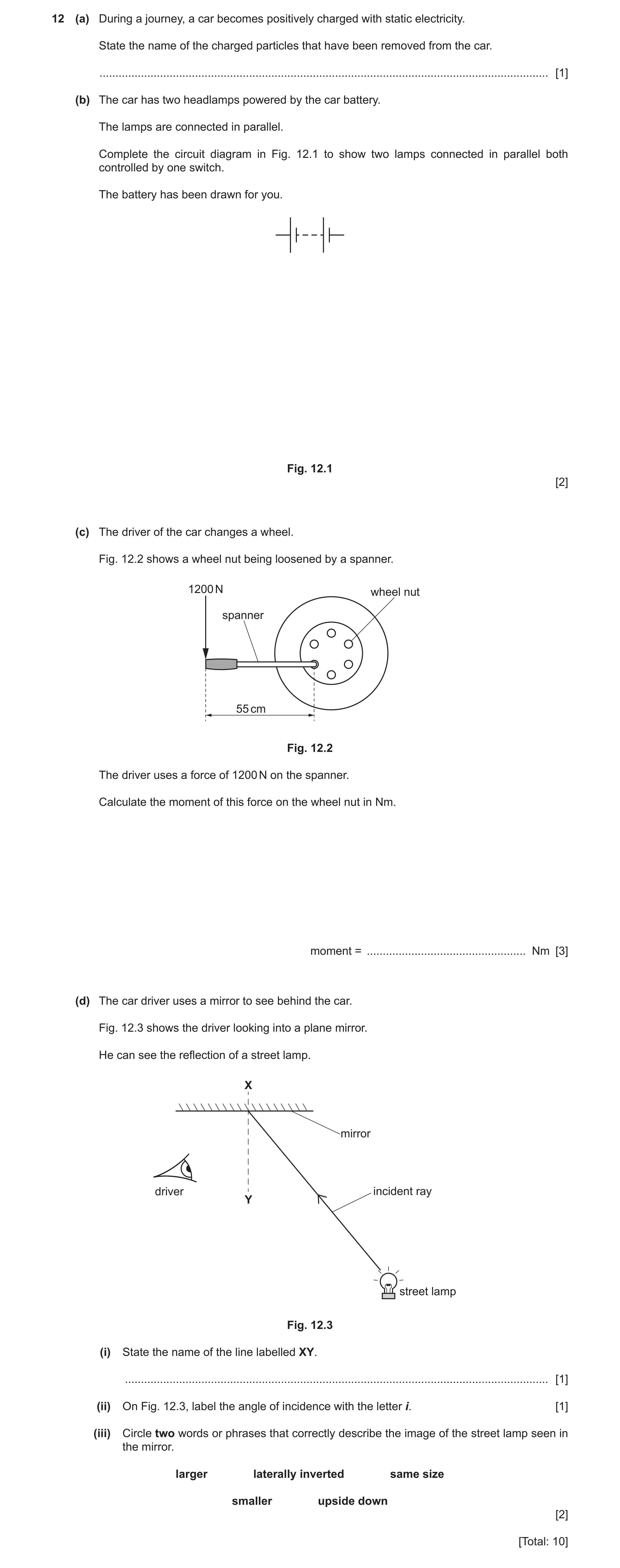
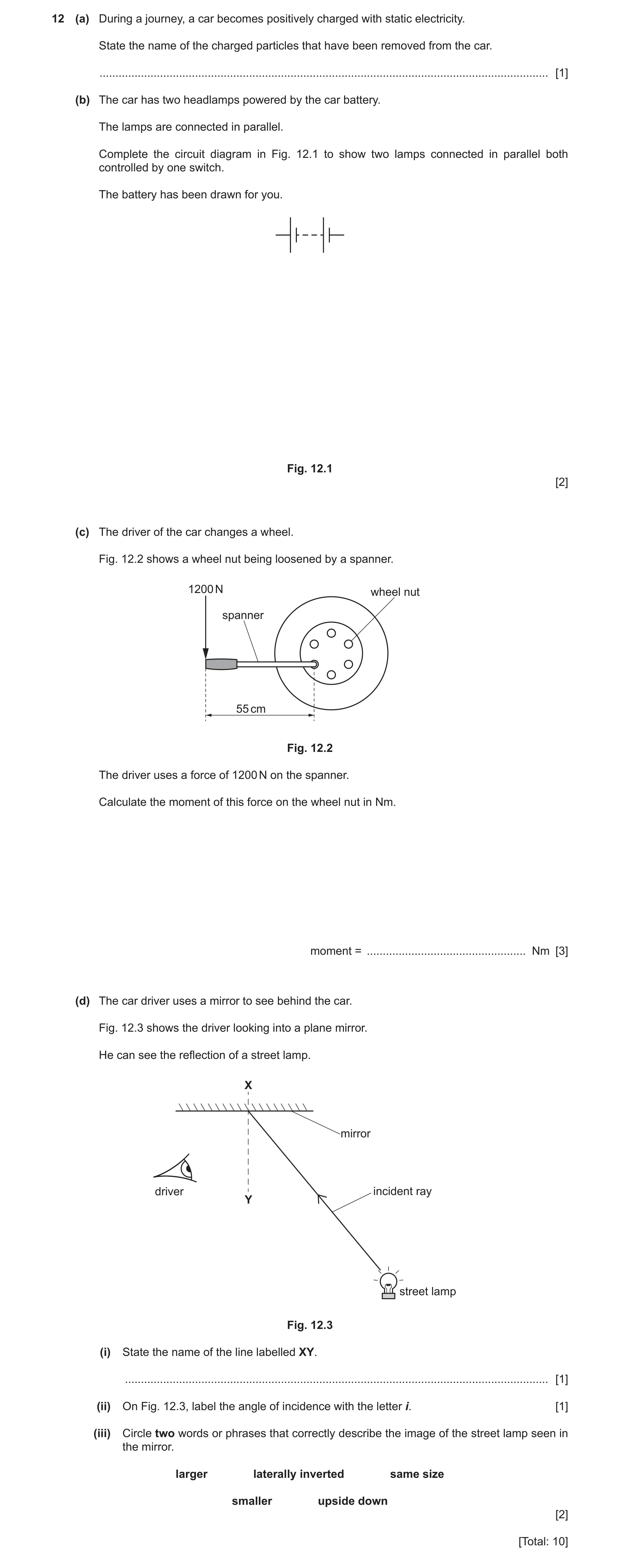
12 (a) During a journey, a car becomes positively charged with static electricity. State the name of the charged particles that have been removed from the car. … [1] (b) The car has two headlamps powered by the car battery. The lamps are connected in parallel. Complete the circuit diagram in Fig. 12.1 to show two lamps connected in parallel both controlled by one switch. The battery has been drawn for you. Fig. 12.1 [2] (c) The driver of the car changes a wheel. Fig. 12.2 shows a wheel nut being loosened by a spanner. 1200 N wheel nut spanner 55 cm Fig. 12.2 The driver uses a force of 1200 N on the spanner. Calculate the moment of this force on the wheel nut in Nm. moment = … Nm [3] (d) The car driver uses a mirror to see behind the car. Fig. 12.3 shows the driver looking into a plane mirror. He can see the reflection of a street lamp. X mirror driver incident ray Y street lamp Fig. 12.3 (i) State the name of the line labelled XY. … [1] (ii) On Fig. 12.3, label the angle of incidence with the letter i. [1] (iii) Circle two words or phrases that correctly describe the image of the street lamp seen in the mirror. larger laterally inverted same size smaller upside down [2] [Total: 10]
10 marks
Mark scheme: 12(a) electrons; 1 12(b) all symbols correct; lamps in parallel and switch in correct place; 2 12(c) 55 cm = 0.55 m; moment = force distance or 1200 0.55 or 1200 55; moment = 660 (Nm) ; 3 12(d)(i) normal; 1 12(d)(ii) angle of incidence identified; 1 12(d)(iii) same size; laterally inverted; 2
This question in 0654/32 May/June 2022
Q15 · Table 9.1 contains descriptions of a solid, a liquid and a gas 0654/33 May/June 2022
9 (a) Table 9.1 contains descriptions of a solid, a liquid and a gas. Complete Table 9.1 using the words in the list. solid liquid gas Use each word once only. Table 9.1 description solid, liquid or gas the particles have a random arrangement and are close together … the particles have a regular arrangement and are close together … the particles have a random arrangement and are widely separated from each other … [2] (b) Some water is heated in a copper saucepan on the hot-plate of an electric cooker. This is shown in Fig. 9.1. copper saucepan plastic handle hot-plate water heat Fig. 9.1 (i) State the main method of thermal energy transfer through: the copper saucepan … the water. … [2] (ii) Suggest why the handle of the saucepan is made from plastic and not copper. … … [1] (c) An electric circuit contains a copper wire. The current in the copper wire is 0.5 A. The potential difference (p.d.) across the copper wire is 4.0 V. Calculate the resistance of the wire. State the unit of your answer. resistance = … unit … [3] (d) Fig. 9.2 shows a copper wire placed between the poles of a magnet. S N Fig. 9.2 When the switch is closed, the wire moves upwards. State how this observation would change if the current is reversed. … … [1] [Total: 9]
9 marks
Mark scheme: 9(a) the particles have a random arrangement and are close together = liquid the particles have a regular arrangement and are close together = solid the particles are widely separated from each other = gas 2 9(b)(i) conduction; convection; 2 9(b)(ii) plastic is an insulator (so you don’t burn your hand); 1 Question Answer Marks 9(c) R = V / I (in any form) or 4.0 / 0.5; resistance = 8; ; 3 9(d) wire moves down / opposite way; 1
This question in 0654/33 May/June 2022
Q16 · During a journey, a car becomes positively charged with static electricity 0654/33 May/June 2022
12 (a) During a journey, a car becomes positively charged with static electricity. State the name of the charged particles that have been removed from the car. … [1] (b) The car has two headlamps powered by the car battery. The lamps are connected in parallel. Complete the circuit diagram in Fig. 12.1 to show two lamps connected in parallel both controlled by one switch. The battery has been drawn for you. Fig. 12.1 [2] (c) The driver of the car changes a wheel. Fig. 12.2 shows a wheel nut being loosened by a spanner. 1200 N wheel nut spanner 55 cm Fig. 12.2 The driver uses a force of 1200 N on the spanner. Calculate the moment of this force on the wheel nut in Nm. moment = … Nm [3] (d) The car driver uses a mirror to see behind the car. Fig. 12.3 shows the driver looking into a plane mirror. He can see the reflection of a street lamp. X mirror driver incident ray Y street lamp Fig. 12.3 (i) State the name of the line labelled XY. … [1] (ii) On Fig. 12.3, label the angle of incidence with the letter i. [1] (iii) Circle two words or phrases that correctly describe the image of the street lamp seen in the mirror. larger laterally inverted same size smaller upside down [2] [Total: 10]
10 marks
Mark scheme: 12(a) electrons; 1 12(b) all symbols correct; lamps in parallel and switch in correct place; 2 12(c) 55 cm = 0.55 m; moment = force distance or 1200 0.55 or 1200 55; moment = 660 (Nm) ; 3 12(d)(i) normal; 1 12(d)(ii) angle of incidence identified; 1 12(d)(iii) same size; laterally inverted; 2
This question in 0654/33 May/June 2022
Q17 · A room in a house has an electric heater 0654/32 Feb/March 2023
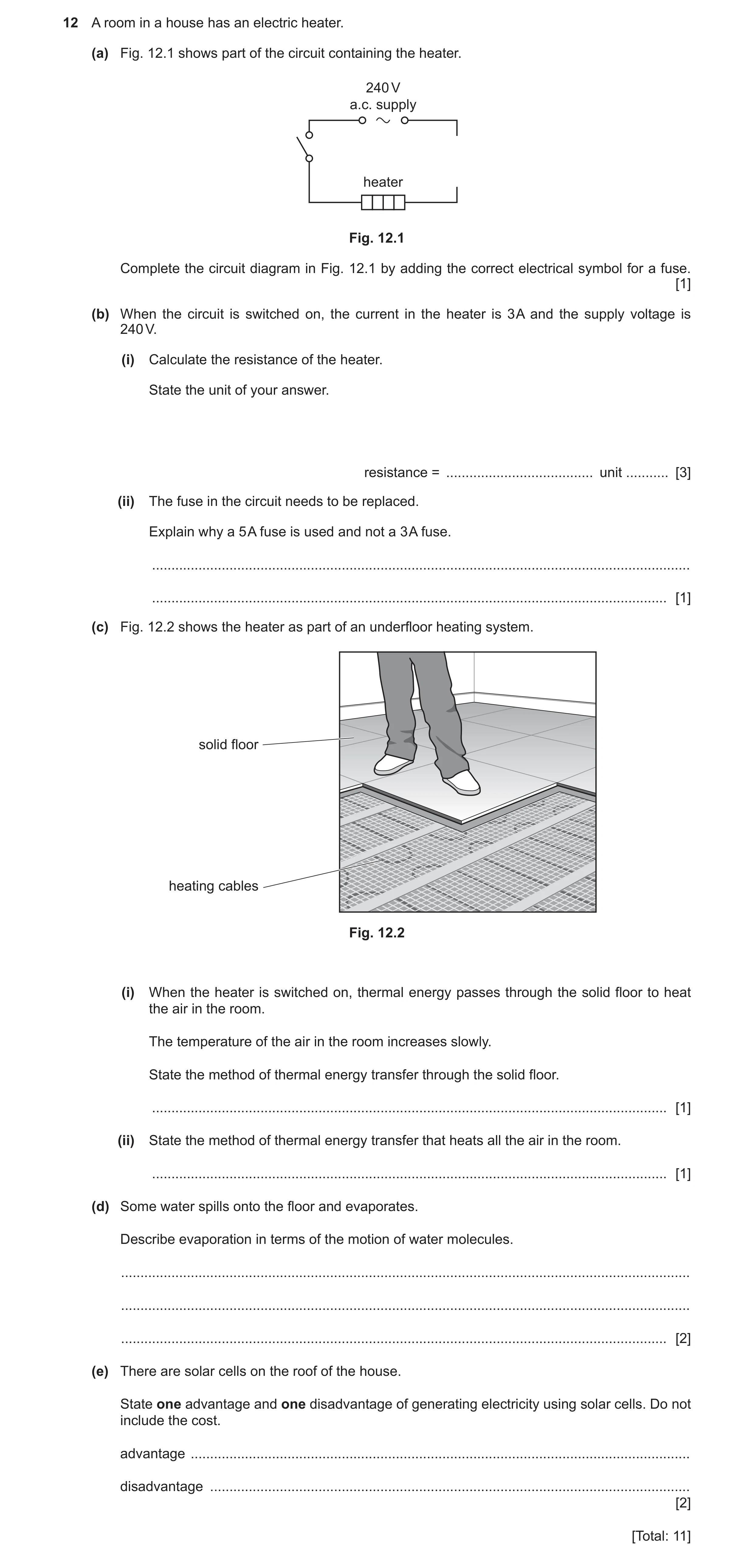
12 A room in a house has an electric heater. (a) Fig. 12.1 shows part of the circuit containing the heater. 240 V a.c. supply heater Fig. 12.1 Complete the circuit diagram in Fig. 12.1 by adding the correct electrical symbol for a fuse. [1] (b) When the circuit is switched on, the current in the heater is 3 A and the supply voltage is 240 V. (i) Calculate the resistance of the heater. State the unit of your answer. resistance = … unit … [3] (ii) The fuse in the circuit needs to be replaced. Explain why a 5 A fuse is used and not a 3 A fuse. … … [1] (c) Fig. 12.2 shows the heater as part of an underfloor heating system. solid floor heating cables Fig. 12.2 (i) When the heater is switched on, thermal energy passes through the solid floor to heat the air in the room. The temperature of the air in the room increases slowly. State the method of thermal energy transfer through the solid floor. … [1] (ii) State the method of thermal energy transfer that heats all the air in the room. … [1] (d) Some water spills onto the floor and evaporates. Describe evaporation in terms of the motion of water molecules. … … … [2] (e) There are solar cells on the roof of the house. State one advantage and one disadvantage of generating electricity using solar cells. Do not include the cost. advantage … disadvantage … [2] [Total: 11]
11 marks
Mark scheme: 12(a) fuse inserted in gap using the correct symbol ; 1 12(b)(i) evidence of resistance = voltage / current (in any form) or 240 / 3 ; 3 = 80 ; / ohms ; 12(b)(ii) fuse needs to be slightly greater than maximum current (or it would blow in normal use) ; 1 12(c)(i) conduction ; 1 12(c)(ii) convection ; 1 12(d) faster moving / most energetic molecules (leave) ; 2 (leave) from the surface of the liquid ; 12(e) renewable energy / does not produce CO2 etc ; 2 need sunlight / only works during the day etc ;
This question in 0654/32 Feb/March 2023
Q18 · Complete the following sentences using the words shown 0654/32 Feb/March 2024
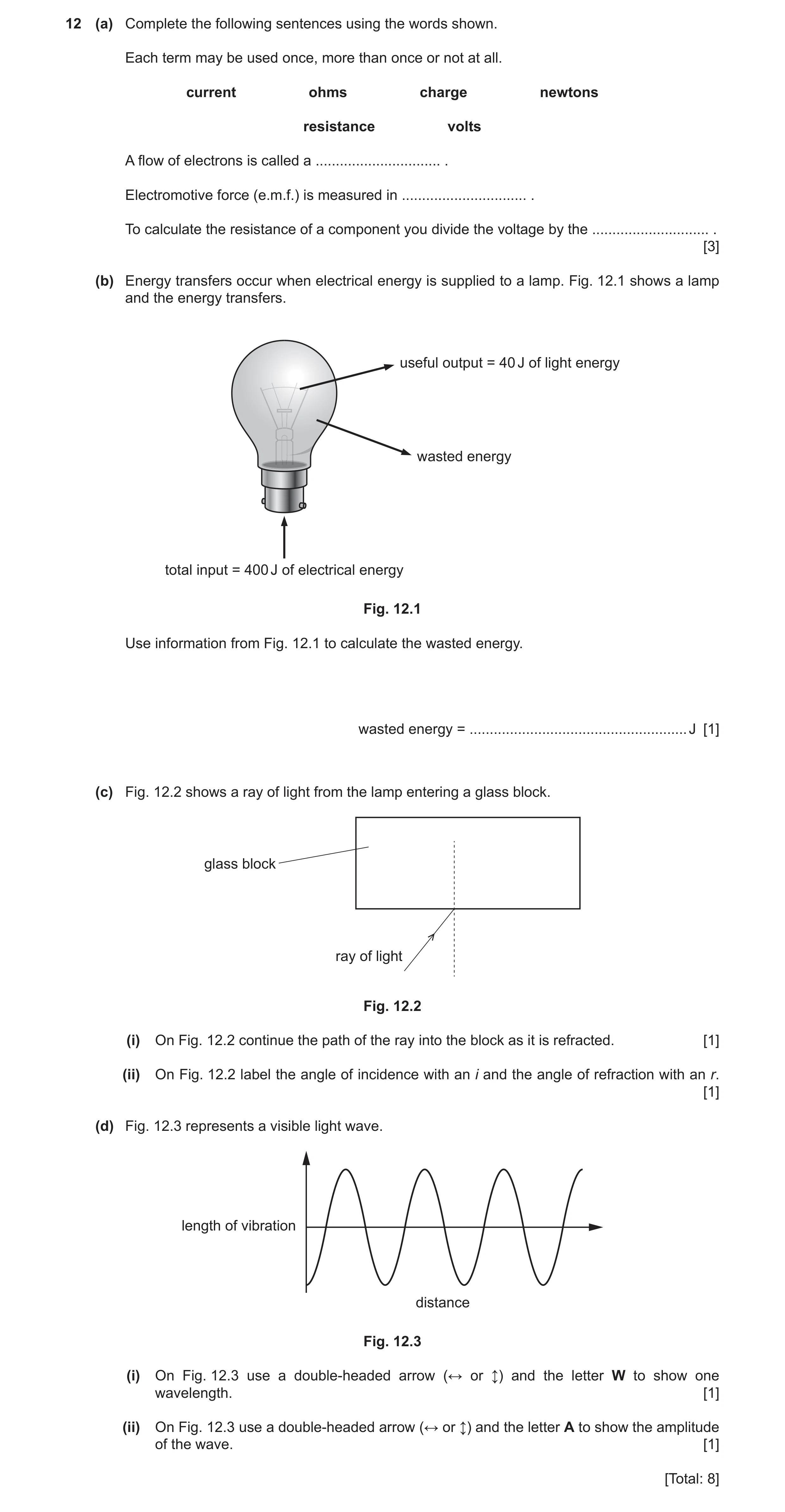
12 (a) Complete the following sentences using the words shown. Each term may be used once, more than once or not at all. current ohms charge newtons resistance volts A flow of electrons is called a … . Electromotive force (e.m.f.) is measured in … . To calculate the resistance of a component you divide the voltage by the … . [3] (b) Energy transfers occur when electrical energy is supplied to a lamp. Fig. 12.1 shows a lamp and the energy transfers. useful output = 40J of light energy wasted energy total input = 400J of electrical energy Fig. 12.1 Use information from Fig. 12.1 to calculate the wasted energy. wasted energy = … J [1] (c) Fig. 12.2 shows a ray of light from the lamp entering a glass block. glass block ray of light Fig. 12.2 (i) On Fig. 12.2 continue the path of the ray into the block as it is refracted. [1] (ii) On Fig. 12.2 label the angle of incidence with an i and the angle of refraction with an r. [1] (d) Fig. 12.3 represents a visible light wave. length of vibration distance Fig. 12.3 (i) On Fig. 12.3 use a double-headed arrow (↔ or ↕) and the letter W to show one wavelength. [1] (ii) On Fig. 12.3 use a double-headed arrow (↔ or ↕) and the letter A to show the amplitude of the wave. [1] [Total: 8]
8 marks
Mark scheme: 12(a) current ; 3 volts ; current ; 12(b) 360 (J ); 1 12(c)(i) ray drawn correctly ; 1 12(c)(ii) i and r labelled correctly ; 1 C 12(d)(i) one wavelength correctly shown ; 1 12(d)(ii) amplitude correctly shown ; 1
This question in 0654/32 Feb/March 2024
Q19 · The driver of a car fills the fuel tank with gasoline (petrol) 0654/31 May/June 2024
12 (a) The driver of a car fills the fuel tank with gasoline (petrol). As the gasoline flows into the fuel tank, the gasoline becomes charged. (i) State the force that causes the gasoline to become charged. … [1] (ii) State the name and the charge on the particles transferred when the gasoline becomes charged. name … charge … [2] (b) Some of the gasoline spills onto the hand of the driver. The gasoline evaporates and the driver’s hand cools down. Explain this cooling effect. Use ideas about molecules in your answer. … … … . … [2] (c) (i) During a journey in the car, the car engine transfers 5.8 × 10⁷ J of useful energy to the car. State the work done on the car by the car engine. State the unit of your answer. work done = … unit … [2] (ii) During the journey, the air in the tyres of the car warms up. Describe what happens to the motion of the air particles in the tyres as the air warms up. … … [1] (d) The windscreen wipers on the car are powered by an electric motor. The turning effect on the current‑carrying coil in the electric motor can be increased by increasing the magnetic field strength. (i) State one other way to increase the turning effect on the coil. … [1] (ii) The moment of a force is a measure of its turning effect. Complete the sentence to describe how to calculate the moment of a force. The moment of a force is calculated by multiplying the … by the perpendicular distance from the … . [2] [Total: 11]
11 marks
Mark scheme: 12(a)(i) friction ; 1 12(a)(ii) electron ; negative ; 2 12(b) the most energetic molecules escape ; average speed / energy of remaining molecules is lower ; 2 12(c)(i) 5.8 107 ; J ; 2 12(c)(ii) move faster ; 1 12(d)(i) increase current / voltage or increase number of turns ; 1 12(d)(ii) force ; pivot ; 2
This question in 0654/31 May/June 2024
Q20 · A student investigates the motion of smoke particles in air using a microscope 0654/32 May/June 2024
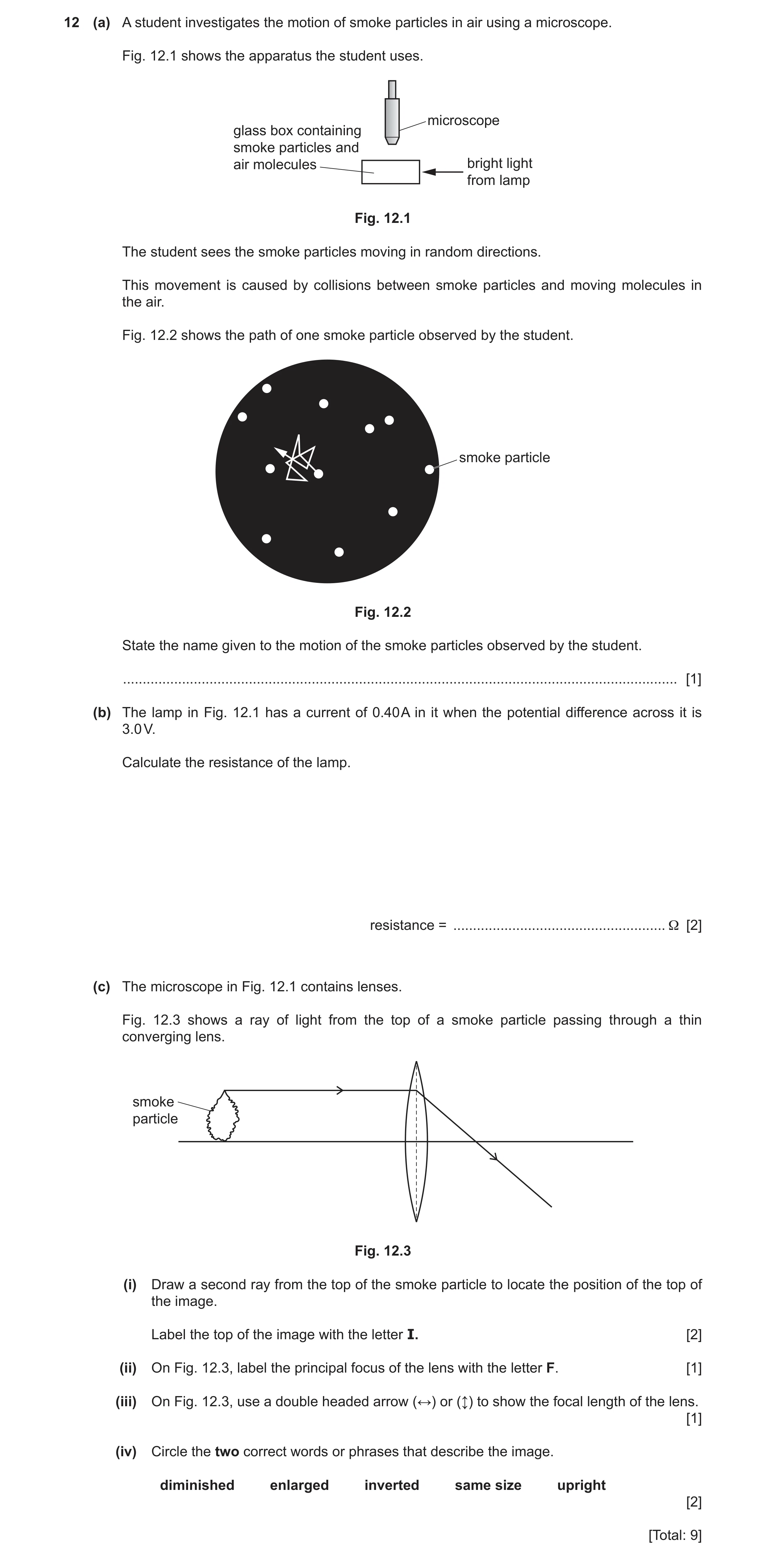
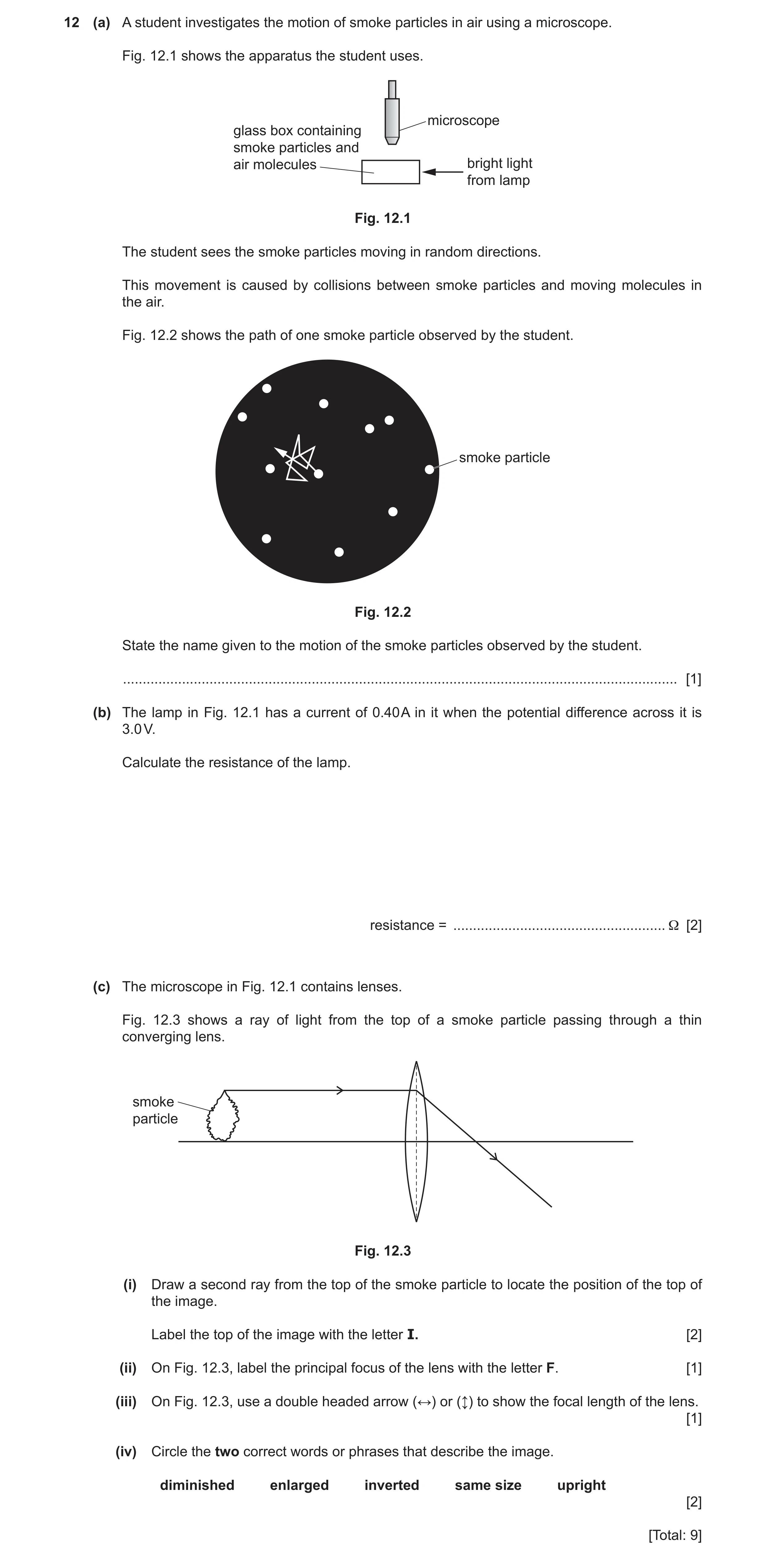
12 (a) A student investigates the motion of smoke particles in air using a microscope. Fig. 12.1 shows the apparatus the student uses. microscope glass box containing smoke particles and air molecules bright light from lamp Fig. 12.1 The student sees the smoke particles moving in random directions. This movement is caused by collisions between smoke particles and moving molecules in the air. Fig. 12.2 shows the path of one smoke particle observed by the student. smoke particle Fig. 12.2 State the name given to the motion of the smoke particles observed by the student. … [1] (b) The lamp in Fig. 12.1 has a current of 0.40 A in it when the potential difference across it is 3.0 V. Calculate the resistance of the lamp. resistance = … Ω [2] (c) The microscope in Fig. 12.1 contains lenses. Fig. 12.3 shows a ray of light from the top of a smoke particle passing through a thin converging lens. smoke particle Fig. 12.3 (i) Draw a second ray from the top of the smoke particle to locate the position of the top of the image. Label the top of the image with the letter I. [2] (ii) On Fig. 12.3, label the principal focus of the lens with the letter F. [1] (iii) On Fig. 12.3, use a double headed arrow (↔) or (↕) to show the focal length of the lens. [1] (iv) Circle the two correct words or phrases that describe the image. diminished enlarged inverted same size upright [2] [Total: 9]
9 marks
Mark scheme: 12(a) Brownian (motion) ; 1 12(b) R= V / I (in any form) or 3.0 / 0.4 ; = 7.5 () ; 2 12(c)(i) second line through centre of lens ; image labelled I ; 2 12(c)(ii) principal focus correctly labelled ; 1 12(c)(iii) focal length correctly shown ; 1 12(c)(iv) diminished ; inverted ; 2
This question in 0654/32 May/June 2024
Q21 · A student investigates the motion of smoke particles in air using a microscope 0654/33 May/June 2024
12 (a) A student investigates the motion of smoke particles in air using a microscope. Fig. 12.1 shows the apparatus the student uses. microscope glass box containing smoke particles and air molecules bright light from lamp Fig. 12.1 The student sees the smoke particles moving in random directions. This movement is caused by collisions between smoke particles and moving molecules in the air. Fig. 12.2 shows the path of one smoke particle observed by the student. smoke particle Fig. 12.2 State the name given to the motion of the smoke particles observed by the student. … [1] (b) The lamp in Fig. 12.1 has a current of 0.40 A in it when the potential difference across it is 3.0 V. Calculate the resistance of the lamp. resistance = … Ω [2] (c) The microscope in Fig. 12.1 contains lenses. Fig. 12.3 shows a ray of light from the top of a smoke particle passing through a thin converging lens. smoke particle Fig. 12.3 (i) Draw a second ray from the top of the smoke particle to locate the position of the top of the image. Label the top of the image with the letter I. [2] (ii) On Fig. 12.3, label the principal focus of the lens with the letter F. [1] (iii) On Fig. 12.3, use a double headed arrow (↔) or (↕) to show the focal length of the lens. [1] (iv) Circle the two correct words or phrases that describe the image. diminished enlarged inverted same size upright [2] [Total: 9]
9 marks
Mark scheme: 12(a) Brownian (motion) ; 1 12(b) R= V / I (in any form) or 3.0 / 0.4 ; = 7.5 () ; 2 12(c)(i) second line through centre of lens ; image labelled I ; 2 12(c)(ii) principal focus correctly labelled ; 1 12(c)(iii) focal length correctly shown ; 1 12(c)(iv) diminished ; inverted ; 2
This question in 0654/33 May/June 2024
Question 22 0654/31 Oct/Nov 2024
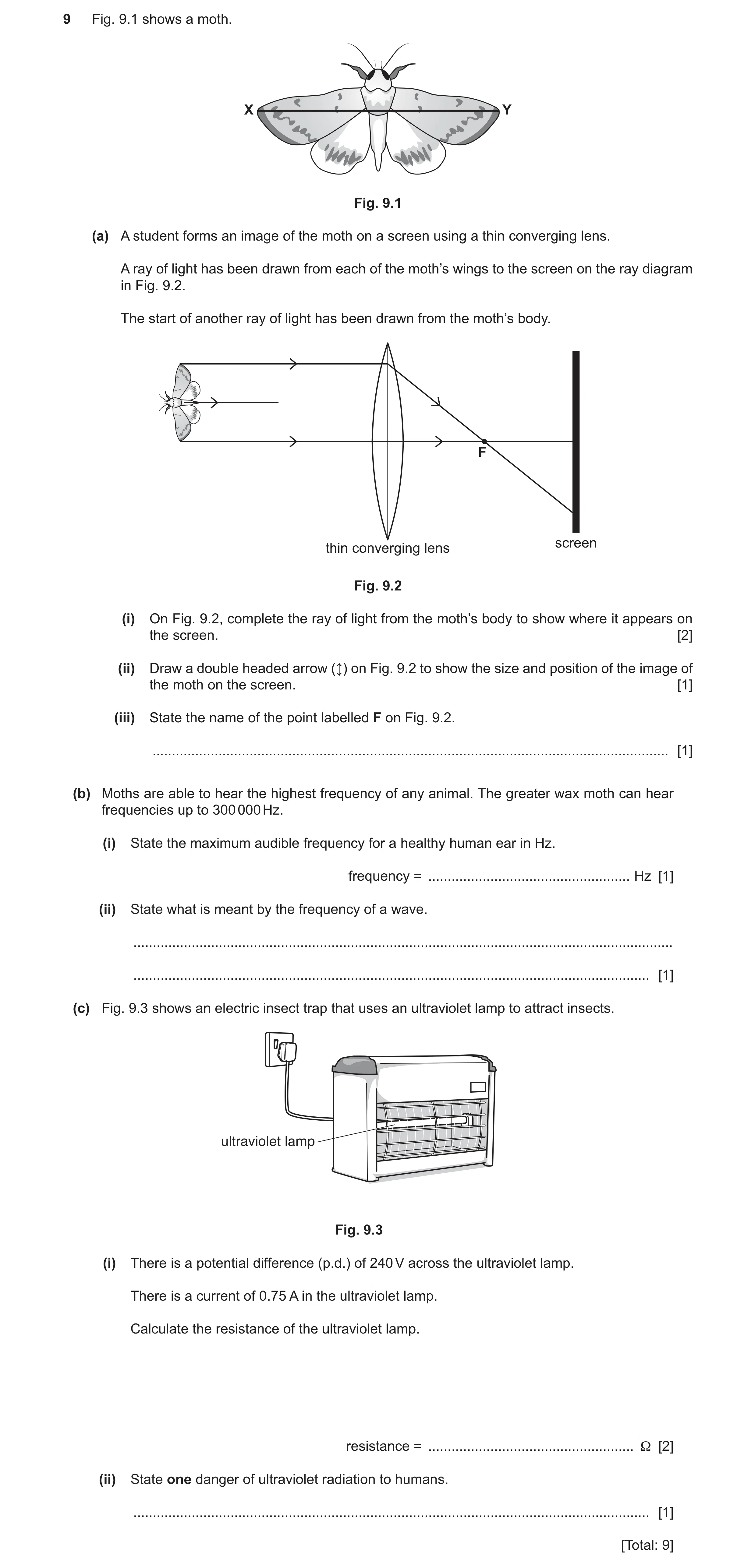
9 Fig. 9.1 shows a moth. X Y Fig. 9.1 (a) A student forms an image of the moth on a screen using a thin converging lens. A ray of light has been drawn from each of the moth’s wings to the screen on the ray diagram in Fig. 9.2. The start of another ray of light has been drawn from the moth’s body. F screen thin converging lens Fig. 9.2 (i) On Fig. 9.2, complete the ray of light from the moth’s body to show where it appears on the screen. [2] (ii) Draw a double headed arrow (↕) on Fig. 9.2 to show the size and position of the image of the moth on the screen. [1] (iii) State the name of the point labelled F on Fig. 9.2. … [1] (b) Moths are able to hear the highest frequency of any animal. The greater wax moth can hear frequencies up to 300 000 Hz. (i) State the maximum audible frequency for a healthy human ear in Hz. frequency = … Hz [1] (ii) State what is meant by the frequency of a wave. … … [1] (c) Fig. 9.3 shows an electric insect trap that uses an ultraviolet lamp to attract insects. ultraviolet lamp Fig. 9.3 (i) There is a potential difference (p.d.) of 240 V across the ultraviolet lamp. There is a current of 0.75 A in the ultraviolet lamp. Calculate the resistance of the ultraviolet lamp. resistance = … Ω [2] (ii) State one danger of ultraviolet radiation to humans. … [1] [Total: 9]
9 marks
Mark scheme: 9(a)(i) horizontal ray continued to lens axis ; 2 diagonal straight line from lens through F to screen ; 9(a)(ii) position of image correctly indicated ; 1 9(a)(iii) principal focus / focal point ; 1 9(b)(i) 20 000 (Hz) ; 1 9(b)(ii) number of waves that pass a fixed point per unit time / owtte ; 1 9(c)(i) evidence of resistance = potential difference ÷ current / 240 ÷ 0.75 ; 2 320 () ; 9(c)(ii) skin cancer / cataracts and eye damage / immune system depression / premature aging and other skin damage ; 1
This question in 0654/31 Oct/Nov 2024
Q23 · An electric kettle with a heating element 0654/32 Oct/Nov 2025
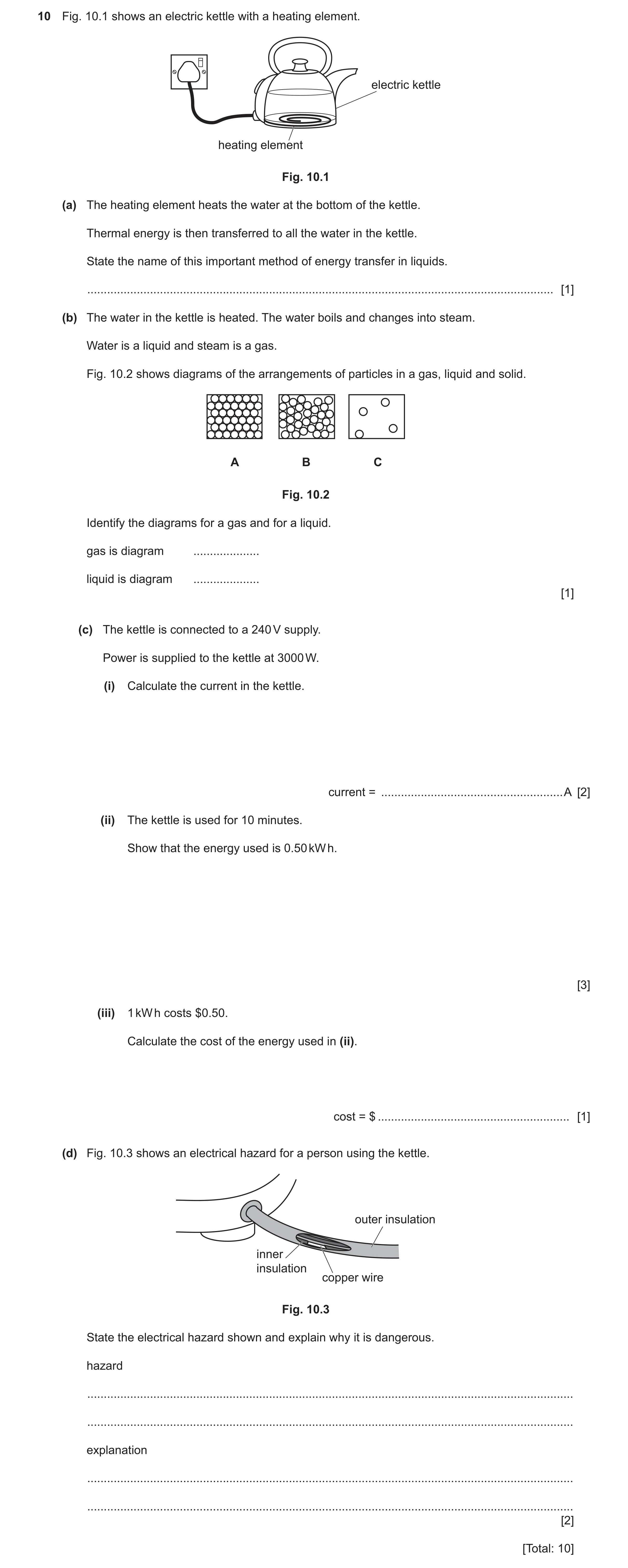
10 Fig. 10.1 shows an electric kettle with a heating element. electric kettle heating element Fig. 10.1 (a) The heating element heats the water at the bottom of the kettle. Thermal energy is then transferred to all the water in the kettle. State the name of this important method of energy transfer in liquids. … [1] (b) The water in the kettle is heated. The water boils and changes into steam. Water is a liquid and steam is a gas. Fig. 10.2 shows diagrams of the arrangements of particles in a gas, liquid and solid. A B C Fig. 10.2 Identify the diagrams for a gas and for a liquid. gas is diagram … liquid is diagram … [1] (c) The kettle is connected to a 240 V supply. Power is supplied to the kettle at 3000 W. (i) Calculate the current in the kettle. current = … A [2] (ii) The kettle is used for 10 minutes. Show that the energy used is 0.50 kW h. [3] (iii) 1 kW h costs $0.50. Calculate the cost of the energy used in (ii). cost = $ … [1] (d) Fig. 10.3 shows an electrical hazard for a person using the kettle. outer insulation inner insulation copper wire Fig. 10.3 State the electrical hazard shown and explain why it is dangerous. hazard … … explanation … … [2] [Total: 10]
10 marks
Mark scheme: 10(a) convection ; 1 10(b) (gas is diagram) C and (liquid is diagram) B ; 1 10(c)(i) P = IV (in any form) 2 OR (current =) 3000 / 240 ; 12.5 (A) ; 10(c)(ii) energy = power time (in any form) ; 3 conversion of minutes to hours ; conversion of W to kW ; (= 0.5 kWh) 10(c)(iii) ($) 0.25 ; 1 10(d) insulation damaged / exposed (live) wire / AW ; 2 electric shock ;
This question in 0654/32 Oct/Nov 2025
Q24 · An electric kettle with a heating element 0654/33 Oct/Nov 2025
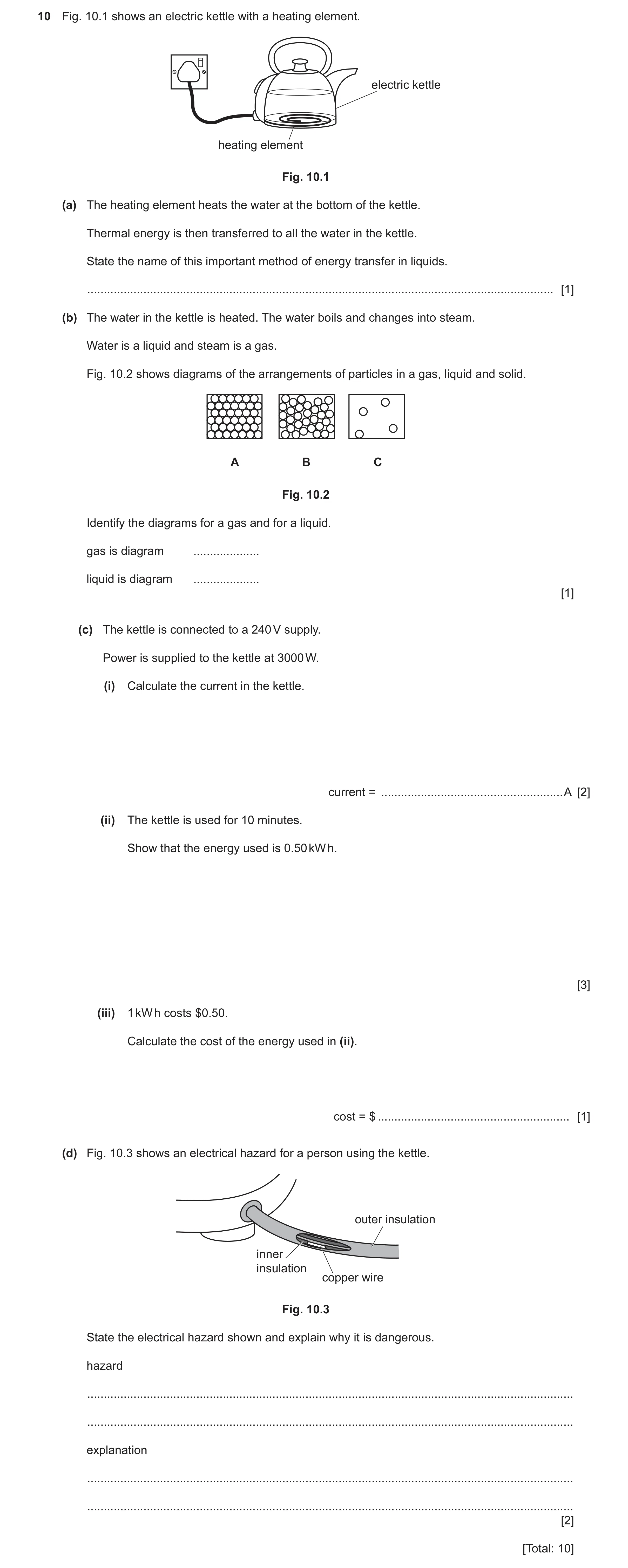
10 Fig. 10.1 shows an electric kettle with a heating element. electric kettle heating element Fig. 10.1 (a) The heating element heats the water at the bottom of the kettle. Thermal energy is then transferred to all the water in the kettle. State the name of this important method of energy transfer in liquids. … [1] (b) The water in the kettle is heated. The water boils and changes into steam. Water is a liquid and steam is a gas. Fig. 10.2 shows diagrams of the arrangements of particles in a gas, liquid and solid. A B C Fig. 10.2 Identify the diagrams for a gas and for a liquid. gas is diagram … liquid is diagram … [1] (c) The kettle is connected to a 240 V supply. Power is supplied to the kettle at 3000 W. (i) Calculate the current in the kettle. current = … A [2] (ii) The kettle is used for 10 minutes. Show that the energy used is 0.50 kW h. [3] (iii) 1 kW h costs $0.50. Calculate the cost of the energy used in (ii). cost = $ … [1] (d) Fig. 10.3 shows an electrical hazard for a person using the kettle. outer insulation inner insulation copper wire Fig. 10.3 State the electrical hazard shown and explain why it is dangerous. hazard … … explanation … … [2] [Total: 10]
10 marks
Mark scheme: 10(a) convection ; 1 10(b) (gas is diagram) C and (liquid is diagram) B ; 1 10(c)(i) P = IV (in any form) 2 OR (current =) 3000 / 240 ; 12.5 (A) ; 10(c)(ii) energy = power time (in any form) ; 3 conversion of minutes to hours ; conversion of W to kW ; (= 0.5 kWh) 10(c)(iii) ($) 0.25 ; 1 10(d) insulation damaged / exposed (live) wire / AW ; 2 electric shock ;
This question in 0654/33 Oct/Nov 2025
 10
10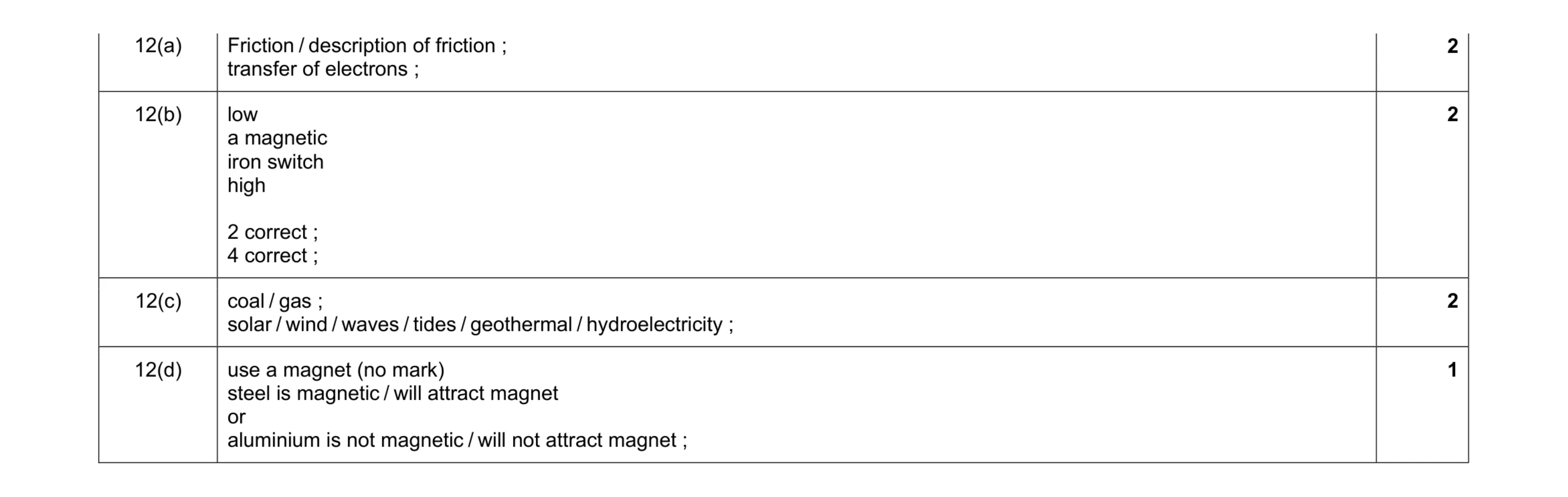 7
7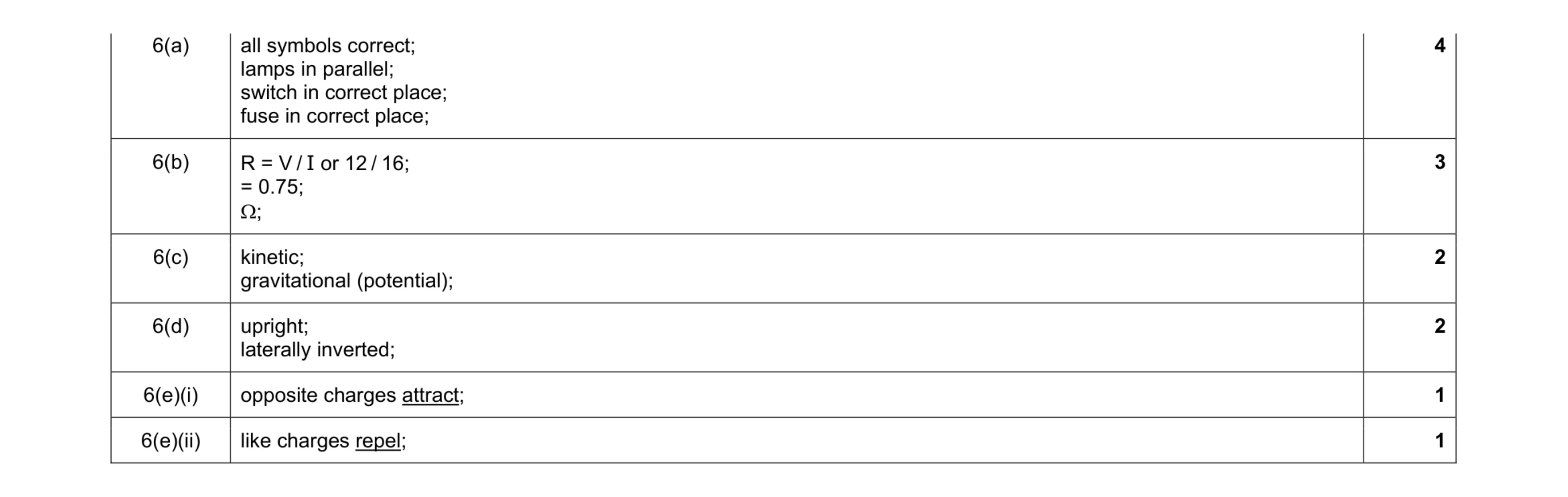 13
13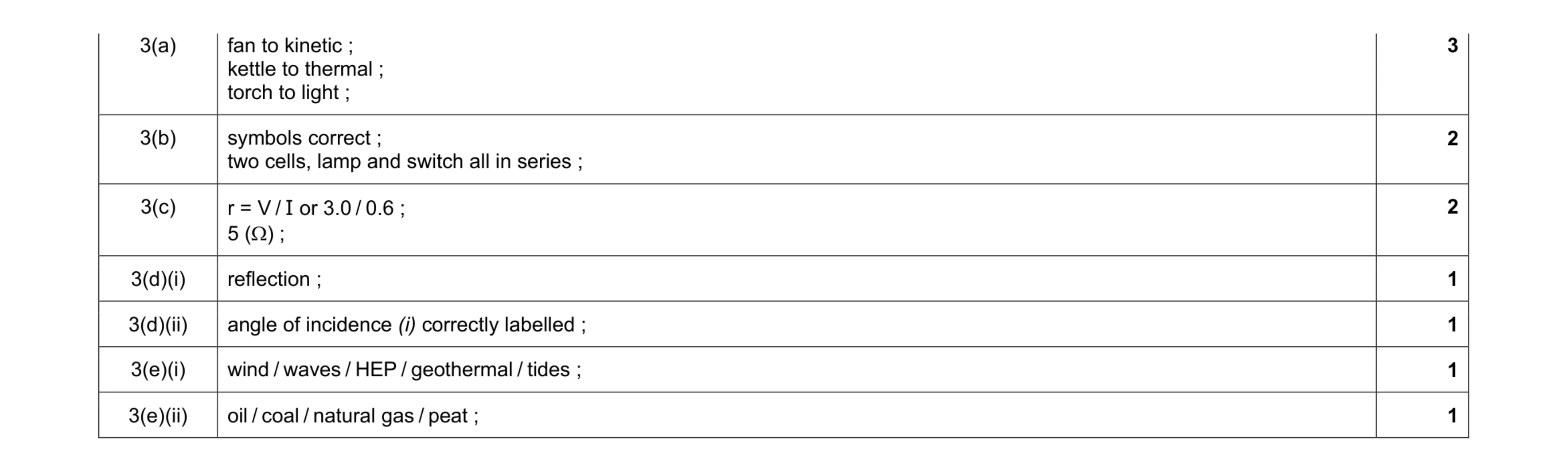 11
11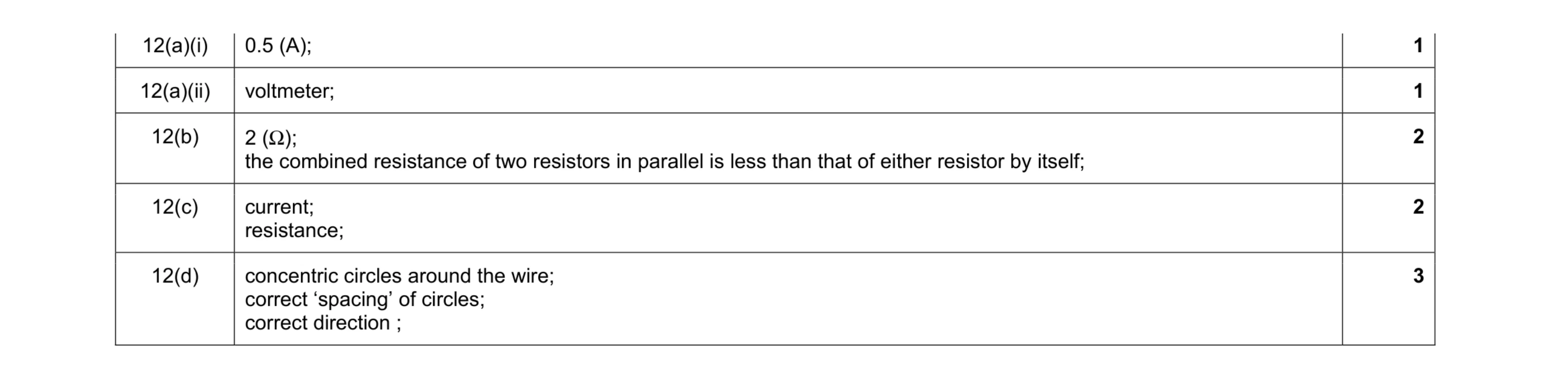 9
9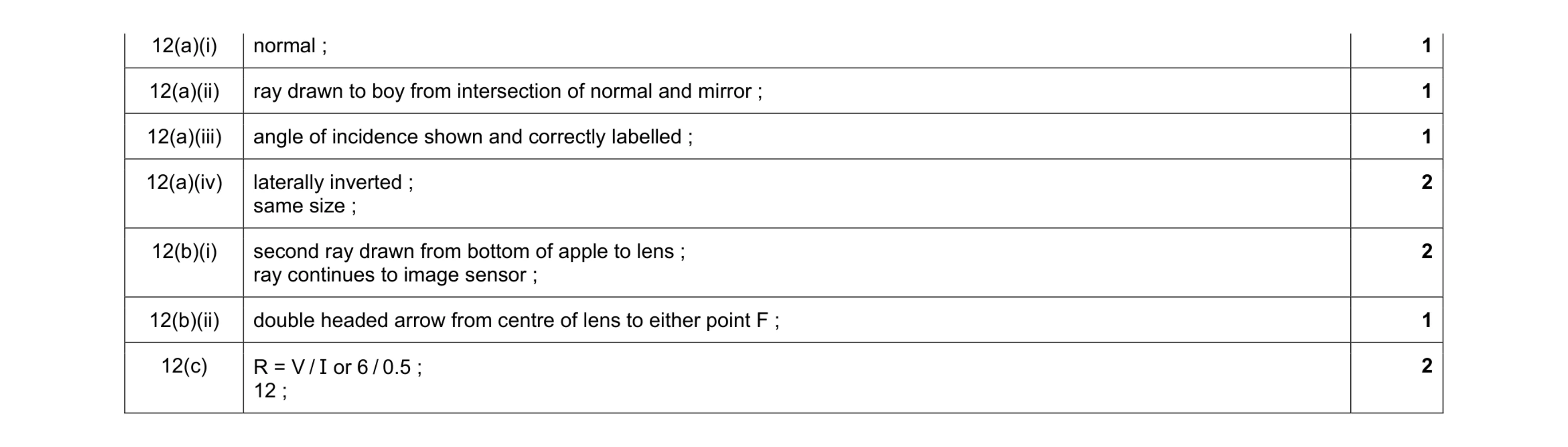 10
10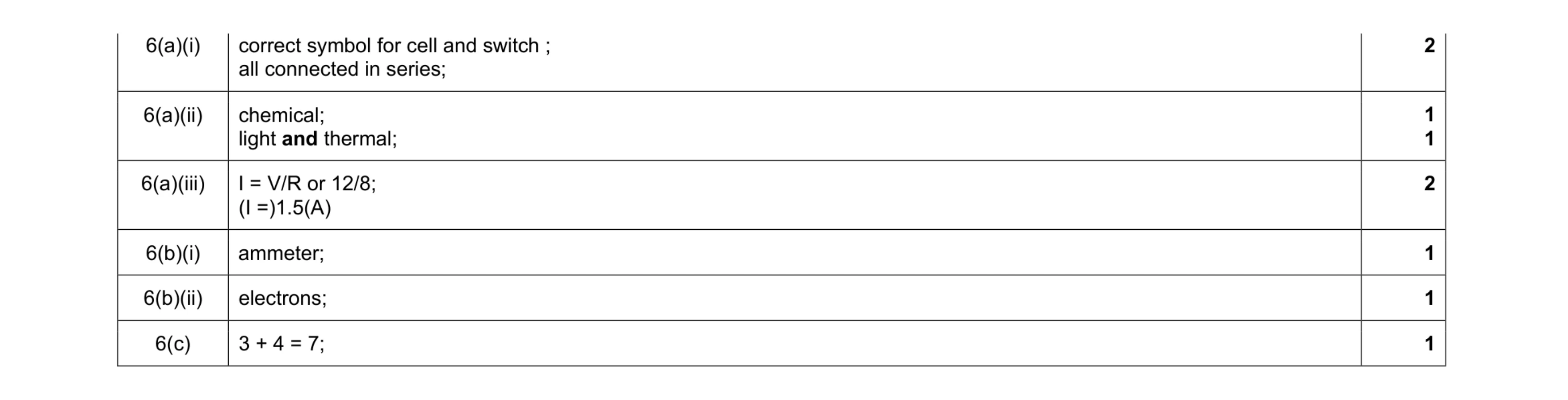 9
9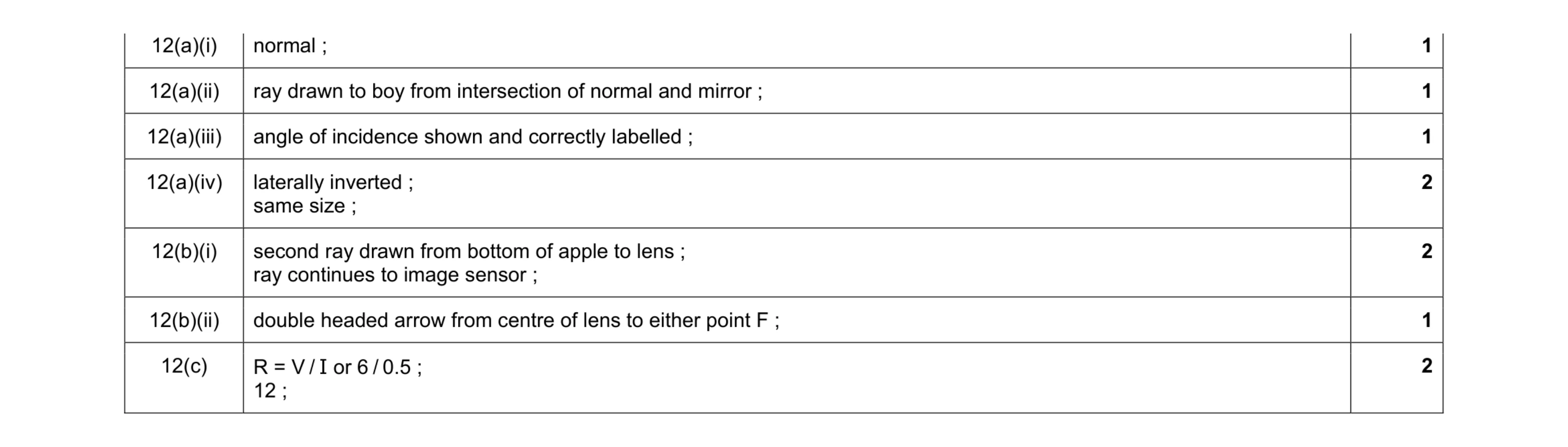 10
10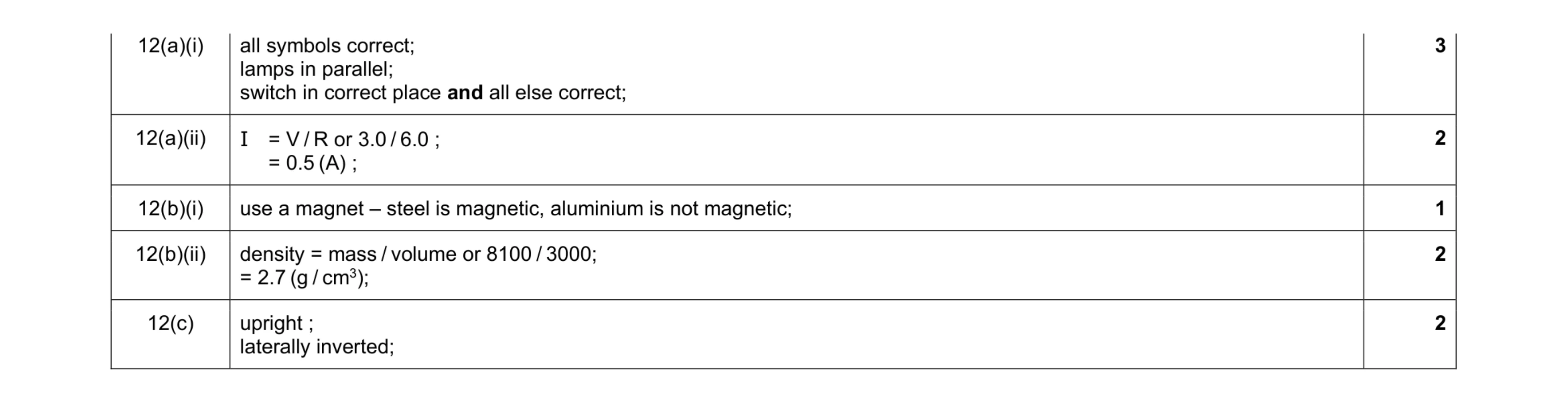 10
10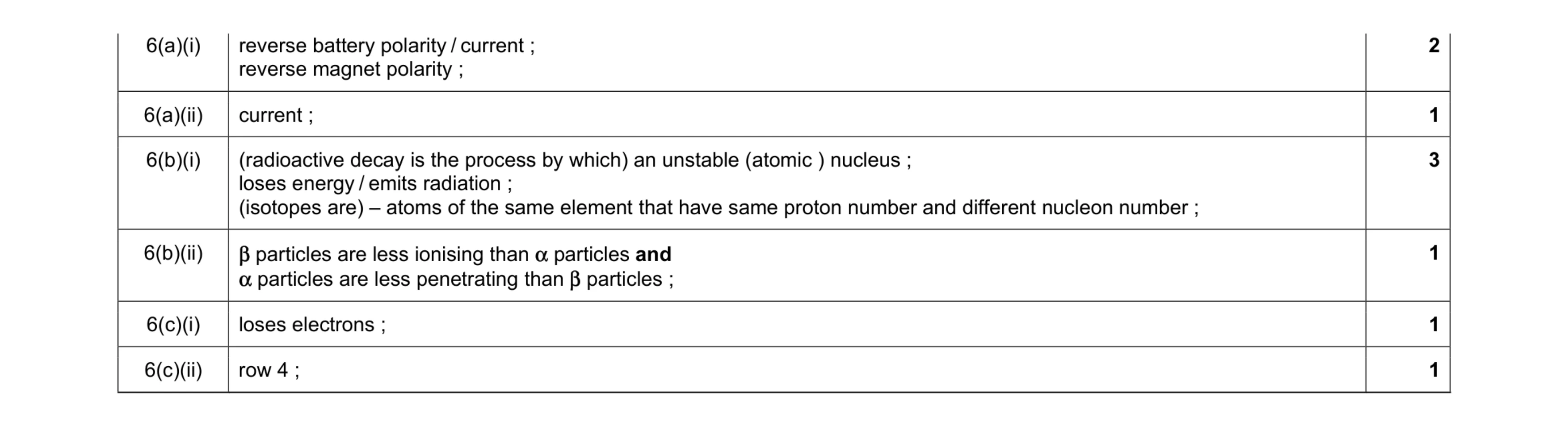 9
9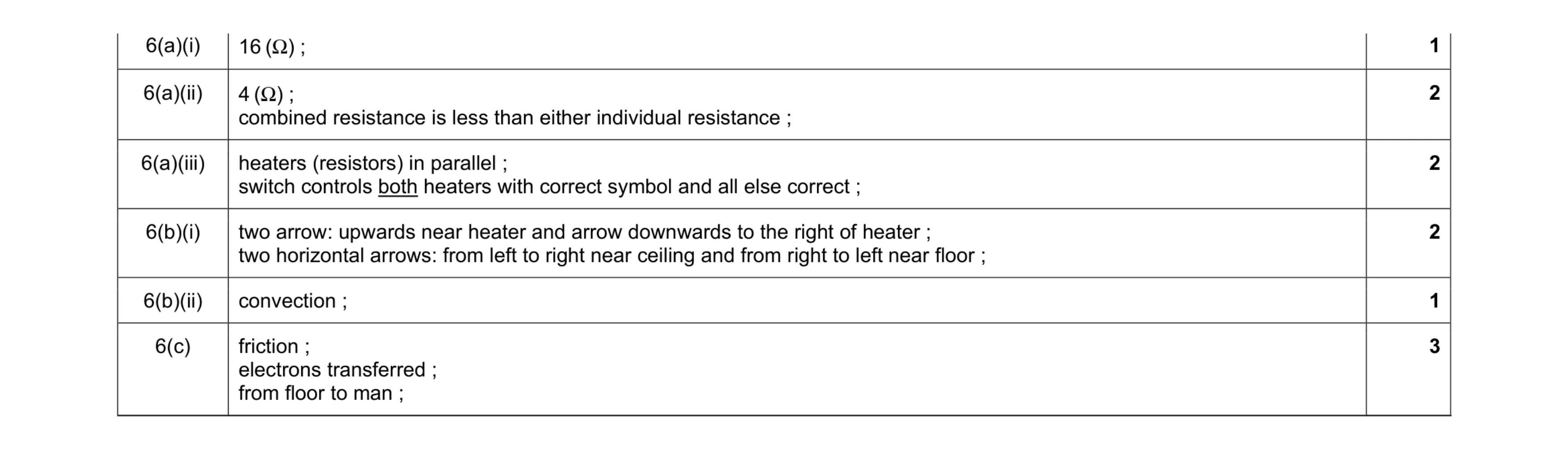 11
11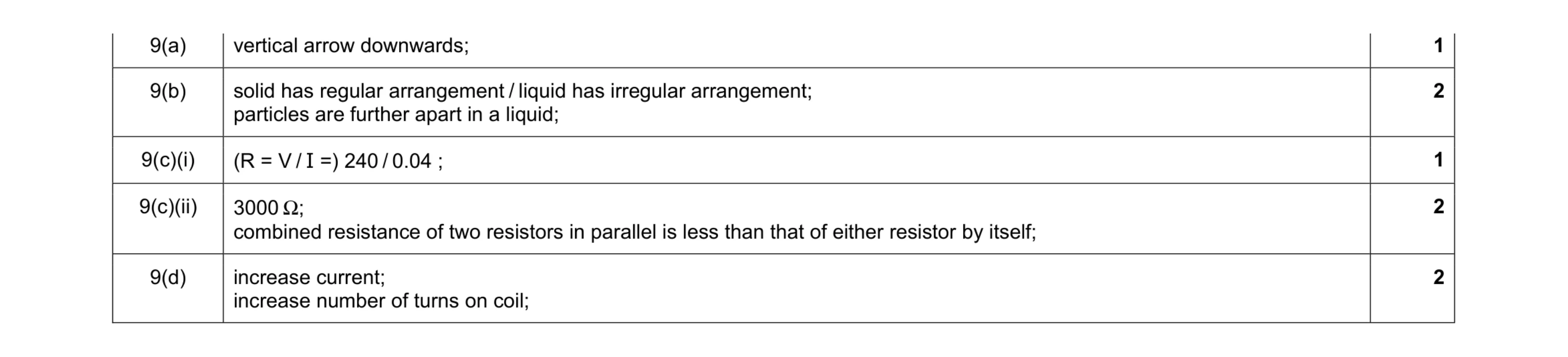 8
8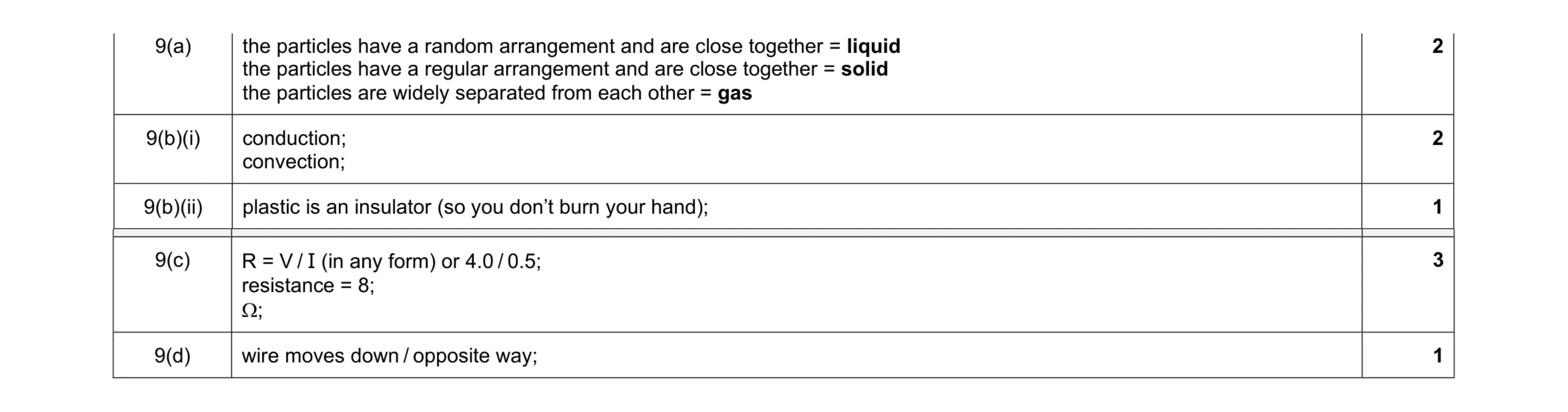 9
9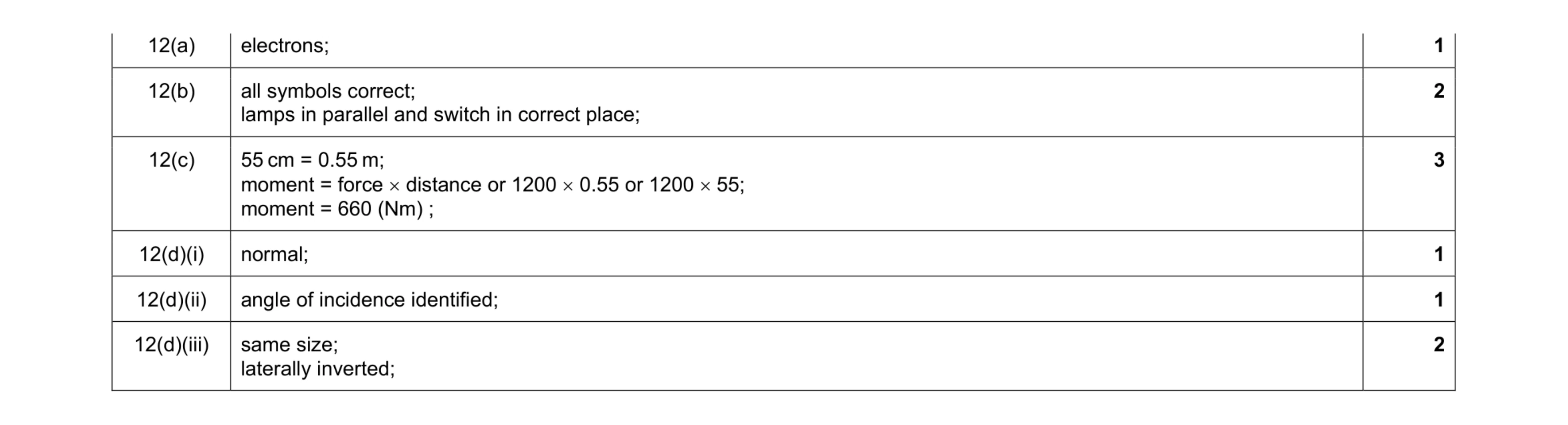 10
10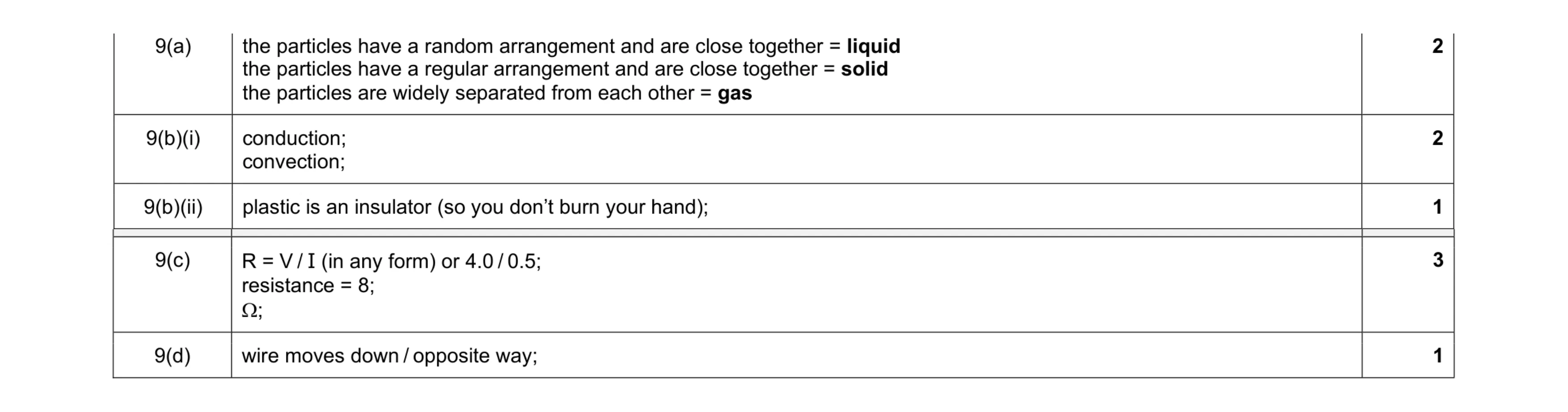 9
9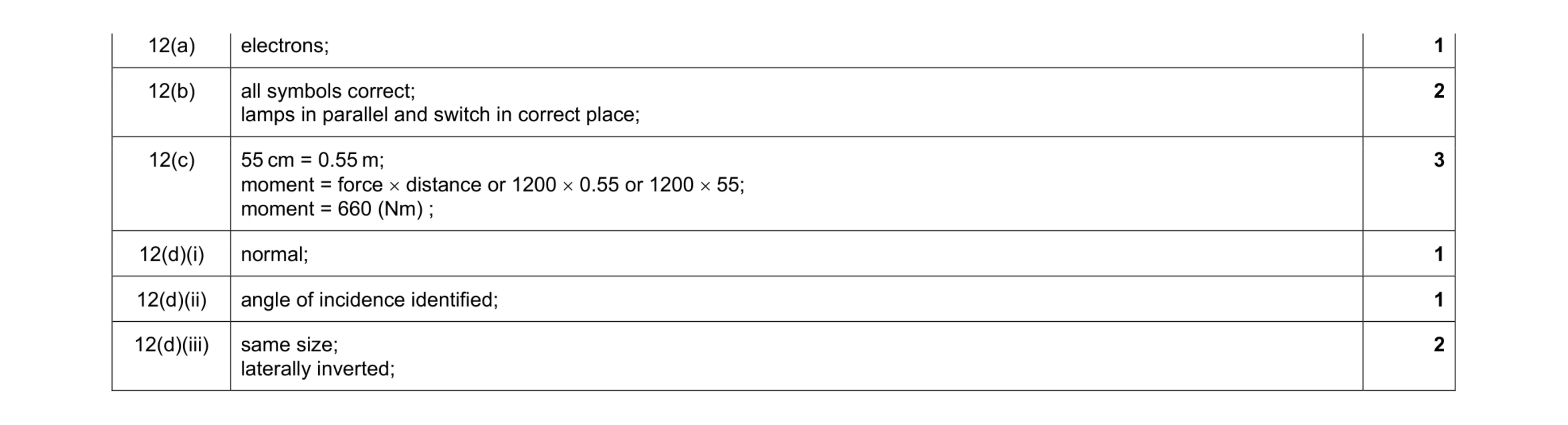 10
10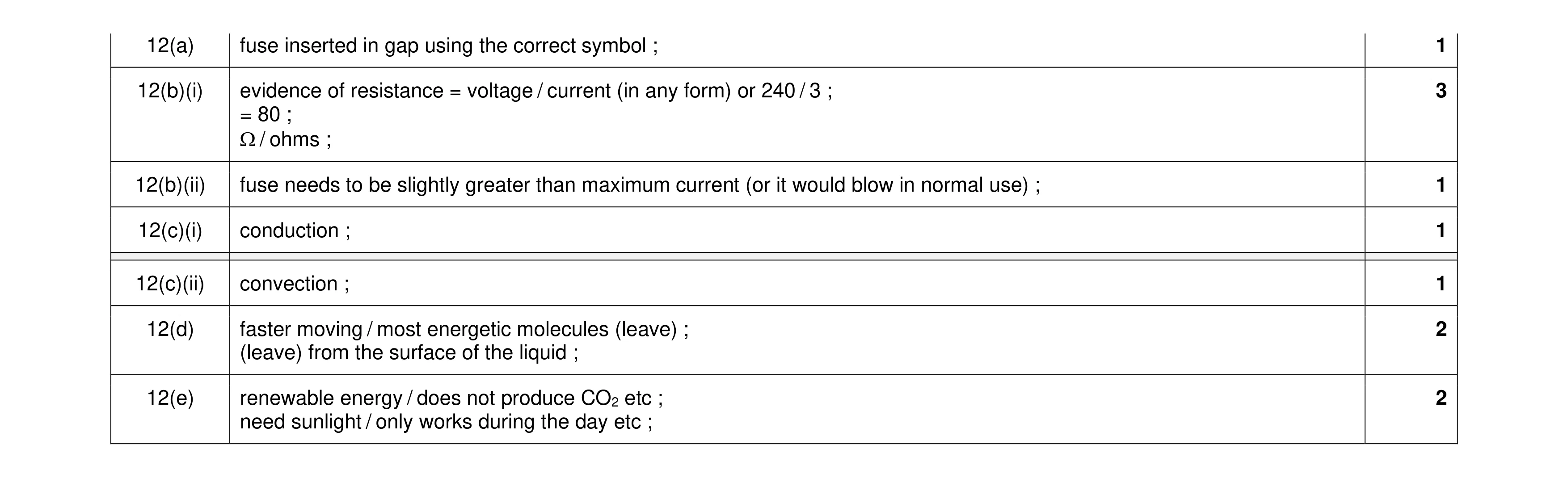 11
11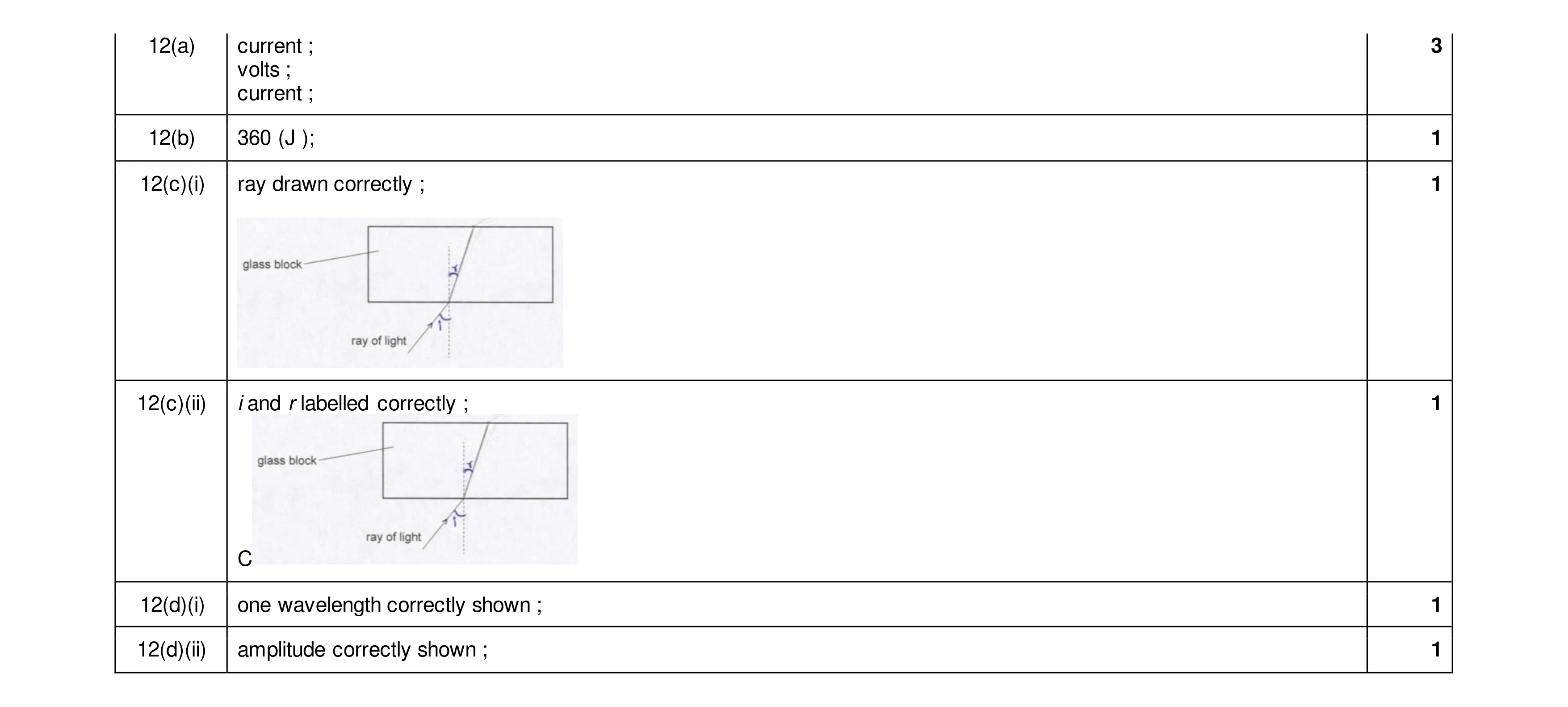 8
8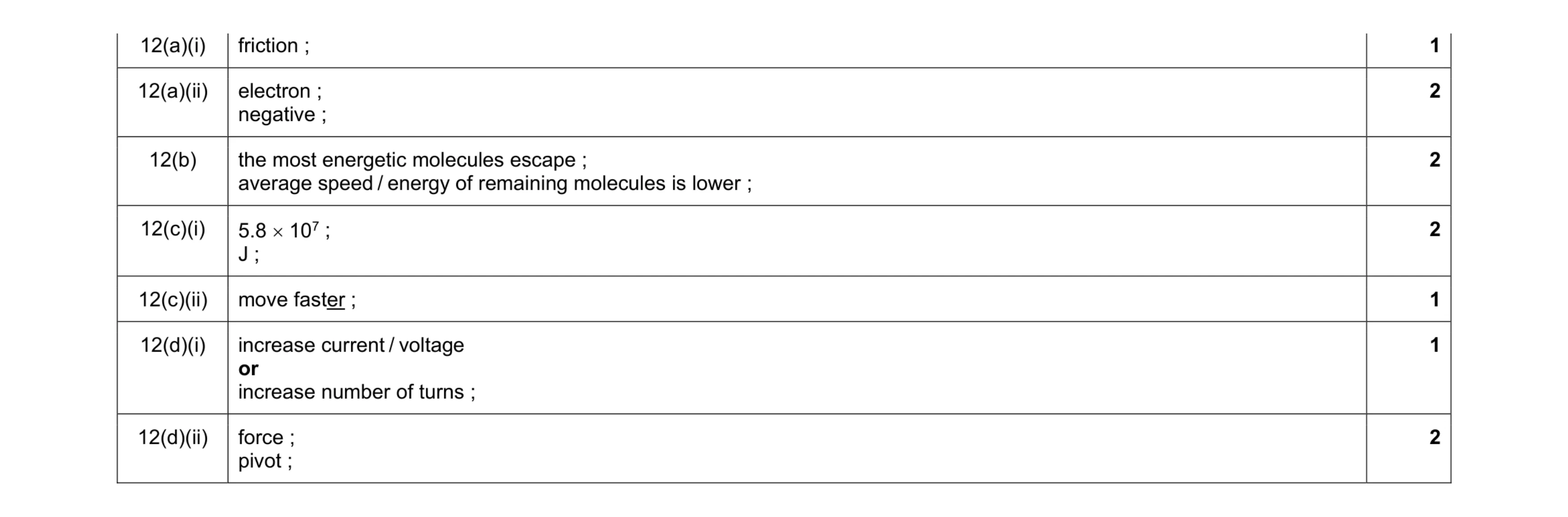 11
11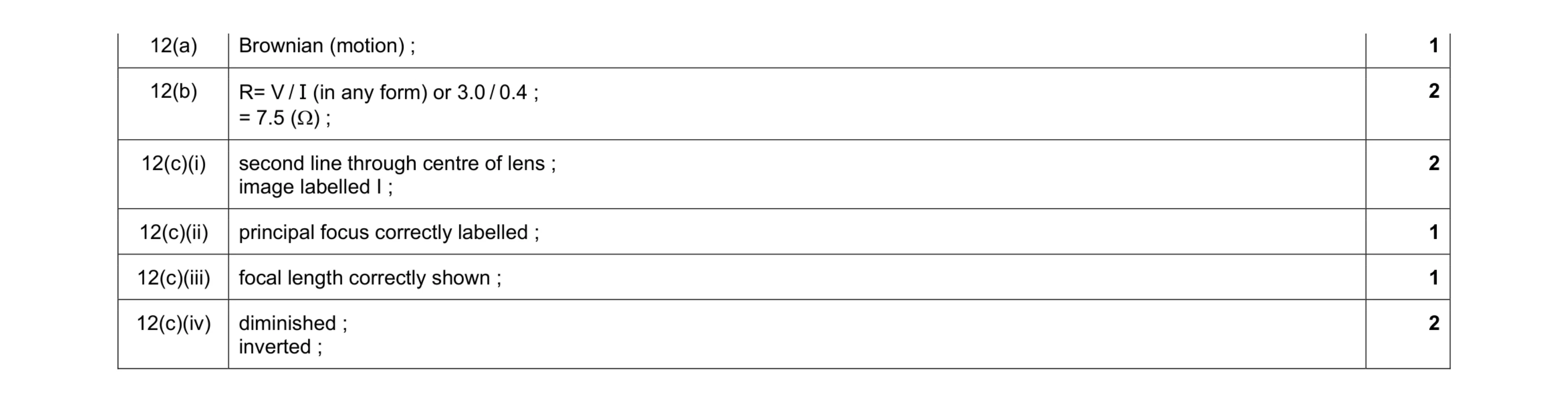 9
9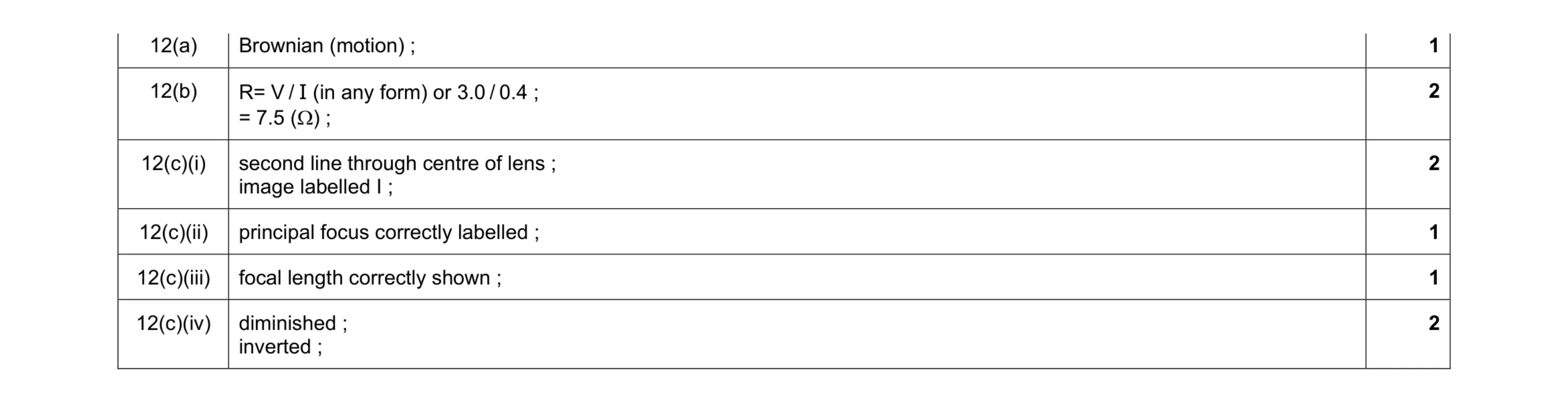 9
9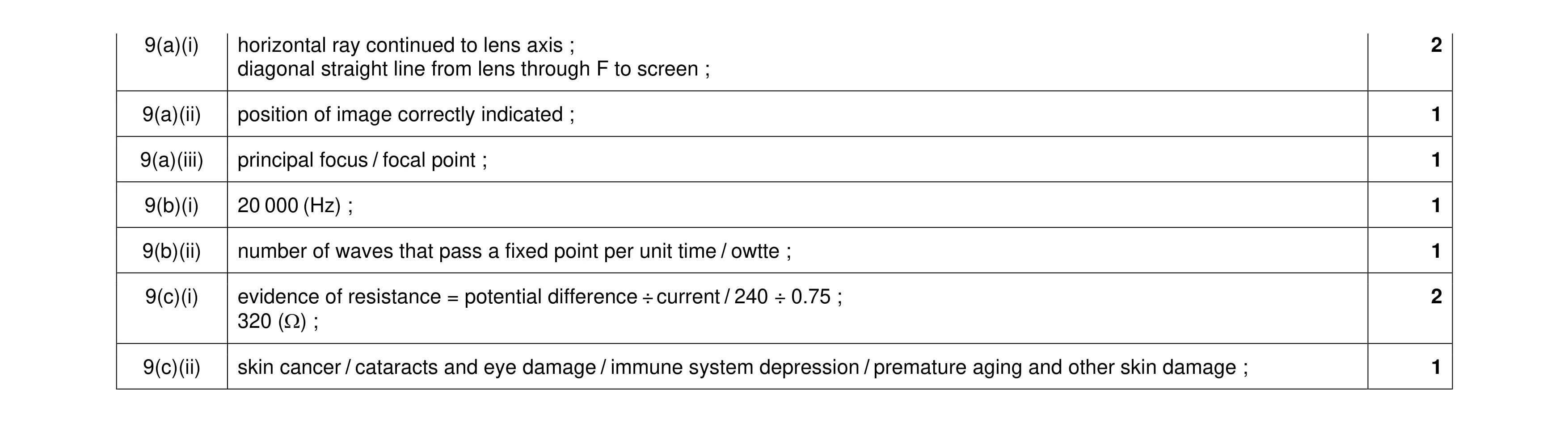 9
9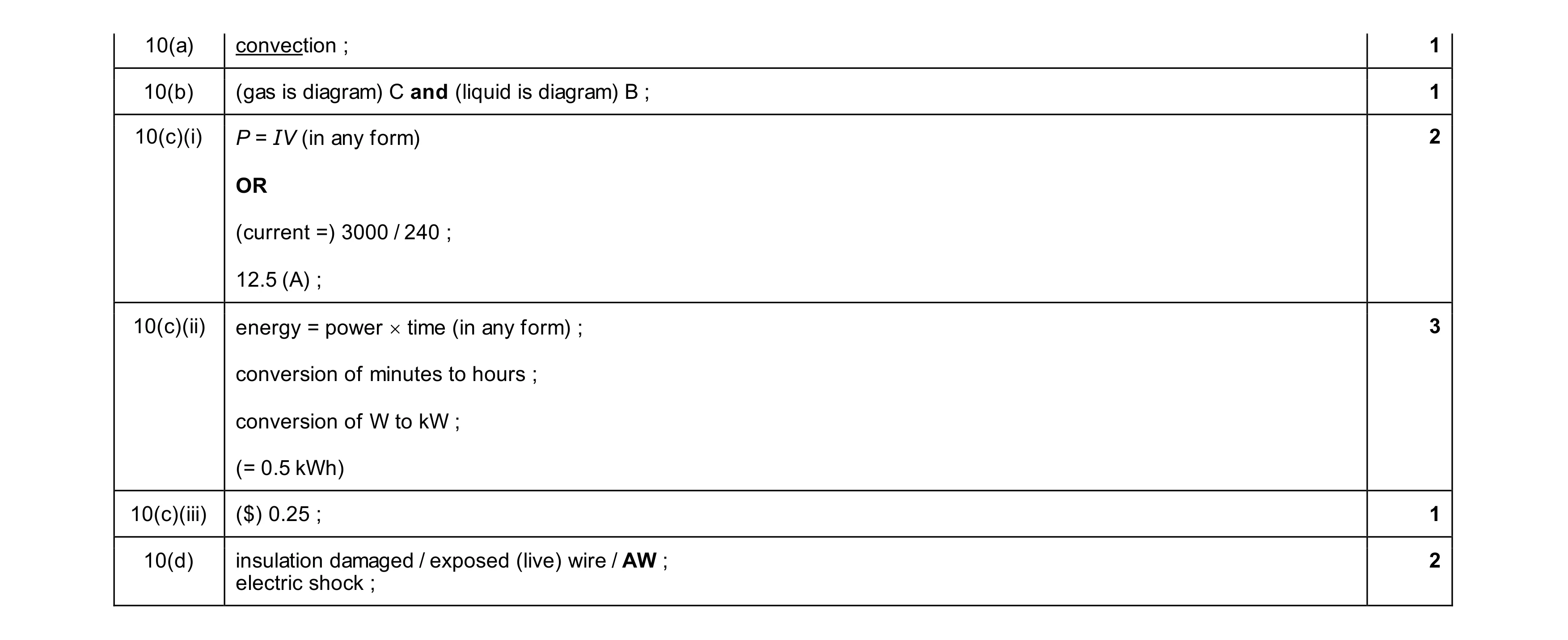 10
10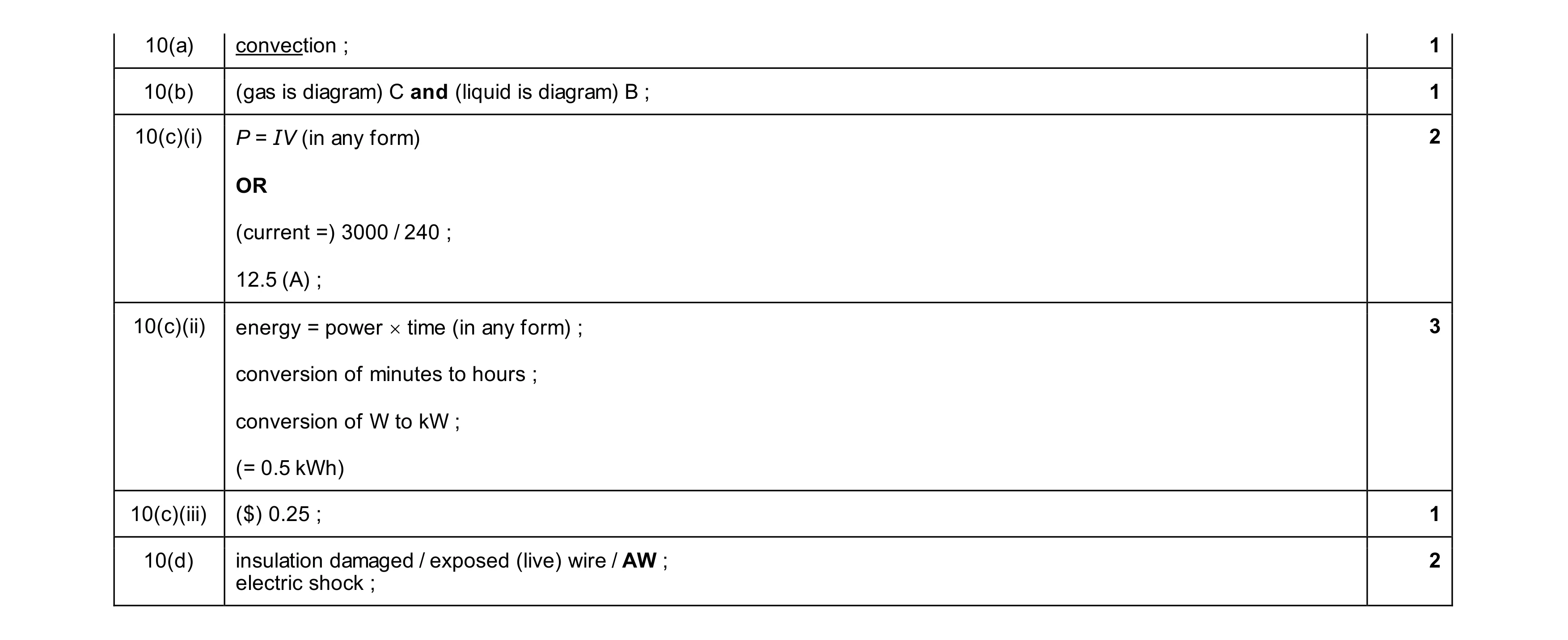 10
10