Questions as text
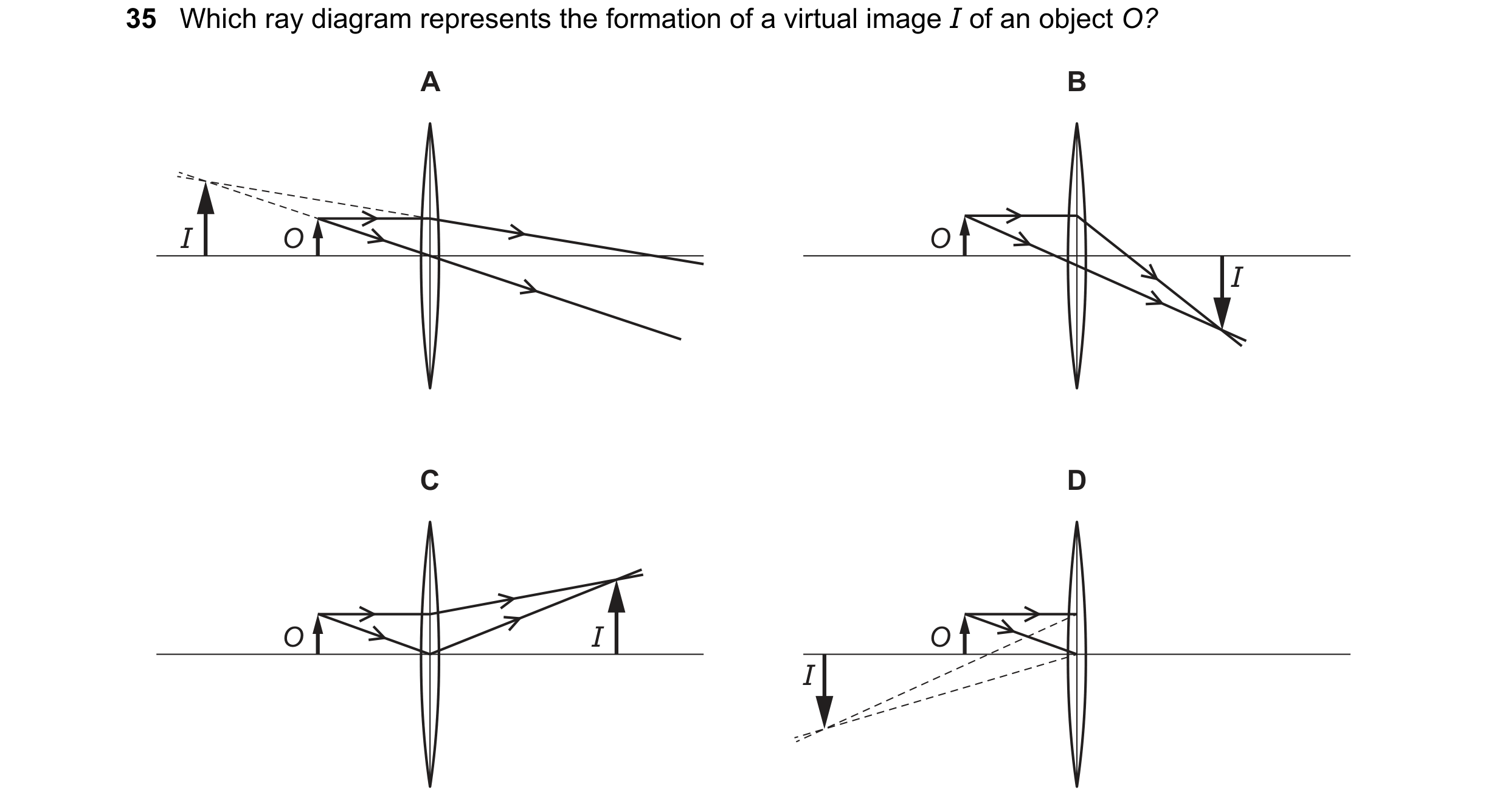
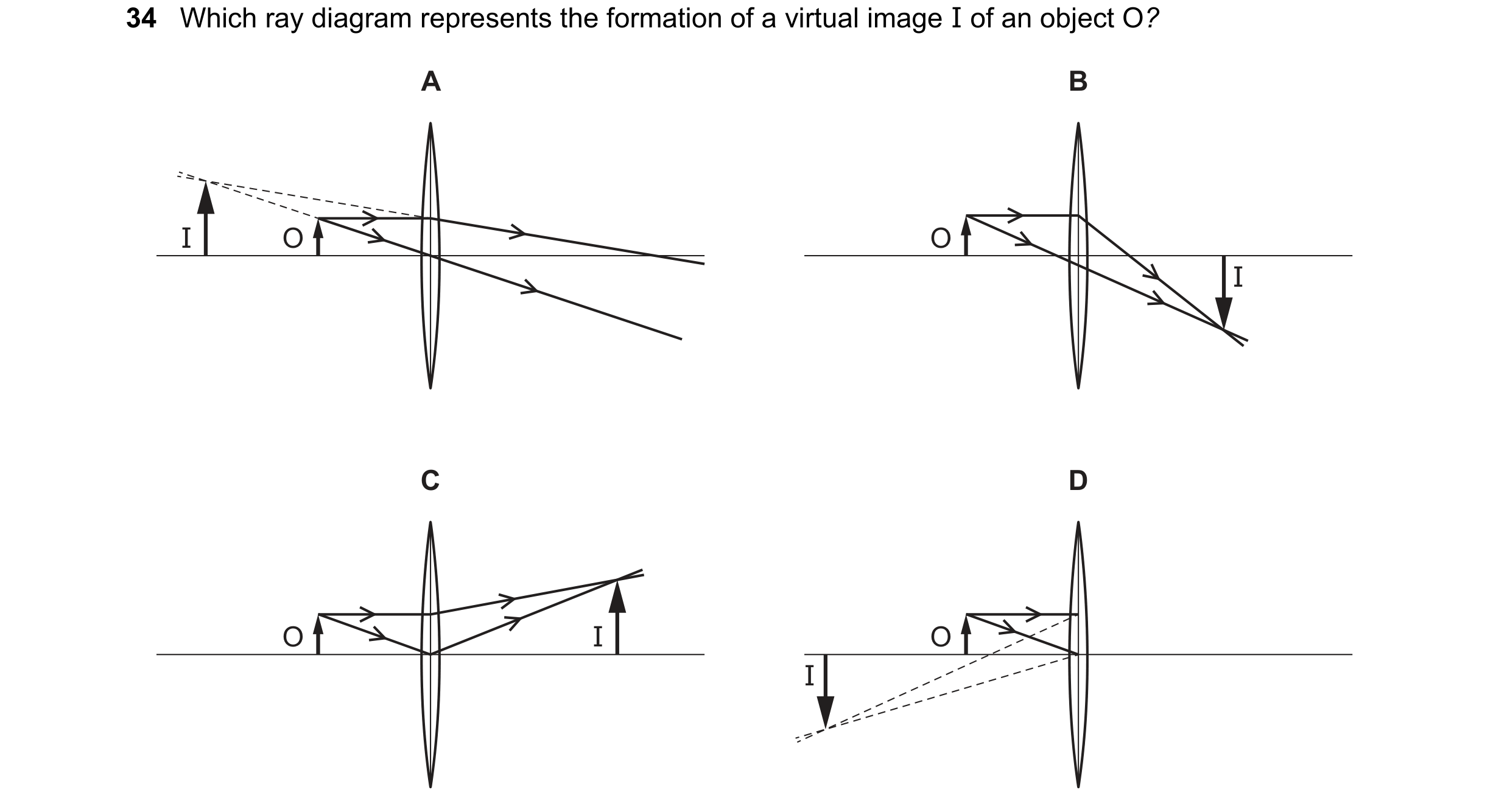
Q1 · Which ray diagram represents the formation of a virtual image I of an object O? 0654/21 May/June 2017
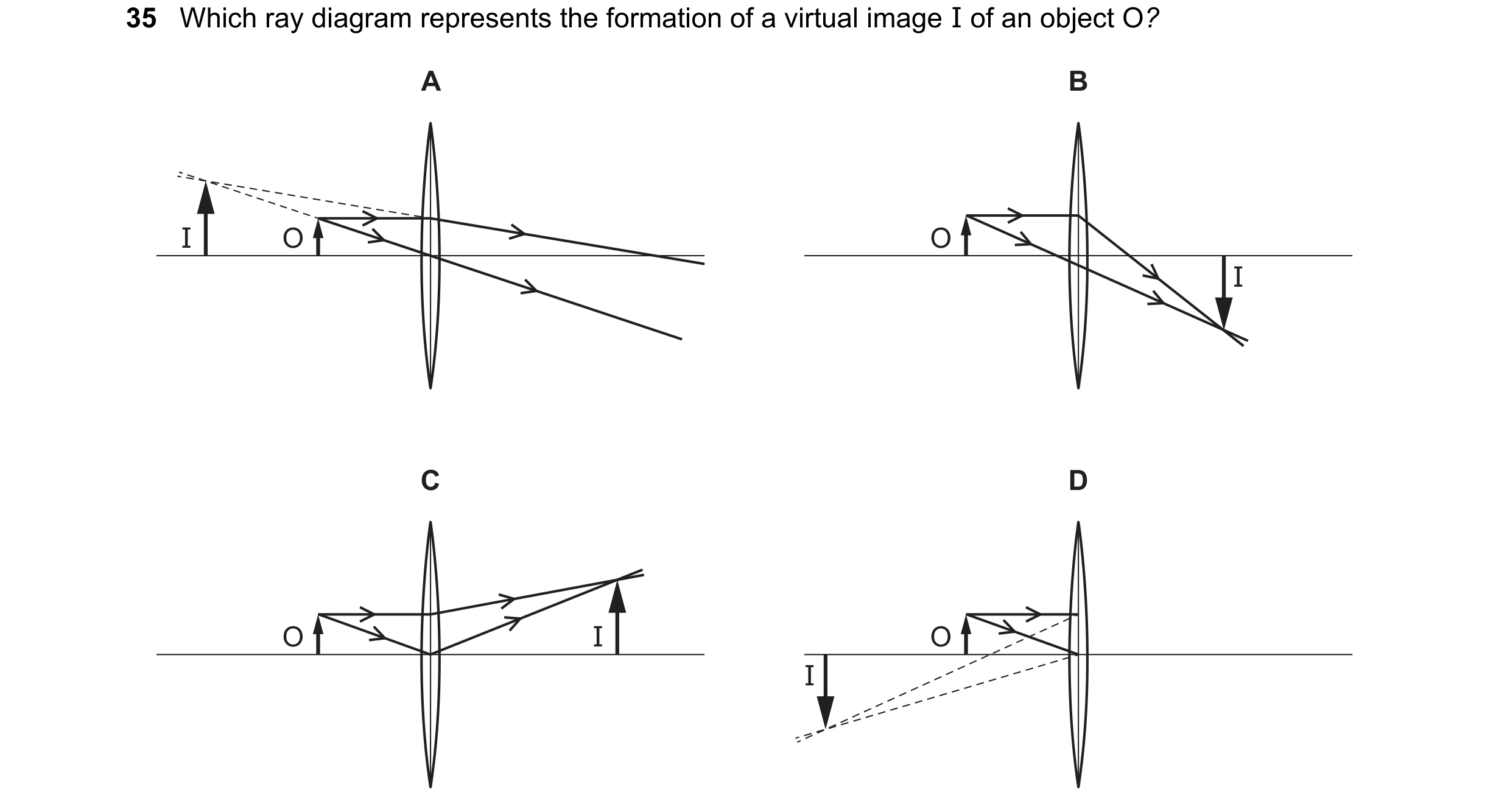
35 Which ray diagram represents the formation of a virtual image I of an object O? A B I O O I C D O I O I
1 marks
Answer: A
This question in 0654/21 May/June 2017
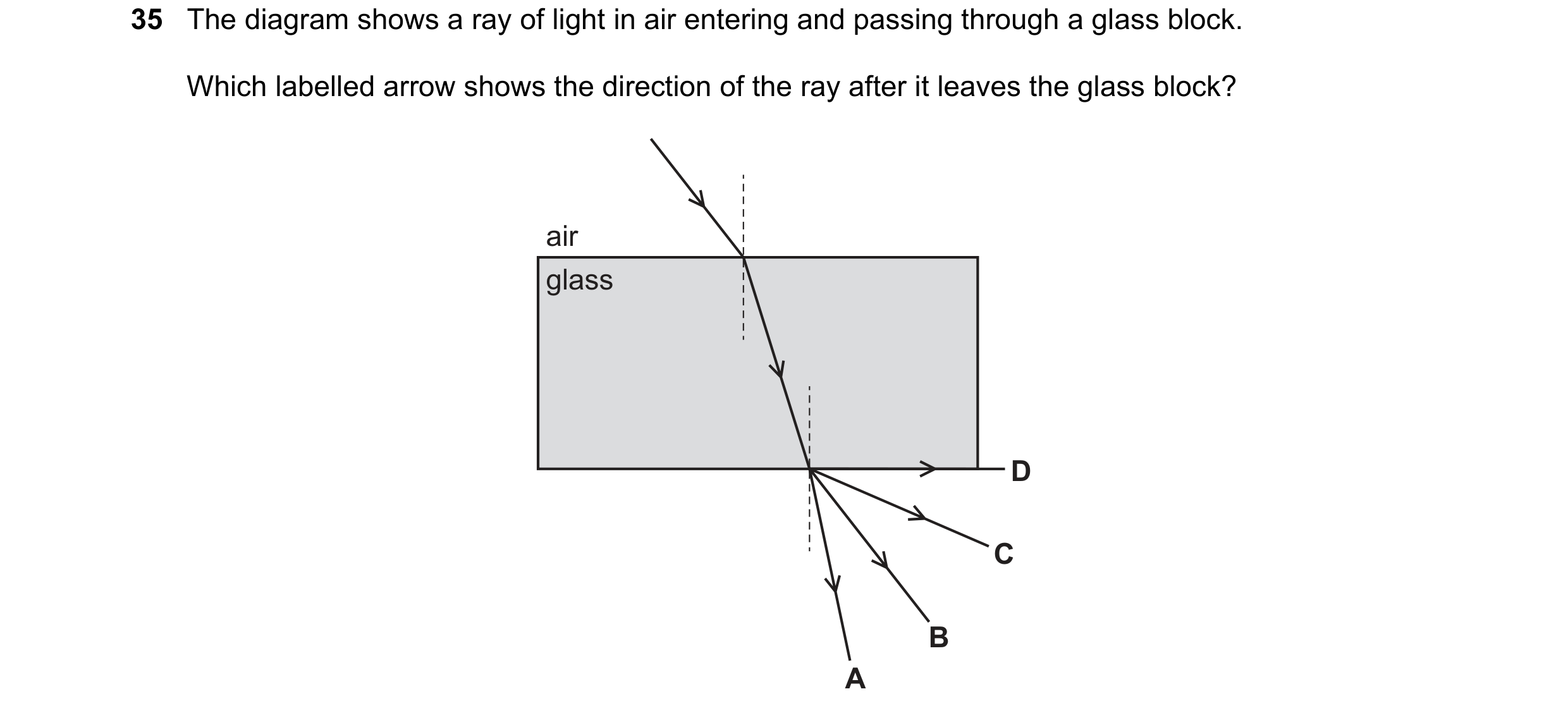
Q2 · The diagram shows a ray of light in air entering and passing through a glass block 0654/22 May/June 2017
35 The diagram shows a ray of light in air entering and passing through a glass block. Which labelled arrow shows the direction of the ray after it leaves the glass block? air glass D C B A
1 marks
Answer: B
This question in 0654/22 May/June 2017
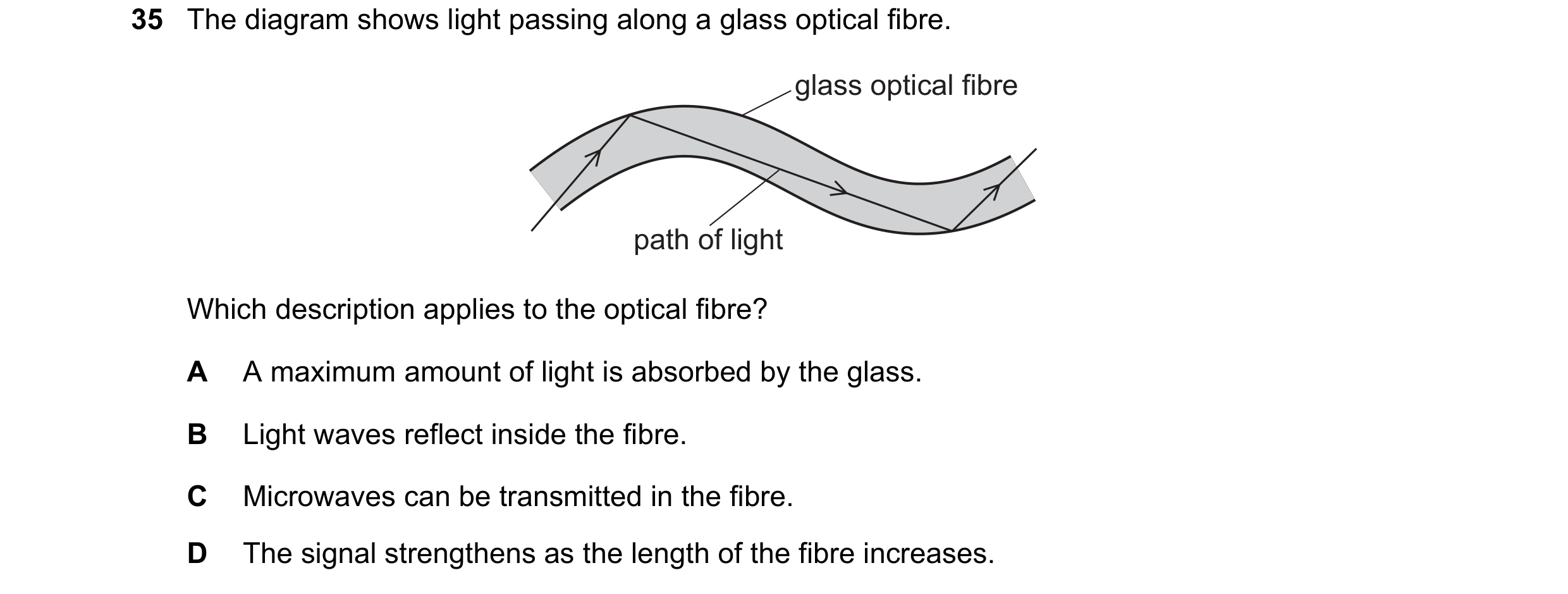
Q3 · The diagram shows light passing along a glass optical fibre 0654/23 May/June 2017
35 The diagram shows light passing along a glass optical fibre. glass optical fibre path of light Which description applies to the optical fibre? A A maximum amount of light is absorbed by the glass. B Light waves reflect inside the fibre. C Microwaves can be transmitted in the fibre. D The signal strengthens as the length of the fibre increases.
1 marks
Answer: B
This question in 0654/23 May/June 2017
Q4 · The diagram shows two rays of light that have passed from an object through a thin… 0654/21 Oct/Nov 2017
35 The diagram shows two rays of light that have passed from an object through a thin converging lens. An image is formed. object rays of light lens Which statement about the image is correct? A It is inverted and real. B It is inverted and virtual. C It is upright and real. D It is upright and virtual.
1 marks
Answer: D
This question in 0654/21 Oct/Nov 2017
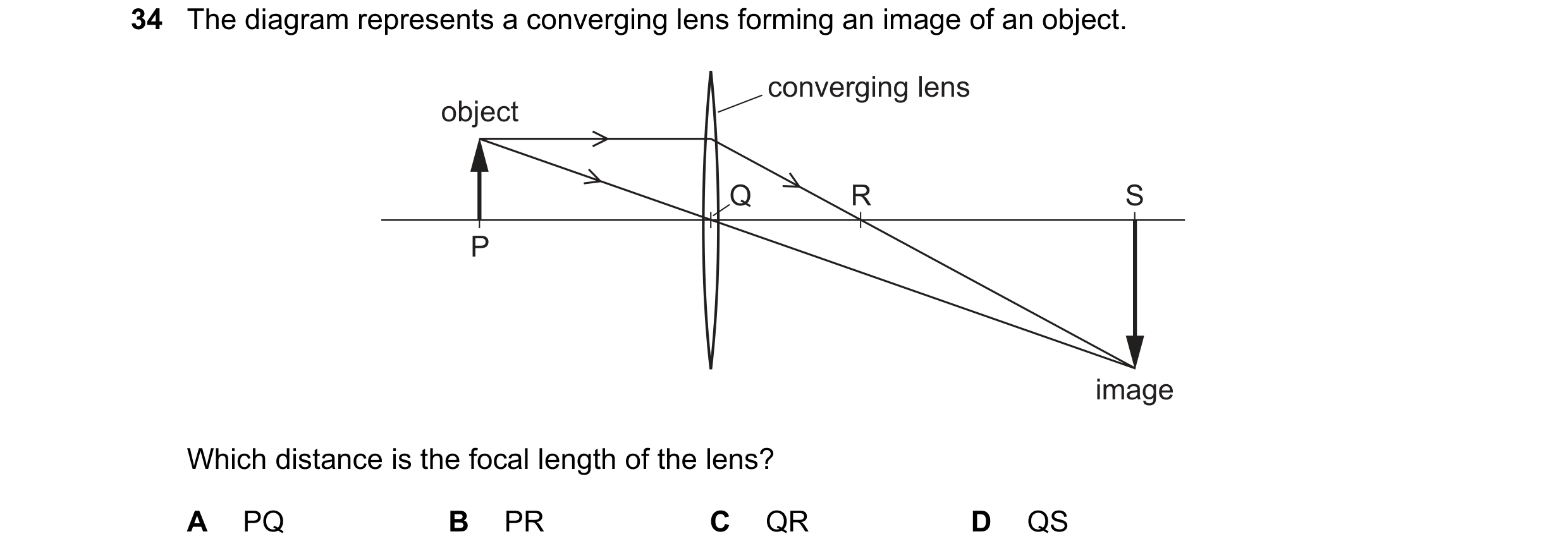
Q5 · The diagram represents a converging lens forming an image of an object 0654/22 Oct/Nov 2017
34 The diagram represents a converging lens forming an image of an object. converging lens object Q R S P image Which distance is the focal length of the lens? A PQ B PR C QR D QS
1 marks
Answer: C
This question in 0654/22 Oct/Nov 2017
Q6 · A student uses a converging lens to obtain a magnified, virtual image of an object 0654/23 Oct/Nov 2017
34 A student uses a converging lens to obtain a magnified, virtual image of an object. The object is in the position shown in the diagram. A principal focus of the lens is also shown on each side of the lens. At which labelled position is the image formed? converging lens object A B principal focus principal focus C D
1 marks
Answer: A
This question in 0654/23 Oct/Nov 2017
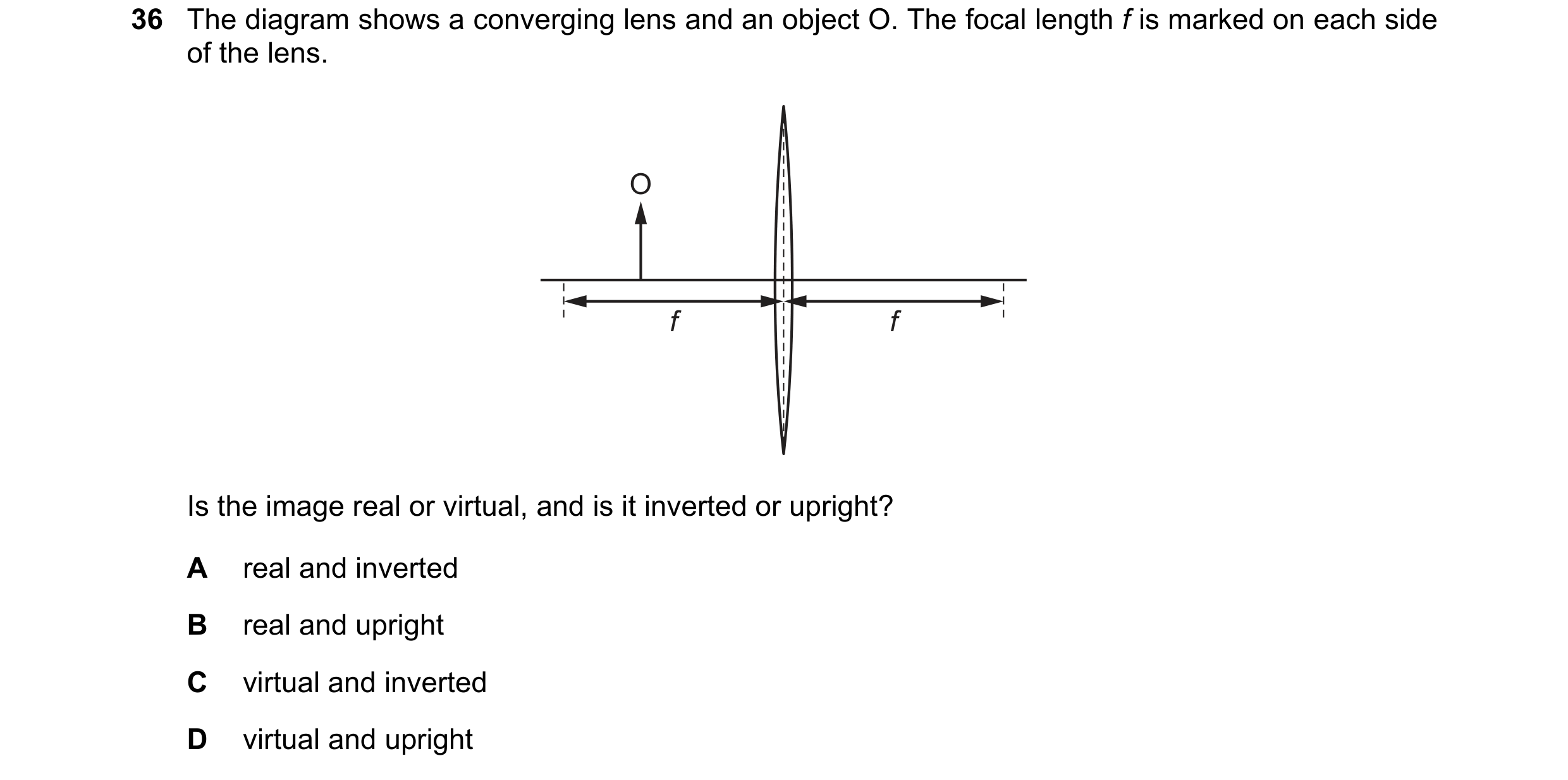
Q7 · The diagram shows a converging lens and an object O 0654/21 Oct/Nov 2018
36 The diagram shows a converging lens and an object O. The focal length f is marked on each side of the lens. O f f Is the image real or virtual, and is it inverted or upright? A real and inverted B real and upright C virtual and inverted D virtual and upright
1 marks
Answer: D
This question in 0654/21 Oct/Nov 2018
Q8 · Which diagram shows how a real image is formed by a convex lens? 0654/22 Oct/Nov 2018
34 Which diagram shows how a real image is formed by a convex lens? A B C D
1 marks
Answer: A
This question in 0654/22 Oct/Nov 2018
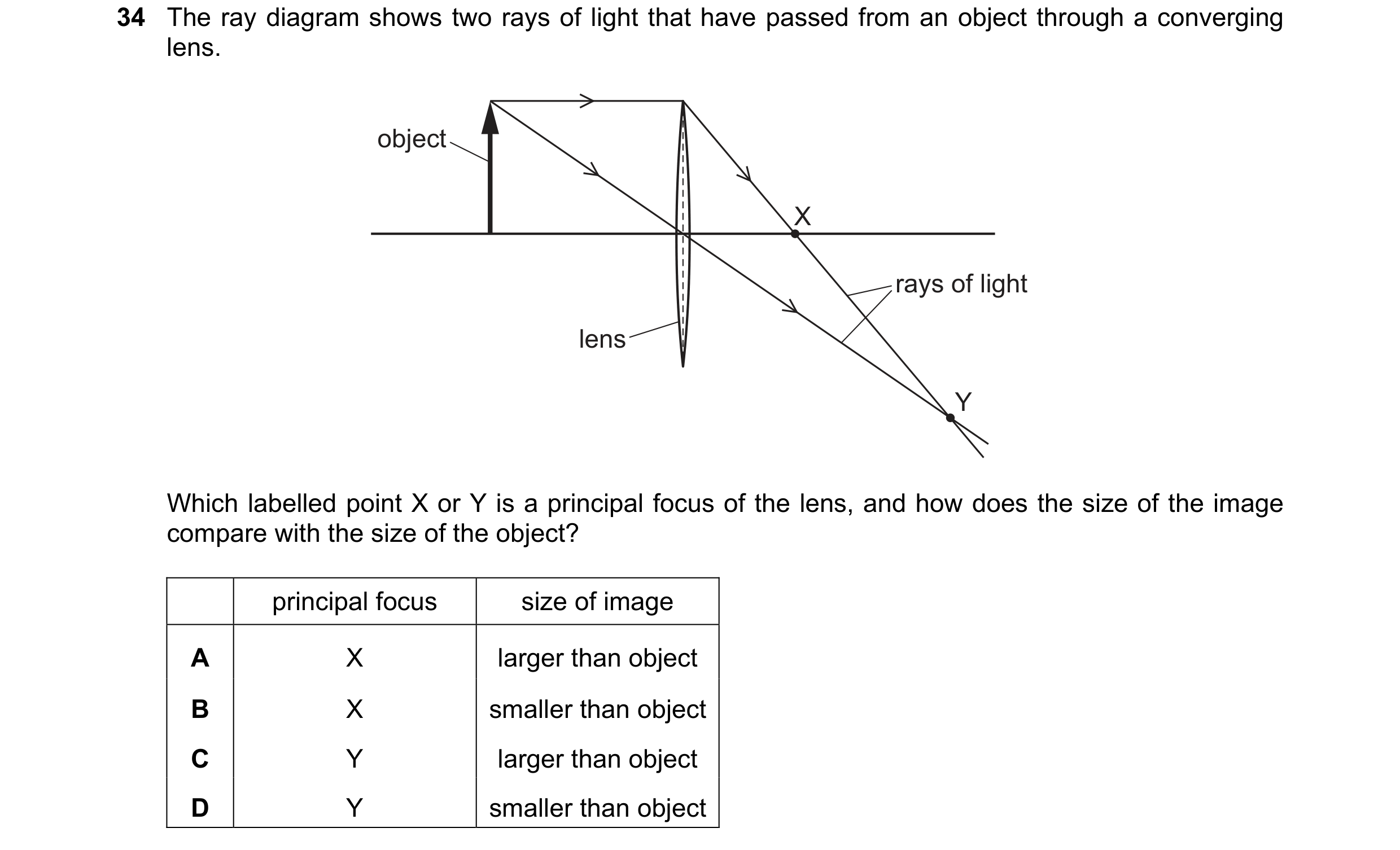
Q9 · The ray diagram shows two rays of light that have passed from an object through a… 0654/23 Oct/Nov 2018
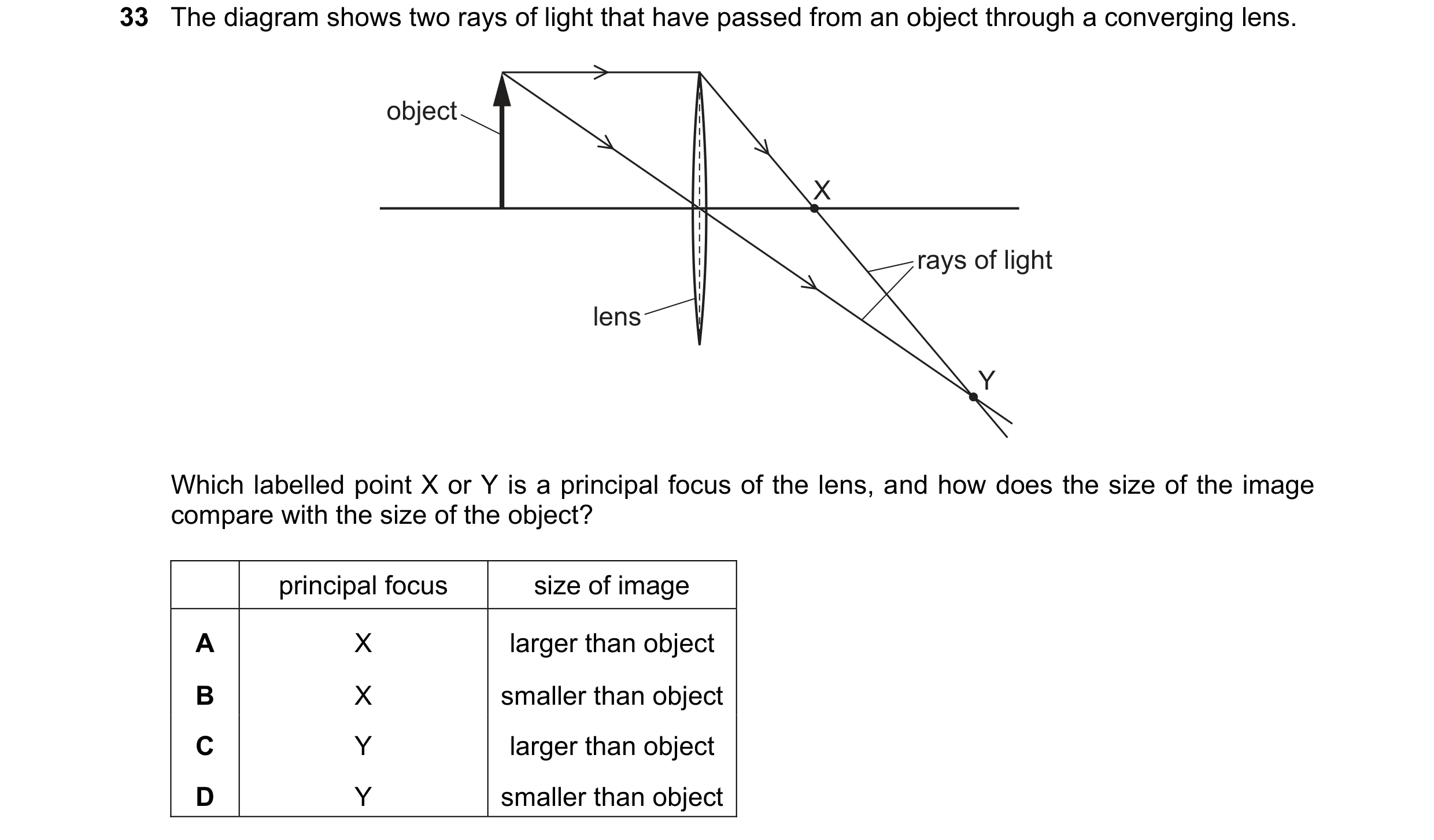
34 The ray diagram shows two rays of light that have passed from an object through a converging lens. object X rays of light lens Y Which labelled point X or Y is a principal focus of the lens, and how does the size of the image compare with the size of the object? principal focus size of image A X larger than object B X smaller than object C Y larger than object D Y smaller than object
1 marks
Answer: A
This question in 0654/23 Oct/Nov 2018
Q10 · In the diagrams, F is one principal focus of the converging lens 0654/21 May/June 2019
34 In the diagrams, F is one principal focus of the converging lens. Which diagram shows the lens being used as a magnifying glass? A B F F C D F F
1 marks
Answer: A
This question in 0654/21 May/June 2019
Q11 · A student stands in front of a plane mirror on a wall 0654/22 May/June 2019
33 A student stands in front of a plane mirror on a wall. Which statement about the image of the student is not correct? A The image is laterally inverted. B The image is smaller than the student. C The image is upright. D The student and the image are equal distances from the mirror.
1 marks
Answer: B
This question in 0654/22 May/June 2019
Q12 · A glass block is surrounded by air 0654/21 Oct/Nov 2019
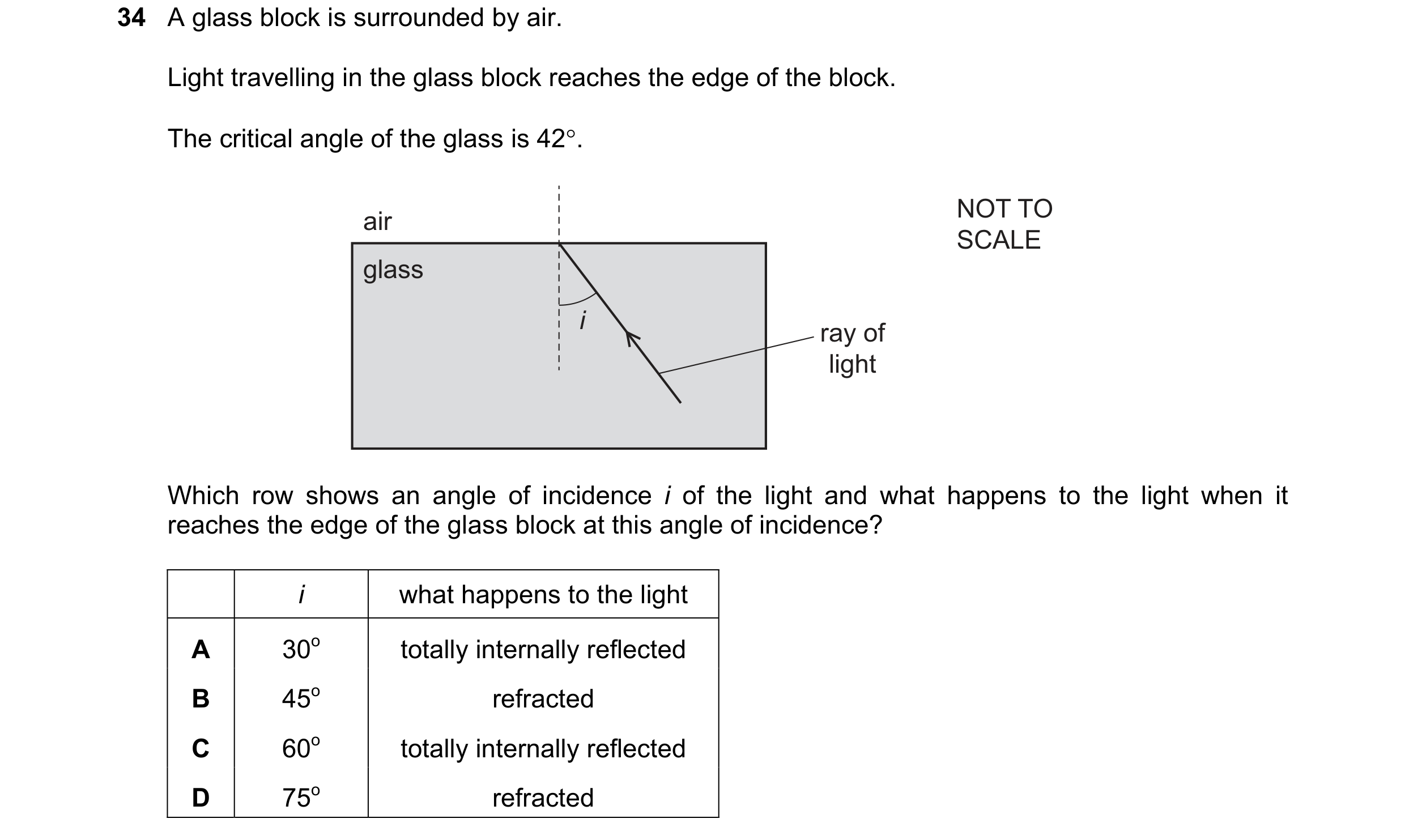
34 A glass block is surrounded by air. Light travelling in the glass block reaches the edge of the block. The critical angle of the glass is 42°. NOT TO air SCALE glass i ray of light Which row shows an angle of incidence i of the light and what happens to the light when it reaches the edge of the glass block at this angle of incidence? i what happens to the light A 30o totally internally reflected B 45o refracted C 60o totally internally reflected D 75o refracted
1 marks
Answer: C
This question in 0654/21 Oct/Nov 2019
Q13 · A glass block is surrounded by air 0654/22 Oct/Nov 2019
34 A glass block is surrounded by air. Light travelling in the glass block reaches the edge of the block. The critical angle of the glass is 42°. NOT TO air SCALE glass i ray of light Which row shows an angle of incidence i of the light and what happens to the light when it reaches the edge of the glass block at this angle of incidence? i what happens to the light A 30o totally internally reflected B 45o refracted C 60o totally internally reflected D 75o refracted
1 marks
Answer: C
This question in 0654/22 Oct/Nov 2019
Q14 · A glass block is surrounded by air 0654/23 Oct/Nov 2019
32 A glass block is surrounded by air. Light travelling in the glass block reaches the edge of the block. The critical angle of the glass is 42°. NOT TO air SCALE glass i ray of light Which row shows an angle of incidence i of the light and what happens to the light when it reaches the edge of the glass block at this angle of incidence? i what happens to the light A 30o totally internally reflected B 45o refracted C 60o totally internally reflected D 75o refracted
1 marks
Answer: C
This question in 0654/23 Oct/Nov 2019
Q15 · Which statement about real and virtual images formed by a thin converging lens is correct? 0654/23 Oct/Nov 2019
33 Which statement about real and virtual images formed by a thin converging lens is correct? A All real images are enlarged and inverted. B All real images can be produced on a screen. C All virtual images are diminished and upright. D All virtual images can be produced on a screen.
1 marks
Answer: B
This question in 0654/23 Oct/Nov 2019
Q16 · Which ray diagram represents the formation of a virtual image I of an object O? 0654/21 May/June 2020
35 Which ray diagram represents the formation of a virtual image I of an object O? A B I O O I C D O I O I
1 marks
Answer: A
This question in 0654/21 May/June 2020
Q17 · The diagram shows light passing through a plastic block 0654/22 May/June 2020
33 The diagram shows light passing through a plastic block. 55° plastic block 40° 40° 55° What is the refractive index of the plastic? A 0.73 B 0.78 C 1.27 D 1.38
1 marks
Answer: C
This question in 0654/22 May/June 2020
Q18 · Which ray diagram represents the formation of a virtual image I of an object O? 0654/22 May/June 2020
34 Which ray diagram represents the formation of a virtual image I of an object O? A B I O O I C D O I O I
1 marks
Answer: A
This question in 0654/22 May/June 2020
Q19 · Which ray diagram represents the formation of a virtual image I of an object O? 0654/23 May/June 2020
34 Which ray diagram represents the formation of a virtual image I of an object O? A B I O O I C D O I O I
1 marks
Answer: A
This question in 0654/23 May/June 2020
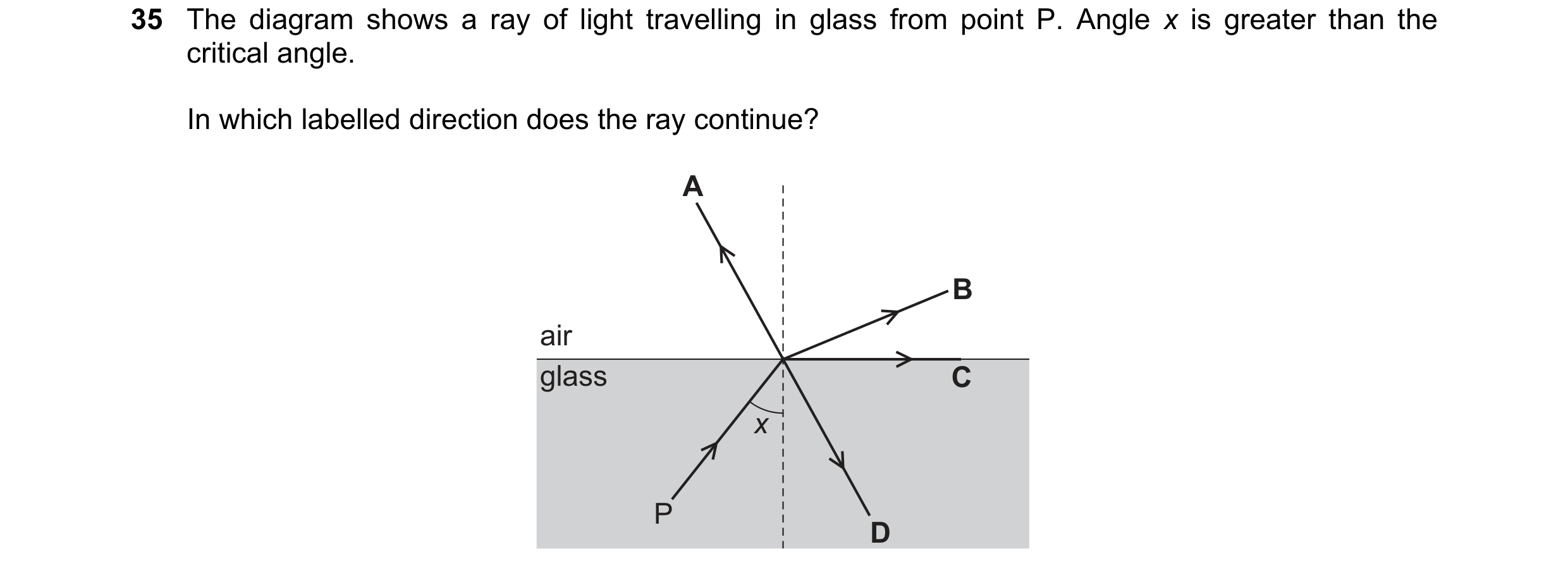
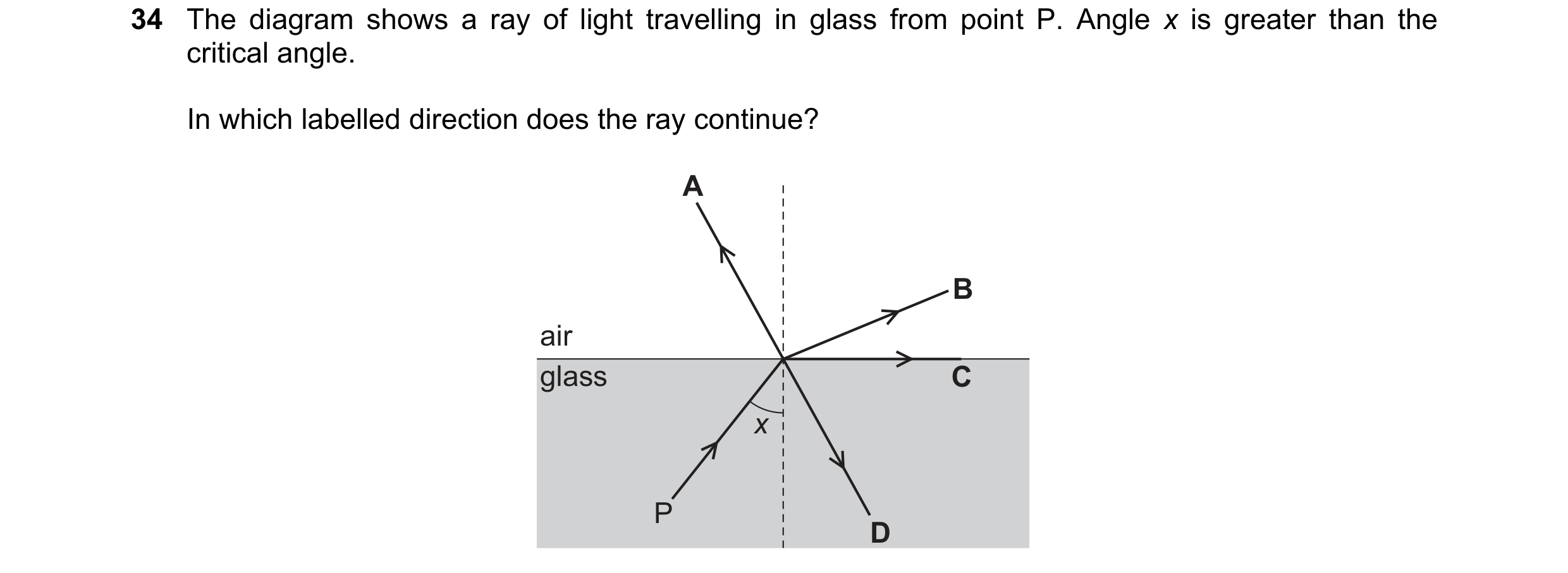
Q20 · The diagram shows a ray of light travelling in glass from point P 0654/21 Oct/Nov 2020
35 The diagram shows a ray of light travelling in glass from point P. Angle x is greater than the critical angle. In which labelled direction does the ray continue? A B air glass C x P D
1 marks
Answer: D
This question in 0654/21 Oct/Nov 2020
Q21 · The diagram shows a ray of light travelling in glass from point P 0654/22 Oct/Nov 2020
34 The diagram shows a ray of light travelling in glass from point P. Angle x is greater than the critical angle. In which labelled direction does the ray continue? A B air glass C x P D
1 marks
Answer: D
This question in 0654/22 Oct/Nov 2020
Q22 · The diagram shows a ray of light travelling in glass from point P 0654/23 Oct/Nov 2020
34 The diagram shows a ray of light travelling in glass from point P. Angle x is greater than the critical angle. In which labelled direction does the ray continue? A B air glass C x P D
1 marks
Answer: D
This question in 0654/23 Oct/Nov 2020
Q23 · The diagram shows two rays of light that have passed from an object through a converging… 0654/22 Feb/March 2021
33 The diagram shows two rays of light that have passed from an object through a converging lens. object X rays of light lens Y Which labelled point X or Y is a principal focus of the lens, and how does the size of the image compare with the size of the object? principal focus size of image A X larger than object B X smaller than object C Y larger than object D Y smaller than object
1 marks
Answer: A
This question in 0654/22 Feb/March 2021
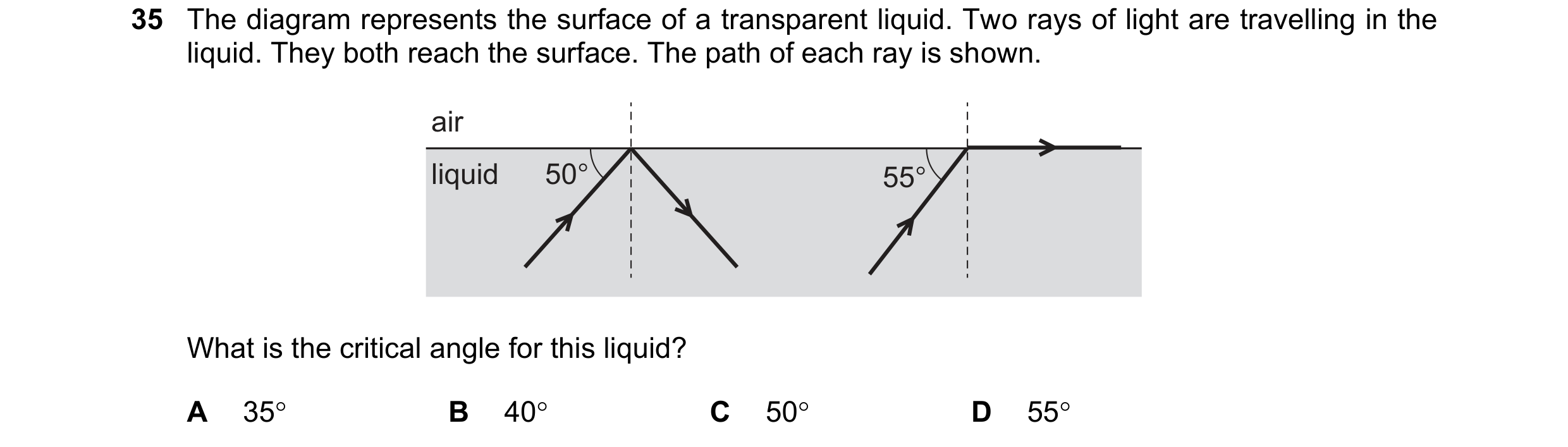
Q24 · The diagram represents the surface of a transparent liquid 0654/21 May/June 2021
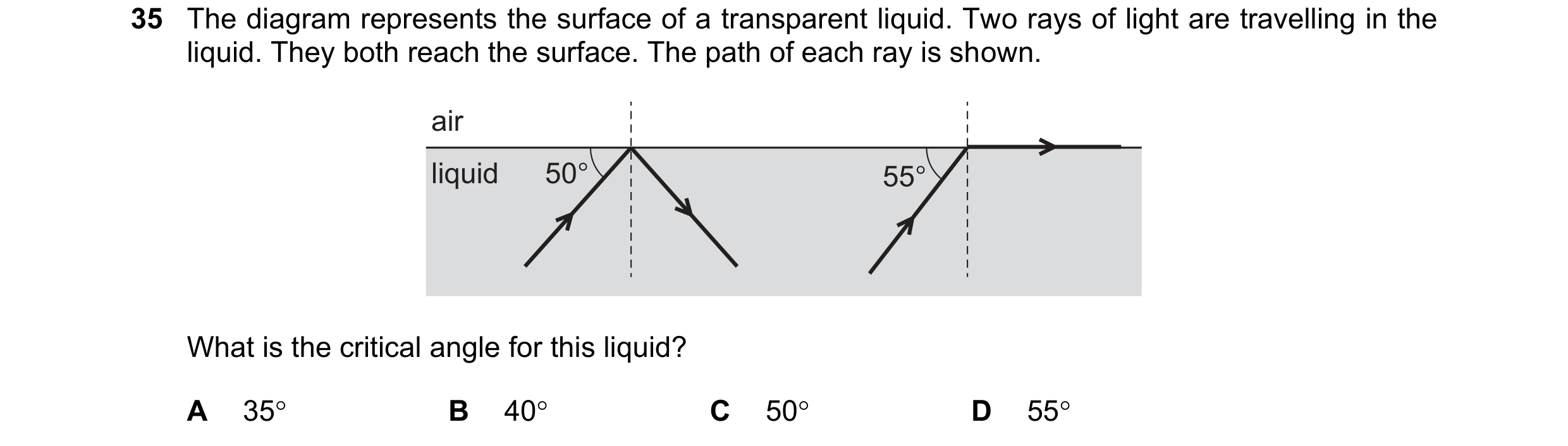
35 The diagram represents the surface of a transparent liquid. Two rays of light are travelling in the liquid. They both reach the surface. The path of each ray is shown. air liquid 50° 55° What is the critical angle for this liquid? A 35 B 40 C 50 D 55
1 marks
Answer: A
This question in 0654/21 May/June 2021
Q25 · The diagram represents the surface of a transparent liquid 0654/22 May/June 2021
35 The diagram represents the surface of a transparent liquid. Two rays of light are travelling in the liquid. They both reach the surface. The path of each ray is shown. air liquid 50° 55° What is the critical angle for this liquid? A 35 B 40 C 50 D 55
1 marks
Answer: A
This question in 0654/22 May/June 2021
Q26 · A boy stands 3.0 m in front of a plane mirror 0654/23 May/June 2021
34 A boy stands 3.0 m in front of a plane mirror. He sees his image formed by the mirror. The boy moves 1.0 m closer to the mirror. How much closer is the boy to his image now? A 0.50 m B 1.0 m C 2.0 m D 4.0 m
1 marks
Answer: C
This question in 0654/23 May/June 2021
Q27 · The diagram represents the surface of a transparent liquid 0654/23 May/June 2021
35 The diagram represents the surface of a transparent liquid. Two rays of light are travelling in the liquid. They both reach the surface. The path of each ray is shown. air liquid 50° 55° What is the critical angle for this liquid? A 35 B 40 C 50 D 55
1 marks
Answer: A
This question in 0654/23 May/June 2021
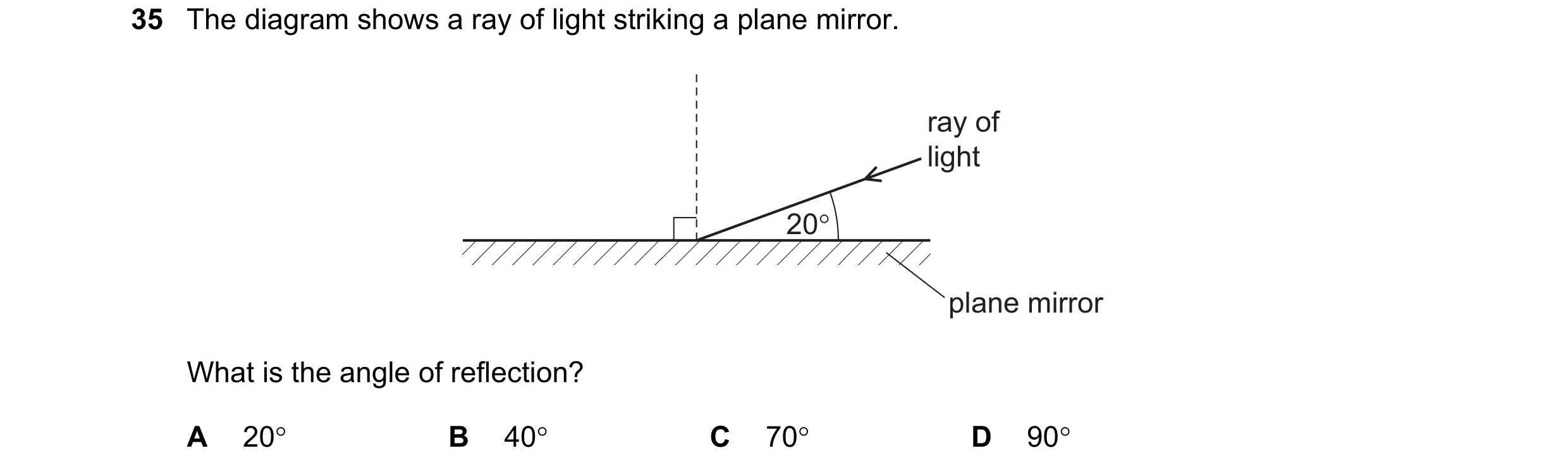
Q28 · The diagram shows a ray of light striking a plane mirror 0654/21 Oct/Nov 2021
35 The diagram shows a ray of light striking a plane mirror. ray of light 20° plane mirror What is the angle of reflection? A 20 B 40 C 70 D 90
1 marks
Answer: C
This question in 0654/21 Oct/Nov 2021
Q29 · Which diagram shows a converging lens forming a real image of an object O? 0654/21 Oct/Nov 2021
36 Which diagram shows a converging lens forming a real image of an object O? A B O O C D O O
1 marks
Answer: C
This question in 0654/21 Oct/Nov 2021
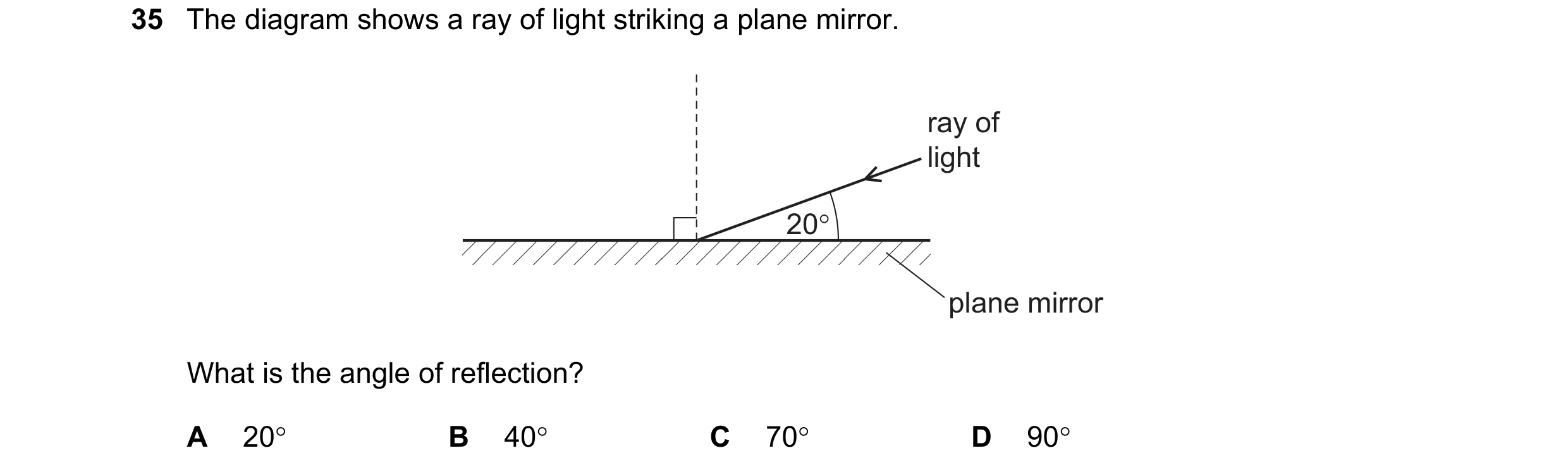
Q30 · The diagram shows a ray of light striking a plane mirror 0654/22 Oct/Nov 2021
35 The diagram shows a ray of light striking a plane mirror. ray of light 20° plane mirror What is the angle of reflection? A 20 B 40 C 70 D 90
1 marks
Answer: C
This question in 0654/22 Oct/Nov 2021
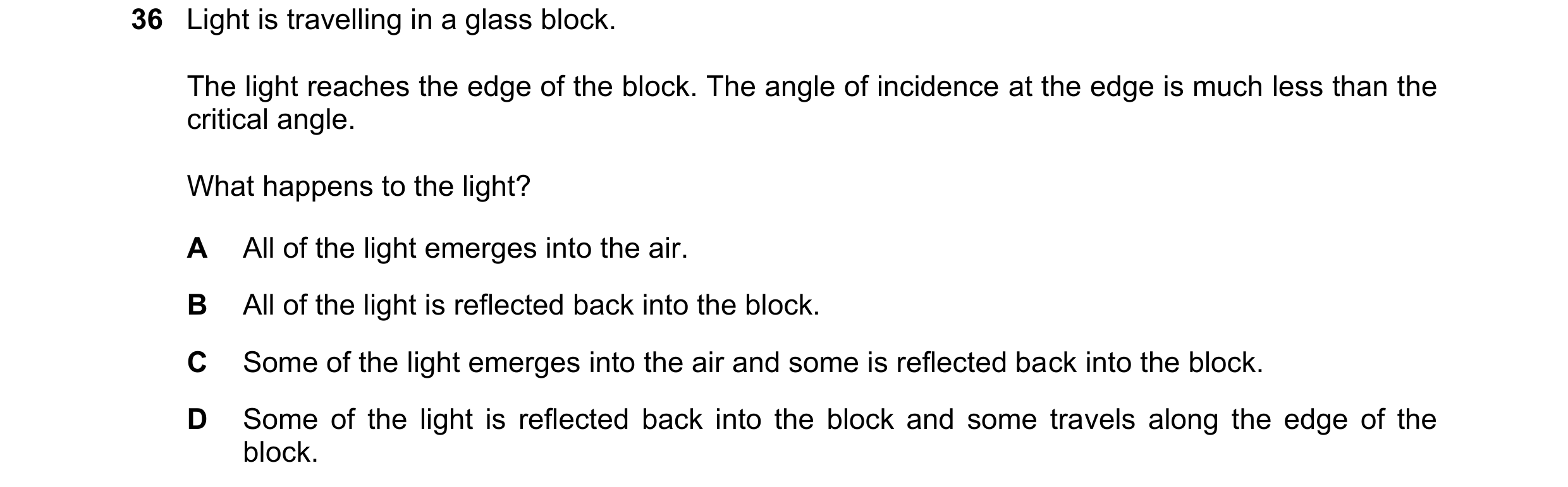
Q31 · Light is travelling in a glass block 0654/22 Oct/Nov 2021
36 Light is travelling in a glass block. The light reaches the edge of the block. The angle of incidence at the edge is much less than the critical angle. What happens to the light? A All of the light emerges into the air. B All of the light is reflected back into the block. C Some of the light emerges into the air and some is reflected back into the block. D Some of the light is reflected back into the block and some travels along the edge of the block.
1 marks
Answer: C
This question in 0654/22 Oct/Nov 2021
Q32 · The diagram shows a ray of light striking a plane mirror 0654/23 Oct/Nov 2021
34 The diagram shows a ray of light striking a plane mirror. ray of light 20° plane mirror What is the angle of reflection? A 20 B 40 C 70 D 90
1 marks
Answer: C
This question in 0654/23 Oct/Nov 2021
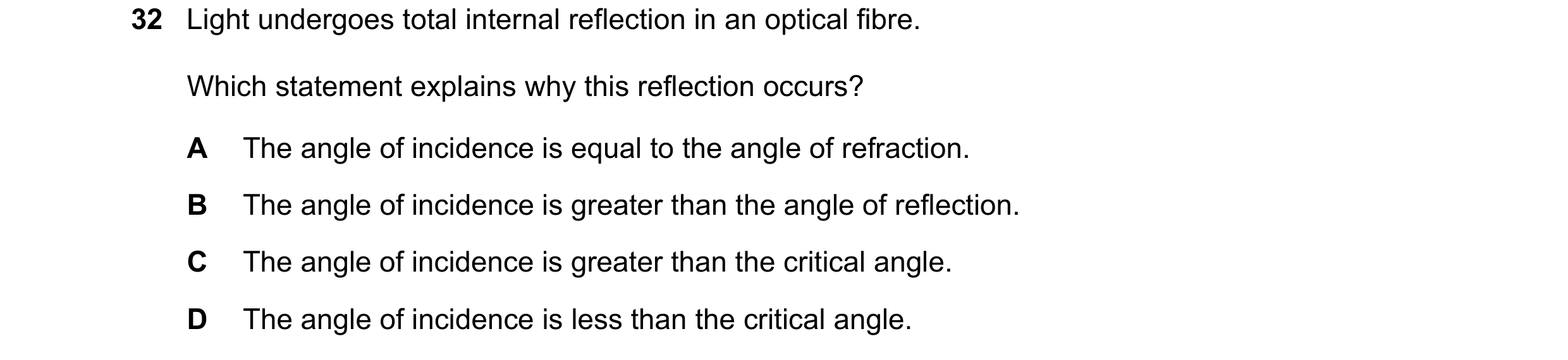
Q33 · Light undergoes total internal reflection in an optical fibre 0654/22 Feb/March 2022
32 Light undergoes total internal reflection in an optical fibre. Which statement explains why this reflection occurs? A The angle of incidence is equal to the angle of refraction. B The angle of incidence is greater than the angle of reflection. C The angle of incidence is greater than the critical angle. D The angle of incidence is less than the critical angle.
1 marks
Answer: C
This question in 0654/22 Feb/March 2022
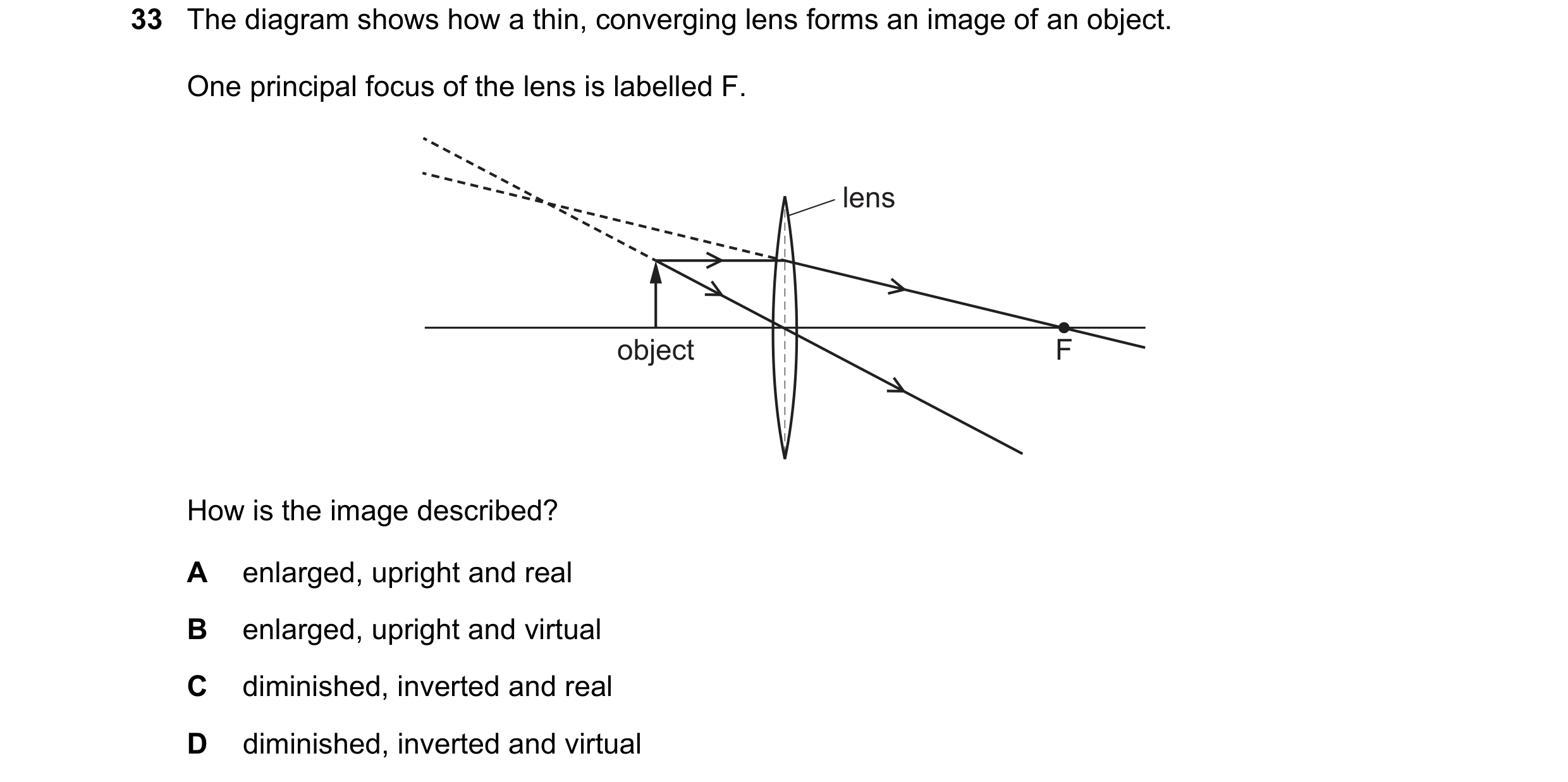
Q34 · The diagram shows how a thin, converging lens forms an image of an object 0654/21 May/June 2022
33 The diagram shows how a thin, converging lens forms an image of an object. One principal focus of the lens is labelled F. lens object F How is the image described? A enlarged, upright and real B enlarged, upright and virtual C diminished, inverted and real D diminished, inverted and virtual
1 marks
Answer: B
This question in 0654/21 May/June 2022
Q35 · Light enters a glass block at an angle of incidence of 41 0654/22 May/June 2022
34 Light enters a glass block at an angle of incidence of 41. The light bends toward the normal. The angle between the refracted ray and the glass-air boundary is 62. glass 62° air 41° Which expression is equal to the refractive index of the glass? sin 41 sin 41 sin 49 sin 49 A B C D sin 28 sin 62 sin 28 sin 62
1 marks
Answer: A
This question in 0654/22 May/June 2022
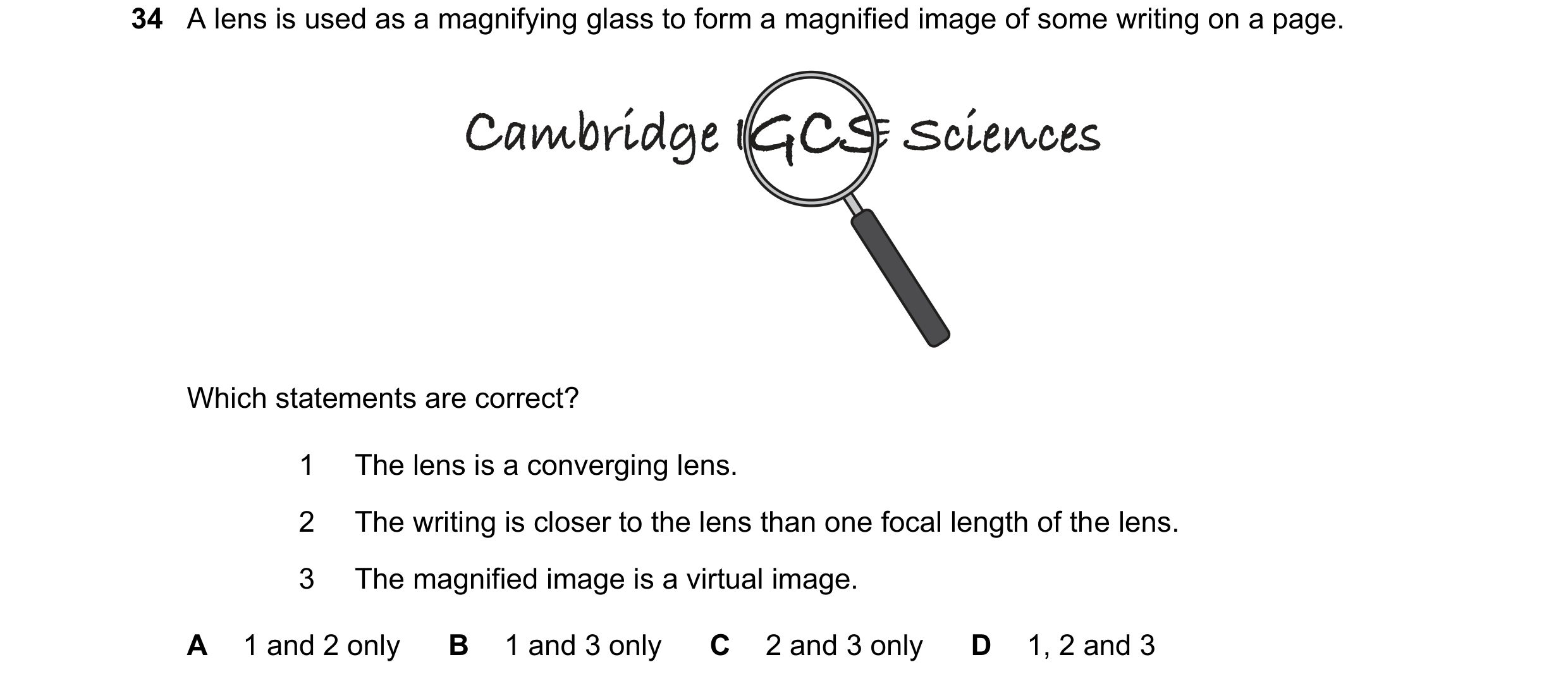
Q36 · A lens is used as a magnifying glass to form a magnified image of some writing on a page 0654/23 May/June 2022
34 A lens is used as a magnifying glass to form a magnified image of some writing on a page. ambridge I E Sciences Which statements are correct? 1 The lens is a converging lens. 2 The writing is closer to the lens than one focal length of the lens. 3 The magnified image is a virtual image. A 1 and 2 only B 1 and 3 only C 2 and 3 only D 1, 2 and 3
1 marks
Answer: D
This question in 0654/23 May/June 2022
Q37 · The critical angle for diamond in air is 25 0654/21 Oct/Nov 2022
34 The critical angle for diamond in air is 25. Light travels faster in air than in diamond. Which diagram shows the path of light passing from diamond into air? A B air air diamond diamond 30° 20° C D air air diamond diamond 30° 20°
1 marks
Answer: D
This question in 0654/21 Oct/Nov 2022
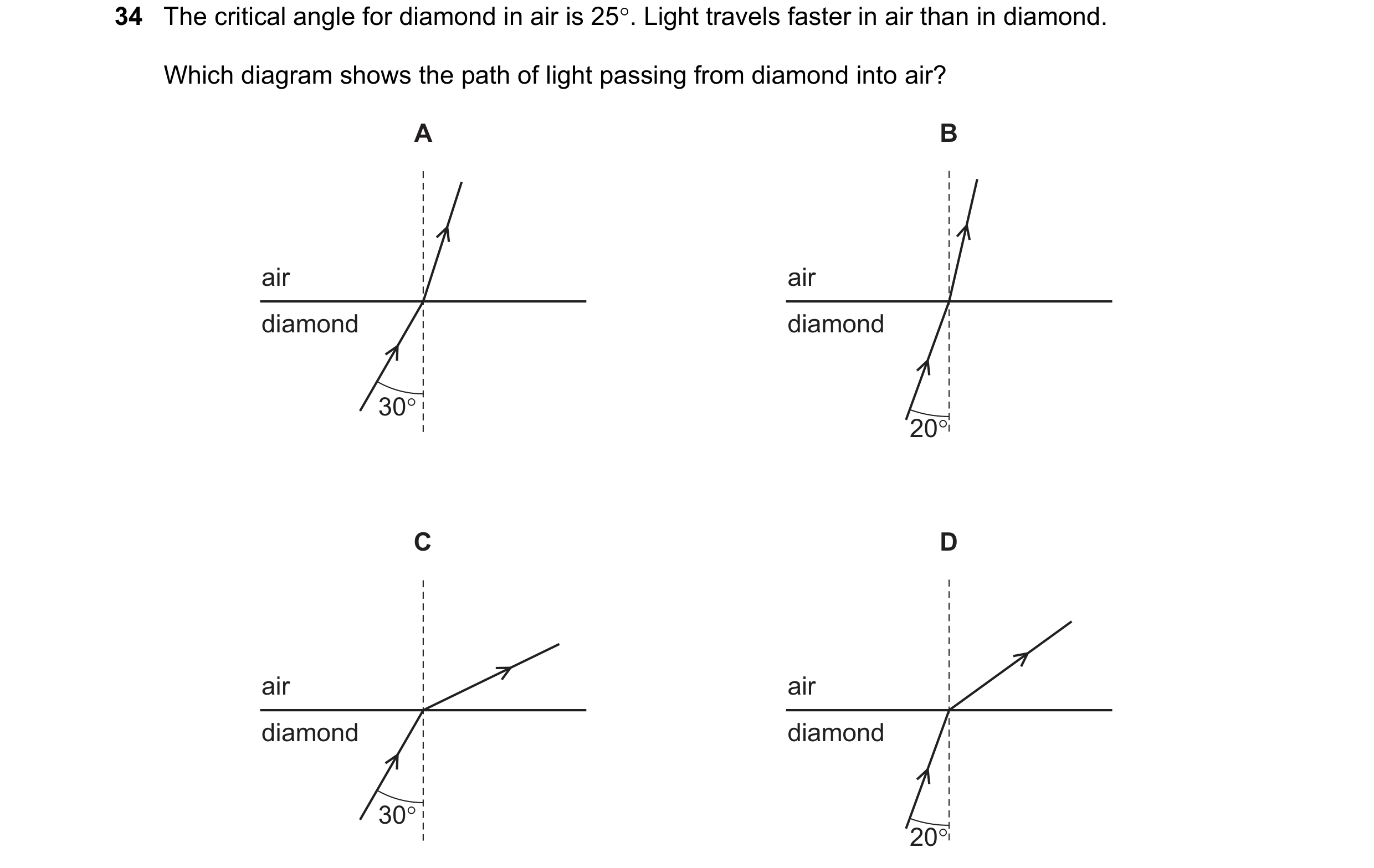
Q38 · The critical angle for diamond in air is 25 0654/22 Oct/Nov 2022
34 The critical angle for diamond in air is 25. Light travels faster in air than in diamond. Which diagram shows the path of light passing from diamond into air? A B air air diamond diamond 30° 20° C D air air diamond diamond 30° 20°
1 marks
Answer: D
This question in 0654/22 Oct/Nov 2022
Q39 · The critical angle for diamond in air is 25° 0654/23 Oct/Nov 2022
34 The critical angle for diamond in air is 25°. Light travels faster in air than in diamond. Which diagram shows the path of light passing from diamond into air? A B air air diamond diamond 30° 20° C D air air diamond diamond 30° 20°
1 marks
Answer: D
This question in 0654/23 Oct/Nov 2022
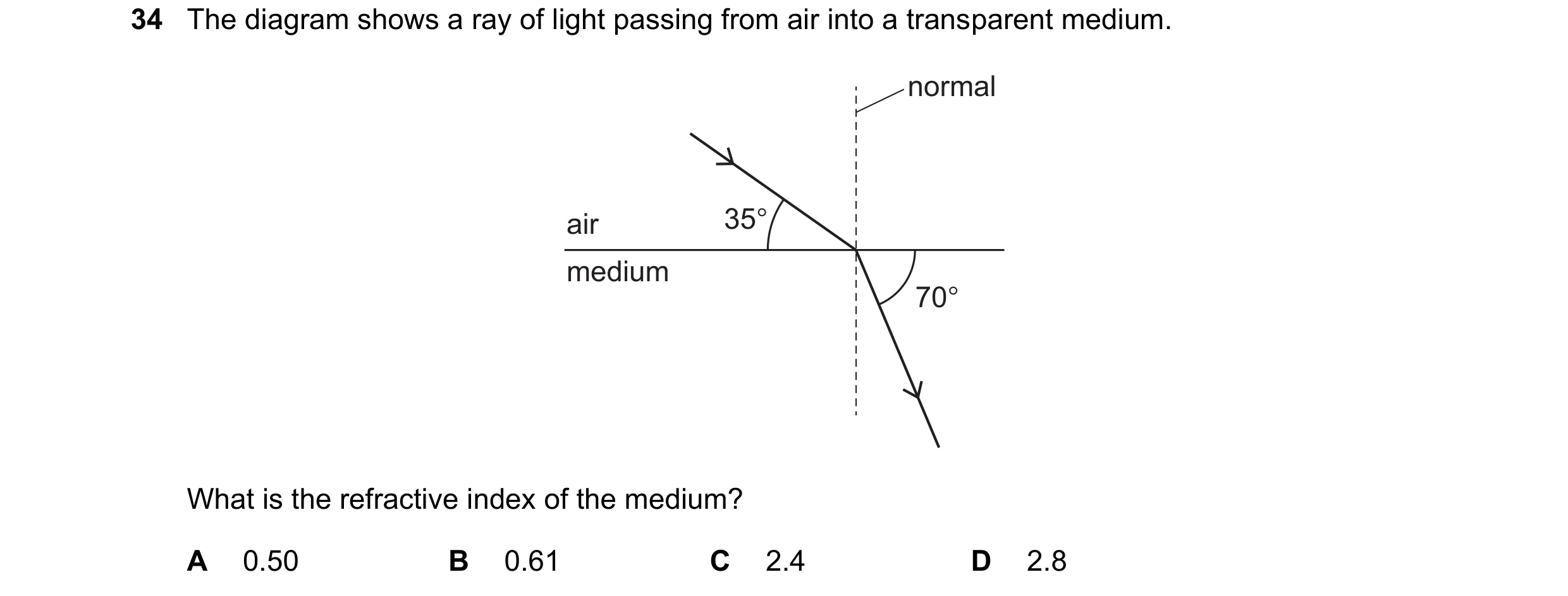
Q40 · The diagram shows a ray of light passing from air into a transparent medium 0654/22 Feb/March 2023
34 The diagram shows a ray of light passing from air into a transparent medium. normal air 35° medium 70° What is the refractive index of the medium? A 0.50 B 0.61 C 2.4 D 2.8
1 marks
Answer: C
This question in 0654/22 Feb/March 2023
Q41 · A student stands in front of a plane mirror on a wall 0654/21 May/June 2023
32 A student stands in front of a plane mirror on a wall. Which statement about the image of the student is not correct? A The image is laterally inverted (left to right). B The image is smaller than the student. C The image is upright. D The student and the image are equal distances from the mirror.
1 marks
Answer: B
This question in 0654/21 May/June 2023
Q42 · The diagram shows a ray of light passing from air into plastic 0654/21 May/June 2023
34 The diagram shows a ray of light passing from air into plastic. The sizes of four angles are given. 30° 60° air plastic 72° 18° The table gives the value of the sine of each angle. angle / sine 18 0.31 30 0.50 60 0.87 72 0.95 What is the refractive index of the plastic? A 0.62 B 0.92 C 1.6 D 1.7
1 marks
Answer: C
This question in 0654/21 May/June 2023
Q43 · An object is placed in front of a plane mirror on a wall 0654/22 May/June 2023
34 An object is placed in front of a plane mirror on a wall. What are the characteristics of the image formed? A same size as object and inverted top to bottom B same size as object and laterally inverted (left to right) C smaller than object and inverted top to bottom D smaller than object and laterally inverted (left to right)
1 marks
Answer: B
This question in 0654/22 May/June 2023
Q44 · A ray of light in air enters glass at an angle of incidence of 34 0654/22 May/June 2023
35 A ray of light in air enters glass at an angle of incidence of 34. The refractive index of glass is 1.5. What is the angle of refraction of the ray of light in the glass? A 22 B 24 C 56 D 57
1 marks
Answer: A
This question in 0654/22 May/June 2023
Q45 · Light passes from air through a solid glass block and back into the air 0654/23 May/June 2023
34 Light passes from air through a solid glass block and back into the air. Which diagram shows the path of the light? A B glass glass block block C D glass glass block block
1 marks
Answer: A
This question in 0654/23 May/June 2023
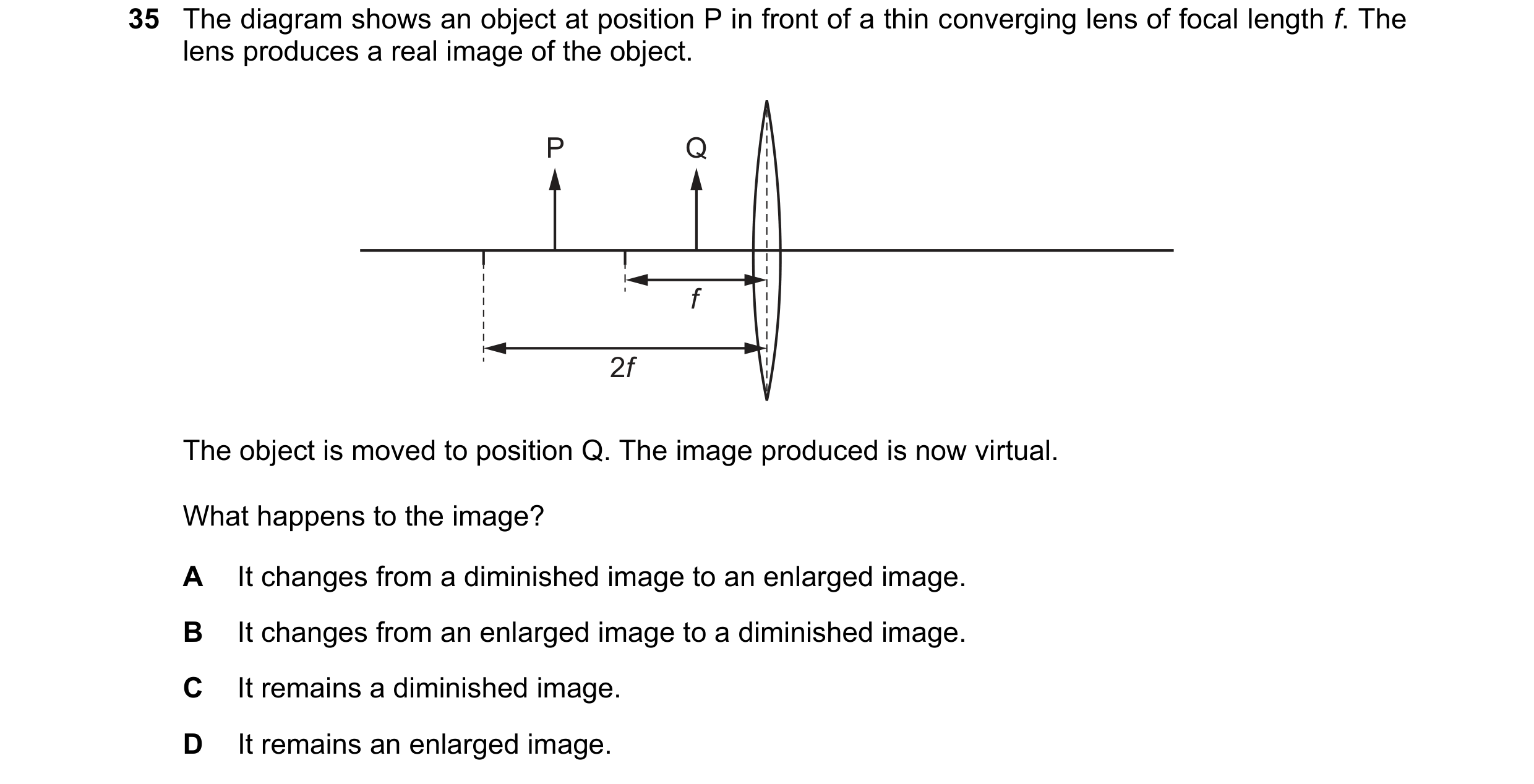
Q46 · The diagram shows an object at position P in front of a thin converging lens of focal… 0654/23 May/June 2023
35 The diagram shows an object at position P in front of a thin converging lens of focal length f. The lens produces a real image of the object. P Q f 2f The object is moved to position Q. The image produced is now virtual. What happens to the image? A It changes from a diminished image to an enlarged image. B It changes from an enlarged image to a diminished image. C It remains a diminished image. D It remains an enlarged image.
1 marks
Answer: D
This question in 0654/23 May/June 2023
Q47 · When light passes from air into glass its speed decreases but its frequency remains… 0654/21 Oct/Nov 2023
34 When light passes from air into glass its speed decreases but its frequency remains constant. Light travelling in air enters a glass block at an angle of incidence that is greater than 0. Which row describes what happens to the direction and what happens to the wavelength of the light? direction wavelength A moves away from the normal decreases B moves away from the normal increases C moves towards the normal decreases D moves towards the normal increases
1 marks
Answer: C
This question in 0654/21 Oct/Nov 2023
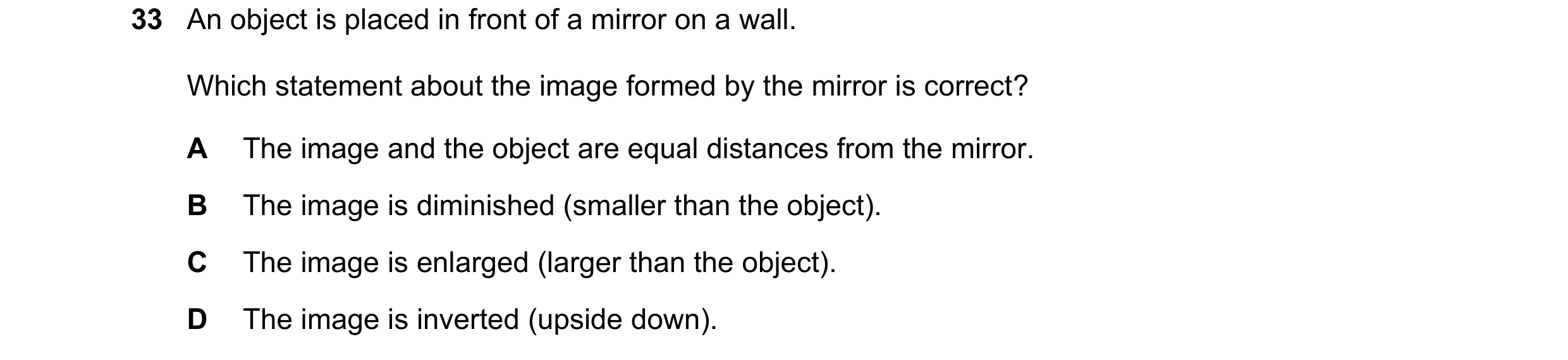
Q48 · An object is placed in front of a mirror on a wall 0654/22 Feb/March 2024
33 An object is placed in front of a mirror on a wall. Which statement about the image formed by the mirror is correct? A The image and the object are equal distances from the mirror. B The image is diminished (smaller than the object). C The image is enlarged (larger than the object). D The image is inverted (upside down).
1 marks
Answer: A
This question in 0654/22 Feb/March 2024
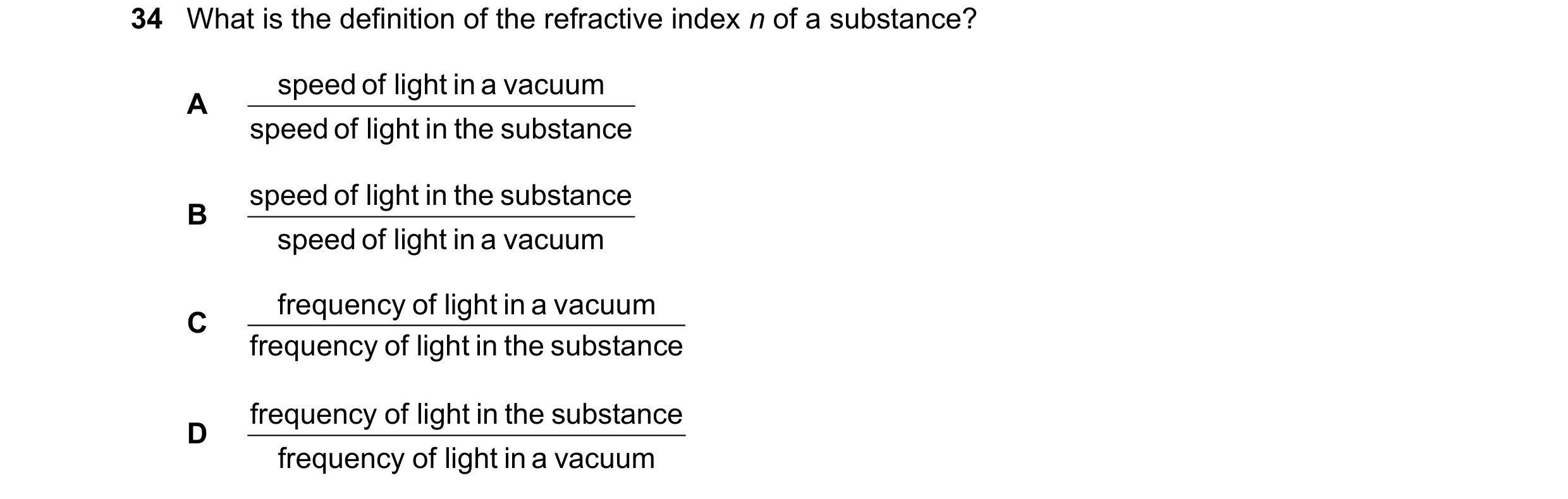
Q49 · What is the definition of the refractive index n of a substance? 0654/22 Feb/March 2024
34 What is the definition of the refractive index n of a substance? speed of light in a vacuum A speed of light in the substance speed of light in the substance B speed of light in a vacuum frequency of light in a vacuum C frequency of light in the substance frequency of light in the substance D frequency of light in a vacuum
1 marks
Answer: A
This question in 0654/22 Feb/March 2024
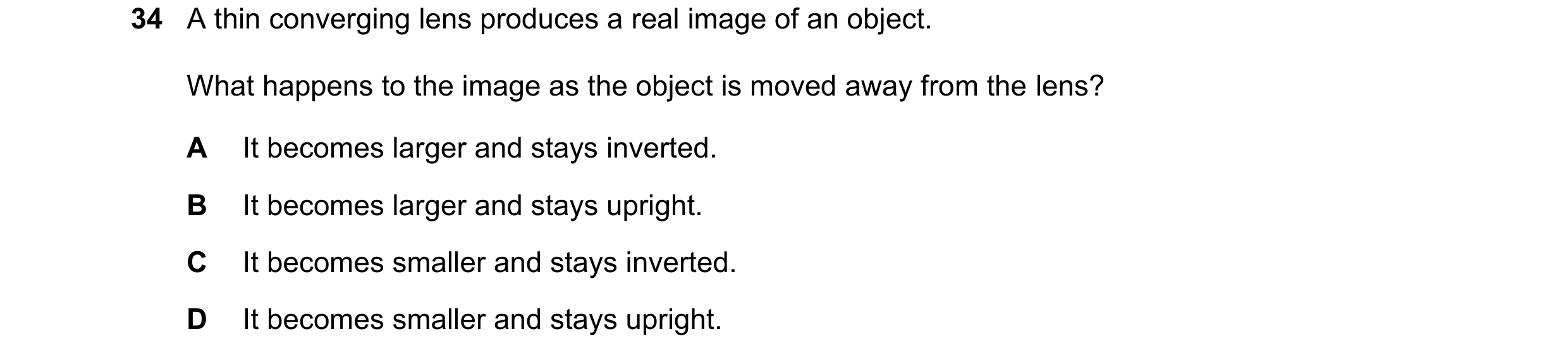
Q50 · A thin converging lens produces a real image of an object 0654/21 May/June 2024
34 A thin converging lens produces a real image of an object. What happens to the image as the object is moved away from the lens? A It becomes larger and stays inverted. B It becomes larger and stays upright. C It becomes smaller and stays inverted. D It becomes smaller and stays upright.
1 marks
Answer: C
This question in 0654/21 May/June 2024
Q51 · A plane mirror is fixed to a vertical wall and forms an image of an object 0654/22 May/June 2024
34 A plane mirror is fixed to a vertical wall and forms an image of an object. What are the characteristics of the image? A enlarged and upright B enlarged and inverted C same size as the object and upright D same size as the object and inverted
1 marks
Answer: C
This question in 0654/22 May/June 2024
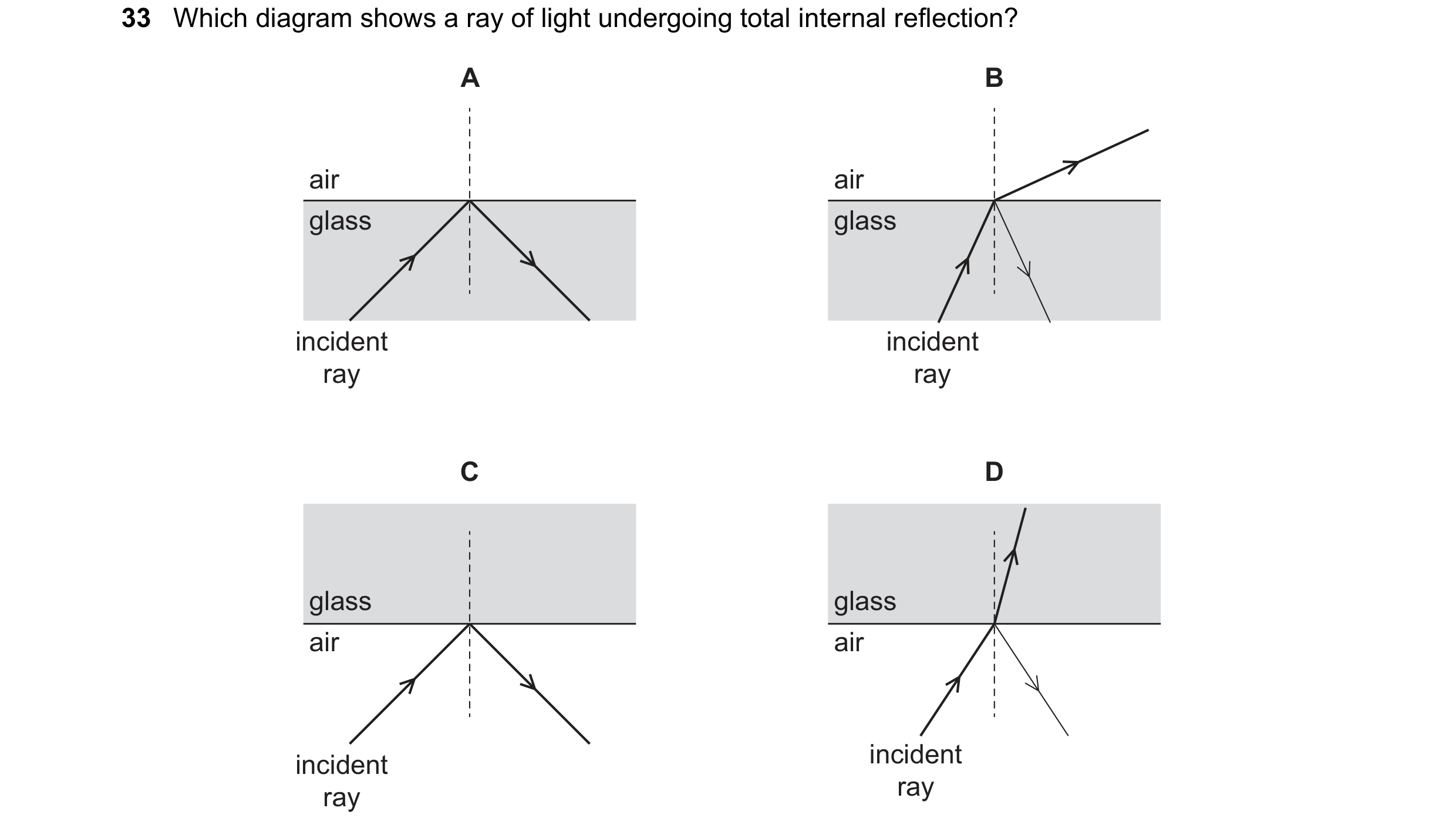
Q52 · Which diagram shows a ray of light undergoing total internal reflection? 0654/23 May/June 2024
33 Which diagram shows a ray of light undergoing total internal reflection? A B air air glass glass incident incident ray ray C D glass glass air air incident incident ray ray
1 marks
Answer: A
This question in 0654/23 May/June 2024
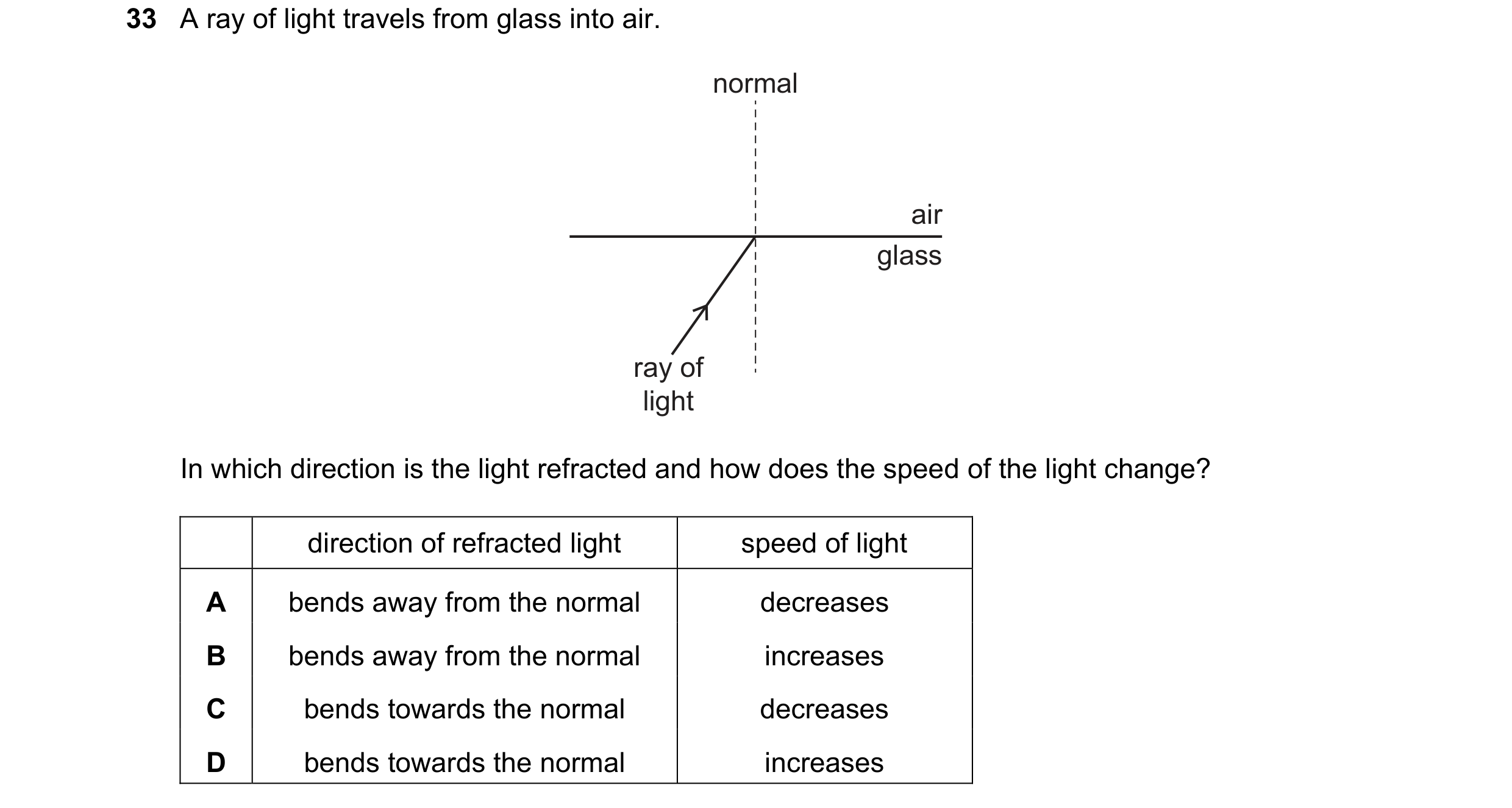
Q53 · A ray of light travels from glass into air 0654/21 Oct/Nov 2024
33 A ray of light travels from glass into air. normal air glass ray of light In which direction is the light refracted and how does the speed of the light change? direction of refracted light speed of light A bends away from the normal decreases B bends away from the normal increases C bends towards the normal decreases D bends towards the normal increases
1 marks
Answer: B
This question in 0654/21 Oct/Nov 2024
Q54 · The critical angle of water is 49 0654/22 Oct/Nov 2024
33 The critical angle of water is 49. A ray of light from the bottom of a swimming pool has an angle of incidence of 50 at the surface of the water. What happens to the ray of light? A It is all refracted with an angle of refraction of 49. B It is partly reflected and partly refracted. C It is totally internally reflected with an angle of reflection of 50. D It travels along the surface of the water.
1 marks
Answer: C
This question in 0654/22 Oct/Nov 2024
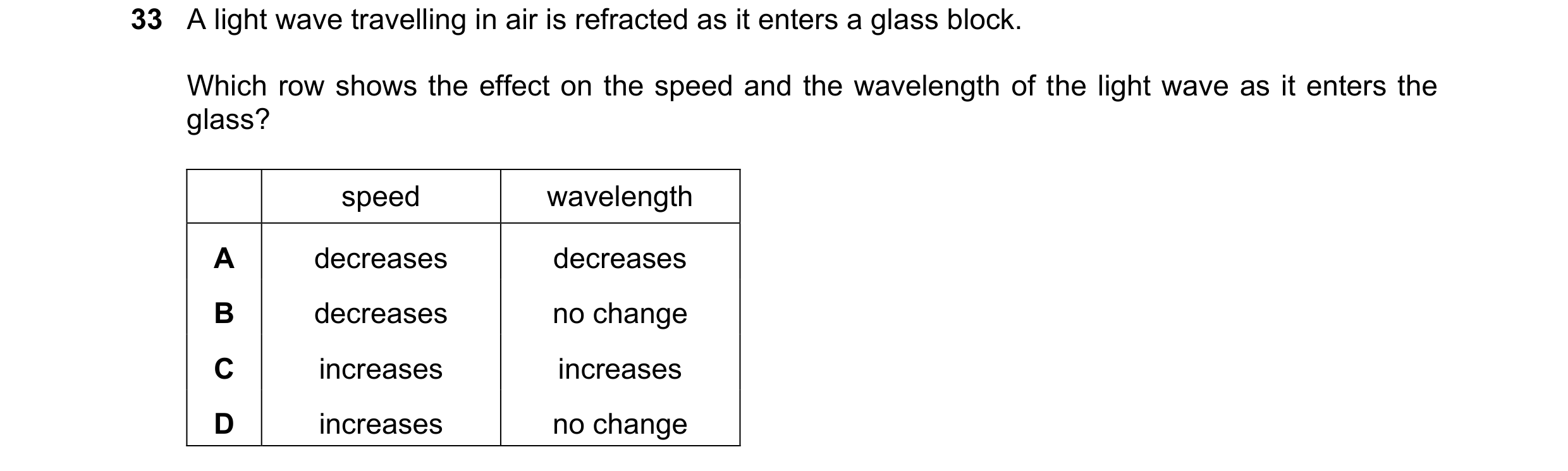
Q55 · A light wave travelling in air is refracted as it enters a glass block 0654/23 Oct/Nov 2024
33 A light wave travelling in air is refracted as it enters a glass block. Which row shows the effect on the speed and the wavelength of the light wave as it enters the glass? speed wavelength A decreases decreases B decreases no change C increases increases D increases no change
1 marks
Answer: A
This question in 0654/23 Oct/Nov 2024
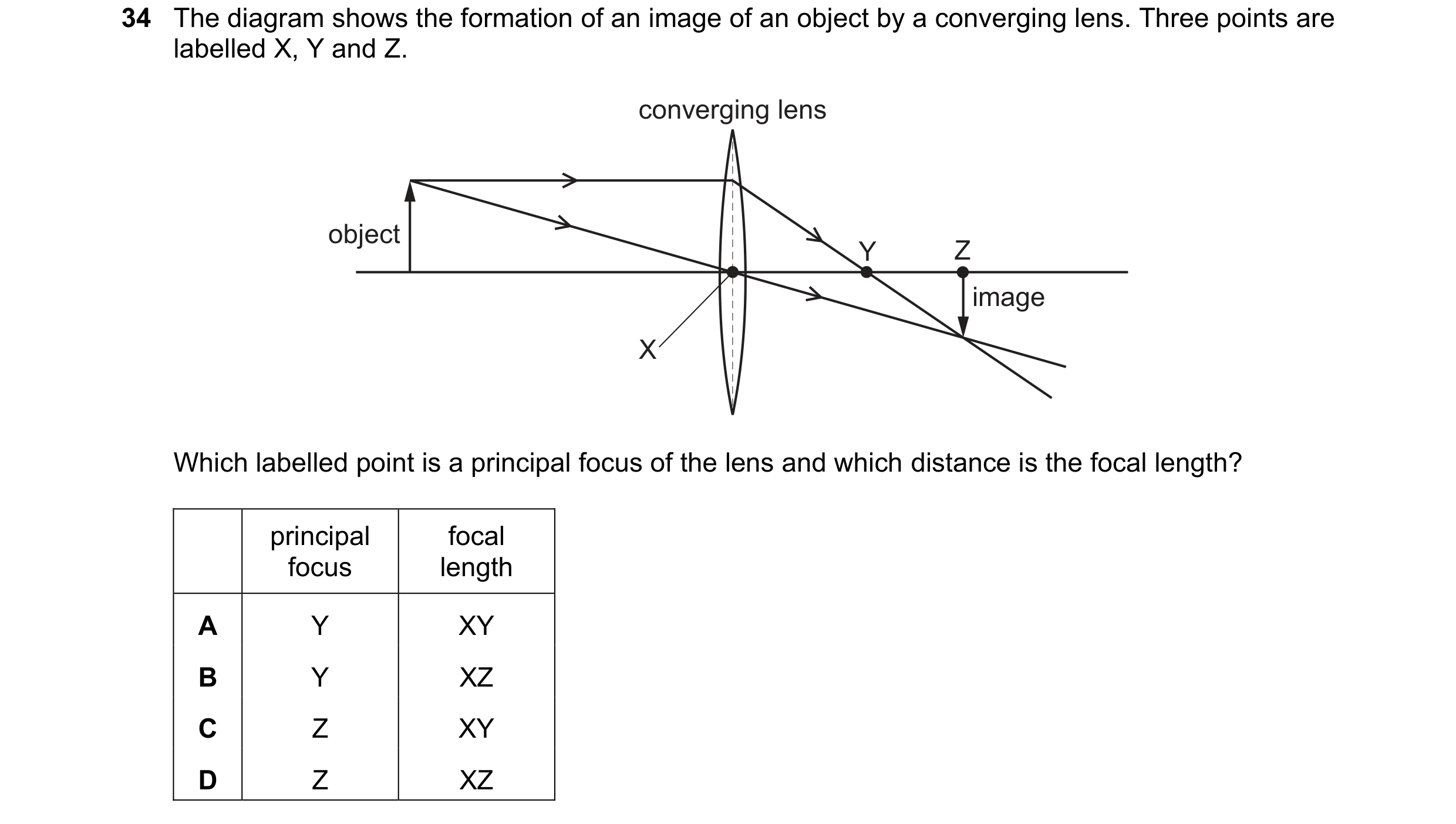
Q56 · The diagram shows the formation of an image of an object by a converging lens 0654/23 Oct/Nov 2024
34 The diagram shows the formation of an image of an object by a converging lens. Three points are labelled X, Y and Z. converging lens object Y Z image X Which labelled point is a principal focus of the lens and which distance is the focal length? principal focal focus length A Y XY B Y XZ C Z XY D Z XZ
1 marks
Answer: A
This question in 0654/23 Oct/Nov 2024
Q57 · Which statement about real and virtual images formed by a thin converging lens is correct? 0654/22 Feb/March 2025
35 Which statement about real and virtual images formed by a thin converging lens is correct? A All real images are enlarged and inverted. B All real images can be produced on a screen. C All virtual images are diminished and upright. D All virtual images can be produced on a screen.
1 marks
Answer: B
This question in 0654/22 Feb/March 2025
Q58 · The diagram shows a ray of light passing from medium P to medium Q and then to medium R 0654/21 May/June 2025
34 The diagram shows a ray of light passing from medium P to medium Q and then to medium R. The speeds of light in each of the mediums P, Q and R are cP, cQ and cR respectively. P Q R Which list compares the speeds of light in the three mediums in order from lowest to highest? A cP cQ cR B cP cR cQ C cQ cP cR D cR cQ cP
1 marks
Answer: D
This question in 0654/21 May/June 2025
Q59 · What is the difference between a real image and a virtual image? 0654/22 May/June 2025
34 What is the difference between a real image and a virtual image? A A real image can be shown on a screen, but a virtual image cannot. B A real image is always formed by a magnifying glass. C A real image is always formed by a plane mirror. D A virtual image can be shown on a screen, but a real image cannot.
1 marks
Answer: A
This question in 0654/22 May/June 2025
Q60 · An image of an object is formed by a plane mirror 0654/23 May/June 2025
32 An image of an object is formed by a plane mirror. The image formed is virtual. Which statement describes what is meant by a virtual image? A The reflected rays do not meet where the image is formed. B The image is formed directly opposite the object. C The image is the same distance from the mirror as the distance of the object from the mirror. D The angle of incidence is equal to the angle of reflection.
1 marks
Answer: A
This question in 0654/23 May/June 2025
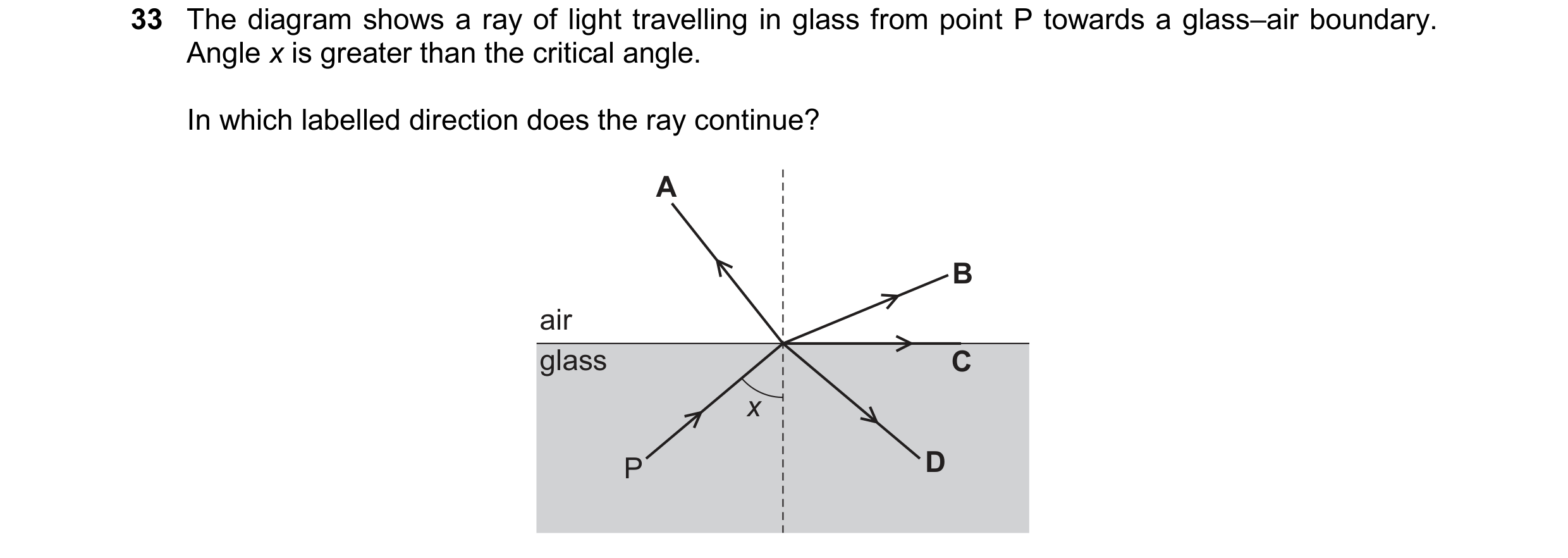
Q61 · The diagram shows a ray of light travelling in glass from point P towards a glass–air… 0654/23 May/June 2025
33 The diagram shows a ray of light travelling in glass from point P towards a glass–air boundary. Angle x is greater than the critical angle. In which labelled direction does the ray continue? A B air glass C x P D
1 marks
Answer: D
This question in 0654/23 May/June 2025
Q62 · In the diagrams, F is one principal focus of the converging lens 0654/21 Oct/Nov 2025
33 In the diagrams, F is one principal focus of the converging lens. Which diagram shows the use of a lens as a magnifying glass? A B F F C D F F
1 marks
Answer: A
This question in 0654/21 Oct/Nov 2025
Q63 · A ray of light strikes the boundary between water and air 0654/21 Oct/Nov 2025
35 A ray of light strikes the boundary between water and air. Which statement describes when the angle of incidence is equal to the critical angle? A The light passes from air into water and no light is reflected. B The light passes from air into water and the angle of refraction is 90°. C The light passes from water into air and no light is reflected. D The light passes from water into air and the angle of refraction is 90°.
1 marks
Answer: D
This question in 0654/21 Oct/Nov 2025
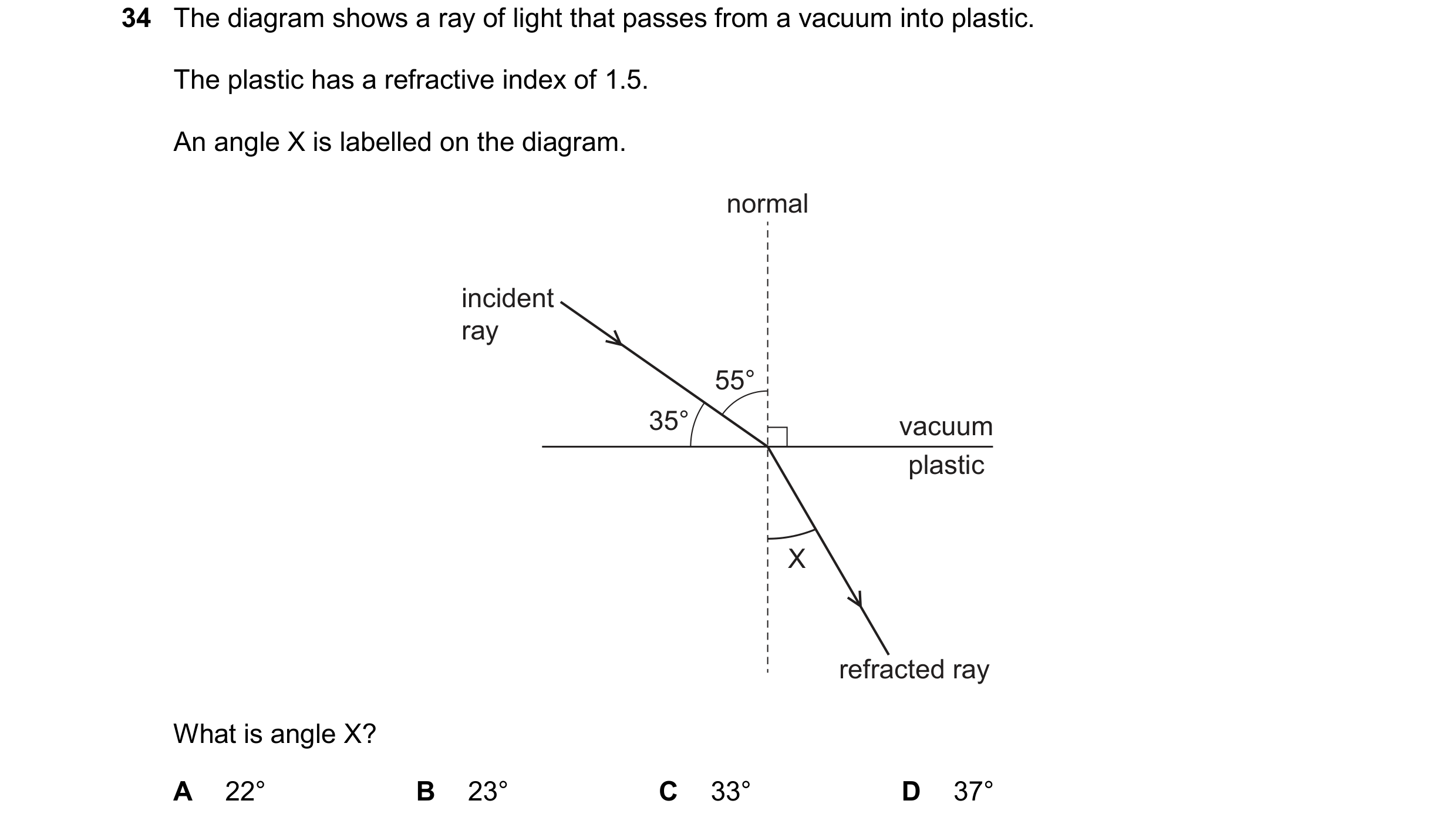
Q64 · The diagram shows a ray of light that passes from a vacuum into plastic 0654/22 Oct/Nov 2025
34 The diagram shows a ray of light that passes from a vacuum into plastic. The plastic has a refractive index of 1.5. An angle X is labelled on the diagram. normal incident ray 55° 35° vacuum plastic X refracted ray What is angle X? A 22° B 23° C 33° D 37°
1 marks
Answer: C
This question in 0654/22 Oct/Nov 2025
Q65 · Which statement describes the term critical angle? 0654/23 Oct/Nov 2025
33 Which statement describes the term critical angle? A the largest angle of incidence in a denser medium for which refraction into a less dense medium occurs B the largest angle of incidence in a less dense medium for which refraction into a denser medium occurs C the smallest angle of incidence in a denser medium for which refraction into a less dense medium occurs D the smallest angle of incidence in a less dense medium for which refraction into a denser medium occurs
1 marks
Answer: A
This question in 0654/23 Oct/Nov 2025
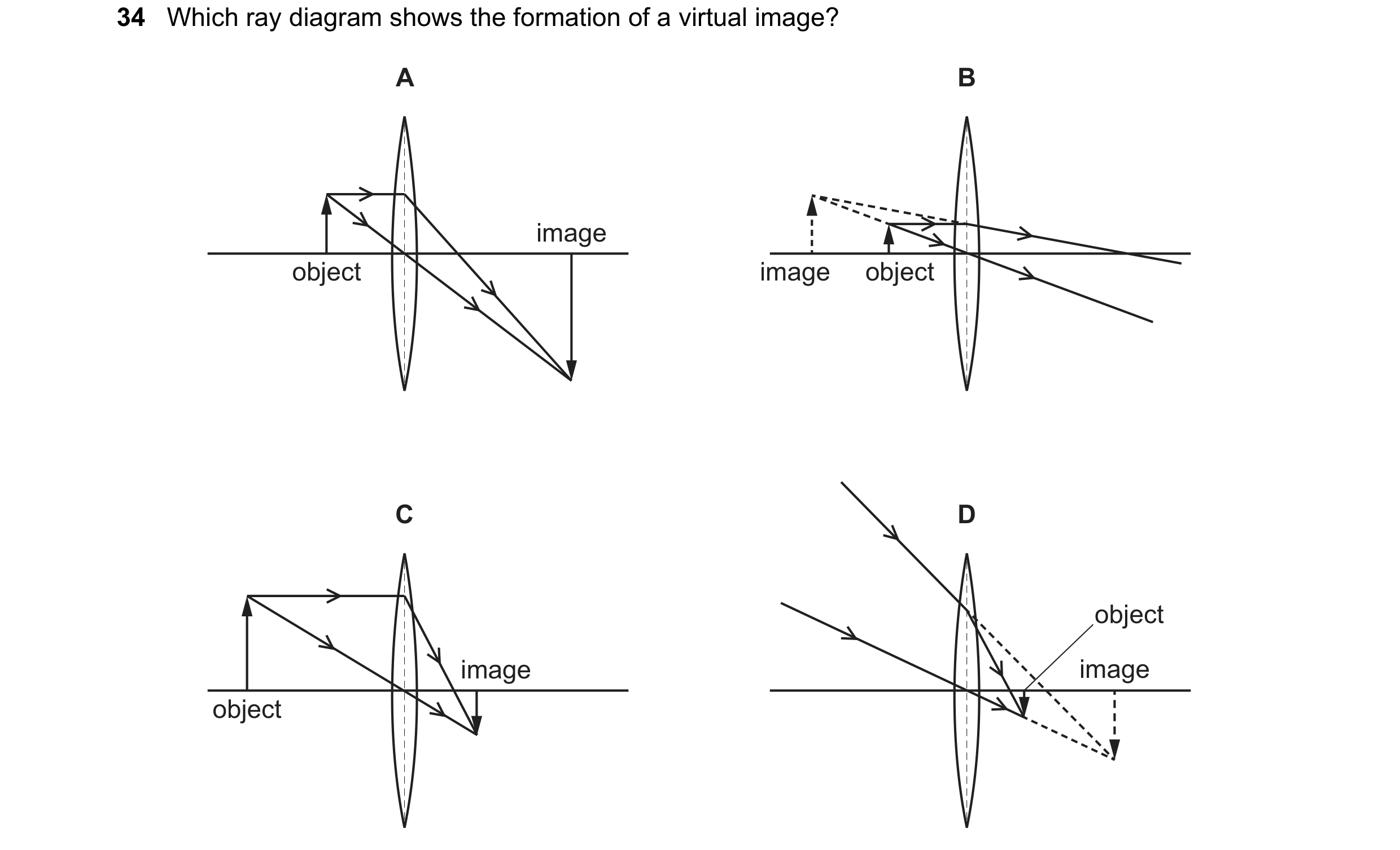
Q66 · Which ray diagram shows the formation of a virtual image? 0654/23 Oct/Nov 2025
34 Which ray diagram shows the formation of a virtual image? A B image object image object C D object image image object
1 marks
Answer: B
This question in 0654/23 Oct/Nov 2025
 1 / 24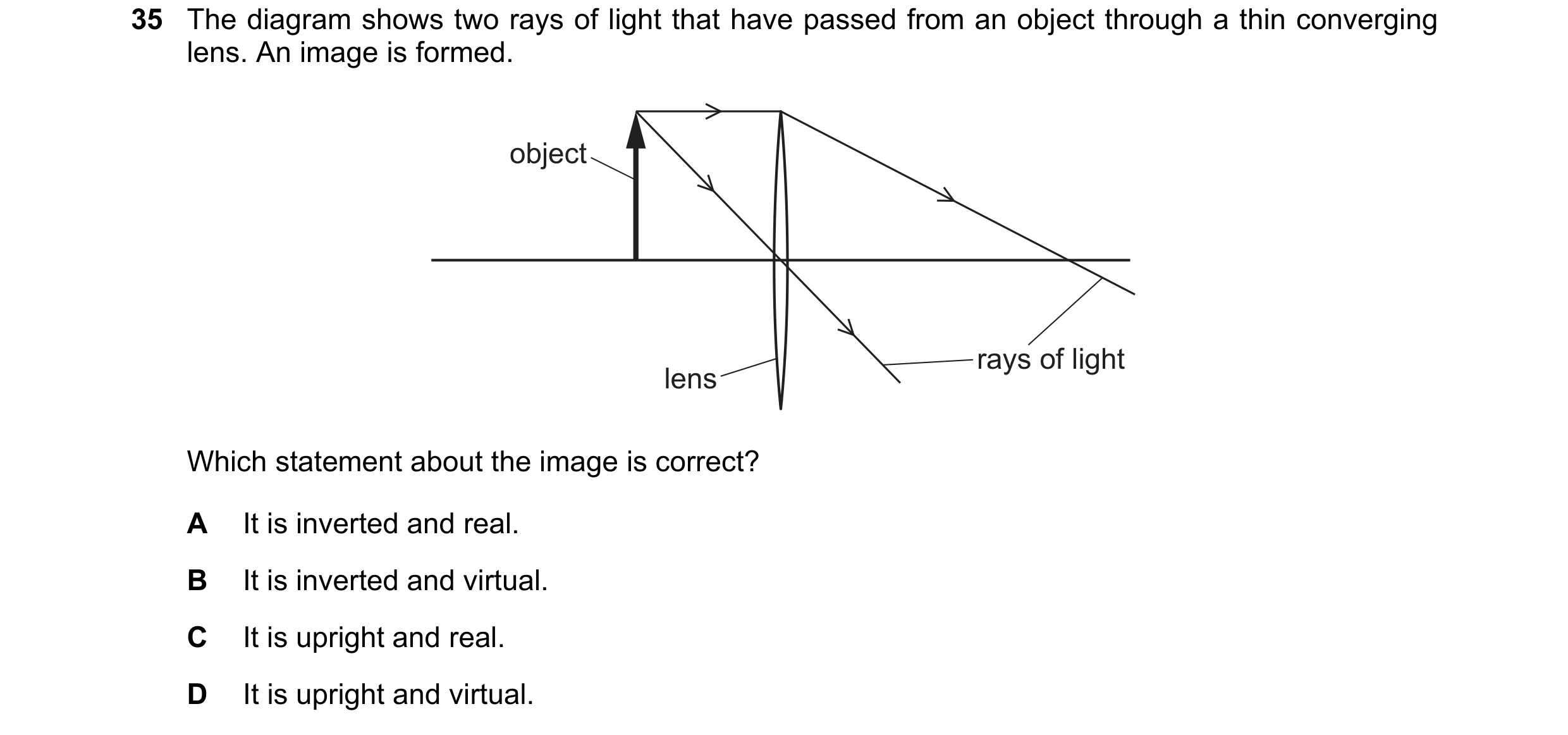
 2 / 24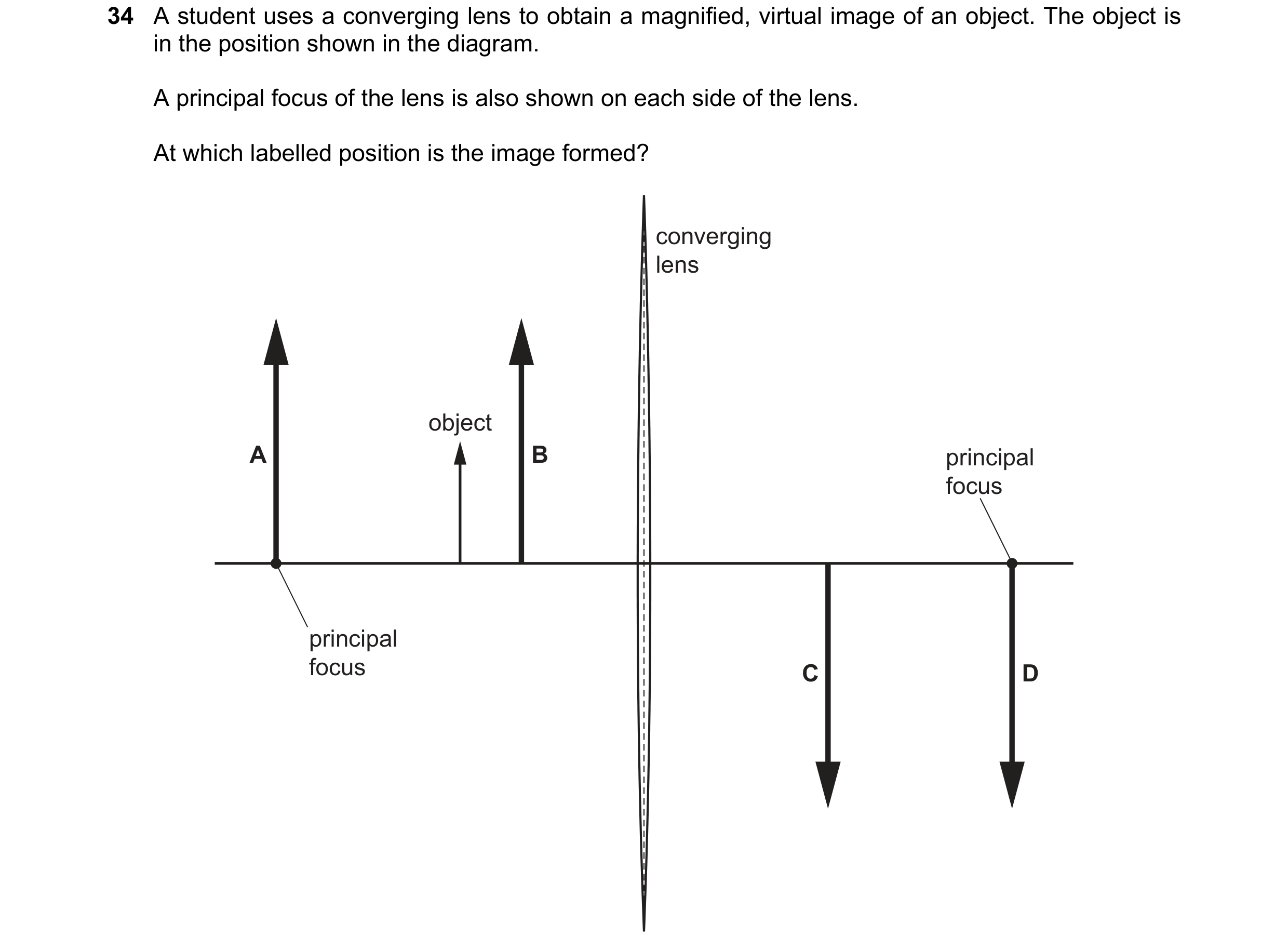
 3 / 24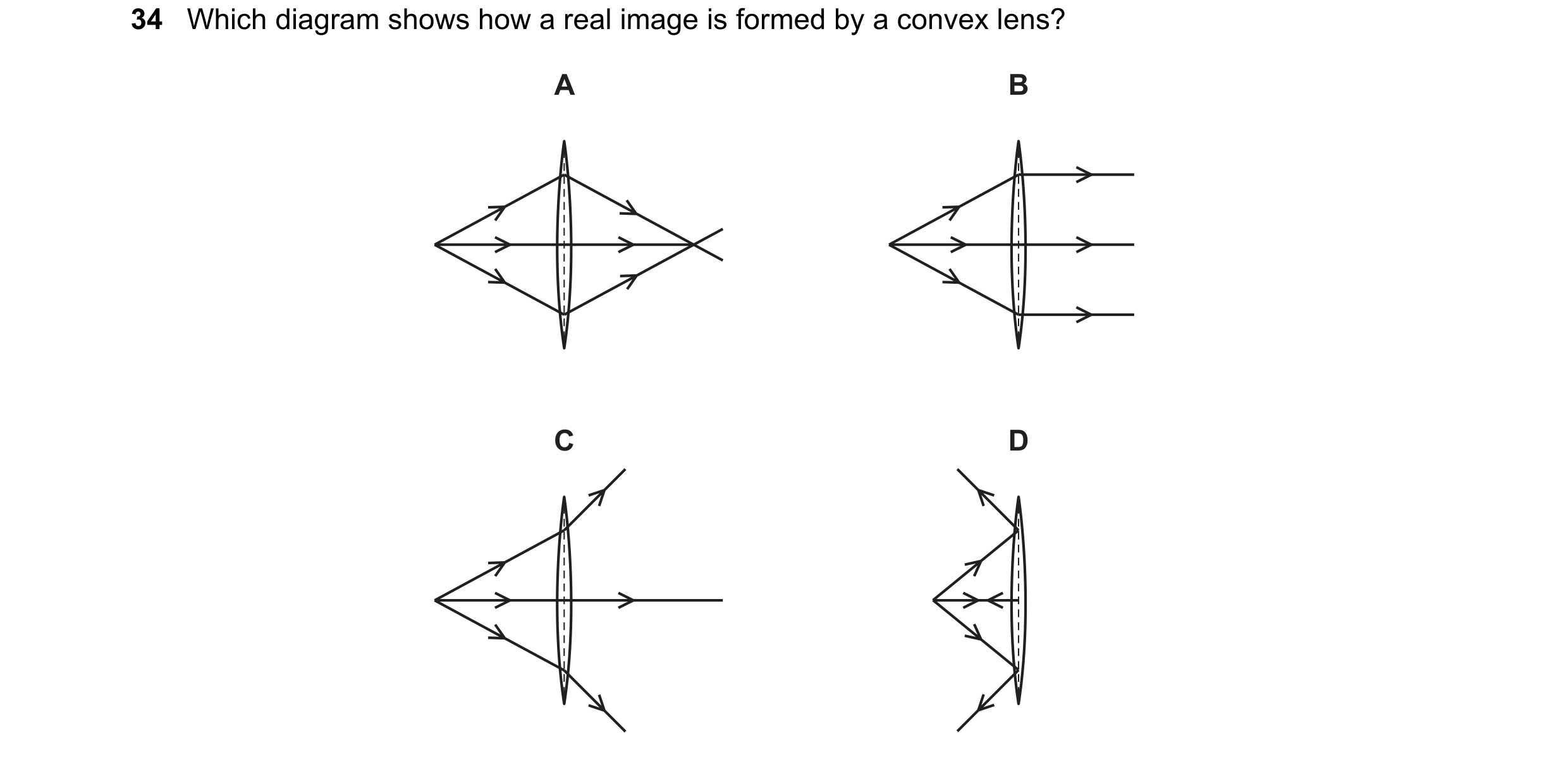
 4 / 24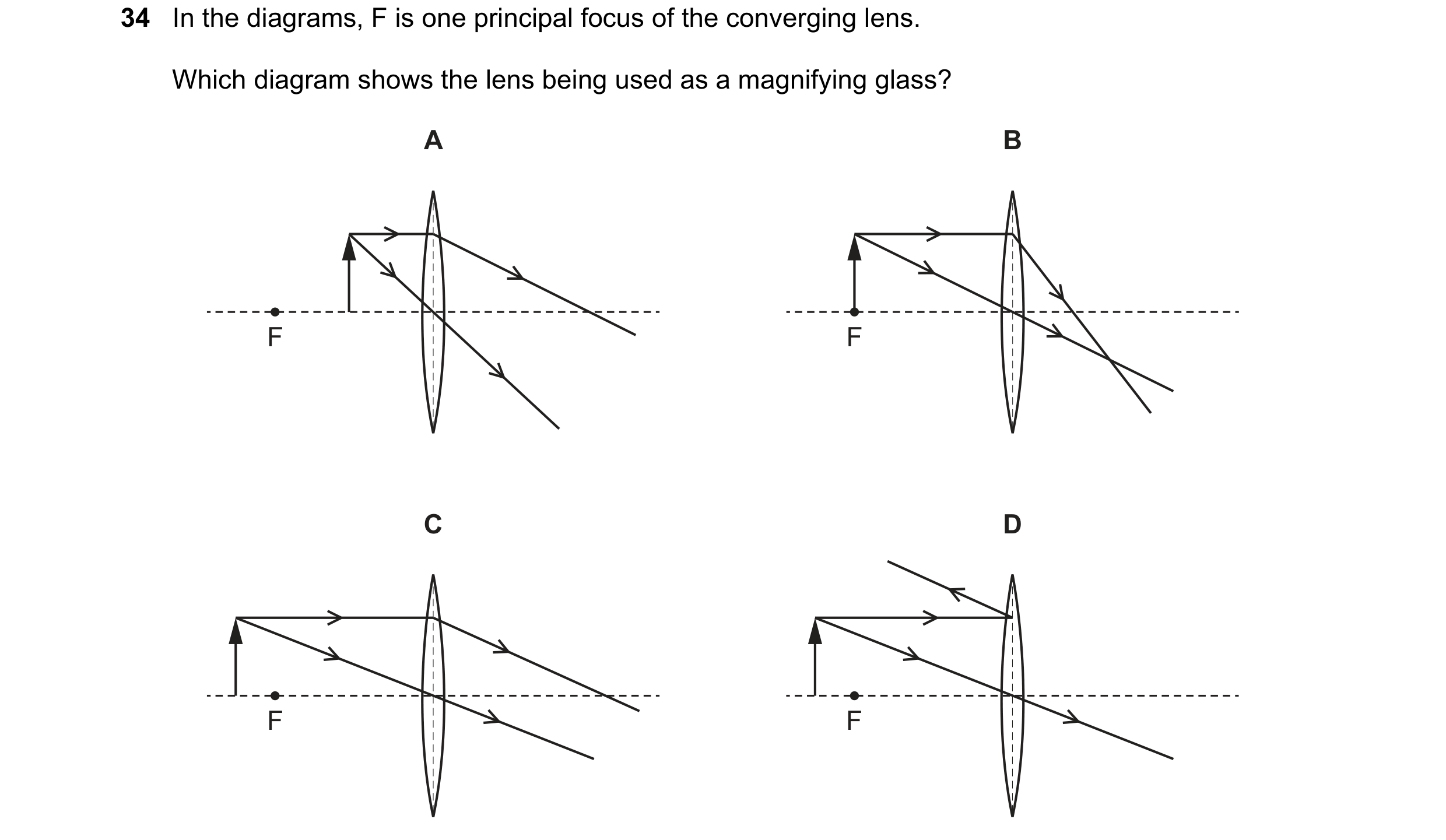
 5 / 24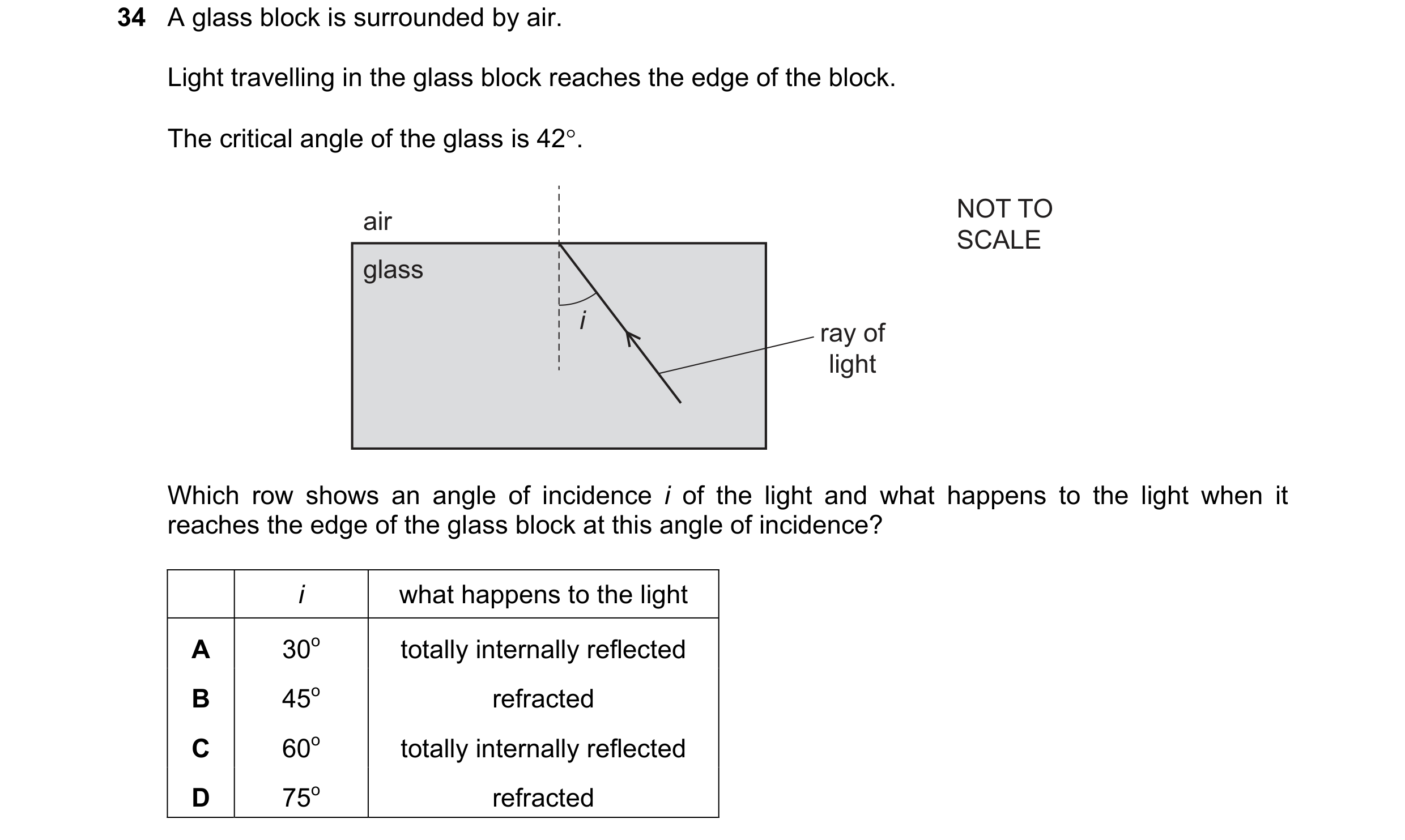
 6 / 24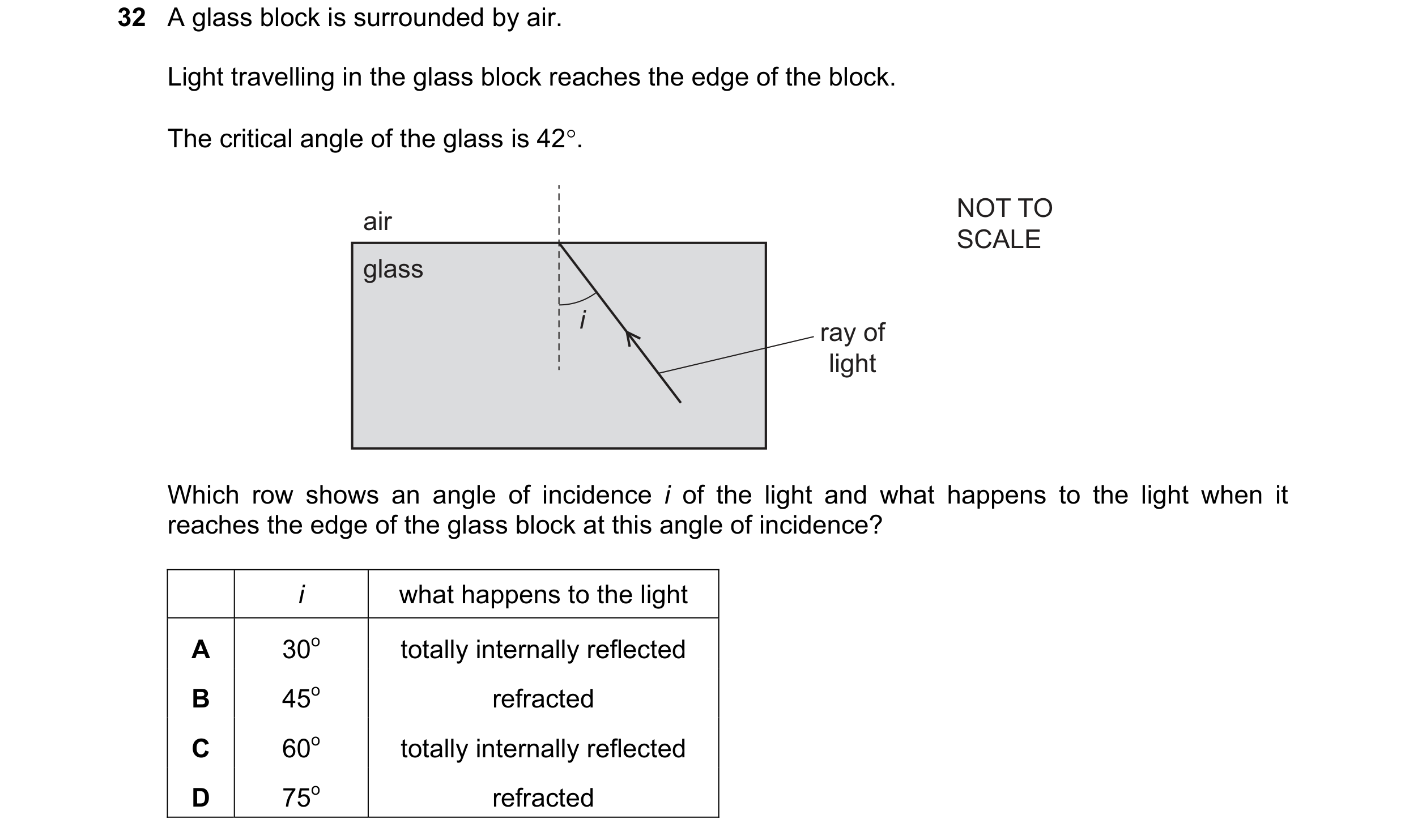

 7 / 24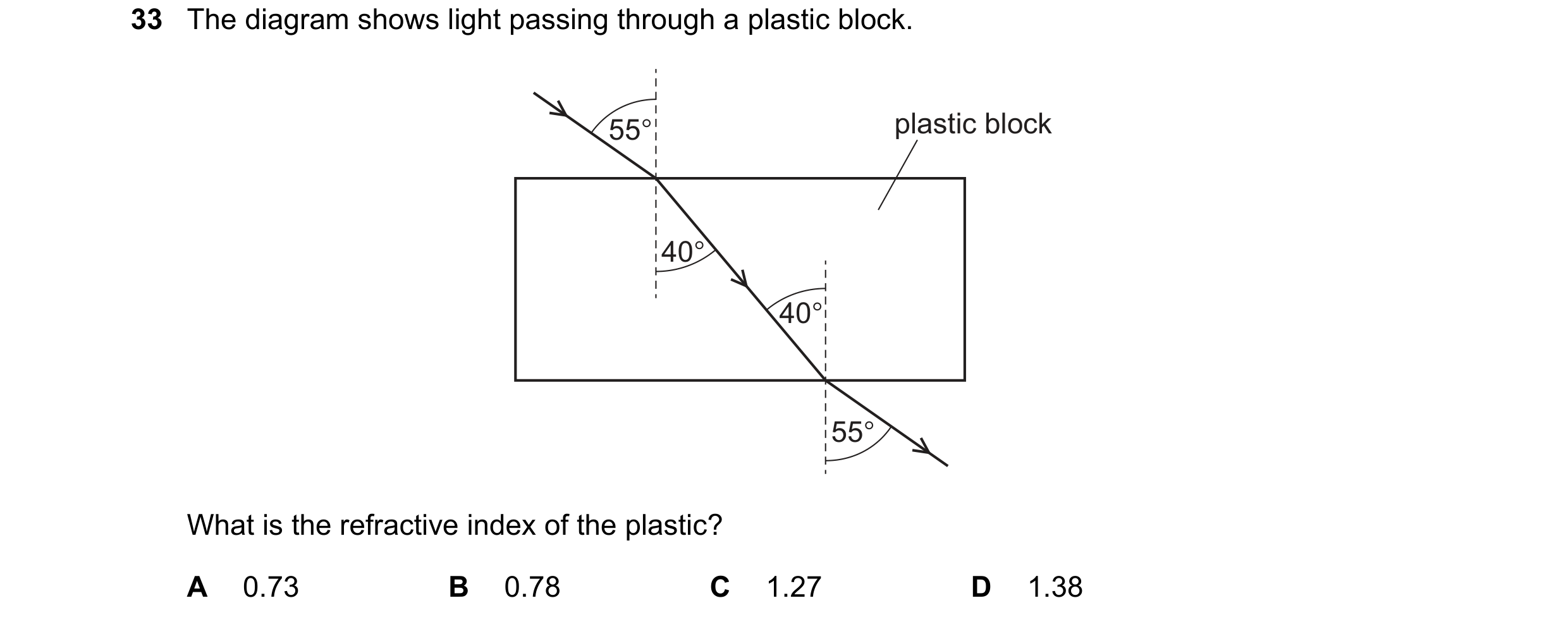
 8 / 24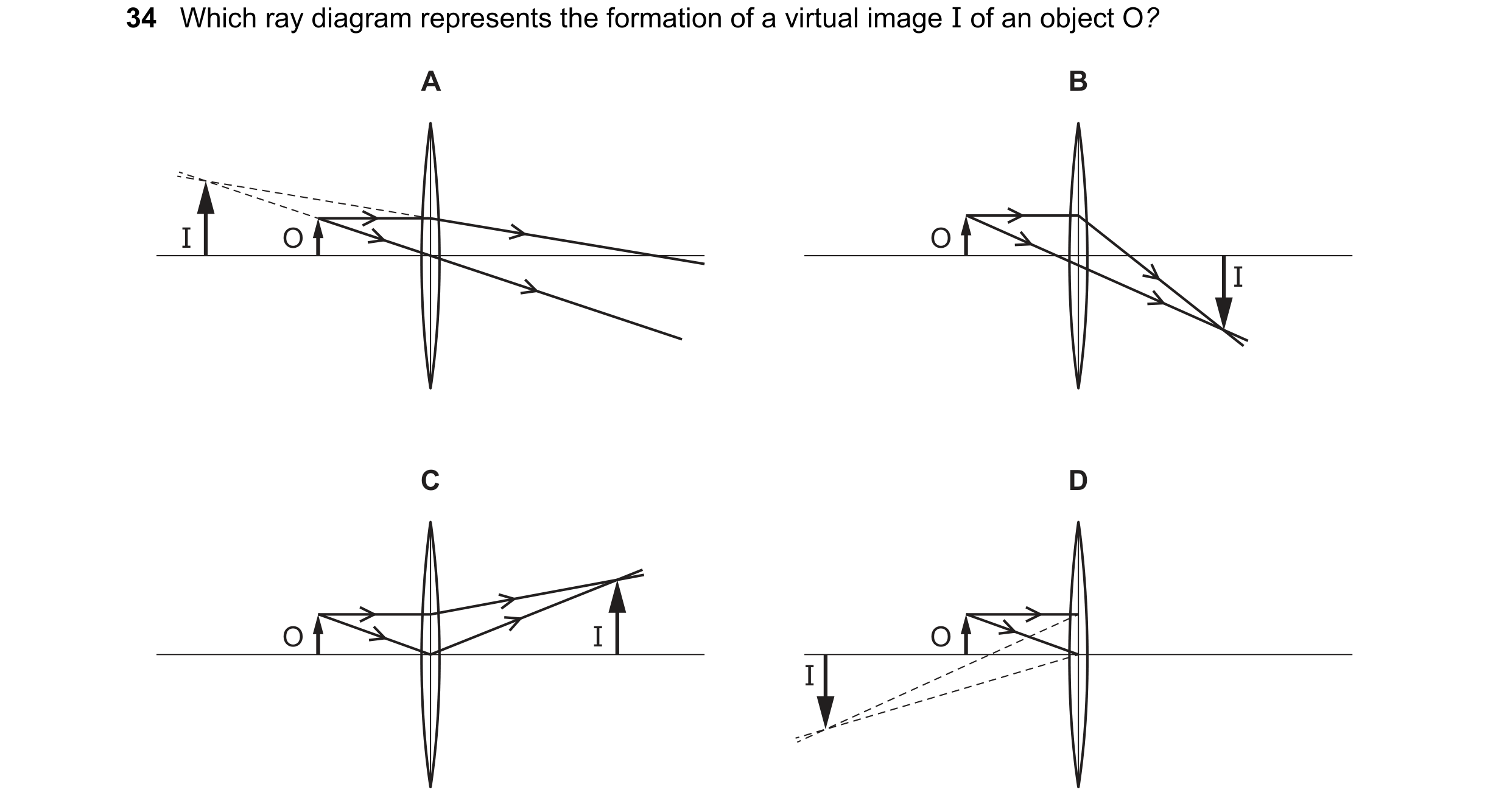
 9 / 24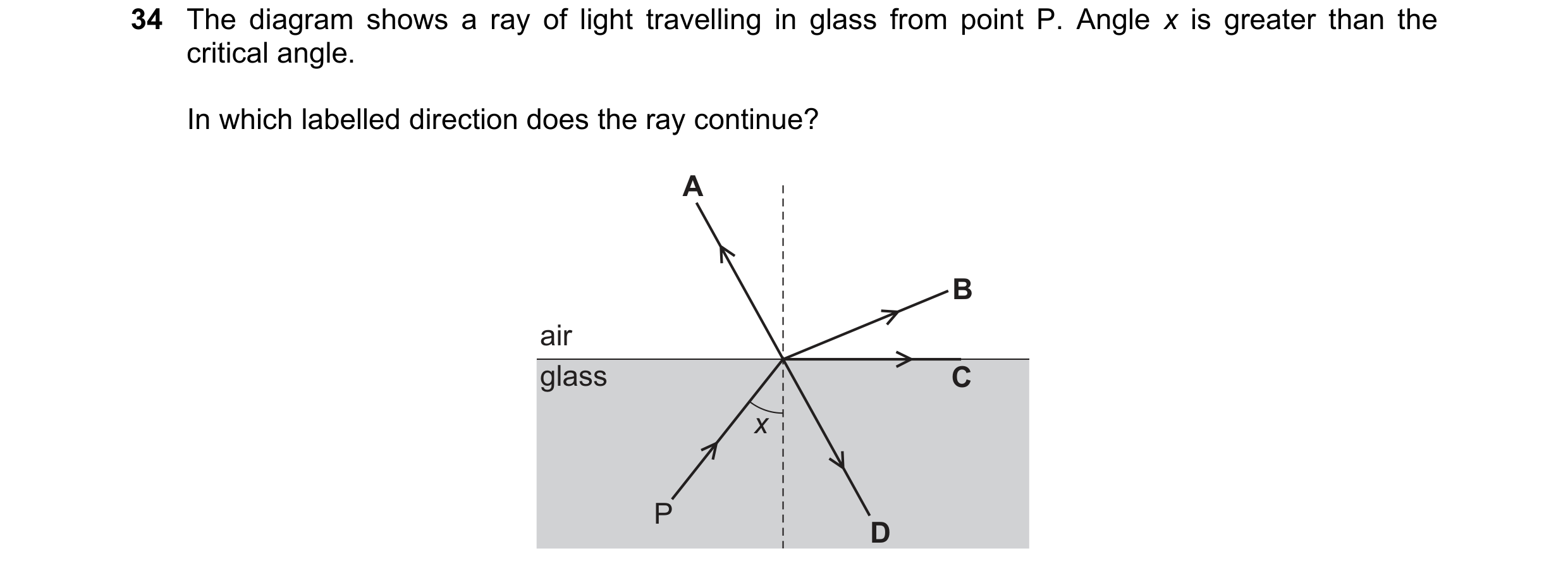
 10 / 24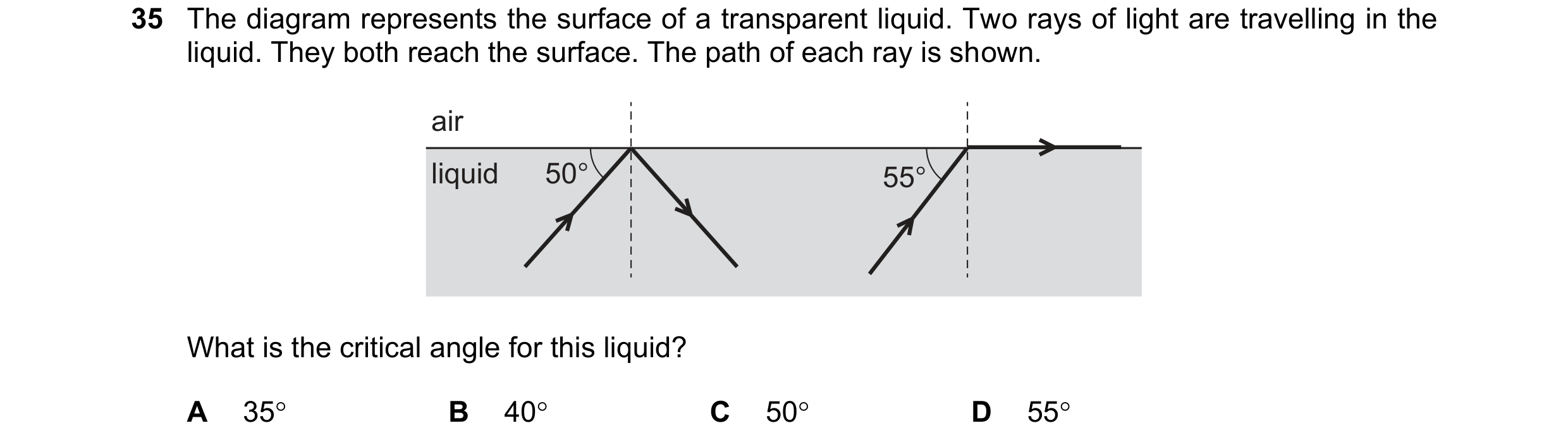

 11 / 24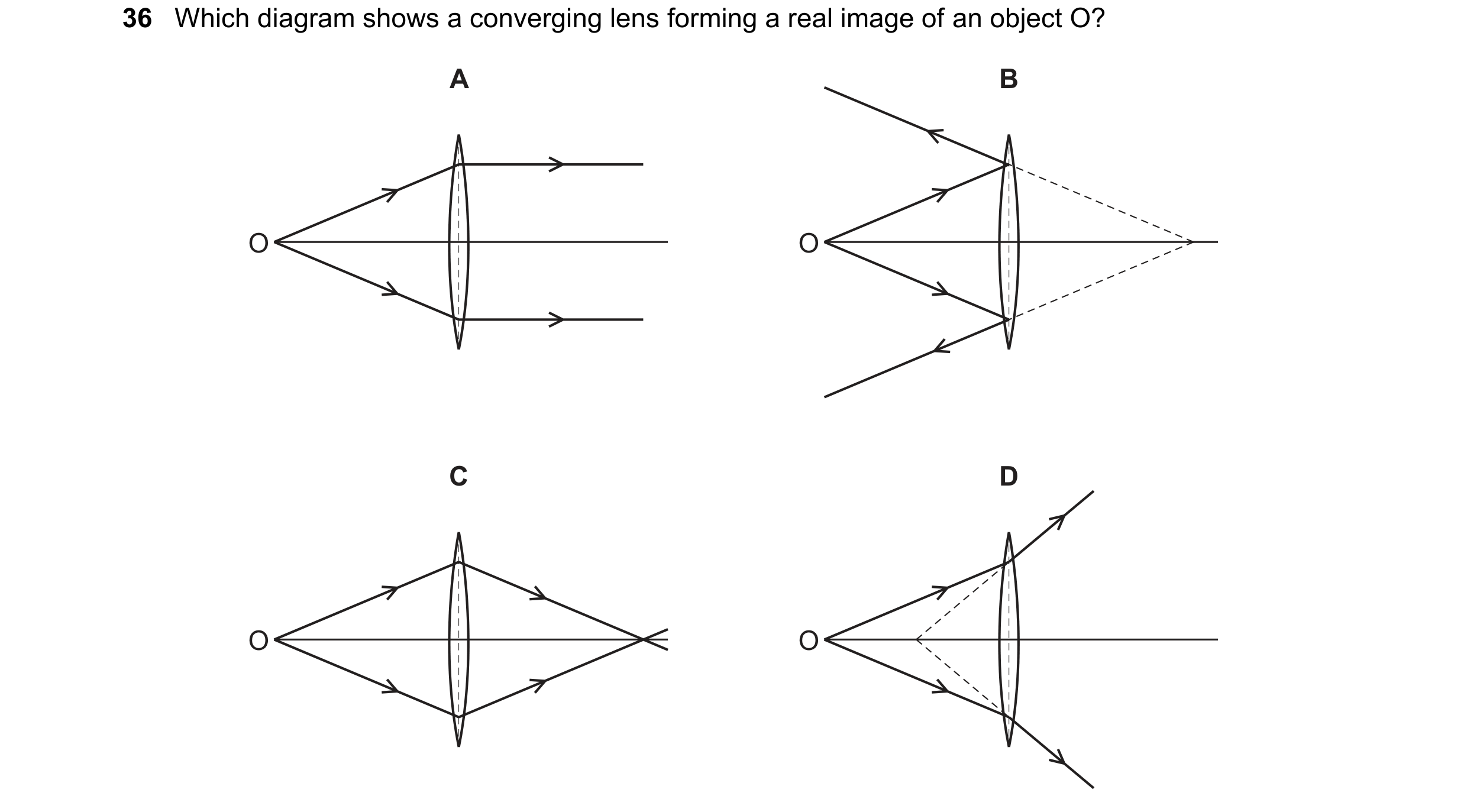
 12 / 24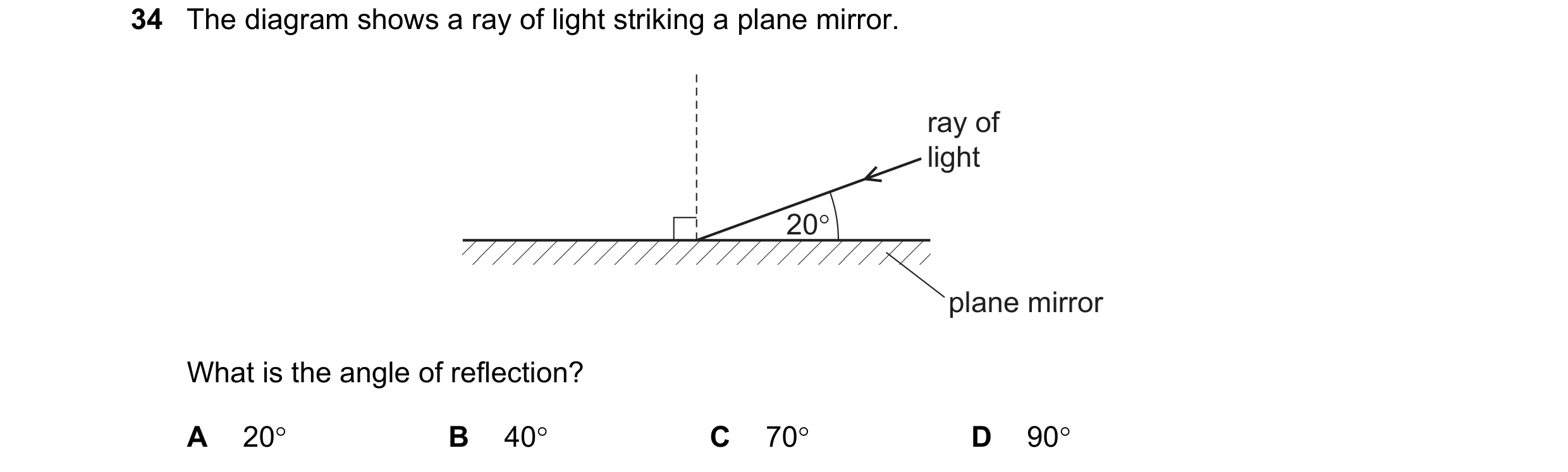
 13 / 24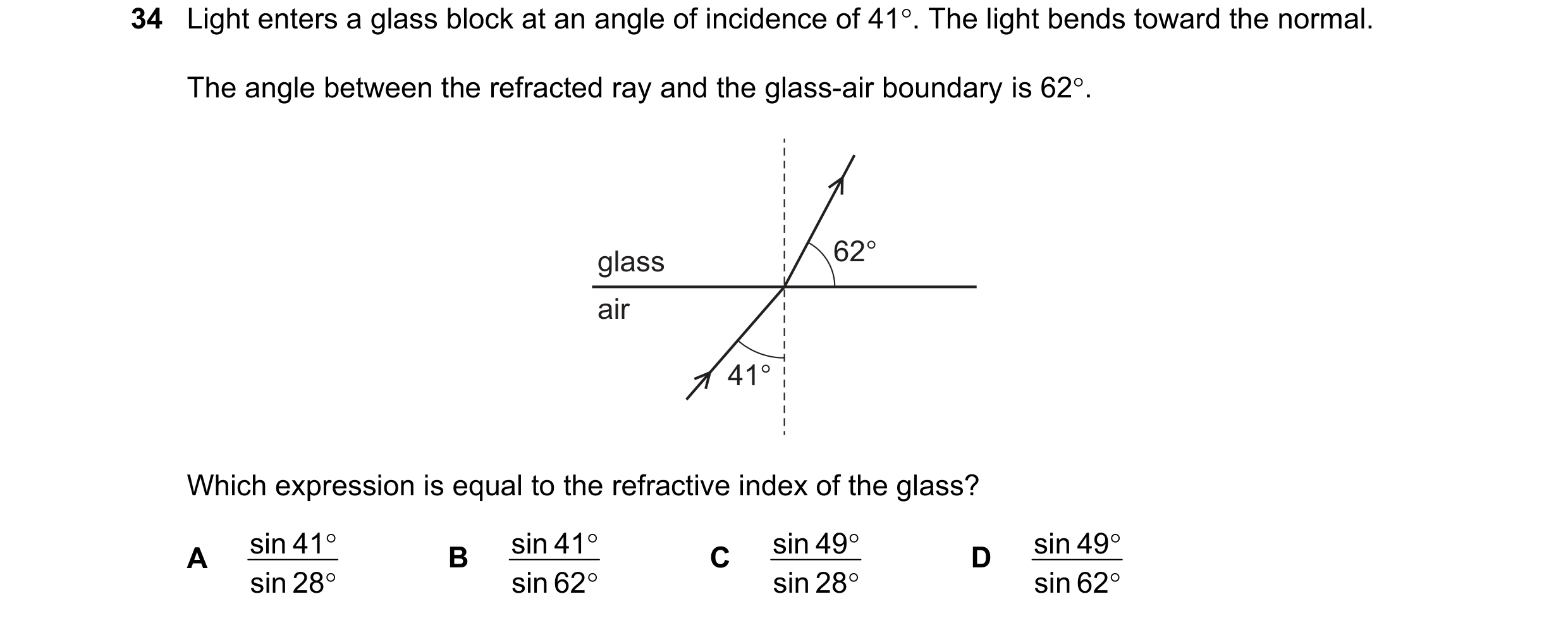
 14 / 24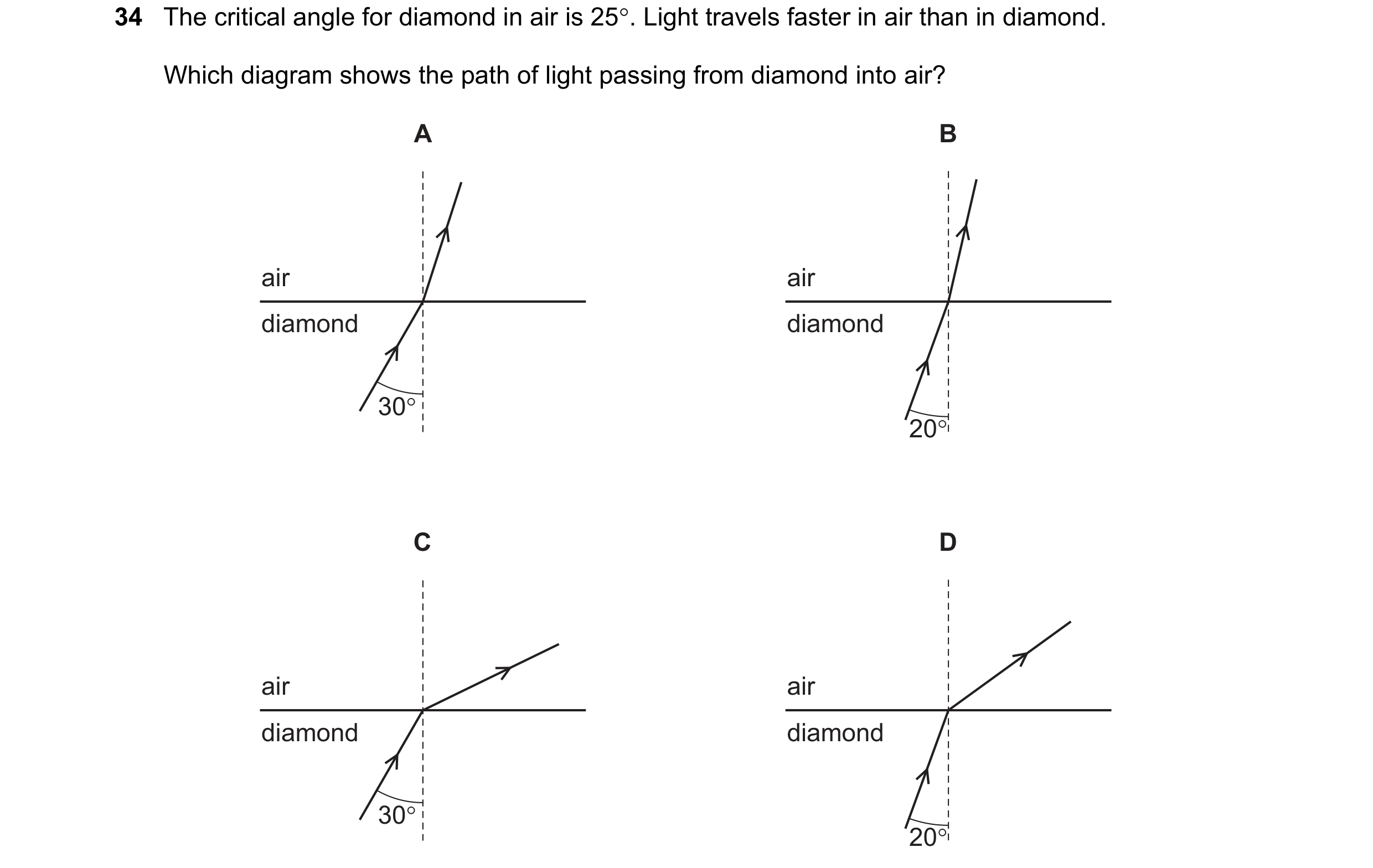
 15 / 24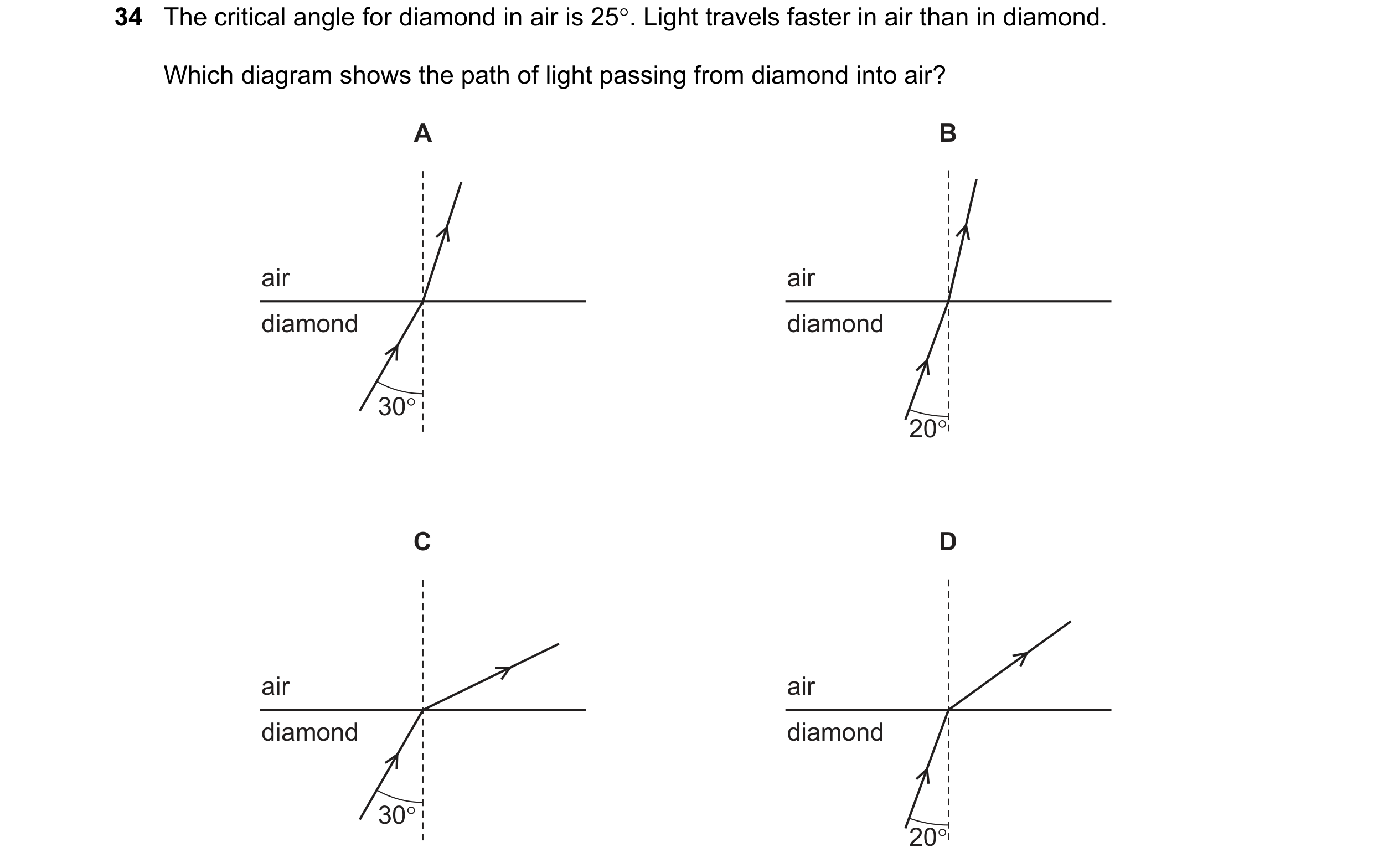
 16 / 24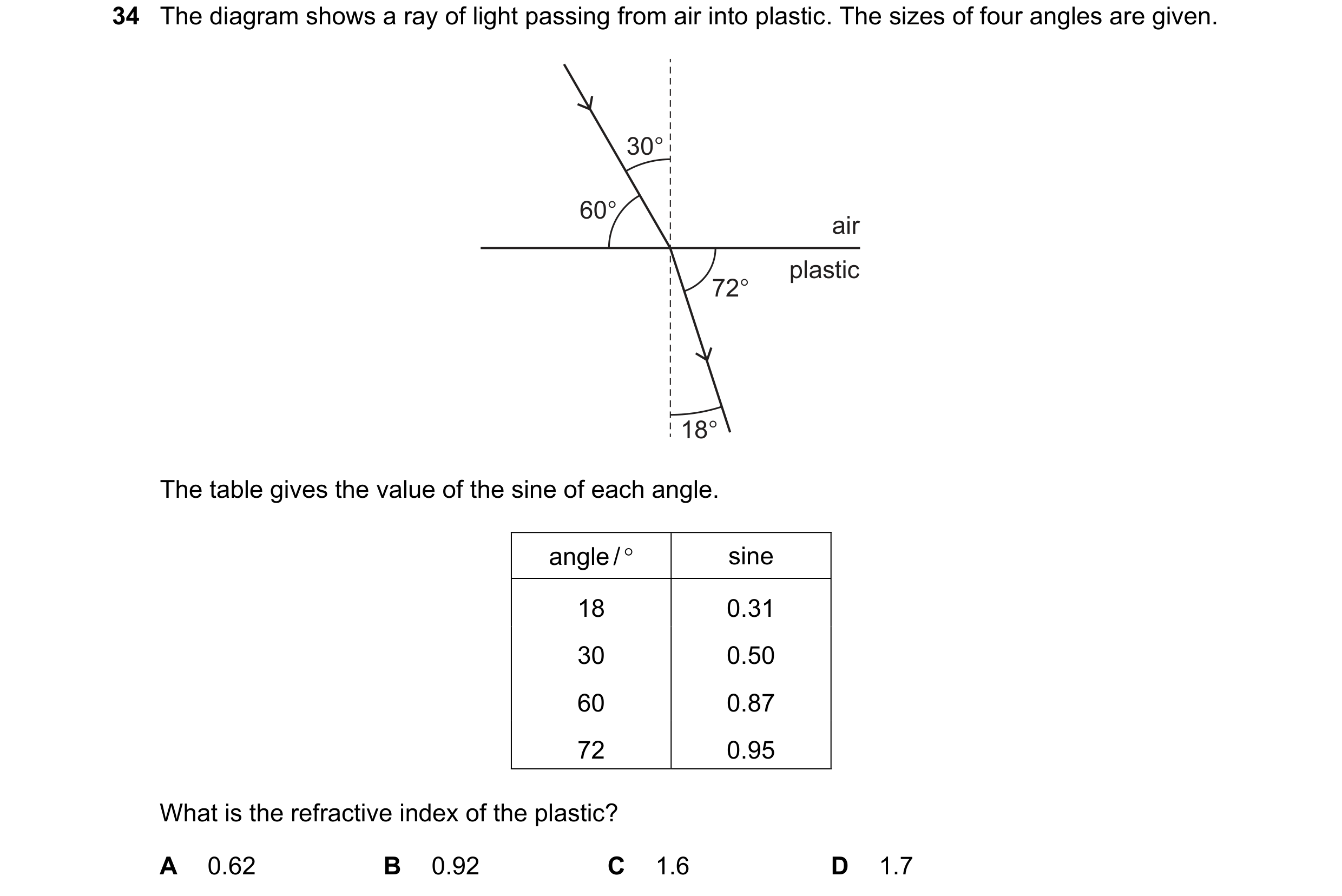
 17 / 24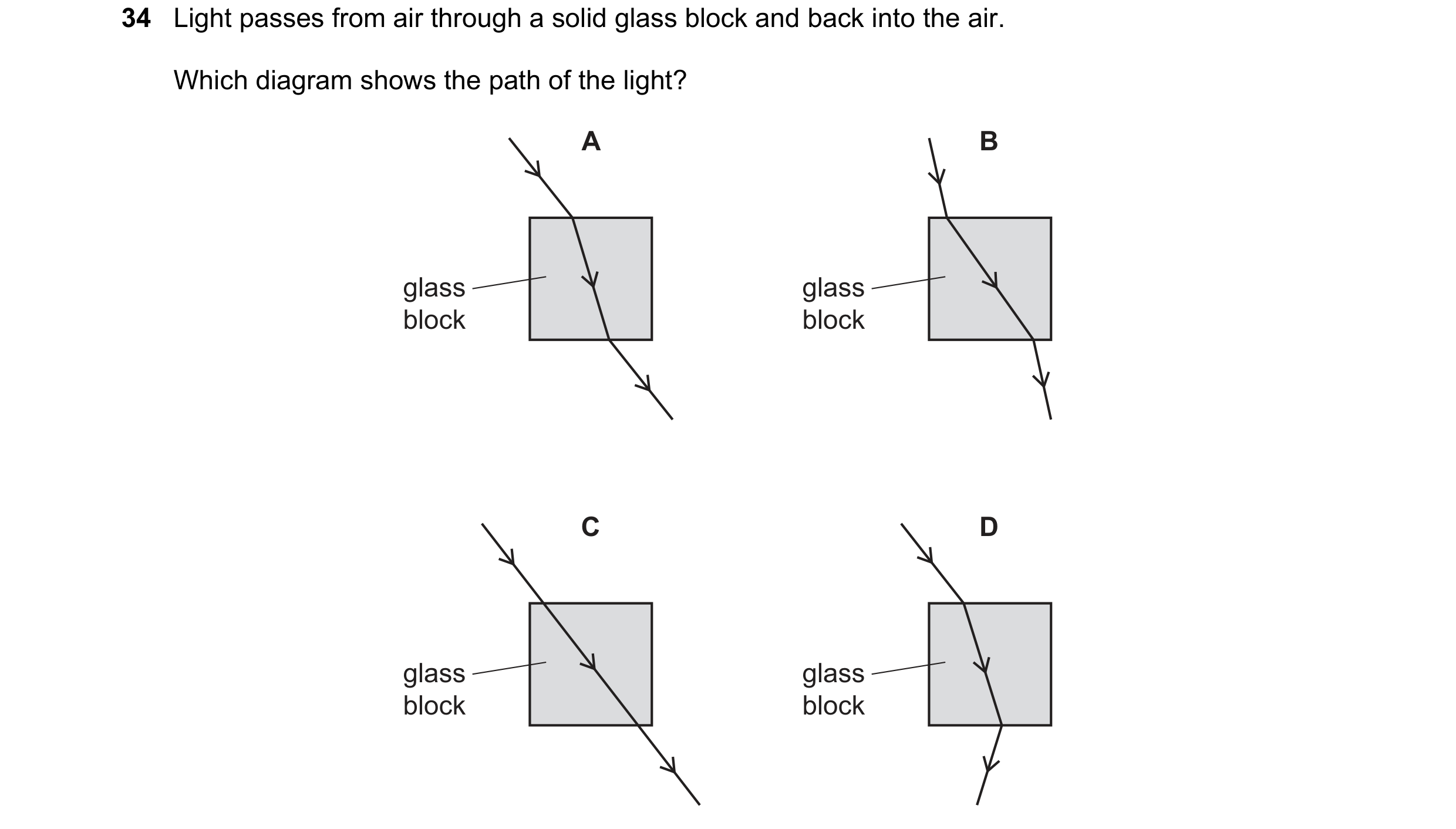
 18 / 24
 19 / 24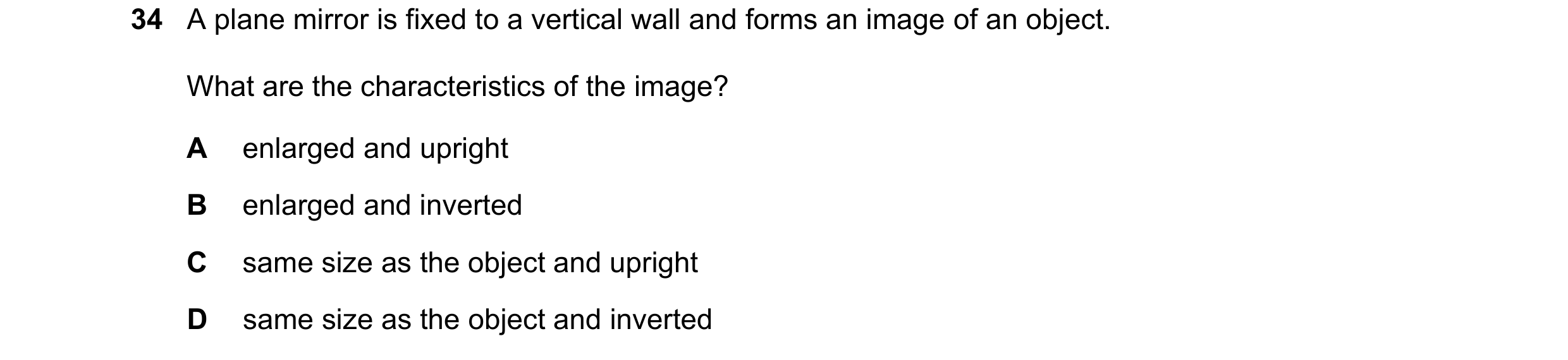
 20 / 24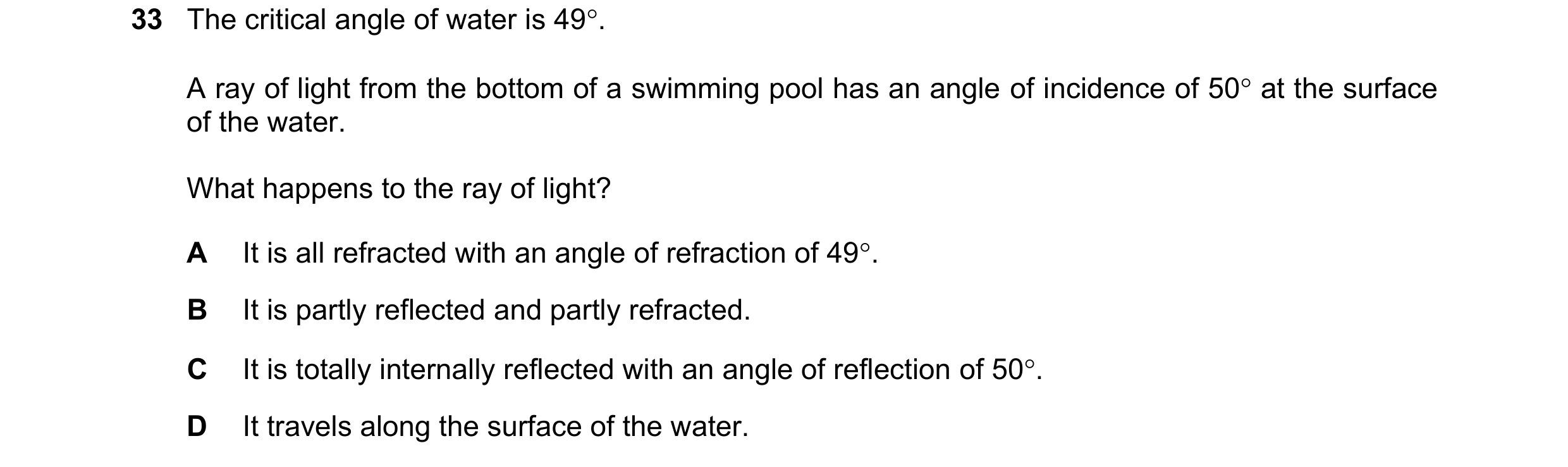
 21 / 24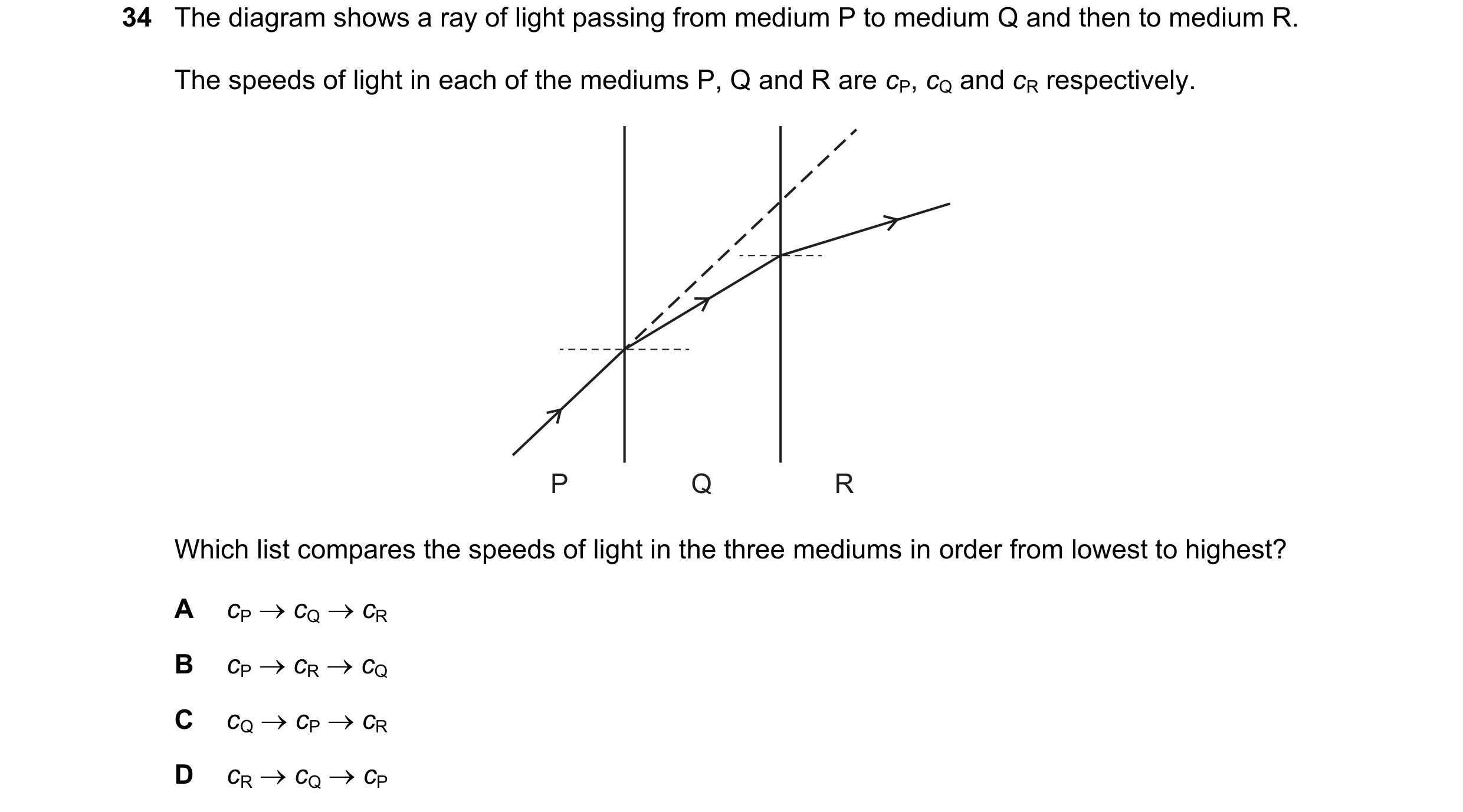

 22 / 24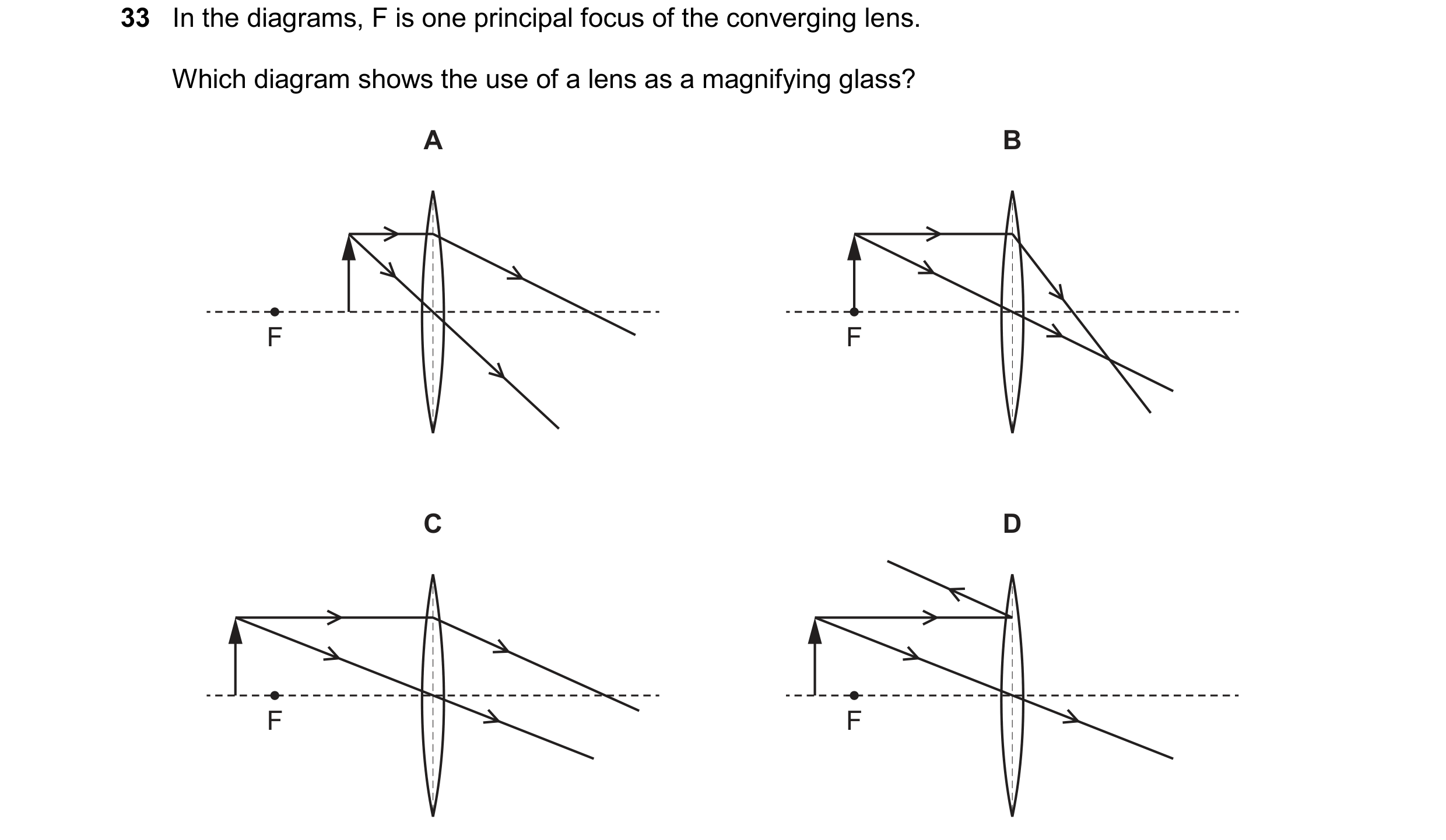
 23 / 24
 24 / 24