Cambridge IGCSE Sciences - Co-ordinated (Double) 0654 — 2017 May/June Paper 2 · Variant 2
0654/22/M/J/17 · 40 questions · 40 marks · ≈45 min
The question paper and its mark scheme, free to read here and free to download. This is Cambridge’s own paper, exactly as it was sat.
Question paper16 pages

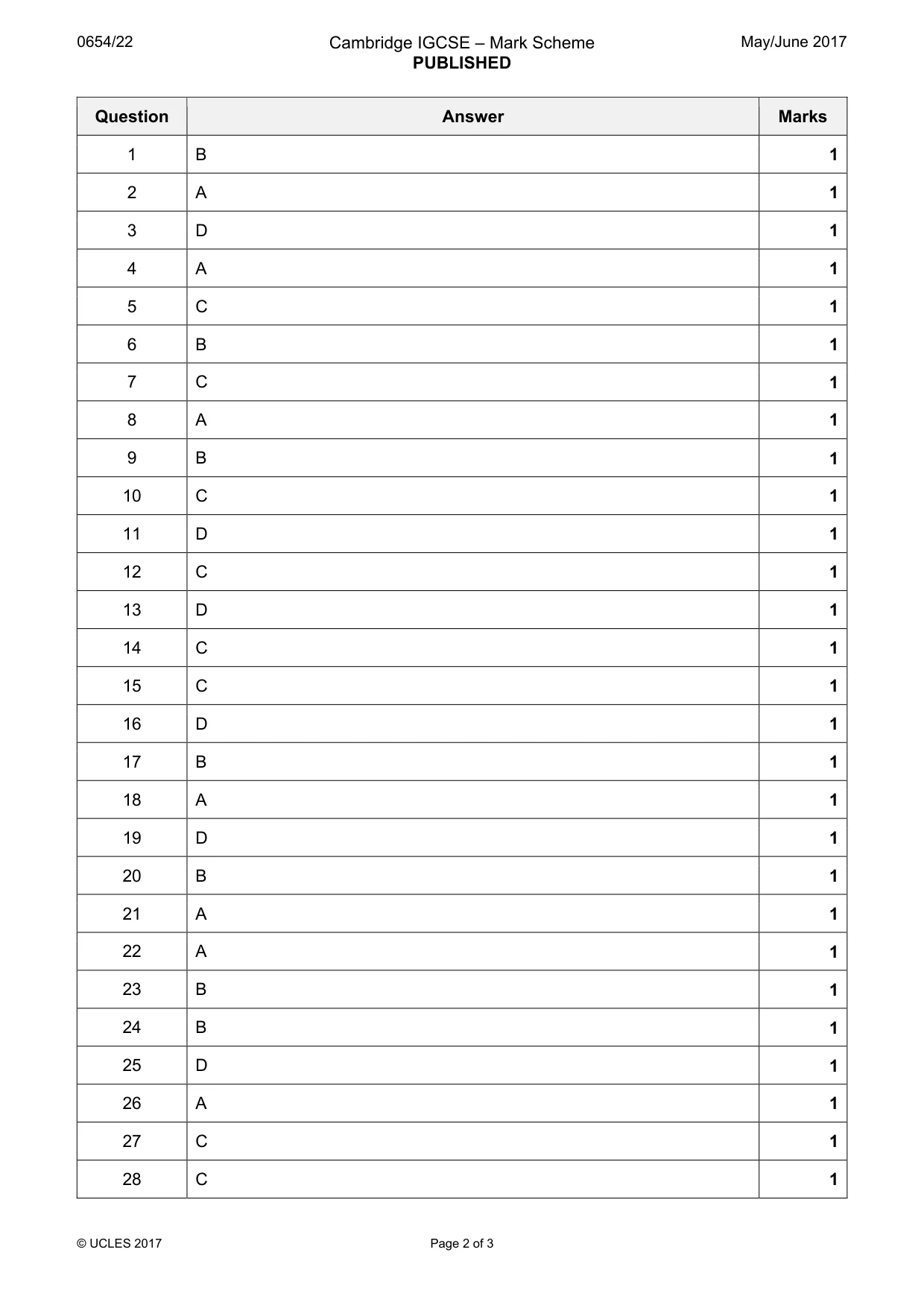
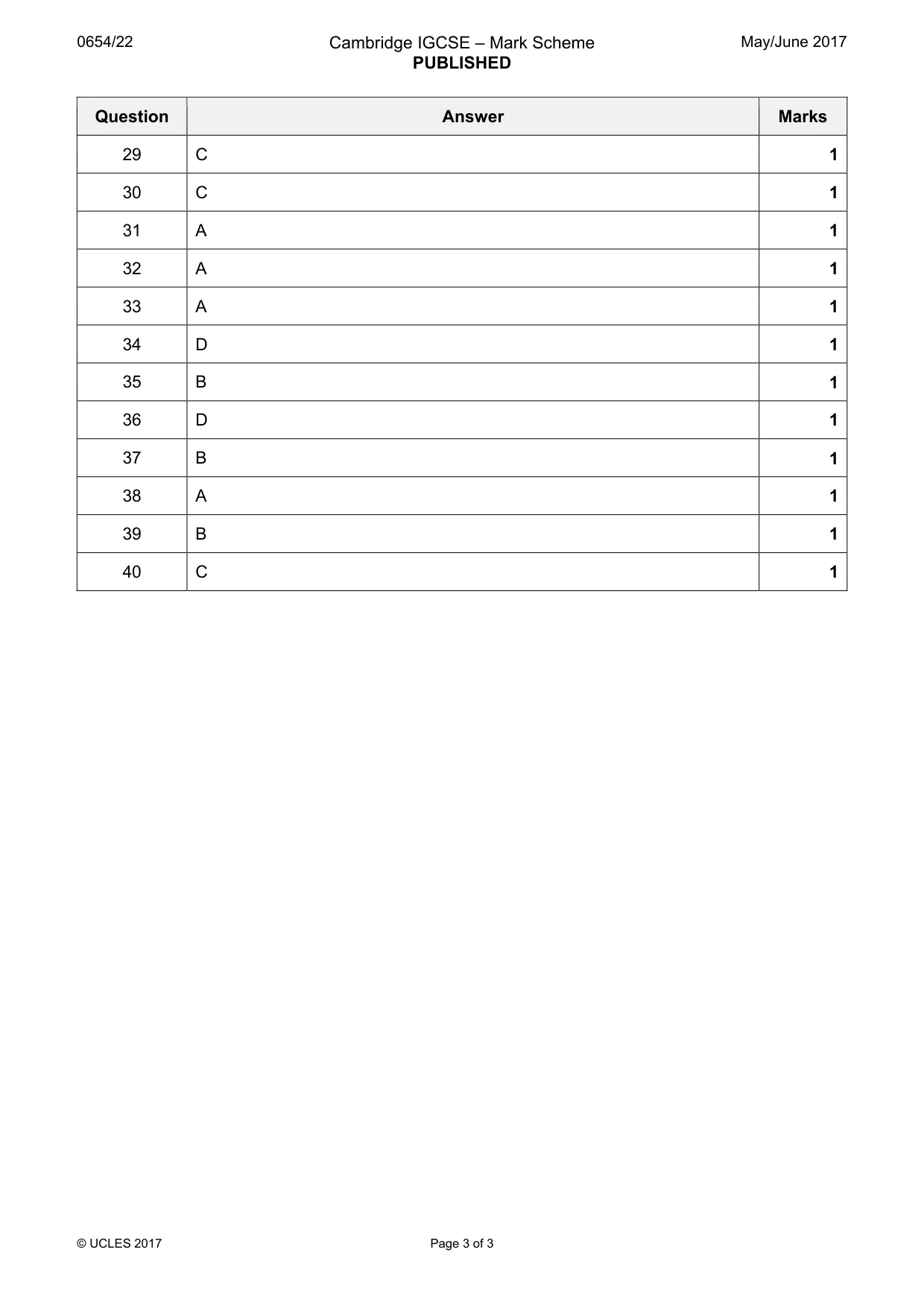
Mark scheme3 pages
Answers below. Sit the paper first if you are practising.
Questions as text
Q1 · Which structural feature is found in a plant cell but not in an animal cell?
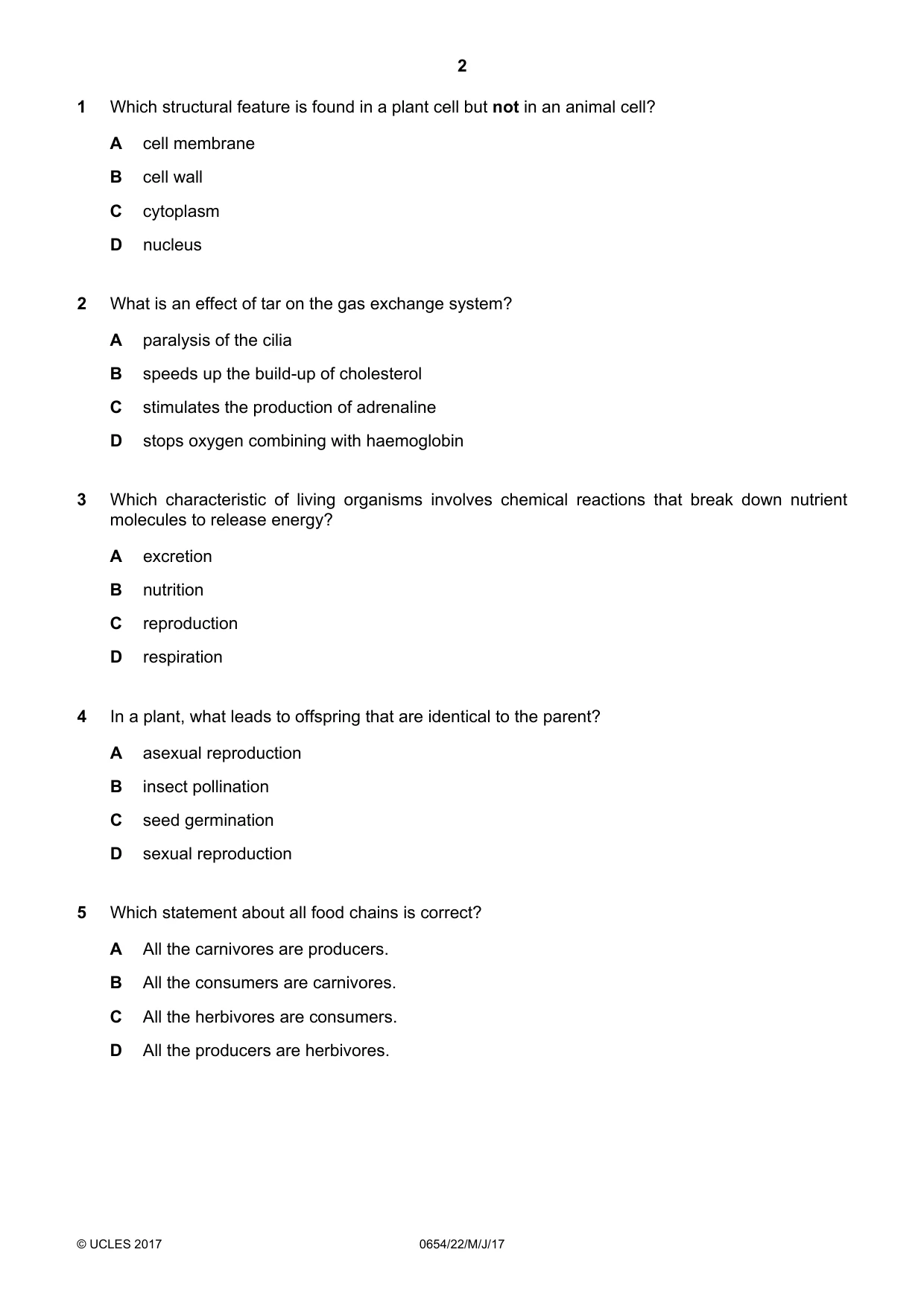
1 Which structural feature is found in a plant cell but not in an animal cell? A cell membrane B cell wall C cytoplasm D nucleus
Mark scheme: B
Q2 · What is an effect of tar on the gas exchange system?
2 What is an effect of tar on the gas exchange system? A paralysis of the cilia B speeds up the build-up of cholesterol C stimulates the production of adrenaline D stops oxygen combining with haemoglobin
Mark scheme: A
Q3 · Which characteristic of living organisms involves chemical reactions that break down…
3 Which characteristic of living organisms involves chemical reactions that break down nutrient molecules to release energy? A excretion B nutrition C reproduction D respiration
Mark scheme: D
Q4 · In a plant, what leads to offspring that are identical to the parent?
4 In a plant, what leads to offspring that are identical to the parent? A asexual reproduction B insect pollination C seed germination D sexual reproduction
Mark scheme: A
Q5 · Which statement about all food chains is correct?
5 Which statement about all food chains is correct? A All the carnivores are producers. B All the consumers are carnivores. C All the herbivores are consumers. D All the producers are herbivores.
Mark scheme: C
Q6 · What is the function of microorganisms in yoghurt making?
6 What is the function of microorganisms in yoghurt making? A They make the sugar in milk become solid. B They produce lactic acid. C They raise the pH of the mixture. D They reduce the fat content of the milk.
Mark scheme: B
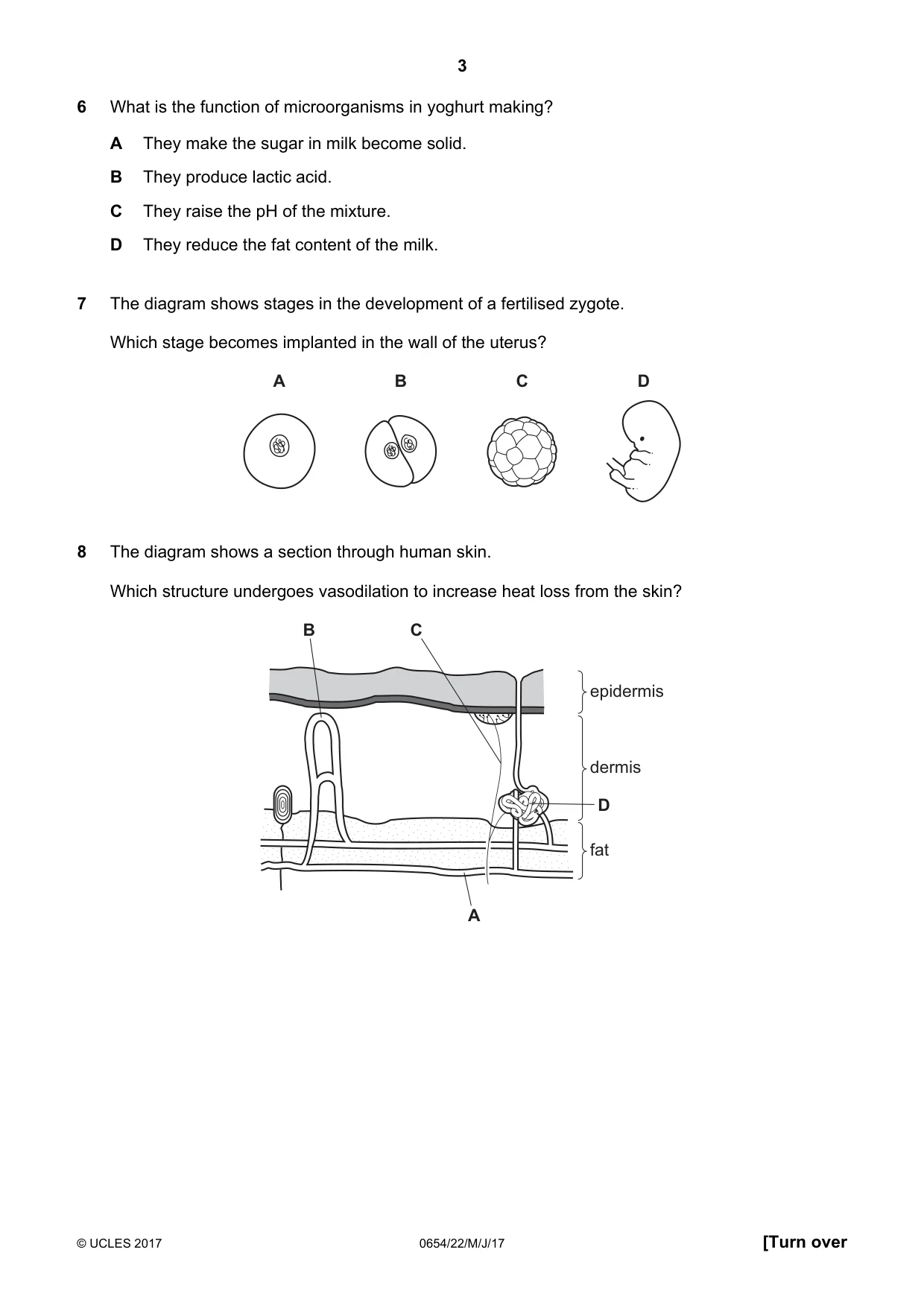
Q7 · The diagram shows stages in the development of a fertilised zygote
7 The diagram shows stages in the development of a fertilised zygote. Which stage becomes implanted in the wall of the uterus? A B C D
Mark scheme: C
Q8 · The diagram shows a section through human skin
8 The diagram shows a section through human skin. Which structure undergoes vasodilation to increase heat loss from the skin? B C epidermis dermis D fat A
Mark scheme: A
Q9 · The list shows some effects of human activities
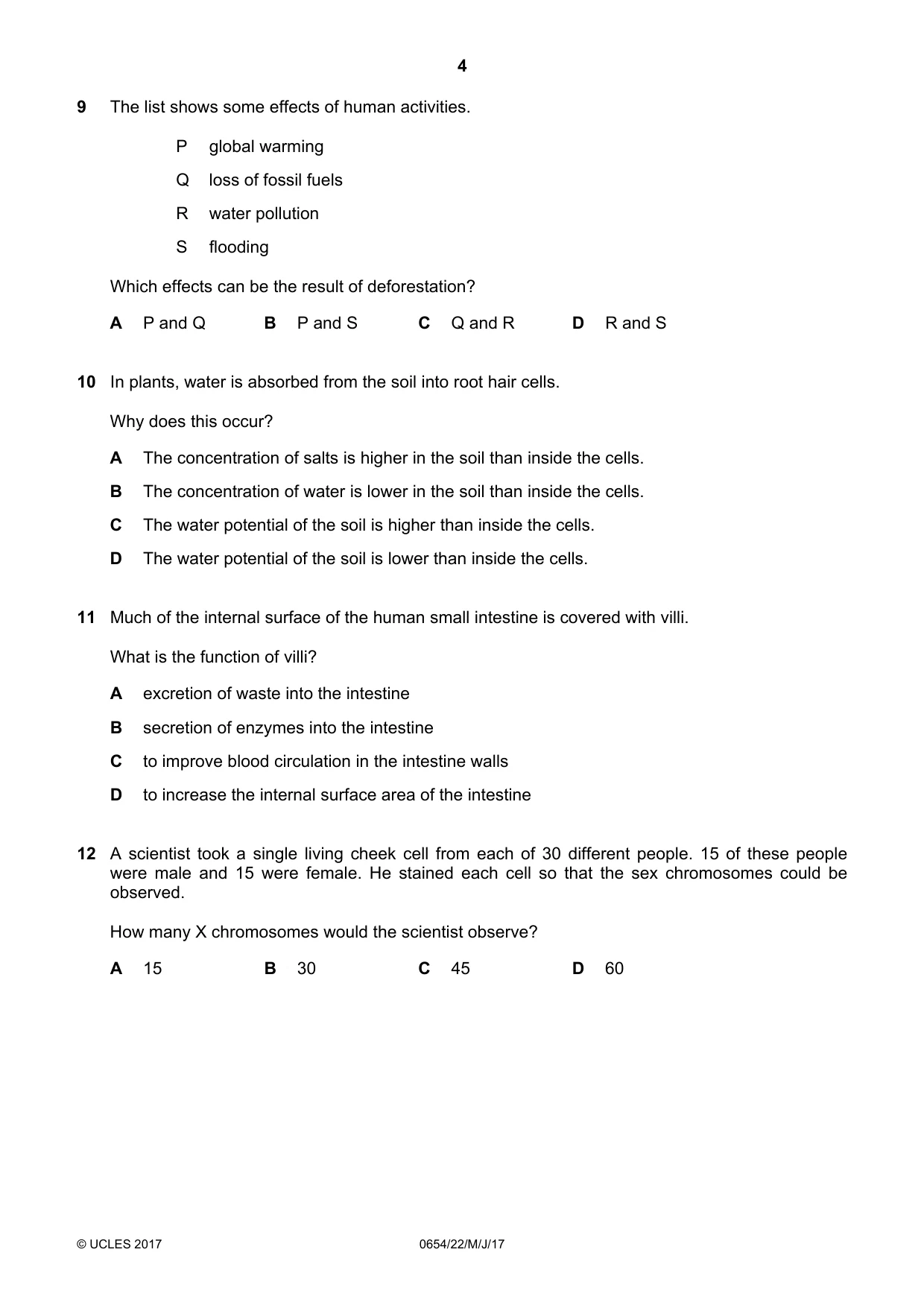
9 The list shows some effects of human activities. P global warming Q loss of fossil fuels R water pollution S flooding Which effects can be the result of deforestation? A P and Q B P and S C Q and R D R and S
Mark scheme: B
Q10 · In plants, water is absorbed from the soil into root hair cells
10 In plants, water is absorbed from the soil into root hair cells. Why does this occur? A The concentration of salts is higher in the soil than inside the cells. B The concentration of water is lower in the soil than inside the cells. C The water potential of the soil is higher than inside the cells. D The water potential of the soil is lower than inside the cells.
Mark scheme: C
Q11 · Much of the internal surface of the human small intestine is covered with villi
11 Much of the internal surface of the human small intestine is covered with villi. What is the function of villi? A excretion of waste into the intestine B secretion of enzymes into the intestine C to improve blood circulation in the intestine walls D to increase the internal surface area of the intestine
Mark scheme: D
Q12 · A scientist took a single living cheek cell from each of 30 different people
12 A scientist took a single living cheek cell from each of 30 different people. 15 of these people were male and 15 were female. He stained each cell so that the sex chromosomes could be observed. How many X chromosomes would the scientist observe? A 15 B 30 C 45 D 60
Mark scheme: C
Q13 · The diagram shows a section through the front of the eye and a front view of the eye
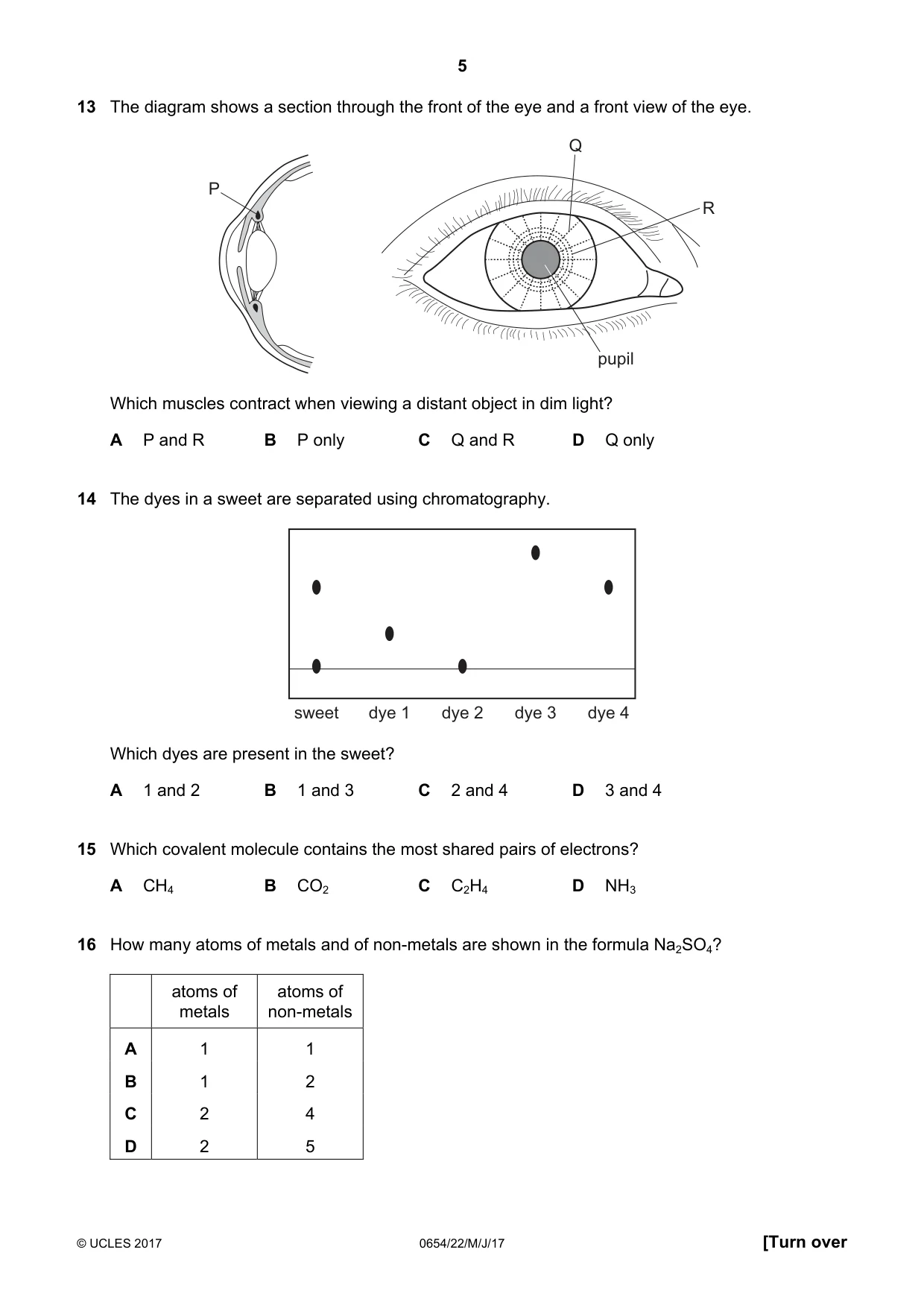
13 The diagram shows a section through the front of the eye and a front view of the eye. Q P R pupil Which muscles contract when viewing a distant object in dim light? A P and R B P only C Q and R D Q only
Mark scheme: D
Q14 · The dyes in a sweet are separated using chromatography
14 The dyes in a sweet are separated using chromatography. sweet dye 1 dye 2 dye 3 dye 4 Which dyes are present in the sweet? A 1 and 2 B 1 and 3 C 2 and 4 D 3 and 4
Mark scheme: C
Q15 · Which covalent molecule contains the most shared pairs of electrons?
15 Which covalent molecule contains the most shared pairs of electrons? A CH4 B CO2 C C2H4 D NH3
Mark scheme: C
Q16 · How many atoms of metals and of non-metals are shown in the formula Na2SO4?
16 How many atoms of metals and of non-metals are shown in the formula Na2SO4? atoms of atoms of metals non-metals A 1 1 B 1 2 C 2 4 D 2 5
Mark scheme: D
Q17 · Molten zinc bromide and aqueous zinc bromide are electrolysed using inert electrodes
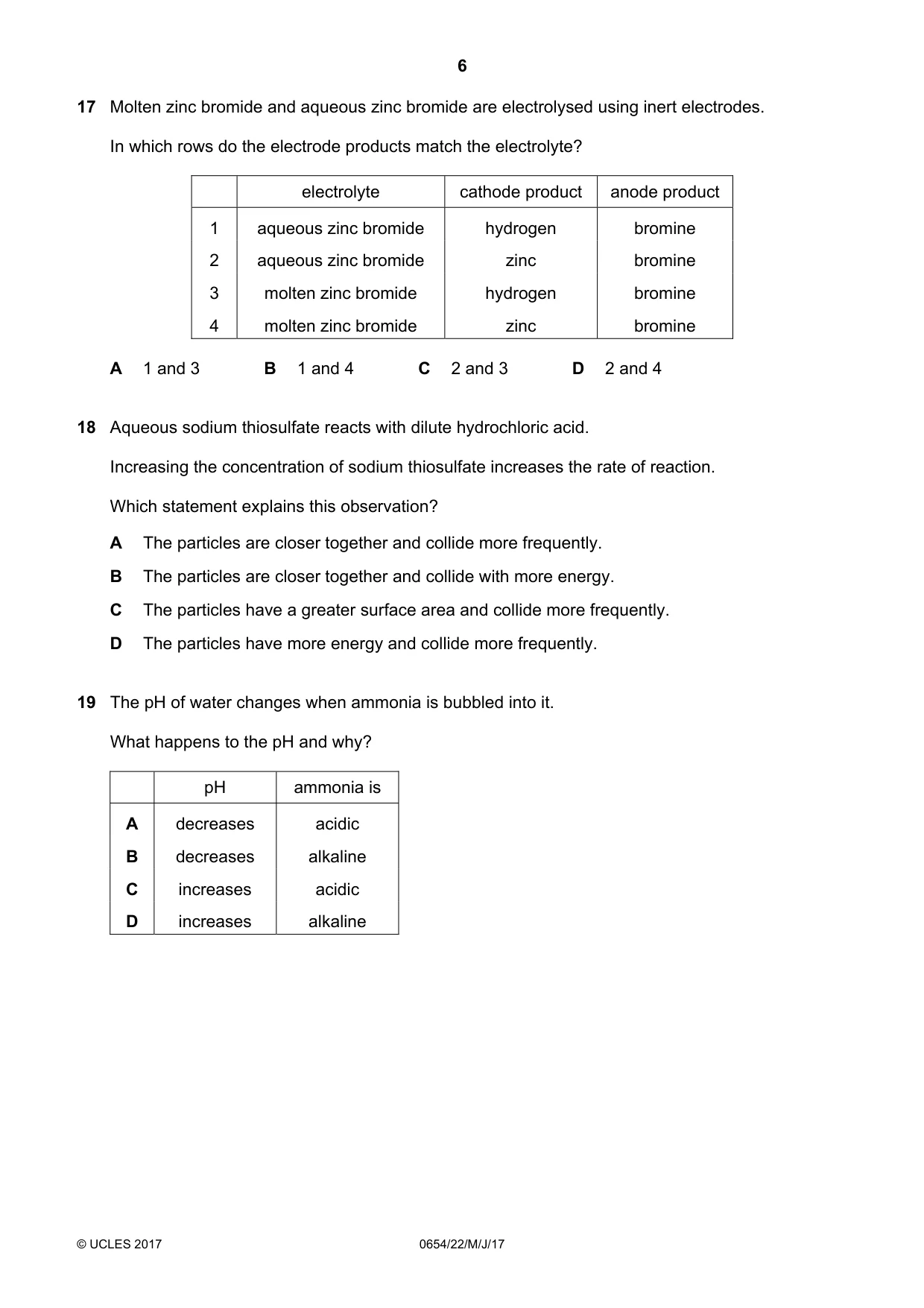
17 Molten zinc bromide and aqueous zinc bromide are electrolysed using inert electrodes. In which rows do the electrode products match the electrolyte? electrolyte cathode product anode product 1 aqueous zinc bromide hydrogen bromine 2 aqueous zinc bromide zinc bromine 3 molten zinc bromide hydrogen bromine 4 molten zinc bromide zinc bromine A 1 and 3 B 1 and 4 C 2 and 3 D 2 and 4
Mark scheme: B
Q18 · Aqueous sodium thiosulfate reacts with dilute hydrochloric acid
18 Aqueous sodium thiosulfate reacts with dilute hydrochloric acid. Increasing the concentration of sodium thiosulfate increases the rate of reaction. Which statement explains this observation? A The particles are closer together and collide more frequently. B The particles are closer together and collide with more energy. C The particles have a greater surface area and collide more frequently. D The particles have more energy and collide more frequently.
Mark scheme: A
Q19 · The pH of water changes when ammonia is bubbled into it
19 The pH of water changes when ammonia is bubbled into it. What happens to the pH and why? pH ammonia is A decreases acidic B decreases alkaline C increases acidic D increases alkaline
Mark scheme: D
More questions on The characteristic properties of acids and bases
Q20 · Some properties of gas Y are listed
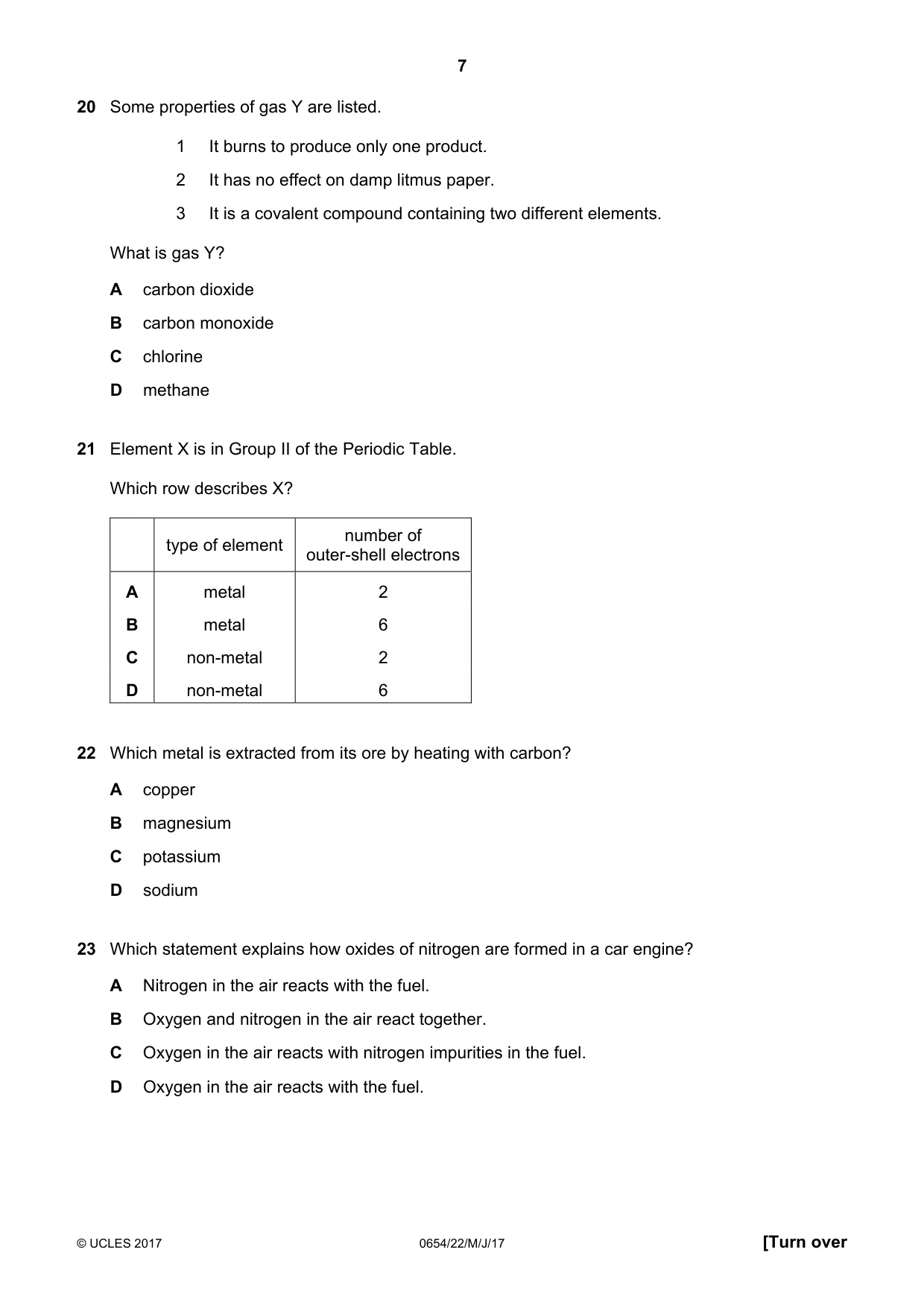
20 Some properties of gas Y are listed. 1 It burns to produce only one product. 2 It has no effect on damp litmus paper. 3 It is a covalent compound containing two different elements. What is gas Y? A carbon dioxide B carbon monoxide C chlorine D methane
Mark scheme: B
Q21 · Element X is in Group II of the Periodic Table
21 Element X is in Group II of the Periodic Table. Which row describes X? number of type of element outer-shell electrons A metal 2 B metal 6 C non-metal 2 D non-metal 6
Mark scheme: A
Q22 · Which metal is extracted from its ore by heating with carbon?
22 Which metal is extracted from its ore by heating with carbon? A copper B magnesium C potassium D sodium
Mark scheme: A
Q23 · Which statement explains how oxides of nitrogen are formed in a car engine?
23 Which statement explains how oxides of nitrogen are formed in a car engine? A Nitrogen in the air reacts with the fuel. B Oxygen and nitrogen in the air react together. C Oxygen in the air reacts with nitrogen impurities in the fuel. D Oxygen in the air reacts with the fuel.
Mark scheme: B
Q24 · The diagram shows an experiment about the rusting of iron
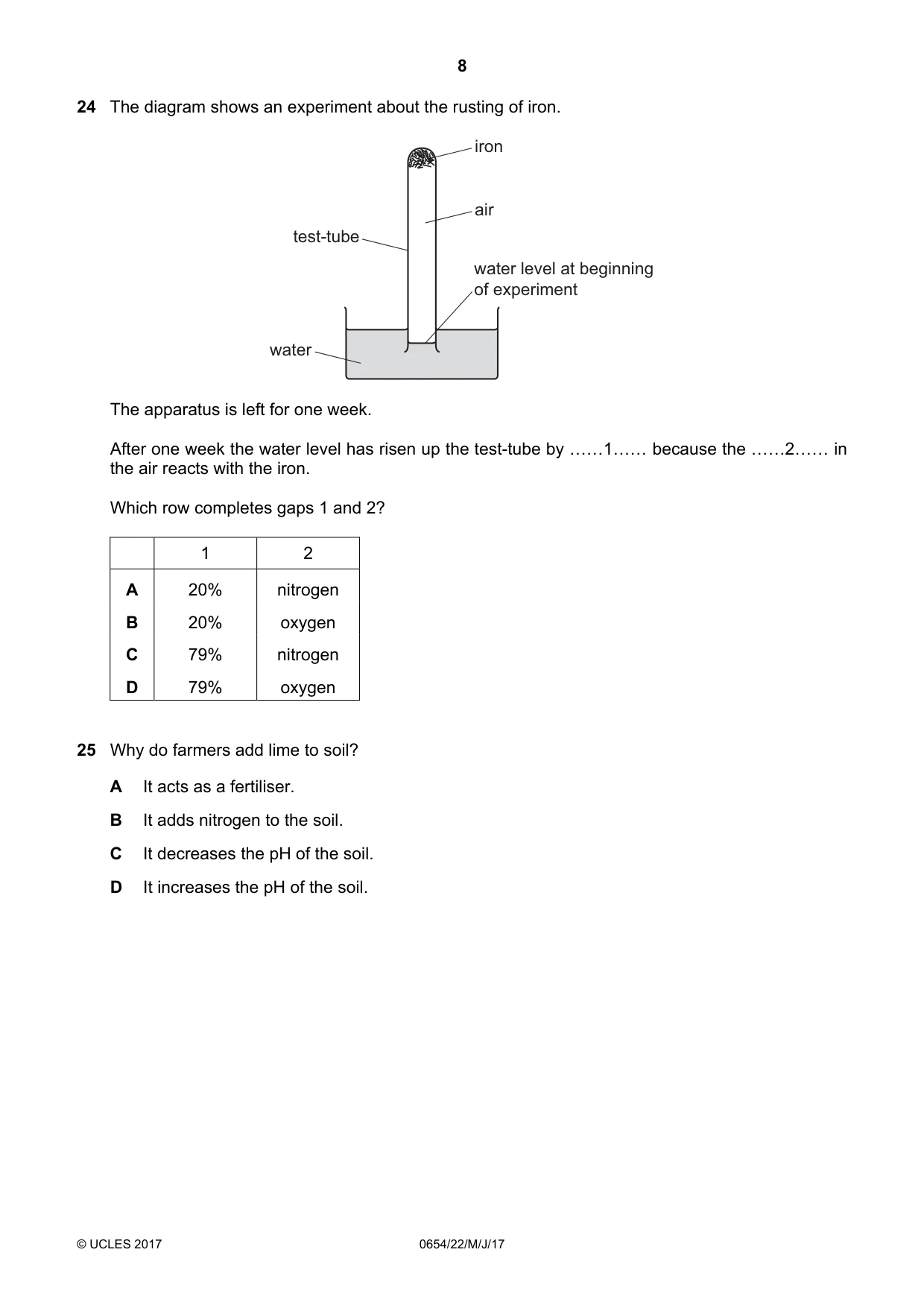
24 The diagram shows an experiment about the rusting of iron. iron air test-tube water level at beginning of experiment water The apparatus is left for one week. After one week the water level has risen up the test-tube by ««1«« because the ««2«« in the air reacts with the iron. Which row completes gaps 1 and 2? 1 2 A 20% nitrogen B 20% oxygen C 79% nitrogen D 79% oxygen
Mark scheme: B
Q25 · Why do farmers add lime to soil?
25 Why do farmers add lime to soil? A It acts as a fertiliser. B It adds nitrogen to the soil. C It decreases the pH of the soil. D It increases the pH of the soil.
Mark scheme: D
More questions on The characteristic properties of acids and bases
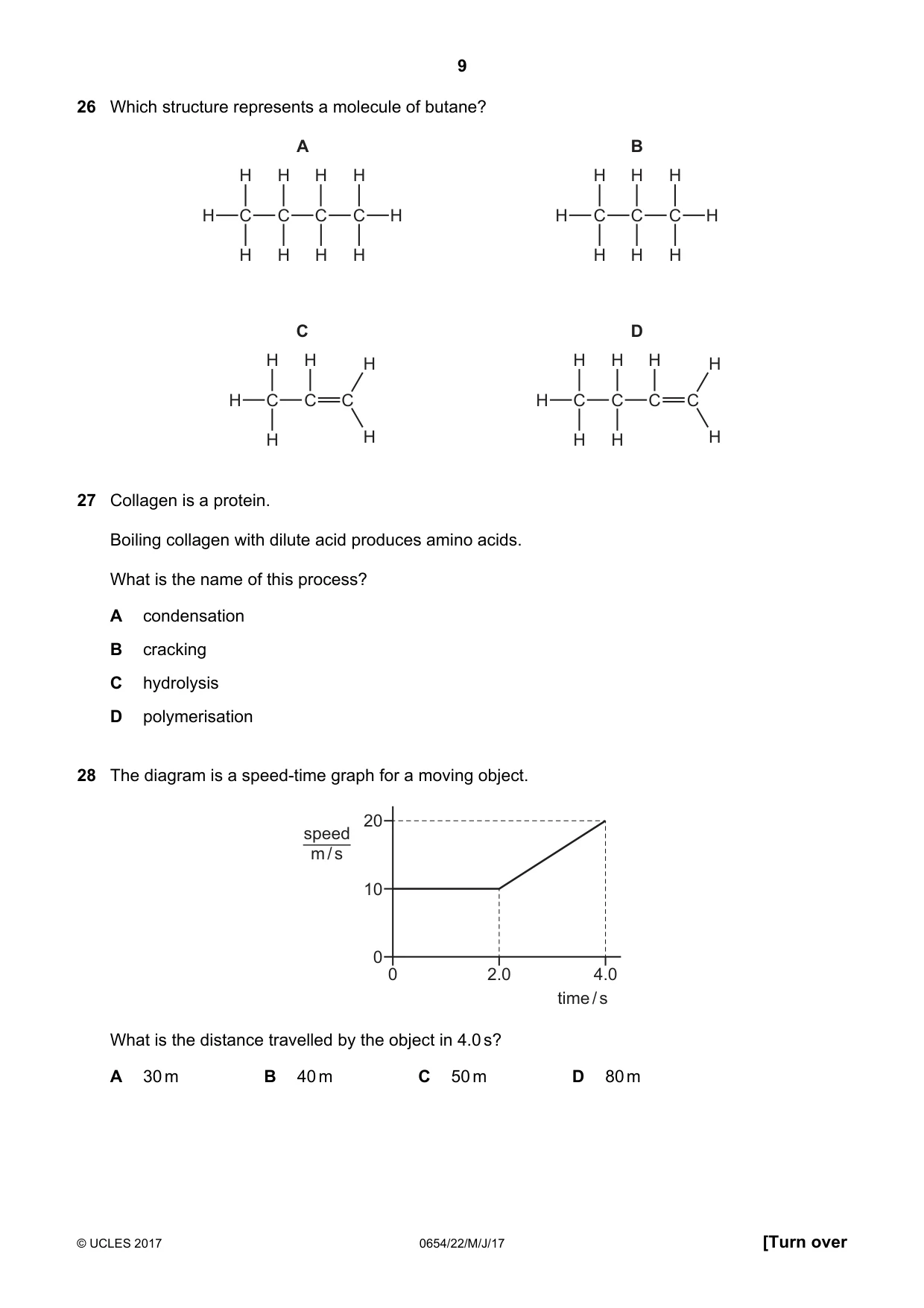
Q26 · Which structure represents a molecule of butane?
26 Which structure represents a molecule of butane? A B H H H H H H H H C C C C H H C C C H H H H H H H H C D H H H H H H H H C C C H C C C C H H H H H
Mark scheme: A
Q27 · Collagen is a protein
27 Collagen is a protein. Boiling collagen with dilute acid produces amino acids. What is the name of this process? A condensation B cracking C hydrolysis D polymerisation
Mark scheme: C
Q28 · The diagram is a speed-time graph for a moving object
28 The diagram is a speed-time graph for a moving object. 20 speed m / s 10 0 0 2.0 4.0 time / s What is the distance travelled by the object in 4.0 s? A 30 m B 40 m C 50 m D 80 m
Mark scheme: C
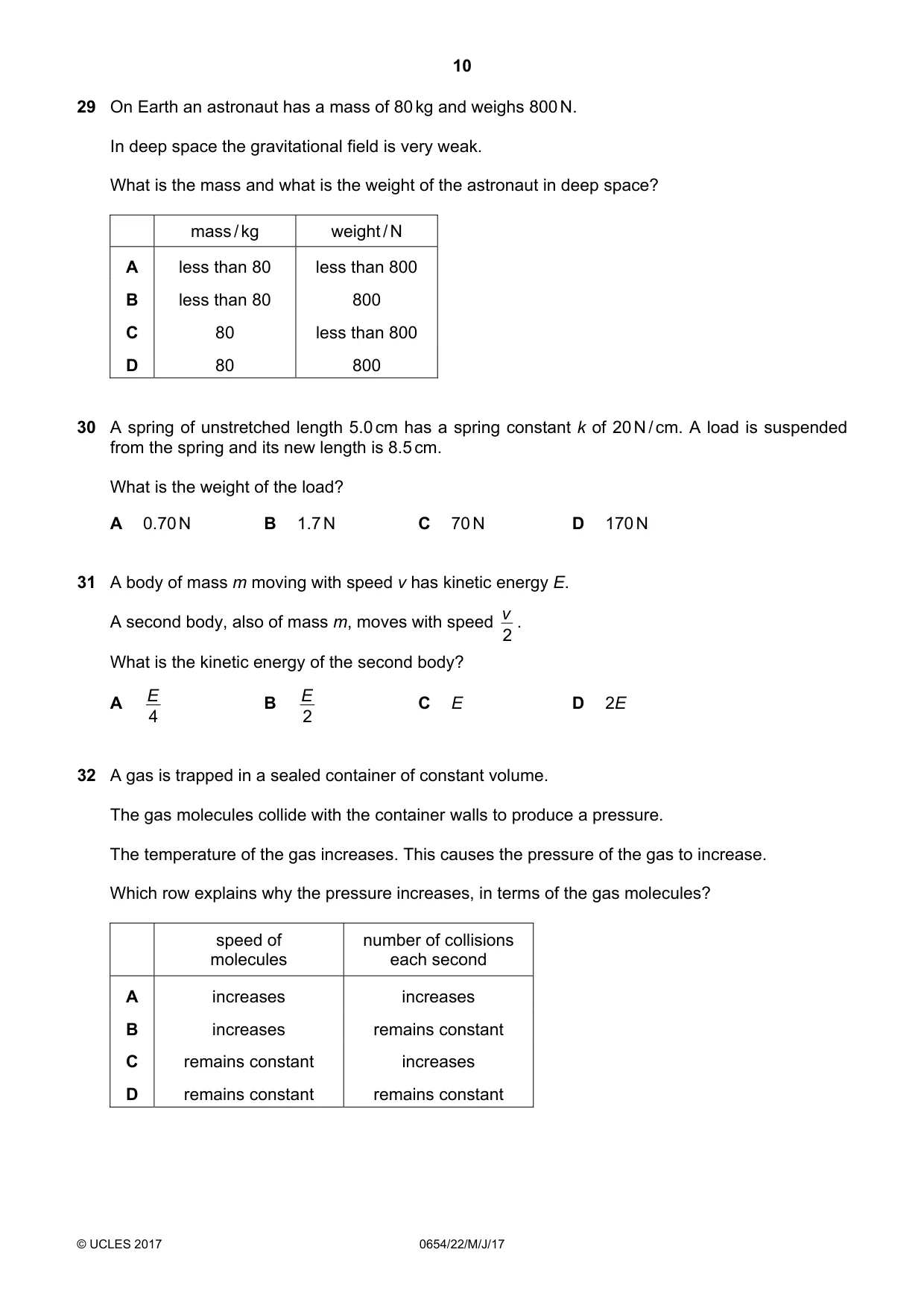
Q29 · On Earth an astronaut has a mass of 80 kg and weighs 800 N
29 On Earth an astronaut has a mass of 80 kg and weighs 800 N. In deep space the gravitational field is very weak. What is the mass and what is the weight of the astronaut in deep space? mass / kg weight / N A less than 80 less than 800 B less than 80 800 C 80 less than 800 D 80 800
Mark scheme: C
Q30 · A spring of unstretched length 5.0 cm has a spring constant k of 20 N / cm
30 A spring of unstretched length 5.0 cm has a spring constant k of 20 N / cm. A load is suspended from the spring and its new length is 8.5 cm. What is the weight of the load? A 0.70 N B 1.7 N C 70 N D 170 N
Mark scheme: C
Q31 · A body of mass m moving with speed v has kinetic energy E
31 A body of mass m moving with speed v has kinetic energy E. v . A second body, also of mass m, moves with speed 2 What is the kinetic energy of the second body? E E A B C E D 2E 4 2
Mark scheme: A
Q32 · A gas is trapped in a sealed container of constant volume
32 A gas is trapped in a sealed container of constant volume. The gas molecules collide with the container walls to produce a pressure. The temperature of the gas increases. This causes the pressure of the gas to increase. Which row explains why the pressure increases, in terms of the gas molecules? speed of number of collisions molecules each second A increases increases B increases remains constant C remains constant increases D remains constant remains constant
Mark scheme: A
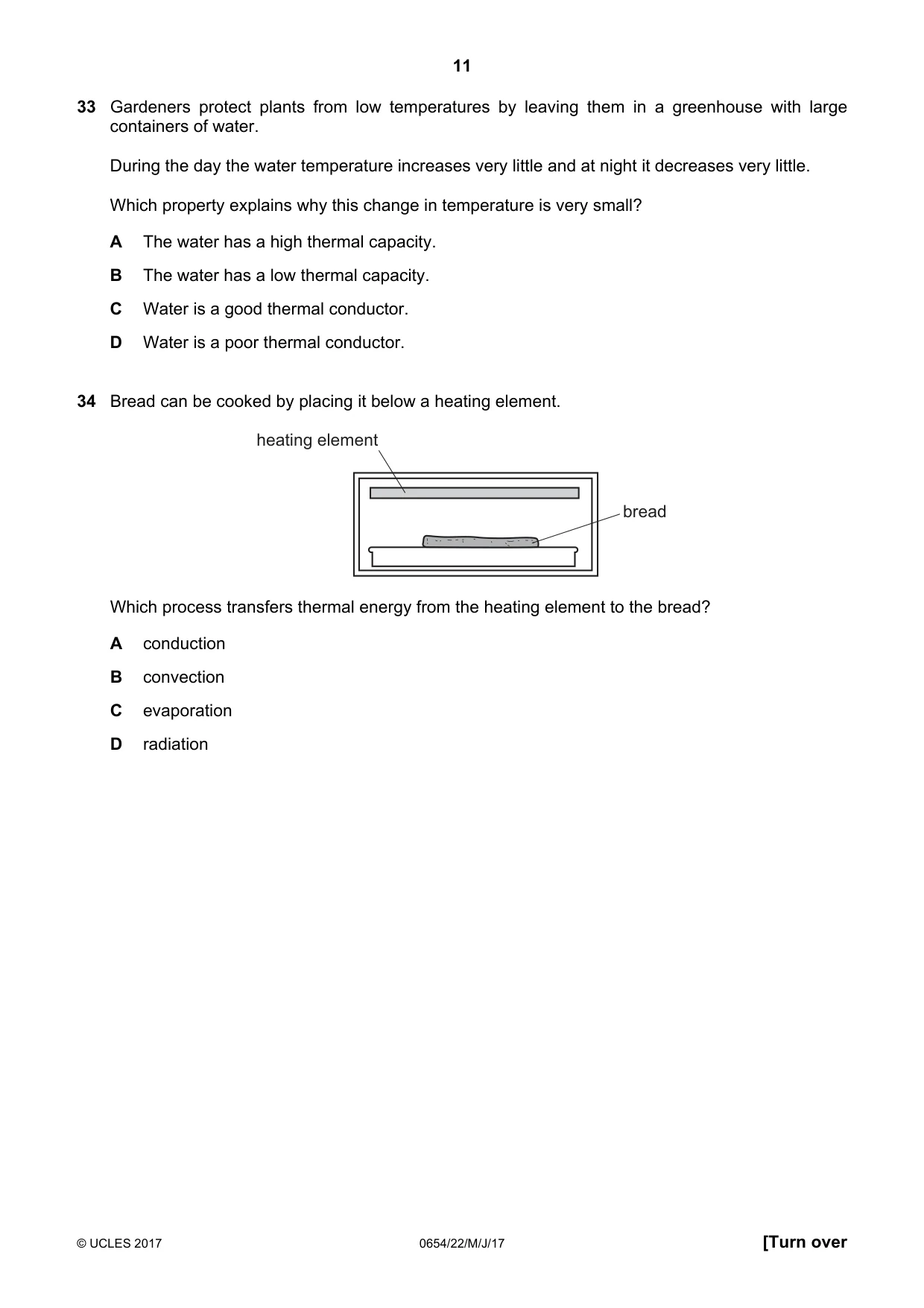
Q33 · Gardeners protect plants from low temperatures by leaving them in a greenhouse with large…
33 Gardeners protect plants from low temperatures by leaving them in a greenhouse with large containers of water. During the day the water temperature increases very little and at night it decreases very little. Which property explains why this change in temperature is very small? A The water has a high thermal capacity. B The water has a low thermal capacity. C Water is a good thermal conductor. D Water is a poor thermal conductor.
Mark scheme: A
Q34 · Bread can be cooked by placing it below a heating element
34 Bread can be cooked by placing it below a heating element. heating element bread Which process transfers thermal energy from the heating element to the bread? A conduction B convection C evaporation D radiation
Mark scheme: D
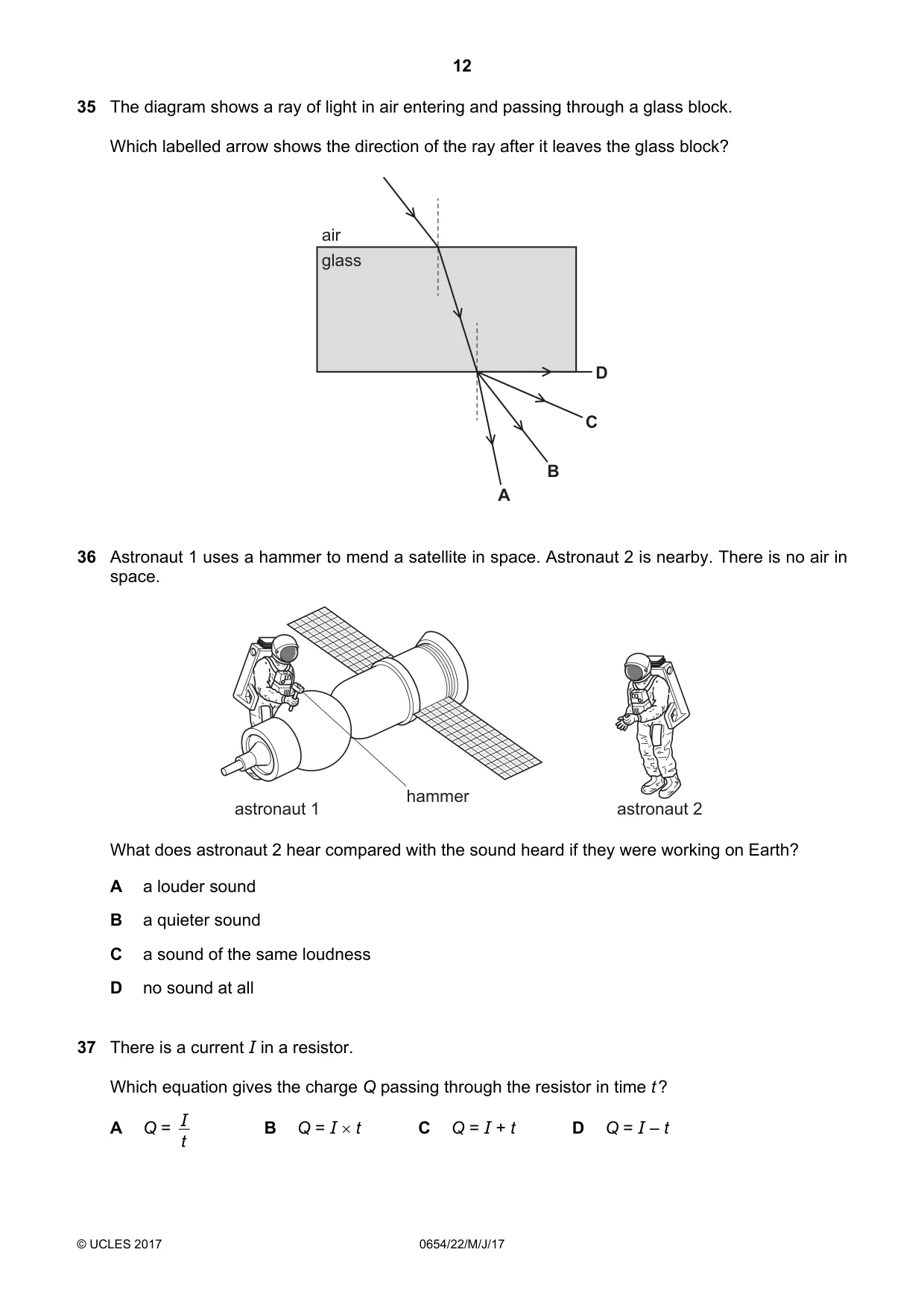
Q35 · The diagram shows a ray of light in air entering and passing through a glass block
35 The diagram shows a ray of light in air entering and passing through a glass block. Which labelled arrow shows the direction of the ray after it leaves the glass block? air glass D C B A
Mark scheme: B
Q36 · Astronaut 1 uses a hammer to mend a satellite in space
36 Astronaut 1 uses a hammer to mend a satellite in space. Astronaut 2 is nearby. There is no air in space. hammer astronaut 1 astronaut 2 What does astronaut 2 hear compared with the sound heard if they were working on Earth? A a louder sound B a quieter sound C a sound of the same loudness D no sound at all
Mark scheme: D
Q37 · There is a current I in a resistor
37 There is a current I in a resistor. Which equation gives the charge Q passing through the resistor in time t ? I Q = I × t Q = I + t Q = I – t A Q = t B C D
Mark scheme: B
Q38 · Two identical resistors are connected in series
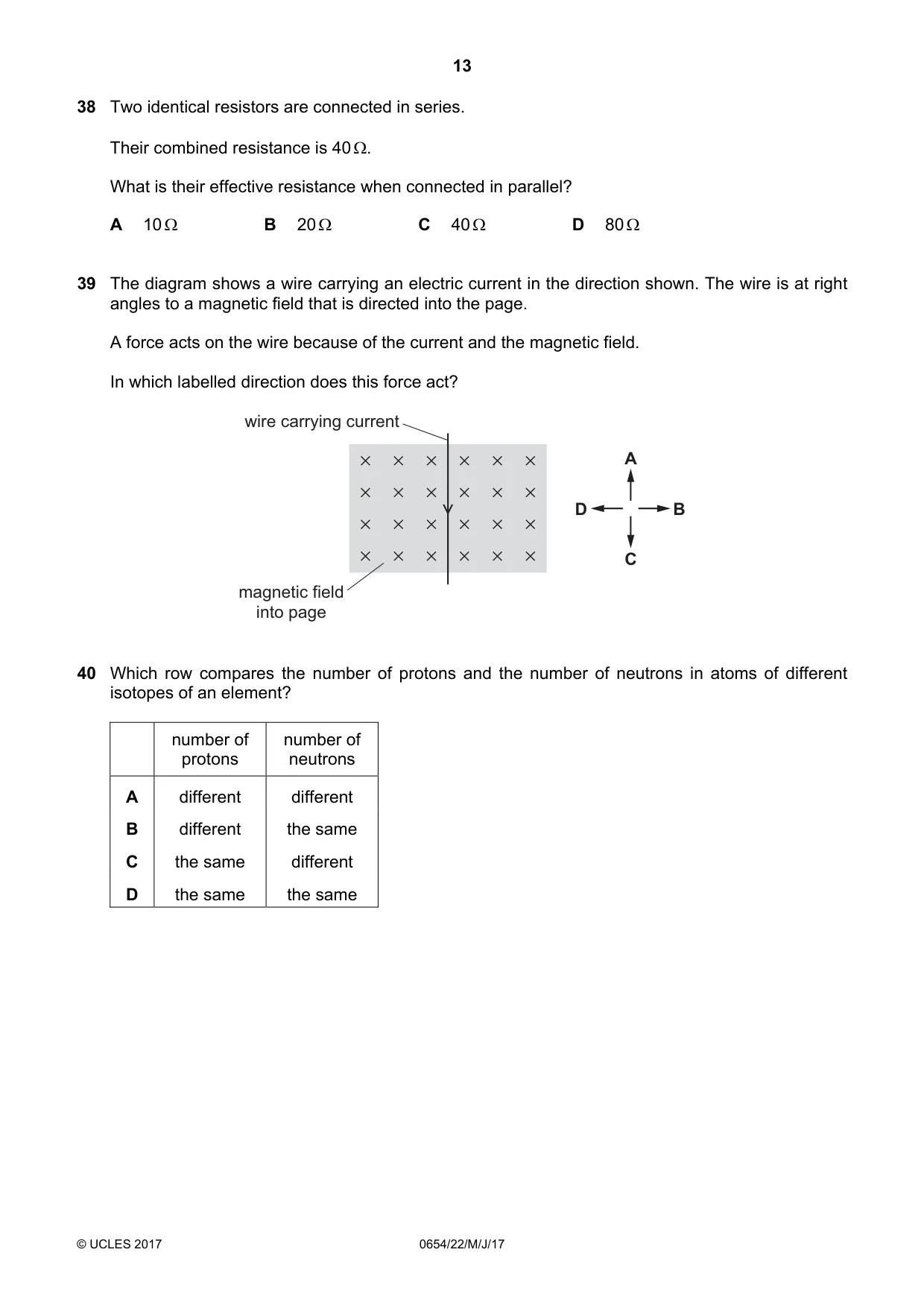
38 Two identical resistors are connected in series. Their combined resistance is 40 Ω. What is their effective resistance when connected in parallel? A 10 Ω B 20 Ω C 40 Ω D 80 Ω
Mark scheme: A
Q39 · The diagram shows a wire carrying an electric current in the direction shown
39 The diagram shows a wire carrying an electric current in the direction shown. The wire is at right angles to a magnetic field that is directed into the page. A force acts on the wire because of the current and the magnetic field. In which labelled direction does this force act? wire carrying current A D B C magnetic field into page
Mark scheme: B
Q40 · Which row compares the number of protons and the number of neutrons in atoms of different…
40 Which row compares the number of protons and the number of neutrons in atoms of different isotopes of an element? number of number of protons neutrons A different different B different the same C the same different D the same the same
Mark scheme: C
What was in this paper
The subtopics covered by these 40 questions, and how many questions each got. Open one in a new tab to see every Cambridge question on it.
2The characteristic properties of acids and bases2Air quality and climate1Alkanes1Arrangement of elements1Asexual reproduction1Cell structure1Chromatography1Chromosomes and genes1Coordination and response1Corrosion of metals1Digestive system1Electrical circuits1Electrical quantities1Electrolysis1Electromagnetic effects1Energy, work and power1Extraction of metals1Food chains and food webs1Forces1Formulas1Gas exchange in humans1Habitat destruction1Homeostasis1Identification of ions and gases1Isotopes1Kinetic particle model of matter1Light1Mass and weight1Motion1Osmosis1Polymers1Rate of reaction1Sexual reproduction in humans1Simple molecules and covalent bonds1Sound1Thermal properties and temperature1Transfer of thermal energy1What you needed in this session
Cambridge’s own grade thresholds for 2017 May/June, Paper 2 · Variant 2. A higher threshold means an easier paper — the bar moves with how the cohort did.