Questions as text
Q1 · A speed-time graph for a car over a period of 50 seconds 0654/31 May/June 2017
7 (a) Fig. 7.1 shows a speed-time graph for a car over a period of 50 seconds. BB CC 4 3 speed m / s 2 1 A DD EE 0 0 10 20 30 40 50 time / s Fig. 7.1 (i) State a time when the car is not moving. … s [1] (ii) State the maximum speed reached by the car. … m / s [1] (iii) Calculate the distance travelled by the car between 10 seconds and 15 seconds. Show your working. distance = … m [2] (b) A man has been riding in a car which has plastic seats. Suggest why an electric charge builds up on the man. … … [1] (c) The car has a warning triangle to alert other motorists. Fig. 7.2 shows a warning triangle. Fig. 7.2 The triangle contains many tiny prisms. Fig. 7.3 shows one prism. The rays of light undergo total internal reflection inside the prism. Fig. 7.3 Rays of light enter and leave the prism as shown. Complete Fig. 7.3 to show the path of the ray of light through the prism. [2] (d) The temperature of the air in car tyres increases during a journey. (i) Describe what happens to the motion of the air particles as the air warms up. … … [1] (ii) When the temperature of the air in the tyres increases, the pressure in the tyres increases. Explain in terms of the motion of the air particles why the pressure increases. … … … [2]
10 marks
Mark scheme: 7(a)(i) when time is 0 s / 40–50 s ; 1 7(a)(ii) 4 (m / s) ; 1 7(a)(iii) distance = speed × time / 5 × 4 ; = 20 (m) ; 2 7(b) reference to friction or description / transfer of electrons / negative charge ; 1 7(c) no deviation at first interface and first reflection correct ; second reflection correct ; 2 7(d)(i) move faster ; 1 7(d)(ii) more frequent collisions / collide at greater speed (with wall) ; more force exerted on tyre walls ; 2
This question in 0654/31 May/June 2017
Q2 · A student is climbing a mountain 0654/31 May/June 2017
13 (a) A student is climbing a mountain. State the type of energy gained by the student as she climbs. … energy [1] (b) The student makes a loud noise as she climbs and hears the echo from another mountain a few seconds later. The student knows the distance to the other mountain. Describe how she can calculate a value for the speed of sound in air. … … … … … … [3] (c) On the mountain, the student is exposed to both infra-red and ultraviolet waves. Infra-red and ultraviolet are part of the electromagnetic spectrum. On Fig. 13.1, put infra-red and ultraviolet waves in their correct places in the incomplete electromagnetic spectrum. visible γ-rays microwaves light Fig. 13.1 [2] (d) The student uses a camera to take photographs when she reaches the top of the mountain. The camera uses a converging lens. Fig. 13.2 shows an incomplete ray diagram for a converging lens forming an image. object F F Fig. 13.2 (i) On Fig. 13.2, complete the ray diagram to show the three rays of light after they have passed through the lens. One ray has been drawn for you. [1] (ii) On Fig. 13.2, draw an arrow ↓ to show where the image is formed. [1] (iii) State the name of points F. … [1]
9 marks
Mark scheme: 13(a) gravitational (potential) energy ; 1 13(b) measure the number of seconds / time between noise and echo ; divide distance by time ; divide double the distance / multiply by 2 ; 3 13(c) infra-red to right of visible ; ultraviolet to left of visible ; 2 13(d)(i) middle ray passes through without deviation and bottom ray passes out parallel to principal axis ; 1 13(d)(ii) inverted arrow drawn at intersection of three rays ; 1 13(d)(iii) principal focus / focal point ; 1
This question in 0654/31 May/June 2017
Q3 · A school orchestra is practising 0654/32 May/June 2017
7 A school orchestra is practising. (a) Table 7.1 shows the highest and lowest sound frequencies of some of the musical instruments in the orchestra. Table 7.1 instrument highest frequency / Hz lowest frequency / Hz cymbals 900 300 flute 2600 260 piano 4200 30 trumpet 1050 170 violin 3500 200 (i) State the meaning of the term frequency. … … [1] (ii) State which instrument can produce the sound with the highest pitch. Explain your answer. instrument … explanation … … [2] (iii) State the highest and lowest frequencies that can normally be heard by a human. highest … Hz lowest … Hz [1] (b) A cymbal is made from brass. The volume of brass used to make the cymbal is 160 cm3. The mass of the cymbal is 1200 g. Calculate the density of brass. State the formula you use, show your working and state the unit of your answer. formula working density = … unit … [3] (c) Sound waves are longitudinal waves. (i) Give an example of a transverse wave. … [1] (ii) Describe the difference between a longitudinal wave and a transverse wave. … … … [1] (d) A teacher and a student are measuring the speed of sound. The teacher makes a loud sound by hitting two cymbals together. (i) The student stands 150 m from the teacher. She records the time between when she sees the teacher hit the cymbals and when she hears the sound. The sound takes 0.5 s to reach the student. Calculate the speed of sound in air. State the formula you use and show your working. formula working speed of sound = … m / s [2] (ii) Explain why a sound wave is produced when the cymbals hit each other. … … [1] (e) Fig. 7.1 shows a student working on her laptop computer at school. lamp laptop screen Fig. 7.1 not to scale Light from a lamp is reflected by the laptop screen into the student’s eyes. (i) On Fig. 7.1, label the angle of incidence with the letter i . [1] (ii) When the angle of reflection is 40°, state the angle of incidence. Explain your answer. angle of incidence … °. explanation … … [2] Question 8 starts on page 16.
15 marks
Mark scheme: 7(a)(i) no of waves / second ; 1 7(a)(ii) piano ; highest frequency ; 2 7(a)(iii) 20 000 Hz and 20 Hz ; 1 7(b) density = mass / volume ; = 1200 / 160 = 7.5 ; g / cm3 ; 3 7(c)(i) (named) electromagnetic wave / water waves ; 1 7(c)(ii) transverse waves oscillate at right angles to direction of wave / energy transfer or longitudinal waves oscillate parallel to direction of wave / energy transfer ; 1 7(d)(i) speed = distance / time ; = 150 / 0.5 = 300 (m / s) ; 2 7(d)(ii) vibration of air molecules produced ; 1 7(e)(i) angle of incidence correctly labelled ; 1 7(e)(ii) 40° ; angle of incidence = angle of reflection ; 2
This question in 0654/32 May/June 2017
Q4 · The speed-time graph for a truck 0654/33 May/June 2017
7 (a) Fig. 7.1 shows the speed-time graph for a truck. 10 8 6 speed m / s 4 2 0 0 10 20 30 40 50 60 70 80 90 100 time / s Fig. 7.1 (i) State the maximum speed of the truck. … m / s [1] (ii) On Fig. 7.1, mark with an X the point when the truck has stopped moving. [1] (b) Fig. 7.2 shows four forces, P, Q, R and S, acting on the truck. P S Q road R Fig. 7.2 Compare the size and direction of forces Q and S when the truck is slowing down. size … direction … [2] (c) The air in the tyres of the truck is warmed during its journey. (i) Describe what happens to the motion of the air particles as the air warms up. … … [1] (ii) When the temperature of the air in the tyres increases, the pressure in the tyres increases. Explain, in terms of the motion of the air particles, why the pressure increases. … … … [2] (d) A reflector on the rear of the truck is made from many small red plastic prisms. One prism is shown in Fig. 7.3. Light from the headlight of a following car enters the prism. ray of light from car red plastic prism Fig. 7.3 Total internal reflection occurs within the prism. On Fig. 7.3, complete the path taken by the ray of light. [2] (e) The truck has two headlights. The lamp inside one headlight is connected in parallel with the lamp in the other headlight across a 24 V battery. (i) The resistance of each lamp is 5.6 Ω. Calculate the current passing through each lamp. State the formula you use and show your working. formula working current = … A [2] (ii) Suggest one important reason why the lamps in the headlights are connected in parallel rather than in series. … … … [1]
12 marks
Mark scheme: 7(a)(i) 8 (m / s) ; 1 7(a)(ii) X at 100 s ; 1 7(b) S greater than Q ; S and Q in opposite directions ; 2 7(c)(i) move faster ; 1 7(c)(ii) more frequent collisions / collide at greater speed (with wall) ; more force exerted on tyre walls ; 2 7(d) ray enters undeviated and first reflection ; second reflection and exit from prism ; 2 7(e)(i) I = V / R ; = 24 / 5.6 = 4.29 A ; 2 7(e)(ii) if one lamp fails the other will still light up / work / have a complete circuit ; 1
This question in 0654/33 May/June 2017
Q5 · A student reading a book 0654/32 Oct/Nov 2017
3 (a) Fig. 3.1 shows a student reading a book. electric lamp book Fig. 3.1 Light from an electric lamp is reflected by the book into the student’s eyes. (i) On Fig. 3.1, label the angle of incidence with the letter i . [1] (ii) The angle of reflection is 30°. State the angle of incidence. Explain your answer. angle of incidence … explanation … … [2] (iii) State the useful energy transfer that happens in the electric lamp. from … energy to … energy [1] (b) The student watches her teacher set up a radiation detector in the school science laboratory. A sealed radioactive source, strontium-90, is placed on the bench next to the radiation detector. Strontium-90 emits β-particles. A small count rate is measured. (i) Suggest a suitable radiation detector for this experiment. … [1] (ii) State the name of the particle, found in an atom, that is identical to a β-particle. … [1] (iii) When the teacher repeats the experiment a few minutes later, the count rate measured is slightly higher. Suggest one reason for this. … … [1] (iv) When not in use, the strontium-90 source is stored in a box lined with lead. Explain why this is done. … … [1] (c) The teacher asks the student to test one of the springs from a chair. Fig. 3.2 shows the chair. spring Fig. 3.2 The student measures the extension of the spring for different stretching forces. She plots the graph shown in Fig. 3.3. 10.0 8.0 6.0 extension / mm 4.0 2.0 0 0 20 40 60 80 100 120 force / N Fig. 3.3 (i) Use the graph to state the force needed to give an extension of 4.0 mm. … N [1] (ii) The force changes the shape of the spring. State one other effect that a force can have on a body. … [1]
10 marks
Mark scheme: 3(a)(i) angle of incidence correctly labelled ; 1 3(a)(ii) 30° ; angle of incidence = angle of reflection ; 2 3(a)(iii) electrical energy to light energy ; 1 3(b)(i) GM tube etc. ; 1 3(b)(ii) Electron ; 1 3(b)(iii) reference to background radiation / decay is a random process ; 1 3(b)(iv) (β–)radiation cannot penetrate lead ; 1 3(c)(i) 54 (N) ; 1 3(c)(ii) change in speed / direction of motion ; 1
This question in 0654/32 Oct/Nov 2017
Q6 · A radioactive isotope of iodine is used by a doctor to examine the thyroid gland of a… 0654/33 Oct/Nov 2017
4 (a) A radioactive isotope of iodine is used by a doctor to examine the thyroid gland of a patient. The patient takes a tablet containing the iodine, which is absorbed by the thyroid gland. The iodine emits γ-rays, that are detected outside the body. (i) Name a suitable detector for γ-rays. … [1] (ii) State the meaning of the term isotope. … … [1] (b) α-particles, β-particles and γ-rays are ionising. (i) Place these three radiations in order of their ionising ability. … … … [1] most ionising least ionising (ii) State one effect of ionising radiation on the human body. … … [1] (c) Fig. 4.1 shows a special thermometer used in hospitals to take the temperature of babies. The temperature reading is produced using thermal radiation from the human body. Thermal radiation is part of the electromagnetic spectrum. SCAN Fig. 4.1 (i) Suggest the part of the electromagnetic spectrum used by this thermometer. … [1] (ii) Fig. 4.2 shows an incomplete electromagnetic spectrum. Add the part of the electromagnetic spectrum you have suggested in (c)(i) in the correct place in Fig. 4.2. γ -rays ultraviolet microwaves Fig. 4.2 [1] (d) Endoscopes are used by doctors to observe inside a patient. An endoscope uses optical fibres. Complete Fig. 4.3 to show how a ray of light travels down an optical fibre by total internal reflection. Fig. 4.3 [1]
7 marks
Mark scheme: 4 4( 4 4( 4 4( 4 Que (a)(i) solid s (a)(ii) existen (b)(i) (b)(ii) mutatio (c)(i) infra-re (c)(ii) infra-re 4(d) total in estion 14.5 (° state detector / S nce of an eleme α on of cells / canc ed ; ed in correct box nternal reflection ° C) ; SSD / GM tube / p nt that has atom β cer etc. ; x ; n at the wall of th photographic film ms with same pro γ ; he fibre througho m ; oton number but out the fibre ; Answer Infra-red t different neutro on number / mas ss number ; Ma 1 1 1 1 1 1 1 arks
This question in 0654/33 Oct/Nov 2017
Q7 · A car on a horizontal road 0654/31 Oct/Nov 2018
12 (a) Fig. 12.1 shows a car on a horizontal road. Two forces acting on the car are shown. 1500 N 2000 N Fig. 12.1 Determine the magnitude and direction of the resultant force on the car. magnitude … N direction … [2] (b) The fuel used in the car is a liquid. Exhaust gases from the car engine leave the car engine through an exhaust pipe made from solid steel. Complete the sentences about solids, liquids and gases. Use only the words solid, liquid or gas. Each word may be used once, more than once or not at all. In a … the particles are closest together. The forces of attraction are weakest in a … . In a … the particles can only vibrate but not move around. [2] (c) A car engine transforms the chemical energy in gasoline (petrol) into thermal energy and sound energy. State two other forms of energy gained by a car when it accelerates up a hill. 1 … energy 2 … energy [2] (d) The red reflectors found on cars use total internal reflection to allow car drivers to see the back of another vehicle. They reflect the light from car headlamps. The reflectors are made of many tiny prisms. Fig. 12.2 shows part of the path of a ray of light in a prism in the reflector. ray of light 45° prism Fig. 12.2 On Fig. 12.2, complete the path of the ray of light to show how the ray emerges from the prism. [2]
8 marks
Mark scheme: 12(a) magnitude = 500 (N) ; direction to right ; 2 12(b) solid gas solid 1 or 2 correct ; 3 correct ; 2 12(c) kinetic energy ; gravitational (potential) energy ; 2 12(d) ray reflects from other surface ; emerges parallel to incident ray ; 2
This question in 0654/31 Oct/Nov 2018
Q8 · Two headlamps on a truck are connected in parallel with a battery 0654/32 Oct/Nov 2018
6 Two headlamps on a truck are connected in parallel with a battery. (a) The circuit also contains: • one switch that controls both headlamps • one fuse that protects both headlamps. Draw a circuit diagram for this circuit using electrical circuit symbols. [4] (b) The battery has a voltage of 12 V and supplies a current of 16 A to each lamp. Calculate the resistance in each lamp when lit. State the formula you use, show your working and give the unit of your answer. formula working resistance = … unit … [3] (c) The truck accelerates up a hill. Apart from thermal energy, state two forms of energy gained by the truck as it accelerates up the hill. 1 … energy 2 … energy [2] (d) The truck has rear view mirrors to help the driver see behind the truck. The truck driver sees a taxi in his mirror as shown in Fig. 6.1. TAXI TAXI Fig. 6.1 Use Fig. 6.1 to describe two characteristics of an image seen in a plane mirror apart from size. 1 … … 2 … … [2] (e) The bodywork of the truck is painted using an electrostatic paint spray gun. The paint droplets leave the spray gun with a negative electric charge. The bodywork is given a positive electric charge. Fig. 6.2 shows part of the process. negatively charged paint droplets positively charged paint bodywork spray gun Fig. 6.2 (i) Explain why the negative charges on the paint droplets and positive charges on the bodywork ensure that most of the paint reaches the bodywork. … … [1] (ii) Explain why the negative charges on the paint droplets ensure that the paint is spread evenly. … … [1]
13 marks
Mark scheme: 6(a) all symbols correct; lamps in parallel; switch in correct place; fuse in correct place; 4 6(b) R = V / I or 12 / 16; = 0.75; Ω; 3 6(c) kinetic; gravitational (potential); 2 6(d) upright; laterally inverted; 2 6(e)(i) opposite charges attract; 1 6(e)(ii) like charges repel; 1
This question in 0654/32 Oct/Nov 2018
Q9 · An electric kettle, an electric fan and a torch (flashlight) all transform electrical… 0654/33 Oct/Nov 2018
3 (a) An electric kettle, an electric fan and a torch (flashlight) all transform electrical energy into other forms of energy. Fig. 3.1 shows a kettle, a fan and a torch. Fig. 3.1 Draw one line from each device to the most useful form of energy that it produces. device most useful energy produced chemical fan kinetic kettle light torch thermal [3] (b) A torch contains two cells, a lamp and a switch connected in series. Draw a circuit diagram for the torch using electrical circuit symbols. [2] (c) The current in the lamp is 0.6 A when the potential difference across it is 3.0 V. Calculate the resistance of the lamp. State the formula you use and show your working. formula working resistance = … Ω [2] (d) Fig. 3.2 shows a single ray from the torch shining on a mirror. X Fig. 3.2 (i) Name the effect that occurs at point X. … [1] (ii) On Fig. 3.2, label the angle of incidence with the letter i. [1] (e) Torches sometimes use rechargeable cells. Solar energy can be used to recharge these cells. Solar energy is a renewable energy source. (i) State one other renewable energy source. … [1] (ii) State one non-renewable energy source. … [1]
11 marks
Mark scheme: 3(a) fan to kinetic ; kettle to thermal ; torch to light ; 3 3(b) symbols correct ; two cells, lamp and switch all in series ; 2 3(c) r = V / I or 3.0 / 0.6 ; 5 (Ω) ; 2 3(d)(i) reflection ; 1 3(d)(ii) angle of incidence (i) correctly labelled ; 1 3(e)(i) wind / waves / HEP / geothermal / tides ; 1 3(e)(ii) oil / coal / natural gas / peat ; 1
This question in 0654/33 Oct/Nov 2018
Q10 · Aluminium can be easily shaped into containers to store food 0654/33 Oct/Nov 2018
9 (a) Aluminium can be easily shaped into containers to store food. Describe one other property that makes aluminium suitable for making food containers. … … [1] (b) The frames of bicycles are also made from aluminium. The air in the tyres of a bicycle warms up during a journey. (i) Describe what happens to the air molecules in the tyres as the air warms up. … … [1] (ii) Explain, in terms of molecules, why the pressure exerted on the walls of the tyre increases as the tyre warms up. … … … [2] (c) A cyclist has a mirror on his bicycle so that he can see behind him. He sees a bus in his mirror. This is shown in Fig. 9.1. BUS Fig. 9.1 The mirror in Fig. 9.1 is a plane mirror. Select three words or phrases from the list to describe the image that he sees. inverted laterally inverted magnified same size smaller upright 1 … 2 … 3 … [2] (d) The bicycle is left outside on a sunny day. Energy from the Sun heats the black saddle on the bicycle. (i) State the method of energy transfer between the Sun and the Earth. … [1] (ii) Name the part of the electromagnetic spectrum involved in thermal energy transfer from the Sun to the Earth. … [1] (iii) Fig. 9.2 shows an incomplete electromagnetic spectrum. On Fig. 9.2, write your answer to (d)(ii) in the correct place. visibleγ-rays microwaves light Fig. 9.2 [1] (iv) γ-rays are part of the electromagnetic spectrum, but beta particles are not. State two other differences between beta particles and γ-rays. 1 … 2 … [2]
11 marks
Mark scheme: 9(a) does not corrode / does not react with food / low density ; 1 9(b)(i) move faster ; 1 9(b)(ii) ref. to collision with wall more frequent / collisions exert greater force ; max 2 9(c) laterally inverted same size upright 1 or 2 correct ; 3 correct ; 2 9(d)(i) radiation ; 1 9(d)(ii) infrared ; 1 9(d)(iii) between visible and microwaves ; 1 9(d)(iv) beta more ionising ; beta less penetrating ; gamma no charge but beta negative ; max 2
This question in 0654/33 Oct/Nov 2018
Q11 · A shower is connected to an electrical pump to increase the flow of water 0654/31 May/June 2019
3 (a) A shower is connected to an electrical pump to increase the flow of water. Fig. 3.1 shows an incomplete circuit diagram for the shower pump. (i) Complete Fig. 3.1 by adding a switch and two resistors all in series with the power supply and motor. a.c. power supply M motor Fig. 3.1 [3] (ii) The two resistors in the pump circuit have values of 4 Ω and 6 Ω. Calculate the combined resistance of the two resistors in series. resistance = … Ω [1] (iii) The potential difference across the resistors is 50 volts. Use your answer to (a)(ii) to calculate the current in the circuit. Show your working. current = … A [2] (iv) An electrician measures the current in the circuit. Describe how the ammeter is connected to measure the current. … … [1] (v) Draw the symbol for an ammeter. [1] (b) A boy combs his hair while looking in a plane mirror. He notices the reflection of a spider in the mirror. (i) Write the letter X on Fig. 3.2 to show the position of the image of the spider. Fig. 3.2 [1] (ii) Circle the two correct words or phrases that describe the image of the spider in the mirror. diminished enlarged laterally inverted same size upside down [2] (iii) On Fig. 3.2, draw the path of a ray of light from the spider to show how the student can see the spider in the mirror. [2] [Total: 13]
13 marks
Mark scheme: 3(a)(i) symbol for resistor ; symbol for switch ; two resistors, switch, supply and motor all in series ; 3 3(a)(ii) (4 + 6) = 10 (Ω) ; 1 3(a)(iii) I = V / R or 50 / 10 ; 5 (A) ; 2 3(a)(iv) connected in series ; 1 3(a)(v) correct symbol for ammeter ; 1 3(b)(i) image of spider at same level and distance from mirror ; 1 3(b)(ii) laterally inverted ; same size ; 2 3(b)(iii) ray from spider in the room, reflected in mirror to eye ; angle of incidence equal to angle of reflection ; 2
This question in 0654/31 May/June 2019
Q12 · A presenter talking into a microphone at a radio station, and a man listening to the… 0654/32 May/June 2019
6 (a) Fig. 6.1 shows a presenter talking into a microphone at a radio station, and a man listening to the radio show on a radio at home. Fig. 6.1 (i) Write radio waves in the correct location in the incomplete electromagnetic spectrum in Fig. 6.2. gamma ultraviolet visible rays [1] Fig. 6.2 (ii) Fig. 6.3 shows soundwaves travelling in compressions (C) and rarefactions (R) from the loudspeaker to the ear of the man. On Fig. 6.3 use a double headed arrow ( ) to show one wavelength. C R C R C R C R C R C Fig. 6.3 [1] (iii) The distance from the radio station to the man is 500 km. Suggest why the radio signal arrives at the man’s radio almost instantly. … [1] (b) The radio presenter is talking about photography. (i) Complete the ray diagram in Fig. 6.4 to show how light rays from an object travel through a converging lens and are focused on the image sensor. L image sensor lens [2] Fig. 6.4 (ii) State the name of the distance L shown in Fig. 6.4. … [1] (c) The man investigates the properties of water. (i) State the melting point of water. temperature = … °C [1] (ii) The man boils the water in a kettle to produce steam. Fig. 6.5 shows different arrangements of molecules in solids, liquids and gases. Label each of the diagrams using the words ice, steam and water to show the correct arrangement of molecules for each. … … … [2] Fig. 6.5 [Total: 9]
9 marks
Mark scheme: 6(a)(i) right hand box ; 1 6(a)(ii) from centre of compression to next centre of compression or rarefaction to rarefaction or corresponding points on successive compressions ; 1 6(a)(iii) electromagnetic waves travel at the speed of light / electromagnetic or radio waves travel at high speed ; 1 6(b)(i) top and bottom rays parallel to middle ray ; top and bottom rays from lens to focal point on camera sensor ; 2 6(b)(ii) focal length ; 1 6(c)(i) 0 (oC) ; 1 6(c)(ii) correct label on 1 diagram ; correct label on all 3 diagrams ; 2
This question in 0654/32 May/June 2019
Q13 · A presenter talking into a microphone at a radio station, and a man listening to the… 0654/33 May/June 2019
6 (a) Fig. 6.1 shows a presenter talking into a microphone at a radio station, and a man listening to the radio show on a radio at home. Fig. 6.1 (i) Write radio waves in the correct location in the incomplete electromagnetic spectrum in Fig. 6.2. gamma ultraviolet visible rays [1] Fig. 6.2 (ii) Fig. 6.3 shows soundwaves travelling in compressions (C) and rarefactions (R) from the loudspeaker to the ear of the man. On Fig. 6.3 use a double headed arrow ( ) to show one wavelength. C R C R C R C R C R C Fig. 6.3 [1] (iii) The distance from the radio station to the man is 500 km. Suggest why the radio signal arrives at the man’s radio almost instantly. … [1] (b) The radio presenter is talking about photography. (i) Complete the ray diagram in Fig. 6.4 to show how light rays from an object travel through a converging lens and are focused on the image sensor. L image sensor lens [2] Fig. 6.4 (ii) State the name of the distance L shown in Fig. 6.4. … [1] (c) The man investigates the properties of water. (i) State the melting point of water. temperature = … °C [1] (ii) The man boils the water in a kettle to produce steam. Fig. 6.5 shows different arrangements of molecules in solids, liquids and gases. Label each of the diagrams using the words ice, steam and water to show the correct arrangement of molecules for each. … … … [2] Fig. 6.5 [Total: 9]
9 marks
Mark scheme: 6(a)(i) right hand box ; 1 6(a)(ii) from centre of compression to next centre of compression or rarefaction to rarefaction or corresponding points on successive compressions ; 1 6(a)(iii) electromagnetic waves travel at the speed of light / electromagnetic or radio waves travel at high speed ; 1 6(b)(i) top and bottom rays parallel to middle ray ; top and bottom rays from lens to focal point on camera sensor ; 2 6(b)(ii) focal length ; 1 6(c)(i) 0 (oC) ; 1 6(c)(ii) correct label on 1 diagram ; correct label on all 3 diagrams ; 2
This question in 0654/33 May/June 2019
Q14 · A ray of light from a lamp striking the surface of an ice rink 0654/31 Oct/Nov 2019
9 (a) Fig. 9.1 shows a ray of light from a lamp striking the surface of an ice rink. The ice acts like a plane mirror. ray of light spectator seating ice Fig. 9.1 (i) On Fig. 9.1 draw the normal at the point where the ray strikes the ice rink and label with the word normal. [1] (ii) On Fig. 9.1 draw the reflected ray to show where a spectator will see the ray and label with the words reflected ray. [1] (iii) On Fig. 9.1 mark the angle of incidence and label with the letter i. [1] (b) The ice rink is prepared by melting the surface and freezing it again to create a smooth surface. (i) State the temperature at which the water on the surface freezes. … [1] (ii) A piece of ice is left to melt in a container. Complete Fig. 9.2 to show the arrangement of particles in liquid water. The diagram for ice has been done for you. solid water (ice) liquid water Fig. 9.2 [2] (c) Fig. 9.3 shows how the blade of an ice skate cuts a groove into the ice. Fig. 9.4 shows a very heavy machine used to make the ice smooth again. groove Fig. 9.3 Fig. 9.4 The machine does not cut grooves into the ice. Explain this observation. … … … [2] (d) A sample of the ice was taken for analysis. The mass of the sample was 4600 g. The volume was 5000 cm3. Calculate the density of the ice. density = … g / cm3 [2] (e) The floor that surrounds the rink is made from rubber. Suggest why a floor made from rubber can prevent sliding. … [1] [Total: 11]
11 marks
Mark scheme: 9(a)(i) normal drawn from ice and ray intercept, 90° to the ice ; 1 9(a)(ii) reflected ray to correct point in spectator area (symmetrical about the normal to the incident ray) and labelled ‘reflected ray’ ; 1 9(a)(iii) angle drawn between the normal and the incident ray and labelled ‘i’ ; 1 9(b)(i) 0 °C ; 1 9(b)(ii) in liquid water : molecules drawn touching in random arrangement ; in liquid water: random arrangement ; 2 9(c) larger area; so smaller pressure; 2 9(d) ρ = m/v or 4600 / 5000 or 4.6 / 5000 seen ; 0.92 g/cm3 ; 2 9(e) friction ; 1
This question in 0654/31 Oct/Nov 2019
Q15 · A boy swims in a heated swimming pool 0654/32 Oct/Nov 2019
12 A boy swims in a heated swimming pool. (a) Water molecules with enough energy escape from the surface of the swimming pool. Name the process in which more-energetic molecules escape from the surface of a liquid. … [1] (b) Fig. 12.1 shows a boy looking at an object at the bottom of the pool. A ray of light is shown from the object to the boy’s eye. The ray of light is refracted as it leaves the water. normal water object Fig. 12.1 (i) Describe why the light is refracted. … … [1] (ii) On Fig. 12.1, mark the angle of incidence and label with the letter i. [1] (c) The boy stands in the swimming pool and repeatedly splashes his hand on the surface of the water to create a regular set of waves. Place the terms relating to wave properties into the correct sentence. Each word may be used once, more than once, or not at all. amplitude frequency speed wavefront wavelength By splashing his hand more times per second, he will increase the … of the waves. By splashing his hand harder, the height of the waves increases, which means the … has increased. By splashing his hand more slowly, he notices that the distance between each crest of the wave has increased, which means the … has increased. [3] (d) Fig. 12.2 shows the boy swimming. frictional force driving force Fig. 12.2 (i) State what happens to the swimming speed of the boy if his driving force becomes less than the frictional force. … [1] (ii) State what happens to the swimming speed of the boy if his driving force is equal to the frictional force. … [1] (e) The temperature of the water in the swimming pool is measured using a liquid-in-glass thermometer. Before the water temperature is measured, the thermometer has a reading of 20 °C. When used to measure the temperature of the water, the thermometer reading rises to 28 °C. Explain why the liquid inside the thermometer rises when the thermometer is put into the water. … … … [2] [Total: 10]
10 marks
Mark scheme: 12(a) evaporation ; 1 12(b)(i) due to a change of speed ; 1 12(b)(ii) angle drawn between the normal and the ray from the object and labelled with the letter ‘i’ ; 1 12(c) frequency ; amplitude ; wavelength ; 3 12(d)(i) slows down ; 1 12(d)(ii) constant ; 1 12(e) molecules gain KE / move apart ; liquid expands ; 2
This question in 0654/32 Oct/Nov 2019
Q16 · A thin converging lens used in a digital camera 0654/31 May/June 2020
9 (a) Fig. 9.1 shows a thin converging lens used in a digital camera. A ray of light has been drawn from a man’s head to the image sensor. ray 1 hand F F image sensor thin converging lens Fig. 9.1 (i) On Fig. 9.1 draw a ray of light from the man’s hand to show where it will be detected on the image sensor of the camera. [2] (ii) The image is formed on the image sensor. Circle the two correct words or phrases that describe the image. diminished enlarged inverted same size upright [2] (iii) The camera detects visible light, and has an infrared sensor. Write visible light and infrared in the correct positions in the electromagnetic spectrum in Fig. 9.2. X-rays radio waves [2] Fig. 9.2 (b) The camera is used to photograph a thunder storm. Thunder and lightning are caused at the same time. The photographer sees the flash of lightning before he hears the thunder. (i) Explain why the photographer sees the lightning before he hears the thunder. … … [1] (ii) Explain why an astronaut orbiting the Earth in a space-station sees the lightning but does not hear the thunder. … … … [2] (c) When electronic equipment is recycled, some of the materials can be sorted using magnets. (i) In a recycling factory an electromagnet is used to sort steel from other metals. Explain why an electromagnet is used to sort the steel. … … … [2] (ii) Some materials at the recycling factory were tested to see if they conducted electricity. Complete Table 9.1 by placing a tick (3) in the electrical conductor column or electrical insulator column to correctly describe each material. Table 9.1 electrical conductor electrical insulator aluminium cardboard copper polystyrene PVC [2] [Total: 13]
13 marks
Mark scheme: 9(a)(i) second ray drawn (parallel) to ray 1 towards lens; from lens, through F to a point further up on the image sensor; 2 9(a)(ii) diminished; inverted; 2 9(a)(iii) microwaves to mobile telephones X-rays to security at airports visible light to photographic cameras ;; 2 correct for 1 mark all correct for 2 marks 2 9(b)(i) light travels faster than sound ; 1 Question Answer Marks 9(b)(ii) space is a vacuum ; sound needs a medium to travel / light can travel through a vacuum; 2 9(c)(i) steel is magnetic (most other metals are not) ; magnet can be switched off to release the steel; 2 9(c)(ii) electrical conductor electrical insulator aluminium √ cardboard √ copper √ polystyrene √ PVC √ ;; 3 correct for 1 mark all correct for 2 marks 2
This question in 0654/31 May/June 2020
Q17 · A boy looking into a plane mirror 0654/31 Oct/Nov 2020
12 (a) Fig. 12.1 shows a boy looking into a plane mirror. He can see the reflection of an apple. X incident ray Y Fig. 12.1 (i) Name the line XY shown on Fig. 12.1. (ii) n Fig. 12.1, draw the reflected ray to the boy and label with the words reflected ray. [1] (iii) On Fig. 12.1, mark the angle of incidence and label with the letter i. [1] (iv) Circle the two correct words or phrases that describe the image of the apple in the mirror. diminished enlarged laterally inverted same size upside down [2] (b) The boy takes a photograph of the apple using a digital camera with a thin converging lens as shown in Fig. 12.2. ray of light F F thin image converging sensor lens Fig. 12.2 (i) On Fig. 12.2, draw a ray of light from the bottom of the apple to show where it will be detected on the image sensor of the camera. [2] (ii) n Fig. 12.2, draw a double‑headed arrow ( ) to show the focal length of the lens. [1] (c) To improve the photograph, the boy uses the camera flash. The flash is a lamp operated by a cell and a switch. The current in the lamp is 0.5 A. The voltage across the lamp is 6 V. Calculate the resistance of the lamp. resistance = ������������������������������������������������������ Ω [2] [Total: 10]
10 marks
Mark scheme: 12(a)(i) normal ; 1 12(a)(ii) ray drawn to boy from intersection of normal and mirror ; 1 12(a)(iii) angle of incidence shown and correctly labelled ; 1 12(a)(iv) laterally inverted ; same size ; 2 12(b)(i) second ray drawn from bottom of apple to lens ; ray continues to image sensor ; 2 12(b)(ii) double headed arrow from centre of lens to either point F ; 1 12(c) R = V / I or 6 / 0.5 ; 12 ; 2
This question in 0654/31 Oct/Nov 2020
Q18 · A block of glass with a ray of light passing through it 0654/32 Oct/Nov 2020
12 (a) Fig. 12.1 shows a block of glass with a ray of light passing through it. The ray of light is passing from the air into the glass. air glass Fig. 12.1 (i) On Fig. 12.1, label the angle of incidence with the letter i and the angle of refraction with the letter r. [1] (ii) On Fig. 12.1, complete the diagram to show how the ray of light continues through the glass and out into the air. [2] (b) Fig. 12.2 shows rays of light from an object projected onto a screen through a thin converging lens. lens object M screen Fig. 12.2 (i) State the name of the distance M. … [1] (ii) Circle two words or phrases that correctly describe the image on the screen. diminished enlarged inverted same size upright [2] (c) A robot is used to collect samples of radioactive material from a nuclear storage facility. (i) Explain why the robotic vehicle is more suitable to collect the radioactive material than a human being. … … … [2] Fig. 12.3 is a graph of the radioactive decay curve for a sample of the radioactive material. (ii) Use the graph in Fig. 12.3 to determine the half-life of the sample. 1000 900 800 700 activity 600counts / s 500 400 300 200 100 0 0 1 2 3 4 5 6 7 time / years Fig. 12.3 half-life = … years [2] (d) The robot has a d.c. motor. State two ways in which the turning effect of the current-carrying coil in the magnetic field of a d.c. motor can be increased. 1 … 2 … [2] [Total: 12]
12 marks
Mark scheme: 12(a)(i) correct angles labelled with i and r; 1 12(a)(ii) ray drawn in same direction to edge of glass and then out of glass; parallel to incident ray; 2 12(b)(i) focal length; 1 12(b)(ii) enlarged; inverted; 2 12(c)(i) radiation is ionising; human cells can be damaged / cancer; 2 12(c)(ii) evidence of working (on graph) / count divided by two; 2 ; 2 12(d) any 2 of: increasing the current, increase the number of turns on the coil, increase the strength of the magnet;; 2
This question in 0654/32 Oct/Nov 2020
Q19 · A boy looking into a plane mirror 0654/33 Oct/Nov 2020
12 (a) Fig. 12.1 shows a boy looking into a plane mirror. He can see the reflection of an apple. X incident ray Y Fig. 12.1 (i) Name the line XY shown on Fig. 12.1. … [1] (ii) On Fig. 12.1, draw the reflected ray to the boy and label with the words reflected ray. [1] (iii) On Fig. 12.1, mark the angle of incidence and label with the letter i. [1] (iv) Circle the two correct words or phrases that describe the image of the apple in the mirror. diminished enlarged laterally inverted same size upside down [2] (b) The boy takes a photograph of the apple using a digital camera with a thin converging lens as shown in Fig. 12.2. ray of light F F thin image converging sensor lens Fig. 12.2 (i) On Fig. 12.2, draw a ray of light from the bottom of the apple to show where it will be detected on the image sensor of the camera. [2] (ii) On Fig. 12.2, draw a double‑headed arrow ( ) to show the focal length of the lens. [1] (c) To improve the photograph, the boy uses the camera flash. The flash is a lamp operated by a cell and a switch. The current in the lamp is 0.5 A. The voltage across the lamp is 6 V. Calculate the resistance of the lamp. resistance = … Ω [2] [Total: 10]
10 marks
Mark scheme: 12(a)(i) normal ; 1 12(a)(ii) ray drawn to boy from intersection of normal and mirror ; 1 12(a)(iii) angle of incidence shown and correctly labelled ; 1 12(a)(iv) laterally inverted ; same size ; 2 12(b)(i) second ray drawn from bottom of apple to lens ; ray continues to image sensor ; 2 12(b)(ii) double headed arrow from centre of lens to either point F ; 1 12(c) R = V / I or 6 / 0.5 ; 12 ; 2
This question in 0654/33 Oct/Nov 2020
Q20 · A bicycle has a front lamp, X, and a rear lamp, Y, connected in parallel across a battery 0654/32 Feb/March 2021
12 (a) A bicycle has a front lamp, X, and a rear lamp, Y, connected in parallel across a battery. Both lamps are controlled by a single switch. (i) Draw a circuit diagram using standard electrical symbols showing two lamps connected in parallel across a battery. Include the switch in the diagram. [3] (ii) When the switch is closed, lamp X has a resistance of 6.0 Ω. The potential difference across the lamp is 3.0 V. Calculate the current in lamp X. current = … A [2] (b) Bicycle frames can be made from either steel or aluminium. (i) Suggest and explain a simple way of deciding whether the frame of the bicycle is made from steel or aluminium. … … [1] (ii) A bicycle frame is made from aluminium. A block of aluminium has a mass 8100 g and a volume of 3000 cm3. Calculate the density of aluminium. density = … g / cm3 [2] (c) The bicycle has a mirror to help the cyclist see behind him. The cyclist sees a police car in his mirror. This is shown in Fig. 12.1. Fig. 12.1 Use Fig. 12.1 to describe two characteristics of an image seen in a plane mirror apart from size. 1 … … 2 … … [2] [Total: 10]
10 marks
Mark scheme: 12(a)(i) all symbols correct; lamps in parallel; switch in correct place and all else correct; 3 12(a)(ii) I = V / R or 3.0 / 6.0 ; = 0.5 (A) ; 2 12(b)(i) use a magnet – steel is magnetic, aluminium is not magnetic; 1 12(b)(ii) density = mass / volume or 8100 / 3000; = 2.7 (g / cm3); 2 12(c) upright ; laterally inverted; 2
This question in 0654/32 Feb/March 2021
Q21 · A cyclist starts from rest and accelerates for 20 s 0654/31 May/June 2021
3 (a) A cyclist starts from rest and accelerates for 20 s. The cyclist then travels at a constant speed of 5 m / s for 90 s. Finally the cyclist slows down and stops after a further 5 s. (i) On the grid in Fig. 3.1 draw a speed‑time graph for the cyclist’s journey. 6 5 4 speed 3 m / s 2 1 0 20 40 60 80 100 120 time / s Fig. 3.1 [3] (ii) Calculate the distance travelled when the cyclist is travelling at constant speed. distance = … m [2] (b) Energy from the Sun heats the black saddle of the bicycle. (i) State the method of energy transfer between the Sun and the Earth. … [1] (ii) Name the part of the Sun’s electromagnetic spectrum that is responsible for heating the saddle. … [1] (iii) The Sun also heats up the air in the bicycle tyres. This causes the pressure of the air in the tyres to increase. Describe, in terms of the motion of the air molecules, why the pressure of the air in the tyres increases as the temperature of the air increases. … … … … [2] (c) Fig. 3.2 shows a metal nut on the bicycle which is difficult to unscrew. metal nut Fig. 3.2 Fig. 3.3 shows two spanners A and B. A B Fig. 3.3 Explain why it is easier to use spanner B to unscrew the nut rather than spanner A. … … … [2] (d) The cyclist uses a plane mirror placed on his bicycle to see behind him. State two characteristics of an image seen in a plane mirror. 1 … 2 … [2] [Total: 13]
13 marks
Mark scheme: 3(a)(i) section from 0–20 s line rises from (0, 0) to (20, 5) ; section from 20–110 s horizontal line from (20 ,5) to (110, 5) ; section from 110–115 s line goes down from (110, 5) to (115, 0) ; 3 3(a)(ii) (constant speed = 5 m / s and time = 90 s) no mark distance = speed × time or 90 × 5 ; = 450 (m) ; 2 3(b)(i) radiation ; 1 3(b)(ii) infrared ; 1 3(b)(iii) increased kinetic energy / speed ; more (frequent) collisions (with tyre) ; 2 3(c) B is longer ; ref to moment = force × (perpendicular) distance ; greater moment ; max 2 2 3(d) upright ; laterally inverted ; same size (as object) ; max 2 2
This question in 0654/31 May/June 2021
Q22 · A student constructs a circuit containing two lamps in parallel connected across two… 0654/31 Oct/Nov 2021
3 (a) A student constructs a circuit containing two lamps in parallel connected across two cells in series. Each lamp is controlled by a separate switch. (i) Draw a circuit diagram for this circuit using standard electrical symbols. [3] (ii) State one advantage of connecting the lamps in parallel rather than in series. … … [1] (b) Fig. 3.1 shows a filament lamp. glass bulb, filled with gas filament metal base Fig. 3.1 (i) When the lamp is switched on, thermal energy is transferred from the filament through the metal base. Name the process that transfers the thermal energy. … [1] (ii) Suggest one part of the electromagnetic spectrum emitted by the lamp. … [1] (c) Fig. 3.2 shows a ray of light from the lamp passing through a rectangular glass block. Fig. 3.2 (i) On Fig. 3.2, label the angle of incidence with the letter i and the angle of refraction with the letter r. [2] (ii) Explain why the ray of light changes direction as it is refracted through the glass block. … … [1] [Total: 9]
9 marks
Mark scheme: 3(a)(i) all symbols correct ; lamps in parallel ; both switches in correct place ; 3 3(a)(ii) if one lamp fails the other will still light / so both lamps get the full battery voltage ; 1 3(b)(i) conduction ; 1 3(b)(ii) visible light / infrared ; 1 3(c)(i) i positioned between incident ray and normal ; r positioned between refracted ray and normal ; 2 3(c)(ii) change of speed ; 1
This question in 0654/31 Oct/Nov 2021
Q23 · An astronomer on Earth is able to see the Moon even though the Moon does not emit visible… 0654/32 Oct/Nov 2021
3 (a) An astronomer on Earth is able to see the Moon even though the Moon does not emit visible light. State one property of visible light that enables observation of the Moon. … … [1] (b) Visible light is part of the electromagnetic spectrum. Place visible light in the correct place in the incomplete electromagnetic spectrum in Fig. 3.1. X-rays ultraviolet microwaves Fig. 3.1 [1] (c) (i) Light rays from the Moon travel at 3 × 10⁵ km / s to reach the astronomer on Earth. The distance travelled is 400 000 km. Calculate the time taken for the light rays to travel from the Moon to the Earth. time = … s [2] (ii) Explain why sound waves are unable to travel from the Moon to the Earth. … … [1] (d) The astronomer uses lenses in a telescope to look at the Moon. Fig. 3.2 shows rays of light passing through a lens. object image Fig. 3.2 (i) On Fig. 3.2 label the focal length of the lens with a double headed arrow (↔). [1] (ii) On Fig. 3.2 label the principal focus of the lens with the letter F. [1] (e) An astronaut on the Moon is exposed to ionising background radiation. (i) State one effect of ionising radiation on the human body. … … [1] (ii) Suggest one source of background radiation on the Moon. … … [1] [Total: 9]
9 marks
Mark scheme: 3(a) reflection ; 1 3(b) (visible) light in middle box ; 1 3(c)(i) time = distance ÷ speed or 400 000 ÷ 3 × 10⁵ ; = 1.33 (s) ; 2 3(c)(ii) sound (waves) cannot travel through a vacuum / need a medium to travel through ; 1 3(d)(i) arrow showing distance from centre of lens to point labelled F ; 1 3(d)(ii) F labelled as either point marked with a dot on the axis of the lens; 1 3(e)(i) cancer / mutation etc. ; 1 3(e)(ii) cosmic radiation ; 1
This question in 0654/32 Oct/Nov 2021
Q24 · The total current supplied to a television when in use is 3 A 0654/33 Oct/Nov 2021
6 (a) The total current supplied to a television when in use is 3 A. (i) The fuse in the electrical supply to the television is replaced. Several fuse ratings are available. 1 A 3 A 5 A 13 A 30 A State which fuse should be used. Explain your answer. fuse … A explanation … … … [2] (ii) The electrical supply to the television is 120 V. Calculate the total resistance of the television. resistance = … Ω [2] (b) The television is connected to a power socket which also supplies electricity to a kettle and an electric heater. The power socket is next to a kitchen sink. Fig. 6.1 shows the power socket. to kettle to television to electric heater Fig. 6.1 State and explain one reason why this arrangement is not safe. … … … … [2] (c) Television signals are carried by radio waves. (i) On Fig. 6.2 write radio waves in the correct place in the incomplete electromagnetic spectrum. X-rays microwaves Fig. 6.2 [1] (ii) Fig. 6.3 represents an electromagnetic wave. On Fig. 6.3 mark and label one wavelength. [1] Fig. 6.3 (d) Fig. 6.4 shows a ray of light from the television reflecting at a plane mirror. plane mirror ray of light X Fig. 6.4 (i) Identify the line labelled X. … [1] (ii) Label the angle of reflection with the letter r. [1] (iii) The angle of reflection is 30°. State the angle of incidence. angle = … ° [1] [Total: 11]
11 marks
Mark scheme: 6(a)(i) 5 (A) ; smallest rating above working current ; 2 6(a)(ii) R = V / I or 120 / 3 ; 40 (Ω) ; 2 6(b) insulation broken or missing ; fire hazard / overheating ; or socket overloaded ; fire hazard / overheating ; or socket too close to water ; danger of electrocution ; 2 6(c)(i) radio waves in right hand box ; 1 6(c)(ii) peak to peak / trough to trough / equivalent ; 1 6(d)(i) normal ; 1 6(d)(ii) between ray and normal ; 1 6(d)(iii) 30° ; 1
This question in 0654/33 Oct/Nov 2021
Q25 · Some examples of waves are listed 0654/32 Feb/March 2022
3 Some examples of waves are listed. γ-ray infrared microwave radio sound visible light X-ray (a) Use words from the list to answer the following questions. (i) State which wave in the electromagnetic spectrum has the highest frequency. … [1] (ii) State which wave is emitted by a remote control for a television. … [1] (b) Fig. 3.1 shows a ray of light passing through a rectangular glass block. P 45° glass block B 26° Q x Fig. 3.1 (not to scale) (i) State the effect shown by the ray of light at B. … [1] (ii) State the name of the line labelled PQ. … [1] (iii) State the value of angle x. angle = … ° [1] (iv) The glass block in Fig. 3.1 is resting on a bench. The glass block exerts a pressure on the bench. State the two variables that must be measured to determine the pressure exerted. 1 … 2 … [2] (v) The mass of the glass block is 156 g. The volume of the glass block is 60.0 cm3. Calculate the density of the glass block. density = … g / cm3 [2] (c) α-particles, β-particles and γ-rays are all types of ionising radiation. (i) Place these three radiations in order of their ionising ability. most ionising … … least ionising … [1] (ii) State which one of these radiations is negatively charged. … [1] (iii) State which one of these radiations is the most penetrating. … [1] [Total: 12]
12 marks
Mark scheme: 3(a)(i) γ – ray; 1 3(a)(ii) infrared ; 1 3(b)(i) refraction; 1 3(b)(ii) normal; 1 3(b)(iii) 45(o); 1 3(b)(iv) force / mass / weight; area; 2 3(b)(v) density = mass / volume or 156 / 60 ; 2.60 (g / cm3) ; 2 3(c)(i) α β γ; 1 3(c)(ii) β; 1 3(c)(iii) γ; 1
This question in 0654/32 Feb/March 2022
Q26 · A student uses her laptop computer 0654/31 May/June 2022
3 A student uses her laptop computer. (a) The laptop screen acts as a plane mirror. Fig. 3.1 shows a ray of light reflected by the laptop screen. Y laptop screen ray of light X Fig. 3.1 (i) Name the line labelled XY. … [1] (ii) Label the angle of incidence with the letter i. [1] (iii) The angle of incidence is 40°. State the angle of reflection. … ° [1] (b) The laptop contains two speakers each with a resistance of 8 Ω. (i) The current in one speaker is 3 A. Calculate the potential difference (p.d.) across this speaker. p.d. = … V [2] (ii) The two speakers are connected in parallel. The combined resistance of the two speakers is one of the following values. 4 Ω 8 Ω 16 Ω 64 Ω State the correct value of the combined resistance. Explain your answer. resistance = … Ω explanation … … [2] (iii) Fig. 3.2 shows circuit symbols for four electrical components found in the laptop. Identify the four electrical components. symbol component … … … … Fig. 3.2 [2] (c) Fig. 3.3 shows the laptop being closed. 12 N 24 cm pivot Fig. 3.3 Calculate the moment of the force about the pivot in Nm. moment = … Nm [3] [Total: 12]
12 marks
Mark scheme: 3(a)(i) normal ; 1 3(a)(ii) angle of incidence correctly labelled; 1 3(a)(iii) 40o ; 1 3(b)(i) V= IR or V = 3 8; 24 (V); 2 3(b)(ii) 4 (); the combined resistance of two resistors in parallel is less than that of either resistor by itself; 2 3(b)(iii) cell variable resistor lamp switch 2 or 3 correct ; 4 correct ; 2 3(c) 24cm = 0.24 m ; moment = force distance or 12 0.24 ; 2.9 (Nm); 3
This question in 0654/31 May/June 2022
Q27 · During a journey, a car becomes positively charged with static electricity 0654/32 May/June 2022
12 (a) During a journey, a car becomes positively charged with static electricity. State the name of the charged particles that have been removed from the car. … [1] (b) The car has two headlamps powered by the car battery. The lamps are connected in parallel. Complete the circuit diagram in Fig. 12.1 to show two lamps connected in parallel both controlled by one switch. The battery has been drawn for you. Fig. 12.1 [2] (c) The driver of the car changes a wheel. Fig. 12.2 shows a wheel nut being loosened by a spanner. 1200 N wheel nut spanner 55 cm Fig. 12.2 The driver uses a force of 1200 N on the spanner. Calculate the moment of this force on the wheel nut in Nm. moment = … Nm [3] (d) The car driver uses a mirror to see behind the car. Fig. 12.3 shows the driver looking into a plane mirror. He can see the reflection of a street lamp. X mirror driver incident ray Y street lamp Fig. 12.3 (i) State the name of the line labelled XY. … [1] (ii) On Fig. 12.3, label the angle of incidence with the letter i. [1] (iii) Circle two words or phrases that correctly describe the image of the street lamp seen in the mirror. larger laterally inverted same size smaller upside down [2] [Total: 10]
10 marks
Mark scheme: 12(a) electrons; 1 12(b) all symbols correct; lamps in parallel and switch in correct place; 2 12(c) 55 cm = 0.55 m; moment = force distance or 1200 0.55 or 1200 55; moment = 660 (Nm) ; 3 12(d)(i) normal; 1 12(d)(ii) angle of incidence identified; 1 12(d)(iii) same size; laterally inverted; 2
This question in 0654/32 May/June 2022
Q28 · During a journey, a car becomes positively charged with static electricity 0654/33 May/June 2022
12 (a) During a journey, a car becomes positively charged with static electricity. State the name of the charged particles that have been removed from the car. … [1] (b) The car has two headlamps powered by the car battery. The lamps are connected in parallel. Complete the circuit diagram in Fig. 12.1 to show two lamps connected in parallel both controlled by one switch. The battery has been drawn for you. Fig. 12.1 [2] (c) The driver of the car changes a wheel. Fig. 12.2 shows a wheel nut being loosened by a spanner. 1200 N wheel nut spanner 55 cm Fig. 12.2 The driver uses a force of 1200 N on the spanner. Calculate the moment of this force on the wheel nut in Nm. moment = … Nm [3] (d) The car driver uses a mirror to see behind the car. Fig. 12.3 shows the driver looking into a plane mirror. He can see the reflection of a street lamp. X mirror driver incident ray Y street lamp Fig. 12.3 (i) State the name of the line labelled XY. … [1] (ii) On Fig. 12.3, label the angle of incidence with the letter i. [1] (iii) Circle two words or phrases that correctly describe the image of the street lamp seen in the mirror. larger laterally inverted same size smaller upside down [2] [Total: 10]
10 marks
Mark scheme: 12(a) electrons; 1 12(b) all symbols correct; lamps in parallel and switch in correct place; 2 12(c) 55 cm = 0.55 m; moment = force distance or 1200 0.55 or 1200 55; moment = 660 (Nm) ; 3 12(d)(i) normal; 1 12(d)(ii) angle of incidence identified; 1 12(d)(iii) same size; laterally inverted; 2
This question in 0654/33 May/June 2022
Q29 · An astronomer observes a large meteorite, a rock from outer space 0654/33 Oct/Nov 2022
12 An astronomer observes a large meteorite, a rock from outer space. The astronomer uses a telescope which contains mirrors. Fig. 12.1 shows the image of the meteorite seen in the mirror by the astronomer. Fig. 12.1 (a) Select two words or phrases from the list to describe the characteristics of an image formed by a single plane mirror. diminished enlarged inverted same size upright 1 … 2 … [2] (b) The meteorite enters the Earth’s atmosphere. Fig. 12.2 is a speed-time graph for the meteorite as it approaches Earth. 40 000 speed m / s 30 000 20 000 10 000 0 0 4.0 8.0 12.0 16.0 time / s Fig. 12.2 (i) On Fig. 12.2, label with an S a point when the meteorite is slowing down. [1] (ii) State the form of energy lost by the meteorite as it slows down. … [1] (iii) Use Fig. 12.2 to determine the maximum speed of the meteorite. speed … m / s [1] (c) The mass of the meteorite is 22 500 kg. The density of the meteorite is 7500 kg / m3. (i) Calculate the volume of the meteorite. volume = … m3 [2] (ii) A scientist suggests that the meteorite contains metallic iron. Suggest a simple way for the scientist to test for iron in an object found on Earth. … … [1] (d) The meteorite’s temperature is 1500 °C when it falls into the sea. The meteorite loses thermal energy to the water. (i) State the main method of thermal energy transfer from the meteorite into the water. … [1] (ii) Some of the seawater evaporates. Describe the process of evaporation in terms of the movement and energy of water molecules. … … … [2] (iii) The meteorite is a solid and the seawater is a liquid. Draw more circles in the boxes in Fig. 12.3 to show the arrangement and separation of particles in a solid and in a liquid. solid liquid Fig. 12.3 [2] [Total: 13]
13 marks
Mark scheme: 12(a) same size ; 2 upright ; 12(b)(i) S somewhere between 5 s and 12 s ; 1 12(b)(ii) kinetic energy ; 1 12(b)(iii) 36 000 m / s ; 1 12(c)(i) volume = mass ÷ density (words or symbols) or 22 500 ÷ 7500 ; 2 = 3.0 m3 ; 12(c)(ii) use a magnet ; 1 12(d)(i) conduction ; 1 12(d)(ii) fastest moving / most energetic molecules ; 2 escape at surface ; 12(d)(iii) solid – all touching and regular arrangement ; 2 liquid – all / most touching and irregular arrangement ;
This question in 0654/33 Oct/Nov 2022
Q30 · An athlete running on a level road 0654/32 Feb/March 2023
6 (a) Fig. 6.1 shows an athlete running on a level road. Four forces A, B, C and D act on the runner. A D B C Fig. 6.1 Force B is the driving force which moves the athlete forward. State the names of forces C and D. C … D … [2] (b) Complete the sentence to describe how forces change a body. Forces may change the direction of motion of a body, the … of a body and the … of a body. [2] (c) The athlete runs up a hill at constant speed. Use words or phrases from the list below to complete the sentences about the energy transfers taking place. Each word or phrase may be used once, more than once or not at all. chemical potential gravitational potential kinetic light Stored … energy from food is transferred to … energy as the athlete moves. As the athlete moves up the hill his store of … energy increases. The speed of the athlete is constant when moving up the hill, so his … energy remains constant. [2] (d) Explain why the athlete’s power output is greater when he runs faster. … … … [1] (e) A photographer takes a photograph of the athlete using a digital camera with a thin converging lens as shown in Fig. 6.2. Two rays of light are shown passing from the head of the athlete to the lens. ray 1 ray 2 F F thin image converging sensor principal focus = F lens Fig. 6.2 (i) A focused image of the athlete’s head is formed on the image sensor. Complete Fig. 6.2 to show how these two rays pass from the lens to form the image on the sensor. [2] (ii) On Fig. 6.2, draw a double headed arrow (↔) to show the focal length of the lens. [1] (iii) Circle two words or phrases that describe the image formed. diminished enlarged inverted same size upright [2] [Total: 12]
12 marks
Mark scheme: 6(a) C weight ; 2 D drag / air resistance ; 6(b) Any two from 2 size ; shape ; speed ; 6(c) chemical potential 2 kinetic gravitational potential kinetic ;; 6(d) rate of work done increases; 1 6(e)(i) ray 1 refracts through F and meets ray 2 on the image sensor ; 2 ray 2 continues in a straight line onto image sensor ; 6(e)(ii) focal length correctly shown ; 1 6(e)(iii) inverted ; 2 diminished ;
This question in 0654/32 Feb/March 2023
Q31 · An oil tanker is carrying petroleum 0654/32 May/June 2023
12 (a) An oil tanker is carrying petroleum. Petroleum is a non-renewable energy source. Identify the energy sources in Table 12.1 as renewable or non-renewable by placing a tick (3) for each one in the correct column. One has been done for you. Table 12.1 energy source renewable non-renewable coal hydroelectric (HEP) natural gas solar 3 tidal [2] (b) Fig. 12.1 shows a speed–time graph for the oil tanker. The graph is divided into sections P, Q, R and S. 6 S 5 4 speed 3 R m / s 2 Q 1 P 0 0 100 200 300 400 500 600 700 800 900 1000 time / s Fig. 12.1 (i) State a section of the graph (P, Q, R or S) when the oil tanker is travelling at a constant speed and state this speed. section … speed … m / s [1] (ii) State the section of the graph (P, Q, R or S) when the oil tanker has the greatest acceleration. Explain your answer. section … explanation … … [1] (iii) Calculate the distance travelled by the oil tanker during section P. distance = … m [2] (c) The captain of the oil tanker uses a telescope to look at another ship. The telescope uses a converging lens to focus the light and form an image of the other ship. Fig. 12.2 shows two parallel light rays passing through a convex lens. F Fig. 12.2 (i) Complete the light rays in Fig. 12.2 to show how the light rays are focused by the lens at point F. [1] (ii) State the name of point F. … [1] (d) Fig. 12.3 shows a wave similar to a water wave on the surface of the sea. A C D B E Fig. 12.3 (i) State which letter, A, B, C, D or E, is the amplitude of the wave. letter … [1] (ii) State which letter, A, B, C, D or E, is the wavelength of the wave. letter … [1] [Total: 10]
10 marks
Mark scheme: 12(a) energy source renewable non-renewable coal hydroelectric (HEP) natural gas solar tidal 2 or 3 correct ; 4 correct ; 12(b)(i) section Q and 1 (m / s) OR section S and 5 (m / s) ; 1 12(b)(ii) section R AND greatest gradient ; 1 12(b)(iii) area under graph or 1/2 1 300 ; 150 (m) ; 2 12(c)(i) both rays meet at F ; 1 12(c)(ii) principal focus ; 1 Question Answer Marks 12(d)(i) B ; 1 12(d)(ii) E ; 1
This question in 0654/32 May/June 2023
Q32 · An oil tanker is carrying petroleum 0654/33 May/June 2023
12 (a) An oil tanker is carrying petroleum. Petroleum is a non-renewable energy source. Identify the energy sources in Table 12.1 as renewable or non-renewable by placing a tick (3) for each one in the correct column. One has been done for you. Table 12.1 energy source renewable non-renewable coal hydroelectric (HEP) natural gas solar 3 tidal [2] (b) Fig. 12.1 shows a speed–time graph for the oil tanker. The graph is divided into sections P, Q, R and S. 6 S 5 4 speed 3 R m / s 2 Q 1 P 0 0 100 200 300 400 500 600 700 800 900 1000 time / s Fig. 12.1 (i) State a section of the graph (P, Q, R or S) when the oil tanker is travelling at a constant speed and state this speed. section … speed … m / s [1] (ii) State the section of the graph (P, Q, R or S) when the oil tanker has the greatest acceleration. Explain your answer. section … explanation … … [1] (iii) Calculate the distance travelled by the oil tanker during section P. distance = … m [2] (c) The captain of the oil tanker uses a telescope to look at another ship. The telescope uses a converging lens to focus the light and form an image of the other ship. Fig. 12.2 shows two parallel light rays passing through a convex lens. F Fig. 12.2 (i) Complete the light rays in Fig. 12.2 to show how the light rays are focused by the lens at point F. [1] (ii) State the name of point F. … [1] (d) Fig. 12.3 shows a wave similar to a water wave on the surface of the sea. A C D B E Fig. 12.3 (i) State which letter, A, B, C, D or E, is the amplitude of the wave. letter … [1] (ii) State which letter, A, B, C, D or E, is the wavelength of the wave. letter … [1] [Total: 10]
10 marks
Mark scheme: 12(a) energy source renewable non-renewable coal hydroelectric (HEP) natural gas solar tidal 2 or 3 correct ; 4 correct ; 12(b)(i) section Q and 1 (m / s) OR section S and 5 (m / s) ; 1 12(b)(ii) section R AND greatest gradient ; 1 12(b)(iii) area under graph or 1/2 1 300 ; 150 (m) ; 2 12(c)(i) both rays meet at F ; 1 12(c)(ii) principal focus ; 1 Question Answer Marks 12(d)(i) B ; 1 12(d)(ii) E ; 1
This question in 0654/33 May/June 2023
Q33 · How the energy transfers in a television when 100 J of electrical energy are supplied 0654/32 Oct/Nov 2023
6 (a) Fig. 6.1 shows how the energy transfers in a television when 100 J of electrical energy are supplied. thermal 30 J light 65 J electrical sound 100 J Fig. 6.1 (i) Calculate the energy transferred as sound. energy = … J [1] (ii) Complete the sentences using the energy transfers shown in Fig. 6.1. The television is designed to transfer … energy to … energy and … energy. … energy is wasted by the television. [3] (iii) The weight of the television is 120 N. Calculate the mass of the television. The gravitational force on unit mass, g, is 10 N / kg. mass = … kg [2] (b) Fig. 6.2 shows the power socket which supplies electricity to a television, a laptop and a printer. to printer to to television laptop Fig. 6.2 (i) State the electrical hazard visible on Fig. 6.2. … … [1] (ii) Explain why the hazard identified in (b)(i) is not safe. … … … [1] (c) A ray of light from the television is reflected by a mirror. This is shown in Fig. 6.3. X a d b c mirror ray of light NOT TO SCALE Y Fig. 6.3 (i) State the name of the line XY. … [1] (ii) State which angle, a, b, c or d, is the angle of incidence. … [1] (iii) State the relationship between the angle of incidence and the angle of reflection. … [1] [Total: 11]
11 marks
Mark scheme: 6(a)(i) 5 (J) ; 1 6(a)(ii) electrical ; 3 light and sound ; thermal ; 6(a)(iii) weight = mass g (in any form) or mass = 120 ÷ 10 ; 2 = 12 (kg) ; 6(b)(i) frayed cables ; 1 6(b)(ii) danger of electrocution / short circuit ; 1 6(c)(i) normal ; 1 6(c)(ii) b ; 1 6(c)(iii) angle of incidence equals angle of reflection ; 1
This question in 0654/32 Oct/Nov 2023
Q34 · Complete the following sentences using the words shown 0654/32 Feb/March 2024
12 (a) Complete the following sentences using the words shown. Each term may be used once, more than once or not at all. current ohms charge newtons resistance volts A flow of electrons is called a … . Electromotive force (e.m.f.) is measured in … . To calculate the resistance of a component you divide the voltage by the … . [3] (b) Energy transfers occur when electrical energy is supplied to a lamp. Fig. 12.1 shows a lamp and the energy transfers. useful output = 40J of light energy wasted energy total input = 400J of electrical energy Fig. 12.1 Use information from Fig. 12.1 to calculate the wasted energy. wasted energy = … J [1] (c) Fig. 12.2 shows a ray of light from the lamp entering a glass block. glass block ray of light Fig. 12.2 (i) On Fig. 12.2 continue the path of the ray into the block as it is refracted. [1] (ii) On Fig. 12.2 label the angle of incidence with an i and the angle of refraction with an r. [1] (d) Fig. 12.3 represents a visible light wave. length of vibration distance Fig. 12.3 (i) On Fig. 12.3 use a double-headed arrow (↔ or ↕) and the letter W to show one wavelength. [1] (ii) On Fig. 12.3 use a double-headed arrow (↔ or ↕) and the letter A to show the amplitude of the wave. [1] [Total: 8]
8 marks
Mark scheme: 12(a) current ; 3 volts ; current ; 12(b) 360 (J ); 1 12(c)(i) ray drawn correctly ; 1 12(c)(ii) i and r labelled correctly ; 1 C 12(d)(i) one wavelength correctly shown ; 1 12(d)(ii) amplitude correctly shown ; 1
This question in 0654/32 Feb/March 2024
Q35 · A torch (flashlight) contains two cells, a lamp and a switch connected in series 0654/31 May/June 2024
3 (a) A torch (flashlight) contains two cells, a lamp and a switch connected in series. Fig. 3.1 shows an incomplete circuit diagram for the torch. (i) Complete the circuit diagram in Fig. 3.1 for the torch using electrical symbols. Fig. 3.1 [2] (ii) A voltmeter is connected to measure the potential difference across the lamp. Add a voltmeter to your circuit diagram in Fig. 3.1 using the correct electrical symbol. [2] (iii) Fig. 3.2 shows a cell and lamp used in the torch. 1.5 V 3.0 V 1.5 A Fig. 3.2 Use information from Fig. 3.2 to explain why two cells are used to light the lamp. … … [1] (iv) Use information from Fig. 3.2 to calculate the resistance of the lamp when lit. resistance = … Ω [2] (v) The cell provides an electromotive force (e.m.f.) to the circuit. Complete the sentence. The e.m.f. of an electrical source of energy is measured in … . [1] (b) Fig. 3.3 shows a single ray of light from the torch shining on a mirror. A C mirror K L B torch Fig. 3.3 (i) State the relationship between angle K and angle L. … … [1] (ii) State the name of the dotted line AB. … [1] (iii) State what happens to the ray of light at point C. … [1] [Total: 11]
11 marks
Mark scheme: 3(a)(i) correct symbols for lamp and switch ; all in series and all else correct ; 2 3(a)(ii) voltmeter connected across the lamp ; correct symbol ; 2 3(a)(iii) lamp needs 3.0 V so two 1.5 V cells ; 1 3(a)(iv) resistance = pd/current (in any form) or 3.0 / 1.5 ; = 2.0 () ; 2 3(a)(v) volts ; 1 3(b)(i) angle K equals angle L ; 1 3(b)(ii) normal ; 1 3(b)(iii) reflected / reflection ; 1
This question in 0654/31 May/June 2024
Q36 · A student investigates the motion of smoke particles in air using a microscope 0654/32 May/June 2024
12 (a) A student investigates the motion of smoke particles in air using a microscope. Fig. 12.1 shows the apparatus the student uses. microscope glass box containing smoke particles and air molecules bright light from lamp Fig. 12.1 The student sees the smoke particles moving in random directions. This movement is caused by collisions between smoke particles and moving molecules in the air. Fig. 12.2 shows the path of one smoke particle observed by the student. smoke particle Fig. 12.2 State the name given to the motion of the smoke particles observed by the student. … [1] (b) The lamp in Fig. 12.1 has a current of 0.40 A in it when the potential difference across it is 3.0 V. Calculate the resistance of the lamp. resistance = … Ω [2] (c) The microscope in Fig. 12.1 contains lenses. Fig. 12.3 shows a ray of light from the top of a smoke particle passing through a thin converging lens. smoke particle Fig. 12.3 (i) Draw a second ray from the top of the smoke particle to locate the position of the top of the image. Label the top of the image with the letter I. [2] (ii) On Fig. 12.3, label the principal focus of the lens with the letter F. [1] (iii) On Fig. 12.3, use a double headed arrow (↔) or (↕) to show the focal length of the lens. [1] (iv) Circle the two correct words or phrases that describe the image. diminished enlarged inverted same size upright [2] [Total: 9]
9 marks
Mark scheme: 12(a) Brownian (motion) ; 1 12(b) R= V / I (in any form) or 3.0 / 0.4 ; = 7.5 () ; 2 12(c)(i) second line through centre of lens ; image labelled I ; 2 12(c)(ii) principal focus correctly labelled ; 1 12(c)(iii) focal length correctly shown ; 1 12(c)(iv) diminished ; inverted ; 2
This question in 0654/32 May/June 2024
Q37 · A student investigates the motion of smoke particles in air using a microscope 0654/33 May/June 2024
12 (a) A student investigates the motion of smoke particles in air using a microscope. Fig. 12.1 shows the apparatus the student uses. microscope glass box containing smoke particles and air molecules bright light from lamp Fig. 12.1 The student sees the smoke particles moving in random directions. This movement is caused by collisions between smoke particles and moving molecules in the air. Fig. 12.2 shows the path of one smoke particle observed by the student. smoke particle Fig. 12.2 State the name given to the motion of the smoke particles observed by the student. … [1] (b) The lamp in Fig. 12.1 has a current of 0.40 A in it when the potential difference across it is 3.0 V. Calculate the resistance of the lamp. resistance = … Ω [2] (c) The microscope in Fig. 12.1 contains lenses. Fig. 12.3 shows a ray of light from the top of a smoke particle passing through a thin converging lens. smoke particle Fig. 12.3 (i) Draw a second ray from the top of the smoke particle to locate the position of the top of the image. Label the top of the image with the letter I. [2] (ii) On Fig. 12.3, label the principal focus of the lens with the letter F. [1] (iii) On Fig. 12.3, use a double headed arrow (↔) or (↕) to show the focal length of the lens. [1] (iv) Circle the two correct words or phrases that describe the image. diminished enlarged inverted same size upright [2] [Total: 9]
9 marks
Mark scheme: 12(a) Brownian (motion) ; 1 12(b) R= V / I (in any form) or 3.0 / 0.4 ; = 7.5 () ; 2 12(c)(i) second line through centre of lens ; image labelled I ; 2 12(c)(ii) principal focus correctly labelled ; 1 12(c)(iii) focal length correctly shown ; 1 12(c)(iv) diminished ; inverted ; 2
This question in 0654/33 May/June 2024
Question 38 0654/31 Oct/Nov 2024
9 Fig. 9.1 shows a moth. X Y Fig. 9.1 (a) A student forms an image of the moth on a screen using a thin converging lens. A ray of light has been drawn from each of the moth’s wings to the screen on the ray diagram in Fig. 9.2. The start of another ray of light has been drawn from the moth’s body. F screen thin converging lens Fig. 9.2 (i) On Fig. 9.2, complete the ray of light from the moth’s body to show where it appears on the screen. [2] (ii) Draw a double headed arrow (↕) on Fig. 9.2 to show the size and position of the image of the moth on the screen. [1] (iii) State the name of the point labelled F on Fig. 9.2. … [1] (b) Moths are able to hear the highest frequency of any animal. The greater wax moth can hear frequencies up to 300 000 Hz. (i) State the maximum audible frequency for a healthy human ear in Hz. frequency = … Hz [1] (ii) State what is meant by the frequency of a wave. … … [1] (c) Fig. 9.3 shows an electric insect trap that uses an ultraviolet lamp to attract insects. ultraviolet lamp Fig. 9.3 (i) There is a potential difference (p.d.) of 240 V across the ultraviolet lamp. There is a current of 0.75 A in the ultraviolet lamp. Calculate the resistance of the ultraviolet lamp. resistance = … Ω [2] (ii) State one danger of ultraviolet radiation to humans. … [1] [Total: 9]
9 marks
Mark scheme: 9(a)(i) horizontal ray continued to lens axis ; 2 diagonal straight line from lens through F to screen ; 9(a)(ii) position of image correctly indicated ; 1 9(a)(iii) principal focus / focal point ; 1 9(b)(i) 20 000 (Hz) ; 1 9(b)(ii) number of waves that pass a fixed point per unit time / owtte ; 1 9(c)(i) evidence of resistance = potential difference ÷ current / 240 ÷ 0.75 ; 2 320 () ; 9(c)(ii) skin cancer / cataracts and eye damage / immune system depression / premature aging and other skin damage ; 1
This question in 0654/31 Oct/Nov 2024
Q39 · A person climbs a mountain 0654/32 Oct/Nov 2024
3 A person climbs a mountain. (a) The person is exposed to infrared and ultraviolet radiation from the Sun. Infrared and ultraviolet radiation are part of the electromagnetic spectrum. (i) Fig. 3.1 shows an incomplete electromagnetic spectrum. On Fig. 3.1, write infrared and ultraviolet in their correct places. increasing frequency radio visible light γ-rays waves Fig. 3.1 [2] (ii) Ultraviolet waves travel at 300 000 000 m / s in a vacuum. State the speed of infrared waves in a vacuum. speed = … m / s [1] (b) The person makes a loud sound and then hears an echo. State what is meant by an echo. … … [1] (c) The person takes a photograph with a camera. The camera contains a thin converging lens. Fig. 3.2 shows an incomplete ray diagram for a thin converging lens forming an image. object ray 1 ray 2 F F thin converging lens Fig. 3.2 (i) State the name of the points labelled F on Fig. 3.2. … [1] (ii) On Fig. 3.2: • draw a line to complete the path of ray 2 • draw the image formed • label the image. [2] (d) The person drops the camera from the top of the mountain. The camera falls down the mountain. Fig. 3.3 shows the distance–time graph for the motion of the camera over the first 6.0 s. 200 150 distance / m 100 50 0 1 2 3 4 5 6 time / s Fig. 3.3 Use Fig. 3.3 to determine the average speed of the camera over 6.0 s. speed = … m / s [3] [Total: 10]
10 marks
Mark scheme: 3(a)(i) 2 radio waves infrared visible light ultraviolet γ - rays infrared correct ; ultraviolet correct ; 3(a)(ii) 300 000 000 (m / s) ; 1 3(b) the reflection of sound ; 1 3(c)(i) principal focus / focal point ; 1 3(c)(ii) horizontal line drawn from lens to intersect with ray 1 ; 2 inverted (labelled) arrow for image ; 3(d) total distance 180 m ; 3 evidence of speed = distance ÷ time / 180 ÷ 6.0 ; 30 (m / s) ;
This question in 0654/32 Oct/Nov 2024
Q40 · A person climbs a mountain 0654/33 Oct/Nov 2024
3 A person climbs a mountain. (a) The person is exposed to infrared and ultraviolet radiation from the Sun. Infrared and ultraviolet radiation are part of the electromagnetic spectrum. (i) Fig. 3.1 shows an incomplete electromagnetic spectrum. On Fig. 3.1, write infrared and ultraviolet in their correct places. increasing frequency radio visible light γ-rays waves Fig. 3.1 [2] (ii) Ultraviolet waves travel at 300 000 000 m / s in a vacuum. State the speed of infrared waves in a vacuum. speed = … m / s [1] (b) The person makes a loud sound and then hears an echo. State what is meant by an echo. … … [1] (c) The person takes a photograph with a camera. The camera contains a thin converging lens. Fig. 3.2 shows an incomplete ray diagram for a thin converging lens forming an image. object ray 1 ray 2 F F thin converging lens Fig. 3.2 (i) State the name of the points labelled F on Fig. 3.2. … [1] (ii) On Fig. 3.2: • draw a line to complete the path of ray 2 • draw the image formed • label the image. [2] (d) The person drops the camera from the top of the mountain. The camera falls down the mountain. Fig. 3.3 shows the distance–time graph for the motion of the camera over the first 6.0 s. 200 150 distance / m 100 50 0 1 2 3 4 5 6 time / s Fig. 3.3 Use Fig. 3.3 to determine the average speed of the camera over 6.0 s. speed = … m / s [3] [Total: 10]
10 marks
Mark scheme: 3(a)(i) 2 radio waves infrared visible light ultraviolet γ - rays infrared correct ; ultraviolet correct ; 3(a)(ii) 300 000 000 (m / s) ; 1 3(b) the reflection of sound ; 1 3(c)(i) principal focus / focal point ; 1 3(c)(ii) horizontal line drawn from lens to intersect with ray 1 ; 2 inverted (labelled) arrow for image ; 3(d) total distance 180 m ; 3 evidence of speed = distance ÷ time / 180 ÷ 6.0 ; 30 (m / s) ;
This question in 0654/33 Oct/Nov 2024
Q41 · Α-particles, β-particles and γ-rays are all used in hospitals to treat cancer 0654/33 Oct/Nov 2024
6 (a) α-particles, β-particles and γ-rays are all used in hospitals to treat cancer. Table 6.1 gives information about the nature and charge of these three radiations. Table 6.1 radiation nature charge α-particles positive … β-particles electron … electromagnetic γ-rays wave … (i) Complete Table 6.1. [3] (ii) Place the three radiations in order of their ionising ability, from most ionising to least ionising. most ionising … … least ionising … [1] (iii) State which radiation is the most penetrating. … [1] (b) X-rays and ultrasound waves are also used in hospitals. (i) State one use of X-rays in hospitals. … … [1] (ii) Ultrasound waves have a frequency that is too high for a human to hear. Use your knowledge of the range of audible frequencies for a human to suggest the frequency of ultrasound waves. frequency = … Hz [1] (c) A doctor in the hospital uses some sanitising hand liquid. The liquid contains ethanol, which evaporates from the skin of the doctor and cools the doctor’s hands. Explain why the evaporation of the ethanol causes the doctor’s skin to cool. Use ideas about molecules in your answer. … … … … … [3] [Total: 10]
10 marks
Mark scheme: 6(a)(i) 3 radiation nature charge α-particles helium nucleus positive β-particles electron negative γ-rays electromagnetic no charge / zero wave ;;; one mark for each correct row 6(a)(ii) (in order) 1 (-particles) (-particles) (-rays) ; 6(a)(iii) -rays ; 1 6(b)(i) scanning / imaging (tissues) inside the body ; 1 6(b)(ii) any value above 20 000 (Hz) ; 1 6(c) most energetic molecules escape ; 3 from surface of liquid ; lowering the temperature of the remaining ethanol molecules ;
This question in 0654/33 Oct/Nov 2024
Q42 · A student walks to school 0654/32 Feb/March 2025
9 (a) A student walks to school. Fig. 9.1 shows a speed–time graph for part of the journey. 0.5 0.4 0.3 speed m / s 0.2 0.1 0 0 200 400 600 800 time / s Fig. 9.1 (i) Write the letter C on a part of the graph where the student is walking at constant speed. [1] (ii) State a time when the student accelerates. time = … s [1] (iii) State the maximum speed of the student. maximum speed = … m / s [1] (b) In the classroom, the student uses a laptop computer. Fig. 9.2 shows the power cable from the mains supply to the laptop. The power cable insulation is damaged. Fig. 9.2 State one danger of using this laptop with damaged insulation. … … [1] (c) Fig. 9.3 shows a ray of light reflecting off the laptop screen. laptop screen ray of light Fig. 9.3 (i) On Fig. 9.3, label the angle of incidence with the letter i and the angle of reflection with the letter r. [2] (ii) State the relationship between the angle of incidence and the angle of reflection. … … [1] (d) The student watches the teacher demonstrate an experiment using the isotope strontium-90. Strontium-90 is radioactive and emits β-particles. (i) State the charge on a β-particle. … [1] (ii) State one method of storing safely a small quantity of strontium-90 in a school. … … [1] (e) Fig. 9.4 shows the student sitting on a chair. Fig. 9.4 Fig. 9.5 shows the student balancing on the chair which is tilted backwards. Fig. 9.5 Explain why the student and chair fall over when the chair is tilted further backwards. Use ideas about centre of gravity and moments in your answer. … … … … [2] [Total: 11]
11 marks
Mark scheme: 9(a)(i) C anywhere between t = 0 and t = 400 or between t = 440 and t = 800 ; 1 9(a)(ii) anywhere from t = 400(s) to t = 440(s) ; 1 9(a)(iii) 0.4 (m / s) ; 1 9(b) electrocution/electric shock; 1 9(c)(i) i indicated correctly on the figure ; 2 r indicated correctly on the figure ; 9(c)(ii) angle of incidence = angle of reflection ; 1 9(d)(i) negative/minus 1 / – ; 1 9(d)(ii) in lead container ; 1 9(e) centre of gravity is not over the base ; 2 moment produced (by weight) ;
This question in 0654/32 Feb/March 2025
Q43 · The Sun consists mostly of two elements 0654/32 Feb/March 2025
10 (a) (i) The Sun consists mostly of two elements. State the names of these two elements. 1 … 2 … [1] (ii) The Milky Way galaxy contains the Sun and many other stars. State the approximate diameter of the Milky Way. diameter = … light-years [1] (iii) Stars are extremely hot bodies. Energy is being transferred from the stars into space when they emit electromagnetic radiation. Explain why stars can lose energy by radiation and not by conduction or convection. … … [1] (iv) Visible light waves from a distant star change direction as they enter the Earth’s atmosphere. State the name of this effect. … [1] (b) (i) A frequency of infrared radiation emitted by the Sun is 2.5 × 10¹⁴ Hz. The speed of infrared radiation is 3.0 × 10⁸ m / s. Calculate the wavelength of this infrared radiation. wavelength = … m [2] (ii) Fig. 10.1 shows an incomplete electromagnetic spectrum. Write infrared radiation in its correct position. increasing frequency visible radio X-rays light waves Fig. 10.1 [1] (c) Fig. 10.2 shows a ray of white light from the Sun refracting through a prism. The ray of light splits into the seven colours of the visible spectrum. The seven colours are shown as the numbers 1 to 7. Red light refracts less than violet light. 1 2 3 white 4 light 5 6 prism 7 Fig. 10.2 Complete Table 10.1 to identify the seven colours. Table 10.1 ray number colour observed 1 2 3 4 5 6 7 [2] (d) Fig. 10.3 shows a spacecraft on a rocket about to be launched. Fig. 10.3 (i) The weight of the spacecraft and the rocket is 6 000 000 N. When the rocket engines start to operate, the upward force exerted by the rocket engines is 9 000 000 N. Calculate the resultant upward force on the spacecraft and the rocket. resultant force = … N [1] (ii) The rocket accelerates as it leaves the ground. State what is meant by accelerate. … … [1] (iii) State two energy stores in which the energy stored is increasing as the rocket accelerates upwards. 1 … 2 … [2] [Total: 13]
13 marks
Mark scheme: 10(a)(i) hydrogen 1 and helium ; 10(a)(ii) 100 000 (light-years) ; 1 10(a)(iii) conduction and convection require a medium ORA ; 1 10(a)(iv) refraction ; 1 10(b)(i) v = f (in any form) or wavelength = 3 108 / 2.5 1014 ; 2 1.2 10–6 (m) ; 10(b)(ii) ‘infrared’ in box to the right of ‘visible light’ ; 1 10(c) 2 ray number colour observed 1 R 2 O 3 Y 4 G 5 B 6 I 7 V 7 colours in any order ; 7 colours in correct order ; 10(d)(i) 3 000 000 (N) ; 1 10(d)(ii) increase of speed / velocity; 1 10(d)(iii) any two from 2 gravitational potential / GPE kinetic thermal ; ;
This question in 0654/32 Feb/March 2025
Q44 · A student uses the following equipment to determine the resistance of a lamp 0654/31 May/June 2025
11 (a) A student uses the following equipment to determine the resistance of a lamp. 2 cells ammeter connecting wires lamp switch voltmeter (i) Draw the circuit diagram for the circuit that the student makes to determine the resistance of the lamp. [4] (ii) The student writes down the readings seen on the voltmeter and ammeter. State the formula that the student uses to determine the resistance of the lamp. … [1] (b) The lamp emits visible light. Visible light is part of the electromagnetic spectrum. (i) Write visible light in the correct place in the incomplete electromagnetic spectrum in Fig. 11.1. X-rays microwaves Fig. 11.1 [1] (ii) Name the region of the electromagnetic spectrum with waves of the highest frequency. … [1] (c) Fig. 11.2 shows a ray of light of one frequency passing into a glass block. X Y air glass block Fig. 11.2 (i) State the name of the line XY. … [1] (ii) State the name of the effect shown in Fig. 11.2. … [1] (iii) On Fig. 11.2, label the angle of incidence with the letter i. [1] (iv) On Fig. 11.2, complete the diagram to show how the ray of light emerges into the air. [1] [Total: 11]
11 marks
Mark scheme: 11(a)(i) cells, switch & lamp symbols correct ; 4 ammeter and voltmeter symbols correct ; voltmeter connected in parallel with lamp ; all else correct ; E.g. for 4 marks 11(a)(ii) (resistance) = voltage ÷ current (in any form) ; 1 11(b)(i) visible light in middle box ; 1 11(b)(ii) gamma ; 1 11(c)(i) normal ; 1 11(c)(ii) refraction ; 1 11(c)(iii) angle of incidence correctly identified ; 1 i 11(c)(iv) emergent ray parallel to incident ray ; 1
This question in 0654/31 May/June 2025
Q45 · Information about the planets in the Solar System 0654/31 Oct/Nov 2025
10 (a) Table 10.1 shows information about the planets in the Solar System. Table 10.1 planet mass / kg Mercury 3 × 10²³ Venus 5 × 1024 Earth 6 × 1024 Mars 6 × 1023 X 2 × 1027 Saturn 6 × 1026 Uranus 9 × 1025 Neptune 1 × 1026 (i) Identify planet X. … [1] (ii) The mass of the Sun is 2 × 1030 kg. A student says that the Sun has 100 times the mass of planet X. Use data from Table 10.1 to show that the student is incorrect. [1] (b) (i) The Sun is a stable star that formed as a protostar from two materials. State the two materials from which protostars form. 1 … 2 … [2] (ii) The Sun is a small mass star. Use words or phrases from the list to describe the next stages of the life cycle of the Sun by filling in the gaps in the sequence below. black hole neutron star red giant red super giant supernova white dwarf Sun (stable star) … … and planetary nebula [1] (c) Visible light travels 1.5 × 10¹¹ m from the Sun to the Earth at a speed of 3.0 × 10⁸ m / s. Show that the time for visible light to travel from the Sun to the Earth is approximately 8 minutes. [2] (d) On Fig. 10.1 complete the ray diagram to show how a lens is able to focus rays of light from the Sun onto some dry grass. lens dry grass Fig. 10.1 [1] [Total: 8]
8 marks
Mark scheme: 10(a)(i) Jupiter ; 1 10(a)(ii) 2 1030 ÷ 2 1027 shows the Sun is 1000 times (the mass of planet X) ; 1 OR 2 1027 100 = 2 1029 and (2 1029) ≠ 2 1030 / AW OR 2 1030 ÷ 100 = 2 1028 and (2 1028) ≠ 2 1027 / AW 10(b)(i) (interstellar clouds of) gas ; 2 dust; 10(b)(ii) red giant and white dwarf (in that order) ; 1 10(c) time = 1.5 1011 / 3.0 108 (= 500 s) ; 2 unit conversion 500 s / 60 = 8.3 (min) ; 10(d) three rays drawn coming to a focus on the dried grass ; 1
This question in 0654/31 Oct/Nov 2025
Q46 · Four forces, A, B, C and D, acting on a car moving along a level road 0654/32 Oct/Nov 2025
12 (a) Fig. 12.1 shows four forces, A, B, C and D, acting on a car moving along a level road. A direction of travel D B C Fig. 12.1 (i) State which force, A, B, C or D, is partly caused by air resistance. … [1] (ii) One of the forces shown on Fig. 12.1 is the weight of the car. Explain why the definition of weight below is incorrect. weight is a measure of the quantity of matter in an object … … [1] (iii) The car is moving at constant speed. Force D is 2000 N. State the value of force B. Explain your answer. force B = … N explanation … … [1] (b) As the car slows down the sound of the engine becomes quieter and the frequency of the sound waves decreases. (i) State what happens to the amplitude of the sound waves. … [1] (ii) State what happens to the pitch of the sound. … … [1] (c) The car has two identical headlamps P and Q, connected in a parallel circuit. Fig. 12.2 shows the circuit diagram. X P Q Fig. 12.2 (i) State the name of the component in the circuit that causes a current to flow in the circuit. … [1] (ii) The current in each lamp is 4 A. State the current at point X in the circuit. Choose from the values below. 0 A 2 A 4 A 8 A Explain your answer. current at X = … A explanation … … [2] (iii) State one reason why the headlamps in the car are connected in parallel rather than in series. … … [1] (d) The driver uses a plane mirror in the car to see an image of a bus behind the car. Describe the characteristics of the image of the bus compared with the bus. … … … [2] [Total: 11]
11 marks
Mark scheme: 12(a)(i) D ; 1 12(a)(ii) weight is the gravitational force on an object that has mass / definition of mass (not weight) ; 1 12(a)(iii) 2000 (N) and (constant speed so) no resultant force ; 1 12(b)(i) decreases ; 1 12(b)(ii) decreases ; 1 12(c)(i) battery ; 1 12(c)(ii) 8 (A) ; 2 current in main part of circuit is greater than current in either branch ; 12(c)(iii) full voltage across both lamps 1 OR if one lamp fails, the other will still work / AW ; 12(d) any two from: 2 • same size ; • same distance from mirror ; • laterally inverted ;
This question in 0654/32 Oct/Nov 2025
Q47 · Four forces, A, B, C and D, acting on a car moving along a level road 0654/33 Oct/Nov 2025
12 (a) Fig. 12.1 shows four forces, A, B, C and D, acting on a car moving along a level road. A direction of travel D B C Fig. 12.1 (i) State which force, A, B, C or D, is partly caused by air resistance. … [1] (ii) One of the forces shown on Fig. 12.1 is the weight of the car. Explain why the definition of weight below is incorrect. weight is a measure of the quantity of matter in an object … … [1] (iii) The car is moving at constant speed. Force D is 2000 N. State the value of force B. Explain your answer. force B = … N explanation … … [1] (b) As the car slows down the sound of the engine becomes quieter and the frequency of the sound waves decreases. (i) State what happens to the amplitude of the sound waves. … [1] (ii) State what happens to the pitch of the sound. … … [1] (c) The car has two identical headlamps P and Q, connected in a parallel circuit. Fig. 12.2 shows the circuit diagram. X P Q Fig. 12.2 (i) State the name of the component in the circuit that causes a current to flow in the circuit. … [1] (ii) The current in each lamp is 4 A. State the current at point X in the circuit. Choose from the values below. 0 A 2 A 4 A 8 A Explain your answer. current at X = … A explanation … … [2] (iii) State one reason why the headlamps in the car are connected in parallel rather than in series. … … [1] (d) The driver uses a plane mirror in the car to see an image of a bus behind the car. Describe the characteristics of the image of the bus compared with the bus. … … … [2] [Total: 11]
11 marks
Mark scheme: 12(a)(i) D ; 1 12(a)(ii) weight is the gravitational force on an object that has mass / definition of mass (not weight) ; 1 12(a)(iii) 2000 (N) and (constant speed so) no resultant force ; 1 12(b)(i) decreases ; 1 12(b)(ii) decreases ; 1 12(c)(i) battery ; 1 12(c)(ii) 8 (A) ; 2 current in main part of circuit is greater than current in either branch ; 12(c)(iii) full voltage across both lamps 1 OR if one lamp fails, the other will still work / AW ; 12(d) any two from: 2 • same size ; • same distance from mirror ; • laterally inverted ;
This question in 0654/33 Oct/Nov 2025
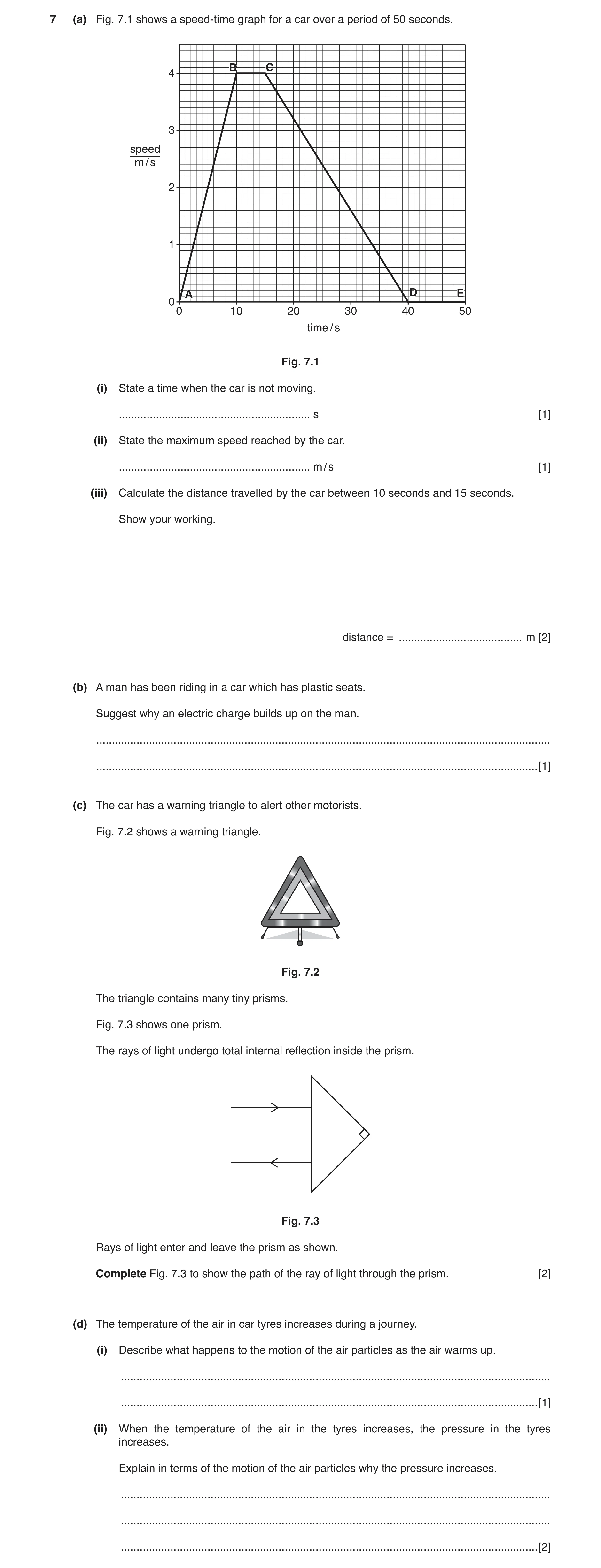
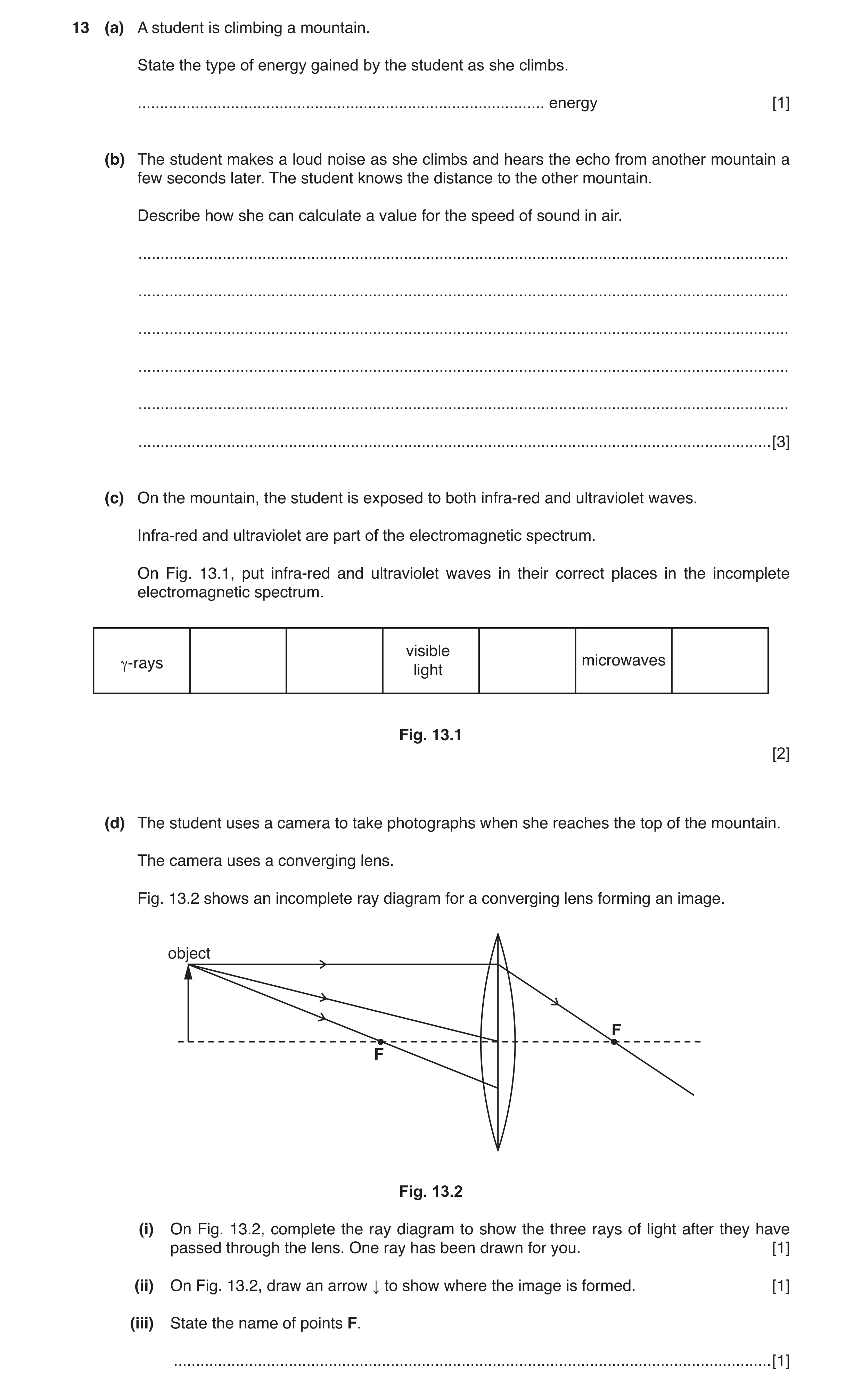
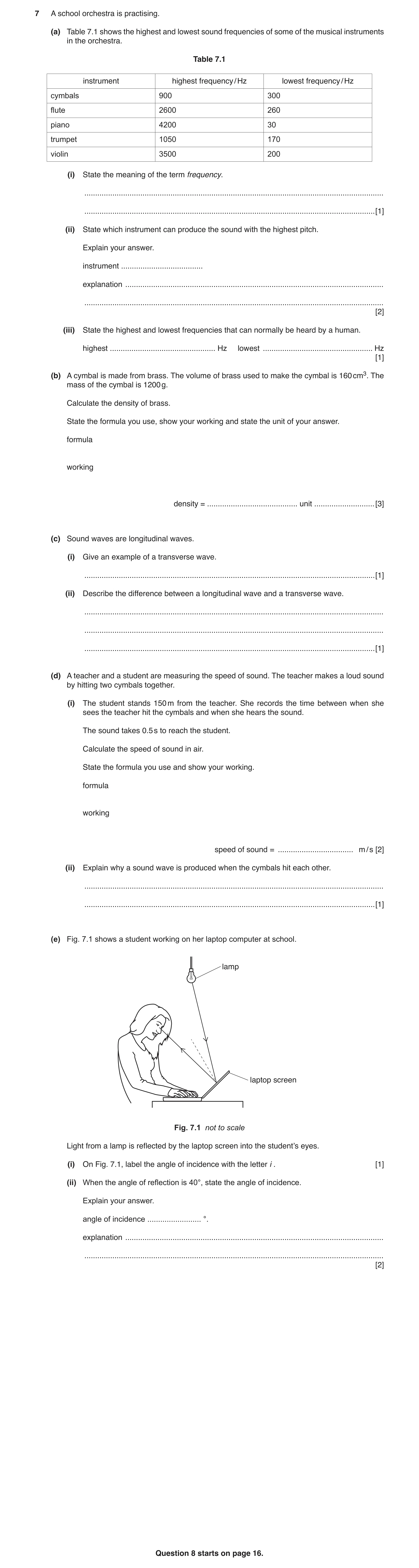
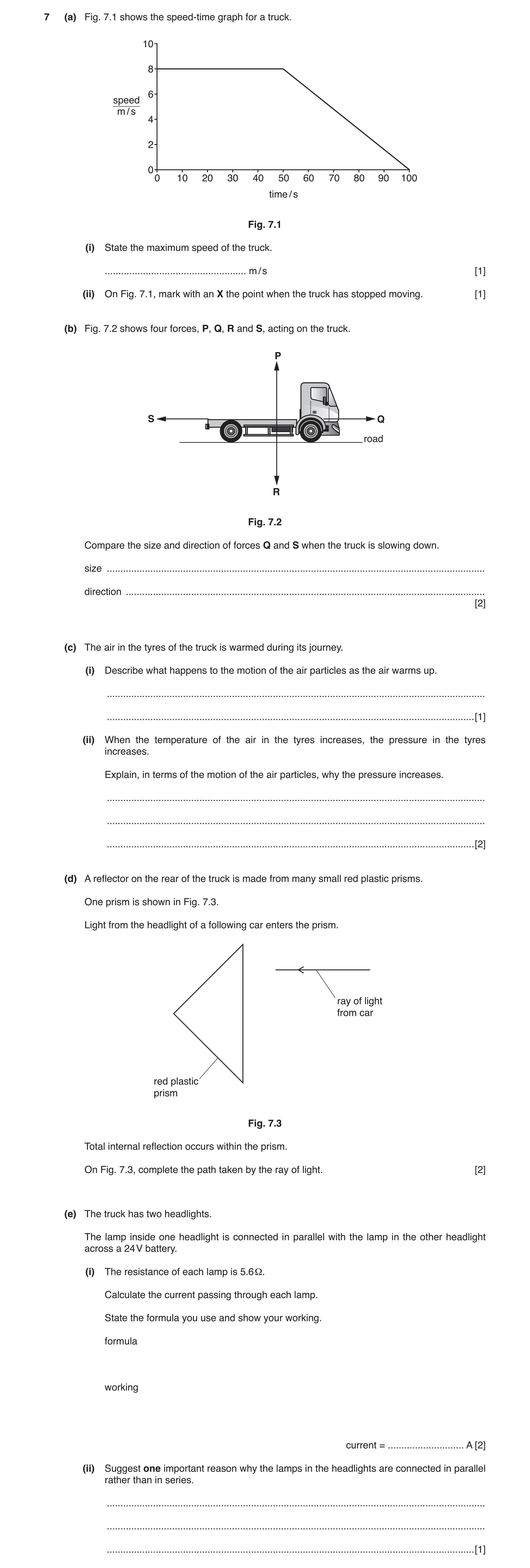
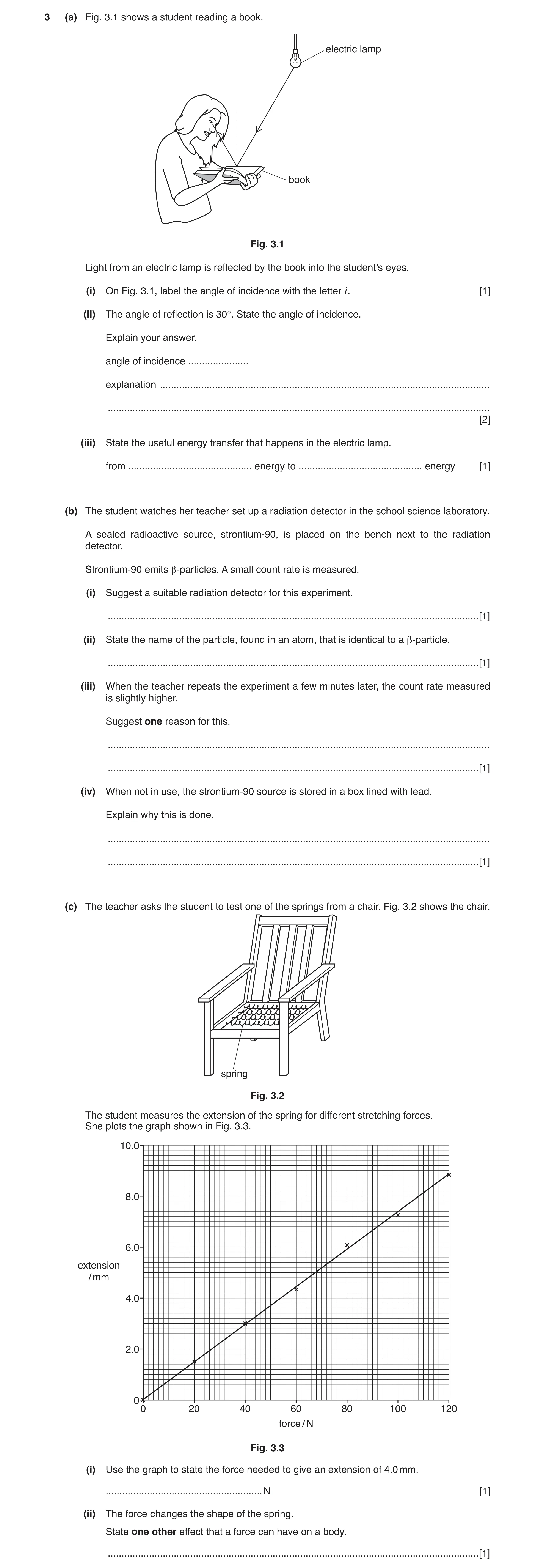
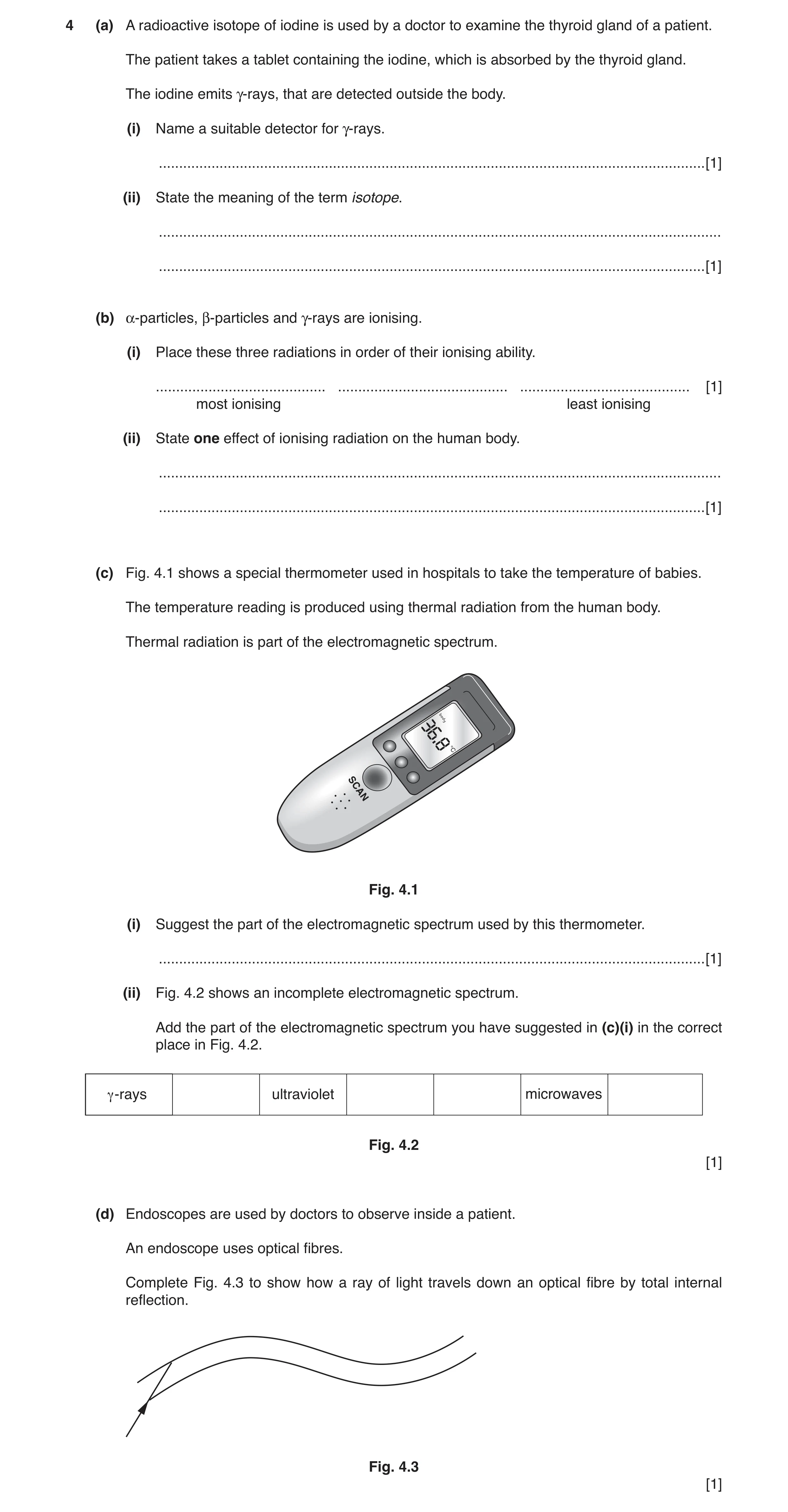
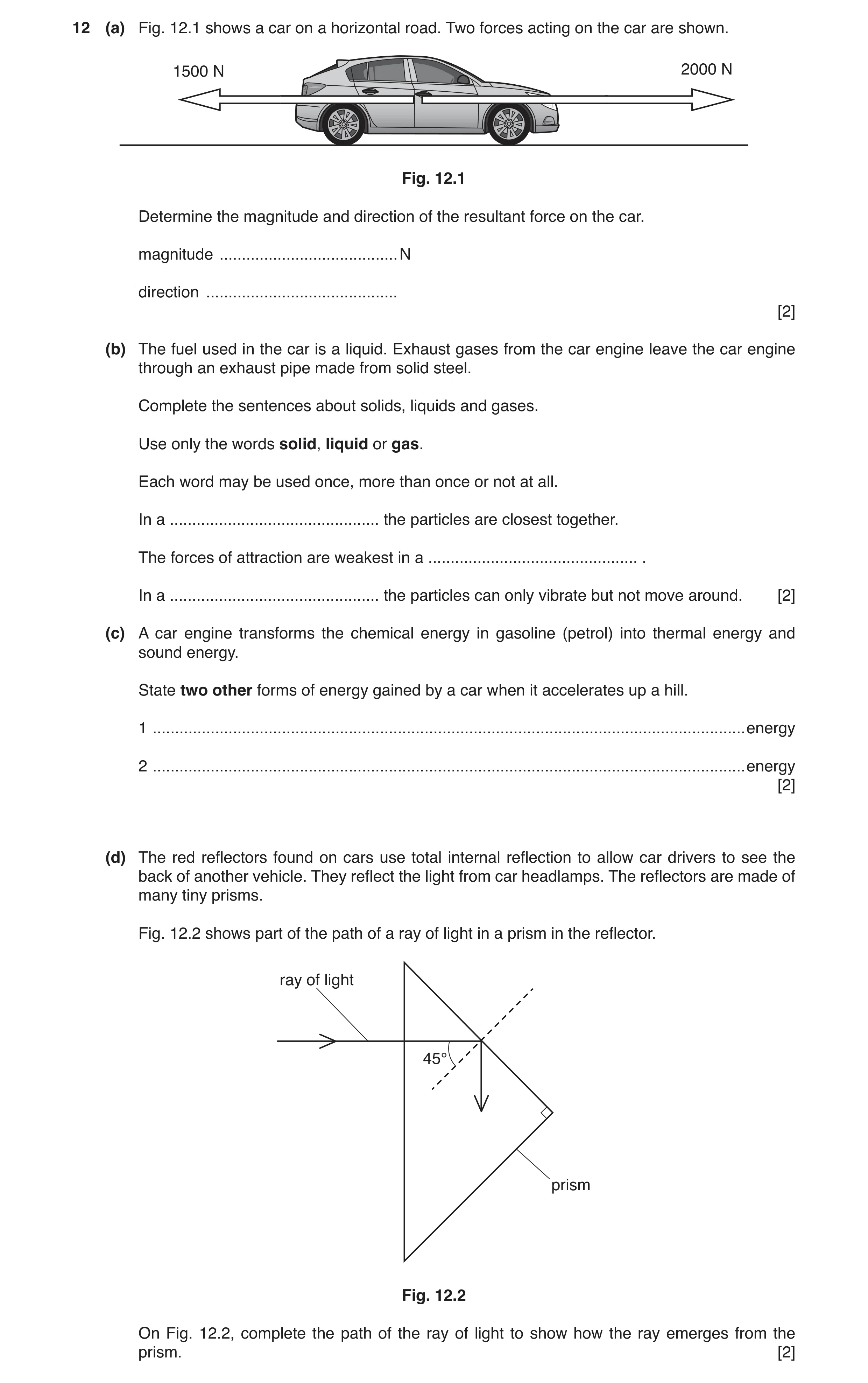
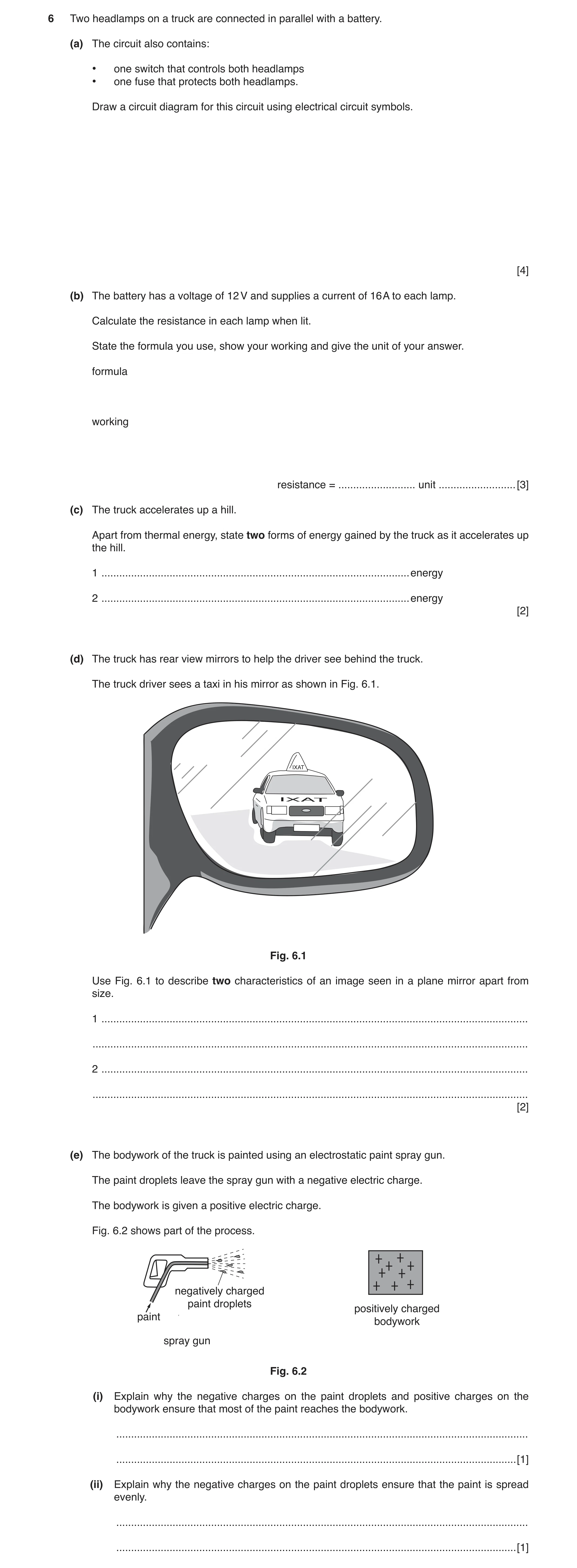
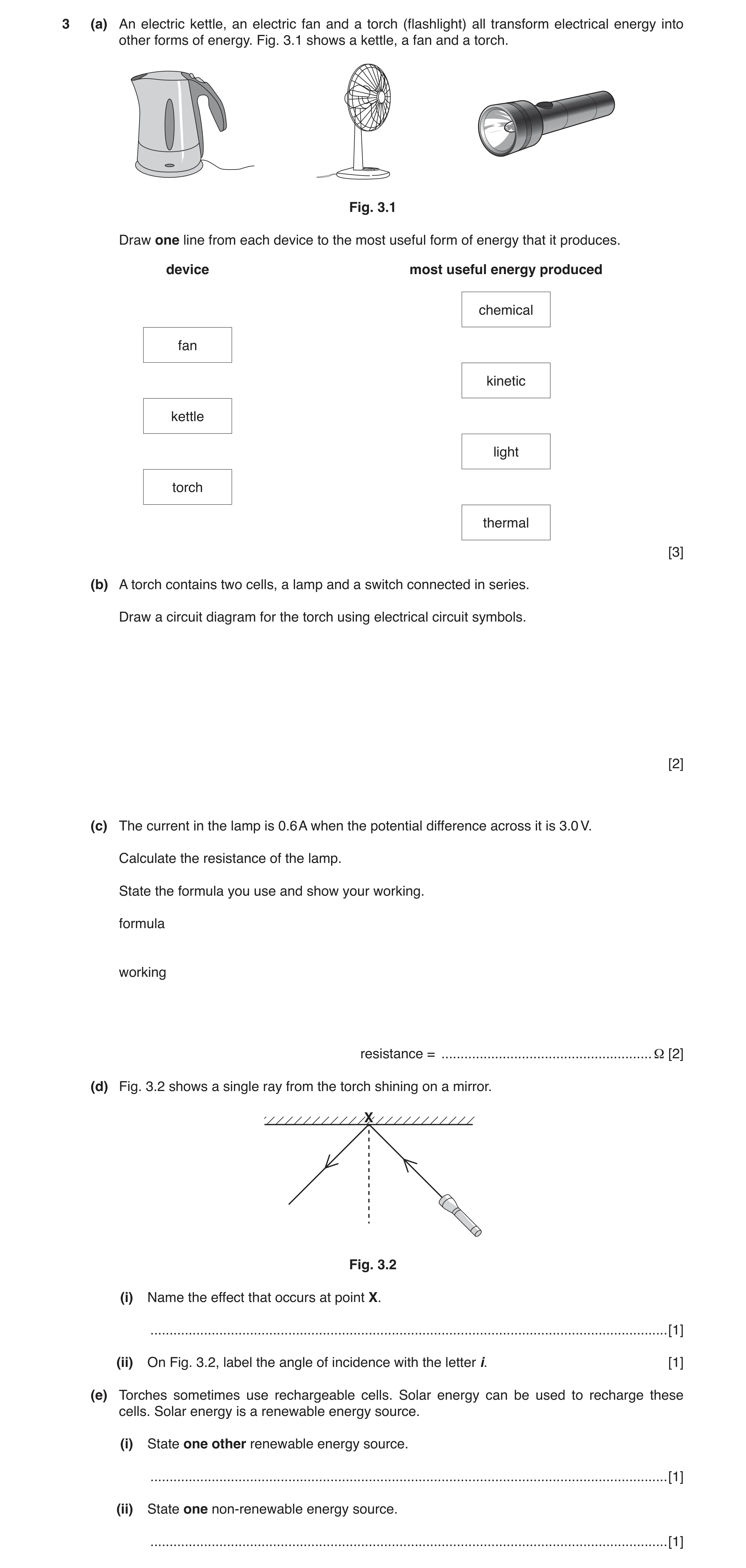
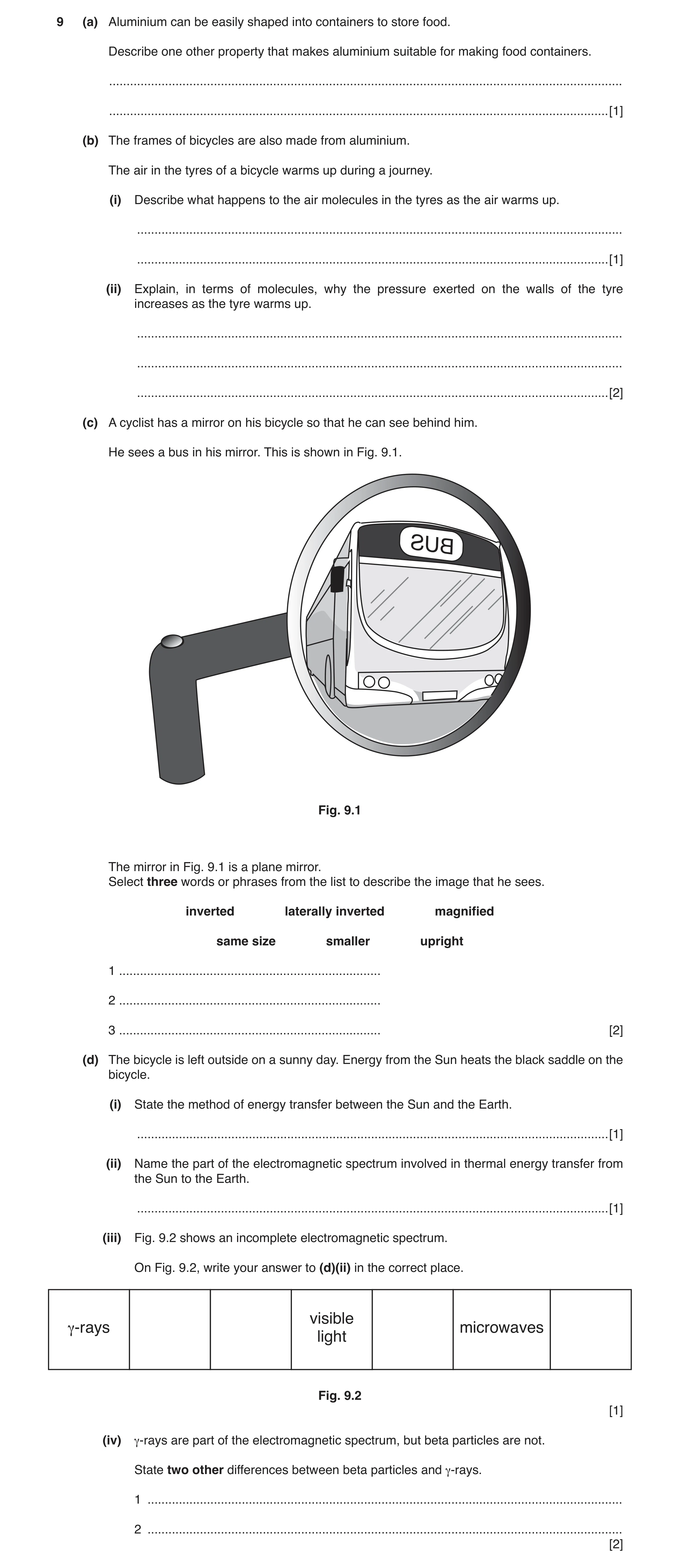
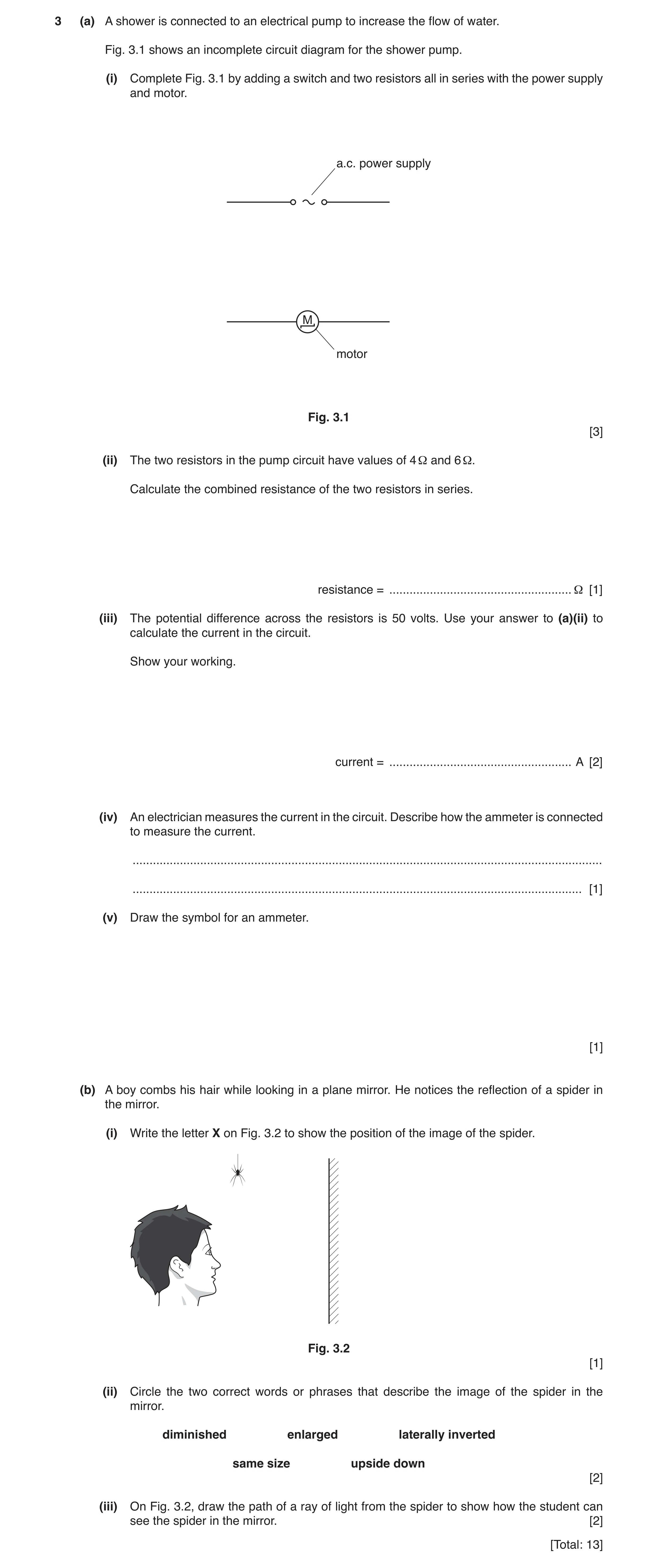
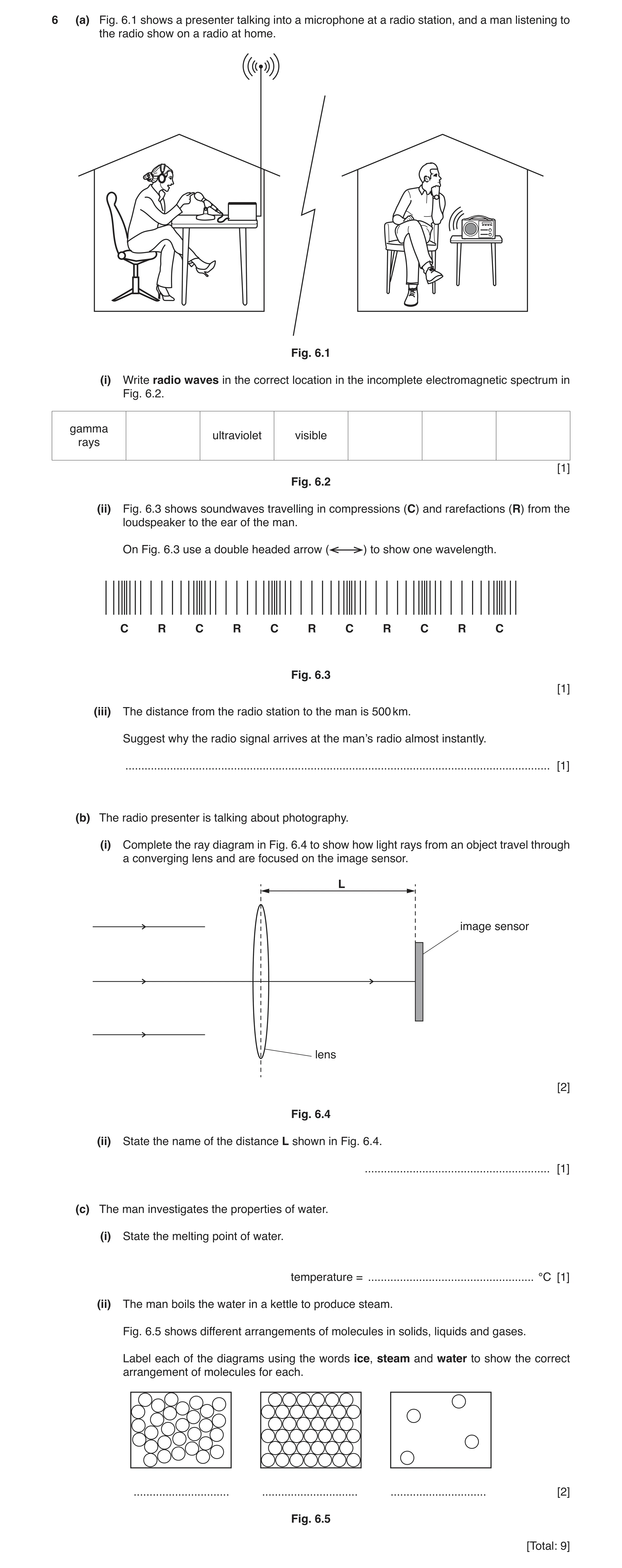
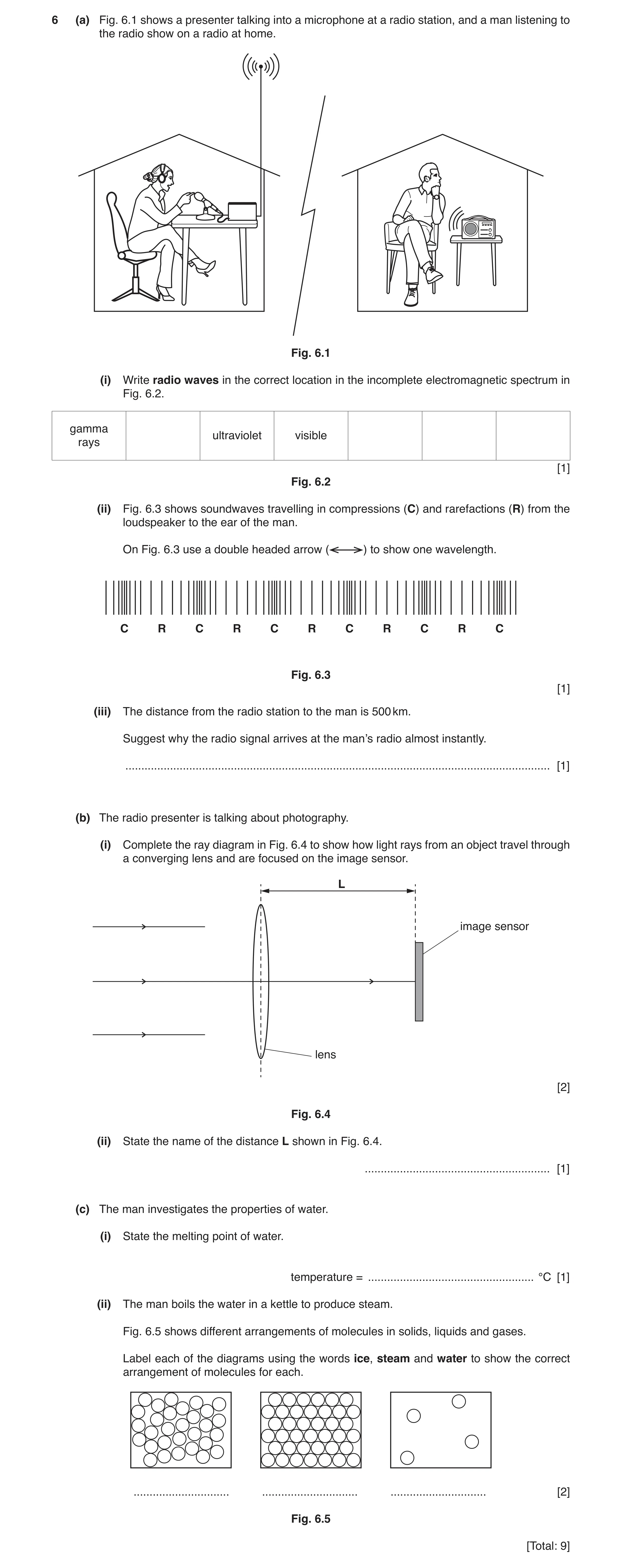
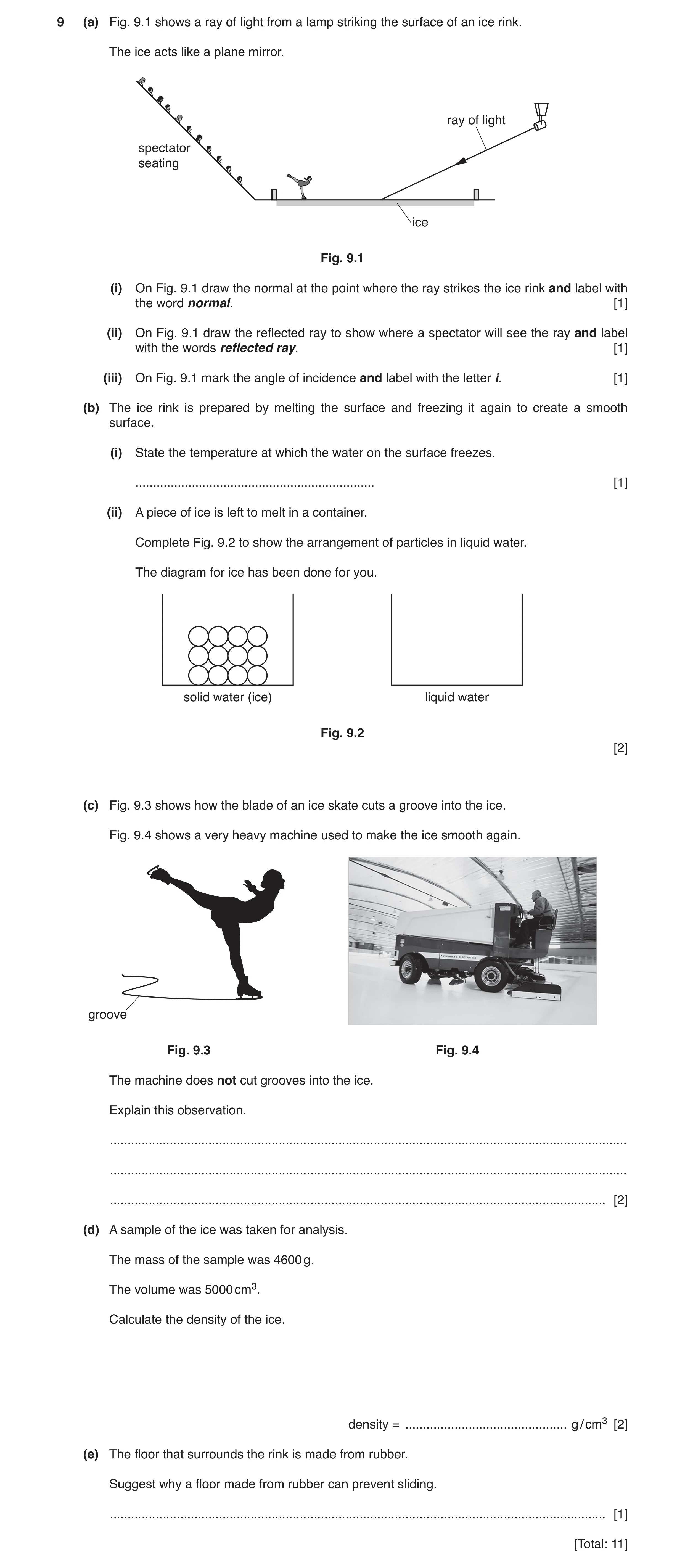
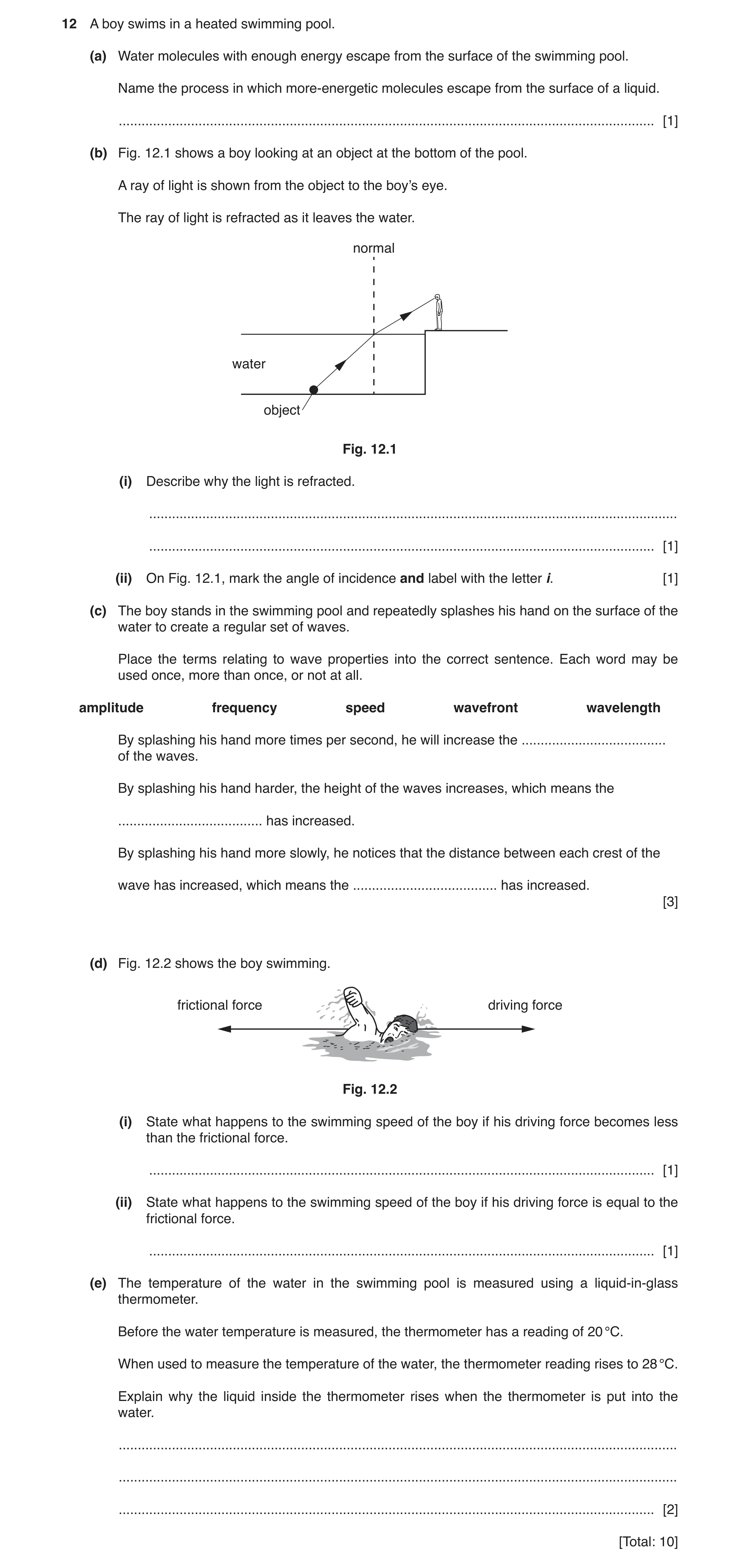
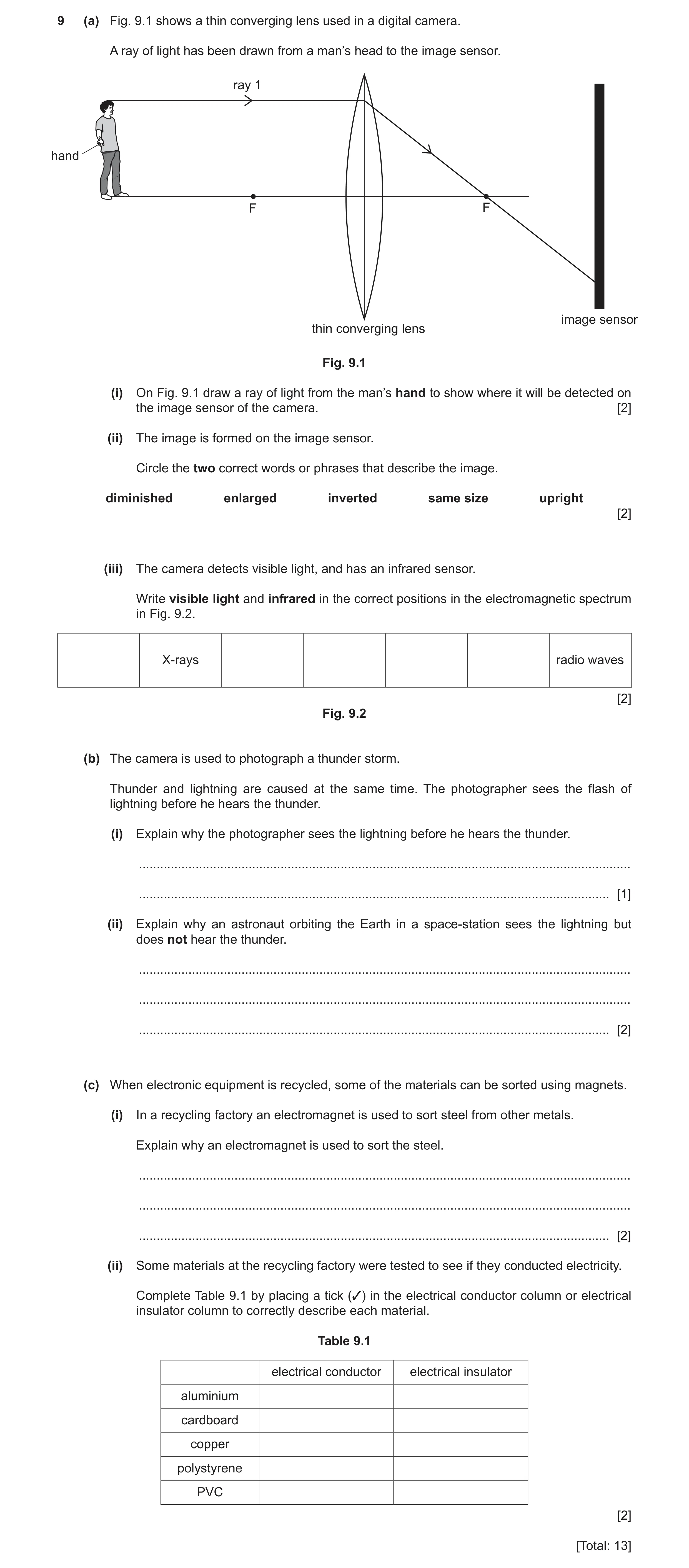
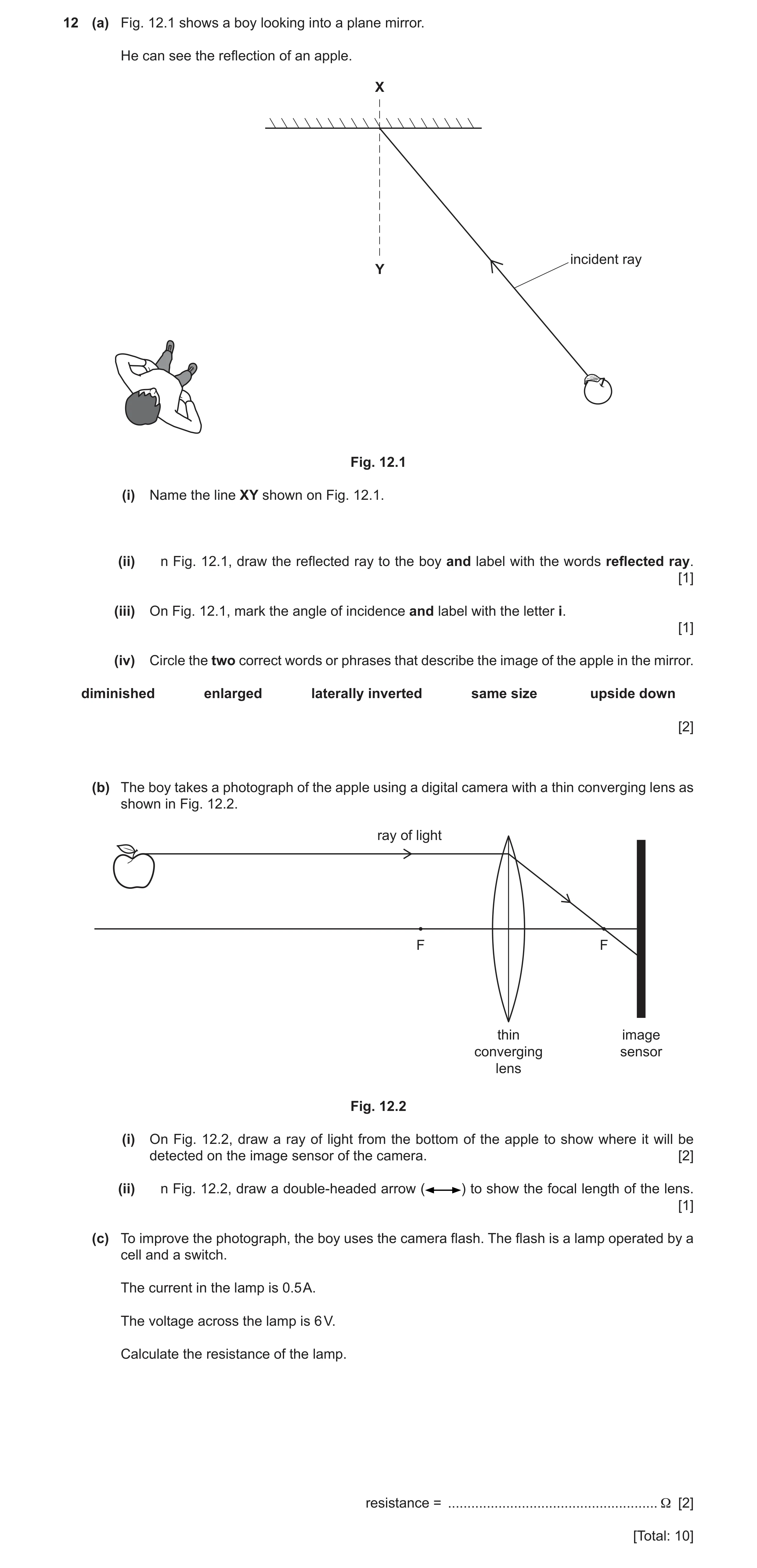
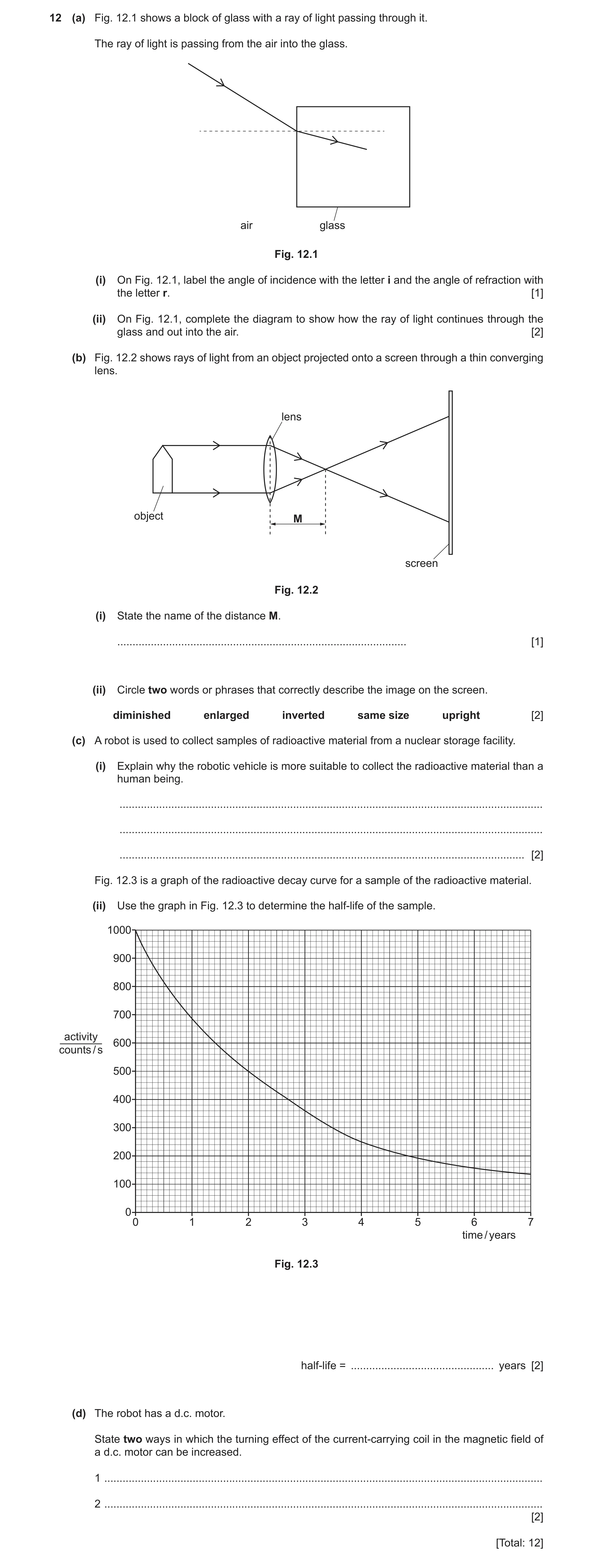
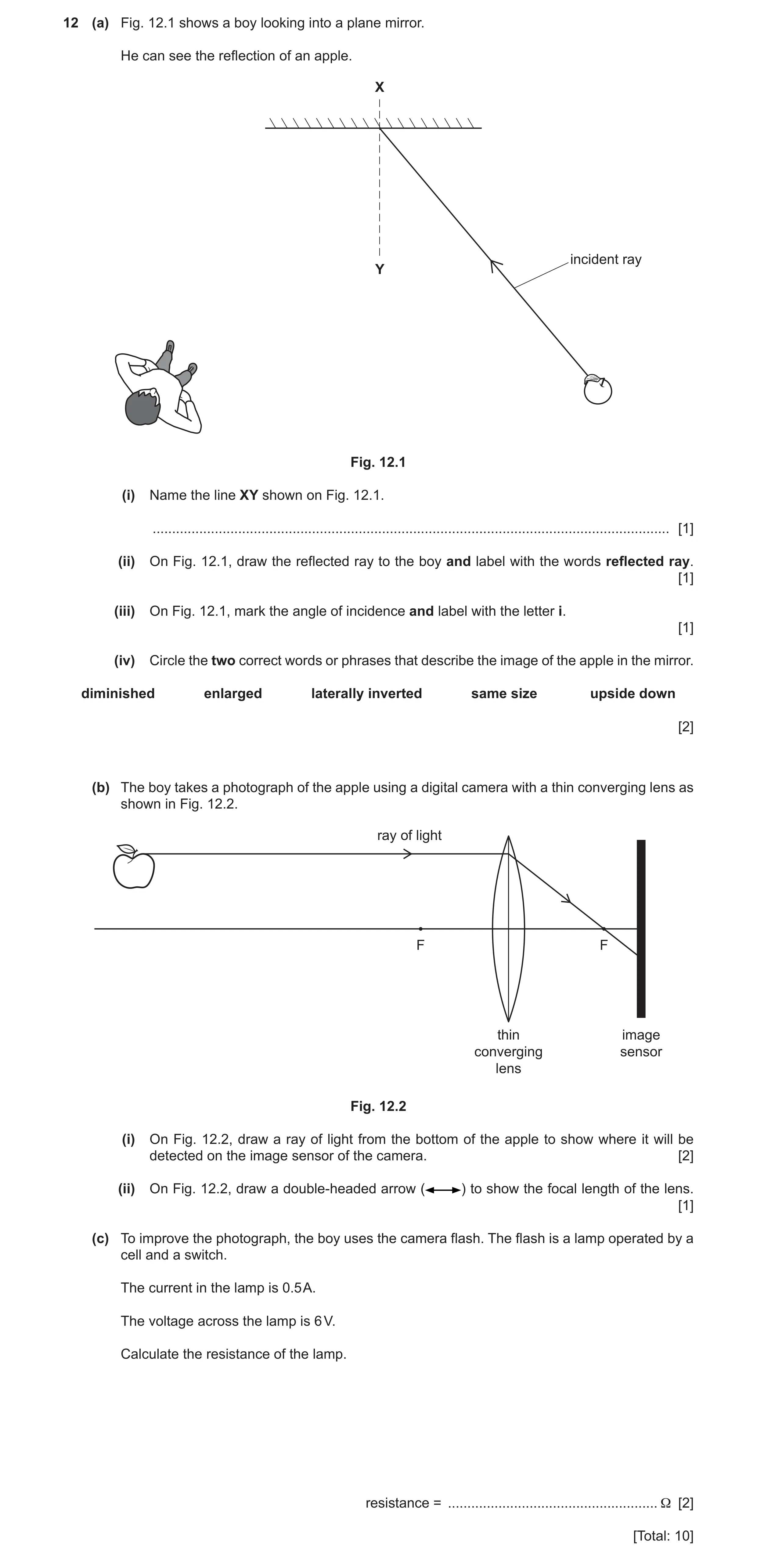
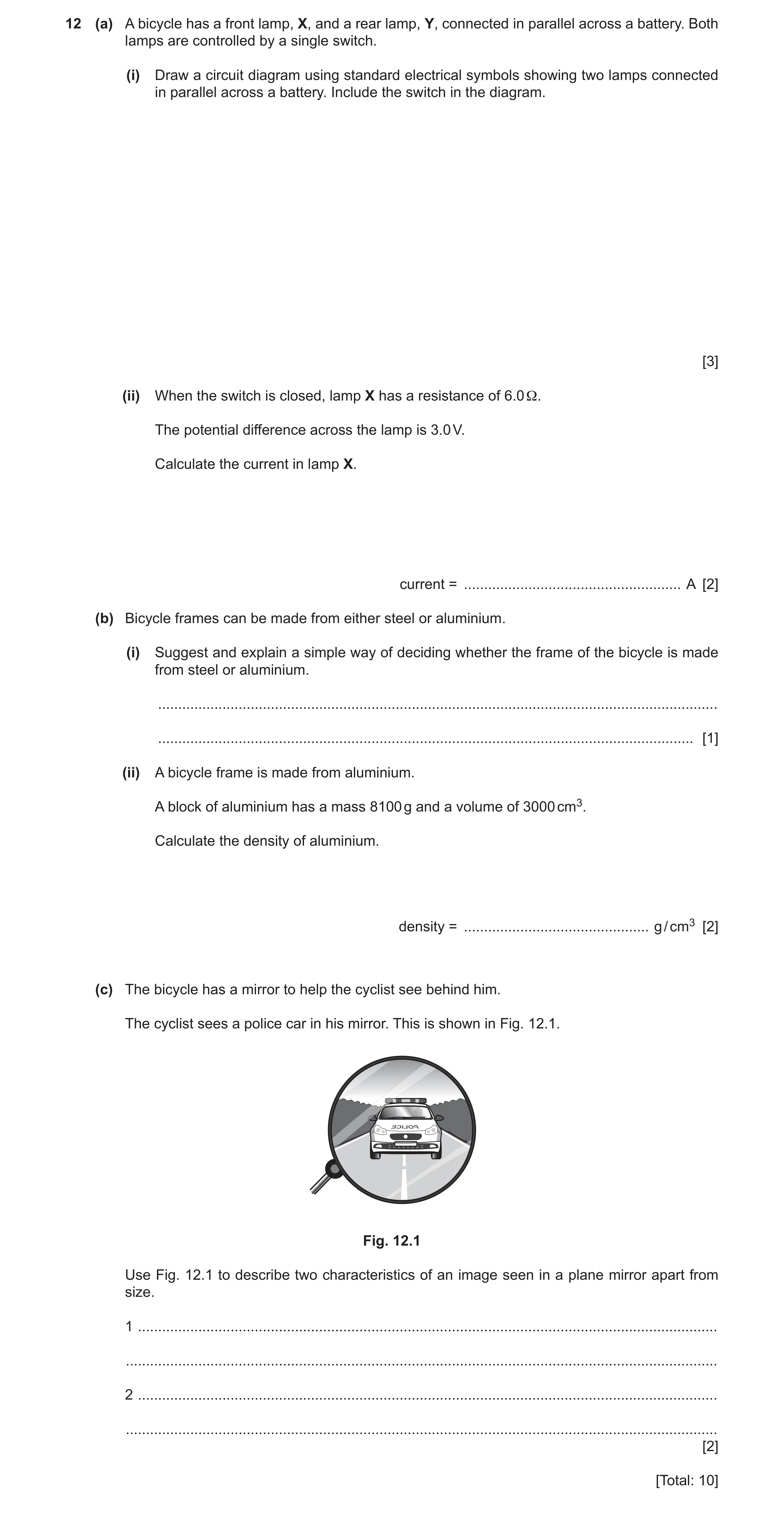
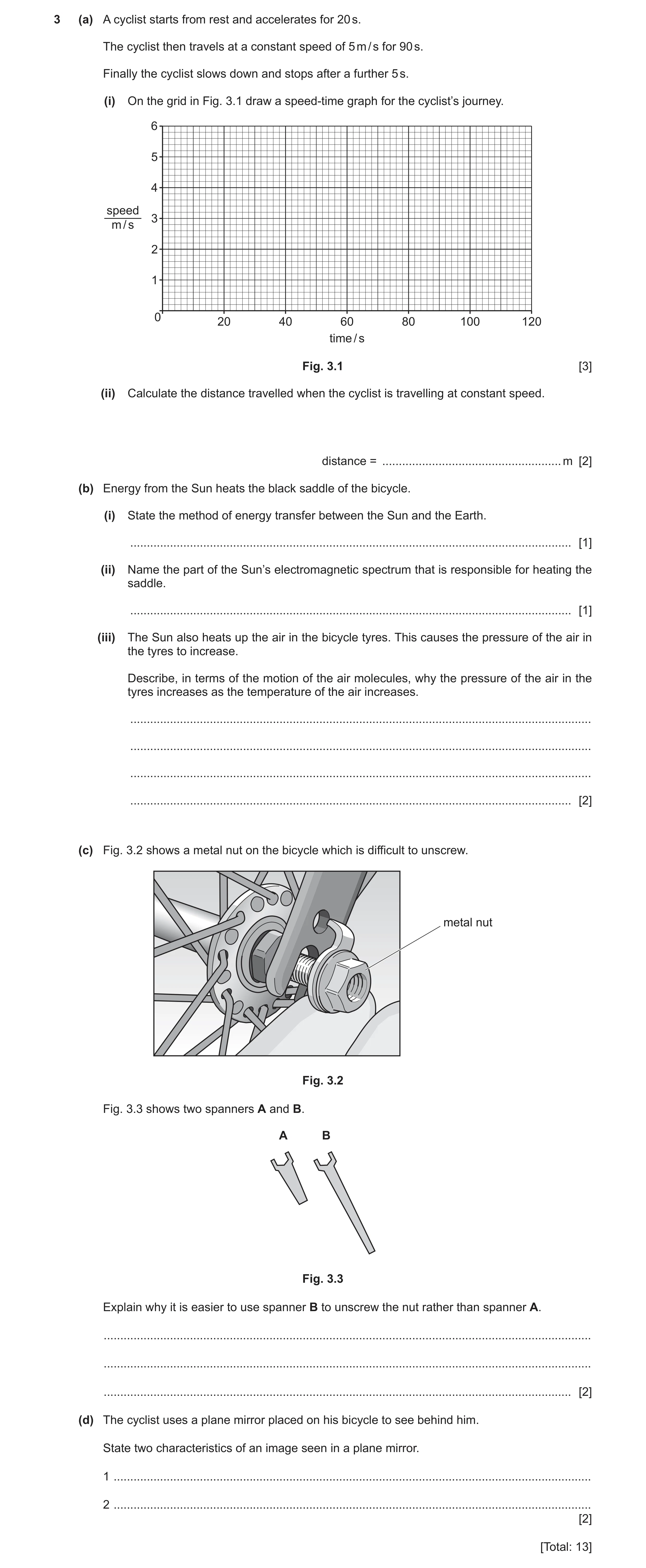
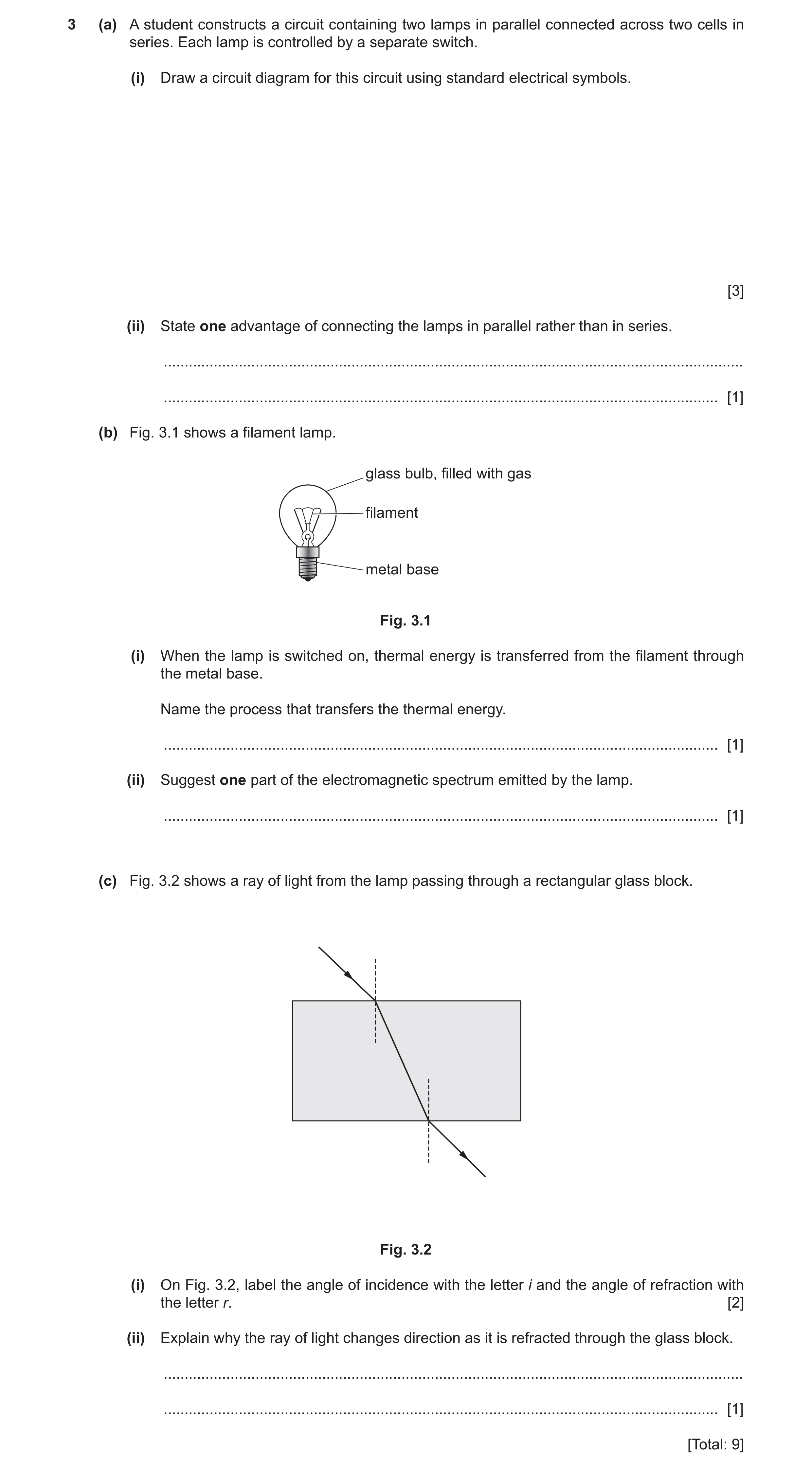
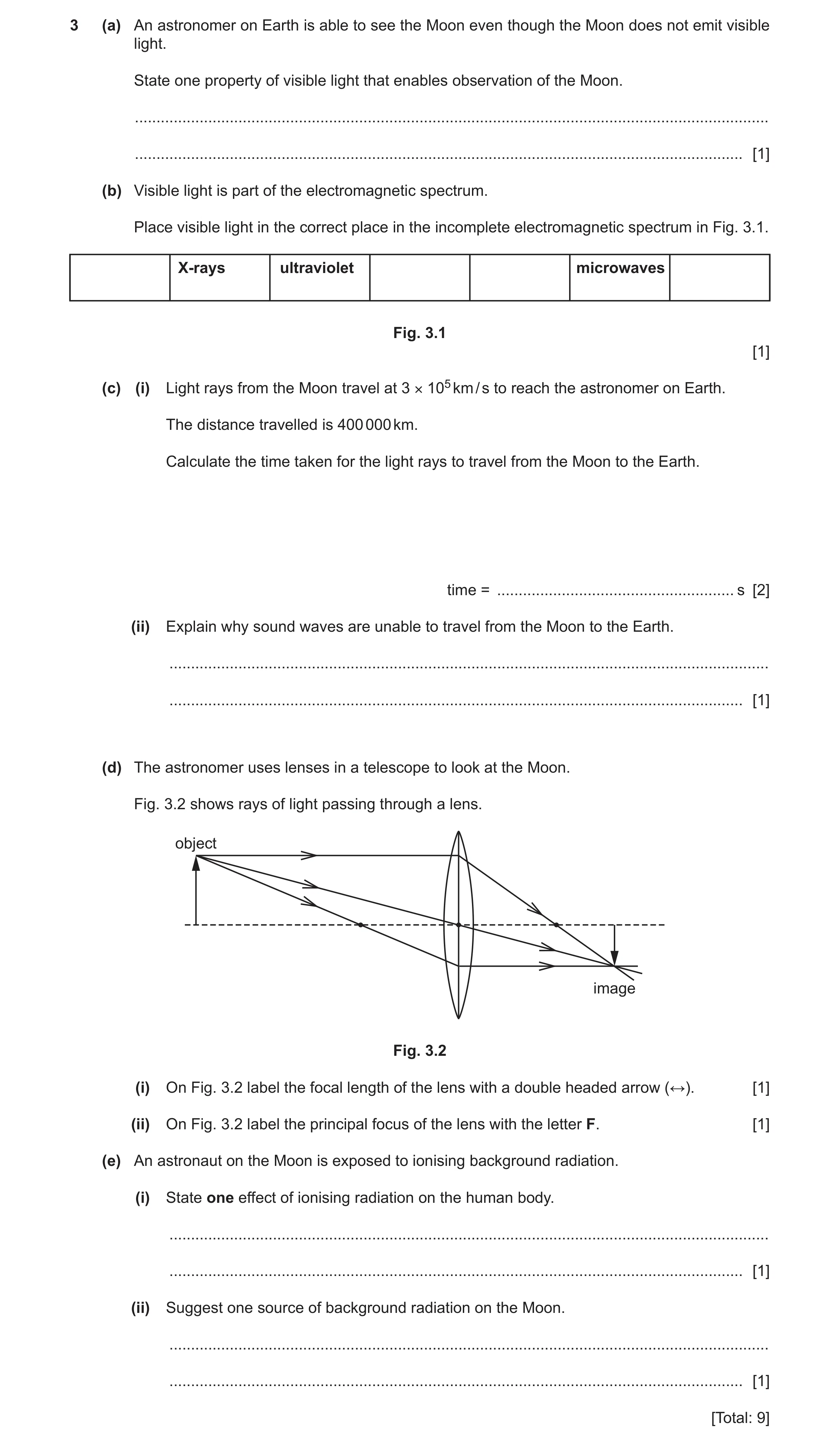
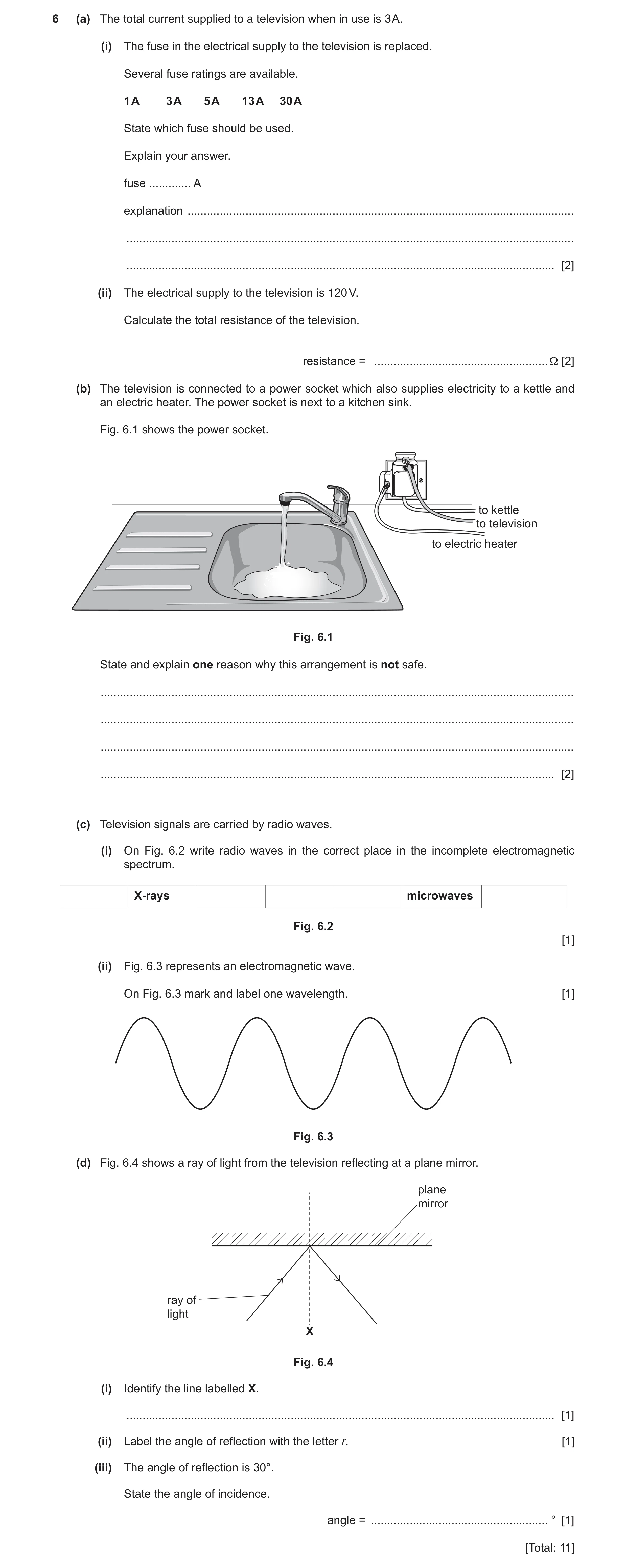
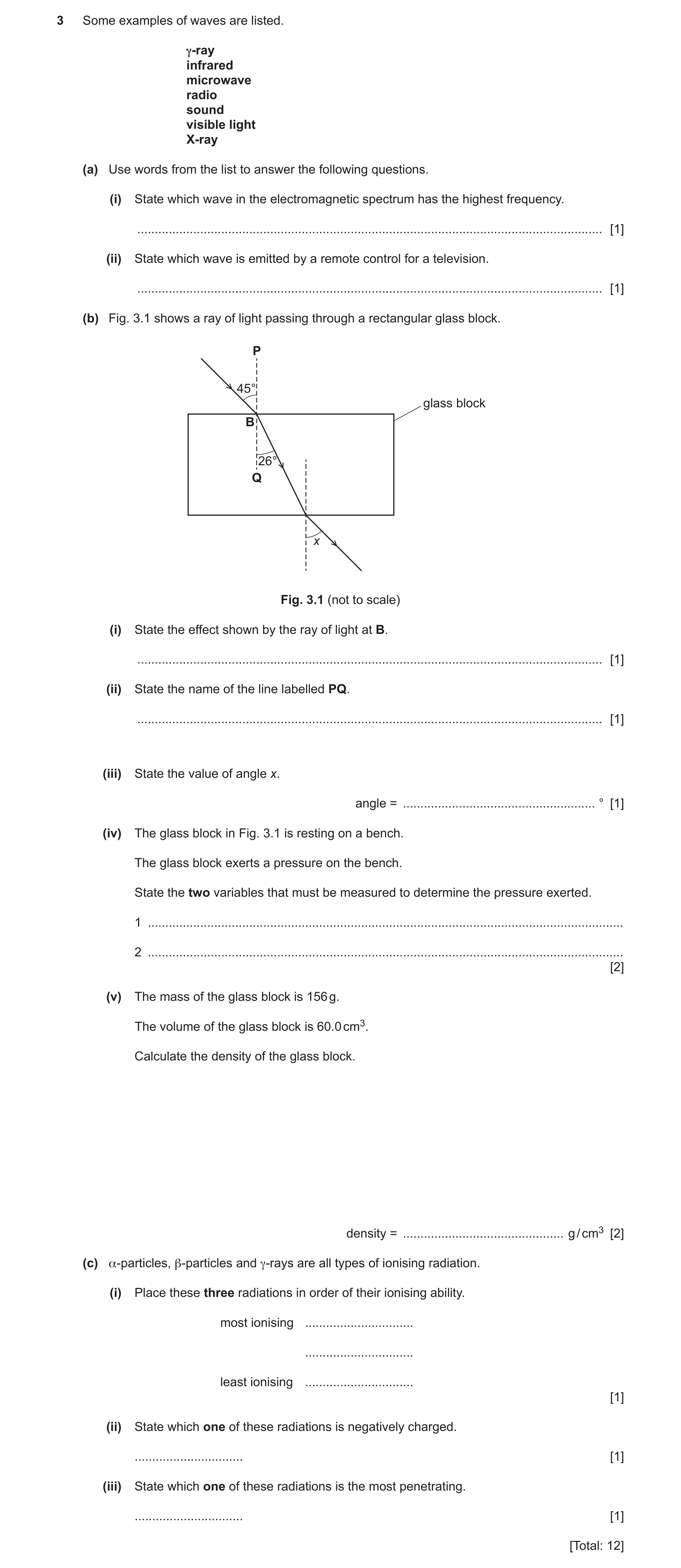
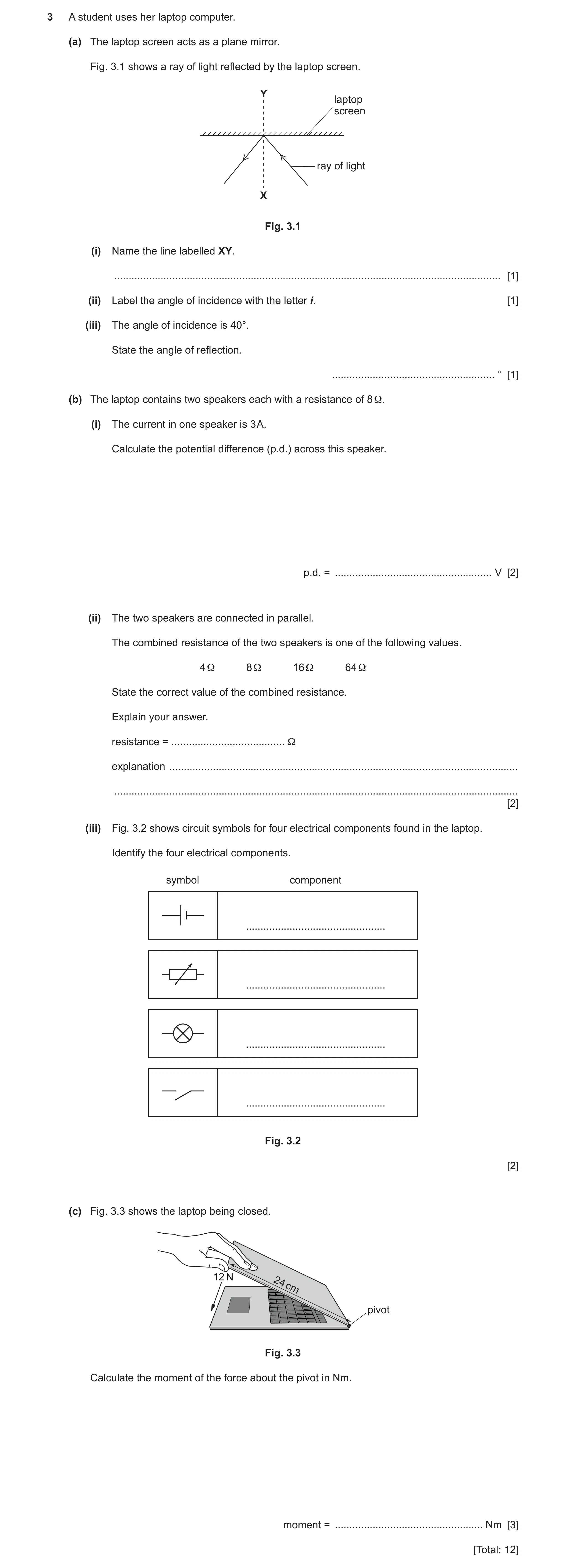
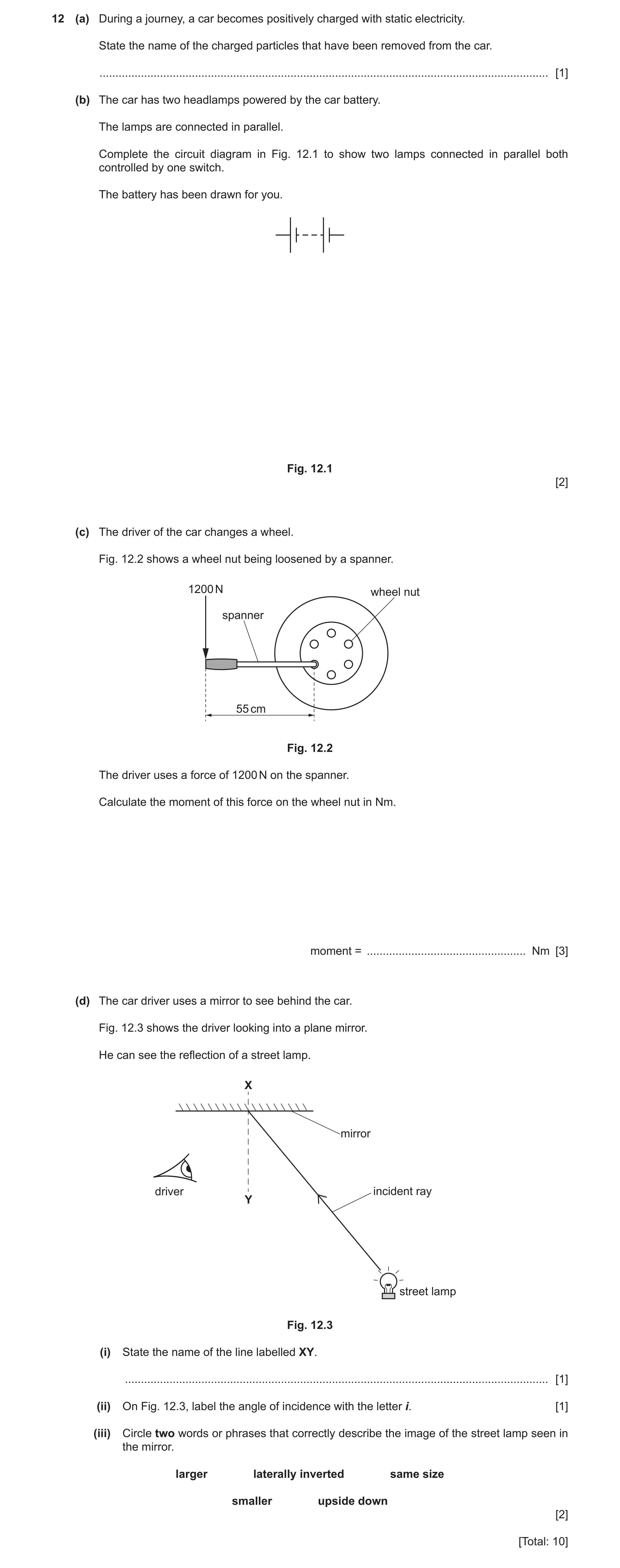
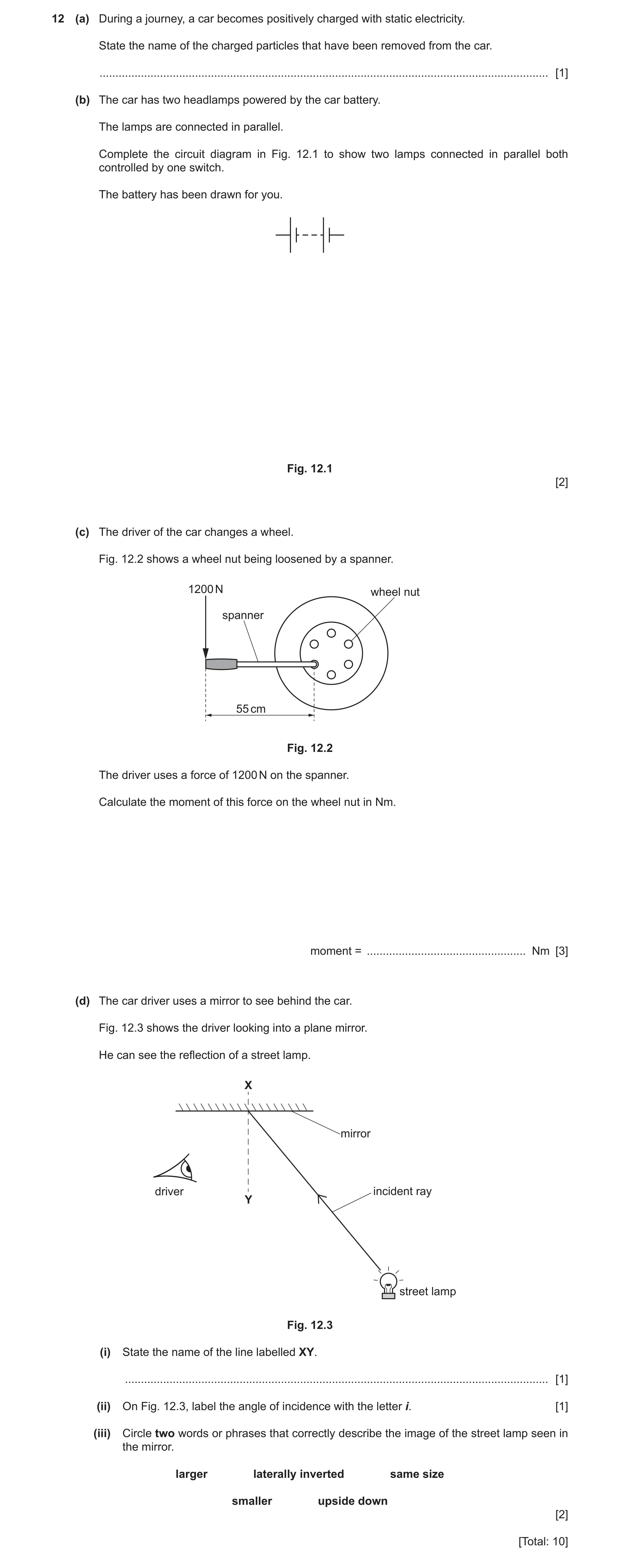
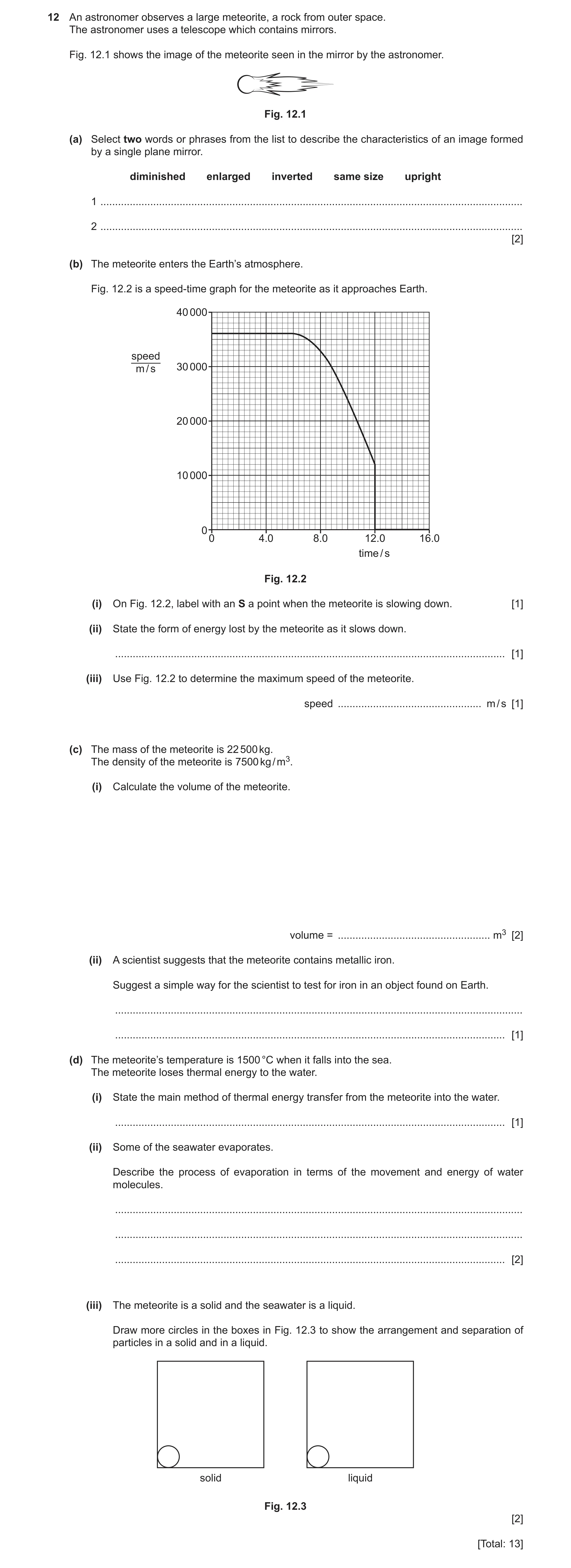
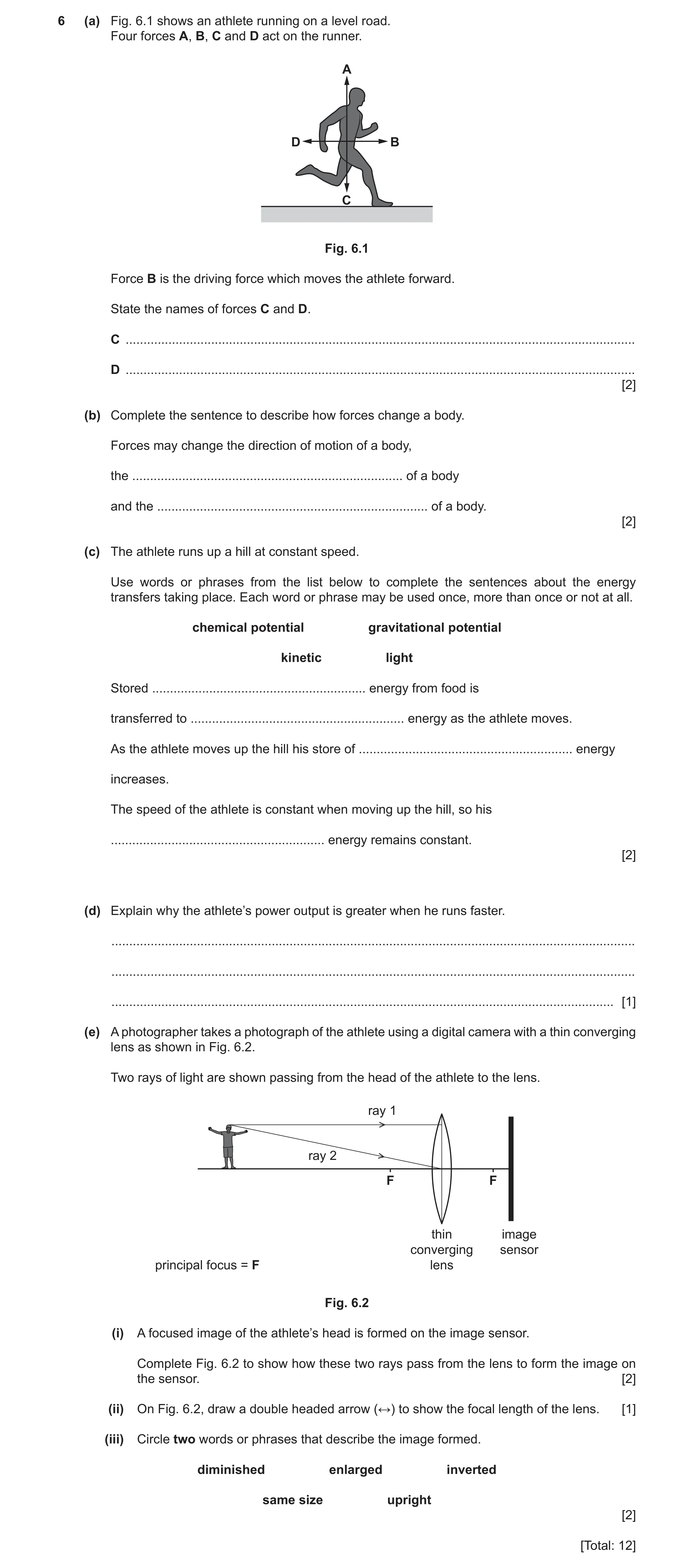
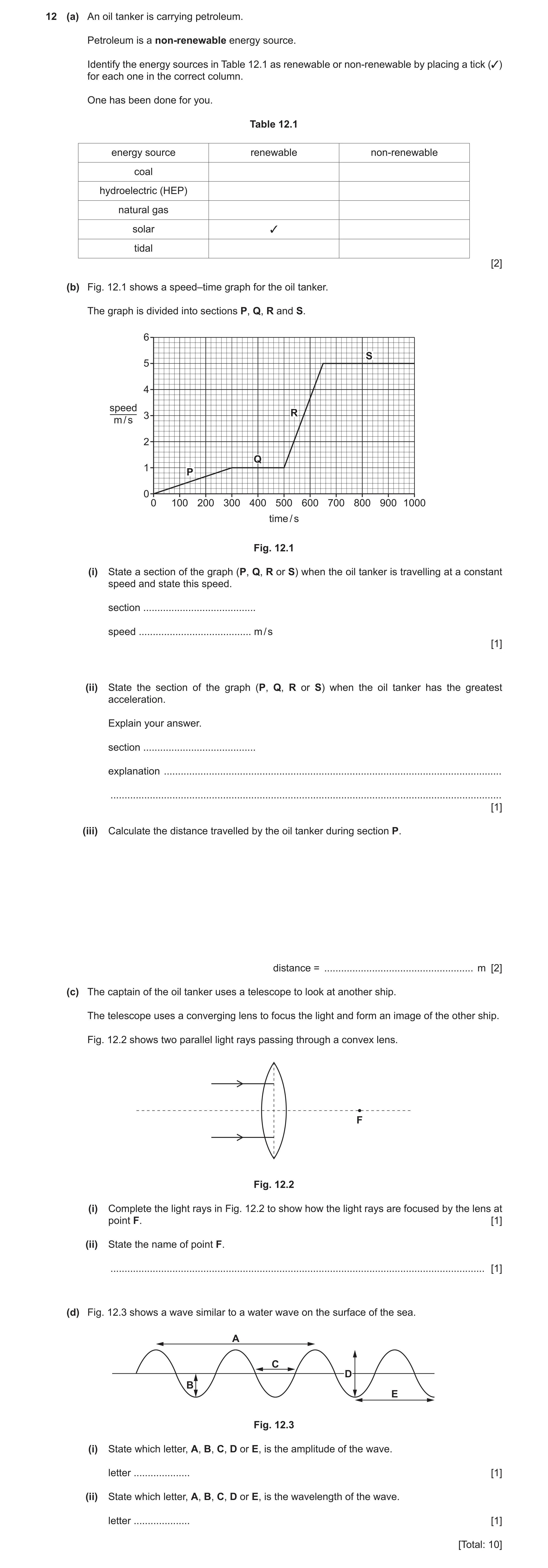
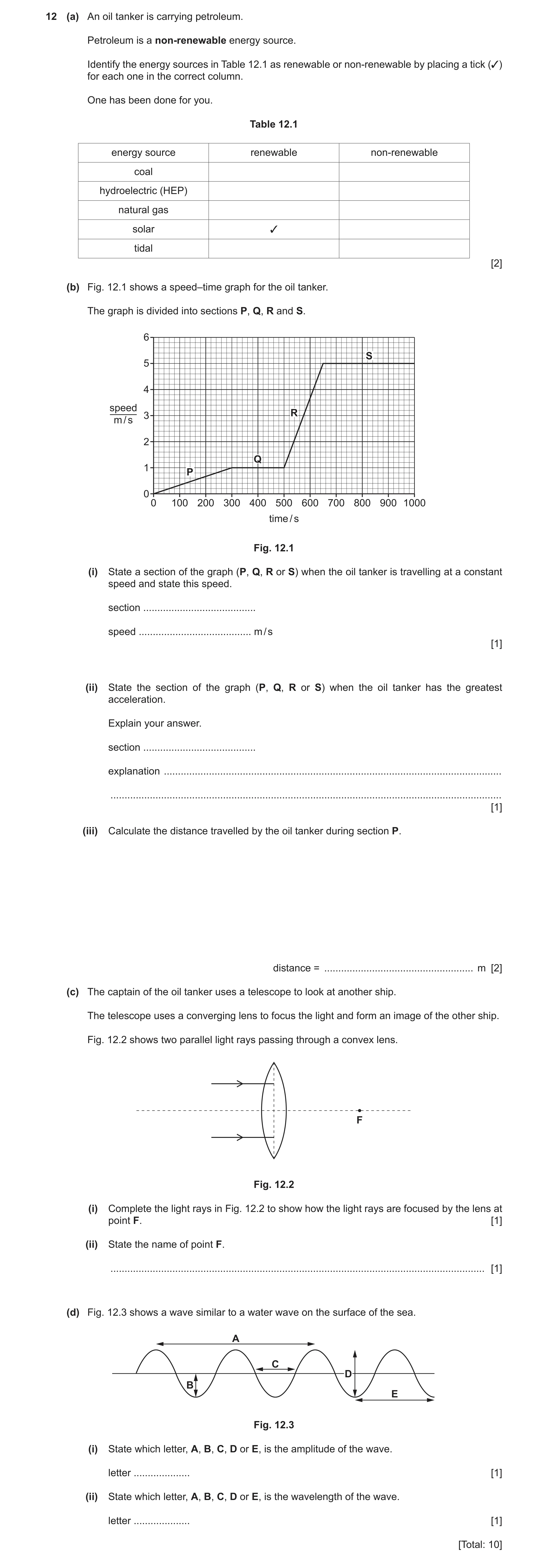
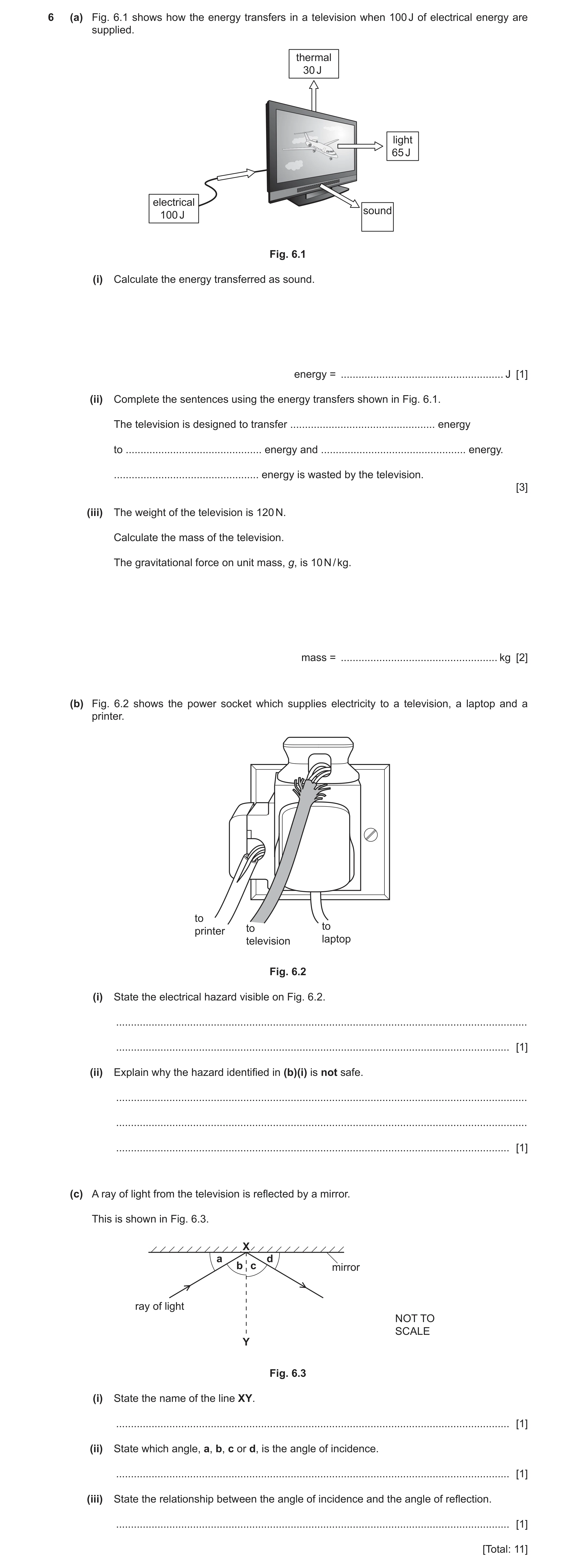
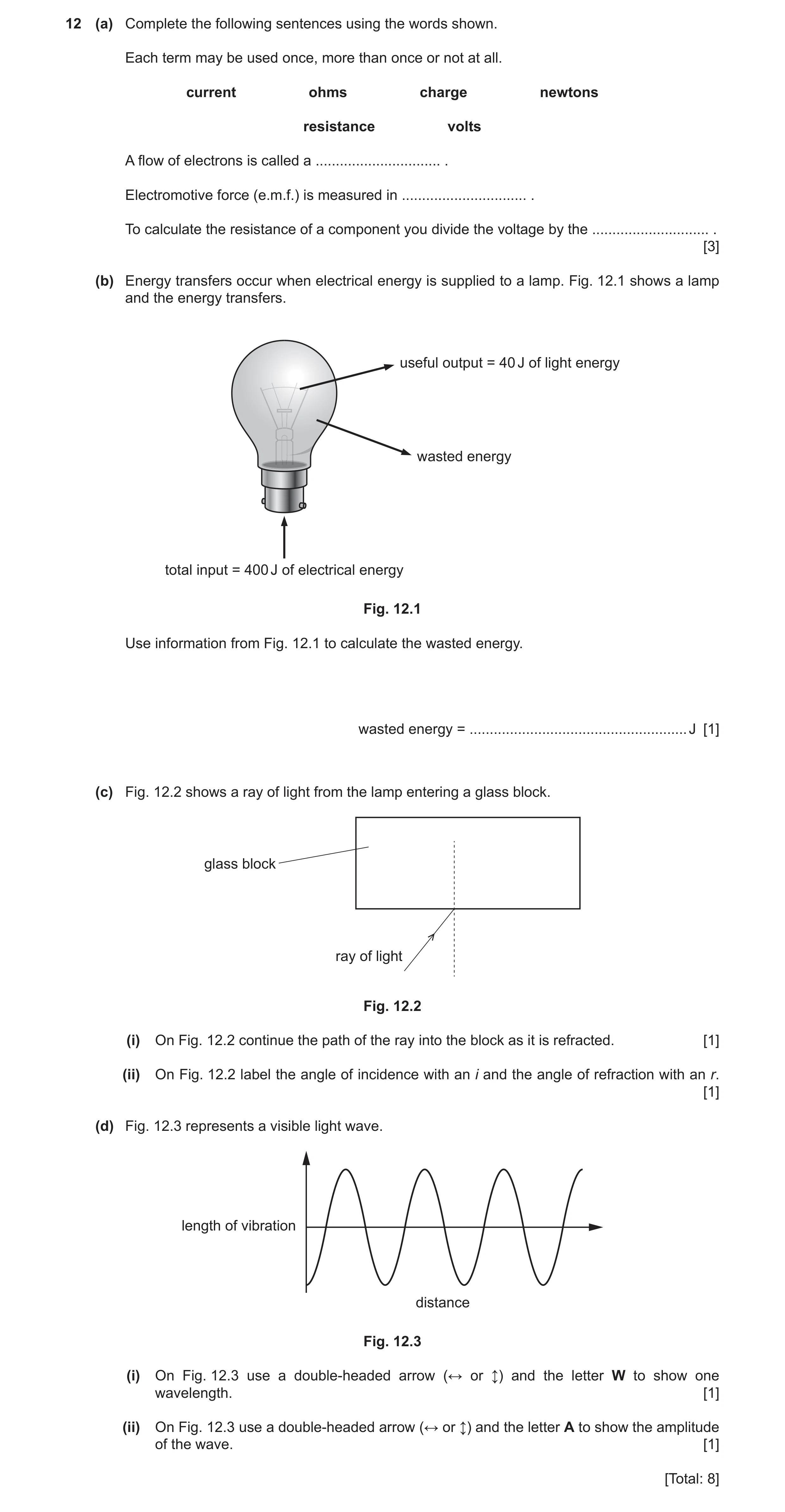
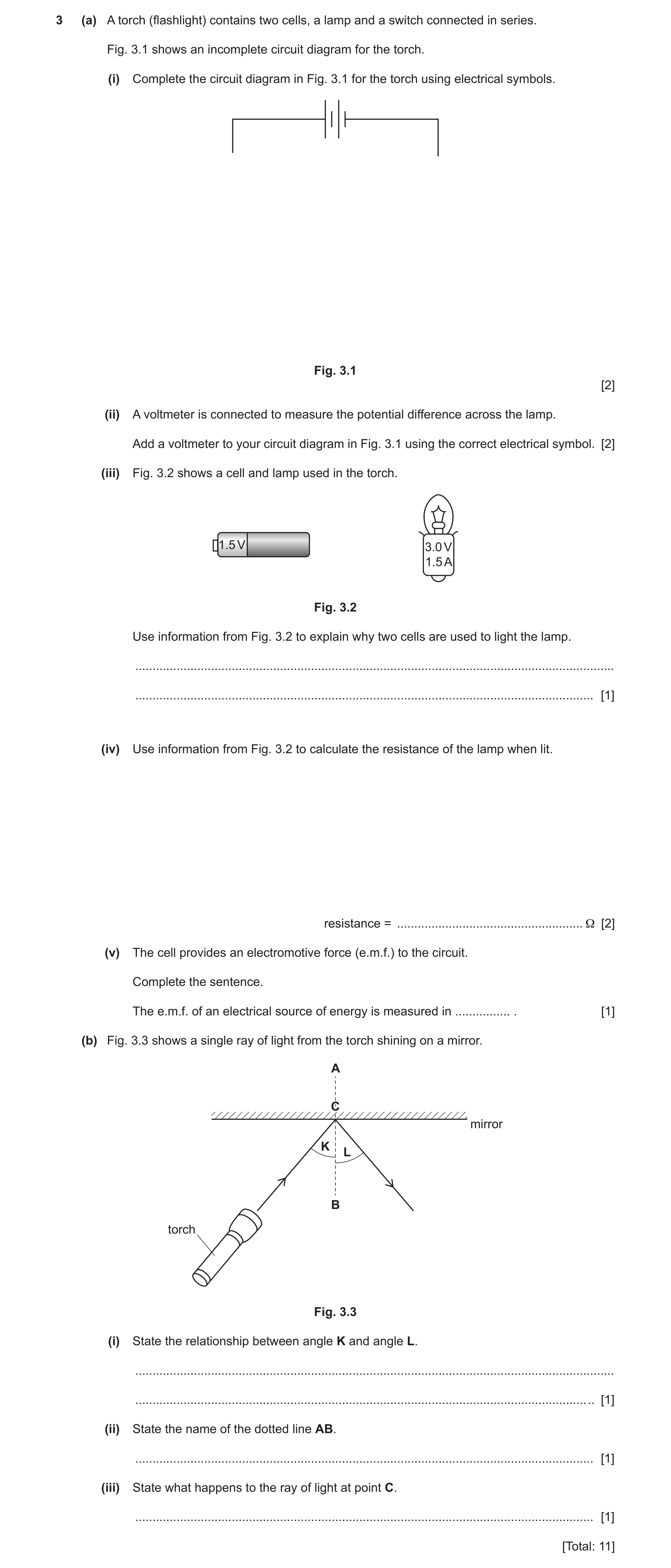
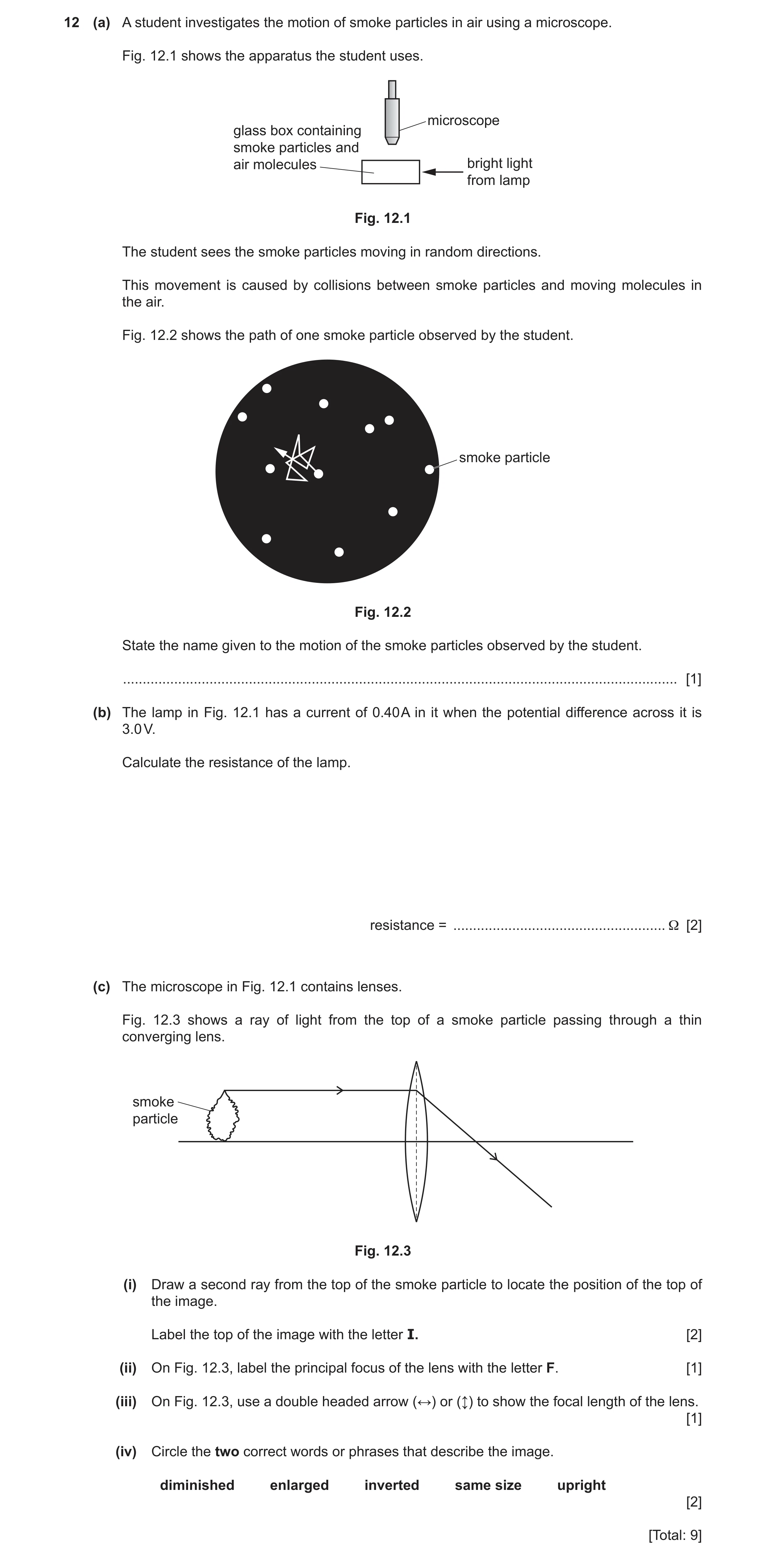
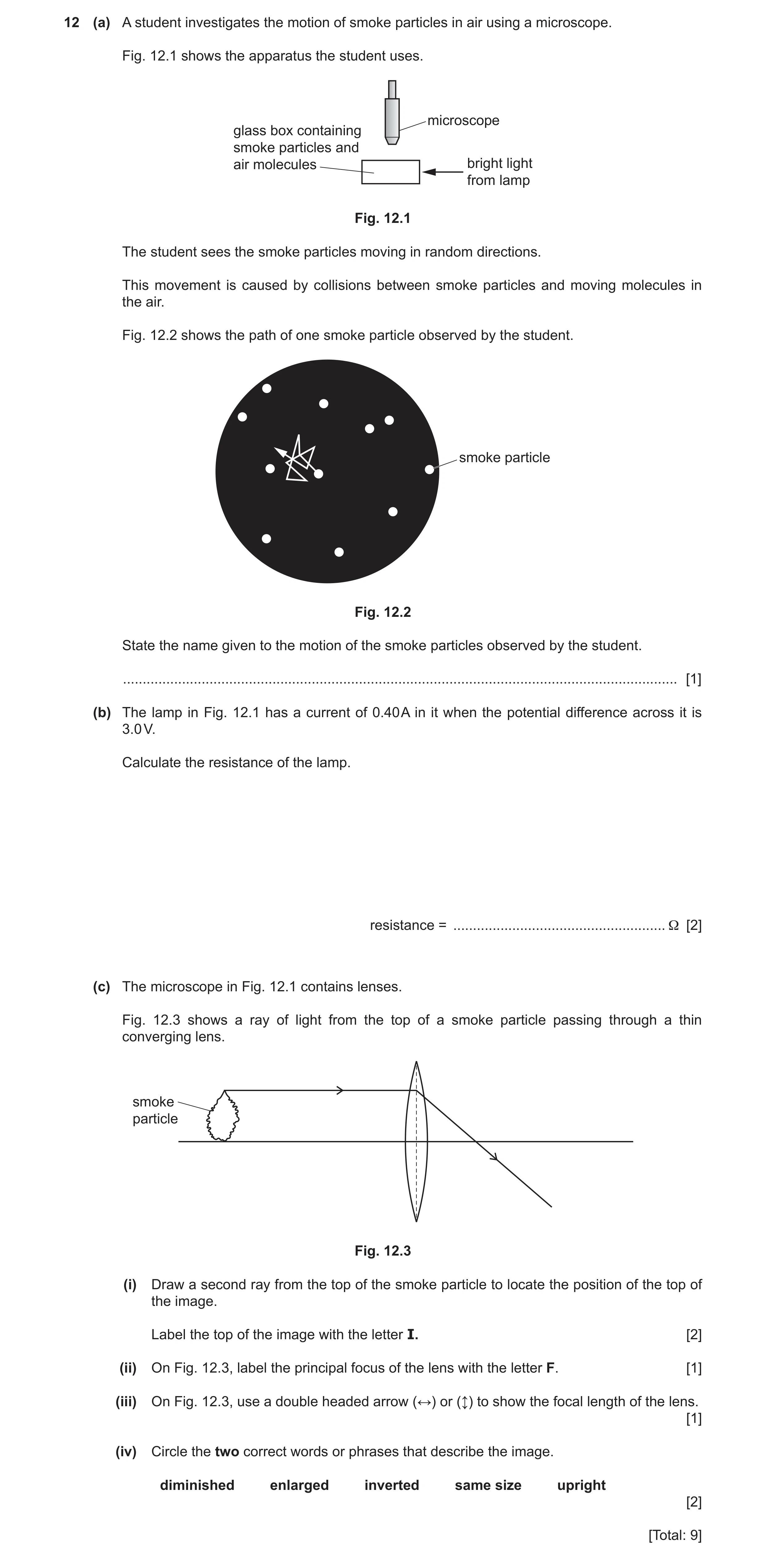
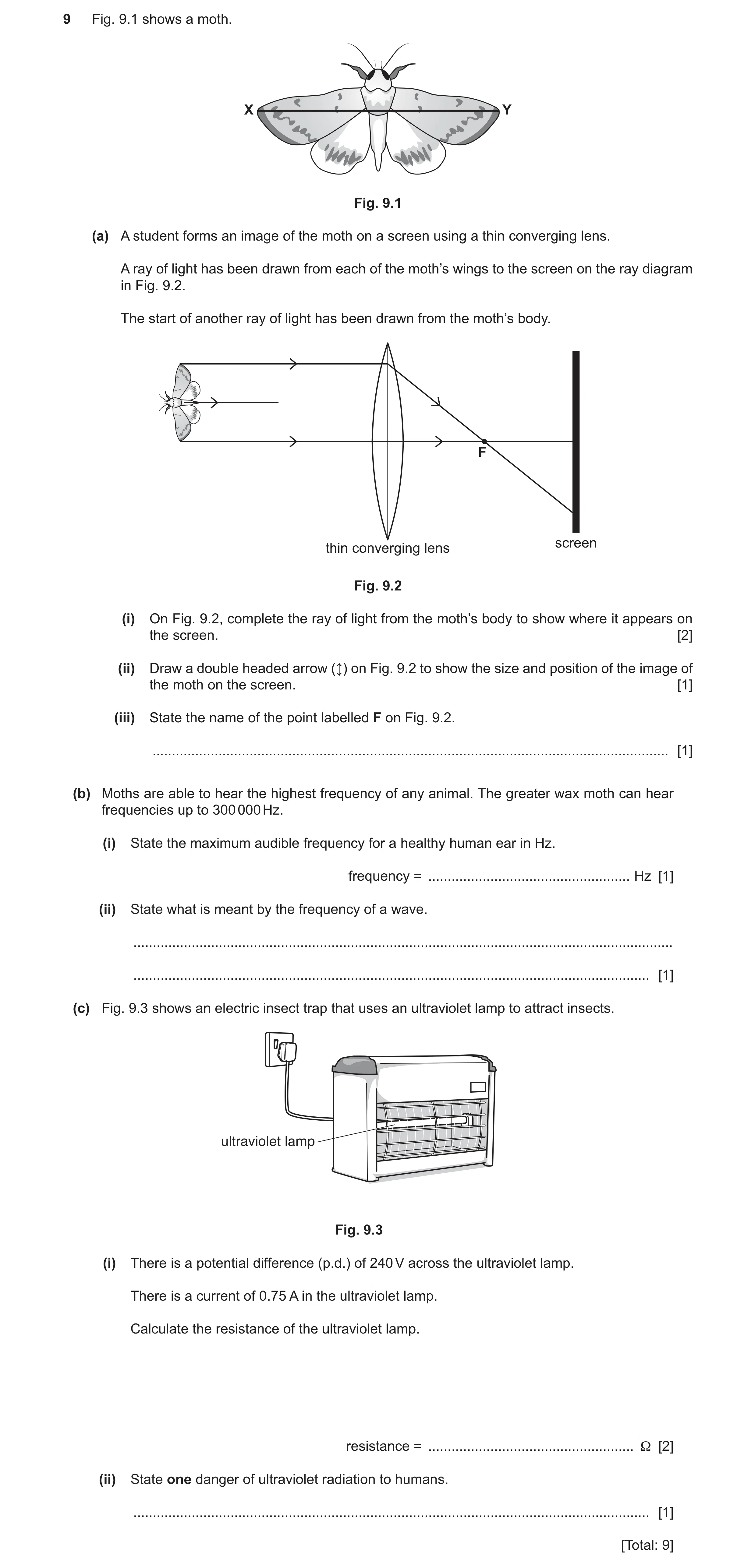
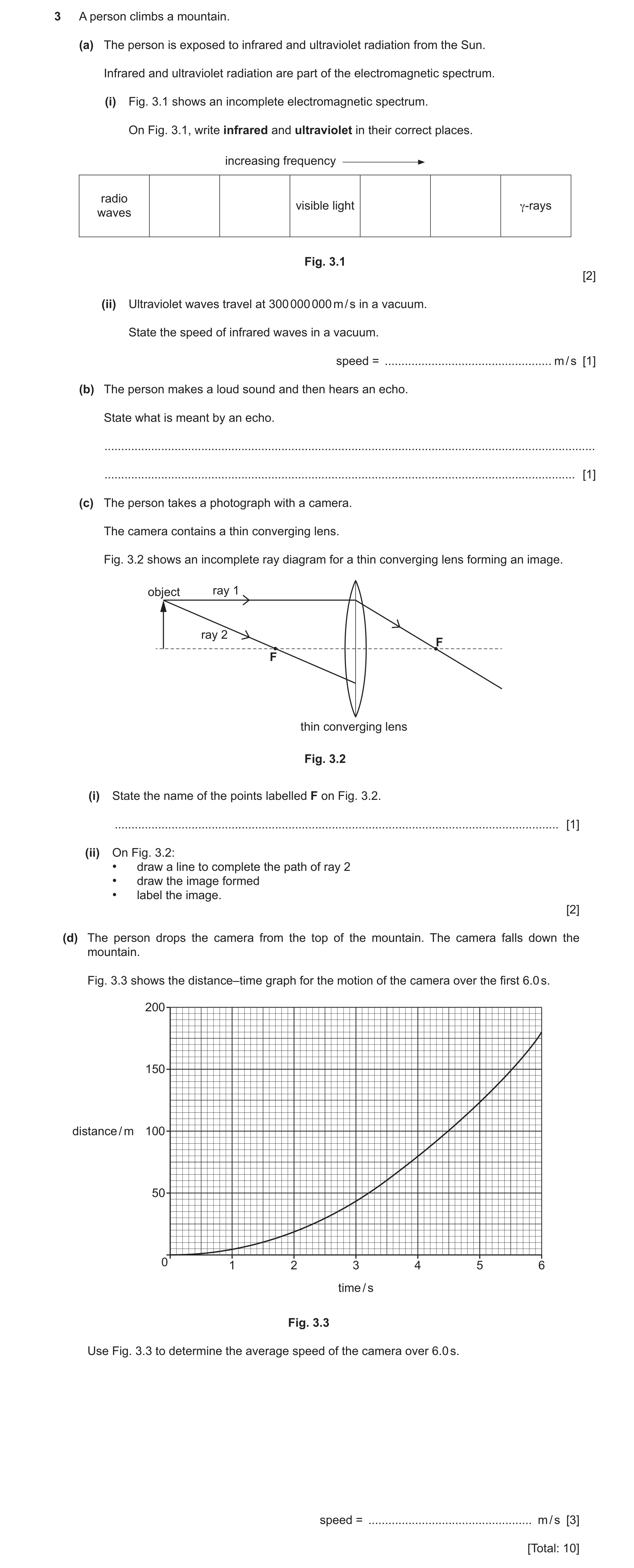
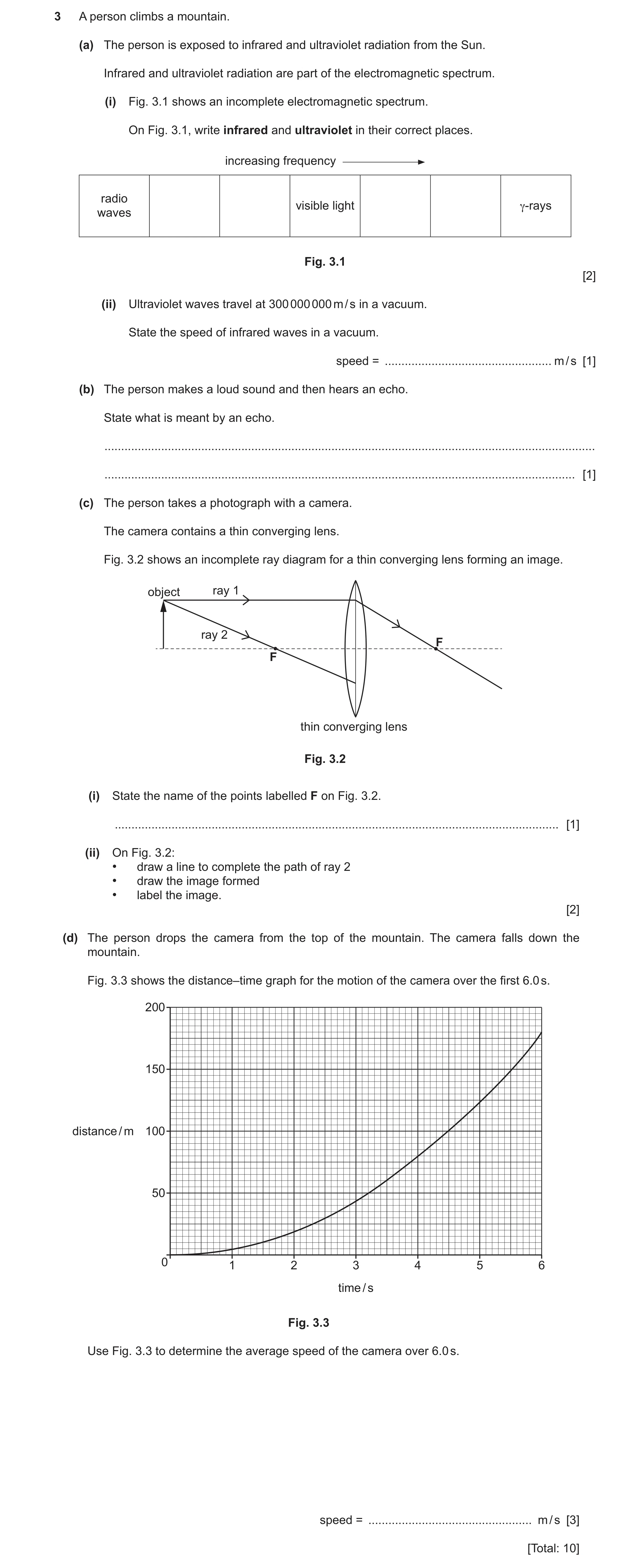
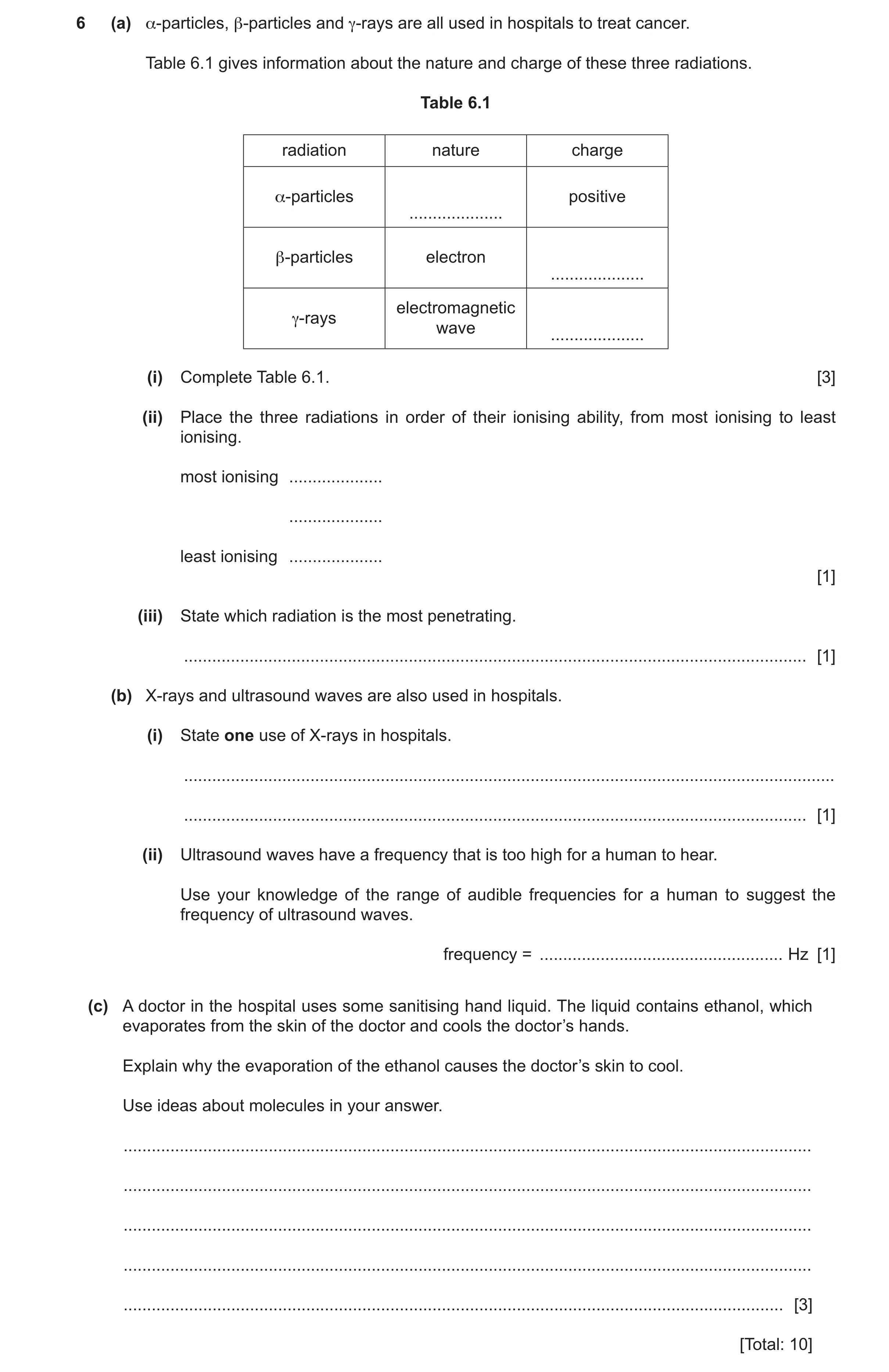
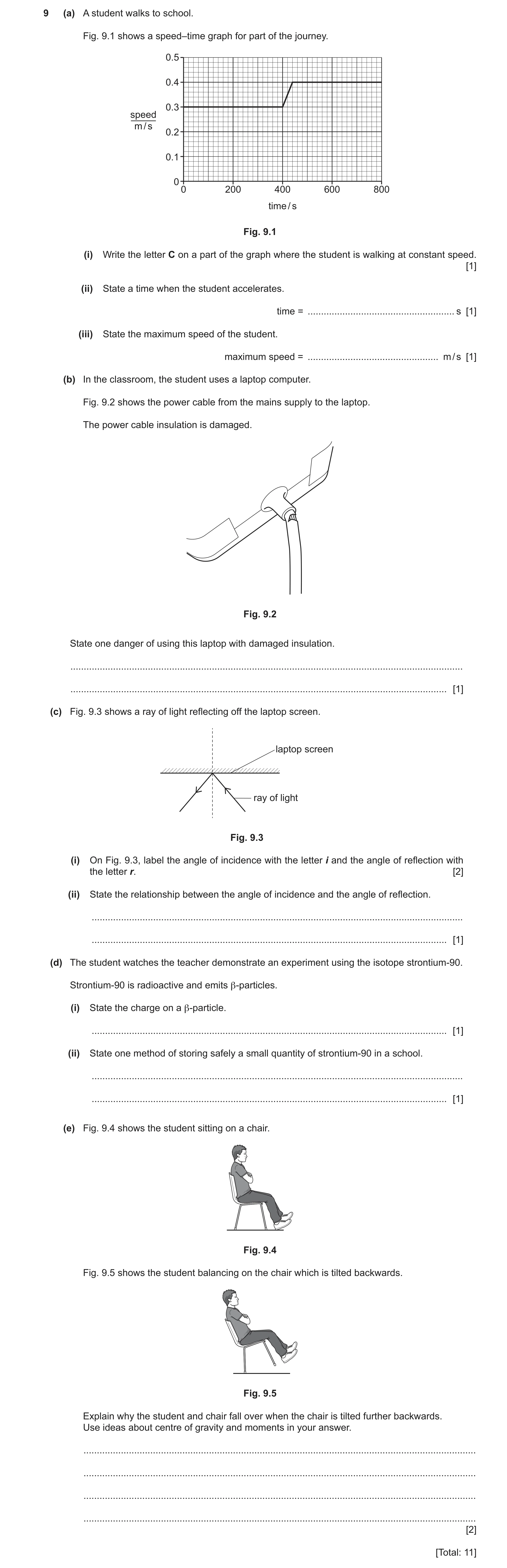
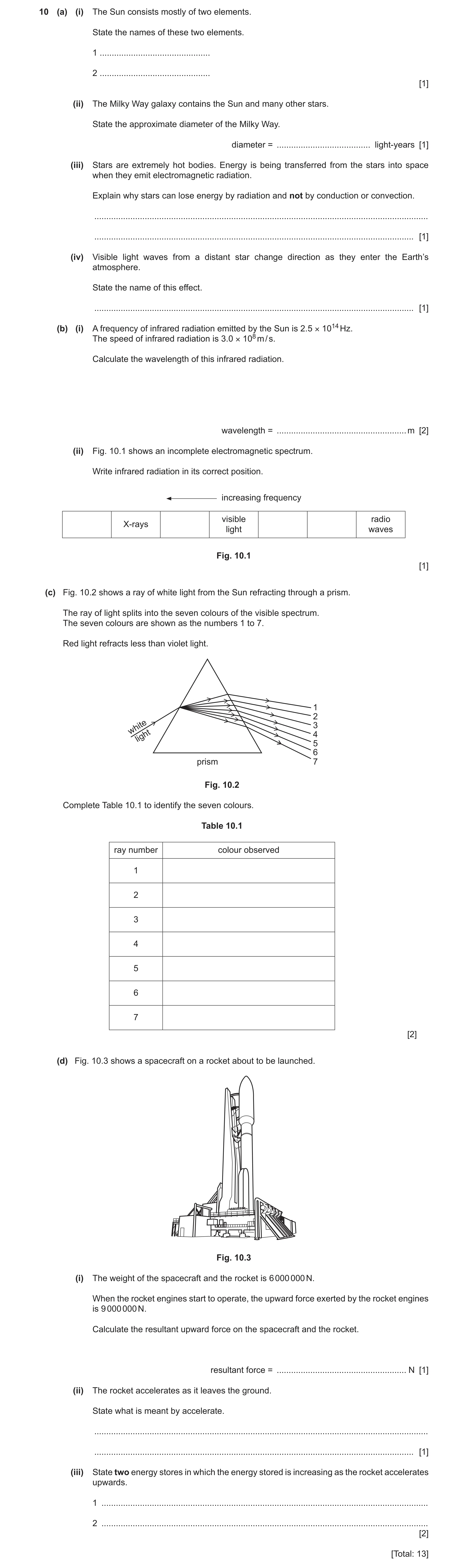
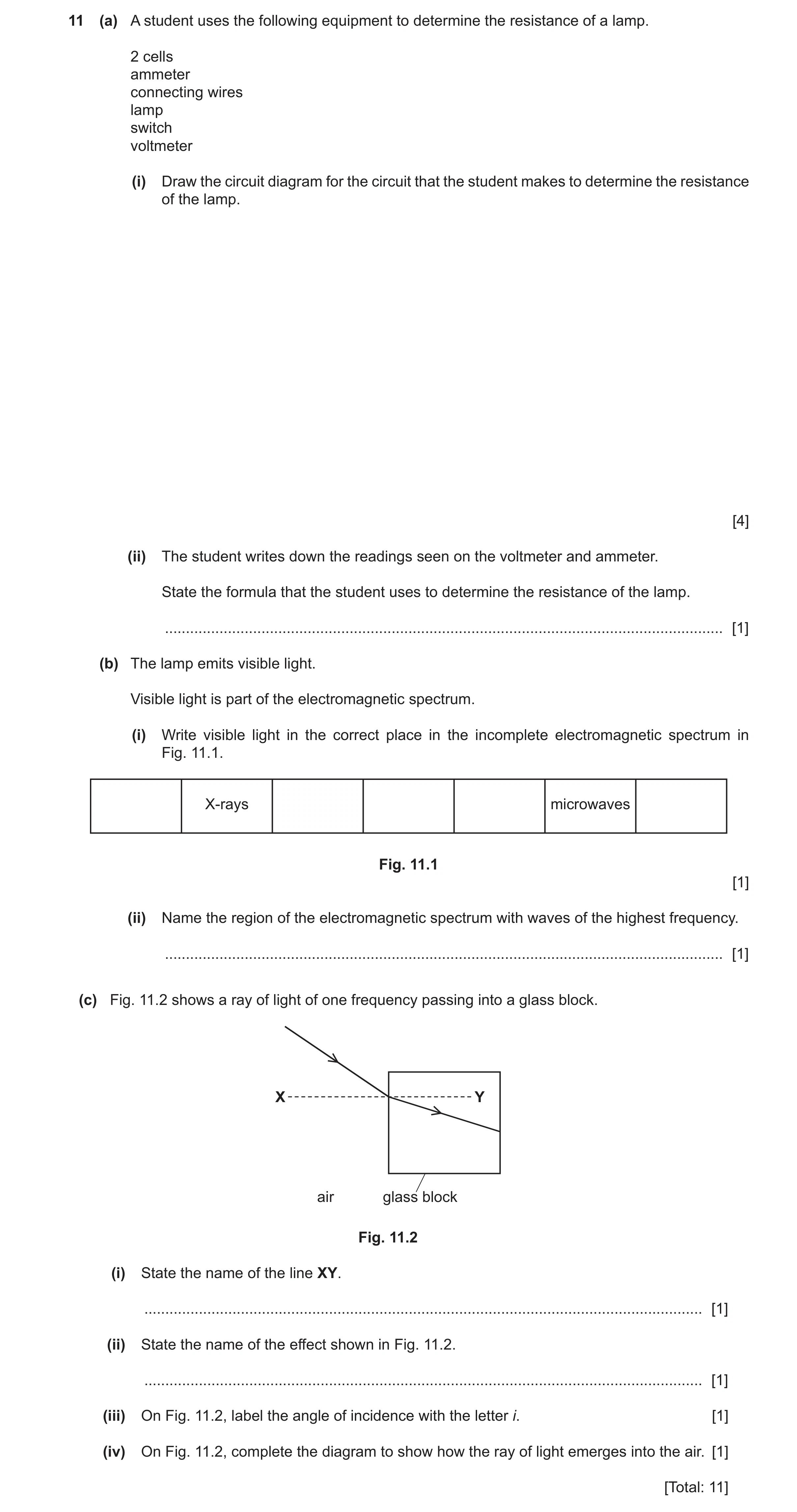
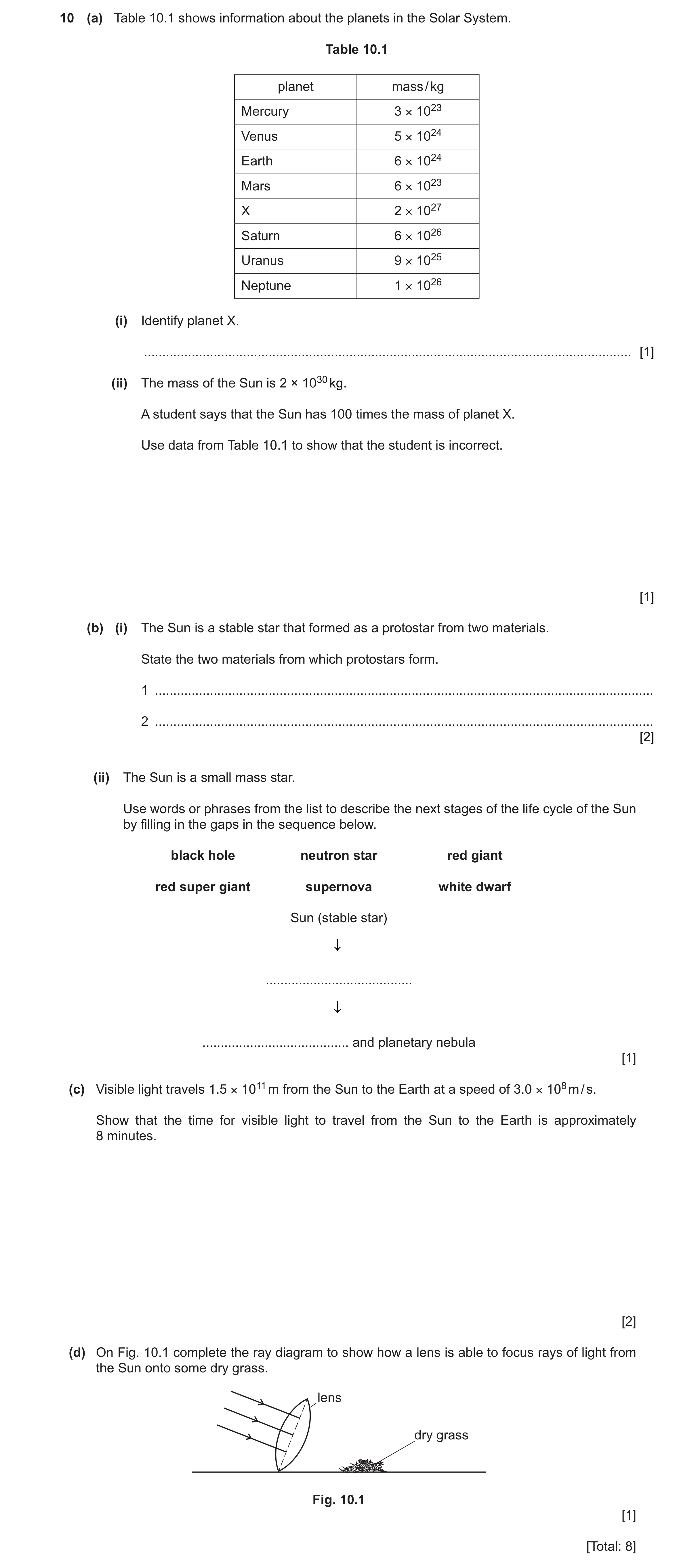
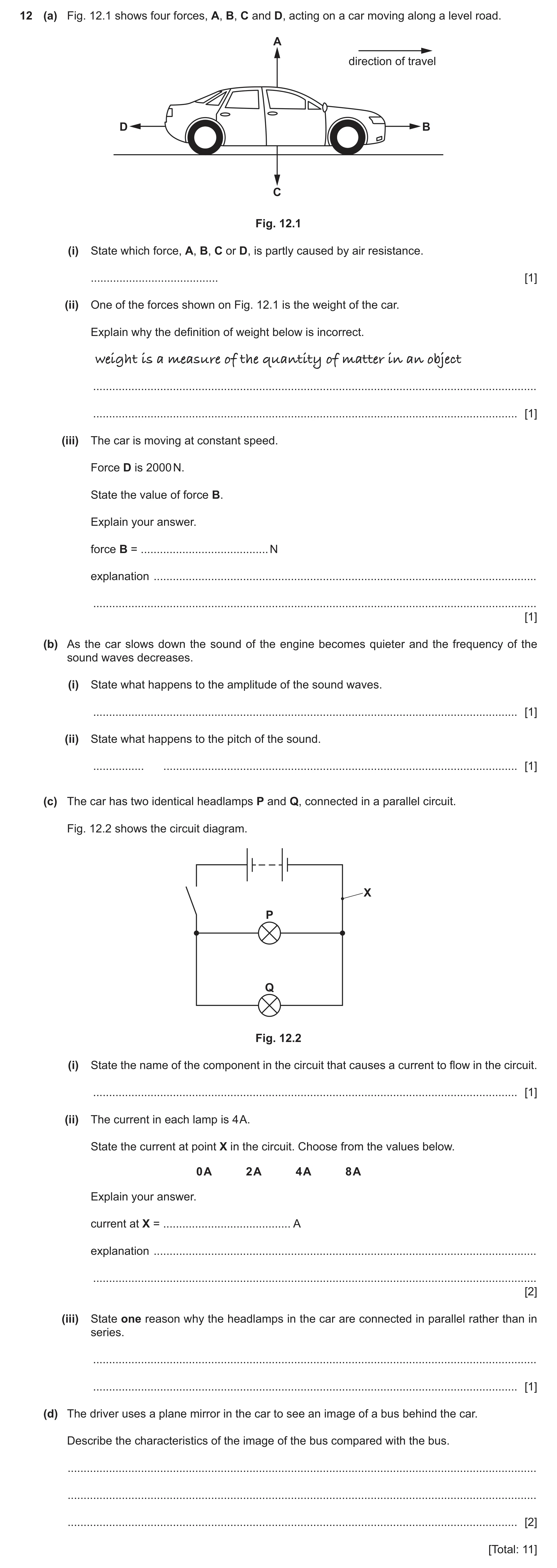
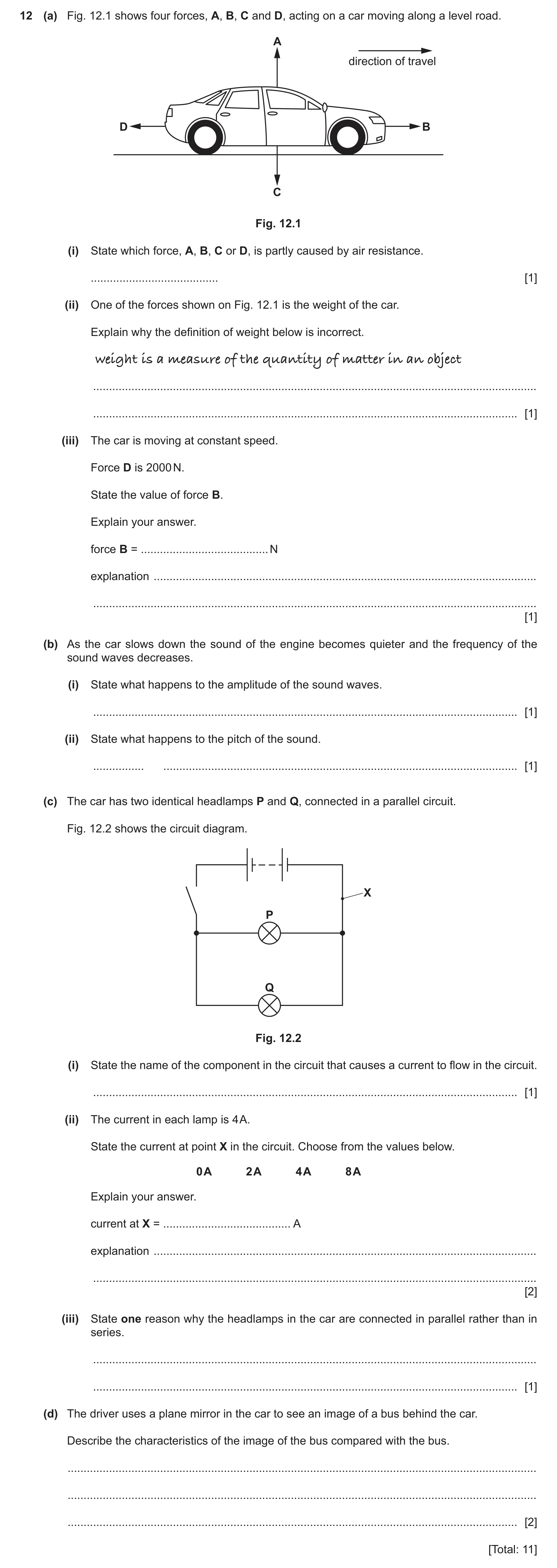
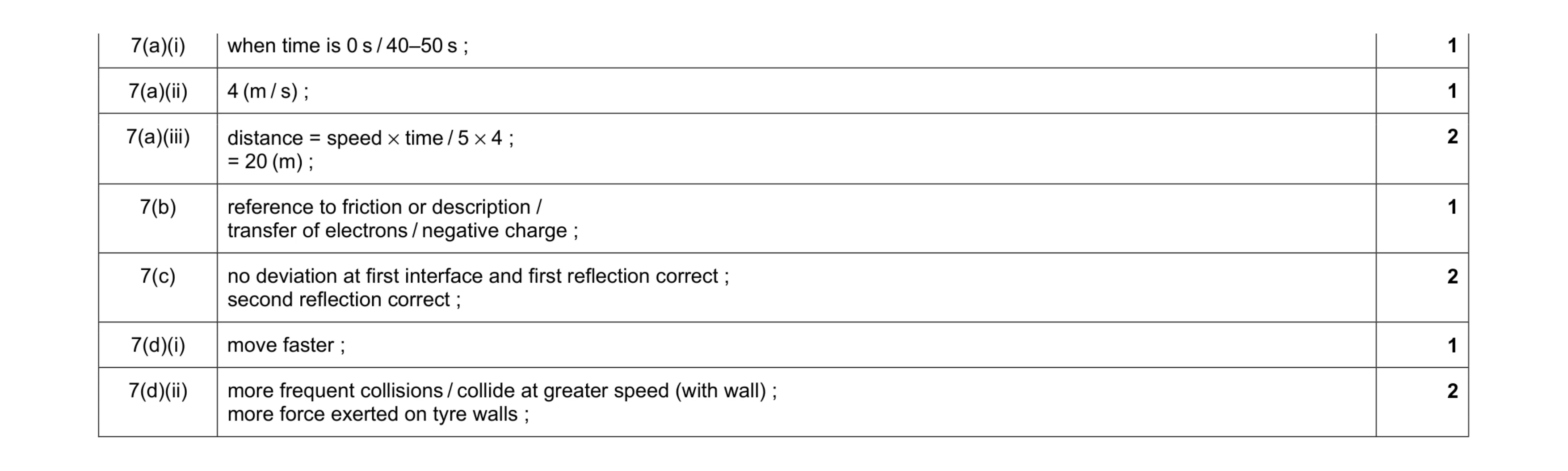 10
10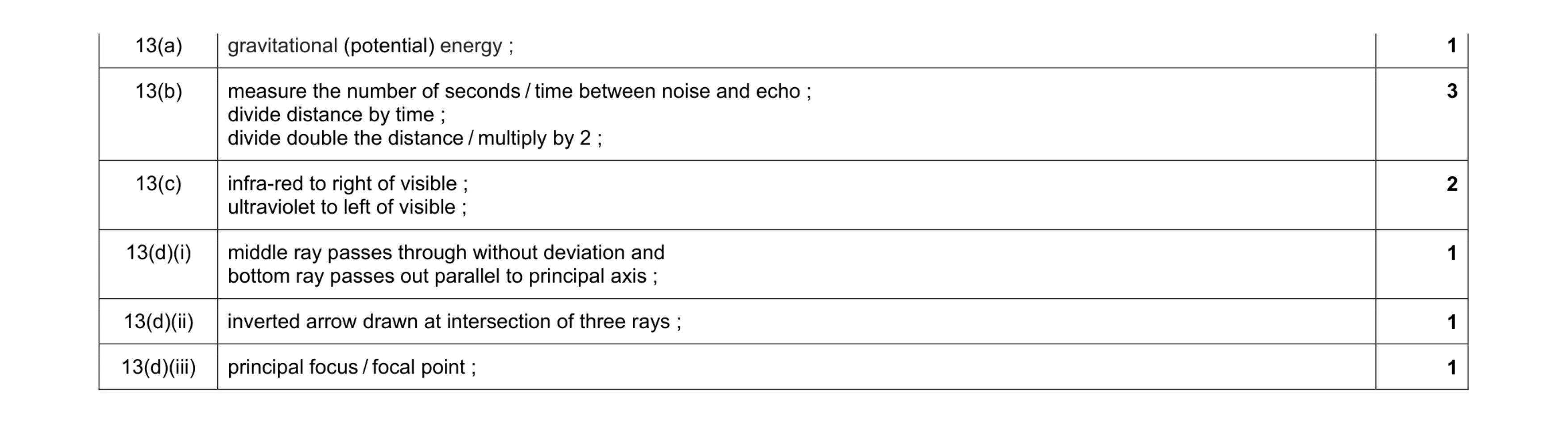 9
9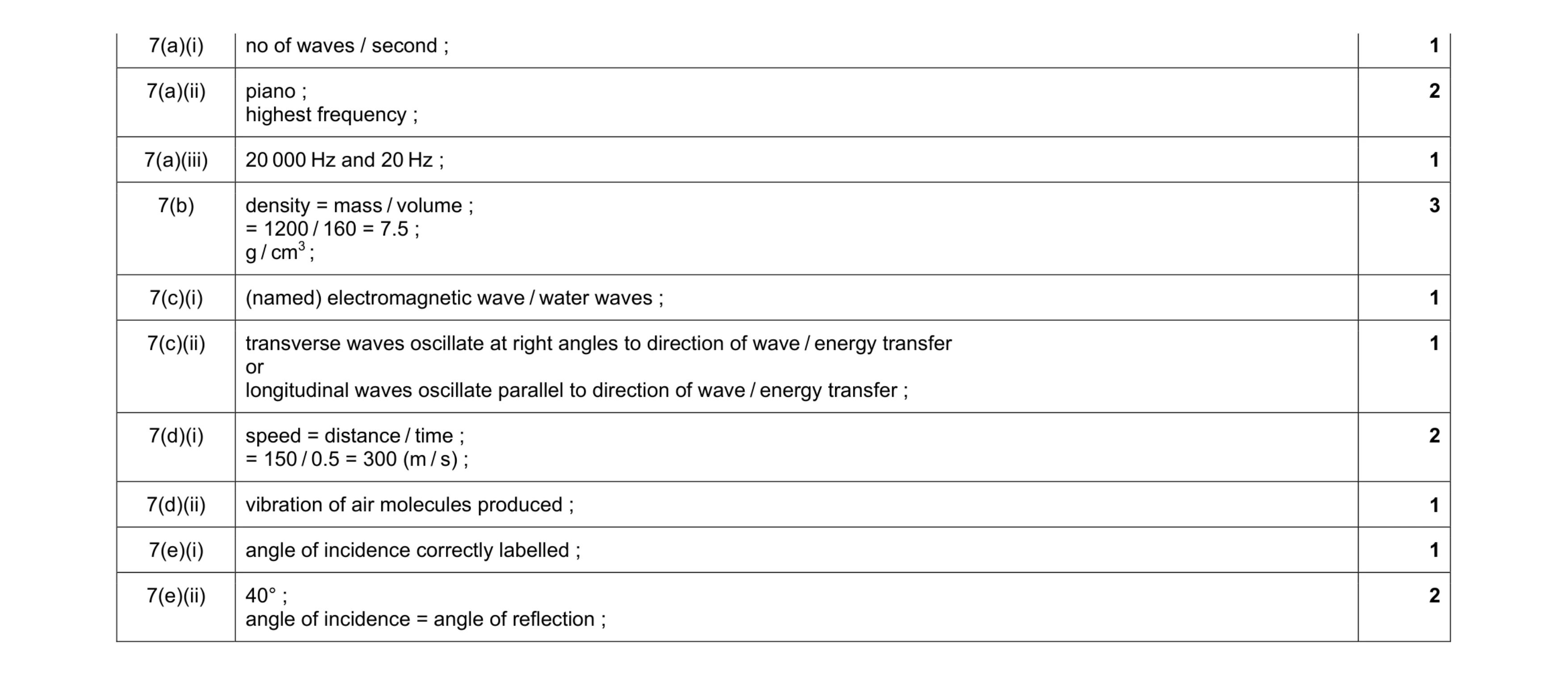 15
15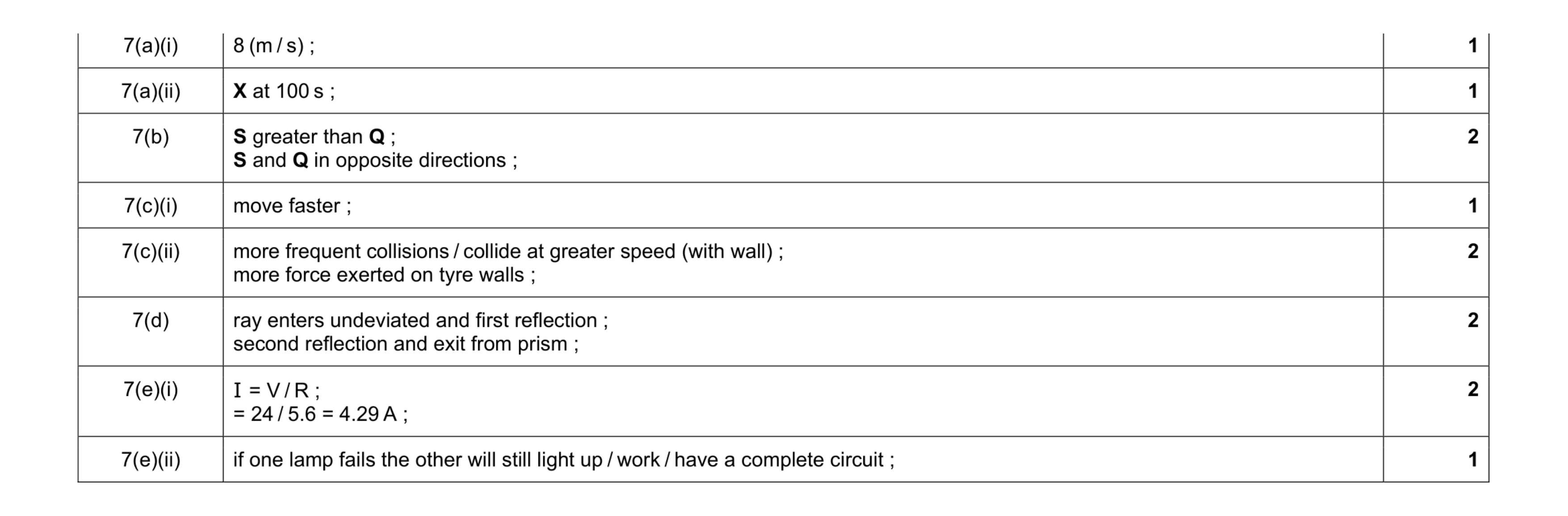 12
12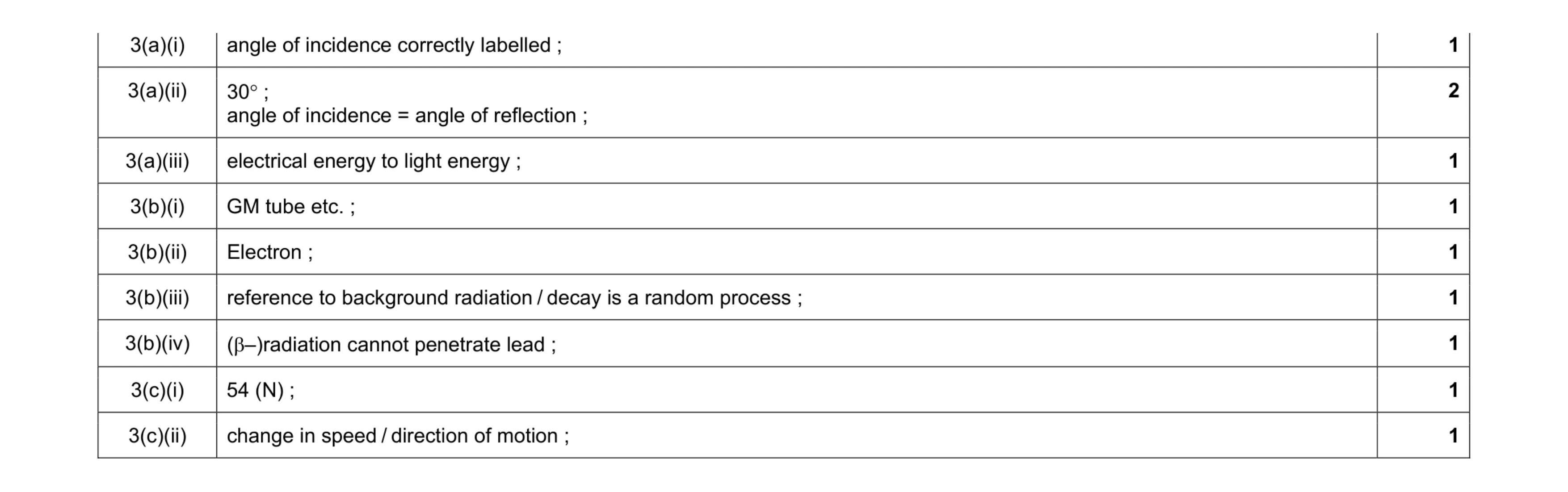 10
10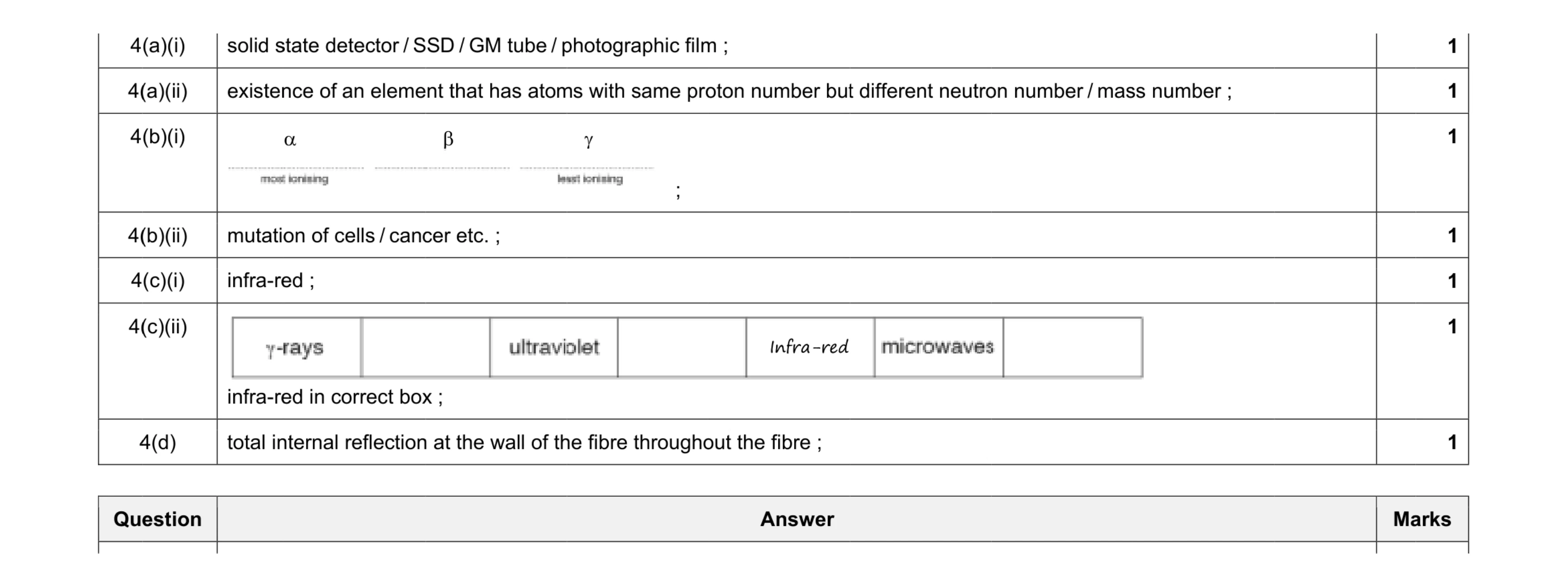 7
7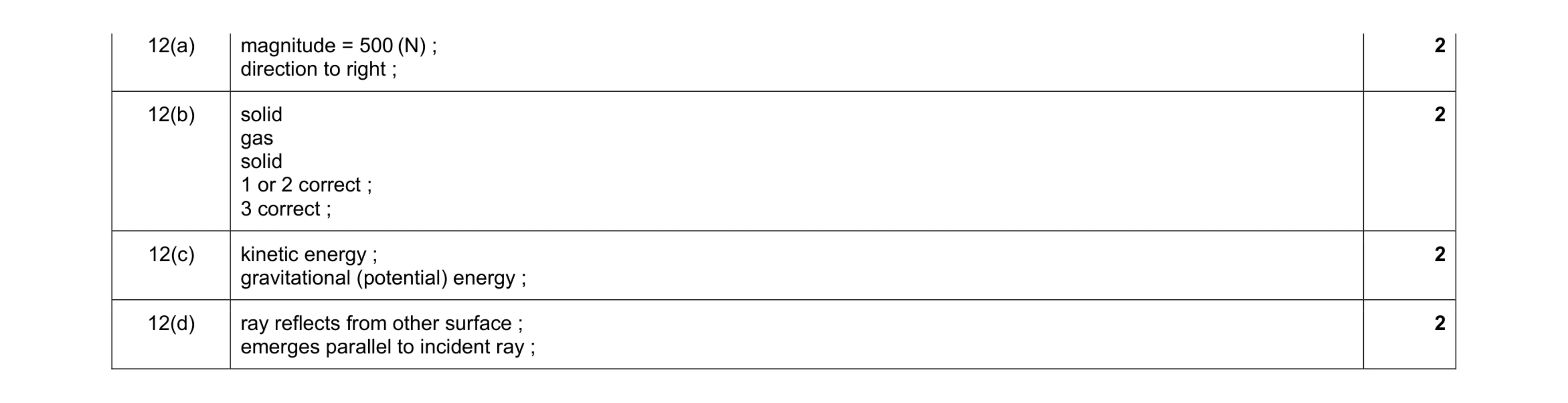 8
8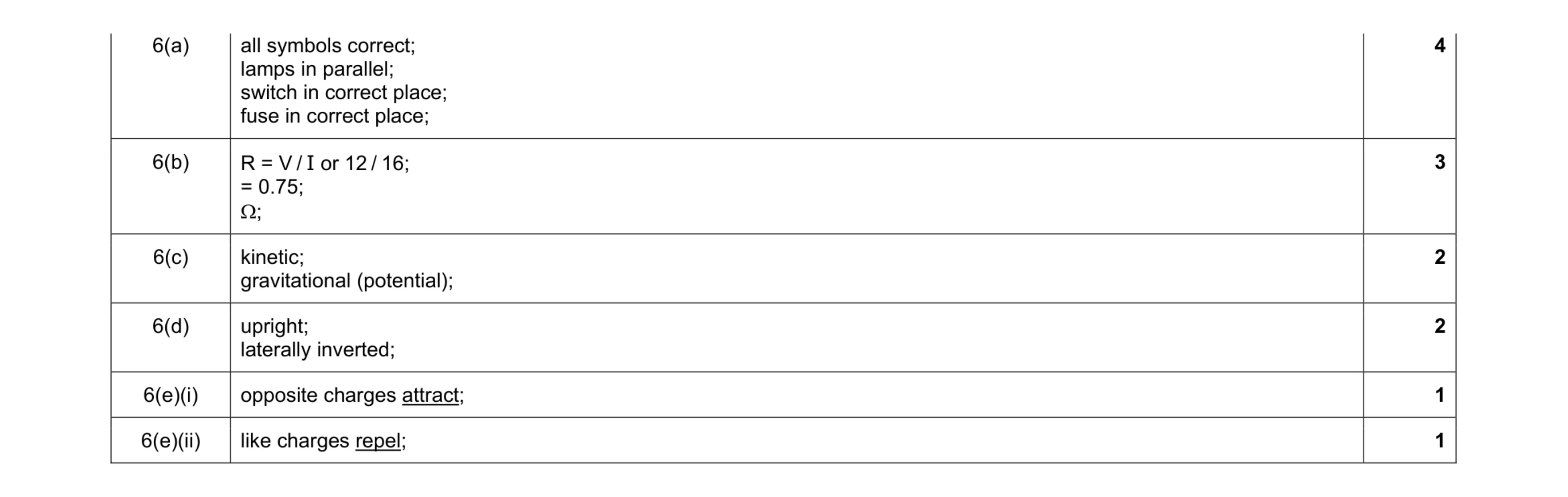 13
13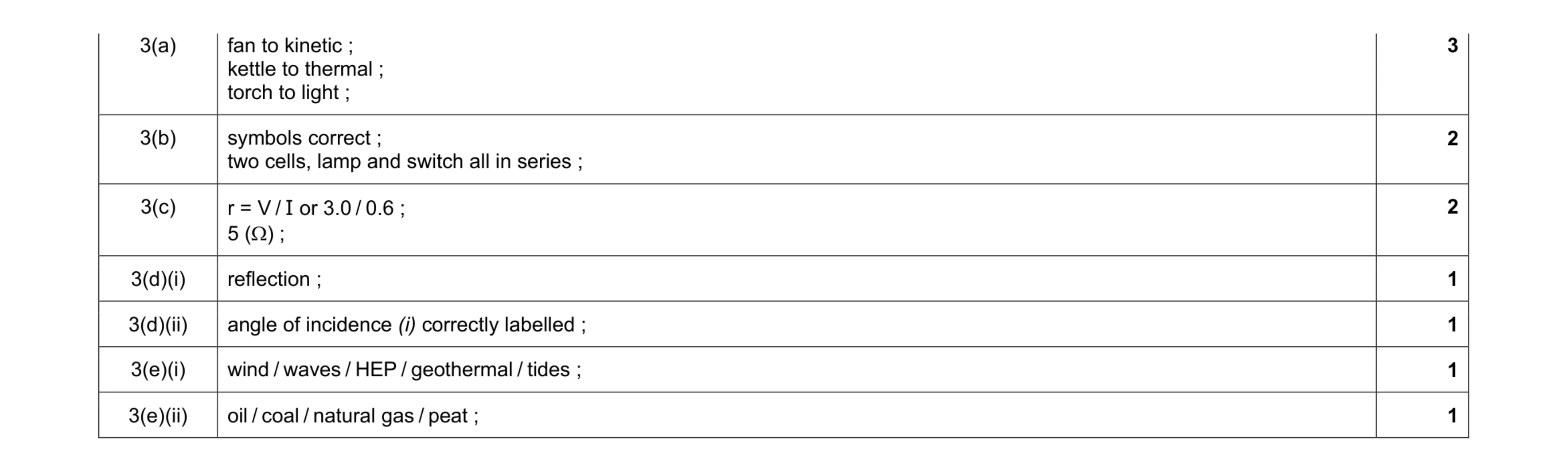 11
11 11
11 13
13 9
9 9
9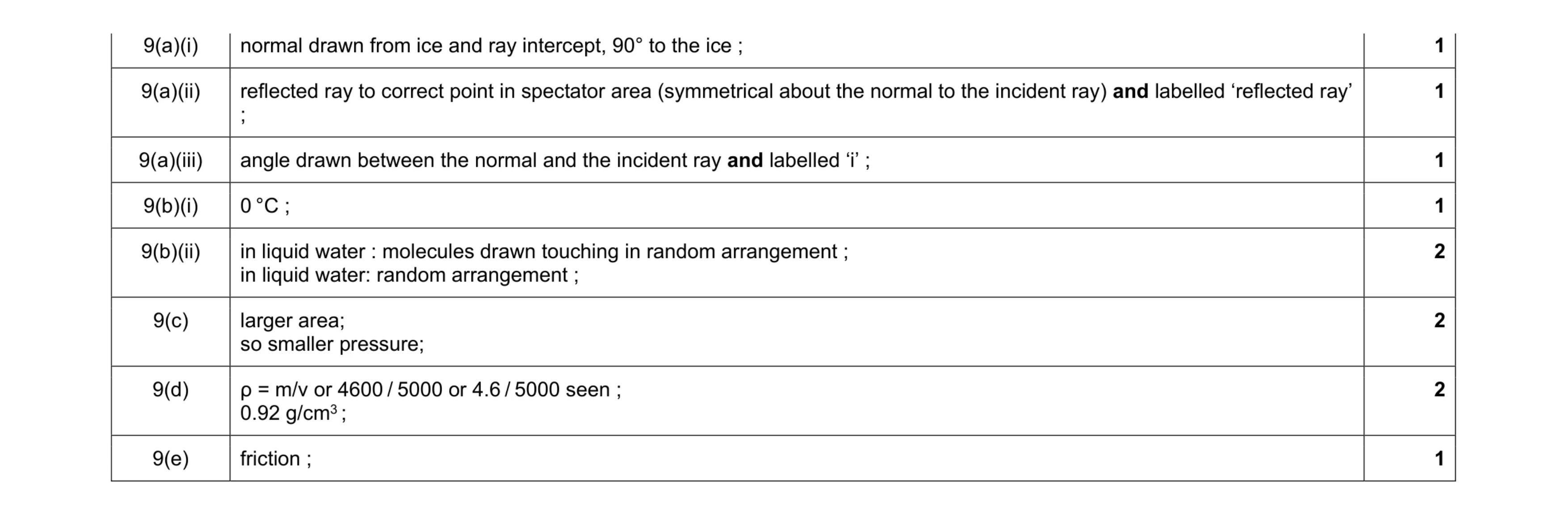 11
11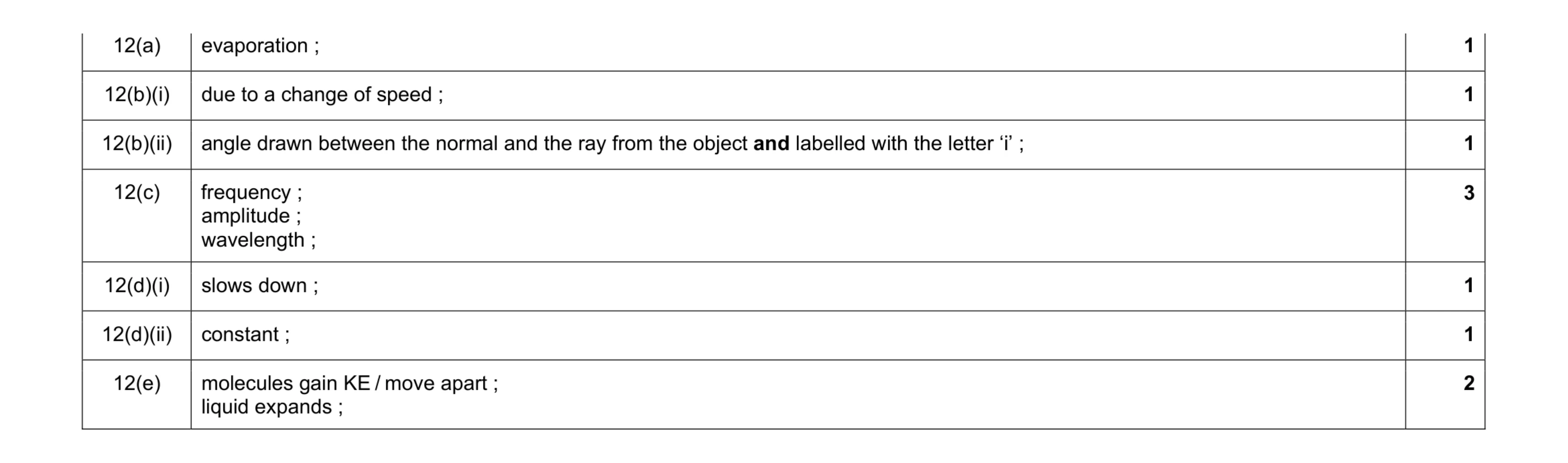 10
10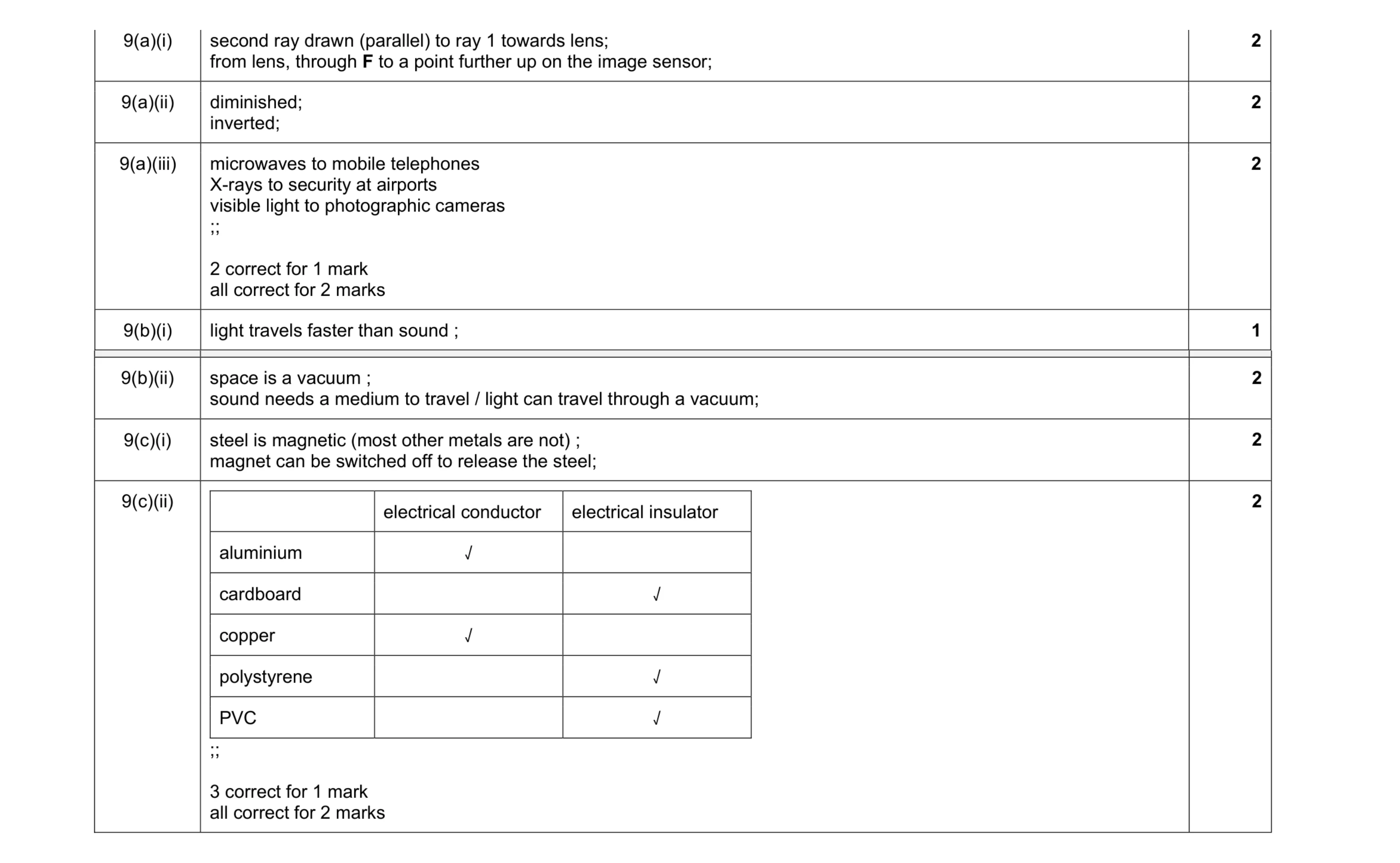 13
13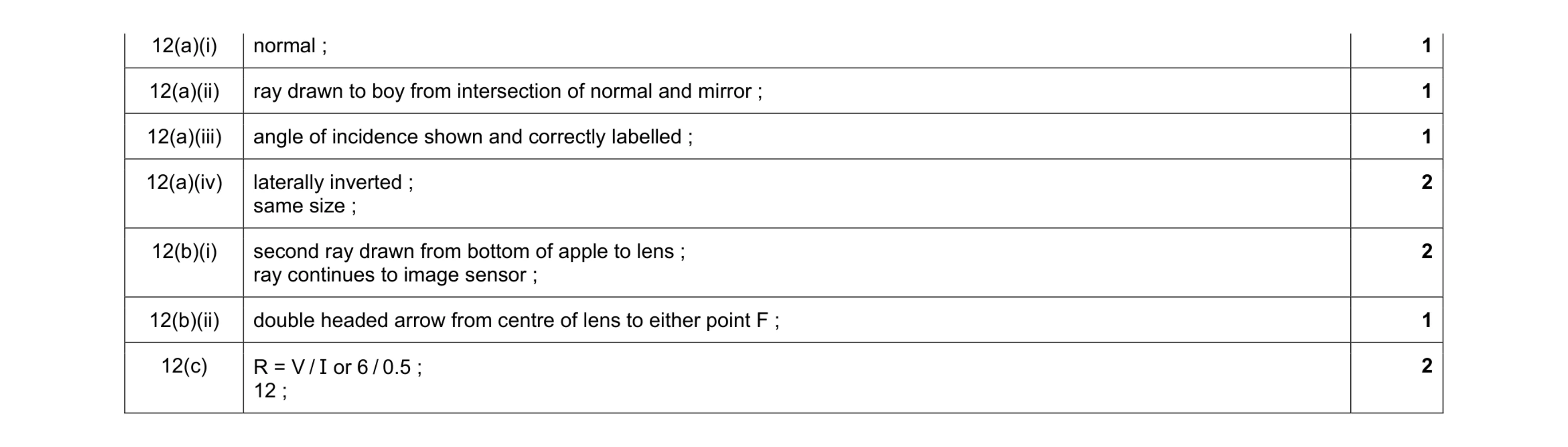 10
10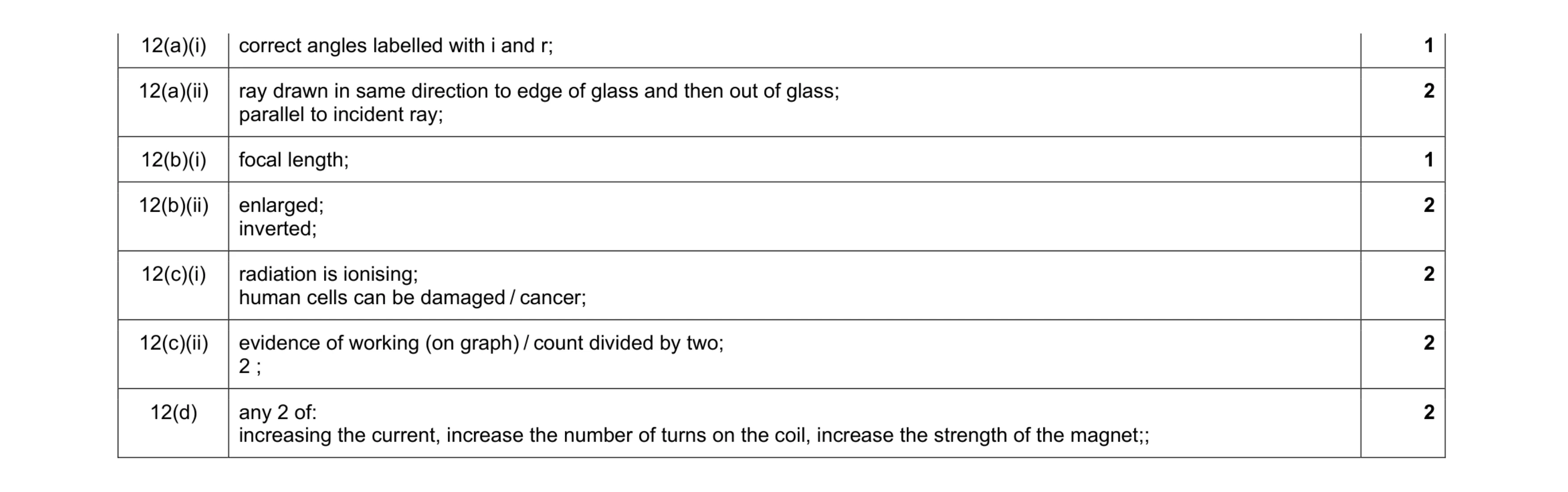 12
12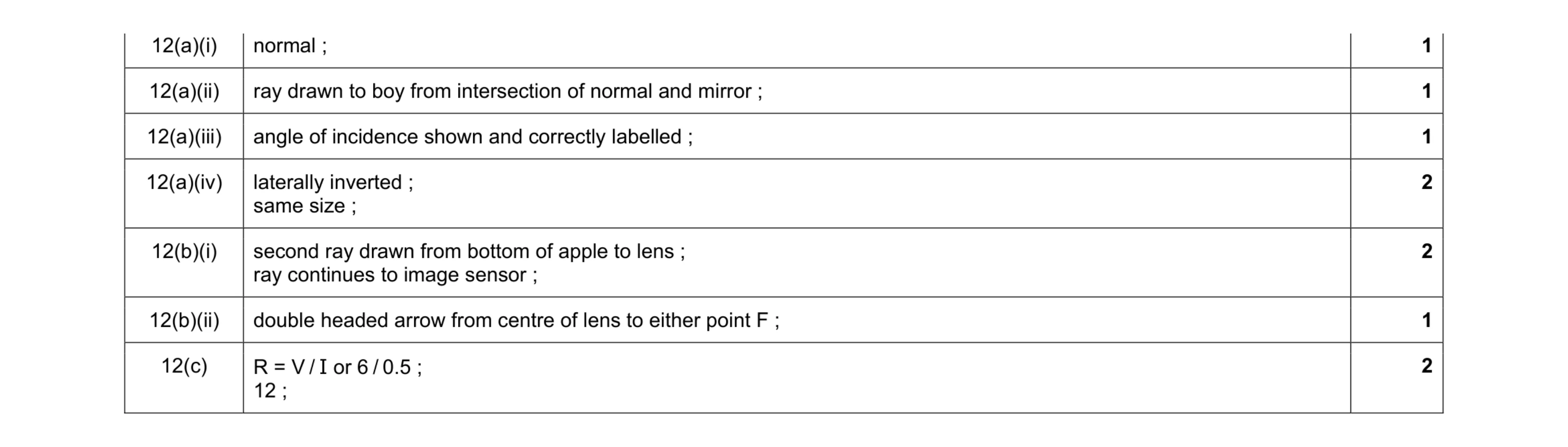 10
10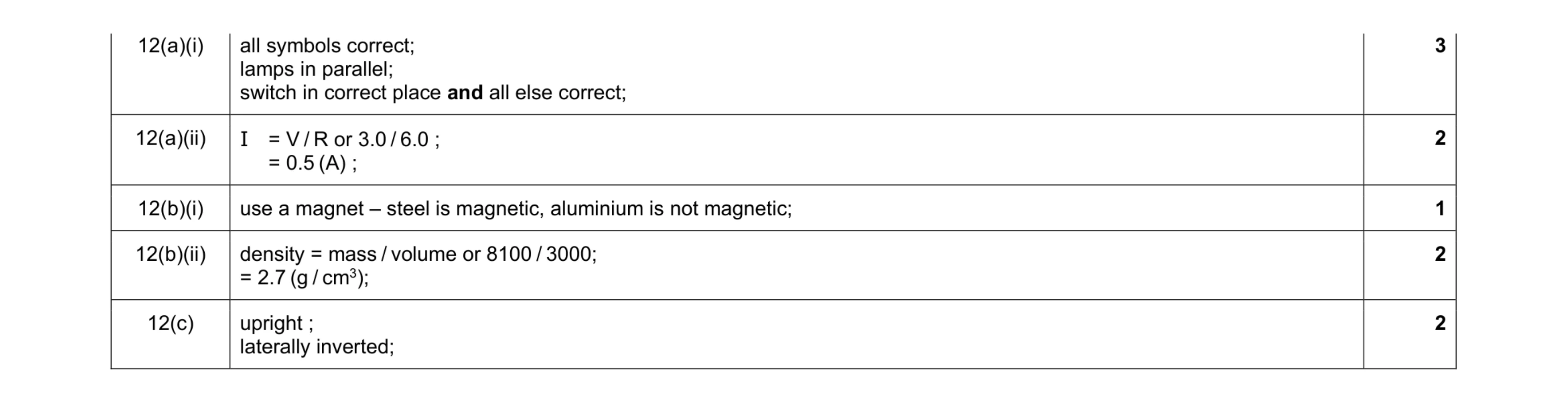 10
10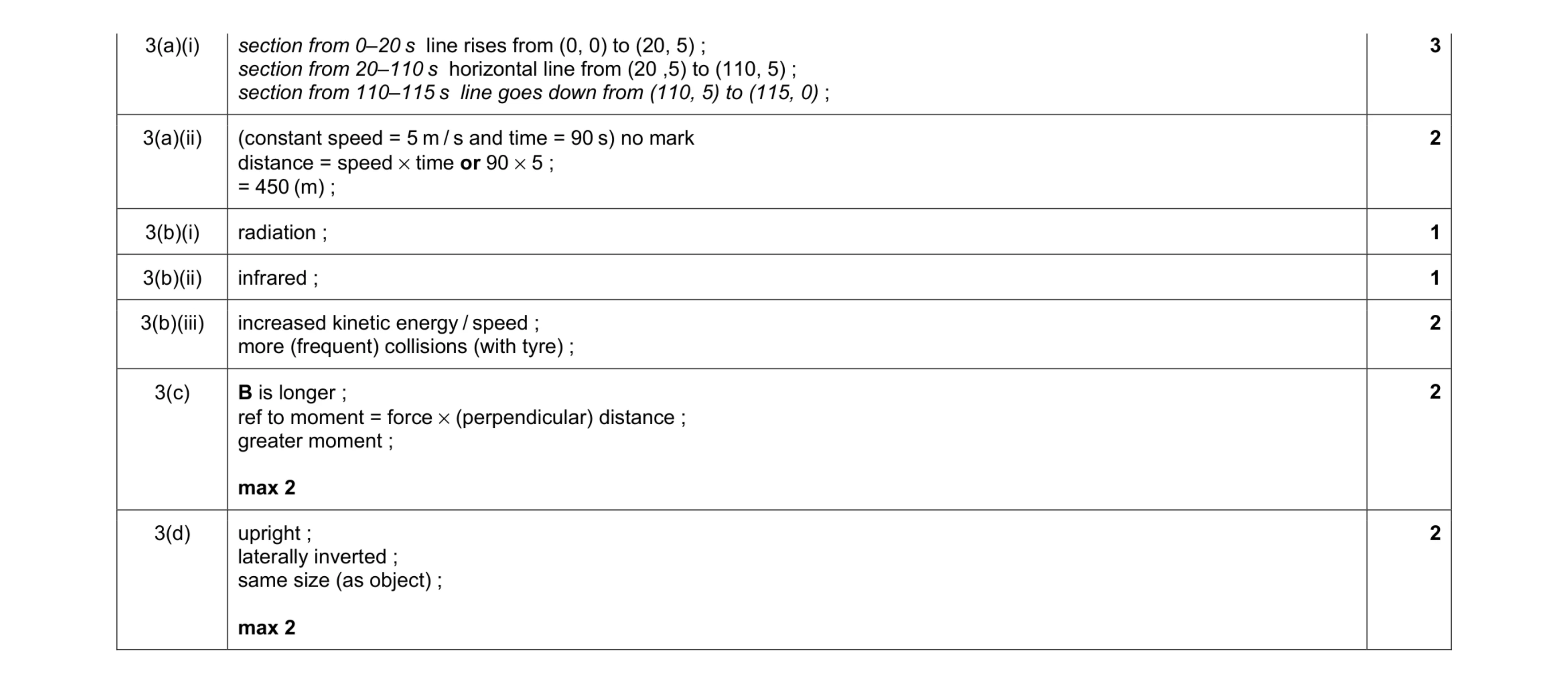 13
13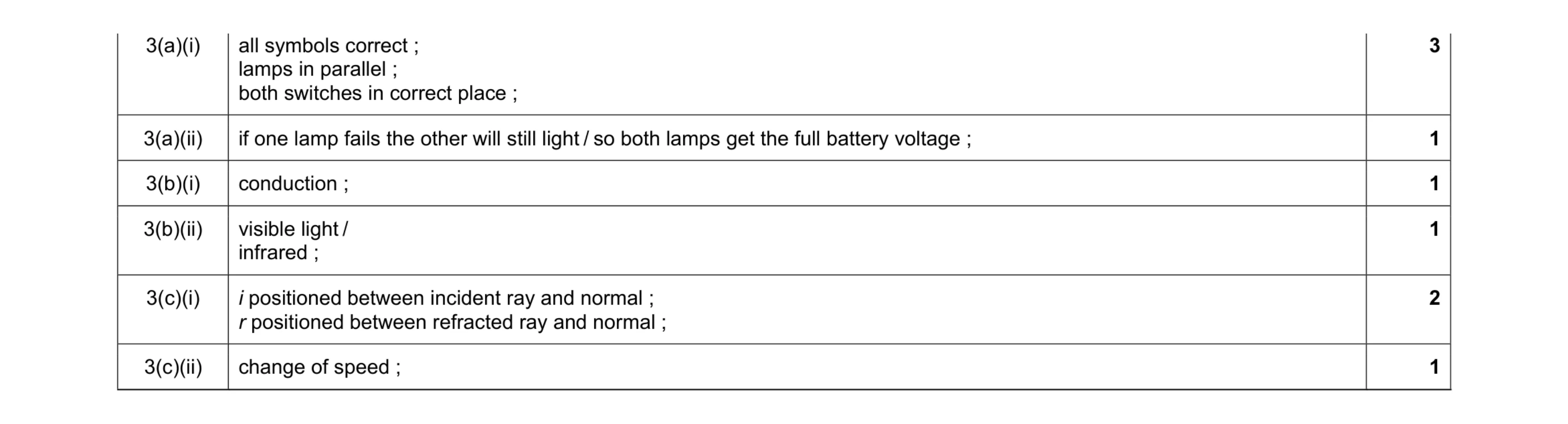 9
9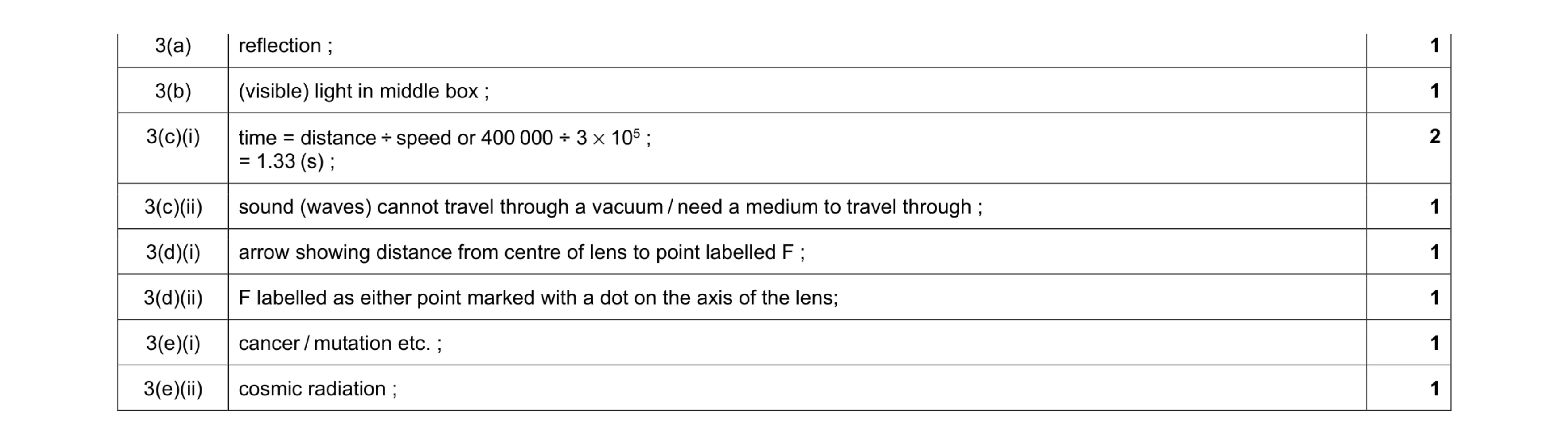 9
9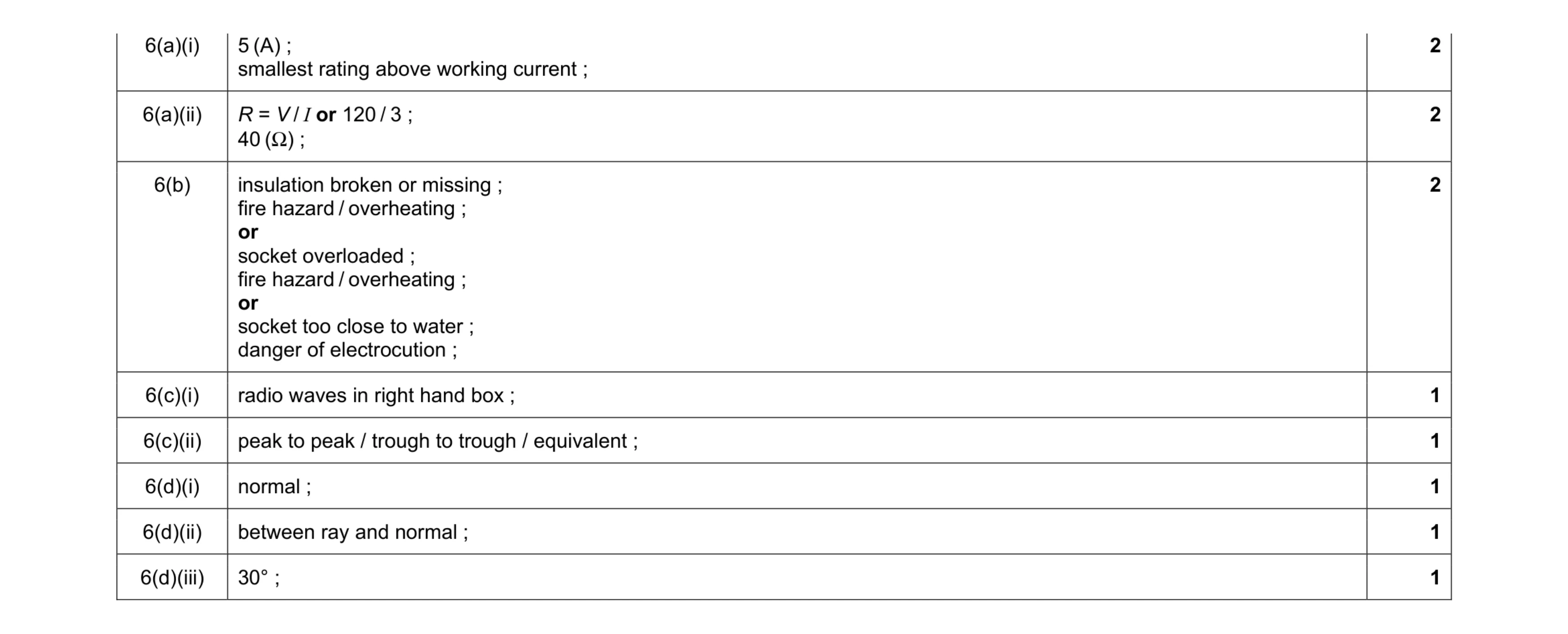 11
11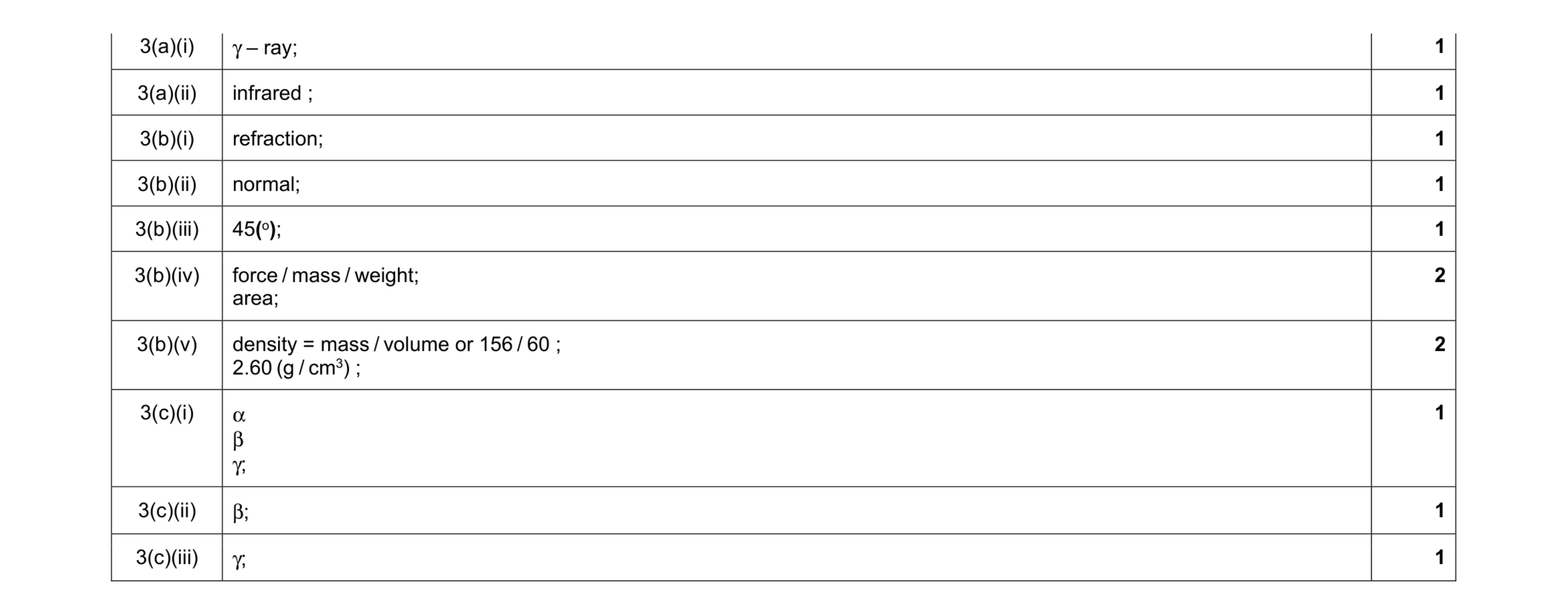 12
12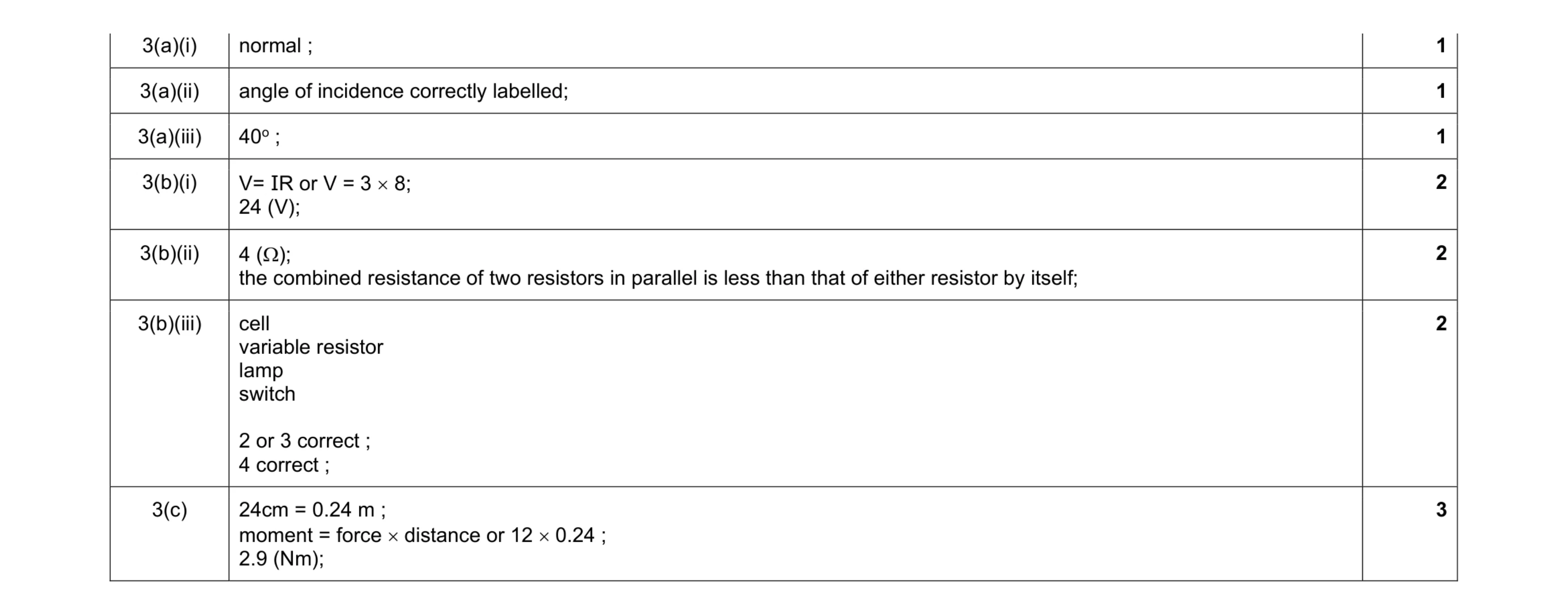 12
12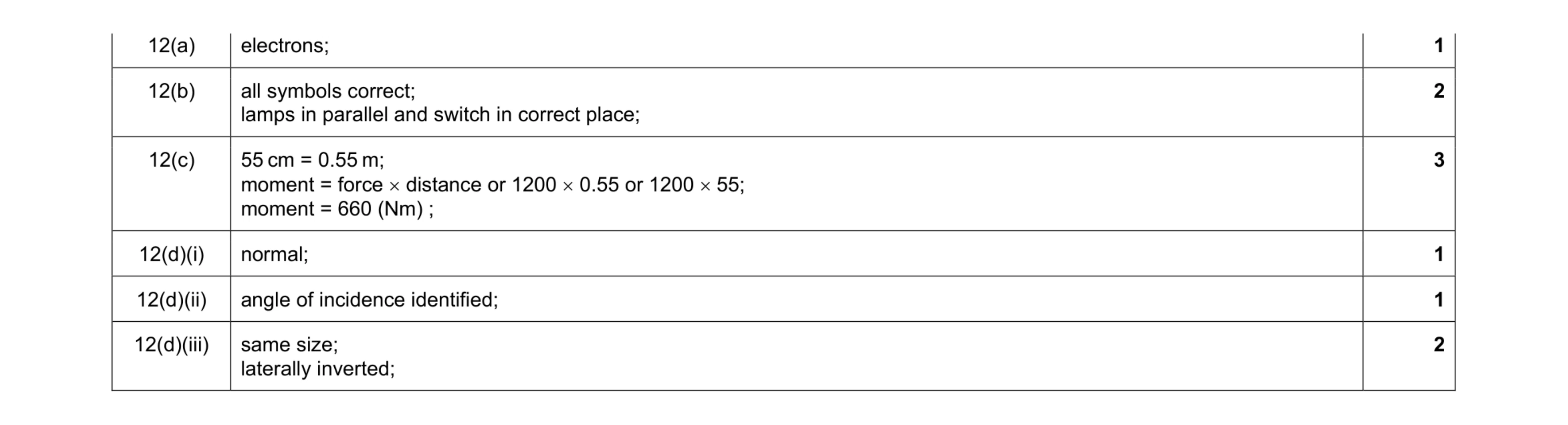 10
10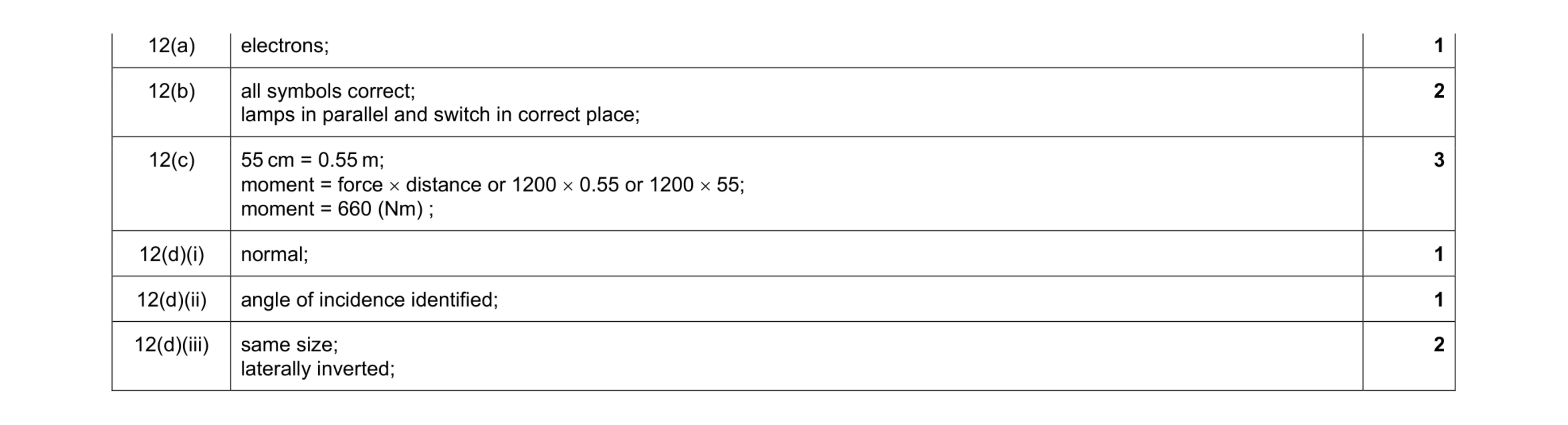 10
10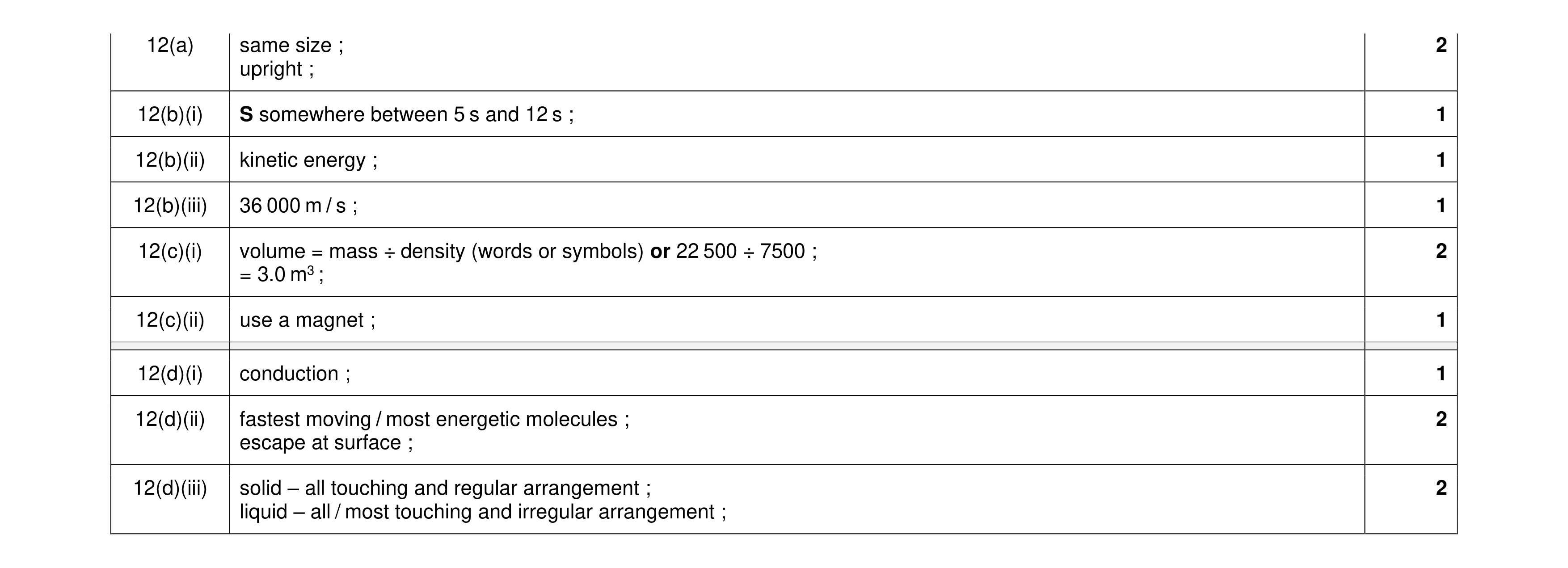 13
13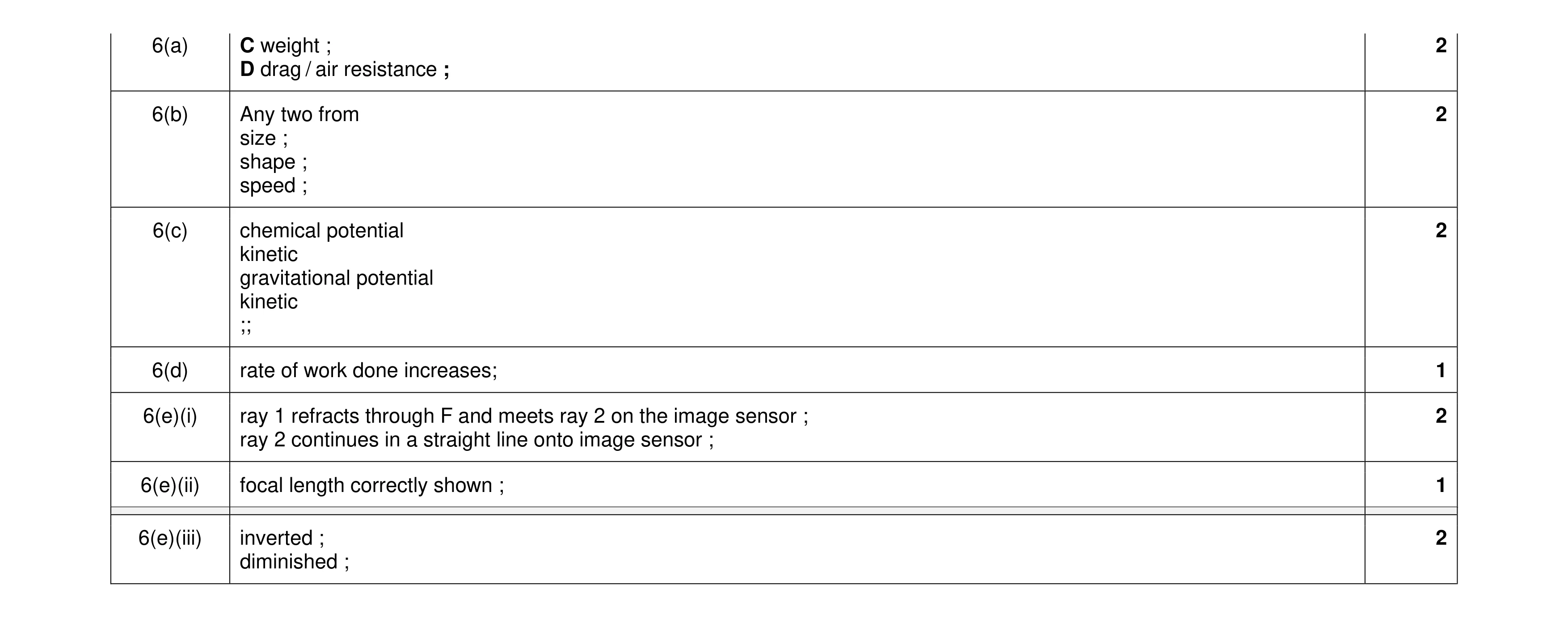 12
12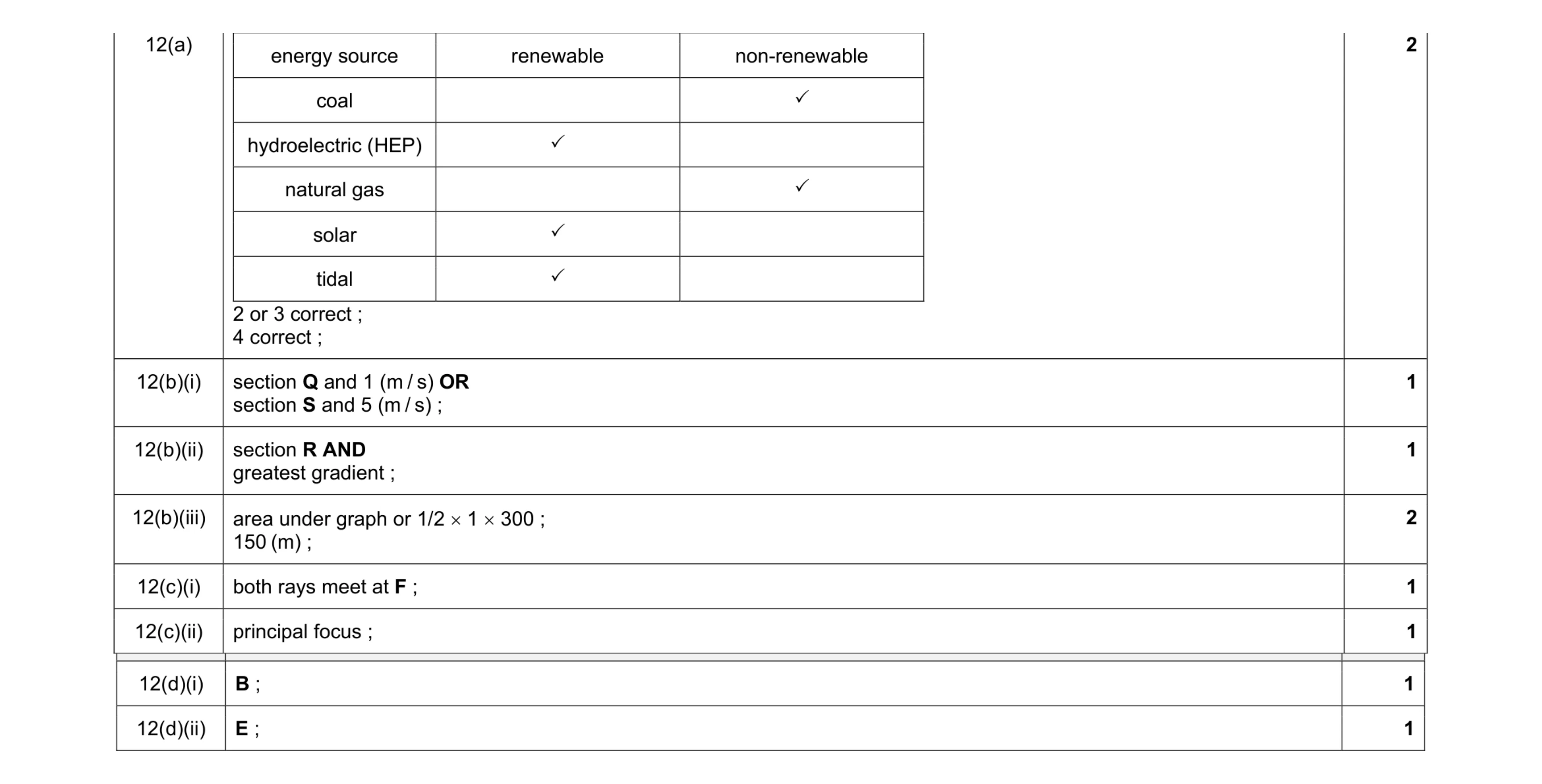 10
10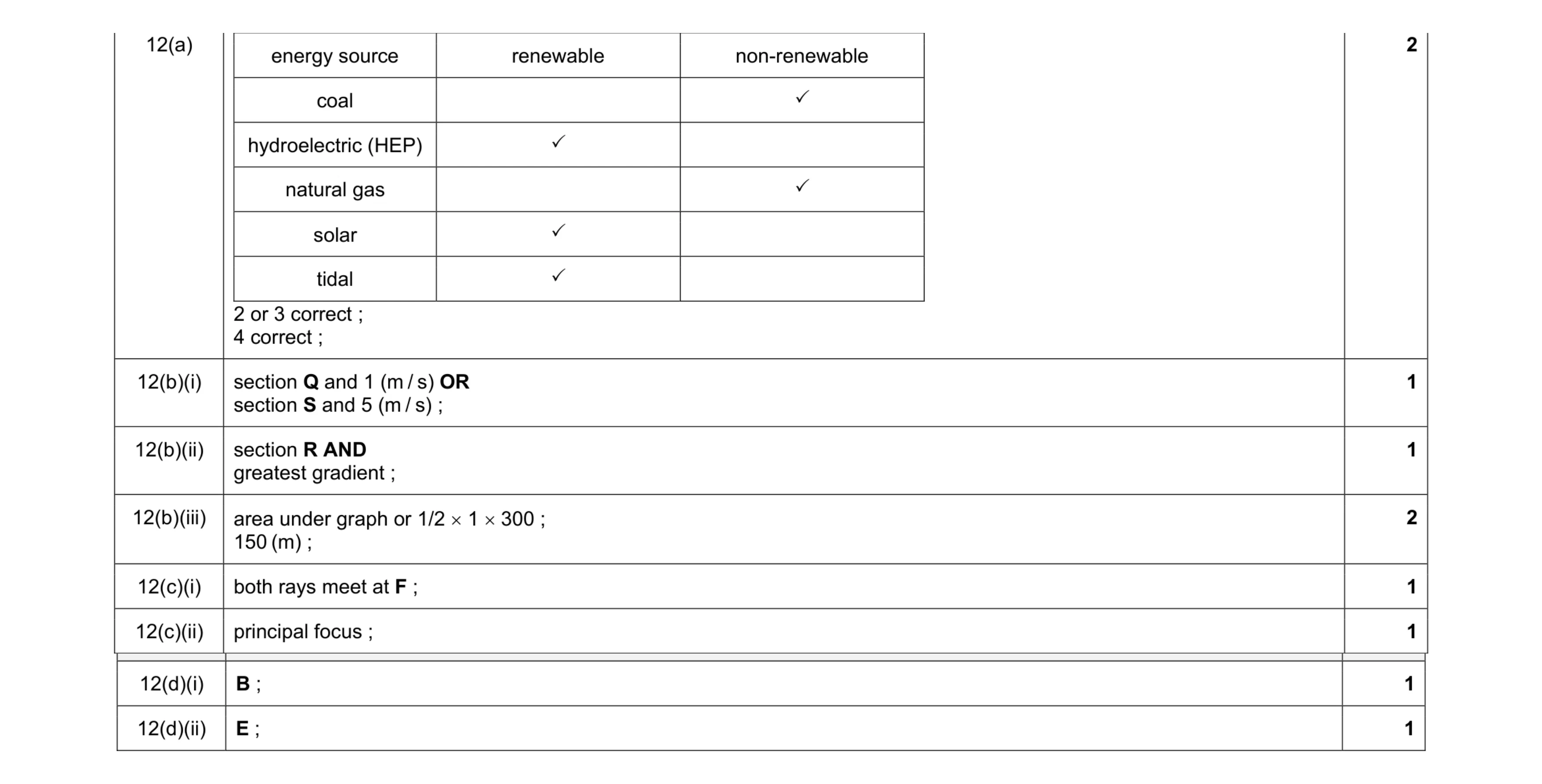 10
10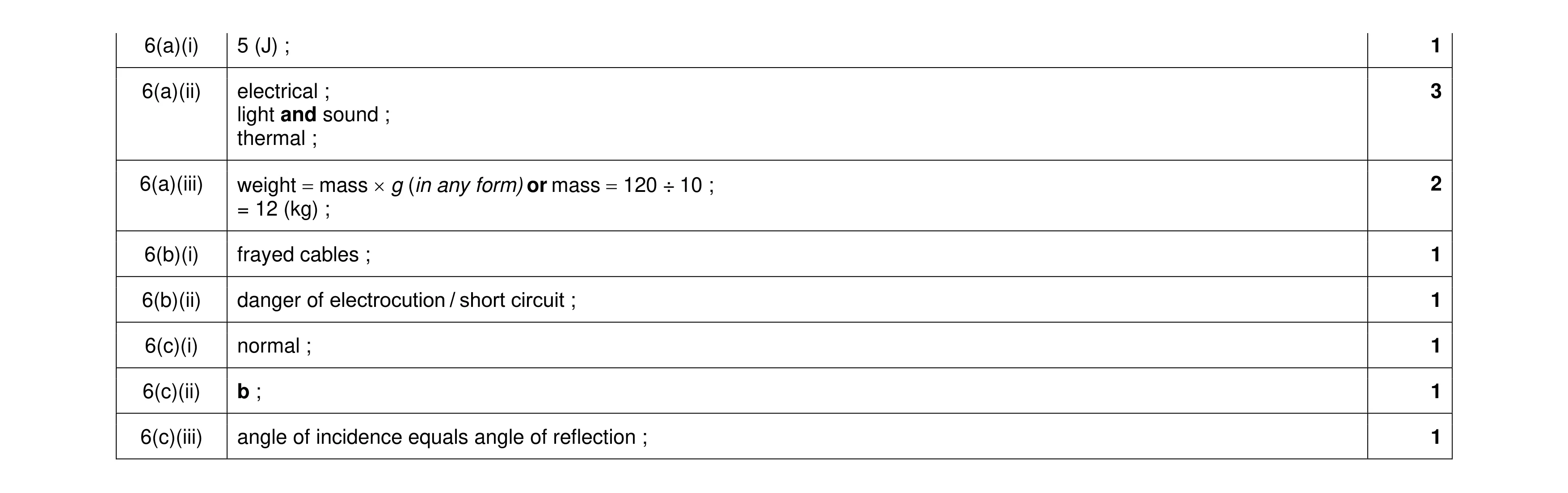 11
11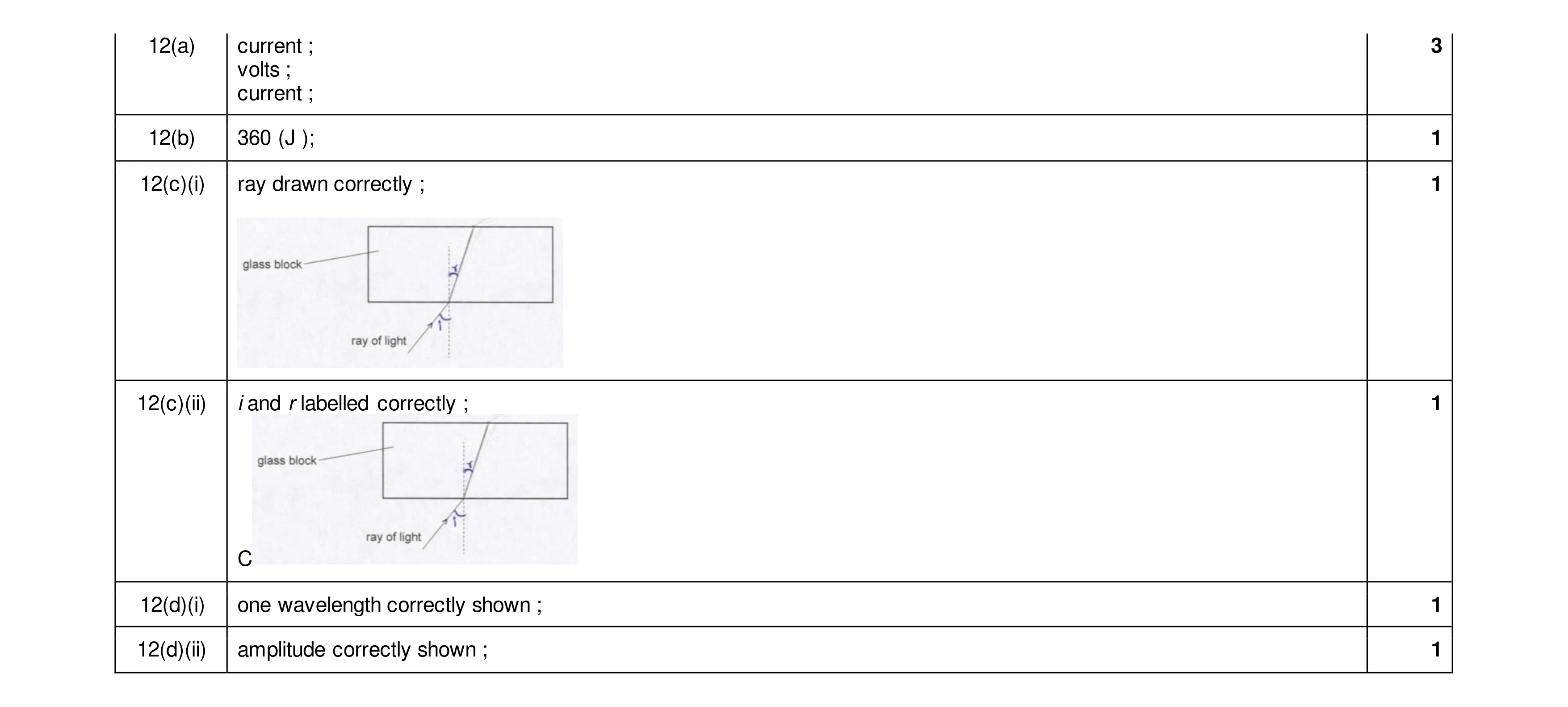 8
8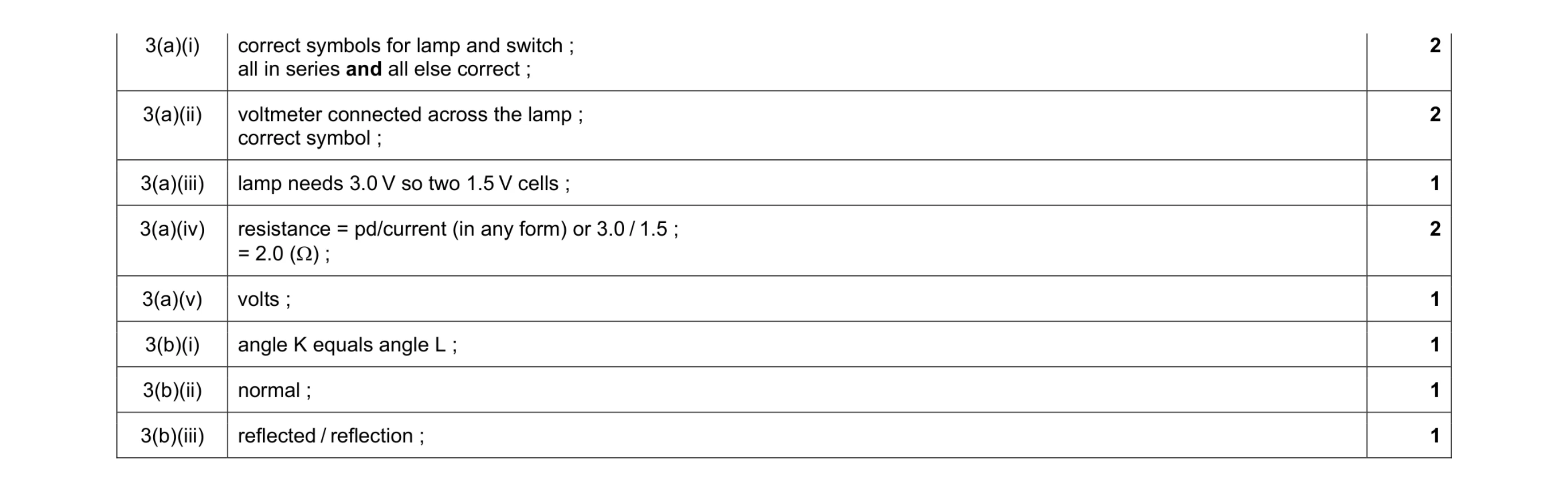 11
11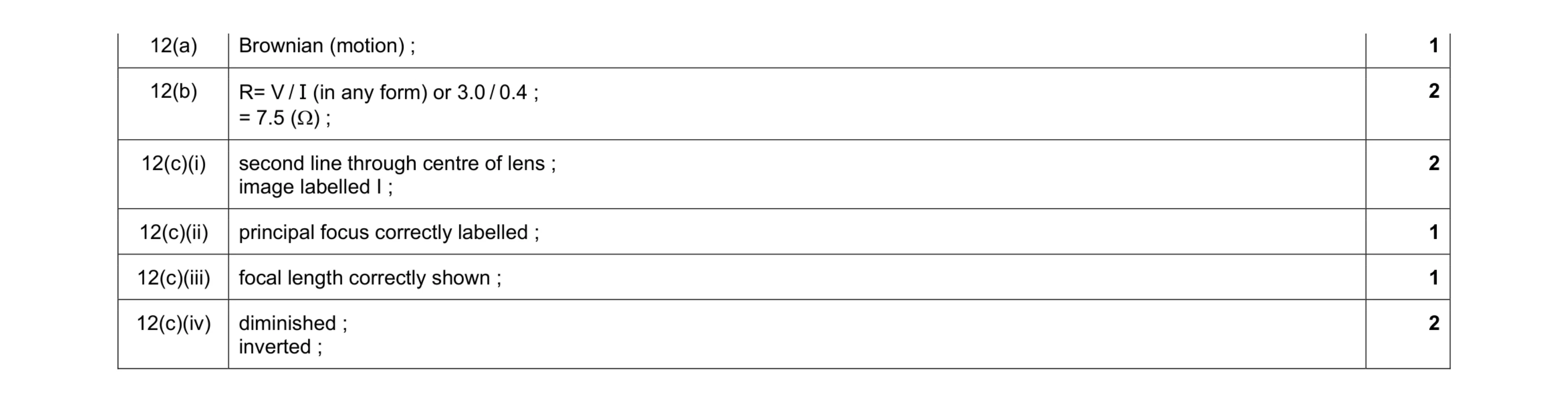 9
9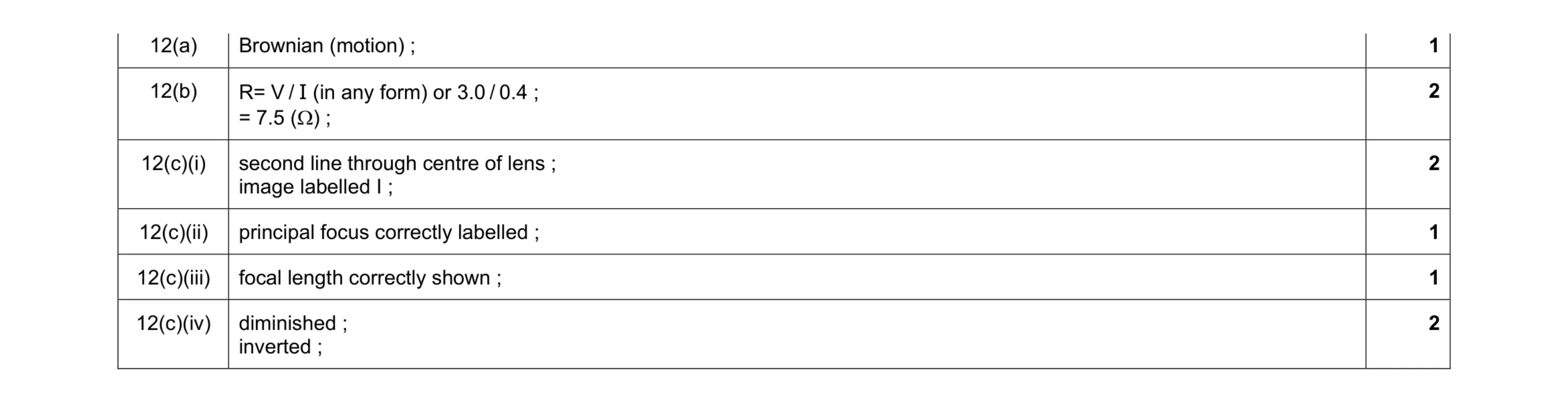 9
9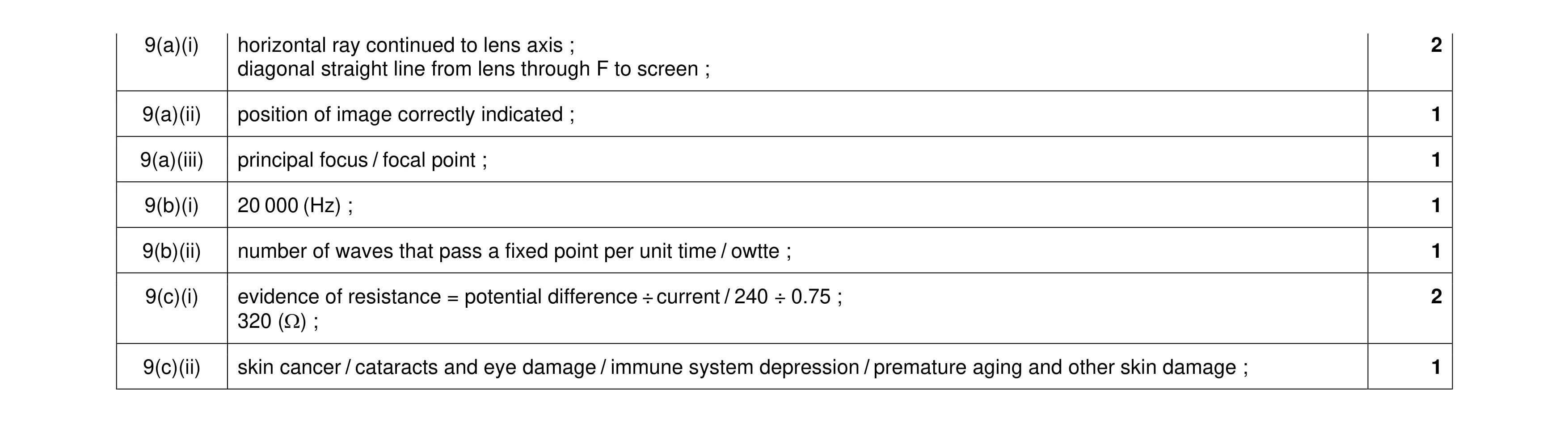 9
9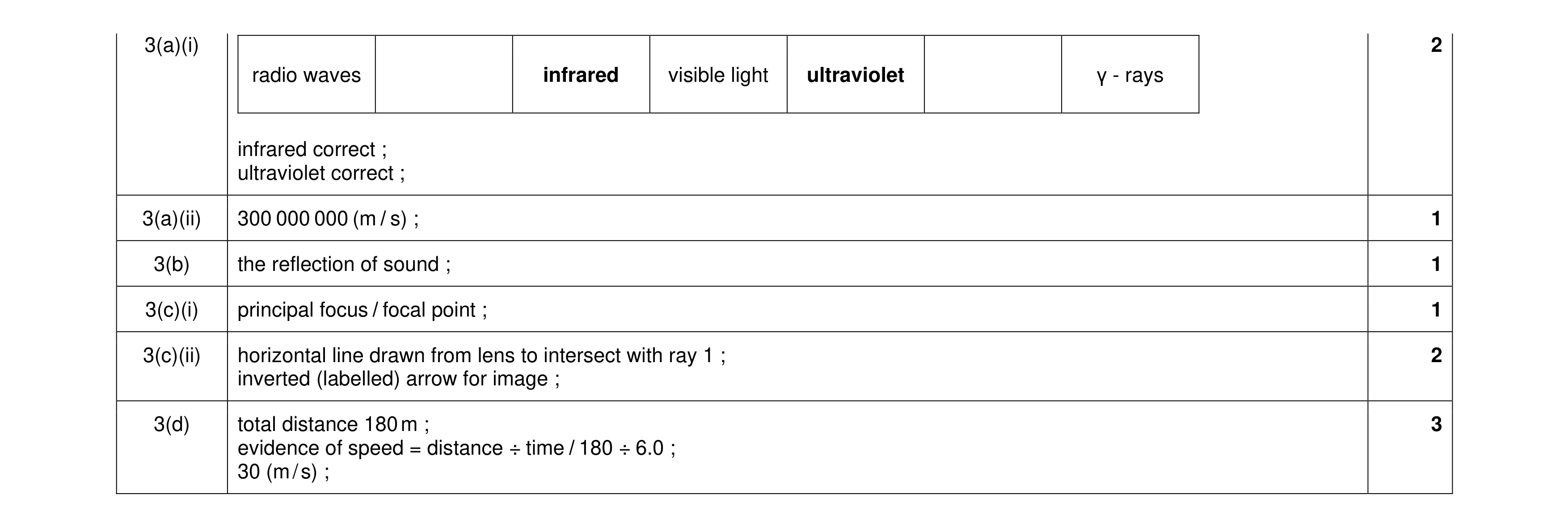 10
10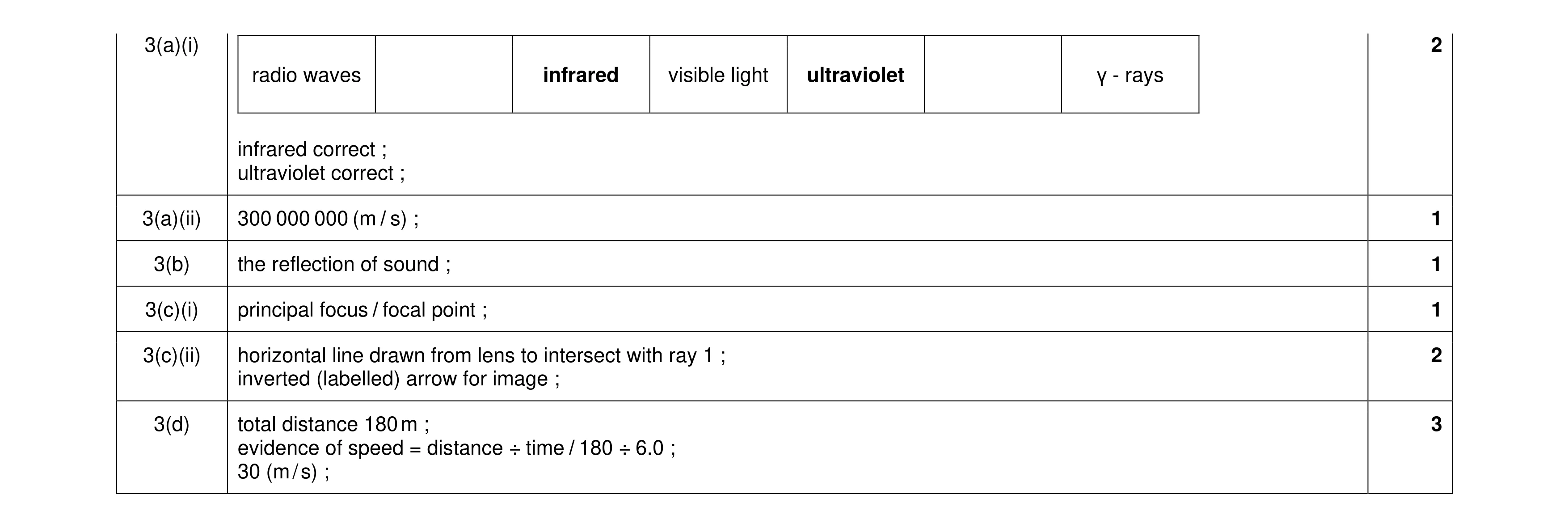 10
10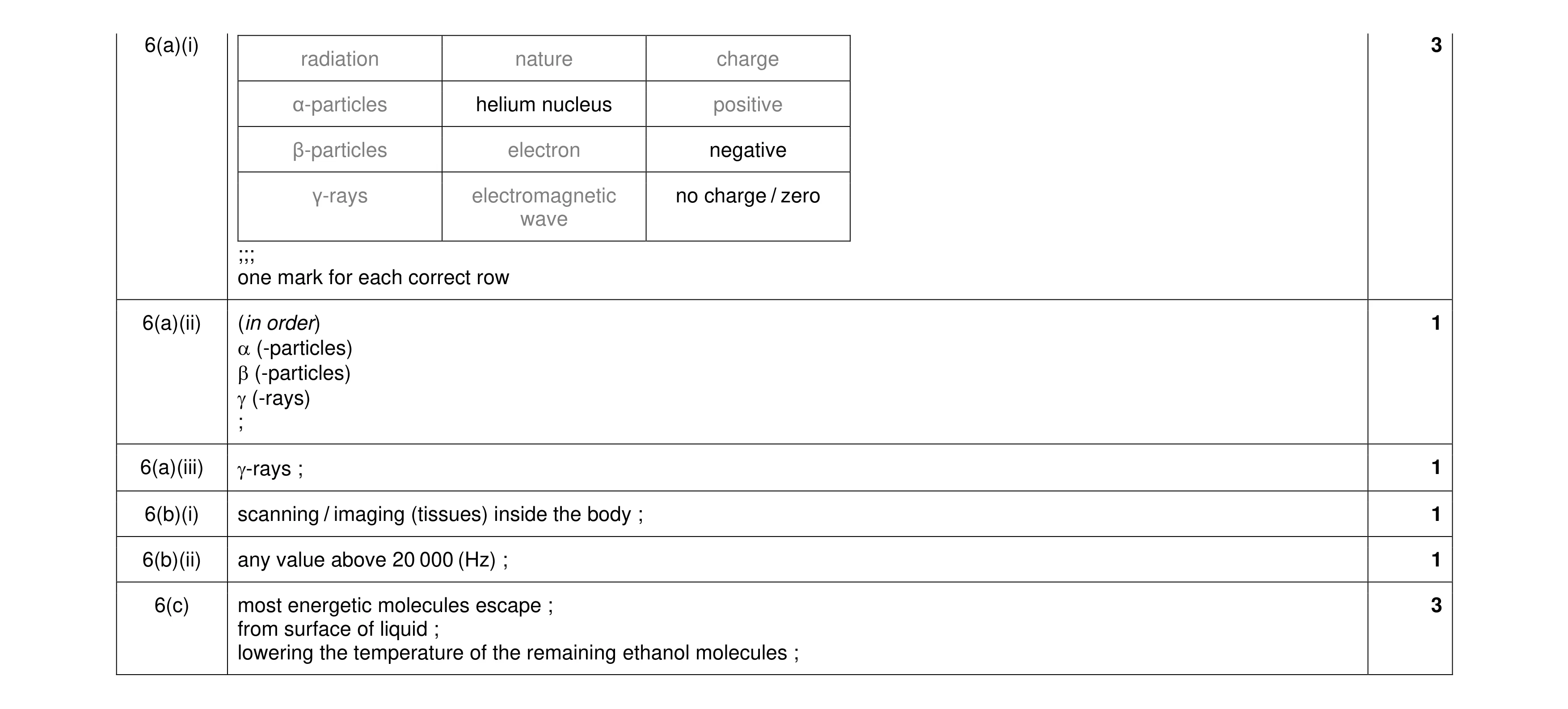 10
10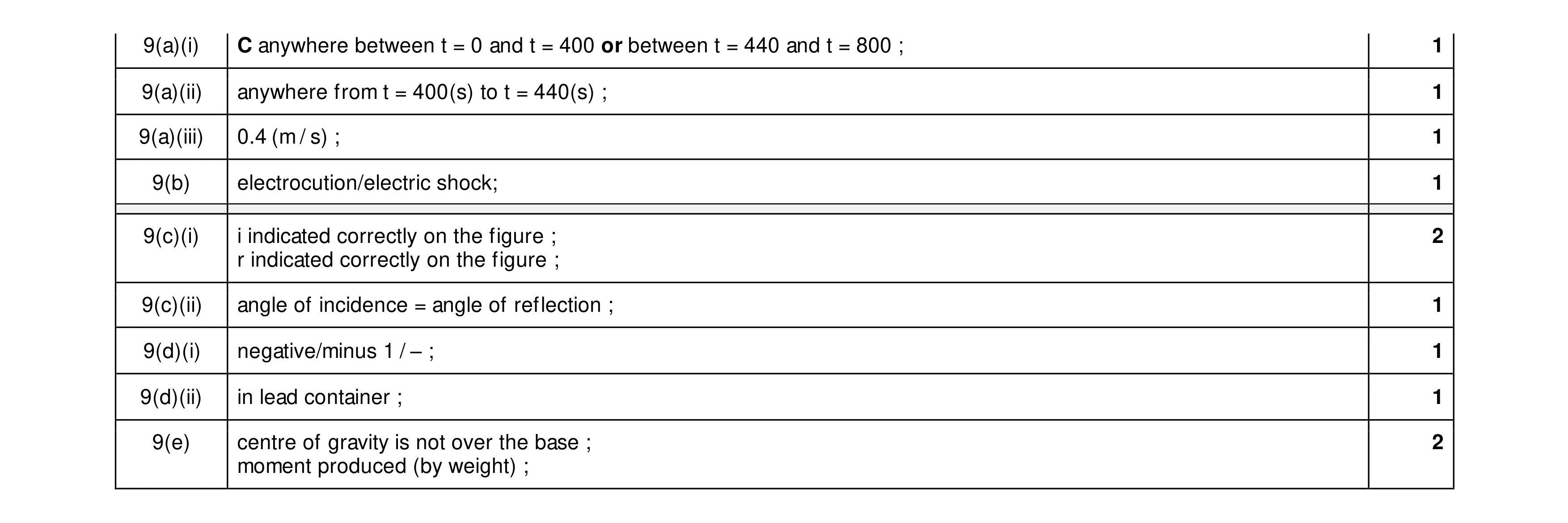 11
11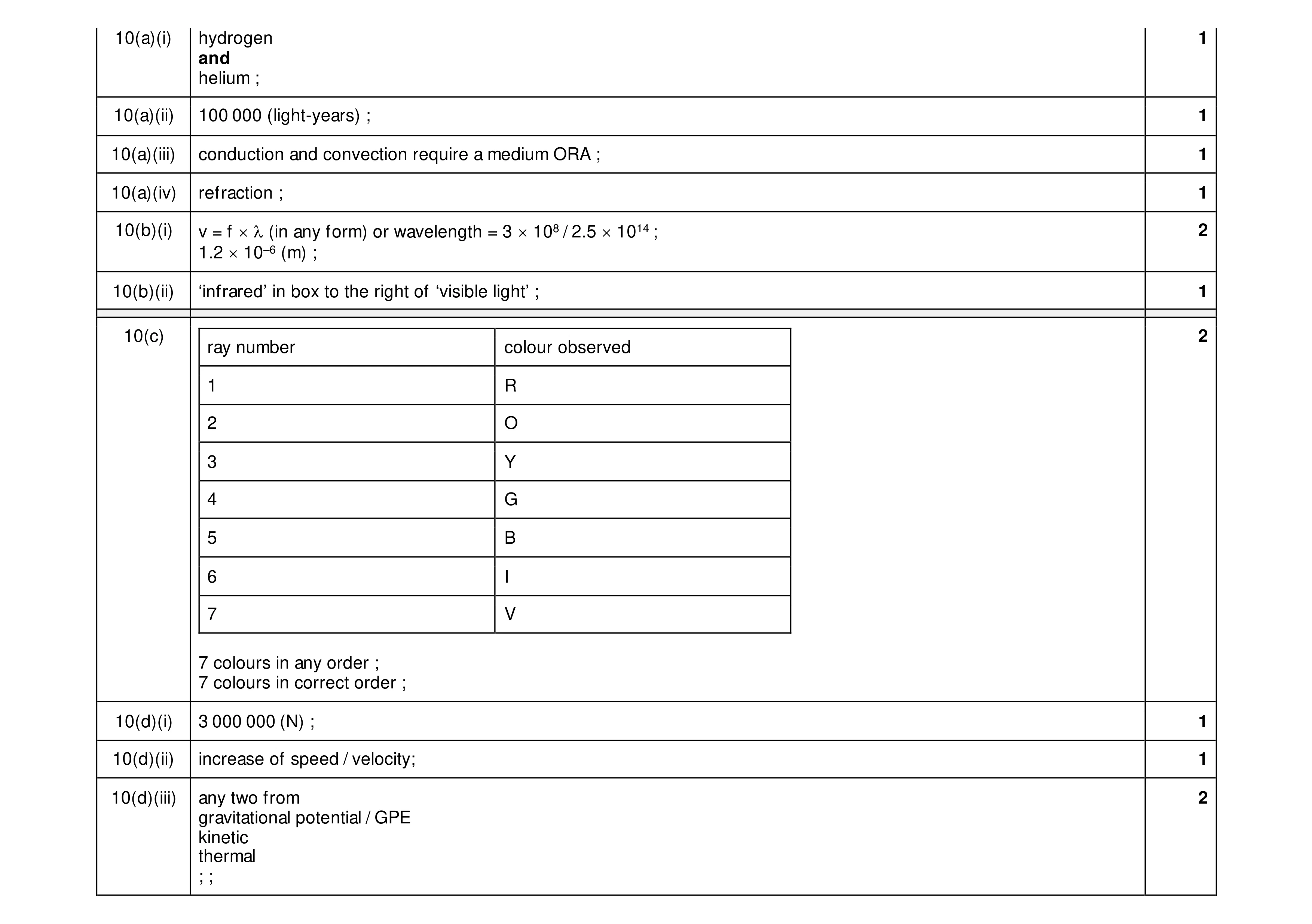 13
13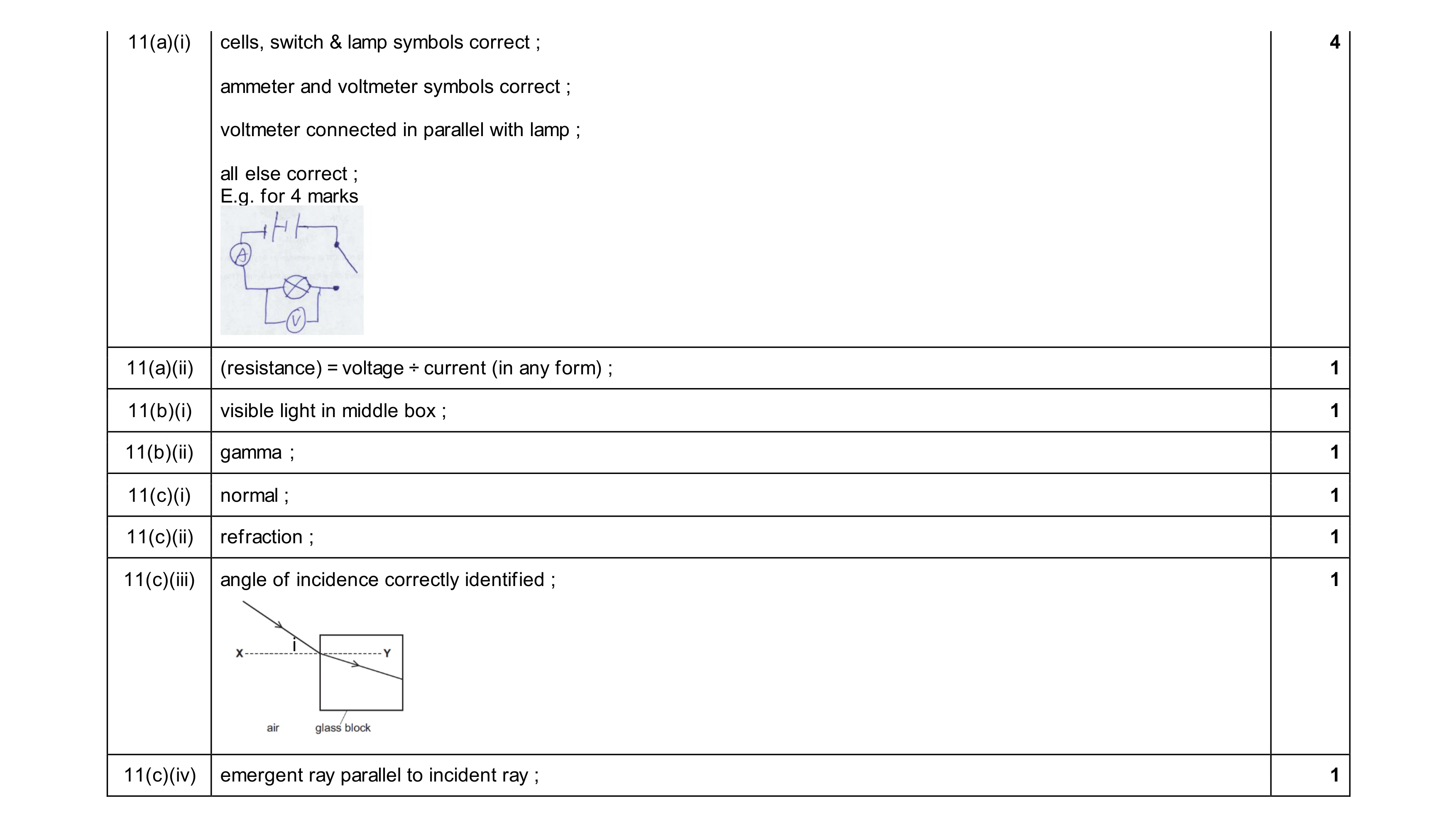 11
11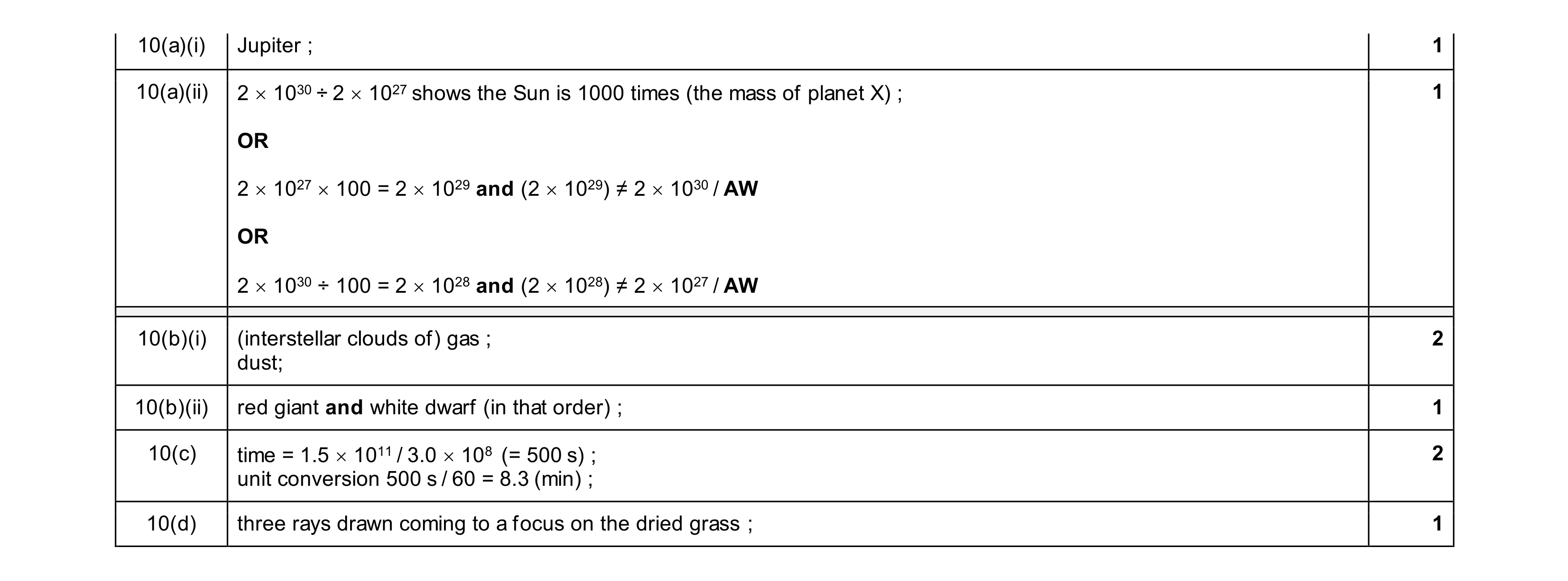 8
8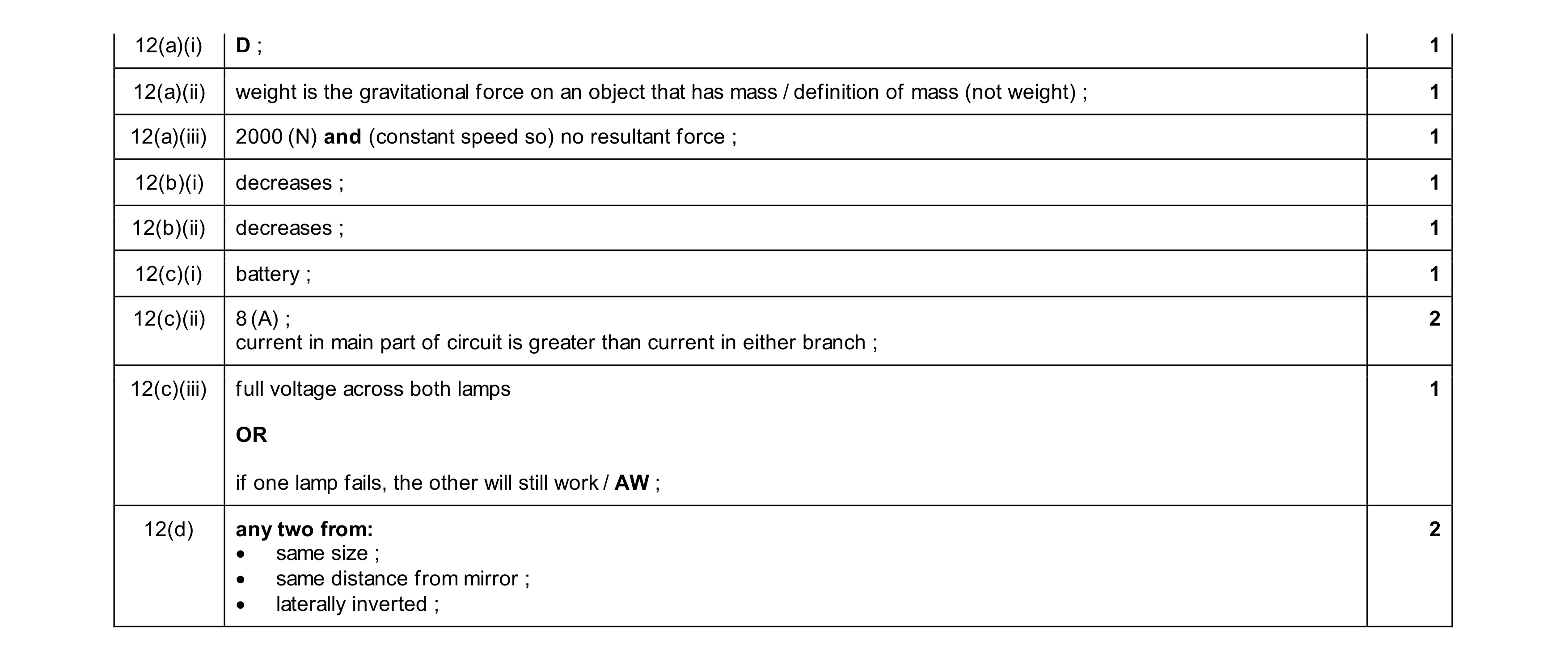 11
11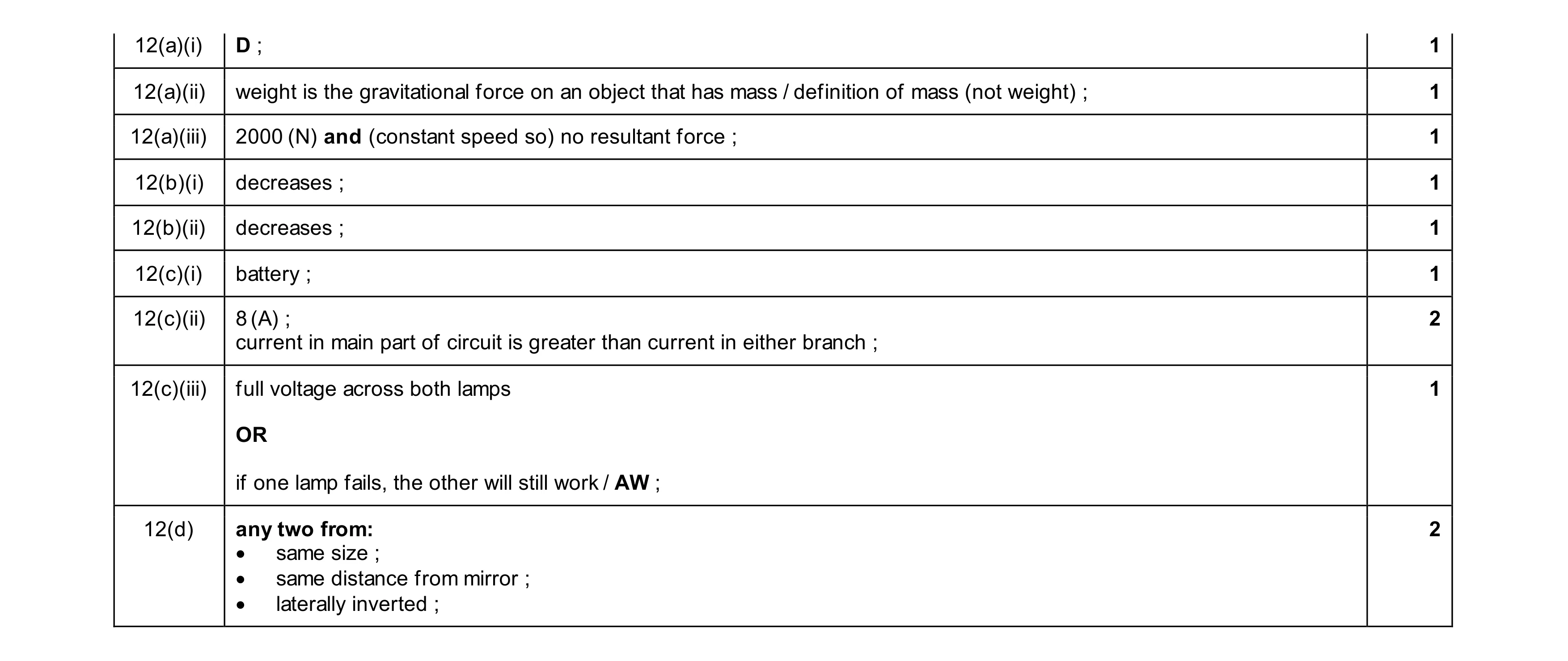 11
11