Cambridge IGCSE Sciences - Co-ordinated (Double) 0654 — 2017 May/June Paper 2 · Variant 1
0654/21/M/J/17 · 40 questions · 40 marks · ≈45 min
The question paper and its mark scheme, free to read here and free to download. This is Cambridge’s own paper, exactly as it was sat.
Question paper16 pages



Mark scheme3 pages
Answers below. Sit the paper first if you are practising.
Questions as text
Q1 · Which structural feature is found in a plant cell but not in an animal cell?
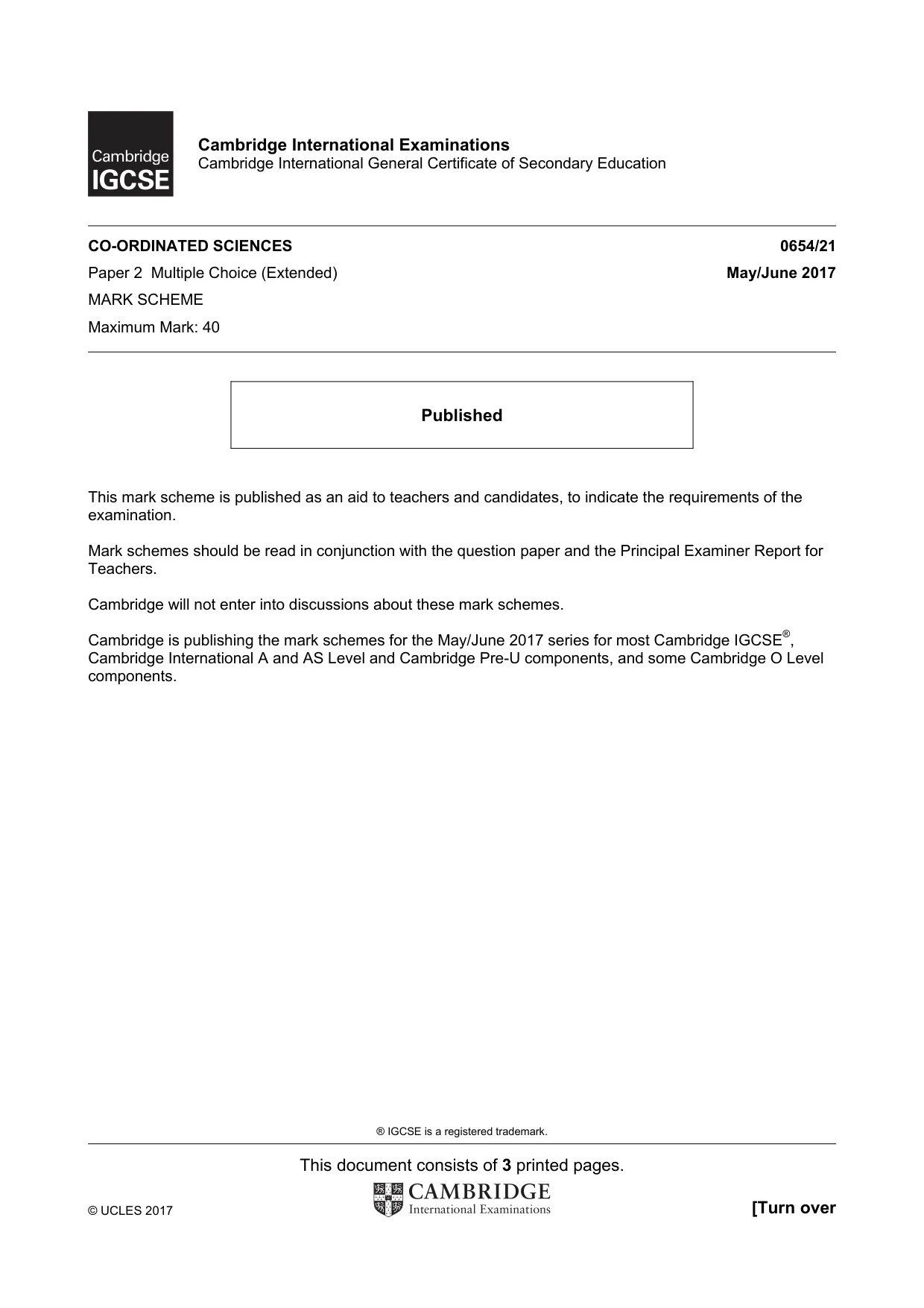
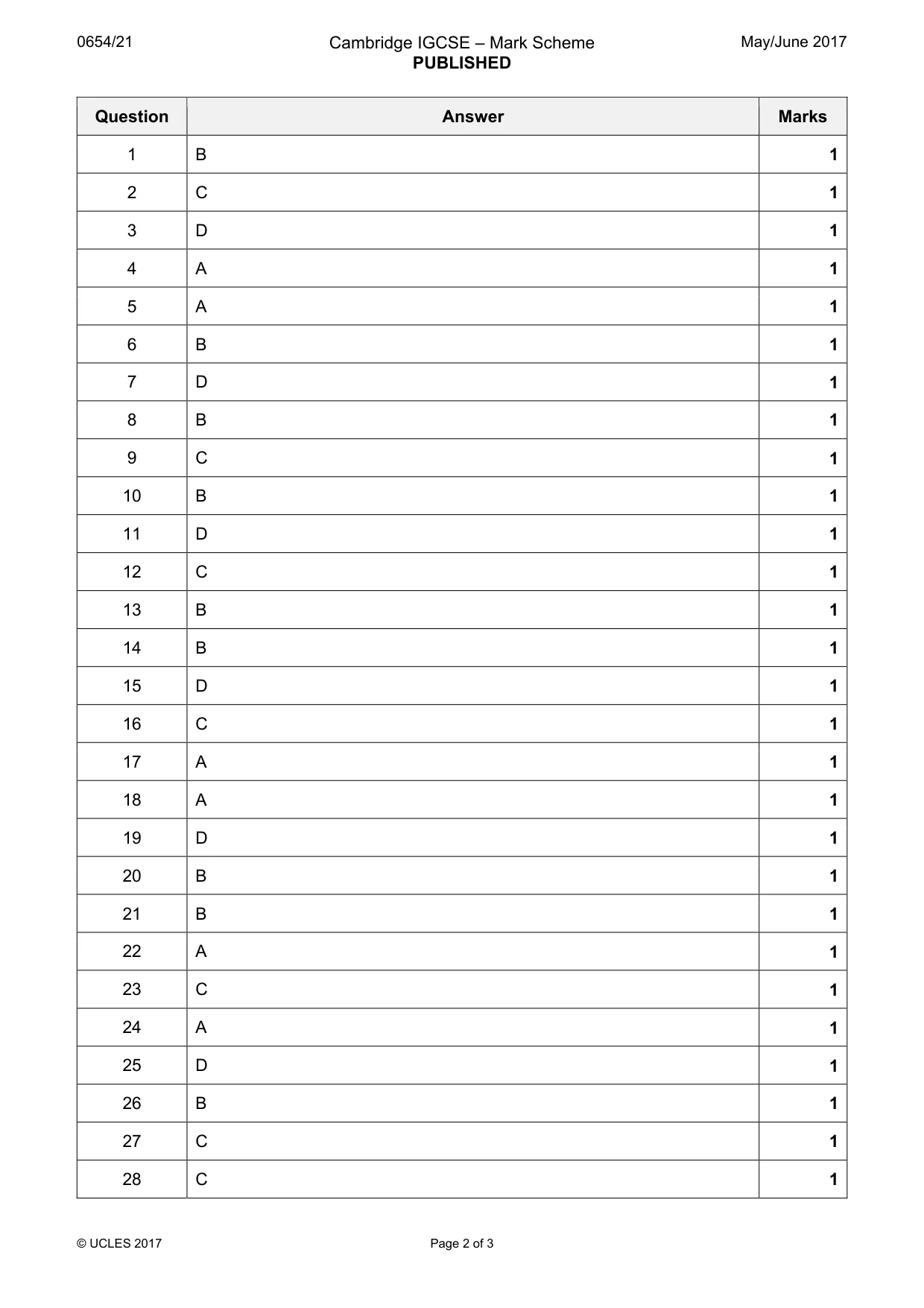
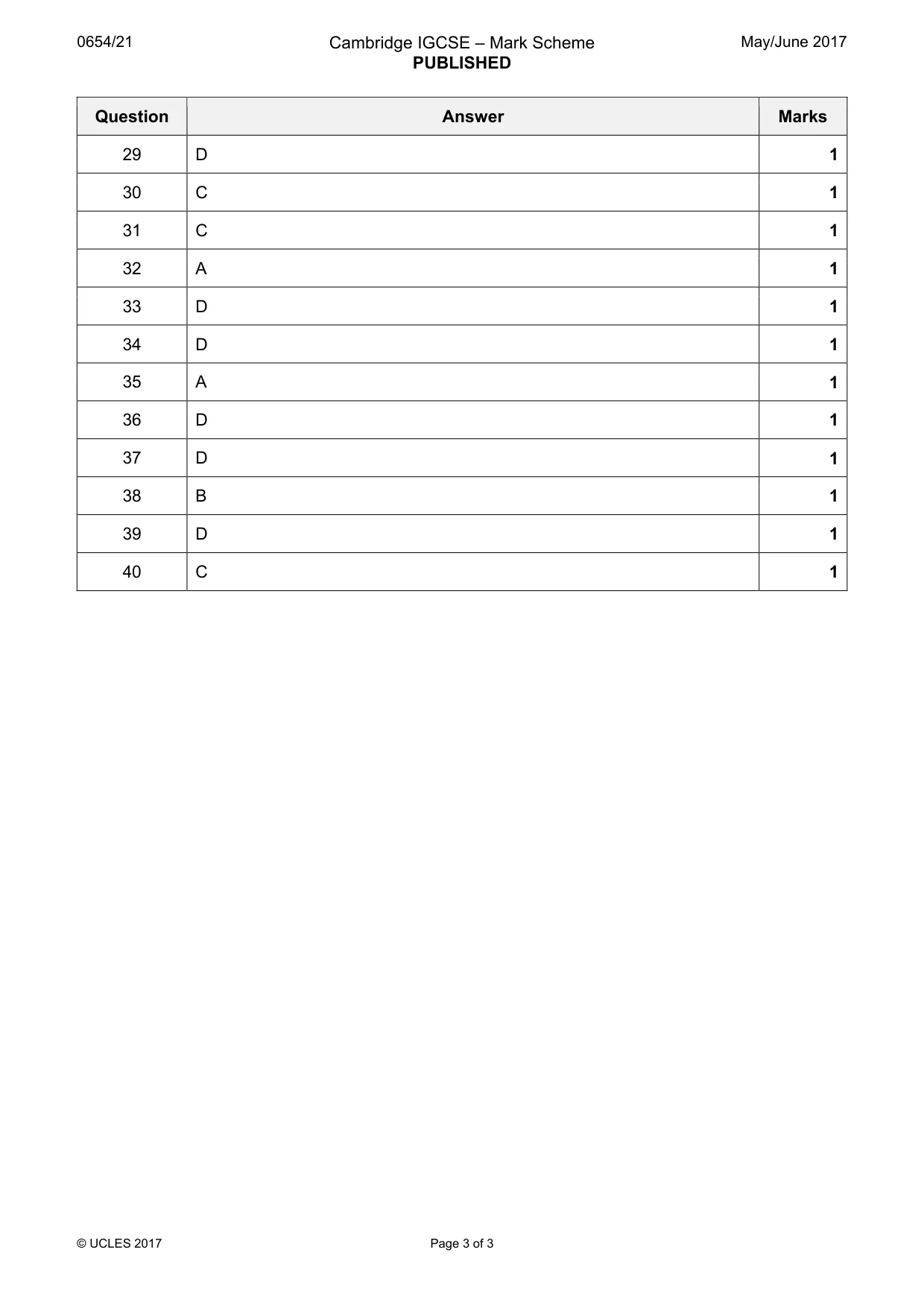
1 Which structural feature is found in a plant cell but not in an animal cell? A cell membrane B cell wall C cytoplasm D nucleus
Mark scheme: B
Q2 · What is the order of decreasing diameter of the structures found in the breathing system?
2 What is the order of decreasing diameter of the structures found in the breathing system? A alveoli → bronchi → capillaries B alveoli → capillaries → bronchi C bronchi → alveoli → capillaries D capillaries → bronchi → alveoli
Mark scheme: C
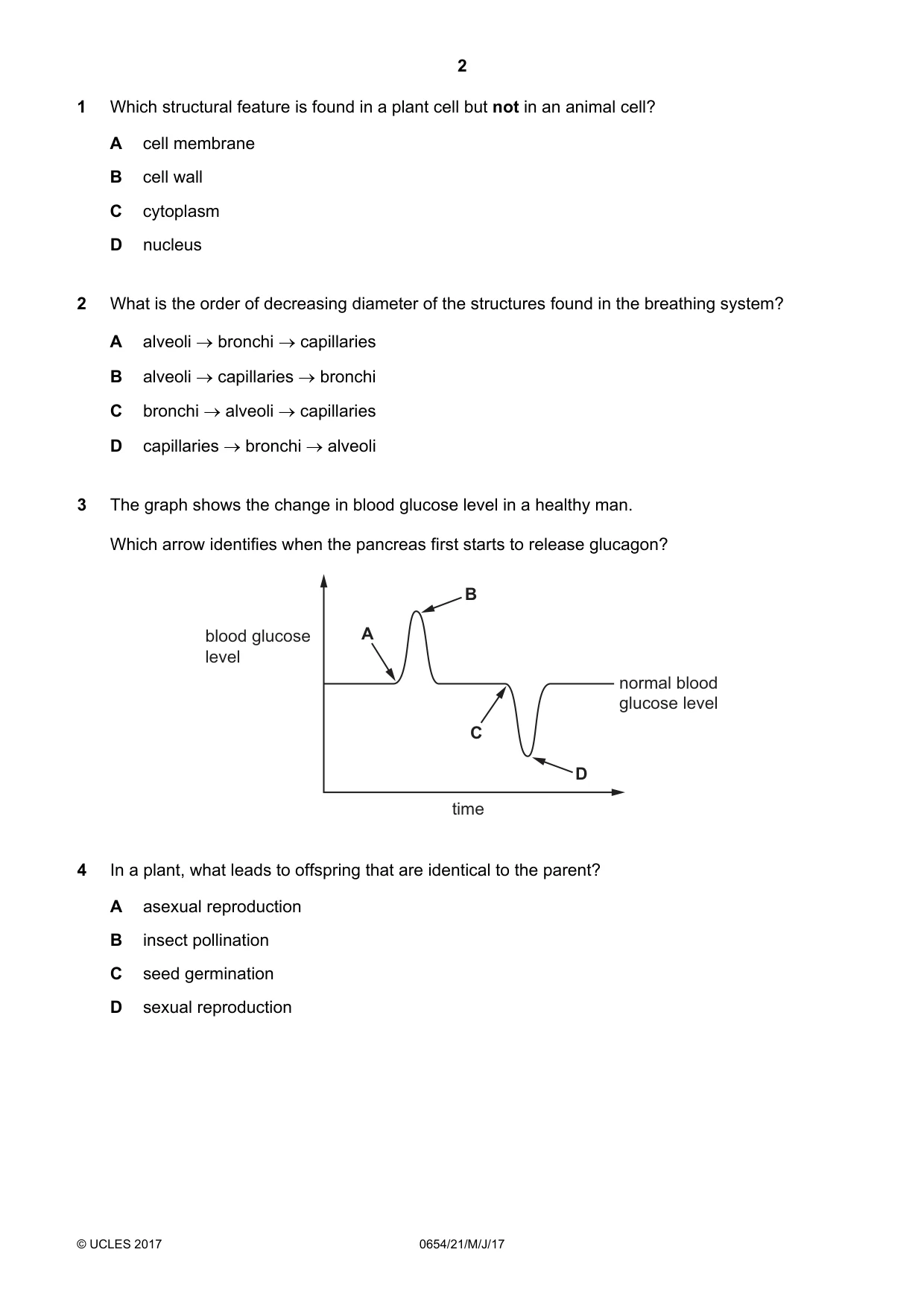
Q3 · The graph shows the change in blood glucose level in a healthy man
3 The graph shows the change in blood glucose level in a healthy man. Which arrow identifies when the pancreas first starts to release glucagon? B blood glucose A level normal blood glucose level C D time
Mark scheme: D
Q4 · In a plant, what leads to offspring that are identical to the parent?
4 In a plant, what leads to offspring that are identical to the parent? A asexual reproduction B insect pollination C seed germination D sexual reproduction
Mark scheme: A
Q5 · A frightened animal may need to run away suddenly
5 A frightened animal may need to run away suddenly. Which substance is released to stimulate an increase in blood glucose concentration? A adrenaline B haemoglobin C plasma D platelets
Mark scheme: A
Q6 · What is the function of microorganisms in yoghurt making?
6 What is the function of microorganisms in yoghurt making? A They make the sugar in milk become solid. B They produce lactic acid. C They raise the pH of the mixture. D They reduce the fat content of the milk.
Mark scheme: B
Q7 · What is an ecosystem?
7 What is an ecosystem? A a chart showing the flow of energy from one organism to another B a diagram giving the energy level of an organism in its environment C a network of interconnected organisms D a unit containing all of the organisms and their environment
Mark scheme: D
Q8 · What is meant by osmosis?
8 What is meant by osmosis? A The diffusion of water molecules from a region of their higher concentration to a region of their lower concentration as a result of their random movement. B The diffusion of water molecules from a region of their higher concentration to a region of their lower concentration through a partially permeable membrane. C The diffusion of water molecules from a region of their lower concentration to a region of their higher concentration as a result of their random movement. D The diffusion of water molecules from a region of their lower concentration to a region of their higher concentration through a partially permeable membrane.
Mark scheme: B
Q9 · What is meant by the term homozygous?
9 What is meant by the term homozygous? A alleles that determine the appearance of an organism B an allele that is effective only when there is no dominant allele present C an individual with two alleles of the same gene that are identical D an individual with two different alleles of the same gene
Mark scheme: C
Q10 · The ribs are lowered as we breathe out
10 The ribs are lowered as we breathe out. Which characteristic of living organisms does this illustrate? A growth B movement C respiration D sensitivity
Mark scheme: B
Q11 · Some human white blood cells produce antibodies
11 Some human white blood cells produce antibodies. What is another function of white blood cells? A enzyme secretion B hormone production C peristalsis D phagocytosis
Mark scheme: D
Q12 · A scientist took a single living cheek cell from each of 30 different people
12 A scientist took a single living cheek cell from each of 30 different people. 15 of these people were male and 15 were female. He stained each cell so that the sex chromosomes could be observed. How many X chromosomes would the scientist observe? A 15 B 30 C 45 D 60
Mark scheme: C
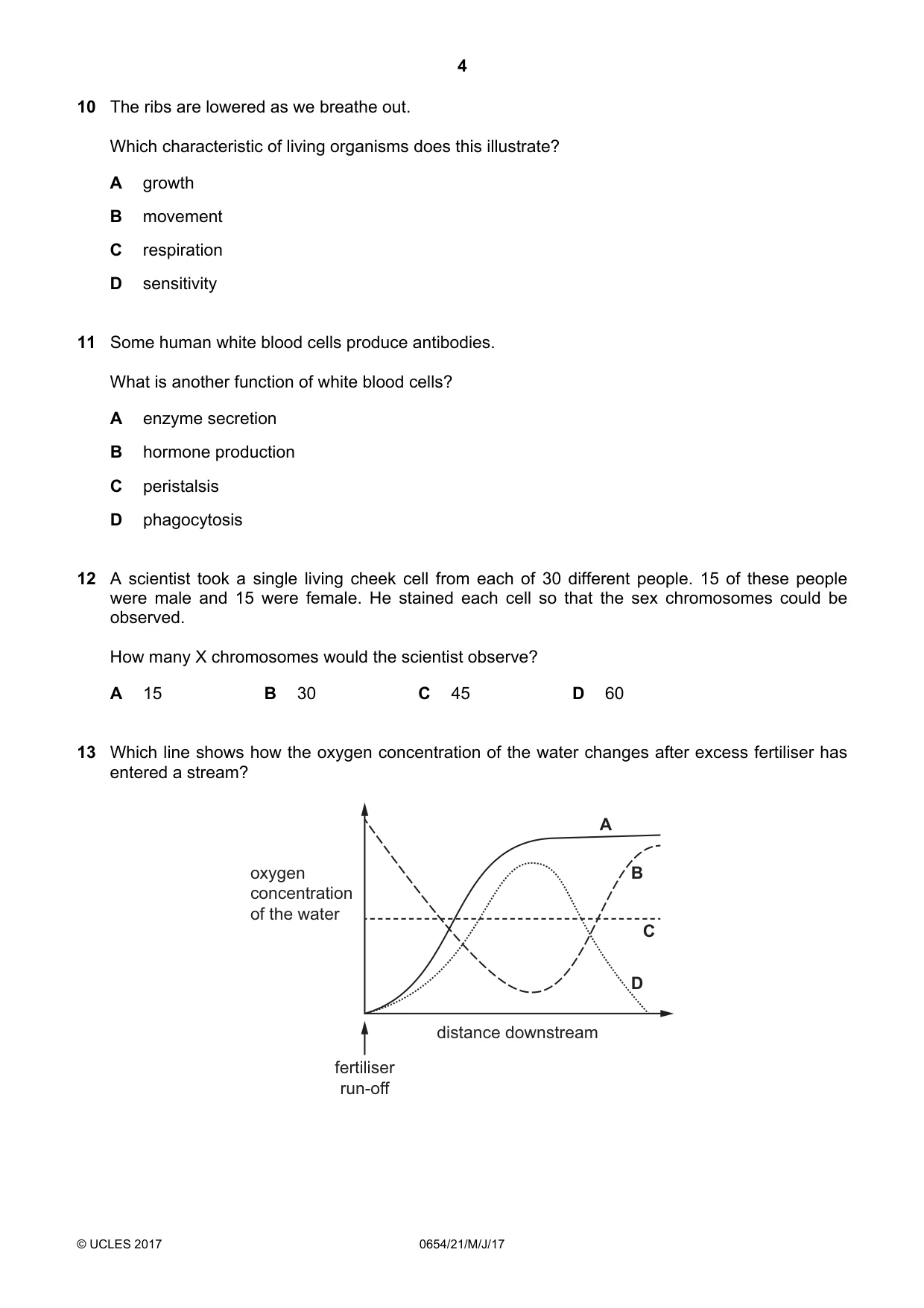
Q13 · Which line shows how the oxygen concentration of the water changes after excess…
13 Which line shows how the oxygen concentration of the water changes after excess fertiliser has entered a stream? A oxygen B concentration of the water C D distance downstream fertiliser run-off
Mark scheme: B
Q14 · Which statement describes how magnesium atoms and nitrogen atoms combine to form…
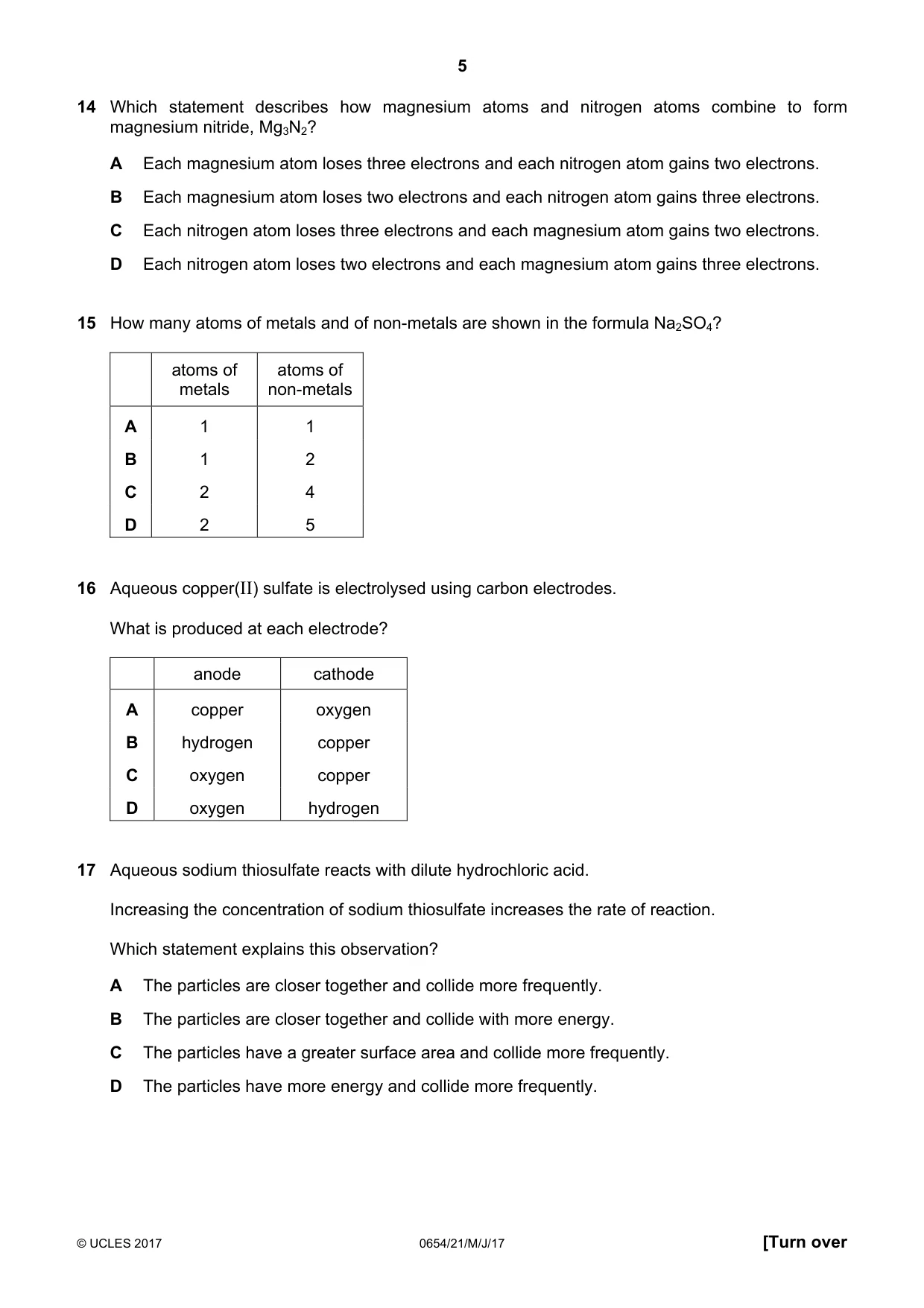
14 Which statement describes how magnesium atoms and nitrogen atoms combine to form magnesium nitride, Mg3N2? A Each magnesium atom loses three electrons and each nitrogen atom gains two electrons. B Each magnesium atom loses two electrons and each nitrogen atom gains three electrons. C Each nitrogen atom loses three electrons and each magnesium atom gains two electrons. D Each nitrogen atom loses two electrons and each magnesium atom gains three electrons.
Mark scheme: B
Q15 · How many atoms of metals and of non-metals are shown in the formula Na2SO4?
15 How many atoms of metals and of non-metals are shown in the formula Na2SO4? atoms of atoms of metals non-metals A 1 1 B 1 2 C 2 4 D 2 5
Mark scheme: D
Q16 · Aqueous copper(II) sulfate is electrolysed using carbon electrodes
16 Aqueous copper(II) sulfate is electrolysed using carbon electrodes. What is produced at each electrode? anode cathode A copper oxygen B hydrogen copper C oxygen copper D oxygen hydrogen
Mark scheme: C
Q17 · Aqueous sodium thiosulfate reacts with dilute hydrochloric acid
17 Aqueous sodium thiosulfate reacts with dilute hydrochloric acid. Increasing the concentration of sodium thiosulfate increases the rate of reaction. Which statement explains this observation? A The particles are closer together and collide more frequently. B The particles are closer together and collide with more energy. C The particles have a greater surface area and collide more frequently. D The particles have more energy and collide more frequently.
Mark scheme: A
Q18 · Aluminium reacts with iron(III) oxide, forming iron
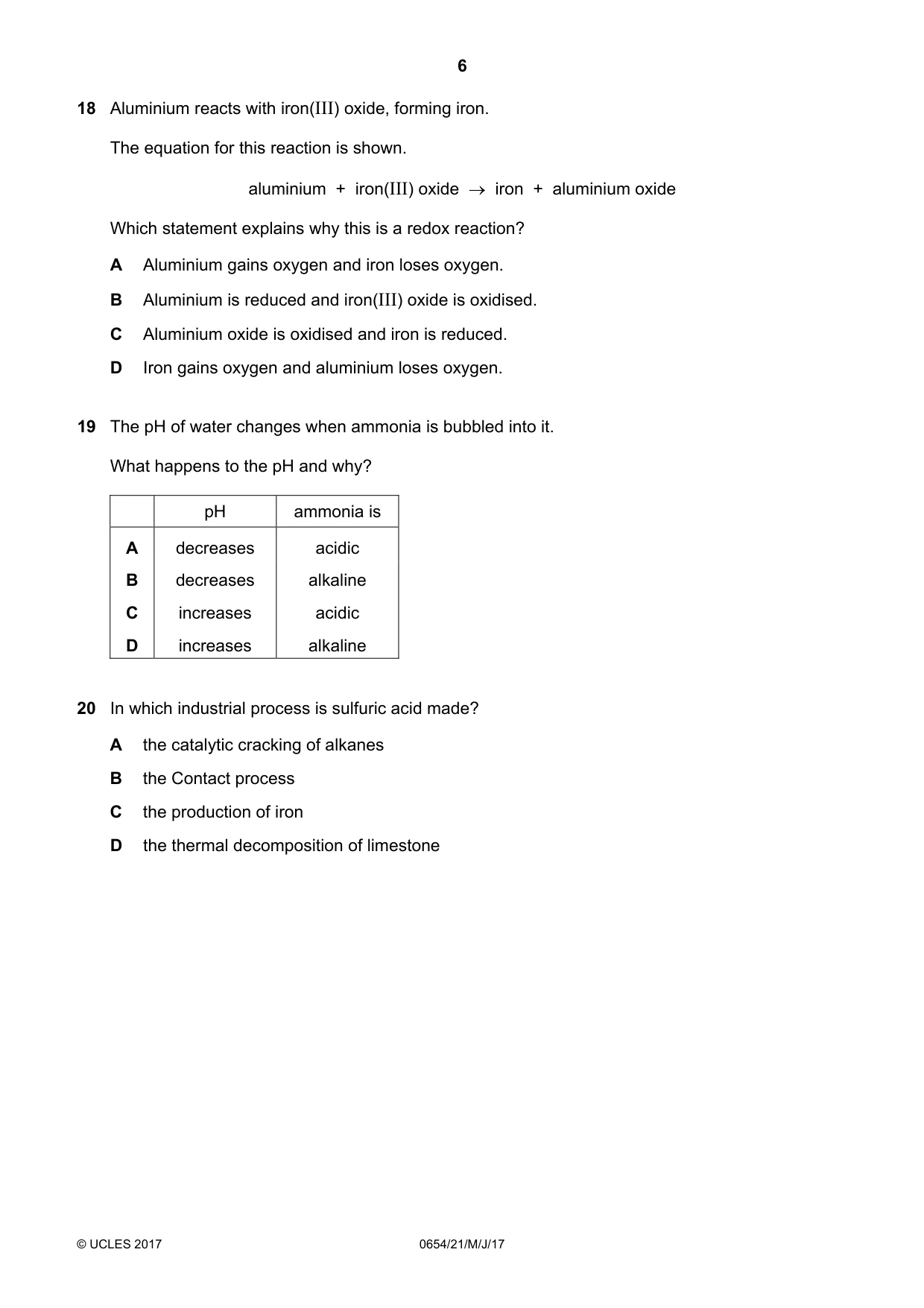
18 Aluminium reacts with iron(III) oxide, forming iron. The equation for this reaction is shown. aluminium + iron(III) oxide → iron + aluminium oxide Which statement explains why this is a redox reaction? A Aluminium gains oxygen and iron loses oxygen. B Aluminium is reduced and iron(III) oxide is oxidised. C Aluminium oxide is oxidised and iron is reduced. D Iron gains oxygen and aluminium loses oxygen.
Mark scheme: A
Q19 · The pH of water changes when ammonia is bubbled into it
19 The pH of water changes when ammonia is bubbled into it. What happens to the pH and why? pH ammonia is A decreases acidic B decreases alkaline C increases acidic D increases alkaline
Mark scheme: D
More questions on The characteristic properties of acids and bases
Q20 · In which industrial process is sulfuric acid made?
20 In which industrial process is sulfuric acid made? A the catalytic cracking of alkanes B the Contact process C the production of iron D the thermal decomposition of limestone
Mark scheme: B
Q21 · Part of the Periodic Table is shown
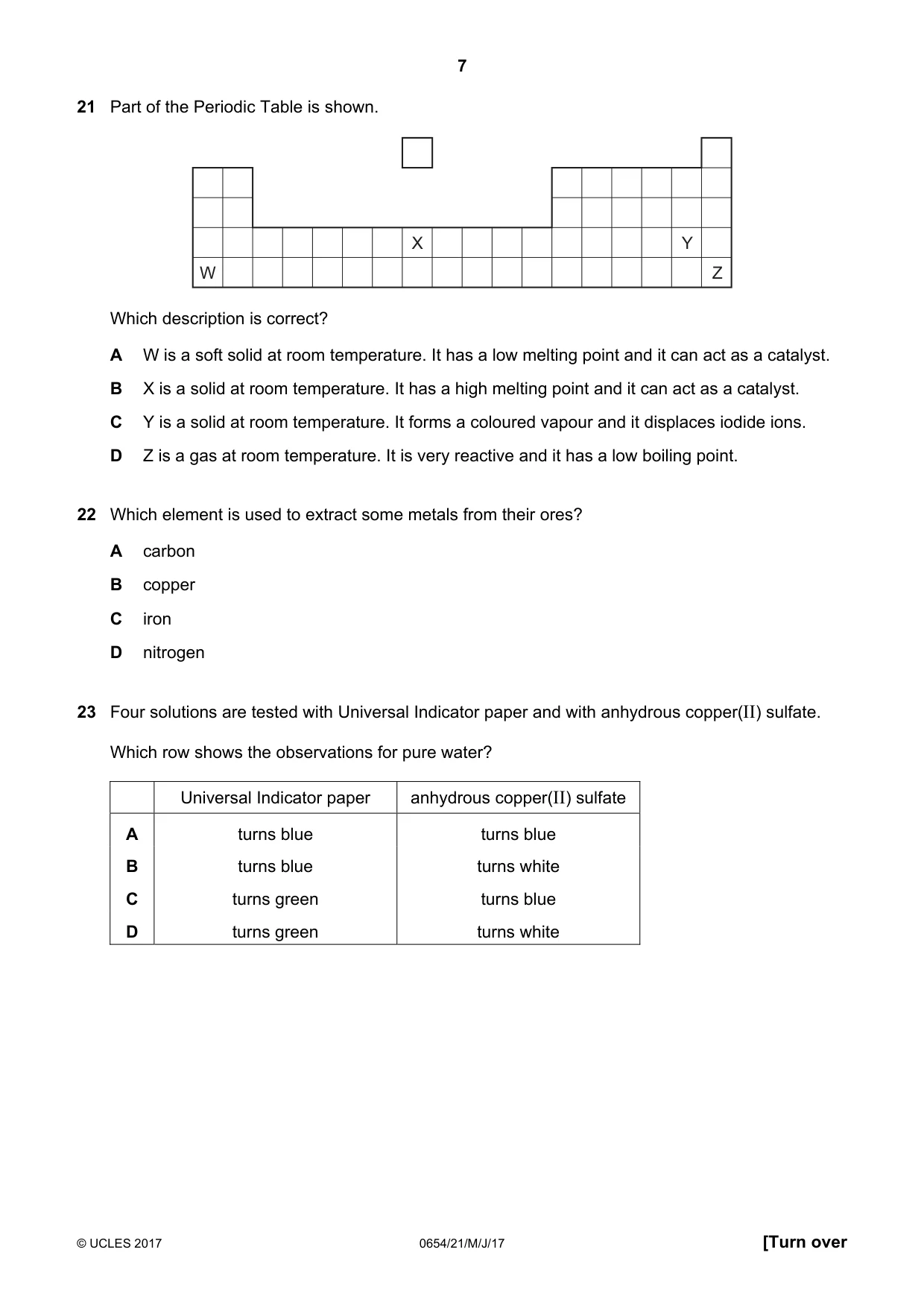
21 Part of the Periodic Table is shown. X Y W Z Which description is correct? A W is a soft solid at room temperature. It has a low melting point and it can act as a catalyst. B X is a solid at room temperature. It has a high melting point and it can act as a catalyst. C Y is a solid at room temperature. It forms a coloured vapour and it displaces iodide ions. D Z is a gas at room temperature. It is very reactive and it has a low boiling point.
Mark scheme: B
Q22 · Which element is used to extract some metals from their ores?
22 Which element is used to extract some metals from their ores? A carbon B copper C iron D nitrogen
Mark scheme: A
Q23 · Four solutions are tested with Universal Indicator paper and with anhydrous copper(II)…
23 Four solutions are tested with Universal Indicator paper and with anhydrous copper(II) sulfate. Which row shows the observations for pure water? Universal Indicator paper anhydrous copper(II) sulfate A turns blue turns blue B turns blue turns white C turns green turns blue D turns green turns white
Mark scheme: C
Q24 · The Haber process is used to make ammonia
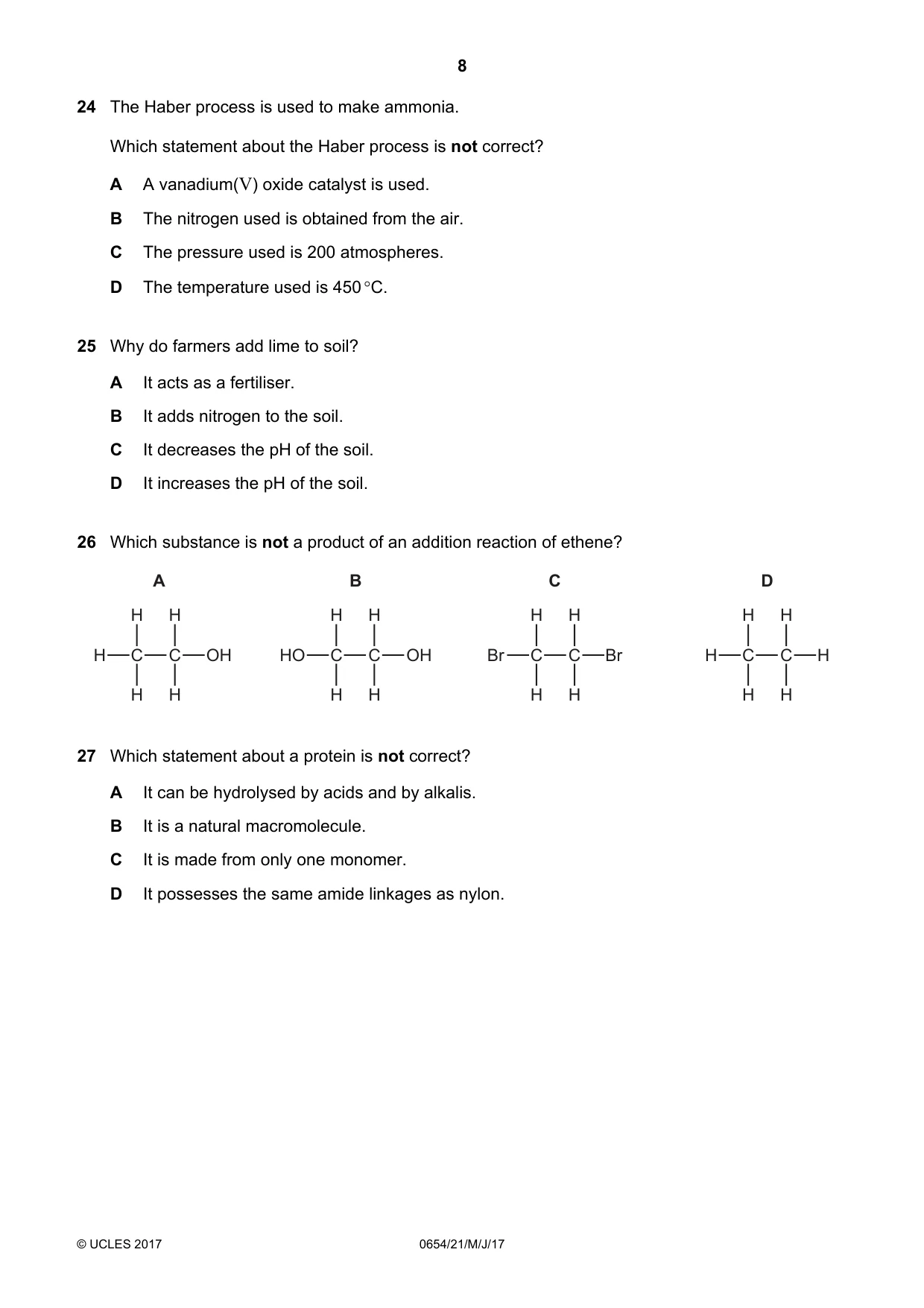
24 The Haber process is used to make ammonia. Which statement about the Haber process is not correct? A A vanadium(V) oxide catalyst is used. B The nitrogen used is obtained from the air. C The pressure used is 200 atmospheres. D The temperature used is 450 °C.
Mark scheme: A
Q25 · Why do farmers add lime to soil?
25 Why do farmers add lime to soil? A It acts as a fertiliser. B It adds nitrogen to the soil. C It decreases the pH of the soil. D It increases the pH of the soil.
Mark scheme: D
More questions on The characteristic properties of acids and bases
Q26 · Which substance is not a product of an addition reaction of ethene?
26 Which substance is not a product of an addition reaction of ethene? A B C D H H H H H H H H H C C OH HO C C OH Br C C Br H C C H H H H H H H H H
Mark scheme: B
Q27 · Which statement about a protein is not correct?
27 Which statement about a protein is not correct? A It can be hydrolysed by acids and by alkalis. B It is a natural macromolecule. C It is made from only one monomer. D It possesses the same amide linkages as nylon.
Mark scheme: C
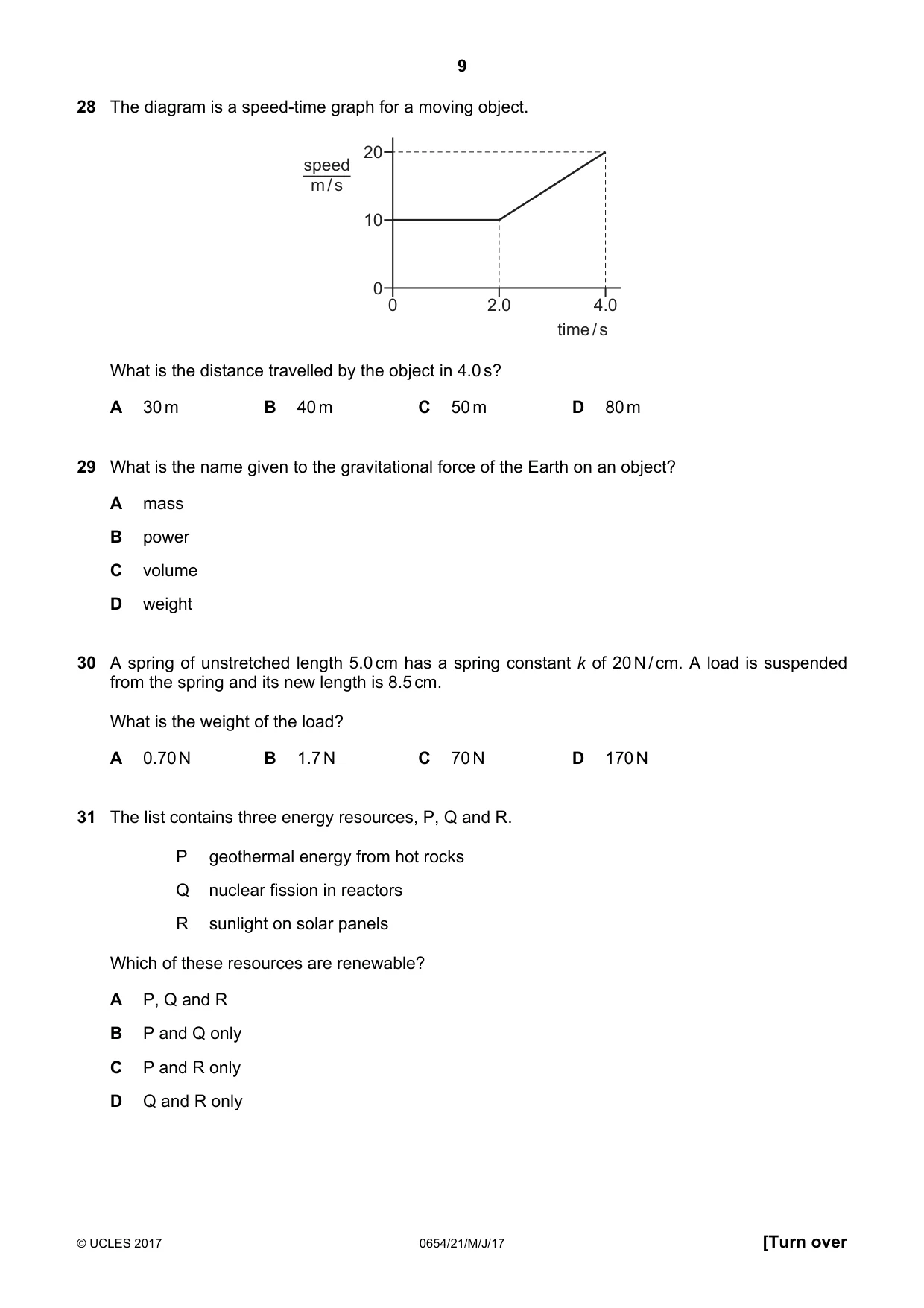
Q28 · The diagram is a speed-time graph for a moving object
28 The diagram is a speed-time graph for a moving object. 20 speed m / s 10 0 0 2.0 4.0 time / s What is the distance travelled by the object in 4.0 s? A 30 m B 40 m C 50 m D 80 m
Mark scheme: C
Q29 · What is the name given to the gravitational force of the Earth on an object?
29 What is the name given to the gravitational force of the Earth on an object? A mass B power C volume D weight
Mark scheme: D
Q30 · A spring of unstretched length 5.0 cm has a spring constant k of 20 N / cm
30 A spring of unstretched length 5.0 cm has a spring constant k of 20 N / cm. A load is suspended from the spring and its new length is 8.5 cm. What is the weight of the load? A 0.70 N B 1.7 N C 70 N D 170 N
Mark scheme: C
Q31 · The list contains three energy resources, P, Q and R
31 The list contains three energy resources, P, Q and R. P geothermal energy from hot rocks Q nuclear fission in reactors R sunlight on solar panels Which of these resources are renewable? A P, Q and R B P and Q only C P and R only D Q and R only
Mark scheme: C
Q32 · A gas trapped in a cylinder has volume V
32 A gas trapped in a cylinder has volume V. The pressure of the gas increases from P to 4P at constant temperature. What is the new volume of the gas? A 0.25V B 0.50V C 2V D 4V
Mark scheme: A
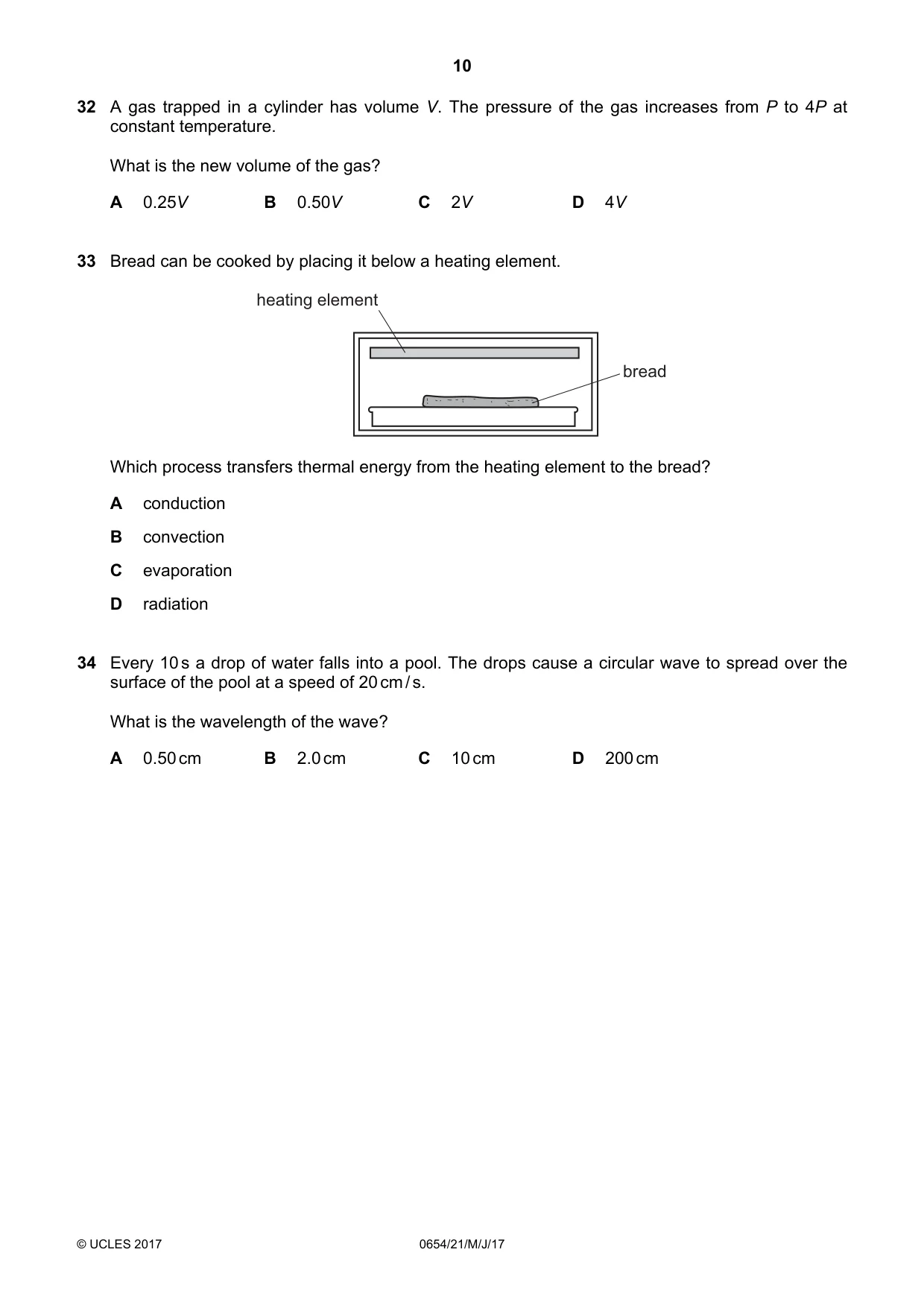
Q33 · Bread can be cooked by placing it below a heating element
33 Bread can be cooked by placing it below a heating element. heating element bread Which process transfers thermal energy from the heating element to the bread? A conduction B convection C evaporation D radiation
Mark scheme: D
Q34 · Every 10 s a drop of water falls into a pool
34 Every 10 s a drop of water falls into a pool. The drops cause a circular wave to spread over the surface of the pool at a speed of 20 cm / s. What is the wavelength of the wave? A 0.50 cm B 2.0 cm C 10 cm D 200 cm
Mark scheme: D
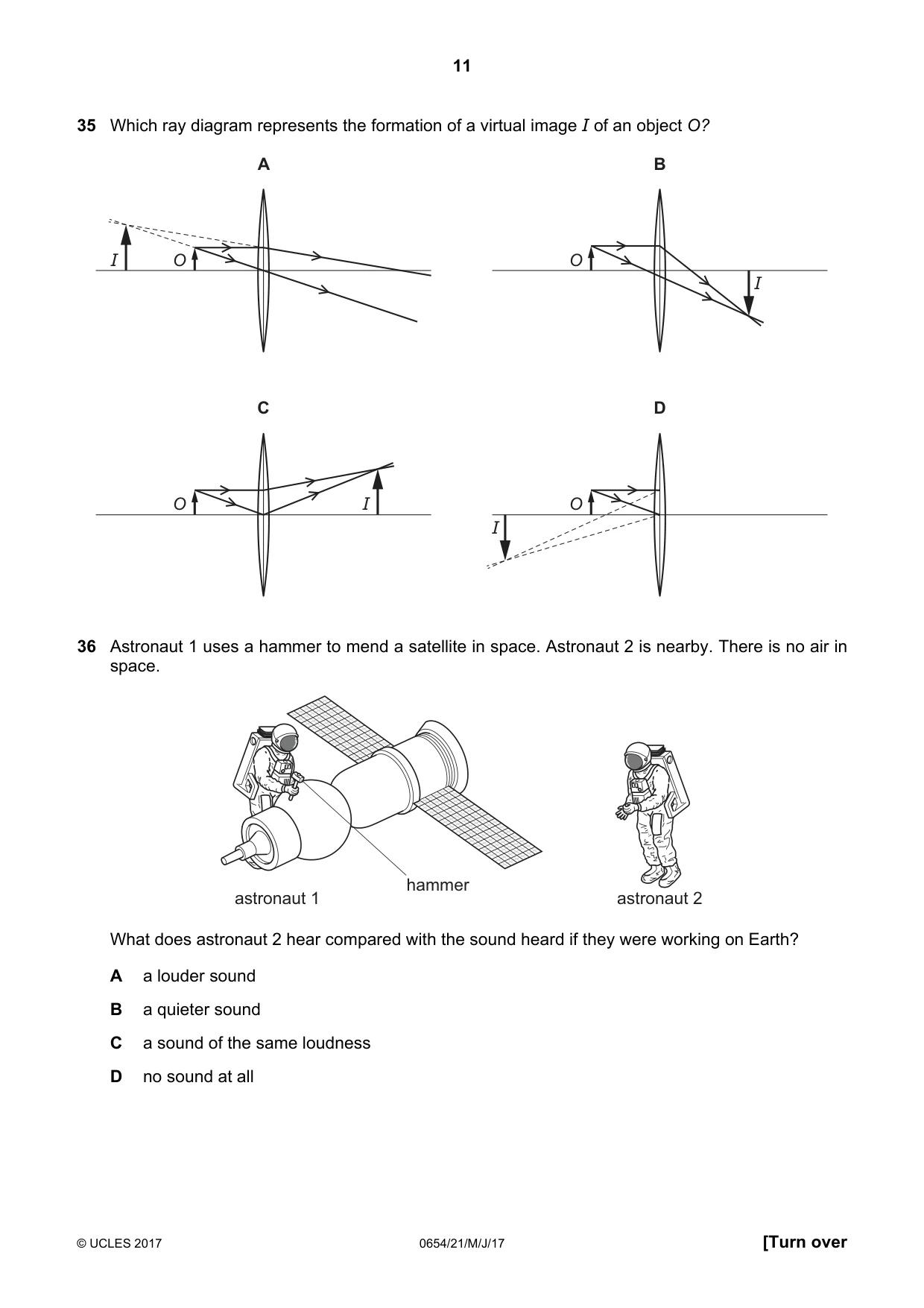
Q35 · Which ray diagram represents the formation of a virtual image I of an object O?
35 Which ray diagram represents the formation of a virtual image I of an object O? A B I O O I C D O I O I
Mark scheme: A
Q36 · Astronaut 1 uses a hammer to mend a satellite in space
36 Astronaut 1 uses a hammer to mend a satellite in space. Astronaut 2 is nearby. There is no air in space. hammer astronaut 1 astronaut 2 What does astronaut 2 hear compared with the sound heard if they were working on Earth? A a louder sound B a quieter sound C a sound of the same loudness D no sound at all
Mark scheme: D
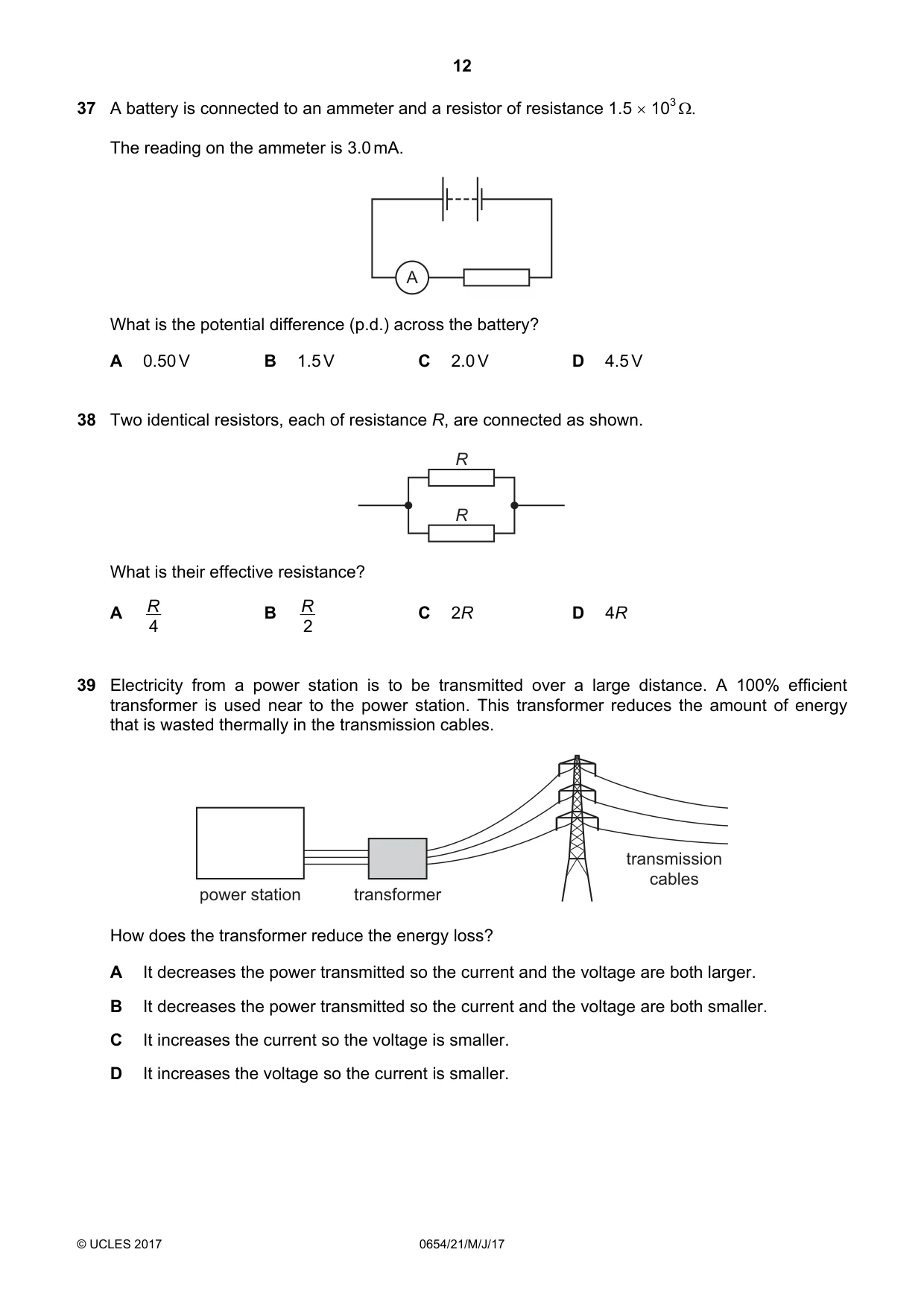
Q37 · A battery is connected to an ammeter and a resistor of resistance 1.5 × 10³ Ω
37 A battery is connected to an ammeter and a resistor of resistance 1.5 × 10³ Ω. The reading on the ammeter is 3.0 mA. A What is the potential difference (p.d.) across the battery? A 0.50 V B 1.5 V C 2.0 V D 4.5 V
Mark scheme: D
Q38 · Two identical resistors, each of resistance R, are connected as shown
38 Two identical resistors, each of resistance R, are connected as shown. R R What is their effective resistance? A R B R C 2R D 4R 4 2
Mark scheme: B
Q39 · Electricity from a power station is to be transmitted over a large distance
39 Electricity from a power station is to be transmitted over a large distance. A 100% efficient transformer is used near to the power station. This transformer reduces the amount of energy that is wasted thermally in the transmission cables. transmission cables power station transformer How does the transformer reduce the energy loss? A It decreases the power transmitted so the current and the voltage are both larger. B It decreases the power transmitted so the current and the voltage are both smaller. C It increases the current so the voltage is smaller. D It increases the voltage so the current is smaller.
Mark scheme: D
Q40 · Which row compares the number of protons and the number of neutrons in atoms of different…
40 Which row compares the number of protons and the number of neutrons in atoms of different isotopes of an element? number of number of protons neutrons A different different B different the same C the same different D the same the same
Mark scheme: C
What was in this paper
The subtopics covered by these 40 questions, and how many questions each got. Open one in a new tab to see every Cambridge question on it.
2Chromosomes and genes2The characteristic properties of acids and bases2Transition elements2Alkenes1Arrangement of elements1Cell structure1Characteristics of living organisms1Diseases and immunity1Electrical circuits1Electrical quantities1Electrolysis1Electromagnetic effects1Energy flow1Energy, work and power1Extraction of metals1Forces1Formulas1Gas exchange in humans1General properties of waves1Habitat destruction1Homeostasis1Hormones1Identification of ions and gases1Ions and ionic bonds1Kinetic particle model of matter1Light1Mass and weight1Motion1Osmosis1Polymers1Rate of reaction1Redox1Sound1The nucleus1Transfer of thermal energy1What you needed in this session
Cambridge’s own grade thresholds for 2017 May/June, Paper 2 · Variant 1. A higher threshold means an easier paper — the bar moves with how the cohort did.