Questions as text
Q1 · A container with fixed volume is filled with a substance 0653/22 Feb/March 2017
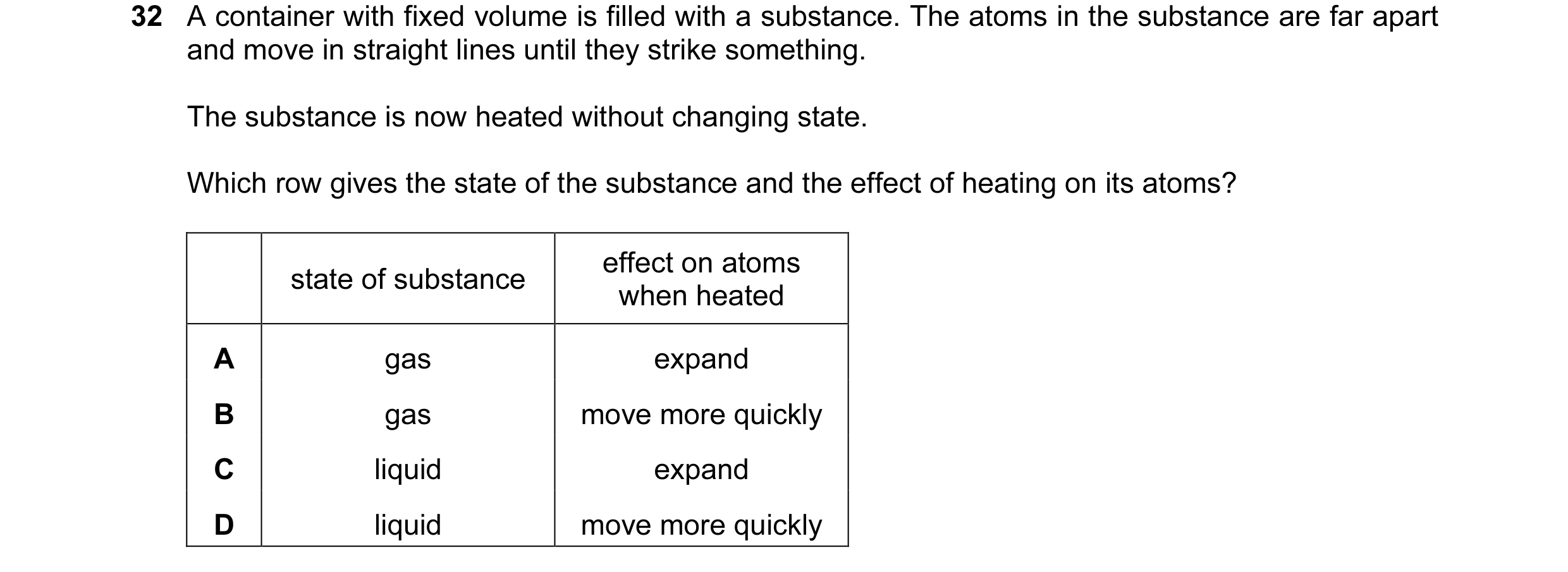
32 A container with fixed volume is filled with a substance. The atoms in the substance are far apart and move in straight lines until they strike something. The substance is now heated without changing state. Which row gives the state of the substance and the effect of heating on its atoms? effect on atoms state of substance when heated A gas expand B gas move more quickly C liquid expand D liquid move more quickly
1 marks
Answer: B
This question in 0653/22 Feb/March 2017
Q2 · A liquid changes into a gas and this causes the temperature of the liquid to change 0653/21 May/June 2017
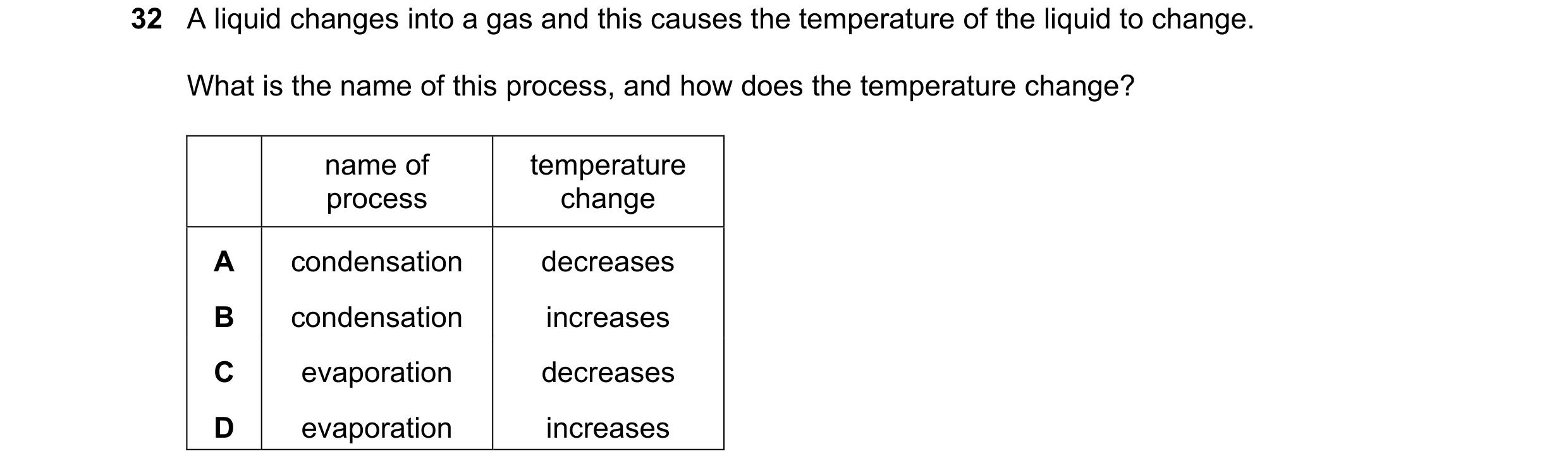
32 A liquid changes into a gas and this causes the temperature of the liquid to change. What is the name of this process, and how does the temperature change? name of temperature process change A condensation decreases B condensation increases C evaporation decreases D evaporation increases
1 marks
Answer: C
This question in 0653/21 May/June 2017
Q3 · Two cylinders contain the same type of gas 0653/22 May/June 2017
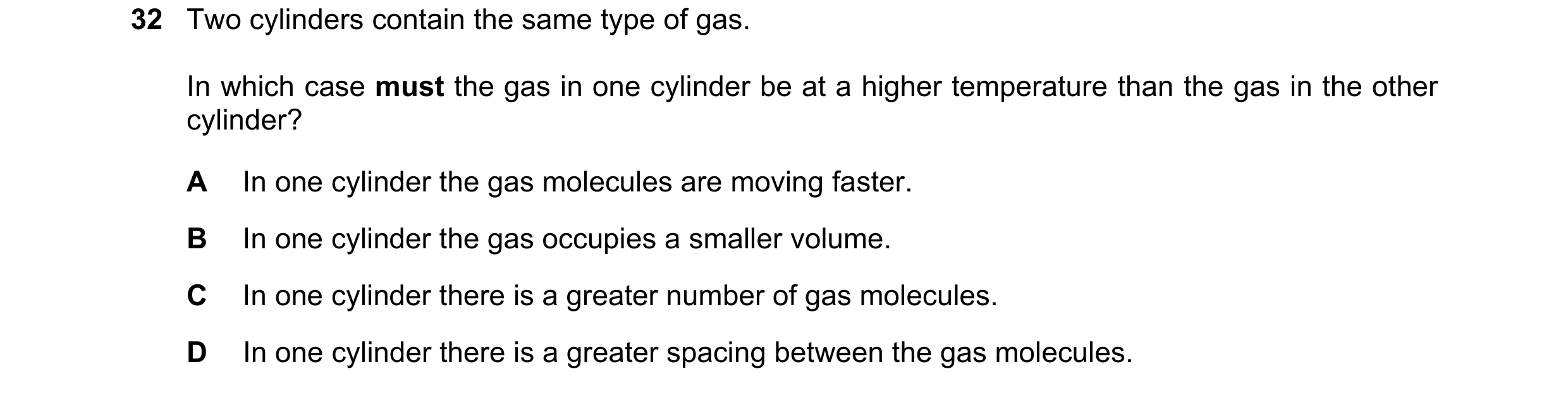
32 Two cylinders contain the same type of gas. In which case must the gas in one cylinder be at a higher temperature than the gas in the other cylinder? A In one cylinder the gas molecules are moving faster. B In one cylinder the gas occupies a smaller volume. C In one cylinder there is a greater number of gas molecules. D In one cylinder there is a greater spacing between the gas molecules.
1 marks
Answer: A
This question in 0653/22 May/June 2017
Q4 · The molecules in a substance vibrate about fixed positions 0653/23 May/June 2017
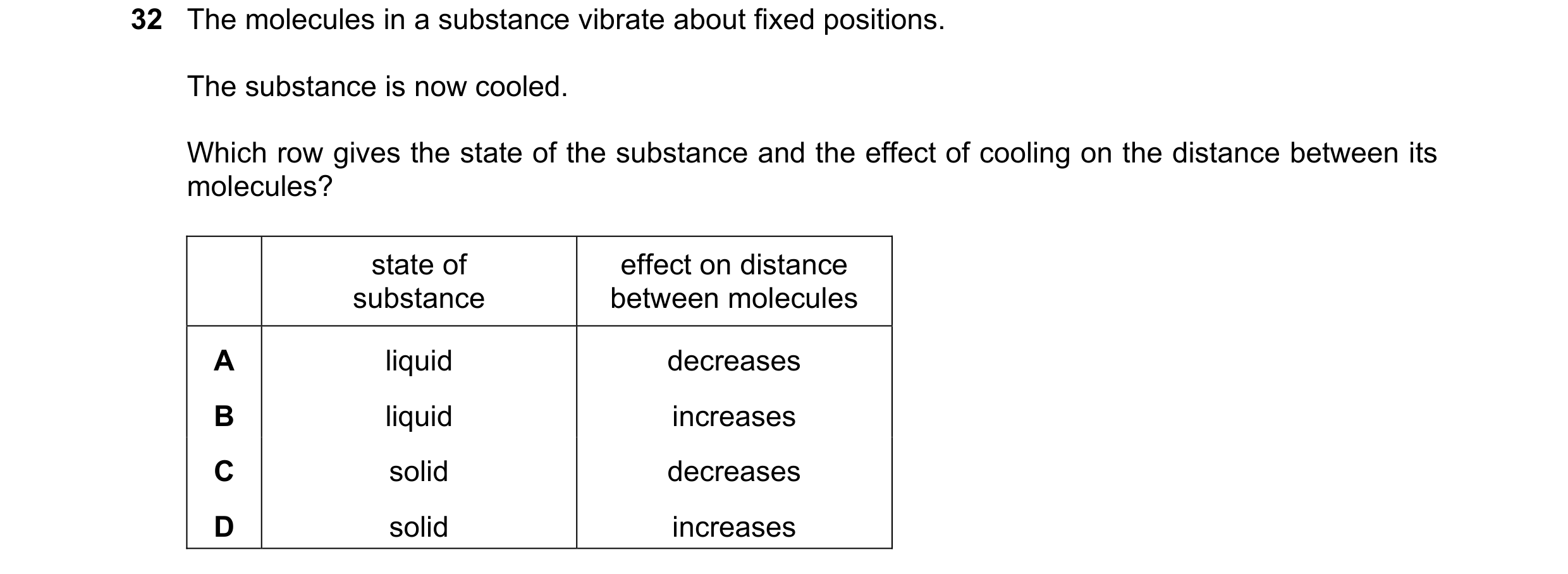
32 The molecules in a substance vibrate about fixed positions. The substance is now cooled. Which row gives the state of the substance and the effect of cooling on the distance between its molecules? state of effect on distance substance between molecules A liquid decreases B liquid increases C solid decreases D solid increases
1 marks
Answer: C
This question in 0653/23 May/June 2017
Q5 · When a liquid evaporates, which molecules escape and what happens, if anything, to the… 0653/21 Oct/Nov 2017
32 When a liquid evaporates, which molecules escape and what happens, if anything, to the temperature of the remaining liquid? molecules temperature of escaping remaining liquid A less energetic decreases molecules B less energetic stays the same molecules C more energetic decreases molecules D more energetic stays the same molecules
1 marks
Answer: C
This question in 0653/21 Oct/Nov 2017
Q6 · What is the effect of increasing the temperature on the collisions between reacting… 0653/22 Oct/Nov 2017
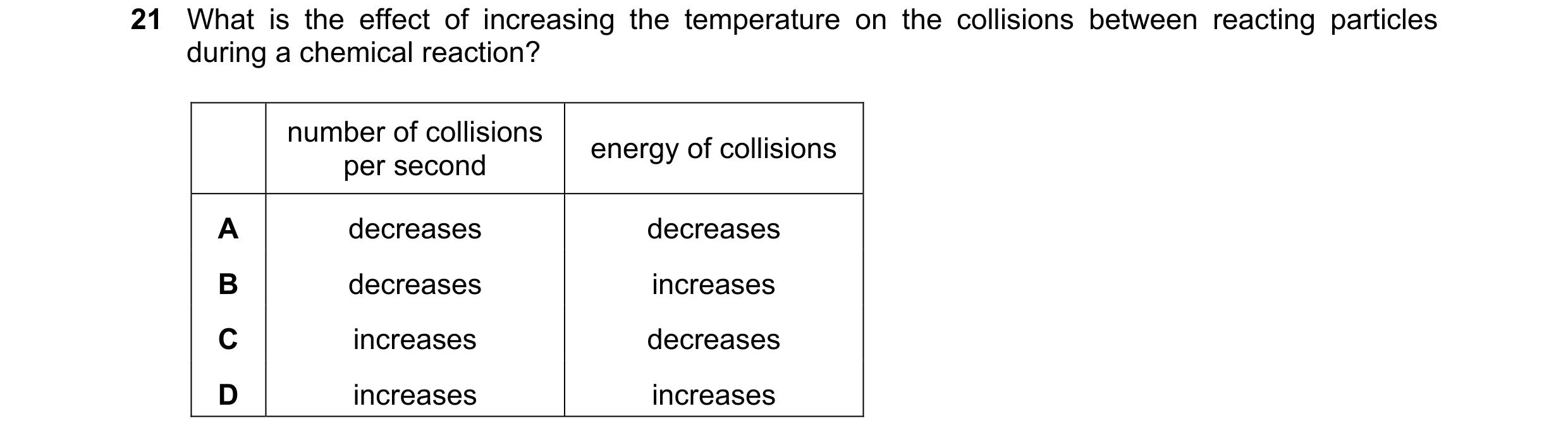
21 What is the effect of increasing the temperature on the collisions between reacting particles during a chemical reaction? number of collisions energy of collisions per second A decreases decreases B decreases increases C increases decreases D increases increases
1 marks
Answer: D
This question in 0653/22 Oct/Nov 2017
Q7 · Which description is correct for the molecules of a gas with a temperature that is rising? 0653/22 Oct/Nov 2017
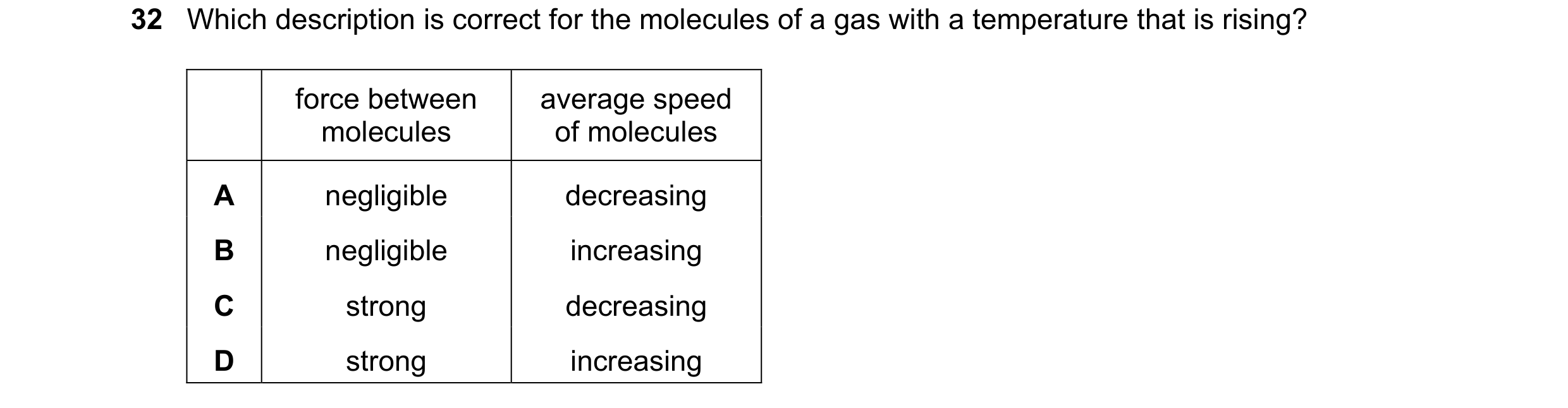
32 Which description is correct for the molecules of a gas with a temperature that is rising? force between average speed molecules of molecules A negligible decreasing B negligible increasing C strong decreasing D strong increasing
1 marks
Answer: B
This question in 0653/22 Oct/Nov 2017
Q8 · The molecules of a substance are far apart and moving at high speeds in straight lines 0653/23 Oct/Nov 2017
32 The molecules of a substance are far apart and moving at high speeds in straight lines. The forces between them are negligible. Two changes are now made to the substance. change 1 The average speed of the molecules is reduced but they remain far apart. change 2 The molecules move much closer together. There are much stronger forces between them, but they can change places with each other. What is the effect of each change? change 1 change 2 A temperature decreases gas to liquid B temperature decreases liquid to solid C temperature increases gas to liquid D temperature increases liquid to solid
1 marks
Answer: A
This question in 0653/23 Oct/Nov 2017
Q9 · The molecules of a substance are far apart and move at high speed in straight lines until… 0653/22 Feb/March 2018
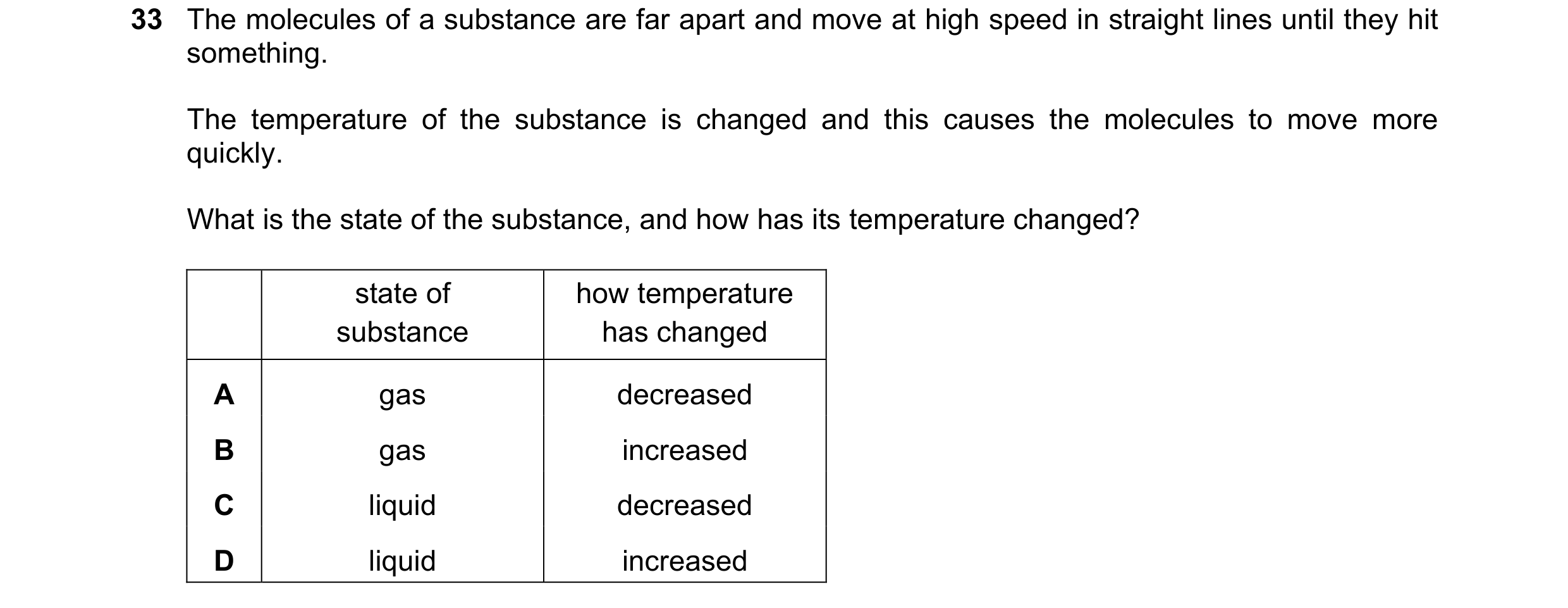
33 The molecules of a substance are far apart and move at high speed in straight lines until they hit something. The temperature of the substance is changed and this causes the molecules to move more quickly. What is the state of the substance, and how has its temperature changed? state of how temperature substance has changed A gas decreased B gas increased C liquid decreased D liquid increased
1 marks
Answer: B
This question in 0653/22 Feb/March 2018
Q10 · The molecules of a substance are close together 0653/22 May/June 2018
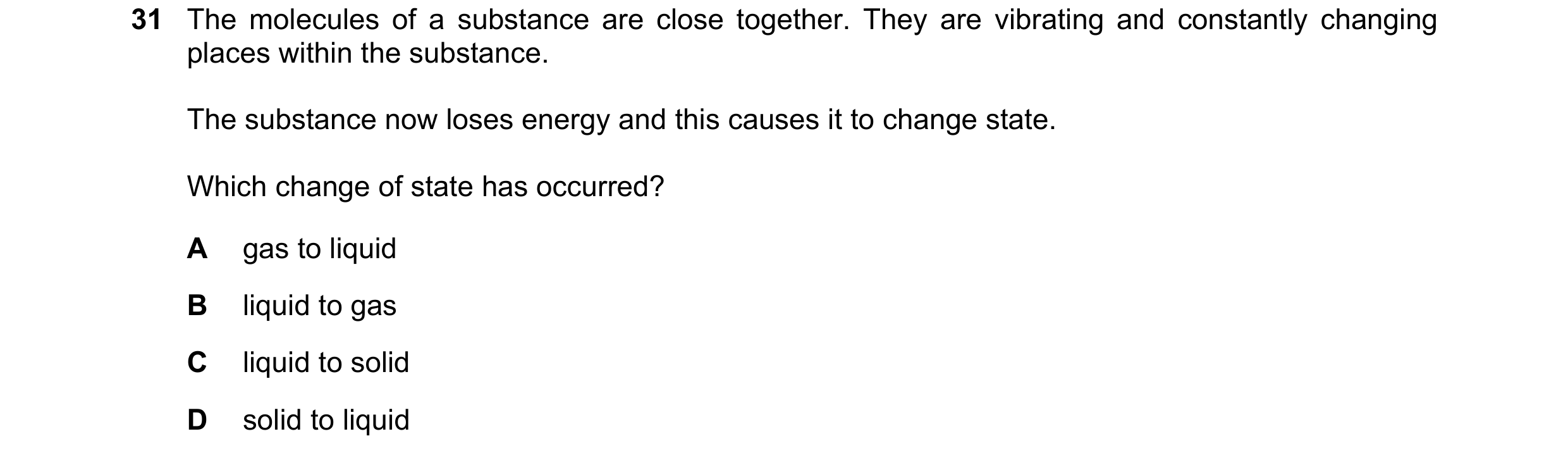
31 The molecules of a substance are close together. They are vibrating and constantly changing places within the substance. The substance now loses energy and this causes it to change state. Which change of state has occurred? A gas to liquid B liquid to gas C liquid to solid D solid to liquid
1 marks
Answer: C
This question in 0653/22 May/June 2018
Q11 · A scientist investigates two different substances, P and Q 0653/21 Oct/Nov 2018
32 A scientist investigates two different substances, P and Q. Substance P completely fills its container but can be compressed. Substance Q is not in a container but has a definite shape. In which state is each substance? substance P substance Q A gas liquid B gas solid C liquid gas D liquid solid
1 marks
Answer: B
This question in 0653/21 Oct/Nov 2018
Q12 · Gases are easier to compress than either solids or liquids 0653/22 Oct/Nov 2018
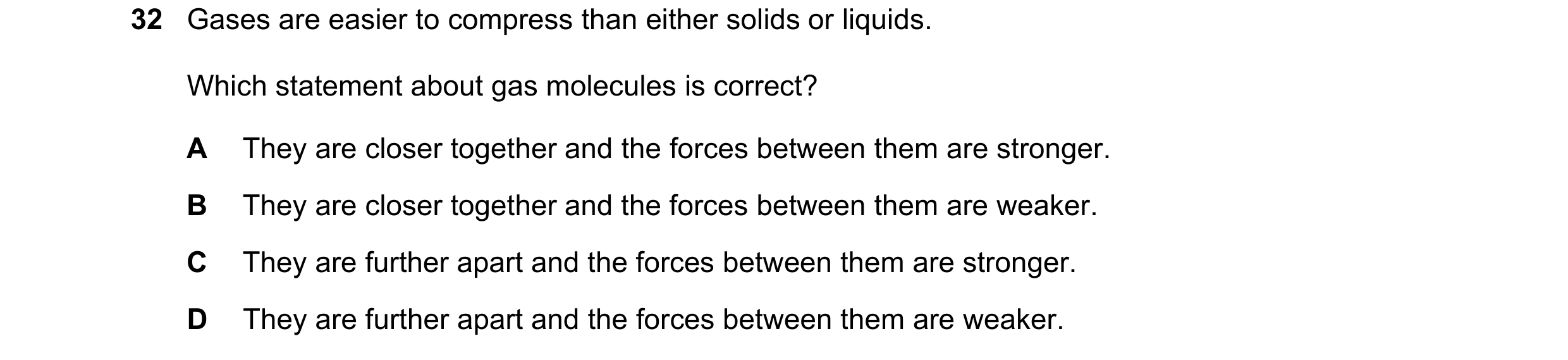
32 Gases are easier to compress than either solids or liquids. Which statement about gas molecules is correct? A They are closer together and the forces between them are stronger. B They are closer together and the forces between them are weaker. C They are further apart and the forces between them are stronger. D They are further apart and the forces between them are weaker.
1 marks
Answer: D
This question in 0653/22 Oct/Nov 2018
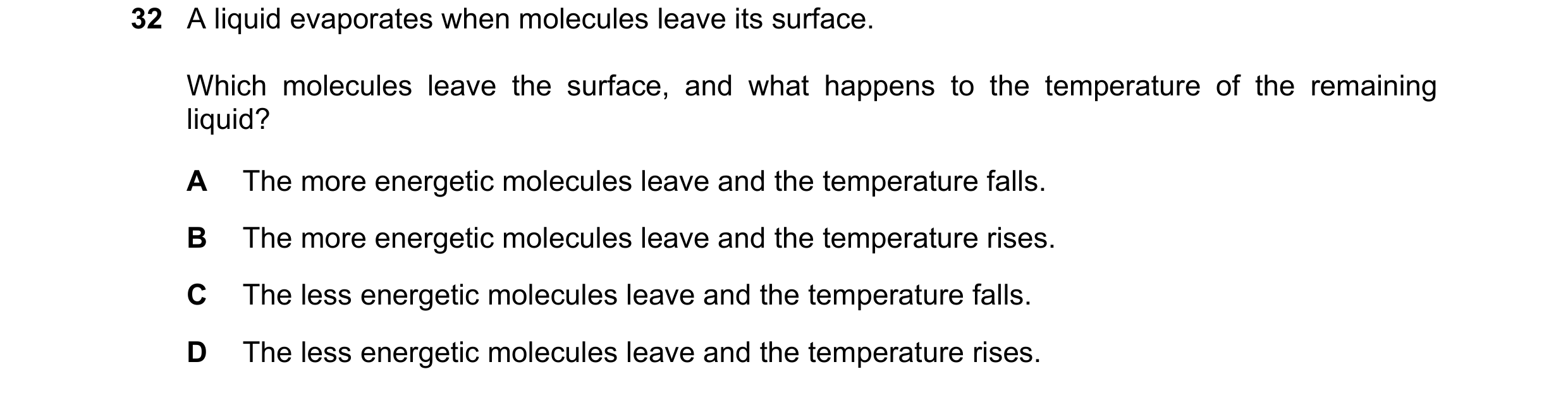
Q13 · A liquid evaporates when molecules leave its surface 0653/23 Oct/Nov 2018
32 A liquid evaporates when molecules leave its surface. Which molecules leave the surface, and what happens to the temperature of the remaining liquid? A The more energetic molecules leave and the temperature falls. B The more energetic molecules leave and the temperature rises. C The less energetic molecules leave and the temperature falls. D The less energetic molecules leave and the temperature rises.
1 marks
Answer: A
This question in 0653/23 Oct/Nov 2018
Q14 · Which statement describes oxygen molecules at room temperature and pressure? 0653/22 Feb/March 2019
14 Which statement describes oxygen molecules at room temperature and pressure? A They are closely packed and move around slowly. B They are closely packed and vibrate about a fixed point. C They are loosely packed and move around rapidly. D They are loosely packed and vibrate about a fixed point.
1 marks
Answer: C
This question in 0653/22 Feb/March 2019
Q15 · A balloon contains helium 0653/21 May/June 2019
32 A balloon contains helium. The balloon is released and rises through the atmosphere. Its volume increases and the temperature of the helium inside it decreases. What happens to the average distance between the helium molecules and what happens to their average speed? average distance average speed between molecules of molecules A decreases decreases B decreases increases C increases decreases D increases increases
1 marks
Answer: C
This question in 0653/21 May/June 2019
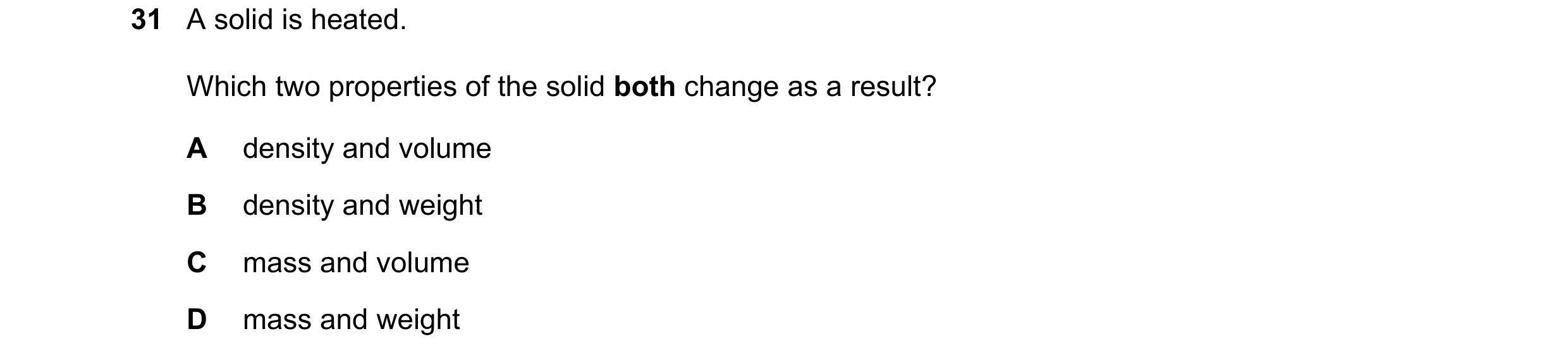
Q16 · A solid is heated 0653/22 May/June 2019
31 A solid is heated. Which two properties of the solid both change as a result? A density and volume B density and weight C mass and volume D mass and weight
1 marks
Answer: A
This question in 0653/22 May/June 2019
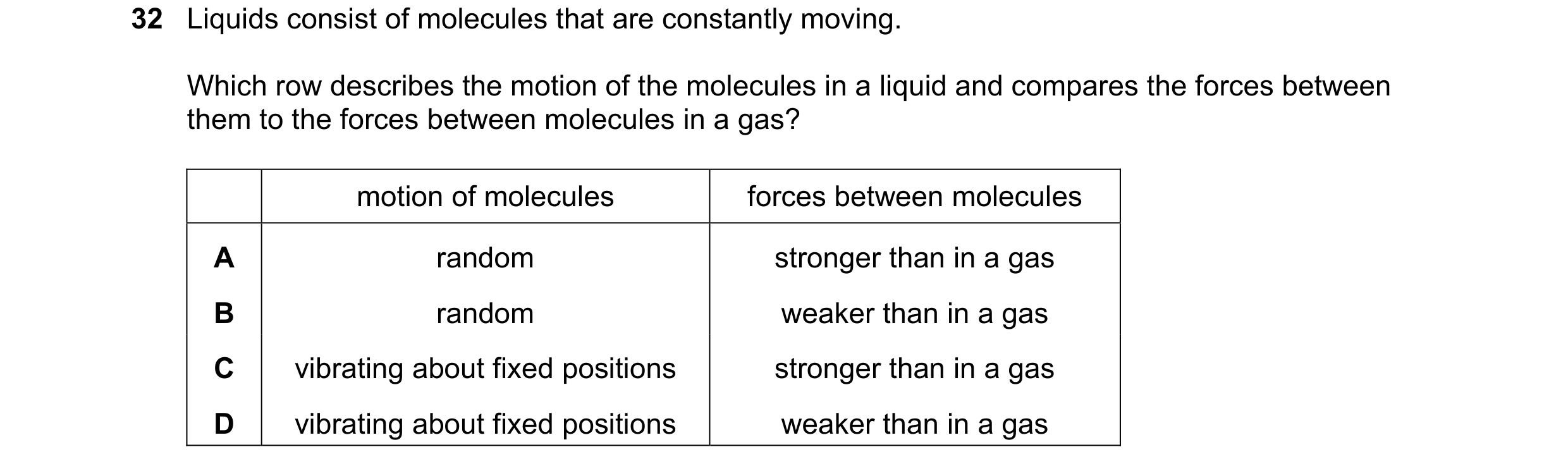
Q17 · Liquids consist of molecules that are constantly moving 0653/22 Oct/Nov 2019
32 Liquids consist of molecules that are constantly moving. Which row describes the motion of the molecules in a liquid and compares the forces between them to the forces between molecules in a gas? motion of molecules forces between molecules A random stronger than in a gas B random weaker than in a gas C vibrating about fixed positions stronger than in a gas D vibrating about fixed positions weaker than in a gas
1 marks
Answer: A
This question in 0653/22 Oct/Nov 2019
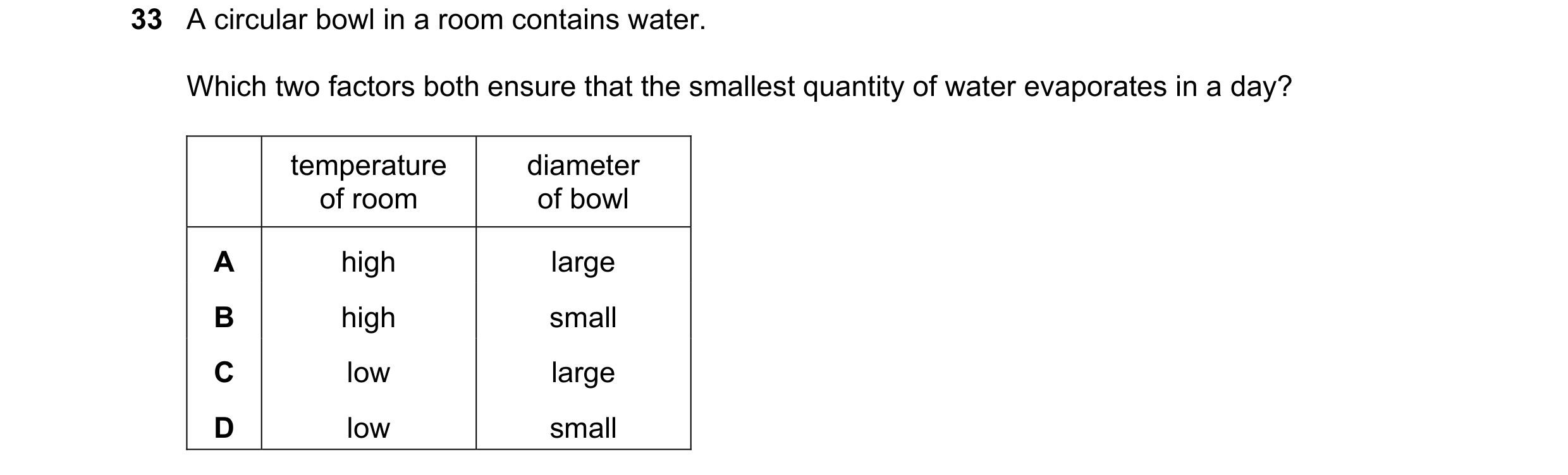
Q18 · A circular bowl in a room contains water 0653/22 Oct/Nov 2019
33 A circular bowl in a room contains water. Which two factors both ensure that the smallest quantity of water evaporates in a day? temperature diameter of room of bowl A high large B high small C low large D low small
1 marks
Answer: D
This question in 0653/22 Oct/Nov 2019
Q19 · Which statement about the molecules in a gas is correct? 0653/23 Oct/Nov 2019
32 Which statement about the molecules in a gas is correct? A They are closer together than those in solids. B They are further apart than those in liquids. C They are not free to move around. D They are packed together in a regular pattern.
1 marks
Answer: B
This question in 0653/23 Oct/Nov 2019
Q20 · What happens to water molecules when water is heated to 100 °C in a beaker? 0653/22 Feb/March 2020
14 What happens to water molecules when water is heated to 100 °C in a beaker? A They gain energy and escape from the beaker. B They gain energy and move more slowly. C They lose energy and escape from the beaker. D They lose energy and move more slowly.
1 marks
Answer: A
This question in 0653/22 Feb/March 2020
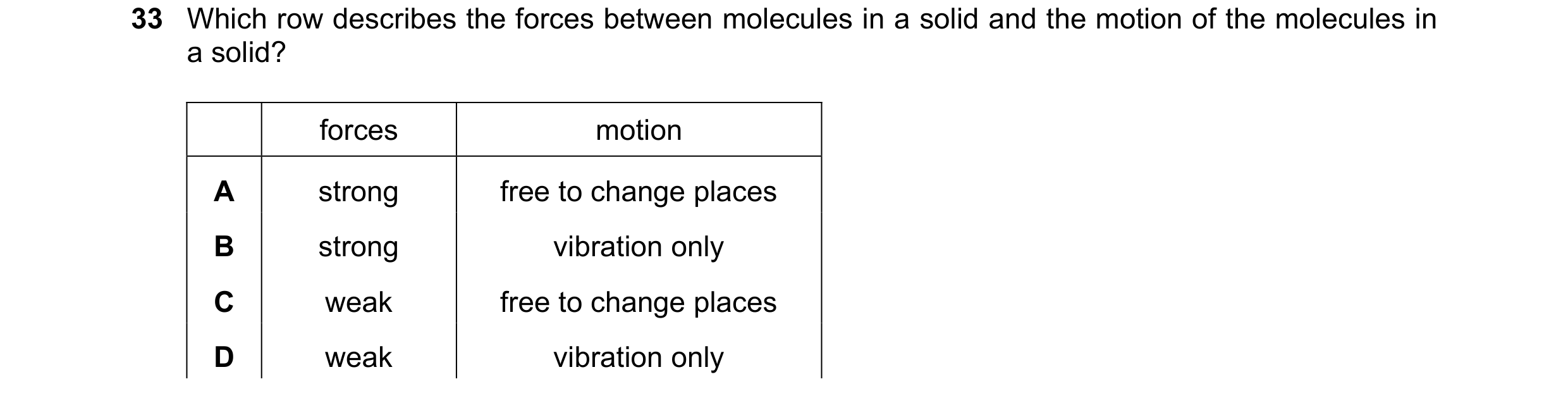
Q21 · Which row describes the forces between molecules in a solid and the motion of the… 0653/22 Feb/March 2020
33 Which row describes the forces between molecules in a solid and the motion of the molecules in a solid? forces motion A strong free to change places B strong vibration only C weak free to change places D weak vibration only
1 marks
Answer: B
This question in 0653/22 Feb/March 2020
Q22 · In which change of state do the particles gain kinetic energy and remain tightly packed? 0653/21 May/June 2020
14 In which change of state do the particles gain kinetic energy and remain tightly packed? A gas to liquid B liquid to gas C liquid to solid D solid to liquid
1 marks
Answer: D
This question in 0653/21 May/June 2020
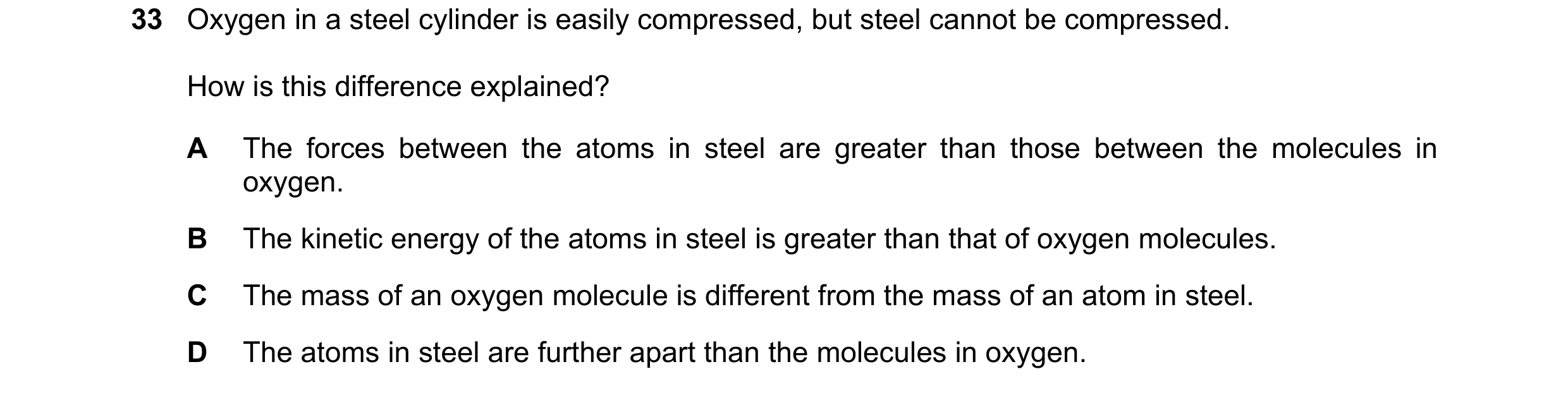
Q23 · Oxygen in a steel cylinder is easily compressed, but steel cannot be compressed 0653/21 May/June 2020
33 Oxygen in a steel cylinder is easily compressed, but steel cannot be compressed. How is this difference explained? A The forces between the atoms in steel are greater than those between the molecules in oxygen. B The kinetic energy of the atoms in steel is greater than that of oxygen molecules. C The mass of an oxygen molecule is different from the mass of an atom in steel. D The atoms in steel are further apart than the molecules in oxygen.
1 marks
Answer: A
This question in 0653/21 May/June 2020
Q24 · Which action increases the rate of evaporation of a liquid? 0653/22 May/June 2020
33 Which action increases the rate of evaporation of a liquid? A cooling the liquid B covering the liquid C increasing the surface area of the liquid D reducing any draught over the liquid
1 marks
Answer: C
This question in 0653/22 May/June 2020
Q25 · Conduction of heat in metals involves the movement of atoms and electrons 0653/22 May/June 2020
34 Conduction of heat in metals involves the movement of atoms and electrons. Which row describes the movement of the atoms and the electrons? atoms electrons A move freely move freely B move freely vibrate about fixed positions C vibrate about fixed positions move freely D vibrate about fixed positions vibrate about fixed positions
1 marks
Answer: C
This question in 0653/22 May/June 2020
Q26 · The molecules in a substance vibrate about fixed positions 0653/21 Oct/Nov 2020
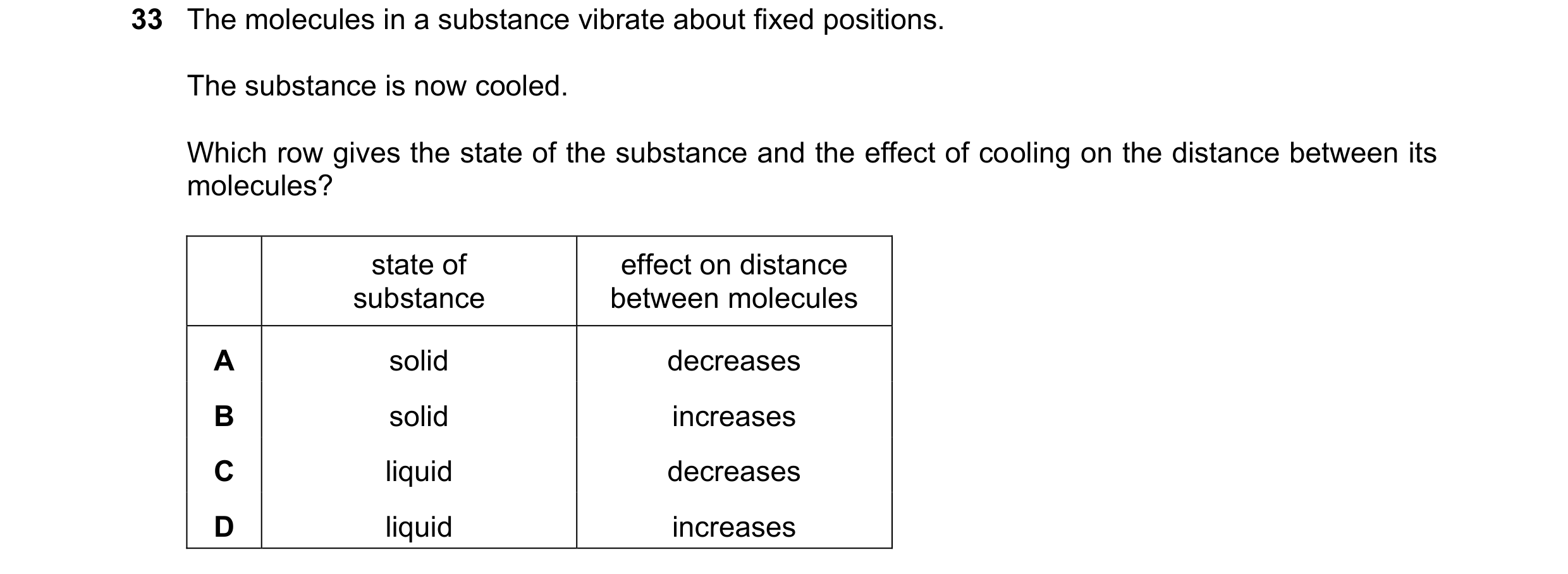
33 The molecules in a substance vibrate about fixed positions. The substance is now cooled. Which row gives the state of the substance and the effect of cooling on the distance between its molecules? state of effect on distance substance between molecules A solid decreases B solid increases C liquid decreases D liquid increases
1 marks
Answer: A
This question in 0653/21 Oct/Nov 2020
Q27 · The molecules in a substance vibrate about fixed positions 0653/22 Oct/Nov 2020
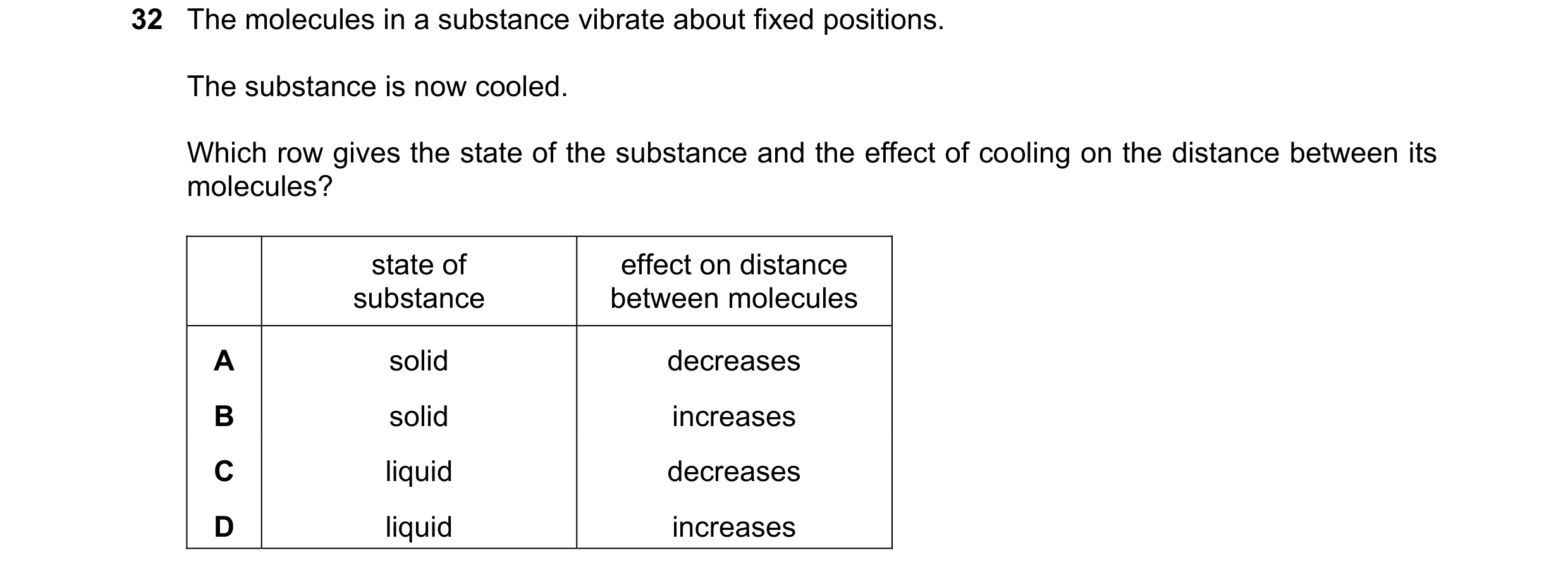
32 The molecules in a substance vibrate about fixed positions. The substance is now cooled. Which row gives the state of the substance and the effect of cooling on the distance between its molecules? state of effect on distance substance between molecules A solid decreases B solid increases C liquid decreases D liquid increases
1 marks
Answer: A
This question in 0653/22 Oct/Nov 2020
Q28 · The molecules in a substance vibrate about fixed positions 0653/23 Oct/Nov 2020
34 The molecules in a substance vibrate about fixed positions. The substance is now cooled. Which row gives the state of the substance and the effect of cooling on the distance between its molecules? state of effect on distance substance between molecules A solid decreases B solid increases C liquid decreases D liquid increases
1 marks
Answer: A
This question in 0653/23 Oct/Nov 2020
Q29 · A fixed mass of argon gas in a sealed container is heated 0653/21 May/June 2021
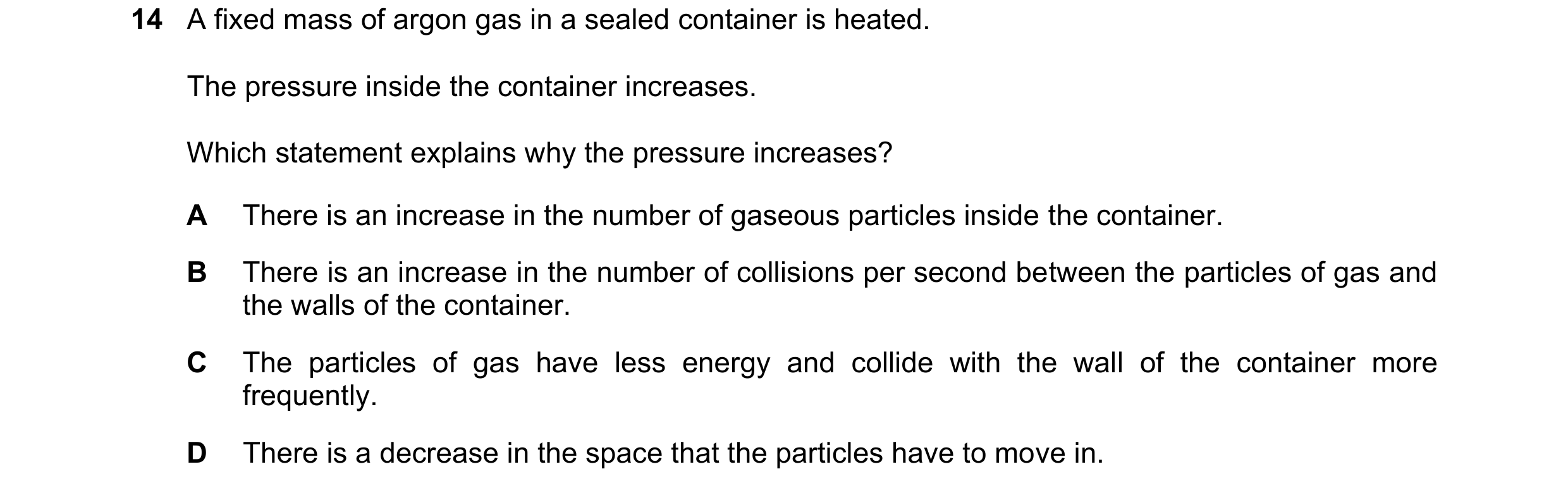
14 A fixed mass of argon gas in a sealed container is heated. The pressure inside the container increases. Which statement explains why the pressure increases? A There is an increase in the number of gaseous particles inside the container. B There is an increase in the number of collisions per second between the particles of gas and the walls of the container. C The particles of gas have less energy and collide with the wall of the container more frequently. D There is a decrease in the space that the particles have to move in.
1 marks
Answer: B
This question in 0653/21 May/June 2021
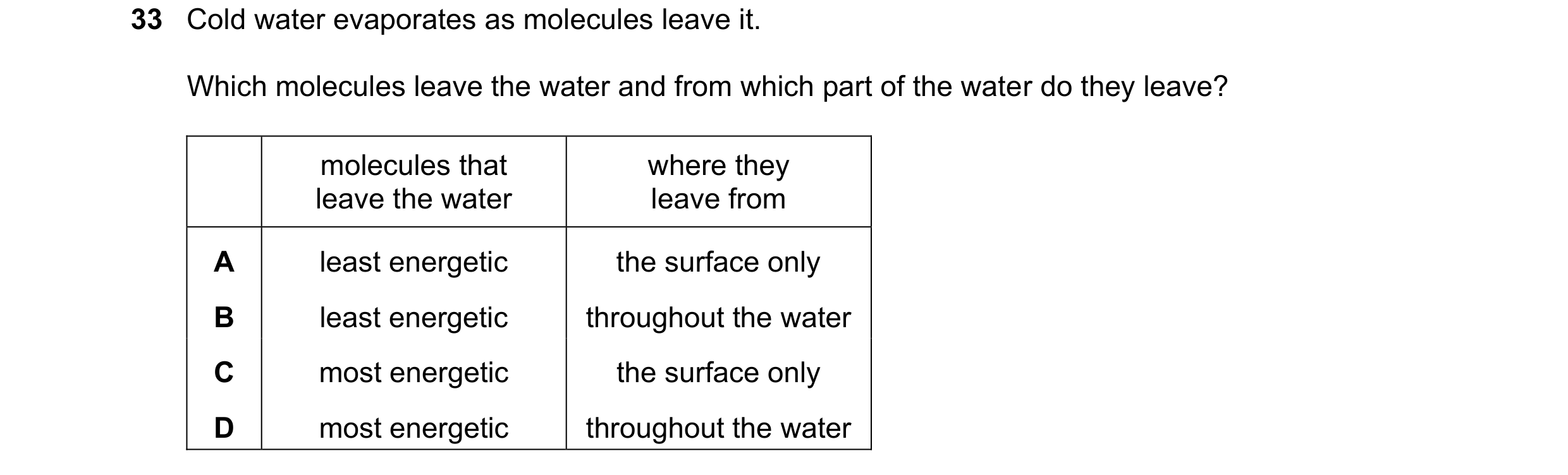
Q30 · Cold water evaporates as molecules leave it 0653/21 May/June 2021
33 Cold water evaporates as molecules leave it. Which molecules leave the water and from which part of the water do they leave? molecules that where they leave the water leave from A least energetic the surface only B least energetic throughout the water C most energetic the surface only D most energetic throughout the water
1 marks
Answer: C
This question in 0653/21 May/June 2021
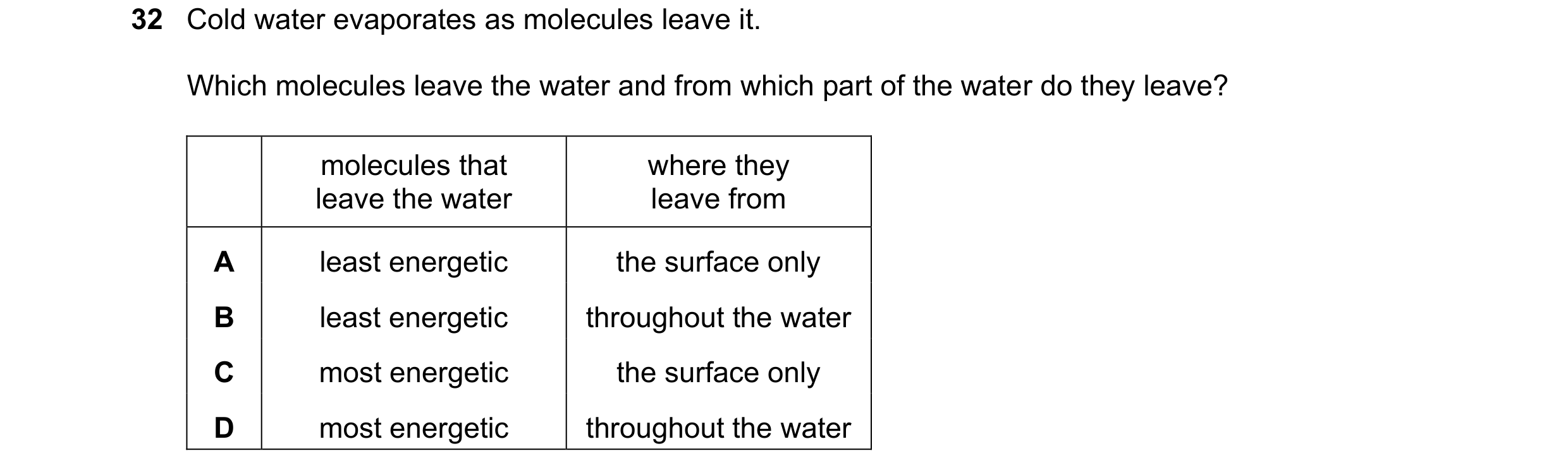
Q31 · Cold water evaporates as molecules leave it 0653/22 May/June 2021
32 Cold water evaporates as molecules leave it. Which molecules leave the water and from which part of the water do they leave? molecules that where they leave the water leave from A least energetic the surface only B least energetic throughout the water C most energetic the surface only D most energetic throughout the water
1 marks
Answer: C
This question in 0653/22 May/June 2021
Q32 · The table shows the speed of sound in three different substances X, Y and Z 0653/22 May/June 2021
36 The table shows the speed of sound in three different substances X, Y and Z. One substance is a solid, one is a liquid and one is a gas. speed of sound substance m/s X 3600 Y 1500 Z 267 Which row shows the states of the three substances? solid liquid gas A X Y Z B X Z Y C Z X Y D Z Y X
1 marks
Answer: A
This question in 0653/22 May/June 2021
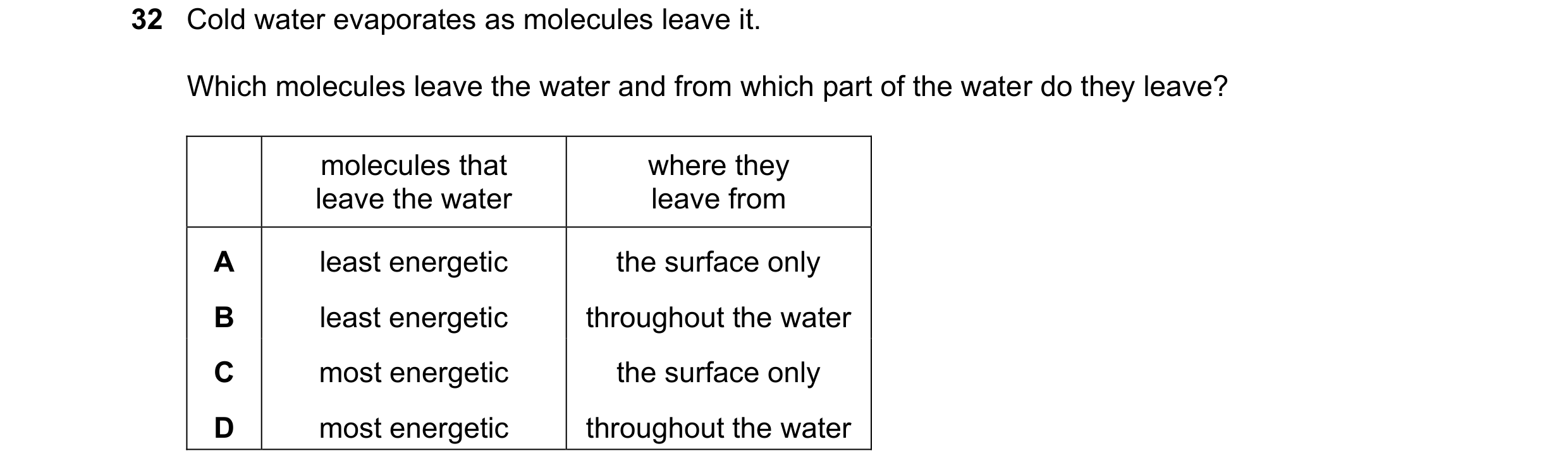
Q33 · Cold water evaporates as molecules leave it 0653/23 May/June 2021
32 Cold water evaporates as molecules leave it. Which molecules leave the water and from which part of the water do they leave? molecules that where they leave the water leave from A least energetic the surface only B least energetic throughout the water C most energetic the surface only D most energetic throughout the water
1 marks
Answer: C
This question in 0653/23 May/June 2021
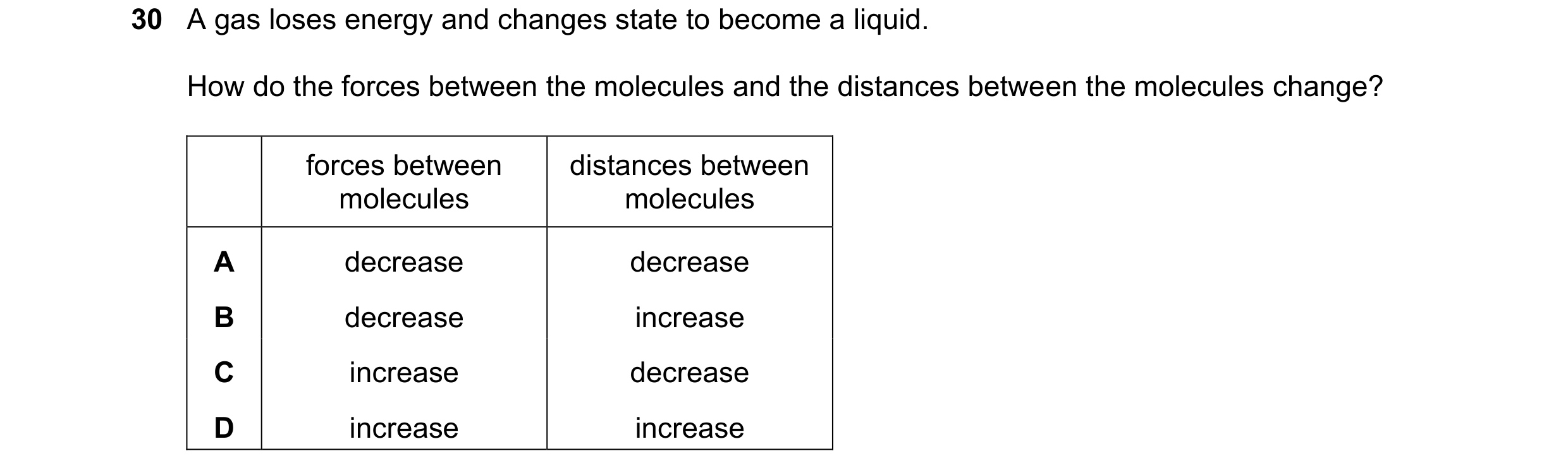
Q34 · A gas loses energy and changes state to become a liquid 0653/21 Oct/Nov 2021
30 A gas loses energy and changes state to become a liquid. How do the forces between the molecules and the distances between the molecules change? forces between distances between molecules molecules A decrease decrease B decrease increase C increase decrease D increase increase
1 marks
Answer: C
This question in 0653/21 Oct/Nov 2021
Q35 · Which statements about liquids and gases are correct? 0653/22 Oct/Nov 2021
31 Which statements about liquids and gases are correct? 1 Molecules in gases are further apart than molecules in liquids. 2 Molecules in liquids and gases are arranged randomly. 3 When a liquid evaporates, the temperature of the remaining liquid decreases. A 1 and 2 only B 1 and 3 only C 2 and 3 only D 1, 2 and 3
1 marks
Answer: D
This question in 0653/22 Oct/Nov 2021
Q36 · Water in a beaker evaporates quickly 0653/23 Oct/Nov 2021
32 Water in a beaker evaporates quickly. Which statements about the evaporation of the water from the beaker are correct? 1 Evaporation happens at all temperatures between 0 C and 100 C. 2 The more-energetic water molecules escape from the surface of the water. 3 The temperature of the water remaining in the beaker decreases. A 1 and 2 only B 1 and 3 only C 2 and 3 only D 1, 2 and 3
1 marks
Answer: D
This question in 0653/23 Oct/Nov 2021
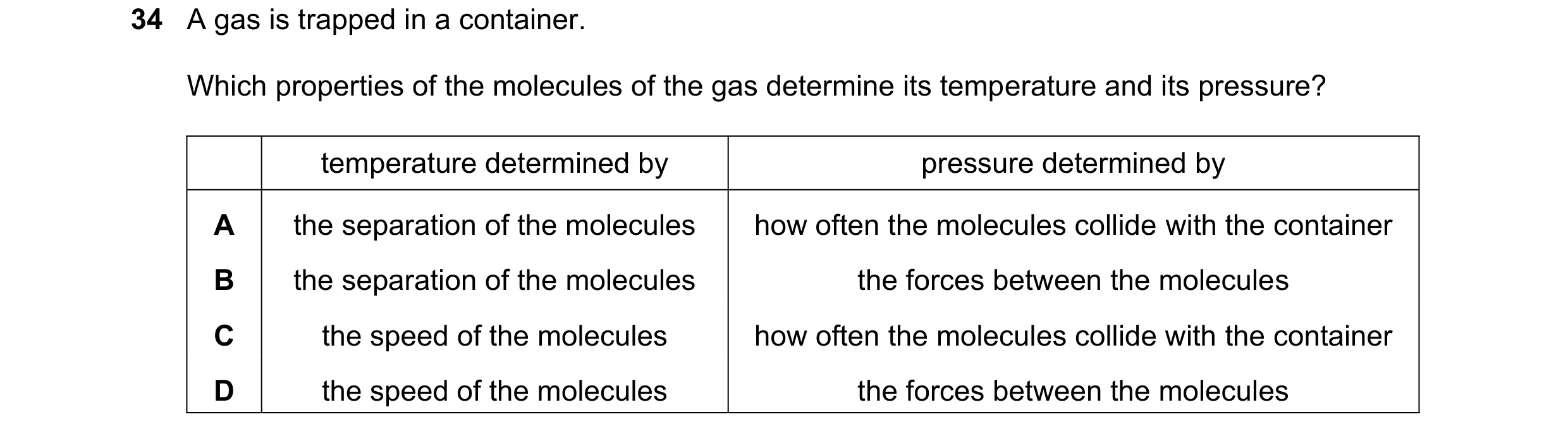
Q37 · A gas is trapped in a container 0653/22 Feb/March 2022
34 A gas is trapped in a container. Which properties of the molecules of the gas determine its temperature and its pressure? temperature determined by pressure determined by A the separation of the molecules how often the molecules collide with the container B the separation of the molecules the forces between the molecules C the speed of the molecules how often the molecules collide with the container D the speed of the molecules the forces between the molecules
1 marks
Answer: C
This question in 0653/22 Feb/March 2022
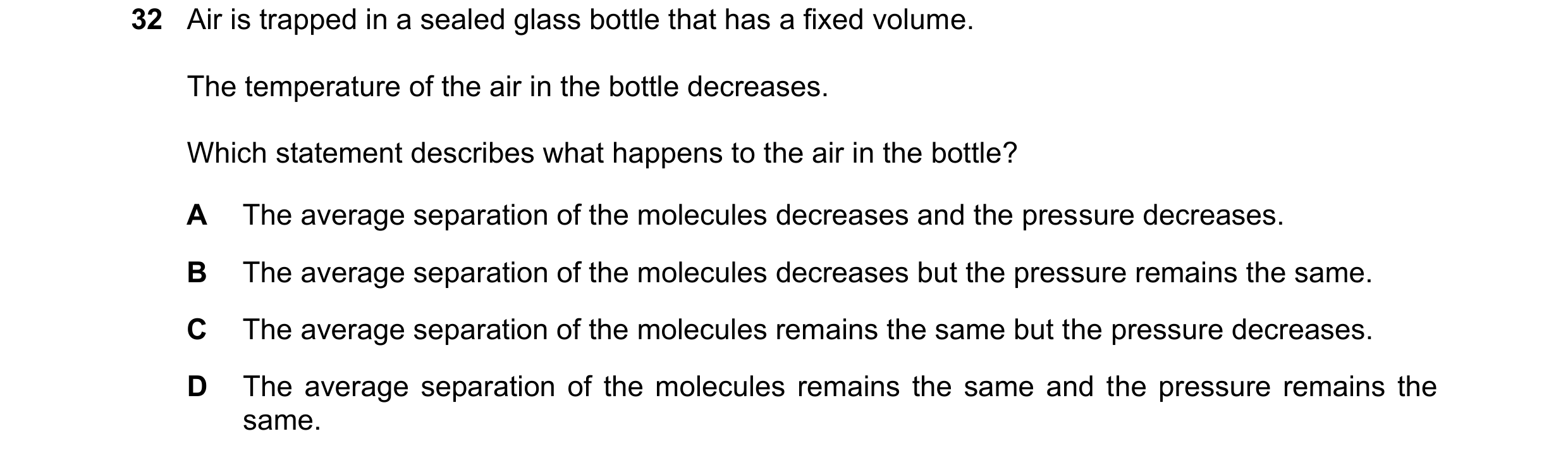
Q38 · Air is trapped in a sealed glass bottle that has a fixed volume 0653/22 May/June 2022
32 Air is trapped in a sealed glass bottle that has a fixed volume. The temperature of the air in the bottle decreases. Which statement describes what happens to the air in the bottle? A The average separation of the molecules decreases and the pressure decreases. B The average separation of the molecules decreases but the pressure remains the same. C The average separation of the molecules remains the same but the pressure decreases. D The average separation of the molecules remains the same and the pressure remains the same.
1 marks
Answer: C
This question in 0653/22 May/June 2022
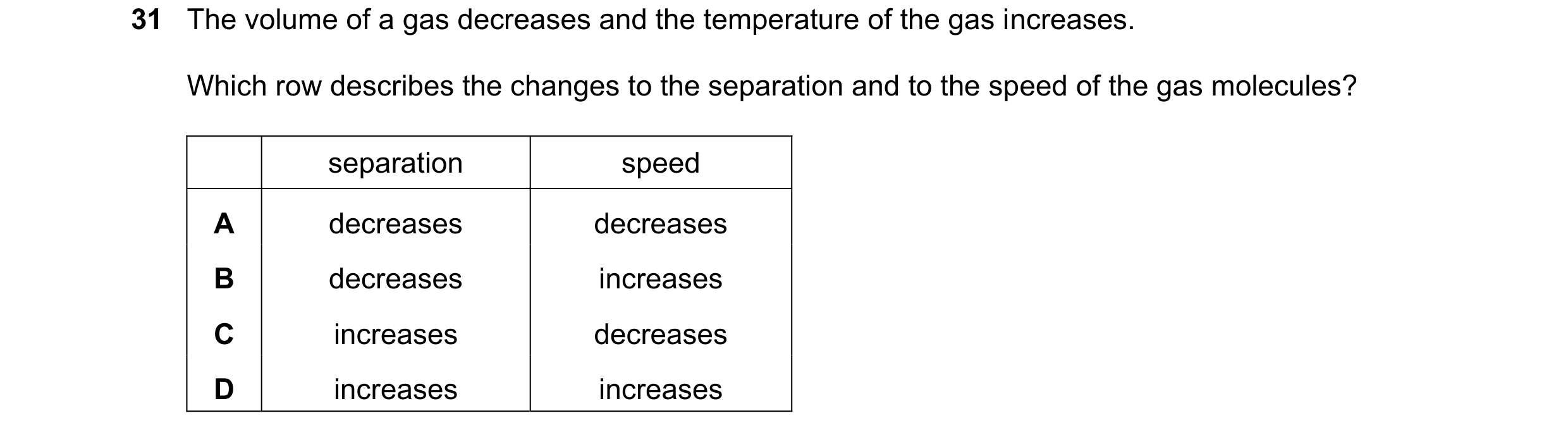
Q39 · The volume of a gas decreases and the temperature of the gas increases 0653/23 May/June 2022
31 The volume of a gas decreases and the temperature of the gas increases. Which row describes the changes to the separation and to the speed of the gas molecules? separation speed A decreases decreases B decreases increases C increases decreases D increases increases
1 marks
Answer: B
This question in 0653/23 May/June 2022
Q40 · Air is trapped in a cylinder by a piston 0653/21 Oct/Nov 2022
33 Air is trapped in a cylinder by a piston. The piston is moved so that the volume of the trapped air decreases. The pressure of the trapped air increases but the temperature of the trapped air does not change. trapped air piston cylinder What happens to the average speed of the air particles and what happens to the average distance between them? average speed average distance of particles between particles A does not change decreases B does not change increases C increases decreases D increases increases
1 marks
Answer: A
This question in 0653/21 Oct/Nov 2022
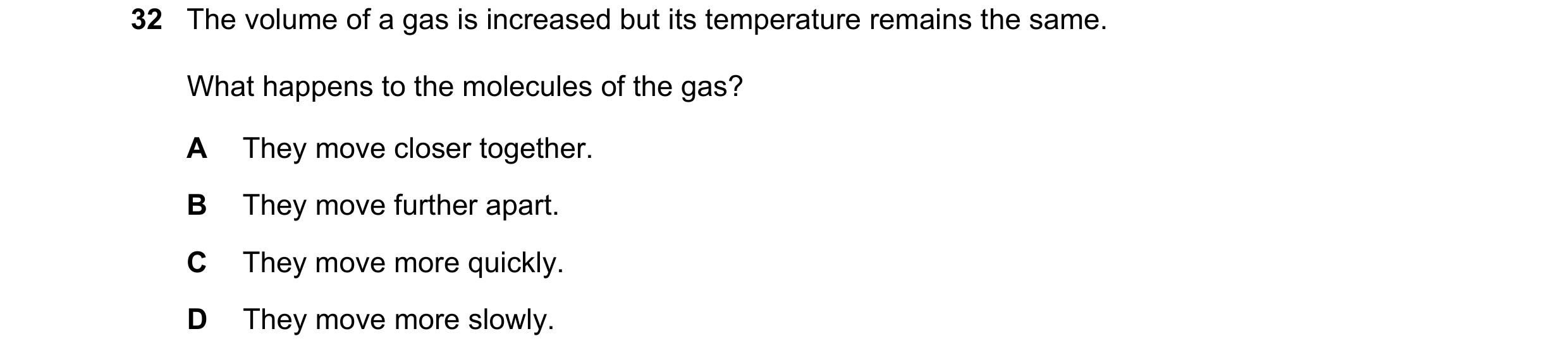
Q41 · The volume of a gas is increased but its temperature remains the same 0653/22 Oct/Nov 2022
32 The volume of a gas is increased but its temperature remains the same. What happens to the molecules of the gas? A They move closer together. B They move further apart. C They move more quickly. D They move more slowly.
1 marks
Answer: B
This question in 0653/22 Oct/Nov 2022
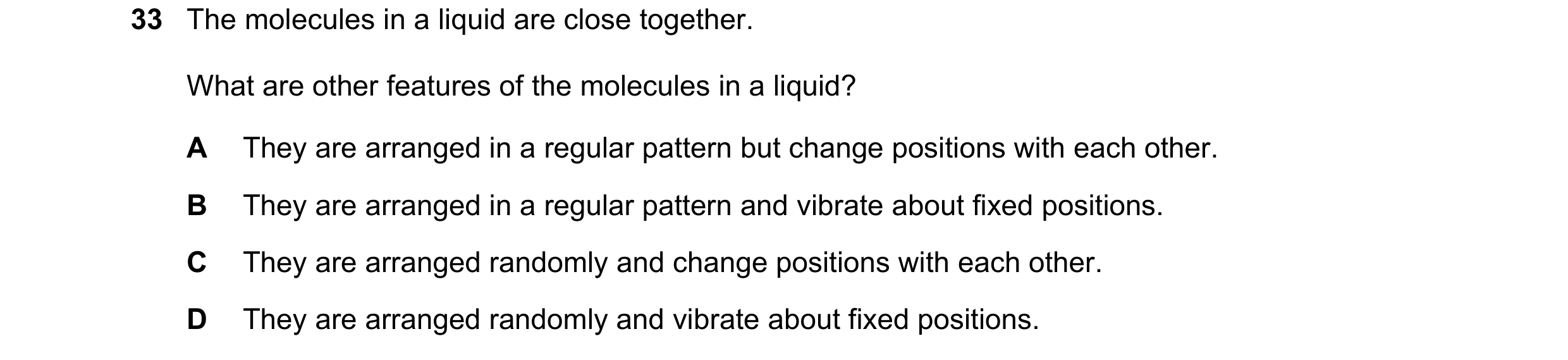
Q42 · The molecules in a liquid are close together 0653/21 May/June 2023
33 The molecules in a liquid are close together. What are other features of the molecules in a liquid? A They are arranged in a regular pattern but change positions with each other. B They are arranged in a regular pattern and vibrate about fixed positions. C They are arranged randomly and change positions with each other. D They are arranged randomly and vibrate about fixed positions.
1 marks
Answer: C
This question in 0653/21 May/June 2023
Q43 · What happens as a liquid starts to evaporate? 0653/22 May/June 2023
33 What happens as a liquid starts to evaporate? A The mass of the remaining liquid increases. B The mass of the remaining liquid is constant. C The temperature of the remaining liquid decreases. D The temperature of the remaining liquid increases.
1 marks
Answer: C
This question in 0653/22 May/June 2023
Q44 · Which statement describes the molecules in a gas? 0653/23 May/June 2023
34 Which statement describes the molecules in a gas? A They are close together and move about quickly. B They are close together and move about slowly. C They are far apart and move about quickly. D They are far apart and move about slowly.
1 marks
Answer: C
This question in 0653/23 May/June 2023
Q45 · A student investigates the rate of evaporation of water 0653/23 May/June 2023
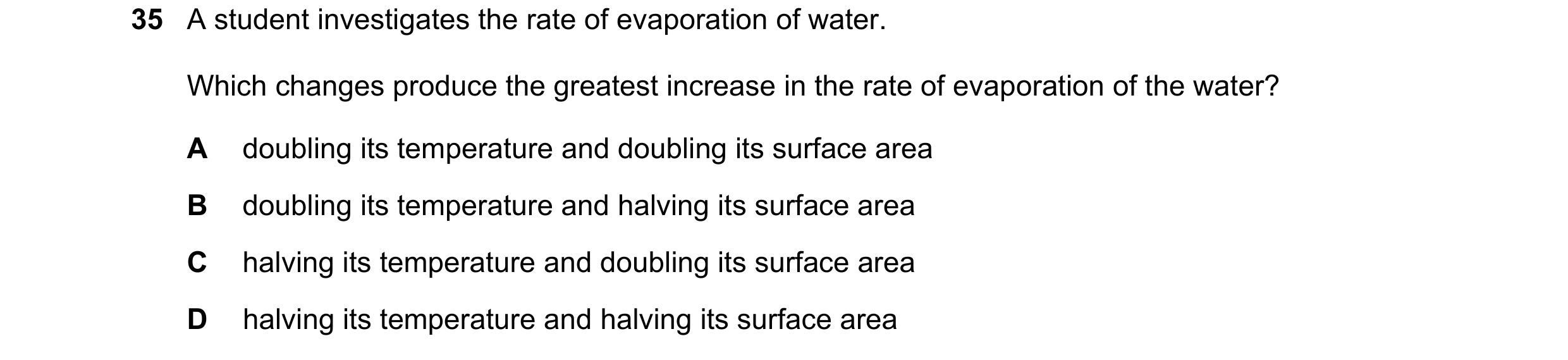
35 A student investigates the rate of evaporation of water. Which changes produce the greatest increase in the rate of evaporation of the water? A doubling its temperature and doubling its surface area B doubling its temperature and halving its surface area C halving its temperature and doubling its surface area D halving its temperature and halving its surface area
1 marks
Answer: A
This question in 0653/23 May/June 2023
Q46 · The molecules in a substance are close together but free to change positions with each… 0653/21 Oct/Nov 2023
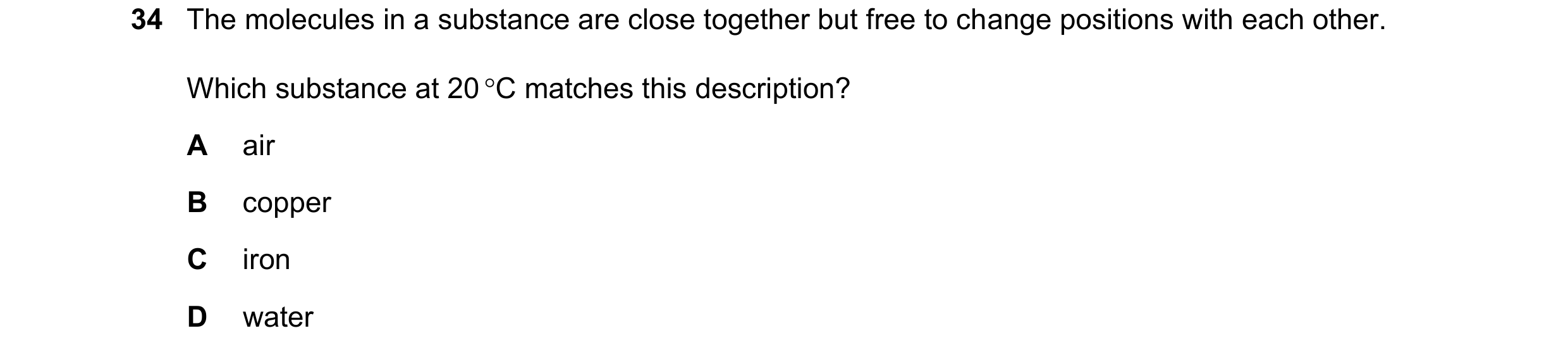
34 The molecules in a substance are close together but free to change positions with each other. Which substance at 20 C matches this description? A air B copper C iron D water
1 marks
Answer: D
This question in 0653/21 Oct/Nov 2023
Q47 · Which statement about the boiling point of a substance is correct? 0653/22 Oct/Nov 2023
33 Which statement about the boiling point of a substance is correct? A At all temperatures above its boiling point, a substance must be a gas. B At all temperatures above its boiling point, a substance must be a liquid. C At all temperatures below its boiling point, a substance must be a gas. D At all temperatures below its boiling point, a substance must be a liquid.
1 marks
Answer: A
This question in 0653/22 Oct/Nov 2023
Q48 · Which row describes the arrangement and separation of the particles in a liquid? 0653/23 Oct/Nov 2023
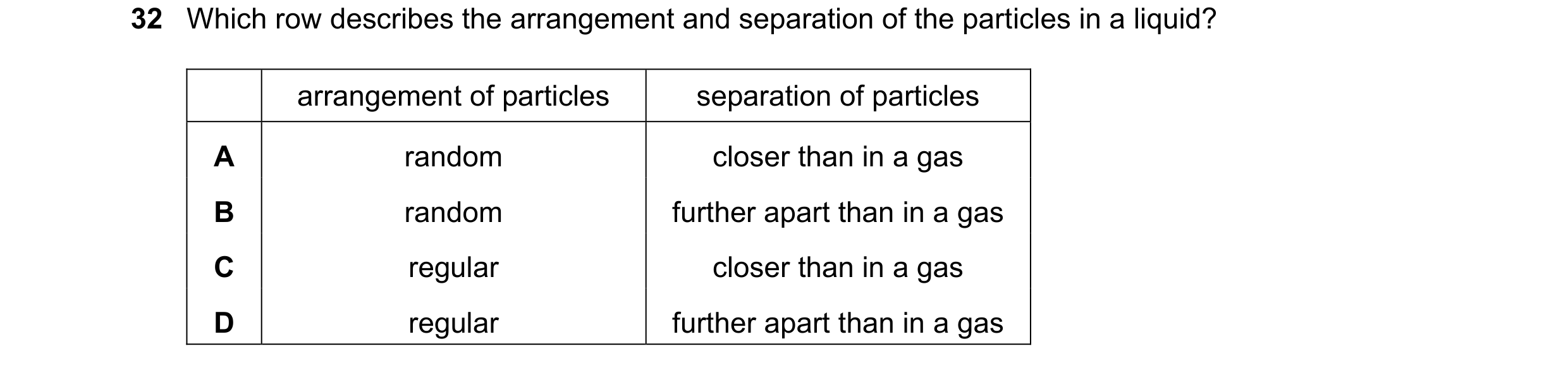
32 Which row describes the arrangement and separation of the particles in a liquid? arrangement of particles separation of particles A random closer than in a gas B random further apart than in a gas C regular closer than in a gas D regular further apart than in a gas
1 marks
Answer: A
This question in 0653/23 Oct/Nov 2023
Q49 · An open container in a laboratory contains water 0653/23 Oct/Nov 2023
33 An open container in a laboratory contains water. The container is placed on a bench near a closed window. The container is in bright sunlight and it is a windy day outside. The water in the container evaporates slowly. open top container water Four actions are listed. 1 adding more water to the container 2 opening the window 3 covering the window with a curtain 4 increasing the room temperature Which two actions, on their own, increase the rate of evaporation? A 1 and 2 B 1 and 3 C 2 and 4 D 3 and 4
1 marks
Answer: C
This question in 0653/23 Oct/Nov 2023
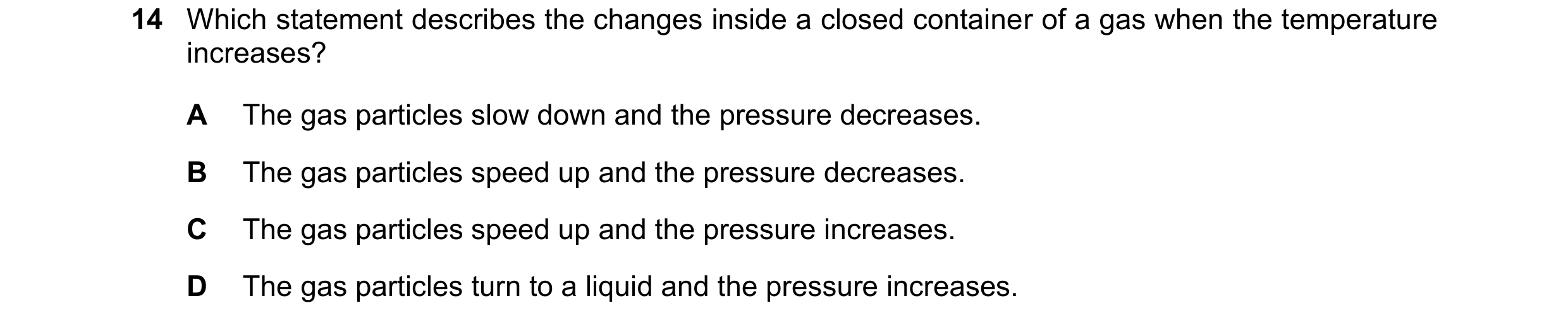
Q50 · Which statement describes the changes inside a closed container of a gas when the… 0653/22 Feb/March 2024
14 Which statement describes the changes inside a closed container of a gas when the temperature increases? A The gas particles slow down and the pressure decreases. B The gas particles speed up and the pressure decreases. C The gas particles speed up and the pressure increases. D The gas particles turn to a liquid and the pressure increases.
1 marks
Answer: C
This question in 0653/22 Feb/March 2024
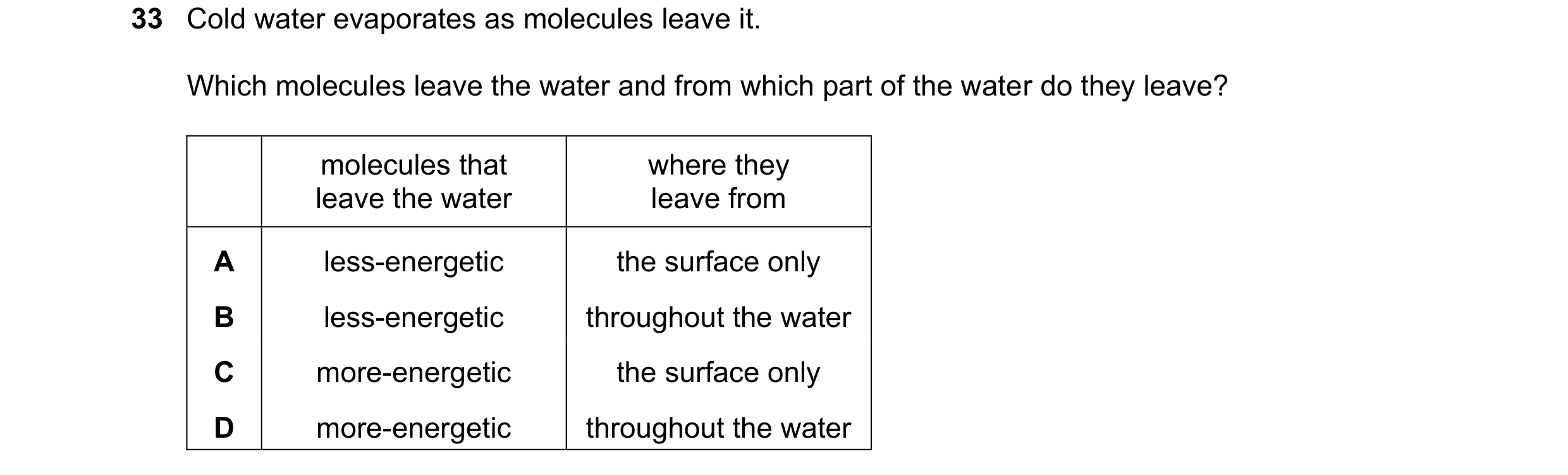
Q51 · Cold water evaporates as molecules leave it 0653/22 Feb/March 2024
33 Cold water evaporates as molecules leave it. Which molecules leave the water and from which part of the water do they leave? molecules that where they leave the water leave from A less-energetic the surface only B less-energetic throughout the water C more-energetic the surface only D more-energetic throughout the water
1 marks
Answer: C
This question in 0653/22 Feb/March 2024
Q52 · 50 g of a liquid alkane at 20 C is left in an open, insulated beaker for 30 minutes 0653/21 May/June 2024
14 50 g of a liquid alkane at 20 C is left in an open, insulated beaker for 30 minutes. After this time, the mass of the liquid is 42 g and its temperature is 18 C. Which statement is correct? A Some of the liquid evaporates in an exothermic process. B The evaporation is an endothermic process because covalent bonds in the alkane molecules are broken. C The temperature decreases because energy is used to overcome attractive forces between the liquid molecules. D There are fewer molecules in the remaining liquid so they move further apart.
1 marks
Answer: C
This question in 0653/21 May/June 2024
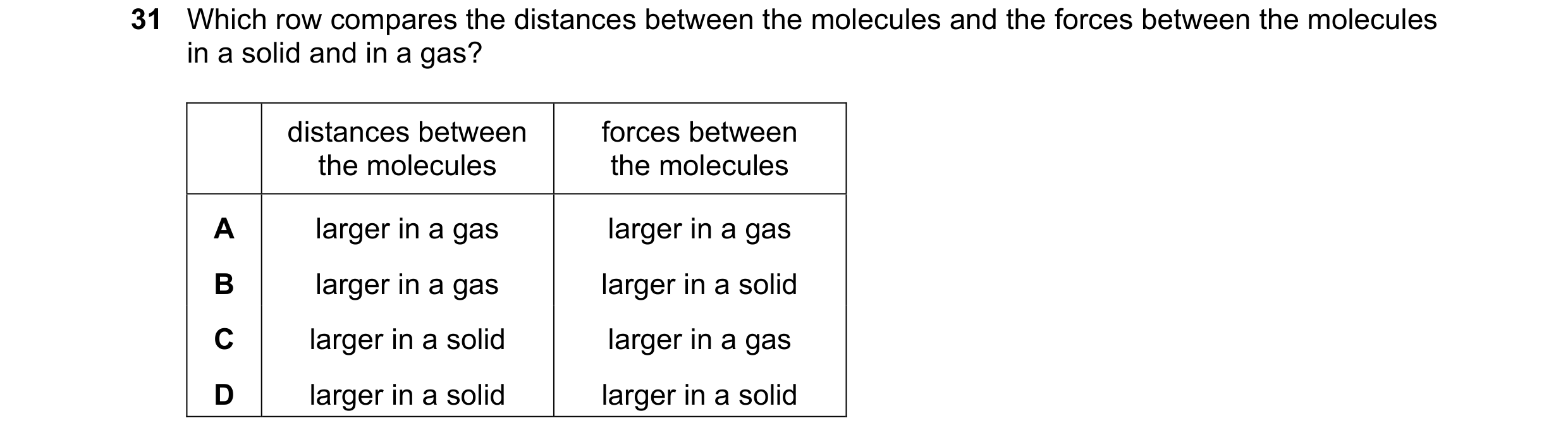
Q53 · Which row compares the distances between the molecules and the forces between the… 0653/21 May/June 2024
31 Which row compares the distances between the molecules and the forces between the molecules in a solid and in a gas? distances between forces between the molecules the molecules A larger in a gas larger in a gas B larger in a gas larger in a solid C larger in a solid larger in a gas D larger in a solid larger in a solid
1 marks
Answer: B
This question in 0653/21 May/June 2024
Q54 · Which statement is correct for evaporation? 0653/21 May/June 2024
32 Which statement is correct for evaporation? A Evaporation occurs only at the boiling point of the liquid. B Evaporation occurs only at the surface of a liquid. C Evaporation involves a vapour changing into a liquid. D Evaporation increases the temperature of the remaining liquid.
1 marks
Answer: B
This question in 0653/21 May/June 2024
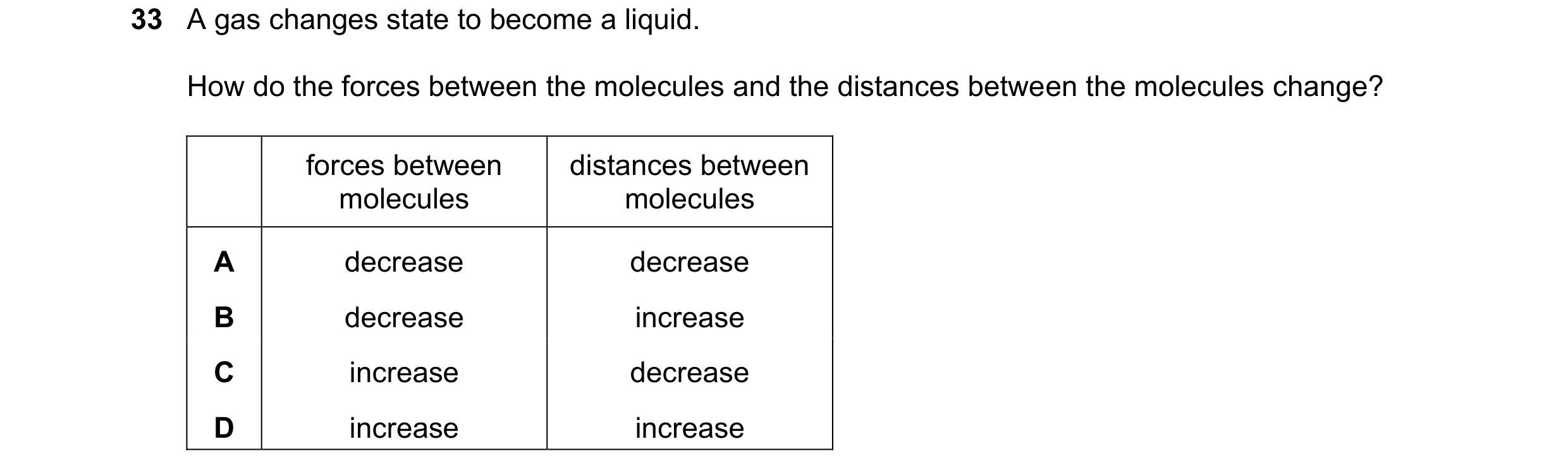
Q55 · A gas changes state to become a liquid 0653/21 Oct/Nov 2024
33 A gas changes state to become a liquid. How do the forces between the molecules and the distances between the molecules change? forces between distances between molecules molecules A decrease decrease B decrease increase C increase decrease D increase increase
1 marks
Answer: C
This question in 0653/21 Oct/Nov 2024
Q56 · The water in four containers is at the same temperature 0653/23 Oct/Nov 2024
33 The water in four containers is at the same temperature. There is a movement of air over the surface of containers A and B but not over C and D. From which container does the water evaporate at the lowest rate? A B C D air air
1 marks
Answer: C
This question in 0653/23 Oct/Nov 2024
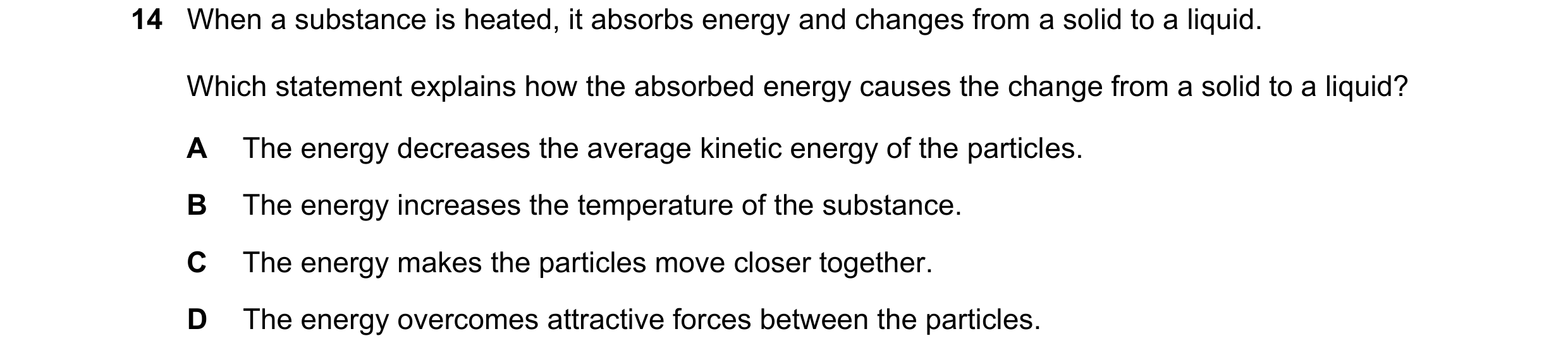
Q57 · When a substance is heated, it absorbs energy and changes from a solid to a liquid 0653/22 Feb/March 2025
14 When a substance is heated, it absorbs energy and changes from a solid to a liquid. Which statement explains how the absorbed energy causes the change from a solid to a liquid? A The energy decreases the average kinetic energy of the particles. B The energy increases the temperature of the substance. C The energy makes the particles move closer together. D The energy overcomes attractive forces between the particles.
1 marks
Answer: D
This question in 0653/22 Feb/March 2025
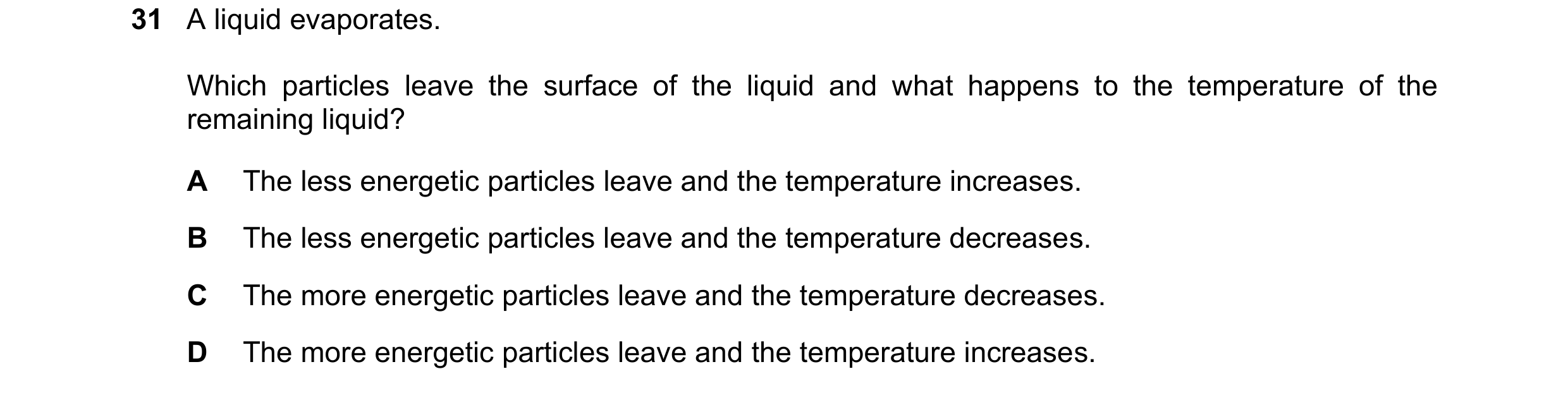
Question 58 0653/22 Feb/March 2025
31 A liquid evaporates. Which particles leave the surface of the liquid and what happens to the temperature of the remaining liquid? A The less energetic particles leave and the temperature increases. B The less energetic particles leave and the temperature decreases. C The more energetic particles leave and the temperature decreases. D The more energetic particles leave and the temperature increases.
1 marks
Answer: C
This question in 0653/22 Feb/March 2025
Q59 · A student draws the diagram shown 0653/22 Feb/March 2025
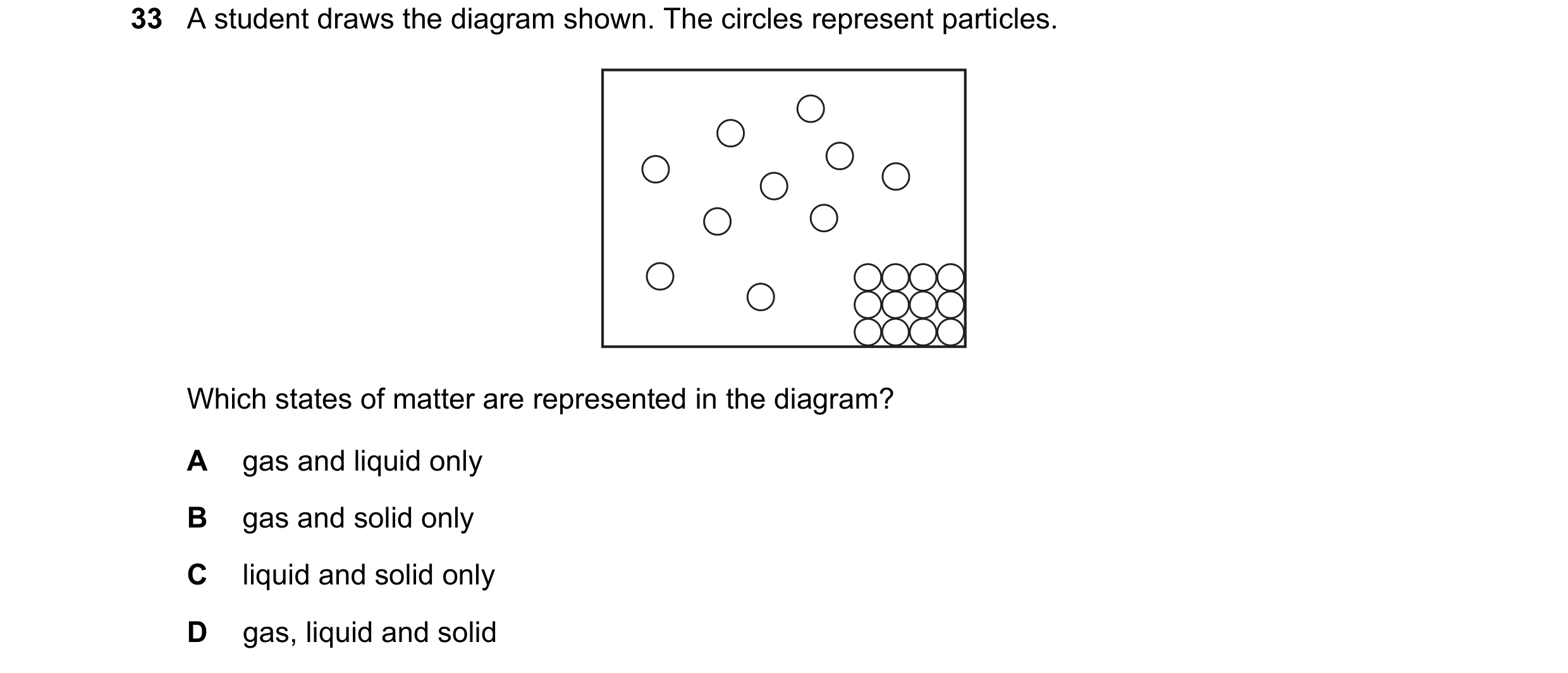
33 A student draws the diagram shown. The circles represent particles. Which states of matter are represented in the diagram? A gas and liquid only B gas and solid only C liquid and solid only D gas, liquid and solid
1 marks
Answer: B
This question in 0653/22 Feb/March 2025
Q60 · The temperature of a gas increases 0653/21 May/June 2025
31 The temperature of a gas increases. Which row is correct for the particles of the gas? force between average speed particles of particles A strong decreases B strong increases C very weak decreases D very weak increases
1 marks
Answer: D
This question in 0653/21 May/June 2025
Q61 · The diagrams show two identical wide beakers and two identical narrow measuring cylinders 0653/21 May/June 2025
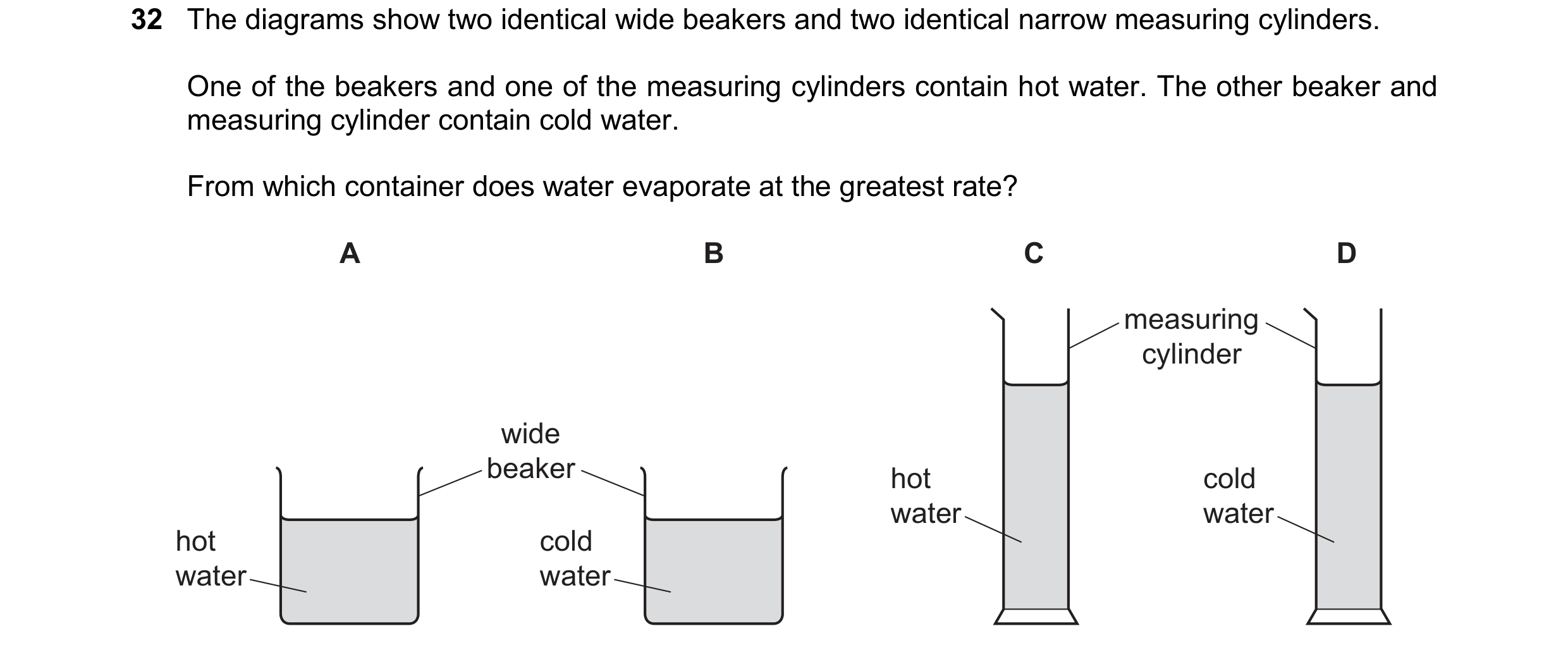
32 The diagrams show two identical wide beakers and two identical narrow measuring cylinders. One of the beakers and one of the measuring cylinders contain hot water. The other beaker and measuring cylinder contain cold water. From which container does water evaporate at the greatest rate? A B C D measuring cylinder wide beaker hot cold water water hot cold water water
1 marks
Answer: A
This question in 0653/21 May/June 2025
Q62 · What is a property of both solids and liquids? 0653/22 May/June 2025
31 What is a property of both solids and liquids? A They always fill a container. B They can flow. C They have a fixed shape. D They have a fixed volume.
1 marks
Answer: D
This question in 0653/22 May/June 2025
Q63 · Which states of matter contain particles that are close together? 0653/23 May/June 2025
32 Which states of matter contain particles that are close together? A solids, liquids and gases B liquids and gases only C solids and gases only D solids and liquids only
1 marks
Answer: D
This question in 0653/23 May/June 2025
Q64 · Which two factors both increase the rate at which a shallow pool of water evaporates? 0653/23 May/June 2025
33 Which two factors both increase the rate at which a shallow pool of water evaporates? A greater surface area and higher temperature B greater surface area and lower temperature C smaller surface area and higher temperature D smaller surface area and lower temperature
1 marks
Answer: A
This question in 0653/23 May/June 2025
Q65 · A beaker of water is placed in front of an electric fan 0653/22 Oct/Nov 2025
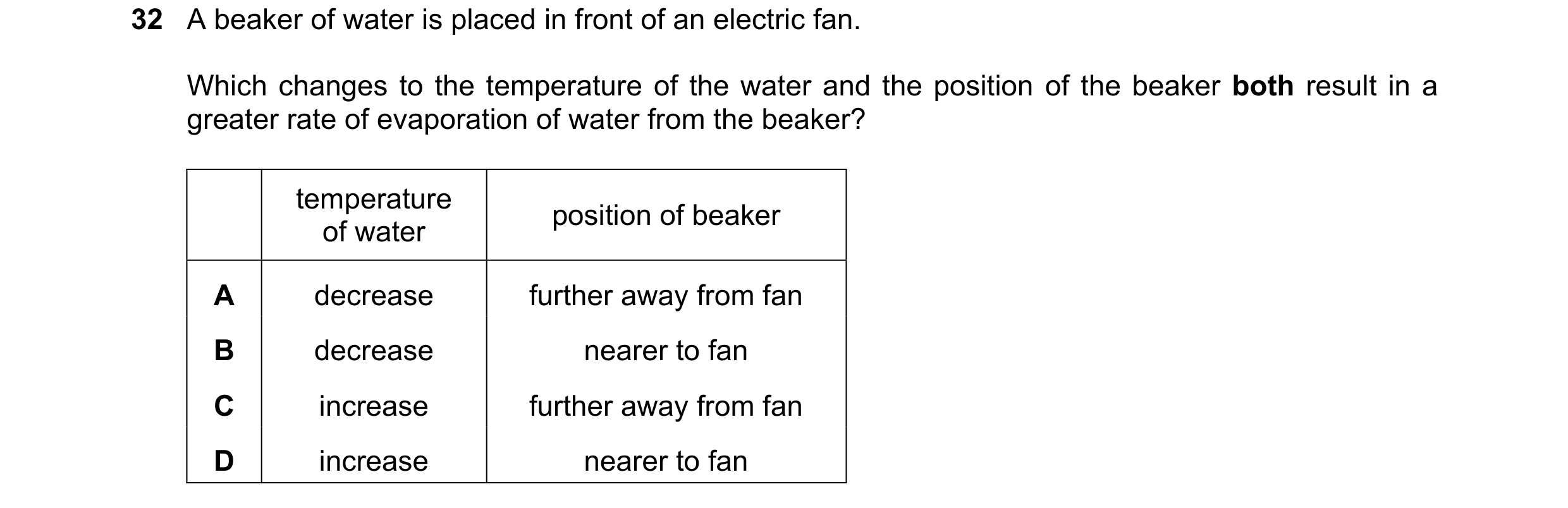
32 A beaker of water is placed in front of an electric fan. Which changes to the temperature of the water and the position of the beaker both result in a greater rate of evaporation of water from the beaker? temperature position of beaker of water A decrease further away from fan B decrease nearer to fan C increase further away from fan D increase nearer to fan
1 marks
Answer: D
This question in 0653/22 Oct/Nov 2025
 1 / 17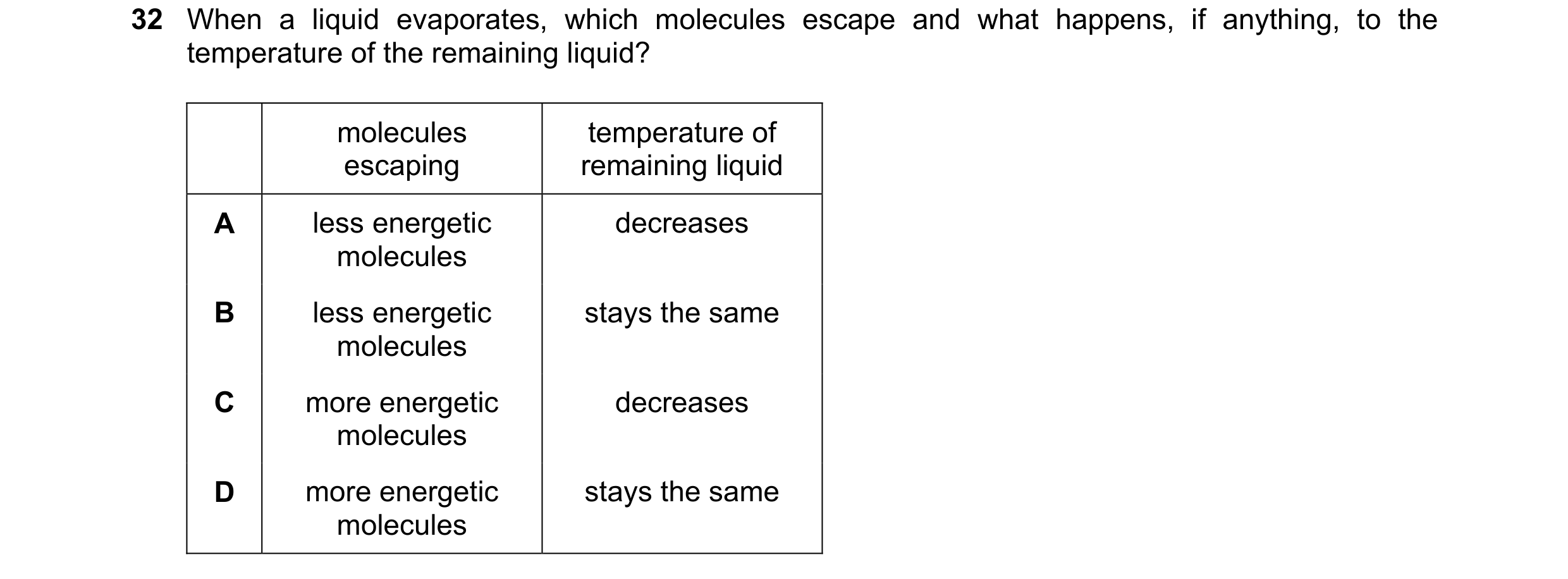
 2 / 17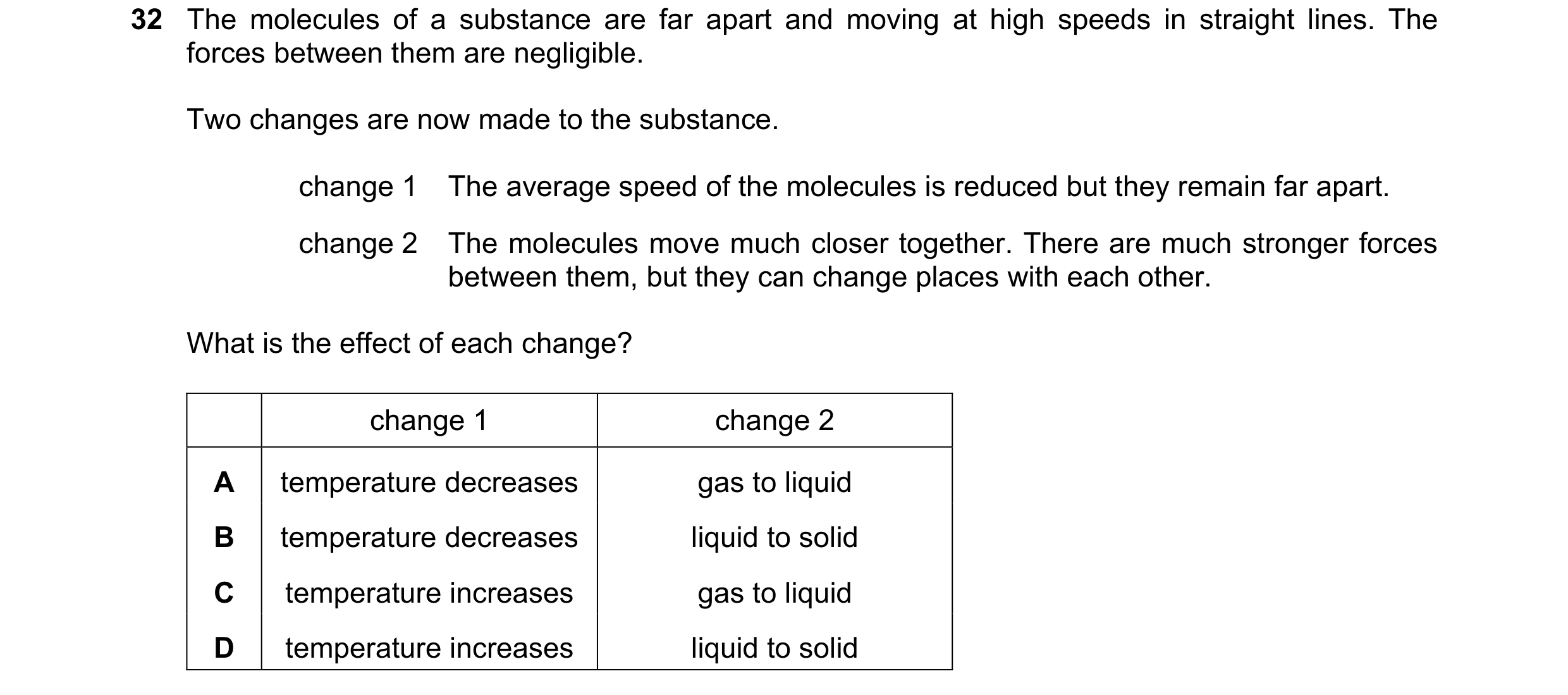
 3 / 17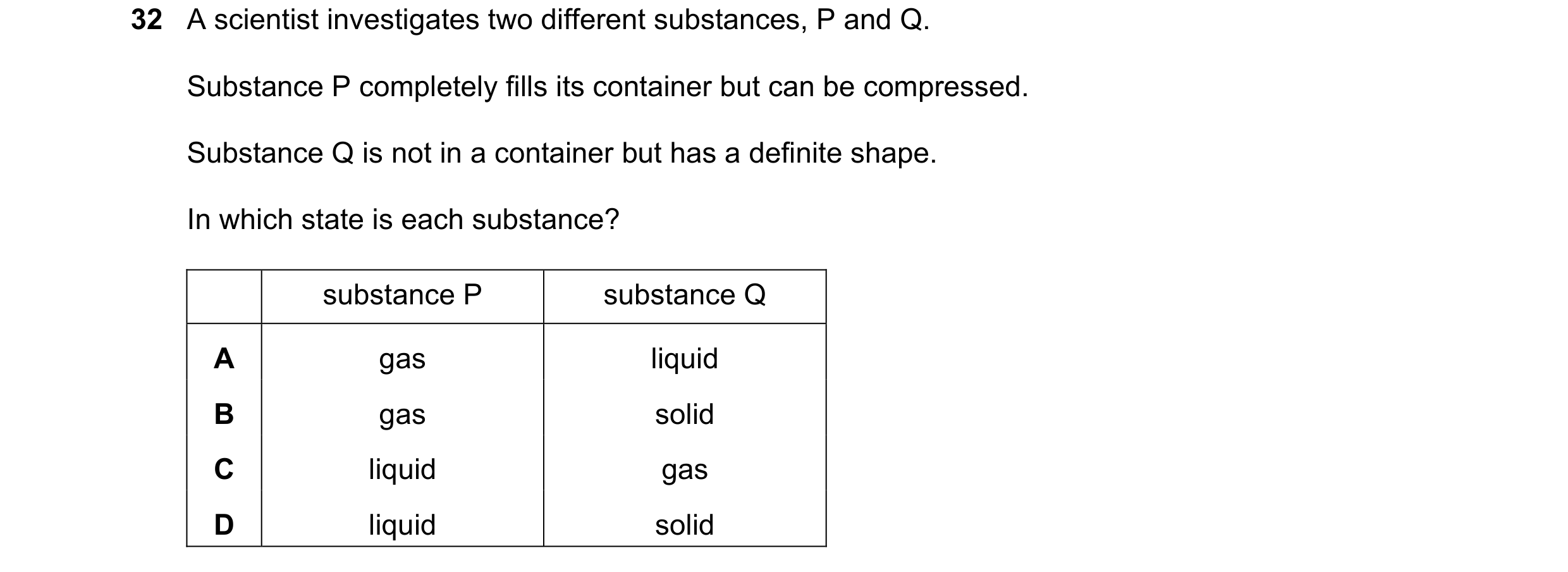
 4 / 17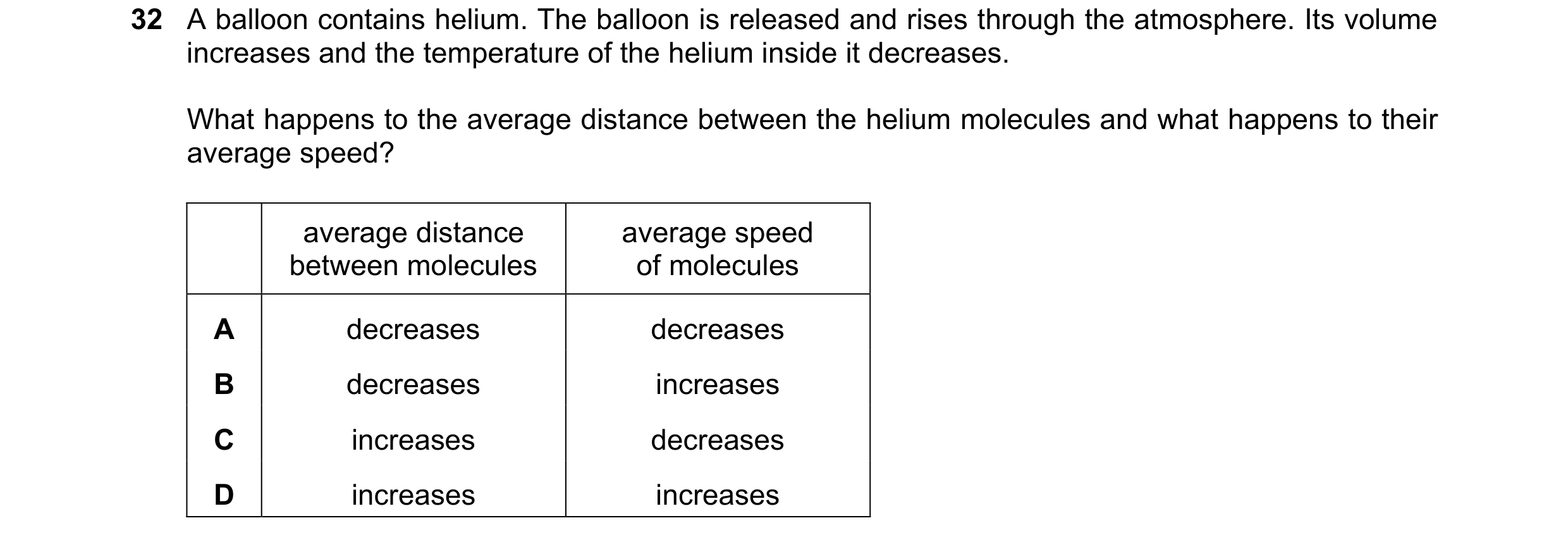
 5 / 17


 6 / 17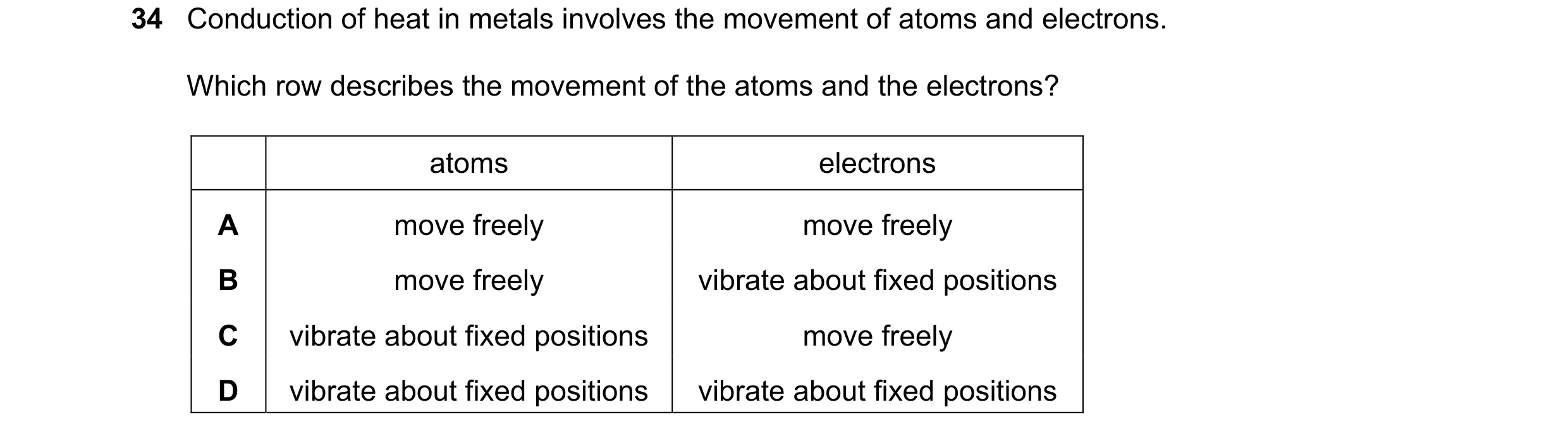
 7 / 17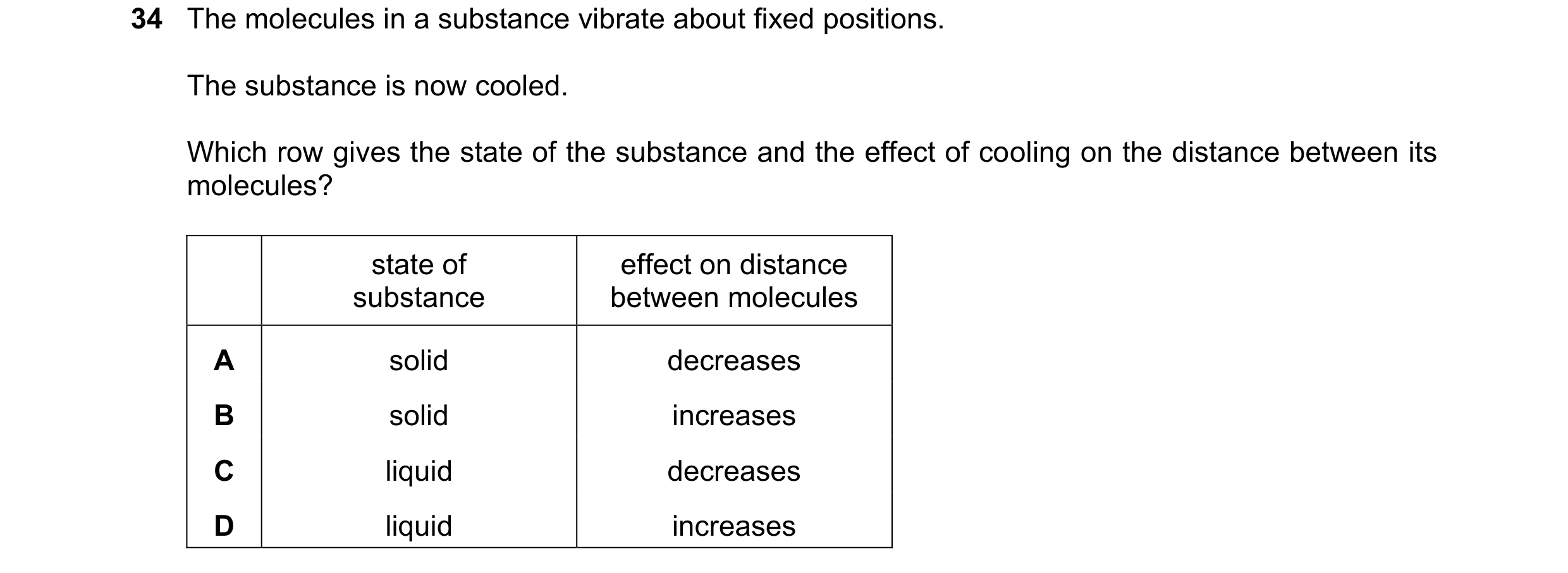
 8 / 17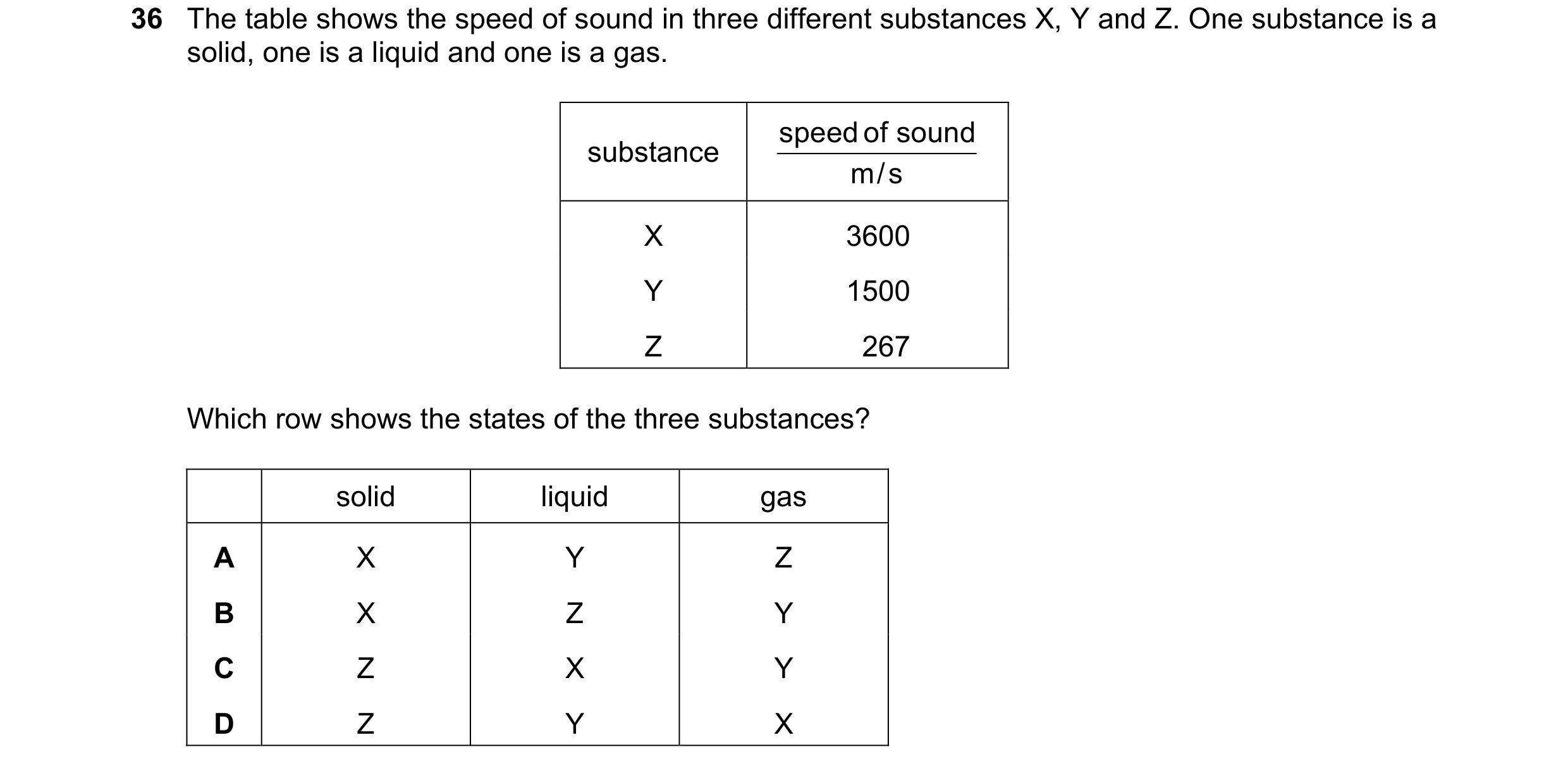
 9 / 17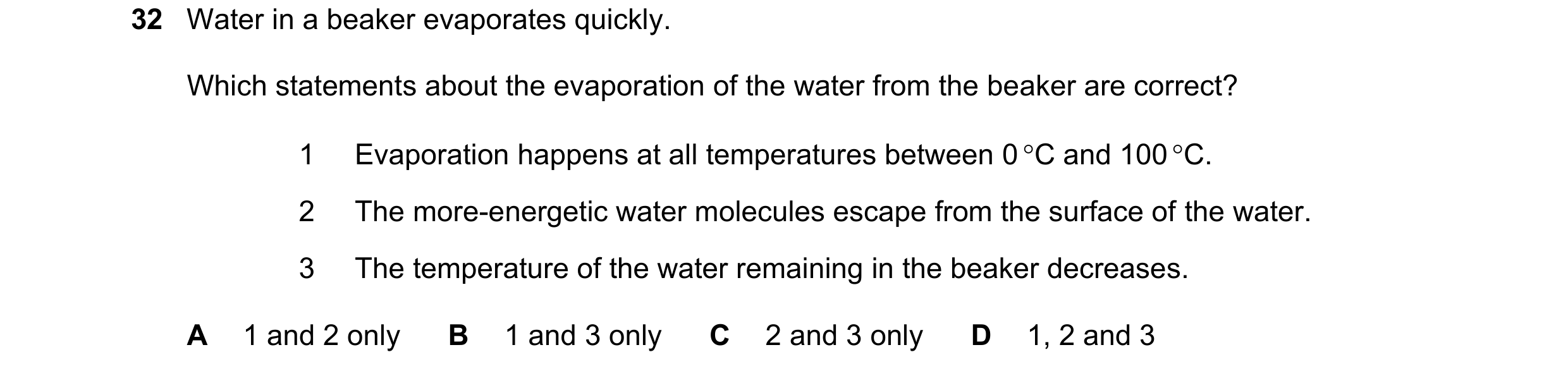
 10 / 17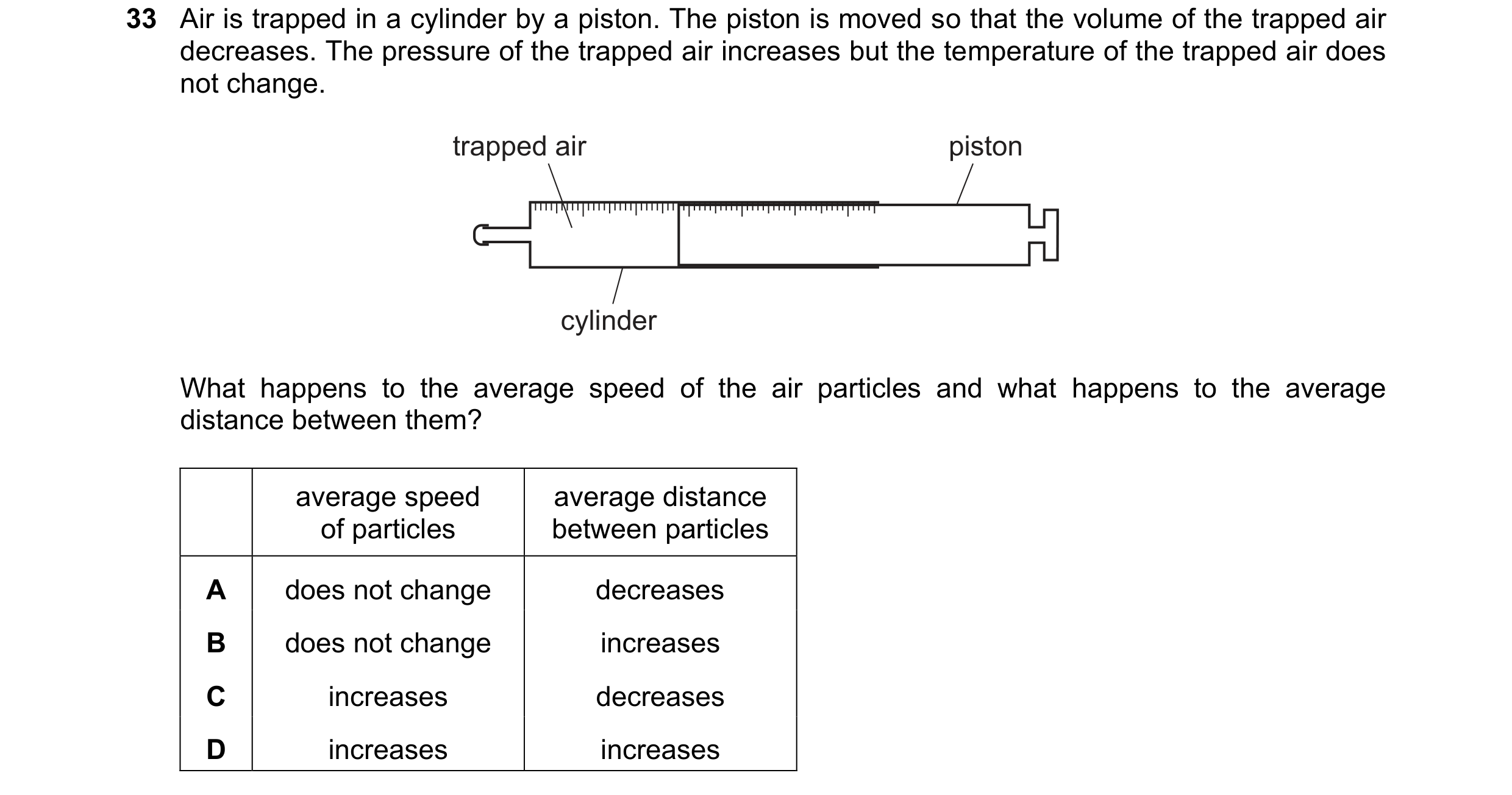
 11 / 17

 12 / 17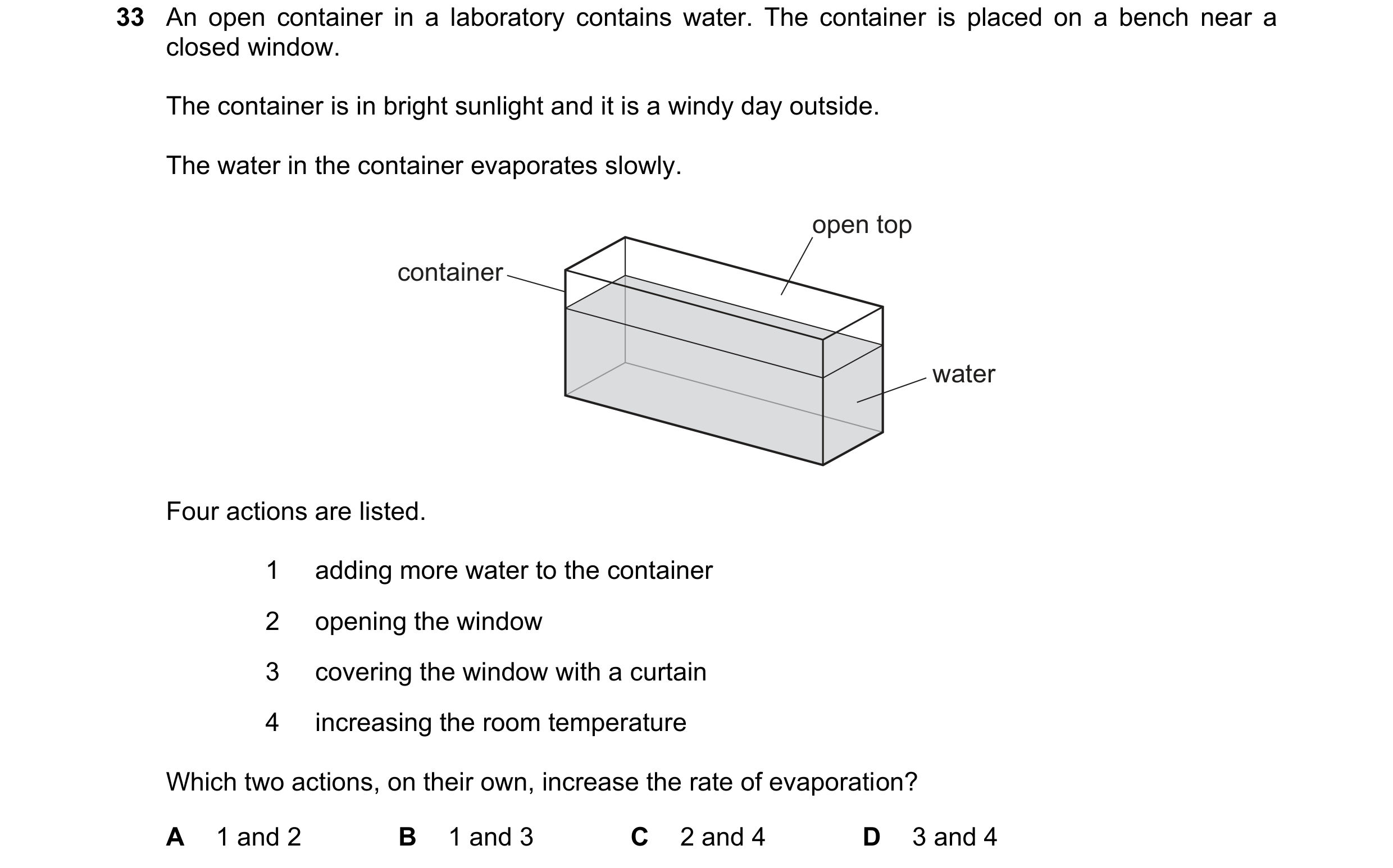
 13 / 17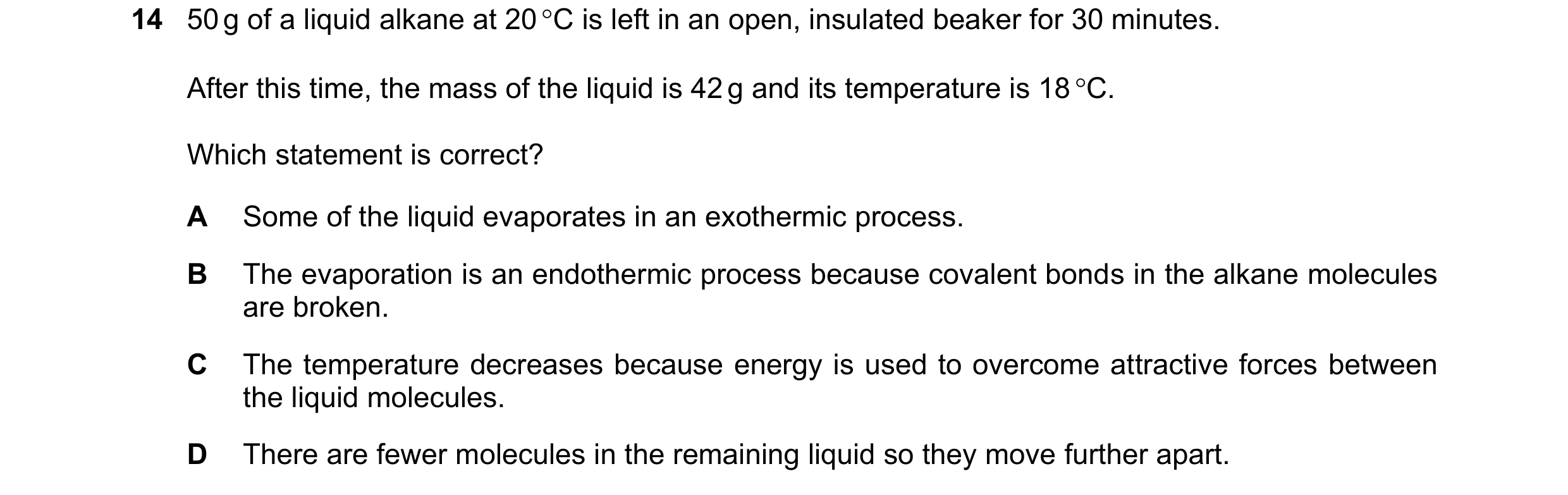

 14 / 17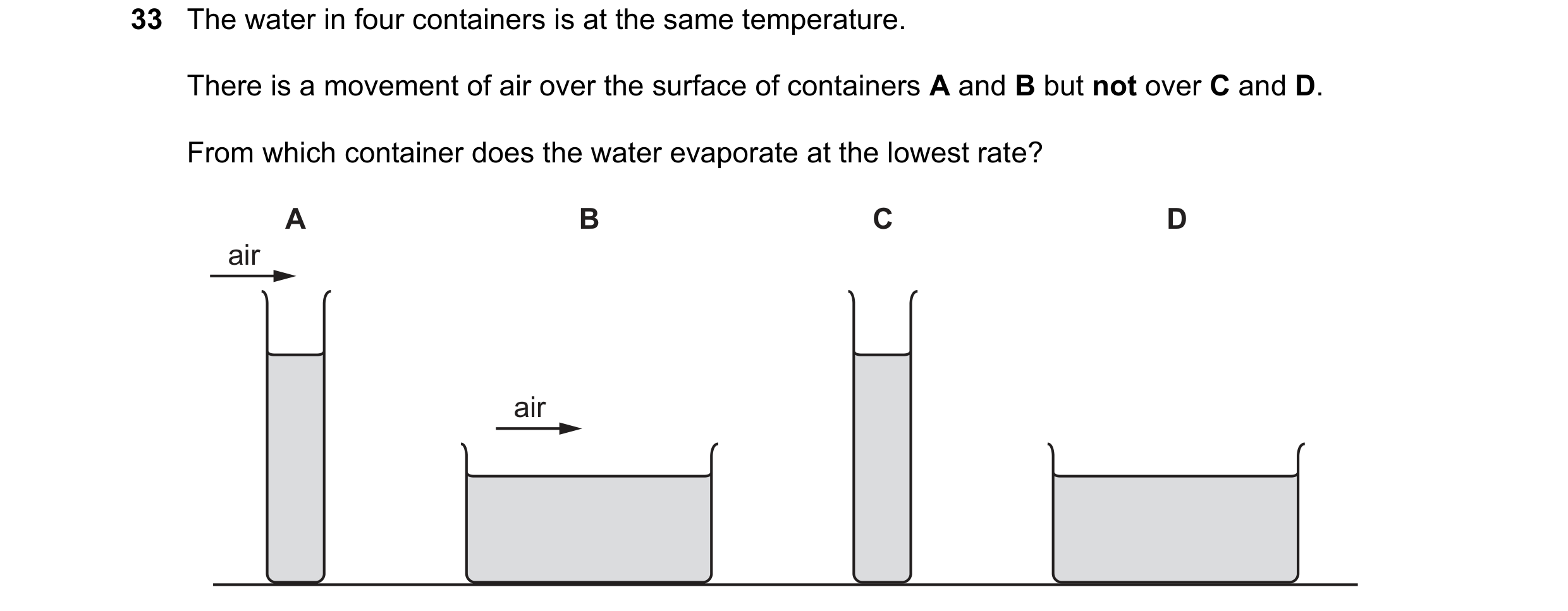
 15 / 17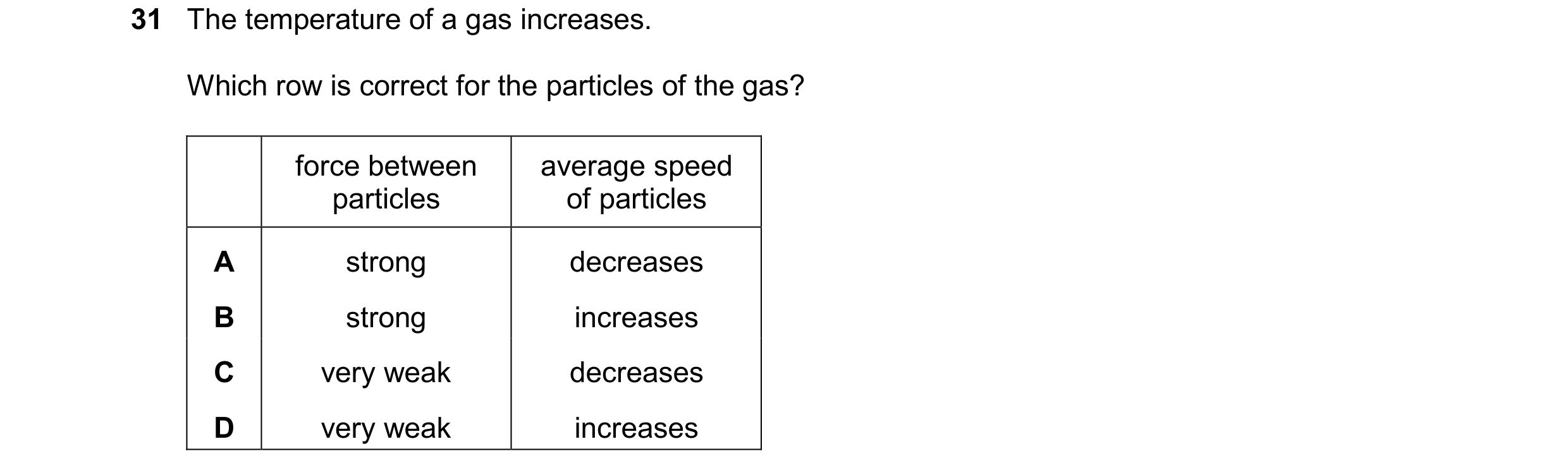


 16 / 17
 17 / 17